zekeLabs
Learning made Simpler !
www.zekeLabs.com
Five Pillars of Well Architected Framework
● Operational Excellence - The ability to run and monitor systems to deliver business value and to
continually improve supporting processes and procedures.
● Security - The ability to protect information, systems, and assets while delivering business value
through risk assessments and mitigation strategies.
● Reliability - The ability of a system to recover from infrastructure or service disruptions, dynamically
acquire computing resources to meet demand, and mitigate disruptions such as misconfigurations or
transient network issues.
● Performance Efficiency - The ability to use computing resources efficiently to meet system
requirements, and to maintain that efficiency as demand changes and technologies evolve
● Cost Optimization - The ability to avoid or eliminate unneeded cost or suboptimal resources
General Design Principles
● Stop guessing your capacity needs
● Test systems at production scale
● Automate to make architectural experimentation easier
● Allow for evolutionary architectures
● Drive architectures using data
● Improve through game days
Operational Excellence
● The operational excellence pillar includes the ability to run and monitor systems to deliver business
value and to continually improve supporting processes and procedures.
● The operational excellence pillar provides an overview of design principles, best practices, and
questions.
Operational Excellence Design Principles
● Perform operations as code
● Annotate documentation
● Make frequent, small, reversible changes
● Refine operations procedures frequently
● Anticipate failure
● Learn from all operational failures
Operational Excellence Best Practices
● There are three best practice areas for operational excellence in the cloud
○ Prepare
○ Operate
○ Evolve
Best Practices Prepare
● Effective preparation is required to drive operational excellence
● Operational readiness is validated through checklists to ensure a workload meets defined standards
and that required procedures are adequately captured in runbooks and playbooks.
● Using AWS CloudFormation enables you to have consistent, templated, sandbox development, test,
and production environments with increasing levels of operations control.
● AWS enables visibility into your workloads at all layers through various log collection and monitoring
features (application programming interfaces (APIs), and network flow logs can be collected using
Amazon CloudWatch, AWS CloudTrail, and VPC Flow Logs)
Best Practices Operate
● Successful operation of a workload is measured by the achievement of business and customer
outcomes.
● Define expected outcomes, determine how success will be measured, and identify the workload and
operations metrics that will be used in those calculations to determine if operations are successful.
● Use collected metrics to determine if you are satisfying customer and business needs, and identify
areas for improvement
● Use established runbooks for well-understood events, and use playbooks to aid in the resolution of
other events.
● Prioritize responses to events based on their business and customer impact.
● Communicate the operational status of workloads through dashboards and notifications that are
tailored to the target audience so that they may take appropriate action
● Determine the root cause of unplanned events and unexpected impacts from planned events.
Best Practices Evolve
● Evolution of operations is required to sustain operational excellence
● Dedicate work cycles to making continuous incremental improvements.
● Include feedback loops within your procedures to rapidly identify areas for improvement
● With AWS Developer Tools you can implement continuous delivery build, test, and deployment
activities that work with a variety of source code, build, testing, and deployment tools from AWS and
third parties
● The results of deployment activities can be used to identify opportunities for improvement for both
deployment and development.
● Successful evolution of operations is founded in: frequent small improvements; providing safe
environments and time to experiment, develop, and test improvements; and environments in which
learning from failures is encouraged.
Key AWS Services for Operational Excellence
● The AWS service that is essential to operational excellence is AWS CloudFormation, which you can
use to create templates based on best practices. This enables you to provision resources in an orderly
and consistent fashion from your development through production environments
● Prepare: AWS Config and AWS Config rules can be used to create standards for workloads and to
determine if environments are compliant with those standards before being put into production.
● Operate: Amazon CloudWatch allows you to monitor the operational health of a workload.
● Evolve: Amazon Elasticsearch Service (Amazon ES) allows you to analyze your log data to gain
actionable insights quickly and securely
Security Design Principles
● Implement a strong identity foundation
● Enable traceability
● Apply security at all layers
● Automate security best practices
● Protect data in transit and at rest
● Prepare for security events
Security Definition
● There are five best practice areas for security in the cloud:
○ Identity and Access Management
○ Detective Controls
○ Infrastructure Protection
○ Data Protection
○ Incident Response
● For security you will want to control who can do what.
● In addition, you want to be able to identify security incidents, protect your systems and services, and
maintain the confidentiality and integrity of data through data protection.
● The AWS Shared Responsibility Model enables organizations that adopt the cloud to achieve their
security and compliance goals
Best Practices - Identity and Access Management
● Identity and access management are key parts of an information security program, ensuring that only
authorized and authenticated users are able to access your resources
● You should apply granular policies, which assign permissions to a user, group, role, or resource
● IAM allows you to control user access to AWS services and resources.
● You also have the ability to require strong password practices, such as complexity level, avoiding re-
use, and using multi-factor authentication (MFA).
● IAM enables secure access through instance profiles, identity federation, and temporary credentials
● It is critical to keep root user credentials protected, and to this end AWS recommends attaching MFA to
the root user
Best Practices - Detective Controls
● You can use detective controls to identify a potential security incident.
● These controls are an essential part of governance frameworks and can be used to support a quality
process, a legal or compliance obligation, and for threat identification and response efforts.
● In AWS, you can implement detective controls by processing logs, events, and monitoring that allows
for auditing, automated analysis, and alarming.
● CloudTrail logs, AWS API calls, and CloudWatch provide monitoring of metrics with alarming, and
AWS Config provides configuration history.
● Service-level logs are also available. You can use Amazon Simple Storage Service to log access
requests.
● Amazon Glacier provides a vault lock feature to preserve mission-critical data with compliance controls
designed to support auditable long-term retention.
Best Practices - Infrastructure Protection
● Infrastructure protection includes control methodologies, such as defense-in-depth and MFA
● In AWS, you can implement stateful and stateless packet inspection, either by using AWS-native
technologies or by using partner products and services available through the AWS Marketplace
● You should use Amazon Virtual Private Cloud (Amazon VPC) to create a private, secured, and
scalable environment in which you can define your topology—including gateways, routing tables, and
public and private subnets.
● Enforcing boundary protection, monitoring points of ingress and egress, and comprehensive logging,
monitoring, and alerting are all essential
Best Practices - Data Protection
● Data classification provides a way to categorize organizational data based on levels of sensitivity, and
encryption protects data by rendering it unintelligible to unauthorized access.
● In AWS, the following practices facilitate protection of data
○ As an AWS customer you maintain full control over your data
○ AWS makes it easier for you to encrypt your data and manage keys, including regular key
rotation
○ Detailed logging that contains important content, such as file access and changes, is available.
○ AWS has designed storage systems for exceptional resiliency
○ Versioning, which can be part of a larger data lifecycle management process, can protect against
accidental overwrites, deletes, and similar harm.
○ AWS never initiates the movement of data between Regions
○ AWS provides multiple means for encrypting data at rest and in transit
Best Practices - Incident Response
● In AWS, the following practices facilitate effective incident response
○ Detailed logging is available that contains important content, such as file access and changes
○ Events can be automatically processed and trigger scripts that automate runbooks through the
use of AWS APIs
○ You can pre-provision tooling and a “clean room” using AWS CloudFormation. This allows you to
carry out forensics in a safe, isolated environment.
● Ensure that you have a way to quickly grant access for your InfoSec team, and automate the isolation
of instances as well at the capturing of data and state for forensics.
Key AWS Services for Security
● Identity and Access Management: IAM enables you to securely control access to AWS services and
resources. MFA adds an extra layer of protection on top of your user name and password.
● Detective Controls: AWS CloudTrail records AWS API calls, AWS Config provides a detailed
inventory of your AWS resources and configuration, and Amazon CloudWatch is a monitoring service
for AWS resources.
● Infrastructure Protection: Amazon VPC lets you provision a private, isolated section of the AWS
Cloud where you can launch AWS resources in a virtual network
● Data Protection: Services such as ELB, EBS, Amazon S3, and RDS include encryption capabilities to
protect your data in transit and at rest. Amazon Macie automatically discovers, classifies, and protects
sensitive data, while AWS Key Management Service makes it easy for you to create and control keys
used for encryption.
● Incident Response: IAM should be used to grant appropriate authorization to incident response
teams. AWS CloudFormation can be used to create a trusted environment for conducting
investigations
Reliability Design Principles
● Test recovery procedures
● Automatically recover from failure
● Scale horizontally to increase aggregate system availability
● Stop guessing capacity
● Manage change in automation
Reliability Definition
● There are three best practice areas for reliability in the cloud
○ Foundations
○ Change Management
○ Failure Management
Best Practices Foundations
● You must have sufficient network bandwidth to your data center.
● It is the responsibility of AWS to satisfy the requirement for sufficient networking and compute capacity,
while you are free to change resource size and allocation, such as the size of storage devices, on
demand
Best Practices Change Management
● Using AWS, you can monitor the behavior of a system and automate the response to KPIs
● For example, by adding additional servers as a system gains more users.
● You can control who has permission to make system changes and audit the history of these changes.
● Automatic logging of changes to your environment allows you to audit and quickly identify actions that
might have impacted reliability.
Best Practices Failure Management
● With AWS, you can take advantage of automation to react to monitoring data.
● For example, when a particular metric crosses a threshold, you can trigger an automated action to
remedy the problem.
● Also, rather than trying to diagnose and fix a failed resource that is part of your production environment,
you can replace it with a new one and carry out the analysis on the failed resource out of band.
● Regularly back up your data and test your backup files to ensure you can recover from both logical and
physical errors.
● Actively track KPIs, such as the recovery time objective (RTO) and recovery point objective (RPO), to
assess a system’s resiliency (especially under failure-testing scenarios).
Reliability Key AWS Services
● Foundations:
○ Amazon VPC lets you launch AWS resources in a virtual network.
○ AWS Trusted Advisor provides visibility into service limits.
○ AWS Shield is a DDoS protection service that safeguards web applications running on AWS
● Change Management
○ AWS CloudTrail records AWS API calls for your account and delivers log files to you for auditing
○ AWS Config continuously records configuration changes
○ Auto Scaling provides an automated demand management for a deployed workload
○ CloudWatch provides the ability to alert on metrics, including custom metrics.
● Failure Management
○ AWS CloudFormation provides templates for the creation of AWS resources and provisions them
in an orderly and predictable fashion
○ Amazon S3 keeps backups, Glacier provides highly durable archives, KMS provides a reliable
key management system that integrates with many AWS services.
Performance Efficiency Design Principles
● Democratize advanced technologies
● Go global in minutes
● Use serverless architectures
● Experiment more often
● Mechanical sympathy
Performance Definition
● There are four best practice areas for performance efficiency in the cloud
○ Selection
○ Review
○ Monitoring
○ Tradeoffs
Performance Best Practices Selection
● In AWS, resources are virtualized and are available in a number of different types and configurations.
● For example,Amazon DynamoDB provides a fully managed NoSQL database with single-digit
millisecond latency at any scale.
● When you select the patterns and implementation for your architecture, use a data-driven approach for
the most optimal solution.
● Your architecture will likely combine a number of different architectural approaches (for example, event-
driven, ETL, or pipeline).
● Four main resource types that you should consider
○ Compute - instances, containers, and functions
○ Storage - block, file, or object
○ Database - RDS, NoSQL
○ Network - AWS offers product features (for example, very high network instance types, Amazon
EBS optimized instances, Amazon S3 transfer acceleration, dynamic Amazon CloudFront) to
optimize network traffic. AWS also offers networking features (for example, Amazon Route 53
latency routing, Amazon VPC endpoints, and AWS Direct Connect) to reduce network distance or
jitter.
Monitoring and Tradeoffs
● Monitoring
○ Amazon CloudWatch provides the ability to monitor and send notification alarms
○ You can use automation to work around performance issues by triggering actions through Amazon
Kinesis, Amazon Simple Queue Service (Amazon SQS), and AWS Lambda.
● Tradeoffs
○ Using AWS, you can go global in minutes and deploy resources in multiple locations across the
globe to be closer to your end users
○ You can also dynamically add read-only replicas to information stores such as database systems
to reduce the load on the primary database
○ AWS also offers caching solutions such as Amazon ElastiCache, which provides an in-memory
data store or cache, and Amazon CloudFront, which caches copies of your static content closer to
end users.
○ Amazon DynamoDB Accelerator (DAX) provides a read-through/write-through distributed caching
tier in front of Amazon DynamoDB,
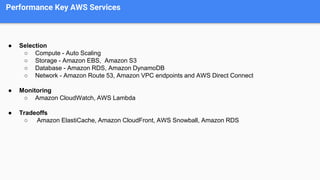
Performance Key AWS Services
● Selection
○ Compute - Auto Scaling
○ Storage - Amazon EBS, Amazon S3
○ Database - Amazon RDS, Amazon DynamoDB
○ Network - Amazon Route 53, Amazon VPC endpoints and AWS Direct Connect
● Monitoring
○ Amazon CloudWatch, AWS Lambda
● Tradeoffs
○ Amazon ElastiCache, Amazon CloudFront, AWS Snowball, Amazon RDS
Cost Optimization Design Principles
● Adopt a consumption model
● Measure overall efficiency
● Stop spending money on data center operations
● Analyze and attribute expenditure
● Use managed services to reduce cost of ownership
Cost Optimization Definition
● There are four best practice areas for cost optimization in the cloud:
○ Cost-Effective Resources
○ Matching Supply and Demand
○ Expenditure Awareness
○ Optimizing Over Time
Best Practices Cost Optimization
● Cost-Effective Resources
○ On-Demand Instances allow you to pay for compute capacity by the hour, with no minimum
commitments required.
○ Reserved Instances allow you to reserve capacity and offer savings of up to 75% off On-Demand
pricing.
○ With Spot Instances, you can bid on unused Amazon EC2 capacity at significant discounts.
○ By using tools such as AWS Trusted Advisor to regularly review your AWS usage, you can
actively monitor your utilization and adjust your deployments accordingly.
● Matching Supply and Demand
○ Auto Scaling and demand, buffer, and time-based approaches allow you to add and remove
resources as needed.
● Expenditure Awareness
○ You can use cost allocation tags to AWS resources (such as EC2 instances or S3 buckets) to
categorize and track your AWS costs
○ You can set up billing alerts to notify you of predicted overspending
○ AWS Simple Monthly Calculator allows you to calculate your data transfer costs
● Optimizing Over Time
○ AWS Trusted Advisor inspects your AWS environment and finds opportunities to save you money
by eliminating unused or idle resources or committing to Reserved Instance capacity.
Visit : www.zekeLabs.com for more details
THANK YOU
Let us know how can we help your organization to Upskill the
employees to stay updated in the ever-evolving IT Industry.
Get in touch:
www.zekeLabs.com | +91-8095465880 | info@zekeLabs.com

AWS Well Architected Framework

  • 1.
  • 2.
    Five Pillars ofWell Architected Framework ● Operational Excellence - The ability to run and monitor systems to deliver business value and to continually improve supporting processes and procedures. ● Security - The ability to protect information, systems, and assets while delivering business value through risk assessments and mitigation strategies. ● Reliability - The ability of a system to recover from infrastructure or service disruptions, dynamically acquire computing resources to meet demand, and mitigate disruptions such as misconfigurations or transient network issues. ● Performance Efficiency - The ability to use computing resources efficiently to meet system requirements, and to maintain that efficiency as demand changes and technologies evolve ● Cost Optimization - The ability to avoid or eliminate unneeded cost or suboptimal resources
  • 3.
    General Design Principles ●Stop guessing your capacity needs ● Test systems at production scale ● Automate to make architectural experimentation easier ● Allow for evolutionary architectures ● Drive architectures using data ● Improve through game days
  • 4.
    Operational Excellence ● Theoperational excellence pillar includes the ability to run and monitor systems to deliver business value and to continually improve supporting processes and procedures. ● The operational excellence pillar provides an overview of design principles, best practices, and questions.
  • 5.
    Operational Excellence DesignPrinciples ● Perform operations as code ● Annotate documentation ● Make frequent, small, reversible changes ● Refine operations procedures frequently ● Anticipate failure ● Learn from all operational failures
  • 6.
    Operational Excellence BestPractices ● There are three best practice areas for operational excellence in the cloud ○ Prepare ○ Operate ○ Evolve
  • 7.
    Best Practices Prepare ●Effective preparation is required to drive operational excellence ● Operational readiness is validated through checklists to ensure a workload meets defined standards and that required procedures are adequately captured in runbooks and playbooks. ● Using AWS CloudFormation enables you to have consistent, templated, sandbox development, test, and production environments with increasing levels of operations control. ● AWS enables visibility into your workloads at all layers through various log collection and monitoring features (application programming interfaces (APIs), and network flow logs can be collected using Amazon CloudWatch, AWS CloudTrail, and VPC Flow Logs)
  • 8.
    Best Practices Operate ●Successful operation of a workload is measured by the achievement of business and customer outcomes. ● Define expected outcomes, determine how success will be measured, and identify the workload and operations metrics that will be used in those calculations to determine if operations are successful. ● Use collected metrics to determine if you are satisfying customer and business needs, and identify areas for improvement ● Use established runbooks for well-understood events, and use playbooks to aid in the resolution of other events. ● Prioritize responses to events based on their business and customer impact. ● Communicate the operational status of workloads through dashboards and notifications that are tailored to the target audience so that they may take appropriate action ● Determine the root cause of unplanned events and unexpected impacts from planned events.
  • 9.
    Best Practices Evolve ●Evolution of operations is required to sustain operational excellence ● Dedicate work cycles to making continuous incremental improvements. ● Include feedback loops within your procedures to rapidly identify areas for improvement ● With AWS Developer Tools you can implement continuous delivery build, test, and deployment activities that work with a variety of source code, build, testing, and deployment tools from AWS and third parties ● The results of deployment activities can be used to identify opportunities for improvement for both deployment and development. ● Successful evolution of operations is founded in: frequent small improvements; providing safe environments and time to experiment, develop, and test improvements; and environments in which learning from failures is encouraged.
  • 10.
    Key AWS Servicesfor Operational Excellence ● The AWS service that is essential to operational excellence is AWS CloudFormation, which you can use to create templates based on best practices. This enables you to provision resources in an orderly and consistent fashion from your development through production environments ● Prepare: AWS Config and AWS Config rules can be used to create standards for workloads and to determine if environments are compliant with those standards before being put into production. ● Operate: Amazon CloudWatch allows you to monitor the operational health of a workload. ● Evolve: Amazon Elasticsearch Service (Amazon ES) allows you to analyze your log data to gain actionable insights quickly and securely
  • 11.
    Security Design Principles ●Implement a strong identity foundation ● Enable traceability ● Apply security at all layers ● Automate security best practices ● Protect data in transit and at rest ● Prepare for security events
  • 12.
    Security Definition ● Thereare five best practice areas for security in the cloud: ○ Identity and Access Management ○ Detective Controls ○ Infrastructure Protection ○ Data Protection ○ Incident Response ● For security you will want to control who can do what. ● In addition, you want to be able to identify security incidents, protect your systems and services, and maintain the confidentiality and integrity of data through data protection. ● The AWS Shared Responsibility Model enables organizations that adopt the cloud to achieve their security and compliance goals
  • 13.
    Best Practices -Identity and Access Management ● Identity and access management are key parts of an information security program, ensuring that only authorized and authenticated users are able to access your resources ● You should apply granular policies, which assign permissions to a user, group, role, or resource ● IAM allows you to control user access to AWS services and resources. ● You also have the ability to require strong password practices, such as complexity level, avoiding re- use, and using multi-factor authentication (MFA). ● IAM enables secure access through instance profiles, identity federation, and temporary credentials ● It is critical to keep root user credentials protected, and to this end AWS recommends attaching MFA to the root user
  • 14.
    Best Practices -Detective Controls ● You can use detective controls to identify a potential security incident. ● These controls are an essential part of governance frameworks and can be used to support a quality process, a legal or compliance obligation, and for threat identification and response efforts. ● In AWS, you can implement detective controls by processing logs, events, and monitoring that allows for auditing, automated analysis, and alarming. ● CloudTrail logs, AWS API calls, and CloudWatch provide monitoring of metrics with alarming, and AWS Config provides configuration history. ● Service-level logs are also available. You can use Amazon Simple Storage Service to log access requests. ● Amazon Glacier provides a vault lock feature to preserve mission-critical data with compliance controls designed to support auditable long-term retention.
  • 15.
    Best Practices -Infrastructure Protection ● Infrastructure protection includes control methodologies, such as defense-in-depth and MFA ● In AWS, you can implement stateful and stateless packet inspection, either by using AWS-native technologies or by using partner products and services available through the AWS Marketplace ● You should use Amazon Virtual Private Cloud (Amazon VPC) to create a private, secured, and scalable environment in which you can define your topology—including gateways, routing tables, and public and private subnets. ● Enforcing boundary protection, monitoring points of ingress and egress, and comprehensive logging, monitoring, and alerting are all essential
  • 16.
    Best Practices -Data Protection ● Data classification provides a way to categorize organizational data based on levels of sensitivity, and encryption protects data by rendering it unintelligible to unauthorized access. ● In AWS, the following practices facilitate protection of data ○ As an AWS customer you maintain full control over your data ○ AWS makes it easier for you to encrypt your data and manage keys, including regular key rotation ○ Detailed logging that contains important content, such as file access and changes, is available. ○ AWS has designed storage systems for exceptional resiliency ○ Versioning, which can be part of a larger data lifecycle management process, can protect against accidental overwrites, deletes, and similar harm. ○ AWS never initiates the movement of data between Regions ○ AWS provides multiple means for encrypting data at rest and in transit
  • 17.
    Best Practices -Incident Response ● In AWS, the following practices facilitate effective incident response ○ Detailed logging is available that contains important content, such as file access and changes ○ Events can be automatically processed and trigger scripts that automate runbooks through the use of AWS APIs ○ You can pre-provision tooling and a “clean room” using AWS CloudFormation. This allows you to carry out forensics in a safe, isolated environment. ● Ensure that you have a way to quickly grant access for your InfoSec team, and automate the isolation of instances as well at the capturing of data and state for forensics.
  • 18.
    Key AWS Servicesfor Security ● Identity and Access Management: IAM enables you to securely control access to AWS services and resources. MFA adds an extra layer of protection on top of your user name and password. ● Detective Controls: AWS CloudTrail records AWS API calls, AWS Config provides a detailed inventory of your AWS resources and configuration, and Amazon CloudWatch is a monitoring service for AWS resources. ● Infrastructure Protection: Amazon VPC lets you provision a private, isolated section of the AWS Cloud where you can launch AWS resources in a virtual network ● Data Protection: Services such as ELB, EBS, Amazon S3, and RDS include encryption capabilities to protect your data in transit and at rest. Amazon Macie automatically discovers, classifies, and protects sensitive data, while AWS Key Management Service makes it easy for you to create and control keys used for encryption. ● Incident Response: IAM should be used to grant appropriate authorization to incident response teams. AWS CloudFormation can be used to create a trusted environment for conducting investigations
  • 19.
    Reliability Design Principles ●Test recovery procedures ● Automatically recover from failure ● Scale horizontally to increase aggregate system availability ● Stop guessing capacity ● Manage change in automation
  • 20.
    Reliability Definition ● Thereare three best practice areas for reliability in the cloud ○ Foundations ○ Change Management ○ Failure Management
  • 21.
    Best Practices Foundations ●You must have sufficient network bandwidth to your data center. ● It is the responsibility of AWS to satisfy the requirement for sufficient networking and compute capacity, while you are free to change resource size and allocation, such as the size of storage devices, on demand
  • 22.
    Best Practices ChangeManagement ● Using AWS, you can monitor the behavior of a system and automate the response to KPIs ● For example, by adding additional servers as a system gains more users. ● You can control who has permission to make system changes and audit the history of these changes. ● Automatic logging of changes to your environment allows you to audit and quickly identify actions that might have impacted reliability.
  • 23.
    Best Practices FailureManagement ● With AWS, you can take advantage of automation to react to monitoring data. ● For example, when a particular metric crosses a threshold, you can trigger an automated action to remedy the problem. ● Also, rather than trying to diagnose and fix a failed resource that is part of your production environment, you can replace it with a new one and carry out the analysis on the failed resource out of band. ● Regularly back up your data and test your backup files to ensure you can recover from both logical and physical errors. ● Actively track KPIs, such as the recovery time objective (RTO) and recovery point objective (RPO), to assess a system’s resiliency (especially under failure-testing scenarios).
  • 24.
    Reliability Key AWSServices ● Foundations: ○ Amazon VPC lets you launch AWS resources in a virtual network. ○ AWS Trusted Advisor provides visibility into service limits. ○ AWS Shield is a DDoS protection service that safeguards web applications running on AWS ● Change Management ○ AWS CloudTrail records AWS API calls for your account and delivers log files to you for auditing ○ AWS Config continuously records configuration changes ○ Auto Scaling provides an automated demand management for a deployed workload ○ CloudWatch provides the ability to alert on metrics, including custom metrics. ● Failure Management ○ AWS CloudFormation provides templates for the creation of AWS resources and provisions them in an orderly and predictable fashion ○ Amazon S3 keeps backups, Glacier provides highly durable archives, KMS provides a reliable key management system that integrates with many AWS services.
  • 25.
    Performance Efficiency DesignPrinciples ● Democratize advanced technologies ● Go global in minutes ● Use serverless architectures ● Experiment more often ● Mechanical sympathy
  • 26.
    Performance Definition ● Thereare four best practice areas for performance efficiency in the cloud ○ Selection ○ Review ○ Monitoring ○ Tradeoffs
  • 27.
    Performance Best PracticesSelection ● In AWS, resources are virtualized and are available in a number of different types and configurations. ● For example,Amazon DynamoDB provides a fully managed NoSQL database with single-digit millisecond latency at any scale. ● When you select the patterns and implementation for your architecture, use a data-driven approach for the most optimal solution. ● Your architecture will likely combine a number of different architectural approaches (for example, event- driven, ETL, or pipeline). ● Four main resource types that you should consider ○ Compute - instances, containers, and functions ○ Storage - block, file, or object ○ Database - RDS, NoSQL ○ Network - AWS offers product features (for example, very high network instance types, Amazon EBS optimized instances, Amazon S3 transfer acceleration, dynamic Amazon CloudFront) to optimize network traffic. AWS also offers networking features (for example, Amazon Route 53 latency routing, Amazon VPC endpoints, and AWS Direct Connect) to reduce network distance or jitter.
  • 28.
    Monitoring and Tradeoffs ●Monitoring ○ Amazon CloudWatch provides the ability to monitor and send notification alarms ○ You can use automation to work around performance issues by triggering actions through Amazon Kinesis, Amazon Simple Queue Service (Amazon SQS), and AWS Lambda. ● Tradeoffs ○ Using AWS, you can go global in minutes and deploy resources in multiple locations across the globe to be closer to your end users ○ You can also dynamically add read-only replicas to information stores such as database systems to reduce the load on the primary database ○ AWS also offers caching solutions such as Amazon ElastiCache, which provides an in-memory data store or cache, and Amazon CloudFront, which caches copies of your static content closer to end users. ○ Amazon DynamoDB Accelerator (DAX) provides a read-through/write-through distributed caching tier in front of Amazon DynamoDB,
  • 29.
    Performance Key AWSServices ● Selection ○ Compute - Auto Scaling ○ Storage - Amazon EBS, Amazon S3 ○ Database - Amazon RDS, Amazon DynamoDB ○ Network - Amazon Route 53, Amazon VPC endpoints and AWS Direct Connect ● Monitoring ○ Amazon CloudWatch, AWS Lambda ● Tradeoffs ○ Amazon ElastiCache, Amazon CloudFront, AWS Snowball, Amazon RDS
  • 30.
    Cost Optimization DesignPrinciples ● Adopt a consumption model ● Measure overall efficiency ● Stop spending money on data center operations ● Analyze and attribute expenditure ● Use managed services to reduce cost of ownership
  • 31.
    Cost Optimization Definition ●There are four best practice areas for cost optimization in the cloud: ○ Cost-Effective Resources ○ Matching Supply and Demand ○ Expenditure Awareness ○ Optimizing Over Time
  • 32.
    Best Practices CostOptimization ● Cost-Effective Resources ○ On-Demand Instances allow you to pay for compute capacity by the hour, with no minimum commitments required. ○ Reserved Instances allow you to reserve capacity and offer savings of up to 75% off On-Demand pricing. ○ With Spot Instances, you can bid on unused Amazon EC2 capacity at significant discounts. ○ By using tools such as AWS Trusted Advisor to regularly review your AWS usage, you can actively monitor your utilization and adjust your deployments accordingly. ● Matching Supply and Demand ○ Auto Scaling and demand, buffer, and time-based approaches allow you to add and remove resources as needed. ● Expenditure Awareness ○ You can use cost allocation tags to AWS resources (such as EC2 instances or S3 buckets) to categorize and track your AWS costs ○ You can set up billing alerts to notify you of predicted overspending ○ AWS Simple Monthly Calculator allows you to calculate your data transfer costs ● Optimizing Over Time ○ AWS Trusted Advisor inspects your AWS environment and finds opportunities to save you money by eliminating unused or idle resources or committing to Reserved Instance capacity.
  • 33.
    Visit : www.zekeLabs.comfor more details THANK YOU Let us know how can we help your organization to Upskill the employees to stay updated in the ever-evolving IT Industry. Get in touch: www.zekeLabs.com | +91-8095465880 | info@zekeLabs.com