
© 2020, Amazon Web Services, Inc. or its affiliates. All rights reserved.
Getting started with AWS: Storage
O n l i n e W e b i n a r – 2 0 2 0 / 0 4 / 2 3
Cobus Bernard
Sr Developer Advocate
Amazon Web Services
@cobusbernard
cobusbernard
cobusbernard
© 2020, Amazon Web Services, Inc. or its affiliates. All rights reserved.
Agenda
Quick overview of definitions
Amazon RDS
Amazon S3
Amazon EBS
Amazon EFS
Q&A
© 2020, Amazon Web Services, Inc. or its affiliates. All rights reserved.
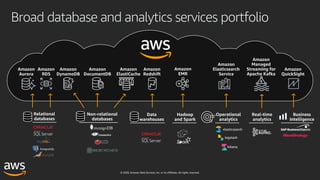
Broad database and analytics services portfolio
Relational
databases
Non-relational
databases
Data
warehouses
Hadoop
and Spark
Amazon
Redshift
Amazon
EMR
Operational
analytics
Amazon
Elasticsearch
Service
Amazon
Aurora
Amazon
DynamoDB
Business
Intelligence
Amazon
QuickSight
Amazon
RDS
Amazon
DocumentDB
Amazon
ElastiCache
Real-time
analytics
Amazon
Managed
Streaming for
Apache Kafka
PostgreSQL
logstash
elasticsearch
kibana
© 2020, Amazon Web Services, Inc. or its affiliates. All rights reserved.
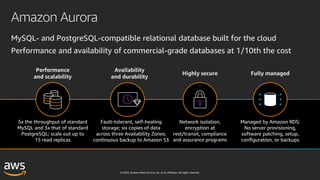
Amazon Aurora
MySQL- and PostgreSQL-compatible relational database built for the cloud
Performance and availability of commercial-grade databases at 1/10th the cost
Performance
and scalability
Availability
and durability
Highly secure Fully managed
5x the throughput of standard
MySQL and 3x that of standard
PostgreSQL; scale out up to
15 read replicas
Fault-tolerant, self-healing
storage; six copies of data
across three Availability Zones;
continuous backup to Amazon S3
Network isolation,
encryption at
rest/transit, compliance
and assurance programs
Managed by Amazon RDS:
No server provisioning,
software patching, setup,
configuration, or backups
Thank you!
© 2020, Amazon Web Services, Inc. or its affiliates. All rights reserved.
Cobus Bernard
Sr Developer Advocate
Amazon Web Services
@cobusbernard
cobusbernard
cobusbernard

AWS SSA Webinar 9 - Getting Started on AWS: Storage

  • 1.
    © 2020, AmazonWeb Services, Inc. or its affiliates. All rights reserved. Getting started with AWS: Storage O n l i n e W e b i n a r – 2 0 2 0 / 0 4 / 2 3 Cobus Bernard Sr Developer Advocate Amazon Web Services @cobusbernard cobusbernard cobusbernard
  • 2.
    © 2020, AmazonWeb Services, Inc. or its affiliates. All rights reserved. Agenda Quick overview of definitions Amazon RDS Amazon S3 Amazon EBS Amazon EFS Q&A
  • 3.
    © 2020, AmazonWeb Services, Inc. or its affiliates. All rights reserved.
  • 4.
    © 2020, AmazonWeb Services, Inc. or its affiliates. All rights reserved. Broad database and analytics services portfolio Relational databases Non-relational databases Data warehouses Hadoop and Spark Amazon Redshift Amazon EMR Operational analytics Amazon Elasticsearch Service Amazon Aurora Amazon DynamoDB Business Intelligence Amazon QuickSight Amazon RDS Amazon DocumentDB Amazon ElastiCache Real-time analytics Amazon Managed Streaming for Apache Kafka PostgreSQL logstash elasticsearch kibana
  • 5.
    © 2020, AmazonWeb Services, Inc. or its affiliates. All rights reserved. Amazon Aurora MySQL- and PostgreSQL-compatible relational database built for the cloud Performance and availability of commercial-grade databases at 1/10th the cost Performance and scalability Availability and durability Highly secure Fully managed 5x the throughput of standard MySQL and 3x that of standard PostgreSQL; scale out up to 15 read replicas Fault-tolerant, self-healing storage; six copies of data across three Availability Zones; continuous backup to Amazon S3 Network isolation, encryption at rest/transit, compliance and assurance programs Managed by Amazon RDS: No server provisioning, software patching, setup, configuration, or backups
  • 6.
    Thank you! © 2020,Amazon Web Services, Inc. or its affiliates. All rights reserved. Cobus Bernard Sr Developer Advocate Amazon Web Services @cobusbernard cobusbernard cobusbernard

Editor's Notes

  • #5 AWS offers the broadest set of databases and analytics services for customers to lift and shift their database and analytics workloads to the cloud. And customers are doing this at record levels across many different areas: 1/ relational databases – For customers wanting to move away from self-managing Oracle, SQL Server, MySQL, PostgreSQL, and MariaDB databases, AWS offers Amazon RDS and Amazon Aurora. 2/ non-relational databases – For customers wanting to move away from self-managed non-relational document- and key-value stores such as MongoDB, Redis, and Memcached, AWS offers DynamoDB, DocumentDB and ElastiCache. 3/ Data Warehouses – customers want to move from their expensive, proprietary Teradata, Oracle and SQL Server Data Warehouses to Amazon Redshift. 4/ Hadoop and Spark – customers want to move from their Hadoop and Spark deployments on-premises to EMR for cost savings and having a managed service. 5/ operational analytics – customers want to move from their elasticsearch, logstash, and kibana (ELK) on-premises to Elasticsearch Service for cost savings and having a managed service. 6/ real-time analytics – customers want to move from their Apache Kafka deployments to Amazon Managed Streaming for Kafka.
  • #6 Amazon Aurora is a MySQL and PostgreSQL-compatible relational database built for the cloud, that combines the performance and availability of traditional enterprise databases with the simplicity and cost-effectiveness of open source databases. Amazon Aurora is up to five times faster than standard MySQL databases and three times faster than standard PostgreSQL databases. It provides the security, availability, and reliability of commercial databases at 1/10th the cost. Amazon Aurora is fully managed by Amazon Relational Database Service (RDS), which automates time-consuming administration tasks like hardware provisioning, database setup, patching, and backups. Amazon Aurora features a distributed, fault-tolerant, self-healing storage system that auto-scales up to 64TB per database instance. It delivers high performance and availability with up to 15 low-latency read replicas, point-in-time recovery, continuous backup to Amazon S3, and replication across three Availability Zones (AZs).