P-104 Avoiding Iatrongenic
Consulting
Ed Kless
@edkless
CPE Credit
• In order to receive CPE credit for this session, you must be present for the entire
session.
– Session Code: P-104
– Recommended CPE Credit = 1
– Delivery Method = Group Live
– Field of Study = Specialized Knowledge and Applications
• Visit the Sage Summit Connect kiosks to enter CPE credit during the conference.
#SageSummit
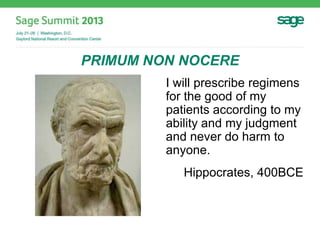
PRIMUM NON NOCERE
I will prescribe regimens
for the good of my
patients according to my
ability and my judgment
and never do harm to
anyone.
Hippocrates, 400BCE
100,000
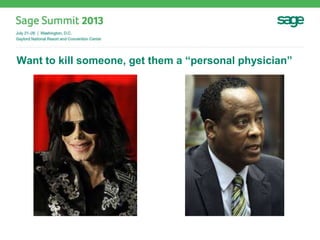
Want to kill someone, get them a “personal physician”
Table Conversation: an iatrogenic
consulting engagement
Table Conversation: ideas to prevent
iatrogenic consulting
Your Feedback Is Important to Us!
• Completing a session survey is fast and easy:
Complete the survey on your mobile phone, laptop, or tablet
through the Sage Summit mobile app.
– IOS, Blackberry, or Android users may download the app from the
at the App Store by searching “Sage Summit”
• Remember each completed survey is another entry for one of several daily prize
drawings, including an Apple iPad!
• Your feedback helps us improve future sessions and presentation techniques.
• Session code for this session: P-104
#SageSummit
Contact Information
• Presenter Contact Information:
– Ed Kless
– ed.kless@sage.com
– Twitter hashtag @edkless
• Follow us @Sage_Summit
– Use the official Sage Summit hashtag: #SageSummit
• Don’t forget to use the Sage Summit mobile or web app for all your conference needs.
Thank you for your participation.
#SageSummit

Avoiding Iatrogenic Consulting

  • 1.
  • 2.
    CPE Credit • Inorder to receive CPE credit for this session, you must be present for the entire session. – Session Code: P-104 – Recommended CPE Credit = 1 – Delivery Method = Group Live – Field of Study = Specialized Knowledge and Applications • Visit the Sage Summit Connect kiosks to enter CPE credit during the conference. #SageSummit
  • 4.
    PRIMUM NON NOCERE Iwill prescribe regimens for the good of my patients according to my ability and my judgment and never do harm to anyone. Hippocrates, 400BCE
  • 5.
  • 6.
    Want to killsomeone, get them a “personal physician”
  • 7.
    Table Conversation: aniatrogenic consulting engagement
  • 8.
    Table Conversation: ideasto prevent iatrogenic consulting
  • 10.
    Your Feedback IsImportant to Us! • Completing a session survey is fast and easy: Complete the survey on your mobile phone, laptop, or tablet through the Sage Summit mobile app. – IOS, Blackberry, or Android users may download the app from the at the App Store by searching “Sage Summit” • Remember each completed survey is another entry for one of several daily prize drawings, including an Apple iPad! • Your feedback helps us improve future sessions and presentation techniques. • Session code for this session: P-104 #SageSummit
  • 11.
    Contact Information • PresenterContact Information: – Ed Kless – ed.kless@sage.com – Twitter hashtag @edkless • Follow us @Sage_Summit – Use the official Sage Summit hashtag: #SageSummit • Don’t forget to use the Sage Summit mobile or web app for all your conference needs. Thank you for your participation. #SageSummit

Editor's Notes

  • #4 Healer Causedhttp://thehealthcareblog.com/blog/2012/08/06/how-doctors-die/How Doctors DieBy Ken Murray MDYears ago, Charlie, a highly respected orthopedist and a mentor of mine, found a lump in his stomach. He had a surgeon explore the area, and the diagnosis was pancreatic cancer. This surgeon was one of the best in the country. He had even invented a new procedure for this exact cancer that could triple a patient’s five-year-survival odds—from 5 percent to 15 percent—albeit with a poor quality of life. Charlie was uninterested. He went home the next day, closed his practice, and never set foot in a hospital again. He focused on spending time with family and feeling as good as possible. Several months later, he died at home. He got no chemotherapy, radiation, or surgical treatment. Medicare didn’t spend much on him.It’s not a frequent topic of discussion, but doctors die, too. And they don’t die like the rest of us. What’s unusual about them is not how much treatment they get compared to most Americans, but how little. For all the time they spend fending off the deaths of others, they tend to be fairly serene when faced with death themselves. They know exactly what is going to happen, they know the choices, and they generally have access to any sort of medical care they could want. But they go gently.