Avogadro 2 and Open Chemistry
Dr. Marcus D. Hanwell
@mhanwell
Technical Leader
Avogadro User Meeting
University of Pittsburgh, PA
25 August, 2018
Some History
● Got a BSc in Physics from the University of Sheffield (2000 - 2003)
○ Did an internship in Silicon Valley in 2002 - servers, computers, simulations, America...
○ Somewhere in about 2002 started packaging for Gentoo Linux on AMD64, scientific packages
● Decided to stay on and do a PhD in Sheffield (2003 - 2007)
○ Nanomaterial Engineering Group working on thiol encapsulated gold nanoparticles
○ Started doing a lot of programming for an experimentalist...data acquisition, simulated
nanoparticle packing, helping people get stuff working, C++ plotting of measured surface
pressure on Langmuir troughs, simulated X-ray reflectometry, scheduled to finish in 2007
● Thought about taking part in Google Summer of Code since the start
○ Got it together in 2007, went searching for a project in C++ where I could edit molecules
○ Kalzium had the perfect project, started contributing a few patches, talking
○ Submitted a proposal, which was accepted with Benoit Jacob as my mentor
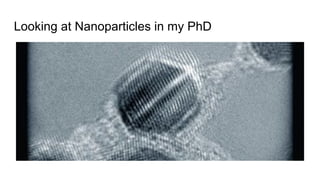
Looking at Nanoparticles in my PhD
A Little More History...
● Summer of Code project (2007)
○ Kalzium was using Avogadro as its editing library, spent most of my time on that
○ Hacked on code in Paris in the Versailles gardens coming up with eye candy
● Postdoc combining experiment and simulation (2007-2009)
○ Came to Pittsburgh, PA for two years in Geoff’s group as it started up
○ XServe cluster, conductivity rig, AFMs, clean rooms, defect simulation and Avogadro
● Interviewed with Kitware and offered a position (2009 - present)
○ Gave a talk in Jamaica about Avogadro at the first Camp KDE
○ Bill Hoffman was there talking about CMake
● First funding (SBIR) as principal investigator in 2010
○ Founding of broader Open Chemistry project
○ Started rewrite of Avogadro 2, development of MoleQueue, and MongoChem to complement
What Is Avogadro 2?
● Ambitious rewrite from the ground up
○ Move to permissive 3-clause BSD license from GPLv2
○ Obtained permission to relicense all Avogado code from contributors
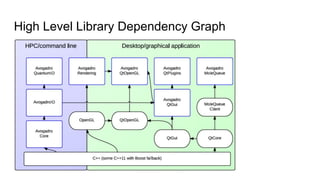
● Using minimal dependencies, multiple focused libraries
○ Core/IO pretty much just C++11
○ Rendering brings in OpenGL
○ Qt classes integrate these things and expose Qt derived classes
○ QtPlugins depend on many things, a lot of functionality in the plugins
● Application in a separate repository as a user of the libraries
● New web-based server code using wrapped core code (no Qt, OpenGL, etc)
● Coded for extensibility, scalability, speed, but also to be useful
High Level Library Dependency Graph
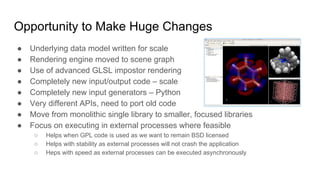
Opportunity to Make Huge Changes
● Underlying data model written for scale
● Rendering engine moved to scene graph
● Use of advanced GLSL impostor rendering
● Completely new input/output code – scale
● Completely new input generators – Python
● Very different APIs, need to port old code
● Move from monolithic single library to smaller, focused libraries
● Focus on executing in external processes where feasible
○ Helps when GPL code is used as we want to remain BSD licensed
○ Helps with stability as external processes will not crash the application
○ Heps with speed as external processes can be executed asynchronously
Molecule Model and Copy-on-Write
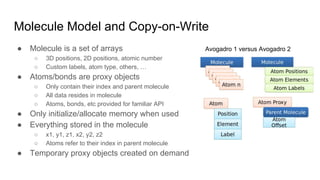
● Molecule is a set of arrays
○ 3D positions, 2D positions, atomic number
○ Custom labels, atom type, others, …
● Atoms/bonds are proxy objects
○ Only contain their index and parent molecule
○ All data resides in molecule
○ Atoms, bonds, etc provided for familiar API
● Only initialize/allocate memory when used
● Everything stored in the molecule
○ x1, y1, z1, x2, y2, z2
○ Atoms refer to their index in parent molecule
● Temporary proxy objects created on demand
Avogadro 1 versus Avogadro 2
Cheap Copies Until They Are Changed
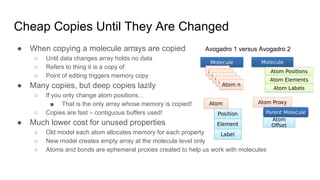
● When copying a molecule arrays are copied
○ Until data changes array holds no data
○ Refers to thing it is a copy of
○ Point of editing triggers memory copy
● Many copies, but deep copies lazily
○ If you only change atom positions...
■ That is the only array whose memory is copied!
○ Copies are fast – contiguous buffers used!
● Much lower cost for unused properties
○ Old model each atom allocates memory for each property
○ New model creates empty array at the molecule level only
○ Atoms and bonds are ephemeral proxies created to help us work with molecules
Avogadro 1 versus Avogadro 2
From Painters to Scene Graphs
● Avogadro 1.x has a nice API for adding new visualization engines
○ painter->setColor(color); painter->drawSphere(center, radius);
○ Every time we rendered all engines were called for all atoms, bonds, etc
○ Cost of virtual overhead, looking up color for atom type, looking up radius, etc
○ Most renders are just camera changes...
● Avogadro 2 has a nice API for adding new visualization engines
○ sphereNode->addSphere(center, color, radius);
○ Only done when the scene changes, after that just render the scene graph
○ Even if quite slow only done if changes to the molecule are made
○ Very amenable to using vertex buffers to store geometry on the graphics card (OpenGL 2.1+)
● The API did not get significantly more complex
○ Can do many more things under the hood to optimize
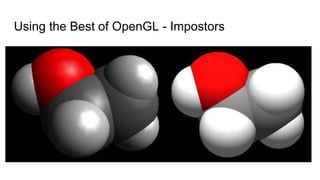
Using the Best of OpenGL - Impostors
● Avogadro 1.x we rendered spheres using display lists, and level of detail
○ Close spheres used the sphere with the most triangles
○ Far away spheres used the lowest level of detail
○ Had to be calculated for each frame based on the camera
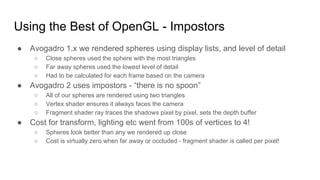
● Avogadro 2 uses impostors - “there is no spoon”
○ All of our spheres are rendered using two triangles
○ Vertex shader ensures it always faces the camera
○ Fragment shader ray traces the shadows pixel by pixel, sets the depth buffer
● Cost for transform, lighting etc went from 100s of vertices to 4!
○ Spheres look better than any we rendered up close
○ Cost is virtually zero when far away or occluded - fragment shader is called per pixel!
Using the Best of OpenGL - Impostors
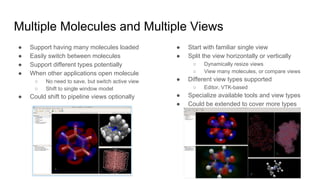
Multiple Molecules and Multiple Views
● Support having many molecules loaded
● Easily switch between molecules
● Support different types potentially
● When other applications open molecule
○ No need to save, but switch active view
○ Shift to single window model
● Could shift to pipeline views optionally
● Start with familiar single view
● Split the view horizontally or vertically
○ Dynamically resize views
○ View many molecules, or compare views
● Different view types supported
○ Editor, VTK-based
● Specialize available tools and view types
● Could be extended to cover more types
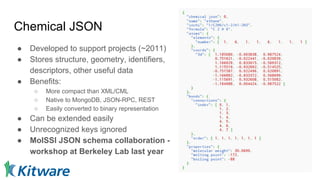
Chemical JSON
● Developed to support projects (~2011)
● Stores structure, geometry, identifiers,
descriptors, other useful data
● Benefits:
○ More compact than XML/CML
○ Native to MongoDB, JSON-RPC, REST
○ Easily converted to binary representation
● Can be extended easily
● Unrecognized keys ignored
● MolSSI JSON schema collaboration -
workshop at Berkeley Lab last year
Papers and a Little History on Chemical JSON
● Quixote collaboration with Peter Murray-Rust (2011)
○ “The Quixote project: Collaborative and Open Quantum Chemistry data management in the
Internet age”, https://doi.org/10.1186/1758-2946-3-38
● Early work in CML with NWChem and Avogadro (2013)
○ “From data to analysis: linking NWChem and Avogadro with the syntax and semantics of
Chemical Markup Language” https://doi.org/10.1186/1758-2946-5-25
● Later moved to JSON, RESTful API, visualization (2017)
○ “Open chemistry: RESTful web APIs, JSON, NWChem and the modern web application”
○ https://doi.org/10.1186/s13321-017-0241-z
● Interested in Linked Data, JSON-LD, and how they might be layered on top
● Use of BSON, HDF5, and related technologies for binary data
● BSD licensed reference implementations
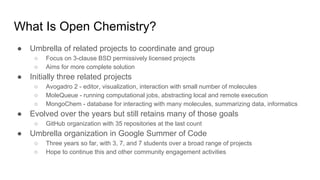
What Is Open Chemistry?
● Umbrella of related projects to coordinate and group
○ Focus on 3-clause BSD permissively licensed projects
○ Aims for more complete solution
● Initially three related projects
○ Avogadro 2 - editor, visualization, interaction with small number of molecules
○ MoleQueue - running computational jobs, abstracting local and remote execution
○ MongoChem - database for interacting with many molecules, summarizing data, informatics
● Evolved over the years but still retains many of those goals
○ GitHub organization with 35 repositories at the last count
● Umbrella organization in Google Summer of Code
○ Three years so far, with 3, 7, and 7 students over a broad range of projects
○ Hope to continue this and other community engagement activities
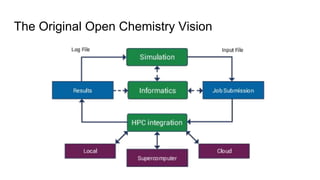
The Original Open Chemistry Vision
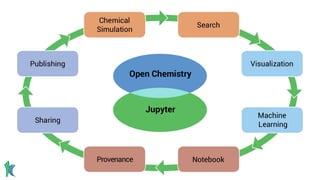
Open Chemistry, Avogadro, Jupyter and Web
● Making data more accessible
● Federated, open data repositories
● Modern HTML5 interfaces
● JSON data format for NWChem data as a prototype, add to other QM codes
● What about working with the data?
● Can we have chemistry from desktop-to-phone
○ Create data, upload, organize
○ Search and analyze data
○ Share data - email, social media, publications
● What if we tied a data server to a Jupyter notebook?
● Can we link generated data to existing government databases?
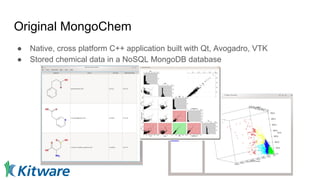
Original MongoChem
● Native, cross platform C++ application built with Qt, Avogadro, VTK
● Stored chemical data in a NoSQL MongoDB database
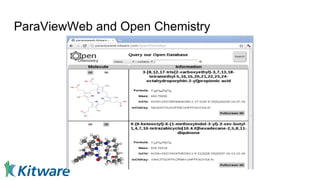
ParaViewWeb and Open Chemistry
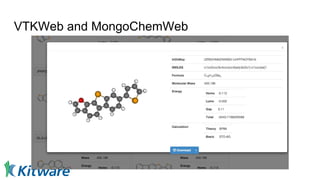
VTKWeb and MongoChemWeb
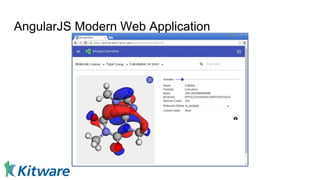
AngularJS Modern Web Application
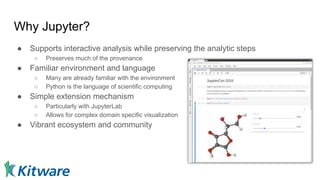
Why Jupyter?
● Supports interactive analysis while preserving the analytic steps​
○ Preserves much of the provenance​
● Familiar environment and language​
○ Many are already familiar with the environment​
○ Python is the language of scientific computing​
● Simple extension mechanism​
○ Particularly with JupyterLab​
○ Allows for complex domain specific visualization​
● Vibrant ecosystem and community​
​
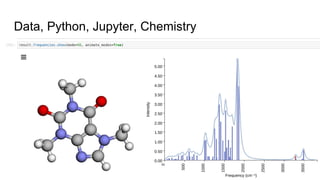
Data, Python, Jupyter, Chemistry
Approach and Philosophy
● Data is the core of the platform
○ Start with a simple but powerful date model and data server
● RESTful APIs are ubiquitous
○ Use from notebooks, apps, command line, desktop, etc
● Jupyter notebooks for interactive analysis
○ High level domain specific Python API within the notebooks
● Web application
○ Authentication, access control, management tasks
○ Launching, searching, managing notebooks
○ Interact with data outside of the notebook
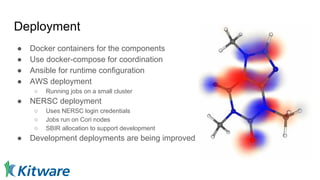
Deployment
● Docker containers for the components
● Use docker-compose for coordination
● Ansible for runtime configuration
● AWS deployment
○ Running jobs on a small cluster
● NERSC deployment
○ Uses NERSC login credentials
○ Jobs run on Cori nodes
○ SBIR allocation to support development
● Development deployments are being improved
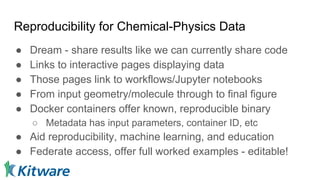
Reproducibility for Chemical-Physics Data
● Dream - share results like we can currently share code
● Links to interactive pages displaying data
● Those pages link to workflows/Jupyter notebooks
● From input geometry/molecule through to final figure
● Docker containers offer known, reproducible binary
○ Metadata has input parameters, container ID, etc
● Aid reproducibility, machine learning, and education
● Federate access, offer full worked examples - editable!
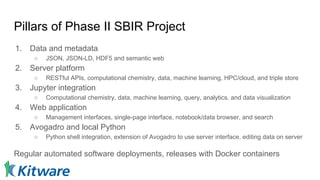
Pillars of Phase II SBIR Project
1. Data and metadata
○ JSON, JSON-LD, HDF5 and semantic web
2. Server platform
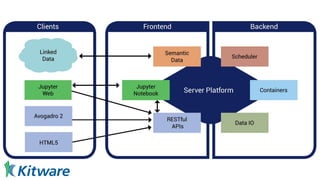
○ RESTful APIs, computational chemistry, data, machine learning, HPC/cloud, and triple store
3. Jupyter integration
○ Computational chemistry, data, machine learning, query, analytics, and data visualization
4. Web application
○ Management interfaces, single-page interface, notebook/data browser, and search
5. Avogadro and local Python
○ Python shell integration, extension of Avogadro to use server interface, editing data on server
Regular automated software deployments, releases with Docker containers
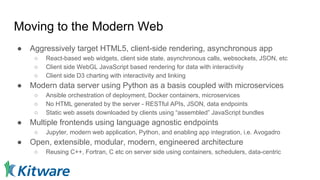
Moving to the Modern Web
● Aggressively target HTML5, client-side rendering, asynchronous app
○ React-based web widgets, client side state, asynchronous calls, websockets, JSON, etc
○ Client side WebGL JavaScript based rendering for data with interactivity
○ Client side D3 charting with interactivity and linking
● Modern data server using Python as a basis coupled with microservices
○ Ansible orchestration of deployment, Docker containers, microservices
○ No HTML generated by the server - RESTful APIs, JSON, data endpoints
○ Static web assets downloaded by clients using “assembled” JavaScript bundles
● Multiple frontends using language agnostic endpoints
○ Jupyter, modern web application, Python, and enabling app integration, i.e. Avogadro
● Open, extensible, modular, modern, engineered architecture
○ Reusing C++, Fortran, C etc on server side using containers, schedulers, data-centric
Collaboration and Community
● Phase II project partners/direct subcontracts
○ Bert de Jong at Berkeley Lab - links to NWChem, diverse projects with data/viz needs
○ Johannes Hachmann at SUNY Buffalo - focused on machine learning, chemical libraries
● Deployments on diverse infrastructure
○ NERSC science gateway, Amazon EC2, soon university deployments
○ NERSC requires NIM account, Amazon much more open, university likely more limited
● Engaging MolSSI, already sponsored a workshop last year on JSON schema
● Building a community around user interfaces, reproducibility, data
○ Engage with the academic, lab-based and industrial communities
● Open framework with licensing friendly to both open and proprietary codes
○ Commercialization approaches customizing to new codes, environments, compute cluster, etc
Closing Thoughts
● Avogadro 2 already has a number of exciting new features
● What are the pain points preventing us from releasing 2.0?
● Successfully reusing components of Avogadro Libraries server-side
● Integration of Avogadro 2 with the Open Chemistry Jupyter platform coming
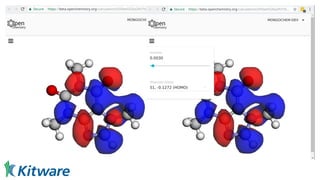
● Volume rendering using VTK is working in Avogadro 2
○ Developing new API to support “active objects” to enable more dynamic extensions
○ Number of technical issues had to be solved
● Eleven years of Avogadro, open source, and data
● Position our open source tools for the future
● Embrace Python in more diverse ways to increase engagement
● This open source thing might just win out, despite the resistance to it ;-)

Avogadro 2 and Open Chemistry

  • 1.
    Avogadro 2 andOpen Chemistry Dr. Marcus D. Hanwell @mhanwell Technical Leader Avogadro User Meeting University of Pittsburgh, PA 25 August, 2018
  • 2.
    Some History ● Gota BSc in Physics from the University of Sheffield (2000 - 2003) ○ Did an internship in Silicon Valley in 2002 - servers, computers, simulations, America... ○ Somewhere in about 2002 started packaging for Gentoo Linux on AMD64, scientific packages ● Decided to stay on and do a PhD in Sheffield (2003 - 2007) ○ Nanomaterial Engineering Group working on thiol encapsulated gold nanoparticles ○ Started doing a lot of programming for an experimentalist...data acquisition, simulated nanoparticle packing, helping people get stuff working, C++ plotting of measured surface pressure on Langmuir troughs, simulated X-ray reflectometry, scheduled to finish in 2007 ● Thought about taking part in Google Summer of Code since the start ○ Got it together in 2007, went searching for a project in C++ where I could edit molecules ○ Kalzium had the perfect project, started contributing a few patches, talking ○ Submitted a proposal, which was accepted with Benoit Jacob as my mentor
  • 3.
  • 4.
    A Little MoreHistory... ● Summer of Code project (2007) ○ Kalzium was using Avogadro as its editing library, spent most of my time on that ○ Hacked on code in Paris in the Versailles gardens coming up with eye candy ● Postdoc combining experiment and simulation (2007-2009) ○ Came to Pittsburgh, PA for two years in Geoff’s group as it started up ○ XServe cluster, conductivity rig, AFMs, clean rooms, defect simulation and Avogadro ● Interviewed with Kitware and offered a position (2009 - present) ○ Gave a talk in Jamaica about Avogadro at the first Camp KDE ○ Bill Hoffman was there talking about CMake ● First funding (SBIR) as principal investigator in 2010 ○ Founding of broader Open Chemistry project ○ Started rewrite of Avogadro 2, development of MoleQueue, and MongoChem to complement
  • 5.
    What Is Avogadro2? ● Ambitious rewrite from the ground up ○ Move to permissive 3-clause BSD license from GPLv2 ○ Obtained permission to relicense all Avogado code from contributors ● Using minimal dependencies, multiple focused libraries ○ Core/IO pretty much just C++11 ○ Rendering brings in OpenGL ○ Qt classes integrate these things and expose Qt derived classes ○ QtPlugins depend on many things, a lot of functionality in the plugins ● Application in a separate repository as a user of the libraries ● New web-based server code using wrapped core code (no Qt, OpenGL, etc) ● Coded for extensibility, scalability, speed, but also to be useful
  • 6.
    High Level LibraryDependency Graph
  • 7.
    Opportunity to MakeHuge Changes ● Underlying data model written for scale ● Rendering engine moved to scene graph ● Use of advanced GLSL impostor rendering ● Completely new input/output code – scale ● Completely new input generators – Python ● Very different APIs, need to port old code ● Move from monolithic single library to smaller, focused libraries ● Focus on executing in external processes where feasible ○ Helps when GPL code is used as we want to remain BSD licensed ○ Helps with stability as external processes will not crash the application ○ Heps with speed as external processes can be executed asynchronously
  • 8.
    Molecule Model andCopy-on-Write ● Molecule is a set of arrays ○ 3D positions, 2D positions, atomic number ○ Custom labels, atom type, others, … ● Atoms/bonds are proxy objects ○ Only contain their index and parent molecule ○ All data resides in molecule ○ Atoms, bonds, etc provided for familiar API ● Only initialize/allocate memory when used ● Everything stored in the molecule ○ x1, y1, z1, x2, y2, z2 ○ Atoms refer to their index in parent molecule ● Temporary proxy objects created on demand Avogadro 1 versus Avogadro 2
  • 9.
    Cheap Copies UntilThey Are Changed ● When copying a molecule arrays are copied ○ Until data changes array holds no data ○ Refers to thing it is a copy of ○ Point of editing triggers memory copy ● Many copies, but deep copies lazily ○ If you only change atom positions... ■ That is the only array whose memory is copied! ○ Copies are fast – contiguous buffers used! ● Much lower cost for unused properties ○ Old model each atom allocates memory for each property ○ New model creates empty array at the molecule level only ○ Atoms and bonds are ephemeral proxies created to help us work with molecules Avogadro 1 versus Avogadro 2
  • 10.
    From Painters toScene Graphs ● Avogadro 1.x has a nice API for adding new visualization engines ○ painter->setColor(color); painter->drawSphere(center, radius); ○ Every time we rendered all engines were called for all atoms, bonds, etc ○ Cost of virtual overhead, looking up color for atom type, looking up radius, etc ○ Most renders are just camera changes... ● Avogadro 2 has a nice API for adding new visualization engines ○ sphereNode->addSphere(center, color, radius); ○ Only done when the scene changes, after that just render the scene graph ○ Even if quite slow only done if changes to the molecule are made ○ Very amenable to using vertex buffers to store geometry on the graphics card (OpenGL 2.1+) ● The API did not get significantly more complex ○ Can do many more things under the hood to optimize
  • 11.
    Using the Bestof OpenGL - Impostors ● Avogadro 1.x we rendered spheres using display lists, and level of detail ○ Close spheres used the sphere with the most triangles ○ Far away spheres used the lowest level of detail ○ Had to be calculated for each frame based on the camera ● Avogadro 2 uses impostors - “there is no spoon” ○ All of our spheres are rendered using two triangles ○ Vertex shader ensures it always faces the camera ○ Fragment shader ray traces the shadows pixel by pixel, sets the depth buffer ● Cost for transform, lighting etc went from 100s of vertices to 4! ○ Spheres look better than any we rendered up close ○ Cost is virtually zero when far away or occluded - fragment shader is called per pixel!
  • 12.
    Using the Bestof OpenGL - Impostors
  • 13.
    Multiple Molecules andMultiple Views ● Support having many molecules loaded ● Easily switch between molecules ● Support different types potentially ● When other applications open molecule ○ No need to save, but switch active view ○ Shift to single window model ● Could shift to pipeline views optionally ● Start with familiar single view ● Split the view horizontally or vertically ○ Dynamically resize views ○ View many molecules, or compare views ● Different view types supported ○ Editor, VTK-based ● Specialize available tools and view types ● Could be extended to cover more types
  • 14.
    Chemical JSON ● Developedto support projects (~2011) ● Stores structure, geometry, identifiers, descriptors, other useful data ● Benefits: ○ More compact than XML/CML ○ Native to MongoDB, JSON-RPC, REST ○ Easily converted to binary representation ● Can be extended easily ● Unrecognized keys ignored ● MolSSI JSON schema collaboration - workshop at Berkeley Lab last year
  • 15.
    Papers and aLittle History on Chemical JSON ● Quixote collaboration with Peter Murray-Rust (2011) ○ “The Quixote project: Collaborative and Open Quantum Chemistry data management in the Internet age”, https://doi.org/10.1186/1758-2946-3-38 ● Early work in CML with NWChem and Avogadro (2013) ○ “From data to analysis: linking NWChem and Avogadro with the syntax and semantics of Chemical Markup Language” https://doi.org/10.1186/1758-2946-5-25 ● Later moved to JSON, RESTful API, visualization (2017) ○ “Open chemistry: RESTful web APIs, JSON, NWChem and the modern web application” ○ https://doi.org/10.1186/s13321-017-0241-z ● Interested in Linked Data, JSON-LD, and how they might be layered on top ● Use of BSON, HDF5, and related technologies for binary data ● BSD licensed reference implementations
  • 16.
    What Is OpenChemistry? ● Umbrella of related projects to coordinate and group ○ Focus on 3-clause BSD permissively licensed projects ○ Aims for more complete solution ● Initially three related projects ○ Avogadro 2 - editor, visualization, interaction with small number of molecules ○ MoleQueue - running computational jobs, abstracting local and remote execution ○ MongoChem - database for interacting with many molecules, summarizing data, informatics ● Evolved over the years but still retains many of those goals ○ GitHub organization with 35 repositories at the last count ● Umbrella organization in Google Summer of Code ○ Three years so far, with 3, 7, and 7 students over a broad range of projects ○ Hope to continue this and other community engagement activities
  • 17.
    The Original OpenChemistry Vision
  • 18.
    Open Chemistry, Avogadro,Jupyter and Web ● Making data more accessible ● Federated, open data repositories ● Modern HTML5 interfaces ● JSON data format for NWChem data as a prototype, add to other QM codes ● What about working with the data? ● Can we have chemistry from desktop-to-phone ○ Create data, upload, organize ○ Search and analyze data ○ Share data - email, social media, publications ● What if we tied a data server to a Jupyter notebook? ● Can we link generated data to existing government databases?
  • 19.
    Original MongoChem ● Native,cross platform C++ application built with Qt, Avogadro, VTK ● Stored chemical data in a NoSQL MongoDB database
  • 20.
  • 21.
  • 22.
  • 24.
    Why Jupyter? ● Supportsinteractive analysis while preserving the analytic steps​ ○ Preserves much of the provenance​ ● Familiar environment and language​ ○ Many are already familiar with the environment​ ○ Python is the language of scientific computing​ ● Simple extension mechanism​ ○ Particularly with JupyterLab​ ○ Allows for complex domain specific visualization​ ● Vibrant ecosystem and community​ ​
  • 25.
  • 26.
    Approach and Philosophy ●Data is the core of the platform ○ Start with a simple but powerful date model and data server ● RESTful APIs are ubiquitous ○ Use from notebooks, apps, command line, desktop, etc ● Jupyter notebooks for interactive analysis ○ High level domain specific Python API within the notebooks ● Web application ○ Authentication, access control, management tasks ○ Launching, searching, managing notebooks ○ Interact with data outside of the notebook
  • 29.
    Deployment ● Docker containersfor the components ● Use docker-compose for coordination ● Ansible for runtime configuration ● AWS deployment ○ Running jobs on a small cluster ● NERSC deployment ○ Uses NERSC login credentials ○ Jobs run on Cori nodes ○ SBIR allocation to support development ● Development deployments are being improved
  • 30.
    Reproducibility for Chemical-PhysicsData ● Dream - share results like we can currently share code ● Links to interactive pages displaying data ● Those pages link to workflows/Jupyter notebooks ● From input geometry/molecule through to final figure ● Docker containers offer known, reproducible binary ○ Metadata has input parameters, container ID, etc ● Aid reproducibility, machine learning, and education ● Federate access, offer full worked examples - editable!
  • 32.
    Pillars of PhaseII SBIR Project 1. Data and metadata ○ JSON, JSON-LD, HDF5 and semantic web 2. Server platform ○ RESTful APIs, computational chemistry, data, machine learning, HPC/cloud, and triple store 3. Jupyter integration ○ Computational chemistry, data, machine learning, query, analytics, and data visualization 4. Web application ○ Management interfaces, single-page interface, notebook/data browser, and search 5. Avogadro and local Python ○ Python shell integration, extension of Avogadro to use server interface, editing data on server Regular automated software deployments, releases with Docker containers
  • 33.
    Moving to theModern Web ● Aggressively target HTML5, client-side rendering, asynchronous app ○ React-based web widgets, client side state, asynchronous calls, websockets, JSON, etc ○ Client side WebGL JavaScript based rendering for data with interactivity ○ Client side D3 charting with interactivity and linking ● Modern data server using Python as a basis coupled with microservices ○ Ansible orchestration of deployment, Docker containers, microservices ○ No HTML generated by the server - RESTful APIs, JSON, data endpoints ○ Static web assets downloaded by clients using “assembled” JavaScript bundles ● Multiple frontends using language agnostic endpoints ○ Jupyter, modern web application, Python, and enabling app integration, i.e. Avogadro ● Open, extensible, modular, modern, engineered architecture ○ Reusing C++, Fortran, C etc on server side using containers, schedulers, data-centric
  • 34.
    Collaboration and Community ●Phase II project partners/direct subcontracts ○ Bert de Jong at Berkeley Lab - links to NWChem, diverse projects with data/viz needs ○ Johannes Hachmann at SUNY Buffalo - focused on machine learning, chemical libraries ● Deployments on diverse infrastructure ○ NERSC science gateway, Amazon EC2, soon university deployments ○ NERSC requires NIM account, Amazon much more open, university likely more limited ● Engaging MolSSI, already sponsored a workshop last year on JSON schema ● Building a community around user interfaces, reproducibility, data ○ Engage with the academic, lab-based and industrial communities ● Open framework with licensing friendly to both open and proprietary codes ○ Commercialization approaches customizing to new codes, environments, compute cluster, etc
  • 35.
    Closing Thoughts ● Avogadro2 already has a number of exciting new features ● What are the pain points preventing us from releasing 2.0? ● Successfully reusing components of Avogadro Libraries server-side ● Integration of Avogadro 2 with the Open Chemistry Jupyter platform coming ● Volume rendering using VTK is working in Avogadro 2 ○ Developing new API to support “active objects” to enable more dynamic extensions ○ Number of technical issues had to be solved ● Eleven years of Avogadro, open source, and data ● Position our open source tools for the future ● Embrace Python in more diverse ways to increase engagement ● This open source thing might just win out, despite the resistance to it ;-)