AVL TREE
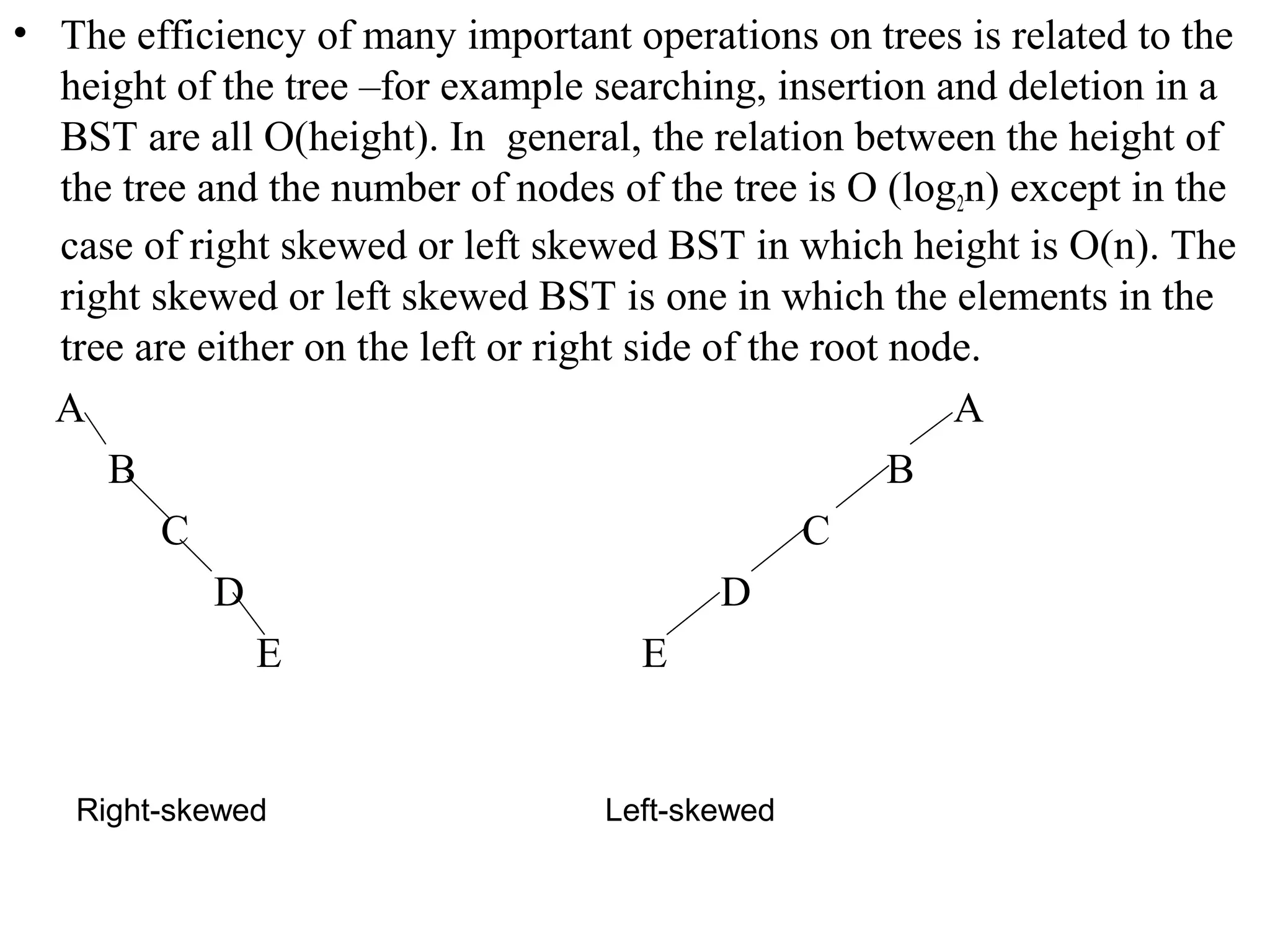
• The efficiency of many important operations on trees is related to the 
height of the tree –for example searching, insertion and deletion in a 
BST are all O(height). In general, the relation between the height of 
the tree and the number of nodes of the tree is O (log2n) except in the 
case of right skewed or left skewed BST in which height is O(n). The 
right skewed or left skewed BST is one in which the elements in the 
tree are either on the left or right side of the root node. 
A A 
B B 
C C 
D D 
E E 
Right-skewed Left-skewed
• For efficiency sake, we would like to guarantee that h remains 
O(log2n). One way to do this is to force our trees to be height-balanced. 
• Method to check whether a tree is height balanced or not is as 
follows: 
– Start at the leaves and work towards the root of the tree. 
– Check the height of the subtrees(left and right) of the node. 
– A tree is said to be height balanced if the difference of heights of 
its left and right subtrees of each node is equal to 0, 1 or -1 
• Example: 
• Check whether the shown tree is balanced or not
A 
B C 
D 
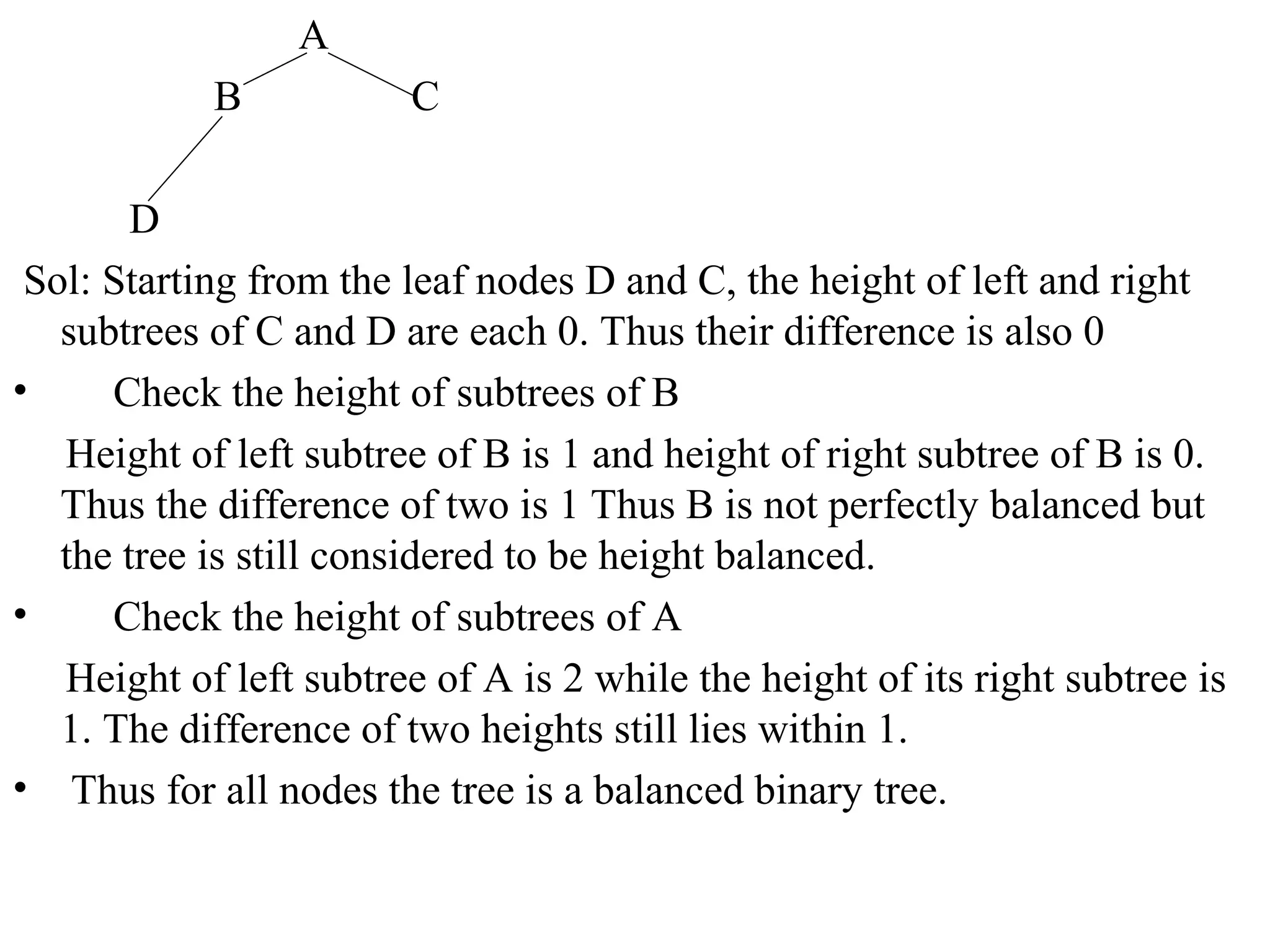
Sol: Starting from the leaf nodes D and C, the height of left and right 
subtrees of C and D are each 0. Thus their difference is also 0 
• Check the height of subtrees of B 
Height of left subtree of B is 1 and height of right subtree of B is 0. 
Thus the difference of two is 1 Thus B is not perfectly balanced but 
the tree is still considered to be height balanced. 
• Check the height of subtrees of A 
Height of left subtree of A is 2 while the height of its right subtree is 
1. The difference of two heights still lies within 1. 
• Thus for all nodes the tree is a balanced binary tree.
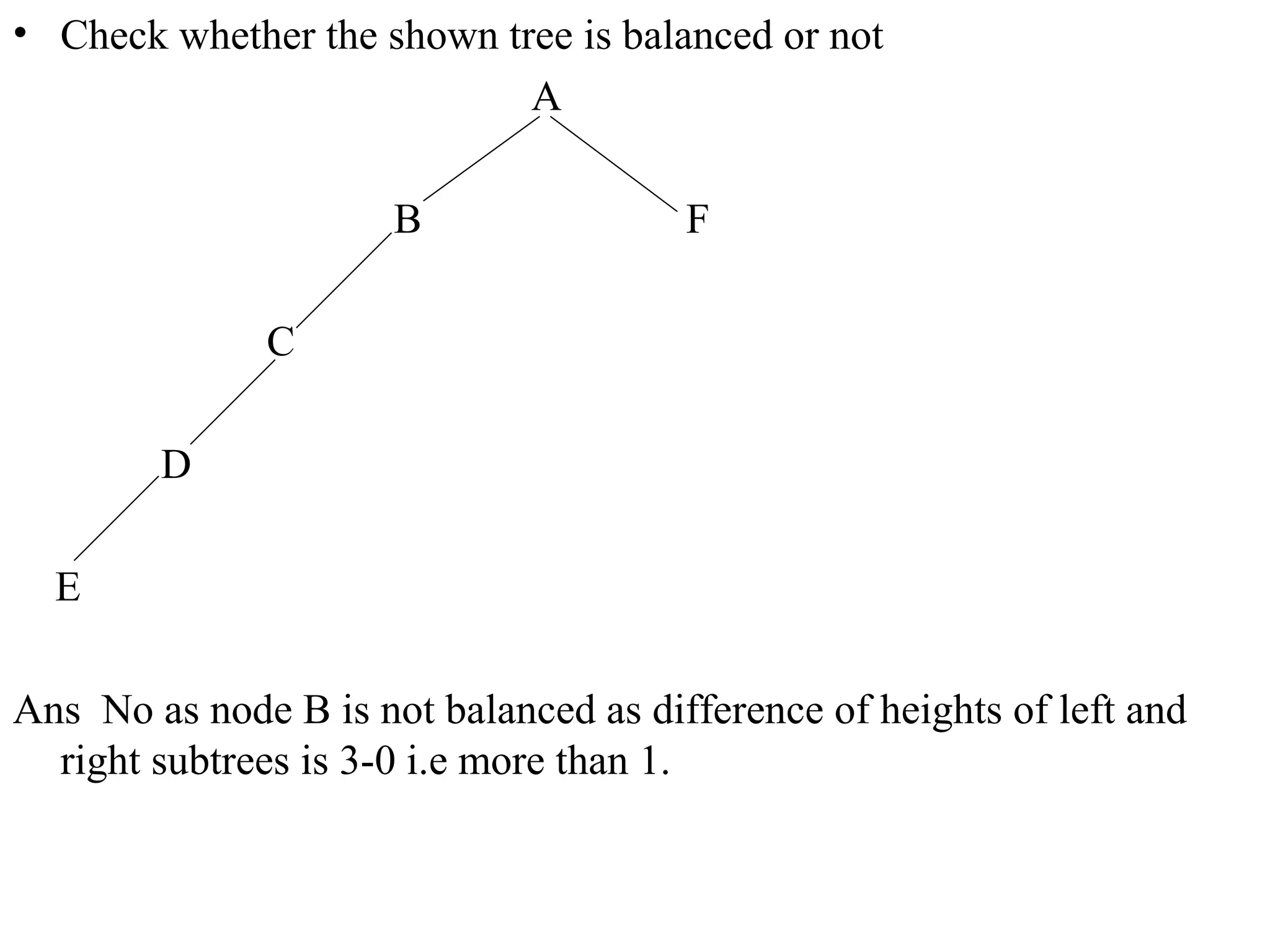
• Check whether the shown tree is balanced or not 
A 
B F 
C 
D 
E 
Ans No as node B is not balanced as difference of heights of left and 
right subtrees is 3-0 i.e more than 1.
Height-balanced Binary tree (AVL Tree) 
The disadvantage of a skewed binary search tree is that the worst case 
time complexity of a search is O(n). In order to overcome this 
disadvantage, it is necessray to maintain the binary search tree to be 
of balanced height. Two Russian mathematicians , G.M. Adel and 
E.M. Landis gave a technique to balance the height of a binary tree 
and the resulting tree is called AVL tree. 
Definition: An empty binary tree is an AVL tree. A non empty binary 
tree T is an AVL tree iff given TL and TR to be the left and right 
subtrees of T and h(TL) and h(TR) be the heights of subtrees TL and TR 
respectively, TL and TR are AVL trees and |h(TL)-h(TR)| ≤ 1. 
|h(TL)-h(TR)| is also called the balance factor (BF) and for an AVL tree 
the balance factor of a node can be either -1, 0 or 1 
An AVL search tree is a binary search tree which is an AVL tree.
• A node in a binary tree that does not contain the BF of 0, 1 or -1, it is 
said to be unbalanced. If one inserts a new node into a balanced 
binary tree at the leaf, then the possible changes in the status of the 
node are as follows: 
• The node was either left or right heavy and has now become balanced. 
A node is said to be left heavy if number of nodes in its left subtree 
are one more than the number of nodes in its right subtree.. In other 
words, the difference in heights is 1. Similar is the case with right 
heavy node where number of nodes in right subtree are one more than 
the number of nodes in left subtree 
• The node was balanced and has now become left or right heavy 
• The node was heavy and the new node has been inserted in the heavy 
subtree, thus creating an unbalanced subtree. Such a node is called a 
critical node.
Rotations- Inserting an element in an AVL search tree in its first phase 
is similar to that of the one used in a binary search tree. However, if 
after insertion of the element, the balance factor of any node in a 
binary search tree is affected so as to render the binary search tree 
unbalanced, we resort to techniques called Rotations to restore the 
balance of the search tree. 
• To perform rotations, it is necessary to identify the specific node A 
whose BF (balance factor) is neither 0,1 or -1 and which is nearest 
ancestor to the inserted node on the path from inserted node to the 
root. 
• The rebalancing rotations are classified as LL, LR, RR and RL based 
on the position of the inserted node with reference to A 
LL rotation: Inserted node in the left subtree of the left subtree of A 
RR rotation: Inserted node in the right subtree of the right subtree of A 
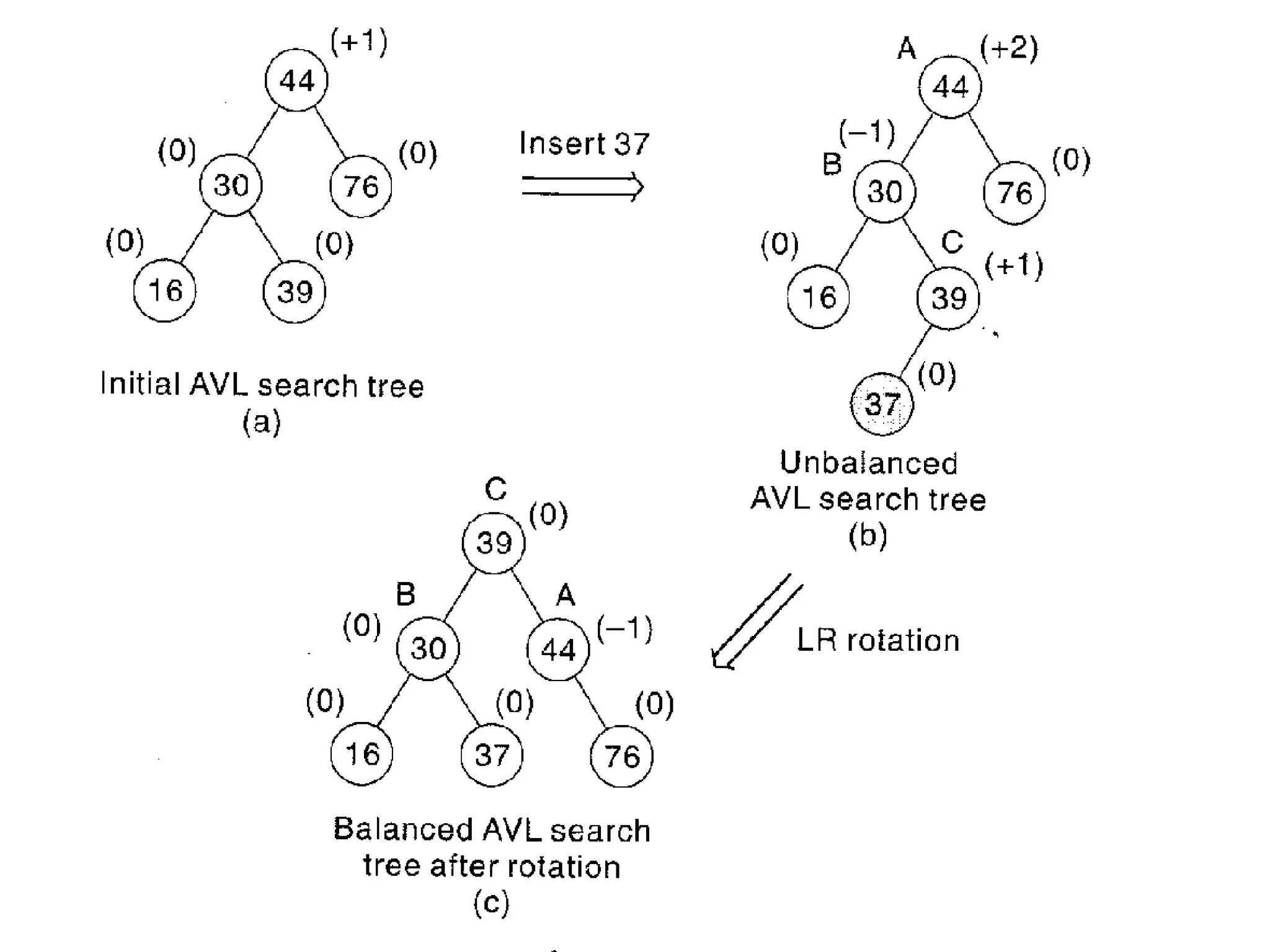
LR rotation: Inserted node in the right subtree of the left subtree of A 
RL rotation: Inserted node in the left subtree of the right subtree of A
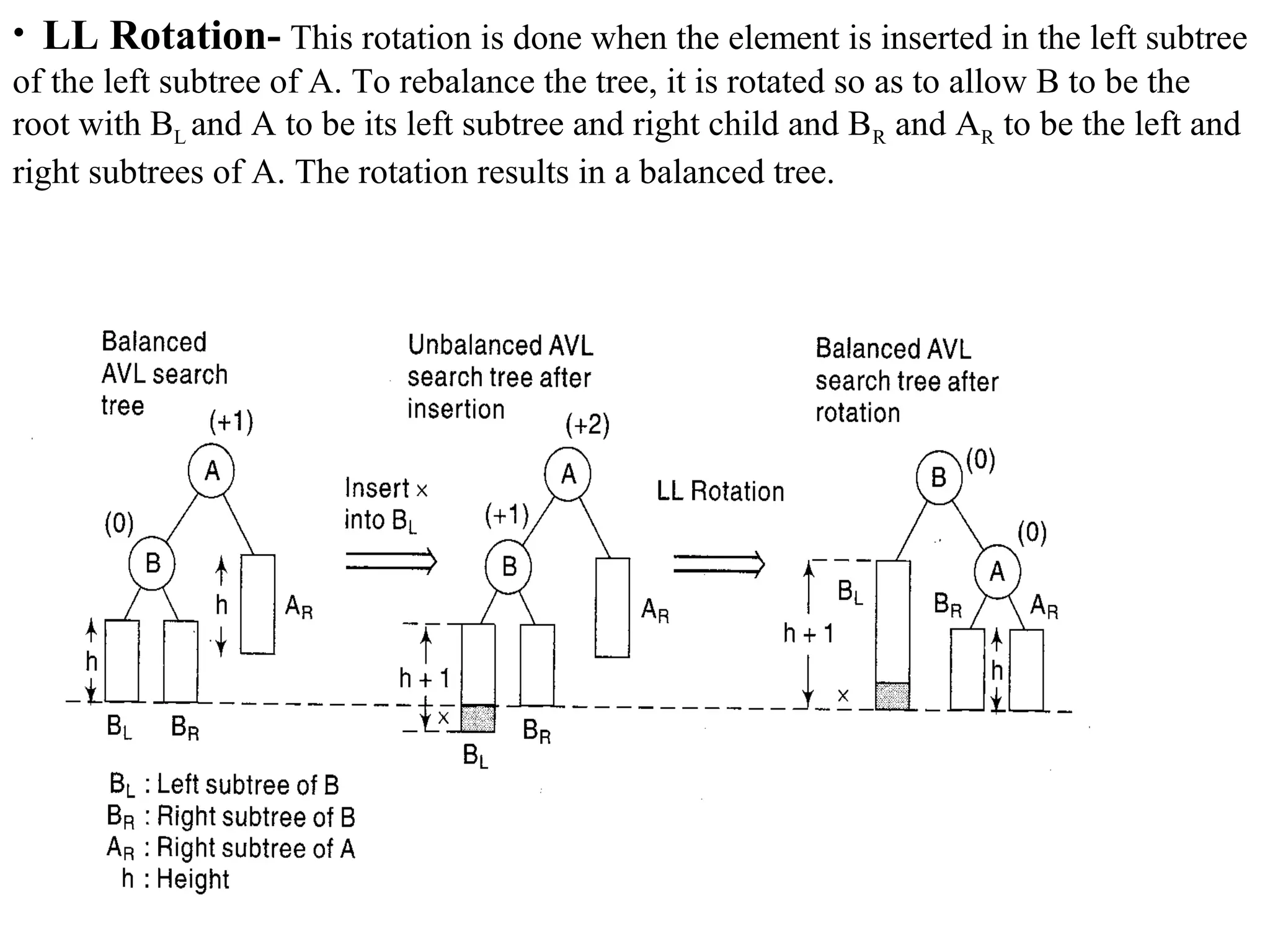
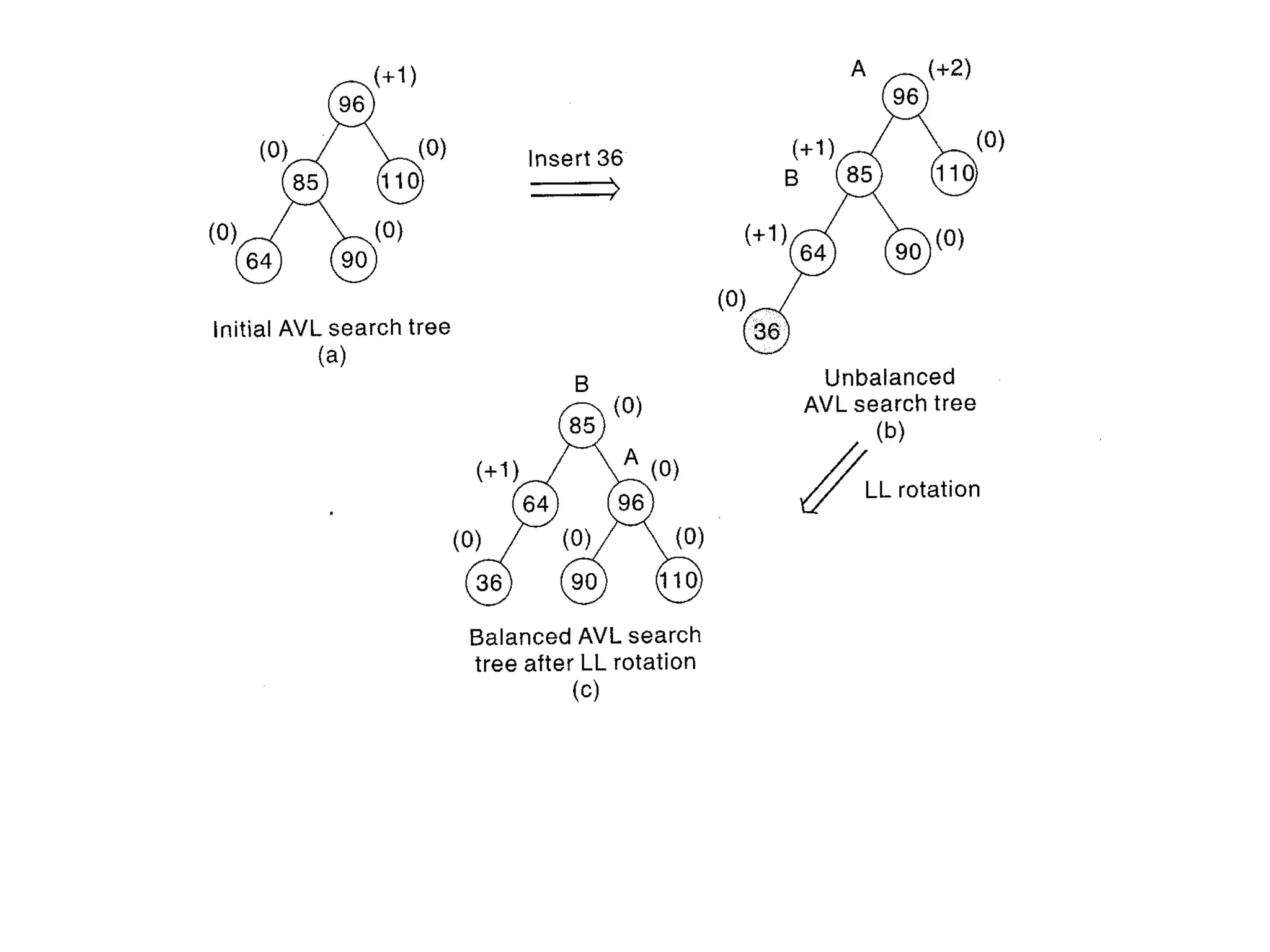
• LL Rotation- This rotation is done when the element is inserted in the left subtree 
of the left subtree of A. To rebalance the tree, it is rotated so as to allow B to be the 
root with BL and A to be its left subtree and right child and BR and AR to be the left and 
right subtrees of A. The rotation results in a balanced tree.
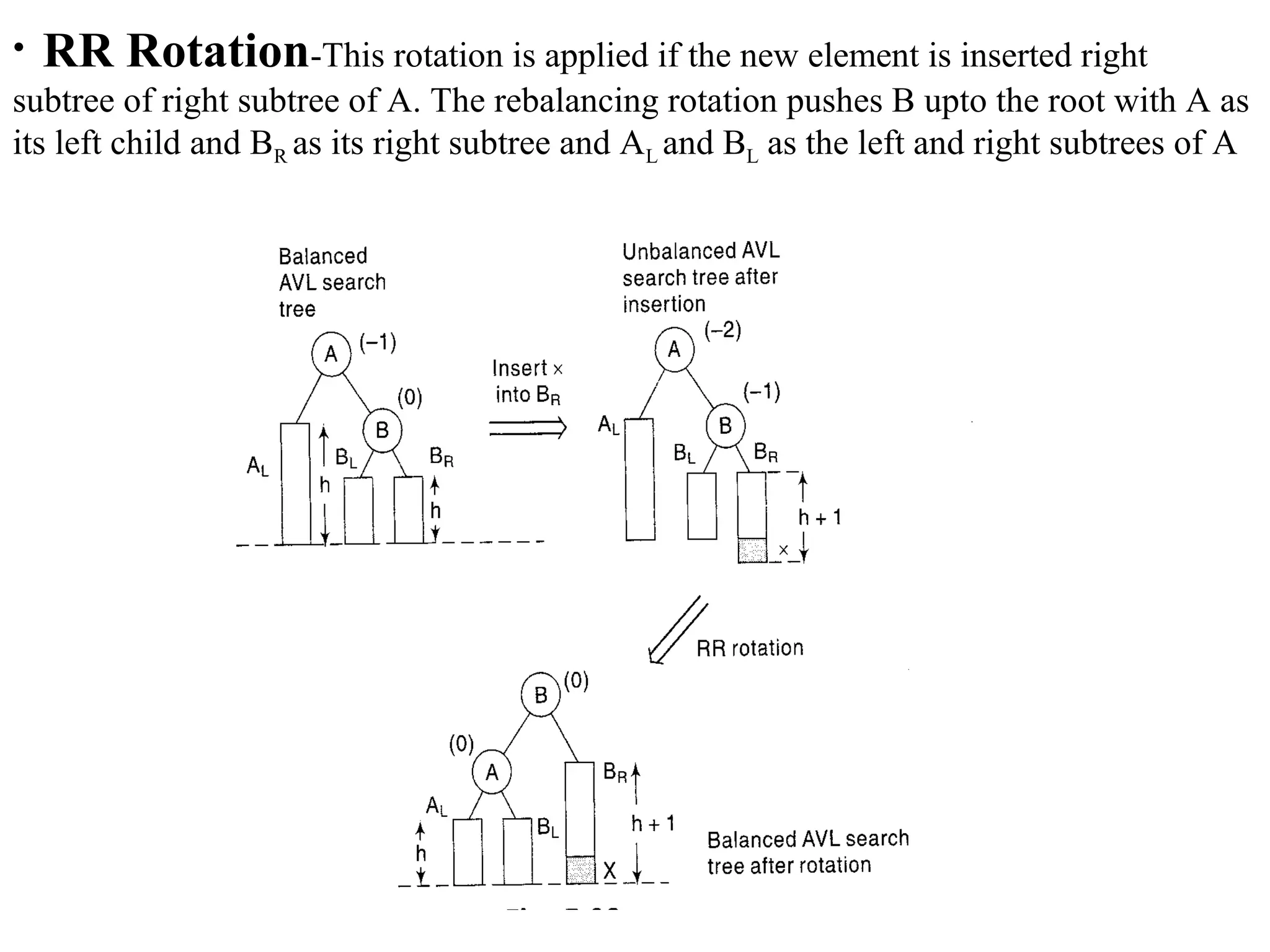
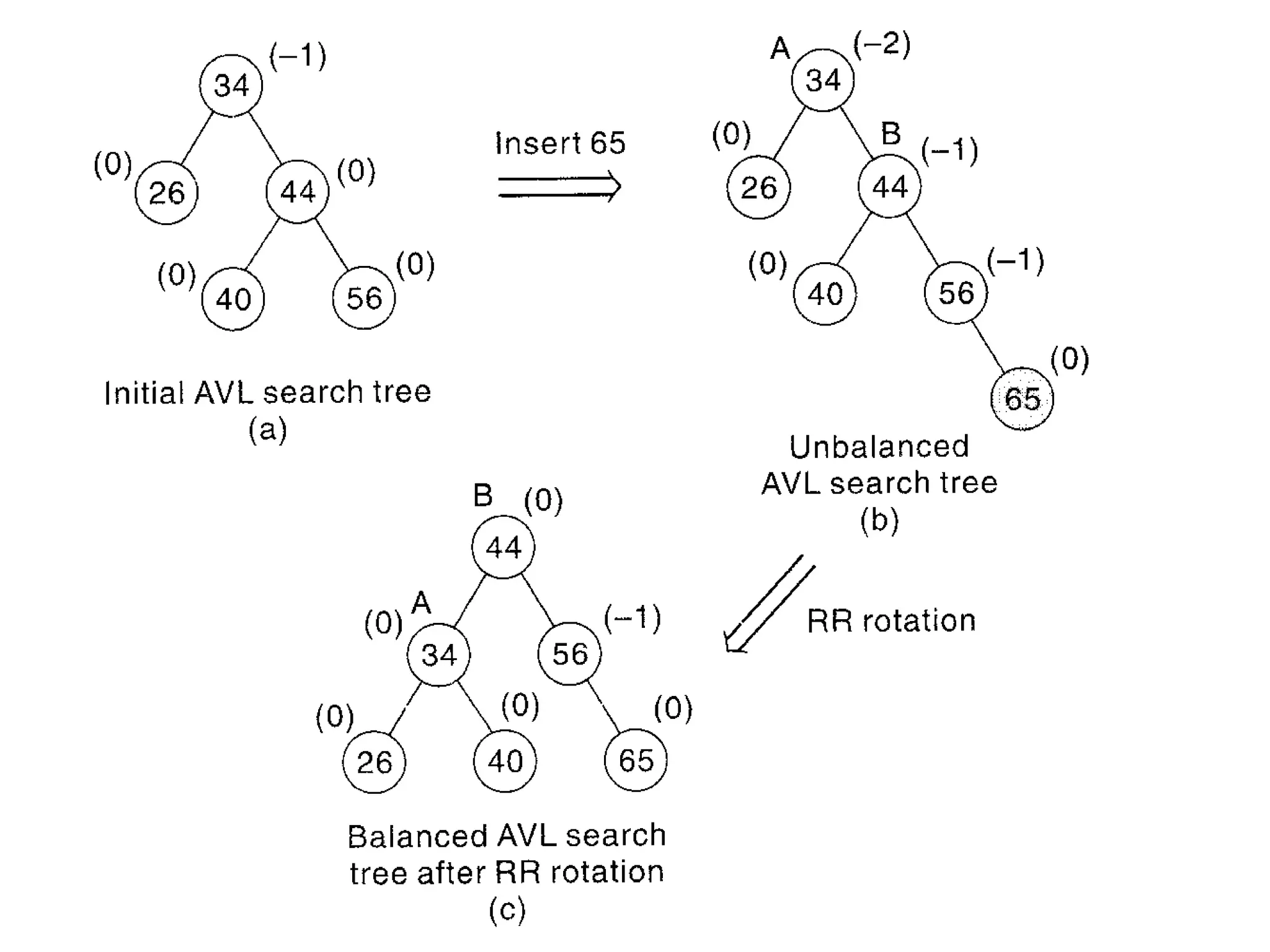
• RR Rotation-This rotation is applied if the new element is inserted right 
subtree of right subtree of A. The rebalancing rotation pushes B upto the root with A as 
its left child and BR as its right subtree and AL and BL as the left and right subtrees of A
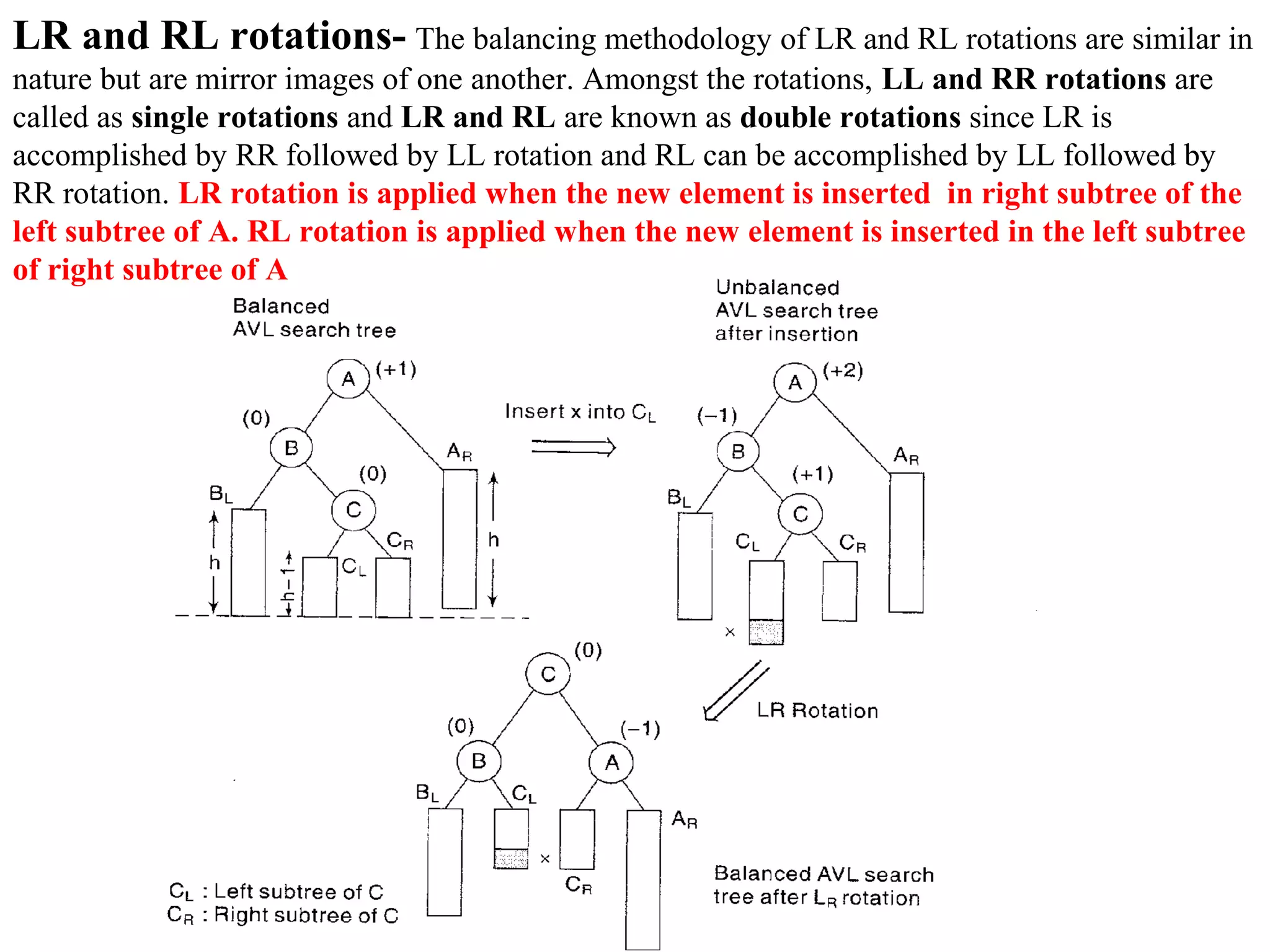
LR and RL rotations- The balancing methodology of LR and RL rotations are similar in 
nature but are mirror images of one another. Amongst the rotations, LL and RR rotations are 
called as single rotations and LR and RL are known as double rotations since LR is 
accomplished by RR followed by LL rotation and RL can be accomplished by LL followed by 
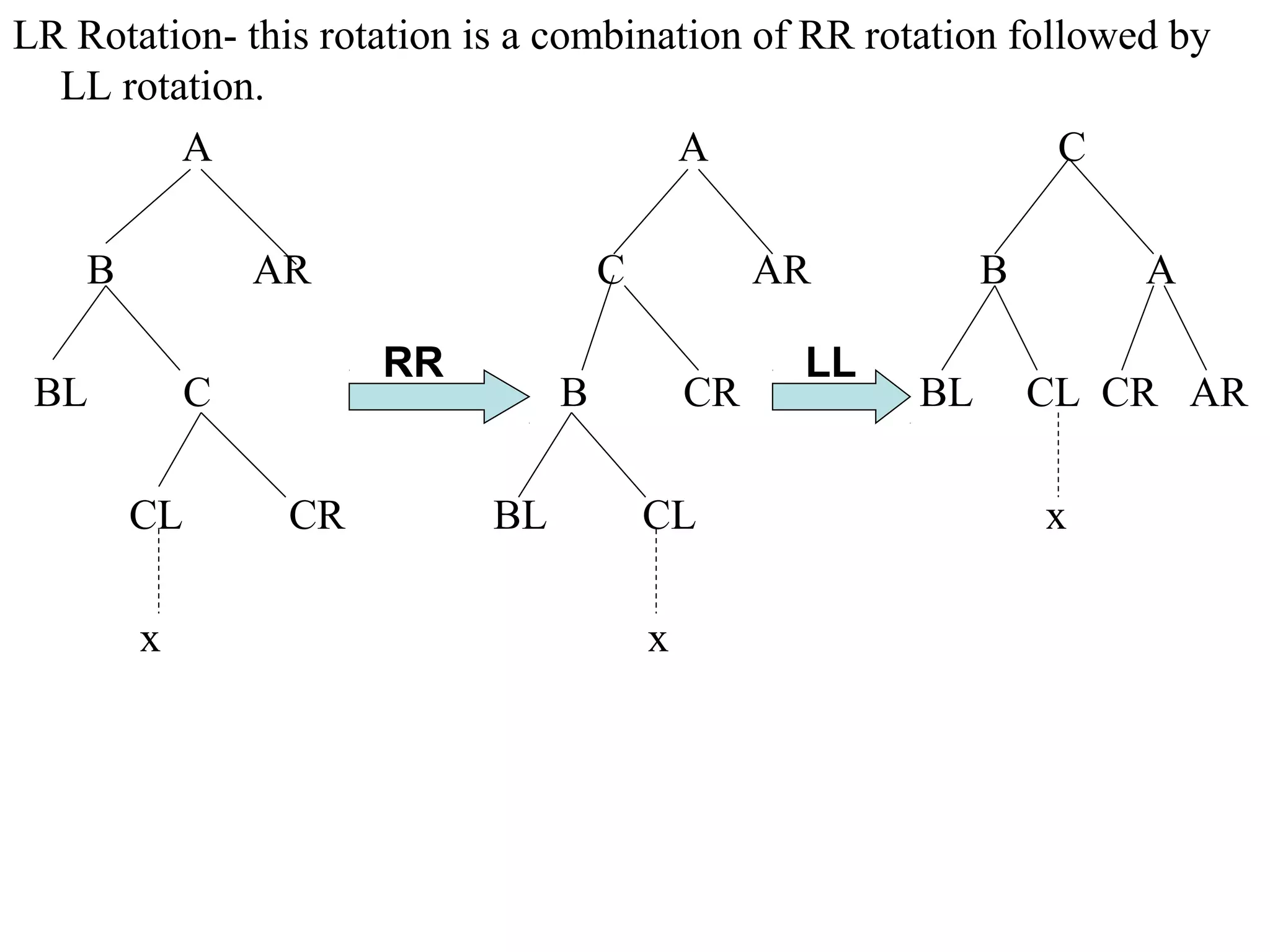
RR rotation. LR rotation is applied when the new element is inserted in right subtree of the 
left subtree of A. RL rotation is applied when the new element is inserted in the left subtree 
of right subtree of A
LR Rotation- this rotation is a combination of RR rotation followed by 
LL rotation. 
A A C 
B AR C AR B A 
RR LL 
BL C B CR BL CL CR AR 
CL CR BL CL x 
x x
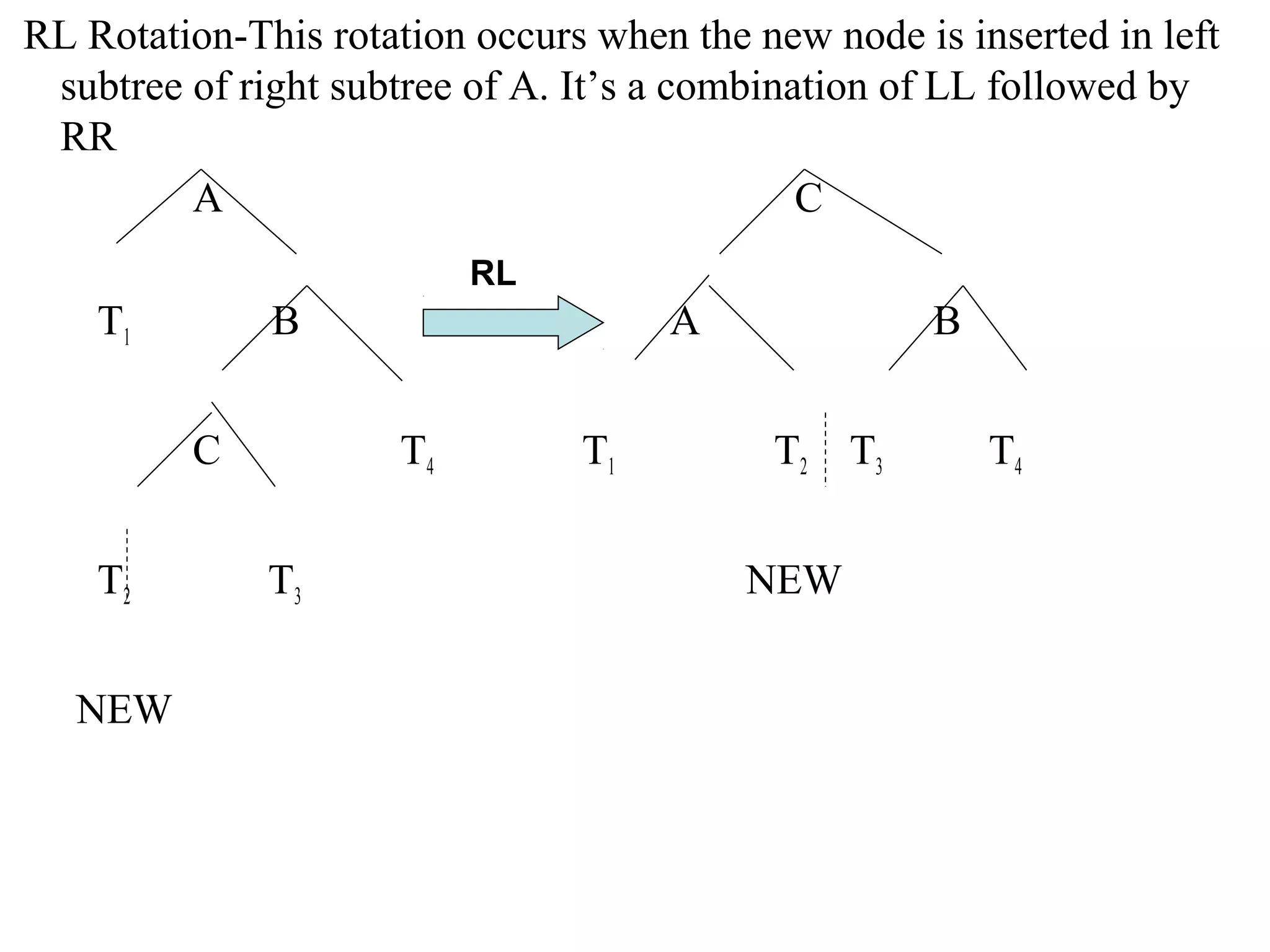
RL Rotation-This rotation occurs when the new node is inserted in left 
subtree of right subtree of A. It’s a combination of LL followed by 
RR 
A C 
T1 B A B 
C T4 T1 T2 T3 T4 
T2 T3 NEW 
NEW 
RL
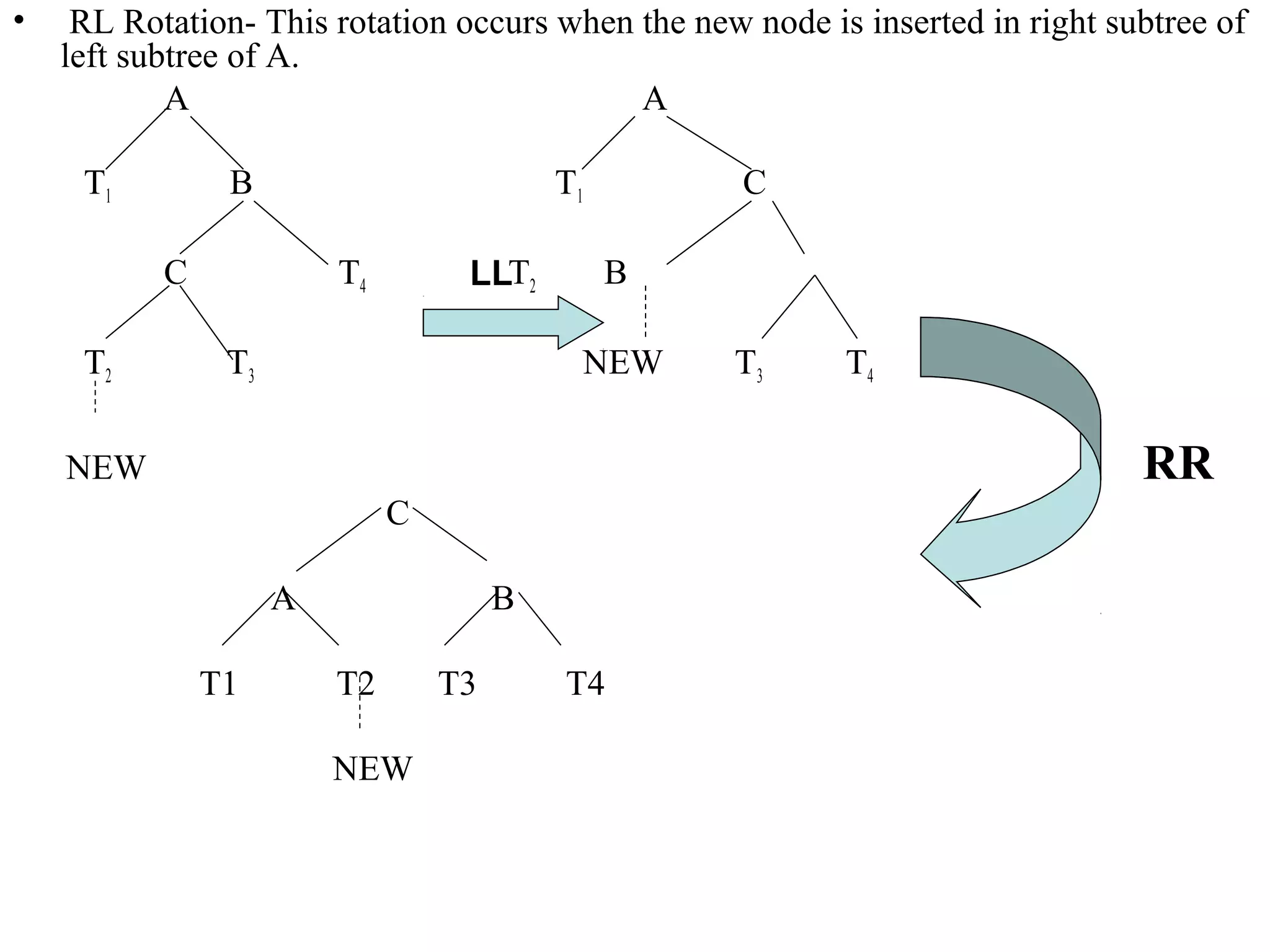
• RL Rotation- This rotation occurs when the new node is inserted in right subtree of 
left subtree of A. 
A A 
T1 B T1 C 
C T4 T2 B 
T2 T3 NEW T3 T4 
NEW RR 
C 
A B 
T1 T2 T3 T4 
NEW 
LL
Avl tree

Avl tree

  • 1.
  • 2.
    • The efficiencyof many important operations on trees is related to the height of the tree –for example searching, insertion and deletion in a BST are all O(height). In general, the relation between the height of the tree and the number of nodes of the tree is O (log2n) except in the case of right skewed or left skewed BST in which height is O(n). The right skewed or left skewed BST is one in which the elements in the tree are either on the left or right side of the root node. A A B B C C D D E E Right-skewed Left-skewed
  • 3.
    • For efficiencysake, we would like to guarantee that h remains O(log2n). One way to do this is to force our trees to be height-balanced. • Method to check whether a tree is height balanced or not is as follows: – Start at the leaves and work towards the root of the tree. – Check the height of the subtrees(left and right) of the node. – A tree is said to be height balanced if the difference of heights of its left and right subtrees of each node is equal to 0, 1 or -1 • Example: • Check whether the shown tree is balanced or not
  • 4.
    A B C D Sol: Starting from the leaf nodes D and C, the height of left and right subtrees of C and D are each 0. Thus their difference is also 0 • Check the height of subtrees of B Height of left subtree of B is 1 and height of right subtree of B is 0. Thus the difference of two is 1 Thus B is not perfectly balanced but the tree is still considered to be height balanced. • Check the height of subtrees of A Height of left subtree of A is 2 while the height of its right subtree is 1. The difference of two heights still lies within 1. • Thus for all nodes the tree is a balanced binary tree.
  • 5.
    • Check whetherthe shown tree is balanced or not A B F C D E Ans No as node B is not balanced as difference of heights of left and right subtrees is 3-0 i.e more than 1.
  • 6.
    Height-balanced Binary tree(AVL Tree) The disadvantage of a skewed binary search tree is that the worst case time complexity of a search is O(n). In order to overcome this disadvantage, it is necessray to maintain the binary search tree to be of balanced height. Two Russian mathematicians , G.M. Adel and E.M. Landis gave a technique to balance the height of a binary tree and the resulting tree is called AVL tree. Definition: An empty binary tree is an AVL tree. A non empty binary tree T is an AVL tree iff given TL and TR to be the left and right subtrees of T and h(TL) and h(TR) be the heights of subtrees TL and TR respectively, TL and TR are AVL trees and |h(TL)-h(TR)| ≤ 1. |h(TL)-h(TR)| is also called the balance factor (BF) and for an AVL tree the balance factor of a node can be either -1, 0 or 1 An AVL search tree is a binary search tree which is an AVL tree.
  • 7.
    • A nodein a binary tree that does not contain the BF of 0, 1 or -1, it is said to be unbalanced. If one inserts a new node into a balanced binary tree at the leaf, then the possible changes in the status of the node are as follows: • The node was either left or right heavy and has now become balanced. A node is said to be left heavy if number of nodes in its left subtree are one more than the number of nodes in its right subtree.. In other words, the difference in heights is 1. Similar is the case with right heavy node where number of nodes in right subtree are one more than the number of nodes in left subtree • The node was balanced and has now become left or right heavy • The node was heavy and the new node has been inserted in the heavy subtree, thus creating an unbalanced subtree. Such a node is called a critical node.
  • 8.
    Rotations- Inserting anelement in an AVL search tree in its first phase is similar to that of the one used in a binary search tree. However, if after insertion of the element, the balance factor of any node in a binary search tree is affected so as to render the binary search tree unbalanced, we resort to techniques called Rotations to restore the balance of the search tree. • To perform rotations, it is necessary to identify the specific node A whose BF (balance factor) is neither 0,1 or -1 and which is nearest ancestor to the inserted node on the path from inserted node to the root. • The rebalancing rotations are classified as LL, LR, RR and RL based on the position of the inserted node with reference to A LL rotation: Inserted node in the left subtree of the left subtree of A RR rotation: Inserted node in the right subtree of the right subtree of A LR rotation: Inserted node in the right subtree of the left subtree of A RL rotation: Inserted node in the left subtree of the right subtree of A
  • 9.
    • LL Rotation-This rotation is done when the element is inserted in the left subtree of the left subtree of A. To rebalance the tree, it is rotated so as to allow B to be the root with BL and A to be its left subtree and right child and BR and AR to be the left and right subtrees of A. The rotation results in a balanced tree.
  • 11.
    • RR Rotation-Thisrotation is applied if the new element is inserted right subtree of right subtree of A. The rebalancing rotation pushes B upto the root with A as its left child and BR as its right subtree and AL and BL as the left and right subtrees of A
  • 13.
    LR and RLrotations- The balancing methodology of LR and RL rotations are similar in nature but are mirror images of one another. Amongst the rotations, LL and RR rotations are called as single rotations and LR and RL are known as double rotations since LR is accomplished by RR followed by LL rotation and RL can be accomplished by LL followed by RR rotation. LR rotation is applied when the new element is inserted in right subtree of the left subtree of A. RL rotation is applied when the new element is inserted in the left subtree of right subtree of A
  • 14.
    LR Rotation- thisrotation is a combination of RR rotation followed by LL rotation. A A C B AR C AR B A RR LL BL C B CR BL CL CR AR CL CR BL CL x x x
  • 15.
    RL Rotation-This rotationoccurs when the new node is inserted in left subtree of right subtree of A. It’s a combination of LL followed by RR A C T1 B A B C T4 T1 T2 T3 T4 T2 T3 NEW NEW RL
  • 16.
    • RL Rotation-This rotation occurs when the new node is inserted in right subtree of left subtree of A. A A T1 B T1 C C T4 T2 B T2 T3 NEW T3 T4 NEW RR C A B T1 T2 T3 T4 NEW LL