Ramp
operation
safety
RAMP SAFETY
2
× Ramp safety is a significant safety concern in the aviation industry. The
airport's ramp area involves a vast number of activities and movements
from aircraft, vehicles, equipment and people. More so, it
accommodates personnel and contractors from different organizations
such as airport operations and maintenance staff, airport police and
fire, airport and airline engineers, planners, regulatory and security
personnel, as well as ground handlers, caterers, and fuelers - all
performing different activities and tasks every day. Owing to the level of
aircraft activity, the complexity of work tasks, and the equipment used
in servicing aircraft, ramp operations and workers can face a variety of
safety concerns and hazards.
Encouraging the Reporting of Safety
Information
There is growing realization in
the aviation industry that
encouraging prompt reporting
of safety issues actually reduces
the number of accidents and
incidents. An environment of
“open reporting” is a key
element in fostering a “just
culture” for the systematic
reporting, collection, analysis
and dissemination of safety
information that will be used
solely to prevent accidents.
3
4
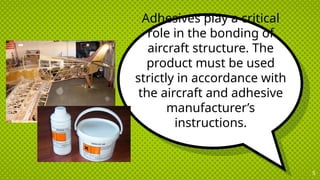
Adhesives play a critical
role in the bonding of
aircraft structure. The
product must be used
strictly in accordance with
the aircraft and adhesive
manufacturer’s
instructions.
5
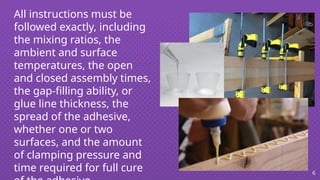
All instructions must be
followed exactly, including
the mixing ratios, the
ambient and surface
temperatures, the open
and closed assembly times,
the gap-filling ability, or
glue line thickness, the
spread of the adhesive,
whether one or two
surfaces, and the amount
of clamping pressure and
time required for full cure 6
“Adhesives meeting the requirements of a
MIL-SPEC, Aerospace Material Specification
(AMS), or Technical Standard Order (TSO) for
wooden aircraft structures are satisfactory,
provided they are found to be compatible
with existing structural materials in the
aircraft and fabrication methods to be used
in the repair.”
7
Casein Glue
8
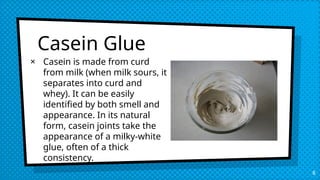
× Casein is made from curd
from milk (when milk sours, it
separates into curd and
whey). It can be easily
identified by both smell and
appearance. In its natural
form, casein joints take the
appearance of a milky-white
glue, often of a thick
consistency.
Casein Glue
9
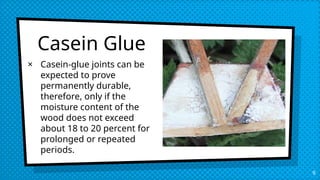
× Casein-glue joints can be
expected to prove
permanently durable,
therefore, only if the
moisture content of the
wood does not exceed
about 18 to 20 percent for
prolonged or repeated
periods.
Casein Glue
10
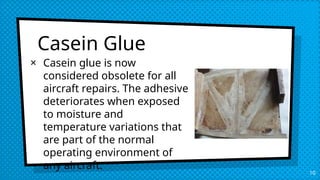
× Casein glue is now
considered obsolete for all
aircraft repairs. The adhesive
deteriorates when exposed
to moisture and
temperature variations that
are part of the normal
operating environment of
any aircraft.
Casein Glue
11
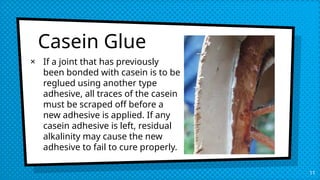
× If a joint that has previously
been bonded with casein is to be
reglued using another type
adhesive, all traces of the casein
must be scraped off before a
new adhesive is applied. If any
casein adhesive is left, residual
alkalinity may cause the new
adhesive to fail to cure properly.
Casein Glue
12
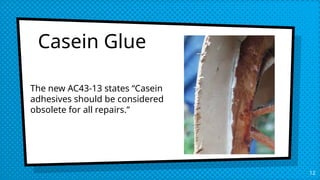
The new AC43-13 states “Casein
adhesives should be considered
obsolete for all repairs.”
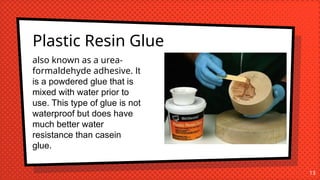
Plastic Resin Glue
13
also known as a urea-
formaldehyde adhesive. It
is a powdered glue that is
mixed with water prior to
use. This type of glue is not
waterproof but does have
much better water
resistance than casein
glue.
Plastic Resin Glue
14
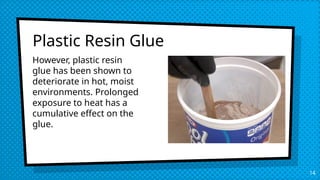
However, plastic resin
glue has been shown to
deteriorate in hot, moist
environments. Prolonged
exposure to heat has a
cumulative effect on the
glue.
Plastic Resin Glue
15
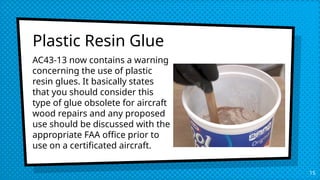
AC43-13 now contains a warning
concerning the use of plastic
resin glues. It basically states
that you should consider this
type of glue obsolete for aircraft
wood repairs and any proposed
use should be discussed with the
appropriate FAA office prior to
use on a certificated aircraft.
16
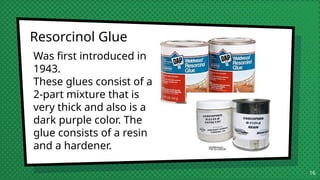
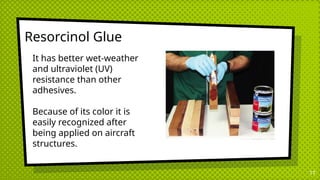
Resorcinol Glue
Was first introduced in
1943.
These glues consist of a
2-part mixture that is
very thick and also is a
dark purple color. The
glue consists of a resin
and a hardener.
Resorcinol Glue
17
It has better wet-weather
and ultraviolet (UV)
resistance than other
adhesives.
Because of its color it is
easily recognized after
being applied on aircraft
structures.
Epoxy Adhesive
18
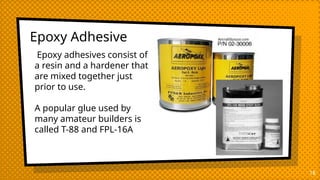
Epoxy adhesives consist of
a resin and a hardener that
are mixed together just
prior to use.
A popular glue used by
many amateur builders is
called T-88 and FPL-16A
Epoxy Adhesive
19
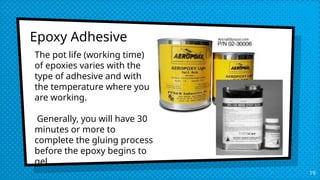
The pot life (working time)
of epoxies varies with the
type of adhesive and with
the temperature where you
are working.
Generally, you will have 30
minutes or more to
complete the gluing process
before the epoxy begins to
gel.
Epoxy Adhesive
20
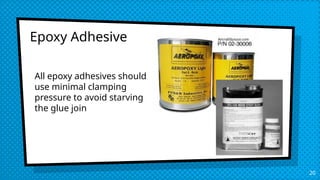
All epoxy adhesives should
use minimal clamping
pressure to avoid starving
the glue join
Process
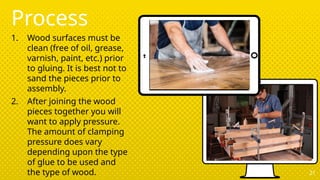
1. Wood surfaces must be
clean (free of oil, grease,
varnish, paint, etc.) prior
to gluing. It is best not to
sand the pieces prior to
assembly.
2. After joining the wood
pieces together you will
want to apply pressure.
The amount of clamping
pressure does vary
depending upon the type
of glue to be used and
the type of wood. 21
Definition of Terms Used in the Glue
Process
× Close contact adhesive—a non-gap-filling
adhesive (e.g., resorcinol-formaldehyde
glue) suitable for use only in those joints
where the surfaces to be joined can be
brought into close contact by means of
adequate pressure, to allow a glue line of
no more than 0.005- inch gap.
22
Definition of Terms Used in the Glue
Process
× Gap-filling adhesive—an adhesive suitable
for use in those joints in which the surfaces
to be joined may not be close or in
continuous contact (e.g., epoxy adhesives)
due either to the impracticability of
applying adequate pressure or to the slight
inaccuracies of fabricating the joint.
23
24
Definition of Terms Used in the Glue
Process
× Glue line—resultant layer of adhesive
joining any two adjacent wood layers in the
assembly.
× Single spread—spread of adhesive to one
surface only.
× Double spread—spread of adhesive to both
surfaces and equally divided between the
two surfaces to be joined.
25
Definition of Terms Used in the Glue
Process
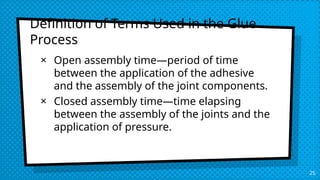
× Open assembly time—period of time
between the application of the adhesive
and the assembly of the joint components.
× Closed assembly time—time elapsing
between the assembly of the joints and the
application of pressure.
Definition of terms used in the
glue process
26
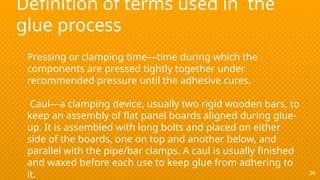
Pressing or clamping time—time during which the
components are pressed tightly together under
recommended pressure until the adhesive cures.
Caul—a clamping device, usually two rigid wooden bars, to
keep an assembly of flat panel boards aligned during glue-
up. It is assembled with long bolts and placed on either
side of the boards, one on top and another below, and
parallel with the pipe/bar clamps. A caul is usually finished
and waxed before each use to keep glue from adhering to
it.

AVIATION RAMP OPERATIONS SAFETY TRAINING.pptx

  • 1.
  • 2.
    RAMP SAFETY 2 × Rampsafety is a significant safety concern in the aviation industry. The airport's ramp area involves a vast number of activities and movements from aircraft, vehicles, equipment and people. More so, it accommodates personnel and contractors from different organizations such as airport operations and maintenance staff, airport police and fire, airport and airline engineers, planners, regulatory and security personnel, as well as ground handlers, caterers, and fuelers - all performing different activities and tasks every day. Owing to the level of aircraft activity, the complexity of work tasks, and the equipment used in servicing aircraft, ramp operations and workers can face a variety of safety concerns and hazards.
  • 3.
    Encouraging the Reportingof Safety Information There is growing realization in the aviation industry that encouraging prompt reporting of safety issues actually reduces the number of accidents and incidents. An environment of “open reporting” is a key element in fostering a “just culture” for the systematic reporting, collection, analysis and dissemination of safety information that will be used solely to prevent accidents. 3
  • 4.
  • 5.
    Adhesives play acritical role in the bonding of aircraft structure. The product must be used strictly in accordance with the aircraft and adhesive manufacturer’s instructions. 5
  • 6.
    All instructions mustbe followed exactly, including the mixing ratios, the ambient and surface temperatures, the open and closed assembly times, the gap-filling ability, or glue line thickness, the spread of the adhesive, whether one or two surfaces, and the amount of clamping pressure and time required for full cure 6
  • 7.
    “Adhesives meeting therequirements of a MIL-SPEC, Aerospace Material Specification (AMS), or Technical Standard Order (TSO) for wooden aircraft structures are satisfactory, provided they are found to be compatible with existing structural materials in the aircraft and fabrication methods to be used in the repair.” 7
  • 8.
    Casein Glue 8 × Caseinis made from curd from milk (when milk sours, it separates into curd and whey). It can be easily identified by both smell and appearance. In its natural form, casein joints take the appearance of a milky-white glue, often of a thick consistency.
  • 9.
    Casein Glue 9 × Casein-gluejoints can be expected to prove permanently durable, therefore, only if the moisture content of the wood does not exceed about 18 to 20 percent for prolonged or repeated periods.
  • 10.
    Casein Glue 10 × Caseinglue is now considered obsolete for all aircraft repairs. The adhesive deteriorates when exposed to moisture and temperature variations that are part of the normal operating environment of any aircraft.
  • 11.
    Casein Glue 11 × Ifa joint that has previously been bonded with casein is to be reglued using another type adhesive, all traces of the casein must be scraped off before a new adhesive is applied. If any casein adhesive is left, residual alkalinity may cause the new adhesive to fail to cure properly.
  • 12.
    Casein Glue 12 The newAC43-13 states “Casein adhesives should be considered obsolete for all repairs.”
  • 13.
    Plastic Resin Glue 13 alsoknown as a urea- formaldehyde adhesive. It is a powdered glue that is mixed with water prior to use. This type of glue is not waterproof but does have much better water resistance than casein glue.
  • 14.
    Plastic Resin Glue 14 However,plastic resin glue has been shown to deteriorate in hot, moist environments. Prolonged exposure to heat has a cumulative effect on the glue.
  • 15.
    Plastic Resin Glue 15 AC43-13now contains a warning concerning the use of plastic resin glues. It basically states that you should consider this type of glue obsolete for aircraft wood repairs and any proposed use should be discussed with the appropriate FAA office prior to use on a certificated aircraft.
  • 16.
    16 Resorcinol Glue Was firstintroduced in 1943. These glues consist of a 2-part mixture that is very thick and also is a dark purple color. The glue consists of a resin and a hardener.
  • 17.
    Resorcinol Glue 17 It hasbetter wet-weather and ultraviolet (UV) resistance than other adhesives. Because of its color it is easily recognized after being applied on aircraft structures.
  • 18.
    Epoxy Adhesive 18 Epoxy adhesivesconsist of a resin and a hardener that are mixed together just prior to use. A popular glue used by many amateur builders is called T-88 and FPL-16A
  • 19.
    Epoxy Adhesive 19 The potlife (working time) of epoxies varies with the type of adhesive and with the temperature where you are working. Generally, you will have 30 minutes or more to complete the gluing process before the epoxy begins to gel.
  • 20.
    Epoxy Adhesive 20 All epoxyadhesives should use minimal clamping pressure to avoid starving the glue join
  • 21.
    Process 1. Wood surfacesmust be clean (free of oil, grease, varnish, paint, etc.) prior to gluing. It is best not to sand the pieces prior to assembly. 2. After joining the wood pieces together you will want to apply pressure. The amount of clamping pressure does vary depending upon the type of glue to be used and the type of wood. 21
  • 22.
    Definition of TermsUsed in the Glue Process × Close contact adhesive—a non-gap-filling adhesive (e.g., resorcinol-formaldehyde glue) suitable for use only in those joints where the surfaces to be joined can be brought into close contact by means of adequate pressure, to allow a glue line of no more than 0.005- inch gap. 22
  • 23.
    Definition of TermsUsed in the Glue Process × Gap-filling adhesive—an adhesive suitable for use in those joints in which the surfaces to be joined may not be close or in continuous contact (e.g., epoxy adhesives) due either to the impracticability of applying adequate pressure or to the slight inaccuracies of fabricating the joint. 23
  • 24.
    24 Definition of TermsUsed in the Glue Process × Glue line—resultant layer of adhesive joining any two adjacent wood layers in the assembly. × Single spread—spread of adhesive to one surface only. × Double spread—spread of adhesive to both surfaces and equally divided between the two surfaces to be joined.
  • 25.
    25 Definition of TermsUsed in the Glue Process × Open assembly time—period of time between the application of the adhesive and the assembly of the joint components. × Closed assembly time—time elapsing between the assembly of the joints and the application of pressure.
  • 26.
    Definition of termsused in the glue process 26 Pressing or clamping time—time during which the components are pressed tightly together under recommended pressure until the adhesive cures. Caul—a clamping device, usually two rigid wooden bars, to keep an assembly of flat panel boards aligned during glue- up. It is assembled with long bolts and placed on either side of the boards, one on top and another below, and parallel with the pipe/bar clamps. A caul is usually finished and waxed before each use to keep glue from adhering to it.