1
Gender, politeness andstereotypes
Interruptions
Feedback
Explanations
Gossip
The linguistic construction of gender
2.
2
Interruptions
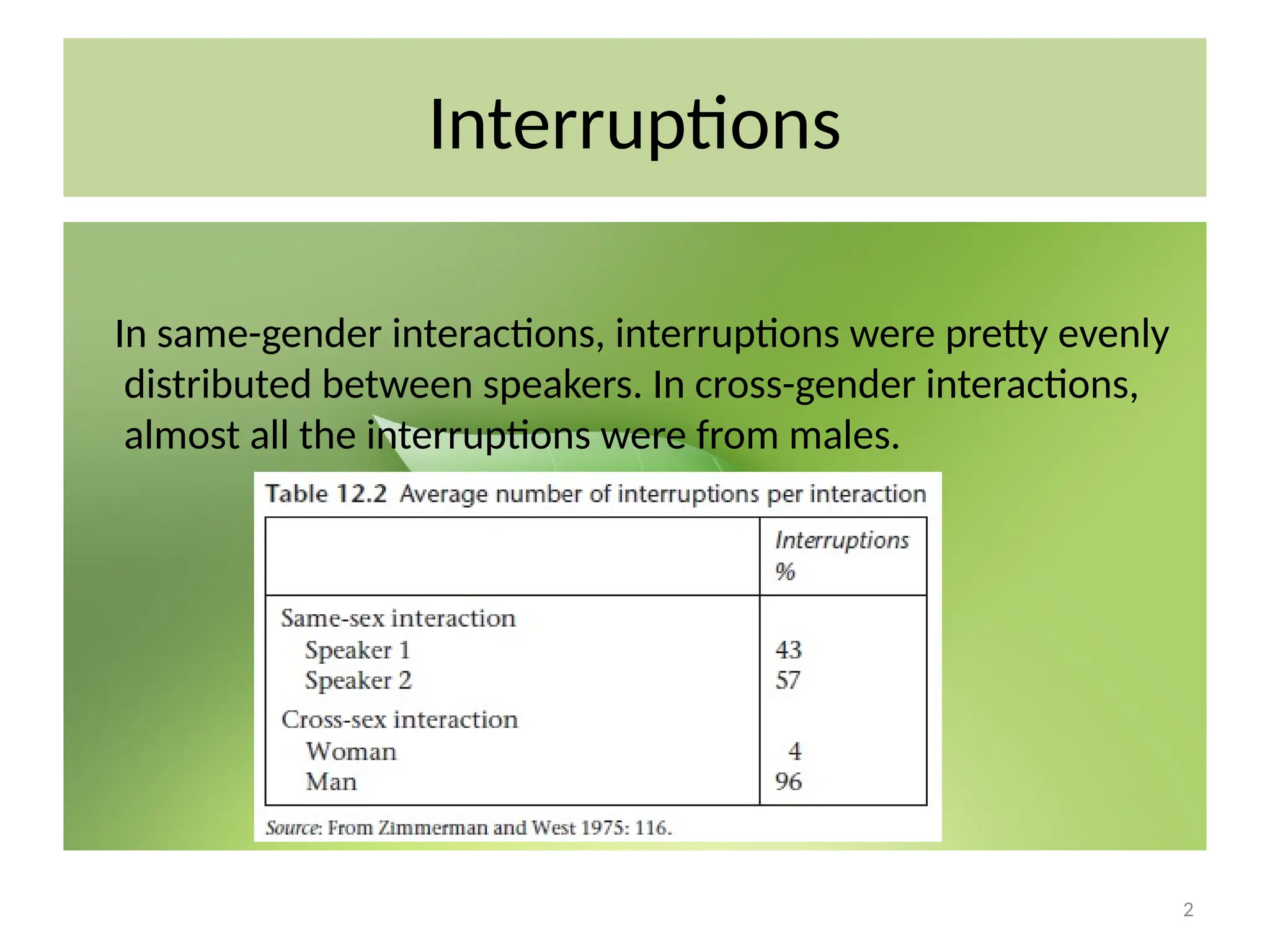
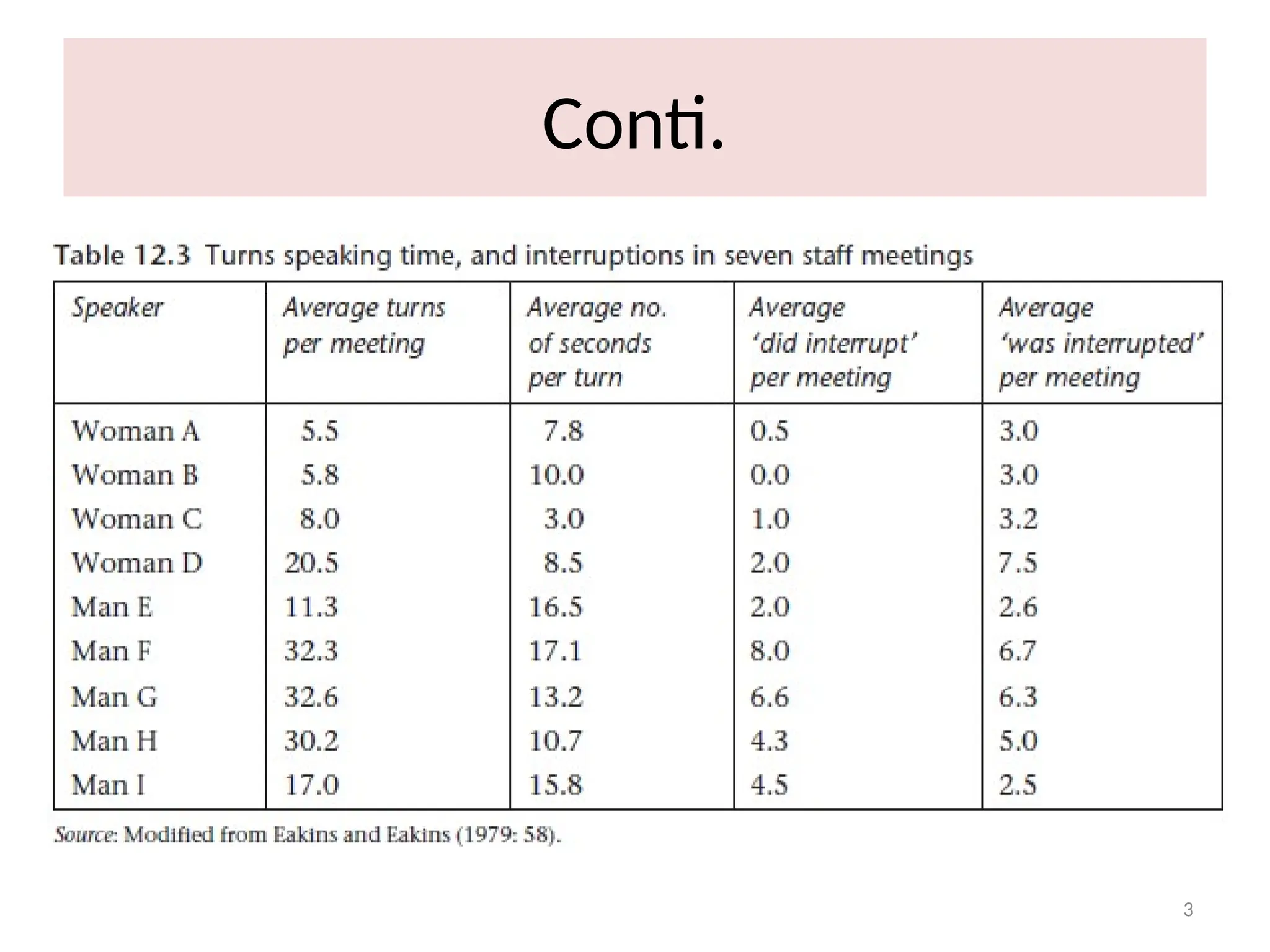
In same-gender interactions,interruptions were pretty evenly
distributed between speakers. In cross-gender interactions,
almost all the interruptions were from males.
4
Feedback
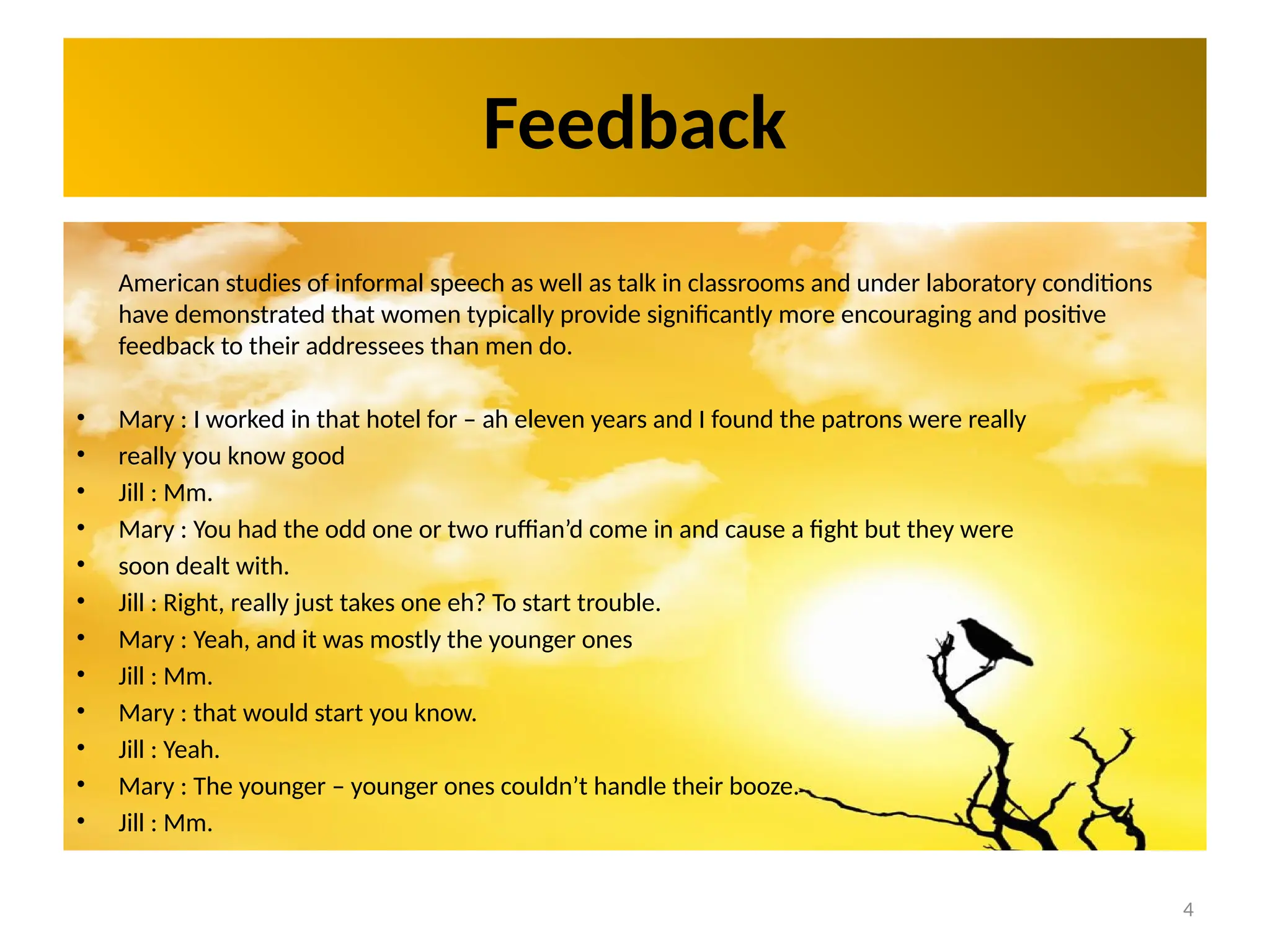
American studies ofinformal speech as well as talk in classrooms and under laboratory conditions
have demonstrated that women typically provide significantly more encouraging and positive
feedback to their addressees than men do.
• Mary : I worked in that hotel for – ah eleven years and I found the patrons were really
• really you know good
• Jill : Mm.
• Mary : You had the odd one or two ruffian’d come in and cause a fight but they were
• soon dealt with.
• Jill : Right, really just takes one eh? To start trouble.
• Mary : Yeah, and it was mostly the younger ones
• Jill : Mm.
• Mary : that would start you know.
• Jill : Yeah.
• Mary : The younger – younger ones couldn’t handle their booze.
• Jill : Mm.
5.
5
Conti.
• In general,then, research on conversational
interaction reveals women as cooperative
conversationalists, whereas men tend to be more
competitive and less supportive of others.
• Why are women’s patterns of interaction different
from men’s? Is it because they are subordinate in
status to men in most communities so that they
must strive to please? Or
are there other explanations?
6.
6
Explanations
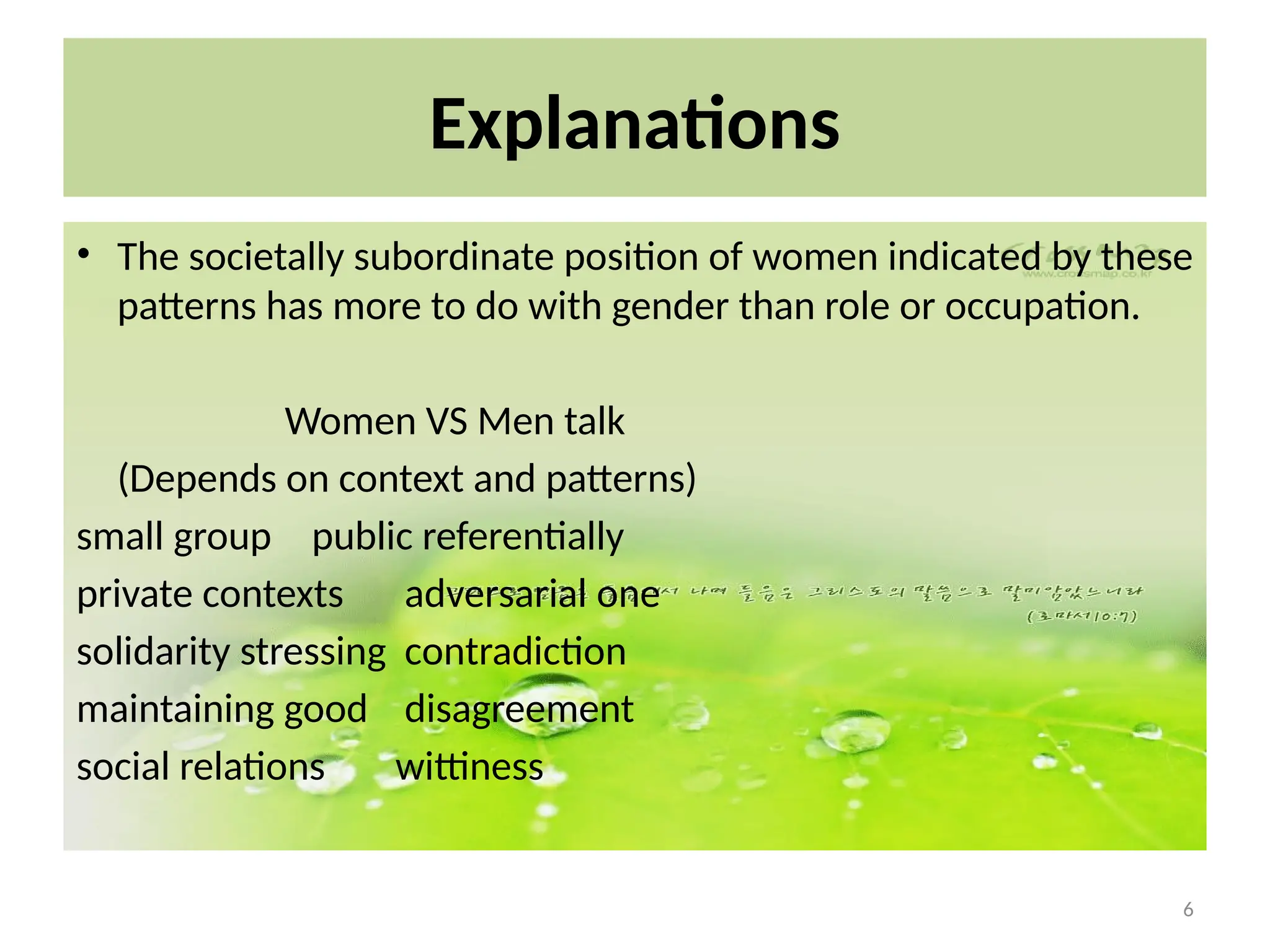
• The societallysubordinate position of women indicated by these
patterns has more to do with gender than role or occupation.
Women VS Men talk
(Depends on context and patterns)
small group public referentially
private contexts adversarial one
solidarity stressing contradiction
maintaining good disagreement
social relations wittiness
7.
7
Gossip
• Gossip describesthe kind of relaxed in-group talk
that goes on between people in informal contexts.
Women’s gossip
• personal experiences and personal relationships, on
personal problems and feelings
• It may include criticism of the behaviour of others,
• but women tend to avoid criticising people directly
because this would cause discomfort
8.
8
Women gossips
• Womenprovide a sympathetic response
• Focusing on the affective message
• Facilitative tags are frequent,
• Encouraging others to comment and
contribute.
• Women complete each other’s utterances,
agree frequently and provide supportive
feedback.
9.
9
Men gossips
• Themale equivalent of women’s gossip is difficult to
identify.
• focus on things and activities
• Topics like sport, cars and possessions turn up
regularly. The focus is on information and facts
rather than on feelings and reactions
• Men provided conflicting accounts of the same event
• Contrasted completely with the cooperative,
agreeing, supportive,
10.
10
Men gossips
• Itseems possible that for men mock-insults
and abuse serve the same function –
expressing solidarity and maintaining social
relationships – as compliments and agreeing
comments do for women.
11.
11
The linguistic constructionof gender
• Ed : “he’s I mean he’s like a real artsy fartsy fag he’s like
[ indecipherable ]
He’s so gay he’s got this like really high voice and wire rim
glasses”
• In example 19 , Ed criticises a man who fails to fit the
established masculine norms, but,
ironically, Ed’s criticism
uses features associated with, or ‘indexing’, a more
feminine speech style, such as frequent use of the particle
like , hedges, such as I mean , and intensifiers, such as
real , so and really .
12.
12
Overlapping man andwoman identities
• Often obvious but sometimes challengeable.
• Overlapping man and woman identities
• Occupation:
Women working in police
Men working as designer
and hairdresser.
• Every phonological, lexical and syntactic
selection conveys social information.
![11
The linguistic construction of gender
• Ed : “he’s I mean he’s like a real artsy fartsy fag he’s like
[ indecipherable ]
He’s so gay he’s got this like really high voice and wire rim
glasses”
• In example 19 , Ed criticises a man who fails to fit the
established masculine norms, but,
ironically, Ed’s criticism
uses features associated with, or ‘indexing’, a more
feminine speech style, such as frequent use of the particle
like , hedges, such as I mean , and intensifiers, such as
real , so and really .](https://image.slidesharecdn.com/auxiliariesandmodals1-251103134550-bdd37ce7/75/Auxiliaries_and_Modals-about-english-language-11-2048.jpg)




![Language & Gender presentation [Shoaib_020].pptx](https://cdn.slidesharecdn.com/ss_thumbnails/languagegendershoaib020-240318170347-13e150a7-thumbnail.jpg?width=640&height=640&fit=bounds)


