DRUGS
ACTING ON
AUTONOMIC NERVOUS SYSTEM
Dr. Sakhile Ndlalane
Levy Mwanawasa Teaching Hospital
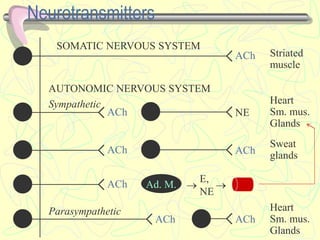
Neurotransmitters
ACh ACh
Sweat
glands
Striated
muscle
ACh
SOMATIC NERVOUS SYSTEM
Heart
Sm. mus.
Glands
ACh ACh
Parasympathetic
ACh
E,
NE
Ad. M.  
Heart
Sm. mus.
Glands
ACh NE
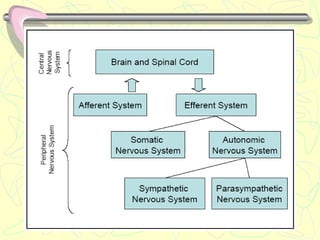
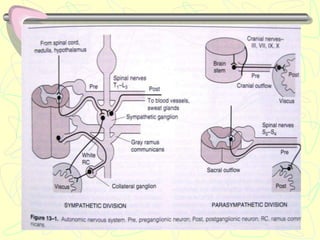
AUTONOMIC NERVOUS SYSTEM
Sympathetic
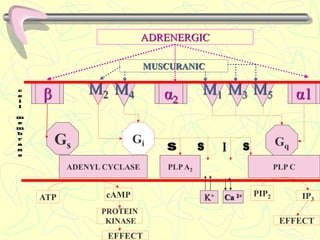
β M2 M4 M1 M3 M5
α2 α1
Gs Gq
Gi
ADENYL CYCLASE PLP C
PLPA2
K+ Ca 2+
ATP cAMP
PROTEIN
KINASE
PIP2 IP3
EFFECT
EFFECT
ADRENERGIC
MUSCURANIC
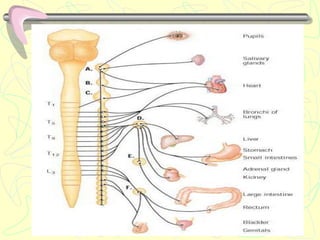
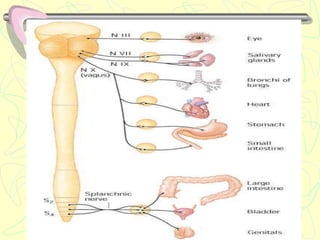
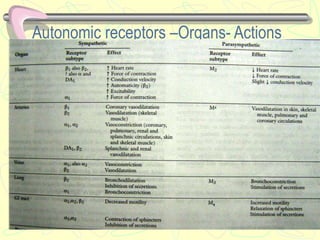
Autonomic receptors –Organs- Actions
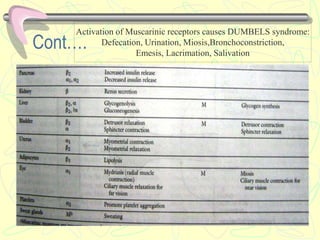
Cont….
Activation of Muscarinic receptors causes DUMBELS syndrome:
Defecation, Urination, Miosis,Bronchoconstriction,
Emesis, Lacrimation, Salivation
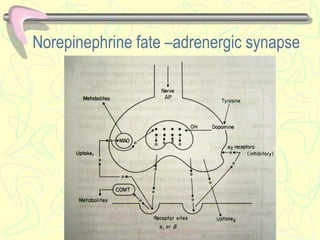
Norepinephrine fate –adrenergic synapse
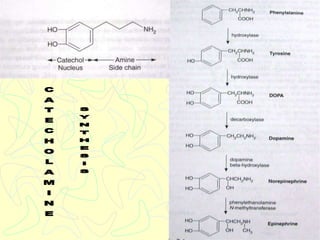
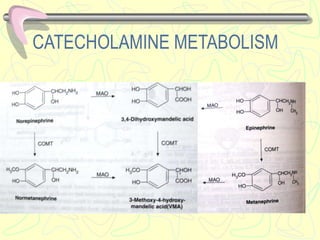
CATECHOLAMINE METABOLISM
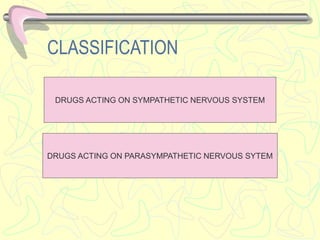
CLASSIFICATION
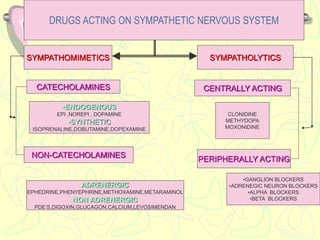
DRUGS ACTING ON SYMPATHETIC NERVOUS SYSTEM
DRUGS ACTING ON PARASYMPATHETIC NERVOUS SYTEM
SYMPATHOMIMETICS SYMPATHOLYTICS
CATECHOLAMINES
NON-CATECHOLAMINES
CENTRALLY ACTING
PERIPHERALLY ACTING
CLONIDINE
METHYDOPA
MOXONIDINE
•ENDOGENOUS
EPI ,NOREPI , DOPAMINE
•SYNTHETIC
ISOPRENALINE,DOBUTAMINE,DOPEXAMINE
ADRENERGIC
EPHEDRINE,PHENYEPHRINE,METHOXAMINE,METARAMINOL
NON ADRENERGIC
PDE’S,DIGOXIN,GLUCAGON,CALCIUM,LEVOSIMENDAN
DRUGS ACTING ON SYMPATHETIC NERVOUS SYSTEM
•GANGLION BLOCKERS
•ADRENEGIC NEURON BLOCKERS
•ALPHA BLOCKERS
•BETA BLOCKERS
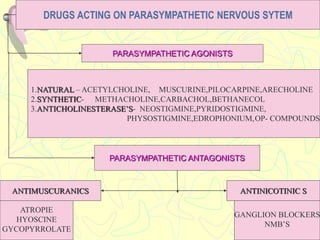
DRUGS ACTING ON PARASYMPATHETIC NERVOUS SYTEM
PARASYMPATHETIC ANTAGONISTS
PARASYMPATHETIC AGONISTS
1.NATURAL – ACETYLCHOLINE, MUSCURINE,PILOCARPINE,ARECHOLINE
2.SYNTHETIC- METHACHOLINE,CARBACHOL,BETHANECOL
3.ANTICHOLINESTERASE’S- NEOSTIGMINE,PYRIDOSTIGMINE,
PHYSOSTIGMINE,EDROPHONIUM,OP- COMPOUNDS
ATROPIE
HYOSCINE
GYCOPYRROLATE
GANGLION BLOCKERS
NMB’S
ANTIMUSCURANICS ANTINICOTINIC S
SYMPATHOMIMETICS
• DIRECT( mimic effects of epinephrine at adrenergic receptors)
– Catechols,phenyleprine,methoxamine
• INDIRECT(causes release of endogenous norepinephrine from
post ganglionic symp. nerve terminals )
– Amphetamines,TCA’s
• BOTH
– Ephedrine,metraminol,dopamine
• INOCONSTRCITORS
– Norepinephrine,epinephrine,ephedrine
• INODILATORS
– Dobutamine,dopexamine, isoproterenol, PDE inhib’s
EPINEPHRINE
• 80-90% of adrenal medullary catecholamines is epinephrine
• Powerful agonist at α and β receptors
• More powerful than norepinephrine at α and isoproterenol at β
receptors
• DOC- acute anaphylaxis
– 0.5 -1 mg IM or 1:1000 0.5 – 1 ml
• Cardiac arrest(α effects)
– 1 mg repeated 3 times
• Bronchospasm
• Shock ( sepsis) dose: 0.01 – 0.2 µg/kg/min)
– Low dose – β2 effects prominent ,vosodilatation, decresed SVR,
decreased Diastolic B.P , mean pressure remains same
– High dose- α effects prominent- vosoconstriction at skin,kidneys
decreased renal blood flow but coronary blood flow preserved
• Topical vosoconstrictor
– Used with L.A drugs
Side effect
Tachyarrythmias
NOREPINEPHRINE
• Potent arteriolar and venoconstrictor
• Acts exclusively at α receptors
• Increased systolic,diastolic,pulmonary, central venous
pressure
• Heart rate normal or decreased – baroreflex activity
• Septic shock- 0.01 – 0.1 µg/kg/min
• High dose – renal blood flow decreased,GFR
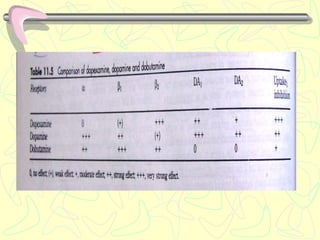
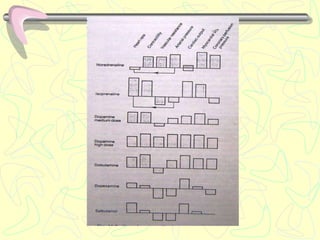
Dopamine
• Natural precursor of epi and norepinephrine
• Dose dependenet actions
• Low dose(< 3 µg/kg/min)
– DA1 agonist action,↑ renal & splanchnic blood flow, ↑GFR & ↑sodium
excretion( diuretic action)
• Medium dose( 5-10 µg/kg/min)
– DA1 agonist & β1 agonist action, ↑cardiac output & ↑renal blood flow – so
DOC in cardiogenic ,traumatic and septic shock
– Advantages limited by tachycardia.
• High dose( > 15 µg/kg/min)
– α1 agonist actions predominate, direct vasosconstricion and ↑cardiac
output ( like norepinephrine), ↓renal & splanchnic blood flow
• Central dopamine receptors – Basal ganglia ,CTZ – mediate
pituitary prolaction secretion and nausea & vomiting
• ↓CNS dopamine – parkinsons disease
• Dopamine antagonists – phenothiazines , butryphenones-
antipsychotics and antiemetics- extrapyramidal side effects.
Isoprenaline ( isoproterenol)
• β1 agonist & β2 agonist ,virtually no action on α
receptors
• ↑Heart rate ↓ peripheral resistance & ↑cardiac output
• Relaxation of bronchial smooth muscle & mast cell
stabilisation
• Dose – 0.5 to 10 µg/min
• Most important current indication
– Bradyarrthymias or AV block with low C.O ( post MI)
– Stokes adams attacks
Dobutamine
• Primarily a β1 agonist .( mod β2 & α agonist)
• NO activity at DA1 receptors.
• ↑cardiac output(β1 ) . Heart rate also increases(β2)
• Dose : 2.5 – 25 µg/kg/min.
• Myocardial O2 consumption less
• Low cardiac output states :
– dobutamine + dopamine or norepinephrine
dopexamine
• Agonist at β2 & DA1 receptors.
• Weak DA2 agonist & uptake 1 inhibitor.
• Produces vasodilatation in skeletal muscles.
• Mild ↑in cardiac output(β2 )
• Renal , mesentric,cerebral & corornary vasodilatation(β2 & DA1 )
• Natriuresis (DA1 )
• Dose : 0.5 – 6.0 µg/kg/min.
• Some anti-inflammatory effects.
Fenoldapam
• DA1 agonist –peripheral vasodilatation & ↑renal blood
flow & sodium ,water excretion.
• Hypertensive emergencies.
• No rebound hypertension ( unlike SNP)
Ibopamine
• oral dopamine(DA1 & DA2)
• Prodrug – converted to epinine after oral intake
• Cardiac failure
Ephedrine
• Direct action – agonist at α , β1 β2
• Indirect action- endogenous N.E release
• Also MAO inhibitor action
• Effects are similar to epinephrine but action is 10 times longer (
half life 3-6 hrs)
• Blood flow ↑coronary & skeletal muscle
↓renal & splanchnic
• Also bronchodilator
• Tachyphylaxis can occur .
• Used for post spinal hypotension , post GA hypotension
• Especially useful in OBS patients as UTERINE BLOOD FLOW
is maintained.
• Dose – IV. 3- 12 mg or 15-30 mg IM
• Phenylephrine
• Potent synthetic direct acting α1 agonist
• Effects similar to N.E
• IV boluses 20-50 µg or 20 -50 µg/min infusion
• Nasal decongestant & mydriatic
• Methoxamine
• Direct acting α1 agonist with weak β antagonist action
• Vasoconstriciton & bradycardia ( baroreflex & β blocker)
• Used in Post spinal & GA hypotension. 2-5 mg iv bolus
• Acs within 2 mins and lasts for 20 mins
• Metaraminol
• Both direct & indirect acting
• α effects predominate – vasoconstriciton,reflex bradycardia
• 1-5 mg iv bolus – aacts within 3 mins and lasts for 25 mins
Phosphodiesterase inhibitors
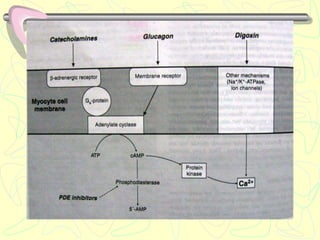
• ↑ cAMP
• ↑Ca2+ so positive inotropy & lusitropy (cardiac)
• ↓ Ca2+ - smooth muscle- vasodilatation
• Amrinone , Milrinone,(bipyridines) enoximone(imidazole)
• PDE III inhibitors-potent arteriolar & coronary vasodilators
• ↓preload,afterload,PVR,PCWP & ↑cardiac index
• Myocardial O2 consumption not increased
• Does not cause tachyphylaxis
• Most useful in CCF where downregulatio of β receptors occurs.
• Side effects: hypotension, tachyarrhythmia's ,thrombocytopenia
• Half life ↑ in CCF or renal failure ,so only one loading dose over 5 mins
is enough( 20 hrs)
• Enoximone- active sulfoxide metabolite
• Loading dose 0.5 mg/kg infusion 5 µg/kg/min
• GLUCAGON
• ↑adenylate cyclase and hence ↑c AMP in cardiac cells
by a mechanism independent of β receptors.
• Nausea, vomiting,hyperglycemia & hyperkalemia
• Used as inotrope in β-blocker poisoning.
• CALCIUM
• Ca2+ is involved in excitation –contraction coupling of
smooth muscle an contraction in cardiac muscle
• ↑extra cellular Ca2+ increases intracellular Ca2+
consequently the force of contraction of cardiac
myocytes
• Cardio Pulmonary Bypass – 5 mg/kg.
• Also indicated in hypocalcemia, hyperkalemia, calcium
channel blocker toxicity.
Levosimendan
• increases myocardial sensitivity to Ca -
enhances affinity of Troponin C for Ca2+
• suppresses vascular endothelin-1 release
• some PDE III inhibiton
• activates ATP sensitive K+ channels
• Inodilator”
• reduces SVR and PCR
• increase SV and CO
• non-cAMP dependent
Selective β2 agonists
• They relax bronchial ,uterine & vascular smooth
muscle with less effects on heart.
• Salbutamol,Trebutaline,Ritodrine,salmeterol( partial
agonists)
• Mostly used as bronchodilators
• High dose β2 mediated tremor, tachyarrhythmia's
,hypokalemia,hypergylcemia,hypomagnesemia may
occur
• Salbutamol : most commonly used bronchodilator.
• MDI , 1-2 puffs ,each 100µg.duration 3-5 hrs
• Nebulizer ,2.5mg given as 2.5ml of 0.1% sol.
• I.V dose 250µg slowly or infusion 5µg./min( 3-20
µg./min)
• Salmeterol: Highly lipophilic.longer acting BD dose
• Ritodrine : Tocolytic, can cause tachycardia(β1 ),
pulmonary oedema( renin↑)
• Selective β1 agonists – xamoterol (partial agonist)
• At high doses act as β blocker
• It has 45% of the intrinsic activity of isoproterenol
• Useful in moderate heart failure, severe heart failure act
as β blocker
Sypmpatholytic drugs
Clonidine:
• Central action:
• Partial α2 agonist - brainstem – NTS & RVLM -
↓ sympathetic tone
• Also partial agonist at central imidazoline receptors.( I1)
• Peripheral α2 agonist & I1 agonist (kidneys)
• Baroreceptor reflexes are preserved ,so effects of ephedrine
or phenylephrine may be exaggerated
• α2 :α1 > 200:1
.
• Used to avoid intubation response.
• Decrease MAC of inhalational agents( by 50%)
• Itrathecally used to provide analgesia- activating
descending spinal & supraspinal inhibitory pathways
• They modify local release of nociceptive
neurotransmitters – substance P & CGRP.
• Also use for perioperative shivering & opiate
withdrawal(Lofexidine).
• Side effects- dry mouth ,sedation,rebound
hypertension( locus coerulus)
Dexmedetomidine & Azepexole – more selective α2
agonists
• Methydopa
• Crosses BBB –converted to α methylnorepinephrine which is
a full agonist(α2 :α1 10:1)
• Used for PIH
• Perpipheral oedema,hepatotoxicity,hemolytic anemia
• Moxonidine
• selective I1 receptor agonist (I1> α2)
• Minimal α2 related side effects
• No effects on lipid & carbohydrate metabolism
• ↑ sodium excretion & urine flow.
• Benefecial in congestive cardiac failure
• Potentiaetes bradycardia
• Contraindicated in second or third degree heart block
Ganglion blockers
• Hexamethonium & Trimpetaphan
• They inhibit the effects of Ach at autonomic ganglia
and block both sym. & parasymp. Transmission
• Trimetaphan used in hypotensive technique.
Adrenergic nurone blocker
• Gaunethedine
• It has L.A properties
• Used in IVRA ( beirs block) to treat CRPS
α adrenergic antagonists
• Used maily as vosodilators in second line
treatment of hypertension
• Urinary tract smooth muscle relaxants
• BPH
• Pheochromocytoma
• Common side effects- postural hypotension &
reflex tachycardia
• α1 selective antagonists
• Prazocin,doxazocin,phenoxybenzamine & Urapidil
• Labetalol & carvedilol
• Tamsulosin- α1A antagonist - BPH
• Urapidil - α1 selective antagonist & agonist at central 5
HT1A receptor in RVLM.
• Arterio & venodilator with little effect on heart
rate(central 5 HT1A stimulation attenuates reflex
tachycardia)
• Pre-eclampsia, hypertensive crisis,perioperative
hypertension
• α2 selective antagonists – yohimbine
• Non selective α antagonists
• Phentolamine, tolazoline – pheochromocytoma
• More postural hypotension & reflex tachycardia
β blockers
• β blockers are competetive antagonists at β receptors.
• Most are stereo isomers with L-forms more active.
• Calssification
• I ) Relative affinity to β1 or β2 receptors
• First generatrion ( non selevtive)
– propranolol, timolol
• Second generation( selective β1blockers wihtout ancillary
effects )
– Atenolol,metoprolol.bisoprolol
• Third generation (β1selective & effects on other receptors)
– Labetolol,carvedilol, bucindilol
• II) Partial agonist activity ( ISA) :
– Dichloroisoprotrenol is the first β blocker isolated
and has similar structure to isoproterenol
– It has 50% agonist activity of isoproterenol.
– Stimulant effect is evident if the patient has low
sympathetic activity but antagonist at high
sympathetic activity
– May be advantageous in patients of
• Low resting heart rate
• PVD
• Hyperlipidemias
– Pindolol, acebutolol,oxeprenalol,sotalol,timolol.
• III) Membrane stabilizing effect :
– Along with β blocking they also block Na+ channels (
local anesthetic action)
– So reduce the phase 4 of action potential
– Hence decrease conduction in cardiac tissue
– It occurs only with high doses above therapeutic
range.
– Propranolol,acebutalol,labetalol
• IV) Ancillary effects :
– Vasodilators : Bucindolol ,Nebivolol
– Ant oxidants: carvedilol
– Ca2+ channel blockers : carvedilol
Pharmacokinetics
• Highly lipid soluble
– Proronolol,labetalol, exepranolol,metoprolol
– Well absorbed
– Significant first pass metabolism
– So reduced bioavailability,
– short terminal half life, highly protein bound
– But all the hydroxy metabolites are active ,so duration is long
enough
– Transfer via BBB and placenta( sedation ,sleep,fetal bradycardia)
• Water soluble
– Atenolol,celiprolol,nadolol,sotalol
– Less well absorbed but are not subject to first pass metabolism
– Eliminated unchnged by kidney ,long terminal half lifes
– Slightly protein bound
– Do not cross BBB or Placenta
Indications
• Hypertension :
– First line therapy
– ↓ heart rate, C.O, myocardial contractility
– ↓ central sympathetic activity
– ↓ renin secretion( non selective propranolol,timolol)
– ↑ peripheral vascular resistance( unopposed α stimulation)
• IHD
• Secondary prevention of M.I
• Obstructive cardiomyopathy
• Congestive cardiac failure
• Arrhythmias:
– SVT
– ↓ H.R in A.F & Flutter
– Sotolol( class II & II )
• Migraine prophylaxis
• Essential tremor
• Anxiety states
• Glaucoma( timolol,betoxolol,cartelol)
• Thyrotoxicosis
Adverse reactions
• Can precipitate heart failure
• Can cause AV block
• Excessive β blockade treatment
– β agonists – isoproterenol, dobutamine
– Calcium chloride
– Glucagon ( ↑cAMP by mechanism independent of β receptors
• Bronchospasm :
– Non selective more , β1 selective less
– Raynaud’s phenomenon & PVD
• Hypoglycemia unawareness ( Diabetes)
• Muscle fatigue
• Impotence
• Depression
• Occulomucocutaneous syndrome( proctolol)
Newer β blockers
• Labetolol
– α1β1β2 antagonist
– Partial agonist at β2 receptors
– 4 to 7 times more potent at β than α
– Oral & IV forms available – 5- 10 mg
– Perioperative hypertension,controlled hypertension ot
pheochromocytoma
• Carveidolol
– β : α is 10:1
– Antoxidant activity and Ca2+ channel blocker( high doses)
– Stereisomer ,extensive first passmetabolism, active metabolites
• Bucindolol :
– Produces vasodilatation by cGMP dependent mecahnism
• Nebivolol
– Lipophilic ,recemic mixture with NO mediated vasodilator properties
• Celiprolol
- β1 selective blocker with weak β2 agonist effects
– COPD & PVD
• Esmolol
– Rapid onset , short acting , ( rapidly metabolised by red cell
esterases elimination half life- 9 mins
– Perioperative HTN , SVT , AF 0.5 – 2.0 mg/kg iv bolus or
25 - 500 µg/kg/min infusion.
The End

Autonomic nervous system drugs

  • 1.
    DRUGS ACTING ON AUTONOMIC NERVOUSSYSTEM Dr. Sakhile Ndlalane Levy Mwanawasa Teaching Hospital
  • 6.
    Neurotransmitters ACh ACh Sweat glands Striated muscle ACh SOMATIC NERVOUSSYSTEM Heart Sm. mus. Glands ACh ACh Parasympathetic ACh E, NE Ad. M.   Heart Sm. mus. Glands ACh NE AUTONOMIC NERVOUS SYSTEM Sympathetic
  • 7.
    β M2 M4M1 M3 M5 α2 α1 Gs Gq Gi ADENYL CYCLASE PLP C PLPA2 K+ Ca 2+ ATP cAMP PROTEIN KINASE PIP2 IP3 EFFECT EFFECT ADRENERGIC MUSCURANIC
  • 8.
  • 9.
    Cont…. Activation of Muscarinicreceptors causes DUMBELS syndrome: Defecation, Urination, Miosis,Bronchoconstriction, Emesis, Lacrimation, Salivation
  • 11.
  • 12.
  • 13.
    CLASSIFICATION DRUGS ACTING ONSYMPATHETIC NERVOUS SYSTEM DRUGS ACTING ON PARASYMPATHETIC NERVOUS SYTEM
  • 14.
    SYMPATHOMIMETICS SYMPATHOLYTICS CATECHOLAMINES NON-CATECHOLAMINES CENTRALLY ACTING PERIPHERALLYACTING CLONIDINE METHYDOPA MOXONIDINE •ENDOGENOUS EPI ,NOREPI , DOPAMINE •SYNTHETIC ISOPRENALINE,DOBUTAMINE,DOPEXAMINE ADRENERGIC EPHEDRINE,PHENYEPHRINE,METHOXAMINE,METARAMINOL NON ADRENERGIC PDE’S,DIGOXIN,GLUCAGON,CALCIUM,LEVOSIMENDAN DRUGS ACTING ON SYMPATHETIC NERVOUS SYSTEM •GANGLION BLOCKERS •ADRENEGIC NEURON BLOCKERS •ALPHA BLOCKERS •BETA BLOCKERS
  • 15.
    DRUGS ACTING ONPARASYMPATHETIC NERVOUS SYTEM PARASYMPATHETIC ANTAGONISTS PARASYMPATHETIC AGONISTS 1.NATURAL – ACETYLCHOLINE, MUSCURINE,PILOCARPINE,ARECHOLINE 2.SYNTHETIC- METHACHOLINE,CARBACHOL,BETHANECOL 3.ANTICHOLINESTERASE’S- NEOSTIGMINE,PYRIDOSTIGMINE, PHYSOSTIGMINE,EDROPHONIUM,OP- COMPOUNDS ATROPIE HYOSCINE GYCOPYRROLATE GANGLION BLOCKERS NMB’S ANTIMUSCURANICS ANTINICOTINIC S
  • 16.
    SYMPATHOMIMETICS • DIRECT( mimiceffects of epinephrine at adrenergic receptors) – Catechols,phenyleprine,methoxamine • INDIRECT(causes release of endogenous norepinephrine from post ganglionic symp. nerve terminals ) – Amphetamines,TCA’s • BOTH – Ephedrine,metraminol,dopamine • INOCONSTRCITORS – Norepinephrine,epinephrine,ephedrine • INODILATORS – Dobutamine,dopexamine, isoproterenol, PDE inhib’s
  • 17.
    EPINEPHRINE • 80-90% ofadrenal medullary catecholamines is epinephrine • Powerful agonist at α and β receptors • More powerful than norepinephrine at α and isoproterenol at β receptors • DOC- acute anaphylaxis – 0.5 -1 mg IM or 1:1000 0.5 – 1 ml • Cardiac arrest(α effects) – 1 mg repeated 3 times • Bronchospasm • Shock ( sepsis) dose: 0.01 – 0.2 µg/kg/min) – Low dose – β2 effects prominent ,vosodilatation, decresed SVR, decreased Diastolic B.P , mean pressure remains same – High dose- α effects prominent- vosoconstriction at skin,kidneys decreased renal blood flow but coronary blood flow preserved • Topical vosoconstrictor – Used with L.A drugs Side effect Tachyarrythmias
  • 18.
    NOREPINEPHRINE • Potent arteriolarand venoconstrictor • Acts exclusively at α receptors • Increased systolic,diastolic,pulmonary, central venous pressure • Heart rate normal or decreased – baroreflex activity • Septic shock- 0.01 – 0.1 µg/kg/min • High dose – renal blood flow decreased,GFR
  • 19.
    Dopamine • Natural precursorof epi and norepinephrine • Dose dependenet actions • Low dose(< 3 µg/kg/min) – DA1 agonist action,↑ renal & splanchnic blood flow, ↑GFR & ↑sodium excretion( diuretic action) • Medium dose( 5-10 µg/kg/min) – DA1 agonist & β1 agonist action, ↑cardiac output & ↑renal blood flow – so DOC in cardiogenic ,traumatic and septic shock – Advantages limited by tachycardia. • High dose( > 15 µg/kg/min) – α1 agonist actions predominate, direct vasosconstricion and ↑cardiac output ( like norepinephrine), ↓renal & splanchnic blood flow • Central dopamine receptors – Basal ganglia ,CTZ – mediate pituitary prolaction secretion and nausea & vomiting • ↓CNS dopamine – parkinsons disease • Dopamine antagonists – phenothiazines , butryphenones- antipsychotics and antiemetics- extrapyramidal side effects.
  • 20.
    Isoprenaline ( isoproterenol) •β1 agonist & β2 agonist ,virtually no action on α receptors • ↑Heart rate ↓ peripheral resistance & ↑cardiac output • Relaxation of bronchial smooth muscle & mast cell stabilisation • Dose – 0.5 to 10 µg/min • Most important current indication – Bradyarrthymias or AV block with low C.O ( post MI) – Stokes adams attacks
  • 21.
    Dobutamine • Primarily aβ1 agonist .( mod β2 & α agonist) • NO activity at DA1 receptors. • ↑cardiac output(β1 ) . Heart rate also increases(β2) • Dose : 2.5 – 25 µg/kg/min. • Myocardial O2 consumption less • Low cardiac output states : – dobutamine + dopamine or norepinephrine
  • 22.
    dopexamine • Agonist atβ2 & DA1 receptors. • Weak DA2 agonist & uptake 1 inhibitor. • Produces vasodilatation in skeletal muscles. • Mild ↑in cardiac output(β2 ) • Renal , mesentric,cerebral & corornary vasodilatation(β2 & DA1 ) • Natriuresis (DA1 ) • Dose : 0.5 – 6.0 µg/kg/min. • Some anti-inflammatory effects.
  • 26.
    Fenoldapam • DA1 agonist–peripheral vasodilatation & ↑renal blood flow & sodium ,water excretion. • Hypertensive emergencies. • No rebound hypertension ( unlike SNP) Ibopamine • oral dopamine(DA1 & DA2) • Prodrug – converted to epinine after oral intake • Cardiac failure
  • 27.
    Ephedrine • Direct action– agonist at α , β1 β2 • Indirect action- endogenous N.E release • Also MAO inhibitor action • Effects are similar to epinephrine but action is 10 times longer ( half life 3-6 hrs) • Blood flow ↑coronary & skeletal muscle ↓renal & splanchnic • Also bronchodilator • Tachyphylaxis can occur . • Used for post spinal hypotension , post GA hypotension • Especially useful in OBS patients as UTERINE BLOOD FLOW is maintained. • Dose – IV. 3- 12 mg or 15-30 mg IM
  • 28.
    • Phenylephrine • Potentsynthetic direct acting α1 agonist • Effects similar to N.E • IV boluses 20-50 µg or 20 -50 µg/min infusion • Nasal decongestant & mydriatic • Methoxamine • Direct acting α1 agonist with weak β antagonist action • Vasoconstriciton & bradycardia ( baroreflex & β blocker) • Used in Post spinal & GA hypotension. 2-5 mg iv bolus • Acs within 2 mins and lasts for 20 mins • Metaraminol • Both direct & indirect acting • α effects predominate – vasoconstriciton,reflex bradycardia • 1-5 mg iv bolus – aacts within 3 mins and lasts for 25 mins
  • 29.
    Phosphodiesterase inhibitors • ↑cAMP • ↑Ca2+ so positive inotropy & lusitropy (cardiac) • ↓ Ca2+ - smooth muscle- vasodilatation • Amrinone , Milrinone,(bipyridines) enoximone(imidazole) • PDE III inhibitors-potent arteriolar & coronary vasodilators • ↓preload,afterload,PVR,PCWP & ↑cardiac index • Myocardial O2 consumption not increased • Does not cause tachyphylaxis • Most useful in CCF where downregulatio of β receptors occurs. • Side effects: hypotension, tachyarrhythmia's ,thrombocytopenia • Half life ↑ in CCF or renal failure ,so only one loading dose over 5 mins is enough( 20 hrs) • Enoximone- active sulfoxide metabolite • Loading dose 0.5 mg/kg infusion 5 µg/kg/min
  • 31.
    • GLUCAGON • ↑adenylatecyclase and hence ↑c AMP in cardiac cells by a mechanism independent of β receptors. • Nausea, vomiting,hyperglycemia & hyperkalemia • Used as inotrope in β-blocker poisoning. • CALCIUM • Ca2+ is involved in excitation –contraction coupling of smooth muscle an contraction in cardiac muscle • ↑extra cellular Ca2+ increases intracellular Ca2+ consequently the force of contraction of cardiac myocytes • Cardio Pulmonary Bypass – 5 mg/kg. • Also indicated in hypocalcemia, hyperkalemia, calcium channel blocker toxicity.
  • 32.
    Levosimendan • increases myocardialsensitivity to Ca - enhances affinity of Troponin C for Ca2+ • suppresses vascular endothelin-1 release • some PDE III inhibiton • activates ATP sensitive K+ channels • Inodilator” • reduces SVR and PCR • increase SV and CO • non-cAMP dependent
  • 33.
    Selective β2 agonists •They relax bronchial ,uterine & vascular smooth muscle with less effects on heart. • Salbutamol,Trebutaline,Ritodrine,salmeterol( partial agonists) • Mostly used as bronchodilators • High dose β2 mediated tremor, tachyarrhythmia's ,hypokalemia,hypergylcemia,hypomagnesemia may occur
  • 34.
    • Salbutamol :most commonly used bronchodilator. • MDI , 1-2 puffs ,each 100µg.duration 3-5 hrs • Nebulizer ,2.5mg given as 2.5ml of 0.1% sol. • I.V dose 250µg slowly or infusion 5µg./min( 3-20 µg./min) • Salmeterol: Highly lipophilic.longer acting BD dose • Ritodrine : Tocolytic, can cause tachycardia(β1 ), pulmonary oedema( renin↑) • Selective β1 agonists – xamoterol (partial agonist) • At high doses act as β blocker • It has 45% of the intrinsic activity of isoproterenol • Useful in moderate heart failure, severe heart failure act as β blocker
  • 35.
    Sypmpatholytic drugs Clonidine: • Centralaction: • Partial α2 agonist - brainstem – NTS & RVLM - ↓ sympathetic tone • Also partial agonist at central imidazoline receptors.( I1) • Peripheral α2 agonist & I1 agonist (kidneys) • Baroreceptor reflexes are preserved ,so effects of ephedrine or phenylephrine may be exaggerated • α2 :α1 > 200:1 .
  • 36.
    • Used toavoid intubation response. • Decrease MAC of inhalational agents( by 50%) • Itrathecally used to provide analgesia- activating descending spinal & supraspinal inhibitory pathways • They modify local release of nociceptive neurotransmitters – substance P & CGRP. • Also use for perioperative shivering & opiate withdrawal(Lofexidine). • Side effects- dry mouth ,sedation,rebound hypertension( locus coerulus) Dexmedetomidine & Azepexole – more selective α2 agonists
  • 37.
    • Methydopa • CrossesBBB –converted to α methylnorepinephrine which is a full agonist(α2 :α1 10:1) • Used for PIH • Perpipheral oedema,hepatotoxicity,hemolytic anemia • Moxonidine • selective I1 receptor agonist (I1> α2) • Minimal α2 related side effects • No effects on lipid & carbohydrate metabolism • ↑ sodium excretion & urine flow. • Benefecial in congestive cardiac failure • Potentiaetes bradycardia • Contraindicated in second or third degree heart block
  • 38.
    Ganglion blockers • Hexamethonium& Trimpetaphan • They inhibit the effects of Ach at autonomic ganglia and block both sym. & parasymp. Transmission • Trimetaphan used in hypotensive technique. Adrenergic nurone blocker • Gaunethedine • It has L.A properties • Used in IVRA ( beirs block) to treat CRPS
  • 39.
    α adrenergic antagonists •Used maily as vosodilators in second line treatment of hypertension • Urinary tract smooth muscle relaxants • BPH • Pheochromocytoma • Common side effects- postural hypotension & reflex tachycardia
  • 40.
    • α1 selectiveantagonists • Prazocin,doxazocin,phenoxybenzamine & Urapidil • Labetalol & carvedilol • Tamsulosin- α1A antagonist - BPH • Urapidil - α1 selective antagonist & agonist at central 5 HT1A receptor in RVLM. • Arterio & venodilator with little effect on heart rate(central 5 HT1A stimulation attenuates reflex tachycardia) • Pre-eclampsia, hypertensive crisis,perioperative hypertension • α2 selective antagonists – yohimbine • Non selective α antagonists • Phentolamine, tolazoline – pheochromocytoma • More postural hypotension & reflex tachycardia
  • 41.
    β blockers • βblockers are competetive antagonists at β receptors. • Most are stereo isomers with L-forms more active. • Calssification • I ) Relative affinity to β1 or β2 receptors • First generatrion ( non selevtive) – propranolol, timolol • Second generation( selective β1blockers wihtout ancillary effects ) – Atenolol,metoprolol.bisoprolol • Third generation (β1selective & effects on other receptors) – Labetolol,carvedilol, bucindilol
  • 42.
    • II) Partialagonist activity ( ISA) : – Dichloroisoprotrenol is the first β blocker isolated and has similar structure to isoproterenol – It has 50% agonist activity of isoproterenol. – Stimulant effect is evident if the patient has low sympathetic activity but antagonist at high sympathetic activity – May be advantageous in patients of • Low resting heart rate • PVD • Hyperlipidemias – Pindolol, acebutolol,oxeprenalol,sotalol,timolol.
  • 43.
    • III) Membranestabilizing effect : – Along with β blocking they also block Na+ channels ( local anesthetic action) – So reduce the phase 4 of action potential – Hence decrease conduction in cardiac tissue – It occurs only with high doses above therapeutic range. – Propranolol,acebutalol,labetalol • IV) Ancillary effects : – Vasodilators : Bucindolol ,Nebivolol – Ant oxidants: carvedilol – Ca2+ channel blockers : carvedilol
  • 44.
    Pharmacokinetics • Highly lipidsoluble – Proronolol,labetalol, exepranolol,metoprolol – Well absorbed – Significant first pass metabolism – So reduced bioavailability, – short terminal half life, highly protein bound – But all the hydroxy metabolites are active ,so duration is long enough – Transfer via BBB and placenta( sedation ,sleep,fetal bradycardia) • Water soluble – Atenolol,celiprolol,nadolol,sotalol – Less well absorbed but are not subject to first pass metabolism – Eliminated unchnged by kidney ,long terminal half lifes – Slightly protein bound – Do not cross BBB or Placenta
  • 45.
    Indications • Hypertension : –First line therapy – ↓ heart rate, C.O, myocardial contractility – ↓ central sympathetic activity – ↓ renin secretion( non selective propranolol,timolol) – ↑ peripheral vascular resistance( unopposed α stimulation) • IHD • Secondary prevention of M.I • Obstructive cardiomyopathy • Congestive cardiac failure
  • 46.
    • Arrhythmias: – SVT –↓ H.R in A.F & Flutter – Sotolol( class II & II ) • Migraine prophylaxis • Essential tremor • Anxiety states • Glaucoma( timolol,betoxolol,cartelol) • Thyrotoxicosis
  • 47.
    Adverse reactions • Canprecipitate heart failure • Can cause AV block • Excessive β blockade treatment – β agonists – isoproterenol, dobutamine – Calcium chloride – Glucagon ( ↑cAMP by mechanism independent of β receptors • Bronchospasm : – Non selective more , β1 selective less – Raynaud’s phenomenon & PVD • Hypoglycemia unawareness ( Diabetes) • Muscle fatigue • Impotence • Depression • Occulomucocutaneous syndrome( proctolol)
  • 48.
    Newer β blockers •Labetolol – α1β1β2 antagonist – Partial agonist at β2 receptors – 4 to 7 times more potent at β than α – Oral & IV forms available – 5- 10 mg – Perioperative hypertension,controlled hypertension ot pheochromocytoma • Carveidolol – β : α is 10:1 – Antoxidant activity and Ca2+ channel blocker( high doses) – Stereisomer ,extensive first passmetabolism, active metabolites
  • 49.
    • Bucindolol : –Produces vasodilatation by cGMP dependent mecahnism • Nebivolol – Lipophilic ,recemic mixture with NO mediated vasodilator properties • Celiprolol - β1 selective blocker with weak β2 agonist effects – COPD & PVD • Esmolol – Rapid onset , short acting , ( rapidly metabolised by red cell esterases elimination half life- 9 mins – Perioperative HTN , SVT , AF 0.5 – 2.0 mg/kg iv bolus or 25 - 500 µg/kg/min infusion.
  • 50.