Presented By:
Kanchan sahu
CSREM,PARALAKHAMUNDI
AUTOMOBILE
INDUSTRY
PESTEL ANALYSIS & POTER’S FIVE FORCE MODEL
Automobile?
 Motorized vehicle consisting of four wheels and
powered by an internal engine. Automobiles are
used to transport people and items from
one location to another location.
Automobile Industry
 The automobile industry is a term that covers a
wide range of companies and organizations
involved in the design, development, manufacture,
marketing and selling of motor vehicles, towed
vehicles, motorcycles and mopeds. It is one of the
world's most important economic
sectors by revenue.
 By producing 18.4 million units , China in
no.1 position.
 U.S. in second place with 8.7 million units,
 while Japan in third place with 8.4 million
units.
 Ford, General Motors, and Chrysler are often
referred to as the "Big Three" or, more
recently the "Detroit Three", being the largest
automakers in the United States and Canada.
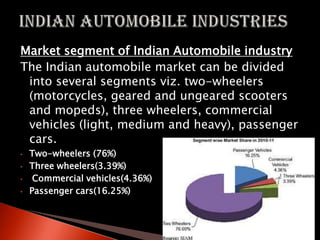
Market segment of Indian Automobile industry
The Indian automobile market can be divided
into several segments viz. two-wheelers
(motorcycles, geared and ungeared scooters
and mopeds), three wheelers, commercial
vehicles (light, medium and heavy), passenger
cars.
• Two-wheelers (76%)
• Three wheelers(3.39%)
• Commercial vehicles(4.36%)
• Passenger cars(16.25%)
 India became the sixth largest passenger
vehicle producer in the world with an annual
production of more than 3.9 million units in
2011.
 In 2010, India beat Thailand to become Asia's
third largest exporter of passenger cars.
Top 3 Indian company
Maruti suzuki
Hyundai
Tata motors
 The production of passenger vehicles in India was
recorded at 3.23 million in 2012-13 and is expected
to grow at a compound annual growth rate (CAGR) of
13 per cent during 2012-2021, as per data published
by Automotive Component Manufacturers Association
of India (ACMA).
 Passenger car sales stood at 1.89 million units in
2012-1,as per Mr Boris Fitz, Director, Sales and
Network Development, Mercedes-Benz India.
 The industry produced 1.74 million vehicles in May
2013. The export of passenger vehicles and three-
wheelers grew by 7.34 percent and 26.53 percent
respectively during the April-May 2013,(SIAM).
 In 2002, the Indian government formulated an auto policy that
aimed at promoting integrated, phased, enduring and self-
sustained growth of the Indian automotive industry
 Approval for foreign equity investment up to 100% in the
automotive sector .

Formulation of an appropriate auto fuel policy .
 Allowing automatic approval for foreign equity investment up to
100% with no minimum investment criteria.
 Establish an international hub for manufacturing small,
affordable passenger cars as well as tractor and two wheelers.
Lying emphasis on R&D activities carried out by companies in
India by giving a weighted tax deduction of up to 150% for in
house research and R&D activities.

Plan to have a terminal life policy for CVs along with incentives
for replacement for such vehicles.
Promoting multi-model transportation and the implementation
of mass rapid transport system
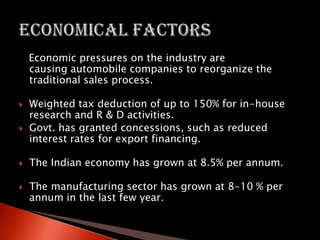
Economic pressures on the industry are
causing automobile companies to reorganize the
traditional sales process.
 Weighted tax deduction of up to 150% for in-house
research and R & D activities.
 Govt. has granted concessions, such as reduced
interest rates for export financing.
 The Indian economy has grown at 8.5% per annum.
 The manufacturing sector has grown at 8-10 % per
annum in the last few year.
 changed lifestyle of people.
 Growth in urbanization.
 85% of cars are financed in India.
 Indian customers are highly discerning, educated and
well informed.
 They are price sensitive and put a lot of emphasis on
value for money.
 Preference for small and compact cars. They are
socially acceptable even amongst the well off.
 Preference for fuel efficient cars with low running
costs.
 Internet has a great impact on automobile
industry
• Technology relating to automobile designs
• Technology of automobile manufacture
• Technological developments that may
increase use of automobiles.
• R&D
 Physical conditions effecting ability to use
automobiles of different types. This will also
include state infrastructure such as roads for
driving vehicles.
 Acquisition of land.
 Global warming
 Hybrid & electric car.
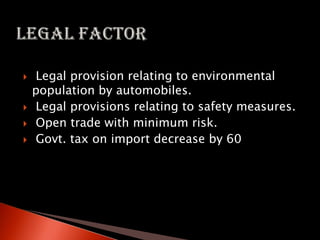
 Legal provision relating to environmental
population by automobiles.
 Legal provisions relating to safety measures.
 Open trade with minimum risk.
 Govt. tax on import decrease by 60
Porter’s Five force
model
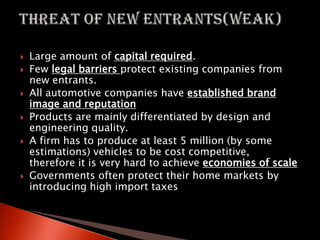
 Large amount of capital required.
 Few legal barriers protect existing companies from
new entrants.
 All automotive companies have established brand
image and reputation
 Products are mainly differentiated by design and
engineering quality.
 A firm has to produce at least 5 million (by some
estimations) vehicles to be cost competitive,
therefore it is very hard to achieve economies of scale
 Governments often protect their home markets by
introducing high import taxes
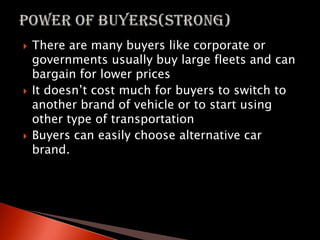
 There are many buyers like corporate or
governments usually buy large fleets and can
bargain for lower prices
 It doesn’t cost much for buyers to switch to
another brand of vehicle or to start using
other type of transportation
 Buyers can easily choose alternative car
brand.
 Large number of suppliers
 Some suppliers are large but the most of
them are pretty small
 Companies use another type of material (use
one metal instead of another) but only to
some extent (plastic instead of metal)
 Materials widely accessible
 Suppliers do not pose any threat of forward
integration
 There are many alternative types of
transportation, such as bicycles, motorcycles,
trains, buses or planes
 Substitutes can rarely offer the same
convenience
 Alternative types of transportation almost
always cost less and sometimes are more
environment friendly
 Moderate number of competitors
 If a firm would decide to leave an industry it
would incur huge losses, so most of the time
it either bankrupts or stays in automotive
industry for the lifetime.
 Industry is very large but matured
 Size of competing firm’s vary but they usually
compete for different consumer segments
 Customers are loyal to their brands
 There is moderate threat of being acquired by
a competitor
Automoile

Automoile

  • 1.
  • 2.
    Automobile?  Motorized vehicleconsisting of four wheels and powered by an internal engine. Automobiles are used to transport people and items from one location to another location. Automobile Industry  The automobile industry is a term that covers a wide range of companies and organizations involved in the design, development, manufacture, marketing and selling of motor vehicles, towed vehicles, motorcycles and mopeds. It is one of the world's most important economic sectors by revenue.
  • 3.
     By producing18.4 million units , China in no.1 position.  U.S. in second place with 8.7 million units,  while Japan in third place with 8.4 million units.  Ford, General Motors, and Chrysler are often referred to as the "Big Three" or, more recently the "Detroit Three", being the largest automakers in the United States and Canada.
  • 4.
    Market segment ofIndian Automobile industry The Indian automobile market can be divided into several segments viz. two-wheelers (motorcycles, geared and ungeared scooters and mopeds), three wheelers, commercial vehicles (light, medium and heavy), passenger cars. • Two-wheelers (76%) • Three wheelers(3.39%) • Commercial vehicles(4.36%) • Passenger cars(16.25%)
  • 5.
     India becamethe sixth largest passenger vehicle producer in the world with an annual production of more than 3.9 million units in 2011.  In 2010, India beat Thailand to become Asia's third largest exporter of passenger cars.
  • 6.
    Top 3 Indiancompany Maruti suzuki Hyundai Tata motors
  • 7.
     The productionof passenger vehicles in India was recorded at 3.23 million in 2012-13 and is expected to grow at a compound annual growth rate (CAGR) of 13 per cent during 2012-2021, as per data published by Automotive Component Manufacturers Association of India (ACMA).  Passenger car sales stood at 1.89 million units in 2012-1,as per Mr Boris Fitz, Director, Sales and Network Development, Mercedes-Benz India.  The industry produced 1.74 million vehicles in May 2013. The export of passenger vehicles and three- wheelers grew by 7.34 percent and 26.53 percent respectively during the April-May 2013,(SIAM).
  • 10.
     In 2002,the Indian government formulated an auto policy that aimed at promoting integrated, phased, enduring and self- sustained growth of the Indian automotive industry  Approval for foreign equity investment up to 100% in the automotive sector .  Formulation of an appropriate auto fuel policy .  Allowing automatic approval for foreign equity investment up to 100% with no minimum investment criteria.  Establish an international hub for manufacturing small, affordable passenger cars as well as tractor and two wheelers. Lying emphasis on R&D activities carried out by companies in India by giving a weighted tax deduction of up to 150% for in house research and R&D activities.  Plan to have a terminal life policy for CVs along with incentives for replacement for such vehicles. Promoting multi-model transportation and the implementation of mass rapid transport system
  • 11.
    Economic pressures onthe industry are causing automobile companies to reorganize the traditional sales process.  Weighted tax deduction of up to 150% for in-house research and R & D activities.  Govt. has granted concessions, such as reduced interest rates for export financing.  The Indian economy has grown at 8.5% per annum.  The manufacturing sector has grown at 8-10 % per annum in the last few year.
  • 12.
     changed lifestyleof people.  Growth in urbanization.  85% of cars are financed in India.  Indian customers are highly discerning, educated and well informed.  They are price sensitive and put a lot of emphasis on value for money.  Preference for small and compact cars. They are socially acceptable even amongst the well off.  Preference for fuel efficient cars with low running costs.
  • 13.
     Internet hasa great impact on automobile industry • Technology relating to automobile designs • Technology of automobile manufacture • Technological developments that may increase use of automobiles. • R&D
  • 14.
     Physical conditionseffecting ability to use automobiles of different types. This will also include state infrastructure such as roads for driving vehicles.  Acquisition of land.  Global warming  Hybrid & electric car.
  • 15.
     Legal provisionrelating to environmental population by automobiles.  Legal provisions relating to safety measures.  Open trade with minimum risk.  Govt. tax on import decrease by 60
  • 16.
  • 17.
     Large amountof capital required.  Few legal barriers protect existing companies from new entrants.  All automotive companies have established brand image and reputation  Products are mainly differentiated by design and engineering quality.  A firm has to produce at least 5 million (by some estimations) vehicles to be cost competitive, therefore it is very hard to achieve economies of scale  Governments often protect their home markets by introducing high import taxes
  • 18.
     There aremany buyers like corporate or governments usually buy large fleets and can bargain for lower prices  It doesn’t cost much for buyers to switch to another brand of vehicle or to start using other type of transportation  Buyers can easily choose alternative car brand.
  • 19.
     Large numberof suppliers  Some suppliers are large but the most of them are pretty small  Companies use another type of material (use one metal instead of another) but only to some extent (plastic instead of metal)  Materials widely accessible  Suppliers do not pose any threat of forward integration
  • 20.
     There aremany alternative types of transportation, such as bicycles, motorcycles, trains, buses or planes  Substitutes can rarely offer the same convenience  Alternative types of transportation almost always cost less and sometimes are more environment friendly
  • 21.
     Moderate numberof competitors  If a firm would decide to leave an industry it would incur huge losses, so most of the time it either bankrupts or stays in automotive industry for the lifetime.  Industry is very large but matured  Size of competing firm’s vary but they usually compete for different consumer segments  Customers are loyal to their brands  There is moderate threat of being acquired by a competitor