This document presents a study on ultra-wideband (UWB) radar systems that enable automatic target detection and localization in road environments, focusing on the correlation of reflected signals for obstacle detection. The proposed algorithm enhances radar capabilities by allowing detection and localization even in challenging, non-line-of-sight urban settings, emphasizing accuracy and efficiency through correlation peak determination. Simulation results validate the algorithm's effectiveness in identifying targets and estimating their distances from the radar.
![International Journal of Electrical and Computer Engineering (IJECE)
Vol. 12, No. 2, April 2022, pp. 1695~1702
ISSN: 2088-8708, DOI: 10.11591/ijece.v12i2.pp1695-1702 1695
Journal homepage: http://ijece.iaescore.com
Automatic target detection and localization using
ultra-wideband radar
Dounia Daghouj1
, Maroua abdellaoui1
, Mohammed Fattah2
, Said Mazer1
, Youness Balboul1
,
Moulhime El Bekkali1
1
National School of Applied Sciences, Sidi Mohamed Ben Abdellah University, Fez, Morocco
2
Superior School of Technology, Moulay Ismail University, Meknes, Morocco
Article Info ABSTRACT
Article history:
Received Apr 29, 2021
Revised Sep 18, 2021
Accepted Oct 25, 2021
The pulse ultra-wide band (UWB) radar consists of switching of energy of
very short duration in an ultra-broadband emission chain, and the UWB signal
emitted is an ultrashort pulse, of the order of nanoseconds, without a carrier.
These systems can indicate the presence and distances of a distant object, call
a target, and determine its size, shape, speed, and trajectory. In this paper, we
present a UWB radar system allowing the detection of the presence of a target
and its localization in a road environment based on the principle of correlation
of the reflected signal with the reference and the determination of its
correlation peak.
Keywoords:
Correlation peak
Detection
Localization
Target
Ultra-wide band radar This is an open access article under the CC BY-SA license.
Corresponding Author:
Dounia Daghouj
National School of Applied Sciences, Sidi Mohamed Ben Abdellah University
Fez, Morocco
Email: dounia.daghouj@usmba.ac.ma
1. INTRODUCTION
Road safety is an important consideration in everyday life. Most vehicles are equipped with collision
avoidance sensors such as laser scanners, cameras, and infrared sensors. These systems are used to detect
obstacles, their positions, and speeds. They work reliably under certain conditions but suffer from several
limitations in others. Factors such as open areas, fog, smoke, dust, dirt, lighting conditions, and reflections can
lead to faulty sensor values. In addition, visual and infrared sensors must be classified close to the target, while
radar sensors depend on the frequency of operation and can operate up to several hundred meters.
The term radar, translated into radio detection and ranging [1], [2], means detecting and estimating
distance by waves; it is a device emitting and receiving electromagnetic waves, used to detect and locate objects
in any space. The capacity of radar is determined according to the technology used, and as it is known, the
most exploited technology in the current research work aimed at road safety is the ultra-wide band (UWB) [3],
[4] since it allows detection [5] and localization with great precision and in any environment [6].
The detection of the various obstacles by an UWB system is based on the transmission and reception
of brief duration pulses, of the order of a few Pico or nanoseconds [7], which requires a specific signal
processing at a reception to properly exploit the reflected signals [8] and extract the maximum amount of
information. In order to develop a UWB radar [9] system capable of detecting targets in urban areas, one of
the main difficulties is related to the complexity of the propagation environment induced by the obstacles
present in the scene, and generally, the target is not in the line of sight of the radar, which complicates the task
more and more. The recent literature includes several works dealing with this problem [10], [11] and in this](https://image.slidesharecdn.com/65157068713925975emr18sep29aprd-220622062321-5e83c6e4/85/Automatic-target-detection-and-localization-using-ultra-wideband-radar-1-320.jpg)
![International Journal of Electrical and Computer Engineering (IJECE)
Vol. 12, No. 2, April 2022, pp. 1695~1702
ISSN: 2088-8708, DOI: 10.11591/ijece.v12i2.pp1695-1702 1695
Journal homepage: http://ijece.iaescore.com
Automatic target detection and localization using
ultra-wideband radar
Dounia Daghouj1
, Maroua abdellaoui1
, Mohammed Fattah2
, Said Mazer1
, Youness Balboul1
,
Moulhime El Bekkali1
1
National School of Applied Sciences, Sidi Mohamed Ben Abdellah University, Fez, Morocco
2
Superior School of Technology, Moulay Ismail University, Meknes, Morocco
Article Info ABSTRACT
Article history:
Received Apr 29, 2021
Revised Sep 18, 2021
Accepted Oct 25, 2021
The pulse ultra-wide band (UWB) radar consists of switching of energy of
very short duration in an ultra-broadband emission chain, and the UWB signal
emitted is an ultrashort pulse, of the order of nanoseconds, without a carrier.
These systems can indicate the presence and distances of a distant object, call
a target, and determine its size, shape, speed, and trajectory. In this paper, we
present a UWB radar system allowing the detection of the presence of a target
and its localization in a road environment based on the principle of correlation
of the reflected signal with the reference and the determination of its
correlation peak.
Keywoords:
Correlation peak
Detection
Localization
Target
Ultra-wide band radar This is an open access article under the CC BY-SA license.
Corresponding Author:
Dounia Daghouj
National School of Applied Sciences, Sidi Mohamed Ben Abdellah University
Fez, Morocco
Email: dounia.daghouj@usmba.ac.ma
1. INTRODUCTION
Road safety is an important consideration in everyday life. Most vehicles are equipped with collision
avoidance sensors such as laser scanners, cameras, and infrared sensors. These systems are used to detect
obstacles, their positions, and speeds. They work reliably under certain conditions but suffer from several
limitations in others. Factors such as open areas, fog, smoke, dust, dirt, lighting conditions, and reflections can
lead to faulty sensor values. In addition, visual and infrared sensors must be classified close to the target, while
radar sensors depend on the frequency of operation and can operate up to several hundred meters.
The term radar, translated into radio detection and ranging [1], [2], means detecting and estimating
distance by waves; it is a device emitting and receiving electromagnetic waves, used to detect and locate objects
in any space. The capacity of radar is determined according to the technology used, and as it is known, the
most exploited technology in the current research work aimed at road safety is the ultra-wide band (UWB) [3],
[4] since it allows detection [5] and localization with great precision and in any environment [6].
The detection of the various obstacles by an UWB system is based on the transmission and reception
of brief duration pulses, of the order of a few Pico or nanoseconds [7], which requires a specific signal
processing at a reception to properly exploit the reflected signals [8] and extract the maximum amount of
information. In order to develop a UWB radar [9] system capable of detecting targets in urban areas, one of
the main difficulties is related to the complexity of the propagation environment induced by the obstacles
present in the scene, and generally, the target is not in the line of sight of the radar, which complicates the task
more and more. The recent literature includes several works dealing with this problem [10], [11] and in this](https://image.slidesharecdn.com/65157068713925975emr18sep29aprd-220622062321-5e83c6e4/75/Automatic-target-detection-and-localization-using-ultra-wideband-radar-1-2048.jpg)
![ ISSN: 2088-8708
Int J Elec & Comp Eng, Vol. 12, No. 2, April 2022: 1695-1702
1696
work, we explore a new solution based on an algorithm for the detection and localization of non-line-of-sight
(NLOS) targets in urban areas based on the exploitation of signals propagating in a vehicle to vehicle channel,
which follows a Rayleigh distribution and reflects the characteristics of the urban environment [12] and in
particular the multipath phenomenon. This algorithm is essentially based on a simple and efficient processing
using the correlation principle that allows testing the similarity between the reflected signals and the template
to detect existing targets in the radar area with high accuracy and low cost.
This article focuses on the presentation of an algorithm, based on the determination of the maximum
correlation peak, to determine the presence of an obstacle in the backscattered electromagnetic field while
correlating the received signal with the reference and the localization of these targets detected by calculating
the distance separating the radar from them. In the first part of this paper, we propose an algorithm that allows
the detection of a target and its localization in a road environment based on the correlation technique, then we
present the detection and localization method used by our UWB radar and at the end, we discuss the results of
the simulation.
2. THE PROPOSED ALGORITHM FOR DETECTING AND LOCATING TARGETS
Obstacle detection and localization is a subject that interests many researchers and has been the subject
of much work. Several algorithms have been proposed for the detection and localization of obstacles in the
road domain and each algorithm has its strengths and weaknesses [13]–[15]. Most of these methods have
somewhat complex architectures and require the fusion of radar with another type of sensor. In this work, the
proposed algorithm shows a simple and efficient approach to signal processing; based on the coherent reception
of the signal and the correlation of the received signal with the reference. Although the proposed algorithm
contains a coherent receiver which is recognized by its power consumption and somewhat complex
architecture, it can help to improve the signal-to-noise ratio (SNR) by the coherent integration of the signal and
have a better sensitivity to maximize the probability of detection. The efficiency of this signal processing
approach is verified by the detection simulations carried out. The presented algorithm is therefore capable of
detecting and locating road obstacles and presents a solid basis for a future development of the field of
classification. Figure 1 describes our target detection and localization algorithm for a UWB system.
Figure 1. The algorithm for detecting and locating targets](https://image.slidesharecdn.com/65157068713925975emr18sep29aprd-220622062321-5e83c6e4/85/Automatic-target-detection-and-localization-using-ultra-wideband-radar-2-320.jpg)
![Int J Elec & Comp Eng ISSN: 2088-8708
Automatic target detection and localization using ultra-wideband radar (Dounia Daghouj)
1697
Correlation is obtained by shifting one of the signals, multiplying the shifted signal by the other signal,
and then integrating the resulting signal. For a given waveform and a given target, we obtain a reflected signal
specific to them, called a signature, and to know if the target exists or not, we correlate the pulse reflected by
the target and the reference signal in order to calculate the distance of the obstacle by determining the position
of the correlation peak identified by the threshold detection method. In the following sections, we present the
method used and simulation results of different signals used to justify the ability of our algorithm to detect and
locate targets in our radar area.
3. METHOD
Pulse radar emits a repetitive strain of high-powered signal pulses of brief duration (microwaves)
[16]–[20]. Each pulse is followed by a time during which echoes can be received before a new pulse is emitted.
The echo processing of the radar pulses provides information about the target, such as the range or distance to
the target, determined from the measurement of the propagation time of the electromagnetic wave.
3.1. UWB detection chain
The radar system proposed and studied in our research work is a short-range radar based on UWB
technology. It is intended for anti-collision applications in road transport. This system is based on the
transmission of the unicycle pulse via a Rayleigh vehicle channel [21]; at reception, the correlation technique
is applied on the received pulse in order to detect and locate obstacles in the vehicle environment. Figure 2
shows the detection chain proposed for our UWB radar detection.
Figure 2. The block diagram of a UWB detection chain
The above transmission chain is based on the generation of a single-cycle pulse with a width of 2 ns
at transmission and a frequency of 3 GHz, the transmission of this pulse in a vehicular channel that follows a
Rayleigh distribution, the reception of the signal by a coherent receiver [22] and finally, the correlation of the
received signal with the reference that constitutes the fundamental signal processing step to be able to decide
the presence or absence of the obstacle.
3.2. Signal processing
On reception, the received signal is processed and analyzed based on the algorithm already presented
in the previous section in order to extract the maximum amount of information about the target.
3.2.1. Received signal
The radar return signal combines the transmitted signal and the various interference of the propagation
channel [23]. This work aims to develop a detection and location system used in very noisy environments such
as urban areas. In our case, and to model the real environment, we worked with a multipath vehicle to vehicle
channel that follows a Rayleigh distribution reflecting the state of a real space. The following formula models
the received signal.
S(t)=s(t)*h(t)+n(t) (1)
With s (t) is the transmitted signal, h (t) represents the impulse response of channel v2v, and n (t) is the Gaussian
additive white noise.](https://image.slidesharecdn.com/65157068713925975emr18sep29aprd-220622062321-5e83c6e4/85/Automatic-target-detection-and-localization-using-ultra-wideband-radar-3-320.jpg)
![ ISSN: 2088-8708
Int J Elec & Comp Eng, Vol. 12, No. 2, April 2022: 1695-1702
1698
3.2.2. Target detection and localization
In the detection step, a decision is made by the detection algorithm regarding the presence or absence
of the signal scattered by the target in the radar data. Based on Figure 1, the target can be detected by the UWB
radar by correlating the signal backscattered by the latter and picked up by the receiving antenna with the
reference in order to measure the degree of similarity between them and to make a decision on the presence of
this obstacle in the radar's working area.
The role of radar systems is to detect targets in space where each target is located by its position,
direction, and speed [24]. In the case where only the position and direction of the target is determined, the radar
system emits through a directional antenna [25], at each instant, a pulse S(t) only in a narrow angular cone
around a determined direction . In the presence of a target in this direction, the transmitted signal is reflected
and received with a delay time which is proportional to the distance d between the antenna and the target with:
R(t) = S (t + Δt) + n(t) (2)
Δt = 2 d* c (3)
with S (t + Δt) is the received signal, Δt is the round-trip time, d is the distance between the radar and the target,
C is the celerity. After detecting the embedded pulses, the detection scheme identifies correlation peaks and
then translates their positions in the target ranges to locate the detected target.
4. RESULTS AND DISCUSSION
4.1. Detection
The detection of various obstacles by the UWB system, known internationally as UWB [26], is based
on the transmission and reception of very short pulses of a few picoseconds or nanoseconds. The advantage of
this system is that data transmission rates of the order of a few gigabits per second (Gbps) can be achieved due
to the very short pulse duration. The response is very rich in information. The detection phase is used to
determine the presence or not of an obstacle in any space. In our case, to be able to decide the presence of the
target in the road environment, we carried out a correlation of the received signal with the reference which
presents a signal emitted by the transmitting antenna and received by that of reception in the absence of obstacle
[27], the signal obtained is analyzed automatically based on a detection algorithm in order to determine the
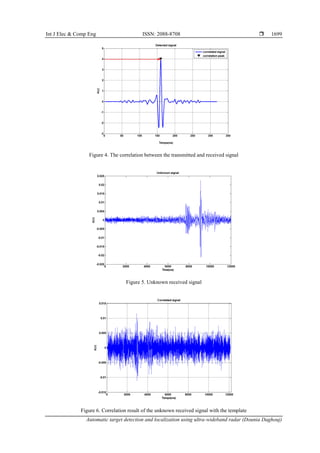
maximum peak of correlation which translates the resemblance between the two signals. Figures 3 and 4 show
the transmitted signal translated by a unicycle defined as the first derivative of the Gaussian, the template, the
received signal, and the correlation between the latter two signals.
Here the maximum correlation peak reflects the similarity between the two correlated signals, which
implies the presence of the target. To test the ability of our algorithm to detect the real signals emitted by our
detection radar and reflected by the target, we used an unknown signal [28], [29], and we correlated this signal
with the template in order to test the similarity between them. Figures 5 and 6 show an unknown received
signal and its correlation with the template. The result obtained after the correlation shows an absence of the
correlation peak, which makes it possible to confirm the absence of a copy, delayed in time, of the reference
in the signal reflected by the target mentioned above, then the absence of the target in the radar zone.
Figure 3. The emitted signal-the reference-received signal](https://image.slidesharecdn.com/65157068713925975emr18sep29aprd-220622062321-5e83c6e4/85/Automatic-target-detection-and-localization-using-ultra-wideband-radar-4-320.jpg)
![ ISSN: 2088-8708
Int J Elec & Comp Eng, Vol. 12, No. 2, April 2022: 1695-1702
1700
4.2. Localization
The objective here is to determine the distance between the radar and the object in the space
illuminated by the radar beam. This location is realized from the signal s (t) modeled as the first derivative of
the Gaussian pulse (the unicycle) and defined by (3) [11], [27], [30],
𝑆(𝑡) = −2𝑎[(
𝑡
ɽ2) 𝑒𝑥𝑝[− (
𝑡
ɽ2)] (3)
where 𝑎 is a normalization constant, and ɽ is the constant used to adjust the width of the pulse. The distance
between the obstacle and the radar can be calculated by estimating the flight time by determining the abscissa
corresponding to the maximum peak of correlation between the signal reflected by the detected target and the
reference. Figure 5 shows the abscissa of the correlation peak used to estimate the time of flight in order to
calculate the distance separating the target from the radar. Then, in this case, the distance equal to:
d =
𝒄.∆𝒕
𝟐
(4)
with ∆t is the position of the correlation peak that allows determining the location of the target and C is the
celerity. Beyond the detection of the echo, the correlation focuses on the target location, which for the radial
direction is obtained by estimating the time of flight. The maximum correlation, identified as the maximum
peak, indicates the delay (or time of flight) between transmitted and received pulses. This makes it possible to
calculate the distance separating the target from the radar simply and reliably [28]. In our case, the calculated
distance equal to 24 m.
5. CONCLUSION
In this paper, we presented our UWB radar dedicated to the detection of vulnerable people in urban.
Then we discussed the detection and tracking algorithm and, in the end, the simulation results. We have shown
that our correlation-based algorithm allows us to detect targets and locate them with better accuracy while
determining the maximum correlation peak, which allows us to decide about the presence or not of the targets
and then translate their positions which allows us to locate them. Several aspects related to the presented UWB
radar remain to be studied and constitute the perspectives of our research work, including the classification and
monitoring of obstacles detected.
REFERENCES
[1] A. Araghi, M. Khalily, P. Xiao, and R. Tafazolli, “Study on the location of mmwave antenna for the autonomous car’s detection
and ranging sensors,” in 2020 14th European Conference on Antennas and Propagation (EuCAP), Mar. 2020, pp. 1–4, doi:
10.23919/EuCAP48036.2020.9135074.
[2] G. Arun Francis, M. Arulselvan, P. Elangkumaran, S. Keerthivarman, and J. Vijaya Kumar, “Object detection using ultrasonic
sensor,” International Journal of Innovative Technology and Exploring Engineering, vol. 8, no. 6, pp. 207–209, 2019.
[3] A. Alarifi et al., “Ultra wideband indoor positioning technologies: Analysis and recent advances,” Sensors (Switzerland), vol. 16,
no. 5, May 2016, Art. No. 707, doi: 10.3390/s16050707.
[4] A. H. Majeed and K. H. Sayidmarie, “UWB elliptical patch monopole antenna with dual-band notched characteristics,”
International Journal of Electrical and Computer Engineering (IJECE), vol. 9, no. 5, pp. 3591–3598, Oct. 2019, doi:
10.11591/ijece.v9i5.pp3591-3598.
[5] J. Ali, R. Yahya, N. Abdullah, and S. Z. Sapuan, “Ultra-wideband monostatic antenna for behind the wall detection,” International
Journal of Electrical and Computer Engineering (IJECE), vol. 7, no. 6, pp. 2936–2941, Dec. 2017, doi:
10.11591/ijece.v7i6.pp2936-2941.
[6] V. Gharat, E. Colin, G. Baudoin, and D. Richard, “Indoor performance analysis of LF-RFID based positioning system: Comparison
with UHF-RFID and UWB,” in 2017 International Conference on Indoor Positioning and Indoor Navigation, IPIN 2017, Sep.
2017, vol. 2017-Janua, pp. 1–8, doi: 10.1109/IPIN.2017.8115901.
[7] A. Ren, F. Zhou, A. Rahman, X. Wang, N. Zhao, and X. Yang, “A study of indoor positioning based on UWB base-station
configurations,” in Proceedings of 2017 IEEE 2nd Advanced Information Technology, Electronic and Automation Control
Conference, IAEAC 2017, Mar. 2017, pp. 1939–1943, doi: 10.1109/IAEAC.2017.8054352.
[8] D. Daghouj, S. Mazer, Y. Balboul, A. Menhaj, and L. Sakkila, “Modeling of an obstacle detection chain in a vehicular environment,”
in 2019 7th Mediterranean Congress of Telecommunications (CMT), Oct. 2019, pp. 1–4, doi: 10.1109/CMT.2019.8931380.
[9] D. Kocur, T. Porteleky, M. Svecova, M. Svingal, and J. Fortes, “A novel signal processing scheme for static person localization
using m-sequence UWB radars,” IEEE Sensors Journal, vol. 21, no. 18, pp. 20296–20310, Sep. 2021, doi:
10.1109/JSEN.2021.3093658.
[10] P. Dai, Y. Yang, C. Zhang, X. Bao, H. Zhang, and Y. Zhang, “Analysis of target detection based on UWB NLOS ranging modeling,”
in 2018 Ubiquitous Positioning, Indoor Navigation and Location-Based Services (UPINLBS), Mar. 2018, pp. 1–6, doi:
10.1109/UPINLBS.2018.8559809.
[11] L. Tantiparimongkol and P. Phasukkit, “IR-UWB pulse generation using FPGA scheme for through obstacle human detection,”
Sensors, vol. 20, no. 13, Jul. 2020, Art. no. 3750, doi: 10.3390/s20133750.
[12] A. Kılıç, İ. Babaoğlu, A. Babalık, and A. Arslan, “Through-wall radar classification of human posture using convolutional neural](https://image.slidesharecdn.com/65157068713925975emr18sep29aprd-220622062321-5e83c6e4/85/Automatic-target-detection-and-localization-using-ultra-wideband-radar-6-320.jpg)
![Int J Elec & Comp Eng ISSN: 2088-8708
Automatic target detection and localization using ultra-wideband radar (Dounia Daghouj)
1701
networks,” International Journal of Antennas and Propagation, vol. 2019, pp. 1–10, Mar. 2019, doi: 10.1155/2019/7541814.
[13] C. Will, P. Vaishnav, A. Chakraborty, and A. Santra, “Human target detection, tracking, and classification using 24-GHz FMCW
radar,” IEEE Sensors Journal, vol. 19, no. 17, pp. 7283–7299, Sep. 2019, doi: 10.1109/JSEN.2019.2914365.
[14] O. Rabaste, E. Colin-Koeniguer, D. Poullin, A. Cheraly, J. F. Pétex, and H. K. Phan, “Around-the-corner radar: Detection of a
human being in non-line of sight,” IET Radar, Sonar and Navigation, vol. 9, no. 6, pp. 660–668, Jul. 2015, doi: 10.1049/iet-
rsn.2014.0337.
[15] D. Daghouj, M. Fattah, S. Mazer, Y. Balboul, and M. El Bekkali, “UWB waveform for automotive short range radar,” International
Journal on Engineering Applications, vol. 8, no. 4, pp. 158–164, Jul. 2020, doi: 10.15866/irea.v8i4.18997.
[16] C. Demonceaux, A. Potelle, and D. Kachi-Akkouche, “Obstacle detection in road scene based on road detection and motion
analysis,” IFAC Proceedings Volumes (IFAC-PapersOnline), vol. 37, no. 8, pp. 442–447, Jul. 2004, doi: 10.1016/s1474-
6670(17)32016-5.
[17] S. Chang, N. Mitsumoto, and J. W. Burdick, “An algorithm for UWB radar-based human detection,” in 2009 IEEE Radar
Conference, 2009, pp. 1–6, doi: 10.1109/RADAR.2009.4976999.
[18] A. G. Yarovoy, L. P. Ligthart, J. Matuzas, and B. Levitas, “UWB radar for human being detection,” IEEE Aerospace and Electronic
Systems Magazine, vol. 21, no. 11, pp. 22–26, Nov. 2006, doi: 10.1109/MAES.2006.284354.
[19] K. T. Wong and W. K. Chung, “Pulse-diverse radar/sonar FSK-PSK waveform design to emphasize/de-emphasize designated
Doppler-delay sectors,” in IEEE National Radar Conference - Proceedings, 2000, pp. 745–749, doi: 10.1109/radar.2000.851928.
[20] D. Cao, T. Li, P. Kang, H. Liu, S. Zhou, and H. Su, “Single-pulse multi-beams operation of phased array radar,” in 2016 CIE
International Conference on Radar (RADAR), Oct. 2016, pp. 1–4, doi: 10.1109/RADAR.2016.8059597.
[21] M. Hernandez, H.-B. Li, I. Dotlić, and R. M. (NICT), Channel models for TG8. IEEE P802.15 Working Group for Wireless Personal
Area Networks (WPANs), 2012.
[22] D. Daghouj, M. Fattah, S. Mazer, Y. Balboul, and M. El Bekkali, “UWB coherent receiver performance in a vehicular channel,”
International Journal of Advanced Trends in Computer Science and Engineering, vol. 9, no. 2, pp. 1996–2001, Apr. 2020, doi:
10.30534/ijatcse/2020/170922020.
[23] Y. Liu, G. Liao, S. Zhu, Z. Yang, Y. Chen, and X. Zhang, “Performance improvement in a coexistent radar and communications
system,” in Proceedings of the IEEE Sensor Array and Multichannel Signal Processing Workshop, Jun. 2020, vol. 2020-June, doi:
10.1109/SAM48682.2020.9104303.
[24] W. Yi, T. Zhou, Y. Ai, and R. S. Blum, “Suboptimal low complexity joint multi-target detection and localization for non-coherent
MIMO radar with widely separated antennas,” IEEE Transactions on Signal Processing, vol. 68, pp. 901–916, 2020, doi:
10.1109/TSP.2020.2968282.
[25] C. Srinivasu, D. Monica Satyavathi, and N. Markandeya Gupta, “Performance evaluation of UWB waveforms in high-resolution
radar,” in Lecture Notes in Electrical Engineering, vol. 655, Springer Singapore, 2021, pp. 559–565.
[26] C. H. Navitha, K. Sivani, and K. A. Reddy, “Performance evaluation of adaptive continuous wavelet transform based rake receiver
for UWB systems,” International Journal of Electrical and Computer Engineering (IJECE), vol. 8, no. 5, pp. 3444–3452, Oct.
2018, doi: 10.11591/ijece.v8i5.pp3444-3452.
[27] L. Sakkila, A. Rivenq, F. Boukour, C. Tatkeu, Y. El Hillali, and J. M. Rouvaen, “Collision avoidance radar system using UWB
waveforms signature for road applications,” in 2009 9th International Conference on Intelligent Transport Systems
Telecommunications, ITST 2009, Oct. 2009, pp. 223–226, doi: 10.1109/ITST.2009.5399353.
[28] M. Abdellaoui, D. Daghouj, M. Fattah, Y. Balboul, S. Mazer, and M. El Bekkali, “Artificial intelligence approach for target
classification: A state of the art,” Advances in Science, Technology and Engineering Systems, vol. 5, no. 4, pp. 445–456, Aug. 2020,
doi: 10.25046/AJ050453.
[29] A. Maroua and F. Mohammed, “Characterization of ultra wide band indoor propagation,” in 2019 7th Mediterranean Congress of
Telecommunications (CMT), Oct. 2019, pp. 1–4, doi: 10.1109/CMT.2019.8931367.
[30] M. Fattah et al., “Multi band OFDM alliance power line communication system,” Procedia Computer Science, vol. 151,
pp. 1034–1039, 2019, doi: 10.1016/j.procs.2019.04.146.
BIOGRAPHIES OF AUTHORS
Dounia Daghouj was born in Taza in 1992. She obtained her diploma of state
engineer in network and telecommunication from the National School of Applied Sciences in
2016; currently he is a PhD student in Artificial Intelligence, Data Sciences and Emerging
Systems Laboratory at the University of Sidi Mohamed Ben Abdellah Fez. She could be
contacted via email: dounia.daghouj@usmba.ac.ma.
Maroua abdellaoui obtained her diploma of state engineer in network and
telecommunication from the National School of Applied Sciences in 2017; currently he is a
PhD student in Artificial Intelligence, Data Sciences and Emerging Systems Laboratory at the
University of Sidi Mohamed Ben Abdellah. She could be contacted via email:
abdellaoui.marwa@gmail.com.](https://image.slidesharecdn.com/65157068713925975emr18sep29aprd-220622062321-5e83c6e4/85/Automatic-target-detection-and-localization-using-ultra-wideband-radar-7-320.jpg)