PRIMER ON AUTOMOBILE FUEL EFFICIENCY AND EMISSIONS
POLLUTION PROBE IS A NON-PROFIT CHARITABLE ORGANIZATION THAT WORKS
in partnership with all sectors of society to protect health by promoting clean air and clean water. Pollution Probe was
established in 1969 following a gathering of 240 students and professors at the University of Toronto campus to discuss
a series of disquieting pesticide-related stories that had appeared in the media. Early issues tackled by Pollution Probe
included urging the Canadian government to ban DDT for almost all uses, and campaigning for the clean-up of the Don
River in Toronto. We encouraged curbside recycling in 140 Ontario communities and supported the development of
the Blue Box programme. Pollution Probe has published several books, including Profit from Pollution Prevention, The
Green Consumer Guide (of which more than 225,000 copies were sold across Canada) and Additive Alert.
Since the 1990s, Pollution Probe has focused its programmes on issues related to air pollution, water pollution and human
health, including a major programme to remove human sources of mercury from the environment. Pollution Probe’s
scope has recently expanded to new concerns, including the unique risks that environmental contaminants pose to
children, the health risks related to exposures within indoor environments, and the development of innovative tools
for promoting responsible environmental behaviour.
Since 1993, as part of our ongoing commitment to improving air quality, Pollution Probe has held an annual Clean Air
Campaign during the month of June to raise awareness of the inter-relationships among vehicle emissions, smog, climate
change and related human respiratory problems. The Clean Air Campaign helped the Ontario Ministry of the Environment
develop a mandatory vehicle emissions testing programme, called Drive Clean.
Pollution Probe offers innovative and practical solutions to environmental issues pertaining to air and water pollution.
In defining environmental problems and advocating practical solutions, we draw
upon sound science and technology, mobilize scientists and other experts, and
build partnerships with industry, governments and communities.
POLLUTION PROBE’S PRIMER SERIES
POLLUTION PROBE has prepared a series of educational Primers on environmental topics. The goal of the Primers is to inform Canadians
about current environmental issues by setting out the scientific basis for concern, potential solutions and the policy tools available.
Each Primer focuses on what is being done, and what more can be done by governments, businesses and individuals on these
issues. The Primers are researched and written under the direction of Pollution Probe’s Executive Director. Before publication they are
reviewed by scientists, non-governmental organizations, industry experts, policy makers and others who have technical expertise on
the issue to ensure that they are factually correct and reflect current thinking on the topic.
All of Pollution Probe’s Primers are available for $20.00 per copy, plus postage (Cdn. $2.50, US $4.50, Int. $10.50). For more infor-
mation, or to see the Primers on-line, visit our website at www.pollutionprobe.org/Publications/Primers.htm.
The Acid Rain Primer (October 2006) contains an in-depth discus-
sion of the science of acid rain and the policy and regulatory history
of this fascinating environmental and health issue.
A Guide to Climate Change for Small- to Medium-sized Enter-
prises (September 2006) explains how businesses can take action
to reduce their greenhouse gases and lower their energy costs,
as well as managing the risks and opportunities associated with
climate change.
Primer on Volatile Organic Compounds (October 2005) focuses
on major VOC sources that are harmful to human health, explains
how they are controlled and highlights government and industry
action to reduce the level of VOCs in the atmosphere.
Child Health and the Environment – A Primer (August 2005)
provides an introduction to what makes children healthy, explains
why children are more vulnerable than adults and examines health
effects and exposures of concern for children.
Primer on Bioproducts (November 2004) provides an overview of
the ways bioproducts are made and highlights some of the issues
that bioproduct technologies might raise for Canadians.
The Source Water Protection Primer (May 2004) explains the
water cycle, identifies threats to water sources, focuses on water-
sheds as the ideal management unit and identifies steps to consider
when developing local source water protection plans.
Primer on Climate Change and Human Health (April 2004)
describes the ways in which a more variable climate may impact
Canadians’ health, reviews actions taken by governments and indus-
tries, and examines what individuals can do to reduce greenhouse
gas emissions.
Emissions Trading Primer (November 2003) explains the concepts
behind emissions trading, describes the ways in which it works and
provides examples and case studies.
Primer on the Technologies of Renewable Energy (September
2003) explains the concept of renewable energy and the rationale
for shifting energy generation towards cleaner and less greenhouse
gas-intensive sources.
Mercury in the Environment: A Primer (June 2003) provides an
overview of the mercury cycle, releases to the environment, trans-
portation and deposition around the world and the uptake and
accumulation of mercury in the food chain.
The Drinking Water Primer (June 2002) examines the two sources
of drinking water — groundwater and surface water — and the
extent to which Canadians depend on them.
The Smog Primer (June 2002) explains what smog and the pollu-
tants that create it are and highlights the major sources of these
pollutants (i.e., transportation and the burning of fossil fuels for
energy).
JUNE 2009
As Canada’s largest traffic safety advocate representing over 5.4 million members across the country, the Canadian
Automobile Association (CAA) has an important role to play towards mitigating the effects of climate change. CAA
has existed since the introduction of the first gasoline-powered automobile and has witnessed many changes over the
decades. Key among these is the impact of pollution on the environment which has had a dramatic impact on Canadians’
health and that of our environment. It is therefore critical that CAA be part of the climate change solution.
As part of this goal, CAA was pleased to partner with Pollution Probe to present this first – a primer on automobile
fuel efficiency and emissions. As part of our association’s advocacy mandate, we believe that this primer will serve as
a useful and comprehensive resource for our members, government and indeed all Canadians as they strive to understand
the changes that can be made both within the automobile industry and in their own lives to improve vehicle efficiency.
By understanding and changing personal behaviour, as well as that of industry and governments, we are confident
that we can make a difference.
Tim Shearman
National President
CANADIAN AUTOMOBILE ASSOCIATION
JUNE 2009
Pollution Probe is pleased to present the latest in our series of popular educational Primers – Primer on Automobile
Fuel Efficiency and Emissions – produced in partnership with the Canadian Automobile Association (CAA). We believe
this primer will be a valuable tool that can be used by many organizations to educate and inform motorists, businesses,
policymakers and the public. We believe that the reader needs more than a fact sheet to understand the scope of what
industry, government and individuals can do to reduce fuel consumption and emissions.
Automobile fuel efficiency and emissions are subjects in which Pollution Probe has extensive knowledge. Since 2004,
Pollution Probe has been working actively to support improvements in automobile technology and consumer aware-
ness that lead to reduced emissions from the light-duty vehicle fleet in Canada. In 2005, we published Greenhouse
Gas Emissions and Vehicle Fuel Efficiency Standards for Canada, a major report that probed the many facets of
designing effective policies to reduce greenhouse gas emissions from automobiles. Pollution Probe has published
several other reports on this subject, including a partnership report with the CAA, Driving Towards a Cleaner Environment
– A Healthier Future.
I am confident that the Primer on Automobile Fuel Efficiency and Emissions will help consumers make sense of the range
of environmental technologies and designs entering the automobile market, empower the public to participate in informed
discourse on government policy, and support motorists in developing conscientious eco-driving skills.
Bob Oliver
Executive Director
POLLUTION PROBE
ACKNOWLEDGEMENTS
Production of this primer has been made possible through a financial contribution from:
Canadian Automobile Association
Natural Resources Canada
We would also like to thank staff at the following organizations for providing technical information and/or comments
on the primer:
American Honda Motor Co.
Canadian Automobile Association
CrossChasm Technologies Inc.
Green Communities
Natural Resources Canada
Ontario Ministry of the Environment – Drive Clean Office
Toyota Canada Inc.
Transport Canada
Special thanks to Matthew Stevens of CrossChasm Technologies for providing ongoing technical support to the primer.
This publication was researched and written for Pollution Probe by Olivia Nugent and Bob Oliver.
Pollution Probe gratefully acknowledges Shauna Rae (www.shaunarae.ca) for design and layout of this publication.
Pollution Probe is solely responsible for the contents of this primer.
ISBN 0-919764-52-5
DRAFTCOPY
DRAFTCOPY
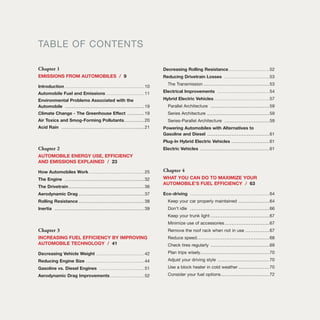
TABLE OF CONTENTS
Chapter 1
EMISSIONS FROM AUTOMOBILES / 9
Introduction ..............................................10
Automobile Fuel and Emissions ......................11
Environmental Problems Associated with the
Automobile ..............................................19
Climate Change - The Greenhouse Effect ..........19
Air Toxics and Smog-Forming Pollutants............20
Acid Rain ................................................21
Chapter 2
AUTOMOBILE ENERGY USE, EFFICIENCY
AND EMISSIONS EXPLAINED / 23
How Automobiles Work ................................25
The Engine ..............................................32
The Drivetrain............................................36
Aerodynamic Drag ......................................37
Rolling Resistance ......................................38
Inertia ....................................................39
Chapter 3
INCREASING FUEL EFFICIENCY BY IMPROVING
AUTOMOBILE TECHNOLOGY / 41
Decreasing Vehicle Weight ............................42
Reducing Engine Size ..................................44
Gasoline vs. Diesel Engines ..........................51
Aerodynamic Drag Improvements....................52
Decreasing Rolling Resistance........................52
Reducing Drivetrain Losses ..........................53
The Transmission ......................................53
Electrical Improvements ..............................54
Hybrid Electric Vehicles ................................57
Parallel Architecture ..................................59
Series Architecture ....................................59
Series-Parallel Architecture ..........................59
Powering Automobiles with Alternatives to
Gasoline and Diesel ....................................61
Plug-In Hybrid Electric Vehicles ......................61
Electric Vehicles ........................................61
Chapter 4
WHAT YOU CAN DO TO MAXIMIZE YOUR
AUTOMOBILE’S FUEL EFFICIENCY / 63
Eco-driving ..............................................64
Keep your car properly maintained ..................64
Don’t idle ..............................................66
Keep your trunk light ..................................67
Minimize use of accessories..........................67
Remove the roof rack when not in use ..............67
Reduce speed..........................................68
Check tires regularly ..................................69
Plan trips wisely........................................70
Adjust your driving style ..............................70
Use a block heater in cold weather ..................70
Consider your fuel options ............................72
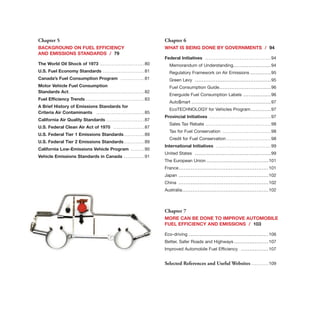
Chapter 5
BACKGROUND ON FUEL EFFICIENCY
AND EMISSIONS STANDARDS / 79
The World Oil Shock of 1973 ..........................80
U.S. Fuel Economy Standards ........................81
Canada’s Fuel Consumption Program ..............81
Motor Vehicle Fuel Consumption
Standards Act............................................82
Fuel Efficiency Trends ..................................83
A Brief History of Emissions Standards for
Criteria Air Contaminants ............................85
California Air Quality Standards ......................87
U.S. Federal Clean Air Act of 1970 ..................87
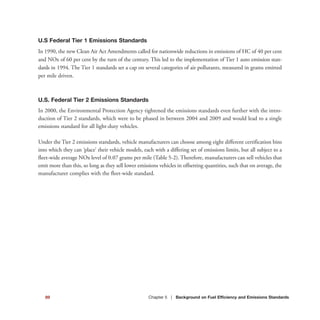
U.S. Federal Tier 1 Emissions Standards............89
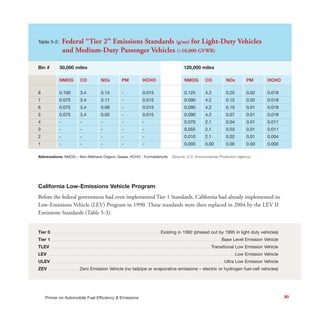
U.S. Federal Tier 2 Emissions Standards............89
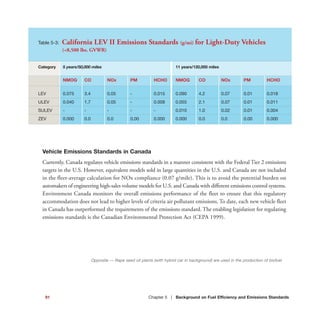
California Low-Emissions Vehicle Program ........90
Vehicle Emissions Standards in Canada ............91
Chapter 6
WHAT IS BEING DONE BY GOVERNMENTS / 94
Federal Initiatives ......................................94
Memorandum of Understanding......................94
Regulatory Framework on Air Emissions ............95
Green Levy ............................................95
Fuel Consumption Guide..............................96
Energuide Fuel Consumption Labels ................96
Auto$mart ..............................................97
EcoTECHNOLOGY for Vehicles Program............97
Provincial Initiatives ....................................97
Sales Tax Rebate ......................................98
Tax for Fuel Conservation ............................98
Credit for Fuel Conservation ..........................98
International Initiatives ................................99
United States ............................................99
The European Union ....................................101
France....................................................101
Japan ....................................................102
China ....................................................102
Australia..................................................102
Chapter 7
MORE CAN BE DONE TO IMPROVE AUTOMOBILE
FUEL EFFICIENCY AND EMISSIONS / 103
Eco-driving ..............................................106
Better, Safer Roads and Highways ....................107
Improved Automobile Fuel Efficiency ................107
Selected References and Useful Websites ..........109
and Useful Websites ....................................92
DRAFTCOPY
CHAPTER ONE
EMISSIONS FROM
AUTOMOBILES
INTRODUCTION
The private automobile is the primary mode of transportation for Canadians.
More than 80 per cent of Canada’s 9.3 million households have a personal vehicle.
In total, there are 19.2 million passenger cars, vans, sport utility vehicles, and pick up trucks registered in
Canada and these are typically driven more than 332 billion kilometres per year. With close to one vehicle
for every two people, Canada has one of the highest ratios of car ownership in the world. This level of private
automobile ownership and use has had profound impacts on the economy and people’s lifestyles. But the
scale of automobile use in Canada (and around the world) has also come at a cost.
Energy is needed to power an automobile, and most of this energy comes from the burning of fossil fuels in the
vehicle’s engine. This burning or “combustion” process produces emissions that pollute the air and contribute to
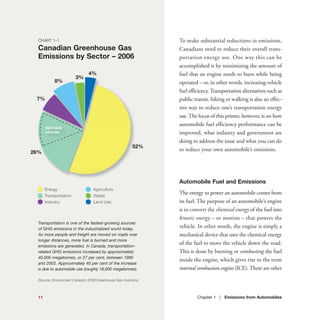
climate change. In fact, transportation is a major source of these emissions. One-quarter of Canada’s greenhouse
gas (GHG) emissions come from transportation activity (Chart 1-1) – half of which are generated by light-duty
vehicles (a vehicle classification that is primarily composed of cars, minivans, sport-utility vehicles, vans and light pick-
up trucks). These GHG emission levels continue to increase as the number of vehicles on the road and the distances
they travel continue to grow. In addition to GHG emissions, automobiles emit toxic and smog-forming pollutants
into the air known as criteria air contaminants (CACs). While such emissions from new vehicles are declining due
to the development of more effective pollution control devices and improved fuel formulations, the overall increase
in the number of vehicles being driven somewhat limits the potential improvements in air quality. Thus, private
automobiles remain a contributor to smog and other environmental health issues related to air emissions.
CHAPTER 1 | EMISSIONS FROM AUTOMOBILES
10Primer on Automobile Fuel Efficiency & Emissions
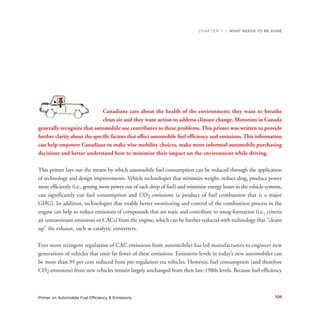
To make substantial reductions in emissions,
Canadians need to reduce their overall trans-
portation energy use. One way this can be
accomplished is by minimizing the amount of
fuel that an engine needs to burn while being
operated – or, in other words, increasing vehicle
fuel efficiency.Transportation alternatives such as
public transit, biking or walking is also an effec-
tive way to reduce one’s transportation energy
use.The focus of this primer, however, is on how
automobile fuel efficiency performance can be
improved, what industry and government are
doing to address the issue and what you can do
to reduce your own automobile’s emissions.
Automobile Fuel and Emissions
The energy to power an automobile comes from
its fuel. The purpose of an automobile’s engine
is to convert the chemical energy of the fuel into
kinetic energy – or motion – that powers the
vehicle. In other words, the engine is simply a
mechanical device that uses the chemical energy
of the fuel to move the vehicle down the road.
This is done by burning or combusting the fuel
inside the engine, which gives rise to the term
internal combustion engine (ICE).There are other
Chapter 1 | Emissions from Automobiles11
CHART 1-1
Canadian Greenhouse Gas
Emissions by Sector – 2006
Transportation is one of the fastest-growing sources
of GHG emissions in the industrialized world today.
As more people and freight are moved on roads over
longer distances, more fuel is burned and more
emissions are generated. In Canada, transportation-
related GHG emissions increased by approximately
40,000 megatonnes, or 27 per cent, between 1990
and 2003. Approximately 40 per cent of the increase
is due to automobile use (roughly 16,000 megatonnes).
(Source: Environment Canada’s 2006 Greenhouse Gas Inventory)
Energy
Transportation
Industry
Agriculture
Waste
Land Use
52%
4%
3%
8%
7%
26%
light-duty
vehicles
12
ways to power automobiles, such as with electric motors, but the internal combustion engine is by far the most
common way to generate the required power. The more fuel an automobile’s engine consumes, the more emis-
sions it generates. What are these emissions? They are composed of the same elements that are drawn into the
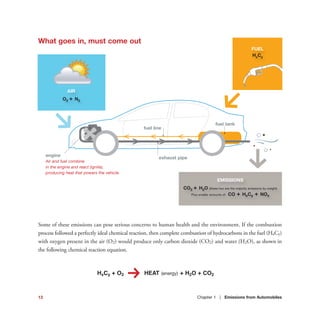
engine in the first place. In other words, “what goes in, must come out”.
First let’s examine “what goes in” (i.e., fuel and air). An automobile requires a source of energy to power its
movement. This energy is most commonly supplied by fuels derived from crude oil, such as gasoline and diesel.
Since crude oil is the by-product of decomposed biological matter deposited millions of years ago, fuels derived
from crude oil are called fossil fuels. Fossil fuels such as gasoline and diesel are made up of molecules containing
mostly hydrogen and carbon atoms, and are therefore referred to as hydrocarbons (HC). In addition to HC, fossil
fuels may also contain some amount of sulphur, which is a naturally occurring element in crude oil and many
other fossil fuels, including coal. Oxygen is needed to combust the hydrocarbons inside the engine. This oxygen
is present in the air that surrounds us (air is composed of roughly 21 per cent oxygen and 78 per cent nitrogen).
Both oxygen and fuel are drawn or pumped into the automobile’s engine. Together, they are the key ingredients
needed for the engine to generate power.
Now let’s examine “what comes out” (i.e., combustion products or emissions). Fuel from the fuel tank is mixed
with air that is drawn into the engine to combust the fuel (this is discussed in more detail in chapter two). In the
process of combustion, the molecules comprising the fuel and air in the engine react with each other, releasing
heat and rearranging themselves into new molecules. These new molecules are the products of combustion, and
they comprise the gases that are pumped out of the engine and into the exhaust pipe. The stream of gases emitted
from the engine then pass through exhaust after-treatment systems, in which the combustion products undergo
further reactions (to reduce levels of certain air pollutants) before finally exiting the vehicle’s tailpipe back into
the atmosphere. It is the various chemical components of this exhaust that we refer to as emissions.
Primer on Automobile Fuel Efficiency & Emissions
What goes in, must come out
Some of these emissions can pose serious concerns to human health and the environment. If the combustion
process followed a perfectly ideal chemical reaction, then complete combustion of hydrocarbons in the fuel (HxCy)
with oxygen present in the air (O2) would produce only carbon dioxide (CO2) and water (H2O), as shown in
the following chemical reaction equation.
Chapter 1 | Emissions from Automobiles13
exhaust pipe
engine
Air and fuel combine
in the engine and react (ignite),
producing heat that powers the vehicle.
fuel line
fuel tank
AIR
O2 + N2
EMISSIONS
CO2 + H2O (these two are the majority emissions by weight)
Plus smaller amounts of: CO + HxCy + NOx
FUEL
HxCy
c
l
h
In the real world, however, combustion is neither a complete nor a perfect process; therefore, the products in the
engine exhaust also contain some unburned fuel. Emissions of unburned fuel are also classified as Volatile Organic
Compounds (VOCs) – “volatile” because they easily and quickly evaporate into the air.1
In addition, there is also a
degree of incomplete or partial combustion of hydrocarbons, which results in emissions of carbon monoxide (CO).
The combustion process occurs under conditions of high heat and pressure, which causes nitrogen in the air
to bond with oxygen and form Oxides of Nitrogen (NOx). The sulphur in fuel also bonds with oxygen to form
Oxides of Sulphur (SOx - under some conditions, the sulphur can also bond with hydrogen to produce a small
amount of hydrogen sulphide, H2S). In addition to these chemical compounds, automobile engines also emit
varying amounts of Particulate Matter (PM), which can include microscopic liquid droplets and particles of soot
produced during combustion. Thus, the “real” chemical equation of combustion in the engine looks more like this:
[HxCy + S]FUEL + [O2 + N2]AIR
k HEATENERGY TO POWER ENGINES +
[H20 + CO2 + CO + VOCs(HxCy) + NOx + SOx + PM] EMISSIONS
On the following page, Table 1-1 summarizes the characteristics of the major pollutants associated with auto-
mobile use.
1
The terms Volatile Organic Compounds and Hydrocarbons are often used interchangeably in automotive emissions literature.
14Primer on Automobile Fuel Efficiency & Emissions
Chapter 1 | Emissions from Automobiles15
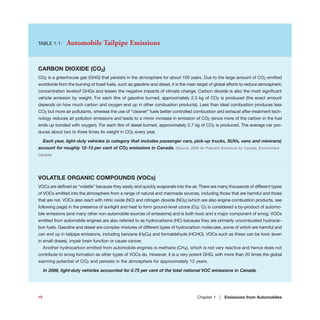
TABLE 1-1: Automobile Tailpipe Emissions
CARBON DIOXIDE (CO2)
CO2 is a greenhouse gas (GHG) that persists in the atmosphere for about 150 years. Due to the large amount of CO2 emitted
worldwide from the burning of fossil fuels, such as gasoline and diesel, it is the main target of global efforts to reduce atmospheric
concentration levelsof GHGs and lessen the negative impacts of climate change. Carbon dioxide is also the most significant
vehicle emission by weight. For each litre of gasoline burned, approximately 2.3 kg of CO2 is produced (the exact amount
depends on how much carbon and oxygen end up in other combustion products). Less than ideal combustion produces less
CO2 but more air pollutants, whereas the use of “cleaner” fuels better controlled combustion and exhaust after-treatment tech-
nology reduces air pollution emissions and leads to a minor increase in emission of CO2 (since more of the carbon in the fuel
ends up bonded with oxygen). For each litre of diesel burned, approximately 2.7 kg of CO2 is produced. The average car pro-
duces about two to three times its weight in CO2 every year.
Each year, light-duty vehicles (a category that includes passenger cars, pick-up trucks, SUVs, vans and minivans)
account for roughly 12-13 per cent of CO2 emissions in Canada. (Source: 2006 Air Pollutant Emissions for Canada, Environment
Canada)
VOLATILE ORGANIC COMPOUNDS (VOCs)
VOCs are defined as “volatile” because they easily and quickly evaporate into the air. There are many thousands of different types
of VOCs emitted into the atmosphere from a range of natural and manmade sources, including those that are harmful and those
that are not. VOCs also react with nitric oxide (NO) and nitrogen dioxide (NO2) (which are also engine combustion products, see
following page) in the presence of sunlight and heat to form ground-level ozone (O3). O3 is considered a by-product of automo-
bile emissions (and many other non-automobile sources of emissions) and is both toxic and a major component of smog. VOCs
emitted from automobile engines are also referred to as hydrocarbons (HC) because they are primarily uncombusted hydrocar-
bon fuels. Gasoline and diesel are complex mixtures of different types of hydrocarbon molecules, some of which are harmful and
can end up in tailpipe emissions, including benzene (H6C6) and formaldehyde (HCHO). VOCs such as these can be toxic (even
in small doses), impair brain function or cause cancer.
Another hydrocarbon emitted from automobile engines is methane (CH4), which is not very reactive and hence does not
contribute to smog formation as other types of VOCs do. However, it is a very potent GHG, with more than 20 times the global
warming potential of CO2 and persists in the atmosphere for approximately 12 years.
In 2006, light-duty vehicles accounted for 0.75 per cent of the total national VOC emissions in Canada.
TABLE 1-1, CONTINUED
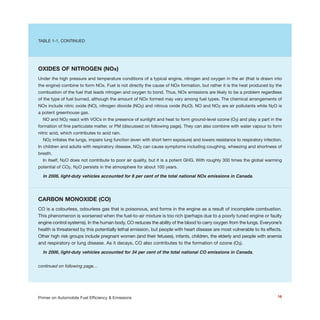
OXIDES OF NITROGEN (NOx)
Under the high pressure and temperature conditions of a typical engine, nitrogen and oxygen in the air (that is drawn into
the engine) combine to form NOx. Fuel is not directly the cause of NOx formation, but rather it is the heat produced by the
combustion of the fuel that leads nitrogen and oxygen to bond. Thus, NOx emissions are likely to be a problem regardless
of the type of fuel burned, although the amount of NOx formed may vary among fuel types. The chemical arrangements of
NOx include nitric oxide (NO), nitrogen dioxide (NO2) and nitrous oxide (N2O). NO and NO2 are air pollutants while N2O is
a potent greenhouse gas.
NO and NO2 react with VOCs in the presence of sunlight and heat to form ground-level ozone (O3) and play a part in the
formation of fine particulate matter, or PM (discussed on following page). They can also combine with water vapour to form
nitric acid, which contributes to acid rain.
NO2 irritates the lungs, impairs lung function (even with short term exposure) and lowers resistance to respiratory infection.
In children and adults with respiratory disease, NO2 can cause symptoms including coughing, wheezing and shortness of
breath.
In itself, N2O does not contribute to poor air quality, but it is a potent GHG. With roughly 300 times the global warming
potential of CO2, N2O persists in the atmosphere for about 100 years.
In 2006, light-duty vehicles accounted for 8 per cent of the total national NOx emissions in Canada.
CARBON MONOXIDE (CO)
CO is a colourless, odourless gas that is poisonous, and forms in the engine as a result of incomplete combustion.
This phenomenon is worsened when the fuel-to-air mixture is too rich (perhaps due to a poorly tuned engine or faulty
engine control systems). In the human body, CO reduces the ability of the blood to carry oxygen from the lungs. Everyone’s
health is threatened by this potentially lethal emission, but people with heart disease are most vulnerable to its effects.
Other high risk groups include pregnant women (and their fetuses), infants, children, the elderly and people with anemia
and respiratory or lung disease. As it decays, CO also contributes to the formation of ozone (O3).
In 2006, light-duty vehicles accounted for 34 per cent of the total national CO emissions in Canada.
continued on following page…
16Primer on Automobile Fuel Efficiency & Emissions
DRAFTCOPY
TABLE 1-1, CONTINUED
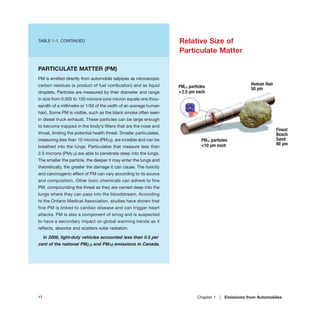
PARTICULATE MATTER (PM)
PM is emitted directly from automobile tailpipes as microscopic
carbon residues (a product of fuel combustion) and as liquid
droplets. Particles are measured by their diameter and range
in size from 0.005 to 100 microns (one micron equals one thou-
sandth of a millimetre or 1/50 of the width of an average human
hair). Some PM is visible, such as the black smoke often seen
in diesel truck exhaust. These particles can be large enough
to become trapped in the body’s filters that are the nose and
throat, limiting the potential health threat. Smaller particulates,
measuring less than 10 microns (PM10), are invisible and can be
breathed into the lungs. Particulates that measure less than
2.5 microns (PM2.5) are able to penetrate deep into the lungs.
The smaller the particle, the deeper it may enter the lungs and
theoretically, the greater the damage it can cause. The toxicity
and carcinogenic effect of PM can vary according to its source
and composition. Other toxic chemicals can adhere to fine
PM, compounding the threat as they are carried deep into the
lungs where they can pass into the bloodstream. According
to the Ontario Medical Association, studies have shown that
fine PM is linked to cardiac disease and can trigger heart
attacks. PM is also a component of smog and is suspected
to have a secondary impact on global warming trends as it
reflects, absorbs and scatters solar radiation.
In 2006, light-duty vehicles accounted less than 0.5 per
cent of the national PM2.5 and PM10 emissions in Canada.
PM10 particles
<10 µm each
PM2.5 particles
<2.5 µm each
Finest
Beach
Sand
90 µm
Human Hair
50 µm
Relative Size of
Particulate Matter
17 Chapter 1 | Emissions from Automobiles
18Primer on Automobile Fuel Efficiency & Emissions
TABLE 1-1, CONTINUED
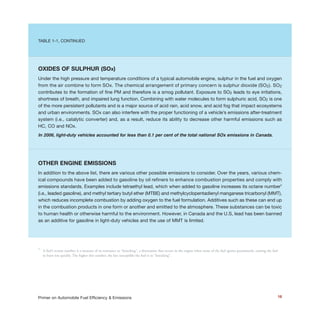
OXIDES OF SULPHUR (SOx)
Under the high pressure and temperature conditions of a typical automobile engine, sulphur in the fuel and oxygen
from the air combine to form SOx. The chemical arrangement of primary concern is sulphur dioxide (SO2). SO2
contributes to the formation of fine PM and therefore is a smog pollutant. Exposure to SO2 leads to eye irritations,
shortness of breath, and impaired lung function. Combining with water molecules to form sulphuric acid, SO2 is one
of the more persistent pollutants and is a major source of acid rain, acid snow, and acid fog that impact ecosystems
and urban environments. SOx can also interfere with the proper functioning of a vehicle’s emissions after-treatment
system (i.e., catalytic converter) and, as a result, reduce its ability to decrease other harmful emissions such as
HC, CO and NOx.
In 2006, light-duty vehicles accounted for less than 0.1 per cent of the total national SOx emissions in Canada.
OTHER ENGINE EMISSIONS
In addition to the above list, there are various other possible emissions to consider. Over the years, various chem-
ical compounds have been added to gasoline by oil refiners to enhance combustion properties and comply with
emissions standards. Examples include tetraethyl lead, which when added to gasoline increases its octane number2
(i.e., leaded gasoline), and methyl tertiary butyl ether (MTBE) and methylcyclopentadienyl manganese tricarbonyl (MMT),
which reduces incomplete combustion by adding oxygen to the fuel formulation. Additives such as these can end up
in the combustion products in one form or another and emitted to the atmosphere. These substances can be toxic
to human health or otherwise harmful to the environment. However, in Canada and the U.S, lead has been banned
as an additive for gasoline in light-duty vehicles and the use of MMT is limited.
2
A fuel’s octane number is a measure of its resistance to “knocking”, a detonation that occurs in the engine when some of the fuel ignites prematurely, causing the fuel
to burn too quickly. The higher this number, the less susceptible the fuel is to “knocking”.
19
Environmental Problems Associated with the Automobile
If emissions were of no health or environmental consequence, then we would not be concerned about them.
However, as detailed previously in Table 1-1, automobile emissions need to be taken very seriously. Of great concern
are the greenhouse gas emissions that trap heat in our atmosphere and contribute to climate change. Other emis-
sions combine to form smog that threatens the quality of our air and the health of our environment. Even the
health of our lakes and oceans is threat-
ened by automobile emissions: NOx and
SOx emissions contribute to the forma-
tion of acid rain, while excess CO2 in the
atmosphere is absorbed into the oceans
forming carbonic acid that can negatively
impact coral reefs and marine ecology.
Climate Change -
The Greenhouse Effect
Energy from the sun drives the Earth’s cli-
mate. As the sun’s energy reaches the Earth’s
surface, some of it is reflected back and
some of it is absorbed. The absorbed energy
warms the Earth and is then radiated back
out towards space as infrared energy. Certain
chemical compounds in the Earth’s atmosphere act as “greenhouse gases,” absorbing the radiated infrared energy
and thereby trapping some of the heat in the atmosphere, which then warms the Earth’s surface to an average of
14°C. This phenomenon, called the “natural greenhouse effect,” keeps the Earth in a temperature range that
allows life on this planet to thrive. Without it, the sun’s heat would escape and the average temperature of the
Earth would drop to -19°C. However, any changes in the atmospheric greenhouse gas concentrations will affect
the amount of energy stored in the atmosphere and disrupt the balance of the global climate system. For example,
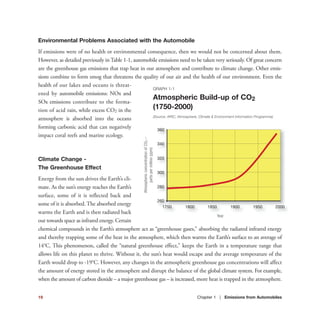
when the amount of carbon dioxide – a major greenhouse gas – is increased, more heat is trapped in the atmosphere.
360
340
320
300
280
260
18001750 1850 1900 20001950
GRAPH 1-1
Atmospheric Build-up of CO2
(1750-2000)
(Source: ARIC, Atmosphere, Climate & Environment Information Programme)
Chapter 1 | Emissions from Automobiles
Year
AtmosphericconcentrationofCO2–
partspermillion(ppm)
20Primer on Automobile Fuel Efficiency & Emissions
This “enhanced greenhouse effect” causes the Earth’s surface temperature to rise. Since the beginning of the indus-
trial revolution (approximately 1750 AD), the concentration of all the major greenhouse gases has increased in the
atmosphere, thereby helping to bring about the changes in climate that the world is currently experiencing (Graph
1-1). Leading scientists around the world have predicted that increasing temperatures will lead to changes in
many aspects of weather, such as wind patterns, precipitation, and the severity and frequency of extreme weather events.
A report released in 2007 from the Intergovernmental Panel on Climate Change (IPCC) declared that “Warming of
the climate system is unequivocal, as is now evident from observations of increases in global average air and ocean
temperatures, widespread melting of snow and ice and rising global average sea level”. The report also stated that
“eleven of the last twelve years (1995-2006) rank among the twelve warmest years in the instrumental record
of global surface temperature (since 1850)”.
Air Toxics and Smog-Forming Pollutants
Smog is formed in the lower atmosphere, just above the Earth’s surface when a variety of sources release smog-
forming pollutants (PM, NOx, VOCs, SO2 and CO) into the air. Heat and sunlight cause chemical reactions to
occur between these pollutants, forming ground-level ozone (O3) - a major component of smog. When inhaled,
smog can be harmful to human health. The damaging short-term effects can range from eye, nose or throat irri-
tation to decreased lung function. Smog can also aggravate respiratory or cardiac disease and, in some cases, cause
premature death. Recent health studies suggest that there is no safe level of human exposure to smog and negative
health outcomes are associated with very low levels of exposure, even for healthy individuals.The Ontario Medical
Association estimates that more than 9,500 people in Ontario die prematurely each year from the effects of smog.
Furthermore, every year, about 16,000 people in Ontario are admitted to hospital as a result of exposure to smog
and an additional 60,000 sufferers visit the emergency room. Aside from their contribution to smog formation,
some of these pollutants can have direct, negative impacts on human health, and are therefore called air toxics.
To address the human health impacts of these emissions, governments in Canada and the U.S. regulate how much
automobiles are permitted to release during operation. These regulated emissions generally fall into the categories
of VOCs, NOx, CO and PM, and are called criteria air contaminants (CACs). For more discussion on this, see
chapter five.
Chapter 1 | Emissions from Automobiles21
Acid Rain
Regular rain becomes “acid rain” because of pollutants that humans (and some natural processes) have released
into the air. Two pollutants in particular are the main cause of acid rain: sulphur dioxide (SO2) and oxides of
nitrogen (NOx). In the air and in the presence of water vapour, SO2 chemically changes into sulphuric acid and
NOx changes into nitric acid. Sunlight can increase the speed of these reactions. As more and more SO2 and NOx
are emitted into the air, more of these acids are formed. These acids are then dissolved in the water that forms
rain. The rain can become so acidic that it damages the environment when it falls to the Earth. The effects of acid rain
can most clearly be seen in aquatic ecosystems. Acid rain causes a range of effects that harm or kill individual
fish, reduce fish populations, completely eliminate fish species from an affected body of water, and decrease the
number of species of plants and animals. Forests and soils are also affected by acid rain. Trees and other plants
need certain soil nutrients and minerals to grow. When acid rain falls onto the Earth, it dissolves these nutrients
and minerals and washes them away so they are no longer available for the trees and plants.
To limit the negative impacts of automobile emissions on human health and the environment, governments and
industry have taken action to dramatically reduce emissions. The petrochemical and vehicle manufacturing industries
have developed advanced fuel formulations and emissions control technologies to meet government-regulated standards
that significantly reduce certain emissions from automobiles. Consequently, emissions of SOx and other CACs from
automobiles are much lower today than in the past. However, GHG emissions from automobiles remain a problem.
More details on this are provided in chapter five of this primer, which recounts the important work that has been
done to “clean up” automobile emissions. Further to this, chapter six profiles the work that is being done by govern-
ments, and chapter seven describes how the Canadian Automobile Association (CAA) and Pollution Probe are
working together to help drivers do even more to improve fuel efficiency, reduce emissions and limit the impact
of personal mobility on the environment.
In the next two chapters, a simple yet thorough introduction on how automobiles work is provided, followed
by a discussion of the factors that govern fuel consumption and emissions and, finally, an explanation of the
technologies and driving habits that can help to dramatically reduce automobile fuel use and emissions.
To limit the negative impacts of automobile emissions
on human health and the environment, governments
and industry have taken action to dramatically reduce
emissions. The petrochemical and vehicle manufac-
turing industries have developed advanced fuel for-
mulations and emissions control technologies to meet
government-regulated standards that significantly reduce
certain emissions from automobiles. Consequently,
emissions of SOx and other CACs from automobiles
are much lower today than in the past. However, GHG
emissions from automobiles remain a problem. More
details on this are provided in chapter five of this primer,
which recounts the important work that has been done
to “clean up” automobile emissions. Further to this,
chapter six profiles the work that is being done by gov-
ernments, and chapter seven describes how the Canadian
Automobile Association (CAA) and Pollution Probe
are working together to help drivers do even more to
improve fuel efficiency, reduce emissions and limit the
impact of personal mobility on the environment.
In the next two chapters, a simple yet thorough intro-
duction on how automobiles work is provided, followed
by a discussion of the factors that govern fuel consump-
tion and emissions and, finally, an explanation of the
technologies and driving habits that can help to dramat-
ically reduce automobile fuel use and emissions.
Opposite page — clockwise, from top left: ACID RAIN — typical effects of leaf affected by acid rain (right) as compared to a healthy
leaf; SMOG — the city of Los Angeles suffers under an unhealthy haze; CLIMATE CHANGE — icebergs melting in the North Atlantic
Sea at the Vatnajokull glacier in Iceland.
DRAFTCOPY
Chapter 2
Automobile Energy Use,
Efficiency and Emissions
Explained
CHAPTER TWO
AUTOMOBILE ENERGY
USE, EFFICIENCY AND
EMISSIONS EXPLAINED
N
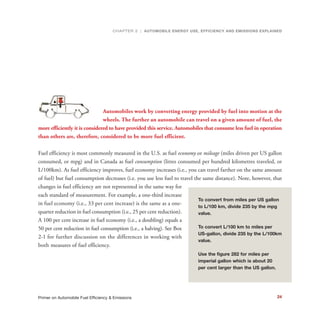
Automobiles work by converting energy provided by fuel into motion at the
wheels. The further an automobile can travel on a given amount of fuel, the
more efficiently it is considered to have provided this service. Automobiles that consume less fuel in operation
than others are, therefore, considered to be more fuel efficient.
Fuel efficiency is most commonly measured in the U.S. as fuel economy or mileage (miles driven per US gallon
consumed, or mpg) and in Canada as fuel consumption (litres consumed per hundred kilometres traveled, or

L/100km). As fuel efficiency improves, fuel economy increases (i.e., you can travel farther on the same amount
of fuel) but fuel consumption decreases (i.e. you use less fuel to travel the same distance). Note, however, that
changes in fuel efficiency are not represented in the same way for
each standard of measurement. For example, a one-third increase
in fuel economy (i.e., 33 per cent increase) is the same as a one-
quarter reduction in fuel consumption (i.e., 25 per cent reduction).
A 100 per cent increase in fuel economy (i.e., a doubling) equals a
50 per cent reduction in fuel consumption (i.e., a halving). See Box
2-1 for further discussion on the differences in working with
both measures of fuel efficiency.
To convert from miles per US gallon
to L/100 km, divide 235 by the mpg
value.
To convert L/100 km to miles per
US-gallon, divide 235 by the L/100km
value.
Use the figure 282 for miles per
imperial gallon which is about 20
per cent larger than the US gallon.
CHAPTER 2 | AUTOMOBILE ENERGY USE, EFFICIENCY AND EMISSIONS EXPLAINED
24Primer on Automobile Fuel Efficiency & Emissions
How Automobiles Work
Understanding how automobiles operate is the first step in understanding the factors that govern energy use
within. Even though there is a myriad of different automobile models with different performance characteristics
and uses on the market today, most modern vehicles function based on the same mechanical principles and
can be broken down into several main subsystems. This primer presents five subsystems, each of which play a
role in automobile fuel efficiency and emissions: 1) Engine & Exhaust 2) Drivetrain 3) Electrical System
4) Body & Frame and 5) Wheels, Tires & Brakes. These subsystems will be referred to frequently in this primer.
The fuel supplied to an automobile represents 100 per cent of the energy available for conversion into motion
at the wheels – there is no other source of energy available other than the fuel pumped into the tank. However,
only a fraction of the energy in the fuel is utilized to move the automobile – in fact, in a typical gasoline-powered
vehicle being used for urban driving, only about 13 per cent of the fuel energy that is delivered to the engine
actually makes it to the wheels to move the vehicle. The rest of the energy is lost in the engine and at various
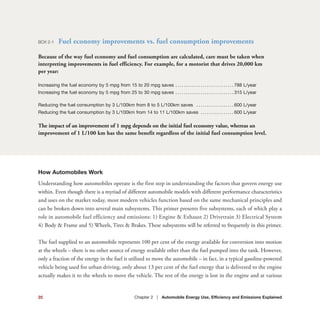
BOX 2-1 Fuel economy improvements vs. fuel consumption improvements
Because of the way fuel economy and fuel consumption are calculated, care must be taken when
interpreting improvements in fuel efficiency. For example, for a motorist that drives 20,000 km
per year:
Increasing the fuel economy by 5 mpg from 15 to 20 mpg saves . . . . . . . . . . . . . . . . . . . . . . . . . . . . 788 L/year
Increasing the fuel economy by 5 mpg from 25 to 30 mpg saves . . . . . . . . . . . . . . . . . . . . . . . . . . . . 315 L/year
Reducing the fuel consumption by 3 L/100km from 8 to 5 L/100km saves . . . . . . . . . . . . . . . . . . 600 L/year
Reducing the fuel consumption by 3 L/100km from 14 to 11 L/100km saves . . . . . . . . . . . . . . . . 600 L/year
The impact of an improvement of 1 mpg depends on the initial fuel economy value, whereas an
improvement of 1 L/100 km has the same benefit regardless of the initial fuel consumption level.
25 Chapter 2 | Automobile Energy Use, Efficiency and Emissions Explained
Five Automobile Subsystems
26Primer on Automobile Fuel Efficiency & Emissions
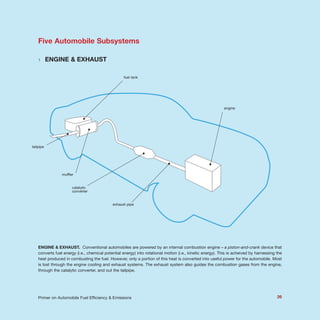
1 ENGINE & EXHAUST
catalytic
converter
engine
exhaust pipe
fuel tank
tailpipe
muffler
ENGINE & EXHAUST. Conventional automobiles are powered by an internal combustion engine – a piston-and-crank device that
converts fuel energy (i.e., chemical potential energy) into rotational motion (i.e., kinetic energy). This is acheived by harnessing the
heat produced in combusting the fuel. However, only a portion of this heat is converted into useful power for the automobile. Most
is lost through the engine cooling and exhaust systems. The exhaust system also guides the combustion gases from the engine,
through the catalytic converter, and out the tailpipe.
Rear-wheel drive
Front-wheel drive
Five Automobile Subsystems, continued
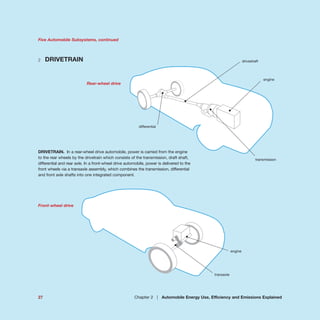
2 DRIVETRAIN
differential
transmission
transaxle
DRIVETRAIN. In a rear-wheel drive automobile, power is carried from the engine
to the rear wheels by the drivetrain which consists of the transmission, draft shaft,
differential and rear axle. In a front-wheel drive automobile, power is delivered to the
front wheels via a transaxle assembly, which combines the transmission, differential
and front axle shafts into one integrated component.
27 Chapter 2 | Automobile Energy Use, Efficiency and Emissions Explained
driveshaft
engine
engine
Five Automobile Subsystems, continued
3 ELECTRICAL SYSTEM
parking light/turn signal
battery
headlights
dome light
Instruments
windshield wiper
electrical wiring
tail light
starter
alternator
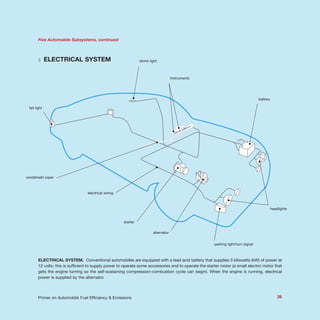
ELECTRICAL SYSTEM. Conventional automobiles are equipped with a lead acid battery that supplies 3 kilowatts (kW) of power at
12 volts; this is sufficient to supply power to operate some accessories and to operate the starter motor (a small electric motor that
gets the engine turning so the self-sustaining compression-combustion cycle can begin). When the engine is running, electrical
power is supplied by the alternator.
28Primer on Automobile Fuel Efficiency & Emissions
Five Automobile Subsystems, continued
4 BODY & FRAME
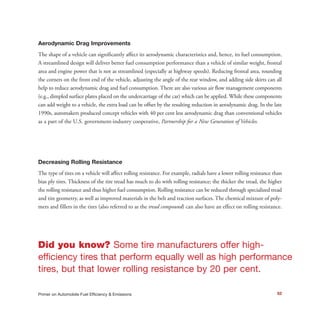
BODY & FRAME. Automobile bodies come in a variety of different shapes and styles. The shape of the body can significantly affect
its aerodynamic characteristics and, hence, its fuel consumption. A streamlined design will deliver better fuel consumption performance
than a vehicle of similar weight, frontal area and engine power that is not as streamlined (especially at highway speeds). The body and
frame also provide the structural support for the other automobile subsystems.
29 Chapter 2 | Automobile Energy Use, Efficiency and Emissions Explained
Five Automobile Subsystems, continued
5 WHEELS, TIRES & BRAKES
brake fluid reservoir
front wheel, brake assembly
brake hose
parking brake handle
brake pedal
rear wheel brake assembly
brake hose
tire
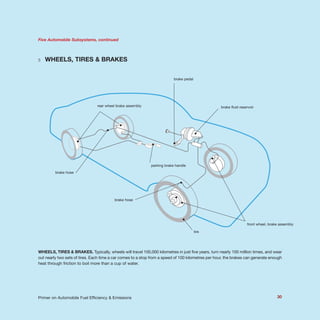
WHEELS, TIRES & BRAKES. Typically, wheels will travel 100,000 kilometres in just five years, turn nearly 100 million times, and wear
out nearly two sets of tires. Each time a car comes to a stop from a speed of 100 kilometres per hour, the brakes can generate enough
heat through friction to boil more than a cup of water.
30Primer on Automobile Fuel Efficiency & Emissions
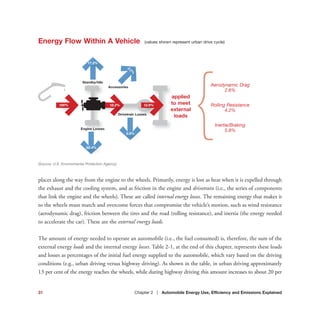
places along the way from the engine to the wheels. Primarily, energy is lost as heat when it is expelled through
the exhaust and the cooling system, and as friction in the engine and drivetrain (i.e., the series of components
that link the engine and the wheels). These are called internal energy losses. The remaining energy that makes it
to the wheels must match and overcome forces that compromise the vehicle’s motion, such as wind resistance
(aerodynamic drag), friction between the tires and the road (rolling resistance), and inertia (the energy needed
to accelerate the car). These are the external energy loads.
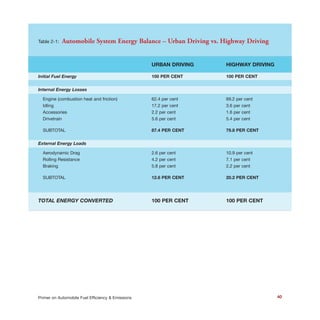
The amount of energy needed to operate an automobile (i.e., the fuel consumed) is, therefore, the sum of the
external energy loads and the internal energy losses. Table 2-1, at the end of this chapter, represents these loads
and losses as percentages of the initial fuel energy supplied to the automobile, which vary based on the driving
conditions (e.g., urban driving versus highway driving). As shown in the table, in urban driving approximately
13 per cent of the energy reaches the wheels, while during highway driving this amount increases to about 20 per
Standby/Idle
Engine Losses
Energy Flow Within A Vehicle (values shown represent urban drive cycle)
31 Chapter 2 | Automobile Energy Use, Efficiency and Emissions Explained
%100% %
17.2%
%
62.4%
%2.2%
%5.6%
%12.6%
%18.2%
Accessories
Drivetrain Losses
applied
to meet
external
loads
Aerodynamic Drag
2.6%
Rolling Resistance
4.2%
Inertia/Braking
5.8%
(Source: U.S. Environmental Protection Agency)
32Primer on Automobile Fuel Efficiency & Emissions
cent. It should be noted that in either situation, the energy reaching the wheels can further decrease due to the
use of energy-consuming accessories, such as air conditioning, headlights or window defrosters. To better
understand what is behind these numbers, and what it means for improving fuel efficiency and reducing emis-
sions, it is important to follow the flow of energy as it is transmitted throughout the major component systems
of an automobile. Let’s take a look and see where the energy goes to provide useful work and where it is lost.
The Engine
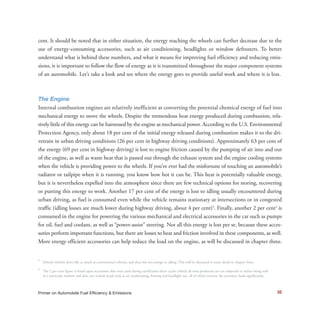
Internal combustion engines are relatively inefficient at converting the potential chemical energy of fuel into
mechanical energy to move the wheels. Despite the tremendous heat energy produced during combustion, rela-
tively little of this energy can be harnessed by the engine as mechanical power. According to the U.S. Environmental
Protection Agency, only about 18 per cent of the initial energy released during combustion makes it to the dri-
vetrain in urban driving conditions (26 per cent in highway driving conditions). Approximately 63 per cent of
the energy (69 per cent in highway driving) is lost to engine friction caused by the pumping of air into and out
of the engine, as well as waste heat that is passed out through the exhaust system and the engine cooling systems
when the vehicle is providing power to the wheels. If you’ve ever had the misfortune of touching an automobile’s
radiator or tailpipe when it is running, you know how hot it can be. This heat is potentially valuable energy,
but it is nevertheless expelled into the atmosphere since there are few technical options for storing, recovering
or putting this energy to work. Another 17 per cent of the energy is lost to idling usually encountered during
urban driving, as fuel is consumed even while the vehicle remains stationary at intersections or in congested
traffic (idling losses are much lower during highway driving, about 4 per cent)3
. Finally, another 2 per cent4
is
consumed in the engine for powering the various mechanical and electrical accessories in the car such as pumps
for oil, fuel and coolant, as well as “power-assist” steering. Not all this energy is lost per se, because these acces-
sories perform important functions, but there are losses to heat and friction involved in these components, as well.
More energy efficient accessories can help reduce the load on the engine, as will be discussed in chapter three.
3
Hybrid vehicles don’t idle as much as conventional vehicles, and thus lose less energy to idling. This will be discussed in more detail in chapter three.
4
The 2 per cent figure is based upon accessories that were used during certification drive cycles (which all mass produced cars are subjected to before being sold
in a particular market) and does not include loads such as air conditioning, heating and headlight use, all of which increase the accessory loads significantly.
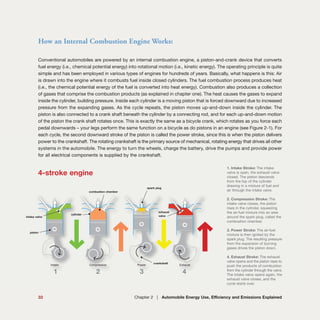
Conventional automobiles are powered by an internal combustion engine, a piston-and-crank device that converts
fuel energy (i.e., chemical potential energy) into rotational motion (i.e., kinetic energy). The operating principle is quite
simple and has been employed in various types of engines for hundreds of years. Basically, what happens is this: Air
is drawn into the engine where it combusts fuel inside closed cylinders. The fuel combustion process produces heat
(i.e., the chemical potential energy of the fuel is converted into heat energy). Combustion also produces a collection
of gases that comprise the combustion products (as explained in chapter one). The heat causes the gases to expand
inside the cylinder, building pressure. Inside each cylinder is a moving piston that is forced downward due to increased
pressure from the expanding gases. As the cycle repeats, the piston moves up-and-down inside the cylinder. The
piston is also connected to a crank shaft beneath the cylinder by a connecting rod, and for each up-and-down motion
of the piston the crank shaft rotates once. This is exactly the same as a bicycle crank, which rotates as you force each
pedal downwards – your legs perform the same function on a bicycle as do pistons in an engine (see Figure 2-1). For
each cycle, the second downward stroke of the piston is called the power stroke, since this is when the piston delivers
power to the crankshaft. The rotating crankshaft is the primary source of mechanical, rotating energy that drives all other
systems in the automobile. The energy to turn the wheels, charge the battery, drive the pumps and provide power
for all electrical components is supplied by the crankshaft.
How an Internal Combustion Engine Works:
33 Chapter 2 | Automobile Energy Use, Efficiency and Emissions Explained
Intake ExhaustCompression Power
4-stroke engine
1. Intake Stroke: The intake
valve is open, the exhaust valve
closed. The piston descends
from the top of the cylinder
drawing in a mixture of fuel and
air through the intake valve.
2. Compression Stroke: The
intake valve closes, the piston
rises in the cylinder, squeezing
the air-fuel mixture into an area
around the spark plug, called the
combustion chamber.
3. Power Stroke: The air-fuel
mixture is then ignited by the
spark plug. The resulting pressure
from the expansion of burning
gases drives the piston down.
4. Exhaust Stroke: The exhaust
valve opens and the piston rises to
push the products of combustion
from the cylinder through the valve.
The intake valve opens again, the
exhaust valve closes, and the
cycle starts over.
1 2 3 4
piston
intake valve
combustion chamber
cylinder
spark plug
%
%
%
%exhaust
valve
crankshaft
34Primer on Automobile Fuel Efficiency & Emissions
The combustion products then exit the engine and enter the exhaust system. The exhaust system is connected to the
engine and channels the flow of combustion gases through emission and noise control devices (e.g., catalytic converter
and resonator/muffler systems) before exiting the tailpipe as emissions. As it leaves the engine, the temperature of com-
bustion gases can reach 2,000˚C or more, but are much lower by the time they exit the exhaust pipe.
Reviewing the process by which air is drawn into the engine, it can be seen that the engine essentially acts as an elab-
orate, self-powered pumping system; air is mixed with fuel and burned, then forced out through the exhaust system,
essentially converting some of the energy potential of the fuel into rotational energy at the crankshaft. The rate at which
fuel is combusted determines the power. Power is the rate at which energy is supplied (i.e., converted into useful work).
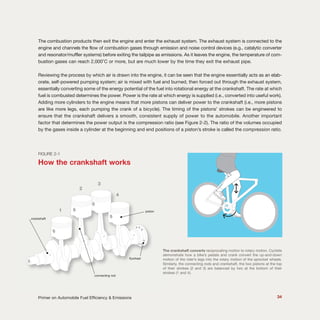
Adding more cylinders to the engine means that more pistons can deliver power to the crankshaft (i.e., more pistons
are like more legs, each pumping the crank of a bicycle). The timing of the pistons’ strokes can be engineered to
ensure that the crankshaft delivers a smooth, consistent supply of power to the automobile. Another important
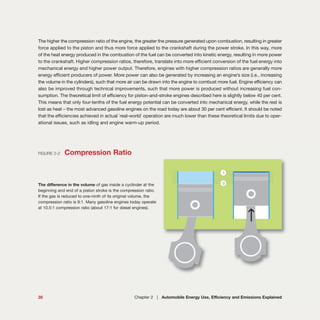
factor that determines the power output is the compression ratio (see Figure 2-2). The ratio of the volumes occupied
by the gases inside a cylinder at the beginning and end positions of a piston’s stroke is called the compression ratio.
FIGURE 2-1
How the crankshaft works
The crankshaft converts reciprocating motion to rotary motion. Cyclists
demonstrate how a bike’s pedals and crank convert the up-and-down
motion of the rider’s legs into the rotary motion of the sprocket wheels.
Similarly, the connecting rods and crankshaft, the two pistons at the top
of their strokes (2 and 3) are balanced by two at the bottom of their
strokes (1 and 4).
flywheel
1
2
3
4
crankshaft
connecting rod
piston
The higher the compression ratio of the engine, the greater the pressure generated upon combustion, resulting in greater
force applied to the piston and thus more force applied to the crankshaft during the power stroke. In this way, more
of the heat energy produced in the combustion of the fuel can be converted into kinetic energy, resulting in more power
to the crankshaft. Higher compression ratios, therefore, translate into more efficient conversion of the fuel energy into
mechanical energy and higher power output. Therefore, engines with higher compression ratios are generally more
energy efficient producers of power. More power can also be generated by increasing an engine’s size (i.e., increasing
the volume in the cylinders), such that more air can be drawn into the engine to combust more fuel. Engine efficiency can
also be improved through technical improvements, such that more power is produced without increasing fuel con-
sumption. The theoretical limit of efficiency for piston-and-stroke engines described here is slightly below 40 per cent.
This means that only four-tenths of the fuel energy potential can be converted into mechanical energy, while the rest is
lost as heat – the most advanced gasoline engines on the road today are about 30 per cent efficient. It should be noted
that the efficiencies achieved in actual `real-world` operation are much lower than these theoretical limits due to oper-
ational issues, such as idling and engine warm-up period.
35 Chapter 2 | Automobile Energy Use, Efficiency and Emissions Explained
FIGURE 2-2 Compression Ratio
The difference in the volume of gas inside a cyclinder at the
beginning and end of a piston stroke is the compression ratio.
If the gas is reduced to one-ninth of its original volume, the
compression ratio is 9:1. Many gasoline engines today operate
at 10.5:1 compression ratio (about 17:1 for diesel engines).
The Drivetrain
In a conventional car, the drivetrain (sometimes referred to as the driveline) consists of several components (i.e.,
driveshaft, transmission, differential and axle) that transmit energy from the engine to the wheels. The transmission
connects the crankshaft to the driveshaft. The transmission also converts the engine speed (the rate at which the
crankshaft rotates) into the speed required for the driveshaft to turn the wheels at the desired rate. Said another
way, power is the product of force and speed, and so the purpose of the transmission is to convert the force and
speed combinations that the engine can produce into force and speed combinations that the driver wants at the
wheels. The transmission contains low gears that provide extra force for accelerating the car from a rest position
or for climbing hills, and high gears primarily used at cruising speeds. The idea is to turn the driveshaft and wheels
at revolutions needed to propel the automobile forward at any speed (and in reverse) while permitting the engine
to run in a narrower, optimal speed range (say, between 1,500-3,500 rpm). The axle upon which the wheels turn
is connected to the driveshaft through the differential. The differential is simply a set of bevelled gears that directs
power from the driveshaft to the wheels. A vehicle’s wheels can rotate at different speeds, especially when turning
corners. The differential is designed to drive a pair of wheels with equal force, while allowing them to rotate at
different speeds.
The drivetrain accounts for about 5.6 per cent of energy losses in both urban and highway driving. Some of this
energy is lost in the transmission. There are two types of transmissions: manual transmissions and automatic
transmissions. Manual transmissions are controlled by the driver by way of a stick shift and are in direct contact
with the engine crankshaft through a clutch. To shift gears in a manual transmission, a driver will momentarily
disengage the clutch, which disconnects engine power to the driveshaft, make the shift and then re-engage the
clutch to bring power back to the driveshaft. The benefit of the direct connection is that little power is lost across
the clutch. Automatic transmissions, on the other hand, shift gears without driver intervention and are indirectly
connected to the engine through a fluid-coupling device known as a torque converter. Some power is lost in the
fluid between the engine and the driveshaft, meaning that automatic transmissions can lead to lower levels of
fuel efficiency. A trained driver, shifting at efficient engine speeds, can use less energy with a manual transmission
than can be achieved with an automatic transmission. However, most drivers lack such training and awareness;
this, coupled with technical advancements in some automatic transmissions, means that the average driver may
lose less energy with an automatic than a manual transmission.
36Primer on Automobile Fuel Efficiency & Emissions
Friction in the gears and bearings along the drivetrain also contribute to energy losses. Materials, component
design and lubrication are important to minimizing these losses.
The remaining energy that is delivered to the wheels (about 13 per cent in urban driving and 20 per cent in high-
way driving after the engine and drivetrain losses are accounted for), is used to overcome the external loads (or
forces) in order to move the vehicle and keep it moving. These external loads, discussed next, are aerodynamic drag,
rolling resistance and inertia.
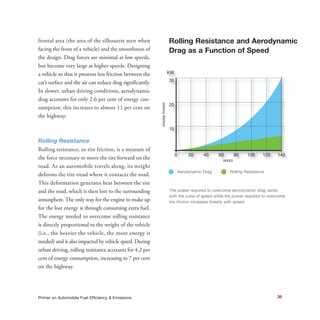
Aerodynamic drag
Aerodynamic drag is a form of resistance applied to a vehicle as it moves through air. It is caused by friction
between the vehicle’s surface and the air. Drag also occurs because there is a difference in air pressure between
the front and rear surfaces of the vehicle’s body. This has to be overcome to keep the vehicle moving through
the air. Think about how much more force and energy is needed when you are riding a bike into a headwind
– it’s the same thing with an automobile. Drag is directly related to the vehicle’s shape, factoring in both the total
Major forces on an automobile in motion
37 Chapter 2 | Automobile Energy Use, Efficiency and Emissions Explained
Aerodynamic Drag
Rolling Friction Rolling Friction FORWARD FORCE
Inertial Force
(during acceleration)
frontal area (the area of the silhouette seen when
facing the front of a vehicle) and the smoothness of
the design. Drag forces are minimal at low speeds,
but become very large at higher speeds. Designing
a vehicle so that it presents less friction between the
car’s surface and the air can reduce drag significantly.
In slower, urban driving conditions, aerodynamic
drag accounts for only 2.6 per cent of energy con-
sumption; this increases to almost 11 per cent on
the highway.
Rolling Resistance
Rolling resistance, or tire friction, is a measure of
the force necessary to move the tire forward on the
road. As an automobile travels along, its weight
deforms the tire tread where it contacts the road.
This deformation generates heat between the tire
and the road, which is then lost to the surrounding
atmosphere. The only way for the engine to make up
for the lost energy is through consuming extra fuel.
The energy needed to overcome rolling resistance
is directly proportional to the weight of the vehicle
(i.e., the heavier the vehicle, the more energy is
needed) and is also impacted by vehicle speed. During
urban driving, rolling resistance accounts for 4.2 per
cent of energy consumption, increasing to 7 per cent
on the highway.
38Primer on Automobile Fuel Efficiency & Emissions
140120100806040200
10
20
30
KW
Rolling Resistance and Aerodynamic
Drag as a Function of Speed
The power required to overcome aerodynamic drag varies
with the cube of speed while the power required to overcome
tire friction increases linearly with speed.
Aerodynamic Drag Rolling Resistance
ENGINEPOWER
SPEED
39 Chapter 2 | Automobile Energy Use, Efficiency and Emissions Explained
Inertia
To increase speed, the engine and drivetrain must deliver enough energy to overcome a vehicle’s inertia. The
heavier an object, the more inertia it has and the more energy is required to move that object. Thus, the less an
automobile weighs, the less energy is needed to move it. In terms of automobile design, vehicle mass and
inertia can be considered the same thing (“overcoming inertia” is how engineers describe the act of acceleration).
An automobile coasting down the highway also has inertia, which must be overcome by the brakes to reduce
speed (called deceleration). In other words, the energy invested (i.e., fuel consumed) in accelerating a vehicle
is not actually lost until the brakes are applied. Brakes stop a vehicle by forcing a high-friction material against
spinning iron discs or drums that are bolted to the wheels. This friction causes the car to slow and, eventually,
to stop. Each time a car comes to a stop from a speed of 100 kilometres per hour, the brakes generate enough
heat through friction to boil almost 300 ml of water (about a cup). This heat then dissipates to the surrounding
atmosphere and is lost. In urban driving, inertia accounts for almost 6 per cent of energy consumed, due to
frequent braking. In highway driving, where full braking is less frequent, only 2 per cent of the energy is lost.
In summary, fuel is consumed by an automobile in amounts sufficient to meet internal losses and external loads.
One way to reduce fuel consumption, therefore, is to reduce the amount of energy lost throughout the auto-
mobile system. More losses means less energy reaching the wheels where it is needed to move the automobile.
Reducing the external loads is another way to reduce fuel consumption. Chapter three will discuss how these
challenges are being addressed.
40Primer on Automobile Fuel Efficiency & Emissions
Table 2-1: Automobile System Energy Balance – Urban Driving vs. Highway Driving
URBAN DRIVING HIGHWAY DRIVING
Initial Fuel Energy 100 PER CENT 100 PER CENT
Internal Energy Losses
Engine (combustion heat and friction) 62.4 per cent 69.2 per cent
Idling 17.2 per cent 3.6 per cent
Accessories 2.2 per cent 1.6 per cent
Drivetrain 5.6 per cent 5.4 per cent
SUBTOTAL 87.4 PER CENT 79.8 PER CENT
External Energy Loads
Aerodynamic Drag 2.6 per cent 10.9 per cent
Rolling Resistance 4.2 per cent 7.1 per cent
Braking 5.8 per cent 2.2 per cent
SUBTOTAL 12.6 PER CENT 20.2 PER CENT
TOTAL ENERGY CONVERTED 100 PER CENT 100 PER CENT
DRAFTCOPY
Chapter 3
Saving Energy Within an
Automobile – Improving
Fuel Efficiency
CHAPTER THREE
INCREASING FUEL
EFFICIENCY BY
IMPROVING AUTOMOBILE
TECHNOLOGY
AUTOMOBILE ENERGY USE, EFFICIENCY AND
Chapter two discussed how energy from fuel is converted into mechanical
energy to power an automobile, how that energy is distributed throughout
the automobile and where energy is lost along the way. By decreasing the loads on the vehicle (i.e., drag
due to air and rolling resistance, and inertia due to mass) and by decreasing the energy lost within the
system, the distance an automobile will travel on a tank of gas can be increased (i.e., improving fuel effi-
ciency). The less fuel consumed by an automobile, the lower the emissions of carbon dioxide -- a major
greenhouse gas. This chapter discusses in more detail the specific improvements that can be integrated
into new automobiles to improve fuel efficiency.
Decreasing Vehicle Weight
Weight is one of the most important factors governing an automobile’s fuel efficiency. The greater the mass of
the vehicle, the more inertia it has, and the more energy is required to accelerate the automobile (and more energy
is lost to braking). In contrast, lighter vehicles require less power to accelerate; this means smaller, less powerful
engines are able to provide the required acceleration performance without consuming as much fuel. Consider,
for example, how much easier it is to physically push a lighter vehicle; it may take only 1 or 2 people to get it
moving. However, a heavier vehicle may need 3 or 4 people. Short of reducing vehicle size, several options exist
to lower vehicle weight. Many automobile parts can be made of lighter materials. Conventional steel in auto-
mobile parts can often be replaced with significantly lighter materials that incorporate high strength-low alloy
steels, aluminum, magnesium, titanium, carbon-fibre composites and plastics without compromising safety or
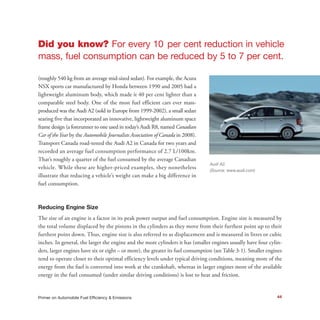
performance. In this way, some automobile manufacturers are aiming to cut vehicle weight by up to 40 per cent
CHAPTER 3 | INCREASING FUEL EFFICIENCY BY IMPROVING AUTOMOBILE TECHNOLOGY
42Primer on Automobile Fuel Efficiency & Emissions
Vehicle Weight, Safety and Fuel Efficiency
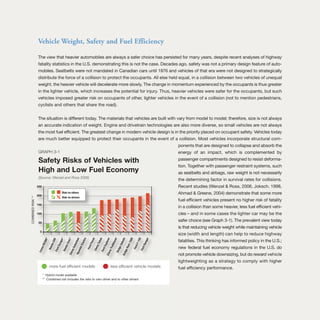
The view that heavier automobiles are always a safer choice has persisted for many years, despite recent analyses of highway
fatality statistics in the U.S. demonstrating this is not the case. Decades ago, safety was not a primary design feature of auto-
mobiles. Seatbelts were not mandated in Canadian cars until 1976 and vehicles of that era were not designed to strategically
distribute the force of a collision to protect the occupants. All else held equal, in a collision between two vehicles of unequal
weight, the heavier vehicle will decelerate more slowly. The change in momentum experienced by the occupants is thus greater
in the lighter vehicle, which increases the potential for injury. Thus, heavier vehicles were safer for the occupants, but such
vehicles imposed greater risk on occupants of other, lighter vehicles in the event of a collision (not to mention pedestrians,
cyclists and others that share the road).
The situation is different today. The materials that vehicles are built with vary from model to model; therefore, size is not always
an accurate indication of weight. Engine and drivetrain technologies are also more diverse, so small vehicles are not always
the most fuel efficient. The greatest change in modern vehicle design is in the priority placed on occupant safety. Vehicles today
are much better equipped to protect their occupants in the event of a collision. Most vehicles incorporate structural com-
ponents that are designed to collapse and absorb the
energy of an impact, which is complemented by
passenger compartments designed to resist deforma-
tion. Together with passenger restraint systems, such
as seatbelts and airbags, raw weight is not necessarily
the determining factor in survival rates for collisions.
Recent studies (Wenzel & Ross, 2006, Joksch, 1998,
Ahmad & Greene, 2004) demonstrate that some more
fuel efficient vehicles present no higher risk of fatality
in a collision than some heavier, less fuel efficient vehi-
cles – and in some cases the lighter car may be the
safer choice (see Graph 3-1). The prevalent view today
is that reducing vehicle weight while maintaining vehicle
size (width and length) can help to reduce highway
fatalities. This thinking has informed policy in the U.S.;
new federal fuel economy regulations in the U.S. do
not promote vehicle downsizing, but do reward vehicle
lightweighting as a strategy to comply with higher
fuel efficiency performance.
250
200
150
100
50
0
LexusRS300*
HondaCRVFordEscape*
HondaCivic*ChevySuburbanHyundaiElantra
FordFocus
ChevyTahoe
FordExplorerChevyTrailblazer
DodgeDakotaDodgeRam1500
FordF-150
FordRanger
Risk-to-others
Risk-to-drivers
* Hybrid model available
** Combined risk includes the risks to own driver and to other drivers
GRAPH 3-1
Safety Risks of Vehicles with
High and Low Fuel Economy
(Source: Wenzel and Ross 2006)
COMBINEDRISK**
more fuel efficient models less efficient vehicle models
(roughly 540 kg from an average mid-sized sedan). For example, the Acura
NSX sports car manufactured by Honda between 1990 and 2005 had a
lightweight aluminum body, which made it 40 per cent lighter than a
comparable steel body. One of the most fuel efficient cars ever mass-
produced was the Audi A2 (sold in Europe from 1999-2002), a small sedan
seating five that incorporated an innovative, lightweight aluminum space
frame design (a forerunner to one used in today’s Audi R8, named Canadian
Car of theYear by the Automobile Journalists Association of Canada in 2008).
Transport Canada road-tested the Audi A2 in Canada for two years and
recorded an average fuel consumption performance of 2.7 L/100km.
That’s roughly a quarter of the fuel consumed by the average Canadian
vehicle. While these are higher-priced examples, they nonetheless
illustrate that reducing a vehicle’s weight can make a big difference in
fuel consumption.
Reducing Engine Size
The size of an engine is a factor in its peak power output and fuel consumption. Engine size is measured by
the total volume displaced by the pistons in the cylinders as they move from their furthest point up to their
furthest point down. Thus, engine size is also referred to as displacement and is measured in litres or cubic
inches. In general, the larger the engine and the more cylinders it has (smaller engines usually have four cylin-
ders, larger engines have six or eight – or more), the greater its fuel consumption (see Table 3-1). Smaller engines
tend to operate closer to their optimal efficiency levels under typical driving conditions, meaning more of the
energy from the fuel is converted into work at the crankshaft, whereas in larger engines more of the available
energy in the fuel consumed (under similar driving conditions) is lost to heat and friction.
Did you know? For every 10 per cent reduction in vehicle
mass, fuel consumption can be reduced by 5 to 7 per cent.
Audi A2.
(Source: www.audi.com)
44Primer on Automobile Fuel Efficiency & Emissions
45 Chapter 3 | Increasing Fuel Efficiency by Improving Automobile Technology
Due to improvements in technology and design, engines have become
much more efficient at converting the energy supplied by the fuel into
mechanical power, which is delivered to the vehicle. Over time, the
amount of power generated as a function of engine size has increased
(also called specific power, measured as engine horsepower divided
by engine displacement in litres, hp/L). This illustration shows the trend,
and how it can be leveraged to reduce fuel consumption (or increase
fuel economy). Note: the automobile engines and models referenced
were chosen as reasonable representation of the average power and
fuel economy ratings for the specified model year, as indicated in the
U.S. Environmental Protection Agency’s report, Light-Duty Automotive
Technology and Fuel Economy Trends 1975 Through 2008.
As shown, the advancements in engine technology over the past
20 years can lead to significantly more powerful vehicles, or sig-
nificantly more fuel efficient vehicles without sacrificing power.
FIGURE 3-1
Engine Size: Power versus Fuel Efficiency
Model Year: 1988
Typical Model: FORD TAURUS
Engine Size: 2.5 L
Engine Power: 90 hp
Specific Power: 36 hp/L
Fuel Economy: 24 mpg
Model Year: 2008
Typical Model: NISSAN ALTIMA
Engine Size: 2.5 L
Engine Power: 175 hp
Specific Power: 70 hp/L
Fuel Economy: 26 mpg
Model Year: 2008
Typical Model: MINI COOPER
Engine Size: 1.6 L
Engine Power: 118 hp
Specific Power: 74 hp/L
Fuel Economy: 32 mpg
20 years
of engine
development
k
xAlternative: engine downsizing
Table 3-1: Vehicle Engine Size and Annual Fuel Consumption
Vehicle Engine Size Annual Fuel Difference in fuel
Consumption* consumption between
two engine sizes
Compact car 1.8 litre (4 cylinder) 1,300 litres
2.0 litre (4 cylinder) 1,734 litres
434 litres
Mid-sized car 2.4 litre (4 cylinder) 1,641 litres
3.6 litre (6 cylinder) 2,044 litres
403 litres
SUV 3.7 litre (6 cylinder) 2,438 litres
5.7 litre (8 cylinder) 2,752 litres
314 litres
Pick-up Truck 4.6 litre (8 cylinder) 2,668 litres
5.4 litre (8 cylinder) 2,881 litres
213 litres
* Based on an annual driving distance of 20,000 km with a mix of 55 per cent city driving and 45 per cent highway driving.
(Source: Natural Resources Canada’s 2008 Fuel Consumption Guide)
46Primer on Automobile Fuel Efficiency & Emissions
47 Chapter 3 | Increasing Fuel Efficiency by Improving Automobile Technology
Turbocharging and Supercharging
Most internal combustion engines are naturally aspirated, meaning that the air is drawn into the cylinder via the vacuum
created by the downward stroke of the piston. Because air is a reactant, the amount of reaction (combustion) that can occur
is limited by the amount of air that can enter the cylinder. Turbocharged and supercharged engines have devices that pump
more air into the cylinder, allowing for more fuel to be combusted, generating more power. The result is that a smaller
displacement engine can produce equivalent power to its larger, naturally aspirated counterpart.
Turbocharger: A turbocharger uses the engine exhaust to spin a turbine. The turbine, in turn, drives an impeller, which pumps
air into the cylinder. The turbocharger boosts power at higher engine speeds and has a slight lag since sufficient pressure
must first build in the engine exhaust stream. The Volkswagen TDI engines are equipped with turbocharger technology.
Supercharger: As with a turbocharger, superchargers use an impeller to pump air into the cylinder, but it is powered by the
crankshaft rather than the engine exhaust. This adds an extra load to the engine; engineers call this a parasitic load, since
it steals power that would otherwise be delivered to the wheels. This limits its fuel consumption benefit in comparison to a
turbocharger, which is not connected to the crankshaft. A supercharger, however, can boost power at lower engine speeds
with no lag. The Pontiac Grand Prix GTP uses supercharger technology.
During the late 1970s and early 1980s, North American automobiles, on average, experienced significant engine
downsizing in an attempt to curb fuel consumption (more on this in chapter five). Many models that were for-
merly equipped with 8-cylinder engines now came equipped with 6- or 4-cylinder engines. Power output of engines
decreased and vehicles became smaller (lighter cars require less power to accelerate, and lose less energy upon
braking); however, this trend only lasted for a few successive model years. New technologies were soon intro-
duced that allowed smaller engines to produce more power without increasing the amount of fuel consumed.
These technologies included fuel injection, improved combustion chamber design, increased compression ratios,
more precise valve control, and exhaust gas recirculation. This ensures more complete combustion of the fuel,
thus increasing the amount of power produced from each drop of fuel and, depending on the technology,
reducing the amount of NOx and VOCs (HC) emissions. More efficient engine design meant newer vehicles
could meet the demand for power with smaller engines. The smaller engines also represent a significant reduction
in weight, contributing to lower fuel consumption.
Since the mid-1980s, engines continued to become more efficient producers of power. This would have led to
greater fuel savings if the engine downsizing trends had continued. Instead, engine sizes remained steady and
reductions in fuel consumption were not realized. Ongoing technology improvements led to ever-higher power
ratings among new vehicles (see Figure 3-1). For future vehicle fleets to consume significantly less fuel, smaller
engines will need to be part of the design agenda among automakers. In September of 2008, General Motors
announced that they would double their global production of small four-cylinder engines (1.0 to 1.4 litres) by
2011, with more than half of the increase happening in North America. The highlight of this plan is the manu-
facturing of a 1.4 litre turbocharged engine, generating the power of a larger engine but consuming the fuel of
a small automobile.
There are numerous engine technologies available today (or in development) that will enable a small engine to
perform as would a larger engine in terms of power output, while consuming much less fuel. These technologies,
along with potential fuel consumption reductions, are listed in Table 3-2. It should be noted that these potential
reduction factors are not necessarily additive, nor are they necessarily compatible with each other.
48Primer on Automobile Fuel Efficiency & Emissions
Table 3-2: Engine Technology and Fuel Savings
Technology Fuel Consumption Reduction
Potential for Average North
American Vehicle*
Variable Valve Timing (VVT, also known as Cam Phasing) – During each Up to 3 per cent
combustion cycle, valves open and close allowing air and fuel into the
cylinders and exhaust out. Normally, the length of time the valves are open is
optimized for a specific engine rpm (rotational speed), but VVT allows this
timing to be optimized for a range of rpm.
Variable Valve Lift (VVL) – Enables better control of the flow of air and Up to 2 per cent
combustion gases through the engine. VVL is similar to VVT but allows for
adjustments of how far the valves open.
Camless Valve Actuation – Enables more precise control of valves using Up to 12 per cent
electronic controls instead of mechanical cam assemblies (i.e., camshafts,
rocker arms and pushrods). Eliminates the need for camshafts and reduces
load on the crankshaft and engine.
Turbocharging – Effectively increases the efficiency of the engine by pre- Up to 7 per cent
compressing air before it enters the engine. Good way to boost the power
output of smaller engines that consume less fuel.
Cylinder Deactivation – When less power is needed (e.g., cruising) the valves Up to 6 per cent
that feed air and fuel into some of the cylinders are closed, effectively shrinking
the engine size (or “displacement”). Six cylinder engines can operate on three
cylinders, thus reducing fuel consumption.
Variable Compression Ratio (VCR) – Under lighter loads, the compression ratio Up to 10 per cent
can be increased to make the engine generate power more efficiently. This is
done by adjusting the volume above the piston.
* NOTE: REDUCTION FACTORS ARE NOT ADDITIVE
continued on following page…
49 Chapter 3 | Increasing Fuel Efficiency by Improving Automobile Technology
Table 3-2: Engine Technology and Fuel Savings continued
Technology Fuel Consumption Reduction
Potential for Average North
American Vehicle
Gasoline Direct Injection (GDI) – In conventional engines, the air and fuel is mixed Up to 6 per cent
prior to entering the combustion chamber. Using GDI technology, the air is drawn
into the chamber first and then the fuel is added directly into the cylinder with an
injector. This allows more precise control over the air-fuel mix ratio which results in
optimal combustion. It also helps reduce pre-ignition allowing for more fuel to be
injected, resulting in increased power output.
Homogeneous Charge Compression Ignition (HCCI) – In a conventional gasoline Up to 20 per cent
engine, the ignition timing is controlled by a spark. In HCCI the fuel is ignited by the
air-fuel mixture heating during compression. In order to control the timing of ignition
in HCCI the air-fuel mixture must be tightly controlled and thoroughly mixed inside the
combustion chamber. Controlling the timing of ignition continues to be a challenge
for designers of HCCI engines.
High Speed Direct Injection Diesel (HSDI) – Electronically controlled high-speed Up to 25 per cent
multi-pulse injectors in diesel powered vehicles improve air-fuel mixing through
multiple injections and injection pulse patterns. HSDI can significantly reduce engine
emissions allowing for the use of simpler, cheaper exhaust after-treatment systems.
HSDI has the potential to better control combustion and reduces vibration.
* NOTE: REDUCTION FACTORS ARE NOT ADDITIVE
50Primer on Automobile Fuel Efficiency & Emissions
Gasoline versus Diesel engines:
Gasoline and diesel engines work in a similar manner. Both are piston-and-crank engines. However, diesel engines operate at
a much higher compression ratio, substantially increasing efficiency. Another key difference is how ignition of the air-fuel mixture
in the two engine types is brought about. In a gasoline engine, air and fuel are mixed in the cylinder and compressed by the piston.
As the piston reaches the top of its stroke and compression is peaking, a sparkplug in the combustion chamber fires, igniting
the combustion process. In a diesel engine, there is no sparkplug. Instead air is compressed by the piston in the absence of
fuel. Under this compression, diesel fuel is injected directly into the combustion chamber, where it immediately ignites as the
piston nears the top of its stroke due to the heat of the air. Thus, ignition timing in a gasoline engine is controlled by the sparkplug,
while in a diesel engine it is controlled by the injector. In addition to their higher compression ratios, diesel engines also owe their
superior efficiencies to a variety of other technical factors: this includes lower throttling losses (gasoline engines have a throttle
to control air flow into the engine while diesel engines do not), as well as a tendency to be outfitted with more fuel-saving tech-
nologies than with typical gasoline engines, including variable-geometry turbochargers, intercoolers and cooled exhaust gas
recirculation.
As a fuel, diesel has more chemical potential energy per litre than gasoline, which means less fuel needs to be combusted to
produce the energy needed to power the automobile. However, because the energy and carbon content of diesel is higher than
gasoline, about 15 per cent more CO2 is produced per litre consumed. Combining the lower fuel consumption characteristics
of diesel engines with the higher CO2 emissions per litre, overall CO2 emissions from diesel automobiles tend to be about 20
per cent lower than their gasoline equivalents. Diesel engines have suffered from the conventional view that, compared to
gasoline engines, they are noisy, vibrate too much, perform poorly in the winter, offer poor acceleration performance and emit
unsightly, black particulate matter, all of which has made them a less preferred option for many automobile buyers. However,
new diesel engine technologies have been introduced that address these perceived performance issues. In addition, recently
introduced low-sulphur-in-diesel regulations have facilitated the use of new exhaust after-treatment technologies to reduce
tailpipe emissions; the reason for this is because high sulphur levels in fuel inhibits the functioning of exhaust after-treatment
technologies to “clean up” the exhaust.
51 Chapter 3 | Increasing Fuel Efficiency by Improving Automobile Technology
52Primer on Automobile Fuel Efficiency & Emissions
Aerodynamic Drag Improvements
The shape of a vehicle can significantly affect its aerodynamic characteristics and, hence, its fuel consumption.
A streamlined design will deliver better fuel consumption performance than a vehicle of similar weight, frontal
area and engine power that is not as streamlined (especially at highway speeds). Reducing frontal area, rounding
the corners on the front end of the vehicle, adjusting the angle of the rear window, and adding side skirts can all
help to reduce aerodynamic drag and fuel consumption. There are also various air flow management components
(e.g., dimpled surface plates placed on the undercarriage of the car) which can be applied. While these components
can add weight to a vehicle, the extra load can be offset by the resulting reduction in aerodynamic drag. In the late
1990s, automakers produced concept vehicles with 40 per cent less aerodynamic drag than conventional vehicles
as a part of the U.S. government-industry cooperative, Partnership for a New Generation of Vehicles.
Decreasing Rolling Resistance
The type of tires on a vehicle will affect rolling resistance. For example, radials have a lower rolling resistance than
bias ply tires. Thickness of the tire tread has much to do with rolling resistance; the thicker the tread, the higher
the rolling resistance and thus higher fuel consumption. Rolling resistance can be reduced through specialized tread
and tire geometry, as well as improved materials in the belt and traction surfaces. The chemical mixture of poly-
mers and fillers in the tires (also referred to as the tread compound) can also have an effect on rolling resistance.
Did you know? Some tire manufacturers offer high-
efficiency tires that perform equally well as high performance
tires, but that lower rolling resistance by 20 per cent.
Reducing Drivetrain losses
The Transmission –
As briefly introduced in chapter two, the transmission is a system of gears that converts the speed of the crank-
shaft to the appropriate speed for the driveshaft and wheels. The idea is to maintain the engine speed at its most
fuel efficient operating range, while the transmission “gears down” (or gears up) to the speed and operating require-
ments of the automobile and driver. Keeping the engine at its optimal operating range for automobile driving
conditions requires as many gears as possible. For example, transmissions with five gears (i.e., a five-speed) will almost
always deliver improved fuel economy, especially at highway speeds, over a four-speed transmission. Historically,
manual transmissions (i.e., standard or “stick-shift”), if used correctly, have tended to use less fuel than automatic
transmissions. This is partly due to the fact that there are fewer gears in automatic transmissions, but also because
they make connection with the driveshaft through a fluid medium in the torque converter. The fluid connection
is an effective means to transmit power during vehicle acceleration, but more energy is lost at steady speeds.
However, manual transmissions make a solid connection to the crankshaft, minimizing energy loss. They also tend
to be smaller and lighter than automatics. Automatic transmissions have been closing the fuel efficiency gap in
part by employing design enhancements, such as torque converter lockup, which solidly engages the transmission
and the crankshaft as the rate of acceleration slows (and energy loss increases). Knowledgeable drivers can use less
fuel with a manual transmission, but since most drivers are not trained to shift at optimal points to maintain peak
efficiency, today’s automatic transmissions can usually offer the average driver equal performance to that of
manual ones.
Here are some innovations that can reduce energy loss across the transmission and reduce fuel consumption:
Current electronically shifted manual transmissions (ESMAT) are identical in operation to manual transmissions, but
the clutch and shift operations are automated by onboard electronics. Shift points can be electronically programmed
for optimal fuel efficiency. The existing single clutch systems have struggled with shift quality. Dual-clutch systems
have recently been introduced that significantly improve the shift quality. ESMAT technology can reduce fuel
consumption by 7 per cent.
53 Chapter 3 | Increasing Fuel Efficiency by Improving Automobile Technology
54Primer on Automobile Fuel Efficiency & Emissions
As explained above, the more gears in an automatic transmission, the more fuel efficient the vehicle can be because
the extra gears are better able to keep the engine running at or near its most efficient speed. Today’s five- and six-
speed automatic transmissions are the continuation of a trend that began in the late-1970s, in which more vehicles
with automatic transmissions came with a fourth, overdrive gear, in addition to the classic three-speed transmission.
Today, about 40 per cent of new passenger cars with automatic transmissions are equipped with at least five-speeds.
Extra gears can reduce fuel consumption by up to 3 per cent.
Aggressive Shift Logic technology permits an automatic transmission to switch between sport and economy modes.
In sport mode, the upshift and downshift points are set to maximize acceleration performance, while in economy
mode the transmission eases the pressure on the engine by shifting at lower speeds to maintain a smooth ride and
optimal fuel efficiency. Aggressive shift logic can reduce fuel consumption by 2 per cent.
Continuously variable transmissions (CVT), which are a type of automatic transmission, do away with discrete
gears or speeds, and work to keep the engine power (torque x speed) perfectly matched to the power demand
at the wheels at all times. This saves fuel by keeping the engine at its most efficient operating point over a wide
range of driveshaft speeds, continuously varying the gearing as required. CVTs have slightly higher internal
friction energy losses than some conventional automatics; however, this slight increase is generally negligible as
compared to the benefit. CVTs can reduce fuel consumption by 6 per cent.
Electrical Improvements
A conventional automobile is equipped with a lead acid battery that supplies 3 kilowatts (kW) of power at 12 volts;
this is sufficient to supply power to operate some accessories and to operate the starter motor (a small electric motor
that gets the engine turning so the self-sustaining compression-combustion cycle can begin). In conventional
vehicles, many important accessory systems such as oil pumps, coolant pumps, power-assisted steering and braking
systems, and air conditioning (A/C) are powered by the crankshaft. As it turns, belts and chains loaded onto the
crankshaft supply mechanical energy to these accessories. The problem is that these represent what engineers
call parasitic loads on the crankshaft; they effectively steal power from the engine that would otherwise be delivered
to the drivetrain and the wheels. Thus, the engine must burn more fuel to maintain power sufficient to drive the
automobile. You may have noticed that when you turn on the A/C, your car appears to lose a bit of power, requiring
you to press further down on the accelerator pedal. Even when the A/C is off, it still draws some power from the
crankshaft, wasting fuel. Energy lost to parasitic loads can be minimized by disconnecting them from the crank-
shaft and running them on electricity from a battery (although energy from the engine is still required to charge
the battery). This is because electrically powered accessories utilize energy more efficiently, they need less energy
to run, and they can be turned off when not in use. For example, some newer vehicles use electrical power steering
so that there is not a continual power draw from the engine, and instead draw electricity only as needed. Higher
voltage systems (42-volt and higher) can support even more loads (A/C, in particular) to run off electric power
than can conventional 12-volt systems.
Moving towards higher power electric architecture provides significant new opportunities for fuel saving systems.
For example, more electric power can support features such as Idle-Off and Launch Assist, in which the engine
shuts off when the vehicle brakes (thus conserving fuel). An electric motor then helps to get the vehicle quickly
moving again when the driver presses the accelerator. Without the extra electric power to run the motor, the driver
would need to wait until the engine restarted to get moving again. These features require additional electrical
power, which requires a battery capable of storing more electric energy (i.e., more electric charge). The battery can
discharge energy (i.e., supply electricity) to the vehicle’s systems as needed, but must also be recharged with avail-
able energy wherever possible. This energy can be partly supplied by the engine, but additional power can also be
retrieved during braking using Regenerative Braking technology. In regenerative braking mode, a vehicle uses the
electric motor to help reduce speed. As the driver applies the brakes, the electric motor is engaged and turned
in reverse, acting as a generator that charges the battery. Resisting this motion, the motor applies a counter-force
to the wheels slowing the vehicle. This differs from conventional braking that slows the vehicle via friction pads,
converting the kinetic energy of the moving vehicle into heat, which is then lost to the surrounding air. Thus,
some of the energy normally lost during conventional braking is retrieved and stored in vehicles with regenerative
braking systems; this stored energy can then be used to power the vehicle.
55 Chapter 3 | Increasing Fuel Efficiency by Improving Automobile Technology
56Primer on Automobile Fuel Efficiency & Emissions
The degree of electric architecture in vehicle systems ranges from the conventional 12-volt systems with which most drivers are
familiar, to fully electric vehicles that have no internal combustion engine and operate entirely on electricity stored on-board in batteries.
The optimal choice depends on the application. The system voltages shown are nominal ratings.
FIGURE 3-2
Spectrum of Automobile Electrification
MINOR ELECTRIFICATION MAJOR ELECTRIFICATION
2008 Honda Fit
12-volt system powers
starting motor, lighting,
controls and displays,
fans and radio. Example
of current state of
conventional automobile
technology.
2005 Chevrolet
Equinox
12-volt system supports
typical equipment as
in conventional
automobiles, but also
power-assisted electric
steering.
2006 Honda Civic
Hybrid
158-volt battery
system supports
regenerative braking,
idle-off and launch-
assist, power-assisted
steering, electric power
pumps, and engine
downsizing.
Chevrolet Volt (for
release in 2010)
365-volt battery system
designed for plug-in
charging powers all-
electric drive from 0 to
100mph for a 40-mile
range, and is supple-
mented by a 12-gallon
fuel tank. Also called
an Extended Range
Electric Vehicle.
2007 Saturn Vue
Green Line
36-volt system supports
belted alternator starter
(BAS), providing idle-off
and launch-assist
capability, regenerative
braking, and power-
assisted steering.
2008 Toyota Prius
202-volt battery system
supports idle-off and all-
electric drive at low speeds
for about a mile, substan-
tial regenerative braking,
power-assisted steering,
electric power pumps,
engine downsizing and
high-efficiency (Atkinson
cycle) engine operation.
1999 GM EV1
312-volt battery system
supporting all electric
drive and power
systems. No internal
combustion engine.
Battery is charged by
regenerative braking
and by plugging in.
e
e
57 Chapter 3 | Increasing Fuel Efficiency by Improving Automobile Technology
Hybrid Electric Vehicles
Today, there are hybrid electric vehicles composed of an internal combustion engine, a large battery pack, and one (or
more) electric motors to deliver power to the driveshaft. As described above, this can help reduce fuel consumption
by shutting off the engine when it is running inefficiently (e.g., driving at low speeds or idling), and by making use
of regenerative braking. However, if a larger or more advanced battery system is added that can store more energy
and produce more power when needed, then the electric motor can play a much larger role in moving the vehicle,
by providing significant power to the driveshaft and wheels. Since extra power is available to the wheels from the
electric motor, there is less demand on the internal combustion engine to produce power across all operating
conditions. Therefore, the engine can operate at its peak efficiency more often, while the electric motor helps
manage the load under conditions where the engine is less efficient, saving fuel. The extra power provided by
the electric motor also allows the automobile manufacturer to downsize the combustion engine to reduce fuel
consumption, while maintaining an acceptable level of acceleration performance.
Some companies are adding extra battery capacity to enable their hybrids to run on all-electric drive at higher
speeds and for extended periods of time. With this extra energy storage capacity on-board, there is an opportunity
to “top up” the charge with an external supply of electricity (say, from a household outlet) when the automobile
is parked. Such vehicles are called plug-in hybrids.
While the term “hybrid” generally refers to the combination of an internal combustion engine with an electric
motor in a vehicle, there are a variety of ways that these two sources of power can be integrated. As the electric
architecture becomes more robust, the motor can displace the engine as the primary power source. Figure 3-1
conceptually describes a spectrum of electrification for automobiles, from minor to major roles for electrical
power. Different configurations for hybrid systems are possible along a wide spectrum.
Opposite: Plugging in and charging up
Parallel Architecture (opposite, top) –
In a parallel hybrid system, power to the wheels can be delivered by the engine and the electric motor simultaneously.
The motor and engine driveshafts are coupled together, either before or after the vehicle’s transmission. The electric
motor receives its power from the battery and, conversely, the motor running in reverse can also charge the battery via
regenerative braking. Examples of this architecture can be found in Honda’s Integrated Motor Assist IMA® System
used in the Civic Hybrid, and the Belt-Alternator-Starter (BAS) system used in GM’s Saturn Vue and Aura Green Line
models.
Series Architecture (opposite, middle) –
The series hybrid architecture is unique in that the engine does not directly power the wheels; instead, the wheels are
powered entirely by the electric motor. The engine drives a generator, which produces electricity that can be stored in
the battery for use by the electric motor later on, or delivered immediately to the motor to drive the wheels. As in parallel
architecture, the electric motor can also function as a generator, slowing the wheels and converting some of this energy
into electricity to charge the battery. A computer continuously manages the direction of energy flow. An example of this
type of vehicle is the Chevrolet Volt, which is under development by GM.
Series-Parallel Architecture (opposite, bottom) –
The most complicated design is a combination of the series and the parallel systems. In this architecture, the engine can
deliver direct power to the wheels and it can power a generator that supplies electricity to the battery. The battery supplies
electricity to the motor that, in turn, delivers direct power to the wheels. As with the parallel and series architectures, the
electric motor can deliver regenerative braking energy to the battery for later use. This architecture allows greater flexibility
and control over the engine, while minimizing the total mass and size of the accompanying electrical motors. Here the
engine and two motors are all connected to a planetary gear system. Unlike a conventional transmission, which has discrete
gears (4, 5 or 6, typically), a planetary gear system configured with two electrical motors can operate at any gear ratio that
is deemed best by independently varying the speeds of the motors. This allows the engine to run at the most efficient
speed and results in excellent fuel efficiency performance. Examples of this type of system are Toyota’s Hybrid Synergy
Drive® (used in the Prius, Camry hybrid and others), Ford’s Escape/Mariner Hybrid system, and the GM Two-Mode
hybrid system (used in the Chevrolet Tahoe and GM Sierra).
59 Chapter 3 | Increasing Fuel Efficiency by Improving Automobile Technology
60Primer on Automobile Fuel Efficiency & Emissions
WheelsHybrid
Battery
Electric
Motor
Internal
Combustion
Engine
%Charging
%Discharging
%Charging
%Drive Power
%Regenerative Braking
Generator
Wheels
Electric
Motor
Internal
Combustion
Engine %Drive Power
Generator
Hybrid
Battery
%Charging
Wheels
Hybrid
Battery
Electric
Motor
Internal
Combustion
Engine
%Discharging
%Charging
%%Regenerative Braking
Drive Power
%Drive Power
Parallel Architecture
Series Architecture
Series-Parallel Architecture
%Disharging
%Drive Power
%Regenerative Braking
Thus far, this chapter has focused mainly on technology improvements that can be made to automobiles to reduce
fuel consumption. To keep the focus on technology, and to keep the content relevant to the majority of drivers, the
wide range of fuel alternatives to gasoline and diesel are not addressed in this chapter. A brief treatment is given,
however, to vehicles powered – fully or in part – by electricity supplies from external sources (e.g., the electrical grid).
Electric drive technology offers efficiency enhancements to transportation that are irrespective of whether the external
electricity supply is from hydro, coal, wind or nuclear power, just as the liquid fuel stored on-board could be gasoline,
diesel, natural gas or made from renewable sources.
Plug-In Hybrid Electric Vehicles
Plug-in hybrid electric vehicles (PHEVs) may consist of any of the three hybrid architectures. Plug-in hybrids have a
larger capacity battery pack that can be charged from an electrical outlet. They can drive a certain distance range in
an all-electric mode (or nearly all-electric) on the store of externally supplied electricity, after which the vehicle operates
like a typical, non plug-in hybrid. The idea is that while driving in all-electric mode, the plug-in hybrid vehicle consumes
no fuel and produces no emissions. Even if the initial charge is depleted before the trip is over, the initial all-electric range
helps to significantly reduce the overall fuel consumed and emissions produced during the trip. Plug-in hybrids are often
categorized by their charge-depleting range. For instance, a PHEV10 has a 10 mile (16 km) charge-depleting range
while a PHEV40 has a 40 mile (64 km) charge-depleting range. For Canadians that drive less than 64km a day, the
PHEV40 would normally operate in the charge-depleting mode.
Electric Vehicles
Electric vehicles (EVs) do not use an internal combustion engine to power the drivetrain and wheels, but rather they rely
on electric motors to provide the necessary power. The required electric potential energy is usually stored in a battery
pack on board the vehicle, although other configurations are possible. For example, there are streetcars and buses in
Canada that run on electrical power directly supplied from overhead powerlines – such vehicles are called tethered EVs.
Battery options vary from the commonplace lead-acid, to nickel-metal hydride and lithium ion. In sequence, each of
Powering Automobiles with Electricity
61 Chapter 3 | Increasing Fuel Efficiency by Improving Automobile Technology
these battery options is expected to deliver greater charge capacity and lighter, more compact design characteristics.
Developing new battery technologies that are lighter, smaller, cost less and have a longer useful life will help EV models
compete with conventional internal combustion engine vehicles. Although substantial research and development activities
are being directed towards battery technology, most estimates are that the energy storage capacities will not rival the
energy available in a conventional tank of gasoline. To illustrate, consider that the chemical potential energy available
in 40 litres of gasoline – the volume of a typical car’s fuel tank, which can be filled in about two minutes at the pump – is
roughly equal to the electrical energy consumed in an average Canadian household over the course of 11 days.
It is important to note that whereas gasoline and diesel engines are only 30-40 per cent efficient at converting fuel
energy into kinetic energy (i.e., as motion or as work on the driveshaft), electric motors can convert more than 94 per
cent of the electrical energy supplied into useful work. Provided the electricity can be effectively stored and supplied to
the motor, electric vehicles can be a much more energy efficient means of transportation. The energy storage limitations
of today’s batteries, however, tend to restrict EVs to usage patterns composed of predictable, shorter trips, requiring
drivers to incorporate sufficient time for charging. Under these conditions, replacing conventional automobiles with EVs
could have significant and positive local air quality impacts, since they produce no (or very few) emissions. On the other
hand, depending on how the electricity to power an EV is generated (e.g., with coal-fired power plants), the vehicle can
still be associated with GHG and CAC emissions. If green power (e.g., solar, wind, etc.) is used to charge an EV or even a
plug-in hybrid vehicle, however, these non-conventional vehicles can become a much more environmentally sustainable
transportation choice.
62Primer on Automobile Fuel Efficiency & Emissions
Chapter 3
Saving Energy Within an
Automobile – Improving
Fuel Efficiency
CHAPTER FOUR
WHAT YOU CAN DO
TO MAXIMIZE YOUR
AUTOMOBILE’S FUEL
EFFICIENCY
ECO-DRIVING
The previous chapter discussed several ways in which technological improve-
ments can be used to design automobiles to be more fuel efficient. This chapter
describes actions that individual motorists can take to reduce fuel consumption in their current automobile.
An obvious option is to drive less and, wherever practical, take transit, bike or walk instead. The next best
option is to drive in the most fuel-conserving manner possible.There are numerous ways you can do this. Often
referred to as eco-driving, this chapter explains how people can conserve fuel and reduce emissions by
driving in a safe and efficient manner, maintaining their automobile in peak condition, and planning their
trips to minimize distance traveled. Also included is a short guide to purchasing fuel efficient vehicles, as well
as a brief description of some fuel alternatives that you may encounter when purchasing a new automobile.
Keep your car properly maintained.
One of the most important things that you can do to reduce your fuel consumption and emissions is to keep your
automobile properly maintained.This means observing the manufacturer’s recommended maintenance schedule and
getting a trained automotive professional to perform regular check-ups. There are many components that need to
be checked and maintained regularly in order to keep the vehicle operating at peak performance. For instance,
changing the motor oil according to the schedule recommended by the manufacturer keeps the moving parts of the
engine well lubricated. This cuts down on internal friction that would otherwise steal valuable energy; remember,
any energy loss within the engine means less energy reaching the wheels to move the vehicle. A worn or malfunc-
tioning spark plug can cause the engine to misfire, which results in unburned (and wasted) fuel. Dragging brakes
can significantly increase fuel consumption because the vehicle must work harder to overcome the resistance.
CHAPTER 4 | WHAT YOU CAN DO TO MAXIMIZE YOUR AUTOMOBILE’S FUEL EFFICIENCY
64Primer on Automobile Fuel Efficiency & Emissions
Table 4-1:
Perform a Monthly Maintenance Check
Most vehicle maintenance should be left to the professionals. However once a month, the following checks
can be performed to help identify and/or prevent problems that can cost you fuel and money:
• Look for signs of uneven wear of your tires or embedded objects that can cause air leaks. Measure tire pressure monthly,
and be especially committed in winter when tires are cold. Regardless of the season, check tire pressure whenever there
is a sharp change in temperature. The vehicle manufacturer’s recommended pressure for your car’s tires is specified
on a plate or sticker attached to the edge of the driver’s door, the door post, the glove box or the fuel door. Note, the
pressure marked on the tire itself is the maximum pressure and is not likely to be the same as the manufacturer’s recom-
mended pressure. If you can’t find the plate, check the owner’s manual or consult your dealer.
• Check around the car and under the engine for fluid leaks. If fluid is leaking, get the problem fixed by a professional.
• Check fluid levels, including engine oil, the engine coolant level, transmission fluid and power steering fluid, according
to the instructions in the owner’s manual, and top-up as appropriate.
• Check under the hood for cracked or split spark plug wires (generally only visible on older automobiles), cracked radiator
hoses or loose clamps, and corrosion around the battery terminals. Have any faulty or damaged equipment repaired
or replaced.
• Check for problems with the brakes. On a straight, flat and traffic-free stretch of road, rest your hands lightly on the
steering wheel and apply the brakes gradually. If the vehicle drifts to one side, one of the brake linings may be worn
more than the other, or the brakes may need adjustment. In either case, have the brakes inspected by a professional.
• Use a similar test to check for problems with wheel alignment. On a straight, flat and traffic-free stretch of road, rest
your hands lightly on the steering wheel and drive at an even speed. If the vehicle pulls to one side, the wheels may be
misaligned. Poorly aligned wheels will cause your tires to drag rather than roll unobstructed, scrubbing off your tread and
making them wear out faster. This means increased rolling resistance, which will increase fuel consumption, so be sure
to get your wheels aligned by a professional.
(Source: The AutoSmart Guide, Natural Resources Canada)
65 Chapter 4 | What you can do to maximize your automobile’s fuel efficiency
66Primer on Automobile Fuel Efficiency & Emissions
A poorly operating Emission Control System will also mean more pollutants exiting the tailpipe. A well-tuned
engine can consume 15-25 per cent less fuel than one that is poorly maintained.
In today’s automobiles, should any of the above problems exist in an engine (with the exception of dragging brakes),
the check-engine indicator light on the instrument panel should come on. Legislation in the State of California
requires the check-engine light to come on if the vehicle controls detect any failure that may significantly increase
your vehicle’s emissions. A common reason for the check-engine light to be on is that sensors used to monitor exhaust
gases have failed, and the engine controller is unable to ensure proper engine operation. You should take your auto-
mobile in for a check-up immediately if this light is on.
Table 4-1 lists some simple things that can be done by the driver on a monthly basis to keep their car functioning
at its most fuel efficient.
Don’t idle.
An automobile consuming fuel while not moving has a fuel economy rating of zero miles per gallon – that’s as
bad as it can get. In fact, ten seconds of idling will use more fuel than turning off the engine and restarting it again.
For every 10 minutes that you idle, one third of a litre of fuel is wasted for an average vehicle, but this can even be
as high as one half litre if your vehicle has a five-litre engine, such as in a large pick-up truck. If every Canadian
motorist avoided idling their automobile for just three minutes per day, more than 1.4 million tonnes of CO2
would be kept out of the atmosphere each year. As a rule, try to turn off your engine if you are going to be stop-
ping for more than 60 seconds and you are not in traffic. As well, avoid ‘warming up’ your car in the driveway
before you leave the house. Contrary to popular belief, idling is not the best way to warm up your vehicle.
Idling your car’s engine until the interior is sufficiently warm can take up to 10 minutes on a cold day. What’s often
forgotten is that idling only warms the engine – not the wheel bearings, steering, suspension, transmission and tires.
These parts can only be warmed up by driving the vehicle. According to Natural Resources Canada, with today’s
computer-controlled engines, even on very cold winter days, usually no more than one minute of idling is required
for the average vehicle’s motor to be warmed before starting to drive.
Keep your trunk light.
As we have learned in the previous chapters, vehicle weight is a major contributor to higher fuel consumption.
Loading your trunk full of items that you rarely use will only make your car heavier, thereby increasing fuel
consumption when you hit the road. For every 45 kilograms of extra weight, fuel consumption can increase by
about 2 per cent.
Minimize use of accessories.
Most new automobiles are available with a wide array of options, ranging from air conditioning (A/C) to power
windows to automatic seat warmers. These extras can potentially increase fuel consumption in three ways: by adding
weight to the vehicle, by increasing aerodynamic drag or by drawing extra power either directly from the engine or
through the alternator (which is powered by the engine). Some of the accessories that have the greatest drain on the
engine include air conditioning, automatic seat warmers and fog lights. During city driving, using your air-
conditioning full-blast can increase your fuel consumption by 10-25 per cent compared to leaving it off. Instead
of using air conditioning, roll down your windows. At normal highway speeds there is a modest increase in
aerodynamic drag if you have your windows down; however, this increase in drag uses less fuel than the power
required for air conditioning. It is only at speeds well above the posted legal limits that it is better to roll your
windows up and turn on the A/C. As a general guide, until the noise from the wind rushing past the open
windows becomes too loud to speak over, you are saving more fuel by keeping the windows down and the A/C off.
Options such as power sunroofs and power seats don’t consume much power, but they do add significant weight
to the vehicle. In fact, power seats can add 40 to 60 kg to the weight of a car, adding up to a 2 to 3 per cent lifetime
fuel consumption increase for a vehicle that weighs 1,200 kilograms. The more accessory systems powered by
the engine, the harder it must work to keep the automobile moving and the more fuel consumed.
Remove the roof rack when not in use.
Roof racks reduce the aerodynamic performance of a car; as wind drag increases, so does fuel consumption. The
extra fuel consumed depends on the speed of the car and how well the rack is packed (See Table 4-2). Try to remove
roof racks when they are not being used, or don’t use them at all (the trunk is the safest place to stow equipment).
67 Chapter 4 | What you can do to maximize your automobile’s fuel efficiency
Table 4-2: Aerodynamics and Roof Racks
No rack 540 km on one tank of gas at 80 km/hr
Empty rack 515 km on one tank of gas at 80 km/hr
Well packed rack (i.e., items arranged in steps
with lower items at front of rack) 490 km on one tank of gas at 80 km/hr
Poorly packed rack (i.e., oversized items, packed
with higher items to front of rack) 450 km on one tank of gas at 80 km/hr
Table 4-3: Fuel Consumption by Speed
Speed Fuel Consumption
(Model years 1988-1997 cars and light trucks)
Optimal speed for 90 km/hr 7.2 L/100 km
fuel efficiency
95 km/hr 7.5 L/100 km
105 km/hr 8.0 L/100 km
110 km/hr 8.8 L/100 km
120 km/hr 9.5 L/100 km
(Source: Transportation Energy Data Book, Fuel Economy by Speed, 1973, 1984 and 1997 Studies. US Department of Energy)
68Primer on Automobile Fuel Efficiency & Emissions
Reduce speed.
As you increase speed, more power is needed to push the car through the air. Driving at lower speeds can signifi-
cantly improve fuel efficiency on the highway. This was the major reason for the United States adopting a nationwide
55 mile per hour (90 km/hr) speed limit in the aftermath of the 1973 Oil Crisis, since slower traffic conserves more
fuel. Table 4-3 shows the amount of gas consumed per 100 km by a car moving at varying speeds. Tests have shown
that most cars use about 20 per cent less fuel when being driven at 90 km/h instead of 110 km/h.
Check tires regularly.
It is important to maintain correct tire pressure. Proper
tire inflation reduces rolling resistance by optimizing road
contact area (see Illustration), which results in better trac-
tion and fuel efficiency. Underinflated tires cause the sides
of the tires to buckle, increasing the resistance and wear
of the tire. This not only leads to increased fuel consump-
tion but also can cause excessive heat to build-up in the
tire material, causing unnecessary wear and tear on the
tires. Fuel efficiency may actually increase slightly with
overinflated tires, but this can compromise safety due to
the loss of traction. Driving a car with just one tire under-
inflated by 8 psi (56 kPa) can increase the vehicle’s fuel
consumption by 1 per cent. If every Canadian motorist
had properly inflated tires, 375,000 tonnes of CO2
would be prevented from entering the atmosphere due
to reduced fuel consumption. Maintaining tire pressure
is also important in colder weather since pressure drops by
about 1 psi for every 5˚C drop in temperature. Consider
purchasing a small portable air pump for use at home
rather than having to go to a gas station for air.
Remember to remove snow tires after the winter season.
The deep treads on snow tires increase traction and vehi-
cle safety in snowy conditions, but also increase rolling
resistance and waste fuel on clear pavement.
69
How tire pressure affects
fuel consumption
Underinflated tires cause the tires sidewalls and
tread to buckle, reducing the area of contact with the
road (c) and causing a loss of traction, especially on
curves. The flexing of an under-inflated tire increases
fuel consumption and leads to excessive heat buildup,
which causes premature wear and tear on the tires.
Correct inflation (center) results in maximum road
contact area, traction and fuel economy. Overinflation
(right) again reduces the area of contact with the road.
Fuel economy may increase slightly, but it can also
compromise safety due to loss of traction. Check
tire pressure once a month and before starting out
on long trips.
(Source: Complete Car Care Manual, CAA)
Too low Correct Too high
Area of reduced contact
p c fp c f f c p fcp
Chapter 4 | What you can do to maximize your automobile’s fuel efficiency
Plan trips wisely.
When doing errands by automobile, try to combine all of your stops into one trip – this will save you time, money
and fuel and reduce emissions. Taking several separate short trips with cold engine starts (term ‘cold’ refers to a start at
20˚C) can use twice as much fuel as would a longer trip covering the same distance with a warm engine. By planning
your trips ahead of time, you can ensure that most traveling occurs when the engine is warmed up and most efficient.
A warm engine also keeps your emissions control system working properly, keeping your emissions of air pollutants
as low as possible.
Adjust your driving style.
Accelerating rapidly and braking hard greatly increases fuel consumption. It also puts a lot of wear and tear on the
engine and brakes. Frequent hard braking means you’re wasting energy invested in getting the car up to speed in
the first place. One study referenced by Natural Resources Canada showed that aggressive driving behaviour, char-
acterized as frequent “jackrabbit” starts and hard braking, reduced travel time by only 4 per cent but increased
fuel consumption by 39 per cent. Fuel efficiency is optimal when motorists accelerate smoothly and maintain steady
speeds as much as possible. The same holds true on the highway. It takes energy to get a vehicle up to cruising
speed, and that energy is lost every time the vehicle is forced to slow down unnecessarily – for example, when
approaching other vehicles too quickly and having to brake. Using cruise control on the highway helps you
maintain a constant speed and will also save gas (but remember to take care when using cruise control in slippery
conditions and check the owner’s manual for proper instructions on its use). Also, avoid driving with your left foot
on the brake – it increases fuel consumption and prematurely wears out the brakes.
Use a block heater in cold weather.
During colder months, automobile engines and their emission control systems (e.g., catalytic converters) take longer
to warm up to their proper operating temperature, at which point engine efficiency is optimal and emissions of
toxic and smog-forming pollutants are kept minimal. Until an automobile warms up, its engine can burn up to 50
per cent more fuel, and emissions of pollutants are uncontrolled. As well, when an engine starts up in cold weather,
the oil that lubricates the parts is thick and slow, making the engine work harder to get going and contributing to
5
The same holds true on the highway. It takes energy to get a vehicle up to cruising speed, and that energy is lost every time the vehicle is forced to slow down unnecessarily.
70Primer on Automobile Fuel Efficiency & Emissions
heater
even higher fuel consumption and emissions. These problems can be eased with the installation of a block heater
– a device that warms the coolant in the engine and allows it to start warm and rise to an optimal operating tem-
perature much faster. A block heater can increase the fuel efficiency of a car by 10 per cent in -20˚C weather. It
also means you’ll have heat from the ventilation system as soon as you start your automobile. Block heaters come
in electric (which is plugged into an external outlet) and fuel-powered options (also referred to as auxiliary heaters)
which can draw a small amount of fuel from the vehicle’s tank and heat it up as if it were a small furnace attached
to your engine. Try to use an automatic timer to turn on the block heater no more than two hours before you need
to start your automobile, since this is plenty of time to warm up the engine (fuel-powered coolant heaters can
do the job in about 15 minutes).
71 Chapter 4 | What you can do to maximize your automobile’s fuel efficiency
Auxiliary coolant heater
Though not commonly used in North
America, auxiliary coolant heaters can be
more convenient than plug-in block
heaters. Since they operate using fuel
from on-board, they do not need to be
connected to an external energy source.
engine
fuel tank
fuel line to heater
72Primer on Automobile Fuel Efficiency & Emissions
Consider your fuel options.
Unless a certain type of fuel alternative supports a more energy-efficient engine operating cycle, it might not lead
to significant fuel savings. As explained in chapter 2, a higher compression ratio in the engine’s cylinders allows
the engine to generate more power from the available fuel. Fuels must be able to tolerate the higher heat resulting
from higher compression and this is a significant reason for the more efficient performance of diesel engines.
Diesel engines operate with compression ratios ranging from 16:1 to 17:1, whereas most modern gasoline engines
operate at about 10.5:1. Higher octane gasoline is available for higher compression gasoline engines (with ratios
as high as 12:1). Note that higher octane gasoline only yields fuel efficiency benefits when used in automobiles
with higher compression engines (i.e., there is no benefit to using high octane fuel if the automobile does not
require it). On the other hand, using lower octane gasoline in a high compression engine can lead to engine
knock, a sharp pinging sound associated with spontaneous ignition of the fuel (ignition should only happen as
controlled by the spark plug), which retards power production and can seriously damage the engine.
In addition to diesel and higher-octane gasoline, further fuel alternatives exist. However, few engines are opti-
mized to run on these fuels. For example, ethanol-blended gasoline and natural gas have been used in engines
primarily designed for gasoline and so are limited to the performance qualities of gasoline; this includes less
compressibility and, therefore, less efficient production of power. Since natural gas and ethanol also generate
less energy when combusted, you have to burn more to generate the energy necessary to travel a given distance.
Because these fuel and engine alternatives are often more expensive than conventional options, the up-front
cost may be more. So what are the benefits? Economically, diesel can save you more in the long run and natural
gas often costs less per unit of energy than gasoline. Environmentally, the question is whether fuel alternatives
lead to reduced emissions. This depends on the fuel in question, whether the vehicle’s engine is optimized for that
fuel and whether the process used for creating that fuel is a net contributor to emissions of greenhouse gases
and other toxic substances. Given that this primer is focused on fuel efficiency and emissions from the auto-
mobile, only a brief description is included here of some of the fuel alternatives you may come across as you
shop for a new vehicle (Table 4-4).
Table 4-4: Alternative Fuels
Ethanol Gasoline Blend Alcohol based fuels, such as ethanol, are primarily derived from fermented grains or
plant sugars and are therefore named biofuels. Since the 1970s, most vehicles sold
in Canada have been able to operate with a blend of up to 10 per cent ethanol in
gasoline (if in doubt, check the vehicle manual).
E85 fuel A number of vehicles currently available can run on ethanol-blended gasoline at 85
per cent ethanol and 15 per cent gasoline (as well as regular gasoline blends).
Biodiesel Biodiesel is a type of fuel having properties similar to diesel but derived from fats,
such as vegetable oil or animal fats. It can be blended with diesel in any proportion
from zero to 100 per cent with few engine modifications. Currently, 5 per cent
biodiesel (B5) is considered safe for most diesel engines. At low temperatures,
biodiesel crystallizes resulting in a gel-like consistency. Crystallization is avoided by
reducing the biodiesel content in the diesel blend in the winter. Biodiesel is also
biodegradable, non-toxic and sulphur free.
Propane Propane is the third most widely used fuel in North America after gasoline and diesel.
Propane is one of the by-products of natural gas and petroleum refining processes.
A gas at normal pressure, it liquefies when compressed, which helps to increase the
energy stored on-board.
Natural Gas Cars, vans, buses and small trucks generally use natural gas that has been compressed
(called compressed natural gas or CNG) and stored in high-pressure cylinders. Natural
gas is mostly composed of methane (CH4) and, when burned in an engine, it tends to
produce fewer toxic and smog-forming pollutants and usually less CO2 than regular
gasoline. Since methane is a powerful greenhouse gas, it is important that the combustion
process in the engine and the emission control system be optimized to keep methane
exhaust levels low.
73 Chapter 4 | What you can do to maximize your automobile’s fuel efficiency
Purchasing a Vehicle
When it comes to purchasing a new vehicle, try to purchase the most fuel efficient car that meets your needs.
The checklist below can help inform your decision.
Do some research Go to http://oee.nrcan.gc.ca to compare the fuel consumption of various makes and
at home first models of vehicles for a specific model year and to help you select the most fuel efficient
vehicle that meets your everyday needs.
Check out the Compare vehicles using the EnerGuide label that is found
EnerGuide Label on all new cars. The label shows city and highway fuel
consumption ratings and an estimated annual fuel cost
for that particular vehicle. These values may not be a
perfect estimate of the fuel consumption that you
personally will experience, but it is a valuable tool for
comparing the relative difference in fuel consumption
performance between models.
Choose a vehicle that fits Put some serious thought into your space and cargo needs. Often the bigger the car, the
your everyday needs in heavier it will be. If you need extra space because you occasionally load your car with
terms of both size and equipment or large items, consider a towable trailer for those times or rent or borrow
power a larger vehicle. If interior space is important, consider a minivan. Few vehicles can rival
the interior volume and seating capacity of a minivan – even SUVs don’t offer as much
space and usually consume much more fuel. Another option is a 4-cylinder model of a
compact SUV, ‘crossover’ utility vehicle or station wagon. Passenger cars with smaller
engines tend to deliver better fuel economy than those with larger engines, and may cost
less in terms of purchase price and fuel expenses. If keeping fuel consumption and
emissions low is important to you, consider a V6 instead of a V8 engine option; or a 4-cylinder
engine instead of a V6, where the option exists. If you need more power than a small
gasoline engine can deliver, look for options that can boost power without increasing
fuel consumption; small engines that have turbochargers or are coupled to a hybrid
drivetrain might fit your needs. Diesel engines can also offer excellent towing capability
and better fuel efficiency performance than gasoline engines in similar models. Keep in
mind that horsepower levels have doubled over the past two decades and that the power
available in today’s subcompact cars exceeds that of many midsize sedans of the mid-
1980s. How much power do you really need for the majority of your driving?
75 Chapter 4 | What you can do to maximize your automobile’s fuel efficiency
Choose manual Look for the transmission option that minimizes fuel consumption. Generally speaking,
transmission over manual transmissions will use less fuel – saving up to 100 litres a year - if you know how
automatic to use them. One technique for minimizing fuel consumption with manual transmissions
is to up-shift at lower engine speeds. Driving in a lower gear than necessary causes the
engine to run fast and leads to increased friction losses in the engine. However, keep in
mind that newer automatic transmissions can deliver comparable (or even better) efficiency
to manual transmissions for the average driver who is not conscientious about fuel efficient
shifting techniques. When in doubt, check the Government of Canada’s EnerGuide fuel
consumption ratings (see preceeding page).
Two-wheel drive vs. The added weight and drivetrain losses associated with 4-wheel and ‘all-wheel’ drive
four-wheel drive systems increase fuel consumption. Although all-wheel drive can offer better traction
when accelerating under slippery conditions, it does not assist in turning or braking; there
is no substitute for safe driving habits. Snow tires and electronic stability control (ESC) can
enhance safety performance without the same weight penalty as all-wheel drive systems.
Be conscientious about Accessories and power features can be a big drag on an engine, increasing fuel consump-
adding the extras tion. Added features, such as sunroofs, can add weight or contribute to aerodynamic drag.
Aftermarket additions, such as spoilers and other stylized treatments to the shape of the
automobile, may have an aesthetic impact but often add weight and increase drag. If the
automaker didn’t include them in the original design, it is unlikely they work to save fuel.
Think about how much you really need these items; are they worth the increased fuel
consumption and emissions?
Consider adding the following options when purchasing your next vehicle. They can all help to reduce fuel
consumption (Source: Natural Resources Canada’s AutoSmart Guide)
Tinted glass This option can help block some of the sun's radiation from entering through the windows
and heating up the passenger space, which will reduce the need for air conditioning and
help you save fuel. Tinted glass can be installed on any vehicle. Before installing tinted
glass, check with local authorities regarding car window tint laws in your area.
Aluminum wheels These wheels are lighter than the traditional steel used in most vehicles. This reduces
weight and, hence, fuel consumption. Note, however, that some aluminum wheels may
be less resistant to impact than traditional steel wheels. This can lead to other problems
with tire performance, so check with a trusted dealer.
Cruise control Using cruise control helps to save fuel on highway driving by maintaining a consistent
speed, reducing speeding and encouraging eco-driving.
76Primer on Automobile Fuel Efficiency & Emissions
Tachometer A tachometer indicates engine speed. If you are purchasing a car with a manual
transmission, a tachometer can help you know when to shift gears and keep the
engine at its most fuel efficient speed. Some automobiles are equipped with a shift
indicator light, which also identifies the optimal shift points.
‘Real-time’ fuel A fuel consumption gauge is an installable programmable computer that allows you to
consumption gauge see (depending upon the model) fuel consumption, fuel cost-per-km, coolant temperature,
(also known as scan engine speed, horsepower, idling time and more. This type of feedback can help you self-
gauges) train to become a better eco-driver.
Photos, clockwise from top left: CRUISE CONTROL on a 2000 Jeep Grand Cherokee Steering Wheel; ALUMINUM WHEELS;
TACHOMETER showing engine RPM (revolutions per minute); TINTED WINDOWS; SCANGAUGE®
77 Chapter 4 | What you can do to maximize your automobile’s fuel efficiency
The term Hypermilers refers to people who modify their driving habits to get the maximum mileage out of a tank full of
gas. By driving in the most fuel efficient manner possible, Hypermilers are able to exceed the expected fuel economy
rating for their automobile. This is usually achieved by following all the tips given in this chapter to cut down on engine
inefficiency, aerodynamic drag, rolling friction and kinetic energy lost to braking. Some Hypermilers will “go the extra
mile” by timing stoplights, “pulling through” a parking space (this avoids the wasted gas of having to back out when
you leave), timing trips to take advantage of strong tailwinds (and avoiding setting out into strong headwinds) and even
listening to slower paced music in the car which tends to promote a less aggressive driving style. Hypermiling seems
to work: enthusiasts driving hybrids have been known to achieve impressive fuel economy performance, some exceed
100 mpg (the most fuel efficient hybrids are rated at 60-70 mpg). Although hypermiling demonstrates how far fuel
efficient driving techniques can take you, some techniques can be very dangerous (or illegal) and should never be
practiced. These include turning off the vehicle's engine while coasting in traffic, tailgating or “drafting” larger vehicles,
such as trucks, or even rolling through stop signs.
Hypermilers
78Primer on Automobile Fuel Efficiency & Emissions
CHAPTER FIVE
BACKGROUND ON
FUEL EFFICIENCY AND
EMISSIONS STANDARDS
THE WORLD OIL SHOCK OF 1973
The story of fuel efficiency standards begins in 1973 when members of the
Organization of Petroleum Exporting Countries (OPEC) announced that they
would no longer ship oil to nations that had supported Israel in its conflict with Syria and Egypt during
the Yom Kippur War. The targeted communities included the U.S., Western Europe and Japan. This action
resulted in a 98 per cent decrease in U.S. oil imports and an increase in gasoline prices from a national
average of 38.5 cents a gallon in May 1973 to 55.1 cents a gallon in June of 1974. This price shock nudged
the already fragile economies of the industrialized world deeper into recession and caused the first U.S.
fuel shortage crisis since World War II. Motorists faced long lines at the pumps and gas rationing was
enforced in many countries. In the U.S., for example, vehicles with plate numbers ending in an odd-
numbered digit could fill up on odd-numbered days of the month,
and even-numbered plates could pump gas on even-numbered days.
The U.S. government’s immediate response to the oil shortages included
a variety of measures aimed at reducing the nation’s consumption of oil,
one of which was the introduction of a national speed limit of 55 mph to
conserve fuel. Energy conservation became a central theme of government
programs in the late 1970s and early 1980s. As part of its efforts to reduce
oil consumption, the government began to view automobiles as an oppor-
tunity for significant reductions.Then, as now, the transportation sector was
the largest consumer of oil in the U.S. (about 53 per cent), with passenger
cars representing the largest share. Cars in those days were generally large
CHAPTER 5 | BACKGROUND ON FUEL EFFICIENCY AND EMISSIONS STANDARDS
80Primer on Automobile Fuel Efficiency & Emissions
1973 Oil crisis. Source: Wikipedia
and heavy. On average, the 1974 model year fleet only traveled 13.6 miles on a gallon of gasoline (compared to
today’s fleet which achieves approximately 25 mpg). At the same time, smaller, more fuel efficient imports were
becoming popular probably due to their lower price in a time of economic uncertainty. This trend encouraged
domestic manufacturers to begin offering smaller models of their own.
U.S. Fuel Economy Standards
In 1975, motivated by the economic imperative to reduce oil consumption in the light-duty vehicle sector, the
U.S. Congress and President enacted a new law that established Corporate Average Fuel Economy (CAFE)
standards. Specifically, this law required that by 1985, passenger cars must average at least 27.5 mpg (double the
1974 level of 13.6 mpg). Although concerns were expressed about achieving this target, automakers improved
their average fuel economy levels to 27.0 mpg by 1985, falling short of the mandate by 0.5 mile per gallon.
The U.S. government granted a brief reprieve, temporarily reducing the standard to 26.0 mpg. However, by
the 1990 model year, all manufacturers were meeting or exceeding the 27.5 mpg goal legislated by Congress.
Canada’s Fuel Consumption Program
The Canadian government responded to the Oil Shock of 1973 with a range of initiatives similar to those in the
U.S. In 1975, the same year that CAFE was legislated in the U.S., Canada established the Joint Government-
Industry Voluntary Fuel Consumption Program, “to promote energy conservation in the transportation sector
through the design, manufacture, and sale of fuel efficient motor vehicles”. Under this program, Transport Canada
began collecting fuel consumption data from the auto manufacturers and publishing it in an annual Fuel
Consumption Guide. Labelling of fuel consumption ratings also emerged as a voluntary program for new cars
and light trucks at this time. In 1976, under the Fuel Consumption Program, the Federal government approved
the establishment of Company Average Fuel Consumption (CAFC) targets. The CAFC targets essentially
represent the same level of vehicle fuel efficiency as CAFE in the U.S., and to this day Transport Canada continues
to set CAFC targets in tandem with CAFE targets. However, there are some significant differences. Most notably,
CAFC targets are voluntary and until recently, no laws existed regarding their enforcement.
81 Chapter 5 | Background on Fuel Efficiency and Emissions Standards
Motor Vehicle Fuel Consumption
Standards Act
In 1982, the Motor Vehicle Fuel Consump-
tion Standards Act (MVFCSA) was passed
by Canada’s Parliament. The Act provides for
the Minister of Transport and the Minister
of Natural Resources to recommend CAFC
standards, which would be issued as legally
binding standards on auto manufacturers.
However, the Act was not proclaimed because
the auto industry affirmed its commitment
to voluntarily meet the standards set under
the existing Fuel Consumption Program
(a commitment to meet the U.S. CAFE
targets). Nevertheless, in November 2007
(25 years later), the Government of Canada
proclaimed the MVFCSA, making it law.
In the Regulatory Framework on Air Emis-
sions, issued in April 2007, the Government
of Canada announced its plan to set fuel
consumption standards (under the new law)
at a level that “maximizes the environmental
and economic benefits”.This would have been
the first time light-duty vehicles would be
subject to regulations on fuel consumption,
with the objectives of reducing GHG
emissions and protecting the economy from
the impact of sharply fluctuating fuel prices.
However, in April 2009, the government
announced a new plan to regulate CO2
emissions instead of fuel consumption (see
chapter six).
82Primer on Automobile Fuel Efficiency & Emissions
What’s the Difference Between Passenger
Cars & Light Trucks?
The “Light-Duty Vehicle” fleet is made up of:
Passenger cars under CAFE are defined as “an automobile
that is manufactured primarily for transporting not more than
10 individuals and is not capable of off-highway operation”.
Light trucks under CAFE are defined as “an automobile
that is manufactured primarily for off-highway operation”.
A vehicle is classified as a light truck if it meets a combination
of specific physical characteristics defining its shape, weight
and power distribution, or if it meets one of the following:
• Transports more than ten persons;
• Provides temporary living quarters;
• Transports property on an open bed;
• Provides greater cargo-carrying than passenger-carrying
volume;
• Permits extended use of the automobile for cargo-
carrying purposes through the removal of seats; or
• Is equipped with features for use as an off-road vehicle.
For model years 2008 to 2010, these regulations apply to
vehicles of not more than 8,500 lbs Gross Vehicle Weight
Rating (GVWR*). Note that under these criteria, many SUVs
and minivans on the market today are classified as light
trucks.
*GVWR = is the total weight of vehicle including the weight of the
vehicle itself plus fuel, passengers and cargo.
Fuel Efficiency Trends
As discussed earlier, automakers successfully achieved
their goal of doubling the fuel efficiency of cars by
1985. In Canada and the U.S., fuel efficiency levels
peaked in 1987 and 1988 (Graph 5-1). Afterwards,
U.S. fuel economy levels entered a period of long
decline, and have only begun to climb again in recent
years. In Canada, the decline followed a similar trend.
However, according to Transport Canada estimates
in recent years, fuel efficiency levels today may have
drawn level with the late-1980s peak, perhaps due to
consumer concerns about environmental impacts and
steady increases in fuel prices over the past several years.
The main reasons for this decline in performance in fuel efficiency are two-fold. Firstly, there are two sets of
fuel economy standards set in the U.S.: one for passenger cars and one for light trucks. The car standards were
higher (27.5 mpg) than the truck standards (varying from year-to-year, about 20-22 mpg). These standards
were changed little or not at all throughout the 1990s and for most of this decade. Consequently, automakers
generally directed their technology development towards delivering higher horsepower, acceleration performance,
and larger, heavier and more luxurious vehicles to the market, while sacrificing some of the potential improve-
ments in fuel efficiency that could have been achieved with the same technologies. Secondly, market preferences
underwent a pronounced shift towards light trucks, due to the popularity of minivans and SUVs during the
1990s. Light truck standards were initially developed to incorporate pick up trucks and cargo vans (work vehicles)
into the CAFE rules. However, the U.S. Code defines light trucks according to geometric attributes consistent
with off-highway capability and cargo space. Minivans and SUVs were able to comply with these definitions,
despite their frequent use as family and commuter vehicles. At the turn of the century, new light truck sales
exceeded passenger car sales in the U.S. The result is that compared to the 1987 fleet, both vehicle weight and
horsepower levels have increased steadily (Graph 5-2). In Canada, where light truck sales also increased but have
GRAPH 5-1
Fuel Efficiency Trends 1975-2008
83 Chapter 5 | Background on Fuel Efficiency and Emissions Standards
FuelEconomy(MPG)
Canadian light-duty vehicle fleet U.S. light-duty vehicle fleet
14.0
16.0
18.0
20.0
22.0
24.0
26.0
28.0
30.0
1975
1977
1979
1981
1985
1983
1987
1989
1991
1993
1995
1997
1999
2001
2003
2005
2007
not exceeded passenger car sales, the trend shows
that average vehicle weight fell substantially in the
early years before increasing again, and in 2004
was about 5 per cent higher than in 1979. The
trend in average horsepower shows that, since
1982, horsepower has risen consistently each
year, and by 2004 was 53 per cent greater than
in 1979.
Both the governments of Canada and the U.S.
are currently developing new light-duty vehicle
fuel efficiency regulations. Both governments
are motivated by concerns about climate change
and the economic benefits of more energy effi-
cient transportation. CAFE standards in the U.S.
helped to break OPEC’s control over global oil
prices for more than a decade. According to the
National Academies of Sciences, CAFE standards
save Americans 43 billion gallons of gasoline per
year, or about 13 per cent of total oil consump-
tion. Moreover, GHG emissions are 7 per cent
lower than would otherwise be the case, which
translates into approximately 100 megatonnes
of carbon saved annually.
84Primer on Automobile Fuel Efficiency & Emissions
Index, 1975 = 100
GRAPH 5-2
Trends in U.S. Vehicles
GRAPH 5-3
Trends in Canadian Vehicles
Horsepower Weight Fuel Consumption
50
70
90
100
110
130
150
170
190
1975 1987 1998 2008
Horsepower Weight Fuel Consumption
Index, 1979 = 100
50
100
150
200
1979 1983 1987 1991 1995 1999 2003
85 Chapter 5 | Background on Fuel Efficiency and Emissions Standards
Table 5-1: CAFC Targets
CAFC Standard Model Year
Passenger Car 8.6 L/100km 1990-present
Light Truck (includes SUVs and
minivans) 11.4 L/100km 1996-2004
11.2 L/100km 2005
10.9 L/100km 2006
10.6 L/100km 2007
10.5 L/100km 2008
A Brief History of Automobile Emissions Standards for Criteria Air Contaminants
So far this primer has dealt primarily with automobile fuel efficiency, which relates directly to CO2 emissions from
the tailpipe. We learned that CO2 is the predominant emission from gasoline and diesel-powered vehicles, and
is the main greenhouse gas generated by the light-duty vehicle fleet. Thus, reducing fuel consumption is the
most practical way of reducing CO2 emissions from transportation.
However, we have also learned that there are additional chemical compounds produced by automobiles that can
seriously affect human health. These emissions are either toxic, contribute to the formation of smog, or both,
and are referred to as air pollutants or criteria air contaminants (CACs). These include NOx, VOCs, CO, SOx,
and PM. Since reducing these emissions is integrally related to reducing the environmental impact of automobiles,
a discussion of measures to reduce CACs is included in this chapter.
Before the relationship between increased CO2 levels in the atmosphere and the global warming trend was
widely recognized, air pollution was the primary focus of vehicle emissions standards. Over the past few decades,
2Primer on Automobile Fuel Efficiency & Emissions
FIGURE 5-1
Catalytic converters (Exhaust After-Treatment Technology)
Technologies exist today to
reduce the amount of toxic and
smog-forming emissions produced
by a typical automobile. The
catalytic converter, first introduced
in 1975, has made the most
significant contribution. The job of
the catalytic converter is to
convert harmful pollutants into
less harmful emissions before
they exit the tailpipe. CO and HC
emissions combine with oxygen
to form CO2 and H2O, while NOx
emissions are reduced to nitrogen
(N2) and oxygen (O2) before being
released into the atmosphere.
Combined with other technologies
and engine designs that limit the
production of harmful (i.e., toxic
and smog-forming) emissions, the
catalytic converter has helped to
decrease these emissions levels
by more than 95 per cent since it
was first introduced more than
three decades ago. Unfortunately,
catalytic converters are not able to
reduce carbon dioxide emissions
– the primary greenhouse gas in
automobile exhaust. Catalytic
converters also only function
properly after they have warmed
up to the correct operating
temperature.
86Primer on Automobile Fuel Efficiency & Emissions
Untreated
exhaust in
Oxidation catalyst to
reduce carbon monoxide (CO)
and unburned hydrocarbons (HC)
O2 from
air pump
Treated
exhaust
out
Reduction catalyst to
reduce oxides
of nitrogen (NOx)
Catalytic Converter
87 Chapter 5 | Background on Fuel Efficiency and Emissions Standards
regulations have been implemented with the goal of decreasing the emissions of these air pollutants from a
vehicle’s tailpipe. As a result, automobile manufacturers have had to develop new emission control technologies
to meet new standards (these new technologies would not necessarily have to improve fuel efficiency or reduce
CO2 but rather decrease the emissions of other air pollutants). The following section will discuss the various
standards that have been enacted over the past several decades. As a result of these standards, the emissions of
air pollutants from automobiles have decreased by more than 95 per cent.
California Air Quality Standards
In 1959, the State of California enacted legislation to establish air quality standards and necessary controls for
motor vehicle emissions. As a result, automakers developed the first generation of emissions control technology,
which reduced hydrocarbon (HC or VOCs) emissions that evaporated from the engine and fuel tank itself. By
1966, the first ever tailpipe emissions standards were adopted which enforced reductions of 72 per cent in HC
and 56 per cent in CO from 1963 levels (using oxidation catalysts in the exhaust system). The federal government
replicated these standards and applied them to all cars sold in the U.S. beginning with the 1968 model year.
Federal Clean Air Act of 1970
The year 1970 saw the passing of the Federal Clean Air Act in the U.S., which required automobiles to emit 90
per cent less HC and CO from 1970 levels by the 1975 model year, and 90 per cent less NOx from 1971 levels
by the 1976 model year. These magnitudes of reductions would require the development of more advanced
catalytic converters (see Figure 5-1). A second stage was added to the oxidation catalyst stage: a reduction catalyst
to reduce NOx – hence the three-way catalytic converter, reducing HC, CO, and NOx. By 1980, the levels of
total vehicle emissions in California matched those of 1970, despite a 40 per cent increase in the total vehicle
miles traveled per year. By 1990, total criteria pollutant emissions were actually below 1970 levels, and there
were far fewer smog days.
88Primer on Automobile Fuel Efficiency & Emissions
On-Board Diagnostics (“Check-Engine” Light)
In the early 1980s, automobile manufacturers began to introduce on-board computers to enable more precise control of engine
operation, including the timing of ignition and fuel injection. The presence of computers in automobiles enabled the devel-
opment of advanced diagnostics (i.e., sophisticated monitoring of engine operation). In 1985, the California Air Resources
Board (CARB) mandated the use of On-Board Diagnostic (OBD). This led to a further mandate for more robust diagnostic
and control capability in 1988 (OBD-II). In time, OBD-II became standard for all automobiles sold in the U.S. and Canada (from
the 1996 model year onwards).
When the OBD system detects malfunctions that can shorten engine life, consume excess fuel or cause excessive emissions,
the Check Engine light will be illuminated on your automobile’s instrument panel. Types of malfunctions can range from
mistimed ignition (i.e., engine “misfiring”) to faulty sensors, such as oxygen sensors in the exhaust system, which are a critical
component of advanced emissions control systems (OBD is an innovation that enables automakers to achieve a very high level
of emissions performance). Therefore, the Check Engine light should not be ignored. Get your automobile checked as soon
as possible if it lights up while you are driving. Your automobile’s emissions control system may not be working if the Check
Engine light is illuminated.
OBD also provides for a communications port (on the dashboard
in some newer models). OBD protocols permit maintenance pro-
fessionals to communicate directly with the automobile’s OBD
system, allowing them to observe operational parameters in real
time, download information for analysis or upload new OBD code.
Generic code readers that plug into the communications port
enable problems to be quickly diagnosed.
89 Chapter 5 | Background on Fuel Efficiency and Emissions Standards
U.S Federal Tier 1 Emissions Standards
In 1990, the new Clean Air Act Amendments called for nationwide reductions in emissions of HC of 40 per cent
and NOx of 60 per cent by the turn of the century. This led to the implementation of Tier 1 auto emission stan-
dards in 1994. The Tier 1 standards set a cap on several categories of air pollutants, measured in grams emitted
per mile driven.
U.S. Federal Tier 2 Emissions Standards
In 2000, the Environmental Protection Agency tightened the emissions standards even further with the intro-
duction of Tier 2 standards, which were to be phased in between 2004 and 2009 and would lead to a single
emissions standard for all light-duty vehicles.
Under the Tier 2 emissions standards, vehicle manufacturers can choose among eight different certification bins
into which they can ‘place’ their vehicle models, each with a differing set of emissions limits, but all subject to a
fleet-wide average NOx level of 0.07 grams per mile (Table 5-2). Therefore, manufacturers can sell vehicles that
emit more than this, so long as they sell lower emissions vehicles in offsetting quantities, such that on average, the
manufacturer complies with the fleet-wide standard.
California Low-Emissions Vehicle Program
Before the federal government had even implemented Tier 1 Standards, California had already implemented its
Low-Emissions Vehicle (LEV) Program in 1990. These standards were then replaced in 2004 by the LEV II
Emissions Standards (Table 5-3).
Tier 0............................................................................Existing in 1992 (phased out by 1995 in light duty vehicles)
Tier 1......................................................................................................................Base Level Emission Vehicle
TLEV ..............................................................................................................Transitional Low Emission Vehicle
LEV ................................................................................................................................Low Emission Vehicle
ULEV........................................................................................................................Ultra Low Emission Vehicle
ZEV ......................Zero Emission Vehicle (no tailpipe or evaporative emissions – electric or hydrogen fuel-cell vehicles)
Table 5-2: Federal “Tier 2” Emissions Standards (g/mi) for Light-Duty Vehicles
and Medium-Duty Passenger Vehicles (<10,000 GVWR)
Bin # 50,000 miles 120,000 miles
NMOG CO NOx PM HCHO NMOG CO NOx PM HCHO
8 0.100 3.4 0.14 - 0.015 0.125 4.2 0.20 0.02 0.018
7 0.075 3.4 0.11 - 0.015 0.090 4.2 0.15 0.02 0.018
6 0.075 3.4 0.08 - 0.015 0.090 4.2 0.10 0.01 0.018
5 0.075 3.4 0.05 - 0.015 0.090 4.2 0.07 0.01 0.018
4 - - - - - 0.070 2.1 0.04 0.01 0.011
3 - - - - - 0.055 2.1 0.03 0.01 0.011
2 - - - - - 0.010 2.1 0.02 0.01 0.004
1 - - - - - 0.000 0.00 0.00 0.00 0.000
Abbreviations: NMOG – Non-Methane Organic Gases; HCHO - Formaldehyde (Source: U.S. Environmental Protection Agency)
90Primer on Automobile Fuel Efficiency & Emissions
Opposite — Rape seed oil plants (with hybrid car in background) are used in the production of biofuel
Vehicle Emissions Standards in Canada
Currently, Canada regulates vehicle emissions standards in a manner consistent with the Federal Tier 2 emissions
targets in the U.S. However, equivalent models sold in large quantities in the U.S. and Canada are not included
in the fleet-average calculation for NOx compliance (0.07 g/mile). This is to avoid the potential burden on
automakers of engineering high-sales volume models for U.S. and Canada with different emissions control systems.
Environment Canada monitors the overall emissions performance of the fleet to ensure that this regulatory
accommodation does not lead to higher levels of criteria air pollutant emissions. To date, each new vehicle fleet
in Canada has outperformed the requirements of the emissions standard. The enabling legislation for regulating
emissions standards is the Canadian Environmental Protection Act (CEPA 1999).
Table 5-3: California LEV II Emissions Standards (g/mi) for Light-Duty Vehicles
(<8,500 lbs. GVWR)
Category 5 years/50,000 miles 11 years/120,000 miles
NMOG CO NOx PM HCHO NMOG CO NOx PM HCHO
LEV 0.075 3.4 0.05 - 0.015 0.090 4.2 0.07 0.01 0.018
ULEV 0.040 1.7 0.05 - 0.008 0.055 2.1 0.07 0.01 0.011
SULEV - - - - - 0.010 1.0 0.02 0.01 0.004
ZEV 0.000 0.0 0.0 0.00 0.000 0.000 0.0 0.0 0.00 0.000
91 Chapter 5 | Background on Fuel Efficiency and Emissions Standards
CHAPTER SIX
WHAT IS BEING DONE
BY GOVERNMENTS
94Primer on Automobile Fuel Efficiency & Emissions
THE WORLD OIL SHOCK OF 1973
In Canada today, the average fuel efficiency levels of new automobile fleets are
relatively unchanged from what they were two decades ago. We understand why
this is happening, but what is being done to reverse this trend? This chapter will look at what is currently
being done by governments in Canada and around the world.
Federal Initiatives
Several other initiatives have been undertaken by the federal government to encourage reductions in GHG
emissions from passenger cars and light trucks, including the following:
Memorandum of Understanding
In 2005, the Government of Canada and the Canadian Auto Industry signed an agreement on climate change
and vehicle emissions. This agreement calls on the automobile industry to voluntarily cut GHG emissions from
new light-duty vehicles (cars, minivans, sport utility vehicles, vans and pick-up trucks) so that by 2010, annual
emissions will be reduced by 5.3 megatonnes (Mt). This figure is measured against the federal government’s
forecast of 91.5 Mt of emissions from these vehicles in 2010. The auto industry plans to reach this goal
through the introduction of advanced technologies.
CHAPTER 6 | WHAT IS BEING DONE BY GOVERNMENTS
95 Chapter 6 | What is being done by governments
Regulatory Framework on Air Emissions
In the Regulatory Framework on Air Emissions, issued in April 2007, the government announced its plan to set
fuel consumption standards at a level that “maximizes the environmental and economic benefits” (www.ec.gc.ca/
default.asp?lang=En&n=714D9AAE-1&news=29FDD9F6-489A-4C5C-9115-193686D1C2B5). Later that year,
in November, the Government of Canada proclaimed the Motor Vehicle Fuel Consumption Standards Act into
law (as explained earlier in chapter 5, this Act was passed in 1982 but was not then made law). This set the stage
to regulate light-duty vehicle fuel consumption levels in Canada, for the first time ever, with the objective of
reducing GHG emissions.
However, in April 2009, the federal government announced that new vehicles would be subject to CO2 emissions
regulations, instead. Using the Canadian Environmental Protection Act (CEPA 1999) as the legal framework,
new standards are to be promulgated for the 2011 model year. As of April 2009, the government has given notice
that the new rules are to be equivalent to the CAFE standards for the 2011 model year (to the extent possible), but
measured in g CO2/km rather than mpg (the U.S. fuel economy metric).
Green Levy
Since 2007, some new vehicles with poor fuel economy are subject to a Green Levy. This levy applies to certain
types of vehicle classifications (including passenger cars, station wagons, vans and sport utility vehicles) designed
primarily to carry passengers. The levy does not apply to pick-up trucks or vans equipped to accommodate
ten or more passengers. Vehicles that have an average fuel consumption (calculated by combining 55 per cent of
the city fuel consumption rating with 45 per cent of the highway fuel consumption rating) of 13 or more litres
per 100 km are subject to the tax at the rates shown in Table 6-1. This levy is not directly paid by the consumer;
instead, it is paid by the manufacturer when the vehicle is delivered to the dealer. However, industry says the
levy is incorporated into the final sticker price, so the consumer ultimately bears the burden. This provides
an incentive for manufacturers to improve the fuel efficiency of models currently subject to the levy, and for
consumers to avoid purchasing vehicles with poor fuel consumption ratings.
Table 6-1: Green Levy Tax Rates
Combined Fuel Consumption Rating (L/100 km) TAX
13.0 - 13.9 litres per 100 km $1,000
14.0 - 14.9 litres per 100 km $2,000
15.0 - 15.9 litres per 100 km $3,000
16 or more litres per 100 km $4,000
96Primer on Automobile Fuel Efficiency & Emissions
As part of the same initiative, the federal government initiated the ecoAUTO program that paid rebates of up
to $2,000 to buyers of the most fuel efficient vehicles. However, this incentive program terminated in March
2009. Consumers could apply for rebates on eligible 2006, 2007 and 2008 model-year vehicles purchased or
leased between March 20, 2007 and December 31, 2008.
Fuel Consumption Guide
Each year, Natural Resources Canada’s Office of Energy Efficiency publishes a Fuel Consumption Guide which
lists fuel consumption ratings for passenger cars and light-duty pick-up trucks, vans and special purpose vehicles
sold in Canada. This information provides consumers with a means to compare the fuel consumption performance
of various makes and models and make an informed purchase or leasing decision. Go to http://oee.nrcan.gc.ca for
more details.
EnerGuide Fuel Consumption Labels
Every new vehicle carries an EnerGuide fuel consumption label, which allows consumers to compare the fuel
consumption and estimated annual fuel costs prior to purchase. The label lists how much fuel you can expect to
consume per 100 kilometres of driving in the city and on the highway. Every new passenger car, van and light-
97 Chapter 6 | What is being done by governments
duty truck in Canadian automobile dealers’ showrooms is expected to carry an EnerGuide fuel economy label,
but there is no law requiring dealers to do so.
Auto$mart
The Auto$mart program, delivered by Natural Resources Canada, offers a wide variety of teaching tools, on-line
resources, publications and tips to inform motorists about improving automobile fuel efficiency through good driving
practices and vehicle maintenance. Go to www.oee.nrcan.gc.ca/transportation/personal-vehicles-initiative.cfm
for more details.
EcoTECHNOLOGY for Vehicles Program
The EcoTECHNOLOGY for Vehicles Program explores how advanced technologies can help reduce vehicle
greenhouse gas emissions, air pollutants and fuel consumption. The program includes in-depth testing and pub-
lishing of results on the safety and environmental performance of a range of emerging technologies for use in
light-duty vehicles.The technologies are then showcased at various events across the country to provide Canadians
with ‘hands-on’ experience. Go to www.tc.gc.ca/programs/environment/etv/menu-eng.htm for more details.
Provincial Initiatives
INSPECTION AND MAINTENANCE PROGRAMS —
British Columbia (Vancouver and Fraser Valley Region) and Ontario have both implemented vehicle
inspection and maintenance (I&M) programs. The programs require vehicles to undergo an emissions test
to identify emissions problems and have them repaired. Older vehicles with defective pollution controls
can be the most polluting vehicles on the road. These I&M programs identify high emitting vehicles with
the goal of getting them repaired or taken off the road. These programs are focused on testing emissions
of CACs (air toxic and smog-forming pollutants) and are intended to keep vehicle emissions within appro-
priate levels for the age of the vehicle.
98Primer on Automobile Fuel Efficiency & Emissions
ONTARIO
Sales Tax Rebate — People who purchase or lease new or used hybrid-electric vehicles may qualify for a retail
sales tax rebate of $1,000 for hybrid-electric vehicles purchased after May 9, 2001 and before March 24, 2006,
and $2,000 for hybrid-electric vehicles purchased after March 23, 2006 and before April 1, 2012. Ontario also
offers up to $1,000 for a retail sales tax rebate for the purchase of an alternative fuel vehicle.
Tax for Fuel Conservation — Tax for Fuel Conservation (TFFC) is a tax that was created in 1989 and applies to
certain fuel inefficient vehicles sold, leased or rented in Ontario. TFFC applies to new passenger vehicles using
6.0 or more litres and SUVs using 8.0 or more litres of gasoline or diesel fuel per 100 kilometres of highway
driving. Taxes range from $75 on a car using 6.0 to 7.9 l/100 km to $7,000 on a passenger car using over 18
litres/100km.
Credit for Fuel Conservation — Tax Credit for Fuel Conservation (TCFFC) is a tax rebate of up to $100
available to purchasers of new passenger cars that use less than 6.0 litres of gasoline or diesel fuel per 100 kilo-
metres of highway driving. This rebate does not apply to sport utility vehicles.
PRINCE EDWARD ISLAND
Prince Edward Island offers a partial rebate of the Provincial Sales Tax (PST) with the purchase or lease of a
hybrid-electric vehicle. Vehicles are eligible for a rebate of up to $3,000 of the paid PST.
BRITISH COLUMBIA
The Provincial Government offers a point of sale reduction of the Provincial Sales Tax on the purchase or lease of
a hybrid electric or alternative fuel vehicle. Qualifying hybrid-electric vehicles are eligible for a temporary, but
increased, 100 per cent point of sale tax reduction to a maximum of $2,000. This tax concession will be eliminated
on April 1, 2011. The provincial government also announced a plan that includes a $2,000 rebate for those who
trade in their old vehicles for a new hybrid car.
QUEBEC
Hybrid-electric vehicles leased for long term, or brought into Québec after March 23, 2006 and before February
21, 2007, are eligible for a rebate of $1,000. For hybrid-electric vehicles purchased, leased for a long term or
brought into Québec after February 20, 2007, and before January 1, 2009, the maximum is $2,000.
MANITOBA
Manitoba residents who purchase and register their hybrid vehicle in Manitoba are eligible for a $2,000 rebate.
Only hybrid vehicles that are purchased or leased (minimum 2 year lease) between November 15, 2006 and
November 15, 2008 are eligible.
International Initiatives
There has been much activity internationally, with regards to automobile fuel efficiency standards and incen-
tive programs to encourage consumer demand for fuel efficient vehicles.
UNITED STATES
Fuel Economy Standards — In December 2007, President Bush signed The U.S. Energy Independence and Security
Act of 2007 into law. This act requires that the Department of Transportation set new national fuel economy
standards to ensure that by 2020, new vehicles sold in the U.S. contribute to a light-duty vehicle fleet average
of at minimum 35 mpg – an increase to existing levels of about 40 per cent. Designed to reduce the nation’s
dependence on foreign oil, this is the first major increase in fuel economy standards in the U.S. for automobiles
since 1975.
The Department of Transportation issued proposed standards for public discussion in 2008. The proposed format
is a significant departure from the previous fleet-average fuel economy target. A size-based formula is under con-
99 Chapter 6 | What is being done by governments
sideration that will force automakers to make technology improvements that increase fuel economy in vehicles
of all sizes. The Department projects that their proposed rule would result in about 31-32 mpg in 2015, on track
to exceed Congress’ 2020 target of 35 mpg by a wide margin. In May 2009, President Obama announced further
action (see below).
Hybrid Incentive Program — Hybrid vehicles purchased after December 31, 2005 may be eligible for a federal
income tax credit of up to $3,400. Credit amounts begin to phase out for a given manufacturer once it has sold
over 60,000 qualifying vehicles. Any vehicle purchased after December 31, 2010 will not be eligible for the
credit.
California GHG Standards for Vehicles — In 2004, The California Air Resources Board (CARB) - a department
of the California Environmental Protection Agency - approved a new regulation that requires substantial reductions
in greenhouse gas emissions from new light-duty vehicles starting in the 2009 model year. The standard requires
a 30 percent reduction by 2016, which can be achieved by reducing carbon dioxide ( CO2), methane (CH4)
and nitrous oxide (N2O) emissions from the tailpipe (see chapter 2), and hydrofluorocarbon (HFC) emissions
from refrigerant fluid in the automobile’s air conditioning system (it can escape if the A/C system is damaged,
or if it’s improperly handled during vehicle maintenance and vehicle scrapping – note that this is not a combustion
emission, but HFCs are powerful GHGs nonetheless). Under the Federal Clean Air Act, California is the only state
allowed to set its own emissions standards for motor vehicles, provided that the standards are as stringent as the
federal standards and the state receives a waiver from the Environmental Protection Agency, permitting the state
to adopt such standards. Once CARB receives a waiver from the EPA, other states can adopt California’s standards.
In December 2007, the waiver required from the EPA was denied. In January 2009, shortly after taking office,
President Obama called on the EPA to reconsider CARB’s request.
Several states have confirmed their intentions to adopt California GHG emissions standards if and when the EPA
approves California’s waiver request. Some Canadian provinces have also announced they will coordinate policies
on GHG emissions standards consistent with the State of California (including British Columbia, Manitoba,
Québec and Nova Scotia).
100Primer on Automobile Fuel Efficiency & Emissions
101 Chapter 6 | What is being done by governments
President Obama announces new, parallel fuel economy and GHG emissions regulations — To reconcile the
divergence between federal fuel economy rules and California GHG emissions standards, President Obama announced
in May 2009 that the CAFE standards would be adjusted to further harmonize with California standards in terms
of timelines and levels of stringency. In addition, he announced that the U.S. EPA would begin regulating GHG
emissions from vehicles in a manner consistent with California’s standards. Thus, two parallel sets of rules are set
to emerge: one for fuel economy administered by the Department of Transportation, and one for GHG emissions
administered by the EPA. A notice of upcoming joint rulemaking was issued by the department and agency, which
lays out the plan to produce a compatible set of rules (http:www.nhtsa.gov/staticfiles/DOT/NHTSA/Rulemaking/Rules/
Associated%20Files/Joint_CAFE_GHG_ Emissions.pdf)
THE EUROPEAN UNION
In September 2008, the Environment Committee of the European Parliament voted to mandate an average limit
of 120 grams of CO2 per kilometre traveled (g CO2/km) from new passenger cars by 2012. It also voted for a
new long-term target of 95 g CO2/km for 2020. Current levels in the European Union are about 160 g CO2/km.
Of the 120 g CO2/km target, 130 g/km is to be reached by improvements in vehicle motor technology. The
further 10 g/km reduction is to be obtained by using other technical improvements such as better tires or the
use of biofuels.
France
In 2007, France’s Ministry of Ecology announced a new fee and rebate system using a sliding scale based on the
amount of CO2 being emitted by newly purchased vehicles. Under the system, purchasers of new passenger
cars emitting less than 130 g CO2/km, will receive a bonus in the range of about €200-1,000 (CA$300-1,500).
The bonus will be supplemented by an extra payment when the purchase of the vehicle is accompanied by the
scrapping of a vehicle that is more than 15 years old. Conversely, buyers of new vehicles that emit more than 160 g
CO2/km will pay a penalty in a range from €200-2,600 (CA$300-4,000). This will affect approximately 25
per cent of new vehicles sold. Buyers of vehicles emitting between 130-160 g CO2 /km will not receive a bonus
nor will they pay a penalty. This “neutral zone” will apply to about 45 per cent of vehicle purchases. To encourage
the development of extremely low emission vehicles (e.g., electric vehicles), the government has a special bonus
of about €5,000 (CA$8,400) for the purchase of vehicles emitting less than 60 g CO2/km. In August 2008,
the French government announced that there has been a 45 per cent increase in sales of vehicles consuming less
than 130 g CO2/km in France in the eight months since the program was introduced. In that time, the average
CO2 emissions from new cars sold has fallen by 9 per cent.
Japan
In 2006, Japan strengthened their fuel economy standards by requiring automakers to improve average vehicle
fuel efficiency of new passenger vehicles from 13.6 km/L (approximately 7.4 L/100km or 32 mpg) in 2004 to
16.8 km/L (6.0 L/100km or 39.5 mpg) in 2015, an increase of 24 per cent. As a result, Japan’s standards are
expected to be among the lowest fleet-average greenhouse gas emissions for new passenger vehicles in the world
(approximately 125 g CO2/km) in 2015.
China
China’s rapidly growing vehicle market will be subject to fuel efficiency standards, as well. The new standards set
maximum fuel consumption limits by weight category and were implemented in two phases, with Phase 1 taking
effect July 2005 and Phase 2 in January 2008. Each individual vehicle model sold in China is required to meet
the standard for its weight class. The standards range from 38 mpg in 2005 (43 mpg in 2008) for the lightest
vehicles, to 19 mpg in 2005 (21 mpg in 2008) for vehicles weighing over approximately 5,500 lbs. Commercial
vehicles and pick-up trucks are not regulated under the standards.
According to a recent study, Phase 1 has increased overall passenger vehicle (including SUVs) fuel efficiency by
approximately 9 per cent, from 26 mpg in 2002 to 28 mpg in 2006.
Australia
In Australia, a voluntary agreement calls on the automotive industry to reduce fleet average fuel consumption for
passenger cars by 18 per cent by 2010 (over 2002 levels). There are no specified enforcement or non-compliance
penalties under this agreement.
102Primer on Automobile Fuel Efficiency & Emissions
CHAPTER SEVEN
MORE CAN BE DONE
TO IMPROVE
AUTOMOBILE
FUEL EFFICIENCY
AND EMISSIONS
104Primer on Automobile Fuel Efficiency & Emissions
E
Canadians care about the health of the environment; they want to breathe
clean air and they want action to address climate change. Motorists in Canada
generally recognize that automobile use contributes to these problems. This primer was written to provide
further clarity about the specific factors that affect automobile fuel efficiency and emissions. This information
can help empower Canadians to make wise mobility choices, make more informed automobile purchasing
decisions and better understand how to minimize their impact on the environment while driving.
This primer lays out the means by which automobile fuel consumption can be reduced through the application
of technology and design improvements. Vehicle technologies that minimize weight, reduce drag, produce power
more efficiently (i.e., getting more power out of each drop of fuel) and minimize energy losses in the vehicle systems,
can significantly cut fuel consumption and CO2 emissions (a product of fuel combustion that is a major
GHG). In addition, technologies that enable better monitoring and control of the combustion process in the
engine can help to reduce emissions of compounds that are toxic and contribute to smog-formation (i.e., criteria
air contaminant emissions or CACs) from the engine, which can be further reduced with technology that “cleans
up” the exhaust, such as catalytic converters.
Ever more stringent regulation of CAC emissions from automobiles has led manufacturers to engineer new
generations of vehicles that emit far fewer of these emissions. Emissions levels in today’s new automobiles can
be more than 95 per cent reduced from pre-regulation era vehicles. However, fuel consumption (and therefore
CO2 emissions) from new vehicles remain largely unchanged from their late-1980s levels. Because fuel efficiency
CHAPTER 7 | WHAT NEEDS TO BE DONE
levels did not increase, CO2 emissions have tracked steadily upwards with the increasing number of vehicles
on the road and the distances they are driven.
But just how fuel efficient can automobiles really become? Experts at Argonne National Laboratories in the U.S.
estimate that, using technologies available today or expected in the near future (some of which were identified in
this primer), the average automobile could consume 30 per cent less fuel with little or no loss in size, acceleration,
safety or comfort. With some degree of trade-off against acceleration rates, the reductions could be as deep as
50 per cent or more. Transport Canada’s ecoTECHNOLOGY for Vehicles Program has tested vehicles built
and sold in other markets that use innovative technology and design features to reduce fuel consumption to even
lower levels (e.g., the diesel-powered Audi A2 four door + hatchback, consuming less than 3 L/100km). Hybrid-
electric vehicles are available in Canada today, some consuming about 30-40 per cent less fuel than conventional
vehicles of similar size.
A recent report from McKinsey & Company (a global management consulting firm) concludes that despite the
growing number of cars on the road worldwide, the automotive industry has a significant opportunity to reduce
greenhouse gas emissions from the use of passenger vehicles, much of it using proven technologies. They further
state that an integrated approach to reducing emissions in the automotive sector can reduce passenger vehicle
emissions in 2030 by 47 percent, globally, relative to a ‘do nothing’ scenario. This is mainly due to improvements
in fuel efficiency, but advanced low-carbon fuels, greater use of public transport and eco-friendly driving
habits, and improved road and traffic infrastructure also contribute significantly to the projected reductions.
This echoes an approach that the Canadian Automobile Association and Pollution Probe first announced in a
partnership report entitled, Moving Together Towards a Cleaner Environment – A Healthier Future. We call it an
EcoMobility Plan for Canada, and it involves a three-pronged approach:
105 Chapter 7 | More Can Be Done To Improve Automobile Fuel Efficiency and Emissions
106Primer on Automobile Fuel Efficiency & Emissions
Eco-Driving
Eco-driving primarily relates to the role of the individual in contributing to a healthier environment by reducing
the amount of fuel burned and emissions generated in getting around. Eco-drivers seek to make smart choices
that reduce the energy needed to be mobile. This includes making use of active transportation options (such as
walking and cycling) and public transit, whenever possible. In situations where automobiles are the only practical
mobility option, eco-driving is about conserving fuel by driving in a safe and efficient manner, maintaining your
automobile in peak condition and planning your trips to minimize the distance traveled. Eco-driving is also about
using the most fuel efficient automobile that serves the mobility needs of the driver and passengers. These concepts
are detailed in chapter four of this primer.
Eco-Driving
Improved Automobile ff
Fuel Efficiency
Better, Safer Roads
and Highways
EcoMobility for a
Cleaner Environment
107 Chapter 7 | More Can Be Done To Improve Automobile Fuel Efficiency and Emissions
Better, Safer Roads and Highways
This relates to the need for transportation planners to consider the impacts of road infrastructure on energy use
and emissions. Roads designed with an eye towards working with the eco-driver (e.g., encouraging drivers to maintain
steady speeds with minimal braking) can help to keep fuel consumption and emissions low. Advanced traffic
management systems can also play a vital role in keeping motorists safe while contributing to reduced fuel consump-
tion and emissions.
Improved Automobile Fuel Efficiency
This relates to driving innovation in technology and design to improve new automobile fuel efficiency levels,
so that motorists can achieve their goals of reducing their environmental impacts of driving. This part of the plan
also considers the opportunities for Canadian industry to benefit from the shift towards more fuel efficient
vehicle markets around the world.
CAA and Pollution Probe see the three-points as integrated and concurrent elements of EcoMobility. In other
words, greater progress towards a cleaner environment can be leveraged through improvements in all three areas
rather than in one alone. Conversely, progress will be limited if synergies among the elements are not fully
appreciated.
In the partnership report, CAA and Pollution Probe made several recommendations to the Government of Canada
in support of the EcoMobility Plan. Making eco-driving a national objective is the leading recommendation, to
be supported with information and awareness programs that increase Canadian motorists’ appreciation of the
importance automobile fuel efficiency plays in addressing climate change. This primer is intended to be an
important contribution to this effort. Rather than simply providing people with eco-driving tips and general
encouragement to consider using more fuel efficient vehicles, this primer is intended to empower people with
knowledge and understanding, so they can become more sophisticated automobile consumers and drivers.
This should also benefit automakers and their dealers, given the range of high-technology options that are
announced as forthcoming, including more hybrid-electric vehicles, advanced diesel-powered vehicles, vehicles
that have an electric plug-in option, as well as a broad range of technologies to improve conventional gasoline-
powered vehicles. Selling these new technology platforms into the Canadian market will be easier if consumers
appreciate their value.
We also seek to provide policymakers and the public with general knowledge of automobile technology,
sufficient to become active participants in the development of government policies and programs to help shift
Canadians towards greener, cleaner automobile use. We believe this is necessary to realize the improvements in
environmental performance that organizations such as Argonne National Labs and the McKinsey & Co. report
indicate are possible for automobiles.
In the future, CAA and Pollution Probe will continue to be actively engaged in issues relating to the environ-
mental impacts of automobile use. We remain committed to achieving progress on this issue. To this end, we will
conduct research and contribute our findings to the development of sound government policies to promote
more fuel efficient, lower emission automobile use in Canada, through regulations, economic incentives, infor-
mation programs and marketing campaigns.
108Primer on Automobile Fuel Efficiency & Emissions
Selected References and Useful Websites
109 Chapter 7 | More Can Be Done To Improve Automobile Fuel Efficiency and Emissions
Gordon, D., Greene, D., Ross, M., Wenzel, T. 2007. Sipping
Fuel and Saving Lives: Increasing Fuel Economy Without
Sacrificing Safety. A Report Prepared for The International
Council on Clean Transportation. Washington, D.C.
Government of Canada. 2008. Background Paper for the
Development of Motor Vehicle Fuel Consumption Regulations.
Ottawa.
The International Council on Clean Transportation. 2007.
Passenger Vehicle Greenhouse Gas and Fuel Economy
Standards: A Global Update. Washington, D.C.
McKinsey & Company. 2009. Road toward a low-carbon
future: Reducing CO2 emissions from passenger vehicles in
the global road transportation system. New York City.
Natural Resources Canada. 2007. The AutoSmart Guide.
Ottawa.
Plotkin, Stephen. 2007. Examining Fuel Economy and
Carbon Standards for Light Vehicles. Washington, D.C.
Pollution Probe & CAA. 2006. Driving Toward a Cleaner
Environment – A Healthier Future. Toronto. Available on-line
at www.pollutionprobe.org/Publications/Air.htm
Pollution Probe. 2002. The Smog Primer. Toronto. Available
on-line at www.pollutionprobe.org/Publications/Air.
Pollution Probe. 2005. Greenhouse Gas Emissions and Vehicle
Fuel Efficiency Standards for Canada. Toronto. Available on-
line at www.pollutionprobe.org/Publications/Air.htm.
Reader’s Digest & Canadian Automobile Association. 1980.
Complete Car Care Manual. Canada.
Ross, M., & Wenzel, T. 2002. An Analysis of Traffic Deaths by
Vehicle Type and Model. Report prepared for the U.S.
Department of Energy. Washington, D.C.
United States Environmental Protection Agency. 2008. Light-
Duty Automotive Technology and Fuel Economy Trends 1975
Through 2008. www.epa.gov/otaq/fetrends.htm.
Environment Canada. April 2009. News Release: Government of
Canada to Reduce Greenhouse Gas Emissions from Vehicles.
Available on-line at
www.ec.gc.ca/default.asp?lang=En&n=714D9AAE-
1&news=29FDD9F6-489A-4C5C-9115-193686D1C2B5
WEBSITES:
American Council for an Energy-Efficient Economy’s Green
Book: www.greenercars.org
Environment Canada CEPA Environmental Registry:
www.ec.gc.ca/ceparegistry/documents/regs/nox2005/introcfm
Green Car Congress; Energy, Technology, Issues and Policies
for Sustainable Mobility: www.greencarcongress.com.
Natural Resources Canada Fuel Consumption Guide:
www.oee.nrcan.gc.ca/transportation/tools/fuel-consumption-
guide/fuel-consumption-guide.cfm
The International Council on Clean Transportation:
www.theicct.org
Transport Canada: www.tc.gc.ca/environment/menu.htm.
U.S. Environmental Protection Agency & U.S. Department of
Energy, Energy Efficiency and Renewable Energy:
www.fueleconomy.gov.
OTTAWA OFFICE:
63 Sparks Street
Suite 101
Ottawa, Ontario
Canada K1P 5A6
tel. 613-237-8666
fax 613-237-6111
TORONTO OFFICE:
625 Church Street
Suite 402
Toronto, Ontario
Canada M4Y 2G1
tel. 416-926-1907
fax 416-926-1601
www.pollutionprobe.org
CANADIAN AUTOMOBILE
ASSOCIATION (CAA)
1145 Hunt Club Road
Suite 200
Ottawa, Ontario
K1V 0Y3
tel. 613-247-0117
fax 613-247-0118
www.caa.ca

Auto Primer

  • 1.
    PRIMER ON AUTOMOBILEFUEL EFFICIENCY AND EMISSIONS
  • 2.
    POLLUTION PROBE ISA NON-PROFIT CHARITABLE ORGANIZATION THAT WORKS in partnership with all sectors of society to protect health by promoting clean air and clean water. Pollution Probe was established in 1969 following a gathering of 240 students and professors at the University of Toronto campus to discuss a series of disquieting pesticide-related stories that had appeared in the media. Early issues tackled by Pollution Probe included urging the Canadian government to ban DDT for almost all uses, and campaigning for the clean-up of the Don River in Toronto. We encouraged curbside recycling in 140 Ontario communities and supported the development of the Blue Box programme. Pollution Probe has published several books, including Profit from Pollution Prevention, The Green Consumer Guide (of which more than 225,000 copies were sold across Canada) and Additive Alert. Since the 1990s, Pollution Probe has focused its programmes on issues related to air pollution, water pollution and human health, including a major programme to remove human sources of mercury from the environment. Pollution Probe’s scope has recently expanded to new concerns, including the unique risks that environmental contaminants pose to children, the health risks related to exposures within indoor environments, and the development of innovative tools for promoting responsible environmental behaviour. Since 1993, as part of our ongoing commitment to improving air quality, Pollution Probe has held an annual Clean Air Campaign during the month of June to raise awareness of the inter-relationships among vehicle emissions, smog, climate change and related human respiratory problems. The Clean Air Campaign helped the Ontario Ministry of the Environment develop a mandatory vehicle emissions testing programme, called Drive Clean. Pollution Probe offers innovative and practical solutions to environmental issues pertaining to air and water pollution. In defining environmental problems and advocating practical solutions, we draw upon sound science and technology, mobilize scientists and other experts, and build partnerships with industry, governments and communities.
  • 3.
    POLLUTION PROBE’S PRIMERSERIES POLLUTION PROBE has prepared a series of educational Primers on environmental topics. The goal of the Primers is to inform Canadians about current environmental issues by setting out the scientific basis for concern, potential solutions and the policy tools available. Each Primer focuses on what is being done, and what more can be done by governments, businesses and individuals on these issues. The Primers are researched and written under the direction of Pollution Probe’s Executive Director. Before publication they are reviewed by scientists, non-governmental organizations, industry experts, policy makers and others who have technical expertise on the issue to ensure that they are factually correct and reflect current thinking on the topic. All of Pollution Probe’s Primers are available for $20.00 per copy, plus postage (Cdn. $2.50, US $4.50, Int. $10.50). For more infor- mation, or to see the Primers on-line, visit our website at www.pollutionprobe.org/Publications/Primers.htm. The Acid Rain Primer (October 2006) contains an in-depth discus- sion of the science of acid rain and the policy and regulatory history of this fascinating environmental and health issue. A Guide to Climate Change for Small- to Medium-sized Enter- prises (September 2006) explains how businesses can take action to reduce their greenhouse gases and lower their energy costs, as well as managing the risks and opportunities associated with climate change. Primer on Volatile Organic Compounds (October 2005) focuses on major VOC sources that are harmful to human health, explains how they are controlled and highlights government and industry action to reduce the level of VOCs in the atmosphere. Child Health and the Environment – A Primer (August 2005) provides an introduction to what makes children healthy, explains why children are more vulnerable than adults and examines health effects and exposures of concern for children. Primer on Bioproducts (November 2004) provides an overview of the ways bioproducts are made and highlights some of the issues that bioproduct technologies might raise for Canadians. The Source Water Protection Primer (May 2004) explains the water cycle, identifies threats to water sources, focuses on water- sheds as the ideal management unit and identifies steps to consider when developing local source water protection plans. Primer on Climate Change and Human Health (April 2004) describes the ways in which a more variable climate may impact Canadians’ health, reviews actions taken by governments and indus- tries, and examines what individuals can do to reduce greenhouse gas emissions. Emissions Trading Primer (November 2003) explains the concepts behind emissions trading, describes the ways in which it works and provides examples and case studies. Primer on the Technologies of Renewable Energy (September 2003) explains the concept of renewable energy and the rationale for shifting energy generation towards cleaner and less greenhouse gas-intensive sources. Mercury in the Environment: A Primer (June 2003) provides an overview of the mercury cycle, releases to the environment, trans- portation and deposition around the world and the uptake and accumulation of mercury in the food chain. The Drinking Water Primer (June 2002) examines the two sources of drinking water — groundwater and surface water — and the extent to which Canadians depend on them. The Smog Primer (June 2002) explains what smog and the pollu- tants that create it are and highlights the major sources of these pollutants (i.e., transportation and the burning of fossil fuels for energy).
  • 4.
    JUNE 2009 As Canada’slargest traffic safety advocate representing over 5.4 million members across the country, the Canadian Automobile Association (CAA) has an important role to play towards mitigating the effects of climate change. CAA has existed since the introduction of the first gasoline-powered automobile and has witnessed many changes over the decades. Key among these is the impact of pollution on the environment which has had a dramatic impact on Canadians’ health and that of our environment. It is therefore critical that CAA be part of the climate change solution. As part of this goal, CAA was pleased to partner with Pollution Probe to present this first – a primer on automobile fuel efficiency and emissions. As part of our association’s advocacy mandate, we believe that this primer will serve as a useful and comprehensive resource for our members, government and indeed all Canadians as they strive to understand the changes that can be made both within the automobile industry and in their own lives to improve vehicle efficiency. By understanding and changing personal behaviour, as well as that of industry and governments, we are confident that we can make a difference. Tim Shearman National President CANADIAN AUTOMOBILE ASSOCIATION
  • 5.
    JUNE 2009 Pollution Probeis pleased to present the latest in our series of popular educational Primers – Primer on Automobile Fuel Efficiency and Emissions – produced in partnership with the Canadian Automobile Association (CAA). We believe this primer will be a valuable tool that can be used by many organizations to educate and inform motorists, businesses, policymakers and the public. We believe that the reader needs more than a fact sheet to understand the scope of what industry, government and individuals can do to reduce fuel consumption and emissions. Automobile fuel efficiency and emissions are subjects in which Pollution Probe has extensive knowledge. Since 2004, Pollution Probe has been working actively to support improvements in automobile technology and consumer aware- ness that lead to reduced emissions from the light-duty vehicle fleet in Canada. In 2005, we published Greenhouse Gas Emissions and Vehicle Fuel Efficiency Standards for Canada, a major report that probed the many facets of designing effective policies to reduce greenhouse gas emissions from automobiles. Pollution Probe has published several other reports on this subject, including a partnership report with the CAA, Driving Towards a Cleaner Environment – A Healthier Future. I am confident that the Primer on Automobile Fuel Efficiency and Emissions will help consumers make sense of the range of environmental technologies and designs entering the automobile market, empower the public to participate in informed discourse on government policy, and support motorists in developing conscientious eco-driving skills. Bob Oliver Executive Director POLLUTION PROBE
  • 6.
    ACKNOWLEDGEMENTS Production of thisprimer has been made possible through a financial contribution from: Canadian Automobile Association Natural Resources Canada We would also like to thank staff at the following organizations for providing technical information and/or comments on the primer: American Honda Motor Co. Canadian Automobile Association CrossChasm Technologies Inc. Green Communities Natural Resources Canada Ontario Ministry of the Environment – Drive Clean Office Toyota Canada Inc. Transport Canada Special thanks to Matthew Stevens of CrossChasm Technologies for providing ongoing technical support to the primer. This publication was researched and written for Pollution Probe by Olivia Nugent and Bob Oliver. Pollution Probe gratefully acknowledges Shauna Rae (www.shaunarae.ca) for design and layout of this publication. Pollution Probe is solely responsible for the contents of this primer. ISBN 0-919764-52-5
  • 7.
  • 8.
    TABLE OF CONTENTS Chapter1 EMISSIONS FROM AUTOMOBILES / 9 Introduction ..............................................10 Automobile Fuel and Emissions ......................11 Environmental Problems Associated with the Automobile ..............................................19 Climate Change - The Greenhouse Effect ..........19 Air Toxics and Smog-Forming Pollutants............20 Acid Rain ................................................21 Chapter 2 AUTOMOBILE ENERGY USE, EFFICIENCY AND EMISSIONS EXPLAINED / 23 How Automobiles Work ................................25 The Engine ..............................................32 The Drivetrain............................................36 Aerodynamic Drag ......................................37 Rolling Resistance ......................................38 Inertia ....................................................39 Chapter 3 INCREASING FUEL EFFICIENCY BY IMPROVING AUTOMOBILE TECHNOLOGY / 41 Decreasing Vehicle Weight ............................42 Reducing Engine Size ..................................44 Gasoline vs. Diesel Engines ..........................51 Aerodynamic Drag Improvements....................52 Decreasing Rolling Resistance........................52 Reducing Drivetrain Losses ..........................53 The Transmission ......................................53 Electrical Improvements ..............................54 Hybrid Electric Vehicles ................................57 Parallel Architecture ..................................59 Series Architecture ....................................59 Series-Parallel Architecture ..........................59 Powering Automobiles with Alternatives to Gasoline and Diesel ....................................61 Plug-In Hybrid Electric Vehicles ......................61 Electric Vehicles ........................................61 Chapter 4 WHAT YOU CAN DO TO MAXIMIZE YOUR AUTOMOBILE’S FUEL EFFICIENCY / 63 Eco-driving ..............................................64 Keep your car properly maintained ..................64 Don’t idle ..............................................66 Keep your trunk light ..................................67 Minimize use of accessories..........................67 Remove the roof rack when not in use ..............67 Reduce speed..........................................68 Check tires regularly ..................................69 Plan trips wisely........................................70 Adjust your driving style ..............................70 Use a block heater in cold weather ..................70 Consider your fuel options ............................72
  • 9.
    Chapter 5 BACKGROUND ONFUEL EFFICIENCY AND EMISSIONS STANDARDS / 79 The World Oil Shock of 1973 ..........................80 U.S. Fuel Economy Standards ........................81 Canada’s Fuel Consumption Program ..............81 Motor Vehicle Fuel Consumption Standards Act............................................82 Fuel Efficiency Trends ..................................83 A Brief History of Emissions Standards for Criteria Air Contaminants ............................85 California Air Quality Standards ......................87 U.S. Federal Clean Air Act of 1970 ..................87 U.S. Federal Tier 1 Emissions Standards............89 U.S. Federal Tier 2 Emissions Standards............89 California Low-Emissions Vehicle Program ........90 Vehicle Emissions Standards in Canada ............91 Chapter 6 WHAT IS BEING DONE BY GOVERNMENTS / 94 Federal Initiatives ......................................94 Memorandum of Understanding......................94 Regulatory Framework on Air Emissions ............95 Green Levy ............................................95 Fuel Consumption Guide..............................96 Energuide Fuel Consumption Labels ................96 Auto$mart ..............................................97 EcoTECHNOLOGY for Vehicles Program............97 Provincial Initiatives ....................................97 Sales Tax Rebate ......................................98 Tax for Fuel Conservation ............................98 Credit for Fuel Conservation ..........................98 International Initiatives ................................99 United States ............................................99 The European Union ....................................101 France....................................................101 Japan ....................................................102 China ....................................................102 Australia..................................................102 Chapter 7 MORE CAN BE DONE TO IMPROVE AUTOMOBILE FUEL EFFICIENCY AND EMISSIONS / 103 Eco-driving ..............................................106 Better, Safer Roads and Highways ....................107 Improved Automobile Fuel Efficiency ................107 Selected References and Useful Websites ..........109 and Useful Websites ....................................92
  • 10.
  • 11.
    INTRODUCTION The private automobileis the primary mode of transportation for Canadians. More than 80 per cent of Canada’s 9.3 million households have a personal vehicle. In total, there are 19.2 million passenger cars, vans, sport utility vehicles, and pick up trucks registered in Canada and these are typically driven more than 332 billion kilometres per year. With close to one vehicle for every two people, Canada has one of the highest ratios of car ownership in the world. This level of private automobile ownership and use has had profound impacts on the economy and people’s lifestyles. But the scale of automobile use in Canada (and around the world) has also come at a cost. Energy is needed to power an automobile, and most of this energy comes from the burning of fossil fuels in the vehicle’s engine. This burning or “combustion” process produces emissions that pollute the air and contribute to climate change. In fact, transportation is a major source of these emissions. One-quarter of Canada’s greenhouse gas (GHG) emissions come from transportation activity (Chart 1-1) – half of which are generated by light-duty vehicles (a vehicle classification that is primarily composed of cars, minivans, sport-utility vehicles, vans and light pick- up trucks). These GHG emission levels continue to increase as the number of vehicles on the road and the distances they travel continue to grow. In addition to GHG emissions, automobiles emit toxic and smog-forming pollutants into the air known as criteria air contaminants (CACs). While such emissions from new vehicles are declining due to the development of more effective pollution control devices and improved fuel formulations, the overall increase in the number of vehicles being driven somewhat limits the potential improvements in air quality. Thus, private automobiles remain a contributor to smog and other environmental health issues related to air emissions. CHAPTER 1 | EMISSIONS FROM AUTOMOBILES 10Primer on Automobile Fuel Efficiency & Emissions
  • 12.
    To make substantialreductions in emissions, Canadians need to reduce their overall trans- portation energy use. One way this can be accomplished is by minimizing the amount of fuel that an engine needs to burn while being operated – or, in other words, increasing vehicle fuel efficiency.Transportation alternatives such as public transit, biking or walking is also an effec- tive way to reduce one’s transportation energy use.The focus of this primer, however, is on how automobile fuel efficiency performance can be improved, what industry and government are doing to address the issue and what you can do to reduce your own automobile’s emissions. Automobile Fuel and Emissions The energy to power an automobile comes from its fuel. The purpose of an automobile’s engine is to convert the chemical energy of the fuel into kinetic energy – or motion – that powers the vehicle. In other words, the engine is simply a mechanical device that uses the chemical energy of the fuel to move the vehicle down the road. This is done by burning or combusting the fuel inside the engine, which gives rise to the term internal combustion engine (ICE).There are other Chapter 1 | Emissions from Automobiles11 CHART 1-1 Canadian Greenhouse Gas Emissions by Sector – 2006 Transportation is one of the fastest-growing sources of GHG emissions in the industrialized world today. As more people and freight are moved on roads over longer distances, more fuel is burned and more emissions are generated. In Canada, transportation- related GHG emissions increased by approximately 40,000 megatonnes, or 27 per cent, between 1990 and 2003. Approximately 40 per cent of the increase is due to automobile use (roughly 16,000 megatonnes). (Source: Environment Canada’s 2006 Greenhouse Gas Inventory) Energy Transportation Industry Agriculture Waste Land Use 52% 4% 3% 8% 7% 26% light-duty vehicles
  • 13.
    12 ways to powerautomobiles, such as with electric motors, but the internal combustion engine is by far the most common way to generate the required power. The more fuel an automobile’s engine consumes, the more emis- sions it generates. What are these emissions? They are composed of the same elements that are drawn into the engine in the first place. In other words, “what goes in, must come out”. First let’s examine “what goes in” (i.e., fuel and air). An automobile requires a source of energy to power its movement. This energy is most commonly supplied by fuels derived from crude oil, such as gasoline and diesel. Since crude oil is the by-product of decomposed biological matter deposited millions of years ago, fuels derived from crude oil are called fossil fuels. Fossil fuels such as gasoline and diesel are made up of molecules containing mostly hydrogen and carbon atoms, and are therefore referred to as hydrocarbons (HC). In addition to HC, fossil fuels may also contain some amount of sulphur, which is a naturally occurring element in crude oil and many other fossil fuels, including coal. Oxygen is needed to combust the hydrocarbons inside the engine. This oxygen is present in the air that surrounds us (air is composed of roughly 21 per cent oxygen and 78 per cent nitrogen). Both oxygen and fuel are drawn or pumped into the automobile’s engine. Together, they are the key ingredients needed for the engine to generate power. Now let’s examine “what comes out” (i.e., combustion products or emissions). Fuel from the fuel tank is mixed with air that is drawn into the engine to combust the fuel (this is discussed in more detail in chapter two). In the process of combustion, the molecules comprising the fuel and air in the engine react with each other, releasing heat and rearranging themselves into new molecules. These new molecules are the products of combustion, and they comprise the gases that are pumped out of the engine and into the exhaust pipe. The stream of gases emitted from the engine then pass through exhaust after-treatment systems, in which the combustion products undergo further reactions (to reduce levels of certain air pollutants) before finally exiting the vehicle’s tailpipe back into the atmosphere. It is the various chemical components of this exhaust that we refer to as emissions. Primer on Automobile Fuel Efficiency & Emissions
  • 14.
    What goes in,must come out Some of these emissions can pose serious concerns to human health and the environment. If the combustion process followed a perfectly ideal chemical reaction, then complete combustion of hydrocarbons in the fuel (HxCy) with oxygen present in the air (O2) would produce only carbon dioxide (CO2) and water (H2O), as shown in the following chemical reaction equation. Chapter 1 | Emissions from Automobiles13 exhaust pipe engine Air and fuel combine in the engine and react (ignite), producing heat that powers the vehicle. fuel line fuel tank AIR O2 + N2 EMISSIONS CO2 + H2O (these two are the majority emissions by weight) Plus smaller amounts of: CO + HxCy + NOx FUEL HxCy c l h
  • 15.
    In the realworld, however, combustion is neither a complete nor a perfect process; therefore, the products in the engine exhaust also contain some unburned fuel. Emissions of unburned fuel are also classified as Volatile Organic Compounds (VOCs) – “volatile” because they easily and quickly evaporate into the air.1 In addition, there is also a degree of incomplete or partial combustion of hydrocarbons, which results in emissions of carbon monoxide (CO). The combustion process occurs under conditions of high heat and pressure, which causes nitrogen in the air to bond with oxygen and form Oxides of Nitrogen (NOx). The sulphur in fuel also bonds with oxygen to form Oxides of Sulphur (SOx - under some conditions, the sulphur can also bond with hydrogen to produce a small amount of hydrogen sulphide, H2S). In addition to these chemical compounds, automobile engines also emit varying amounts of Particulate Matter (PM), which can include microscopic liquid droplets and particles of soot produced during combustion. Thus, the “real” chemical equation of combustion in the engine looks more like this: [HxCy + S]FUEL + [O2 + N2]AIR k HEATENERGY TO POWER ENGINES + [H20 + CO2 + CO + VOCs(HxCy) + NOx + SOx + PM] EMISSIONS On the following page, Table 1-1 summarizes the characteristics of the major pollutants associated with auto- mobile use. 1 The terms Volatile Organic Compounds and Hydrocarbons are often used interchangeably in automotive emissions literature. 14Primer on Automobile Fuel Efficiency & Emissions
  • 16.
    Chapter 1 |Emissions from Automobiles15 TABLE 1-1: Automobile Tailpipe Emissions CARBON DIOXIDE (CO2) CO2 is a greenhouse gas (GHG) that persists in the atmosphere for about 150 years. Due to the large amount of CO2 emitted worldwide from the burning of fossil fuels, such as gasoline and diesel, it is the main target of global efforts to reduce atmospheric concentration levelsof GHGs and lessen the negative impacts of climate change. Carbon dioxide is also the most significant vehicle emission by weight. For each litre of gasoline burned, approximately 2.3 kg of CO2 is produced (the exact amount depends on how much carbon and oxygen end up in other combustion products). Less than ideal combustion produces less CO2 but more air pollutants, whereas the use of “cleaner” fuels better controlled combustion and exhaust after-treatment tech- nology reduces air pollution emissions and leads to a minor increase in emission of CO2 (since more of the carbon in the fuel ends up bonded with oxygen). For each litre of diesel burned, approximately 2.7 kg of CO2 is produced. The average car pro- duces about two to three times its weight in CO2 every year. Each year, light-duty vehicles (a category that includes passenger cars, pick-up trucks, SUVs, vans and minivans) account for roughly 12-13 per cent of CO2 emissions in Canada. (Source: 2006 Air Pollutant Emissions for Canada, Environment Canada) VOLATILE ORGANIC COMPOUNDS (VOCs) VOCs are defined as “volatile” because they easily and quickly evaporate into the air. There are many thousands of different types of VOCs emitted into the atmosphere from a range of natural and manmade sources, including those that are harmful and those that are not. VOCs also react with nitric oxide (NO) and nitrogen dioxide (NO2) (which are also engine combustion products, see following page) in the presence of sunlight and heat to form ground-level ozone (O3). O3 is considered a by-product of automo- bile emissions (and many other non-automobile sources of emissions) and is both toxic and a major component of smog. VOCs emitted from automobile engines are also referred to as hydrocarbons (HC) because they are primarily uncombusted hydrocar- bon fuels. Gasoline and diesel are complex mixtures of different types of hydrocarbon molecules, some of which are harmful and can end up in tailpipe emissions, including benzene (H6C6) and formaldehyde (HCHO). VOCs such as these can be toxic (even in small doses), impair brain function or cause cancer. Another hydrocarbon emitted from automobile engines is methane (CH4), which is not very reactive and hence does not contribute to smog formation as other types of VOCs do. However, it is a very potent GHG, with more than 20 times the global warming potential of CO2 and persists in the atmosphere for approximately 12 years. In 2006, light-duty vehicles accounted for 0.75 per cent of the total national VOC emissions in Canada.
  • 17.
    TABLE 1-1, CONTINUED OXIDESOF NITROGEN (NOx) Under the high pressure and temperature conditions of a typical engine, nitrogen and oxygen in the air (that is drawn into the engine) combine to form NOx. Fuel is not directly the cause of NOx formation, but rather it is the heat produced by the combustion of the fuel that leads nitrogen and oxygen to bond. Thus, NOx emissions are likely to be a problem regardless of the type of fuel burned, although the amount of NOx formed may vary among fuel types. The chemical arrangements of NOx include nitric oxide (NO), nitrogen dioxide (NO2) and nitrous oxide (N2O). NO and NO2 are air pollutants while N2O is a potent greenhouse gas. NO and NO2 react with VOCs in the presence of sunlight and heat to form ground-level ozone (O3) and play a part in the formation of fine particulate matter, or PM (discussed on following page). They can also combine with water vapour to form nitric acid, which contributes to acid rain. NO2 irritates the lungs, impairs lung function (even with short term exposure) and lowers resistance to respiratory infection. In children and adults with respiratory disease, NO2 can cause symptoms including coughing, wheezing and shortness of breath. In itself, N2O does not contribute to poor air quality, but it is a potent GHG. With roughly 300 times the global warming potential of CO2, N2O persists in the atmosphere for about 100 years. In 2006, light-duty vehicles accounted for 8 per cent of the total national NOx emissions in Canada. CARBON MONOXIDE (CO) CO is a colourless, odourless gas that is poisonous, and forms in the engine as a result of incomplete combustion. This phenomenon is worsened when the fuel-to-air mixture is too rich (perhaps due to a poorly tuned engine or faulty engine control systems). In the human body, CO reduces the ability of the blood to carry oxygen from the lungs. Everyone’s health is threatened by this potentially lethal emission, but people with heart disease are most vulnerable to its effects. Other high risk groups include pregnant women (and their fetuses), infants, children, the elderly and people with anemia and respiratory or lung disease. As it decays, CO also contributes to the formation of ozone (O3). In 2006, light-duty vehicles accounted for 34 per cent of the total national CO emissions in Canada. continued on following page… 16Primer on Automobile Fuel Efficiency & Emissions
  • 18.
    DRAFTCOPY TABLE 1-1, CONTINUED PARTICULATEMATTER (PM) PM is emitted directly from automobile tailpipes as microscopic carbon residues (a product of fuel combustion) and as liquid droplets. Particles are measured by their diameter and range in size from 0.005 to 100 microns (one micron equals one thou- sandth of a millimetre or 1/50 of the width of an average human hair). Some PM is visible, such as the black smoke often seen in diesel truck exhaust. These particles can be large enough to become trapped in the body’s filters that are the nose and throat, limiting the potential health threat. Smaller particulates, measuring less than 10 microns (PM10), are invisible and can be breathed into the lungs. Particulates that measure less than 2.5 microns (PM2.5) are able to penetrate deep into the lungs. The smaller the particle, the deeper it may enter the lungs and theoretically, the greater the damage it can cause. The toxicity and carcinogenic effect of PM can vary according to its source and composition. Other toxic chemicals can adhere to fine PM, compounding the threat as they are carried deep into the lungs where they can pass into the bloodstream. According to the Ontario Medical Association, studies have shown that fine PM is linked to cardiac disease and can trigger heart attacks. PM is also a component of smog and is suspected to have a secondary impact on global warming trends as it reflects, absorbs and scatters solar radiation. In 2006, light-duty vehicles accounted less than 0.5 per cent of the national PM2.5 and PM10 emissions in Canada. PM10 particles <10 µm each PM2.5 particles <2.5 µm each Finest Beach Sand 90 µm Human Hair 50 µm Relative Size of Particulate Matter 17 Chapter 1 | Emissions from Automobiles
  • 19.
    18Primer on AutomobileFuel Efficiency & Emissions TABLE 1-1, CONTINUED OXIDES OF SULPHUR (SOx) Under the high pressure and temperature conditions of a typical automobile engine, sulphur in the fuel and oxygen from the air combine to form SOx. The chemical arrangement of primary concern is sulphur dioxide (SO2). SO2 contributes to the formation of fine PM and therefore is a smog pollutant. Exposure to SO2 leads to eye irritations, shortness of breath, and impaired lung function. Combining with water molecules to form sulphuric acid, SO2 is one of the more persistent pollutants and is a major source of acid rain, acid snow, and acid fog that impact ecosystems and urban environments. SOx can also interfere with the proper functioning of a vehicle’s emissions after-treatment system (i.e., catalytic converter) and, as a result, reduce its ability to decrease other harmful emissions such as HC, CO and NOx. In 2006, light-duty vehicles accounted for less than 0.1 per cent of the total national SOx emissions in Canada. OTHER ENGINE EMISSIONS In addition to the above list, there are various other possible emissions to consider. Over the years, various chem- ical compounds have been added to gasoline by oil refiners to enhance combustion properties and comply with emissions standards. Examples include tetraethyl lead, which when added to gasoline increases its octane number2 (i.e., leaded gasoline), and methyl tertiary butyl ether (MTBE) and methylcyclopentadienyl manganese tricarbonyl (MMT), which reduces incomplete combustion by adding oxygen to the fuel formulation. Additives such as these can end up in the combustion products in one form or another and emitted to the atmosphere. These substances can be toxic to human health or otherwise harmful to the environment. However, in Canada and the U.S, lead has been banned as an additive for gasoline in light-duty vehicles and the use of MMT is limited. 2 A fuel’s octane number is a measure of its resistance to “knocking”, a detonation that occurs in the engine when some of the fuel ignites prematurely, causing the fuel to burn too quickly. The higher this number, the less susceptible the fuel is to “knocking”.
  • 20.
    19 Environmental Problems Associatedwith the Automobile If emissions were of no health or environmental consequence, then we would not be concerned about them. However, as detailed previously in Table 1-1, automobile emissions need to be taken very seriously. Of great concern are the greenhouse gas emissions that trap heat in our atmosphere and contribute to climate change. Other emis- sions combine to form smog that threatens the quality of our air and the health of our environment. Even the health of our lakes and oceans is threat- ened by automobile emissions: NOx and SOx emissions contribute to the forma- tion of acid rain, while excess CO2 in the atmosphere is absorbed into the oceans forming carbonic acid that can negatively impact coral reefs and marine ecology. Climate Change - The Greenhouse Effect Energy from the sun drives the Earth’s cli- mate. As the sun’s energy reaches the Earth’s surface, some of it is reflected back and some of it is absorbed. The absorbed energy warms the Earth and is then radiated back out towards space as infrared energy. Certain chemical compounds in the Earth’s atmosphere act as “greenhouse gases,” absorbing the radiated infrared energy and thereby trapping some of the heat in the atmosphere, which then warms the Earth’s surface to an average of 14°C. This phenomenon, called the “natural greenhouse effect,” keeps the Earth in a temperature range that allows life on this planet to thrive. Without it, the sun’s heat would escape and the average temperature of the Earth would drop to -19°C. However, any changes in the atmospheric greenhouse gas concentrations will affect the amount of energy stored in the atmosphere and disrupt the balance of the global climate system. For example, when the amount of carbon dioxide – a major greenhouse gas – is increased, more heat is trapped in the atmosphere. 360 340 320 300 280 260 18001750 1850 1900 20001950 GRAPH 1-1 Atmospheric Build-up of CO2 (1750-2000) (Source: ARIC, Atmosphere, Climate & Environment Information Programme) Chapter 1 | Emissions from Automobiles Year AtmosphericconcentrationofCO2– partspermillion(ppm)
  • 21.
    20Primer on AutomobileFuel Efficiency & Emissions This “enhanced greenhouse effect” causes the Earth’s surface temperature to rise. Since the beginning of the indus- trial revolution (approximately 1750 AD), the concentration of all the major greenhouse gases has increased in the atmosphere, thereby helping to bring about the changes in climate that the world is currently experiencing (Graph 1-1). Leading scientists around the world have predicted that increasing temperatures will lead to changes in many aspects of weather, such as wind patterns, precipitation, and the severity and frequency of extreme weather events. A report released in 2007 from the Intergovernmental Panel on Climate Change (IPCC) declared that “Warming of the climate system is unequivocal, as is now evident from observations of increases in global average air and ocean temperatures, widespread melting of snow and ice and rising global average sea level”. The report also stated that “eleven of the last twelve years (1995-2006) rank among the twelve warmest years in the instrumental record of global surface temperature (since 1850)”. Air Toxics and Smog-Forming Pollutants Smog is formed in the lower atmosphere, just above the Earth’s surface when a variety of sources release smog- forming pollutants (PM, NOx, VOCs, SO2 and CO) into the air. Heat and sunlight cause chemical reactions to occur between these pollutants, forming ground-level ozone (O3) - a major component of smog. When inhaled, smog can be harmful to human health. The damaging short-term effects can range from eye, nose or throat irri- tation to decreased lung function. Smog can also aggravate respiratory or cardiac disease and, in some cases, cause premature death. Recent health studies suggest that there is no safe level of human exposure to smog and negative health outcomes are associated with very low levels of exposure, even for healthy individuals.The Ontario Medical Association estimates that more than 9,500 people in Ontario die prematurely each year from the effects of smog. Furthermore, every year, about 16,000 people in Ontario are admitted to hospital as a result of exposure to smog and an additional 60,000 sufferers visit the emergency room. Aside from their contribution to smog formation, some of these pollutants can have direct, negative impacts on human health, and are therefore called air toxics. To address the human health impacts of these emissions, governments in Canada and the U.S. regulate how much automobiles are permitted to release during operation. These regulated emissions generally fall into the categories of VOCs, NOx, CO and PM, and are called criteria air contaminants (CACs). For more discussion on this, see chapter five.
  • 22.
    Chapter 1 |Emissions from Automobiles21 Acid Rain Regular rain becomes “acid rain” because of pollutants that humans (and some natural processes) have released into the air. Two pollutants in particular are the main cause of acid rain: sulphur dioxide (SO2) and oxides of nitrogen (NOx). In the air and in the presence of water vapour, SO2 chemically changes into sulphuric acid and NOx changes into nitric acid. Sunlight can increase the speed of these reactions. As more and more SO2 and NOx are emitted into the air, more of these acids are formed. These acids are then dissolved in the water that forms rain. The rain can become so acidic that it damages the environment when it falls to the Earth. The effects of acid rain can most clearly be seen in aquatic ecosystems. Acid rain causes a range of effects that harm or kill individual fish, reduce fish populations, completely eliminate fish species from an affected body of water, and decrease the number of species of plants and animals. Forests and soils are also affected by acid rain. Trees and other plants need certain soil nutrients and minerals to grow. When acid rain falls onto the Earth, it dissolves these nutrients and minerals and washes them away so they are no longer available for the trees and plants. To limit the negative impacts of automobile emissions on human health and the environment, governments and industry have taken action to dramatically reduce emissions. The petrochemical and vehicle manufacturing industries have developed advanced fuel formulations and emissions control technologies to meet government-regulated standards that significantly reduce certain emissions from automobiles. Consequently, emissions of SOx and other CACs from automobiles are much lower today than in the past. However, GHG emissions from automobiles remain a problem. More details on this are provided in chapter five of this primer, which recounts the important work that has been done to “clean up” automobile emissions. Further to this, chapter six profiles the work that is being done by govern- ments, and chapter seven describes how the Canadian Automobile Association (CAA) and Pollution Probe are working together to help drivers do even more to improve fuel efficiency, reduce emissions and limit the impact of personal mobility on the environment. In the next two chapters, a simple yet thorough introduction on how automobiles work is provided, followed by a discussion of the factors that govern fuel consumption and emissions and, finally, an explanation of the technologies and driving habits that can help to dramatically reduce automobile fuel use and emissions. To limit the negative impacts of automobile emissions on human health and the environment, governments and industry have taken action to dramatically reduce emissions. The petrochemical and vehicle manufac- turing industries have developed advanced fuel for- mulations and emissions control technologies to meet government-regulated standards that significantly reduce certain emissions from automobiles. Consequently, emissions of SOx and other CACs from automobiles are much lower today than in the past. However, GHG emissions from automobiles remain a problem. More details on this are provided in chapter five of this primer, which recounts the important work that has been done to “clean up” automobile emissions. Further to this, chapter six profiles the work that is being done by gov- ernments, and chapter seven describes how the Canadian Automobile Association (CAA) and Pollution Probe are working together to help drivers do even more to improve fuel efficiency, reduce emissions and limit the impact of personal mobility on the environment. In the next two chapters, a simple yet thorough intro- duction on how automobiles work is provided, followed by a discussion of the factors that govern fuel consump- tion and emissions and, finally, an explanation of the technologies and driving habits that can help to dramat- ically reduce automobile fuel use and emissions. Opposite page — clockwise, from top left: ACID RAIN — typical effects of leaf affected by acid rain (right) as compared to a healthy leaf; SMOG — the city of Los Angeles suffers under an unhealthy haze; CLIMATE CHANGE — icebergs melting in the North Atlantic Sea at the Vatnajokull glacier in Iceland.
  • 24.
    DRAFTCOPY Chapter 2 Automobile EnergyUse, Efficiency and Emissions Explained CHAPTER TWO AUTOMOBILE ENERGY USE, EFFICIENCY AND EMISSIONS EXPLAINED
  • 25.
    N Automobiles work byconverting energy provided by fuel into motion at the wheels. The further an automobile can travel on a given amount of fuel, the more efficiently it is considered to have provided this service. Automobiles that consume less fuel in operation than others are, therefore, considered to be more fuel efficient. Fuel efficiency is most commonly measured in the U.S. as fuel economy or mileage (miles driven per US gallon consumed, or mpg) and in Canada as fuel consumption (litres consumed per hundred kilometres traveled, or L/100km). As fuel efficiency improves, fuel economy increases (i.e., you can travel farther on the same amount of fuel) but fuel consumption decreases (i.e. you use less fuel to travel the same distance). Note, however, that changes in fuel efficiency are not represented in the same way for each standard of measurement. For example, a one-third increase in fuel economy (i.e., 33 per cent increase) is the same as a one- quarter reduction in fuel consumption (i.e., 25 per cent reduction). A 100 per cent increase in fuel economy (i.e., a doubling) equals a 50 per cent reduction in fuel consumption (i.e., a halving). See Box 2-1 for further discussion on the differences in working with both measures of fuel efficiency. To convert from miles per US gallon to L/100 km, divide 235 by the mpg value. To convert L/100 km to miles per US-gallon, divide 235 by the L/100km value. Use the figure 282 for miles per imperial gallon which is about 20 per cent larger than the US gallon. CHAPTER 2 | AUTOMOBILE ENERGY USE, EFFICIENCY AND EMISSIONS EXPLAINED 24Primer on Automobile Fuel Efficiency & Emissions
  • 26.
    How Automobiles Work Understandinghow automobiles operate is the first step in understanding the factors that govern energy use within. Even though there is a myriad of different automobile models with different performance characteristics and uses on the market today, most modern vehicles function based on the same mechanical principles and can be broken down into several main subsystems. This primer presents five subsystems, each of which play a role in automobile fuel efficiency and emissions: 1) Engine & Exhaust 2) Drivetrain 3) Electrical System 4) Body & Frame and 5) Wheels, Tires & Brakes. These subsystems will be referred to frequently in this primer. The fuel supplied to an automobile represents 100 per cent of the energy available for conversion into motion at the wheels – there is no other source of energy available other than the fuel pumped into the tank. However, only a fraction of the energy in the fuel is utilized to move the automobile – in fact, in a typical gasoline-powered vehicle being used for urban driving, only about 13 per cent of the fuel energy that is delivered to the engine actually makes it to the wheels to move the vehicle. The rest of the energy is lost in the engine and at various BOX 2-1 Fuel economy improvements vs. fuel consumption improvements Because of the way fuel economy and fuel consumption are calculated, care must be taken when interpreting improvements in fuel efficiency. For example, for a motorist that drives 20,000 km per year: Increasing the fuel economy by 5 mpg from 15 to 20 mpg saves . . . . . . . . . . . . . . . . . . . . . . . . . . . . 788 L/year Increasing the fuel economy by 5 mpg from 25 to 30 mpg saves . . . . . . . . . . . . . . . . . . . . . . . . . . . . 315 L/year Reducing the fuel consumption by 3 L/100km from 8 to 5 L/100km saves . . . . . . . . . . . . . . . . . . 600 L/year Reducing the fuel consumption by 3 L/100km from 14 to 11 L/100km saves . . . . . . . . . . . . . . . . 600 L/year The impact of an improvement of 1 mpg depends on the initial fuel economy value, whereas an improvement of 1 L/100 km has the same benefit regardless of the initial fuel consumption level. 25 Chapter 2 | Automobile Energy Use, Efficiency and Emissions Explained
  • 27.
    Five Automobile Subsystems 26Primeron Automobile Fuel Efficiency & Emissions 1 ENGINE & EXHAUST catalytic converter engine exhaust pipe fuel tank tailpipe muffler ENGINE & EXHAUST. Conventional automobiles are powered by an internal combustion engine – a piston-and-crank device that converts fuel energy (i.e., chemical potential energy) into rotational motion (i.e., kinetic energy). This is acheived by harnessing the heat produced in combusting the fuel. However, only a portion of this heat is converted into useful power for the automobile. Most is lost through the engine cooling and exhaust systems. The exhaust system also guides the combustion gases from the engine, through the catalytic converter, and out the tailpipe.
  • 28.
    Rear-wheel drive Front-wheel drive FiveAutomobile Subsystems, continued 2 DRIVETRAIN differential transmission transaxle DRIVETRAIN. In a rear-wheel drive automobile, power is carried from the engine to the rear wheels by the drivetrain which consists of the transmission, draft shaft, differential and rear axle. In a front-wheel drive automobile, power is delivered to the front wheels via a transaxle assembly, which combines the transmission, differential and front axle shafts into one integrated component. 27 Chapter 2 | Automobile Energy Use, Efficiency and Emissions Explained driveshaft engine engine
  • 29.
    Five Automobile Subsystems,continued 3 ELECTRICAL SYSTEM parking light/turn signal battery headlights dome light Instruments windshield wiper electrical wiring tail light starter alternator ELECTRICAL SYSTEM. Conventional automobiles are equipped with a lead acid battery that supplies 3 kilowatts (kW) of power at 12 volts; this is sufficient to supply power to operate some accessories and to operate the starter motor (a small electric motor that gets the engine turning so the self-sustaining compression-combustion cycle can begin). When the engine is running, electrical power is supplied by the alternator. 28Primer on Automobile Fuel Efficiency & Emissions
  • 30.
    Five Automobile Subsystems,continued 4 BODY & FRAME BODY & FRAME. Automobile bodies come in a variety of different shapes and styles. The shape of the body can significantly affect its aerodynamic characteristics and, hence, its fuel consumption. A streamlined design will deliver better fuel consumption performance than a vehicle of similar weight, frontal area and engine power that is not as streamlined (especially at highway speeds). The body and frame also provide the structural support for the other automobile subsystems. 29 Chapter 2 | Automobile Energy Use, Efficiency and Emissions Explained
  • 31.
    Five Automobile Subsystems,continued 5 WHEELS, TIRES & BRAKES brake fluid reservoir front wheel, brake assembly brake hose parking brake handle brake pedal rear wheel brake assembly brake hose tire WHEELS, TIRES & BRAKES. Typically, wheels will travel 100,000 kilometres in just five years, turn nearly 100 million times, and wear out nearly two sets of tires. Each time a car comes to a stop from a speed of 100 kilometres per hour, the brakes can generate enough heat through friction to boil more than a cup of water. 30Primer on Automobile Fuel Efficiency & Emissions
  • 32.
    places along theway from the engine to the wheels. Primarily, energy is lost as heat when it is expelled through the exhaust and the cooling system, and as friction in the engine and drivetrain (i.e., the series of components that link the engine and the wheels). These are called internal energy losses. The remaining energy that makes it to the wheels must match and overcome forces that compromise the vehicle’s motion, such as wind resistance (aerodynamic drag), friction between the tires and the road (rolling resistance), and inertia (the energy needed to accelerate the car). These are the external energy loads. The amount of energy needed to operate an automobile (i.e., the fuel consumed) is, therefore, the sum of the external energy loads and the internal energy losses. Table 2-1, at the end of this chapter, represents these loads and losses as percentages of the initial fuel energy supplied to the automobile, which vary based on the driving conditions (e.g., urban driving versus highway driving). As shown in the table, in urban driving approximately 13 per cent of the energy reaches the wheels, while during highway driving this amount increases to about 20 per Standby/Idle Engine Losses Energy Flow Within A Vehicle (values shown represent urban drive cycle) 31 Chapter 2 | Automobile Energy Use, Efficiency and Emissions Explained %100% % 17.2% % 62.4% %2.2% %5.6% %12.6% %18.2% Accessories Drivetrain Losses applied to meet external loads Aerodynamic Drag 2.6% Rolling Resistance 4.2% Inertia/Braking 5.8% (Source: U.S. Environmental Protection Agency)
  • 33.
    32Primer on AutomobileFuel Efficiency & Emissions cent. It should be noted that in either situation, the energy reaching the wheels can further decrease due to the use of energy-consuming accessories, such as air conditioning, headlights or window defrosters. To better understand what is behind these numbers, and what it means for improving fuel efficiency and reducing emis- sions, it is important to follow the flow of energy as it is transmitted throughout the major component systems of an automobile. Let’s take a look and see where the energy goes to provide useful work and where it is lost. The Engine Internal combustion engines are relatively inefficient at converting the potential chemical energy of fuel into mechanical energy to move the wheels. Despite the tremendous heat energy produced during combustion, rela- tively little of this energy can be harnessed by the engine as mechanical power. According to the U.S. Environmental Protection Agency, only about 18 per cent of the initial energy released during combustion makes it to the dri- vetrain in urban driving conditions (26 per cent in highway driving conditions). Approximately 63 per cent of the energy (69 per cent in highway driving) is lost to engine friction caused by the pumping of air into and out of the engine, as well as waste heat that is passed out through the exhaust system and the engine cooling systems when the vehicle is providing power to the wheels. If you’ve ever had the misfortune of touching an automobile’s radiator or tailpipe when it is running, you know how hot it can be. This heat is potentially valuable energy, but it is nevertheless expelled into the atmosphere since there are few technical options for storing, recovering or putting this energy to work. Another 17 per cent of the energy is lost to idling usually encountered during urban driving, as fuel is consumed even while the vehicle remains stationary at intersections or in congested traffic (idling losses are much lower during highway driving, about 4 per cent)3 . Finally, another 2 per cent4 is consumed in the engine for powering the various mechanical and electrical accessories in the car such as pumps for oil, fuel and coolant, as well as “power-assist” steering. Not all this energy is lost per se, because these acces- sories perform important functions, but there are losses to heat and friction involved in these components, as well. More energy efficient accessories can help reduce the load on the engine, as will be discussed in chapter three. 3 Hybrid vehicles don’t idle as much as conventional vehicles, and thus lose less energy to idling. This will be discussed in more detail in chapter three. 4 The 2 per cent figure is based upon accessories that were used during certification drive cycles (which all mass produced cars are subjected to before being sold in a particular market) and does not include loads such as air conditioning, heating and headlight use, all of which increase the accessory loads significantly.
  • 34.
    Conventional automobiles arepowered by an internal combustion engine, a piston-and-crank device that converts fuel energy (i.e., chemical potential energy) into rotational motion (i.e., kinetic energy). The operating principle is quite simple and has been employed in various types of engines for hundreds of years. Basically, what happens is this: Air is drawn into the engine where it combusts fuel inside closed cylinders. The fuel combustion process produces heat (i.e., the chemical potential energy of the fuel is converted into heat energy). Combustion also produces a collection of gases that comprise the combustion products (as explained in chapter one). The heat causes the gases to expand inside the cylinder, building pressure. Inside each cylinder is a moving piston that is forced downward due to increased pressure from the expanding gases. As the cycle repeats, the piston moves up-and-down inside the cylinder. The piston is also connected to a crank shaft beneath the cylinder by a connecting rod, and for each up-and-down motion of the piston the crank shaft rotates once. This is exactly the same as a bicycle crank, which rotates as you force each pedal downwards – your legs perform the same function on a bicycle as do pistons in an engine (see Figure 2-1). For each cycle, the second downward stroke of the piston is called the power stroke, since this is when the piston delivers power to the crankshaft. The rotating crankshaft is the primary source of mechanical, rotating energy that drives all other systems in the automobile. The energy to turn the wheels, charge the battery, drive the pumps and provide power for all electrical components is supplied by the crankshaft. How an Internal Combustion Engine Works: 33 Chapter 2 | Automobile Energy Use, Efficiency and Emissions Explained Intake ExhaustCompression Power 4-stroke engine 1. Intake Stroke: The intake valve is open, the exhaust valve closed. The piston descends from the top of the cylinder drawing in a mixture of fuel and air through the intake valve. 2. Compression Stroke: The intake valve closes, the piston rises in the cylinder, squeezing the air-fuel mixture into an area around the spark plug, called the combustion chamber. 3. Power Stroke: The air-fuel mixture is then ignited by the spark plug. The resulting pressure from the expansion of burning gases drives the piston down. 4. Exhaust Stroke: The exhaust valve opens and the piston rises to push the products of combustion from the cylinder through the valve. The intake valve opens again, the exhaust valve closes, and the cycle starts over. 1 2 3 4 piston intake valve combustion chamber cylinder spark plug % % % %exhaust valve crankshaft
  • 35.
    34Primer on AutomobileFuel Efficiency & Emissions The combustion products then exit the engine and enter the exhaust system. The exhaust system is connected to the engine and channels the flow of combustion gases through emission and noise control devices (e.g., catalytic converter and resonator/muffler systems) before exiting the tailpipe as emissions. As it leaves the engine, the temperature of com- bustion gases can reach 2,000˚C or more, but are much lower by the time they exit the exhaust pipe. Reviewing the process by which air is drawn into the engine, it can be seen that the engine essentially acts as an elab- orate, self-powered pumping system; air is mixed with fuel and burned, then forced out through the exhaust system, essentially converting some of the energy potential of the fuel into rotational energy at the crankshaft. The rate at which fuel is combusted determines the power. Power is the rate at which energy is supplied (i.e., converted into useful work). Adding more cylinders to the engine means that more pistons can deliver power to the crankshaft (i.e., more pistons are like more legs, each pumping the crank of a bicycle). The timing of the pistons’ strokes can be engineered to ensure that the crankshaft delivers a smooth, consistent supply of power to the automobile. Another important factor that determines the power output is the compression ratio (see Figure 2-2). The ratio of the volumes occupied by the gases inside a cylinder at the beginning and end positions of a piston’s stroke is called the compression ratio. FIGURE 2-1 How the crankshaft works The crankshaft converts reciprocating motion to rotary motion. Cyclists demonstrate how a bike’s pedals and crank convert the up-and-down motion of the rider’s legs into the rotary motion of the sprocket wheels. Similarly, the connecting rods and crankshaft, the two pistons at the top of their strokes (2 and 3) are balanced by two at the bottom of their strokes (1 and 4). flywheel 1 2 3 4 crankshaft connecting rod piston
  • 36.
    The higher thecompression ratio of the engine, the greater the pressure generated upon combustion, resulting in greater force applied to the piston and thus more force applied to the crankshaft during the power stroke. In this way, more of the heat energy produced in the combustion of the fuel can be converted into kinetic energy, resulting in more power to the crankshaft. Higher compression ratios, therefore, translate into more efficient conversion of the fuel energy into mechanical energy and higher power output. Therefore, engines with higher compression ratios are generally more energy efficient producers of power. More power can also be generated by increasing an engine’s size (i.e., increasing the volume in the cylinders), such that more air can be drawn into the engine to combust more fuel. Engine efficiency can also be improved through technical improvements, such that more power is produced without increasing fuel con- sumption. The theoretical limit of efficiency for piston-and-stroke engines described here is slightly below 40 per cent. This means that only four-tenths of the fuel energy potential can be converted into mechanical energy, while the rest is lost as heat – the most advanced gasoline engines on the road today are about 30 per cent efficient. It should be noted that the efficiencies achieved in actual `real-world` operation are much lower than these theoretical limits due to oper- ational issues, such as idling and engine warm-up period. 35 Chapter 2 | Automobile Energy Use, Efficiency and Emissions Explained FIGURE 2-2 Compression Ratio The difference in the volume of gas inside a cyclinder at the beginning and end of a piston stroke is the compression ratio. If the gas is reduced to one-ninth of its original volume, the compression ratio is 9:1. Many gasoline engines today operate at 10.5:1 compression ratio (about 17:1 for diesel engines).
  • 37.
    The Drivetrain In aconventional car, the drivetrain (sometimes referred to as the driveline) consists of several components (i.e., driveshaft, transmission, differential and axle) that transmit energy from the engine to the wheels. The transmission connects the crankshaft to the driveshaft. The transmission also converts the engine speed (the rate at which the crankshaft rotates) into the speed required for the driveshaft to turn the wheels at the desired rate. Said another way, power is the product of force and speed, and so the purpose of the transmission is to convert the force and speed combinations that the engine can produce into force and speed combinations that the driver wants at the wheels. The transmission contains low gears that provide extra force for accelerating the car from a rest position or for climbing hills, and high gears primarily used at cruising speeds. The idea is to turn the driveshaft and wheels at revolutions needed to propel the automobile forward at any speed (and in reverse) while permitting the engine to run in a narrower, optimal speed range (say, between 1,500-3,500 rpm). The axle upon which the wheels turn is connected to the driveshaft through the differential. The differential is simply a set of bevelled gears that directs power from the driveshaft to the wheels. A vehicle’s wheels can rotate at different speeds, especially when turning corners. The differential is designed to drive a pair of wheels with equal force, while allowing them to rotate at different speeds. The drivetrain accounts for about 5.6 per cent of energy losses in both urban and highway driving. Some of this energy is lost in the transmission. There are two types of transmissions: manual transmissions and automatic transmissions. Manual transmissions are controlled by the driver by way of a stick shift and are in direct contact with the engine crankshaft through a clutch. To shift gears in a manual transmission, a driver will momentarily disengage the clutch, which disconnects engine power to the driveshaft, make the shift and then re-engage the clutch to bring power back to the driveshaft. The benefit of the direct connection is that little power is lost across the clutch. Automatic transmissions, on the other hand, shift gears without driver intervention and are indirectly connected to the engine through a fluid-coupling device known as a torque converter. Some power is lost in the fluid between the engine and the driveshaft, meaning that automatic transmissions can lead to lower levels of fuel efficiency. A trained driver, shifting at efficient engine speeds, can use less energy with a manual transmission than can be achieved with an automatic transmission. However, most drivers lack such training and awareness; this, coupled with technical advancements in some automatic transmissions, means that the average driver may lose less energy with an automatic than a manual transmission. 36Primer on Automobile Fuel Efficiency & Emissions
  • 38.
    Friction in thegears and bearings along the drivetrain also contribute to energy losses. Materials, component design and lubrication are important to minimizing these losses. The remaining energy that is delivered to the wheels (about 13 per cent in urban driving and 20 per cent in high- way driving after the engine and drivetrain losses are accounted for), is used to overcome the external loads (or forces) in order to move the vehicle and keep it moving. These external loads, discussed next, are aerodynamic drag, rolling resistance and inertia. Aerodynamic drag Aerodynamic drag is a form of resistance applied to a vehicle as it moves through air. It is caused by friction between the vehicle’s surface and the air. Drag also occurs because there is a difference in air pressure between the front and rear surfaces of the vehicle’s body. This has to be overcome to keep the vehicle moving through the air. Think about how much more force and energy is needed when you are riding a bike into a headwind – it’s the same thing with an automobile. Drag is directly related to the vehicle’s shape, factoring in both the total Major forces on an automobile in motion 37 Chapter 2 | Automobile Energy Use, Efficiency and Emissions Explained Aerodynamic Drag Rolling Friction Rolling Friction FORWARD FORCE Inertial Force (during acceleration)
  • 39.
    frontal area (thearea of the silhouette seen when facing the front of a vehicle) and the smoothness of the design. Drag forces are minimal at low speeds, but become very large at higher speeds. Designing a vehicle so that it presents less friction between the car’s surface and the air can reduce drag significantly. In slower, urban driving conditions, aerodynamic drag accounts for only 2.6 per cent of energy con- sumption; this increases to almost 11 per cent on the highway. Rolling Resistance Rolling resistance, or tire friction, is a measure of the force necessary to move the tire forward on the road. As an automobile travels along, its weight deforms the tire tread where it contacts the road. This deformation generates heat between the tire and the road, which is then lost to the surrounding atmosphere. The only way for the engine to make up for the lost energy is through consuming extra fuel. The energy needed to overcome rolling resistance is directly proportional to the weight of the vehicle (i.e., the heavier the vehicle, the more energy is needed) and is also impacted by vehicle speed. During urban driving, rolling resistance accounts for 4.2 per cent of energy consumption, increasing to 7 per cent on the highway. 38Primer on Automobile Fuel Efficiency & Emissions 140120100806040200 10 20 30 KW Rolling Resistance and Aerodynamic Drag as a Function of Speed The power required to overcome aerodynamic drag varies with the cube of speed while the power required to overcome tire friction increases linearly with speed. Aerodynamic Drag Rolling Resistance ENGINEPOWER SPEED
  • 40.
    39 Chapter 2| Automobile Energy Use, Efficiency and Emissions Explained Inertia To increase speed, the engine and drivetrain must deliver enough energy to overcome a vehicle’s inertia. The heavier an object, the more inertia it has and the more energy is required to move that object. Thus, the less an automobile weighs, the less energy is needed to move it. In terms of automobile design, vehicle mass and inertia can be considered the same thing (“overcoming inertia” is how engineers describe the act of acceleration). An automobile coasting down the highway also has inertia, which must be overcome by the brakes to reduce speed (called deceleration). In other words, the energy invested (i.e., fuel consumed) in accelerating a vehicle is not actually lost until the brakes are applied. Brakes stop a vehicle by forcing a high-friction material against spinning iron discs or drums that are bolted to the wheels. This friction causes the car to slow and, eventually, to stop. Each time a car comes to a stop from a speed of 100 kilometres per hour, the brakes generate enough heat through friction to boil almost 300 ml of water (about a cup). This heat then dissipates to the surrounding atmosphere and is lost. In urban driving, inertia accounts for almost 6 per cent of energy consumed, due to frequent braking. In highway driving, where full braking is less frequent, only 2 per cent of the energy is lost. In summary, fuel is consumed by an automobile in amounts sufficient to meet internal losses and external loads. One way to reduce fuel consumption, therefore, is to reduce the amount of energy lost throughout the auto- mobile system. More losses means less energy reaching the wheels where it is needed to move the automobile. Reducing the external loads is another way to reduce fuel consumption. Chapter three will discuss how these challenges are being addressed.
  • 41.
    40Primer on AutomobileFuel Efficiency & Emissions Table 2-1: Automobile System Energy Balance – Urban Driving vs. Highway Driving URBAN DRIVING HIGHWAY DRIVING Initial Fuel Energy 100 PER CENT 100 PER CENT Internal Energy Losses Engine (combustion heat and friction) 62.4 per cent 69.2 per cent Idling 17.2 per cent 3.6 per cent Accessories 2.2 per cent 1.6 per cent Drivetrain 5.6 per cent 5.4 per cent SUBTOTAL 87.4 PER CENT 79.8 PER CENT External Energy Loads Aerodynamic Drag 2.6 per cent 10.9 per cent Rolling Resistance 4.2 per cent 7.1 per cent Braking 5.8 per cent 2.2 per cent SUBTOTAL 12.6 PER CENT 20.2 PER CENT TOTAL ENERGY CONVERTED 100 PER CENT 100 PER CENT
  • 42.
    DRAFTCOPY Chapter 3 Saving EnergyWithin an Automobile – Improving Fuel Efficiency CHAPTER THREE INCREASING FUEL EFFICIENCY BY IMPROVING AUTOMOBILE TECHNOLOGY
  • 43.
    AUTOMOBILE ENERGY USE,EFFICIENCY AND Chapter two discussed how energy from fuel is converted into mechanical energy to power an automobile, how that energy is distributed throughout the automobile and where energy is lost along the way. By decreasing the loads on the vehicle (i.e., drag due to air and rolling resistance, and inertia due to mass) and by decreasing the energy lost within the system, the distance an automobile will travel on a tank of gas can be increased (i.e., improving fuel effi- ciency). The less fuel consumed by an automobile, the lower the emissions of carbon dioxide -- a major greenhouse gas. This chapter discusses in more detail the specific improvements that can be integrated into new automobiles to improve fuel efficiency. Decreasing Vehicle Weight Weight is one of the most important factors governing an automobile’s fuel efficiency. The greater the mass of the vehicle, the more inertia it has, and the more energy is required to accelerate the automobile (and more energy is lost to braking). In contrast, lighter vehicles require less power to accelerate; this means smaller, less powerful engines are able to provide the required acceleration performance without consuming as much fuel. Consider, for example, how much easier it is to physically push a lighter vehicle; it may take only 1 or 2 people to get it moving. However, a heavier vehicle may need 3 or 4 people. Short of reducing vehicle size, several options exist to lower vehicle weight. Many automobile parts can be made of lighter materials. Conventional steel in auto- mobile parts can often be replaced with significantly lighter materials that incorporate high strength-low alloy steels, aluminum, magnesium, titanium, carbon-fibre composites and plastics without compromising safety or performance. In this way, some automobile manufacturers are aiming to cut vehicle weight by up to 40 per cent CHAPTER 3 | INCREASING FUEL EFFICIENCY BY IMPROVING AUTOMOBILE TECHNOLOGY 42Primer on Automobile Fuel Efficiency & Emissions
  • 44.
    Vehicle Weight, Safetyand Fuel Efficiency The view that heavier automobiles are always a safer choice has persisted for many years, despite recent analyses of highway fatality statistics in the U.S. demonstrating this is not the case. Decades ago, safety was not a primary design feature of auto- mobiles. Seatbelts were not mandated in Canadian cars until 1976 and vehicles of that era were not designed to strategically distribute the force of a collision to protect the occupants. All else held equal, in a collision between two vehicles of unequal weight, the heavier vehicle will decelerate more slowly. The change in momentum experienced by the occupants is thus greater in the lighter vehicle, which increases the potential for injury. Thus, heavier vehicles were safer for the occupants, but such vehicles imposed greater risk on occupants of other, lighter vehicles in the event of a collision (not to mention pedestrians, cyclists and others that share the road). The situation is different today. The materials that vehicles are built with vary from model to model; therefore, size is not always an accurate indication of weight. Engine and drivetrain technologies are also more diverse, so small vehicles are not always the most fuel efficient. The greatest change in modern vehicle design is in the priority placed on occupant safety. Vehicles today are much better equipped to protect their occupants in the event of a collision. Most vehicles incorporate structural com- ponents that are designed to collapse and absorb the energy of an impact, which is complemented by passenger compartments designed to resist deforma- tion. Together with passenger restraint systems, such as seatbelts and airbags, raw weight is not necessarily the determining factor in survival rates for collisions. Recent studies (Wenzel & Ross, 2006, Joksch, 1998, Ahmad & Greene, 2004) demonstrate that some more fuel efficient vehicles present no higher risk of fatality in a collision than some heavier, less fuel efficient vehi- cles – and in some cases the lighter car may be the safer choice (see Graph 3-1). The prevalent view today is that reducing vehicle weight while maintaining vehicle size (width and length) can help to reduce highway fatalities. This thinking has informed policy in the U.S.; new federal fuel economy regulations in the U.S. do not promote vehicle downsizing, but do reward vehicle lightweighting as a strategy to comply with higher fuel efficiency performance. 250 200 150 100 50 0 LexusRS300* HondaCRVFordEscape* HondaCivic*ChevySuburbanHyundaiElantra FordFocus ChevyTahoe FordExplorerChevyTrailblazer DodgeDakotaDodgeRam1500 FordF-150 FordRanger Risk-to-others Risk-to-drivers * Hybrid model available ** Combined risk includes the risks to own driver and to other drivers GRAPH 3-1 Safety Risks of Vehicles with High and Low Fuel Economy (Source: Wenzel and Ross 2006) COMBINEDRISK** more fuel efficient models less efficient vehicle models
  • 45.
    (roughly 540 kgfrom an average mid-sized sedan). For example, the Acura NSX sports car manufactured by Honda between 1990 and 2005 had a lightweight aluminum body, which made it 40 per cent lighter than a comparable steel body. One of the most fuel efficient cars ever mass- produced was the Audi A2 (sold in Europe from 1999-2002), a small sedan seating five that incorporated an innovative, lightweight aluminum space frame design (a forerunner to one used in today’s Audi R8, named Canadian Car of theYear by the Automobile Journalists Association of Canada in 2008). Transport Canada road-tested the Audi A2 in Canada for two years and recorded an average fuel consumption performance of 2.7 L/100km. That’s roughly a quarter of the fuel consumed by the average Canadian vehicle. While these are higher-priced examples, they nonetheless illustrate that reducing a vehicle’s weight can make a big difference in fuel consumption. Reducing Engine Size The size of an engine is a factor in its peak power output and fuel consumption. Engine size is measured by the total volume displaced by the pistons in the cylinders as they move from their furthest point up to their furthest point down. Thus, engine size is also referred to as displacement and is measured in litres or cubic inches. In general, the larger the engine and the more cylinders it has (smaller engines usually have four cylin- ders, larger engines have six or eight – or more), the greater its fuel consumption (see Table 3-1). Smaller engines tend to operate closer to their optimal efficiency levels under typical driving conditions, meaning more of the energy from the fuel is converted into work at the crankshaft, whereas in larger engines more of the available energy in the fuel consumed (under similar driving conditions) is lost to heat and friction. Did you know? For every 10 per cent reduction in vehicle mass, fuel consumption can be reduced by 5 to 7 per cent. Audi A2. (Source: www.audi.com) 44Primer on Automobile Fuel Efficiency & Emissions
  • 46.
    45 Chapter 3| Increasing Fuel Efficiency by Improving Automobile Technology Due to improvements in technology and design, engines have become much more efficient at converting the energy supplied by the fuel into mechanical power, which is delivered to the vehicle. Over time, the amount of power generated as a function of engine size has increased (also called specific power, measured as engine horsepower divided by engine displacement in litres, hp/L). This illustration shows the trend, and how it can be leveraged to reduce fuel consumption (or increase fuel economy). Note: the automobile engines and models referenced were chosen as reasonable representation of the average power and fuel economy ratings for the specified model year, as indicated in the U.S. Environmental Protection Agency’s report, Light-Duty Automotive Technology and Fuel Economy Trends 1975 Through 2008. As shown, the advancements in engine technology over the past 20 years can lead to significantly more powerful vehicles, or sig- nificantly more fuel efficient vehicles without sacrificing power. FIGURE 3-1 Engine Size: Power versus Fuel Efficiency Model Year: 1988 Typical Model: FORD TAURUS Engine Size: 2.5 L Engine Power: 90 hp Specific Power: 36 hp/L Fuel Economy: 24 mpg Model Year: 2008 Typical Model: NISSAN ALTIMA Engine Size: 2.5 L Engine Power: 175 hp Specific Power: 70 hp/L Fuel Economy: 26 mpg Model Year: 2008 Typical Model: MINI COOPER Engine Size: 1.6 L Engine Power: 118 hp Specific Power: 74 hp/L Fuel Economy: 32 mpg 20 years of engine development k xAlternative: engine downsizing
  • 47.
    Table 3-1: VehicleEngine Size and Annual Fuel Consumption Vehicle Engine Size Annual Fuel Difference in fuel Consumption* consumption between two engine sizes Compact car 1.8 litre (4 cylinder) 1,300 litres 2.0 litre (4 cylinder) 1,734 litres 434 litres Mid-sized car 2.4 litre (4 cylinder) 1,641 litres 3.6 litre (6 cylinder) 2,044 litres 403 litres SUV 3.7 litre (6 cylinder) 2,438 litres 5.7 litre (8 cylinder) 2,752 litres 314 litres Pick-up Truck 4.6 litre (8 cylinder) 2,668 litres 5.4 litre (8 cylinder) 2,881 litres 213 litres * Based on an annual driving distance of 20,000 km with a mix of 55 per cent city driving and 45 per cent highway driving. (Source: Natural Resources Canada’s 2008 Fuel Consumption Guide) 46Primer on Automobile Fuel Efficiency & Emissions
  • 48.
    47 Chapter 3| Increasing Fuel Efficiency by Improving Automobile Technology Turbocharging and Supercharging Most internal combustion engines are naturally aspirated, meaning that the air is drawn into the cylinder via the vacuum created by the downward stroke of the piston. Because air is a reactant, the amount of reaction (combustion) that can occur is limited by the amount of air that can enter the cylinder. Turbocharged and supercharged engines have devices that pump more air into the cylinder, allowing for more fuel to be combusted, generating more power. The result is that a smaller displacement engine can produce equivalent power to its larger, naturally aspirated counterpart. Turbocharger: A turbocharger uses the engine exhaust to spin a turbine. The turbine, in turn, drives an impeller, which pumps air into the cylinder. The turbocharger boosts power at higher engine speeds and has a slight lag since sufficient pressure must first build in the engine exhaust stream. The Volkswagen TDI engines are equipped with turbocharger technology. Supercharger: As with a turbocharger, superchargers use an impeller to pump air into the cylinder, but it is powered by the crankshaft rather than the engine exhaust. This adds an extra load to the engine; engineers call this a parasitic load, since it steals power that would otherwise be delivered to the wheels. This limits its fuel consumption benefit in comparison to a turbocharger, which is not connected to the crankshaft. A supercharger, however, can boost power at lower engine speeds with no lag. The Pontiac Grand Prix GTP uses supercharger technology.
  • 49.
    During the late1970s and early 1980s, North American automobiles, on average, experienced significant engine downsizing in an attempt to curb fuel consumption (more on this in chapter five). Many models that were for- merly equipped with 8-cylinder engines now came equipped with 6- or 4-cylinder engines. Power output of engines decreased and vehicles became smaller (lighter cars require less power to accelerate, and lose less energy upon braking); however, this trend only lasted for a few successive model years. New technologies were soon intro- duced that allowed smaller engines to produce more power without increasing the amount of fuel consumed. These technologies included fuel injection, improved combustion chamber design, increased compression ratios, more precise valve control, and exhaust gas recirculation. This ensures more complete combustion of the fuel, thus increasing the amount of power produced from each drop of fuel and, depending on the technology, reducing the amount of NOx and VOCs (HC) emissions. More efficient engine design meant newer vehicles could meet the demand for power with smaller engines. The smaller engines also represent a significant reduction in weight, contributing to lower fuel consumption. Since the mid-1980s, engines continued to become more efficient producers of power. This would have led to greater fuel savings if the engine downsizing trends had continued. Instead, engine sizes remained steady and reductions in fuel consumption were not realized. Ongoing technology improvements led to ever-higher power ratings among new vehicles (see Figure 3-1). For future vehicle fleets to consume significantly less fuel, smaller engines will need to be part of the design agenda among automakers. In September of 2008, General Motors announced that they would double their global production of small four-cylinder engines (1.0 to 1.4 litres) by 2011, with more than half of the increase happening in North America. The highlight of this plan is the manu- facturing of a 1.4 litre turbocharged engine, generating the power of a larger engine but consuming the fuel of a small automobile. There are numerous engine technologies available today (or in development) that will enable a small engine to perform as would a larger engine in terms of power output, while consuming much less fuel. These technologies, along with potential fuel consumption reductions, are listed in Table 3-2. It should be noted that these potential reduction factors are not necessarily additive, nor are they necessarily compatible with each other. 48Primer on Automobile Fuel Efficiency & Emissions
  • 50.
    Table 3-2: EngineTechnology and Fuel Savings Technology Fuel Consumption Reduction Potential for Average North American Vehicle* Variable Valve Timing (VVT, also known as Cam Phasing) – During each Up to 3 per cent combustion cycle, valves open and close allowing air and fuel into the cylinders and exhaust out. Normally, the length of time the valves are open is optimized for a specific engine rpm (rotational speed), but VVT allows this timing to be optimized for a range of rpm. Variable Valve Lift (VVL) – Enables better control of the flow of air and Up to 2 per cent combustion gases through the engine. VVL is similar to VVT but allows for adjustments of how far the valves open. Camless Valve Actuation – Enables more precise control of valves using Up to 12 per cent electronic controls instead of mechanical cam assemblies (i.e., camshafts, rocker arms and pushrods). Eliminates the need for camshafts and reduces load on the crankshaft and engine. Turbocharging – Effectively increases the efficiency of the engine by pre- Up to 7 per cent compressing air before it enters the engine. Good way to boost the power output of smaller engines that consume less fuel. Cylinder Deactivation – When less power is needed (e.g., cruising) the valves Up to 6 per cent that feed air and fuel into some of the cylinders are closed, effectively shrinking the engine size (or “displacement”). Six cylinder engines can operate on three cylinders, thus reducing fuel consumption. Variable Compression Ratio (VCR) – Under lighter loads, the compression ratio Up to 10 per cent can be increased to make the engine generate power more efficiently. This is done by adjusting the volume above the piston. * NOTE: REDUCTION FACTORS ARE NOT ADDITIVE continued on following page… 49 Chapter 3 | Increasing Fuel Efficiency by Improving Automobile Technology
  • 51.
    Table 3-2: EngineTechnology and Fuel Savings continued Technology Fuel Consumption Reduction Potential for Average North American Vehicle Gasoline Direct Injection (GDI) – In conventional engines, the air and fuel is mixed Up to 6 per cent prior to entering the combustion chamber. Using GDI technology, the air is drawn into the chamber first and then the fuel is added directly into the cylinder with an injector. This allows more precise control over the air-fuel mix ratio which results in optimal combustion. It also helps reduce pre-ignition allowing for more fuel to be injected, resulting in increased power output. Homogeneous Charge Compression Ignition (HCCI) – In a conventional gasoline Up to 20 per cent engine, the ignition timing is controlled by a spark. In HCCI the fuel is ignited by the air-fuel mixture heating during compression. In order to control the timing of ignition in HCCI the air-fuel mixture must be tightly controlled and thoroughly mixed inside the combustion chamber. Controlling the timing of ignition continues to be a challenge for designers of HCCI engines. High Speed Direct Injection Diesel (HSDI) – Electronically controlled high-speed Up to 25 per cent multi-pulse injectors in diesel powered vehicles improve air-fuel mixing through multiple injections and injection pulse patterns. HSDI can significantly reduce engine emissions allowing for the use of simpler, cheaper exhaust after-treatment systems. HSDI has the potential to better control combustion and reduces vibration. * NOTE: REDUCTION FACTORS ARE NOT ADDITIVE 50Primer on Automobile Fuel Efficiency & Emissions
  • 52.
    Gasoline versus Dieselengines: Gasoline and diesel engines work in a similar manner. Both are piston-and-crank engines. However, diesel engines operate at a much higher compression ratio, substantially increasing efficiency. Another key difference is how ignition of the air-fuel mixture in the two engine types is brought about. In a gasoline engine, air and fuel are mixed in the cylinder and compressed by the piston. As the piston reaches the top of its stroke and compression is peaking, a sparkplug in the combustion chamber fires, igniting the combustion process. In a diesel engine, there is no sparkplug. Instead air is compressed by the piston in the absence of fuel. Under this compression, diesel fuel is injected directly into the combustion chamber, where it immediately ignites as the piston nears the top of its stroke due to the heat of the air. Thus, ignition timing in a gasoline engine is controlled by the sparkplug, while in a diesel engine it is controlled by the injector. In addition to their higher compression ratios, diesel engines also owe their superior efficiencies to a variety of other technical factors: this includes lower throttling losses (gasoline engines have a throttle to control air flow into the engine while diesel engines do not), as well as a tendency to be outfitted with more fuel-saving tech- nologies than with typical gasoline engines, including variable-geometry turbochargers, intercoolers and cooled exhaust gas recirculation. As a fuel, diesel has more chemical potential energy per litre than gasoline, which means less fuel needs to be combusted to produce the energy needed to power the automobile. However, because the energy and carbon content of diesel is higher than gasoline, about 15 per cent more CO2 is produced per litre consumed. Combining the lower fuel consumption characteristics of diesel engines with the higher CO2 emissions per litre, overall CO2 emissions from diesel automobiles tend to be about 20 per cent lower than their gasoline equivalents. Diesel engines have suffered from the conventional view that, compared to gasoline engines, they are noisy, vibrate too much, perform poorly in the winter, offer poor acceleration performance and emit unsightly, black particulate matter, all of which has made them a less preferred option for many automobile buyers. However, new diesel engine technologies have been introduced that address these perceived performance issues. In addition, recently introduced low-sulphur-in-diesel regulations have facilitated the use of new exhaust after-treatment technologies to reduce tailpipe emissions; the reason for this is because high sulphur levels in fuel inhibits the functioning of exhaust after-treatment technologies to “clean up” the exhaust. 51 Chapter 3 | Increasing Fuel Efficiency by Improving Automobile Technology
  • 53.
    52Primer on AutomobileFuel Efficiency & Emissions Aerodynamic Drag Improvements The shape of a vehicle can significantly affect its aerodynamic characteristics and, hence, its fuel consumption. A streamlined design will deliver better fuel consumption performance than a vehicle of similar weight, frontal area and engine power that is not as streamlined (especially at highway speeds). Reducing frontal area, rounding the corners on the front end of the vehicle, adjusting the angle of the rear window, and adding side skirts can all help to reduce aerodynamic drag and fuel consumption. There are also various air flow management components (e.g., dimpled surface plates placed on the undercarriage of the car) which can be applied. While these components can add weight to a vehicle, the extra load can be offset by the resulting reduction in aerodynamic drag. In the late 1990s, automakers produced concept vehicles with 40 per cent less aerodynamic drag than conventional vehicles as a part of the U.S. government-industry cooperative, Partnership for a New Generation of Vehicles. Decreasing Rolling Resistance The type of tires on a vehicle will affect rolling resistance. For example, radials have a lower rolling resistance than bias ply tires. Thickness of the tire tread has much to do with rolling resistance; the thicker the tread, the higher the rolling resistance and thus higher fuel consumption. Rolling resistance can be reduced through specialized tread and tire geometry, as well as improved materials in the belt and traction surfaces. The chemical mixture of poly- mers and fillers in the tires (also referred to as the tread compound) can also have an effect on rolling resistance. Did you know? Some tire manufacturers offer high- efficiency tires that perform equally well as high performance tires, but that lower rolling resistance by 20 per cent.
  • 54.
    Reducing Drivetrain losses TheTransmission – As briefly introduced in chapter two, the transmission is a system of gears that converts the speed of the crank- shaft to the appropriate speed for the driveshaft and wheels. The idea is to maintain the engine speed at its most fuel efficient operating range, while the transmission “gears down” (or gears up) to the speed and operating require- ments of the automobile and driver. Keeping the engine at its optimal operating range for automobile driving conditions requires as many gears as possible. For example, transmissions with five gears (i.e., a five-speed) will almost always deliver improved fuel economy, especially at highway speeds, over a four-speed transmission. Historically, manual transmissions (i.e., standard or “stick-shift”), if used correctly, have tended to use less fuel than automatic transmissions. This is partly due to the fact that there are fewer gears in automatic transmissions, but also because they make connection with the driveshaft through a fluid medium in the torque converter. The fluid connection is an effective means to transmit power during vehicle acceleration, but more energy is lost at steady speeds. However, manual transmissions make a solid connection to the crankshaft, minimizing energy loss. They also tend to be smaller and lighter than automatics. Automatic transmissions have been closing the fuel efficiency gap in part by employing design enhancements, such as torque converter lockup, which solidly engages the transmission and the crankshaft as the rate of acceleration slows (and energy loss increases). Knowledgeable drivers can use less fuel with a manual transmission, but since most drivers are not trained to shift at optimal points to maintain peak efficiency, today’s automatic transmissions can usually offer the average driver equal performance to that of manual ones. Here are some innovations that can reduce energy loss across the transmission and reduce fuel consumption: Current electronically shifted manual transmissions (ESMAT) are identical in operation to manual transmissions, but the clutch and shift operations are automated by onboard electronics. Shift points can be electronically programmed for optimal fuel efficiency. The existing single clutch systems have struggled with shift quality. Dual-clutch systems have recently been introduced that significantly improve the shift quality. ESMAT technology can reduce fuel consumption by 7 per cent. 53 Chapter 3 | Increasing Fuel Efficiency by Improving Automobile Technology
  • 55.
    54Primer on AutomobileFuel Efficiency & Emissions As explained above, the more gears in an automatic transmission, the more fuel efficient the vehicle can be because the extra gears are better able to keep the engine running at or near its most efficient speed. Today’s five- and six- speed automatic transmissions are the continuation of a trend that began in the late-1970s, in which more vehicles with automatic transmissions came with a fourth, overdrive gear, in addition to the classic three-speed transmission. Today, about 40 per cent of new passenger cars with automatic transmissions are equipped with at least five-speeds. Extra gears can reduce fuel consumption by up to 3 per cent. Aggressive Shift Logic technology permits an automatic transmission to switch between sport and economy modes. In sport mode, the upshift and downshift points are set to maximize acceleration performance, while in economy mode the transmission eases the pressure on the engine by shifting at lower speeds to maintain a smooth ride and optimal fuel efficiency. Aggressive shift logic can reduce fuel consumption by 2 per cent. Continuously variable transmissions (CVT), which are a type of automatic transmission, do away with discrete gears or speeds, and work to keep the engine power (torque x speed) perfectly matched to the power demand at the wheels at all times. This saves fuel by keeping the engine at its most efficient operating point over a wide range of driveshaft speeds, continuously varying the gearing as required. CVTs have slightly higher internal friction energy losses than some conventional automatics; however, this slight increase is generally negligible as compared to the benefit. CVTs can reduce fuel consumption by 6 per cent. Electrical Improvements A conventional automobile is equipped with a lead acid battery that supplies 3 kilowatts (kW) of power at 12 volts; this is sufficient to supply power to operate some accessories and to operate the starter motor (a small electric motor that gets the engine turning so the self-sustaining compression-combustion cycle can begin). In conventional vehicles, many important accessory systems such as oil pumps, coolant pumps, power-assisted steering and braking systems, and air conditioning (A/C) are powered by the crankshaft. As it turns, belts and chains loaded onto the crankshaft supply mechanical energy to these accessories. The problem is that these represent what engineers
  • 56.
    call parasitic loadson the crankshaft; they effectively steal power from the engine that would otherwise be delivered to the drivetrain and the wheels. Thus, the engine must burn more fuel to maintain power sufficient to drive the automobile. You may have noticed that when you turn on the A/C, your car appears to lose a bit of power, requiring you to press further down on the accelerator pedal. Even when the A/C is off, it still draws some power from the crankshaft, wasting fuel. Energy lost to parasitic loads can be minimized by disconnecting them from the crank- shaft and running them on electricity from a battery (although energy from the engine is still required to charge the battery). This is because electrically powered accessories utilize energy more efficiently, they need less energy to run, and they can be turned off when not in use. For example, some newer vehicles use electrical power steering so that there is not a continual power draw from the engine, and instead draw electricity only as needed. Higher voltage systems (42-volt and higher) can support even more loads (A/C, in particular) to run off electric power than can conventional 12-volt systems. Moving towards higher power electric architecture provides significant new opportunities for fuel saving systems. For example, more electric power can support features such as Idle-Off and Launch Assist, in which the engine shuts off when the vehicle brakes (thus conserving fuel). An electric motor then helps to get the vehicle quickly moving again when the driver presses the accelerator. Without the extra electric power to run the motor, the driver would need to wait until the engine restarted to get moving again. These features require additional electrical power, which requires a battery capable of storing more electric energy (i.e., more electric charge). The battery can discharge energy (i.e., supply electricity) to the vehicle’s systems as needed, but must also be recharged with avail- able energy wherever possible. This energy can be partly supplied by the engine, but additional power can also be retrieved during braking using Regenerative Braking technology. In regenerative braking mode, a vehicle uses the electric motor to help reduce speed. As the driver applies the brakes, the electric motor is engaged and turned in reverse, acting as a generator that charges the battery. Resisting this motion, the motor applies a counter-force to the wheels slowing the vehicle. This differs from conventional braking that slows the vehicle via friction pads, converting the kinetic energy of the moving vehicle into heat, which is then lost to the surrounding air. Thus, some of the energy normally lost during conventional braking is retrieved and stored in vehicles with regenerative braking systems; this stored energy can then be used to power the vehicle. 55 Chapter 3 | Increasing Fuel Efficiency by Improving Automobile Technology
  • 57.
    56Primer on AutomobileFuel Efficiency & Emissions The degree of electric architecture in vehicle systems ranges from the conventional 12-volt systems with which most drivers are familiar, to fully electric vehicles that have no internal combustion engine and operate entirely on electricity stored on-board in batteries. The optimal choice depends on the application. The system voltages shown are nominal ratings. FIGURE 3-2 Spectrum of Automobile Electrification MINOR ELECTRIFICATION MAJOR ELECTRIFICATION 2008 Honda Fit 12-volt system powers starting motor, lighting, controls and displays, fans and radio. Example of current state of conventional automobile technology. 2005 Chevrolet Equinox 12-volt system supports typical equipment as in conventional automobiles, but also power-assisted electric steering. 2006 Honda Civic Hybrid 158-volt battery system supports regenerative braking, idle-off and launch- assist, power-assisted steering, electric power pumps, and engine downsizing. Chevrolet Volt (for release in 2010) 365-volt battery system designed for plug-in charging powers all- electric drive from 0 to 100mph for a 40-mile range, and is supple- mented by a 12-gallon fuel tank. Also called an Extended Range Electric Vehicle. 2007 Saturn Vue Green Line 36-volt system supports belted alternator starter (BAS), providing idle-off and launch-assist capability, regenerative braking, and power- assisted steering. 2008 Toyota Prius 202-volt battery system supports idle-off and all- electric drive at low speeds for about a mile, substan- tial regenerative braking, power-assisted steering, electric power pumps, engine downsizing and high-efficiency (Atkinson cycle) engine operation. 1999 GM EV1 312-volt battery system supporting all electric drive and power systems. No internal combustion engine. Battery is charged by regenerative braking and by plugging in. e e
  • 58.
    57 Chapter 3| Increasing Fuel Efficiency by Improving Automobile Technology Hybrid Electric Vehicles Today, there are hybrid electric vehicles composed of an internal combustion engine, a large battery pack, and one (or more) electric motors to deliver power to the driveshaft. As described above, this can help reduce fuel consumption by shutting off the engine when it is running inefficiently (e.g., driving at low speeds or idling), and by making use of regenerative braking. However, if a larger or more advanced battery system is added that can store more energy and produce more power when needed, then the electric motor can play a much larger role in moving the vehicle, by providing significant power to the driveshaft and wheels. Since extra power is available to the wheels from the electric motor, there is less demand on the internal combustion engine to produce power across all operating conditions. Therefore, the engine can operate at its peak efficiency more often, while the electric motor helps manage the load under conditions where the engine is less efficient, saving fuel. The extra power provided by the electric motor also allows the automobile manufacturer to downsize the combustion engine to reduce fuel consumption, while maintaining an acceptable level of acceleration performance. Some companies are adding extra battery capacity to enable their hybrids to run on all-electric drive at higher speeds and for extended periods of time. With this extra energy storage capacity on-board, there is an opportunity to “top up” the charge with an external supply of electricity (say, from a household outlet) when the automobile is parked. Such vehicles are called plug-in hybrids. While the term “hybrid” generally refers to the combination of an internal combustion engine with an electric motor in a vehicle, there are a variety of ways that these two sources of power can be integrated. As the electric architecture becomes more robust, the motor can displace the engine as the primary power source. Figure 3-1 conceptually describes a spectrum of electrification for automobiles, from minor to major roles for electrical power. Different configurations for hybrid systems are possible along a wide spectrum. Opposite: Plugging in and charging up
  • 60.
    Parallel Architecture (opposite,top) – In a parallel hybrid system, power to the wheels can be delivered by the engine and the electric motor simultaneously. The motor and engine driveshafts are coupled together, either before or after the vehicle’s transmission. The electric motor receives its power from the battery and, conversely, the motor running in reverse can also charge the battery via regenerative braking. Examples of this architecture can be found in Honda’s Integrated Motor Assist IMA® System used in the Civic Hybrid, and the Belt-Alternator-Starter (BAS) system used in GM’s Saturn Vue and Aura Green Line models. Series Architecture (opposite, middle) – The series hybrid architecture is unique in that the engine does not directly power the wheels; instead, the wheels are powered entirely by the electric motor. The engine drives a generator, which produces electricity that can be stored in the battery for use by the electric motor later on, or delivered immediately to the motor to drive the wheels. As in parallel architecture, the electric motor can also function as a generator, slowing the wheels and converting some of this energy into electricity to charge the battery. A computer continuously manages the direction of energy flow. An example of this type of vehicle is the Chevrolet Volt, which is under development by GM. Series-Parallel Architecture (opposite, bottom) – The most complicated design is a combination of the series and the parallel systems. In this architecture, the engine can deliver direct power to the wheels and it can power a generator that supplies electricity to the battery. The battery supplies electricity to the motor that, in turn, delivers direct power to the wheels. As with the parallel and series architectures, the electric motor can deliver regenerative braking energy to the battery for later use. This architecture allows greater flexibility and control over the engine, while minimizing the total mass and size of the accompanying electrical motors. Here the engine and two motors are all connected to a planetary gear system. Unlike a conventional transmission, which has discrete gears (4, 5 or 6, typically), a planetary gear system configured with two electrical motors can operate at any gear ratio that is deemed best by independently varying the speeds of the motors. This allows the engine to run at the most efficient speed and results in excellent fuel efficiency performance. Examples of this type of system are Toyota’s Hybrid Synergy Drive® (used in the Prius, Camry hybrid and others), Ford’s Escape/Mariner Hybrid system, and the GM Two-Mode hybrid system (used in the Chevrolet Tahoe and GM Sierra). 59 Chapter 3 | Increasing Fuel Efficiency by Improving Automobile Technology
  • 61.
    60Primer on AutomobileFuel Efficiency & Emissions WheelsHybrid Battery Electric Motor Internal Combustion Engine %Charging %Discharging %Charging %Drive Power %Regenerative Braking Generator Wheels Electric Motor Internal Combustion Engine %Drive Power Generator Hybrid Battery %Charging Wheels Hybrid Battery Electric Motor Internal Combustion Engine %Discharging %Charging %%Regenerative Braking Drive Power %Drive Power Parallel Architecture Series Architecture Series-Parallel Architecture %Disharging %Drive Power %Regenerative Braking
  • 62.
    Thus far, thischapter has focused mainly on technology improvements that can be made to automobiles to reduce fuel consumption. To keep the focus on technology, and to keep the content relevant to the majority of drivers, the wide range of fuel alternatives to gasoline and diesel are not addressed in this chapter. A brief treatment is given, however, to vehicles powered – fully or in part – by electricity supplies from external sources (e.g., the electrical grid). Electric drive technology offers efficiency enhancements to transportation that are irrespective of whether the external electricity supply is from hydro, coal, wind or nuclear power, just as the liquid fuel stored on-board could be gasoline, diesel, natural gas or made from renewable sources. Plug-In Hybrid Electric Vehicles Plug-in hybrid electric vehicles (PHEVs) may consist of any of the three hybrid architectures. Plug-in hybrids have a larger capacity battery pack that can be charged from an electrical outlet. They can drive a certain distance range in an all-electric mode (or nearly all-electric) on the store of externally supplied electricity, after which the vehicle operates like a typical, non plug-in hybrid. The idea is that while driving in all-electric mode, the plug-in hybrid vehicle consumes no fuel and produces no emissions. Even if the initial charge is depleted before the trip is over, the initial all-electric range helps to significantly reduce the overall fuel consumed and emissions produced during the trip. Plug-in hybrids are often categorized by their charge-depleting range. For instance, a PHEV10 has a 10 mile (16 km) charge-depleting range while a PHEV40 has a 40 mile (64 km) charge-depleting range. For Canadians that drive less than 64km a day, the PHEV40 would normally operate in the charge-depleting mode. Electric Vehicles Electric vehicles (EVs) do not use an internal combustion engine to power the drivetrain and wheels, but rather they rely on electric motors to provide the necessary power. The required electric potential energy is usually stored in a battery pack on board the vehicle, although other configurations are possible. For example, there are streetcars and buses in Canada that run on electrical power directly supplied from overhead powerlines – such vehicles are called tethered EVs. Battery options vary from the commonplace lead-acid, to nickel-metal hydride and lithium ion. In sequence, each of Powering Automobiles with Electricity 61 Chapter 3 | Increasing Fuel Efficiency by Improving Automobile Technology
  • 63.
    these battery optionsis expected to deliver greater charge capacity and lighter, more compact design characteristics. Developing new battery technologies that are lighter, smaller, cost less and have a longer useful life will help EV models compete with conventional internal combustion engine vehicles. Although substantial research and development activities are being directed towards battery technology, most estimates are that the energy storage capacities will not rival the energy available in a conventional tank of gasoline. To illustrate, consider that the chemical potential energy available in 40 litres of gasoline – the volume of a typical car’s fuel tank, which can be filled in about two minutes at the pump – is roughly equal to the electrical energy consumed in an average Canadian household over the course of 11 days. It is important to note that whereas gasoline and diesel engines are only 30-40 per cent efficient at converting fuel energy into kinetic energy (i.e., as motion or as work on the driveshaft), electric motors can convert more than 94 per cent of the electrical energy supplied into useful work. Provided the electricity can be effectively stored and supplied to the motor, electric vehicles can be a much more energy efficient means of transportation. The energy storage limitations of today’s batteries, however, tend to restrict EVs to usage patterns composed of predictable, shorter trips, requiring drivers to incorporate sufficient time for charging. Under these conditions, replacing conventional automobiles with EVs could have significant and positive local air quality impacts, since they produce no (or very few) emissions. On the other hand, depending on how the electricity to power an EV is generated (e.g., with coal-fired power plants), the vehicle can still be associated with GHG and CAC emissions. If green power (e.g., solar, wind, etc.) is used to charge an EV or even a plug-in hybrid vehicle, however, these non-conventional vehicles can become a much more environmentally sustainable transportation choice. 62Primer on Automobile Fuel Efficiency & Emissions
  • 64.
    Chapter 3 Saving EnergyWithin an Automobile – Improving Fuel Efficiency CHAPTER FOUR WHAT YOU CAN DO TO MAXIMIZE YOUR AUTOMOBILE’S FUEL EFFICIENCY
  • 65.
    ECO-DRIVING The previous chapterdiscussed several ways in which technological improve- ments can be used to design automobiles to be more fuel efficient. This chapter describes actions that individual motorists can take to reduce fuel consumption in their current automobile. An obvious option is to drive less and, wherever practical, take transit, bike or walk instead. The next best option is to drive in the most fuel-conserving manner possible.There are numerous ways you can do this. Often referred to as eco-driving, this chapter explains how people can conserve fuel and reduce emissions by driving in a safe and efficient manner, maintaining their automobile in peak condition, and planning their trips to minimize distance traveled. Also included is a short guide to purchasing fuel efficient vehicles, as well as a brief description of some fuel alternatives that you may encounter when purchasing a new automobile. Keep your car properly maintained. One of the most important things that you can do to reduce your fuel consumption and emissions is to keep your automobile properly maintained.This means observing the manufacturer’s recommended maintenance schedule and getting a trained automotive professional to perform regular check-ups. There are many components that need to be checked and maintained regularly in order to keep the vehicle operating at peak performance. For instance, changing the motor oil according to the schedule recommended by the manufacturer keeps the moving parts of the engine well lubricated. This cuts down on internal friction that would otherwise steal valuable energy; remember, any energy loss within the engine means less energy reaching the wheels to move the vehicle. A worn or malfunc- tioning spark plug can cause the engine to misfire, which results in unburned (and wasted) fuel. Dragging brakes can significantly increase fuel consumption because the vehicle must work harder to overcome the resistance. CHAPTER 4 | WHAT YOU CAN DO TO MAXIMIZE YOUR AUTOMOBILE’S FUEL EFFICIENCY 64Primer on Automobile Fuel Efficiency & Emissions
  • 66.
    Table 4-1: Perform aMonthly Maintenance Check Most vehicle maintenance should be left to the professionals. However once a month, the following checks can be performed to help identify and/or prevent problems that can cost you fuel and money: • Look for signs of uneven wear of your tires or embedded objects that can cause air leaks. Measure tire pressure monthly, and be especially committed in winter when tires are cold. Regardless of the season, check tire pressure whenever there is a sharp change in temperature. The vehicle manufacturer’s recommended pressure for your car’s tires is specified on a plate or sticker attached to the edge of the driver’s door, the door post, the glove box or the fuel door. Note, the pressure marked on the tire itself is the maximum pressure and is not likely to be the same as the manufacturer’s recom- mended pressure. If you can’t find the plate, check the owner’s manual or consult your dealer. • Check around the car and under the engine for fluid leaks. If fluid is leaking, get the problem fixed by a professional. • Check fluid levels, including engine oil, the engine coolant level, transmission fluid and power steering fluid, according to the instructions in the owner’s manual, and top-up as appropriate. • Check under the hood for cracked or split spark plug wires (generally only visible on older automobiles), cracked radiator hoses or loose clamps, and corrosion around the battery terminals. Have any faulty or damaged equipment repaired or replaced. • Check for problems with the brakes. On a straight, flat and traffic-free stretch of road, rest your hands lightly on the steering wheel and apply the brakes gradually. If the vehicle drifts to one side, one of the brake linings may be worn more than the other, or the brakes may need adjustment. In either case, have the brakes inspected by a professional. • Use a similar test to check for problems with wheel alignment. On a straight, flat and traffic-free stretch of road, rest your hands lightly on the steering wheel and drive at an even speed. If the vehicle pulls to one side, the wheels may be misaligned. Poorly aligned wheels will cause your tires to drag rather than roll unobstructed, scrubbing off your tread and making them wear out faster. This means increased rolling resistance, which will increase fuel consumption, so be sure to get your wheels aligned by a professional. (Source: The AutoSmart Guide, Natural Resources Canada) 65 Chapter 4 | What you can do to maximize your automobile’s fuel efficiency
  • 67.
    66Primer on AutomobileFuel Efficiency & Emissions A poorly operating Emission Control System will also mean more pollutants exiting the tailpipe. A well-tuned engine can consume 15-25 per cent less fuel than one that is poorly maintained. In today’s automobiles, should any of the above problems exist in an engine (with the exception of dragging brakes), the check-engine indicator light on the instrument panel should come on. Legislation in the State of California requires the check-engine light to come on if the vehicle controls detect any failure that may significantly increase your vehicle’s emissions. A common reason for the check-engine light to be on is that sensors used to monitor exhaust gases have failed, and the engine controller is unable to ensure proper engine operation. You should take your auto- mobile in for a check-up immediately if this light is on. Table 4-1 lists some simple things that can be done by the driver on a monthly basis to keep their car functioning at its most fuel efficient. Don’t idle. An automobile consuming fuel while not moving has a fuel economy rating of zero miles per gallon – that’s as bad as it can get. In fact, ten seconds of idling will use more fuel than turning off the engine and restarting it again. For every 10 minutes that you idle, one third of a litre of fuel is wasted for an average vehicle, but this can even be as high as one half litre if your vehicle has a five-litre engine, such as in a large pick-up truck. If every Canadian motorist avoided idling their automobile for just three minutes per day, more than 1.4 million tonnes of CO2 would be kept out of the atmosphere each year. As a rule, try to turn off your engine if you are going to be stop- ping for more than 60 seconds and you are not in traffic. As well, avoid ‘warming up’ your car in the driveway before you leave the house. Contrary to popular belief, idling is not the best way to warm up your vehicle. Idling your car’s engine until the interior is sufficiently warm can take up to 10 minutes on a cold day. What’s often forgotten is that idling only warms the engine – not the wheel bearings, steering, suspension, transmission and tires. These parts can only be warmed up by driving the vehicle. According to Natural Resources Canada, with today’s computer-controlled engines, even on very cold winter days, usually no more than one minute of idling is required for the average vehicle’s motor to be warmed before starting to drive.
  • 68.
    Keep your trunklight. As we have learned in the previous chapters, vehicle weight is a major contributor to higher fuel consumption. Loading your trunk full of items that you rarely use will only make your car heavier, thereby increasing fuel consumption when you hit the road. For every 45 kilograms of extra weight, fuel consumption can increase by about 2 per cent. Minimize use of accessories. Most new automobiles are available with a wide array of options, ranging from air conditioning (A/C) to power windows to automatic seat warmers. These extras can potentially increase fuel consumption in three ways: by adding weight to the vehicle, by increasing aerodynamic drag or by drawing extra power either directly from the engine or through the alternator (which is powered by the engine). Some of the accessories that have the greatest drain on the engine include air conditioning, automatic seat warmers and fog lights. During city driving, using your air- conditioning full-blast can increase your fuel consumption by 10-25 per cent compared to leaving it off. Instead of using air conditioning, roll down your windows. At normal highway speeds there is a modest increase in aerodynamic drag if you have your windows down; however, this increase in drag uses less fuel than the power required for air conditioning. It is only at speeds well above the posted legal limits that it is better to roll your windows up and turn on the A/C. As a general guide, until the noise from the wind rushing past the open windows becomes too loud to speak over, you are saving more fuel by keeping the windows down and the A/C off. Options such as power sunroofs and power seats don’t consume much power, but they do add significant weight to the vehicle. In fact, power seats can add 40 to 60 kg to the weight of a car, adding up to a 2 to 3 per cent lifetime fuel consumption increase for a vehicle that weighs 1,200 kilograms. The more accessory systems powered by the engine, the harder it must work to keep the automobile moving and the more fuel consumed. Remove the roof rack when not in use. Roof racks reduce the aerodynamic performance of a car; as wind drag increases, so does fuel consumption. The extra fuel consumed depends on the speed of the car and how well the rack is packed (See Table 4-2). Try to remove roof racks when they are not being used, or don’t use them at all (the trunk is the safest place to stow equipment). 67 Chapter 4 | What you can do to maximize your automobile’s fuel efficiency
  • 69.
    Table 4-2: Aerodynamicsand Roof Racks No rack 540 km on one tank of gas at 80 km/hr Empty rack 515 km on one tank of gas at 80 km/hr Well packed rack (i.e., items arranged in steps with lower items at front of rack) 490 km on one tank of gas at 80 km/hr Poorly packed rack (i.e., oversized items, packed with higher items to front of rack) 450 km on one tank of gas at 80 km/hr Table 4-3: Fuel Consumption by Speed Speed Fuel Consumption (Model years 1988-1997 cars and light trucks) Optimal speed for 90 km/hr 7.2 L/100 km fuel efficiency 95 km/hr 7.5 L/100 km 105 km/hr 8.0 L/100 km 110 km/hr 8.8 L/100 km 120 km/hr 9.5 L/100 km (Source: Transportation Energy Data Book, Fuel Economy by Speed, 1973, 1984 and 1997 Studies. US Department of Energy) 68Primer on Automobile Fuel Efficiency & Emissions Reduce speed. As you increase speed, more power is needed to push the car through the air. Driving at lower speeds can signifi- cantly improve fuel efficiency on the highway. This was the major reason for the United States adopting a nationwide 55 mile per hour (90 km/hr) speed limit in the aftermath of the 1973 Oil Crisis, since slower traffic conserves more fuel. Table 4-3 shows the amount of gas consumed per 100 km by a car moving at varying speeds. Tests have shown that most cars use about 20 per cent less fuel when being driven at 90 km/h instead of 110 km/h.
  • 70.
    Check tires regularly. Itis important to maintain correct tire pressure. Proper tire inflation reduces rolling resistance by optimizing road contact area (see Illustration), which results in better trac- tion and fuel efficiency. Underinflated tires cause the sides of the tires to buckle, increasing the resistance and wear of the tire. This not only leads to increased fuel consump- tion but also can cause excessive heat to build-up in the tire material, causing unnecessary wear and tear on the tires. Fuel efficiency may actually increase slightly with overinflated tires, but this can compromise safety due to the loss of traction. Driving a car with just one tire under- inflated by 8 psi (56 kPa) can increase the vehicle’s fuel consumption by 1 per cent. If every Canadian motorist had properly inflated tires, 375,000 tonnes of CO2 would be prevented from entering the atmosphere due to reduced fuel consumption. Maintaining tire pressure is also important in colder weather since pressure drops by about 1 psi for every 5˚C drop in temperature. Consider purchasing a small portable air pump for use at home rather than having to go to a gas station for air. Remember to remove snow tires after the winter season. The deep treads on snow tires increase traction and vehi- cle safety in snowy conditions, but also increase rolling resistance and waste fuel on clear pavement. 69 How tire pressure affects fuel consumption Underinflated tires cause the tires sidewalls and tread to buckle, reducing the area of contact with the road (c) and causing a loss of traction, especially on curves. The flexing of an under-inflated tire increases fuel consumption and leads to excessive heat buildup, which causes premature wear and tear on the tires. Correct inflation (center) results in maximum road contact area, traction and fuel economy. Overinflation (right) again reduces the area of contact with the road. Fuel economy may increase slightly, but it can also compromise safety due to loss of traction. Check tire pressure once a month and before starting out on long trips. (Source: Complete Car Care Manual, CAA) Too low Correct Too high Area of reduced contact p c fp c f f c p fcp Chapter 4 | What you can do to maximize your automobile’s fuel efficiency
  • 71.
    Plan trips wisely. Whendoing errands by automobile, try to combine all of your stops into one trip – this will save you time, money and fuel and reduce emissions. Taking several separate short trips with cold engine starts (term ‘cold’ refers to a start at 20˚C) can use twice as much fuel as would a longer trip covering the same distance with a warm engine. By planning your trips ahead of time, you can ensure that most traveling occurs when the engine is warmed up and most efficient. A warm engine also keeps your emissions control system working properly, keeping your emissions of air pollutants as low as possible. Adjust your driving style. Accelerating rapidly and braking hard greatly increases fuel consumption. It also puts a lot of wear and tear on the engine and brakes. Frequent hard braking means you’re wasting energy invested in getting the car up to speed in the first place. One study referenced by Natural Resources Canada showed that aggressive driving behaviour, char- acterized as frequent “jackrabbit” starts and hard braking, reduced travel time by only 4 per cent but increased fuel consumption by 39 per cent. Fuel efficiency is optimal when motorists accelerate smoothly and maintain steady speeds as much as possible. The same holds true on the highway. It takes energy to get a vehicle up to cruising speed, and that energy is lost every time the vehicle is forced to slow down unnecessarily – for example, when approaching other vehicles too quickly and having to brake. Using cruise control on the highway helps you maintain a constant speed and will also save gas (but remember to take care when using cruise control in slippery conditions and check the owner’s manual for proper instructions on its use). Also, avoid driving with your left foot on the brake – it increases fuel consumption and prematurely wears out the brakes. Use a block heater in cold weather. During colder months, automobile engines and their emission control systems (e.g., catalytic converters) take longer to warm up to their proper operating temperature, at which point engine efficiency is optimal and emissions of toxic and smog-forming pollutants are kept minimal. Until an automobile warms up, its engine can burn up to 50 per cent more fuel, and emissions of pollutants are uncontrolled. As well, when an engine starts up in cold weather, the oil that lubricates the parts is thick and slow, making the engine work harder to get going and contributing to 5 The same holds true on the highway. It takes energy to get a vehicle up to cruising speed, and that energy is lost every time the vehicle is forced to slow down unnecessarily. 70Primer on Automobile Fuel Efficiency & Emissions
  • 72.
    heater even higher fuelconsumption and emissions. These problems can be eased with the installation of a block heater – a device that warms the coolant in the engine and allows it to start warm and rise to an optimal operating tem- perature much faster. A block heater can increase the fuel efficiency of a car by 10 per cent in -20˚C weather. It also means you’ll have heat from the ventilation system as soon as you start your automobile. Block heaters come in electric (which is plugged into an external outlet) and fuel-powered options (also referred to as auxiliary heaters) which can draw a small amount of fuel from the vehicle’s tank and heat it up as if it were a small furnace attached to your engine. Try to use an automatic timer to turn on the block heater no more than two hours before you need to start your automobile, since this is plenty of time to warm up the engine (fuel-powered coolant heaters can do the job in about 15 minutes). 71 Chapter 4 | What you can do to maximize your automobile’s fuel efficiency Auxiliary coolant heater Though not commonly used in North America, auxiliary coolant heaters can be more convenient than plug-in block heaters. Since they operate using fuel from on-board, they do not need to be connected to an external energy source. engine fuel tank fuel line to heater
  • 73.
    72Primer on AutomobileFuel Efficiency & Emissions Consider your fuel options. Unless a certain type of fuel alternative supports a more energy-efficient engine operating cycle, it might not lead to significant fuel savings. As explained in chapter 2, a higher compression ratio in the engine’s cylinders allows the engine to generate more power from the available fuel. Fuels must be able to tolerate the higher heat resulting from higher compression and this is a significant reason for the more efficient performance of diesel engines. Diesel engines operate with compression ratios ranging from 16:1 to 17:1, whereas most modern gasoline engines operate at about 10.5:1. Higher octane gasoline is available for higher compression gasoline engines (with ratios as high as 12:1). Note that higher octane gasoline only yields fuel efficiency benefits when used in automobiles with higher compression engines (i.e., there is no benefit to using high octane fuel if the automobile does not require it). On the other hand, using lower octane gasoline in a high compression engine can lead to engine knock, a sharp pinging sound associated with spontaneous ignition of the fuel (ignition should only happen as controlled by the spark plug), which retards power production and can seriously damage the engine. In addition to diesel and higher-octane gasoline, further fuel alternatives exist. However, few engines are opti- mized to run on these fuels. For example, ethanol-blended gasoline and natural gas have been used in engines primarily designed for gasoline and so are limited to the performance qualities of gasoline; this includes less compressibility and, therefore, less efficient production of power. Since natural gas and ethanol also generate less energy when combusted, you have to burn more to generate the energy necessary to travel a given distance. Because these fuel and engine alternatives are often more expensive than conventional options, the up-front cost may be more. So what are the benefits? Economically, diesel can save you more in the long run and natural gas often costs less per unit of energy than gasoline. Environmentally, the question is whether fuel alternatives lead to reduced emissions. This depends on the fuel in question, whether the vehicle’s engine is optimized for that fuel and whether the process used for creating that fuel is a net contributor to emissions of greenhouse gases and other toxic substances. Given that this primer is focused on fuel efficiency and emissions from the auto- mobile, only a brief description is included here of some of the fuel alternatives you may come across as you shop for a new vehicle (Table 4-4).
  • 74.
    Table 4-4: AlternativeFuels Ethanol Gasoline Blend Alcohol based fuels, such as ethanol, are primarily derived from fermented grains or plant sugars and are therefore named biofuels. Since the 1970s, most vehicles sold in Canada have been able to operate with a blend of up to 10 per cent ethanol in gasoline (if in doubt, check the vehicle manual). E85 fuel A number of vehicles currently available can run on ethanol-blended gasoline at 85 per cent ethanol and 15 per cent gasoline (as well as regular gasoline blends). Biodiesel Biodiesel is a type of fuel having properties similar to diesel but derived from fats, such as vegetable oil or animal fats. It can be blended with diesel in any proportion from zero to 100 per cent with few engine modifications. Currently, 5 per cent biodiesel (B5) is considered safe for most diesel engines. At low temperatures, biodiesel crystallizes resulting in a gel-like consistency. Crystallization is avoided by reducing the biodiesel content in the diesel blend in the winter. Biodiesel is also biodegradable, non-toxic and sulphur free. Propane Propane is the third most widely used fuel in North America after gasoline and diesel. Propane is one of the by-products of natural gas and petroleum refining processes. A gas at normal pressure, it liquefies when compressed, which helps to increase the energy stored on-board. Natural Gas Cars, vans, buses and small trucks generally use natural gas that has been compressed (called compressed natural gas or CNG) and stored in high-pressure cylinders. Natural gas is mostly composed of methane (CH4) and, when burned in an engine, it tends to produce fewer toxic and smog-forming pollutants and usually less CO2 than regular gasoline. Since methane is a powerful greenhouse gas, it is important that the combustion process in the engine and the emission control system be optimized to keep methane exhaust levels low. 73 Chapter 4 | What you can do to maximize your automobile’s fuel efficiency
  • 76.
    Purchasing a Vehicle Whenit comes to purchasing a new vehicle, try to purchase the most fuel efficient car that meets your needs. The checklist below can help inform your decision. Do some research Go to http://oee.nrcan.gc.ca to compare the fuel consumption of various makes and at home first models of vehicles for a specific model year and to help you select the most fuel efficient vehicle that meets your everyday needs. Check out the Compare vehicles using the EnerGuide label that is found EnerGuide Label on all new cars. The label shows city and highway fuel consumption ratings and an estimated annual fuel cost for that particular vehicle. These values may not be a perfect estimate of the fuel consumption that you personally will experience, but it is a valuable tool for comparing the relative difference in fuel consumption performance between models. Choose a vehicle that fits Put some serious thought into your space and cargo needs. Often the bigger the car, the your everyday needs in heavier it will be. If you need extra space because you occasionally load your car with terms of both size and equipment or large items, consider a towable trailer for those times or rent or borrow power a larger vehicle. If interior space is important, consider a minivan. Few vehicles can rival the interior volume and seating capacity of a minivan – even SUVs don’t offer as much space and usually consume much more fuel. Another option is a 4-cylinder model of a compact SUV, ‘crossover’ utility vehicle or station wagon. Passenger cars with smaller engines tend to deliver better fuel economy than those with larger engines, and may cost less in terms of purchase price and fuel expenses. If keeping fuel consumption and emissions low is important to you, consider a V6 instead of a V8 engine option; or a 4-cylinder engine instead of a V6, where the option exists. If you need more power than a small gasoline engine can deliver, look for options that can boost power without increasing fuel consumption; small engines that have turbochargers or are coupled to a hybrid drivetrain might fit your needs. Diesel engines can also offer excellent towing capability and better fuel efficiency performance than gasoline engines in similar models. Keep in mind that horsepower levels have doubled over the past two decades and that the power available in today’s subcompact cars exceeds that of many midsize sedans of the mid- 1980s. How much power do you really need for the majority of your driving? 75 Chapter 4 | What you can do to maximize your automobile’s fuel efficiency
  • 77.
    Choose manual Lookfor the transmission option that minimizes fuel consumption. Generally speaking, transmission over manual transmissions will use less fuel – saving up to 100 litres a year - if you know how automatic to use them. One technique for minimizing fuel consumption with manual transmissions is to up-shift at lower engine speeds. Driving in a lower gear than necessary causes the engine to run fast and leads to increased friction losses in the engine. However, keep in mind that newer automatic transmissions can deliver comparable (or even better) efficiency to manual transmissions for the average driver who is not conscientious about fuel efficient shifting techniques. When in doubt, check the Government of Canada’s EnerGuide fuel consumption ratings (see preceeding page). Two-wheel drive vs. The added weight and drivetrain losses associated with 4-wheel and ‘all-wheel’ drive four-wheel drive systems increase fuel consumption. Although all-wheel drive can offer better traction when accelerating under slippery conditions, it does not assist in turning or braking; there is no substitute for safe driving habits. Snow tires and electronic stability control (ESC) can enhance safety performance without the same weight penalty as all-wheel drive systems. Be conscientious about Accessories and power features can be a big drag on an engine, increasing fuel consump- adding the extras tion. Added features, such as sunroofs, can add weight or contribute to aerodynamic drag. Aftermarket additions, such as spoilers and other stylized treatments to the shape of the automobile, may have an aesthetic impact but often add weight and increase drag. If the automaker didn’t include them in the original design, it is unlikely they work to save fuel. Think about how much you really need these items; are they worth the increased fuel consumption and emissions? Consider adding the following options when purchasing your next vehicle. They can all help to reduce fuel consumption (Source: Natural Resources Canada’s AutoSmart Guide) Tinted glass This option can help block some of the sun's radiation from entering through the windows and heating up the passenger space, which will reduce the need for air conditioning and help you save fuel. Tinted glass can be installed on any vehicle. Before installing tinted glass, check with local authorities regarding car window tint laws in your area. Aluminum wheels These wheels are lighter than the traditional steel used in most vehicles. This reduces weight and, hence, fuel consumption. Note, however, that some aluminum wheels may be less resistant to impact than traditional steel wheels. This can lead to other problems with tire performance, so check with a trusted dealer. Cruise control Using cruise control helps to save fuel on highway driving by maintaining a consistent speed, reducing speeding and encouraging eco-driving. 76Primer on Automobile Fuel Efficiency & Emissions
  • 78.
    Tachometer A tachometerindicates engine speed. If you are purchasing a car with a manual transmission, a tachometer can help you know when to shift gears and keep the engine at its most fuel efficient speed. Some automobiles are equipped with a shift indicator light, which also identifies the optimal shift points. ‘Real-time’ fuel A fuel consumption gauge is an installable programmable computer that allows you to consumption gauge see (depending upon the model) fuel consumption, fuel cost-per-km, coolant temperature, (also known as scan engine speed, horsepower, idling time and more. This type of feedback can help you self- gauges) train to become a better eco-driver. Photos, clockwise from top left: CRUISE CONTROL on a 2000 Jeep Grand Cherokee Steering Wheel; ALUMINUM WHEELS; TACHOMETER showing engine RPM (revolutions per minute); TINTED WINDOWS; SCANGAUGE® 77 Chapter 4 | What you can do to maximize your automobile’s fuel efficiency
  • 79.
    The term Hypermilersrefers to people who modify their driving habits to get the maximum mileage out of a tank full of gas. By driving in the most fuel efficient manner possible, Hypermilers are able to exceed the expected fuel economy rating for their automobile. This is usually achieved by following all the tips given in this chapter to cut down on engine inefficiency, aerodynamic drag, rolling friction and kinetic energy lost to braking. Some Hypermilers will “go the extra mile” by timing stoplights, “pulling through” a parking space (this avoids the wasted gas of having to back out when you leave), timing trips to take advantage of strong tailwinds (and avoiding setting out into strong headwinds) and even listening to slower paced music in the car which tends to promote a less aggressive driving style. Hypermiling seems to work: enthusiasts driving hybrids have been known to achieve impressive fuel economy performance, some exceed 100 mpg (the most fuel efficient hybrids are rated at 60-70 mpg). Although hypermiling demonstrates how far fuel efficient driving techniques can take you, some techniques can be very dangerous (or illegal) and should never be practiced. These include turning off the vehicle's engine while coasting in traffic, tailgating or “drafting” larger vehicles, such as trucks, or even rolling through stop signs. Hypermilers 78Primer on Automobile Fuel Efficiency & Emissions
  • 80.
    CHAPTER FIVE BACKGROUND ON FUELEFFICIENCY AND EMISSIONS STANDARDS
  • 81.
    THE WORLD OILSHOCK OF 1973 The story of fuel efficiency standards begins in 1973 when members of the Organization of Petroleum Exporting Countries (OPEC) announced that they would no longer ship oil to nations that had supported Israel in its conflict with Syria and Egypt during the Yom Kippur War. The targeted communities included the U.S., Western Europe and Japan. This action resulted in a 98 per cent decrease in U.S. oil imports and an increase in gasoline prices from a national average of 38.5 cents a gallon in May 1973 to 55.1 cents a gallon in June of 1974. This price shock nudged the already fragile economies of the industrialized world deeper into recession and caused the first U.S. fuel shortage crisis since World War II. Motorists faced long lines at the pumps and gas rationing was enforced in many countries. In the U.S., for example, vehicles with plate numbers ending in an odd- numbered digit could fill up on odd-numbered days of the month, and even-numbered plates could pump gas on even-numbered days. The U.S. government’s immediate response to the oil shortages included a variety of measures aimed at reducing the nation’s consumption of oil, one of which was the introduction of a national speed limit of 55 mph to conserve fuel. Energy conservation became a central theme of government programs in the late 1970s and early 1980s. As part of its efforts to reduce oil consumption, the government began to view automobiles as an oppor- tunity for significant reductions.Then, as now, the transportation sector was the largest consumer of oil in the U.S. (about 53 per cent), with passenger cars representing the largest share. Cars in those days were generally large CHAPTER 5 | BACKGROUND ON FUEL EFFICIENCY AND EMISSIONS STANDARDS 80Primer on Automobile Fuel Efficiency & Emissions 1973 Oil crisis. Source: Wikipedia
  • 82.
    and heavy. Onaverage, the 1974 model year fleet only traveled 13.6 miles on a gallon of gasoline (compared to today’s fleet which achieves approximately 25 mpg). At the same time, smaller, more fuel efficient imports were becoming popular probably due to their lower price in a time of economic uncertainty. This trend encouraged domestic manufacturers to begin offering smaller models of their own. U.S. Fuel Economy Standards In 1975, motivated by the economic imperative to reduce oil consumption in the light-duty vehicle sector, the U.S. Congress and President enacted a new law that established Corporate Average Fuel Economy (CAFE) standards. Specifically, this law required that by 1985, passenger cars must average at least 27.5 mpg (double the 1974 level of 13.6 mpg). Although concerns were expressed about achieving this target, automakers improved their average fuel economy levels to 27.0 mpg by 1985, falling short of the mandate by 0.5 mile per gallon. The U.S. government granted a brief reprieve, temporarily reducing the standard to 26.0 mpg. However, by the 1990 model year, all manufacturers were meeting or exceeding the 27.5 mpg goal legislated by Congress. Canada’s Fuel Consumption Program The Canadian government responded to the Oil Shock of 1973 with a range of initiatives similar to those in the U.S. In 1975, the same year that CAFE was legislated in the U.S., Canada established the Joint Government- Industry Voluntary Fuel Consumption Program, “to promote energy conservation in the transportation sector through the design, manufacture, and sale of fuel efficient motor vehicles”. Under this program, Transport Canada began collecting fuel consumption data from the auto manufacturers and publishing it in an annual Fuel Consumption Guide. Labelling of fuel consumption ratings also emerged as a voluntary program for new cars and light trucks at this time. In 1976, under the Fuel Consumption Program, the Federal government approved the establishment of Company Average Fuel Consumption (CAFC) targets. The CAFC targets essentially represent the same level of vehicle fuel efficiency as CAFE in the U.S., and to this day Transport Canada continues to set CAFC targets in tandem with CAFE targets. However, there are some significant differences. Most notably, CAFC targets are voluntary and until recently, no laws existed regarding their enforcement. 81 Chapter 5 | Background on Fuel Efficiency and Emissions Standards
  • 83.
    Motor Vehicle FuelConsumption Standards Act In 1982, the Motor Vehicle Fuel Consump- tion Standards Act (MVFCSA) was passed by Canada’s Parliament. The Act provides for the Minister of Transport and the Minister of Natural Resources to recommend CAFC standards, which would be issued as legally binding standards on auto manufacturers. However, the Act was not proclaimed because the auto industry affirmed its commitment to voluntarily meet the standards set under the existing Fuel Consumption Program (a commitment to meet the U.S. CAFE targets). Nevertheless, in November 2007 (25 years later), the Government of Canada proclaimed the MVFCSA, making it law. In the Regulatory Framework on Air Emis- sions, issued in April 2007, the Government of Canada announced its plan to set fuel consumption standards (under the new law) at a level that “maximizes the environmental and economic benefits”.This would have been the first time light-duty vehicles would be subject to regulations on fuel consumption, with the objectives of reducing GHG emissions and protecting the economy from the impact of sharply fluctuating fuel prices. However, in April 2009, the government announced a new plan to regulate CO2 emissions instead of fuel consumption (see chapter six). 82Primer on Automobile Fuel Efficiency & Emissions What’s the Difference Between Passenger Cars & Light Trucks? The “Light-Duty Vehicle” fleet is made up of: Passenger cars under CAFE are defined as “an automobile that is manufactured primarily for transporting not more than 10 individuals and is not capable of off-highway operation”. Light trucks under CAFE are defined as “an automobile that is manufactured primarily for off-highway operation”. A vehicle is classified as a light truck if it meets a combination of specific physical characteristics defining its shape, weight and power distribution, or if it meets one of the following: • Transports more than ten persons; • Provides temporary living quarters; • Transports property on an open bed; • Provides greater cargo-carrying than passenger-carrying volume; • Permits extended use of the automobile for cargo- carrying purposes through the removal of seats; or • Is equipped with features for use as an off-road vehicle. For model years 2008 to 2010, these regulations apply to vehicles of not more than 8,500 lbs Gross Vehicle Weight Rating (GVWR*). Note that under these criteria, many SUVs and minivans on the market today are classified as light trucks. *GVWR = is the total weight of vehicle including the weight of the vehicle itself plus fuel, passengers and cargo.
  • 84.
    Fuel Efficiency Trends Asdiscussed earlier, automakers successfully achieved their goal of doubling the fuel efficiency of cars by 1985. In Canada and the U.S., fuel efficiency levels peaked in 1987 and 1988 (Graph 5-1). Afterwards, U.S. fuel economy levels entered a period of long decline, and have only begun to climb again in recent years. In Canada, the decline followed a similar trend. However, according to Transport Canada estimates in recent years, fuel efficiency levels today may have drawn level with the late-1980s peak, perhaps due to consumer concerns about environmental impacts and steady increases in fuel prices over the past several years. The main reasons for this decline in performance in fuel efficiency are two-fold. Firstly, there are two sets of fuel economy standards set in the U.S.: one for passenger cars and one for light trucks. The car standards were higher (27.5 mpg) than the truck standards (varying from year-to-year, about 20-22 mpg). These standards were changed little or not at all throughout the 1990s and for most of this decade. Consequently, automakers generally directed their technology development towards delivering higher horsepower, acceleration performance, and larger, heavier and more luxurious vehicles to the market, while sacrificing some of the potential improve- ments in fuel efficiency that could have been achieved with the same technologies. Secondly, market preferences underwent a pronounced shift towards light trucks, due to the popularity of minivans and SUVs during the 1990s. Light truck standards were initially developed to incorporate pick up trucks and cargo vans (work vehicles) into the CAFE rules. However, the U.S. Code defines light trucks according to geometric attributes consistent with off-highway capability and cargo space. Minivans and SUVs were able to comply with these definitions, despite their frequent use as family and commuter vehicles. At the turn of the century, new light truck sales exceeded passenger car sales in the U.S. The result is that compared to the 1987 fleet, both vehicle weight and horsepower levels have increased steadily (Graph 5-2). In Canada, where light truck sales also increased but have GRAPH 5-1 Fuel Efficiency Trends 1975-2008 83 Chapter 5 | Background on Fuel Efficiency and Emissions Standards FuelEconomy(MPG) Canadian light-duty vehicle fleet U.S. light-duty vehicle fleet 14.0 16.0 18.0 20.0 22.0 24.0 26.0 28.0 30.0 1975 1977 1979 1981 1985 1983 1987 1989 1991 1993 1995 1997 1999 2001 2003 2005 2007
  • 85.
    not exceeded passengercar sales, the trend shows that average vehicle weight fell substantially in the early years before increasing again, and in 2004 was about 5 per cent higher than in 1979. The trend in average horsepower shows that, since 1982, horsepower has risen consistently each year, and by 2004 was 53 per cent greater than in 1979. Both the governments of Canada and the U.S. are currently developing new light-duty vehicle fuel efficiency regulations. Both governments are motivated by concerns about climate change and the economic benefits of more energy effi- cient transportation. CAFE standards in the U.S. helped to break OPEC’s control over global oil prices for more than a decade. According to the National Academies of Sciences, CAFE standards save Americans 43 billion gallons of gasoline per year, or about 13 per cent of total oil consump- tion. Moreover, GHG emissions are 7 per cent lower than would otherwise be the case, which translates into approximately 100 megatonnes of carbon saved annually. 84Primer on Automobile Fuel Efficiency & Emissions Index, 1975 = 100 GRAPH 5-2 Trends in U.S. Vehicles GRAPH 5-3 Trends in Canadian Vehicles Horsepower Weight Fuel Consumption 50 70 90 100 110 130 150 170 190 1975 1987 1998 2008 Horsepower Weight Fuel Consumption Index, 1979 = 100 50 100 150 200 1979 1983 1987 1991 1995 1999 2003
  • 86.
    85 Chapter 5| Background on Fuel Efficiency and Emissions Standards Table 5-1: CAFC Targets CAFC Standard Model Year Passenger Car 8.6 L/100km 1990-present Light Truck (includes SUVs and minivans) 11.4 L/100km 1996-2004 11.2 L/100km 2005 10.9 L/100km 2006 10.6 L/100km 2007 10.5 L/100km 2008 A Brief History of Automobile Emissions Standards for Criteria Air Contaminants So far this primer has dealt primarily with automobile fuel efficiency, which relates directly to CO2 emissions from the tailpipe. We learned that CO2 is the predominant emission from gasoline and diesel-powered vehicles, and is the main greenhouse gas generated by the light-duty vehicle fleet. Thus, reducing fuel consumption is the most practical way of reducing CO2 emissions from transportation. However, we have also learned that there are additional chemical compounds produced by automobiles that can seriously affect human health. These emissions are either toxic, contribute to the formation of smog, or both, and are referred to as air pollutants or criteria air contaminants (CACs). These include NOx, VOCs, CO, SOx, and PM. Since reducing these emissions is integrally related to reducing the environmental impact of automobiles, a discussion of measures to reduce CACs is included in this chapter. Before the relationship between increased CO2 levels in the atmosphere and the global warming trend was widely recognized, air pollution was the primary focus of vehicle emissions standards. Over the past few decades,
  • 87.
    2Primer on AutomobileFuel Efficiency & Emissions FIGURE 5-1 Catalytic converters (Exhaust After-Treatment Technology) Technologies exist today to reduce the amount of toxic and smog-forming emissions produced by a typical automobile. The catalytic converter, first introduced in 1975, has made the most significant contribution. The job of the catalytic converter is to convert harmful pollutants into less harmful emissions before they exit the tailpipe. CO and HC emissions combine with oxygen to form CO2 and H2O, while NOx emissions are reduced to nitrogen (N2) and oxygen (O2) before being released into the atmosphere. Combined with other technologies and engine designs that limit the production of harmful (i.e., toxic and smog-forming) emissions, the catalytic converter has helped to decrease these emissions levels by more than 95 per cent since it was first introduced more than three decades ago. Unfortunately, catalytic converters are not able to reduce carbon dioxide emissions – the primary greenhouse gas in automobile exhaust. Catalytic converters also only function properly after they have warmed up to the correct operating temperature. 86Primer on Automobile Fuel Efficiency & Emissions Untreated exhaust in Oxidation catalyst to reduce carbon monoxide (CO) and unburned hydrocarbons (HC) O2 from air pump Treated exhaust out Reduction catalyst to reduce oxides of nitrogen (NOx) Catalytic Converter
  • 88.
    87 Chapter 5| Background on Fuel Efficiency and Emissions Standards regulations have been implemented with the goal of decreasing the emissions of these air pollutants from a vehicle’s tailpipe. As a result, automobile manufacturers have had to develop new emission control technologies to meet new standards (these new technologies would not necessarily have to improve fuel efficiency or reduce CO2 but rather decrease the emissions of other air pollutants). The following section will discuss the various standards that have been enacted over the past several decades. As a result of these standards, the emissions of air pollutants from automobiles have decreased by more than 95 per cent. California Air Quality Standards In 1959, the State of California enacted legislation to establish air quality standards and necessary controls for motor vehicle emissions. As a result, automakers developed the first generation of emissions control technology, which reduced hydrocarbon (HC or VOCs) emissions that evaporated from the engine and fuel tank itself. By 1966, the first ever tailpipe emissions standards were adopted which enforced reductions of 72 per cent in HC and 56 per cent in CO from 1963 levels (using oxidation catalysts in the exhaust system). The federal government replicated these standards and applied them to all cars sold in the U.S. beginning with the 1968 model year. Federal Clean Air Act of 1970 The year 1970 saw the passing of the Federal Clean Air Act in the U.S., which required automobiles to emit 90 per cent less HC and CO from 1970 levels by the 1975 model year, and 90 per cent less NOx from 1971 levels by the 1976 model year. These magnitudes of reductions would require the development of more advanced catalytic converters (see Figure 5-1). A second stage was added to the oxidation catalyst stage: a reduction catalyst to reduce NOx – hence the three-way catalytic converter, reducing HC, CO, and NOx. By 1980, the levels of total vehicle emissions in California matched those of 1970, despite a 40 per cent increase in the total vehicle miles traveled per year. By 1990, total criteria pollutant emissions were actually below 1970 levels, and there were far fewer smog days.
  • 89.
    88Primer on AutomobileFuel Efficiency & Emissions On-Board Diagnostics (“Check-Engine” Light) In the early 1980s, automobile manufacturers began to introduce on-board computers to enable more precise control of engine operation, including the timing of ignition and fuel injection. The presence of computers in automobiles enabled the devel- opment of advanced diagnostics (i.e., sophisticated monitoring of engine operation). In 1985, the California Air Resources Board (CARB) mandated the use of On-Board Diagnostic (OBD). This led to a further mandate for more robust diagnostic and control capability in 1988 (OBD-II). In time, OBD-II became standard for all automobiles sold in the U.S. and Canada (from the 1996 model year onwards). When the OBD system detects malfunctions that can shorten engine life, consume excess fuel or cause excessive emissions, the Check Engine light will be illuminated on your automobile’s instrument panel. Types of malfunctions can range from mistimed ignition (i.e., engine “misfiring”) to faulty sensors, such as oxygen sensors in the exhaust system, which are a critical component of advanced emissions control systems (OBD is an innovation that enables automakers to achieve a very high level of emissions performance). Therefore, the Check Engine light should not be ignored. Get your automobile checked as soon as possible if it lights up while you are driving. Your automobile’s emissions control system may not be working if the Check Engine light is illuminated. OBD also provides for a communications port (on the dashboard in some newer models). OBD protocols permit maintenance pro- fessionals to communicate directly with the automobile’s OBD system, allowing them to observe operational parameters in real time, download information for analysis or upload new OBD code. Generic code readers that plug into the communications port enable problems to be quickly diagnosed.
  • 90.
    89 Chapter 5| Background on Fuel Efficiency and Emissions Standards U.S Federal Tier 1 Emissions Standards In 1990, the new Clean Air Act Amendments called for nationwide reductions in emissions of HC of 40 per cent and NOx of 60 per cent by the turn of the century. This led to the implementation of Tier 1 auto emission stan- dards in 1994. The Tier 1 standards set a cap on several categories of air pollutants, measured in grams emitted per mile driven. U.S. Federal Tier 2 Emissions Standards In 2000, the Environmental Protection Agency tightened the emissions standards even further with the intro- duction of Tier 2 standards, which were to be phased in between 2004 and 2009 and would lead to a single emissions standard for all light-duty vehicles. Under the Tier 2 emissions standards, vehicle manufacturers can choose among eight different certification bins into which they can ‘place’ their vehicle models, each with a differing set of emissions limits, but all subject to a fleet-wide average NOx level of 0.07 grams per mile (Table 5-2). Therefore, manufacturers can sell vehicles that emit more than this, so long as they sell lower emissions vehicles in offsetting quantities, such that on average, the manufacturer complies with the fleet-wide standard.
  • 91.
    California Low-Emissions VehicleProgram Before the federal government had even implemented Tier 1 Standards, California had already implemented its Low-Emissions Vehicle (LEV) Program in 1990. These standards were then replaced in 2004 by the LEV II Emissions Standards (Table 5-3). Tier 0............................................................................Existing in 1992 (phased out by 1995 in light duty vehicles) Tier 1......................................................................................................................Base Level Emission Vehicle TLEV ..............................................................................................................Transitional Low Emission Vehicle LEV ................................................................................................................................Low Emission Vehicle ULEV........................................................................................................................Ultra Low Emission Vehicle ZEV ......................Zero Emission Vehicle (no tailpipe or evaporative emissions – electric or hydrogen fuel-cell vehicles) Table 5-2: Federal “Tier 2” Emissions Standards (g/mi) for Light-Duty Vehicles and Medium-Duty Passenger Vehicles (<10,000 GVWR) Bin # 50,000 miles 120,000 miles NMOG CO NOx PM HCHO NMOG CO NOx PM HCHO 8 0.100 3.4 0.14 - 0.015 0.125 4.2 0.20 0.02 0.018 7 0.075 3.4 0.11 - 0.015 0.090 4.2 0.15 0.02 0.018 6 0.075 3.4 0.08 - 0.015 0.090 4.2 0.10 0.01 0.018 5 0.075 3.4 0.05 - 0.015 0.090 4.2 0.07 0.01 0.018 4 - - - - - 0.070 2.1 0.04 0.01 0.011 3 - - - - - 0.055 2.1 0.03 0.01 0.011 2 - - - - - 0.010 2.1 0.02 0.01 0.004 1 - - - - - 0.000 0.00 0.00 0.00 0.000 Abbreviations: NMOG – Non-Methane Organic Gases; HCHO - Formaldehyde (Source: U.S. Environmental Protection Agency) 90Primer on Automobile Fuel Efficiency & Emissions
  • 92.
    Opposite — Rapeseed oil plants (with hybrid car in background) are used in the production of biofuel Vehicle Emissions Standards in Canada Currently, Canada regulates vehicle emissions standards in a manner consistent with the Federal Tier 2 emissions targets in the U.S. However, equivalent models sold in large quantities in the U.S. and Canada are not included in the fleet-average calculation for NOx compliance (0.07 g/mile). This is to avoid the potential burden on automakers of engineering high-sales volume models for U.S. and Canada with different emissions control systems. Environment Canada monitors the overall emissions performance of the fleet to ensure that this regulatory accommodation does not lead to higher levels of criteria air pollutant emissions. To date, each new vehicle fleet in Canada has outperformed the requirements of the emissions standard. The enabling legislation for regulating emissions standards is the Canadian Environmental Protection Act (CEPA 1999). Table 5-3: California LEV II Emissions Standards (g/mi) for Light-Duty Vehicles (<8,500 lbs. GVWR) Category 5 years/50,000 miles 11 years/120,000 miles NMOG CO NOx PM HCHO NMOG CO NOx PM HCHO LEV 0.075 3.4 0.05 - 0.015 0.090 4.2 0.07 0.01 0.018 ULEV 0.040 1.7 0.05 - 0.008 0.055 2.1 0.07 0.01 0.011 SULEV - - - - - 0.010 1.0 0.02 0.01 0.004 ZEV 0.000 0.0 0.0 0.00 0.000 0.000 0.0 0.0 0.00 0.000 91 Chapter 5 | Background on Fuel Efficiency and Emissions Standards
  • 94.
    CHAPTER SIX WHAT ISBEING DONE BY GOVERNMENTS
  • 95.
    94Primer on AutomobileFuel Efficiency & Emissions THE WORLD OIL SHOCK OF 1973 In Canada today, the average fuel efficiency levels of new automobile fleets are relatively unchanged from what they were two decades ago. We understand why this is happening, but what is being done to reverse this trend? This chapter will look at what is currently being done by governments in Canada and around the world. Federal Initiatives Several other initiatives have been undertaken by the federal government to encourage reductions in GHG emissions from passenger cars and light trucks, including the following: Memorandum of Understanding In 2005, the Government of Canada and the Canadian Auto Industry signed an agreement on climate change and vehicle emissions. This agreement calls on the automobile industry to voluntarily cut GHG emissions from new light-duty vehicles (cars, minivans, sport utility vehicles, vans and pick-up trucks) so that by 2010, annual emissions will be reduced by 5.3 megatonnes (Mt). This figure is measured against the federal government’s forecast of 91.5 Mt of emissions from these vehicles in 2010. The auto industry plans to reach this goal through the introduction of advanced technologies. CHAPTER 6 | WHAT IS BEING DONE BY GOVERNMENTS
  • 96.
    95 Chapter 6| What is being done by governments Regulatory Framework on Air Emissions In the Regulatory Framework on Air Emissions, issued in April 2007, the government announced its plan to set fuel consumption standards at a level that “maximizes the environmental and economic benefits” (www.ec.gc.ca/ default.asp?lang=En&n=714D9AAE-1&news=29FDD9F6-489A-4C5C-9115-193686D1C2B5). Later that year, in November, the Government of Canada proclaimed the Motor Vehicle Fuel Consumption Standards Act into law (as explained earlier in chapter 5, this Act was passed in 1982 but was not then made law). This set the stage to regulate light-duty vehicle fuel consumption levels in Canada, for the first time ever, with the objective of reducing GHG emissions. However, in April 2009, the federal government announced that new vehicles would be subject to CO2 emissions regulations, instead. Using the Canadian Environmental Protection Act (CEPA 1999) as the legal framework, new standards are to be promulgated for the 2011 model year. As of April 2009, the government has given notice that the new rules are to be equivalent to the CAFE standards for the 2011 model year (to the extent possible), but measured in g CO2/km rather than mpg (the U.S. fuel economy metric). Green Levy Since 2007, some new vehicles with poor fuel economy are subject to a Green Levy. This levy applies to certain types of vehicle classifications (including passenger cars, station wagons, vans and sport utility vehicles) designed primarily to carry passengers. The levy does not apply to pick-up trucks or vans equipped to accommodate ten or more passengers. Vehicles that have an average fuel consumption (calculated by combining 55 per cent of the city fuel consumption rating with 45 per cent of the highway fuel consumption rating) of 13 or more litres per 100 km are subject to the tax at the rates shown in Table 6-1. This levy is not directly paid by the consumer; instead, it is paid by the manufacturer when the vehicle is delivered to the dealer. However, industry says the levy is incorporated into the final sticker price, so the consumer ultimately bears the burden. This provides an incentive for manufacturers to improve the fuel efficiency of models currently subject to the levy, and for consumers to avoid purchasing vehicles with poor fuel consumption ratings.
  • 97.
    Table 6-1: GreenLevy Tax Rates Combined Fuel Consumption Rating (L/100 km) TAX 13.0 - 13.9 litres per 100 km $1,000 14.0 - 14.9 litres per 100 km $2,000 15.0 - 15.9 litres per 100 km $3,000 16 or more litres per 100 km $4,000 96Primer on Automobile Fuel Efficiency & Emissions As part of the same initiative, the federal government initiated the ecoAUTO program that paid rebates of up to $2,000 to buyers of the most fuel efficient vehicles. However, this incentive program terminated in March 2009. Consumers could apply for rebates on eligible 2006, 2007 and 2008 model-year vehicles purchased or leased between March 20, 2007 and December 31, 2008. Fuel Consumption Guide Each year, Natural Resources Canada’s Office of Energy Efficiency publishes a Fuel Consumption Guide which lists fuel consumption ratings for passenger cars and light-duty pick-up trucks, vans and special purpose vehicles sold in Canada. This information provides consumers with a means to compare the fuel consumption performance of various makes and models and make an informed purchase or leasing decision. Go to http://oee.nrcan.gc.ca for more details. EnerGuide Fuel Consumption Labels Every new vehicle carries an EnerGuide fuel consumption label, which allows consumers to compare the fuel consumption and estimated annual fuel costs prior to purchase. The label lists how much fuel you can expect to consume per 100 kilometres of driving in the city and on the highway. Every new passenger car, van and light-
  • 98.
    97 Chapter 6| What is being done by governments duty truck in Canadian automobile dealers’ showrooms is expected to carry an EnerGuide fuel economy label, but there is no law requiring dealers to do so. Auto$mart The Auto$mart program, delivered by Natural Resources Canada, offers a wide variety of teaching tools, on-line resources, publications and tips to inform motorists about improving automobile fuel efficiency through good driving practices and vehicle maintenance. Go to www.oee.nrcan.gc.ca/transportation/personal-vehicles-initiative.cfm for more details. EcoTECHNOLOGY for Vehicles Program The EcoTECHNOLOGY for Vehicles Program explores how advanced technologies can help reduce vehicle greenhouse gas emissions, air pollutants and fuel consumption. The program includes in-depth testing and pub- lishing of results on the safety and environmental performance of a range of emerging technologies for use in light-duty vehicles.The technologies are then showcased at various events across the country to provide Canadians with ‘hands-on’ experience. Go to www.tc.gc.ca/programs/environment/etv/menu-eng.htm for more details. Provincial Initiatives INSPECTION AND MAINTENANCE PROGRAMS — British Columbia (Vancouver and Fraser Valley Region) and Ontario have both implemented vehicle inspection and maintenance (I&M) programs. The programs require vehicles to undergo an emissions test to identify emissions problems and have them repaired. Older vehicles with defective pollution controls can be the most polluting vehicles on the road. These I&M programs identify high emitting vehicles with the goal of getting them repaired or taken off the road. These programs are focused on testing emissions of CACs (air toxic and smog-forming pollutants) and are intended to keep vehicle emissions within appro- priate levels for the age of the vehicle.
  • 99.
    98Primer on AutomobileFuel Efficiency & Emissions ONTARIO Sales Tax Rebate — People who purchase or lease new or used hybrid-electric vehicles may qualify for a retail sales tax rebate of $1,000 for hybrid-electric vehicles purchased after May 9, 2001 and before March 24, 2006, and $2,000 for hybrid-electric vehicles purchased after March 23, 2006 and before April 1, 2012. Ontario also offers up to $1,000 for a retail sales tax rebate for the purchase of an alternative fuel vehicle. Tax for Fuel Conservation — Tax for Fuel Conservation (TFFC) is a tax that was created in 1989 and applies to certain fuel inefficient vehicles sold, leased or rented in Ontario. TFFC applies to new passenger vehicles using 6.0 or more litres and SUVs using 8.0 or more litres of gasoline or diesel fuel per 100 kilometres of highway driving. Taxes range from $75 on a car using 6.0 to 7.9 l/100 km to $7,000 on a passenger car using over 18 litres/100km. Credit for Fuel Conservation — Tax Credit for Fuel Conservation (TCFFC) is a tax rebate of up to $100 available to purchasers of new passenger cars that use less than 6.0 litres of gasoline or diesel fuel per 100 kilo- metres of highway driving. This rebate does not apply to sport utility vehicles. PRINCE EDWARD ISLAND Prince Edward Island offers a partial rebate of the Provincial Sales Tax (PST) with the purchase or lease of a hybrid-electric vehicle. Vehicles are eligible for a rebate of up to $3,000 of the paid PST. BRITISH COLUMBIA The Provincial Government offers a point of sale reduction of the Provincial Sales Tax on the purchase or lease of a hybrid electric or alternative fuel vehicle. Qualifying hybrid-electric vehicles are eligible for a temporary, but increased, 100 per cent point of sale tax reduction to a maximum of $2,000. This tax concession will be eliminated on April 1, 2011. The provincial government also announced a plan that includes a $2,000 rebate for those who trade in their old vehicles for a new hybrid car.
  • 100.
    QUEBEC Hybrid-electric vehicles leasedfor long term, or brought into Québec after March 23, 2006 and before February 21, 2007, are eligible for a rebate of $1,000. For hybrid-electric vehicles purchased, leased for a long term or brought into Québec after February 20, 2007, and before January 1, 2009, the maximum is $2,000. MANITOBA Manitoba residents who purchase and register their hybrid vehicle in Manitoba are eligible for a $2,000 rebate. Only hybrid vehicles that are purchased or leased (minimum 2 year lease) between November 15, 2006 and November 15, 2008 are eligible. International Initiatives There has been much activity internationally, with regards to automobile fuel efficiency standards and incen- tive programs to encourage consumer demand for fuel efficient vehicles. UNITED STATES Fuel Economy Standards — In December 2007, President Bush signed The U.S. Energy Independence and Security Act of 2007 into law. This act requires that the Department of Transportation set new national fuel economy standards to ensure that by 2020, new vehicles sold in the U.S. contribute to a light-duty vehicle fleet average of at minimum 35 mpg – an increase to existing levels of about 40 per cent. Designed to reduce the nation’s dependence on foreign oil, this is the first major increase in fuel economy standards in the U.S. for automobiles since 1975. The Department of Transportation issued proposed standards for public discussion in 2008. The proposed format is a significant departure from the previous fleet-average fuel economy target. A size-based formula is under con- 99 Chapter 6 | What is being done by governments
  • 101.
    sideration that willforce automakers to make technology improvements that increase fuel economy in vehicles of all sizes. The Department projects that their proposed rule would result in about 31-32 mpg in 2015, on track to exceed Congress’ 2020 target of 35 mpg by a wide margin. In May 2009, President Obama announced further action (see below). Hybrid Incentive Program — Hybrid vehicles purchased after December 31, 2005 may be eligible for a federal income tax credit of up to $3,400. Credit amounts begin to phase out for a given manufacturer once it has sold over 60,000 qualifying vehicles. Any vehicle purchased after December 31, 2010 will not be eligible for the credit. California GHG Standards for Vehicles — In 2004, The California Air Resources Board (CARB) - a department of the California Environmental Protection Agency - approved a new regulation that requires substantial reductions in greenhouse gas emissions from new light-duty vehicles starting in the 2009 model year. The standard requires a 30 percent reduction by 2016, which can be achieved by reducing carbon dioxide ( CO2), methane (CH4) and nitrous oxide (N2O) emissions from the tailpipe (see chapter 2), and hydrofluorocarbon (HFC) emissions from refrigerant fluid in the automobile’s air conditioning system (it can escape if the A/C system is damaged, or if it’s improperly handled during vehicle maintenance and vehicle scrapping – note that this is not a combustion emission, but HFCs are powerful GHGs nonetheless). Under the Federal Clean Air Act, California is the only state allowed to set its own emissions standards for motor vehicles, provided that the standards are as stringent as the federal standards and the state receives a waiver from the Environmental Protection Agency, permitting the state to adopt such standards. Once CARB receives a waiver from the EPA, other states can adopt California’s standards. In December 2007, the waiver required from the EPA was denied. In January 2009, shortly after taking office, President Obama called on the EPA to reconsider CARB’s request. Several states have confirmed their intentions to adopt California GHG emissions standards if and when the EPA approves California’s waiver request. Some Canadian provinces have also announced they will coordinate policies on GHG emissions standards consistent with the State of California (including British Columbia, Manitoba, Québec and Nova Scotia). 100Primer on Automobile Fuel Efficiency & Emissions
  • 102.
    101 Chapter 6| What is being done by governments President Obama announces new, parallel fuel economy and GHG emissions regulations — To reconcile the divergence between federal fuel economy rules and California GHG emissions standards, President Obama announced in May 2009 that the CAFE standards would be adjusted to further harmonize with California standards in terms of timelines and levels of stringency. In addition, he announced that the U.S. EPA would begin regulating GHG emissions from vehicles in a manner consistent with California’s standards. Thus, two parallel sets of rules are set to emerge: one for fuel economy administered by the Department of Transportation, and one for GHG emissions administered by the EPA. A notice of upcoming joint rulemaking was issued by the department and agency, which lays out the plan to produce a compatible set of rules (http:www.nhtsa.gov/staticfiles/DOT/NHTSA/Rulemaking/Rules/ Associated%20Files/Joint_CAFE_GHG_ Emissions.pdf) THE EUROPEAN UNION In September 2008, the Environment Committee of the European Parliament voted to mandate an average limit of 120 grams of CO2 per kilometre traveled (g CO2/km) from new passenger cars by 2012. It also voted for a new long-term target of 95 g CO2/km for 2020. Current levels in the European Union are about 160 g CO2/km. Of the 120 g CO2/km target, 130 g/km is to be reached by improvements in vehicle motor technology. The further 10 g/km reduction is to be obtained by using other technical improvements such as better tires or the use of biofuels. France In 2007, France’s Ministry of Ecology announced a new fee and rebate system using a sliding scale based on the amount of CO2 being emitted by newly purchased vehicles. Under the system, purchasers of new passenger cars emitting less than 130 g CO2/km, will receive a bonus in the range of about €200-1,000 (CA$300-1,500). The bonus will be supplemented by an extra payment when the purchase of the vehicle is accompanied by the scrapping of a vehicle that is more than 15 years old. Conversely, buyers of new vehicles that emit more than 160 g CO2/km will pay a penalty in a range from €200-2,600 (CA$300-4,000). This will affect approximately 25 per cent of new vehicles sold. Buyers of vehicles emitting between 130-160 g CO2 /km will not receive a bonus nor will they pay a penalty. This “neutral zone” will apply to about 45 per cent of vehicle purchases. To encourage the development of extremely low emission vehicles (e.g., electric vehicles), the government has a special bonus
  • 103.
    of about €5,000(CA$8,400) for the purchase of vehicles emitting less than 60 g CO2/km. In August 2008, the French government announced that there has been a 45 per cent increase in sales of vehicles consuming less than 130 g CO2/km in France in the eight months since the program was introduced. In that time, the average CO2 emissions from new cars sold has fallen by 9 per cent. Japan In 2006, Japan strengthened their fuel economy standards by requiring automakers to improve average vehicle fuel efficiency of new passenger vehicles from 13.6 km/L (approximately 7.4 L/100km or 32 mpg) in 2004 to 16.8 km/L (6.0 L/100km or 39.5 mpg) in 2015, an increase of 24 per cent. As a result, Japan’s standards are expected to be among the lowest fleet-average greenhouse gas emissions for new passenger vehicles in the world (approximately 125 g CO2/km) in 2015. China China’s rapidly growing vehicle market will be subject to fuel efficiency standards, as well. The new standards set maximum fuel consumption limits by weight category and were implemented in two phases, with Phase 1 taking effect July 2005 and Phase 2 in January 2008. Each individual vehicle model sold in China is required to meet the standard for its weight class. The standards range from 38 mpg in 2005 (43 mpg in 2008) for the lightest vehicles, to 19 mpg in 2005 (21 mpg in 2008) for vehicles weighing over approximately 5,500 lbs. Commercial vehicles and pick-up trucks are not regulated under the standards. According to a recent study, Phase 1 has increased overall passenger vehicle (including SUVs) fuel efficiency by approximately 9 per cent, from 26 mpg in 2002 to 28 mpg in 2006. Australia In Australia, a voluntary agreement calls on the automotive industry to reduce fleet average fuel consumption for passenger cars by 18 per cent by 2010 (over 2002 levels). There are no specified enforcement or non-compliance penalties under this agreement. 102Primer on Automobile Fuel Efficiency & Emissions
  • 104.
    CHAPTER SEVEN MORE CANBE DONE TO IMPROVE AUTOMOBILE FUEL EFFICIENCY AND EMISSIONS
  • 105.
    104Primer on AutomobileFuel Efficiency & Emissions E Canadians care about the health of the environment; they want to breathe clean air and they want action to address climate change. Motorists in Canada generally recognize that automobile use contributes to these problems. This primer was written to provide further clarity about the specific factors that affect automobile fuel efficiency and emissions. This information can help empower Canadians to make wise mobility choices, make more informed automobile purchasing decisions and better understand how to minimize their impact on the environment while driving. This primer lays out the means by which automobile fuel consumption can be reduced through the application of technology and design improvements. Vehicle technologies that minimize weight, reduce drag, produce power more efficiently (i.e., getting more power out of each drop of fuel) and minimize energy losses in the vehicle systems, can significantly cut fuel consumption and CO2 emissions (a product of fuel combustion that is a major GHG). In addition, technologies that enable better monitoring and control of the combustion process in the engine can help to reduce emissions of compounds that are toxic and contribute to smog-formation (i.e., criteria air contaminant emissions or CACs) from the engine, which can be further reduced with technology that “cleans up” the exhaust, such as catalytic converters. Ever more stringent regulation of CAC emissions from automobiles has led manufacturers to engineer new generations of vehicles that emit far fewer of these emissions. Emissions levels in today’s new automobiles can be more than 95 per cent reduced from pre-regulation era vehicles. However, fuel consumption (and therefore CO2 emissions) from new vehicles remain largely unchanged from their late-1980s levels. Because fuel efficiency CHAPTER 7 | WHAT NEEDS TO BE DONE
  • 106.
    levels did notincrease, CO2 emissions have tracked steadily upwards with the increasing number of vehicles on the road and the distances they are driven. But just how fuel efficient can automobiles really become? Experts at Argonne National Laboratories in the U.S. estimate that, using technologies available today or expected in the near future (some of which were identified in this primer), the average automobile could consume 30 per cent less fuel with little or no loss in size, acceleration, safety or comfort. With some degree of trade-off against acceleration rates, the reductions could be as deep as 50 per cent or more. Transport Canada’s ecoTECHNOLOGY for Vehicles Program has tested vehicles built and sold in other markets that use innovative technology and design features to reduce fuel consumption to even lower levels (e.g., the diesel-powered Audi A2 four door + hatchback, consuming less than 3 L/100km). Hybrid- electric vehicles are available in Canada today, some consuming about 30-40 per cent less fuel than conventional vehicles of similar size. A recent report from McKinsey & Company (a global management consulting firm) concludes that despite the growing number of cars on the road worldwide, the automotive industry has a significant opportunity to reduce greenhouse gas emissions from the use of passenger vehicles, much of it using proven technologies. They further state that an integrated approach to reducing emissions in the automotive sector can reduce passenger vehicle emissions in 2030 by 47 percent, globally, relative to a ‘do nothing’ scenario. This is mainly due to improvements in fuel efficiency, but advanced low-carbon fuels, greater use of public transport and eco-friendly driving habits, and improved road and traffic infrastructure also contribute significantly to the projected reductions. This echoes an approach that the Canadian Automobile Association and Pollution Probe first announced in a partnership report entitled, Moving Together Towards a Cleaner Environment – A Healthier Future. We call it an EcoMobility Plan for Canada, and it involves a three-pronged approach: 105 Chapter 7 | More Can Be Done To Improve Automobile Fuel Efficiency and Emissions
  • 107.
    106Primer on AutomobileFuel Efficiency & Emissions Eco-Driving Eco-driving primarily relates to the role of the individual in contributing to a healthier environment by reducing the amount of fuel burned and emissions generated in getting around. Eco-drivers seek to make smart choices that reduce the energy needed to be mobile. This includes making use of active transportation options (such as walking and cycling) and public transit, whenever possible. In situations where automobiles are the only practical mobility option, eco-driving is about conserving fuel by driving in a safe and efficient manner, maintaining your automobile in peak condition and planning your trips to minimize the distance traveled. Eco-driving is also about using the most fuel efficient automobile that serves the mobility needs of the driver and passengers. These concepts are detailed in chapter four of this primer. Eco-Driving Improved Automobile ff Fuel Efficiency Better, Safer Roads and Highways EcoMobility for a Cleaner Environment
  • 108.
    107 Chapter 7| More Can Be Done To Improve Automobile Fuel Efficiency and Emissions Better, Safer Roads and Highways This relates to the need for transportation planners to consider the impacts of road infrastructure on energy use and emissions. Roads designed with an eye towards working with the eco-driver (e.g., encouraging drivers to maintain steady speeds with minimal braking) can help to keep fuel consumption and emissions low. Advanced traffic management systems can also play a vital role in keeping motorists safe while contributing to reduced fuel consump- tion and emissions. Improved Automobile Fuel Efficiency This relates to driving innovation in technology and design to improve new automobile fuel efficiency levels, so that motorists can achieve their goals of reducing their environmental impacts of driving. This part of the plan also considers the opportunities for Canadian industry to benefit from the shift towards more fuel efficient vehicle markets around the world. CAA and Pollution Probe see the three-points as integrated and concurrent elements of EcoMobility. In other words, greater progress towards a cleaner environment can be leveraged through improvements in all three areas rather than in one alone. Conversely, progress will be limited if synergies among the elements are not fully appreciated. In the partnership report, CAA and Pollution Probe made several recommendations to the Government of Canada in support of the EcoMobility Plan. Making eco-driving a national objective is the leading recommendation, to be supported with information and awareness programs that increase Canadian motorists’ appreciation of the importance automobile fuel efficiency plays in addressing climate change. This primer is intended to be an important contribution to this effort. Rather than simply providing people with eco-driving tips and general encouragement to consider using more fuel efficient vehicles, this primer is intended to empower people with knowledge and understanding, so they can become more sophisticated automobile consumers and drivers.
  • 109.
    This should alsobenefit automakers and their dealers, given the range of high-technology options that are announced as forthcoming, including more hybrid-electric vehicles, advanced diesel-powered vehicles, vehicles that have an electric plug-in option, as well as a broad range of technologies to improve conventional gasoline- powered vehicles. Selling these new technology platforms into the Canadian market will be easier if consumers appreciate their value. We also seek to provide policymakers and the public with general knowledge of automobile technology, sufficient to become active participants in the development of government policies and programs to help shift Canadians towards greener, cleaner automobile use. We believe this is necessary to realize the improvements in environmental performance that organizations such as Argonne National Labs and the McKinsey & Co. report indicate are possible for automobiles. In the future, CAA and Pollution Probe will continue to be actively engaged in issues relating to the environ- mental impacts of automobile use. We remain committed to achieving progress on this issue. To this end, we will conduct research and contribute our findings to the development of sound government policies to promote more fuel efficient, lower emission automobile use in Canada, through regulations, economic incentives, infor- mation programs and marketing campaigns. 108Primer on Automobile Fuel Efficiency & Emissions
  • 110.
    Selected References andUseful Websites 109 Chapter 7 | More Can Be Done To Improve Automobile Fuel Efficiency and Emissions Gordon, D., Greene, D., Ross, M., Wenzel, T. 2007. Sipping Fuel and Saving Lives: Increasing Fuel Economy Without Sacrificing Safety. A Report Prepared for The International Council on Clean Transportation. Washington, D.C. Government of Canada. 2008. Background Paper for the Development of Motor Vehicle Fuel Consumption Regulations. Ottawa. The International Council on Clean Transportation. 2007. Passenger Vehicle Greenhouse Gas and Fuel Economy Standards: A Global Update. Washington, D.C. McKinsey & Company. 2009. Road toward a low-carbon future: Reducing CO2 emissions from passenger vehicles in the global road transportation system. New York City. Natural Resources Canada. 2007. The AutoSmart Guide. Ottawa. Plotkin, Stephen. 2007. Examining Fuel Economy and Carbon Standards for Light Vehicles. Washington, D.C. Pollution Probe & CAA. 2006. Driving Toward a Cleaner Environment – A Healthier Future. Toronto. Available on-line at www.pollutionprobe.org/Publications/Air.htm Pollution Probe. 2002. The Smog Primer. Toronto. Available on-line at www.pollutionprobe.org/Publications/Air. Pollution Probe. 2005. Greenhouse Gas Emissions and Vehicle Fuel Efficiency Standards for Canada. Toronto. Available on- line at www.pollutionprobe.org/Publications/Air.htm. Reader’s Digest & Canadian Automobile Association. 1980. Complete Car Care Manual. Canada. Ross, M., & Wenzel, T. 2002. An Analysis of Traffic Deaths by Vehicle Type and Model. Report prepared for the U.S. Department of Energy. Washington, D.C. United States Environmental Protection Agency. 2008. Light- Duty Automotive Technology and Fuel Economy Trends 1975 Through 2008. www.epa.gov/otaq/fetrends.htm. Environment Canada. April 2009. News Release: Government of Canada to Reduce Greenhouse Gas Emissions from Vehicles. Available on-line at www.ec.gc.ca/default.asp?lang=En&n=714D9AAE- 1&news=29FDD9F6-489A-4C5C-9115-193686D1C2B5 WEBSITES: American Council for an Energy-Efficient Economy’s Green Book: www.greenercars.org Environment Canada CEPA Environmental Registry: www.ec.gc.ca/ceparegistry/documents/regs/nox2005/introcfm Green Car Congress; Energy, Technology, Issues and Policies for Sustainable Mobility: www.greencarcongress.com. Natural Resources Canada Fuel Consumption Guide: www.oee.nrcan.gc.ca/transportation/tools/fuel-consumption- guide/fuel-consumption-guide.cfm The International Council on Clean Transportation: www.theicct.org Transport Canada: www.tc.gc.ca/environment/menu.htm. U.S. Environmental Protection Agency & U.S. Department of Energy, Energy Efficiency and Renewable Energy: www.fueleconomy.gov.
  • 112.
    OTTAWA OFFICE: 63 SparksStreet Suite 101 Ottawa, Ontario Canada K1P 5A6 tel. 613-237-8666 fax 613-237-6111 TORONTO OFFICE: 625 Church Street Suite 402 Toronto, Ontario Canada M4Y 2G1 tel. 416-926-1907 fax 416-926-1601 www.pollutionprobe.org CANADIAN AUTOMOBILE ASSOCIATION (CAA) 1145 Hunt Club Road Suite 200 Ottawa, Ontario K1V 0Y3 tel. 613-247-0117 fax 613-247-0118 www.caa.ca