1
Module
No.
Description of TopicContact
Hrs.
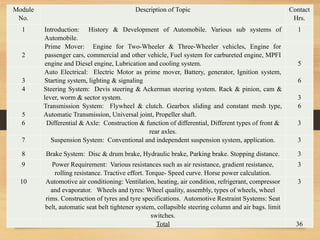
1 Introduction: History & Development of Automobile. Various sub systems of
Automobile.
1
2
Prime Mover: Engine for Two-Wheeler & Three-Wheeler vehicles, Engine for
passenger cars, commercial and other vehicle, Fuel system for carbureted engine, MPFI
engine and Diesel engine, Lubrication and cooling system. 5
3
Auto Electrical: Electric Motor as prime mover, Battery, generator, Ignition system,
Starting system, lighting & signaling 6
4 Steering System: Devis steering & Ackerman steering system. Rack & pinion, cam &
lever, worm & sector system. 3
5
Transmission System: Flywheel & clutch. Gearbox sliding and constant mesh type,
Automatic Transmission, Universal joint, Propeller shaft.
6
6 Differential & Axle: Construction & function of differential, Different types of front &
rear axles.
3
7 Suspension System: Conventional and independent suspension system, application. 3
8 Brake System: Disc & drum brake, Hydraulic brake, Parking brake. Stopping distance. 3
9 Power Requirement: Various resistances such as air resistance, gradient resistance,
rolling resistance. Tractive effort. Torque- Speed curve. Horse power calculation.
3
10 Automotive air conditioning: Ventilation, heating, air condition, refrigerant, compressor
and evaporator. Wheels and tyres: Wheel quality, assembly, types of wheels, wheel
rims. Construction of tyres and tyre specifications. Automotive Restraint Systems: Seat
belt, automatic seat belt tightener system, collapsible steering column and air bags. limit
switches.
3
Total 36
3.
1
Suggested Books
1. K.Newton, W. Steed and T.K. Garrette, Motor Vehicle, 2nd Edition,
Butterworth, 1989.
2. A.K. Babu, Automobile Mechanics, Khanna Publishing House, 2019.
3. A. De, Automobile Engineering, Revised Edition, Galgotia Publication Pvt.
Ltd., 2010.
4. W.H. Crouse and D.L. Anglin, Automotive Mechanics, McGraw Hill, New
Delhi, 2005.
5. J. Heitner, Automotive Mechanics, Affiliated South West Press, New Delhi,
2000.
6. G.B. Narang, Automobile Engineering, Khanna Publishers, New Delhi, 2001.
7. K. Ramakrishna, Automobile Engineering, PHI Learning Pvt. Ltd., New
Delhi, 2012.
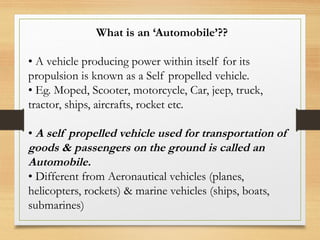
What is an‘Automobile’??
• A vehicle producing power within itself for its
propulsion is known as a Self propelled vehicle.
• Eg. Moped, Scooter, motorcycle, Car, jeep, truck,
tractor, ships, aircrafts, rocket etc.
• A self propelled vehicle used for transportation of
goods & passengers on the ground is called an
Automobile.
• Different from Aeronautical vehicles (planes,
helicopters, rockets) & marine vehicles (ships, boats,
submarines)
6.
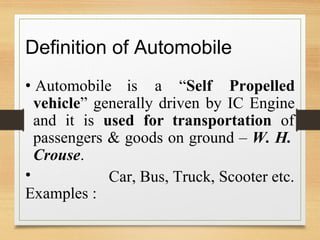
Definition of Automobile
•Automobile is a “Self Propelled
vehicle” generally driven by IC Engine
and it is used for transportation of
passengers
Crouse.
•
Examples :
& goods on ground – W. H.
Car, Bus, Truck, Scooter etc.
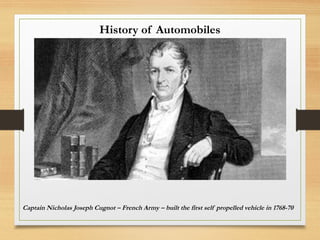
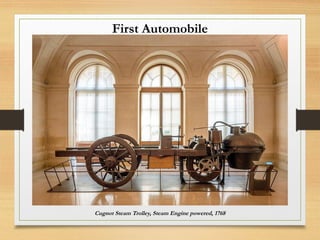
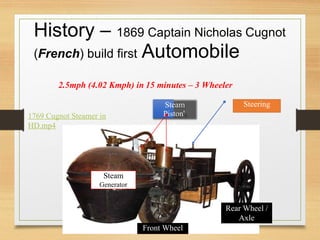
History – 1869Captain Nicholas Cugnot
(French) build first Automobile
2.5mph (4.02 Kmph) in 15 minutes – 3 Wheeler
Steam
Piston'
s
1769 Cugnot Steamer in
HD.mp4
Front Wheel
Rear Wheel /
Axle
Steam
Generator
Steering
13.
e is e
1801– Richard
Carriage
threvithrick – Firs Steam
TREVITHICK'S PUFFING DEVIL
ON TREVITHICK DAY 2017.mp4
Trevithick was born in 1771 in a
mining
England.
village
He
in
was
Cornwall,
terrible
a
student–his teachers thought he
was a “disobedient, slow,
obstinate, [and] spoiled boy” who
anything,
basically
would never amount to
and in fact he was
illiterat
to tinker
h entir life–but he loved
with tools and machines6.
Puffing DEVIL
Wheels
Steam
Generator
Chimney
14.
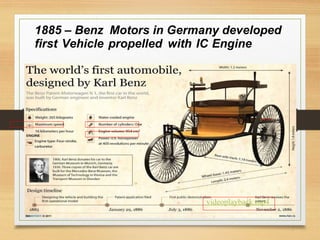
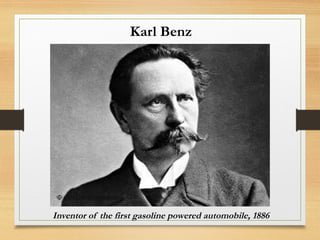
1885 – BenzMotors in Germany developed
first Vehicle propelled with IC Engine
7
videoplayback.mp4
15.
…Contd
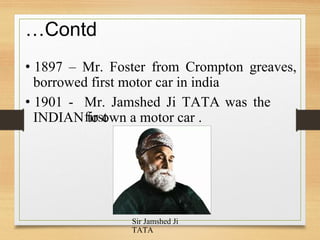
• 1897 –Mr. Foster from Crompton greaves,
borrowed first motor car in india
• 1901 -
INDIAN
Mr. Jamshed Ji TATA was the
first
to own a motor car .
Sir Jamshed Ji
TATA
16.
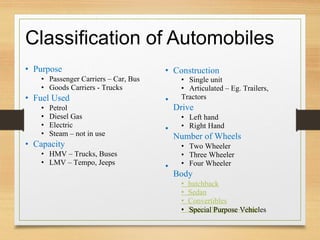
Classification
• Purpose
• PassengerCarriers – Car, Bus
• Goods Carriers - Trucks
• Fuel Used
• Petrol
• Diesel Gas
• Electric
• Steam – not in use
• Capacity
• HMV – Trucks, Buses
• LMV – Tempo, Jeeps
of Automobiles
• Construction
• Single unit
• Articulated – Eg. Trailers,
Tractors
Drive
• Left hand
• Right Hand
Number of Wheels
• Two Wheeler
• Three Wheeler
• Four Wheeler
Body
• hatchback
• Sedan
• Convertibles
• Station Wagons - Vans
•
•
•
• Special Purpose Vehicles
18.
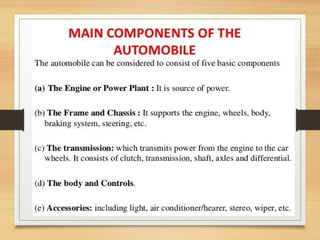
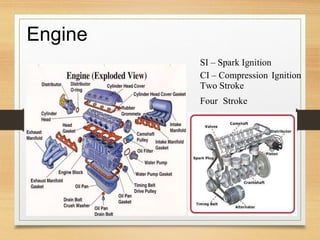
Engine
SI – SparkIgnition
CI – Compression
Two Stroke
Ignition
Four Stroke
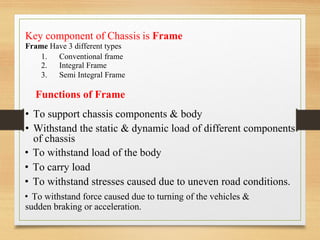
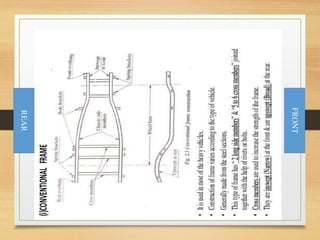
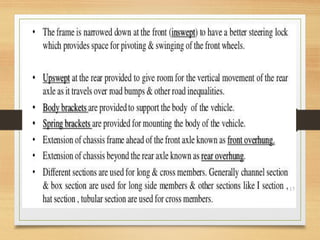
Key component ofChassis
Frame Have 3 different types
is Frame
1.
2.
3.
Conventional frame
Integral Frame
Semi Integral Frame
Functions of Frame
• To support chassis components & body
• Withstand the static & dynamic load of different components
of chassis
• To withstand load of the body
• To carry load
• To withstand stresses caused due to uneven road conditions.
• To withstand force caused due to turning of the vehicles &
sudden braking or acceleration.
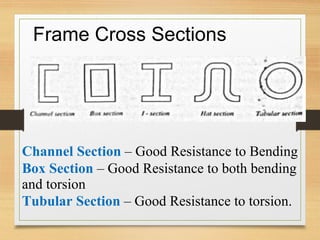
Frame Cross Sections
ChannelSection – Good Resistance to Bending
Box Section – Good Resistance to both bending
and torsion
Tubular Section – Good Resistance to torsion.
27.
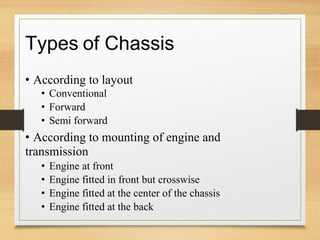
Types of Chassis
•According to layout
• Conventional
• Forward
• Semi forward
• According to mounting of engine and
transmission
• Engine at front
• Engine fitted in front but crosswise
• Engine fitted at the center of the chassis
• Engine fitted at the back
28.
According to mountingof
Component of Chassis
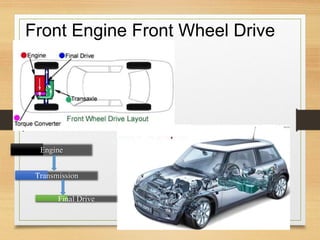
• Front Engine Rear Wheel Drive
• Front Engine Front Wheel Drive
• Rear Engine Rear Wheel Drive
• All Wheel Drive
29.
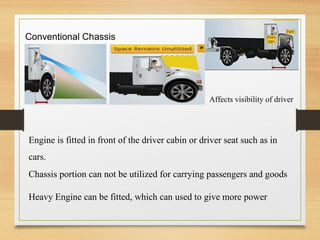
Conventional Chassis
Affects visibilityof driver
Engine is fitted in front of the driver cabin or driver seat such as in
cars.
Chassis portion can not be utilized for carrying passengers and goods
Heavy Engine can be fitted, which can used to give more power
30.
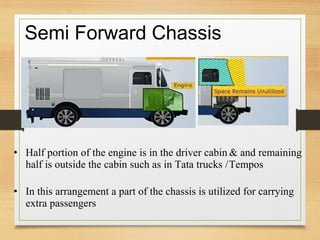
Semi Forward Chassis
•Half portion of the engine is in the driver cabin
half is outside the cabin such as in Tata trucks /
& and remaining
Tempos
• In this arrangement a part of the chassis is utilized for carrying
extra passengers
31.
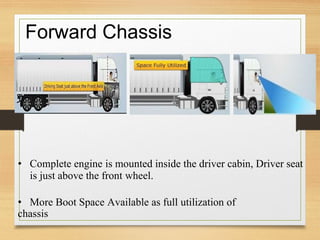
Forward Chassis
• Completeengine is mounted inside the driver cabin, Driver seat
is just above the front wheel.
• More Boot Space Available as full utilization of
chassis
32.
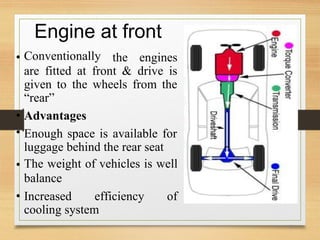
Engine
Conventionally
at front
• theengines
are fitted at front & drive is
given to
“rear”
the wheels from the
•
•
Advantages
Enough space is available for
luggage behind the rear seat
The weight of vehicles is well
balance
•
• Increased efficiency of
cooling system
24
33.
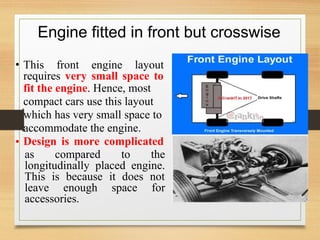
Engine fitted infront but crosswise
• This front engine layout
requires very small space to
fit the engine. Hence, most
compact cars use this layout
which has very small space to
accommodate the engine.
Design is more complicated
•
as compared to the
longitudinally placed engine.
This is because it does not
leave enough space for
accessories.
34.
Engine is mountedat center
• Mid-engine, rear-wheel drive
format can be considered the
original layout of automobiles.
Drive is given to the rear.
Equal Distribution of weight.
•
•
• Largest drawback of mid-engine
cars is
space;
restricted rear passenger
• Consequently most mid-engine
vehicles are two-seat vehicles.
The engine in effect pushes
the
passenger compartment
forward
towards the front axle (if
engine is
behind driver).
•
35.
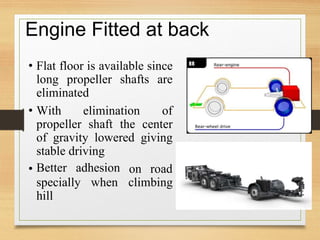
Engine Fitted atback
• Flat floor is available since
long propeller shafts are
eliminated
• With
propeller
elimination of
center
giving
shaft the
of gravity lowered
stable driving
Better adhesion
• on road
climbing
specially
hill
when
r r h
•Fo highe
y
stre
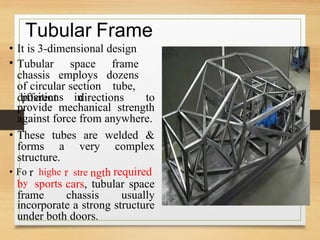
Tubular Frame
•
•
It is 3-dimensional design
Tubular space frame
chassis employs dozens
of circular section tube,
positions in
different directions to
provide mechanical strength
against force from anywhere.
• These tubes are welded &
forms a very complex
structure.
ngt required
b sports cars, tubular space
frame chassis usually
incorporate a strong structure
under both doors.
38.
Advantages & Disadvantages
• Very strong in any • Very complex , costly
and time consuming to
be built.
It engages a lot of
spaces rise the door seal
and result in difficult to
access to the cabin.
direction
with ladder
Monocoque
(compared
chassis and
chassis of •
the same weight)
• Impossible for
robotized production.
39.
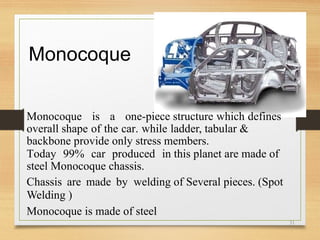
Monocoque
Monocoque is aone-piece structure which defines
overall shape of the car. while ladder, tabular &
backbone provide only stress members.
Today 99% car produced in this planet are made of
steel Monocoque chassis.
Chassis are made by welding of Several pieces. (Spot
Welding )
Monocoque is made of steel
31
40.
Advantages & Disadvantages
•Space-efficiency.
• Monocoque
•
chassis •
It is very heavy.
Impossible for small
volume production.
In case of accidents
benefit crash production
because it uses
metal.
a lot of •
whole structure
obsolete.
become
• Cheap
production
for mass
41.
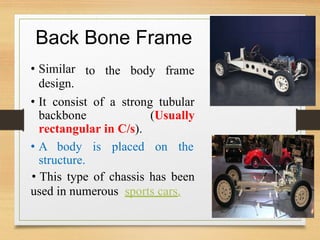
Back
• Similar
design.
Bone Frame
tothe body frame
• It consist
backbone
of a strong tubular
(Usually
rectangular in C/s).
• A body is placed on the
structure.
• This type of chassis has been
used in numerous sports cars.
42.
licated an
.
d m
,
ore
e
costlyHow eve r
ll
th m
-
ore
axles with wheel drive
are ne eded, the co st
benefit tur ns in f
e sis
Advantages & Disadvantages
• The vulnerable parts of the
drive shaft are covered by a
• Manufacturing
backbone chassis
comp
the
more
is
thick tube. The whole
system is extremely reliable.
However, if a problem
occurs, repairs are more
complicated. avor of
backbon
chas
.
• The modular system enables
configurations of 2-, 3-, 4-,
5-, 6-, or 8-axle vehicles
• The backbone chassis is
heavier for a given torsional
stiffness than a uni-body.
with various wheel bases.
Th
e
chassis gives no
side
protection
impacts.
against
34
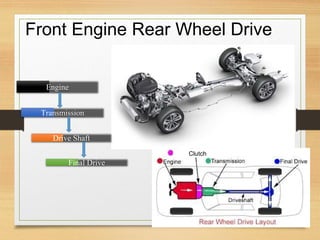
Front Engine RearWheel Drive
Engine
Transmission
Drive Shaft
Clutch
Final Drive
45.
Front
Drive
Engine Rear Wheel
•Most common type of layout.
• Engine Located at front and driving power is given
to rear wheels.
• Driving Power flows from engine to rear wheel
through various mechanical linkages.
46.
ation, making therear
ltaneous acceleration
es.
Advantages & Disadvantages
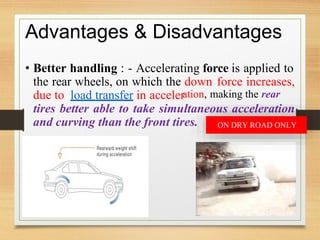
• Better handling : - Accelerating force is applied to
the rear wheels, on which the down
due to load transfer in acceler
force increases,
tires better able to take simu
and curving than the front tir ON DRY ROAD ONLY
47.
Even weight distribution
•The division of weight between the front and rear
wheels has a significant impact on a car's handling,
and it is much easier to get a 50/50 weight
distribution in a rear wheel drive car.
Steering radius
• As no complicated drive shaft joints are required at
the front wheels, it is possible to turn them further
than would be possible using front wheel drive,
resulting in a smaller steering radius.
48.
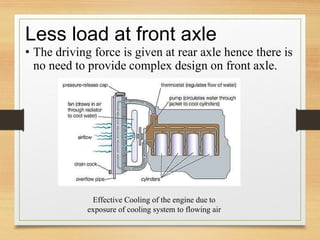
Less load atfront axle
• The driving force is given at rear axle hence there is
no need to provide complex design on front axle.
Effective Cooling of the engine due to
exposure of cooling system to flowing air
49.
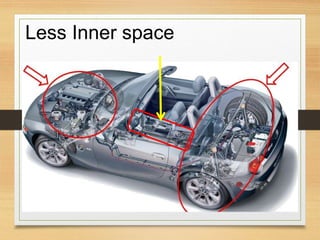
Disadvantages
Decreased interior space– This isn't an issue in a vehicle with
a ladder frame like a pickup truck, where the space used by the
drive line is unusable for passengers or cargo. But in a
passenger car, rear wheel drive means: Less front leg room
(the transmission tunnel takes up a lot of space between the
driver and front passenger), less leg room for center rear
passengers (due to the tunnel needed for the drive shaft),
and sometimes less trunk space (since there is also more
hardware that must be placed underneath the trunk).
Increased weight
• Thedrive shaft, which connects the engine at the
front to the drive axle in the back, adds weight.
There is extra sheet metal to form the transmission
tunnel. A rear wheel drive car will weigh slightly
more than a comparable front wheel drive car, but
less than four wheel drive.
52.
Higher purchase price
•Due to the added cost of materials, rear wheel
drive is typically slightly more expensive to
purchase
vehicle.
.
than a comparable front wheel drive
Front
Drive
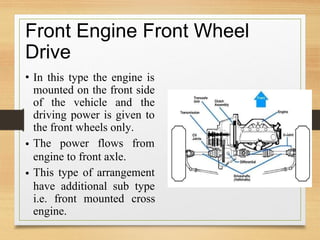
Engine Front Wheel
•In this type the engine is
mounted on the front side
of the vehicle and the
driving power is given to
the front wheels only.
The power flows from
engine to front axle.
This type of arrangement
•
•
have additional sub type
cross
i.e. front mounted
engine.
55.
Advantages
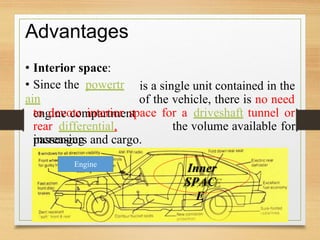
• Interior space:
•Since the powertr
ain
engine compartment
is a single unit contained in the
of the vehicle, there is no need
to devote interior space for a driveshaft tunnel or
for
rear differential,
increasing
the volume available
passengers and cargo.
Inner
SPAC
E
Engine
56.
Better handling onslippery
surface
• Slippery-surface traction: placing the mass of the
drivetrain over the driven wheels
improves traction on wet, snowy, or icy surfaces.
Improved drive train efficiency
• The direct connection between engine and
transaxle reduce the mass and
of the drivetrain compared to
mechanical inertia
a rear-wheel drive
vehicle with a similar engine and transmission,
allowing greater fuel economy.
57.
Disadvantages
• Less TurningRadius
• The drive shafts may limit the amount by which the
front wheels can turn, they are generally unable to
make the.
• More Weight on front results in rapid wear of
front tires.
• Front-wheel drive has worse acceleration than
rear-wheel drive, which is why most sporty and
race cars use rear-wheel drive.
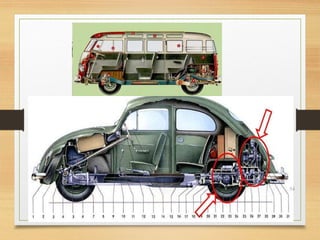
Advantages
• Weight overrear wheels, increased traction while
accelerating.
• Front axle construction is simplified.
• Absence of propeller shaft results in decrease of
floor height.
• Engine components mounted at rear of rear axle
hence more space is available.
63.
Disadvantages
• Separate coolingmechanism is needed for
effective cooling
mounted at rear.
of the engine as the engine is
• More load on rear side may result in overturning
(Over steer) of the vehicle.
• Longer linkages are required to operate clutch,
gears from driver.
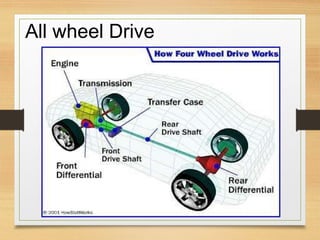
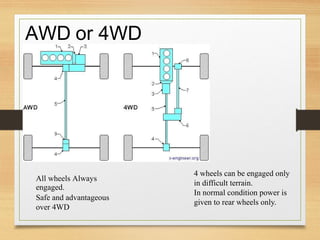
AWD or 4WD
Allwheels Always
engaged.
Safe and advantageous
over 4WD
4 wheels can be engaged only
in difficult terrain.
In normal condition power is
given to rear wheels only.
66.
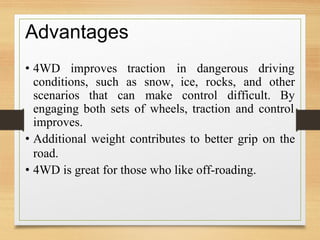
Advantages
• 4WD improvestraction in dangerous driving
conditions, such as snow,
make
ice, rocks, and other
scenarios that can control difficult. By
engaging both sets of wheels, traction and control
improves.
• Additional weight contributes to better grip on the
road.
• 4WD is great for those who like off-roading.
67.
Disadvantages
• The maindisadvantage of 4WD is added cost for
purchase, maintenance, and fuel. The extra equipment
(differentials, transfer case, etc.) adds complexity and
weight to the vehicle, increasing initial market value,
tire wear, and the cost of repairs and maintenance.
The added power and weight of 4WD and AWD
systems require more fuel, making them less efficient
than their 2WD counterparts.
Added weight improves traction and control, but it also
increases the braking distance required to make a
complete stop. Lighter vehicles can avoid collision
easier than heavier vehicles.
•
•


![e is e
1801 – Richard
Carriage
threvithrick – Firs Steam
TREVITHICK'S PUFFING DEVIL
ON TREVITHICK DAY 2017.mp4
Trevithick was born in 1771 in a
mining
England.
village
He
in
was
Cornwall,
terrible
a
student–his teachers thought he
was a “disobedient, slow,
obstinate, [and] spoiled boy” who
anything,
basically
would never amount to
and in fact he was
illiterat
to tinker
h entir life–but he loved
with tools and machines6.
Puffing DEVIL
Wheels
Steam
Generator
Chimney](https://image.slidesharecdn.com/19-ae-m-n-nasim-250327111826-684a181a/85/Auto-mobile-engineering-over-view-N-Mondal-13-320.jpg)