5/12/2022
1
© AGA |
AGAAlbuquerque &
New Mexico Chapters
PDT
May 19, 2022
Gerry Boaz, CPA, CGFM, CGMA
AGA National President
Technical Manager, Comptroller of the Treasury, Division of State
Audit
Gerry.Boaz@cot.tn.gov
(615) 747-5262
1
Disclaimer
2
The opinions and views expressed in this presentation are
our own and do not necessarily represent the opinions or
views of the TN Comptroller of the Treasury, his
representatives, or the TN Department of Audit. Official
positions are determined only after due process and
deliberation.
2
1
2
5/12/2022
2
Looking into the
Auditing Crystal Ball
AICPA Auditing Standards Update
3
Session Objectives
Discuss AICPA Auditing Standards Board effective (or soon
to be) SASs:
Auditor Reporting suite of SASs
Materiality
Evidence
Estimates
Others
4
3
4
5/12/2022
3
5
Recently Issued Auditing Standards
SAS No. Topic AU- C Section
Affected
Issued
134 Auditor Reporting 700, 701(new),
705, 706
May 2019
135 Omnibus SAS Various May 2019
136 EBP ERISA Audits 703 (new) July 2019
137 Other Information 720 July 2019
Effective for audits of financial statements for
periods ending on or after December 15, 2020.
(12/31/20 or June 30, 2021)
Early
implementation
not permitted.
5
6
5/12/2022
4
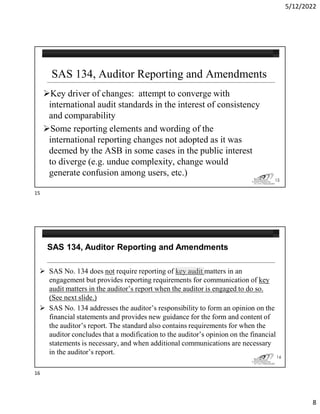
Recently Issued Auditing Standards
SAS No. Topic AU- C Section
Affected
Issued
138 Materiality 200, 320, 450,
600
Dec 2019
139 Auditor Reporting
- Extended
800, 805, 810 March
2020
140 Auditor Reporting
- Extended
Various April
2020
Effective for audits of financial statements for periods
ending on or after December 15, 2020. (12/31/20 or June
30, 2021)
Early
implementation
not permitted.
(With the
exception of
138)
Recently Issued Auditing Standards
SAS
No.
Topic AU- C
Section
Affected
Issued Effective
Date
142 Audit
Evidence
Various July
2020
12/31/22
or
6/30/23
143 Auditing
Accounting
Estimates/
Disclosures
Various July
2020
12/31/23
or
6/30/24
7
8
5/12/2022
5
9
Amendment to the Effective Dates of SASs 134-140
 134-140 were effective for audits of financial statements for periods
ending on or after December 15, 2020. (12/31/20 or June 30, 2021)
 SAS 141, Amended those dates. The revised dates for 134-140 is
December 15, 2021. (12/31/21 or June 30, 2022)
 In addition, SASs 134-140, with the exception of SAS 138, did not
permit early implementation. SAS 141 amends those SASs to
allow early implementation. ASB recommends implementation of
all the reporting standards at the same time.
 SAS 141 was effective upon issuance. (May 2020) 10
9
10
5/12/2022
6
Auditor Reporting Standards
SAS No. Topic AU- C Sec.
134 Auditor reporting, including key
audit matters
700, 701(new),
705, 706
135 Omnibus SAS addressing related
party transactions and significant
unusual transactions
260, 550
136 EBP ERISA audits 703 (new)
137 Other information 720
138 Description of materiality
139-140 Conforming amendments to other
AU-C sections with reporting
requirements
720, 725, 800, 805,
810, 930, 935, 940
Effective for audits
of financial
statements for
periods ending on
or after December
15, 2021. Early
implementation
permitted. (SAS
No. 141)
Auditor Reporting Standards
The new statements are very much interconnected with
each other and so best to implement all at the same time
SAS 134 affected by materiality description in SAS 138
SAS 137 (Other Information) reflected in the new
reporting format of SAS 134
12
11
12
5/12/2022
7
13
SAS 134, Auditor Reporting and Amendments
SAS No. 134 significantly changes the form and content of the
auditor’s report issued after auditing a set of financial
statements. The SAS also addresses the auditor’s responsibility
to form an opinion on the financial statements.
The auditor reporting suite of standards will benefit users of
audited financial statements throughout the U.S. by placing the
auditor’s opinion at the front of the report for added visibility
and providing necessary transparency into the basis for the
auditor’s opinion and the responsibilities of both entity
management and auditors. 14
13
14
5/12/2022
8
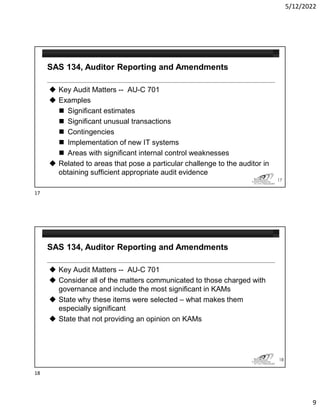
SAS 134, Auditor Reporting and Amendments
Key driver of changes: attempt to converge with
international audit standards in the interest of consistency
and comparability
Some reporting elements and wording of the
international reporting changes not adopted as it was
deemed by the ASB in some cases in the public interest
to diverge (e.g. undue complexity, change would
generate confusion among users, etc.)
15
 SAS No. 134 does not require reporting of key audit matters in an
engagement but provides reporting requirements for communication of key
audit matters in the auditor’s report when the auditor is engaged to do so.
(See next slide.)
 SAS No. 134 addresses the auditor’s responsibility to form an opinion on the
financial statements and provides new guidance for the form and content of
the auditor’s report. The standard also contains requirements for when the
auditor concludes that a modification to the auditor’s opinion on the financial
statements is necessary, and when additional communications are necessary
in the auditor’s report.
SAS 134, Auditor Reporting and Amendments
16
15
16
5/12/2022
9
SAS 134, Auditor Reporting and Amendments
17
 Key Audit Matters -- AU-C 701
 Examples
 Significant estimates
 Significant unusual transactions
 Contingencies
 Implementation of new IT systems
 Areas with significant internal control weaknesses
 Related to areas that pose a particular challenge to the auditor in
obtaining sufficient appropriate audit evidence
SAS 134, Auditor Reporting and Amendments
18
 Key Audit Matters -- AU-C 701
 Consider all of the matters communicated to those charged with
governance and include the most significant in KAMs
 State why these items were selected – what makes them
especially significant
 State that not providing an opinion on KAMs
17
18
5/12/2022
10
Illustration 3: An Auditor’s Report on Financial Statements for a Single Year Prepared in
Accordance With Accounting Principles Generally Accepted in the United States of America
 Circumstances include the following:
 Audit of a complete set of general purpose financial statements (single year).
 The audit is not a group audit.
 Management is responsible for the preparation of the financial statements in accordance with accounting
principles generally accepted in the United States of America as promulgated by the Financial
Accounting Standards Board.
 The terms of the audit engagement reflect the description of management’s responsibility for the financial
statements in AU-C section 210, Terms of Engagement.
 The auditor has concluded that an unmodified (that is, “clean”) opinion is appropriate based on the audit
evidence obtained.
 Based on the audit evidence obtained, the auditor has concluded that there are no conditions or events,
considered in the aggregate, that raise substantial doubt about the entity’s ability to continue as a going
concern for a reasonable period of time in accordance with AU-C section 570, The Auditor’s
Consideration of an Entity’s Ability to Continue as a Going Concern.
 The auditor has not been engaged to communicate key audit matters.
19
Opinion Paragraph Presented First
Independent Auditor’s Report
[Appropriate Addressee]
Report on the Audit of the Financial Statements1
Opinion
(We have audited the financial statements of ABC Company, which comprise the balance sheet as of December
31, 20X1, and the related statements of income, changes in stockholders’ equity, and cash flows for the year then
ended, and the related notes to the financial statements.)
We have audited the accompanying financial statements of the governmental activities, the business-type
activities, the aggregate discretely presented component units, each major fund, and the aggregate remaining
fund information of [Typical County], Tennessee, as of and for the year ended [June 30, 201X], and the related
notes to the financial statements, which collectively comprise the county’s basic financial statements as listed in
the table of contents.
In our opinion, the accompanying financial statements present fairly, in all material respects, the financial
position of ABC Company as of December 31, 20X1, and the results of its operations and its cash flows for the
year then ended in accordance with accounting principles generally accepted in the United States of America.
20
19
20
5/12/2022
11
Opinion
 First section is opinion
 Identifies scope of audit – entity audited, period and statements (including
disclosures)
 Essentially same information as currently included with opinion
21
Followed by the Basis for Opinion
 Basis for Opinion (for all audits)
 We conducted our audit in accordance with auditing standards generally
accepted in the United States of America (GAAS). Our responsibilities under
those standards are further described in the Auditor’s Responsibilities for the
Audit of the Financial Statements section of our report. We are required to be
independent of ABC Company and to meet our other ethical responsibilities,
in accordance with the relevant ethical requirements relating to our audit. We
believe that the audit evidence we have obtained is sufficient and appropriate
to provide a basis for our audit opinion.
22
21
22
5/12/2022
12
Followed by the Basis for Opinion
 Previously Basis section not used for an unmodified opinion
 Apart from Opinion section and the Basis of Opinion section, order of
sections not specified – matter of professional judgment
 Specific headings for the sections are required, however
 Basis section now includes reference to GAAS. Previously in the Auditor's
Responsibility section
23
Followed by the Basis for Opinion
 Previously auditor independence indicated via the report title
 Now specifically stated in the Basis section
 Ethical requirements may also include those of a state board of
accountancy and Yellow Book in addition to AICPA requirements
 "Sufficient and appropriate evidence" -- moved from Auditor's
Responsibility section to Basis
24
23
24
5/12/2022
13
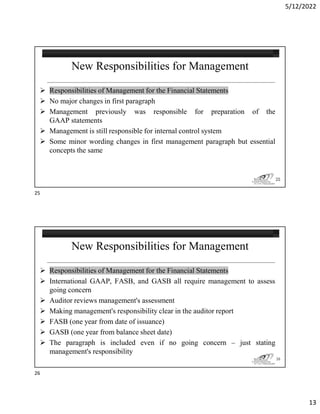
New Responsibilities for Management
 Responsibilities of Management for the Financial Statements
 No major changes in first paragraph
 Management previously was responsible for preparation of the
GAAP statements
 Management is still responsible for internal control system
 Some minor wording changes in first management paragraph but essential
concepts the same
25
New Responsibilities for Management
 Responsibilities of Management for the Financial Statements
 International GAAP, FASB, and GASB all require management to assess
going concern
 Auditor reviews management's assessment
 Making management's responsibility clear in the auditor report
 FASB (one year from date of issuance)
 GASB (one year from balance sheet date)
 The paragraph is included even if no going concern – just stating
management's responsibility
26
25
26
5/12/2022
14
New Responsibilities for Management
 Responsibilities of Management for the Financial Statements
 Management is responsible for the preparation and fair presentation of the
financial statements in accordance with accounting principles generally accepted
in the United States of America, and for the design, implementation, and
maintenance of internal control relevant to the preparation and fair presentation of
financial statements that are free from material misstatement, whether due to fraud
or error.
 In preparing the financial statements, management is required to evaluate whether
there are conditions or events, considered in the aggregate, that raise substantial
doubt about ABC Company’s ability to continue as a going concern for [insert the
time period set by the applicable financial reporting framework- SAS 132].
27
New Responsibilities for Auditors
Auditor’s Responsibilities for the Audit of the Financial Statements
 Many new additions
 Mainly a clarification of extant responsibilities
 Important terms used: "reasonable assurance," "material misstatement"
 These are explained in detail to report user
28
27
28
5/12/2022
15
New Auditor’s Responsibilities
Auditor’s Responsibilities for the Audit of the Financial Statements
Our objectives are to obtain reasonable assurance about whether the financial
statements as a whole are free from material misstatement, whether due to
fraud or error, and to issue an auditor’s report that includes our opinion.
Reasonable assurance is a high level of assurance but is not absolute assurance
and therefore is not a guarantee that an audit conducted in accordance with
GAAS will always detect a material misstatement when it exists. The risk of
not detecting a material misstatement resulting from fraud is higher than for
one resulting from error, as fraud may involve collusion, forgery, intentional
omissions, misrepresentations, or the override of internal control. (Prior to
SAS 138:) Misstatements are considered material if, individually or in the
aggregate, they could reasonably be expected to influence the economic
decisions of users made on the basis of these financial statements. (see next
slide) 29
New Auditor’s Responsibilities
 (Previous:) Misstatements are considered material if,
individually or in the aggregate, they could reasonably be
expected to influence the economic decisions of users made on
the basis of these financial statements.
 Revised by SAS 138:
 (New:) Misstatements are considered material if there is a
substantial likelihood that, individually or in the aggregate, they
would influence the judgment made by a reasonable user based
on the financial statements.
30
29
30
5/12/2022
16
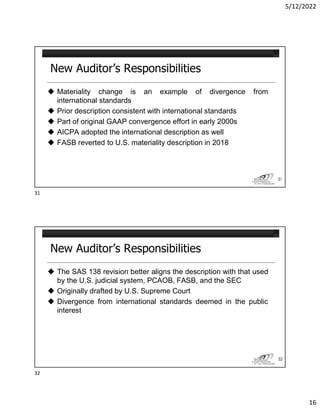
New Auditor’s Responsibilities
 Materiality change is an example of divergence from
international standards
 Prior description consistent with international standards
 Part of original GAAP convergence effort in early 2000s
 AICPA adopted the international description as well
 FASB reverted to U.S. materiality description in 2018
31
New Auditor’s Responsibilities
 The SAS 138 revision better aligns the description with that used
by the U.S. judicial system, PCAOB, FASB, and the SEC
 Originally drafted by U.S. Supreme Court
 Divergence from international standards deemed in the public
interest
32
31
32
5/12/2022
17
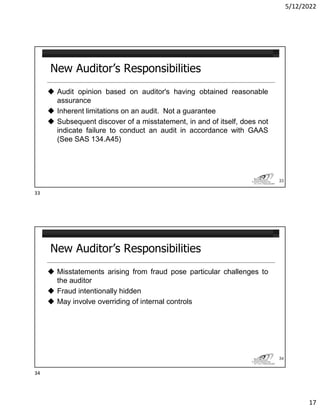
New Auditor’s Responsibilities
 Audit opinion based on auditor's having obtained reasonable
assurance
 Inherent limitations on an audit. Not a guarantee
 Subsequent discover of a misstatement, in and of itself, does not
indicate failure to conduct an audit in accordance with GAAS
(See SAS 134.A45)
33
New Auditor’s Responsibilities
 Misstatements arising from fraud pose particular challenges to
the auditor
 Fraud intentionally hidden
 May involve overriding of internal controls
34
33
34
5/12/2022
18
New Auditor’s Responsibilities
 Next paragraph provides some details on what is done as part of
an audit (see next slide)
35
New Auditor Responsibilities (cont’d)
 In performing an audit in accordance with GAAS, we:
 Exercise professional judgment and maintain professional skepticism throughout the audit.
 Identify and assess the risks of material misstatement of the financial statements, whether due to
fraud or error, and design and perform audit procedures responsive to those risks. [see AU-C 315 for
basic process] Such procedures include examining, on a test basis, evidence regarding the amounts
and disclosures in the financial statements.
 Obtain an understanding [not simply considering I/C] of internal control relevant to the audit in order
to design audit procedures that are appropriate in the circumstances, but not for the purpose of
expressing an opinion on the effectiveness of ABC Company’s internal control. Accordingly, no such
opinion is expressed. [clarifying auditor's responsibility with respect to internal control risk]
 Evaluate the appropriateness of accounting policies used and the reasonableness of significant
accounting estimates made by management, as well as evaluate the overall presentation of the
financial statements.
 Conclude whether, in our judgment, there are conditions or events, considered in the aggregate, that
raise substantial doubt about ABC Company’s ability to continue as a going concern for a reasonable
period of time.
36
35
36
5/12/2022
19
New Auditor’s Responsibilities
 "Reasonable period of time" regarding going concern determined
using the applicable reporting framework
 FASB (one year from f/s issuance)
 GASB (one year from balance sheet date)
37
We are required to communicate with those charged
with governance regarding, among other matters, the
planned scope and timing of the audit, significant audit
findings, and certain internal control–related matters that
we identified during the audit.
New Auditor Responsibilities (cont’d)
38
37
38
5/12/2022
20
Hierarchy
Key audit matters (KAM)
Emphasis of a matter (EOM)
Other matter (OM)
39
 How will this affect your audits?
Will change the format and wording of all Auditor
Reports. Will require additional audit time in the
year of implementation, but this should not be a
budget breaker with a little planning.
Introduces Key Audit Matters as a concept, but this
will not create audit issues.
40
39
40
5/12/2022
21
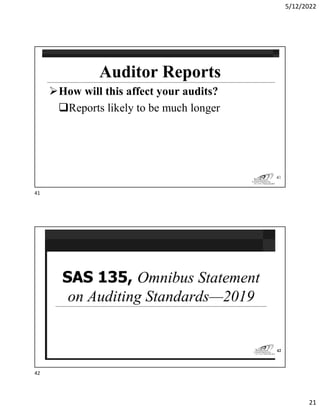
How will this affect your audits?
Reports likely to be much longer
41
42
41
42
5/12/2022
22
Proposed amendments to AU-C 260, Communication with TCWG,
and AU-C 550, Related Parties, as well as various other sections
Amendments intended to enhance audit quality by heightening the
auditor’s focus on
related parties and relationships and transactions with related
parties
Significant unusual transactions
ASB considered PCAOB AS 16, AS 17 and AS 18
SAS 135, Omnibus Statement on Auditing
Standards – 2019
43
 How will this affect your audits?
Will require additional documentation for Related
Party Transactions and Unusual Transactions.
The amount of documentation will not be
overwhelming but will take additional planning
and time.
Additions to communications or inquiries with
those charged with governance.
Increased representation letter items. 44
43
44
5/12/2022
23
45
ERISA
 Guidance for ERISA audits moved to AU-C 703
 Reporting guidance was previously with f/s guidance in
AU-C 700
46
45
46
5/12/2022
24
47
Other Information – Definitions
 Annual report. A document, or combination of documents, typically prepared on an
annual basis by management or those charged with governance in accordance with
law, regulation, or custom, the purpose of which is to provide owners (or similar
stakeholders) with information on the entity’s operations and the entity’s financial
results and financial position as set out in the financial statements. An annual report
contains, accompanies, or incorporates by reference the financial statements and the
auditor’s report thereon and usually includes information about the entity’s
developments, its future outlook and risks and uncertainties, a statement by the
entity’s governing body, and reports covering governance matters.
 The term annual reports of governments is intended to include annual
comprehensive financial reports or other annual financial reports that include the
government’s financial statements and the auditor’s report thereon. (Ref: par. A10)
48
47
48
5/12/2022
25
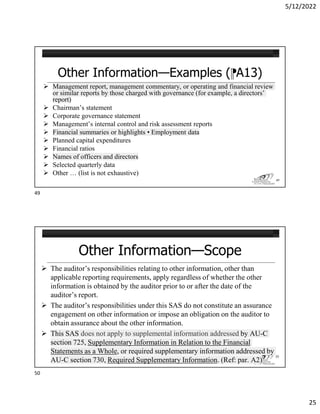
Other Information—Examples (⁋A13)
 Management report, management commentary, or operating and financial review
or similar reports by those charged with governance (for example, a directors’
report)
 Chairman’s statement
 Corporate governance statement
 Management’s internal control and risk assessment reports
 Financial summaries or highlights • Employment data
 Planned capital expenditures
 Financial ratios
 Names of officers and directors
 Selected quarterly data
 Other … (list is not exhaustive)
49
Other Information—Scope
 The auditor’s responsibilities relating to other information, other than
applicable reporting requirements, apply regardless of whether the other
information is obtained by the auditor prior to or after the date of the
auditor’s report.
 The auditor’s responsibilities under this SAS do not constitute an assurance
engagement on other information or impose an obligation on the auditor to
obtain assurance about the other information.
 This SAS does not apply to supplemental information addressed by AU-C
section 725, Supplementary Information in Relation to the Financial
Statements as a Whole, or required supplementary information addressed by
AU-C section 730, Required Supplementary Information. (Ref: par. A2)
50
49
50
5/12/2022
26
Other Information
 Requirements
 This SAS requires the auditor to read and consider the other
information (think letter of transmittal and statistical sections) because
other information that is materially inconsistent with the financial
statements or the auditor’s knowledge obtained in the audit may indicate
that a material misstatement of the financial statements or that a material
misstatement of the other information exists, either of which may
undermine the credibility of the financial statements and the auditor’s
report thereon.
 The objectives of the auditor, having read the other information, are as
follows:
51
Other Information
 Requirements
 To consider whether a material inconsistency exists between the other
information and the financial statements.
 To remain alert for indications that
 a material inconsistency exists between the other information and the
auditor’s knowledge obtained in the audit or
 a material misstatement of fact exists or the other information is
otherwise misleading
 To respond appropriately when the auditor identifies that such material
inconsistencies appear to exist, or when the auditor otherwise becomes
aware that other information appears to be materially misstated.
 To report in accordance with this SAS
52
51
52
5/12/2022
27
Other Information–Definitions
 Misstatement of the other information. A misstatement of
the other information exists when the other information is
incorrectly stated or otherwise misleading. (Ref: par. A11–
A12).
 Other information. Financial or nonfinancial information
(other than financial statements and the auditor’s report
thereon) included in an entity’s annual report. (Ref: par.
A13)
53
Other Information
 Reporting Illustration 1: The Auditor Has Not Identified an Uncorrected Material
Misstatement of the Other Information
 Other Information [Included in the Annual Report] Management is responsible for the
other information [included in the annual report]. The other information comprises the
[information included in the annual report] but does not include the financial statements
and our auditor’s report thereon.
 Our opinion on the financial statements does not cover the other information, and we do
not express an opinion or any form of assurance thereon. In connection with our audit of
the financial statements, our responsibility is to read the other information and consider
whether a material inconsistency exists between the other information and the financial
statements, or the other information otherwise appears to be materially misstated. If,
based on the work performed, we conclude that an uncorrected material misstatement of
the other information exists, we are required to describe it in our report.
54
53
54
5/12/2022
28
Other Information
 Reporting Illustration 2: The Auditor Has Concluded That an Uncorrected Material Misstatement
of the Other Information Exists
 Other Information [Included in the Annual Report] Management is responsible for the other
information [included in the annual report]. The other information comprises the [information
included in the annual report] but does not include the financial statements and our auditor’s
report thereon.
 Our opinion on the financial statements does not cover the other information, and we do not
express an opinion or any form of assurance thereon. In connection with our audit of the financial
statements, our responsibility is to read the other information and consider whether a material
inconsistency exists between the other information and the financial statements, or the other
information otherwise appears to be materially misstated. If, based on the work performed, we
conclude that an uncorrected material misstatement of the other information exists, we are
required to describe it in our report. As described below, we have concluded that such an
uncorrected material misstatement of the other information exists.
 [Description of material misstatement of the other information]
55
Other Information
 Question
 Does the Annual Report under SAS 137 include information in the Annual
Comprehensive Financial Report Audit such as
 Letter of Transmittal
 Combining Statements if not engaged to give an in-relation opinion
 Corrective Action Plans submitted by Management in compliance with regulations
 Introductory Section information such as a List of Officials and TCWG and Table
of Contents
 Etc.
 What about the Statistical Section?
 Mostly depends on the agreement with Management!
56
55
56
5/12/2022
29
 How will this affect your audits?
 Very little practical effect (if you have already been reading and
considering the accuracy of the information) . More attention to details
of some information presented within our Annual Comprehensive
Financial Reports.
 The engagement letter should specify what the auditor’s report
responsibility is and is not.
 Will change Auditor’s report if the report includes other information.
Will add additional paragraphs.
 Will require additional documentation related to the other information. 57
58
57
58
5/12/2022
30
Auditor Reporting Standards
SAS No. Topic AU- C Sec.
134 Auditor reporting, including key audit
matters
700, 701(new), 705,
706
135 Omnibus SAS addressing related party
transactions and significant unusual
transactions
260, 550
136 EBP ERISA audits 703 (new)
137 Other information 720
138 Description of materiality
139-140 Conforming amendments to other AU-C
sections with reporting requirements
720, 725, 800, 805,
810, 930, 935, 940
Effective for
audits of
financial
statements for
periods ending
on or after
December 15,
2021. Early
implementation
permitted. (SAS
No. 141)
 Definitions:
 The primary difference between the definitions held by the U.S. judicial system
and other U.S. standard setters and regulators and the definitions currently held
by the ASB, IASB, and IAASB relate to whether a misstatement “would
influence the judgment of a reasonable investor” versus “could reasonably be
expected to influence the judgment of a reasonable person.”
 In essence, the U.S. judicial system and other U.S. standard setters and
regulators define an omission or misstatement as material if there is a substantial
likelihood that a reasonable person would consider it important.
 The ASB, IASB, and IAASB definitions state that misstatements, including
omissions, are considered to be material if they, individually or in the aggregate,
could reasonably be expected to influence the economic decisions of users taken
on the basis of the financial statements (i.e. reasonable investor).
60
59
60
5/12/2022
31
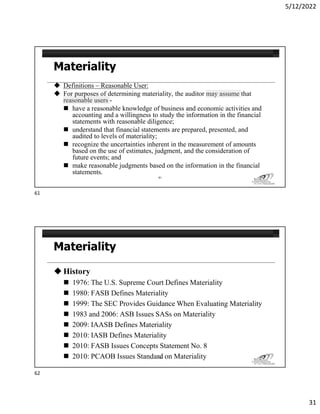
 Definitions – Reasonable User:
 For purposes of determining materiality, the auditor may assume that
reasonable users -
 have a reasonable knowledge of business and economic activities and
accounting and a willingness to study the information in the financial
statements with reasonable diligence;
 understand that financial statements are prepared, presented, and
audited to levels of materiality;
 recognize the uncertainties inherent in the measurement of amounts
based on the use of estimates, judgment, and the consideration of
future events; and
 make reasonable judgments based on the information in the financial
statements.
61
 History
 1976: The U.S. Supreme Court Defines Materiality
 1980: FASB Defines Materiality
 1999: The SEC Provides Guidance When Evaluating Materiality
 1983 and 2006: ASB Issues SASs on Materiality
 2009: IAASB Defines Materiality
 2010: IASB Defines Materiality
 2010: FASB Issues Concepts Statement No. 8
 2010: PCAOB Issues Standard on Materiality
62
61
62
5/12/2022
32
 History
 2011: ASB Issues SAS No. 122, which adopts the IAASB, IASB,
and FASB aligned definitions.
 2018: FASB Amends Concepts Statement No. 8
 2018: IASB Amends Definition of Material
 2019: ASB Proposes to Amend the Definition of Materiality and
then issues Statement 138 in December 2019
63
How will this affect your audits?
Very little practical effect.
Will change Auditor’s report language in a
minor way (as previously illustrated).
May change documentation in various
ways.
64
63
64
5/12/2022
33
65
 This proposed amendments would implement the requirements of
SAS 134 Auditor Reporting Amendments to:
Section 800, Special Considerations — Audits of Financial
Statements Prepared in Accordance With Special Purpose
Frameworks.
 Section 805, Special Considerations — Audits of Single
Financial Statements and Specific Elements, Accounts, or Items
of a Financial Statement.
Section 810, Engagements to Report on Summary Financial
Statements. 66
65
66
5/12/2022
34
 Changes to AU-C Section 800
 The designation of the cash, tax, regulatory, contractual, and other bases of accounting as examples
of special purpose frameworks rather than as part of the definition of special purpose framework
 The addition of an introductory paragraph stating that section 570, The Auditor’s Consideration of
an Entity’s Ability to Continue as a Going Concern, applies to audits of special purpose financial
statements
 Clarification that, in all audits of special purpose financial statements (irrespective of whether the
going concern basis of accounting is relevant to the preparation of the special purpose financial
statements), the auditor is required to do the following:
 Conclude whether substantial doubt exists about the entity’s ability to continue as a going concern for a
reasonable period of time.
 When substantial doubt exists, evaluate the adequacy of the financial statement disclosures as required by the
applicable financial reporting framework.
 For special purpose financial statements prepared in accordance with a contractual or other basis of
accounting, a new requirement that the EOM paragraph in the auditor’s report state that the
financial statements may not be suitable for another purpose. 67
68
67
68
5/12/2022
35
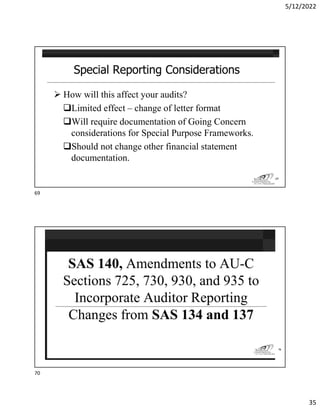
 How will this affect your audits?
Limited effect – change of letter format
Will require documentation of Going Concern
considerations for Special Purpose Frameworks.
Should not change other financial statement
documentation.
69
70
69
70
5/12/2022
36
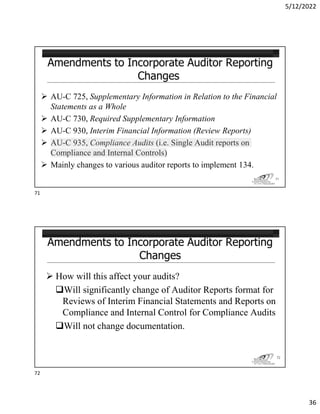
 AU-C 725, Supplementary Information in Relation to the Financial
Statements as a Whole
 AU-C 730, Required Supplementary Information
 AU-C 930, Interim Financial Information (Review Reports)
 AU-C 935, Compliance Audits (i.e. Single Audit reports on
Compliance and Internal Controls)
 Mainly changes to various auditor reports to implement 134.
71
 How will this affect your audits?
Will significantly change of Auditor Reports format for
Reviews of Interim Financial Statements and Reports on
Compliance and Internal Control for Compliance Audits
Will not change documentation.
72
71
72
5/12/2022
37
73
74
SAS No. Topic AU- C Section
Affected
Issued Effective
Date
142 Audit Evidence Various July 2020 12/31/22 or
6/30/23
143 Auditing Accounting
Estimates/Disclosures
Various July 2020 12/31/23 or
6/30/24
73
74
5/12/2022
38
 In August 2017, the ASB began a project to assess whether
revisions of AU-C section 500 are necessary to address the
evolving nature of business and audit services and issues that
have arisen during the standard-setting activities of the ASB.
 These issues include use of emerging technologies by both
preparers and auditors, audit data analytics (ADA), the
application of professional skepticism, the expanding use of
external information sources as audit evidence, and more
broadly, the accuracy, completeness, and reliability of audit
evidence.
75
 .A27 Unconscious or conscious auditor biases may affect the
auditor’s professional skepticism and professional judgment,
including, for example, in the design and performance of audit
procedures or the evaluation of audit evidence. Examples of
unconscious auditor biases that may impede the maintenance of
professional skepticism and, therefore, the reasonableness of the
professional judgments made by the auditor in complying with
the requirements of this SAS, may include the following:
76
75
76
5/12/2022
39
 Availability bias, which is a tendency to place more weight on events or experiences
that immediately come to mind or are readily available than on those that are not
 Confirmation bias, which is a tendency to place more weight on information that
corroborates an existing belief than information that contradicts or casts doubt on
that belief
 Overconfidence bias, which is a tendency to overestimate one's own ability to make
accurate assessments of risk or other judgments or decisions
 Anchoring bias, which is a tendency to use an initial piece of information as an anchor
against which subsequent information is inadequately assessed
 Automation bias, which is a tendency to favor output generated from automated
systems, even when human reasoning or contradictory information raises questions
about whether such output is reliable or fit for purpose 77
 Emerging audit techniques, such as ADA, and emerging technologies,
such as artificial intelligence (AI), robotic process automation (RPA), and
blockchain, offer both challenges and opportunities that will affect audits
of financial and nonfinancial information into the foreseeable future.
 For the purposes of this proposed SAS, the phrase “automated tools and
techniques” will be used to refer to both emerging audit techniques and
emerging technologies.
 There is ongoing activity in the United States and internationally regarding
how the profession should respond to such automated tools and
techniques, including consideration of whether changes to professional
standards would enhance audit quality and make the standards more
relevant in today’s environment.
78
77
78
5/12/2022
40
 In recent years, the IAASB has had a working group considering the topic of
professional skepticism. The projects on quality control, group audits, and
professional skepticism represented the three areas for which the IAASB sought
input from responders in Invitation to Comment (ITC) Enhancing Audit Quality in
the Public Interest, issued in January 2016.
 As explained in the ITC, the ISAs explicitly recognize the fundamental importance
of professional skepticism. Professional skepticism includes being alert to audit
evidence that contradicts other audit evidence obtained or information that brings
into question the reliability of documents or responses to inquiries to be used as
audit evidence.
 The auditor may accept records and documents as genuine unless the auditor has
reason to believe the contrary. Nevertheless, the auditor is required to consider the
reliability of information to be used as audit evidence.
79
 The key issues identified with respect to professional skepticism are as follows:
 Questions have been raised about how auditors can more clearly demonstrate the
application of professional skepticism, how to better describe the basis for the auditor’s
professional judgments, and how the auditor’s mind-set has affected the nature, timing,
and extent of audit procedures performed as well as the critical evaluation of audit
evidence.
 Concern about instances in which auditors did not appropriately apply professional
skepticism in their audits is a recurring theme in audit inspection findings globally and
has been a key issue in discussions about audit quality. Regulatory bodies have suggested
that enhanced professional skepticism by auditors will contribute significantly to
improving the quality of audits and that firms should prioritize efforts in this area.
 The existence of many ways to describe the application of professional skepticism
indicates that the concept of professional skepticism, and the expectations of how auditors
should appropriately apply it, may need to be more clearly articulated in our standards. 80
79
80
5/12/2022
41
 In recent years, the IAASB has had a working group considering the topic of
professional skepticism. The projects on quality control, group audits, and
professional skepticism represented the three areas for which the IAASB sought
input from responders in Invitation to Comment (ITC) Enhancing Audit Quality in
the Public Interest, issued in January 2016.
 As explained in the ITC, the ISAs explicitly recognize the fundamental importance
of professional skepticism. Professional skepticism includes being alert to audit
evidence that contradicts other audit evidence obtained or information that brings
into question the reliability of documents or responses to inquiries to be used as
audit evidence.
 The auditor may accept records and documents as genuine unless the auditor has
reason to believe the contrary. Nevertheless, the auditor is required to consider the
reliability of information to be used as audit evidence.
81
 Having a separate section of a proposed SAS labeled
“professional skepticism” or merely using the words
“professional skepticism” throughout the proposed
SAS is not sufficient to achieve the objectives outlined
here. (Exposure Draft, 6/20/2019)
82
81
82
5/12/2022
42
 In September 2018, the IAASB issued ISA 540 (Revised), Auditing
Accounting Estimates and Related Disclosures. In finalizing ISA 540
(Revised), the IAASB also issued a series of conforming amendments to
other ISAs, including conforming amendments to ISA 500, Audit
Evidence.
 In general, the conforming amendments include a new definition of
external information sources, related application material to the
definition, and other application material that further explains the
concept of external information sources. This proposed SAS includes
substantially all of the IAASB’s conforming amendments to ISA 500.
 We will discuss the definition shortly. 83
 Extant AU-C section 500 contains separate definitions of sufficiency (a measure of
quantity) and appropriateness (a measure of quality). The ASB believes that audit
evidence always has to first be appropriate for the auditor’s intended purposes; the
key question, then, is whether the auditor has obtained enough of such audit evidence
for the auditor’s intended purpose.
 In the proposed SAS, the ASB retained separate definitions of sufficiency and
appropriateness.
 The definition of appropriateness remains largely the same as the extant definition.
 However, the ASB proposes to amend the definition of sufficiency to focus on the measure of the
persuasiveness of audit evidence rather than emphasizing the quantity of audit evidence. The ASB
believes that this change is important because, with the array of automated tools and techniques
available to the auditor in today’s environment and the different nature and sources of information
available, the quantity of audit evidence, in itself, may not be determinative of its sufficiency. 84
83
84
5/12/2022
43
 This standard is closely aligned with the requirements of “professional
skepticism”, and the risk assessment procedures.
 A matter of professional judgment, but based on evidence.
 Still must achieve “sufficient appropriate” audit evidence, but this
standard raises the bar on what those terms mean. Together, the terms
emphasize the “persuasiveness” of the evidence.
 Evidence must be evaluated. The objective of an auditor is to evaluate the
evidence to ensure sufficient appropriate evidence has been obtained.
 The auditor’s evaluation of audit evidence is not a formulaic exercise,
and is dependent on the degree to which each attribute of the audit
evidence influences the auditor’s evaluation. 85
 Definitions: For purposes of generally accepted auditing
standards (GAAS), the following terms have the meanings
attributed as follows:
 Appropriateness (of audit evidence). The measure of the relevance and
reliability of audit evidence.
 Sufficiency (of audit evidence). The measure of the persuasiveness of
audit evidence. The persuasiveness of audit evidence necessary is affected
by the auditor’s assessment of the risks of material misstatement. (Ref:
par. A5)
86
85
86
5/12/2022
44
 Definitions: For purposes of generally accepted auditing standards
(GAAS), the following terms have the meanings attributed as
follows (cont’d):
 Audit evidence. Information used by the auditor in arriving at the conclusions on
which the auditor’s opinion is based. (Ref: par. A6–A7)
 External information source. An individual or organization external to the entity that
develops information used by the entity in preparing the financial statements or used
by the auditor as audit evidence, when such information is available for use by a broad
range of users. When information has been provided by an individual or organization
acting in the capacity of management’s specialist, service organization, or auditor’s
specialist, the individual or organization is not considered an external information
source with respect to that particular information. (Ref: par. A8)
87
 The auditor “should” evaluate information to be used as
audit evidence by taking into account (Ref: par. .A11)
a. the relevance and reliability of the information, including its
source, and (Ref: par. .A12—.A34)
b. whether such information corroborates or contradicts
assertions in the financial statements. (Ref: par. . A35—.A38)
88
87
88
5/12/2022
45
 The auditor's evaluation of the information to be used as
audit evidence in accordance with paragraph .07
“should” include
a. evaluating whether the information is sufficiently precise and
detailed for the auditor's purposes and (Ref: par. .A39)
b. obtaining audit evidence about the accuracy and
completeness of the information, as necessary (Ref: par.
.A40—.A42).
89
 Requirements – Audit Procedures as a Basis for
Concluding on the Sufficiency and Appropriateness of
Audit Evidence
 In evaluating information to be used as audit evidence, the
auditor “should” consider whether the results of audit
procedures provide a basis for concluding on the
sufficiency and appropriateness of audit evidence obtained.
(Ref: par. .A43—.A64)
90
89
90
5/12/2022
46
 Requirements – Inconsistencies in, or Doubts About the
Reliability of, Audit Evidence
 The auditor “should” determine whether modifications or
additions to audit procedures are necessary to resolve
inconsistencies in, or doubts about the reliability of, audit
evidence, including when
 a. audit evidence obtained from one source is inconsistent with that
obtained from another source.
 b. the results of an audit procedure are inconsistent with the results
of another audit procedure.
91
 That’s all the requirements!
 The bulk of this standard is in the Application Guidance.
92
91
92
5/12/2022
47
93
• “The objective of the auditor is to design and perform
audit procedures that enable the auditor to obtain
sufficient appropriate audit evidence…”
Extant objective:
• “The objective of the auditor is to evaluate
information to be used as audit evidence, including the
results of audit procedures, to inform the auditor’s
overall conclusion about whether sufficient
appropriate audit evidence has been obtained.”
Proposed objective:
Audit Evidence
“Information used by the auditor
in arriving at the conclusions on
which the auditor’s opinion is
based. Audit evidence is
information to which audit
procedures have been applied
and consists of information that
corroborates or contradicts
assertions in the financial
statements.”
 Revising an objective currently focused on
the design and performance of audit
procedures.
 Developing a framework for evaluating
audit evidence based on
 appropriateness (relevance and reliability), and
 sufficiency (persuasiveness)
 Shift focus from quantity to persuasiveness 94
“The objective of
the auditor is to
design and perform
audit procedures
that enable the
auditor to obtain
sufficient
appropriate audit
evidence…”
93
94
5/12/2022
48
95
As a basis for concluding whether
sufficient appropriate audit
evidence has been obtained, the
objective of the auditor is to
evaluate information to which
audit procedures have been
applied to determine whether
such information is appropriate
audit evidence.
Audit evidence should be
considered notwithstanding the
source from which it is obtained
or the method used to obtain the
information.
How will this affect your audits?
 May have a Significant practical effect. May require more
documentation to evaluate the evidence to demonstrate
sufficient appropriate audit evidence, professional
skepticism, and the risk assessment. This will depend on the
degree of work you have been doing!
 May change documentation in multiple ways.
 Will require additional audit time, unless??.
96
95
96
5/12/2022
49
97
SAS 143, Estimates: Fundamental
Aspects
Explains the nature of accounting estimates and the concept
of estimation uncertainty
Address scalability of the SAS for all types of accounting
estimates, from relatively simple to complex
Requires a separate assessment of inherent risk and
control risk
Includes risk assessment requirements more specific to
estimates and addresses the increasingly complex business
environment and complexity in financial reporting
frameworks
Addresses the exercise of professional skepticism when
auditing accounting estimates
Intended to enable
auditors to
appropriately
address the
increasingly
complex scenarios
that arise from new
accounting standards
that include
estimates
97
98
5/12/2022
50
SAS 143, Auditing Accounting Estimates
and Related Disclosures
Issued July 2020
Effective for audits of financial statements for
periods ending on or after December 15, 2023
Supersedes AU-C section 540
Converges with ISA 540 (Revised), Auditing
Accounting Estimates and Related Disclosures
Addresses the auditor’s responsibilities relating to
accounting estimates, including fair value accounting
estimates, and related disclosures in an audit of
financial statements.
Effective for periods
ending on or after
December 15, 2023
SAS 143, Estimates: Fundamental
Aspects
Emphasizes that further audit procedures need to be
responsive to the reasons for the assessed risks of material
misstatement at the relevant assertion level
Emphasizes the importance of the auditor’s decisions about
controls relating to accounting estimates by providing
estimates-specific guidance on relevant requirements in
other AU-C sections
Requires the auditor to evaluate, based on the audit
procedures performed and the audit evidence obtained,
whether the accounting estimates and related disclosures
are reasonable in the context of the applicable financial
reporting framework.
Consistent with the
risk assessment
project to revise AU-
C 315 currently in
process
99
100
5/12/2022
51
 Fundamental Aspects of the Standard.
 Concept of Estimation Uncertainty
 Separate assessment of Inherent Risk and Control Risk.
 Concept of Spectrum of Inherent Risk. (i.e. Appendix A)
 Scalability for all types of accounting estimates, from simple to
complex, based on Estimation Uncertainty.
 Enhanced risk assessment based on complexity, subjectivity, and
estimation uncertainty.
 Increased importance of professional skepticism as risk factors increase.
 Evaluation of the Estimates.
 Additional Communication with TCWG may be considered (i.e.
Appendix B).
101
How will this affect your audits?
Significant practical effect for larger more
complex audits that involve complex estimates.
Will change documentation in multiple ways.
Will require significant more audit time if the
audit involves complex estimates.
102
101
102
5/12/2022
52
103
https://us.aicpa.org/content/dam/aicpa/research/standards/auditattest/downloadabledocuments/
sas-144-at-a-glance.pdf
 Amendments to various application material paragraphs provide
guidance on applying AU-C section 540 when management has used
the work of a specialist in developing accounting estimates.
 Certain amendments enhance guidance about evaluating the work of
the management’s specialist.
 Other amendments are made to no longer refer to using the work of
an external inventory-taking firm as using the work of a management’s
specialist.
 These amendments are not intended nor expected to change existing
practice. 104
103
104
5/12/2022
53
 AU-C section 500, Audit Evidence, requires the auditor to take
into account the relevance and reliability of information to be used
as audit evidence, including its source, and contains an appendix
addressing the use of external information sources.
 AU-C section 540 has been amended to add a new appendix,
“Use of Pricing Information From Third Parties as Audit
Evidence,” to provide guidance on using such information as audit
evidence for estimates related to the fair value of financial
instruments.
105
 Amendments to various application paragraphs in AU-C section 620
enhance the guidance related to using the work of an auditor’s
specialist.
 Next steps SAS No. 144 is effective for audits of financial statements
for periods ending on or after December 15, 2023 (FYE 6/30/2024).
 Early implementation is permitted.
 SAS No. 144 is available for auditors to read and consider in order to
adequately prepare for implementation, and can be viewed on the
AICPA’s website by clicking here.
106
105
106
5/12/2022
54
107
 I encourage you to remember this date:
 Periods ending on or after December 15, 2023, or
 December 31, 2023
 June 30, 2024.
108
107
108
5/12/2022
55
 Deficiencies in the auditor’s risk assessment procedures is a
common issue identified by practice monitoring programs in
the United States and worldwide. In 2020 U.S. peer reviews,
AU-C section 315 was the leading source of matters for
further consideration (MFCs), constituting 25 percent of
MFCs. (private company audits)
109
 The ASB’s project to enhance the auditing standards relating to the auditor’s risk
assessment through the issuance of SAS No. 145 was intended to enable auditors to
appropriately address the following:
 Understanding the entity’s system of internal control, in particular, relating to the
auditor’s work effort to obtain the necessary understanding
 Modernizing the standard in relation to IT considerations, including addressing risks
arising from an entity’s use of IT
 Determining risks of material misstatement, including significant risks
110
109
110
5/12/2022
56
 Enhances the following:
 Requirements and guidance related to the auditor’s risk
assessment, in particular, obtaining an understanding of the
entity’s system of internal control and assessing control risk.
 Guidance that addresses the economic, technological, and
regulatory aspects of the markets and environment in which
entities and audit firms operate SAS 145 also includes, among
other things, the following:
111
 Enhances the following:
o Revised requirements to evaluate the design of certain controls within the
control activities component, including general IT controls, and to
determine whether such controls have been implemented
o New requirement to separately assess inherent risk and control risk
o New requirement to assess control risk at the maximum level such that, if
the auditor does not plan to test the operating effectiveness of controls, the
assessment of the risk of material misstatement is the same as the
assessment of inherent risk
112
111
112
5/12/2022
57
 Guidance that addresses the economic, technological, and regulatory
aspects of the markets and environment in which entities and audit
firms operate also includes, among other things, the following
(cont.):
o A revised definition of significant risk
o New guidance on scalability
o New guidance on maintaining professional skepticism
o A new “stand-back” requirement intended to drive an evaluation of the
completeness of the auditor’s identification of significant classes of
transactions, account balances, and disclosures
113
 Guidance that addresses the economic, technological, and regulatory aspects of
the markets and environment in which entities and audit firms operate also
includes, among other things, the following (cont.):
o Revised requirements relating to audit documentation
o A conforming amendment to perform substantive procedures for each
relevant assertion of each significant class of transactions, account balance,
and disclosure, regardless of the assessed level of control risk (rather than
for all relevant assertions related to each material class of transactions,
account balance, and disclosure, irrespective of the assessed risks of
material misstatement, as previously required). 114
113
114
5/12/2022
58
 SAS No. 145 does not fundamentally change the key concepts
underpinning audit risk, which is a function of the risks of material
misstatement and detection risk. Rather, SAS No. 145 clarifies and
enhances certain aspects of the identification and assessment of the
risks of material misstatement to drive better risk assessments and,
therefore, enhance audit quality.
 Reminder: Effective for audits of financial statements for periods
ending on or after December 15, 2023 (i.e., December 31, 2023 or
June 30, 2024). 115
SSAE 19, Agreed Upon Procedures Engagements
SSAE 20, New Description of Materiality
SSAE 21, New Attestation Service: Direct Examinations
SSAE 22, Review Engagements
116
115
116
5/12/2022
59
SSAE No. 19, Agreed-Upon Procedures
Engagements
Issued December 2019
Does not require an assertion from the responsible
party
Doesn’t require that the procedures be known at
the beginning of the engagement; instead provides
flexibility by allowing procedures to be developed
over the course of the engagement, by or with the
assistance of, the practitioner
SSAE 19 is
effective for
agreed-upon
procedures
reports dated on
or after July 15,
2021. Early
implementation
is permitted.
SSAE No. 19, Agreed-Upon Procedures
Engagements
Engaging party required to acknowledge
that the procedures are appropriate for the
intended purpose of the engagement prior to
the issuance of the report.
Doesn’t require intended users to take
responsibility for the sufficiency of the
procedures
Permits general-use report unless certain
conditions exist
SSAE 19 is
effective for
agreed-upon
procedures
reports dated on
or after July 15,
2021. Early
implementation
is permitted.
117
118
5/12/2022
60
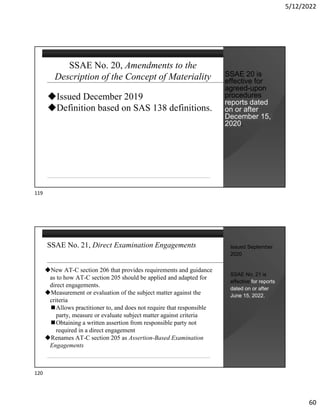
SSAE No. 20, Amendments to the
Description of the Concept of Materiality
Issued December 2019
Definition based on SAS 138 definitions.
SSAE 20 is
effective for
agreed-upon
procedures
reports dated
on or after
December 15,
2020.
SSAE No. 21, Direct Examination Engagements
New AT-C section 206 that provides requirements and guidance
as to how AT-C section 205 should be applied and adapted for
direct engagements.
Measurement or evaluation of the subject matter against the
criteria
Allows practitioner to, and does not require that responsible
party, measure or evaluate subject matter against criteria
Obtaining a written assertion from responsible party not
required in a direct engagement
Renames AT-C section 205 as Assertion-Based Examination
Engagements
Issued September
2020
SSAE No. 21 is
effective for reports
dated on or after
June 15, 2022.
119
120
5/12/2022
61
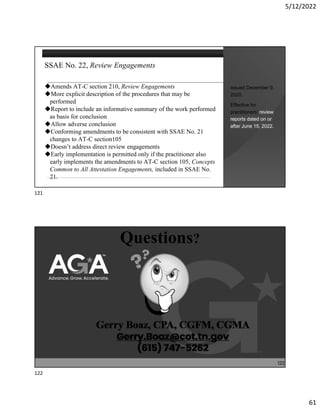
SSAE No. 22, Review Engagements
Amends AT-C section 210, Review Engagements
More explicit description of the procedures that may be
performed
Report to include an informative summary of the work performed
as basis for conclusion
Allow adverse conclusion
Conforming amendments to be consistent with SSAE No. 21
changes to AT-C section105
Doesn’t address direct review engagements
Early implementation is permitted only if the practitioner also
early implements the amendments to AT-C section 105, Concepts
Common to All Attestation Engagements, included in SSAE No.
21.
Issued December 9,
2020.
Effective for
practitioners’ review
reports dated on or
after June 15, 2022.
Questions?
122
121
122

AuditingStandardsUpdateHandout.pdf

  • 1.
    5/12/2022 1 © AGA | AGAAlbuquerque& New Mexico Chapters PDT May 19, 2022 Gerry Boaz, CPA, CGFM, CGMA AGA National President Technical Manager, Comptroller of the Treasury, Division of State Audit Gerry.Boaz@cot.tn.gov (615) 747-5262 1 Disclaimer 2 The opinions and views expressed in this presentation are our own and do not necessarily represent the opinions or views of the TN Comptroller of the Treasury, his representatives, or the TN Department of Audit. Official positions are determined only after due process and deliberation. 2 1 2
  • 2.
    5/12/2022 2 Looking into the AuditingCrystal Ball AICPA Auditing Standards Update 3 Session Objectives Discuss AICPA Auditing Standards Board effective (or soon to be) SASs: Auditor Reporting suite of SASs Materiality Evidence Estimates Others 4 3 4
  • 3.
    5/12/2022 3 5 Recently Issued AuditingStandards SAS No. Topic AU- C Section Affected Issued 134 Auditor Reporting 700, 701(new), 705, 706 May 2019 135 Omnibus SAS Various May 2019 136 EBP ERISA Audits 703 (new) July 2019 137 Other Information 720 July 2019 Effective for audits of financial statements for periods ending on or after December 15, 2020. (12/31/20 or June 30, 2021) Early implementation not permitted. 5 6
  • 4.
    5/12/2022 4 Recently Issued AuditingStandards SAS No. Topic AU- C Section Affected Issued 138 Materiality 200, 320, 450, 600 Dec 2019 139 Auditor Reporting - Extended 800, 805, 810 March 2020 140 Auditor Reporting - Extended Various April 2020 Effective for audits of financial statements for periods ending on or after December 15, 2020. (12/31/20 or June 30, 2021) Early implementation not permitted. (With the exception of 138) Recently Issued Auditing Standards SAS No. Topic AU- C Section Affected Issued Effective Date 142 Audit Evidence Various July 2020 12/31/22 or 6/30/23 143 Auditing Accounting Estimates/ Disclosures Various July 2020 12/31/23 or 6/30/24 7 8
  • 5.
    5/12/2022 5 9 Amendment to theEffective Dates of SASs 134-140  134-140 were effective for audits of financial statements for periods ending on or after December 15, 2020. (12/31/20 or June 30, 2021)  SAS 141, Amended those dates. The revised dates for 134-140 is December 15, 2021. (12/31/21 or June 30, 2022)  In addition, SASs 134-140, with the exception of SAS 138, did not permit early implementation. SAS 141 amends those SASs to allow early implementation. ASB recommends implementation of all the reporting standards at the same time.  SAS 141 was effective upon issuance. (May 2020) 10 9 10
  • 6.
    5/12/2022 6 Auditor Reporting Standards SASNo. Topic AU- C Sec. 134 Auditor reporting, including key audit matters 700, 701(new), 705, 706 135 Omnibus SAS addressing related party transactions and significant unusual transactions 260, 550 136 EBP ERISA audits 703 (new) 137 Other information 720 138 Description of materiality 139-140 Conforming amendments to other AU-C sections with reporting requirements 720, 725, 800, 805, 810, 930, 935, 940 Effective for audits of financial statements for periods ending on or after December 15, 2021. Early implementation permitted. (SAS No. 141) Auditor Reporting Standards The new statements are very much interconnected with each other and so best to implement all at the same time SAS 134 affected by materiality description in SAS 138 SAS 137 (Other Information) reflected in the new reporting format of SAS 134 12 11 12
  • 7.
    5/12/2022 7 13 SAS 134, AuditorReporting and Amendments SAS No. 134 significantly changes the form and content of the auditor’s report issued after auditing a set of financial statements. The SAS also addresses the auditor’s responsibility to form an opinion on the financial statements. The auditor reporting suite of standards will benefit users of audited financial statements throughout the U.S. by placing the auditor’s opinion at the front of the report for added visibility and providing necessary transparency into the basis for the auditor’s opinion and the responsibilities of both entity management and auditors. 14 13 14
  • 8.
    5/12/2022 8 SAS 134, AuditorReporting and Amendments Key driver of changes: attempt to converge with international audit standards in the interest of consistency and comparability Some reporting elements and wording of the international reporting changes not adopted as it was deemed by the ASB in some cases in the public interest to diverge (e.g. undue complexity, change would generate confusion among users, etc.) 15  SAS No. 134 does not require reporting of key audit matters in an engagement but provides reporting requirements for communication of key audit matters in the auditor’s report when the auditor is engaged to do so. (See next slide.)  SAS No. 134 addresses the auditor’s responsibility to form an opinion on the financial statements and provides new guidance for the form and content of the auditor’s report. The standard also contains requirements for when the auditor concludes that a modification to the auditor’s opinion on the financial statements is necessary, and when additional communications are necessary in the auditor’s report. SAS 134, Auditor Reporting and Amendments 16 15 16
  • 9.
    5/12/2022 9 SAS 134, AuditorReporting and Amendments 17  Key Audit Matters -- AU-C 701  Examples  Significant estimates  Significant unusual transactions  Contingencies  Implementation of new IT systems  Areas with significant internal control weaknesses  Related to areas that pose a particular challenge to the auditor in obtaining sufficient appropriate audit evidence SAS 134, Auditor Reporting and Amendments 18  Key Audit Matters -- AU-C 701  Consider all of the matters communicated to those charged with governance and include the most significant in KAMs  State why these items were selected – what makes them especially significant  State that not providing an opinion on KAMs 17 18
  • 10.
    5/12/2022 10 Illustration 3: AnAuditor’s Report on Financial Statements for a Single Year Prepared in Accordance With Accounting Principles Generally Accepted in the United States of America  Circumstances include the following:  Audit of a complete set of general purpose financial statements (single year).  The audit is not a group audit.  Management is responsible for the preparation of the financial statements in accordance with accounting principles generally accepted in the United States of America as promulgated by the Financial Accounting Standards Board.  The terms of the audit engagement reflect the description of management’s responsibility for the financial statements in AU-C section 210, Terms of Engagement.  The auditor has concluded that an unmodified (that is, “clean”) opinion is appropriate based on the audit evidence obtained.  Based on the audit evidence obtained, the auditor has concluded that there are no conditions or events, considered in the aggregate, that raise substantial doubt about the entity’s ability to continue as a going concern for a reasonable period of time in accordance with AU-C section 570, The Auditor’s Consideration of an Entity’s Ability to Continue as a Going Concern.  The auditor has not been engaged to communicate key audit matters. 19 Opinion Paragraph Presented First Independent Auditor’s Report [Appropriate Addressee] Report on the Audit of the Financial Statements1 Opinion (We have audited the financial statements of ABC Company, which comprise the balance sheet as of December 31, 20X1, and the related statements of income, changes in stockholders’ equity, and cash flows for the year then ended, and the related notes to the financial statements.) We have audited the accompanying financial statements of the governmental activities, the business-type activities, the aggregate discretely presented component units, each major fund, and the aggregate remaining fund information of [Typical County], Tennessee, as of and for the year ended [June 30, 201X], and the related notes to the financial statements, which collectively comprise the county’s basic financial statements as listed in the table of contents. In our opinion, the accompanying financial statements present fairly, in all material respects, the financial position of ABC Company as of December 31, 20X1, and the results of its operations and its cash flows for the year then ended in accordance with accounting principles generally accepted in the United States of America. 20 19 20
  • 11.
    5/12/2022 11 Opinion  First sectionis opinion  Identifies scope of audit – entity audited, period and statements (including disclosures)  Essentially same information as currently included with opinion 21 Followed by the Basis for Opinion  Basis for Opinion (for all audits)  We conducted our audit in accordance with auditing standards generally accepted in the United States of America (GAAS). Our responsibilities under those standards are further described in the Auditor’s Responsibilities for the Audit of the Financial Statements section of our report. We are required to be independent of ABC Company and to meet our other ethical responsibilities, in accordance with the relevant ethical requirements relating to our audit. We believe that the audit evidence we have obtained is sufficient and appropriate to provide a basis for our audit opinion. 22 21 22
  • 12.
    5/12/2022 12 Followed by theBasis for Opinion  Previously Basis section not used for an unmodified opinion  Apart from Opinion section and the Basis of Opinion section, order of sections not specified – matter of professional judgment  Specific headings for the sections are required, however  Basis section now includes reference to GAAS. Previously in the Auditor's Responsibility section 23 Followed by the Basis for Opinion  Previously auditor independence indicated via the report title  Now specifically stated in the Basis section  Ethical requirements may also include those of a state board of accountancy and Yellow Book in addition to AICPA requirements  "Sufficient and appropriate evidence" -- moved from Auditor's Responsibility section to Basis 24 23 24
  • 13.
    5/12/2022 13 New Responsibilities forManagement  Responsibilities of Management for the Financial Statements  No major changes in first paragraph  Management previously was responsible for preparation of the GAAP statements  Management is still responsible for internal control system  Some minor wording changes in first management paragraph but essential concepts the same 25 New Responsibilities for Management  Responsibilities of Management for the Financial Statements  International GAAP, FASB, and GASB all require management to assess going concern  Auditor reviews management's assessment  Making management's responsibility clear in the auditor report  FASB (one year from date of issuance)  GASB (one year from balance sheet date)  The paragraph is included even if no going concern – just stating management's responsibility 26 25 26
  • 14.
    5/12/2022 14 New Responsibilities forManagement  Responsibilities of Management for the Financial Statements  Management is responsible for the preparation and fair presentation of the financial statements in accordance with accounting principles generally accepted in the United States of America, and for the design, implementation, and maintenance of internal control relevant to the preparation and fair presentation of financial statements that are free from material misstatement, whether due to fraud or error.  In preparing the financial statements, management is required to evaluate whether there are conditions or events, considered in the aggregate, that raise substantial doubt about ABC Company’s ability to continue as a going concern for [insert the time period set by the applicable financial reporting framework- SAS 132]. 27 New Responsibilities for Auditors Auditor’s Responsibilities for the Audit of the Financial Statements  Many new additions  Mainly a clarification of extant responsibilities  Important terms used: "reasonable assurance," "material misstatement"  These are explained in detail to report user 28 27 28
  • 15.
    5/12/2022 15 New Auditor’s Responsibilities Auditor’sResponsibilities for the Audit of the Financial Statements Our objectives are to obtain reasonable assurance about whether the financial statements as a whole are free from material misstatement, whether due to fraud or error, and to issue an auditor’s report that includes our opinion. Reasonable assurance is a high level of assurance but is not absolute assurance and therefore is not a guarantee that an audit conducted in accordance with GAAS will always detect a material misstatement when it exists. The risk of not detecting a material misstatement resulting from fraud is higher than for one resulting from error, as fraud may involve collusion, forgery, intentional omissions, misrepresentations, or the override of internal control. (Prior to SAS 138:) Misstatements are considered material if, individually or in the aggregate, they could reasonably be expected to influence the economic decisions of users made on the basis of these financial statements. (see next slide) 29 New Auditor’s Responsibilities  (Previous:) Misstatements are considered material if, individually or in the aggregate, they could reasonably be expected to influence the economic decisions of users made on the basis of these financial statements.  Revised by SAS 138:  (New:) Misstatements are considered material if there is a substantial likelihood that, individually or in the aggregate, they would influence the judgment made by a reasonable user based on the financial statements. 30 29 30
  • 16.
    5/12/2022 16 New Auditor’s Responsibilities Materiality change is an example of divergence from international standards  Prior description consistent with international standards  Part of original GAAP convergence effort in early 2000s  AICPA adopted the international description as well  FASB reverted to U.S. materiality description in 2018 31 New Auditor’s Responsibilities  The SAS 138 revision better aligns the description with that used by the U.S. judicial system, PCAOB, FASB, and the SEC  Originally drafted by U.S. Supreme Court  Divergence from international standards deemed in the public interest 32 31 32
  • 17.
    5/12/2022 17 New Auditor’s Responsibilities Audit opinion based on auditor's having obtained reasonable assurance  Inherent limitations on an audit. Not a guarantee  Subsequent discover of a misstatement, in and of itself, does not indicate failure to conduct an audit in accordance with GAAS (See SAS 134.A45) 33 New Auditor’s Responsibilities  Misstatements arising from fraud pose particular challenges to the auditor  Fraud intentionally hidden  May involve overriding of internal controls 34 33 34
  • 18.
    5/12/2022 18 New Auditor’s Responsibilities Next paragraph provides some details on what is done as part of an audit (see next slide) 35 New Auditor Responsibilities (cont’d)  In performing an audit in accordance with GAAS, we:  Exercise professional judgment and maintain professional skepticism throughout the audit.  Identify and assess the risks of material misstatement of the financial statements, whether due to fraud or error, and design and perform audit procedures responsive to those risks. [see AU-C 315 for basic process] Such procedures include examining, on a test basis, evidence regarding the amounts and disclosures in the financial statements.  Obtain an understanding [not simply considering I/C] of internal control relevant to the audit in order to design audit procedures that are appropriate in the circumstances, but not for the purpose of expressing an opinion on the effectiveness of ABC Company’s internal control. Accordingly, no such opinion is expressed. [clarifying auditor's responsibility with respect to internal control risk]  Evaluate the appropriateness of accounting policies used and the reasonableness of significant accounting estimates made by management, as well as evaluate the overall presentation of the financial statements.  Conclude whether, in our judgment, there are conditions or events, considered in the aggregate, that raise substantial doubt about ABC Company’s ability to continue as a going concern for a reasonable period of time. 36 35 36
  • 19.
    5/12/2022 19 New Auditor’s Responsibilities "Reasonable period of time" regarding going concern determined using the applicable reporting framework  FASB (one year from f/s issuance)  GASB (one year from balance sheet date) 37 We are required to communicate with those charged with governance regarding, among other matters, the planned scope and timing of the audit, significant audit findings, and certain internal control–related matters that we identified during the audit. New Auditor Responsibilities (cont’d) 38 37 38
  • 20.
    5/12/2022 20 Hierarchy Key audit matters(KAM) Emphasis of a matter (EOM) Other matter (OM) 39  How will this affect your audits? Will change the format and wording of all Auditor Reports. Will require additional audit time in the year of implementation, but this should not be a budget breaker with a little planning. Introduces Key Audit Matters as a concept, but this will not create audit issues. 40 39 40
  • 21.
    5/12/2022 21 How will thisaffect your audits? Reports likely to be much longer 41 42 41 42
  • 22.
    5/12/2022 22 Proposed amendments toAU-C 260, Communication with TCWG, and AU-C 550, Related Parties, as well as various other sections Amendments intended to enhance audit quality by heightening the auditor’s focus on related parties and relationships and transactions with related parties Significant unusual transactions ASB considered PCAOB AS 16, AS 17 and AS 18 SAS 135, Omnibus Statement on Auditing Standards – 2019 43  How will this affect your audits? Will require additional documentation for Related Party Transactions and Unusual Transactions. The amount of documentation will not be overwhelming but will take additional planning and time. Additions to communications or inquiries with those charged with governance. Increased representation letter items. 44 43 44
  • 23.
    5/12/2022 23 45 ERISA  Guidance forERISA audits moved to AU-C 703  Reporting guidance was previously with f/s guidance in AU-C 700 46 45 46
  • 24.
    5/12/2022 24 47 Other Information –Definitions  Annual report. A document, or combination of documents, typically prepared on an annual basis by management or those charged with governance in accordance with law, regulation, or custom, the purpose of which is to provide owners (or similar stakeholders) with information on the entity’s operations and the entity’s financial results and financial position as set out in the financial statements. An annual report contains, accompanies, or incorporates by reference the financial statements and the auditor’s report thereon and usually includes information about the entity’s developments, its future outlook and risks and uncertainties, a statement by the entity’s governing body, and reports covering governance matters.  The term annual reports of governments is intended to include annual comprehensive financial reports or other annual financial reports that include the government’s financial statements and the auditor’s report thereon. (Ref: par. A10) 48 47 48
  • 25.
    5/12/2022 25 Other Information—Examples (⁋A13) Management report, management commentary, or operating and financial review or similar reports by those charged with governance (for example, a directors’ report)  Chairman’s statement  Corporate governance statement  Management’s internal control and risk assessment reports  Financial summaries or highlights • Employment data  Planned capital expenditures  Financial ratios  Names of officers and directors  Selected quarterly data  Other … (list is not exhaustive) 49 Other Information—Scope  The auditor’s responsibilities relating to other information, other than applicable reporting requirements, apply regardless of whether the other information is obtained by the auditor prior to or after the date of the auditor’s report.  The auditor’s responsibilities under this SAS do not constitute an assurance engagement on other information or impose an obligation on the auditor to obtain assurance about the other information.  This SAS does not apply to supplemental information addressed by AU-C section 725, Supplementary Information in Relation to the Financial Statements as a Whole, or required supplementary information addressed by AU-C section 730, Required Supplementary Information. (Ref: par. A2) 50 49 50
  • 26.
    5/12/2022 26 Other Information  Requirements This SAS requires the auditor to read and consider the other information (think letter of transmittal and statistical sections) because other information that is materially inconsistent with the financial statements or the auditor’s knowledge obtained in the audit may indicate that a material misstatement of the financial statements or that a material misstatement of the other information exists, either of which may undermine the credibility of the financial statements and the auditor’s report thereon.  The objectives of the auditor, having read the other information, are as follows: 51 Other Information  Requirements  To consider whether a material inconsistency exists between the other information and the financial statements.  To remain alert for indications that  a material inconsistency exists between the other information and the auditor’s knowledge obtained in the audit or  a material misstatement of fact exists or the other information is otherwise misleading  To respond appropriately when the auditor identifies that such material inconsistencies appear to exist, or when the auditor otherwise becomes aware that other information appears to be materially misstated.  To report in accordance with this SAS 52 51 52
  • 27.
    5/12/2022 27 Other Information–Definitions  Misstatementof the other information. A misstatement of the other information exists when the other information is incorrectly stated or otherwise misleading. (Ref: par. A11– A12).  Other information. Financial or nonfinancial information (other than financial statements and the auditor’s report thereon) included in an entity’s annual report. (Ref: par. A13) 53 Other Information  Reporting Illustration 1: The Auditor Has Not Identified an Uncorrected Material Misstatement of the Other Information  Other Information [Included in the Annual Report] Management is responsible for the other information [included in the annual report]. The other information comprises the [information included in the annual report] but does not include the financial statements and our auditor’s report thereon.  Our opinion on the financial statements does not cover the other information, and we do not express an opinion or any form of assurance thereon. In connection with our audit of the financial statements, our responsibility is to read the other information and consider whether a material inconsistency exists between the other information and the financial statements, or the other information otherwise appears to be materially misstated. If, based on the work performed, we conclude that an uncorrected material misstatement of the other information exists, we are required to describe it in our report. 54 53 54
  • 28.
    5/12/2022 28 Other Information  ReportingIllustration 2: The Auditor Has Concluded That an Uncorrected Material Misstatement of the Other Information Exists  Other Information [Included in the Annual Report] Management is responsible for the other information [included in the annual report]. The other information comprises the [information included in the annual report] but does not include the financial statements and our auditor’s report thereon.  Our opinion on the financial statements does not cover the other information, and we do not express an opinion or any form of assurance thereon. In connection with our audit of the financial statements, our responsibility is to read the other information and consider whether a material inconsistency exists between the other information and the financial statements, or the other information otherwise appears to be materially misstated. If, based on the work performed, we conclude that an uncorrected material misstatement of the other information exists, we are required to describe it in our report. As described below, we have concluded that such an uncorrected material misstatement of the other information exists.  [Description of material misstatement of the other information] 55 Other Information  Question  Does the Annual Report under SAS 137 include information in the Annual Comprehensive Financial Report Audit such as  Letter of Transmittal  Combining Statements if not engaged to give an in-relation opinion  Corrective Action Plans submitted by Management in compliance with regulations  Introductory Section information such as a List of Officials and TCWG and Table of Contents  Etc.  What about the Statistical Section?  Mostly depends on the agreement with Management! 56 55 56
  • 29.
    5/12/2022 29  How willthis affect your audits?  Very little practical effect (if you have already been reading and considering the accuracy of the information) . More attention to details of some information presented within our Annual Comprehensive Financial Reports.  The engagement letter should specify what the auditor’s report responsibility is and is not.  Will change Auditor’s report if the report includes other information. Will add additional paragraphs.  Will require additional documentation related to the other information. 57 58 57 58
  • 30.
    5/12/2022 30 Auditor Reporting Standards SASNo. Topic AU- C Sec. 134 Auditor reporting, including key audit matters 700, 701(new), 705, 706 135 Omnibus SAS addressing related party transactions and significant unusual transactions 260, 550 136 EBP ERISA audits 703 (new) 137 Other information 720 138 Description of materiality 139-140 Conforming amendments to other AU-C sections with reporting requirements 720, 725, 800, 805, 810, 930, 935, 940 Effective for audits of financial statements for periods ending on or after December 15, 2021. Early implementation permitted. (SAS No. 141)  Definitions:  The primary difference between the definitions held by the U.S. judicial system and other U.S. standard setters and regulators and the definitions currently held by the ASB, IASB, and IAASB relate to whether a misstatement “would influence the judgment of a reasonable investor” versus “could reasonably be expected to influence the judgment of a reasonable person.”  In essence, the U.S. judicial system and other U.S. standard setters and regulators define an omission or misstatement as material if there is a substantial likelihood that a reasonable person would consider it important.  The ASB, IASB, and IAASB definitions state that misstatements, including omissions, are considered to be material if they, individually or in the aggregate, could reasonably be expected to influence the economic decisions of users taken on the basis of the financial statements (i.e. reasonable investor). 60 59 60
  • 31.
    5/12/2022 31  Definitions –Reasonable User:  For purposes of determining materiality, the auditor may assume that reasonable users -  have a reasonable knowledge of business and economic activities and accounting and a willingness to study the information in the financial statements with reasonable diligence;  understand that financial statements are prepared, presented, and audited to levels of materiality;  recognize the uncertainties inherent in the measurement of amounts based on the use of estimates, judgment, and the consideration of future events; and  make reasonable judgments based on the information in the financial statements. 61  History  1976: The U.S. Supreme Court Defines Materiality  1980: FASB Defines Materiality  1999: The SEC Provides Guidance When Evaluating Materiality  1983 and 2006: ASB Issues SASs on Materiality  2009: IAASB Defines Materiality  2010: IASB Defines Materiality  2010: FASB Issues Concepts Statement No. 8  2010: PCAOB Issues Standard on Materiality 62 61 62
  • 32.
    5/12/2022 32  History  2011:ASB Issues SAS No. 122, which adopts the IAASB, IASB, and FASB aligned definitions.  2018: FASB Amends Concepts Statement No. 8  2018: IASB Amends Definition of Material  2019: ASB Proposes to Amend the Definition of Materiality and then issues Statement 138 in December 2019 63 How will this affect your audits? Very little practical effect. Will change Auditor’s report language in a minor way (as previously illustrated). May change documentation in various ways. 64 63 64
  • 33.
    5/12/2022 33 65  This proposedamendments would implement the requirements of SAS 134 Auditor Reporting Amendments to: Section 800, Special Considerations — Audits of Financial Statements Prepared in Accordance With Special Purpose Frameworks.  Section 805, Special Considerations — Audits of Single Financial Statements and Specific Elements, Accounts, or Items of a Financial Statement. Section 810, Engagements to Report on Summary Financial Statements. 66 65 66
  • 34.
    5/12/2022 34  Changes toAU-C Section 800  The designation of the cash, tax, regulatory, contractual, and other bases of accounting as examples of special purpose frameworks rather than as part of the definition of special purpose framework  The addition of an introductory paragraph stating that section 570, The Auditor’s Consideration of an Entity’s Ability to Continue as a Going Concern, applies to audits of special purpose financial statements  Clarification that, in all audits of special purpose financial statements (irrespective of whether the going concern basis of accounting is relevant to the preparation of the special purpose financial statements), the auditor is required to do the following:  Conclude whether substantial doubt exists about the entity’s ability to continue as a going concern for a reasonable period of time.  When substantial doubt exists, evaluate the adequacy of the financial statement disclosures as required by the applicable financial reporting framework.  For special purpose financial statements prepared in accordance with a contractual or other basis of accounting, a new requirement that the EOM paragraph in the auditor’s report state that the financial statements may not be suitable for another purpose. 67 68 67 68
  • 35.
    5/12/2022 35  How willthis affect your audits? Limited effect – change of letter format Will require documentation of Going Concern considerations for Special Purpose Frameworks. Should not change other financial statement documentation. 69 70 69 70
  • 36.
    5/12/2022 36  AU-C 725,Supplementary Information in Relation to the Financial Statements as a Whole  AU-C 730, Required Supplementary Information  AU-C 930, Interim Financial Information (Review Reports)  AU-C 935, Compliance Audits (i.e. Single Audit reports on Compliance and Internal Controls)  Mainly changes to various auditor reports to implement 134. 71  How will this affect your audits? Will significantly change of Auditor Reports format for Reviews of Interim Financial Statements and Reports on Compliance and Internal Control for Compliance Audits Will not change documentation. 72 71 72
  • 37.
    5/12/2022 37 73 74 SAS No. TopicAU- C Section Affected Issued Effective Date 142 Audit Evidence Various July 2020 12/31/22 or 6/30/23 143 Auditing Accounting Estimates/Disclosures Various July 2020 12/31/23 or 6/30/24 73 74
  • 38.
    5/12/2022 38  In August2017, the ASB began a project to assess whether revisions of AU-C section 500 are necessary to address the evolving nature of business and audit services and issues that have arisen during the standard-setting activities of the ASB.  These issues include use of emerging technologies by both preparers and auditors, audit data analytics (ADA), the application of professional skepticism, the expanding use of external information sources as audit evidence, and more broadly, the accuracy, completeness, and reliability of audit evidence. 75  .A27 Unconscious or conscious auditor biases may affect the auditor’s professional skepticism and professional judgment, including, for example, in the design and performance of audit procedures or the evaluation of audit evidence. Examples of unconscious auditor biases that may impede the maintenance of professional skepticism and, therefore, the reasonableness of the professional judgments made by the auditor in complying with the requirements of this SAS, may include the following: 76 75 76
  • 39.
    5/12/2022 39  Availability bias,which is a tendency to place more weight on events or experiences that immediately come to mind or are readily available than on those that are not  Confirmation bias, which is a tendency to place more weight on information that corroborates an existing belief than information that contradicts or casts doubt on that belief  Overconfidence bias, which is a tendency to overestimate one's own ability to make accurate assessments of risk or other judgments or decisions  Anchoring bias, which is a tendency to use an initial piece of information as an anchor against which subsequent information is inadequately assessed  Automation bias, which is a tendency to favor output generated from automated systems, even when human reasoning or contradictory information raises questions about whether such output is reliable or fit for purpose 77  Emerging audit techniques, such as ADA, and emerging technologies, such as artificial intelligence (AI), robotic process automation (RPA), and blockchain, offer both challenges and opportunities that will affect audits of financial and nonfinancial information into the foreseeable future.  For the purposes of this proposed SAS, the phrase “automated tools and techniques” will be used to refer to both emerging audit techniques and emerging technologies.  There is ongoing activity in the United States and internationally regarding how the profession should respond to such automated tools and techniques, including consideration of whether changes to professional standards would enhance audit quality and make the standards more relevant in today’s environment. 78 77 78
  • 40.
    5/12/2022 40  In recentyears, the IAASB has had a working group considering the topic of professional skepticism. The projects on quality control, group audits, and professional skepticism represented the three areas for which the IAASB sought input from responders in Invitation to Comment (ITC) Enhancing Audit Quality in the Public Interest, issued in January 2016.  As explained in the ITC, the ISAs explicitly recognize the fundamental importance of professional skepticism. Professional skepticism includes being alert to audit evidence that contradicts other audit evidence obtained or information that brings into question the reliability of documents or responses to inquiries to be used as audit evidence.  The auditor may accept records and documents as genuine unless the auditor has reason to believe the contrary. Nevertheless, the auditor is required to consider the reliability of information to be used as audit evidence. 79  The key issues identified with respect to professional skepticism are as follows:  Questions have been raised about how auditors can more clearly demonstrate the application of professional skepticism, how to better describe the basis for the auditor’s professional judgments, and how the auditor’s mind-set has affected the nature, timing, and extent of audit procedures performed as well as the critical evaluation of audit evidence.  Concern about instances in which auditors did not appropriately apply professional skepticism in their audits is a recurring theme in audit inspection findings globally and has been a key issue in discussions about audit quality. Regulatory bodies have suggested that enhanced professional skepticism by auditors will contribute significantly to improving the quality of audits and that firms should prioritize efforts in this area.  The existence of many ways to describe the application of professional skepticism indicates that the concept of professional skepticism, and the expectations of how auditors should appropriately apply it, may need to be more clearly articulated in our standards. 80 79 80
  • 41.
    5/12/2022 41  In recentyears, the IAASB has had a working group considering the topic of professional skepticism. The projects on quality control, group audits, and professional skepticism represented the three areas for which the IAASB sought input from responders in Invitation to Comment (ITC) Enhancing Audit Quality in the Public Interest, issued in January 2016.  As explained in the ITC, the ISAs explicitly recognize the fundamental importance of professional skepticism. Professional skepticism includes being alert to audit evidence that contradicts other audit evidence obtained or information that brings into question the reliability of documents or responses to inquiries to be used as audit evidence.  The auditor may accept records and documents as genuine unless the auditor has reason to believe the contrary. Nevertheless, the auditor is required to consider the reliability of information to be used as audit evidence. 81  Having a separate section of a proposed SAS labeled “professional skepticism” or merely using the words “professional skepticism” throughout the proposed SAS is not sufficient to achieve the objectives outlined here. (Exposure Draft, 6/20/2019) 82 81 82
  • 42.
    5/12/2022 42  In September2018, the IAASB issued ISA 540 (Revised), Auditing Accounting Estimates and Related Disclosures. In finalizing ISA 540 (Revised), the IAASB also issued a series of conforming amendments to other ISAs, including conforming amendments to ISA 500, Audit Evidence.  In general, the conforming amendments include a new definition of external information sources, related application material to the definition, and other application material that further explains the concept of external information sources. This proposed SAS includes substantially all of the IAASB’s conforming amendments to ISA 500.  We will discuss the definition shortly. 83  Extant AU-C section 500 contains separate definitions of sufficiency (a measure of quantity) and appropriateness (a measure of quality). The ASB believes that audit evidence always has to first be appropriate for the auditor’s intended purposes; the key question, then, is whether the auditor has obtained enough of such audit evidence for the auditor’s intended purpose.  In the proposed SAS, the ASB retained separate definitions of sufficiency and appropriateness.  The definition of appropriateness remains largely the same as the extant definition.  However, the ASB proposes to amend the definition of sufficiency to focus on the measure of the persuasiveness of audit evidence rather than emphasizing the quantity of audit evidence. The ASB believes that this change is important because, with the array of automated tools and techniques available to the auditor in today’s environment and the different nature and sources of information available, the quantity of audit evidence, in itself, may not be determinative of its sufficiency. 84 83 84
  • 43.
    5/12/2022 43  This standardis closely aligned with the requirements of “professional skepticism”, and the risk assessment procedures.  A matter of professional judgment, but based on evidence.  Still must achieve “sufficient appropriate” audit evidence, but this standard raises the bar on what those terms mean. Together, the terms emphasize the “persuasiveness” of the evidence.  Evidence must be evaluated. The objective of an auditor is to evaluate the evidence to ensure sufficient appropriate evidence has been obtained.  The auditor’s evaluation of audit evidence is not a formulaic exercise, and is dependent on the degree to which each attribute of the audit evidence influences the auditor’s evaluation. 85  Definitions: For purposes of generally accepted auditing standards (GAAS), the following terms have the meanings attributed as follows:  Appropriateness (of audit evidence). The measure of the relevance and reliability of audit evidence.  Sufficiency (of audit evidence). The measure of the persuasiveness of audit evidence. The persuasiveness of audit evidence necessary is affected by the auditor’s assessment of the risks of material misstatement. (Ref: par. A5) 86 85 86
  • 44.
    5/12/2022 44  Definitions: Forpurposes of generally accepted auditing standards (GAAS), the following terms have the meanings attributed as follows (cont’d):  Audit evidence. Information used by the auditor in arriving at the conclusions on which the auditor’s opinion is based. (Ref: par. A6–A7)  External information source. An individual or organization external to the entity that develops information used by the entity in preparing the financial statements or used by the auditor as audit evidence, when such information is available for use by a broad range of users. When information has been provided by an individual or organization acting in the capacity of management’s specialist, service organization, or auditor’s specialist, the individual or organization is not considered an external information source with respect to that particular information. (Ref: par. A8) 87  The auditor “should” evaluate information to be used as audit evidence by taking into account (Ref: par. .A11) a. the relevance and reliability of the information, including its source, and (Ref: par. .A12—.A34) b. whether such information corroborates or contradicts assertions in the financial statements. (Ref: par. . A35—.A38) 88 87 88
  • 45.
    5/12/2022 45  The auditor'sevaluation of the information to be used as audit evidence in accordance with paragraph .07 “should” include a. evaluating whether the information is sufficiently precise and detailed for the auditor's purposes and (Ref: par. .A39) b. obtaining audit evidence about the accuracy and completeness of the information, as necessary (Ref: par. .A40—.A42). 89  Requirements – Audit Procedures as a Basis for Concluding on the Sufficiency and Appropriateness of Audit Evidence  In evaluating information to be used as audit evidence, the auditor “should” consider whether the results of audit procedures provide a basis for concluding on the sufficiency and appropriateness of audit evidence obtained. (Ref: par. .A43—.A64) 90 89 90
  • 46.
    5/12/2022 46  Requirements –Inconsistencies in, or Doubts About the Reliability of, Audit Evidence  The auditor “should” determine whether modifications or additions to audit procedures are necessary to resolve inconsistencies in, or doubts about the reliability of, audit evidence, including when  a. audit evidence obtained from one source is inconsistent with that obtained from another source.  b. the results of an audit procedure are inconsistent with the results of another audit procedure. 91  That’s all the requirements!  The bulk of this standard is in the Application Guidance. 92 91 92
  • 47.
    5/12/2022 47 93 • “The objectiveof the auditor is to design and perform audit procedures that enable the auditor to obtain sufficient appropriate audit evidence…” Extant objective: • “The objective of the auditor is to evaluate information to be used as audit evidence, including the results of audit procedures, to inform the auditor’s overall conclusion about whether sufficient appropriate audit evidence has been obtained.” Proposed objective: Audit Evidence “Information used by the auditor in arriving at the conclusions on which the auditor’s opinion is based. Audit evidence is information to which audit procedures have been applied and consists of information that corroborates or contradicts assertions in the financial statements.”  Revising an objective currently focused on the design and performance of audit procedures.  Developing a framework for evaluating audit evidence based on  appropriateness (relevance and reliability), and  sufficiency (persuasiveness)  Shift focus from quantity to persuasiveness 94 “The objective of the auditor is to design and perform audit procedures that enable the auditor to obtain sufficient appropriate audit evidence…” 93 94
  • 48.
    5/12/2022 48 95 As a basisfor concluding whether sufficient appropriate audit evidence has been obtained, the objective of the auditor is to evaluate information to which audit procedures have been applied to determine whether such information is appropriate audit evidence. Audit evidence should be considered notwithstanding the source from which it is obtained or the method used to obtain the information. How will this affect your audits?  May have a Significant practical effect. May require more documentation to evaluate the evidence to demonstrate sufficient appropriate audit evidence, professional skepticism, and the risk assessment. This will depend on the degree of work you have been doing!  May change documentation in multiple ways.  Will require additional audit time, unless??. 96 95 96
  • 49.
    5/12/2022 49 97 SAS 143, Estimates:Fundamental Aspects Explains the nature of accounting estimates and the concept of estimation uncertainty Address scalability of the SAS for all types of accounting estimates, from relatively simple to complex Requires a separate assessment of inherent risk and control risk Includes risk assessment requirements more specific to estimates and addresses the increasingly complex business environment and complexity in financial reporting frameworks Addresses the exercise of professional skepticism when auditing accounting estimates Intended to enable auditors to appropriately address the increasingly complex scenarios that arise from new accounting standards that include estimates 97 98
  • 50.
    5/12/2022 50 SAS 143, AuditingAccounting Estimates and Related Disclosures Issued July 2020 Effective for audits of financial statements for periods ending on or after December 15, 2023 Supersedes AU-C section 540 Converges with ISA 540 (Revised), Auditing Accounting Estimates and Related Disclosures Addresses the auditor’s responsibilities relating to accounting estimates, including fair value accounting estimates, and related disclosures in an audit of financial statements. Effective for periods ending on or after December 15, 2023 SAS 143, Estimates: Fundamental Aspects Emphasizes that further audit procedures need to be responsive to the reasons for the assessed risks of material misstatement at the relevant assertion level Emphasizes the importance of the auditor’s decisions about controls relating to accounting estimates by providing estimates-specific guidance on relevant requirements in other AU-C sections Requires the auditor to evaluate, based on the audit procedures performed and the audit evidence obtained, whether the accounting estimates and related disclosures are reasonable in the context of the applicable financial reporting framework. Consistent with the risk assessment project to revise AU- C 315 currently in process 99 100
  • 51.
    5/12/2022 51  Fundamental Aspectsof the Standard.  Concept of Estimation Uncertainty  Separate assessment of Inherent Risk and Control Risk.  Concept of Spectrum of Inherent Risk. (i.e. Appendix A)  Scalability for all types of accounting estimates, from simple to complex, based on Estimation Uncertainty.  Enhanced risk assessment based on complexity, subjectivity, and estimation uncertainty.  Increased importance of professional skepticism as risk factors increase.  Evaluation of the Estimates.  Additional Communication with TCWG may be considered (i.e. Appendix B). 101 How will this affect your audits? Significant practical effect for larger more complex audits that involve complex estimates. Will change documentation in multiple ways. Will require significant more audit time if the audit involves complex estimates. 102 101 102
  • 52.
    5/12/2022 52 103 https://us.aicpa.org/content/dam/aicpa/research/standards/auditattest/downloadabledocuments/ sas-144-at-a-glance.pdf  Amendments tovarious application material paragraphs provide guidance on applying AU-C section 540 when management has used the work of a specialist in developing accounting estimates.  Certain amendments enhance guidance about evaluating the work of the management’s specialist.  Other amendments are made to no longer refer to using the work of an external inventory-taking firm as using the work of a management’s specialist.  These amendments are not intended nor expected to change existing practice. 104 103 104
  • 53.
    5/12/2022 53  AU-C section500, Audit Evidence, requires the auditor to take into account the relevance and reliability of information to be used as audit evidence, including its source, and contains an appendix addressing the use of external information sources.  AU-C section 540 has been amended to add a new appendix, “Use of Pricing Information From Third Parties as Audit Evidence,” to provide guidance on using such information as audit evidence for estimates related to the fair value of financial instruments. 105  Amendments to various application paragraphs in AU-C section 620 enhance the guidance related to using the work of an auditor’s specialist.  Next steps SAS No. 144 is effective for audits of financial statements for periods ending on or after December 15, 2023 (FYE 6/30/2024).  Early implementation is permitted.  SAS No. 144 is available for auditors to read and consider in order to adequately prepare for implementation, and can be viewed on the AICPA’s website by clicking here. 106 105 106
  • 54.
    5/12/2022 54 107  I encourageyou to remember this date:  Periods ending on or after December 15, 2023, or  December 31, 2023  June 30, 2024. 108 107 108
  • 55.
    5/12/2022 55  Deficiencies inthe auditor’s risk assessment procedures is a common issue identified by practice monitoring programs in the United States and worldwide. In 2020 U.S. peer reviews, AU-C section 315 was the leading source of matters for further consideration (MFCs), constituting 25 percent of MFCs. (private company audits) 109  The ASB’s project to enhance the auditing standards relating to the auditor’s risk assessment through the issuance of SAS No. 145 was intended to enable auditors to appropriately address the following:  Understanding the entity’s system of internal control, in particular, relating to the auditor’s work effort to obtain the necessary understanding  Modernizing the standard in relation to IT considerations, including addressing risks arising from an entity’s use of IT  Determining risks of material misstatement, including significant risks 110 109 110
  • 56.
    5/12/2022 56  Enhances thefollowing:  Requirements and guidance related to the auditor’s risk assessment, in particular, obtaining an understanding of the entity’s system of internal control and assessing control risk.  Guidance that addresses the economic, technological, and regulatory aspects of the markets and environment in which entities and audit firms operate SAS 145 also includes, among other things, the following: 111  Enhances the following: o Revised requirements to evaluate the design of certain controls within the control activities component, including general IT controls, and to determine whether such controls have been implemented o New requirement to separately assess inherent risk and control risk o New requirement to assess control risk at the maximum level such that, if the auditor does not plan to test the operating effectiveness of controls, the assessment of the risk of material misstatement is the same as the assessment of inherent risk 112 111 112
  • 57.
    5/12/2022 57  Guidance thataddresses the economic, technological, and regulatory aspects of the markets and environment in which entities and audit firms operate also includes, among other things, the following (cont.): o A revised definition of significant risk o New guidance on scalability o New guidance on maintaining professional skepticism o A new “stand-back” requirement intended to drive an evaluation of the completeness of the auditor’s identification of significant classes of transactions, account balances, and disclosures 113  Guidance that addresses the economic, technological, and regulatory aspects of the markets and environment in which entities and audit firms operate also includes, among other things, the following (cont.): o Revised requirements relating to audit documentation o A conforming amendment to perform substantive procedures for each relevant assertion of each significant class of transactions, account balance, and disclosure, regardless of the assessed level of control risk (rather than for all relevant assertions related to each material class of transactions, account balance, and disclosure, irrespective of the assessed risks of material misstatement, as previously required). 114 113 114
  • 58.
    5/12/2022 58  SAS No.145 does not fundamentally change the key concepts underpinning audit risk, which is a function of the risks of material misstatement and detection risk. Rather, SAS No. 145 clarifies and enhances certain aspects of the identification and assessment of the risks of material misstatement to drive better risk assessments and, therefore, enhance audit quality.  Reminder: Effective for audits of financial statements for periods ending on or after December 15, 2023 (i.e., December 31, 2023 or June 30, 2024). 115 SSAE 19, Agreed Upon Procedures Engagements SSAE 20, New Description of Materiality SSAE 21, New Attestation Service: Direct Examinations SSAE 22, Review Engagements 116 115 116
  • 59.
    5/12/2022 59 SSAE No. 19,Agreed-Upon Procedures Engagements Issued December 2019 Does not require an assertion from the responsible party Doesn’t require that the procedures be known at the beginning of the engagement; instead provides flexibility by allowing procedures to be developed over the course of the engagement, by or with the assistance of, the practitioner SSAE 19 is effective for agreed-upon procedures reports dated on or after July 15, 2021. Early implementation is permitted. SSAE No. 19, Agreed-Upon Procedures Engagements Engaging party required to acknowledge that the procedures are appropriate for the intended purpose of the engagement prior to the issuance of the report. Doesn’t require intended users to take responsibility for the sufficiency of the procedures Permits general-use report unless certain conditions exist SSAE 19 is effective for agreed-upon procedures reports dated on or after July 15, 2021. Early implementation is permitted. 117 118
  • 60.
    5/12/2022 60 SSAE No. 20,Amendments to the Description of the Concept of Materiality Issued December 2019 Definition based on SAS 138 definitions. SSAE 20 is effective for agreed-upon procedures reports dated on or after December 15, 2020. SSAE No. 21, Direct Examination Engagements New AT-C section 206 that provides requirements and guidance as to how AT-C section 205 should be applied and adapted for direct engagements. Measurement or evaluation of the subject matter against the criteria Allows practitioner to, and does not require that responsible party, measure or evaluate subject matter against criteria Obtaining a written assertion from responsible party not required in a direct engagement Renames AT-C section 205 as Assertion-Based Examination Engagements Issued September 2020 SSAE No. 21 is effective for reports dated on or after June 15, 2022. 119 120
  • 61.
    5/12/2022 61 SSAE No. 22,Review Engagements Amends AT-C section 210, Review Engagements More explicit description of the procedures that may be performed Report to include an informative summary of the work performed as basis for conclusion Allow adverse conclusion Conforming amendments to be consistent with SSAE No. 21 changes to AT-C section105 Doesn’t address direct review engagements Early implementation is permitted only if the practitioner also early implements the amendments to AT-C section 105, Concepts Common to All Attestation Engagements, included in SSAE No. 21. Issued December 9, 2020. Effective for practitioners’ review reports dated on or after June 15, 2022. Questions? 122 121 122