AGA PRESENTATION:
NEW MEXICO BUDGET OVERVIEW
Dr. Andrew Miner, DPA
Deputy Director, State Budget Division
andrew.miner@state.nm.us, 827-3812
INTRODUCTION TO THE STATE BUDGET DIVISION
• SBD is the Governor’s/Executive Budget Office, part of the Department of Finance and
Administration (DFA)
• Provide budget and policy information, analysis, and recommendations to Executive Branch
leadership (i.e. DFA management, Governor’s Office, agency heads)
• Executive budget recommendation
• Testify at budget hearings
• Fiscal impact reports and policy recommendations for legislation
• Manage state budget activities throughout the fiscal year
• Approve Operating Budget submissions
• Process Budget Adjustment Requests and other documents
• Review proposed HR actions and contracts for budget soundness
• Promote efficiency in government operations and effective use of taxpayer dollars
• Direct performance management process in collaboration with Legislative Finance Committee
• Only the SBD Director is appointed, all other staff are classified
2
OTHER STATE BUDGET ACTORS
• DFA Financial Control Division
• Process general fund allotments
• Work with SBD and agencies to resolve budget and accounting issues
• Governor’s Office and Cabinet Directors
• Work with SBD and agencies to address Executive budget priorities
• Legislative Finance Committee
• Legislature’s budget office – also produce a budget recommendation
• Review agency budget activities (including BARs) and performance
• Other legislative committees – House Appropriations and Finance (HAFC), Senate
Finance (SFC), Legislative Education Study Committee (LESC)
• Consensus Revenue Estimation Group (CREG) – DFA, LFC,TRD, and DOT economists
• Outside of state government – Advocacy groups, schools, local governments, etc.
3
THE STATE BUDGET CYCLE
• July/August: Appropriation request preparation by agencies (due Sept. 1 by statute)
• SBD and Governor’s Office may meet with agencies to discuss budget needs and executive priorities
• SBD and LFC may issue budget guidelines to agencies
• SBD provides training and instructions, facilitates BRS and PBB system use, troubleshoots technical problems
and otherwise assists as needed
• September – December: SBD and LFC prepare budget recommendations
• LFC holds fall budget hearings for all agencies, discuss their requests
• Review submissions for technical accuracy, request more info from agencies, meet as needed
• Finalize and publish recommendations according to executive (SBD) and legislative (LFC) priorities in early
January
• New Mexico is one of only a few states where the executive and legislative branches release concurrent
budget recommendations
• October: Agencies request nonrecurring appropriations, Section 4 special language, and budget
adjustment authority language for incorporation into executive and LFC recommendations
4
THE STATE BUDGET CYCLE
• January – March: Legislative session, passage of the General Appropriations Act (GAA)
• Alternate 60 day (odd years) and 30 day (even years) sessions
• Budget hearings at House Appropriations and Finance Committee (HAFC) – Committee adopts LFC or executive
recommendation or requests reconciliation
• Concurrently – SFC holds informational budget hearings with selected agencies
• House passes budget bill (usually HB2) and moves to Senate
• Executive agencies work with SBD to submit Senate amendment requests, non-Executive branch agencies may
request amendments independently
• Once budget passes Senate and concurred in House, SBD and Governor’s Office work together to draft line-item
vetoes. Generally, governor may veto appropriations or language, but may not change appropriations or create
new language through deletion
• April: agencies prepare operating budget (due May 1 by statute)
• SBD issues guidelines based on enacted budget and provides training, assists as needed
• May begin to budget nonrecurring appropriations as authorized in budget bill
• May/June: SBD reviews operating budget submissions for accuracy, prepares and posts budget journals
in SHARE by July 1 for use in new FY 5
STRUCTURE OF THE STATE BUDGET:
REVENUE CATEGORIES
• General Fund (GF)
• State income collected from various sales and income taxes.
• Most strictly controlled and appropriated by legislature. Cannot increase during the fiscal year.
• Distributed to agencies by FCD generally in 1/12 allotments
• “New money”: increased projected GF revenue over previous year estimated by CREG. How to
spend it is the subject of intense debate during budget formulation in the legislative session.
• Other State Funds (OSF)
• Recurring revenue agencies receive from permits, fees, leases, interest income, etc.
• Agencies have limited authority to increase budget during FY through Budget Adjustment Requests
• Fund Balance
• Nonrecurring OSF revenue (amounts sitting in agency special revenue funds)
• Appropriated as part of OSF total in the budget bill, but budgeted separately in SHARE
• Budgeted with equity codes denoting how restricted use of the fund balance is
6
STRUCTURE OF THE STATE BUDGET:
REVENUE CATEGORIES
• Transfer Revenue
• Transfers received from various sources – another state agency, another program in same agency, or
outside entity
• Reciprocal transfers
• Money received to perform a service, generally established through an MOU, grant, etc. Expended as 300 or 400
expense
• Nonreciprocal transfers
• Money received with “no strings attached,” directed transfers by legislature or within agency, often from a
segregated special revenue fund to an operating fund
• Limited authority to increase during FY, similar to OSF
• Federal Funds
• Money received from the federal government through grants or other funding distributions
• Amounts are listed in the budget bill but those within agencies’ operating budgets can be adjusted from
this amount
• Broad authority to increase during FY if agency can show new funds have been awarded
7
STRUCTURE OF THE STATE BUDGET:
EXPENDITURE CATEGORIES
• Appropriated and budgeted by 3-digit category total; agencies spend by 6-digit line items
within each category
• Budget actuals and requested amounts are reported with 6-digit codes to aid in budget planning
and recommendations
• Personal Services and Employee Benefits (PSEB – 200s)
• Costs associated with salaries,employer share of benefits such as insurance and retirement
contributions, and costs such as unemployment and workers’ compensation
• Contracts (300s)
• Contract expenses for services performed by various entities – private firms, nonprofits, other
agencies
8
STRUCTURE OF THE STATE BUDGET:
EXPENDITURE CATEGORIES
• Other Costs (400s)
• Basically everything else – travel, utilities, supplies, grants, maintenance, etc.
• Some are fixed costs determined by rate schedules issued by GSD and DoIT
• Other Financing Uses (500s)
• Nonreciprocal transfers to other agencies, within agency, or to a component unit
• Recipient should recognize as transfer revenue
9
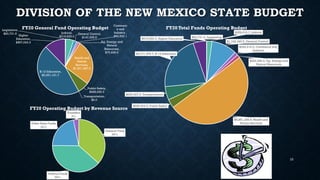
DIVISION OF THE NEW MEXICO STATE BUDGET
Legislative,
$20,731.6 Judicial,
$318,833.0
General Control,
$147,535.6
Commerc
e and
Industry ,
$62,622.1
Ag, Energy and
Natural
Resources,
$75,638.6
Health and
Human
Services,
$1,871,387.0
Public Safety,
$468,659.3
Transportation,
$0.0
K-12 Education,
$3,251,191.7
Higher
Education,
$867,043.3
FY20 General Fund Operating Budget
$20,731.6, Legislative
$359,016.7, Judicial
$1,746,340.5, General Control
$242,215.2, Commerce and
Industry
$222,296.4, Ag, Energy and
Natural Resources
$8,881,208.9, Health and
Human Services
$599,204.5, Public Safety
$920,307.5, Transportation
$3,771,579.7, K-12 Education
$919,840.0, Higher Education
FY20 Total Funds Operating Budget
General Fund
36%
Federal Funds
39%
Other State Funds
22%
Transfers
3%
FY20 Operating Budget by Revenue Source
10
THE GENERAL APPROPRIATIONS ACT (GAA, HB2)
• 2022 Session/FY23: Chapter 54 from the regular session
• Sections 1-3: Standard front material, definitions, general provisions, BAR authority for
federal increases and other grants
• Section 4
• Every agency’s recurring operating budget by program, broken out by funding source and
expenditure category. Dollars truncated to thousands with one decimal point (75.9 = $75,900)
11
THE GENERAL APPROPRIATIONS ACT (GAA, HB2)
• Section 4, continued
• Language may be included to identify source of transferred funds, earmark specific funding, or
otherwise stipulate use of funds or powers of the agency
• Subset of agency/program’s performance measures and approved targets
12
THE GENERAL APPROPRIATIONS ACT (GAA, HB2)
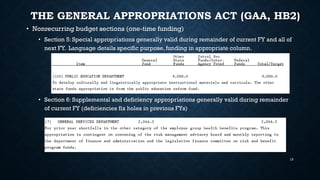
• Nonrecurring budget sections (one-time funding)
• Section 5: Special appropriations generally valid during remainder of current FY and all of
next FY. Language details specific purpose, funding in appropriate column.
• Section 6: Supplemental and deficiency appropriations generally valid during remainder
of current FY (deficiencies fix holes in previous FYs)
13
THE GENERAL APPROPRIATIONS ACT (GAA, HB2)
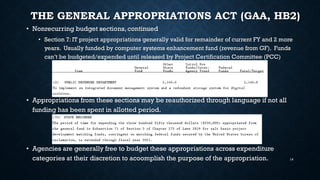
• Nonrecurring budget sections, continued
• Section 7: IT project appropriations generally valid for remainder of current FY and 2 more
years. Usually funded by computer systems enhancement fund (revenue from GF). Funds
can’t be budgeted/expended until released by Project Certification Committee (PCC)
• Appropriations from these sections may be reauthorized through language if not all
funding has been spent in allotted period.
• Agencies are generally free to budget these appropriations across expenditure
categories at their discretion to acoomplish the purpose of the appropriation. 14
THE GENERAL APPROPRIATIONS ACT (GAA, HB2)
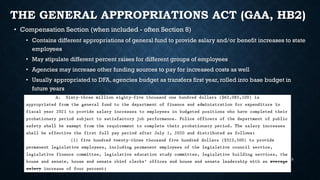
• Compensation Section (when included - often Section 8)
• Contains different appropriations of general fund to provide salary and/or benefit increases to state
employees
• May stipulate different percent raises for different groups of employees
• Agencies may increase other funding sources to pay for increased costs as well
• Usually appropriated to DFA, agencies budget as transfers first year, rolled into base budget in
future years
15
THE GENERAL APPROPRIATIONS ACT (GAA)
• Budget Adjustment Request (BAR) Language sections (generally follow all appropriations)
• 1st section: additional BAR authority specific to certain agencies for remainder of current FY
• 2nd section: general BAR authority for all agencies and agency-specific authority for next FY
• Transfers section
• General fund transfers to certain agencies and/or funds, generally not viewed as appropriations
to expend the money
16
HOW TO CITE THE GAA AND OTHER LEGISLATION
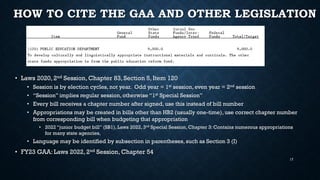
• Laws 2020, 2nd Session, Chapter 83, Section 5, Item 120
• Session is by election cycles, not year. Odd year = 1st session, even year = 2nd session
• “Session” implies regular session, otherwise “1st Special Session”
• Every bill receives a chapter number after signed, use this instead of bill number
• Appropriations may be created in bills other than HB2 (usually one-time), use correct chapter number
from corresponding bill when budgeting that appropriation
• 2022 “junior budget bill” (SB1), Laws 2022, 3rd Special Session, Chapter 3: Contains numerous appropriations
for many state agencies,
• Language may be identified by subsection in parentheses, such as Section 3 (I)
• FY23 GAA: Laws 2022, 2nd Session, Chapter 54
17
NEW MEXICO STATUTES
• NM OneSource Statute Lookup: https://nmonesource.com/nmos/en/nav.do
• Enter search terms (citation or keyword) and click result from dropdown
• State Budget Statutes: 6-3-1 through 6-3-25 NMSA 1978
• Special Revenue Fund Statutes
• Important to know statutes detailing sources, eligible uses, and managerial authority
(ability to increase budget) associated with each of an agency’s special revenue funds
18
THE ACCOUNTABILITY IN GOVERNMENT ACT
(AGA): 6-3A-1 THROUGH 6-3A-10 NMSA 1978
• Establishes performance measure process for each agency in order to connect
budget with agency performance
• Each performance measure has a type (output, explanatory, etc.) and a target, with
numerical data that can be consistently measured and tracked from year to year
• Data is used by LFC to create agency report cards for public and legislative use
(frequently used during legislative session hearings)
• AGA establishes process to revise measures, set targets, and report data each year
19
PERFORMANCE MEASURE CYCLE
• June 15: SBD issues guidelines to agencies to request changes to their measures for the next
budget cycle year (June 2022: changes for FY24)
• July 15: Agencies submit requested changes to SBD and LFC
• “Key” agencies must also identify which measures they will report on quarterly in the current FY
• July/August: Agencies, SBD and LFC meet as needed to collaborate on requested changes and
strive to come to consensus
• August 15: SBD issues final approved measures to agencies, incorporates changes into
performance measure system
• Sept. 1: Agencies include requested targets for approved measures as part of their budget
request.
• Legislative session: SBD and LFC analysts meet to discuss their target recommendations and
strive to come to consensus
• Select measures and targets included in GAA
CONSENSUS REVENUE ESTIMATES
• Group comprised of staff economists from DFA, LFC,TRD and DOT. No appointees, so process is
removed from partisan politics
• Provides common ground for budget development between executive and legislative branches,
especially with regards to expected new general fund revenue
• Full updates to revenue estimates and projections twice yearly (August and December) with
another update in the middle of legislative session
• Factors examined in preparing the revenue forecast
• Expected trends in oil and gas prices and contributing factors, due to New Mexico’s heavy dependence
on oil and gas severance tax revenue
• Legislature that impacts revenue (spending initiatives, tax cuts/credits
• Broad economic and industry forecasts (GDP, inflation, recession predictions, etc)
• Important to identify differences in one-time / nonrecurring revenue changes vs. longer term,
recurring trends
• Should budget enacted by legislature and signed by Governor contain large nonrecurring spending
packages or grow recurring spending, and if so by what amount? 21
JANUARY 2022 REVENUE ESTIMATE UPDATE
• Expected FY22 General Fund revenue: $8.16 billion
• Expected FY23 General Fund revenue: $9.05 billion
• Potential positive factors to consider
• Continued high oil and gas prices and as well as high production
• Low unemployment
• High gross receipts tax and personal income tax receipts
• Generally strong US economic growth remains the forecast (pandemic recovery)
• Potential negative factors to consider
• Oil and gas price volatility ($1 change in oil price = $30 million NM revenue change)
• Inflation and federal reserve actions to control it
• Corporate income tax receipts lower than expectations
• Pandemic uncertainly and potential increased recession risks
• Post 2022 Session Projected General Fund Reserve Levels
• FY22: 29.2% of recurring appropriations ($2.18 billion)
• FY23: 25% of recurring appropriations ($2.12 billion) 22
THANK YOU - ANY QUESTIONS?
23
MORE BUDGET REFERENCE MATERIAL AVAILABLE
AT SBD’S WEBSITE
CONTACT ME IF YOU ARE INTERESTED IN
ATTENDING NEXT SESSION OF BUDGET BOOT CAMP
(4 VIRTUAL MODULES OVER 2 DAYS)

StateBudgetOverview.pdf

  • 1.
    AGA PRESENTATION: NEW MEXICOBUDGET OVERVIEW Dr. Andrew Miner, DPA Deputy Director, State Budget Division andrew.miner@state.nm.us, 827-3812
  • 2.
    INTRODUCTION TO THESTATE BUDGET DIVISION • SBD is the Governor’s/Executive Budget Office, part of the Department of Finance and Administration (DFA) • Provide budget and policy information, analysis, and recommendations to Executive Branch leadership (i.e. DFA management, Governor’s Office, agency heads) • Executive budget recommendation • Testify at budget hearings • Fiscal impact reports and policy recommendations for legislation • Manage state budget activities throughout the fiscal year • Approve Operating Budget submissions • Process Budget Adjustment Requests and other documents • Review proposed HR actions and contracts for budget soundness • Promote efficiency in government operations and effective use of taxpayer dollars • Direct performance management process in collaboration with Legislative Finance Committee • Only the SBD Director is appointed, all other staff are classified 2
  • 3.
    OTHER STATE BUDGETACTORS • DFA Financial Control Division • Process general fund allotments • Work with SBD and agencies to resolve budget and accounting issues • Governor’s Office and Cabinet Directors • Work with SBD and agencies to address Executive budget priorities • Legislative Finance Committee • Legislature’s budget office – also produce a budget recommendation • Review agency budget activities (including BARs) and performance • Other legislative committees – House Appropriations and Finance (HAFC), Senate Finance (SFC), Legislative Education Study Committee (LESC) • Consensus Revenue Estimation Group (CREG) – DFA, LFC,TRD, and DOT economists • Outside of state government – Advocacy groups, schools, local governments, etc. 3
  • 4.
    THE STATE BUDGETCYCLE • July/August: Appropriation request preparation by agencies (due Sept. 1 by statute) • SBD and Governor’s Office may meet with agencies to discuss budget needs and executive priorities • SBD and LFC may issue budget guidelines to agencies • SBD provides training and instructions, facilitates BRS and PBB system use, troubleshoots technical problems and otherwise assists as needed • September – December: SBD and LFC prepare budget recommendations • LFC holds fall budget hearings for all agencies, discuss their requests • Review submissions for technical accuracy, request more info from agencies, meet as needed • Finalize and publish recommendations according to executive (SBD) and legislative (LFC) priorities in early January • New Mexico is one of only a few states where the executive and legislative branches release concurrent budget recommendations • October: Agencies request nonrecurring appropriations, Section 4 special language, and budget adjustment authority language for incorporation into executive and LFC recommendations 4
  • 5.
    THE STATE BUDGETCYCLE • January – March: Legislative session, passage of the General Appropriations Act (GAA) • Alternate 60 day (odd years) and 30 day (even years) sessions • Budget hearings at House Appropriations and Finance Committee (HAFC) – Committee adopts LFC or executive recommendation or requests reconciliation • Concurrently – SFC holds informational budget hearings with selected agencies • House passes budget bill (usually HB2) and moves to Senate • Executive agencies work with SBD to submit Senate amendment requests, non-Executive branch agencies may request amendments independently • Once budget passes Senate and concurred in House, SBD and Governor’s Office work together to draft line-item vetoes. Generally, governor may veto appropriations or language, but may not change appropriations or create new language through deletion • April: agencies prepare operating budget (due May 1 by statute) • SBD issues guidelines based on enacted budget and provides training, assists as needed • May begin to budget nonrecurring appropriations as authorized in budget bill • May/June: SBD reviews operating budget submissions for accuracy, prepares and posts budget journals in SHARE by July 1 for use in new FY 5
  • 6.
    STRUCTURE OF THESTATE BUDGET: REVENUE CATEGORIES • General Fund (GF) • State income collected from various sales and income taxes. • Most strictly controlled and appropriated by legislature. Cannot increase during the fiscal year. • Distributed to agencies by FCD generally in 1/12 allotments • “New money”: increased projected GF revenue over previous year estimated by CREG. How to spend it is the subject of intense debate during budget formulation in the legislative session. • Other State Funds (OSF) • Recurring revenue agencies receive from permits, fees, leases, interest income, etc. • Agencies have limited authority to increase budget during FY through Budget Adjustment Requests • Fund Balance • Nonrecurring OSF revenue (amounts sitting in agency special revenue funds) • Appropriated as part of OSF total in the budget bill, but budgeted separately in SHARE • Budgeted with equity codes denoting how restricted use of the fund balance is 6
  • 7.
    STRUCTURE OF THESTATE BUDGET: REVENUE CATEGORIES • Transfer Revenue • Transfers received from various sources – another state agency, another program in same agency, or outside entity • Reciprocal transfers • Money received to perform a service, generally established through an MOU, grant, etc. Expended as 300 or 400 expense • Nonreciprocal transfers • Money received with “no strings attached,” directed transfers by legislature or within agency, often from a segregated special revenue fund to an operating fund • Limited authority to increase during FY, similar to OSF • Federal Funds • Money received from the federal government through grants or other funding distributions • Amounts are listed in the budget bill but those within agencies’ operating budgets can be adjusted from this amount • Broad authority to increase during FY if agency can show new funds have been awarded 7
  • 8.
    STRUCTURE OF THESTATE BUDGET: EXPENDITURE CATEGORIES • Appropriated and budgeted by 3-digit category total; agencies spend by 6-digit line items within each category • Budget actuals and requested amounts are reported with 6-digit codes to aid in budget planning and recommendations • Personal Services and Employee Benefits (PSEB – 200s) • Costs associated with salaries,employer share of benefits such as insurance and retirement contributions, and costs such as unemployment and workers’ compensation • Contracts (300s) • Contract expenses for services performed by various entities – private firms, nonprofits, other agencies 8
  • 9.
    STRUCTURE OF THESTATE BUDGET: EXPENDITURE CATEGORIES • Other Costs (400s) • Basically everything else – travel, utilities, supplies, grants, maintenance, etc. • Some are fixed costs determined by rate schedules issued by GSD and DoIT • Other Financing Uses (500s) • Nonreciprocal transfers to other agencies, within agency, or to a component unit • Recipient should recognize as transfer revenue 9
  • 10.
    DIVISION OF THENEW MEXICO STATE BUDGET Legislative, $20,731.6 Judicial, $318,833.0 General Control, $147,535.6 Commerc e and Industry , $62,622.1 Ag, Energy and Natural Resources, $75,638.6 Health and Human Services, $1,871,387.0 Public Safety, $468,659.3 Transportation, $0.0 K-12 Education, $3,251,191.7 Higher Education, $867,043.3 FY20 General Fund Operating Budget $20,731.6, Legislative $359,016.7, Judicial $1,746,340.5, General Control $242,215.2, Commerce and Industry $222,296.4, Ag, Energy and Natural Resources $8,881,208.9, Health and Human Services $599,204.5, Public Safety $920,307.5, Transportation $3,771,579.7, K-12 Education $919,840.0, Higher Education FY20 Total Funds Operating Budget General Fund 36% Federal Funds 39% Other State Funds 22% Transfers 3% FY20 Operating Budget by Revenue Source 10
  • 11.
    THE GENERAL APPROPRIATIONSACT (GAA, HB2) • 2022 Session/FY23: Chapter 54 from the regular session • Sections 1-3: Standard front material, definitions, general provisions, BAR authority for federal increases and other grants • Section 4 • Every agency’s recurring operating budget by program, broken out by funding source and expenditure category. Dollars truncated to thousands with one decimal point (75.9 = $75,900) 11
  • 12.
    THE GENERAL APPROPRIATIONSACT (GAA, HB2) • Section 4, continued • Language may be included to identify source of transferred funds, earmark specific funding, or otherwise stipulate use of funds or powers of the agency • Subset of agency/program’s performance measures and approved targets 12
  • 13.
    THE GENERAL APPROPRIATIONSACT (GAA, HB2) • Nonrecurring budget sections (one-time funding) • Section 5: Special appropriations generally valid during remainder of current FY and all of next FY. Language details specific purpose, funding in appropriate column. • Section 6: Supplemental and deficiency appropriations generally valid during remainder of current FY (deficiencies fix holes in previous FYs) 13
  • 14.
    THE GENERAL APPROPRIATIONSACT (GAA, HB2) • Nonrecurring budget sections, continued • Section 7: IT project appropriations generally valid for remainder of current FY and 2 more years. Usually funded by computer systems enhancement fund (revenue from GF). Funds can’t be budgeted/expended until released by Project Certification Committee (PCC) • Appropriations from these sections may be reauthorized through language if not all funding has been spent in allotted period. • Agencies are generally free to budget these appropriations across expenditure categories at their discretion to acoomplish the purpose of the appropriation. 14
  • 15.
    THE GENERAL APPROPRIATIONSACT (GAA, HB2) • Compensation Section (when included - often Section 8) • Contains different appropriations of general fund to provide salary and/or benefit increases to state employees • May stipulate different percent raises for different groups of employees • Agencies may increase other funding sources to pay for increased costs as well • Usually appropriated to DFA, agencies budget as transfers first year, rolled into base budget in future years 15
  • 16.
    THE GENERAL APPROPRIATIONSACT (GAA) • Budget Adjustment Request (BAR) Language sections (generally follow all appropriations) • 1st section: additional BAR authority specific to certain agencies for remainder of current FY • 2nd section: general BAR authority for all agencies and agency-specific authority for next FY • Transfers section • General fund transfers to certain agencies and/or funds, generally not viewed as appropriations to expend the money 16
  • 17.
    HOW TO CITETHE GAA AND OTHER LEGISLATION • Laws 2020, 2nd Session, Chapter 83, Section 5, Item 120 • Session is by election cycles, not year. Odd year = 1st session, even year = 2nd session • “Session” implies regular session, otherwise “1st Special Session” • Every bill receives a chapter number after signed, use this instead of bill number • Appropriations may be created in bills other than HB2 (usually one-time), use correct chapter number from corresponding bill when budgeting that appropriation • 2022 “junior budget bill” (SB1), Laws 2022, 3rd Special Session, Chapter 3: Contains numerous appropriations for many state agencies, • Language may be identified by subsection in parentheses, such as Section 3 (I) • FY23 GAA: Laws 2022, 2nd Session, Chapter 54 17
  • 18.
    NEW MEXICO STATUTES •NM OneSource Statute Lookup: https://nmonesource.com/nmos/en/nav.do • Enter search terms (citation or keyword) and click result from dropdown • State Budget Statutes: 6-3-1 through 6-3-25 NMSA 1978 • Special Revenue Fund Statutes • Important to know statutes detailing sources, eligible uses, and managerial authority (ability to increase budget) associated with each of an agency’s special revenue funds 18
  • 19.
    THE ACCOUNTABILITY INGOVERNMENT ACT (AGA): 6-3A-1 THROUGH 6-3A-10 NMSA 1978 • Establishes performance measure process for each agency in order to connect budget with agency performance • Each performance measure has a type (output, explanatory, etc.) and a target, with numerical data that can be consistently measured and tracked from year to year • Data is used by LFC to create agency report cards for public and legislative use (frequently used during legislative session hearings) • AGA establishes process to revise measures, set targets, and report data each year 19
  • 20.
    PERFORMANCE MEASURE CYCLE •June 15: SBD issues guidelines to agencies to request changes to their measures for the next budget cycle year (June 2022: changes for FY24) • July 15: Agencies submit requested changes to SBD and LFC • “Key” agencies must also identify which measures they will report on quarterly in the current FY • July/August: Agencies, SBD and LFC meet as needed to collaborate on requested changes and strive to come to consensus • August 15: SBD issues final approved measures to agencies, incorporates changes into performance measure system • Sept. 1: Agencies include requested targets for approved measures as part of their budget request. • Legislative session: SBD and LFC analysts meet to discuss their target recommendations and strive to come to consensus • Select measures and targets included in GAA
  • 21.
    CONSENSUS REVENUE ESTIMATES •Group comprised of staff economists from DFA, LFC,TRD and DOT. No appointees, so process is removed from partisan politics • Provides common ground for budget development between executive and legislative branches, especially with regards to expected new general fund revenue • Full updates to revenue estimates and projections twice yearly (August and December) with another update in the middle of legislative session • Factors examined in preparing the revenue forecast • Expected trends in oil and gas prices and contributing factors, due to New Mexico’s heavy dependence on oil and gas severance tax revenue • Legislature that impacts revenue (spending initiatives, tax cuts/credits • Broad economic and industry forecasts (GDP, inflation, recession predictions, etc) • Important to identify differences in one-time / nonrecurring revenue changes vs. longer term, recurring trends • Should budget enacted by legislature and signed by Governor contain large nonrecurring spending packages or grow recurring spending, and if so by what amount? 21
  • 22.
    JANUARY 2022 REVENUEESTIMATE UPDATE • Expected FY22 General Fund revenue: $8.16 billion • Expected FY23 General Fund revenue: $9.05 billion • Potential positive factors to consider • Continued high oil and gas prices and as well as high production • Low unemployment • High gross receipts tax and personal income tax receipts • Generally strong US economic growth remains the forecast (pandemic recovery) • Potential negative factors to consider • Oil and gas price volatility ($1 change in oil price = $30 million NM revenue change) • Inflation and federal reserve actions to control it • Corporate income tax receipts lower than expectations • Pandemic uncertainly and potential increased recession risks • Post 2022 Session Projected General Fund Reserve Levels • FY22: 29.2% of recurring appropriations ($2.18 billion) • FY23: 25% of recurring appropriations ($2.12 billion) 22
  • 23.
    THANK YOU -ANY QUESTIONS? 23 MORE BUDGET REFERENCE MATERIAL AVAILABLE AT SBD’S WEBSITE CONTACT ME IF YOU ARE INTERESTED IN ATTENDING NEXT SESSION OF BUDGET BOOT CAMP (4 VIRTUAL MODULES OVER 2 DAYS)