Audiology: Science toPractice Steven Kramer
download
https://textbookfull.com/product/audiology-science-to-practice-
steven-kramer/
Download more ebook from https://textbookfull.com
2.
We believe theseproducts will be a great fit for you. Click
the link to download now, or visit textbookfull.com
to discover even more!
A Clinician s Guide to Cannabinoid Science 1st Edition
Steven James
https://textbookfull.com/product/a-clinician-s-guide-to-
cannabinoid-science-1st-edition-steven-james/
Advances in Audiology and Hearing Science-Volume 2:
Otoprotection, Regeneration, and Telemedicine 1st
Edition Stavros Hatzopoulos (Editor)
https://textbookfull.com/product/advances-in-audiology-and-
hearing-science-volume-2-otoprotection-regeneration-and-
telemedicine-1st-edition-stavros-hatzopoulos-editor/
Signal Transduction, Third Edition Kramer
https://textbookfull.com/product/signal-transduction-third-
edition-kramer/
Educational Audiology Handbook Third Edition Cheryl
Deconde Johnson
https://textbookfull.com/product/educational-audiology-handbook-
third-edition-cheryl-deconde-johnson/
3.
Liberalism with excellenceFirst Edition Kramer
https://textbookfull.com/product/liberalism-with-excellence-
first-edition-kramer/
The Data Science Design Manual 1st Edition Steven S.
Skiena
https://textbookfull.com/product/the-data-science-design-
manual-1st-edition-steven-s-skiena/
Case Formulation for Personality Disorders: Tailoring
Psychotherapy to the Individual Client Ueli Kramer
https://textbookfull.com/product/case-formulation-for-
personality-disorders-tailoring-psychotherapy-to-the-individual-
client-ueli-kramer/
Cavernomas of the CNS Basic Science to Clinical
Practice Ond■ej Bradá■
https://textbookfull.com/product/cavernomas-of-the-cns-basic-
science-to-clinical-practice-ondrej-bradac/
Introduction to Policing Steven M. Cox
https://textbookfull.com/product/introduction-to-policing-steven-
m-cox/
Contents
Preface ix
Contributors xi
PARTI
Perspectives on the Profession of Audiology 1
1 The Discipline of Audiology 3
Professional Organizations 4
Development of the Profession of Audiology 5
References 8
2 Audiology as a Career 9
Education and Professional Credentials 10
What Do Audiologists Do? 11
Membership Demographics and Work Settings 14
References 16
PART II
Fundamentals of Hearing Science 17
3 Properties of Sound 19
Simple Vibrations and Sound Transmission 20
Frequency 22
Phase 25
Amplitude 27
Intensity and Pressure 28
Decibels 31
Audibility by Frequency 37
Wavelength 37
Complex Sounds 39
Resonance 41
Acoustics of Speech 43
Filtering 46
Psychoacoustics 49
References 55
v
10.
AUDIOLOGY: SCIENCE TOPRACTICE
vi
4 Anatomy of the Auditory System 57
General Orientation to the Anatomy of the Auditory and Vestibular Systems 58
Outer Ear 63
Middle Ear 64
Inner Ear 68
The Sensory Organ of Hearing 69
Auditory Neural Pathways 75
References 80
5 Functions of the Auditory System 81
Air-to-Fluid Impedance Mismatch 82
Functions of the Outer Ear 82
Functions of the Middle Ear 83
Functions of the Inner Ear 87
Tuning Curves 93
Role of the Outer Hair Cells 96
Frequency Coding 98
Intensity Coding 100
Summary of the Auditory Transduction Process 102
References 104
PART III
Clinical Audiology 107
6 Audiometric Testing 109
The Audiometer 110
Transducers 113
Air Conduction Versus Bone Conduction Testing 116
The Test Environment 117
Procedures for Obtaining Pure-Tone Thresholds 120
Examples of How to Establish Thresholds 121
Variables Influencing Thresholds 123
Techniques for Testing Infants and Toddlers 124
References 128
7 Audiogram Interpretation 129
The Audiogram 130
Describing Audiograms 138
Sample Audiograms with Descriptions 143
Additional Factors to Consider 143
References 150
8 Speech Audiometry 151
Speech Testing Equipment and Calibration 152
Speech Threshold Measures 154
Suprathreshold Speech Recognition 156
Most Comfortable and Uncomfortable Loudness Levels 161
Procedures for Suprathreshold Speech Recognition 161
11.
vii
CONTENTS
Steps for ObtainingWord Recognition Score (WRS) 166
Interpreting Word Recognition Scores 168
Speech-in-Noise Tests 171
Variations with Young Children or Difficult-to-Test Populations 172
References 174
9 Masking for Pure-Tone and Speech Audiometry 177
Interaural Attenuation 178
Maskers 179
Central Masking 180
When to Mask for Air Conduction Pure-Tone Thresholds 181
When to Mask for Bone Conduction Pure-Tone Thresholds 182
Applying the Rules for Pure-Tone Masking 182
How to Mask for Air Conduction Pure-Tone Thresholds (Plateau Method) 186
How to Mask for Bone Conduction Thresholds (Plateau Method) 190
Summary of the Step-by-Step Procedures for Masking with the Plateau Method 193
Masking Examples 196
Masking for Speech Testing 206
References 209
10 Outer and Middle Ear Assessment 211
Otoscopy 212
Immittance 213
Tympanometry 216
Probe Tone Frequency 225
Wideband Acoustic Immittance 226
Acoustic Reflex Threshold Measurement 231
Interpretations of Acoustic Reflex Thresholds 233
Examples of ART Interpretations 237
Acoustic Reflex Decay 239
References 241
11 Evoked Physiologic Responses 243
Otoacoustic Emissions (OAEs) 244
Auditory Brainstem Response (ABR) 251
Neurodiagnostic ABR 255
Threshold ABR 256
Auditory Steady-State Response (ASSR) 258
References 261
12 Disorders of the Auditory System 263
Describing Auditory Disorders 264
Outer Ear Disorders 265
Middle Ear Disorders 270
Acquired Cochlear Disorders 277
Neural Disorders 289
Central Auditory Disorders 291
Nonorganic (Functional) Hearing Loss 294
Tinnitus 295
References 300
12.
AUDIOLOGY: SCIENCE TOPRACTICE
viii
13 Screening for Hearing Loss 303
Historical and Current Practice Guidelines 304
Hearing Identification Programs 306
Screening the Hearing of School Age Children 312
Screening the Hearing of Adults 313
Screening Outcomes and Efficacy 313
References 317
14 Hearing Aids 319
H. Gustav Mueller
Who Dispenses Hearing Aids 320
Current Hearing Aid Usage Trends 321
Assessment of Hearing Aid Candidacy and Treatment Planning 324
Selection 327
Fitting Strategies 329
Basic Hearing Aid Styles 332
Hearing Aid Programming 338
Prescriptive Fitting Methods 339
Hearing Aid Verification 340
Hearing Aid Orientation 342
Validation of Hearing Aid Benefit 342
Summary 346
References 346
15 Implantable Devices 347
Specialized Heaing Aids and Auditory Implants 348
Bone-Anchored Implant (BAI) 348
Middle Ear Implant (MEI) 352
Cochlear Implant (CI) 354
CI Evaluation 356
References 358
16 Vestibular System 361
Anatomy and Physiology of the Vestibular System 362
Central Pathways Involved in Balance and Movement 367
Vestibular Disorders 371
Assessing Vestibular Disorders 375
References 382
Glossary 383
Index 407
13.
Preface
This textbook providesan introductory, yet com-
prehensive look at the field of audiology. It is
designed for undergraduate students, beginning
audiology doctoral students, graduate speech-
language pathology students, and other profes-
sionals who work closely with audiologists. It is
expected that the knowledge obtained in this
textbook will be applicable to the readers’ future
education or clinical practices. For some, it may
help them decide to go into the profession of
audiology.
Fromsciencetopractice,thistextbookcovers
anatomy and physiology, acoustic properties and
perception of sounds, audiometry and speech
measures, masking, audiogram interpretations,
outer and middle ear assessments, otoacoustic
emission and auditory brainstem responses, hear-
ing screening, hearing aids, and cochlear and
other implantable devices. Where appropriate,
variations in procedures for pediatrics are pre-
sented. Beginning students also have a lot of in
terest in knowing about some common hearing
disorders, and this book provides concise de-
scriptions of selected auditory pathologies from
different parts of the auditory system, with typical
audiologic findings for many of the more com-
monly found ear diseases and hearing disorders
to help the student learn how to integrate in-
formation from multiple tests. Also included is a
separate chapter on the vestibular (balance) sys-
tem, for those who wish to learn more about this
important aspect of audiology. In addition, there
are two chapters describing the profession of
audiology, including its career outlook, what it
takes to become an audiologist, as well as what
audiologists do and where they practice. As a
special addition, James Jerger, a legend in audi
ology, and University of Arizona share their
perspectives on the history of audiology in the
United States; these can be found throughout the
various chapters as set-aside boxes (Historical
Vignettes).
Although this textbook is intended for read-
ers with little or no background in audiology, it
is not a cursory overview. Instead, it presents a
comprehensive and challenging coverage of hear
ing science and clinical audiology, but written
in a style that tries to make new and/or difficult
concepts relatively easy to understand. The ap-
proach to this book is to keep it readable and to
punctuate the text with useful figures and tables.
Each chapter has a list of key objectives, and
throughout the chapter key words or phrases are
italicized and included in a Glossary at the end
of the textbook. In addition, most of the chapters
have strategically-placed reviews (synopses) that
can serve as quick refreshers before moving on,
or which can provide a “quick read” of the en-
tire text. Having taught beginning students for a
number of years, the authors have learned a lot
about how students learn and what keeps them
motivated. After getting the students interested
in the profession of audiology, information about
acoustics is presented so that they have the tools
to understand how the ear works and how hear-
ing loss is assessed (which is what they really
want to know) and these areas form the bulk of
the text. Of course, the order of the chapters can
be changed to suit any instructor.
FEATURES AND ADDITIONS
TO THIS EDITION
This third edition of Audiology: Science to Prac-
tice has been extensively revised from the previ-
ous edition. This edition represents a collabora-
tion with a new co-author, David Brown, whose
ix
14.
AUDIOLOGY: SCIENCE TOPRACTICE
x
long-time teaching experience and expertise in
audiology and hearing science provided an op-
portunity to again update and expand the text-
book in order to be useful to a wider audience.
We also incorporated some of the feedback re-
ceived through a survey of faculty who were cur-
rent or interested users of the textbook.
This edition has four new chapters: (1) Outer
and Middle Ear Assessment, that now includes a
new section on otoscopy, more information on the
use of different immittance probe-tone frequen
cies, and a well-developed section on the use
of wideband acoustic immittance (reflectance);
(2) Evoked Responses, with more information and
examples on the use of OAEs, ABRs, and ASSRs
for assessing neural pathologies and auditory
sensitivity; (3) Implantable Devices, that covers
cochlear implants, bone-anchored hearing aids,
and other implantable devices; and (4) Vestibu-
lar System for those choosing to include a more
comprehensive coverage of vestibular anatomy,
physiology, disorders, and assessment. Another
substantive change includes a revision of the
chapter on Hearing Aids to make it more appro-
priate for the undergraduate student or others
who want an overview of this impor
tant part of
audiology. The chapter on Disorders of the Audi-
tory System now has figures that include clinical
data from a variety of audiology tests, including
immittance, speech, and special tests, so that the
student can begin to learn to integrate basic au-
diologic test results for the different disorders.
This edition has systematically reviewed each
of the chapters from the previous edition to ex-
pand, update, and reorganize the material to
make it even more useful to the student new
to audiology, and at the same time continuing
to be more comprehensive than one might find
in other introductory texts on audiology. Refer-
ences and figures have been updated, including
photos of new hearing instruments and ampli-
fication devices, and some new figures on the
anatomy of the auditory and vestibular systems.
This edition retains the features that worked well
in previous editions, including an easy-to-read
format, key learning objectives, and synopses
within each chapter with bulleted highlights
for review. The chapters are now organized in
a more traditional sequence beginning with in-
formation about the profession of audiology,
followed by acoustics, anatomy/physiology, and
clinical audiology. Stylistically, this edition now
has some set-aside boxes with ancillary informa-
tion that are interspersed throughout the text-
book, including much of Dr. Jerger’s historical
account of audiology in the United States. We are
excited about all the improvements in this edition
that will help beginning students gain an even
stronger foundation about audiology concepts.
This edition also comes with a PluralPlus
companion website which includes lecture out-
lines in slide format that can be used in teaching
audiological concepts, the full text of Dr. Jerger’s
essay on the history of audiology, and more.
15.
Contributors
David K. Brown,PhD
Associate Professor
Director, AUD SIMLab
School of Audiology
Pacific University
Hillsboro, Oregon
Cheryl D. Johnson, EdD
Adjunct Assistant Professor
Disability and Psychoeducational Studies
College of Education
University of Arizona
Tucson, Arizona
James Jerger, PhD
Distinguished Scholar-in-Residence
School of Behavioral and Brain Sciences
The University of Texas at Dallas
Dallas, Texas
Steven Kramer, PhD
Professor
School of Speech, Language,
and Hearing Sciences
San Diego State University
San Diego, California
H. Gustav Mueller, PhD
Professor
Department of Hearing and Speech Sciences
Vanderbilt University
Nashville, Tennessee
xi
17.
To the childrenwith hearing impairments on my school bus many years ago,
who inspired me to pursue a career in audiology;
To my past, present, and future students, who have always made my work
enjoyable, challenging, and rewarding;
To my wife, Paula, for her support and sacrifices during the writing of this text;
To my colleagues who provide me with an exciting place to work, and for their
camaraderie and continued support during the revision of this textbook.
—Steven Kramer
To my mentors and teachers who spent time answering my questions,
may I spend as much time with my students as you did with me;
To my colleagues, who shared their knowledge with me;
To my students throughout the years who challenged me to learn more;
To my family and especially my wife, Dianne, who gave up and put up with so much
during the writing of this book. I promise I will be home for dinner soon!
—David Brown
19.
Perspectives on the
Professionof Audiology
P
A
R
T
I
WELCOME to the fascinating world of
audiology! In the rst part of this textbook,
we will provide you with some informa-
tion about the profession of audiology.
We hope this part provides you with an
appreciation for the rewarding aspects
of being involved with the profession of
audiology. In Chapter 1, you will learn
about audiology and its professional or-
ganizations. Chapter 1 also includes an
overview of the development of the pro-
fession, with contributions by Dr. James
Jerger, a pioneer and continuing contrib-
utor to audiological research. You will
also nd some of Dr. Jerger’s historical
perspectives interspersed throughout the
textbook as set-aside boxes (Historical
Vignettes). An extended version of this
historical perspective by Jerger and De-
Conde Johnson, from the second edition,
is available on the companion website. In
Chapter 2, you will learn about what is
required to become an audiologist, the
kinds of settings where audiologists prac
tice, and the kinds of activities that might
ll their work week. You will become fa-
miliar with the varied paths you might
take within audiology and the extensive
scope of practice that denes the skills
20.
of audiologists. Chapter2 also presents
some current demographic trends in au-
diology, as summarized from surveys
regularly conducted by our professional
organizations. For those interested in
speech-language pathology, nursing, op
tometry, rehabilitation counseling, or
other related elds, we know that you
will interact with people who have hear-
ing loss and with audiologists, and the in-
formation in this textbook will, undoubt-
edly, be of use to you. We hope many of
you will become intrigued by the possibil-
ity of joining the profession of audiology.
21.
3
After reading thischapter, you should be able to:
1. Dene audiology and understand how audiology relates to other
disciplines.
2. List some professional and student organizations related to
audiology.
3. Become aware of professional websites’ resources to learn more
about the profession.
4. Discuss how and when audiology as a profession rst began,
and describe key events that transpired over the years as the
profession evolved.
The Discipline
of Audiology
1
22.
AUDIOLOGY: SCIENCE TOPRACTICE
4
Audiology is a discipline that focuses on the
study of normal hearing and hearing disorders.
Additionally, audiology includes the assessment
and treatment of vestibular (balance) disorders.
More precisely, audiology is a health care profes-
sion devoted to identification, assessment, treat-
ment/rehabilitation, and prevention of hearing
and balance disorders, and understanding the
effects of hearing loss on related communication
disorders. An audiologist is a professional who
has the appropriate degree and license in his or
her state to practice audiology, and who is, typi-
cally, certified by a professional board. Audiolo-
gists are the experts who understand the effects
of hearing loss on communication and how to
best improve a patient’s ability to hear.
Audiologists work with many other profes-
sionals and support personnel. The medical ex-
pert in hearing disorders is the physician. The
medical specialty related to the ear is called
otology, which is practiced by appropriately
trained and certified otologists, also called neuro-
otologists, otolaryngologists, or ear, nose, and
throat (ENT) specialists. Audiologists also work
closely with speech-language pathologists, who
are certified and/or licensed professionals who
engage in prevention, assessment, and treatment
of speech and language disorders, including
those who have hearing loss. In addition, many
audiologists are part of interdisciplinary teams,
especially when it comes to the assessment and
treatment of pediatric patients, as well as pa-
tients with implantable devices, cystic fibrosis,
cleft palate, or balance problems, to name a few.
PROFESSIONAL ORGANIZATIONS
The American Academy of Audiology (AAA) is the
professional organization for audiologists. In 1988,
AAA (often referred to as “triple A”) was founded
in order to establish an organization devoted en
tirely to the needs of audiologists and the interests
oftheaudiologyprofession(http://www.audiology
.org). Originally, AAA focused on transitioning
audiology to a doctoral level profession, which
became a reality by 2007. Membership in AAA
quickly skyrocketed, and, today, AAA has a mem-
bership of more than 12,000 audiologists (Amer-
ican Academy of Audiology [AAA], n.d. a). Prior
to the formation of AAA, the American Speech-
Language-Hearing Association (ASHA) was, and
still remains, a professional organization for au-
diologists and speech-language pathologists. The
ASHA was established in 1925 as the American
Academy of Speech Correction, and went through
several name changes including the American So-
ciety for the Study of Disorders of Speech (1927),
the American Speech Correction Association
(1934), the American Speech and Hearing Asso-
ciation (1947), and in 1978 became the American
Speech-Language-Hearing Association (American
Speech-Language-Hearing Association [ASHA],
n.d.). In its early years, ASHA focused on speech
disorders; however, during World War II, with
service personnel returning with hearing losses,
ASHA expanded its mission to include assessment
and treatment of those with hearing disorders.
The AAA and ASHA are both strong advo-
cates for the hearing impaired and related services
by audiologists, both at the state and national lev-
els. The AAA and ASHA each have professional
certifications for audiologists: American Board of
Audiology (ABA) Certification through AAA, and
the Certificate of Clinical Competence in Audiol-
ogy (CCC-A) through ASHA. In addition, each of
these organizations can award accreditation to
academic programs that meet a set of standards;
the Accreditation Commission for Audiology Edu-
cation (ACAE) associated with AAA, and the Com-
mission on Academic Accreditation (CAA) associ-
ated with ASHA.
Audiologists may also choose to join other
professional organizations. The Academy of Dis-
pensing Audiologists (ADA) was established in
1977 to support the needs of audiologists who
dispense (sell) hearing aids. The ADA later
changed its name to the Academy of Doctors of
Audiology (ADA) (http://www.audiologist.org),
and expanded its focus to any audiologists in
private practice or those who wished to estab-
lish a private practice. The Educational Audiol-
ogy Association (EAA) (http://www.edaud.org),
formed in 1983, is a professional membership
organization of audiologists and related profes-
sionals who deliver a full spectrum of hearing
services to all children, particularly those in ed-
ucational settings. Many audiologists are also
23.
1. The Disciplineof Audiology 5
associated with the American Auditory Society
(AAS) (http://www.amauditorysoc.org) and/or
the Academy of Rehabilitative Audiology (ARA)
(http://www.audrehab.org). Additionally, there
is a national student organization for those inter-
ested in audiology, called the Student Academy
of Audiology (SAA) (http://saa.audiology.org).
The SAA is devoted to audiology education, stu-
dent research, professional requirements, and
networking of students enrolled in audiology
doctoral programs. Undergraduate students who
are potentially interested in pursuing a career in
audiology may also join SAA (Undergraduate As-
sociate). Most university programs have a local
chapter of SAA that is part of the national SAA.
Undergraduate programs may also have a chap-
ter of National Student Speech Language Hear-
ing Association (NSSLHA). A wealth of informa-
tion about the field of audiology and a career
as an audiologist can be found on the above-
mentioned websites.
DEVELOPMENT OF THE PROFESSION
OF AUDIOLOGY1
Prior to World War II, persons with hearing disor-
ders received services by physicians and hearing
aid dispensers (Martin & Clark, 2015). Audiology
in the United States established its roots in 1922
with the fabrication of the first commercial audi-
ometer (Western Electric 1-A) by Harvey Fletcher
and R. L. Wegel, who were conducting pioneer-
ing research in speech communication at Bell
Telephone Laboratories (Jerger, 2009). These au-
diometers were used, primarily, for research and
in otolaryngology practices.
Audiology as a profession began around the
time of World War II, mostly because of returning
service personnel who developed hearing prob-
lems from unprotected exposures to high-level
noises. Initially, returning armed-service person-
nel were seen by otologists and speech-language
pathologists, but clinical services for those with
hearing loss soon evolved into a specialty prac-
tice in the United States that became known as
1
Includes contributions by James Jerger and Cheryl De-
Conde Johnson (adapted with permission).
the field of audiology. While the effects of exces-
sive noise on hearing have been recognized vir-
tually since the beginning of the industrial age, it
was not until World War II that the United States
military began to address the issues of hearing
conservation with a series of regulations defin-
ing noise exposure as a hazard, setting forth con-
ditions under which hearing protection must be
employed, and requiring that personnel exposed
to potentially hazardous noise have their hear-
ing monitored. The introduction of jet aircraft
Historical Vignette
The first genuine audiologist in the United
States was, undoubtedly, Cordia C. Bunch.
As a graduate student at the University
of Iowa, late in World War I, Bunch came
under the influence of Carl Seashore, a psy-
chologist who was studying the measure-
ment of musical aptitude, and L. W. Dean,
an otolaryngologist. Together, they stimu-
lated Bunch’s interest in the measurement
of hearing. Over the two decades from
1920 to 1940, Bunch carried out the first
systematic studies of the relation between
types of hearing loss and audiometric pat-
terns. Bunch’s pioneering efforts were pub-
lished in a slender volume entitled Clinical
Audiometry, which is now a classic in the
field. In 1941, Bunch accepted an offer
from the School of Speech at Northwestern
University to teach courses in hearing test-
ing and hearing disorders, as part of the
education of the deaf program. While at
Northwestern University, Bunch mentored
a young faculty member in speech science,
Raymond Carhart. In 1942, Bunch unex-
pectedly died at the age of 57. In order to
continue the course in hearing testing and
disorders, the Northwestern administra-
tion asked Raymond Carhart to teach the
course. The rest, as they say, is history, as
Carhart became another one of the early
pioneers of the field.
24.
AUDIOLOGY: SCIENCE TOPRACTICE
6
into the Air Force and the Navy in the late 1940s,
generating high levels of noise, was an impor
tant factor driving interest in hearing protection.
Early studies of the effects of noise on the audi-
tory system were carried out in the 1940s and
1950s at the Naval School of Aviation Medicine,
in Pensacola, Florida. Similar research programs
were established at the Navy submarine base in
Groton, Connecticut, and at the Navy Electronics
Laboratory in San Diego, California. After World
War II, audiology-specific educational programs
were developed in universities to prepare profes-
sionals for clinical work, as well as becoming the
stage for further research efforts that would de-
fine the practice of audiology. In the early years,
audiology focused on rehabilitation, including
lipreading (now called speechreading), auditory
training, and hearing aids.
During the late 1960s and early 1970s, there
was a focus on the development of several objec-
tive measures of the auditory system: Immittance
(known then as impedance) blossomed into tests
called tympanometry, used for assessing middle
ear disorders, and acoustic reflex thresholds,
used for differentiating/documenting conductive,
sensory, and neural losses. The immittance test
battery is now standard in basic hearing assess-
ments. The mid to late 1970s brought our atten-
tion to the clinical use of evoked electrical poten-
tials, especially the auditory brainstem response
(ABR), which provided an objective evaluation
of the auditory system that was unaffected by
sedation. The ABR continues to be used as a spe-
cialty test for neurologic function, and even more
importantly for both newborn hearing screening
and follow-up hearing threshold assessment. In
the late 1970s, otoacoustic emission (OAE) test-
ing was developed as another objective measure
of the auditory system, and became an accepted
part of clinical practice by the late 1980s. The
clinical applicability of OAE testing was the pri-
mary impetus for states in the United States to
adopt universal newborn hearing screening pro-
grams. Marion Downs of the University of Col-
orado, undoubtedly, had the greatest impact on
the testing of pediatrics and, ultimately, the con-
cept and realization of universal hearing screen-
ing of all newborns. Dr. Downs founded the first
screening program in 1962 and never ceased to
push for newborn hearing screening. According
to the National Center for Hearing Assessment
and Management (NCHAM) at Utah State Uni-
versity, all states and territories of America now
have an Early Hearing Detection and Interven-
tion (EHDI) program (National Center for Hear-
ing Assessment and Management, n.d.).
The development of better-designed hear-
ing aids and procedures for hearing aid fittings
was also an important step forward in treating
those with hearing loss. During the early 1950s,
the transistor was developed and its value in the
design of wearable hearing aids was immediately
apparent. An even greater impact on hearing aid
design and miniaturization was the advent of dig-
ital signal processing, and by the 1990s, digital
hearing aids were becoming the standard. Other
important advances in hearing aids included mi-
crophone technology and better/smaller batter-
ies. It is interesting to point out that prior to 1977,
ASHA considered it unethical for audiologists to
dispense hearing aids, except in the Veteran’s
Hospitals. However, through the continuing in-
Historical Vignette
Attempts to exploit the residual hearing of
severely and profoundly hearing-impaired
persons has a history much longer than
audiology. Long before there were audi-
ometers and hearing aids, educators of
the deaf were at the front lines of auditory
training, using whatever tools were avail-
able. Alexander Graham Bell, inventor of
the telephone and founder of the AG Bell
Association, took a special interest in the
possibilities of auditory training because
of his wife’s hearing loss. He was a strong
proponent of the aural approach and lent
his considerable reputation to its promul-
gation in the last quarter of the nineteenth
century. Another early supporter of system
atic training in listening was Max Goldstein,
who founded the world-famous Central In-
stitute for the Deaf in St. Louis.
25.
1. The Disciplineof Audiology 7
terests and activities of audiologists directed to-
ward dispensing of hearing aids throughout the
1970s, ASHA changed its perspective in 1979, and
hearing aid dispensing soon became a large part
of audiology practices. At the time of this writing
(August 2017), the U.S. Congress passed legisla-
tion allowing hearing aids to be sold over-the-
counter (OTC) for adults with mild to moderate
degrees of hearing loss, and established about a
three-year time window to develop regulations
and implementation.
Cochlear implants (CI) were another mile-
stone in audiology, beginning with the first im-
plants in the 1960s. Subsequently, there was a
30-year, slow-but-steady, convincing of the pro-
fession that cochlear implants were able to pro-
duce remarkable results in adults and children,
and now cochlear implants are well accepted in
the audiology community. The progress of co-
chlear implants over the past three decades has
been truly remarkable. The early CI systems
were essentially aids to speechreading and few
users could maintain a conversation without the
aid of visual cues. However, as the number of
electrodes increased and speech-coding strat-
egies became more sophisticated, performance
in the auditory-only condition improved several-
fold. It is now quite reasonable to expect that
a person with a cochlear implant will be able
to converse, even on the telephone. Thirty years
ago, few people would have predicted that this
level of performance would ever be attainable.
There has also been a relatively long history
in the area of vestibular disorders and testing.
Bradford (1975) describes some of the early his-
tory in this area that includes the early descrip-
tions of nystagmus (reflexive eye movements)
by Purkinjie (1820), discovery of the cerebellar
and labyrinthine sources of vertigo by Flourens
(1828), and the development of caloric testing by
Barany (1915). Pioneering work in establishing
the clinical use of electronystagmography (ENG)
was done by Alfred Coats (e.g., Coats, 1975),
Baloh and colleagues (e.g., Baloh, Sills, Honru-
bia, 1977), and Barber and colleagues (e.g., Bar-
ber and Stockwell, 1980). With advances in tech-
nology in the past decade, the electrode-based
ENG method evolved to an infrared video cam-
era method for recording eye movements (VNG)
during the vestibular exam. Other advancements
include the development of rotary chair testing
that rotates the whole body with head fixed in
place, and posturography with a platform that
allows for tilting the body in different directions.
One of the more recent clinical developments
is the recording of vestibular evoked myogenic
potentials involving the ocular muscles (oVEMP)
or the cervical muscles (cVEMP) in response to
loud sounds, which have been shown to be use-
ful for assessing the saccule and utricle, which
are sensory organs of the vestibular system.
Over the last 70+ years, audiology has
evolved (often in parallel) along at least the fol-
lowing eight distinct paths:
l
l Development of auditory diagnostic tests
(behavioral and physiologic)
l
l Hearing aids and rehabilitation/treatment
l
l Pediatrics
l
l Auditory processing disorders (APDs)
l
l Hearing conservation
l
l Audiology in the educational (school)
systems
l
l Tinnitus evaluation and therapy
l
l Development of vestibular tests and
rehabilitation
The reader is referred to some of the comment
boxes throughout this textbook for overviews of
these paths. A more complete historical account
of audiology in the United States has been pub-
lished by Jerger (2009). In addition, Jerger and
DeConde Johnson have an expanded chapter on
the development of these paths in the second
edition of this textbook, which is also available
in this textbook’s companion website. As Jerger
and DeConde Johnson (2014) concluded,
. . . it is interesting to observe the degree to
which these paths have interacted. We see the
fruits of progress in the diagnostic path reflected
in the development of APD testing, the impact of
advances in electroacoustics and electrophysiol-
ogy on universal screening procedures, the influ-
ence of cochlear implant advances on auditory
training, and the influences of all on intervention
with amplifica
tion, hearing conservation, tinni-
tus therapy, and audiology in the educational
26.
AUDIOLOGY: SCIENCE TOPRACTICE
8
setting. These are, we believe, hallmarks of a ro-
bust and growing profession with a remarkable
history. (p. 380)
REFERENCES
American Academy of Audiology [AAA]. (n.d.). Acad-
emy Information. Retrieved from http://www.audi
ology.org/about-us/academy-information
American Speech-Language-HearingAssociation [ASHA].
(n.d.). History of ASHA. Retrieved from http://www
.asha.org/about/history
Jerger, J. (2009). Audiology in the USA. San Diego, CA:
Plural.
Jerger, J., DeConde Johnson, C. (2014). A brief his-
tory of audiology in the United States. In S. Kramer
(Ed.), Audiology: Science to Practice (2nd ed.). San
Diego, CA: Plural.
Martin, F. N., Clark, J. G. (2015). Introduction to
Audiology (12th ed.). Boston, MA: Pearson Educa-
tion, Inc.
National Center for Hearing Assessment and Man-
agement (n.d.). State EDHI Information. Retrieved
from http://www.infanthearing.org/states_home
SYNOPSIS 1–1
l
l Audiology is a discipline that focuses on the study of normal hearing and
hearing disorders, as well as vestibular (balance) assessment and rehabilitation.
Audiology in the United States had its beginnings around the time of World
War II.
l
l An audiologist is a licensed professional who practices audiology, and is an
expert on the effects of hearing loss on communication and psychosocial
factors. Otology is the discipline primarily related to medical assessment and
treatment of hearing and balance disorders, and is the specialty practiced by
otologists.
l
l The American Academy of Audiology (AAA) and the American Speech-Language-
Hearing Association (ASHA) are the two main professional organizations serving
their audiologist members. The AAA was founded in 1988, and is entirely run
by and for audiologists.
l
l The national student organization for future doctoral level audiologists is
called the Student Academy of Audiology (SAA). Most doctoral audiology
programs have local chapters of SAA. Many undergraduate programs encourage
undergraduates to enroll in student chapters.
l
l Audiology became a doctoral level profession by 2007, and today the AAA has
more than 12,000 members.
l
l Some key historical milestones in audiology include development of immittance
measures (early 1970s), auditory brainstem response (ABR) measures (late
1970s), approval for audiologists to dispense hearing aids (1979), otoacoustic
emission measures (1980s), digital hearing aids become the dominant type
(1990s), and legislation allowing OTC hearing aids (2017).
27.
9
After reading thischapter, you should be able to:
1. Understand the academic and clinical requirements that are
needed to become an audiologist: Know the basic difference
between an AuD and PhD.
2. Know the legal requirements to practice audiology: List two pro-
fessional certications that are available to audiologists.
3. Describe various paths/specialties that audiologists might follow
to dene their careers.
4. Describe the general activities of audiologists and how they
might spend their time in any given week.
5. Describe the types of settings in which audiologists typically
work.
6. List four to six activities that are within an audiologist’s scope
of practice.
7. Discuss why some activities within an audiologist’s scope of
practice might diminish in importance, or disappear in the
future.
8. Give an estimate of the number of audiologists there are in its
professional organizations and describe the general member-
ship demographics.
9. Access the professional websites of AAA and ASHA to nd AuD
programs and to learn more about the profession.
Audiology as a Career
2
28.
AUDIOLOGY: SCIENCE TOPRACTICE
10
Audiology continues to gain notoriety in the labor
market, and has been highly recommended as a
top career choice with an excellent employment
outlook. In fact, Time Magazine (2015) ranked
audiology as the number one profession, out of
40 professions, based on job stress, salary, and
job outlook. CareerCast (2015, 2017) has ranked
audiology in the top four professions (out of 200
occupations) for having the least stressful job,
behind medical sonographer, compliance officer,
and hair stylist. The U.S. Bureau of Labor Sta-
tistics (2017) estimates that the average growth
rate for all occupations between 2014 and 2022
will be 7%; however, audiology’s projected job
growth is estimated to be 29%. The job market
outlook for audiologists is quite strong, and the
need is expected to grow substantially in the fu-
ture (Windmill Freeman, 2013).
EDUCATION AND
PROFESSIONAL CREDENTIALS
Today, the entry-level degree to practice clinical
audiology is a professional doctorate, referred to
as the Doctor of Audiology (AuD). The AuD is
a 3- to 4-year graduate degree composed of a
comprehensive curriculum with about 2000 to
3000 hours of clinical experiences, precepted
(supervised) by licensed and/or certified audiol-
ogists. The AuD is the entry level clinical doc-
toral degree, different from the research doctor-
ate (PhD) that has been available in audiology
and hearing sciences since its inception for those
interested in research and/or an academic posi-
tion. The move from a clinical master’s degree
in audiology to a professional doctoral degree
began in the late 1980s, and was a guiding force
in the establishment of the American Academy
of Audiology (AAA). The first AuD program be-
came available in 1993 at Baylor College of Med-
icine in Houston (which subsequently closed its
AuD program). In 1993, ASHA endorsed a plan
to transition to the clinical doctoral degree, and
by 2007 the AuD became required (a master’s
degree was no longer adequate) to practice audi-
ology. As of 2017, there were 75 audiology clin-
ical doctoral programs in the country (American
Academy of Audiology [AAA], n.d.).
Students entering audiology clinical doctoral
programs come from a variety of disciplines, such
as speech and hearing, psychology, education,
engineering, music, physics, computer science,
neuroscience, medicine, nursing, and business to
name a few. Audiology is a scientific discipline
and requires a relatively strong science founda-
tion and an ability to meet the challenges of a
rigorous curriculum. Most AuD programs expect
students to have some preparation in physical,
life, social, and behavioral sciences, as well as
statistics.
The curricula for AuD programs are quite
similar across programs, and are partially driven
by the professional accreditation standards, as
well as specific requirements for professional cer-
tification. A list and links to doctoral programs can
be found on the AAA website (www.audiology
.org) and the American Speech-Language-Hearing
(ASHA) website (www.asha.org). There are, how-
ever, differences across programs in the number
of faculty, the breadth of academic courses, the va-
riety and amount of clinical experiences, and the
amount of research available to students. While
most programs have a similar core of courses, a
program may have strengths in one or more areas,
or may provide more advanced preparation in
some areas, such as hearing aids, electrophysiol-
ogy, vestibular assessment, cochlear implants, tin-
nitus, business practice, and/or rehabilitation. As
part of an AuD program, students are required
to have clinical experiences that are precepted
by an audiologist or other relevant professional.
Some AuD programs have an on-campus clinic
where students begin their clinical experiences,
and then obtain additional clinical experiences in
community hospitals, clinics, or other agencies.
Other AuD programs may rely solely on the com-
munity resources for the clinical experiences.
The final year of the AuD program is called
an externship, which is usually the equivalent to
a year’s full-time clinical experience at a clinical
site approved by the AuD program. Externships
are established through specific affiliation agree-
ments developed between the externship site
and the AuD program’s institution. An externship
site agrees to have an on-site preceptor who will
take an active role in further educating and men-
toring the extern during the final year of his or
29.
2. Audiology asa Career 11
her program, prior to entering the profession as
an audiologist. Externships are located through-
out the country, and in many cases the location
where one completes the externship may be dif-
ferent than the location where the AuD program
resides. Most externship placements require the
student to apply for an available position, in-
terview, and wait to see if they are offered the
position. In the best-case scenario, the student
may be in a position to choose among more than
one offer. Currently, the externship is part of the
AuD program, and a designee of the program
maintains regular contact with the extern site re-
garding the extern’s progress, performance, and
professionalism.
Upon completion of the AuD degree, includ-
ing all the clinical rotations and externship re-
quirements relevant for the state in which one
chooses to practice, and upon passing a national
examination in audiology (currently offered
through Praxis), the student is eligible to apply
for a license to practice audiology in that state.
Some states may also require a separate license
or exam to be qualified to dispense hearing aids.
In addition to the legal requirement of having a
state license, most audiologists choose to obtain
professional certification through AAA and/or
ASHA. But do not think that the education and
training is over after obtaining a license and cer-
tification; there are mandatory continuing educa-
tion hours that must be fulfilled to maintain the
license and certification throughout one’s profes-
sional career. For those who wish to continue
their education and obtain a research doctorate
(PhD), the AuD can be an excellent foundation
and a valuable asset in an academic position.
WHAT DO AUDIOLOGISTS DO?
Audiologists are typically educated and clinically
trained as “generalists” in the areas of diagnostic
assessment of patients with hearing and balance
disorders, and nonmedical treatment of hearing
loss, primarily through the fitting of hearing aids
or other implantable devices (e.g., cochlear im-
plants). Although many employment settings in-
volve a wide range of activities and populations,
there are many areas within the field of audiology
in which an audiologist may choose to concen-
trate, and many audiologists choose to be involved
in more than one of these areas. Some examples
of different areas within the discipline of audiol-
ogy (not necessarily mutually exclusive) include:
l
l Pediatric audiologist: Interested and
skilled in special audiological techniques
of assessment and treatment of infants and
children; good at counseling and working
SYNOPSIS 2–1
l
l Audiologists have been ranked
as one of the top career choices
with a projected need for more
audiologists in the coming years.
Audiology has also been ranked
as one of the least stressful jobs.
l
l A professional doctorate (AuD)
is required to practice clinical
audiology. The AuD is obtained
by successfully completing a 3-
to 4-year clinical doctoral degree
program, passing the national
examination in audiology, and
obtaining an audiology license
from the state in which he or she
resides.
l
l The AuD is different from the
PhD; the latter being an academic,
research-focused doctoral
degree for those interested in an
academic or research position.
An externship is the nal year of
an AuD program, and is usually
a full-time, 12-month position at
a clinical site that has a formal
afliation with the university’s
AuD program. Externs are typically
selected by the clinical site, and
require site-specic applications
and interviews. Externships can be
from states other than the state in
which the program resides.
30.
AUDIOLOGY: SCIENCE TOPRACTICE
12
with families and referral agencies. Often
works in a facility primarily serving
children, such as a children’s hospital.
l
l Geriatric audiologist: Interested and
skilled in assessment and treatment of
elderly patients; knowledgeable with the
Medicare system; typically works in a
veteran’s hospital or university clinic.
l
l Hearing aid dispensing audiologist:
Engages in the fitting and selling of
hearing aids as part of their audiology
practice; typically works in a private
practice, but may also work in a medical
or university setting.
l
l Cochlear implant audiologist: Part of
a team that determines cochlear implant
candidacy; trained in the “mapping” of the
patient’s device and monitoring its use.
May also provide auditory rehabilitation
for patients who have received an implant.
An additional certification for cochlear
implants is available through ABA (http://
www.boardofaudiology.org/cochlear
-implant-specialty-certification)
l
l Auditory implant specialist: Part of a
team that determines auditory implant
candidacy for patients who may benefit
from this form of implantable device
(i.e., transcutaneous and percutaneous
implants, etc.), trains patients in the care
and use of these devices, and monitors
their function.
l
l Educational audiologist: Provides hearing
assessment and hearing aid management
of children in schools; part of a team that
provides input to the child’s educational
plan and needs as they relate to their
hearing abilities; may also engage in the
evaluation of auditory processing disorders;
works in a school district, often as an
itinerant that services several schools.
l
l Vestibular (balance) audiologist:
Provides balance system assessment and
rehabilitation to children and adults.
Often works in a hospital or clinic as
part of a team with physicians, physical
therapists, and optometrists specializing in
individuals with disorders of the vestibular
system including falls, imbalance,
dizziness, and spatial disorientation.
l
l Intraoperative monitoring specialist:
Skilled in evoked potentials in a variety
of modalities; high level of knowledge in
neurology and anatomy; assists surgeons
in the operating room; often contracts
with hospitals. Additional certification
is needed through the American Board
of Neurophysiologic Monitoring and/or
the American Board of Registration of
Electroencephalographic and Evoked
Potential Technologists.
l
l Military audiologist: An enlisted
audiologist (Army, Navy, or Air Force) who
performs assessment and treatment of
armed services personnel, recruits, and
their families; establishes appropriate
hearing conservation programs to monitor
noise levels of enlisted personnel; works
in a community-based military hospital.
l
l Industrial (hearing conservation)
audiologist: Specializes in consulting
with industrial companies with potentially
excessive noise levels to establish
appropriate hearing conservation
programs to monitor noise levels, assess
hearing, and educate employees and
employers about protecting their hearing;
contracts with companies.
l
l Academic audiologist: Clinically educated
and credentialed faculty member who is
part of a university audiology program;
may teach, conduct research, and precept
students in a university-based clinic.
l
l Research audiologist: Engages in hearing
research, usually of an applied nature;
often funded by grants in a university or
hospital setting; may also work in private
research institutes or in companies that
develop test equipment or hearing aids.
l
l Forensic audiologist: Specializes in
legal cases related to hearing loss
and issues related to environmental
or industrial noise; gives occasional
depositions or testimony in legal cases;
usually done outside of a regular job as
an audiologist.
31.
2. Audiology asa Career 13
l
l Animal audiology: Specializes in
the assessment of hearing in animals
(emphasis on canines), including the
use of auditory brainstem responses
(ABR). Works closely with veterinarians
to evaluate hearing in the more than
80 breeds with genetic hearing loss and
other dogs with age- or noise-related
deafness. Usually done as a portion of
an audiologist’s regular job. May also
engage in fitting animals with hearing
aids. Specialty training and certificate are
available (http://www.fetchlab.org).
Audiologists provide a variety of services to
meet the needs of persons with hearing and bal-
ance problems. As mentioned earlier, audiologists
are involved with identification (screening), as-
sessment, treatment, and prevention. Audiologists
might wear different hats or many hats, such as
those of a diagnostician, therapist, counselor, con-
sultant, preceptor, team leader, advocate, business
person, researcher, and/or teacher. An audiolo-
gist’s role as a teacher might involve being an AuD
student’s preceptor, providing in-service training
sessions, or case study presentations to other hos-
pital staff, medical students, residents, and fellows.
They might develop brochures and workshops for
consumers and industry on the effects of hearing
loss or its prevention and treatment. They might
lead aural rehabilitation group therapy sessions
with adults, or auditory habilitation therapy ses-
sions with children who have hearing loss. They
might be asked to provide input on treatment
plans for those receiving cochlear implants, oto-
toxic medications, vestibular disorders, tinnitus,
head injury, speech-language disorders, and/or
a child’s school-based educational plan. Audiol-
ogists must be able to assess and treat patients
of all ages, including, for example, newborns and
patients with a variety of disabilities, and must
be culturally and linguistically sensitive in their
selection of tests, counseling, and treatment.
Audiologists working in hospitals or clinics
spend a good deal of their time planning, per-
forming, and interpreting diagnostic tests; usually
this is followed by some patient counseling, con-
sulting with the physician, writing a report for the
patient’s chart, and filling out the billing informa-
tion. In many cases, the audiologist seeks addi-
tional services for the patient. Most patients who
come to an audiologist for hearing problems will
receive a basic audiological assessment, including
pure-tone audiometry, speech tests, immittance
tests, and otoacoustic emissions. When appropri-
ate, advanced tests may be scheduled, such as au-
ditory brainstem response (ABR) or assessment of
auditory processing disorders. In addition, audiol-
ogists are often involved with vestibular (balance)
testing, tinnitus assessment, and facial nerve test-
ing. Audiologists must keep up with technological
advances and learn to incorporate new equipment
and tests into their practice.
Audiologists are experts in hearing aid fit-
tings. They determine hearing aid candidacy, per-
form hearing aid fittings, and verify and validate
the hearing aid fitting and benefits (outcome mea-
sures). They remove ear wax (cerumen manage-
ment) when appropriate, make ear impressions,
order hearing aids from a selected manufacturer,
handle the sales transaction, and provide the nec-
essary orientation, counseling, and follow-up ser-
vices. Audiologists also are knowledgeable about
other assistive listening devices, such as FM or
infrared amplifying devices, personal listening
devices, amplified telephones, Bluetooth technol-
ogy, and/or alarms for those who are deaf.
In many situations, audiologists are part of
specialty teams consisting of physicians, nurses,
and speech-language pathologists, working with
patients who have cleft palate, cystic fibrosis,
childhood hearing loss, or those being fit with
cochlear implants or other implantable devices.
Many audiologists are also involved with new-
born hearing screening and work closely with
pediatric nurses and trained volunteers or other
hearing screening staff.
Audiologists use established and emerging
technologies as tools to facilitate their patient
care; however, it is important to realize that au-
diologists are the most knowledgeable of all pro-
fessionals regarding the effects of hearing loss on
communication, and how to improve the quality
of life for individuals and families who are deal-
ing with hearing loss. Counseling, treatment, and
extended rehabilitation are very important and
32.
AUDIOLOGY: SCIENCE TOPRACTICE
14
rewarding aspects of an audiologist’s role. The
human characteristics that are important skills
for audiologists are described thoroughly by
DeBonis and Donohue (2007) and include such
things as listening, respect for the client’s beliefs,
understanding the feeling of the patient and how
the hearing loss impacts the patient’s life, clinician-
patient interaction styles, and collaboration with
the patient and other professionals.
The AAA and ASHA have each developed
a document called the scope of practice that de-
scribes services that are considered appropriate
for audiologists. These documents are available
on the respective websites (www.audiology.org;
www.asha.org), and are periodically updated to
reflect changes in the profession. Although the
scope of practice defines the wide range of ac-
tivities in which audiologists may engage, it does
not imply that all audiologists have the necessary
knowledge and skills to perform all the activities.
Therefore, an audiologist should only perform
those activities that he or she feels adequately
trained to do, or obtain the necessary training
should something unfamiliar be required as part
of one’s job. In addition to all the activities men-
tioned in the preceding sections, here are some
other activities considered within the scope of
practice:
l
l Otoscopic examination of the external ear
l
l Screening of speech, language, orofacial,
and cognitive disorders
l
l Identification of high-risk factors
associated with hearing, speech, or
balance problems
l
l Cerumen (ear wax) management (consult
state licensure limitations)
l
l Perform and interpret tests of sensory
and motor evoked potentials, including
intraoperative monitoring (NIOM),
electromyography of facial nerve function
(ENOG), and vestibular evoked myogenic
potentials (VEMP)
l
l Perform tests of vestibular function,
including videonystagmography (VNG)
or electronystagmography (ENG), balance
platform testing (posturography), and
rotary chair testing
l
l Evaluation of auditory processing disorders
l
l Cochlear implant mapping
l
l Noise measurements and consultations
regarding environmental modifications that
might impact hearing and communication
l
l Tinnitus evaluation and treatment
l
l Design and conduct audiologic research
On a final note, the audiology scope of
practice will change over time, or some activities
will take on less importance as new techniques
emerge, current techniques go by the wayside,
or other specialists reclaim the turf. For example,
the use of ABR to diagnose 8th cranial nerve tu-
mors has been supplanted, to a large extent, by
improved imaging techniques, such as contrast
computerized tomogram (CT) and magnetic res-
onance imaging (MRI) scans. However, the use of
ABR to determine auditory thresholds is on the
rise due to the increasing need to determine out-
comes of newborn hearing screening programs
and any necessary infant follow-up for suspected
hearing loss. As another example, some audiolo-
gists are involved with intraoperative monitoring
(by virtue of their experience with ABR record-
ing), often involving evoked potential measures
of spinal nerves during back surgery; and it is
conceivable that this type of work may be sub-
sumed by other specialists in the future.
MEMBERSHIP DEMOGRAPHICS
AND WORK SETTINGS
Windmill and Freeman (2013) reported that
there were about 16,000 licensed audiologists in
the United States, of whom about 12,800 were
involved with providing patient care. According
to a recent survey by ASHA (American Speech-
Language-Hearing Association, n.d.), at the end of
2016 there were 13,118 ASHA certified audiolo-
gists (and 162,473 speech-language pathologists).
Males comprised 14.9% of audiologists (com-
pared with 3.07% of speech-language patholo-
gists). Age is relatively evenly distributed among
ASHA members who are less than 35 years (30%),
35 to 44 years (28%), 45 to 54 years (20%), and
older than 55 years (23%). Only about 7.9% of
audiologists and speech-language pathologists
A good idea,approved Barnabas. By the light of the moon he
scraped the ashes off the big slab of stone that was set in the floor
of the chimney, and he was about to pry the stone itself loose when
something seemed to occur to him. He straightened up, and glanced
toward the door.
What is the matter? asked Nathan.
I'm thinking of Simon Glass, Barnabas answered.
Why, I forgot all about him, exclaimed Nathan. He and what
was left of his party must have turned back. I didn't see them at the
fort.
But I did, lad, declared Barnabas. Glass marched in with the
Rangers, and that young Godfrey was close behind him.
Yes, I seen 'em both, corroborated Atwood.
I was watching the Indians all the time, and Colonel Butler,
said Nathan. So Glass has arrived then? But you don't think he'll
give us any more trouble?
Barnabas only shook his head.
McNicol, he said, stand yonder by the door, an' keep your ears
to the wood. Watchin' won't come amiss.
The man went to his post, and Barnabas stooped down and
lifted the slab. He dropped to his knees, dug rapidly into the dirt
with a knife, and lifted out a flat tin box, much rusted. He forced the
lid open and handed Nathan a packet of papers sealed with green
wax.
The lad pressed it reverently to his lips. I won't look at them,
he declared. The seal shall remain unbroken until I find my father,
or until I am satisfied that he is dead.
35.
It would bewise to learn the contents, lad, said Barnabas.
Nathan shook his head. My father's secret is sacred to me, he
replied. If he is alive, he would wish me to guard it, I know. But the
papers must not be lost. Will you keep them for me?
BARNABAS HANDED NATHAN A PACKET OF PAPERS
Barnabas readily—even eagerly—assented. The packet was not
large, and he thrust it deep down into one of his wide-topped boots.
It's just damp enough not to crackle, he said, as he dropped the
slab back into place, and cunningly strewed the ashes over it again—
a wiser bit of forethought than he knew.
Now, he added. We'll be off—
36.
Hist, men! McNicolinterrupted, in a whisper. Come hither,
quick!
The three joined the Scotchman at the door, but they did not
need to ask what he meant. The forest was alive with whispering
voices—with the passage of feet over dry twigs and rustling grass. A
light danced among the thick foliage.
It was too late for retreat, and, as the little band crouched
behind the shadowy doorway, they beheld a startling sight.
By twos and threes a group of Tories and Indians glided into the
glade, close to the spring. The two foremost held a shrinking man
between them, and as they came nearer, one said aloud, in a
familiar voice that made Nathan shudder: Is this the place, you
rebel dog?
It's Captain Stanbury's cabin, muttered the prisoner, who had
evidently been made to serve as an unwilling guide.
You know what you'll get if you're lying, Simon Glass—for it
was he—replied with an oath. Come, men, he added.
God help us! whispered Barnabas. There's no escape unless
we kin keep hid. But they're comin' to the cabin, an' Colonel Butler's
promise won't count with such fiends. They'll kill every man of us in
cold blood.
Low as the words were spoken, they reached the ears of the
enemy, and a creaking noise made by McCollum's heavy boots
completed the betrayal. There are rebels here! roared Simon Glass.
Don't let a blasted one escape! Surround the cabin!
It's all up, cried Barnabas. Give 'em a volley, an' remember
the massacre. Now—fire!
37.
Four muskets flashedand roared, and, as the echo fled down
the valley, the night rang with yells of rage and agony.
There was no time to look for the result of the volley through
the drifting smoke. Barnabas instantly slammed the door shut, and
dragged the heavy table against it. Down, all of you, he shouted.
Stick to the floor. Nathan, you guard the rear wall, an' watch
through the cracks of the logs. McNicol, you an' Atwood take the two
ends. I'll tend to the open winder here in front.
The three crawled to their posts of duty, and for a time the
silence outside was broken only by an occasional moan of pain. The
wary enemy had taken to cover at once, until they could learn the
strength of their assailants.
Did you kill Glass? McNicol whispered across the room.
He ain't in sight, replied Barnabas. He moved his head just as
I fired. The Tory with him is lyin' dead here on the grass, an' the
prisoner is beside him—he's better off, for he'd a been tomahawked
anyway. An' there's a wounded Indian dragging hisself past the
spring. I won't waste powder on the wretch.
Glass must have learned where we were bound, and followed
us here for revenge, said Nathan.
It's either that or a deeper motive, Barnabas answered, and
even as he spoke a hot fire was opened on the cabin from three
sides. The fusillade lasted for several minutes, the bullets tearing
through the crevices or burying themselves in the thick logs, but by
crouching flat all escaped harm.
As the fire slackened the enemy boldly showed themselves here
and there in the moonlight, but they learned a lesson in prudence
when McNicol shot two of their number from a loophole, and Atwood
picked off a third. Barnabas kept blazing away at the gleam of a
torch some distance off in the wood, where a part of the enemy was
38.
probably assembled. Asnearly as could be judged, the besieging
force numbered nearly a score.
It's a bad lookout, said Atwood, we can't count on help from
any of the settlers.
More likely the shooting will bring the whole party from the
fort, replied Barnabas. We might make a dash by the rear if there
was a winder. The enemy ain't showed up on that side yet.
They're here now, whispered Nathan. I see the bushes
moving— Bang! the lad's musket cracked, and with a screech an
Indian fell dead. Two more who had been reconnoitering the rear of
the cabin bounded into the woods.
That's the way to do it, said Barnabas. Load quickly, men, an'
don't all let your muskets get empty at once.
An interval of silence followed, lasting perhaps ten minutes, and
then a harsh voice from the forest called for a truce.
Only one kin come near, shouted Barnabas. What do you
want, Glass, if that's you?
I'm willing to make fair terms, replied the Tory, who was
careful to keep hidden. Come out and give up your arms, and not
one of you shall be hurt.
We'd sooner surrender to a rattlesnake than to you, Simon,
Barnabas answered. We're goin' to hold the cabin, an' that's our
last word.
Glass accepted the ultimatum with a torrent of profanity and
threats, and a moment later the firing recommenced. For some
minutes the bullets rained against the logs, while the besieged,
flattened on the floor, kept watch at loopholes and crevices for any
of the enemy who might expose themselves. The plucky little band
39.
well realized thattheir fight was desperate and well-nigh hopeless,
but not a word or sign of fear betrayed what they felt.
Presently the firing ceased, and now there were indications that
the foe intended to make a combined rush. So certain of this was
Barnabas that he summoned Nathan and his companions to the
front wall. But for at least once in his life the old woodsman was
outmatched. The Indians and Tories advanced only to the edge of
the clearing, whence they let drive a straggling volley, and while this
diversion was going on, three torches were thrown from the rear
upon the roof of the cabin.
A strong breeze happened to be blowing, and with amazing
rapidity the flames took hold and spread. The roof was soon burned
through in patches, and now the loft floor caught fire. Clouds of
suffocating smoke rolled to the lower room, and a shower of sparks
and blazing embers made the situation unbearable.
It's all up with us here, cried Barnabas, an' there's nothin' left
to do but die fightin'. Come, men, let's open the door, give the devils
a volley, an' make a rush. Each one for hisself arter that, an' mebbe
one or two of us kin reach the woods.
40.
CHAPTER XI
IN WHICHGODFREY PLEADS FOR THE
CONDEMNED PRISONERS
Without waiting for an answer, Barnabas jerked the table away
and swung the door partly open. The enemy were on the watch and
immediately opened a hot fire. Two bullets struck Reuben Atwood,
and he fell dead across the threshold. The others dodged back into
the heat and smoke, and just at the critical moment the firing
ceased in response to a loud command.
It's the Tory colonel hisself, exclaimed Barnabas, as he peeped
through a crevice. He's just arrived, an' there's lots of Royal Greens
along with him.
Colonel Butler, he added loudly, we'll surrender, providin' you
spare our lives.
Come out first, and then we'll talk, the officer shouted back
after a brief pause.
There was hope in the words, and Barnabas and his companions
lost no time in scrambling to their feet. Half-choked, and sweating
from every pore, they stepped over Atwood's dead body and
staggered across the clearing. At sight of the three figures there was
a loud murmur of astonishment.
41.
Where's the rest?demanded Simon Glass, as he roughly
stripped the prisoners of their muskets.
We're all here but one, Barnabas answered, pointing to the
doorway, an' he's dead.
I'll send you to join him, snarled Glass, and with that he
presented a gun to the old man's head. But before he could fire,
Colonel Butler knocked the weapon aside.
You ruffian! he exclaimed. Would you shoot a prisoner in cold
blood?
He deserves it, remonstrated Glass, in an injured tone. Why,
this is the leader of the rebel band that attacked my party a couple
of days ago, killed four of us, and stole our horses.
I have nothing to do with that affair, snapped Colonel Butler.
When I want you to play executioner I'll tell you. Don't interfere
again!
With a scowl Glass slunk away, and for a few moments the
officer scrutinized his three captives in silence. The upper part of the
cabin was now wrapped in flames, and the red glare made the scene
as light as day. Tories and Indians stood grouped in a half-circle, the
former with cold, pitiless faces, while the latter looked ferociously at
the prisoners under their painted cheeks as they gripped their blood-
stained tomahawks and edged nearer with fiendish anticipation.
Godfrey, who had been with the attacking party, was standing to the
rear, and his face alone expressed pity. He blushed as Nathan
discovered him and gave him a quick glance of contempt and
defiance.
You can't expect mercy, Colonel Butler finally said. Within a
few hours after the surrender you are found here with arms in your
possession—a direct violation of my terms. And you took the
offensive, firing deliberately on a part of my force.
42.
That's right, Colonel,chimed in Glass. They shot first. We've
six dead here.
We were compelled to fire, sir, said Barnabas. We had no way
to retreat, an' that ruffian yonder told his men not to let one of us
escape.
Exactly, assented Glass. But my object was to take you
prisoners. I saw you and your men recover the arms you had hidden
in the woods, and I was justified in following to discover your
purpose.
At this Godfrey started to come forward, but changed his mind
and stopped. His face was pale and haggard.
Man, you lie, cried McNicol, turning to the one-eyed Tory. You
never saw us get the guns, and you didn't even know we were here
till you reached the cabin. And had we surrendered at the first, every
one of us would have been massacred in cold blood. I know you
well, you dirty traitor.
Colonel, don't believe that rebel, retorted Glass, with a glance
of fury at McNicol. The affair happened just as I said.
Hang the affair! testily exclaimed the officer. He moved aside
for a moment to converse in a whisper with Captain Caldwell, of the
Royal Greens, and then turned to the prisoners. My duty is very
simple, he said. There is but one question at stake. You were
found bearing arms in violation of my terms. You have brought your
fate on yourselves, and now—
Sir, would our lives have been safe anywhere in this valley
without fire-arms? interrupted Barnabas.
Colonel Butler bit his lip with rage. You rebel dog, he cried, do
you dare to assert that I can't enforce my own commands? But
43.
enough. Captain Caldwell,a platoon of your men, please. Stand the
prisoners out and shoot them.
Nathan turned pale. Barnabas and McNicol heard the sentence
without moving a muscle. A file of the Royal Greens stepped
forward, bringing their musket butts to earth with a dull clatter. But
just as several Tories laid hold of the victims to place them in
position, an unexpected interference came from Godfrey Spencer.
Colonel Butler, he exclaimed, let me speak to you before this
goes any further.
Stop, you fool, muttered Glass, trying to push the lad back.
Let me go, Godfrey whispered fiercely. If you don't, I'll tell
all.
What do you want to say? asked Colonel Butler. Oh, it's you,
Lieutenant Spencer!
Sir, I beg you to spare these men, pleaded Godfrey. With
justice to yourself, you can waive the question of their bearing arms,
since their object in coming to the cabin to-night was in no wise
contrary to the terms of the surrender. We came for the same
purpose, and the meeting was accidental. Simon Glass has lied
deliberately, and I can vouch for it that he would have shot the
prisoners at once, had they given themselves up.
Glass ground his teeth with rage, and had looks been able to kill,
the lad must have fallen dead.
I can't understand this hurried march of your little detachment
from the Jersies to Wyoming, replied Colonel Butler. You told me
you were sent by Major Langdon, and now I infer that this cabin was
connected with your mission; also, that the prisoners marched from
the Jersies with the same purpose in view. I would like a further
explanation.
44.
That I can'tgive, sir, Godfrey answered firmly.
Perhaps you can? and the Colonel turned to Barnabas.
The old man shook his head. It's a private matter, sir, he
replied, an' my lips are sealed. But what this young lieutenant says
is all true.
Colonel Butler looked puzzled and vexed. Whom did Major
Langdon put in command of the party? he sharply inquired of
Godfrey.
Simon Glass, sir.
And why were you—an officer of rank—sent along as a
subordinate?
I don't know, sir. I don't even know fully the object of the
expedition.
Glass, you can explain this mystery, exclaimed the Colonel,
losing patience.
Sir, would you have me betray my trust? demanded Glass, with
well-feigned indignation. You saw my papers yesterday. You know
that they are signed by Major Langdon, and that I am acting under
his orders.
And under mine as well, sir, replied the Colonel, with a frown.
There can be no independent commands while I have control here.
Come, we'll drop the question of Major Langdon's authority. I want
you to do some work for me to-morrow. You are just the man for it,
and you can have the force you led out of the fort when my back
was turned.
I am at your service, sir, Glass replied in a mollified tone.
45.
The Colonel nodded.You may as well camp here for the
balance of the night, and start early in the morning. Scour the whole
upper part of the valley, and burn every cabin and house to its
foundations.
A wicked smile showed how well pleased the ruffian was with his
orders. How about the prisoners, sir? he asked carelessly.
The sentence stands, Colonel Butler replied grimly. I will give
them a few hours to prepare for death. Hang or shoot them at
daybreak.
I can't entertain your appeal, he added, to Godfrey. Your
arguments do not mitigate the fact that these rebels were found in
arms. I must do my duty.
In spite of Glass's angry and threatening looks Godfrey made a
second attempt to save the prisoners, but Colonel Butler cut him
short in a manner that forbade further appeal. The officer was in an
ugly mood, for his natural curiosity to solve the mystery connected
with the cabin had been baffled. But matters of more importance
demanded his immediate presence at the fort, and without delay he
marched off at the head of the Royal Greens.
Glass's first act after the departure of Colonel Butler was to
search Nathan thoroughly from head to foot, and the lad submitted
with an air of surprise that was more feigned than real; by this time
he had an inkling of what it all meant.
The ruffian could hardly conceal his disappointment when he
failed to find what he wanted. He proceeded to search McNicol and
Barnabas—luckily omitting the latter's boots—and then he reviled
the prisoners with the most bitter taunts and insults his brutal mind
could invent.
Nathan lost his temper and answered back, thereby receiving a
cruel blow in the face; but Barnabas and McNicol stoically endured
46.
the shower ofabuse. None of the three showed any sign of fear,
though they knew they were to die in the morning, and their
courage might well have won admiration and pity from a more
chivalrous foe. But Simon Glass's half-dozen Tory comrades—who
numbered among them the survivors of the squadron of dragoons—
were as brutal and degraded as himself. The rest of the force were
Indians, and mercy or pity could have been better expected from a
pack of panthers than from these blood-thirsty Senecas.
The ruffian finally wearied of his pastime and walked toward the
cabin, which was now nearly consumed. After watching the dying
blaze for a moment he returned.
How soon will those ruins be cool? he asked of one of his
companions.
I should judge in about two or three hours, the man replied.
Glass looked pleased. We'd better be turning in, he continued,
for we must take an early start in the morning. We'll hang the
rebels before we go. Bring them over yonder now.
He led the way to a thicket of low bushes that stood on the near
bank of the spring. In the centre of the thicket were three saplings,
and to these the prisoners were secured in a sitting position, with
their arms fastened behind them and their backs turned to one
another. Having seen that the work was done thoroughly, Glass
departed.
You'd better be praying, you rebels, he said, in a sneering
tone, for your necks will stretch at the first light of dawn.
The night was very warm and the Tories and Indians stretched
themselves in groups amid the thick grass that carpeted the
clearing. A sentry was posted on guard at the thicket, and as he
paced to and fro with loaded musket the upper part of his body was
visible to the captives. They could see no others of the party for the
47.
bushes, but thesilence indicated that all were asleep. Godfrey had
kept in the background after Colonel Butler's departure, either for
the purpose of shunning Glass or to avoid those he had vainly tried
to befriend.
There was no hope of escape, and for a while the wretched little
group talked in whispers, each nobly endeavoring to cheer and
comfort the others. None had rested much on the previous night,
and finally Barnabas and McNicol fell asleep.
Nathan was now alone with his thoughts, and in the face of
death his fortitude almost deserted him, and his mind yielded to
bitter anguish. He lived the past over again—his boyhood days here
in the valley, his years at college in Philadelphia, and then the string
of terrible events that had begun with the loss of his father on
Monmouth battle-field. But amid the conflicting thoughts that
distressed him the memory of Godfrey's strange words was
uppermost.
What can it mean? the lad asked himself. Is it possible that
Major Langdon sent Simon Glass here to find and steal these
papers? He heard my father tell me where they were, but why would
he want to get them? It is a deep mystery—one too incredible to be
true!
Vainly the lad puzzled himself, and at last he fell into a restless
sleep. A couple of hours later he awoke with a start, realizing at
once where he was, and dreading to find that dawn had come. The
moon was far down and under a bank of clouds, and the cabin had
long ago burnt itself out to the last spark. But, from the direction of
the ruins, floated a dull noise and the sound of low voices.
Barnabas, are you awake? Nathan whispered.
Yes, lad, muttered the old man, and as he spoke McNicol
opened his eyes and twisted his cramped body.
48.
Before more couldbe said the bushes rustled, and a dusky
figure shouldering a musket crept softly into the thicket. Godfrey—
for it was, indeed, he—put a finger to his lips. Hush! he whispered.
I've come to save you. All are sleeping, except Glass and four of the
Indians. They're poking about in the ashes of the cabin, and we
must get away before they return. I am going with you, for my life is
equally in danger.
He stooped down with a knife in one hand, and quickly severed
the cords that held the prisoners. Now come, he added. Look
where you step, and don't even breathe loudly.
Nathan and his friends rose, trembling with joy, and almost
doubting the reality of their good fortune. But they knew by what
extreme caution safety must be won, and as noiselessly as shadows
they trailed their sore and stiffened bodies behind Godfrey to the
farther edge of the thicket.
The young officer had thought out his plans beforehand, and
with a warning gesture he stepped into the spring at the point where
it became a narrow rivulet, and brawled its course swiftly across the
lower corner of the clearing. The others followed, and the murmur of
the waters drowned what slight noise was unavoidable.
Now came the critical moment. With anxious hearts the fugitives
waded slowly down the stream, crouching low beneath the fringe of
tall grass that concealed, on both sides, the sleeping forms of Tories
and Indians. On and on they went amid unbroken silence, and at
last the dense foliage of the wood closed over them like an arch.
They had safely passed the limits of the camp. They waded twenty
yards further, and then stepped on land.
Godfrey handed his musket to Barnabas. You know the
country, he whispered. Lead as you think best.
We'll make a wide detour back of the fort, Barnabas replied,
an' then come around to the river at the lower end of the valley.
49.
On a brisktrot they started toward the northwest, and as they
hurried along the forest trails that the old woodsman chose, Godfrey
briefly told what all were anxious to know.
I got awake a bit ago, he said, and heard Glass instructing
four of the worst Indians to tomahawk you people just before
daylight. They were to kill me at the same time, and pretend it was
done by mistake. That was to be Glass's revenge for what I said to-
night. I remained perfectly still, pretending to be asleep, and when
Glass and the Indians went over to the cabin, I decided all at once
what to do. I told the sentry I had been ordered to relieve him, and
he handed over his musket without a word. He was asleep in two
minutes, and my way was clear.
Barnabas and McNicol warmly thanked the lad, and Nathan
impulsively clasped his hand.
I hope we are friends again, Godfrey, he said. I will never
forget what you did to-night.
I will do more, if I ever get the chance, Godfrey answered.
But I can't explain now—wait until we are certain of freedom.
By this time the fugitives were a mile from the enemy's camp,
and before they had gone twenty yards further a faint outcry behind
them told them that their escape was discovered. All now depended
on speed, for it was certain that the Indians, by the aid of torches,
would follow the trail with the unerring keenness of blood-hounds.
Barnabas led the little party at a steady pace, taking them
several miles to the rear of the fort before he turned parallel with
the river. Now they headed for the lower end of the valley, and for
nearly three hours, while they traversed the lonely and gloomy
forest, they heard no sound but the chirp of night-birds and the
distant cries of prowling wild animals.
50.
I can't keepthis up much longer, panted Nathan. The Indians
may be close behind, but for my part I believe they've lost the trail.
Mebbe so, lad, replied Barnabas, though the quietness ain't
an indication of it. We're all badly winded, but the river ain't far off
now. Onct we git across, or find a boat—
The rest of the sentence was drowned by one blood-curdling
whoop that rang with awful shrillness through the silent wood.
Another and another followed, and the glimmer of a torch was seen
coming over a knoll at a furlong's space behind the fugitives.
The Senecas are hot on the trail! cried Barnabas, an' their
keen ears have heard us. On for the river! It's our last chance!
51.
CHAPTER XII
IN WHICHA MYSTERIOUS ISLAND PLAYS A
PART
Barnabas was right in guessing the river to be near, and the
fugitives could not have approached it at a better time or place,
though they had little idea of the good fortune in store for them. If
they thought about the chances at all, as they ran desperately
before the screeching Indians, it was to realize what little likelihood
there was of finding a boat, or of safely gaining the farther bank by
swimming.
But when they had plunged through a slope of water-birches,
and straggled breathlessly down to the pebbly shore of the
Susquehanna, a welcome sight at once met their eyes. Almost
directly opposite, and twenty yards out in the stream, a big flat-boat
was drifting leisurely with the current.
Over the high gunwales rose two or three heads, and a voice
demanded sharply: Who's yonder?
Friends! cried Barnabas. Fugitives from the enemy! The
redskins are hot upon us. Cover the bank with your guns while we
come aboard.
Splash! went Barnabas into the water, and his companions after
him. With sturdy strokes they swam diagonally down-stream, caught
the stern of the flat, and hauled themselves on board. As they
52.
dropped low onthe bottom, yells and musket-shots split the air, and
bullets rained like hail against the thick timbers.
From the shelter of the elevated bulwark the occupants of the
flat returned a cool and effective fire, and when Nathan ventured to
peep through a loop-hole he saw two Indians prostrate on the beach
and a third struggling in agony in shallow water.
During the lull that followed the first volley from both sides, the
boat drifted over a course of rapids, and the swifter current swung it
well toward mid-stream. With a few parting shots the baffled foes
disappeared, and a peaceful calm fell on river and wood.
The escaped prisoners were surprised to find Morgan Proud and
Abel Cutbush on board the flat. The latter's wife and child were with
him, and another member of the party was a negro named Cato.
Mrs. Cutbush was a hardy type of the colonial women of the time,
and her six-year-old daughter, Molly, had not even whimpered during
the brief fight.
It's a good thing we happened to be here, said Proud, when
he had gleaned their thrilling story from the fugitives, and it's all
owin' to chance, too. I waited a bit after you left, and as no one
came along I pushed down to Wilkesbarre. The people had all fled
except Cato here, and Cutbush and his family, and they were tryin'
to tinker up this old flat—the only boat left. I helped 'em to stop the
leaks and rig bulwarks on both sides, and about an hour ago we got
started. There's a couple of other parties ahead of us, but we aren't
likely to ketch up with 'em. This old craft is heavy, and it draws a
heap of water. I'm thinking we'll stick now and then.
We'll pull through all right, cheerfully replied Barnabas. Now
that them redskins have turned back the danger is about over, for
the enemy will have enough plunderin' and burnin' to do right here
in the valley to keep 'em busy. How are you off for weapons? We
brought just one with us.
53.
We have twoextra muskets, said Cutbush, and as Cato ain't
much on shootin', his'll make up the number your party will want in
case of a possible attack. There's food aboard, and as for
ammunition— He pointed to a keg of powder and a quantity of
bullets in one corner of the flat.
By this time the boat had drifted between the abrupt mountains
that closed the lower end of the Wyoming Valley, and there was a
certainty of good current and depth for some miles ahead. All
through the night the men of the party took turns at sleeping and at
guiding the flat by means of long poles and a rudder. No hostile shot
or yell broke the quiet, and at last the morning sun kissed the blue
water into ripples and stained the hoary mountain peaks with gold.
Danger was behind, and hope and safety in front.
While Mrs. Cutbush prepared the frugal breakfast, aided by Molly
and Cato, Barnabas and Nathan found time to sit in the bow of the
flat, where they were presently joined by Godfrey. The lad looked
haggard and worried.
I'm ruined, he said, as he sat down beside his companions. I
feel that I've nothing left to live for. Not that I regret what I did last
night. Don't think it. But I shall be branded as a deserter—and
worse. I can never go back to Major Langdon, and if I am caught I
will be shot or hanged as a traitor. I wish I had never been sent on
this wretched business.
Your mission was not legitimate war, replied Nathan.
Explanations will surely right you. But why worry about the matter
at all? You are safe, and can share our fortunes. And after the
fiendish acts you saw done at Wyoming by a British force—
Stop! Godfrey said, sadly. I am still true to my cause, Nathan
—as much as you are to yours. Let us not discuss that matter. We
can at least be friends while we are together.
54.
How could webe otherwise, after your noble deed? replied
Nathan.
Then you have no ill-feeling? asked Godfrey. I was afraid you
blamed me for that night in Philadelphia. It was Major Langdon who
found the note, and he made me go along. I have always wished I
could explain.
Well, it's all right now, said Nathan. And it was all right then,
he added to himself, remembering his reckless flight through the
town.
There is something else I want to speak about, continued
Godfrey. Have you got those—those papers safe?
Yes, I have them, Nathan exclaimed, eagerly. Can you explain
the mystery about them?
Godfrey shook his head. It is a mystery, he replied, and a
deep one. I only know this. The day after the battle of Monmouth,
while our army was at Middletown, Major Langdon sent Simon Glass
and a squad of dragoons to Wyoming to get those papers. I don't
know why I was sent along, and I never knew until last night that
the papers were the property of your father. And Glass—who is the
worst ruffian I ever knew—has tried his best to get all of your party
killed ever since he learned you were bound for the same place.
That's why he was so savage with me last night, when I appealed to
Colonel Butler to spare your lives.
I've had an idea of what was going on for some time past, said
Barnabas. I seen a mighty ugly look in Major Langdon's eyes when
he stood over Captain Stanbury on the battle-field. That's when he
overheard about the papers, but what in the name of creation did he
want with them? Could your father have known him before, lad—
over in England?
55.
I don't know,replied Nathan. I never heard him speak of
Major Langdon. In fact, I don't know anything about my father's
past. But I believe the secret to this mystery lies over the sea, and
I'll tell you why.
He went on to relate the visit of Mr. Noah Waxpenny to the
Indian Queen, and how he had asked information concerning both
Richard Stanbury and Major Langdon. This was new to Godfrey and
Barnabas, and all three discussed the matter earnestly, but without
coming any nearer a solution.
We've got to have patience, an' wait, said Barnabas. That's
the only thing to do. The papers are safe, anyway, an' this fellow
from London may clear up the mystery if we run across him. Or your
father may turn up, lad—
Perhaps Godfrey knows something about him, exclaimed
Nathan. Did the British carry off any prisoners after the battle of
Monmouth?
Not that I know of, replied Godfrey. I saw or heard of none;
but then I was in front during the retreat.
My father is alive, declared Nathan. I am sure of it.
I hope so, said Godfrey. Speaking about those papers, he
added, I feel a good bit worried. If Glass gets it into his head that
you have them—as he probably will, when he has dug over the ruins
of the cabin—he is sure to follow you up.
It's hardly likely, replied Barnabas. An' then he can't ketch us
anyway, pervidin' the currents and depth of water hold good. No,
lad, I think we're done with Simon Glass, as far as this expedition is
concerned. There, Mrs. Cutbush has got breakfast ready. She's
calling us.
56.
Barnabas and thetwo lads found no further opportunity that day
to discuss the mystery of Major Langdon and the papers. It was a
day of hard and unremitting toil. There had been a long spell of dry
weather, and, as the river gradually widened, its channel became
more and more obstructed by grass-bars, shallows, and outcropping
ledges. Doubtless the preceding boats had found a ready passage,
but the abandoned flat that Proud and Cutbush had tinkered up
under the spur of necessity was broad, heavy, and leaky. Cato was
constantly kept busy bailing water, and rudder and poles were of
little aid to navigation. Every few minutes all of the party except Mrs.
Cutbush and Molly were compelled to get out, and by their united
strength drag the craft over the shallows.
By ten o'clock that night less than twelve miles had been
covered, and the exhausted men could proceed no further. They
encamped on a patch of sand and scrub in mid-channel, and took
turns at guard mounting until morning. Mrs. Cutbush and her
daughter slept in the flat, on a comfortable bed of dried grass, that
was protected from the damp planks by an underlayer of pine
boughs.
We're about thirty miles below Wilkesbarre, now, said
Barnabas, as the journey was resumed after breakfast, an' it's a
good twenty miles yet to the main river, where we'll strike deep
water an' the shelter of the lower forts. If I thought the wadin' and
haulin' was to last another day I'd suggest we take to footin' it on
shore.
It would be a wise plan, agreed Godfrey. At the speed we've
been making, a force of Tories and Indians could have overhauled us
twice over, and they may do it yet. You don't know Simon Glass.
Don't I? Barnabas interrupted grimly. I reckon I do. But
honestly, lad, I believe he's given up the chase. It's best to take
precautions though, an' that's why I spoke of walkin'.
57.
It won't beeasy for me, declared Proud, shaking his head.
I've got a sprained ankle.
And my little gal, who ain't no light weight, would have to be
carried, added Cutbush.
I've been down the river twice before, said Nathan, and I'm
pretty sure that the lower part of the North Branch is deeper than up
here.
Several others suddenly remembered the same fact, from past
experience, and so it was decided to stick to the flat. Godfrey alone
favored a land journey, and he could not hide his apprehension at
the choice. If they knew Simon Glass as I do, he said to himself,
they wouldn't lose any time in getting below the forts.
However, after three hours' repetition of the previous day's
labors, the channel actually did become deeper and less obstructed.
In consequence the current was more sluggish, but the flat drifted
steadily on for mile after mile, and there was a fair prospect of
reaching the main river that evening.
Early in the afternoon a magnificent buck with large antlers burst
out of the woods on the south bank, about a quarter of a mile
below, plunged precipitately into the water, and swam for the
opposite shore.
Something scared it, said Nathan.
A bear or a wolf, replied Barnabas.
Or a man, Godfrey suggested uneasily.
Barnabas did not answer. He thoughtfully watched the animal
until it mounted the bank and disappeared, and after that an extra
wrinkle or two remained on his furrowed brow. During the afternoon
58.
he scanned bothshores intently, and furtively examined the muskets
to see that all were loaded.
The sun faded in a haze of gold and purple, and the shroud of
night fell on lonely mountain and river. There was no moon, and
through the blackness the flat gurgled on its watery way. An hour
after dark a misty object loomed out of mid-stream. It was an island,
and as the upper point drew near, Cutbush gave the rudder a twist
that sent the flat into the channel on the left.
It's the proper course, he explained, and the one that we
boatmen take. T'other side is full of rocks and shallows.
But there's a bit of rapids below, said McNicol, if my ears don't
deceive me.
They're no account, replied Cutbush. There's a clean passage
through toward the shore side.
He swung the boat further to the left, and it glided silently along
within fifty yards of the bank, and three times that distance from the
island.
I've got my bearin's exactly now, said Barnabas. That's what
they call Packer's Island acrost from us, an' a mile or so down
yonder on the right is the settlement of Northumberland, where the
North an' West Branches meet. We'll be on the main river in half an
hour.
I want to stop at all the forts on the way down, said Nathan,
because the soldiers may have had late reports from the army, and
can tell me if my father—
Look out, sir, Godfrey eagerly interrupted, turning to Cutbush.
We're running straight into a little island. Don't you see it?
59.
The men weregrouped in the stern at the time, and Godfrey's
warning cry, coming so suddenly, startled and confused Cutbush.
The result was that he sharply twisted the rudder the wrong way,
sending the flat farther toward the shore, and in a direction where
the depth of the channel was very doubtful.
Cutbush did not discover his mistake until the others called his
attention to it. Then he saw what they meant. Close ahead a
triangular promontory of rock and timber jutted in a gradual slope
some forty yards beyond the normal line of the bank, and thirty feet
straight out from its apex lay the island to which Godfrey had
reference. The location was an odd one, and it was a decidedly
queer-looking island—a long, narrow cluster of bushy pine trees,
pointing up and down stream, and thickly fringed at its base with
bushes that seemed to grow straight out of the water.
It's risky to try that passage, said Barnabas, pointing to the
thirty-foot channel between island and promontory, whither the flat
was now steadily drifting. We may find shoals there.
I give the rudder a wrong turn without thinkin', muttered
Cutbush. But it's not shoals I'm afraid of. If we float down yonder I
won't have time to steer for the rift through the falls, and they're
only fifty yards below.
As he spoke he tried to rectify his mistake, and the first two
sweeps of the rudder veered the nose of the flat away from the
bank. The third swung it broadside across stream, and in this
position it bore down on the little island, with a slight diagonal trend
toward the wider and safer channel on the outer side. But there was
hardly time for this movement to take effect, and the danger of
striking was so apparent that Cutbush let go of the rudder—which
was as good as useless while the flat was turned broadside—and
snatched up one of the poles. He drove it in off the stern, leaned
after it till he almost stood on his head, and then rose up with both
arms wet to the elbow.
60.
The pole won'ttouch! he exclaimed. There's easy twelve foot
of water here.
Twelve foot of water! cried Barnabas; an' that island only ten
yards below! It ain't nateral, man!
We're going to strike the island, said Nathan. Try again.
No, it's all right, interposed Barnabas. We're movin' slow, an'
there ain't any gravel beach as I can see to stick on. The rear end
will strike easy, an' then the flat will swing out toward the far
channel.
So Cutbush dropped the pole and the boat drifted on broadside
with the current, its occupants calmly waiting the moment of
collision. As the distance decreased from ten yards to five, Barnabas
craned his neck forward, and shaded his eyes to peer over the lower
bulwark. It's queer, he muttered. I've been here before, an' I
don't mind seein' that—
Just then a startling thing happened. The whole island was seen
to lurch visibly to one side, and at the same instant something
flashed and glittered amid the fringe of bushes.
Look! Godfrey whispered, hoarsely.
Down for your lives, men! yelled Barnabas. It's a trap! Keep
low, an' don't let 'em get aboard.
The entire party dropped like a flash, and grabbed their
muskets. A terrible instant of silence followed, broken by a howl
from Cato and a whimper of fright from Molly, who was lying flat on
the bottom in her mother's arms. Then a volley of shots rang out
from the fiendishly contrived ambuscade, and more than one ball
tore through the thick bulwark.
61.
But happily noone was hurt, and Barnabas, McNicol, and
Nathan at once fired through the three loopholes at which they were
posted. A yell of agony blended with another fusillade from the
unseen foe, and now a quicker current drove the heavy flat
broadside against the mysterious little island.
There was a crash of timber meeting timber and a sound of
branches smiting the water. Then, with shrill and blood-curdling
yells, four painted Indians scrambled over the bulwark and dropped
into the boat. At the same instant a little one-eyed man, holding a
musket high overhead in one hand, pulled himself aboard at the
bow.
62.
Welcome to ourwebsite – the ideal destination for book lovers and
knowledge seekers. With a mission to inspire endlessly, we offer a
vast collection of books, ranging from classic literary works to
specialized publications, self-development books, and children's
literature. Each book is a new journey of discovery, expanding
knowledge and enriching the soul of the reade
Our website is not just a platform for buying books, but a bridge
connecting readers to the timeless values of culture and wisdom. With
an elegant, user-friendly interface and an intelligent search system,
we are committed to providing a quick and convenient shopping
experience. Additionally, our special promotions and home delivery
services ensure that you save time and fully enjoy the joy of reading.
Let us accompany you on the journey of exploring knowledge and
personal growth!
textbookfull.com




![5521 Ruffin Road
San Diego, CA 92123
e-mail: info@pluralpublishing.com
website: http://www.pluralpublishing.com
Copyright 2019 © by Plural Publishing, Inc.
Typeset in 11/13 ITC Garamond Std by Achorn International Inc.
Printed in the United States of America by McNaughton & Gunn
All rights, including that of translation, reserved. No part of this publication may be reproduced,
stored in a retrieval system, or transmitted in any form or by any means, electronic, mechanical,
recording, or otherwise, including photocopying, recording, taping, Web distribution, or
information storage and retrieval systems without the prior written consent of the publisher.
For permission to use material from this text, contact us by
Telephone: (866) 758-7251
Fax: (888) 758-7255
e-mail: permissions@pluralpublishing.com
Every attempt has been made to contact the copyright holders for material originally printed in
another source. If any have been inadvertently overlooked, the publishers will gladly make the
necessary arrangements at the first opportunity.
Library of Congress Cataloging-in-Publication Data
Names: Kramer, Steven J., author. | Brown, David K. (Professor of audiology),
author. | Jerger, James, contributor. | Mueller, H. Gustav, contributor.
Title: Audiology : science to practice / Steven Kramer, David K. Brown ; with
contributions by James Jerger, H. Gustav Mueller.
Description: Third edition. | San Diego, CA : Plural Publishing, [2019] |
Includes bibliographical references and index.
Identifiers: LCCN 2017057249| ISBN 9781944883355 (alk. paper) |
ISBN 1944883355 (alk. paper)
Subjects: | MESH: Hearing—physiology | Hearing Disorders | Audiology |
Hearing Tests—methods
Classification: LCC RF290 | NLM WV 270 | DDC 617.8—dc23
LC record available at https://lccn.loc.gov/2017057249](https://image.slidesharecdn.com/38347-250424184356-342354bd/85/Audiology-Science-to-Practice-Steven-Kramer-8-320.jpg)
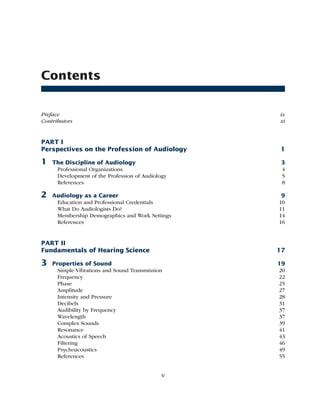
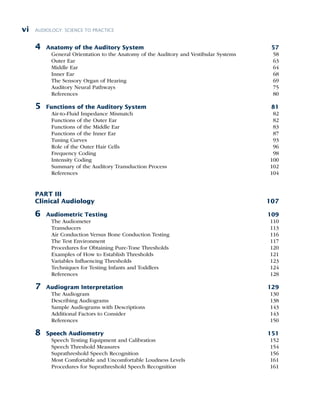
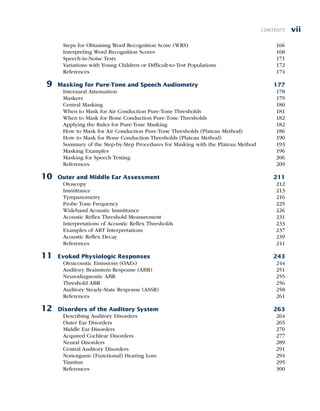
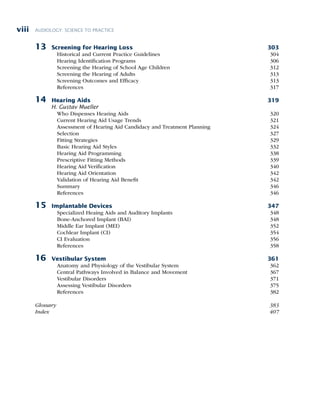


![AUDIOLOGY: SCIENCE TO PRACTICE
4
Audiology is a discipline that focuses on the
study of normal hearing and hearing disorders.
Additionally, audiology includes the assessment
and treatment of vestibular (balance) disorders.
More precisely, audiology is a health care profes-
sion devoted to identification, assessment, treat-
ment/rehabilitation, and prevention of hearing
and balance disorders, and understanding the
effects of hearing loss on related communication
disorders. An audiologist is a professional who
has the appropriate degree and license in his or
her state to practice audiology, and who is, typi-
cally, certified by a professional board. Audiolo-
gists are the experts who understand the effects
of hearing loss on communication and how to
best improve a patient’s ability to hear.
Audiologists work with many other profes-
sionals and support personnel. The medical ex-
pert in hearing disorders is the physician. The
medical specialty related to the ear is called
otology, which is practiced by appropriately
trained and certified otologists, also called neuro-
otologists, otolaryngologists, or ear, nose, and
throat (ENT) specialists. Audiologists also work
closely with speech-language pathologists, who
are certified and/or licensed professionals who
engage in prevention, assessment, and treatment
of speech and language disorders, including
those who have hearing loss. In addition, many
audiologists are part of interdisciplinary teams,
especially when it comes to the assessment and
treatment of pediatric patients, as well as pa-
tients with implantable devices, cystic fibrosis,
cleft palate, or balance problems, to name a few.
PROFESSIONAL ORGANIZATIONS
The American Academy of Audiology (AAA) is the
professional organization for audiologists. In 1988,
AAA (often referred to as “triple A”) was founded
in order to establish an organization devoted en
tirely to the needs of audiologists and the interests
oftheaudiologyprofession(http://www.audiology
.org). Originally, AAA focused on transitioning
audiology to a doctoral level profession, which
became a reality by 2007. Membership in AAA
quickly skyrocketed, and, today, AAA has a mem-
bership of more than 12,000 audiologists (Amer-
ican Academy of Audiology [AAA], n.d. a). Prior
to the formation of AAA, the American Speech-
Language-Hearing Association (ASHA) was, and
still remains, a professional organization for au-
diologists and speech-language pathologists. The
ASHA was established in 1925 as the American
Academy of Speech Correction, and went through
several name changes including the American So-
ciety for the Study of Disorders of Speech (1927),
the American Speech Correction Association
(1934), the American Speech and Hearing Asso-
ciation (1947), and in 1978 became the American
Speech-Language-Hearing Association (American
Speech-Language-Hearing Association [ASHA],
n.d.). In its early years, ASHA focused on speech
disorders; however, during World War II, with
service personnel returning with hearing losses,
ASHA expanded its mission to include assessment
and treatment of those with hearing disorders.
The AAA and ASHA are both strong advo-
cates for the hearing impaired and related services
by audiologists, both at the state and national lev-
els. The AAA and ASHA each have professional
certifications for audiologists: American Board of
Audiology (ABA) Certification through AAA, and
the Certificate of Clinical Competence in Audiol-
ogy (CCC-A) through ASHA. In addition, each of
these organizations can award accreditation to
academic programs that meet a set of standards;
the Accreditation Commission for Audiology Edu-
cation (ACAE) associated with AAA, and the Com-
mission on Academic Accreditation (CAA) associ-
ated with ASHA.
Audiologists may also choose to join other
professional organizations. The Academy of Dis-
pensing Audiologists (ADA) was established in
1977 to support the needs of audiologists who
dispense (sell) hearing aids. The ADA later
changed its name to the Academy of Doctors of
Audiology (ADA) (http://www.audiologist.org),
and expanded its focus to any audiologists in
private practice or those who wished to estab-
lish a private practice. The Educational Audiol-
ogy Association (EAA) (http://www.edaud.org),
formed in 1983, is a professional membership
organization of audiologists and related profes-
sionals who deliver a full spectrum of hearing
services to all children, particularly those in ed-
ucational settings. Many audiologists are also](https://image.slidesharecdn.com/38347-250424184356-342354bd/85/Audiology-Science-to-Practice-Steven-Kramer-22-320.jpg)
![AUDIOLOGY: SCIENCE TO PRACTICE
8
setting. These are, we believe, hallmarks of a ro-
bust and growing profession with a remarkable
history. (p. 380)
REFERENCES
American Academy of Audiology [AAA]. (n.d.). Acad-
emy Information. Retrieved from http://www.audi
ology.org/about-us/academy-information
American Speech-Language-HearingAssociation [ASHA].
(n.d.). History of ASHA. Retrieved from http://www
.asha.org/about/history
Jerger, J. (2009). Audiology in the USA. San Diego, CA:
Plural.
Jerger, J., DeConde Johnson, C. (2014). A brief his-
tory of audiology in the United States. In S. Kramer
(Ed.), Audiology: Science to Practice (2nd ed.). San
Diego, CA: Plural.
Martin, F. N., Clark, J. G. (2015). Introduction to
Audiology (12th ed.). Boston, MA: Pearson Educa-
tion, Inc.
National Center for Hearing Assessment and Man-
agement (n.d.). State EDHI Information. Retrieved
from http://www.infanthearing.org/states_home
SYNOPSIS 1–1
l
l Audiology is a discipline that focuses on the study of normal hearing and
hearing disorders, as well as vestibular (balance) assessment and rehabilitation.
Audiology in the United States had its beginnings around the time of World
War II.
l
l An audiologist is a licensed professional who practices audiology, and is an
expert on the effects of hearing loss on communication and psychosocial
factors. Otology is the discipline primarily related to medical assessment and
treatment of hearing and balance disorders, and is the specialty practiced by
otologists.
l
l The American Academy of Audiology (AAA) and the American Speech-Language-
Hearing Association (ASHA) are the two main professional organizations serving
their audiologist members. The AAA was founded in 1988, and is entirely run
by and for audiologists.
l
l The national student organization for future doctoral level audiologists is
called the Student Academy of Audiology (SAA). Most doctoral audiology
programs have local chapters of SAA. Many undergraduate programs encourage
undergraduates to enroll in student chapters.
l
l Audiology became a doctoral level profession by 2007, and today the AAA has
more than 12,000 members.
l
l Some key historical milestones in audiology include development of immittance
measures (early 1970s), auditory brainstem response (ABR) measures (late
1970s), approval for audiologists to dispense hearing aids (1979), otoacoustic
emission measures (1980s), digital hearing aids become the dominant type
(1990s), and legislation allowing OTC hearing aids (2017).](https://image.slidesharecdn.com/38347-250424184356-342354bd/85/Audiology-Science-to-Practice-Steven-Kramer-26-320.jpg)
![AUDIOLOGY: SCIENCE TO PRACTICE
10
Audiology continues to gain notoriety in the labor
market, and has been highly recommended as a
top career choice with an excellent employment
outlook. In fact, Time Magazine (2015) ranked
audiology as the number one profession, out of
40 professions, based on job stress, salary, and
job outlook. CareerCast (2015, 2017) has ranked
audiology in the top four professions (out of 200
occupations) for having the least stressful job,
behind medical sonographer, compliance officer,
and hair stylist. The U.S. Bureau of Labor Sta-
tistics (2017) estimates that the average growth
rate for all occupations between 2014 and 2022
will be 7%; however, audiology’s projected job
growth is estimated to be 29%. The job market
outlook for audiologists is quite strong, and the
need is expected to grow substantially in the fu-
ture (Windmill Freeman, 2013).
EDUCATION AND
PROFESSIONAL CREDENTIALS
Today, the entry-level degree to practice clinical
audiology is a professional doctorate, referred to
as the Doctor of Audiology (AuD). The AuD is
a 3- to 4-year graduate degree composed of a
comprehensive curriculum with about 2000 to
3000 hours of clinical experiences, precepted
(supervised) by licensed and/or certified audiol-
ogists. The AuD is the entry level clinical doc-
toral degree, different from the research doctor-
ate (PhD) that has been available in audiology
and hearing sciences since its inception for those
interested in research and/or an academic posi-
tion. The move from a clinical master’s degree
in audiology to a professional doctoral degree
began in the late 1980s, and was a guiding force
in the establishment of the American Academy
of Audiology (AAA). The first AuD program be-
came available in 1993 at Baylor College of Med-
icine in Houston (which subsequently closed its
AuD program). In 1993, ASHA endorsed a plan
to transition to the clinical doctoral degree, and
by 2007 the AuD became required (a master’s
degree was no longer adequate) to practice audi-
ology. As of 2017, there were 75 audiology clin-
ical doctoral programs in the country (American
Academy of Audiology [AAA], n.d.).
Students entering audiology clinical doctoral
programs come from a variety of disciplines, such
as speech and hearing, psychology, education,
engineering, music, physics, computer science,
neuroscience, medicine, nursing, and business to
name a few. Audiology is a scientific discipline
and requires a relatively strong science founda-
tion and an ability to meet the challenges of a
rigorous curriculum. Most AuD programs expect
students to have some preparation in physical,
life, social, and behavioral sciences, as well as
statistics.
The curricula for AuD programs are quite
similar across programs, and are partially driven
by the professional accreditation standards, as
well as specific requirements for professional cer-
tification. A list and links to doctoral programs can
be found on the AAA website (www.audiology
.org) and the American Speech-Language-Hearing
(ASHA) website (www.asha.org). There are, how-
ever, differences across programs in the number
of faculty, the breadth of academic courses, the va-
riety and amount of clinical experiences, and the
amount of research available to students. While
most programs have a similar core of courses, a
program may have strengths in one or more areas,
or may provide more advanced preparation in
some areas, such as hearing aids, electrophysiol-
ogy, vestibular assessment, cochlear implants, tin-
nitus, business practice, and/or rehabilitation. As
part of an AuD program, students are required
to have clinical experiences that are precepted
by an audiologist or other relevant professional.
Some AuD programs have an on-campus clinic
where students begin their clinical experiences,
and then obtain additional clinical experiences in
community hospitals, clinics, or other agencies.
Other AuD programs may rely solely on the com-
munity resources for the clinical experiences.
The final year of the AuD program is called
an externship, which is usually the equivalent to
a year’s full-time clinical experience at a clinical
site approved by the AuD program. Externships
are established through specific affiliation agree-
ments developed between the externship site
and the AuD program’s institution. An externship
site agrees to have an on-site preceptor who will
take an active role in further educating and men-
toring the extern during the final year of his or](https://image.slidesharecdn.com/38347-250424184356-342354bd/85/Audiology-Science-to-Practice-Steven-Kramer-28-320.jpg)