Genre- fantasy
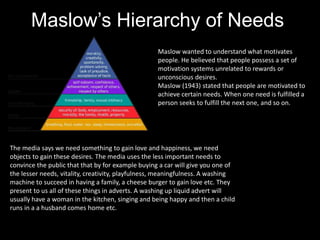
Maslow’s Hierarchy of Needs
Maslow wanted to understand what motivates
people. He believed that people possess a set of
motivation systems unrelated to rewards or
unconscious desires.
Maslow (1943) stated that people are motivated to
achieve certain needs. When one need is fulfilled a
person seeks to fulfill the next one, and so on.
The media says we need something to gain love and happiness, we need
objects to gain these desires. The media uses the less important needs to
convince the public that that by for example buying a car will give you one of
the lesser needs, vitality, creativity, playfulness, meaningfulness. A washing
machine to succeed in having a family, a cheese burger to gain love etc. They
present to us all of these things in adverts. A washing up liquid advert will
usually have a woman in the kitchen, singing and being happy and then a child
runs in a a husband comes home etc.
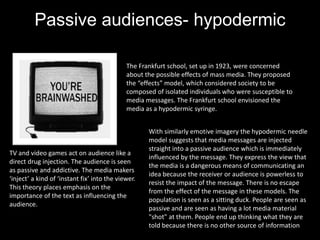
Passive audiences- hypodermic
syringe theory (1923)
The Frankfurt school, set up in 1923, were concerned
about the possible effects of mass media. They proposed
the “effects” model, which considered society to be
composed of isolated individuals who were susceptible to
media messages. The Frankfurt school envisioned the
media as a hypodermic syringe.
TV and video games act on audience like a
direct drug injection. The audience is seen
as passive and addictive. The media makers
‘inject’ a kind of ‘instant fix’ into the viewer.
This theory places emphasis on the
importance of the text as influencing the
audience.
With similarly emotive imagery the hypodermic needle
model suggests that media messages are injected
straight into a passive audience which is immediately
influenced by the message. They express the view that
the media is a dangerous means of communicating an
idea because the receiver or audience is powerless to
resist the impact of the message. There is no escape
from the effect of the message in these models. The
population is seen as a sitting duck. People are seen as
passive and are seen as having a lot media material
"shot" at them. People end up thinking what they are
told because there is no other source of information.
Blumler & Katz (1924)
Entertainment- escaping, or being
diverted, from problems
relaxing
getting intrinsic cultural or aesthetic
enjoyment
filling time
emotional release
sexual arousal
Information- finding out about relevant
events and conditions in immediate
surroundings, society and the world
seeking advice on practical matters or opinion
and decision choices
satisfying curiosity and general interest
learning; self-education
gaining a sense of security through knowledge
Personal Identity- finding
reinforcement for personal values
finding models of behavior
identifying with valued other (in the
media)
gaining insight into one's self
Integration and Social Interaction- gaining
insight into circumstances of others; social
empathy
identifying with others and gaining a sense
of belonging
finding a basis for conversation and social
interaction
having a substitute for real-life
companionship
helping to carry out social roles
enabling one to connect with family, friends
and society
Diversion (escapism)- audience
uses media as emotional
release
Audience pleasures
• Visceral- physical reaction, for example: saw
• Voyeuristic- spying on others, for example: I’m a celeb
• Puzzle solving- solving a mystery, working things out, for example: Broadchurch
• Disruptive- chaos, for example: the impossible
• Vicarious- living via other people, for example: casualty
• Aesthetic- beautifully made text, for example: about time
Psychographic segmentation divides a market into groups based on
social class, lifestyle and personality characteristics based on the
assumption, that the types of product and brands an individual
purchases, will reflect the persons characteristics and patterns of
living.
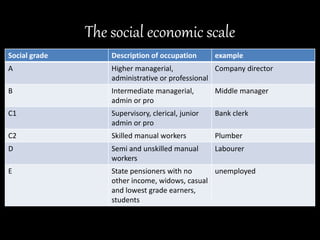
Social class- single most used variable for research purposes and divides the population
into groups based on the occupation of the ‘chief income earner’ (CIE), as such it can be
seen as socio- economic scale. In the UK, the national readership survey provides the
following standardised grouping
The social economic scale
Social grade Description of occupation example
A Higher managerial,
administrative or professional
Company director
B Intermediate managerial,
admin or pro
Middle manager
C1 Supervisory, clerical, junior
admin or pro
Bank clerk
C2 Skilled manual workers Plumber
D Semi and unskilled manual
workers
Labourer
E State pensioners with no
other income, widows, casual
and lowest grade earners,
students
unemployed
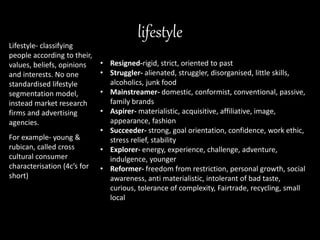
lifestyle
Lifestyle- classifying
people according to their,
values, beliefs, opinions
and interests. No one
standardised lifestyle
segmentation model,
instead market research
firms and advertising
agencies.
For example- young &
rubican, called cross
cultural consumer
characterisation (4c’s for
short)
• Resigned-rigid, strict, oriented to past
• Struggler- alienated, struggler, disorganised, little skills,
alcoholics, junk food
• Mainstreamer- domestic, conformist, conventional, passive,
family brands
• Aspirer- materialistic, acquisitive, affiliative, image,
appearance, fashion
• Succeeder- strong, goal orientation, confidence, work ethic,
stress relief, stability
• Explorer- energy, experience, challenge, adventure,
indulgence, younger
• Reformer- freedom from restriction, personal growth, social
awareness, anti materialistic, intolerant of bad taste,
curious, tolerance of complexity, Fairtrade, recycling, small
local
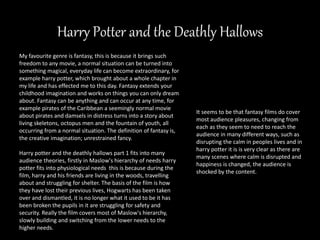
Harry Potter and the Deathly Hallows
It seems to be that fantasy films do cover
most audience pleasures, changing from
each as they seem to need to reach the
audience in many different ways, such as
disrupting the calm in peoples lives and in
harry potter it is is very clear as there are
many scenes where calm is disrupted and
happiness is changed, the audience is
shocked by the content.
My favourite genre is fantasy, this is because it brings such
freedom to any movie, a normal situation can be turned into
something magical, everyday life can become extraordinary, for
example harry potter, which brought about a whole chapter in
my life and has effected me to this day. Fantasy extends your
childhood imagination and works on things you can only dream
about. Fantasy can be anything and can occur at any time, for
example pirates of the Caribbean a seemingly normal movie
about pirates and damsels in distress turns into a story about
living skeletons, octopus men and the fountain of youth, all
occurring from a normal situation. The definition of fantasy is,
the creative imagination; unrestrained fancy.
Harry potter and the deathly hallows part 1 fits into many
audience theories, firstly in Maslow's hierarchy of needs harry
potter fits into physiological needs this is because during the
film, harry and his friends are living in the woods, travelling
about and struggling for shelter. The basis of the film is how
they have lost their previous lives, Hogwarts has been taken
over and dismantled, it is no longer what it used to be it has
been broken the pupils in it are struggling for safety and
security. Really the film covers most of Maslow's hierarchy,
slowly building and switching from the lower needs to the
higher needs.

Audience theory

  • 1.
  • 2.
    Maslow’s Hierarchy ofNeeds Maslow wanted to understand what motivates people. He believed that people possess a set of motivation systems unrelated to rewards or unconscious desires. Maslow (1943) stated that people are motivated to achieve certain needs. When one need is fulfilled a person seeks to fulfill the next one, and so on. The media says we need something to gain love and happiness, we need objects to gain these desires. The media uses the less important needs to convince the public that that by for example buying a car will give you one of the lesser needs, vitality, creativity, playfulness, meaningfulness. A washing machine to succeed in having a family, a cheese burger to gain love etc. They present to us all of these things in adverts. A washing up liquid advert will usually have a woman in the kitchen, singing and being happy and then a child runs in a a husband comes home etc.
  • 3.
    Passive audiences- hypodermic syringetheory (1923) The Frankfurt school, set up in 1923, were concerned about the possible effects of mass media. They proposed the “effects” model, which considered society to be composed of isolated individuals who were susceptible to media messages. The Frankfurt school envisioned the media as a hypodermic syringe. TV and video games act on audience like a direct drug injection. The audience is seen as passive and addictive. The media makers ‘inject’ a kind of ‘instant fix’ into the viewer. This theory places emphasis on the importance of the text as influencing the audience. With similarly emotive imagery the hypodermic needle model suggests that media messages are injected straight into a passive audience which is immediately influenced by the message. They express the view that the media is a dangerous means of communicating an idea because the receiver or audience is powerless to resist the impact of the message. There is no escape from the effect of the message in these models. The population is seen as a sitting duck. People are seen as passive and are seen as having a lot media material "shot" at them. People end up thinking what they are told because there is no other source of information.
  • 4.
    Blumler & Katz(1924) Entertainment- escaping, or being diverted, from problems relaxing getting intrinsic cultural or aesthetic enjoyment filling time emotional release sexual arousal Information- finding out about relevant events and conditions in immediate surroundings, society and the world seeking advice on practical matters or opinion and decision choices satisfying curiosity and general interest learning; self-education gaining a sense of security through knowledge Personal Identity- finding reinforcement for personal values finding models of behavior identifying with valued other (in the media) gaining insight into one's self Integration and Social Interaction- gaining insight into circumstances of others; social empathy identifying with others and gaining a sense of belonging finding a basis for conversation and social interaction having a substitute for real-life companionship helping to carry out social roles enabling one to connect with family, friends and society Diversion (escapism)- audience uses media as emotional release
  • 5.
    Audience pleasures • Visceral-physical reaction, for example: saw • Voyeuristic- spying on others, for example: I’m a celeb • Puzzle solving- solving a mystery, working things out, for example: Broadchurch • Disruptive- chaos, for example: the impossible • Vicarious- living via other people, for example: casualty • Aesthetic- beautifully made text, for example: about time Psychographic segmentation divides a market into groups based on social class, lifestyle and personality characteristics based on the assumption, that the types of product and brands an individual purchases, will reflect the persons characteristics and patterns of living. Social class- single most used variable for research purposes and divides the population into groups based on the occupation of the ‘chief income earner’ (CIE), as such it can be seen as socio- economic scale. In the UK, the national readership survey provides the following standardised grouping
  • 6.
    The social economicscale Social grade Description of occupation example A Higher managerial, administrative or professional Company director B Intermediate managerial, admin or pro Middle manager C1 Supervisory, clerical, junior admin or pro Bank clerk C2 Skilled manual workers Plumber D Semi and unskilled manual workers Labourer E State pensioners with no other income, widows, casual and lowest grade earners, students unemployed
  • 7.
    lifestyle Lifestyle- classifying people accordingto their, values, beliefs, opinions and interests. No one standardised lifestyle segmentation model, instead market research firms and advertising agencies. For example- young & rubican, called cross cultural consumer characterisation (4c’s for short) • Resigned-rigid, strict, oriented to past • Struggler- alienated, struggler, disorganised, little skills, alcoholics, junk food • Mainstreamer- domestic, conformist, conventional, passive, family brands • Aspirer- materialistic, acquisitive, affiliative, image, appearance, fashion • Succeeder- strong, goal orientation, confidence, work ethic, stress relief, stability • Explorer- energy, experience, challenge, adventure, indulgence, younger • Reformer- freedom from restriction, personal growth, social awareness, anti materialistic, intolerant of bad taste, curious, tolerance of complexity, Fairtrade, recycling, small local
  • 8.
    Harry Potter andthe Deathly Hallows It seems to be that fantasy films do cover most audience pleasures, changing from each as they seem to need to reach the audience in many different ways, such as disrupting the calm in peoples lives and in harry potter it is is very clear as there are many scenes where calm is disrupted and happiness is changed, the audience is shocked by the content. My favourite genre is fantasy, this is because it brings such freedom to any movie, a normal situation can be turned into something magical, everyday life can become extraordinary, for example harry potter, which brought about a whole chapter in my life and has effected me to this day. Fantasy extends your childhood imagination and works on things you can only dream about. Fantasy can be anything and can occur at any time, for example pirates of the Caribbean a seemingly normal movie about pirates and damsels in distress turns into a story about living skeletons, octopus men and the fountain of youth, all occurring from a normal situation. The definition of fantasy is, the creative imagination; unrestrained fancy. Harry potter and the deathly hallows part 1 fits into many audience theories, firstly in Maslow's hierarchy of needs harry potter fits into physiological needs this is because during the film, harry and his friends are living in the woods, travelling about and struggling for shelter. The basis of the film is how they have lost their previous lives, Hogwarts has been taken over and dismantled, it is no longer what it used to be it has been broken the pupils in it are struggling for safety and security. Really the film covers most of Maslow's hierarchy, slowly building and switching from the lower needs to the higher needs.