Utilisingtravel
dataandtechnology
toinformyour
travelprogramme
www.atpi.comExpert Insight
How to make the most of your travel data utilising guided
analytics and current technologies - by ATPI’s Carlos Padilla
www.atpi.com2
Data: in a travel management context that word may fill
you either with dread or enthusiasm!
Similar to the way in which data and technology has transformed
our daily lives over the past few years, the same can be said for data
within the business travel industry.
Introduction
1	 How data technologies are empowering the
	 travel manager
2	 Why you need to move away from static reporting
3	 How to use data to inform your travel programme
4	 Working with your TMC to maximise your data
What this expert insight will tell you:
Currently leading ATPI’s management information team
in Australia - using information management, business
intelligence, insight analytics and modelling to help clients
turn their travel programme data into specific actions.
Carlos Padilla
www.atpi.com3
The GBTA Foundation undertook a survey in 2012 ‘The State of
Expense Data Management and Consolidation in the Business Travel
Industry’, which found that travel managers were not convinced they
have a complete or accurate picture of the total cost of individual
trips. Respondents stated they struggle to reconcile data, spending
442,000 hours in staff time per year or $22.7 million manually
reconciling and cleaning travel data.
Transparent, accurate and timely data is something that travel
managers have felt historically they aren’t receiving from their travel
suppliers. However, here in 2016, travel data and analysis is in a more
positive place – this document outlines the progress which has been
made, why and what technologies are now available.
Traditional reporting and analysis of travel data typically
focused on post-trip data (what has happened), which limits the
ability of the person managing a travel programme to analyse
future trends (what could happen) and therefore contribute to
cost / value management.
The strength of the travel management company (TMC),
and the value a good travel partner brings to their client is
aggregating various streams of data (from for example your
air, hotel, rail and car partners) and consolidating them in
one single, transparent source to empower and inform.
www.atpi.com4
Drill anywhere
Like drill down, drill anywhere allows the user to move through
levels of detail within a single report. The difference here is that
the hierarchy, or path, is built by the user during the drill process,
rather than the administrator during the view building stage
An application (app)
Piece of software to assist in accomplishing one or several tasks
(often referred to as user interfaces). This software will usually run
within an operating system (OS) or framework i.e. web applications
run within the web browser, mobile apps within mobiles’ OS
(Android / iOS)
Business intelligence
Made up of several related activities, including
data mining, online analytical processing,
querying and reporting that makes it possible
to analyse larger amounts of data
Data association
Helps uncover relationships between
seemingly unrelated data in a relational
database or other information repository
Drill down
In information technology to drill down means to move
from one place to another, focusing in on something
Data mining
The computational process of discovering
patterns in large data sets (“big data”). The
overall goal of the data mining process
is to extract information from a data set
and transform it into an understandable
structure for further use
Somecommondatadefinitions
www.atpi.com5
Data warehouses
Central repositories of integrated data from one or more disparate
sources. They store current and historical data and are used for
creating analytical reports
Extract, transform & load
Three database functions that are
combined into one tool to pull data out
of one database and place it (generally)
into a data warehouse
Management information system
A computer-based system that provides managers with the tools
to organise, evaluate and efficiently manage departments within
an organisation
On-line analytical processing (OLAP)
OLAP performs multidimensional analysis of
business data and provides the capability for
complex calculations, trend analysis, and
sophisticated data modelling
Unstructured data
Information that either does not have a pre-defined data
model or is not organised in a pre-defined manner.
Unstructured information is typically text-heavy, but may
contain data such as dates, numbers and facts as well
www.atpi.com6
Static travel reports providing fixed answers to specific
‘anticipated’ questions become a major barrier to
properly analysing data. Why? When a new question
appears, the initial report is no longer relevant and you
need to go back to the drawing board (which could
involve several iterations).
A dynamic tool that manages high volumes of data and reduces
complexity eliminates this problem. And here at ATPI we are able to
deliver this for our clients through building a solution that gives each
company a window into their travel programme.
An optimised view on reporting ‘data consumption’ involves
exposing critical relationships among the data elements essential
for properly understanding travel behaviour. Instead of concealing
relationships in pre-defined drill down paths, data analysis needs
to bring the relationships to the surface to aid the consumer in
understanding and interpreting travel data (and therefore travel
behaviour). This in the business intelligence world is referred to
as ‘data association’.
A dynamic tool which can present this information 24/7
to travel managers and allows them to drill down into
the data real-time is of much more value than a static
report run a number of hours ago.
Developingtechnologiestomanagetraveldata
www.atpi.com7
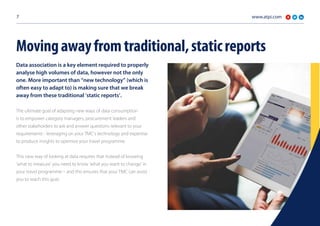
Data association is a key element required to properly
analyse high volumes of data, however not the only
one. More important than “new technology” (which is
often easy to adapt to) is making sure that we break
away from these traditional ‘static reports’.
The ultimate goal of adapting new ways of data consumption
is to empower category managers, procurement leaders and
other stakeholders to ask and answer questions relevant to your
requirements - leveraging on your TMC’s technology and expertise
to produce insights to optimise your travel programme.
This new way of looking at data requires that instead of knowing
‘what to measure’ you need to know ‘what you want to change’ in
your travel programme – and this ensures that your TMC can assist
you to reach this goal.
Movingawayfromtraditional,staticreports
www.atpi.com8
An example of data association could for example, be applied
to leakage from travel policy – i.e. identifying travellers that have
booked a rail ticket through your preferred TMC but not booked
accommodation through the correct channel. From a duty of care
perspective (as well as cost management) this out of policy behaviour
is important to action before the traveller takes their journey.
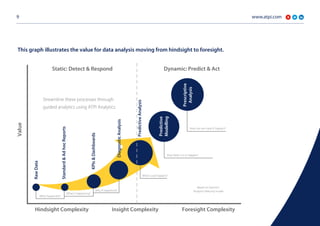
Describing what happened, why it happened and monitoring
what is happening now is slowly losing relevance due to low
complexity and low value (i.e. it has already happened – there is
nothing you can do to change it). Every traditional TMC will be able
to capture this data and report on it. However there is significant
difference between just reporting on data and actually producing
actionable insights.
The only way to move forward is to understand the ‘what and why’
so that you are able to plan what might happen (forecasting), to
determine if this forecast is likely to happen (predicting) and what
actions should be taken to change the outcome as necessary
(prescriptive analytics).
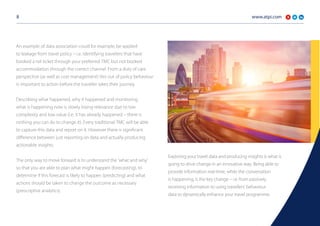
Exploring your travel data and producing insights is what is
going to drive change in an innovative way. Being able to
provide information real-time, while the conversation
is happening, is the key change – i.e. from passively
receiving information to using travellers’ behaviour
data to dynamically enhance your travel programme.
www.atpi.com9
This graph illustrates the value for data analysis moving from hindsight to foresight.
Static: Detect & Respond Dynamic: Predict & Act
Streamline these processes through
guided analytics using ATPI Analytics
Based on Gartner’s
Analytics Maturity model
Value
RawData
Standard&AdhocReports
KPIs&Dashboards
DiagnosticAnalysis
PredictiveAnalysis
Hindsight Complexity Insight Complexity Foresight Complexity
What happened?
What is happening?
Why it happened?
What could happen?
How likely is it to happen?
How can we make it happen?
Predictive
Modelling
Prescriptive
Analysis
www.atpi.com10
To accomplish this is no easy task; it requires a high
degree of interaction/integration with your TMC, as
they are the natural aggregators of your supplier
data and can provide one consolidated view bringing
together your travel intelligence.
Understanding basic elements (such as data transparency) is a must;
traditional TMCs are often frightened by the concept of giving clients
access to the ‘raw data’, without realising that the change from
traditional static reports requires this, and actually delivers the detail
that the travel manager is looking for (as long as it is presented in a
user-friendly way).
WorkingwithyourTMC
www.atpi.com11
The next step in the new cycle of data consumption
is that the data aggregators/consolidators have the
ability to channel all this data captured, use data
association and other techniques (i.e. data mining) to
produce insights tailored to a single project or task -
which in the data world is called ‘guided analytics’.
Guided analytics, as the pillar for data consumption in the dynamic
data world, is only possible through applications (or apps). Imagine
one single app that has all of your travel information/behaviour to
analyse one specific subject such as duty of care. This app would be
designed to use every single field captured to bring to the surface
the underlying data relations specific to a subject. This concept
leaves far behind any static report.
The collection, processing and analysing of data then becomes
worthless if the outcome is not somehow translated into action.
Using data to inform and manage a travel programme needs to
evolve as well. The same way static reporting is soon to be the past,
so will enforcing your travel policy through a policing approach.
The information era requires a less conflicted and more dynamic
approach (such as targeted advertising/promotion) and even
though you might think these are unrelated subjects, the best
way of changing behaviour is not through the general analysis
of data but a direct engagement with subjects (i.e. travellers) to
trigger change.
Guidedanalytics
www.atpi.com12
Consolidation (pre-trip and post-trip)
Check with your data suppliers what sort of challenges they face so
that you can work together to overcome these, understanding that
multiple data from multiple sources / suppliers can be challenging
Transparency of data
The more eyes on the data the better data you’ll get. Ensure data is
something that is covered in your contract with your suppliers – so
you get access to all the raw data available
Traveller profiles
Keeping traveller profiles up-to-date will ensure that the traveller
data being analysed is accurate, i.e. ensure data going in is as
accurate as possible
Reviewing data with your account manager
Make sure you make data and travel intelligence a regular topic on
the agenda with your account manager. Reporting may be crucial to
your travel programme or business in which case you may wish to
make it part of their KPIs / objectives
Change the conversation timing
Having access to a dynamic tool means you can start using
forecasted data to plan and inform your travel programme.
Real-time data means analysis is immediate and current –
delayed and out of date analysis will become a thing of
the past
Afewtoptipstobettermanageyourdata:
www.atpi.com13
Hopefully this document has given you insight into
the world of data and left you in a positive mind-set
thinking about your own travel programme.
Dynamic tools enable you as a travel manager to use significant
amounts of data to improve programme performance and get
better value from your supplier relationships. Your TMC is the central
point, bringing together various sources of data and providing this
data to you (real-time) in a format that you and your stakeholders
find useful.
Once presented in a user-friendly manner, you can use this
huge amount of data to drill down into areas that are of
particular interest, feeding into specific objectives,
indicators or providing stakeholders with snapshots of
your business travel.
Conclusion
14
Wanttoknowmore?
For examples of case studies and more how-to guides,
visit the ATPI Knowledge Hub.
www.atpi.com
Carlos’ expertise lies in business process improvement
with 10+ years of experience in major industries
such as Financial Services, Retail, Manufacturing and
Travel, turning data into insights through business
intelligence and analytics. Carlos is passionate about
helping people make sense of information.
Carlos is currently leading ATPI’s management information team in
Australia - using information management, business intelligence,
insight analytics and modelling to help clients turn their travel
programme data into specific actions.
Before joining ATPI Carlos worked for the management consultants
PwC – located in Venezuela - where he grew up.
Abouttheexpert
www.atpi.comPublished: 03.16
ATPI is among the world’s leading travel management
companies. Our dynamic and innovative approach to
savings and service has earned us one of the highest
client retention rates in the industry.
With over 100 offices worldwide, the company has successful
operations in corporate travel, corporate event management,
online travel technology and specialist travel management for
a number of key industries.

ATPI Expert Insight Analytics

  • 1.
    Utilisingtravel dataandtechnology toinformyour travelprogramme www.atpi.comExpert Insight How tomake the most of your travel data utilising guided analytics and current technologies - by ATPI’s Carlos Padilla
  • 2.
    www.atpi.com2 Data: in atravel management context that word may fill you either with dread or enthusiasm! Similar to the way in which data and technology has transformed our daily lives over the past few years, the same can be said for data within the business travel industry. Introduction 1 How data technologies are empowering the travel manager 2 Why you need to move away from static reporting 3 How to use data to inform your travel programme 4 Working with your TMC to maximise your data What this expert insight will tell you: Currently leading ATPI’s management information team in Australia - using information management, business intelligence, insight analytics and modelling to help clients turn their travel programme data into specific actions. Carlos Padilla
  • 3.
    www.atpi.com3 The GBTA Foundationundertook a survey in 2012 ‘The State of Expense Data Management and Consolidation in the Business Travel Industry’, which found that travel managers were not convinced they have a complete or accurate picture of the total cost of individual trips. Respondents stated they struggle to reconcile data, spending 442,000 hours in staff time per year or $22.7 million manually reconciling and cleaning travel data. Transparent, accurate and timely data is something that travel managers have felt historically they aren’t receiving from their travel suppliers. However, here in 2016, travel data and analysis is in a more positive place – this document outlines the progress which has been made, why and what technologies are now available. Traditional reporting and analysis of travel data typically focused on post-trip data (what has happened), which limits the ability of the person managing a travel programme to analyse future trends (what could happen) and therefore contribute to cost / value management. The strength of the travel management company (TMC), and the value a good travel partner brings to their client is aggregating various streams of data (from for example your air, hotel, rail and car partners) and consolidating them in one single, transparent source to empower and inform.
  • 4.
    www.atpi.com4 Drill anywhere Like drilldown, drill anywhere allows the user to move through levels of detail within a single report. The difference here is that the hierarchy, or path, is built by the user during the drill process, rather than the administrator during the view building stage An application (app) Piece of software to assist in accomplishing one or several tasks (often referred to as user interfaces). This software will usually run within an operating system (OS) or framework i.e. web applications run within the web browser, mobile apps within mobiles’ OS (Android / iOS) Business intelligence Made up of several related activities, including data mining, online analytical processing, querying and reporting that makes it possible to analyse larger amounts of data Data association Helps uncover relationships between seemingly unrelated data in a relational database or other information repository Drill down In information technology to drill down means to move from one place to another, focusing in on something Data mining The computational process of discovering patterns in large data sets (“big data”). The overall goal of the data mining process is to extract information from a data set and transform it into an understandable structure for further use Somecommondatadefinitions
  • 5.
    www.atpi.com5 Data warehouses Central repositoriesof integrated data from one or more disparate sources. They store current and historical data and are used for creating analytical reports Extract, transform & load Three database functions that are combined into one tool to pull data out of one database and place it (generally) into a data warehouse Management information system A computer-based system that provides managers with the tools to organise, evaluate and efficiently manage departments within an organisation On-line analytical processing (OLAP) OLAP performs multidimensional analysis of business data and provides the capability for complex calculations, trend analysis, and sophisticated data modelling Unstructured data Information that either does not have a pre-defined data model or is not organised in a pre-defined manner. Unstructured information is typically text-heavy, but may contain data such as dates, numbers and facts as well
  • 6.
    www.atpi.com6 Static travel reportsproviding fixed answers to specific ‘anticipated’ questions become a major barrier to properly analysing data. Why? When a new question appears, the initial report is no longer relevant and you need to go back to the drawing board (which could involve several iterations). A dynamic tool that manages high volumes of data and reduces complexity eliminates this problem. And here at ATPI we are able to deliver this for our clients through building a solution that gives each company a window into their travel programme. An optimised view on reporting ‘data consumption’ involves exposing critical relationships among the data elements essential for properly understanding travel behaviour. Instead of concealing relationships in pre-defined drill down paths, data analysis needs to bring the relationships to the surface to aid the consumer in understanding and interpreting travel data (and therefore travel behaviour). This in the business intelligence world is referred to as ‘data association’. A dynamic tool which can present this information 24/7 to travel managers and allows them to drill down into the data real-time is of much more value than a static report run a number of hours ago. Developingtechnologiestomanagetraveldata
  • 7.
    www.atpi.com7 Data association isa key element required to properly analyse high volumes of data, however not the only one. More important than “new technology” (which is often easy to adapt to) is making sure that we break away from these traditional ‘static reports’. The ultimate goal of adapting new ways of data consumption is to empower category managers, procurement leaders and other stakeholders to ask and answer questions relevant to your requirements - leveraging on your TMC’s technology and expertise to produce insights to optimise your travel programme. This new way of looking at data requires that instead of knowing ‘what to measure’ you need to know ‘what you want to change’ in your travel programme – and this ensures that your TMC can assist you to reach this goal. Movingawayfromtraditional,staticreports
  • 8.
    www.atpi.com8 An example ofdata association could for example, be applied to leakage from travel policy – i.e. identifying travellers that have booked a rail ticket through your preferred TMC but not booked accommodation through the correct channel. From a duty of care perspective (as well as cost management) this out of policy behaviour is important to action before the traveller takes their journey. Describing what happened, why it happened and monitoring what is happening now is slowly losing relevance due to low complexity and low value (i.e. it has already happened – there is nothing you can do to change it). Every traditional TMC will be able to capture this data and report on it. However there is significant difference between just reporting on data and actually producing actionable insights. The only way to move forward is to understand the ‘what and why’ so that you are able to plan what might happen (forecasting), to determine if this forecast is likely to happen (predicting) and what actions should be taken to change the outcome as necessary (prescriptive analytics). Exploring your travel data and producing insights is what is going to drive change in an innovative way. Being able to provide information real-time, while the conversation is happening, is the key change – i.e. from passively receiving information to using travellers’ behaviour data to dynamically enhance your travel programme.
  • 9.
    www.atpi.com9 This graph illustratesthe value for data analysis moving from hindsight to foresight. Static: Detect & Respond Dynamic: Predict & Act Streamline these processes through guided analytics using ATPI Analytics Based on Gartner’s Analytics Maturity model Value RawData Standard&AdhocReports KPIs&Dashboards DiagnosticAnalysis PredictiveAnalysis Hindsight Complexity Insight Complexity Foresight Complexity What happened? What is happening? Why it happened? What could happen? How likely is it to happen? How can we make it happen? Predictive Modelling Prescriptive Analysis
  • 10.
    www.atpi.com10 To accomplish thisis no easy task; it requires a high degree of interaction/integration with your TMC, as they are the natural aggregators of your supplier data and can provide one consolidated view bringing together your travel intelligence. Understanding basic elements (such as data transparency) is a must; traditional TMCs are often frightened by the concept of giving clients access to the ‘raw data’, without realising that the change from traditional static reports requires this, and actually delivers the detail that the travel manager is looking for (as long as it is presented in a user-friendly way). WorkingwithyourTMC
  • 11.
    www.atpi.com11 The next stepin the new cycle of data consumption is that the data aggregators/consolidators have the ability to channel all this data captured, use data association and other techniques (i.e. data mining) to produce insights tailored to a single project or task - which in the data world is called ‘guided analytics’. Guided analytics, as the pillar for data consumption in the dynamic data world, is only possible through applications (or apps). Imagine one single app that has all of your travel information/behaviour to analyse one specific subject such as duty of care. This app would be designed to use every single field captured to bring to the surface the underlying data relations specific to a subject. This concept leaves far behind any static report. The collection, processing and analysing of data then becomes worthless if the outcome is not somehow translated into action. Using data to inform and manage a travel programme needs to evolve as well. The same way static reporting is soon to be the past, so will enforcing your travel policy through a policing approach. The information era requires a less conflicted and more dynamic approach (such as targeted advertising/promotion) and even though you might think these are unrelated subjects, the best way of changing behaviour is not through the general analysis of data but a direct engagement with subjects (i.e. travellers) to trigger change. Guidedanalytics
  • 12.
    www.atpi.com12 Consolidation (pre-trip andpost-trip) Check with your data suppliers what sort of challenges they face so that you can work together to overcome these, understanding that multiple data from multiple sources / suppliers can be challenging Transparency of data The more eyes on the data the better data you’ll get. Ensure data is something that is covered in your contract with your suppliers – so you get access to all the raw data available Traveller profiles Keeping traveller profiles up-to-date will ensure that the traveller data being analysed is accurate, i.e. ensure data going in is as accurate as possible Reviewing data with your account manager Make sure you make data and travel intelligence a regular topic on the agenda with your account manager. Reporting may be crucial to your travel programme or business in which case you may wish to make it part of their KPIs / objectives Change the conversation timing Having access to a dynamic tool means you can start using forecasted data to plan and inform your travel programme. Real-time data means analysis is immediate and current – delayed and out of date analysis will become a thing of the past Afewtoptipstobettermanageyourdata:
  • 13.
    www.atpi.com13 Hopefully this documenthas given you insight into the world of data and left you in a positive mind-set thinking about your own travel programme. Dynamic tools enable you as a travel manager to use significant amounts of data to improve programme performance and get better value from your supplier relationships. Your TMC is the central point, bringing together various sources of data and providing this data to you (real-time) in a format that you and your stakeholders find useful. Once presented in a user-friendly manner, you can use this huge amount of data to drill down into areas that are of particular interest, feeding into specific objectives, indicators or providing stakeholders with snapshots of your business travel. Conclusion
  • 14.
    14 Wanttoknowmore? For examples ofcase studies and more how-to guides, visit the ATPI Knowledge Hub. www.atpi.com Carlos’ expertise lies in business process improvement with 10+ years of experience in major industries such as Financial Services, Retail, Manufacturing and Travel, turning data into insights through business intelligence and analytics. Carlos is passionate about helping people make sense of information. Carlos is currently leading ATPI’s management information team in Australia - using information management, business intelligence, insight analytics and modelling to help clients turn their travel programme data into specific actions. Before joining ATPI Carlos worked for the management consultants PwC – located in Venezuela - where he grew up. Abouttheexpert
  • 15.
    www.atpi.comPublished: 03.16 ATPI isamong the world’s leading travel management companies. Our dynamic and innovative approach to savings and service has earned us one of the highest client retention rates in the industry. With over 100 offices worldwide, the company has successful operations in corporate travel, corporate event management, online travel technology and specialist travel management for a number of key industries.