Atopic
Dermatitis: cytokines
and inflammation
Dr. José Antonio Ortega Martell. Pachuca, Hidalgo,
México
Th2
Th1
Th17Th22
TSLP
IL-4
IL-13
IL-31
Inflammatory
disease with
complex
cytokine and
immunological
networks
Atopic Dermatitis
Inflammatory
cutaneous
disease
Atopic
diathesis
Multifactorial
onset and
aggravation
Skin barrier
dysfunction
Allergology International 66 (2017) 230-247
and/or predisposition to overproduce
immunoglobulin E (IgE) antibodies
Personal or family history of asthma,
allergic rhinitis and conjunctivitis,
and/or atopic dermatitis
Environmental factors, sweating,
physical irritation (including scratching),
microbes/fungi, stress, and allergens
(dust mites, foods)
Decreased expression of ceramide and
filaggrin (primary or secondary),
increased transepidermal water loss,
lowered treshold of itch
Th2
Th1 Th17
J Allergy Clin Immunol 2019;144:362-74
• Skin = active immune organ
• Contact with Ag:
• Tolerance vs Immunity
• Immunological cells:
• Dendritic cells
• T reg lymphocytes
Toleroge
n
Immunoge
n
Tolerogen Immunogen
Tolerance:
• Dendritic cells (immature)
• T reg lymphocytes
LC
cDCTreg
Effector cell network:
• Keratinocytes
• Th lymphocytes
• Tc lymphocytes
• Macrophages
• Granulocytes
• B
lymphocytes
• Mast cells
• ILC (1,2,3)
• NKT cells
Maintenanceoftoleranceinresting-stateskin
J Allergy Clin Immunol 2019;144:362-74
Resting state: tolerance
J Allergy Clin Immunol 2019;144:362-74
Contact with
Ag without
damage
JAllergyClinImmunol2019;144:362-74
Resting state: tolerance
J Allergy Clin Immunol 2019;144:362-74
Contact with Ag: inflammatory
response
J Allergy Clin Immunol 2019;144:362-74
Inflammatory state
J Allergy Clin Immunol 2019;144:362-74
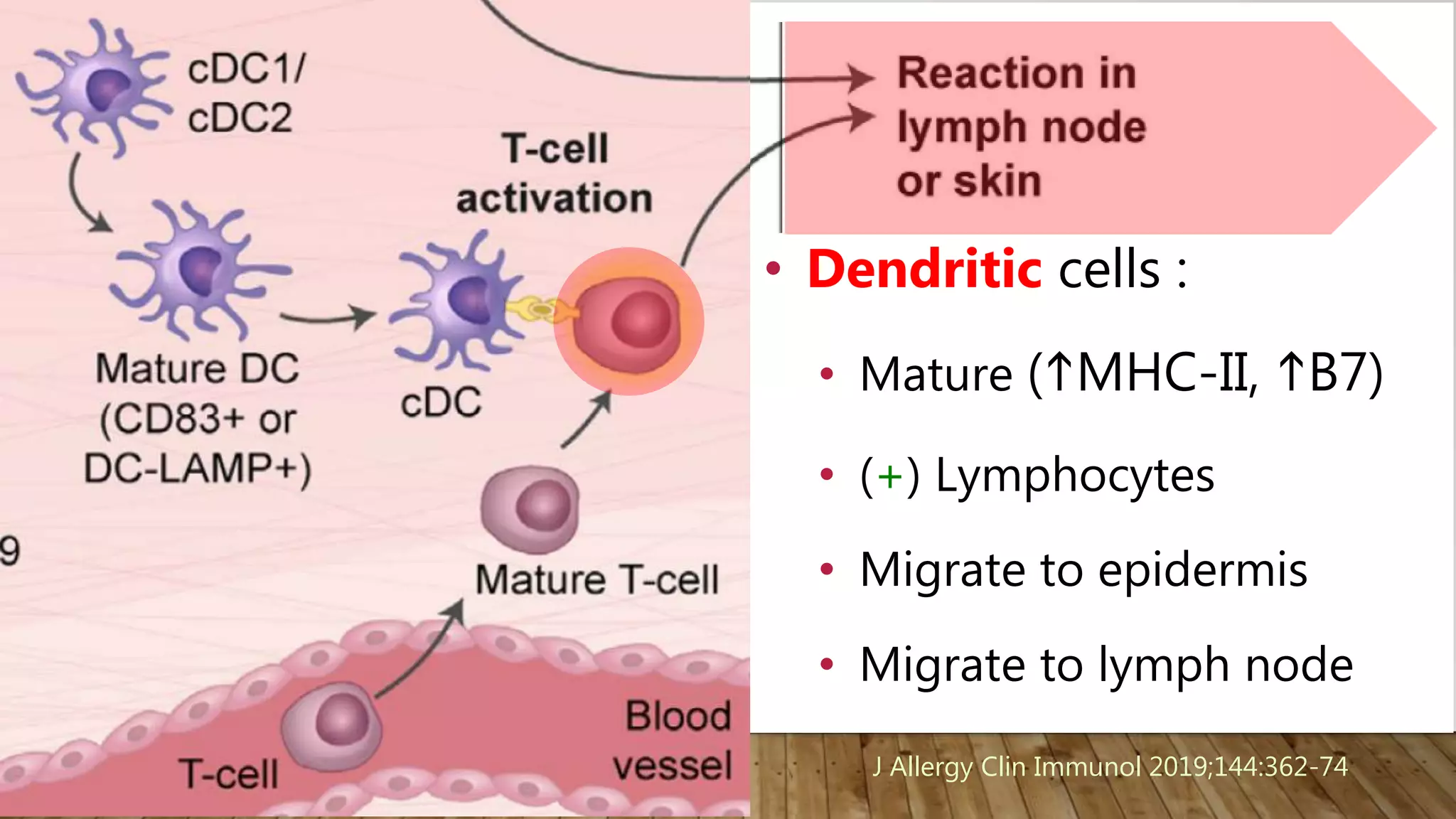
• Dendritic cells :
• Mature (hMHC-II, hB7)
• (+) Lymphocytes
• Migrate to epidermis
• Migrate to lymph node
J Allergy Clin Immunol 2019;144:362-74
•Effector T cells:
• Th1 g IFN-g
• Th2 g IL-4, 5, 13
• Th17 g IL-17, 26, 29
• Th22 g IL-22
J Allergy Clin Immunol 2019;144:362-74
• Macrophages:
• Inflammatory (M1)
• Granulocytes:
• Neutrophils
• Eosinophils
J Allergy Clin Immunol 2019;144:362-74
https://doi.org/10.1016/j.alit.2019.08.013
• Tolerogenic Dendritic
cells, Treg lymphocytes
Non AD
• Langerhan Cells, IDEC,
Th2 lymphocytes
Non lesional
• LC, Monocyte derived
LC, ILC2, IDEC, Th2
Acute lesion
• LC, MDLC, IDEC, ILC2,
Th2, Th1, Th17, Th22
Chronic lesion
Atopic dermatitis: cells &
biomolecules
IL-10, TGF-b, IL-35,
CTLA-4, PD-1
TARC: CCL17, CCL22,
Eotaxins, S100A7, 8, 9
TSLP, IL-25, IL-33, IL-4,
IL-13, IgE, IL-5, IL-31
IFN-g, FAS-L, TNF-a,
IL-17, IL-22
https://doi.org/10.1016/j.alit.2019.08.013
J Allergy Clin Immunol 2019;143:1-11
Atopic dermatitis:
endotypes
Phenotype
Endotype
J Allergy Clin Immunol 2019;143:1-11
e.g. : Allergic
e.g. : IgE
disease’s
visible features
molecular
mechanisms
Acute
• New onset
• < 72 hours
• Erythematous
• Wet
• Highly inflammatory
Chronic
• Relapsing
• > 72 hours
• Lichenified
• Dry, thick
• Hyperpigmented
J Allergy Clin Immunol 2019;143:1-11
Different clinical presentation
Atopic dermatitis:
classification
Atopic dermatitis:
classification
Nonlesional Acute Chronic
Antimicrobial peptides
(S100A7, S100A8, S100A9)
-- hhh h
Proliferation, hyperplasia
(Keratin 16 mRNA, Ki67)
-- h hhh
Th2 markers h hhh hhhhh
Th22 markers -- hhh hhhhh
Th17 markers -- h hhh
Th1 markers -- h hhhh
J Allergy Clin Immunol 2019;143:1-11
Different skin profile
Extrinsic
• Frequency: 80%
• High total IgE
• (+) Specific IgE
• Eosinophilia
• Atopic background
• > rate filaggrin mutation
Intrinsic
• Frequency: 20%
• Normal IgE
• Delayed onseat
• Female predominance
• Increased metal
contact sensitization
J Allergy Clin Immunol 2019;143:1-11
Similar clinical presentation
Atopic dermatitis:
classification
Extrinsic
• Th2 markers correlate
positively with
disease severity and
negatively with barrier
products (loricrin,
periplakin, and
filaggrin)
Intrinsic
• Th1/interferon-related
gene expression and
levels of the Th17
chemokine CCL20
correlate with disease
severity
J Allergy Clin Immunol 2019;143:1-11
Similar clinical presentation
Atopic dermatitis:
classification
J Allergy Clin Immunol 2019;143:1-11
Atopic dermatitis: endotypes
Greater expression of:
• Th2 hhh
• Th22 hhh
• Th1 hh
Decreased expression of:
• FLG iii
• LOR iii
• PPL ii
Greater expression of:
• Th22 hhhh
• Th17 hhh
• Th2 hh
• hh epidermal
hyperplasia and hh
parakeratosis
• Relatively preserved
barrier proteins LOR/FLG
Greater expression of:
• Th22 hhhh
• Th2 hhh
• Th1/Th17 = absent
• Lichenified phenotype
• FLG mutations = rare
• h IL-22 g proliferation
(barrier abnormalities)
Latin America
•Amerindians, Asians, Africans,
Atopic dermatitis: children g
adult
• face, trunk, and extensor
limb inflammatory
involvement
• lichenified, chronic, dry,
and flexural distribution
J Allergy Clin Immunol 2019;143:1-11
• hhh Th2 / Th22
• h barrier defect
• h sensitization
• hhh Th1 / Th17
• i barrier defect
J Allergy Clin Immunol 2019;143:1-11
• i
sensitization
Atopic dermatitis: children g
adult
J Allergy Clin Immunol 2019;143:1-11
Atopic dermatitis:
endotypes
• Pediatric atopic dermatitis:
• 85% AD cases begin before age of 5 years
• Increased Th2
IL-9, IL-13, OX40L, IgE, FceRI
• Increased Th17/22
IL-17A, IL-12/23p40, CCL20, IL-
19, IL-22, LL37, S100A7
• Resemblance to psoriasis
J Allergy Clin Immunol 2019;143:1-11
Atopic dermatitis:
endotypes
• Psoriasis:
• Increased expression:
• Th17/22, IL-23, Th1
• Epidermal hyperplasia
• Parakeratosis
• strong genetic predisposition
• autoimmune pathogenic trait
Atopic dermatitis: summary
TSLP, IL-25, IL-33
Alarmins g Th2
polarization
IL-4, IL-5, IL-13
Th2 g h IgE, i FLG, h Eos
IL-9
MC, Bas g h FceR, h
Histam
CRTH2
PGD2 g h Th2, ILC2, Eos,
Ba
Histam, IL-31, NK
Sensory neuron g h
Pruritus
OX40, JAK, PDE4
Activation g Th2
polarization
IL-12, IL-23
Th17 polarization
IL-17, IL-22
Epidermal
hyperplasia
IFNg, TNFa
Eczema, spongiosis
Atopic dermatitis: bio-
targets
IL-4
IL-13
IL-5
CRTH2
TSLP
OX40
IgEJAK
PDE4
IL-
12/23
IL-31
IL-22
IL-17
Dupilumab Pitakinra
Lebrikizuma
b
Tralokinuma
b
Mepolizuma
b
Reslizuma
bBenralizuma
b
Fevipiprant
OC000459
Tezepeluma
b MK-8226
GBR830
KHK4083
Omalizumab QGE031TofacitinibBaricitini
b
ASN002
CrisaboroleRoflumilast
Apremilast
Ustekinumab
Nemolizuma
b
BMS-981164
Fezakinumab
Secukinumab
MOR106
J Allergy Clin Immunol 2019;143:1-11
Atopic dermatitis: bio-
targets
JAllergyClinImmunol2019;143:1-11
Atopic dermatitis: bio-
targets
JAllergyClinImmunol2019;143:1-11
Atopic dermatitis: bio-
targets
JAllergyClinImmunol2019;143:1-11
Atopic dermatitis: bio-
targets
JAllergyClinImmunol2019;143:1-11
Atopic dermatitis: bio-
targets
JAllergyClinImmunol2019;143:1-11
Atopic dermatitis: bio-
targets
JAllergyClinImmunol2019;143:1-11
Atopic dermatitis:
conclusions• Heterogenous inflammatory skin disease
• Different phenotypes based on:
• age, chronicity, ethnicity, FLG and immune
status
• Underlying molecular mechanisms (endotypes) g
personalized medicine
Atopic dermatitis: questions
• Endotypes related to microbiome?
• Endotypes related to specific allergens?
• Endotypes related to autoantigens?
• Different cytokine networks in AD types?
https://www.worldallergy.org
drortegamartell@prodigy.net.mx
Thank you
Merci
Gracias

Atopic dermatitis cytokines and inflammation. Prof. Dr. Ortega Martell