THIS IS A PRESENTATION BASED ON ATMOSPHERE AND ITS REGIONS
Submitted by
 Student Name: Sudipto Kumar Biswas
 Faculty: Science
 Dept: Chemistry
 ID:1708012
 HSTU
Submitted to
 Md. Rezaul Karim Sir
 Lecturer of Dept of Chemistry
 Faculty: Science
 HSTU
REGIONS OF ATMOSPHERE
WHAT IS ATMOSPHERE ?
Atmosphere is the layer of gases that surrounds a planet or celestial body.
On the Earth atmosphere helps to regulate temperature, protects us from harmful radiation and provides the air we
breathe. The composition and properties of the atmosphere can vary depending on factors such as altitude, location and
weather conditions.The atmosphere is made up of several layers each with its own unique characteristics. This can lead to
changes in weather patterns, rising sea levels and other environmental impacts.
The atmosphere is divided into five different layers each with its own unique characteristics and properties. These layers
are the
 Troposphere
 Stratosphere
 Mesosphere
 Thermosphere
 Exosphere
TROPOSPHERE
What is the tropospher?
 The troposphere is the lowest layer of Earth's atmosphere. Most of the mass (about 75-80%) of the atmosphere is in the
troposphere. Most types of clouds are found in the troposphere and almost all weather occurs within this layer.
Composition
 In the Earth’s planetary atmosphere, a volume of dry air is composed of 78.08% nitrogen, 20.95% oxygen, 0.93% argon, 0.04%
carbon dioxide, trace gases, and variable amounts of water vapor.
Temperature
 The planatory surface of the Earth heats the troposphere by means of latent heat, thermal radiation, and sensible heat. At the
middle latitudes, tropospheric temperatures decrease from an average temperature of 15°C (59°F) at sea level to
approximately -55°C (-67°F) at the tropopause. At the equator, the tropospheric temperatures decrease from an average
temperature of 20°C (68°F) at sea level to approximately -70°C to -75°C (-94 to -103°F) at the tropopause. At the
geographical poles, the Arctic and the Antarctic regions, the tropospheric temperature decreases from an average temperature
of 0°C (32°F) at sea level to approximately -45°C (-45F) at the tropopause.
Pressure
The maximum air pressure is at sea level and decreases at high altitude.
Humidity
If the air contains water vapor, then cooling of the air can cause the water to condense and the air no longer functions as an
ideal gas. In the troposphere, the average environmental lapse rate is a decrease of about 6.5°C for every 1.0 km (1,000m)
of increased altitude.
Altitude
The temperature of the troposphere decreases with increased altitude. The rate of decrease in air temperature is measured
with the Environmental Lapse Rate (-dT/dz-dT/dz) which is the numeric difference between the temperature of the planetary
surface and the temperature of the tropopause divided by the altitude.
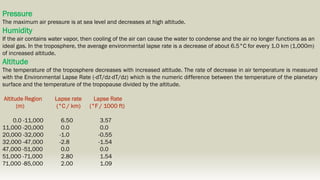
Altitude Region Lapse rate Lapse Rate
(m) (°C / km) (°F / 1000 ft)
0.0 -11,000 6.50 3.57
11,000 -20,000 0.0 0.0
20,000 -32,000 -1.0 -0.55
32,000 -47,000 -2.8 -1.54
47,000 -51,000 0.0 0.0
51,000 -71,000 2.80 1.54
71,000 -85,000 2.00 1.09
Compression and expansion
A parcel of air rises and expands because of the lower atmospheric pressure at high altitudes. The expansion of the air
parcel pushes outwards against the surrounding air and transfers energy from the parcel of air to the atmosphere.
Transferring energy to a parcel of air by way of heat is a slow and inefficient exchange of energy with the environment which
is an adiabatic process (no energy transfer by way of heat). As the rising parcel of air loses energy while it acts upon the
surrounding atmosphere, no heat energy is transferred from the atmosphere to the air parcel to compensate for the heat
loss. The parcel of air loses energy as it reaches greater altitude, which is manifested as a decrease in the temperature of
the air mass. Analogously, the reverse process occurs within a cold parcel of air that is being compressed and is sinking to
the planetary surface.
Environment
The environmental lapse rate ( dT / d z dT/dz) at which temperature decreases with altitude usually is unequal to the
adiabatic lapse rate ( d S / d z ≠ 0 dS/dzneq 0). If the upper air is warmer than predicted by the adiabatic lapse rate ( d S
/ d z > 0 dS/dz>0) then a rising and expanding parcel of air will arrive at the new altitude at a lower temperature than the
surrounding air. In which case the air parcel is denser than the surrounding air and so falls back to its original altitude as
an air mass that is stable against being lifted. If the upper air is cooler than predicted by the adiabatic lapse rate. When the
air parcel rises to a new altitude, the air mass will have a higher temperature and a lower density than the surrounding air
and will continue to accelerate and rise.
Atmospheric flow
The general flow of the atmosphere is from west to east which however can be interrupted by polar flows either north-to-
south flow or a south-to-north flow which meteorology describes as a zonal flow and as a meridional flow.
Three Cell Model
The three-cell model of the atmosphere of the Earth describes the actual flow of the atmosphere with the tropical-latitude
Hadley cell, the mid-latitude Ferrel cell and the polar cell to describe the flow of energy and the circulation of the planetary
atmosphere.
Zonal flow
A zonal flow regime is the meteorological term meaning that the general flow pattern is west to east along the Earth's
latitude lines with weak short waves embedded in the flow.[9]
Meridional flow
When the zonal flow buckles, the atmosphere can flow in a more longitudinal (or meridional) direction, and thus the term
"meridional flow" arises. Meridional flow patterns feature strong, amplified troughs of low pressure and ridges of high
pressure, with more north–south flow in the general pattern than west-to-east flow.
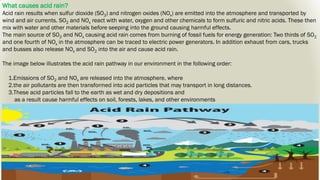
What causes acid rain?
Acid rain results when sulfur dioxide (SO2) and nitrogen oxides (NOx) are emitted into the atmosphere and transported by
wind and air currents. SO2 and NOx react with water, oxygen and other chemicals to form sulfuric and nitric acids. These then
mix with water and other materials before seeping into the ground causing harmful effects.
The main source of SO2 and NOx causing acid rain comes from burning of fossil fuels for energy generation: Two thirds of SO2
and one fourth of NOx in the atmosphere can be traced to electric power generators. In addition exhaust from cars, trucks
and busses also release NOx and SO2 into the air and cause acid rain.
The image below illustrates the acid rain pathway in our environment in the following order:
1.Emissions of SO2 and NOx are released into the atmosphere, where
2.the air pollutants are then transformed into acid particles that may transport in long distances.
3.These acid particles fall to the earth as wet and dry depositions and
as a result cause harmful effects on soil, forests, lakes, and other environments
Stratosphere
Definition and Characteristics
The stratosphere is the second most layer of the atmosphere spreading up to the height of about 50 km from the surface of
the earth and is ideal for flying aircraft.
Characteristics of Stratosphere
1.Height
It extends up to a height of 10 to 50 km. From the earth’s surface. The average height is however 40 km. At the poles, the
stratosphere starts at about 8 km. So it is nearest to the poles.
2. Temperature Inversion
The lower layers of the stratosphere are colder & as we move upwards, the upper layers become hotter. This is different from
troposphere & other layers of the atmosphere, where the temperature falls with the increase in height. This fall in
temperature in the stratosphere, as we move upwards is temperature inversion.
3. Calm & stable layer
The stratosphere is a very calm & stable layer unlike the troposphere which is a turbulent layer. This layer is calm and stable
because of the absence of any vertical air currents. The reason for this is that the vertical air current flows from the warmer
(lower ) layer to the colder (upper) layer
4. Suitable for flying aircraft
The stratosphere is free from any weather disturbance like a thunderstorm, clouds, turbulence, etc. This layer is suitable for
flying jet aircraft.
5. The flow of jet streams
However, this layer is characterized by the flow of horizontal air currents called jet streams. These jet streams are fast-flowing
streams of current flowing from west to east direction.
6. Region of ozone formation
Stratosphere is the region where about 90 % of ozone is formed. Ozone (chemical formula: O3 ) is a gas that is formed by the
action of the sun’s rays on oxygen present in the stratosphere.
Thus, we can conclude that stratosphere the second most layer is very important for the survival of humans and also it is
important for the jet aircrafts.
OZONE;
It is a type of gaseous compound. It is made from the combination of three oxygen atoms. Therefore, the chemical formula of
this compound is O3.
Formation of Ozone
The formation of O3 is a two-step reaction. In the first step, the oxygen molecule is broken down into oxygen atoms with the
help of sunlight. In the second step, the collision of oxygen atoms with another oxygen atom leads to the formation of ozone.
We can also produce ozone artificially with the help of oxygen molecules in the laboratory. The principle is similar to natural
process. However, voltage electric current is applied in place of sunlight. Ozone formation takes place by placing dry oxygen
in ozonizer and passing it through high voltage electric current by silent electric discharge. The electricity will transform the
oxygen molecule into ozone.
3O2 + energy = 2O3
Importance of ozone shild
The stratosphere of the earth’s atmosphere contains a significant amount of O3. Thus, this gaseous compound protects
living organisms including humans from the harmful UV radiations (λ = 255 nm). Excessive exposure to the UV radiation for a
longer period of time can cause melanoma or skin cancer in humans.
Furthermore, it can cause many other forms of cancer and other diseases. Overall excessive UV radiation is a threat to any
living organism. Hence, it is essential to maintain and protect the ozone layer.
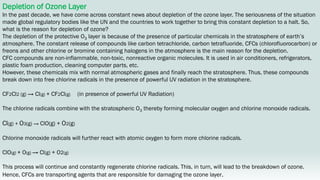
Depletion of Ozone Layer
In the past decade, we have come across constant news about depletion of the ozone layer. The seriousness of the situation
made global regulatory bodies like the UN and the countries to work together to bring this constant depletion to a halt. So,
what is the reason for depletion of ozone?
The depletion of the protective O3 layer is because of the presence of particular chemicals in the stratosphere of earth’s
atmosphere. The constant release of compounds like carbon tetrachloride, carbon tetrafluoride, CFCs (chlorofluorocarbon) or
freons and other chlorine or bromine containing halogens in the atmosphere is the main reason for the depletion.
CFC compounds are non-inflammable, non-toxic, nonreactive organic molecules. It is used in air conditioners, refrigerators,
plastic foam production, cleaning computer parts, etc.
However, these chemicals mix with normal atmospheric gases and finally reach the stratosphere. Thus, these compounds
break down into free chlorine radicals in the presence of powerful UV radiation in the stratosphere.
CF2Cl2 (g) → Cl(g) + CF2Cl(g) (in presence of powerful UV Radiation)
The chlorine radicals combine with the stratospheric O3 thereby forming molecular oxygen and chlorine monoxide radicals.
Cl(g) + O3(g) → ClO(g) + O2(g)
Chlorine monoxide radicals will further react with atomic oxygen to form more chlorine radicals.
ClO(g) + O(g) → Cl(g) + O2(g)
This process will continue and constantly regenerate chlorine radicals. This, in turn, will lead to the breakdown of ozone.
Hence, CFCs are transporting agents that are responsible for damaging the ozone layer.
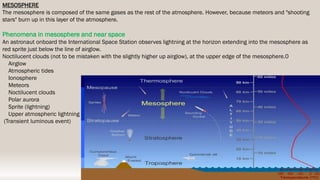
MESOSPHERE
The mesosphere is composed of the same gases as the rest of the atmosphere. However, because meteors and "shooting
stars" burn up in this layer of the atmosphere.
Phenomena in mesosphere and near space
An astronaut onboard the International Space Station observes lightning at the horizon extending into the mesosphere as
red sprite just below the line of airglow.
Noctilucent clouds (not to be mistaken with the slightly higher up airglow), at the upper edge of the mesosphere.0
Airglow
Atmospheric tides
Ionosphere
Meteors
Noctilucent clouds
Polar aurora
Sprite (lightning)
Upper atmospheric lightning
(Transient luminous event)
What does the mesosphere contain?
The mesosphere has the same composition as the other layers of Earth's atmosphere. The composition of the atmosphere is
generally 78% nitrogen (N), 21% oxygen (O), 0.93% argon (Ar), 0.04% carbon dioxide (CO_2), and 0.03% of trace gases.
However, the mesosphere also contains meteoric smoke particles (MSPs) consisting of compounds that contain metallic
elements such as the following:
Iron (Fe)
Magnesium (Mg)
Sodium (Na)
Calcium (Ca)
Potassium (K)
What are the main characteristics of the mesosphere?
The main characteristics of the mesosphere that differentiate it from other layers of Earth's atmosphere are the following:
The mesosphere is the coldest layer of Earth's atmosphere.
The mesosphere is the first line of defense from bodies entering the atmosphere; meteors begin to burn up upon entering
the mesosphere.
Noctilucent clouds form high up in the mesosphere and are only visible at twilight.
Why is the mesosphere cold?
The mesosphere decreases in temperature with altitude. The mesosphere ranges in temperatures from -2.5 to -90 degrees
Celsius. The reason the temperature decreases with altitude is because the Earth's surface is a source of heat, heat from its
geothermal gradient and absorbed solar radiation that is reemitted. An increase in distance from Earth's heat decreases the
temperature.
THERMOSPHERE
The thermosphere is the layer in the Earth's atmosphere directly above the mesosphere and below the exosphere. Within
this layer of the atmosphere, ultraviolet radiation causes photoionization/photodissociation of molecules, creating ions.
Thermosphere thus constitutes the larger part of the ionosphere. Thermospheric temperatures increase with altitude due to
absorption of highly energetic solar radiation. Temperatures are highly dependent on solar activity and can rise to 2,000 °C
(3,630 °F) or more. Radiation causes the atmospheric particles in this layer to become electrically charged, enabling radio
waves to be refracted and thus be received beyond the horizon. The border between the thermosphere and exosphere is
known as the thermopause.
The dynamics of the thermosphere are dominated by atmospheric tides which are driven predominantly by diurnal heating.
Atmospheric waves dissipate above this level because of collisions between the neutral gas and the ionospheric plasma.
Solar XUV radiation
The solar X-ray and extreme ultraviolet radiation (XUV) at wavelengths < 170 nm is almost completely absorbed within the
thermosphere. This radiation causes the various ionospheric layers as well as a temperature increase at these heights.
The solar XUV radiation is highly variable in time and space. In the extreme ultraviolet, the Lyman α line at 121.6 nm
represents an important source of ionization and dissociation at ionospheric D layer heights. During quiet periods of solar
activity, it alone contains more energy than the rest of the XUV spectrum. Quasi-periodic changes of the order of 100% or
greater, with periods of 27 days and 11 years, belong to the prominent variations of solar XUV radiation. However, irregular
fluctuations over all time scales are present all the time. During the low solar activity, about half of the total energy input
into the thermosphere is thought to be solar XUV radiation. That solar XUV energy input occurs only during daytime
conditions, maximizing at the equator during equinox.
Solar wind
The second source of energy input into the thermosphere is solar wind energy which is transferred to the magnetosphere by
mechanisms that are not well understood. One possible way to transfer energy is via a hydrodynamic dynamo process. Solar
wind particles penetrate the polar regions of the magnetosphere where the geomagnetic field lines are essentially vertically
directed. An electric field is generated directed from dawn to dusk. Along the last closed geomagnetic field lines with their
footpoints within the auroral zones, field-aligned electric currents can flow into the ionospheric dynamo region where they
are closed by electric Pedersen and Hall currents. Ohmic losses of the Pedersen currents heat the lower thermosphere .Also
penetration of high energetic particles from the magnetosphere into the auroral regions enhance drastically the electric
conductivity, further increasing the electric currents and thus Joule heating. During the very large activity, however, this heat
input can increase substantially, by a factor of four or more. That solar wind input occurs mainly in the auroral regions during
both day and night.
EXOSPHERE
The exosphere is a thin, atmosphere-like volume surrounding a planet or natural satellite where molecules are gravitationally
bound to that body but where the density is so low that the molecules are essentially collision-less.The Earth's exosphere is
mostly hydrogen and helium, with some heavier atoms and molecules near the base.
Surface boundary exosphere
Mercury, Ceres and several large natural satellites, such as the Moon, Europa, and Ganymede, have exospheres without a
denser atmosphere underneath,[3] referred to as a surface boundary exosphere.[4] Here, molecules are ejected on elliptic
trajectories until they collide with the surface. Smaller bodies such as asteroids, in which the molecules emitted from the
surface escape to space, are not considered to have exospheres.
Earth's exosphere
The most common molecules within Earth's exosphere are those of the lightest atmospheric gases. Hydrogen is present
throughout the exosphere with some helium, carbon dioxide, and atomic oxygen near its base.
Upper boundary
In principle, the exosphere covers distances where particles are still gravitationally bound to Earth, i.e. particles still have
ballistic orbits that will take them back towards Earth. The upper boundary of the exosphere can be defined as the distance
at which the influence of solar radiation pressure on atomic hydrogen exceeds that of Earth's gravitational pull. This happens
at half the distance to the Moon or somewhere in the neighborhood of 200,000 kilometres (120,000 mi). The exosphere,
observable from space as the geocorona, is seen to extend to at least 100,000 kilometres (62,000 mi) from Earth's
surface.[7] Other scientists consider the exosphere to end at around 10,000 kilometres (6,200 mi).[8
SOME QUESTIOS RELATED THIS TOPIC
 What atmosphere is all about?
 Discuss these terms 1. three cell model, 2.zonal flow, 3.meridional flow
 What is acid rain and how does it occurs discuss in short.
 What is ozone layer? Why it so important?
 Dicuss the formation of ozone layer and its depletion?
 Why mesosphere is cold and discuss its constituents(molecules) .
 Discuss these terms------ 1. solar wind 2.thermospheric strom 3.solar XUV radiation
 What is surface boundary exposure? And critical altitude?
THANK YOU

Atmosphere and It's characteristics. Pdf

  • 1.
    THIS IS APRESENTATION BASED ON ATMOSPHERE AND ITS REGIONS Submitted by  Student Name: Sudipto Kumar Biswas  Faculty: Science  Dept: Chemistry  ID:1708012  HSTU Submitted to  Md. Rezaul Karim Sir  Lecturer of Dept of Chemistry  Faculty: Science  HSTU
  • 2.
    REGIONS OF ATMOSPHERE WHATIS ATMOSPHERE ? Atmosphere is the layer of gases that surrounds a planet or celestial body. On the Earth atmosphere helps to regulate temperature, protects us from harmful radiation and provides the air we breathe. The composition and properties of the atmosphere can vary depending on factors such as altitude, location and weather conditions.The atmosphere is made up of several layers each with its own unique characteristics. This can lead to changes in weather patterns, rising sea levels and other environmental impacts. The atmosphere is divided into five different layers each with its own unique characteristics and properties. These layers are the  Troposphere  Stratosphere  Mesosphere  Thermosphere  Exosphere
  • 3.
    TROPOSPHERE What is thetropospher?  The troposphere is the lowest layer of Earth's atmosphere. Most of the mass (about 75-80%) of the atmosphere is in the troposphere. Most types of clouds are found in the troposphere and almost all weather occurs within this layer. Composition  In the Earth’s planetary atmosphere, a volume of dry air is composed of 78.08% nitrogen, 20.95% oxygen, 0.93% argon, 0.04% carbon dioxide, trace gases, and variable amounts of water vapor. Temperature  The planatory surface of the Earth heats the troposphere by means of latent heat, thermal radiation, and sensible heat. At the middle latitudes, tropospheric temperatures decrease from an average temperature of 15°C (59°F) at sea level to approximately -55°C (-67°F) at the tropopause. At the equator, the tropospheric temperatures decrease from an average temperature of 20°C (68°F) at sea level to approximately -70°C to -75°C (-94 to -103°F) at the tropopause. At the geographical poles, the Arctic and the Antarctic regions, the tropospheric temperature decreases from an average temperature of 0°C (32°F) at sea level to approximately -45°C (-45F) at the tropopause.
  • 4.
    Pressure The maximum airpressure is at sea level and decreases at high altitude. Humidity If the air contains water vapor, then cooling of the air can cause the water to condense and the air no longer functions as an ideal gas. In the troposphere, the average environmental lapse rate is a decrease of about 6.5°C for every 1.0 km (1,000m) of increased altitude. Altitude The temperature of the troposphere decreases with increased altitude. The rate of decrease in air temperature is measured with the Environmental Lapse Rate (-dT/dz-dT/dz) which is the numeric difference between the temperature of the planetary surface and the temperature of the tropopause divided by the altitude. Altitude Region Lapse rate Lapse Rate (m) (°C / km) (°F / 1000 ft) 0.0 -11,000 6.50 3.57 11,000 -20,000 0.0 0.0 20,000 -32,000 -1.0 -0.55 32,000 -47,000 -2.8 -1.54 47,000 -51,000 0.0 0.0 51,000 -71,000 2.80 1.54 71,000 -85,000 2.00 1.09
  • 5.
    Compression and expansion Aparcel of air rises and expands because of the lower atmospheric pressure at high altitudes. The expansion of the air parcel pushes outwards against the surrounding air and transfers energy from the parcel of air to the atmosphere. Transferring energy to a parcel of air by way of heat is a slow and inefficient exchange of energy with the environment which is an adiabatic process (no energy transfer by way of heat). As the rising parcel of air loses energy while it acts upon the surrounding atmosphere, no heat energy is transferred from the atmosphere to the air parcel to compensate for the heat loss. The parcel of air loses energy as it reaches greater altitude, which is manifested as a decrease in the temperature of the air mass. Analogously, the reverse process occurs within a cold parcel of air that is being compressed and is sinking to the planetary surface. Environment The environmental lapse rate ( dT / d z dT/dz) at which temperature decreases with altitude usually is unequal to the adiabatic lapse rate ( d S / d z ≠ 0 dS/dzneq 0). If the upper air is warmer than predicted by the adiabatic lapse rate ( d S / d z > 0 dS/dz>0) then a rising and expanding parcel of air will arrive at the new altitude at a lower temperature than the surrounding air. In which case the air parcel is denser than the surrounding air and so falls back to its original altitude as an air mass that is stable against being lifted. If the upper air is cooler than predicted by the adiabatic lapse rate. When the air parcel rises to a new altitude, the air mass will have a higher temperature and a lower density than the surrounding air and will continue to accelerate and rise.
  • 6.
    Atmospheric flow The generalflow of the atmosphere is from west to east which however can be interrupted by polar flows either north-to- south flow or a south-to-north flow which meteorology describes as a zonal flow and as a meridional flow. Three Cell Model The three-cell model of the atmosphere of the Earth describes the actual flow of the atmosphere with the tropical-latitude Hadley cell, the mid-latitude Ferrel cell and the polar cell to describe the flow of energy and the circulation of the planetary atmosphere. Zonal flow A zonal flow regime is the meteorological term meaning that the general flow pattern is west to east along the Earth's latitude lines with weak short waves embedded in the flow.[9] Meridional flow When the zonal flow buckles, the atmosphere can flow in a more longitudinal (or meridional) direction, and thus the term "meridional flow" arises. Meridional flow patterns feature strong, amplified troughs of low pressure and ridges of high pressure, with more north–south flow in the general pattern than west-to-east flow.
  • 7.
    What causes acidrain? Acid rain results when sulfur dioxide (SO2) and nitrogen oxides (NOx) are emitted into the atmosphere and transported by wind and air currents. SO2 and NOx react with water, oxygen and other chemicals to form sulfuric and nitric acids. These then mix with water and other materials before seeping into the ground causing harmful effects. The main source of SO2 and NOx causing acid rain comes from burning of fossil fuels for energy generation: Two thirds of SO2 and one fourth of NOx in the atmosphere can be traced to electric power generators. In addition exhaust from cars, trucks and busses also release NOx and SO2 into the air and cause acid rain. The image below illustrates the acid rain pathway in our environment in the following order: 1.Emissions of SO2 and NOx are released into the atmosphere, where 2.the air pollutants are then transformed into acid particles that may transport in long distances. 3.These acid particles fall to the earth as wet and dry depositions and as a result cause harmful effects on soil, forests, lakes, and other environments
  • 8.
    Stratosphere Definition and Characteristics Thestratosphere is the second most layer of the atmosphere spreading up to the height of about 50 km from the surface of the earth and is ideal for flying aircraft. Characteristics of Stratosphere 1.Height It extends up to a height of 10 to 50 km. From the earth’s surface. The average height is however 40 km. At the poles, the stratosphere starts at about 8 km. So it is nearest to the poles. 2. Temperature Inversion The lower layers of the stratosphere are colder & as we move upwards, the upper layers become hotter. This is different from troposphere & other layers of the atmosphere, where the temperature falls with the increase in height. This fall in temperature in the stratosphere, as we move upwards is temperature inversion.
  • 9.
    3. Calm &stable layer The stratosphere is a very calm & stable layer unlike the troposphere which is a turbulent layer. This layer is calm and stable because of the absence of any vertical air currents. The reason for this is that the vertical air current flows from the warmer (lower ) layer to the colder (upper) layer 4. Suitable for flying aircraft The stratosphere is free from any weather disturbance like a thunderstorm, clouds, turbulence, etc. This layer is suitable for flying jet aircraft. 5. The flow of jet streams However, this layer is characterized by the flow of horizontal air currents called jet streams. These jet streams are fast-flowing streams of current flowing from west to east direction. 6. Region of ozone formation Stratosphere is the region where about 90 % of ozone is formed. Ozone (chemical formula: O3 ) is a gas that is formed by the action of the sun’s rays on oxygen present in the stratosphere. Thus, we can conclude that stratosphere the second most layer is very important for the survival of humans and also it is important for the jet aircrafts.
  • 10.
    OZONE; It is atype of gaseous compound. It is made from the combination of three oxygen atoms. Therefore, the chemical formula of this compound is O3. Formation of Ozone The formation of O3 is a two-step reaction. In the first step, the oxygen molecule is broken down into oxygen atoms with the help of sunlight. In the second step, the collision of oxygen atoms with another oxygen atom leads to the formation of ozone. We can also produce ozone artificially with the help of oxygen molecules in the laboratory. The principle is similar to natural process. However, voltage electric current is applied in place of sunlight. Ozone formation takes place by placing dry oxygen in ozonizer and passing it through high voltage electric current by silent electric discharge. The electricity will transform the oxygen molecule into ozone. 3O2 + energy = 2O3 Importance of ozone shild The stratosphere of the earth’s atmosphere contains a significant amount of O3. Thus, this gaseous compound protects living organisms including humans from the harmful UV radiations (λ = 255 nm). Excessive exposure to the UV radiation for a longer period of time can cause melanoma or skin cancer in humans. Furthermore, it can cause many other forms of cancer and other diseases. Overall excessive UV radiation is a threat to any living organism. Hence, it is essential to maintain and protect the ozone layer.
  • 11.
    Depletion of OzoneLayer In the past decade, we have come across constant news about depletion of the ozone layer. The seriousness of the situation made global regulatory bodies like the UN and the countries to work together to bring this constant depletion to a halt. So, what is the reason for depletion of ozone? The depletion of the protective O3 layer is because of the presence of particular chemicals in the stratosphere of earth’s atmosphere. The constant release of compounds like carbon tetrachloride, carbon tetrafluoride, CFCs (chlorofluorocarbon) or freons and other chlorine or bromine containing halogens in the atmosphere is the main reason for the depletion. CFC compounds are non-inflammable, non-toxic, nonreactive organic molecules. It is used in air conditioners, refrigerators, plastic foam production, cleaning computer parts, etc. However, these chemicals mix with normal atmospheric gases and finally reach the stratosphere. Thus, these compounds break down into free chlorine radicals in the presence of powerful UV radiation in the stratosphere. CF2Cl2 (g) → Cl(g) + CF2Cl(g) (in presence of powerful UV Radiation) The chlorine radicals combine with the stratospheric O3 thereby forming molecular oxygen and chlorine monoxide radicals. Cl(g) + O3(g) → ClO(g) + O2(g) Chlorine monoxide radicals will further react with atomic oxygen to form more chlorine radicals. ClO(g) + O(g) → Cl(g) + O2(g) This process will continue and constantly regenerate chlorine radicals. This, in turn, will lead to the breakdown of ozone. Hence, CFCs are transporting agents that are responsible for damaging the ozone layer.
  • 12.
    MESOSPHERE The mesosphere iscomposed of the same gases as the rest of the atmosphere. However, because meteors and "shooting stars" burn up in this layer of the atmosphere. Phenomena in mesosphere and near space An astronaut onboard the International Space Station observes lightning at the horizon extending into the mesosphere as red sprite just below the line of airglow. Noctilucent clouds (not to be mistaken with the slightly higher up airglow), at the upper edge of the mesosphere.0 Airglow Atmospheric tides Ionosphere Meteors Noctilucent clouds Polar aurora Sprite (lightning) Upper atmospheric lightning (Transient luminous event)
  • 13.
    What does themesosphere contain? The mesosphere has the same composition as the other layers of Earth's atmosphere. The composition of the atmosphere is generally 78% nitrogen (N), 21% oxygen (O), 0.93% argon (Ar), 0.04% carbon dioxide (CO_2), and 0.03% of trace gases. However, the mesosphere also contains meteoric smoke particles (MSPs) consisting of compounds that contain metallic elements such as the following: Iron (Fe) Magnesium (Mg) Sodium (Na) Calcium (Ca) Potassium (K) What are the main characteristics of the mesosphere? The main characteristics of the mesosphere that differentiate it from other layers of Earth's atmosphere are the following: The mesosphere is the coldest layer of Earth's atmosphere. The mesosphere is the first line of defense from bodies entering the atmosphere; meteors begin to burn up upon entering the mesosphere. Noctilucent clouds form high up in the mesosphere and are only visible at twilight. Why is the mesosphere cold? The mesosphere decreases in temperature with altitude. The mesosphere ranges in temperatures from -2.5 to -90 degrees Celsius. The reason the temperature decreases with altitude is because the Earth's surface is a source of heat, heat from its geothermal gradient and absorbed solar radiation that is reemitted. An increase in distance from Earth's heat decreases the temperature.
  • 14.
    THERMOSPHERE The thermosphere isthe layer in the Earth's atmosphere directly above the mesosphere and below the exosphere. Within this layer of the atmosphere, ultraviolet radiation causes photoionization/photodissociation of molecules, creating ions. Thermosphere thus constitutes the larger part of the ionosphere. Thermospheric temperatures increase with altitude due to absorption of highly energetic solar radiation. Temperatures are highly dependent on solar activity and can rise to 2,000 °C (3,630 °F) or more. Radiation causes the atmospheric particles in this layer to become electrically charged, enabling radio waves to be refracted and thus be received beyond the horizon. The border between the thermosphere and exosphere is known as the thermopause. The dynamics of the thermosphere are dominated by atmospheric tides which are driven predominantly by diurnal heating. Atmospheric waves dissipate above this level because of collisions between the neutral gas and the ionospheric plasma. Solar XUV radiation The solar X-ray and extreme ultraviolet radiation (XUV) at wavelengths < 170 nm is almost completely absorbed within the thermosphere. This radiation causes the various ionospheric layers as well as a temperature increase at these heights. The solar XUV radiation is highly variable in time and space. In the extreme ultraviolet, the Lyman α line at 121.6 nm represents an important source of ionization and dissociation at ionospheric D layer heights. During quiet periods of solar activity, it alone contains more energy than the rest of the XUV spectrum. Quasi-periodic changes of the order of 100% or greater, with periods of 27 days and 11 years, belong to the prominent variations of solar XUV radiation. However, irregular fluctuations over all time scales are present all the time. During the low solar activity, about half of the total energy input into the thermosphere is thought to be solar XUV radiation. That solar XUV energy input occurs only during daytime conditions, maximizing at the equator during equinox.
  • 15.
    Solar wind The secondsource of energy input into the thermosphere is solar wind energy which is transferred to the magnetosphere by mechanisms that are not well understood. One possible way to transfer energy is via a hydrodynamic dynamo process. Solar wind particles penetrate the polar regions of the magnetosphere where the geomagnetic field lines are essentially vertically directed. An electric field is generated directed from dawn to dusk. Along the last closed geomagnetic field lines with their footpoints within the auroral zones, field-aligned electric currents can flow into the ionospheric dynamo region where they are closed by electric Pedersen and Hall currents. Ohmic losses of the Pedersen currents heat the lower thermosphere .Also penetration of high energetic particles from the magnetosphere into the auroral regions enhance drastically the electric conductivity, further increasing the electric currents and thus Joule heating. During the very large activity, however, this heat input can increase substantially, by a factor of four or more. That solar wind input occurs mainly in the auroral regions during both day and night.
  • 16.
    EXOSPHERE The exosphere isa thin, atmosphere-like volume surrounding a planet or natural satellite where molecules are gravitationally bound to that body but where the density is so low that the molecules are essentially collision-less.The Earth's exosphere is mostly hydrogen and helium, with some heavier atoms and molecules near the base. Surface boundary exosphere Mercury, Ceres and several large natural satellites, such as the Moon, Europa, and Ganymede, have exospheres without a denser atmosphere underneath,[3] referred to as a surface boundary exosphere.[4] Here, molecules are ejected on elliptic trajectories until they collide with the surface. Smaller bodies such as asteroids, in which the molecules emitted from the surface escape to space, are not considered to have exospheres. Earth's exosphere The most common molecules within Earth's exosphere are those of the lightest atmospheric gases. Hydrogen is present throughout the exosphere with some helium, carbon dioxide, and atomic oxygen near its base. Upper boundary In principle, the exosphere covers distances where particles are still gravitationally bound to Earth, i.e. particles still have ballistic orbits that will take them back towards Earth. The upper boundary of the exosphere can be defined as the distance at which the influence of solar radiation pressure on atomic hydrogen exceeds that of Earth's gravitational pull. This happens at half the distance to the Moon or somewhere in the neighborhood of 200,000 kilometres (120,000 mi). The exosphere, observable from space as the geocorona, is seen to extend to at least 100,000 kilometres (62,000 mi) from Earth's surface.[7] Other scientists consider the exosphere to end at around 10,000 kilometres (6,200 mi).[8
  • 17.
    SOME QUESTIOS RELATEDTHIS TOPIC  What atmosphere is all about?  Discuss these terms 1. three cell model, 2.zonal flow, 3.meridional flow  What is acid rain and how does it occurs discuss in short.  What is ozone layer? Why it so important?  Dicuss the formation of ozone layer and its depletion?  Why mesosphere is cold and discuss its constituents(molecules) .  Discuss these terms------ 1. solar wind 2.thermospheric strom 3.solar XUV radiation  What is surface boundary exposure? And critical altitude?
  • 18.