1Information presented was prepared by A.T. Kearney for the NRF conference; it should not be disseminated without written consent
Disruptive Value Chain
Integration in the Consumer
Retail Industry
Winning in the New Market Norm
April 2011
2Information presented was prepared by A.T. Kearney for the NRF conference; it should not be disseminated without written consent
Secular Commodity Scarcity:
‒ Double digit cost inflation
‒ Secular trend of demand
outpacing supply in oil and
petro-based materials
Globalized Competition:
‒ Accelerated pressure from
emerging global competitors in
NA market
Post-Recession Consciousness:
Limited ability to raise prices,
even for brand leaders
Trading down and waiting
for sales
Pay premium for true
innovation
Changing Demographics:
Aging Boomer trends – convenient
retailing and “age friendly”
products
• Increasing retail localization due
to changing ethno-graphics
5-10Years
Emerging market trends will change the NA consumer
product and retail industry
Source: Morningstar; Reuters; US census; A.T. Kearney analysis;
Consumer Trends Macro Global Trends
3-5Years
3Information presented was prepared by A.T. Kearney for the NRF conference; it should not be disseminated without written consent
We are entering a new norm of accelerating complexity and
increasing consumer needs
• Increased Input
Materials Cost
Volatility
• Increased Demand
for Differentiated
Products & Services
• Increased Retail
Format Complexity
The New
Market Norm
Post-Recession Consciousness
Changing Demographics
Commodity Markets Scarcity
Globalized Competitor Entry
Trends
4Information presented was prepared by A.T. Kearney for the NRF conference; it should not be disseminated without written consent
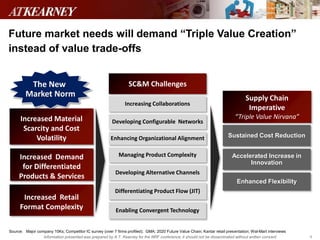
Future market needs will demand “Triple Value Creation”
instead of value trade-offs
SC&M Challenges
Supply Chain
Imperative
“Triple Value Nirvana”
Increasing Collaborations
Developing Configurable Networks
Managing Product Complexity
Enabling Convergent Technology
Enhancing Organizational Alignment
Source: Major company 10Ks; Competitor IC survey (over 7 firms profiled); GMA; 2020 Future Value Chain; Kantar retail presentation; Wal-Mart interviews
Accelerated Increase in
Innovation
Enhanced Flexibility
Sustained Cost Reduction
Developing Alternative Channels
Differentiating Product Flow (JIT)
Increased Material
Scarcity and Cost
Volatility
Increased Retail
Format Complexity
Increased Demand
for Differentiated
Products & Services
The New
Market Norm
5Information presented was prepared by A.T. Kearney for the NRF conference; it should not be disseminated without written consent
Despite broad
SC&M investments…
…Performance gaps exist
in today’s SC&M networks
Traditional SC&M tactics and levers will not be adequate to
deliver the triple value nirvana
• >90% of all CPG new
product launches defined
as incremental(3)
Source: (1) The State of the Retail SC – RILA, 2010; (2) GMA Manuf. Excellence Share Group Meeting 2010;
(3) ProductScan (4) A.T. Kearney client interviews
What do manufacturers and retailers need to do to
perform and win in the future?
Accelerated
Innovation
Sustained
Cost
Reduction
• Lack of flexible
manufacturing assets a
key barrier to NPD(4)
• >65% expect an increase
in product variations
• >50% of CPG identified
SC cost inefficiency as a
major gap
Enhanced
Flexibility
• 69% of SC executives surveyed focusing on
Inventory and S&OP optimization
• 69% indicated that improving delivery
performance was a focus area in 2010-11
• 63% reported investing in improving order
fulfillment performance vs. cost tradeoff
• 55% will continue to pursue global
manufacturing and outsourcing strategies
6Information presented was prepared by A.T. Kearney for the NRF conference; it should not be disseminated without written consent
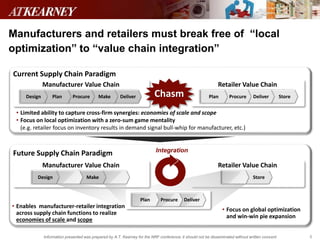
Manufacturers and retailers must break free of “local
optimization” to “value chain integration”
Manufacturer Value Chain Retailer Value Chain
Chasm
Current Supply Chain Paradigm
Integration
Future Supply Chain Paradigm
DeliverMakeProcurePlanDesign StoreDeliverProcurePlan
• Limited ability to capture cross-firm synergies: economies of scale and scope
• Focus on local optimization with a zero-sum game mentality
(e.g. retailer focus on inventory results in demand signal bull-whip for manufacturer, etc.)
Manufacturer Value Chain Retailer Value Chain
MakeDesign Store
DeliverProcurePlan
• Enables manufacturer-retailer integration
across supply chain functions to realize
economies of scale and scope
• Focus on global optimization
and win-win pie expansion
7Information presented was prepared by A.T. Kearney for the NRF conference; it should not be disseminated without written consent
Sector leaders have started pursuing value chain
collaboration, few have achieved broad integration
Integration Enabled Synergy Levers
Economies
of Scale
Economies
of Scope
Technology
Enablement
• Cross-firm
pooled
commodity
sourcing (e.g. PET,
cocoa, freight, etc.)
• Capacity pooling
and asset sharing
• Volume pooling with
contract
manufacturers
• Collaborative
logistics – Share
DC capacity
• Re-shape industry
structure
• Joint
forecasting
and planning
• Best of breed
shared services
(e.g. commodity
risk management)
• Harmonize
packaging/
product forms
across brands
• Direct to store
or customer
delivery
• Cross-firm slow
movers break-pack
pooling
• Social media
& community
forum tools to enable
Consumer led innovation
• Global
procurement
platform
• Joint investment
in next-
generation
manufacturing
assets
• RFID and
real-time
synchronization to
enable case-level
tagging at store
DeliverMakeProcurePlan
• Advising a leading retailer
and CPG on a business
model for joint demand
forecasting and planning
to streamline inventory
and logistics efficiency
• Working with 3PL to
design “plug & play”
warehouses that
eliminate a layer
in traditional
manufacturer and
retailer network
• Establishing a op-
model for joint
commodity
directed buy
across several
manufacturers
8Information presented was prepared by A.T. Kearney for the NRF conference; it should not be disseminated without written consent
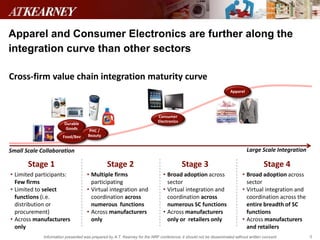
Apparel and Consumer Electronics are further along the
integration curve than other sectors
Stage 1 Stage 2 Stage 3 Stage 4
• Limited participants:
Few firms
• Limited to select
functions (i.e.
distribution or
procurement)
• Across manufacturers
only
Consumer
Electronics
Food/Bev
Durable
Goods
Cross-firm value chain integration maturity curve
• Broad adoption across
sector
• Virtual integration and
coordination across the
entire breadth of SC
functions
• Across manufacturers
and retailers
• Broad adoption across
sector
• Virtual integration and
coordination across
numerous SC functions
• Across manufacturers
only or retailers only
• Multiple firms
participating
• Virtual integration and
coordination across
numerous functions
• Across manufacturers
only
Small Scale Collaboration Large Scale Integration
PHC /
Beauty
Apparel
9Information presented was prepared by A.T. Kearney for the NRF conference; it should not be disseminated without written consent
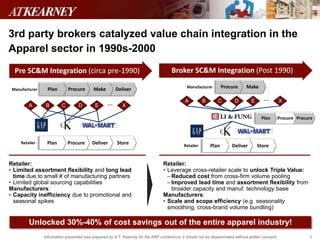
Unlocked 30%-40% of cost savings out of the entire apparel industry!
3rd party brokers catalyzed value chain integration in the
Apparel sector in 1990s-2000
Pre SC&M Integration (circa pre-1990) Broker SC&M Integration (Post 1990)
Manufacturer
Retailer
Retailer:
• Limited assortment flexibility and long lead
time due to small # of manufacturing partners
• Limited global sourcing capabilities
Manufacturers:
• Capacity inefficiency due to promotional and
seasonal spikes
Retailer:
• Leverage cross-retailer scale to unlock Triple Value:
‒Reduced cost from cross-firm volume pooling
‒Improved lead time and assortment flexibility from
broader capacity and manuf. technology base
Manufacturers:
• Scale and scope efficiency (e.g. seasonality
smoothing, cross-brand volume bundling)
A B C D E X…
DeliverMakeProcurePlan
StoreDeliverProcurePlan
Manufacturer
Retailer
A B C D E X…
MakeProcure
StoreDeliverPlan
ProcureProcurePlan
10Information presented was prepared by A.T. Kearney for the NRF conference; it should not be disseminated without written consent
Moving from Stage 1 to Stage 4 for the NA FMCG industry
can unlock ~500B(1)
Source: (1) Frost & Sullivan; EIU; First Research; A.T. Kearney dry ambient goods distribution benchmarking; A.T. Kearney analysis
Note: We define FMCG as the Packaged Food & Beverage, Personal & Household Products and Beauty sectors
Savings Benefit from Value Chain Integration ($B)
~$35-40
$420-500
11Information presented was prepared by A.T. Kearney for the NRF conference; it should not be disseminated without written consent
We see two potential models for integration in the
consumer product space
Open Broker Model Vertical Alliance Model
• Multi non-competing firms alliance
• Participants need to gain membership
• Industry shared platform
• Participants opt-in via “plug & play”
• Participants benefit from industry level
economies of scale
• 3rd party dedicated focus
Benefit Drivers
• Functional scope and scale benefits as
participants can collaborate and seek
cross-brand / category synergies
• Closed – alliance members only
Mode of
Participation
• Open standard platform
Orchestration • 3rd party broker • A governing unit composed of
network members
Value Sharing • Value split amongst “customers” and
broker based on free market dynamics
• Value split amongst participants based
on benefit contribution to the alliance
Organizational
Structure
• Participants are a “customer” for 3rd party
• Joint organizational board
• Voting right based on value and risk
contribution
12Information presented was prepared by A.T. Kearney for the NRF conference; it should not be disseminated without written consent
Open Deliver Platform
Open Make Platform
Open Broker Model unlock industry wide synergies by
integrating through specific functions
Logistics Flow Today Potential Emerging Broker Platform
Broker
LCC Contract Manufacturers
Manufacturing pre 1990s Global Broker Model
LCC Contract Manufacturers
Illustrative
Plant
Plant
Stores
C
MCPlant
DC Stores
MC DC
MC
DC
Plant
Plant Stores
StoresMCPlant
DC Stores
Manufacturer Retailer
• Able to
achieve
industry wide
scale benefits
• Limited
functional
scope (each
platform only
addresses a
particular
value chain
function)
13Information presented was prepared by A.T. Kearney for the NRF conference; it should not be disseminated without written consent
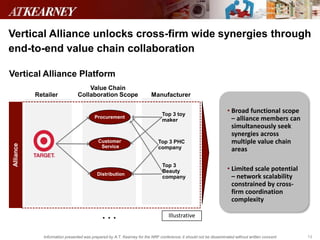
Vertical Alliance unlocks cross-firm wide synergies through
end-to-end value chain collaboration
Vertical Alliance Platform
Retailer Manufacturer
Value Chain
Collaboration Scope
Customer
Service
Procurement
Alliance
Distribution
Top 3 toy
maker
Top 3 PHC
company
Top 3
Beauty
company
. . .
• Broad functional scope
– alliance members can
simultaneously seek
synergies across
multiple value chain
areas
• Limited scale potential
– network scalability
constrained by cross-
firm coordination
complexity
Illustrative
14Information presented was prepared by A.T. Kearney for the NRF conference; it should not be disseminated without written consent
Model Preference – Discussion:
•Which of the proposed model is better aligned with your company’s strategic goals?
•Which operating model can help your firm increase long term competitiveness?
Guiding Principles Model Preference
Competitive position and trade-off between scale vs. focus
can determine model adoption choice
1.Competitive Polarization
‒ Maintain market leadership position
‒ Increase cost and/or service advantage
over laggards
‒ Secure best of breed capabilities across
non competing firms
2.Scale & Focus
‒ Achieve industry-wide scale benefits
‒ Pursue organizational focus and liberalize
the balance sheet
‒ Set new industry standards
Vertical Alliance
Hybrid
(Open Broker +
Vertical Alliance)
Open Broker
DesireforCompetitive
Polarization Desire for Scale and FocusLowHigh
Low High
15Information presented was prepared by A.T. Kearney for the NRF conference; it should not be disseminated without written consent
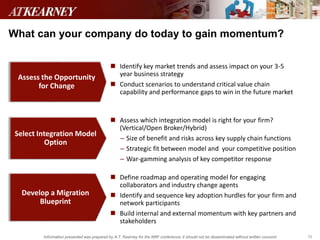
What can your company do today to gain momentum?
Assess the Opportunity
for Change
Select Integration Model
Option
Develop a Migration
Blueprint
 Identify key market trends and assess impact on your 3-5
year business strategy
 Conduct scenarios to understand critical value chain
capability and performance gaps to win in the future market
 Assess which integration model is right for your firm?
(Vertical/Open Broker/Hybrid)
‒ Size of benefit and risks across key supply chain functions
‒ Strategic fit between model and your competitive position
‒ War-gamming analysis of key competitor response
 Define roadmap and operating model for engaging
collaborators and industry change agents
 Identify and sequence key adoption hurdles for your firm and
network participants
 Build internal and external momentum with key partners and
stakeholders
16Information presented was prepared by A.T. Kearney for the NRF conference; it should not be disseminated without written consent
Thank you – please don’t hesitate to contact us
Kumar Venkataraman
Principal
kumar.venkataraman@atkearney.com
Michael Hu
Manager
michael.hu@atkearney.com

Disruptive Value Chain Integration in Consumer Product Industry

  • 1.
    1Information presented wasprepared by A.T. Kearney for the NRF conference; it should not be disseminated without written consent Disruptive Value Chain Integration in the Consumer Retail Industry Winning in the New Market Norm April 2011
  • 2.
    2Information presented wasprepared by A.T. Kearney for the NRF conference; it should not be disseminated without written consent Secular Commodity Scarcity: ‒ Double digit cost inflation ‒ Secular trend of demand outpacing supply in oil and petro-based materials Globalized Competition: ‒ Accelerated pressure from emerging global competitors in NA market Post-Recession Consciousness: Limited ability to raise prices, even for brand leaders Trading down and waiting for sales Pay premium for true innovation Changing Demographics: Aging Boomer trends – convenient retailing and “age friendly” products • Increasing retail localization due to changing ethno-graphics 5-10Years Emerging market trends will change the NA consumer product and retail industry Source: Morningstar; Reuters; US census; A.T. Kearney analysis; Consumer Trends Macro Global Trends 3-5Years
  • 3.
    3Information presented wasprepared by A.T. Kearney for the NRF conference; it should not be disseminated without written consent We are entering a new norm of accelerating complexity and increasing consumer needs • Increased Input Materials Cost Volatility • Increased Demand for Differentiated Products & Services • Increased Retail Format Complexity The New Market Norm Post-Recession Consciousness Changing Demographics Commodity Markets Scarcity Globalized Competitor Entry Trends
  • 4.
    4Information presented wasprepared by A.T. Kearney for the NRF conference; it should not be disseminated without written consent Future market needs will demand “Triple Value Creation” instead of value trade-offs SC&M Challenges Supply Chain Imperative “Triple Value Nirvana” Increasing Collaborations Developing Configurable Networks Managing Product Complexity Enabling Convergent Technology Enhancing Organizational Alignment Source: Major company 10Ks; Competitor IC survey (over 7 firms profiled); GMA; 2020 Future Value Chain; Kantar retail presentation; Wal-Mart interviews Accelerated Increase in Innovation Enhanced Flexibility Sustained Cost Reduction Developing Alternative Channels Differentiating Product Flow (JIT) Increased Material Scarcity and Cost Volatility Increased Retail Format Complexity Increased Demand for Differentiated Products & Services The New Market Norm
  • 5.
    5Information presented wasprepared by A.T. Kearney for the NRF conference; it should not be disseminated without written consent Despite broad SC&M investments… …Performance gaps exist in today’s SC&M networks Traditional SC&M tactics and levers will not be adequate to deliver the triple value nirvana • >90% of all CPG new product launches defined as incremental(3) Source: (1) The State of the Retail SC – RILA, 2010; (2) GMA Manuf. Excellence Share Group Meeting 2010; (3) ProductScan (4) A.T. Kearney client interviews What do manufacturers and retailers need to do to perform and win in the future? Accelerated Innovation Sustained Cost Reduction • Lack of flexible manufacturing assets a key barrier to NPD(4) • >65% expect an increase in product variations • >50% of CPG identified SC cost inefficiency as a major gap Enhanced Flexibility • 69% of SC executives surveyed focusing on Inventory and S&OP optimization • 69% indicated that improving delivery performance was a focus area in 2010-11 • 63% reported investing in improving order fulfillment performance vs. cost tradeoff • 55% will continue to pursue global manufacturing and outsourcing strategies
  • 6.
    6Information presented wasprepared by A.T. Kearney for the NRF conference; it should not be disseminated without written consent Manufacturers and retailers must break free of “local optimization” to “value chain integration” Manufacturer Value Chain Retailer Value Chain Chasm Current Supply Chain Paradigm Integration Future Supply Chain Paradigm DeliverMakeProcurePlanDesign StoreDeliverProcurePlan • Limited ability to capture cross-firm synergies: economies of scale and scope • Focus on local optimization with a zero-sum game mentality (e.g. retailer focus on inventory results in demand signal bull-whip for manufacturer, etc.) Manufacturer Value Chain Retailer Value Chain MakeDesign Store DeliverProcurePlan • Enables manufacturer-retailer integration across supply chain functions to realize economies of scale and scope • Focus on global optimization and win-win pie expansion
  • 7.
    7Information presented wasprepared by A.T. Kearney for the NRF conference; it should not be disseminated without written consent Sector leaders have started pursuing value chain collaboration, few have achieved broad integration Integration Enabled Synergy Levers Economies of Scale Economies of Scope Technology Enablement • Cross-firm pooled commodity sourcing (e.g. PET, cocoa, freight, etc.) • Capacity pooling and asset sharing • Volume pooling with contract manufacturers • Collaborative logistics – Share DC capacity • Re-shape industry structure • Joint forecasting and planning • Best of breed shared services (e.g. commodity risk management) • Harmonize packaging/ product forms across brands • Direct to store or customer delivery • Cross-firm slow movers break-pack pooling • Social media & community forum tools to enable Consumer led innovation • Global procurement platform • Joint investment in next- generation manufacturing assets • RFID and real-time synchronization to enable case-level tagging at store DeliverMakeProcurePlan • Advising a leading retailer and CPG on a business model for joint demand forecasting and planning to streamline inventory and logistics efficiency • Working with 3PL to design “plug & play” warehouses that eliminate a layer in traditional manufacturer and retailer network • Establishing a op- model for joint commodity directed buy across several manufacturers
  • 8.
    8Information presented wasprepared by A.T. Kearney for the NRF conference; it should not be disseminated without written consent Apparel and Consumer Electronics are further along the integration curve than other sectors Stage 1 Stage 2 Stage 3 Stage 4 • Limited participants: Few firms • Limited to select functions (i.e. distribution or procurement) • Across manufacturers only Consumer Electronics Food/Bev Durable Goods Cross-firm value chain integration maturity curve • Broad adoption across sector • Virtual integration and coordination across the entire breadth of SC functions • Across manufacturers and retailers • Broad adoption across sector • Virtual integration and coordination across numerous SC functions • Across manufacturers only or retailers only • Multiple firms participating • Virtual integration and coordination across numerous functions • Across manufacturers only Small Scale Collaboration Large Scale Integration PHC / Beauty Apparel
  • 9.
    9Information presented wasprepared by A.T. Kearney for the NRF conference; it should not be disseminated without written consent Unlocked 30%-40% of cost savings out of the entire apparel industry! 3rd party brokers catalyzed value chain integration in the Apparel sector in 1990s-2000 Pre SC&M Integration (circa pre-1990) Broker SC&M Integration (Post 1990) Manufacturer Retailer Retailer: • Limited assortment flexibility and long lead time due to small # of manufacturing partners • Limited global sourcing capabilities Manufacturers: • Capacity inefficiency due to promotional and seasonal spikes Retailer: • Leverage cross-retailer scale to unlock Triple Value: ‒Reduced cost from cross-firm volume pooling ‒Improved lead time and assortment flexibility from broader capacity and manuf. technology base Manufacturers: • Scale and scope efficiency (e.g. seasonality smoothing, cross-brand volume bundling) A B C D E X… DeliverMakeProcurePlan StoreDeliverProcurePlan Manufacturer Retailer A B C D E X… MakeProcure StoreDeliverPlan ProcureProcurePlan
  • 10.
    10Information presented wasprepared by A.T. Kearney for the NRF conference; it should not be disseminated without written consent Moving from Stage 1 to Stage 4 for the NA FMCG industry can unlock ~500B(1) Source: (1) Frost & Sullivan; EIU; First Research; A.T. Kearney dry ambient goods distribution benchmarking; A.T. Kearney analysis Note: We define FMCG as the Packaged Food & Beverage, Personal & Household Products and Beauty sectors Savings Benefit from Value Chain Integration ($B) ~$35-40 $420-500
  • 11.
    11Information presented wasprepared by A.T. Kearney for the NRF conference; it should not be disseminated without written consent We see two potential models for integration in the consumer product space Open Broker Model Vertical Alliance Model • Multi non-competing firms alliance • Participants need to gain membership • Industry shared platform • Participants opt-in via “plug & play” • Participants benefit from industry level economies of scale • 3rd party dedicated focus Benefit Drivers • Functional scope and scale benefits as participants can collaborate and seek cross-brand / category synergies • Closed – alliance members only Mode of Participation • Open standard platform Orchestration • 3rd party broker • A governing unit composed of network members Value Sharing • Value split amongst “customers” and broker based on free market dynamics • Value split amongst participants based on benefit contribution to the alliance Organizational Structure • Participants are a “customer” for 3rd party • Joint organizational board • Voting right based on value and risk contribution
  • 12.
    12Information presented wasprepared by A.T. Kearney for the NRF conference; it should not be disseminated without written consent Open Deliver Platform Open Make Platform Open Broker Model unlock industry wide synergies by integrating through specific functions Logistics Flow Today Potential Emerging Broker Platform Broker LCC Contract Manufacturers Manufacturing pre 1990s Global Broker Model LCC Contract Manufacturers Illustrative Plant Plant Stores C MCPlant DC Stores MC DC MC DC Plant Plant Stores StoresMCPlant DC Stores Manufacturer Retailer • Able to achieve industry wide scale benefits • Limited functional scope (each platform only addresses a particular value chain function)
  • 13.
    13Information presented wasprepared by A.T. Kearney for the NRF conference; it should not be disseminated without written consent Vertical Alliance unlocks cross-firm wide synergies through end-to-end value chain collaboration Vertical Alliance Platform Retailer Manufacturer Value Chain Collaboration Scope Customer Service Procurement Alliance Distribution Top 3 toy maker Top 3 PHC company Top 3 Beauty company . . . • Broad functional scope – alliance members can simultaneously seek synergies across multiple value chain areas • Limited scale potential – network scalability constrained by cross- firm coordination complexity Illustrative
  • 14.
    14Information presented wasprepared by A.T. Kearney for the NRF conference; it should not be disseminated without written consent Model Preference – Discussion: •Which of the proposed model is better aligned with your company’s strategic goals? •Which operating model can help your firm increase long term competitiveness? Guiding Principles Model Preference Competitive position and trade-off between scale vs. focus can determine model adoption choice 1.Competitive Polarization ‒ Maintain market leadership position ‒ Increase cost and/or service advantage over laggards ‒ Secure best of breed capabilities across non competing firms 2.Scale & Focus ‒ Achieve industry-wide scale benefits ‒ Pursue organizational focus and liberalize the balance sheet ‒ Set new industry standards Vertical Alliance Hybrid (Open Broker + Vertical Alliance) Open Broker DesireforCompetitive Polarization Desire for Scale and FocusLowHigh Low High
  • 15.
    15Information presented wasprepared by A.T. Kearney for the NRF conference; it should not be disseminated without written consent What can your company do today to gain momentum? Assess the Opportunity for Change Select Integration Model Option Develop a Migration Blueprint  Identify key market trends and assess impact on your 3-5 year business strategy  Conduct scenarios to understand critical value chain capability and performance gaps to win in the future market  Assess which integration model is right for your firm? (Vertical/Open Broker/Hybrid) ‒ Size of benefit and risks across key supply chain functions ‒ Strategic fit between model and your competitive position ‒ War-gamming analysis of key competitor response  Define roadmap and operating model for engaging collaborators and industry change agents  Identify and sequence key adoption hurdles for your firm and network participants  Build internal and external momentum with key partners and stakeholders
  • 16.
    16Information presented wasprepared by A.T. Kearney for the NRF conference; it should not be disseminated without written consent Thank you – please don’t hesitate to contact us Kumar Venkataraman Principal kumar.venkataraman@atkearney.com Michael Hu Manager michael.hu@atkearney.com