







Sonnet CXXX 
By : SHAKESPEARE 
An unconventional love poem about 
the “Dark Lady”
PRESENTED BY:- 
BBM – A (2014-17) 
GROUP 11 
KUMARI HARSHITA 
PRITESH REDDY 
VISHWASAI 
YASH GOVIL 
GAURAV DEY 
MARUTESH
What is a sonnet? 
A sonnet is a 14 line poem which traditionally is 
used as a way to declare love for someone – you 
say brilliant things about them and tell them 
how much you love them! 
What sort of things would you put in a sonnet? 
Think of ways to compliment someone – did 
they feature in your original list of love poetry? 
Shakespeare wrote 154 sonnets. The lady 
spoken about in this sonnet is featured in 
Sonnets 127 to 154. she is known as ‘The Dark 
Lady’ 
Early sonnets are based on the Petrarchan model 
(which follows a different rhyme scheme), 
however, the focus of the sonnet remains the 
same – idolising the woman and making her an 
‘inspiration’.
SONNET CXXX 
My mistress' eyes are nothing like the sun; 
Coral is far more red than her lips' red; 
If snow be white, why then her breasts are dun; 
If hairs be wires, black wires grow on her head. 
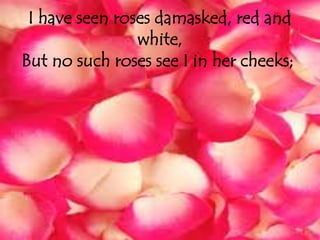
I have seen roses damasked, red and white, 
But no such roses see I in her cheeks; 
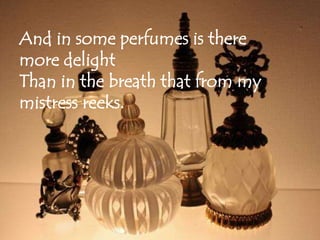
And in some perfumes is there more delight 
Than in the breath that from my mistress reeks. 
I love to hear her speak, yet well I know 
That music hath a far more pleasing sound; 
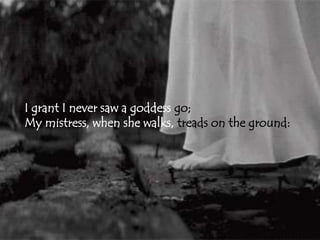
I grant I never saw a goddess go; 
My mistress, when she walks, treads on the ground: 
And yet, by heaven, I think my love as rare 
As any she belied with false compare.
EXPLAINATION 
She has dark eyes, her lips are not red. Her breasts are 
not as white as snow and she has black hair She has 
pale cheeks, he is also saying that her breath doesn’t 
smell as good as some perfumes. He loves to hear her 
speak, but he knows that music has a more pleasing 
sound than her voice; He’s never seen a goddess 
walk, but he knows that she walks only on the ground. 
Even though she is not special, his love for her is still 
unique
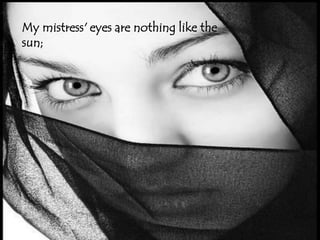
My mistress' eyes are nothing like the 
sun;
Coral is far more red than 
her lips' red;
If snow be white, why then her breasts are dun
If hairs be wires, black wires grow 
on her head.
I have seen roses damasked, red and 
white, 
But no such roses see I in her cheeks;
And in some perfumes is there 
more delight 
Than in the breath that from my 
mistress reeks.
I love to hear her speak, yet well I know 
That music hath a far more pleasing sound;
I grant I never saw a goddess go; 
My mistress, when she walks, treads on the ground:
And yet, by heaven, I think my love as rare 
As any she belied with false compare.
And yet, by heaven, I think my love as rare 
As any she belied with false compare. 
The poet is satirising the tradition of comparing one’s love 
to all things beautiful, divine and immortal. 
He makes many negative comparisons. 
But these final lines suggest that she is beyond all these 
things just by being herself: mortal and approachable. 
Rare = precious, superb, of fine and unusual quality 
He thinks that his love is more special, than those which are 
based on superficial comparisons.
FORM 
Shakespeare does follow traditional English 
sonnets as Sonnet 130 as 14 lines and it follows 
the rhyming scheme ABABCDCD etc. By using 
the tradition rhyme scheme of English Sonnets, 
Shakespeare can be said to be using it to parody 
the hyperbolic nature in which poets expressed 
their love for others.
POETIC FEATURES 
The poet uses parallelism to compare his love to the standards of ladies in 
Petrarchan poetry ‘If snow be white, why her breasts are dun’. The effect of 
the parallelism is it makes the contents of the poem clear and the audience 
knows exactly why the poet dissatisfied with his love. 
There is a lot of negative imagery in this sonnet. By creating imagery then 
not continuing with it and then describing a new image, Shakespeare builds 
up the poem and brings it back down, creates drama and keeps the reader’s 
interest as they want to know where the poem will go next. 
The effect of the tripling ‘damasked, red and white,’ builds up the beauty the 
poet has seen in the rose. By building up the beauty in the rose, it causes a 
sharp contrast between the rose and the poet’s love, who does not measure 
up when compared to the rose. 
In this poem as in many poems roses symbolise romance. In this poem 
Shakespeare uses the rose to compare idealised romance ‘I have seene Roses 
damaskt’ to reality ‘no such Roses see I in her cheeks’.
Summary of Sonnet CXXX: 
• In this sonnet Shakespeare compares his lover to a 
number of other beauties—and never in the lover’s 
favor. According to him; 
• Her eyes are “nothing like the sun” 
• her lips are less red than coral 
• compared to white snow, her breasts are dun-colored 
• her hairs are like black wires on her head 
• In the second quatrain, the speaker says 
• he has seen roses separated by color (“damasked”) 
into red and white, but he sees no such roses in his 
mistress’s cheeks 
• he says the breath t “reeks” from his mistress and is 
less delightful than perfume
SUMMARY CONTINUED…. 
In the third quatrain, he admits that, 
though he loves her voice, music “hath a far more 
pleasing sound” 
that, though he has never seen a goddess, his mistress— 
unlike goddesses—walks on the ground 
In the couplet, however, the speaker declares that, “by 
heaven,” he thinks his love 
as rare and valuable 
“As any she belied with false compare”—that is, any 
love in which false comparisons were invoked to 
describe the loved one’s beauty
COMPARISON 
In this sonnet, Shakespeare draws on 
sight, sound and smell when he 
compares 
his mistress' eyes to the sun 
her lips to red coral 
her breasts to white snow 
her hair to black wires 
her cheeks to red and white roses 
her breath to perfume 
her voice to music
COMPARISON (CONTINUED…) 
Shakespeare comparing her to natural objects, he notes 
that 
her eyes are "nothing like the sun," and 
the colors of her lips and breasts dull when compared to 
the red of coral and the whiteness of snow 
her smell reeks – The ideal woman in a poem probably 
isn't supposed to smell at all, unless she smells like 
perfume, here she has a stench- foul breath 
My mistress, when she walks, treads on the ground 
that her hair is black, he describes them in a derogatory 
way ,"black wires grow on her head’
Sonnet cxxx project work

Sonnet cxxx project work

  • 1.
    Sonnet CXXX By: SHAKESPEARE An unconventional love poem about the “Dark Lady”
  • 2.
    PRESENTED BY:- BBM– A (2014-17) GROUP 11 KUMARI HARSHITA PRITESH REDDY VISHWASAI YASH GOVIL GAURAV DEY MARUTESH
  • 3.
    What is asonnet? A sonnet is a 14 line poem which traditionally is used as a way to declare love for someone – you say brilliant things about them and tell them how much you love them! What sort of things would you put in a sonnet? Think of ways to compliment someone – did they feature in your original list of love poetry? Shakespeare wrote 154 sonnets. The lady spoken about in this sonnet is featured in Sonnets 127 to 154. she is known as ‘The Dark Lady’ Early sonnets are based on the Petrarchan model (which follows a different rhyme scheme), however, the focus of the sonnet remains the same – idolising the woman and making her an ‘inspiration’.
  • 4.
    SONNET CXXX Mymistress' eyes are nothing like the sun; Coral is far more red than her lips' red; If snow be white, why then her breasts are dun; If hairs be wires, black wires grow on her head. I have seen roses damasked, red and white, But no such roses see I in her cheeks; And in some perfumes is there more delight Than in the breath that from my mistress reeks. I love to hear her speak, yet well I know That music hath a far more pleasing sound; I grant I never saw a goddess go; My mistress, when she walks, treads on the ground: And yet, by heaven, I think my love as rare As any she belied with false compare.
  • 5.
    EXPLAINATION She hasdark eyes, her lips are not red. Her breasts are not as white as snow and she has black hair She has pale cheeks, he is also saying that her breath doesn’t smell as good as some perfumes. He loves to hear her speak, but he knows that music has a more pleasing sound than her voice; He’s never seen a goddess walk, but he knows that she walks only on the ground. Even though she is not special, his love for her is still unique
  • 6.
    My mistress' eyesare nothing like the sun;
  • 7.
    Coral is farmore red than her lips' red;
  • 8.
    If snow bewhite, why then her breasts are dun
  • 9.
    If hairs bewires, black wires grow on her head.
  • 10.
    I have seenroses damasked, red and white, But no such roses see I in her cheeks;
  • 11.
    And in someperfumes is there more delight Than in the breath that from my mistress reeks.
  • 12.
    I love tohear her speak, yet well I know That music hath a far more pleasing sound;
  • 13.
    I grant Inever saw a goddess go; My mistress, when she walks, treads on the ground:
  • 14.
    And yet, byheaven, I think my love as rare As any she belied with false compare.
  • 15.
    And yet, byheaven, I think my love as rare As any she belied with false compare. The poet is satirising the tradition of comparing one’s love to all things beautiful, divine and immortal. He makes many negative comparisons. But these final lines suggest that she is beyond all these things just by being herself: mortal and approachable. Rare = precious, superb, of fine and unusual quality He thinks that his love is more special, than those which are based on superficial comparisons.
  • 16.
    FORM Shakespeare doesfollow traditional English sonnets as Sonnet 130 as 14 lines and it follows the rhyming scheme ABABCDCD etc. By using the tradition rhyme scheme of English Sonnets, Shakespeare can be said to be using it to parody the hyperbolic nature in which poets expressed their love for others.
  • 17.
    POETIC FEATURES Thepoet uses parallelism to compare his love to the standards of ladies in Petrarchan poetry ‘If snow be white, why her breasts are dun’. The effect of the parallelism is it makes the contents of the poem clear and the audience knows exactly why the poet dissatisfied with his love. There is a lot of negative imagery in this sonnet. By creating imagery then not continuing with it and then describing a new image, Shakespeare builds up the poem and brings it back down, creates drama and keeps the reader’s interest as they want to know where the poem will go next. The effect of the tripling ‘damasked, red and white,’ builds up the beauty the poet has seen in the rose. By building up the beauty in the rose, it causes a sharp contrast between the rose and the poet’s love, who does not measure up when compared to the rose. In this poem as in many poems roses symbolise romance. In this poem Shakespeare uses the rose to compare idealised romance ‘I have seene Roses damaskt’ to reality ‘no such Roses see I in her cheeks’.
  • 18.
    Summary of SonnetCXXX: • In this sonnet Shakespeare compares his lover to a number of other beauties—and never in the lover’s favor. According to him; • Her eyes are “nothing like the sun” • her lips are less red than coral • compared to white snow, her breasts are dun-colored • her hairs are like black wires on her head • In the second quatrain, the speaker says • he has seen roses separated by color (“damasked”) into red and white, but he sees no such roses in his mistress’s cheeks • he says the breath t “reeks” from his mistress and is less delightful than perfume
  • 19.
    SUMMARY CONTINUED…. Inthe third quatrain, he admits that, though he loves her voice, music “hath a far more pleasing sound” that, though he has never seen a goddess, his mistress— unlike goddesses—walks on the ground In the couplet, however, the speaker declares that, “by heaven,” he thinks his love as rare and valuable “As any she belied with false compare”—that is, any love in which false comparisons were invoked to describe the loved one’s beauty
  • 20.
    COMPARISON In thissonnet, Shakespeare draws on sight, sound and smell when he compares his mistress' eyes to the sun her lips to red coral her breasts to white snow her hair to black wires her cheeks to red and white roses her breath to perfume her voice to music
  • 21.
    COMPARISON (CONTINUED…) Shakespearecomparing her to natural objects, he notes that her eyes are "nothing like the sun," and the colors of her lips and breasts dull when compared to the red of coral and the whiteness of snow her smell reeks – The ideal woman in a poem probably isn't supposed to smell at all, unless she smells like perfume, here she has a stench- foul breath My mistress, when she walks, treads on the ground that her hair is black, he describes them in a derogatory way ,"black wires grow on her head’