Methods and resources for working with
students with special needs
By: Brian Liberatore ITEC-7530
 What is Special
Education?
 Special Education is
instruction that has been
specially designed to
meet the needs of
students whom have met
state and/or federal
criteria to be classified
as disabled.
 Question 1:
Does the child have a
disability?
 Question 2:
Does the disability affect
the education of the
student?
If both criteria are met after evaluations, the student is
eligible to receive Special Education services.
Dickson, J. (2009, October 30). Fact Sheet: EVALUATIONS TO DETERMINE IF A CHILD IS ELIGIBLE FOR SPECIAL
EDUCATION (Initial Evaluations). Retrieved June 12, 2010, from Georgia Department of Education:
http://www.doe.k12.ga.us/DMGetDocument.aspx/Initial_eva
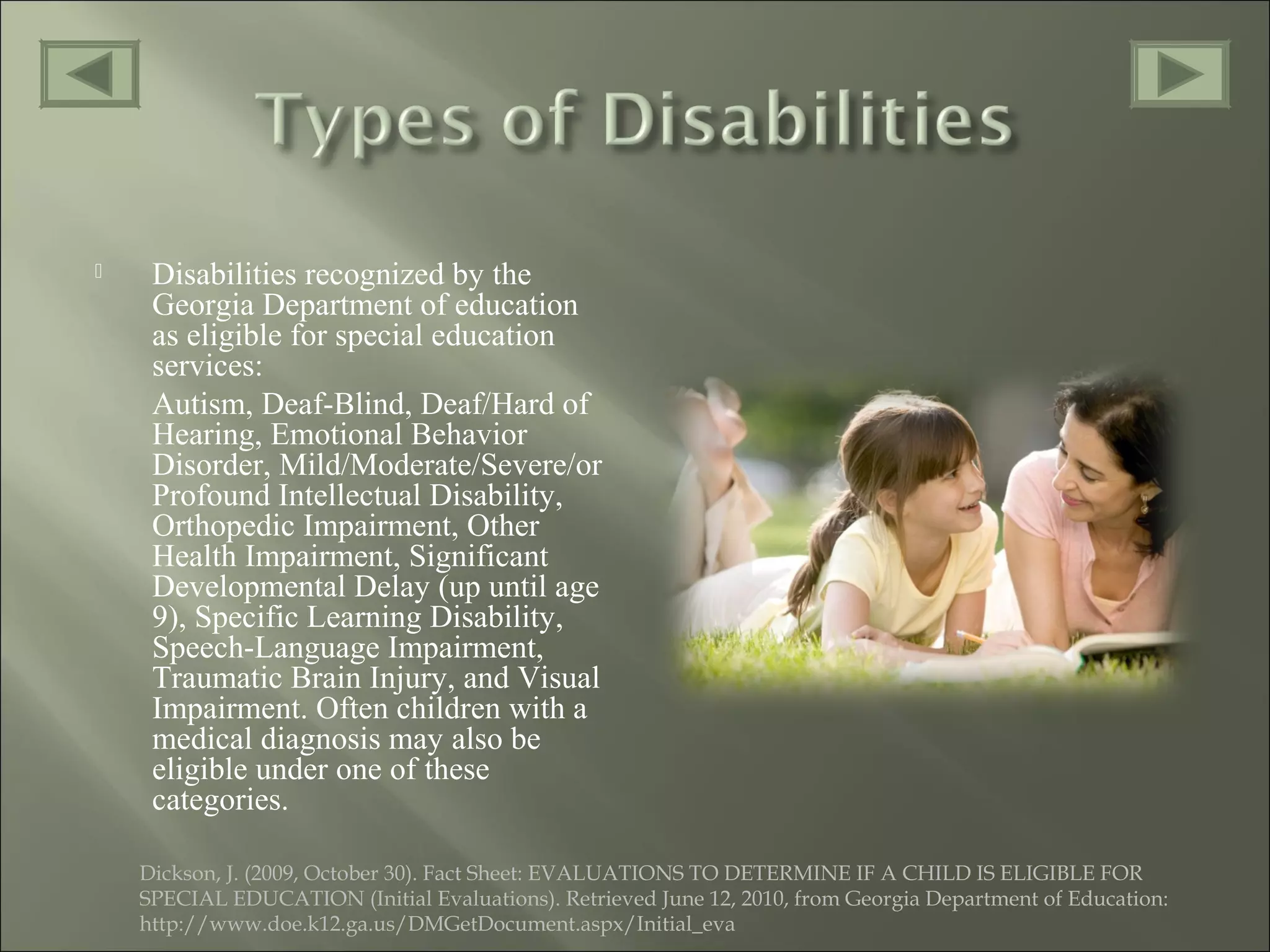
 Disabilities recognized by the
Georgia Department of education
as eligible for special education
services:
Autism, Deaf-Blind, Deaf/Hard of
Hearing, Emotional Behavior
Disorder, Mild/Moderate/Severe/or
Profound Intellectual Disability,
Orthopedic Impairment, Other
Health Impairment, Significant
Developmental Delay (up until age
9), Specific Learning Disability,
Speech-Language Impairment,
Traumatic Brain Injury, and Visual
Impairment. Often children with a
medical diagnosis may also be
eligible under one of these
categories.
Dickson, J. (2009, October 30). Fact Sheet: EVALUATIONS TO DETERMINE IF A CHILD IS ELIGIBLE FOR
SPECIAL EDUCATION (Initial Evaluations). Retrieved June 12, 2010, from Georgia Department of Education:
http://www.doe.k12.ga.us/DMGetDocument.aspx/Initial_eva
 Inclusion:
 “Inclusion considers that all
students are full members of
the school community and are
entitled to the opportunities
and responsibilities that are
available to all students in the
school.”
 Least Restrictive Environment
 section 612, part (a) of the Individuals with
Disabilities Education Act of 1997
“IN GENERAL..To the maximum extent
appropriate, children with disabilities,
including children in public or private
institutions or other care facilities, are
educated with children who are not
disabled, and special classes, separate
schooling, or other removal of children
with disabilities from the regular
educational environment occurs only
when the nature or severity of the
disability of a child is such that education
in regular classes with the use of
supplementary aids and services cannot be
achieved satisfactorily.”
Instruction, O. o. (n/a). Inclusive Learning Environments for
Students With Special Needs . Retrieved June 12, 2010, from New
Horizons For Learning:
http://www.newhorizons.org/spneeds/inclusion/front_inclusion.
htm
 No-Tech
 Non-electronic
 Examples:
 Copies of lecture notes
and fill-in-the-blank
outlines.
 Student access to
dictionaries and
thesauruses during
writing activities.
 Modified pencil grip
 Raised lined paper
 Braille books and
handouts
 Low-Tech
 Electronic devices that
provide a limited
functional ability and
lack sophisticated
computer components.
 Examples:
 Talking watch
 Voice recorder
 Electronic
dictionary/thesaurus
Behrmann, M., & Jerome, M. K. (2002, January 1). Assistive Technology for Students with Mild Disabilities: Update
2002. ERIC Digest. Retrieved June 12, 2010, from ERIC Digest: http://www.ericdigests.org/2003-1/assistive.htm
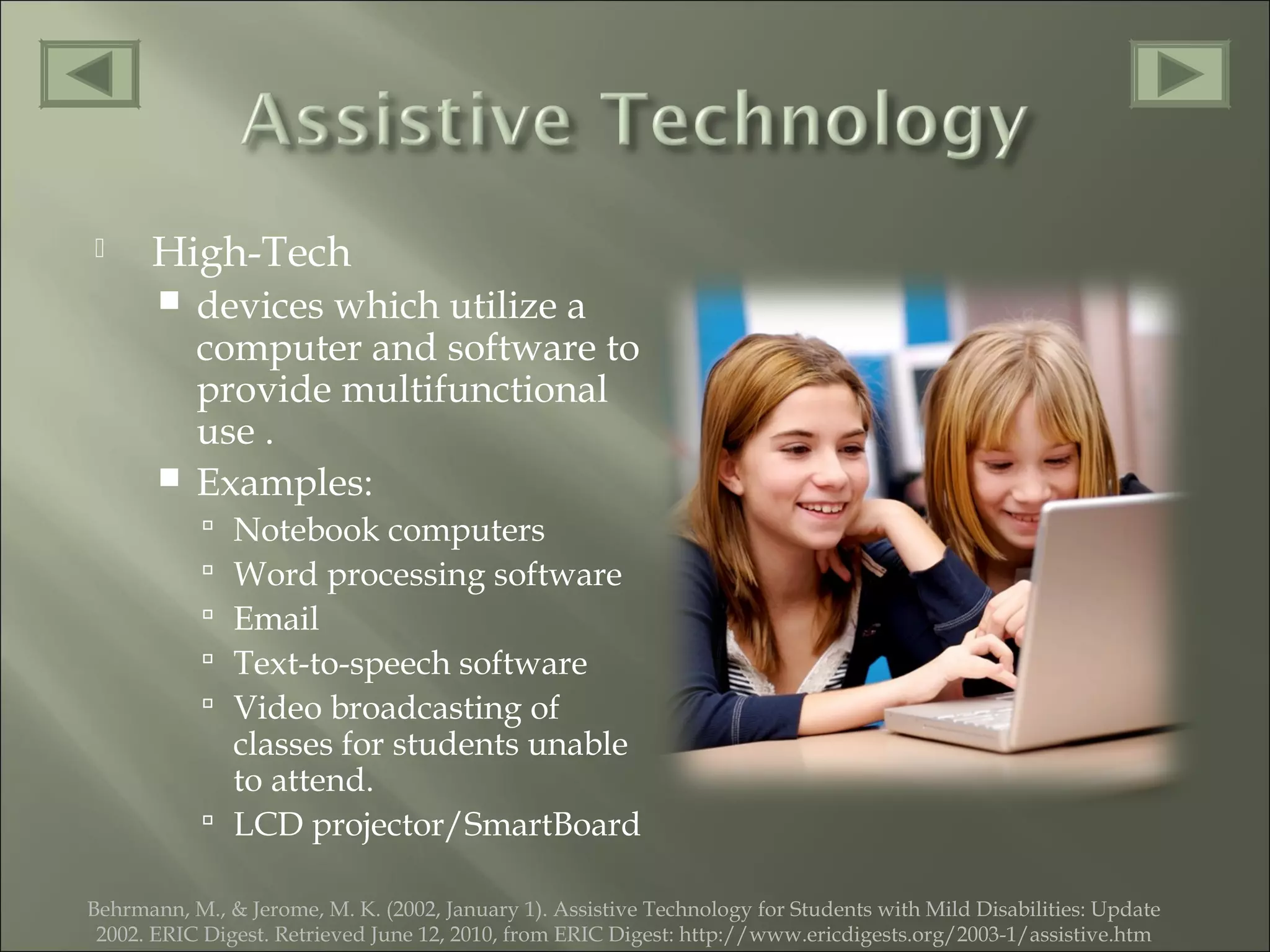
 High-Tech
 devices which utilize a
computer and software to
provide multifunctional
use .
 Examples:
 Notebook computers
 Word processing software
 Email
 Text-to-speech software
 Video broadcasting of
classes for students unable
to attend.
 LCD projector/SmartBoard
Behrmann, M., & Jerome, M. K. (2002, January 1). Assistive Technology for Students with Mild Disabilities: Update
2002. ERIC Digest. Retrieved June 12, 2010, from ERIC Digest: http://www.ericdigests.org/2003-1/assistive.htm
 Kelvin, Dominick, and Shiranta
 Diagnosed with ADHD
 Assistive Technologies/
Interventions
 Keep oral instructions brief
 Letting the students read smaller
passages
 Dividing larger assignments into
smaller sections
 Keep instruction fast paced
 High levels of participation and
motivation during activities
 Peer partners
 Sarah
 Diagnosed with hearing
disability
 Requires assistive hearing
device
 Other Assistive
Technologies/Practices:
 If student seems inattentive,
make sure hearing aid is
turned on and check the
battery.
 Utilize FM transmitter
system to amplify your voice
 Sign Language interpreter
 Note taker
 Voice-to-text software and
projector
 Printed lecture notes to be
given to the student
 America, One Hundred Fifth Congress of. (1997, January 7). Individuals With Disabilities
Education Act of 1997. Retrieved June 12, 2010, from Office of Special Education and
Rehabilitation Services: http://www2.ed.gov/policy/speced/leg/idea/idea.pdf
 Assistive Technology 101. (2010). Retrieved June 12, 2010, from The Family Center on
Technology and Disability: http://www.fctd.info/factsheet/at101
 Behrmann, M., & Jerome, M. K. (2002, January 1). Assistive Technology for Students with
Mild Disabilities: Update 2002. ERIC Digest. Retrieved June 12, 2010, from ERIC Digest:
http://www.ericdigests.org/2003-1/assistive.htm
 Dickson, J. (2009, October 30). Fact Sheet: EVALUATIONS TO DETERMINE IF A
CHILD IS ELIGIBLE FOR SPECIAL EDUCATION (Initial Evaluations). Retrieved June
12, 2010, from Georgia Department of Education:
http://www.doe.k12.ga.us/DMGetDocument.aspx/Initial_eva
 Education, N. C. (2006). Help for Young Learners: How To Choose AT? Retrieved June 12,
2010, from LD Online: http://www.ldonline.org/article/8088
 Office of State Superintendent of Public. (n/a). Inclusive Learning Environments for
Students With Special Needs . Retrieved June 12, 2010, from New Horizons For Learning:
http://www.newhorizons.org/spneeds/inclusion/front_inclusion.htm
 America, One Hundred Fifth Congress of. (1997, January 7). Individuals With Disabilities
Education Act of 1997. Retrieved June 12, 2010, from Office of Special Education and
Rehabilitation Services: http://www2.ed.gov/policy/speced/leg/idea/idea.pdf
 Assistive Technology 101. (2010). Retrieved June 12, 2010, from The Family Center on
Technology and Disability: http://www.fctd.info/factsheet/at101
 Behrmann, M., & Jerome, M. K. (2002, January 1). Assistive Technology for Students with
Mild Disabilities: Update 2002. ERIC Digest. Retrieved June 12, 2010, from ERIC Digest:
http://www.ericdigests.org/2003-1/assistive.htm
 Dickson, J. (2009, October 30). Fact Sheet: EVALUATIONS TO DETERMINE IF A
CHILD IS ELIGIBLE FOR SPECIAL EDUCATION (Initial Evaluations). Retrieved June
12, 2010, from Georgia Department of Education:
http://www.doe.k12.ga.us/DMGetDocument.aspx/Initial_eva
 Education, N. C. (2006). Help for Young Learners: How To Choose AT? Retrieved June 12,
2010, from LD Online: http://www.ldonline.org/article/8088
 Office of State Superintendent of Public. (n/a). Inclusive Learning Environments for
Students With Special Needs . Retrieved June 12, 2010, from New Horizons For Learning:
http://www.newhorizons.org/spneeds/inclusion/front_inclusion.htm

Assistive technology web quest

  • 1.
    Methods and resourcesfor working with students with special needs By: Brian Liberatore ITEC-7530
  • 2.
     What isSpecial Education?  Special Education is instruction that has been specially designed to meet the needs of students whom have met state and/or federal criteria to be classified as disabled.
  • 3.
     Question 1: Doesthe child have a disability?  Question 2: Does the disability affect the education of the student? If both criteria are met after evaluations, the student is eligible to receive Special Education services. Dickson, J. (2009, October 30). Fact Sheet: EVALUATIONS TO DETERMINE IF A CHILD IS ELIGIBLE FOR SPECIAL EDUCATION (Initial Evaluations). Retrieved June 12, 2010, from Georgia Department of Education: http://www.doe.k12.ga.us/DMGetDocument.aspx/Initial_eva
  • 4.
     Disabilities recognizedby the Georgia Department of education as eligible for special education services: Autism, Deaf-Blind, Deaf/Hard of Hearing, Emotional Behavior Disorder, Mild/Moderate/Severe/or Profound Intellectual Disability, Orthopedic Impairment, Other Health Impairment, Significant Developmental Delay (up until age 9), Specific Learning Disability, Speech-Language Impairment, Traumatic Brain Injury, and Visual Impairment. Often children with a medical diagnosis may also be eligible under one of these categories. Dickson, J. (2009, October 30). Fact Sheet: EVALUATIONS TO DETERMINE IF A CHILD IS ELIGIBLE FOR SPECIAL EDUCATION (Initial Evaluations). Retrieved June 12, 2010, from Georgia Department of Education: http://www.doe.k12.ga.us/DMGetDocument.aspx/Initial_eva
  • 5.
     Inclusion:  “Inclusionconsiders that all students are full members of the school community and are entitled to the opportunities and responsibilities that are available to all students in the school.”  Least Restrictive Environment  section 612, part (a) of the Individuals with Disabilities Education Act of 1997 “IN GENERAL..To the maximum extent appropriate, children with disabilities, including children in public or private institutions or other care facilities, are educated with children who are not disabled, and special classes, separate schooling, or other removal of children with disabilities from the regular educational environment occurs only when the nature or severity of the disability of a child is such that education in regular classes with the use of supplementary aids and services cannot be achieved satisfactorily.” Instruction, O. o. (n/a). Inclusive Learning Environments for Students With Special Needs . Retrieved June 12, 2010, from New Horizons For Learning: http://www.newhorizons.org/spneeds/inclusion/front_inclusion. htm
  • 6.
     No-Tech  Non-electronic Examples:  Copies of lecture notes and fill-in-the-blank outlines.  Student access to dictionaries and thesauruses during writing activities.  Modified pencil grip  Raised lined paper  Braille books and handouts  Low-Tech  Electronic devices that provide a limited functional ability and lack sophisticated computer components.  Examples:  Talking watch  Voice recorder  Electronic dictionary/thesaurus Behrmann, M., & Jerome, M. K. (2002, January 1). Assistive Technology for Students with Mild Disabilities: Update 2002. ERIC Digest. Retrieved June 12, 2010, from ERIC Digest: http://www.ericdigests.org/2003-1/assistive.htm
  • 7.
     High-Tech  deviceswhich utilize a computer and software to provide multifunctional use .  Examples:  Notebook computers  Word processing software  Email  Text-to-speech software  Video broadcasting of classes for students unable to attend.  LCD projector/SmartBoard Behrmann, M., & Jerome, M. K. (2002, January 1). Assistive Technology for Students with Mild Disabilities: Update 2002. ERIC Digest. Retrieved June 12, 2010, from ERIC Digest: http://www.ericdigests.org/2003-1/assistive.htm
  • 8.
     Kelvin, Dominick,and Shiranta  Diagnosed with ADHD  Assistive Technologies/ Interventions  Keep oral instructions brief  Letting the students read smaller passages  Dividing larger assignments into smaller sections  Keep instruction fast paced  High levels of participation and motivation during activities  Peer partners  Sarah  Diagnosed with hearing disability  Requires assistive hearing device  Other Assistive Technologies/Practices:  If student seems inattentive, make sure hearing aid is turned on and check the battery.  Utilize FM transmitter system to amplify your voice  Sign Language interpreter  Note taker  Voice-to-text software and projector  Printed lecture notes to be given to the student
  • 9.
     America, OneHundred Fifth Congress of. (1997, January 7). Individuals With Disabilities Education Act of 1997. Retrieved June 12, 2010, from Office of Special Education and Rehabilitation Services: http://www2.ed.gov/policy/speced/leg/idea/idea.pdf  Assistive Technology 101. (2010). Retrieved June 12, 2010, from The Family Center on Technology and Disability: http://www.fctd.info/factsheet/at101  Behrmann, M., & Jerome, M. K. (2002, January 1). Assistive Technology for Students with Mild Disabilities: Update 2002. ERIC Digest. Retrieved June 12, 2010, from ERIC Digest: http://www.ericdigests.org/2003-1/assistive.htm  Dickson, J. (2009, October 30). Fact Sheet: EVALUATIONS TO DETERMINE IF A CHILD IS ELIGIBLE FOR SPECIAL EDUCATION (Initial Evaluations). Retrieved June 12, 2010, from Georgia Department of Education: http://www.doe.k12.ga.us/DMGetDocument.aspx/Initial_eva  Education, N. C. (2006). Help for Young Learners: How To Choose AT? Retrieved June 12, 2010, from LD Online: http://www.ldonline.org/article/8088  Office of State Superintendent of Public. (n/a). Inclusive Learning Environments for Students With Special Needs . Retrieved June 12, 2010, from New Horizons For Learning: http://www.newhorizons.org/spneeds/inclusion/front_inclusion.htm
  • 10.
     America, OneHundred Fifth Congress of. (1997, January 7). Individuals With Disabilities Education Act of 1997. Retrieved June 12, 2010, from Office of Special Education and Rehabilitation Services: http://www2.ed.gov/policy/speced/leg/idea/idea.pdf  Assistive Technology 101. (2010). Retrieved June 12, 2010, from The Family Center on Technology and Disability: http://www.fctd.info/factsheet/at101  Behrmann, M., & Jerome, M. K. (2002, January 1). Assistive Technology for Students with Mild Disabilities: Update 2002. ERIC Digest. Retrieved June 12, 2010, from ERIC Digest: http://www.ericdigests.org/2003-1/assistive.htm  Dickson, J. (2009, October 30). Fact Sheet: EVALUATIONS TO DETERMINE IF A CHILD IS ELIGIBLE FOR SPECIAL EDUCATION (Initial Evaluations). Retrieved June 12, 2010, from Georgia Department of Education: http://www.doe.k12.ga.us/DMGetDocument.aspx/Initial_eva  Education, N. C. (2006). Help for Young Learners: How To Choose AT? Retrieved June 12, 2010, from LD Online: http://www.ldonline.org/article/8088  Office of State Superintendent of Public. (n/a). Inclusive Learning Environments for Students With Special Needs . Retrieved June 12, 2010, from New Horizons For Learning: http://www.newhorizons.org/spneeds/inclusion/front_inclusion.htm