ACHARYA NARENDRA DEVA UNIVERSITY OF AGRICULTURE &
TECHNOLOGY KUMARGANJ, AYODHYA
Assignment On:
Imaging techniques
Course: BIOCHEM 505 (2+2)
Course Title: Techniques in Biochemistry
Presented By
Mr. Rahul Kumar Maurya
Ph. D. Agril. Biotechnology
ID. No. A-11164/19/22
Presented To
Dr. Pratibha Singh (Head & Professor
Department of Biochemistry)
Dr. R. P.
Singh(Assistant Professor)
Department of Biochemistry,
ANDUA&T, Kumarganj, Ayodhya-224229
PHOSPHORIMAGE
R
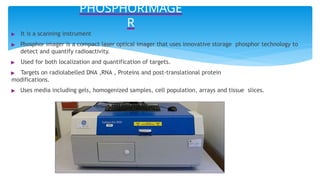
▶ It is a scanning instrument
▶ Phosphor imager is a compact laser optical imager that uses innovative storage phosphor technology to
detect and quantify radioactivity.
▶ Used for both localization and quantification of targets.
▶ Targets on radiolabelled DNA ,RNA , Proteins and post-translational protein
modifications.
▶ Uses media including gels, homogenized samples, cell population, arrays and tissue slices.
Use of Phosphorimager
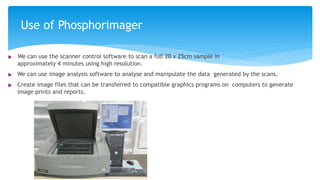
▶ We can use the scanner control software to scan a full 20 x 25cm sample in
approximately 4 minutes using high resolution.
▶ We can use image analysis software to analyse and manipulate the data generated by the scans.
▶ Create image files that can be transferred to compatible graphics programs on computers to generate
image prints and reports.
PRINCIPL
E
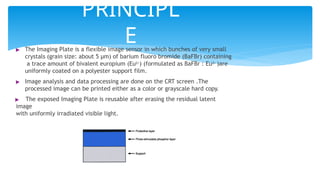
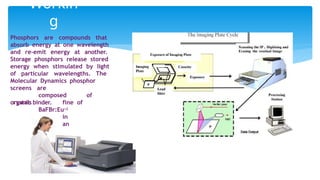
▶ The Imaging Plate is a flexible image sensor in which bunches of very small
crystals (grain size: about 5 µm) of barium fluoro bromide (BaFBr) containing
a trace amount of bivalent europium (Eu2+) (formulated as BaFBr : Eu2+ )are
uniformly coated on a polyester support film.
▶ Image analysis and data processing are done on the CRT screen .The
processed image can be printed either as a color or grayscale hard copy.
▶ The exposed Imaging Plate is reusable after erasing the residual latent
image
with uniformly irradiated visible light.
INSTRUMENTATION
 The PhosphorImager equipment includes the
following hardware components:-
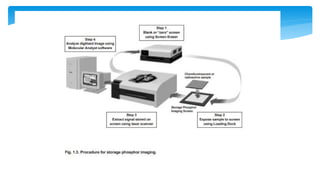
▶ PhosphorImager SI (scanning instrument) —
samples.
scans and analyzes
▶ Phosphor screen — collects the image.
▶ Exposure cassette — holds the screen in a light-tight environment.
▶ Image Eraser SF™ — erases screens for reuse.
▶ Additional accessories include a SCSI cable, a SCSI terminator, and a power
cord.
Workin
g
Phosphors are compounds that
absorb energy at one wavelength
and re-emit energy at another.
Storage phosphors release stored
energy when stimulated by light
of particular wavelengths. The
Molecular Dynamics phosphor
screens
crystals
are
composed of
fine of
BaFBr:Eu+2
in
an
organic binder.
APPLICATIONS
▶ reduces exposure times by 90% for most samples
▶ simplifies accurate quantification because of its wide & linear response
▶ Storage phosphor screens capture latent images produced by ionizing radiation (β
and γ emissions from radiolabelled blots, gels, TLC plates, tissues, or X-rays).
▶ Latent images are read by laser scanning and saved in digital format.
▶ The PhosphorImager SI comes with Image Quant software and documentation for Mac or PC, with which
1-D analysis of density profiles (peak area integration) and volume quantitation of signal intensities can
be determined.
▶ Typical applications include DNA sequencing gels, DNA blots, CAT assays, protein blots, X-rays, and
whole body autoradiography.
▶ Southern, Northern, Western, and other radio-labelled blotting assays produce images on storage
phosphor screens 10-100 times faster than with film. Any radioisotope material may be used for
blotting applications.
ADVANTAGES
Phosphor screen autoradiography offers many advantages over traditional film autoradiography:
Exposure time is approximately 1/10th that of traditional autoradiography using X-ray film.
Sensitivity is 10 to 250 times that of film, depending on the isotope used and the sample type, such
as membrane, gel, or TLC (thin-layer chromatography) plate.
The linear dynamic range is 40 times better than film.
Exposure takes place at room temperature.
The phosphor screens are reusable.
No chemicals, darkroom, or special
treatment is required.
Results can be analysed qualitatively and
quantitatively using image analysis
software.
MRI
1.MRI is a radiology technique
2.That uses magnetism, radio waves and a
computer to produce images of body structures
3.In 1997 the first MRI exam was performed on a
human being
4.It took five hours to produce one image
PRINCIPLE Of MRI
• MRI makes use of the magnetic properties of certain atomic nuclei
• Hydrogen nucleus (single proton) present in water molecules and therefore in all body
tissues
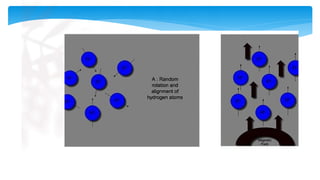
• The hydrogen nuclei partially aligned by a strong magnetic field in the scanner
• The nuclei can be rotated using radio waves , and they subsequently oscillate in the
magnetic field while returning to equilibrium.
• Simultaneously they emit a radio signal
• This is detected using antennas (coils)
• Very detailed images can be made of soft tissues
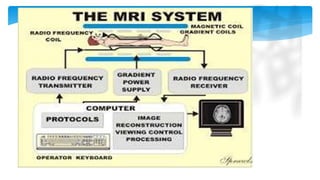
MAIN COMPONENTS OF AN MRI
• Scanner
• Computers
• Recording hardware
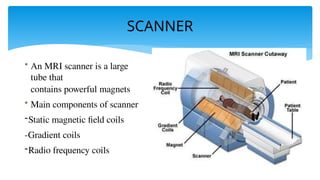
SCANNER
• An MRI scanner is a large
tube that
contains powerful magnets
• Main components of scanner
-Static magnetic field coils
-Gradient coils
-Radio frequency coils
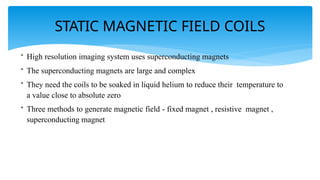
STATIC MAGNETIC FIELD COILS
• High resolution imaging system uses superconducting magnets
• The superconducting magnets are large and complex
• They need the coils to be soaked in liquid helium to reduce their temperature to
a value close to absolute zero
• Three methods to generate magnetic field - fixed magnet , resistive magnet ,
superconducting magnet
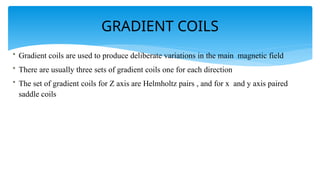
GRADIENT COILS
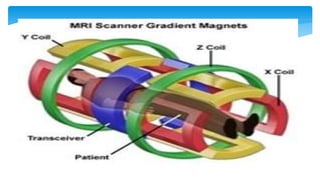
• Gradient coils are used to produce deliberate variations in the main magnetic field
• There are usually three sets of gradient coils one for each direction
• The set of gradient coils for Z axis are Helmholtz pairs , and for x and y axis paired
saddle coils
PROCEDURE
During the test
• The MRI machine looks like a long narrow tube that has both ends open. You lie
down on a movable table that slides into the opening of the tube. A technologist
monitors you from another room. You can talk with the person by microphone.
• If you have a fear of enclosed spaces (claustrophobia), you might be given a drug
to help you feel sleepy and less anxious. Most people get through the exam without
difficulty.
• The MRI machine creates a strong magnetic field around you, and radio waves are
directed at your body. The procedure is painless. You don't feel the magnetic field
or radio waves, and there are no moving parts around you.
• During the MRI scan, the internal part of the magnet produces repetitive tapping,
thumping and other noises. You might be given earplugs or have music playing to
help block the noise.
• In some cases, a contrast material, typically gadolinium, will be injected through an
intravenous (IV) line into a vein in your hand or arm. The contrast material enhances
certain details. Gadolinium rarely causes allergic reactions.
• An MRI can last anywhere from 15 minutes to more than an hour. You must hold still
because movement can blur the resulting images.
1.After the test
If you haven't been sedated, you can resume your usual activities immediately after the scan.
2.Results
A doctor specially trained to interpret MRIs (radiologist) will analyze the images from
your scan and report the findings to your doctor.
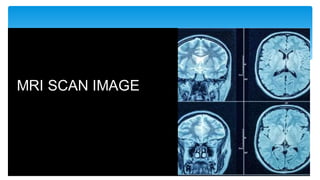
MRI SCAN IMAGE
DIAGNOSIS
• Most ailments of the brain including tumors
• Sport injuries
• Prostate problems
• Certain ENT conditions
• Musculoskeletal problems
• Most spinal conditions / injuries
Assignment of biochemistry for different techniques

Assignment of biochemistry for different techniques

  • 1.
    ACHARYA NARENDRA DEVAUNIVERSITY OF AGRICULTURE & TECHNOLOGY KUMARGANJ, AYODHYA Assignment On: Imaging techniques Course: BIOCHEM 505 (2+2) Course Title: Techniques in Biochemistry Presented By Mr. Rahul Kumar Maurya Ph. D. Agril. Biotechnology ID. No. A-11164/19/22 Presented To Dr. Pratibha Singh (Head & Professor Department of Biochemistry) Dr. R. P. Singh(Assistant Professor) Department of Biochemistry, ANDUA&T, Kumarganj, Ayodhya-224229
  • 2.
    PHOSPHORIMAGE R ▶ It isa scanning instrument ▶ Phosphor imager is a compact laser optical imager that uses innovative storage phosphor technology to detect and quantify radioactivity. ▶ Used for both localization and quantification of targets. ▶ Targets on radiolabelled DNA ,RNA , Proteins and post-translational protein modifications. ▶ Uses media including gels, homogenized samples, cell population, arrays and tissue slices.
  • 3.
    Use of Phosphorimager ▶We can use the scanner control software to scan a full 20 x 25cm sample in approximately 4 minutes using high resolution. ▶ We can use image analysis software to analyse and manipulate the data generated by the scans. ▶ Create image files that can be transferred to compatible graphics programs on computers to generate image prints and reports.
  • 4.
    PRINCIPL E ▶ The ImagingPlate is a flexible image sensor in which bunches of very small crystals (grain size: about 5 µm) of barium fluoro bromide (BaFBr) containing a trace amount of bivalent europium (Eu2+) (formulated as BaFBr : Eu2+ )are uniformly coated on a polyester support film. ▶ Image analysis and data processing are done on the CRT screen .The processed image can be printed either as a color or grayscale hard copy. ▶ The exposed Imaging Plate is reusable after erasing the residual latent image with uniformly irradiated visible light.
  • 5.
    INSTRUMENTATION  The PhosphorImagerequipment includes the following hardware components:- ▶ PhosphorImager SI (scanning instrument) — samples. scans and analyzes ▶ Phosphor screen — collects the image. ▶ Exposure cassette — holds the screen in a light-tight environment. ▶ Image Eraser SF™ — erases screens for reuse. ▶ Additional accessories include a SCSI cable, a SCSI terminator, and a power cord.
  • 6.
    Workin g Phosphors are compoundsthat absorb energy at one wavelength and re-emit energy at another. Storage phosphors release stored energy when stimulated by light of particular wavelengths. The Molecular Dynamics phosphor screens crystals are composed of fine of BaFBr:Eu+2 in an organic binder.
  • 8.
    APPLICATIONS ▶ reduces exposuretimes by 90% for most samples ▶ simplifies accurate quantification because of its wide & linear response ▶ Storage phosphor screens capture latent images produced by ionizing radiation (β and γ emissions from radiolabelled blots, gels, TLC plates, tissues, or X-rays). ▶ Latent images are read by laser scanning and saved in digital format. ▶ The PhosphorImager SI comes with Image Quant software and documentation for Mac or PC, with which 1-D analysis of density profiles (peak area integration) and volume quantitation of signal intensities can be determined. ▶ Typical applications include DNA sequencing gels, DNA blots, CAT assays, protein blots, X-rays, and whole body autoradiography. ▶ Southern, Northern, Western, and other radio-labelled blotting assays produce images on storage phosphor screens 10-100 times faster than with film. Any radioisotope material may be used for blotting applications.
  • 9.
    ADVANTAGES Phosphor screen autoradiographyoffers many advantages over traditional film autoradiography: Exposure time is approximately 1/10th that of traditional autoradiography using X-ray film. Sensitivity is 10 to 250 times that of film, depending on the isotope used and the sample type, such as membrane, gel, or TLC (thin-layer chromatography) plate. The linear dynamic range is 40 times better than film. Exposure takes place at room temperature. The phosphor screens are reusable. No chemicals, darkroom, or special treatment is required. Results can be analysed qualitatively and quantitatively using image analysis software.
  • 10.
    MRI 1.MRI is aradiology technique 2.That uses magnetism, radio waves and a computer to produce images of body structures 3.In 1997 the first MRI exam was performed on a human being 4.It took five hours to produce one image
  • 11.
    PRINCIPLE Of MRI •MRI makes use of the magnetic properties of certain atomic nuclei • Hydrogen nucleus (single proton) present in water molecules and therefore in all body tissues • The hydrogen nuclei partially aligned by a strong magnetic field in the scanner • The nuclei can be rotated using radio waves , and they subsequently oscillate in the magnetic field while returning to equilibrium. • Simultaneously they emit a radio signal • This is detected using antennas (coils) • Very detailed images can be made of soft tissues
  • 13.
    MAIN COMPONENTS OFAN MRI • Scanner • Computers • Recording hardware
  • 14.
    SCANNER • An MRIscanner is a large tube that contains powerful magnets • Main components of scanner -Static magnetic field coils -Gradient coils -Radio frequency coils
  • 15.
    STATIC MAGNETIC FIELDCOILS • High resolution imaging system uses superconducting magnets • The superconducting magnets are large and complex • They need the coils to be soaked in liquid helium to reduce their temperature to a value close to absolute zero • Three methods to generate magnetic field - fixed magnet , resistive magnet , superconducting magnet
  • 16.
    GRADIENT COILS • Gradientcoils are used to produce deliberate variations in the main magnetic field • There are usually three sets of gradient coils one for each direction • The set of gradient coils for Z axis are Helmholtz pairs , and for x and y axis paired saddle coils
  • 18.
    PROCEDURE During the test •The MRI machine looks like a long narrow tube that has both ends open. You lie down on a movable table that slides into the opening of the tube. A technologist monitors you from another room. You can talk with the person by microphone. • If you have a fear of enclosed spaces (claustrophobia), you might be given a drug to help you feel sleepy and less anxious. Most people get through the exam without difficulty. • The MRI machine creates a strong magnetic field around you, and radio waves are directed at your body. The procedure is painless. You don't feel the magnetic field or radio waves, and there are no moving parts around you. • During the MRI scan, the internal part of the magnet produces repetitive tapping, thumping and other noises. You might be given earplugs or have music playing to help block the noise.
  • 19.
    • In somecases, a contrast material, typically gadolinium, will be injected through an intravenous (IV) line into a vein in your hand or arm. The contrast material enhances certain details. Gadolinium rarely causes allergic reactions. • An MRI can last anywhere from 15 minutes to more than an hour. You must hold still because movement can blur the resulting images. 1.After the test If you haven't been sedated, you can resume your usual activities immediately after the scan. 2.Results A doctor specially trained to interpret MRIs (radiologist) will analyze the images from your scan and report the findings to your doctor.
  • 21.
  • 22.
    DIAGNOSIS • Most ailmentsof the brain including tumors • Sport injuries • Prostate problems • Certain ENT conditions • Musculoskeletal problems • Most spinal conditions / injuries