Vygotsky vs. Gibson Pro/Contra PresentationAssignment 3 Advanced Motivation and Developmental TheoryDr. M. Gail DerrickGroup 4Geertina Ellis, Jacqueline Higgins, Margaret Gibson-Gutierrez, Harriet Watkins
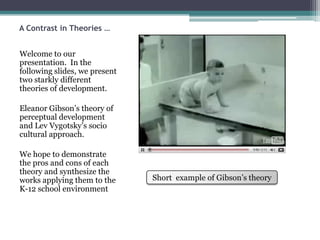
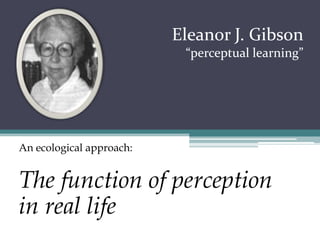
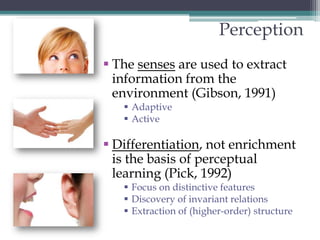
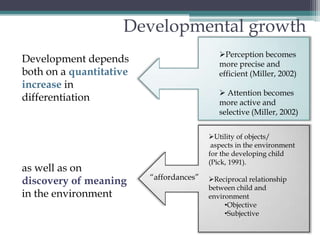
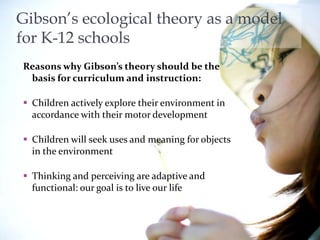
A Contrast in Theories …Welcome to our presentation.  In the following slides, we present two starkly different theories of development.  Eleanor Gibson’s theory of perceptual development and Lev Vygotsky’ssocio cultural approach. We hope to demonstrate the pros and cons of each  theory and synthesize the works applying them to the K-12 school environment Short  example of Gibson’s theory
CONTRASTOF THEORIESPro
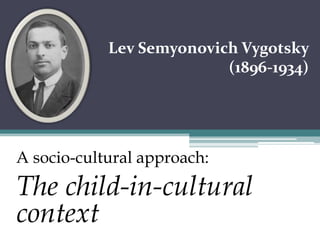
Lev SemyonovichVygotsky(1896-1934)A socio-cultural approach:The child-in-cultural context
Vygotsky’s ViewsChildren ‘s quantitative and qualitative developmental patterns of behavior vary across cultures, subcultures and/or historical time. This is the worldview to which Vygotsky’s socio-cultural approach ascribes (Miller, 2002).
Socio-cultural ApproachAssumptionsChild – in Activity – in Cultural-Context: the unit of study
The Zone of Proximal Development
The Socio-cultural Origins of Mental Functioning
Cultural Tools Mediate Intellectual Functioning
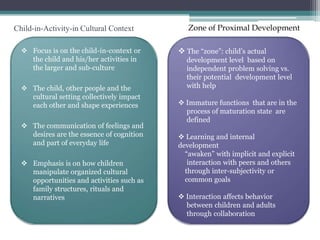
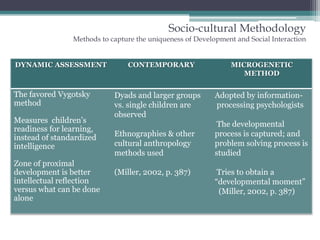
Socio-cultural MethodologyChild-in-Activity-in Cultural ContextZone of Proximal DevelopmentThe “zone”: child’s actual      development level  based on      independent problem solving vs.      their potential  development level      with help Immature functions  that are in the     process of maturation state  are      defined  Learning and internal  development     “awaken” with implicit and explicit      interaction with peers and others    through inter-subjectivity or     common goals  Interaction affects behavior     between children and adults      through collaboration Focus is on the child-in-context or the child and his/her activities in the larger and sub-culture
The child, other people and the cultural setting collectively impact each other and shape experiences
The communication of feelings and desires are the essence of cognition and part of everyday life
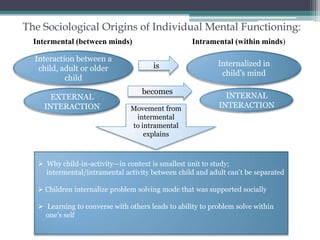
Emphasis is on how children manipulate organized cultural opportunities and activities such as family structures, rituals and narrativesThe Sociological Origins of Individual Mental Functioning:Intermental (between minds)Intramental (within minds)Internalized in child’s mindInteraction between a child, adult or older childisbecomesEXTERNALINTERACTIONINTERNAL INTERACTIONMovement from intermentalto intramental explains  Why child-in-activity—in context is smallest unit to study; intermental/intramental activity between child and adult can’t be separated  Children internalize problem solving mode that was supported socially
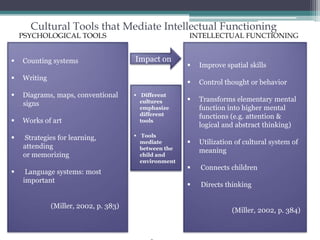
 Learning to converse with others leads to ability to problem solve within one’s self Cultural Tools that Mediate Intellectual FunctioningINTELLECTUAL FUNCTIONINGPSYCHOLOGICAL TOOLSCounting systems
 Writing
 Diagrams, maps, conventional	signs Works of art
 Strategies for learning, attending	or memorizing Language systems: most important                        (Miller, 2002, p. 383) Improve spatial skills
Control thought or behavior
Transforms elementary mental function into higher mental functions (e.g. attention & logical and abstract thinking)
Utilization of cultural system of meaning
Connects children
Directs thinking                             (Miller, 2002, p. 384)Impact on Different cultures emphasize different tools
 Tools mediate between the child and environmentPoints to Consider

Assignment 3 Group Presentation

  • 1.
    Vygotsky vs. GibsonPro/Contra PresentationAssignment 3 Advanced Motivation and Developmental TheoryDr. M. Gail DerrickGroup 4Geertina Ellis, Jacqueline Higgins, Margaret Gibson-Gutierrez, Harriet Watkins
  • 2.
    A Contrast inTheories …Welcome to our presentation. In the following slides, we present two starkly different theories of development. Eleanor Gibson’s theory of perceptual development and Lev Vygotsky’ssocio cultural approach. We hope to demonstrate the pros and cons of each theory and synthesize the works applying them to the K-12 school environment Short example of Gibson’s theory
  • 3.
  • 4.
    Lev SemyonovichVygotsky(1896-1934)A socio-culturalapproach:The child-in-cultural context
  • 5.
    Vygotsky’s ViewsChildren ‘squantitative and qualitative developmental patterns of behavior vary across cultures, subcultures and/or historical time. This is the worldview to which Vygotsky’s socio-cultural approach ascribes (Miller, 2002).
  • 6.
    Socio-cultural ApproachAssumptionsChild –in Activity – in Cultural-Context: the unit of study
  • 7.
    The Zone ofProximal Development
  • 8.
    The Socio-cultural Originsof Mental Functioning
  • 9.
    Cultural Tools MediateIntellectual Functioning
  • 10.
    Socio-cultural MethodologyChild-in-Activity-in CulturalContextZone of Proximal DevelopmentThe “zone”: child’s actual development level based on independent problem solving vs. their potential development level with help Immature functions that are in the process of maturation state are defined Learning and internal development “awaken” with implicit and explicit interaction with peers and others through inter-subjectivity or common goals Interaction affects behavior between children and adults through collaboration Focus is on the child-in-context or the child and his/her activities in the larger and sub-culture
  • 11.
    The child, otherpeople and the cultural setting collectively impact each other and shape experiences
  • 12.
    The communication offeelings and desires are the essence of cognition and part of everyday life
  • 13.
    Emphasis is onhow children manipulate organized cultural opportunities and activities such as family structures, rituals and narrativesThe Sociological Origins of Individual Mental Functioning:Intermental (between minds)Intramental (within minds)Internalized in child’s mindInteraction between a child, adult or older childisbecomesEXTERNALINTERACTIONINTERNAL INTERACTIONMovement from intermentalto intramental explains Why child-in-activity—in context is smallest unit to study; intermental/intramental activity between child and adult can’t be separated Children internalize problem solving mode that was supported socially
  • 14.
    Learning toconverse with others leads to ability to problem solve within one’s self Cultural Tools that Mediate Intellectual FunctioningINTELLECTUAL FUNCTIONINGPSYCHOLOGICAL TOOLSCounting systems
  • 15.
  • 16.
    Diagrams, maps,conventional signs Works of art
  • 17.
    Strategies forlearning, attending or memorizing Language systems: most important (Miller, 2002, p. 383) Improve spatial skills
  • 18.
  • 19.
    Transforms elementary mentalfunction into higher mental functions (e.g. attention & logical and abstract thinking)
  • 20.
    Utilization of culturalsystem of meaning
  • 21.
  • 22.
    Directs thinking (Miller, 2002, p. 384)Impact on Different cultures emphasize different tools
  • 23.
    Tools mediatebetween the child and environmentPoints to Consider