Assignment 20:
Opening Sequence Analysis
Judy Ibelgauptiene
Katia Martins
Leticia Silva
Noor Naoum
Judy
Ibelgauptiene

Katia Martins

Leticia Silva

Noor Naoum

Editing + 1
Narrative
Theory

Purpose/Conv
entions +
Some sound +
1 Narrative
Theory

Narrative
(Structure/Eni
gma/Type) +
MES + 1
Narrative
Theory

CAM SAMC +
Some Sound +
1 Narrative
Theory
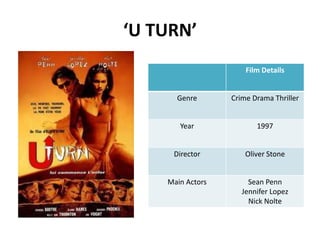
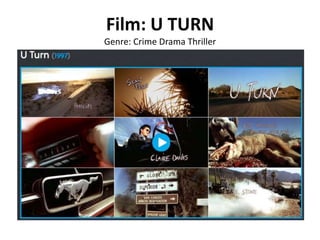
‘U TURN’
Film Details

Genre

Crime Drama Thriller

Year

1997

Director

Oliver Stone

Main Actors

Sean Penn
Jennifer Lopez
Nick Nolte
Film: U TURN
Genre: Crime Drama Thriller
Template Notes
Genre Purpose
Crime, Drama + Thriller
Purpose (Opening Sequence)
The purpose is…
(four points?)
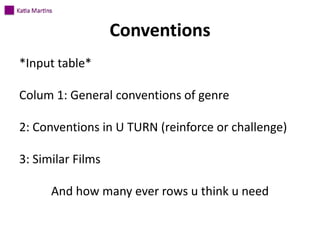
Conventions
*Input table*
Colum 1: General conventions of genre
2: Conventions in U TURN (reinforce or challenge)
3: Similar Films

And how many ever rows u think u need
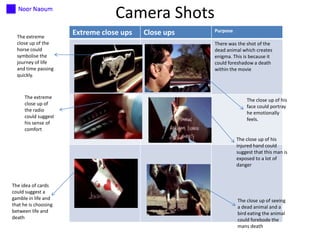
Camera Shots
The extreme
close up of the
horse could
symbolise the
journey of life
and time passing
quickly.

The extreme
close up of
the radio
could suggest
his sense of
comfort

Extreme close ups

Close ups

Purpose
There was the shot of the
dead animal which creates
enigma. This is because it
could foreshadow a death
within the movie

The close up of his
face could portray
he emotionally
feels.

The close up of his
injured hand could
suggest that this man is
exposed to a lot of
danger

The idea of cards
could suggest a
gamble in life and
that he is choosing
between life and
death

The close up of seeing
a dead animal and a
bird eating the animal
could forebode the
mans death
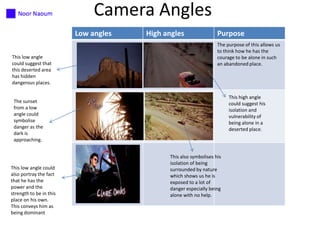
Camera Angles
Low angles
This low angle
could suggest that
this deserted area
has hidden
dangerous places.

High angles

Purpose
The purpose of this allows us
to think how he has the
courage to be alone in such
an abandoned place.

This high angle
could suggest his
isolation and
vulnerability of
being alone in a
deserted place.

The sunset
from a low
angle could
symbolise
danger as the
dark is
approaching.

This low angle could
also portray the fact
that he has the
power and the
strength to be in this
place on his own.
This conveys him as
being dominant

This also symbolises his
isolation of being
surrounded by nature
which shows us he is
exposed to a lot of
danger especially being
alone with no help.
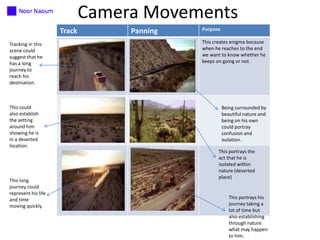
Camera Movements
Track
Tracking in this
scene could
suggest that he
has a long
journey to
reach his
destination.

This could
also establish
the setting
around him
showing he is
in a deserted
location.

This long
journey could
represent his life
and time
moving quickly.

Panning

Purpose
This creates enigma because
when he reaches to the end
we want to know whether he
keeps on going or not.

Being surrounded by
beautiful nature and
being on his own
could portray
confusion and
isolation.
This portrays the
act that he is
isolated within
nature (deserted
place)

This portrays his
journey taking a
lot of time but
also establishing
through nature
what may happen
to him.
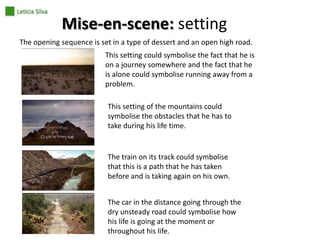
Mise-en-scene: setting
The opening sequence is set in a type of dessert and an open high road.
This setting could symbolise the fact that he is
on a journey somewhere and the fact that he
is alone could symbolise running away from a
problem.
This setting of the mountains could
symbolise the obstacles that he has to
take during his life time.

The train on its track could symbolise
that this is a path that he has taken
before and is taking again on his own.
The car in the distance going through the
dry unsteady road could symbolise how
his life is going at the moment or
throughout his life.
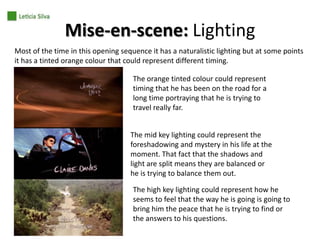
Mise-en-scene: Lighting
Most of the time in this opening sequence it has a naturalistic lighting but at some points
it has a tinted orange colour that could represent different timing.
The orange tinted colour could represent
timing that he has been on the road for a
long time portraying that he is trying to
travel really far.
The mid key lighting could represent the
foreshadowing and mystery in his life at the
moment. That fact that the shadows and
light are split means they are balanced or
he is trying to balance them out.
The high key lighting could represent how he
seems to feel that the way he is going is going to
bring him the peace that he is trying to find or
the answers to his questions.
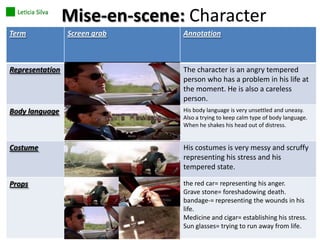
Mise-en-scene: Character
Term

Screen grab

Annotation

Representation

The character is an angry tempered
person who has a problem in his life at
the moment. He is also a careless
person.

Body language

His body language is very unsettled and uneasy.
Also a trying to keep calm type of body language.
When he shakes his head out of distress.

Costume

His costumes is very messy and scruffy
representing his stress and his
tempered state.

Props

the red car= representing his anger.
Grave stone= foreshadowing death.
bandage-= representing the wounds in his
life.
Medicine and cigar= establishing his stress.
Sun glasses= trying to run away from life.
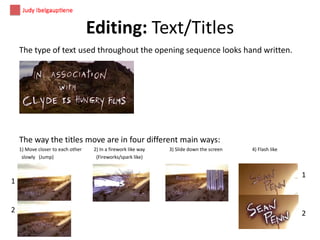
Editing: Text/Titles
The type of text used throughout the opening sequence looks hand written.

The way the titles move are in four different main ways:
1) Move closer to each other
slowly (Jump)

1

2

2) In a firework like way
(Fireworks/spark like)

3) Slide down the screen

4) Flash like

1

2
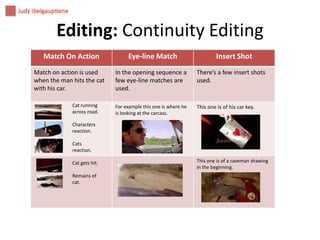
Editing: Continuity Editing
Match On Action
Match on action is used
when the man hits the cat
with his car.
Cat running
across road.

Eye-line Match

Insert Shot

In the opening sequence a
few eye-line matches are
used.

There’s a few insert shots
used.

For example this one is where he
is looking at the carcass.

This one is of his car key.

Characters
reaction.
Cats
reaction.
Cat gets hit.
Remains of
cat.

This one is of a caveman drawing
in the beginning.
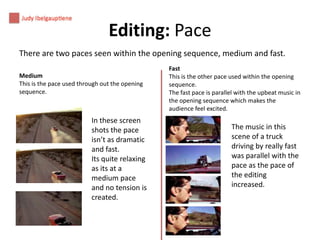
Editing: Pace
There are two paces seen within the opening sequence, medium and fast.
Medium
This is the pace used through out the opening
sequence.

In these screen
shots the pace
isn’t as dramatic
and fast.
Its quite relaxing
as its at a
medium pace
and no tension is
created.

Fast
This is the other pace used within the opening
sequence.
The fast pace is parallel with the upbeat music in
the opening sequence which makes the
audience feel excited.

The music in this
scene of a truck
driving by really fast
was parallel with the
pace as the pace of
the editing
increased.
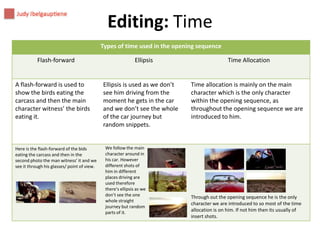
Editing: Time
Types of time used in the opening sequence
Flash-forward

A flash-forward is used to
show the birds eating the
carcass and then the main
character witness’ the birds
eating it.

Here is the flash-forward of the bids
eating the carcass and then in the
second photo the man witness’ it and we
see it through his glasses/ point of view.

Ellipsis

Ellipsis is used as we don’t
see him driving from the
moment he gets in the car
and we don’t see the whole
of the car journey but
random snippets.

We follow the main
character around in
his car. However
different shots of
him in different
places driving are
used therefore
there's ellipsis as we
don’t see the one
whole straight
journey but random
parts of it.

Time Allocation

Time allocation is mainly on the main
character which is the only character
within the opening sequence, as
throughout the opening sequence we are
introduced to him.

Through out the opening sequence he is the only
character we are introduced to so most of the time
allocation is on him. If not him then its usually of
insert shots.
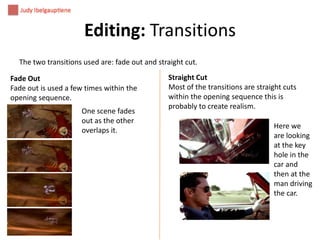
Editing: Transitions
The two transitions used are: fade out and straight cut.

Fade Out
Fade out is used a few times within the
opening sequence.
One scene fades
out as the other
overlaps it.

Straight Cut
Most of the transitions are straight cuts
within the opening sequence this is
probably to create realism.
Here we
are looking
at the key
hole in the
car and
then at the
man driving
the car.
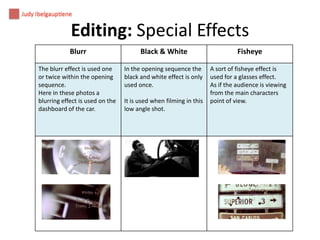
Editing: Special Effects
Blurr

Black & White

Fisheye

The blurr effect is used one
or twice within the opening
sequence.
Here in these photos a
blurring effect is used on the
dashboard of the car.

In the opening sequence the
black and white effect is only
used once.

A sort of fisheye effect is
used for a glasses effect.
As if the audience is viewing
from the main characters
point of view.

It is used when filming in this
low angle shot.
Sound: Diegetic
Sound: Non-diegetic
• In the background the music seems to be calm
and a happy type of atmosphere. When he
reaches the signs the volume control
decreases and allows us to hear the diegetic
sound of him turning off the car.
Leticia Silva

Narrative
STRUCTURE

TYPE

ENIGMA

The structure in non-linear
because it has moments
where the opening
sequence has a scene from
2 birds eating a wolf and
then when he drives past he
sees it. So the timings are
placed to go back and forth
but to still link together.

The type is restricted
(implicit) because you don’t
know what is going on in the
opening sequence and it
doesn’t give away to much
which causes the audience
to have their own theory of
what is the meaning behind
this opening sequence and
by being restricted it helps
to capture the audiences
attention id order to keep
them interested in the
opening sequence.

The enigmas are :
Who is he?
What is he doing out in the
middle of the road on his
own?
Why is he in the middle of
the high road on his own
and why is he so stressed
out?
Why the cigars and
medicines?
Where is he going?
What is he doing and what
did he do?
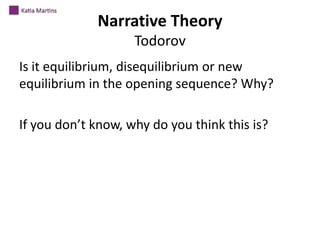
Narrative Theory
Todorov
Is it equilibrium, disequilibrium or new
equilibrium in the opening sequence? Why?
If you don’t know, why do you think this is?
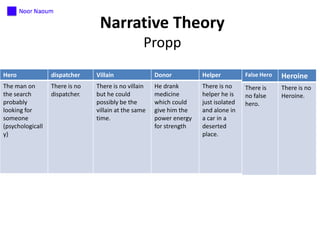
Narrative Theory
Propp
Hero

dispatcher

Villain

Donor

Helper

False Hero

Heroine

The man on
the search
probably
looking for
someone
(psychologicall
y)

There is no
dispatcher.

There is no villain
but he could
possibly be the
villain at the same
time.

He drank
medicine
which could
give him the
power energy
for strength

There is no
helper he is
just isolated
and alone in
a car in a
deserted
place.

There is
no false
hero.

There is no
Heroine.
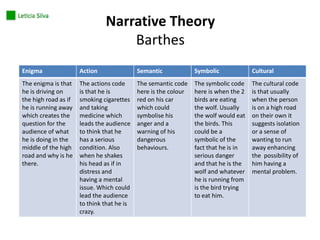
Narrative Theory
Barthes
Enigma

Action

Semantic

Symbolic

Cultural

The enigma is that
he is driving on
the high road as if
he is running away
which creates the
question for the
audience of what
he is doing in the
middle of the high
road and why is he
there.

The actions code
is that he is
smoking cigarettes
and taking
medicine which
leads the audience
to think that he
has a serious
condition. Also
when he shakes
his head as if in
distress and
having a mental
issue. Which could
lead the audience
to think that he is
crazy.

The semantic code
here is the colour
red on his car
which could
symbolise his
anger and a
warning of his
dangerous
behaviours.

The symbolic code
here is when the 2
birds are eating
the wolf. Usually
the wolf would eat
the birds. This
could be a
symbolic of the
fact that he is in
serious danger
and that he is the
wolf and whatever
he is running from
is the bird trying
to eat him.

The cultural code
is that usually
when the person
is on a high road
on their own it
suggests isolation
or a sense of
wanting to run
away enhancing
the possibility of
him having a
mental problem.
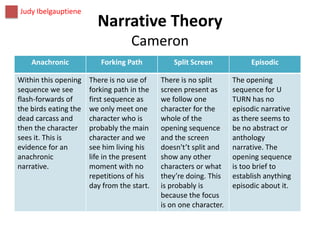
Judy Ibelgauptiene

Narrative Theory
Cameron

Anachronic

Forking Path

Split Screen

Within this opening
sequence we see
flash-forwards of
the birds eating the
dead carcass and
then the character
sees it. This is
evidence for an
anachronic
narrative.

There is no use of
forking path in the
first sequence as
we only meet one
character who is
probably the main
character and we
see him living his
life in the present
moment with no
repetitions of his
day from the start.

There is no split
screen present as
we follow one
character for the
whole of the
opening sequence
and the screen
doesn't’t split and
show any other
characters or what
they’re doing. This
is probably is
because the focus
is on one character.

Episodic
The opening
sequence for U
TURN has no
episodic narrative
as there seems to
be no abstract or
anthology
narrative. The
opening sequence
is too brief to
establish anything
episodic about it.

Assignment 20

  • 1.
    Assignment 20: Opening SequenceAnalysis Judy Ibelgauptiene Katia Martins Leticia Silva Noor Naoum
  • 2.
    Judy Ibelgauptiene Katia Martins Leticia Silva NoorNaoum Editing + 1 Narrative Theory Purpose/Conv entions + Some sound + 1 Narrative Theory Narrative (Structure/Eni gma/Type) + MES + 1 Narrative Theory CAM SAMC + Some Sound + 1 Narrative Theory
  • 3.
    ‘U TURN’ Film Details Genre CrimeDrama Thriller Year 1997 Director Oliver Stone Main Actors Sean Penn Jennifer Lopez Nick Nolte
  • 4.
    Film: U TURN Genre:Crime Drama Thriller
  • 5.
  • 6.
  • 7.
    Purpose (Opening Sequence) Thepurpose is… (four points?)
  • 8.
    Conventions *Input table* Colum 1:General conventions of genre 2: Conventions in U TURN (reinforce or challenge) 3: Similar Films And how many ever rows u think u need
  • 9.
    Camera Shots The extreme closeup of the horse could symbolise the journey of life and time passing quickly. The extreme close up of the radio could suggest his sense of comfort Extreme close ups Close ups Purpose There was the shot of the dead animal which creates enigma. This is because it could foreshadow a death within the movie The close up of his face could portray he emotionally feels. The close up of his injured hand could suggest that this man is exposed to a lot of danger The idea of cards could suggest a gamble in life and that he is choosing between life and death The close up of seeing a dead animal and a bird eating the animal could forebode the mans death
  • 10.
    Camera Angles Low angles Thislow angle could suggest that this deserted area has hidden dangerous places. High angles Purpose The purpose of this allows us to think how he has the courage to be alone in such an abandoned place. This high angle could suggest his isolation and vulnerability of being alone in a deserted place. The sunset from a low angle could symbolise danger as the dark is approaching. This low angle could also portray the fact that he has the power and the strength to be in this place on his own. This conveys him as being dominant This also symbolises his isolation of being surrounded by nature which shows us he is exposed to a lot of danger especially being alone with no help.
  • 11.
    Camera Movements Track Tracking inthis scene could suggest that he has a long journey to reach his destination. This could also establish the setting around him showing he is in a deserted location. This long journey could represent his life and time moving quickly. Panning Purpose This creates enigma because when he reaches to the end we want to know whether he keeps on going or not. Being surrounded by beautiful nature and being on his own could portray confusion and isolation. This portrays the act that he is isolated within nature (deserted place) This portrays his journey taking a lot of time but also establishing through nature what may happen to him.
  • 12.
    Mise-en-scene: setting The openingsequence is set in a type of dessert and an open high road. This setting could symbolise the fact that he is on a journey somewhere and the fact that he is alone could symbolise running away from a problem. This setting of the mountains could symbolise the obstacles that he has to take during his life time. The train on its track could symbolise that this is a path that he has taken before and is taking again on his own. The car in the distance going through the dry unsteady road could symbolise how his life is going at the moment or throughout his life.
  • 13.
    Mise-en-scene: Lighting Most ofthe time in this opening sequence it has a naturalistic lighting but at some points it has a tinted orange colour that could represent different timing. The orange tinted colour could represent timing that he has been on the road for a long time portraying that he is trying to travel really far. The mid key lighting could represent the foreshadowing and mystery in his life at the moment. That fact that the shadows and light are split means they are balanced or he is trying to balance them out. The high key lighting could represent how he seems to feel that the way he is going is going to bring him the peace that he is trying to find or the answers to his questions.
  • 14.
    Mise-en-scene: Character Term Screen grab Annotation Representation Thecharacter is an angry tempered person who has a problem in his life at the moment. He is also a careless person. Body language His body language is very unsettled and uneasy. Also a trying to keep calm type of body language. When he shakes his head out of distress. Costume His costumes is very messy and scruffy representing his stress and his tempered state. Props the red car= representing his anger. Grave stone= foreshadowing death. bandage-= representing the wounds in his life. Medicine and cigar= establishing his stress. Sun glasses= trying to run away from life.
  • 15.
    Editing: Text/Titles The typeof text used throughout the opening sequence looks hand written. The way the titles move are in four different main ways: 1) Move closer to each other slowly (Jump) 1 2 2) In a firework like way (Fireworks/spark like) 3) Slide down the screen 4) Flash like 1 2
  • 16.
    Editing: Continuity Editing MatchOn Action Match on action is used when the man hits the cat with his car. Cat running across road. Eye-line Match Insert Shot In the opening sequence a few eye-line matches are used. There’s a few insert shots used. For example this one is where he is looking at the carcass. This one is of his car key. Characters reaction. Cats reaction. Cat gets hit. Remains of cat. This one is of a caveman drawing in the beginning.
  • 17.
    Editing: Pace There aretwo paces seen within the opening sequence, medium and fast. Medium This is the pace used through out the opening sequence. In these screen shots the pace isn’t as dramatic and fast. Its quite relaxing as its at a medium pace and no tension is created. Fast This is the other pace used within the opening sequence. The fast pace is parallel with the upbeat music in the opening sequence which makes the audience feel excited. The music in this scene of a truck driving by really fast was parallel with the pace as the pace of the editing increased.
  • 18.
    Editing: Time Types oftime used in the opening sequence Flash-forward A flash-forward is used to show the birds eating the carcass and then the main character witness’ the birds eating it. Here is the flash-forward of the bids eating the carcass and then in the second photo the man witness’ it and we see it through his glasses/ point of view. Ellipsis Ellipsis is used as we don’t see him driving from the moment he gets in the car and we don’t see the whole of the car journey but random snippets. We follow the main character around in his car. However different shots of him in different places driving are used therefore there's ellipsis as we don’t see the one whole straight journey but random parts of it. Time Allocation Time allocation is mainly on the main character which is the only character within the opening sequence, as throughout the opening sequence we are introduced to him. Through out the opening sequence he is the only character we are introduced to so most of the time allocation is on him. If not him then its usually of insert shots.
  • 19.
    Editing: Transitions The twotransitions used are: fade out and straight cut. Fade Out Fade out is used a few times within the opening sequence. One scene fades out as the other overlaps it. Straight Cut Most of the transitions are straight cuts within the opening sequence this is probably to create realism. Here we are looking at the key hole in the car and then at the man driving the car.
  • 20.
    Editing: Special Effects Blurr Black& White Fisheye The blurr effect is used one or twice within the opening sequence. Here in these photos a blurring effect is used on the dashboard of the car. In the opening sequence the black and white effect is only used once. A sort of fisheye effect is used for a glasses effect. As if the audience is viewing from the main characters point of view. It is used when filming in this low angle shot.
  • 21.
  • 22.
    Sound: Non-diegetic • Inthe background the music seems to be calm and a happy type of atmosphere. When he reaches the signs the volume control decreases and allows us to hear the diegetic sound of him turning off the car.
  • 23.
    Leticia Silva Narrative STRUCTURE TYPE ENIGMA The structurein non-linear because it has moments where the opening sequence has a scene from 2 birds eating a wolf and then when he drives past he sees it. So the timings are placed to go back and forth but to still link together. The type is restricted (implicit) because you don’t know what is going on in the opening sequence and it doesn’t give away to much which causes the audience to have their own theory of what is the meaning behind this opening sequence and by being restricted it helps to capture the audiences attention id order to keep them interested in the opening sequence. The enigmas are : Who is he? What is he doing out in the middle of the road on his own? Why is he in the middle of the high road on his own and why is he so stressed out? Why the cigars and medicines? Where is he going? What is he doing and what did he do?
  • 24.
    Narrative Theory Todorov Is itequilibrium, disequilibrium or new equilibrium in the opening sequence? Why? If you don’t know, why do you think this is?
  • 25.
    Narrative Theory Propp Hero dispatcher Villain Donor Helper False Hero Heroine Theman on the search probably looking for someone (psychologicall y) There is no dispatcher. There is no villain but he could possibly be the villain at the same time. He drank medicine which could give him the power energy for strength There is no helper he is just isolated and alone in a car in a deserted place. There is no false hero. There is no Heroine.
  • 26.
    Narrative Theory Barthes Enigma Action Semantic Symbolic Cultural The enigmais that he is driving on the high road as if he is running away which creates the question for the audience of what he is doing in the middle of the high road and why is he there. The actions code is that he is smoking cigarettes and taking medicine which leads the audience to think that he has a serious condition. Also when he shakes his head as if in distress and having a mental issue. Which could lead the audience to think that he is crazy. The semantic code here is the colour red on his car which could symbolise his anger and a warning of his dangerous behaviours. The symbolic code here is when the 2 birds are eating the wolf. Usually the wolf would eat the birds. This could be a symbolic of the fact that he is in serious danger and that he is the wolf and whatever he is running from is the bird trying to eat him. The cultural code is that usually when the person is on a high road on their own it suggests isolation or a sense of wanting to run away enhancing the possibility of him having a mental problem.
  • 27.
    Judy Ibelgauptiene Narrative Theory Cameron Anachronic ForkingPath Split Screen Within this opening sequence we see flash-forwards of the birds eating the dead carcass and then the character sees it. This is evidence for an anachronic narrative. There is no use of forking path in the first sequence as we only meet one character who is probably the main character and we see him living his life in the present moment with no repetitions of his day from the start. There is no split screen present as we follow one character for the whole of the opening sequence and the screen doesn't’t split and show any other characters or what they’re doing. This is probably is because the focus is on one character. Episodic The opening sequence for U TURN has no episodic narrative as there seems to be no abstract or anthology narrative. The opening sequence is too brief to establish anything episodic about it.