Asset/Liability Management
Part 1
Tuesday July 13th, 2021
1
Dale Sheller, Senior Vice President – The Baker Group
dale@gobaker.com
405-415-7214
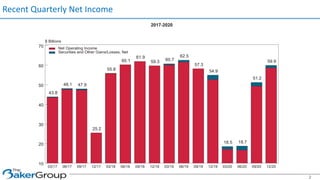
Recent Quarterly Net Income
2
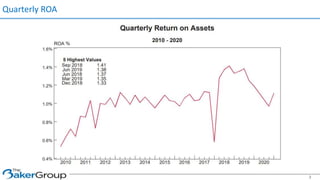
Quarterly ROA
3
4
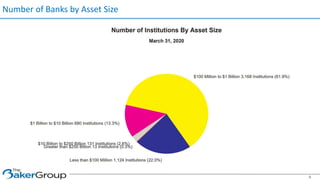
Number of Banks by Asset Size
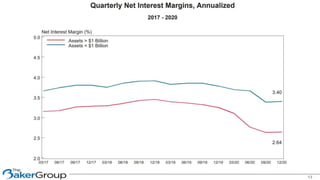
5
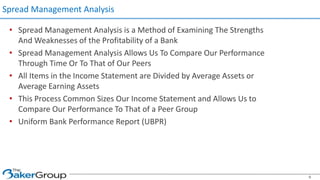
Spread Management Analysis
• Spread Management Analysis is a Method of Examining The Strengths
And Weaknesses of the Profitability of a Bank
• Spread Management Analysis Allows Us To Compare Our Performance
Through Time Or To That of Our Peers
• All Items in the Income Statement are Divided by Average Assets or
Average Earning Assets
• This Process Common Sizes Our Income Statement and Allows Us to
Compare Our Performance To That of a Peer Group
• Uniform Bank Performance Report (UBPR)
6
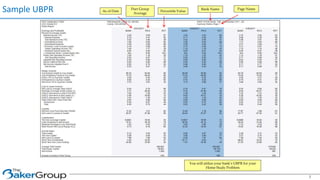
Sample UBPR
7
As of Date
Bank Name
Peer Group
Average
Percentile Value
Page Name
You will utilize your bank’s UBPR for your
Home Study Problem
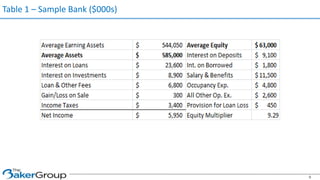
Table 1 – Sample Bank ($000s)
8
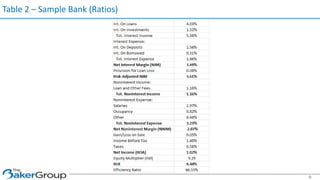
Table 2 – Sample Bank (Ratios)
9
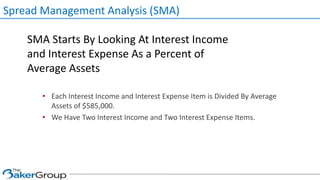
Spread Management Analysis (SMA)
SMA Starts By Looking At Interest Income
and Interest Expense As a Percent of
Average Assets
• Each Interest Income and Interest Expense Item is Divided By Average
Assets of $585,000.
• We Have Two Interest Income and Two Interest Expense Items.

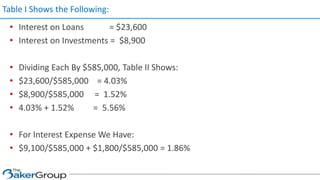
Table I Shows the Following:
• Interest on Loans = $23,600
• Interest on Investments = $8,900
• Dividing Each By $585,000, Table II Shows:
• $23,600/$585,000 = 4.03%
• $8,900/$585,000 = 1.52%
• 4.03% + 1.52% = 5.56%
• For Interest Expense We Have:
• $9,100/$585,000 + $1,800/$585,000 = 1.86%
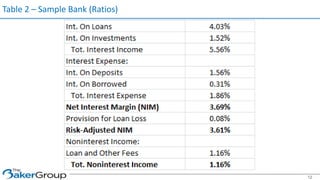
Table 2 – Sample Bank (Ratios)
12
13
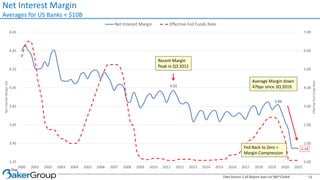
4.02
3.86
3.39
0.00
1.00
2.00
3.00
4.00
5.00
6.00
7.00
3.25
3.45
3.65
3.85
4.05
4.25
4.45
4.65
2000 2001 2002 2003 2004 2005 2006 2007 2008 2009 2010 2011 2012 2013 2014 2015 2016 2017 2018 2019 2020 2021
Effective
Fed
Funds
Rate
Net
Interest
Margin
(%)
Net Interest Margin Effective Fed Funds Rate
Net Interest Margin
Averages for US Banks < $10B
14
Recent Margin
Peak in Q3 2011
Fed Back to Zero =
Margin Compression
Average Margin down
47bps since 3Q 2019.
Data Source: Call Report data via S&P Global
12 Month Loan Growth Rates
15
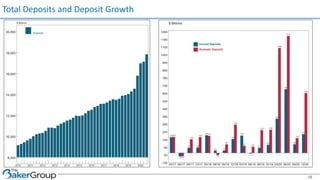
Total Deposits and Deposit Growth
16
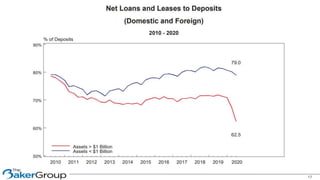
17
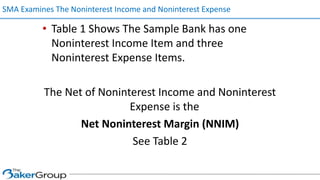
• Table 1 Shows The Sample Bank has one
Noninterest Income Item and three
Noninterest Expense Items.
The Net of Noninterest Income and Noninterest
Expense is the
Net Noninterest Margin (NNIM)
See Table 2
SMA Examines The Noninterest Income and Noninterest Expense
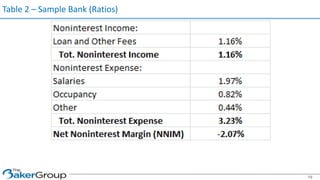
Table 2 – Sample Bank (Ratios)
19
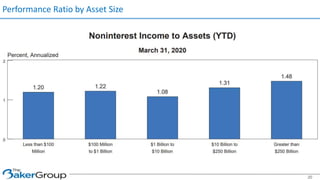
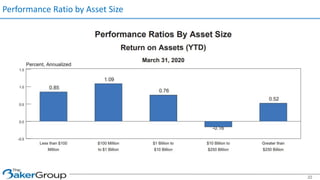
Performance Ratio by Asset Size
20
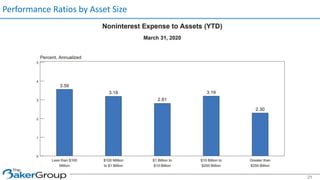
Performance Ratios by Asset Size
21
Performance Ratio by Asset Size
22
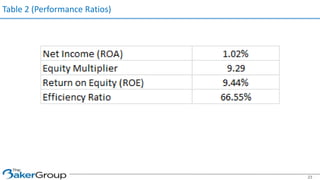
Table 2 (Performance Ratios)
23
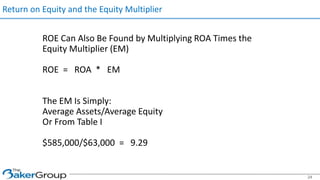
Return on Equity and the Equity Multiplier
24
ROE Can Also Be Found by Multiplying ROA Times the
Equity Multiplier (EM)
ROE = ROA * EM
The EM Is Simply:
Average Assets/Average Equity
Or From Table I
$585,000/$63,000 = 9.29
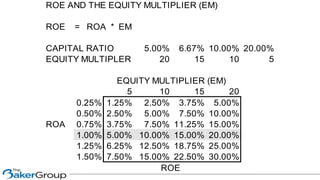
ROE AND THE EQUITY MULTIPLIER (EM)
ROE = ROA * EM
CAPITAL RATIO =
5.00% 6.67% 10.00% 20.00%
EQUITY MULTIPLER = 20 15 10 5
EQUITY MULTIPLIER (EM)
5 10 15 20
0.25% 1.25% 2.50% 3.75% 5.00%
0.50% 2.50% 5.00% 7.50% 10.00%
ROA 0.75% 3.75% 7.50% 11.25% 15.00%
1.00% 5.00% 10.00% 15.00% 20.00%
1.25% 6.25% 12.50% 18.75% 25.00%
1.50% 7.50% 15.00% 22.50% 30.00%
ROE
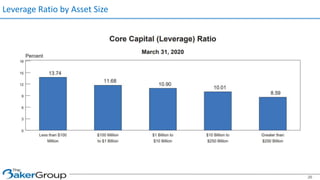
Leverage Ratio by Asset Size
26
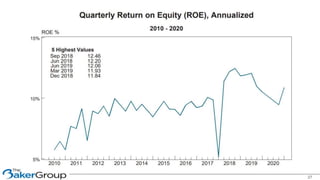
27
28
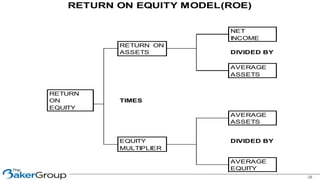
RETURN ON EQUITY MODEL(ROE)
NET
INCOME
RETURN ON
ASSETS DIVIDED BY
AVERAGE
ASSETS
RETURN
ON TIMES
EQUITY
AVERAGE
ASSETS
EQUITY DIVIDED BY
MULTIPLIER
AVERAGE
EQUITY
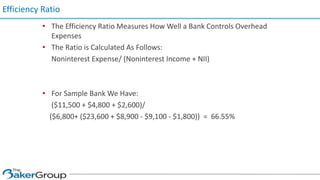
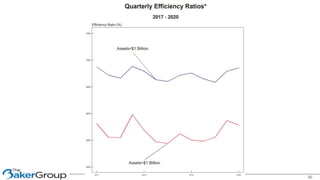
• The Efficiency Ratio Measures How Well a Bank Controls Overhead
Expenses
• The Ratio is Calculated As Follows:
Noninterest Expense/ (Noninterest Income + NII)
• For Sample Bank We Have:
($11,500 + $4,800 + $2,600)/
($6,800+ ($23,600 + $8,900 - $9,100 - $1,800)) = 66.55%
Efficiency Ratio
30
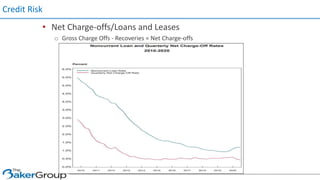
• Net Charge-offs/Loans and Leases
o Gross Charge Offs - Recoveries = Net Charge-offs
Credit Risk
Key Terms
1. Net Interest Margin (NIM)
2. Risk-Adjusted NIM
3. Net Noninterest Margin (NNM)
4. Rate of Return on Assets (ROA)
5. Equity Multiplier (EM)
6. Return on Equity (ROE)
7. Efficiency Ratio
Asset/Liability Management
Part 2
33
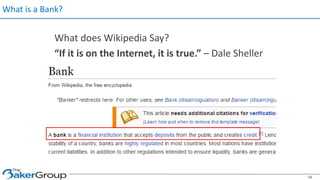
What is a Bank?
What does Wikipedia Say?
“If it is on the Internet, it is true.” – Dale Sheller
34
What’s the Definition of Asset/Liability Management?
Dictionary of Banking Terms Definition:
“Active management of a bank’s balance sheet to
maintain a mix of loan and deposits consistent with its
goals for long-term growth and risk management.”
It’s a Structured Decision Making Process.
35
What are the Objectives of Asset/Liability Management?
• Generate income (spread)
• Maintain capital (or grow it!)
• Identify and management risks (Risk Management)
• Manage Growth (not enough growth vs. too little
growth)
The purpose of Asset-Liability Management is to
control a bank’s sensitivity to changes in market
interest rates and limits its losses in income and capital.
36
Asset/Liability Management – Four Observations
1. Interest Rate Risk is unavoidable.
2. Interest Rate Risk is usually the least risk of
the risks a bank will take.
3. Interest Rate Risk is separate from credit risk
and liquidity risk, but has codependent
causes and consequences.
4. Accepting a large amount of Interest Rate
Risk is not essential to bank’s profitability.
37
Important to Understand the Relationships
• Balance Sheet
• Income Statement
• Assets
• Liabilities
• Capital/Equity
How do they work together and how are they
independent?
38
Asset/Liability Management Components
• Policy: Statement of management’s objectives
regarding Asset Liability Management (ALM).
• Measurements: Key ratios, spreads, GAP, simulation,
trend analysis, investment portfolio yields, costs,
yield curves, rate shocks, present value, cash flows
• Software: A tool used to calculated the
measurements
• Asset/Liability Committee (ALCO): Decision making
body that manages the ALM processes.
39
Asset/Liability Management Committee (ALCO)
• A committee tasked to manage an institution’s Asset/Liability
Management position.
Duties include but are not limited to:
• Pricing products and services
• Maintaining Profitability
• Meeting Cash Flow Needs
• Managing Interest Rate Risk Position
• Identifying and Managing Risk
• Other topics, but the ALCO is primarily concerned with
Interest Rate Risk management issues.
40
An Effective Asset/Liability Management Program
• Identifies financial goals (Planning)
• Identifies interest-rate, prepayment, credit and
liquidity risk (assessment)
• Develops and maintains accurate risk management
techniques (tools/software, policy, ALCO)
• Integrates ALM into the management process
(planning, strategizing, policy, ALCO)
• Evaluates effect of management strategies before
implementation (simulation)
• Implements strategies to maximize performance
41
Types of Interest Rate Risk
42
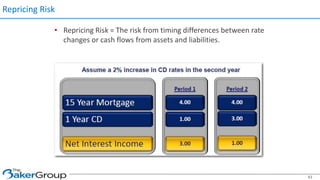
Repricing Risk
43
• Repricing Risk = The risk from timing differences between rate
changes or cash flows from assets and liabilities.
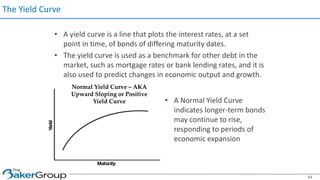
The Yield Curve
• A yield curve is a line that plots the interest rates, at a set
point in time, of bonds of differing maturity dates.
• The yield curve is used as a benchmark for other debt in the
market, such as mortgage rates or bank lending rates, and it is
also used to predict changes in economic output and growth.
44
Normal Yield Curve – AKA
Upward Sloping or Positive
Yield Curve • A Normal Yield Curve
indicates longer-term bonds
may continue to rise,
responding to periods of
economic expansion
The Yield Curve (Cont.)
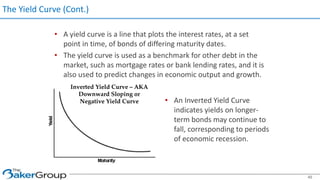
• A yield curve is a line that plots the interest rates, at a set
point in time, of bonds of differing maturity dates.
• The yield curve is used as a benchmark for other debt in the
market, such as mortgage rates or bank lending rates, and it is
also used to predict changes in economic output and growth.
45
Inverted Yield Curve – AKA
Downward Sloping or
Negative Yield Curve • An Inverted Yield Curve
indicates yields on longer-
term bonds may continue to
fall, corresponding to periods
of economic recession.
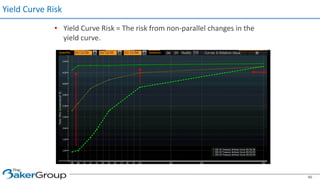
Yield Curve Risk
• Yield Curve Risk = The risk from non-parallel changes in the
yield curve.
46
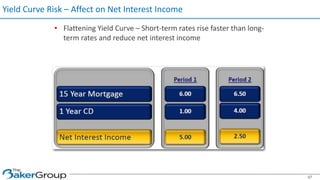
Yield Curve Risk – Affect on Net Interest Income
47
• Flattening Yield Curve – Short-term rates rise faster than long-
term rates and reduce net interest income
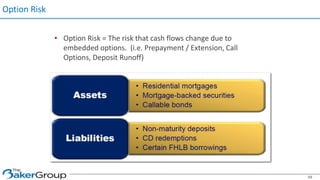
Option Risk
48
• Option Risk = The risk that cash flows change due to
embedded options. (i.e. Prepayment / Extension, Call
Options, Deposit Runoff)
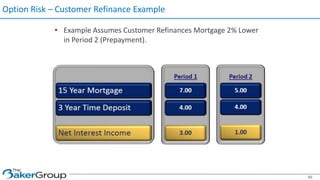
Option Risk – Customer Refinance Example
• Example Assumes Customer Refinances Mortgage 2% Lower
in Period 2 (Prepayment).
49
Option Risk – Extension Risk
50
• As rates rise, prepayments slow and average lives extend.
Basis Risk
51
• Basis Risk = The Risk that different indices (Treasury / LIBOR)
with the same repricing frequency do not move in unison.
Summary of Types of Interest Rate Risk
• Repricing Risk
• Yield Curve Risk
• Option Risk
• Basis Risk
• How much of each risk is within my
institution’s balance sheet?
52
• Not just IRR
• Non-Interest Income/Expense (Efficiency Ratio)
• Tax Planning
• Other Areas of Risk Management
• Credit Risk and Asset Quality Factors
• Capital Risk and Dividend Policy
• Liquidity Risk and Liability Pricing
• Strategic Planning
Related ALCO Responsibilities
53
• Asset and liability management involves making decisions that
affect all aspects of a bank’s risk and return profile
• Bank risk management has been widely criticized recently as
many institutions failed to adequately measure, monitor and
manage credit risk, liquidity risk, interest rate risk and
operational risk
• GAP analysis is used to manage interest rate risk in terms how
interest rate changes affect a bank’s net interest income
• Net interest income will change whenever interest rates change
• Changes in interest rates do not affect assets and liabilities
equally
• In addition to interest rate risk issues, a bank’s ALCO reviews
decisions associated with credit risk (asset quality), liquidity risk,
capital, dividend policy and overall bank strategic planning
Summary: Asset/Liability Management
54

Asset-Liability-Part-1-and-2.pptx

  • 1.
    Asset/Liability Management Part 1 TuesdayJuly 13th, 2021 1 Dale Sheller, Senior Vice President – The Baker Group dale@gobaker.com 405-415-7214
  • 2.
  • 3.
  • 4.
  • 5.
    Number of Banksby Asset Size 5
  • 6.
    Spread Management Analysis •Spread Management Analysis is a Method of Examining The Strengths And Weaknesses of the Profitability of a Bank • Spread Management Analysis Allows Us To Compare Our Performance Through Time Or To That of Our Peers • All Items in the Income Statement are Divided by Average Assets or Average Earning Assets • This Process Common Sizes Our Income Statement and Allows Us to Compare Our Performance To That of a Peer Group • Uniform Bank Performance Report (UBPR) 6
  • 7.
    Sample UBPR 7 As ofDate Bank Name Peer Group Average Percentile Value Page Name You will utilize your bank’s UBPR for your Home Study Problem
  • 8.
    Table 1 –Sample Bank ($000s) 8
  • 9.
    Table 2 –Sample Bank (Ratios) 9
  • 10.
    Spread Management Analysis(SMA) SMA Starts By Looking At Interest Income and Interest Expense As a Percent of Average Assets • Each Interest Income and Interest Expense Item is Divided By Average Assets of $585,000. • We Have Two Interest Income and Two Interest Expense Items.
  • 11.
    Table I Showsthe Following: • Interest on Loans = $23,600 • Interest on Investments = $8,900 • Dividing Each By $585,000, Table II Shows: • $23,600/$585,000 = 4.03% • $8,900/$585,000 = 1.52% • 4.03% + 1.52% = 5.56% • For Interest Expense We Have: • $9,100/$585,000 + $1,800/$585,000 = 1.86%
  • 12.
    Table 2 –Sample Bank (Ratios) 12
  • 13.
  • 14.
    4.02 3.86 3.39 0.00 1.00 2.00 3.00 4.00 5.00 6.00 7.00 3.25 3.45 3.65 3.85 4.05 4.25 4.45 4.65 2000 2001 20022003 2004 2005 2006 2007 2008 2009 2010 2011 2012 2013 2014 2015 2016 2017 2018 2019 2020 2021 Effective Fed Funds Rate Net Interest Margin (%) Net Interest Margin Effective Fed Funds Rate Net Interest Margin Averages for US Banks < $10B 14 Recent Margin Peak in Q3 2011 Fed Back to Zero = Margin Compression Average Margin down 47bps since 3Q 2019. Data Source: Call Report data via S&P Global
  • 15.
    12 Month LoanGrowth Rates 15
  • 16.
    Total Deposits andDeposit Growth 16
  • 17.
  • 18.
    • Table 1Shows The Sample Bank has one Noninterest Income Item and three Noninterest Expense Items. The Net of Noninterest Income and Noninterest Expense is the Net Noninterest Margin (NNIM) See Table 2 SMA Examines The Noninterest Income and Noninterest Expense
  • 19.
    Table 2 –Sample Bank (Ratios) 19
  • 20.
    Performance Ratio byAsset Size 20
  • 21.
    Performance Ratios byAsset Size 21
  • 22.
    Performance Ratio byAsset Size 22
  • 23.
  • 24.
    Return on Equityand the Equity Multiplier 24 ROE Can Also Be Found by Multiplying ROA Times the Equity Multiplier (EM) ROE = ROA * EM The EM Is Simply: Average Assets/Average Equity Or From Table I $585,000/$63,000 = 9.29
  • 25.
    ROE AND THEEQUITY MULTIPLIER (EM) ROE = ROA * EM CAPITAL RATIO = 5.00% 6.67% 10.00% 20.00% EQUITY MULTIPLER = 20 15 10 5 EQUITY MULTIPLIER (EM) 5 10 15 20 0.25% 1.25% 2.50% 3.75% 5.00% 0.50% 2.50% 5.00% 7.50% 10.00% ROA 0.75% 3.75% 7.50% 11.25% 15.00% 1.00% 5.00% 10.00% 15.00% 20.00% 1.25% 6.25% 12.50% 18.75% 25.00% 1.50% 7.50% 15.00% 22.50% 30.00% ROE
  • 26.
    Leverage Ratio byAsset Size 26
  • 27.
  • 28.
    28 RETURN ON EQUITYMODEL(ROE) NET INCOME RETURN ON ASSETS DIVIDED BY AVERAGE ASSETS RETURN ON TIMES EQUITY AVERAGE ASSETS EQUITY DIVIDED BY MULTIPLIER AVERAGE EQUITY
  • 29.
    • The EfficiencyRatio Measures How Well a Bank Controls Overhead Expenses • The Ratio is Calculated As Follows: Noninterest Expense/ (Noninterest Income + NII) • For Sample Bank We Have: ($11,500 + $4,800 + $2,600)/ ($6,800+ ($23,600 + $8,900 - $9,100 - $1,800)) = 66.55% Efficiency Ratio
  • 30.
  • 31.
    • Net Charge-offs/Loansand Leases o Gross Charge Offs - Recoveries = Net Charge-offs Credit Risk
  • 32.
    Key Terms 1. NetInterest Margin (NIM) 2. Risk-Adjusted NIM 3. Net Noninterest Margin (NNM) 4. Rate of Return on Assets (ROA) 5. Equity Multiplier (EM) 6. Return on Equity (ROE) 7. Efficiency Ratio
  • 33.
  • 34.
    What is aBank? What does Wikipedia Say? “If it is on the Internet, it is true.” – Dale Sheller 34
  • 35.
    What’s the Definitionof Asset/Liability Management? Dictionary of Banking Terms Definition: “Active management of a bank’s balance sheet to maintain a mix of loan and deposits consistent with its goals for long-term growth and risk management.” It’s a Structured Decision Making Process. 35
  • 36.
    What are theObjectives of Asset/Liability Management? • Generate income (spread) • Maintain capital (or grow it!) • Identify and management risks (Risk Management) • Manage Growth (not enough growth vs. too little growth) The purpose of Asset-Liability Management is to control a bank’s sensitivity to changes in market interest rates and limits its losses in income and capital. 36
  • 37.
    Asset/Liability Management –Four Observations 1. Interest Rate Risk is unavoidable. 2. Interest Rate Risk is usually the least risk of the risks a bank will take. 3. Interest Rate Risk is separate from credit risk and liquidity risk, but has codependent causes and consequences. 4. Accepting a large amount of Interest Rate Risk is not essential to bank’s profitability. 37
  • 38.
    Important to Understandthe Relationships • Balance Sheet • Income Statement • Assets • Liabilities • Capital/Equity How do they work together and how are they independent? 38
  • 39.
    Asset/Liability Management Components •Policy: Statement of management’s objectives regarding Asset Liability Management (ALM). • Measurements: Key ratios, spreads, GAP, simulation, trend analysis, investment portfolio yields, costs, yield curves, rate shocks, present value, cash flows • Software: A tool used to calculated the measurements • Asset/Liability Committee (ALCO): Decision making body that manages the ALM processes. 39
  • 40.
    Asset/Liability Management Committee(ALCO) • A committee tasked to manage an institution’s Asset/Liability Management position. Duties include but are not limited to: • Pricing products and services • Maintaining Profitability • Meeting Cash Flow Needs • Managing Interest Rate Risk Position • Identifying and Managing Risk • Other topics, but the ALCO is primarily concerned with Interest Rate Risk management issues. 40
  • 41.
    An Effective Asset/LiabilityManagement Program • Identifies financial goals (Planning) • Identifies interest-rate, prepayment, credit and liquidity risk (assessment) • Develops and maintains accurate risk management techniques (tools/software, policy, ALCO) • Integrates ALM into the management process (planning, strategizing, policy, ALCO) • Evaluates effect of management strategies before implementation (simulation) • Implements strategies to maximize performance 41
  • 42.
    Types of InterestRate Risk 42
  • 43.
    Repricing Risk 43 • RepricingRisk = The risk from timing differences between rate changes or cash flows from assets and liabilities.
  • 44.
    The Yield Curve •A yield curve is a line that plots the interest rates, at a set point in time, of bonds of differing maturity dates. • The yield curve is used as a benchmark for other debt in the market, such as mortgage rates or bank lending rates, and it is also used to predict changes in economic output and growth. 44 Normal Yield Curve – AKA Upward Sloping or Positive Yield Curve • A Normal Yield Curve indicates longer-term bonds may continue to rise, responding to periods of economic expansion
  • 45.
    The Yield Curve(Cont.) • A yield curve is a line that plots the interest rates, at a set point in time, of bonds of differing maturity dates. • The yield curve is used as a benchmark for other debt in the market, such as mortgage rates or bank lending rates, and it is also used to predict changes in economic output and growth. 45 Inverted Yield Curve – AKA Downward Sloping or Negative Yield Curve • An Inverted Yield Curve indicates yields on longer- term bonds may continue to fall, corresponding to periods of economic recession.
  • 46.
    Yield Curve Risk •Yield Curve Risk = The risk from non-parallel changes in the yield curve. 46
  • 47.
    Yield Curve Risk– Affect on Net Interest Income 47 • Flattening Yield Curve – Short-term rates rise faster than long- term rates and reduce net interest income
  • 48.
    Option Risk 48 • OptionRisk = The risk that cash flows change due to embedded options. (i.e. Prepayment / Extension, Call Options, Deposit Runoff)
  • 49.
    Option Risk –Customer Refinance Example • Example Assumes Customer Refinances Mortgage 2% Lower in Period 2 (Prepayment). 49
  • 50.
    Option Risk –Extension Risk 50 • As rates rise, prepayments slow and average lives extend.
  • 51.
    Basis Risk 51 • BasisRisk = The Risk that different indices (Treasury / LIBOR) with the same repricing frequency do not move in unison.
  • 52.
    Summary of Typesof Interest Rate Risk • Repricing Risk • Yield Curve Risk • Option Risk • Basis Risk • How much of each risk is within my institution’s balance sheet? 52
  • 53.
    • Not justIRR • Non-Interest Income/Expense (Efficiency Ratio) • Tax Planning • Other Areas of Risk Management • Credit Risk and Asset Quality Factors • Capital Risk and Dividend Policy • Liquidity Risk and Liability Pricing • Strategic Planning Related ALCO Responsibilities 53
  • 54.
    • Asset andliability management involves making decisions that affect all aspects of a bank’s risk and return profile • Bank risk management has been widely criticized recently as many institutions failed to adequately measure, monitor and manage credit risk, liquidity risk, interest rate risk and operational risk • GAP analysis is used to manage interest rate risk in terms how interest rate changes affect a bank’s net interest income • Net interest income will change whenever interest rates change • Changes in interest rates do not affect assets and liabilities equally • In addition to interest rate risk issues, a bank’s ALCO reviews decisions associated with credit risk (asset quality), liquidity risk, capital, dividend policy and overall bank strategic planning Summary: Asset/Liability Management 54