Home Search Management Custom List SettingsCreate Report
Welcome to your new asset tracking system.
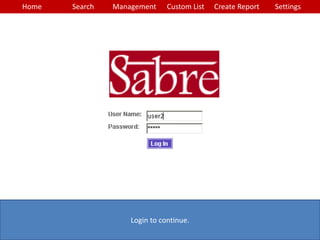
Login to continue.
Home Search Management Custom List SettingsCreate Report
Welcome to your new asset tracking system.
Home Search Management Custom List SettingsCreate Report
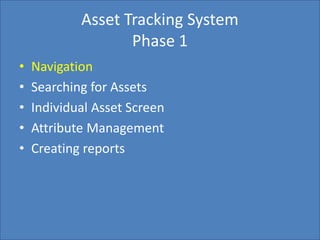
Asset Tracking System
Phase 1
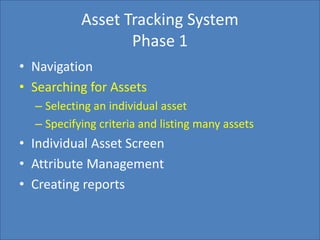
• Navigation
• Searching for Assets
• Individual Asset Screen
• Attribute Management
• Creating reports
Home Search Management Custom List SettingsCreate Report
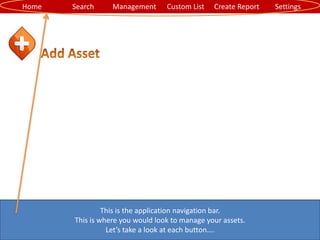
This is the application navigation bar.
This is where you would look to manage your assets.
Let’s take a look at each button….
Home Search Management Custom List SettingsCreate Report
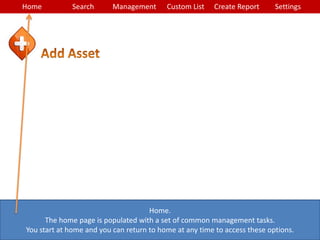
Home.
The home page is populated with a set of common management tasks.
You start at home and you can return to home at any time to access these options.
Home Search Management Custom List SettingsCreate Report
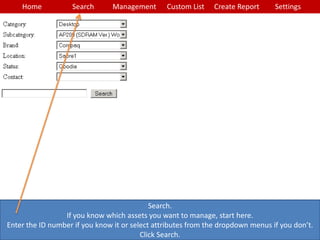
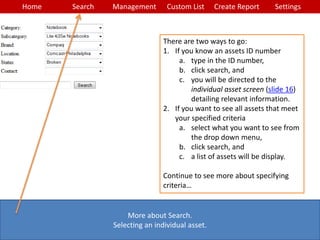
Search.
If you know which assets you want to manage, start here.
Enter the ID number if you know it or select attributes from the dropdown menus if you don’t.
Click Search.
Home Search Management Custom List SettingsCreate Report
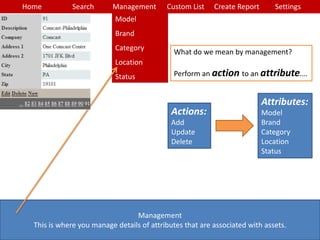
Management
This is where you manage details of attributes that are associated with assets.
Model
Brand
Category
Location
Status
Actions:
Add
Update
Delete
Attributes:
Model
Brand
Category
Location
Status
What do we mean by management?
Perform an action to an attribute….
Home Search Management Custom List SettingsCreate Report
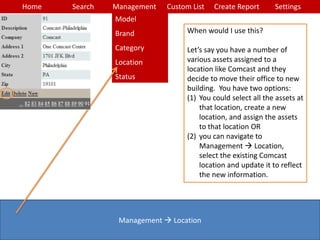
Management  Location
Model
Brand
Category
Location
Status
When would I use this?
Let’s say you have a number of
various assets assigned to a
location like Comcast and they
decide to move their office to new
building. You have two options:
(1) You could select all the assets at
that location, create a new
location, and assign the assets
to that location OR
(2) you can navigate to
Management  Location,
select the existing Comcast
location and update it to reflect
the new information.
Home Search Management Custom List SettingsCreate Report
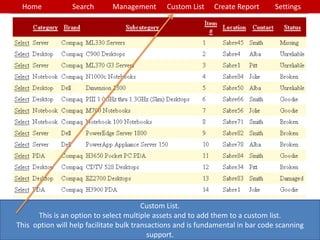
Custom List.
This is an option to select multiple assets and to add them to a custom list.
This option will help facilitate bulk transactions and is fundamental in bar code scanning
support.
Home Search Management Custom List SettingsCreate Report
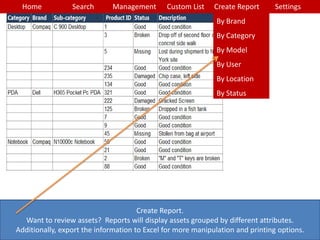
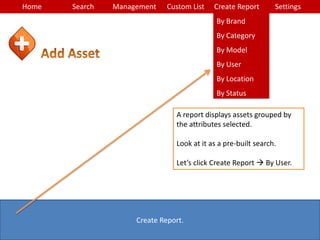
Create Report.
Want to review assets? Reports will display assets grouped by different attributes.
Additionally, export the information to Excel for more manipulation and printing options.
By Brand
By Category
By Model
By User
By Location
By Status
Home Search Management Custom List SettingsCreate Report
Settings.
This is where you’ll find user settings and admin functionality.
Home Search Management Custom List SettingsCreate Report
Asset Tracking System
Phase 1
• Navigation
• Searching for Assets
– Selecting an individual asset
– Specifying criteria and listing many assets
• Individual Asset Screen
• Attribute Management
• Creating reports
Home Search Management Custom List SettingsCreate Report
More about Search.
Selecting an individual asset.
There are two ways to go:
1. If you know an assets ID number
a. type in the ID number,
b. click search, and
c. you will be directed to the
individual asset screen (slide 16)
detailing relevant information.
2. If you want to see all assets that meet
your specified criteria
a. select what you want to see from
the drop down menu,
b. click search, and
c. a list of assets will be display.
Continue to see more about specifying
criteria…
Home Search Management Custom List SettingsCreate Report
More about Search.
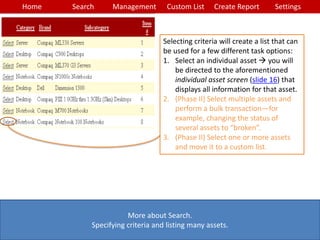
Specifying criteria and listing many assets.
Selecting criteria will create a list that can
be used for a few different task options:
1. Select an individual asset  you will
be directed to the aforementioned
individual asset screen (slide 16) that
displays all information for that asset.
2. (Phase II) Select multiple assets and
perform a bulk transaction—for
example, changing the status of
several assets to “broken”.
3. (Phase II) Select one or more assets
and move it to a custom list.
Home Search Management Custom List SettingsCreate Report
Asset Tracking System
Phase 1
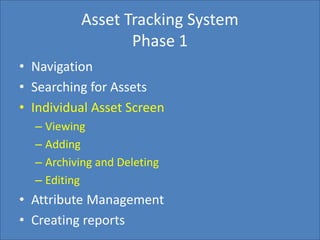
• Navigation
• Searching for Assets
• Individual Asset Screen
– Viewing
– Adding
– Archiving and Deleting
– Editing
• Attribute Management
• Creating reports
Home Search Management Custom List SettingsCreate Report
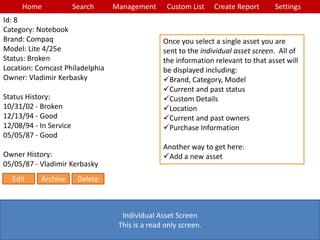
Individual Asset Screen
This is a read only screen.
Once you select a single asset you are
sent to the individual asset screen. All of
the information relevant to that asset will
be displayed including:
Brand, Category, Model
Current and past status
Custom Details
Location
Current and past owners
Purchase Information
Another way to get here:
Add a new asset
Id: 8
Category: Notebook
Brand: Compaq
Model: Lite 4/25e
Status: Broken
Location: Comcast Philadelphia
Owner: Vladimir Kerbasky
Status History:
10/31/02 - Broken
12/13/94 - Good
12/08/94 - In Service
05/05/87 - Good
Owner History:
05/05/87 - Vladimir Kerbasky
Edit Archive Delete
Home Search Management Custom List SettingsCreate Report
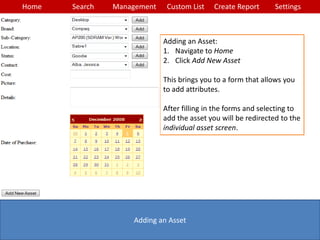
Adding an Asset
Adding an Asset:
1. Navigate to Home
2. Click Add New Asset
This brings you to a form that allows you
to add attributes.
After filling in the forms and selecting to
add the asset you will be redirected to the
individual asset screen.
Home Search Management Custom List SettingsCreate Report
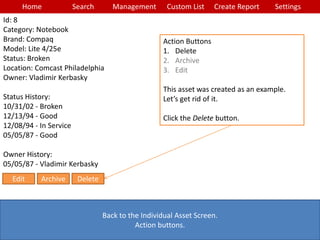
Back to the Individual Asset Screen.
Action buttons.
Action Buttons
1. Delete
2. Archive
3. Edit
This asset was created as an example.
Let’s get rid of it.
Click the Delete button.
Id: 8
Category: Notebook
Brand: Compaq
Model: Lite 4/25e
Status: Broken
Location: Comcast Philadelphia
Owner: Vladimir Kerbasky
Status History:
10/31/02 - Broken
12/13/94 - Good
12/08/94 - In Service
05/05/87 - Good
Owner History:
05/05/87 - Vladimir Kerbasky
Edit Archive Delete
Home Search Management Custom List SettingsCreate Report
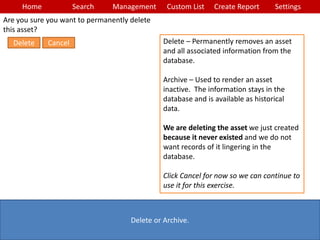
Delete or Archive.
Delete – Permanently removes an asset
and all associated information from the
database.
Archive – Used to render an asset
inactive. The information stays in the
database and is available as historical
data.
We are deleting the asset we just created
because it never existed and we do not
want records of it lingering in the
database.
Click Cancel for now so we can continue to
use it for this exercise.
Are you sure you want to permanently delete
this asset?
CancelDelete
Home Search Management Custom List SettingsCreate Report
Back to the Individual Asset Screen.
Action buttons.
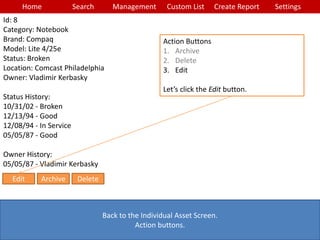
Action Buttons
1. Archive
2. Delete
3. Edit
Let’s click the Edit button.
Id: 8
Category: Notebook
Brand: Compaq
Model: Lite 4/25e
Status: Broken
Location: Comcast Philadelphia
Owner: Vladimir Kerbasky
Status History:
10/31/02 - Broken
12/13/94 - Good
12/08/94 - In Service
05/05/87 - Good
Owner History:
05/05/87 - Vladimir Kerbasky
Edit Archive Delete
Home Search Management Custom List SettingsCreate Report
Individual Asset Screen.
Action Buttons  Edit.
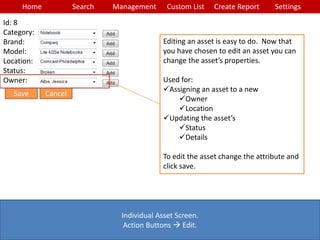
Editing an asset is easy to do. Now that
you have chosen to edit an asset you can
change the asset’s properties.
Used for:
Assigning an asset to a new
Owner
Location
Updating the asset’s
Status
Details
To edit the asset change the attribute and
click save.
Id: 8
Category:
Brand:
Model:
Location:
Status:
Owner:
CancelSave
Home Search Management Custom List SettingsCreate Report
Individual Asset Screen.
Action Buttons  Edit.
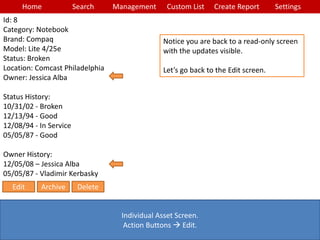
Notice you are back to a read-only screen
with the updates visible.
Let’s go back to the Edit screen.
Id: 8
Category: Notebook
Brand: Compaq
Model: Lite 4/25e
Status: Broken
Location: Comcast Philadelphia
Owner: Jessica Alba
Status History:
10/31/02 - Broken
12/13/94 - Good
12/08/94 - In Service
05/05/87 - Good
Owner History:
12/05/08 – Jessica Alba
05/05/87 - Vladimir Kerbasky
Edit Archive Delete
Home Search Management Custom List SettingsCreate Report
Individual Asset Screen.
Adding an attribute from the individual Asset Screen.
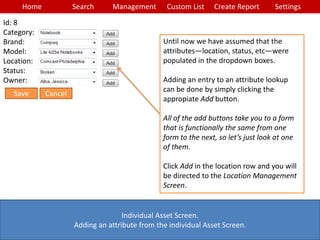
Until now we have assumed that the
attributes—location, status, etc—were
populated in the dropdown boxes.
Adding an entry to an attribute lookup
can be done by simply clicking the
appropiate Add button.
All of the add buttons take you to a form
that is functionally the same from one
form to the next, so let’s just look at one
of them.
Click Add in the location row and you will
be directed to the Location Management
Screen.
Id: 8
Category:
Brand:
Model:
Location:
Status:
Owner:
CancelSave
Home Search Management Custom List SettingsCreate Report
Asset Tracking System
Phase 1
• Navigation
• Searching for Assets
• Individual Asset Screen
• Attribute Management
– Adding and Updating
– Deleting
• Creating reports
Home Search Management Custom List SettingsCreate Report
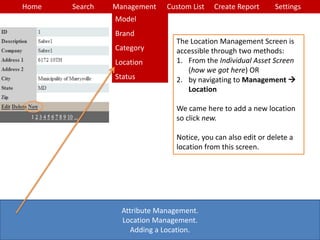
Attribute Management.
Location Management.
Adding a Location.
The Location Management Screen is
accessible through two methods:
1. From the Individual Asset Screen
(how we got here) OR
2. by navigating to Management 
Location
We came here to add a new location
so click new.
Notice, you can also edit or delete a
location from this screen.
Model
Brand
Category
Location
Status
Home Search Management Custom List SettingsCreate Report
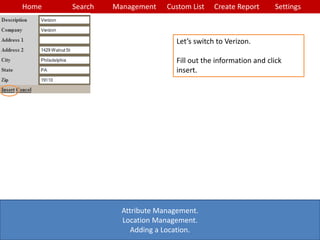
Attribute Management.
Location Management.
Adding a Location.
Let’s switch to Verizon.
Fill out the information and click
insert.
Home Search Management Custom List SettingsCreate Report
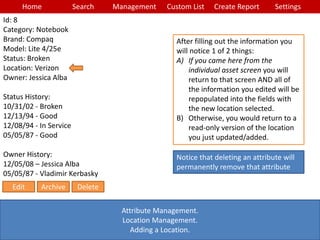
Attribute Management.
Location Management.
Adding a Location.
After filling out the information you
will notice 1 of 2 things:
A) If you came here from the
individual asset screen you will
return to that screen AND all of
the information you edited will be
repopulated into the fields with
the new location selected.
B) Otherwise, you would return to a
read-only version of the location
you just updated/added.
Id: 8
Category: Notebook
Brand: Compaq
Model: Lite 4/25e
Status: Broken
Location: Verizon
Owner: Jessica Alba
Status History:
10/31/02 - Broken
12/13/94 - Good
12/08/94 - In Service
05/05/87 - Good
Owner History:
12/05/08 – Jessica Alba
05/05/87 - Vladimir Kerbasky
Edit Archive Delete
Notice that deleting an attribute will
permanently remove that attribute
Home Search Management Custom List SettingsCreate Report
Asset Tracking System
Phase 1
• Navigation
• Searching for Assets
• Individual Asset Screen
• Attribute Management
• Creating reports
Home Search Management Custom List SettingsCreate Report
Create Report.
By Brand
By Category
By Model
By User
By Location
By Status
A report displays assets grouped by
the attributes selected.
Look at it as a pre-built search.
Let’s click Create Report  By User.
Home Search Management Custom List SettingsCreate Report
Create Report By User
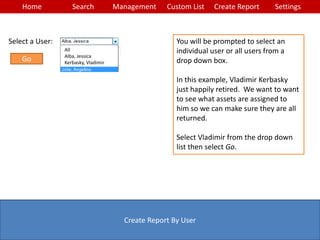
You will be prompted to select an
individual user or all users from a
drop down box.
In this example, Vladimir Kerbasky
just happily retired. We want to want
to see what assets are assigned to
him so we can make sure they are all
returned.
Select Vladimir from the drop down
list then select Go.
Select a User:
All
Alba, Jessica
Kerbasky, Vladimir
Go
Home Search Management Custom List SettingsCreate Report
Create Report By User
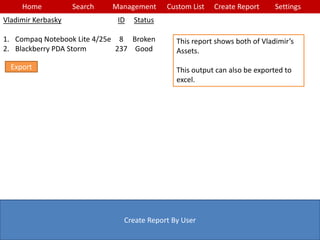
This report shows both of Vladimir’s
Assets.
This output can also be exported to
excel.
Vladimir Kerbasky
1. Compaq Notebook Lite 4/25e
2. Blackberry PDA Storm
ID
8
237
Status
Broken
Good
Export
Home Search Management Custom List SettingsCreate Report
Asset Tracking System
Phase 1
Objective:
– Develop a core functioning application
– Display asset information
– Add/Archive assets
– Edit asset attributes
– Add custom attributes
– Support CSV exports

Asset Management

  • 1.
    Home Search ManagementCustom List SettingsCreate Report Welcome to your new asset tracking system. Login to continue.
  • 2.
    Home Search ManagementCustom List SettingsCreate Report Welcome to your new asset tracking system. Welcome to your new asset tracking system.
  • 3.
    Home Search ManagementCustom List SettingsCreate Report Asset Tracking System Phase 1 • Navigation • Searching for Assets • Individual Asset Screen • Attribute Management • Creating reports
  • 4.
    Home Search ManagementCustom List SettingsCreate Report This is the application navigation bar. This is where you would look to manage your assets. Let’s take a look at each button….
  • 5.
    Home Search ManagementCustom List SettingsCreate Report Home. The home page is populated with a set of common management tasks. You start at home and you can return to home at any time to access these options.
  • 6.
    Home Search ManagementCustom List SettingsCreate Report Search. If you know which assets you want to manage, start here. Enter the ID number if you know it or select attributes from the dropdown menus if you don’t. Click Search.
  • 7.
    Home Search ManagementCustom List SettingsCreate Report Management This is where you manage details of attributes that are associated with assets. Model Brand Category Location Status Actions: Add Update Delete Attributes: Model Brand Category Location Status What do we mean by management? Perform an action to an attribute….
  • 8.
    Home Search ManagementCustom List SettingsCreate Report Management  Location Model Brand Category Location Status When would I use this? Let’s say you have a number of various assets assigned to a location like Comcast and they decide to move their office to new building. You have two options: (1) You could select all the assets at that location, create a new location, and assign the assets to that location OR (2) you can navigate to Management  Location, select the existing Comcast location and update it to reflect the new information.
  • 9.
    Home Search ManagementCustom List SettingsCreate Report Custom List. This is an option to select multiple assets and to add them to a custom list. This option will help facilitate bulk transactions and is fundamental in bar code scanning support.
  • 10.
    Home Search ManagementCustom List SettingsCreate Report Create Report. Want to review assets? Reports will display assets grouped by different attributes. Additionally, export the information to Excel for more manipulation and printing options. By Brand By Category By Model By User By Location By Status
  • 11.
    Home Search ManagementCustom List SettingsCreate Report Settings. This is where you’ll find user settings and admin functionality.
  • 12.
    Home Search ManagementCustom List SettingsCreate Report Asset Tracking System Phase 1 • Navigation • Searching for Assets – Selecting an individual asset – Specifying criteria and listing many assets • Individual Asset Screen • Attribute Management • Creating reports
  • 13.
    Home Search ManagementCustom List SettingsCreate Report More about Search. Selecting an individual asset. There are two ways to go: 1. If you know an assets ID number a. type in the ID number, b. click search, and c. you will be directed to the individual asset screen (slide 16) detailing relevant information. 2. If you want to see all assets that meet your specified criteria a. select what you want to see from the drop down menu, b. click search, and c. a list of assets will be display. Continue to see more about specifying criteria…
  • 14.
    Home Search ManagementCustom List SettingsCreate Report More about Search. Specifying criteria and listing many assets. Selecting criteria will create a list that can be used for a few different task options: 1. Select an individual asset  you will be directed to the aforementioned individual asset screen (slide 16) that displays all information for that asset. 2. (Phase II) Select multiple assets and perform a bulk transaction—for example, changing the status of several assets to “broken”. 3. (Phase II) Select one or more assets and move it to a custom list.
  • 15.
    Home Search ManagementCustom List SettingsCreate Report Asset Tracking System Phase 1 • Navigation • Searching for Assets • Individual Asset Screen – Viewing – Adding – Archiving and Deleting – Editing • Attribute Management • Creating reports
  • 16.
    Home Search ManagementCustom List SettingsCreate Report Individual Asset Screen This is a read only screen. Once you select a single asset you are sent to the individual asset screen. All of the information relevant to that asset will be displayed including: Brand, Category, Model Current and past status Custom Details Location Current and past owners Purchase Information Another way to get here: Add a new asset Id: 8 Category: Notebook Brand: Compaq Model: Lite 4/25e Status: Broken Location: Comcast Philadelphia Owner: Vladimir Kerbasky Status History: 10/31/02 - Broken 12/13/94 - Good 12/08/94 - In Service 05/05/87 - Good Owner History: 05/05/87 - Vladimir Kerbasky Edit Archive Delete
  • 17.
    Home Search ManagementCustom List SettingsCreate Report Adding an Asset Adding an Asset: 1. Navigate to Home 2. Click Add New Asset This brings you to a form that allows you to add attributes. After filling in the forms and selecting to add the asset you will be redirected to the individual asset screen.
  • 18.
    Home Search ManagementCustom List SettingsCreate Report Back to the Individual Asset Screen. Action buttons. Action Buttons 1. Delete 2. Archive 3. Edit This asset was created as an example. Let’s get rid of it. Click the Delete button. Id: 8 Category: Notebook Brand: Compaq Model: Lite 4/25e Status: Broken Location: Comcast Philadelphia Owner: Vladimir Kerbasky Status History: 10/31/02 - Broken 12/13/94 - Good 12/08/94 - In Service 05/05/87 - Good Owner History: 05/05/87 - Vladimir Kerbasky Edit Archive Delete
  • 19.
    Home Search ManagementCustom List SettingsCreate Report Delete or Archive. Delete – Permanently removes an asset and all associated information from the database. Archive – Used to render an asset inactive. The information stays in the database and is available as historical data. We are deleting the asset we just created because it never existed and we do not want records of it lingering in the database. Click Cancel for now so we can continue to use it for this exercise. Are you sure you want to permanently delete this asset? CancelDelete
  • 20.
    Home Search ManagementCustom List SettingsCreate Report Back to the Individual Asset Screen. Action buttons. Action Buttons 1. Archive 2. Delete 3. Edit Let’s click the Edit button. Id: 8 Category: Notebook Brand: Compaq Model: Lite 4/25e Status: Broken Location: Comcast Philadelphia Owner: Vladimir Kerbasky Status History: 10/31/02 - Broken 12/13/94 - Good 12/08/94 - In Service 05/05/87 - Good Owner History: 05/05/87 - Vladimir Kerbasky Edit Archive Delete
  • 21.
    Home Search ManagementCustom List SettingsCreate Report Individual Asset Screen. Action Buttons  Edit. Editing an asset is easy to do. Now that you have chosen to edit an asset you can change the asset’s properties. Used for: Assigning an asset to a new Owner Location Updating the asset’s Status Details To edit the asset change the attribute and click save. Id: 8 Category: Brand: Model: Location: Status: Owner: CancelSave
  • 22.
    Home Search ManagementCustom List SettingsCreate Report Individual Asset Screen. Action Buttons  Edit. Notice you are back to a read-only screen with the updates visible. Let’s go back to the Edit screen. Id: 8 Category: Notebook Brand: Compaq Model: Lite 4/25e Status: Broken Location: Comcast Philadelphia Owner: Jessica Alba Status History: 10/31/02 - Broken 12/13/94 - Good 12/08/94 - In Service 05/05/87 - Good Owner History: 12/05/08 – Jessica Alba 05/05/87 - Vladimir Kerbasky Edit Archive Delete
  • 23.
    Home Search ManagementCustom List SettingsCreate Report Individual Asset Screen. Adding an attribute from the individual Asset Screen. Until now we have assumed that the attributes—location, status, etc—were populated in the dropdown boxes. Adding an entry to an attribute lookup can be done by simply clicking the appropiate Add button. All of the add buttons take you to a form that is functionally the same from one form to the next, so let’s just look at one of them. Click Add in the location row and you will be directed to the Location Management Screen. Id: 8 Category: Brand: Model: Location: Status: Owner: CancelSave
  • 24.
    Home Search ManagementCustom List SettingsCreate Report Asset Tracking System Phase 1 • Navigation • Searching for Assets • Individual Asset Screen • Attribute Management – Adding and Updating – Deleting • Creating reports
  • 25.
    Home Search ManagementCustom List SettingsCreate Report Attribute Management. Location Management. Adding a Location. The Location Management Screen is accessible through two methods: 1. From the Individual Asset Screen (how we got here) OR 2. by navigating to Management  Location We came here to add a new location so click new. Notice, you can also edit or delete a location from this screen. Model Brand Category Location Status
  • 26.
    Home Search ManagementCustom List SettingsCreate Report Attribute Management. Location Management. Adding a Location. Let’s switch to Verizon. Fill out the information and click insert.
  • 27.
    Home Search ManagementCustom List SettingsCreate Report Attribute Management. Location Management. Adding a Location. After filling out the information you will notice 1 of 2 things: A) If you came here from the individual asset screen you will return to that screen AND all of the information you edited will be repopulated into the fields with the new location selected. B) Otherwise, you would return to a read-only version of the location you just updated/added. Id: 8 Category: Notebook Brand: Compaq Model: Lite 4/25e Status: Broken Location: Verizon Owner: Jessica Alba Status History: 10/31/02 - Broken 12/13/94 - Good 12/08/94 - In Service 05/05/87 - Good Owner History: 12/05/08 – Jessica Alba 05/05/87 - Vladimir Kerbasky Edit Archive Delete Notice that deleting an attribute will permanently remove that attribute
  • 28.
    Home Search ManagementCustom List SettingsCreate Report Asset Tracking System Phase 1 • Navigation • Searching for Assets • Individual Asset Screen • Attribute Management • Creating reports
  • 29.
    Home Search ManagementCustom List SettingsCreate Report Create Report. By Brand By Category By Model By User By Location By Status A report displays assets grouped by the attributes selected. Look at it as a pre-built search. Let’s click Create Report  By User.
  • 30.
    Home Search ManagementCustom List SettingsCreate Report Create Report By User You will be prompted to select an individual user or all users from a drop down box. In this example, Vladimir Kerbasky just happily retired. We want to want to see what assets are assigned to him so we can make sure they are all returned. Select Vladimir from the drop down list then select Go. Select a User: All Alba, Jessica Kerbasky, Vladimir Go
  • 31.
    Home Search ManagementCustom List SettingsCreate Report Create Report By User This report shows both of Vladimir’s Assets. This output can also be exported to excel. Vladimir Kerbasky 1. Compaq Notebook Lite 4/25e 2. Blackberry PDA Storm ID 8 237 Status Broken Good Export
  • 32.
    Home Search ManagementCustom List SettingsCreate Report Asset Tracking System Phase 1 Objective: – Develop a core functioning application – Display asset information – Add/Archive assets – Edit asset attributes – Add custom attributes – Support CSV exports