Assessment 3
Essay TIPS
SWK405
The task
Essay
When preparing to write an essay be sure to read the question.
It is helpful to break it down as demonstrated below.
PART 1
Critically analyse the strengths and weaknesses in the delivery
of services to remote communities via face to face and virtual
service models.
PART 2
Identify within each approach (FACE TO FACE AND
VIRTUAL) the challenges for the human services worker and
professional development strategies for improving regional and
remote skills
In considering each approach select one of the following
population groups or service needs.
Essay Structure
My suggestion is to start by identifying the
group/population/issue you have selected to work with. You
may think about the agency interview and report you have
completed in Assessment 2 to inform your choice of service.
In considering each approach select one of the following
population groups or service needs.
Your population/issue
Step 1:
Select your population or issue and the type of service to be
offered.
Disaster recovery within Australia
Domestic Violence Services for women in remote and regional
Australia
Mental Health Services for remote Aboriginal community
Other
What is the service you are providing?
Step 2:
Consider what part/s of the service is suited to face to face or
virtual service delivery?
e.g.
Critically Analyse
Step 3: It is important to consider carefully the strengths and
weaknesses of each type of service delivery model to remote
areas.
When you think about these strengths and weaknesses, some
will relate to client outcomes and some will relate to the service
provider (logistics, cost, personnel).
Not simply a description but your own critique.
The following questions will help you to focus your reading and
develop a critical lens.
Critical Reading
Step 4:
What have some authors written about the advantages and
disadvantages of each type of service model?
What do you think about their positions?
Does this fit with the service you have selected for the essay?
Has technology come further since the article was written?
Is there a research that supports the arguments proposed in the
literature? Critique the research that supports the author’s
argument.
What position do you take in relation to ideas raised in the
literature?
Is there a bias in the readings in favour of one type of service
delivery over another?
Step 5: Shaping your argument
Consider the following focus questions to shape your argument
Strengths and weakness of face to face service delivery
What is face to face service delivery?
e.g. this could be where staff live and work within the
community or where staff undertake remote community visits to
deliver services.
What are the benefits of delivering services face to face?
To the client, for the worker
What are the challenges of delivering face to face services to
remote areas?
e.g. Cost, staff recruitment and retention, staff skills and
resilience, culture and language, occupational health and safety,
work/life balance
Strengths and weaknesses of virtual models of service delivery
What is virtual service delivery?
e.g. phone, online, skype
What kind of services can be enhanced by technology?
Accessing information through the internet (community and
client empowerment), Apps, social media (connections and
groups)
What type of service is most suited to ICT?
e.g. counselling? Meetings? community work?
What are some assumptions when relying on ICT to deliver a
service?
e.g. internet access? Speed, cost, confidence
Some things to think about – confidentiality, transparency,
accountability.
Combination of approaches
Would there be benefits realised through combining face to face
service delivery with other technology?
Not just simply one approach or the other.
Part 2 of the question
Identify within each approach (FACE TO FACE AND
VIRTUAL) the challenges for the human services worker and
professional development strategies for improving regional and
remote skills
Step 6: The human services worker and the organisation
Now that you have considered the pros and cons of the type of
service model to your population or issue, consider the second
part of the question.
A) What challenges are there for the human services worker in
delivering services face to face and virtual?
B) What approach could the organisation take to support and
develop the skills of the worker in either the face to face or
virtual service delivery?
Structure
Introduction
Clearly outlines the way that you will be approaching the essay
Help the reader to anticipate the key themes and arguments.
Body
One paragraph for each new idea. Introduce each idea and
ensure that it logically leads from the last paragraph.
Conclusion
Summarise the key points of your essay that support your
argument.
3 The Mass-consumed Interior
The more the manufacturer or dealer arranges model rooms or
representa-
tive exhibits, or practices ensemble room selling, the more help
and suggestion
it will be to the consumer.
Christine Frederick1
From the moment the manufacture of large numbers of domestic
goods
was transferred to factories, and middle-class home-makers
were forced
to leave the comfort of their homes to purchase them, mass
consumption
and the interior developed an intimate relationship with each
other. As
the domestic interior came to be seen as the destination for
consumed
goods, its replication in the public sphere (in idealized forms)
as a frame
for displaying those products became increasingly widespread.
We have
seen how Peter Behrens created a dining room for Berlin’s
Wertheim
department store in 1902 which contained a fully laid table. A
later com-
mercial display, mounted in Bowman Brothers’ London store in
the
1930s, set out to be even more ‘authentic’, comprising, as it
did, a table set
for breakfast complete with boiled eggs and toast. The dinner
service
being promoted was designed by the English ceramics designer
Susie
Cooper. Increasingly, represented interiors, or components of
them such
as these, were used as the frames for objects of desire in
commercial set-
tings. Through the process the domestic interior was itself
transformed
into an object of mass consumption.
Mass consumption, it has been claimed, was one of modernity’s
defining features.2 That same claim could also be made for the
domestic
interior, as it became absorbed by the world of mass
consumption. The
model of consumption that used the interior as a selling tool
was highly
dependent upon the creation of consumer desire. Through an
engage-
ment with the evocative design of interiors in commercial
spaces in
which goods were displayed, the desire to purchase was
encouraged. As
women came out of their homes to purchase domestic goods, the
mod-
ern interior’s relationship with mass consumption had an ‘inside
out’
push built into it. The evocatively designed interior became,
therefore,
both a means (of selling) and an end (the location for the

consumed 55
055_072_Modern_Ch 3:Layout 1 30/5/08 17:44 Page 55
Sparke, Penny. The Modern Interior, Reaktion Books, Limited,
2008. ProQuest Ebook Central,
http://ebookcentral.proquest.com/lib/asulib-
ebooks/detail.action?docID=480991.
Created from asulib-ebooks on 2018-10-11 15:10:22.
C
op
yr
ig
ht
©
2
00
8.
R
ea
kt
io
n
B
oo
ks
, L
im
ite
d.
A
ll
rig
ht
s
re
se
rv
ed
.
goods) in this context. Gradually, as the power of the
marketplace
expanded the means came to dominate the end and the idealized
public
sphere interior became as important as, if not more so than, its
realized
counterparts. Indeed, in that form, the modern interior became
an
accomplice in the construction of the ‘irrational’ desire which
under-
pinned the mass consumption of goods intended for ‘real’
interiors. The
result was that it became increasingly difficult to view them
independently
and yet another level of ambiguity between the private and the
public
spheres was created.
Another effect of the interior’s expanding relationship with
mass
consumption was felt in retail spaces themselves. Arcades were
covered
over to make the conditions for consuming more acceptable, and
as a
consequence the idea of spaces within spaces, of rooms within
rooms and
of stores within stores became increasingly widespread. The
experiences56
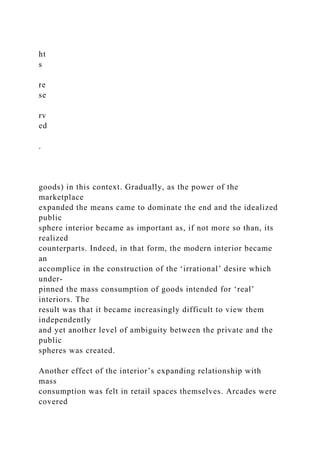
A breakfast table set with a service designed by Susie Cooper,
displayed in the Bowman
Brothers’ Store, London, late 1930s, illustrated in C. G. Holme,
ed., The Studio Year
Book, 1939.
055_072_Modern_Ch 3:Layout 1 30/5/08 17:44 Page 56
Sparke, Penny. The Modern Interior, Reaktion Books, Limited,
2008. ProQuest Ebook Central,
http://ebookcentral.proquest.com/lib/asulib-
ebooks/detail.action?docID=480991.
Created from asulib-ebooks on 2018-10-11 15:10:22.
C
op
yr
ig
ht
©
2
00
8.
R
ea
kt
io
n
B
oo
ks
, L
im
ite
d.
A
ll
rig
ht
s
re
se
rv
ed
.
that took place within those retail spaces – from department
stores to
shopping malls – were ones of continually enhanced
‘immersion’, of
being increasingly shut off from the outside world and
contained within
safe, unthreatening and (when the technology became available)
tempera -
ture-controlled spaces. Commercial branding also played a key
role in
those constructions helping the flow of people through them.
Gradually,
as the process of interiorization increased its pace it became
increasingly
hard to distinguish ‘inside’ experiences from ‘outside’ ones, and
more and
more difficult to understand where the boundaries between what
previ-
ously had been separate spheres were located. The same thing
was hap-
pening in the domestic arena. In the interior of Adolf Loos’s
Moller
House, created in Vienna’s Starkfriedgasse in 1927–8, for
example, the
designer combined oriental rugs, parquet floors and wood
panelling with
a subtle use of different levels, thereby developing, in a
domestic setting,
the idea of insides within other insides – a layering of inside
spaces a bit
like Benjamin’s layers of envelopment within the compass case.
‘It is no
longer the house that is the theatre box’, one writer has
explained in con-
nection with Loos’s complex interior design, ‘there is a theatre
box inside
the house, overlooking the internal social spaces . . . the
classical distinc-
tion between inside and outside, private and public, becomes
convoluted.’3
In locating spaces within other spaces Loos could have been
anticipating
the shopping mall of the early twenty-first century.
The work that went on behind the scenes in the construction of
idealized interiors was inevitably hidden from consumers.
Model domes-
tic interiors were presented as static images and spaces,
complete with
puffed-up cushions.4 Real lives, in that context, were replaced
by the
modern, mass media-dependent notion of ‘lifestyles’, the
idealized ver-
sions, that is, of the lives that people actually lead.5 An
abstract, totalizing
concept created by the sum of consumers’ possessions,
activities, aspira-
tions and desires, the concept of ‘lifestyle’ emerged largely as a
result of
the mass media’s engagement with the modern interior. It filled
the gap
left by the loss of the home’s economic and productive role and
linked it
more firmly with the processes of mass consumption and
identity forma-
tion. That, in turn, led to the absorption of interior decoration
into the
fashion system and to the ensuing presentation, in mass market
women’s
magazines, of a mix of different kinds of information related to
interiors,
fashion and leisure activities in a single publication. Rapidly,
however, the
idea of lifestyle began to take on an existence of its own, above
and
beyond the individual elements upon which it was dependent. 57
055_072_Modern_Ch 3:Layout 1 30/5/08 17:44 Page 57
Sparke, Penny. The Modern Interior, Reaktion Books, Limited,
2008. ProQuest Ebook Central,
http://ebookcentral.proquest.com/lib/asulib-
ebooks/detail.action?docID=480991.
Created from asulib-ebooks on 2018-10-11 15:10:22.
C
op
yr
ig
ht
©
2
00
8.
R
ea
kt
io
n
B
oo
ks
, L
im
ite
d.
A
ll
rig
ht
s
re
se
rv
ed
.
A couture dress by Paul Poiret in an interior with fabric also
designed by the couturier,
illustrated in La Revue de La Femme, May 1927.
055_072_Modern_Ch 3:Layout 1 30/5/08 17:44 Page 58
Sparke, Penny. The Modern Interior, Reaktion Books, Limited,
2008. ProQuest Ebook Central,
http://ebookcentral.proquest.com/lib/asulib-
ebooks/detail.action?docID=480991.
Created from asulib-ebooks on 2018-10-11 15:10:22.
C
op
yr
ig
ht
©
2
00
8.
R
ea
kt
io
n
B
oo
ks
, L
im
ite
d.
A
ll
rig
ht
s
re
se
rv
ed
.
Various forms of the mass media were quick to represent the
ideal -
ized domestic interior and to use it as a mechanism for
stimulating desire
and mass consumption. Viewed inside the home the printed
pages of
magazines, mail order catalogues, advice books, exhibition
catalogues
and newspapers played important roles, while outside the
domestic arena
world exhibitions, department stores, restaurants and museums
began
to contain constructed interiors which were also intended to
stimulate
consumption, or at least the desire for it.6 The late nineteenth
and early
twentieth centuries witnessed a number of ways in which the
mass media,
in its various manifestations, helped to construct relationships
between
consumers and interiors. Developments in lithography and
photography
made it increasingly easy to represent whole interiors in two
dimensions
and to reproduce those images in large numbers. The problems
of early
flash photography and the long exposures that were needed to
capture the
interior meant that it took longer than other areas of the
environment to
photograph. By the last decades of the century, however, those
technical
obstacles had mostly been overcome. Women’s magazines
extended
their promotion of fashionable clothing items to include
components of
the interior and complete interiors. An image of a woman
wearing a
Poiret dress from the 1920s, for example, was published in the
French
women’s magazine La Revue de La Femme in May 1927. She
was framed
by, and depicted gently caressing, a pair of curtains designed by
the same
couturier, suggesting a unity between her body, her dress and
the interi-
or in which she was located.7 By the early twentieth century
interiors had
become an important component of a wide range of women’s
maga-
zines, including the ‘upmarket’ Vogue, then as now a fashion-
oriented
magazine in which sumptuous interiors created by interior
decorators
complemented the fashionable images of modern luxury evoked
by the
couture clothing which graced most of its pages. It was sharply
contrasted
with the ‘pseudo-rationality’ of other, more ‘downmarket’
magazines such
as Good Housekeeping, which targeted home-makers and the
work that
went on in the home. It claimed to undertake laboratory tests of
many of
the items it featured as a means of ensuring their scientific
validity, their
reliability and their value for money.
Magazines, read and looked at in the home for the most part,
attempted on a number of different levels to focus women’s
attention on
idealized versions of the very interiors in which they were
frequently sit-
ting while they read. Magazine culture was very important in
nineteenth-
century England. ‘The magazine’, one writer has explained,
‘bought by an 59
055_072_Modern_Ch 3:Layout 1 30/5/08 17:44 Page 59
Sparke, Penny. The Modern Interior, Reaktion Books, Limited,
2008. ProQuest Ebook Central,
http://ebookcentral.proquest.com/lib/asulib-
ebooks/detail.action?docID=480991.
Created from asulib-ebooks on 2018-10-11 15:10:22.
C
op
yr
ig
ht
©
2
00
8.
R
ea
kt
io
n
B
oo
ks
, L
im
ite
d.
A
ll
rig
ht
s
re
se
rv
ed
.
upper middle-class woman, might be read by her daughters, her
servants
and friends, then swapped for another through the exchange
pages of
the first magazine before being thrown out or sent to a second-
hand
bookshop.’8 Advertisements for items of furniture and other
decorative
domestic objects were the most obvious way in which the
housewife was
targeted as a consumer of, and for, the interior. They frequently
showed
their ‘subjects’ within interior settings. An advertisement in the
March
1914 edition of the American magazine, Ladies’ Home Journal,
for exam-
ple, which was promoting a brand of floor polish, depicted a
housewife
and her maidservant busy polishing while a group of children
played
happily on the floor. The conventional, cosy, middle-class
interior setting
that was represented, complete with its solid wood dining table,
piano
and patterned curtains, was intended to make the product seem
‘real’ and
appealing. In an article titled ‘How You Can Furnish a Five-
room
Apartment for $300’ the same journal once again focused
housewives’
attention on the interior. ‘A careful shopper’, the author
suggested, ‘can
furnish her apartment both inexpensively and tastefully’.9
Colour drawings
and a list of prices were included. Editorials represented a much
softer,
and possibly more effective, sell than advertisements. The same
idea was
also appropriated by advertisers, however, as a Harrods’
advertisement in
a 1920 Ideal Home Exhibition catalogue, headed ‘Harrods
Furnish a 6-
Room Flat Complete for £500’, clearly demonstrated.10
Blurring their
promotional and editorial content, magazines played a role in
reinforcing
their readers’ ambiguous identities as readers/home-
makers/consumers.
Mail order catalogues provided another means of consuming
interiors at
home. In the usa, where greater distances made them more
necessary
than in Europe, the Sears, Roebuck and Company and
Montgomery
Ward catalogues dominated the field.
Consumers of the interior did not always remain in their homes,
however. From the late nineteenth century onwards, as we have
seen,
people (mostly women) came out of the home to buy household
goods
to take back into it. A wide range of shopping options for direct
purchas-
ing were on offer – from market stalls, to fixed shops, to chain
stores, to
department stores. The last, however, were most linked with
modernity
in those years and addressed themselves to middle-class female
con-
sumers most directly. Those modern ‘cathedrals’ or ‘palaces’,
as they have
been called at different times, played a key role in that
context.11 Much
has been written about the ways in which, in the late nineteenth
and
early twentieth centuries, department stores employed varying
levels of60
055_072_Modern_Ch 3:Layout 1 30/5/08 17:44 Page 60
Sparke, Penny. The Modern Interior, Reaktion Books, Limited,
2008. ProQuest Ebook Central,
http://ebookcentral.proquest.com/lib/asulib-
ebooks/detail.action?docID=480991.
Created from asulib-ebooks on 2018-10-11 15:10:22.
C
op
yr
ig
ht
©
2
00
8.
R
ea
kt
io
n
B
oo
ks
, L
im
ite
d.
A
ll
rig
ht
s
re
se
rv
ed
.
An interior of the Bon Marché department store, rue de
Babylone, Paris, 1880.
055_072_Modern_Ch 3:Layout 1 30/5/08 17:44 Page 61
Sparke, Penny. The Modern Interior, Reaktion Books, Limited,
2008. ProQuest Ebook Central,
http://ebookcentral.proquest.com/lib/asulib-
ebooks/detail.action?docID=480991.
Created from asulib-ebooks on 2018-10-11 15:10:22.
C
op
yr
ig
ht
©
2
00
8.
R
ea
kt
io
n
B
oo
ks
, L
im
ite
d.
A
ll
rig
ht
s
re
se
rv
ed
.
spectacle to entice customers inside them and to stimulate
desire and
pleasure so that consuming, for the middle-class women who
were their
first customers, was perceived as a leisure activity rather than
work. In the
French department stores, Galeries Lafayettes and Bon Marché
among
them, consumers were given a sense of being practically
exposed to the
sky but nonetheless enclosed with a fantasy world.12 This
engraving of an
interior in the Bon Marché store in Paris reveals an open, multi-
storey,
iron and steel structure. The cold, industrial nature of those
materials was
visually offset, however, by the presence of a variety of goods –
items of
clothing, lengths of fabrics and rugs among them – which were
suspended
from the balconies of the different floors and on lines hung
between the
building’s structural columns. One writer has described some of
the ways
in which that sense of being in a fantasy world was achieved
visually.
‘Display managers learned the new color theory and exploited
color, often
in the most adroit ways’, he has written. ‘They decorated with
puffed arch-
ways of colored silk; they hung garlands of flowers, draperies
of colored
plush, cages of colored birds. The biggest stores designed rooms
. . .
around a single color scheme. Green in all its tints and shades
prevailed
from basement to roof at William Filene’s Sons Company in
Boston in
1901.’13 By that time furniture sets and room settings were
beginning to be
used both inside American stores and in their windows to
achieve an exot-
ic, luxurious look.14 ‘To obtain the desired effect of
“Parisianism”, store
managers imitated French salons . . . and even copied the
complete inter -
ior of a “real Parisian boulevard appartement”’, one writer has
explained,
demonstrating, in anticipation of the hotels and shopping malls
of Las
Vegas several decades later, just how effective evocations of
the interior
could be in stimulating the imaginations and fantasies of
consumers.15 The
evocation of the private sphere in the public context satisfied
the require-
ments of familiarity, voyeurism, curiosity and wish-fulfilment.
However
the ‘spectacularization’ of the department store applied equally
to restaur -
ants, hotels, theatres and dry goods stores.16
By the end of the 1920s the furniture sections of American
depart-
ment stores had fully embraced the modern interior design style,
known
as Art Deco, that had become popular in Europe following the
1925
Exposition Internationales des Arts Décoratifs et Industriels
Modernes, and
they had begun to display complete modern room sets,
sometimes in
partnership with museums. A mixture of modern French and
American
designs in room settings were shown at both John Wanamaker
and
Macy’s in New York in 1927. Macy’s cleared its floor of
traditional pieces62
055_072_Modern_Ch 3:Layout 1 30/5/08 17:44 Page 62
Sparke, Penny. The Modern Interior, Reaktion Books, Limited,
2008. ProQuest Ebook Central,
http://ebookcentral.proquest.com/lib/asulib-
ebooks/detail.action?docID=480991.
Created from asulib-ebooks on 2018-10-11 15:10:22.
C
op
yr
ig
ht
©
2
00
8.
R
ea
kt
io
n
B
oo
ks
, L
im
ite
d.
A
ll
rig
ht
s
re
se
rv
ed
.
and showed only modern designs at that time.17 The president
of New
York’s Metropolitan Museum of Art, Robert W. de Forest,
became the
chair man of the store’s advisory committee, thereby giving that
commer-
cial project a level of cultural validation.18
Many other American stores were quick to follow Macy’s lead
and
displayed rooms filled with designs by European ‘masters’, such
as the
German Bruno Paul, and the Italian Gio Ponti. The appeal of the
room
setting over individualized items of furniture undoubtedly lay in
its
strong visual impact and its ability to evoke an idealized
version of
‘reality’. It also suggested a lifestyle. The idea of the
Gesamtkunstwerk, so
beloved of early twentieth-century designers, had, by the 1920s,
been
transformed by store designers into a selling tool. In the 1930s
Mary, the
wife of the designer Russel Wright, devoted limitless energy to
selling her
husband’s aluminium ware. She undertook live demonstrations
in stores
using real food as props, thereby sustaining a commercial
tradition that
had been in place in American stores since the early century. In
1950 the
Wrights published a book together titled Guide to Easier Living
in which
they explained that ‘Good informal living substitutes a little
headwork 63
A backcloth for a store window display of furniture, illustrated
in a store window display
manual, 1925.
055_072_Modern_Ch 3:Layout 1 30/5/08 17:44 Page 63
Sparke, Penny. The Modern Interior, Reaktion Books, Limited,
2008. ProQuest Ebook Central,
http://ebookcentral.proquest.com/lib/asulib-
ebooks/detail.action?docID=480991.
Created from asulib-ebooks on 2018-10-11 15:10:22.
C
op
yr
ig
ht
©
2
00
8.
R
ea
kt
io
n
B
oo
ks
, L
im
ite
d.
A
ll
rig
ht
s
re
se
rv
ed
.
for a lot of legwork. It doesn’t need wealth, but it does take
thought, some
ingenuity and resourcefulness, and more than a little loving care
to cre-
ate a home that is really your own.’19
Displays of furniture ensembles and of complete interiors were
not
only visible inside the bodies of stores, they were also installed
in shop
windows which could be viewed from the street. By the early
twentieth
century the three-walled interior frame had become a familiar
sight in
department store windows. It had its origins in the theatrical
stage set
and the domestic dramas of the decades around the turn of the
century.
A 1925 American manual for ‘mercantile display’ advised that
‘the installing
of a design of this character is well worth the effort as it lends
itself to the
display of a varied line of merchandise’.20 The same manual
also included
a display of living-room furniture, explaining that, ‘The
furniture is
arranged in a manner to show [it] off to good advantage, using
the
necessary accessories such as the lamp, book rack, pictures
etc.’, rein-
forcing the, probably tacit, knowledge of professionals in that
field that
consumers needed to be shown just enough of an interior for
their
imaginations to be stimulated and their desires evoked.21 The
neo-classical
simplicity of one model shop window interior in the manual,
intended
for a display of furniture, provided a fairly neutral backcloth (p.
63).
Draped curtains added a level of theatricality, a chequered floor
a sugges-
tion of Viennese modernity, and a fringed standard lamp a
counterpoint
to its otherwise strict symmetry.
While department stores provided an urban means of consuming
the interior, the shopping mall became its suburban equivalent.
With the
advent of the automobile in the us, demand grew for out-of-
town shop-
ping places where there was plenty of parking space.22 Thus the
shopping
mall, a collection of individual shops brought together into a
single unit,
was born. In 1916 the Chicago architect Arthur Aldis created
one of the
first shopping complexes of that kind, Market Square in Lake
Forest,
a wealthy suburb of Chicago. He integrated twenty-eight stores,
twelve
office units, thirty apartments, a gymnasium and a clubhouse,
and added
landscaping around them. His aim was to position everything in
one place
so that the consumer could combine shopping with leisure
activities.
Through the twentieth century the idea of the suburban mall
gradually
displaced that of the urban department store. Targeting a range
of social
classes, it offered consumers a very different interior
experience, one which
was usually less consistent, less spectacular, less luxurious, less
glamorous
and more utilitarian. By the end of the century shopping malls
had taken64
055_072_Modern_Ch 3:Layout 1 30/5/08 17:44 Page 64
Sparke, Penny. The Modern Interior, Reaktion Books, Limited,
2008. ProQuest Ebook Central,
http://ebookcentral.proquest.com/lib/asulib-
ebooks/detail.action?docID=480991.
Created from asulib-ebooks on 2018-10-11 15:10:22.
C
op
yr
ig
ht
©
2
00
8.
R
ea
kt
io
n
B
oo
ks
, L
im
ite
d.
A
ll
rig
ht
s
re
se
rv
ed
.
over from the department store for the most part, offering,
through their
more nuanced and complex ‘inside’ spaces, an even more
ambiguous
retail experience than their predecessors.
Although the direct purchasing of objects for the interior did
not
usually take place at exhibitions on a significant scale, they
played a cru-
cial role, nonetheless, in the development of the representation
of the
mass-consumed interior in the public sphere.23 Walter
Benjamin
described the world exhibitions as ‘places of pilgrimage to the
commod-
ity fetish’ intended ‘to entertain the working classes’.24 It
wasn’t until the
last decades of the nineteenth century that complete (or at least
two- or
three-sided) ‘room sets’ were exhibited in those settings. Prior
to that iso-
lated items of furniture had been displayed either in elaborate
cabinets or
in roped-off areas. At Philadephia’s Centennial Exhibition of
1876, for
example, finely carved wooden display cases containing free-
standing
items of furniture had stood looking rather lost under the vast
iron
trusses and plate glass of that vast exhibition hall.25 Full-scale
models of
workers’ houses had been shown at the 1867 exhibition in Paris,
but the
emphasis at that time had still been upon their exteriors rather
than their
interiors.26 The Austrian critic Jacob von Falke, the author of
the first
German language book on interior design, Art in the House
(1871), was
among the first designers in Germany or Austria to create a
complete
‘ensemble’ interior display in an exhibition.27 By 1880 it had
become a
fairly common strategy used by curators in applied arts
museums and by
designers at trade fairs. A William Morris exhibit at The
Foreign Fair of
1883–4, for example, held in Boston’s Mechanics Hall, was
divided into six
compartments, or rooms. A pamphlet describing the display
cautioned
that ‘the rooms must not . . . be taken to represent the rooms of
a
dwelling, nor is the ordinary decoration of a house attempted.
Morris
and Company are exhibiting here as manufacturers only, and the
arrange-
ment of goods is that which seemed best for showing them in
the ways
most accordant to their actual use.’28 That caveat could have
been applied
equally well to all the exhibition room sets that came after it.
By the time of the Paris Exposition Universelle of 1900, room
sets
were being extensively used. That exhibition set out to celebrate
modern
art, industry and commerce and for all the exhibiting countries
the inte-
grated interior represented a level of achievement in all of those
three
areas. It also demonstrated the degree of progressiveness, or
modernity,
embraced by the countries in question. Examples of exhibited
interiors
at Paris 1900 included those designed by German exhibitors,
Richard 65
055_072_Modern_Ch 3:Layout 1 30/5/08 17:44 Page 65
Sparke, Penny. The Modern Interior, Reaktion Books, Limited,
2008. ProQuest Ebook Central,
http://ebookcentral.proquest.com/lib/asulib-
ebooks/detail.action?docID=480991.
Created from asulib-ebooks on 2018-10-11 15:10:22.
C
op
yr
ig
ht
©
2
00
8.
R
ea
kt
io
n
B
oo
ks
, L
im
ite
d.
A
ll
rig
ht
s
re
se
rv
ed
.
Riemerschmid among them, and the famous Art Nouveau
settings creat-
ed by Eugène Gaillard, George de Feure and others which were
displayed
in the Samuel Bing pavilion. Austria also made its presence felt
with,
among other displays, the Viennese Interior, a Gesamtkunstwerk
designed
by Joseph Olbrich, and an Interior of a Pleasure Yacht created
by the same
designer.29 Other interiors were sponsored by the Parisian
department
stores, Bon Marché among them, again in the Art Nouveau
style. (The
pioneer American interior decorator, Elsie de Wolfe, later
recounted in
her autobiography that the last had been purchased by her
friend, the
Marchioness of Anglesey, who, in turn, had passed on to her the
eight -
eenth-century wooden wall panelling which it had displaced.)
Through the twentieth century the exhibition room set
increasingly
became a commonplace, at least until the late 1950s. At the
Turin 1902
exhibition the Italian designer Carlo Bugatti showed his
dramatic interior
based on a snail’s shell, while Charles Rennie Mackintosh and
Margaret66
Georges Djo-Bourgeois, study for the ‘Studium Louvre’
Pavilion, exhibited at the
Exposition Internationale des Arts Décoratifs et Industriels
Modernes, Paris, 1925.
055_072_Modern_Ch 3:Layout 1 30/5/08 17:44 Page 66
Sparke, Penny. The Modern Interior, Reaktion Books, Limited,
2008. ProQuest Ebook Central,
http://ebookcentral.proquest.com/lib/asulib-
ebooks/detail.action?docID=480991.
Created from asulib-ebooks on 2018-10-11 15:10:22.
C
op
yr
ig
ht
©
2
00
8.
R
ea
kt
io
n
B
oo
ks
, L
im
ite
d.
A
ll
rig
ht
s
re
se
rv
ed
.
Macdonald’s Rose Boudoir was widely admired at the same
event. The
1925 Paris Exposition Internationales des Arts Décoratifs et
Industriels
Modernes depended heavily upon its spectacular exhibited
interiors to
entice its visitors into its buildings. Although actual shopping
was not 67
Marcel Guillemard, dining room for the ‘Pavillon Primavera’,
exhibited at the Exposition
Internationale des Arts Décoratifs et Industriels Modernes,
Paris, 1925.
055_072_Modern_Ch 3:Layout 1 30/5/08 17:44 Page 67
Sparke, Penny. The Modern Interior, Reaktion Books, Limited,
2008. ProQuest Ebook Central,
http://ebookcentral.proquest.com/lib/asulib-
ebooks/detail.action?docID=480991.
Created from asulib-ebooks on 2018-10-11 15:10:22.
C
op
yr
ig
ht
©
2
00
8.
R
ea
kt
io
n
B
oo
ks
, L
im
ite
d.
A
ll
rig
ht
s
re
se
rv
ed
.
possible anywhere in the exhibition, many of the displays
reinforced the
fact that Paris was the city in which consumption took place on
a spec-
tacular scale.30 A number of room sets were constructed in a
group of
pavilions which were created to promote the interior decorating
sections
of Paris’s leading department stores. One such room, an office
designed
by Georges Djo-Bourgeois, was installed in the Grands
Magasins du
Louvre’s Studium Louvre pavilion. Featuring leather armchairs,
a piece of
sculpture by Léon Leyritz and lacquered panels by Pierre
Demaria, it was
a rich, masculine space offset by a number of feminine touches
including
vases of flowers and patterning on the curtains and carpet. A
dining room
was designed by Marcel Guillemard as part of Au Printemps’
Primavera
pavilion. The rich woods and modern furniture forms in
Guillemard’s
room set were intended to persuade visitors that employing
Primavera
to decorate their homes would bring a high level of elegant
luxury and
modernity into their lives.
It was not only the large international exhibitions that employed
the
concept of the constructed interior as a display strategy,
however. At a
more local level, events such as Britain’s Ideal Home
Exhibition, established
by the Daily Mail newspaper before the First World War, and
the annual
exhibition held in Paris, the Salon des Arts Ménagers, also used
room sets.31
Their aim was less to present a display of national prowess in
an interna-
tional context but rather to inspire the public, fulfil their dreams
and
aspirations and to encourage them to consume. As the century
progressed
the messages conveyed by constructed interiors in exhibitions
became
increasingly complex and their audiences more sophisticated. At
the
Britain Can Make It exhibition, held at London’s Victoria and
Albert
Museum in 1946, a range of room sets were presented as
representations
of class, age and gender. Examples included ‘a technical office
for a televi-
sion research engineer’, ‘a secondary school classroom’, ‘a
cottage kitchen
for a miner’, and a ‘bachelor’s bed sitting room’.32 The
exhibition curators
aimed to encourage a more reflective response from its audience
than that
of consumer desire alone. A notice on a wall at the exhibition
instructed
visitors to ‘view the rooms as if the family has just vacated it’.
The inten-
tion was to move one step nearer to the occupant than had been
achieved
at earlier exhibitions, and in so doing, to engage the audience’s
imagina-
tions as completely as possible. Several reviews were critical of
the strategy,
however, and one commentator wrote that, ‘we feel bound to
remark that
in most cases the rooms bear no relationship to the imagined
families and
the class-distinction in naming the rooms appears utterly
meaningless . . .68
055_072_Modern_Ch 3:Layout 1 30/5/08 17:44 Page 68
Sparke, Penny. The Modern Interior, Reaktion Books, Limited,
2008. ProQuest Ebook Central,
http://ebookcentral.proquest.com/lib/asulib-
ebooks/detail.action?docID=480991.
Created from asulib-ebooks on 2018-10-11 15:10:22.
C
op
yr
ig
ht
©
2
00
8.
R
ea
kt
io
n
B
oo
ks
, L
im
ite
d.
A
ll
rig
ht
s
re
se
rv
ed
.
This is an exhibition, and therefore it is no criticism to say that
most of
these rooms lack reality. It is important that the public should
realise
this. Otherwise they may feel that it is all rather outside their
powers of
attainment.’33
Museums played a crucial role in collecting and displaying
period
interiors through the twentieth century and, indeed, many of the
strate-
gies used in the more commercial contexts of exhibitions and
depart-
ment stores had originated in the context of the ‘period room’.
The
Victoria and Albert Museum acquired its first complete interior
in 1869
while New York’s Metropolitan Museum of Modern Art began
to collect
rooms in 1903.34 The Brooklyn Museum also engaged in
acquiring period
rooms. One of its exhibits, an eighteenth-century dining room
from
a plantation house in South Carolina, called Cane Acres,
contained a
number of tasteful, English-influenced items of furniture.
Visitors to the
museum were encouraged to believe in the ‘authenticity’ of the
setting by
the presence of wine in the glass carafes. The original
motivation behind
what came to be known as the ‘period rooms’ phenomenon had
been to
educate the public in historical styles at a time when historicist
eclecticism 69
A period room from Cane Acres, an eighteenth-century house on
the Perry Plantation,
Summerville, South Carolina, exhibited in the Brooklyn
Museum, New York.
055_072_Modern_Ch 3:Layout 1 30/5/08 17:44 Page 69
Sparke, Penny. The Modern Interior, Reaktion Books, Limited,
2008. ProQuest Ebook Central,
http://ebookcentral.proquest.com/lib/asulib-
ebooks/detail.action?docID=480991.
Created from asulib-ebooks on 2018-10-11 15:10:22.
C
op
yr
ig
ht
©
2
00
8.
R
ea
kt
io
n
B
oo
ks
, L
im
ite
d.
A
ll
rig
ht
s
re
se
rv
ed
.
was the taste of the day. The Cane Acres room set out to do just
that. At
one of its exhibitions, held in 1934, instead of showing the
usual domes-
tic period interiors, the Metropolitan Museum of Art focused on
the con-
temporary workspaces of well-known industrial designers of the
day as a
means of educating the public about the design profession and it
contri-
bution to modern life. Raymond Loewy and Lee Simonson
recreated a
version of the former’s office as a ‘frame’ in which to display
his design
skills and their wide application to boats and cars as well as
interiors
themselves.
Popular films, or ‘movies’, provided another important means
through which the interior was mediated and a desire to
consume stimu -
lated on a mass scale through the twentieth century. Movies
were created
to entertain, distract and provide a level of fantasy and escapism
from
the realities of everyday life. They offered, therefore, an ideal
vehicle for70
Raymond Loewy and Lee Simonson, reconstruction of Loewy’s
office for an exhibition
held at the Metropolitan Museum of Art, ‘Contemporary
Industrial Art: 1934’, New York,
1934.
055_072_Modern_Ch 3:Layout 1 30/5/08 17:44 Page 70
Sparke, Penny. The Modern Interior, Reaktion Books, Limited,
2008. ProQuest Ebook Central,
http://ebookcentral.proquest.com/lib/asulib-
ebooks/detail.action?docID=480991.
Created from asulib-ebooks on 2018-10-11 15:10:22.
C
op
yr
ig
ht
©
2
00
8.
R
ea
kt
io
n
B
oo
ks
, L
im
ite
d.
A
ll
rig
ht
s
re
se
rv
ed
.
The second-floor drawing room of Hope Hampton’s residence at
1145 Park Avenue,
New York, designed by Elsie de Wolfe Inc., c. 1934.
A still from Jacques Feyder’s 1929 film The Kiss, starring
George Davis and Greta Garbo.
055_072_Modern_Ch 3:Layout 1 30/5/08 17:44 Page 71
Sparke, Penny. The Modern Interior, Reaktion Books, Limited,
2008. ProQuest Ebook Central,
http://ebookcentral.proquest.com/lib/asulib-
ebooks/detail.action?docID=480991.
Created from asulib-ebooks on 2018-10-11 15:10:22.
C
op
yr
ig
ht
©
2
00
8.
R
ea
kt
io
n
B
oo
ks
, L
im
ite
d.
A
ll
rig
ht
s
re
se
rv
ed
.
commercial and ideological messages and product
placements.35 In the
1930s the idea of Hollywood ‘celebrities’ homes’ acquired
media appeal.
Elsie de Wolfe’s decorating firm created several home interiors
for movie
stars, including one for Hope Hampton in New York and
another for Gary
Cooper in California. The former contained a multitude of
luxurious
materials. ‘It’s all white and gold and shimmering’, a journalist
explained
in 1938, ‘with a kind of lighthearted dignity about it. The
oyster-white
furniture is trimmed with gold, the draperies are white satin;
and the
marble floor is quite sumptuous, with its inlay of gray, oyster-
white and
yellow. A French window and a scrolled iron gateway lead out
to a terrace
for al-fresco dining.’36 The glamorous atmosphere of that
sumptuous
apartment was mirrored in the countless ‘fantasy’ sets created
for
Hollywood films in that decade. In Grand Hotel (1932) the
cinematogra-
phy, sets, costumes and the slim figures of Greta Garbo and
Joan Fontaine
all contributed to a glamorous representation of modernity in
which the
‘moderne interior’ played a star role.37 In Dinner at Eight of
the following
year a ‘moderne’ setting was used to represent ‘arrivisme’ and
to contrast
with a more ‘tasteful’ classical setting which stood for upper
class tradi-
tion.38 A 1929 film, The Kiss, directed by Jacques Feyder and
starring
George Davis and Greta Garbo, also wooed its audience through
its use
of stylish ‘streamlined moderne’ sets. Film interiors were
hugely influen-
tial. A bedroom set in The Kiss reappeared, for instance, in a
bedroom
design created by John Wellborn Root which was shown at the
Architect
and the Industrial Arts exhibition held in New York’s Metro
politan
Museum of Art in the same year the film was released.39 The
level of
spectacle employed in those films, as in many others, evoked
high levels
of consumer desire.40
The idealized modern interior made an impact in many different
contexts and fulfilled a number of different purposes. Through
its prox-
imity to consumers’ everyday lives and its role in helping to
form the
concept of ‘lifestyle’ it was able to perform a powerful
communicative
function which could only be equalled by dress or food.
Providing a level
of familiarity for consumers outside the home, it tapped into
their desires
and succeeded in stimulating their dreams and aspirations.
Arguably, as
a result, in its idealized and mediated forms, the modern interior
was one
of the key drivers of mass consumption in the twentieth century
as well
as, in its realized versions, the destination of many of its
objects.
72
055_072_Modern_Ch 3:Layout 1 30/5/08 17:44 Page 72
Sparke, Penny. The Modern Interior, Reaktion Books, Limited,
2008. ProQuest Ebook Central,
http://ebookcentral.proquest.com/lib/asulib-
ebooks/detail.action?docID=480991.
Created from asulib-ebooks on 2018-10-11 15:10:22.
C
op
yr
ig
ht
©
2
00
8.
R
ea
kt
io
n
B
oo
ks
, L
im
ite
d.
A
ll
rig
ht
s
re
se
rv
ed
.
8 The Mass-produced Interior
The lack of standards in the design of apartments is also a
hindrance for
the rationalizing of the building trade . . . For rationalization
must be
based on standardization – as in other spheres of production, the
motor-
car industry for example.
Stig Lindegren1
Together the processes of industrialization, rationalization and
standard-
ization, all of which had their origins in the world of work and
produc-
tion, defined modernization.2 As we have seen their impact was
felt not
only in the spaces within factories and offices but also in those
in the
modern home. While industrialization increased the availability
of fash-
ionable goods destined for the domestic arena, rationalization
radically
changed the nature of spaces in the home, firstly in those areas
dedicated
to work but quickly afterwards in others as well.
Standardization also
found its way into the domestic arena, both through the mass-
produced
objects that filled its interiors and through the idea of the
standardized,
minimal interior.
For Modernist architects, whose thoughts and actions were
driven
by a desire to democratize design, standardization was hugely
important.
The idea that objects could, and should, be cheaply mass
produced as
exact replicas of each other, with interchangeable components,
had its
origins in American arms manufacturing where the development
of
standardized parts had ensured that guns could be repaired
easily. The
principle was subsequently transferred by Henry Ford into
automobile
manufacture. The 1925 image overleaf of the production line in
Ford’s
Louisville factory depicts the end of the assembly process when
the body
and chassis come together. The factory workers are checking the
last
details of the fully assembled, standardized automobiles.
Standardization
required the existence of a ‘model’ or ‘prototype’ that was
subsequently
replicated. For ease of assembly, distribution and repair all the
constituent
elements of mass-produced objects had to be exact replicas of
each other.
The same principles also influenced the development of the
modern inter -
ior. The effect was a further erosion of the separation between
the spheres
and a confirmation of the Modernists’ desire to minimize the
presence of 147
147_166_Modern_Ch 8:Layout 1 30/5/08 18:25 Page 147
Sparke, Penny. The Modern Interior, Reaktion Books, Limited,
2008. ProQuest Ebook Central,
http://ebookcentral.proquest.com/lib/asulib-
ebooks/detail.action?docID=480991.
Created from asulib-ebooks on 2018-10-11 14:10:42.
C
op
yr
ig
ht
©
2
00
8.
R
ea
kt
io
n
B
oo
ks
, L
im
ite
d.
A
ll
rig
ht
s
re
se
rv
ed
.
nineteenth-century domesticity, and of feminine domestic
consump-
tion, within the interior of the modern home. Early ideas
relating to
the application of standardization to the home were visible in
early
twentieth-century Germany. In his furniture and interior designs
for
the new garden city of Hellerau Richard Riemerschmid
developed a
number of machine-made furniture programmes – his Maschinen
-
möbel progrämme sets of series, that is, of simple, wooden
furniture pieces
that could be used, in combination, to create basic interior
settings. All
his pieces were given numbers – a 1905 kitchen chair was
described as
‘number 825’, for example. They were made simply and their
means of
manufacture was not concealed. Screw-heads were often left
visible, for
instance. A model combination living and dining room of 1906,
created
by Riemerschmid for Hellerau, contained a small table and
chairs, a sofa
and a storage cupboard. Simple textiles – an embroidered runner
for the
table and some patterned cushions for the sofa – were included
to soften
the space as were some reproduced images on the wall, one
depicting148
Workers assembling Model ‘t’ cars at the new Ford Motors’s
Plant on South Western
Parkway, Louisville, Kentucky, 1925.
147_166_Modern_Ch 8:Layout 1 30/5/08 18:25 Page 148
Sparke, Penny. The Modern Interior, Reaktion Books, Limited,
2008. ProQuest Ebook Central,
http://ebookcentral.proquest.com/lib/asulib-
ebooks/detail.action?docID=480991.
Created from asulib-ebooks on 2018-10-11 14:10:42.
C
op
yr
ig
ht
©
2
00
8.
R
ea
kt
io
n
B
oo
ks
, L
im
ite
d.
A
ll
rig
ht
s
re
se
rv
ed
.
Leonardo da Vinci’s Mona Lisa and another a mountain scene.
Bruno Paul
worked in a similar way at that time, developing what he called
his
Typenmöbelprogrämme and, like Riemerschmid, numbering his
series of
replicated furniture pieces. One of his model interiors from
1908/9 was
illustrated in Die Kunst magazine (see below). The utilitarian
appear-
ance of the items of mass-produced furniture it contained was
offset, as
in Riemerschmid’s earlier interior, by a patterned wallpaper,
cushions,
flowers and paintings hung on the wall.
As we have already seen 1914 saw the eruption of a heated
debate
about the merits or otherwise of standardization in design
between the
Belgian architect designer, Henry Van de Velde, and the
German cham -
p ion of modern industrial design, Hermann Muthesius. While
the former
defended the nineteenth-century ideal of individualism in
designed
environments, the latter supported an approach towards the
manufac-
ture of objects that aligned itself with factory production
systems. Within
the Modernist architectural model, which dominated progressive
ideas
149
A living room with ‘standardized furniture’ designed by Bruno
Paul, 1908–9, illustrated
in Die Kunst, 1909.
147_166_Modern_Ch 8:Layout 1 30/5/08 18:25 Page 149
Sparke, Penny. The Modern Interior, Reaktion Books, Limited,
2008. ProQuest Ebook Central,
http://ebookcentral.proquest.com/lib/asulib-
ebooks/detail.action?docID=480991.
Created from asulib-ebooks on 2018-10-11 14:10:42.
C
op
yr
ig
ht
©
2
00
8.
R
ea
kt
io
n
B
oo
ks
, L
im
ite
d.
A
ll
rig
ht
s
re
se
rv
ed
.
about the interior through the inter-war years and beyond,
Muthesius’s
view proved to be the more influential. The issue of
standardization in,
and of, the modern interior was not a straightforward matter,
however,
and it was interpreted in a variety of ways. While the European
Modernists
of the middle years of the twentieth century used it to underpin
their
democratic, egalitarian ideals, and to emphasize the social, the
spatial and
the functional roles of objects, the American commercial
industrial design-
ers of the 1930s utilized standardized machine manufacture to
align the
interior with the market-led values of industrial modernity.
The architectural Modernists set out to standardize both individ-
ual furniture items and the interior as a whole, as far as that was
feasible.
The latter was most easily achieved in new, large-scale,
utilitarian spaces
– open plan offices, hotel kitchens, work canteens and student
halls
among them. Spaces like these were frequently dominated by
the presence
of mass-produced artefacts, from office chairs to kitchen
equipment, to
knives and forks. In the canteen of the Bijenkorf Department
Store in The
Hague (p. 151) the architect P. L. Kramer arranged long trestle
tables in
straight rows, and included plain white items of standardized
crockery to
encourage a sense of communal dining. The use of standardized
compo-
nents was also possible inside objects of mass transportation
(themselves
mass produced), particularly in the more utilitarian spaces
destined for
lower-class travellers. The interior of one third class railway
carriage, or
of a third class cabin in an ocean liner, for example, looked
very much
like the ones either side of them. Both contained minimal levels
of com-
fort. Even in the home – the site, more usually, of individualism
and social
aspiration – the same issue was enthusiastically addressed by
the Modern -
ists. ‘Of course a home is a much more complex organism than
a car, and
is conditioned by many more human functions’, the Swedish
architect
Stig Lindegren admitted in 1949. ‘But’, he added, ‘that only
increases the
demand for a technical solution of the problem.’3 Two decades
later the
French cultural critic Jean Baudrillard devoted a section of his
book
The System of Objects (1968) – a study of the neo-Platonic
relationship
between the ideas of the ‘model’ and the ‘series’ in mass
production – to
the concept of the ‘model interior’ in which he emphasized its
class impli-
cations. He made a distinction between the unattainable,
aristocratic
interiors depicted in contemporary French magazines such as
Maison
Française and Mobilier et Decoration, those ‘old eighteenth-
century man-
sions, miraculously well-equipped villas, Italian gardens heated
by
infra-red rays and populated by Etruscan statuettes, in short the
world of150
147_166_Modern_Ch 8:Layout 1 30/5/08 18:25 Page 150
Sparke, Penny. The Modern Interior, Reaktion Books, Limited,
2008. ProQuest Ebook Central,
http://ebookcentral.proquest.com/lib/asulib-
ebooks/detail.action?docID=480991.
Created from asulib-ebooks on 2018-10-11 14:10:42.
C
op
yr
ig
ht
©
2
00
8.
R
ea
kt
io
n
B
oo
ks
, L
im
ite
d.
A
ll
rig
ht
s
re
se
rv
ed
.
the unique’, and what he called ‘models in the proper sense of
the word’,
interiors, that is, which contained items that were, through mass
produc-
tion, accessible to a large sector of society.4
Although Christine Frederick’s rational kitchens, discussed in
the
previous chapter, were based on the principles of efficiency and
produc-
tivity, and similar objects appeared in all of them, she had
stopped short
of advocating the principle of industrialized standardization.
Instead she
had remained committed to the craft process. By the 1920s, in
Germany,
the question of ‘standards’ had emerged as an important issue
however,
manifested, for example, in the formulation of the din
(Deutsches Institut
für Normung) standards. It was within that climate that Grete
Schütte-
Lihotzky developed her famous kitchen design, the standardized
compon -
ents of which were manufactured in huge numbers. ‘The
Frankfurt
Kitchen was a factory-assembled module delivered to a building
site and
lifted into place by crane. Ten thousand were installed in the
Frankfurt 151
The staff canteen at the Bijenkorf department store, The Hague,
designed by P. L. Kramer,
1924, illustrated in Wendingen in 1925.
147_166_Modern_Ch 8:Layout 1 30/5/08 18:25 Page 151
Sparke, Penny. The Modern Interior, Reaktion Books, Limited,
2008. ProQuest Ebook Central,
http://ebookcentral.proquest.com/lib/asulib-
ebooks/detail.action?docID=480991.
Created from asulib-ebooks on 2018-10-11 14:10:42.
C
op
yr
ig
ht
©
2
00
8.
R
ea
kt
io
n
B
oo
ks
, L
im
ite
d.
A
ll
rig
ht
s
re
se
rv
ed
.
settlements alone’, one writer has explained. As we have seen
Lihotsky
took her inspiration from ship’s galleys and railroad dining-car
kitchens
so the principle of standardization, inherent in those spaces,
moved nat-
urally into the domestic context.5 Indeed, the role of
standardized interi-
or components in determining the appearance of interior spaces
became increasingly apparent within the implementation of
archi tectural
Modernism in Europe, and in the us through the middle years of
the
twentieth century. The concept of the idealized ‘model interior’,
which
could be replicated through the mass availability of
standardized goods,
had by that time captured the popular imagination through the
media
of exhibitions, magazines and other forms of mass
dissemination. At
the Weissenhof Siedlung of 1927, for example, the house
designed by
J.J.P. Oud, which contained Erna Meyer’s rational kitchen, also
featured
standardized furniture pieces in its combination living and
dining room,
designed by Ferdinand Kramer.
The need to put any objects into interiors went against the grain
of
the architectural Modernists and was often undertaken
extremely reluc-
tantly. Indeed the Modernist interior was often conceived, at
least in ideal
terms, as a near empty, uncluttered, dematerialized space. Many
archi-
tects, as we have already seen, found a solution in the idea of
built-in fur-
niture, extensions of the architectural frame, which helped to
diminish
the impact of the materiality of interior furnishings and to
emphasize the
dominance of architectural space. ‘We would prefer’, wrote Le
Corbusier,
‘that our fittings and our furniture be built into walls, stay
there, invis-
ible and practical, leaving the home spacious and aerated’.6
Given the
practical demands of occupying space, however, the total
exclusion of
material objects was never a realistic option and, inevitably, the
modern
interior became a container for a variety of material artefacts,
both
mass-produced and otherwise. Indeed, a tension between
abstraction
and materiality characterized the Modernist interior.
Recognizing the
inevitability of the need for material objects in their otherwise
abstract,
spatial settings, a number of Modernist architects, Le Corbusier
among
them, chose to complement their built-in furniture with ‘free-
standing’
furnishings, sometimes, as we have seen, mass-produced items
bought
‘off the shelf ’ and sometimes objects made to their own designs
over
which they could maintain a higher level of control. The
contemporary
materials utilized in many of their designs – tubular steel, glass
and ply-
wood among them – determined a particular furniture aesthetic
which
quickly came to characterize the Modernist interior. They
offered a level152
147_166_Modern_Ch 8:Layout 1 30/5/08 18:25 Page 152
Sparke, Penny. The Modern Interior, Reaktion Books, Limited,
2008. ProQuest Ebook Central,
http://ebookcentral.proquest.com/lib/asulib-
ebooks/detail.action?docID=480991.
Created from asulib-ebooks on 2018-10-11 14:10:42.
C
op
yr
ig
ht
©
2
00
8.
R
ea
kt
io
n
B
oo
ks
, L
im
ite
d.
A
ll
rig
ht
s
re
se
rv
ed
.
of materiality to otherwise abstract Modernist settings but the
skeletal
forms of the furniture items that were included prevented them
from
disturbing spatial continuity. A subtle balancing act was needed
in the
design of the material and the spatial aspects of those interiors.
Import -
antly, also, the materials in question were industrially
manufactured
rather than crafted. Like Adam Smith’s identical pins, produced
in early
pin factories, one industrially produced tubular steel chair
looked, there-
fore, exactly like another.
Le Corbusier’s Pavillon de l’Esprit Nouveau, designed for the
1925
Paris Exposition Internationale des Arts Décoratifs et
Industriels Modernes,
combined fitted furniture with a number of anonymous ‘object-
types’. The
pavilion itself was a rare instance of a prototype interior
designed as a
‘model’ unit that theoretically, at least, could be replicated
many times over
in a large apartment block. Le Corbusier chose each item to
show his com-
mitment to new materials, industrial production, and
standardization.7 He 153
The interior of Le Corbusier’s ‘Pavillon de l’Esprit Nouveau’
for the Exposition
Internationale des Arts Décoratifs et Industriels Modernes,
Paris, 1925.
147_166_Modern_Ch 8:Layout 1 30/5/08 18:25 Page 153
Sparke, Penny. The Modern Interior, Reaktion Books, Limited,
2008. ProQuest Ebook Central,
http://ebookcentral.proquest.com/lib/asulib-
ebooks/detail.action?docID=480991.
Created from asulib-ebooks on 2018-10-11 14:10:42.
C
op
yr
ig
ht
©
2
00
8.
R
ea
kt
io
n
B
oo
ks
, L
im
ite
d.
A
ll
rig
ht
s
re
se
rv
ed
.
saw the furniture items he included as aesthetically neutral
tools, passive
pieces of ‘equipment’ rather than as elements within a
decorative scheme.
He selected metal doors, produced by the Roneo company, a
manufac-
turer of steel office equipment; prefabricated metal windows; a
tubular
metal staircase (inspired by ones used on ships); bentwood
armchairs
(recalling the communal café rather than the private living
room); a metal
table made by L. Schmittheisler, a producer of hospital
equipment; and
some standardized modular storage units, described as ‘class-
less furni-
ture’.8 The leather ‘club’ armchair he included, discussed in the
previous
chapter, was suggestive of a masculinity that had been created
within a
semi-public sphere. The overall aim was to eliminate any traces
of
individualized domesticity and to provide the occupant with the
basic
utilitarian requirements for everyday life. The architect
immodestly
described his little pavilion as ‘a turning point in the design of
modern
interiors’.9 Ironically, though, as was often the case with
Modernist pro-
posals, in reality many of its supposedly standardized items had
to be
custom-made. Special small versions of Maples’ leather
armchairs, for
example, usually produced to standardized measurements, had
to be
produced to fit Le Corbusier’s space.10
Although Le Corbusier included a tubular steel stair handrail in
his
pavilion, he did not at that time realize the potential of that
material for
the design of furniture pieces that would bring the world of
industry into
the home.11 In fact it wasn’t until 1927 that, with Pierre
Jeanneret and
Charlotte Perriand, Le Corbusier began to design chairs in
tubular steel.
From as early as 1925, however, the Bauhaus-trained architect
and
designer Marcel Breuer had understood the potential of that
material
– encountered through his bicycle – to transform the bulky club
arm-
chair, of which Le Corbusier was so fond, into a skeletal
version of the
same design. With its open tubular steel frame Breuer’s Wassily
chair of
1925 could provide the same utilitarian function as a traditional
armchair
but without blocking the spatial continuity of the room that
contained it.
He was dissatisfied with his first version, writing: ‘It is my
most extreme
work, both in its outward appearance and in the use of
materials; it is the
least artistic, the most logical, the least “cosy” and the most
mechanical.’
He went on to develop it through several stages until it was
finally
resolved to his satisfaction.12 In contrast to Le Corbusier’s idea
of using
‘off the shelf ’ items, Breuer’s approach was to design his own
mass-
produced furniture pieces to enhance and reinforce the spatiality
of
his interiors and their standardized nature. It was a strategy that
was154
147_166_Modern_Ch 8:Layout 1 30/5/08 18:25 Page 154
Sparke, Penny. The Modern Interior, Reaktion Books, Limited,
2008. ProQuest Ebook Central,
http://ebookcentral.proquest.com/lib/asulib-
ebooks/detail.action?docID=480991.
Created from asulib-ebooks on 2018-10-11 14:10:42.
C
op
yr
ig
ht
©
2
00
8.
R
ea
kt
io
n
B
oo
ks
, L
im
ite
d.
A
ll
rig
ht
s
re
se
rv
ed
.
subsequently emulated by many other Modernist architects,
from Mies
van der Rohe to Charles Eames.
Over the next few years Breuer designed many other tubular
steel
furniture items for the numerous interior spaces he created. His
tubular
steel club armchair appeared in the living area of Walter
Gropius’s house
in Dessau of 1925–6, for example, while a dressing niche in a
guest room
in the same house featured a little tubular steel stool and a
multi-shelf
dressing table. The living room in Moholy-Nagy’s house of the
same years
contained a number of Breuer’s tubular steel pieces, as did an
interior he
created in Berlin in 1926 for Erwin Piscator, and the
Harnischmacher
house of three years later (both pictured overleaf ).
Breuer’s interest in tubular steel was soon emulated by many
other
architects and designers. At the Weissenhof Siedlung Mies van
der Rohe,
Mart Stam, J.J.P. Oud, S. van Ravesteyn, Heinz and Bodo Rasch
and
Arthur Korn were among the architects who displayed tubular
steel fur-
niture pieces in the interiors of the buildings they created for
that event.
A little later the Italian Rationalist architects, Giuseppe
Terragni and
Gabrielle Mucchi, among others, created furniture pieces in the
same
material. In the 1930s the British company pel devoted itself to
the mass
manufacture of tubular steel furniture, while at the same time in
the us
Wolfgang Hoffmann, Josef Hoffmann’s son, designed a range of
items for
the Howell Company that were produced in considerable
numbers. Only
in the us did tubular steel find a place in the popular modern
residential
interior in the years before 1939, however. In Europe, with the
exception
of the handful of patrons of Modernist architecture, it was more
usually
found in church halls, canteens and school classrooms.
By the mid 1930s, as several publications of the time
demonstrated,
few Modernist interiors were complete without their items of
tubular
steel furniture. Paul Frankl’s New Dimensions: The Decorative
Arts of Today
in Words and Pictures (1928); Dorothy Todd and Raymond
Mortimer’s The
New Interior Decoration (1929); Hans Hoffmann’s Modern
Interiors in
Europe and America (1930); and Hans Eckstein’s Die Schöne
Wohnung
(1931), among others, all depicted numerous examples of
interior spaces
containing items made of tubular steel.13 Retail spaces were
especially well
represented, as were cafés and bars, all of them purveyors of the
modern
lifestyle. Examples included a Parisian bar designed by Robert
Block of
Studio Athelia; bars in Helsingfors and Kyoto by Birger Jarl
Carlstadt and
Isaburo Ueno respectively; a seaside restaurant in San Sebastian
by the
Spanish architect, Labayen-Aizpurúa; a music shop in Vienna
by Ernst 155
147_166_Modern_Ch 8:Layout 1 30/5/08 18:25 Page 155
Sparke, Penny. The Modern Interior, Reaktion Books, Limited,
2008. ProQuest Ebook Central,
http://ebookcentral.proquest.com/lib/asulib-
ebooks/detail.action?docID=480991.
Created from asulib-ebooks on 2018-10-11 14:10:42.
C
op
yr
ig
ht
©
2
00
8.
R
ea
kt
io
n
B
oo
ks
, L
im
ite
d.
A
ll
rig
ht
s
re
se
rv
ed
.
The dining room in an apartment, designed by Marcel Breuer
for Erwin Piscator, Berlin,
photographed by Cami Stone, 1926.
Marianne Harnischmacher in the living room of the
Harnischmacher House, Wiesbaden,
photographed by Wolf and Lotte Schede-Foto, 1932.
147_166_Modern_Ch 8:Layout 1 30/5/08 18:25 Page 156
Sparke, Penny. The Modern Interior, Reaktion Books, Limited,
2008. ProQuest Ebook Central,
http://ebookcentral.proquest.com/lib/asulib-
ebooks/detail.action?docID=480991.
Created from asulib-ebooks on 2018-10-11 14:10:42.
C
op
yr
ig
ht
©
2
00
8.
R
ea
kt
io
n
B
oo
ks
, L
im
ite
d.
A
ll
rig
ht
s
re
se
rv
ed
.
Lichtblau; a baker’s shop in Stockholm by Eskil Sundahl; and a
shoe shop
by Jock D. Peters in Los Angeles. In private residences,
however, tubular
steel was for the most part reserved for private bars, smoking
rooms and
studies, a reinforcement of the material’s inherent masculinity.
Only a
very small number of living rooms were graced by its presence.
As well as playing a strongly visual, material and spatial role
with-
in Modernist interiors the emphasis of mass-produced artefacts
in inter -
iors also reflected the ideological face of that movement. The
Modernist
interior was proposed as a solution to the problem of the
‘minimum
dwelling’, that is to the possibility of low income families being
able to
live their lives in a basic, utilitarian environment.14 In that
context the
inclusion of low-priced, standardized, mass-produced artefacts
formed
part of many Modernist architects’ social agendas. A narrow
line sepa-
rated object standardization in the interior from the
standardization
of the interior itself. Indeed, in the context of the minimum
dwelling, the
entire interior could itself be seen as a ‘model’ or a ‘prototype’
that could
be replicated. The British architect Wells Coates’s version of
the ‘minimal
flat’ was not directed at the less well-off, however, but rather at
people
with modern, mobile lifestyles who didn’t want to be tied down
by an
excess of material possessions. The interior of the Isokon
Minimum Flat
157
The Isokon Minimum Flat, designed by Wells Coates and
exhibited at London’s Exhibition
of British Art in Relation to the Home, 1933.
147_166_Modern_Ch 8:Layout 1 30/5/08 18:25 Page 157
Sparke, Penny. The Modern Interior, Reaktion Books, Limited,
2008. ProQuest Ebook Central,
http://ebookcentral.proquest.com/lib/asulib-
ebooks/detail.action?docID=480991.
Created from asulib-ebooks on 2018-10-11 14:10:42.
C
op
yr
ig
ht
©
2
00
8.
R
ea
kt
io
n
B
oo
ks
, L
im
ite
d.
A
ll
rig
ht
s
re
se
rv
ed
.
created for the apartment building he designed in Lawn Road,
London
consisted of a bed-sitting room and a small kitchenette, and
featured
Isokon plywood items and pel tubular steel chairs.15 It was
shown at
the Exhibition of British Industrial Art in Relation to the Home
held in
London’s Dorland Hall in 1933.
Unless they were created especially by Modernist architects for
their
own spaces, or for the handful of private residential clients for
whom they
worked, standardized mass-produced furniture items, such as
pel’s
simple tubular steel side chairs, could only be produced if there
was mass
demand for them. From the late nineteenth century onwards the
serial
production of wooden and metal furniture pieces had developed
in the
us, focused for the most part in Grand Rapids, near Lake
Michigan, in
response to the demand from new offices, hospitals, restaurants
and
other large-scale public sphere buildings which were being
constructed at
that time. In addition to the growing presence of machine-made
furni-
ture and furnishings in inside spaces, inter-war interiors in both
the
public and the private spheres were also becoming more and
more heav-
ily populated by mass-produced, standardized machines. Offices
saw the
arrival of typewriters and duplicating machines; shops that of
cash regis-
ters and adding machines; while homes witnessed the influx of a
wide
range of domestic machines, from irons to kettles, toasters and
electric
fires. As the spaces designed for work and commerce were
gradually
modernized and, with domestic spaces absorbing the products of
the
new technologies, the need for the new machines to reflect that
change
aesthetically became a priority. Also as the economic
depression hit harder
in the us, putting increased pressure on manufacturers to
differentiate
their products, those objects needed to be given modern visual
identities
that would enhance their suitability for the spaces they were
destined to
facilitate the introduction of modernity into.
In the late 1920s the members of the newly established
American
industrial design profession focused on the creation of unified,
modern-
looking identities for the new machines destined for the newly
modernized
interiors of both the public and the private spheres. Like their
European
Modernist architectural contemporaries, they looked to the
public sphere
for an appropriate aesthetic. Like Le Corbusier, for example,
they were
inspired by the new, modern machine par excellence, the
automobile.
While the French architect was more interested in the
manufacturing
principles underpinning it than the automobile itself (although
he did
design a ‘Minimum Car’ with Pierre Jeanneret) his American
counter-158
147_166_Modern_Ch 8:Layout 1 30/5/08 18:25 Page 158
Sparke, Penny. The Modern Interior, Reaktion Books, Limited,
2008. ProQuest Ebook Central,
http://ebookcentral.proquest.com/lib/asulib-
ebooks/detail.action?docID=480991.
Created from asulib-ebooks on 2018-10-11 14:10:42.
C
op
yr
ig
ht
©
2
00
8.
R
ea
kt
io
n
B
oo
ks
, L
im
ite
d.
A
ll
rig
ht
s
re
se
rv
ed
.
parts went one step further by designing cars and subsequently
emulat-
ing the streamlined aesthetic they developed for them in the
interior.
Their objects of transportation were styled to eliminate ‘drag’
and maxi-
mize speed. The symbolic implications of that new, dynamic
aesthetic
were immediate and compelling and were quickly transferred to
inani-
mate objects such as pencil sharpeners and refrigerators.
Inevitably those
objects found their way into interiors, both public and private,
enabling
the interior itself to be ‘streamlined’.
The American industrial designers who took upon themselves
the
ambitious task of streamlining the entire environment, both
interior
and exterior, came from a variety of commercial
backgrounds.16 Very few
were architects by training, the majority having worked in
advertising
and, in some cases, in theatre and retail design.17 They were
extremely
adept, therefore, at creating high levels of visual rhetoric and
spectacle
in interior spaces. Their work crossed a spectrum from
experimental to
live projects. While they dreamed of redesigning the city and
imagined
extraordinary futuristic objects of transport for the ‘world of
tomorrow’,
for the most part their everyday work consisted of product
redesigns and
the commercial interior projects that were associated with them.
The link
between product and interior design initiated by the American
industrial
designers offered an alternative approach to the creation of the
modern
interior to that which had been formulated by the European
Modernist
architects. While the forms and materials both groups used were
often
superficially similar – tubular steel and simple geometry
featured widely,
for example – the contexts in which they worked and their
working
methods were utterly different. Mass-produced artefacts
provided the
starting point for the industrial designers and they worked
outwards
from them into the spaces that contained them. Given that they
worked
predominantly in the commercial arena their primary aim was to
ensure
that the objects they designed looked modern, attractive and
desirable.
The work that Norman Bel Geddes undertook for the Simmons
Company, for instance, had that end in sight. In his
deliberations about
the design of a bed, which in his view had to ‘consist of the
simplest
possible horizontal and perpendicular sections, perhaps molded
out of one
sheet of metal’, he demonstrated the industrial designer’s
characteristic
concern for economical manufacture. He was also interested in
ensuring
that the bed could be dusted and dismantled easily and, above
all, that it
‘possess[ed] sheer, graceful lines’.18 When he moved his focus
on to the
showroom in which the bed was to be displayed his main
preoccupation 159
147_166_Modern_Ch 8:Layout 1 30/5/08 18:25 Page 159
Sparke, Penny. The Modern Interior, Reaktion Books, Limited,
2008. ProQuest Ebook Central,
http://ebookcentral.proquest.com/lib/asulib-
ebooks/detail.action?docID=480991.
Created from asulib-ebooks on 2018-10-11 14:10:42.
C
op
yr
ig
ht
©
2
00
8.
R
ea
kt
io
n
B
oo
ks
, L
im
ite
d.
A
ll
rig
ht
s
re
se
rv
ed
.
remained the enhancement of the bed’s desirability. Drawing on
his
earlier experiences in theatre design and shop window dressing
he creat-
ed a complete and enclosed bedroom ‘set’ featuring streamlined,
curved
panelled walls, subtle concealed lighting and sufficient simple
props to
give a sense of realism to the ensemble, but not to outshine the
bed,
which had to remain the focus of attention.
The interior that Bel Geddes created for the Simmons Company
was both an extension and a dramatization of the bed, as well as
a form of
brand reinforcement. Interestingly, for the design of his private
residence
Zalmon G. Simmons and his wife Frances adopted a quite
different
approach, asking the interior decorator Elsie de Wolfe to
provide them
with a reproduction eighteenth-century French ‘Chinoiserie’
setting. While
the redecoration of their home was probably led by Frances
Simmons,
her husband’s commercial interior was targeted at a mass
audience that
sought to embrace signs of modernity in their homes. The
Simmons’s
home interior, which subtly combined modernity with tradition,
was
an appropriate expression of the couple’s significant financial
and social
achievements and their (acquired) position in society. Bel
Geddes also
worked for the advertising agency J. Walter Thompson, which
commis-
sioned him to create a combined conference room and
auditorium. He
approached that project in two ways, firstly as the creation of an
efficient
machine, ensuring the inclusion of a screen for projection and
an advanced
ventilation system, and secondly as a space in which ambiance
was all
important. To that latter end he included concealed lighting
operated by
twenty-two dimmer switches.19 The room was described as
being made
up of ‘impressive plain surfaces, restfully colored, supremely
comfort-
able and completely modern’.20
The American industrial designers created a wide range of inter
-
iors for offices, showrooms, shops and exhibitions, as well as
for objects
of transportation. They understood offices, first and foremost,
as appro-
priate spaces for their modern machines. In his book Horizons
(1934) Bel
Geddes described the office as the sum of the artefacts and
machines it
contained – from the telephone, to the fountain pen, to the
calendar pad,
to the lamps, to the clock, to the receptacles for cigarettes, to
the adding
machine, to the calculating machine, to the dictating machine,
to the
filing cabinet. His was a strongly ‘object-centric’ view of
interiors which
were defined by their material contents. In the mock-up corner
of An
Industrial Designer’s Office (already described in chapter Five),
created by
Raymond Loewy and Lee Simonson for the 1934 exhibition at
New York’s160
147_166_Modern_Ch 8:Layout 1 30/5/08 18:25 Page 160
Sparke, Penny. The Modern Interior, Reaktion Books, Limited,
2008. ProQuest Ebook Central,
http://ebookcentral.proquest.com/lib/asulib-
ebooks/detail.action?docID=480991.
Created from asulib-ebooks on 2018-10-11 14:10:42.
C
op
yr
ig
ht
©
2
00
8.
R
ea
kt
io
n
B
oo
ks
, L
im
ite
d.
A
ll
rig
ht
s
re
se
rv
ed
.
The interior of the Eastman Kodak Shop designed by Walter
Dorwin Teague, New York,
1931.
147_166_Modern_Ch 8:Layout 1 30/5/08 18:25 Page 161
Sparke, Penny. The Modern Interior, Reaktion Books, Limited,
2008. ProQuest Ebook Central,
http://ebookcentral.proquest.com/lib/asulib-
ebooks/detail.action?docID=480991.
Created from asulib-ebooks on 2018-10-11 14:10:42.
C
op
yr
ig
ht
©
2
00
8.
R
ea
kt
io
n
B
oo
ks
, L
im
ite
d.
A
ll
rig
ht
s
re
se
rv
ed
.
Metropolitan Museum of Art, the aesthetic of streamlining was
applied
both to the contents of the interior and to its frame. The walls
were cov-
ered with curved, horizontal metal bands. The same metal was
also used
as edging on the curved cantilevered desks, for the frame of an
uphol-
stered chair, and for the support for a display stand. Repetition
was used
to accentuate the unity of that streamlined environment as it had
been by
the Gesamtkunstwerk architect-decorators, Henry Van de Velde
and Peter
Behrens, earlier in the century. The space was dominated by the
objects
within it, however, from Loewy’s model for his Hupmobile
automobile,
which was positioned on a plinth centre stage, to his drawing
for the
Princess Anne ferryboat, to his dramatically modern-looking
glass and
metal furnishings.
The same designers also worked on numerous shop interiors.
Loewy created the W. T. Grant store in Buffalo, among others,
while
Walter Dorwin Teague designed Eastman Kodak’s New York
store in 1931.
The scheme for the latter shop interior exhibited the same
horizontal
metal strips, albeit on a different scale, that the designer had
used in his
redesign of one of the company’s cameras. The design for the
camera
shop was a low-key affair, however, in which the visibility of
the goods
on sale was paramount. Lighting was concealed behind wall
cases fitted
flush with the walls. Commenting on that interior, a
contemporary critic
explained that, ‘The entire design was conceived as providing a
neutral
setting for the display of the photographic enlargements and the
various
colourful objects of Eastman Kodak manufacture. It was
executed, there-
fore, in varying tones of silver, gray and black. The finish of
the various
materials was chosen with the same object in view. The display
space
draws the eye because it is of a light, dull finish in contrast to
the dark,
polished enframement’, adding that: ‘The display counters have
been kept
low, better to attract attention, and the objects are displayed on
plain
standards of a similar finish to that of the walls.’21
Some of the American industrial designers’ most overtly
modern
ideas were reserved for their designs for the interiors of objects
of trans-
portation. Transport was their first love and they developed
exciting
visions of, and wrote extensively and rhetorically about, their
streamlined
planes, trains, boats, automobiles and even their space rockets,
of the
future. Only a few of their designs were realized, however. Bel
Geddes was
responsible for the interior of the Chrysler Airflow of 1933,
while the auto-
mobile’s exterior was the creation of the engineer, Carl Breer.
Loewy’s
powerful locomotive designs for the Pennsylvania Railroad
Company and162
147_166_Modern_Ch 8:Layout 1 30/5/08 18:25 Page 162
Sparke, Penny. The Modern Interior, Reaktion Books, Limited,
2008. ProQuest Ebook Central,
http://ebookcentral.proquest.com/lib/asulib-
ebooks/detail.action?docID=480991.
Created from asulib-ebooks on 2018-10-11 14:10:42.
C
op
yr
ig
ht
©
2
00
8.
R
ea
kt
io
n
B
oo
ks
, L
im
ite
d.
A
ll
rig
ht
s
re
se
rv
ed
.
Dreyfuss’s 20th Century Limited model for New York Central
both went
into production also. The designers in question were equally at
home
working inside trains, planes and ships. The specific constraints
pre-
sented by those projects, including the need to appeal to paying
passen-
gers and to build on the important symbolic relationship of
transport
objects with modern life, made those interiors especially
challenging.
Passenger plane interiors were perhaps the most demanding of
all. Bel
Geddes’s office designed a mock-up for Pan American’s China
Clippers
which began flying in 1935. He made a number of innovative
proposals
including the provision of sleeping facilities, a galley with a
refrigerator
and sound insulation. Ship interiors also received the attention
of the
industrial designers. In 1936 Raymond Loewy created a number
of rooms, 163
The main lounge and observation end of the 20th Century
Limited train, designed by
Henry Dreyfuss, 1938.
147_166_Modern_Ch 8:Layout 1 30/5/08 18:25 Page 163
Sparke, Penny. The Modern Interior, Reaktion Books, Limited,
2008. ProQuest Ebook Central,
http://ebookcentral.proquest.com/lib/asulib-
ebooks/detail.action?docID=480991.
Created from asulib-ebooks on 2018-10-11 14:10:42.
C
op
yr
ig
ht
©
2
00
8.
R
ea
kt
io
n
B
oo
ks
, L
im
ite
d.
A
ll
rig
ht
s
re
se
rv
ed
.
including the main hall and the state room, for the Panama
Railways
Steamship Company’s liner, the ss Panama. His spaces exuded
an air
of modern luxury and recalled the interiors shown in
contemporary
Hollywood films and glamorous hotels more closely than they
did the
usual standardized spaces of mass travel. A range of modern
materials
was employed including stainless steel, aluminium and glass,
and Loewy
rounded off the corners of the objects in the interior both for
safety
reasons and as a strategy for making those compact spaces look
as large
as possible.
Many of the same requirements underpinned the industrial
designers’ work for train interiors. Henry Dreyfuss’s settings
for the 20th
Century Limited were strikingly controlled, modern-looking,
and decep-
tively spacious. His use of concealed lighting enhanced the
luxurious
ambiance that he had set out to create. Muted colours – blue,
grey and
brown – were combined with new materials, including cork and
Formica.
‘Fully enclosed by glass and rounded surfaces, protected from
weather
and engine-soot by air-conditioning, and lulled by radio music,
they
[the passengers] could forget they were travelling as they
experienced a
rubber-cushioned ride.’22 In the train’s main lounge and
observation
car, the designer’s use of top lighting and the addition of metal
strips to
the columns combined with a number of other features to create
an
extremely elegant travelling environment. Loewy’s interior
designs for
the Broadway Limited provided a similarly comfortable
experience for its
passengers. The train’s luxurious interior was enhanced by the
presence
of a circular bar as glamorous as anything that could have been
found in
a New York or a Parisian nightclub.
In spite of their significant impact on interior spaces in the
com-
mercial sphere the industrial designers made very little
difference to the
design of the modern home. Exceptionally Bel Geddes was
involved in a
project to visualize ‘The House of Tomorrow’. The result was
spatially
unadventurous however, most of its rooms being conventional
rectan-
gles, and its design details echoed those of the European
Modernists for
the most part. The design was published in the Ladies’ Home
Journal,
thereby reaching a much wider audience than its European
equivalents,
however. Another group of American designers, several of who
had
European roots and architectural backgrounds, focused
exclusively upon
furniture and interior design. They were more successful than
the indus-
trial designers in modernizing the American home at that time.
Gilbert
Rhode, Paul Frankl, Kem Weber, Russel Wright and a few
others worked164
147_166_Modern_Ch 8:Layout 1 30/5/08 18:25 Page 164
Sparke, Penny. The Modern Interior, Reaktion Books, Limited,
2008. ProQuest Ebook Central,
http://ebookcentral.proquest.com/lib/asulib-
ebooks/detail.action?docID=480991.
Created from asulib-ebooks on 2018-10-11 14:10:42.
C
op
yr
ig
ht
©
2
00
8.
R
ea
kt
io
n
B
oo
ks
, L
im
ite
d.
A
ll
rig
ht
s
re
se
rv
ed
.
with some of the progressive American furniture mass
manufacturers
of the day – the Kroehler Company, Herman Miller, and Conant
Ball,
among them – to create mass-produced sets of simple, light,
wooden
furniture items, inspired by Swedish models, that were ideally
suited to
the spatial constraints of modern, urban apartment living. A
1928 living
room designed by Kem Weber was illustrated in Innen-
Dekoration. It
brought together modern and traditional items in a single
setting. In
Mary McCarthy’s 1936 novel, The Group, a story about the
lives of a group
165A room designed by Kem Weber, Los Angeles, 1928,
illustrated in Innen-Dekoration, 1928.
147_166_Modern_Ch 8:Layout 1 30/5/08 18:25 Page 165
Sparke, Penny. The Modern Interior, Reaktion Books, Limited,
2008. ProQuest Ebook Central,
http://ebookcentral.proquest.com/lib/asulib-
ebooks/detail.action?docID=480991.
Created from asulib-ebooks on 2018-10-11 14:10:42.
C
op
yr
ig
ht
©
2
00
8.
R
ea
kt
io
n
B
oo
ks
, L
im
ite
d.
A
ll
rig
ht
s
re
se
rv
ed
.
of Vassar graduates living in inter-war New York, Kay, one of
the main
characters, was among those for whom the new, compact
furnishing style
was enormously appealing. Her apartment consisted of
Two rooms, plus dinette and kitchen, plus a foyer, plus, Kay’s
pride
and joy, a darling little dressing room. Every stick of furniture
was
the latest thing; blond Swedish chairs and folding table . . . in
the
dinette . . . in the living room a bright-red modern couch and
arm-
chairs to match, a love-seat covered in striped grey-and-white
mattress ticking, steel standing lamps, and a coffee table that
was
just a sheet of glass that Harald had had cut at the glazier’s and
mounted on steel legs, built-in bookcases that Harald had
painted
canary yellow. There were no rugs yet and, instead of curtains,
only
white Venetian blinds at the windows. Instead of flowers, they
had
ivy growing in white pots.23
Those designers positioned themselves somewhere between
European
Modernism on the one hand and American commercial product
design
on the other. Above all they sought to exploit the possibility of
modu-
larity and standardization in furniture manufacture. Their
contribution
was defined by their ‘willingness to make use of the language of
the
marketplace to reach potential users’.24
With the exception of their emphasis on the curved forms of
streamlining, the interior designs developed by the American
designers
of the inter-war years were not especially visually innovative as
they
tended to combine the strategies of the European Modernists
with those
of the exponents of the Art Deco style in a fairly
straightforward way.
The impact of their strongly commercial approach to interior
design
was more significant, however, especially in the years after the
Second
World War when their influence provided a counterbalance to
that of
the Modernists. The approach to the modern interior adopted by
the
American industrial designers was much more pragmatic and
less ideal-
istic than that of their European counterparts and they
anticipated a
world in which, increasingly, objects were to take centre stage
and define
the interiors that contained them.
166
147_166_Modern_Ch 8:Layout 1 30/5/08 18:25 Page 166
Sparke, Penny. The Modern Interior, Reaktion Books, Limited,
2008. ProQuest Ebook Central,
http://ebookcentral.proquest.com/lib/asulib-
ebooks/detail.action?docID=480991.
Created from asulib-ebooks on 2018-10-11 14:10:42.
C
op
yr
ig
ht
©
2
00
8.
R
ea
kt
io
n
B
oo
ks
, L
im
ite
d.
A
ll
rig
ht
s
re
se
rv
ed
.

Assessment 3Essay TIPSSWK405 The taskEssayWhen.docx

  • 1.
    Assessment 3 Essay TIPS SWK405 Thetask Essay When preparing to write an essay be sure to read the question. It is helpful to break it down as demonstrated below. PART 1 Critically analyse the strengths and weaknesses in the delivery of services to remote communities via face to face and virtual service models. PART 2 Identify within each approach (FACE TO FACE AND VIRTUAL) the challenges for the human services worker and professional development strategies for improving regional and remote skills In considering each approach select one of the following population groups or service needs. Essay Structure My suggestion is to start by identifying the group/population/issue you have selected to work with. You
  • 2.
    may think aboutthe agency interview and report you have completed in Assessment 2 to inform your choice of service. In considering each approach select one of the following population groups or service needs. Your population/issue Step 1: Select your population or issue and the type of service to be offered. Disaster recovery within Australia Domestic Violence Services for women in remote and regional Australia Mental Health Services for remote Aboriginal community Other What is the service you are providing? Step 2: Consider what part/s of the service is suited to face to face or virtual service delivery? e.g.
  • 3.
    Critically Analyse Step 3:It is important to consider carefully the strengths and weaknesses of each type of service delivery model to remote areas. When you think about these strengths and weaknesses, some will relate to client outcomes and some will relate to the service provider (logistics, cost, personnel). Not simply a description but your own critique. The following questions will help you to focus your reading and develop a critical lens. Critical Reading Step 4: What have some authors written about the advantages and disadvantages of each type of service model? What do you think about their positions? Does this fit with the service you have selected for the essay? Has technology come further since the article was written? Is there a research that supports the arguments proposed in the literature? Critique the research that supports the author’s argument. What position do you take in relation to ideas raised in the literature? Is there a bias in the readings in favour of one type of service delivery over another?
  • 4.
    Step 5: Shapingyour argument Consider the following focus questions to shape your argument Strengths and weakness of face to face service delivery What is face to face service delivery? e.g. this could be where staff live and work within the community or where staff undertake remote community visits to deliver services. What are the benefits of delivering services face to face? To the client, for the worker What are the challenges of delivering face to face services to remote areas? e.g. Cost, staff recruitment and retention, staff skills and resilience, culture and language, occupational health and safety, work/life balance Strengths and weaknesses of virtual models of service delivery What is virtual service delivery? e.g. phone, online, skype What kind of services can be enhanced by technology? Accessing information through the internet (community and client empowerment), Apps, social media (connections and groups)
  • 5.
    What type ofservice is most suited to ICT? e.g. counselling? Meetings? community work? What are some assumptions when relying on ICT to deliver a service? e.g. internet access? Speed, cost, confidence Some things to think about – confidentiality, transparency, accountability. Combination of approaches Would there be benefits realised through combining face to face service delivery with other technology? Not just simply one approach or the other. Part 2 of the question Identify within each approach (FACE TO FACE AND VIRTUAL) the challenges for the human services worker and professional development strategies for improving regional and remote skills Step 6: The human services worker and the organisation Now that you have considered the pros and cons of the type of service model to your population or issue, consider the second
  • 6.
    part of thequestion. A) What challenges are there for the human services worker in delivering services face to face and virtual? B) What approach could the organisation take to support and develop the skills of the worker in either the face to face or virtual service delivery? Structure Introduction Clearly outlines the way that you will be approaching the essay Help the reader to anticipate the key themes and arguments. Body One paragraph for each new idea. Introduce each idea and ensure that it logically leads from the last paragraph. Conclusion Summarise the key points of your essay that support your argument. 3 The Mass-consumed Interior The more the manufacturer or dealer arranges model rooms or
  • 7.
    representa- tive exhibits, orpractices ensemble room selling, the more help and suggestion it will be to the consumer. Christine Frederick1 From the moment the manufacture of large numbers of domestic goods was transferred to factories, and middle-class home-makers were forced to leave the comfort of their homes to purchase them, mass consumption and the interior developed an intimate relationship with each other. As the domestic interior came to be seen as the destination for consumed goods, its replication in the public sphere (in idealized forms) as a frame for displaying those products became increasingly widespread. We have seen how Peter Behrens created a dining room for Berlin’s Wertheim department store in 1902 which contained a fully laid table. A later com- mercial display, mounted in Bowman Brothers’ London store in the 1930s, set out to be even more ‘authentic’, comprising, as it did, a table set for breakfast complete with boiled eggs and toast. The dinner service being promoted was designed by the English ceramics designer Susie Cooper. Increasingly, represented interiors, or components of
  • 8.
    them such as these,were used as the frames for objects of desire in commercial set- tings. Through the process the domestic interior was itself transformed into an object of mass consumption. Mass consumption, it has been claimed, was one of modernity’s defining features.2 That same claim could also be made for the domestic interior, as it became absorbed by the world of mass consumption. The model of consumption that used the interior as a selling tool was highly dependent upon the creation of consumer desire. Through an engage- ment with the evocative design of interiors in commercial spaces in which goods were displayed, the desire to purchase was encouraged. As women came out of their homes to purchase domestic goods, the mod- ern interior’s relationship with mass consumption had an ‘inside out’ push built into it. The evocatively designed interior became, therefore, both a means (of selling) and an end (the location for the consumed 55 055_072_Modern_Ch 3:Layout 1 30/5/08 17:44 Page 55 Sparke, Penny. The Modern Interior, Reaktion Books, Limited, 2008. ProQuest Ebook Central, http://ebookcentral.proquest.com/lib/asulib- ebooks/detail.action?docID=480991. Created from asulib-ebooks on 2018-10-11 15:10:22.
  • 9.
  • 10.
    ht s re se rv ed . goods) in thiscontext. Gradually, as the power of the marketplace expanded the means came to dominate the end and the idealized public sphere interior became as important as, if not more so than, its realized counterparts. Indeed, in that form, the modern interior became an accomplice in the construction of the ‘irrational’ desire which under- pinned the mass consumption of goods intended for ‘real’ interiors. The result was that it became increasingly difficult to view them independently and yet another level of ambiguity between the private and the public spheres was created. Another effect of the interior’s expanding relationship with mass consumption was felt in retail spaces themselves. Arcades were covered
  • 11.
    over to makethe conditions for consuming more acceptable, and as a consequence the idea of spaces within spaces, of rooms within rooms and of stores within stores became increasingly widespread. The experiences56 A breakfast table set with a service designed by Susie Cooper, displayed in the Bowman Brothers’ Store, London, late 1930s, illustrated in C. G. Holme, ed., The Studio Year Book, 1939. 055_072_Modern_Ch 3:Layout 1 30/5/08 17:44 Page 56 Sparke, Penny. The Modern Interior, Reaktion Books, Limited, 2008. ProQuest Ebook Central, http://ebookcentral.proquest.com/lib/asulib- ebooks/detail.action?docID=480991. Created from asulib-ebooks on 2018-10-11 15:10:22. C op yr ig ht © 2 00 8. R
  • 12.
    ea kt io n B oo ks , L im ite d. A ll rig ht s re se rv ed . that tookplace within those retail spaces – from department stores to
  • 13.
    shopping malls –were ones of continually enhanced ‘immersion’, of being increasingly shut off from the outside world and contained within safe, unthreatening and (when the technology became available) tempera - ture-controlled spaces. Commercial branding also played a key role in those constructions helping the flow of people through them. Gradually, as the process of interiorization increased its pace it became increasingly hard to distinguish ‘inside’ experiences from ‘outside’ ones, and more and more difficult to understand where the boundaries between what previ- ously had been separate spheres were located. The same thing was hap- pening in the domestic arena. In the interior of Adolf Loos’s Moller House, created in Vienna’s Starkfriedgasse in 1927–8, for example, the designer combined oriental rugs, parquet floors and wood panelling with a subtle use of different levels, thereby developing, in a domestic setting, the idea of insides within other insides – a layering of inside spaces a bit like Benjamin’s layers of envelopment within the compass case. ‘It is no longer the house that is the theatre box’, one writer has explained in con- nection with Loos’s complex interior design, ‘there is a theatre box inside the house, overlooking the internal social spaces . . . the classical distinc-
  • 14.
    tion between insideand outside, private and public, becomes convoluted.’3 In locating spaces within other spaces Loos could have been anticipating the shopping mall of the early twenty-first century. The work that went on behind the scenes in the construction of idealized interiors was inevitably hidden from consumers. Model domes- tic interiors were presented as static images and spaces, complete with puffed-up cushions.4 Real lives, in that context, were replaced by the modern, mass media-dependent notion of ‘lifestyles’, the idealized ver- sions, that is, of the lives that people actually lead.5 An abstract, totalizing concept created by the sum of consumers’ possessions, activities, aspira- tions and desires, the concept of ‘lifestyle’ emerged largely as a result of the mass media’s engagement with the modern interior. It filled the gap left by the loss of the home’s economic and productive role and linked it more firmly with the processes of mass consumption and identity forma- tion. That, in turn, led to the absorption of interior decoration into the fashion system and to the ensuing presentation, in mass market women’s magazines, of a mix of different kinds of information related to interiors, fashion and leisure activities in a single publication. Rapidly, however, the
  • 15.
    idea of lifestylebegan to take on an existence of its own, above and beyond the individual elements upon which it was dependent. 57 055_072_Modern_Ch 3:Layout 1 30/5/08 17:44 Page 57 Sparke, Penny. The Modern Interior, Reaktion Books, Limited, 2008. ProQuest Ebook Central, http://ebookcentral.proquest.com/lib/asulib- ebooks/detail.action?docID=480991. Created from asulib-ebooks on 2018-10-11 15:10:22. C op yr ig ht © 2 00 8. R ea kt io n B oo
  • 16.
    ks , L im ite d. A ll rig ht s re se rv ed . A couturedress by Paul Poiret in an interior with fabric also designed by the couturier, illustrated in La Revue de La Femme, May 1927. 055_072_Modern_Ch 3:Layout 1 30/5/08 17:44 Page 58 Sparke, Penny. The Modern Interior, Reaktion Books, Limited, 2008. ProQuest Ebook Central, http://ebookcentral.proquest.com/lib/asulib- ebooks/detail.action?docID=480991. Created from asulib-ebooks on 2018-10-11 15:10:22.
  • 17.
  • 18.
    ht s re se rv ed . Various forms ofthe mass media were quick to represent the ideal - ized domestic interior and to use it as a mechanism for stimulating desire and mass consumption. Viewed inside the home the printed pages of magazines, mail order catalogues, advice books, exhibition catalogues and newspapers played important roles, while outside the domestic arena world exhibitions, department stores, restaurants and museums began to contain constructed interiors which were also intended to stimulate consumption, or at least the desire for it.6 The late nineteenth and early twentieth centuries witnessed a number of ways in which the mass media, in its various manifestations, helped to construct relationships between consumers and interiors. Developments in lithography and photography
  • 19.
    made it increasinglyeasy to represent whole interiors in two dimensions and to reproduce those images in large numbers. The problems of early flash photography and the long exposures that were needed to capture the interior meant that it took longer than other areas of the environment to photograph. By the last decades of the century, however, those technical obstacles had mostly been overcome. Women’s magazines extended their promotion of fashionable clothing items to include components of the interior and complete interiors. An image of a woman wearing a Poiret dress from the 1920s, for example, was published in the French women’s magazine La Revue de La Femme in May 1927. She was framed by, and depicted gently caressing, a pair of curtains designed by the same couturier, suggesting a unity between her body, her dress and the interi- or in which she was located.7 By the early twentieth century interiors had become an important component of a wide range of women’s maga- zines, including the ‘upmarket’ Vogue, then as now a fashion- oriented magazine in which sumptuous interiors created by interior decorators complemented the fashionable images of modern luxury evoked by the couture clothing which graced most of its pages. It was sharply contrasted
  • 20.
    with the ‘pseudo-rationality’of other, more ‘downmarket’ magazines such as Good Housekeeping, which targeted home-makers and the work that went on in the home. It claimed to undertake laboratory tests of many of the items it featured as a means of ensuring their scientific validity, their reliability and their value for money. Magazines, read and looked at in the home for the most part, attempted on a number of different levels to focus women’s attention on idealized versions of the very interiors in which they were frequently sit- ting while they read. Magazine culture was very important in nineteenth- century England. ‘The magazine’, one writer has explained, ‘bought by an 59 055_072_Modern_Ch 3:Layout 1 30/5/08 17:44 Page 59 Sparke, Penny. The Modern Interior, Reaktion Books, Limited, 2008. ProQuest Ebook Central, http://ebookcentral.proquest.com/lib/asulib- ebooks/detail.action?docID=480991. Created from asulib-ebooks on 2018-10-11 15:10:22. C op yr ig ht ©
  • 21.
  • 22.
    . upper middle-class woman,might be read by her daughters, her servants and friends, then swapped for another through the exchange pages of the first magazine before being thrown out or sent to a second- hand bookshop.’8 Advertisements for items of furniture and other decorative domestic objects were the most obvious way in which the housewife was targeted as a consumer of, and for, the interior. They frequently showed their ‘subjects’ within interior settings. An advertisement in the March 1914 edition of the American magazine, Ladies’ Home Journal, for exam- ple, which was promoting a brand of floor polish, depicted a housewife and her maidservant busy polishing while a group of children played happily on the floor. The conventional, cosy, middle-class interior setting that was represented, complete with its solid wood dining table, piano and patterned curtains, was intended to make the product seem ‘real’ and appealing. In an article titled ‘How You Can Furnish a Five- room Apartment for $300’ the same journal once again focused housewives’ attention on the interior. ‘A careful shopper’, the author
  • 23.
    suggested, ‘can furnish herapartment both inexpensively and tastefully’.9 Colour drawings and a list of prices were included. Editorials represented a much softer, and possibly more effective, sell than advertisements. The same idea was also appropriated by advertisers, however, as a Harrods’ advertisement in a 1920 Ideal Home Exhibition catalogue, headed ‘Harrods Furnish a 6- Room Flat Complete for £500’, clearly demonstrated.10 Blurring their promotional and editorial content, magazines played a role in reinforcing their readers’ ambiguous identities as readers/home- makers/consumers. Mail order catalogues provided another means of consuming interiors at home. In the usa, where greater distances made them more necessary than in Europe, the Sears, Roebuck and Company and Montgomery Ward catalogues dominated the field. Consumers of the interior did not always remain in their homes, however. From the late nineteenth century onwards, as we have seen, people (mostly women) came out of the home to buy household goods to take back into it. A wide range of shopping options for direct purchas- ing were on offer – from market stalls, to fixed shops, to chain stores, to department stores. The last, however, were most linked with modernity
  • 24.
    in those yearsand addressed themselves to middle-class female con- sumers most directly. Those modern ‘cathedrals’ or ‘palaces’, as they have been called at different times, played a key role in that context.11 Much has been written about the ways in which, in the late nineteenth and early twentieth centuries, department stores employed varying levels of60 055_072_Modern_Ch 3:Layout 1 30/5/08 17:44 Page 60 Sparke, Penny. The Modern Interior, Reaktion Books, Limited, 2008. ProQuest Ebook Central, http://ebookcentral.proquest.com/lib/asulib- ebooks/detail.action?docID=480991. Created from asulib-ebooks on 2018-10-11 15:10:22. C op yr ig ht © 2 00 8. R ea kt
  • 25.
    io n B oo ks , L im ite d. A ll rig ht s re se rv ed . An interiorof the Bon Marché department store, rue de Babylone, Paris, 1880. 055_072_Modern_Ch 3:Layout 1 30/5/08 17:44 Page 61
  • 26.
    Sparke, Penny. TheModern Interior, Reaktion Books, Limited, 2008. ProQuest Ebook Central, http://ebookcentral.proquest.com/lib/asulib- ebooks/detail.action?docID=480991. Created from asulib-ebooks on 2018-10-11 15:10:22. C op yr ig ht © 2 00 8. R ea kt io n B oo ks , L im ite
  • 27.
    d. A ll rig ht s re se rv ed . spectacle to enticecustomers inside them and to stimulate desire and pleasure so that consuming, for the middle-class women who were their first customers, was perceived as a leisure activity rather than work. In the French department stores, Galeries Lafayettes and Bon Marché among them, consumers were given a sense of being practically exposed to the sky but nonetheless enclosed with a fantasy world.12 This engraving of an interior in the Bon Marché store in Paris reveals an open, multi- storey, iron and steel structure. The cold, industrial nature of those materials was
  • 28.
    visually offset, however,by the presence of a variety of goods – items of clothing, lengths of fabrics and rugs among them – which were suspended from the balconies of the different floors and on lines hung between the building’s structural columns. One writer has described some of the ways in which that sense of being in a fantasy world was achieved visually. ‘Display managers learned the new color theory and exploited color, often in the most adroit ways’, he has written. ‘They decorated with puffed arch- ways of colored silk; they hung garlands of flowers, draperies of colored plush, cages of colored birds. The biggest stores designed rooms . . . around a single color scheme. Green in all its tints and shades prevailed from basement to roof at William Filene’s Sons Company in Boston in 1901.’13 By that time furniture sets and room settings were beginning to be used both inside American stores and in their windows to achieve an exot- ic, luxurious look.14 ‘To obtain the desired effect of “Parisianism”, store managers imitated French salons . . . and even copied the complete inter - ior of a “real Parisian boulevard appartement”’, one writer has explained, demonstrating, in anticipation of the hotels and shopping malls of Las Vegas several decades later, just how effective evocations of the interior
  • 29.
    could be instimulating the imaginations and fantasies of consumers.15 The evocation of the private sphere in the public context satisfied the require- ments of familiarity, voyeurism, curiosity and wish-fulfilment. However the ‘spectacularization’ of the department store applied equally to restaur - ants, hotels, theatres and dry goods stores.16 By the end of the 1920s the furniture sections of American depart- ment stores had fully embraced the modern interior design style, known as Art Deco, that had become popular in Europe following the 1925 Exposition Internationales des Arts Décoratifs et Industriels Modernes, and they had begun to display complete modern room sets, sometimes in partnership with museums. A mixture of modern French and American designs in room settings were shown at both John Wanamaker and Macy’s in New York in 1927. Macy’s cleared its floor of traditional pieces62 055_072_Modern_Ch 3:Layout 1 30/5/08 17:44 Page 62 Sparke, Penny. The Modern Interior, Reaktion Books, Limited, 2008. ProQuest Ebook Central, http://ebookcentral.proquest.com/lib/asulib- ebooks/detail.action?docID=480991. Created from asulib-ebooks on 2018-10-11 15:10:22. C
  • 30.
  • 31.
    s re se rv ed . and showed onlymodern designs at that time.17 The president of New York’s Metropolitan Museum of Art, Robert W. de Forest, became the chair man of the store’s advisory committee, thereby giving that commer- cial project a level of cultural validation.18 Many other American stores were quick to follow Macy’s lead and displayed rooms filled with designs by European ‘masters’, such as the German Bruno Paul, and the Italian Gio Ponti. The appeal of the room setting over individualized items of furniture undoubtedly lay in its strong visual impact and its ability to evoke an idealized version of ‘reality’. It also suggested a lifestyle. The idea of the Gesamtkunstwerk, so beloved of early twentieth-century designers, had, by the 1920s, been transformed by store designers into a selling tool. In the 1930s Mary, the
  • 32.
    wife of thedesigner Russel Wright, devoted limitless energy to selling her husband’s aluminium ware. She undertook live demonstrations in stores using real food as props, thereby sustaining a commercial tradition that had been in place in American stores since the early century. In 1950 the Wrights published a book together titled Guide to Easier Living in which they explained that ‘Good informal living substitutes a little headwork 63 A backcloth for a store window display of furniture, illustrated in a store window display manual, 1925. 055_072_Modern_Ch 3:Layout 1 30/5/08 17:44 Page 63 Sparke, Penny. The Modern Interior, Reaktion Books, Limited, 2008. ProQuest Ebook Central, http://ebookcentral.proquest.com/lib/asulib- ebooks/detail.action?docID=480991. Created from asulib-ebooks on 2018-10-11 15:10:22. C op yr ig ht © 2 00
  • 33.
  • 34.
    for a lotof legwork. It doesn’t need wealth, but it does take thought, some ingenuity and resourcefulness, and more than a little loving care to cre- ate a home that is really your own.’19 Displays of furniture ensembles and of complete interiors were not only visible inside the bodies of stores, they were also installed in shop windows which could be viewed from the street. By the early twentieth century the three-walled interior frame had become a familiar sight in department store windows. It had its origins in the theatrical stage set and the domestic dramas of the decades around the turn of the century. A 1925 American manual for ‘mercantile display’ advised that ‘the installing of a design of this character is well worth the effort as it lends itself to the display of a varied line of merchandise’.20 The same manual also included a display of living-room furniture, explaining that, ‘The furniture is arranged in a manner to show [it] off to good advantage, using the necessary accessories such as the lamp, book rack, pictures etc.’, rein- forcing the, probably tacit, knowledge of professionals in that field that consumers needed to be shown just enough of an interior for their
  • 35.
    imaginations to bestimulated and their desires evoked.21 The neo-classical simplicity of one model shop window interior in the manual, intended for a display of furniture, provided a fairly neutral backcloth (p. 63). Draped curtains added a level of theatricality, a chequered floor a sugges- tion of Viennese modernity, and a fringed standard lamp a counterpoint to its otherwise strict symmetry. While department stores provided an urban means of consuming the interior, the shopping mall became its suburban equivalent. With the advent of the automobile in the us, demand grew for out-of- town shop- ping places where there was plenty of parking space.22 Thus the shopping mall, a collection of individual shops brought together into a single unit, was born. In 1916 the Chicago architect Arthur Aldis created one of the first shopping complexes of that kind, Market Square in Lake Forest, a wealthy suburb of Chicago. He integrated twenty-eight stores, twelve office units, thirty apartments, a gymnasium and a clubhouse, and added landscaping around them. His aim was to position everything in one place so that the consumer could combine shopping with leisure activities. Through the twentieth century the idea of the suburban mall gradually displaced that of the urban department store. Targeting a range
  • 36.
    of social classes, itoffered consumers a very different interior experience, one which was usually less consistent, less spectacular, less luxurious, less glamorous and more utilitarian. By the end of the century shopping malls had taken64 055_072_Modern_Ch 3:Layout 1 30/5/08 17:44 Page 64 Sparke, Penny. The Modern Interior, Reaktion Books, Limited, 2008. ProQuest Ebook Central, http://ebookcentral.proquest.com/lib/asulib- ebooks/detail.action?docID=480991. Created from asulib-ebooks on 2018-10-11 15:10:22. C op yr ig ht © 2 00 8. R ea kt io n
  • 37.
    B oo ks , L im ite d. A ll rig ht s re se rv ed . over fromthe department store for the most part, offering, through their more nuanced and complex ‘inside’ spaces, an even more ambiguous retail experience than their predecessors. Although the direct purchasing of objects for the interior did
  • 38.
    not usually take placeat exhibitions on a significant scale, they played a cru- cial role, nonetheless, in the development of the representation of the mass-consumed interior in the public sphere.23 Walter Benjamin described the world exhibitions as ‘places of pilgrimage to the commod- ity fetish’ intended ‘to entertain the working classes’.24 It wasn’t until the last decades of the nineteenth century that complete (or at least two- or three-sided) ‘room sets’ were exhibited in those settings. Prior to that iso- lated items of furniture had been displayed either in elaborate cabinets or in roped-off areas. At Philadephia’s Centennial Exhibition of 1876, for example, finely carved wooden display cases containing free- standing items of furniture had stood looking rather lost under the vast iron trusses and plate glass of that vast exhibition hall.25 Full-scale models of workers’ houses had been shown at the 1867 exhibition in Paris, but the emphasis at that time had still been upon their exteriors rather than their interiors.26 The Austrian critic Jacob von Falke, the author of the first German language book on interior design, Art in the House (1871), was among the first designers in Germany or Austria to create a complete ‘ensemble’ interior display in an exhibition.27 By 1880 it had
  • 39.
    become a fairly commonstrategy used by curators in applied arts museums and by designers at trade fairs. A William Morris exhibit at The Foreign Fair of 1883–4, for example, held in Boston’s Mechanics Hall, was divided into six compartments, or rooms. A pamphlet describing the display cautioned that ‘the rooms must not . . . be taken to represent the rooms of a dwelling, nor is the ordinary decoration of a house attempted. Morris and Company are exhibiting here as manufacturers only, and the arrange- ment of goods is that which seemed best for showing them in the ways most accordant to their actual use.’28 That caveat could have been applied equally well to all the exhibition room sets that came after it. By the time of the Paris Exposition Universelle of 1900, room sets were being extensively used. That exhibition set out to celebrate modern art, industry and commerce and for all the exhibiting countries the inte- grated interior represented a level of achievement in all of those three areas. It also demonstrated the degree of progressiveness, or modernity, embraced by the countries in question. Examples of exhibited interiors at Paris 1900 included those designed by German exhibitors, Richard 65
  • 40.
    055_072_Modern_Ch 3:Layout 130/5/08 17:44 Page 65 Sparke, Penny. The Modern Interior, Reaktion Books, Limited, 2008. ProQuest Ebook Central, http://ebookcentral.proquest.com/lib/asulib- ebooks/detail.action?docID=480991. Created from asulib-ebooks on 2018-10-11 15:10:22. C op yr ig ht © 2 00 8. R ea kt io n B oo ks , L im
  • 41.
    ite d. A ll rig ht s re se rv ed . Riemerschmid among them,and the famous Art Nouveau settings creat- ed by Eugène Gaillard, George de Feure and others which were displayed in the Samuel Bing pavilion. Austria also made its presence felt with, among other displays, the Viennese Interior, a Gesamtkunstwerk designed by Joseph Olbrich, and an Interior of a Pleasure Yacht created by the same designer.29 Other interiors were sponsored by the Parisian department stores, Bon Marché among them, again in the Art Nouveau style. (The pioneer American interior decorator, Elsie de Wolfe, later
  • 42.
    recounted in her autobiographythat the last had been purchased by her friend, the Marchioness of Anglesey, who, in turn, had passed on to her the eight - eenth-century wooden wall panelling which it had displaced.) Through the twentieth century the exhibition room set increasingly became a commonplace, at least until the late 1950s. At the Turin 1902 exhibition the Italian designer Carlo Bugatti showed his dramatic interior based on a snail’s shell, while Charles Rennie Mackintosh and Margaret66 Georges Djo-Bourgeois, study for the ‘Studium Louvre’ Pavilion, exhibited at the Exposition Internationale des Arts Décoratifs et Industriels Modernes, Paris, 1925. 055_072_Modern_Ch 3:Layout 1 30/5/08 17:44 Page 66 Sparke, Penny. The Modern Interior, Reaktion Books, Limited, 2008. ProQuest Ebook Central, http://ebookcentral.proquest.com/lib/asulib- ebooks/detail.action?docID=480991. Created from asulib-ebooks on 2018-10-11 15:10:22. C op yr ig ht
  • 43.
  • 44.
    ed . Macdonald’s Rose Boudoirwas widely admired at the same event. The 1925 Paris Exposition Internationales des Arts Décoratifs et Industriels Modernes depended heavily upon its spectacular exhibited interiors to entice its visitors into its buildings. Although actual shopping was not 67 Marcel Guillemard, dining room for the ‘Pavillon Primavera’, exhibited at the Exposition Internationale des Arts Décoratifs et Industriels Modernes, Paris, 1925. 055_072_Modern_Ch 3:Layout 1 30/5/08 17:44 Page 67 Sparke, Penny. The Modern Interior, Reaktion Books, Limited, 2008. ProQuest Ebook Central, http://ebookcentral.proquest.com/lib/asulib- ebooks/detail.action?docID=480991. Created from asulib-ebooks on 2018-10-11 15:10:22. C op yr ig ht ©
  • 45.
  • 46.
    . possible anywhere inthe exhibition, many of the displays reinforced the fact that Paris was the city in which consumption took place on a spec- tacular scale.30 A number of room sets were constructed in a group of pavilions which were created to promote the interior decorating sections of Paris’s leading department stores. One such room, an office designed by Georges Djo-Bourgeois, was installed in the Grands Magasins du Louvre’s Studium Louvre pavilion. Featuring leather armchairs, a piece of sculpture by Léon Leyritz and lacquered panels by Pierre Demaria, it was a rich, masculine space offset by a number of feminine touches including vases of flowers and patterning on the curtains and carpet. A dining room was designed by Marcel Guillemard as part of Au Printemps’ Primavera pavilion. The rich woods and modern furniture forms in Guillemard’s room set were intended to persuade visitors that employing Primavera to decorate their homes would bring a high level of elegant luxury and modernity into their lives. It was not only the large international exhibitions that employed
  • 47.
    the concept of theconstructed interior as a display strategy, however. At a more local level, events such as Britain’s Ideal Home Exhibition, established by the Daily Mail newspaper before the First World War, and the annual exhibition held in Paris, the Salon des Arts Ménagers, also used room sets.31 Their aim was less to present a display of national prowess in an interna- tional context but rather to inspire the public, fulfil their dreams and aspirations and to encourage them to consume. As the century progressed the messages conveyed by constructed interiors in exhibitions became increasingly complex and their audiences more sophisticated. At the Britain Can Make It exhibition, held at London’s Victoria and Albert Museum in 1946, a range of room sets were presented as representations of class, age and gender. Examples included ‘a technical office for a televi- sion research engineer’, ‘a secondary school classroom’, ‘a cottage kitchen for a miner’, and a ‘bachelor’s bed sitting room’.32 The exhibition curators aimed to encourage a more reflective response from its audience than that of consumer desire alone. A notice on a wall at the exhibition instructed visitors to ‘view the rooms as if the family has just vacated it’. The inten-
  • 48.
    tion was tomove one step nearer to the occupant than had been achieved at earlier exhibitions, and in so doing, to engage the audience’s imagina- tions as completely as possible. Several reviews were critical of the strategy, however, and one commentator wrote that, ‘we feel bound to remark that in most cases the rooms bear no relationship to the imagined families and the class-distinction in naming the rooms appears utterly meaningless . . .68 055_072_Modern_Ch 3:Layout 1 30/5/08 17:44 Page 68 Sparke, Penny. The Modern Interior, Reaktion Books, Limited, 2008. ProQuest Ebook Central, http://ebookcentral.proquest.com/lib/asulib- ebooks/detail.action?docID=480991. Created from asulib-ebooks on 2018-10-11 15:10:22. C op yr ig ht © 2 00 8. R
  • 49.
    ea kt io n B oo ks , L im ite d. A ll rig ht s re se rv ed . This isan exhibition, and therefore it is no criticism to say that most of
  • 50.
    these rooms lackreality. It is important that the public should realise this. Otherwise they may feel that it is all rather outside their powers of attainment.’33 Museums played a crucial role in collecting and displaying period interiors through the twentieth century and, indeed, many of the strate- gies used in the more commercial contexts of exhibitions and depart- ment stores had originated in the context of the ‘period room’. The Victoria and Albert Museum acquired its first complete interior in 1869 while New York’s Metropolitan Museum of Modern Art began to collect rooms in 1903.34 The Brooklyn Museum also engaged in acquiring period rooms. One of its exhibits, an eighteenth-century dining room from a plantation house in South Carolina, called Cane Acres, contained a number of tasteful, English-influenced items of furniture. Visitors to the museum were encouraged to believe in the ‘authenticity’ of the setting by the presence of wine in the glass carafes. The original motivation behind what came to be known as the ‘period rooms’ phenomenon had been to educate the public in historical styles at a time when historicist eclecticism 69 A period room from Cane Acres, an eighteenth-century house on
  • 51.
    the Perry Plantation, Summerville,South Carolina, exhibited in the Brooklyn Museum, New York. 055_072_Modern_Ch 3:Layout 1 30/5/08 17:44 Page 69 Sparke, Penny. The Modern Interior, Reaktion Books, Limited, 2008. ProQuest Ebook Central, http://ebookcentral.proquest.com/lib/asulib- ebooks/detail.action?docID=480991. Created from asulib-ebooks on 2018-10-11 15:10:22. C op yr ig ht © 2 00 8. R ea kt io n B oo
  • 52.
    ks , L im ite d. A ll rig ht s re se rv ed . was thetaste of the day. The Cane Acres room set out to do just that. At one of its exhibitions, held in 1934, instead of showing the usual domes- tic period interiors, the Metropolitan Museum of Art focused on the con- temporary workspaces of well-known industrial designers of the day as a means of educating the public about the design profession and it contri- bution to modern life. Raymond Loewy and Lee Simonson
  • 53.
    recreated a version ofthe former’s office as a ‘frame’ in which to display his design skills and their wide application to boats and cars as well as interiors themselves. Popular films, or ‘movies’, provided another important means through which the interior was mediated and a desire to consume stimu - lated on a mass scale through the twentieth century. Movies were created to entertain, distract and provide a level of fantasy and escapism from the realities of everyday life. They offered, therefore, an ideal vehicle for70 Raymond Loewy and Lee Simonson, reconstruction of Loewy’s office for an exhibition held at the Metropolitan Museum of Art, ‘Contemporary Industrial Art: 1934’, New York, 1934. 055_072_Modern_Ch 3:Layout 1 30/5/08 17:44 Page 70 Sparke, Penny. The Modern Interior, Reaktion Books, Limited, 2008. ProQuest Ebook Central, http://ebookcentral.proquest.com/lib/asulib- ebooks/detail.action?docID=480991. Created from asulib-ebooks on 2018-10-11 15:10:22. C op yr ig
  • 54.
  • 55.
    rv ed . The second-floor drawingroom of Hope Hampton’s residence at 1145 Park Avenue, New York, designed by Elsie de Wolfe Inc., c. 1934. A still from Jacques Feyder’s 1929 film The Kiss, starring George Davis and Greta Garbo. 055_072_Modern_Ch 3:Layout 1 30/5/08 17:44 Page 71 Sparke, Penny. The Modern Interior, Reaktion Books, Limited, 2008. ProQuest Ebook Central, http://ebookcentral.proquest.com/lib/asulib- ebooks/detail.action?docID=480991. Created from asulib-ebooks on 2018-10-11 15:10:22. C op yr ig ht © 2 00 8.
  • 56.
  • 57.
    commercial and ideologicalmessages and product placements.35 In the 1930s the idea of Hollywood ‘celebrities’ homes’ acquired media appeal. Elsie de Wolfe’s decorating firm created several home interiors for movie stars, including one for Hope Hampton in New York and another for Gary Cooper in California. The former contained a multitude of luxurious materials. ‘It’s all white and gold and shimmering’, a journalist explained in 1938, ‘with a kind of lighthearted dignity about it. The oyster-white furniture is trimmed with gold, the draperies are white satin; and the marble floor is quite sumptuous, with its inlay of gray, oyster- white and yellow. A French window and a scrolled iron gateway lead out to a terrace for al-fresco dining.’36 The glamorous atmosphere of that sumptuous apartment was mirrored in the countless ‘fantasy’ sets created for Hollywood films in that decade. In Grand Hotel (1932) the cinematogra- phy, sets, costumes and the slim figures of Greta Garbo and Joan Fontaine all contributed to a glamorous representation of modernity in which the ‘moderne interior’ played a star role.37 In Dinner at Eight of the following year a ‘moderne’ setting was used to represent ‘arrivisme’ and to contrast with a more ‘tasteful’ classical setting which stood for upper class tradi-
  • 58.
    tion.38 A 1929film, The Kiss, directed by Jacques Feyder and starring George Davis and Greta Garbo, also wooed its audience through its use of stylish ‘streamlined moderne’ sets. Film interiors were hugely influen- tial. A bedroom set in The Kiss reappeared, for instance, in a bedroom design created by John Wellborn Root which was shown at the Architect and the Industrial Arts exhibition held in New York’s Metro politan Museum of Art in the same year the film was released.39 The level of spectacle employed in those films, as in many others, evoked high levels of consumer desire.40 The idealized modern interior made an impact in many different contexts and fulfilled a number of different purposes. Through its prox- imity to consumers’ everyday lives and its role in helping to form the concept of ‘lifestyle’ it was able to perform a powerful communicative function which could only be equalled by dress or food. Providing a level of familiarity for consumers outside the home, it tapped into their desires and succeeded in stimulating their dreams and aspirations. Arguably, as a result, in its idealized and mediated forms, the modern interior was one of the key drivers of mass consumption in the twentieth century as well as, in its realized versions, the destination of many of its
  • 59.
    objects. 72 055_072_Modern_Ch 3:Layout 130/5/08 17:44 Page 72 Sparke, Penny. The Modern Interior, Reaktion Books, Limited, 2008. ProQuest Ebook Central, http://ebookcentral.proquest.com/lib/asulib- ebooks/detail.action?docID=480991. Created from asulib-ebooks on 2018-10-11 15:10:22. C op yr ig ht © 2 00 8. R ea kt io n B oo
  • 60.
    ks , L im ite d. A ll rig ht s re se rv ed . 8 TheMass-produced Interior The lack of standards in the design of apartments is also a hindrance for the rationalizing of the building trade . . . For rationalization must be based on standardization – as in other spheres of production, the motor-
  • 61.
    car industry forexample. Stig Lindegren1 Together the processes of industrialization, rationalization and standard- ization, all of which had their origins in the world of work and produc- tion, defined modernization.2 As we have seen their impact was felt not only in the spaces within factories and offices but also in those in the modern home. While industrialization increased the availability of fash- ionable goods destined for the domestic arena, rationalization radically changed the nature of spaces in the home, firstly in those areas dedicated to work but quickly afterwards in others as well. Standardization also found its way into the domestic arena, both through the mass- produced objects that filled its interiors and through the idea of the standardized, minimal interior. For Modernist architects, whose thoughts and actions were driven by a desire to democratize design, standardization was hugely important. The idea that objects could, and should, be cheaply mass produced as exact replicas of each other, with interchangeable components, had its origins in American arms manufacturing where the development of
  • 62.
    standardized parts hadensured that guns could be repaired easily. The principle was subsequently transferred by Henry Ford into automobile manufacture. The 1925 image overleaf of the production line in Ford’s Louisville factory depicts the end of the assembly process when the body and chassis come together. The factory workers are checking the last details of the fully assembled, standardized automobiles. Standardization required the existence of a ‘model’ or ‘prototype’ that was subsequently replicated. For ease of assembly, distribution and repair all the constituent elements of mass-produced objects had to be exact replicas of each other. The same principles also influenced the development of the modern inter - ior. The effect was a further erosion of the separation between the spheres and a confirmation of the Modernists’ desire to minimize the presence of 147 147_166_Modern_Ch 8:Layout 1 30/5/08 18:25 Page 147 Sparke, Penny. The Modern Interior, Reaktion Books, Limited, 2008. ProQuest Ebook Central, http://ebookcentral.proquest.com/lib/asulib- ebooks/detail.action?docID=480991. Created from asulib-ebooks on 2018-10-11 14:10:42. C op
  • 63.
  • 64.
    re se rv ed . nineteenth-century domesticity, andof feminine domestic consump- tion, within the interior of the modern home. Early ideas relating to the application of standardization to the home were visible in early twentieth-century Germany. In his furniture and interior designs for the new garden city of Hellerau Richard Riemerschmid developed a number of machine-made furniture programmes – his Maschinen - möbel progrämme sets of series, that is, of simple, wooden furniture pieces that could be used, in combination, to create basic interior settings. All his pieces were given numbers – a 1905 kitchen chair was described as ‘number 825’, for example. They were made simply and their means of manufacture was not concealed. Screw-heads were often left visible, for instance. A model combination living and dining room of 1906, created by Riemerschmid for Hellerau, contained a small table and chairs, a sofa
  • 65.
    and a storagecupboard. Simple textiles – an embroidered runner for the table and some patterned cushions for the sofa – were included to soften the space as were some reproduced images on the wall, one depicting148 Workers assembling Model ‘t’ cars at the new Ford Motors’s Plant on South Western Parkway, Louisville, Kentucky, 1925. 147_166_Modern_Ch 8:Layout 1 30/5/08 18:25 Page 148 Sparke, Penny. The Modern Interior, Reaktion Books, Limited, 2008. ProQuest Ebook Central, http://ebookcentral.proquest.com/lib/asulib- ebooks/detail.action?docID=480991. Created from asulib-ebooks on 2018-10-11 14:10:42. C op yr ig ht © 2 00 8. R ea kt
  • 66.
    io n B oo ks , L im ite d. A ll rig ht s re se rv ed . Leonardo daVinci’s Mona Lisa and another a mountain scene. Bruno Paul worked in a similar way at that time, developing what he called his
  • 67.
    Typenmöbelprogrämme and, likeRiemerschmid, numbering his series of replicated furniture pieces. One of his model interiors from 1908/9 was illustrated in Die Kunst magazine (see below). The utilitarian appear- ance of the items of mass-produced furniture it contained was offset, as in Riemerschmid’s earlier interior, by a patterned wallpaper, cushions, flowers and paintings hung on the wall. As we have already seen 1914 saw the eruption of a heated debate about the merits or otherwise of standardization in design between the Belgian architect designer, Henry Van de Velde, and the German cham - p ion of modern industrial design, Hermann Muthesius. While the former defended the nineteenth-century ideal of individualism in designed environments, the latter supported an approach towards the manufac- ture of objects that aligned itself with factory production systems. Within the Modernist architectural model, which dominated progressive ideas 149 A living room with ‘standardized furniture’ designed by Bruno Paul, 1908–9, illustrated in Die Kunst, 1909. 147_166_Modern_Ch 8:Layout 1 30/5/08 18:25 Page 149
  • 68.
    Sparke, Penny. TheModern Interior, Reaktion Books, Limited, 2008. ProQuest Ebook Central, http://ebookcentral.proquest.com/lib/asulib- ebooks/detail.action?docID=480991. Created from asulib-ebooks on 2018-10-11 14:10:42. C op yr ig ht © 2 00 8. R ea kt io n B oo ks , L im ite
  • 69.
    d. A ll rig ht s re se rv ed . about the interiorthrough the inter-war years and beyond, Muthesius’s view proved to be the more influential. The issue of standardization in, and of, the modern interior was not a straightforward matter, however, and it was interpreted in a variety of ways. While the European Modernists of the middle years of the twentieth century used it to underpin their democratic, egalitarian ideals, and to emphasize the social, the spatial and the functional roles of objects, the American commercial industrial design- ers of the 1930s utilized standardized machine manufacture to align the interior with the market-led values of industrial modernity.
  • 70.
    The architectural Modernistsset out to standardize both individ- ual furniture items and the interior as a whole, as far as that was feasible. The latter was most easily achieved in new, large-scale, utilitarian spaces – open plan offices, hotel kitchens, work canteens and student halls among them. Spaces like these were frequently dominated by the presence of mass-produced artefacts, from office chairs to kitchen equipment, to knives and forks. In the canteen of the Bijenkorf Department Store in The Hague (p. 151) the architect P. L. Kramer arranged long trestle tables in straight rows, and included plain white items of standardized crockery to encourage a sense of communal dining. The use of standardized compo- nents was also possible inside objects of mass transportation (themselves mass produced), particularly in the more utilitarian spaces destined for lower-class travellers. The interior of one third class railway carriage, or of a third class cabin in an ocean liner, for example, looked very much like the ones either side of them. Both contained minimal levels of com- fort. Even in the home – the site, more usually, of individualism and social aspiration – the same issue was enthusiastically addressed by the Modern - ists. ‘Of course a home is a much more complex organism than a car, and
  • 71.
    is conditioned bymany more human functions’, the Swedish architect Stig Lindegren admitted in 1949. ‘But’, he added, ‘that only increases the demand for a technical solution of the problem.’3 Two decades later the French cultural critic Jean Baudrillard devoted a section of his book The System of Objects (1968) – a study of the neo-Platonic relationship between the ideas of the ‘model’ and the ‘series’ in mass production – to the concept of the ‘model interior’ in which he emphasized its class impli- cations. He made a distinction between the unattainable, aristocratic interiors depicted in contemporary French magazines such as Maison Française and Mobilier et Decoration, those ‘old eighteenth- century man- sions, miraculously well-equipped villas, Italian gardens heated by infra-red rays and populated by Etruscan statuettes, in short the world of150 147_166_Modern_Ch 8:Layout 1 30/5/08 18:25 Page 150 Sparke, Penny. The Modern Interior, Reaktion Books, Limited, 2008. ProQuest Ebook Central, http://ebookcentral.proquest.com/lib/asulib- ebooks/detail.action?docID=480991. Created from asulib-ebooks on 2018-10-11 14:10:42. C op
  • 72.
  • 73.
    re se rv ed . the unique’, andwhat he called ‘models in the proper sense of the word’, interiors, that is, which contained items that were, through mass produc- tion, accessible to a large sector of society.4 Although Christine Frederick’s rational kitchens, discussed in the previous chapter, were based on the principles of efficiency and produc- tivity, and similar objects appeared in all of them, she had stopped short of advocating the principle of industrialized standardization. Instead she had remained committed to the craft process. By the 1920s, in Germany, the question of ‘standards’ had emerged as an important issue however, manifested, for example, in the formulation of the din (Deutsches Institut für Normung) standards. It was within that climate that Grete Schütte- Lihotzky developed her famous kitchen design, the standardized compon - ents of which were manufactured in huge numbers. ‘The Frankfurt
  • 74.
    Kitchen was afactory-assembled module delivered to a building site and lifted into place by crane. Ten thousand were installed in the Frankfurt 151 The staff canteen at the Bijenkorf department store, The Hague, designed by P. L. Kramer, 1924, illustrated in Wendingen in 1925. 147_166_Modern_Ch 8:Layout 1 30/5/08 18:25 Page 151 Sparke, Penny. The Modern Interior, Reaktion Books, Limited, 2008. ProQuest Ebook Central, http://ebookcentral.proquest.com/lib/asulib- ebooks/detail.action?docID=480991. Created from asulib-ebooks on 2018-10-11 14:10:42. C op yr ig ht © 2 00 8. R ea kt io
  • 75.
    n B oo ks , L im ite d. A ll rig ht s re se rv ed . settlements alone’,one writer has explained. As we have seen Lihotsky took her inspiration from ship’s galleys and railroad dining-car kitchens so the principle of standardization, inherent in those spaces, moved nat-
  • 76.
    urally into thedomestic context.5 Indeed, the role of standardized interi- or components in determining the appearance of interior spaces became increasingly apparent within the implementation of archi tectural Modernism in Europe, and in the us through the middle years of the twentieth century. The concept of the idealized ‘model interior’, which could be replicated through the mass availability of standardized goods, had by that time captured the popular imagination through the media of exhibitions, magazines and other forms of mass dissemination. At the Weissenhof Siedlung of 1927, for example, the house designed by J.J.P. Oud, which contained Erna Meyer’s rational kitchen, also featured standardized furniture pieces in its combination living and dining room, designed by Ferdinand Kramer. The need to put any objects into interiors went against the grain of the architectural Modernists and was often undertaken extremely reluc- tantly. Indeed the Modernist interior was often conceived, at least in ideal terms, as a near empty, uncluttered, dematerialized space. Many archi- tects, as we have already seen, found a solution in the idea of built-in fur- niture, extensions of the architectural frame, which helped to diminish the impact of the materiality of interior furnishings and to
  • 77.
    emphasize the dominance ofarchitectural space. ‘We would prefer’, wrote Le Corbusier, ‘that our fittings and our furniture be built into walls, stay there, invis- ible and practical, leaving the home spacious and aerated’.6 Given the practical demands of occupying space, however, the total exclusion of material objects was never a realistic option and, inevitably, the modern interior became a container for a variety of material artefacts, both mass-produced and otherwise. Indeed, a tension between abstraction and materiality characterized the Modernist interior. Recognizing the inevitability of the need for material objects in their otherwise abstract, spatial settings, a number of Modernist architects, Le Corbusier among them, chose to complement their built-in furniture with ‘free- standing’ furnishings, sometimes, as we have seen, mass-produced items bought ‘off the shelf ’ and sometimes objects made to their own designs over which they could maintain a higher level of control. The contemporary materials utilized in many of their designs – tubular steel, glass and ply- wood among them – determined a particular furniture aesthetic which quickly came to characterize the Modernist interior. They offered a level152
  • 78.
    147_166_Modern_Ch 8:Layout 130/5/08 18:25 Page 152 Sparke, Penny. The Modern Interior, Reaktion Books, Limited, 2008. ProQuest Ebook Central, http://ebookcentral.proquest.com/lib/asulib- ebooks/detail.action?docID=480991. Created from asulib-ebooks on 2018-10-11 14:10:42. C op yr ig ht © 2 00 8. R ea kt io n B oo ks , L im
  • 79.
    ite d. A ll rig ht s re se rv ed . of materiality tootherwise abstract Modernist settings but the skeletal forms of the furniture items that were included prevented them from disturbing spatial continuity. A subtle balancing act was needed in the design of the material and the spatial aspects of those interiors. Import - antly, also, the materials in question were industrially manufactured rather than crafted. Like Adam Smith’s identical pins, produced in early pin factories, one industrially produced tubular steel chair looked, there- fore, exactly like another.
  • 80.
    Le Corbusier’s Pavillonde l’Esprit Nouveau, designed for the 1925 Paris Exposition Internationale des Arts Décoratifs et Industriels Modernes, combined fitted furniture with a number of anonymous ‘object- types’. The pavilion itself was a rare instance of a prototype interior designed as a ‘model’ unit that theoretically, at least, could be replicated many times over in a large apartment block. Le Corbusier chose each item to show his com- mitment to new materials, industrial production, and standardization.7 He 153 The interior of Le Corbusier’s ‘Pavillon de l’Esprit Nouveau’ for the Exposition Internationale des Arts Décoratifs et Industriels Modernes, Paris, 1925. 147_166_Modern_Ch 8:Layout 1 30/5/08 18:25 Page 153 Sparke, Penny. The Modern Interior, Reaktion Books, Limited, 2008. ProQuest Ebook Central, http://ebookcentral.proquest.com/lib/asulib- ebooks/detail.action?docID=480991. Created from asulib-ebooks on 2018-10-11 14:10:42. C op yr ig ht
  • 81.
  • 82.
    ed . saw the furnitureitems he included as aesthetically neutral tools, passive pieces of ‘equipment’ rather than as elements within a decorative scheme. He selected metal doors, produced by the Roneo company, a manufac- turer of steel office equipment; prefabricated metal windows; a tubular metal staircase (inspired by ones used on ships); bentwood armchairs (recalling the communal café rather than the private living room); a metal table made by L. Schmittheisler, a producer of hospital equipment; and some standardized modular storage units, described as ‘class- less furni- ture’.8 The leather ‘club’ armchair he included, discussed in the previous chapter, was suggestive of a masculinity that had been created within a semi-public sphere. The overall aim was to eliminate any traces of individualized domesticity and to provide the occupant with the basic utilitarian requirements for everyday life. The architect immodestly described his little pavilion as ‘a turning point in the design of modern interiors’.9 Ironically, though, as was often the case with Modernist pro-
  • 83.
    posals, in realitymany of its supposedly standardized items had to be custom-made. Special small versions of Maples’ leather armchairs, for example, usually produced to standardized measurements, had to be produced to fit Le Corbusier’s space.10 Although Le Corbusier included a tubular steel stair handrail in his pavilion, he did not at that time realize the potential of that material for the design of furniture pieces that would bring the world of industry into the home.11 In fact it wasn’t until 1927 that, with Pierre Jeanneret and Charlotte Perriand, Le Corbusier began to design chairs in tubular steel. From as early as 1925, however, the Bauhaus-trained architect and designer Marcel Breuer had understood the potential of that material – encountered through his bicycle – to transform the bulky club arm- chair, of which Le Corbusier was so fond, into a skeletal version of the same design. With its open tubular steel frame Breuer’s Wassily chair of 1925 could provide the same utilitarian function as a traditional armchair but without blocking the spatial continuity of the room that contained it. He was dissatisfied with his first version, writing: ‘It is my most extreme work, both in its outward appearance and in the use of materials; it is the
  • 84.
    least artistic, themost logical, the least “cosy” and the most mechanical.’ He went on to develop it through several stages until it was finally resolved to his satisfaction.12 In contrast to Le Corbusier’s idea of using ‘off the shelf ’ items, Breuer’s approach was to design his own mass- produced furniture pieces to enhance and reinforce the spatiality of his interiors and their standardized nature. It was a strategy that was154 147_166_Modern_Ch 8:Layout 1 30/5/08 18:25 Page 154 Sparke, Penny. The Modern Interior, Reaktion Books, Limited, 2008. ProQuest Ebook Central, http://ebookcentral.proquest.com/lib/asulib- ebooks/detail.action?docID=480991. Created from asulib-ebooks on 2018-10-11 14:10:42. C op yr ig ht © 2 00 8. R
  • 85.
  • 86.
    van der Roheto Charles Eames. Over the next few years Breuer designed many other tubular steel furniture items for the numerous interior spaces he created. His tubular steel club armchair appeared in the living area of Walter Gropius’s house in Dessau of 1925–6, for example, while a dressing niche in a guest room in the same house featured a little tubular steel stool and a multi-shelf dressing table. The living room in Moholy-Nagy’s house of the same years contained a number of Breuer’s tubular steel pieces, as did an interior he created in Berlin in 1926 for Erwin Piscator, and the Harnischmacher house of three years later (both pictured overleaf ). Breuer’s interest in tubular steel was soon emulated by many other architects and designers. At the Weissenhof Siedlung Mies van der Rohe, Mart Stam, J.J.P. Oud, S. van Ravesteyn, Heinz and Bodo Rasch and Arthur Korn were among the architects who displayed tubular steel fur- niture pieces in the interiors of the buildings they created for that event. A little later the Italian Rationalist architects, Giuseppe Terragni and Gabrielle Mucchi, among others, created furniture pieces in the same material. In the 1930s the British company pel devoted itself to the mass
  • 87.
    manufacture of tubularsteel furniture, while at the same time in the us Wolfgang Hoffmann, Josef Hoffmann’s son, designed a range of items for the Howell Company that were produced in considerable numbers. Only in the us did tubular steel find a place in the popular modern residential interior in the years before 1939, however. In Europe, with the exception of the handful of patrons of Modernist architecture, it was more usually found in church halls, canteens and school classrooms. By the mid 1930s, as several publications of the time demonstrated, few Modernist interiors were complete without their items of tubular steel furniture. Paul Frankl’s New Dimensions: The Decorative Arts of Today in Words and Pictures (1928); Dorothy Todd and Raymond Mortimer’s The New Interior Decoration (1929); Hans Hoffmann’s Modern Interiors in Europe and America (1930); and Hans Eckstein’s Die Schöne Wohnung (1931), among others, all depicted numerous examples of interior spaces containing items made of tubular steel.13 Retail spaces were especially well represented, as were cafés and bars, all of them purveyors of the modern lifestyle. Examples included a Parisian bar designed by Robert Block of Studio Athelia; bars in Helsingfors and Kyoto by Birger Jarl Carlstadt and
  • 88.
    Isaburo Ueno respectively;a seaside restaurant in San Sebastian by the Spanish architect, Labayen-Aizpurúa; a music shop in Vienna by Ernst 155 147_166_Modern_Ch 8:Layout 1 30/5/08 18:25 Page 155 Sparke, Penny. The Modern Interior, Reaktion Books, Limited, 2008. ProQuest Ebook Central, http://ebookcentral.proquest.com/lib/asulib- ebooks/detail.action?docID=480991. Created from asulib-ebooks on 2018-10-11 14:10:42. C op yr ig ht © 2 00 8. R ea kt io n B oo
  • 89.
    ks , L im ite d. A ll rig ht s re se rv ed . The diningroom in an apartment, designed by Marcel Breuer for Erwin Piscator, Berlin, photographed by Cami Stone, 1926. Marianne Harnischmacher in the living room of the Harnischmacher House, Wiesbaden, photographed by Wolf and Lotte Schede-Foto, 1932. 147_166_Modern_Ch 8:Layout 1 30/5/08 18:25 Page 156
  • 90.
    Sparke, Penny. TheModern Interior, Reaktion Books, Limited, 2008. ProQuest Ebook Central, http://ebookcentral.proquest.com/lib/asulib- ebooks/detail.action?docID=480991. Created from asulib-ebooks on 2018-10-11 14:10:42. C op yr ig ht © 2 00 8. R ea kt io n B oo ks , L im ite
  • 91.
    d. A ll rig ht s re se rv ed . Lichtblau; a baker’sshop in Stockholm by Eskil Sundahl; and a shoe shop by Jock D. Peters in Los Angeles. In private residences, however, tubular steel was for the most part reserved for private bars, smoking rooms and studies, a reinforcement of the material’s inherent masculinity. Only a very small number of living rooms were graced by its presence. As well as playing a strongly visual, material and spatial role with- in Modernist interiors the emphasis of mass-produced artefacts in inter - iors also reflected the ideological face of that movement. The Modernist interior was proposed as a solution to the problem of the
  • 92.
    ‘minimum dwelling’, that isto the possibility of low income families being able to live their lives in a basic, utilitarian environment.14 In that context the inclusion of low-priced, standardized, mass-produced artefacts formed part of many Modernist architects’ social agendas. A narrow line sepa- rated object standardization in the interior from the standardization of the interior itself. Indeed, in the context of the minimum dwelling, the entire interior could itself be seen as a ‘model’ or a ‘prototype’ that could be replicated. The British architect Wells Coates’s version of the ‘minimal flat’ was not directed at the less well-off, however, but rather at people with modern, mobile lifestyles who didn’t want to be tied down by an excess of material possessions. The interior of the Isokon Minimum Flat 157 The Isokon Minimum Flat, designed by Wells Coates and exhibited at London’s Exhibition of British Art in Relation to the Home, 1933. 147_166_Modern_Ch 8:Layout 1 30/5/08 18:25 Page 157 Sparke, Penny. The Modern Interior, Reaktion Books, Limited, 2008. ProQuest Ebook Central, http://ebookcentral.proquest.com/lib/asulib- ebooks/detail.action?docID=480991. Created from asulib-ebooks on 2018-10-11 14:10:42.
  • 93.
  • 94.
    ht s re se rv ed . created for theapartment building he designed in Lawn Road, London consisted of a bed-sitting room and a small kitchenette, and featured Isokon plywood items and pel tubular steel chairs.15 It was shown at the Exhibition of British Industrial Art in Relation to the Home held in London’s Dorland Hall in 1933. Unless they were created especially by Modernist architects for their own spaces, or for the handful of private residential clients for whom they worked, standardized mass-produced furniture items, such as pel’s simple tubular steel side chairs, could only be produced if there was mass demand for them. From the late nineteenth century onwards the serial production of wooden and metal furniture pieces had developed in the
  • 95.
    us, focused forthe most part in Grand Rapids, near Lake Michigan, in response to the demand from new offices, hospitals, restaurants and other large-scale public sphere buildings which were being constructed at that time. In addition to the growing presence of machine-made furni- ture and furnishings in inside spaces, inter-war interiors in both the public and the private spheres were also becoming more and more heav- ily populated by mass-produced, standardized machines. Offices saw the arrival of typewriters and duplicating machines; shops that of cash regis- ters and adding machines; while homes witnessed the influx of a wide range of domestic machines, from irons to kettles, toasters and electric fires. As the spaces designed for work and commerce were gradually modernized and, with domestic spaces absorbing the products of the new technologies, the need for the new machines to reflect that change aesthetically became a priority. Also as the economic depression hit harder in the us, putting increased pressure on manufacturers to differentiate their products, those objects needed to be given modern visual identities that would enhance their suitability for the spaces they were destined to facilitate the introduction of modernity into.
  • 96.
    In the late1920s the members of the newly established American industrial design profession focused on the creation of unified, modern- looking identities for the new machines destined for the newly modernized interiors of both the public and the private spheres. Like their European Modernist architectural contemporaries, they looked to the public sphere for an appropriate aesthetic. Like Le Corbusier, for example, they were inspired by the new, modern machine par excellence, the automobile. While the French architect was more interested in the manufacturing principles underpinning it than the automobile itself (although he did design a ‘Minimum Car’ with Pierre Jeanneret) his American counter-158 147_166_Modern_Ch 8:Layout 1 30/5/08 18:25 Page 158 Sparke, Penny. The Modern Interior, Reaktion Books, Limited, 2008. ProQuest Ebook Central, http://ebookcentral.proquest.com/lib/asulib- ebooks/detail.action?docID=480991. Created from asulib-ebooks on 2018-10-11 14:10:42. C op yr ig ht
  • 97.
  • 98.
    ed . parts went onestep further by designing cars and subsequently emulat- ing the streamlined aesthetic they developed for them in the interior. Their objects of transportation were styled to eliminate ‘drag’ and maxi- mize speed. The symbolic implications of that new, dynamic aesthetic were immediate and compelling and were quickly transferred to inani- mate objects such as pencil sharpeners and refrigerators. Inevitably those objects found their way into interiors, both public and private, enabling the interior itself to be ‘streamlined’. The American industrial designers who took upon themselves the ambitious task of streamlining the entire environment, both interior and exterior, came from a variety of commercial backgrounds.16 Very few were architects by training, the majority having worked in advertising and, in some cases, in theatre and retail design.17 They were extremely adept, therefore, at creating high levels of visual rhetoric and spectacle in interior spaces. Their work crossed a spectrum from experimental to
  • 99.
    live projects. Whilethey dreamed of redesigning the city and imagined extraordinary futuristic objects of transport for the ‘world of tomorrow’, for the most part their everyday work consisted of product redesigns and the commercial interior projects that were associated with them. The link between product and interior design initiated by the American industrial designers offered an alternative approach to the creation of the modern interior to that which had been formulated by the European Modernist architects. While the forms and materials both groups used were often superficially similar – tubular steel and simple geometry featured widely, for example – the contexts in which they worked and their working methods were utterly different. Mass-produced artefacts provided the starting point for the industrial designers and they worked outwards from them into the spaces that contained them. Given that they worked predominantly in the commercial arena their primary aim was to ensure that the objects they designed looked modern, attractive and desirable. The work that Norman Bel Geddes undertook for the Simmons Company, for instance, had that end in sight. In his deliberations about the design of a bed, which in his view had to ‘consist of the simplest possible horizontal and perpendicular sections, perhaps molded
  • 100.
    out of one sheetof metal’, he demonstrated the industrial designer’s characteristic concern for economical manufacture. He was also interested in ensuring that the bed could be dusted and dismantled easily and, above all, that it ‘possess[ed] sheer, graceful lines’.18 When he moved his focus on to the showroom in which the bed was to be displayed his main preoccupation 159 147_166_Modern_Ch 8:Layout 1 30/5/08 18:25 Page 159 Sparke, Penny. The Modern Interior, Reaktion Books, Limited, 2008. ProQuest Ebook Central, http://ebookcentral.proquest.com/lib/asulib- ebooks/detail.action?docID=480991. Created from asulib-ebooks on 2018-10-11 14:10:42. C op yr ig ht © 2 00 8. R ea
  • 101.
    kt io n B oo ks , L im ite d. A ll rig ht s re se rv ed . remained theenhancement of the bed’s desirability. Drawing on his earlier experiences in theatre design and shop window dressing
  • 102.
    he creat- ed acomplete and enclosed bedroom ‘set’ featuring streamlined, curved panelled walls, subtle concealed lighting and sufficient simple props to give a sense of realism to the ensemble, but not to outshine the bed, which had to remain the focus of attention. The interior that Bel Geddes created for the Simmons Company was both an extension and a dramatization of the bed, as well as a form of brand reinforcement. Interestingly, for the design of his private residence Zalmon G. Simmons and his wife Frances adopted a quite different approach, asking the interior decorator Elsie de Wolfe to provide them with a reproduction eighteenth-century French ‘Chinoiserie’ setting. While the redecoration of their home was probably led by Frances Simmons, her husband’s commercial interior was targeted at a mass audience that sought to embrace signs of modernity in their homes. The Simmons’s home interior, which subtly combined modernity with tradition, was an appropriate expression of the couple’s significant financial and social achievements and their (acquired) position in society. Bel Geddes also worked for the advertising agency J. Walter Thompson, which commis- sioned him to create a combined conference room and auditorium. He
  • 103.
    approached that projectin two ways, firstly as the creation of an efficient machine, ensuring the inclusion of a screen for projection and an advanced ventilation system, and secondly as a space in which ambiance was all important. To that latter end he included concealed lighting operated by twenty-two dimmer switches.19 The room was described as being made up of ‘impressive plain surfaces, restfully colored, supremely comfort- able and completely modern’.20 The American industrial designers created a wide range of inter - iors for offices, showrooms, shops and exhibitions, as well as for objects of transportation. They understood offices, first and foremost, as appro- priate spaces for their modern machines. In his book Horizons (1934) Bel Geddes described the office as the sum of the artefacts and machines it contained – from the telephone, to the fountain pen, to the calendar pad, to the lamps, to the clock, to the receptacles for cigarettes, to the adding machine, to the calculating machine, to the dictating machine, to the filing cabinet. His was a strongly ‘object-centric’ view of interiors which were defined by their material contents. In the mock-up corner of An Industrial Designer’s Office (already described in chapter Five), created by
  • 104.
    Raymond Loewy andLee Simonson for the 1934 exhibition at New York’s160 147_166_Modern_Ch 8:Layout 1 30/5/08 18:25 Page 160 Sparke, Penny. The Modern Interior, Reaktion Books, Limited, 2008. ProQuest Ebook Central, http://ebookcentral.proquest.com/lib/asulib- ebooks/detail.action?docID=480991. Created from asulib-ebooks on 2018-10-11 14:10:42. C op yr ig ht © 2 00 8. R ea kt io n B oo ks
  • 105.
    , L im ite d. A ll rig ht s re se rv ed . The interiorof the Eastman Kodak Shop designed by Walter Dorwin Teague, New York, 1931. 147_166_Modern_Ch 8:Layout 1 30/5/08 18:25 Page 161 Sparke, Penny. The Modern Interior, Reaktion Books, Limited, 2008. ProQuest Ebook Central, http://ebookcentral.proquest.com/lib/asulib- ebooks/detail.action?docID=480991. Created from asulib-ebooks on 2018-10-11 14:10:42.
  • 106.
  • 107.
    ht s re se rv ed . Metropolitan Museum ofArt, the aesthetic of streamlining was applied both to the contents of the interior and to its frame. The walls were cov- ered with curved, horizontal metal bands. The same metal was also used as edging on the curved cantilevered desks, for the frame of an uphol- stered chair, and for the support for a display stand. Repetition was used to accentuate the unity of that streamlined environment as it had been by the Gesamtkunstwerk architect-decorators, Henry Van de Velde and Peter Behrens, earlier in the century. The space was dominated by the objects within it, however, from Loewy’s model for his Hupmobile automobile, which was positioned on a plinth centre stage, to his drawing for the Princess Anne ferryboat, to his dramatically modern-looking glass and metal furnishings.
  • 108.
    The same designersalso worked on numerous shop interiors. Loewy created the W. T. Grant store in Buffalo, among others, while Walter Dorwin Teague designed Eastman Kodak’s New York store in 1931. The scheme for the latter shop interior exhibited the same horizontal metal strips, albeit on a different scale, that the designer had used in his redesign of one of the company’s cameras. The design for the camera shop was a low-key affair, however, in which the visibility of the goods on sale was paramount. Lighting was concealed behind wall cases fitted flush with the walls. Commenting on that interior, a contemporary critic explained that, ‘The entire design was conceived as providing a neutral setting for the display of the photographic enlargements and the various colourful objects of Eastman Kodak manufacture. It was executed, there- fore, in varying tones of silver, gray and black. The finish of the various materials was chosen with the same object in view. The display space draws the eye because it is of a light, dull finish in contrast to the dark, polished enframement’, adding that: ‘The display counters have been kept low, better to attract attention, and the objects are displayed on plain standards of a similar finish to that of the walls.’21
  • 109.
    Some of theAmerican industrial designers’ most overtly modern ideas were reserved for their designs for the interiors of objects of trans- portation. Transport was their first love and they developed exciting visions of, and wrote extensively and rhetorically about, their streamlined planes, trains, boats, automobiles and even their space rockets, of the future. Only a few of their designs were realized, however. Bel Geddes was responsible for the interior of the Chrysler Airflow of 1933, while the auto- mobile’s exterior was the creation of the engineer, Carl Breer. Loewy’s powerful locomotive designs for the Pennsylvania Railroad Company and162 147_166_Modern_Ch 8:Layout 1 30/5/08 18:25 Page 162 Sparke, Penny. The Modern Interior, Reaktion Books, Limited, 2008. ProQuest Ebook Central, http://ebookcentral.proquest.com/lib/asulib- ebooks/detail.action?docID=480991. Created from asulib-ebooks on 2018-10-11 14:10:42. C op yr ig ht ©
  • 110.
  • 111.
    . Dreyfuss’s 20th CenturyLimited model for New York Central both went into production also. The designers in question were equally at home working inside trains, planes and ships. The specific constraints pre- sented by those projects, including the need to appeal to paying passen- gers and to build on the important symbolic relationship of transport objects with modern life, made those interiors especially challenging. Passenger plane interiors were perhaps the most demanding of all. Bel Geddes’s office designed a mock-up for Pan American’s China Clippers which began flying in 1935. He made a number of innovative proposals including the provision of sleeping facilities, a galley with a refrigerator and sound insulation. Ship interiors also received the attention of the industrial designers. In 1936 Raymond Loewy created a number of rooms, 163 The main lounge and observation end of the 20th Century Limited train, designed by Henry Dreyfuss, 1938. 147_166_Modern_Ch 8:Layout 1 30/5/08 18:25 Page 163 Sparke, Penny. The Modern Interior, Reaktion Books, Limited,
  • 112.
    2008. ProQuest EbookCentral, http://ebookcentral.proquest.com/lib/asulib- ebooks/detail.action?docID=480991. Created from asulib-ebooks on 2018-10-11 14:10:42. C op yr ig ht © 2 00 8. R ea kt io n B oo ks , L im ite d.
  • 113.
    A ll rig ht s re se rv ed . including the mainhall and the state room, for the Panama Railways Steamship Company’s liner, the ss Panama. His spaces exuded an air of modern luxury and recalled the interiors shown in contemporary Hollywood films and glamorous hotels more closely than they did the usual standardized spaces of mass travel. A range of modern materials was employed including stainless steel, aluminium and glass, and Loewy rounded off the corners of the objects in the interior both for safety reasons and as a strategy for making those compact spaces look as large as possible.
  • 114.
    Many of thesame requirements underpinned the industrial designers’ work for train interiors. Henry Dreyfuss’s settings for the 20th Century Limited were strikingly controlled, modern-looking, and decep- tively spacious. His use of concealed lighting enhanced the luxurious ambiance that he had set out to create. Muted colours – blue, grey and brown – were combined with new materials, including cork and Formica. ‘Fully enclosed by glass and rounded surfaces, protected from weather and engine-soot by air-conditioning, and lulled by radio music, they [the passengers] could forget they were travelling as they experienced a rubber-cushioned ride.’22 In the train’s main lounge and observation car, the designer’s use of top lighting and the addition of metal strips to the columns combined with a number of other features to create an extremely elegant travelling environment. Loewy’s interior designs for the Broadway Limited provided a similarly comfortable experience for its passengers. The train’s luxurious interior was enhanced by the presence of a circular bar as glamorous as anything that could have been found in a New York or a Parisian nightclub. In spite of their significant impact on interior spaces in the com- mercial sphere the industrial designers made very little
  • 115.
    difference to the designof the modern home. Exceptionally Bel Geddes was involved in a project to visualize ‘The House of Tomorrow’. The result was spatially unadventurous however, most of its rooms being conventional rectan- gles, and its design details echoed those of the European Modernists for the most part. The design was published in the Ladies’ Home Journal, thereby reaching a much wider audience than its European equivalents, however. Another group of American designers, several of who had European roots and architectural backgrounds, focused exclusively upon furniture and interior design. They were more successful than the indus- trial designers in modernizing the American home at that time. Gilbert Rhode, Paul Frankl, Kem Weber, Russel Wright and a few others worked164 147_166_Modern_Ch 8:Layout 1 30/5/08 18:25 Page 164 Sparke, Penny. The Modern Interior, Reaktion Books, Limited, 2008. ProQuest Ebook Central, http://ebookcentral.proquest.com/lib/asulib- ebooks/detail.action?docID=480991. Created from asulib-ebooks on 2018-10-11 14:10:42. C op yr
  • 116.
  • 117.
    se rv ed . with some ofthe progressive American furniture mass manufacturers of the day – the Kroehler Company, Herman Miller, and Conant Ball, among them – to create mass-produced sets of simple, light, wooden furniture items, inspired by Swedish models, that were ideally suited to the spatial constraints of modern, urban apartment living. A 1928 living room designed by Kem Weber was illustrated in Innen- Dekoration. It brought together modern and traditional items in a single setting. In Mary McCarthy’s 1936 novel, The Group, a story about the lives of a group 165A room designed by Kem Weber, Los Angeles, 1928, illustrated in Innen-Dekoration, 1928. 147_166_Modern_Ch 8:Layout 1 30/5/08 18:25 Page 165 Sparke, Penny. The Modern Interior, Reaktion Books, Limited, 2008. ProQuest Ebook Central, http://ebookcentral.proquest.com/lib/asulib- ebooks/detail.action?docID=480991. Created from asulib-ebooks on 2018-10-11 14:10:42.
  • 118.
  • 119.
    ht s re se rv ed . of Vassar graduatesliving in inter-war New York, Kay, one of the main characters, was among those for whom the new, compact furnishing style was enormously appealing. Her apartment consisted of Two rooms, plus dinette and kitchen, plus a foyer, plus, Kay’s pride and joy, a darling little dressing room. Every stick of furniture was the latest thing; blond Swedish chairs and folding table . . . in the dinette . . . in the living room a bright-red modern couch and arm- chairs to match, a love-seat covered in striped grey-and-white mattress ticking, steel standing lamps, and a coffee table that was just a sheet of glass that Harald had had cut at the glazier’s and mounted on steel legs, built-in bookcases that Harald had painted canary yellow. There were no rugs yet and, instead of curtains, only
  • 120.
    white Venetian blindsat the windows. Instead of flowers, they had ivy growing in white pots.23 Those designers positioned themselves somewhere between European Modernism on the one hand and American commercial product design on the other. Above all they sought to exploit the possibility of modu- larity and standardization in furniture manufacture. Their contribution was defined by their ‘willingness to make use of the language of the marketplace to reach potential users’.24 With the exception of their emphasis on the curved forms of streamlining, the interior designs developed by the American designers of the inter-war years were not especially visually innovative as they tended to combine the strategies of the European Modernists with those of the exponents of the Art Deco style in a fairly straightforward way. The impact of their strongly commercial approach to interior design was more significant, however, especially in the years after the Second World War when their influence provided a counterbalance to that of the Modernists. The approach to the modern interior adopted by the American industrial designers was much more pragmatic and less ideal- istic than that of their European counterparts and they
  • 121.
    anticipated a world inwhich, increasingly, objects were to take centre stage and define the interiors that contained them. 166 147_166_Modern_Ch 8:Layout 1 30/5/08 18:25 Page 166 Sparke, Penny. The Modern Interior, Reaktion Books, Limited, 2008. ProQuest Ebook Central, http://ebookcentral.proquest.com/lib/asulib- ebooks/detail.action?docID=480991. Created from asulib-ebooks on 2018-10-11 14:10:42. C op yr ig ht © 2 00 8. R ea kt io n
  • 122.