Strategic Management
Week 12
Preparation for the Assignment 2
Learning outcomes
• Explain the assignment tasks for the module
• Use the marking criteria to evaluate own
work
• Reflect on a plan to improve and develop
your work
The assessment
• A section by section overview
The assessment
• Assignment Two: Following receipt of your consultant report, the CEO is
impressed and wants to explore your ideas further.
• As the current organizational strategy is coming to an end, they are keen to
explore how the formulation and implementation of the successor strategy
could be undertaken.
• You have been asked to prepare a 20-minute presentation where you build on
the environmental analysis and evaluate this against the organizational
strategy. You then need to recommend an implementation plan.
• The presentation will include a written narrative to present the findings of your
research and which supports each slide. Each group member must therefore
include a written narrative supporting the slides they have produced.
The assessment
• For the presentation with a written narrative, you will need to undertake the
following:
• Select the organization for whom your plan will be developed. You are
advised to choose from one of those used for the individual consultant
report.
• As a group, revisit the findings and adjust, revise or develop them if
needed.
Evaluate what is known about the current strategy against your
environmental analysis findings. Make recommendations on how the
strategy might develop.
• • Produce a plan that shows how a new strategy could be implemented.
This should include an analysis of key stakeholders, as well as a timeline
of implementation.
• • Presentation will be in the form of a written narrative.
The presentation
• The group size is 4 – 6 members. You will be required to upload one power point file of your slides per group to Turn It In.
• Include a title slide and a slide of your references.
• When submitting, please enter your student ID number, along with those of the other group members, in the “submission
title” box.
• The document itself should contain the student ID number of each group member in a header or footer;
• student names should not be visible on the work.
• You should have .12 Power Point slides, plus a title slide and a reference slide.
• The power point needs to include a written narrative for each slide, which will be the presentation of the research.
• Each student must write a narrative for their own slides, whilst the title slide will need to include an initial introduction.
• One group member is to consolidate the slides into one power point file to include the written narrative for each
slide and upload the file to Turn It In.
• Presentation of the research will be from the written narrative. Only one presentation to be submitted per group.
Therefore, it is important to agree who will submit the electronic copy and ensure the student ID number of each
group member is included.
Assessment Criteria
• Your work will be assessed against the following criteria:
• • Knowledge and understanding – 30% The extent to which the
presentation demonstrates strong knowledge and understanding
of relevant academic concepts.
• • Analysis and evaluation – 30% The extent to which the
presentation demonstrates analytical skills, and the quality of the
conclusions generated.
• • Research and enquiry – 25% The quality and evaluation of the
sources used and ability to reference using the Harvard style.
• • Presentation – 15% Demonstration of effective presentation skills
and ability to produce high quality supporting material
Key points to consider:
• The assignment is at Level 6
• It is your opportunity to demonstrate how you have engaged
with the module content, as well as the class
• Use the marking criteria to consider the presentation overall
• Presentation style is important although it does not
compensate for a presentation lacking in high quality content
Slide 1 :Introduction
• Introduce:
• 1. The purpose of the presentation,
– To analyse the current position of a selected company ( provide the
name)
– To evaluate the benefits and drawbacks of the previously implemented
strategy
– Implementation of sustainable strategies for the growth and development
– Implementation of strategies infrastructural change management
• 2.. Who you are
• 3.. What the audience can expect to see (i.e. key points – think executive
summary!)
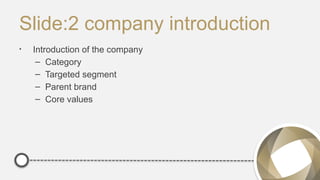
Slide:2 company introduction
• Introduction of the company
– Category
– Targeted segment
– Parent brand
– Core values
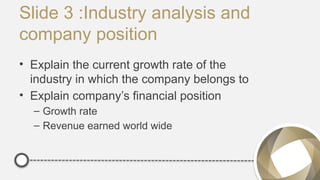
Slide 3 :Industry analysis and
company position
• Explain the current growth rate of the
industry in which the company belongs to
• Explain company’s financial position
– Growth rate
– Revenue earned world wide
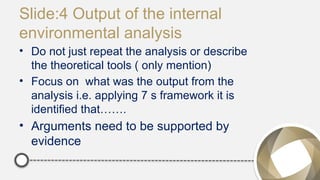
Slide:4 Output of the internal
environmental analysis
• Do not just repeat the analysis or describe
the theoretical tools ( only mention)
• Focus on what was the output from the
analysis i.e. applying 7 s framework it is
identified that…….
• Arguments need to be supported by
evidence
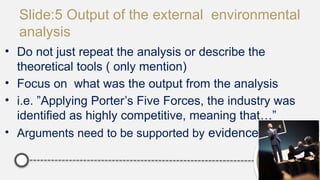
Slide:5 Output of the external environmental
analysis
• Do not just repeat the analysis or describe the
theoretical tools ( only mention)
• Focus on what was the output from the analysis
• i.e. ”Applying Porter’s Five Forces, the industry was
identified as highly competitive, meaning that…”
• Arguments need to be supported by evidence
/Determine the effectiveness of existing strategies
• Mention the current strategy(s) the organisation is following (strategy
examples like cost focus , market development , diversification which
were recommended in A1 )
• This is an opportunity for the organisation’s current strategy to be
critiqued.
• Apply an evaluative judgment to the current strategy – i.e. Is it good or
bad
• A key purpose of a strategic analysis is to determine the effectiveness of
the current strategy amid the prevailing business environment. Strategists
must ask themselves questions such as: Is our strategy failing or
succeeding? Will we meet our stated goals? Does our strategy align with
our vision, mission, and values?
Slide:7 tools to evaluate strategy
• Evaluation of strategies ( GAP analysis)
• Current position
• Expected position
• Identify gap
• Devise improvements (the evaluation has
implications in the recommendations for a new
strategy)
Slide: 8 Recommend new strategy
• Recent strategic actions or strategy formulation
• Recommend Differential strategy for attaining competitive
advantage
• This option will be informed by the viewpoint taken from your
evaluation
• Argue and support the recommendation with evidence
• The recommended strategy needs to be linked to the theory!
• ( use Ansoff, porter’s generic strategy, blue ocean strategy (Blue
Ocean Strategy Book by Renée Mauborgne and W. Chan Kim -> see next slide: )
Slide: 8 Recommend new strategy cont.
• (Blue Ocean Strategy Book by Renée Mauborgne and W. Chan Kim -> see next slide: )
===============================================================
BLUE OCEAN STRATEGY is the simultaneous pursuit of
differentiation and low cost to open up a new market space
and create new demand. It is about creating and capturing
uncontested market space, thereby making the competition
irrelevant.
Slide:9 Strategy implementation plan
• Define
• Evaluate the strategy recommended to find out its effectiveness
with respect to current market situation
• Evaluation on the basis of
– Suitability :ie whether the strategy fulfilling the objective
– Acceptability : what are the risk factors and reactions of the stakeholders
– Feasibility : whether the business has the resources , capacities to
implement strategy
– ( SAF Model)
It is advisable to focus on one set of allied strategies
Slide:10 and 11 Strategy implementation
plan. cont
• The type of implementation plan depends on the nature and type
of the proposed change
• Discuss HOW, in the context of the overall approach to
implementation
• In addition discuss WHAT, regarding specific ideas of procedures
that can be done to facilitate the process
• Explain WHY, evidence needs to be used to support the
arguments being made
Slide:12 Conclusion
• This is an opportunity:
• For the salient points to be summed up
• To show demonstrate coherence across the presentation and show
how the relationship between the sections of the presentation
• i.e. the environmental analysis and the evaluation of current
strategy, new strategic recommendations and the implementation
plan
• This is also an opportunity to demonstrate how the plans presented
have a logical flow from the analysis and research
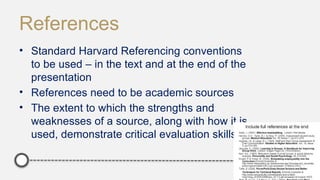
References
• Standard Harvard Referencing conventions
to be used – in the text and at the end of the
presentation
• References need to be academic sources
• The extent to which the strengths and
weaknesses of a source, along with how it is
used, demonstrate critical evaluation skills
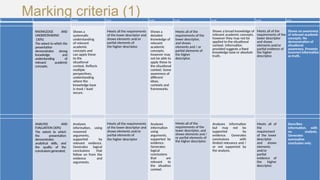
Marking criteria (1)
L6 100-80% 79-70% 69-60% 59-50% 49-40% 39-20% 19-0%
KNOWLEDGE AND
UNDERSTANDING
(30%)
The extent to which the
presentation
demonstrates strong
knowledge and
understanding of
relevant academic
concepts.
Shows a
systematic
understanding
of relevant
academic
concepts and
can apply these
to the
situational
context. Reflects
multiple
perspectives,
understanding
where the
knowledge base
is most / least
secure.
Meets all the requirements
of the lower descriptor and
shows elements and/or
partial elements of
the higher descriptor.
Shows a
detailed
knowledge of
relevant
academic
concepts,
however may
not be able to
apply these to
the situational
context. Some
awareness of
different
ideas,
contexts and
frameworks.
Meets all of the
requirements of the
lower descriptor,
and shows
elements and / or
partial elements of
the higher
descriptor.
Shows a broad knowledge of
relevant academic concepts,
however they may not be
applied to the situational
context. Information
provided suggests a fixed
knowledge base or absolute
truth.
Meets all of the
requirements of the
lower descriptor
and shows
elements and/or
partial evidence of
the higher
descriptor.
Shows no awareness
of relevant academic
concepts. No
demonstration of
situational
awareness. Presents
incorrect information
as truth.
ANALYSIS AND
EVALUATION (30%)
The extent to which
the presentation
demonstrates
analytical skills, and
the quality of the
conclusions generated,
Analyses
information, using
reasoned
arguments,
supported by
relevant evidence.
Generates logical
conclusions that
follow on from the
evidence and
arguments.
Meets all the requirements
of the lower descriptor and
shows elements and/or
partial elements of
the higher descriptor
Analyses
information
using
arguments,
supported by
evidence.
Generates
logical
conclusions
that are
relevant to
the situation
context.
Meets all of the
requirements of the
lower descriptor, and
shows elements and /
or partial elements of
the higher descriptor.
Analyses information
but may not be
supported by
evidence. Generates
conclusions with
limited relevance and /
or not supported by
the analysis.
Meets all of
the
requirement
of the lower
descriptor
and shows
elements
and/or
partial
evidence of
the higher
descriptor.
Describes
information, with
no analysis.
Generates
summative
conclusion only.
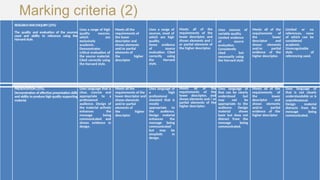
Marking criteria (2)
RESEARCHANDENQUIRY(25%)
The quality and evaluation of the sources
used and ability to reference using the
Harvard style.
Uses a range of high
quality sources,
which are
exclusively
academic.
Demonstrates
critical evaluation of
the source material.
Cited correctly using
the Harvard style.
Meets all the
requirements of
the lower
descriptor and
shows elements
and/or partial
elements of
the higher
descriptor
Uses a range of
sources, most of
which are high
quality.
Some evidence
of source
evaluation. Cited
correctly using
the Harvard
style.
Meets all of the
requirements of the
lower descriptor, and
shows elements and /
or partial elements of
the higher descriptor.
Uses sources of
variable quality.
Limited evidence
of source
evaluation.
Consistently
cited bot
necessarily using
the Harvard style
Meets all of the
requirements of
the lower
descriptor and
shows elements
and/or partial
evidence of the
higher descriptor.
Limited or no
references, none
of which can be
considered
academic.
Unrecognisable
style of
referencing used.
PRESENTATION (15%).
Demonstration of effective presentation skills
and ability to produce high quality supporting
material.
Uses language that is
clear, concise and
appropriate to a
professional
audience. Design of
the material actively
enhances the
message being
communicated and
shows evidence in
design.
Meets all the
requirements of the
lower descriptor and
shows elements
and/or partial
elements of
the higher
descriptor
Uses language of
a high
professional
standard that is
mostly
appropriate to
the audience.
Design material
enhances the
message being
communicated
but may be
simplistic in
design.
Meets all of the
requirements of the
lower descriptor, and
shows elements and / or
partial elements of the
higher descriptor.
Uses language of
that can be clearly
understood but
may not be
appropriate to the
audience. Design
material shows
basic but does not
distract from the
message being
communicated.
Meets all of the
requirements of
the lower
descriptor and
shows elements
and/or partial
evidence of the
higher descriptor
Uses language of
that is not clearly
understandable or is
unprofessional.
Design material
distracts from the
message being
communicated.

assessment 2 U W L guidelines.pptx

  • 1.
  • 2.
    Learning outcomes • Explainthe assignment tasks for the module • Use the marking criteria to evaluate own work • Reflect on a plan to improve and develop your work
  • 3.
    The assessment • Asection by section overview
  • 4.
    The assessment • AssignmentTwo: Following receipt of your consultant report, the CEO is impressed and wants to explore your ideas further. • As the current organizational strategy is coming to an end, they are keen to explore how the formulation and implementation of the successor strategy could be undertaken. • You have been asked to prepare a 20-minute presentation where you build on the environmental analysis and evaluate this against the organizational strategy. You then need to recommend an implementation plan. • The presentation will include a written narrative to present the findings of your research and which supports each slide. Each group member must therefore include a written narrative supporting the slides they have produced.
  • 5.
    The assessment • Forthe presentation with a written narrative, you will need to undertake the following: • Select the organization for whom your plan will be developed. You are advised to choose from one of those used for the individual consultant report. • As a group, revisit the findings and adjust, revise or develop them if needed. Evaluate what is known about the current strategy against your environmental analysis findings. Make recommendations on how the strategy might develop. • • Produce a plan that shows how a new strategy could be implemented. This should include an analysis of key stakeholders, as well as a timeline of implementation. • • Presentation will be in the form of a written narrative.
  • 6.
    The presentation • Thegroup size is 4 – 6 members. You will be required to upload one power point file of your slides per group to Turn It In. • Include a title slide and a slide of your references. • When submitting, please enter your student ID number, along with those of the other group members, in the “submission title” box. • The document itself should contain the student ID number of each group member in a header or footer; • student names should not be visible on the work. • You should have .12 Power Point slides, plus a title slide and a reference slide. • The power point needs to include a written narrative for each slide, which will be the presentation of the research. • Each student must write a narrative for their own slides, whilst the title slide will need to include an initial introduction. • One group member is to consolidate the slides into one power point file to include the written narrative for each slide and upload the file to Turn It In. • Presentation of the research will be from the written narrative. Only one presentation to be submitted per group. Therefore, it is important to agree who will submit the electronic copy and ensure the student ID number of each group member is included.
  • 7.
    Assessment Criteria • Yourwork will be assessed against the following criteria: • • Knowledge and understanding – 30% The extent to which the presentation demonstrates strong knowledge and understanding of relevant academic concepts. • • Analysis and evaluation – 30% The extent to which the presentation demonstrates analytical skills, and the quality of the conclusions generated. • • Research and enquiry – 25% The quality and evaluation of the sources used and ability to reference using the Harvard style. • • Presentation – 15% Demonstration of effective presentation skills and ability to produce high quality supporting material
  • 8.
    Key points toconsider: • The assignment is at Level 6 • It is your opportunity to demonstrate how you have engaged with the module content, as well as the class • Use the marking criteria to consider the presentation overall • Presentation style is important although it does not compensate for a presentation lacking in high quality content
  • 9.
    Slide 1 :Introduction •Introduce: • 1. The purpose of the presentation, – To analyse the current position of a selected company ( provide the name) – To evaluate the benefits and drawbacks of the previously implemented strategy – Implementation of sustainable strategies for the growth and development – Implementation of strategies infrastructural change management • 2.. Who you are • 3.. What the audience can expect to see (i.e. key points – think executive summary!)
  • 10.
    Slide:2 company introduction •Introduction of the company – Category – Targeted segment – Parent brand – Core values
  • 11.
    Slide 3 :Industryanalysis and company position • Explain the current growth rate of the industry in which the company belongs to • Explain company’s financial position – Growth rate – Revenue earned world wide
  • 12.
    Slide:4 Output ofthe internal environmental analysis • Do not just repeat the analysis or describe the theoretical tools ( only mention) • Focus on what was the output from the analysis i.e. applying 7 s framework it is identified that……. • Arguments need to be supported by evidence
  • 13.
    Slide:5 Output ofthe external environmental analysis • Do not just repeat the analysis or describe the theoretical tools ( only mention) • Focus on what was the output from the analysis • i.e. ”Applying Porter’s Five Forces, the industry was identified as highly competitive, meaning that…” • Arguments need to be supported by evidence
  • 14.
    /Determine the effectivenessof existing strategies • Mention the current strategy(s) the organisation is following (strategy examples like cost focus , market development , diversification which were recommended in A1 ) • This is an opportunity for the organisation’s current strategy to be critiqued. • Apply an evaluative judgment to the current strategy – i.e. Is it good or bad • A key purpose of a strategic analysis is to determine the effectiveness of the current strategy amid the prevailing business environment. Strategists must ask themselves questions such as: Is our strategy failing or succeeding? Will we meet our stated goals? Does our strategy align with our vision, mission, and values?
  • 15.
    Slide:7 tools toevaluate strategy • Evaluation of strategies ( GAP analysis) • Current position • Expected position • Identify gap • Devise improvements (the evaluation has implications in the recommendations for a new strategy)
  • 16.
    Slide: 8 Recommendnew strategy • Recent strategic actions or strategy formulation • Recommend Differential strategy for attaining competitive advantage • This option will be informed by the viewpoint taken from your evaluation • Argue and support the recommendation with evidence • The recommended strategy needs to be linked to the theory! • ( use Ansoff, porter’s generic strategy, blue ocean strategy (Blue Ocean Strategy Book by Renée Mauborgne and W. Chan Kim -> see next slide: )
  • 17.
    Slide: 8 Recommendnew strategy cont. • (Blue Ocean Strategy Book by Renée Mauborgne and W. Chan Kim -> see next slide: ) =============================================================== BLUE OCEAN STRATEGY is the simultaneous pursuit of differentiation and low cost to open up a new market space and create new demand. It is about creating and capturing uncontested market space, thereby making the competition irrelevant.
  • 18.
    Slide:9 Strategy implementationplan • Define • Evaluate the strategy recommended to find out its effectiveness with respect to current market situation • Evaluation on the basis of – Suitability :ie whether the strategy fulfilling the objective – Acceptability : what are the risk factors and reactions of the stakeholders – Feasibility : whether the business has the resources , capacities to implement strategy – ( SAF Model) It is advisable to focus on one set of allied strategies
  • 19.
    Slide:10 and 11Strategy implementation plan. cont • The type of implementation plan depends on the nature and type of the proposed change • Discuss HOW, in the context of the overall approach to implementation • In addition discuss WHAT, regarding specific ideas of procedures that can be done to facilitate the process • Explain WHY, evidence needs to be used to support the arguments being made
  • 20.
    Slide:12 Conclusion • Thisis an opportunity: • For the salient points to be summed up • To show demonstrate coherence across the presentation and show how the relationship between the sections of the presentation • i.e. the environmental analysis and the evaluation of current strategy, new strategic recommendations and the implementation plan • This is also an opportunity to demonstrate how the plans presented have a logical flow from the analysis and research
  • 21.
    References • Standard HarvardReferencing conventions to be used – in the text and at the end of the presentation • References need to be academic sources • The extent to which the strengths and weaknesses of a source, along with how it is used, demonstrate critical evaluation skills
  • 22.
    Marking criteria (1) L6100-80% 79-70% 69-60% 59-50% 49-40% 39-20% 19-0% KNOWLEDGE AND UNDERSTANDING (30%) The extent to which the presentation demonstrates strong knowledge and understanding of relevant academic concepts. Shows a systematic understanding of relevant academic concepts and can apply these to the situational context. Reflects multiple perspectives, understanding where the knowledge base is most / least secure. Meets all the requirements of the lower descriptor and shows elements and/or partial elements of the higher descriptor. Shows a detailed knowledge of relevant academic concepts, however may not be able to apply these to the situational context. Some awareness of different ideas, contexts and frameworks. Meets all of the requirements of the lower descriptor, and shows elements and / or partial elements of the higher descriptor. Shows a broad knowledge of relevant academic concepts, however they may not be applied to the situational context. Information provided suggests a fixed knowledge base or absolute truth. Meets all of the requirements of the lower descriptor and shows elements and/or partial evidence of the higher descriptor. Shows no awareness of relevant academic concepts. No demonstration of situational awareness. Presents incorrect information as truth. ANALYSIS AND EVALUATION (30%) The extent to which the presentation demonstrates analytical skills, and the quality of the conclusions generated, Analyses information, using reasoned arguments, supported by relevant evidence. Generates logical conclusions that follow on from the evidence and arguments. Meets all the requirements of the lower descriptor and shows elements and/or partial elements of the higher descriptor Analyses information using arguments, supported by evidence. Generates logical conclusions that are relevant to the situation context. Meets all of the requirements of the lower descriptor, and shows elements and / or partial elements of the higher descriptor. Analyses information but may not be supported by evidence. Generates conclusions with limited relevance and / or not supported by the analysis. Meets all of the requirement of the lower descriptor and shows elements and/or partial evidence of the higher descriptor. Describes information, with no analysis. Generates summative conclusion only.
  • 23.
    Marking criteria (2) RESEARCHANDENQUIRY(25%) Thequality and evaluation of the sources used and ability to reference using the Harvard style. Uses a range of high quality sources, which are exclusively academic. Demonstrates critical evaluation of the source material. Cited correctly using the Harvard style. Meets all the requirements of the lower descriptor and shows elements and/or partial elements of the higher descriptor Uses a range of sources, most of which are high quality. Some evidence of source evaluation. Cited correctly using the Harvard style. Meets all of the requirements of the lower descriptor, and shows elements and / or partial elements of the higher descriptor. Uses sources of variable quality. Limited evidence of source evaluation. Consistently cited bot necessarily using the Harvard style Meets all of the requirements of the lower descriptor and shows elements and/or partial evidence of the higher descriptor. Limited or no references, none of which can be considered academic. Unrecognisable style of referencing used. PRESENTATION (15%). Demonstration of effective presentation skills and ability to produce high quality supporting material. Uses language that is clear, concise and appropriate to a professional audience. Design of the material actively enhances the message being communicated and shows evidence in design. Meets all the requirements of the lower descriptor and shows elements and/or partial elements of the higher descriptor Uses language of a high professional standard that is mostly appropriate to the audience. Design material enhances the message being communicated but may be simplistic in design. Meets all of the requirements of the lower descriptor, and shows elements and / or partial elements of the higher descriptor. Uses language of that can be clearly understood but may not be appropriate to the audience. Design material shows basic but does not distract from the message being communicated. Meets all of the requirements of the lower descriptor and shows elements and/or partial evidence of the higher descriptor Uses language of that is not clearly understandable or is unprofessional. Design material distracts from the message being communicated.

Editor's Notes

  • #14 A high quality strategy typically builds on the economic notion of comparative advantage-- the idea that cooperation between individuals creates value when a seller can produce an item at a lower cost than buyers would spend to produce it themselves. A high quality strategy thus requires that firms invest and organize in a way that generates advantage relative to close competitors. Beyond clichés to “value the customer” or “align and engage ones employees,” a high-quality strategy requires firms to identify sources of unique value that are costly for rivals to match.
  • #15 Explain why the judgment has been reached Use evidence to support the arguments being made A structure approach should be used for the evaluation In turn, the evaluation has implications in the recommendations for a new strategy
  • #16 While formulating plans: Relate this approach to the type, nature and structure of the organisation. Give consideration to which stakeholders need to be involved Identify the probable extent of the resulting strategy
  • #17 While formulating plans: Relate this approach to the type, nature and structure of the organisation. Give consideration to which stakeholders need to be involved Identify the probable extent of the resulting strategy