PSY 616 Milestone Three Guidelines and Rubric: Strategy
Overview: You will prepare three graded formative tasks
(milestones) supporting the analysis needed for the final
product, a consulting case study and action plan for a real-world
organization.
The three presentations will examine the problem in the
organization (Milestone Two), the strategy to address the
problem (Milestone Three), and a prediction of possible
outcomes (Milestone Four).These will also be included in the
final project as an appendix. These formative tasks will scaffold
to the final product providing opportunities to apply
organizational consulting concepts and tools in a real-world
example.
Guidelines for presentations: The development of concise,
professional presentations suitable for presenting to the
leadership of a client organization is an important component of
an organizational consultant’s role. For each presentation, the
content should clearly address the specific goal. The target
audience is the client, so the slides should be written in an
effort to persuade the client to agree with your point of view.
No matter how extensive the research or accurate the
conclusions, a weak presentation can undermine an argument.
When creating presentations, you will develop skills in
researching an issue, synthesizing the information, organizing
data logically, and presenting findings in an effective manner.
1. You may use a product such as PowerPoint, Google
Presentation, or Prezi to create your presentations.
2. There are various template designs that you can find on the
web for your presentation. Consider your presentation from the
perspective of your audience prior to selecting a specific style.
Avoid distractions. Be consistent with the style of text, bullets,
and subpoints to support a powerful presentation that allows
your content to be the focus.
3. Each slide should include your key point(s). Do not place
large blocks of text on the visual.
4. Use clip art, AutoShapes, pictures, charts, tables, and
diagrams to enhance but not overwhelm your content.
5. Be mindful of the intended audience.
Below are links that offer helpful tips and examples for
developing your presentations:
· Making PowerPoint Slides
· Beyond Bullet Points: The Better Way to Use PowerPoint
· Really Bad PowerPoint and How to Avoid it
Prompt: In task 6-2, you will submit a presentation describing
your strategy (or strategies) to address the problem(s) discussed
for your selected organization in Milestone Two. Imagine that
your audience is your client, the leader of the organization. The
format should be a three- to four-slide presentation.
Note: You will also post your presentation by the end of Module
Six to Peer Commentary Discussion 7-2.
Rubric
Format: The presentation must be between three and four slides.
When applicable, discipline-appropriate citations must be used.
Instructor feedback: Students can find their feedback in the
Grade Center.
Critical Elements
Exemplary
Proficient
Needs Improvement
Not Evident
Value
Strategy Selection
Meets “Proficient” criteria and supports rationale with clear and
relevant research-based examples
(23-25)
Develops strategies that address the organization’s problem(s)
using specific organizational psychology concepts
(20-22)
Does not sufficiently develop appropriate strategies to address
the organization’s problem(s) using specific organizational
psychology concepts
(18-19)
Does not develop any strategy to address the organization’s
problem(s) using organizational psychology concepts
(0-17)
25
Theoretical Rationale of Strategy
Meets “Proficient” criteria and uses best practices for
consulting methods
(23-25)
Integrates psychological theory and proven consulting methods
into the strategy rationale
(20-22)
Does not sufficiently integrate psychological theory and proven
consulting methods into the strategy rationale
(18-19)
Does not integrate psychological theory and consulting methods
into the strategy rationale
(0-17)
25
Research-based Rationale for Strategy
Meets “Proficient” criteria using highly relevant evidence from
organizational psychology research
(23-25)
Provides a clear rationale for the strategy development approach
with evidence from organizational psychology research
(20-22)
Rationale for the strategy development approach is not
sufficiently supported by relevant evidence from organizational
psychology research
(18-19)
Does not provide an evidence-based rationale for strategy
development
(0-17)
25
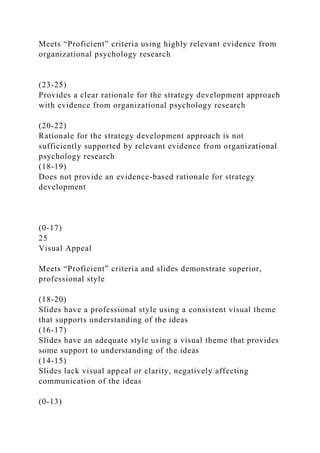
Visual Appeal
Meets “Proficient” criteria and slides demonstrate superior,
professional style
(18-20)
Slides have a professional style using a consistent visual theme
that supports understanding of the ideas
(16-17)
Slides have an adequate style using a visual theme that provides
some support to understanding of the ideas
(14-15)
Slides lack visual appeal or clarity, negatively affecting
communication of the ideas
(0-13)
20
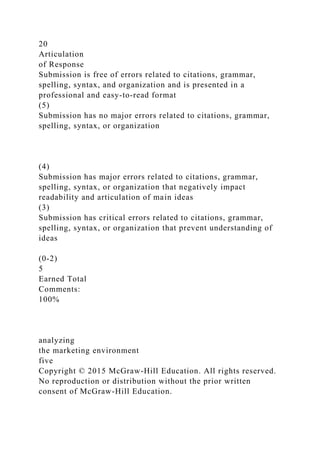
Articulation
of Response
Submission is free of errors related to citations, grammar,
spelling, syntax, and organization and is presented in a
professional and easy-to-read format
(5)
Submission has no major errors related to citations, grammar,
spelling, syntax, or organization
(4)
Submission has major errors related to citations, grammar,
spelling, syntax, or organization that negatively impact
readability and articulation of main ideas
(3)
Submission has critical errors related to citations, grammar,
spelling, syntax, or organization that prevent understanding of
ideas
(0-2)
5
Earned Total
Comments:
100%
analyzing
the marketing environment
five
Copyright © 2015 McGraw-Hill Education. All rights reserved.
No reproduction or distribution without the prior written
consent of McGraw-Hill Education.
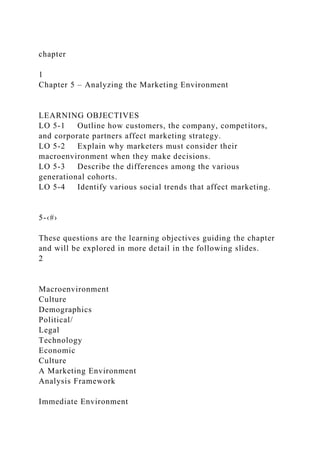
chapter
1
Chapter 5 – Analyzing the Marketing Environment
LEARNING OBJECTIVES
LO 5-1 Outline how customers, the company, competitors,
and corporate partners affect marketing strategy.
LO 5-2 Explain why marketers must consider their
macroenvironment when they make decisions.
LO 5-3 Describe the differences among the various
generational cohorts.
LO 5-4 Identify various social trends that affect marketing.
5-‹#›
These questions are the learning objectives guiding the chapter
and will be explored in more detail in the following slides.
2
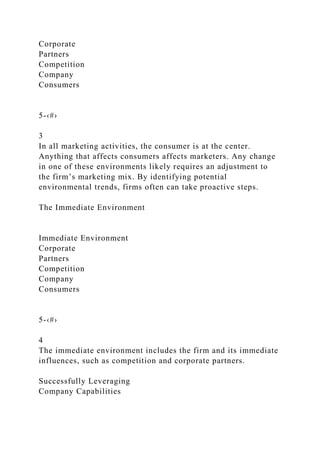
Macroenvironment
Culture
Demographics
Political/
Legal
Technology
Economic
Culture
A Marketing Environment
Analysis Framework
Immediate Environment
Corporate
Partners
Competition
Company
Consumers
5-‹#›
3
In all marketing activities, the consumer is at the center.
Anything that affects consumers affects marketers. Any change
in one of these environments likely requires an adjustment to
the firm’s marketing mix. By identifying potential
environmental trends, firms often can take proactive steps.
The Immediate Environment
Immediate Environment
Corporate
Partners
Competition
Company
Consumers
5-‹#›
4
The immediate environment includes the firm and its immediate
influences, such as competition and corporate partners.
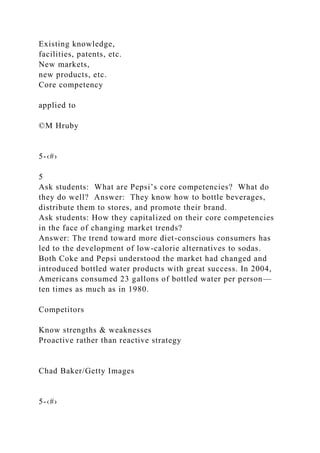
Successfully Leveraging
Company Capabilities
Existing knowledge,
facilities, patents, etc.
New markets,
new products, etc.
Core competency
applied to
©M Hruby
5-‹#›
5
Ask students: What are Pepsi’s core competencies? What do
they do well? Answer: They know how to bottle beverages,
distribute them to stores, and promote their brand.
Ask students: How they capitalized on their core competencies
in the face of changing market trends?
Answer: The trend toward more diet-conscious consumers has
led to the development of low-calorie alternatives to sodas.
Both Coke and Pepsi understood the market had changed and
introduced bottled water products with great success. In 2004,
Americans consumed 23 gallons of bottled water per person—
ten times as much as in 1980.
Competitors
Know strengths & weaknesses
Proactive rather than reactive strategy
Chad Baker/Getty Images
5-‹#›
6
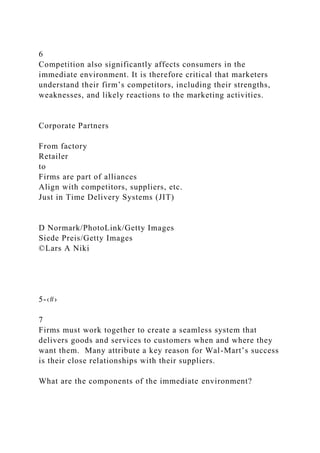
Competition also significantly affects consumers in the
immediate environment. It is therefore critical that marketers
understand their firm’s competitors, including their strengths,
weaknesses, and likely reactions to the marketing activities.
Corporate Partners
From factory
Retailer
to
Firms are part of alliances
Align with competitors, suppliers, etc.
Just in Time Delivery Systems (JIT)
D Normark/PhotoLink/Getty Images
Siede Preis/Getty Images
©Lars A Niki
5-‹#›
7
Firms must work together to create a seamless system that
delivers goods and services to customers when and where they
want them. Many attribute a key reason for Wal-Mart’s success
is their close relationships with their suppliers.
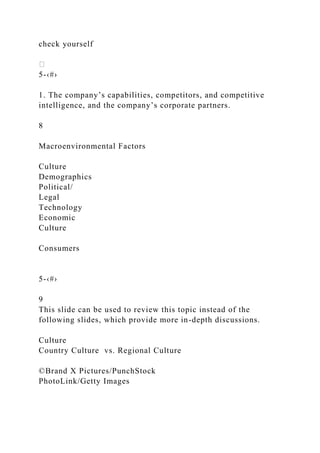
What are the components of the immediate environment?
check yourself
5-‹#›
1. The company’s capabilities, competitors, and competitive
intelligence, and the company’s corporate partners.
8
Macroenvironmental Factors
Culture
Demographics
Political/
Legal
Technology
Economic
Culture
Consumers
5-‹#›
9
This slide can be used to review this topic instead of the
following slides, which provide more in-depth discussions.
Culture
Country Culture vs. Regional Culture
©Brand X Pictures/PunchStock
PhotoLink/Getty Images
5-‹#›
10
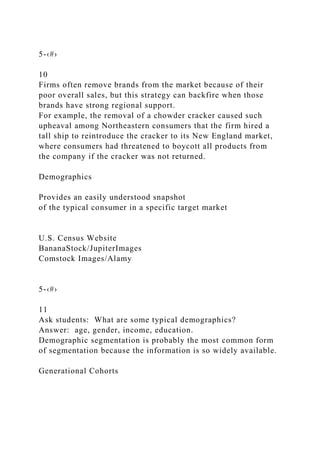
Firms often remove brands from the market because of their
poor overall sales, but this strategy can backfire when those
brands have strong regional support.
For example, the removal of a chowder cracker caused such
upheaval among Northeastern consumers that the firm hired a
tall ship to reintroduce the cracker to its New England market,
where consumers had threatened to boycott all products from
the company if the cracker was not returned.
Demographics
Provides an easily understood snapshot
of the typical consumer in a specific target market
U.S. Census Website
BananaStock/JupiterImages
Comstock Images/Alamy
5-‹#›
11
Ask students: What are some typical demographics?
Answer: age, gender, income, education.
Demographic segmentation is probably the most common form
of segmentation because the information is so widely available.
Generational Cohorts
5-‹#›
12
Group activity: Have students brainstorm a list of the defining
characteristics of their generation.
Ask students: How does your generation differ from previous
generations, such as their parents — the Baby Boomers. What
macroenvironmental forces have had the most impact on your
generation?
Income
Purchasing power is tied to income
Many middle class families feel the decline in purchasing power
in recent years
Courtesy of Hammacher Schlemmer, www.hammacher.com.
5-‹#›
13
The “middle-class squeeze” is a very real global phenomenon.
Many developing countries face similar income inequities to
those found in the United States. Pay gaps also cause problems
for many new college graduates who find they cannot afford to
live on their own and must move back in with their parents.
Education
Education is related to income,
which determines spending power
=
©Fancy Photographer/Veer
Brand X Pictures
5-‹#›
14
Ask students: Do you plan to continue your education after
graduation?
Many students believe they will never return to school after
they finish their Bachelors’ degree, but modern conditions make
this choice more and more unlikely. Lifelong learning of new
skills and new knowledge has become key to survival in the
global economy
Gender
Jochen Sand/Digital Vision/Getty Images
5-‹#›
15
Women now make up more than 60% of the college population.
Ask students? How do you believe this will affect the workplace
in the future?
Ask students? Do you believe that there are still significant
gender differences? What are they?
Male/female roles have been shifting
Marketing has changed to reflect these shifts
Ethnicity
By 2050, minorities will represent 50% of the population.
©2006 Oldemarak, LLC Reprinted with permission The
Wendy’s name, design and logo are registered trademarks of
Oldemark, Llc and are licensed to Wendy’s International, Inc.
Super Bowl XLI Commercial
Bud Light Starring: Carlos Mencia
5-‹#›
16
Ask students: What steps can and should marketers take to
respond to the changing ethnic mix of the United States?
Many marketers already have adjusted their marketing mix to
meet the needs of ethnically diverse segments better. This
YouTube video is for a Carlos Mencia Bud Light superbowl ad
about teaching English.
YouTube link:
http://www.youtube.com/watch?v=670X2MCWzK0
Social Trends
Thrift
Health and Wellness Concerns
Greener Consumers
Privacy Concerns
Time-Poor Society
Celebrity Magazine Covers
5-‹#›
17
This graphic introduces significant social trends. Video:
“What's Hot and Not in Celebrity Magazine Covers”
Ask students why are traditional celebrities not catching
consumers’ attention? Ask students how are tabloids going to
continue to entice readers to buy their content?
Technological Advances
Technology has impacted every aspect of marketing
New products
New forms of communication
New retail channels
Stop and
Shop Website
AP Photo/Ric Feld
Rachael Ray
5-‹#›
18
Arguably the single most important change in the way we live is
the introduction of new technology.
Ask students: What new technologies have you seen at
retailers? This web link is for the shoppers tool page of Stop
and Shop a large east coast grocery retailer. They offer self-
scanners, computer kiosk deli ordering and self checkout.
WSJ: http://live.wsj.com/video/rachael-ray-goes-
digital/A0B4CC90-9D29-43EC-B22D-
31CF9A90D2F6.html#!A0B4CC90-9D29-43EC-B22D-
31CF9A90D2F6
Combined with inflation and interest rates affect firms’ ability
to market goods and services
Economic Situation
Foreign currency fluctuations
Conference Board Website
PhotoLink/Getty Images
Brand X Pictures
5-‹#›
19
Depending on the time of year, discuss projections about
Christmas shopping, vacation planning, or home buying.
Various economic factors affect each of these areas. The web
link leads to the Consumer Confidence Index which takes into
account how consumers feel about how the economy is doing.
This economic indicator relates directly to spending.
Political/Regulatory Environment
Competitive Practice and Trade Legislation
David Hiller/Getty Images
5-‹#›
20
This list includes the major legislation designed to ensure a
competitive marketplace and clearly demonstrates the U.S.
government’s long history of enacting laws that protect fair
trade.
1890: Sherman Antitrust Act
1914: Clayton Act
1914: Federal Trade Commission
1936: Robinson-Putman Act
1938: Wheeler-Lea Act
1993: North American Free Trade Agreement (NAFTA)
What are the six key macroeconomic factors?
Differentiate between country culture and regional culture.
Identify the different generational cohorts.
What are some important social trends shaping consumer values
and shopping behavior?
check yourself
5-‹#›
Culture, demographics, social issues, technological advances,
economic situation, and political/regulatory environment.
Country Culture is the entire country but regional culture is
based on the region or area within the country.
Tweens, Gen Y, Gen X, Baby Boomers, Seniors
Thrift, Greener consumers, marketing to children, privacy
concerns, and time-poor societies.
21
Country culture involves visual nuances of a country’s culture
such as artifacts, behavior, dress, symbols, physical settings,
ceremonies, language differences, colors and tastes, and food
preferences, as well as language.
Glossary
Return to slide
5-‹#›
Country culture involves visual nuances of a country’s culture
such as artifacts, behavior, dress, symbols, physical settings,
ceremonies, language differences, colors and tastes, and food
preferences, as well as language.
Culture is the shared meanings, beliefs, morals, values, and
customs of a group of people.
Glossary
Return to slide
5-‹#›
Culture is the shared meanings, beliefs, morals, values, and
customs of a group of people.
Demographics indicate the characteristics of human populations
and segments, especially those used to identify consumer
markets.
Glossary
Return to slide
5-‹#›
Demographics indicate the characteristics of human populations
and segments, especially those used to identify consumer
markets.
A generational cohort is a group of people of the same
generation.
Glossary
Return to slide
5-‹#›
A generational cohort is a group of people of the same
generation.
The political/regulatory environment comprises political
parties, government organizations, and legislation and laws.
Glossary
Return to slide
5-‹#›
The political/regulatory environment comprises political
parties, government organizations, and legislation and laws.
Regional culture involves the region in which people live in a
particular country.
Glossary
Return to slide
5-‹#›
Regional culture involves the region in which people live in a
particular country.

PSY 616 Milestone Three Guidelines and Rubric StrategyOverview.docx

  • 1.
    PSY 616 MilestoneThree Guidelines and Rubric: Strategy Overview: You will prepare three graded formative tasks (milestones) supporting the analysis needed for the final product, a consulting case study and action plan for a real-world organization. The three presentations will examine the problem in the organization (Milestone Two), the strategy to address the problem (Milestone Three), and a prediction of possible outcomes (Milestone Four).These will also be included in the final project as an appendix. These formative tasks will scaffold to the final product providing opportunities to apply organizational consulting concepts and tools in a real-world example. Guidelines for presentations: The development of concise, professional presentations suitable for presenting to the leadership of a client organization is an important component of an organizational consultant’s role. For each presentation, the content should clearly address the specific goal. The target audience is the client, so the slides should be written in an effort to persuade the client to agree with your point of view. No matter how extensive the research or accurate the conclusions, a weak presentation can undermine an argument. When creating presentations, you will develop skills in researching an issue, synthesizing the information, organizing data logically, and presenting findings in an effective manner. 1. You may use a product such as PowerPoint, Google Presentation, or Prezi to create your presentations. 2. There are various template designs that you can find on the web for your presentation. Consider your presentation from the perspective of your audience prior to selecting a specific style. Avoid distractions. Be consistent with the style of text, bullets,
  • 2.
    and subpoints tosupport a powerful presentation that allows your content to be the focus. 3. Each slide should include your key point(s). Do not place large blocks of text on the visual. 4. Use clip art, AutoShapes, pictures, charts, tables, and diagrams to enhance but not overwhelm your content. 5. Be mindful of the intended audience. Below are links that offer helpful tips and examples for developing your presentations: · Making PowerPoint Slides · Beyond Bullet Points: The Better Way to Use PowerPoint · Really Bad PowerPoint and How to Avoid it Prompt: In task 6-2, you will submit a presentation describing your strategy (or strategies) to address the problem(s) discussed for your selected organization in Milestone Two. Imagine that your audience is your client, the leader of the organization. The format should be a three- to four-slide presentation. Note: You will also post your presentation by the end of Module Six to Peer Commentary Discussion 7-2. Rubric Format: The presentation must be between three and four slides. When applicable, discipline-appropriate citations must be used. Instructor feedback: Students can find their feedback in the Grade Center. Critical Elements Exemplary Proficient Needs Improvement Not Evident Value
  • 3.
    Strategy Selection Meets “Proficient”criteria and supports rationale with clear and relevant research-based examples (23-25) Develops strategies that address the organization’s problem(s) using specific organizational psychology concepts (20-22) Does not sufficiently develop appropriate strategies to address the organization’s problem(s) using specific organizational psychology concepts (18-19) Does not develop any strategy to address the organization’s problem(s) using organizational psychology concepts (0-17) 25 Theoretical Rationale of Strategy Meets “Proficient” criteria and uses best practices for consulting methods (23-25) Integrates psychological theory and proven consulting methods into the strategy rationale (20-22) Does not sufficiently integrate psychological theory and proven consulting methods into the strategy rationale (18-19) Does not integrate psychological theory and consulting methods into the strategy rationale (0-17) 25 Research-based Rationale for Strategy
  • 4.
    Meets “Proficient” criteriausing highly relevant evidence from organizational psychology research (23-25) Provides a clear rationale for the strategy development approach with evidence from organizational psychology research (20-22) Rationale for the strategy development approach is not sufficiently supported by relevant evidence from organizational psychology research (18-19) Does not provide an evidence-based rationale for strategy development (0-17) 25 Visual Appeal Meets “Proficient” criteria and slides demonstrate superior, professional style (18-20) Slides have a professional style using a consistent visual theme that supports understanding of the ideas (16-17) Slides have an adequate style using a visual theme that provides some support to understanding of the ideas (14-15) Slides lack visual appeal or clarity, negatively affecting communication of the ideas (0-13)
  • 5.
    20 Articulation of Response Submission isfree of errors related to citations, grammar, spelling, syntax, and organization and is presented in a professional and easy-to-read format (5) Submission has no major errors related to citations, grammar, spelling, syntax, or organization (4) Submission has major errors related to citations, grammar, spelling, syntax, or organization that negatively impact readability and articulation of main ideas (3) Submission has critical errors related to citations, grammar, spelling, syntax, or organization that prevent understanding of ideas (0-2) 5 Earned Total Comments: 100% analyzing the marketing environment five Copyright © 2015 McGraw-Hill Education. All rights reserved. No reproduction or distribution without the prior written consent of McGraw-Hill Education.
  • 6.
    chapter 1 Chapter 5 –Analyzing the Marketing Environment LEARNING OBJECTIVES LO 5-1 Outline how customers, the company, competitors, and corporate partners affect marketing strategy. LO 5-2 Explain why marketers must consider their macroenvironment when they make decisions. LO 5-3 Describe the differences among the various generational cohorts. LO 5-4 Identify various social trends that affect marketing. 5-‹#› These questions are the learning objectives guiding the chapter and will be explored in more detail in the following slides. 2 Macroenvironment Culture Demographics Political/ Legal Technology Economic Culture A Marketing Environment Analysis Framework Immediate Environment
  • 7.
    Corporate Partners Competition Company Consumers 5-‹#› 3 In all marketingactivities, the consumer is at the center. Anything that affects consumers affects marketers. Any change in one of these environments likely requires an adjustment to the firm’s marketing mix. By identifying potential environmental trends, firms often can take proactive steps. The Immediate Environment Immediate Environment Corporate Partners Competition Company Consumers 5-‹#› 4 The immediate environment includes the firm and its immediate influences, such as competition and corporate partners. Successfully Leveraging Company Capabilities
  • 8.
    Existing knowledge, facilities, patents,etc. New markets, new products, etc. Core competency applied to ©M Hruby 5-‹#› 5 Ask students: What are Pepsi’s core competencies? What do they do well? Answer: They know how to bottle beverages, distribute them to stores, and promote their brand. Ask students: How they capitalized on their core competencies in the face of changing market trends? Answer: The trend toward more diet-conscious consumers has led to the development of low-calorie alternatives to sodas. Both Coke and Pepsi understood the market had changed and introduced bottled water products with great success. In 2004, Americans consumed 23 gallons of bottled water per person— ten times as much as in 1980. Competitors Know strengths & weaknesses Proactive rather than reactive strategy Chad Baker/Getty Images 5-‹#›
  • 9.
    6 Competition also significantlyaffects consumers in the immediate environment. It is therefore critical that marketers understand their firm’s competitors, including their strengths, weaknesses, and likely reactions to the marketing activities. Corporate Partners From factory Retailer to Firms are part of alliances Align with competitors, suppliers, etc. Just in Time Delivery Systems (JIT) D Normark/PhotoLink/Getty Images Siede Preis/Getty Images ©Lars A Niki 5-‹#› 7 Firms must work together to create a seamless system that delivers goods and services to customers when and where they want them. Many attribute a key reason for Wal-Mart’s success is their close relationships with their suppliers. What are the components of the immediate environment?
  • 10.
    check yourself 5-‹#› 1. Thecompany’s capabilities, competitors, and competitive intelligence, and the company’s corporate partners. 8 Macroenvironmental Factors Culture Demographics Political/ Legal Technology Economic Culture Consumers 5-‹#› 9 This slide can be used to review this topic instead of the following slides, which provide more in-depth discussions. Culture Country Culture vs. Regional Culture ©Brand X Pictures/PunchStock PhotoLink/Getty Images
  • 11.
    5-‹#› 10 Firms often removebrands from the market because of their poor overall sales, but this strategy can backfire when those brands have strong regional support. For example, the removal of a chowder cracker caused such upheaval among Northeastern consumers that the firm hired a tall ship to reintroduce the cracker to its New England market, where consumers had threatened to boycott all products from the company if the cracker was not returned. Demographics Provides an easily understood snapshot of the typical consumer in a specific target market U.S. Census Website BananaStock/JupiterImages Comstock Images/Alamy 5-‹#› 11 Ask students: What are some typical demographics? Answer: age, gender, income, education. Demographic segmentation is probably the most common form of segmentation because the information is so widely available. Generational Cohorts
  • 12.
    5-‹#› 12 Group activity: Havestudents brainstorm a list of the defining characteristics of their generation. Ask students: How does your generation differ from previous generations, such as their parents — the Baby Boomers. What macroenvironmental forces have had the most impact on your generation? Income Purchasing power is tied to income Many middle class families feel the decline in purchasing power in recent years Courtesy of Hammacher Schlemmer, www.hammacher.com. 5-‹#› 13 The “middle-class squeeze” is a very real global phenomenon. Many developing countries face similar income inequities to those found in the United States. Pay gaps also cause problems for many new college graduates who find they cannot afford to live on their own and must move back in with their parents. Education Education is related to income, which determines spending power = ©Fancy Photographer/Veer Brand X Pictures
  • 13.
    5-‹#› 14 Ask students: Doyou plan to continue your education after graduation? Many students believe they will never return to school after they finish their Bachelors’ degree, but modern conditions make this choice more and more unlikely. Lifelong learning of new skills and new knowledge has become key to survival in the global economy Gender Jochen Sand/Digital Vision/Getty Images 5-‹#› 15 Women now make up more than 60% of the college population. Ask students? How do you believe this will affect the workplace in the future? Ask students? Do you believe that there are still significant gender differences? What are they? Male/female roles have been shifting Marketing has changed to reflect these shifts
  • 14.
    Ethnicity By 2050, minoritieswill represent 50% of the population. ©2006 Oldemarak, LLC Reprinted with permission The Wendy’s name, design and logo are registered trademarks of Oldemark, Llc and are licensed to Wendy’s International, Inc. Super Bowl XLI Commercial Bud Light Starring: Carlos Mencia 5-‹#› 16 Ask students: What steps can and should marketers take to respond to the changing ethnic mix of the United States? Many marketers already have adjusted their marketing mix to meet the needs of ethnically diverse segments better. This YouTube video is for a Carlos Mencia Bud Light superbowl ad about teaching English. YouTube link: http://www.youtube.com/watch?v=670X2MCWzK0 Social Trends Thrift Health and Wellness Concerns Greener Consumers Privacy Concerns Time-Poor Society Celebrity Magazine Covers
  • 15.
    5-‹#› 17 This graphic introducessignificant social trends. Video: “What's Hot and Not in Celebrity Magazine Covers” Ask students why are traditional celebrities not catching consumers’ attention? Ask students how are tabloids going to continue to entice readers to buy their content? Technological Advances Technology has impacted every aspect of marketing New products New forms of communication New retail channels Stop and Shop Website AP Photo/Ric Feld Rachael Ray 5-‹#› 18 Arguably the single most important change in the way we live is the introduction of new technology. Ask students: What new technologies have you seen at retailers? This web link is for the shoppers tool page of Stop and Shop a large east coast grocery retailer. They offer self- scanners, computer kiosk deli ordering and self checkout. WSJ: http://live.wsj.com/video/rachael-ray-goes-
  • 16.
    digital/A0B4CC90-9D29-43EC-B22D- 31CF9A90D2F6.html#!A0B4CC90-9D29-43EC-B22D- 31CF9A90D2F6 Combined with inflationand interest rates affect firms’ ability to market goods and services Economic Situation Foreign currency fluctuations Conference Board Website PhotoLink/Getty Images Brand X Pictures 5-‹#› 19 Depending on the time of year, discuss projections about Christmas shopping, vacation planning, or home buying. Various economic factors affect each of these areas. The web link leads to the Consumer Confidence Index which takes into account how consumers feel about how the economy is doing. This economic indicator relates directly to spending. Political/Regulatory Environment Competitive Practice and Trade Legislation David Hiller/Getty Images 5-‹#› 20 This list includes the major legislation designed to ensure a
  • 17.
    competitive marketplace andclearly demonstrates the U.S. government’s long history of enacting laws that protect fair trade. 1890: Sherman Antitrust Act 1914: Clayton Act 1914: Federal Trade Commission 1936: Robinson-Putman Act 1938: Wheeler-Lea Act 1993: North American Free Trade Agreement (NAFTA) What are the six key macroeconomic factors?
  • 18.
    Differentiate between countryculture and regional culture. Identify the different generational cohorts. What are some important social trends shaping consumer values and shopping behavior? check yourself 5-‹#› Culture, demographics, social issues, technological advances, economic situation, and political/regulatory environment. Country Culture is the entire country but regional culture is based on the region or area within the country. Tweens, Gen Y, Gen X, Baby Boomers, Seniors Thrift, Greener consumers, marketing to children, privacy concerns, and time-poor societies. 21 Country culture involves visual nuances of a country’s culture such as artifacts, behavior, dress, symbols, physical settings, ceremonies, language differences, colors and tastes, and food preferences, as well as language. Glossary Return to slide 5-‹#› Country culture involves visual nuances of a country’s culture such as artifacts, behavior, dress, symbols, physical settings, ceremonies, language differences, colors and tastes, and food preferences, as well as language. Culture is the shared meanings, beliefs, morals, values, and
  • 19.
    customs of agroup of people. Glossary Return to slide 5-‹#› Culture is the shared meanings, beliefs, morals, values, and customs of a group of people. Demographics indicate the characteristics of human populations and segments, especially those used to identify consumer markets. Glossary Return to slide 5-‹#› Demographics indicate the characteristics of human populations and segments, especially those used to identify consumer markets. A generational cohort is a group of people of the same generation. Glossary Return to slide 5-‹#› A generational cohort is a group of people of the same generation. The political/regulatory environment comprises political parties, government organizations, and legislation and laws.
  • 20.
    Glossary Return to slide 5-‹#› Thepolitical/regulatory environment comprises political parties, government organizations, and legislation and laws. Regional culture involves the region in which people live in a particular country. Glossary Return to slide 5-‹#› Regional culture involves the region in which people live in a particular country.