QUALIFI ASSESSMENT DOCUMENT
QualificationQualifi Level 7 Diploma in Strategic Management & Leadership
Qualification No (RQF) 601/5335/0
Unit Name Strategic Direction
Unit Reference 706
No of Credits 15 Credits
2.
Page 2 of12
Introduction
Prior to attempting this coursework assignment, Learners must familiarise themselves with the following policies:
• Centre Specification
o Can be found at https://qualifi.net/qualifi-level-7-diploma-in-strategic-management-and-leadership/
• Qualifi Quality Assurance Standards
• Qualifi Quality Policy Statement
Plagiarism and Collusion
In submitting the assignment Learner’s must complete a statement of authenticity confirming that the work submitted for all tasks is their
own. The statement should also include the word count.
Your accredited study centre will direct you to the appropriate software that checks the level of similarity. Qualifi recommends the use of
https://www.turnitin.com as a part of the assessment.
Plagiarism and collusion are treated very seriously. Plagiarism involves presenting work, excerpts, ideas or passages of another author without
appropriate referencing and attribution.
Collusion occurs when two or more learners submit work which is so alike in ideas, content, wording and/or structure that the similarity goes
beyond what might have been mere coincidence
Please familiarise yourself on Qualifi’s Malpractice and Maladministration policy, where you can find further information
3.
Page 3 of12
Referencing
A professional approach to work is expected from all learners. Learners must therefore identify and acknowledge ALL
sources/methodologies/applications used.
The learner must use an appropriate referencing system to achieve this. Marks are not awarded for the use of English; however, the learner
must express ideas clearly and ensure that appropriate terminology is used to convey accuracy in meaning.
Qualifi recommends using Harvard Style of Referencing throughout your work.
Appendices
You may include appendices to support your work, however appendices must only contain additional supporting information, and must be
clearly referenced in your assignment.
You may also include tables, graphs, diagrams, Gantt chart and flowcharts that support the main report should be incorporated into the back
of the assignment report that is submitted.
Any published secondary information such as annual reports and company literature, should be referenced in the main text of the assignment,
in accordance of Harvard Style Referencing, and referenced at the end of the assignment.
Confidentiality
Where a Learner is using organisational information that deals with sensitive material or issues, they must seek the advice and permission
from that organisation about its inclusion.
4.
Page 4 of12
Where confidentiality is an issue, Learners are advised to anonymise their assignment report so that it cannot be attributed to that particular
organisation.
Word Count Policy
Learners must comply with the required word count, within a margin of +10%. These rules exclude the index, headings, tables, images,
footnotes, appendices and information contained within references and bibliographies.
When an assessment task requires learners to produce presentation slides with supporting notes, the word count applies to the supporting
notes only.
Submission of Assignments
All work to be submitted on the due date as per Centre’s advice.
All work must be submitted in a single electronic document (.doc file), or via Turnitin, where applicable.
This should go to the tutor and Centre Manager/Programme Director, plus one hard copy posted to the Centre Manager (if required)
Marking and grades
Qualifi uses a standard marking rubric for all assignments, and you can find the details at the end of this document.
Unless stated elsewhere, Learners must answer all questions in this document.
5.
Page 5 of12
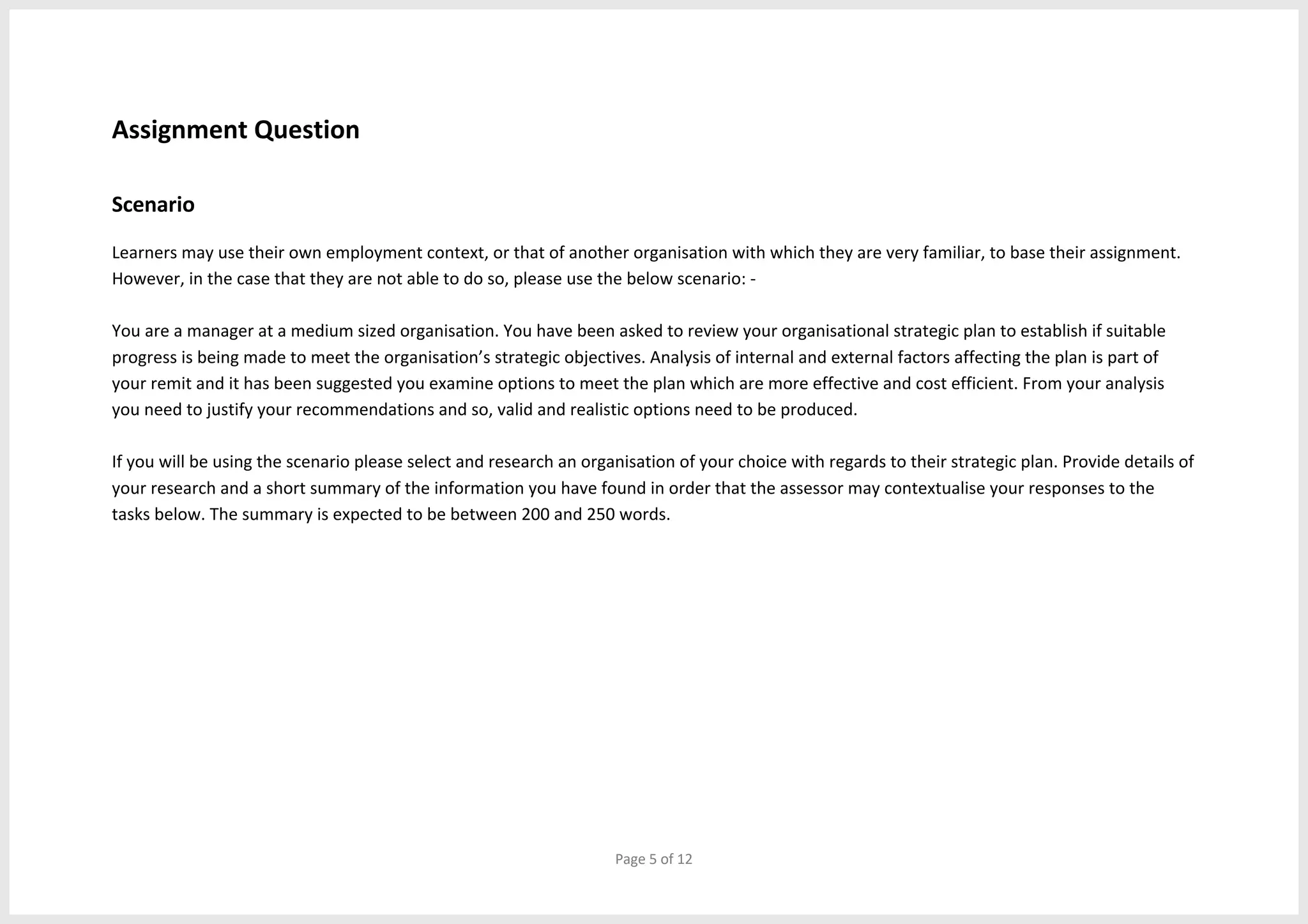
Assignment Question
Scenario
Learners may use their own employment context, or that of another organisation with which they are very familiar, to base their assignment.
However, in the case that they are not able to do so, please use the below scenario: -
You are a manager at a medium sized organisation. You have been asked to review your organisational strategic plan to establish if suitable
progress is being made to meet the organisation’s strategic objectives. Analysis of internal and external factors affecting the plan is part of
your remit and it has been suggested you examine options to meet the plan which are more effective and cost efficient. From your analysis
you need to justify your recommendations and so, valid and realistic options need to be produced.
If you will be using the scenario please select and research an organisation of your choice with regards to their strategic plan. Provide details of
your research and a short summary of the information you have found in order that the assessor may contextualise your responses to the
tasks below. The summary is expected to be between 200 and 250 words.
6.
Page 6 of12
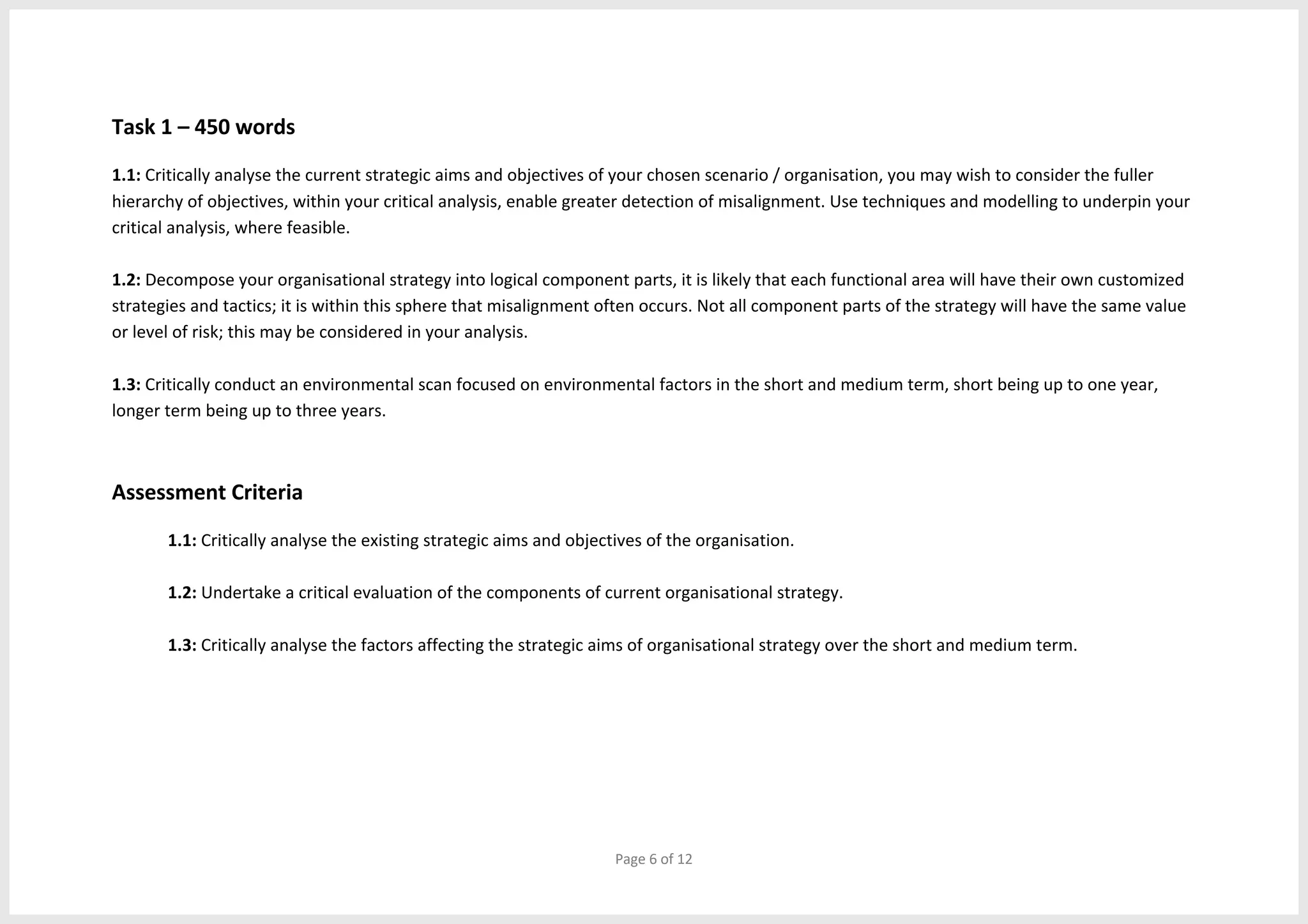
Task 1 – 450 words
1.1: Critically analyse the current strategic aims and objectives of your chosen scenario / organisation, you may wish to consider the fuller
hierarchy of objectives, within your critical analysis, enable greater detection of misalignment. Use techniques and modelling to underpin your
critical analysis, where feasible.
1.2: Decompose your organisational strategy into logical component parts, it is likely that each functional area will have their own customized
strategies and tactics; it is within this sphere that misalignment often occurs. Not all component parts of the strategy will have the same value
or level of risk; this may be considered in your analysis.
1.3: Critically conduct an environmental scan focused on environmental factors in the short and medium term, short being up to one year,
longer term being up to three years.
Assessment Criteria
1.1: Critically analyse the existing strategic aims and objectives of the organisation.
1.2: Undertake a critical evaluation of the components of current organisational strategy.
1.3: Critically analyse the factors affecting the strategic aims of organisational strategy over the short and medium term.
7.
Page 7 of12
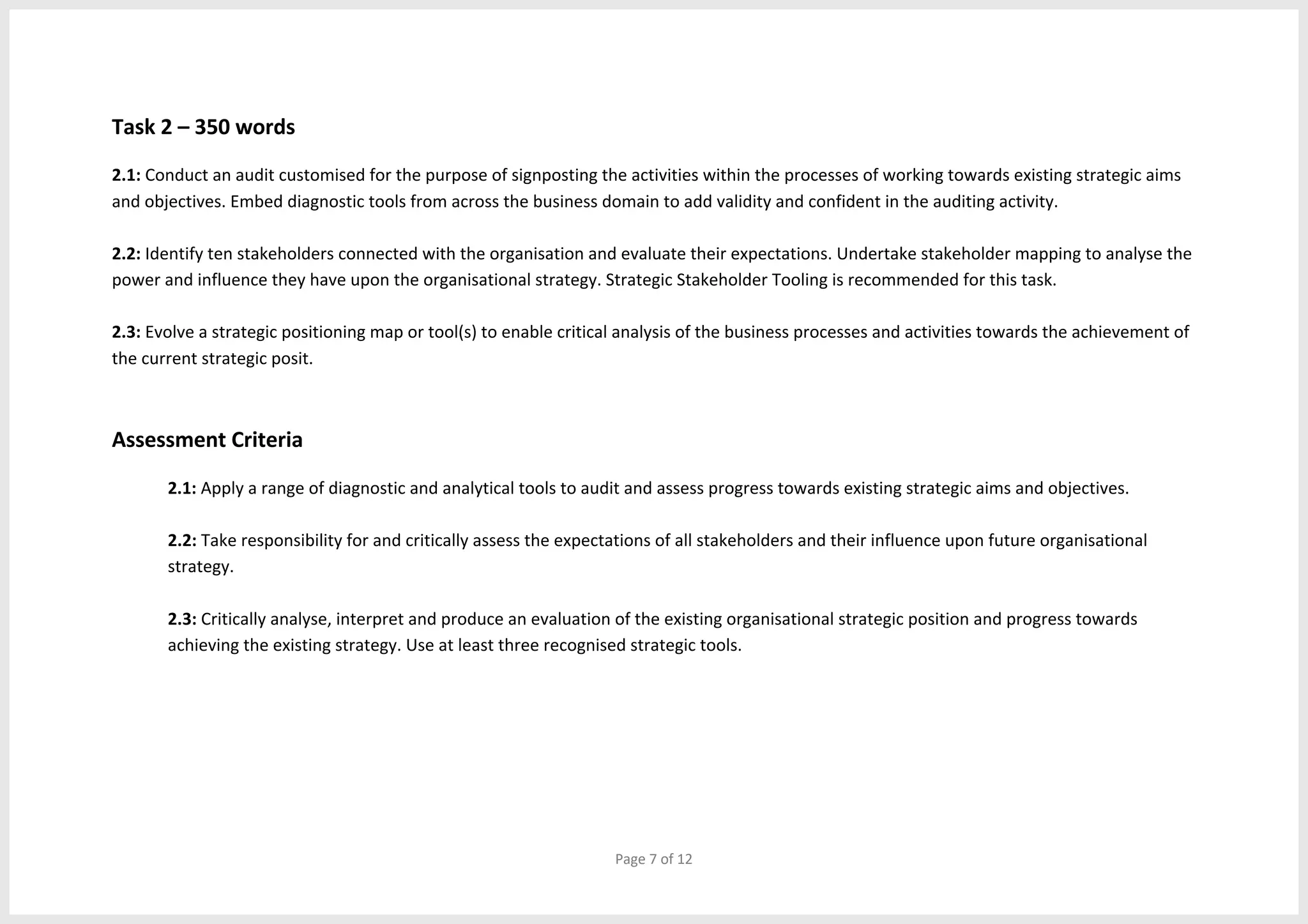
Task 2 – 350 words
2.1: Conduct an audit customised for the purpose of signposting the activities within the processes of working towards existing strategic aims
and objectives. Embed diagnostic tools from across the business domain to add validity and confident in the auditing activity.
2.2: Identify ten stakeholders connected with the organisation and evaluate their expectations. Undertake stakeholder mapping to analyse the
power and influence they have upon the organisational strategy. Strategic Stakeholder Tooling is recommended for this task.
2.3: Evolve a strategic positioning map or tool(s) to enable critical analysis of the business processes and activities towards the achievement of
the current strategic posit.
Assessment Criteria
2.1: Apply a range of diagnostic and analytical tools to audit and assess progress towards existing strategic aims and objectives.
2.2: Take responsibility for and critically assess the expectations of all stakeholders and their influence upon future organisational
strategy.
2.3: Critically analyse, interpret and produce an evaluation of the existing organisational strategic position and progress towards
achieving the existing strategy. Use at least three recognised strategic tools.
8.
Page 8 of12
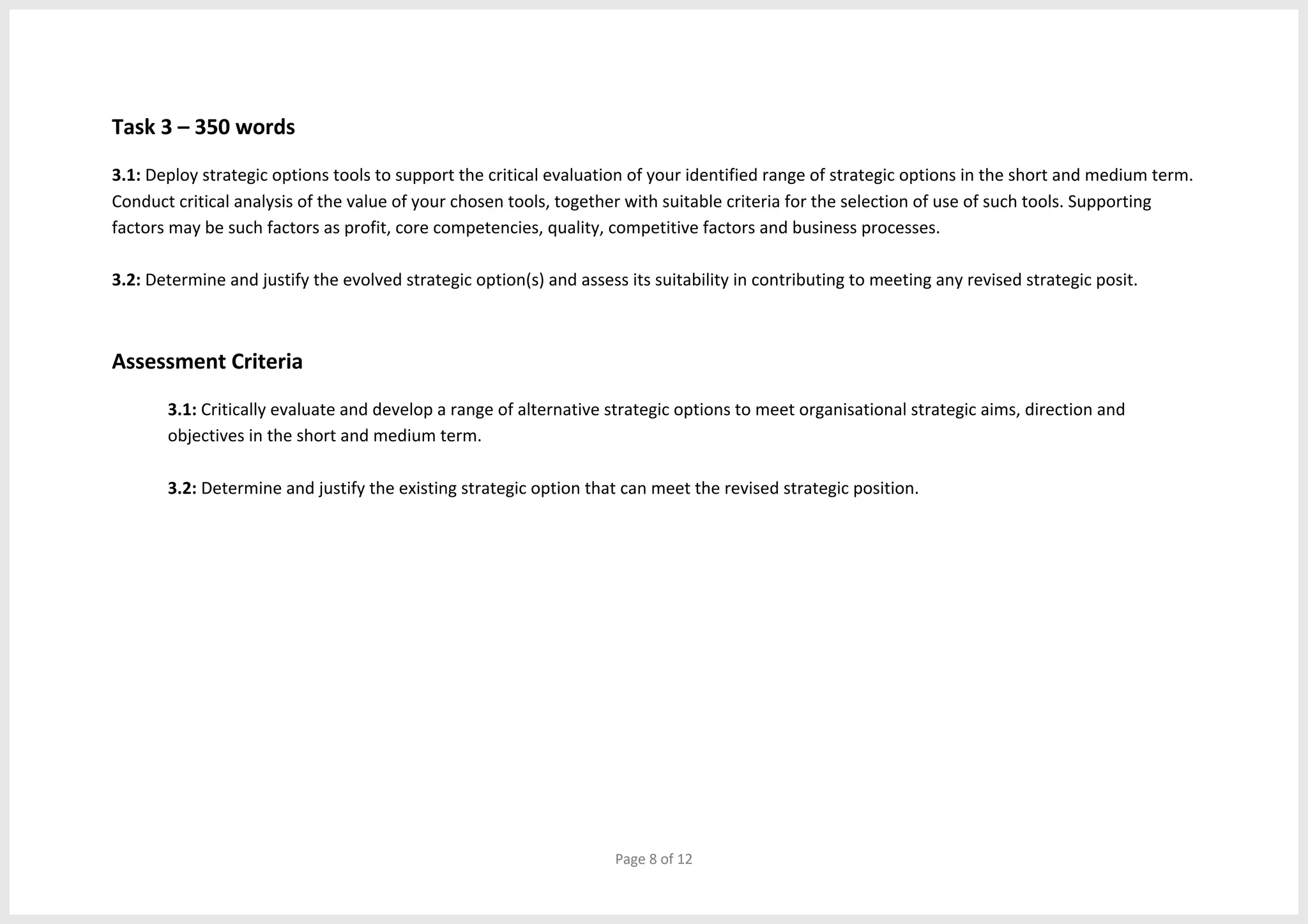
Task 3 – 350 words
3.1: Deploy strategic options tools to support the critical evaluation of your identified range of strategic options in the short and medium term.
Conduct critical analysis of the value of your chosen tools, together with suitable criteria for the selection of use of such tools. Supporting
factors may be such factors as profit, core competencies, quality, competitive factors and business processes.
3.2: Determine and justify the evolved strategic option(s) and assess its suitability in contributing to meeting any revised strategic posit.
Assessment Criteria
3.1: Critically evaluate and develop a range of alternative strategic options to meet organisational strategic aims, direction and
objectives in the short and medium term.
3.2: Determine and justify the existing strategic option that can meet the revised strategic position.
9.
Page 9 of12
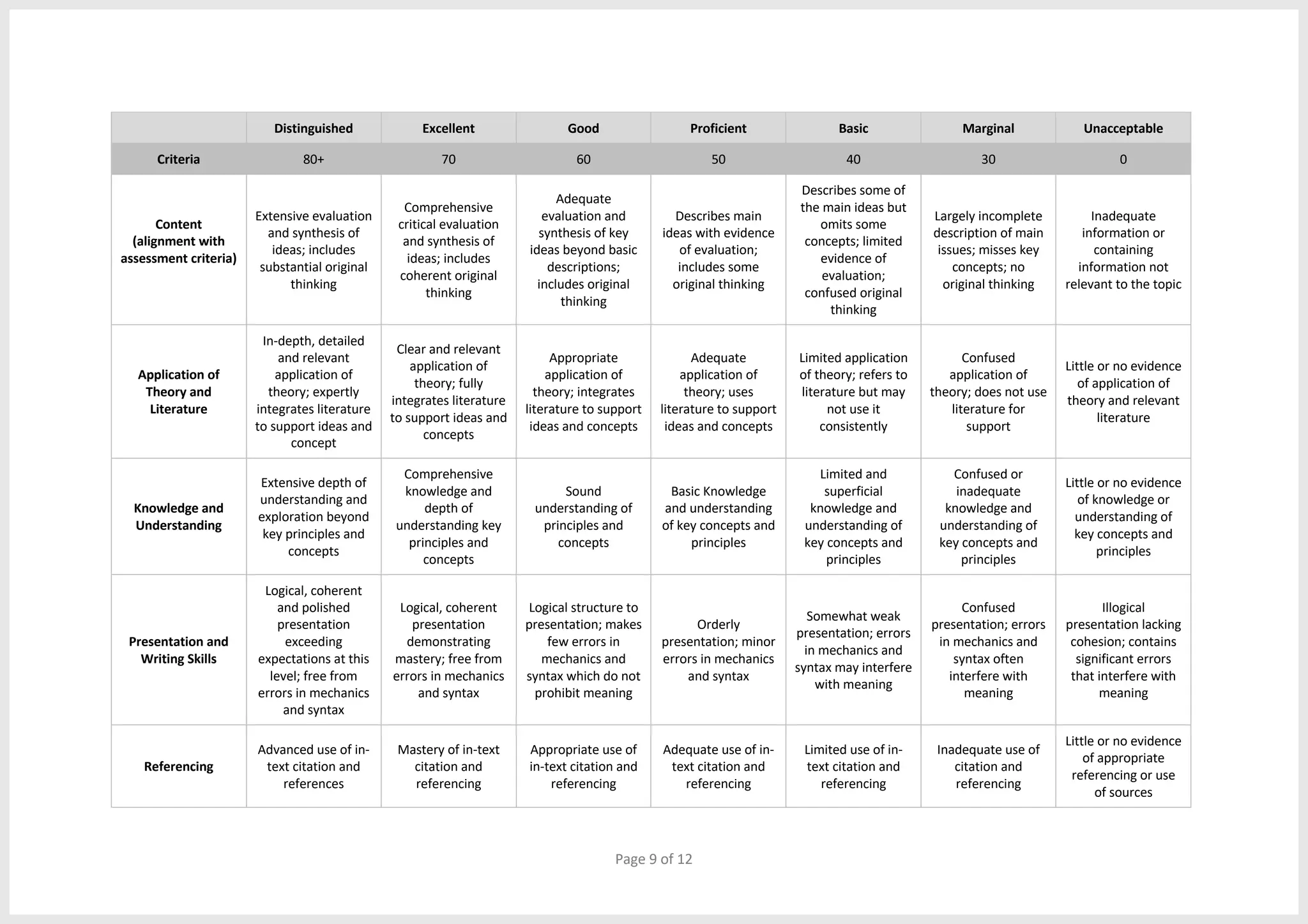
Distinguished Excellent Good Proficient Basic Marginal Unacceptable
Criteria 80+ 70 60 50 40 30 0
Content
(alignment with
assessment criteria)
Extensive evaluation
and synthesis of
ideas; includes
substantial original
thinking
Comprehensive
critical evaluation
and synthesis of
ideas; includes
coherent original
thinking
Adequate
evaluation and
synthesis of key
ideas beyond basic
descriptions;
includes original
thinking
Describes main
ideas with evidence
of evaluation;
includes some
original thinking
Describes some of
the main ideas but
omits some
concepts; limited
evidence of
evaluation;
confused original
thinking
Largely incomplete
description of main
issues; misses key
concepts; no
original thinking
Inadequate
information or
containing
information not
relevant to the topic
Application of
Theory and
Literature
In-depth, detailed
and relevant
application of
theory; expertly
integrates literature
to support ideas and
concept
Clear and relevant
application of
theory; fully
integrates literature
to support ideas and
concepts
Appropriate
application of
theory; integrates
literature to support
ideas and concepts
Adequate
application of
theory; uses
literature to support
ideas and concepts
Limited application
of theory; refers to
literature but may
not use it
consistently
Confused
application of
theory; does not use
literature for
support
Little or no evidence
of application of
theory and relevant
literature
Knowledge and
Understanding
Extensive depth of
understanding and
exploration beyond
key principles and
concepts
Comprehensive
knowledge and
depth of
understanding key
principles and
concepts
Sound
understanding of
principles and
concepts
Basic Knowledge
and understanding
of key concepts and
principles
Limited and
superficial
knowledge and
understanding of
key concepts and
principles
Confused or
inadequate
knowledge and
understanding of
key concepts and
principles
Little or no evidence
of knowledge or
understanding of
key concepts and
principles
Presentation and
Writing Skills
Logical, coherent
and polished
presentation
exceeding
expectations at this
level; free from
errors in mechanics
and syntax
Logical, coherent
presentation
demonstrating
mastery; free from
errors in mechanics
and syntax
Logical structure to
presentation; makes
few errors in
mechanics and
syntax which do not
prohibit meaning
Orderly
presentation; minor
errors in mechanics
and syntax
Somewhat weak
presentation; errors
in mechanics and
syntax may interfere
with meaning
Confused
presentation; errors
in mechanics and
syntax often
interfere with
meaning
Illogical
presentation lacking
cohesion; contains
significant errors
that interfere with
meaning
Referencing
Advanced use of in-
text citation and
references
Mastery of in-text
citation and
referencing
Appropriate use of
in-text citation and
referencing
Adequate use of in-
text citation and
referencing
Limited use of in-
text citation and
referencing
Inadequate use of
citation and
referencing
Little or no evidence
of appropriate
referencing or use
of sources
Page 11 of12
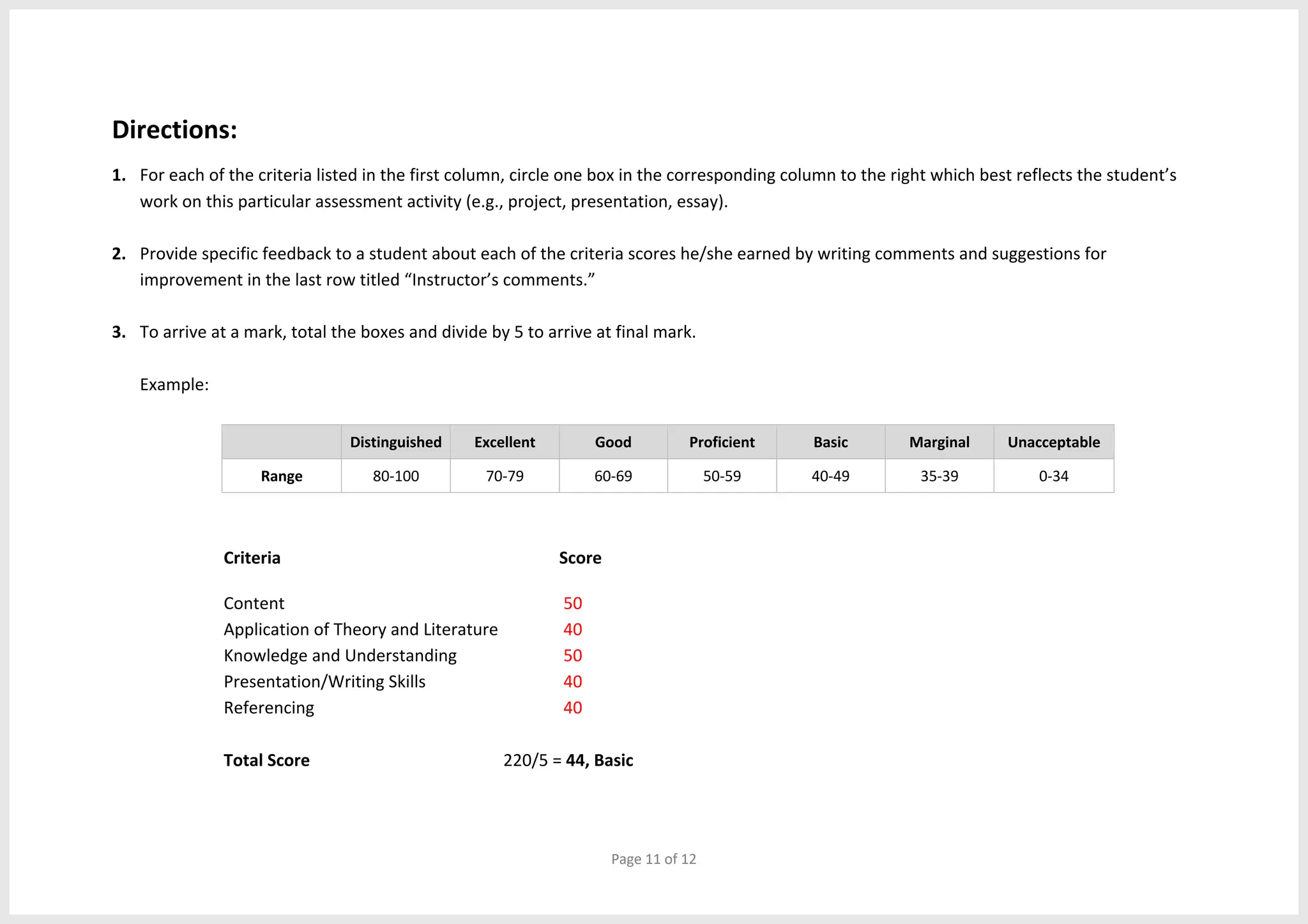
Directions:
1. For each of the criteria listed in the first column, circle one box in the corresponding column to the right which best reflects the student’s
work on this particular assessment activity (e.g., project, presentation, essay).
2. Provide specific feedback to a student about each of the criteria scores he/she earned by writing comments and suggestions for
improvement in the last row titled “Instructor’s comments.”
3. To arrive at a mark, total the boxes and divide by 5 to arrive at final mark.
Example:
Distinguished Excellent Good Proficient Basic Marginal Unacceptable
Range 80-100 70-79 60-69 50-59 40-49 35-39 0-34
Criteria Score
Content 50
Application of Theory and Literature 40
Knowledge and Understanding 50
Presentation/Writing Skills 40
Referencing 40
Total Score 220/5 = 44, Basic
12.
Page 12 of12
HEAD OFFICE
7 Acorn Business Park
Commercial Gate, Nottingham
Nottinghamshire
NG18 1EX
LONDON OFFICE
Golden Cross House
8 Duncannon Street, London
WC2N 4JF
info@qualifi.net
Copyright 2019 Qualifi Ltd