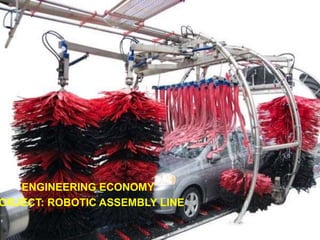
ENGINEERING ECONOMY
ORJECT: ROBOTIC ASSEMBLY LINE
Summary
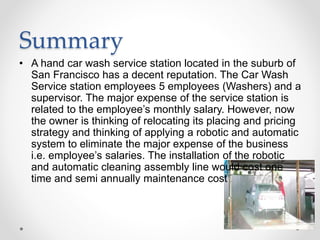
• A hand car wash service station located in the suburb of
San Francisco has a decent reputation. The Car Wash
Service station employees 5 employees (Washers) and a
supervisor. The major expense of the service station is
related to the employee’s monthly salary. However, now
the owner is thinking of relocating its placing and pricing
strategy and thinking of applying a robotic and automatic
system to eliminate the major expense of the business
i.e. employee’s salaries. The installation of the robotic
and automatic cleaning assembly line would cost one
time and semi annually maintenance cost
Summary
• For this project, I shall be using the comparison method
of employees salaries with the one time buying cost of
the automatic robotic assembly line
• I shall be reviewing the Cost Benefit Analysis
• I shall be reviewing whether the installation would
increase the profitability ratio of the company or not.
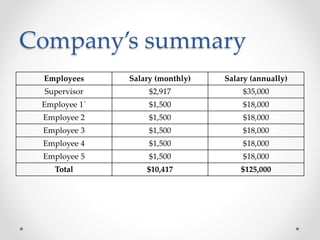
Company’s summary
Employees Salary (monthly) Salary (annually)
Supervisor $2,917 $35,000
Employee 1` $1,500 $18,000
Employee 2 $1,500 $18,000
Employee 3 $1,500 $18,000
Employee 4 $1,500 $18,000
Employee 5 $1,500 $18,000
Total $10,417 $125,000
Company’s Structure
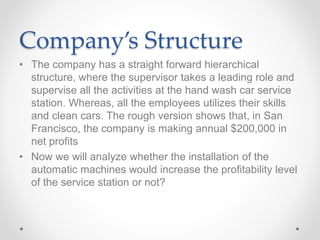
• The company has a straight forward hierarchical
structure, where the supervisor takes a leading role and
supervise all the activities at the hand wash car service
station. Whereas, all the employees utilizes their skills
and clean cars. The rough version shows that, in San
Francisco, the company is making annual $200,000 in
net profits
• Now we will analyze whether the installation of the
automatic machines would increase the profitability level
of the service station or not?
Robotic assembly line
• The supplier has guaranteed that the robotic assembly
line would work for at least 10 years if well maintained
• No need of a supervisor or employee to handle it
• The service station would act as an assembly line where
everything would be automatic
• No employee cost
• The machine has a potential to generate $300,000
annual net profits
• Loan interest rate would be 10% with an installation plan
of 10 years
Automatic robotic
Cleaning assembly line
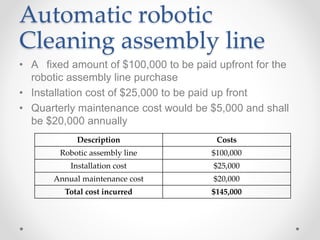
• A fixed amount of $100,000 to be paid upfront for the
robotic assembly line purchase
• Installation cost of $25,000 to be paid up front
• Quarterly maintenance cost would be $5,000 and shall
be $20,000 annually
Description Costs
Robotic assembly line $100,000
Installation cost $25,000
Annual maintenance cost $20,000
Total cost incurred $145,000
ΔB/C Analysis
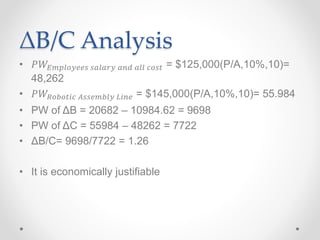
• 𝑃𝑊𝐸𝑚𝑝𝑙𝑜𝑦𝑒𝑒𝑠 𝑠𝑎𝑙𝑎𝑟𝑦 𝑎𝑛𝑑 𝑎𝑙𝑙 𝑐𝑜𝑠𝑡 = $125,000(P/A,10%,10)=
48,262
• 𝑃𝑊𝑅𝑜𝑏𝑜𝑡𝑖𝑐 𝐴𝑠𝑠𝑒𝑚𝑏𝑙𝑦 𝐿𝑖𝑛𝑒 = $145,000(P/A,10%,10)= 55.984
• PW of ΔB = 20682 – 10984.62 = 9698
• PW of ΔC = 55984 – 48262 = 7722
• ΔB/C= 9698/7722 = 1.26
• It is economically justifiable
Final Recommendation
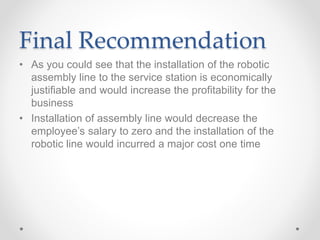
• As you could see that the installation of the robotic
assembly line to the service station is economically
justifiable and would increase the profitability for the
business
• Installation of assembly line would decrease the
employee’s salary to zero and the installation of the
robotic line would incurred a major cost one time
Sources
• Rouwendal, J. (2012). Indirect Effects in Cost-Benefit
Analysis. Journal of Benefit-Cost Analysis, 3(1).
• White, D. and VanLandingham, G. (2015). Benefit-Cost
Analysis in the States: Status, Impact, and
Challenges. Journal of Benefit-Cost Analysis, 6(02),
pp.369-399.
• Muller, N. (2017). Environmental Benefit-Cost Analysis
and the National Accounts. Journal of Benefit-Cost
Analysis, pp.1-40.

Assembly line (Cost Benefit analysis) Engineering Economics

  • 1.
  • 2.
    Summary • A handcar wash service station located in the suburb of San Francisco has a decent reputation. The Car Wash Service station employees 5 employees (Washers) and a supervisor. The major expense of the service station is related to the employee’s monthly salary. However, now the owner is thinking of relocating its placing and pricing strategy and thinking of applying a robotic and automatic system to eliminate the major expense of the business i.e. employee’s salaries. The installation of the robotic and automatic cleaning assembly line would cost one time and semi annually maintenance cost
  • 3.
    Summary • For thisproject, I shall be using the comparison method of employees salaries with the one time buying cost of the automatic robotic assembly line • I shall be reviewing the Cost Benefit Analysis • I shall be reviewing whether the installation would increase the profitability ratio of the company or not.
  • 4.
    Company’s summary Employees Salary(monthly) Salary (annually) Supervisor $2,917 $35,000 Employee 1` $1,500 $18,000 Employee 2 $1,500 $18,000 Employee 3 $1,500 $18,000 Employee 4 $1,500 $18,000 Employee 5 $1,500 $18,000 Total $10,417 $125,000
  • 5.
    Company’s Structure • Thecompany has a straight forward hierarchical structure, where the supervisor takes a leading role and supervise all the activities at the hand wash car service station. Whereas, all the employees utilizes their skills and clean cars. The rough version shows that, in San Francisco, the company is making annual $200,000 in net profits • Now we will analyze whether the installation of the automatic machines would increase the profitability level of the service station or not?
  • 6.
    Robotic assembly line •The supplier has guaranteed that the robotic assembly line would work for at least 10 years if well maintained • No need of a supervisor or employee to handle it • The service station would act as an assembly line where everything would be automatic • No employee cost • The machine has a potential to generate $300,000 annual net profits • Loan interest rate would be 10% with an installation plan of 10 years
  • 7.
    Automatic robotic Cleaning assemblyline • A fixed amount of $100,000 to be paid upfront for the robotic assembly line purchase • Installation cost of $25,000 to be paid up front • Quarterly maintenance cost would be $5,000 and shall be $20,000 annually Description Costs Robotic assembly line $100,000 Installation cost $25,000 Annual maintenance cost $20,000 Total cost incurred $145,000
  • 8.
    ΔB/C Analysis • 𝑃𝑊𝐸𝑚𝑝𝑙𝑜𝑦𝑒𝑒𝑠𝑠𝑎𝑙𝑎𝑟𝑦 𝑎𝑛𝑑 𝑎𝑙𝑙 𝑐𝑜𝑠𝑡 = $125,000(P/A,10%,10)= 48,262 • 𝑃𝑊𝑅𝑜𝑏𝑜𝑡𝑖𝑐 𝐴𝑠𝑠𝑒𝑚𝑏𝑙𝑦 𝐿𝑖𝑛𝑒 = $145,000(P/A,10%,10)= 55.984 • PW of ΔB = 20682 – 10984.62 = 9698 • PW of ΔC = 55984 – 48262 = 7722 • ΔB/C= 9698/7722 = 1.26 • It is economically justifiable
  • 9.
    Final Recommendation • Asyou could see that the installation of the robotic assembly line to the service station is economically justifiable and would increase the profitability for the business • Installation of assembly line would decrease the employee’s salary to zero and the installation of the robotic line would incurred a major cost one time
  • 10.
    Sources • Rouwendal, J.(2012). Indirect Effects in Cost-Benefit Analysis. Journal of Benefit-Cost Analysis, 3(1). • White, D. and VanLandingham, G. (2015). Benefit-Cost Analysis in the States: Status, Impact, and Challenges. Journal of Benefit-Cost Analysis, 6(02), pp.369-399. • Muller, N. (2017). Environmental Benefit-Cost Analysis and the National Accounts. Journal of Benefit-Cost Analysis, pp.1-40.