Analgesic, Antipyretic &
Anti-inflammatory Drugs
NSAIDS: Aspirin-like drugs
SAIDs: Steroid-like drugs
Prof. Mir Imam Ibne Wahed, Ph.D
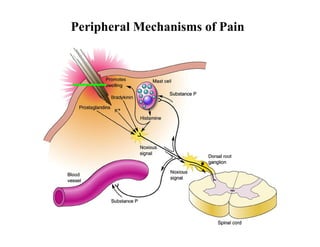
Peripheral Mechanisms of Pain
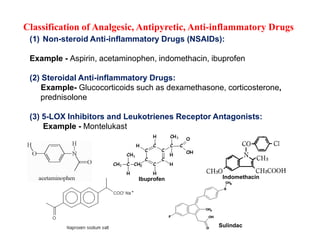
Classification of Analgesic, Antipyretic, Anti-inflammatory Drugs
(1) Non-steroid Anti-inflammatory Drugs (NSAIDs):
Example - Aspirin, acetaminophen, indomethacin, ibuprofen
(2) Steroidal Anti-inflammatory Drugs:
Example- Glucocorticoids such as dexamethasone, corticosterone,
prednisolone
(3) 5-LOX Inhibitors and Leukotrienes Receptor Antagonists:
Example - Montelukast
Ibuprofen Indomethacin
Sulindac
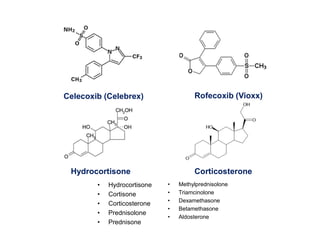
Celecoxib (Celebrex) Rofecoxib (Vioxx)
Hydrocortisone Corticosterone
• Hydrocortisone
• Cortisone
• Corticosterone
• Prednisolone
• Prednisone
• Methylprednisolone
• Triamcinolone
• Dexamethasone
• Betamethasone
• Aldosterone
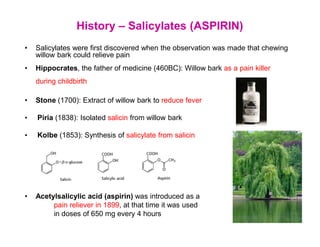
History – Salicylates (ASPIRIN)
• Salicylates were first discovered when the observation was made that chewing
willow bark could relieve pain
• Hippocrates, the father of medicine (460BC): Willow bark as a pain killer
during childbirth
• Stone (1700): Extract of willow bark to reduce fever
• Piria (1838): Isolated salicin from willow bark
• Kolbe (1853): Synthesis of salicylate from salicin
• Acetylsalicylic acid (aspirin) was introduced as a
pain reliever in 1899, at that time it was used
in doses of 650 mg every 4 hours
Aspirin Metabolism Pathways
Acetylsalicylic acid (ASA)
ASA: t1/2 ~20 min
salicylate t1/2 ~3-5 hrs
Hydrolyzed by Esterase
Excrete through kidney
Metabolized in liver
• Duration of action: ~ 4 hr (Orally taken)
• Weak acid (pKa~3.5); so, non-ionized in stomach  easily absorbed.
Aspirin-Mechanism of Action: Covalent Binding to COX
Acetyl Salicylic Acid (ASA) covalently and irreversibly modifies both COX-1
and COX-2 by acetylating serine-530 in the active site & acetylation results in
a steric block, preventing arachidonic acid from binding
Note: Acetylation of COX-2 retains the COX activity although the reaction
produces a different product, 15-R-HETE
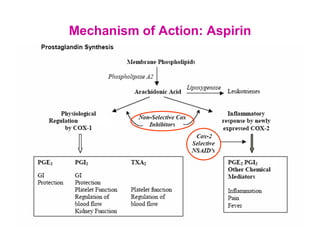
Mechanism of Action: Aspirin
Pharmacological Actions of Aspirin
• Analgesic Actions
• Antipyretic Actions
Anti-inflammatory Actions
• Gastrointestinal (GIT) Effects
• Cardiovascular Effects
• Blood Vessels and Atherosclerosis
• Renal Effects
• Respiratory Effects
• Gestations
Analgesic action:
 Prostaglandin E2 (PGE2) is thought to sensitize nerve endings to the
action of bradykinin, histamine, and other chemical mediators
released locally by the inflammatory process.
 Thus, by decreasing PGE2 synthesis, aspirin and other NSAIDs
repress the sensation of pain.
 The salicylates are used mainly for the management of pain of low to
moderate intensity arising from musculoskeletal disorders rather
than that arising from the viscera.
 Combinations of opioids and NSAIDs are effective in treating pain
caused by malignancy.
 Diflunisal is 3-4 fold more potent than aspirin as an analgesic and an
anti-inflammatory agent, but it has no antipyretic properties.
Antipyretic action:
 Fever occurs when the set-point of the anterior hypothalamic thermoregulatory center is
elevated.
 This can be caused by PGE2 synthesis, which is stimulated when an endogenous fever-
producing agent such as a cytokine, is released from white cells that are activated by
infection (pyrogen- endotoxin), hypersensitivity, malignancy, or inflammation.
 The salicylates lower body temperature in patients with fever by impeding PGE2
synthesis and release.
 Aspirin resets the thermostat toward normal, and it rapidly lowers the body temperature
of febrile patients by sweating and vasodilatation
Anti-inflammatory actions:
 Because aspirin inhibits cyclooxygenase activity, it diminishes the formation of PGs and,
thus, modulates inflammation in which PGs act as mediators.
 Aspirin inhibits inflammation in arthritis, but it neither arrests the progress of the disease
nor induces remission.
Gastrointestinal
 PGs (generated via COX-1) Inhibit stomach acid secretion (PGE2) and stimulate
mucus and HCO3
- secretion (PGI2
 Cytoprotective for the gastric mucosa.
NSAIDs with COX-1 inhibitory activity will produce opposite effects, leading to: Gastric
distress, gastric bleeding, sudden acute hemorrhage (effects are dose-dependent)
Cardiovascular
 Platelets: Inhibition of platelet COX-1-derived TxA2 with the net effect of increasing
bleeding time (inhibition of platelet aggregation)
 Endothelial COX-2 derived PGI2 can inhibit platelet aggregation (inhibition
augments aggregation by TxA2).
 Aspirin covalently modifies and, irreversibly inhibits platelet COX. The enzyme is
inhibited for the lifetime of the platelet (8 -11 days).
 Effect achieved at very low dose.
Basis of therapeutic efficacy in stroke and MI (reduces mortality and prevents
recurrent events).
Renal
 PGs such as TxA2, PGF2 , PGI2 (glom) and PGE2 (medulla), powerful vasodilators can
both increase and decrease Na+ retention (natriuresis predominates), usually in response
to extracellular tonicity or low BP.
 NSAIDs tend to promote Na+ retention and can therefore increase BP. Can counteract
effects of diuretics.
 PGs have minimal impact on normal renal blood flow, but become important in the
compromised kidney. Patients (particularly elderly and volume depleted) are at risk of
renal ischemia with NSAIDs.
Effect on Respiration: triphasic
 Low doses: uncoupling phosphorylation → ↑ CO2 → stimulates respiration.
 Direct stimulation of respiratory center → Hyperventilation → resp. alkalosis (respiration
too fast or too deep, decrease CO2 & increase pH → renal compensation
 Depression of respiratory center and cardiovascular center → ↓ BP, respiratory acidosis,
no compensation + metabolic acidosis also
Gestation
PGs (generated from COX-2) are involved in the initiation, progression of labor and delivery.
Therefore, inhibition of their production by NSAIDs can prolong gestation.
Cancer
Other uses of NSAIDs (mechanisms not known) - Decreased risk of fatal colon carcinoma
Aspirin - Therapeutic Uses
 Antipyretic, analgesic: headache, toothache, neuralgia
 Anti-inflammatory: rheumatic fever, rheumatoid arthritis, other rheumatological
diseases. High dose needed (5-8 g/day). But many patients cannot tolerate
these doses (GIT); so, proprionic acid derivatives such as ibuprofen, naproxen
used first.
 Prophylaxis of cardiovascular diseases (CAD)
 Prophylaxis, pre-eclampsia & hypertension during pregnancy starting between
12-28 weeks of gestation continued until delivery.
 Treatment of cancer.
Recommended Dose:
Analgesic (0.3-0.6 g/day) - relief of pain for example, headache; produce a mild degree of
analgesia.
Anti-inflammatory (3-5 g/day) - these drugs are used to treat inflammatory diseases and
injuries, and with larger doses - rheumatoid disorders
Antipyretic (0.3-0.6 g/day) - reduce fever; lower elevated body temperature; normal body
temperature is not reduced
Antiplatelet (30-100 mg/day)- inhibit platelet aggregation, prolong bleeding time; have
anticoagulant effects. 75mg or 150mg/day
Aspirin: Dose Related
Dose-Dependent Effects:
Low: < 300mg
blocks platelet aggregation
Intermediate: 300-2400mg/day
antipyretic and analgesic effects
High: 2400-4000mg/day
anti-inflammatory effects
Salicylism
Overdose: Hepatic damage and Reye’s
syndrome (kids) - Characterized by severe
hepatic damage and encephalopathy
Aspirin Toxicity - Salicylism
Symptoms:
 Headache - tinnitus - dizziness – hearing impairment – dim vision
 Confusion and drowziness
 Sweating and hyperventilation
 Nausea, vomiting
 Marked acid-base disturbances
 Hyperpyrexia
 Dehydration
 Cardiovascular and respiratory collapse, coma convulsions and death
Management of Salicylism:
 Decrease absorption - activated charcoal, emetics, gastric lavage
 Enhance excretion – ion trapping (alkalinize urine, iv. NaHCO3
(promote the excretion), forced diuresis, hemodialysis
 Supportive measures - fluids, decrease temperature, bicarbonate,
electrolytes, glucose, etc
5. Drug interactions
Gout
• Characterized by deposition of Na urate crystals in the joint 
painful arthritis.
• Acute attacks treated with indomethecin, naproxen, or other
NSAIDs, but not with aspirin (increase plasma urate levels at low
doses by inhibiting uric acid secretion in the renal tubules).
Prophylactic treatment of Gout
• Allopurinol lowers plasma urate by inhibiting xanthine oxidase
(xanthine  uric acid).
• Uricosuric drugs (sulfinpyrazone, probenicid) inhibit renal tubular
reabsorption of uric acid  increase excretion.
• Should drink plenty of H2O to prevent crystallization of urate in the
urine.
• These drugs less effective and more toxic than allopurinol.
Treatment of Gout

Aspirin_Lecture 31st.pdf

  • 1.
    Analgesic, Antipyretic & Anti-inflammatoryDrugs NSAIDS: Aspirin-like drugs SAIDs: Steroid-like drugs Prof. Mir Imam Ibne Wahed, Ph.D
  • 2.
  • 3.
    Classification of Analgesic,Antipyretic, Anti-inflammatory Drugs (1) Non-steroid Anti-inflammatory Drugs (NSAIDs): Example - Aspirin, acetaminophen, indomethacin, ibuprofen (2) Steroidal Anti-inflammatory Drugs: Example- Glucocorticoids such as dexamethasone, corticosterone, prednisolone (3) 5-LOX Inhibitors and Leukotrienes Receptor Antagonists: Example - Montelukast Ibuprofen Indomethacin Sulindac
  • 5.
    Celecoxib (Celebrex) Rofecoxib(Vioxx) Hydrocortisone Corticosterone • Hydrocortisone • Cortisone • Corticosterone • Prednisolone • Prednisone • Methylprednisolone • Triamcinolone • Dexamethasone • Betamethasone • Aldosterone
  • 6.
    History – Salicylates(ASPIRIN) • Salicylates were first discovered when the observation was made that chewing willow bark could relieve pain • Hippocrates, the father of medicine (460BC): Willow bark as a pain killer during childbirth • Stone (1700): Extract of willow bark to reduce fever • Piria (1838): Isolated salicin from willow bark • Kolbe (1853): Synthesis of salicylate from salicin • Acetylsalicylic acid (aspirin) was introduced as a pain reliever in 1899, at that time it was used in doses of 650 mg every 4 hours
  • 8.
    Aspirin Metabolism Pathways Acetylsalicylicacid (ASA) ASA: t1/2 ~20 min salicylate t1/2 ~3-5 hrs Hydrolyzed by Esterase Excrete through kidney Metabolized in liver • Duration of action: ~ 4 hr (Orally taken) • Weak acid (pKa~3.5); so, non-ionized in stomach  easily absorbed.
  • 9.
    Aspirin-Mechanism of Action:Covalent Binding to COX Acetyl Salicylic Acid (ASA) covalently and irreversibly modifies both COX-1 and COX-2 by acetylating serine-530 in the active site & acetylation results in a steric block, preventing arachidonic acid from binding Note: Acetylation of COX-2 retains the COX activity although the reaction produces a different product, 15-R-HETE
  • 10.
  • 11.
    Pharmacological Actions ofAspirin • Analgesic Actions • Antipyretic Actions Anti-inflammatory Actions • Gastrointestinal (GIT) Effects • Cardiovascular Effects • Blood Vessels and Atherosclerosis • Renal Effects • Respiratory Effects • Gestations
  • 12.
    Analgesic action:  ProstaglandinE2 (PGE2) is thought to sensitize nerve endings to the action of bradykinin, histamine, and other chemical mediators released locally by the inflammatory process.  Thus, by decreasing PGE2 synthesis, aspirin and other NSAIDs repress the sensation of pain.  The salicylates are used mainly for the management of pain of low to moderate intensity arising from musculoskeletal disorders rather than that arising from the viscera.  Combinations of opioids and NSAIDs are effective in treating pain caused by malignancy.  Diflunisal is 3-4 fold more potent than aspirin as an analgesic and an anti-inflammatory agent, but it has no antipyretic properties.
  • 13.
    Antipyretic action:  Feveroccurs when the set-point of the anterior hypothalamic thermoregulatory center is elevated.  This can be caused by PGE2 synthesis, which is stimulated when an endogenous fever- producing agent such as a cytokine, is released from white cells that are activated by infection (pyrogen- endotoxin), hypersensitivity, malignancy, or inflammation.  The salicylates lower body temperature in patients with fever by impeding PGE2 synthesis and release.  Aspirin resets the thermostat toward normal, and it rapidly lowers the body temperature of febrile patients by sweating and vasodilatation Anti-inflammatory actions:  Because aspirin inhibits cyclooxygenase activity, it diminishes the formation of PGs and, thus, modulates inflammation in which PGs act as mediators.  Aspirin inhibits inflammation in arthritis, but it neither arrests the progress of the disease nor induces remission.
  • 14.
    Gastrointestinal  PGs (generatedvia COX-1) Inhibit stomach acid secretion (PGE2) and stimulate mucus and HCO3 - secretion (PGI2  Cytoprotective for the gastric mucosa. NSAIDs with COX-1 inhibitory activity will produce opposite effects, leading to: Gastric distress, gastric bleeding, sudden acute hemorrhage (effects are dose-dependent) Cardiovascular  Platelets: Inhibition of platelet COX-1-derived TxA2 with the net effect of increasing bleeding time (inhibition of platelet aggregation)  Endothelial COX-2 derived PGI2 can inhibit platelet aggregation (inhibition augments aggregation by TxA2).  Aspirin covalently modifies and, irreversibly inhibits platelet COX. The enzyme is inhibited for the lifetime of the platelet (8 -11 days).  Effect achieved at very low dose. Basis of therapeutic efficacy in stroke and MI (reduces mortality and prevents recurrent events).
  • 15.
    Renal  PGs suchas TxA2, PGF2 , PGI2 (glom) and PGE2 (medulla), powerful vasodilators can both increase and decrease Na+ retention (natriuresis predominates), usually in response to extracellular tonicity or low BP.  NSAIDs tend to promote Na+ retention and can therefore increase BP. Can counteract effects of diuretics.  PGs have minimal impact on normal renal blood flow, but become important in the compromised kidney. Patients (particularly elderly and volume depleted) are at risk of renal ischemia with NSAIDs. Effect on Respiration: triphasic  Low doses: uncoupling phosphorylation → ↑ CO2 → stimulates respiration.  Direct stimulation of respiratory center → Hyperventilation → resp. alkalosis (respiration too fast or too deep, decrease CO2 & increase pH → renal compensation  Depression of respiratory center and cardiovascular center → ↓ BP, respiratory acidosis, no compensation + metabolic acidosis also Gestation PGs (generated from COX-2) are involved in the initiation, progression of labor and delivery. Therefore, inhibition of their production by NSAIDs can prolong gestation. Cancer Other uses of NSAIDs (mechanisms not known) - Decreased risk of fatal colon carcinoma
  • 16.
    Aspirin - TherapeuticUses  Antipyretic, analgesic: headache, toothache, neuralgia  Anti-inflammatory: rheumatic fever, rheumatoid arthritis, other rheumatological diseases. High dose needed (5-8 g/day). But many patients cannot tolerate these doses (GIT); so, proprionic acid derivatives such as ibuprofen, naproxen used first.  Prophylaxis of cardiovascular diseases (CAD)  Prophylaxis, pre-eclampsia & hypertension during pregnancy starting between 12-28 weeks of gestation continued until delivery.  Treatment of cancer. Recommended Dose: Analgesic (0.3-0.6 g/day) - relief of pain for example, headache; produce a mild degree of analgesia. Anti-inflammatory (3-5 g/day) - these drugs are used to treat inflammatory diseases and injuries, and with larger doses - rheumatoid disorders Antipyretic (0.3-0.6 g/day) - reduce fever; lower elevated body temperature; normal body temperature is not reduced Antiplatelet (30-100 mg/day)- inhibit platelet aggregation, prolong bleeding time; have anticoagulant effects. 75mg or 150mg/day
  • 17.
    Aspirin: Dose Related Dose-DependentEffects: Low: < 300mg blocks platelet aggregation Intermediate: 300-2400mg/day antipyretic and analgesic effects High: 2400-4000mg/day anti-inflammatory effects Salicylism Overdose: Hepatic damage and Reye’s syndrome (kids) - Characterized by severe hepatic damage and encephalopathy
  • 18.
    Aspirin Toxicity -Salicylism Symptoms:  Headache - tinnitus - dizziness – hearing impairment – dim vision  Confusion and drowziness  Sweating and hyperventilation  Nausea, vomiting  Marked acid-base disturbances  Hyperpyrexia  Dehydration  Cardiovascular and respiratory collapse, coma convulsions and death Management of Salicylism:  Decrease absorption - activated charcoal, emetics, gastric lavage  Enhance excretion – ion trapping (alkalinize urine, iv. NaHCO3 (promote the excretion), forced diuresis, hemodialysis  Supportive measures - fluids, decrease temperature, bicarbonate, electrolytes, glucose, etc
  • 19.
  • 20.
    Gout • Characterized bydeposition of Na urate crystals in the joint  painful arthritis. • Acute attacks treated with indomethecin, naproxen, or other NSAIDs, but not with aspirin (increase plasma urate levels at low doses by inhibiting uric acid secretion in the renal tubules). Prophylactic treatment of Gout • Allopurinol lowers plasma urate by inhibiting xanthine oxidase (xanthine  uric acid). • Uricosuric drugs (sulfinpyrazone, probenicid) inhibit renal tubular reabsorption of uric acid  increase excretion. • Should drink plenty of H2O to prevent crystallization of urate in the urine. • These drugs less effective and more toxic than allopurinol.
  • 21.