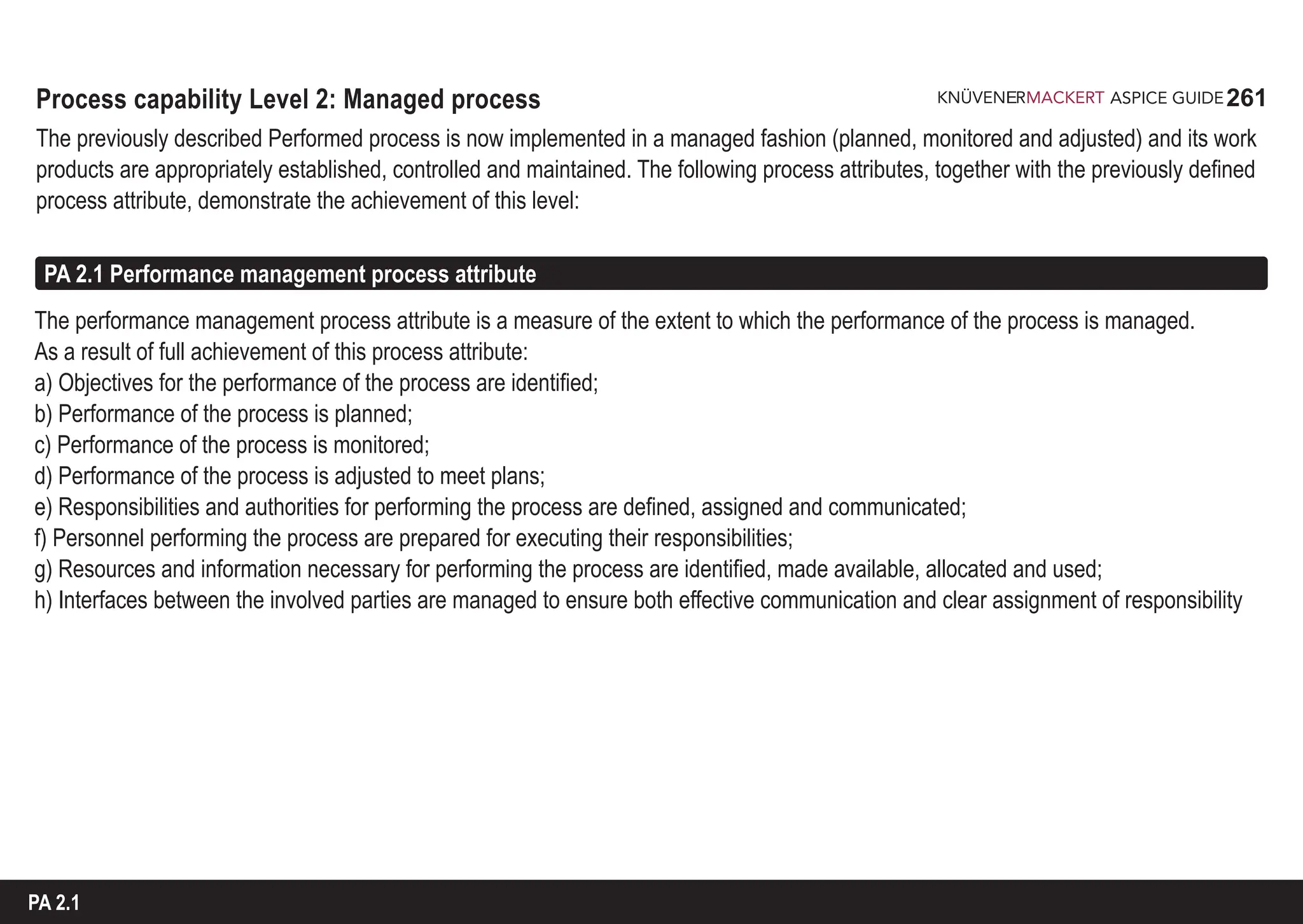
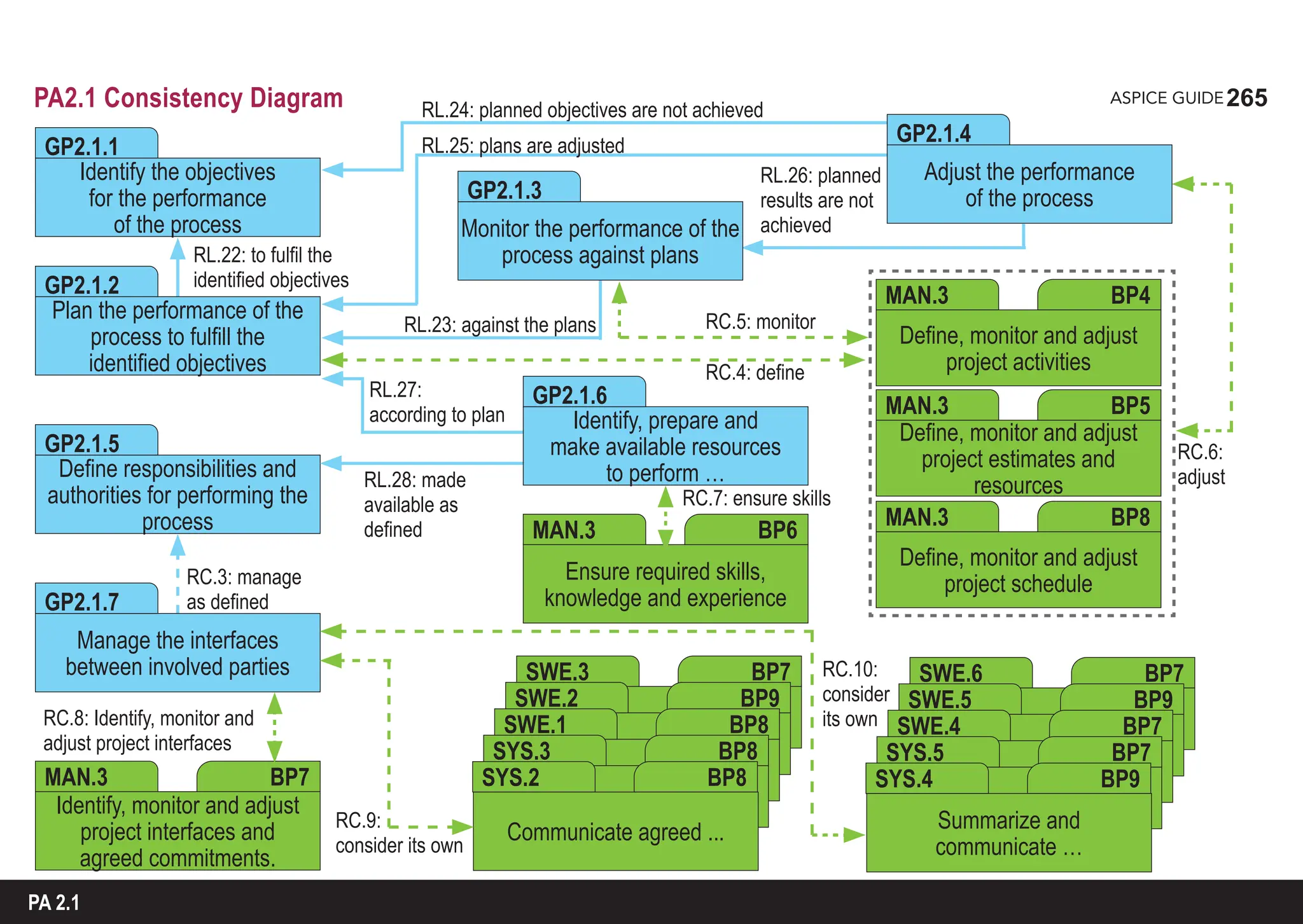
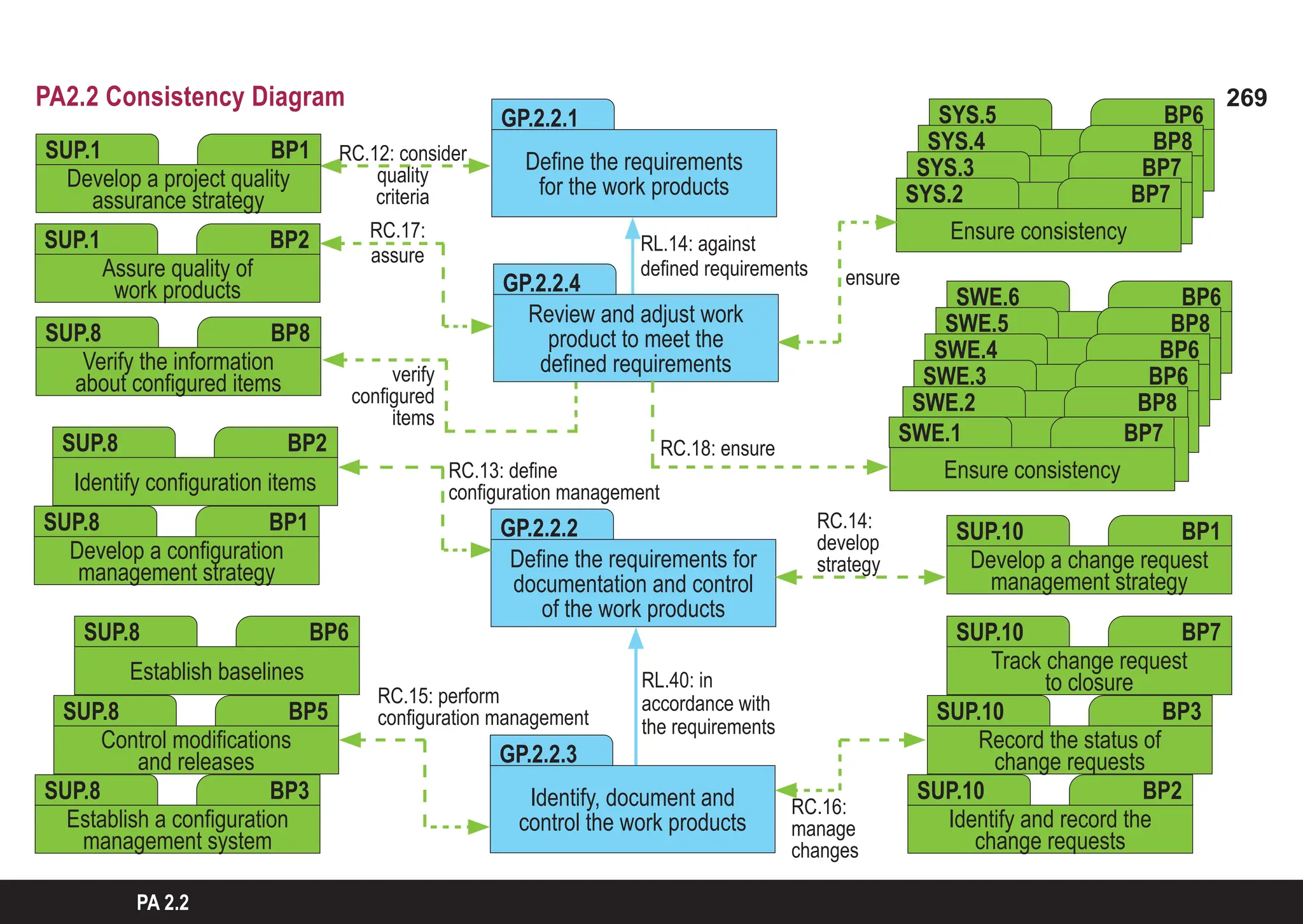
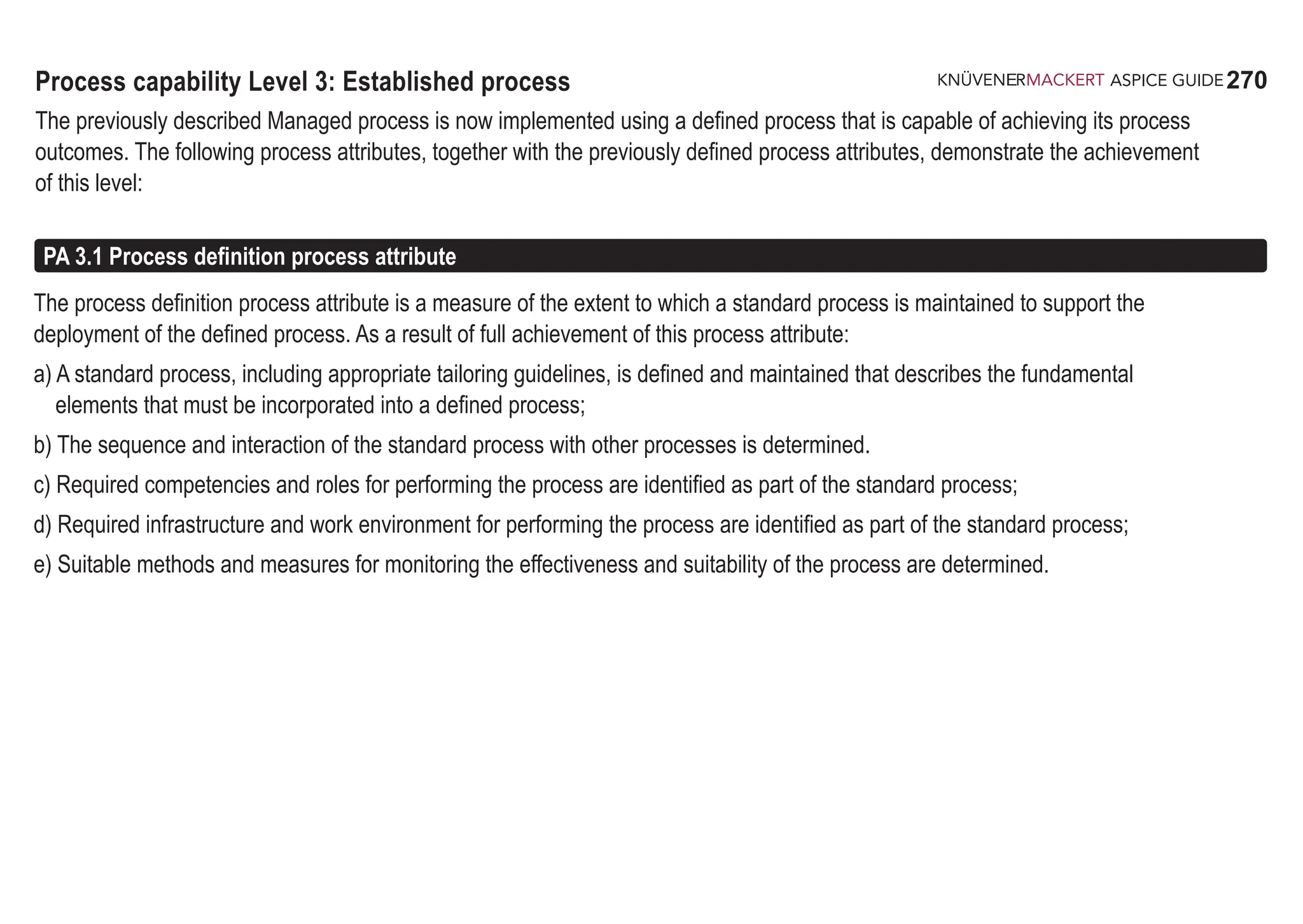
1
ASPICE GUIDE
ASPICE GUIDE
ASPICE GUIDE
▪ INTRODUCTION TO AUTOMOTIVE SPICE®
▪ AUTOMOTIVE SPICE® V3.1 (extended VDA scope)
▪ GUIDELINE RULES AND RECOMMENDATION IDS
▪ RATING CONSISTANCY DIAGRAMS
▪ AGILE SPICE™ V1.1
▪ HARDWARE ENGINEERING SPICE V2.0
▪ MECHANICAL ENGINEERING SPICE V1.7
▪ ASSESSMENT GUIDE
ASPICE
5th Edition 2021
®
2
ASPICE GUIDE
Table of content – 5th Edition – Page 1
How to read this SPICE Guide 06
INTRODUCTION TO PROCESS QUALITY
Why process quality? 10
How effective are your processes? 12
How to benefit from Automotive SPICE 13
How organizations learn systematically 14
INTRODUCTION TO AUTOMOTIVE SPICE
Automotive SPICE Scope And Plug-In Concept 16
2 Dimensions of Automotive SPICE 17
Automotive SPICE Process Overview 18
Automotive SPICE Capability Dimension 19
Automotive SPICE Organization SPICE 20
Organization SPICE Processes 21
AUTOMOTIVE SPICE KEY CONCEPTS
Key Concepts Of Automotive SPICE 23
Qualification Test Versus Integration Test 24
Bidirectional Traceability And Consistency 25
Agree, Summarize And Communicate 26
Evaluation, Verification Criteria And Compliance 27
Interpretation Automotive SPICE
management and support processes 28
How to apply the process elements 29
Work product characteristics 30
AUTOMOTIVE SPICE AND OTHER STANDARDS
Automotive SPICE and Agility 32
An Example For A Functional Safety Impl. 33
Automotive SPICE and Functional Safety 34
Automotive SPICE and Cybersecurity 36
AUTOMOTIVE SPICE PROCESSES
MAN.3 Project Management 1,3
39
MAN.5 Risk Management 2
46
REU.2 Reuse Program Management 48
ACQ.4 Supplier Monitoring 1,3
50
SUP.1 Quality Assurance 1,3 54
SUP.2 Verification 2
60
SUP.4 Joint Review 2
62
SUP.7 Documentation 2 66
SUP.8 Configuration Management 1,3
68
SUP.9 Problem Resolution Management 1,3 74
SUP.10 Change Request Management 1,3 80
SPL.2 Product Release 2
86
3
ASPICE GUIDE
Table of content – 5th Edition – Page 2
SYS.1 Requirements Elicitation 2 90
SYS.2 System Requirements Analysis 1,3
94
SYS.3 System Architectural Design 1,3 100
SYS.4 System Integration & Integr. Test 1,3 106
SYS.5 System Qualification Test 1,3
112
SWE.1 SW Requirements Analysis 1,3 116
SWE.2 SW Architectural Design 1,3
122
SWE.3 SW Detailed Design & Unit Constr. 1,3 128
SWE.4 SW Unit Verification 1,3
134
SWE.5 SW Integration & Integration Test 1,3 140
SWE.6 SW Qualification Test 1,3 146
AGILE SPICE PROCESSES
Agile SPICE™ is a bridge to Automotive SPICE™ 153
Why Agile SPICE? 154
Agile SPICE Assumptions 155
Agile Principles for Automotive 156
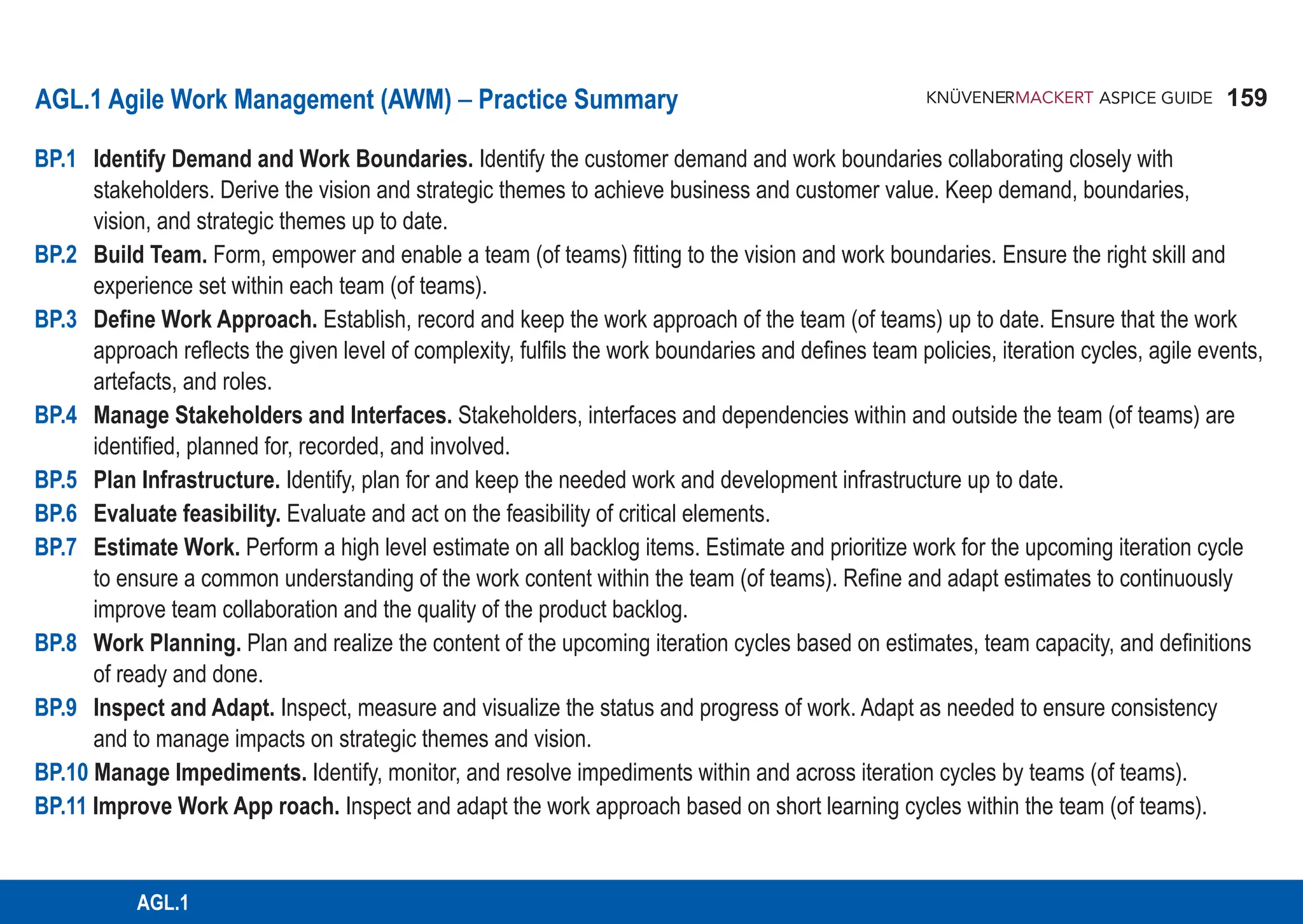
AGL.1 Work Management 158
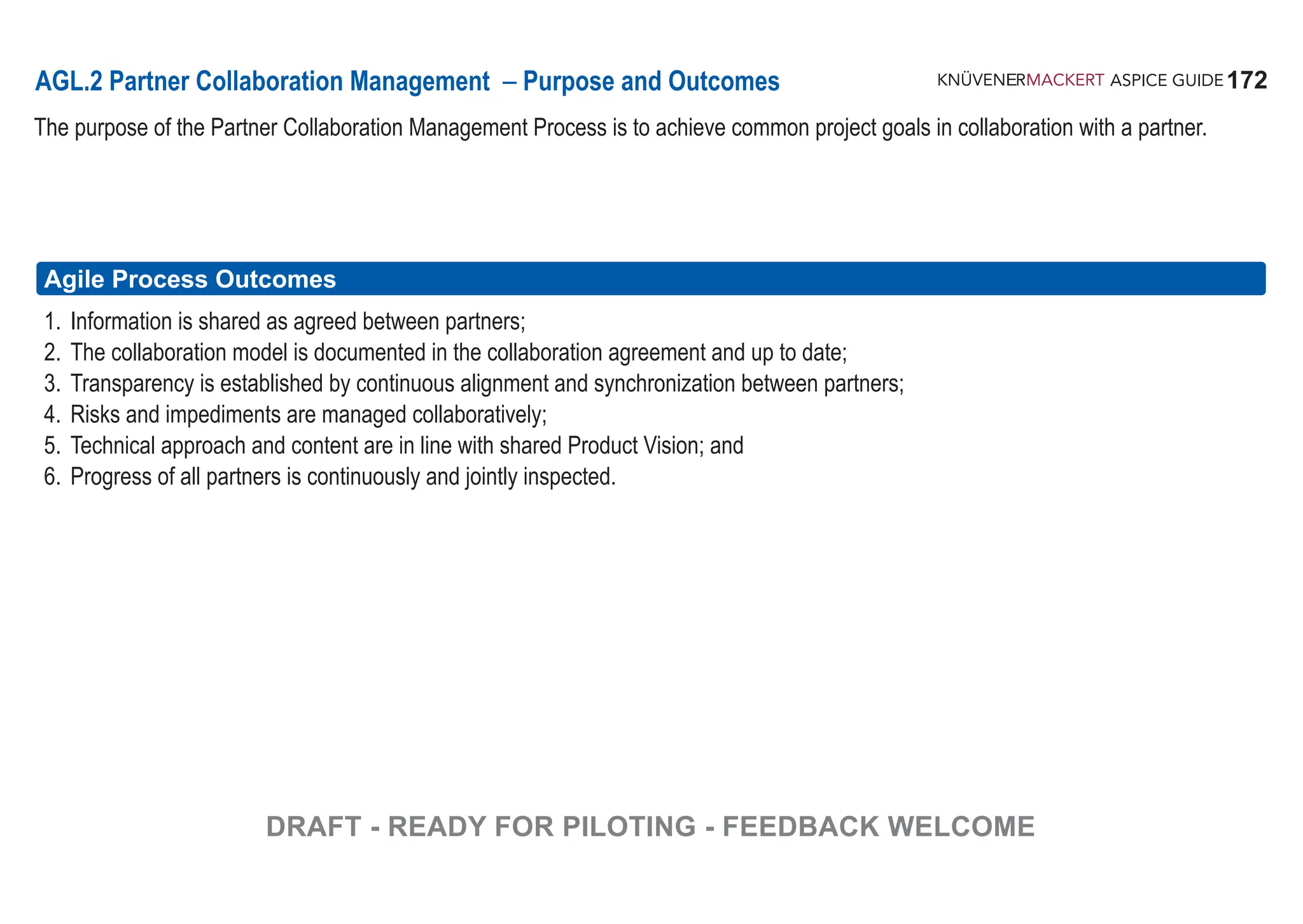
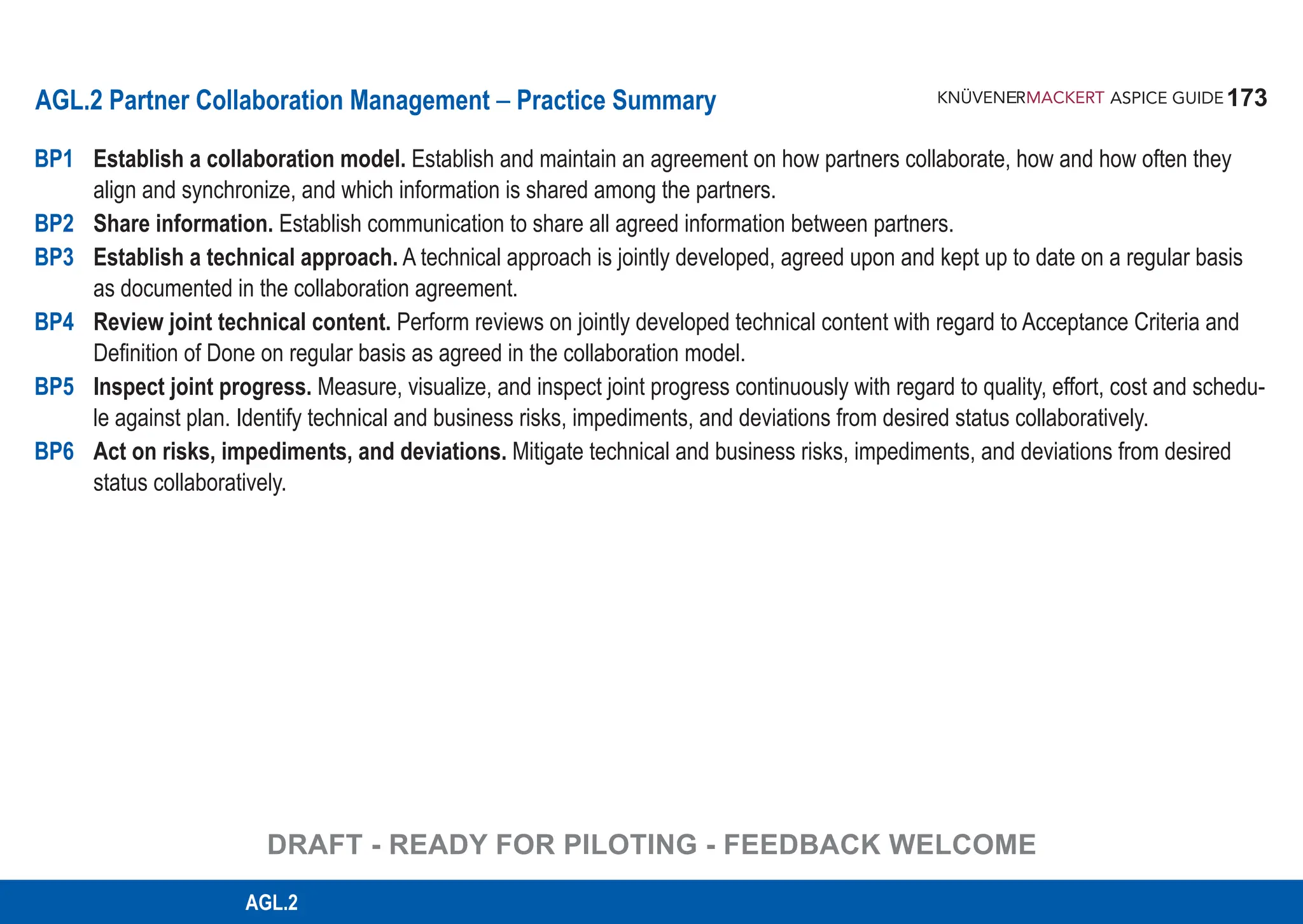
AGL.2 Partner Collaboration Management 172
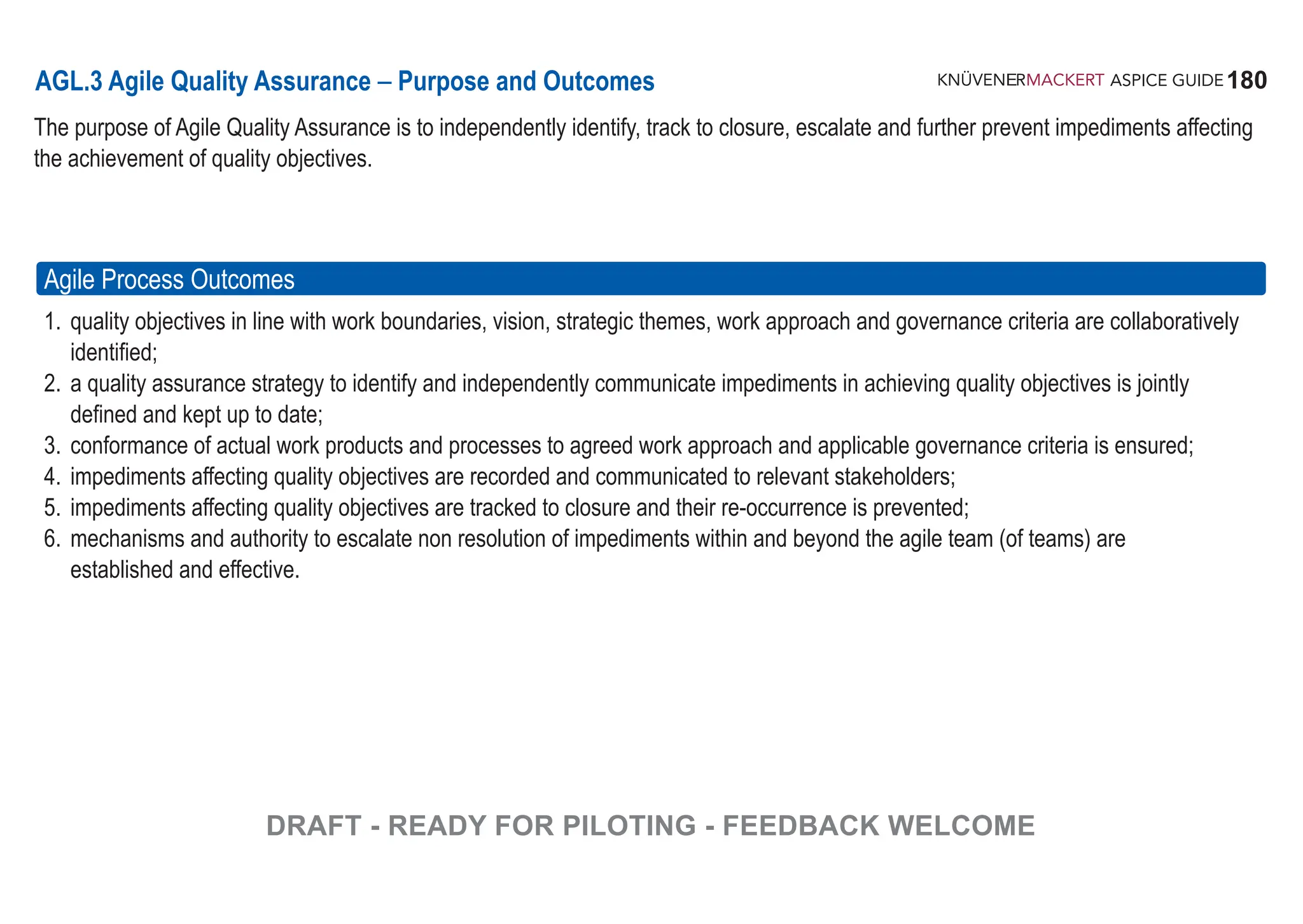
AGL.3 Agile Quality Assurance 180
HARDWARE ENGINEERING SPICE PROCESSES
HW SPICE Bidirectional Traceability & Consistency 191
HWE.1 Hardware Requirements Analysis 192
HWE.2 Hardware Design 202
HWE.3 Verification against Hardware Design 210
HWE.4 Verification against Hardware Requirements 216
MECHANICAL ENGINEERING SPICE PROCESSES
ME SPICE Bidirectional Traceability & Consistency 223
MSE.1 ME System Requirements Analysis 224
MSE.2 ME System Architectural Design 228
MSE.3 ME System Integration & Integr. Test 232
MSE.4 ME System Qualification Test 236
MCE.1 ME Component Requirement Analysis 240
MCE.2 ME Component Design 244
MCE.3 ME Component Sample Production 248
MCE.4 ME Test against
Mechanical Component Design 252
MCE.5 ME Test against Mechanical
Component Requirements 256
1
VDA scope 2
extended VDA scope 3
with assessment guideline for rating consistency
4
ASPICE GUIDE
Table of content – 5th Edition – Page 3
ASSESSMENT GUIDE
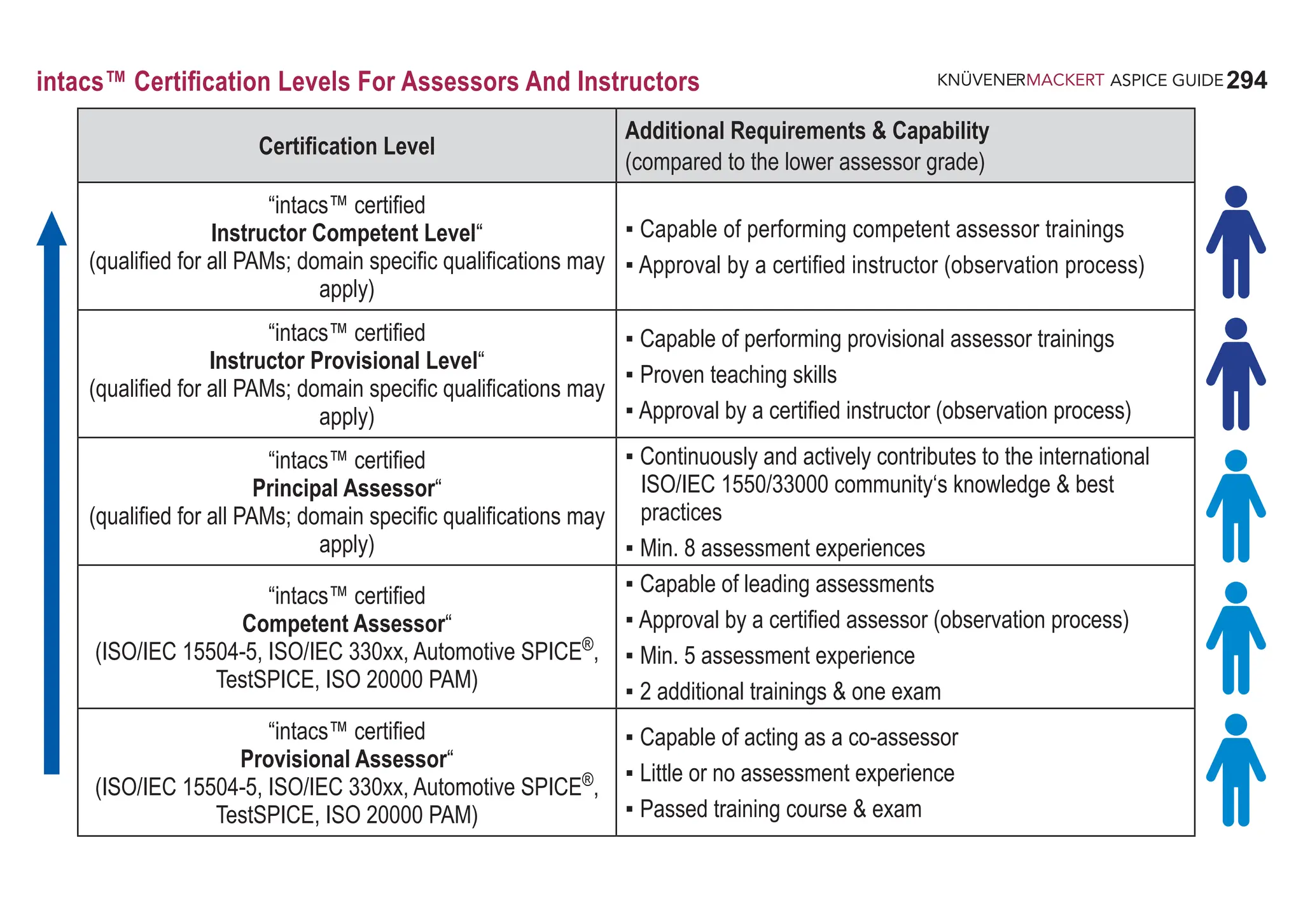
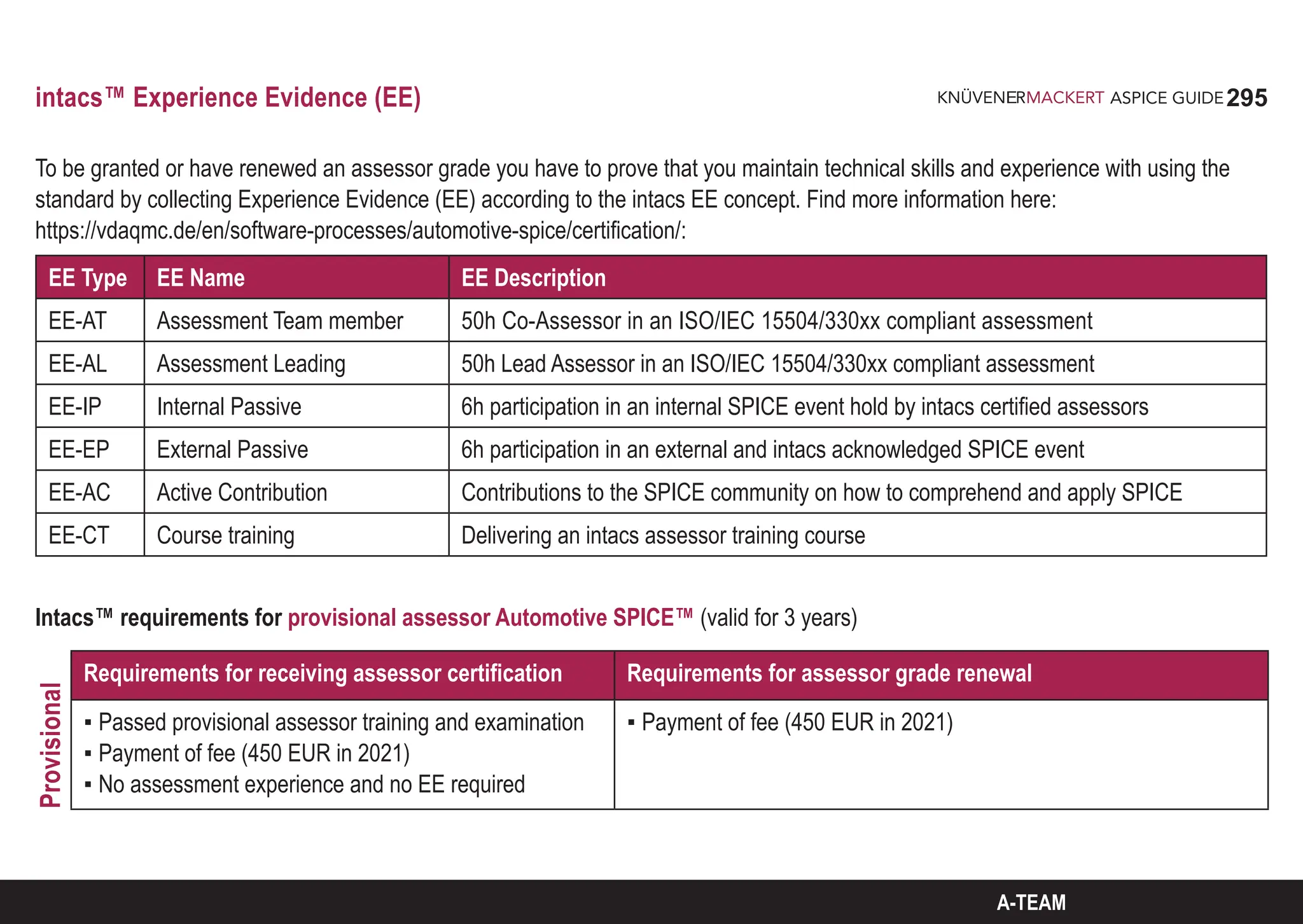
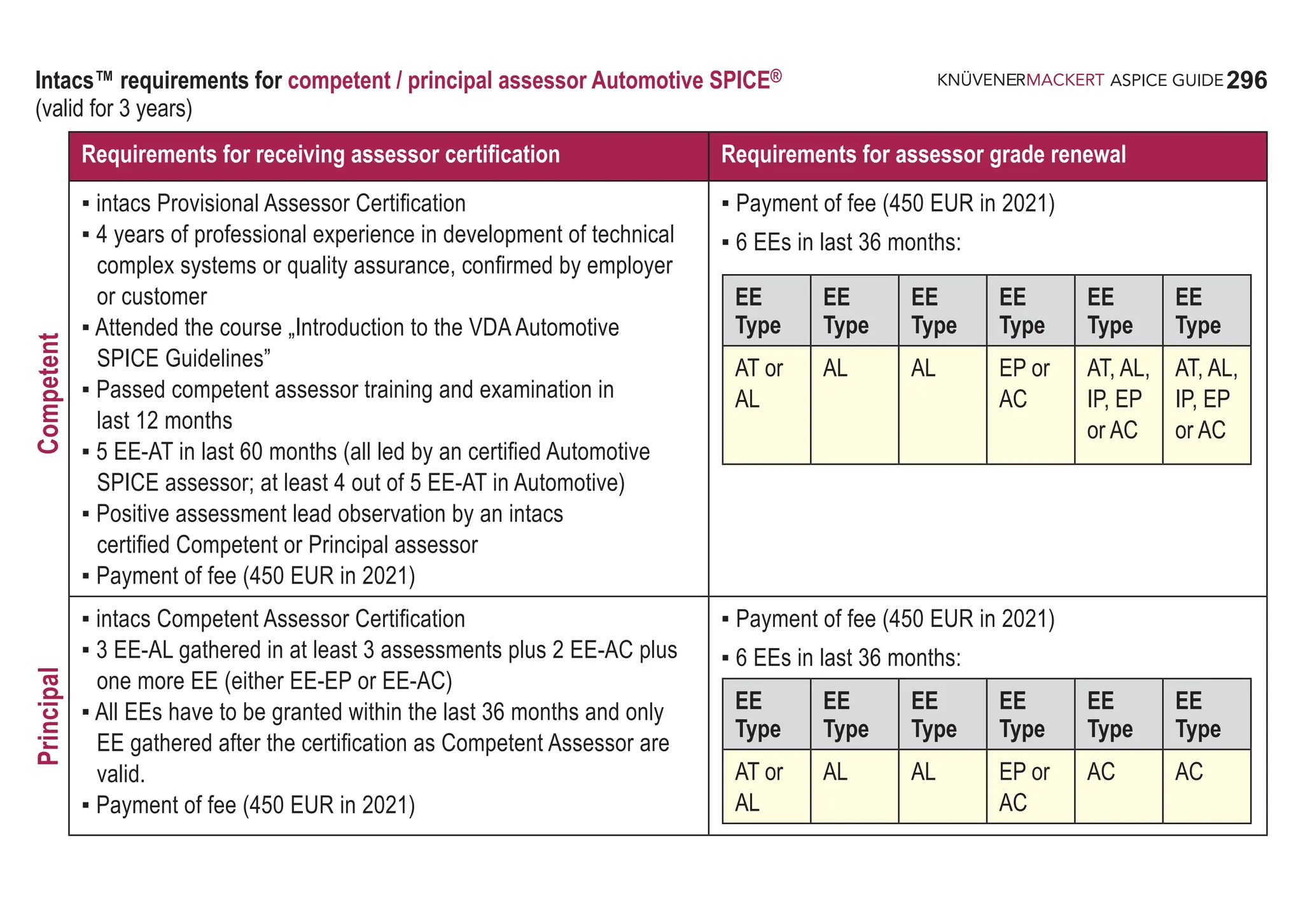
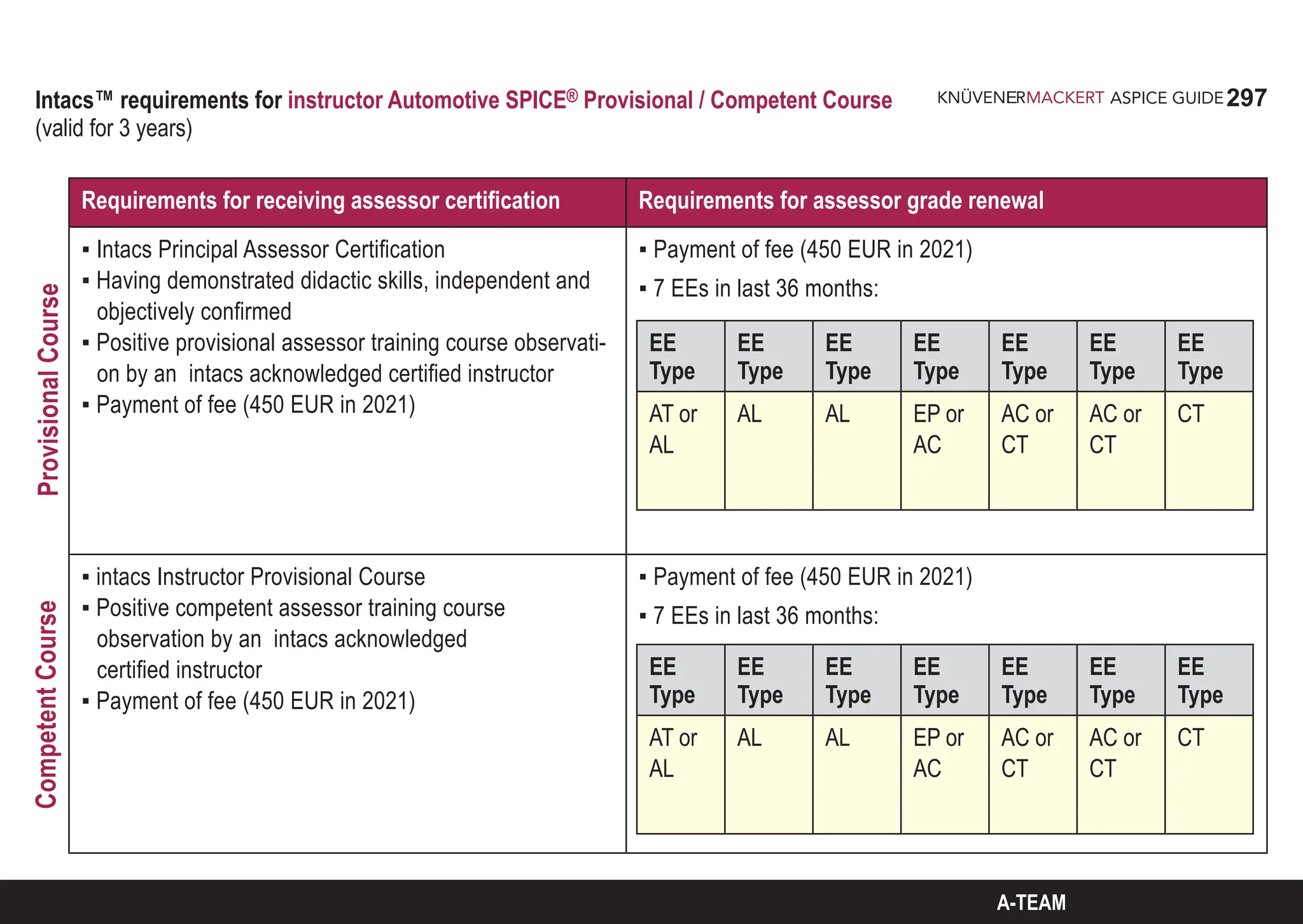
intacs™ Certification For Assessors & Instructors 294
Two Assessment Objectives And Their Impact 298
Assessment Input 300
Assessment Class / Assessment type 302
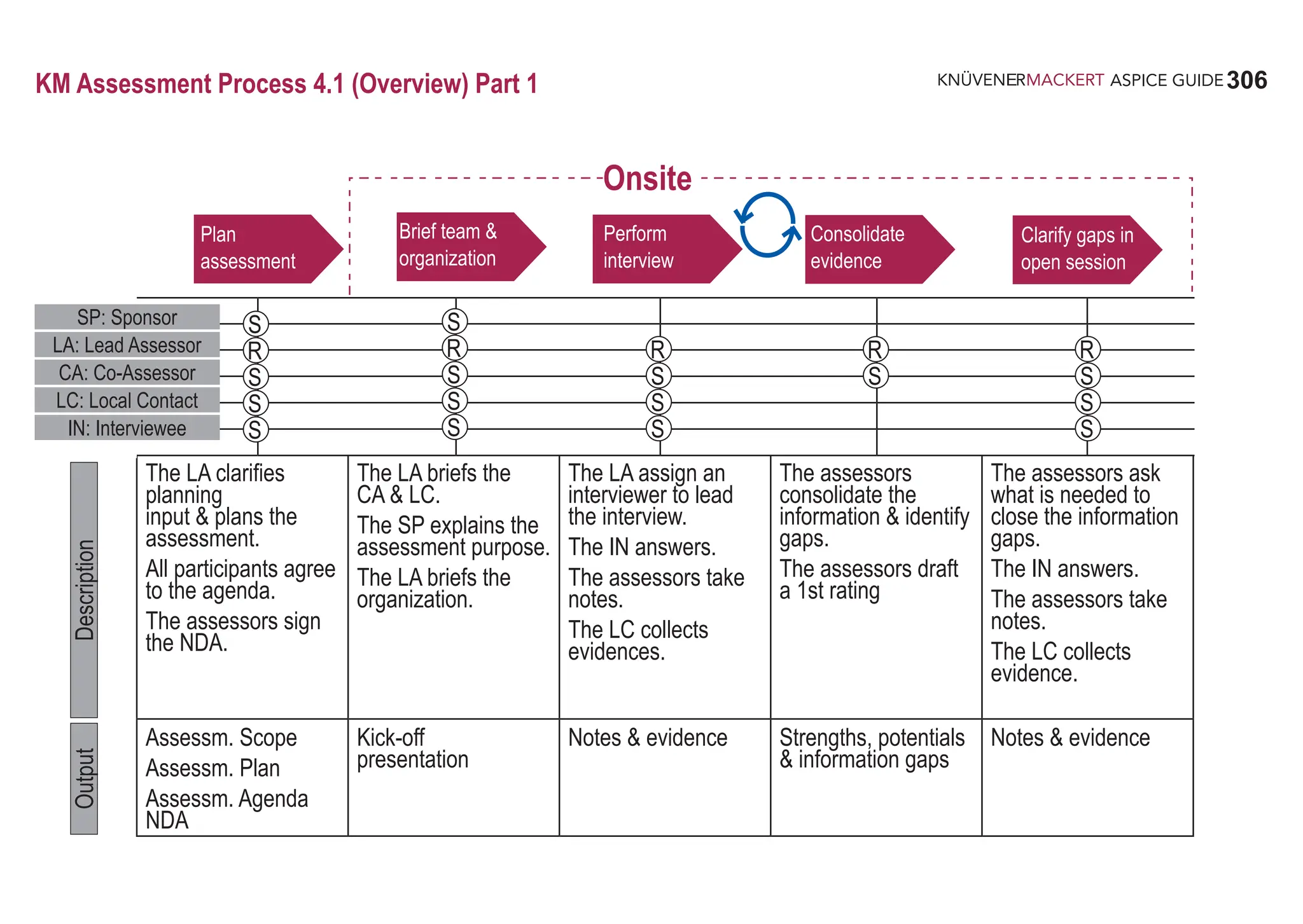
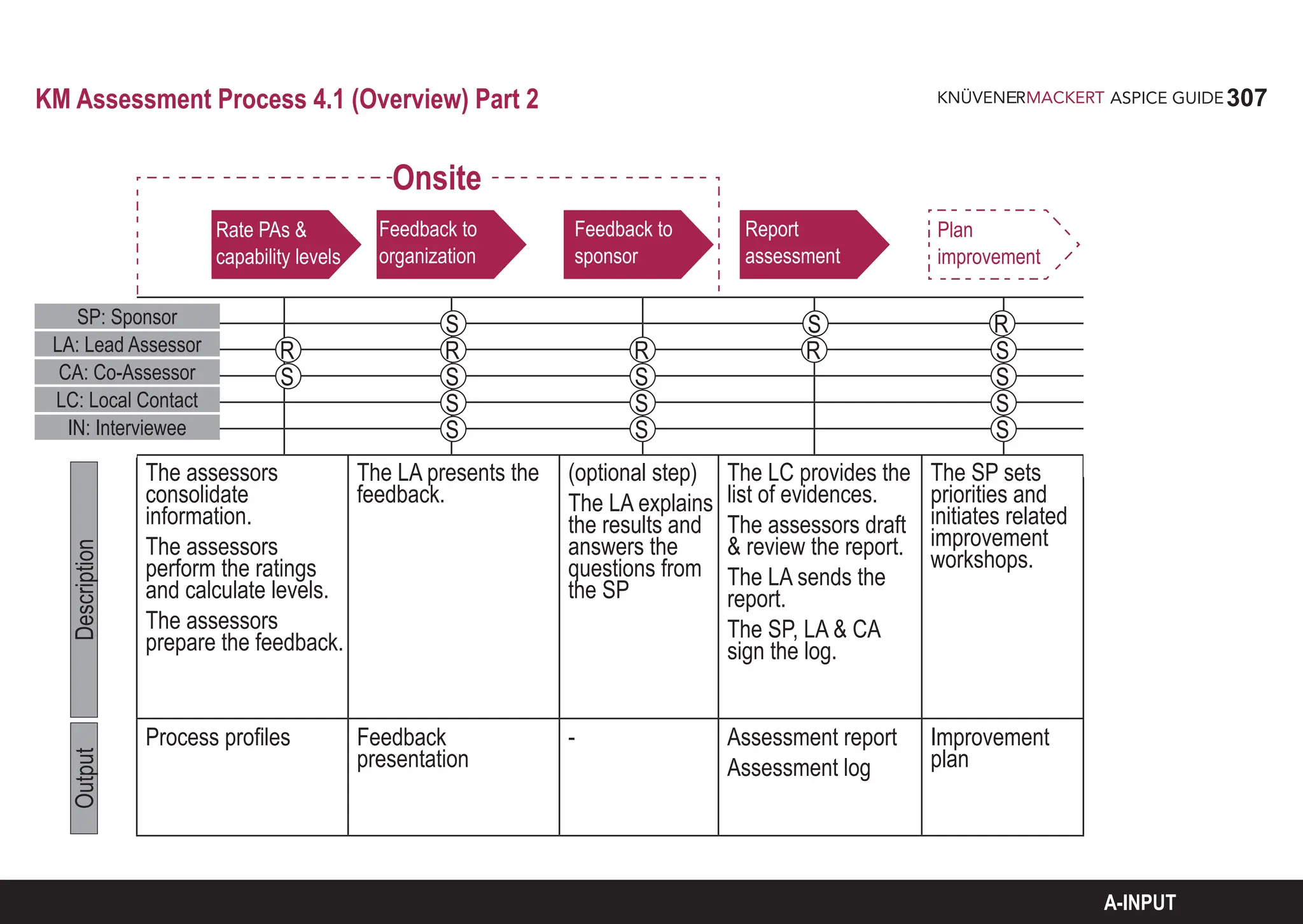
KM Assessment Process 306
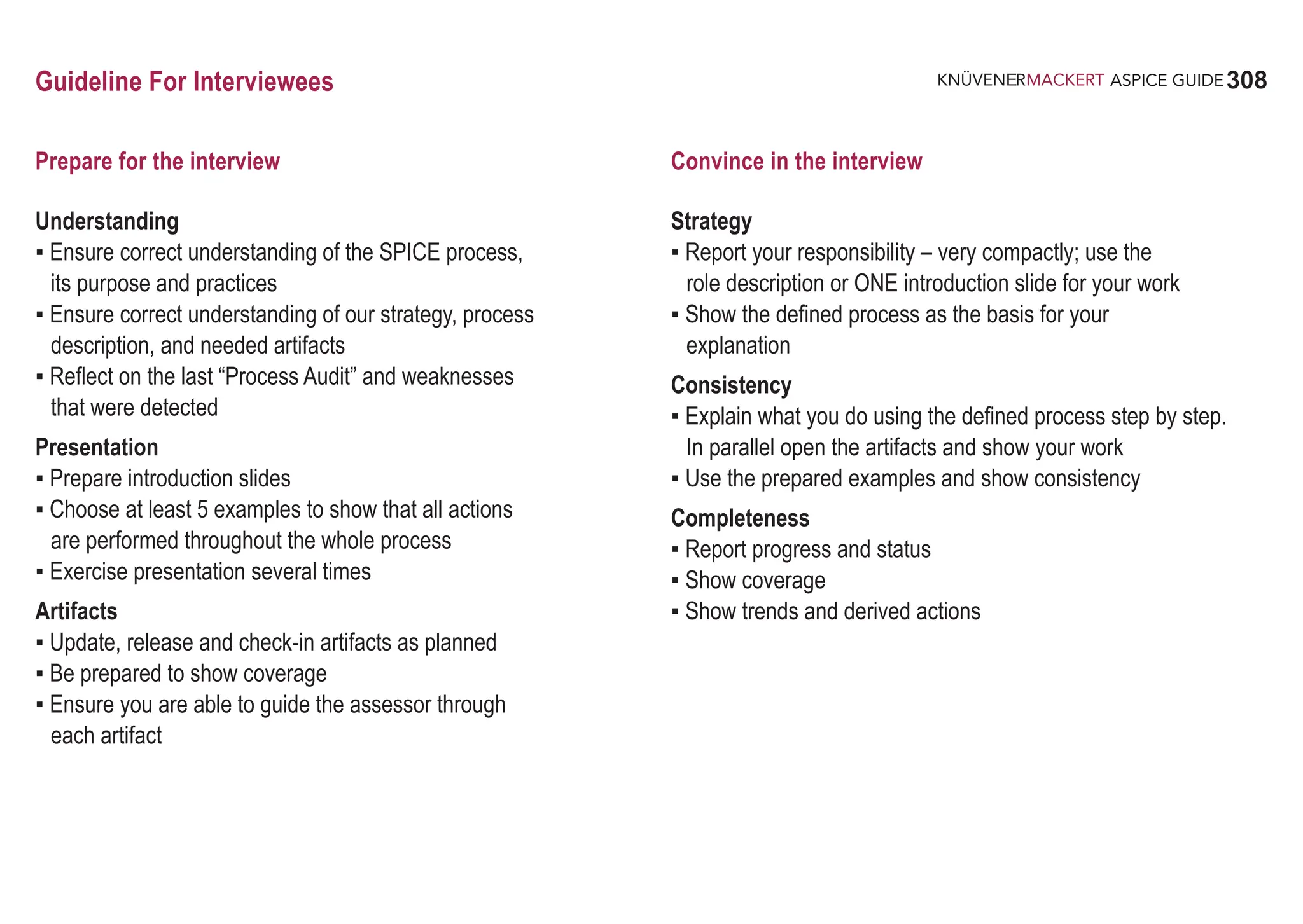
Guideline For Interviewees 308
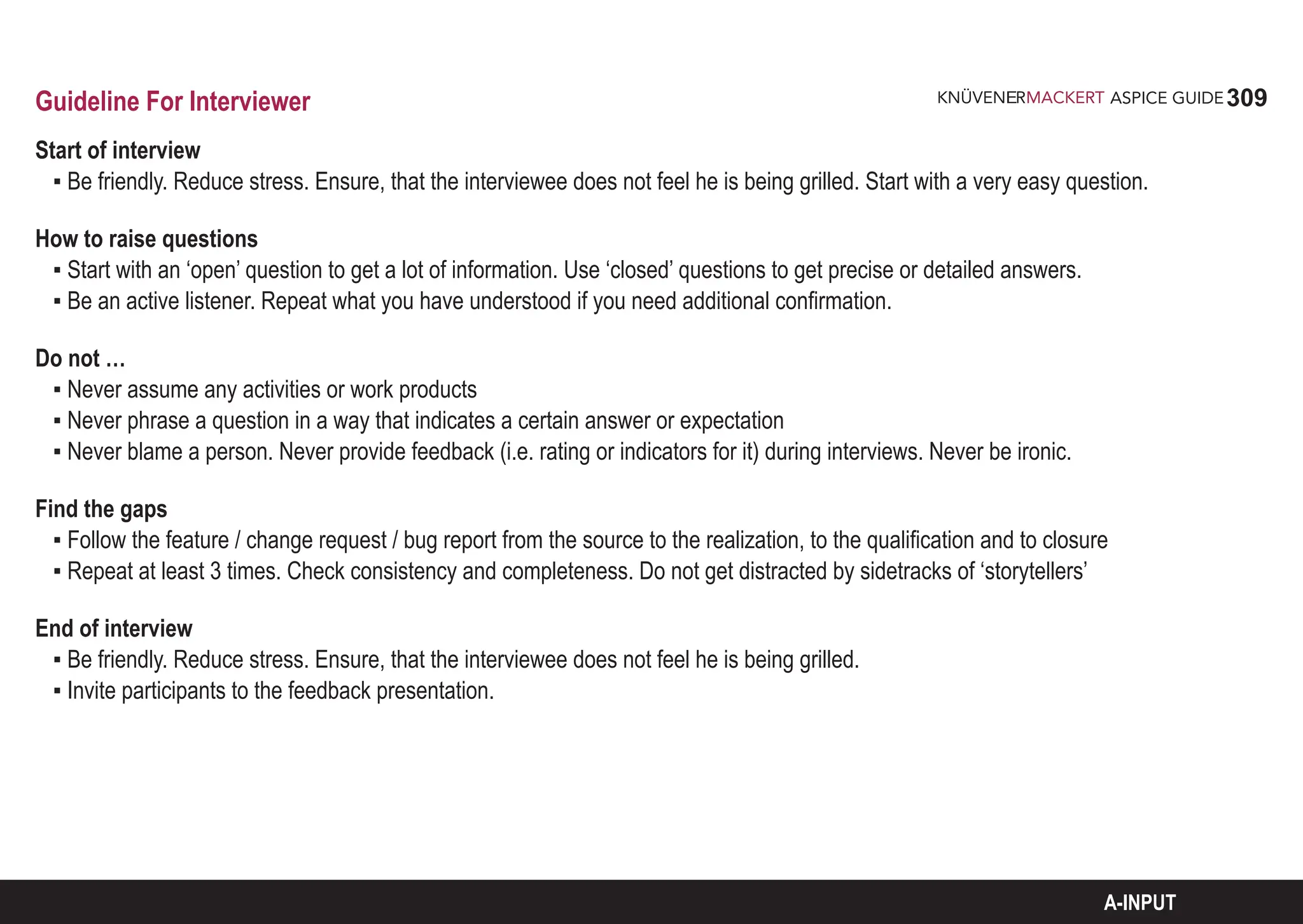
Guideline For Interviewer 309
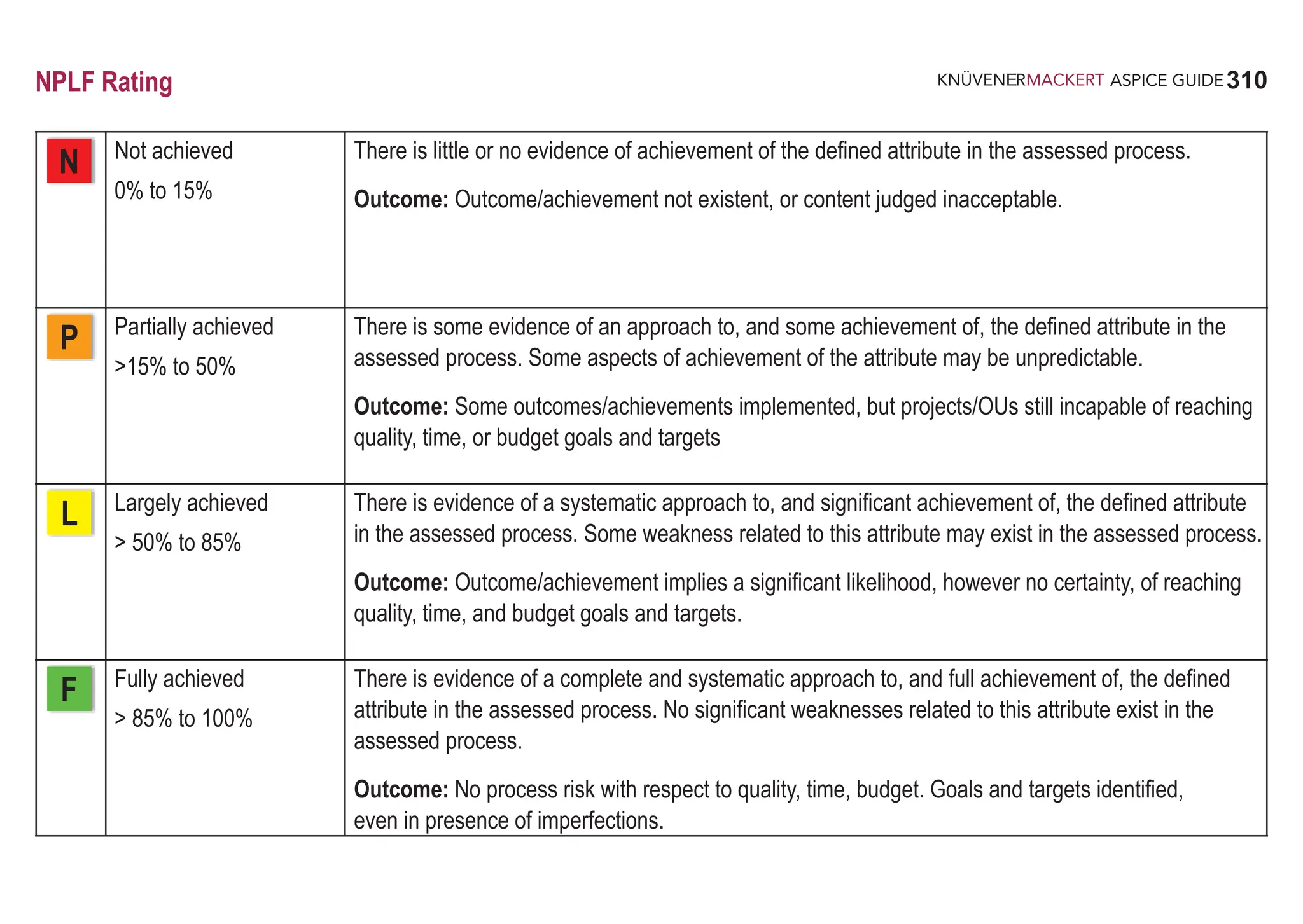
NPLF Rating 310
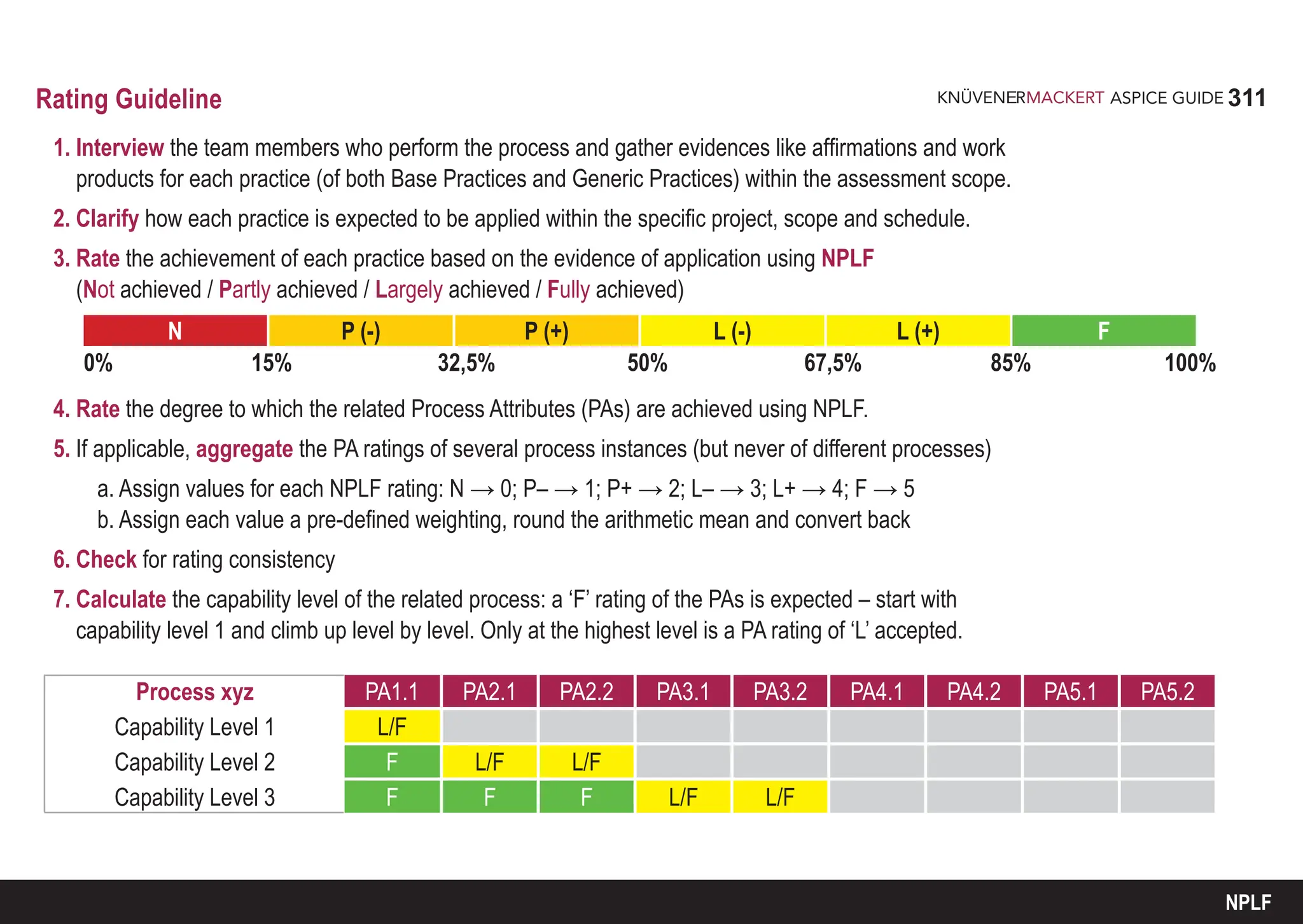
Rating Guideline 311
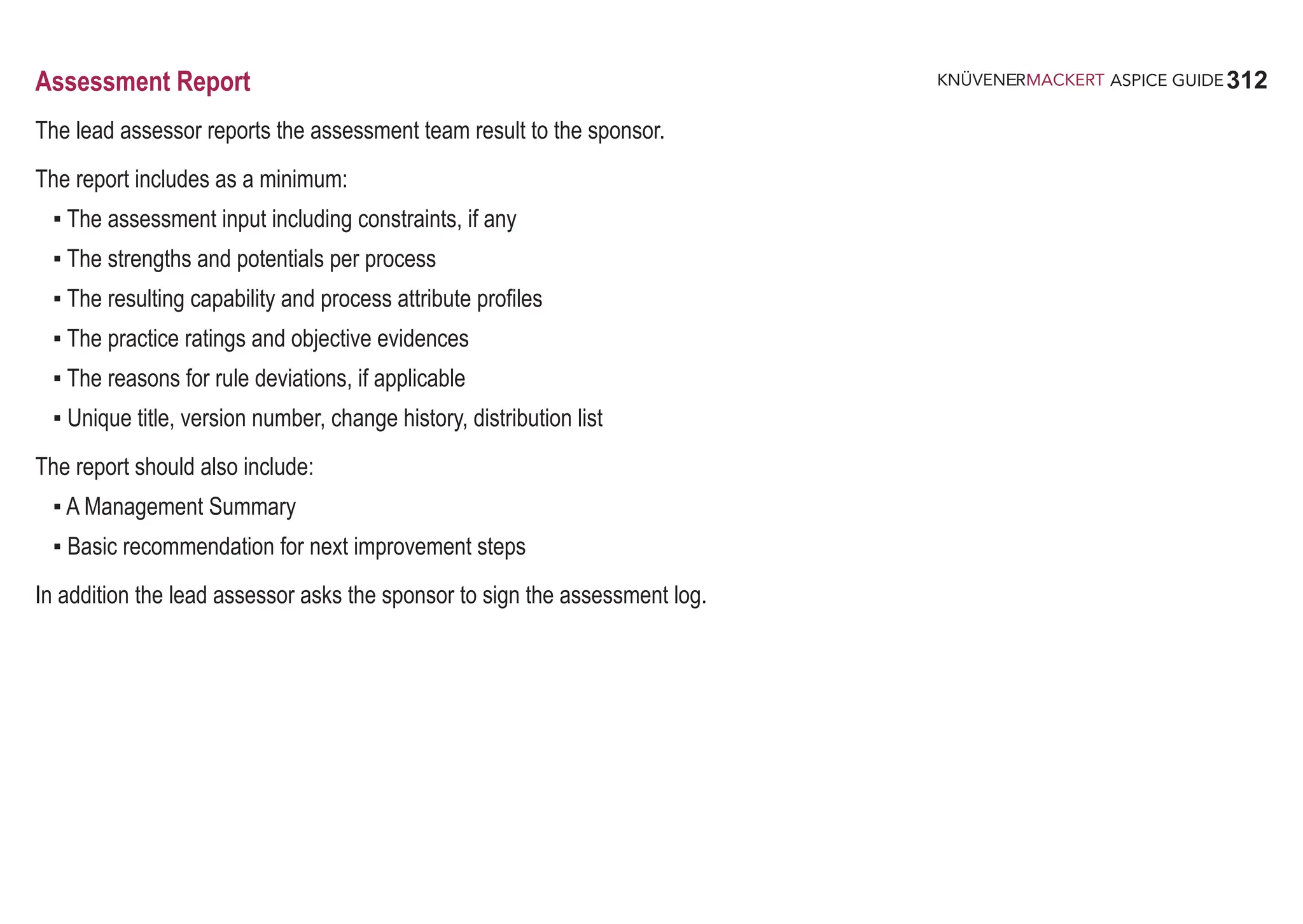
Assessment Report 312
Copyright Notice 313
Accepted Processes Follow Easy Rules 314
CAPABILITY LEVEL
CL 1 – PA 1.1 Process Performance 220
CL 2 – PA 2.1 Performance Management 3 261
CL 2 – PA 2.2 Work Product Management 3 266
CL 3 – PA 3.1 Process Definition 3
270
CL 3 – PA 3.2 Process Deployment 3 274
CL 1-3 – Dependencies Processes and PAs 279
CL 1-3 – Overview with Icons 280
CL 4 – PA 4.1 Quantitative Analysis 284
CL.4 – PA 4.2 Quantitative Control 287
CL 5 – PA 5.1 Process Innovation 289
CL 5 – PA 5.2 Process Innovation Implementation 291
5
ASPICE GUIDE
Table of content – 5th Edition – Page 4
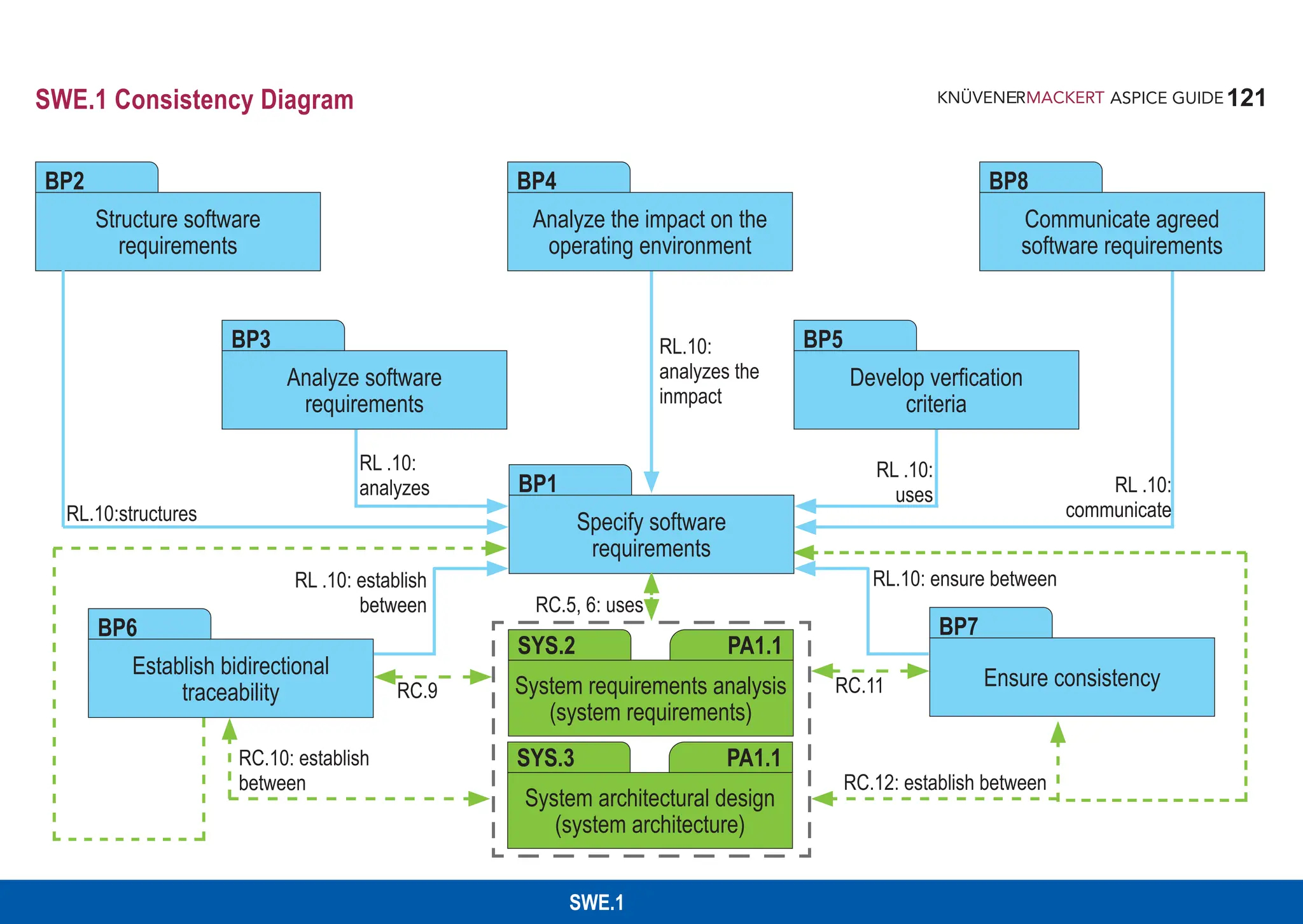
SWE.1 SW Requirements Analysis 121
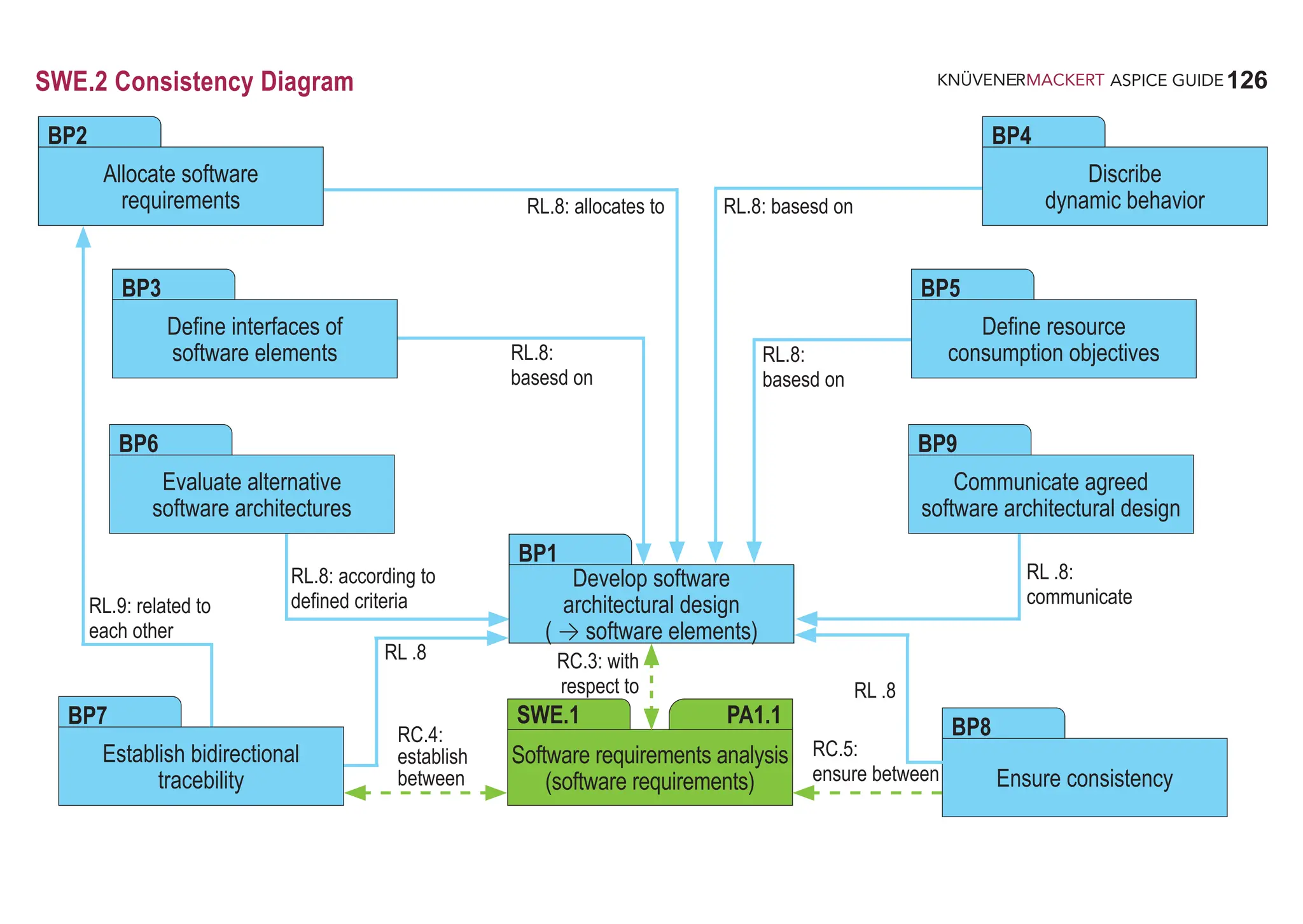
SWE.2 SW Architectural Design 126
SWE.3 SW Detailed Design & Unit Constr. 132
SWE.4 SW Unit Verification 138
SWE.5 SW Integration & Integration Test 145
SWE.6 SW Qualification Test 150
CL 2 Capability Level 2 PA 2.1 265
CL 2 Capability Level 2 PA 2.2 269
CL 3 Capability Level 3 PA 3.x 278
Dependencies between processes and PAs 279
Overview CL 2 and CL 3 280
Diagram Explanation 07
MAN.3 Project Management 45
ACQ.4 Supplier Monitoring 53
SUP.1 Quality Assurance 58
SUP.8 Configuration Management 73
SUP.9 Problem Resolution Management 78
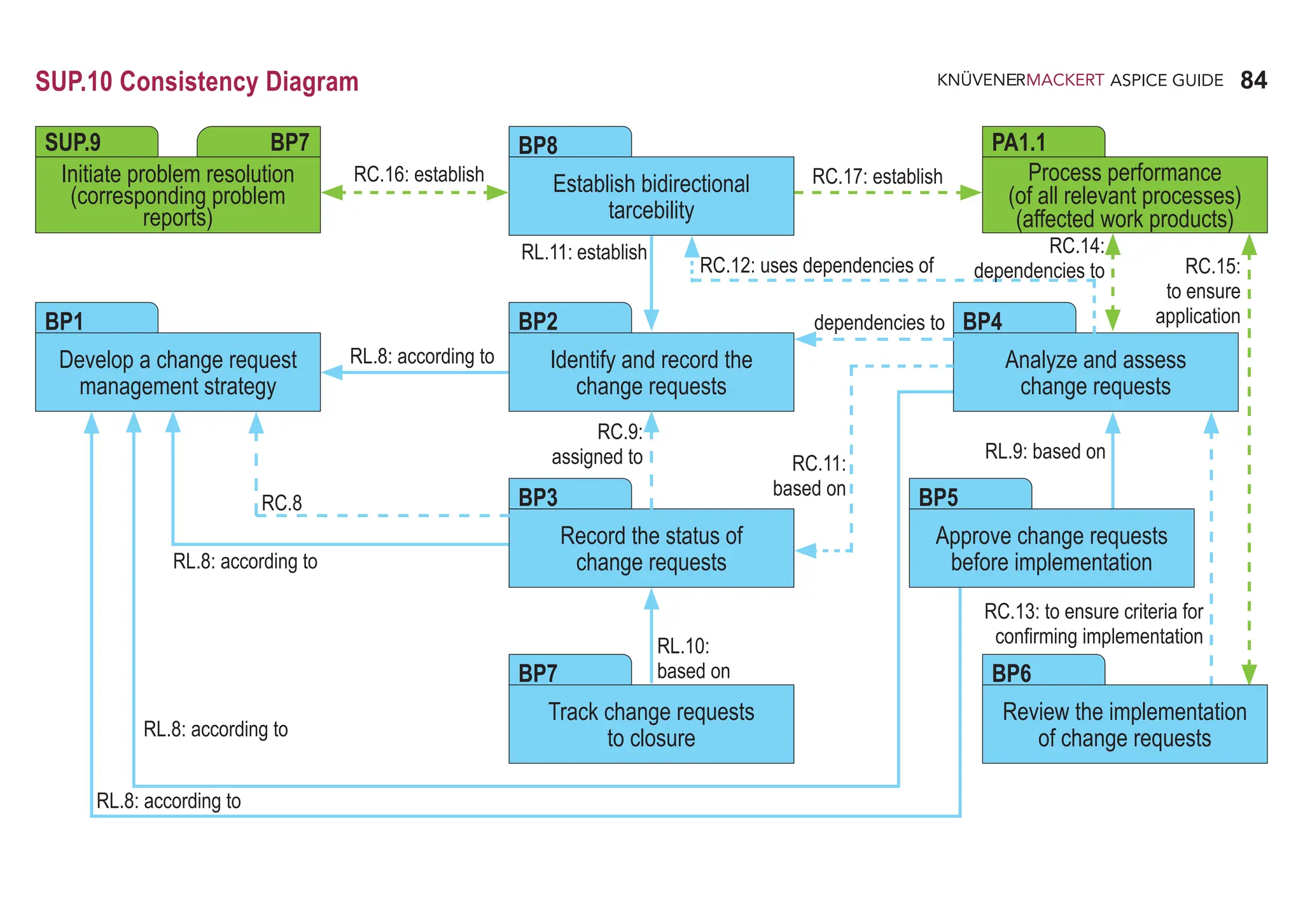
SUP.10 Change Request Management 84
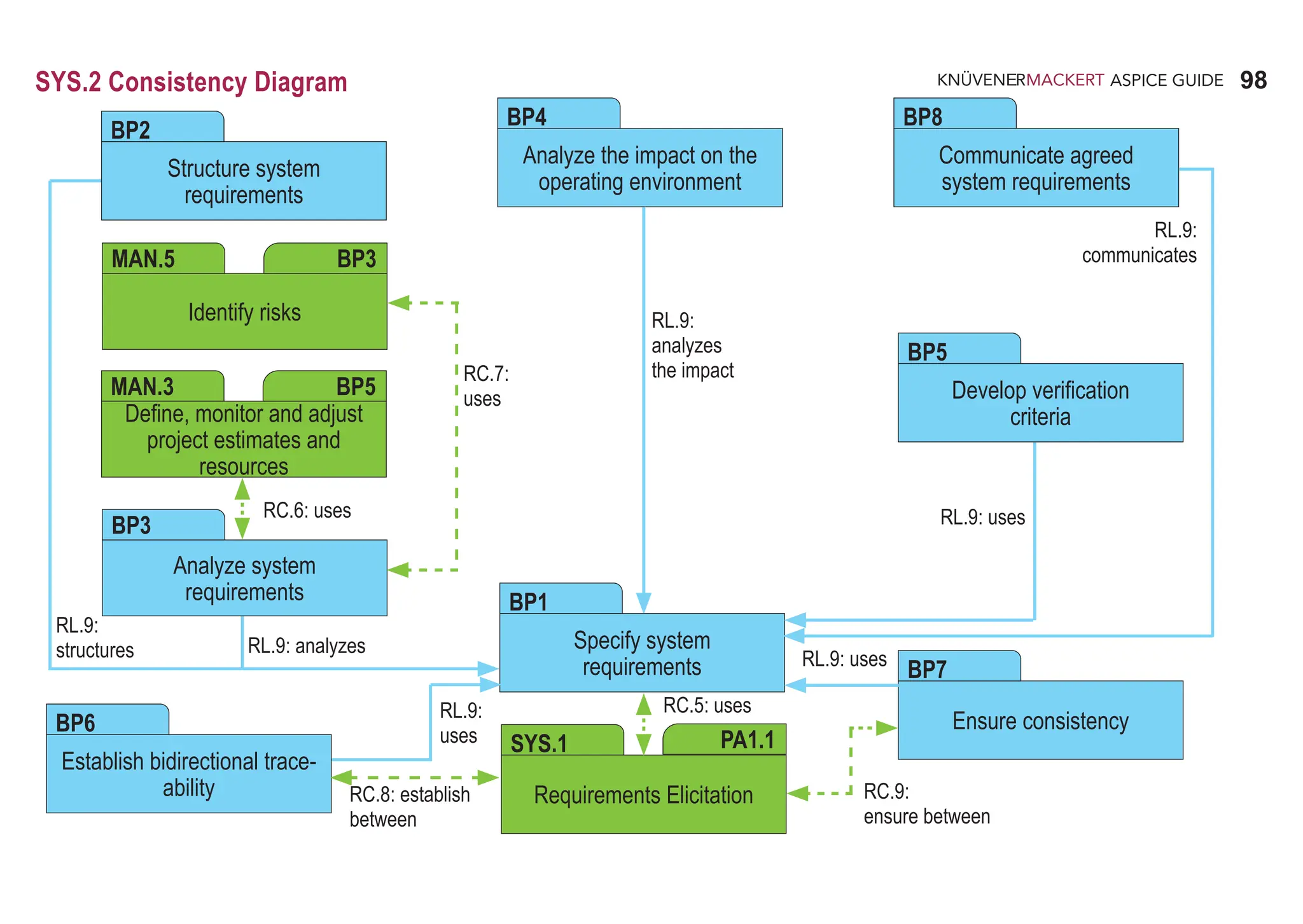
SYS.2 System Requirements Analysis 98
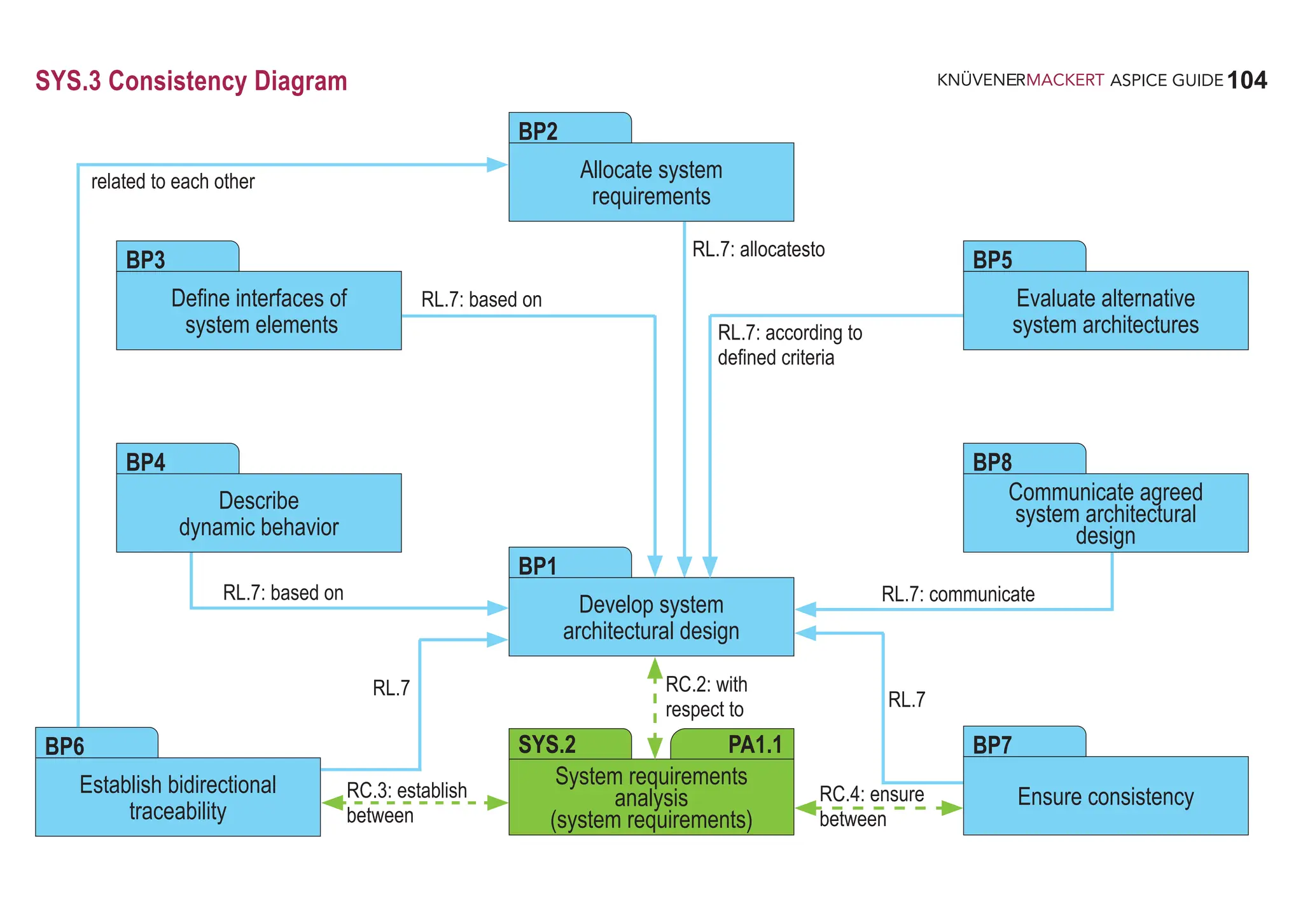
SYS.3 System Architectural Design 104
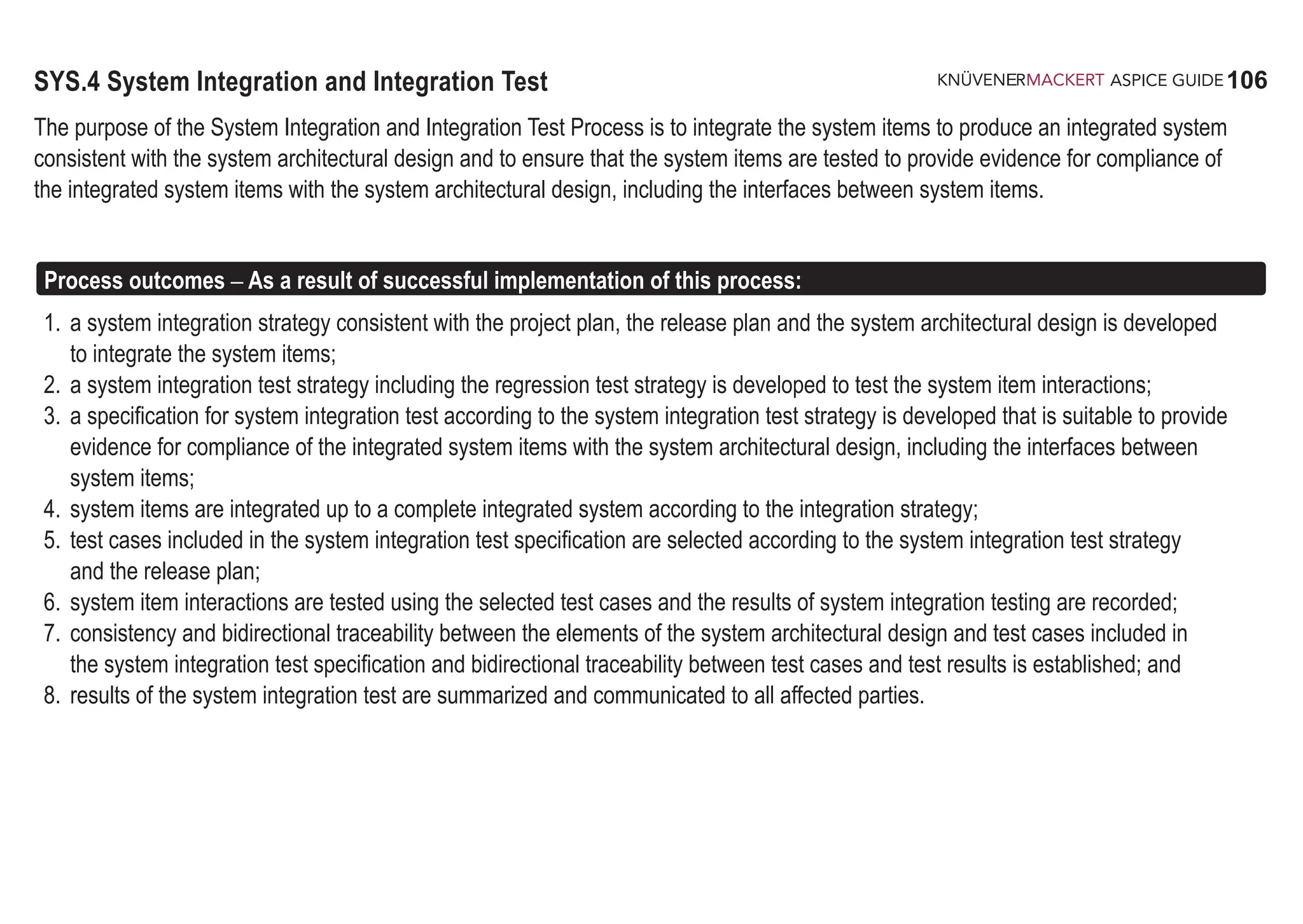
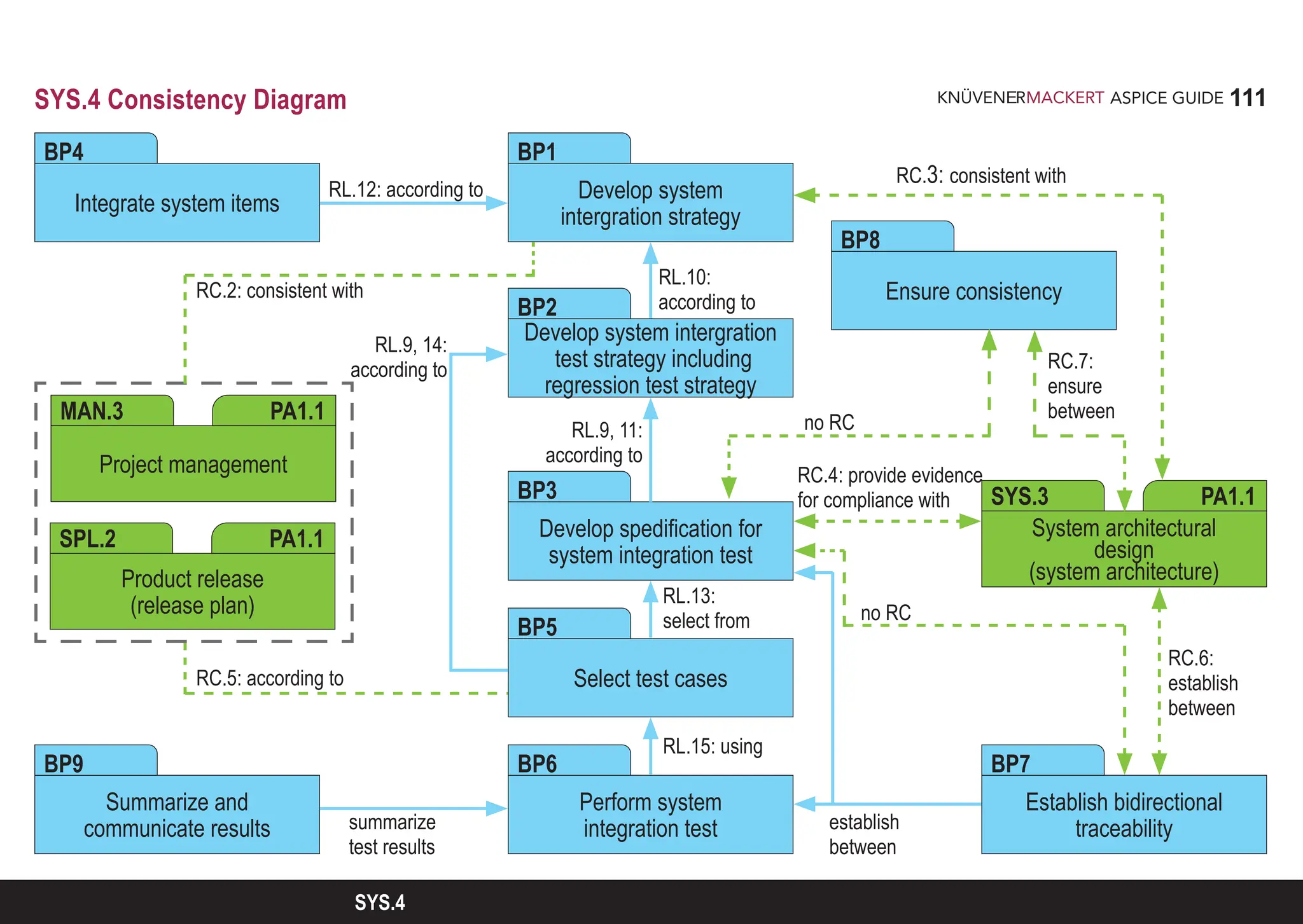
SYS.4 System Integration & Integr. Test 111
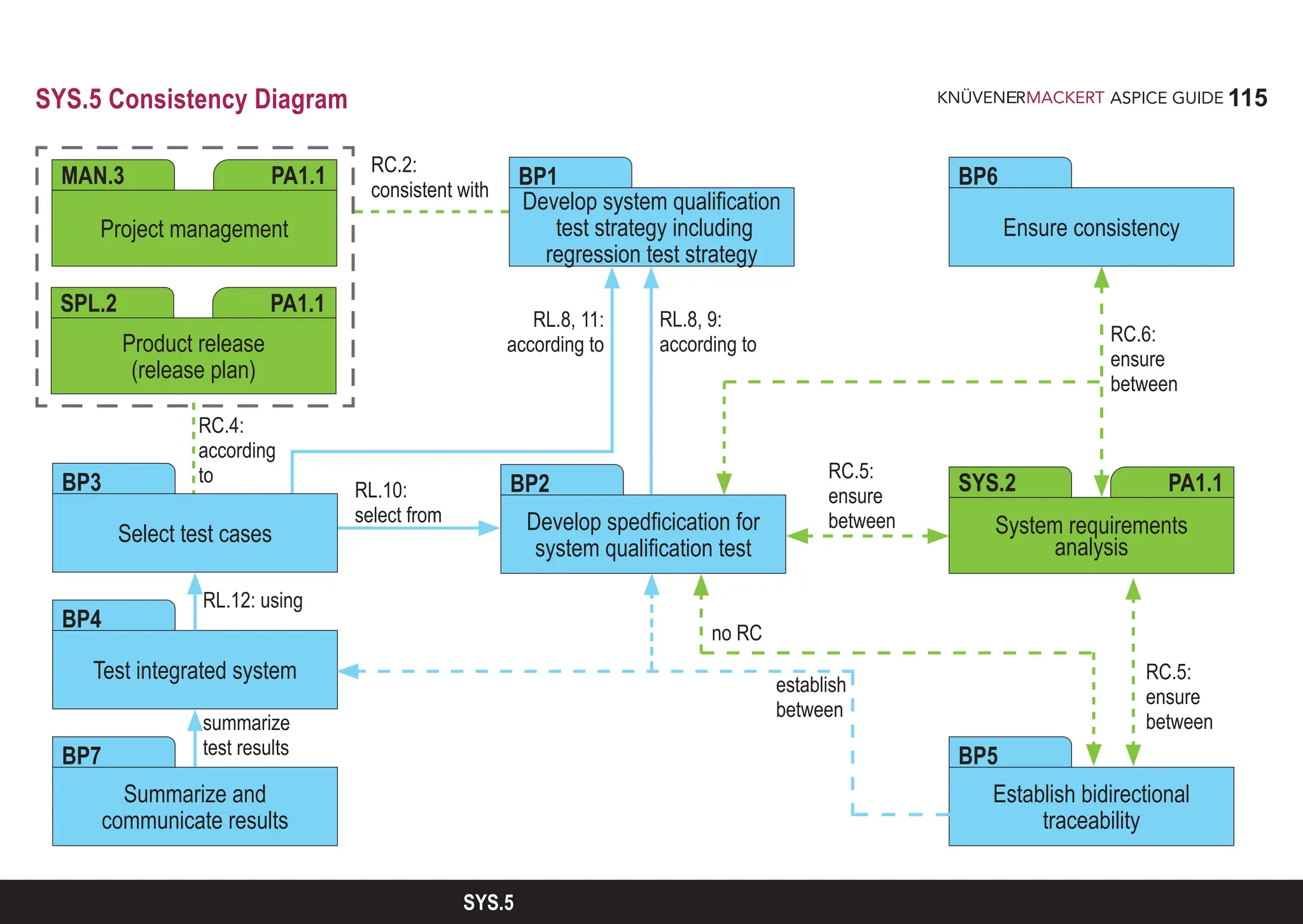
SYS.5 System Qualification Test 115
RATING CONSISTENCY DIAGRAMS
6
ASPICE GUIDE
This Knüvener Mackert SPICE Guide offers a wealth of basic and detailed information to help you achieve maximum benefit from
Automotive SPICE®.
In the following sections, red is reserved for the management and supporting processes, black is used for the system level,
blue for the subdomain level, and green for the component level.
This Knüvener Mackert SPICE Guide contains the following sections:
1. An introduction to the goals and added value of effective processes and a typical approach to process improvement.
2. An introduction to Automotive SPICE® and its application together with agile methods and concepts for functional safety and
cyber safety.
3. The processes of Automotive SPICE®v3.1.
3a. For each practice of the VDA scope the pages and IDs of the related VDA Guideline (1st edition 2017) and
recommendations are listed.
3b. For each process of the VDA scope and for the process attributes of level 2 and 3 the rating consistency
diagrams from the VDA Guideline (1st edition 2017) are copied.
4. An introduction to Agile SPICE™ and the process AGL.1.1
5. The processes of Hardware Engineering SPICE v2.0
6. The processes of Mechanical Engineering SPICE v1.7
7. The process attributes and generic practices for capability levels 1 to 5
8. Various instructions for conducting an assessment with templates, guidelines and requirements
How to read this SPICE Guide
7
ASPICE GUIDE
Automotive SPICE®
Guidelines - Rating Consistency Diagrams
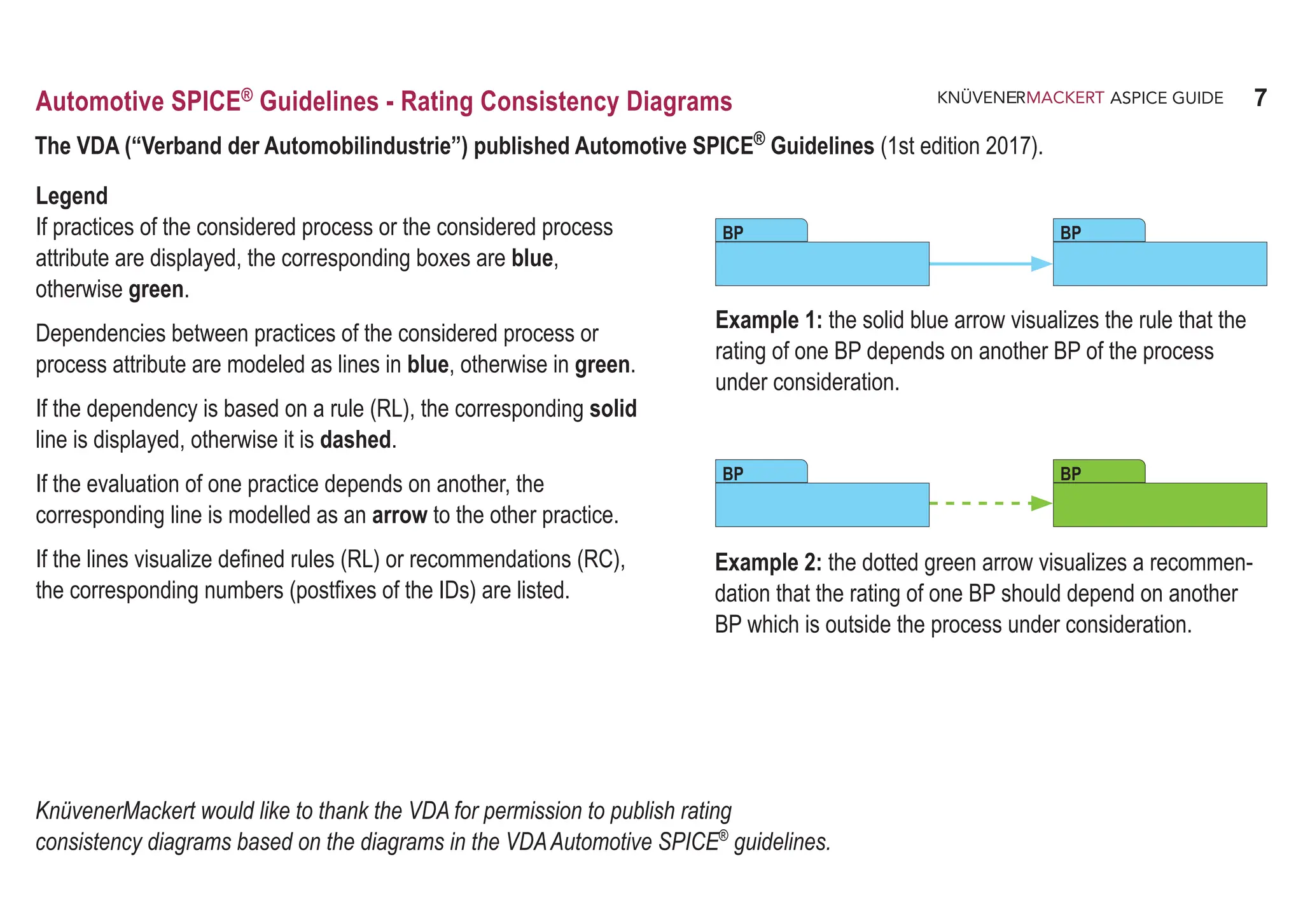
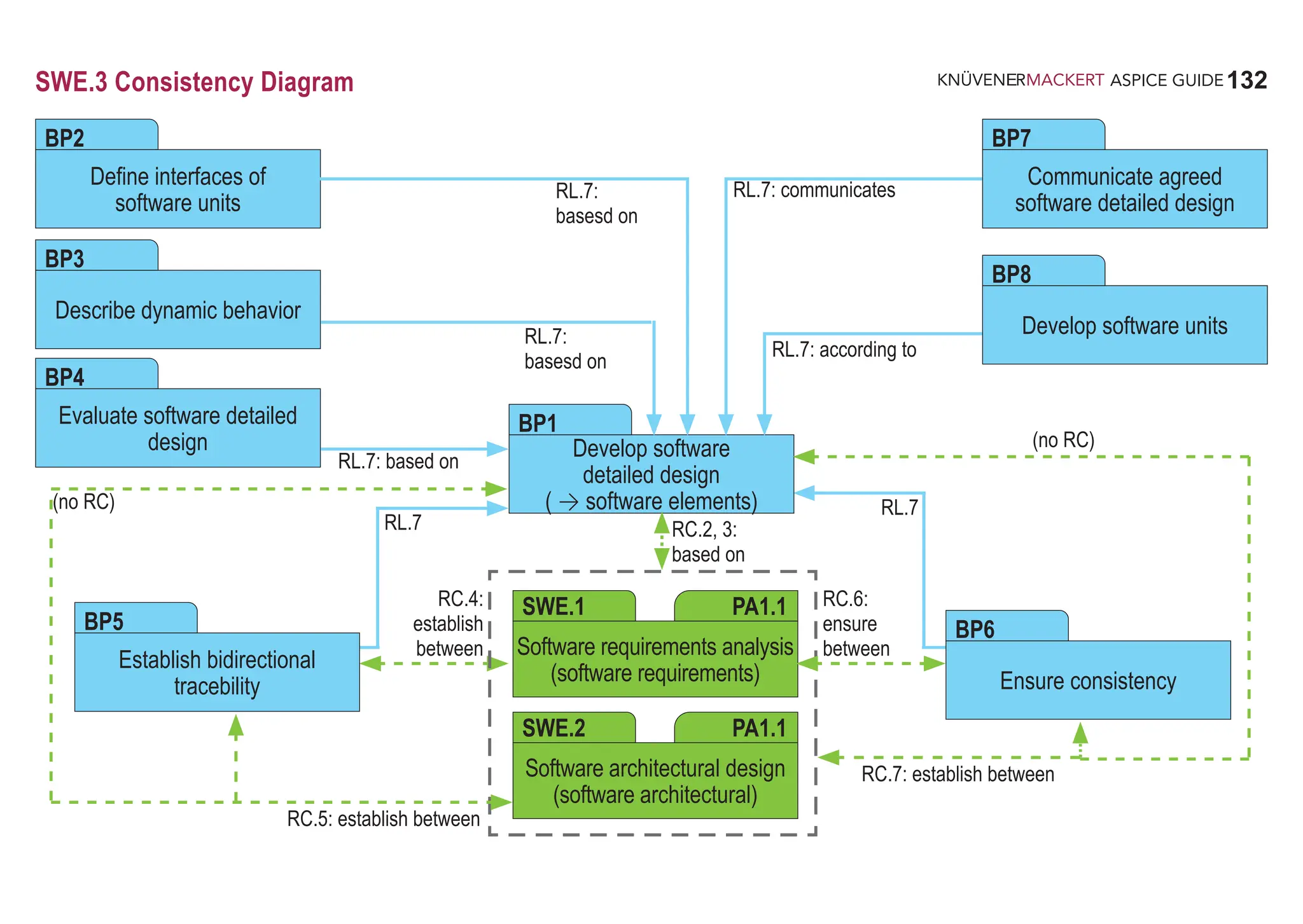
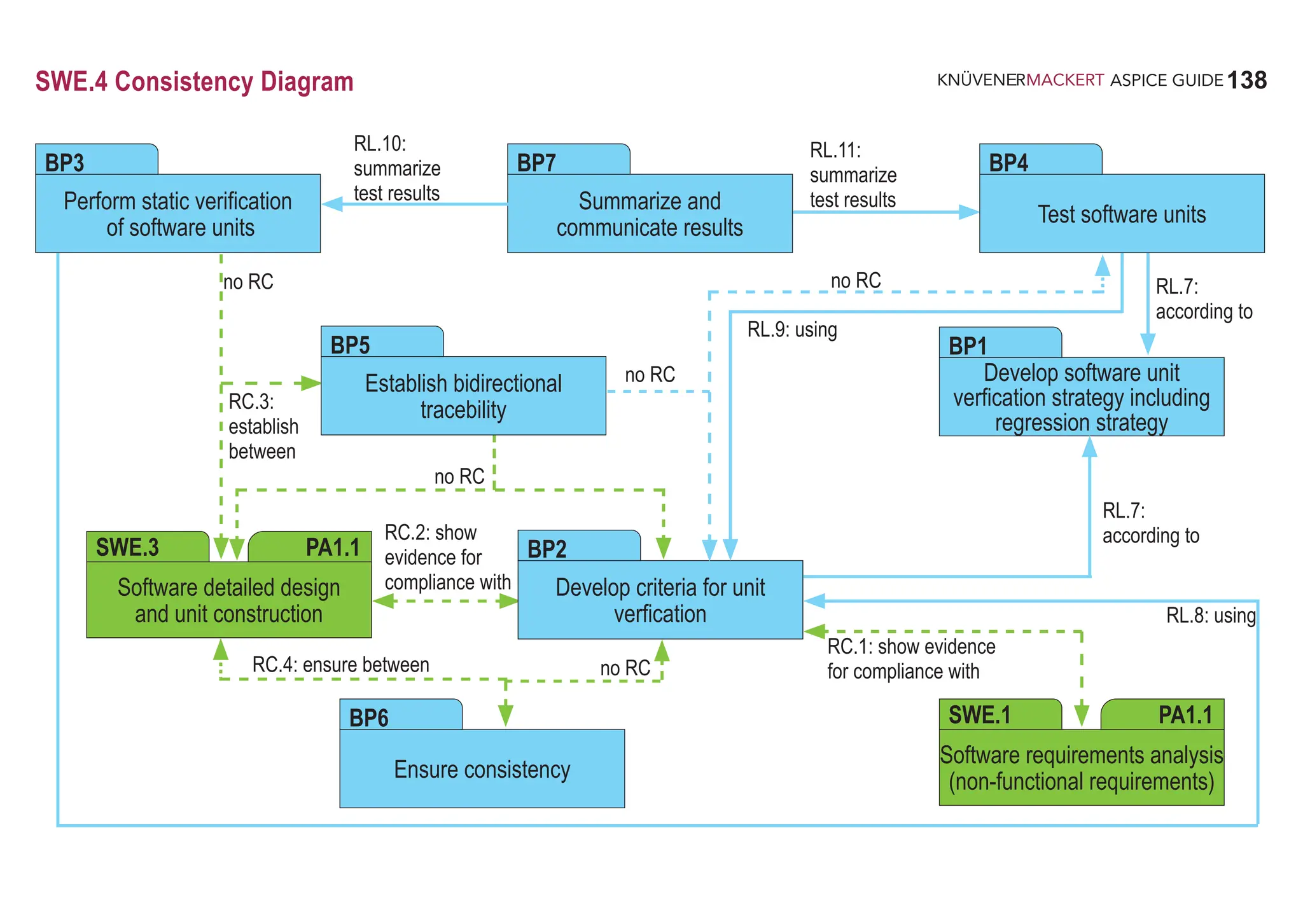
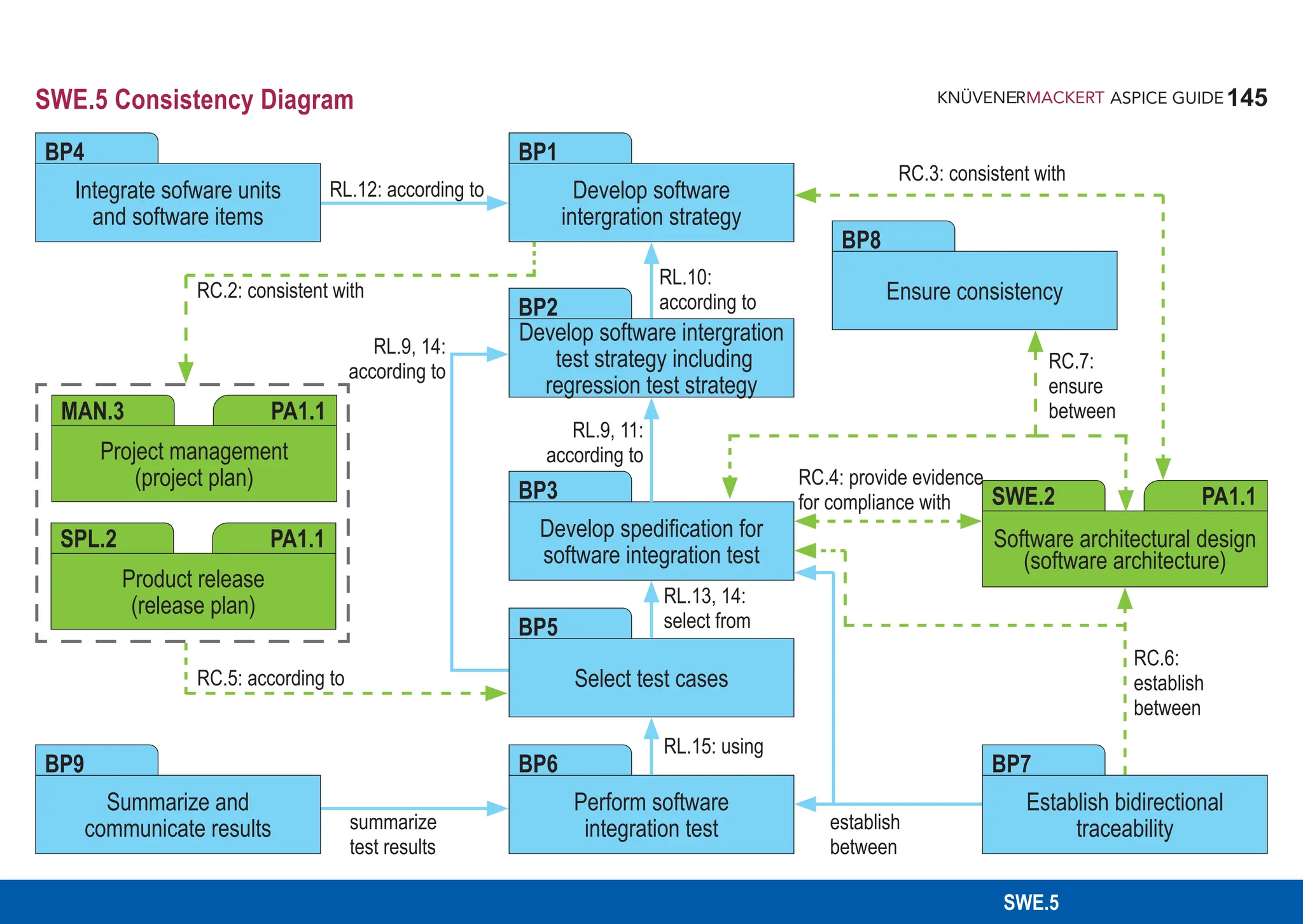
Legend
If practices of the considered process or the considered process
attribute are displayed, the corresponding boxes are blue,
otherwise green.
Dependencies between practices of the considered process or
process attribute are modeled as lines in blue, otherwise in green.
If the dependency is based on a rule (RL), the corresponding solid
line is displayed, otherwise it is dashed.
If the evaluation of one practice depends on another, the
corresponding line is modelled as an arrow to the other practice.
If the lines visualize defined rules (RL) or recommendations (RC),
the corresponding numbers (postfixes of the IDs) are listed.
Example 1: the solid blue arrow visualizes the rule that the
rating of one BP depends on another BP of the process
under consideration.
Example 2: the dotted green arrow visualizes a recommen-
dation that the rating of one BP should depend on another
BP which is outside the process under consideration.
BP
The VDA (“Verband der Automobilindustrie”) published Automotive SPICE® Guidelines (1st edition 2017).
BP
BP BP
KnüvenerMackert would like to thank the VDA for permission to publish rating
consistency diagrams based on the diagrams in the VDAAutomotive SPICE®
guidelines.
8
ASPICE GUIDE
The VDA ("Verband der Automobilindustrie") has published rules and recommendations in the VDAAutomotive SPICE® Guideline
(1st edition 2017). These rules and recommendations are used as rating guidelines in an assessment. They are structured according to
• specific terms (traceability and consistency (TAC), summarize and communicate (SAC),
verification criteria (VEC), strategy and plan (SAP)),
• application in specific environments (model-based development (MBD), agile environments (AGE),
distributed development (DID), management of third-party software (TPS),
management of platform and legacy software (PLS), application parameters (APA)),
• specific processes (VDA scope) or process attributes (level 1 to 3).
All relevant rules and recommendations for a specific practice of the VDA scope are divided into up to 6 different chapters and even
more different sections. To facilitate the overview of the rules and recommendations relevant to a practice, this ASPICE guide lists the
page numbers and IDs of the rules (RL) and recommendations (RC) under the practice, e.g., for MAN.3.BP1 on page 64 (DID.RL.1),
page 72 (PLS.RC.1) and on page 198 (MAN.3.RL.1, MAN.3.RL.2, MAN.3.RL.3, MAN.3.RC.1, MAN.3.RC.2).
Automotive SPICE®
Guidelines – Rules and Recommendations
KnüvenerMackert thanks the VDA for the permission granted to list the page numbers
and IDs of the rules and recommendations in this form following the Practices.
BP 1
Define the scope of work. Identify the project‘s goals, motivation and boundaries. [OUTCOME 1]
64: DID.RL.1
72: PLS.RC.1
198: MAN.3.RL.1-3, MAN.3.RC.1-2
9
ASPICE GUIDE
INTRODUCTION TO PROCESS QUALITY
10
ASPICE GUIDE
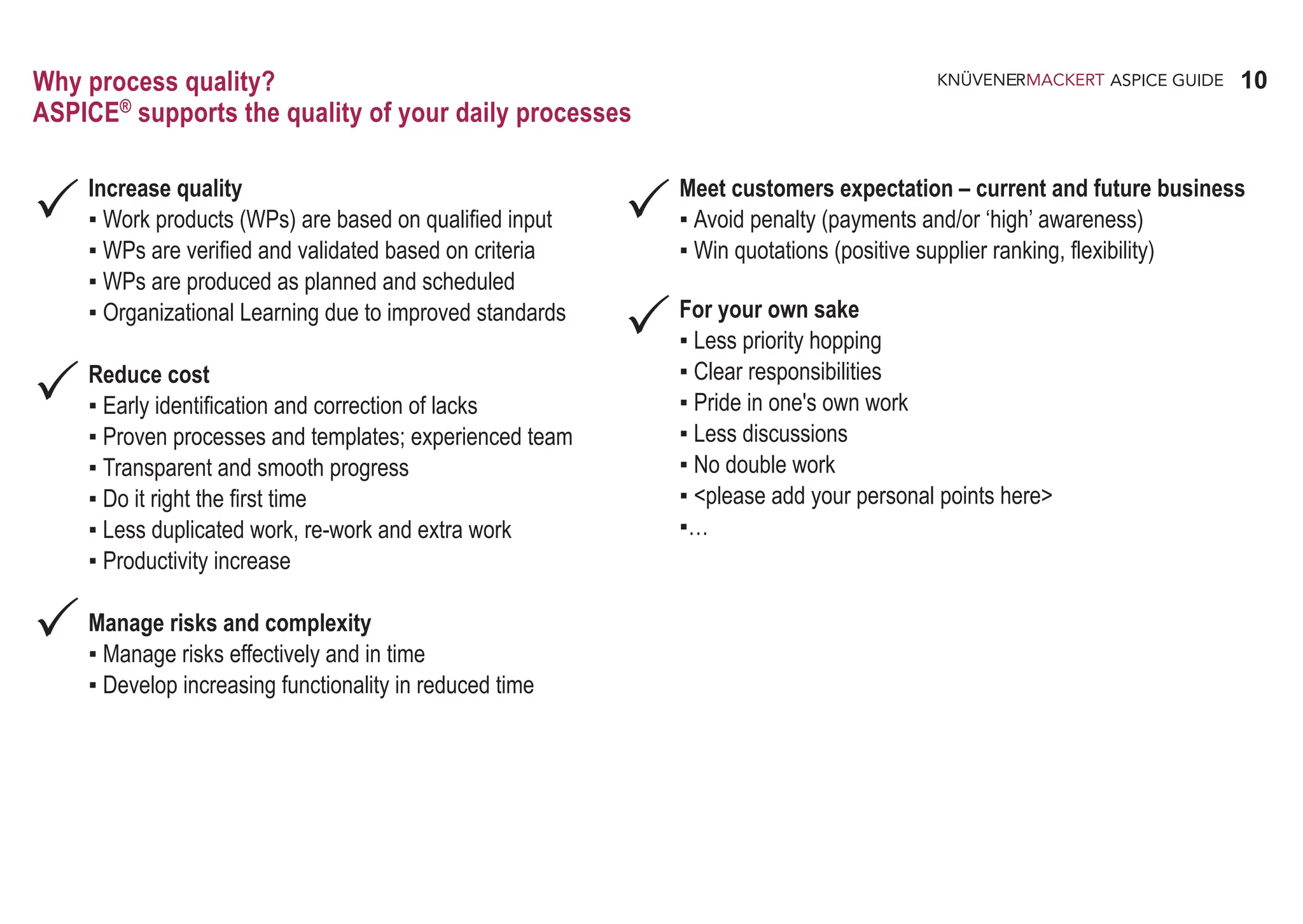
Why process quality?
ASPICE®
supports the quality of your daily processes
Increase quality
▪ Work products (WPs) are based on qualified input
▪ WPs are verified and validated based on criteria
▪ WPs are produced as planned and scheduled
▪ Organizational Learning due to improved standards
Reduce cost
▪ Early identification and correction of lacks
▪ Proven processes and templates; experienced team
▪ Transparent and smooth progress
▪ Do it right the first time
▪ Less duplicated work, re-work and extra work
▪ Productivity increase
Manage risks and complexity
▪ Manage risks effectively and in time
▪ Develop increasing functionality in reduced time



Meet customers expectation – current and future business
▪ Avoid penalty (payments and/or ‘high’ awareness)
▪ Win quotations (positive supplier ranking, flexibility)
For your own sake
▪ Less priority hopping
▪ Clear responsibilities
▪ Pride in one's own work
▪ Less discussions
▪ No double work
▪ <please add your personal points here>
▪…


11
ASPICE GUIDE
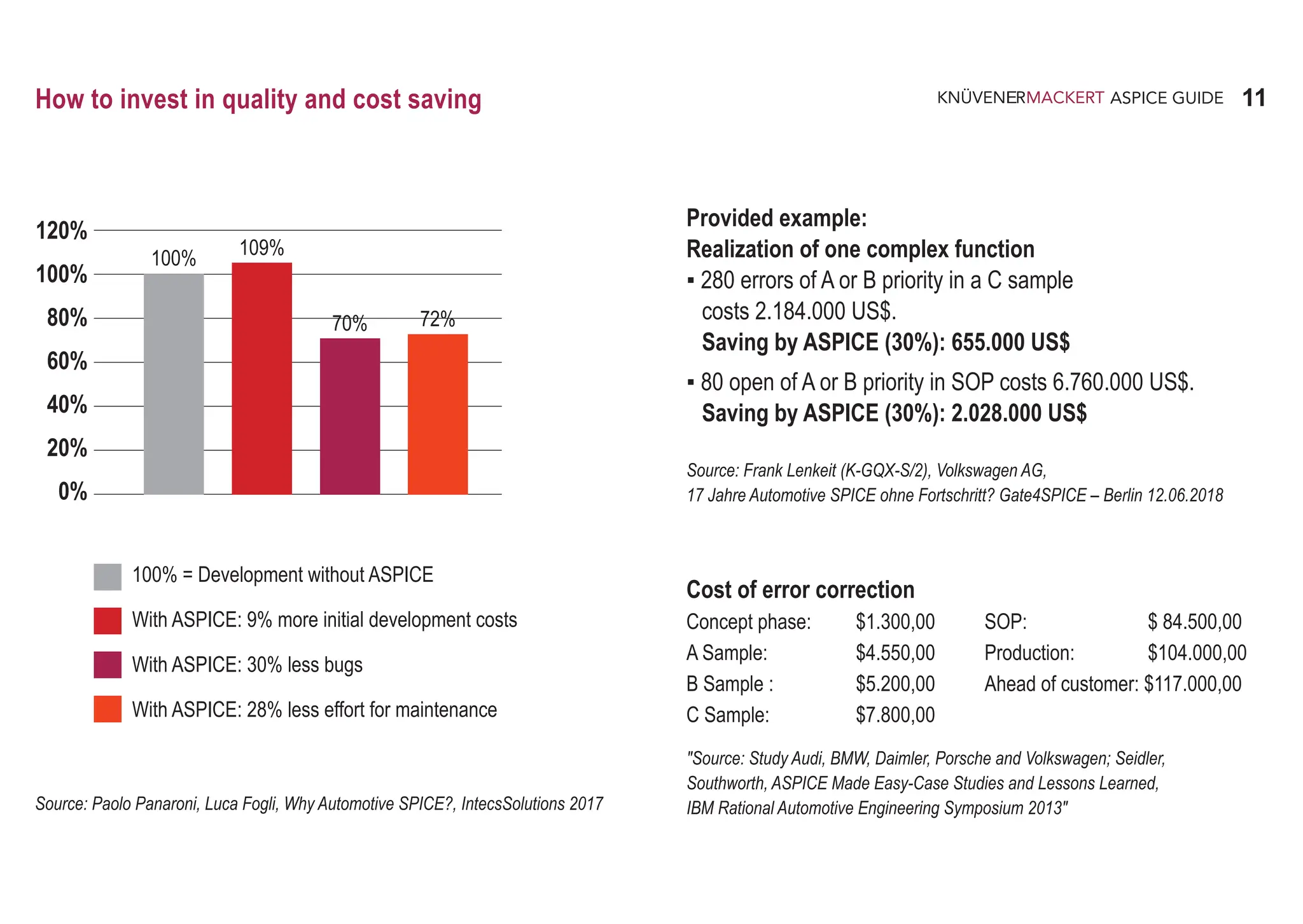
How to invest in quality and cost saving
120%
100%
80%
60%
40%
20%
0%
100% 109%
70% 72%
Source: Paolo Panaroni, Luca Fogli, Why Automotive SPICE?, IntecsSolutions 2017
Provided example:
Realization of one complex function
▪ 280 errors of A or B priority in a C sample
costs 2.184.000 US$.
Saving by ASPICE (30%): 655.000 US$
▪ 80 open of A or B priority in SOP costs 6.760.000 US$.
Saving by ASPICE (30%): 2.028.000 US$
Source: Frank Lenkeit (K-GQX-S/2), Volkswagen AG,
17 Jahre Automotive SPICE ohne Fortschritt? Gate4SPICE – Berlin 12.06.2018
Cost of error correction
Concept phase: $1.300,00 SOP: $ 84.500,00
A Sample: $4.550,00 Production: $104.000,00
B Sample : $5.200,00 Ahead of customer: $117.000,00
C Sample: $7.800,00
"Source: Study Audi, BMW, Daimler, Porsche and Volkswagen; Seidler,
Southworth, ASPICE Made Easy-Case Studies and Lessons Learned,
IBM Rational Automotive Engineering Symposium 2013"
100% = Development without ASPICE
With ASPICE: 9% more initial development costs
With ASPICE: 30% less bugs
With ASPICE: 28% less effort for maintenance
12
ASPICE GUIDE
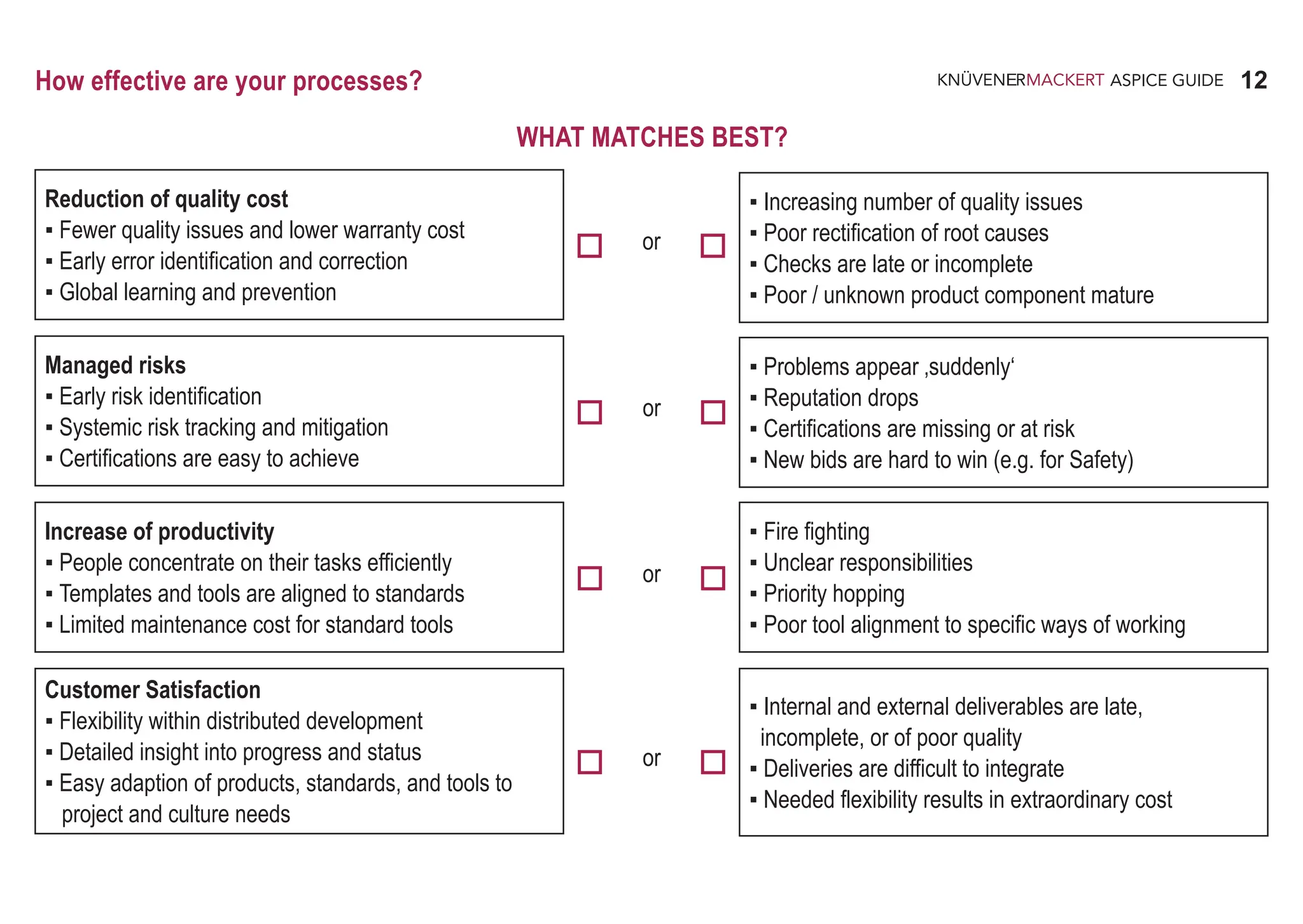
How effective are your processes?
WHAT MATCHES BEST?
Reduction of quality cost
▪ Fewer quality issues and lower warranty cost
▪ Early error identification and correction
▪ Global learning and prevention
Managed risks
▪ Early risk identification
▪ Systemic risk tracking and mitigation
▪ Certifications are easy to achieve
Increase of productivity
▪ People concentrate on their tasks efficiently
▪ Templates and tools are aligned to standards
▪ Limited maintenance cost for standard tools
Customer Satisfaction
▪ Flexibility within distributed development
▪ Detailed insight into progress and status
▪ Easy adaption of products, standards, and tools to
project and culture needs
▪ Increasing number of quality issues
▪ Poor rectification of root causes
▪ Checks are late or incomplete
▪ Poor / unknown product component mature
▪ Problems appear ‚suddenly‘
▪ Reputation drops
▪ Certifications are missing or at risk
▪ New bids are hard to win (e.g. for Safety)
▪ Fire fighting
▪ Unclear responsibilities
▪ Priority hopping
▪ Poor tool alignment to specific ways of working
▪ Internal and external deliverables are late,
incomplete, or of poor quality
▪ Deliveries are difficult to integrate
▪ Needed flexibility results in extraordinary cost
or
or
or
or
13
ASPICE GUIDE
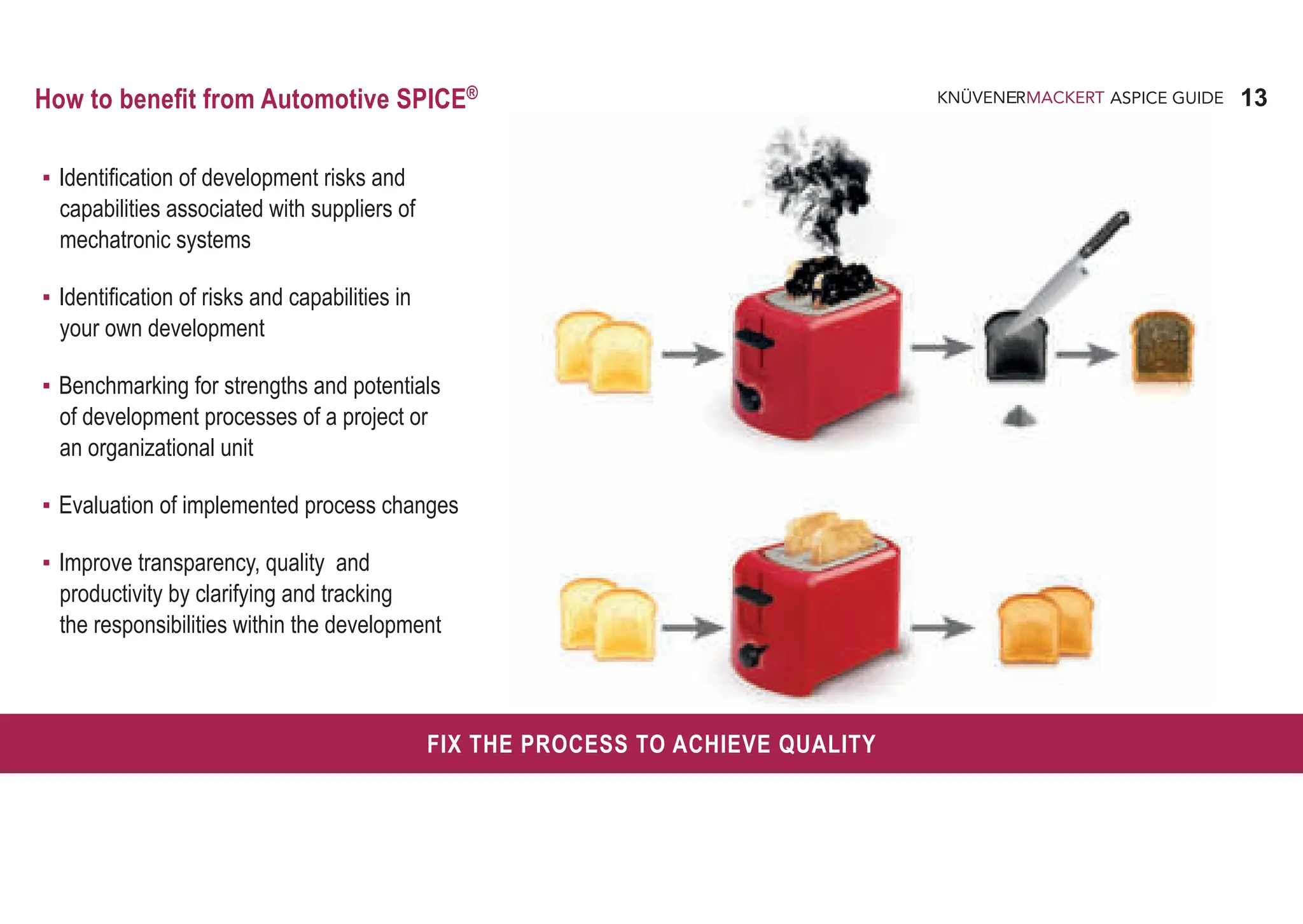
How to benefit from Automotive SPICE®
▪ Identification of development risks and
capabilities associated with suppliers of
mechatronic systems
▪ Identification of risks and capabilities in
your own development
▪ Benchmarking for strengths and potentials
of development processes of a project or
an organizational unit
▪ Evaluation of implemented process changes
▪ Improve transparency, quality and
productivity by clarifying and tracking
the responsibilities within the development
FIX THE PROCESS TO ACHIEVE QUALITY
14
ASPICE GUIDE
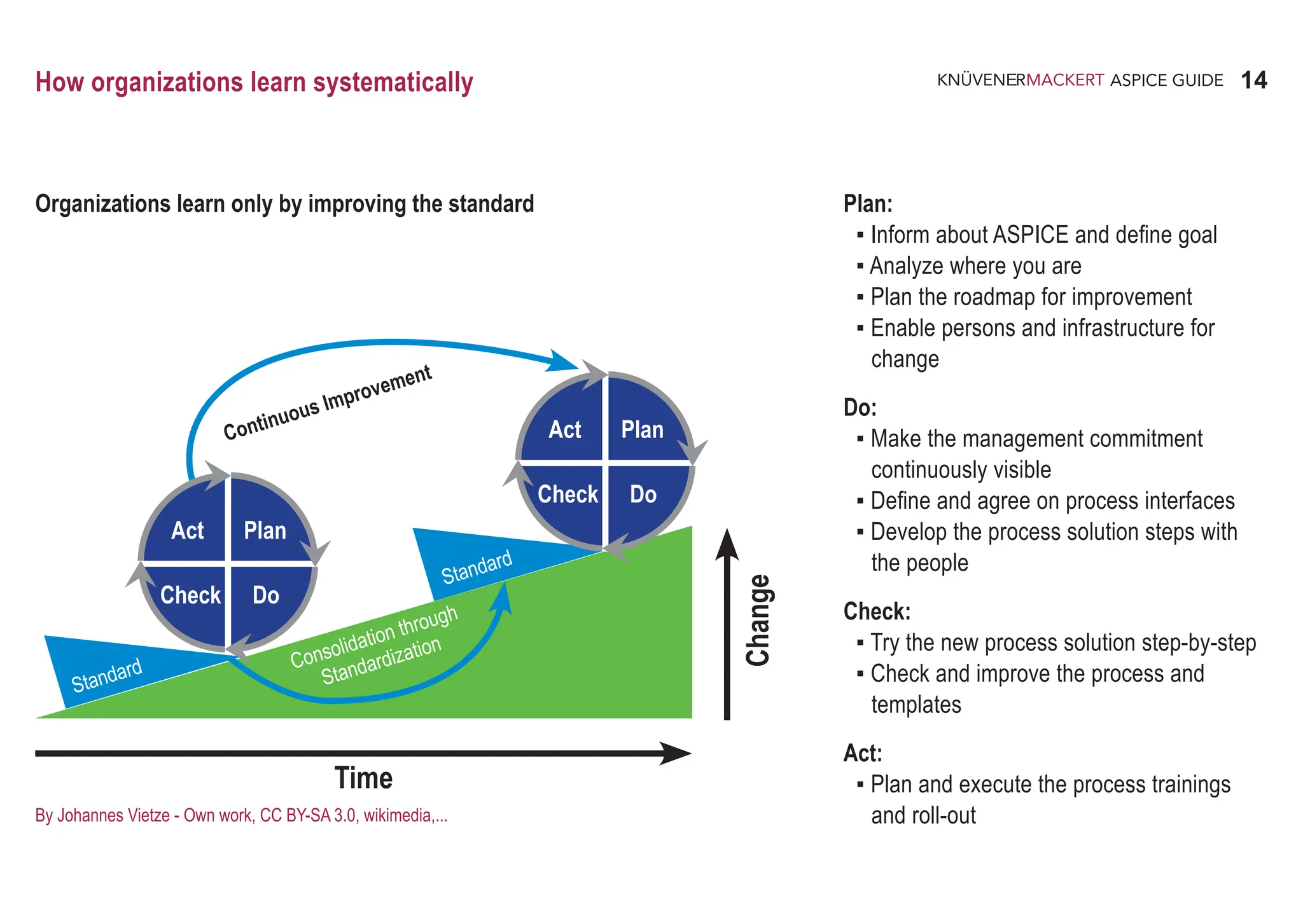
How organizations learn systematically
Plan:
▪ Inform about ASPICE and define goal
▪ Analyze where you are
▪ Plan the roadmap for improvement
▪ Enable persons and infrastructure for
change
Do:
▪ Make the management commitment
continuously visible
▪ Define and agree on process interfaces
▪ Develop the process solution steps with
the people
Check:
▪ Try the new process solution step-by-step
▪ Check and improve the process and
templates
Act:
▪ Plan and execute the process trainings
and roll-out
Change
Time
Standard
Standard
Consolidation through
Standardization
Continuous Improvement
Act Plan
Check Do
Act Plan
Check Do
By Johannes Vietze - Own work, CC BY-SA 3.0, wikimedia,...
Organizations learn only by improving the standard
15
ASPICE GUIDE
INTRODUCTION TO AUTOMOTIVE SPICE®
16
ASPICE GUIDE
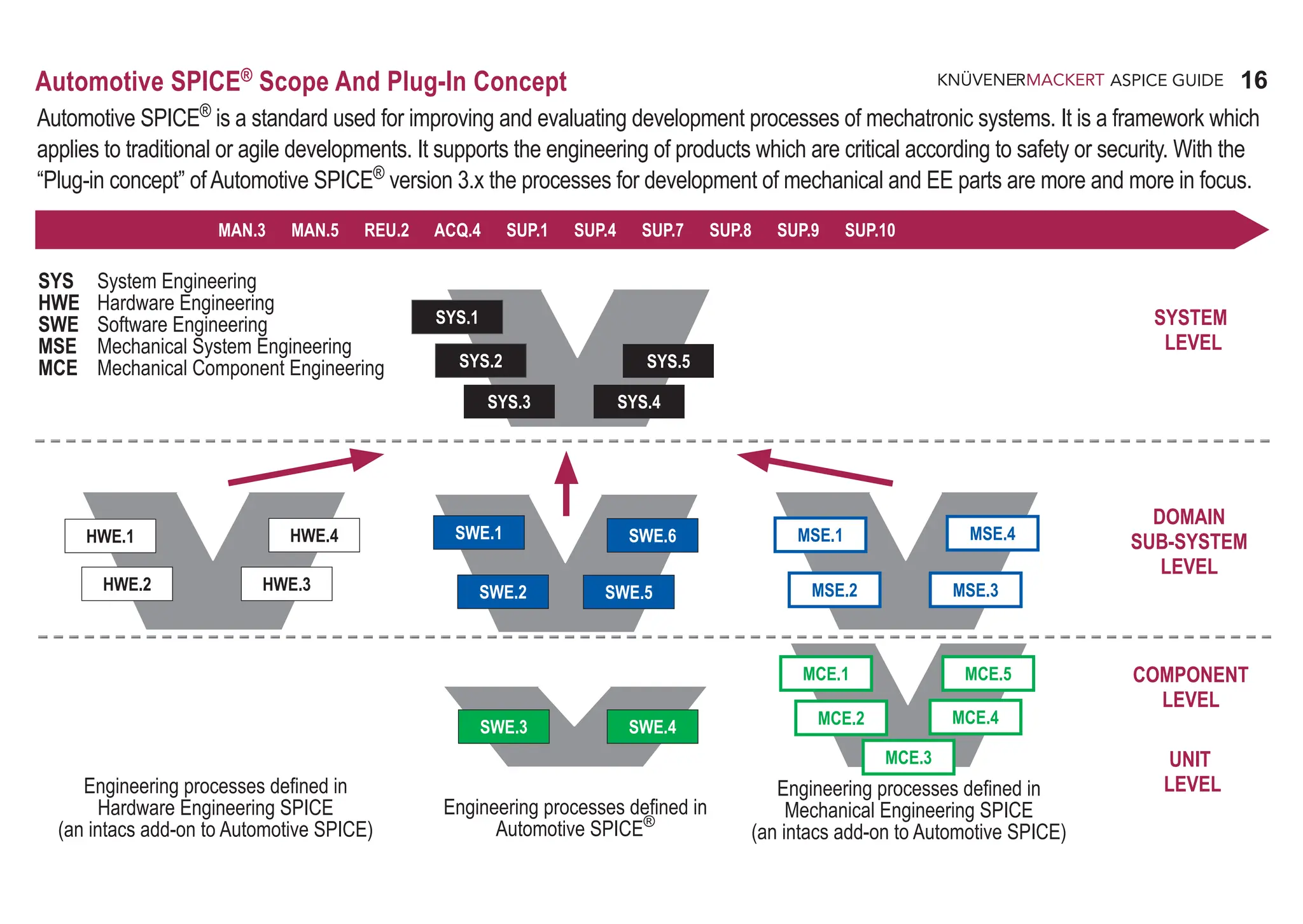
Automotive SPICE®
Scope And Plug-In Concept
SYS System Engineering
HWE Hardware Engineering
SWE Software Engineering
MSE Mechanical System Engineering
MCE Mechanical Component Engineering
SYS.1
SYS.2
SYS.3 SYS.4
SYS.5
HWE.1
HWE.2
HWE.4
HWE.3
SWE.1
SWE.2
SWE.6
SWE.5
MSE.1
MSE.2
MSE.4
MSE.3
MCE.1
MCE.2
MCE.5
MCE.4
MCE.3
SWE.4
SYSTEM
LEVEL
DOMAIN
SUB-SYSTEM
LEVEL
COMPONENT
LEVEL
UNIT
LEVEL
SWE.3
Automotive SPICE® is a standard used for improving and evaluating development processes of mechatronic systems. It is a framework which
applies to traditional or agile developments. It supports the engineering of products which are critical according to safety or security. With the
“Plug-in concept” of Automotive SPICE® version 3.x the processes for development of mechanical and EE parts are more and more in focus.
MAN.3 MAN.5 REU.2 ACQ.4 SUP.1 SUP.4 SUP.7 SUP.8 SUP.9 SUP.10
Engineering processes defined in
Mechanical Engineering SPICE
(an intacs add-on to Automotive SPICE)
Engineering processes defined in
Hardware Engineering SPICE
(an intacs add-on to Automotive SPICE)
Engineering processes defined in
Automotive SPICE®
17
ASPICE GUIDE
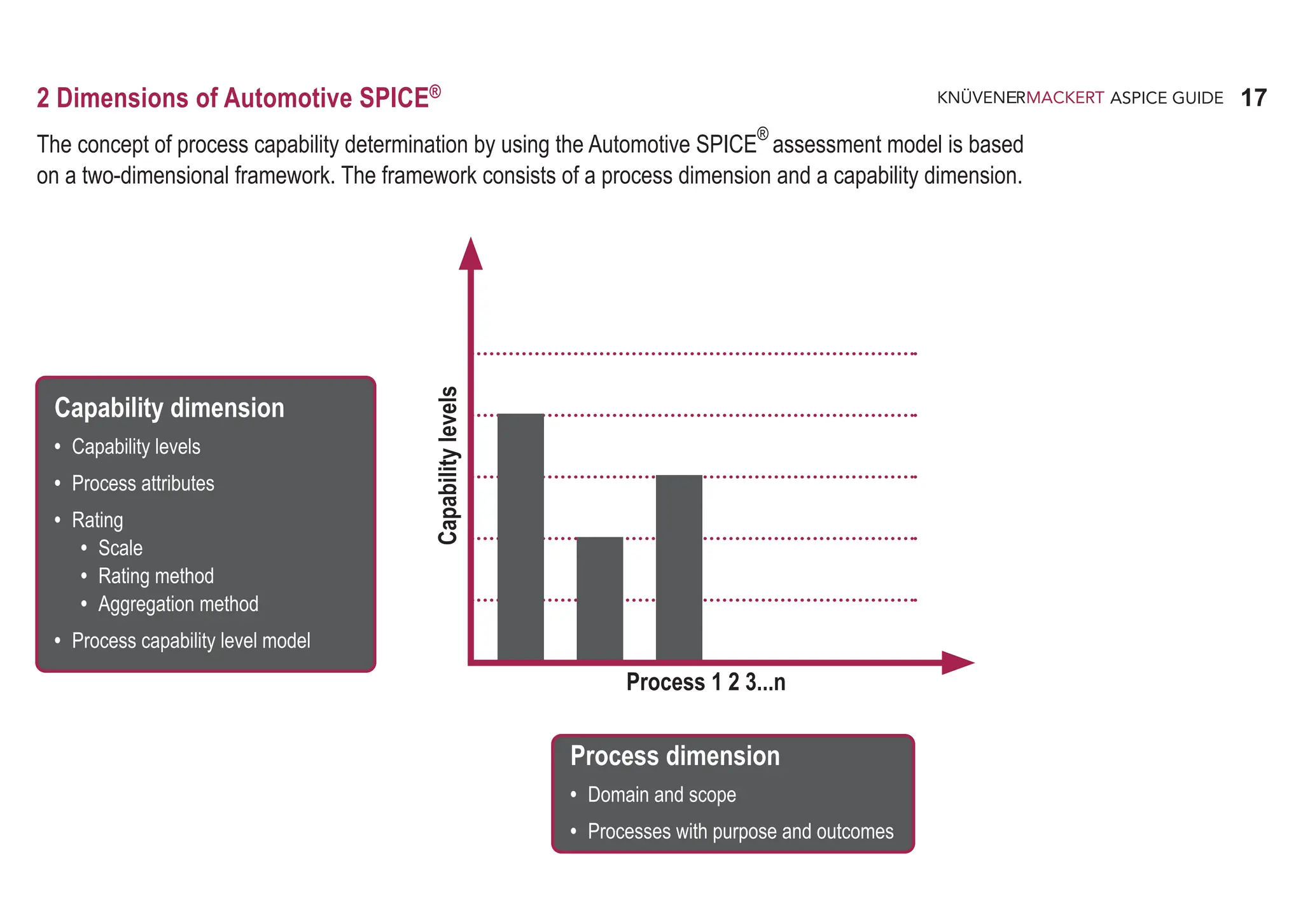
2 Dimensions of Automotive SPICE®
The concept of process capability determination by using the Automotive SPICE®
assessment model is based
on a two-dimensional framework. The framework consists of a process dimension and a capability dimension.
Capability dimension
• Capability levels
• Process attributes
• Rating
• Scale
• Rating method
• Aggregation method
• Process capability level model
Process dimension
• Domain and scope
• Processes with purpose and outcomes
Capability
levels
Process 1 2 3...n
18
ASPICE GUIDE
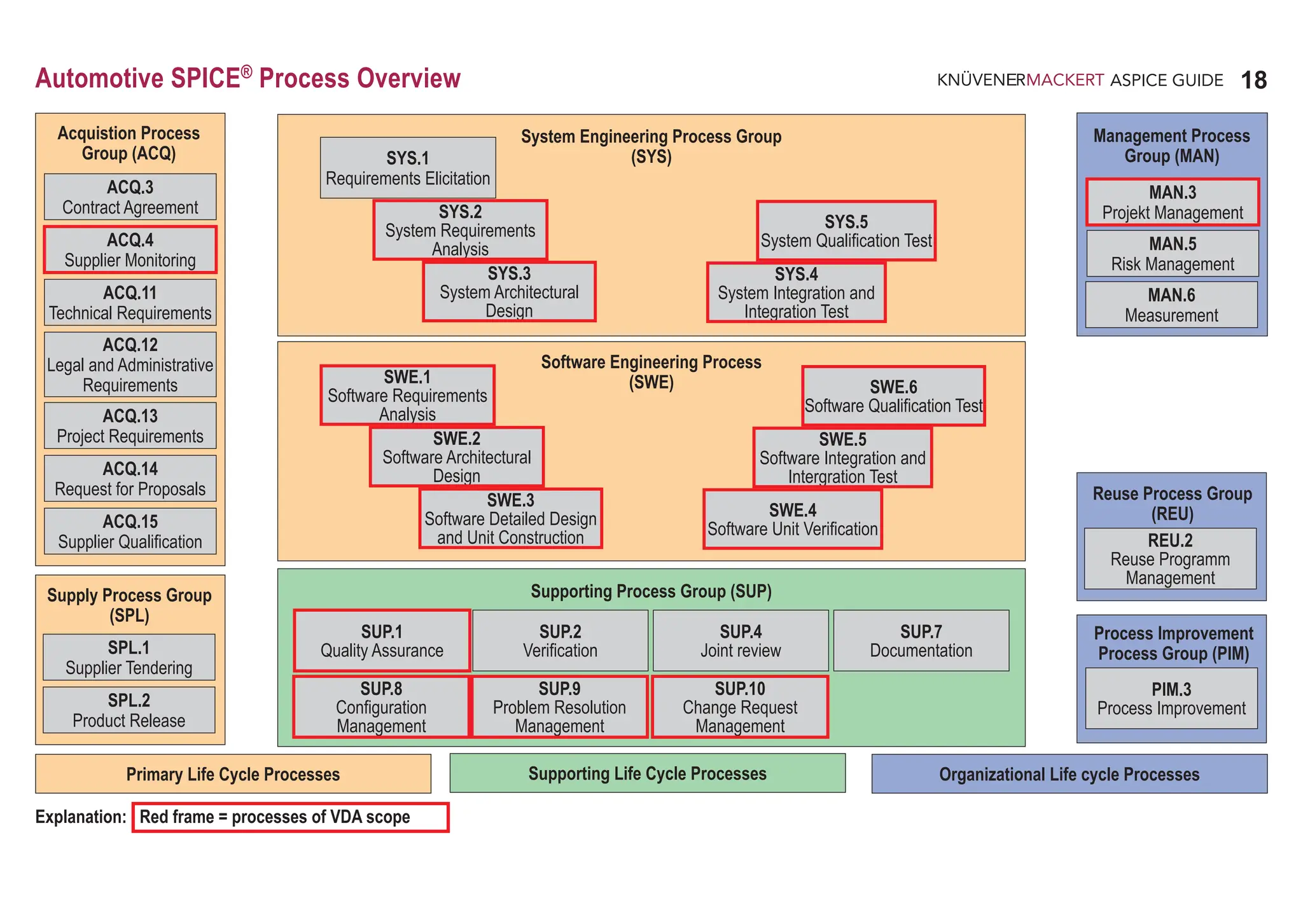
Automotive SPICE® Process Overview
ACQ.3
Contract Agreement
ACQ.4
Supplier Monitoring
ACQ.11
Technical Requirements
ACQ.12
Legal and Administrative
Requirements
ACQ.13
Project Requirements
ACQ.14
Request for Proposals
ACQ.15
Supplier Qualification
SPL.1
Supplier Tendering
SPL.2
Product Release
Primary Life Cycle Processes Supporting Life Cycle Processes Organizational Life cycle Processes
Supply Process Group
(SPL)
Acquistion Process
Group (ACQ)
Explanation: Red frame = processes of VDA scope
System Engineering Process Group
(SYS)
MAN.3
Projekt Management
MAN.5
Risk Management
MAN.6
Measurement
Management Process
Group (MAN)
SYS.3
System Architectural
Design
SYS.2
System Requirements
Analysis
SYS.5
System Qualification Test
SYS.1
Requirements Elicitation
SYS.4
System Integration and
Integration Test
Software Engineering Process
(SWE)
SWE.3
Software Detailed Design
and Unit Construction
SWE.2
Software Architectural
Design
SWE.5
Software Integration and
Intergration Test
SWE.4
Software Unit Verification
SWE.1
Software Requirements
Analysis
SWE.6
Software Qualification Test
SUP.8
Configuration
Management
SUP.1
Quality Assurance
SUP.9
Problem Resolution
Management
SUP.2
Verification
SUP.10
Change Request
Management
SUP.4
Joint review
SUP.7
Documentation
Supporting Process Group (SUP)
REU.2
Reuse Programm
Management
Reuse Process Group
(REU)
PIM.3
Process Improvement
Process Improvement
Process Group (PIM)
19
ASPICE GUIDE
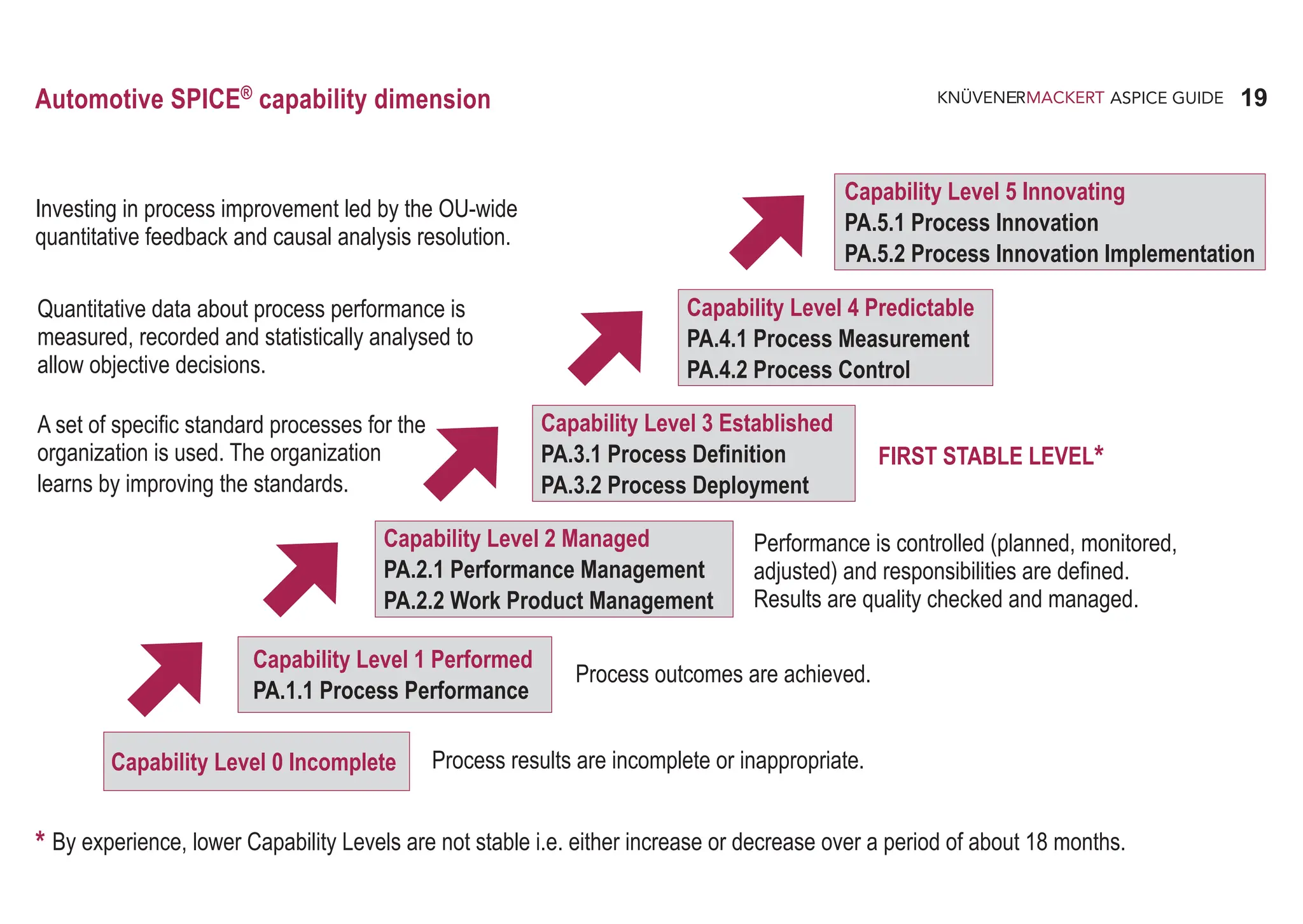
Automotive SPICE®
capability dimension
Capability Level 0 Incomplete
Capability Level 1 Performed
PA.1.1 Process Performance
Capability Level 2 Managed
PA.2.1 Performance Management
PA.2.2 Work Product Management
Capability Level 3 Established
PA.3.1 Process Definition
PA.3.2 Process Deployment
Capability Level 4 Predictable
PA.4.1 Process Measurement
PA.4.2 Process Control
Capability Level 5 Innovating
PA.5.1 Process Innovation
PA.5.2 Process Innovation Implementation
Process results are incomplete or inappropriate.
Process outcomes are achieved.
Performance is controlled (planned, monitored,
adjusted) and responsibilities are defined.
Results are quality checked and managed.
FIRST STABLE LEVEL*
Investing in process improvement led by the OU-wide
quantitative feedback and causal analysis resolution.
Quantitative data about process performance is
measured, recorded and statistically analysed to
allow objective decisions.
A set of specific standard processes for the
organization is used. The organization
learns by improving the standards.
* By experience, lower Capability Levels are not stable i.e. either increase or decrease over a period of about 18 months.
20
ASPICE GUIDE
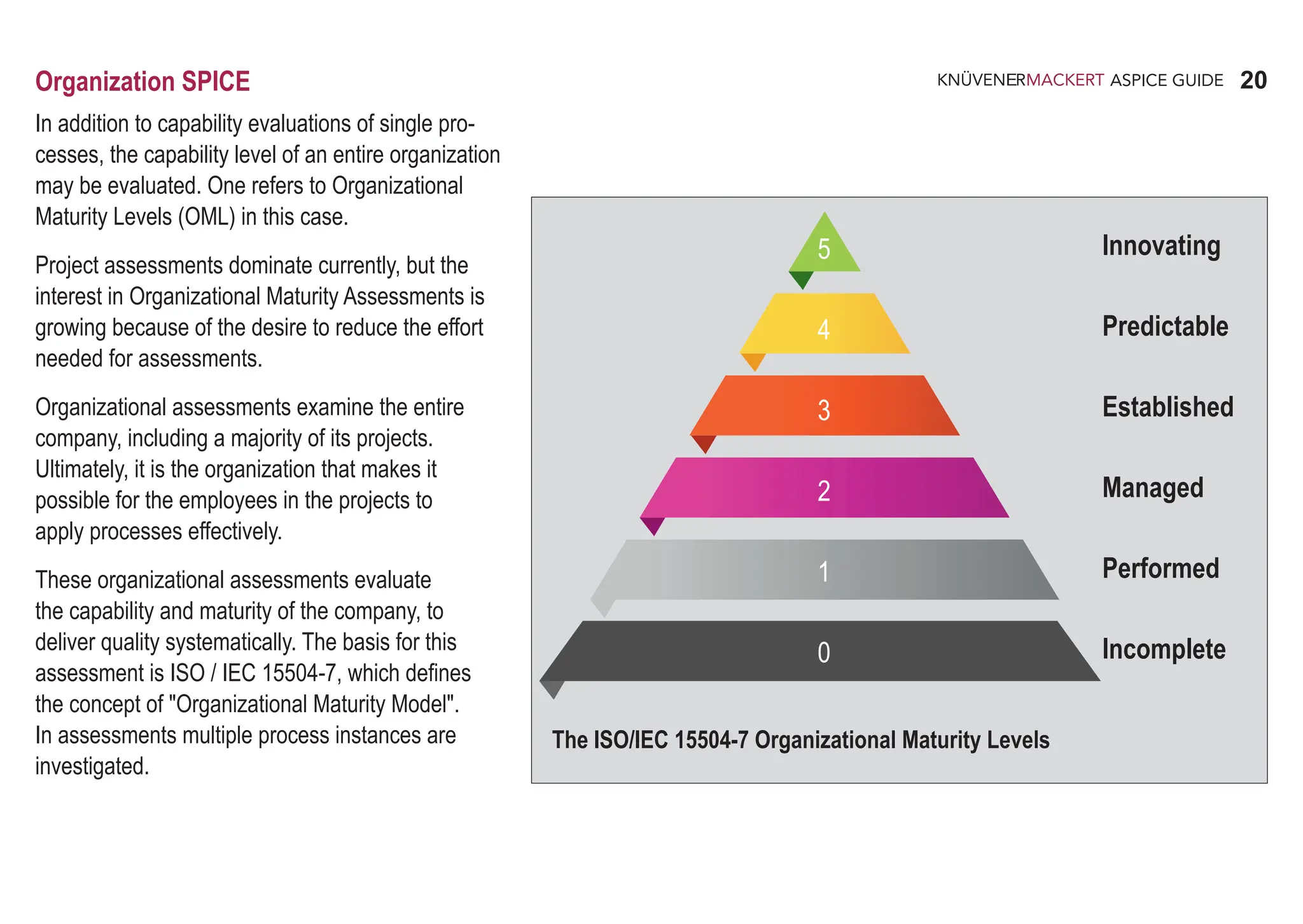
Organization SPICE
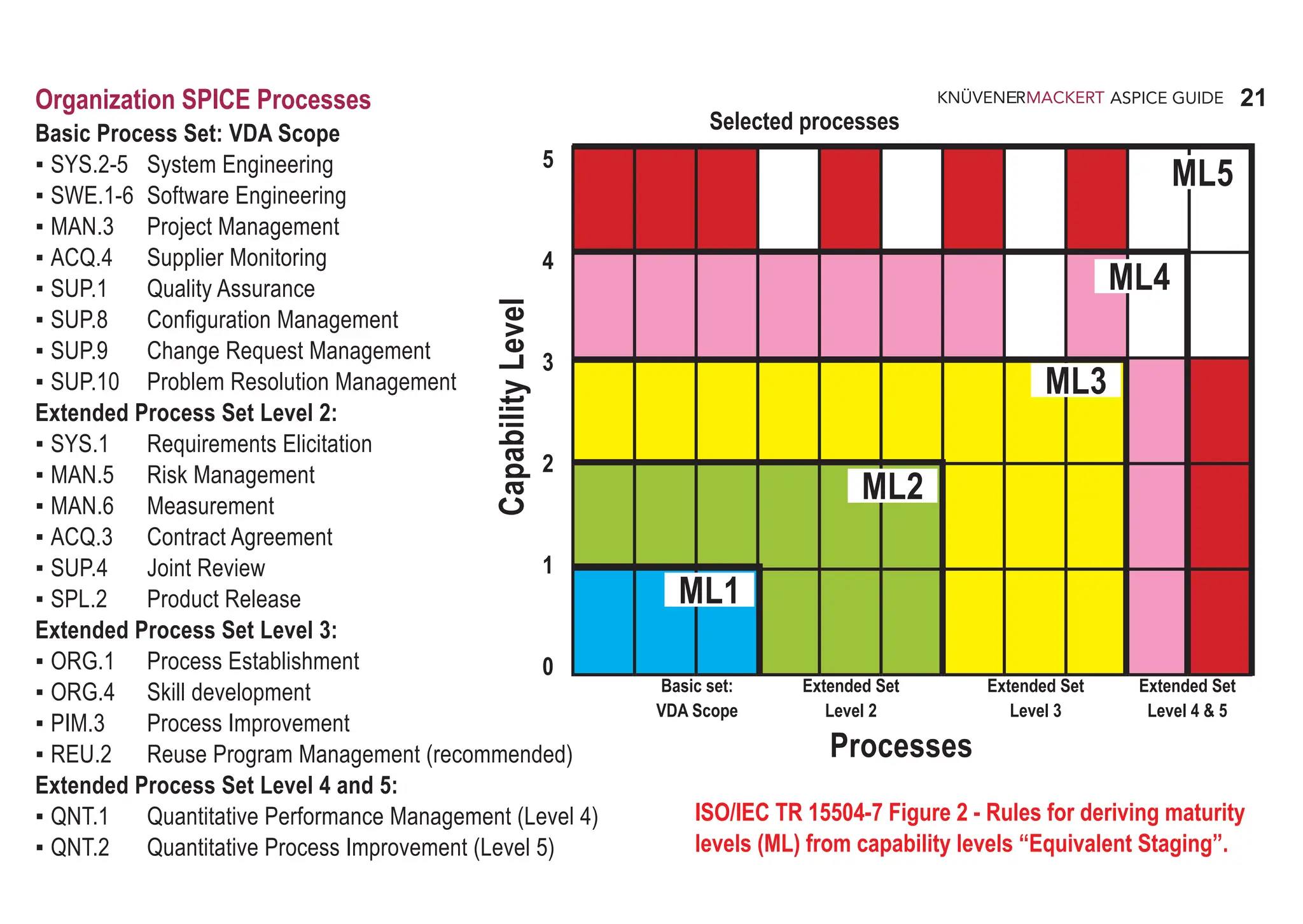
In addition to capability evaluations of single pro-
cesses, the capability level of an entire organization
may be evaluated. One refers to Organizational
Maturity Levels (OML) in this case.
Project assessments dominate currently, but the
interest in Organizational Maturity Assessments is
growing because of the desire to reduce the effort
needed for assessments.
Organizational assessments examine the entire
company, including a majority of its projects.
Ultimately, it is the organization that makes it
possible for the employees in the projects to
apply processes effectively.
These organizational assessments evaluate
the capability and maturity of the company, to
deliver quality systematically. The basis for this
assessment is ISO / IEC 15504-7, which defines
the concept of "Organizational Maturity Model".
In assessments multiple process instances are
investigated.
The ISO/IEC 15504-7 Organizational Maturity Levels
5
4
3
2
1
0
Innovating
Predictable
Established
Managed
Performed
Incomplete
21
ASPICE GUIDE
Organization SPICE Processes
ISO/IEC TR 15504-7 Figure 2 - Rules for deriving maturity
levels (ML) from capability levels “Equivalent Staging”.
Capability
Level
5
4
3
2
1
0
Processes
Basic set:
VDA Scope
Extended Set
Level 2
Extended Set
Level 3
ML5
ML4
ML3
ML2
ML1
Extended Set
Level 4 & 5
Selected processes
Basic Process Set: VDA Scope
▪ SYS.2-5 System Engineering
▪ SWE.1-6 Software Engineering
▪ MAN.3 Project Management
▪ ACQ.4 Supplier Monitoring
▪ SUP.1 Quality Assurance
▪ SUP.8 Configuration Management
▪ SUP.9 Change Request Management
▪ SUP.10 Problem Resolution Management
Extended Process Set Level 2:
▪ SYS.1 Requirements Elicitation
▪ MAN.5 Risk Management
▪ MAN.6 Measurement
▪ ACQ.3 Contract Agreement
▪ SUP.4 Joint Review
▪ SPL.2 Product Release
Extended Process Set Level 3:
▪ ORG.1 Process Establishment
▪ ORG.4 Skill development
▪ PIM.3 Process Improvement
▪ REU.2 Reuse Program Management (recommended)
Extended Process Set Level 4 and 5:
▪ QNT.1 Quantitative Performance Management (Level 4)
▪ QNT.2 Quantitative Process Improvement (Level 5)
22
ASPICE GUIDE
AUTOMOTIVE SPICE® KEY CONCEPTS
23
ASPICE GUIDE
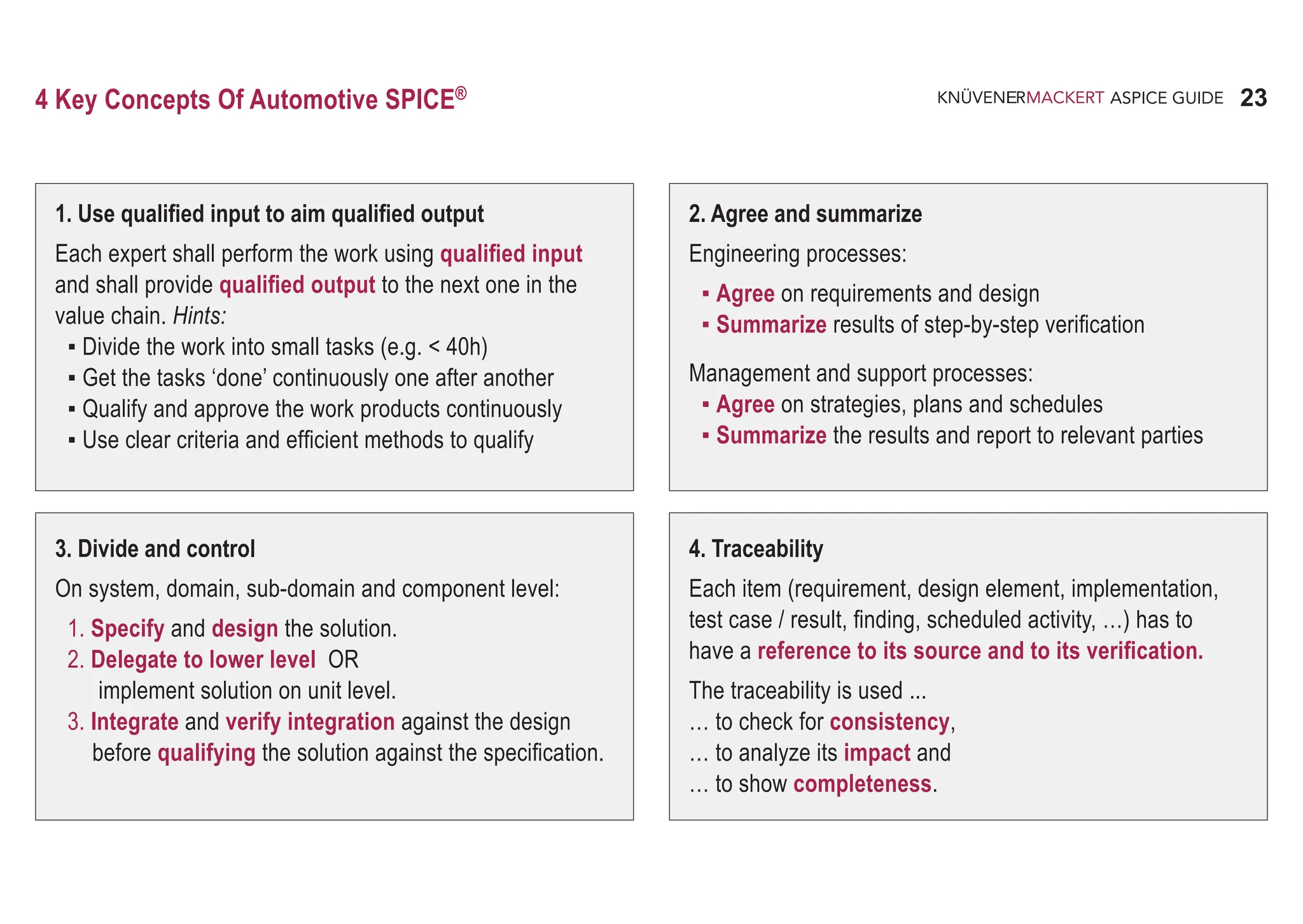
4 Key Concepts Of Automotive SPICE®
3. Divide and control
On system, domain, sub-domain and component level:
1. Specify and design the solution.
2. Delegate to lower level OR
implement solution on unit level.
3. Integrate and verify integration against the design
before qualifying the solution against the specification.
4. Traceability
Each item (requirement, design element, implementation,
test case / result, finding, scheduled activity, …) has to
have a reference to its source and to its verification.
The traceability is used ...
… to check for consistency,
… to analyze its impact and
… to show completeness.
1. Use qualified input to aim qualified output
Each expert shall perform the work using qualified input
and shall provide qualified output to the next one in the
value chain. Hints:
▪ Divide the work into small tasks (e.g. < 40h)
▪ Get the tasks ‘done’ continuously one after another
▪ Qualify and approve the work products continuously
▪ Use clear criteria and efficient methods to qualify
2. Agree and summarize
Engineering processes:
▪ Agree on requirements and design
▪ Summarize results of step-by-step verification
Management and support processes:
▪ Agree on strategies, plans and schedules
▪ Summarize the results and report to relevant parties
24
ASPICE GUIDE
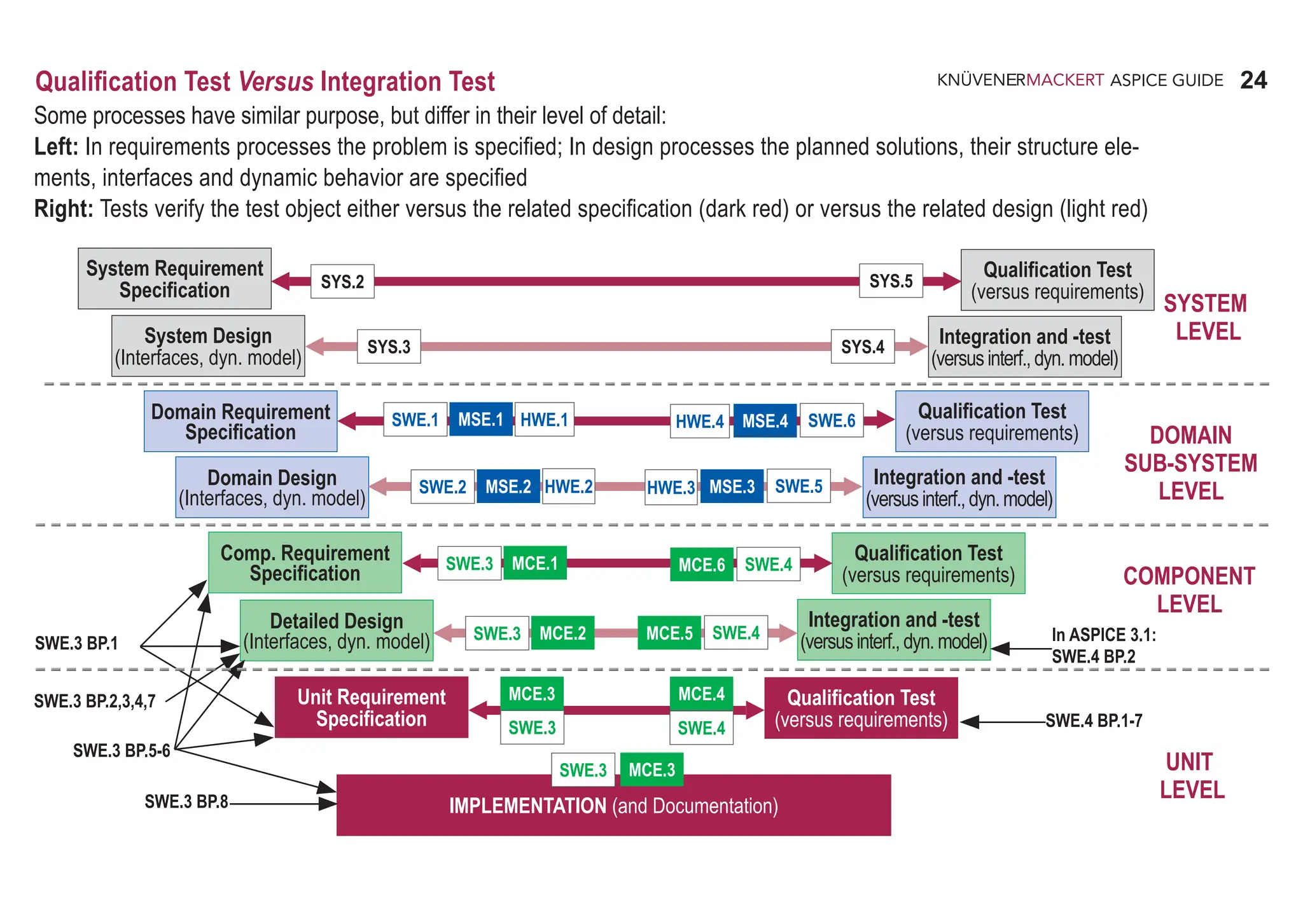
Qualification Test Versus Integration Test
Some processes have similar purpose, but differ in their level of detail:
Left: In requirements processes the problem is specified; In design processes the planned solutions, their structure ele-
ments, interfaces and dynamic behavior are specified
Right: Tests verify the test object either versus the related specification (dark red) or versus the related design (light red)
System Requirement
Specification
System Design
(Interfaces, dyn. model)
Domain Requirement
Specification
Domain Design
(Interfaces, dyn. model)
Comp. Requirement
Specification
Detailed Design
(Interfaces, dyn. model)
Unit Requirement
Specification
IMPLEMENTATION (and Documentation)
Qualification Test
(versus requirements)
Qualification Test
(versus requirements)
Integration and -test
(versusinterf.,dyn.model)
Qualification Test
(versus requirements)
Integration and -test
(versusinterf.,dyn.model)
Integration and -test
(versusinterf.,dyn.model)
Qualification Test
(versus requirements)
MSE.1
SWE.1
SYS.2
SYS.3
MSE.2
SWE.2
MCE.1
SWE.3
MCE.2
SWE.3
MCE.3
SWE.3
MCE.4
SWE.4
SWE.3
MCE.5 SWE.4
MCE.6 SWE.4
MSE.3 SWE.5
MSE.4 SWE.6
SYS.5
SYS.4
SWE.3 BP.1
SWE.3 BP.8
SWE.3 BP.5-6
SWE.3 BP.2,3,4,7
In ASPICE 3.1:
SWE.4 BP.2
SWE.4 BP.1-7
MCE.3
SYSTEM
LEVEL
DOMAIN
SUB-SYSTEM
LEVEL
COMPONENT
LEVEL
UNIT
LEVEL
HWE.4
HWE.1
HWE.2 HWE.3
25
ASPICE GUIDE
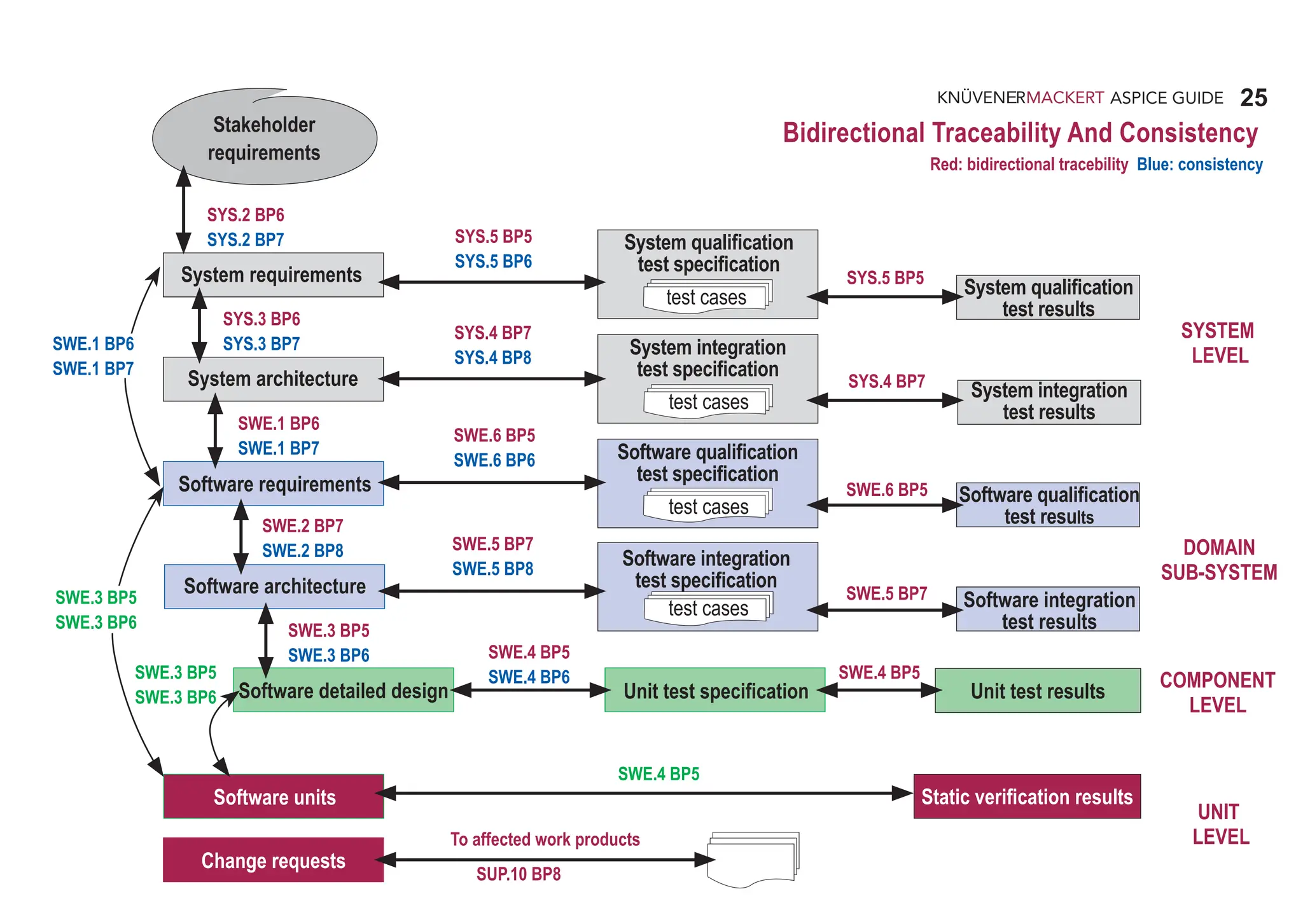
Bidirectional Traceability And Consistency
Stakeholder
requirements
System requirements
System architecture
Software requirements
Software architecture
Software detailed design
Software units
Change requests
System qualification
test specification
System qualification
test results
System integration
test results
Software qualification
test results
Software integration
test results
test cases
Unit test results
Static verification results
System integration
test specification
test cases
Software qualification
test specification
test cases
Software integration
test specification
test cases
Unit test specification
SYS.5 BP5
SYS.5 BP6
SYS.4 BP7
SYS.4 BP8
SWE.6 BP5
SWE.6 BP6
SWE.5 BP7
SWE.5 BP8
SYS.5 BP5
SWE.4 BP5
To affected work products
SUP.10 BP8
SWE.3 BP5
SWE.3 BP6
SWE.1 BP6
SWE.1 BP7
SWE.3 BP5
SWE.3 BP6
SYS.3 BP6
SYS.3 BP7
SWE.1 BP6
SWE.1 BP7
SYS.2 BP6
SYS.2 BP7
SWE.2 BP7
SWE.2 BP8
SWE.3 BP5
SWE.3 BP6
SYS.4 BP7
SWE.6 BP5
SWE.5 BP7
SWE.4 BP5
SWE.4 BP5
SWE.4 BP6
SYSTEM
LEVEL
DOMAIN
SUB-SYSTEM
COMPONENT
LEVEL
UNIT
LEVEL
Red: bidirectional tracebility Blue: consistency
26
ASPICE GUIDE
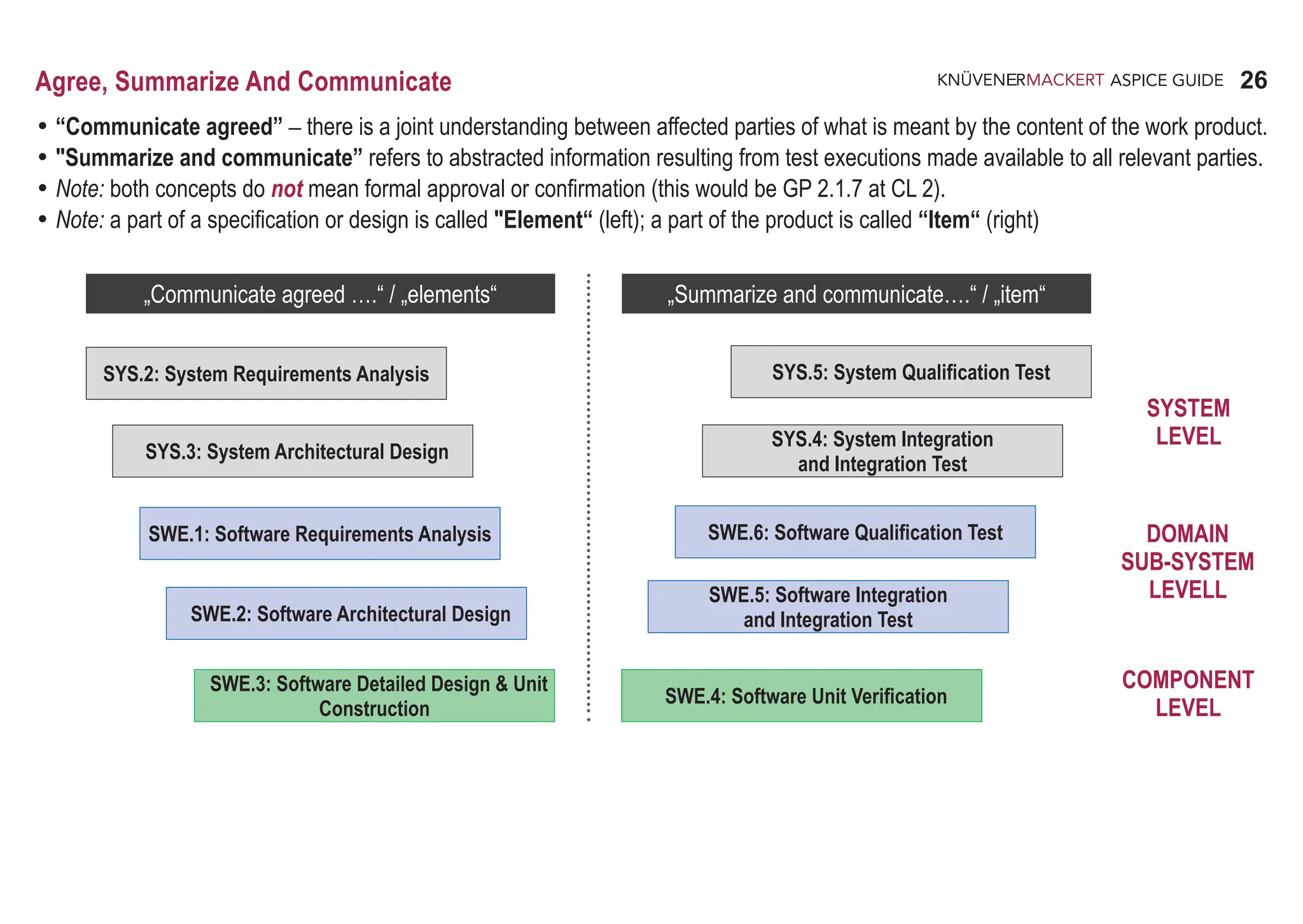
Agree, Summarize And Communicate
• “Communicate agreed” – there is a joint understanding between affected parties of what is meant by the content of the work product.
• "Summarize and communicate” refers to abstracted information resulting from test executions made available to all relevant parties.
• Note: both concepts do not mean formal approval or confirmation (this would be GP 2.1.7 at CL 2).
• Note: a part of a specification or design is called "Element“ (left); a part of the product is called “Item“ (right)
„Communicate agreed ….“ / „elements“
SYS.2: System Requirements Analysis
SYS.3: System Architectural Design
SYS.5: System Qualification Test
SYS.4: System Integration
and Integration Test
SWE.1: Software Requirements Analysis
SWE.2: Software Architectural Design
SWE.3: Software Detailed Design & Unit
Construction
SWE.6: Software Qualification Test
SWE.5: Software Integration
and Integration Test
SWE.4: Software Unit Verification
„Summarize and communicate….“ / „item“
SYSTEM
LEVEL
DOMAIN
SUB-SYSTEM
LEVELL
COMPONENT
LEVEL
27
ASPICE GUIDE
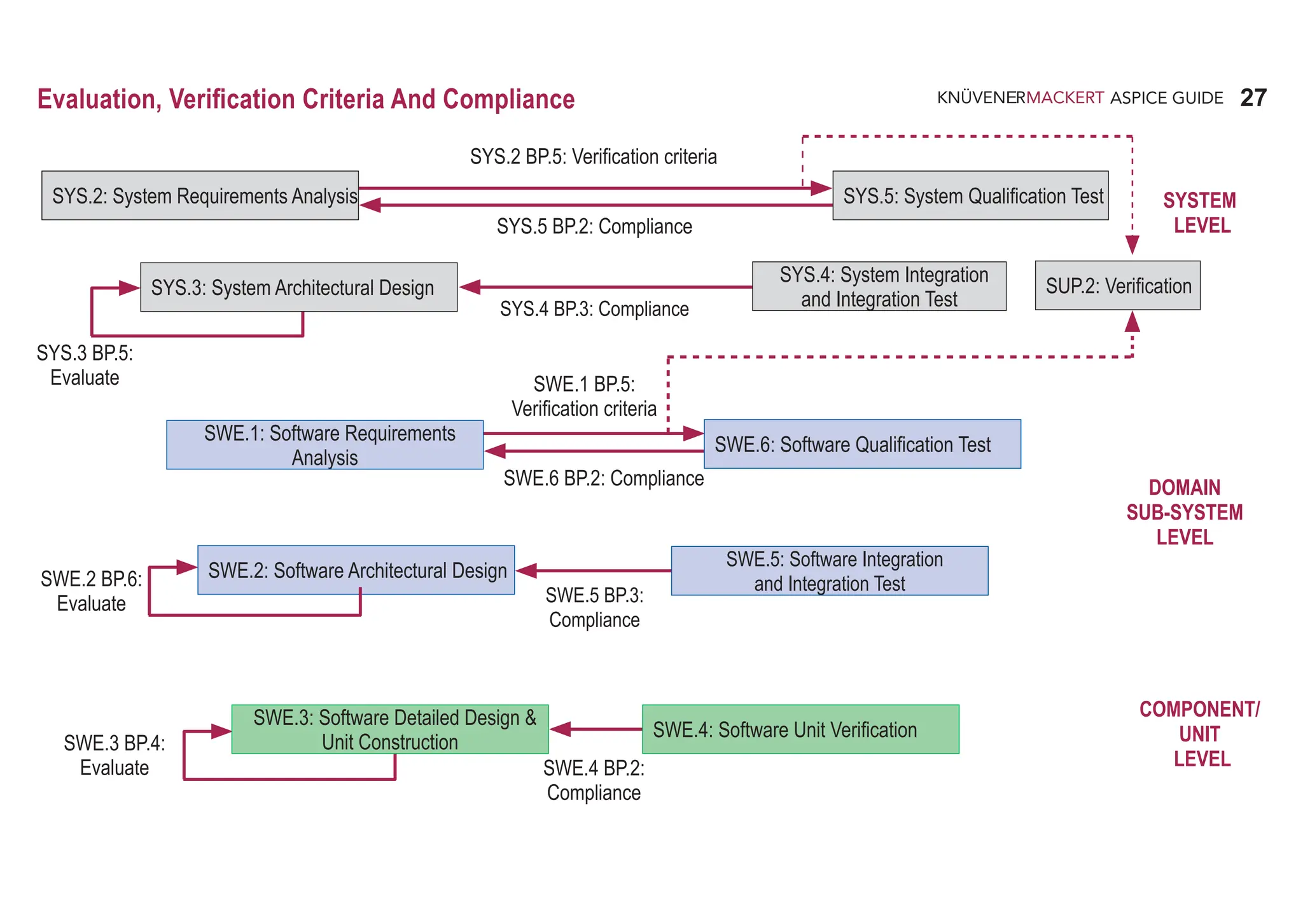
Evaluation, Verification Criteria And Compliance
SYS.2: System Requirements Analysis
SYS.3: System Architectural Design
SWE.1: Software Requirements
Analysis
SWE.2: Software Architectural Design
SWE.3: Software Detailed Design &
Unit Construction
SWE.6: Software Qualification Test
SWE.5: Software Integration
and Integration Test
SWE.4: Software Unit Verification
SUP.2: Verification
SYS.3 BP.5:
Evaluate
SYS.5: System Qualification Test
SYS.4: System Integration
and Integration Test
SYS.2 BP.5: Verification criteria
SWE.2 BP.6:
Evaluate
SWE.3 BP.4:
Evaluate
SYS.5 BP.2: Compliance
SYS.4 BP.3: Compliance
SWE.6 BP.2: Compliance
SWE.1 BP.5:
Verification criteria
SWE.5 BP.3:
Compliance
SWE.4 BP.2:
Compliance
SYSTEM
LEVEL
DOMAIN
SUB-SYSTEM
LEVEL
COMPONENT/
UNIT
LEVEL
28
ASPICE GUIDE
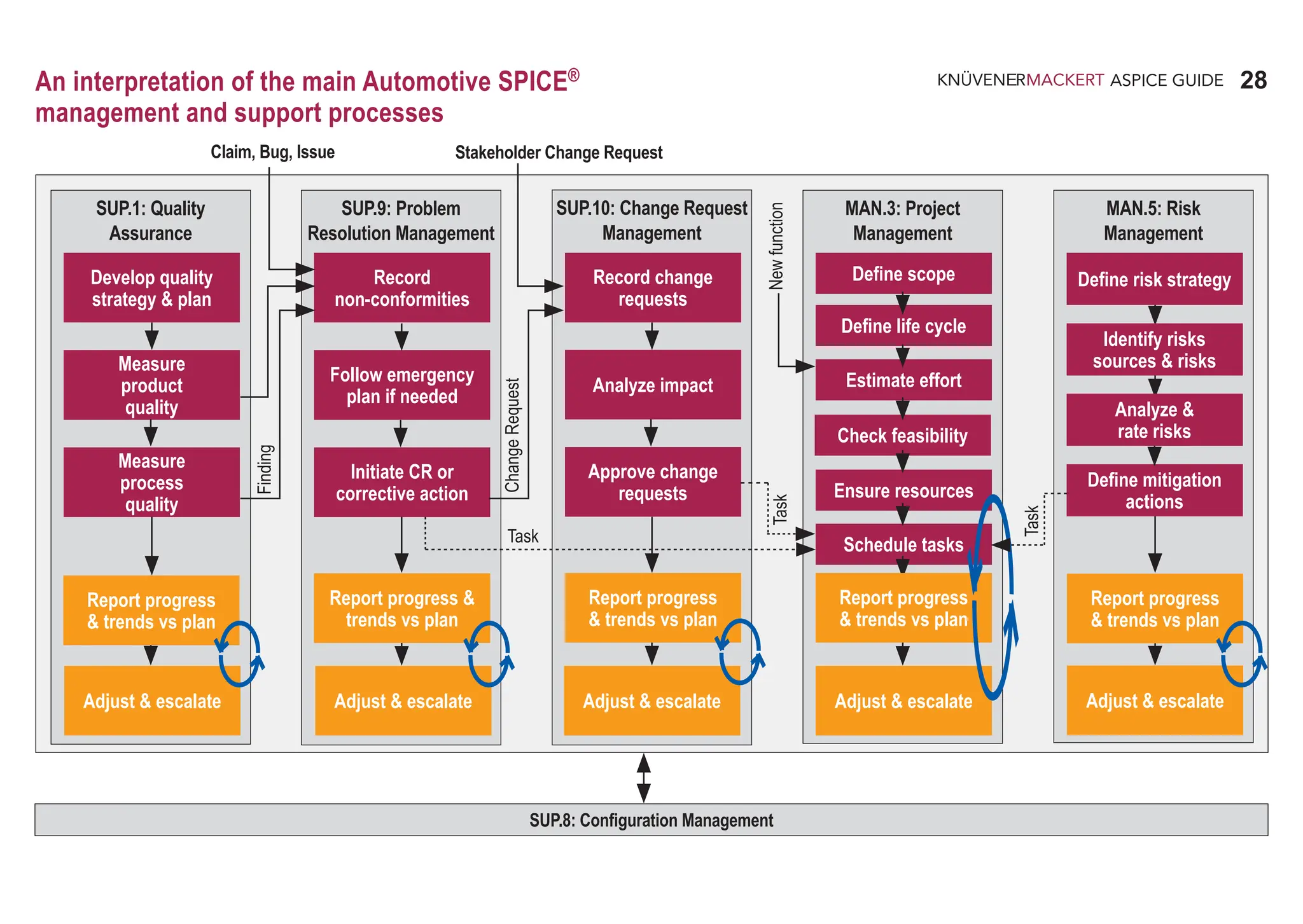
SUP.8: Configuration Management
An interpretation of the main Automotive SPICE®
management and support processes
Finding
Claim, Bug, Issue Stakeholder Change Request
Develop quality
strategy & plan
Measure
product
quality
SUP.1: Quality
Assurance
Adjust & escalate
Measure
process
quality
Develop quality
strategy & plan
Develop quality
strategy & plan
Develop quality
strategy & plan
Develop quality
strategy & plan
Develop quality
strategy & plan
Develop quality
strategy & plan
Develop quality
strategy & plan
Develop quality
strategy & plan
Develop quality
strategy & plan
Develop quality
strategy & plan
Develop quality
strategy & plan
Develop quality
strategy & plan
Define mitigation
actions
MAN.5: Risk
Management
Adjust & escalate
Record change
requests
Analyze impact
SUP.10: Change Request
Management
Adjust & escalate
Approve change
requests
Define scope
Define life cycle
Estimate effort
Check feasibility
Ensure resources
Schedule tasks
MAN.3: Project
Management
Adjust & escalate
Record
non-conformities
Follow emergency
plan if needed
SUP.9: Problem
Resolution Management
Adjust & escalate
Initiate CR or
corrective action
Change
Request
New
function
Task
Task
Analyze &
rate risks
Identify risks
sources & risks
Define risk strategy
Task
Report progress
& trends vs plan
Report progress &
trends vs plan
Report progress
& trends vs plan
Report progress
& trends vs plan
Report progress
& trends vs plan
29
ASPICE GUIDE
To which degree is the
purpose achieved?
How to apply the process elements?
20
04-02 Domain architecture [OUTCOME 2] 13-04 Communication record [OUTCOME 7]
04-03 Domain model [OUTCOME 2] 15-07 Reuse evaluation report [OUTCOME 5, 6, 8]
08-17 Reuse plan [OUTCOME 5, 6] 15-13 Assessment/audit report [OUTCOME 3, 4]
09-03 Reuse policy [OUTCOME 1] 19-05 Reuse strategy [OUTCOME 1]
12-03 Reuse proposal [OUTCOME 4]
REU.2 Reuse Program Management
The purpose of the Reuse Program Management Process is to plan, establish, manage, control, and monitor an organization’s reuse
program and to systematically exploit reuse opportunities.
Process outcomes – as a result of successful implementation of this process
1. the reuse strategy, including its purpose, scope, goals and objectives, is defined;
2. each domain is assessed to determine its reuse potential;
3. the domains in which to investigate reuse opportunities, or in which it is intended to practice reuse, are identified;
4. the organization's systematic reuse capability is assessed;
5. reuse proposals are evaluated to ensure the reuse product is suitable for the proposed application;
6. reuse is implemented according to the reuse strategy;
7. feedback, communication, and notification mechanisms are established, that operate between affected parties; and
8. the reuse program is monitored and evaluated.
Output work products
21
BP 6
BP 4
Define organizational reuse strategy. Define the reuse program and necessary supporting infrastructure for the organization.
[Outcome 1]
Identify domains for potential reuse. Identify set(s) of systems and their components in terms of common properties that
can be organized into a collection of reusable assets that may be used to construct systems in the domain. [OUTCOME 2]
Assess domains for potential reuse. Assess each domain to identify potential use and applications of reusable components
and products. [OUTCOME 3]
Assess reuse maturity. Gain an understanding of the reuse readiness and maturity of the organization, to provide a baseline
and success criteria for reuse program management. [OUTCOME 4]
Evaluate reuse proposals. Evaluate suitability of the provided reusable components and product(s) to proposed use.
[OUTCOME 5]
Implement the reuse program. Perform the defined activities identified in the reuse program. [OUTCOME 6]
Get feedback from reuse. Establish feedback, assessment, communication and notification mechanism that operate between
affected parties to control the progress of reuse program. [OUTCOME 7, 8]
Affected parties may include reuse program administrators, asset managers, domain engineers, developers, operators,
and maintenance groups.
Monitor reuse. Monitor the implementation of the reuse program periodically and evaluate its suitability to actual needs.
[OUTCOME 6, 8]
The quality requirements for re-use work products should be defined.
REU.2 with 8 Base practices
BP 1
BP 8
BP 3
2
BP 2
BP 5
BP 7
1
… for process improvement? .... in an assessment?
What benefit does this
process offer?
What are the typical
results?
What are typical
artefacts?
What are the expected
practices to achieve
the purpose?
Do the work products
provide complete
information?
How effective is the
implementation of
these practices?
Do the outputs
provide sufficient
evidence?
30
ASPICE GUIDE
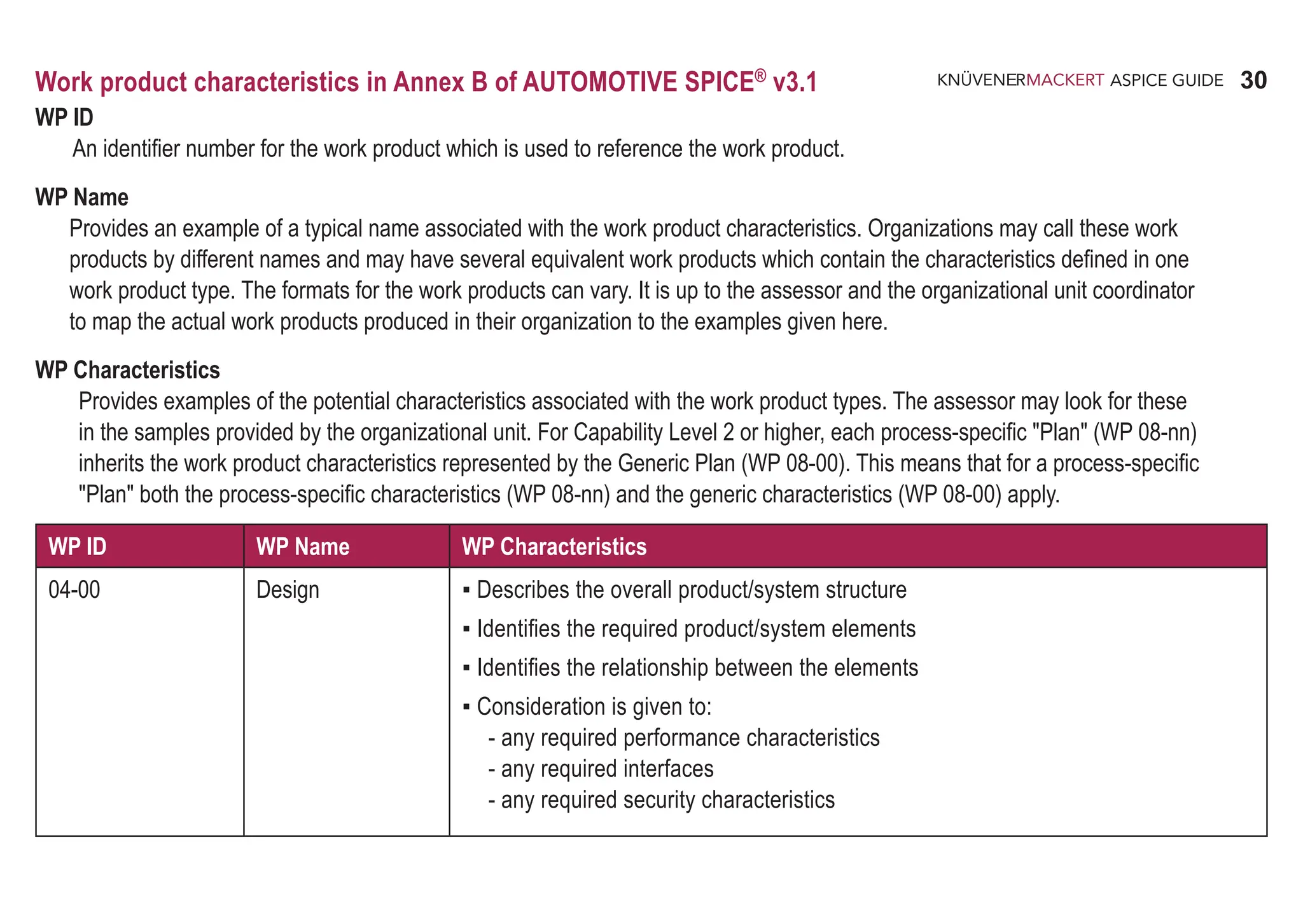
WP ID
An identifier number for the work product which is used to reference the work product.
WP Name
Provides an example of a typical name associated with the work product characteristics. Organizations may call these work
products by different names and may have several equivalent work products which contain the characteristics defined in one
work product type. The formats for the work products can vary. It is up to the assessor and the organizational unit coordinator
to map the actual work products produced in their organization to the examples given here.
WP Characteristics
Provides examples of the potential characteristics associated with the work product types. The assessor may look for these
in the samples provided by the organizational unit. For Capability Level 2 or higher, each process-specific "Plan" (WP 08-nn)
inherits the work product characteristics represented by the Generic Plan (WP 08-00). This means that for a process-specific
"Plan" both the process-specific characteristics (WP 08-nn) and the generic characteristics (WP 08-00) apply.
Work product characteristics in Annex B of AUTOMOTIVE SPICE®
v3.1
WP ID WP Name WP Characteristics
04-00 Design ▪ Describes the overall product/system structure
▪ Identifies the required product/system elements
▪ Identifies the relationship between the elements
▪ Consideration is given to:
- any required performance characteristics
- any required interfaces
- any required security characteristics
31
ASPICE GUIDE
Work product characteristics – Example in Annex B of Automotive SPICE v3.1
WP ID WP Name WP Characteristics
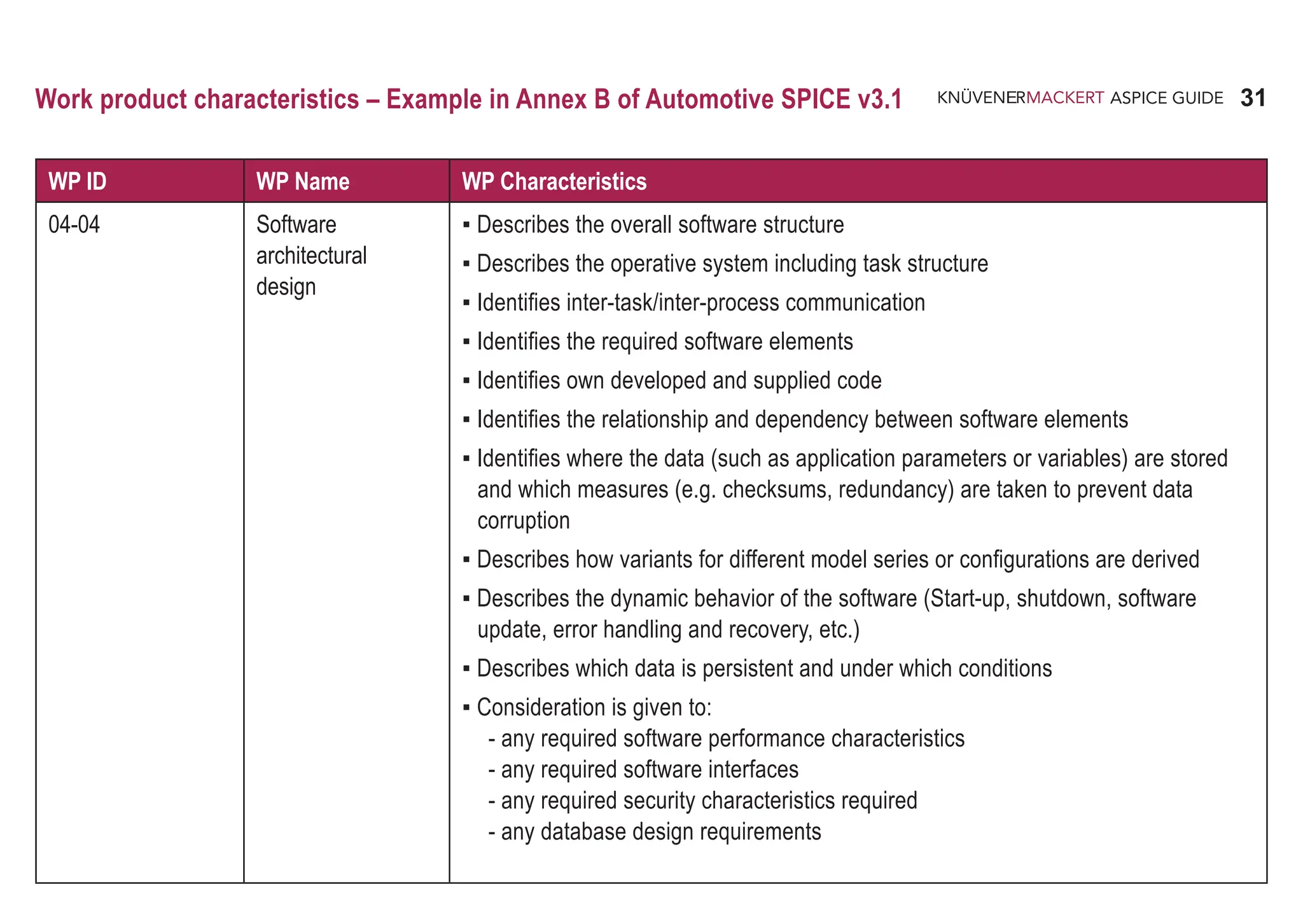
04-04 Software
architectural
design
▪ Describes the overall software structure
▪ Describes the operative system including task structure
▪ Identifies inter-task/inter-process communication
▪ Identifies the required software elements
▪ Identifies own developed and supplied code
▪ Identifies the relationship and dependency between software elements
▪ Identifies where the data (such as application parameters or variables) are stored
and which measures (e.g. checksums, redundancy) are taken to prevent data
corruption
▪ Describes how variants for different model series or configurations are derived
▪ Describes the dynamic behavior of the software (Start-up, shutdown, software
update, error handling and recovery, etc.)
▪ Describes which data is persistent and under which conditions
▪ Consideration is given to:
- any required software performance characteristics
- any required software interfaces
- any required security characteristics required
- any database design requirements
32
ASPICE GUIDE
Automotive SPICE®
and Agility
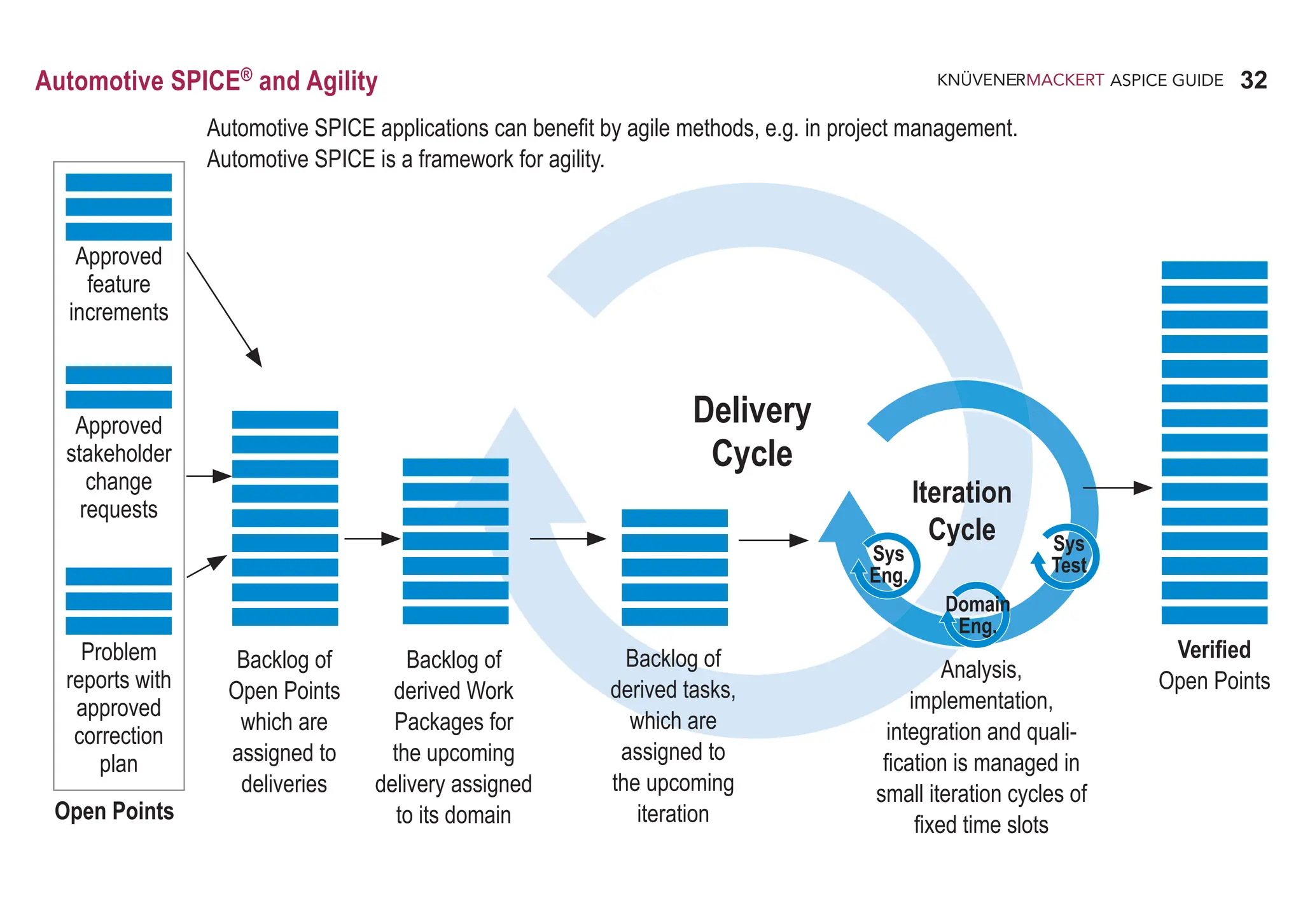
Automotive SPICE applications can benefit by agile methods, e.g. in project management.
Automotive SPICE is a framework for agility.
Approved
feature
increments
Approved
stakeholder
change
requests
Problem
reports with
approved
correction
plan
Open Points
Backlog of
Open Points
which are
assigned to
deliveries
Backlog of
derived Work
Packages for
the upcoming
delivery assigned
to its domain
Backlog of
derived tasks,
which are
assigned to
the upcoming
iteration
Analysis,
implementation,
integration and quali-
fication is managed in
small iteration cycles of
fixed time slots
Verified
Open Points
Iteration
Cycle
Delivery
Cycle
Sys
Eng.
Domain
Eng.
Sys
Test
33
ASPICE GUIDE
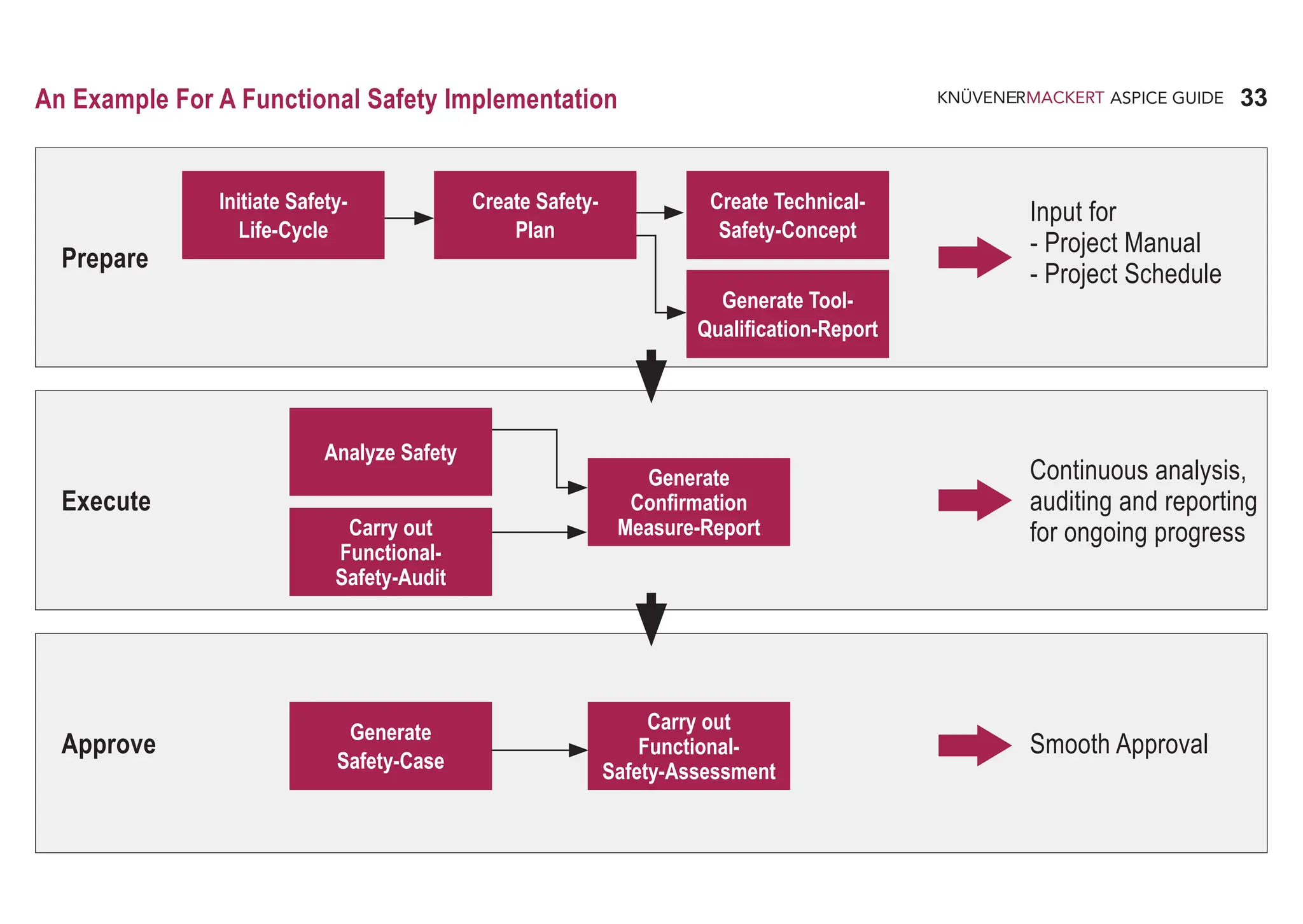
An Example For A Functional Safety Implementation
Prepare
Execute
Approve
Input for
- Project Manual
- Project Schedule
Continuous analysis,
auditing and reporting
for ongoing progress
Smooth Approval
Initiate Safety-
Life-Cycle
Create Safety-
Plan
Create Technical-
Safety-Concept
Generate Tool-
Qualification-Report
Analyze Safety
Carry out
Functional-
Safety-Audit
Generate
Confirmation
Measure-Report
Generate
Safety-Case
Carry out
Functional-
Safety-Assessment
34
ASPICE GUIDE
Automotive SPICE®
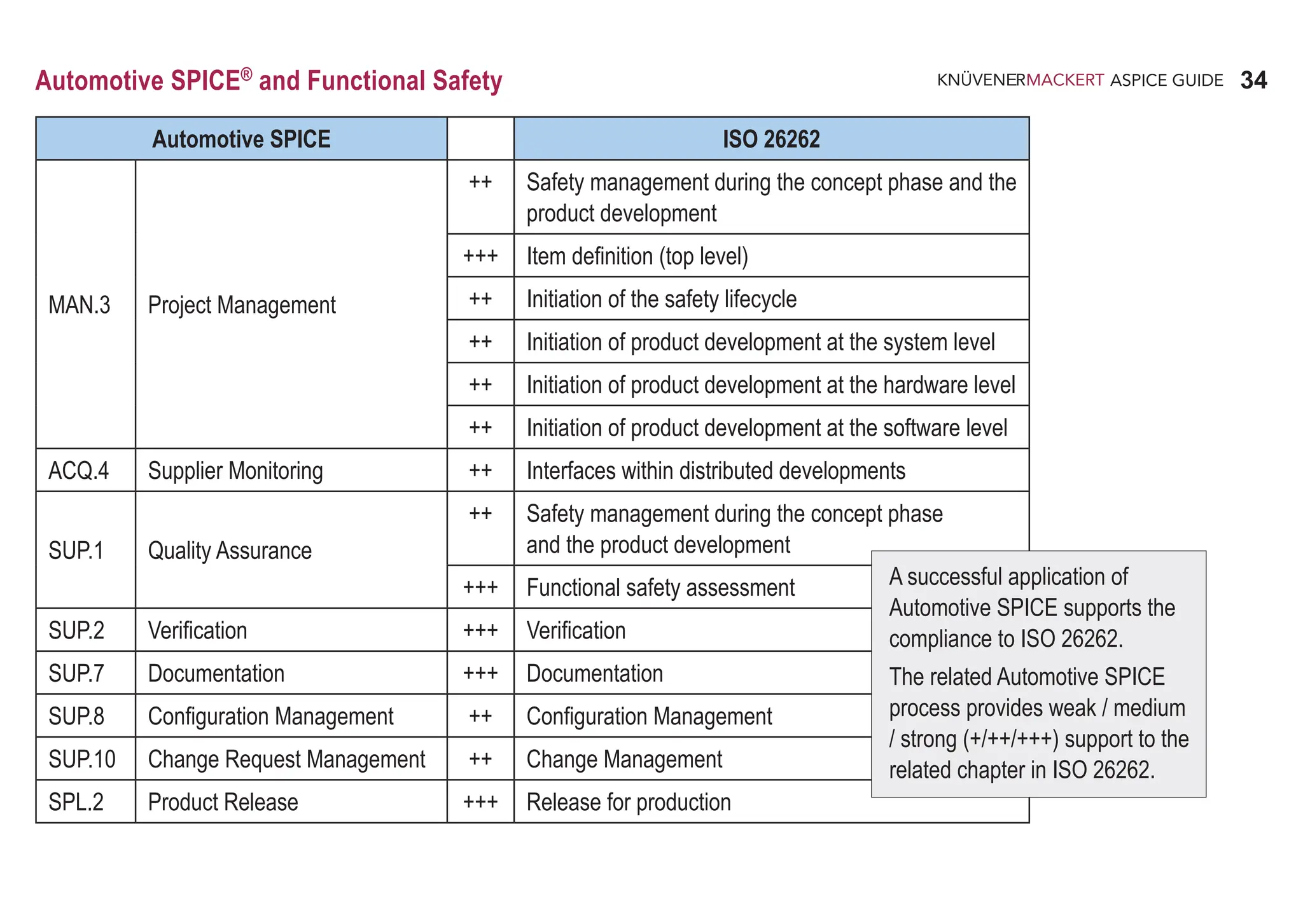
and Functional Safety
Automotive SPICE ISO 26262
MAN.3 Project Management
++ Safety management during the concept phase and the
product development
+++ Item definition (top level)
++ Initiation of the safety lifecycle
++ Initiation of product development at the system level
++ Initiation of product development at the hardware level
++ Initiation of product development at the software level
ACQ.4 Supplier Monitoring ++ Interfaces within distributed developments
SUP.1 Quality Assurance
++ Safety management during the concept phase
and the product development
+++ Functional safety assessment
SUP.2 Verification +++ Verification
SUP.7 Documentation +++ Documentation
SUP.8 Configuration Management ++ Configuration Management
SUP.10 Change Request Management ++ Change Management
SPL.2 Product Release +++ Release for production
A successful application of
Automotive SPICE supports the
compliance to ISO 26262.
The related Automotive SPICE
process provides weak / medium
/ strong (+/++/+++) support to the
related chapter in ISO 26262.
35
ASPICE GUIDE
Automotive SPICE®
and Functional Safety
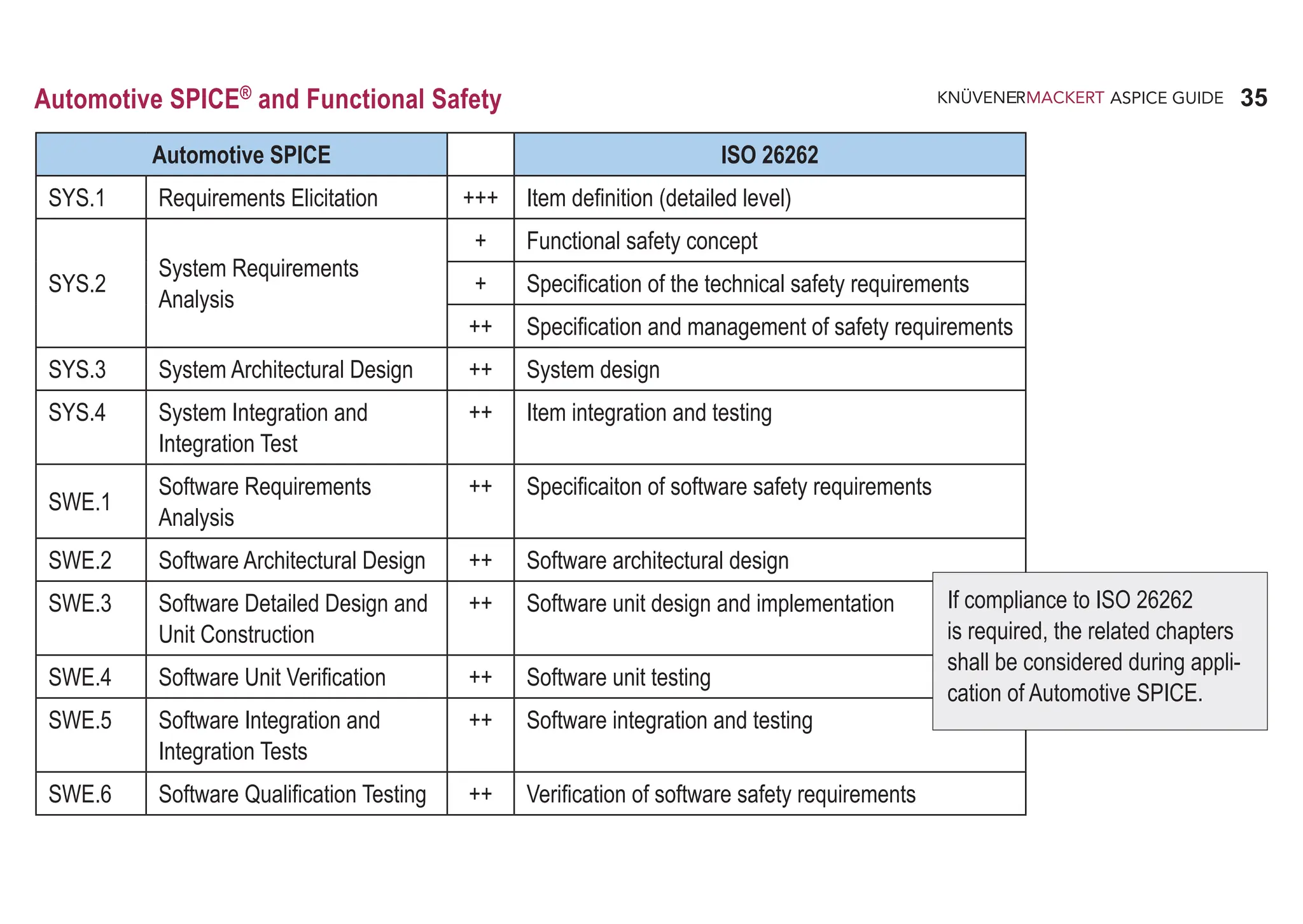
Automotive SPICE ISO 26262
SYS.1 Requirements Elicitation +++ Item definition (detailed level)
SYS.2
System Requirements
Analysis
+ Functional safety concept
+ Specification of the technical safety requirements
++ Specification and management of safety requirements
SYS.3 System Architectural Design ++ System design
SYS.4 System Integration and
Integration Test
++ Item integration and testing
SWE.1
Software Requirements
Analysis
++ Specificaiton of software safety requirements
SWE.2 Software Architectural Design ++ Software architectural design
SWE.3 Software Detailed Design and
Unit Construction
++ Software unit design and implementation
SWE.4 Software Unit Verification ++ Software unit testing
SWE.5 Software Integration and
Integration Tests
++ Software integration and testing
SWE.6 Software Qualification Testing ++ Verification of software safety requirements
If compliance to ISO 26262
is required, the related chapters
shall be considered during appli-
cation of Automotive SPICE.
36
ASPICE GUIDE
Automotive SPICE®
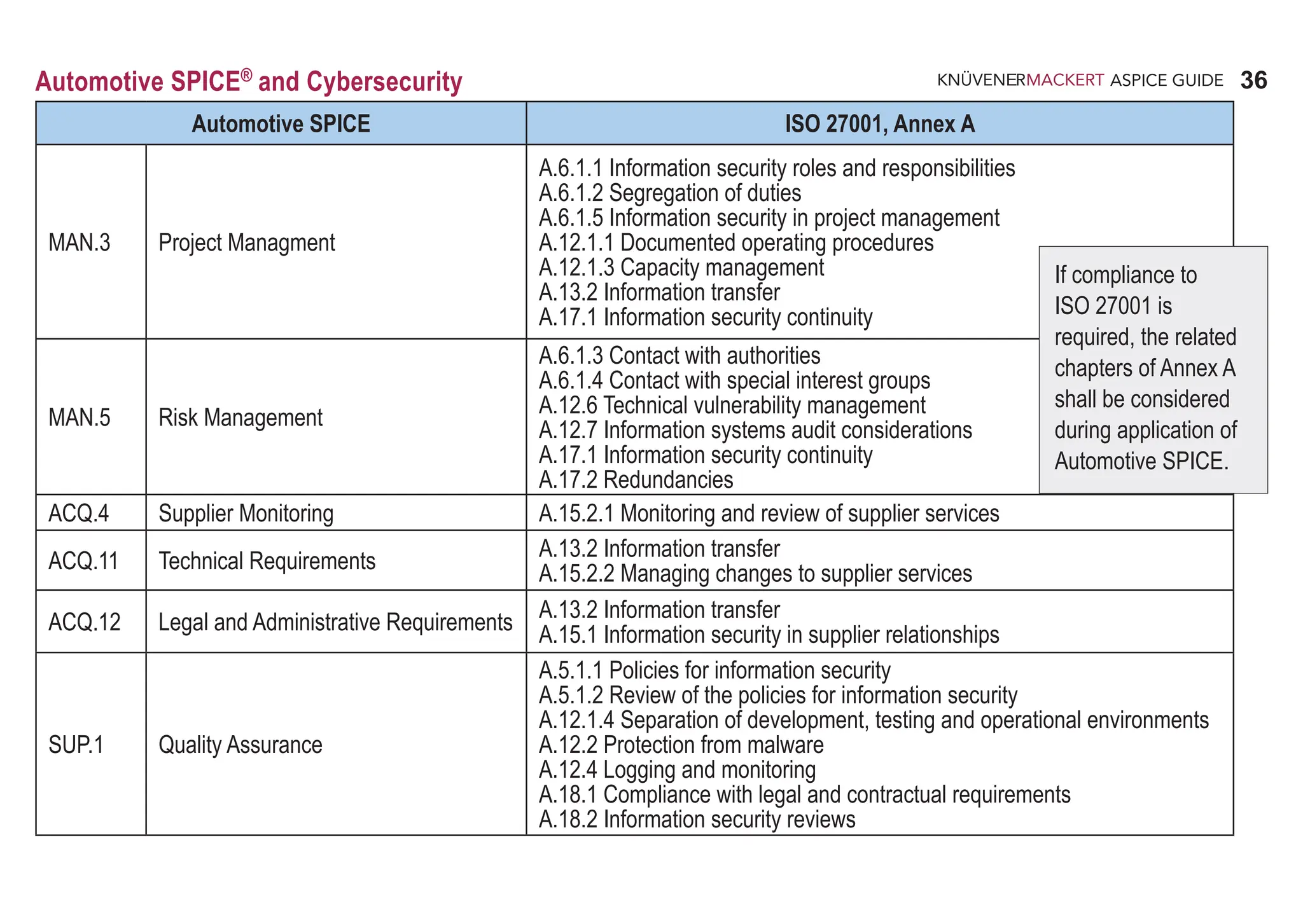
and Cybersecurity
Automotive SPICE ISO 27001, Annex A
MAN.3 Project Managment
A.6.1.1 Information security roles and responsibilities
A.6.1.2 Segregation of duties
A.6.1.5 Information security in project management
A.12.1.1 Documented operating procedures
A.12.1.3 Capacity management
A.13.2 Information transfer
A.17.1 Information security continuity
MAN.5 Risk Management
A.6.1.3 Contact with authorities
A.6.1.4 Contact with special interest groups
A.12.6 Technical vulnerability management
A.12.7 Information systems audit considerations
A.17.1 Information security continuity
A.17.2 Redundancies
ACQ.4 Supplier Monitoring A.15.2.1 Monitoring and review of supplier services
ACQ.11 Technical Requirements A.13.2 Information transfer
A.15.2.2 Managing changes to supplier services
ACQ.12 Legal and Administrative Requirements
A.13.2 Information transfer
A.15.1 Information security in supplier relationships
SUP.1 Quality Assurance
A.5.1.1 Policies for information security
A.5.1.2 Review of the policies for information security
A.12.1.4 Separation of development, testing and operational environments
A.12.2 Protection from malware
A.12.4 Logging and monitoring
A.18.1 Compliance with legal and contractual requirements
A.18.2 Information security reviews
If compliance to
ISO 27001 is
required, the related
chapters of Annex A
shall be considered
during application of
Automotive SPICE.
37
ASPICE GUIDE
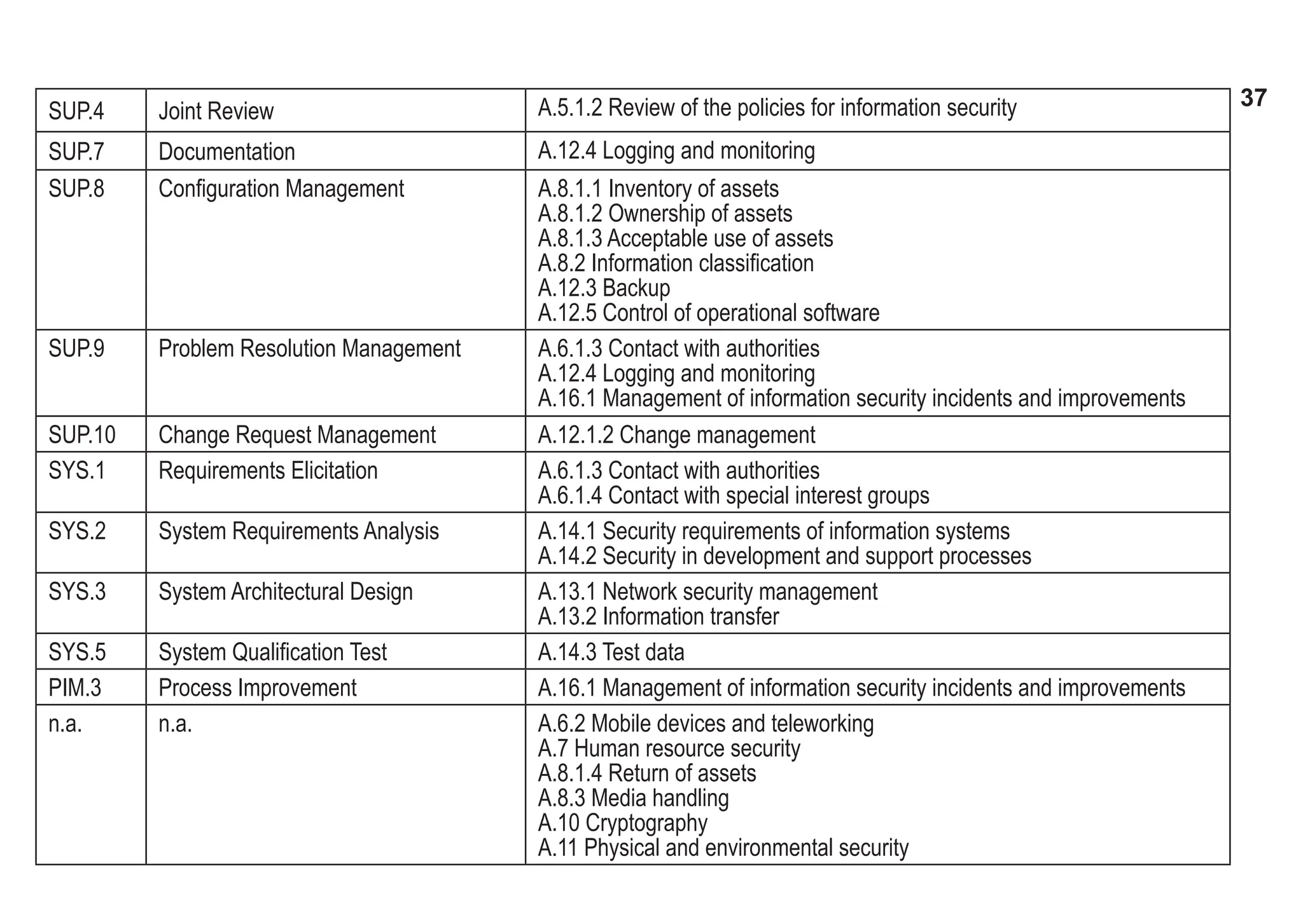
SUP.4 Joint Review A.5.1.2 Review of the policies for information security
SUP.7 Documentation A.12.4 Logging and monitoring
SUP.8 Configuration Management A.8.1.1 Inventory of assets
A.8.1.2 Ownership of assets
A.8.1.3 Acceptable use of assets
A.8.2 Information classification
A.12.3 Backup
A.12.5 Control of operational software
SUP.9 Problem Resolution Management A.6.1.3 Contact with authorities
A.12.4 Logging and monitoring
A.16.1 Management of information security incidents and improvements
SUP.10 Change Request Management A.12.1.2 Change management
SYS.1 Requirements Elicitation A.6.1.3 Contact with authorities
A.6.1.4 Contact with special interest groups
SYS.2 System Requirements Analysis A.14.1 Security requirements of information systems
A.14.2 Security in development and support processes
SYS.3 System Architectural Design A.13.1 Network security management
A.13.2 Information transfer
SYS.5 System Qualification Test A.14.3 Test data
PIM.3 Process Improvement A.16.1 Management of information security incidents and improvements
n.a. n.a. A.6.2 Mobile devices and teleworking
A.7 Human resource security
A.8.1.4 Return of assets
A.8.3 Media handling
A.10 Cryptography
A.11 Physical and environmental security
38
ASPICE GUIDE
AUTOMOTIVE SPICE®
PROCESSES
39
ASPICE GUIDE
08-12 Project plan [OUTCOME 1, 3, 4, 5] 14-06 Schedule [OUTCOME 3, 5]
13-04 Communication record [OUTCOME 4, 6] 14-09 Work breakdown structure [OUTCOME 3,4,5]
13-16 Change request [OUTCOME 7] 14-50 Stakeholder groups list [OUTCOME 4]
13-19 Review record [OUTCOME 2,7] 15-06 Project status report [OUTCOME 4,6]
14-02 Corrective action register [OUTCOME 7]
MAN.3 Project Management
The purpose of the Project Management Process is to identify, establish, and control the activities and resources necessary for a
project to produce a product, in the context of the project’s requirements and constraints.
Process outcomes – as a result of successful implementation of this process
1. the scope of the work for the project is defined;
2. the feasibility of achieving the goals of the project with available resources and constraints is evaluated;
3. the activities and resources necessary to complete the work are sized and estimated;
4. interfaces within the project, and with other projects and organizational units, are identified and monitored;
5. plans for the execution of the project are developed, implemented and maintained;
6. progress of the project is monitored and reported; and
7. corrective action is taken when project goals are not achieved, and recurrence of problems identified in the project
is prevented.
Output work products
MAN.3
40
ASPICE GUIDE
MAN.3 with 10 Base practices
BP 1
BP 3
BP 2
40
Define the scope of work. Identify the project‘s goals, motivation and boundaries. [OUTCOME 1]
Define project life cycle. Define the life cycle for the project, which is appropriate to the scope, context, magnitude and
complexity of the project. [OUTCOME 2]
This typically means that the project life cycle and the customer‘s development process are consistent with each other.
Evaluate feasibility of the project. Evaluate the feasibility of achieving the goals of the project in terms of
technical feasibility within constraints with respect to time, project estimates, and available resources. [OUTCOME 2]
1
64: DID.RL.1
72: PLS.RC.1
198: MAN.3.RL.1-3, MAN.3.RC.1-2
60: AGE.RC.2
201: MAN.3.RC.11-12
208: MAN.3.RC.18
198: MAN.3.RC.2, MAN.3.RL.3
206: MAN.3.RC.15-17
208: MAN.3.RC.19
210: MAN.3.RC.30
41
ASPICE GUIDE
MAN.3 with 10 Base practices
MAN.3
41
2
3
Define, monitor and adjust project activities. Define, monitor and adjust project activities and their dependencies according
to defined project life cycle and estimations. Adjust activities and their dependencies as required. [OUTCOME 3, 5, 7]
A structure and a manageable size of the activities and related work packages support an adequate progress monitoring.
Project activities typically cover engineering, management and supporting processes.
BP 4
59: AGE.RC.1
64: DID.RL.3
199: MAN.3.RC.3-5
201f: MAN.3.RC.11-13, MAN.3.RL.4-9
204: MAN.3.RL.11-15
208: MAN.3.RC.20
42
ASPICE GUIDE
BP 5
Define, monitor and adjust project estimates and resources. Define, monitor and adjust project estimates of effort and
resources based on project's goals, project risks, motivation and boundaries. [OUTCOME 2, 3, 7]
Appropriate estimation methods should be used.
Examples of necessary resources are people, infrastructure (such as tools, test equipment, communication mechanis-
ms...) and hardware/materials.
Project risks (using MAN.5) and quality criteria (using SUP.1) may be considered.
Estimations and resources typically include engineering, management and supporting processes.
5
6
4
7
MAN.3 with 10 Base practices 42
61: AGE.RC.4
64: DID.RL.3
66: TPS.RC.1
68: TPS.RC.7
94: SYS.2.RC.6
125: SWE.1.RC.7
198: MAN.3.RC.2, MAN.3.RL.3
200f: MAN.3.RC.6-13, MAN.3.RL.4-9
206: MAN.3.RC.15-17
208: MAN.3.RC.21-24
209: MAN.3.RC.28
224: CL2.RC.4-6
43
ASPICE GUIDE
MAN.3
MAN.3 with 10 Base practices 43
BP 6
BP 7
8
Ensure required skills, knowledge, and experience. Identify the required skills, knowledge, and experience for the
project in line with the estimates and make sure the selected individuals and teams either have or acquire these in time.
[OUTCOME 3, 7]
In the case of deviations from required skills and knowledge trainings are typically provided.
Identify, monitor and adjust project interfaces and agreed commitments. Identify and agree interfaces of the
project with other (sub-) projects, organizational units and other affected stakeholders and monitor agreed commitments.
[OUTCOME 4, 7]
Project interfaces relate to engineering, management and supporting processes.
206: MAN.3.RC.15-17
225: CL2.RC.7
70: TPS.RC.13
72: PLS.RC.3
78: APA.RC.1
201: MAN.3.RC.13, MAN.3.RL.4-9
204: MAN.3.RL.11-15
209: MAN.3.RC.29
225: CL2.RC.8
9
44
ASPICE GUIDE
BP 9
BP 10
11
MAN.3 with 10 Base practices 44
BP 8 Define, monitor and adjust project schedule. Allocate resources to activities, and schedule each activity of the whole
project. The schedule has to be kept continuously updated during lifetime of the project. [OUTCOME 3, 5, 7]
This relates to all engineering, management and supporting processes.
Ensure consistency. Ensure that estimates, skills, activities, schedules, plans, interfaces, and commitments for the
project are consistent across affected parties. [OUTCOME 3, 4, 5, 7]
Review and report progress of the project. Regularly review and report the status of the project and the fulfillment of
activities against estimated effort and duration to all affected parties. Prevent recurrence of problems identified.
[OUTCOME 6, 7]
Project reviews may be executed at regular intervals by the management. At the end of a project, a project review
contributes to identifying e.g. best practices and lessons learned.
10
198: MAN.3.RC.2, MAN.3.RL.3 204: MAN.3.RL.11-15
199: MAN.3.RC.3-5 208: MAN.3.RL.17, MAN.3.RC.25
201f: MAN.3.RC.11-13, MAN.3.RL.4-9
39: TAC.RL.1 201f: MAN.3.RC.13, MAN.3.RL.4-9
59: AGE.RC.1 205: MAN.3.RC.14-5
64: DID.RL.2
43: SAC.RC.1-2
180: SUP.8.RC.9
201f: MAN.3.RC.13, MAN.3.RL.4-10
209: MAN.3.RC.26-27
210: MAN.3.RC.31
45
ASPICE GUIDE
MAN.3
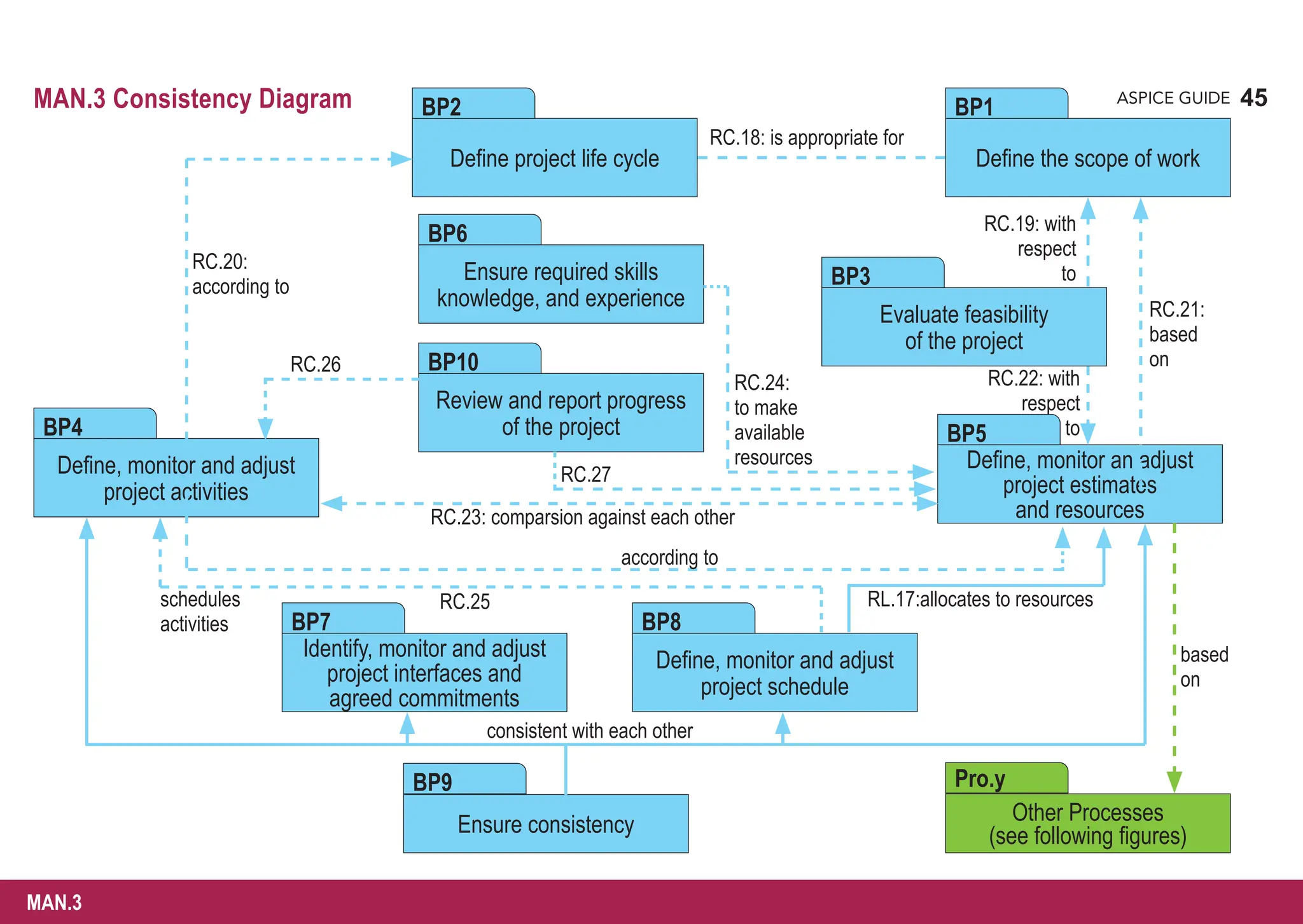
MAN.3 Consistency Diagram
Review and report progress
of the project
BP10
Define, monitor and adjust
project activities
BP4
Other Processes
(see following figures)
Pro.y
Define the scope of work
BP1
Ensure required skills
knowledge, and experience
BP6
Define project life cycle
BP2
Define, monitor an adjust
project estimates
and resources
BP5
Evaluate feasibility
of the project
BP3
Identify, monitor and adjust
project interfaces and
agreed commitments
BP7
Define, monitor and adjust
project schedule
BP8
Ensure consistency
BP9
consistent with each other
RC.21:
based
on
based
on
RL.17:allocates to resources
schedules
activities
RC.23: comparsion against each other
according to
RC.20:
according to
RC.18: is appropriate for
RC.19: with
respect
to
RC.24:
to make
available
resources
RC.22: with
respect
to
RC.26
RC.27
RC.25
46
ASPICE GUIDE
07-07 Risk measure [OUTCOME 5] 14-02 Corrective action register [OUTCOME 6]
08-14 Recovery plan [OUTCOME 4, 6] 14-08 Tracking system [OUTCOME 5, 6]
08-19 Risk management plan [OUTCOME ALL] 15-08 Risk analysis report [OUTCOME 4]
08-20 Risk mitigation plan [OUTCOME 3, 4, 5, 6] 15-09 Risk status report [OUTCOME 4, 5]
13-20 Risk action request [OUTCOME 1, 2, 6]
MAN.5 Risk Management
The purpose of the Risk Management Process is to identify, analyze, treat and monitor the risks continuously.
Process outcomes – as a result of successful implementation of this process
1. the scope of the risk management to be performed is determined;
2. appropriate risk management strategies are defined and implemented;
3. risks are identified as they develop during the conduct of the project;
4. risks are analyzed and the priority in which to apply resources to treatment of these risks is determined;
5. risk measures are defined, applied, and assessed to determine changes in the status of risk and the progress of the treatment
activities; and
6. appropriate treatment is taken to correct or avoid the impact of risk based on its priority, probability, and consequence or other
defined risk threshold.
Output work products
Establish risk management scope. Determine the scope of risk management to be performed for the project, in accordance
with organizational risk management policies. [OUTCOME 1]
Risks may include technical, economic and timing risks.
MAN.5 with 7 Base practices
BP 1
1
47
ASPICE GUIDE
BP 5
Define risk management strategies. Define appropriate strategies to identify risks, mitigate risks and set acceptability
levels for each risk or set of risks, both at the project and organizational level. [OUTCOME 2]
Identify risks. Identify risks to the project both initially within the project strategy and as they develop during the conduct
of the project, continuously looking for risk factors at any occurrence of technical or managerial decisions. [OUTCOME 2, 3]
Examples of risk areas that are typically analyzed for potential risk reasons or risks factors include: cost, schedule, effort,
resource, and technical.
Examples of risk factors may include: unsolved and solved trade-offs, decisions of not implementing a project feature,
design changes, lack of expected resources.
Analyze risks. Analyze risks to determine the priority in which to apply resources to mitigate these risks. [OUTCOME 4]
Risks are normally analyzed to determine their probability, consequence and severity.
Different techniques may be used to analyze a system in order to understand if risks exist, for example,
functional analysis, simulation, FMEA, FTA etc.
Define risk treatment actions. For each risk (or set of risks) define, perform and track the selected actions to keep/reduce
the risks to acceptable level. [OUTCOME 5, 6]
Monitor risks. For each risk (or set of risks) define measures (e.g. metrics) to determine changes in the status of a risk and to
evaluate the progress of the mitigation activities. Apply and assess these risk measures. [OUTCOME 5, 6]
Major risks may need to be communicated to and monitored by higher levels of management.
Take corrective action. When expected progress in risk mitigation is not achieved, take appropriate corrective action to
reduce or avoid the impact of risk. [OUTCOME 6]
Corrective actions may involve developing and implementing new mitigation strategies or adjusting the existing strategies.
MAN.5 with 7 Base practices
BP 2
2
BP 4
BP 6
BP 3
3
4
5
6
7
BP7
47
MAN.5
48
ASPICE GUIDE
04-02 Domain architecture [OUTCOME 2] 13-04 Communication record [OUTCOME 7]
04-03 Domain model [OUTCOME 2] 15-07 Reuse evaluation report [OUTCOME 5, 6, 8]
08-17 Reuse plan [OUTCOME 5, 6] 15-13 Assessment/audit report [OUTCOME 3, 4]
09-03 Reuse policy [OUTCOME 1] 19-05 Reuse strategy [OUTCOME 1]
12-03 Reuse proposal [OUTCOME 4]
REU.2 Reuse Program Management
The purpose of the Reuse Program Management Process is to plan, establish, manage, control, and monitor an organization’s reuse
program and to systematically exploit reuse opportunities.
Process outcomes – as a result of successful implementation of this process
1. the reuse strategy, including its purpose, scope, goals and objectives, is defined;
2. each domain is assessed to determine its reuse potential;
3. the domains in which to investigate reuse opportunities, or in which it is intended to practice reuse, are identified;
4. the organization's systematic reuse capability is assessed;
5. reuse proposals are evaluated to ensure the reuse product is suitable for the proposed application;
6. reuse is implemented according to the reuse strategy;
7. feedback, communication, and notification mechanisms are established, that operate between affected parties; and
8. the reuse program is monitored and evaluated.
Output work products
49
ASPICE GUIDE
BP 6
BP 4
Define organizational reuse strategy. Define the reuse program and necessary supporting infrastructure for the organization.
[Outcome 1]
Identify domains for potential reuse. Identify set(s) of systems and their components in terms of common properties that
can be organized into a collection of reusable assets that may be used to construct systems in the domain. [OUTCOME 2]
Assess domains for potential reuse. Assess each domain to identify potential use and applications of reusable components
and products. [OUTCOME 3]
Assess reuse maturity. Gain an understanding of the reuse readiness and maturity of the organization, to provide a baseline
and success criteria for reuse program management. [OUTCOME 4]
Evaluate reuse proposals. Evaluate suitability of the provided reusable components and product(s) to proposed use.
[OUTCOME 5]
Implement the reuse program. Perform the defined activities identified in the reuse program. [OUTCOME 6]
Get feedback from reuse. Establish feedback, assessment, communication and notification mechanism that operate between
affected parties to control the progress of reuse program. [OUTCOME 7, 8]
Affected parties may include reuse program administrators, asset managers, domain engineers, developers, operators,
and maintenance groups.
Monitor reuse. Monitor the implementation of the reuse program periodically and evaluate its suitability to actual needs.
[OUTCOME 6, 8]
The quality requirements for re-use work products should be defined.
REU.2 with 8 Base practices
BP 1
BP 8
BP 3
2
BP 2
BP 5
BP 7
1
49
REU.2
50
ASPICE GUIDE
02-01 Commitment/agreement [OUTCOME 4] 13-16 Change request [OUTCOME 4]
13-01 Acceptance record [OUTCOME 3] 13-19 Review record [OUTCOME 2]
13-04 Communication record [OUTCOME 1, 2] 14-02 Corrective action register [OUTCOME 4]
13-09 Meeting support record [OUTCOME 1] 15-01 Analysis report [OUTCOME 3]
13-14 Progress status record [OUTCOME 2]
ACQ.4 Supplier Monitoring
The purpose of the Supplier Monitoring Process is to track and assess the performance of the supplier against agreed
requirements.
Process outcomes – as a result of successful implementation of this process
1. joint activities, as agreed between the customer and the supplier, are performed as needed;
2. all information, agreed upon for exchange, is communicated regularly between the supplier and customer;
3. performance of the supplier is monitored against the agreements; and
4. changes to the agreement, if needed, are negotiated between the customer and the supplier and documented in the agreement.
Output work products
51
ASPICE GUIDE
ACQ.4 with 5 Base practices
BP 1
1
2
3
BP 2
4
51
ACQ.4
Agree on and maintain joint processes, joint interfaces, and information to be exchanged. Establish and maintain an
agreement on information to be exchanged and on joint processes and joint interfaces, responsibilities, type and frequency
of joint activities, communications, meetings, status reports and reviews. [OUTCOME 1, 2, 4]
Joint processes and interfaces usually include project management, requirements management, change
management, configuration management, problem resolution, quality assurance and customer acceptance.
Joint activities to be performed should be mutually agreed between the customer and the supplier.
The term customer in this process refers to the assessed party. The term supplier refers to the supplier of
the assessed party.
Exchange all agreed information. Use the defined joint interfaces between customer and supplier for the exchange of all
agreed information. [OUTCOME 1, 2, 3]
Agreed information should include all relevant work products.
69f: TPS.RC.8-11, 13
83: ACQ.4.RL.2
84: ACQ.4.RC.1
86: ACQ.4.RC.3
43: SAC.RC.1-2
67: TPS.RC.2-3
85: ACQ.4.RL.3
52
ASPICE GUIDE
BP 3
BP 4
BP 5
Review technical development with the supplier. Review development with the supplier on the agreed regular basis,
covering technical aspects, problems and risks and also track open items to closure. [OUTCOME 1, 3, 4]
Review progress of the supplier. Review progress of the supplier regarding schedule, quality, and cost on the agreed
regular basis. Track open items to closure and perform risk mitigation activities. [OUTCOME 1, 3, 4]
Act to correct deviations. Take action when agreed objectives are not achieved to correct deviations from the agreed
project plans and to prevent reoccurrence of problems identified. Negotiate changes to objectives and document them in
the agreements. [OUTCOME 4]
ACQ.4 with 5 Base practices
85f: ACQ.4.RL.3-4
70: TPS.RC.12
85: ACQ.4.RL.3
86: ACQ.4.RL.5
86: ACQ.4.RC.2
52
53
ASPICE GUIDE
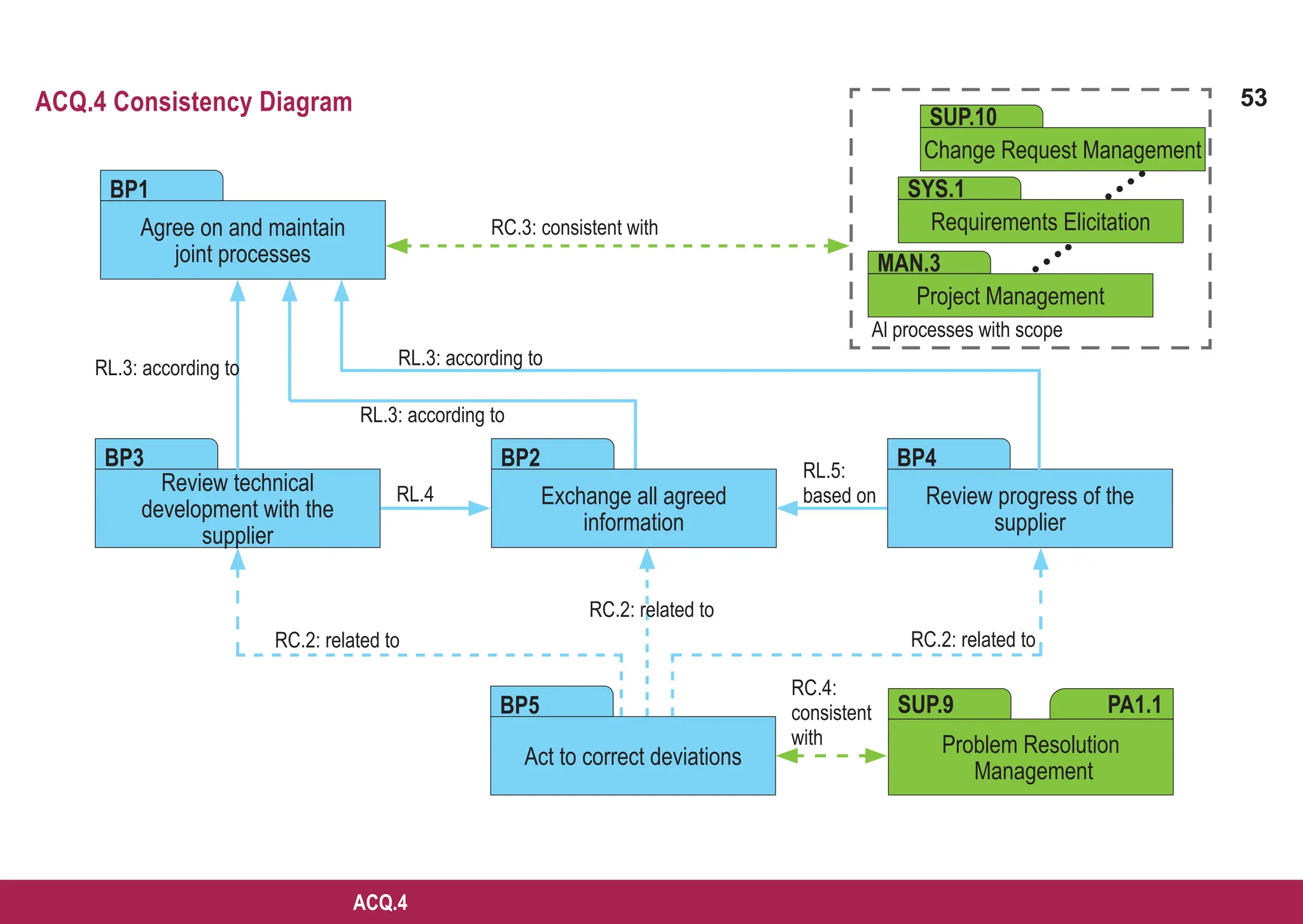
ACQ.4
ACQ.4 Consistency Diagram
Review technical
development with the
supplier
Exchange all agreed
information
Review progress of the
supplier
BP3 BP2 BP4
Problem Resolution
Management
SUP.9 PA1.1
Act to correct deviations
BP5
RC.3: consistent with
Change Request Management
SUP.10
Agree on and maintain
joint processes
BP1
Requirements Elicitation
SYS.1
Project Management
MAN.3
RL.3: according to
RL.3: according to
RL.3: according to
RC.2: related to RC.2: related to
RC.2: related to
RC.4:
consistent
with
RL.5:
based on
Al processes with scope
RL.4
54
ASPICE GUIDE
08-13 Quality plan [OUTCOME 1,2] 13-19 Review record [OUTCOME 2, 3, 4]
13-04 Communication record [OUTCOME 3, 4, 5] 14-02 Corrective action register [OUTCOME 3, 5, 6]
13-07 Problem record [OUTCOME 3, 5] 18-07 Quality criteria [OUTCOME 1]
13-18 Quality record [OUTCOME 2, 3, 4]
SUP.1 Quality Assurance
The purpose of the Quality Assurance Process is to provide independent and objective assurance that work products and processes
comply with predefined provisions and plans and that non-conformances are resolved and further prevented.
Process outcomes – as a result of successful implementation of this process
1. a strategy for performing quality assurance is developed, implemented, and maintained;
2. quality assurance is performed independently and objectively without conflicts of interest;
3. non-conformances of work products, processes, and process activities with relevant requirements are identified, recorded,
communicated to the relevant parties, tracked, resolved, and further prevented;
4. conformance of work products, processes and activities with relevant requirements is verified, documented, and communicated
to the relevant parties;
5. authority to escalate non-conformances to appropriate levels of management is established; and
6. management ensures that escalated non-conformances are resolved.
Output work products
55
ASPICE GUIDE
SUP.1 with 6 Base practices
BP 1
1
2
3
4
55
SUP.1
Develop a project quality assurance strategy. Develop a strategy in order to ensure that work product and process
quality assurance is performed at project level independently and objectively without conflicts of interest. [OUTCOME 1, 2]
Aspects of independence may be financial and/or organizational structure.
Quality assurance may be coordinated with, and make use of, the results of other processes such as verification,
validation, joint review, audit and problem management.
Process quality assurance may include process assessments and audits, problem analysis, regular check of methods,
tools, documents and the adherence to defined processes, reports and lessons learned that improve processes for
future projects.
Work product quality assurance may include reviews, problem analysis, reports and lessons learned that improve
the work products for further use.
51ff: SAP.RL.1-4
62: AGE.RC.10
165ff: SUP.1.RL.1-5
167f: SUP.1.RC.1-2
232: CL2.RC.12
56
ASPICE GUIDE
BP 2
SUP.1 with 6 Base practices 56
5
6
BP3
7
8
Assure quality of work products. Perform the activities according to the quality assurance strategy and the project
schedule to ensure that the work products meet the defined work product requirements and document the results.
[OUTCOME 2, 3, 4]
Relevant work product requirements may include requirements from applicable standards.
Non-conformances detected in work products may be entered into the problem resolution management process
(SUP.9) to document, analyze, resolve, track to closure and prevent the problems.
Assure quality of process activities. Perform the activities according to the quality assurance strategy and the project
schedule to ensure that the processes meet their defined goals and document the results. [OUTCOME 2, 3, 4]
Relevant process goals may include goals from applicable standards.
Problems detected in the process definition or implementation may be entered into a process improvement process
(PIM.3) to describe, record, analyze, resolve, track to closure and prevent the problems.
167f: SUP.1.RL.6-7
170: SUP.1.RC.3
171: SUP.1.RC.7
62: AGE.RC.11
79: APA.RL.7
167f: SUP.1.RL.6-7
170: SUP.1.RC.3
171: SUP.1.RC.6
172: SUP.1.RC.9
233: CL2.RC.17
57
ASPICE GUIDE
SUP.1
BP 4
SUP.1 with 6 Base practices
Summarize and communicate quality assurance activities and results. Regularly report performance, deviations, and
trends of quality assurance activities to relevant parties for information and action according to the quality assurance strategy.
[OUTCOME 3, 4]
Ensure resolution of non-conformances. Deviations or non-conformance found in process and product quality assurance
activities should be analyzed, tracked, corrected, and further prevented. [OUTCOME 3,6]
Implement an escalation mechanism. Establish and maintain an escalation mechanism according to the quality assurance
strategy that ensures that quality assurance may escalate problems to appropriate levels of management and other relevant
stakeholders to resolve them. [OUTCOME 5, 6]
BP 5
BP 6
57
43: SAC.RC.1-2
171: SUP.1.RC.4-5
168f: SUP.1.RL.8-9
171: SUP.1.RC.4-5
172: SUP.1.RC.8
65: DID.RL.9
171: SUP.1.RC.4-5
172: SUP.1.RC.8
58
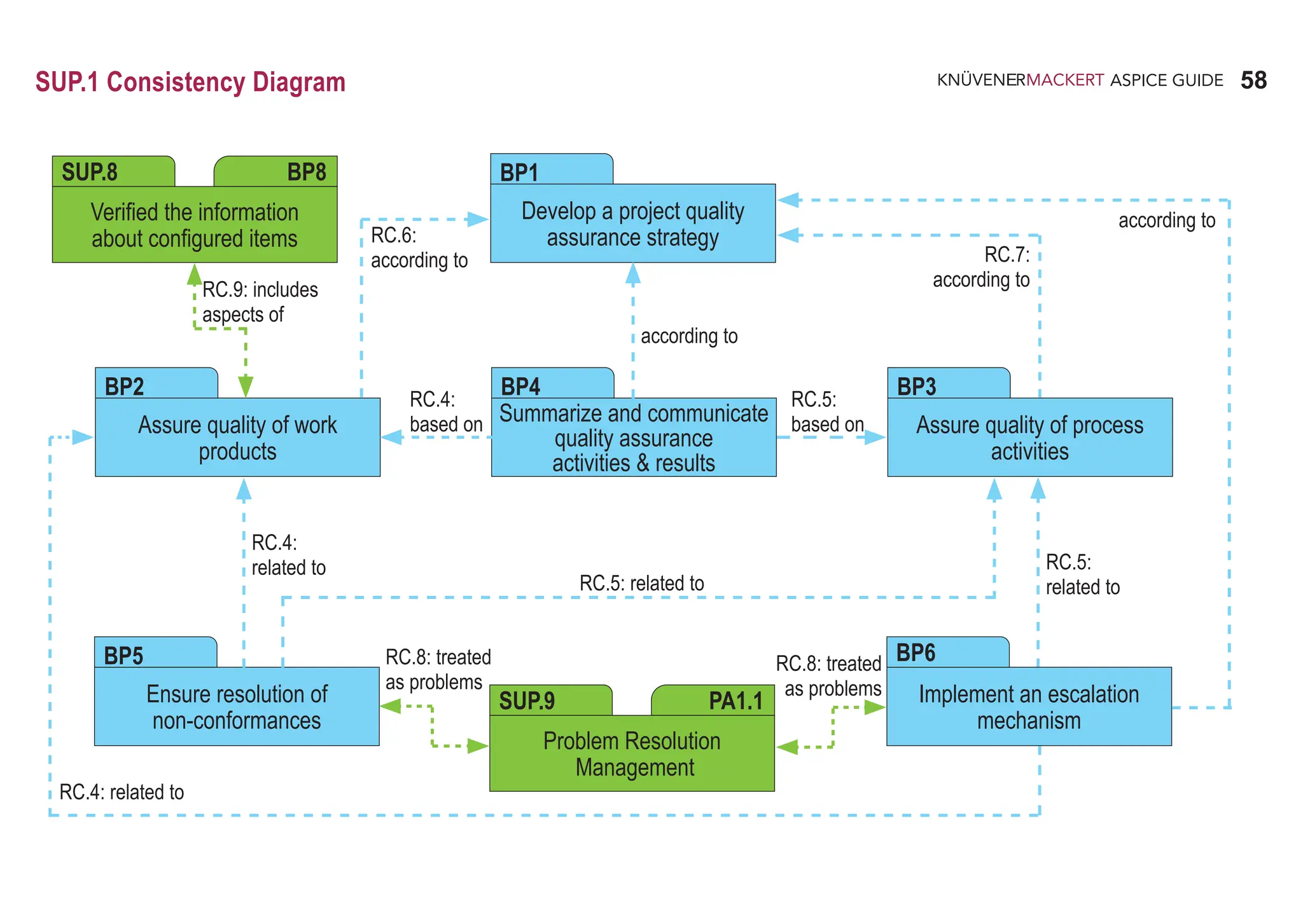
ASPICE GUIDE
SUP.1 Consistency Diagram
Assure quality of work
products
Assure quality of process
activities
BP2
Summarize and communicate
quality assurance
activities & results
BP4 BP3
Problem Resolution
Management
SUP.9 PA1.1
Ensure resolution of
non-conformances
BP5
RC.9: includes
aspects of
RC.4:
related to RC.5:
related to
RC.5: related to
Develop a project quality
assurance strategy
BP1
Verified the information
about configured items
SUP.8 BP8
Implement an escalation
mechanism
BP6
according to
RC.7:
according to
RC.6:
according to
according to
RC.4: related to
RC.4:
based on
RC.5:
based on
RC.8: treated
as problems
RC.8: treated
as problems
59
ASPICE GUIDE
SUP.1
60
ASPICE GUIDE
13-04 Communication record [OUTCOME 5] 14-02 Corrective action register [OUTCOME 4]
13-07 Problem record [OUTCOME 3, 4, 5] 18-07 Quality criteria [OUTCOME 2]
13-25 Verification results [OUTCOME 2, 3, 4, 5] 19-10 Verification strategy [OUTCOME 1]
SUP.2 Verification
The purpose of the Verification Process is to confirm that each work product of a process or project properly reflects the specified
requirements.
Process outcomes – as a result of successful implementation of this process
1. a verification strategy is developed, implemented and maintained;
2. criteria for verification of all required work products are identified;
3. required verification activities are performed;
4. defects are identified, recorded and tracked; and
5. results of the verification activities are made available to the customer and other involved parties.
Output work products
61
ASPICE GUIDE
BP 3
SUP.2 with 5 Base practices
Develop a verification strategy. Develop and implement a verification strategy, including verification activities with associated
methods, techniques, and tools; work product or processes under verification; degrees of independence for verification and
schedule for performing these activities. [OUTCOME 1]
Verification strategy is implemented through a plan.
Software and system verification may provide objective evidence that the outputs of a particular phase of the software
development life cycle (e.g. requirements, design, implementation, testing) meet all of the specified requirements for
that phase.
Verification methods and techniques may include inspections, peer reviews (see also SUP.4), audits, walkthroughs
and analysis.
Develop criteria for verification. Develop the criteria for verification of all required technical work products. [OUTCOME 2]
Conduct verification. Verify identified work products according to the specified strategy and to the developed criteria to con-
firm that the work products meet their specified requirements. The results of verification activities are recorded. [OUTCOME 3]
Determine and track actions for verification results. Problems identified by the verification should be entered into the
problem resolution management process (SUP.9) to describe, record, analyze, resolve, track to closure and prevent the
problems. [OUTCOME 4]
Report verification results. Verification results should be reported to all affected parties. [OUTCOME 5]
BP 1
1
2
BP 2
BP 4
3
BP 5
61
SUP.2
62
ASPICE GUIDE
SUP.4 Joint Review
The purpose of the Joint review process is to maintain a common understanding with the stakeholders of the progress against
the objectives of the agreement and what should be done to help ensure development of a product that satisfies the stakeholders.
Joint reviews are at both project management and technical levels and are held throughout the life of the project.
Process outcomes – as a result of successful implementation of this process
1. management and technical reviews are held based on the needs of the project;
2. the status and products of an activity of a process are evaluated through joint review activities between the stakeholders;
3. review results are made known to all affected parties;
4. action items resulting from reviews are tracked to closure; and
5. problems are identified and recorded.
Joint review should be performed at specific milestones during project/product development. The scope and the goals of joint review
may be different depending on project/product development phase (for example, in the early stage of a project joint review may be
„conceptual“ in order to analyze the customer requirements; in later stages joint review may be concerned with the implementation).
Joint review should be performed to verify different aspects (for example: hardware resources utilization; the introduction of new
requirements and new technologies; modification to the working team structure; technology changes).
1
2
13-04 Communication record [OUTCOME 3] 14-02 Corrective action register [OUTCOME 3, 4, 5]
13-05 Contract review record [OUTCOME 1, 2, 3] 14-08 Tracking system [OUTCOME 3, 4, 5]
13-07 Problem record [OUTCOME 3, 5] 15-01 Analysis report [OUTCOME 3, 5]
13-09 Meeting support record [OUTCOME 1,2] 15-13 Assessment/audit report [OUTCOME 1,2]
13-19 Review record [OUTCOME ALL] 15-16 Improvement opportunity [OUTCOME 3, 4]
Output work products
63
ASPICE GUIDE
BP 3
SUP.4 with 8 Base practices
Define review elements. Based on the needs of the project, identify the schedule, scope and participants of management
and technical reviews, agree all resources required to conduct the reviews (this includes personnel, location and facilities)
and establish review criteria for problem identification, resolution and agreement. [OUTCOME 1]
Establish a mechanism to handle review outcomes. Establish mechanisms to ensure that review results are made
available to all affected parties that problems detected during the reviews are identified and recorded and that action items
raised are recorded for action. [OUTCOME 3]
Prepare joint review. Collect, plan, prepare and distribute review material as appropriate in preparation for the review.
[OUTCOME 1]
The following items may be addressed: Scope and purpose of the review; Products and problems to be reviewed;
Entry and exit criteria; Meeting agenda; Roles and participants; Distribution list; Responsibilities; Resource and facility
requirements; Used tools (checklists, scenario for perspective based reviews etc.).
Conduct joint reviews. Conduct joint management and technical reviews as planned. Record the review results.
[OUTCOME 1, 2]
Distribute the results. Document and distribute the review results to all the affected parties. [OUTCOME 3]
Determine actions for review results. Analyze the review results, propose actions for resolution and determine the priority
for actions. [OUTCOME 4]
BP 1
BP 2
BP 4
1
BP 5
BP 6
63
SUP.4
64
ASPICE GUIDE
SUP.4 with 8 Base practices
Track actions for review results. Track actions for resolution of identified problems in a review to closure. [OUTCOME 4]
Identify and record problems. Identify and record the problems detected during the reviews according to the established
mechanism. [OUTCOME 5]
BP 7
BP 8
64
65
ASPICE GUIDE
SUP.4
66
ASPICE GUIDE
08-26 Documentation plan [OUTCOME 1,2] 14-01 Change history [OUTCOME 5, 6]
13-01 Acceptance record [OUTCOME 4, 5] 14-11 Work product list [OUTCOME 3]
13-19 Review record [OUTCOME 4, 5]
SUP.7 Documentation
The purpose of the Documentation Process is to develop and maintain the recorded information produced by a process.
Process outcomes – as a result of successful implementation of this process
1. a strategy identifying the documentation to be produced during the life cycle of the product or service is developed;
2. the standards to be applied for the development of the documentation are identified;
3. documentation to be produced by the process or project is identified;
4. the content and purpose of all documentation is specified, reviewed and approved;
5. documentation is developed and made available in accordance with identified standards; and
6. documentation is maintained in accordance with defined criteria.
Output work products
SUP.7 with 8 Base practices
Develop a documentation management strategy. Develop a documentation management strategy which addresses
where, when and what should be documented during the life cycle of the product/service.[OUTCOME 1]
A documentation management strategy may define the controls needed to approve documentation for adequacy prior to
issue; to review and update as necessary and re-approve documentation; to ensure that changes and the current revision
status of documentation are identified; to ensure that relevant versions of documentation are available at points of issue;
to ensure that documentation remain legible and readily identifiable; to ensure the controlled distribution of documentation;
to prevent unintended use of obsolete documentation ; and may also specify the levels of confidentiality, copyright or
disclaimers of liability for the documentation.
BP 1
1
67
ASPICE GUIDE
BP 8
SUP.7 with 8 Base practices
Establish standards for documentation. Establish standards for developing, modifying and maintaining documentation.
[OUTCOME 2]
Specify documentation requirements. Specify requirements for documentation such as title, date, identifier, version history,
author(s), reviewer, authorizer, outline of contents, purpose, and distribution list. [OUTCOME 2]
Identify the relevant documentation to be produced. For any given development life cycle, identify the documentation
to be produced. [OUTCOME 3]
Develop documentation. Develop documentation at required process points according to established standards and policy,
ensuring the content and purpose is reviewed and approved as appropriate. [OUTCOME 4, 5]
Check documentation. Review documentation before distribution, and authorize documentation as appropriate before
distribution or release. [OUTCOME 5]
The documentation intended for use by system and software users should accurately describe the system and software
and how it is to be used in clear and useful manner for them.
Documentation should be checked through verification or validation process.
Distribute documentation. Distribute documentation according to determined modes of distribution via appropriate media
to all affected parties, confirming delivery of documentation, where necessary. [OUTCOME 5]
Maintain documentation. Maintain documentation in accordance with the determined documentation strategy. [OUTCOME 6]
If the documentation is part of a product baseline or if its control and stability are important, it should be modified and
distributed in accordance with process SUP.8 Configuration management.
BP 2
BP 3
BP 4
3
BP 5
BP 6
2
BP 7
4
67
SUP.7
68
ASPICE GUIDE
06-02 Handling and storage guide [OUTCOME 3, 4, 5, 7] 13-10 Configuration management record [OUTCOME 2, 5, 7]]
08-04 Configuration management [OUTCOME 1, 2, 7] 14-01 Change history [OUTCOME 3]
08-14 Recovery plan [OUTCOME 1,7] 16-03 Configuration management system [OUTCOME 1, 3, 4]
13-08 Baseline [OUTCOME 2, 3, 4, 5, 6]
SUP.8 Configuration Management
The purpose of the Configuration Management Process is to establish and maintain the integrity of all work products of a process
or project and make them available to affected parties.
Process outcomes – as a result of successful implementation of this process
1. a configuration management strategy is developed;
2. all configuration items generated by a process or project are identified, defined and baselined according to the configuration
management strategy;
3. modifications and releases of the configuration items are controlled;
4. modifications and releases are made available to affected parties;
5. the status of the configuration items and modifications is recorded and reported;
6. the completeness and consistency of the baselines is ensured; and
7. storage of the configuration items is controlled.
Output work products
69
ASPICE GUIDE
SUP.8 with 9 Base practices
Develop a configuration management strategy. Develop a configuration management strategy, including
• responsibilities;
• tools and repositories;
• criteria for configuration items;
• naming conventions;
• access rights;
• criteria for baselines;
• merge and branch strategy;
• the revision history approach for configuration items [OUTCOME 1]
The configuration management strategy typically supports the handling of product/software variants which may be
caused by different sets of application parameters or by other causes.
The branch management strategy specifies in which cases branching is permissible, whether authorization is required,
how branches are merged, and which activities are required to verify that all changes have been consistently integrated
without damage to other changes or to the original software.
BP 1
2
1
69
SUP.8
51ff: SAP.RL.1-4
174: SUP.8.RL.1-5
175: SUP.8.RC.1
70
ASPICE GUIDE
SUP.8 with 9 Base practices
Identify configuration items. Identify and document configuration items according to the configuration management strategy.
[OUTCOME 2]
Configuration control is typically applied for the products that are delivered to the customer, designated internal work pro-
ducts, acquired products, tools and other configuration items that are used in creating and describing these work products.
Establish a configuration management system. Establish a configuration management system according to the
configuration management strategy. [OUTCOME 1, 2, 3, 4, 6, 7]
Establish branch management. Establish branch management according to the configuration management strategy where
applicable for parallel developments that use the same base. [OUTCOME 1, 3, 4, 6, 7]
Control modifications and releases. Establish mechanisms for control of the configuration items according to the
configuration management strategy, and control modifications and releases using these mechanisms. [OUTCOME 3, 4, 5]
BP 3
3
BP 2
70
BP 4
BP 5
78: APA.RL.4
179: SUP.8.RL.14
232: CL2.RC.13
177f: SUP.8.RL.11-14
233: CL2.RC.15
176: SUP.8.RL.9-10
179: SUP.8.RL.14
179: SUP.8.RL.14, SUP.8.RC.3
233: CL2.RC.15
71
ASPICE GUIDE
SUP.8
Establish baselines. Establish baselines for internal purposes and for external delivery according to the configuration
management strategy. [OUTCOME 2]
For baseline issues refer also to the product release process SPL.2.
Report configuration status. Record and report status of configuration items to support project management and other
relevant processes. [OUTCOME 5]
Regular reporting of the configuration status (e.g. how many configuration items are currently under work, checked in,
tested, released, etc.) supports project management activities and dedicated project phases like software integration.
Verify the information about configured items. Verify that the information about configured items, and their baselines is
complete and ensure the consistency of baselines. [OUTCOME 6]
A typical implementation is performing baseline and configuration management audits.
SUP.8 with 9 Base practices 71
BP 6
4
BP 7
5
175: SUP.8.RL.6-8
176: SUP.8.RC.2
179: SUP.8.RL.14
233: CL2.RC.15
179: SUP.8.RC.3
BP 8
6
175: SUP.8.RL.6-8
176: SUP.8.RC.2, SUP.8.RL.9-10
179: SUP.8.RC.3-4
233: CL2.RC.18
72
ASPICE GUIDE
Manage the storage of configuration items and baselines. Ensure the integrity and availability of configuration items
and baselines through appropriate scheduling and resourcing of storage, archiving (long term storage) and backup of the
used CM systems. [OUTCOME 4, 5, 6, 7]
Backup, storage and archiving may need to extend beyond the guaranteed lifetime of available storage media. Relevant
configuration items affected may include those referenced in and . Availability may be specified by contract
requirements.
7
BP9
2 3
SUP.8 with 9 Base practices 72
177: SUP.8.RL.11-13
179: SUP.8.RC.3, 5-6
73
ASPICE GUIDE
SUP.8
SUP.8 Consistency Diagram
Review and report
progress of the projekt
MAN.3 BP10
Control modifications
and releases
BP5
Develop a configuration
management strategy
BP1
Indentify configuration
items
BP2
Establish a configuration
management system
BP3
Establish baselines
BP6
Report configuration status
BP7
Establish branch
management strategy
BP4
Establish a product release
classification and numbering
scheme
SPL.2 BP3
Deliver the release to the
intended customer
SPL.2 BP13
RL.14:
according to
RC.4: using
Manage the storage of
configuration items and
baselines
BP9
Verify the information
about configured items
BP8
RC.6: using
RC.3:
for
RC.3:
for
RC.9:
support to
RC.3:
for
RL.14: according to
RL.14:
according to
RC.8:
support external elivery
RC.7: reflects
RL.14:
according to
RC.5:
for
RL.14:
according to
RC.3:
for
74
ASPICE GUIDE
08-27 Problem management plan [OUTCOME 1] 15-05 Evaluation report [OUTCOME 3]
13-07 Problem record [OUTCOME 2, 3, 4, 5] 15-12 Problem status report [OUTCOME 6]
15-01 Analysis report [OUTCOME 3]
SUP.9 Problem Resolution Management
The purpose of the Problem Resolution Management Process is to ensure that problems are identified, analyzed, managed and
controlled to resolution.
Process outcomes – as a result of successful implementation of this process
1. a problem resolution management strategy is developed;
2. problems are recorded, uniquely identified and classified;
3. problems are analyzed and assessed to identify an appropriate solution;
4. problem resolution is initiated;
5. problems are tracked to closure; and
6. the status of problems and their trend are known.
Output work products
75
ASPICE GUIDE
Develop a problem resolution management strategy. Develop a problem resolution management strategy, including
problem resolution activities, a status model for the problems, alert notifications, responsibilities for performing these activities
and an urgent resolution strategy. Interfaces to affected parties are defined and definitions are maintained. [OUTCOME 1]
Problem resolution activities can be different during the product life cycle, e.g. during prototype construction and series
development.
Identify and record the problem. Each problem is uniquely identified, described and recorded. Supporting information
should be provided to reproduce and diagnose the problem. [OUTCOME 2]
Supporting information typically includes the origin of the problem, how it can be reproduced, environmental information,
by whom it has been detected, etc.
Unique identification supports traceability to changes made.
Record the status of problems. A status according to the status model is assigned to each problem to facilitate tracking.
[OUTCOME 6]
BP 3
BP 2
SUP.9 with 9 Base practices
BP 1
1
75
SUP.9
51ff: SAP.RL.1-4
182: SUP.9.RL.1-2
184: SUP.9.RL.7-8, SUP.9.RC.1
2
3
184: SUP.9.RL.7-8, SUP.9.RC.1
186: SUP.9.RL.9, SUP.9.RC.2
<no rule; no recommendation>
76
ASPICE GUIDE
SUP.9 with 9 Base practices
BP 4
4
76
BP 5
BP 6
Diagnose the cause and determine the impact of the problem. Investigate the problem and determine its cause and
impact in order to categorize the problem and to determine appropriate actions. [OUTCOME 2, 3]
Problem categorization (e.g. A, B, C, light, medium, severe) may be based on severity, impact, criticality, urgency,
relevance for the change process, etc.
Authorize urgent resolution action. If according to the strategy a problem requires an urgent resolution, authorization
shall be obtained for immediate action also according to the strategy. [OUTCOME 4]
Raise alert notifications. If according to the strategy the problem has a high impact on other systems or other affected
parties, an alert notification needs to be raised also according to the strategy. [OUTCOME 4]
183: SUP.9.RL.3-6
186: SUP.9.RC.3
186: SUP.9.RL.9-10
183: SUP.9.RL.3-6
186: SUP.9.RL.9, SUP.9.RC.4
77
ASPICE GUIDE
BP 8
BP 9
7
SUP.9 with 9 Base practices 77
SUP.9
Initiate problem resolution. Initiate appropriate actions according to the strategy to resolve the problem including review
of those actions, or initiate a change request. [OUTCOME 4]
Appropriate actions may include the initiating of a change request. See SUP.10 for managing of change requests.
The implementation of process improvements (to prevent problems) is done in the process improvement process (PIM.3).
The implementation of generic project management improvements (e.g. lessons learned) are part of the project
management process (MAN.3). The implementation of generic work product related improvements are part of the
quality assurance process (SUP.1).
Track problems to closure. Track the status of problems to closure including all related change requests. A formal
acceptance has to be authorized before closing the problem. [OUTCOME 5, 6]
Analyze problem trends. Collect and analyze problem resolution management data, identify trends, and initiate project
related actions, according to the strategy. [OUTCOME 6]
Collected data typically contains information about where the problems occurred, how and when they were found,
what were their impacts, etc.
BP 7
6
5
186: SUP.9.RL.9, SUP.9.RC.5
195: SUP.10.RC.16
184: SUP.9.RL.7-8, SUP.9.RC.1
186: SUP.9.RL.11
186: SUP.9.RL.9
78
ASPICE GUIDE
SUP.9 Consistency Diagram
Track change request
to closure
SUP.10 BP7
Develop a problem
resolution management
strategy
BP1
Record the status
of the problems
BP3
RC.6: initiate
Autorize urgent
resolution action
BP5
Analyze problem trends
BP9
Track problems to closure
BP8
Identify and record
the problem
BP2
Diagnose the cause and
determine the impact
of the problem
BP4
Raise alert notifications
BP6
Initiate problem resolution
BP7
Identify and record the
change requests
SUP.10 BP2
RL.9: according to
RL.9:
according to
RC.5: based on determined
actions
RL.10: based
on determined
actions
RC.4: based
on determined
actions
RC.2:
assigned to
RC.3:
investigate
RL.11:
based on
RC.7: including
related
RL.9: according to
RL.9: according to
RL.9: according to
79
ASPICE GUIDE
SUP.9
80
ASPICE GUIDE
08-28 Change management plan [OUTCOME 1] 13-19 Review record [OUTCOME 7]
13-16 Change request [OUTCOME 2, 3, 4, 5, 6, 7] 13-21 Change control record [OUTCOME 8,9]
SUP.10 Change Request Management
The purpose of the Change Request Management Process is to ensure that change requests are managed, tracked and implemented.
Process outcomes – as a result of successful implementation of this process
1. a change request management strategy is developed;
2. requests for changes are recorded and identified;
3. dependencies and relationships to other change requests are identified;
4. criteria for confirming implementation of change requests are defined;
5. requests for change are analyzed, and resource requirements are estimated;
6. changes are approved and prioritized on the basis of analysis results and availability of resources;
7. approved changes are implemented and tracked to closure;
8. the status of all change requests is known; and
9. bidirectional traceability is established between change requests and affected work products..
Output work products
81
ASPICE GUIDE
SUP.10 with 8 Base practices
BP 1
2
4
3
1
81
SUP.10
BP 2
Develop a change request management strategy. Develop a change request management strategy, including change
request activities, a status model for the change requests, analysis criteria, and responsibilities for performing these activities.
Interfaces to affected parties are defined and maintained. [OUTCOME 1]
A status model for change requests may contain: open, under investigation, approved for implementation, allocated,
implemented, fixed, closed, etc.
Typical analysis criteria are: resource requirements, scheduling issues, risks, benefits, etc.
Change request activities ensure that change requests are systematically identified, described, recorded, analyzed,
implemented, and managed.
The change request management strategy may cover different proceedings across the product life cycle, e.g. during
prototype construction and series development.
Identify and record the change requests. Each change request is uniquely identified, described, and recorded according
to the strategy, including the initiator and reason of the change request. [OUTCOME 2, 3]
51ff: SAP.RL.1-4
79: APA.RL.6
189: SUP.10.RL.1
187: SUP.9.RC.6
194: SUP.10.RL.8
233: CL2.RC.16
82
ASPICE GUIDE
SUP.10 with 8 Base practices 82
BP 4
BP 5
6
5
BP 3
Record the status of change requests. A status according to the status model is assigned to each change request to
facilitate tracking. [OUTCOME 8]
Analyze and assess change requests. Change requests are analyzed according to the strategy including their
dependencies to affected work products and other change requests. Assess the impact of the change requests and establish
criteria for confirming implementation. [OUTCOME 3, 4, 5, 9]
Approve change requests before implementation. Change requests are prioritized based on analysis results and
availability of resources before implementation and approved according to the strategy. [OUTCOME 6]
A Change Control Board (CCB) is a common mechanism used to approve change requests.
Prioritization of change requests may be done by allocation to releases.
192ff: SUP.10.RL.6-7-8, SUP.10.RC.7-10
233: CL2.RC.16
73: PLS.RC.6
79: APA.RL.5
191: SUP.10.RL.4-5, SUP.10.RC.5-6
194: SUP.10.RL.8, SUP.10.RC.11-12
190: SUP.10.RL.3, SUP.10.RC.4
194: SUP.10.RL.8-9
83
ASPICE GUIDE
BP 6
83
SUP.10
SUP.10 with 8 Base practices 83
191: SUP.10.RL.4-5, SUP.10.RC.5-6
194: SUP.10.RC.13
BP 8
BP 7
7
187: SUP.9.RC.7
192: SUP.10.RL.6-7, SUP.10.RC.7
195: SUP.10.RL.10
233: CL2.RC.16
Review the implementation of change requests. The implementation of change requests is reviewed before closure to
ensure that their criteria for confirming implementation are satisfied, and that all relevant processes have been applied.
[OUTCOME 7, 8]
Track change requests to closure. Change requests are tracked until closure. Feedback to the initiator is provided.
[OUTCOME 7, 8]
Establish bidirectional traceability. Establish bidirectional traceability between change requests and work products affected
by the change requests. In case that the change request is initiated by a problem, establish bidirectional traceability between
change requests and the corresponding problem reports. [OUTCOME 9]
Bidirectional traceability supports consistency, completeness and impact analysis.
36ff: TAC.RC.1-3
195: SUP.10.RL.11
84
ASPICE GUIDE
SUP.10 Consistency Diagram
Initiate problem resolution
(corresponding problem
reports)
SUP.9 BP7
Establish bidirectional
tarcebility
BP8
Identify and record the
change requests
BP2
Record the status of
change requests
BP3
Track change requests
to closure
BP7
RC.16: establish
RL.11: establish
Process performance
(of all relevant processes)
(affected work products)
PA1.1
Analyze and assess
change requests
BP4
Approve change requests
before implementation
BP5
Review the implementation
of change requests
BP6
Develop a change request
management strategy
BP1
RC.17: establish
RL.8: according to
RC.8
RC.9:
assigned to
RL.10:
based on
RC.11:
based on
RC.12: uses dependencies of
dependencies to
RC.15:
to ensure
application
RC.14:
dependencies to
RL.9: based on
RC.13: to ensure criteria for
confirming implementation
RL.8: according to
RL.8: according to
RL.8: according to
85
ASPICE GUIDE
SUP.10
86
ASPICE GUIDE
SPL.2 Product Release
The purpose of the Product Release Process is to control the release of a product to the intended customer.
Process outcomes – as a result of successful implementation of this process
1. the contents of the product release are determined;
2. the release is assembled from configured items;
3. the release documentation is defined and produced;
4. the release delivery mechanism and media are determined;
5. release approval is effected against defined criteria;
6. the product release is made available to the intended customer; and
7. confirmation of release is obtained.
Output work products
08-16 Release plan [OUTCOME 1, 3] 13-06 Delivery record [OUTCOME 6,7]
11-03 Product release information [OUTCOME 1, 3, 4, 6] 13-13 Product release approval record [OUTCOME 5]
11-04 Product release package [OUTCOME 2, 3, 6] 15-03 Configuration status report [OUTCOME 2]
11-07 Temporary solution [OUTCOME 6] 18-06 Product release criteria [OUTCOME 5, 7]
87
ASPICE GUIDE
BP 4
BP 2
SPL.2 with 13 Base practices
Define the functional content of releases. Establish a plan for releases that identifies the functionality to be included in each
release. [OUTCOME 1, 3]
The plan should point out which application parameters influencing the identified functionality are effective for which
release.
Define release products. The products associated with the release are defined. [OUTCOME 1]
The release products may include programming tools where these are stated. In automotive terms a release may be
associated with a sample e.g. A, B, C.
Establish a product release classification and numbering scheme. A product release classification and numbering scheme
are established based upon the intended purpose and expectations of the release(s). [OUTCOME 2]
A release numbering implementation may include
• the major release number
• the feature release number
• the defect repair number
• the alpha or beta release
• the iteration within the alpha or beta release
Define the build activities and build environment. A consistent build process is established and maintained. [OUTCOME 2]
A specified and consistent build environment should be used by all parties.
Build the release from configured items. The release is built from configured items to ensure integrity. [OUTCOME 2]
Where relevant the software release should be programmed onto the correct hardware revision before release.
BP 1
1
2
4
BP 3
BP 5
3
5
87
SPL.2
88
ASPICE GUIDE
SPL.2 with 13 Base practices
BP 7
Communicate the type, service level and duration of support for a release. The type, service level and duration of
support for a release are identified and communicated. [OUTCOME 3]
Determine the delivery media type for the release. The media type for product delivery is determined in accordance with
the needs of the customer. [OUTCOME 4]
The media type for delivery may be intermediate (placed on an adequate media and delivered to customer), or direct
(such as delivered in firmware as part of the package) or a mix of both. The release may be delivered electronically by
placement on a server. The release may also need to be duplicated before delivery.
Identify the packaging for the release media. The packaging for different types of media is identified. [OUTCOME 4]
The packaging for certain types of media may need physical or electronic protection for instance specific encryption
techniques.
Define and produce the product release documentation/release notes. Ensure that all documentation to support the
release is produced, reviewed, approved and available. [OUTCOME 3]
Ensure product release approval before delivery. Criteria for the product release are satisfied before release takes place.
[OUTCOME 5]
Ensure consistency. Ensure consistency between software release number, paper label and EPROM-Label (if relevant).
[OUTCOME 5]
BP 6
6
BP 8
7
BP 9
BP 10
BP 11
88
89
ASPICE GUIDE
SPL.2 with 13 Base practices
BP 13
Provide a release note. A release is supported by information detailing key characteristics of the release. [OUTCOME 6]
The release note may include an introduction, the environmental requirements, installation procedures, product
invocation, new feature identification and a list of defect resolutions, known defects and workarounds.
Deliver the release to the intended customer. The product is delivered to the intended customer with positive confirmation
of receipt. [OUTCOME 6, 7]
Confirmation of receipt may be achieved by hand, electronically, by post, by telephone or through a distribution service
provider.
These practices are typically supported by the SUP.8 Configuration Management Process.
BP 12
8
9
10
89
SPL.2
90
ASPICE GUIDE
08-19 Risk management plan [OUTCOME 6] 13-21 Change control record [OUTCOME 3, 4]
08-20 Risk mitigation plan [OUTCOME 6] 15-01 Analysis report [OUTCOME 2, 3, 6]
13-04 Communication record [OUTCOME 1, 4] 17-03 Stakeholder Requirements [OUTCOME 1, 2]
13-19 Review record [OUTCOME 4, 5]
SYS.1 Requirements Elicitation
The purpose of the Requirements Elicitation Process is to gather, process, and track evolving stakeholder needs and requirements
throughout the lifecycle of the product and/or service so as to establish a requirements baseline that serves as the basis for defining
the needed work products.
Process outcomes – as a result of successful implementation of this process
1. continuing communication with the stakeholder is established;
2. agreed stakeholder requirements are defined and baselined;
3. a change mechanism is established to evaluate and incorporate changes to stakeholder requirements into the baselined
requirements based on changing stakeholder needs;
4. a mechanism is established for continuous monitoring of stakeholder needs;
5. a mechanism is established for ensuring that customers can easily determine the status and disposition of their requests; and
6. changes arising from changing technology and stakeholder needs are identified, the associated risks assessed and their impact
managed.
Output work products
91
ASPICE GUIDE
BP 3
SYS.1 with 6 Base practices
Obtain stakeholder requirements and requests. Obtain and define stakeholder requirements and requests through direct
solicitation of customer input and through review of customer business proposals (where relevant), target operating and
hardware environment, and other documents bearing on customer requirements. [OUTCOME 1, 4]
Requirements elicitation may involve the customer and the supplier.
The agreed stakeholder requirements and evaluation of any change may be based on feasibility studies and/or cost and
time analyzes.
The information needed to keep traceability for each customer requirement has to be gathered and documented.
Understand stakeholder expectations. Ensure that both supplier and customer understand each requirement in the same
way. [OUTCOME 2]
Reviewing the requirements and requests with the customer supports a better understanding of customer needs and
expectations. Refer to the process SUP.4 Joint Review.
Agree on requirements. Obtain an explicit agreement from all relevant parties to work on these requirements. [OUTCOME 2]
Establish stakeholder requirements baseline. Formalize the stakeholder‘s requirements and establish them as a baseline
for project use and monitoring against stakeholder needs. The supplier should determine the requirements not stated by the
stakeholder but necessary for specified and intended use and include them in the baseline. [OUTCOME 2,3]
BP 1
1
2
4
BP 2
BP 4
3
91
SYS.1
92
ASPICE GUIDE
SYS.1 with 6 Base practices
Manage stakeholder requirements changes. Manage all changes made to the stakeholder requirements against the
stakeholder requirements baseline to ensure enhancements resulting from changing technology and stakeholder needs
are identified and that those who are affected by the changes are able to assess the impact and risks and initiate appropriate
change control and mitigation actions. [OUTCOME 3, 6]
Requirements change may arise from different sources as for instance changing technology and stakeholder needs,
legal constraints.
An information management system may be needed to manage, store and reference any information gained and
needed in defining agreed stakeholder requirements.
Establish customer-supplier query communication mechanism. Provide means by which the customer can be aware
of the status and disposition of their requirements changes and the supplier can have the ability to communicate necessary
information, including data, in a customer-specified language and format. [OUTCOME 5]
Any changes should be communicated to the customer before implementation in order that the impact, in terms of time,
cost and functionality can be evaluated.
This may include joint meetings with the customer or formal communication to review the status for their requirements
and requests; Refer to the process SUP.4 Joint Review.
The formats of the information communicated by the supplier may include computer-aided design data and electronic
data exchange.
BP5
5
6
BP6
7
8
9
92
93
ASPICE GUIDE
SYS.1
94
ASPICE GUIDE
SYS.2 System Requirements Analysis
The purpose of the System Requirements Analysis Process is to transform the defined stakeholder requirements into a set of system
requirements that will guide the design of the system.
Process outcomes – As a result of successful implementation of this process:
1. a defined set of system requirements is established;
2. system requirements are categorized and analyzed for correctness and verifiability;
3. the impact of system requirements on the operating environment is analyzed;
4. prioritization for implementing the system requirements is defined;
5. the system requirements are updated as needed;
6. consistency and bidirectional traceability are established between stakeholder requirements and system requirements;
7. the system requirements are evaluated for cost, schedule and technical impact; and
8. the system requirements are agreed and communicated to all affected parties.
Output work products
13-04 Communication record [OUTCOME 8] 15-01 Analysis report [OUTCOME 2, 3, 4, 7]
13-19 Review record [OUTCOME 6] 17-08 Interface requirements specification [OUTCOME 1, 3]
13-21 Change control record [OUTCOME 1] 17-12 System requirements specification [OUTCOME 1, 5]
13-22 Traceability record [OUTCOME 6] 17-50 Verification criteria [OUTCOME 2]
95
ASPICE GUIDE
SYS.2 with 8 Base practices
BP 1
1
2
95
SYS.2
Specify system requirements. Use the stakeholder requirements and changes to the stakeholder requirements to identify
the required functions and capabilities of the system. Specify functional and non-functional system requirements in a system
requirements specification. [OUTCOME 1, 5, 7]
Application parameter influencing functions and capabilities are part of the system requirements.
For changes to the stakeholder‘s requirements SUP.10 applies.
Structure system requirements. Structure the system requirements in the system requirements specification by e.g.
• grouping to project relevant clusters,
• sorting in a logical order for the project,
• categorizing based on relevant criteria for the project,
• prioritizing according to stakeholder needs.
[OUTCOME 2, 4]
Prioritizing typically includes the assignment of functional content to planned releases. Refer to SPL.2.BP1
BP 2
3
76f: APA.RL.1, 3
88: SYS.2.RL.1-3
94: SYS.2.RC.5
88f: SYS.2.RL.4-5, SYS.2.RC.1
94: SYS.2.RL.9
96
ASPICE GUIDE
BP 3
BP 4
SYS.2 with 8 Base practices 96
BP5
Analyze system requirements. Analyze the specified system requirements including their interdependencies to ensure
correctness, technical feasibility and verifiability, and to support risk identification. Analyze the impact on cost, schedule and
the technical impact. [OUTCOME 1, 2, 7]
The analysis of impact on cost and schedule supports the adjustment of project estimates. Refer to MAN.3.BP5.
Analyze the impact on the operating environment. Identify the interfaces between the specified system and other elements
of the operating environment. Analyze the impact that the system requirements will have on these interfaces and the operating
environment. [OUTCOME 3, 7]
Develop verification criteria. Develop the verification criteria for each system requirement that define the qualitative and
quantitative measures for the verification of a requirement. [OUTCOME 2, 7]
Verification criteria demonstrate that a requirement can be verified within agreed constraints and is typically used as the
input for the development of the system test cases or other verification measures that ensures compliance with the system
requirements.
Verification which cannot be covered by testing is covered by SUP.2.
5
6
4
60: AGE.RC.3
89: SYS.2.RL.6, SYS.2.RC.2
94: SYS.2.RL.9
90: SYS.2.RC.3-4
94: SYS.2.RL.9
48: VEC.RL.1-2
91: SYS.2.RL.7
94: SYS.2.RL.9
97
ASPICE GUIDE
SYS.2
SYS.2 with 8 Base practices 97
BP6
BP8
Establish bidirectional traceability. Establish bidirectional traceability between stakeholder requirements and system
requirements. [OUTCOME 6]
Bidirectional traceability supports coverage, consistency and impact analysis.
Ensure consistency. Ensure consistency between stakeholder requirements and system requirements. [OUTCOME 6]
Consistency is supported by bidirectional traceability and can be demonstrated by review records.
Communicate agreed system requirements. Communicate the agreed system requirements and updates to system
requirements to all relevant parties. [OUTCOME 8]
BP7
8
7
36ff: TAC.RC.1-4
41: TAC.RL.2-3
94: SYS.2.RL.9, SYS.2.RC.8
39ff: TAC.RL.1-3, TAC.RC.4
92ff: SYS.2.RL.8-9, SYS.2.RC.9
233: CL2.RC.18
44: SAC.RL.1
46: SAC.RC.4-6
94: SYS.2.RL.9
225: CL2.RC.9
98
ASPICE GUIDE
SYS.2 Consistency Diagram
Structure system
requirements
Analyze the impact on the
operating environment
Communicate agreed
system requirements
BP2
BP4 BP8
RL.9:
analyzes
the impact
Identify risks
MAN.5 BP3
Define, monitor and adjust
project estimates and
resources
MAN.3 BP5
Analyze system
requirements
BP3
PA1.1
Develop verification
criteria
BP5
Ensure consistency
BP7
Specify system
requirements
BP1
Requirements Elicitation
SYS.1
Establish bidirectional trace-
ability
BP6
RC.7:
uses
RL.9:
structures
RC.8: establish
between
RL.9: analyzes
RL.9:
uses
RC.6: uses
RC.5: uses
RC.9:
ensure between
RL.9: uses
RL.9:
communicates
RL.9: uses
99
ASPICE GUIDE
SYS.2
100
ASPICE GUIDE
SYS.3 System Architectural Design
The purpose of the System Architectural Design Process is to establish a system architectural design and identify which system
requirements are to be allocated to which elements of the system, and to evaluate the system architectural design against defined
criteria.
Process outcomes – As a result of successful implementation of this process:
1. a system architectural design is defined that identifies the elements of the system;
2. the system requirements are allocated to the elements of the system;
3. the interfaces of each system element are defined;
4. the dynamic behavior of the system elements is defined;
5. consistency and bidirectional traceability are established between system requirements and system architectural design; and
6. the system architectural design is agreed and communicated to all affected parties.
Output work products
04-06 System architectural design [OUTCOME 1, 2, 3, 4, 5] 13-22 Traceability record [OUTCOME 5]
13-04 Communication record [OUTCOME 6] 17-08 Interface requirements specification [OUTCOME 3]
13-19 Review record [OUTCOME 5]
101
ASPICE GUIDE
SYS.3
BP 3
SYS.3 with 8 Base practices
BP 1
BP 2
1
101
Develop system architectural design. Develop and document the system architectural design that specifies the elements
of the system with respect to functional and non-functional system requirements. [OUTCOME 1]
The development of system architectural design typically includes the decomposition into elements across appropriate
hierarchical levels.
Allocate system requirements. Allocate the system requirements to the elements of the system architectural design.
[OUTCOME 2]
Define interfaces of system elements. Identify, develop and document the interfaces of each system element.
[OUTCOME 3]
Describe dynamic behavior. Evaluate and document the dynamic behavior of the interaction between system elements.
[OUTCOME 4]
Dynamic behavior is determined by operating modes (e.g. start-up, shutdown, normal mode, calibration, diagnosis, etc.).
BP 4
2
97: SYS.3.RL.1-2
103: SYS.3.RC.2
98: SYS.3.RL.3
103: SYS.3.RL.7
99: SYS.3.RL.4
103: SYS.3.RL.7
99: SYS.3.RL.5
103: SYS.3.RL.7
102
ASPICE GUIDE
Evaluate alternative system architectures. Define evaluation criteria for the architecture. Evaluate alternative system
architectures according to the defined criteria. Record the rationale for the chosen system architecture. [OUTCOME 1]
Evaluation criteria may include quality characteristics (modularity, maintainability, expandability, scalability, reliability,
security realization and usability) and results of make-buy-reuse analysis.
Establish bidirectional traceability. Establish bidirectional traceability between system requirements and elements
of the system architectural design. [OUTCOME 5]
Bidirectional traceability covers allocation of system requirements to the elements of the system architectural
design.
Bidirectional traceability supports coverage, consistency and impact analysis.
SYS.3 with 8 Base practices
BP6
4
5
102
BP 5
3
101ff: SYS.3.RL.6-7, SYS.3.RC.1
36ff: TAC.RC.1-4
41: TAC.RL.2-3
103: SYS.3.RL.7-8, SYS.3.RC.3
103
ASPICE GUIDE
SYS.3
7
6
BP7
BP8
Ensure consistency. Ensure consistency between system requirements and the system architectural design.
[OUTCOME 1, 2, 5, 6]
Consistency is supported by bidirectional traceability and can be demonstrated by review records.
System requirements typically include system architectural requirements. Refer to BP5.
Communicate agreed system architectural design. Communicate the agreed system architectural design and updates to
system architectural design to all relevant parties. [OUTCOME 6]
SYS.3 with 8 Base practices
39: TAC.RL.1
40: TAC.RC.4
41: TAC.RL.2-3
103: SYS.3.RL.7, SYS.3.RC.4
233: CL2.RC.18
44: SAC.RL.1
46: SAC.RC.4-6
103: SYS.3.RL.7
225: CL2.RC.9
103
104
ASPICE GUIDE
SYS.3 Consistency Diagram
Allocate system
requirements
BP2
System requirements
analysis
(system requirements)
SYS.2 PA1.1
related to each other
Define interfaces of
system elements
BP3
Describe
dynamic behavior
BP4
Evaluate alternative
system architectures
BP5
Communicate agreed
system architectural
design
BP8
Develop system
architectural design
BP1
Establish bidirectional
traceability
BP6
Ensure consistency
BP7
RL.7: based on
RL.7: based on
RL.7
RC.3: establish
between
RC.4: ensure
between
RL.7
RL.7: communicate
RC.2: with
respect to
RL.7: according to
defined criteria
RL.7: allocatesto
105
ASPICE GUIDE
SYS.3
106
ASPICE GUIDE
SYS.4 System Integration and Integration Test
The purpose of the System Integration and Integration Test Process is to integrate the system items to produce an integrated system
consistent with the system architectural design and to ensure that the system items are tested to provide evidence for compliance of
the integrated system items with the system architectural design, including the interfaces between system items.
Process outcomes – As a result of successful implementation of this process:
1. a system integration strategy consistent with the project plan, the release plan and the system architectural design is developed
to integrate the system items;
2. a system integration test strategy including the regression test strategy is developed to test the system item interactions;
3. a specification for system integration test according to the system integration test strategy is developed that is suitable to provide
evidence for compliance of the integrated system items with the system architectural design, including the interfaces between
system items;
4. system items are integrated up to a complete integrated system according to the integration strategy;
5. test cases included in the system integration test specification are selected according to the system integration test strategy
and the release plan;
6. system item interactions are tested using the selected test cases and the results of system integration testing are recorded;
7. consistency and bidirectional traceability between the elements of the system architectural design and test cases included in
the system integration test specification and bidirectional traceability between test cases and test results is established; and
8. results of the system integration test are summarized and communicated to all affected parties.
107
ASPICE GUIDE
BP 2
Output work products
SYS.4 with 9 Base practices
Develop system integration strategy. Develop a strategy for integrating the system items consistent with the project plan
and the release plan. Identify system items based on the system architectural design and define a sequence for integrating
them. [OUTCOME 1]
Develop system integration test strategy including regression test strategy. Develop a strategy for testing the integrated
system items following the integration strategy. This includes a regression test strategy for re-testing integrated system items
if a system item is changed. [OUTCOME 2]
08-50 Test specification [OUTCOME 3, 5] 13-19 Review record [OUTCOME 7]
08-52 Test plan [OUTCOME 1, 2] 13-22 Traceability record [OUTCOME 7]
11-06 System [OUTCOME 4] 13-50 Test result [OUTCOME 6, 8]
13-04 Communication record [OUTCOME 8]
107
SYS.4
51ff: SAP.RL.1-4
65: DID.RL.10
104: SYS.4.RL.1
111: SYS.4.RC.2-3
BP 1
51ff: SAP.RL.1-4
81: APA.RL.8
106: SYS.4.RL.2-3
108
ASPICE GUIDE
Base practices 3-4
SYS.4 with 9 Base practices 108
Develop specification for system integration test. Develop the test specification for system integration test including the
test cases for each integration step of a system item according to the system integration test strategy. The test specification
shall be suitable to provide evidence for compliance of the integrated system items with the system architectural design.
[OUTCOME 3]
The interface descriptions between system elements are an input for the system integration test cases.
Compliance to the architectural design means that the specified integration tests are suitable to prove that the
interfaces between the system items fulfill the specification given by the system architectural design.
The system integration test cases may focus on
• the correct signal flow between system items
• the timelines and timing dependencies of signal flow between system items
• the correct interpretation of signals by all system items using an interface
• the dynamic interaction between system items
The system integration test may be supported using simulation of the environment
(e.g. Hardware-in-the-Loop simulation, vehicle network simulations, digital mock-up).
BP3
1
2
3
4
106: SYS.4.RL.4
110: SYS.4.RL.9, 11
111: SYS.4.RC.4
109
ASPICE GUIDE
BP 4
Base practices 3-4
SYS.4 with 9 Base practices 109
5
SYS.4
110: SYS.4.RL.12
BP5
107: SYS.4.RL.5, SYS.4.RC.1
110: SYS.4.RL.9, 13-14
111: SYS.4.RC.5
6
BP6
Integrate system items. Integrate the system items to an integrated system according to the system integration strategy.
[OUTCOME 4]
The system integration can be performed step wise integrating system items (e.g. the hardware elements as prototype
hardware, peripherals (sensors and actuators), the mechanics and integrated software) to produce a system consistent
with the system architectural design.
Select test cases. Select test cases from the system integration test specification. The selection of test cases shall have
sufficient coverage according to the system integration test strategy and the release plan. [OUTCOME 5]
Perform system integration test. Perform the system integration test using the selected test cases. Record the integration
test results and logs. [OUTCOME 6]
See SUP.9 for handling of non-conformances.
107f: SYS.4.RL.6-8
110: SYS.4.RL.15
110
ASPICE GUIDE
Base practices 3-4
SYS.4 with 9 Base practices
BP8
8
110
BP9
9
Summarize and communicate results. Summarize the system integration test results and communicate them to all
affected parties. [OUTCOME 8]
Providing all necessary information from the test case execution in a summary enables other parties to judge the
consequences
BP7
7
Establish bidirectional traceability. Establish bidirectional traceability between elements of the system architectural
design and test cases included in the system integration test specification.
Establish bidirectional traceability between test cases included in the system integration test specification and system
integration test results. [OUTCOME 7]
Bidirectional traceability supports coverage, consistency and impact analysis.
Ensure consistency. Ensure consistency between elements of the system architectural design and test cases included in
the system integration test specification. [OUTCOME 7]
Consistency is supported by bidirectional traceability and can be demonstrated by review records.
36ff: TAC.RC.1-4
111: SYS.4.RC.6
39: TAC.RL.1
40: TAC.RC.4
111: SYS.4.RC.7
233: CL2.RC.18
43ff: SAC.RC.1-6
225: CL2.RC.10
111
ASPICE GUIDE
SYS.4
SYS.4 Consistency Diagram
System architectural
design
(system architecture)
SYS.3 PA1.1
Develop system
intergration strategy
BP1
Develop system intergration
test strategy including
regression test strategy
BP2
Develop spedification for
system integration test
BP3
Select test cases
BP5
Perform system
integration test
BP6
RC.2: consistent with
RL.12: according to
Establish bidirectional
traceability
BP7
Summarize and
communicate results
BP9
Integrate system items
BP4
Ensure consistency
BP8
Project management
MAN.3 PA1.1
Product release
(release plan)
SPL.2 PA1.1
RC.5: according to
RC.3: consistent with
RL.10:
according to
RL.9, 14:
according to
RL.9, 11:
according to
RL.13:
select from
RL.15: using
RC.7:
ensure
between
summarize
test results
establish
between
no RC
RC.6:
establish
between
RC.4: provide evidence
for compliance with
no RC
112
ASPICE GUIDE
SYS.5 System Qualification Test
The purpose of the System Qualification Test Process is to ensure that the integrated system is tested to provide evidence for
compliance with the system requirements and that the system is ready for delivery.
Process outcomes – As a result of successful implementation of this process:
1. a system qualification test strategy including regression test strategy consistent with the project plan and release plan is developed
to test the integrated system;
2. a specification for system qualification test of the integrated system according to the system qualification test strategy is developed
that is suitable to provide evidence for compliance with the system requirements;
3. test cases included in the system qualification test specification are selected according to the system qualification test strategy and
the release plan;
4. the integrated system is tested using the selected test cases and the results of system qualification test are recorded;
5. consistency and bidirectional traceability are established between system requirements and test cases included in the system
qualification test specification and between test cases and test results; and
6. results of the system qualification test are summarized and communicated to all affected parties.
Output work products
08-50 Test specification [OUTCOME 2, 3] 13-19 Review record [OUTCOME 5]
08-52 Test plan [OUTCOME 1] 13-22 Traceability record [OUTCOME 5]
13-04 Communication record [OUTCOME 6] 13-50 Test result [OUTCOME 4, 6]
113
ASPICE GUIDE
BP4
1
BP 1
SYS.5 with 7 Base practices 113
SYS.5
Develop system qualification test strategy including regression test strategy. Develop a strategy for system qualification
test consistent with the project plan and the release plan. This includes a regression test strategy for re-testing the integrated
system if a system item is changed. [OUTCOME 1]
Develop specification for system qualification test. Develop the specification for system qualification test including
test cases based on the verification criteria according to the system qualification test strategy. The test specification shall
be suitable to provide evidence for compliance of the integrated system with the system requirements. [OUTCOME 2]
Select test cases. Select test cases from the system qualification test specification. The selection of test cases shall have
sufficient coverage according to the system qualification test strategy and the release plan. [OUTCOME 3]
Test integrated system. Test the integrated system using the selected test cases. Record the system qualification test results
and logs. [OUTCOME 4]
See SUP.9 for handling of non-conformances.
BP2
BP3
51ff: SAP.RL.1-4
81: APA.RL.8
113: SYS.5.RL.1-2
117: SYS.5.RC.2
125: SWE.1.RC.5-6
113: SYS.5.RL.3
117: SYS.5.RL.9, SYS.5.RC.3
114: SYS.5.RL.4, SYS.5.RC.1
117: SYS.5.RL.10-11
118: SYS.5.RC.4
114ff: SYS.5.RL.5-8, 12
114
ASPICE GUIDE
SYS.5 with 7 Base practices 114
BP6
BP7
36ff: TAC.RC.1-4
118: SYS.5.RC.5
BP5
2
3
Establish bidirectional traceability. Establish bidirectional traceability between system requirements and test cases
included in the system qualification test specification. Establish bidirectional traceability between test cases included in the
system qualification test specification and system qualification test results. [OUTCOME 5]
Bidirectional traceability supports coverage, consistency and impact analysis.
Ensure consistency. Ensure consistency between system requirements and test cases included in the system qualification
test specification. [OUTCOME 5]
Consistency is supported by bidirectional traceability and can be demonstrated by review records.
Summarize and communicate results. Summarize the system qualification test results and communicate them to all
affected parties. [OUTCOME 6]
Providing all necessary information from the test case execution in a summary enables other parties to judge the
consequences.
4
43ff: SAC.RC.1-6
225: CL2.RC.10
39: TAC.RL.1
40: TAC.RC.4
118: SYS.5.RC.6
233: CL2.RC.18
115
ASPICE GUIDE
SYS.5
SYS.5 Consistency Diagram
System requirements
analysis
SYS.2 PA1.1
Test integrated system
BP4
Summarize and
communicate results
BP7
Develop system qualification
test strategy including
regression test strategy
BP1
Project management
MAN.3 PA1.1
Product release
(release plan)
SPL.2 PA1.1
RC.2:
consistent with
RC.4:
according
to
RL.10:
select from
RL.12: using
summarize
test results
establish
between
Ensure consistency
BP6
Develop spedficication for
system qualification test
BP2
Establish bidirectional
traceability
BP5
Select test cases
BP3
RL.8, 11:
according to
RL.8, 9:
according to
no RC
RC.5:
ensure
between
RC.5:
ensure
between
RC.6:
ensure
between
116
ASPICE GUIDE
SWE.1 Software Requirements Analysis
The purpose of the Software Requirements Analysis Process is to transform the software related parts of the system requirements into
a set of software requirements.
Process outcomes – As a result of successful implementation of this process:
1. the software requirements to be allocated to the software elements of the system and their interfaces are defined;
2. software requirements are categorized and analyzed for correctness and verifiability;
3. the impact of software requirements on the operating environment is analyzed;
4. prioritization for implementing the software requirements is defined;
5. the software requirements are updated as needed;
6. consistency and bidirectional traceability are established between system requirements and software requirements; and consistency
and bidirectional traceability are established between system architectural design and software requirements;
7. the software requirements are evaluated for cost, schedule and technical impact; and
8. the software requirements are agreed and communicated to all affected parties.
Output work products
13-04 Communication record [OUTCOME 8] 15-01 Analysis report [OUTCOME 2, 3, 4, 7]
13-19 Review record [OUTCOME 6] 17-08 Interface requirements specification [OUTCOME 1, 3]
13-21 Change control record [OUTCOME 5,7] 17-11 Software requirements specification [OUTCOME 1]
13-22 Traceability record [OUTCOME 1,6] 17-50 Verification criteria [OUTCOME 2]
117
ASPICE GUIDE
SWE.1 with 8 Base practices
BP 1
1
2
5
117
SWE.1
BP 2
3
Specify software requirements. Use the system requirements and the system architecture and changes to system
requirements and architecture to identify the required functions and capabilities of the software. Specify functional and
nonfunctional software requirements in a software requirements specification. [OUTCOME 1, 5, 7]
Application parameter influencing functions and capabilities are part of the system requirements.
In case of software development only, the system requirements and the system architecture refer to a given operating
environment (see also ). In that case, stakeholder requirements should be used as the basis for identifying the
required functions and capabilities of the software as well as for identifying application parameters influencing software
functions and capabilities.
Structure software requirements. Structure the software requirements in the software requirements specification by e.g.
• grouping to project relevant clusters,
• sorting in a logical order for the project,
• categorizing based on relevant criteria for the project,
• prioritizing according to stakeholder needs.
[OUTCOME 2, 4]
Prioritizing typically includes the assignment of software content to planned releases. Refer to SPL.2.BP1.
73: PLS.RC.4-5
76f: APA.RL.1, 3
120: SWE.1.RL.1-3
120: SWE.1.RL.4-5
121: SWE.1.RC.1
125: SWE.1.RL.10
118
ASPICE GUIDE
BP 4
5
BP 3
4
SWE.1 with 8 Base practices 118
Analyze software requirements. Analyze the specified software requirements including their interdependencies to ensure
correctness, technical feasibility and verifiability, and to support risk identification. Analyze the impact on cost, schedule and
the technical impact. [OUTCOME 2, 7]
The analysis of impact on cost and schedule supports the adjustment of project estimates. Refer to MAN.3.BP5.
Analyze the impact on the operating environment. Analyze the impact that the software requirements will have on
interfaces of system elements and the operating environment. [OUTCOME 3, 7]
The operating environment is defined as the system in which the software executes (e.g. hardware, operating
system, etc.).
60: AGE.RC.3
121: SWE.1.RL.6, SWE.1.RC.2
125: SWE.1.RL.10
122: SWE.1.RC.3-4
125: SWE.1.RL.10
119
ASPICE GUIDE
SWE.1
SWE.1 with 8 Base practices
6
BP 5
BP 6
7
119
Develop verification criteria. Develop the verification criteria for each software requirement that define the qualitative and
quantitative measures for the verification of a requirement. [OUTCOME 2, 7]
Verification criteria demonstrate that a requirement can be verified within agreed constraints and is typically used as the
input for the development of the software test cases or other verification measures that should demonstrate compliance
with the software requirements.
Verification which cannot be covered by testing is covered by SUP.2.
Establish bidirectional traceability. Establish bidirectional traceability between system requirements and software
requirements. Establish bidirectional traceability between the system architecture and software requirements. [OUTCOME 6]
Redundancy should be avoided by establishing a combination of these approaches that covers the project and the
organizational needs.
Bidirectional traceability supports coverage, consistency and impact analysis.
48: VEC.RL.1-2
74: PLS.RC.8
123: SWE.1.RL.7
125: SWE.1.RL.10
8
9
36ff: TAC.RC.1-4
41: TAC.RL.2-3
123ff: SWE.1.RL.8-10
125: SWE.1.RC.9-10
120
ASPICE GUIDE
Ensure consistency. Ensure consistency between system requirements and software requirements. Ensure consistency
between the system architecture and software requirements. [OUTCOME 6]
Consistency is supported by bidirectional traceability and can be demonstrated by review records.
In case of software development only, the system requirements and system architecture refer to a given operating
environment (see also ). In that case, consistency and bidirectional traceability have to be ensured between
stakeholder requirements and software requirements.
Communicate agreed software requirements. Communicate the agreed software requirements and updates to software
requirements to all relevant parties. [OUTCOME 8]
SWE.1 with 8 Base practices
BP 7
BP 8
10
11
2
120
39f: TAC.RL.1, 4
41: TAC.RL.2-3
123ff: SWE.1.RL.8-12
233: CL2.RC.18
44: SAC.RL.1
46: SAC.RC.4-6
67: TPS.RC.2-3
125: SWE.1.RL.10
225: CL2.RC.9
121
ASPICE GUIDE
SWE.1
SWE.1 Consistency Diagram
Develop verfication
criteria
BP5
Structure software
requirements
BP2
Specify software
requirements
BP1
System requirements analysis
(system requirements)
SYS.2 PA1.1
System architectural design
(system architecture)
SYS.3 PA1.1
RC.10: establish
between
Analyze software
requirements
BP3
RL.10:structures
Analyze the impact on the
operating environment
BP4
Communicate agreed
software requirements
BP8
Ensure consistency
BP7
Establish bidirectional
traceability
BP6
RL .10:
analyzes
RL.10:
analyzes the
inmpact
RL .10:
uses RL .10:
communicate
RC.11
RC.9
RL .10: establish
between RC.5, 6: uses
RC.12: establish between
RL.10: ensure between
122
ASPICE GUIDE
SWE.2 Software Architectural Design
The purpose of the Software Architectural Design Process is to establish an architectural design and to identify which software
requirements are to be allocated to which elements of the software, and to evaluate the software architectural design against
defined criteria.
Process outcomes – As a result of successful implementation of this process:
1. a software architectural design is defined that identifies the elements of the software;
2. the software requirements are allocated to the elements of the software;
3. the interfaces of each software element are defined;
4. the dynamic behavior and resource consumption objectives of the software elements are defined;
5. consistency and bidirectional traceability are established between software requirements and software architectural design; and
6. the software architectural design is agreed and communicated to all affected parties.
Output work products
04-04 Software architectural design [OUTCOME 1, 2, 3, 4, 5] 13-22 Traceability record [OUTCOME 5]
13-04 Communication record [OUTCOME 6] 17-08 Interface requirements specification [OUTCOME 3]
13-19 Review record [OUTCOME 5]
123
ASPICE GUIDE
SWE.2
SWE.2 with 9 Base practices
BP1
1
BP2
BP3
123
Develop software architectural design. Develop and document the software architectural design that specifies the
elements of the software with respect to functional and non-functional software requirements. [OUTCOME 1]
The software is decomposed into elements across appropriate hierarchical levels down to the software components
(the lowest level elements of the software architectural design) that are described in the detailed design.
Allocate software requirements. Allocate the software requirements to the elements of the software architectural design.
[OUTCOME 2]
Define interfaces of software elements. Identify, develop and document the interfaces of each software element.
[OUTCOME 3]
61: AGE.RC.5-6
68: TPS.RC.4, 6
72: PLS.RC.2
128: SWE.2.RL.1-2
134: SWE.2.RC.3
129: SWE.2.RL.3
134: SWE.2.RL.8
68: TPS.RC.5
129: SWE.2.RL.4
134: SWE.2.RL.8
124
ASPICE GUIDE
SWE.2 with 9 Base practices
BP6
124
BP4
2
3
130: SWE.2.RL.5
134: SWE.2.RL.8
131: SWE.2.RL.6
134: SWE.2.RL.8
Describe dynamic behavior. Evaluate and document the timing and dynamic interaction of software elements to meet
the required dynamic behavior of the system. [OUTCOME 4]
Dynamic behavior is determined by operating modes (e.g. start-up, shutdown, normal mode, calibration, diagnosis, etc.),
processes and process intercommunication, tasks, threads, time slices, interrupts, etc.
During evaluation of the dynamic behavior the target platform and potential loads on the target should be considered.
Define resource consumption objectives. Determine and document the resource consumption objectives
for all relevant elements of the software architectural design on the appropriate hierarchical level. [OUTCOME 4]
Resource consumption is typically determined for resources like Memory (ROM, RAM, external / internal EEPROM or
Data Flash), CPU load, etc.
Evaluate alternative software architectures. Define evaluation criteria for the architecture. Evaluate alternative software
architectures according to the defined criteria. Record the rationale for the chosen software architecture.
[OUTCOME 1, 2, 3, 4, 5]
Evaluation criteria may include quality characteristics (modularity, maintainability, expandability, scalability, reliability,
security realization and usability) and results of make-buy-reuse analysis.
5
132: SWE.2.RC.1
134: SWE.2.RL.8
BP5
4
125
ASPICE GUIDE
Establish bidirectional traceability. Establish bidirectional traceability between software requirements and elements of the
software architectural design. [OUTCOME 5]
Bidirectional traceability covers allocation of software requirements to the elements of the software architectural design.
Bidirectional traceability supports coverage, consistency and impact analysis.
Ensure consistency. Ensure consistency between software requirements and the software architectural design.
[OUTCOME 1, 2, 5, 6]
Consistency is supported by bidirectional traceability and can be demonstrated by review records.
Communicate agreed software architectural design. Communicate the agreed software architectural design and updates
to software architectural design to all relevant parties. [OUTCOME 6]
6
BP7
7
8
BP8
BP9
SWE.2
SWE.2 with 9 Base practices
36ff: TAC.RC.1-4
41: TAC.RL.2-3
134: SWE.2.RL.8-9, SWE.2.RC.4
39: TAC.RL.1
40: TAC.RC.4
41: TAC.RL.2-3
134: SWE.2.RL.8, SWE.2.RC.5
233: CL2.RC.18
44: SAC.RL.1
46: SAC.RC.4-6
225: CL2.RC.9
125
126
ASPICE GUIDE
SWE.2 Consistency Diagram
Allocate software
requirements
BP2
Software requirements analysis
(software requirements)
SWE.1 PA1.1
RC.5:
ensure between
Discribe
dynamic behavior
BP4
RL.9: related to
each other
RL .8:
communicate
RL .8
RC.4:
establish
between
Define interfaces of
software elements
BP3
Ensure consistency
BP8
Define resource
consumption objectives
BP5
Evaluate alternative
software architectures
BP6
Develop software
architectural design
( → software elements)
BP1
Communicate agreed
software architectural design
BP9
Establish bidirectional
tracebility
BP7
RL.8: basesd on
RL.8: according to
defined criteria
RL .8
RC.3: with
respect to
RL.8: allocates to
RL.8:
basesd on
RL.8:
basesd on
127
ASPICE GUIDE
SWE.2
128
ASPICE GUIDE
SWE.3 Software Detailed Design and Unit Construction
The purpose of the Software Detailed Design and Unit Construction Process is to provide an evaluated detailed design for the software
components and to specify and to produce the software units.
Process outcomes – As a result of successful implementation of this process:
1. a detailed design is developed that describes software units;
2. interfaces of each software unit are defined;
3. the dynamic behavior of the software units is defined;
4. consistency and bidirectional traceability are established between software requirements and software units; and consistency and
bidirectional traceability are established between software architectural design and software detailed design; and consistency and
bidirectional traceability are established between software detailed design and software units;
5. the software detailed design and the relationship to the software architectural design is agreed and communicated to all affected
parties; and
6. software units defined by the software detailed design are produced.
Output work products
04-05 Software detailed design [OUTCOME 1, 2, 3] 13-19 Review record [OUTCOME 4]
11-05 Software unit [OUTCOME 6] 13-22 Traceability record [OUTCOME 4]
13-04 Communication record [OUTCOME 5]
129
ASPICE GUIDE
BP4
2
SWE.3 with 8 Base practices
BP1
BP2
129
SWE.3
Develop software detailed design. Develop a detailed design for each software component defined in the software
architectural design that specifies all software units with respect to functional and non-functional software requirements.
[OUTCOME 1]
Define interfaces of software units. Identify, specify and document the interfaces of each software unit. [OUTCOME 2]
Describe dynamic behavior. Evaluate and document the dynamic behavior of and the interaction between relevant
software units. [OUTCOME 3]
Not all software units have dynamic behavior to be described.
Evaluate software detailed design. Evaluate the software detailed design in terms of interoperability, interaction,
criticality, technical complexity, risks and testability. [OUTCOME 1,2,3,4]
The results of the evaluation can be used as input for software unit verification.
BP3
1
76: APA.RL.2
137: SWE.3.RL.1-2
143: SWE.3.RC.2-3
138: SWE.3.RL.3
143: SWE.3.RL.7
139: SWE.3.RL.4
143: SWE.3.RL.7
141: SWE.3.RL.5, SWE.3.RC.1
143: SWE.3.RL.7
130
ASPICE GUIDE
BP6
BP5
SWE.3 with 8 Base practices 130
Establish bidirectional traceability. Establish bidirectional traceability between software requirements and software units.
Establish bidirectional traceability between the software architectural design and the software detailed design. Establish
bidirectional traceability between the software detailed design and software units. [OUTCOME 4]
Redundancy should be avoided by establishing a combination of these approaches that covers the project and the
organizational needs.
Bidirectional traceability supports coverage, consistency and impact analysis.
Ensure consistency. Ensure consistency between software requirements and software units. Ensure consistency between
the software architectural design, the software detailed design and software units. [OUTCOME 4]
Consistency is supported by bidirectional traceability and can be demonstrated by review records.
3
4
5
36ff: TAC.RC.1-4
41: TAC.RL.2-3
143: SWE.3.RL.7, SWE.3.RC.4-5
39: TAC.RL.1
40: TAC.RC.4
41: TAC.RL.2-3
57: MBD.RL.6
143: SWE.3.RL.7, SWE.3.RC.6-7
233: CL2.RC.18
131
ASPICE GUIDE
SWE.3
SWE.3 with 8 Base practices
BP8
BP7
Communicate agreed software detailed design. Communicate the agreed software detailed design and updates to the
software detailed design to all relevant parties. [OUTCOME 5]
Develop software units. Develop and document the executable representations of each software unit according to the
software detailed design. [OUTCOME 6]
44: SAC.RL.1
46: SAC.RC.4-6
143: SWE.3.RL.7
225: CL2.RC.9
141ff: SWE.3.RL.6-7
131
132
ASPICE GUIDE
SWE.3 Consistency Diagram
Define interfaces of
software units
BP2
Software architectural design
(software architectural)
SWE.2 PA1.1
RL.7
RC.5: establish between
RL.7: communicates
Describe dynamic behavior
BP3
Evaluate software detailed
design
BP4
Develop software
detailed design
( → software elements)
BP1
Ensure consistency
BP6
Establish bidirectional
tracebility
BP5
RL.7:
basesd on
Software requirements analysis
(software requirements)
SWE.1 PA1.1
Communicate agreed
software detailed design
BP7
Develop software units
BP8
RL.7:
basesd on
RL.7: according to
RC.4:
establish
between
RL.7
RC.2, 3:
based on
RC.6:
ensure
between
RC.7: establish between
RL.7: based on
(no RC)
(no RC)
133
ASPICE GUIDE
134
ASPICE GUIDE
SWE.4 Software Unit Verification
The purpose of the Software Unit Verification Process is to verify software units to provide evidence for compliance of the software
units with the software detailed design and with the non-functional software requirements.
Process outcomes – As a result of successful implementation of this process:
1. a software unit verification strategy including regression strategy is developed to verify the software units;
2. criteria for software unit verification are developed according to the software unit verification strategy that are suitable to provide
evidence for compliance of the software units with the software detailed design and with the non-functional software requirements;
3. software units are verified according to the software unit verification strategy and the defined criteria for software unit verification
and the results are recorded;
4. consistency and bidirectional traceability are established between software units, criteria for verification and verification results; and
5. results of the unit verification are summarized and communicated to all affected parties.
Output work products
08-50 Test specification E [OUTCOME 2] 13-22 Traceability record [OUTCOME 4]
08-52 Test plan [OUTCOME 1] 13-25 Verification results [OUTCOME 3, 5]
13-04 Communication record [OUTCOME 5] 13-50 Test result [OUTCOME 3, 5]
13-19 Review record [OUTCOME 3, 4] 15-01 Analysis report [OUTCOME 3]
135
ASPICE GUIDE
BP2
2
3
SWE.4 with 7 Base practices
Develop software unit verification strategy including regression strategy. Develop a strategy for verification of the
software units including regression strategy for re-verification if a software unit is changed. The verification strategy shall define
how to provide evidence for compliance of the software units with the software detailed design and with the non-functional
requirements. [OUTCOME 1]
Possible techniques for unit verification include static/dynamic analysis, code reviews, unit testing etc.
Develop criteria for unit verification. Develop criteria for unit verification that are suitable to provide evidence for
compliance of the software units, and their interactions within the component, with the software detailed design and with
the non-functional requirements according to the verification strategy. For unit testing, criteria shall be defined in a unit test
specification. [OUTCOME 2]
Possible criteria for unit verification include unit test cases, unit test data, static verification, coverage goals and coding
standards such as the MISRA rules.
The unit test specification may be implemented e.g. as a script in an automated test bench.
BP1
1
135
SWE.4
51ff: SAP.RL.1-4
62: AGE.RC.7
81: APA.RL.8
145: SWE.4.RL.1-2
148: SWE.4.RL.7
149: SWE.4.RC.1-2
136
ASPICE GUIDE
4
5
SWE.4 with 7 Base practices 136
BP3
BP4
BP5
7
6
Perform static verification of software units. Verify software units for correctness using the defined criteria for verification.
Record the results of the static verification. [OUTCOME 3]
Static verification may include static analysis, code reviews, checks against coding standards and guidelines, and other
techniques.
See SUP.9 for handling of non-conformances.
Test software units. Test software units using the unit test specification according to the software unit verification strategy.
Record the test results and logs. [OUTCOME 3]
See SUP.9 for handling of non-conformances.
Establish bidirectional traceability. Establish bidirectional traceability between software units and static verification results.
Establish bidirectional traceability between the software detailed design and the unit test specification. Establish bidirectional
traceability between the unit test specification and unit test results. [OUTCOME 4]
Bidirectional traceability supports coverage, consistency and impact analysis.
57: MBD.RL.7-8, 10
62: AGE.RC.11
145: SWE.4.RL.3-6
148: SWE.4.RL.8
57: MBD.RL.9, 11
145ff: SWE.4.RL.3-7, 9
36ff: TAC.RC.1-4
149: SWE.4.RC.3
137
ASPICE GUIDE
SWE.4
SWE.4 with 7 Base practices
Ensure consistency. Ensure consistency between the software detailed design and the unit test specification. [OUTCOME 4]
Consistency is supported by bidirectional traceability and can be demonstrated by review records.
Summarize and communicate results. Summarize the unit test results and static verification results and communicate
them to all affected parties. [OUTCOME 5]
Providing all necessary information from the test case execution in a summary enables other parties to judge the
consequences.
BP6
BP7
8
9
137
39: TAC.RL.1
40: TAC.RC.4
149: SWE.4.RC.4
233: CL2.RC.18
43ff: SAC.RC.1-6
148: SWE.4.RL.10-11
225: CL2.RC.10
138
ASPICE GUIDE
SWE.4 Consistency Diagram
RC.4: ensure between
Develop software unit
verfication strategy including
regression strategy
BP1
Perform static verification
of software units
BP3
Develop criteria for unit
verfication
BP2
Software requirements analysis
(non-functional requirements)
SWE.1 PA1.1
Software detailed design
and unit construction
SWE.3 PA1.1
RL.7:
according to
RL.8: using
RL.11:
summarize
test results
no RC
RL.9: using
RC.1: show evidence
for compliance with
Establish bidirectional
tracebility
BP5
Summarize and
communicate results
BP7
Test software units
BP4
Ensure consistency
BP6
RC.3:
establish
between
no RC
no RC
no RC
no RC
RL.10:
summarize
test results
RL.7:
according to
RC.2: show
evidence for
compliance with
139
ASPICE GUIDE
SWE.4
140
ASPICE GUIDE
SWE.5 Software Integration and Integration Test
The purpose of the Software Integration and Integration Test Process is to integrate the software units into larger software items up
to a complete integrated software consistent with the software architectural design and to ensure that the software items are tested
to provide evidence for compliance of the integrated software items with the software architectural design, including the interfaces
between the software units and between the software items..
Process outcomes – As a result of successful implementation of this process:
1. a software integration strategy consistent with the project plan, release plan and the software architectural design is developed
to integrate the software items;
2. a software integration test strategy including the regression test strategy is developed to test the software unit and software item
interactions;
3. a specification for software integration test according to the software integration test strategy is developed that is suitable to
provide evidence for compliance of the integrated software items with the software architectural design, including the interfaces
between the software units and between the software items;
4. software units and software items are integrated up to a complete integrated software according to the integration strategy;
5. test cases included in the software integration test specification are selected according to the software integration test strategy,
and the release plan;
6. integrated software items are tested using the selected test cases and the results of software integration test are recorded;
7. consistency and bidirectional traceability are established between the elements of the software architectural design and the
test cases included in the software integration test specification and between test cases and test results; and
8. results of the software integration test are summarized and communicated to all affected parties.
141
ASPICE GUIDE
Output work products
01-03 Software item [OUTCOME 4] 13-19 Review record [OUTCOME 7]
01-50 Integrated software [OUTCOME 4] 13-22 Traceability record [OUTCOME 7]
08-50 Test specification [OUTCOME 3,5] 13-50 Test result [OUTCOME 6, 8]
08-52 Test plan [OUTCOME 1,2] 17-02 Build list [OUTCOME 4, 7]
13-04 Communication record [OUTCOME 8]
SWE.5 with 9 Base practices
BP1
141
SWE.5
51ff: SAP.RL.1-4
62: AGE.RC.8
65: DID.RL.10
150: SWE.5.RL.1
157: SWE.5.RC.2-3
BP2
51ff: SAP.RL.1-4
81: APA.RL.8
152: SWE.5.RL.2-3
Develop software integration strategy. Develop a strategy for integrating software items consistent with the project plan
and release plan. Identify software items based on the software architectural design and define a sequence for integrating
them. [OUTCOME 1]
Develop software integration test strategy including regression test strategy. Develop a strategy for testing the
integrated software items following the integration strategy. This includes a regression test strategy for re-testing integrated
software items if a software item is changed. [OUTCOME 2]
142
ASPICE GUIDE
BP4
Develop specification for software integration test. Develop the test specification for software integration test including
the test cases according to the software integration test strategy for each integrated software item. The test specification
shall be suitable to provide evidence for compliance of the integrated software items with the software architectural design.
[OUTCOME 3]
Compliance to the architectural design means that the specified integration tests are suitable to prove that the
interfaces between the software units and between the software items fulfill the specification given by the software
architectural design.
The software integration test cases may focus on
• the correct dataflow between software items
• the timelines and timing dependencies of dataflow between software items
• the correct interpretation of data by all software items using an interface
• the dynamic interaction between software items
• the compliance to resource consumption objectives of interfaces
Integrate software units and software items. Integrate the software units to software items and software items to integrated
software according to the software integration strategy. [OUTCOME 4]
SWE.5 with 9 Base practices 142
BP3
1
2
70: TPS.RC.11
152: SWE.5.RL.4
156: SWE.5.RL.9, SWE.5.RL.11
157: SWE.5.RC.4
156: SWE.5.RL.12
143
ASPICE GUIDE
SWE.5 with 9 Base practices 143
SWE.5
Select test cases. Select test cases from the software integration test specification. The selection of test cases shall have
sufficient coverage according to the software integration test strategy and the release plan. [OUTCOME 5]
Perform software integration test. Perform the software integration test using the selected test cases. Record the
integration test results and logs. [OUTCOME 6]
See SUP.9 for handling of non-conformances.
The software integration test may be supported by using hardware debug interfaces or simulation environments
(e.g. Software-in-the-Loop-Simulation).
Establish bidirectional traceability. Establish bidirectional traceability between elements of the software architectural
design and test cases included in the software integration test specification. Establish bidirectional traceability between test
cases included in the software integration test specification and software integration test results. [OUTCOME 7]
Bidirectional traceability supports coverage, consistency and impact analysis.
BP5
BP7
5
BP6
4
3
153: SWE.5.RL.5
153: SWE.5.RC.1
156: SWE.5.RL.9
156: SWE.5.RL.13-14
157: SWE.5.RC.5
70: TPS.RC.12
153f: SWE.5.RL.6-8
156: SWE.5.RL.15
36ff: TAC.RC.1-4
157: SWE.5.RC.6
144
ASPICE GUIDE
BP8
BP9
SWE.5 with 9 Base practices
Ensure consistency. Ensure consistency between elements of the software architectural design and test cases included in
the software integration test specification. [OUTCOME 7]
Consistency is supported by bidirectional traceability and can be demonstrated by review records.
Summarize and communicate results. Summarize the software integration test results and communicate them to all
affected parties. [OUTCOME 8]
Providing all necessary information from the test case execution in a summary enables other parties to judge the
consequences.
6
7
144
39: TAC.RL.1
40: TAC.RC.4
157: SWE.5.RC.7
233: CL2.RC.18
43ff: SAC.RC.1-6, SAC.RL.2
225: CL2.RC.10
145
ASPICE GUIDE
SWE.5
SWE.5 Consistency Diagram
Software architectural design
(software architecture)
SWE.2 PA1.1
Develop software
intergration strategy
BP1
Develop software intergration
test strategy including
regression test strategy
BP2
Develop spedification for
software integration test
BP3
Select test cases
BP5
Perform software
integration test
BP6
RC.2: consistent with
RL.12: according to
Establish bidirectional
traceability
BP7
Summarize and
communicate results
BP9
Integrate sofware units
and software items
BP4
Ensure consistency
BP8
Project management
(project plan)
MAN.3 PA1.1
Product release
(release plan)
SPL.2 PA1.1
RC.5: according to
RC.3: consistent with
RL.10:
according to
RL.9, 14:
according to
RL.9, 11:
according to
RL.13, 14:
select from
RL.15: using
RC.7:
ensure
between
summarize
test results
establish
between
RC.6:
establish
between
RC.4: provide evidence
for compliance with
146
ASPICE GUIDE
SWE.6 Software Qualification Test
The purpose of the Software Qualification Test Process is to ensure that the integrated software is tested to provide evidence for
compliance with the software requirements.
Process outcomes – As a result of successful implementation of this process:
1. a software qualification test strategy including regression test strategy consistent with the project plan and release plan is
developed to test the integrated software;
2. a specification for software qualification test of the integrated software according to the software qualification test strategy is
developed that is suitable to provide evidence for compliance with the software requirements;
3. test cases included in the software qualification test specification are selected according to the software qualification test strategy
and the release plan;
4. the integrated software is tested using the selected test cases and the results of software qualification test are recorded;
5. consistency and bidirectional traceability are established between software requirements and software qualification test
specification including test cases and between test cases and test results; and
6. results of the software qualification test are summarized and communicated to all affected parties.
Output work products
08-50 Test specification [OUTCOME 2, 3] 13-19 Review record [OUTCOME 5]
08-52 Test plan [OUTCOME 1] 13-22 Traceability record [OUTCOME 5]
13-04 Communication record [OUTCOME 6] 13-50 Test result [OUTCOME 4, 6]
147
ASPICE GUIDE
BP2
SWE.6 with 7 Base practices
BP1
147
SWE.6
Develop software qualification test strategy including regression test strategy. Develop a strategy for software
qualification testing consistent with the project plan and the release plan. This includes a regression test strategy for
re-testing the integrated software if a software item is changed. [OUTCOME 1]
Develop specification for software qualification test. Develop the specification for software qualification test including
test cases based on the verification criteria, according to the software test strategy. The test specification shall be suitable
to provide evidence for compliance of the integrated software with the software requirements. [OUTCOME 2]
Select test cases. Select test cases from the software test specification. The selection of test cases shall have sufficient
coverage according to the software test strategy and the release plan. [OUTCOME 3]
51ff: SAP.RL.1-4
62: AGE.RC.9
74: PLS.RC.7
81: APA.RL.8
159: SWE.6.RL.1-2
163: SWE.6.RC.2
BP3
159: SWE.6.RL.3
163: SWE.6.RL.8-9
164: SWE.6.RC.3
160: SWE.6.RL.4, SWE.6.RC.1
163: SWE.6.RL.8, 10-11
164: SWE.6.RC.4
148
ASPICE GUIDE
BP4
1
BP5
BP6
SWE.6 with 7 Base practices 148
Test integrated software. Test the integrated software using the selected test cases. Record the software test results and
logs. [OUTCOME 4]
See SUP.9 for handling of non-conformances.
Establish bidirectional traceability. Establish bidirectional traceability between software requirements and test cases
included in the software qualification test specification. Establish bidirectional traceability between test cases included in the
software qualification test specification and software qualification test results. [OUTCOME 5]
Bidirectional traceability supports coverage, consistency and impact analysis.
Ensure consistency. Ensure consistency between software requirements and test cases included in the software qualification
test specification. [OUTCOME 5]
Consistency is supported by bidirectional traceability and can be demonstrated by review records.
.
2
3
160f: SWE.6.RL.5-7
163: SWE.6.RL.12
36ff: TAC.RC.1-4
164: SWE.6.RC.5
39: TAC.RL.1
40: TAC.RC.4
164: SWE.6.RC.6
233: CL2.RC.18
149
ASPICE GUIDE
SWE.6
BP7
4
43ff: SAC.RC.1-6
225: CL2.RC.10
SWE.6 with 7 Base practices 149
Summarize and communicate results. Summarize the software qualification test results and communicate them to all
affected parties. [OUTCOME 6]
Providing all necessary information from the test case execution in a summary enables other parties to judge the consequences
150
ASPICE GUIDE
SWE.6 Consistency Diagram
Software requirements
analysis
SWE.1 PA1.1
Test integrated software
BP4
Summarize and
communicate results
BP7
Develop software qulification
test strategy including
regression test strategy
BP1
Project management
(project plan)
MAN.3 PA1.1
Product release
(release plan)
SPL.2 PA1.1
RC.2:
consistent with
RC.4:
according to
RL.10:
select from
RL.12: using
RC.3: ensure between
summarize
test results
Ensure consistency
BP6
Develop spedfication for
software qualification test
BP2
Establish bidirectional
traceability
BP5
Select test cases
BP3
RC.6
RC.5
RL.8, 11:
according to
RL.8, 9:
according to
establish between
based on
establish between
151
ASPICE GUIDE
152
ASPICE GUIDE
AGILE SPICE™ Version 1.1
153
ASPICE GUIDE
Agile SPICE™ is a bridge to Automotive SPICE®
AGILE
Close to certainty Methods, Tools, Technology Far from certainty
Close
to
agreement
Requirements,
Business
Goals
Far
from
agreement
Chaotic
Disintegration or
massive avoidance
Complex
Simple
Complicated
Co-creation:
Collaborative ideation,
visioning, design exploration,
iterative improvement,
knowledge management
Consulting:
judgmental
decision-making
ideological control
Selling:
poltical decision-
making & control;
compromise negotiation
dominant coalitions
Telling:
rational decision-
making and control
▪ Growing complexity and faster changes during
development drive increased use of agile approaches.
▪ OEMs ensure the overall quality and safety/security of
those products, leading to increased pressure to show
SPICE capabilities.
▪ SPICE as is can be applied and interpreted for any kind
of development.
▪ However, both agile organizations and those in an agile
transition struggle in implementing and interpreting SPICE.
▪ There is a need to reduce misunderstandings and help
to interpret the terminology for both sides.
▪ This bridge shall …
- reduce the variation in interpretation of assessors,
- increase the acceptance of SPICE in the agile
community.
154
ASPICE GUIDE
Why Agile SPICE™?
Viewpoint from an agile organization
▪ Driving acceptance of process capability requirements in
agile environments especially in automotive industry
▪ Practices describing „what“ is expected not the „how“
- Avoiding discussions about specific agile approaches
- Ensuring expected process capability by automotive industry
▪ Helping in both implementing agile good practices and
achieving Automotive SPICE expectations at the same time
▪ Resolving past misunderstandings of how to implement and
assess relevant Base Practices in agile environments
▪ Providing a “SPICE bridge” to agile approaches
Viewpoint from an agile organization
▪ How to keep existing capability while moving toward agile
approaches?
▪ Learning about agile terminology
▪ Avoiding typical pitfalls in an agile transformation
(e.g., how to ensure a minimum of governance)
Viewpoint of an assessor
▪ Very broad interpretations of existing SPICE processes in
agile organizations
▪ Lack of common terminology for assessing agile
▪ Need a mapping of ratings between classical and agile
approaches
▪ Requires comparability of ratings of agile and classical
approaches to development work
Wishful thinking in the long run: Use of Agile SPICE™ as a bridge to other PAMs.
155
ASPICE GUIDE
Agile SPICE™ Assumptions
▪ Providing agile practices for the what and not the how
▪ Condensing existing best agile practices without favoring
a specific one (e.g., Scrum, Kanban, SAFe, LeSS, Nexus,
Scrum of Scrums….)
▪ Practice is within the guiding principles of the agile
manifesto and our definition of agility
▪ Bridging existing PAM processes and outcomes
(do their intentions match?)
▪ Retaining existing process attributes / generic practices
(capability dimension) on CL2-5
Agility is the timely adaption of
an organization (or team) to
an ever-changing environment
while continuously delivering
value to their customers at
sustainable pace.
Definition by Kugler Maag Cie and Knüvener Mackert GmbH.
AGILE
156
ASPICE GUIDE
Agile Principles for Automotive*
1. Our highest priority is to satisfy our customers through early and continuous delivery of valuable and usable
system functions.
2. Requirement changes are mastered, prioritized and systematically integrated into our continuous development
work. Agile processes make use of changes to the competitive advantage of the customer.
3. We deliver regularly usable and enhanced system features, preferring shorter time periods within a few weeks
or months.
4. Experts from all domains should collaborate intensively during product development.
5. We organize the product development around motivated individuals. We design an environment and support to
achieve maximum value. In doing so, we trust that the individuals do their jobs independently and in the best
possible way.
6. The most efficient and effective way to communicate information to and within a development team is face-to-face.
7. Usable and extended system functions are the most important measure of progress. Agile processes promote
sustainable development.
8. Clients, developers and users should be able to maintain a steady pace for an unlimited period of time.
9. Continuous attention to technical excellence and good design promotes agility.
10. Simplicity - the art of maximizing the amount of work not done - is essential.
11. The best architectures, requirements and designs are created by self-organized teams.
12. At regular intervals, the team reflects on how it can become more effective and adjusts its behavior accordingly
*Adapted by Kugler Maag Cie
157
ASPICE GUIDE
Agile Work Management – Assumptions
Granularity of planning
Priority/
Level of detail
Iteration planning (lowest level)
Assign work/tasks; clarify dependencies,
utilization/capacity and responsibilities
with team, ensure results
Iteration advanced planning
Clarify dependencies, utilization/
availability and responsibilities in
different team (of teams)
Clarify dependencies and
competences in different
areas like SW, HW,
Mechanics, Production
Short Iterations (2-4 weeks)
Short term view – small
potentially shippable work increment
(e.g., task level, e.g. sprints)
(2-3 short iterations = 4-10 weeks)
<
Medium term view – larger
potentially shippable work
increment(e.g., epic/feature/
story level, e.g. releases) (1 large
iteration = 4-6 smaller iterations)
<
Long term view
(e.g., vision/strategic
themes level)
Picture by Kugler Maag Cie GmbH 2019
AGILE
158
ASPICE GUIDE
AGL.1 Agile Work Management
The purpose of Agile Work Management is to collaboratively manage the work of a team (of teams) to develop iteratively within work
boundaries, vision and strategic themes to generate business and customer value.
1. the product vision and strategic themes are jointly defined and kept up to date;
2. the right set of competencies and adequate resources are planned and adapted as needed;
3. a work approach is defined and continuously improved;
4. dependencies, interfaces, stakeholders and their commitment are planned for and monitored;
5. the needed infrastructure and work environment is planned and operationalized;
6. the feasibility is evaluated for critical elements;
7. the backlog is estimated and prioritized as basis for both for short term and long term planning;
8. the content of iterations and (potentially) shippable work increment is planned and realized;
9. progress and status of work completion is made transparent and impacts on strategic themes and vision are managed to ensure
consistency;
10. impediments are identified and resolved when planned work or vision and strategic themes are significantly affected; recurrence
of selected issues is prevented.
Agile Process Outcomes
DRAFT - READY FOR PILOTING - FEEDBACK WELCOME
159
ASPICE GUIDE
AGL.1
BP.1 Identify Demand and Work Boundaries. Identify the customer demand and work boundaries collaborating closely with
stakeholders. Derive the vision and strategic themes to achieve business and customer value. Keep demand, boundaries,
vision, and strategic themes up to date.
BP.2 Build Team. Form, empower and enable a team (of teams) fitting to the vision and work boundaries. Ensure the right skill and
experience set within each team (of teams).
BP.3 Define Work Approach. Establish, record and keep the work approach of the team (of teams) up to date. Ensure that the work
approach reflects the given level of complexity, fulfils the work boundaries and defines team policies, iteration cycles, agile events,
artefacts, and roles.
BP.4 Manage Stakeholders and Interfaces. Stakeholders, interfaces and dependencies within and outside the team (of teams) are
identified, planned for, recorded, and involved.
BP.5 Plan Infrastructure. Identify, plan for and keep the needed work and development infrastructure up to date.
BP.6 Evaluate feasibility. Evaluate and act on the feasibility of critical elements.
BP.7 Estimate Work. Perform a high level estimate on all backlog items. Estimate and prioritize work for the upcoming iteration cycle
to ensure a common understanding of the work content within the team (of teams). Refine and adapt estimates to continuously
improve team collaboration and the quality of the product backlog.
BP.8 Work Planning. Plan and realize the content of the upcoming iteration cycles based on estimates, team capacity, and definitions
of ready and done.
BP.9 Inspect and Adapt. Inspect, measure and visualize the status and progress of work. Adapt as needed to ensure consistency
and to manage impacts on strategic themes and vision.
BP.10 Manage Impediments. Identify, monitor, and resolve impediments within and across iteration cycles by teams (of teams).
BP.11 Improve Work App roach. Inspect and adapt the work approach based on short learning cycles within the team (of teams).
AGL.1 Agile Work Management (AWM) – Practice Summary
160
ASPICE GUIDE
160
AGL.1 with 11 Base practices
Identify Demand and Work Boundaries. Identify the customer demand and work boundaries collaborating closely with
stakeholders. Derive the vision and strategic themes linked to business and customer value. Keep demand, boundaries, vision,
and strategic themes up to date. [OUTCOME 1]
Notes & Definitions:
▪ Collaboration can be internal and external as well as across organizations; e.g., within a program,
product line or organization, and together with (multiple) customers and suppliers.
▪ A customer demand is a recorded customer requirement or statement on the problem to be solved.
▪ A vision defines the product capabilities potentially leading to a successful solution.
▪ Strategic themes are unique selling propositions related both to vision of the product and its quality criteria.
They typically run across iterations and address a mid and long term perspective.
▪ Vision and strategic themes are typically the result of requirements engineering activities.
▪ A customer can be a stakeholder within (e.g., product management) or external to the organization (an individual customer)
▪ Boundaries can include out of scope, system context, solution space, link to feasibility, organizational constraints and
business objectives, platform and product line constraints as well as regulatory requirements.
▪ Ensure agreement with stakeholders on change mechanism for changes to the demand and
boundaries.
Agile Work Products: Product backlog, Demand statement (e.g. includes agreed stakeholder goals),
Boundaries, Vision and strategic themes
Supporting Agile Principles 1, 2, 4, 10, 11
BP1
DRAFT - READY FOR PILOTING - FEEDBACK WELCOME
161
ASPICE GUIDE 161
Base practices
Build Team. Form, empower and enable a team (of teams) fitting to the vision and work boundaries. Ensure the right skill
and experience set within each team (of teams). [OUTCOME 2]
Notes & Definitions:
▪ Self organization is a guiding principle for founding an agile team (of teams) and their efficient performance.
▪ Teams of teams are used for larger scopes using a fitting agile scaling approach for teams.
▪ In scaling approaches all teams need to agree on ground rules to ensure a common purpose.
▪ Best performing teams are typically stable in composition and are working at a sustainable pace.
▪ Team building includes defined ground rules for collaboration within a team (of teams).
▪ Empowerment is a conscious delegation of decision authority to a team (of teams).
▪ Enablement ensures the right skills and experience set within a team (of teams) including needed training.
▪ Responsibility for technical releases and product liability must be defined.
Agile Work Products: Team setup, Work approach, Training plans and records, Skill profiles
Supporting Agile Principles 4, 5, 6, 8, 9, 11, 12
BP2
AGL.1
DRAFT - READY FOR PILOTING - FEEDBACK WELCOME
162
ASPICE GUIDE
Define work approach. Establish, record and keep the work approach of the team (of teams) up to date. Ensure that the
work approach reflects the given level of complexity, fulfils the work boundaries and defines team policies, iteration cycles,
agile events, artefacts, and roles. [OUTCOME 3]
Notes & Definitions:
▪ Typically, agility is based on the pull principle as well as on limiting the amount of work in progress and on reducing
multi tasking.
▪ The Definition of Done (DoD) is a build in quality measure containing minimum, agreed to and recorded set of criteria
upon which a task or increment is considered to be done.
▪ The Definition of Ready (DoR) is a build in quality measure containing minimum, agreed to and recorded set of
criteria upon which a content is considered as ready to be pulled.
▪ Typical team (of teams) policies include Definitions of Ready and Done based on quality criteria.
▪ Stakeholder requirements for DoD and DoR include quality requirements, and possibly regulatory requirements imposed
by safety or security considerations.
▪ An agile approach often encompasses a whole product lifecycle and a clear alignment with the customer work approach.
▪ Typically, there is an agreement in place with the customer on the chosen agile approach and how delivered work is
accepted for each shippable work increment.
▪ If an iteration based approach has been chosen, iterations must be in line with t he chosen agile approach and is
influenced by the customer and technical feasibility as well as safety and security aspects.
Agile Work Products: Work approach, Definition of Done (DoD), Definition of Ready (DoR)
Supporting Agile Principles 2, 4, 5, 7, 8, 9, 10, 11
Base practices
BP3
162
DRAFT - READY FOR PILOTING - FEEDBACK WELCOME
163
ASPICE GUIDE
AGL.1
Manage Stakeholders and interfaces. Stakeholders, interfaces and dependencies within and outside the team (of
teams) are identified, planned for, recorded and involved. [OUTCOME 4]
Notes & Definitions:
▪ Dependencies and interfaces include both technical and organizational ones:
▪ technical: e.g., among major architectural elements or safety/security related activities/roles;
▪ organizational: e.g., to other teams/stakeholders and between different iteration cycles;
▪ Supplied products or services: e.g. from suppliers or from customers.
▪ Critical dependencies should be identified from the start, their sequence identified, and their status tracked
across multiple iteration cycles. The elements of the backlog typically contain a path to address them.
▪ Stakeholder involvement includes tracking the commitment of involved and affected parties as well as ensuring the
active involvement of stakeholders.
▪ Maintain communication records for all interfaces. Continuously verify the necessity of all interfaces and remove
unnecessary interfaces.
▪ In case of mixed agile and classical approaches, e.g., on system and other discipline level, clearly define how
different approaches integrate and synchronize.
▪ Agile practitioners are typically organized in communities of practice (CoP, self organizing networks).
Agile Work Products: Agile work approach (containing e.g. communication and meeting mechanisms,
technical and organizational interfaces and dependencies), Product backlog
Supporting Agile Principles 2, 4, 5, 12
Base practices
BP4
163
DRAFT - READY FOR PILOTING - FEEDBACK WELCOME
164
ASPICE GUIDE
164
Plan Infrastructure. Identify, plan for and keep the needed work and development infrastructure up to date.
[OUTCOME 5]
Notes & Definitions:
▪ Infrastructure typically includes but is not limited to an engineering tool chain, ticketing and backlog database,
verification and integration environment, communication and collaboration tools, physical and online workspaces,
work environment, licensing, etc.
▪ Align infrastructure needed for the interfaces to all stakeholders within and outside the organization.
▪ Agile approaches typically focus on as much automation of processes as possible, e.g. for ticketing, development,
continuous integration and deployment, and transparency of status.
Agile Work Products: Work environment, Product backlog
Supporting Agile Principles 3, 6, 10
Base practices
BP5
DRAFT - READY FOR PILOTING - FEEDBACK WELCOME
165
ASPICE GUIDE
AGL.1
Evaluate feasibility. Evaluate and act on the feasibility of critical elements. [OUTCOME 6]
Notes & Definitions:
▪ Criticality is related to fundamental and conscious decisions during the complete product lifecycle.
▪ Critical elements address contents related to e.g. product risks, architectural challenges, key features, key
technology decisions, key supplied features, relevant safety and security contents.
▪ The identification, prioritization and monitoring of critical elements is a continuous activity.
▪ Critical elements should be addressed by potentially shippable work increments.
▪ Many agile approaches are built for adapting to uncertainty in early stages of development
(see MAN.5 for risk mamagement).
Agile Work Products: Prototypes, Potentially shippable work increment, Product backlog
(e.g., contents characterized as critical elements), Impediments (Risks)
Supporting Agile Principles 1, 2, 4, 7, 9, 10, 11
Base practices
BP6
165
DRAFT - READY FOR PILOTING - FEEDBACK WELCOME
166
ASPICE GUIDE
Estimate Work. Perform a high-level estimate on all backlog items. Estimate and prioritize work for the upcoming
iteration cycles to ensure a common understanding of the work content within the team (of teams). Refine and adapt
estimates to continuously improve team collaboration and the quality of the product backlog. [OUTCOME 7]
Notes & Definitions:
▪ A high level estimate helps to gauge the overall feasibility of vision and strategic themes.
▪ Work estimation requires sufficiently small backlog items fitting within the upcoming iteration cycle, i.e., satisfying a
DoR and considering (potential) impediments.
▪ The selection of work items for estimation should be driven by priority and business value.
▪ Typically, agile estimation is based on experts discussing estimates to achieve a shared understanding and
consensus.
▪ Appropriate estimation method and recorded estimation data from previous estimates should be used, i.e.,
based on estimating complexity, relative size, historical data or analogy.
▪ Usually, the estimation method is continuously evaluated and refined.
Agile Work Products: Product backlog, Tasks
Supporting Agile Principles 3, 7, 8, 10, 12
Base practices
BP7
166
DRAFT - READY FOR PILOTING - FEEDBACK WELCOME
167
ASPICE GUIDE
AGL.1
167
Base practices
BP8
Work Planning. Plan and realize the content of the upcoming iteration cycles based on estimates and definitions of
ready and done.[OUTCOME 8]
Notes & Definitions:
▪ Typically, there are different levels of planning related to iteration cycles depending on the complexity of the product
and team of teams (e.g., sprints and releases).
▪ In general, work planning should consider actual team member capacity, availability and velocity as well as the recor-
ded work approach, dependencies and feasibility.
▪ Planning is usually based on selecting (pulling) content from the prioritized product backlog meeting DoR criteria,
estimates, overall vision and strategic themes.
▪ Typically, planned work for each level is the result of a planning workshop for the upcoming iteration cycles by
focusing on the near and known future.
▪ Typically, the team decides on the work distribution mechanisms within the team (of teams), e.g., principles like push,
pull, round robin.
▪ Typically, work is planned to avoid multitasking and by limiting the amount of work in progress; i.e. interruption and
segmentation of activities is reduced to a minimum.
▪ Typically, one or multiple iterations form a potentially shippable work increment (SWI)= Release. Being potentially
shippable does not mean the results have to be delivered to customers. Shipping is a recorded business decision
and should provide customer value and feedback.
▪ The term “sample” is often used in automotive for a larger shippable work increment containing results of multiple
iteration cycles and disciplines.
Agile Work Products: Product backlog, Tasks (e.g., part of the backlog), Plan for the upcoming activities in a task list,
Shippable work increment (SWI) = Release
Supporting Agile Principles 1, 3, 4, 5, 7, 8, 9, 10, 11, 12
168
ASPICE GUIDE
Inspect and Adapt. Inspect, measure and visualize the status and progress of work. Adapt as needed to
ensure consistency and to manage impacts on strategic themes and vision. [OUTCOME 9]
Notes & Definitions:
▪ Intervals and events to inspect the status depend on the complexity of the product and team of teams
(e.g., small iterations on team level and larger increments on team of teams or program level).
▪ Typically, progress and status of work of a team is visible and reviewed daily.
▪ Measurements are typically related to team (of teams) capacity, velocity, and rate of completion based on agreed to
Definition of Ready and Definition of Done.
▪ The status is usually visible on demand at any time by physical or online team boards or charts.
▪ Transparency supports achieving consistency among current and overall planning, product backlog, team skills and
team capacity to ensure a sustainable pace.
Agile Work Products: Reporting, Tasks, (updated) Product backlog, (updated) Vision and strategic themes
Supporting Agile Principles 1, 5, 6, 7, 8
Base practices
BP9
168
DRAFT - READY FOR PILOTING - FEEDBACK WELCOME
169
ASPICE GUIDE
AGL.1
Base practices
Manage Impediments. Identify, monitor, and resolve impediments within and across iteration cycles by teams
(of teams). [OUTCOME 10]
Notes & Definitions:
▪ An impediment is any issue or risk towards either achieving current iteration/increment goals or likely affecting
planned work or visions and strategic themes (potential impediment = risk).
▪ Managing impediments supports consistency among current planning and vision, product backlog, and team
capacity to ensure a sustainable pace.
▪ Impediments are typically identified by the team (of teams) while reviewing the progress of work. Addressing them
helps in adapting work planning as well as vision and strategic themes.
▪ Work resulting from impediments is typically managed as backlog item.
Agile Work Products: Implementation backlog, Tasks, (updated) Backlog, (updated) Vision and strategic themes
Supporting Agile Principles 1, 5, 6, 7, 8
BP10
169
DRAFT - READY FOR PILOTING - FEEDBACK WELCOME
170
ASPICE GUIDE
Base practices
Improve Work Approach.
Inspect and adapt the work approach based on short learning cycles within the team (of teams). [OUTCOME 3]
Notes & Definitions:
▪ The way of working in the team (of teams) is regularly discussed to identify improvements to the recorded work
approach.
▪ Typically current processes, interfaces, and work products are inspected as part of the work approach and adapted
at least per iteration cycle and event driven.
▪ Improvement work from identified improvements is typically managed as part of the backlog.
Agile Work Products: (updated) Work Approach, (updated) Definition of Done (DoD),
(updated) Definition of Ready (DoR), Tasks
Supporting Agile Principles 5, 6, 12
BP11
170
DRAFT - READY FOR PILOTING - FEEDBACK WELCOME
171
ASPICE GUIDE
AGL.1
DRAFT - READY FOR PILOTING - FEEDBACK WELCOME
172
ASPICE GUIDE
AGL.2 Partner Collaboration Management – Purpose and Outcomes
The purpose of the Partner Collaboration Management Process is to achieve common project goals in collaboration with a partner.
Agile Process Outcomes
1. Information is shared as agreed between partners;
2. The collaboration model is documented in the collaboration agreement and up to date;
3. Transparency is established by continuous alignment and synchronization between partners;
4. Risks and impediments are managed collaboratively;
5. Technical approach and content are in line with shared Product Vision; and
6. Progress of all partners is continuously and jointly inspected.
DRAFT - READY FOR PILOTING - FEEDBACK WELCOME
173
ASPICE GUIDE
AGL.2 Partner Collaboration Management – Practice Summary
BP1 Establish a collaboration model. Establish and maintain an agreement on how partners collaborate, how and how often they
align and synchronize, and which information is shared among the partners.
BP2 Share information. Establish communication to share all agreed information between partners.
BP3 Establish a technical approach. A technical approach is jointly developed, agreed upon and kept up to date on a regular basis
as documented in the collaboration agreement.
BP4 Review joint technical content. Perform reviews on jointly developed technical content with regard to Acceptance Criteria and
Definition of Done on regular basis as agreed in the collaboration model.
BP5 Inspect joint progress. Measure, visualize, and inspect joint progress continuously with regard to quality, effort, cost and schedu-
le against plan. Identify technical and business risks, impediments, and deviations from desired status collaboratively.
BP6 Act on risks, impediments, and deviations. Mitigate technical and business risks, impediments, and deviations from desired
status collaboratively.
DRAFT - READY FOR PILOTING - FEEDBACK WELCOME
AGL.2
174
ASPICE GUIDE
AGL.2 with 6 Base Practices
Establish a collaboration model. Establish and maintain an agreement on how partners collaborate, how and how often they
align and synchronize, and which information is shared among the partners. [OUTCOME 1, 2, 3]
Notes & Definitions:
▪ Ensure that the collaboration model is based on a common understanding regarding roles, meetings, and artifacts.
▪ While cooperation is a loosely coupled group work, agile collaboration is characterized by a teamwork with a common
goal, continuous alignment and synchronization.
▪ A Collaboration Agreement typically includes e.g., communication mechanisms with escalation paths and urgent
problem resolution, meeting structure, technical and organizational interfaces, infrastructure, roles including skills
and responsibility split, and ownership of artifacts.
Agile Work Products: Collaboration agreement, Product vision, Definition of Done
Supporting Agile Principles 4, 6, 11
BP1
174
DRAFT - READY FOR PILOTING - FEEDBACK WELCOME
175
ASPICE GUIDE
Base practices
Share information. Establish communication to share all agreed information between partners.
[OUTCOME 1, 2, 3]
Notes & Definitions:
▪ In agile context, a suitable meeting structure may encompass Queue Replenishment, Product Backlog Refinement,
Iteration Planning, Stand up, Iteration Review, Retrospective. These collaborative activities highly depend on self
organization of the team (of teams).
▪ Information to be shared may include technical content, acceptance criteria, status, risks, impediments, and open points.
▪ Collaboration in an agile environment requires a common Definition of Ready and Definition of Done. It is up to the team
(of teams) to complement the agreed minimum set by own criteria.
Agile Work Products: Collaboration agreement, Product vision, Product roadmap, Product backlog, Open item list, Risk list,
Definition of Ready, Definition of Done, Impediment backlog
Supporting Agile Principles 4, 6, 8, 12
BP2
175
AGL.2
DRAFT - READY FOR PILOTING - FEEDBACK WELCOME
176
ASPICE GUIDE
Base practices
Establish a technical approach. A technical approach is jointly developed, agreed
upon and kept up to date on a regular basis as documented in the collaboration agreement. [OUTCOME 1, 3, 4, 5]
Notes & Definitions:
▪ Constraints , risks , assumptions , and open items are , considered.
▪ The technical approach is aligned with the agile work approach (see AGL.1).
Agile Work Products: Product vision, Product backlog, Impediment backlog, Definition of Done / Definition of Ready,
Review record, Open item list, Risk list
Supporting Agile Principles 2, 4, 5, 6, 9, 10, 11, 12
BP3
176
DRAFT - READY FOR PILOTING - FEEDBACK WELCOME
177
ASPICE GUIDE
Base practices
Review joint technical content. Perform reviews on jointly developed technical content with regard to Acceptance Criteria and
Definition of Done on regular basis as agreed in the Collaboration Agreement. [OUTCOME 1, 2, 3, 5]
Notes & Definitions:
▪ If rework is required, prioritize, plan and track work packages to closure. Ensure that the joint technical content is in line
with shared Product Vision.
▪ Acceptance Criteria are applicable to individual work packages.
▪ Definition of Done is to be considered for the work packages of the same type.
Agile Work Products: Product vision, Product roadmap, Product backlog, Iteration backlog, Definition of Done,
Review record, Open item list
Supporting Agile Principles 1, 2, 3, 4, 6, 7, 9, 10, 11, 12
BP4
177
AGL.2
DRAFT - READY FOR PILOTING - FEEDBACK WELCOME
178
ASPICE GUIDE
Base practices
Inspect joint progress. Measure, visualize, and inspect joint progress continuously with regard to quality,
effort, cost and schedule against plan. Identify technical and business risks, impediments, and deviations from desired status
collaboratively. [OUTCOME 1, 3, 4, 6]
Notes & Definitions:
▪ Quality, effort, cost, and schedule can be monitored by metrics and KPIs agreed by the partners.
▪ Inspect is the ability of a team (of teams) to detect deviations from desired status.
Agile Work Products: Iteration/release burndown chart or cumulative flow diagram, Velocity chart, Open item list,
Risk list, Impediment backlog
Supporting Agile Principles 4, 5, 6, 7, 8, 12
BP5
178
DRAFT - READY FOR PILOTING - FEEDBACK WELCOME
179
ASPICE GUIDE
Base practices
Act on risks, impediments, and deviations. Mitigate technical and business risks, impediments, and deviations from desired
status collaboratively. [OUTCOME 1, 4]
Notes & Definitions:
▪ Prioritize, plan and track open points to closure. In case of deviations from the desired status, jointly identify root causes,
introduce countermeasures and prevent reoccurrence.
▪ Adaption is the ability of a team (of teams) to timely adjust to an everchanging environment.
Agile Work Products: Collaboration agreement, Product vision, Product roadmap, Product backlog, Definition of Done,
Open item list, Risk list, Impediment backlog
Supporting Agile Principles 1, 2, 3, 4, 5, 9, 10, 11
BP6
179
AGL.2
DRAFT - READY FOR PILOTING - FEEDBACK WELCOME
180
ASPICE GUIDE
AGL.3 Agile Quality Assurance – Purpose and Outcomes
The purpose of Agile Quality Assurance is to independently identify, track to closure, escalate and further prevent impediments affecting
the achievement of quality objectives.
Agile Process Outcomes
1. quality objectives in line with work boundaries, vision, strategic themes, work approach and governance criteria are collaboratively
identified;
2. a quality assurance strategy to identify and independently communicate impediments in achieving quality objectives is jointly
defined and kept up to date;
3. conformance of actual work products and processes to agreed work approach and applicable governance criteria is ensured;
4. impediments affecting quality objectives are recorded and communicated to relevant stakeholders;
5. impediments affecting quality objectives are tracked to closure and their re-occurrence is prevented;
6. mechanisms and authority to escalate non resolution of impediments within and beyond the agile team (of teams) are
established and effective.
DRAFT - READY FOR PILOTING - FEEDBACK WELCOME
181
ASPICE GUIDE
AGL.3 Agile Quality Assurance (AQA) – Practice Summary
BP 1 Identify quality objectives. Collaboratively identify and agree on quality objectives in line with work boundaries, vision, strategic
themes, work approach, and governance criteria.
BP 2 Define a quality assurance strategy. Jointly define and record a quality assurance strategy to identify and independently
communicate impediments in achieving quality objectives.
BP 3 Ensure conformance. Ensure the conformance of actual work products and processes as implemented by the agile team
(of teams) to agreed work approach and applicable governance criteria.
BP 4 Record impediments. Record impediments affecting the achievement of quality objectives and communicate them to relevant
stakeholders.
BP 5 Resolve impediments. Track impediments affecting the achievement of quality objectives to closure and prevent their
re occurrence.
BP 6 Establish escalation mechanisms. Establish mechanisms and authority to escalate non resolution of impediments within and
beyond the agile team (of teams).
BP 7 Ensure effective escalation. Ensure the resolution of escalated impediments by adequate governance and decision making
bodies.
BP 8 Inspect and adapt. Inspect and adapt the quality assurance strategy based on short learning cycles within the agile
team (of teams).
AGL.3
DRAFT - READY FOR PILOTING - FEEDBACK WELCOME
182
ASPICE GUIDE
AGL.3 with 8 Base Practices
Identify quality objectives. Collaboratively identify and agree on quality objectives in line with work boundaries, vision,
strategic themes, work approach and governance criteria. [OUTCOME 1]
Notes & Definitions:
▪ Quality objectives
- encompass the work approach selected by the agile team (of teams) as well as the relevant governance processes
of the organization,
- are agreed collaboratively,
- are achieved by the agile team (of teams) across the iterations.
▪ Quality objectives lead to the establishment of suitable work processes and quality characteristics for the work products.
▪ Among other, criteria for contents definition, structure, review, approval of work products as well as any other criterion
derived from standards are part of the quality objectives.
Agile Work Products: Quality objectives
Supporting Agile Principles 1, 3, 4
BP1
182
DRAFT - READY FOR PILOTING - FEEDBACK WELCOME
183
ASPICE GUIDE
AGL.3 with 8 Base Practices
Define a quality assurance strategy. Jointly define and record a quality assurance strategy to identify and independently
communicate impediments in achieving quality objectives. [OUTCOME 2]
Notes & Definitions:
▪ The agile team (of teams) is jointly responsible for the quality of their processes and work products.
▪ The strategy encompasses the quality of work processes and developed products.
▪ The strategy includes the quality assurance of supplier deliverables.
▪ The strategy addresses methods to identify, track to closure, escalate and further prevent impediments affecting the
achievement of quality objectives.
▪ The strategy includes the communication of impediments independently from the development team.
▪ Agile quality assurance may make use of the results of other processes such as e g iteration reviews and retrospectives,
problem analysis, reports.
▪ The strategy is agreed to, recorded and communicated.
Agile Work Products: Agile quality strategy, Quality plan
Supporting Agile Principles 2, 4, 6, 12
BP2
183
AGL.3
DRAFT - READY FOR PILOTING - FEEDBACK WELCOME
184
ASPICE GUIDE
AGL.3 with 8 Base Practices
Ensure conformance. Ensure the conformance of actual work products and processes as implemented by the agile team
(of teams) to agreed work approach and applicable governance criteria. [OUTCOME 2, 3]
Notes & Definitions:
▪ Typically, criteria for the quality of processes and work product are defined, e g in a DoR and DoD.
▪ Quality assurance activities are planned, e g as part of the backlog and iteration planning.
▪ Quality assurance checks objectively for each release that work products and processes are aligned with the
work approach and the applicable governance criteria.
▪ The agile methodology followed by the agile team (of teams) is also verified.
Agile Work Products: Review record
Supporting Agile Principles 1, 3, 5
BP3
184
DRAFT - READY FOR PILOTING - FEEDBACK WELCOME
185
ASPICE GUIDE
AGL.3 with 8 Base Practices
Record impediments. Ensure the conformance of actual work products and processes as implemented by the agile team
(of teams) to agreed work approach and applicable governance criteria. [OUTCOME 4]
Notes & Definitions:
▪ Record impediments that affect the achievement of quality objectives.
▪ Communicate regularly with the team (of teams) regarding impediments and desired performance. This can happen at
various levels, during daily stand ups, during iteration reviews and retrospectives, etc.
▪ The agile team (of teams) plans in the backlog the corrective actions necessary to resolve the recorded impediments.
▪ Communication can include metrics, risks, qualitative feedback, etc.
▪ Metrics relevant to process and product quality can be present. This can include(but not limited to) velocity forecasts,
defect trends, increments released per gate, etc.
▪ Communication should be based on the perspective relevant for the recipient agile team (of teams), management,
customer.
Agile Work Products: Impediment backlog, Backlog, Communication record
Supporting Agile Principles 6, 7, 12
BP4
185
AGL.3
DRAFT - READY FOR PILOTING - FEEDBACK WELCOME
186
ASPICE GUIDE
AGL.3 with 8 Base Practices
Resolve impediments Track. Track impediments affecting the achievement of quality objectives to closure and prevent their
re-occurrence. [OUTCOME 5]
Notes & Definitions:
▪ Ensure that impediments are correctly understood by relevant stakeholders.
▪ Ensure that resolving and closing of impediments are planned by the agile team(of teams).
▪ Track and verify the closure of impediments.
▪ Analyse and communicate root causes of re-occurring impediments.
▪ Support the agile team (of teams) to avoid impediment re occurrence.
Agile Work Products: Impediment backlog, Backlog, Communication record
Supporting Agile Principles 6, 8, 12
BP5
186
DRAFT - READY FOR PILOTING - FEEDBACK WELCOME
187
ASPICE GUIDE
AGL.3 with 8 Base Practices
Establish escalation mechanisms. Establish mechanisms and authority to escalate non resolution of impediments within
and beyond the agile team(of teams). [OUTCOME 6]
Notes & Definitions:
▪ The escalation path is known by each team member and those that contribute to the team.
▪ The escalation path begins with the team as the starting point Typically, the path ends with the highest authority
in the organisation.
▪ The escalation path is typically recorded e g by an organigram.
▪ The escalation path is accessible to anyone in the organisation.
▪ The impediment backlog is visible at least to anyone in the escalation path and the team (of teams).
Agile Work Products: Escalation path, Communication record, Impediment backlog
Supporting Agile Principles 1, 3, 4, 7, 8, (9)
BP6
187
AGL.3
DRAFT - READY FOR PILOTING - FEEDBACK WELCOME
188
ASPICE GUIDE
AGL.3 with 8 Base Practices
Ensure effective escalation. Ensure the resolution of escalated impediments by adequate governance and decision-making
bodies. [OUTCOME 6]
Notes & Definitions:
▪ Primarily, the agile team (of teams) is jointly responsible for resolving impediments and collaborates closely with the
person who tracks their impediments to closure
▪ Each member in the escalation path maintains seamless communication to its lower and its upper partners in the path
▪ The agile quality assurance responsible acts as ‘escalation guard’ and is empowered to involve higher authorities of the
escalation path, if necessary
▪ Any escalation rationale, decision, action and effect is recorded in the impediment backlog
Agile Work Products: Escalation record, Communication record, Impediment backlog
Supporting Agile Principles 1, 3, 4, 7, 8, (9)
BP7
188
DRAFT - READY FOR PILOTING - FEEDBACK WELCOME
189
ASPICE GUIDE
AGL.3 with 8 Base Practicesapt
Inspect and adapt. Inspect and adapt the quality assurance strategy based on short learning cycles within the agile team
(of teams). [OUTCOME 1, 2]
Notes & Definitions:
▪ The quality strategy typically considers different organizational levels of development
▪ Inspect and adapt events take place regularly in a collaborative way with the agile team (of teams) and relevant
stakeholders
▪ The learning aspects consider multiple views, including management, teams and customer
▪ The adaptations of quality strategy and/or objectives are consistent with the organisation strategy and reflect customer
quality needs
▪ The adaptations and learnings are reflected and made visible, e g in retrospectives by maintaining DoD and DoR criteria
Agile Work Products: Quality plan, Agile quality strategy, Quality objectives, Meeting records
Supporting Agile Principles 4, 8, 12
BP8
189
AGL.3
DRAFT - READY FOR PILOTING - FEEDBACK WELCOME
190
ASPICE GUIDE
HARDWARE ENGINEERING SPICE Version 2.0
191
ASPICE GUIDE
HW SPICE Bidirectional Traceability And Consistency
Hardeware requirements
Hardeware design
Change request
System requirements
System qualification
test specification
Test cases
Stakeholder
requirements
System architecture
System qualification
test results
System integration
test results
System integration
test specification
Test cases
Verification results
Specification for verification
against hardware requirements
Verification measures
Specification for verification
against hardware design
Verification measures
SYS.5 BP5
SYS.5 BP6
bidirectional traceability
consistency
Automotive SPICE® PAM v3.1
To affected work products
SUP.10 BP8
SYS.4 BP7
SYS.4 BP8
SYS.2 BP6
SYS.2 BP7
SYS.3 BP6
SYS.3 BP7
HWE.1 BP5
HWE.1 BP6
HWE.1 BP5
HWE.1 BP6 HWE.4 BP6
HWE.4 BP7
HWE.2 BP8
HWE.2 BP9
HWE.3 BP6
HWE.3 BP7
HWE.3 BP6
HWE.4 BP6
SYS.4 BP7
SYS.5 BP5
Automotive SPICE® PAM v3.1
HWE 1
192
ASPICE GUIDE
13-04 Communication record [OUTCOME 8] 15-01 Analysis report [OUTCOME 2, 3, 4, 7]
13-19 Review record [OUTCOME 6] 17-08 Interface requirements specification [OUTCOME 1, 3]
13-21 Change control record [OUTCOME 5, 7] 17-HW01 Hardware requirements specification [OUTCOME 1]
13-22 Traceability record [OUTCOME 1, 6]
HWE.1 Hardware Requirements Analysis
The purpose of the Hardware Requirements Analysis process is to transform the hardware-related system requirements or stakeholder
requirements, and hardware-related system architectural design, into a set of hardware requirements.
Process outcomes – as a result of successful implementation of this process
1. The hardware requirements to be allocated to the hardware elements of the system and their interfaces are defined.
2. Hardware requirements are categorized and analysed.
3. The impact of hardware requirements on the operating environment is analysed.
4. Prioritization of hardware requirements is defined.
5. The hardware requirements are updated as needed.
6. Consistency and bidirectional traceability are established between system requirements and hardware requirements. Consistency
and bidirectional traceability are established between system architectural design and hardware requirements.
7. The hardware requirements are evaluated for cost, schedule and
8. The hardware requirements are agreed and communicated to all affected parties.
Output work products
193
ASPICE GUIDE
HWE.1 with 7 Base practices
Specify hardware requirements. Use the stakeholder and system requirements, and the system architecture including interface
definitions, as well as changes to these, to identify the required functions and capabilities of the hardware. Specify hardware
requirements including hardware interface requirements in a hardware requirements specification according to state-ofthe- art
characteristics for requirements. [OUTCOME 1,5]
[ISO 26262-5:2018, clauses 6.4.1, 6.4.2, 6.4.5]
A single requirement usually needs both ‘functional’ and ‘nonfunctional’ information in it, acc. to the definition of this terms
in ISO IEC IEEE 29148 [25] or IREB CPRE [26]. For further information see Rationale 5 – No Usage of Terms Functional
and Non-functional Requirement.
Characteristics of requirements are defined in standards such as ISO IEEE 29148 clause 5.2, or ISO 26262-8:2018
clause 6.4.2.4. According to these standards characteristics of an individual requirement include being: Typical analysis
criteria are: resource requirements, scheduling issues, risks, benefits, etc. Change request activities ensure that change
requests are systematically identified, described, recorded, analyzed, implemented, and managed. The change request
management strategy may cover different proceedings across the product life cycle, e.g. during prototype construction
and series development.
• verifiable
• design-free/implementation-free (see Section 3.6 here)
• unambiguous
• comprehensible
• consistent in itself
• complete in itself
• not contradicting any other requirement
• atomic/singular
• defined through language criteria and sentence structure supporting the above characteristics
BP 1
2
193
HWE 1
1
194
ASPICE GUIDE
HWE.1 with 7 Base practices
In case of hardware development only, the system requirements and the system architecture refer to a given operating
environment (see also Note 14). In that case, stakeholder requirements should be used as the basis for identifying the
required functions and capabilities of the hardware.
Hardware requirements specify particular desired characteristics of the hardware and can include
• lifetime and mission profile, lifetime robustness (as, in contrast to software, hardware characteristics
are impacted by physical influences which may change the hardware’s characteristics over time)
• maximum price
• storage and transportation requirements
• functional behaviour of analog or digital circuits and logic
• quiescent current, voltage impulse responsiveness to crank, start-stop, drop-out, load dump
• temperature, maximum hardware heat dissipation
• power consumption depending on the operating state such as sleepmode, start-up, reset conditions
• frequencies, modulation, signal delays, filters, control loops
• power-up and power-down sequences, accuracy and precision of signal acquisition or signal processing time
• computing resources such as memory space and CPU clock tolerances
• maximum abrasive wear and shearing forces for e.g. pins or soldering joints
• requirements resulting from lessons learned [ISO 26262-2:2018, clause 5.4.2.6]
• safety related requirements derived from the technical safety concept [ISO 26262-5:2018, clauses 6.4.1, 6.4.2]
BP 1
3
4
194
195
ASPICE GUIDE
HWE 1
HWE.1 with 7 Base practices
Some numerical values, to be mentioned in complete requirements statements, may only be determined in an
evolutionary way by means of e.g. measurements, prototype testing. Incomplete or underspecified aspects should be
considered as a risk in HWE.1.BP3
EXAMPLE: Radio connection at system level Sender and receiver, 400m away from each other. Both components
will require a max. signal-to-noise ratio. However, these values can only be determined in an empirical way. Therefore,
exact hardware requirements cannot be defined in the first place.
Hardware requirements are often integrated in superordinate requirements specifications, or spread across several
work products, such as customer requirements, system requirements, and industry standards.
Reasons for an update may be e.g.
• change requests,
• results of safety analyses [ISO 26262-9, clauses 8.4.3 and 8.4.4] and analysis of dependent failures
[ISO 26262-9 clause 7.4]
BP 1
5
6
7
195
196
ASPICE GUIDE
Structure hardware requirements. Structure the hardware requirements in the hardware requirements specification
[OUTCOME 2, 4, 8]
In regards to classifying requirements into ‘funcional’ and ‘nonfunctional’, acc. to the definition of this terms in ISO IEC
IEEE 29148 [25] or IREB CPRE [26], see Rationale 5 – No Usage of Terms Functional and Nonfunctional Requirement.
Structuring supports the comprehensibility and the managing of requirements, and can be done by e.g.
• grouping according to HW functionalities
• grouping according to hardware components, e.g. the hardware requirements are restructured depending on the
allocation in the hardware architecture
• categorising based on relevant criteria for the project such as organisational, technical, legal, and internal topics.
• categorizing according to planned variants of the product.
• labelling with ASIL attribute [ISO 26262-8:2018, clause 6.4.2.5c)]
• sorting in a logical order for the project
• prioritizing according to stakeholder needs
• prioritizing through the assignment of hardware content to planned samples or series releases.
Refer to Automotive SPICE® SPL.2.BP1.
Analyse hardware requirements. Analyse the specified hardware requirements including their interdependencies to ensure
correctness, technical feasibility, and to support risk identification. Determine the impact on cost, schedule, and the technical
impact. [OUTCOME 2, 7]
The analysis of impact on cost and schedule supports the adjustment of project estimates. Refer to Automotive SPICE®
MAN.3.BP5 and MAN.3.BP8. For risk identification refer to Automotive SPICE® MAN.5.BP3.
HWE.1 with 7 Base practices
BP 2
BP 3
196
8
9
10
197
ASPICE GUIDE
HWE.1 with 7 Base practices
Analyse the impact on the operating environment. Analyse the impact that the hardware requirements will have on
interfaces of the system elements and the operating environment. [OUTCOME 3, 7]
Aspects of the operation environment may be e.g.
• the mounting space and position
• temperature
• humidity
• mechanical stress
• EMC/EMI, or ESD
Interfaces to the system elements may be e.g.
• connector
• cable harness
• optical/illumination
• voltage/currents
• power supply
• heat dissipation
The system level (e.g. SYS.3 in Automotive SPICE®) is responsible for deciding on the connection technology of the interfaces
of system elements (crimping, soldering, pressing, etc.).
BP 4
12
197
HWE 1
11
198
ASPICE GUIDE
Establish bidirectional traceability. Establish bidirectional traceability between a single hardware requirement and
system requirements. Establish bidirectional traceability between a single hardware requirement and the system architecture.
[OUTCOME 6]
For a particular hardware requirement traceability redundancy should be avoided by establishing a combination of these
approaches that covers the project and the organisational needs.
Bidirectional traceability supports coverage, consistency, and impact analysis.
Ensure consistency. Ensure consistency between system requirements and hardware requirements. Ensure consistency
between the system architecture and hardware requirements. [OUTCOME 6] [ISO 26262-5:2018, clause 6.4.9]
Consistency is supported by bidirectional traceability and can be demonstrated by review records.
In case of hardware development only, the system requirements and system architecture refer to a given operating en-
vironment (see also note 13). In that case, consistency and bidirectional traceability have to be ensured between stakehol-
der requirements and hardware requirements.
Safety related requirements shall be compliant with system architectural constraints such as
• Fault tolerant time interval [ISO 26262-5:2018, clause 6.4.7]
• Fault handling time interval [ISO 26262-5:2018, clause 6.4.7]
• Multiple-point fault detection interval [ISO 26262-5:2018, clause 6.4.8]
Communicate agreed hardware requirements. Communicate the agreed hardware requirements and updates to
hardware requirements to all relevant parties. [OUTCOME 8]
HWE.1 with 7 Base practices
BP 5
14
BP 7
13
15
16
17
198
BP 6
199
ASPICE GUIDE
HWE.1 Rating Guidelines with 18 Rules and Recommendations
If the hardware requirements specification does not reflect latest changes, the indicator BP1 must not be rated higher than L.
If hardware requirements are not derived from system requirements and system architecture but from another reasonable
source (e.g. platform requirements, HW being a SEooC according to ISO 26262) according to a reuse strategy the indicator
BP1 must not be downrated.
If hardware requirements are not verifiable, the indicator BP1 must not be rated higher than P.
In case of hardware development only, if the traceability from hardware requirements to stakeholder requirements is
established, the indicator BP5 must not be downrated.
In case of hardware development only, if the consistency from hardware requirements to stakeholder requirements is
ensured, the indicator BP6 must not be downrated.
If the specification of hardware requirements (BP1) is rated P or lower, PA 1.1 shall be downrated.
If there is no evidence for prioritization but a release plan consistently maps hardware functionality to future releases the
indicator BP2 should not be downrated.
If the analysis of correctness and technical feasibility is covered by risk management this should not be used to downrate the
indicator BP3.
RL1
RL2
RL3
RL4
RL5
RL6
RC1
RC2
199
HWE 1
200
ASPICE GUIDE
HWE.1 Rating Guidelines with 18 Rules and Recommendations
[HWE.1.RC.3] If the analysis of hardware requirements impact on cost and schedule is covered by the estimation of work
packages in the project planning this should not be used to downrate the indicator BP3.
[HWE.1.RC.4] If PA 1.1 for SYS.2 is downrated, this should be in line with the rating of the indicator BP1.
[HWE.1.RC.5] If PA 1.1 for SYS.3 is downrated, this should be in line with the rating of the indicator BP1.
[HWE.1.RC.6] If the indicator BP3 is downrated, this should be in line with the rating of the indicators ‘determine, monitor
and adjust project estimates and resources’ (Automotive SPICE® MAN.3.BP5) and ‘determine, monitor and adjust project
schedule (Automotive SPICE® MAN.3.BP8)’.
[HWE.1.RC.7] If the indicator BP3 is downrated, this should be in line with the rating of the indicator ‘evaluate feasibility
of the project’ (Automotive SPICE® MAN.5.BP3).
[HWE.1.RC.8] If Automotive SPICE® SYS.2 BP1 is downrated, this should be in line with the rating of the indicator BP5.
[HWE.1.RC.9] If Automotive SPICE® SYS.3 BP1 is downrated, this should be in line with the rating of the indicator BP5.
[HWE.1.RC.10] If Automotive SPICE® SYS.2 BP1 is downrated, this should be in line with the rating of the indicator BP6.
[HWE.1.RC.11] If Automotive SPICE® SYS.3 BP1 is downrated, this should be in line with the rating of the indicator BP6.
RC3
RC4
RC5
RC6
RC7
RC8
RC9
RC10
RC11
200
201
ASPICE GUIDE
HWE 1
202
ASPICE GUIDE
04-HW01 Hardware architecture [OUTCOME 1, 2, 3, 4] 11-HW02 Special characteristics [OUTCOME 9]
04-HW02 Hardware detailed design description [OUTCOME 1, 3, 4, 5] 13-04 Communication record [OUTCOME 7, 8, 9, 10]
04-HW03 Schematics [OUTCOME1, 3] 13-19 Review record [OUTCOME 6]
04-HW04 Bill of materials [OUTCOME 1] 13-22 Traceability record [OUTCOME 6]
04-HW05 Layout [OUTCOME 1] 15-01 Analysis report [OUTCOME 5]
11-HW01 Hardware production data [OUTCOME 7, 8] 17-08 Interface requirement specification [OUTCOME 3]
HWE.2 Hardware Design
The purpose of the Hardware Design process is to provide an evaluated design, that is suitable for manufacturing, and to derive
production-relevant data.
Process outcomes – as a result of successful implementation of this process
1. A HW architecture and HW detailed design is developed.
2. The HW requirements are allocated to the hardware components or their interfaces.
3. The interfaces between the HW elements are defined.
4. The dynamic behaviour of the HW elements is defined.
5. The HW architecture and the HW detailed design are evaluated.
6. Consistency and bidirectional traceability are established between hardware requirements and hardware components.
7. Hardware production data is derived from the HW detailed design and communicated to the affected parties.
8. Information for production test is derived from the HW detailed design and communicated to the affected parties.
Output work products
203
ASPICE GUIDE
Develop hardware architecture. Develop the hardware architecture that identifies the hardware components. Describe the
rationale for the defined hardware architecture. [OUTCOME 1]
Hardware design typically starts at an abstract level, using e.g. recursively decomposed block diagrams that identify the
HW components.
One purpose of a hardware architectural design is to provide motivation, reasoning, and explanatory context information to
other subject matter experts in the hardware domain and product domain, respectively.
The appropriate level of architectural detail is driven by e.g.
• the need for integration of reused hardware components
• the complexity of the hardware components
• the allocation of requirements to hardware components
• the intent for future reuse of hardware components
• the intent for adaptability of hardware components
The hardware architecture may include a ground concept, supply concept, EMC concept.
Hardware elements might inherit the highest ASIL of corresponding requirements, unless the criteria for coexistence in
accordance with ISO 26262- 9:2018, clause 6 are met. [ISO 26262-5:2018 clause 7.4.1.4]
HWE.2 with 9 Base practices
BP 1
1
203
2
3
4
5
HWE 2
204
ASPICE GUIDE
Develop hardware detailed design. Develop a hardware detailed design based on components of the hardware architecture.
Identify all hardware parts based on the related requirements. Describe the detailed design for intended hardware variants.
[OUTCOME 1]
A HW detailed design typically comprises schematics, RTL design, PCB characteristics, layouts, bill of materials (BOM),
and a sufficiently comprehensive description.
The identification of hardware parts and their suppliers may be subject to a pre-defined repository. For supplier
selection see ACQ.2 in ISO/IEC 33060; see also IATF 16949:2016, clause 8.4.1.2.
Hardware design may be subject to constraints such as
• availability of hardware parts on the market
• hardware design rules, layout rules
• creepage and clearance distances
• compliance of HW parts with industry standards such as AEC-Q, REACH
Hardware elements might inherit the highest ASIL of corresponding requirements, unless the criteria for coexistence in
accordance with ISO26262- 9:2018, clause 6 are met. [ISO 26262-5:2018 clause 7.4.1.4]
In the case of safety-related development, the hardware detailed design should consider the results of safety analyses
[ISO 26262-9:2018, clauses 8.4.3 and 8.4.4] and analysis of dependent failures. [ISO 26262-9:2018 clause 7.4.2]
HWE.2 with 9 Base practices
BP 2
6
204
7
8
9
10
205
ASPICE GUIDE
Define interfaces of the hardware elements. Specify and document the interfaces between the hardware elements.
[OUTCOME 1, 2, 3]
A hardware element interface is typically defined by output, input, type, and electrical characteristics including signal
tolerances.
Examples of interfaces are
• high level interfaces like SPI, I2C, CAN, LIN, Ethernet
• electrical interconnections
• thermal interfaces between hardware parts (heat dissipation)
Describe dynamic behaviour. Evaluate and document the dynamic behaviour of the relevant hardware elements and
the interaction between them. [OUTCOME 1, 4]
Examples are
• transitions between electrical states of hardware parts
• power-up and power-down sequences
• frequencies, modulations
• signal delays
• debounce times
• filters
• short circuit behaviour
• self-protection
Not all hardware elements have dynamic behaviour that needs to be described.
Particular views of the architecture may require a description of the dynamic behaviour of the complete hardware.
HWE.2 with 9 Base practices
BP 3
11
205
12
BP 4
13
14
15
HWE 2
206
ASPICE GUIDE
Allocate hardware requirements. Allocate the hardware requirements to the hardware elements and interfaces of the
hardware architecture.[OUTCOME 2] [ISO 26262-5:2018 clauses 6.4.1, 7.4.1.2]
This allocation typically reflects one direction of bidirectional traceability addressed by HWE.2.BP8.
Allocation might be done based on single requirements or cluster of requirements.
Allocation should be on appropriate level of granularity, at least to single hardware components.
Evaluate the hardware architecture and the hardware detailed design. Analyse and evaluate the hardware architecture
and detailed design against defined quantitative or qualitative criteria, including risks, manufacturability, and verifiability. Identify
special characteristics. [OUTCOME 5, 9] [ISO 26262-5:2018 clause 10.4.3, clause 7.4.5 and clause 9.4.1.2 NOTE 2]
Examples for risk evaluation are
• prototype testing
• simulations
• calculations such as ‘Weibull distribution’, WCCA
• qualitative or quantitative analyses such as FMEA, FMEDA/FMECA, ETA, FTA, DFA
• identification of interference such as temperature, vibrations, water, dust, EMI, noise factor, crosstalk
[ISO 26262-5:2018 clause 7.4.1.7]
Example for manufacturability are
• evidence for conformity with production constraints
• evidence of availability for all hardware parts
• appropriate knowledge of production technology and their availability
The results of the evaluation can be used as input for the verification of the physical hardware against the
hardware design (HWE.3).
HWE.2 with 9 Base practices
BP 5
16
206
17
BP 6
19
20
18
21
207
ASPICE GUIDE
HWE.2 with 9 Base practices
BP 6
207
In case of safety-related development hardware design evaluation might include checking the criteria for coexistence of
elements as explained in ISO 26262- 9:2018 clauses 6.4.2, 6.4.3, and 6.4.4.
In case of safety-related development, hardware design evaluation might also include safety analysis in order to
• identify faults, or failures, and their potential causes, that can lead to the
violation of a safety goal, or a safety requirement, respectively
• identify hardware-related hazards not yet considered in the hazard analysis
and risk assessment above the hardware level
[ISO 26262-5:2018 clauses 6.4.3, 6.4.4 and 6.4.8], [ISO 26262-9:2018 clauses 8.1 and 8.4.5]
In case of safety-related development, hardware design evaluation might also include dependent failure analysis in
order to confirm that sufficient independence is achieved. [ISO 26262-9:2018, clauses 7.1 and 7.4]
In case of safety-related development, hardware design evaluation by means of quantitative safety analyses might
also include the consideration of ‘dedicated measures’ such as hardware part over-design (e.g. electrical or thermal
stress rating) or physical separation (e.g. spacing of contacts on a printed circuit board) [ISO 26262-5:2018 clauses 9.4.2]
Even in case of reuse of hardware elements, the suitability for the current application shall be evaluated.
Evaluation may also include the checking of application notes and erratas.
If an application review is performed with the suppliers of hardware parts (e.g. SBC) refer to SUP.4 or ACQ.4
in Automotive SPICE®.
In the semiconductor context, design evaluation typically includes pre-silicon verification, and may include subsequent
steps. Still, the purpose of such verification activities in the context of HWE.2 is to critically review the design specification
itself but not the physical product sample.
22
23
24
25
26
27
28
29
HWE 2
208
ASPICE GUIDE
Establish bidirectional traceability. Establish bidirectional traceability between hardware elements. [OUTCOME 6]
[ISO 26262-5:2018 clause 7.4.1.5]
Bidirectional traceability supports coverage, consistency and impact analysis.
Traceability should be on appropriate level of granularity, at least to single hardware components.
Ensure consistency. Ensure consistency between hardware requirements and hardware components of the hardware
architecture. Ensure consistency between hardware components of the hardware architecture and the hardware parts of
the hardware detailed design. [OUTCOME 6]
Consistency is supported by bidirectional traceability and can be demonstrated by review records.
A typical solution that supports the consistency between hardware detailed design and hardware architecture is to draw
frames around those hardware parts in the schematic that represent a hardware component.
Ensure safety requirements are considered in hardware architecture. [ISO 26262-5:2018 clauses 7.4.1.1]
Communicate all information needed to relevant parties. Communicate the hardware architecture and hardware detailed
design and all updates of hardware architecture and hardware detailed design to all relevant parties. Provide relevant
production data and special characteristics to the affected parties. [OUTCOME 7, 8, 9, 10]
Interface definitions (e.g. the hardware software interface or interfaces to mechanical elements) might be impacted by
hardware architecture and hardware design adaptations. Refer to Automotive SPICE® SYS.3 and SUP.10, respectively.
[ISO 26262-5:2018 clause 6.4.10]
If hazards are identified by the hardware design not yet reflected in the hazard analysis and risk assessment, they need
to be communicated to all relevant parties. [ISO 26262-5:2018 clause 7.4.3.6]
BP 8
HWE.2 with 9 Base practices 208
BP 7
31
BP 9
32
33
34
30
35
36
209
ASPICE GUIDE
HWE.2 Rating Guidelines with Rules and Recommendations
[HWE.2.RL.1] If manufacturability is not evaluated in the context of the indicator BP6, then PA 1.1 shall be downrated.
[HWE.2.RL.2] If the allocation of the hardware requirements to elements of the hardware architecture BP3 is downrated,
the indicator BP8 shall be downrated.
[HWE.2.RC.1] If HWE.1.PA.1.1 is downrated, this should be in-line with the rating of the indicator BP1.
RL1
RL2
RC1
209
HWE 2
Production data typically includes the bill of materials (BOM), GERBER data, placement data, mask data (GDS2), and
input to e.g. ICT, AOI, AXI, EOL, wafer- or package level test.
Information for EOL test might include loads to be used.
Production processes are not in the scope of this HWE PRM/PAM. See Rationale 1 – No Production Process
BP 9
HWE.2 with 9 Base practices 209
37
38
39
210
ASPICE GUIDE
08-HW01 Verification plan [OUTCOME 1] 13-19 Review record [OUTCOME 6]
08-HW02 Verification specification [OUTCOME 3, 4] 13-22 Traceability record [OUTCOME 6]
13-01 Acceptance record [OUTCOME 2] 13-HW01 Verification result [OUTCOME 5, 7]
13-04 Communication record [OUTCOME 7]
HWE.3 Verification against Hardware Design
The purpose of the Verification against Hardware Design process is to ensure that the hardware is verified to provide evidence for
compliance with the hardware design.
Process outcomes – as a result of successful implementation of this process
1. A strategy for the verification against hardware design is defined, including a regression strategy consistent with the project plan
and release plan, as well as suitable measurement and verification equipment.
2. Hardware design-compliant samples are received according to the strategy for the verification against hardware design.
3. A verification specification is developed according to the strategy for the verification against hardware design that is suitable to
provide evidence for compliance with the hardware design.
4. Verification measures included in the specification are selected according to the verification strategy and the release plan.
5. Verification is performed using the selected verification measures, and verification results are recorded.
6. Consistency and bidirectional traceability are established between hardware elements and verification measures; bidirectional
traceability is established between verification measures and verification results.
7. Verification results are summarized and communicated to all affected parties.
Output work products
211
ASPICE GUIDE
Develop a strategy for the verification against hardware design. Develop a strategy for the verification against hardware
design including
a) a definition of the verification scope [ISO 26262-8:2018 clause 9.4.1.1 b)]
b) the identification of the hardware variants to be verified
c) a definition of suitable measurement and verification equipment [ISO 26262-8:2018 clause 9.4.1.1 f)]
d) a regression strategy for verifying the hardware [ISO 26262-8:2018 clause 9.4.1.1 i)].
e) a definition of the criteria to select verification measures including
- the coverage of new or changed requirements
- the coverage of change requests
- the coverage of changes to the device under test
- the consideration of dependencies, based on the analysis of changes
- the selection of appropriate verification measures forregression verification
f) a definition of the methods for verification measure development including criteria for selection
[ISO 26262-8:2018 clause 9.4.1.1 c)]
g) a definition of how specific requirements regarding verification (e.g. test-specific stakeholder requirements,
[ISO 26262-8:2018 clauses 10.4.5 and 10.4.6] are covered
h) required sequences of verification steps
i) an approach for the handling of failed verification [ISO 26262-8:2018 clause 9.4.1.1 h)]
j) an approach for verification measure data handling [OUTCOME 1]
The reason for the existence of aspects a) to i) is given in Section 2 on ‘Noseparate guideline document’.
Hardware design includes hardware architecture and hardware detailed design.
If HW parts are used, which are not or not yet qualified for the intended use, the HW design verification strategy
should include the verification of the calculated or simulated results.
HWE.3 with 8 Base practices
BP 1
211
1
2
3
HWE 3
212
ASPICE GUIDE
HWE.3 with 8 Base practices 212
The suitability of measurement and verification equipment may be dependent on e.g. the release stage such as the
EMC measurement of early samples intended to be done by non-certified labs.
Suitability also addresses special test-software as test environment running on the hardware.
For semiconductor development, the verification strategy should explain which verification activities
• are done in the context of design creation addressed by HWE.2 (i.e. pre-silicon verification)
• or otherwise are done at the post-silicon level addressed by HWE.3
Develop specification for the verification against hardware design. Develop the verification specification according to the
defined strategy. The verification specification shall be suitable to provide evidence for compliance of the hardware with
the hardware design. [OUTCOME 3]
This typically includes pass/fail criteria for each verification measure.
Measuring points can be used for stepwise testing of hardware items.
The objective is to verify the sole hardware, i.e. without software/mechanical functionality. Further, hardware-software-in-
terface testing is a system architectural design concern outside HWE.3.
However, for the purpose of HWE.3 software/mechanical elements might be needed as a test environment.
The requirement of using HW parts in the HW design which meet certain characteristics defined e.g. in standards such
as AEC-Q (‘pre-qualification’) does not necessarily provide evidence that the hardware is compliant with the design in the
context of HWE.3. [ISO 26262-5:2018 clause 10.4.3]
In the case of safety-related development, additional safety-related test cases should be determined by using
results of the safety analysis including faults and failure mode information [ISO 26262-9:2018, clause 8.4.7],
see also HWE.2.BP6 Notes 22 and 23.
In case of safety-related development, ‘dedicated measures’ might need to be considered such as burn-in tests
[ISO 26262-5:2018 clauses 9.4.1.2 NOTE 2]
BP 1
4
5
BP 2
7
8
9
10
11
12
6
213
ASPICE GUIDE
HWE.3 with 8 Base practices
Ensure use of compliant samples. Ensure that the samples used for verification against hardware design are compliant with
the corresponding production data, including special characteristics. [OUTCOME 2]
Received evidence can be e.g. sample reports, record of visual inspection, ICT report.
Bill of materials-compliance alone does not automatically mean full production data compliance, i.e. design compliance.
Parties from which samples are obtained can be production, prototype and sample construction/workshops, or build-
2print-suppliers.
A produced hardware may have imperfections which can be identified e.g. by means of visual or X-ray inspections,
such as footprint/pitch error, incorrect locations of HW parts etc.
If samples have deviations, or need to be reworked or modified, this information needs to be recorded.
Production processes themselves are not in the scope of HWE PRM/PAM; the assumption is that the production process
itself is done correctly; for the purpose of getting correct samples, only process interfaces to the production processes are
in scope. See Section 3.2 for a detailed rationale.
Select verification measures. Select verification measures from the verification specification according to the defined stra-
tegy. The selection of verification measures shall
a) have sufficient coverage according to the strategy for the verification against hardware design and the release plan
b) consider the intended use of the deliverable item (e.g. for EMV testing, for supporting software testing)
c) be implemented according to the selection criteria (as defined in the strategy)
d) be adequately documented
e) list the adopted criteria [OUTCOME 4]
BP 3
13
BP 4
14
15
16
17
18
213
HWE 3
214
ASPICE GUIDE
Criteria for selection may be e.g.
• maturity of a requirements implementation
• regression strategy
• prioritization of requirements
Verify hardware design. Verify the hardware design using the selected verification measures according to the defined stra-
tegy. Record the verification results including pass/fail status and corresponding verification measure data. [OUTCOME 5]
See Automotive SPICE® SUP.9 for handling of non-conformances.
Results could support the update of simulation models.
Establish bidirectional traceability. Establish bidirectional traceability between the hardware elements and verification
measures. Establish bidirectional traceability between the verification measures and verification results. [OUTCOME 6]
Bidirectional traceability supports coverage, consistency and impact analysis.
Ensure consistency. Ensure consistency between hardware elements and the verification measures. [OUTCOME 6]
Consistency is supported by bidirectional traceability and can be demonstrated by review records.
Summarize and communicate results. Summarize the verification results and communicate them to all affected parties.
[OUTCOME 7]
In the case large amounts of verification data is generated (e.g. automated tests) then a meaningful summary of the
verification data as adequate evidence for each verification result can be provided.
HWE.3 with 8 Base practices
BP4
BP5
19
BP7
BP6
BP8
20
21
24
214
22
23
215
ASPICE GUIDE
HWE.3 Rating Guidelines with 3 Rules and Recommendations
If the strategy for verification against hardware design does not cover all aspects in BP1, the indicator BP1 must not be rated F.
If the test implementation using automation does not cover the following aspect, the indicator BP5 must not be rated F:
Correctness, completeness, and consistency of test scripts and test programs with respect to the test cases assigned to an
automated test in the verification specification.
If the verification results contain only a pure passed/failed information without supporting verification measure data, the
indicator BP5 must not be rated higher than P.
RL1
RL2
RL3
215
HWE 3
216
ASPICE GUIDE
08-HW01 Verification plan [OUTCOME 1] 13-19 Review record [OUTCOME 6]
08-HW02 Verification specification [OUTCOME 2,4] 13-22 Traceability record [OUTCOM 6]
13-01 Acceptance record [OUTCOME 3] 13-HW01 Verification result [OUTCOME 5,7]
13-04 Communication record [OUTCOME 7]
HWE.4 Verification against Hardware Requirements
The purpose of the Verification against Hardware Requirements process is to ensure that the complete hardware is verified to provide
evidence for compliance with the hardware requirements.
Process outcomes – as a result of successful implementation of this process
1. A strategy for verification against hardware requirements including regression strategy consistent with the project plan and release
plan is developed, and suitability of measurement and verification equipment is ensured.
2. A specification for verifying the hardware according to the strategy for verification against hardware is developed that is suitable to
provide evidence for compliance with the hardware requirements.
3. Hardware design-compliant samples are received according to the strategy for verification against hardware.
4. Verification measures included in the verification specification are selected according to the verification strategy and the release plan.
5. The hardware is verified using the selected verification measures and the results of hardware requirements verifications are
recorded.
6. Consistency and bidirectional traceability are established between verification measures and hardware requirements.
Consistency and bidirectional traceability are established between verification measures and verification results.
7. Results of the verifications are summarized and communicated to all affected parties.
Output work products
217
ASPICE GUIDE
Develop a strategy for the verification against hardware requirements. Develop a strategy for the verification against
hardware requirements consistent with the project plan and the release plan including
a) a definition of the verification scope [ISO 26262-8:2018 clause 9.4.1.1 b)]
b) identification of the hardware variants to be verified
c) definition of suitable measurement and verification equipment [ISO 26262-8:2018 clause 9.4.1.1 f)]
d) a regression strategy for verifying the hardware [ISO 26262-8:2018 clause 9.4.1.1 i)],
e) a definition of the criteria to select verification measures including
- the coverage of new or changed requirements
- the coverage of change requests
- the coverage of changes to the device under test
- the consideration of dependencies, based on the analysis of changes
- the selection of appropriate verification measures for regression verification
f) a definition of the methods for verification measure development including criteria for selection
[ISO 26262-8:2018 clause 9.4.1.1 c)]
g) a definition of how specific requirements regarding verification (e.g. test-specific stakeholder requirements)
are covered
h) required sequences of verification steps
i) an approach for the handling of failed verification [ISO 26262- 8:2018 clause 9.4.1.1 h)]
j) an approach for verification measure data handling
The reason for the existence of aspects a) to f) is given in Section 2 on ‘No separate guideline document’.
Hardware regression verification means verifying that a hardware item, which has not been changed, is not influenced
by a change of another hardware item.
HWE.4 with 8 Base practices
BP 1
217
1
2
HWE 4
218
ASPICE GUIDE
A predefined number of verification measures to be repeated on any change might be defined in the regression strategy as
well, e.g. all safety relevant test cases.
The objective is to verify discrete hardware functionality, i.e. without software/mechanical functionality. However, for that
purpose mechanical elements, or suitable special test-software running on the hardware, might be needed as the verificati-
on environment.
The suitability of measurement and verification equipment may be dependent on e.g. the release stage such as the EMC
measurement of early samples intended to be done by non-certified labs.
For semiconductor development the strategy typically covers both Pre- and Post-Silicon verification against hardware
requirements.
Develop specification for the verification against hardware requirements. Develop the verification specification according
to the defined strategy. The verification specification shall
a) be suitable to provide evidence for compliance of the hardware with the hardware requirements
b) include a definition of entry and exit criteria for the verification [OUTCOME 2]
This typically includes pass/fail criteria for each verification measure.
For safety-related aspects the durability and robustness of hardware against environmental and operational stress factors
should be verified [ISO 26262-5:2018 clause 10.4.6]
In the case of safety-related development, additional safety-related verification measures should be determined by using
results of the safety analysis including faults and failure mode information [ISO 26262-9:2018, clause 8.4.7], see also
HWE.2 BP6 Note 22
HWE.4 with 8 Base practices 218
5
BP 1
BP 2
8
7
9
4
3
6
219
ASPICE GUIDE
BP 3
HWE.4 with 8 Base practices 219
10
12
11
13
Ensure use of compliant samples. Ensure that the samples used for the verification against hardware requirements are
compliant with the corresponding production data, including special characteristics, provided by hardware design.
[OUTCOME 3]
Received evidence can be e.g. sample reports, record of visual inspection, ICT report.
Bill of materials-compliance alone does not automatically mean full production data compliance.
The party from which samples are obtained can be production, prototype and sample construction or build2print-suppliers.
If samples have deviations, or need to be reworked or modified, this information needs to be documented.
Production processes themselves are not in the scope of HWE PRM/PAM; the assumption is that the production process
itself is done correctly; for the purpose of getting correct samples, only process interfaces to the production processes are
in scope.
Select verification measures. Select verification measures from the verification specification according to the defined
strategy. The selection of verification measures shall
b) consider the intended use of the deliverable item (e.g. for EMV testing, for supporting software testing)
c) document the used selection criteria (as defined in the strategy)
d) be documented [OUTCOME 4]
Criteria for selection may be e.g.
• maturity of implementation of requirements
• regression strategy
• prioritization of requirements
Calculations and simulations are considered hardware design evaluation activities, see HWE.2 BP6
BP 4
14
15
HWE 4
16
220
ASPICE GUIDE
HWE.4 with 8 Base practices
BP 8
220
Verify hardware. Verify the hardware using the selected verification measures according to the defined strategy. Record the
verification results including pass/fail status and corresponding verification measure data. [OUTCOME 5]
See Automotive SPICE® SUP.9 for handling of non-conformances
Establish bidirectional traceability. Establish bidirectional traceability between hardware requirements and verification
measures. Establish bidirectional traceability between verification measures and verification results. [OUTCOME 6]
Bidirectional traceability supports coverage, consistency and impact analysis.
Ensure consistency. Ensure consistency between hardware requirements and verification measures. [OUTCOME 6]
Consistency is supported by bidirectional traceability and can be demonstrated by review records.
Summarize and communicate results. Summarize the verification results and communicate them to all affected parties.
[OUTCOME 7]
Providing all necessary information from the verification measures in a summary supports other parties in taking
appropriate measures.
In the case large amounts of verification data may be generated (e.g. automated tests) then a meaningful summary
of the verification data as adequate evidence for each verification result can be provided.
BP 5
17
BP 6
18
BP 7
19
20
21
221
ASPICE GUIDE
HWE.4 Rating Guidelines with 3 Rules
[HWE.4.RL.1] If the strategy for verification against hardware requirements does not cover all aspects in BP1, the indicator
BP1 must not be rated F.
[HWE.4.RL.2] If the test implementation using automation does not cover the following aspect, the indicator BP5 must not be
rated F:
• Correctness, completeness, and consistency of test scripts and test programs with respect to the test cases assigned
to an automated test in the verification specification.
[HWE.4.RL.3] If the verification results contain only a pure pass/fail information without supporting verification measure data,
the indicator BP5 must not be rated higher than P.
RL1
RL2
RL3
221
HWE 4
222
ASPICE GUIDE
MECHANICAL ENGINEERING SPICE Version 1.7
223
ASPICE GUIDE
Mechanical
System
Mechanical
Component
Upper
System
Upper system
Requirements
Upper system
Architecture
Mechanical system
Requirements
Mechanical system
Architecture
Mechanical Component
Requirements
Mechanical Component
Design
Mechanical qualification
test results
Mechanical integration
test results
Assembly record
Mechanical component
qualification test results
Mechanical component
test results
Production record
Mechanical component
production strategy
Mechanical component test
specification
Mechanical component
qualification test specification
Test cases
Mechanical system
integration strategy
Mechanical system
integration test specification
Test cases
Mechanical qualification
test specification
Nomenclature:
MSE.4 BP5.1 refers to
MSE.4 Mechanical system qualification test
BP5.1 Establish bidirectional tracebility 1. Establish bidirectional
tracebility between mechanical system requirements and test cases
included in the mechanical system qualification test specification.
MSE.3 BP7.4
MSE.3 BP8.4
MSE.4 BP5.2
MSE.4 BP6.2
MSE.3 BP7.5
MSE.3 BP8.5
MSE.3 BP7.5
MSE.3 BP8.3
Test cases
Test cases
MCE.5 BP5.3
MCE.5 BP6.3
MCE.3 BP4.2
MCE.3 BP5.2
MCE.4 BP5.2
MCE.4 BP6.2
MSE.4 BP5.2
MSE.4 BP6.2
MCE.5 BP5.1
MCE.5 BP6.1
MSE.3 BP7.1
MSE.3 BP8.1
MCE.3 BP4.3
MCE.3 BP5.3
MCE.4 BP5.3
MCE.4 BP6.3
MCE.5 BP5.2
MCE.5 BP6.2
MSE.3 BP7.3
MSE.3 BP8.3
MSE.3 BP7.2
MSE.3 BP8.2
MSE.3 BP7.3
MSE.3 BP8.3
MCE.5 BP5.1
MCE.5 BP6.1
MCE.4 BP5.1
MCE.4 BP6.1
MCE.3 BP4.1
MCE.3 BP5.1
MCE.2 BP4.1
MCE.2 BP5.1
MCE.2 BP4.2
MCE.2 BP5.2
MCE.1 BP6.2
MCE.1 BP7.2
MCE.1 BP6.1
MCE.1 BP7.1
MSE.2 BP9.2
MSE.2 BP10.2
MSE.1 BP6.2
MSE.1 BP7.2
MSE.1 BP6.1
MSE.1 BP7.1
MSE.2 BP9.1
MSE.2 BP10.2
Red: bidirectional tracebility Blue: consistency
SYSTEM
LEVEL
DOMAIN
SUB-SYSTEM
LEVEL
COMPONENT
LEVEL
223
ME SPICE Bidirectional Traceability And Consistency
224
ASPICE GUIDE
01-51 Application parameter [OUTCOME 1] 15-01 Analysis report [OUTCOME 2, 3, 4, 7]
13-04 Communication record [OUTCOME 8] 17-08 Interface requirements specification [1] [OUTCOME 1]
13-19 Review record [OUTCOME 6] 17-ME01 Mechanical system requirements specification [OUTCOME 1]
13-21 Change control record [OUTCOME 5, 7] 17-50 Verification criteria [OUTCOME 2]
13-22 Traceability record [OUTCOME 1, 6]
MSE.1 Mechanical System Requirements Analysis
The purpose of the Mechanical System Requirements Analysis process is to derive the mechanical system requirements from the
upper system requirements together with all affected stakeholders.
1. the mechanical system requirements are derived from the upper system requirements and the upper system architecture;
2. Note: If the mechanical system is the highest system the source of these requirements are the only the stakeholders, in other
cases the requirements’ source is the upper system requirements and the upper system architecture.
3. the mechanical system requirements are categorized and analyzed for correctness and verifiability;
4. the impact of mechanical system requirements on the operating environment is analyzed and communicated;
5. prioritization for implementing the mechanical system requirements is defined;
6. the mechanical system requirements are updated as needed;
7. consistency and bidirectional traceability are established between upper system requirements and mechanical system
requirements; and consistency and bidirectional traceability are established between upper system architecture and mechanical
system requirements;
8. the mechanical system requirements are evaluated for cost, schedule and technical impact; and
9. the mechanical system requirements are agreed and communicated to all affected stakeholders.
Output work products
Process outcomes – as a result of successful implementation of this process
Mechanical System Engineering
225
ASPICE GUIDE
Specify mechanical system requirements.
Use the upper system requirements and the upper system architecture as well as changes to the upper system requirements
and architecture to identify the required functions and capabilities of the mechanical system. Specify functional and
non-functional mechanical system requirements in a mechanical system requirements specification. [OUTCOME 1, 5, 7]
Non-functional requirements may include e.g. production, maintenance, exchangeability of systems and components
in the field, logistic, packaging, sizing, weight, price per unit, producibility, environmental, design guidelines, modelling
guidelines and patents.
Mechanical system requirements should include tolerances as necessary.
Structure mechanical system requirements.
Structure the mechanical system requirements in the mechanical system requirements specification by e.g.
• grouping to project relevant clusters like architecture elements,
• sorting in a logical order for the project,
• categorizing based on relevant criteria for the project,
• prioritizing according to stakeholder needs.
[OUTCOME 2, 4]
Prioritizing typically includes the assignment of mechanical content to planned releases. Refer to SPL.2 BP1.
Analyze mechanical system requirements.
Analyze the specified mechanical system requirements including their interdependencies to ensure correctness, technical
feasibility and verifiability, and to support risk identification. Analyze the impact on cost, schedule and the technical impact.
[OUTCOME 2, 7]
The analysis of impact on cost, schedule and quality supports the adjustment of project estimates. Refer to MAN.3 BP5.
BP1
1
BP2
MSE.1 with 8 Base practices
BP3
2
3
4
225
MSE.1
226
ASPICE GUIDE
Analyze the impact on the operating environment.
Analyze the impact that the mechanical system requirements will have on upper system elements and the operating
environment. [OUTCOME 3, 7]
Develop verification criteria.
Develop the verification criteria for each mechanical system requirement that define the qualitative and quantitative
measures for the verification of a requirement. [OUTCOME 2, 7]
Verification criteria demonstrate that a requirement can be verified within agreed constraints and is typically used as
the input for the development of the test cases or other verification measures that should demonstrate compliance with
the mechanical system requirements.
Verification which cannot be covered by testing is covered by SUP.2.
Establish bidirectional traceability.
1. Establish bidirectional traceability between upper system requirements and mechanical system requirements.
2. Establish bidirectional traceability between the upper system architecture and mechanical system requirements.
[OUTCOME 6]
Bidirectional traceability supports coverage, consistency and impact analysis.
BP4
5
BP5
MSE.1 with 8 Base practices
BP6
6
7
226
227
ASPICE GUIDE
BP7
Ensure consistency.
1. Ensure consistency between upper system requirements and mechanical system requirements.
2. Ensure consistency between the upper system architecture and mechanical system requirements.
[OUTCOME 6]
Consistency is supported by bidirectional traceability and can be demonstrated by review records.
In case of mechanical development only, the upper system requirements and upper system architecture refer to
a given operating environment. In that case, consistency and bidirectional tracea-bility has to be ensured between
stakeholder requirements and mechanical system requirements.
Communicate agreed mechanical requirements.
Communicate the agreed mechanical system requirements and updates to mechanical system requirements to all relevant
stakeholders. [OUTCOME 8]
8
9
BP8
MSE.1 with 8 Base practices 227
MSE.1
228
ASPICE GUIDE
04-ME01 Mechanical system architectural design [OUTCOME 1, 2, 3, 4, 5] 13-22 Traceability record [OUTCOME 5]
13-04 Communication record [OUTCOME 6] 17-08 Interface requirement specification [OUTCOME 3]
13-19 Review record [OUTCOME 5] 13-ME01 Characteristics classification record [OUTCOME 1]
MSE.2 Mechanical System Architectural Design
The purpose of the Mechanical System Architectural Design Process is to establish an architectural design and to identify which mecha-
nical system requirements are to be allocated to which elements of the mechanic, and to evaluate the mechanical system architectural
design against defined criteria.
1. a mechanical system architectural design is defined that identifies the elements of the mechanical system;
2. the mechanical system requirements are allocated to the elements of the mechanical system;
3. the interfaces of each mechanical system elements are defined;
4. the static and dynamic behaviour and design constraints of the mechanical system elements are defined;
5. consistency and bidirectional traceability are established between mechanical system requirements and mechanical system
architectural design; and
6. the mechanical system architectural design is agreed and communicated to all affected stakeholders.
Output work products
Process outcomes – as a result of successful implementation of this process
229
ASPICE GUIDE
BP1
1
BP2
MSE.2 with 11 Base practices
BP3
2
3
4
BP4
Develop mechanical system architectural design.
Develop and document the mechanical system architectural design that specifies the elements of the mechanical system
with respect to functional and non-functional mechanical system requirements. [OUTCOME 1]
The mechanical system is decomposed into elements across appropriate hierarchical levels down to the mechanical
components (the elements on the lowest level of the mechanical system architectural design) that are described in the
mechanical component design.
Consider make, buy and reuse options.
Model-based development (e.g. FEM, SysML) may facilitate the collaboration of the different engineering domains.
Allocate mechanical system requirements.
Allocate all mechanical system requirements to the elements of the mechanical system architectural design. [OUTCOME 2]
Define interfaces of mechanical elements.
Identify, develop and document the interfaces of each mechanical system element. [OUTCOME 3]
Identify special characteristics.
Identify and document special characteristics of the mechanical system elements. [OUTCOME 1]
The identification of special characteristics is supported by e.g. simulation, risk analysis, sizing calculations.
Describe dynamic and static behaviour.
Evaluate and document the dynamic and static behaviour of and the interaction between mechanical.
system elements. [OUTCOME 4]
Static and dynamic behaviour is determined by e.g. stress, force, pressure, strain, temperature, operating modes
(open, closed, in motion, misuse, emergency, etc.)
BP5
5
229
MSE.2
230
ASPICE GUIDE
BP6
BP7
MSE.2 with 11 Base practices
BP8
6
7
Consider, determine, and document design constraints.
Determine and document design constraints for all mechanical system elements and take them into account for creating
the mechanical system architecture. [OUTCOME 4]
Evaluate alternative mechanical system architectures.
Define evaluation criteria for architectural design. Evaluate alternative mechanical system architectures according to the
defined criteria. Record the rationale for the chosen mechanical system architecture. [OUTCOME 1, 2, 3, 4, 5]
Evaluation criteria may include quality characteristics (cost, weight, packaging, modularity, maintainability,
expandability, scalability, reliability, safety and usability) and results of make-buy-reuse analysis.
Verify mechanical system architectural design.
Ensure that the mechanical system architectural design meets all mechanical system requirements. [Outcomes 4, 5]
Verification of mechanical system architectural design may include FEA, simulation, or Product FMEA.
Establish bidirectional traceability.
1. Establish bidirectional traceability between mechanical system requirements and elements of the mechanical system
architectural design.
2. Establish bidirectional traceability between elements of the mechanical system architectural design and elements of the
system architectural design.
[OUTCOME 5]
Bidirectional traceability covers allocation of mechanical system requirements to the elements of the mechanical system
architectural design.
Bidirectional traceability supports coverage, consistency and impact analysis.
BP9
8
9
230
231
ASPICE GUIDE
BP10
10
11
Ensure consistency.
1. Ensure consistency between mechanical system requirements and the mechanical system architectural design.
2. Ensure consistency between elements of the mechanical system architectural design and elements of the
system architectural design.
[OUTCOME 1, 2, 5, 6]
Consistency is supported by bidirectional traceability and can be demonstrated by review records.
Mechanical system requirements include mechanical system architectural requirements, refer to BP7.
Communicate agreed mechanical system architectural design.
Communicate the agreed mechanical system architectural design and updates to mechanical system architectural design
to all relevant stakeholders. [OUTCOME 6]
BP11
MSE.2 with 11 Base practices 231
MSE.2
232
ASPICE GUIDE
MSE.3 Mechanical System Integration and Integration Test
The purpose of the Mechanical System Integration and Integration Test Process is to integrate the mechanical items (mechanical
component items and/or mechanical system items) into larger mechanical items up to a complete integrated mechanical system item
consistent with the mechanical system architectural design and to ensure that the mechanical items are tested to provide evidence for
compliance of the integrated mechanical items with the mechanical system architectural design, including the interfaces between the
mechanical items.
1. a mechanical system integration strategy consistent with the project plan, release plan and the mechanical system architectural
design is developed to integrate the mechanical items;
2. a mechanical system integration test strategy including the regression test strategy is developed to test the mechanical items
interactions;
3. a specification for mechanical system integration test according to the mechanical system integration test strategy is developed
that is suitable to provide evidence for compliance of the integrated mechanical items with the mechanical system architectural
design, including the interfaces between the mechanical items;
4. mechanical items are integrated up to a complete integrated mechanical system according to the integration strategy;
5. test cases included in the mechanical system integration test specification are selected according to the mechanical system
integration test strategy, and the release plan;
6. integrated mechanical items are tested using the selected test cases and the results of mechanical system integration testing are
recorded;
7. consistency and bidirectional traceability are established between the elements of the mechanical system architectural design and
the test cases included in the mechanical system integration test specification, between test cases and test results and between
integrated mechanical items and recorded process data; and
8. the results of the mechanical system integration test are summarized and communicated to all affected stakeholders.
Process outcomes – as a result of successful implementation of this process
233
ASPICE GUIDE
Output work products
08-ME01 Sample control plan [OUTCOME 1,2] 13-22 Traceability record [OUTCOME 7]
17-ME02 Assembly instruction [OUTCOME 1] 17-ME03 Bill of material (BOM, Build list) [OUTCOME 3, 4, 7]
13-ME02 Assembly record [OUTCOME 4] 11-ME01 Mechanical System [OUTCOME 4]
08-50 Test specification [OUTCOME 3,5] 13-04 Communication record [OUTCOME 8]
13-50 Test result [OUTCOME 6,8] 13-19 Review record [OUTCOME 7]
BP1
BP2
MSE.3 with 9 Base practices
BP3
Develop mechanical system integration strategy.
Develop a strategy for integrating mechanical sub-systems consistent with the project plan and the release plan. Identify
mechanical subsystems based on the mechanical system architectural design and define a sequence for integrating them.
[OUTCOME 1]
Develop mechanical system integration test strategy including regression test strategy.
Develop a strategy for testing the integrated mechanical item following the mechanical system integration strategy. This inclu-
des a regression test strategy for retesting integrated mechanical item if a mechanical item is changed. [OUTCOME 2]
Develop specification for mechanical system integration test.
Develop the test specification for mechanical system integration test including the test cases according to the mechanical
system integration test strategy for each integrated mechanical item. The test specification shall be suitable to provide
evidence for compliance of the integrated mechanical items with the mechanical system architectural design. [OUTCOME 3]
Compliance to the architectural design means that the specified integration tests are suitable to prove that the interfa-
ces between the mechanical items fulfill the specification (e.g. special characteristics) given by the mechanical system
architectural design.
1
233
MSE.3
234
ASPICE GUIDE
BP6
Perform mechanical system integration test.
Perform the mechanical system integration test using the selected test cases. Record the integration test results and logs.
[OUTCOME 6]
See SUP.9 for handling of non-conformances
Capable test environment as defined in the test strategy needs to be available for performing mechanical system
integration and integration test.
Establish bidirectional traceability.
1. Establish bidirectional traceability between elements of the mechanical system architectural design and test cases
included in the mechanical system integration test specification.
2. Establish bidirectional traceability between test cases included in the mechanical system integration test specification
and mechanical system integration test results.
3. Establish bidirectional traceability between integrated mechanical items and recorded process data according to the
mechanical system integration strategy.
4. Establish bidirectional traceability between integrated mechanical items and the considered mechanical system item.
5. Establish bidirectional traceability between the mechanical integration test results and the integrated mechanical systems.
[OUTCOME 7]
Bidirectional traceability supports coverage, consistency and impact analysis.
BP7
2
3
4
BP5
BP4
MSE.3 with 9 Base practices
Integrate mechanical items.
Integrate the mechanical items to integrated mechanical system item according to the mechanical system integration
strategy and record process data according to the integration strategy. [OUTCOME 4]
Select test cases.
Select test cases from the mechanical system integration test specification. The selection of test cases shall have sufficient
coverage according to the mechanical system integration test strategy and the release plan. [OUTCOME 5]
234
235
ASPICE GUIDE
MSE.3 with 9 Base practices
B8
BP9
Ensure consistency.
1. Ensure consistency between elements of the mechanical system architectural design and test cases included in
the mechanical system integration test specification.
2. Ensure consistency between test cases included in the mechanical system integration test speci-fication and
mechanical system integration test results.
3. Ensure consistency between integrated mechanical items and recorded process data according to the mechanical system
integration strategy.
4. Ensure consistency between integrated mechanical items and the considered mechanical sys-tem item.
5. Ensure consistency between the mechanical integration test results and the integrated mechan-ical systems.
[OUTCOME 7]
Consistency is supported by bidirectional traceability and can be demonstrated by review records.
Summarize and communicate results.
Summarize the mechanical system integration test results and communicate them to all affected stakeholders. [OUTCOME 8]
Providing all necessary information (e.g. test results, recorded process data) from the test case execution in a summary
enables stakeholders to judge the consequences.
6
5
235
MSE.3
236
ASPICE GUIDE
MSE.4 Mechanical System Qualification Test
The purpose of the Mechanical System Qualification Test Process is to ensure that the integrated mechanical system is tested to
provide evidence for compliance with the mechanical system requirements.
1. a mechanical system qualification test strategy including regression test strategy consistent with the project plan and the release
plan is developed to test the integrated mechanical system;
2. a specification for mechanical system qualification test of the integrated mechanical system according to the mechanical system
qualification test strategy is developed that is suitable to provide evidence for compliance with the mechanical system requirements;
3. test cases included in the mechanical system qualification test specification are selected according to the mechanical system
qualification test strategy and the release plan;
4. the integrated mechanical system is tested using the selected test cases and the results of mechanical system qualification test
are recorded;
5. consistency and bidirectional traceability are established between mechanical system requirements and mechanical system
qualification test specification including test cases and between test cases and test results; and
6. results of the mechanical system qualification test are summarized and communicated to all affected stakeholders.
Process outcomes – as a result of successful implementation of this process
08-52 Test plan (DVP) [OUTCOME 1, 2, 6] 13-22 Traceability record [OUTCOME 5]
08-50 Test specification [OUTCOME 2, 3] 13-04 Communication record [OUTCOME 6]
13-50 Test result [OUTCOME 4, 6] 13-19 Review record [OUTCOME 5]
Output work products
237
ASPICE GUIDE
BP1
BP2
MSE.4 with 7 Base practices
BP3
BP4
Develop mechanical system qualification test strategy including a regression test strategy.
Develop a strategy for mechanical system qualification testing consistent with the project plan and the release plan. This
includes a regression test strategy for retesting the integrated mechanical system if a mechanical subsystem is changed.
[OUTCOME 1]
Develop specification for mechanical system qualification test.
Develop the specification for mechanical system qualification testing including test cases based on the verification criteria
according to the mechanical system test strategy. The test specification shall be suitable to provide evidence for compliance
of the integrated mechanical system with the mechanical system requirements. [OUTCOME 2]
Select test cases.
Select test cases from the mechanical system qualification test specification. The selection of test cases shall have sufficient
coverage according to the mechanical system qualification test strategy and the release plan. [OUTCOME 3]
Test the integrated mechanical system.
Test the mechanical system using the selected test cases. Record the mechanical system qualification test results and logs.
[OUTCOME 4]
See SUP.9 for handling of non-conformances
Capable test environment as defined in the test strategy needs to be available for performing mechanical system
qualification testing.
2
1
237
MSE.4
238
ASPICE GUIDE
BP5
BP6
MSE.4 with 7 Base practices
BP7
Establish bidirectional traceability.
1. Establish bidirectional traceability between mechanical system requirements and test cases included in the mechanical
system qualification test specification.
2. Establish bidirectional traceability between test cases included in the mechanical system qualification test specification
and mechanical system qualification test results.
3. Establish bidirectional traceability between the mechanical system qualification test results and the integrated
mechanical systems.
[OUTCOME 5]
Bidirectional traceability supports coverage, consistency and impact analysis.
Ensure consistency.
1. Ensure consistency between mechanical system requirements and test cases included in the mechanical system
qualification test specification.
2. Ensure consistency between test cases included in the mechanical system qualification test specification and mechanical
system qualification test results.
3. Ensure consistency between the mechanical system qualification test results and the integrated mechanical systems.
[OUTCOME 5]
Consistency is supported by bidirectional traceability and can be demonstrated by review records.
Summarize and communicate results.
Summarize the mechanical system qualification test results and communicate them to all affected stakeholders.
[OUTCOME 6]
Providing all necessary information from the test case execution in a summary enables stakeholders to judg
the consequences.
3
4
5
238
239
ASPICE GUIDE
MSE.4
240
ASPICE GUIDE
MCE.1 Mechanical Component Requirements Analysis
The purpose of the Mechanical Component Requirements Analysis process is to establish the requirements for the mechanical
component.
1. the mechanical component requirements are derived from the upper system requirements and upper system architecture;
2. mechanical component requirements are categorized and analyzed for completeness, correctness, and verifiability;
3. the impact of mechanical component requirements on the operating environment is analyzed;
4. prioritization for implementing the mechanical component requirements is defined;
5. the mechanical component requirements are updated as needed;
6. consistency and bidirectional traceability are established between upper system requirements and mechanical component require-
ments; and consistency and bidirectional traceability are established between upper system architectural design and mechanical
component requirements;
7. the mechanical component requirements are evaluated for cost, schedule and technical impact; and
8. the mechanical component requirements are agreed and communicated to all affected stakeholders.
Output work products
Process outcomes – as a result of successful implementation of this process
13-04 Communication record [OUTCOME 8] 15-01 Analysis report [OUTCOME 2, 3, 4, 7]
13-19 Review record [OUTCOME 6] 17-08 Interface requirements specification [OUTCOME 1]
13-21 Change control record [OUTCOME 5,7] 17-ME04 Mechanical component requirements specification [OUTCOME 1]
13-22 Traceability record [OUTCOME 1, 6] 17-50 Verification criteria [OUTCOME 2]
Mechanical Component Engineering
241
ASPICE GUIDE
Specify mechanical component requirements.
Use the upper system requirements and the upper system architecture and changes to the upper system requirements
and the upper system architecture to identify the required functions and capabilities of the mechanical component. Specify
functional and non-functional mechanical component requirements in a mechanical component requirements specification.
[OUTCOME 1, 5, 7]
If the system requirements and the system architectural design refer to a given operating environment, then the
stakeholder requirements should be used as the basis for identifying the required functions and capabilities of the
mechanical component.
Non-functional requirements may include e.g. production, maintenance, logistic, environmental.
Structure mechanical component requirements.
Structure the mechanical component requirements in the mechanical component requirements specification by e.g.
• grouping to project relevant clusters,
• sorting in a logical order for the project,
• categorizing based on relevant criteria for the project,
• prioritizing according to stakeholder needs.
[OUTCOME 2, 4]
Prioritizing typically includes the assignment of mechanical content to planned releases. Refer to SPL.2 BP1.
BP1
BP2
MCE.1 with 8 Base practices
1
2
3
241
MCE.1
242
ASPICE GUIDE
BP3
BP4
MCE.1 with 8 Base practices
4
BP5
5
Analyze mechanical component requirements.
Analyze the specified mechanical component requirements including their interdependencies to ensure correctness,
technical feasibility, producibility and verifiability, and to support risk identification. Analyze the impact on cost, schedule
and the technical impact. [OUTCOME 2, 7]
The analysis of impact on cost, schedule and quality supports the adjustment of project esti-mates. Refer to MAN.3 BP5.
Analyze the impact on the operating environment.
Analyze the impact that the mechanical component requirements will have on interfaces of system elements and the
operating environment. [OUTCOME 3, 7]
Develop verification criteria.
Develop the verification criteria for each mechanical component requirement that define the qualitative and quantitative
measures for the verification of a requirement. [OUTCOME 2, 7]
Verification criteria demonstrate that a requirement can be verified within agreed constraints and are typically used as
the input for the development of the test cases or other verification measures that should demonstrate compliance with
the mechanical component requirements.
Verification which cannot be covered by testing is covered by SUP.2.
Establish bidirectional traceability.
1. Establish bidirectional traceability between upper system requirements and mechanical component requirements.
2. Establish bidirectional traceability between the upper system architecture and mechanical component requirements.
[OUTCOME 6]
Redundancy should be avoided by establishing a combination of the approaches BP6.1 and BP6.2 that covers the
project and the organizational needs.
Bidirectional traceability supports coverage, consistency and impact analysis.
6
7
8
BP6
242
243
ASPICE GUIDE
Ensure consistency.
1. Ensure consistency between upper system requirements and mechanical component requirements.
2. Ensure consistency between the upper system architecture and mechanical component requirements.
[OUTCOME 6]
Consistency is supported by bidirectional traceability and can be demonstrated by review records.
If the system requirements and the system architectural design refer to a given operating environment, then the
stakeholder requirements should be used as the basis for identifying the required functions and capabilities of the
mechanical component.
Communicate agreed mechanical component requirements.
Communicate the agreed mechanical component requirements and updates to mechanical component requirements to
all relevant stakeholders. [OUTCOME 8]
BP7
BP8
MCE.1 with 8 Base practices
9
10
243
MCE.1
244
ASPICE GUIDE
MCE.2 Mechanical Component Design
The purpose of the Mechanical Component Design process is to provide an evaluated design for the mechanical component.
1. a design is developed that describes the mechanical component;
2. interfaces of the mechanical component are defined;
3. consistency and bidirectional traceability are established between mechanical component requirements and mechanical component
design; and consistency and bidirectional traceability are established between upper system architecture and mechanical component
design; and
4. the mechanical component design is agreed and communicated to all affected stakeholders.
Output work products
Process outcomes – as a result of successful implementation of this process
04-ME02 Mechanical component design [OUTCOME 1,2] 13-04 Communication record [OUTCOME 4]
13-22 Traceability record [OUTCOME 3]
245
ASPICE GUIDE
Develop mechanical component design.
Develop a design for the mechanical component using the functional and non-functional mechanical component
requirements including interfaces. [OUTCOME 1]
While developing the mechanical component design the requirements and data relevant for production are identified
and documented.
Non-functional requirements may include e.g. price per unit, maintenance, logistic, packaging, size, weight,
manufacturability, environmental constraints, design guidelines, modelling guidelines, failure times.
Design for Manufacturing and Design for Assembly may be used to ensure manufacturability.
Evaluate mechanical component design.
Evaluate the mechanical component design in terms of interaction, criticality, technical complexity, risks, measurability
and verifiability. [OUTCOME 1,2]
The results of the evaluation can be used as input for test against mechanical component design.
Verify mechanical component design.
Ensure that the mechanical component design meets all mechanical component requirements. [OUTCOMES 4, 5]
Verification of mechanical component design may include FEA, simulation, or Product FMEA.
BP1
BP2
MCE.2 with 6 Base practices
1
2
4
3
BP3
245
MCE.2
246
ASPICE GUIDE
Establish bidirectional traceability.
1. Establish bidirectional traceability between mechanical component requirements and mechanical component design.
2. Establish bidirectional traceability between the mechanical system architectural design and mechanical component design.
[OUTCOME 3]
Redundancy should be avoided by establishing a combination of the approaches BP4.1 and
BP4.2 that covers the project and the organizational needs.
Bidirectional traceability supports coverage, consistency and impact analysis.
BP4
BP5
MCE.2 with 6 Base practices
5
BP6
6
Ensure consistency.
1. Ensure consistency between mechanical component requirements and mechanical component design.
2. Ensure consistency between the mechanical system architectural design and mechanical component design.
[OUTCOME 3]
Consistency is supported by bidirectional traceability and can be demonstrated by review records.
Communicate agreed mechanical component design.
Communicate the agreed mechanical component design and updates to the mechanical component design to all relevant
stakeholders. [OUTCOME 4]
7
246
247
ASPICE GUIDE
MCE.2
248
ASPICE GUIDE
MCE.3 Mechanical Component Sample Production
The purpose of the Mechanical Component Sample Production process is to produce a mechanical component item that reflects
properly the mechanical component design and mechanical component production strategy.
1. a mechanical component production strategy is developed, communicated to, and agreed on with all affected stakeholders,
2. mechanical component items are produced according to the mechanical component design,
3. bidirectional traceability are established between the produced mechanical component and recorded process data according
to the mechanical component production strategy; and consistency and bidirectional traceability are established between
recorded process data and the mechanical component production strategy (control plan), and
4. information gathered during production is communicated to all affected stakeholders.
Process outcomes – as a result of successful implementation of this process
Output work products
11-ME02 Mechanical Component [OUTCOME 1,2] 13-22 Traceability record [3] [OUTCOME 3]
19-ME01 Production strategy [OUTCOME 1] 13-04 Communication record [OUTCOME 4]
13-ME03 Production record [OUTCOME 2,4] 15-01 Analysis report [OUTCOME 4]
(Containing analyses results of e.g. suitability of chosen
production method regarding effectiveness, timing, cost)
249
ASPICE GUIDE
Develop mechanical component production strategy.
Develop a strategy for production of the mechanical component item. The mechanical component production strategy
shall be consistent with the mechanical component design, project plan (e.g. estimation of number of built items needed),
release plan (e.g. definition of releases and their content), and test strategy (e.g. mapping of test methods to releases).
[OUTCOME 1] The mechanical component production strategy may contain the definition of the production method(s),
verification method(s) (control plan).
Agree on mechanical component production strategy.
Communicate the agreed mechanical component production strategy between all involved stakeholders (e.g. engineering,
sample shop, production). [OUTCOME 1]
The communication of the mechanical component production strategy to suppliers is handled by ACQ.4 Supplier
monitoring.
Ensure and support production of mechanical components.
Ensure and support production of mechanical component items according to:
• the mechanical component design
• mechanical component production strategy
• the requirements and data relevant for production.
Record process data according to the mechanical component production strategy. [OUTCOME 2, 4]
Production here means only sample phases (e.g. prototype building, pre-series production) and does not cover the
process of industrialization.
BP1
BP2
MCE.3 with 6 Base practices
1
2
BP3
249
MCE.3
250
ASPICE GUIDE
Establish bidirectional traceability.
1. Establish bidirectional traceability between mechanical component production strategy and mechanical component design.
2. Establish bidirectional traceability between the produced mechanical component item and recorded process data
according to the mechanical component production strategy.
3. Establish bidirectional traceability between recorded process data and mechanical component production strategy
(control plan).
[OUTCOME 3]
Bidirectional traceability supports coverage, consistency and impact analysis.
BP4
BP5
MCE.3 with 6 Base practices
3
Ensure consistency.
1. Ensure consistency between recorded process data and mechanical component production strategy (control plan).
2. Ensure consistency between produced mechanical component item and recorded process data according to the
mechanical component production strategy.
3. Ensure consistency between recorded process data and mechanical component production strategy (control plan).
[OUTCOME 3]
Consistency is supported by bidirectional traceability and can be demonstrated by review records.
4
250
251
ASPICE GUIDE
BP6 Provide feedback to all affected stakeholders
Communicate information gathered during the production of the mechanical component to all affected stakeholders.
[OUTCOME 4]
These information may contain:
• Capability of chosen production method
• Manufacturability of the mechanical component
• Improvement potentials for future releases
• Process data and information
See SUP.9 for handling of non-conformances
The communication of information mentioned above is handled by ACQ.4 Supplier monitoring in case of production
at a supplier’s site.
Affected stakeholders may be:
• Industrialization
• Series production
• Mechanical engineering
• Project management
MCE.3 with 6 Base practices
5
6
251
MCE.3
252
ASPICE GUIDE
MCE.4 Test against Mechanical Component Design
The purpose of the Test against mechanical component design process is to test the mechanical component item to provide evidence for
compliance of the mechanical component item with the mechanical component design.
1. a strategy for test against mechanical component design including regression test strategy is developed;
2. a specification for test against mechanical component design is developed according to the strategy for test against mechanical
component design that is suitable to provide evidence for compliance of the mechanical component item with the mechanical
component design;
3. test cases included in the test specification for test against mechanical component design are selected according to the test
strategy for test against the mechanical component design and the release plan;
4. the mechanical component item is tested according to the strategy for test against mechanical component design and the test
specification for test against mechanical component design and the results are recorded;
5. consistency and bidirectional traceability are established between the mechanical component design and the test specification
for test against mechanical component design as well as between the test specification for test against mechanical component
design and test results; and
6. results of the test against mechanical component design are summarized and communicated to all affected stakeholders.
Process outcomes – as a result of successful implementation of this process
Output work products
08-50 Test specification [OUTCOME 2] 13-19 Review record [OUTCOME 3, 4]
08-52 Test plan [OUTCOME 1, 6] 13-22 Traceability record [OUTCOME 4]
13-04 Communication record [OUTCOME 6] 13-50 Test result [OUTCOME 3, 5, 6]
253
ASPICE GUIDE
Develop strategy for test against mechanical component design including regression test strategy.
Develop a strategy for test against mechanical component design including regression test strategy for retest if the
mechanical component design is changed. The test strategy shall define how to provide evidence for compliance of the
mechanical component item with the mechanical component design. [OUTCOME 1]
The test strategy shall contain a planning of needed items for testing and the allocation of tests to be performed within
different releases. The needed amount of items for dedicated tests shall consider that random and systematic faults
have to be detected.
Develop test specification for test against mechanical component design.
Develop test specification for test against mechanical component design including test cases that are suitable to provide
evidence for compliance of the mechanical component item with the mechanical component design according to the test
strategy. [OUTCOME 2]
Select test cases.
Select test cases from the test specification for test against mechanical component design. The selection of test cases shall
have sufficient coverage according to the test strategy for test against mechanical component design and the release plan.
[OUTCOME 3]
Test mechanical component item.
Test the mechanical component item using the test specification for test against mechanical component design according to
the strategy for test against mechanical component design. Record the test results and measured values. [OUTCOME 4]
See SUP.9 for handling of non-conformances.
Capable test environment as defined in the test strategy needs to be available for performing test against mechanical
component design.
BP1
BP2
MCE.4 with 7 Base practices
1
BP3
2
3
BP4
253
MCE.4
254
ASPICE GUIDE
Establish bidirectional traceability.
1. Establish bidirectional traceability between the mechanical component design and the mechanical component test
specification for test against mechanical component design.
2. Establish bidirectional traceability between the test results and tested mechanical component items.
3. Establish bidirectional traceability between test cases included in the mechanical component test specification and
mechanical component test results.
[OUTCOME 5]
Bidirectional traceability supports coverage, consistency and impact analysis.
BP5
MCE.4 with 7 Base practices
4
BP6
Ensure consistency.
1. Ensure consistency between the mechanical component design and the test specification for test against mechanical
component design.
2. Ensure consistency between the test results and tested mechanical component items.
3. Ensure consistency between test cases included in the mechanical component test specification and mechanical
component test results.
[OUTCOME 5]
Consistency is supported by bidirectional traceability and can be demonstrated by review records.
Summarize and communicate results.
Summarize the test results and communicate them to all affected stakeholders. [OUTCOME 6]
Providing all necessary information from the test case execution in a summary enables stakeholders to judge
the consequences.
5
BP7
6
254
255
ASPICE GUIDE
MCE.4
256
ASPICE GUIDE
MCE.5 Test against Mechanical Component Requirements
The purpose of the Test against Mechanical Component Requirements process is to test the mechanical component to provide evidence
for compliance of the mechanical component with the mechanical component requirements.
1. a strategy for the test against mechanical component requirements including regression test strategy consistent with the project
plan and the release plan is developed;
2. a specification for the test against mechanical component requirements is developed according to the strategy for the test against
mechanical component requirements that is suitable to provide evidence for compliance of the mechanical component with the
mechanical component requirements;
3. test cases included in the test specification for the test against mechanical component requirements are selected according to the
test strategy for the test against mechanical component requirements and the release plan
4. the mechanical component is tested according to the strategy for the test against mechanical component requirements and the
test specification for the test against mechanical component requirements, and the results are recorded;
5. consistency and bidirectional traceability are established between the mechanical component requirements and the test
specification for the test against mechanical component requirements as well as between the test specification for the test against
mechanical component requirements and test results; and
6. results of the test against mechanical component requirements are summarized and communicated to all affected stakeholders.
Process outcomes – as a result of successful implementation of this process
Output work products
08-50 Test specification [OUTCOME 2, 6] 13-19 Review record [OUTCOME 3, 4]
08-52 Test plan [OUTCOME 1, 6] 13-22 Traceability record [OUTCOME 4]
13-04 Communication record [OUTCOME 6] 13-50 Test result [OUTCOME 3, 5]
257
ASPICE GUIDE
Develop strategy for the test against mechanical component requirements including regression test strategy.
Develop a strategy for the test against mechanical component requirements consistent with the project plan and the release
plan. This includes a regression test strategy for retesting the mechanical component if it has been changed. [OUTCOME 1]
The test strategy shall include a plan of which items need to be tested and the allocation of tests to be performed within
different releases. The needed amount of items for dedicated tests shall consider that random and systematic faults have
to be detected.
Develop test specification for the test against mechanical component requirements.
Develop test specification including test cases for the test against mechanical component requirements that are suitable to
provide evidence for compliance of the mechanical component with the mechanical component requirements according
to the test strategy. [OUTCOME 2]
Select test cases.
Select test cases from the test specification for the test against mechanical component requirements. The selection of test
cases shall have sufficient coverage according to the test strategy for the test against mechanical component requirements
and the release plan. [OUTCOME 5]
Test the mechanical component.
Test the mechanical component using the test specification for the test against mechanical component requirements
according to the strategy for the test against mechanical component requirements. Record the test results and measured
values. [OUTCOME 3]
See SUP.9 for handling of non-conformances.
Capable test environment as defined in the test strategy needs to be available for performing test against mechanical
component requirements.
BP1
MCE.5 with 7 Base practices
1
BP2
BP3
2
3
BP4
257
MCE.5
258
ASPICE GUIDE
Establish bidirectional traceability.
1. Establish bidirectional traceability between the mechanical component requirements and the test specification for test
against mechanical component requirements.
2. Establish bidirectional traceability between the test specification for the test against mechanical component requirements
and test results.
3. Establish bidirectional traceability between the mechanical component qualification test results and the tested mechanical
component items.
[OUTCOME 4]
Bidirectional traceability supports coverage, consistency and impact analysis.
BP5
MCE.5 with 7 Base practices
4
BP6
Ensure consistency.
1. Ensure consistency between the mechanical component requirements and the test specification for the test against
mechanical component requirements.
2. Ensure consistency between the test specification for the test against mechanical component requirements and test
results.
3. Ensure consistency between the mechanical component qualification test results and the tested mechanical component
items.
[OUTCOME 4]
Consistency is supported by bidirectional traceability and can be demonstrated by review records.
Summarize and communicate results.
Summarize the test results and communicate them to all affected stakeholders. [OUTCOME 6]
Providing all necessary information from the test case execution in a summary enables stakeholders to judge the
consequences.
5
6
BP7
258
CAPABILITY LEVELS
260
ASPICE GUIDE
Process capability Level 1: Performed process
The implemented process achieves its process purpose. The following process attribute demonstrates the achievement of this level
The process performance process attribute is a measure of the extent to which the process purpose is achieved. As a result of full
achievement of this attribute:
a) the process achieves its defined outcomes
PA 1.1 Process performance process attribute
GP
1.1.1
Achieve the process outcomes [ACHIEVEMENT a]
Achieve the intent of the base practices. Produce work products that evidence the process outcomes.
Generic practices 1.1.1
Generic resources
Resources are used to achieve the intent of process specific base practices [ACHIEVEMENT a]
261
ASPICE GUIDE
Process capability Level 2: Managed process
The previously described Performed process is now implemented in a managed fashion (planned, monitored and adjusted) and its work
products are appropriately established, controlled and maintained. The following process attributes, together with the previously defined
process attribute, demonstrate the achievement of this level:
The performance management process attribute is a measure of the extent to which the performance of the process is managed.
As a result of full achievement of this process attribute:
a) Objectives for the performance of the process are identified;
b) Performance of the process is planned;
c) Performance of the process is monitored;
d) Performance of the process is adjusted to meet plans;
e) Responsibilities and authorities for performing the process are defined, assigned and communicated;
f) Personnel performing the process are prepared for executing their responsibilities;
g) Resources and information necessary for performing the process are identified, made available, allocated and used;
h) Interfaces between the involved parties are managed to ensure both effective communication and clear assignment of responsibility
PA 2.1 Performance management process attribute
PA 2.1
262
ASPICE GUIDE
GP
2.1.2
GP
2.1.1
Identify the objectives for the performance of the process. [ACHIEVEMENT a]
Performance objectives are identified based on process requirements.
The scope of the process performance is defined.
Assumptions and constraints are considered when identifying the performance objectives.
Performance objectives may include
(1) timely production of artifacts meeting the defined quality criteria,
(2) process cycle time or frequency
(3) resource usage; and
(4) boundaries of the process.
At minimum, process performance objectives for resources, effort and schedule should be stated.
Plan the performance of the process to fulfill the identified objectives. [ACHIEVEMENT b]
Plan(s) for the performance of the process are developed.
The process performance cycle is defined.
Key milestones for the performance of the process are established.
Estimates for process performance attributes are determined and maintained.
Process activities and tasks are defined.
Schedule is defined and aligned with the approach to performing the process.
Process work product reviews are planned.
Generic practices 2.1.1 - 2.1.2
1
2
262
215: CL2.RL.1-4
216: CL2.RL.5-9
223: CL2.RL.22
263
ASPICE GUIDE
GP
2.1.4
Generic practices 2.1.3 - 2.1.5 263
PA 2.1
GP
2.1.3
Monitor the performance of the process against the plans. [ACHIEVEMENT c]
The process is performed according to the plan(s).
Process performance is monitored to ensure planned results are achieved and to identify possible deviations.
Adjust the performance of the process. [ACHIEVEMENT d]
Process performance issues are identified.
Appropriate actions are taken when planned results and objectives are not achieved.
The plan(s) are adjusted, as necessary.
Rescheduling is performed as necessary.
Define responsibilities and authorities for performing the process. [ACHIEVEMENT e]
Responsibilities, commitments and authorities to perform the process are defined, assigned and communicated.
Responsibilities and authorities to verify process work products are defined and assigned.
The needs for process performance experience, knowledge and skills are defined.
217: CL2.RL.10-12
223: CL2.RL.23
218: CL2.RL.13-14
223: CL2.RL.24-26
GP
2.1.5
64: DID.RL.4
219: CL2.RL.15-17
264
ASPICE GUIDE
Generic practices 2.1.6 - 2.1.7 264
GP
2.1.6
Identify, prepare, and make available resources to perform the process according to plan. [ACHIEVEMENT f, g]
The human and infrastructure resources, necessary for performing the process are identified, made available, allocated
and used.
The individuals performing and managing the process are prepared by training, mentoring, or coaching to execute their
responsibilities.
The information necessary to perform the process is identified and made available.
Manage the interfaces between involved parties. [ACHIEVEMENT h]
The individuals and groups involved in the process performance are determined.
Responsibilities of the involved parties are assigned.
Interfaces between the involved parties are managed.
Communication is assured between the involved parties.
Communication between the involved parties is effective.
GP
2.1.7
64: DID.RL.5
220: CL2.RL.18-19
224: CL2.RL.27-28
43: SAC.RC.1
64: DID.RL.7
221: CL2.RL.20-21
224: CL2.RC.3
265
ASPICE GUIDE
PA 2.1
RC.9:
consider its own
PA2.1 Consistency Diagram
Identify the objectives
for the performance
of the process
GP2.1.1
Plan the performance of the
process to fulfill the
identified objectives
GP2.1.2
Define responsibilities and
authorities for performing the
process
GP2.1.5
Manage the interfaces
between involved parties
GP2.1.7
Identify, monitor and adjust
project interfaces and
agreed commitments.
MAN.3 BP7
Ensure required skills,
knowledge and experience
MAN.3 BP6
SWE.3 BP7
SWE.2 BP9
SWE.1 BP8
SYS.3 BP8
SYS.2 BP8
Communicate agreed ...
SWE.6 BP7
SWE.5 BP9
SWE.4 BP7
SYS.5 BP7
SYS.4 BP9
Summarize and
communicate …
RL.24: planned objectives are not achieved
RL.22: to fulfil the
identified objectives
RC.8: Identify, monitor and
adjust project interfaces
Define, monitor and adjust
project activities
MAN.3 BP4
Define, monitor and adjust
project estimates and
resources
MAN.3 BP5
Define, monitor and adjust
project schedule
MAN.3 BP8
RC.3: manage
as defined
RC.10:
consider
its own
RL.28: made
available as
defined
RL.27:
according to plan Identify, prepare and
make available resources
to perform …
GP2.1.6
RL.23: against the plans
RL.25: plans are adjusted
RL.26: planned
results are not
achieved
Adjust the performance
of the process
GP2.1.4
RC.5: monitor
RC.4: define
RC.7: ensure skills
RC.6:
adjust
Monitor the performance of the
process against plans
GP2.1.3
266
ASPICE GUIDE
PA 2.2 Work product management process attribute
The work product management process attribute is a measure of the extent to which the work products produced by the process are
appropriately managed. As a result of full achievement of this process attribute:
a) Requirements for the work products of the process are defined;
b) Requirements for documentation and control of the work products are defined;
c) Work products are appropriately identified, documented, and controlled;
d) Work products are reviewed in accordance with planned arrangements and adjusted as necessary to meet requirements.
Requirements for documentation and control of work products may include requirements for the identification of changes and
revision status, approval and re-approval of work products, distribution of work products, and for making relevant versions of
applicable work products available at points of use.
The work products referred to in this clause are those that result from the achievement of the process purpose through the
process outcomes.
1
2
GP
2.2.1
Generic practices 2.2.1
Define the requirements for the work products. [ACHIEVEMENT a]
The requirements for the work products to be produced are defined.
Requirements may include defining contents and structure.
Quality criteria of the work products are identified.
Appropriate review and approval criteria for the work products are defined.
266
65: DID.RL.8
227f: CL2.RL.29-33
267
ASPICE GUIDE
GP
2.2.3
GP
2.2.2
Generic practices 2.2.2 - 2.2.3 267
PA 2.2
64: DID.RL.6
228: CL2.RL.34
232: CL2.RL.40
Define the requirements for documentation and control of the work products. [ACHIEVEMENT b]
Requirements for the documentation and control of the work products are defined. Such requirements may include
requirements for
(1) distribution,
(2) identification of work products and their components and
(3) traceability.
Dependencies between work products are identified and understood.
Requirements for the approval of work products to be controlled are defined.
Identify, document and control the work products. [ACHIEVEMENT c]
The work products to be controlled are identified.
Change control is established for work products.
The work products are documented and controlled in accordance with requirements.
Versions of work products are assigned to product configurations as applicable.
The work products are made available through appropriate access mechanisms.
The revision status of the work products may readily be ascertained.
268
ASPICE GUIDE
Generic practices 2.2.4 268
GP
2.2.4
Review and adjust work products to meet the defined requirements. [ACHIEVEMENT d]
Work products are reviewed against the defined requirements in accordance with planned arrangements.
Issues arising from work product reviews are resolved.
269
ASPICE GUIDE
PA 2.2
PA2.2 Consistency Diagram
SYS.5 BP6
SYS.4 BP8
SYS.3 BP7
Ensure consistency
SYS.2 BP7
Develop a change request
management strategy
SUP.10 BP1
Define the requirements
for the work products
GP.2.2.1
SWE.6 BP6
SWE.5 BP8
SWE.4 BP6
SWE.3 BP6
SWE.2 BP8
SWE.1 BP7
Ensure consistency
Identify and record the
change requests
SUP.10 BP2
Record the status of
change requests
SUP.10 BP3
Track change request
to closure
SUP.10 BP7
Establish a configuration
management system
SUP.8 BP3
Control modifications
and releases
SUP.8 BP5
Establish baselines
SUP.8 BP6
Identify configuration items
SUP.8 BP2
Develop a configuration
management strategy
SUP.8 BP1
Develop a project quality
assurance strategy
SUP.1 BP1
Assure quality of
work products
SUP.1 BP2
Verify the information
about configured items
SUP.8 BP8
Review and adjust work
product to meet the
defined requirements
GP.2.2.4
Define the requirements for
documentation and control
of the work products
GP.2.2.2
Identify, document and
control the work products
GP.2.2.3
RC.12: consider
quality
criteria
RC.17:
assure
RL.14: against
defined requirements ensure
RC.18: ensure
verify
configured
items
RC.13: define
configuration management
RC.15: perform
configuration management
RL.40: in
accordance with
the requirements
RC.16:
manage
changes
RC.14:
develop
strategy
270
ASPICE GUIDE
Process capability Level 3: Established process
The previously described Managed process is now implemented using a defined process that is capable of achieving its process
outcomes. The following process attributes, together with the previously defined process attributes, demonstrate the achievement
of this level:
The process definition process attribute is a measure of the extent to which a standard process is maintained to support the
deployment of the defined process. As a result of full achievement of this process attribute:
a) A standard process, including appropriate tailoring guidelines, is defined and maintained that describes the fundamental
elements that must be incorporated into a defined process;
b) The sequence and interaction of the standard process with other processes is determined.
c) Required competencies and roles for performing the process are identified as part of the standard process;
d) Required infrastructure and work environment for performing the process are identified as part of the standard process;
e) Suitable methods and measures for monitoring the effectiveness and suitability of the process are determined.
PA 3.1 Process definition process attribute
271
ASPICE GUIDE
GP
3.1.1
Generic practices 3.1.1 - 3.1.3 271
Define and maintain the standard process that will support the deployment of the defined process. [ACHIEVEMENT a]
A standard process is developed and maintained that includes the fundamental process elements.
The standard process identifies the deployment needs and deployment context.
Guidance and/or procedures are provided to support implementation of the process as needed.
Appropriate tailoring guideline(s) are available as needed.
Determine the sequence and interaction between processes so that they work as an integrated system of processes.
[ACHIEVEMENT b]
The standard process’s sequence and interaction with other processes are determined.
Deployment of the standard process as a defined process maintains integrity of processes.
Identify the roles and competencies, responsibilities, and authorities for performing the standard process.
[ACHIEVEMENT c]
Process performance roles are identified
Competencies for performing the process are identified.
Authorities necessary for executing responsibilities are identified.
GP
3.1.2
PA 3.1
235f: CL3.RL.1-5
244: CL3.RC.4-5
237: CL3.RL.6
244: CL3.RC.3-5
GP
3.1.3
237: CL3.RL.7
244: CL3.RC.3-5
272
ASPICE GUIDE
GP
3.1.5
Generic practices 3.1.4 - 3.1.5 272
GP
3.1.4
Identify the required infrastructure and work environment for performing the standard process. [ACHIEVEMENT d]
Process infrastructure components are identified (facilities, tools, networks, methods, etc.).
Work environment requirements are identified.
Determine suitable methods and measures to monitor the effectiveness and suitability of the standard process.
[ACHIEVEMENT e]
Methods and measures for monitoring the effectiveness and suitability of the process are determined.
Appropriate criteria and data needed to monitor the effectiveness and suitability of the process are defined.
The need to conduct internal audit and management review is established.
Process changes are implemented to maintain the standard process.
238: CL3.RL.8
244: CL3.RC.3-5
239: CL3.RL.9
273
ASPICE GUIDE
PA 3.1
274
ASPICE GUIDE
The process deployment process attribute is a measure of the extent to which the standard process is deployed as a defined process
to achieve its process outcomes. As a result of full achievement of this process attribute:
a) A defined process is deployed based upon an appropriately selected and/or tailored standard process;
b) Required roles, responsibilities and authorities for performing the defined process are assigned and communicated;
c) Personnel performing the defined process are competent on the basis of appropriate education, training, and experience;
d) Required resources and information necessary for performing the defined process are made available, allocated and used;
e) Required infrastructure and work environment for performing the defined process are made available, managed and maintained;
f) Appropriate data are collected and analysed as a basis for understanding the behaviour of the process, to demonstrate the
suitability and effectiveness of the process, and to evaluate where continual improvement of the process can be made.
PA 3.2 Process deployment process attribute
GP
3.2.1
Generic practices 3.2.1 - 3.2.2
Deploy a defined process that satisfies the context specific requirements of the use of the standard process. [ACHIE-
VEMENT a]
The defined process is appropriately selected and/or tailored from the standard process.
Conformance of defined process with standard process requirements is verified.
274
240: CL3.RL.10
275
ASPICE GUIDE
GP
3.2.2
GP
3.2.3
Generic practices 3.2.2 - 3.2.6
GP
3.2.4
275
Assign and communicate roles, responsibilities and authorities for performing the defined process.
[ACHIEVEMENT b]
The roles for performing the defined process are assigned and communicated.
The responsibilities and authorities for performing the defined process are assigned and communicated.
Ensure necessary competencies for performing the defined process. [ACHIEVEMENT c]
Appropriate competencies for assigned personnel are identified.
Suitable training is available for those deploying the defined process.
Provide resources and information to support the performance of the defined process. [ACHIEVEMENT d]
Required human resources are made available, allocated and used.
Required information to perform the process is made available, allocated and used.
PA 3.2
240: CL3.RL.11, CL3.RC.1
244: CL3.RL.17
246: CL3.RL.22
240: CL3.RL.12-13
244: CL3.RL.18
241: CL3.RL.14
245: CL3.RL.19
246: CL3.RC.6
276
ASPICE GUIDE
Generic practices 3.2.5 - 3.2.6 276
GP
3.2.5
GP
3.2.6
1
Provide adequate process infrastructure to support the performance of the defined process. [ACHIEVEMENT e]
Required infrastructure and work environment is available.
Organizational support to effectively manage and maintain the infrastructure and work environment is available.
Infrastructure and work environment is used and maintained.
Collect and analyze data about performance of the process to demonstrate its suitability and effectiveness.
[ACHIEVEMENT f]
Data required to understand the behavior, suitability and effectiveness of the defined process are identified.
Data is collected and analyzed to understand the behavior, suitability and effectiveness of the defined process.
Results of the analysis are used to identify where continual improvement of the standard and/or defined process can be made.
Data about process performance may be qualitative or quantitative.
241: CL3.RL.15
245: CL3.RL.20
247: CL3.RC.7
242: CL3.RL.16
242: CL3.RC.2
245: CL3.RL.21
277
ASPICE GUIDE
PA 3.2
278
ASPICE GUIDE
Level 3 Consistency Diagram
Develop s defined process that satisfies
the context specific requirements of the
use of the standard process
GP.3.2.1
Assign an communicate roles, responsbilities
and authorities for performing the defined process
GP.3.2.2
Develop s defined process that satisfies
the context specific reqirements of the
use of the standard process
GP.3.2.1
Ensure necessary competencies for performing
the defined process
GP.3.2.3
Develop s defined process that satisfies
the context specific reqirements of the
use of the standard process
GP.3.2.1
Provide recources and information to the
support the performance of the defined process
GP.3.2.4
Develop s defined process that satisfies
the context specific reqirements of the
use of the standard process
GP.3.2.1
Provide adequate process infrastructure to
support the performance of the defined process
GP.3.2.5
Develop s defined process that satisfies
the context specific reqirements of the
use of the standard process
GP.3.2.1
Collect and analyze data about performance
of the process to demonstrate
its suitability and effectiveness
GP.3.2.6
RC.5: based
on standard
process
Define and maintain in the standard process that
will support the deployment of the defined process
GP.3.1.1
Determine the sequence and interaction
between processes so that they work as
an integrated system of processes
GP.3.1.2
Identify the roles and competencies, responsbili-
ties, and authorities for performing the standard
porcess
GP.3.1.3
Identify the required infrastructure and work
enviroment for performing the standards process
GP.3.1.4
Determine suitable methods and measures to
monitor the effectiveness and suitability of the
standard process
GP.3.1.5
RL.17:
based on
standard
process
RL.19: based
on standard
process
RL.18:
based on
standard
process
RL.20: based
on standard
process
RL.21: based on measures
RC.4: monitor effectiveness
RC.3:
identify
infra-
structure
RC.3:
identify
roles
RC.3: determine interaction
279
ASPICE GUIDE
Dependencies between processes and Process Attributes(ASPICE and ME SPICE)
PA
2.1
PA
2.2
PA
3.1
PA
3.2
MAN.3 Project Management ++
MAN.5 Risk Management + +
REU.2 Reuse Program Management + +
ACQ.4 Supplier Monitoring + +
SUP.1 Quality Assurance ++ +
SUP.2 Verification ++ +
SUP.4 Joint Review +
SUP.7 Documentation + +
SUP.8 Configuration Management ++ +
SUP.9 Problem Resolution Management + + +
SUP.10 Change Request Management + +
SPL.2 Product Release +
A +/++ entry in a cell
indicates a dependency:
a weakness in the process
most likely corresponds to
a weakness in the related
Process Attribute (PA)
PA 3.2
280
ASPICE GUIDE
Capability Level 1: The Performed Process
5
4
3
2
1
0
Innovating
Predictable
Established
Managed
Performed
Incomplete
The process purpose and outcomes are achieved
▪ The intent of the base practices is achieved
▪ The work products are produced
GP
1.1.1
281
ASPICE GUIDE
Capability Level 2: The Managed Process
PA 2.1: Performance Management
GP 2.1.1 – GP 2.1.7
GP
2.1.1
GP
2.1.2
GP
2.1.3
GP
2.1.4
GP
2.1.5
1. Objectives (time, cost, quality)
are known
2. Cost, time and functionality
are planned
5. Authorities and responsibilities
are clearly assigned
3.+4. Process performance is monitored
and adjusted to achieve the objectives
7. Interfaces are managed 6. Resources are identified
and available
GP
2.1.7
GP
2.1.6
Overview
282
ASPICE GUIDE
Capability Level 2: The Managed Process
PA 2.2: Work Product Management
GP 2.2.1 – GP 2.2.4
1. Requirements and approval criteria
for the work products are defined
2. Requirements for the control of the
work products are defined
4. Work products are verified 3. Work products are controlled
X
X
X
GP
2.2.1
GP
2.2.2
GP
2.2.4
GP
2.2.3
283
ASPICE GUIDE
Capability Level 3: The Established Process
PA 3.1: Process definition
GP 3.1.1 – GP 3.1.5
1. A standard process including
tailoring guidelines is defined
2. Sequence and interaction
between processes are
identified
3. Roles and competencies are
identified
4. The infrastructure needed for the
process performance is defined
5. Appropriate methods for
monitoring the effectiveness
and suitability of the
standard process are
determined
PA 3.2: Process deployment
GP 3.2.1 – GP 3.2.6
1. The process is established
2. Tasks, competencies and
responsibilities are assigned
3. Necessary competencies
are ensured
4. Resources/ information
are available
5. Infrastructure is available
6. Process performance
data is collected
GP
3.1.1
GP
3.1.2
GP
3.1.3
GP
3.1.4
GP
3.1.5
GP
3.2.1
GP
3.2.2
GP
3.2.3
GP
3.2.4
GP
3.2.5
GP
3.2.6
Overview
284
ASPICE GUIDE
Process capability Level 4: Predictable process
The previously described Established process now operates predictively within defined limits to achieve its process outcomes. Quan-
titative management needs are identified, measurement data are collected and analysed to identify assignable causes of variation.
Corrective action is taken to address assignable causes of variation.
The following process attributes, together with the previously defined process attributes, demonstrate the achievement of this level:
PA 4.1 Quantitative analysis process attribute
The quantitative analysis process attribute is a measure of the extent to which information needs are defined, relationships between
process elements are identified and data are collected. As a result of full achievement of this process attribute:
a) The process is aligned with quantitative business goals;
b) Process information needs in support of relevant defined quantitative business goals are established;
c) Process measurement objectives are derived from process information needs;
d) Measurable relationships between process elements that contribute to the process performance are identified;
e) Quantitative objectives for process performance in support of relevant business goals are established;
f) Appropriate measures and frequency of measurement are identified and defined in line with process measurement objectives and
quantitative objectives for process performance;
g) Results of measurement are collected, validated and reported in order to monitor the extent to which the quantitative objectives for
process performance are met.
Information needs typically reflect management, technical, project, process or product needs.
1
285
ASPICE GUIDE
GP
4.1.1
Generic practices 4.1.1 - 4.1.6
Identify business goals. [ACHIEVEMENT a]
Business goals are identified that are supported by the quantitatively measured process.
Establish process information needs. [ACHIEVEMENT a, b ]
Stakeholders of the identified business goals and the quantitatively measured process, and their information needs
are identified, defined and agreed.
Derive process measurement objectives from process information needs. [ACHIEVEMENT a, c]
The process measurement objectives to satisfy the established process information needs are derived.
Identify measurable relationships between process elements. [ACHIEVEMENT a, d]
Identify the relationships between process elements, which contribute to the derived measurement objectives.
Establish quantitative objectives. [ACHIEVEMENT a, e]
Establish quantitative objectives for the identified measurable process elements and their relationships. Agreement
with process stakeholders is established.
Identify process measures that support the achievement of the quantitative objectives. [ACHIEVEMENT a, f]
Detailed measures are defined to support monitoring, analysis and verification needs of the quantitative objectives.
Frequency of data collection is defined.
Algorithms and methods to create derived measurement results from base measures are defined, as appropriate.
Verification mechanism for base and derived measures is defined.
Typically, the standard process definition is extended to include the collection of data for process measurement.
GP
4.1.2
GP
4.1.3
GP
4.1.4
GP
4.1.5
GP
4.1.6
1
285
PA 4.1
286
ASPICE GUIDE
GP
4.1.7
Generic practices 4.1.7
Collect product and process measurement results through performing the defined process. [ACHIEVEMENT a, g ]
Data collection mechanism is created for all identified measures.
Required data is collected within the defined frequency, and recorded.
Measurement results are analyzed, and reported to the identified stakeholders.
A product measure can contribute to a process measure, e.g. the productivity of testing characterized by the number
of defects found in a given timeframe in relation to the product defect rate in the field.
2
286
287
ASPICE GUIDE
PA 4.2 Quantitative control process attribute
The quantitative control process attribute is a measure of the extent to which objective data are used to manage process performance
that is predictable. As a result of full achievement of this process attribute:
a) Techniques for analyzing the collected data are selected;
b) Assignable causes of process variation are determined through analysis of the collected data;
c) Distributions that characterize the performance of the process are established;
d) Corrective actions are taken to address assignable causes of variation;
e) Separate distributions are established (as necessary) for analyzing the process under the influence of assignable causes of variation.
GP
4.2.1
Select analysis techniques. [ACHIEVEMENT a]
Analysis methods and techniques for control of the process measurements are defined.
Establish distributions that characterize the process performance. [ACHIEVEMENT c]
Expected distributions and corresponding control limits for measurement results are defined.
Determine assignable causes of process variation. [ACHIEVEMENT b]
Each deviation from the defined control limits is identified and recorded.
Determine assignable causes of these deviations by analyzing collected data using the defined analysis techniques.
All deviations and assigned causes are recorded.
GP
4.2.2
GP
4.2.3
287
PA 4.2
Generic practices 4.2.1 - 4.2.3
288
ASPICE GUIDE
Identify and implement corrective actions to address assignable causes. [ACHIEVEMENT d]
Corrective actions are determined, recorded, and implemented to address assignable causes of variation.
Corrective action results are monitored and evaluated to determine their effectiveness.
Establish separate distributions for analyzing the process [ACHIEVEMENT e]
Separate distributions are used to quantitatively understand the variation of process performance under the influence of
assignable causes.
Generic practices 4.2.4 - 4.2.5
GP
4.2.4
GP
4.2.5
288
289
ASPICE GUIDE
Process capability Level 5: Innovating process
The previously described Predictable process is now continually improved to respond to change aligned with organizational goals.
The following process attributes, together with the previously defined process attributes, demonstrate the achievement of this level:
PA 5.1 Process innovation process attribute
The process innovation process attribute is a measure of the extent to which changes to the process are identified from investigations of
innovative approaches to the definition and deployment of the process. As a result of full achievement of this process attribute:
a) Process innovation objectives are defined that support the relevant business goals;
b) Appropriate data are analysed to identify opportunities for innovation;
c) Innovation opportunities derived from new technologies and process concepts are identified;
d) An implementation strategy is established to achieve the process innovation objectives.
GP
5.1.1
GP
5.1.2
Define the process innovation objectives for the process that support the relevant business goals. [ACHIEVEMENT a]
New business visions and goals are analyzed to give guidance for new process objectives and potential areas of process
innovation.
Analyze data of the process to identify opportunities for innovation. [ACHIEVEMENT b]
Common causes of variation in process performance are identified and analyzed to get a quantitative understanding of their
impact.Identify opportunities for innovation based on the quantitative understanding of the analyzed data.
PA 5.1
Generic practices 5.1.1 - 5.1.2
290
ASPICE GUIDE
Generic practices 5.1.3 - 5.1.4
GP
5.1.4
290
GP
5.1.3
Analyze new technologies and process concepts to identify opportunities for innovation. [ACHIEVEMENT c]
Industry best practices, new technologies and process concepts are identified and evaluated.Feedback on opportunities for
innovation is actively sought.Emergent risks are considered in evaluating improvement opportunities.
Define and maintain an implementation strategy based on innovation vision and objectives. [ACHIEVEMENT d]
Commitment to innovation is demonstrated by organizational management including the process owner(s) and other relevant
stakeholders.
Define and maintain an implementation strategy to achieve identified opportunities for innovation and objectives.
Based on implementation strategy process changes are planned, prioritized based on their impact on defined innovations.
Measures that validate the results of process changes are defined to determine the expected effectiveness of the process
changes and the expected impact on defined business objectives.
291
ASPICE GUIDE
PA 5.2 Process innovation implementation process attribute
The process innovation process implementation attribute is a measure of the extent to which changes to the definition, management
and performance of the process achieves the relevant process innovation objectives. As a result of full achievement of this process
attribute:
a) Impact of all proposed changes is assessed against the objectives of the defined process and standard process;
b) Implementation of all agreed changes is managed to ensure that any disruption to the process performance is understood and
acted upon;
c) Effectiveness of process change on the basis of actual performance is evaluated against the defined product requirements and
process objectives.
GP
5.2.1
GP
5.2.2
Assess the impact of each proposed change against the objectives of the defined and standard process.
[ACHIEVEMENT a] New business visions and goals are analyzed to give guidance for new process objectives and potential
areas of process innovation. Objective priorities for process innovation are established. Specified changes are assessed
against product quality and process performance requirements and goals. Impact of changes to other defined and standard
processes is considered.
Manage the implementation of agreed changes. [ACHIEVEMENT b]
A mechanism is established for incorporating accepted changes into the defined and standard process(es) effectively and
completely.
The factors that impact the effectiveness and full deployment of the process change are identified and managed, such as:
• Economic factors (productivity, profit, growth, efficiency, quality, competition, resources, and capacity );
• Human factors (job satisfaction, motivation, morale, conflict/cohesion, goal consensus, participation, training, span of control);
• Management factors (skills, commitment, leadership, knowledge, ability, organizational culture and risks);
291
PA 5.2
Generic practices 5.2.1 - 5.2.2
292
ASPICE GUIDE
GP
5.2.3
GP
5.2.2
• Technology factors (sophistication of system, technical expertise, development methodology, need of new technologies)
Training is provided to users of the process.
Process changes are effectively communicated to all affected parties.
Records of the change implementation are maintained.
Evaluate the effectiveness of process change. [ACHIEVEMENT c]
Performance and capability of the changed process are measured and evaluated against process objectives and historical
data. A mechanism is available for documenting and reporting analysis results to management and owners of standard and
defined process. Measures are analyzed to determine whether the process performance has improved with respect to com-
mon causes of variations. Other feedback is recorded, such as opportunities for further innovation of the predictable process.
Generic practices 5.2.2 - 5.2.3 292
293
ASPICE GUIDE
ASSESSMENT GUIDE
PA 5.2
294
ASPICE GUIDE
Certification Level
Additional Requirements & Capability
(compared to the lower assessor grade)
“intacs™ certified
Instructor Competent Level“
(qualified for all PAMs; domain specific qualifications may
apply)
▪ Capable of performing competent assessor trainings
▪ Approval by a certified instructor (observation process)
“intacs™ certified
Instructor Provisional Level“
(qualified for all PAMs; domain specific qualifications may
apply)
▪ Capable of performing provisional assessor trainings
▪ Proven teaching skills
▪ Approval by a certified instructor (observation process)
“intacs™ certified
Principal Assessor“
(qualified for all PAMs; domain specific qualifications may
apply)
▪ Continuously and actively contributes to the international
ISO/IEC 1550/33000 community‘s knowledge & best
practices
▪ Min. 8 assessment experiences
“intacs™ certified
Competent Assessor“
(ISO/IEC 15504-5, ISO/IEC 330xx, Automotive SPICE®
,
TestSPICE, ISO 20000 PAM)
▪ Capable of leading assessments
▪ Approval by a certified assessor (observation process)
▪ Min. 5 assessment experience
▪ 2 additional trainings & one exam
“intacs™ certified
Provisional Assessor“
(ISO/IEC 15504-5, ISO/IEC 330xx, Automotive SPICE®
,
TestSPICE, ISO 20000 PAM)
▪ Capable of acting as a co-assessor
▪ Little or no assessment experience
▪ Passed training course & exam
intacs™ Certification Levels For Assessors And Instructors
295
ASPICE GUIDE
EE Type EE Name EE Description
EE-AT Assessment Team member 50h Co-Assessor in an ISO/IEC 15504/330xx compliant assessment
EE-AL Assessment Leading 50h Lead Assessor in an ISO/IEC 15504/330xx compliant assessment
EE-IP Internal Passive 6h participation in an internal SPICE event hold by intacs certified assessors
EE-EP External Passive 6h participation in an external and intacs acknowledged SPICE event
EE-AC Active Contribution Contributions to the SPICE community on how to comprehend and apply SPICE
EE-CT Course training Delivering an intacs assessor training course
intacs™ Experience Evidence (EE)
To be granted or have renewed an assessor grade you have to prove that you maintain technical skills and experience with using the
standard by collecting Experience Evidence (EE) according to the intacs EE concept. Find more information here:
https://vdaqmc.de/en/software-processes/automotive-spice/certification/:
Intacs™ requirements for provisional assessor Automotive SPICE™ (valid for 3 years)
Requirements for receiving assessor certification Requirements for assessor grade renewal
▪ Passed provisional assessor training and examination
▪ Payment of fee (450 EUR in 2021)
▪ No assessment experience and no EE required
▪ Payment of fee (450 EUR in 2021)
Provisional
A-TEAM
296
ASPICE GUIDE
Intacs™ requirements for competent / principal assessor Automotive SPICE®
(valid for 3 years)
Requirements for receiving assessor certification Requirements for assessor grade renewal
▪ intacs Provisional Assessor Certification
▪ 4 years of professional experience in development of technical
complex systems or quality assurance, confirmed by employer
or customer
▪ Attended the course „Introduction to the VDA Automotive
SPICE Guidelines”
▪ Passed competent assessor training and examination in
last 12 months
▪ 5 EE-AT in last 60 months (all led by an certified Automotive
SPICE assessor; at least 4 out of 5 EE-AT in Automotive)
▪ Positive assessment lead observation by an intacs
certified Competent or Principal assessor
▪ Payment of fee (450 EUR in 2021)
▪ 6 EEs in last 36 months:
▪ intacs Competent Assessor Certification
▪ 3 EE-AL gathered in at least 3 assessments plus 2 EE-AC plus
one more EE (either EE-EP or EE-AC)
▪ All EEs have to be granted within the last 36 months and only
EE gathered after the certification as Competent Assessor are
valid.
▪ Payment of fee (450 EUR in 2021)
▪ 6 EEs in last 36 months:
Competent
Principal
EE
Type
EE
Type
EE
Type
EE
Type
EE
Type
EE
Type
AT or
AL
AL AL EP or
AC
AT, AL,
IP, EP
or AC
AT, AL,
IP, EP
or AC
EE
Type
EE
Type
EE
Type
EE
Type
EE
Type
EE
Type
AT or
AL
AL AL EP or
AC
AC AC
297
ASPICE GUIDE
Intacs™ requirements for instructor Automotive SPICE® Provisional / Competent Course
(valid for 3 years)
Requirements for receiving assessor certification Requirements for assessor grade renewal
▪ Intacs Principal Assessor Certification
▪ Having demonstrated didactic skills, independent and
objectively confirmed
▪ Positive provisional assessor training course observati-
on by an intacs acknowledged certified instructor
▪ Payment of fee (450 EUR in 2021)
▪ 7 EEs in last 36 months:
▪ intacs Instructor Provisional Course
▪ Positive competent assessor training course
observation by an intacs acknowledged
certified instructor
▪ Payment of fee (450 EUR in 2021)
▪ 7 EEs in last 36 months:
Provisional
Course
Competent
Course
EE
Type
EE
Type
EE
Type
EE
Type
EE
Type
EE
Type
EE
Type
AT or
AL
AL AL EP or
AC
AC or
CT
AC or
CT
CT
EE
Type
EE
Type
EE
Type
EE
Type
EE
Type
EE
Type
EE
Type
AT or
AL
AL AL EP or
AC
AC or
CT
AC or
CT
CT
A-TEAM
298
ASPICE GUIDE
Two different Automotive SPICE® assessment objectives
and their impact on the rating
OBJECTIVE:
Identification of process related product risks
▪ Classical objective
▪ Typically the customer aims to identify the product risks
resulting from process weaknesses
▪ Selected to measure completeness of process performance
▪ Weaknesses in one process affect all following processes
▪ Insufficient inputs, which should be approved according to
schedule, lead to downrating
OBJECTIVE:
Evaluation of process improvement
▪ Improvement objective
▪ Typically the organization aims to identify effectiveness
of process changes
▪ Selected to measure the capability of recently modified
processes
▪ Weaknesses in one process do NOT affect following
processes
▪ Insufficient inputs do NOT lead to downrating
▪ Focus on small subsets e.g. golden samples
→ This objective leads to better rating results
299
ASPICE GUIDE
Two different Automotive SPICE® assessment
objectives and their impact on the rating
1. The assessment objective
"Identification of process
related product risks" is
selected to measure process
performance completeness
Good process performance with insufficient input from other processes leads to a lower rating. The argument is, that with insufficient
input, the process cannot be executed without risks.
Typically the customer is interested to identify the process related product risks.
Good process performance with insufficient input from other processes leads to a good rating (see example above).
The argument is, that the process is executed in a good way based on the available input.
The test process can only be
executed for the given 40% of the
system requirements.
→ rating < L; Level 0
40% of spec
is available
System
Requirements
Spec
Test
Spec
Idea of completeness
2. The assessment objective
"Evaluation of process improvement"
is selected to measure the capability
of recently implemented processes
For the given 40% of the system
requirements the test process is
executed well →rating F
40% of spec
is available
System
Requirements
Spec
Test
Spec
Idea of capability
A-INPUT
300
ASPICE GUIDE
Assessment Input Part 1 of 3: Assessment Plan
Roles and Assignments
Sponsor, Position
Local Coordinator
Lead Assessor, Certification ID
Co Assessor(s), Certification ID(s)
Standards and Classifications
2.2.1 Model based development Yes/No 2.2.4 Management of 3rd
party software Yes/No
2.2.2 Agile environments Yes/No 2.2.5 Management of platform and legacy software SW Yes/No
2.2.3 Distributed development Yes/No 2.2.6 Application parameters Yes/No
Process Assessment Model version Automotive SPICE 3.1 Assessment class 1, 2 or 3
Assessment Standard ISO/IEC 33002 Independence category A, B, C or D
Assessment Process KM-Assessment-Process VDA Guideline version
1st edition
2017
Application of VDA Assessment Guideline chapter 2.2: Assessing specific application environments
301
ASPICE GUIDE
Assessment Input Part 2 of 3: Assessed Project and Assessment Scope
Project & Product
Company, Organizational Unit(s) <Name(s) of the assessed …>
Project(s) <Name(s) of the assessed project(s)>
Product(s), ASIL Level(s) e.g., Braking Control Unit, ASIL D
Application Domain(s) Body Electronics, Integrated Services, Infotainment, Powertrain, Chassis Control
Organization Unit Classification Automotive Tier 1 Small/Medium-sized Enterprise Yes/No
Assessment Scope
Assessment purpose “Evaluation of process improvement” or “Identify process related product risk”
Process instances and locations e.g., VDA scope incl. MAN.5, REU.2 in location A; SWE.1-5 for Basic-SW in location B;
SWE.1-5 for Appl.-SW in location C;
Target capability level e.g., CL 3 for all assessed processes
Process context category
A (part of product/delivery) or B (Entire product/delivery); if A, please specify e.g.,
"A subset of stakeholder requirements valid for a specific release" OR "All changes
between two defined project milestones" OR "All software requirements implemented by
improved processes"
A-INPUT
302
ASPICE GUIDE
Assessment Input Part 3 of 3: Assessment Agenda
Day 1
Start End Topic Participants
9:00 9:15 Kick off Sponsor, Assessment Team
9.15 10:50 MAN.3 - Project Management - Project Level
10:50 11:00 Break
11:00 12:00 MAN.3 - Project Mngt. - Sub-Project/Teams
12:00 12:30 Break
12:30 13:30 Consolidation
13:30 15:00 SUP.1 - Quality Assurance
15:00 15:30 Consolidation
15:30 17:00 SUP.8 - Configuration Management
17:00 17:30 Consolidation
Day 2
Start End Topic Participants
9:00 10:30 SYS.2 - System Requirements
10:30 11.00 Consolidation
11:00 12:15 SYS.3 - System Architecture
12.15 13:00 Break
13:00 13.30 Consolidation
13.30 15:00 SWE.1 - SW Requirements
15:00 15:30 Consolidation
15:30 17:00 SWE.2 - SW Architecture
17:00 17:30 Consolidation
303
ASPICE GUIDE
Assessment Input Part 3 of 3: Assessment Agenda
A-INPUT
Day 3
Start End Topic Participants
9:00 10:15 SWE.3 - SW Construction
10:15 10:45 Consolidation
10:45 12:15 SWE.4 - SW Module Test
12:15 13:00 Break
13:00 13:30 Consolidation
13:30 15:00 SWE.5 - SW Integration and Integr. Test
15:00 15:30 Consolidation
15:30 17:00 SWE.6 - SW Qualification
17:00 17:30 Consolidation
Day 4
Start End Topic Participants
9:00 10:15 SYS.4 - System Integration and Integr. Test
10:15 10.45 Consolidation
10:45 12:15 SYS.5 - System Qualification
12.15 13:00 Break
13:00 13.30 Consolidation
13.30 14:45 SUP.9 - Problem Resolution Management
14:45 15:15 Consolidation
15:15 17:00 SUP.10 - Change Request Management
17:00 17:30 Consolidation
304
ASPICE GUIDE
Assessment Input Part 3 of 3: Assessment Agenda
Day 5
Start End Topic Participants
9:00 11:00 Consolidation
11.00 12:00 Open Session
12:00 13:00 Break
13:00 15:00 Consolidation
15:00 16:00 Presentation of Preliminary Results
305
ASPICE GUIDE
A-INPUT
Assessment class:
1. 4 or more process instances per process
If there are fewer than the required number of process
instances available in the organization, all process
instances shall be selected.
2. 2 or more process instances per process
If there are fewer than … (ditto)
3. else
Example for a specific application environment:
2.2.5 Management of platform and legacy SW
No (i.e. the Management of platform and legacy software is
not applied): The assessment covers the current project and
former projects in which platform and legacy software were
developed. The platform and legacy software development
is assessed and rated in separate instances.
Type A Type B Type C Type D
Body performing
the assessment
The body performing the assessment is
independent of the organization being assessed
The body performing the
assessment is part of the
organization being assessed
The body performing the
assessment may or may
NOT be independent being
assessed
Competent
assessor
Independent of the
organization being
assessed
Independent of the
organization being assessed
Adequate
separation of responsibility
from personnel in other
functions
Need NOT be independent
of the organization being
assessed
Assessors
(other than
competent
asessor)
May be from the organization
being assessed provided
clear separation of the
reponsibilities of the
assessors from personnel
in other functions
Assessment class / Assessment type
306
ASPICE GUIDE
KM Assessment Process 4.1 (Overview) Part 1
The LA clarifies
planning
input & plans the
assessment.
All participants agree
to the agenda.
The assessors sign
the NDA.
The LA briefs the
CA & LC.
The SP explains the
assessment purpose.
The LA briefs the
organization.
The LA assign an
interviewer to lead
the interview.
The IN answers.
The assessors take
notes.
The LC collects
evidences.
The assessors
consolidate the
information & identify
gaps.
The assessors draft
a 1st rating
The assessors ask
what is needed to
close the information
gaps.
The IN answers.
The assessors take
notes.
The LC collects
evidence.
Assessm. Scope
Assessm. Plan
Assessm. Agenda
NDA
Kick-off
presentation
Notes & evidence Strengths, potentials
& information gaps
Notes & evidence
Description
Output
Plan
assessment
Brief team &
organization
Perform
interview
Consolidate
evidence
Clarify gaps in
open session
S
R
S
S
S
S
R
S
S
S
R
S
S
S
R
S
R
S
S
S
Onsite
SP: Sponsor
LA: Lead Assessor
CA: Co-Assessor
LC: Local Contact
IN: Interviewee
307
ASPICE GUIDE
KM Assessment Process 4.1 (Overview) Part 2
The assessors
consolidate
information.
The assessors
perform the ratings
and calculate levels.
The assessors
prepare the feedback.
The LA presents the
feedback.
(optional step)
The LA explains
the results and
answers the
questions from
the SP
The LC provides the
list of evidences.
The assessors draft
& review the report.
The LA sends the
report.
The SP, LA & CA
sign the log.
The SP sets
priorities and
initiates related
improvement
workshops.
Process profiles Feedback
presentation
- Assessment report
Assessment log
Improvement
plan
Description
Output
R
S
S
R
S
S
S
R
S
S
S
SP: Sponsor
LA: Lead Assessor
CA: Co-Assessor
LC: Local Contact
IN: Interviewee
Rate PAs &
capability levels
Feedback to
organization
Feedback to
sponsor
Report
assessment
Plan
improvement
Onsite
R
S
S
S
S
S
R
A-INPUT
308
ASPICE GUIDE
Guideline For Interviewees
Understanding
▪ Ensure correct understanding of the SPICE process,
its purpose and practices
▪ Ensure correct understanding of our strategy, process
description, and needed artifacts
▪ Reflect on the last “Process Audit” and weaknesses
that were detected
Presentation
▪ Prepare introduction slides
▪ Choose at least 5 examples to show that all actions
are performed throughout the whole process
▪ Exercise presentation several times
Artifacts
▪ Update, release and check-in artifacts as planned
▪ Be prepared to show coverage
▪ Ensure you are able to guide the assessor through
each artifact
Prepare for the interview
Strategy
▪ Report your responsibility – very compactly; use the
role description or ONE introduction slide for your work
▪ Show the defined process as the basis for your
explanation
Consistency
▪ Explain what you do using the defined process step by step.
In parallel open the artifacts and show your work
▪ Use the prepared examples and show consistency
Completeness
▪ Report progress and status
▪ Show coverage
▪ Show trends and derived actions
Convince in the interview
309
ASPICE GUIDE
Guideline For Interviewer
Start of interview
▪ Be friendly. Reduce stress. Ensure, that the interviewee does not feel he is being grilled. Start with a very easy question.
How to raise questions
▪ Start with an ‘open’ question to get a lot of information. Use ‘closed’ questions to get precise or detailed answers.
▪ Be an active listener. Repeat what you have understood if you need additional confirmation.
Do not …
▪ Never assume any activities or work products
▪ Never phrase a question in a way that indicates a certain answer or expectation
▪ Never blame a person. Never provide feedback (i.e. rating or indicators for it) during interviews. Never be ironic.
Find the gaps
▪ Follow the feature / change request / bug report from the source to the realization, to the qualification and to closure
▪ Repeat at least 3 times. Check consistency and completeness. Do not get distracted by sidetracks of ‘storytellers’
End of interview
▪ Be friendly. Reduce stress. Ensure, that the interviewee does not feel he is being grilled.
▪ Invite participants to the feedback presentation.
A-INPUT
310
ASPICE GUIDE
NPLF Rating
Not achieved
0% to 15%
There is little or no evidence of achievement of the defined attribute in the assessed process.
Outcome: Outcome/achievement not existent, or content judged inacceptable.
Partially achieved
>15% to 50%
There is some evidence of an approach to, and some achievement of, the defined attribute in the
assessed process. Some aspects of achievement of the attribute may be unpredictable.
Outcome: Some outcomes/achievements implemented, but projects/OUs still incapable of reaching
quality, time, or budget goals and targets
Largely achieved
> 50% to 85%
There is evidence of a systematic approach to, and significant achievement of, the defined attribute
in the assessed process. Some weakness related to this attribute may exist in the assessed process.
Outcome: Outcome/achievement implies a significant likelihood, however no certainty, of reaching
quality, time, and budget goals and targets.
Fully achieved
> 85% to 100%
There is evidence of a complete and systematic approach to, and full achievement of, the defined
attribute in the assessed process. No significant weaknesses related to this attribute exist in the
assessed process.
Outcome: No process risk with respect to quality, time, budget. Goals and targets identified,
even in presence of imperfections.
N
P
L
F
311
ASPICE GUIDE
Rating Guideline
1. Interview the team members who perform the process and gather evidences like affirmations and work
products for each practice (of both Base Practices and Generic Practices) within the assessment scope.
2. Clarify how each practice is expected to be applied within the specific project, scope and schedule.
3. Rate the achievement of each practice based on the evidence of application using NPLF
(Not achieved / Partly achieved / Largely achieved / Fully achieved)
4. Rate the degree to which the related Process Attributes (PAs) are achieved using NPLF.
5. If applicable, aggregate the PA ratings of several process instances (but never of different processes)
a. Assign values for each NPLF rating: N → 0; P– → 1; P+ → 2; L– → 3; L+ → 4; F → 5
b. Assign each value a pre-defined weighting, round the arithmetic mean and convert back
6. Check for rating consistency
7. Calculate the capability level of the related process: a ‘F’ rating of the PAs is expected – start with
capability level 1 and climb up level by level. Only at the highest level is a PA rating of ‘L’ accepted.
P (-) L (-)
P (+) L (+) F
N
0% 15% 32,5% 50% 67,5% 85% 100%
Process xyz PA1.1 PA2.1 PA2.2 PA3.1 PA3.2 PA4.1 PA4.2 PA5.1 PA5.2
Capability Level 1 L/F
Capability Level 2 F L/F L/F
Capability Level 3 F F F L/F L/F
NPLF
312
ASPICE GUIDE
Assessment Report
The lead assessor reports the assessment team result to the sponsor.
The report includes as a minimum:
▪ The assessment input including constraints, if any
▪ The strengths and potentials per process
▪ The resulting capability and process attribute profiles
▪ The practice ratings and objective evidences
▪ The reasons for rule deviations, if applicable
▪ Unique title, version number, change history, distribution list
The report should also include:
▪ A Management Summary
▪ Basic recommendation for next improvement steps
In addition the lead assessor asks the sponsor to sign the assessment log.
313
ASPICE GUIDE
COPYRIGHT NOTICE 2021
This document reproduces material from the Automotive SPICE®
Process Reference Model and Process Assessment Model
Version 3.1 for which permission has been granted by the SPICE User Group and the VDA QMC. This document shall be made
available free of charge.
Automotive SPICE®
is a registered trademark of the Verband der Automobilindustrie e.V. (VDA)”
For further information about Automotive SPICE®
visit www.automotivespice.com.
Photo: Fotolia, Layout: Serife Kittelberger – www.lavora.de
Knüvener Mackert GmbH provides certified Automotive SPICE®
trainings according to the International Assessor Certification
Scheme (intacs™).
Download the KNÜVENER MACKERT ASPICE GUIDE free of charge from www.knuevenermackert.com/aspice
or order a printed copy from info@knuevenermackert.com.
ISBN 978-3-00-061926-7
TRAININGWORKSHOPS@KNÜVENERMACKERT
Easy and effective learning in training workshops
We offer trainings for
• SPICE and Process Management
• Engineering
• Safety and Security
• Management
• Leadership
Please find more information on www.knuevenermackert.com.
IT ISN'T ONLY ASPICE WHICH WE SIMPLIFY
Acceptance of processes is the key
Accepted processes are lived and make it possible to learn from each other.
Accepted processes can fulfil norms – and provide benefit.
The focus lies on the most important process results.
The responsibility for content and release are clear.
Participants agree on the most direct path to the goal.
Accepted processes are based on simple rules.
WWW.KNUEVENERMACKERT.COM
SERVICES – WE DELIVER!
We deliver more than just process definition
We deliver by driving the change to your next level
• Trainings
• Assessments ASPICE, SPICE, CMMI, Safety
• Process management
• Process standardization
• Process roll out
• Coaching
WWW.KNUEVENERMACKERT.COM
Knüvener Mackert GmbH
Rote-Äcker-Str. 13 | 72766 Reutlingen | Germany
www.knuevenermackert.com | info@knuevenermackert.com
9 783000 619267
ISBN 978-3-00-061926-7

ASPICE-Guide-KM2021-04.pdf

  • 1.
    1 ASPICE GUIDE ASPICE GUIDE ASPICEGUIDE ▪ INTRODUCTION TO AUTOMOTIVE SPICE® ▪ AUTOMOTIVE SPICE® V3.1 (extended VDA scope) ▪ GUIDELINE RULES AND RECOMMENDATION IDS ▪ RATING CONSISTANCY DIAGRAMS ▪ AGILE SPICE™ V1.1 ▪ HARDWARE ENGINEERING SPICE V2.0 ▪ MECHANICAL ENGINEERING SPICE V1.7 ▪ ASSESSMENT GUIDE ASPICE 5th Edition 2021 ®
  • 2.
    2 ASPICE GUIDE Table ofcontent – 5th Edition – Page 1 How to read this SPICE Guide 06 INTRODUCTION TO PROCESS QUALITY Why process quality? 10 How effective are your processes? 12 How to benefit from Automotive SPICE 13 How organizations learn systematically 14 INTRODUCTION TO AUTOMOTIVE SPICE Automotive SPICE Scope And Plug-In Concept 16 2 Dimensions of Automotive SPICE 17 Automotive SPICE Process Overview 18 Automotive SPICE Capability Dimension 19 Automotive SPICE Organization SPICE 20 Organization SPICE Processes 21 AUTOMOTIVE SPICE KEY CONCEPTS Key Concepts Of Automotive SPICE 23 Qualification Test Versus Integration Test 24 Bidirectional Traceability And Consistency 25 Agree, Summarize And Communicate 26 Evaluation, Verification Criteria And Compliance 27 Interpretation Automotive SPICE management and support processes 28 How to apply the process elements 29 Work product characteristics 30 AUTOMOTIVE SPICE AND OTHER STANDARDS Automotive SPICE and Agility 32 An Example For A Functional Safety Impl. 33 Automotive SPICE and Functional Safety 34 Automotive SPICE and Cybersecurity 36 AUTOMOTIVE SPICE PROCESSES MAN.3 Project Management 1,3 39 MAN.5 Risk Management 2 46 REU.2 Reuse Program Management 48 ACQ.4 Supplier Monitoring 1,3 50 SUP.1 Quality Assurance 1,3 54 SUP.2 Verification 2 60 SUP.4 Joint Review 2 62 SUP.7 Documentation 2 66 SUP.8 Configuration Management 1,3 68 SUP.9 Problem Resolution Management 1,3 74 SUP.10 Change Request Management 1,3 80 SPL.2 Product Release 2 86
  • 3.
    3 ASPICE GUIDE Table ofcontent – 5th Edition – Page 2 SYS.1 Requirements Elicitation 2 90 SYS.2 System Requirements Analysis 1,3 94 SYS.3 System Architectural Design 1,3 100 SYS.4 System Integration & Integr. Test 1,3 106 SYS.5 System Qualification Test 1,3 112 SWE.1 SW Requirements Analysis 1,3 116 SWE.2 SW Architectural Design 1,3 122 SWE.3 SW Detailed Design & Unit Constr. 1,3 128 SWE.4 SW Unit Verification 1,3 134 SWE.5 SW Integration & Integration Test 1,3 140 SWE.6 SW Qualification Test 1,3 146 AGILE SPICE PROCESSES Agile SPICE™ is a bridge to Automotive SPICE™ 153 Why Agile SPICE? 154 Agile SPICE Assumptions 155 Agile Principles for Automotive 156 AGL.1 Work Management 158 AGL.2 Partner Collaboration Management 172 AGL.3 Agile Quality Assurance 180 HARDWARE ENGINEERING SPICE PROCESSES HW SPICE Bidirectional Traceability & Consistency 191 HWE.1 Hardware Requirements Analysis 192 HWE.2 Hardware Design 202 HWE.3 Verification against Hardware Design 210 HWE.4 Verification against Hardware Requirements 216 MECHANICAL ENGINEERING SPICE PROCESSES ME SPICE Bidirectional Traceability & Consistency 223 MSE.1 ME System Requirements Analysis 224 MSE.2 ME System Architectural Design 228 MSE.3 ME System Integration & Integr. Test 232 MSE.4 ME System Qualification Test 236 MCE.1 ME Component Requirement Analysis 240 MCE.2 ME Component Design 244 MCE.3 ME Component Sample Production 248 MCE.4 ME Test against Mechanical Component Design 252 MCE.5 ME Test against Mechanical Component Requirements 256 1 VDA scope 2 extended VDA scope 3 with assessment guideline for rating consistency
  • 4.
    4 ASPICE GUIDE Table ofcontent – 5th Edition – Page 3 ASSESSMENT GUIDE intacs™ Certification For Assessors & Instructors 294 Two Assessment Objectives And Their Impact 298 Assessment Input 300 Assessment Class / Assessment type 302 KM Assessment Process 306 Guideline For Interviewees 308 Guideline For Interviewer 309 NPLF Rating 310 Rating Guideline 311 Assessment Report 312 Copyright Notice 313 Accepted Processes Follow Easy Rules 314 CAPABILITY LEVEL CL 1 – PA 1.1 Process Performance 220 CL 2 – PA 2.1 Performance Management 3 261 CL 2 – PA 2.2 Work Product Management 3 266 CL 3 – PA 3.1 Process Definition 3 270 CL 3 – PA 3.2 Process Deployment 3 274 CL 1-3 – Dependencies Processes and PAs 279 CL 1-3 – Overview with Icons 280 CL 4 – PA 4.1 Quantitative Analysis 284 CL.4 – PA 4.2 Quantitative Control 287 CL 5 – PA 5.1 Process Innovation 289 CL 5 – PA 5.2 Process Innovation Implementation 291
  • 5.
    5 ASPICE GUIDE Table ofcontent – 5th Edition – Page 4 SWE.1 SW Requirements Analysis 121 SWE.2 SW Architectural Design 126 SWE.3 SW Detailed Design & Unit Constr. 132 SWE.4 SW Unit Verification 138 SWE.5 SW Integration & Integration Test 145 SWE.6 SW Qualification Test 150 CL 2 Capability Level 2 PA 2.1 265 CL 2 Capability Level 2 PA 2.2 269 CL 3 Capability Level 3 PA 3.x 278 Dependencies between processes and PAs 279 Overview CL 2 and CL 3 280 Diagram Explanation 07 MAN.3 Project Management 45 ACQ.4 Supplier Monitoring 53 SUP.1 Quality Assurance 58 SUP.8 Configuration Management 73 SUP.9 Problem Resolution Management 78 SUP.10 Change Request Management 84 SYS.2 System Requirements Analysis 98 SYS.3 System Architectural Design 104 SYS.4 System Integration & Integr. Test 111 SYS.5 System Qualification Test 115 RATING CONSISTENCY DIAGRAMS
  • 6.
    6 ASPICE GUIDE This KnüvenerMackert SPICE Guide offers a wealth of basic and detailed information to help you achieve maximum benefit from Automotive SPICE®. In the following sections, red is reserved for the management and supporting processes, black is used for the system level, blue for the subdomain level, and green for the component level. This Knüvener Mackert SPICE Guide contains the following sections: 1. An introduction to the goals and added value of effective processes and a typical approach to process improvement. 2. An introduction to Automotive SPICE® and its application together with agile methods and concepts for functional safety and cyber safety. 3. The processes of Automotive SPICE®v3.1. 3a. For each practice of the VDA scope the pages and IDs of the related VDA Guideline (1st edition 2017) and recommendations are listed. 3b. For each process of the VDA scope and for the process attributes of level 2 and 3 the rating consistency diagrams from the VDA Guideline (1st edition 2017) are copied. 4. An introduction to Agile SPICE™ and the process AGL.1.1 5. The processes of Hardware Engineering SPICE v2.0 6. The processes of Mechanical Engineering SPICE v1.7 7. The process attributes and generic practices for capability levels 1 to 5 8. Various instructions for conducting an assessment with templates, guidelines and requirements How to read this SPICE Guide
  • 7.
    7 ASPICE GUIDE Automotive SPICE® Guidelines- Rating Consistency Diagrams Legend If practices of the considered process or the considered process attribute are displayed, the corresponding boxes are blue, otherwise green. Dependencies between practices of the considered process or process attribute are modeled as lines in blue, otherwise in green. If the dependency is based on a rule (RL), the corresponding solid line is displayed, otherwise it is dashed. If the evaluation of one practice depends on another, the corresponding line is modelled as an arrow to the other practice. If the lines visualize defined rules (RL) or recommendations (RC), the corresponding numbers (postfixes of the IDs) are listed. Example 1: the solid blue arrow visualizes the rule that the rating of one BP depends on another BP of the process under consideration. Example 2: the dotted green arrow visualizes a recommen- dation that the rating of one BP should depend on another BP which is outside the process under consideration. BP The VDA (“Verband der Automobilindustrie”) published Automotive SPICE® Guidelines (1st edition 2017). BP BP BP KnüvenerMackert would like to thank the VDA for permission to publish rating consistency diagrams based on the diagrams in the VDAAutomotive SPICE® guidelines.
  • 8.
    8 ASPICE GUIDE The VDA("Verband der Automobilindustrie") has published rules and recommendations in the VDAAutomotive SPICE® Guideline (1st edition 2017). These rules and recommendations are used as rating guidelines in an assessment. They are structured according to • specific terms (traceability and consistency (TAC), summarize and communicate (SAC), verification criteria (VEC), strategy and plan (SAP)), • application in specific environments (model-based development (MBD), agile environments (AGE), distributed development (DID), management of third-party software (TPS), management of platform and legacy software (PLS), application parameters (APA)), • specific processes (VDA scope) or process attributes (level 1 to 3). All relevant rules and recommendations for a specific practice of the VDA scope are divided into up to 6 different chapters and even more different sections. To facilitate the overview of the rules and recommendations relevant to a practice, this ASPICE guide lists the page numbers and IDs of the rules (RL) and recommendations (RC) under the practice, e.g., for MAN.3.BP1 on page 64 (DID.RL.1), page 72 (PLS.RC.1) and on page 198 (MAN.3.RL.1, MAN.3.RL.2, MAN.3.RL.3, MAN.3.RC.1, MAN.3.RC.2). Automotive SPICE® Guidelines – Rules and Recommendations KnüvenerMackert thanks the VDA for the permission granted to list the page numbers and IDs of the rules and recommendations in this form following the Practices. BP 1 Define the scope of work. Identify the project‘s goals, motivation and boundaries. [OUTCOME 1] 64: DID.RL.1 72: PLS.RC.1 198: MAN.3.RL.1-3, MAN.3.RC.1-2
  • 9.
  • 10.
    10 ASPICE GUIDE Why processquality? ASPICE® supports the quality of your daily processes Increase quality ▪ Work products (WPs) are based on qualified input ▪ WPs are verified and validated based on criteria ▪ WPs are produced as planned and scheduled ▪ Organizational Learning due to improved standards Reduce cost ▪ Early identification and correction of lacks ▪ Proven processes and templates; experienced team ▪ Transparent and smooth progress ▪ Do it right the first time ▪ Less duplicated work, re-work and extra work ▪ Productivity increase Manage risks and complexity ▪ Manage risks effectively and in time ▪ Develop increasing functionality in reduced time    Meet customers expectation – current and future business ▪ Avoid penalty (payments and/or ‘high’ awareness) ▪ Win quotations (positive supplier ranking, flexibility) For your own sake ▪ Less priority hopping ▪ Clear responsibilities ▪ Pride in one's own work ▪ Less discussions ▪ No double work ▪ <please add your personal points here> ▪…  
  • 11.
    11 ASPICE GUIDE How toinvest in quality and cost saving 120% 100% 80% 60% 40% 20% 0% 100% 109% 70% 72% Source: Paolo Panaroni, Luca Fogli, Why Automotive SPICE?, IntecsSolutions 2017 Provided example: Realization of one complex function ▪ 280 errors of A or B priority in a C sample costs 2.184.000 US$. Saving by ASPICE (30%): 655.000 US$ ▪ 80 open of A or B priority in SOP costs 6.760.000 US$. Saving by ASPICE (30%): 2.028.000 US$ Source: Frank Lenkeit (K-GQX-S/2), Volkswagen AG, 17 Jahre Automotive SPICE ohne Fortschritt? Gate4SPICE – Berlin 12.06.2018 Cost of error correction Concept phase: $1.300,00 SOP: $ 84.500,00 A Sample: $4.550,00 Production: $104.000,00 B Sample : $5.200,00 Ahead of customer: $117.000,00 C Sample: $7.800,00 "Source: Study Audi, BMW, Daimler, Porsche and Volkswagen; Seidler, Southworth, ASPICE Made Easy-Case Studies and Lessons Learned, IBM Rational Automotive Engineering Symposium 2013" 100% = Development without ASPICE With ASPICE: 9% more initial development costs With ASPICE: 30% less bugs With ASPICE: 28% less effort for maintenance
  • 12.
    12 ASPICE GUIDE How effectiveare your processes? WHAT MATCHES BEST? Reduction of quality cost ▪ Fewer quality issues and lower warranty cost ▪ Early error identification and correction ▪ Global learning and prevention Managed risks ▪ Early risk identification ▪ Systemic risk tracking and mitigation ▪ Certifications are easy to achieve Increase of productivity ▪ People concentrate on their tasks efficiently ▪ Templates and tools are aligned to standards ▪ Limited maintenance cost for standard tools Customer Satisfaction ▪ Flexibility within distributed development ▪ Detailed insight into progress and status ▪ Easy adaption of products, standards, and tools to project and culture needs ▪ Increasing number of quality issues ▪ Poor rectification of root causes ▪ Checks are late or incomplete ▪ Poor / unknown product component mature ▪ Problems appear ‚suddenly‘ ▪ Reputation drops ▪ Certifications are missing or at risk ▪ New bids are hard to win (e.g. for Safety) ▪ Fire fighting ▪ Unclear responsibilities ▪ Priority hopping ▪ Poor tool alignment to specific ways of working ▪ Internal and external deliverables are late, incomplete, or of poor quality ▪ Deliveries are difficult to integrate ▪ Needed flexibility results in extraordinary cost or or or or
  • 13.
    13 ASPICE GUIDE How tobenefit from Automotive SPICE® ▪ Identification of development risks and capabilities associated with suppliers of mechatronic systems ▪ Identification of risks and capabilities in your own development ▪ Benchmarking for strengths and potentials of development processes of a project or an organizational unit ▪ Evaluation of implemented process changes ▪ Improve transparency, quality and productivity by clarifying and tracking the responsibilities within the development FIX THE PROCESS TO ACHIEVE QUALITY
  • 14.
    14 ASPICE GUIDE How organizationslearn systematically Plan: ▪ Inform about ASPICE and define goal ▪ Analyze where you are ▪ Plan the roadmap for improvement ▪ Enable persons and infrastructure for change Do: ▪ Make the management commitment continuously visible ▪ Define and agree on process interfaces ▪ Develop the process solution steps with the people Check: ▪ Try the new process solution step-by-step ▪ Check and improve the process and templates Act: ▪ Plan and execute the process trainings and roll-out Change Time Standard Standard Consolidation through Standardization Continuous Improvement Act Plan Check Do Act Plan Check Do By Johannes Vietze - Own work, CC BY-SA 3.0, wikimedia,... Organizations learn only by improving the standard
  • 15.
  • 16.
    16 ASPICE GUIDE Automotive SPICE® ScopeAnd Plug-In Concept SYS System Engineering HWE Hardware Engineering SWE Software Engineering MSE Mechanical System Engineering MCE Mechanical Component Engineering SYS.1 SYS.2 SYS.3 SYS.4 SYS.5 HWE.1 HWE.2 HWE.4 HWE.3 SWE.1 SWE.2 SWE.6 SWE.5 MSE.1 MSE.2 MSE.4 MSE.3 MCE.1 MCE.2 MCE.5 MCE.4 MCE.3 SWE.4 SYSTEM LEVEL DOMAIN SUB-SYSTEM LEVEL COMPONENT LEVEL UNIT LEVEL SWE.3 Automotive SPICE® is a standard used for improving and evaluating development processes of mechatronic systems. It is a framework which applies to traditional or agile developments. It supports the engineering of products which are critical according to safety or security. With the “Plug-in concept” of Automotive SPICE® version 3.x the processes for development of mechanical and EE parts are more and more in focus. MAN.3 MAN.5 REU.2 ACQ.4 SUP.1 SUP.4 SUP.7 SUP.8 SUP.9 SUP.10 Engineering processes defined in Mechanical Engineering SPICE (an intacs add-on to Automotive SPICE) Engineering processes defined in Hardware Engineering SPICE (an intacs add-on to Automotive SPICE) Engineering processes defined in Automotive SPICE®
  • 17.
    17 ASPICE GUIDE 2 Dimensionsof Automotive SPICE® The concept of process capability determination by using the Automotive SPICE® assessment model is based on a two-dimensional framework. The framework consists of a process dimension and a capability dimension. Capability dimension • Capability levels • Process attributes • Rating • Scale • Rating method • Aggregation method • Process capability level model Process dimension • Domain and scope • Processes with purpose and outcomes Capability levels Process 1 2 3...n
  • 18.
    18 ASPICE GUIDE Automotive SPICE®Process Overview ACQ.3 Contract Agreement ACQ.4 Supplier Monitoring ACQ.11 Technical Requirements ACQ.12 Legal and Administrative Requirements ACQ.13 Project Requirements ACQ.14 Request for Proposals ACQ.15 Supplier Qualification SPL.1 Supplier Tendering SPL.2 Product Release Primary Life Cycle Processes Supporting Life Cycle Processes Organizational Life cycle Processes Supply Process Group (SPL) Acquistion Process Group (ACQ) Explanation: Red frame = processes of VDA scope System Engineering Process Group (SYS) MAN.3 Projekt Management MAN.5 Risk Management MAN.6 Measurement Management Process Group (MAN) SYS.3 System Architectural Design SYS.2 System Requirements Analysis SYS.5 System Qualification Test SYS.1 Requirements Elicitation SYS.4 System Integration and Integration Test Software Engineering Process (SWE) SWE.3 Software Detailed Design and Unit Construction SWE.2 Software Architectural Design SWE.5 Software Integration and Intergration Test SWE.4 Software Unit Verification SWE.1 Software Requirements Analysis SWE.6 Software Qualification Test SUP.8 Configuration Management SUP.1 Quality Assurance SUP.9 Problem Resolution Management SUP.2 Verification SUP.10 Change Request Management SUP.4 Joint review SUP.7 Documentation Supporting Process Group (SUP) REU.2 Reuse Programm Management Reuse Process Group (REU) PIM.3 Process Improvement Process Improvement Process Group (PIM)
  • 19.
    19 ASPICE GUIDE Automotive SPICE® capabilitydimension Capability Level 0 Incomplete Capability Level 1 Performed PA.1.1 Process Performance Capability Level 2 Managed PA.2.1 Performance Management PA.2.2 Work Product Management Capability Level 3 Established PA.3.1 Process Definition PA.3.2 Process Deployment Capability Level 4 Predictable PA.4.1 Process Measurement PA.4.2 Process Control Capability Level 5 Innovating PA.5.1 Process Innovation PA.5.2 Process Innovation Implementation Process results are incomplete or inappropriate. Process outcomes are achieved. Performance is controlled (planned, monitored, adjusted) and responsibilities are defined. Results are quality checked and managed. FIRST STABLE LEVEL* Investing in process improvement led by the OU-wide quantitative feedback and causal analysis resolution. Quantitative data about process performance is measured, recorded and statistically analysed to allow objective decisions. A set of specific standard processes for the organization is used. The organization learns by improving the standards. * By experience, lower Capability Levels are not stable i.e. either increase or decrease over a period of about 18 months.
  • 20.
    20 ASPICE GUIDE Organization SPICE Inaddition to capability evaluations of single pro- cesses, the capability level of an entire organization may be evaluated. One refers to Organizational Maturity Levels (OML) in this case. Project assessments dominate currently, but the interest in Organizational Maturity Assessments is growing because of the desire to reduce the effort needed for assessments. Organizational assessments examine the entire company, including a majority of its projects. Ultimately, it is the organization that makes it possible for the employees in the projects to apply processes effectively. These organizational assessments evaluate the capability and maturity of the company, to deliver quality systematically. The basis for this assessment is ISO / IEC 15504-7, which defines the concept of "Organizational Maturity Model". In assessments multiple process instances are investigated. The ISO/IEC 15504-7 Organizational Maturity Levels 5 4 3 2 1 0 Innovating Predictable Established Managed Performed Incomplete
  • 21.
    21 ASPICE GUIDE Organization SPICEProcesses ISO/IEC TR 15504-7 Figure 2 - Rules for deriving maturity levels (ML) from capability levels “Equivalent Staging”. Capability Level 5 4 3 2 1 0 Processes Basic set: VDA Scope Extended Set Level 2 Extended Set Level 3 ML5 ML4 ML3 ML2 ML1 Extended Set Level 4 & 5 Selected processes Basic Process Set: VDA Scope ▪ SYS.2-5 System Engineering ▪ SWE.1-6 Software Engineering ▪ MAN.3 Project Management ▪ ACQ.4 Supplier Monitoring ▪ SUP.1 Quality Assurance ▪ SUP.8 Configuration Management ▪ SUP.9 Change Request Management ▪ SUP.10 Problem Resolution Management Extended Process Set Level 2: ▪ SYS.1 Requirements Elicitation ▪ MAN.5 Risk Management ▪ MAN.6 Measurement ▪ ACQ.3 Contract Agreement ▪ SUP.4 Joint Review ▪ SPL.2 Product Release Extended Process Set Level 3: ▪ ORG.1 Process Establishment ▪ ORG.4 Skill development ▪ PIM.3 Process Improvement ▪ REU.2 Reuse Program Management (recommended) Extended Process Set Level 4 and 5: ▪ QNT.1 Quantitative Performance Management (Level 4) ▪ QNT.2 Quantitative Process Improvement (Level 5)
  • 22.
  • 23.
    23 ASPICE GUIDE 4 KeyConcepts Of Automotive SPICE® 3. Divide and control On system, domain, sub-domain and component level: 1. Specify and design the solution. 2. Delegate to lower level OR implement solution on unit level. 3. Integrate and verify integration against the design before qualifying the solution against the specification. 4. Traceability Each item (requirement, design element, implementation, test case / result, finding, scheduled activity, …) has to have a reference to its source and to its verification. The traceability is used ... … to check for consistency, … to analyze its impact and … to show completeness. 1. Use qualified input to aim qualified output Each expert shall perform the work using qualified input and shall provide qualified output to the next one in the value chain. Hints: ▪ Divide the work into small tasks (e.g. < 40h) ▪ Get the tasks ‘done’ continuously one after another ▪ Qualify and approve the work products continuously ▪ Use clear criteria and efficient methods to qualify 2. Agree and summarize Engineering processes: ▪ Agree on requirements and design ▪ Summarize results of step-by-step verification Management and support processes: ▪ Agree on strategies, plans and schedules ▪ Summarize the results and report to relevant parties
  • 24.
    24 ASPICE GUIDE Qualification TestVersus Integration Test Some processes have similar purpose, but differ in their level of detail: Left: In requirements processes the problem is specified; In design processes the planned solutions, their structure ele- ments, interfaces and dynamic behavior are specified Right: Tests verify the test object either versus the related specification (dark red) or versus the related design (light red) System Requirement Specification System Design (Interfaces, dyn. model) Domain Requirement Specification Domain Design (Interfaces, dyn. model) Comp. Requirement Specification Detailed Design (Interfaces, dyn. model) Unit Requirement Specification IMPLEMENTATION (and Documentation) Qualification Test (versus requirements) Qualification Test (versus requirements) Integration and -test (versusinterf.,dyn.model) Qualification Test (versus requirements) Integration and -test (versusinterf.,dyn.model) Integration and -test (versusinterf.,dyn.model) Qualification Test (versus requirements) MSE.1 SWE.1 SYS.2 SYS.3 MSE.2 SWE.2 MCE.1 SWE.3 MCE.2 SWE.3 MCE.3 SWE.3 MCE.4 SWE.4 SWE.3 MCE.5 SWE.4 MCE.6 SWE.4 MSE.3 SWE.5 MSE.4 SWE.6 SYS.5 SYS.4 SWE.3 BP.1 SWE.3 BP.8 SWE.3 BP.5-6 SWE.3 BP.2,3,4,7 In ASPICE 3.1: SWE.4 BP.2 SWE.4 BP.1-7 MCE.3 SYSTEM LEVEL DOMAIN SUB-SYSTEM LEVEL COMPONENT LEVEL UNIT LEVEL HWE.4 HWE.1 HWE.2 HWE.3
  • 25.
    25 ASPICE GUIDE Bidirectional TraceabilityAnd Consistency Stakeholder requirements System requirements System architecture Software requirements Software architecture Software detailed design Software units Change requests System qualification test specification System qualification test results System integration test results Software qualification test results Software integration test results test cases Unit test results Static verification results System integration test specification test cases Software qualification test specification test cases Software integration test specification test cases Unit test specification SYS.5 BP5 SYS.5 BP6 SYS.4 BP7 SYS.4 BP8 SWE.6 BP5 SWE.6 BP6 SWE.5 BP7 SWE.5 BP8 SYS.5 BP5 SWE.4 BP5 To affected work products SUP.10 BP8 SWE.3 BP5 SWE.3 BP6 SWE.1 BP6 SWE.1 BP7 SWE.3 BP5 SWE.3 BP6 SYS.3 BP6 SYS.3 BP7 SWE.1 BP6 SWE.1 BP7 SYS.2 BP6 SYS.2 BP7 SWE.2 BP7 SWE.2 BP8 SWE.3 BP5 SWE.3 BP6 SYS.4 BP7 SWE.6 BP5 SWE.5 BP7 SWE.4 BP5 SWE.4 BP5 SWE.4 BP6 SYSTEM LEVEL DOMAIN SUB-SYSTEM COMPONENT LEVEL UNIT LEVEL Red: bidirectional tracebility Blue: consistency
  • 26.
    26 ASPICE GUIDE Agree, SummarizeAnd Communicate • “Communicate agreed” – there is a joint understanding between affected parties of what is meant by the content of the work product. • "Summarize and communicate” refers to abstracted information resulting from test executions made available to all relevant parties. • Note: both concepts do not mean formal approval or confirmation (this would be GP 2.1.7 at CL 2). • Note: a part of a specification or design is called "Element“ (left); a part of the product is called “Item“ (right) „Communicate agreed ….“ / „elements“ SYS.2: System Requirements Analysis SYS.3: System Architectural Design SYS.5: System Qualification Test SYS.4: System Integration and Integration Test SWE.1: Software Requirements Analysis SWE.2: Software Architectural Design SWE.3: Software Detailed Design & Unit Construction SWE.6: Software Qualification Test SWE.5: Software Integration and Integration Test SWE.4: Software Unit Verification „Summarize and communicate….“ / „item“ SYSTEM LEVEL DOMAIN SUB-SYSTEM LEVELL COMPONENT LEVEL
  • 27.
    27 ASPICE GUIDE Evaluation, VerificationCriteria And Compliance SYS.2: System Requirements Analysis SYS.3: System Architectural Design SWE.1: Software Requirements Analysis SWE.2: Software Architectural Design SWE.3: Software Detailed Design & Unit Construction SWE.6: Software Qualification Test SWE.5: Software Integration and Integration Test SWE.4: Software Unit Verification SUP.2: Verification SYS.3 BP.5: Evaluate SYS.5: System Qualification Test SYS.4: System Integration and Integration Test SYS.2 BP.5: Verification criteria SWE.2 BP.6: Evaluate SWE.3 BP.4: Evaluate SYS.5 BP.2: Compliance SYS.4 BP.3: Compliance SWE.6 BP.2: Compliance SWE.1 BP.5: Verification criteria SWE.5 BP.3: Compliance SWE.4 BP.2: Compliance SYSTEM LEVEL DOMAIN SUB-SYSTEM LEVEL COMPONENT/ UNIT LEVEL
  • 28.
    28 ASPICE GUIDE SUP.8: ConfigurationManagement An interpretation of the main Automotive SPICE® management and support processes Finding Claim, Bug, Issue Stakeholder Change Request Develop quality strategy & plan Measure product quality SUP.1: Quality Assurance Adjust & escalate Measure process quality Develop quality strategy & plan Develop quality strategy & plan Develop quality strategy & plan Develop quality strategy & plan Develop quality strategy & plan Develop quality strategy & plan Develop quality strategy & plan Develop quality strategy & plan Develop quality strategy & plan Develop quality strategy & plan Develop quality strategy & plan Develop quality strategy & plan Define mitigation actions MAN.5: Risk Management Adjust & escalate Record change requests Analyze impact SUP.10: Change Request Management Adjust & escalate Approve change requests Define scope Define life cycle Estimate effort Check feasibility Ensure resources Schedule tasks MAN.3: Project Management Adjust & escalate Record non-conformities Follow emergency plan if needed SUP.9: Problem Resolution Management Adjust & escalate Initiate CR or corrective action Change Request New function Task Task Analyze & rate risks Identify risks sources & risks Define risk strategy Task Report progress & trends vs plan Report progress & trends vs plan Report progress & trends vs plan Report progress & trends vs plan Report progress & trends vs plan
  • 29.
    29 ASPICE GUIDE To whichdegree is the purpose achieved? How to apply the process elements? 20 04-02 Domain architecture [OUTCOME 2] 13-04 Communication record [OUTCOME 7] 04-03 Domain model [OUTCOME 2] 15-07 Reuse evaluation report [OUTCOME 5, 6, 8] 08-17 Reuse plan [OUTCOME 5, 6] 15-13 Assessment/audit report [OUTCOME 3, 4] 09-03 Reuse policy [OUTCOME 1] 19-05 Reuse strategy [OUTCOME 1] 12-03 Reuse proposal [OUTCOME 4] REU.2 Reuse Program Management The purpose of the Reuse Program Management Process is to plan, establish, manage, control, and monitor an organization’s reuse program and to systematically exploit reuse opportunities. Process outcomes – as a result of successful implementation of this process 1. the reuse strategy, including its purpose, scope, goals and objectives, is defined; 2. each domain is assessed to determine its reuse potential; 3. the domains in which to investigate reuse opportunities, or in which it is intended to practice reuse, are identified; 4. the organization's systematic reuse capability is assessed; 5. reuse proposals are evaluated to ensure the reuse product is suitable for the proposed application; 6. reuse is implemented according to the reuse strategy; 7. feedback, communication, and notification mechanisms are established, that operate between affected parties; and 8. the reuse program is monitored and evaluated. Output work products 21 BP 6 BP 4 Define organizational reuse strategy. Define the reuse program and necessary supporting infrastructure for the organization. [Outcome 1] Identify domains for potential reuse. Identify set(s) of systems and their components in terms of common properties that can be organized into a collection of reusable assets that may be used to construct systems in the domain. [OUTCOME 2] Assess domains for potential reuse. Assess each domain to identify potential use and applications of reusable components and products. [OUTCOME 3] Assess reuse maturity. Gain an understanding of the reuse readiness and maturity of the organization, to provide a baseline and success criteria for reuse program management. [OUTCOME 4] Evaluate reuse proposals. Evaluate suitability of the provided reusable components and product(s) to proposed use. [OUTCOME 5] Implement the reuse program. Perform the defined activities identified in the reuse program. [OUTCOME 6] Get feedback from reuse. Establish feedback, assessment, communication and notification mechanism that operate between affected parties to control the progress of reuse program. [OUTCOME 7, 8] Affected parties may include reuse program administrators, asset managers, domain engineers, developers, operators, and maintenance groups. Monitor reuse. Monitor the implementation of the reuse program periodically and evaluate its suitability to actual needs. [OUTCOME 6, 8] The quality requirements for re-use work products should be defined. REU.2 with 8 Base practices BP 1 BP 8 BP 3 2 BP 2 BP 5 BP 7 1 … for process improvement? .... in an assessment? What benefit does this process offer? What are the typical results? What are typical artefacts? What are the expected practices to achieve the purpose? Do the work products provide complete information? How effective is the implementation of these practices? Do the outputs provide sufficient evidence?
  • 30.
    30 ASPICE GUIDE WP ID Anidentifier number for the work product which is used to reference the work product. WP Name Provides an example of a typical name associated with the work product characteristics. Organizations may call these work products by different names and may have several equivalent work products which contain the characteristics defined in one work product type. The formats for the work products can vary. It is up to the assessor and the organizational unit coordinator to map the actual work products produced in their organization to the examples given here. WP Characteristics Provides examples of the potential characteristics associated with the work product types. The assessor may look for these in the samples provided by the organizational unit. For Capability Level 2 or higher, each process-specific "Plan" (WP 08-nn) inherits the work product characteristics represented by the Generic Plan (WP 08-00). This means that for a process-specific "Plan" both the process-specific characteristics (WP 08-nn) and the generic characteristics (WP 08-00) apply. Work product characteristics in Annex B of AUTOMOTIVE SPICE® v3.1 WP ID WP Name WP Characteristics 04-00 Design ▪ Describes the overall product/system structure ▪ Identifies the required product/system elements ▪ Identifies the relationship between the elements ▪ Consideration is given to: - any required performance characteristics - any required interfaces - any required security characteristics
  • 31.
    31 ASPICE GUIDE Work productcharacteristics – Example in Annex B of Automotive SPICE v3.1 WP ID WP Name WP Characteristics 04-04 Software architectural design ▪ Describes the overall software structure ▪ Describes the operative system including task structure ▪ Identifies inter-task/inter-process communication ▪ Identifies the required software elements ▪ Identifies own developed and supplied code ▪ Identifies the relationship and dependency between software elements ▪ Identifies where the data (such as application parameters or variables) are stored and which measures (e.g. checksums, redundancy) are taken to prevent data corruption ▪ Describes how variants for different model series or configurations are derived ▪ Describes the dynamic behavior of the software (Start-up, shutdown, software update, error handling and recovery, etc.) ▪ Describes which data is persistent and under which conditions ▪ Consideration is given to: - any required software performance characteristics - any required software interfaces - any required security characteristics required - any database design requirements
  • 32.
    32 ASPICE GUIDE Automotive SPICE® andAgility Automotive SPICE applications can benefit by agile methods, e.g. in project management. Automotive SPICE is a framework for agility. Approved feature increments Approved stakeholder change requests Problem reports with approved correction plan Open Points Backlog of Open Points which are assigned to deliveries Backlog of derived Work Packages for the upcoming delivery assigned to its domain Backlog of derived tasks, which are assigned to the upcoming iteration Analysis, implementation, integration and quali- fication is managed in small iteration cycles of fixed time slots Verified Open Points Iteration Cycle Delivery Cycle Sys Eng. Domain Eng. Sys Test
  • 33.
    33 ASPICE GUIDE An ExampleFor A Functional Safety Implementation Prepare Execute Approve Input for - Project Manual - Project Schedule Continuous analysis, auditing and reporting for ongoing progress Smooth Approval Initiate Safety- Life-Cycle Create Safety- Plan Create Technical- Safety-Concept Generate Tool- Qualification-Report Analyze Safety Carry out Functional- Safety-Audit Generate Confirmation Measure-Report Generate Safety-Case Carry out Functional- Safety-Assessment
  • 34.
    34 ASPICE GUIDE Automotive SPICE® andFunctional Safety Automotive SPICE ISO 26262 MAN.3 Project Management ++ Safety management during the concept phase and the product development +++ Item definition (top level) ++ Initiation of the safety lifecycle ++ Initiation of product development at the system level ++ Initiation of product development at the hardware level ++ Initiation of product development at the software level ACQ.4 Supplier Monitoring ++ Interfaces within distributed developments SUP.1 Quality Assurance ++ Safety management during the concept phase and the product development +++ Functional safety assessment SUP.2 Verification +++ Verification SUP.7 Documentation +++ Documentation SUP.8 Configuration Management ++ Configuration Management SUP.10 Change Request Management ++ Change Management SPL.2 Product Release +++ Release for production A successful application of Automotive SPICE supports the compliance to ISO 26262. The related Automotive SPICE process provides weak / medium / strong (+/++/+++) support to the related chapter in ISO 26262.
  • 35.
    35 ASPICE GUIDE Automotive SPICE® andFunctional Safety Automotive SPICE ISO 26262 SYS.1 Requirements Elicitation +++ Item definition (detailed level) SYS.2 System Requirements Analysis + Functional safety concept + Specification of the technical safety requirements ++ Specification and management of safety requirements SYS.3 System Architectural Design ++ System design SYS.4 System Integration and Integration Test ++ Item integration and testing SWE.1 Software Requirements Analysis ++ Specificaiton of software safety requirements SWE.2 Software Architectural Design ++ Software architectural design SWE.3 Software Detailed Design and Unit Construction ++ Software unit design and implementation SWE.4 Software Unit Verification ++ Software unit testing SWE.5 Software Integration and Integration Tests ++ Software integration and testing SWE.6 Software Qualification Testing ++ Verification of software safety requirements If compliance to ISO 26262 is required, the related chapters shall be considered during appli- cation of Automotive SPICE.
  • 36.
    36 ASPICE GUIDE Automotive SPICE® andCybersecurity Automotive SPICE ISO 27001, Annex A MAN.3 Project Managment A.6.1.1 Information security roles and responsibilities A.6.1.2 Segregation of duties A.6.1.5 Information security in project management A.12.1.1 Documented operating procedures A.12.1.3 Capacity management A.13.2 Information transfer A.17.1 Information security continuity MAN.5 Risk Management A.6.1.3 Contact with authorities A.6.1.4 Contact with special interest groups A.12.6 Technical vulnerability management A.12.7 Information systems audit considerations A.17.1 Information security continuity A.17.2 Redundancies ACQ.4 Supplier Monitoring A.15.2.1 Monitoring and review of supplier services ACQ.11 Technical Requirements A.13.2 Information transfer A.15.2.2 Managing changes to supplier services ACQ.12 Legal and Administrative Requirements A.13.2 Information transfer A.15.1 Information security in supplier relationships SUP.1 Quality Assurance A.5.1.1 Policies for information security A.5.1.2 Review of the policies for information security A.12.1.4 Separation of development, testing and operational environments A.12.2 Protection from malware A.12.4 Logging and monitoring A.18.1 Compliance with legal and contractual requirements A.18.2 Information security reviews If compliance to ISO 27001 is required, the related chapters of Annex A shall be considered during application of Automotive SPICE.
  • 37.
    37 ASPICE GUIDE SUP.4 JointReview A.5.1.2 Review of the policies for information security SUP.7 Documentation A.12.4 Logging and monitoring SUP.8 Configuration Management A.8.1.1 Inventory of assets A.8.1.2 Ownership of assets A.8.1.3 Acceptable use of assets A.8.2 Information classification A.12.3 Backup A.12.5 Control of operational software SUP.9 Problem Resolution Management A.6.1.3 Contact with authorities A.12.4 Logging and monitoring A.16.1 Management of information security incidents and improvements SUP.10 Change Request Management A.12.1.2 Change management SYS.1 Requirements Elicitation A.6.1.3 Contact with authorities A.6.1.4 Contact with special interest groups SYS.2 System Requirements Analysis A.14.1 Security requirements of information systems A.14.2 Security in development and support processes SYS.3 System Architectural Design A.13.1 Network security management A.13.2 Information transfer SYS.5 System Qualification Test A.14.3 Test data PIM.3 Process Improvement A.16.1 Management of information security incidents and improvements n.a. n.a. A.6.2 Mobile devices and teleworking A.7 Human resource security A.8.1.4 Return of assets A.8.3 Media handling A.10 Cryptography A.11 Physical and environmental security
  • 38.
  • 39.
    39 ASPICE GUIDE 08-12 Projectplan [OUTCOME 1, 3, 4, 5] 14-06 Schedule [OUTCOME 3, 5] 13-04 Communication record [OUTCOME 4, 6] 14-09 Work breakdown structure [OUTCOME 3,4,5] 13-16 Change request [OUTCOME 7] 14-50 Stakeholder groups list [OUTCOME 4] 13-19 Review record [OUTCOME 2,7] 15-06 Project status report [OUTCOME 4,6] 14-02 Corrective action register [OUTCOME 7] MAN.3 Project Management The purpose of the Project Management Process is to identify, establish, and control the activities and resources necessary for a project to produce a product, in the context of the project’s requirements and constraints. Process outcomes – as a result of successful implementation of this process 1. the scope of the work for the project is defined; 2. the feasibility of achieving the goals of the project with available resources and constraints is evaluated; 3. the activities and resources necessary to complete the work are sized and estimated; 4. interfaces within the project, and with other projects and organizational units, are identified and monitored; 5. plans for the execution of the project are developed, implemented and maintained; 6. progress of the project is monitored and reported; and 7. corrective action is taken when project goals are not achieved, and recurrence of problems identified in the project is prevented. Output work products MAN.3
  • 40.
    40 ASPICE GUIDE MAN.3 with10 Base practices BP 1 BP 3 BP 2 40 Define the scope of work. Identify the project‘s goals, motivation and boundaries. [OUTCOME 1] Define project life cycle. Define the life cycle for the project, which is appropriate to the scope, context, magnitude and complexity of the project. [OUTCOME 2] This typically means that the project life cycle and the customer‘s development process are consistent with each other. Evaluate feasibility of the project. Evaluate the feasibility of achieving the goals of the project in terms of technical feasibility within constraints with respect to time, project estimates, and available resources. [OUTCOME 2] 1 64: DID.RL.1 72: PLS.RC.1 198: MAN.3.RL.1-3, MAN.3.RC.1-2 60: AGE.RC.2 201: MAN.3.RC.11-12 208: MAN.3.RC.18 198: MAN.3.RC.2, MAN.3.RL.3 206: MAN.3.RC.15-17 208: MAN.3.RC.19 210: MAN.3.RC.30
  • 41.
    41 ASPICE GUIDE MAN.3 with10 Base practices MAN.3 41 2 3 Define, monitor and adjust project activities. Define, monitor and adjust project activities and their dependencies according to defined project life cycle and estimations. Adjust activities and their dependencies as required. [OUTCOME 3, 5, 7] A structure and a manageable size of the activities and related work packages support an adequate progress monitoring. Project activities typically cover engineering, management and supporting processes. BP 4 59: AGE.RC.1 64: DID.RL.3 199: MAN.3.RC.3-5 201f: MAN.3.RC.11-13, MAN.3.RL.4-9 204: MAN.3.RL.11-15 208: MAN.3.RC.20
  • 42.
    42 ASPICE GUIDE BP 5 Define,monitor and adjust project estimates and resources. Define, monitor and adjust project estimates of effort and resources based on project's goals, project risks, motivation and boundaries. [OUTCOME 2, 3, 7] Appropriate estimation methods should be used. Examples of necessary resources are people, infrastructure (such as tools, test equipment, communication mechanis- ms...) and hardware/materials. Project risks (using MAN.5) and quality criteria (using SUP.1) may be considered. Estimations and resources typically include engineering, management and supporting processes. 5 6 4 7 MAN.3 with 10 Base practices 42 61: AGE.RC.4 64: DID.RL.3 66: TPS.RC.1 68: TPS.RC.7 94: SYS.2.RC.6 125: SWE.1.RC.7 198: MAN.3.RC.2, MAN.3.RL.3 200f: MAN.3.RC.6-13, MAN.3.RL.4-9 206: MAN.3.RC.15-17 208: MAN.3.RC.21-24 209: MAN.3.RC.28 224: CL2.RC.4-6
  • 43.
    43 ASPICE GUIDE MAN.3 MAN.3 with10 Base practices 43 BP 6 BP 7 8 Ensure required skills, knowledge, and experience. Identify the required skills, knowledge, and experience for the project in line with the estimates and make sure the selected individuals and teams either have or acquire these in time. [OUTCOME 3, 7] In the case of deviations from required skills and knowledge trainings are typically provided. Identify, monitor and adjust project interfaces and agreed commitments. Identify and agree interfaces of the project with other (sub-) projects, organizational units and other affected stakeholders and monitor agreed commitments. [OUTCOME 4, 7] Project interfaces relate to engineering, management and supporting processes. 206: MAN.3.RC.15-17 225: CL2.RC.7 70: TPS.RC.13 72: PLS.RC.3 78: APA.RC.1 201: MAN.3.RC.13, MAN.3.RL.4-9 204: MAN.3.RL.11-15 209: MAN.3.RC.29 225: CL2.RC.8 9
  • 44.
    44 ASPICE GUIDE BP 9 BP10 11 MAN.3 with 10 Base practices 44 BP 8 Define, monitor and adjust project schedule. Allocate resources to activities, and schedule each activity of the whole project. The schedule has to be kept continuously updated during lifetime of the project. [OUTCOME 3, 5, 7] This relates to all engineering, management and supporting processes. Ensure consistency. Ensure that estimates, skills, activities, schedules, plans, interfaces, and commitments for the project are consistent across affected parties. [OUTCOME 3, 4, 5, 7] Review and report progress of the project. Regularly review and report the status of the project and the fulfillment of activities against estimated effort and duration to all affected parties. Prevent recurrence of problems identified. [OUTCOME 6, 7] Project reviews may be executed at regular intervals by the management. At the end of a project, a project review contributes to identifying e.g. best practices and lessons learned. 10 198: MAN.3.RC.2, MAN.3.RL.3 204: MAN.3.RL.11-15 199: MAN.3.RC.3-5 208: MAN.3.RL.17, MAN.3.RC.25 201f: MAN.3.RC.11-13, MAN.3.RL.4-9 39: TAC.RL.1 201f: MAN.3.RC.13, MAN.3.RL.4-9 59: AGE.RC.1 205: MAN.3.RC.14-5 64: DID.RL.2 43: SAC.RC.1-2 180: SUP.8.RC.9 201f: MAN.3.RC.13, MAN.3.RL.4-10 209: MAN.3.RC.26-27 210: MAN.3.RC.31
  • 45.
    45 ASPICE GUIDE MAN.3 MAN.3 ConsistencyDiagram Review and report progress of the project BP10 Define, monitor and adjust project activities BP4 Other Processes (see following figures) Pro.y Define the scope of work BP1 Ensure required skills knowledge, and experience BP6 Define project life cycle BP2 Define, monitor an adjust project estimates and resources BP5 Evaluate feasibility of the project BP3 Identify, monitor and adjust project interfaces and agreed commitments BP7 Define, monitor and adjust project schedule BP8 Ensure consistency BP9 consistent with each other RC.21: based on based on RL.17:allocates to resources schedules activities RC.23: comparsion against each other according to RC.20: according to RC.18: is appropriate for RC.19: with respect to RC.24: to make available resources RC.22: with respect to RC.26 RC.27 RC.25
  • 46.
    46 ASPICE GUIDE 07-07 Riskmeasure [OUTCOME 5] 14-02 Corrective action register [OUTCOME 6] 08-14 Recovery plan [OUTCOME 4, 6] 14-08 Tracking system [OUTCOME 5, 6] 08-19 Risk management plan [OUTCOME ALL] 15-08 Risk analysis report [OUTCOME 4] 08-20 Risk mitigation plan [OUTCOME 3, 4, 5, 6] 15-09 Risk status report [OUTCOME 4, 5] 13-20 Risk action request [OUTCOME 1, 2, 6] MAN.5 Risk Management The purpose of the Risk Management Process is to identify, analyze, treat and monitor the risks continuously. Process outcomes – as a result of successful implementation of this process 1. the scope of the risk management to be performed is determined; 2. appropriate risk management strategies are defined and implemented; 3. risks are identified as they develop during the conduct of the project; 4. risks are analyzed and the priority in which to apply resources to treatment of these risks is determined; 5. risk measures are defined, applied, and assessed to determine changes in the status of risk and the progress of the treatment activities; and 6. appropriate treatment is taken to correct or avoid the impact of risk based on its priority, probability, and consequence or other defined risk threshold. Output work products Establish risk management scope. Determine the scope of risk management to be performed for the project, in accordance with organizational risk management policies. [OUTCOME 1] Risks may include technical, economic and timing risks. MAN.5 with 7 Base practices BP 1 1
  • 47.
    47 ASPICE GUIDE BP 5 Definerisk management strategies. Define appropriate strategies to identify risks, mitigate risks and set acceptability levels for each risk or set of risks, both at the project and organizational level. [OUTCOME 2] Identify risks. Identify risks to the project both initially within the project strategy and as they develop during the conduct of the project, continuously looking for risk factors at any occurrence of technical or managerial decisions. [OUTCOME 2, 3] Examples of risk areas that are typically analyzed for potential risk reasons or risks factors include: cost, schedule, effort, resource, and technical. Examples of risk factors may include: unsolved and solved trade-offs, decisions of not implementing a project feature, design changes, lack of expected resources. Analyze risks. Analyze risks to determine the priority in which to apply resources to mitigate these risks. [OUTCOME 4] Risks are normally analyzed to determine their probability, consequence and severity. Different techniques may be used to analyze a system in order to understand if risks exist, for example, functional analysis, simulation, FMEA, FTA etc. Define risk treatment actions. For each risk (or set of risks) define, perform and track the selected actions to keep/reduce the risks to acceptable level. [OUTCOME 5, 6] Monitor risks. For each risk (or set of risks) define measures (e.g. metrics) to determine changes in the status of a risk and to evaluate the progress of the mitigation activities. Apply and assess these risk measures. [OUTCOME 5, 6] Major risks may need to be communicated to and monitored by higher levels of management. Take corrective action. When expected progress in risk mitigation is not achieved, take appropriate corrective action to reduce or avoid the impact of risk. [OUTCOME 6] Corrective actions may involve developing and implementing new mitigation strategies or adjusting the existing strategies. MAN.5 with 7 Base practices BP 2 2 BP 4 BP 6 BP 3 3 4 5 6 7 BP7 47 MAN.5
  • 48.
    48 ASPICE GUIDE 04-02 Domainarchitecture [OUTCOME 2] 13-04 Communication record [OUTCOME 7] 04-03 Domain model [OUTCOME 2] 15-07 Reuse evaluation report [OUTCOME 5, 6, 8] 08-17 Reuse plan [OUTCOME 5, 6] 15-13 Assessment/audit report [OUTCOME 3, 4] 09-03 Reuse policy [OUTCOME 1] 19-05 Reuse strategy [OUTCOME 1] 12-03 Reuse proposal [OUTCOME 4] REU.2 Reuse Program Management The purpose of the Reuse Program Management Process is to plan, establish, manage, control, and monitor an organization’s reuse program and to systematically exploit reuse opportunities. Process outcomes – as a result of successful implementation of this process 1. the reuse strategy, including its purpose, scope, goals and objectives, is defined; 2. each domain is assessed to determine its reuse potential; 3. the domains in which to investigate reuse opportunities, or in which it is intended to practice reuse, are identified; 4. the organization's systematic reuse capability is assessed; 5. reuse proposals are evaluated to ensure the reuse product is suitable for the proposed application; 6. reuse is implemented according to the reuse strategy; 7. feedback, communication, and notification mechanisms are established, that operate between affected parties; and 8. the reuse program is monitored and evaluated. Output work products
  • 49.
    49 ASPICE GUIDE BP 6 BP4 Define organizational reuse strategy. Define the reuse program and necessary supporting infrastructure for the organization. [Outcome 1] Identify domains for potential reuse. Identify set(s) of systems and their components in terms of common properties that can be organized into a collection of reusable assets that may be used to construct systems in the domain. [OUTCOME 2] Assess domains for potential reuse. Assess each domain to identify potential use and applications of reusable components and products. [OUTCOME 3] Assess reuse maturity. Gain an understanding of the reuse readiness and maturity of the organization, to provide a baseline and success criteria for reuse program management. [OUTCOME 4] Evaluate reuse proposals. Evaluate suitability of the provided reusable components and product(s) to proposed use. [OUTCOME 5] Implement the reuse program. Perform the defined activities identified in the reuse program. [OUTCOME 6] Get feedback from reuse. Establish feedback, assessment, communication and notification mechanism that operate between affected parties to control the progress of reuse program. [OUTCOME 7, 8] Affected parties may include reuse program administrators, asset managers, domain engineers, developers, operators, and maintenance groups. Monitor reuse. Monitor the implementation of the reuse program periodically and evaluate its suitability to actual needs. [OUTCOME 6, 8] The quality requirements for re-use work products should be defined. REU.2 with 8 Base practices BP 1 BP 8 BP 3 2 BP 2 BP 5 BP 7 1 49 REU.2
  • 50.
    50 ASPICE GUIDE 02-01 Commitment/agreement[OUTCOME 4] 13-16 Change request [OUTCOME 4] 13-01 Acceptance record [OUTCOME 3] 13-19 Review record [OUTCOME 2] 13-04 Communication record [OUTCOME 1, 2] 14-02 Corrective action register [OUTCOME 4] 13-09 Meeting support record [OUTCOME 1] 15-01 Analysis report [OUTCOME 3] 13-14 Progress status record [OUTCOME 2] ACQ.4 Supplier Monitoring The purpose of the Supplier Monitoring Process is to track and assess the performance of the supplier against agreed requirements. Process outcomes – as a result of successful implementation of this process 1. joint activities, as agreed between the customer and the supplier, are performed as needed; 2. all information, agreed upon for exchange, is communicated regularly between the supplier and customer; 3. performance of the supplier is monitored against the agreements; and 4. changes to the agreement, if needed, are negotiated between the customer and the supplier and documented in the agreement. Output work products
  • 51.
    51 ASPICE GUIDE ACQ.4 with5 Base practices BP 1 1 2 3 BP 2 4 51 ACQ.4 Agree on and maintain joint processes, joint interfaces, and information to be exchanged. Establish and maintain an agreement on information to be exchanged and on joint processes and joint interfaces, responsibilities, type and frequency of joint activities, communications, meetings, status reports and reviews. [OUTCOME 1, 2, 4] Joint processes and interfaces usually include project management, requirements management, change management, configuration management, problem resolution, quality assurance and customer acceptance. Joint activities to be performed should be mutually agreed between the customer and the supplier. The term customer in this process refers to the assessed party. The term supplier refers to the supplier of the assessed party. Exchange all agreed information. Use the defined joint interfaces between customer and supplier for the exchange of all agreed information. [OUTCOME 1, 2, 3] Agreed information should include all relevant work products. 69f: TPS.RC.8-11, 13 83: ACQ.4.RL.2 84: ACQ.4.RC.1 86: ACQ.4.RC.3 43: SAC.RC.1-2 67: TPS.RC.2-3 85: ACQ.4.RL.3
  • 52.
    52 ASPICE GUIDE BP 3 BP4 BP 5 Review technical development with the supplier. Review development with the supplier on the agreed regular basis, covering technical aspects, problems and risks and also track open items to closure. [OUTCOME 1, 3, 4] Review progress of the supplier. Review progress of the supplier regarding schedule, quality, and cost on the agreed regular basis. Track open items to closure and perform risk mitigation activities. [OUTCOME 1, 3, 4] Act to correct deviations. Take action when agreed objectives are not achieved to correct deviations from the agreed project plans and to prevent reoccurrence of problems identified. Negotiate changes to objectives and document them in the agreements. [OUTCOME 4] ACQ.4 with 5 Base practices 85f: ACQ.4.RL.3-4 70: TPS.RC.12 85: ACQ.4.RL.3 86: ACQ.4.RL.5 86: ACQ.4.RC.2 52
  • 53.
    53 ASPICE GUIDE ACQ.4 ACQ.4 ConsistencyDiagram Review technical development with the supplier Exchange all agreed information Review progress of the supplier BP3 BP2 BP4 Problem Resolution Management SUP.9 PA1.1 Act to correct deviations BP5 RC.3: consistent with Change Request Management SUP.10 Agree on and maintain joint processes BP1 Requirements Elicitation SYS.1 Project Management MAN.3 RL.3: according to RL.3: according to RL.3: according to RC.2: related to RC.2: related to RC.2: related to RC.4: consistent with RL.5: based on Al processes with scope RL.4
  • 54.
    54 ASPICE GUIDE 08-13 Qualityplan [OUTCOME 1,2] 13-19 Review record [OUTCOME 2, 3, 4] 13-04 Communication record [OUTCOME 3, 4, 5] 14-02 Corrective action register [OUTCOME 3, 5, 6] 13-07 Problem record [OUTCOME 3, 5] 18-07 Quality criteria [OUTCOME 1] 13-18 Quality record [OUTCOME 2, 3, 4] SUP.1 Quality Assurance The purpose of the Quality Assurance Process is to provide independent and objective assurance that work products and processes comply with predefined provisions and plans and that non-conformances are resolved and further prevented. Process outcomes – as a result of successful implementation of this process 1. a strategy for performing quality assurance is developed, implemented, and maintained; 2. quality assurance is performed independently and objectively without conflicts of interest; 3. non-conformances of work products, processes, and process activities with relevant requirements are identified, recorded, communicated to the relevant parties, tracked, resolved, and further prevented; 4. conformance of work products, processes and activities with relevant requirements is verified, documented, and communicated to the relevant parties; 5. authority to escalate non-conformances to appropriate levels of management is established; and 6. management ensures that escalated non-conformances are resolved. Output work products
  • 55.
    55 ASPICE GUIDE SUP.1 with6 Base practices BP 1 1 2 3 4 55 SUP.1 Develop a project quality assurance strategy. Develop a strategy in order to ensure that work product and process quality assurance is performed at project level independently and objectively without conflicts of interest. [OUTCOME 1, 2] Aspects of independence may be financial and/or organizational structure. Quality assurance may be coordinated with, and make use of, the results of other processes such as verification, validation, joint review, audit and problem management. Process quality assurance may include process assessments and audits, problem analysis, regular check of methods, tools, documents and the adherence to defined processes, reports and lessons learned that improve processes for future projects. Work product quality assurance may include reviews, problem analysis, reports and lessons learned that improve the work products for further use. 51ff: SAP.RL.1-4 62: AGE.RC.10 165ff: SUP.1.RL.1-5 167f: SUP.1.RC.1-2 232: CL2.RC.12
  • 56.
    56 ASPICE GUIDE BP 2 SUP.1with 6 Base practices 56 5 6 BP3 7 8 Assure quality of work products. Perform the activities according to the quality assurance strategy and the project schedule to ensure that the work products meet the defined work product requirements and document the results. [OUTCOME 2, 3, 4] Relevant work product requirements may include requirements from applicable standards. Non-conformances detected in work products may be entered into the problem resolution management process (SUP.9) to document, analyze, resolve, track to closure and prevent the problems. Assure quality of process activities. Perform the activities according to the quality assurance strategy and the project schedule to ensure that the processes meet their defined goals and document the results. [OUTCOME 2, 3, 4] Relevant process goals may include goals from applicable standards. Problems detected in the process definition or implementation may be entered into a process improvement process (PIM.3) to describe, record, analyze, resolve, track to closure and prevent the problems. 167f: SUP.1.RL.6-7 170: SUP.1.RC.3 171: SUP.1.RC.7 62: AGE.RC.11 79: APA.RL.7 167f: SUP.1.RL.6-7 170: SUP.1.RC.3 171: SUP.1.RC.6 172: SUP.1.RC.9 233: CL2.RC.17
  • 57.
    57 ASPICE GUIDE SUP.1 BP 4 SUP.1with 6 Base practices Summarize and communicate quality assurance activities and results. Regularly report performance, deviations, and trends of quality assurance activities to relevant parties for information and action according to the quality assurance strategy. [OUTCOME 3, 4] Ensure resolution of non-conformances. Deviations or non-conformance found in process and product quality assurance activities should be analyzed, tracked, corrected, and further prevented. [OUTCOME 3,6] Implement an escalation mechanism. Establish and maintain an escalation mechanism according to the quality assurance strategy that ensures that quality assurance may escalate problems to appropriate levels of management and other relevant stakeholders to resolve them. [OUTCOME 5, 6] BP 5 BP 6 57 43: SAC.RC.1-2 171: SUP.1.RC.4-5 168f: SUP.1.RL.8-9 171: SUP.1.RC.4-5 172: SUP.1.RC.8 65: DID.RL.9 171: SUP.1.RC.4-5 172: SUP.1.RC.8
  • 58.
    58 ASPICE GUIDE SUP.1 ConsistencyDiagram Assure quality of work products Assure quality of process activities BP2 Summarize and communicate quality assurance activities & results BP4 BP3 Problem Resolution Management SUP.9 PA1.1 Ensure resolution of non-conformances BP5 RC.9: includes aspects of RC.4: related to RC.5: related to RC.5: related to Develop a project quality assurance strategy BP1 Verified the information about configured items SUP.8 BP8 Implement an escalation mechanism BP6 according to RC.7: according to RC.6: according to according to RC.4: related to RC.4: based on RC.5: based on RC.8: treated as problems RC.8: treated as problems
  • 59.
  • 60.
    60 ASPICE GUIDE 13-04 Communicationrecord [OUTCOME 5] 14-02 Corrective action register [OUTCOME 4] 13-07 Problem record [OUTCOME 3, 4, 5] 18-07 Quality criteria [OUTCOME 2] 13-25 Verification results [OUTCOME 2, 3, 4, 5] 19-10 Verification strategy [OUTCOME 1] SUP.2 Verification The purpose of the Verification Process is to confirm that each work product of a process or project properly reflects the specified requirements. Process outcomes – as a result of successful implementation of this process 1. a verification strategy is developed, implemented and maintained; 2. criteria for verification of all required work products are identified; 3. required verification activities are performed; 4. defects are identified, recorded and tracked; and 5. results of the verification activities are made available to the customer and other involved parties. Output work products
  • 61.
    61 ASPICE GUIDE BP 3 SUP.2with 5 Base practices Develop a verification strategy. Develop and implement a verification strategy, including verification activities with associated methods, techniques, and tools; work product or processes under verification; degrees of independence for verification and schedule for performing these activities. [OUTCOME 1] Verification strategy is implemented through a plan. Software and system verification may provide objective evidence that the outputs of a particular phase of the software development life cycle (e.g. requirements, design, implementation, testing) meet all of the specified requirements for that phase. Verification methods and techniques may include inspections, peer reviews (see also SUP.4), audits, walkthroughs and analysis. Develop criteria for verification. Develop the criteria for verification of all required technical work products. [OUTCOME 2] Conduct verification. Verify identified work products according to the specified strategy and to the developed criteria to con- firm that the work products meet their specified requirements. The results of verification activities are recorded. [OUTCOME 3] Determine and track actions for verification results. Problems identified by the verification should be entered into the problem resolution management process (SUP.9) to describe, record, analyze, resolve, track to closure and prevent the problems. [OUTCOME 4] Report verification results. Verification results should be reported to all affected parties. [OUTCOME 5] BP 1 1 2 BP 2 BP 4 3 BP 5 61 SUP.2
  • 62.
    62 ASPICE GUIDE SUP.4 JointReview The purpose of the Joint review process is to maintain a common understanding with the stakeholders of the progress against the objectives of the agreement and what should be done to help ensure development of a product that satisfies the stakeholders. Joint reviews are at both project management and technical levels and are held throughout the life of the project. Process outcomes – as a result of successful implementation of this process 1. management and technical reviews are held based on the needs of the project; 2. the status and products of an activity of a process are evaluated through joint review activities between the stakeholders; 3. review results are made known to all affected parties; 4. action items resulting from reviews are tracked to closure; and 5. problems are identified and recorded. Joint review should be performed at specific milestones during project/product development. The scope and the goals of joint review may be different depending on project/product development phase (for example, in the early stage of a project joint review may be „conceptual“ in order to analyze the customer requirements; in later stages joint review may be concerned with the implementation). Joint review should be performed to verify different aspects (for example: hardware resources utilization; the introduction of new requirements and new technologies; modification to the working team structure; technology changes). 1 2 13-04 Communication record [OUTCOME 3] 14-02 Corrective action register [OUTCOME 3, 4, 5] 13-05 Contract review record [OUTCOME 1, 2, 3] 14-08 Tracking system [OUTCOME 3, 4, 5] 13-07 Problem record [OUTCOME 3, 5] 15-01 Analysis report [OUTCOME 3, 5] 13-09 Meeting support record [OUTCOME 1,2] 15-13 Assessment/audit report [OUTCOME 1,2] 13-19 Review record [OUTCOME ALL] 15-16 Improvement opportunity [OUTCOME 3, 4] Output work products
  • 63.
    63 ASPICE GUIDE BP 3 SUP.4with 8 Base practices Define review elements. Based on the needs of the project, identify the schedule, scope and participants of management and technical reviews, agree all resources required to conduct the reviews (this includes personnel, location and facilities) and establish review criteria for problem identification, resolution and agreement. [OUTCOME 1] Establish a mechanism to handle review outcomes. Establish mechanisms to ensure that review results are made available to all affected parties that problems detected during the reviews are identified and recorded and that action items raised are recorded for action. [OUTCOME 3] Prepare joint review. Collect, plan, prepare and distribute review material as appropriate in preparation for the review. [OUTCOME 1] The following items may be addressed: Scope and purpose of the review; Products and problems to be reviewed; Entry and exit criteria; Meeting agenda; Roles and participants; Distribution list; Responsibilities; Resource and facility requirements; Used tools (checklists, scenario for perspective based reviews etc.). Conduct joint reviews. Conduct joint management and technical reviews as planned. Record the review results. [OUTCOME 1, 2] Distribute the results. Document and distribute the review results to all the affected parties. [OUTCOME 3] Determine actions for review results. Analyze the review results, propose actions for resolution and determine the priority for actions. [OUTCOME 4] BP 1 BP 2 BP 4 1 BP 5 BP 6 63 SUP.4
  • 64.
    64 ASPICE GUIDE SUP.4 with8 Base practices Track actions for review results. Track actions for resolution of identified problems in a review to closure. [OUTCOME 4] Identify and record problems. Identify and record the problems detected during the reviews according to the established mechanism. [OUTCOME 5] BP 7 BP 8 64
  • 65.
  • 66.
    66 ASPICE GUIDE 08-26 Documentationplan [OUTCOME 1,2] 14-01 Change history [OUTCOME 5, 6] 13-01 Acceptance record [OUTCOME 4, 5] 14-11 Work product list [OUTCOME 3] 13-19 Review record [OUTCOME 4, 5] SUP.7 Documentation The purpose of the Documentation Process is to develop and maintain the recorded information produced by a process. Process outcomes – as a result of successful implementation of this process 1. a strategy identifying the documentation to be produced during the life cycle of the product or service is developed; 2. the standards to be applied for the development of the documentation are identified; 3. documentation to be produced by the process or project is identified; 4. the content and purpose of all documentation is specified, reviewed and approved; 5. documentation is developed and made available in accordance with identified standards; and 6. documentation is maintained in accordance with defined criteria. Output work products SUP.7 with 8 Base practices Develop a documentation management strategy. Develop a documentation management strategy which addresses where, when and what should be documented during the life cycle of the product/service.[OUTCOME 1] A documentation management strategy may define the controls needed to approve documentation for adequacy prior to issue; to review and update as necessary and re-approve documentation; to ensure that changes and the current revision status of documentation are identified; to ensure that relevant versions of documentation are available at points of issue; to ensure that documentation remain legible and readily identifiable; to ensure the controlled distribution of documentation; to prevent unintended use of obsolete documentation ; and may also specify the levels of confidentiality, copyright or disclaimers of liability for the documentation. BP 1 1
  • 67.
    67 ASPICE GUIDE BP 8 SUP.7with 8 Base practices Establish standards for documentation. Establish standards for developing, modifying and maintaining documentation. [OUTCOME 2] Specify documentation requirements. Specify requirements for documentation such as title, date, identifier, version history, author(s), reviewer, authorizer, outline of contents, purpose, and distribution list. [OUTCOME 2] Identify the relevant documentation to be produced. For any given development life cycle, identify the documentation to be produced. [OUTCOME 3] Develop documentation. Develop documentation at required process points according to established standards and policy, ensuring the content and purpose is reviewed and approved as appropriate. [OUTCOME 4, 5] Check documentation. Review documentation before distribution, and authorize documentation as appropriate before distribution or release. [OUTCOME 5] The documentation intended for use by system and software users should accurately describe the system and software and how it is to be used in clear and useful manner for them. Documentation should be checked through verification or validation process. Distribute documentation. Distribute documentation according to determined modes of distribution via appropriate media to all affected parties, confirming delivery of documentation, where necessary. [OUTCOME 5] Maintain documentation. Maintain documentation in accordance with the determined documentation strategy. [OUTCOME 6] If the documentation is part of a product baseline or if its control and stability are important, it should be modified and distributed in accordance with process SUP.8 Configuration management. BP 2 BP 3 BP 4 3 BP 5 BP 6 2 BP 7 4 67 SUP.7
  • 68.
    68 ASPICE GUIDE 06-02 Handlingand storage guide [OUTCOME 3, 4, 5, 7] 13-10 Configuration management record [OUTCOME 2, 5, 7]] 08-04 Configuration management [OUTCOME 1, 2, 7] 14-01 Change history [OUTCOME 3] 08-14 Recovery plan [OUTCOME 1,7] 16-03 Configuration management system [OUTCOME 1, 3, 4] 13-08 Baseline [OUTCOME 2, 3, 4, 5, 6] SUP.8 Configuration Management The purpose of the Configuration Management Process is to establish and maintain the integrity of all work products of a process or project and make them available to affected parties. Process outcomes – as a result of successful implementation of this process 1. a configuration management strategy is developed; 2. all configuration items generated by a process or project are identified, defined and baselined according to the configuration management strategy; 3. modifications and releases of the configuration items are controlled; 4. modifications and releases are made available to affected parties; 5. the status of the configuration items and modifications is recorded and reported; 6. the completeness and consistency of the baselines is ensured; and 7. storage of the configuration items is controlled. Output work products
  • 69.
    69 ASPICE GUIDE SUP.8 with9 Base practices Develop a configuration management strategy. Develop a configuration management strategy, including • responsibilities; • tools and repositories; • criteria for configuration items; • naming conventions; • access rights; • criteria for baselines; • merge and branch strategy; • the revision history approach for configuration items [OUTCOME 1] The configuration management strategy typically supports the handling of product/software variants which may be caused by different sets of application parameters or by other causes. The branch management strategy specifies in which cases branching is permissible, whether authorization is required, how branches are merged, and which activities are required to verify that all changes have been consistently integrated without damage to other changes or to the original software. BP 1 2 1 69 SUP.8 51ff: SAP.RL.1-4 174: SUP.8.RL.1-5 175: SUP.8.RC.1
  • 70.
    70 ASPICE GUIDE SUP.8 with9 Base practices Identify configuration items. Identify and document configuration items according to the configuration management strategy. [OUTCOME 2] Configuration control is typically applied for the products that are delivered to the customer, designated internal work pro- ducts, acquired products, tools and other configuration items that are used in creating and describing these work products. Establish a configuration management system. Establish a configuration management system according to the configuration management strategy. [OUTCOME 1, 2, 3, 4, 6, 7] Establish branch management. Establish branch management according to the configuration management strategy where applicable for parallel developments that use the same base. [OUTCOME 1, 3, 4, 6, 7] Control modifications and releases. Establish mechanisms for control of the configuration items according to the configuration management strategy, and control modifications and releases using these mechanisms. [OUTCOME 3, 4, 5] BP 3 3 BP 2 70 BP 4 BP 5 78: APA.RL.4 179: SUP.8.RL.14 232: CL2.RC.13 177f: SUP.8.RL.11-14 233: CL2.RC.15 176: SUP.8.RL.9-10 179: SUP.8.RL.14 179: SUP.8.RL.14, SUP.8.RC.3 233: CL2.RC.15
  • 71.
    71 ASPICE GUIDE SUP.8 Establish baselines.Establish baselines for internal purposes and for external delivery according to the configuration management strategy. [OUTCOME 2] For baseline issues refer also to the product release process SPL.2. Report configuration status. Record and report status of configuration items to support project management and other relevant processes. [OUTCOME 5] Regular reporting of the configuration status (e.g. how many configuration items are currently under work, checked in, tested, released, etc.) supports project management activities and dedicated project phases like software integration. Verify the information about configured items. Verify that the information about configured items, and their baselines is complete and ensure the consistency of baselines. [OUTCOME 6] A typical implementation is performing baseline and configuration management audits. SUP.8 with 9 Base practices 71 BP 6 4 BP 7 5 175: SUP.8.RL.6-8 176: SUP.8.RC.2 179: SUP.8.RL.14 233: CL2.RC.15 179: SUP.8.RC.3 BP 8 6 175: SUP.8.RL.6-8 176: SUP.8.RC.2, SUP.8.RL.9-10 179: SUP.8.RC.3-4 233: CL2.RC.18
  • 72.
    72 ASPICE GUIDE Manage thestorage of configuration items and baselines. Ensure the integrity and availability of configuration items and baselines through appropriate scheduling and resourcing of storage, archiving (long term storage) and backup of the used CM systems. [OUTCOME 4, 5, 6, 7] Backup, storage and archiving may need to extend beyond the guaranteed lifetime of available storage media. Relevant configuration items affected may include those referenced in and . Availability may be specified by contract requirements. 7 BP9 2 3 SUP.8 with 9 Base practices 72 177: SUP.8.RL.11-13 179: SUP.8.RC.3, 5-6
  • 73.
    73 ASPICE GUIDE SUP.8 SUP.8 ConsistencyDiagram Review and report progress of the projekt MAN.3 BP10 Control modifications and releases BP5 Develop a configuration management strategy BP1 Indentify configuration items BP2 Establish a configuration management system BP3 Establish baselines BP6 Report configuration status BP7 Establish branch management strategy BP4 Establish a product release classification and numbering scheme SPL.2 BP3 Deliver the release to the intended customer SPL.2 BP13 RL.14: according to RC.4: using Manage the storage of configuration items and baselines BP9 Verify the information about configured items BP8 RC.6: using RC.3: for RC.3: for RC.9: support to RC.3: for RL.14: according to RL.14: according to RC.8: support external elivery RC.7: reflects RL.14: according to RC.5: for RL.14: according to RC.3: for
  • 74.
    74 ASPICE GUIDE 08-27 Problemmanagement plan [OUTCOME 1] 15-05 Evaluation report [OUTCOME 3] 13-07 Problem record [OUTCOME 2, 3, 4, 5] 15-12 Problem status report [OUTCOME 6] 15-01 Analysis report [OUTCOME 3] SUP.9 Problem Resolution Management The purpose of the Problem Resolution Management Process is to ensure that problems are identified, analyzed, managed and controlled to resolution. Process outcomes – as a result of successful implementation of this process 1. a problem resolution management strategy is developed; 2. problems are recorded, uniquely identified and classified; 3. problems are analyzed and assessed to identify an appropriate solution; 4. problem resolution is initiated; 5. problems are tracked to closure; and 6. the status of problems and their trend are known. Output work products
  • 75.
    75 ASPICE GUIDE Develop aproblem resolution management strategy. Develop a problem resolution management strategy, including problem resolution activities, a status model for the problems, alert notifications, responsibilities for performing these activities and an urgent resolution strategy. Interfaces to affected parties are defined and definitions are maintained. [OUTCOME 1] Problem resolution activities can be different during the product life cycle, e.g. during prototype construction and series development. Identify and record the problem. Each problem is uniquely identified, described and recorded. Supporting information should be provided to reproduce and diagnose the problem. [OUTCOME 2] Supporting information typically includes the origin of the problem, how it can be reproduced, environmental information, by whom it has been detected, etc. Unique identification supports traceability to changes made. Record the status of problems. A status according to the status model is assigned to each problem to facilitate tracking. [OUTCOME 6] BP 3 BP 2 SUP.9 with 9 Base practices BP 1 1 75 SUP.9 51ff: SAP.RL.1-4 182: SUP.9.RL.1-2 184: SUP.9.RL.7-8, SUP.9.RC.1 2 3 184: SUP.9.RL.7-8, SUP.9.RC.1 186: SUP.9.RL.9, SUP.9.RC.2 <no rule; no recommendation>
  • 76.
    76 ASPICE GUIDE SUP.9 with9 Base practices BP 4 4 76 BP 5 BP 6 Diagnose the cause and determine the impact of the problem. Investigate the problem and determine its cause and impact in order to categorize the problem and to determine appropriate actions. [OUTCOME 2, 3] Problem categorization (e.g. A, B, C, light, medium, severe) may be based on severity, impact, criticality, urgency, relevance for the change process, etc. Authorize urgent resolution action. If according to the strategy a problem requires an urgent resolution, authorization shall be obtained for immediate action also according to the strategy. [OUTCOME 4] Raise alert notifications. If according to the strategy the problem has a high impact on other systems or other affected parties, an alert notification needs to be raised also according to the strategy. [OUTCOME 4] 183: SUP.9.RL.3-6 186: SUP.9.RC.3 186: SUP.9.RL.9-10 183: SUP.9.RL.3-6 186: SUP.9.RL.9, SUP.9.RC.4
  • 77.
    77 ASPICE GUIDE BP 8 BP9 7 SUP.9 with 9 Base practices 77 SUP.9 Initiate problem resolution. Initiate appropriate actions according to the strategy to resolve the problem including review of those actions, or initiate a change request. [OUTCOME 4] Appropriate actions may include the initiating of a change request. See SUP.10 for managing of change requests. The implementation of process improvements (to prevent problems) is done in the process improvement process (PIM.3). The implementation of generic project management improvements (e.g. lessons learned) are part of the project management process (MAN.3). The implementation of generic work product related improvements are part of the quality assurance process (SUP.1). Track problems to closure. Track the status of problems to closure including all related change requests. A formal acceptance has to be authorized before closing the problem. [OUTCOME 5, 6] Analyze problem trends. Collect and analyze problem resolution management data, identify trends, and initiate project related actions, according to the strategy. [OUTCOME 6] Collected data typically contains information about where the problems occurred, how and when they were found, what were their impacts, etc. BP 7 6 5 186: SUP.9.RL.9, SUP.9.RC.5 195: SUP.10.RC.16 184: SUP.9.RL.7-8, SUP.9.RC.1 186: SUP.9.RL.11 186: SUP.9.RL.9
  • 78.
    78 ASPICE GUIDE SUP.9 ConsistencyDiagram Track change request to closure SUP.10 BP7 Develop a problem resolution management strategy BP1 Record the status of the problems BP3 RC.6: initiate Autorize urgent resolution action BP5 Analyze problem trends BP9 Track problems to closure BP8 Identify and record the problem BP2 Diagnose the cause and determine the impact of the problem BP4 Raise alert notifications BP6 Initiate problem resolution BP7 Identify and record the change requests SUP.10 BP2 RL.9: according to RL.9: according to RC.5: based on determined actions RL.10: based on determined actions RC.4: based on determined actions RC.2: assigned to RC.3: investigate RL.11: based on RC.7: including related RL.9: according to RL.9: according to RL.9: according to
  • 79.
  • 80.
    80 ASPICE GUIDE 08-28 Changemanagement plan [OUTCOME 1] 13-19 Review record [OUTCOME 7] 13-16 Change request [OUTCOME 2, 3, 4, 5, 6, 7] 13-21 Change control record [OUTCOME 8,9] SUP.10 Change Request Management The purpose of the Change Request Management Process is to ensure that change requests are managed, tracked and implemented. Process outcomes – as a result of successful implementation of this process 1. a change request management strategy is developed; 2. requests for changes are recorded and identified; 3. dependencies and relationships to other change requests are identified; 4. criteria for confirming implementation of change requests are defined; 5. requests for change are analyzed, and resource requirements are estimated; 6. changes are approved and prioritized on the basis of analysis results and availability of resources; 7. approved changes are implemented and tracked to closure; 8. the status of all change requests is known; and 9. bidirectional traceability is established between change requests and affected work products.. Output work products
  • 81.
    81 ASPICE GUIDE SUP.10 with8 Base practices BP 1 2 4 3 1 81 SUP.10 BP 2 Develop a change request management strategy. Develop a change request management strategy, including change request activities, a status model for the change requests, analysis criteria, and responsibilities for performing these activities. Interfaces to affected parties are defined and maintained. [OUTCOME 1] A status model for change requests may contain: open, under investigation, approved for implementation, allocated, implemented, fixed, closed, etc. Typical analysis criteria are: resource requirements, scheduling issues, risks, benefits, etc. Change request activities ensure that change requests are systematically identified, described, recorded, analyzed, implemented, and managed. The change request management strategy may cover different proceedings across the product life cycle, e.g. during prototype construction and series development. Identify and record the change requests. Each change request is uniquely identified, described, and recorded according to the strategy, including the initiator and reason of the change request. [OUTCOME 2, 3] 51ff: SAP.RL.1-4 79: APA.RL.6 189: SUP.10.RL.1 187: SUP.9.RC.6 194: SUP.10.RL.8 233: CL2.RC.16
  • 82.
    82 ASPICE GUIDE SUP.10 with8 Base practices 82 BP 4 BP 5 6 5 BP 3 Record the status of change requests. A status according to the status model is assigned to each change request to facilitate tracking. [OUTCOME 8] Analyze and assess change requests. Change requests are analyzed according to the strategy including their dependencies to affected work products and other change requests. Assess the impact of the change requests and establish criteria for confirming implementation. [OUTCOME 3, 4, 5, 9] Approve change requests before implementation. Change requests are prioritized based on analysis results and availability of resources before implementation and approved according to the strategy. [OUTCOME 6] A Change Control Board (CCB) is a common mechanism used to approve change requests. Prioritization of change requests may be done by allocation to releases. 192ff: SUP.10.RL.6-7-8, SUP.10.RC.7-10 233: CL2.RC.16 73: PLS.RC.6 79: APA.RL.5 191: SUP.10.RL.4-5, SUP.10.RC.5-6 194: SUP.10.RL.8, SUP.10.RC.11-12 190: SUP.10.RL.3, SUP.10.RC.4 194: SUP.10.RL.8-9
  • 83.
    83 ASPICE GUIDE BP 6 83 SUP.10 SUP.10with 8 Base practices 83 191: SUP.10.RL.4-5, SUP.10.RC.5-6 194: SUP.10.RC.13 BP 8 BP 7 7 187: SUP.9.RC.7 192: SUP.10.RL.6-7, SUP.10.RC.7 195: SUP.10.RL.10 233: CL2.RC.16 Review the implementation of change requests. The implementation of change requests is reviewed before closure to ensure that their criteria for confirming implementation are satisfied, and that all relevant processes have been applied. [OUTCOME 7, 8] Track change requests to closure. Change requests are tracked until closure. Feedback to the initiator is provided. [OUTCOME 7, 8] Establish bidirectional traceability. Establish bidirectional traceability between change requests and work products affected by the change requests. In case that the change request is initiated by a problem, establish bidirectional traceability between change requests and the corresponding problem reports. [OUTCOME 9] Bidirectional traceability supports consistency, completeness and impact analysis. 36ff: TAC.RC.1-3 195: SUP.10.RL.11
  • 84.
    84 ASPICE GUIDE SUP.10 ConsistencyDiagram Initiate problem resolution (corresponding problem reports) SUP.9 BP7 Establish bidirectional tarcebility BP8 Identify and record the change requests BP2 Record the status of change requests BP3 Track change requests to closure BP7 RC.16: establish RL.11: establish Process performance (of all relevant processes) (affected work products) PA1.1 Analyze and assess change requests BP4 Approve change requests before implementation BP5 Review the implementation of change requests BP6 Develop a change request management strategy BP1 RC.17: establish RL.8: according to RC.8 RC.9: assigned to RL.10: based on RC.11: based on RC.12: uses dependencies of dependencies to RC.15: to ensure application RC.14: dependencies to RL.9: based on RC.13: to ensure criteria for confirming implementation RL.8: according to RL.8: according to RL.8: according to
  • 85.
  • 86.
    86 ASPICE GUIDE SPL.2 ProductRelease The purpose of the Product Release Process is to control the release of a product to the intended customer. Process outcomes – as a result of successful implementation of this process 1. the contents of the product release are determined; 2. the release is assembled from configured items; 3. the release documentation is defined and produced; 4. the release delivery mechanism and media are determined; 5. release approval is effected against defined criteria; 6. the product release is made available to the intended customer; and 7. confirmation of release is obtained. Output work products 08-16 Release plan [OUTCOME 1, 3] 13-06 Delivery record [OUTCOME 6,7] 11-03 Product release information [OUTCOME 1, 3, 4, 6] 13-13 Product release approval record [OUTCOME 5] 11-04 Product release package [OUTCOME 2, 3, 6] 15-03 Configuration status report [OUTCOME 2] 11-07 Temporary solution [OUTCOME 6] 18-06 Product release criteria [OUTCOME 5, 7]
  • 87.
    87 ASPICE GUIDE BP 4 BP2 SPL.2 with 13 Base practices Define the functional content of releases. Establish a plan for releases that identifies the functionality to be included in each release. [OUTCOME 1, 3] The plan should point out which application parameters influencing the identified functionality are effective for which release. Define release products. The products associated with the release are defined. [OUTCOME 1] The release products may include programming tools where these are stated. In automotive terms a release may be associated with a sample e.g. A, B, C. Establish a product release classification and numbering scheme. A product release classification and numbering scheme are established based upon the intended purpose and expectations of the release(s). [OUTCOME 2] A release numbering implementation may include • the major release number • the feature release number • the defect repair number • the alpha or beta release • the iteration within the alpha or beta release Define the build activities and build environment. A consistent build process is established and maintained. [OUTCOME 2] A specified and consistent build environment should be used by all parties. Build the release from configured items. The release is built from configured items to ensure integrity. [OUTCOME 2] Where relevant the software release should be programmed onto the correct hardware revision before release. BP 1 1 2 4 BP 3 BP 5 3 5 87 SPL.2
  • 88.
    88 ASPICE GUIDE SPL.2 with13 Base practices BP 7 Communicate the type, service level and duration of support for a release. The type, service level and duration of support for a release are identified and communicated. [OUTCOME 3] Determine the delivery media type for the release. The media type for product delivery is determined in accordance with the needs of the customer. [OUTCOME 4] The media type for delivery may be intermediate (placed on an adequate media and delivered to customer), or direct (such as delivered in firmware as part of the package) or a mix of both. The release may be delivered electronically by placement on a server. The release may also need to be duplicated before delivery. Identify the packaging for the release media. The packaging for different types of media is identified. [OUTCOME 4] The packaging for certain types of media may need physical or electronic protection for instance specific encryption techniques. Define and produce the product release documentation/release notes. Ensure that all documentation to support the release is produced, reviewed, approved and available. [OUTCOME 3] Ensure product release approval before delivery. Criteria for the product release are satisfied before release takes place. [OUTCOME 5] Ensure consistency. Ensure consistency between software release number, paper label and EPROM-Label (if relevant). [OUTCOME 5] BP 6 6 BP 8 7 BP 9 BP 10 BP 11 88
  • 89.
    89 ASPICE GUIDE SPL.2 with13 Base practices BP 13 Provide a release note. A release is supported by information detailing key characteristics of the release. [OUTCOME 6] The release note may include an introduction, the environmental requirements, installation procedures, product invocation, new feature identification and a list of defect resolutions, known defects and workarounds. Deliver the release to the intended customer. The product is delivered to the intended customer with positive confirmation of receipt. [OUTCOME 6, 7] Confirmation of receipt may be achieved by hand, electronically, by post, by telephone or through a distribution service provider. These practices are typically supported by the SUP.8 Configuration Management Process. BP 12 8 9 10 89 SPL.2
  • 90.
    90 ASPICE GUIDE 08-19 Riskmanagement plan [OUTCOME 6] 13-21 Change control record [OUTCOME 3, 4] 08-20 Risk mitigation plan [OUTCOME 6] 15-01 Analysis report [OUTCOME 2, 3, 6] 13-04 Communication record [OUTCOME 1, 4] 17-03 Stakeholder Requirements [OUTCOME 1, 2] 13-19 Review record [OUTCOME 4, 5] SYS.1 Requirements Elicitation The purpose of the Requirements Elicitation Process is to gather, process, and track evolving stakeholder needs and requirements throughout the lifecycle of the product and/or service so as to establish a requirements baseline that serves as the basis for defining the needed work products. Process outcomes – as a result of successful implementation of this process 1. continuing communication with the stakeholder is established; 2. agreed stakeholder requirements are defined and baselined; 3. a change mechanism is established to evaluate and incorporate changes to stakeholder requirements into the baselined requirements based on changing stakeholder needs; 4. a mechanism is established for continuous monitoring of stakeholder needs; 5. a mechanism is established for ensuring that customers can easily determine the status and disposition of their requests; and 6. changes arising from changing technology and stakeholder needs are identified, the associated risks assessed and their impact managed. Output work products
  • 91.
    91 ASPICE GUIDE BP 3 SYS.1with 6 Base practices Obtain stakeholder requirements and requests. Obtain and define stakeholder requirements and requests through direct solicitation of customer input and through review of customer business proposals (where relevant), target operating and hardware environment, and other documents bearing on customer requirements. [OUTCOME 1, 4] Requirements elicitation may involve the customer and the supplier. The agreed stakeholder requirements and evaluation of any change may be based on feasibility studies and/or cost and time analyzes. The information needed to keep traceability for each customer requirement has to be gathered and documented. Understand stakeholder expectations. Ensure that both supplier and customer understand each requirement in the same way. [OUTCOME 2] Reviewing the requirements and requests with the customer supports a better understanding of customer needs and expectations. Refer to the process SUP.4 Joint Review. Agree on requirements. Obtain an explicit agreement from all relevant parties to work on these requirements. [OUTCOME 2] Establish stakeholder requirements baseline. Formalize the stakeholder‘s requirements and establish them as a baseline for project use and monitoring against stakeholder needs. The supplier should determine the requirements not stated by the stakeholder but necessary for specified and intended use and include them in the baseline. [OUTCOME 2,3] BP 1 1 2 4 BP 2 BP 4 3 91 SYS.1
  • 92.
    92 ASPICE GUIDE SYS.1 with6 Base practices Manage stakeholder requirements changes. Manage all changes made to the stakeholder requirements against the stakeholder requirements baseline to ensure enhancements resulting from changing technology and stakeholder needs are identified and that those who are affected by the changes are able to assess the impact and risks and initiate appropriate change control and mitigation actions. [OUTCOME 3, 6] Requirements change may arise from different sources as for instance changing technology and stakeholder needs, legal constraints. An information management system may be needed to manage, store and reference any information gained and needed in defining agreed stakeholder requirements. Establish customer-supplier query communication mechanism. Provide means by which the customer can be aware of the status and disposition of their requirements changes and the supplier can have the ability to communicate necessary information, including data, in a customer-specified language and format. [OUTCOME 5] Any changes should be communicated to the customer before implementation in order that the impact, in terms of time, cost and functionality can be evaluated. This may include joint meetings with the customer or formal communication to review the status for their requirements and requests; Refer to the process SUP.4 Joint Review. The formats of the information communicated by the supplier may include computer-aided design data and electronic data exchange. BP5 5 6 BP6 7 8 9 92
  • 93.
  • 94.
    94 ASPICE GUIDE SYS.2 SystemRequirements Analysis The purpose of the System Requirements Analysis Process is to transform the defined stakeholder requirements into a set of system requirements that will guide the design of the system. Process outcomes – As a result of successful implementation of this process: 1. a defined set of system requirements is established; 2. system requirements are categorized and analyzed for correctness and verifiability; 3. the impact of system requirements on the operating environment is analyzed; 4. prioritization for implementing the system requirements is defined; 5. the system requirements are updated as needed; 6. consistency and bidirectional traceability are established between stakeholder requirements and system requirements; 7. the system requirements are evaluated for cost, schedule and technical impact; and 8. the system requirements are agreed and communicated to all affected parties. Output work products 13-04 Communication record [OUTCOME 8] 15-01 Analysis report [OUTCOME 2, 3, 4, 7] 13-19 Review record [OUTCOME 6] 17-08 Interface requirements specification [OUTCOME 1, 3] 13-21 Change control record [OUTCOME 1] 17-12 System requirements specification [OUTCOME 1, 5] 13-22 Traceability record [OUTCOME 6] 17-50 Verification criteria [OUTCOME 2]
  • 95.
    95 ASPICE GUIDE SYS.2 with8 Base practices BP 1 1 2 95 SYS.2 Specify system requirements. Use the stakeholder requirements and changes to the stakeholder requirements to identify the required functions and capabilities of the system. Specify functional and non-functional system requirements in a system requirements specification. [OUTCOME 1, 5, 7] Application parameter influencing functions and capabilities are part of the system requirements. For changes to the stakeholder‘s requirements SUP.10 applies. Structure system requirements. Structure the system requirements in the system requirements specification by e.g. • grouping to project relevant clusters, • sorting in a logical order for the project, • categorizing based on relevant criteria for the project, • prioritizing according to stakeholder needs. [OUTCOME 2, 4] Prioritizing typically includes the assignment of functional content to planned releases. Refer to SPL.2.BP1 BP 2 3 76f: APA.RL.1, 3 88: SYS.2.RL.1-3 94: SYS.2.RC.5 88f: SYS.2.RL.4-5, SYS.2.RC.1 94: SYS.2.RL.9
  • 96.
    96 ASPICE GUIDE BP 3 BP4 SYS.2 with 8 Base practices 96 BP5 Analyze system requirements. Analyze the specified system requirements including their interdependencies to ensure correctness, technical feasibility and verifiability, and to support risk identification. Analyze the impact on cost, schedule and the technical impact. [OUTCOME 1, 2, 7] The analysis of impact on cost and schedule supports the adjustment of project estimates. Refer to MAN.3.BP5. Analyze the impact on the operating environment. Identify the interfaces between the specified system and other elements of the operating environment. Analyze the impact that the system requirements will have on these interfaces and the operating environment. [OUTCOME 3, 7] Develop verification criteria. Develop the verification criteria for each system requirement that define the qualitative and quantitative measures for the verification of a requirement. [OUTCOME 2, 7] Verification criteria demonstrate that a requirement can be verified within agreed constraints and is typically used as the input for the development of the system test cases or other verification measures that ensures compliance with the system requirements. Verification which cannot be covered by testing is covered by SUP.2. 5 6 4 60: AGE.RC.3 89: SYS.2.RL.6, SYS.2.RC.2 94: SYS.2.RL.9 90: SYS.2.RC.3-4 94: SYS.2.RL.9 48: VEC.RL.1-2 91: SYS.2.RL.7 94: SYS.2.RL.9
  • 97.
    97 ASPICE GUIDE SYS.2 SYS.2 with8 Base practices 97 BP6 BP8 Establish bidirectional traceability. Establish bidirectional traceability between stakeholder requirements and system requirements. [OUTCOME 6] Bidirectional traceability supports coverage, consistency and impact analysis. Ensure consistency. Ensure consistency between stakeholder requirements and system requirements. [OUTCOME 6] Consistency is supported by bidirectional traceability and can be demonstrated by review records. Communicate agreed system requirements. Communicate the agreed system requirements and updates to system requirements to all relevant parties. [OUTCOME 8] BP7 8 7 36ff: TAC.RC.1-4 41: TAC.RL.2-3 94: SYS.2.RL.9, SYS.2.RC.8 39ff: TAC.RL.1-3, TAC.RC.4 92ff: SYS.2.RL.8-9, SYS.2.RC.9 233: CL2.RC.18 44: SAC.RL.1 46: SAC.RC.4-6 94: SYS.2.RL.9 225: CL2.RC.9
  • 98.
    98 ASPICE GUIDE SYS.2 ConsistencyDiagram Structure system requirements Analyze the impact on the operating environment Communicate agreed system requirements BP2 BP4 BP8 RL.9: analyzes the impact Identify risks MAN.5 BP3 Define, monitor and adjust project estimates and resources MAN.3 BP5 Analyze system requirements BP3 PA1.1 Develop verification criteria BP5 Ensure consistency BP7 Specify system requirements BP1 Requirements Elicitation SYS.1 Establish bidirectional trace- ability BP6 RC.7: uses RL.9: structures RC.8: establish between RL.9: analyzes RL.9: uses RC.6: uses RC.5: uses RC.9: ensure between RL.9: uses RL.9: communicates RL.9: uses
  • 99.
  • 100.
    100 ASPICE GUIDE SYS.3 SystemArchitectural Design The purpose of the System Architectural Design Process is to establish a system architectural design and identify which system requirements are to be allocated to which elements of the system, and to evaluate the system architectural design against defined criteria. Process outcomes – As a result of successful implementation of this process: 1. a system architectural design is defined that identifies the elements of the system; 2. the system requirements are allocated to the elements of the system; 3. the interfaces of each system element are defined; 4. the dynamic behavior of the system elements is defined; 5. consistency and bidirectional traceability are established between system requirements and system architectural design; and 6. the system architectural design is agreed and communicated to all affected parties. Output work products 04-06 System architectural design [OUTCOME 1, 2, 3, 4, 5] 13-22 Traceability record [OUTCOME 5] 13-04 Communication record [OUTCOME 6] 17-08 Interface requirements specification [OUTCOME 3] 13-19 Review record [OUTCOME 5]
  • 101.
    101 ASPICE GUIDE SYS.3 BP 3 SYS.3with 8 Base practices BP 1 BP 2 1 101 Develop system architectural design. Develop and document the system architectural design that specifies the elements of the system with respect to functional and non-functional system requirements. [OUTCOME 1] The development of system architectural design typically includes the decomposition into elements across appropriate hierarchical levels. Allocate system requirements. Allocate the system requirements to the elements of the system architectural design. [OUTCOME 2] Define interfaces of system elements. Identify, develop and document the interfaces of each system element. [OUTCOME 3] Describe dynamic behavior. Evaluate and document the dynamic behavior of the interaction between system elements. [OUTCOME 4] Dynamic behavior is determined by operating modes (e.g. start-up, shutdown, normal mode, calibration, diagnosis, etc.). BP 4 2 97: SYS.3.RL.1-2 103: SYS.3.RC.2 98: SYS.3.RL.3 103: SYS.3.RL.7 99: SYS.3.RL.4 103: SYS.3.RL.7 99: SYS.3.RL.5 103: SYS.3.RL.7
  • 102.
    102 ASPICE GUIDE Evaluate alternativesystem architectures. Define evaluation criteria for the architecture. Evaluate alternative system architectures according to the defined criteria. Record the rationale for the chosen system architecture. [OUTCOME 1] Evaluation criteria may include quality characteristics (modularity, maintainability, expandability, scalability, reliability, security realization and usability) and results of make-buy-reuse analysis. Establish bidirectional traceability. Establish bidirectional traceability between system requirements and elements of the system architectural design. [OUTCOME 5] Bidirectional traceability covers allocation of system requirements to the elements of the system architectural design. Bidirectional traceability supports coverage, consistency and impact analysis. SYS.3 with 8 Base practices BP6 4 5 102 BP 5 3 101ff: SYS.3.RL.6-7, SYS.3.RC.1 36ff: TAC.RC.1-4 41: TAC.RL.2-3 103: SYS.3.RL.7-8, SYS.3.RC.3
  • 103.
    103 ASPICE GUIDE SYS.3 7 6 BP7 BP8 Ensure consistency.Ensure consistency between system requirements and the system architectural design. [OUTCOME 1, 2, 5, 6] Consistency is supported by bidirectional traceability and can be demonstrated by review records. System requirements typically include system architectural requirements. Refer to BP5. Communicate agreed system architectural design. Communicate the agreed system architectural design and updates to system architectural design to all relevant parties. [OUTCOME 6] SYS.3 with 8 Base practices 39: TAC.RL.1 40: TAC.RC.4 41: TAC.RL.2-3 103: SYS.3.RL.7, SYS.3.RC.4 233: CL2.RC.18 44: SAC.RL.1 46: SAC.RC.4-6 103: SYS.3.RL.7 225: CL2.RC.9 103
  • 104.
    104 ASPICE GUIDE SYS.3 ConsistencyDiagram Allocate system requirements BP2 System requirements analysis (system requirements) SYS.2 PA1.1 related to each other Define interfaces of system elements BP3 Describe dynamic behavior BP4 Evaluate alternative system architectures BP5 Communicate agreed system architectural design BP8 Develop system architectural design BP1 Establish bidirectional traceability BP6 Ensure consistency BP7 RL.7: based on RL.7: based on RL.7 RC.3: establish between RC.4: ensure between RL.7 RL.7: communicate RC.2: with respect to RL.7: according to defined criteria RL.7: allocatesto
  • 105.
  • 106.
    106 ASPICE GUIDE SYS.4 SystemIntegration and Integration Test The purpose of the System Integration and Integration Test Process is to integrate the system items to produce an integrated system consistent with the system architectural design and to ensure that the system items are tested to provide evidence for compliance of the integrated system items with the system architectural design, including the interfaces between system items. Process outcomes – As a result of successful implementation of this process: 1. a system integration strategy consistent with the project plan, the release plan and the system architectural design is developed to integrate the system items; 2. a system integration test strategy including the regression test strategy is developed to test the system item interactions; 3. a specification for system integration test according to the system integration test strategy is developed that is suitable to provide evidence for compliance of the integrated system items with the system architectural design, including the interfaces between system items; 4. system items are integrated up to a complete integrated system according to the integration strategy; 5. test cases included in the system integration test specification are selected according to the system integration test strategy and the release plan; 6. system item interactions are tested using the selected test cases and the results of system integration testing are recorded; 7. consistency and bidirectional traceability between the elements of the system architectural design and test cases included in the system integration test specification and bidirectional traceability between test cases and test results is established; and 8. results of the system integration test are summarized and communicated to all affected parties.
  • 107.
    107 ASPICE GUIDE BP 2 Outputwork products SYS.4 with 9 Base practices Develop system integration strategy. Develop a strategy for integrating the system items consistent with the project plan and the release plan. Identify system items based on the system architectural design and define a sequence for integrating them. [OUTCOME 1] Develop system integration test strategy including regression test strategy. Develop a strategy for testing the integrated system items following the integration strategy. This includes a regression test strategy for re-testing integrated system items if a system item is changed. [OUTCOME 2] 08-50 Test specification [OUTCOME 3, 5] 13-19 Review record [OUTCOME 7] 08-52 Test plan [OUTCOME 1, 2] 13-22 Traceability record [OUTCOME 7] 11-06 System [OUTCOME 4] 13-50 Test result [OUTCOME 6, 8] 13-04 Communication record [OUTCOME 8] 107 SYS.4 51ff: SAP.RL.1-4 65: DID.RL.10 104: SYS.4.RL.1 111: SYS.4.RC.2-3 BP 1 51ff: SAP.RL.1-4 81: APA.RL.8 106: SYS.4.RL.2-3
  • 108.
    108 ASPICE GUIDE Base practices3-4 SYS.4 with 9 Base practices 108 Develop specification for system integration test. Develop the test specification for system integration test including the test cases for each integration step of a system item according to the system integration test strategy. The test specification shall be suitable to provide evidence for compliance of the integrated system items with the system architectural design. [OUTCOME 3] The interface descriptions between system elements are an input for the system integration test cases. Compliance to the architectural design means that the specified integration tests are suitable to prove that the interfaces between the system items fulfill the specification given by the system architectural design. The system integration test cases may focus on • the correct signal flow between system items • the timelines and timing dependencies of signal flow between system items • the correct interpretation of signals by all system items using an interface • the dynamic interaction between system items The system integration test may be supported using simulation of the environment (e.g. Hardware-in-the-Loop simulation, vehicle network simulations, digital mock-up). BP3 1 2 3 4 106: SYS.4.RL.4 110: SYS.4.RL.9, 11 111: SYS.4.RC.4
  • 109.
    109 ASPICE GUIDE BP 4 Basepractices 3-4 SYS.4 with 9 Base practices 109 5 SYS.4 110: SYS.4.RL.12 BP5 107: SYS.4.RL.5, SYS.4.RC.1 110: SYS.4.RL.9, 13-14 111: SYS.4.RC.5 6 BP6 Integrate system items. Integrate the system items to an integrated system according to the system integration strategy. [OUTCOME 4] The system integration can be performed step wise integrating system items (e.g. the hardware elements as prototype hardware, peripherals (sensors and actuators), the mechanics and integrated software) to produce a system consistent with the system architectural design. Select test cases. Select test cases from the system integration test specification. The selection of test cases shall have sufficient coverage according to the system integration test strategy and the release plan. [OUTCOME 5] Perform system integration test. Perform the system integration test using the selected test cases. Record the integration test results and logs. [OUTCOME 6] See SUP.9 for handling of non-conformances. 107f: SYS.4.RL.6-8 110: SYS.4.RL.15
  • 110.
    110 ASPICE GUIDE Base practices3-4 SYS.4 with 9 Base practices BP8 8 110 BP9 9 Summarize and communicate results. Summarize the system integration test results and communicate them to all affected parties. [OUTCOME 8] Providing all necessary information from the test case execution in a summary enables other parties to judge the consequences BP7 7 Establish bidirectional traceability. Establish bidirectional traceability between elements of the system architectural design and test cases included in the system integration test specification. Establish bidirectional traceability between test cases included in the system integration test specification and system integration test results. [OUTCOME 7] Bidirectional traceability supports coverage, consistency and impact analysis. Ensure consistency. Ensure consistency between elements of the system architectural design and test cases included in the system integration test specification. [OUTCOME 7] Consistency is supported by bidirectional traceability and can be demonstrated by review records. 36ff: TAC.RC.1-4 111: SYS.4.RC.6 39: TAC.RL.1 40: TAC.RC.4 111: SYS.4.RC.7 233: CL2.RC.18 43ff: SAC.RC.1-6 225: CL2.RC.10
  • 111.
    111 ASPICE GUIDE SYS.4 SYS.4 ConsistencyDiagram System architectural design (system architecture) SYS.3 PA1.1 Develop system intergration strategy BP1 Develop system intergration test strategy including regression test strategy BP2 Develop spedification for system integration test BP3 Select test cases BP5 Perform system integration test BP6 RC.2: consistent with RL.12: according to Establish bidirectional traceability BP7 Summarize and communicate results BP9 Integrate system items BP4 Ensure consistency BP8 Project management MAN.3 PA1.1 Product release (release plan) SPL.2 PA1.1 RC.5: according to RC.3: consistent with RL.10: according to RL.9, 14: according to RL.9, 11: according to RL.13: select from RL.15: using RC.7: ensure between summarize test results establish between no RC RC.6: establish between RC.4: provide evidence for compliance with no RC
  • 112.
    112 ASPICE GUIDE SYS.5 SystemQualification Test The purpose of the System Qualification Test Process is to ensure that the integrated system is tested to provide evidence for compliance with the system requirements and that the system is ready for delivery. Process outcomes – As a result of successful implementation of this process: 1. a system qualification test strategy including regression test strategy consistent with the project plan and release plan is developed to test the integrated system; 2. a specification for system qualification test of the integrated system according to the system qualification test strategy is developed that is suitable to provide evidence for compliance with the system requirements; 3. test cases included in the system qualification test specification are selected according to the system qualification test strategy and the release plan; 4. the integrated system is tested using the selected test cases and the results of system qualification test are recorded; 5. consistency and bidirectional traceability are established between system requirements and test cases included in the system qualification test specification and between test cases and test results; and 6. results of the system qualification test are summarized and communicated to all affected parties. Output work products 08-50 Test specification [OUTCOME 2, 3] 13-19 Review record [OUTCOME 5] 08-52 Test plan [OUTCOME 1] 13-22 Traceability record [OUTCOME 5] 13-04 Communication record [OUTCOME 6] 13-50 Test result [OUTCOME 4, 6]
  • 113.
    113 ASPICE GUIDE BP4 1 BP 1 SYS.5with 7 Base practices 113 SYS.5 Develop system qualification test strategy including regression test strategy. Develop a strategy for system qualification test consistent with the project plan and the release plan. This includes a regression test strategy for re-testing the integrated system if a system item is changed. [OUTCOME 1] Develop specification for system qualification test. Develop the specification for system qualification test including test cases based on the verification criteria according to the system qualification test strategy. The test specification shall be suitable to provide evidence for compliance of the integrated system with the system requirements. [OUTCOME 2] Select test cases. Select test cases from the system qualification test specification. The selection of test cases shall have sufficient coverage according to the system qualification test strategy and the release plan. [OUTCOME 3] Test integrated system. Test the integrated system using the selected test cases. Record the system qualification test results and logs. [OUTCOME 4] See SUP.9 for handling of non-conformances. BP2 BP3 51ff: SAP.RL.1-4 81: APA.RL.8 113: SYS.5.RL.1-2 117: SYS.5.RC.2 125: SWE.1.RC.5-6 113: SYS.5.RL.3 117: SYS.5.RL.9, SYS.5.RC.3 114: SYS.5.RL.4, SYS.5.RC.1 117: SYS.5.RL.10-11 118: SYS.5.RC.4 114ff: SYS.5.RL.5-8, 12
  • 114.
    114 ASPICE GUIDE SYS.5 with7 Base practices 114 BP6 BP7 36ff: TAC.RC.1-4 118: SYS.5.RC.5 BP5 2 3 Establish bidirectional traceability. Establish bidirectional traceability between system requirements and test cases included in the system qualification test specification. Establish bidirectional traceability between test cases included in the system qualification test specification and system qualification test results. [OUTCOME 5] Bidirectional traceability supports coverage, consistency and impact analysis. Ensure consistency. Ensure consistency between system requirements and test cases included in the system qualification test specification. [OUTCOME 5] Consistency is supported by bidirectional traceability and can be demonstrated by review records. Summarize and communicate results. Summarize the system qualification test results and communicate them to all affected parties. [OUTCOME 6] Providing all necessary information from the test case execution in a summary enables other parties to judge the consequences. 4 43ff: SAC.RC.1-6 225: CL2.RC.10 39: TAC.RL.1 40: TAC.RC.4 118: SYS.5.RC.6 233: CL2.RC.18
  • 115.
    115 ASPICE GUIDE SYS.5 SYS.5 ConsistencyDiagram System requirements analysis SYS.2 PA1.1 Test integrated system BP4 Summarize and communicate results BP7 Develop system qualification test strategy including regression test strategy BP1 Project management MAN.3 PA1.1 Product release (release plan) SPL.2 PA1.1 RC.2: consistent with RC.4: according to RL.10: select from RL.12: using summarize test results establish between Ensure consistency BP6 Develop spedficication for system qualification test BP2 Establish bidirectional traceability BP5 Select test cases BP3 RL.8, 11: according to RL.8, 9: according to no RC RC.5: ensure between RC.5: ensure between RC.6: ensure between
  • 116.
    116 ASPICE GUIDE SWE.1 SoftwareRequirements Analysis The purpose of the Software Requirements Analysis Process is to transform the software related parts of the system requirements into a set of software requirements. Process outcomes – As a result of successful implementation of this process: 1. the software requirements to be allocated to the software elements of the system and their interfaces are defined; 2. software requirements are categorized and analyzed for correctness and verifiability; 3. the impact of software requirements on the operating environment is analyzed; 4. prioritization for implementing the software requirements is defined; 5. the software requirements are updated as needed; 6. consistency and bidirectional traceability are established between system requirements and software requirements; and consistency and bidirectional traceability are established between system architectural design and software requirements; 7. the software requirements are evaluated for cost, schedule and technical impact; and 8. the software requirements are agreed and communicated to all affected parties. Output work products 13-04 Communication record [OUTCOME 8] 15-01 Analysis report [OUTCOME 2, 3, 4, 7] 13-19 Review record [OUTCOME 6] 17-08 Interface requirements specification [OUTCOME 1, 3] 13-21 Change control record [OUTCOME 5,7] 17-11 Software requirements specification [OUTCOME 1] 13-22 Traceability record [OUTCOME 1,6] 17-50 Verification criteria [OUTCOME 2]
  • 117.
    117 ASPICE GUIDE SWE.1 with8 Base practices BP 1 1 2 5 117 SWE.1 BP 2 3 Specify software requirements. Use the system requirements and the system architecture and changes to system requirements and architecture to identify the required functions and capabilities of the software. Specify functional and nonfunctional software requirements in a software requirements specification. [OUTCOME 1, 5, 7] Application parameter influencing functions and capabilities are part of the system requirements. In case of software development only, the system requirements and the system architecture refer to a given operating environment (see also ). In that case, stakeholder requirements should be used as the basis for identifying the required functions and capabilities of the software as well as for identifying application parameters influencing software functions and capabilities. Structure software requirements. Structure the software requirements in the software requirements specification by e.g. • grouping to project relevant clusters, • sorting in a logical order for the project, • categorizing based on relevant criteria for the project, • prioritizing according to stakeholder needs. [OUTCOME 2, 4] Prioritizing typically includes the assignment of software content to planned releases. Refer to SPL.2.BP1. 73: PLS.RC.4-5 76f: APA.RL.1, 3 120: SWE.1.RL.1-3 120: SWE.1.RL.4-5 121: SWE.1.RC.1 125: SWE.1.RL.10
  • 118.
    118 ASPICE GUIDE BP 4 5 BP3 4 SWE.1 with 8 Base practices 118 Analyze software requirements. Analyze the specified software requirements including their interdependencies to ensure correctness, technical feasibility and verifiability, and to support risk identification. Analyze the impact on cost, schedule and the technical impact. [OUTCOME 2, 7] The analysis of impact on cost and schedule supports the adjustment of project estimates. Refer to MAN.3.BP5. Analyze the impact on the operating environment. Analyze the impact that the software requirements will have on interfaces of system elements and the operating environment. [OUTCOME 3, 7] The operating environment is defined as the system in which the software executes (e.g. hardware, operating system, etc.). 60: AGE.RC.3 121: SWE.1.RL.6, SWE.1.RC.2 125: SWE.1.RL.10 122: SWE.1.RC.3-4 125: SWE.1.RL.10
  • 119.
    119 ASPICE GUIDE SWE.1 SWE.1 with8 Base practices 6 BP 5 BP 6 7 119 Develop verification criteria. Develop the verification criteria for each software requirement that define the qualitative and quantitative measures for the verification of a requirement. [OUTCOME 2, 7] Verification criteria demonstrate that a requirement can be verified within agreed constraints and is typically used as the input for the development of the software test cases or other verification measures that should demonstrate compliance with the software requirements. Verification which cannot be covered by testing is covered by SUP.2. Establish bidirectional traceability. Establish bidirectional traceability between system requirements and software requirements. Establish bidirectional traceability between the system architecture and software requirements. [OUTCOME 6] Redundancy should be avoided by establishing a combination of these approaches that covers the project and the organizational needs. Bidirectional traceability supports coverage, consistency and impact analysis. 48: VEC.RL.1-2 74: PLS.RC.8 123: SWE.1.RL.7 125: SWE.1.RL.10 8 9 36ff: TAC.RC.1-4 41: TAC.RL.2-3 123ff: SWE.1.RL.8-10 125: SWE.1.RC.9-10
  • 120.
    120 ASPICE GUIDE Ensure consistency.Ensure consistency between system requirements and software requirements. Ensure consistency between the system architecture and software requirements. [OUTCOME 6] Consistency is supported by bidirectional traceability and can be demonstrated by review records. In case of software development only, the system requirements and system architecture refer to a given operating environment (see also ). In that case, consistency and bidirectional traceability have to be ensured between stakeholder requirements and software requirements. Communicate agreed software requirements. Communicate the agreed software requirements and updates to software requirements to all relevant parties. [OUTCOME 8] SWE.1 with 8 Base practices BP 7 BP 8 10 11 2 120 39f: TAC.RL.1, 4 41: TAC.RL.2-3 123ff: SWE.1.RL.8-12 233: CL2.RC.18 44: SAC.RL.1 46: SAC.RC.4-6 67: TPS.RC.2-3 125: SWE.1.RL.10 225: CL2.RC.9
  • 121.
    121 ASPICE GUIDE SWE.1 SWE.1 ConsistencyDiagram Develop verfication criteria BP5 Structure software requirements BP2 Specify software requirements BP1 System requirements analysis (system requirements) SYS.2 PA1.1 System architectural design (system architecture) SYS.3 PA1.1 RC.10: establish between Analyze software requirements BP3 RL.10:structures Analyze the impact on the operating environment BP4 Communicate agreed software requirements BP8 Ensure consistency BP7 Establish bidirectional traceability BP6 RL .10: analyzes RL.10: analyzes the inmpact RL .10: uses RL .10: communicate RC.11 RC.9 RL .10: establish between RC.5, 6: uses RC.12: establish between RL.10: ensure between
  • 122.
    122 ASPICE GUIDE SWE.2 SoftwareArchitectural Design The purpose of the Software Architectural Design Process is to establish an architectural design and to identify which software requirements are to be allocated to which elements of the software, and to evaluate the software architectural design against defined criteria. Process outcomes – As a result of successful implementation of this process: 1. a software architectural design is defined that identifies the elements of the software; 2. the software requirements are allocated to the elements of the software; 3. the interfaces of each software element are defined; 4. the dynamic behavior and resource consumption objectives of the software elements are defined; 5. consistency and bidirectional traceability are established between software requirements and software architectural design; and 6. the software architectural design is agreed and communicated to all affected parties. Output work products 04-04 Software architectural design [OUTCOME 1, 2, 3, 4, 5] 13-22 Traceability record [OUTCOME 5] 13-04 Communication record [OUTCOME 6] 17-08 Interface requirements specification [OUTCOME 3] 13-19 Review record [OUTCOME 5]
  • 123.
    123 ASPICE GUIDE SWE.2 SWE.2 with9 Base practices BP1 1 BP2 BP3 123 Develop software architectural design. Develop and document the software architectural design that specifies the elements of the software with respect to functional and non-functional software requirements. [OUTCOME 1] The software is decomposed into elements across appropriate hierarchical levels down to the software components (the lowest level elements of the software architectural design) that are described in the detailed design. Allocate software requirements. Allocate the software requirements to the elements of the software architectural design. [OUTCOME 2] Define interfaces of software elements. Identify, develop and document the interfaces of each software element. [OUTCOME 3] 61: AGE.RC.5-6 68: TPS.RC.4, 6 72: PLS.RC.2 128: SWE.2.RL.1-2 134: SWE.2.RC.3 129: SWE.2.RL.3 134: SWE.2.RL.8 68: TPS.RC.5 129: SWE.2.RL.4 134: SWE.2.RL.8
  • 124.
    124 ASPICE GUIDE SWE.2 with9 Base practices BP6 124 BP4 2 3 130: SWE.2.RL.5 134: SWE.2.RL.8 131: SWE.2.RL.6 134: SWE.2.RL.8 Describe dynamic behavior. Evaluate and document the timing and dynamic interaction of software elements to meet the required dynamic behavior of the system. [OUTCOME 4] Dynamic behavior is determined by operating modes (e.g. start-up, shutdown, normal mode, calibration, diagnosis, etc.), processes and process intercommunication, tasks, threads, time slices, interrupts, etc. During evaluation of the dynamic behavior the target platform and potential loads on the target should be considered. Define resource consumption objectives. Determine and document the resource consumption objectives for all relevant elements of the software architectural design on the appropriate hierarchical level. [OUTCOME 4] Resource consumption is typically determined for resources like Memory (ROM, RAM, external / internal EEPROM or Data Flash), CPU load, etc. Evaluate alternative software architectures. Define evaluation criteria for the architecture. Evaluate alternative software architectures according to the defined criteria. Record the rationale for the chosen software architecture. [OUTCOME 1, 2, 3, 4, 5] Evaluation criteria may include quality characteristics (modularity, maintainability, expandability, scalability, reliability, security realization and usability) and results of make-buy-reuse analysis. 5 132: SWE.2.RC.1 134: SWE.2.RL.8 BP5 4
  • 125.
    125 ASPICE GUIDE Establish bidirectionaltraceability. Establish bidirectional traceability between software requirements and elements of the software architectural design. [OUTCOME 5] Bidirectional traceability covers allocation of software requirements to the elements of the software architectural design. Bidirectional traceability supports coverage, consistency and impact analysis. Ensure consistency. Ensure consistency between software requirements and the software architectural design. [OUTCOME 1, 2, 5, 6] Consistency is supported by bidirectional traceability and can be demonstrated by review records. Communicate agreed software architectural design. Communicate the agreed software architectural design and updates to software architectural design to all relevant parties. [OUTCOME 6] 6 BP7 7 8 BP8 BP9 SWE.2 SWE.2 with 9 Base practices 36ff: TAC.RC.1-4 41: TAC.RL.2-3 134: SWE.2.RL.8-9, SWE.2.RC.4 39: TAC.RL.1 40: TAC.RC.4 41: TAC.RL.2-3 134: SWE.2.RL.8, SWE.2.RC.5 233: CL2.RC.18 44: SAC.RL.1 46: SAC.RC.4-6 225: CL2.RC.9 125
  • 126.
    126 ASPICE GUIDE SWE.2 ConsistencyDiagram Allocate software requirements BP2 Software requirements analysis (software requirements) SWE.1 PA1.1 RC.5: ensure between Discribe dynamic behavior BP4 RL.9: related to each other RL .8: communicate RL .8 RC.4: establish between Define interfaces of software elements BP3 Ensure consistency BP8 Define resource consumption objectives BP5 Evaluate alternative software architectures BP6 Develop software architectural design ( → software elements) BP1 Communicate agreed software architectural design BP9 Establish bidirectional tracebility BP7 RL.8: basesd on RL.8: according to defined criteria RL .8 RC.3: with respect to RL.8: allocates to RL.8: basesd on RL.8: basesd on
  • 127.
  • 128.
    128 ASPICE GUIDE SWE.3 SoftwareDetailed Design and Unit Construction The purpose of the Software Detailed Design and Unit Construction Process is to provide an evaluated detailed design for the software components and to specify and to produce the software units. Process outcomes – As a result of successful implementation of this process: 1. a detailed design is developed that describes software units; 2. interfaces of each software unit are defined; 3. the dynamic behavior of the software units is defined; 4. consistency and bidirectional traceability are established between software requirements and software units; and consistency and bidirectional traceability are established between software architectural design and software detailed design; and consistency and bidirectional traceability are established between software detailed design and software units; 5. the software detailed design and the relationship to the software architectural design is agreed and communicated to all affected parties; and 6. software units defined by the software detailed design are produced. Output work products 04-05 Software detailed design [OUTCOME 1, 2, 3] 13-19 Review record [OUTCOME 4] 11-05 Software unit [OUTCOME 6] 13-22 Traceability record [OUTCOME 4] 13-04 Communication record [OUTCOME 5]
  • 129.
    129 ASPICE GUIDE BP4 2 SWE.3 with8 Base practices BP1 BP2 129 SWE.3 Develop software detailed design. Develop a detailed design for each software component defined in the software architectural design that specifies all software units with respect to functional and non-functional software requirements. [OUTCOME 1] Define interfaces of software units. Identify, specify and document the interfaces of each software unit. [OUTCOME 2] Describe dynamic behavior. Evaluate and document the dynamic behavior of and the interaction between relevant software units. [OUTCOME 3] Not all software units have dynamic behavior to be described. Evaluate software detailed design. Evaluate the software detailed design in terms of interoperability, interaction, criticality, technical complexity, risks and testability. [OUTCOME 1,2,3,4] The results of the evaluation can be used as input for software unit verification. BP3 1 76: APA.RL.2 137: SWE.3.RL.1-2 143: SWE.3.RC.2-3 138: SWE.3.RL.3 143: SWE.3.RL.7 139: SWE.3.RL.4 143: SWE.3.RL.7 141: SWE.3.RL.5, SWE.3.RC.1 143: SWE.3.RL.7
  • 130.
    130 ASPICE GUIDE BP6 BP5 SWE.3 with8 Base practices 130 Establish bidirectional traceability. Establish bidirectional traceability between software requirements and software units. Establish bidirectional traceability between the software architectural design and the software detailed design. Establish bidirectional traceability between the software detailed design and software units. [OUTCOME 4] Redundancy should be avoided by establishing a combination of these approaches that covers the project and the organizational needs. Bidirectional traceability supports coverage, consistency and impact analysis. Ensure consistency. Ensure consistency between software requirements and software units. Ensure consistency between the software architectural design, the software detailed design and software units. [OUTCOME 4] Consistency is supported by bidirectional traceability and can be demonstrated by review records. 3 4 5 36ff: TAC.RC.1-4 41: TAC.RL.2-3 143: SWE.3.RL.7, SWE.3.RC.4-5 39: TAC.RL.1 40: TAC.RC.4 41: TAC.RL.2-3 57: MBD.RL.6 143: SWE.3.RL.7, SWE.3.RC.6-7 233: CL2.RC.18
  • 131.
    131 ASPICE GUIDE SWE.3 SWE.3 with8 Base practices BP8 BP7 Communicate agreed software detailed design. Communicate the agreed software detailed design and updates to the software detailed design to all relevant parties. [OUTCOME 5] Develop software units. Develop and document the executable representations of each software unit according to the software detailed design. [OUTCOME 6] 44: SAC.RL.1 46: SAC.RC.4-6 143: SWE.3.RL.7 225: CL2.RC.9 141ff: SWE.3.RL.6-7 131
  • 132.
    132 ASPICE GUIDE SWE.3 ConsistencyDiagram Define interfaces of software units BP2 Software architectural design (software architectural) SWE.2 PA1.1 RL.7 RC.5: establish between RL.7: communicates Describe dynamic behavior BP3 Evaluate software detailed design BP4 Develop software detailed design ( → software elements) BP1 Ensure consistency BP6 Establish bidirectional tracebility BP5 RL.7: basesd on Software requirements analysis (software requirements) SWE.1 PA1.1 Communicate agreed software detailed design BP7 Develop software units BP8 RL.7: basesd on RL.7: according to RC.4: establish between RL.7 RC.2, 3: based on RC.6: ensure between RC.7: establish between RL.7: based on (no RC) (no RC)
  • 133.
  • 134.
    134 ASPICE GUIDE SWE.4 SoftwareUnit Verification The purpose of the Software Unit Verification Process is to verify software units to provide evidence for compliance of the software units with the software detailed design and with the non-functional software requirements. Process outcomes – As a result of successful implementation of this process: 1. a software unit verification strategy including regression strategy is developed to verify the software units; 2. criteria for software unit verification are developed according to the software unit verification strategy that are suitable to provide evidence for compliance of the software units with the software detailed design and with the non-functional software requirements; 3. software units are verified according to the software unit verification strategy and the defined criteria for software unit verification and the results are recorded; 4. consistency and bidirectional traceability are established between software units, criteria for verification and verification results; and 5. results of the unit verification are summarized and communicated to all affected parties. Output work products 08-50 Test specification E [OUTCOME 2] 13-22 Traceability record [OUTCOME 4] 08-52 Test plan [OUTCOME 1] 13-25 Verification results [OUTCOME 3, 5] 13-04 Communication record [OUTCOME 5] 13-50 Test result [OUTCOME 3, 5] 13-19 Review record [OUTCOME 3, 4] 15-01 Analysis report [OUTCOME 3]
  • 135.
    135 ASPICE GUIDE BP2 2 3 SWE.4 with7 Base practices Develop software unit verification strategy including regression strategy. Develop a strategy for verification of the software units including regression strategy for re-verification if a software unit is changed. The verification strategy shall define how to provide evidence for compliance of the software units with the software detailed design and with the non-functional requirements. [OUTCOME 1] Possible techniques for unit verification include static/dynamic analysis, code reviews, unit testing etc. Develop criteria for unit verification. Develop criteria for unit verification that are suitable to provide evidence for compliance of the software units, and their interactions within the component, with the software detailed design and with the non-functional requirements according to the verification strategy. For unit testing, criteria shall be defined in a unit test specification. [OUTCOME 2] Possible criteria for unit verification include unit test cases, unit test data, static verification, coverage goals and coding standards such as the MISRA rules. The unit test specification may be implemented e.g. as a script in an automated test bench. BP1 1 135 SWE.4 51ff: SAP.RL.1-4 62: AGE.RC.7 81: APA.RL.8 145: SWE.4.RL.1-2 148: SWE.4.RL.7 149: SWE.4.RC.1-2
  • 136.
    136 ASPICE GUIDE 4 5 SWE.4 with7 Base practices 136 BP3 BP4 BP5 7 6 Perform static verification of software units. Verify software units for correctness using the defined criteria for verification. Record the results of the static verification. [OUTCOME 3] Static verification may include static analysis, code reviews, checks against coding standards and guidelines, and other techniques. See SUP.9 for handling of non-conformances. Test software units. Test software units using the unit test specification according to the software unit verification strategy. Record the test results and logs. [OUTCOME 3] See SUP.9 for handling of non-conformances. Establish bidirectional traceability. Establish bidirectional traceability between software units and static verification results. Establish bidirectional traceability between the software detailed design and the unit test specification. Establish bidirectional traceability between the unit test specification and unit test results. [OUTCOME 4] Bidirectional traceability supports coverage, consistency and impact analysis. 57: MBD.RL.7-8, 10 62: AGE.RC.11 145: SWE.4.RL.3-6 148: SWE.4.RL.8 57: MBD.RL.9, 11 145ff: SWE.4.RL.3-7, 9 36ff: TAC.RC.1-4 149: SWE.4.RC.3
  • 137.
    137 ASPICE GUIDE SWE.4 SWE.4 with7 Base practices Ensure consistency. Ensure consistency between the software detailed design and the unit test specification. [OUTCOME 4] Consistency is supported by bidirectional traceability and can be demonstrated by review records. Summarize and communicate results. Summarize the unit test results and static verification results and communicate them to all affected parties. [OUTCOME 5] Providing all necessary information from the test case execution in a summary enables other parties to judge the consequences. BP6 BP7 8 9 137 39: TAC.RL.1 40: TAC.RC.4 149: SWE.4.RC.4 233: CL2.RC.18 43ff: SAC.RC.1-6 148: SWE.4.RL.10-11 225: CL2.RC.10
  • 138.
    138 ASPICE GUIDE SWE.4 ConsistencyDiagram RC.4: ensure between Develop software unit verfication strategy including regression strategy BP1 Perform static verification of software units BP3 Develop criteria for unit verfication BP2 Software requirements analysis (non-functional requirements) SWE.1 PA1.1 Software detailed design and unit construction SWE.3 PA1.1 RL.7: according to RL.8: using RL.11: summarize test results no RC RL.9: using RC.1: show evidence for compliance with Establish bidirectional tracebility BP5 Summarize and communicate results BP7 Test software units BP4 Ensure consistency BP6 RC.3: establish between no RC no RC no RC no RC RL.10: summarize test results RL.7: according to RC.2: show evidence for compliance with
  • 139.
  • 140.
    140 ASPICE GUIDE SWE.5 SoftwareIntegration and Integration Test The purpose of the Software Integration and Integration Test Process is to integrate the software units into larger software items up to a complete integrated software consistent with the software architectural design and to ensure that the software items are tested to provide evidence for compliance of the integrated software items with the software architectural design, including the interfaces between the software units and between the software items.. Process outcomes – As a result of successful implementation of this process: 1. a software integration strategy consistent with the project plan, release plan and the software architectural design is developed to integrate the software items; 2. a software integration test strategy including the regression test strategy is developed to test the software unit and software item interactions; 3. a specification for software integration test according to the software integration test strategy is developed that is suitable to provide evidence for compliance of the integrated software items with the software architectural design, including the interfaces between the software units and between the software items; 4. software units and software items are integrated up to a complete integrated software according to the integration strategy; 5. test cases included in the software integration test specification are selected according to the software integration test strategy, and the release plan; 6. integrated software items are tested using the selected test cases and the results of software integration test are recorded; 7. consistency and bidirectional traceability are established between the elements of the software architectural design and the test cases included in the software integration test specification and between test cases and test results; and 8. results of the software integration test are summarized and communicated to all affected parties.
  • 141.
    141 ASPICE GUIDE Output workproducts 01-03 Software item [OUTCOME 4] 13-19 Review record [OUTCOME 7] 01-50 Integrated software [OUTCOME 4] 13-22 Traceability record [OUTCOME 7] 08-50 Test specification [OUTCOME 3,5] 13-50 Test result [OUTCOME 6, 8] 08-52 Test plan [OUTCOME 1,2] 17-02 Build list [OUTCOME 4, 7] 13-04 Communication record [OUTCOME 8] SWE.5 with 9 Base practices BP1 141 SWE.5 51ff: SAP.RL.1-4 62: AGE.RC.8 65: DID.RL.10 150: SWE.5.RL.1 157: SWE.5.RC.2-3 BP2 51ff: SAP.RL.1-4 81: APA.RL.8 152: SWE.5.RL.2-3 Develop software integration strategy. Develop a strategy for integrating software items consistent with the project plan and release plan. Identify software items based on the software architectural design and define a sequence for integrating them. [OUTCOME 1] Develop software integration test strategy including regression test strategy. Develop a strategy for testing the integrated software items following the integration strategy. This includes a regression test strategy for re-testing integrated software items if a software item is changed. [OUTCOME 2]
  • 142.
    142 ASPICE GUIDE BP4 Develop specificationfor software integration test. Develop the test specification for software integration test including the test cases according to the software integration test strategy for each integrated software item. The test specification shall be suitable to provide evidence for compliance of the integrated software items with the software architectural design. [OUTCOME 3] Compliance to the architectural design means that the specified integration tests are suitable to prove that the interfaces between the software units and between the software items fulfill the specification given by the software architectural design. The software integration test cases may focus on • the correct dataflow between software items • the timelines and timing dependencies of dataflow between software items • the correct interpretation of data by all software items using an interface • the dynamic interaction between software items • the compliance to resource consumption objectives of interfaces Integrate software units and software items. Integrate the software units to software items and software items to integrated software according to the software integration strategy. [OUTCOME 4] SWE.5 with 9 Base practices 142 BP3 1 2 70: TPS.RC.11 152: SWE.5.RL.4 156: SWE.5.RL.9, SWE.5.RL.11 157: SWE.5.RC.4 156: SWE.5.RL.12
  • 143.
    143 ASPICE GUIDE SWE.5 with9 Base practices 143 SWE.5 Select test cases. Select test cases from the software integration test specification. The selection of test cases shall have sufficient coverage according to the software integration test strategy and the release plan. [OUTCOME 5] Perform software integration test. Perform the software integration test using the selected test cases. Record the integration test results and logs. [OUTCOME 6] See SUP.9 for handling of non-conformances. The software integration test may be supported by using hardware debug interfaces or simulation environments (e.g. Software-in-the-Loop-Simulation). Establish bidirectional traceability. Establish bidirectional traceability between elements of the software architectural design and test cases included in the software integration test specification. Establish bidirectional traceability between test cases included in the software integration test specification and software integration test results. [OUTCOME 7] Bidirectional traceability supports coverage, consistency and impact analysis. BP5 BP7 5 BP6 4 3 153: SWE.5.RL.5 153: SWE.5.RC.1 156: SWE.5.RL.9 156: SWE.5.RL.13-14 157: SWE.5.RC.5 70: TPS.RC.12 153f: SWE.5.RL.6-8 156: SWE.5.RL.15 36ff: TAC.RC.1-4 157: SWE.5.RC.6
  • 144.
    144 ASPICE GUIDE BP8 BP9 SWE.5 with9 Base practices Ensure consistency. Ensure consistency between elements of the software architectural design and test cases included in the software integration test specification. [OUTCOME 7] Consistency is supported by bidirectional traceability and can be demonstrated by review records. Summarize and communicate results. Summarize the software integration test results and communicate them to all affected parties. [OUTCOME 8] Providing all necessary information from the test case execution in a summary enables other parties to judge the consequences. 6 7 144 39: TAC.RL.1 40: TAC.RC.4 157: SWE.5.RC.7 233: CL2.RC.18 43ff: SAC.RC.1-6, SAC.RL.2 225: CL2.RC.10
  • 145.
    145 ASPICE GUIDE SWE.5 SWE.5 ConsistencyDiagram Software architectural design (software architecture) SWE.2 PA1.1 Develop software intergration strategy BP1 Develop software intergration test strategy including regression test strategy BP2 Develop spedification for software integration test BP3 Select test cases BP5 Perform software integration test BP6 RC.2: consistent with RL.12: according to Establish bidirectional traceability BP7 Summarize and communicate results BP9 Integrate sofware units and software items BP4 Ensure consistency BP8 Project management (project plan) MAN.3 PA1.1 Product release (release plan) SPL.2 PA1.1 RC.5: according to RC.3: consistent with RL.10: according to RL.9, 14: according to RL.9, 11: according to RL.13, 14: select from RL.15: using RC.7: ensure between summarize test results establish between RC.6: establish between RC.4: provide evidence for compliance with
  • 146.
    146 ASPICE GUIDE SWE.6 SoftwareQualification Test The purpose of the Software Qualification Test Process is to ensure that the integrated software is tested to provide evidence for compliance with the software requirements. Process outcomes – As a result of successful implementation of this process: 1. a software qualification test strategy including regression test strategy consistent with the project plan and release plan is developed to test the integrated software; 2. a specification for software qualification test of the integrated software according to the software qualification test strategy is developed that is suitable to provide evidence for compliance with the software requirements; 3. test cases included in the software qualification test specification are selected according to the software qualification test strategy and the release plan; 4. the integrated software is tested using the selected test cases and the results of software qualification test are recorded; 5. consistency and bidirectional traceability are established between software requirements and software qualification test specification including test cases and between test cases and test results; and 6. results of the software qualification test are summarized and communicated to all affected parties. Output work products 08-50 Test specification [OUTCOME 2, 3] 13-19 Review record [OUTCOME 5] 08-52 Test plan [OUTCOME 1] 13-22 Traceability record [OUTCOME 5] 13-04 Communication record [OUTCOME 6] 13-50 Test result [OUTCOME 4, 6]
  • 147.
    147 ASPICE GUIDE BP2 SWE.6 with7 Base practices BP1 147 SWE.6 Develop software qualification test strategy including regression test strategy. Develop a strategy for software qualification testing consistent with the project plan and the release plan. This includes a regression test strategy for re-testing the integrated software if a software item is changed. [OUTCOME 1] Develop specification for software qualification test. Develop the specification for software qualification test including test cases based on the verification criteria, according to the software test strategy. The test specification shall be suitable to provide evidence for compliance of the integrated software with the software requirements. [OUTCOME 2] Select test cases. Select test cases from the software test specification. The selection of test cases shall have sufficient coverage according to the software test strategy and the release plan. [OUTCOME 3] 51ff: SAP.RL.1-4 62: AGE.RC.9 74: PLS.RC.7 81: APA.RL.8 159: SWE.6.RL.1-2 163: SWE.6.RC.2 BP3 159: SWE.6.RL.3 163: SWE.6.RL.8-9 164: SWE.6.RC.3 160: SWE.6.RL.4, SWE.6.RC.1 163: SWE.6.RL.8, 10-11 164: SWE.6.RC.4
  • 148.
    148 ASPICE GUIDE BP4 1 BP5 BP6 SWE.6 with7 Base practices 148 Test integrated software. Test the integrated software using the selected test cases. Record the software test results and logs. [OUTCOME 4] See SUP.9 for handling of non-conformances. Establish bidirectional traceability. Establish bidirectional traceability between software requirements and test cases included in the software qualification test specification. Establish bidirectional traceability between test cases included in the software qualification test specification and software qualification test results. [OUTCOME 5] Bidirectional traceability supports coverage, consistency and impact analysis. Ensure consistency. Ensure consistency between software requirements and test cases included in the software qualification test specification. [OUTCOME 5] Consistency is supported by bidirectional traceability and can be demonstrated by review records. . 2 3 160f: SWE.6.RL.5-7 163: SWE.6.RL.12 36ff: TAC.RC.1-4 164: SWE.6.RC.5 39: TAC.RL.1 40: TAC.RC.4 164: SWE.6.RC.6 233: CL2.RC.18
  • 149.
    149 ASPICE GUIDE SWE.6 BP7 4 43ff: SAC.RC.1-6 225:CL2.RC.10 SWE.6 with 7 Base practices 149 Summarize and communicate results. Summarize the software qualification test results and communicate them to all affected parties. [OUTCOME 6] Providing all necessary information from the test case execution in a summary enables other parties to judge the consequences
  • 150.
    150 ASPICE GUIDE SWE.6 ConsistencyDiagram Software requirements analysis SWE.1 PA1.1 Test integrated software BP4 Summarize and communicate results BP7 Develop software qulification test strategy including regression test strategy BP1 Project management (project plan) MAN.3 PA1.1 Product release (release plan) SPL.2 PA1.1 RC.2: consistent with RC.4: according to RL.10: select from RL.12: using RC.3: ensure between summarize test results Ensure consistency BP6 Develop spedfication for software qualification test BP2 Establish bidirectional traceability BP5 Select test cases BP3 RC.6 RC.5 RL.8, 11: according to RL.8, 9: according to establish between based on establish between
  • 151.
  • 152.
  • 153.
    153 ASPICE GUIDE Agile SPICE™is a bridge to Automotive SPICE® AGILE Close to certainty Methods, Tools, Technology Far from certainty Close to agreement Requirements, Business Goals Far from agreement Chaotic Disintegration or massive avoidance Complex Simple Complicated Co-creation: Collaborative ideation, visioning, design exploration, iterative improvement, knowledge management Consulting: judgmental decision-making ideological control Selling: poltical decision- making & control; compromise negotiation dominant coalitions Telling: rational decision- making and control ▪ Growing complexity and faster changes during development drive increased use of agile approaches. ▪ OEMs ensure the overall quality and safety/security of those products, leading to increased pressure to show SPICE capabilities. ▪ SPICE as is can be applied and interpreted for any kind of development. ▪ However, both agile organizations and those in an agile transition struggle in implementing and interpreting SPICE. ▪ There is a need to reduce misunderstandings and help to interpret the terminology for both sides. ▪ This bridge shall … - reduce the variation in interpretation of assessors, - increase the acceptance of SPICE in the agile community.
  • 154.
    154 ASPICE GUIDE Why AgileSPICE™? Viewpoint from an agile organization ▪ Driving acceptance of process capability requirements in agile environments especially in automotive industry ▪ Practices describing „what“ is expected not the „how“ - Avoiding discussions about specific agile approaches - Ensuring expected process capability by automotive industry ▪ Helping in both implementing agile good practices and achieving Automotive SPICE expectations at the same time ▪ Resolving past misunderstandings of how to implement and assess relevant Base Practices in agile environments ▪ Providing a “SPICE bridge” to agile approaches Viewpoint from an agile organization ▪ How to keep existing capability while moving toward agile approaches? ▪ Learning about agile terminology ▪ Avoiding typical pitfalls in an agile transformation (e.g., how to ensure a minimum of governance) Viewpoint of an assessor ▪ Very broad interpretations of existing SPICE processes in agile organizations ▪ Lack of common terminology for assessing agile ▪ Need a mapping of ratings between classical and agile approaches ▪ Requires comparability of ratings of agile and classical approaches to development work Wishful thinking in the long run: Use of Agile SPICE™ as a bridge to other PAMs.
  • 155.
    155 ASPICE GUIDE Agile SPICE™Assumptions ▪ Providing agile practices for the what and not the how ▪ Condensing existing best agile practices without favoring a specific one (e.g., Scrum, Kanban, SAFe, LeSS, Nexus, Scrum of Scrums….) ▪ Practice is within the guiding principles of the agile manifesto and our definition of agility ▪ Bridging existing PAM processes and outcomes (do their intentions match?) ▪ Retaining existing process attributes / generic practices (capability dimension) on CL2-5 Agility is the timely adaption of an organization (or team) to an ever-changing environment while continuously delivering value to their customers at sustainable pace. Definition by Kugler Maag Cie and Knüvener Mackert GmbH. AGILE
  • 156.
    156 ASPICE GUIDE Agile Principlesfor Automotive* 1. Our highest priority is to satisfy our customers through early and continuous delivery of valuable and usable system functions. 2. Requirement changes are mastered, prioritized and systematically integrated into our continuous development work. Agile processes make use of changes to the competitive advantage of the customer. 3. We deliver regularly usable and enhanced system features, preferring shorter time periods within a few weeks or months. 4. Experts from all domains should collaborate intensively during product development. 5. We organize the product development around motivated individuals. We design an environment and support to achieve maximum value. In doing so, we trust that the individuals do their jobs independently and in the best possible way. 6. The most efficient and effective way to communicate information to and within a development team is face-to-face. 7. Usable and extended system functions are the most important measure of progress. Agile processes promote sustainable development. 8. Clients, developers and users should be able to maintain a steady pace for an unlimited period of time. 9. Continuous attention to technical excellence and good design promotes agility. 10. Simplicity - the art of maximizing the amount of work not done - is essential. 11. The best architectures, requirements and designs are created by self-organized teams. 12. At regular intervals, the team reflects on how it can become more effective and adjusts its behavior accordingly *Adapted by Kugler Maag Cie
  • 157.
    157 ASPICE GUIDE Agile WorkManagement – Assumptions Granularity of planning Priority/ Level of detail Iteration planning (lowest level) Assign work/tasks; clarify dependencies, utilization/capacity and responsibilities with team, ensure results Iteration advanced planning Clarify dependencies, utilization/ availability and responsibilities in different team (of teams) Clarify dependencies and competences in different areas like SW, HW, Mechanics, Production Short Iterations (2-4 weeks) Short term view – small potentially shippable work increment (e.g., task level, e.g. sprints) (2-3 short iterations = 4-10 weeks) < Medium term view – larger potentially shippable work increment(e.g., epic/feature/ story level, e.g. releases) (1 large iteration = 4-6 smaller iterations) < Long term view (e.g., vision/strategic themes level) Picture by Kugler Maag Cie GmbH 2019 AGILE
  • 158.
    158 ASPICE GUIDE AGL.1 AgileWork Management The purpose of Agile Work Management is to collaboratively manage the work of a team (of teams) to develop iteratively within work boundaries, vision and strategic themes to generate business and customer value. 1. the product vision and strategic themes are jointly defined and kept up to date; 2. the right set of competencies and adequate resources are planned and adapted as needed; 3. a work approach is defined and continuously improved; 4. dependencies, interfaces, stakeholders and their commitment are planned for and monitored; 5. the needed infrastructure and work environment is planned and operationalized; 6. the feasibility is evaluated for critical elements; 7. the backlog is estimated and prioritized as basis for both for short term and long term planning; 8. the content of iterations and (potentially) shippable work increment is planned and realized; 9. progress and status of work completion is made transparent and impacts on strategic themes and vision are managed to ensure consistency; 10. impediments are identified and resolved when planned work or vision and strategic themes are significantly affected; recurrence of selected issues is prevented. Agile Process Outcomes DRAFT - READY FOR PILOTING - FEEDBACK WELCOME
  • 159.
    159 ASPICE GUIDE AGL.1 BP.1 IdentifyDemand and Work Boundaries. Identify the customer demand and work boundaries collaborating closely with stakeholders. Derive the vision and strategic themes to achieve business and customer value. Keep demand, boundaries, vision, and strategic themes up to date. BP.2 Build Team. Form, empower and enable a team (of teams) fitting to the vision and work boundaries. Ensure the right skill and experience set within each team (of teams). BP.3 Define Work Approach. Establish, record and keep the work approach of the team (of teams) up to date. Ensure that the work approach reflects the given level of complexity, fulfils the work boundaries and defines team policies, iteration cycles, agile events, artefacts, and roles. BP.4 Manage Stakeholders and Interfaces. Stakeholders, interfaces and dependencies within and outside the team (of teams) are identified, planned for, recorded, and involved. BP.5 Plan Infrastructure. Identify, plan for and keep the needed work and development infrastructure up to date. BP.6 Evaluate feasibility. Evaluate and act on the feasibility of critical elements. BP.7 Estimate Work. Perform a high level estimate on all backlog items. Estimate and prioritize work for the upcoming iteration cycle to ensure a common understanding of the work content within the team (of teams). Refine and adapt estimates to continuously improve team collaboration and the quality of the product backlog. BP.8 Work Planning. Plan and realize the content of the upcoming iteration cycles based on estimates, team capacity, and definitions of ready and done. BP.9 Inspect and Adapt. Inspect, measure and visualize the status and progress of work. Adapt as needed to ensure consistency and to manage impacts on strategic themes and vision. BP.10 Manage Impediments. Identify, monitor, and resolve impediments within and across iteration cycles by teams (of teams). BP.11 Improve Work App roach. Inspect and adapt the work approach based on short learning cycles within the team (of teams). AGL.1 Agile Work Management (AWM) – Practice Summary
  • 160.
    160 ASPICE GUIDE 160 AGL.1 with11 Base practices Identify Demand and Work Boundaries. Identify the customer demand and work boundaries collaborating closely with stakeholders. Derive the vision and strategic themes linked to business and customer value. Keep demand, boundaries, vision, and strategic themes up to date. [OUTCOME 1] Notes & Definitions: ▪ Collaboration can be internal and external as well as across organizations; e.g., within a program, product line or organization, and together with (multiple) customers and suppliers. ▪ A customer demand is a recorded customer requirement or statement on the problem to be solved. ▪ A vision defines the product capabilities potentially leading to a successful solution. ▪ Strategic themes are unique selling propositions related both to vision of the product and its quality criteria. They typically run across iterations and address a mid and long term perspective. ▪ Vision and strategic themes are typically the result of requirements engineering activities. ▪ A customer can be a stakeholder within (e.g., product management) or external to the organization (an individual customer) ▪ Boundaries can include out of scope, system context, solution space, link to feasibility, organizational constraints and business objectives, platform and product line constraints as well as regulatory requirements. ▪ Ensure agreement with stakeholders on change mechanism for changes to the demand and boundaries. Agile Work Products: Product backlog, Demand statement (e.g. includes agreed stakeholder goals), Boundaries, Vision and strategic themes Supporting Agile Principles 1, 2, 4, 10, 11 BP1 DRAFT - READY FOR PILOTING - FEEDBACK WELCOME
  • 161.
    161 ASPICE GUIDE 161 Basepractices Build Team. Form, empower and enable a team (of teams) fitting to the vision and work boundaries. Ensure the right skill and experience set within each team (of teams). [OUTCOME 2] Notes & Definitions: ▪ Self organization is a guiding principle for founding an agile team (of teams) and their efficient performance. ▪ Teams of teams are used for larger scopes using a fitting agile scaling approach for teams. ▪ In scaling approaches all teams need to agree on ground rules to ensure a common purpose. ▪ Best performing teams are typically stable in composition and are working at a sustainable pace. ▪ Team building includes defined ground rules for collaboration within a team (of teams). ▪ Empowerment is a conscious delegation of decision authority to a team (of teams). ▪ Enablement ensures the right skills and experience set within a team (of teams) including needed training. ▪ Responsibility for technical releases and product liability must be defined. Agile Work Products: Team setup, Work approach, Training plans and records, Skill profiles Supporting Agile Principles 4, 5, 6, 8, 9, 11, 12 BP2 AGL.1 DRAFT - READY FOR PILOTING - FEEDBACK WELCOME
  • 162.
    162 ASPICE GUIDE Define workapproach. Establish, record and keep the work approach of the team (of teams) up to date. Ensure that the work approach reflects the given level of complexity, fulfils the work boundaries and defines team policies, iteration cycles, agile events, artefacts, and roles. [OUTCOME 3] Notes & Definitions: ▪ Typically, agility is based on the pull principle as well as on limiting the amount of work in progress and on reducing multi tasking. ▪ The Definition of Done (DoD) is a build in quality measure containing minimum, agreed to and recorded set of criteria upon which a task or increment is considered to be done. ▪ The Definition of Ready (DoR) is a build in quality measure containing minimum, agreed to and recorded set of criteria upon which a content is considered as ready to be pulled. ▪ Typical team (of teams) policies include Definitions of Ready and Done based on quality criteria. ▪ Stakeholder requirements for DoD and DoR include quality requirements, and possibly regulatory requirements imposed by safety or security considerations. ▪ An agile approach often encompasses a whole product lifecycle and a clear alignment with the customer work approach. ▪ Typically, there is an agreement in place with the customer on the chosen agile approach and how delivered work is accepted for each shippable work increment. ▪ If an iteration based approach has been chosen, iterations must be in line with t he chosen agile approach and is influenced by the customer and technical feasibility as well as safety and security aspects. Agile Work Products: Work approach, Definition of Done (DoD), Definition of Ready (DoR) Supporting Agile Principles 2, 4, 5, 7, 8, 9, 10, 11 Base practices BP3 162 DRAFT - READY FOR PILOTING - FEEDBACK WELCOME
  • 163.
    163 ASPICE GUIDE AGL.1 Manage Stakeholdersand interfaces. Stakeholders, interfaces and dependencies within and outside the team (of teams) are identified, planned for, recorded and involved. [OUTCOME 4] Notes & Definitions: ▪ Dependencies and interfaces include both technical and organizational ones: ▪ technical: e.g., among major architectural elements or safety/security related activities/roles; ▪ organizational: e.g., to other teams/stakeholders and between different iteration cycles; ▪ Supplied products or services: e.g. from suppliers or from customers. ▪ Critical dependencies should be identified from the start, their sequence identified, and their status tracked across multiple iteration cycles. The elements of the backlog typically contain a path to address them. ▪ Stakeholder involvement includes tracking the commitment of involved and affected parties as well as ensuring the active involvement of stakeholders. ▪ Maintain communication records for all interfaces. Continuously verify the necessity of all interfaces and remove unnecessary interfaces. ▪ In case of mixed agile and classical approaches, e.g., on system and other discipline level, clearly define how different approaches integrate and synchronize. ▪ Agile practitioners are typically organized in communities of practice (CoP, self organizing networks). Agile Work Products: Agile work approach (containing e.g. communication and meeting mechanisms, technical and organizational interfaces and dependencies), Product backlog Supporting Agile Principles 2, 4, 5, 12 Base practices BP4 163 DRAFT - READY FOR PILOTING - FEEDBACK WELCOME
  • 164.
    164 ASPICE GUIDE 164 Plan Infrastructure.Identify, plan for and keep the needed work and development infrastructure up to date. [OUTCOME 5] Notes & Definitions: ▪ Infrastructure typically includes but is not limited to an engineering tool chain, ticketing and backlog database, verification and integration environment, communication and collaboration tools, physical and online workspaces, work environment, licensing, etc. ▪ Align infrastructure needed for the interfaces to all stakeholders within and outside the organization. ▪ Agile approaches typically focus on as much automation of processes as possible, e.g. for ticketing, development, continuous integration and deployment, and transparency of status. Agile Work Products: Work environment, Product backlog Supporting Agile Principles 3, 6, 10 Base practices BP5 DRAFT - READY FOR PILOTING - FEEDBACK WELCOME
  • 165.
    165 ASPICE GUIDE AGL.1 Evaluate feasibility.Evaluate and act on the feasibility of critical elements. [OUTCOME 6] Notes & Definitions: ▪ Criticality is related to fundamental and conscious decisions during the complete product lifecycle. ▪ Critical elements address contents related to e.g. product risks, architectural challenges, key features, key technology decisions, key supplied features, relevant safety and security contents. ▪ The identification, prioritization and monitoring of critical elements is a continuous activity. ▪ Critical elements should be addressed by potentially shippable work increments. ▪ Many agile approaches are built for adapting to uncertainty in early stages of development (see MAN.5 for risk mamagement). Agile Work Products: Prototypes, Potentially shippable work increment, Product backlog (e.g., contents characterized as critical elements), Impediments (Risks) Supporting Agile Principles 1, 2, 4, 7, 9, 10, 11 Base practices BP6 165 DRAFT - READY FOR PILOTING - FEEDBACK WELCOME
  • 166.
    166 ASPICE GUIDE Estimate Work.Perform a high-level estimate on all backlog items. Estimate and prioritize work for the upcoming iteration cycles to ensure a common understanding of the work content within the team (of teams). Refine and adapt estimates to continuously improve team collaboration and the quality of the product backlog. [OUTCOME 7] Notes & Definitions: ▪ A high level estimate helps to gauge the overall feasibility of vision and strategic themes. ▪ Work estimation requires sufficiently small backlog items fitting within the upcoming iteration cycle, i.e., satisfying a DoR and considering (potential) impediments. ▪ The selection of work items for estimation should be driven by priority and business value. ▪ Typically, agile estimation is based on experts discussing estimates to achieve a shared understanding and consensus. ▪ Appropriate estimation method and recorded estimation data from previous estimates should be used, i.e., based on estimating complexity, relative size, historical data or analogy. ▪ Usually, the estimation method is continuously evaluated and refined. Agile Work Products: Product backlog, Tasks Supporting Agile Principles 3, 7, 8, 10, 12 Base practices BP7 166 DRAFT - READY FOR PILOTING - FEEDBACK WELCOME
  • 167.
    167 ASPICE GUIDE AGL.1 167 Base practices BP8 WorkPlanning. Plan and realize the content of the upcoming iteration cycles based on estimates and definitions of ready and done.[OUTCOME 8] Notes & Definitions: ▪ Typically, there are different levels of planning related to iteration cycles depending on the complexity of the product and team of teams (e.g., sprints and releases). ▪ In general, work planning should consider actual team member capacity, availability and velocity as well as the recor- ded work approach, dependencies and feasibility. ▪ Planning is usually based on selecting (pulling) content from the prioritized product backlog meeting DoR criteria, estimates, overall vision and strategic themes. ▪ Typically, planned work for each level is the result of a planning workshop for the upcoming iteration cycles by focusing on the near and known future. ▪ Typically, the team decides on the work distribution mechanisms within the team (of teams), e.g., principles like push, pull, round robin. ▪ Typically, work is planned to avoid multitasking and by limiting the amount of work in progress; i.e. interruption and segmentation of activities is reduced to a minimum. ▪ Typically, one or multiple iterations form a potentially shippable work increment (SWI)= Release. Being potentially shippable does not mean the results have to be delivered to customers. Shipping is a recorded business decision and should provide customer value and feedback. ▪ The term “sample” is often used in automotive for a larger shippable work increment containing results of multiple iteration cycles and disciplines. Agile Work Products: Product backlog, Tasks (e.g., part of the backlog), Plan for the upcoming activities in a task list, Shippable work increment (SWI) = Release Supporting Agile Principles 1, 3, 4, 5, 7, 8, 9, 10, 11, 12
  • 168.
    168 ASPICE GUIDE Inspect andAdapt. Inspect, measure and visualize the status and progress of work. Adapt as needed to ensure consistency and to manage impacts on strategic themes and vision. [OUTCOME 9] Notes & Definitions: ▪ Intervals and events to inspect the status depend on the complexity of the product and team of teams (e.g., small iterations on team level and larger increments on team of teams or program level). ▪ Typically, progress and status of work of a team is visible and reviewed daily. ▪ Measurements are typically related to team (of teams) capacity, velocity, and rate of completion based on agreed to Definition of Ready and Definition of Done. ▪ The status is usually visible on demand at any time by physical or online team boards or charts. ▪ Transparency supports achieving consistency among current and overall planning, product backlog, team skills and team capacity to ensure a sustainable pace. Agile Work Products: Reporting, Tasks, (updated) Product backlog, (updated) Vision and strategic themes Supporting Agile Principles 1, 5, 6, 7, 8 Base practices BP9 168 DRAFT - READY FOR PILOTING - FEEDBACK WELCOME
  • 169.
    169 ASPICE GUIDE AGL.1 Base practices ManageImpediments. Identify, monitor, and resolve impediments within and across iteration cycles by teams (of teams). [OUTCOME 10] Notes & Definitions: ▪ An impediment is any issue or risk towards either achieving current iteration/increment goals or likely affecting planned work or visions and strategic themes (potential impediment = risk). ▪ Managing impediments supports consistency among current planning and vision, product backlog, and team capacity to ensure a sustainable pace. ▪ Impediments are typically identified by the team (of teams) while reviewing the progress of work. Addressing them helps in adapting work planning as well as vision and strategic themes. ▪ Work resulting from impediments is typically managed as backlog item. Agile Work Products: Implementation backlog, Tasks, (updated) Backlog, (updated) Vision and strategic themes Supporting Agile Principles 1, 5, 6, 7, 8 BP10 169 DRAFT - READY FOR PILOTING - FEEDBACK WELCOME
  • 170.
    170 ASPICE GUIDE Base practices ImproveWork Approach. Inspect and adapt the work approach based on short learning cycles within the team (of teams). [OUTCOME 3] Notes & Definitions: ▪ The way of working in the team (of teams) is regularly discussed to identify improvements to the recorded work approach. ▪ Typically current processes, interfaces, and work products are inspected as part of the work approach and adapted at least per iteration cycle and event driven. ▪ Improvement work from identified improvements is typically managed as part of the backlog. Agile Work Products: (updated) Work Approach, (updated) Definition of Done (DoD), (updated) Definition of Ready (DoR), Tasks Supporting Agile Principles 5, 6, 12 BP11 170 DRAFT - READY FOR PILOTING - FEEDBACK WELCOME
  • 171.
    171 ASPICE GUIDE AGL.1 DRAFT -READY FOR PILOTING - FEEDBACK WELCOME
  • 172.
    172 ASPICE GUIDE AGL.2 PartnerCollaboration Management – Purpose and Outcomes The purpose of the Partner Collaboration Management Process is to achieve common project goals in collaboration with a partner. Agile Process Outcomes 1. Information is shared as agreed between partners; 2. The collaboration model is documented in the collaboration agreement and up to date; 3. Transparency is established by continuous alignment and synchronization between partners; 4. Risks and impediments are managed collaboratively; 5. Technical approach and content are in line with shared Product Vision; and 6. Progress of all partners is continuously and jointly inspected. DRAFT - READY FOR PILOTING - FEEDBACK WELCOME
  • 173.
    173 ASPICE GUIDE AGL.2 PartnerCollaboration Management – Practice Summary BP1 Establish a collaboration model. Establish and maintain an agreement on how partners collaborate, how and how often they align and synchronize, and which information is shared among the partners. BP2 Share information. Establish communication to share all agreed information between partners. BP3 Establish a technical approach. A technical approach is jointly developed, agreed upon and kept up to date on a regular basis as documented in the collaboration agreement. BP4 Review joint technical content. Perform reviews on jointly developed technical content with regard to Acceptance Criteria and Definition of Done on regular basis as agreed in the collaboration model. BP5 Inspect joint progress. Measure, visualize, and inspect joint progress continuously with regard to quality, effort, cost and schedu- le against plan. Identify technical and business risks, impediments, and deviations from desired status collaboratively. BP6 Act on risks, impediments, and deviations. Mitigate technical and business risks, impediments, and deviations from desired status collaboratively. DRAFT - READY FOR PILOTING - FEEDBACK WELCOME AGL.2
  • 174.
    174 ASPICE GUIDE AGL.2 with6 Base Practices Establish a collaboration model. Establish and maintain an agreement on how partners collaborate, how and how often they align and synchronize, and which information is shared among the partners. [OUTCOME 1, 2, 3] Notes & Definitions: ▪ Ensure that the collaboration model is based on a common understanding regarding roles, meetings, and artifacts. ▪ While cooperation is a loosely coupled group work, agile collaboration is characterized by a teamwork with a common goal, continuous alignment and synchronization. ▪ A Collaboration Agreement typically includes e.g., communication mechanisms with escalation paths and urgent problem resolution, meeting structure, technical and organizational interfaces, infrastructure, roles including skills and responsibility split, and ownership of artifacts. Agile Work Products: Collaboration agreement, Product vision, Definition of Done Supporting Agile Principles 4, 6, 11 BP1 174 DRAFT - READY FOR PILOTING - FEEDBACK WELCOME
  • 175.
    175 ASPICE GUIDE Base practices Shareinformation. Establish communication to share all agreed information between partners. [OUTCOME 1, 2, 3] Notes & Definitions: ▪ In agile context, a suitable meeting structure may encompass Queue Replenishment, Product Backlog Refinement, Iteration Planning, Stand up, Iteration Review, Retrospective. These collaborative activities highly depend on self organization of the team (of teams). ▪ Information to be shared may include technical content, acceptance criteria, status, risks, impediments, and open points. ▪ Collaboration in an agile environment requires a common Definition of Ready and Definition of Done. It is up to the team (of teams) to complement the agreed minimum set by own criteria. Agile Work Products: Collaboration agreement, Product vision, Product roadmap, Product backlog, Open item list, Risk list, Definition of Ready, Definition of Done, Impediment backlog Supporting Agile Principles 4, 6, 8, 12 BP2 175 AGL.2 DRAFT - READY FOR PILOTING - FEEDBACK WELCOME
  • 176.
    176 ASPICE GUIDE Base practices Establisha technical approach. A technical approach is jointly developed, agreed upon and kept up to date on a regular basis as documented in the collaboration agreement. [OUTCOME 1, 3, 4, 5] Notes & Definitions: ▪ Constraints , risks , assumptions , and open items are , considered. ▪ The technical approach is aligned with the agile work approach (see AGL.1). Agile Work Products: Product vision, Product backlog, Impediment backlog, Definition of Done / Definition of Ready, Review record, Open item list, Risk list Supporting Agile Principles 2, 4, 5, 6, 9, 10, 11, 12 BP3 176 DRAFT - READY FOR PILOTING - FEEDBACK WELCOME
  • 177.
    177 ASPICE GUIDE Base practices Reviewjoint technical content. Perform reviews on jointly developed technical content with regard to Acceptance Criteria and Definition of Done on regular basis as agreed in the Collaboration Agreement. [OUTCOME 1, 2, 3, 5] Notes & Definitions: ▪ If rework is required, prioritize, plan and track work packages to closure. Ensure that the joint technical content is in line with shared Product Vision. ▪ Acceptance Criteria are applicable to individual work packages. ▪ Definition of Done is to be considered for the work packages of the same type. Agile Work Products: Product vision, Product roadmap, Product backlog, Iteration backlog, Definition of Done, Review record, Open item list Supporting Agile Principles 1, 2, 3, 4, 6, 7, 9, 10, 11, 12 BP4 177 AGL.2 DRAFT - READY FOR PILOTING - FEEDBACK WELCOME
  • 178.
    178 ASPICE GUIDE Base practices Inspectjoint progress. Measure, visualize, and inspect joint progress continuously with regard to quality, effort, cost and schedule against plan. Identify technical and business risks, impediments, and deviations from desired status collaboratively. [OUTCOME 1, 3, 4, 6] Notes & Definitions: ▪ Quality, effort, cost, and schedule can be monitored by metrics and KPIs agreed by the partners. ▪ Inspect is the ability of a team (of teams) to detect deviations from desired status. Agile Work Products: Iteration/release burndown chart or cumulative flow diagram, Velocity chart, Open item list, Risk list, Impediment backlog Supporting Agile Principles 4, 5, 6, 7, 8, 12 BP5 178 DRAFT - READY FOR PILOTING - FEEDBACK WELCOME
  • 179.
    179 ASPICE GUIDE Base practices Acton risks, impediments, and deviations. Mitigate technical and business risks, impediments, and deviations from desired status collaboratively. [OUTCOME 1, 4] Notes & Definitions: ▪ Prioritize, plan and track open points to closure. In case of deviations from the desired status, jointly identify root causes, introduce countermeasures and prevent reoccurrence. ▪ Adaption is the ability of a team (of teams) to timely adjust to an everchanging environment. Agile Work Products: Collaboration agreement, Product vision, Product roadmap, Product backlog, Definition of Done, Open item list, Risk list, Impediment backlog Supporting Agile Principles 1, 2, 3, 4, 5, 9, 10, 11 BP6 179 AGL.2 DRAFT - READY FOR PILOTING - FEEDBACK WELCOME
  • 180.
    180 ASPICE GUIDE AGL.3 AgileQuality Assurance – Purpose and Outcomes The purpose of Agile Quality Assurance is to independently identify, track to closure, escalate and further prevent impediments affecting the achievement of quality objectives. Agile Process Outcomes 1. quality objectives in line with work boundaries, vision, strategic themes, work approach and governance criteria are collaboratively identified; 2. a quality assurance strategy to identify and independently communicate impediments in achieving quality objectives is jointly defined and kept up to date; 3. conformance of actual work products and processes to agreed work approach and applicable governance criteria is ensured; 4. impediments affecting quality objectives are recorded and communicated to relevant stakeholders; 5. impediments affecting quality objectives are tracked to closure and their re-occurrence is prevented; 6. mechanisms and authority to escalate non resolution of impediments within and beyond the agile team (of teams) are established and effective. DRAFT - READY FOR PILOTING - FEEDBACK WELCOME
  • 181.
    181 ASPICE GUIDE AGL.3 AgileQuality Assurance (AQA) – Practice Summary BP 1 Identify quality objectives. Collaboratively identify and agree on quality objectives in line with work boundaries, vision, strategic themes, work approach, and governance criteria. BP 2 Define a quality assurance strategy. Jointly define and record a quality assurance strategy to identify and independently communicate impediments in achieving quality objectives. BP 3 Ensure conformance. Ensure the conformance of actual work products and processes as implemented by the agile team (of teams) to agreed work approach and applicable governance criteria. BP 4 Record impediments. Record impediments affecting the achievement of quality objectives and communicate them to relevant stakeholders. BP 5 Resolve impediments. Track impediments affecting the achievement of quality objectives to closure and prevent their re occurrence. BP 6 Establish escalation mechanisms. Establish mechanisms and authority to escalate non resolution of impediments within and beyond the agile team (of teams). BP 7 Ensure effective escalation. Ensure the resolution of escalated impediments by adequate governance and decision making bodies. BP 8 Inspect and adapt. Inspect and adapt the quality assurance strategy based on short learning cycles within the agile team (of teams). AGL.3 DRAFT - READY FOR PILOTING - FEEDBACK WELCOME
  • 182.
    182 ASPICE GUIDE AGL.3 with8 Base Practices Identify quality objectives. Collaboratively identify and agree on quality objectives in line with work boundaries, vision, strategic themes, work approach and governance criteria. [OUTCOME 1] Notes & Definitions: ▪ Quality objectives - encompass the work approach selected by the agile team (of teams) as well as the relevant governance processes of the organization, - are agreed collaboratively, - are achieved by the agile team (of teams) across the iterations. ▪ Quality objectives lead to the establishment of suitable work processes and quality characteristics for the work products. ▪ Among other, criteria for contents definition, structure, review, approval of work products as well as any other criterion derived from standards are part of the quality objectives. Agile Work Products: Quality objectives Supporting Agile Principles 1, 3, 4 BP1 182 DRAFT - READY FOR PILOTING - FEEDBACK WELCOME
  • 183.
    183 ASPICE GUIDE AGL.3 with8 Base Practices Define a quality assurance strategy. Jointly define and record a quality assurance strategy to identify and independently communicate impediments in achieving quality objectives. [OUTCOME 2] Notes & Definitions: ▪ The agile team (of teams) is jointly responsible for the quality of their processes and work products. ▪ The strategy encompasses the quality of work processes and developed products. ▪ The strategy includes the quality assurance of supplier deliverables. ▪ The strategy addresses methods to identify, track to closure, escalate and further prevent impediments affecting the achievement of quality objectives. ▪ The strategy includes the communication of impediments independently from the development team. ▪ Agile quality assurance may make use of the results of other processes such as e g iteration reviews and retrospectives, problem analysis, reports. ▪ The strategy is agreed to, recorded and communicated. Agile Work Products: Agile quality strategy, Quality plan Supporting Agile Principles 2, 4, 6, 12 BP2 183 AGL.3 DRAFT - READY FOR PILOTING - FEEDBACK WELCOME
  • 184.
    184 ASPICE GUIDE AGL.3 with8 Base Practices Ensure conformance. Ensure the conformance of actual work products and processes as implemented by the agile team (of teams) to agreed work approach and applicable governance criteria. [OUTCOME 2, 3] Notes & Definitions: ▪ Typically, criteria for the quality of processes and work product are defined, e g in a DoR and DoD. ▪ Quality assurance activities are planned, e g as part of the backlog and iteration planning. ▪ Quality assurance checks objectively for each release that work products and processes are aligned with the work approach and the applicable governance criteria. ▪ The agile methodology followed by the agile team (of teams) is also verified. Agile Work Products: Review record Supporting Agile Principles 1, 3, 5 BP3 184 DRAFT - READY FOR PILOTING - FEEDBACK WELCOME
  • 185.
    185 ASPICE GUIDE AGL.3 with8 Base Practices Record impediments. Ensure the conformance of actual work products and processes as implemented by the agile team (of teams) to agreed work approach and applicable governance criteria. [OUTCOME 4] Notes & Definitions: ▪ Record impediments that affect the achievement of quality objectives. ▪ Communicate regularly with the team (of teams) regarding impediments and desired performance. This can happen at various levels, during daily stand ups, during iteration reviews and retrospectives, etc. ▪ The agile team (of teams) plans in the backlog the corrective actions necessary to resolve the recorded impediments. ▪ Communication can include metrics, risks, qualitative feedback, etc. ▪ Metrics relevant to process and product quality can be present. This can include(but not limited to) velocity forecasts, defect trends, increments released per gate, etc. ▪ Communication should be based on the perspective relevant for the recipient agile team (of teams), management, customer. Agile Work Products: Impediment backlog, Backlog, Communication record Supporting Agile Principles 6, 7, 12 BP4 185 AGL.3 DRAFT - READY FOR PILOTING - FEEDBACK WELCOME
  • 186.
    186 ASPICE GUIDE AGL.3 with8 Base Practices Resolve impediments Track. Track impediments affecting the achievement of quality objectives to closure and prevent their re-occurrence. [OUTCOME 5] Notes & Definitions: ▪ Ensure that impediments are correctly understood by relevant stakeholders. ▪ Ensure that resolving and closing of impediments are planned by the agile team(of teams). ▪ Track and verify the closure of impediments. ▪ Analyse and communicate root causes of re-occurring impediments. ▪ Support the agile team (of teams) to avoid impediment re occurrence. Agile Work Products: Impediment backlog, Backlog, Communication record Supporting Agile Principles 6, 8, 12 BP5 186 DRAFT - READY FOR PILOTING - FEEDBACK WELCOME
  • 187.
    187 ASPICE GUIDE AGL.3 with8 Base Practices Establish escalation mechanisms. Establish mechanisms and authority to escalate non resolution of impediments within and beyond the agile team(of teams). [OUTCOME 6] Notes & Definitions: ▪ The escalation path is known by each team member and those that contribute to the team. ▪ The escalation path begins with the team as the starting point Typically, the path ends with the highest authority in the organisation. ▪ The escalation path is typically recorded e g by an organigram. ▪ The escalation path is accessible to anyone in the organisation. ▪ The impediment backlog is visible at least to anyone in the escalation path and the team (of teams). Agile Work Products: Escalation path, Communication record, Impediment backlog Supporting Agile Principles 1, 3, 4, 7, 8, (9) BP6 187 AGL.3 DRAFT - READY FOR PILOTING - FEEDBACK WELCOME
  • 188.
    188 ASPICE GUIDE AGL.3 with8 Base Practices Ensure effective escalation. Ensure the resolution of escalated impediments by adequate governance and decision-making bodies. [OUTCOME 6] Notes & Definitions: ▪ Primarily, the agile team (of teams) is jointly responsible for resolving impediments and collaborates closely with the person who tracks their impediments to closure ▪ Each member in the escalation path maintains seamless communication to its lower and its upper partners in the path ▪ The agile quality assurance responsible acts as ‘escalation guard’ and is empowered to involve higher authorities of the escalation path, if necessary ▪ Any escalation rationale, decision, action and effect is recorded in the impediment backlog Agile Work Products: Escalation record, Communication record, Impediment backlog Supporting Agile Principles 1, 3, 4, 7, 8, (9) BP7 188 DRAFT - READY FOR PILOTING - FEEDBACK WELCOME
  • 189.
    189 ASPICE GUIDE AGL.3 with8 Base Practicesapt Inspect and adapt. Inspect and adapt the quality assurance strategy based on short learning cycles within the agile team (of teams). [OUTCOME 1, 2] Notes & Definitions: ▪ The quality strategy typically considers different organizational levels of development ▪ Inspect and adapt events take place regularly in a collaborative way with the agile team (of teams) and relevant stakeholders ▪ The learning aspects consider multiple views, including management, teams and customer ▪ The adaptations of quality strategy and/or objectives are consistent with the organisation strategy and reflect customer quality needs ▪ The adaptations and learnings are reflected and made visible, e g in retrospectives by maintaining DoD and DoR criteria Agile Work Products: Quality plan, Agile quality strategy, Quality objectives, Meeting records Supporting Agile Principles 4, 8, 12 BP8 189 AGL.3 DRAFT - READY FOR PILOTING - FEEDBACK WELCOME
  • 190.
  • 191.
    191 ASPICE GUIDE HW SPICEBidirectional Traceability And Consistency Hardeware requirements Hardeware design Change request System requirements System qualification test specification Test cases Stakeholder requirements System architecture System qualification test results System integration test results System integration test specification Test cases Verification results Verification results Specification for verification against hardware requirements Verification measures Specification for verification against hardware design Verification measures SYS.5 BP5 SYS.5 BP6 bidirectional traceability consistency Automotive SPICE® PAM v3.1 To affected work products SUP.10 BP8 SYS.4 BP7 SYS.4 BP8 SYS.2 BP6 SYS.2 BP7 SYS.3 BP6 SYS.3 BP7 HWE.1 BP5 HWE.1 BP6 HWE.1 BP5 HWE.1 BP6 HWE.4 BP6 HWE.4 BP7 HWE.2 BP8 HWE.2 BP9 HWE.3 BP6 HWE.3 BP7 HWE.3 BP6 HWE.4 BP6 SYS.4 BP7 SYS.5 BP5 Automotive SPICE® PAM v3.1 HWE 1
  • 192.
    192 ASPICE GUIDE 13-04 Communicationrecord [OUTCOME 8] 15-01 Analysis report [OUTCOME 2, 3, 4, 7] 13-19 Review record [OUTCOME 6] 17-08 Interface requirements specification [OUTCOME 1, 3] 13-21 Change control record [OUTCOME 5, 7] 17-HW01 Hardware requirements specification [OUTCOME 1] 13-22 Traceability record [OUTCOME 1, 6] HWE.1 Hardware Requirements Analysis The purpose of the Hardware Requirements Analysis process is to transform the hardware-related system requirements or stakeholder requirements, and hardware-related system architectural design, into a set of hardware requirements. Process outcomes – as a result of successful implementation of this process 1. The hardware requirements to be allocated to the hardware elements of the system and their interfaces are defined. 2. Hardware requirements are categorized and analysed. 3. The impact of hardware requirements on the operating environment is analysed. 4. Prioritization of hardware requirements is defined. 5. The hardware requirements are updated as needed. 6. Consistency and bidirectional traceability are established between system requirements and hardware requirements. Consistency and bidirectional traceability are established between system architectural design and hardware requirements. 7. The hardware requirements are evaluated for cost, schedule and 8. The hardware requirements are agreed and communicated to all affected parties. Output work products
  • 193.
    193 ASPICE GUIDE HWE.1 with7 Base practices Specify hardware requirements. Use the stakeholder and system requirements, and the system architecture including interface definitions, as well as changes to these, to identify the required functions and capabilities of the hardware. Specify hardware requirements including hardware interface requirements in a hardware requirements specification according to state-ofthe- art characteristics for requirements. [OUTCOME 1,5] [ISO 26262-5:2018, clauses 6.4.1, 6.4.2, 6.4.5] A single requirement usually needs both ‘functional’ and ‘nonfunctional’ information in it, acc. to the definition of this terms in ISO IEC IEEE 29148 [25] or IREB CPRE [26]. For further information see Rationale 5 – No Usage of Terms Functional and Non-functional Requirement. Characteristics of requirements are defined in standards such as ISO IEEE 29148 clause 5.2, or ISO 26262-8:2018 clause 6.4.2.4. According to these standards characteristics of an individual requirement include being: Typical analysis criteria are: resource requirements, scheduling issues, risks, benefits, etc. Change request activities ensure that change requests are systematically identified, described, recorded, analyzed, implemented, and managed. The change request management strategy may cover different proceedings across the product life cycle, e.g. during prototype construction and series development. • verifiable • design-free/implementation-free (see Section 3.6 here) • unambiguous • comprehensible • consistent in itself • complete in itself • not contradicting any other requirement • atomic/singular • defined through language criteria and sentence structure supporting the above characteristics BP 1 2 193 HWE 1 1
  • 194.
    194 ASPICE GUIDE HWE.1 with7 Base practices In case of hardware development only, the system requirements and the system architecture refer to a given operating environment (see also Note 14). In that case, stakeholder requirements should be used as the basis for identifying the required functions and capabilities of the hardware. Hardware requirements specify particular desired characteristics of the hardware and can include • lifetime and mission profile, lifetime robustness (as, in contrast to software, hardware characteristics are impacted by physical influences which may change the hardware’s characteristics over time) • maximum price • storage and transportation requirements • functional behaviour of analog or digital circuits and logic • quiescent current, voltage impulse responsiveness to crank, start-stop, drop-out, load dump • temperature, maximum hardware heat dissipation • power consumption depending on the operating state such as sleepmode, start-up, reset conditions • frequencies, modulation, signal delays, filters, control loops • power-up and power-down sequences, accuracy and precision of signal acquisition or signal processing time • computing resources such as memory space and CPU clock tolerances • maximum abrasive wear and shearing forces for e.g. pins or soldering joints • requirements resulting from lessons learned [ISO 26262-2:2018, clause 5.4.2.6] • safety related requirements derived from the technical safety concept [ISO 26262-5:2018, clauses 6.4.1, 6.4.2] BP 1 3 4 194
  • 195.
    195 ASPICE GUIDE HWE 1 HWE.1with 7 Base practices Some numerical values, to be mentioned in complete requirements statements, may only be determined in an evolutionary way by means of e.g. measurements, prototype testing. Incomplete or underspecified aspects should be considered as a risk in HWE.1.BP3 EXAMPLE: Radio connection at system level Sender and receiver, 400m away from each other. Both components will require a max. signal-to-noise ratio. However, these values can only be determined in an empirical way. Therefore, exact hardware requirements cannot be defined in the first place. Hardware requirements are often integrated in superordinate requirements specifications, or spread across several work products, such as customer requirements, system requirements, and industry standards. Reasons for an update may be e.g. • change requests, • results of safety analyses [ISO 26262-9, clauses 8.4.3 and 8.4.4] and analysis of dependent failures [ISO 26262-9 clause 7.4] BP 1 5 6 7 195
  • 196.
    196 ASPICE GUIDE Structure hardwarerequirements. Structure the hardware requirements in the hardware requirements specification [OUTCOME 2, 4, 8] In regards to classifying requirements into ‘funcional’ and ‘nonfunctional’, acc. to the definition of this terms in ISO IEC IEEE 29148 [25] or IREB CPRE [26], see Rationale 5 – No Usage of Terms Functional and Nonfunctional Requirement. Structuring supports the comprehensibility and the managing of requirements, and can be done by e.g. • grouping according to HW functionalities • grouping according to hardware components, e.g. the hardware requirements are restructured depending on the allocation in the hardware architecture • categorising based on relevant criteria for the project such as organisational, technical, legal, and internal topics. • categorizing according to planned variants of the product. • labelling with ASIL attribute [ISO 26262-8:2018, clause 6.4.2.5c)] • sorting in a logical order for the project • prioritizing according to stakeholder needs • prioritizing through the assignment of hardware content to planned samples or series releases. Refer to Automotive SPICE® SPL.2.BP1. Analyse hardware requirements. Analyse the specified hardware requirements including their interdependencies to ensure correctness, technical feasibility, and to support risk identification. Determine the impact on cost, schedule, and the technical impact. [OUTCOME 2, 7] The analysis of impact on cost and schedule supports the adjustment of project estimates. Refer to Automotive SPICE® MAN.3.BP5 and MAN.3.BP8. For risk identification refer to Automotive SPICE® MAN.5.BP3. HWE.1 with 7 Base practices BP 2 BP 3 196 8 9 10
  • 197.
    197 ASPICE GUIDE HWE.1 with7 Base practices Analyse the impact on the operating environment. Analyse the impact that the hardware requirements will have on interfaces of the system elements and the operating environment. [OUTCOME 3, 7] Aspects of the operation environment may be e.g. • the mounting space and position • temperature • humidity • mechanical stress • EMC/EMI, or ESD Interfaces to the system elements may be e.g. • connector • cable harness • optical/illumination • voltage/currents • power supply • heat dissipation The system level (e.g. SYS.3 in Automotive SPICE®) is responsible for deciding on the connection technology of the interfaces of system elements (crimping, soldering, pressing, etc.). BP 4 12 197 HWE 1 11
  • 198.
    198 ASPICE GUIDE Establish bidirectionaltraceability. Establish bidirectional traceability between a single hardware requirement and system requirements. Establish bidirectional traceability between a single hardware requirement and the system architecture. [OUTCOME 6] For a particular hardware requirement traceability redundancy should be avoided by establishing a combination of these approaches that covers the project and the organisational needs. Bidirectional traceability supports coverage, consistency, and impact analysis. Ensure consistency. Ensure consistency between system requirements and hardware requirements. Ensure consistency between the system architecture and hardware requirements. [OUTCOME 6] [ISO 26262-5:2018, clause 6.4.9] Consistency is supported by bidirectional traceability and can be demonstrated by review records. In case of hardware development only, the system requirements and system architecture refer to a given operating en- vironment (see also note 13). In that case, consistency and bidirectional traceability have to be ensured between stakehol- der requirements and hardware requirements. Safety related requirements shall be compliant with system architectural constraints such as • Fault tolerant time interval [ISO 26262-5:2018, clause 6.4.7] • Fault handling time interval [ISO 26262-5:2018, clause 6.4.7] • Multiple-point fault detection interval [ISO 26262-5:2018, clause 6.4.8] Communicate agreed hardware requirements. Communicate the agreed hardware requirements and updates to hardware requirements to all relevant parties. [OUTCOME 8] HWE.1 with 7 Base practices BP 5 14 BP 7 13 15 16 17 198 BP 6
  • 199.
    199 ASPICE GUIDE HWE.1 RatingGuidelines with 18 Rules and Recommendations If the hardware requirements specification does not reflect latest changes, the indicator BP1 must not be rated higher than L. If hardware requirements are not derived from system requirements and system architecture but from another reasonable source (e.g. platform requirements, HW being a SEooC according to ISO 26262) according to a reuse strategy the indicator BP1 must not be downrated. If hardware requirements are not verifiable, the indicator BP1 must not be rated higher than P. In case of hardware development only, if the traceability from hardware requirements to stakeholder requirements is established, the indicator BP5 must not be downrated. In case of hardware development only, if the consistency from hardware requirements to stakeholder requirements is ensured, the indicator BP6 must not be downrated. If the specification of hardware requirements (BP1) is rated P or lower, PA 1.1 shall be downrated. If there is no evidence for prioritization but a release plan consistently maps hardware functionality to future releases the indicator BP2 should not be downrated. If the analysis of correctness and technical feasibility is covered by risk management this should not be used to downrate the indicator BP3. RL1 RL2 RL3 RL4 RL5 RL6 RC1 RC2 199 HWE 1
  • 200.
    200 ASPICE GUIDE HWE.1 RatingGuidelines with 18 Rules and Recommendations [HWE.1.RC.3] If the analysis of hardware requirements impact on cost and schedule is covered by the estimation of work packages in the project planning this should not be used to downrate the indicator BP3. [HWE.1.RC.4] If PA 1.1 for SYS.2 is downrated, this should be in line with the rating of the indicator BP1. [HWE.1.RC.5] If PA 1.1 for SYS.3 is downrated, this should be in line with the rating of the indicator BP1. [HWE.1.RC.6] If the indicator BP3 is downrated, this should be in line with the rating of the indicators ‘determine, monitor and adjust project estimates and resources’ (Automotive SPICE® MAN.3.BP5) and ‘determine, monitor and adjust project schedule (Automotive SPICE® MAN.3.BP8)’. [HWE.1.RC.7] If the indicator BP3 is downrated, this should be in line with the rating of the indicator ‘evaluate feasibility of the project’ (Automotive SPICE® MAN.5.BP3). [HWE.1.RC.8] If Automotive SPICE® SYS.2 BP1 is downrated, this should be in line with the rating of the indicator BP5. [HWE.1.RC.9] If Automotive SPICE® SYS.3 BP1 is downrated, this should be in line with the rating of the indicator BP5. [HWE.1.RC.10] If Automotive SPICE® SYS.2 BP1 is downrated, this should be in line with the rating of the indicator BP6. [HWE.1.RC.11] If Automotive SPICE® SYS.3 BP1 is downrated, this should be in line with the rating of the indicator BP6. RC3 RC4 RC5 RC6 RC7 RC8 RC9 RC10 RC11 200
  • 201.
  • 202.
    202 ASPICE GUIDE 04-HW01 Hardwarearchitecture [OUTCOME 1, 2, 3, 4] 11-HW02 Special characteristics [OUTCOME 9] 04-HW02 Hardware detailed design description [OUTCOME 1, 3, 4, 5] 13-04 Communication record [OUTCOME 7, 8, 9, 10] 04-HW03 Schematics [OUTCOME1, 3] 13-19 Review record [OUTCOME 6] 04-HW04 Bill of materials [OUTCOME 1] 13-22 Traceability record [OUTCOME 6] 04-HW05 Layout [OUTCOME 1] 15-01 Analysis report [OUTCOME 5] 11-HW01 Hardware production data [OUTCOME 7, 8] 17-08 Interface requirement specification [OUTCOME 3] HWE.2 Hardware Design The purpose of the Hardware Design process is to provide an evaluated design, that is suitable for manufacturing, and to derive production-relevant data. Process outcomes – as a result of successful implementation of this process 1. A HW architecture and HW detailed design is developed. 2. The HW requirements are allocated to the hardware components or their interfaces. 3. The interfaces between the HW elements are defined. 4. The dynamic behaviour of the HW elements is defined. 5. The HW architecture and the HW detailed design are evaluated. 6. Consistency and bidirectional traceability are established between hardware requirements and hardware components. 7. Hardware production data is derived from the HW detailed design and communicated to the affected parties. 8. Information for production test is derived from the HW detailed design and communicated to the affected parties. Output work products
  • 203.
    203 ASPICE GUIDE Develop hardwarearchitecture. Develop the hardware architecture that identifies the hardware components. Describe the rationale for the defined hardware architecture. [OUTCOME 1] Hardware design typically starts at an abstract level, using e.g. recursively decomposed block diagrams that identify the HW components. One purpose of a hardware architectural design is to provide motivation, reasoning, and explanatory context information to other subject matter experts in the hardware domain and product domain, respectively. The appropriate level of architectural detail is driven by e.g. • the need for integration of reused hardware components • the complexity of the hardware components • the allocation of requirements to hardware components • the intent for future reuse of hardware components • the intent for adaptability of hardware components The hardware architecture may include a ground concept, supply concept, EMC concept. Hardware elements might inherit the highest ASIL of corresponding requirements, unless the criteria for coexistence in accordance with ISO 26262- 9:2018, clause 6 are met. [ISO 26262-5:2018 clause 7.4.1.4] HWE.2 with 9 Base practices BP 1 1 203 2 3 4 5 HWE 2
  • 204.
    204 ASPICE GUIDE Develop hardwaredetailed design. Develop a hardware detailed design based on components of the hardware architecture. Identify all hardware parts based on the related requirements. Describe the detailed design for intended hardware variants. [OUTCOME 1] A HW detailed design typically comprises schematics, RTL design, PCB characteristics, layouts, bill of materials (BOM), and a sufficiently comprehensive description. The identification of hardware parts and their suppliers may be subject to a pre-defined repository. For supplier selection see ACQ.2 in ISO/IEC 33060; see also IATF 16949:2016, clause 8.4.1.2. Hardware design may be subject to constraints such as • availability of hardware parts on the market • hardware design rules, layout rules • creepage and clearance distances • compliance of HW parts with industry standards such as AEC-Q, REACH Hardware elements might inherit the highest ASIL of corresponding requirements, unless the criteria for coexistence in accordance with ISO26262- 9:2018, clause 6 are met. [ISO 26262-5:2018 clause 7.4.1.4] In the case of safety-related development, the hardware detailed design should consider the results of safety analyses [ISO 26262-9:2018, clauses 8.4.3 and 8.4.4] and analysis of dependent failures. [ISO 26262-9:2018 clause 7.4.2] HWE.2 with 9 Base practices BP 2 6 204 7 8 9 10
  • 205.
    205 ASPICE GUIDE Define interfacesof the hardware elements. Specify and document the interfaces between the hardware elements. [OUTCOME 1, 2, 3] A hardware element interface is typically defined by output, input, type, and electrical characteristics including signal tolerances. Examples of interfaces are • high level interfaces like SPI, I2C, CAN, LIN, Ethernet • electrical interconnections • thermal interfaces between hardware parts (heat dissipation) Describe dynamic behaviour. Evaluate and document the dynamic behaviour of the relevant hardware elements and the interaction between them. [OUTCOME 1, 4] Examples are • transitions between electrical states of hardware parts • power-up and power-down sequences • frequencies, modulations • signal delays • debounce times • filters • short circuit behaviour • self-protection Not all hardware elements have dynamic behaviour that needs to be described. Particular views of the architecture may require a description of the dynamic behaviour of the complete hardware. HWE.2 with 9 Base practices BP 3 11 205 12 BP 4 13 14 15 HWE 2
  • 206.
    206 ASPICE GUIDE Allocate hardwarerequirements. Allocate the hardware requirements to the hardware elements and interfaces of the hardware architecture.[OUTCOME 2] [ISO 26262-5:2018 clauses 6.4.1, 7.4.1.2] This allocation typically reflects one direction of bidirectional traceability addressed by HWE.2.BP8. Allocation might be done based on single requirements or cluster of requirements. Allocation should be on appropriate level of granularity, at least to single hardware components. Evaluate the hardware architecture and the hardware detailed design. Analyse and evaluate the hardware architecture and detailed design against defined quantitative or qualitative criteria, including risks, manufacturability, and verifiability. Identify special characteristics. [OUTCOME 5, 9] [ISO 26262-5:2018 clause 10.4.3, clause 7.4.5 and clause 9.4.1.2 NOTE 2] Examples for risk evaluation are • prototype testing • simulations • calculations such as ‘Weibull distribution’, WCCA • qualitative or quantitative analyses such as FMEA, FMEDA/FMECA, ETA, FTA, DFA • identification of interference such as temperature, vibrations, water, dust, EMI, noise factor, crosstalk [ISO 26262-5:2018 clause 7.4.1.7] Example for manufacturability are • evidence for conformity with production constraints • evidence of availability for all hardware parts • appropriate knowledge of production technology and their availability The results of the evaluation can be used as input for the verification of the physical hardware against the hardware design (HWE.3). HWE.2 with 9 Base practices BP 5 16 206 17 BP 6 19 20 18 21
  • 207.
    207 ASPICE GUIDE HWE.2 with9 Base practices BP 6 207 In case of safety-related development hardware design evaluation might include checking the criteria for coexistence of elements as explained in ISO 26262- 9:2018 clauses 6.4.2, 6.4.3, and 6.4.4. In case of safety-related development, hardware design evaluation might also include safety analysis in order to • identify faults, or failures, and their potential causes, that can lead to the violation of a safety goal, or a safety requirement, respectively • identify hardware-related hazards not yet considered in the hazard analysis and risk assessment above the hardware level [ISO 26262-5:2018 clauses 6.4.3, 6.4.4 and 6.4.8], [ISO 26262-9:2018 clauses 8.1 and 8.4.5] In case of safety-related development, hardware design evaluation might also include dependent failure analysis in order to confirm that sufficient independence is achieved. [ISO 26262-9:2018, clauses 7.1 and 7.4] In case of safety-related development, hardware design evaluation by means of quantitative safety analyses might also include the consideration of ‘dedicated measures’ such as hardware part over-design (e.g. electrical or thermal stress rating) or physical separation (e.g. spacing of contacts on a printed circuit board) [ISO 26262-5:2018 clauses 9.4.2] Even in case of reuse of hardware elements, the suitability for the current application shall be evaluated. Evaluation may also include the checking of application notes and erratas. If an application review is performed with the suppliers of hardware parts (e.g. SBC) refer to SUP.4 or ACQ.4 in Automotive SPICE®. In the semiconductor context, design evaluation typically includes pre-silicon verification, and may include subsequent steps. Still, the purpose of such verification activities in the context of HWE.2 is to critically review the design specification itself but not the physical product sample. 22 23 24 25 26 27 28 29 HWE 2
  • 208.
    208 ASPICE GUIDE Establish bidirectionaltraceability. Establish bidirectional traceability between hardware elements. [OUTCOME 6] [ISO 26262-5:2018 clause 7.4.1.5] Bidirectional traceability supports coverage, consistency and impact analysis. Traceability should be on appropriate level of granularity, at least to single hardware components. Ensure consistency. Ensure consistency between hardware requirements and hardware components of the hardware architecture. Ensure consistency between hardware components of the hardware architecture and the hardware parts of the hardware detailed design. [OUTCOME 6] Consistency is supported by bidirectional traceability and can be demonstrated by review records. A typical solution that supports the consistency between hardware detailed design and hardware architecture is to draw frames around those hardware parts in the schematic that represent a hardware component. Ensure safety requirements are considered in hardware architecture. [ISO 26262-5:2018 clauses 7.4.1.1] Communicate all information needed to relevant parties. Communicate the hardware architecture and hardware detailed design and all updates of hardware architecture and hardware detailed design to all relevant parties. Provide relevant production data and special characteristics to the affected parties. [OUTCOME 7, 8, 9, 10] Interface definitions (e.g. the hardware software interface or interfaces to mechanical elements) might be impacted by hardware architecture and hardware design adaptations. Refer to Automotive SPICE® SYS.3 and SUP.10, respectively. [ISO 26262-5:2018 clause 6.4.10] If hazards are identified by the hardware design not yet reflected in the hazard analysis and risk assessment, they need to be communicated to all relevant parties. [ISO 26262-5:2018 clause 7.4.3.6] BP 8 HWE.2 with 9 Base practices 208 BP 7 31 BP 9 32 33 34 30 35 36
  • 209.
    209 ASPICE GUIDE HWE.2 RatingGuidelines with Rules and Recommendations [HWE.2.RL.1] If manufacturability is not evaluated in the context of the indicator BP6, then PA 1.1 shall be downrated. [HWE.2.RL.2] If the allocation of the hardware requirements to elements of the hardware architecture BP3 is downrated, the indicator BP8 shall be downrated. [HWE.2.RC.1] If HWE.1.PA.1.1 is downrated, this should be in-line with the rating of the indicator BP1. RL1 RL2 RC1 209 HWE 2 Production data typically includes the bill of materials (BOM), GERBER data, placement data, mask data (GDS2), and input to e.g. ICT, AOI, AXI, EOL, wafer- or package level test. Information for EOL test might include loads to be used. Production processes are not in the scope of this HWE PRM/PAM. See Rationale 1 – No Production Process BP 9 HWE.2 with 9 Base practices 209 37 38 39
  • 210.
    210 ASPICE GUIDE 08-HW01 Verificationplan [OUTCOME 1] 13-19 Review record [OUTCOME 6] 08-HW02 Verification specification [OUTCOME 3, 4] 13-22 Traceability record [OUTCOME 6] 13-01 Acceptance record [OUTCOME 2] 13-HW01 Verification result [OUTCOME 5, 7] 13-04 Communication record [OUTCOME 7] HWE.3 Verification against Hardware Design The purpose of the Verification against Hardware Design process is to ensure that the hardware is verified to provide evidence for compliance with the hardware design. Process outcomes – as a result of successful implementation of this process 1. A strategy for the verification against hardware design is defined, including a regression strategy consistent with the project plan and release plan, as well as suitable measurement and verification equipment. 2. Hardware design-compliant samples are received according to the strategy for the verification against hardware design. 3. A verification specification is developed according to the strategy for the verification against hardware design that is suitable to provide evidence for compliance with the hardware design. 4. Verification measures included in the specification are selected according to the verification strategy and the release plan. 5. Verification is performed using the selected verification measures, and verification results are recorded. 6. Consistency and bidirectional traceability are established between hardware elements and verification measures; bidirectional traceability is established between verification measures and verification results. 7. Verification results are summarized and communicated to all affected parties. Output work products
  • 211.
    211 ASPICE GUIDE Develop astrategy for the verification against hardware design. Develop a strategy for the verification against hardware design including a) a definition of the verification scope [ISO 26262-8:2018 clause 9.4.1.1 b)] b) the identification of the hardware variants to be verified c) a definition of suitable measurement and verification equipment [ISO 26262-8:2018 clause 9.4.1.1 f)] d) a regression strategy for verifying the hardware [ISO 26262-8:2018 clause 9.4.1.1 i)]. e) a definition of the criteria to select verification measures including - the coverage of new or changed requirements - the coverage of change requests - the coverage of changes to the device under test - the consideration of dependencies, based on the analysis of changes - the selection of appropriate verification measures forregression verification f) a definition of the methods for verification measure development including criteria for selection [ISO 26262-8:2018 clause 9.4.1.1 c)] g) a definition of how specific requirements regarding verification (e.g. test-specific stakeholder requirements, [ISO 26262-8:2018 clauses 10.4.5 and 10.4.6] are covered h) required sequences of verification steps i) an approach for the handling of failed verification [ISO 26262-8:2018 clause 9.4.1.1 h)] j) an approach for verification measure data handling [OUTCOME 1] The reason for the existence of aspects a) to i) is given in Section 2 on ‘Noseparate guideline document’. Hardware design includes hardware architecture and hardware detailed design. If HW parts are used, which are not or not yet qualified for the intended use, the HW design verification strategy should include the verification of the calculated or simulated results. HWE.3 with 8 Base practices BP 1 211 1 2 3 HWE 3
  • 212.
    212 ASPICE GUIDE HWE.3 with8 Base practices 212 The suitability of measurement and verification equipment may be dependent on e.g. the release stage such as the EMC measurement of early samples intended to be done by non-certified labs. Suitability also addresses special test-software as test environment running on the hardware. For semiconductor development, the verification strategy should explain which verification activities • are done in the context of design creation addressed by HWE.2 (i.e. pre-silicon verification) • or otherwise are done at the post-silicon level addressed by HWE.3 Develop specification for the verification against hardware design. Develop the verification specification according to the defined strategy. The verification specification shall be suitable to provide evidence for compliance of the hardware with the hardware design. [OUTCOME 3] This typically includes pass/fail criteria for each verification measure. Measuring points can be used for stepwise testing of hardware items. The objective is to verify the sole hardware, i.e. without software/mechanical functionality. Further, hardware-software-in- terface testing is a system architectural design concern outside HWE.3. However, for the purpose of HWE.3 software/mechanical elements might be needed as a test environment. The requirement of using HW parts in the HW design which meet certain characteristics defined e.g. in standards such as AEC-Q (‘pre-qualification’) does not necessarily provide evidence that the hardware is compliant with the design in the context of HWE.3. [ISO 26262-5:2018 clause 10.4.3] In the case of safety-related development, additional safety-related test cases should be determined by using results of the safety analysis including faults and failure mode information [ISO 26262-9:2018, clause 8.4.7], see also HWE.2.BP6 Notes 22 and 23. In case of safety-related development, ‘dedicated measures’ might need to be considered such as burn-in tests [ISO 26262-5:2018 clauses 9.4.1.2 NOTE 2] BP 1 4 5 BP 2 7 8 9 10 11 12 6
  • 213.
    213 ASPICE GUIDE HWE.3 with8 Base practices Ensure use of compliant samples. Ensure that the samples used for verification against hardware design are compliant with the corresponding production data, including special characteristics. [OUTCOME 2] Received evidence can be e.g. sample reports, record of visual inspection, ICT report. Bill of materials-compliance alone does not automatically mean full production data compliance, i.e. design compliance. Parties from which samples are obtained can be production, prototype and sample construction/workshops, or build- 2print-suppliers. A produced hardware may have imperfections which can be identified e.g. by means of visual or X-ray inspections, such as footprint/pitch error, incorrect locations of HW parts etc. If samples have deviations, or need to be reworked or modified, this information needs to be recorded. Production processes themselves are not in the scope of HWE PRM/PAM; the assumption is that the production process itself is done correctly; for the purpose of getting correct samples, only process interfaces to the production processes are in scope. See Section 3.2 for a detailed rationale. Select verification measures. Select verification measures from the verification specification according to the defined stra- tegy. The selection of verification measures shall a) have sufficient coverage according to the strategy for the verification against hardware design and the release plan b) consider the intended use of the deliverable item (e.g. for EMV testing, for supporting software testing) c) be implemented according to the selection criteria (as defined in the strategy) d) be adequately documented e) list the adopted criteria [OUTCOME 4] BP 3 13 BP 4 14 15 16 17 18 213 HWE 3
  • 214.
    214 ASPICE GUIDE Criteria forselection may be e.g. • maturity of a requirements implementation • regression strategy • prioritization of requirements Verify hardware design. Verify the hardware design using the selected verification measures according to the defined stra- tegy. Record the verification results including pass/fail status and corresponding verification measure data. [OUTCOME 5] See Automotive SPICE® SUP.9 for handling of non-conformances. Results could support the update of simulation models. Establish bidirectional traceability. Establish bidirectional traceability between the hardware elements and verification measures. Establish bidirectional traceability between the verification measures and verification results. [OUTCOME 6] Bidirectional traceability supports coverage, consistency and impact analysis. Ensure consistency. Ensure consistency between hardware elements and the verification measures. [OUTCOME 6] Consistency is supported by bidirectional traceability and can be demonstrated by review records. Summarize and communicate results. Summarize the verification results and communicate them to all affected parties. [OUTCOME 7] In the case large amounts of verification data is generated (e.g. automated tests) then a meaningful summary of the verification data as adequate evidence for each verification result can be provided. HWE.3 with 8 Base practices BP4 BP5 19 BP7 BP6 BP8 20 21 24 214 22 23
  • 215.
    215 ASPICE GUIDE HWE.3 RatingGuidelines with 3 Rules and Recommendations If the strategy for verification against hardware design does not cover all aspects in BP1, the indicator BP1 must not be rated F. If the test implementation using automation does not cover the following aspect, the indicator BP5 must not be rated F: Correctness, completeness, and consistency of test scripts and test programs with respect to the test cases assigned to an automated test in the verification specification. If the verification results contain only a pure passed/failed information without supporting verification measure data, the indicator BP5 must not be rated higher than P. RL1 RL2 RL3 215 HWE 3
  • 216.
    216 ASPICE GUIDE 08-HW01 Verificationplan [OUTCOME 1] 13-19 Review record [OUTCOME 6] 08-HW02 Verification specification [OUTCOME 2,4] 13-22 Traceability record [OUTCOM 6] 13-01 Acceptance record [OUTCOME 3] 13-HW01 Verification result [OUTCOME 5,7] 13-04 Communication record [OUTCOME 7] HWE.4 Verification against Hardware Requirements The purpose of the Verification against Hardware Requirements process is to ensure that the complete hardware is verified to provide evidence for compliance with the hardware requirements. Process outcomes – as a result of successful implementation of this process 1. A strategy for verification against hardware requirements including regression strategy consistent with the project plan and release plan is developed, and suitability of measurement and verification equipment is ensured. 2. A specification for verifying the hardware according to the strategy for verification against hardware is developed that is suitable to provide evidence for compliance with the hardware requirements. 3. Hardware design-compliant samples are received according to the strategy for verification against hardware. 4. Verification measures included in the verification specification are selected according to the verification strategy and the release plan. 5. The hardware is verified using the selected verification measures and the results of hardware requirements verifications are recorded. 6. Consistency and bidirectional traceability are established between verification measures and hardware requirements. Consistency and bidirectional traceability are established between verification measures and verification results. 7. Results of the verifications are summarized and communicated to all affected parties. Output work products
  • 217.
    217 ASPICE GUIDE Develop astrategy for the verification against hardware requirements. Develop a strategy for the verification against hardware requirements consistent with the project plan and the release plan including a) a definition of the verification scope [ISO 26262-8:2018 clause 9.4.1.1 b)] b) identification of the hardware variants to be verified c) definition of suitable measurement and verification equipment [ISO 26262-8:2018 clause 9.4.1.1 f)] d) a regression strategy for verifying the hardware [ISO 26262-8:2018 clause 9.4.1.1 i)], e) a definition of the criteria to select verification measures including - the coverage of new or changed requirements - the coverage of change requests - the coverage of changes to the device under test - the consideration of dependencies, based on the analysis of changes - the selection of appropriate verification measures for regression verification f) a definition of the methods for verification measure development including criteria for selection [ISO 26262-8:2018 clause 9.4.1.1 c)] g) a definition of how specific requirements regarding verification (e.g. test-specific stakeholder requirements) are covered h) required sequences of verification steps i) an approach for the handling of failed verification [ISO 26262- 8:2018 clause 9.4.1.1 h)] j) an approach for verification measure data handling The reason for the existence of aspects a) to f) is given in Section 2 on ‘No separate guideline document’. Hardware regression verification means verifying that a hardware item, which has not been changed, is not influenced by a change of another hardware item. HWE.4 with 8 Base practices BP 1 217 1 2 HWE 4
  • 218.
    218 ASPICE GUIDE A predefinednumber of verification measures to be repeated on any change might be defined in the regression strategy as well, e.g. all safety relevant test cases. The objective is to verify discrete hardware functionality, i.e. without software/mechanical functionality. However, for that purpose mechanical elements, or suitable special test-software running on the hardware, might be needed as the verificati- on environment. The suitability of measurement and verification equipment may be dependent on e.g. the release stage such as the EMC measurement of early samples intended to be done by non-certified labs. For semiconductor development the strategy typically covers both Pre- and Post-Silicon verification against hardware requirements. Develop specification for the verification against hardware requirements. Develop the verification specification according to the defined strategy. The verification specification shall a) be suitable to provide evidence for compliance of the hardware with the hardware requirements b) include a definition of entry and exit criteria for the verification [OUTCOME 2] This typically includes pass/fail criteria for each verification measure. For safety-related aspects the durability and robustness of hardware against environmental and operational stress factors should be verified [ISO 26262-5:2018 clause 10.4.6] In the case of safety-related development, additional safety-related verification measures should be determined by using results of the safety analysis including faults and failure mode information [ISO 26262-9:2018, clause 8.4.7], see also HWE.2 BP6 Note 22 HWE.4 with 8 Base practices 218 5 BP 1 BP 2 8 7 9 4 3 6
  • 219.
    219 ASPICE GUIDE BP 3 HWE.4with 8 Base practices 219 10 12 11 13 Ensure use of compliant samples. Ensure that the samples used for the verification against hardware requirements are compliant with the corresponding production data, including special characteristics, provided by hardware design. [OUTCOME 3] Received evidence can be e.g. sample reports, record of visual inspection, ICT report. Bill of materials-compliance alone does not automatically mean full production data compliance. The party from which samples are obtained can be production, prototype and sample construction or build2print-suppliers. If samples have deviations, or need to be reworked or modified, this information needs to be documented. Production processes themselves are not in the scope of HWE PRM/PAM; the assumption is that the production process itself is done correctly; for the purpose of getting correct samples, only process interfaces to the production processes are in scope. Select verification measures. Select verification measures from the verification specification according to the defined strategy. The selection of verification measures shall b) consider the intended use of the deliverable item (e.g. for EMV testing, for supporting software testing) c) document the used selection criteria (as defined in the strategy) d) be documented [OUTCOME 4] Criteria for selection may be e.g. • maturity of implementation of requirements • regression strategy • prioritization of requirements Calculations and simulations are considered hardware design evaluation activities, see HWE.2 BP6 BP 4 14 15 HWE 4 16
  • 220.
    220 ASPICE GUIDE HWE.4 with8 Base practices BP 8 220 Verify hardware. Verify the hardware using the selected verification measures according to the defined strategy. Record the verification results including pass/fail status and corresponding verification measure data. [OUTCOME 5] See Automotive SPICE® SUP.9 for handling of non-conformances Establish bidirectional traceability. Establish bidirectional traceability between hardware requirements and verification measures. Establish bidirectional traceability between verification measures and verification results. [OUTCOME 6] Bidirectional traceability supports coverage, consistency and impact analysis. Ensure consistency. Ensure consistency between hardware requirements and verification measures. [OUTCOME 6] Consistency is supported by bidirectional traceability and can be demonstrated by review records. Summarize and communicate results. Summarize the verification results and communicate them to all affected parties. [OUTCOME 7] Providing all necessary information from the verification measures in a summary supports other parties in taking appropriate measures. In the case large amounts of verification data may be generated (e.g. automated tests) then a meaningful summary of the verification data as adequate evidence for each verification result can be provided. BP 5 17 BP 6 18 BP 7 19 20 21
  • 221.
    221 ASPICE GUIDE HWE.4 RatingGuidelines with 3 Rules [HWE.4.RL.1] If the strategy for verification against hardware requirements does not cover all aspects in BP1, the indicator BP1 must not be rated F. [HWE.4.RL.2] If the test implementation using automation does not cover the following aspect, the indicator BP5 must not be rated F: • Correctness, completeness, and consistency of test scripts and test programs with respect to the test cases assigned to an automated test in the verification specification. [HWE.4.RL.3] If the verification results contain only a pure pass/fail information without supporting verification measure data, the indicator BP5 must not be rated higher than P. RL1 RL2 RL3 221 HWE 4
  • 222.
  • 223.
    223 ASPICE GUIDE Mechanical System Mechanical Component Upper System Upper system Requirements Uppersystem Architecture Mechanical system Requirements Mechanical system Architecture Mechanical Component Requirements Mechanical Component Design Mechanical qualification test results Mechanical integration test results Assembly record Mechanical component qualification test results Mechanical component test results Production record Mechanical component production strategy Mechanical component test specification Mechanical component qualification test specification Test cases Mechanical system integration strategy Mechanical system integration test specification Test cases Mechanical qualification test specification Nomenclature: MSE.4 BP5.1 refers to MSE.4 Mechanical system qualification test BP5.1 Establish bidirectional tracebility 1. Establish bidirectional tracebility between mechanical system requirements and test cases included in the mechanical system qualification test specification. MSE.3 BP7.4 MSE.3 BP8.4 MSE.4 BP5.2 MSE.4 BP6.2 MSE.3 BP7.5 MSE.3 BP8.5 MSE.3 BP7.5 MSE.3 BP8.3 Test cases Test cases MCE.5 BP5.3 MCE.5 BP6.3 MCE.3 BP4.2 MCE.3 BP5.2 MCE.4 BP5.2 MCE.4 BP6.2 MSE.4 BP5.2 MSE.4 BP6.2 MCE.5 BP5.1 MCE.5 BP6.1 MSE.3 BP7.1 MSE.3 BP8.1 MCE.3 BP4.3 MCE.3 BP5.3 MCE.4 BP5.3 MCE.4 BP6.3 MCE.5 BP5.2 MCE.5 BP6.2 MSE.3 BP7.3 MSE.3 BP8.3 MSE.3 BP7.2 MSE.3 BP8.2 MSE.3 BP7.3 MSE.3 BP8.3 MCE.5 BP5.1 MCE.5 BP6.1 MCE.4 BP5.1 MCE.4 BP6.1 MCE.3 BP4.1 MCE.3 BP5.1 MCE.2 BP4.1 MCE.2 BP5.1 MCE.2 BP4.2 MCE.2 BP5.2 MCE.1 BP6.2 MCE.1 BP7.2 MCE.1 BP6.1 MCE.1 BP7.1 MSE.2 BP9.2 MSE.2 BP10.2 MSE.1 BP6.2 MSE.1 BP7.2 MSE.1 BP6.1 MSE.1 BP7.1 MSE.2 BP9.1 MSE.2 BP10.2 Red: bidirectional tracebility Blue: consistency SYSTEM LEVEL DOMAIN SUB-SYSTEM LEVEL COMPONENT LEVEL 223 ME SPICE Bidirectional Traceability And Consistency
  • 224.
    224 ASPICE GUIDE 01-51 Applicationparameter [OUTCOME 1] 15-01 Analysis report [OUTCOME 2, 3, 4, 7] 13-04 Communication record [OUTCOME 8] 17-08 Interface requirements specification [1] [OUTCOME 1] 13-19 Review record [OUTCOME 6] 17-ME01 Mechanical system requirements specification [OUTCOME 1] 13-21 Change control record [OUTCOME 5, 7] 17-50 Verification criteria [OUTCOME 2] 13-22 Traceability record [OUTCOME 1, 6] MSE.1 Mechanical System Requirements Analysis The purpose of the Mechanical System Requirements Analysis process is to derive the mechanical system requirements from the upper system requirements together with all affected stakeholders. 1. the mechanical system requirements are derived from the upper system requirements and the upper system architecture; 2. Note: If the mechanical system is the highest system the source of these requirements are the only the stakeholders, in other cases the requirements’ source is the upper system requirements and the upper system architecture. 3. the mechanical system requirements are categorized and analyzed for correctness and verifiability; 4. the impact of mechanical system requirements on the operating environment is analyzed and communicated; 5. prioritization for implementing the mechanical system requirements is defined; 6. the mechanical system requirements are updated as needed; 7. consistency and bidirectional traceability are established between upper system requirements and mechanical system requirements; and consistency and bidirectional traceability are established between upper system architecture and mechanical system requirements; 8. the mechanical system requirements are evaluated for cost, schedule and technical impact; and 9. the mechanical system requirements are agreed and communicated to all affected stakeholders. Output work products Process outcomes – as a result of successful implementation of this process Mechanical System Engineering
  • 225.
    225 ASPICE GUIDE Specify mechanicalsystem requirements. Use the upper system requirements and the upper system architecture as well as changes to the upper system requirements and architecture to identify the required functions and capabilities of the mechanical system. Specify functional and non-functional mechanical system requirements in a mechanical system requirements specification. [OUTCOME 1, 5, 7] Non-functional requirements may include e.g. production, maintenance, exchangeability of systems and components in the field, logistic, packaging, sizing, weight, price per unit, producibility, environmental, design guidelines, modelling guidelines and patents. Mechanical system requirements should include tolerances as necessary. Structure mechanical system requirements. Structure the mechanical system requirements in the mechanical system requirements specification by e.g. • grouping to project relevant clusters like architecture elements, • sorting in a logical order for the project, • categorizing based on relevant criteria for the project, • prioritizing according to stakeholder needs. [OUTCOME 2, 4] Prioritizing typically includes the assignment of mechanical content to planned releases. Refer to SPL.2 BP1. Analyze mechanical system requirements. Analyze the specified mechanical system requirements including their interdependencies to ensure correctness, technical feasibility and verifiability, and to support risk identification. Analyze the impact on cost, schedule and the technical impact. [OUTCOME 2, 7] The analysis of impact on cost, schedule and quality supports the adjustment of project estimates. Refer to MAN.3 BP5. BP1 1 BP2 MSE.1 with 8 Base practices BP3 2 3 4 225 MSE.1
  • 226.
    226 ASPICE GUIDE Analyze theimpact on the operating environment. Analyze the impact that the mechanical system requirements will have on upper system elements and the operating environment. [OUTCOME 3, 7] Develop verification criteria. Develop the verification criteria for each mechanical system requirement that define the qualitative and quantitative measures for the verification of a requirement. [OUTCOME 2, 7] Verification criteria demonstrate that a requirement can be verified within agreed constraints and is typically used as the input for the development of the test cases or other verification measures that should demonstrate compliance with the mechanical system requirements. Verification which cannot be covered by testing is covered by SUP.2. Establish bidirectional traceability. 1. Establish bidirectional traceability between upper system requirements and mechanical system requirements. 2. Establish bidirectional traceability between the upper system architecture and mechanical system requirements. [OUTCOME 6] Bidirectional traceability supports coverage, consistency and impact analysis. BP4 5 BP5 MSE.1 with 8 Base practices BP6 6 7 226
  • 227.
    227 ASPICE GUIDE BP7 Ensure consistency. 1.Ensure consistency between upper system requirements and mechanical system requirements. 2. Ensure consistency between the upper system architecture and mechanical system requirements. [OUTCOME 6] Consistency is supported by bidirectional traceability and can be demonstrated by review records. In case of mechanical development only, the upper system requirements and upper system architecture refer to a given operating environment. In that case, consistency and bidirectional tracea-bility has to be ensured between stakeholder requirements and mechanical system requirements. Communicate agreed mechanical requirements. Communicate the agreed mechanical system requirements and updates to mechanical system requirements to all relevant stakeholders. [OUTCOME 8] 8 9 BP8 MSE.1 with 8 Base practices 227 MSE.1
  • 228.
    228 ASPICE GUIDE 04-ME01 Mechanicalsystem architectural design [OUTCOME 1, 2, 3, 4, 5] 13-22 Traceability record [OUTCOME 5] 13-04 Communication record [OUTCOME 6] 17-08 Interface requirement specification [OUTCOME 3] 13-19 Review record [OUTCOME 5] 13-ME01 Characteristics classification record [OUTCOME 1] MSE.2 Mechanical System Architectural Design The purpose of the Mechanical System Architectural Design Process is to establish an architectural design and to identify which mecha- nical system requirements are to be allocated to which elements of the mechanic, and to evaluate the mechanical system architectural design against defined criteria. 1. a mechanical system architectural design is defined that identifies the elements of the mechanical system; 2. the mechanical system requirements are allocated to the elements of the mechanical system; 3. the interfaces of each mechanical system elements are defined; 4. the static and dynamic behaviour and design constraints of the mechanical system elements are defined; 5. consistency and bidirectional traceability are established between mechanical system requirements and mechanical system architectural design; and 6. the mechanical system architectural design is agreed and communicated to all affected stakeholders. Output work products Process outcomes – as a result of successful implementation of this process
  • 229.
    229 ASPICE GUIDE BP1 1 BP2 MSE.2 with11 Base practices BP3 2 3 4 BP4 Develop mechanical system architectural design. Develop and document the mechanical system architectural design that specifies the elements of the mechanical system with respect to functional and non-functional mechanical system requirements. [OUTCOME 1] The mechanical system is decomposed into elements across appropriate hierarchical levels down to the mechanical components (the elements on the lowest level of the mechanical system architectural design) that are described in the mechanical component design. Consider make, buy and reuse options. Model-based development (e.g. FEM, SysML) may facilitate the collaboration of the different engineering domains. Allocate mechanical system requirements. Allocate all mechanical system requirements to the elements of the mechanical system architectural design. [OUTCOME 2] Define interfaces of mechanical elements. Identify, develop and document the interfaces of each mechanical system element. [OUTCOME 3] Identify special characteristics. Identify and document special characteristics of the mechanical system elements. [OUTCOME 1] The identification of special characteristics is supported by e.g. simulation, risk analysis, sizing calculations. Describe dynamic and static behaviour. Evaluate and document the dynamic and static behaviour of and the interaction between mechanical. system elements. [OUTCOME 4] Static and dynamic behaviour is determined by e.g. stress, force, pressure, strain, temperature, operating modes (open, closed, in motion, misuse, emergency, etc.) BP5 5 229 MSE.2
  • 230.
    230 ASPICE GUIDE BP6 BP7 MSE.2 with11 Base practices BP8 6 7 Consider, determine, and document design constraints. Determine and document design constraints for all mechanical system elements and take them into account for creating the mechanical system architecture. [OUTCOME 4] Evaluate alternative mechanical system architectures. Define evaluation criteria for architectural design. Evaluate alternative mechanical system architectures according to the defined criteria. Record the rationale for the chosen mechanical system architecture. [OUTCOME 1, 2, 3, 4, 5] Evaluation criteria may include quality characteristics (cost, weight, packaging, modularity, maintainability, expandability, scalability, reliability, safety and usability) and results of make-buy-reuse analysis. Verify mechanical system architectural design. Ensure that the mechanical system architectural design meets all mechanical system requirements. [Outcomes 4, 5] Verification of mechanical system architectural design may include FEA, simulation, or Product FMEA. Establish bidirectional traceability. 1. Establish bidirectional traceability between mechanical system requirements and elements of the mechanical system architectural design. 2. Establish bidirectional traceability between elements of the mechanical system architectural design and elements of the system architectural design. [OUTCOME 5] Bidirectional traceability covers allocation of mechanical system requirements to the elements of the mechanical system architectural design. Bidirectional traceability supports coverage, consistency and impact analysis. BP9 8 9 230
  • 231.
    231 ASPICE GUIDE BP10 10 11 Ensure consistency. 1.Ensure consistency between mechanical system requirements and the mechanical system architectural design. 2. Ensure consistency between elements of the mechanical system architectural design and elements of the system architectural design. [OUTCOME 1, 2, 5, 6] Consistency is supported by bidirectional traceability and can be demonstrated by review records. Mechanical system requirements include mechanical system architectural requirements, refer to BP7. Communicate agreed mechanical system architectural design. Communicate the agreed mechanical system architectural design and updates to mechanical system architectural design to all relevant stakeholders. [OUTCOME 6] BP11 MSE.2 with 11 Base practices 231 MSE.2
  • 232.
    232 ASPICE GUIDE MSE.3 MechanicalSystem Integration and Integration Test The purpose of the Mechanical System Integration and Integration Test Process is to integrate the mechanical items (mechanical component items and/or mechanical system items) into larger mechanical items up to a complete integrated mechanical system item consistent with the mechanical system architectural design and to ensure that the mechanical items are tested to provide evidence for compliance of the integrated mechanical items with the mechanical system architectural design, including the interfaces between the mechanical items. 1. a mechanical system integration strategy consistent with the project plan, release plan and the mechanical system architectural design is developed to integrate the mechanical items; 2. a mechanical system integration test strategy including the regression test strategy is developed to test the mechanical items interactions; 3. a specification for mechanical system integration test according to the mechanical system integration test strategy is developed that is suitable to provide evidence for compliance of the integrated mechanical items with the mechanical system architectural design, including the interfaces between the mechanical items; 4. mechanical items are integrated up to a complete integrated mechanical system according to the integration strategy; 5. test cases included in the mechanical system integration test specification are selected according to the mechanical system integration test strategy, and the release plan; 6. integrated mechanical items are tested using the selected test cases and the results of mechanical system integration testing are recorded; 7. consistency and bidirectional traceability are established between the elements of the mechanical system architectural design and the test cases included in the mechanical system integration test specification, between test cases and test results and between integrated mechanical items and recorded process data; and 8. the results of the mechanical system integration test are summarized and communicated to all affected stakeholders. Process outcomes – as a result of successful implementation of this process
  • 233.
    233 ASPICE GUIDE Output workproducts 08-ME01 Sample control plan [OUTCOME 1,2] 13-22 Traceability record [OUTCOME 7] 17-ME02 Assembly instruction [OUTCOME 1] 17-ME03 Bill of material (BOM, Build list) [OUTCOME 3, 4, 7] 13-ME02 Assembly record [OUTCOME 4] 11-ME01 Mechanical System [OUTCOME 4] 08-50 Test specification [OUTCOME 3,5] 13-04 Communication record [OUTCOME 8] 13-50 Test result [OUTCOME 6,8] 13-19 Review record [OUTCOME 7] BP1 BP2 MSE.3 with 9 Base practices BP3 Develop mechanical system integration strategy. Develop a strategy for integrating mechanical sub-systems consistent with the project plan and the release plan. Identify mechanical subsystems based on the mechanical system architectural design and define a sequence for integrating them. [OUTCOME 1] Develop mechanical system integration test strategy including regression test strategy. Develop a strategy for testing the integrated mechanical item following the mechanical system integration strategy. This inclu- des a regression test strategy for retesting integrated mechanical item if a mechanical item is changed. [OUTCOME 2] Develop specification for mechanical system integration test. Develop the test specification for mechanical system integration test including the test cases according to the mechanical system integration test strategy for each integrated mechanical item. The test specification shall be suitable to provide evidence for compliance of the integrated mechanical items with the mechanical system architectural design. [OUTCOME 3] Compliance to the architectural design means that the specified integration tests are suitable to prove that the interfa- ces between the mechanical items fulfill the specification (e.g. special characteristics) given by the mechanical system architectural design. 1 233 MSE.3
  • 234.
    234 ASPICE GUIDE BP6 Perform mechanicalsystem integration test. Perform the mechanical system integration test using the selected test cases. Record the integration test results and logs. [OUTCOME 6] See SUP.9 for handling of non-conformances Capable test environment as defined in the test strategy needs to be available for performing mechanical system integration and integration test. Establish bidirectional traceability. 1. Establish bidirectional traceability between elements of the mechanical system architectural design and test cases included in the mechanical system integration test specification. 2. Establish bidirectional traceability between test cases included in the mechanical system integration test specification and mechanical system integration test results. 3. Establish bidirectional traceability between integrated mechanical items and recorded process data according to the mechanical system integration strategy. 4. Establish bidirectional traceability between integrated mechanical items and the considered mechanical system item. 5. Establish bidirectional traceability between the mechanical integration test results and the integrated mechanical systems. [OUTCOME 7] Bidirectional traceability supports coverage, consistency and impact analysis. BP7 2 3 4 BP5 BP4 MSE.3 with 9 Base practices Integrate mechanical items. Integrate the mechanical items to integrated mechanical system item according to the mechanical system integration strategy and record process data according to the integration strategy. [OUTCOME 4] Select test cases. Select test cases from the mechanical system integration test specification. The selection of test cases shall have sufficient coverage according to the mechanical system integration test strategy and the release plan. [OUTCOME 5] 234
  • 235.
    235 ASPICE GUIDE MSE.3 with9 Base practices B8 BP9 Ensure consistency. 1. Ensure consistency between elements of the mechanical system architectural design and test cases included in the mechanical system integration test specification. 2. Ensure consistency between test cases included in the mechanical system integration test speci-fication and mechanical system integration test results. 3. Ensure consistency between integrated mechanical items and recorded process data according to the mechanical system integration strategy. 4. Ensure consistency between integrated mechanical items and the considered mechanical sys-tem item. 5. Ensure consistency between the mechanical integration test results and the integrated mechan-ical systems. [OUTCOME 7] Consistency is supported by bidirectional traceability and can be demonstrated by review records. Summarize and communicate results. Summarize the mechanical system integration test results and communicate them to all affected stakeholders. [OUTCOME 8] Providing all necessary information (e.g. test results, recorded process data) from the test case execution in a summary enables stakeholders to judge the consequences. 6 5 235 MSE.3
  • 236.
    236 ASPICE GUIDE MSE.4 MechanicalSystem Qualification Test The purpose of the Mechanical System Qualification Test Process is to ensure that the integrated mechanical system is tested to provide evidence for compliance with the mechanical system requirements. 1. a mechanical system qualification test strategy including regression test strategy consistent with the project plan and the release plan is developed to test the integrated mechanical system; 2. a specification for mechanical system qualification test of the integrated mechanical system according to the mechanical system qualification test strategy is developed that is suitable to provide evidence for compliance with the mechanical system requirements; 3. test cases included in the mechanical system qualification test specification are selected according to the mechanical system qualification test strategy and the release plan; 4. the integrated mechanical system is tested using the selected test cases and the results of mechanical system qualification test are recorded; 5. consistency and bidirectional traceability are established between mechanical system requirements and mechanical system qualification test specification including test cases and between test cases and test results; and 6. results of the mechanical system qualification test are summarized and communicated to all affected stakeholders. Process outcomes – as a result of successful implementation of this process 08-52 Test plan (DVP) [OUTCOME 1, 2, 6] 13-22 Traceability record [OUTCOME 5] 08-50 Test specification [OUTCOME 2, 3] 13-04 Communication record [OUTCOME 6] 13-50 Test result [OUTCOME 4, 6] 13-19 Review record [OUTCOME 5] Output work products
  • 237.
    237 ASPICE GUIDE BP1 BP2 MSE.4 with7 Base practices BP3 BP4 Develop mechanical system qualification test strategy including a regression test strategy. Develop a strategy for mechanical system qualification testing consistent with the project plan and the release plan. This includes a regression test strategy for retesting the integrated mechanical system if a mechanical subsystem is changed. [OUTCOME 1] Develop specification for mechanical system qualification test. Develop the specification for mechanical system qualification testing including test cases based on the verification criteria according to the mechanical system test strategy. The test specification shall be suitable to provide evidence for compliance of the integrated mechanical system with the mechanical system requirements. [OUTCOME 2] Select test cases. Select test cases from the mechanical system qualification test specification. The selection of test cases shall have sufficient coverage according to the mechanical system qualification test strategy and the release plan. [OUTCOME 3] Test the integrated mechanical system. Test the mechanical system using the selected test cases. Record the mechanical system qualification test results and logs. [OUTCOME 4] See SUP.9 for handling of non-conformances Capable test environment as defined in the test strategy needs to be available for performing mechanical system qualification testing. 2 1 237 MSE.4
  • 238.
    238 ASPICE GUIDE BP5 BP6 MSE.4 with7 Base practices BP7 Establish bidirectional traceability. 1. Establish bidirectional traceability between mechanical system requirements and test cases included in the mechanical system qualification test specification. 2. Establish bidirectional traceability between test cases included in the mechanical system qualification test specification and mechanical system qualification test results. 3. Establish bidirectional traceability between the mechanical system qualification test results and the integrated mechanical systems. [OUTCOME 5] Bidirectional traceability supports coverage, consistency and impact analysis. Ensure consistency. 1. Ensure consistency between mechanical system requirements and test cases included in the mechanical system qualification test specification. 2. Ensure consistency between test cases included in the mechanical system qualification test specification and mechanical system qualification test results. 3. Ensure consistency between the mechanical system qualification test results and the integrated mechanical systems. [OUTCOME 5] Consistency is supported by bidirectional traceability and can be demonstrated by review records. Summarize and communicate results. Summarize the mechanical system qualification test results and communicate them to all affected stakeholders. [OUTCOME 6] Providing all necessary information from the test case execution in a summary enables stakeholders to judg the consequences. 3 4 5 238
  • 239.
  • 240.
    240 ASPICE GUIDE MCE.1 MechanicalComponent Requirements Analysis The purpose of the Mechanical Component Requirements Analysis process is to establish the requirements for the mechanical component. 1. the mechanical component requirements are derived from the upper system requirements and upper system architecture; 2. mechanical component requirements are categorized and analyzed for completeness, correctness, and verifiability; 3. the impact of mechanical component requirements on the operating environment is analyzed; 4. prioritization for implementing the mechanical component requirements is defined; 5. the mechanical component requirements are updated as needed; 6. consistency and bidirectional traceability are established between upper system requirements and mechanical component require- ments; and consistency and bidirectional traceability are established between upper system architectural design and mechanical component requirements; 7. the mechanical component requirements are evaluated for cost, schedule and technical impact; and 8. the mechanical component requirements are agreed and communicated to all affected stakeholders. Output work products Process outcomes – as a result of successful implementation of this process 13-04 Communication record [OUTCOME 8] 15-01 Analysis report [OUTCOME 2, 3, 4, 7] 13-19 Review record [OUTCOME 6] 17-08 Interface requirements specification [OUTCOME 1] 13-21 Change control record [OUTCOME 5,7] 17-ME04 Mechanical component requirements specification [OUTCOME 1] 13-22 Traceability record [OUTCOME 1, 6] 17-50 Verification criteria [OUTCOME 2] Mechanical Component Engineering
  • 241.
    241 ASPICE GUIDE Specify mechanicalcomponent requirements. Use the upper system requirements and the upper system architecture and changes to the upper system requirements and the upper system architecture to identify the required functions and capabilities of the mechanical component. Specify functional and non-functional mechanical component requirements in a mechanical component requirements specification. [OUTCOME 1, 5, 7] If the system requirements and the system architectural design refer to a given operating environment, then the stakeholder requirements should be used as the basis for identifying the required functions and capabilities of the mechanical component. Non-functional requirements may include e.g. production, maintenance, logistic, environmental. Structure mechanical component requirements. Structure the mechanical component requirements in the mechanical component requirements specification by e.g. • grouping to project relevant clusters, • sorting in a logical order for the project, • categorizing based on relevant criteria for the project, • prioritizing according to stakeholder needs. [OUTCOME 2, 4] Prioritizing typically includes the assignment of mechanical content to planned releases. Refer to SPL.2 BP1. BP1 BP2 MCE.1 with 8 Base practices 1 2 3 241 MCE.1
  • 242.
    242 ASPICE GUIDE BP3 BP4 MCE.1 with8 Base practices 4 BP5 5 Analyze mechanical component requirements. Analyze the specified mechanical component requirements including their interdependencies to ensure correctness, technical feasibility, producibility and verifiability, and to support risk identification. Analyze the impact on cost, schedule and the technical impact. [OUTCOME 2, 7] The analysis of impact on cost, schedule and quality supports the adjustment of project esti-mates. Refer to MAN.3 BP5. Analyze the impact on the operating environment. Analyze the impact that the mechanical component requirements will have on interfaces of system elements and the operating environment. [OUTCOME 3, 7] Develop verification criteria. Develop the verification criteria for each mechanical component requirement that define the qualitative and quantitative measures for the verification of a requirement. [OUTCOME 2, 7] Verification criteria demonstrate that a requirement can be verified within agreed constraints and are typically used as the input for the development of the test cases or other verification measures that should demonstrate compliance with the mechanical component requirements. Verification which cannot be covered by testing is covered by SUP.2. Establish bidirectional traceability. 1. Establish bidirectional traceability between upper system requirements and mechanical component requirements. 2. Establish bidirectional traceability between the upper system architecture and mechanical component requirements. [OUTCOME 6] Redundancy should be avoided by establishing a combination of the approaches BP6.1 and BP6.2 that covers the project and the organizational needs. Bidirectional traceability supports coverage, consistency and impact analysis. 6 7 8 BP6 242
  • 243.
    243 ASPICE GUIDE Ensure consistency. 1.Ensure consistency between upper system requirements and mechanical component requirements. 2. Ensure consistency between the upper system architecture and mechanical component requirements. [OUTCOME 6] Consistency is supported by bidirectional traceability and can be demonstrated by review records. If the system requirements and the system architectural design refer to a given operating environment, then the stakeholder requirements should be used as the basis for identifying the required functions and capabilities of the mechanical component. Communicate agreed mechanical component requirements. Communicate the agreed mechanical component requirements and updates to mechanical component requirements to all relevant stakeholders. [OUTCOME 8] BP7 BP8 MCE.1 with 8 Base practices 9 10 243 MCE.1
  • 244.
    244 ASPICE GUIDE MCE.2 MechanicalComponent Design The purpose of the Mechanical Component Design process is to provide an evaluated design for the mechanical component. 1. a design is developed that describes the mechanical component; 2. interfaces of the mechanical component are defined; 3. consistency and bidirectional traceability are established between mechanical component requirements and mechanical component design; and consistency and bidirectional traceability are established between upper system architecture and mechanical component design; and 4. the mechanical component design is agreed and communicated to all affected stakeholders. Output work products Process outcomes – as a result of successful implementation of this process 04-ME02 Mechanical component design [OUTCOME 1,2] 13-04 Communication record [OUTCOME 4] 13-22 Traceability record [OUTCOME 3]
  • 245.
    245 ASPICE GUIDE Develop mechanicalcomponent design. Develop a design for the mechanical component using the functional and non-functional mechanical component requirements including interfaces. [OUTCOME 1] While developing the mechanical component design the requirements and data relevant for production are identified and documented. Non-functional requirements may include e.g. price per unit, maintenance, logistic, packaging, size, weight, manufacturability, environmental constraints, design guidelines, modelling guidelines, failure times. Design for Manufacturing and Design for Assembly may be used to ensure manufacturability. Evaluate mechanical component design. Evaluate the mechanical component design in terms of interaction, criticality, technical complexity, risks, measurability and verifiability. [OUTCOME 1,2] The results of the evaluation can be used as input for test against mechanical component design. Verify mechanical component design. Ensure that the mechanical component design meets all mechanical component requirements. [OUTCOMES 4, 5] Verification of mechanical component design may include FEA, simulation, or Product FMEA. BP1 BP2 MCE.2 with 6 Base practices 1 2 4 3 BP3 245 MCE.2
  • 246.
    246 ASPICE GUIDE Establish bidirectionaltraceability. 1. Establish bidirectional traceability between mechanical component requirements and mechanical component design. 2. Establish bidirectional traceability between the mechanical system architectural design and mechanical component design. [OUTCOME 3] Redundancy should be avoided by establishing a combination of the approaches BP4.1 and BP4.2 that covers the project and the organizational needs. Bidirectional traceability supports coverage, consistency and impact analysis. BP4 BP5 MCE.2 with 6 Base practices 5 BP6 6 Ensure consistency. 1. Ensure consistency between mechanical component requirements and mechanical component design. 2. Ensure consistency between the mechanical system architectural design and mechanical component design. [OUTCOME 3] Consistency is supported by bidirectional traceability and can be demonstrated by review records. Communicate agreed mechanical component design. Communicate the agreed mechanical component design and updates to the mechanical component design to all relevant stakeholders. [OUTCOME 4] 7 246
  • 247.
  • 248.
    248 ASPICE GUIDE MCE.3 MechanicalComponent Sample Production The purpose of the Mechanical Component Sample Production process is to produce a mechanical component item that reflects properly the mechanical component design and mechanical component production strategy. 1. a mechanical component production strategy is developed, communicated to, and agreed on with all affected stakeholders, 2. mechanical component items are produced according to the mechanical component design, 3. bidirectional traceability are established between the produced mechanical component and recorded process data according to the mechanical component production strategy; and consistency and bidirectional traceability are established between recorded process data and the mechanical component production strategy (control plan), and 4. information gathered during production is communicated to all affected stakeholders. Process outcomes – as a result of successful implementation of this process Output work products 11-ME02 Mechanical Component [OUTCOME 1,2] 13-22 Traceability record [3] [OUTCOME 3] 19-ME01 Production strategy [OUTCOME 1] 13-04 Communication record [OUTCOME 4] 13-ME03 Production record [OUTCOME 2,4] 15-01 Analysis report [OUTCOME 4] (Containing analyses results of e.g. suitability of chosen production method regarding effectiveness, timing, cost)
  • 249.
    249 ASPICE GUIDE Develop mechanicalcomponent production strategy. Develop a strategy for production of the mechanical component item. The mechanical component production strategy shall be consistent with the mechanical component design, project plan (e.g. estimation of number of built items needed), release plan (e.g. definition of releases and their content), and test strategy (e.g. mapping of test methods to releases). [OUTCOME 1] The mechanical component production strategy may contain the definition of the production method(s), verification method(s) (control plan). Agree on mechanical component production strategy. Communicate the agreed mechanical component production strategy between all involved stakeholders (e.g. engineering, sample shop, production). [OUTCOME 1] The communication of the mechanical component production strategy to suppliers is handled by ACQ.4 Supplier monitoring. Ensure and support production of mechanical components. Ensure and support production of mechanical component items according to: • the mechanical component design • mechanical component production strategy • the requirements and data relevant for production. Record process data according to the mechanical component production strategy. [OUTCOME 2, 4] Production here means only sample phases (e.g. prototype building, pre-series production) and does not cover the process of industrialization. BP1 BP2 MCE.3 with 6 Base practices 1 2 BP3 249 MCE.3
  • 250.
    250 ASPICE GUIDE Establish bidirectionaltraceability. 1. Establish bidirectional traceability between mechanical component production strategy and mechanical component design. 2. Establish bidirectional traceability between the produced mechanical component item and recorded process data according to the mechanical component production strategy. 3. Establish bidirectional traceability between recorded process data and mechanical component production strategy (control plan). [OUTCOME 3] Bidirectional traceability supports coverage, consistency and impact analysis. BP4 BP5 MCE.3 with 6 Base practices 3 Ensure consistency. 1. Ensure consistency between recorded process data and mechanical component production strategy (control plan). 2. Ensure consistency between produced mechanical component item and recorded process data according to the mechanical component production strategy. 3. Ensure consistency between recorded process data and mechanical component production strategy (control plan). [OUTCOME 3] Consistency is supported by bidirectional traceability and can be demonstrated by review records. 4 250
  • 251.
    251 ASPICE GUIDE BP6 Providefeedback to all affected stakeholders Communicate information gathered during the production of the mechanical component to all affected stakeholders. [OUTCOME 4] These information may contain: • Capability of chosen production method • Manufacturability of the mechanical component • Improvement potentials for future releases • Process data and information See SUP.9 for handling of non-conformances The communication of information mentioned above is handled by ACQ.4 Supplier monitoring in case of production at a supplier’s site. Affected stakeholders may be: • Industrialization • Series production • Mechanical engineering • Project management MCE.3 with 6 Base practices 5 6 251 MCE.3
  • 252.
    252 ASPICE GUIDE MCE.4 Testagainst Mechanical Component Design The purpose of the Test against mechanical component design process is to test the mechanical component item to provide evidence for compliance of the mechanical component item with the mechanical component design. 1. a strategy for test against mechanical component design including regression test strategy is developed; 2. a specification for test against mechanical component design is developed according to the strategy for test against mechanical component design that is suitable to provide evidence for compliance of the mechanical component item with the mechanical component design; 3. test cases included in the test specification for test against mechanical component design are selected according to the test strategy for test against the mechanical component design and the release plan; 4. the mechanical component item is tested according to the strategy for test against mechanical component design and the test specification for test against mechanical component design and the results are recorded; 5. consistency and bidirectional traceability are established between the mechanical component design and the test specification for test against mechanical component design as well as between the test specification for test against mechanical component design and test results; and 6. results of the test against mechanical component design are summarized and communicated to all affected stakeholders. Process outcomes – as a result of successful implementation of this process Output work products 08-50 Test specification [OUTCOME 2] 13-19 Review record [OUTCOME 3, 4] 08-52 Test plan [OUTCOME 1, 6] 13-22 Traceability record [OUTCOME 4] 13-04 Communication record [OUTCOME 6] 13-50 Test result [OUTCOME 3, 5, 6]
  • 253.
    253 ASPICE GUIDE Develop strategyfor test against mechanical component design including regression test strategy. Develop a strategy for test against mechanical component design including regression test strategy for retest if the mechanical component design is changed. The test strategy shall define how to provide evidence for compliance of the mechanical component item with the mechanical component design. [OUTCOME 1] The test strategy shall contain a planning of needed items for testing and the allocation of tests to be performed within different releases. The needed amount of items for dedicated tests shall consider that random and systematic faults have to be detected. Develop test specification for test against mechanical component design. Develop test specification for test against mechanical component design including test cases that are suitable to provide evidence for compliance of the mechanical component item with the mechanical component design according to the test strategy. [OUTCOME 2] Select test cases. Select test cases from the test specification for test against mechanical component design. The selection of test cases shall have sufficient coverage according to the test strategy for test against mechanical component design and the release plan. [OUTCOME 3] Test mechanical component item. Test the mechanical component item using the test specification for test against mechanical component design according to the strategy for test against mechanical component design. Record the test results and measured values. [OUTCOME 4] See SUP.9 for handling of non-conformances. Capable test environment as defined in the test strategy needs to be available for performing test against mechanical component design. BP1 BP2 MCE.4 with 7 Base practices 1 BP3 2 3 BP4 253 MCE.4
  • 254.
    254 ASPICE GUIDE Establish bidirectionaltraceability. 1. Establish bidirectional traceability between the mechanical component design and the mechanical component test specification for test against mechanical component design. 2. Establish bidirectional traceability between the test results and tested mechanical component items. 3. Establish bidirectional traceability between test cases included in the mechanical component test specification and mechanical component test results. [OUTCOME 5] Bidirectional traceability supports coverage, consistency and impact analysis. BP5 MCE.4 with 7 Base practices 4 BP6 Ensure consistency. 1. Ensure consistency between the mechanical component design and the test specification for test against mechanical component design. 2. Ensure consistency between the test results and tested mechanical component items. 3. Ensure consistency between test cases included in the mechanical component test specification and mechanical component test results. [OUTCOME 5] Consistency is supported by bidirectional traceability and can be demonstrated by review records. Summarize and communicate results. Summarize the test results and communicate them to all affected stakeholders. [OUTCOME 6] Providing all necessary information from the test case execution in a summary enables stakeholders to judge the consequences. 5 BP7 6 254
  • 255.
  • 256.
    256 ASPICE GUIDE MCE.5 Testagainst Mechanical Component Requirements The purpose of the Test against Mechanical Component Requirements process is to test the mechanical component to provide evidence for compliance of the mechanical component with the mechanical component requirements. 1. a strategy for the test against mechanical component requirements including regression test strategy consistent with the project plan and the release plan is developed; 2. a specification for the test against mechanical component requirements is developed according to the strategy for the test against mechanical component requirements that is suitable to provide evidence for compliance of the mechanical component with the mechanical component requirements; 3. test cases included in the test specification for the test against mechanical component requirements are selected according to the test strategy for the test against mechanical component requirements and the release plan 4. the mechanical component is tested according to the strategy for the test against mechanical component requirements and the test specification for the test against mechanical component requirements, and the results are recorded; 5. consistency and bidirectional traceability are established between the mechanical component requirements and the test specification for the test against mechanical component requirements as well as between the test specification for the test against mechanical component requirements and test results; and 6. results of the test against mechanical component requirements are summarized and communicated to all affected stakeholders. Process outcomes – as a result of successful implementation of this process Output work products 08-50 Test specification [OUTCOME 2, 6] 13-19 Review record [OUTCOME 3, 4] 08-52 Test plan [OUTCOME 1, 6] 13-22 Traceability record [OUTCOME 4] 13-04 Communication record [OUTCOME 6] 13-50 Test result [OUTCOME 3, 5]
  • 257.
    257 ASPICE GUIDE Develop strategyfor the test against mechanical component requirements including regression test strategy. Develop a strategy for the test against mechanical component requirements consistent with the project plan and the release plan. This includes a regression test strategy for retesting the mechanical component if it has been changed. [OUTCOME 1] The test strategy shall include a plan of which items need to be tested and the allocation of tests to be performed within different releases. The needed amount of items for dedicated tests shall consider that random and systematic faults have to be detected. Develop test specification for the test against mechanical component requirements. Develop test specification including test cases for the test against mechanical component requirements that are suitable to provide evidence for compliance of the mechanical component with the mechanical component requirements according to the test strategy. [OUTCOME 2] Select test cases. Select test cases from the test specification for the test against mechanical component requirements. The selection of test cases shall have sufficient coverage according to the test strategy for the test against mechanical component requirements and the release plan. [OUTCOME 5] Test the mechanical component. Test the mechanical component using the test specification for the test against mechanical component requirements according to the strategy for the test against mechanical component requirements. Record the test results and measured values. [OUTCOME 3] See SUP.9 for handling of non-conformances. Capable test environment as defined in the test strategy needs to be available for performing test against mechanical component requirements. BP1 MCE.5 with 7 Base practices 1 BP2 BP3 2 3 BP4 257 MCE.5
  • 258.
    258 ASPICE GUIDE Establish bidirectionaltraceability. 1. Establish bidirectional traceability between the mechanical component requirements and the test specification for test against mechanical component requirements. 2. Establish bidirectional traceability between the test specification for the test against mechanical component requirements and test results. 3. Establish bidirectional traceability between the mechanical component qualification test results and the tested mechanical component items. [OUTCOME 4] Bidirectional traceability supports coverage, consistency and impact analysis. BP5 MCE.5 with 7 Base practices 4 BP6 Ensure consistency. 1. Ensure consistency between the mechanical component requirements and the test specification for the test against mechanical component requirements. 2. Ensure consistency between the test specification for the test against mechanical component requirements and test results. 3. Ensure consistency between the mechanical component qualification test results and the tested mechanical component items. [OUTCOME 4] Consistency is supported by bidirectional traceability and can be demonstrated by review records. Summarize and communicate results. Summarize the test results and communicate them to all affected stakeholders. [OUTCOME 6] Providing all necessary information from the test case execution in a summary enables stakeholders to judge the consequences. 5 6 BP7 258
  • 259.
  • 260.
    260 ASPICE GUIDE Process capabilityLevel 1: Performed process The implemented process achieves its process purpose. The following process attribute demonstrates the achievement of this level The process performance process attribute is a measure of the extent to which the process purpose is achieved. As a result of full achievement of this attribute: a) the process achieves its defined outcomes PA 1.1 Process performance process attribute GP 1.1.1 Achieve the process outcomes [ACHIEVEMENT a] Achieve the intent of the base practices. Produce work products that evidence the process outcomes. Generic practices 1.1.1 Generic resources Resources are used to achieve the intent of process specific base practices [ACHIEVEMENT a]
  • 261.
    261 ASPICE GUIDE Process capabilityLevel 2: Managed process The previously described Performed process is now implemented in a managed fashion (planned, monitored and adjusted) and its work products are appropriately established, controlled and maintained. The following process attributes, together with the previously defined process attribute, demonstrate the achievement of this level: The performance management process attribute is a measure of the extent to which the performance of the process is managed. As a result of full achievement of this process attribute: a) Objectives for the performance of the process are identified; b) Performance of the process is planned; c) Performance of the process is monitored; d) Performance of the process is adjusted to meet plans; e) Responsibilities and authorities for performing the process are defined, assigned and communicated; f) Personnel performing the process are prepared for executing their responsibilities; g) Resources and information necessary for performing the process are identified, made available, allocated and used; h) Interfaces between the involved parties are managed to ensure both effective communication and clear assignment of responsibility PA 2.1 Performance management process attribute PA 2.1
  • 262.
    262 ASPICE GUIDE GP 2.1.2 GP 2.1.1 Identify theobjectives for the performance of the process. [ACHIEVEMENT a] Performance objectives are identified based on process requirements. The scope of the process performance is defined. Assumptions and constraints are considered when identifying the performance objectives. Performance objectives may include (1) timely production of artifacts meeting the defined quality criteria, (2) process cycle time or frequency (3) resource usage; and (4) boundaries of the process. At minimum, process performance objectives for resources, effort and schedule should be stated. Plan the performance of the process to fulfill the identified objectives. [ACHIEVEMENT b] Plan(s) for the performance of the process are developed. The process performance cycle is defined. Key milestones for the performance of the process are established. Estimates for process performance attributes are determined and maintained. Process activities and tasks are defined. Schedule is defined and aligned with the approach to performing the process. Process work product reviews are planned. Generic practices 2.1.1 - 2.1.2 1 2 262 215: CL2.RL.1-4 216: CL2.RL.5-9 223: CL2.RL.22
  • 263.
    263 ASPICE GUIDE GP 2.1.4 Generic practices2.1.3 - 2.1.5 263 PA 2.1 GP 2.1.3 Monitor the performance of the process against the plans. [ACHIEVEMENT c] The process is performed according to the plan(s). Process performance is monitored to ensure planned results are achieved and to identify possible deviations. Adjust the performance of the process. [ACHIEVEMENT d] Process performance issues are identified. Appropriate actions are taken when planned results and objectives are not achieved. The plan(s) are adjusted, as necessary. Rescheduling is performed as necessary. Define responsibilities and authorities for performing the process. [ACHIEVEMENT e] Responsibilities, commitments and authorities to perform the process are defined, assigned and communicated. Responsibilities and authorities to verify process work products are defined and assigned. The needs for process performance experience, knowledge and skills are defined. 217: CL2.RL.10-12 223: CL2.RL.23 218: CL2.RL.13-14 223: CL2.RL.24-26 GP 2.1.5 64: DID.RL.4 219: CL2.RL.15-17
  • 264.
    264 ASPICE GUIDE Generic practices2.1.6 - 2.1.7 264 GP 2.1.6 Identify, prepare, and make available resources to perform the process according to plan. [ACHIEVEMENT f, g] The human and infrastructure resources, necessary for performing the process are identified, made available, allocated and used. The individuals performing and managing the process are prepared by training, mentoring, or coaching to execute their responsibilities. The information necessary to perform the process is identified and made available. Manage the interfaces between involved parties. [ACHIEVEMENT h] The individuals and groups involved in the process performance are determined. Responsibilities of the involved parties are assigned. Interfaces between the involved parties are managed. Communication is assured between the involved parties. Communication between the involved parties is effective. GP 2.1.7 64: DID.RL.5 220: CL2.RL.18-19 224: CL2.RL.27-28 43: SAC.RC.1 64: DID.RL.7 221: CL2.RL.20-21 224: CL2.RC.3
  • 265.
    265 ASPICE GUIDE PA 2.1 RC.9: considerits own PA2.1 Consistency Diagram Identify the objectives for the performance of the process GP2.1.1 Plan the performance of the process to fulfill the identified objectives GP2.1.2 Define responsibilities and authorities for performing the process GP2.1.5 Manage the interfaces between involved parties GP2.1.7 Identify, monitor and adjust project interfaces and agreed commitments. MAN.3 BP7 Ensure required skills, knowledge and experience MAN.3 BP6 SWE.3 BP7 SWE.2 BP9 SWE.1 BP8 SYS.3 BP8 SYS.2 BP8 Communicate agreed ... SWE.6 BP7 SWE.5 BP9 SWE.4 BP7 SYS.5 BP7 SYS.4 BP9 Summarize and communicate … RL.24: planned objectives are not achieved RL.22: to fulfil the identified objectives RC.8: Identify, monitor and adjust project interfaces Define, monitor and adjust project activities MAN.3 BP4 Define, monitor and adjust project estimates and resources MAN.3 BP5 Define, monitor and adjust project schedule MAN.3 BP8 RC.3: manage as defined RC.10: consider its own RL.28: made available as defined RL.27: according to plan Identify, prepare and make available resources to perform … GP2.1.6 RL.23: against the plans RL.25: plans are adjusted RL.26: planned results are not achieved Adjust the performance of the process GP2.1.4 RC.5: monitor RC.4: define RC.7: ensure skills RC.6: adjust Monitor the performance of the process against plans GP2.1.3
  • 266.
    266 ASPICE GUIDE PA 2.2Work product management process attribute The work product management process attribute is a measure of the extent to which the work products produced by the process are appropriately managed. As a result of full achievement of this process attribute: a) Requirements for the work products of the process are defined; b) Requirements for documentation and control of the work products are defined; c) Work products are appropriately identified, documented, and controlled; d) Work products are reviewed in accordance with planned arrangements and adjusted as necessary to meet requirements. Requirements for documentation and control of work products may include requirements for the identification of changes and revision status, approval and re-approval of work products, distribution of work products, and for making relevant versions of applicable work products available at points of use. The work products referred to in this clause are those that result from the achievement of the process purpose through the process outcomes. 1 2 GP 2.2.1 Generic practices 2.2.1 Define the requirements for the work products. [ACHIEVEMENT a] The requirements for the work products to be produced are defined. Requirements may include defining contents and structure. Quality criteria of the work products are identified. Appropriate review and approval criteria for the work products are defined. 266 65: DID.RL.8 227f: CL2.RL.29-33
  • 267.
    267 ASPICE GUIDE GP 2.2.3 GP 2.2.2 Generic practices2.2.2 - 2.2.3 267 PA 2.2 64: DID.RL.6 228: CL2.RL.34 232: CL2.RL.40 Define the requirements for documentation and control of the work products. [ACHIEVEMENT b] Requirements for the documentation and control of the work products are defined. Such requirements may include requirements for (1) distribution, (2) identification of work products and their components and (3) traceability. Dependencies between work products are identified and understood. Requirements for the approval of work products to be controlled are defined. Identify, document and control the work products. [ACHIEVEMENT c] The work products to be controlled are identified. Change control is established for work products. The work products are documented and controlled in accordance with requirements. Versions of work products are assigned to product configurations as applicable. The work products are made available through appropriate access mechanisms. The revision status of the work products may readily be ascertained.
  • 268.
    268 ASPICE GUIDE Generic practices2.2.4 268 GP 2.2.4 Review and adjust work products to meet the defined requirements. [ACHIEVEMENT d] Work products are reviewed against the defined requirements in accordance with planned arrangements. Issues arising from work product reviews are resolved.
  • 269.
    269 ASPICE GUIDE PA 2.2 PA2.2Consistency Diagram SYS.5 BP6 SYS.4 BP8 SYS.3 BP7 Ensure consistency SYS.2 BP7 Develop a change request management strategy SUP.10 BP1 Define the requirements for the work products GP.2.2.1 SWE.6 BP6 SWE.5 BP8 SWE.4 BP6 SWE.3 BP6 SWE.2 BP8 SWE.1 BP7 Ensure consistency Identify and record the change requests SUP.10 BP2 Record the status of change requests SUP.10 BP3 Track change request to closure SUP.10 BP7 Establish a configuration management system SUP.8 BP3 Control modifications and releases SUP.8 BP5 Establish baselines SUP.8 BP6 Identify configuration items SUP.8 BP2 Develop a configuration management strategy SUP.8 BP1 Develop a project quality assurance strategy SUP.1 BP1 Assure quality of work products SUP.1 BP2 Verify the information about configured items SUP.8 BP8 Review and adjust work product to meet the defined requirements GP.2.2.4 Define the requirements for documentation and control of the work products GP.2.2.2 Identify, document and control the work products GP.2.2.3 RC.12: consider quality criteria RC.17: assure RL.14: against defined requirements ensure RC.18: ensure verify configured items RC.13: define configuration management RC.15: perform configuration management RL.40: in accordance with the requirements RC.16: manage changes RC.14: develop strategy
  • 270.
    270 ASPICE GUIDE Process capabilityLevel 3: Established process The previously described Managed process is now implemented using a defined process that is capable of achieving its process outcomes. The following process attributes, together with the previously defined process attributes, demonstrate the achievement of this level: The process definition process attribute is a measure of the extent to which a standard process is maintained to support the deployment of the defined process. As a result of full achievement of this process attribute: a) A standard process, including appropriate tailoring guidelines, is defined and maintained that describes the fundamental elements that must be incorporated into a defined process; b) The sequence and interaction of the standard process with other processes is determined. c) Required competencies and roles for performing the process are identified as part of the standard process; d) Required infrastructure and work environment for performing the process are identified as part of the standard process; e) Suitable methods and measures for monitoring the effectiveness and suitability of the process are determined. PA 3.1 Process definition process attribute
  • 271.
    271 ASPICE GUIDE GP 3.1.1 Generic practices3.1.1 - 3.1.3 271 Define and maintain the standard process that will support the deployment of the defined process. [ACHIEVEMENT a] A standard process is developed and maintained that includes the fundamental process elements. The standard process identifies the deployment needs and deployment context. Guidance and/or procedures are provided to support implementation of the process as needed. Appropriate tailoring guideline(s) are available as needed. Determine the sequence and interaction between processes so that they work as an integrated system of processes. [ACHIEVEMENT b] The standard process’s sequence and interaction with other processes are determined. Deployment of the standard process as a defined process maintains integrity of processes. Identify the roles and competencies, responsibilities, and authorities for performing the standard process. [ACHIEVEMENT c] Process performance roles are identified Competencies for performing the process are identified. Authorities necessary for executing responsibilities are identified. GP 3.1.2 PA 3.1 235f: CL3.RL.1-5 244: CL3.RC.4-5 237: CL3.RL.6 244: CL3.RC.3-5 GP 3.1.3 237: CL3.RL.7 244: CL3.RC.3-5
  • 272.
    272 ASPICE GUIDE GP 3.1.5 Generic practices3.1.4 - 3.1.5 272 GP 3.1.4 Identify the required infrastructure and work environment for performing the standard process. [ACHIEVEMENT d] Process infrastructure components are identified (facilities, tools, networks, methods, etc.). Work environment requirements are identified. Determine suitable methods and measures to monitor the effectiveness and suitability of the standard process. [ACHIEVEMENT e] Methods and measures for monitoring the effectiveness and suitability of the process are determined. Appropriate criteria and data needed to monitor the effectiveness and suitability of the process are defined. The need to conduct internal audit and management review is established. Process changes are implemented to maintain the standard process. 238: CL3.RL.8 244: CL3.RC.3-5 239: CL3.RL.9
  • 273.
  • 274.
    274 ASPICE GUIDE The processdeployment process attribute is a measure of the extent to which the standard process is deployed as a defined process to achieve its process outcomes. As a result of full achievement of this process attribute: a) A defined process is deployed based upon an appropriately selected and/or tailored standard process; b) Required roles, responsibilities and authorities for performing the defined process are assigned and communicated; c) Personnel performing the defined process are competent on the basis of appropriate education, training, and experience; d) Required resources and information necessary for performing the defined process are made available, allocated and used; e) Required infrastructure and work environment for performing the defined process are made available, managed and maintained; f) Appropriate data are collected and analysed as a basis for understanding the behaviour of the process, to demonstrate the suitability and effectiveness of the process, and to evaluate where continual improvement of the process can be made. PA 3.2 Process deployment process attribute GP 3.2.1 Generic practices 3.2.1 - 3.2.2 Deploy a defined process that satisfies the context specific requirements of the use of the standard process. [ACHIE- VEMENT a] The defined process is appropriately selected and/or tailored from the standard process. Conformance of defined process with standard process requirements is verified. 274 240: CL3.RL.10
  • 275.
    275 ASPICE GUIDE GP 3.2.2 GP 3.2.3 Generic practices3.2.2 - 3.2.6 GP 3.2.4 275 Assign and communicate roles, responsibilities and authorities for performing the defined process. [ACHIEVEMENT b] The roles for performing the defined process are assigned and communicated. The responsibilities and authorities for performing the defined process are assigned and communicated. Ensure necessary competencies for performing the defined process. [ACHIEVEMENT c] Appropriate competencies for assigned personnel are identified. Suitable training is available for those deploying the defined process. Provide resources and information to support the performance of the defined process. [ACHIEVEMENT d] Required human resources are made available, allocated and used. Required information to perform the process is made available, allocated and used. PA 3.2 240: CL3.RL.11, CL3.RC.1 244: CL3.RL.17 246: CL3.RL.22 240: CL3.RL.12-13 244: CL3.RL.18 241: CL3.RL.14 245: CL3.RL.19 246: CL3.RC.6
  • 276.
    276 ASPICE GUIDE Generic practices3.2.5 - 3.2.6 276 GP 3.2.5 GP 3.2.6 1 Provide adequate process infrastructure to support the performance of the defined process. [ACHIEVEMENT e] Required infrastructure and work environment is available. Organizational support to effectively manage and maintain the infrastructure and work environment is available. Infrastructure and work environment is used and maintained. Collect and analyze data about performance of the process to demonstrate its suitability and effectiveness. [ACHIEVEMENT f] Data required to understand the behavior, suitability and effectiveness of the defined process are identified. Data is collected and analyzed to understand the behavior, suitability and effectiveness of the defined process. Results of the analysis are used to identify where continual improvement of the standard and/or defined process can be made. Data about process performance may be qualitative or quantitative. 241: CL3.RL.15 245: CL3.RL.20 247: CL3.RC.7 242: CL3.RL.16 242: CL3.RC.2 245: CL3.RL.21
  • 277.
  • 278.
    278 ASPICE GUIDE Level 3Consistency Diagram Develop s defined process that satisfies the context specific requirements of the use of the standard process GP.3.2.1 Assign an communicate roles, responsbilities and authorities for performing the defined process GP.3.2.2 Develop s defined process that satisfies the context specific reqirements of the use of the standard process GP.3.2.1 Ensure necessary competencies for performing the defined process GP.3.2.3 Develop s defined process that satisfies the context specific reqirements of the use of the standard process GP.3.2.1 Provide recources and information to the support the performance of the defined process GP.3.2.4 Develop s defined process that satisfies the context specific reqirements of the use of the standard process GP.3.2.1 Provide adequate process infrastructure to support the performance of the defined process GP.3.2.5 Develop s defined process that satisfies the context specific reqirements of the use of the standard process GP.3.2.1 Collect and analyze data about performance of the process to demonstrate its suitability and effectiveness GP.3.2.6 RC.5: based on standard process Define and maintain in the standard process that will support the deployment of the defined process GP.3.1.1 Determine the sequence and interaction between processes so that they work as an integrated system of processes GP.3.1.2 Identify the roles and competencies, responsbili- ties, and authorities for performing the standard porcess GP.3.1.3 Identify the required infrastructure and work enviroment for performing the standards process GP.3.1.4 Determine suitable methods and measures to monitor the effectiveness and suitability of the standard process GP.3.1.5 RL.17: based on standard process RL.19: based on standard process RL.18: based on standard process RL.20: based on standard process RL.21: based on measures RC.4: monitor effectiveness RC.3: identify infra- structure RC.3: identify roles RC.3: determine interaction
  • 279.
    279 ASPICE GUIDE Dependencies betweenprocesses and Process Attributes(ASPICE and ME SPICE) PA 2.1 PA 2.2 PA 3.1 PA 3.2 MAN.3 Project Management ++ MAN.5 Risk Management + + REU.2 Reuse Program Management + + ACQ.4 Supplier Monitoring + + SUP.1 Quality Assurance ++ + SUP.2 Verification ++ + SUP.4 Joint Review + SUP.7 Documentation + + SUP.8 Configuration Management ++ + SUP.9 Problem Resolution Management + + + SUP.10 Change Request Management + + SPL.2 Product Release + A +/++ entry in a cell indicates a dependency: a weakness in the process most likely corresponds to a weakness in the related Process Attribute (PA) PA 3.2
  • 280.
    280 ASPICE GUIDE Capability Level1: The Performed Process 5 4 3 2 1 0 Innovating Predictable Established Managed Performed Incomplete The process purpose and outcomes are achieved ▪ The intent of the base practices is achieved ▪ The work products are produced GP 1.1.1
  • 281.
    281 ASPICE GUIDE Capability Level2: The Managed Process PA 2.1: Performance Management GP 2.1.1 – GP 2.1.7 GP 2.1.1 GP 2.1.2 GP 2.1.3 GP 2.1.4 GP 2.1.5 1. Objectives (time, cost, quality) are known 2. Cost, time and functionality are planned 5. Authorities and responsibilities are clearly assigned 3.+4. Process performance is monitored and adjusted to achieve the objectives 7. Interfaces are managed 6. Resources are identified and available GP 2.1.7 GP 2.1.6 Overview
  • 282.
    282 ASPICE GUIDE Capability Level2: The Managed Process PA 2.2: Work Product Management GP 2.2.1 – GP 2.2.4 1. Requirements and approval criteria for the work products are defined 2. Requirements for the control of the work products are defined 4. Work products are verified 3. Work products are controlled X X X GP 2.2.1 GP 2.2.2 GP 2.2.4 GP 2.2.3
  • 283.
    283 ASPICE GUIDE Capability Level3: The Established Process PA 3.1: Process definition GP 3.1.1 – GP 3.1.5 1. A standard process including tailoring guidelines is defined 2. Sequence and interaction between processes are identified 3. Roles and competencies are identified 4. The infrastructure needed for the process performance is defined 5. Appropriate methods for monitoring the effectiveness and suitability of the standard process are determined PA 3.2: Process deployment GP 3.2.1 – GP 3.2.6 1. The process is established 2. Tasks, competencies and responsibilities are assigned 3. Necessary competencies are ensured 4. Resources/ information are available 5. Infrastructure is available 6. Process performance data is collected GP 3.1.1 GP 3.1.2 GP 3.1.3 GP 3.1.4 GP 3.1.5 GP 3.2.1 GP 3.2.2 GP 3.2.3 GP 3.2.4 GP 3.2.5 GP 3.2.6 Overview
  • 284.
    284 ASPICE GUIDE Process capabilityLevel 4: Predictable process The previously described Established process now operates predictively within defined limits to achieve its process outcomes. Quan- titative management needs are identified, measurement data are collected and analysed to identify assignable causes of variation. Corrective action is taken to address assignable causes of variation. The following process attributes, together with the previously defined process attributes, demonstrate the achievement of this level: PA 4.1 Quantitative analysis process attribute The quantitative analysis process attribute is a measure of the extent to which information needs are defined, relationships between process elements are identified and data are collected. As a result of full achievement of this process attribute: a) The process is aligned with quantitative business goals; b) Process information needs in support of relevant defined quantitative business goals are established; c) Process measurement objectives are derived from process information needs; d) Measurable relationships between process elements that contribute to the process performance are identified; e) Quantitative objectives for process performance in support of relevant business goals are established; f) Appropriate measures and frequency of measurement are identified and defined in line with process measurement objectives and quantitative objectives for process performance; g) Results of measurement are collected, validated and reported in order to monitor the extent to which the quantitative objectives for process performance are met. Information needs typically reflect management, technical, project, process or product needs. 1
  • 285.
    285 ASPICE GUIDE GP 4.1.1 Generic practices4.1.1 - 4.1.6 Identify business goals. [ACHIEVEMENT a] Business goals are identified that are supported by the quantitatively measured process. Establish process information needs. [ACHIEVEMENT a, b ] Stakeholders of the identified business goals and the quantitatively measured process, and their information needs are identified, defined and agreed. Derive process measurement objectives from process information needs. [ACHIEVEMENT a, c] The process measurement objectives to satisfy the established process information needs are derived. Identify measurable relationships between process elements. [ACHIEVEMENT a, d] Identify the relationships between process elements, which contribute to the derived measurement objectives. Establish quantitative objectives. [ACHIEVEMENT a, e] Establish quantitative objectives for the identified measurable process elements and their relationships. Agreement with process stakeholders is established. Identify process measures that support the achievement of the quantitative objectives. [ACHIEVEMENT a, f] Detailed measures are defined to support monitoring, analysis and verification needs of the quantitative objectives. Frequency of data collection is defined. Algorithms and methods to create derived measurement results from base measures are defined, as appropriate. Verification mechanism for base and derived measures is defined. Typically, the standard process definition is extended to include the collection of data for process measurement. GP 4.1.2 GP 4.1.3 GP 4.1.4 GP 4.1.5 GP 4.1.6 1 285 PA 4.1
  • 286.
    286 ASPICE GUIDE GP 4.1.7 Generic practices4.1.7 Collect product and process measurement results through performing the defined process. [ACHIEVEMENT a, g ] Data collection mechanism is created for all identified measures. Required data is collected within the defined frequency, and recorded. Measurement results are analyzed, and reported to the identified stakeholders. A product measure can contribute to a process measure, e.g. the productivity of testing characterized by the number of defects found in a given timeframe in relation to the product defect rate in the field. 2 286
  • 287.
    287 ASPICE GUIDE PA 4.2Quantitative control process attribute The quantitative control process attribute is a measure of the extent to which objective data are used to manage process performance that is predictable. As a result of full achievement of this process attribute: a) Techniques for analyzing the collected data are selected; b) Assignable causes of process variation are determined through analysis of the collected data; c) Distributions that characterize the performance of the process are established; d) Corrective actions are taken to address assignable causes of variation; e) Separate distributions are established (as necessary) for analyzing the process under the influence of assignable causes of variation. GP 4.2.1 Select analysis techniques. [ACHIEVEMENT a] Analysis methods and techniques for control of the process measurements are defined. Establish distributions that characterize the process performance. [ACHIEVEMENT c] Expected distributions and corresponding control limits for measurement results are defined. Determine assignable causes of process variation. [ACHIEVEMENT b] Each deviation from the defined control limits is identified and recorded. Determine assignable causes of these deviations by analyzing collected data using the defined analysis techniques. All deviations and assigned causes are recorded. GP 4.2.2 GP 4.2.3 287 PA 4.2 Generic practices 4.2.1 - 4.2.3
  • 288.
    288 ASPICE GUIDE Identify andimplement corrective actions to address assignable causes. [ACHIEVEMENT d] Corrective actions are determined, recorded, and implemented to address assignable causes of variation. Corrective action results are monitored and evaluated to determine their effectiveness. Establish separate distributions for analyzing the process [ACHIEVEMENT e] Separate distributions are used to quantitatively understand the variation of process performance under the influence of assignable causes. Generic practices 4.2.4 - 4.2.5 GP 4.2.4 GP 4.2.5 288
  • 289.
    289 ASPICE GUIDE Process capabilityLevel 5: Innovating process The previously described Predictable process is now continually improved to respond to change aligned with organizational goals. The following process attributes, together with the previously defined process attributes, demonstrate the achievement of this level: PA 5.1 Process innovation process attribute The process innovation process attribute is a measure of the extent to which changes to the process are identified from investigations of innovative approaches to the definition and deployment of the process. As a result of full achievement of this process attribute: a) Process innovation objectives are defined that support the relevant business goals; b) Appropriate data are analysed to identify opportunities for innovation; c) Innovation opportunities derived from new technologies and process concepts are identified; d) An implementation strategy is established to achieve the process innovation objectives. GP 5.1.1 GP 5.1.2 Define the process innovation objectives for the process that support the relevant business goals. [ACHIEVEMENT a] New business visions and goals are analyzed to give guidance for new process objectives and potential areas of process innovation. Analyze data of the process to identify opportunities for innovation. [ACHIEVEMENT b] Common causes of variation in process performance are identified and analyzed to get a quantitative understanding of their impact.Identify opportunities for innovation based on the quantitative understanding of the analyzed data. PA 5.1 Generic practices 5.1.1 - 5.1.2
  • 290.
    290 ASPICE GUIDE Generic practices5.1.3 - 5.1.4 GP 5.1.4 290 GP 5.1.3 Analyze new technologies and process concepts to identify opportunities for innovation. [ACHIEVEMENT c] Industry best practices, new technologies and process concepts are identified and evaluated.Feedback on opportunities for innovation is actively sought.Emergent risks are considered in evaluating improvement opportunities. Define and maintain an implementation strategy based on innovation vision and objectives. [ACHIEVEMENT d] Commitment to innovation is demonstrated by organizational management including the process owner(s) and other relevant stakeholders. Define and maintain an implementation strategy to achieve identified opportunities for innovation and objectives. Based on implementation strategy process changes are planned, prioritized based on their impact on defined innovations. Measures that validate the results of process changes are defined to determine the expected effectiveness of the process changes and the expected impact on defined business objectives.
  • 291.
    291 ASPICE GUIDE PA 5.2Process innovation implementation process attribute The process innovation process implementation attribute is a measure of the extent to which changes to the definition, management and performance of the process achieves the relevant process innovation objectives. As a result of full achievement of this process attribute: a) Impact of all proposed changes is assessed against the objectives of the defined process and standard process; b) Implementation of all agreed changes is managed to ensure that any disruption to the process performance is understood and acted upon; c) Effectiveness of process change on the basis of actual performance is evaluated against the defined product requirements and process objectives. GP 5.2.1 GP 5.2.2 Assess the impact of each proposed change against the objectives of the defined and standard process. [ACHIEVEMENT a] New business visions and goals are analyzed to give guidance for new process objectives and potential areas of process innovation. Objective priorities for process innovation are established. Specified changes are assessed against product quality and process performance requirements and goals. Impact of changes to other defined and standard processes is considered. Manage the implementation of agreed changes. [ACHIEVEMENT b] A mechanism is established for incorporating accepted changes into the defined and standard process(es) effectively and completely. The factors that impact the effectiveness and full deployment of the process change are identified and managed, such as: • Economic factors (productivity, profit, growth, efficiency, quality, competition, resources, and capacity ); • Human factors (job satisfaction, motivation, morale, conflict/cohesion, goal consensus, participation, training, span of control); • Management factors (skills, commitment, leadership, knowledge, ability, organizational culture and risks); 291 PA 5.2 Generic practices 5.2.1 - 5.2.2
  • 292.
    292 ASPICE GUIDE GP 5.2.3 GP 5.2.2 • Technologyfactors (sophistication of system, technical expertise, development methodology, need of new technologies) Training is provided to users of the process. Process changes are effectively communicated to all affected parties. Records of the change implementation are maintained. Evaluate the effectiveness of process change. [ACHIEVEMENT c] Performance and capability of the changed process are measured and evaluated against process objectives and historical data. A mechanism is available for documenting and reporting analysis results to management and owners of standard and defined process. Measures are analyzed to determine whether the process performance has improved with respect to com- mon causes of variations. Other feedback is recorded, such as opportunities for further innovation of the predictable process. Generic practices 5.2.2 - 5.2.3 292
  • 293.
  • 294.
    294 ASPICE GUIDE Certification Level AdditionalRequirements & Capability (compared to the lower assessor grade) “intacs™ certified Instructor Competent Level“ (qualified for all PAMs; domain specific qualifications may apply) ▪ Capable of performing competent assessor trainings ▪ Approval by a certified instructor (observation process) “intacs™ certified Instructor Provisional Level“ (qualified for all PAMs; domain specific qualifications may apply) ▪ Capable of performing provisional assessor trainings ▪ Proven teaching skills ▪ Approval by a certified instructor (observation process) “intacs™ certified Principal Assessor“ (qualified for all PAMs; domain specific qualifications may apply) ▪ Continuously and actively contributes to the international ISO/IEC 1550/33000 community‘s knowledge & best practices ▪ Min. 8 assessment experiences “intacs™ certified Competent Assessor“ (ISO/IEC 15504-5, ISO/IEC 330xx, Automotive SPICE® , TestSPICE, ISO 20000 PAM) ▪ Capable of leading assessments ▪ Approval by a certified assessor (observation process) ▪ Min. 5 assessment experience ▪ 2 additional trainings & one exam “intacs™ certified Provisional Assessor“ (ISO/IEC 15504-5, ISO/IEC 330xx, Automotive SPICE® , TestSPICE, ISO 20000 PAM) ▪ Capable of acting as a co-assessor ▪ Little or no assessment experience ▪ Passed training course & exam intacs™ Certification Levels For Assessors And Instructors
  • 295.
    295 ASPICE GUIDE EE TypeEE Name EE Description EE-AT Assessment Team member 50h Co-Assessor in an ISO/IEC 15504/330xx compliant assessment EE-AL Assessment Leading 50h Lead Assessor in an ISO/IEC 15504/330xx compliant assessment EE-IP Internal Passive 6h participation in an internal SPICE event hold by intacs certified assessors EE-EP External Passive 6h participation in an external and intacs acknowledged SPICE event EE-AC Active Contribution Contributions to the SPICE community on how to comprehend and apply SPICE EE-CT Course training Delivering an intacs assessor training course intacs™ Experience Evidence (EE) To be granted or have renewed an assessor grade you have to prove that you maintain technical skills and experience with using the standard by collecting Experience Evidence (EE) according to the intacs EE concept. Find more information here: https://vdaqmc.de/en/software-processes/automotive-spice/certification/: Intacs™ requirements for provisional assessor Automotive SPICE™ (valid for 3 years) Requirements for receiving assessor certification Requirements for assessor grade renewal ▪ Passed provisional assessor training and examination ▪ Payment of fee (450 EUR in 2021) ▪ No assessment experience and no EE required ▪ Payment of fee (450 EUR in 2021) Provisional A-TEAM
  • 296.
    296 ASPICE GUIDE Intacs™ requirementsfor competent / principal assessor Automotive SPICE® (valid for 3 years) Requirements for receiving assessor certification Requirements for assessor grade renewal ▪ intacs Provisional Assessor Certification ▪ 4 years of professional experience in development of technical complex systems or quality assurance, confirmed by employer or customer ▪ Attended the course „Introduction to the VDA Automotive SPICE Guidelines” ▪ Passed competent assessor training and examination in last 12 months ▪ 5 EE-AT in last 60 months (all led by an certified Automotive SPICE assessor; at least 4 out of 5 EE-AT in Automotive) ▪ Positive assessment lead observation by an intacs certified Competent or Principal assessor ▪ Payment of fee (450 EUR in 2021) ▪ Payment of fee (450 EUR in 2021) ▪ 6 EEs in last 36 months: ▪ intacs Competent Assessor Certification ▪ 3 EE-AL gathered in at least 3 assessments plus 2 EE-AC plus one more EE (either EE-EP or EE-AC) ▪ All EEs have to be granted within the last 36 months and only EE gathered after the certification as Competent Assessor are valid. ▪ Payment of fee (450 EUR in 2021) ▪ Payment of fee (450 EUR in 2021) ▪ 6 EEs in last 36 months: Competent Principal EE Type EE Type EE Type EE Type EE Type EE Type AT or AL AL AL EP or AC AT, AL, IP, EP or AC AT, AL, IP, EP or AC EE Type EE Type EE Type EE Type EE Type EE Type AT or AL AL AL EP or AC AC AC
  • 297.
    297 ASPICE GUIDE Intacs™ requirementsfor instructor Automotive SPICE® Provisional / Competent Course (valid for 3 years) Requirements for receiving assessor certification Requirements for assessor grade renewal ▪ Intacs Principal Assessor Certification ▪ Having demonstrated didactic skills, independent and objectively confirmed ▪ Positive provisional assessor training course observati- on by an intacs acknowledged certified instructor ▪ Payment of fee (450 EUR in 2021) ▪ Payment of fee (450 EUR in 2021) ▪ 7 EEs in last 36 months: ▪ intacs Instructor Provisional Course ▪ Positive competent assessor training course observation by an intacs acknowledged certified instructor ▪ Payment of fee (450 EUR in 2021) ▪ Payment of fee (450 EUR in 2021) ▪ 7 EEs in last 36 months: Provisional Course Competent Course EE Type EE Type EE Type EE Type EE Type EE Type EE Type AT or AL AL AL EP or AC AC or CT AC or CT CT EE Type EE Type EE Type EE Type EE Type EE Type EE Type AT or AL AL AL EP or AC AC or CT AC or CT CT A-TEAM
  • 298.
    298 ASPICE GUIDE Two differentAutomotive SPICE® assessment objectives and their impact on the rating OBJECTIVE: Identification of process related product risks ▪ Classical objective ▪ Typically the customer aims to identify the product risks resulting from process weaknesses ▪ Selected to measure completeness of process performance ▪ Weaknesses in one process affect all following processes ▪ Insufficient inputs, which should be approved according to schedule, lead to downrating OBJECTIVE: Evaluation of process improvement ▪ Improvement objective ▪ Typically the organization aims to identify effectiveness of process changes ▪ Selected to measure the capability of recently modified processes ▪ Weaknesses in one process do NOT affect following processes ▪ Insufficient inputs do NOT lead to downrating ▪ Focus on small subsets e.g. golden samples → This objective leads to better rating results
  • 299.
    299 ASPICE GUIDE Two differentAutomotive SPICE® assessment objectives and their impact on the rating 1. The assessment objective "Identification of process related product risks" is selected to measure process performance completeness Good process performance with insufficient input from other processes leads to a lower rating. The argument is, that with insufficient input, the process cannot be executed without risks. Typically the customer is interested to identify the process related product risks. Good process performance with insufficient input from other processes leads to a good rating (see example above). The argument is, that the process is executed in a good way based on the available input. The test process can only be executed for the given 40% of the system requirements. → rating < L; Level 0 40% of spec is available System Requirements Spec Test Spec Idea of completeness 2. The assessment objective "Evaluation of process improvement" is selected to measure the capability of recently implemented processes For the given 40% of the system requirements the test process is executed well →rating F 40% of spec is available System Requirements Spec Test Spec Idea of capability A-INPUT
  • 300.
    300 ASPICE GUIDE Assessment InputPart 1 of 3: Assessment Plan Roles and Assignments Sponsor, Position Local Coordinator Lead Assessor, Certification ID Co Assessor(s), Certification ID(s) Standards and Classifications 2.2.1 Model based development Yes/No 2.2.4 Management of 3rd party software Yes/No 2.2.2 Agile environments Yes/No 2.2.5 Management of platform and legacy software SW Yes/No 2.2.3 Distributed development Yes/No 2.2.6 Application parameters Yes/No Process Assessment Model version Automotive SPICE 3.1 Assessment class 1, 2 or 3 Assessment Standard ISO/IEC 33002 Independence category A, B, C or D Assessment Process KM-Assessment-Process VDA Guideline version 1st edition 2017 Application of VDA Assessment Guideline chapter 2.2: Assessing specific application environments
  • 301.
    301 ASPICE GUIDE Assessment InputPart 2 of 3: Assessed Project and Assessment Scope Project & Product Company, Organizational Unit(s) <Name(s) of the assessed …> Project(s) <Name(s) of the assessed project(s)> Product(s), ASIL Level(s) e.g., Braking Control Unit, ASIL D Application Domain(s) Body Electronics, Integrated Services, Infotainment, Powertrain, Chassis Control Organization Unit Classification Automotive Tier 1 Small/Medium-sized Enterprise Yes/No Assessment Scope Assessment purpose “Evaluation of process improvement” or “Identify process related product risk” Process instances and locations e.g., VDA scope incl. MAN.5, REU.2 in location A; SWE.1-5 for Basic-SW in location B; SWE.1-5 for Appl.-SW in location C; Target capability level e.g., CL 3 for all assessed processes Process context category A (part of product/delivery) or B (Entire product/delivery); if A, please specify e.g., "A subset of stakeholder requirements valid for a specific release" OR "All changes between two defined project milestones" OR "All software requirements implemented by improved processes" A-INPUT
  • 302.
    302 ASPICE GUIDE Assessment InputPart 3 of 3: Assessment Agenda Day 1 Start End Topic Participants 9:00 9:15 Kick off Sponsor, Assessment Team 9.15 10:50 MAN.3 - Project Management - Project Level 10:50 11:00 Break 11:00 12:00 MAN.3 - Project Mngt. - Sub-Project/Teams 12:00 12:30 Break 12:30 13:30 Consolidation 13:30 15:00 SUP.1 - Quality Assurance 15:00 15:30 Consolidation 15:30 17:00 SUP.8 - Configuration Management 17:00 17:30 Consolidation Day 2 Start End Topic Participants 9:00 10:30 SYS.2 - System Requirements 10:30 11.00 Consolidation 11:00 12:15 SYS.3 - System Architecture 12.15 13:00 Break 13:00 13.30 Consolidation 13.30 15:00 SWE.1 - SW Requirements 15:00 15:30 Consolidation 15:30 17:00 SWE.2 - SW Architecture 17:00 17:30 Consolidation
  • 303.
    303 ASPICE GUIDE Assessment InputPart 3 of 3: Assessment Agenda A-INPUT Day 3 Start End Topic Participants 9:00 10:15 SWE.3 - SW Construction 10:15 10:45 Consolidation 10:45 12:15 SWE.4 - SW Module Test 12:15 13:00 Break 13:00 13:30 Consolidation 13:30 15:00 SWE.5 - SW Integration and Integr. Test 15:00 15:30 Consolidation 15:30 17:00 SWE.6 - SW Qualification 17:00 17:30 Consolidation Day 4 Start End Topic Participants 9:00 10:15 SYS.4 - System Integration and Integr. Test 10:15 10.45 Consolidation 10:45 12:15 SYS.5 - System Qualification 12.15 13:00 Break 13:00 13.30 Consolidation 13.30 14:45 SUP.9 - Problem Resolution Management 14:45 15:15 Consolidation 15:15 17:00 SUP.10 - Change Request Management 17:00 17:30 Consolidation
  • 304.
    304 ASPICE GUIDE Assessment InputPart 3 of 3: Assessment Agenda Day 5 Start End Topic Participants 9:00 11:00 Consolidation 11.00 12:00 Open Session 12:00 13:00 Break 13:00 15:00 Consolidation 15:00 16:00 Presentation of Preliminary Results
  • 305.
    305 ASPICE GUIDE A-INPUT Assessment class: 1.4 or more process instances per process If there are fewer than the required number of process instances available in the organization, all process instances shall be selected. 2. 2 or more process instances per process If there are fewer than … (ditto) 3. else Example for a specific application environment: 2.2.5 Management of platform and legacy SW No (i.e. the Management of platform and legacy software is not applied): The assessment covers the current project and former projects in which platform and legacy software were developed. The platform and legacy software development is assessed and rated in separate instances. Type A Type B Type C Type D Body performing the assessment The body performing the assessment is independent of the organization being assessed The body performing the assessment is part of the organization being assessed The body performing the assessment may or may NOT be independent being assessed Competent assessor Independent of the organization being assessed Independent of the organization being assessed Adequate separation of responsibility from personnel in other functions Need NOT be independent of the organization being assessed Assessors (other than competent asessor) May be from the organization being assessed provided clear separation of the reponsibilities of the assessors from personnel in other functions Assessment class / Assessment type
  • 306.
    306 ASPICE GUIDE KM AssessmentProcess 4.1 (Overview) Part 1 The LA clarifies planning input & plans the assessment. All participants agree to the agenda. The assessors sign the NDA. The LA briefs the CA & LC. The SP explains the assessment purpose. The LA briefs the organization. The LA assign an interviewer to lead the interview. The IN answers. The assessors take notes. The LC collects evidences. The assessors consolidate the information & identify gaps. The assessors draft a 1st rating The assessors ask what is needed to close the information gaps. The IN answers. The assessors take notes. The LC collects evidence. Assessm. Scope Assessm. Plan Assessm. Agenda NDA Kick-off presentation Notes & evidence Strengths, potentials & information gaps Notes & evidence Description Output Plan assessment Brief team & organization Perform interview Consolidate evidence Clarify gaps in open session S R S S S S R S S S R S S S R S R S S S Onsite SP: Sponsor LA: Lead Assessor CA: Co-Assessor LC: Local Contact IN: Interviewee
  • 307.
    307 ASPICE GUIDE KM AssessmentProcess 4.1 (Overview) Part 2 The assessors consolidate information. The assessors perform the ratings and calculate levels. The assessors prepare the feedback. The LA presents the feedback. (optional step) The LA explains the results and answers the questions from the SP The LC provides the list of evidences. The assessors draft & review the report. The LA sends the report. The SP, LA & CA sign the log. The SP sets priorities and initiates related improvement workshops. Process profiles Feedback presentation - Assessment report Assessment log Improvement plan Description Output R S S R S S S R S S S SP: Sponsor LA: Lead Assessor CA: Co-Assessor LC: Local Contact IN: Interviewee Rate PAs & capability levels Feedback to organization Feedback to sponsor Report assessment Plan improvement Onsite R S S S S S R A-INPUT
  • 308.
    308 ASPICE GUIDE Guideline ForInterviewees Understanding ▪ Ensure correct understanding of the SPICE process, its purpose and practices ▪ Ensure correct understanding of our strategy, process description, and needed artifacts ▪ Reflect on the last “Process Audit” and weaknesses that were detected Presentation ▪ Prepare introduction slides ▪ Choose at least 5 examples to show that all actions are performed throughout the whole process ▪ Exercise presentation several times Artifacts ▪ Update, release and check-in artifacts as planned ▪ Be prepared to show coverage ▪ Ensure you are able to guide the assessor through each artifact Prepare for the interview Strategy ▪ Report your responsibility – very compactly; use the role description or ONE introduction slide for your work ▪ Show the defined process as the basis for your explanation Consistency ▪ Explain what you do using the defined process step by step. In parallel open the artifacts and show your work ▪ Use the prepared examples and show consistency Completeness ▪ Report progress and status ▪ Show coverage ▪ Show trends and derived actions Convince in the interview
  • 309.
    309 ASPICE GUIDE Guideline ForInterviewer Start of interview ▪ Be friendly. Reduce stress. Ensure, that the interviewee does not feel he is being grilled. Start with a very easy question. How to raise questions ▪ Start with an ‘open’ question to get a lot of information. Use ‘closed’ questions to get precise or detailed answers. ▪ Be an active listener. Repeat what you have understood if you need additional confirmation. Do not … ▪ Never assume any activities or work products ▪ Never phrase a question in a way that indicates a certain answer or expectation ▪ Never blame a person. Never provide feedback (i.e. rating or indicators for it) during interviews. Never be ironic. Find the gaps ▪ Follow the feature / change request / bug report from the source to the realization, to the qualification and to closure ▪ Repeat at least 3 times. Check consistency and completeness. Do not get distracted by sidetracks of ‘storytellers’ End of interview ▪ Be friendly. Reduce stress. Ensure, that the interviewee does not feel he is being grilled. ▪ Invite participants to the feedback presentation. A-INPUT
  • 310.
    310 ASPICE GUIDE NPLF Rating Notachieved 0% to 15% There is little or no evidence of achievement of the defined attribute in the assessed process. Outcome: Outcome/achievement not existent, or content judged inacceptable. Partially achieved >15% to 50% There is some evidence of an approach to, and some achievement of, the defined attribute in the assessed process. Some aspects of achievement of the attribute may be unpredictable. Outcome: Some outcomes/achievements implemented, but projects/OUs still incapable of reaching quality, time, or budget goals and targets Largely achieved > 50% to 85% There is evidence of a systematic approach to, and significant achievement of, the defined attribute in the assessed process. Some weakness related to this attribute may exist in the assessed process. Outcome: Outcome/achievement implies a significant likelihood, however no certainty, of reaching quality, time, and budget goals and targets. Fully achieved > 85% to 100% There is evidence of a complete and systematic approach to, and full achievement of, the defined attribute in the assessed process. No significant weaknesses related to this attribute exist in the assessed process. Outcome: No process risk with respect to quality, time, budget. Goals and targets identified, even in presence of imperfections. N P L F
  • 311.
    311 ASPICE GUIDE Rating Guideline 1.Interview the team members who perform the process and gather evidences like affirmations and work products for each practice (of both Base Practices and Generic Practices) within the assessment scope. 2. Clarify how each practice is expected to be applied within the specific project, scope and schedule. 3. Rate the achievement of each practice based on the evidence of application using NPLF (Not achieved / Partly achieved / Largely achieved / Fully achieved) 4. Rate the degree to which the related Process Attributes (PAs) are achieved using NPLF. 5. If applicable, aggregate the PA ratings of several process instances (but never of different processes) a. Assign values for each NPLF rating: N → 0; P– → 1; P+ → 2; L– → 3; L+ → 4; F → 5 b. Assign each value a pre-defined weighting, round the arithmetic mean and convert back 6. Check for rating consistency 7. Calculate the capability level of the related process: a ‘F’ rating of the PAs is expected – start with capability level 1 and climb up level by level. Only at the highest level is a PA rating of ‘L’ accepted. P (-) L (-) P (+) L (+) F N 0% 15% 32,5% 50% 67,5% 85% 100% Process xyz PA1.1 PA2.1 PA2.2 PA3.1 PA3.2 PA4.1 PA4.2 PA5.1 PA5.2 Capability Level 1 L/F Capability Level 2 F L/F L/F Capability Level 3 F F F L/F L/F NPLF
  • 312.
    312 ASPICE GUIDE Assessment Report Thelead assessor reports the assessment team result to the sponsor. The report includes as a minimum: ▪ The assessment input including constraints, if any ▪ The strengths and potentials per process ▪ The resulting capability and process attribute profiles ▪ The practice ratings and objective evidences ▪ The reasons for rule deviations, if applicable ▪ Unique title, version number, change history, distribution list The report should also include: ▪ A Management Summary ▪ Basic recommendation for next improvement steps In addition the lead assessor asks the sponsor to sign the assessment log.
  • 313.
    313 ASPICE GUIDE COPYRIGHT NOTICE2021 This document reproduces material from the Automotive SPICE® Process Reference Model and Process Assessment Model Version 3.1 for which permission has been granted by the SPICE User Group and the VDA QMC. This document shall be made available free of charge. Automotive SPICE® is a registered trademark of the Verband der Automobilindustrie e.V. (VDA)” For further information about Automotive SPICE® visit www.automotivespice.com. Photo: Fotolia, Layout: Serife Kittelberger – www.lavora.de Knüvener Mackert GmbH provides certified Automotive SPICE® trainings according to the International Assessor Certification Scheme (intacs™). Download the KNÜVENER MACKERT ASPICE GUIDE free of charge from www.knuevenermackert.com/aspice or order a printed copy from info@knuevenermackert.com. ISBN 978-3-00-061926-7
  • 314.
    TRAININGWORKSHOPS@KNÜVENERMACKERT Easy and effectivelearning in training workshops We offer trainings for • SPICE and Process Management • Engineering • Safety and Security • Management • Leadership Please find more information on www.knuevenermackert.com. IT ISN'T ONLY ASPICE WHICH WE SIMPLIFY Acceptance of processes is the key Accepted processes are lived and make it possible to learn from each other. Accepted processes can fulfil norms – and provide benefit. The focus lies on the most important process results. The responsibility for content and release are clear. Participants agree on the most direct path to the goal. Accepted processes are based on simple rules. WWW.KNUEVENERMACKERT.COM
  • 315.
    SERVICES – WEDELIVER! We deliver more than just process definition We deliver by driving the change to your next level • Trainings • Assessments ASPICE, SPICE, CMMI, Safety • Process management • Process standardization • Process roll out • Coaching WWW.KNUEVENERMACKERT.COM
  • 316.
    Knüvener Mackert GmbH Rote-Äcker-Str.13 | 72766 Reutlingen | Germany www.knuevenermackert.com | info@knuevenermackert.com 9 783000 619267 ISBN 978-3-00-061926-7