© 2025 Process Fellows
Quick Start Guide to
Automotive SPICE® v4.0
© 2025 Process Fellows 2
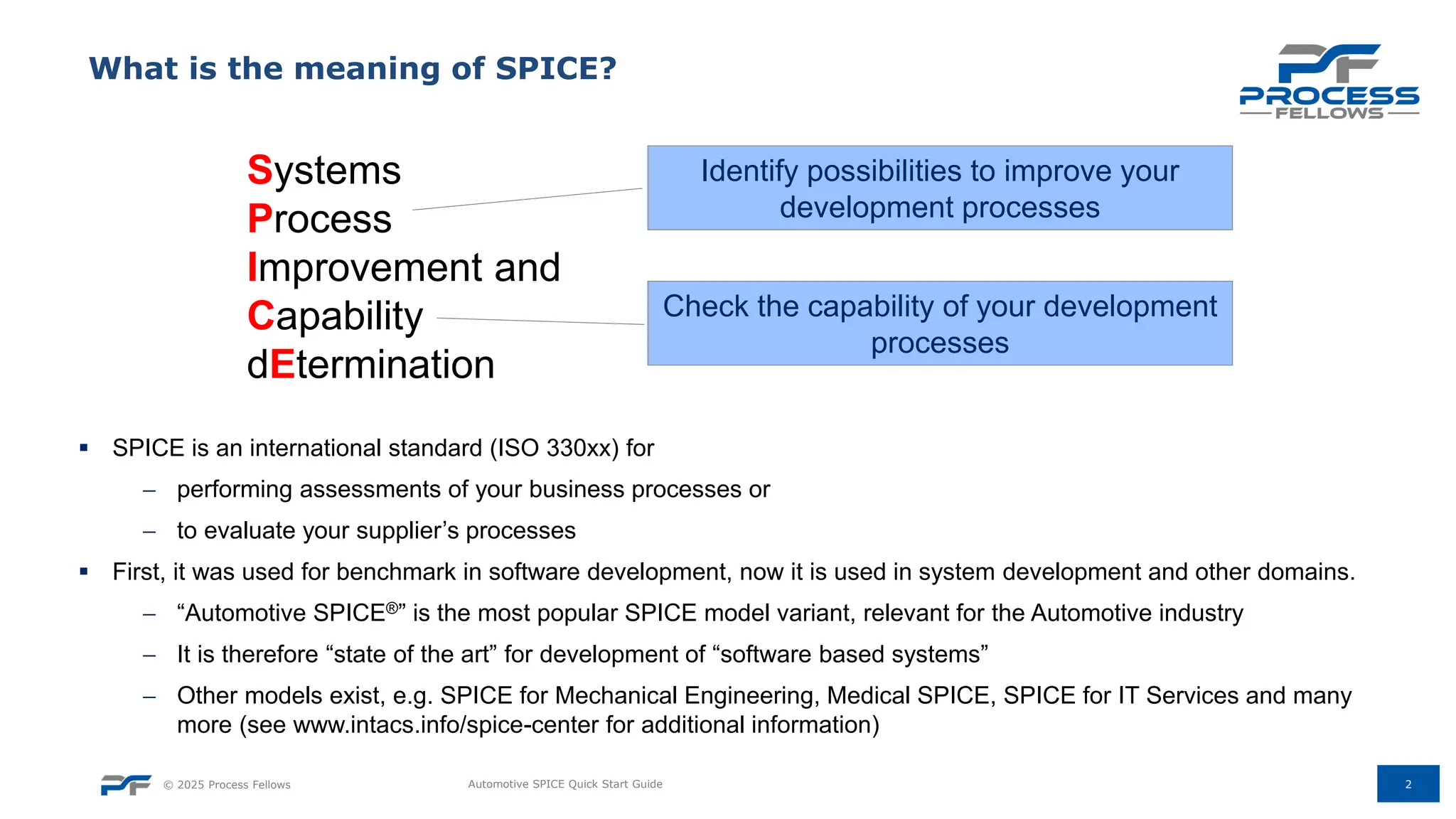
What is the meaning of SPICE?
Automotive SPICE Quick Start Guide
▪ SPICE is an international standard (ISO 330xx) for
− performing assessments of your business processes or
− to evaluate your supplier’s processes
▪ First, it was used for benchmark in software development, now it is used in system development and other domains.
− “Automotive SPICE®” is the most popular SPICE model variant, relevant for the Automotive industry
− It is therefore “state of the art” for development of “software based systems”
− Other models exist, e.g. SPICE for Mechanical Engineering, Medical SPICE, SPICE for IT Services and many
more (see www.intacs.info/spice-center for additional information)
Systems
Process
Improvement and
Capability
dEtermination
Identify possibilities to improve your
development processes
Check the capability of your development
processes
© 2025 Process Fellows 3
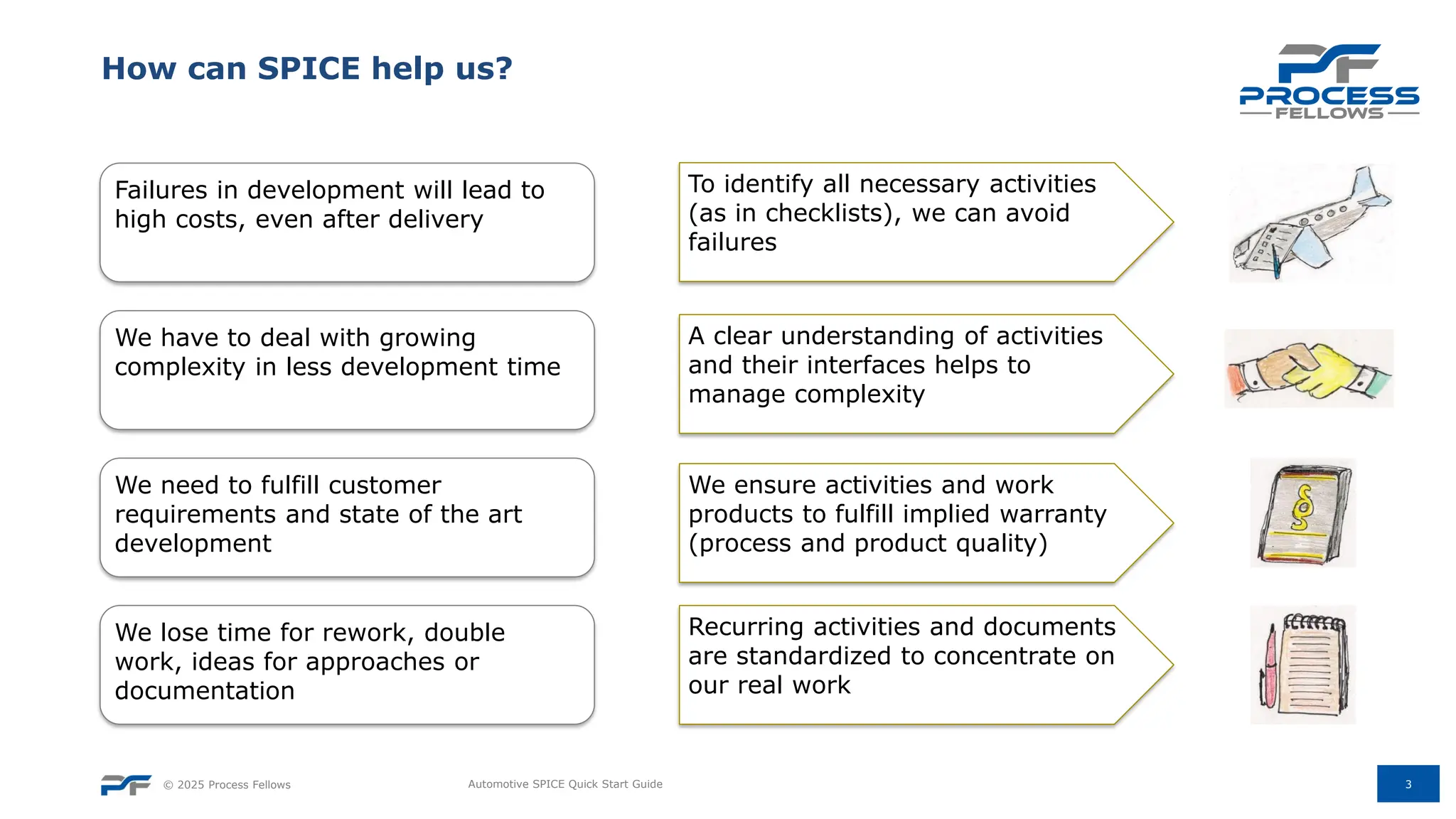
How can SPICE help us?
Failures in development will lead to
high costs, even after delivery
We have to deal with growing
complexity in less development time
We need to fulfill customer
requirements and state of the art
development
We lose time for rework, double
work, ideas for approaches or
documentation
To identify all necessary activities
(as in checklists), we can avoid
failures
A clear understanding of activities
and their interfaces helps to
manage complexity
We ensure activities and work
products to fulfill implied warranty
(process and product quality)
Recurring activities and documents
are standardized to concentrate on
our real work
Automotive SPICE Quick Start Guide
© 2025 Process Fellows 4
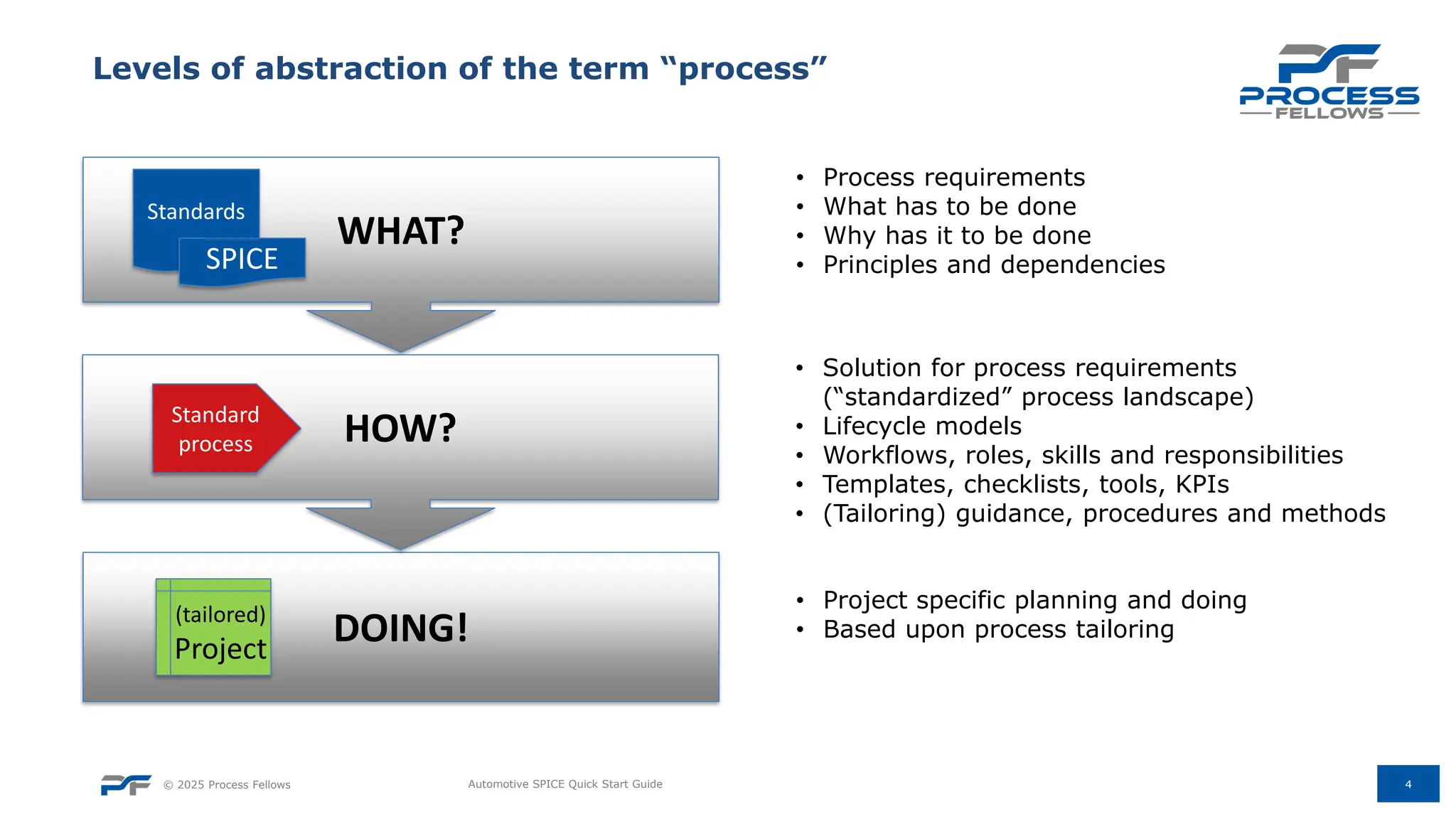
Levels of abstraction of the term “process”
Automotive SPICE Quick Start Guide
WHAT?
• Process requirements
• What has to be done
• Why has it to be done
• Principles and dependencies
Standards
SPICE
DOING!
• Project specific planning and doing
• Based upon process tailoring
(tailored)
Project
HOW?
• Solution for process requirements
(“standardized” process landscape)
• Lifecycle models
• Workflows, roles, skills and responsibilities
• Templates, checklists, tools, KPIs
• (Tailoring) guidance, procedures and methods
Standard
process
© 2025 Process Fellows 5
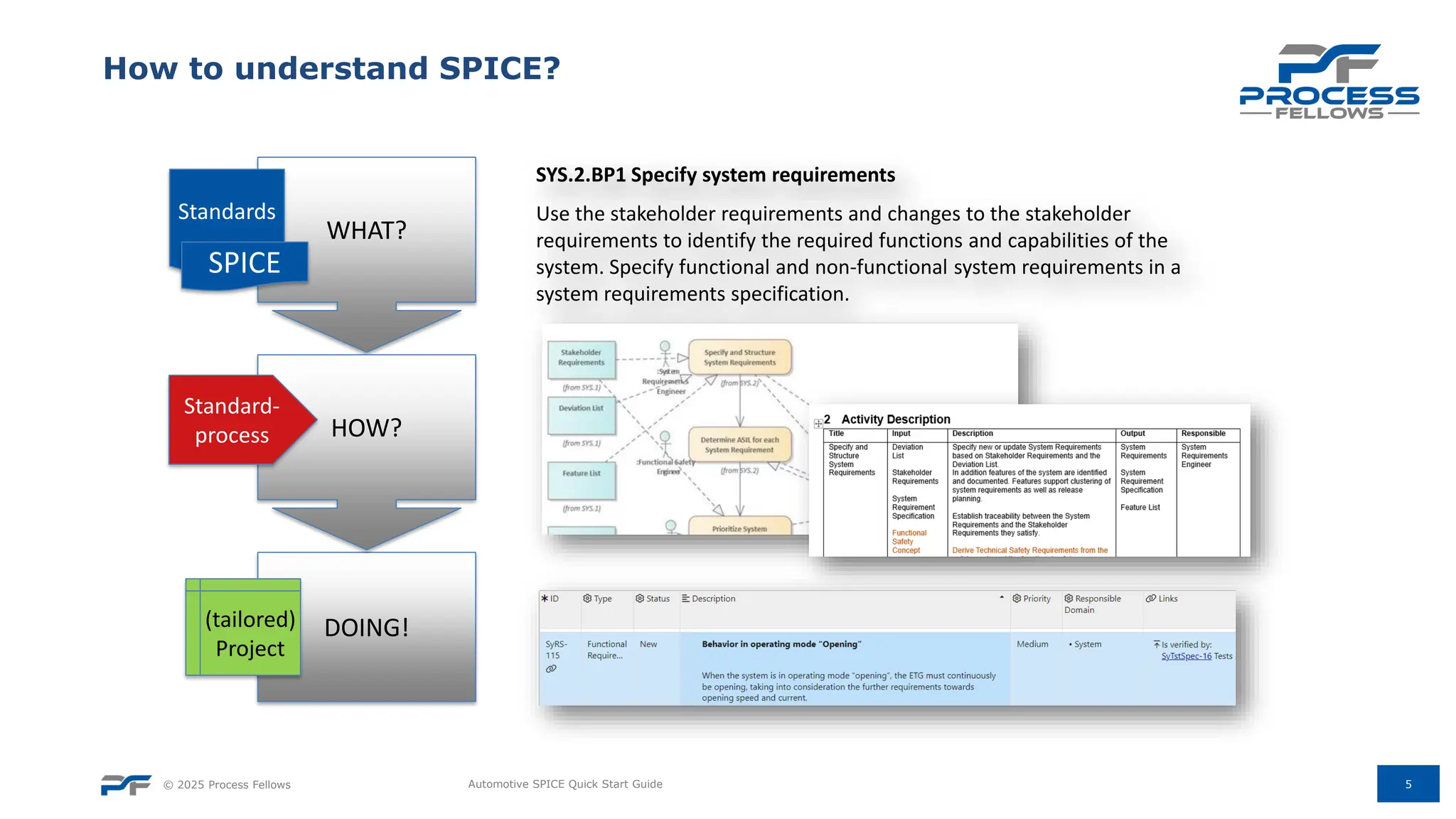
How to understand SPICE?
WHAT?
Standards
SPICE
DOING!
HOW?
Standard-
process
(tailored)
Project
SYS.2.BP1 Specify system requirements
Use the stakeholder requirements and changes to the stakeholder
requirements to identify the required functions and capabilities of the
system. Specify functional and non-functional system requirements in a
system requirements specification.
Automotive SPICE Quick Start Guide
© 2025 Process Fellows 6
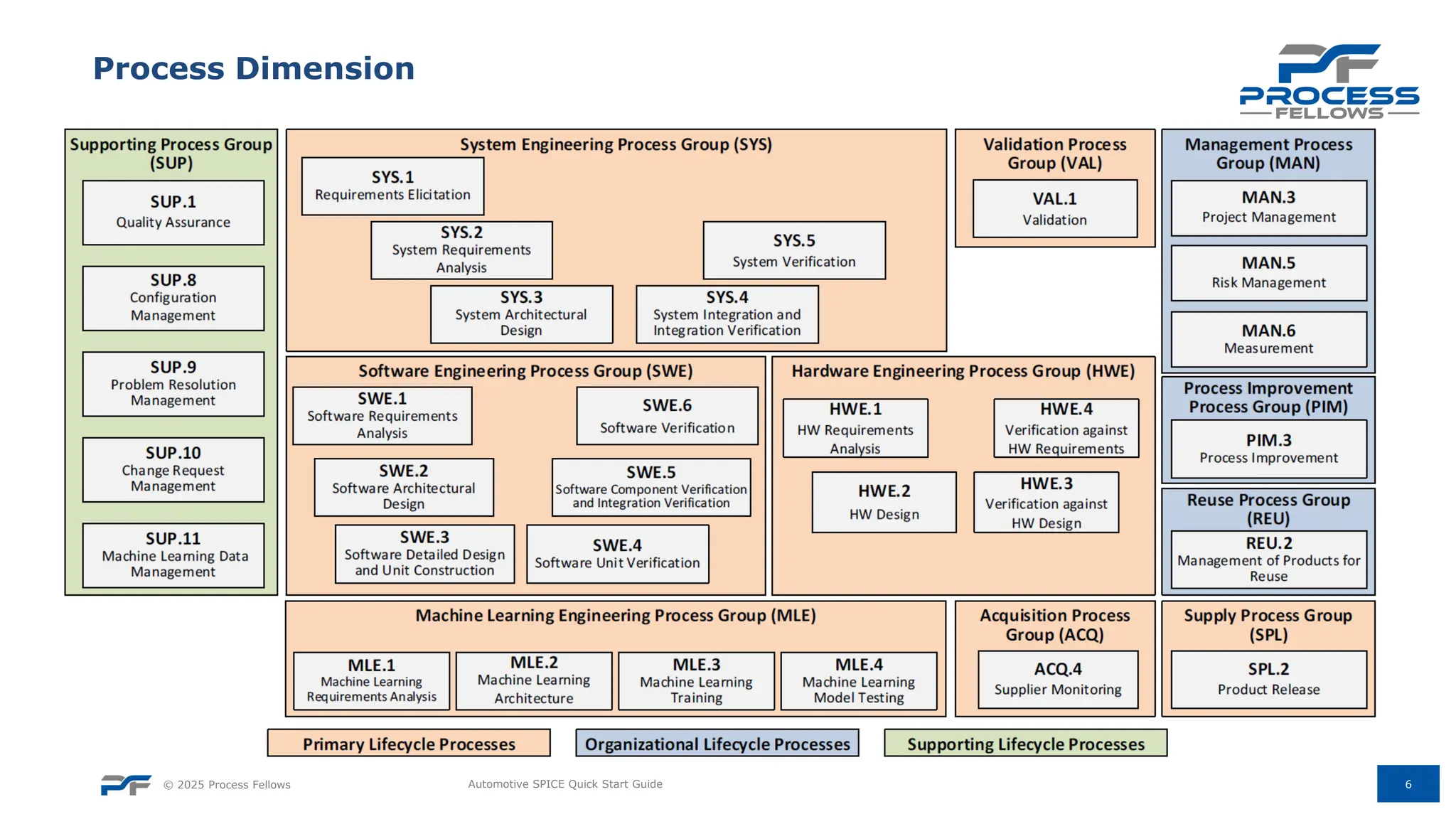
Process Dimension
Automotive SPICE Quick Start Guide
© 2025 Process Fellows 7
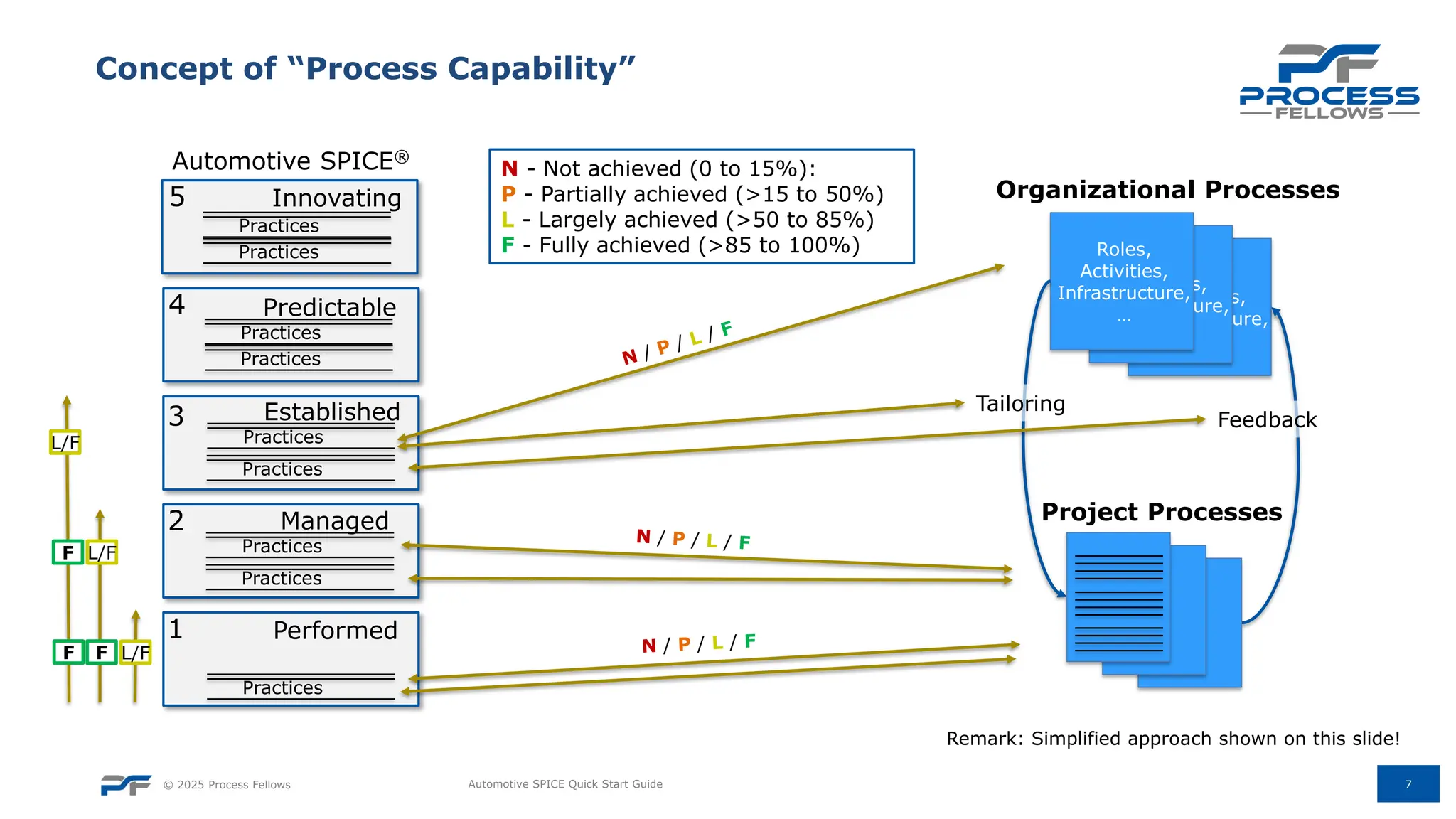
Concept of “Process Capability”
Automotive SPICE Quick Start Guide
L/F
N - Not achieved (0 to 15%):
P - Partially achieved (>15 to 50%)
L - Largely achieved (>50 to 85%)
F - Fully achieved (>85 to 100%)
Automotive SPICE®
1
2
3
4
5
Performed
Managed
Established
Predictable
Innovating
Roles,
Activities,
Infrastructure,
…
Roles,
Activities,
Infrastructure,
…
Roles,
Activities,
Infrastructure,
…
Organizational Processes
Tailoring
Feedback
Project Processes
L/F
F
L/F
F
F
Practices
Practices
Practices
Practices
Practices
Practices
Practices
Practices
Practices
Remark: Simplified approach shown on this slide!
© 2025 Process Fellows
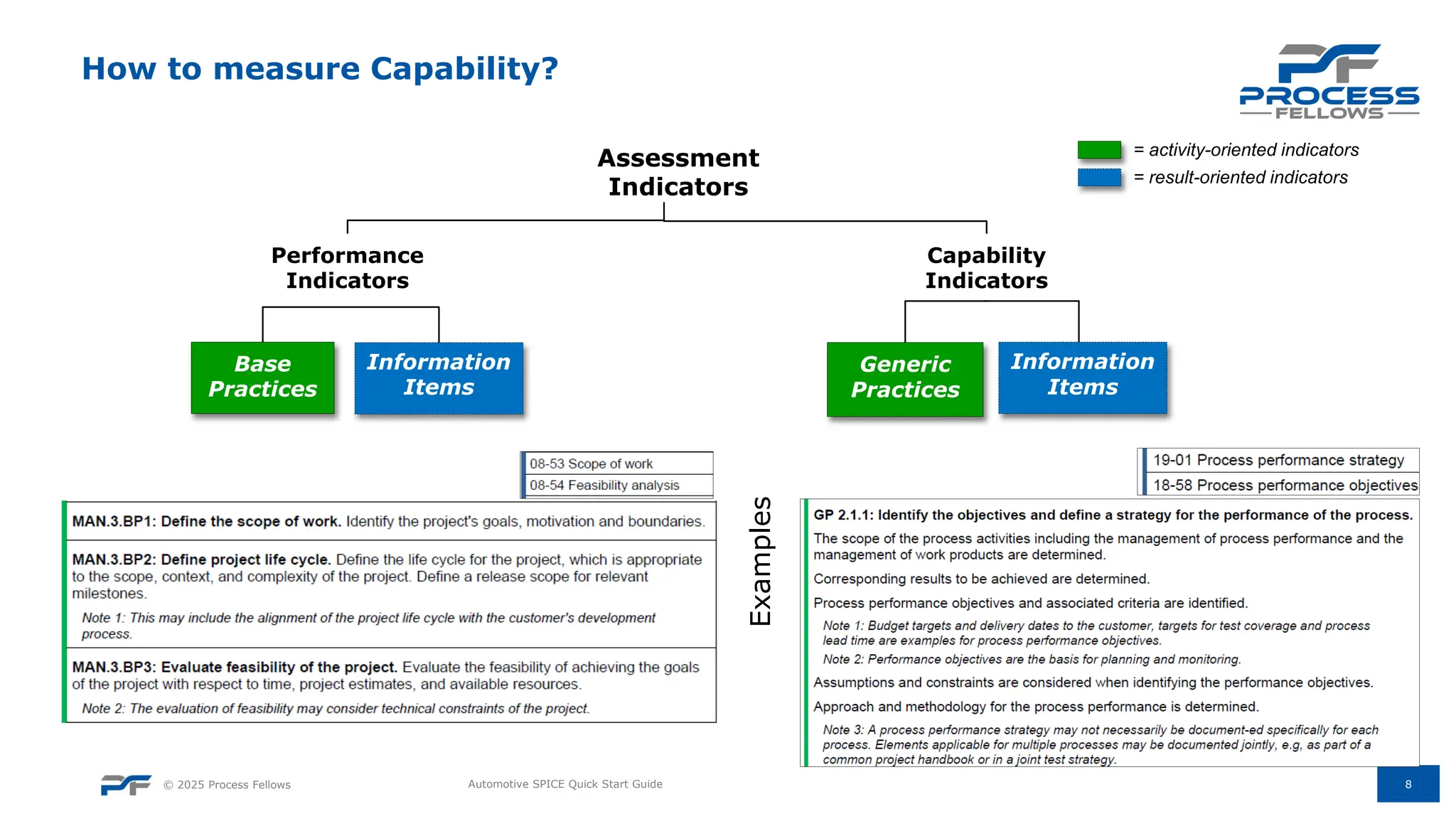
How to measure Capability?
8
Automotive SPICE Quick Start Guide
Assessment
Indicators
Performance
Indicators
Capability
Indicators
Base
Practices
Information
Items
Generic
Practices
Examples
= activity-oriented indicators
= result-oriented indicators
Information
Items
© 2025 Process Fellows 9
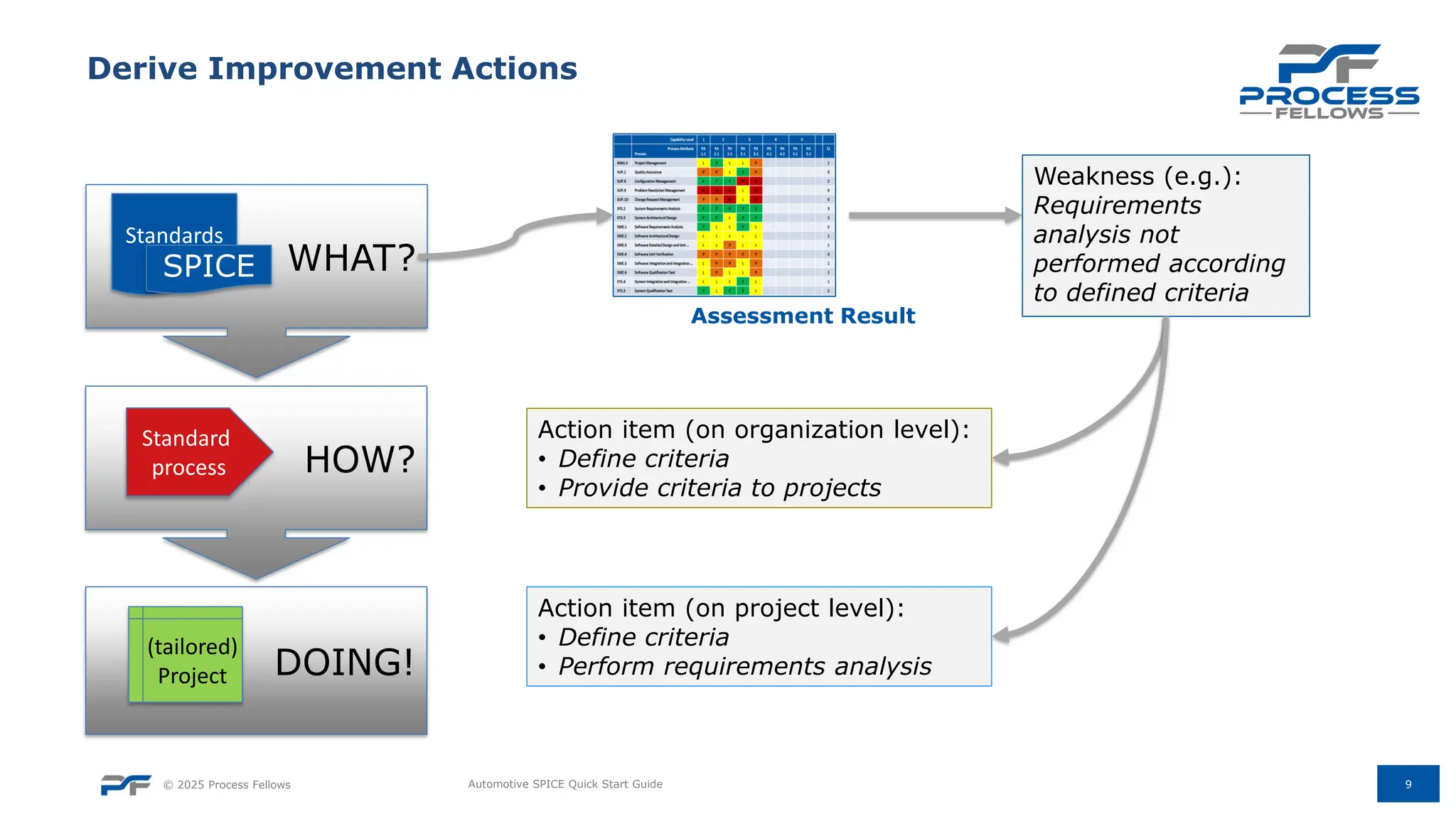
Derive Improvement Actions
Automotive SPICE Quick Start Guide
WHAT?
HOW?
DOING!
Standards
SPICE
(tailored)
Project
Standard
process
Weakness (e.g.):
Requirements
analysis not
performed according
to defined criteria
Action item (on organization level):
• Define criteria
• Provide criteria to projects
Action item (on project level):
• Define criteria
• Perform requirements analysis
Assessment Result
© 2025 Process Fellows
▪ Clarify the assessment scope upfront.
▪ Understand the model and its requirements.
▪ Update the project and process documentation.
(Hopefully, this is not needed because it is anyhow up to date!)
▪ Conduct a gap analysis and implement improvements as needed.
▪ Practice interview questions: Prepare for frequently asked questions.
▪ Prepare a “help sheet”, i.e.
▪ create a compliance mapping between your processes and ASPICE assessment indicators
▪ identify (project) evidences to be presented.
▪ If there are gaps which cannot be closed before the assessment starts:
▪ Be open to an honest discussion.
▪ Show that the gaps and their systematic solution has been identified and started to be implemented.
▪ Implement such solutions taking into account a prioritized list of measures. The prioritization of the measures
should be derived from the prioritization of the gaps and process risks.
▪ Ideally, key metrics show, how an improvement is achieved iteratively (e.g. over several releases), even if the
optimal solution has not yet been achieved.
▪ Thorough preparation requires a combination of theoretical knowledge and practical experience in process
implementation and documentation.
10
How to prepare for an Assessment?
Automotive SPICE Quick Start Guide
Process Fellows GmbH | Schlegelleithe 8 | 91320 Ebermannstadt | GERMANY
Phone: +49 9194 3719 957 | Fax: +49 9194 3719 – 579
Website: www.processfellows.de | E-Mail: info@processfellows.de
www.spice4cars.com

Automotive SPICE®: The Quickstart Guide

  • 1.
    © 2025 ProcessFellows Quick Start Guide to Automotive SPICE® v4.0
  • 2.
    © 2025 ProcessFellows 2 What is the meaning of SPICE? Automotive SPICE Quick Start Guide ▪ SPICE is an international standard (ISO 330xx) for − performing assessments of your business processes or − to evaluate your supplier’s processes ▪ First, it was used for benchmark in software development, now it is used in system development and other domains. − “Automotive SPICE®” is the most popular SPICE model variant, relevant for the Automotive industry − It is therefore “state of the art” for development of “software based systems” − Other models exist, e.g. SPICE for Mechanical Engineering, Medical SPICE, SPICE for IT Services and many more (see www.intacs.info/spice-center for additional information) Systems Process Improvement and Capability dEtermination Identify possibilities to improve your development processes Check the capability of your development processes
  • 3.
    © 2025 ProcessFellows 3 How can SPICE help us? Failures in development will lead to high costs, even after delivery We have to deal with growing complexity in less development time We need to fulfill customer requirements and state of the art development We lose time for rework, double work, ideas for approaches or documentation To identify all necessary activities (as in checklists), we can avoid failures A clear understanding of activities and their interfaces helps to manage complexity We ensure activities and work products to fulfill implied warranty (process and product quality) Recurring activities and documents are standardized to concentrate on our real work Automotive SPICE Quick Start Guide
  • 4.
    © 2025 ProcessFellows 4 Levels of abstraction of the term “process” Automotive SPICE Quick Start Guide WHAT? • Process requirements • What has to be done • Why has it to be done • Principles and dependencies Standards SPICE DOING! • Project specific planning and doing • Based upon process tailoring (tailored) Project HOW? • Solution for process requirements (“standardized” process landscape) • Lifecycle models • Workflows, roles, skills and responsibilities • Templates, checklists, tools, KPIs • (Tailoring) guidance, procedures and methods Standard process
  • 5.
    © 2025 ProcessFellows 5 How to understand SPICE? WHAT? Standards SPICE DOING! HOW? Standard- process (tailored) Project SYS.2.BP1 Specify system requirements Use the stakeholder requirements and changes to the stakeholder requirements to identify the required functions and capabilities of the system. Specify functional and non-functional system requirements in a system requirements specification. Automotive SPICE Quick Start Guide
  • 6.
    © 2025 ProcessFellows 6 Process Dimension Automotive SPICE Quick Start Guide
  • 7.
    © 2025 ProcessFellows 7 Concept of “Process Capability” Automotive SPICE Quick Start Guide L/F N - Not achieved (0 to 15%): P - Partially achieved (>15 to 50%) L - Largely achieved (>50 to 85%) F - Fully achieved (>85 to 100%) Automotive SPICE® 1 2 3 4 5 Performed Managed Established Predictable Innovating Roles, Activities, Infrastructure, … Roles, Activities, Infrastructure, … Roles, Activities, Infrastructure, … Organizational Processes Tailoring Feedback Project Processes L/F F L/F F F Practices Practices Practices Practices Practices Practices Practices Practices Practices Remark: Simplified approach shown on this slide!
  • 8.
    © 2025 ProcessFellows How to measure Capability? 8 Automotive SPICE Quick Start Guide Assessment Indicators Performance Indicators Capability Indicators Base Practices Information Items Generic Practices Examples = activity-oriented indicators = result-oriented indicators Information Items
  • 9.
    © 2025 ProcessFellows 9 Derive Improvement Actions Automotive SPICE Quick Start Guide WHAT? HOW? DOING! Standards SPICE (tailored) Project Standard process Weakness (e.g.): Requirements analysis not performed according to defined criteria Action item (on organization level): • Define criteria • Provide criteria to projects Action item (on project level): • Define criteria • Perform requirements analysis Assessment Result
  • 10.
    © 2025 ProcessFellows ▪ Clarify the assessment scope upfront. ▪ Understand the model and its requirements. ▪ Update the project and process documentation. (Hopefully, this is not needed because it is anyhow up to date!) ▪ Conduct a gap analysis and implement improvements as needed. ▪ Practice interview questions: Prepare for frequently asked questions. ▪ Prepare a “help sheet”, i.e. ▪ create a compliance mapping between your processes and ASPICE assessment indicators ▪ identify (project) evidences to be presented. ▪ If there are gaps which cannot be closed before the assessment starts: ▪ Be open to an honest discussion. ▪ Show that the gaps and their systematic solution has been identified and started to be implemented. ▪ Implement such solutions taking into account a prioritized list of measures. The prioritization of the measures should be derived from the prioritization of the gaps and process risks. ▪ Ideally, key metrics show, how an improvement is achieved iteratively (e.g. over several releases), even if the optimal solution has not yet been achieved. ▪ Thorough preparation requires a combination of theoretical knowledge and practical experience in process implementation and documentation. 10 How to prepare for an Assessment? Automotive SPICE Quick Start Guide
  • 11.
    Process Fellows GmbH| Schlegelleithe 8 | 91320 Ebermannstadt | GERMANY Phone: +49 9194 3719 957 | Fax: +49 9194 3719 – 579 Website: www.processfellows.de | E-Mail: info@processfellows.de www.spice4cars.com