


Aspect-Oriented Software Development  Course 2009 Identifying Concerns on Source Code Techniques, Tools & Methods Eng. Esteban S. Abait ISISTAN – UNCPBA Universidad Nacional del Centro de la Provincia de Buenos Aires
Agenda Introduction
Migration Process
Aspect Mining Techniques Static-based approaches
Dynamic-based approaches Concern-Sorts
Pitfalls on Aspect Mining
Agenda Introduction
Migration Process
Aspect Mining Techniques Static-based approaches
Dynamic-based approaches Concern-Sorts
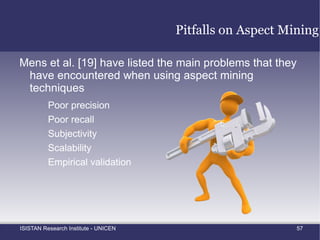
Pitfalls on Aspect Mining
Introduction:  Software Evolution The term evolution describes a phenomenon encountered in many different domains [1] Classes of entities such as natural species, societies, concepts, ideas, for example, are said to evolve in time, each in its own context Real world software is essentially evolutionary in nature [1]
Introduction:  Facebook Evolution Evolution of a real-world software: Facebook 2004 2006 2007 2009 February : Mark Zuckerberg and  co-founders launch Facebook  from their Harvard dorm room December : Facebook reaches  1 millon users Open its registration, anyone can join the social network Launches a mobile feature Reaches 12 millions users Add a gift shop feature Reaches 50 million users 2008:  translation to 21 languages Reaches 300 million active users http://www.facebook.com/press/info.php?timeline
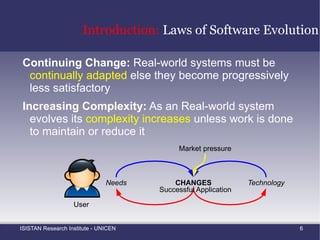
Introduction:  Laws of Software Evolution Continuing Change:  Real-world systems must be  continually adapted  else they become progressively less satisfactory
Increasing Complexity:  As an Real-world system evolves its  complexity increases  unless work is done to maintain or reduce it Needs CHANGES Technology Successful Application Market pressure User
Introduction:  Crosscutting Concerns (1) Crosscutting concerns are believed to negatively affect  evolvability , maintainability and understandability [2] A change to a crosscutting concern is likely to affect many different places in the source code AOP propose a solution to this problem by introducing the notion of aspects An aspect is a language construct that allows us to localize a concern's implementation
Introduction:  Crosscutting Concerns (2) Why crosscutting concerns negatively affect software properties like  evolvability , maintainability or understandability? A deadlock on the locking mechanism of  eclipse  had as a result the modification of 2573 methods
Developers inserted in 1 284 methods a call to lock, as well as a call to unlock
Agenda Introduction
Migration Process
Aspect Mining Techniques Static-based approaches
Dynamic-based approaches Concern-Sorts
Pitfalls on Aspect Mining
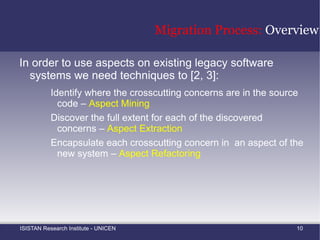
Migration Process:  Overview In order to use aspects on existing legacy software systems we need techniques to [2, 3]: Identify where the crosscutting concerns are in the source code –  Aspect Mining
Discover the full extent for each of the discovered concerns –  Aspect Extraction
Encapsulate each crosscutting concern in  an aspect of the new system –  Aspect Refactoring
Agenda Introduction
Migration Process
Aspect Mining Techniques Static-based approaches
Dynamic-based approaches Concern-Sorts
Pitfalls on Aspect Mining
Aspect Mining:  Introduction (1) Aspect mining aims to  identify crosscutting concerns  in existing systems, thereby improving the system’s comprehensibility and  enabling migration  of existing (object-oriented) programs to aspect-oriented ones
Why (semi-)automatic techniques are needed? The sheer  size and complexity  of many existing systems, combined with the  lack of documentation and knowledge  of such systems render it practically infeasible to manually transform their crosscutting concerns into aspects [2]
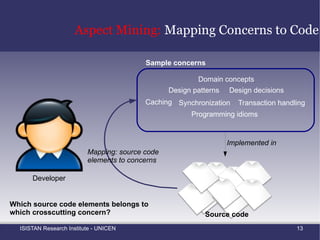
Aspect Mining:  Mapping Concerns to Code Sample concerns Implemented in Mapping: source code elements to concerns Which source code elements belongs to which crosscutting concern? Transaction handling Design patterns Design decisions Domain concepts Programming idioms Synchronization Caching Source code Developer
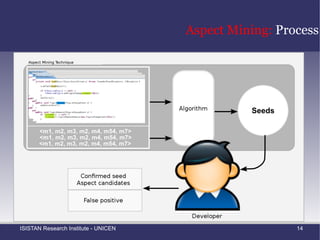
Aspect Mining:  Process
Agenda Introduction
Migration Process
Aspect Mining Techniques Static-based approaches
Dynamic-based approaches Concern-Sorts
Pitfalls on Aspect Mining
Static-based techniques:  Fan-In Analysis (1) Determining  methods  that are  called from many different places  (and hence have a high fan-in) to identify candidate aspects The Logger's log method is called from different places
Its fan-in value depends on the number of different methods
bodies that use it
Static-based techniques:  Fan-In Analysis (2) Marin et al. [4] proposed the use of this metric for finding methods that belongs to the implementation of a crosscutting concern
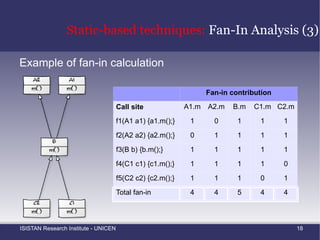
Fan-in definition: the fan-in of method  m  is the number of distinct method bodies that invoke  m
due to  polymorphism , a call to a method  m  contributes to all methods refining  m  as well as all method refined by  m
Static-based techniques:  Fan-In Analysis (3) Example of fan-in calculation Fan-in contribution Call site A1.m A2.m B.m C1.m C2.m f1(A1 a1) {a1.m();} 1 0 1 1 1 f2(A2 a2) {a2.m();} 0 1 1 1 1 f3(B b) {b.m();} 1 1 1 1 1 f4(C1 c1) {c1.m();} 1 1 1 1 0 f5(C2 c2) {c2.m();} 1 1 1 0 1 Total fan-in 4 4 5 4 4
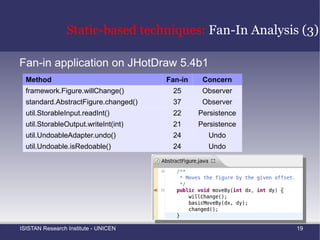
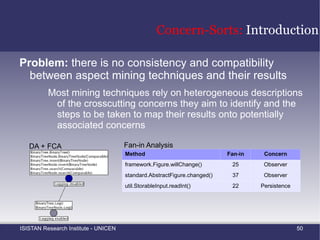
Static-based techniques:  Fan-In Analysis (3) Fan-in application on JHotDraw 5.4b1 Method Fan-in Concern framework.Figure.willChange()  25 Observer standard.AbstractFigure.changed()  37 Observer util.StorableInput.readInt()  22 Persistence util.StorableOutput.writeInt(int)  21 Persistence util.UndoableAdapter.undo()  24 Undo util.Undoable.isRedoable()  24 Undo
Demo time Lets see how to work with an aspect mining tool
Static-based techniques:  Clustering Based Mining Several works on aspect mining relies on the use of clustering algorithms
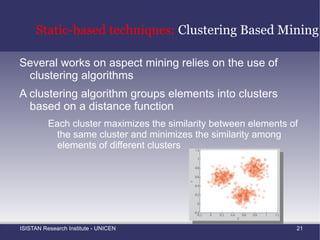
A clustering algorithm groups elements into clusters based on a distance function Each cluster maximizes the similarity between elements of the same cluster and minimizes the similarity among elements of different clusters
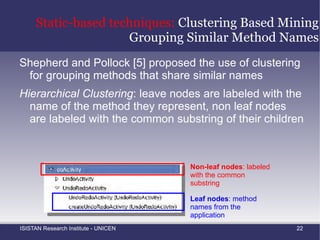
Static-based techniques:  Clustering Based Mining Grouping Similar Method Names Shepherd and Pollock [5] proposed the use of clustering for grouping methods that share similar names
Hierarchical Clustering : leave nodes are labeled with the name of the method they represent, non leaf nodes are labeled with the common substring of their children Leaf nodes : method names from the application Non-leaf nodes : labeled with the common substring
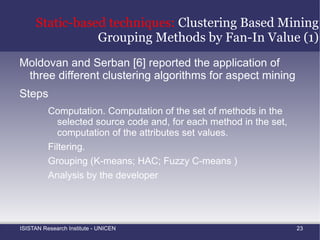
Static-based techniques:  Clustering Based Mining Grouping Methods by Fan-In Value (1) Moldovan and Serban [6] reported the application of three different clustering algorithms for aspect mining
Steps Computation. Computation of the set of methods in the selected source code and, for each method in the set, computation of the attributes set values.
Filtering.
Grouping (K-means; HAC; Fuzzy C-means )
Analysis by the developer
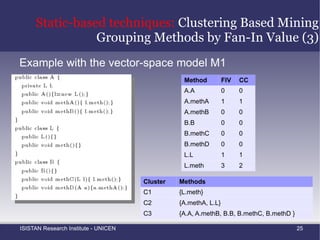
Static-based techniques:  Clustering Based Mining Grouping Methods by Fan-In Value (2) In this approach, the methods to be clustered are represented as a l-dimensional vector: m i  = {m i1 , ..., m il }
The author considered two vector-space models M1: {FIV, CC}, where FIV is the fan-in value and CC is the number of calling classes

Aspect Mining Techniques

  • 1.
    Aspect-Oriented Software Development Course 2009 Identifying Concerns on Source Code Techniques, Tools & Methods Eng. Esteban S. Abait ISISTAN – UNCPBA Universidad Nacional del Centro de la Provincia de Buenos Aires
  • 2.
  • 3.
  • 4.
    Aspect Mining TechniquesStatic-based approaches
  • 5.
  • 6.
  • 7.
  • 8.
  • 9.
    Aspect Mining TechniquesStatic-based approaches
  • 10.
  • 11.
  • 12.
    Introduction: SoftwareEvolution The term evolution describes a phenomenon encountered in many different domains [1] Classes of entities such as natural species, societies, concepts, ideas, for example, are said to evolve in time, each in its own context Real world software is essentially evolutionary in nature [1]
  • 13.
    Introduction: FacebookEvolution Evolution of a real-world software: Facebook 2004 2006 2007 2009 February : Mark Zuckerberg and co-founders launch Facebook from their Harvard dorm room December : Facebook reaches 1 millon users Open its registration, anyone can join the social network Launches a mobile feature Reaches 12 millions users Add a gift shop feature Reaches 50 million users 2008: translation to 21 languages Reaches 300 million active users http://www.facebook.com/press/info.php?timeline
  • 14.
    Introduction: Lawsof Software Evolution Continuing Change: Real-world systems must be continually adapted else they become progressively less satisfactory
  • 15.
    Increasing Complexity: As an Real-world system evolves its complexity increases unless work is done to maintain or reduce it Needs CHANGES Technology Successful Application Market pressure User
  • 16.
    Introduction: CrosscuttingConcerns (1) Crosscutting concerns are believed to negatively affect evolvability , maintainability and understandability [2] A change to a crosscutting concern is likely to affect many different places in the source code AOP propose a solution to this problem by introducing the notion of aspects An aspect is a language construct that allows us to localize a concern's implementation
  • 17.
    Introduction: CrosscuttingConcerns (2) Why crosscutting concerns negatively affect software properties like evolvability , maintainability or understandability? A deadlock on the locking mechanism of eclipse had as a result the modification of 2573 methods
  • 18.
    Developers inserted in1 284 methods a call to lock, as well as a call to unlock
  • 19.
  • 20.
  • 21.
    Aspect Mining TechniquesStatic-based approaches
  • 22.
  • 23.
  • 24.
    Migration Process: Overview In order to use aspects on existing legacy software systems we need techniques to [2, 3]: Identify where the crosscutting concerns are in the source code – Aspect Mining
  • 25.
    Discover the fullextent for each of the discovered concerns – Aspect Extraction
  • 26.
    Encapsulate each crosscuttingconcern in an aspect of the new system – Aspect Refactoring
  • 27.
  • 28.
  • 29.
    Aspect Mining TechniquesStatic-based approaches
  • 30.
  • 31.
  • 32.
    Aspect Mining: Introduction (1) Aspect mining aims to identify crosscutting concerns in existing systems, thereby improving the system’s comprehensibility and enabling migration of existing (object-oriented) programs to aspect-oriented ones
  • 33.
    Why (semi-)automatic techniquesare needed? The sheer size and complexity of many existing systems, combined with the lack of documentation and knowledge of such systems render it practically infeasible to manually transform their crosscutting concerns into aspects [2]
  • 34.
    Aspect Mining: Mapping Concerns to Code Sample concerns Implemented in Mapping: source code elements to concerns Which source code elements belongs to which crosscutting concern? Transaction handling Design patterns Design decisions Domain concepts Programming idioms Synchronization Caching Source code Developer
  • 35.
  • 36.
  • 37.
  • 38.
    Aspect Mining TechniquesStatic-based approaches
  • 39.
  • 40.
  • 41.
    Static-based techniques: Fan-In Analysis (1) Determining methods that are called from many different places (and hence have a high fan-in) to identify candidate aspects The Logger's log method is called from different places
  • 42.
    Its fan-in valuedepends on the number of different methods
  • 43.
  • 44.
    Static-based techniques: Fan-In Analysis (2) Marin et al. [4] proposed the use of this metric for finding methods that belongs to the implementation of a crosscutting concern
  • 45.
    Fan-in definition: thefan-in of method m is the number of distinct method bodies that invoke m
  • 46.
    due to polymorphism , a call to a method m contributes to all methods refining m as well as all method refined by m
  • 47.
    Static-based techniques: Fan-In Analysis (3) Example of fan-in calculation Fan-in contribution Call site A1.m A2.m B.m C1.m C2.m f1(A1 a1) {a1.m();} 1 0 1 1 1 f2(A2 a2) {a2.m();} 0 1 1 1 1 f3(B b) {b.m();} 1 1 1 1 1 f4(C1 c1) {c1.m();} 1 1 1 1 0 f5(C2 c2) {c2.m();} 1 1 1 0 1 Total fan-in 4 4 5 4 4
  • 48.
    Static-based techniques: Fan-In Analysis (3) Fan-in application on JHotDraw 5.4b1 Method Fan-in Concern framework.Figure.willChange() 25 Observer standard.AbstractFigure.changed() 37 Observer util.StorableInput.readInt() 22 Persistence util.StorableOutput.writeInt(int) 21 Persistence util.UndoableAdapter.undo() 24 Undo util.Undoable.isRedoable() 24 Undo
  • 49.
    Demo time Letssee how to work with an aspect mining tool
  • 50.
    Static-based techniques: Clustering Based Mining Several works on aspect mining relies on the use of clustering algorithms
  • 51.
    A clustering algorithmgroups elements into clusters based on a distance function Each cluster maximizes the similarity between elements of the same cluster and minimizes the similarity among elements of different clusters
  • 52.
    Static-based techniques: Clustering Based Mining Grouping Similar Method Names Shepherd and Pollock [5] proposed the use of clustering for grouping methods that share similar names
  • 53.
    Hierarchical Clustering :leave nodes are labeled with the name of the method they represent, non leaf nodes are labeled with the common substring of their children Leaf nodes : method names from the application Non-leaf nodes : labeled with the common substring
  • 54.
    Static-based techniques: Clustering Based Mining Grouping Methods by Fan-In Value (1) Moldovan and Serban [6] reported the application of three different clustering algorithms for aspect mining
  • 55.
    Steps Computation. Computationof the set of methods in the selected source code and, for each method in the set, computation of the attributes set values.
  • 56.
  • 57.
    Grouping (K-means; HAC;Fuzzy C-means )
  • 58.
    Analysis by thedeveloper
  • 59.
    Static-based techniques: Clustering Based Mining Grouping Methods by Fan-In Value (2) In this approach, the methods to be clustered are represented as a l-dimensional vector: m i = {m i1 , ..., m il }
  • 60.
    The author consideredtwo vector-space models M1: {FIV, CC}, where FIV is the fan-in value and CC is the number of calling classes