Rejuvenate Pointcut
   A Tool for Pointcut Expression Recovery in Evolving
                Aspect-Oriented Software


Raffi Khatchadourian1    Phil Greenwood2          Awais Rashid2
                      Guoqing Xu1

                    1 Ohio   State University
                    2 Lancaster   University


  International Conference on Aspect-Oriented Software
                   Development, 2009


                             A
Motivation
                                      Approach
                                     Evaluation
                               More Information


Outline


  1   Motivation


  2   Approach


  3   Evaluation


  4   More Information


          Khatchadourian, Greenwood, Rashid, Xu   Rejuvenate Pointcut
Motivation
                                   Approach
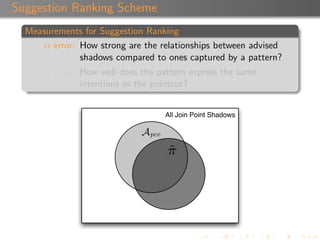
                                  Evaluation
                            More Information


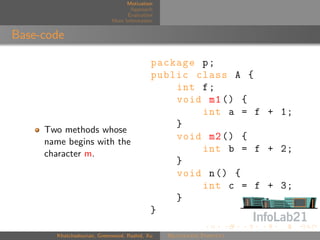
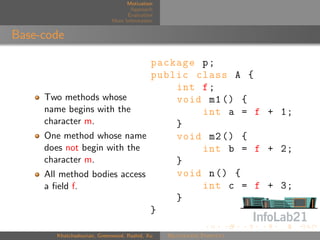
Base-code

                                           package p ;
                                           public class A {
                                               int f ;
                                               void m1 () {
                                                   int a = f + 1;
                                               }
     Two methods whose
     name begins with the
                                               void m2 () {
     character m.
                                                   int b = f + 2;
                                               }
                                               void n () {
                                                   int c = f + 3;
                                               }
                                           }

       Khatchadourian, Greenwood, Rashid, Xu   Rejuvenate Pointcut
Motivation
                                   Approach
                                  Evaluation
                            More Information


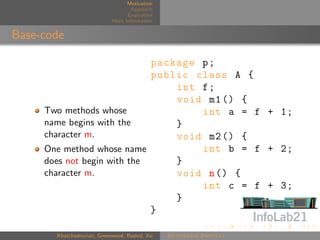
Base-code

                             package p ;
                             public class A {
                                 int f ;
                                 void m1 () {
     Two methods whose               int a = f + 1;
     name begins with the        }
     character m.                void m2 () {
     One method whose name           int b = f + 2;
     does not begin with the     }
     character m.                void n () {
                                     int c = f + 3;
                                 }
                             }

       Khatchadourian, Greenwood, Rashid, Xu   Rejuvenate Pointcut
Motivation
                                   Approach
                                  Evaluation
                            More Information


Base-code

                              package p ;
                              public class A {
                                  int f ;
     Two methods whose            void m1 () {
     name begins with the             int a = f + 1;
     character m.                 }
     One method whose name        void m2 () {
     does not begin with the          int b = f + 2;
     character m.                 }
     All method bodies access     void n () {
     a field f.                        int c = f + 3;
                                  }
                              }

       Khatchadourian, Greenwood, Rashid, Xu   Rejuvenate Pointcut
Motivation
                                     Approach
                                    Evaluation
                              More Information


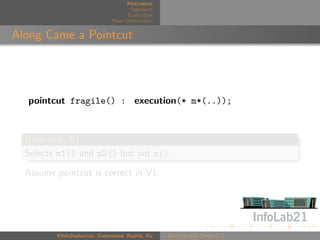
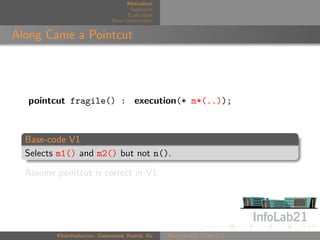
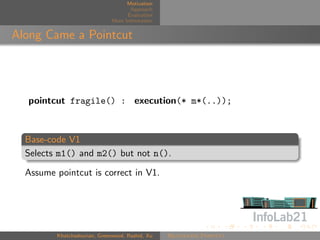
Along Came a Pointcut


  pointcut fragile() : execution(* m*(..));


  Base-code V1
  Selects m1() and m2() but not n().

  Assume pointcut is correct in V1.


         Khatchadourian, Greenwood, Rashid, Xu   Rejuvenate Pointcut
Motivation
                                     Approach
                                    Evaluation
                              More Information


Along Came a Pointcut


  pointcut fragile() : execution(* m*(..));


  Base-code V1
  Selects m1() and m2() but not n().

  Assume pointcut is correct in V1.


         Khatchadourian, Greenwood, Rashid, Xu   Rejuvenate Pointcut
Motivation
                                     Approach
                                    Evaluation
                              More Information


Along Came a Pointcut


  pointcut fragile() : execution(* m*(..));


  Base-code V1
  Selects m1() and m2() but not n().

  Assume pointcut is correct in V1.


         Khatchadourian, Greenwood, Rashid, Xu   Rejuvenate Pointcut
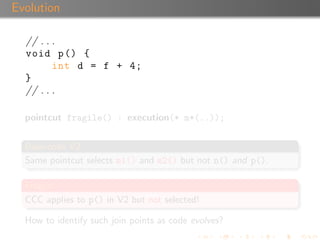
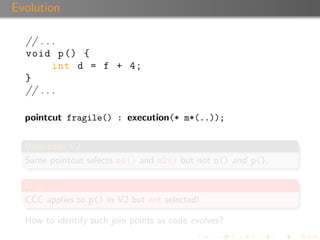
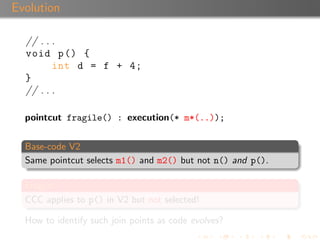
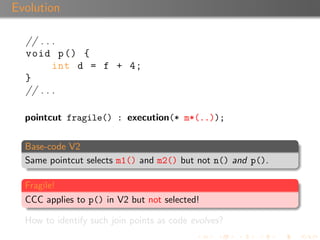
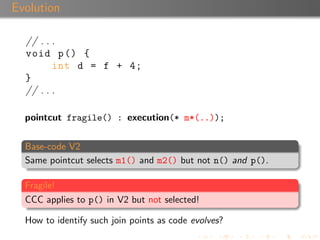
Evolution

  // . . .
  void p () {
         int d = f + 4;
  }
  // . . .

  pointcut fragile() : execution(* m*(..));


  Base-code V2
  Same pointcut selects m1() and m2() but not n() and p().

  Fragile!
  CCC applies to p() in V2 but not selected!

  How to identify such join points as code evolves?
Evolution

  // . . .
  void p () {
         int d = f + 4;
  }
  // . . .

  pointcut fragile() : execution(* m*(..));


  Base-code V2
  Same pointcut selects m1() and m2() but not n() and p().

  Fragile!
  CCC applies to p() in V2 but not selected!

  How to identify such join points as code evolves?
Evolution

  // . . .
  void p () {
         int d = f + 4;
  }
  // . . .

  pointcut fragile() : execution(* m*(..));


  Base-code V2
  Same pointcut selects m1() and m2() but not n() and p().

  Fragile!
  CCC applies to p() in V2 but not selected!

  How to identify such join points as code evolves?
Evolution

  // . . .
  void p () {
         int d = f + 4;
  }
  // . . .

  pointcut fragile() : execution(* m*(..));


  Base-code V2
  Same pointcut selects m1() and m2() but not n() and p().

  Fragile!
  CCC applies to p() in V2 but not selected!

  How to identify such join points as code evolves?
Evolution

  // . . .
  void p () {
         int d = f + 4;
  }
  // . . .

  pointcut fragile() : execution(* m*(..));


  Base-code V2
  Same pointcut selects m1() and m2() but not n() and p().

  Fragile!
  CCC applies to p() in V2 but not selected!

  How to identify such join points as code evolves?
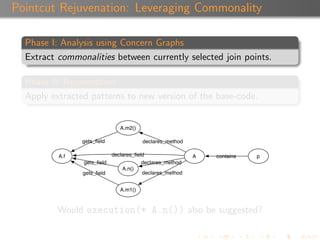
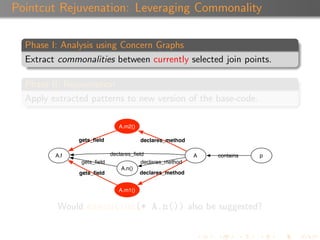
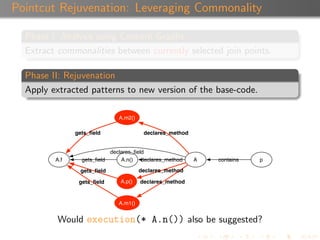
Pointcut Rejuvenation: Leveraging Commonality

  Phase I: Analysis using Concern Graphs
  Extract commonalities between currently selected join points.

  Phase II: Rejuvenation
  Apply extracted patterns to new version of the base-code.


                               A.m2()

                gets_field               declares_method

          A.f               declares_field                 A   contains   p
                gets_field               declares_method
                                A.n()
                gets_field               declares_method


                               A.m1()


          Would execution(* A.n()) also be suggested?
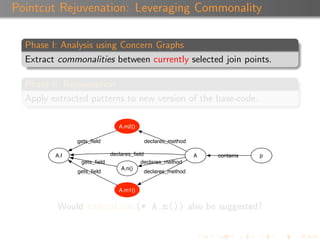
Pointcut Rejuvenation: Leveraging Commonality

  Phase I: Analysis using Concern Graphs
  Extract commonalities between currently selected join points.

  Phase II: Rejuvenation
  Apply extracted patterns to new version of the base-code.

                               A.m2()

               gets_field                 declares_method

         A.f                declares_field                   A   contains   p
                gets_field               declares_method
                                A.n()
               gets_field                  declares_method


                               A.m1()


          Would execution(* A.n()) also be suggested?
Pointcut Rejuvenation: Leveraging Commonality

  Phase I: Analysis using Concern Graphs
  Extract commonalities between currently selected join points.

  Phase II: Rejuvenation
  Apply extracted patterns to new version of the base-code.

                               A.m2()

               gets_field                declares_method

         A.f                declares_field                 A   contains   p
                gets_field               declares_method
                                A.n()
               gets_field               declares_method


                               A.m1()


          Would execution(* A.n()) also be suggested?
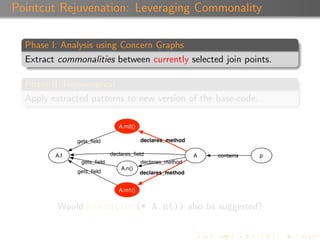
Pointcut Rejuvenation: Leveraging Commonality

  Phase I: Analysis using Concern Graphs
  Extract commonalities between currently selected join points.

  Phase II: Rejuvenation
  Apply extracted patterns to new version of the base-code.

                              A.m2()

               gets_field               declares_method

         A.f               declares_field                 A   contains   p
               gets_field               declares_method
                               A.n()
               gets_field              declares_method


                              A.m1()


          Would execution(* A.n()) also be suggested?
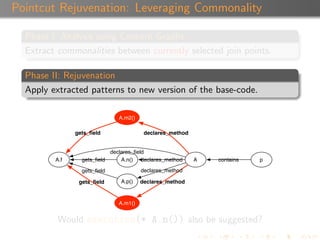
Pointcut Rejuvenation: Leveraging Commonality

  Phase I: Analysis using Concern Graphs
  Extract commonalities between currently selected join points.

  Phase II: Rejuvenation
  Apply extracted patterns to new version of the base-code.

                                A.m2()

               gets_field                  declares_method


                             declares_field
         A.f     gets_field       A.n() declares_method      A   contains   p

                 gets_field               declares_method

                gets_field       A.p()    declares_method


                                A.m1()


          Would execution(* A.n()) also be suggested?
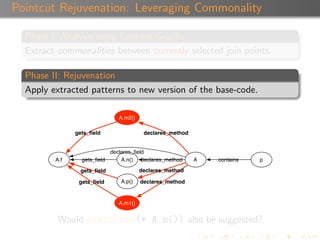
Pointcut Rejuvenation: Leveraging Commonality

  Phase I: Analysis using Concern Graphs
  Extract commonalities between currently selected join points.

  Phase II: Rejuvenation
  Apply extracted patterns to new version of the base-code.

                                A.m2()

               gets_field                  declares_method


                             declares_field
         A.f     gets_field       A.n() declares_method      A   contains   p

                gets_field                declares_method

                gets_field       A.p()    declares_method


                                A.m1()


          Would execution(* A.n()) also be suggested?
Pointcut Rejuvenation: Leveraging Commonality

  Phase I: Analysis using Concern Graphs
  Extract commonalities between currently selected join points.

  Phase II: Rejuvenation
  Apply extracted patterns to new version of the base-code.

                                A.m2()

               gets_field                  declares_method


                             declares_field
         A.f     gets_field       A.n() declares_method      A   contains   p

                gets_field                declares_method

                gets_field       A.p()    declares_method


                                A.m1()


          Would execution(* A.n()) also be suggested?
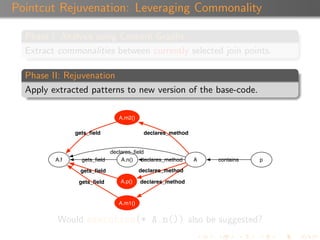
Pointcut Rejuvenation: Leveraging Commonality

  Phase I: Analysis using Concern Graphs
  Extract commonalities between currently selected join points.

  Phase II: Rejuvenation
  Apply extracted patterns to new version of the base-code.

                                A.m2()

               gets_field                  declares_method


                             declares_field
         A.f     gets_field       A.n() declares_method      A   contains   p

                gets_field                declares_method

                gets_field       A.p()    declares_method


                                A.m1()


          Would execution(* A.n()) also be suggested?
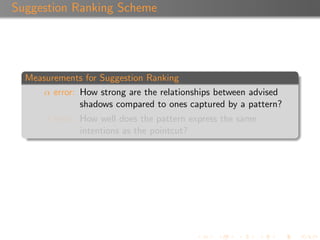
Suggestion Ranking Scheme


  Measurements for Suggestion Ranking
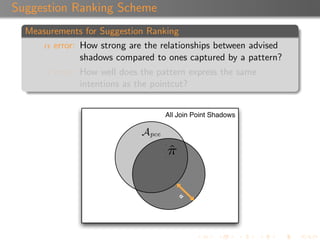
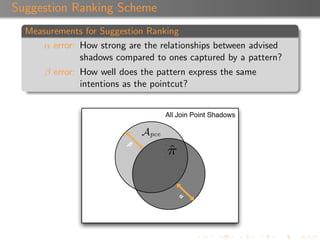
      α error: How strong are the relationships between advised
               shadows compared to ones captured by a pattern?
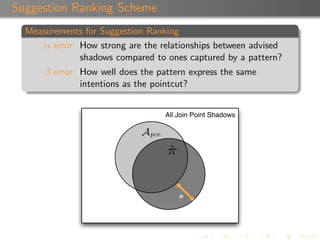
      β error: How well does the pattern express the same
               intentions as the pointcut?
Suggestion Ranking Scheme
  Measurements for Suggestion Ranking
      α error: How strong are the relationships between advised
               shadows compared to ones captured by a pattern?
      β error: How well does the pattern express the same
               intentions as the pointcut?


                                   All Join Point Shadows
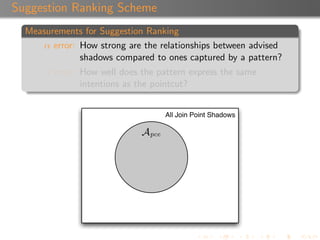
Suggestion Ranking Scheme
  Measurements for Suggestion Ranking
      α error: How strong are the relationships between advised
               shadows compared to ones captured by a pattern?
      β error: How well does the pattern express the same
               intentions as the pointcut?

                             ω       a join point shadow; code correspondi
                                    All Join Point Shadows
                             A       a piece of advice
                             Apce    a pointcut bound to advice A; a set of
                             Apce    a subsequent revision of Apce
                             P       the original program, the underlying b
                             P       a subsequence revision of program P
                             ΩP      the set of join point shadows containe
                             IG P    a finite graph representing structura
                                     tween program elements in P
                             π       an acyclic path (sequence of arcs) in I
                             ΠP      a set of acyclic paths derived from pro
P
                  o.w.
  Suggestion Ranking Scheme
     +
(CG P ))|
    Measurements for Suggestion Ranking
                      if |Apce | = 0
        α error: How strong are the relationships between advised
          +
ths(CG P ))|     shadows compared to ones captured by a pattern?    (2
          β error:
                         o.w.
                     How well does the pattern express the same
                     intentions as the pointcut?
=0
                         ω     a join point shadow; code correspondi
                         A
                             All Join Point Shadows
                               a piece of advice
                                                                   (3
                         Apce a pointcut bound to advice A; a set of
                         Apce a subsequent revision of Apce
π )) + err β (ˆ , Apce )abs(ˆ ) original program, the underlying b
ˆ             π          P
                              πthe
                                                                   (4
                         P     a subsequence revision of program P
                         ΩP    the set of join point shadows containe
tribute equations.       IG P a finite graph representing structura
                               tween program elements in P
                         π     an acyclic path (sequence of arcs) in I
                         ΠP    a set of acyclic paths derived from pro
P
                  o.w.
  Suggestion Ranking Scheme
     +
(CG P ))|
    Measurements for Suggestion Ranking
                      if |Apce | = 0
        α error: How strong are the relationships between advised
          +
ths(CG P ))|     shadows compared to ones captured by a pattern?    (2
          β error:
                         o.w.
                     How well does the pattern express the same
                     intentions as the pointcut?
=0
                         ω     a join point shadow; code correspondi
                         A
                             All Join Point Shadows
                               a piece of advice
                                                                   (3
                         Apce a pointcut bound to advice A; a set of
                         Apce a subsequent revision of Apce
π )) + err β (ˆ , Apce )abs(ˆ ) original program, the underlying b
ˆ             π          P
                              πthe
                                                                   (4
                         P     a subsequence revision of program P
                         ΩP    the set of join point shadows containe
tribute equations.       IG P a αfinite graph representing structura
                               tween program elements in P
                         π     an acyclic path (sequence of arcs) in I
                         ΠP    a set of acyclic paths derived from pro
P
                  o.w.
  Suggestion Ranking Scheme
     +
(CG P ))|
    Measurements for Suggestion Ranking
                      if |Apce | = 0
        α error: How strong are the relationships between advised
          +
ths(CG P ))|     shadows compared to ones captured by a pattern?    (2
          β error:
                         o.w.
                     How well does the pattern express the same
                     intentions as the pointcut?
=0
                         ω     a join point shadow; code correspondi
                         A
                             All Join Point Shadows
                               a piece of advice
                                                                   (3
                         Apce a pointcut bound to advice A; a set of
                         Apce a subsequent revision of Apce
π )) + err β (ˆ , Apce )abs(ˆ ) original program, the underlying b
ˆ             π          P
                              πthe
                                                                   (4
                         P     a subsequence revision of program P
                         ΩP    the set of join point shadows containe
tribute equations.       IG P a αfinite graph representing structura
                               tween program elements in P
                         π     an acyclic path (sequence of arcs) in I
                         ΠP    a set of acyclic paths derived from pro
P
                  o.w.
  Suggestion Ranking Scheme
     +
(CG P ))|
    Measurements for Suggestion Ranking
                      if |Apce | = 0
        α error: How strong are the relationships between advised
          +
ths(CG P ))|     shadows compared to ones captured by a pattern?    (2
          β error:
                         o.w.
                     How well does the pattern express the same
                     intentions as the pointcut?
=0
                         ω     a join point shadow; code correspondi
                         A
                             All Join Point Shadows
                               a piece of advice
                                                                   (3
                         Apce a pointcut bound to advice A; a set of
                      β  Apce a subsequent revision of Apce
π )) + err β (ˆ , Apce )abs(ˆ ) original program, the underlying b
ˆ             π          P
                              πthe
                                                                   (4
                         P     a subsequence revision of program P
                         ΩP    the set of join point shadows containe
tribute equations.       IG P a αfinite graph representing structura
                               tween program elements in P
                         π     an acyclic path (sequence of arcs) in I
                         ΠP    a set of acyclic paths derived from pro
Motivation
                                    Approach
                                   Evaluation
                             More Information


Suggestion Confidence


     Each suggestion is associated with a confidence value ([0,1]).
     A suggestion inherits the confidence of the pattern that
     produced it.
     A pattern’s confidence is calculated using a combination of α,
     β, and the depth of the patterns.


        Khatchadourian, Greenwood, Rashid, Xu   Rejuvenate Pointcut
Motivation
                                    Approach
                                   Evaluation
                             More Information


Suggestion Confidence


     Each suggestion is associated with a confidence value ([0,1]).
     A suggestion inherits the confidence of the pattern that
     produced it.
     A pattern’s confidence is calculated using a combination of α,
     β, and the depth of the patterns.


        Khatchadourian, Greenwood, Rashid, Xu   Rejuvenate Pointcut
Motivation
                                    Approach
                                   Evaluation
                             More Information


Suggestion Confidence


     Each suggestion is associated with a confidence value ([0,1]).
     A suggestion inherits the confidence of the pattern that
     produced it.
     A pattern’s confidence is calculated using a combination of α,
     β, and the depth of the patterns.


        Khatchadourian, Greenwood, Rashid, Xu   Rejuvenate Pointcut
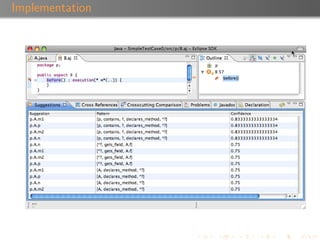
Implementation
Motivation
                                    Approach
                                   Evaluation
                             More Information


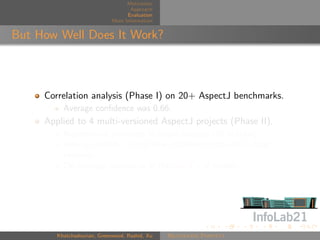
But How Well Does It Work?


     Correlation analysis (Phase I) on 20+ AspectJ benchmarks.
          Average confidence was 0.66.
     Applied to 4 multi-versioned AspectJ projects (Phase II).
          Rejuvenated pointcuts in major releases (26 in total).
          Able to identify 94% of new shadows introduced in later
          versions
          On average, appearing in the top 4% of results.


        Khatchadourian, Greenwood, Rashid, Xu   Rejuvenate Pointcut
Motivation
                                    Approach
                                   Evaluation
                             More Information


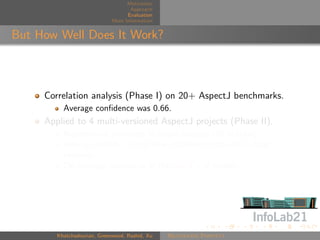
But How Well Does It Work?


     Correlation analysis (Phase I) on 20+ AspectJ benchmarks.
          Average confidence was 0.66.
     Applied to 4 multi-versioned AspectJ projects (Phase II).
          Rejuvenated pointcuts in major releases (26 in total).
          Able to identify 94% of new shadows introduced in later
          versions
          On average, appearing in the top 4% of results.


        Khatchadourian, Greenwood, Rashid, Xu   Rejuvenate Pointcut
Motivation
                                    Approach
                                   Evaluation
                             More Information


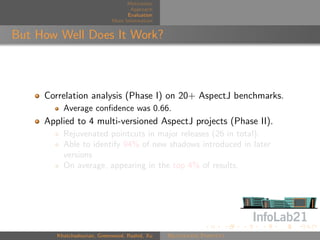
But How Well Does It Work?


     Correlation analysis (Phase I) on 20+ AspectJ benchmarks.
          Average confidence was 0.66.
     Applied to 4 multi-versioned AspectJ projects (Phase II).
          Rejuvenated pointcuts in major releases (26 in total).
          Able to identify 94% of new shadows introduced in later
          versions
          On average, appearing in the top 4% of results.


        Khatchadourian, Greenwood, Rashid, Xu   Rejuvenate Pointcut
Motivation
                                    Approach
                                   Evaluation
                             More Information


But How Well Does It Work?


     Correlation analysis (Phase I) on 20+ AspectJ benchmarks.
          Average confidence was 0.66.
     Applied to 4 multi-versioned AspectJ projects (Phase II).
          Rejuvenated pointcuts in major releases (26 in total).
          Able to identify 94% of new shadows introduced in later
          versions
          On average, appearing in the top 4% of results.


        Khatchadourian, Greenwood, Rashid, Xu   Rejuvenate Pointcut
Motivation
                                    Approach
                                   Evaluation
                             More Information


But How Well Does It Work?


     Correlation analysis (Phase I) on 20+ AspectJ benchmarks.
          Average confidence was 0.66.
     Applied to 4 multi-versioned AspectJ projects (Phase II).
          Rejuvenated pointcuts in major releases (26 in total).
          Able to identify 94% of new shadows introduced in later
          versions
          On average, appearing in the top 4% of results.


        Khatchadourian, Greenwood, Rashid, Xu   Rejuvenate Pointcut
Motivation
                                    Approach
                                   Evaluation
                             More Information


But How Well Does It Work?


     Correlation analysis (Phase I) on 20+ AspectJ benchmarks.
          Average confidence was 0.66.
     Applied to 4 multi-versioned AspectJ projects (Phase II).
          Rejuvenated pointcuts in major releases (26 in total).
          Able to identify 94% of new shadows introduced in later
          versions
          On average, appearing in the top 4% of results.


        Khatchadourian, Greenwood, Rashid, Xu   Rejuvenate Pointcut
Motivation
                                    Approach
                                   Evaluation
                             More Information


Tool and Material Downloads

     Tool research prototype publicly available at
     http://code.google.com/p/rejuvenate-pc.
     Research related material publicly available at
     http://sites.google.com/site/pointcutrejuvenation.
     Full evaluation available in corresponding technical report.


        Khatchadourian, Greenwood, Rashid, Xu   Rejuvenate Pointcut
Motivation
                                    Approach
                                   Evaluation
                             More Information


Tool and Material Downloads

     Tool research prototype publicly available at
     http://code.google.com/p/rejuvenate-pc.
     Research related material publicly available at
     http://sites.google.com/site/pointcutrejuvenation.
     Full evaluation available in corresponding technical report.


        Khatchadourian, Greenwood, Rashid, Xu   Rejuvenate Pointcut
Motivation
                                    Approach
                                   Evaluation
                             More Information


Tool and Material Downloads

     Tool research prototype publicly available at
     http://code.google.com/p/rejuvenate-pc.
     Research related material publicly available at
     http://sites.google.com/site/pointcutrejuvenation.
     Full evaluation available in corresponding technical report.


        Khatchadourian, Greenwood, Rashid, Xu   Rejuvenate Pointcut

Rejuvenate Pointcut: A Tool for Pointcut Expression Recovery in Evolving Aspect-Oriented Software

  • 1.
    Rejuvenate Pointcut A Tool for Pointcut Expression Recovery in Evolving Aspect-Oriented Software Raffi Khatchadourian1 Phil Greenwood2 Awais Rashid2 Guoqing Xu1 1 Ohio State University 2 Lancaster University International Conference on Aspect-Oriented Software Development, 2009 A
  • 2.
    Motivation Approach Evaluation More Information Outline 1 Motivation 2 Approach 3 Evaluation 4 More Information Khatchadourian, Greenwood, Rashid, Xu Rejuvenate Pointcut
  • 3.
    Motivation Approach Evaluation More Information Base-code package p ; public class A { int f ; void m1 () { int a = f + 1; } Two methods whose name begins with the void m2 () { character m. int b = f + 2; } void n () { int c = f + 3; } } Khatchadourian, Greenwood, Rashid, Xu Rejuvenate Pointcut
  • 4.
    Motivation Approach Evaluation More Information Base-code package p ; public class A { int f ; void m1 () { Two methods whose int a = f + 1; name begins with the } character m. void m2 () { One method whose name int b = f + 2; does not begin with the } character m. void n () { int c = f + 3; } } Khatchadourian, Greenwood, Rashid, Xu Rejuvenate Pointcut
  • 5.
    Motivation Approach Evaluation More Information Base-code package p ; public class A { int f ; Two methods whose void m1 () { name begins with the int a = f + 1; character m. } One method whose name void m2 () { does not begin with the int b = f + 2; character m. } All method bodies access void n () { a field f. int c = f + 3; } } Khatchadourian, Greenwood, Rashid, Xu Rejuvenate Pointcut
  • 6.
    Motivation Approach Evaluation More Information Along Came a Pointcut pointcut fragile() : execution(* m*(..)); Base-code V1 Selects m1() and m2() but not n(). Assume pointcut is correct in V1. Khatchadourian, Greenwood, Rashid, Xu Rejuvenate Pointcut
  • 7.
    Motivation Approach Evaluation More Information Along Came a Pointcut pointcut fragile() : execution(* m*(..)); Base-code V1 Selects m1() and m2() but not n(). Assume pointcut is correct in V1. Khatchadourian, Greenwood, Rashid, Xu Rejuvenate Pointcut
  • 8.
    Motivation Approach Evaluation More Information Along Came a Pointcut pointcut fragile() : execution(* m*(..)); Base-code V1 Selects m1() and m2() but not n(). Assume pointcut is correct in V1. Khatchadourian, Greenwood, Rashid, Xu Rejuvenate Pointcut
  • 9.
    Evolution //. . . void p () { int d = f + 4; } // . . . pointcut fragile() : execution(* m*(..)); Base-code V2 Same pointcut selects m1() and m2() but not n() and p(). Fragile! CCC applies to p() in V2 but not selected! How to identify such join points as code evolves?
  • 10.
    Evolution //. . . void p () { int d = f + 4; } // . . . pointcut fragile() : execution(* m*(..)); Base-code V2 Same pointcut selects m1() and m2() but not n() and p(). Fragile! CCC applies to p() in V2 but not selected! How to identify such join points as code evolves?
  • 11.
    Evolution //. . . void p () { int d = f + 4; } // . . . pointcut fragile() : execution(* m*(..)); Base-code V2 Same pointcut selects m1() and m2() but not n() and p(). Fragile! CCC applies to p() in V2 but not selected! How to identify such join points as code evolves?
  • 12.
    Evolution //. . . void p () { int d = f + 4; } // . . . pointcut fragile() : execution(* m*(..)); Base-code V2 Same pointcut selects m1() and m2() but not n() and p(). Fragile! CCC applies to p() in V2 but not selected! How to identify such join points as code evolves?
  • 13.
    Evolution //. . . void p () { int d = f + 4; } // . . . pointcut fragile() : execution(* m*(..)); Base-code V2 Same pointcut selects m1() and m2() but not n() and p(). Fragile! CCC applies to p() in V2 but not selected! How to identify such join points as code evolves?
  • 14.
    Pointcut Rejuvenation: LeveragingCommonality Phase I: Analysis using Concern Graphs Extract commonalities between currently selected join points. Phase II: Rejuvenation Apply extracted patterns to new version of the base-code. A.m2() gets_field declares_method A.f declares_field A contains p gets_field declares_method A.n() gets_field declares_method A.m1() Would execution(* A.n()) also be suggested?
  • 15.
    Pointcut Rejuvenation: LeveragingCommonality Phase I: Analysis using Concern Graphs Extract commonalities between currently selected join points. Phase II: Rejuvenation Apply extracted patterns to new version of the base-code. A.m2() gets_field declares_method A.f declares_field A contains p gets_field declares_method A.n() gets_field declares_method A.m1() Would execution(* A.n()) also be suggested?
  • 16.
    Pointcut Rejuvenation: LeveragingCommonality Phase I: Analysis using Concern Graphs Extract commonalities between currently selected join points. Phase II: Rejuvenation Apply extracted patterns to new version of the base-code. A.m2() gets_field declares_method A.f declares_field A contains p gets_field declares_method A.n() gets_field declares_method A.m1() Would execution(* A.n()) also be suggested?
  • 17.
    Pointcut Rejuvenation: LeveragingCommonality Phase I: Analysis using Concern Graphs Extract commonalities between currently selected join points. Phase II: Rejuvenation Apply extracted patterns to new version of the base-code. A.m2() gets_field declares_method A.f declares_field A contains p gets_field declares_method A.n() gets_field declares_method A.m1() Would execution(* A.n()) also be suggested?
  • 18.
    Pointcut Rejuvenation: LeveragingCommonality Phase I: Analysis using Concern Graphs Extract commonalities between currently selected join points. Phase II: Rejuvenation Apply extracted patterns to new version of the base-code. A.m2() gets_field declares_method declares_field A.f gets_field A.n() declares_method A contains p gets_field declares_method gets_field A.p() declares_method A.m1() Would execution(* A.n()) also be suggested?
  • 19.
    Pointcut Rejuvenation: LeveragingCommonality Phase I: Analysis using Concern Graphs Extract commonalities between currently selected join points. Phase II: Rejuvenation Apply extracted patterns to new version of the base-code. A.m2() gets_field declares_method declares_field A.f gets_field A.n() declares_method A contains p gets_field declares_method gets_field A.p() declares_method A.m1() Would execution(* A.n()) also be suggested?
  • 20.
    Pointcut Rejuvenation: LeveragingCommonality Phase I: Analysis using Concern Graphs Extract commonalities between currently selected join points. Phase II: Rejuvenation Apply extracted patterns to new version of the base-code. A.m2() gets_field declares_method declares_field A.f gets_field A.n() declares_method A contains p gets_field declares_method gets_field A.p() declares_method A.m1() Would execution(* A.n()) also be suggested?
  • 21.
    Pointcut Rejuvenation: LeveragingCommonality Phase I: Analysis using Concern Graphs Extract commonalities between currently selected join points. Phase II: Rejuvenation Apply extracted patterns to new version of the base-code. A.m2() gets_field declares_method declares_field A.f gets_field A.n() declares_method A contains p gets_field declares_method gets_field A.p() declares_method A.m1() Would execution(* A.n()) also be suggested?
  • 22.
    Suggestion Ranking Scheme Measurements for Suggestion Ranking α error: How strong are the relationships between advised shadows compared to ones captured by a pattern? β error: How well does the pattern express the same intentions as the pointcut?
  • 23.
    Suggestion Ranking Scheme Measurements for Suggestion Ranking α error: How strong are the relationships between advised shadows compared to ones captured by a pattern? β error: How well does the pattern express the same intentions as the pointcut? All Join Point Shadows
  • 24.
    Suggestion Ranking Scheme Measurements for Suggestion Ranking α error: How strong are the relationships between advised shadows compared to ones captured by a pattern? β error: How well does the pattern express the same intentions as the pointcut? ω a join point shadow; code correspondi All Join Point Shadows A a piece of advice Apce a pointcut bound to advice A; a set of Apce a subsequent revision of Apce P the original program, the underlying b P a subsequence revision of program P ΩP the set of join point shadows containe IG P a finite graph representing structura tween program elements in P π an acyclic path (sequence of arcs) in I ΠP a set of acyclic paths derived from pro
  • 25.
    P o.w. Suggestion Ranking Scheme + (CG P ))| Measurements for Suggestion Ranking if |Apce | = 0 α error: How strong are the relationships between advised + ths(CG P ))| shadows compared to ones captured by a pattern? (2 β error: o.w. How well does the pattern express the same intentions as the pointcut? =0 ω a join point shadow; code correspondi A All Join Point Shadows a piece of advice (3 Apce a pointcut bound to advice A; a set of Apce a subsequent revision of Apce π )) + err β (ˆ , Apce )abs(ˆ ) original program, the underlying b ˆ π P πthe (4 P a subsequence revision of program P ΩP the set of join point shadows containe tribute equations. IG P a finite graph representing structura tween program elements in P π an acyclic path (sequence of arcs) in I ΠP a set of acyclic paths derived from pro
  • 26.
    P o.w. Suggestion Ranking Scheme + (CG P ))| Measurements for Suggestion Ranking if |Apce | = 0 α error: How strong are the relationships between advised + ths(CG P ))| shadows compared to ones captured by a pattern? (2 β error: o.w. How well does the pattern express the same intentions as the pointcut? =0 ω a join point shadow; code correspondi A All Join Point Shadows a piece of advice (3 Apce a pointcut bound to advice A; a set of Apce a subsequent revision of Apce π )) + err β (ˆ , Apce )abs(ˆ ) original program, the underlying b ˆ π P πthe (4 P a subsequence revision of program P ΩP the set of join point shadows containe tribute equations. IG P a αfinite graph representing structura tween program elements in P π an acyclic path (sequence of arcs) in I ΠP a set of acyclic paths derived from pro
  • 27.
    P o.w. Suggestion Ranking Scheme + (CG P ))| Measurements for Suggestion Ranking if |Apce | = 0 α error: How strong are the relationships between advised + ths(CG P ))| shadows compared to ones captured by a pattern? (2 β error: o.w. How well does the pattern express the same intentions as the pointcut? =0 ω a join point shadow; code correspondi A All Join Point Shadows a piece of advice (3 Apce a pointcut bound to advice A; a set of Apce a subsequent revision of Apce π )) + err β (ˆ , Apce )abs(ˆ ) original program, the underlying b ˆ π P πthe (4 P a subsequence revision of program P ΩP the set of join point shadows containe tribute equations. IG P a αfinite graph representing structura tween program elements in P π an acyclic path (sequence of arcs) in I ΠP a set of acyclic paths derived from pro
  • 28.
    P o.w. Suggestion Ranking Scheme + (CG P ))| Measurements for Suggestion Ranking if |Apce | = 0 α error: How strong are the relationships between advised + ths(CG P ))| shadows compared to ones captured by a pattern? (2 β error: o.w. How well does the pattern express the same intentions as the pointcut? =0 ω a join point shadow; code correspondi A All Join Point Shadows a piece of advice (3 Apce a pointcut bound to advice A; a set of β Apce a subsequent revision of Apce π )) + err β (ˆ , Apce )abs(ˆ ) original program, the underlying b ˆ π P πthe (4 P a subsequence revision of program P ΩP the set of join point shadows containe tribute equations. IG P a αfinite graph representing structura tween program elements in P π an acyclic path (sequence of arcs) in I ΠP a set of acyclic paths derived from pro
  • 29.
    Motivation Approach Evaluation More Information Suggestion Confidence Each suggestion is associated with a confidence value ([0,1]). A suggestion inherits the confidence of the pattern that produced it. A pattern’s confidence is calculated using a combination of α, β, and the depth of the patterns. Khatchadourian, Greenwood, Rashid, Xu Rejuvenate Pointcut
  • 30.
    Motivation Approach Evaluation More Information Suggestion Confidence Each suggestion is associated with a confidence value ([0,1]). A suggestion inherits the confidence of the pattern that produced it. A pattern’s confidence is calculated using a combination of α, β, and the depth of the patterns. Khatchadourian, Greenwood, Rashid, Xu Rejuvenate Pointcut
  • 31.
    Motivation Approach Evaluation More Information Suggestion Confidence Each suggestion is associated with a confidence value ([0,1]). A suggestion inherits the confidence of the pattern that produced it. A pattern’s confidence is calculated using a combination of α, β, and the depth of the patterns. Khatchadourian, Greenwood, Rashid, Xu Rejuvenate Pointcut
  • 32.
  • 33.
    Motivation Approach Evaluation More Information But How Well Does It Work? Correlation analysis (Phase I) on 20+ AspectJ benchmarks. Average confidence was 0.66. Applied to 4 multi-versioned AspectJ projects (Phase II). Rejuvenated pointcuts in major releases (26 in total). Able to identify 94% of new shadows introduced in later versions On average, appearing in the top 4% of results. Khatchadourian, Greenwood, Rashid, Xu Rejuvenate Pointcut
  • 34.
    Motivation Approach Evaluation More Information But How Well Does It Work? Correlation analysis (Phase I) on 20+ AspectJ benchmarks. Average confidence was 0.66. Applied to 4 multi-versioned AspectJ projects (Phase II). Rejuvenated pointcuts in major releases (26 in total). Able to identify 94% of new shadows introduced in later versions On average, appearing in the top 4% of results. Khatchadourian, Greenwood, Rashid, Xu Rejuvenate Pointcut
  • 35.
    Motivation Approach Evaluation More Information But How Well Does It Work? Correlation analysis (Phase I) on 20+ AspectJ benchmarks. Average confidence was 0.66. Applied to 4 multi-versioned AspectJ projects (Phase II). Rejuvenated pointcuts in major releases (26 in total). Able to identify 94% of new shadows introduced in later versions On average, appearing in the top 4% of results. Khatchadourian, Greenwood, Rashid, Xu Rejuvenate Pointcut
  • 36.
    Motivation Approach Evaluation More Information But How Well Does It Work? Correlation analysis (Phase I) on 20+ AspectJ benchmarks. Average confidence was 0.66. Applied to 4 multi-versioned AspectJ projects (Phase II). Rejuvenated pointcuts in major releases (26 in total). Able to identify 94% of new shadows introduced in later versions On average, appearing in the top 4% of results. Khatchadourian, Greenwood, Rashid, Xu Rejuvenate Pointcut
  • 37.
    Motivation Approach Evaluation More Information But How Well Does It Work? Correlation analysis (Phase I) on 20+ AspectJ benchmarks. Average confidence was 0.66. Applied to 4 multi-versioned AspectJ projects (Phase II). Rejuvenated pointcuts in major releases (26 in total). Able to identify 94% of new shadows introduced in later versions On average, appearing in the top 4% of results. Khatchadourian, Greenwood, Rashid, Xu Rejuvenate Pointcut
  • 38.
    Motivation Approach Evaluation More Information But How Well Does It Work? Correlation analysis (Phase I) on 20+ AspectJ benchmarks. Average confidence was 0.66. Applied to 4 multi-versioned AspectJ projects (Phase II). Rejuvenated pointcuts in major releases (26 in total). Able to identify 94% of new shadows introduced in later versions On average, appearing in the top 4% of results. Khatchadourian, Greenwood, Rashid, Xu Rejuvenate Pointcut
  • 39.
    Motivation Approach Evaluation More Information Tool and Material Downloads Tool research prototype publicly available at http://code.google.com/p/rejuvenate-pc. Research related material publicly available at http://sites.google.com/site/pointcutrejuvenation. Full evaluation available in corresponding technical report. Khatchadourian, Greenwood, Rashid, Xu Rejuvenate Pointcut
  • 40.
    Motivation Approach Evaluation More Information Tool and Material Downloads Tool research prototype publicly available at http://code.google.com/p/rejuvenate-pc. Research related material publicly available at http://sites.google.com/site/pointcutrejuvenation. Full evaluation available in corresponding technical report. Khatchadourian, Greenwood, Rashid, Xu Rejuvenate Pointcut
  • 41.
    Motivation Approach Evaluation More Information Tool and Material Downloads Tool research prototype publicly available at http://code.google.com/p/rejuvenate-pc. Research related material publicly available at http://sites.google.com/site/pointcutrejuvenation. Full evaluation available in corresponding technical report. Khatchadourian, Greenwood, Rashid, Xu Rejuvenate Pointcut