Platforms and tools for Web
Services and Mobile Applications
Introduction to .Net
Bent Thomsen
Aalborg University
3rd and 4th of June 2004
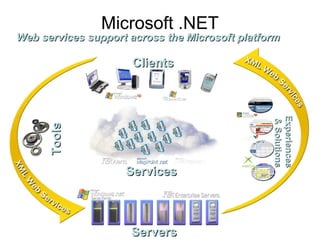
Microsoft .NET
Web services support across the Microsoft platformWeb services support across the Microsoft platform
ToolsTools
ClientsClients
ServicesServices
ServersServers
ExperiencesExperiences
&Solutions&Solutions
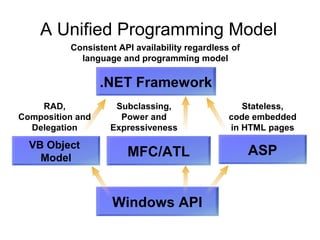
A Unified Programming Model
Windows API
.NET Framework
Consistent API availability regardless of
language and programming model
ASP
Stateless,
code embedded
in HTML pages
MFC/ATL
Subclassing,
Power and
Expressiveness
VB Object
Model
RAD,
Composition and
Delegation
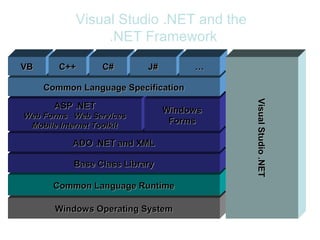
Visual Studio .NET and the
.NET Framework
Windows Operating SystemWindows Operating System
Common Language RuntimeCommon Language Runtime
Base Class LibraryBase Class Library
ADO .NET and XMLADO .NET and XML
ASP .NETASP .NET
Web Forms Web ServicesWeb Forms Web Services
Mobile Internet ToolkitMobile Internet Toolkit
WindowsWindows
FormsForms
Common Language SpecificationCommon Language Specification
VBVB C++C++ C#C# J#J# ……
VisualStudio.NETVisualStudio.NET
Common Language Runtime
• Manages running code
– Threading, Memory management
– Eliminates memory management drudgery
– Kills entire classes of bugs (e.g., memory corruption, ref
counting)
– Auto-versioning, no more DLL Hell
– Scalability, performance, reliability all improve
• Fine-grained evidence-based security
– Code access + Role-based
– Integrated with underlying OS
– Security model ensures safety
• No-touch deployment
– XCOPY, no registry required
• Object remoting with SOAP
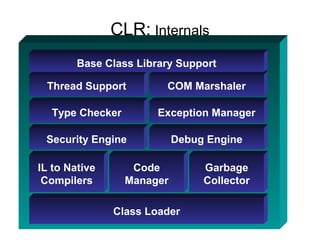
CLR: Internals
Class Loader
IL to Native
Compilers
Code
Manager
Garbage
Collector
Security Engine Debug Engine
Type Checker Exception Manager
Thread Support COM Marshaler
Base Class Library Support
Framework Classes
• Spans all programming languages
– Enables cross language inheritance and debugging
– Integrates well with tools
• Object-oriented and consistent
– Increases developer productivity by reducing the
number of APIs to learn
• Common type system built-in
• Extensible
– Makes it easy to add or modify framework features
• Secure
– Allows creation of secure applications
• System & Runtime Functions
• Windows & Web Development
• Web Services
• Data Access & XML Services
• Networking & IO
• Enterprise Services (COM+ & MSMQ)
• Directory & Security Services
• Diagnostics, Perf-Mon, Debug
• And many more…
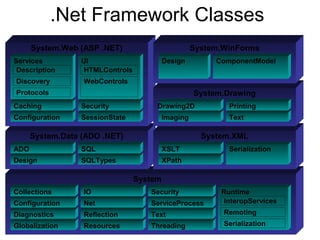
.Net Framework Classes
Unified and Comprehensive API
System
System.Data (ADO .NET) System.XML
System.Web (ASP .NET)
Globalization
Diagnostics
Configuration
Collections
Resources
Reflection
Net
IO
Threading
Text
ServiceProcess
Security
Design
ADO
SQLTypes
SQL
XPath
XSLT
Runtime
InteropServices
Remoting
Serialization
Serialization
Configuration SessionState
Caching Security
Services
Description
Discovery
Protocols
UI
HTMLControls
WebControls
System.Drawing
Imaging
Drawing2D
Text
Printing
System.WinForms
Design ComponentModel
.Net Framework Classes
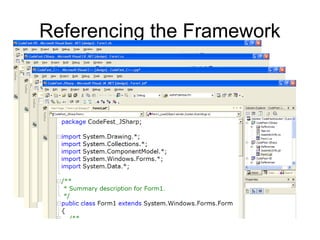
Referencing the Framework
11
Source CodeSource Code
C++, C#, VB orC++, C#, VB or
any .NETany .NET
languagelanguage
csc.exe or vbc.execsc.exe or vbc.exe
CompilerCompiler
AssemblyAssembly
DLL or EXEDLL or EXE
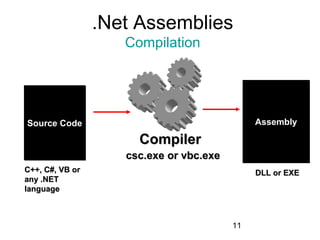
.Net Assemblies
Compilation
VBVBSourceSource
codecode
CompilerCompiler
C++C++C#C#
CompilerCompilerCompilerCompiler
Operating System ServicesOperating System Services
Common Language RuntimeCommon Language Runtime
JIT CompilerJIT Compiler
Native CodeNative Code
ManagedManaged
codecode
AssemblyAssembly
IL CodeIL Code
AssemblyAssembly
IL CodeIL Code
AssemblyAssembly
IL CodeIL Code
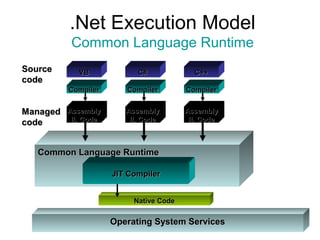
.Net Execution Model
Common Language Runtime
.NET Security
• Role-based Security
– What the user is allowed to do within the
application
– .NET Roles = Windows Active Directory®
groups
• Code Access Security
– What the code is allowed to do on this machine
– Evidence Based (Policies, Permissions,
Evidence)
• Cryptography Built In to .NET FX
Visual Basic .NET
• Evolution, not revolution, of language
used by developers worldwide
• Builds on existing technology while
adding power
– True OOP
– Multithreading
– NT Services
– Web Services
• The fastest way to build scalable
applications for industry
Visual C# .NET
Component Oriented Language
• C# is the first “component oriented”
language in the C/C++ family
• Component concepts are first class:
– Properties, methods, events
– Design-time and run-time attributes
– Integrated documentation using XML
• Enables one-stop programming
– No header files, IDL, etc.
– C++ heritage – simplification with no
unnecessary sacrifices
Visual J# .NET
• Native support for XML Web services
• Fully integrated with Visual Studio .NET
development environment
• Full access to the .NET Framework
– ASP.NET, ADO.NET, Windows Forms
– Integration with >20 other languages
• Protection of existing investments
– Use java language syntax on .NET
– Move applications and skills forward
Visual C++ .NET
Continue to provide most powerful
and flexible language
• Better ANSI/ISO conformance
• Enable seamless, incremental use
of .NET Framework
• Enhanced ATL Servers
• Improved ATL and MFC Clients
• Enhanced STL
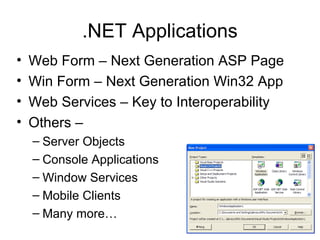
.NET Applications
• Web Form – Next Generation ASP Page
• Win Form – Next Generation Win32 App
• Web Services – Key to Interoperability
• Others –
– Server Objects
– Console Applications
– Window Services
– Mobile Clients
– Many more…
ASP.NET
• Server-side Web Forms and Web Services
components separate code from content
– Developer productivity increases
– Tools easily use ASP.NET
– Any programming language: full VB, JScript, C++,
COBOL, Perl, etc.
– 40% to 70% reduction in lines of code
• Compiled
• No-touch deployment system
• Intelligent state management
• Backwards compatible with ASP
• Controls sense client and adapt output: HTML,
DHTML, WML
What Is an
XML Web Service?
• A Component That Uses XML & HTTP To
Define and Deliver A Service
– Global reach
– Based on open set of standards
– Reuse across platforms
– Works with any operating system, programming
language, or network
– Expose legacy code
• Different systems can actually talk
Web Services
Open Standards & Protocols
• XML
– Universal data format
– Standards-based integration
– User-customizable
• HTTP
– Ubiquitous protocol
– Universally understood
VS.NET and Web Services
• Expose functionality as service
– No need to learn XML, SOAP, or WSDL
– Interface is automatically generated
– Seamless deployment
• Reuse existing Web Services
– VS.NET generates the plumbing
– Full IntelliSense support
• Build and consume with any VS language
• Built-in Support for Developing and
Consuming Web Services
– Based entirely on open standards
– Automatically generates WSDL
– Automatically provides test page
– Attribute based – No heavy coding needed
Software as a Service
Visual Studio .Net and the Net Framework
Public Function HelloWorld() as String
return “Hello World”
End Function
[WebMethod]
WSDLWSDL
Web
Service
Object
Web
Service
Object
Test
Page
Test
Page
Compiler
Windows Forms
• Rich, powerful client UI
– Control anchoring, visual inheritance
– Shared across all .NET languages
– No-touch deployment
• Secure
– Semi-trusted browser component
– Fully-trusted local application
• Full Web Service integration
.NET (R)Evolutionary
• Evolutionary
– Existing Skills Migrate Smoothly
– Interoperates with Existing Applications
– Extension of WinDNA Architecture
• Revolutionary
– Common Language Runtime
– Deployment / Versioning (Ends DLL Hell)
– Web Services & XML Integration
– Evidence Base Code Access Security
5 Key Points to Remember…
• Developers can use any .NET Language
• The .NET Framework provides a foundation
of classes for developers to build a wide
variety of applications
• Source code is compiled to MSIL within an
Assembly
• Assembles contain rich meta data and are
the primary units of deployment
• MSIL is compiled to native code and
executed by the Common Language
Runtime

asp

  • 1.
    Platforms and toolsfor Web Services and Mobile Applications Introduction to .Net Bent Thomsen Aalborg University 3rd and 4th of June 2004
  • 2.
    Microsoft .NET Web servicessupport across the Microsoft platformWeb services support across the Microsoft platform ToolsTools ClientsClients ServicesServices ServersServers ExperiencesExperiences &Solutions&Solutions
  • 3.
    A Unified ProgrammingModel Windows API .NET Framework Consistent API availability regardless of language and programming model ASP Stateless, code embedded in HTML pages MFC/ATL Subclassing, Power and Expressiveness VB Object Model RAD, Composition and Delegation
  • 4.
    Visual Studio .NETand the .NET Framework Windows Operating SystemWindows Operating System Common Language RuntimeCommon Language Runtime Base Class LibraryBase Class Library ADO .NET and XMLADO .NET and XML ASP .NETASP .NET Web Forms Web ServicesWeb Forms Web Services Mobile Internet ToolkitMobile Internet Toolkit WindowsWindows FormsForms Common Language SpecificationCommon Language Specification VBVB C++C++ C#C# J#J# …… VisualStudio.NETVisualStudio.NET
  • 5.
    Common Language Runtime •Manages running code – Threading, Memory management – Eliminates memory management drudgery – Kills entire classes of bugs (e.g., memory corruption, ref counting) – Auto-versioning, no more DLL Hell – Scalability, performance, reliability all improve • Fine-grained evidence-based security – Code access + Role-based – Integrated with underlying OS – Security model ensures safety • No-touch deployment – XCOPY, no registry required • Object remoting with SOAP
  • 6.
    CLR: Internals Class Loader ILto Native Compilers Code Manager Garbage Collector Security Engine Debug Engine Type Checker Exception Manager Thread Support COM Marshaler Base Class Library Support
  • 7.
    Framework Classes • Spansall programming languages – Enables cross language inheritance and debugging – Integrates well with tools • Object-oriented and consistent – Increases developer productivity by reducing the number of APIs to learn • Common type system built-in • Extensible – Makes it easy to add or modify framework features • Secure – Allows creation of secure applications
  • 8.
    • System &Runtime Functions • Windows & Web Development • Web Services • Data Access & XML Services • Networking & IO • Enterprise Services (COM+ & MSMQ) • Directory & Security Services • Diagnostics, Perf-Mon, Debug • And many more… .Net Framework Classes Unified and Comprehensive API
  • 9.
    System System.Data (ADO .NET)System.XML System.Web (ASP .NET) Globalization Diagnostics Configuration Collections Resources Reflection Net IO Threading Text ServiceProcess Security Design ADO SQLTypes SQL XPath XSLT Runtime InteropServices Remoting Serialization Serialization Configuration SessionState Caching Security Services Description Discovery Protocols UI HTMLControls WebControls System.Drawing Imaging Drawing2D Text Printing System.WinForms Design ComponentModel .Net Framework Classes
  • 10.
  • 11.
    11 Source CodeSource Code C++,C#, VB orC++, C#, VB or any .NETany .NET languagelanguage csc.exe or vbc.execsc.exe or vbc.exe CompilerCompiler AssemblyAssembly DLL or EXEDLL or EXE .Net Assemblies Compilation
  • 12.
    VBVBSourceSource codecode CompilerCompiler C++C++C#C# CompilerCompilerCompilerCompiler Operating System ServicesOperatingSystem Services Common Language RuntimeCommon Language Runtime JIT CompilerJIT Compiler Native CodeNative Code ManagedManaged codecode AssemblyAssembly IL CodeIL Code AssemblyAssembly IL CodeIL Code AssemblyAssembly IL CodeIL Code .Net Execution Model Common Language Runtime
  • 13.
    .NET Security • Role-basedSecurity – What the user is allowed to do within the application – .NET Roles = Windows Active Directory® groups • Code Access Security – What the code is allowed to do on this machine – Evidence Based (Policies, Permissions, Evidence) • Cryptography Built In to .NET FX
  • 14.
    Visual Basic .NET •Evolution, not revolution, of language used by developers worldwide • Builds on existing technology while adding power – True OOP – Multithreading – NT Services – Web Services • The fastest way to build scalable applications for industry
  • 15.
    Visual C# .NET ComponentOriented Language • C# is the first “component oriented” language in the C/C++ family • Component concepts are first class: – Properties, methods, events – Design-time and run-time attributes – Integrated documentation using XML • Enables one-stop programming – No header files, IDL, etc. – C++ heritage – simplification with no unnecessary sacrifices
  • 16.
    Visual J# .NET •Native support for XML Web services • Fully integrated with Visual Studio .NET development environment • Full access to the .NET Framework – ASP.NET, ADO.NET, Windows Forms – Integration with >20 other languages • Protection of existing investments – Use java language syntax on .NET – Move applications and skills forward
  • 17.
    Visual C++ .NET Continueto provide most powerful and flexible language • Better ANSI/ISO conformance • Enable seamless, incremental use of .NET Framework • Enhanced ATL Servers • Improved ATL and MFC Clients • Enhanced STL
  • 18.
    .NET Applications • WebForm – Next Generation ASP Page • Win Form – Next Generation Win32 App • Web Services – Key to Interoperability • Others – – Server Objects – Console Applications – Window Services – Mobile Clients – Many more…
  • 19.
    ASP.NET • Server-side WebForms and Web Services components separate code from content – Developer productivity increases – Tools easily use ASP.NET – Any programming language: full VB, JScript, C++, COBOL, Perl, etc. – 40% to 70% reduction in lines of code • Compiled • No-touch deployment system • Intelligent state management • Backwards compatible with ASP • Controls sense client and adapt output: HTML, DHTML, WML
  • 20.
    What Is an XMLWeb Service? • A Component That Uses XML & HTTP To Define and Deliver A Service – Global reach – Based on open set of standards – Reuse across platforms – Works with any operating system, programming language, or network – Expose legacy code • Different systems can actually talk
  • 21.
    Web Services Open Standards& Protocols • XML – Universal data format – Standards-based integration – User-customizable • HTTP – Ubiquitous protocol – Universally understood
  • 22.
    VS.NET and WebServices • Expose functionality as service – No need to learn XML, SOAP, or WSDL – Interface is automatically generated – Seamless deployment • Reuse existing Web Services – VS.NET generates the plumbing – Full IntelliSense support • Build and consume with any VS language
  • 23.
    • Built-in Supportfor Developing and Consuming Web Services – Based entirely on open standards – Automatically generates WSDL – Automatically provides test page – Attribute based – No heavy coding needed Software as a Service Visual Studio .Net and the Net Framework Public Function HelloWorld() as String return “Hello World” End Function [WebMethod] WSDLWSDL Web Service Object Web Service Object Test Page Test Page Compiler
  • 24.
    Windows Forms • Rich,powerful client UI – Control anchoring, visual inheritance – Shared across all .NET languages – No-touch deployment • Secure – Semi-trusted browser component – Fully-trusted local application • Full Web Service integration
  • 25.
    .NET (R)Evolutionary • Evolutionary –Existing Skills Migrate Smoothly – Interoperates with Existing Applications – Extension of WinDNA Architecture • Revolutionary – Common Language Runtime – Deployment / Versioning (Ends DLL Hell) – Web Services & XML Integration – Evidence Base Code Access Security
  • 26.
    5 Key Pointsto Remember… • Developers can use any .NET Language • The .NET Framework provides a foundation of classes for developers to build a wide variety of applications • Source code is compiled to MSIL within an Assembly • Assembles contain rich meta data and are the primary units of deployment • MSIL is compiled to native code and executed by the Common Language Runtime