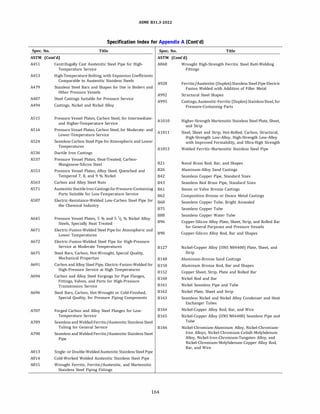
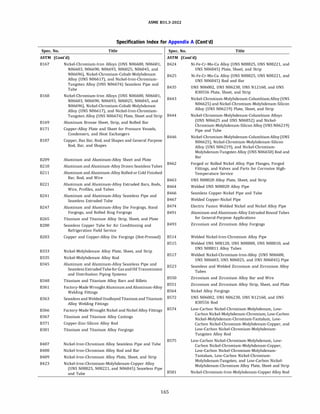
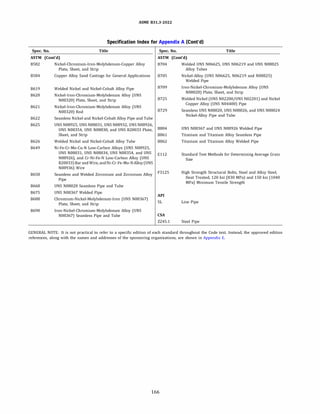
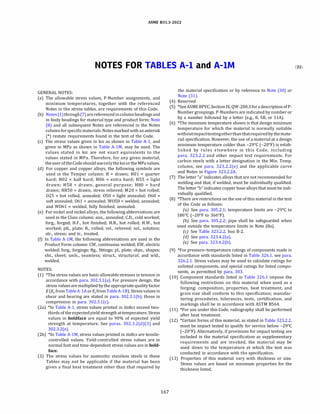
Process Piping
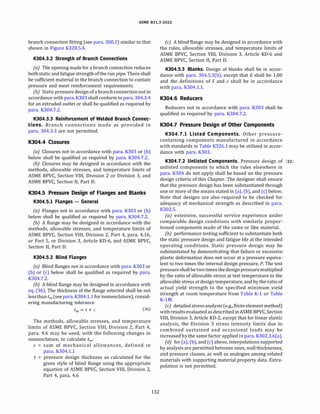
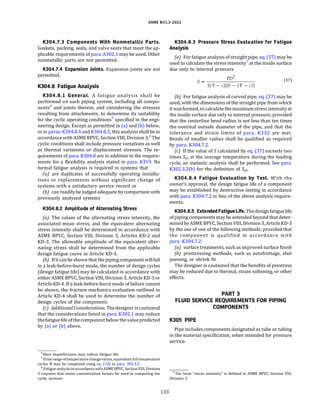
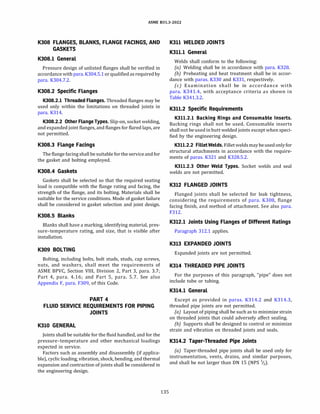
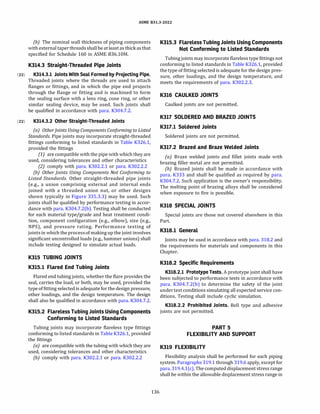
ASME Code for Pressure Piping, 831
AN INTERNATIONAL PIPING CODE®
Process Piping
ASME Code for Pressure Piping, 831
AN INTERNATIONAL PIPING CODE®
� The American Society of
� Mechanical Engineers Two Park Avenue • New York, NY • 10016 USA
Date of Issuance: January 31, 2023
The next edition of this Code is scheduled for publication in 2024. This Code will become effective 6 months after the Date of
Issuance.
ASME issues written replies to inquiries concerning interpretations of technical aspects of this Code. Interpretations are
published on the Committee web page and under http://go.asme.org/lnterpsDatabase. Periodically certain actions of the
ASME 831 Committee may be published as Cases. Cases are published on the ASME website under the 831 Committee
page at http://go.asme.org/831committee as they are issued.
Errata to codes and standards may be posted on the ASME website under the Committee Pages of the associated codes and
standards to provide corrections to incorrectly published items, or to correct typographical or grammatical errors in codes and
standards. Such errata shall be used on the date posted.
The 831 Committee Page can be found at http://go.asme.org/831committee. The associated 831 Committee Page for each
code and standard can be accessed from this main page. There is an option available to automatically receive an e-mail
notification when errata are posted to a particular code or standard. This option can be found on the appropriate Committee
Page after selecting "Errata" in the "Publication Information" section.
ASME is the registered trademark of The American Society of Mechanical Engineers.
This international code or standard was developed under procedures accredited as meeting the criteria for American National Standards
anditisanAmericanNationalStandard.Thestandardscommitteethatapprovedthecodeorstandardwasbalancedtoensurethatindividuals
from competent and concerned interests had an opportunity to participate. The proposed code or standard was made available for public
review andcomment, whichprovidedanopportunity foradditionalpublic inputfromindustry, academia, regulatory agencies, andthepublic­
at-large.
ASMEdoes not "approve," "rate," or "endorse" any item, construction, proprietary device, or activity. ASME does not take any position with
respect to the validity of any patent rights asserted in connection with any items mentioned in this document, and does not undertake to
insure anyone utilizing a standard against liability for infringement of any applicable letters patent, nor does ASME assume any such liability.
Users of a code or standard are expressly advised that determination of the validity of any such patent rights, and the risk of infringement of
such rights, is entirely their own responsibility.
Participation by federal agency representatives or persons affiliated with industry is not to be interpreted as government or industry
endorsement of this code or standard.
ASME accepts responsibility for only those interpretations of this document issued in accordance with the established ASME procedures
and policies, which precludes the issuance of interpretations by individuals.
No part of this document may be reproduced in any form,
in an electronic retrieval system or otherwise,
without the prior written permission of the publisher.
The American Society of Mechanical Engineers
Two Park Avenue, New York, NY 10016-5990
Copyright © 2023 by
THE AMERICAN SOCIETY OF MECHANICAL ENGINEERS
All rights reserved
Printed in U.S.A.
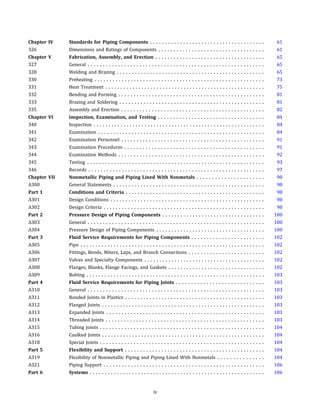
CONTENTS
Foreword ...................................................................... xiv
Committee Roster ................................................................ xvi
Introduction ..................................................................... xxi
Summary of Changes .............................................................. xxiii
Chapter I
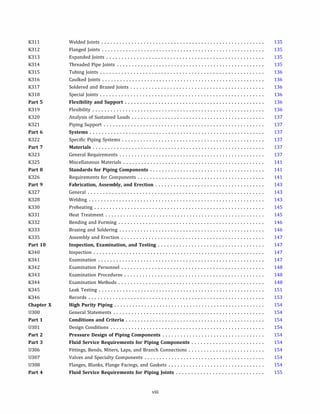
300
Chapter II
Part 1
301
302
Part 2
303
304
Part 3
305
306
307
308
309
Part 4
310
311
312
313
314
315
316
317
318
Part 5
319
320
321
Part 6
322
Chapter III
323
325
Scope and Definitions ...............................................
General Statements ..................................................
Design ...........................................................
Conditions and Criteria ..............................................
Design Conditions ...................................................
Design Criteria .....................................................
Pressure Design of Piping Components ..................................
General ..........................................................
Pressure Design of Components .........................................
Fluid Service Requirements for Piping Components ........................
Pipe .............................................................
Fittings, Bends, Miters, Laps, and Branch Connections .........................
Valves and Specialty Components ........................................
Flanges, Blanks, Flange Facings, and Gaskets ................................
Bolting ...........................................................
Fluid Service Requirements for Piping Joints .............................
General ..........................................................
Welded Joints ......................................................
Flanged Joints ......................................................
Expanded Joints ....................................................
Threaded Joints ....................................................
Tubing Joints ......................................................
Caulked Joints ......................................................
Soldered and Brazed Joints ............................................
Special Joints ......................................................
Flexibility and Support ..............................................
Piping Flexibility ....................................................
Analysis of Sustained Loads ............................................
Piping Support .....................................................
Systems ..........................................................
Specific Piping Systems ...............................................
Materials .........................................................
General Requirements ................................................
Materials - Miscellaneous ............................................
iii
1
1
11
11
11
13
22
22
22
33
33
33
35
35
36
36
36
36
37
37
37
38
38
38
38
39
39
44
45
47
47
49
49
60
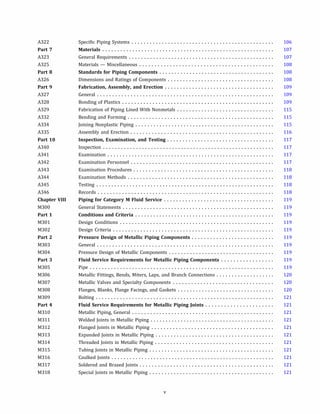
Chapter IV
326
Chapter V
327
328
330
331
332
333
335
Chapter VI
340
341
342
343
344
345
346
Chapter VII
A300
Part 1
A301
A302
Part 2
A303
A304
Part 3
A305
A306
A307
A308
A309
Part 4
A310
A311
A312
A313
A314
A315
A316
A318
Part 5
A319
A321
Part 6
Standards for Piping Components . . . . . . . . . . . . . . . . . . . . . . . . . . . . . . . . . . . . . .
Dimensions and Ratings of Components ...................................
Fabrication, Assembly, and Erection . . . . . . . . . . . . . . . . . . . . . . . . . . . . . . . . . . . .
General ..........................................................
Welding and Brazing .................................................
Preheating ........................................................
Heat Treatment .....................................................
Bending and Forming ................................................
Brazing and Soldering ................................................
Assembly and Erection ...............................................
Inspection, Examination, and Testing . . . . . . . . . . . . . . . . . . . . . . . . . . . . . . . . . . .
Inspection .........................................................
Examination .......................................................
Examination Personnel ...............................................
Examination Procedures ..............................................
Examination Methods ................................................
Testing ...........................................................
Records ..........................................................
Nonmetallic Piping and Piping Lined With Nonmetals . . . . . . . . . . . . . . . . . . . . . .
General Statements ..................................................
Conditions and Criteria . . . . . . . . . . . . . . . . . . . . . . . . . . . . . . . . . . . . . . . . . . . . . .
Design Conditions ...................................................
Design Criteria .....................................................
Pressure Design of Piping Components . . . . . . . . . . . . . . . . . . . . . . . . . . . . . . . . . .
General ..........................................................
Pressure Design of Piping Components ....................................
Fluid Service Requirements for Piping Components . . . . . . . . . . . . . . . . . . . . . . . .
Pipe .............................................................
Fittings, Bends, Miters, Laps, and Branch Connections .........................
Valves and Specialty Components ........................................
Flanges, Blanks, Flange Facings, and Gaskets ................................
Bolting ...........................................................
Fluid Service Requirements for Piping Joints . . . . . . . . . . . . . . . . . . . . . . . . . . . . .
General ..........................................................
Bonded Joints in Plastics ..............................................
Flanged Joints ......................................................
Expanded Joints ....................................................
Threaded Joints ....................................................
Tubing Joints ......................................................
Caulked Joints ......................................................
Special Joints ......................................................
Flexibility and Support . . . . . . . . . . . . . . . . . . . . . . . . . . . . . . . . . . . . . . . . . . . . . .
Flexibility of Nonmetallic Piping and Piping Lined With Nonmetals ...............
Piping Support .....................................................
Systems . . . . . . . . . . . . . . . . . . . . . . . . . . . . . . . . . . . . . . . . . . . . . . . . . . . . . . . . . .
iv
61
61
65
65
65
73
75
81
81
82
84
84
84
91
91
92
93
97
98
98
98
98
98
100
100
100
102
102
102
102
102
103
103
103
103
103
103
103
104
104
104
104
104
106
106
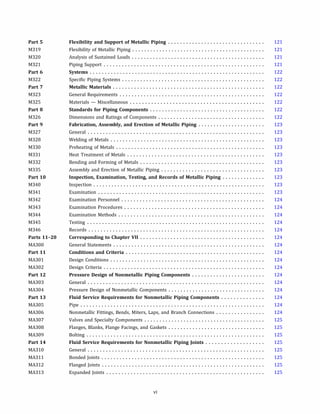
A322
Part 7
A323
A325
Part 8
A326
Part 9
A327
A328
A329
A332
A334
A335
Part 10
A340
A341
A342
A343
A344
A345
A346
Chapter VIII
M300
Part 1
M301
M302
Part 2
M303
M304
Part 3
M305
M306
M307
M308
M309
Part 4
M310
M311
M312
M313
M314
M315
M316
M317
M318
Specific Piping Systems ...............................................
Materials .........................................................
General Requirements ................................................
Materials - Miscellaneous ............................................
Standards for Piping Components ......................................
Dimensions and Ratings of Components ...................................
Fabrication, Assembly, and Erection ....................................
General ..........................................................
Bonding of Plastics ..................................................
Fabrication of Piping Lined With Nonmetals ................................
Bending and Forming ................................................
Joining Nonplastic Piping ..............................................
Assembly and Erection ...............................................
Inspection, Examination, and Testing ...................................
Inspection .........................................................
Examination .......................................................
Examination Personnel ...............................................
Examination Procedures ..............................................
Examination Methods ................................................
Testing ...........................................................
Records ..........................................................
Piping for Category M Fluid Service ....................................
General Statements ..................................................
Conditions and Criteria ..............................................
Design Conditions ...................................................
Design Criteria .....................................................
Pressure Design of Metallic Piping Components ...........................
General ..........................................................
Pressure Design of Metallic Components ...................................
Fluid Service Requirements for Metallic Piping Components .................
Pipe .............................................................
Metallic Fittings, Bends, Miters, Laps, and Branch Connections ...................
Metallic Valves and Specialty Components .................................
Flanges, Blanks, Flange Facings, and Gaskets ................................
Bolting ...........................................................
Fluid Service Requirements for Metallic Piping Joints ......................
Metallic Piping, General ...............................................
Welded Joints in Metallic Piping .........................................
Flanged Joints in Metallic Piping ........................................
Expanded Joints in Metallic Piping .......................................
Threaded Joints in Metallic Piping .......................................
Tubing Joints in Metallic Piping .........................................
Caulked Joints ......................................................
Soldered and Brazed Joints ............................................
Special Joints in Metallic Piping .........................................
v
106
107
107
108
108
108
109
109
109
115
115
115
116
117
117
117
117
118
118
118
118
119
119
119
119
119
119
119
119
119
119
120
120
120
121
121
121
121
121
121
121
121
121
121
121
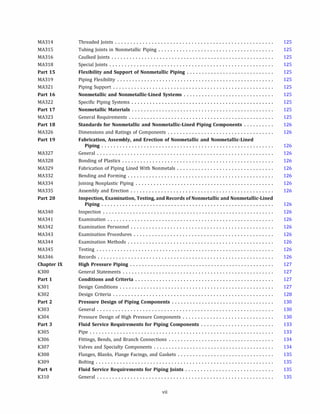
Part 5
M319
M320
M321
Part 6
M322
Part 7
M323
M325
Part 8
M326
Part 9
M327
M328
M330
M331
M332
M335
Part 10
M340
M341
M342
M343
M344
M345
M346
Parts 11-20
MA300
Part 11
MA301
MA302
Part 12
MA303
MA304
Part 13
MA305
MA306
MA307
MA308
MA309
Part 14
MA310
MA311
MA312
MA313
Flexibility and Support of Metallic Piping ................................
Flexibility of Metallic Piping ............................................
Analysis of Sustained Loads ............................................
Piping Support .....................................................
Systems ..........................................................
Specific Piping Systems ...............................................
Metallic Materials ..................................................
General Requirements ................................................
Materials - Miscellaneous ............................................
Standards for Piping Components ......................................
Dimensions and Ratings of Components ...................................
Fabrication, Assembly, and Erection of Metallic Piping ......................
General ..........................................................
Welding of Metals ...................................................
Preheating of Metals .................................................
Heat Treatment of Metals .............................................
Bending and Forming of Metals .........................................
Assembly and Erection of Metallic Piping ..................................
Inspection, Examination, Testing, and Records of Metallic Piping ..............
Inspection .........................................................
Examination .......................................................
Examination Personnel ...............................................
Examination Procedures ..............................................
Examination Methods ................................................
Testing ...........................................................
Records ..........................................................
Corresponding to Chapter VII .........................................
General Statements ..................................................
Conditions and Criteria ..............................................
Design Conditions ...................................................
Design Criteria .....................................................
Pressure Design of Nonmetallic Piping Components ........................
General ..........................................................
Pressure Design of Nonmetallic Components ................................
Fluid Service Requirements for Nonmetallic Piping Components ..............
Pipe .............................................................
Nonmetallic Fittings, Bends, Miters, Laps, and Branch Connections ................
Valves and Specialty Components ........................................
Flanges, Blanks, Flange Facings, and Gaskets ................................
Bolting ...........................................................
Fluid Service Requirements for Nonmetallic Piping Joints ...................
General ..........................................................
Bonded Joints ......................................................
Flanged Joints ......................................................
Expanded Joints ....................................................
vi
121
121
121
121
122
122
122
122
122
122
122
123
123
123
123
123
123
123
123
123
123
124
124
124
124
124
124
124
124
124
124
124
124
124
124
124
124
125
125
125
125
125
125
125
125
MA314
MA315
MA316
MA318
Part 15
MA319
MA321
Part 16
MA322
Part 17
MA323
Part 18
MA326
Part 19
MA327
MA328
MA329
MA332
MA334
MA335
Part 20
MA340
MA341
MA342
MA343
MA344
MA345
MA346
Chapter IX
K300
Part 1
K301
K302
Part 2
K303
K304
Part 3
K305
K306
K307
K308
K309
Part 4
K310
Threaded Joints ....................................................
Tubing Joints in Nonmetallic Piping ......................................
Caulked Joints ......................................................
Special Joints ......................................................
Flexibility and Support of Nonmetallic Piping .............................
Piping Flexibility ....................................................
Piping Support .....................................................
Nonmetallic and Nonmetallic-Lined Systems ..............................
Specific Piping Systems ...............................................
Nonmetallic Materials ...............................................
General Requirements ................................................
Standards for Nonmetallic and Nonmetallic-Lined Piping Components ..........
Dimensions and Ratings of Components ...................................
Fabrication, Assembly, and Erection of Nonmetallic and Nonmetallic-Lined
Piping .........................................................
General ..........................................................
Bonding of Plastics ..................................................
Fabrication of Piping Lined With Nonmetals ................................
Bending and Forming ................................................
Joining Nonplastic Piping ..............................................
Assembly and Erection ...............................................
Inspection, Examination, Testing, and Records of Nonmetallic and Nonmetallic-Lined
Piping .........................................................
Inspection .........................................................
Examination .......................................................
Examination Personnel ...............................................
Examination Procedures ..............................................
Examination Methods ................................................
Testing ...........................................................
Records ..........................................................
High Pressure Piping ................................................
General Statements ..................................................
Conditions and Criteria ..............................................
Design Conditions ...................................................
Design Criteria .....................................................
Pressure Design of Piping Components ..................................
General ..........................................................
Pressure Design of High Pressure Components ..............................
Fluid Service Requirements for Piping Components ........................
Pipe .............................................................
Fittings, Bends, and Branch Connections ...................................
Valves and Specialty Components ........................................
Flanges, Blanks, Flange Facings, and Gaskets ................................
Bolting ...........................................................
Fluid Service Requirements for Piping Joints .............................
General ..........................................................
vii
125
125
125
125
125
125
125
125
125
125
125
126
126
126
126
126
126
126
126
126
126
126
126
126
126
126
126
126
127
127
127
127
128
130
130
130
133
133
134
134
135
135
135
135
K311
K312
K313
K314
K315
K316
K317
K318
Part 5
K319
K320
K321
Part 6
K322
Part 7
K323
K325
Part 8
K326
Part 9
K327
K328
K330
K331
K332
K333
K335
Part 10
K340
K341
K342
K343
K344
K345
K346
Chapter X
U300
Part 1
U301
Part 2
Part 3
U306
U307
U308
Part 4
Welded Joints ......................................................
Flanged Joints ......................................................
Expanded Joints ....................................................
Threaded Pipe Joints .................................................
Tubing Joints ......................................................
Caulked Joints ......................................................
Soldered and Brazed Joints ............................................
Special Joints ......................................................
Flexibility and Support ..............................................
Flexibility .........................................................
Analysis of Sustained Loads ............................................
Piping Support .....................................................
Systems ..........................................................
Specific Piping Systems ...............................................
Materials .........................................................
General Requirements ................................................
Miscellaneous Materials ...............................................
Standards for Piping Components ......................................
Requirements for Components ..........................................
Fabrication, Assembly, and Erection ....................................
General ..........................................................
Welding ..........................................................
Preheating ........................................................
Heat Treatment .....................................................
Bending and Forming ................................................
Brazing and Soldering ................................................
Assembly and Erection ...............................................
Inspection, Examination, and Testing ...................................
Inspection .........................................................
Examination .......................................................
Examination Personnel ...............................................
Examination Procedures ..............................................
Examination Methods ................................................
Leak Testing .......................................................
Records ..........................................................
High Purity Piping ..................................................
General Statements ..................................................
Conditions and Criteria ..............................................
Design Conditions ...................................................
Pressure Design of Piping Components ..................................
Fluid Service Requirements for Piping Components ........................
Fittings, Bends, Miters, Laps, and Branch Connections .........................
Valves and Specialty Components ........................................
Flanges, Blanks, Flange Facings, and Gaskets ................................
Fluid Service Requirements for Piping Joints .............................
viii
135
135
135
135
136
136
136
136
136
136
137
137
137
137
137
137
141
141
141
143
143
143
145
145
146
146
147
147
147
147
148
148
148
151
153
154
154
154
154
154
154
154
154
154
155
U311
U314
U315
Part 5
U319
Part 6
Part 7
Part 8
Part 9
U327
U328
U330
U331
U332
U333
U335
Part 10
U340
U341
U342
U343
U344
U345
U346
Part 11
UM300
UM307
UM322
UM328
UM335
UM341
UM345
Appendices
A
B
c
D
E
F
G
H
K
L
Welded Joints ......................................................
Threaded Joints ....................................................
Tubing Joints ......................................................
Flexibility and Support ..............................................
Piping Flexibility ....................................................
Systems ..........................................................
Metallic Materials ..................................................
Standards for Piping Components ......................................
Fabrication, Assembly, and Erection ....................................
General ..........................................................
Welding ..........................................................
Preheating ........................................................
Heat Treatment .....................................................
Bending and Forming ................................................
Brazing and Soldering ................................................
Assembly and Erection ...............................................
Inspection, Examination, and Testing ...................................
Inspection .........................................................
Examination .......................................................
Examination Personnel ...............................................
Examination Procedures ..............................................
Examination Methods ................................................
Testing ...........................................................
Records ..........................................................
High Purity Piping in Category M Fluid Service ...........................
General Statements ..................................................
Metallic Valves and Specialty Components .................................
Specific Piping Systems ...............................................
Welding of Materials .................................................
Assembly and Erection of Metallic Piping ..................................
Examination .......................................................
Testing ...........................................................
Allowable Stresses and Quality Factors for Metallic Piping and Bolting Materials ......
Stress Tables and Allowable Pressure Tables for Nonmetals .....................
Physical Properties of Piping Materials ....................................
Flexibility and Stress Intensification Factors ................................
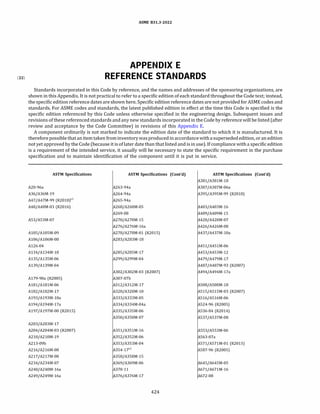
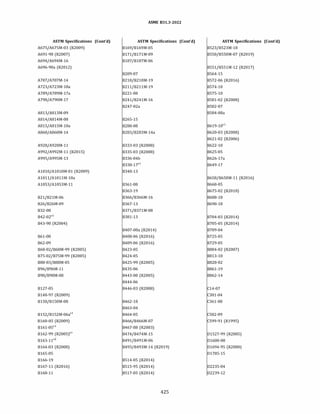
Reference Standards .................................................
Guidance and Precautionary Considerations ................................
Safeguarding .......................................................
Sample Calculations for Branch Reinforcement ..............................
155
155
155
155
155
156
156
156
156
156
156
156
157
157
157
157
157
157
158
158
159
159
160
160
160
160
160
160
161
161
161
161
162
394
402
423
424
429
436
438
Nomenclature ...................................................... 447
Allowable Stresses for High Pressure Piping ................................
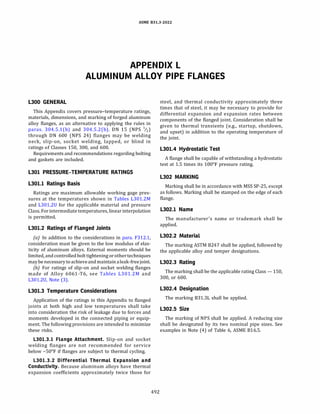
Aluminum Alloy Pipe Flanges ...........................................
ix
463
492
M
N
Q
R
s
v
w
x
z
Figures
300.1.1
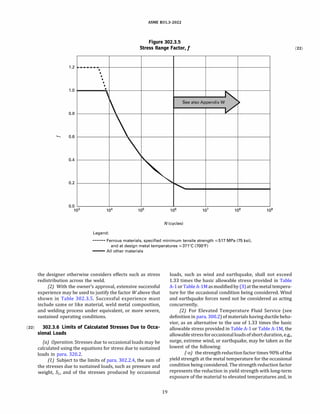
302.3.5
304.2.1
304.2.3
304.3.3
304.3.4
304.5.3
319.4.4A
319.4.4B
323.2.2A
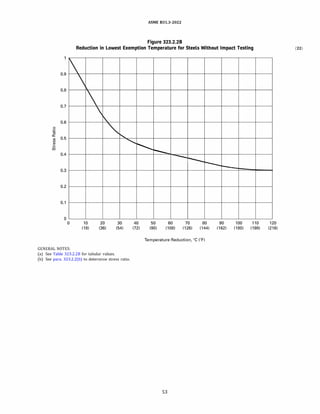
323.2.28
328.3.2
328.4.2
328.4.3
328.4.4
328.5.2A
328.5.28
328.5.2C
328.5.4A, B, C
328.5.40
328.5.4E
328.5.4F
328.5.5
335.3.3
341.3.2
A328.S.3
A328.S.4
A328.5.5
A328.5.6
A328.5.7
K323.3.3
K328.4.3
K328.5.4
Guide to Classifying Fluid Services .......................................
Application of ASME B31.3 Internationally .................................
Quality System Program ..............................................
Use of Alternative Ultrasonic Acceptance Criteria ............................
Piping System Stress Analysis Examples ...................................
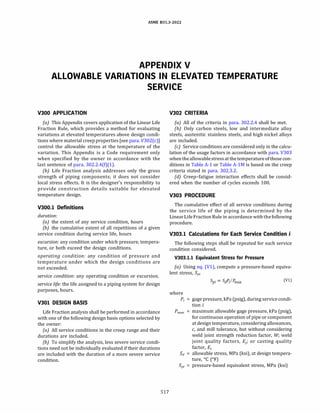
Allowable Variations in Elevated Temperature Service .........................
High-Cycle Fatigue Assessment of Piping Systems ............................
Metallic Bellows Expansion Joints ........................................
Preparation of Technical Inquiries .......................................
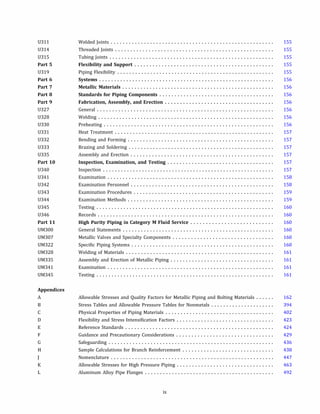
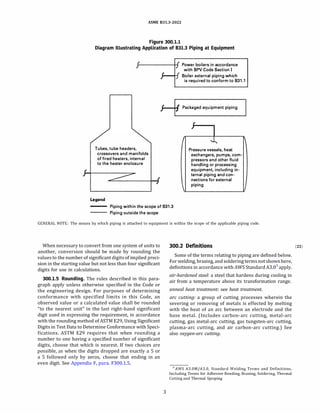
Diagram Illustrating Application of 831.3 Piping at Equipment ...................
Stress Range Factor, f . . . . . . . . . . . . . . . . . . . . . . . . . . . . . . . . . . . . . . . . . . . . . . . .
Nomenclature for Pipe Bends ...........................................
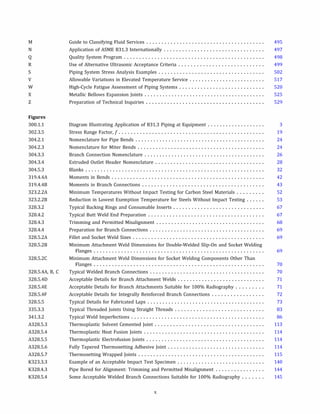
Nomenclature for Miter Bends ..........................................
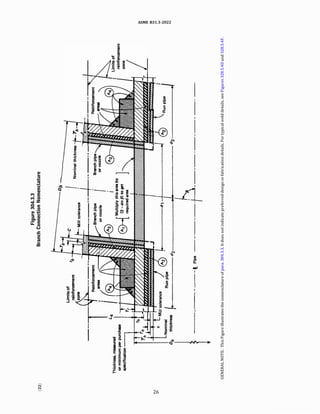
Branch Connection Nomenclature ........................................
Extruded Outlet Header Nomenclature ....................................
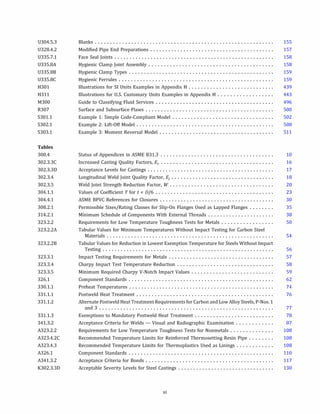
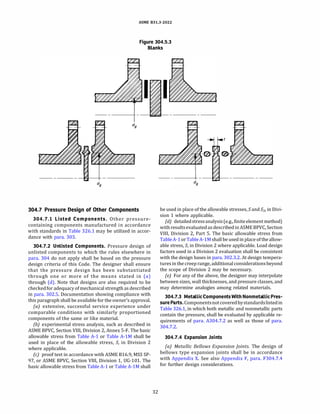
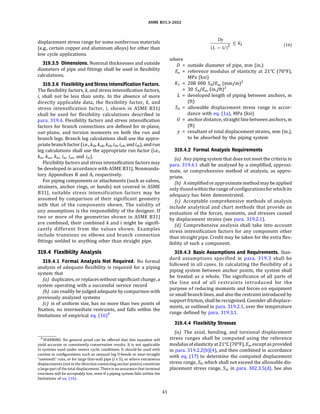
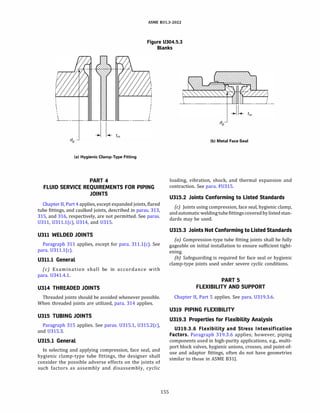
Blanks ...........................................................
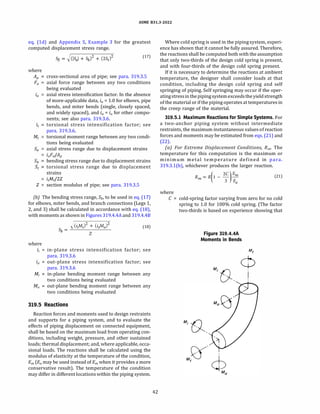
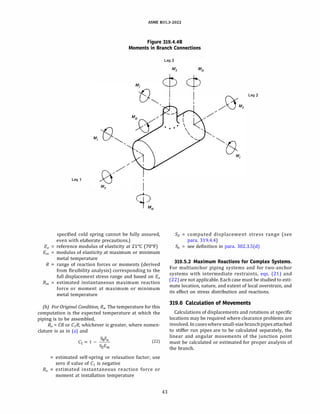
Moments in Bends ..................................................
Moments in Branch Connections ........................................
Minimum Temperatures Without Impact Testing for Carbon Steel Materials .........
Reduction in Lowest Exemption Temperature for Steels Without Impact Testing ......
Typical Backing Rings and Consumable Inserts ..............................
Typical Butt Weld End Preparation ......................................
Trimming and Permitted Misalignment ....................................
Preparation for Branch Connections ......................................
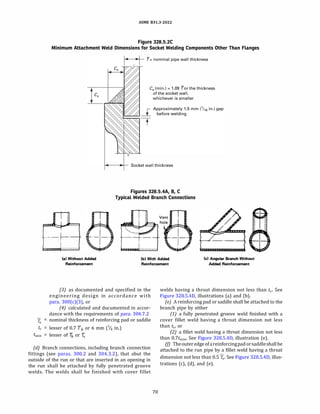
Fillet and Socket Weld Sizes ...........................................
Minimum Attachment Weld Dimensions for Double-Welded Slip-On and Socket Welding
Flanges ........................................................
Minimum Attachment Weld Dimensions for Socket Welding Components Other Than
Flanges ........................................................
Typical Welded Branch Connections ......................................
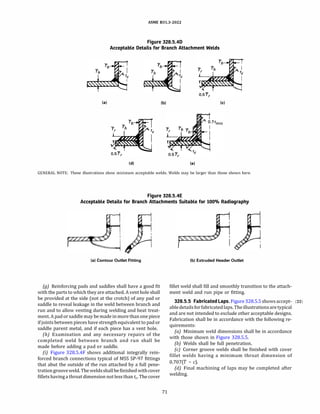
Acceptable Details for Branch Attachment Welds .............................
Acceptable Details for Branch Attachments Suitable for 100% Radiography .........
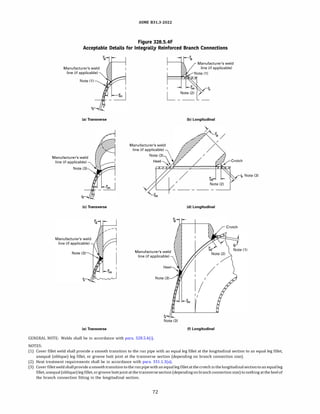
Acceptable Details for Integrally Reinforced Branch Connections .................
Typical Details for Fabricated Laps .......................................
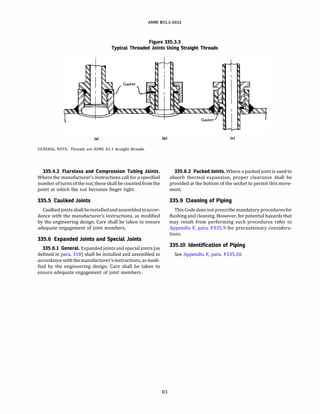
Typical Threaded Joints Using Straight Threads .............................
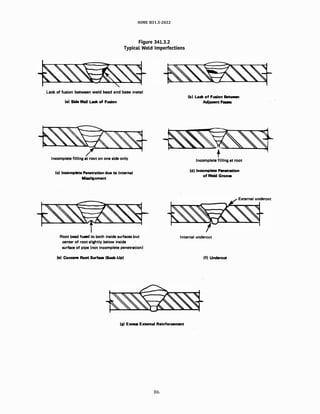
Typical Weld Imperfections ............................................
Thermoplastic Solvent Cemented Joint ....................................
Thermoplastic Heat Fusion Joints ........................................
Thermoplastic Electrofusion Joints .......................................
Fully Tapered Thermosetting Adhesive Joint ................................
Thermosetting Wrapped Joints ..........................................
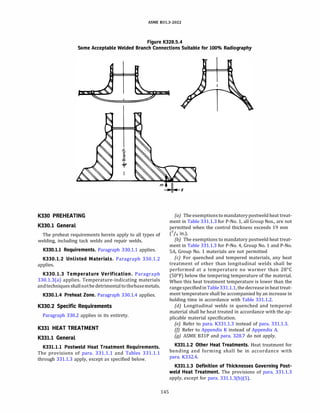
Example of an Acceptable Impact Test Specimen .............................
Pipe Bored for Alignment: Trimming and Permitted Misalignment ................
Some Acceptable Welded Branch Connections Suitable for 100% Radiography .......
x
495
497
498
499
502
517
520
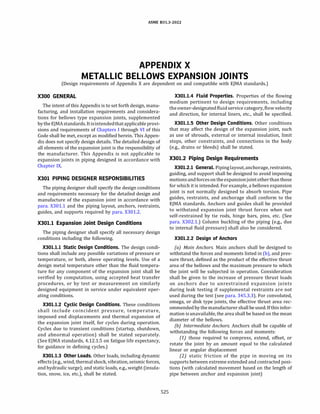
525
529
3
19
24
24
26
28
32
42
43
52
53
67
67
68
69
69
69
70
70
71
71
72
73
83
86
113
114
114
114
115
140
144
145
0304.5.3
0328.4.2
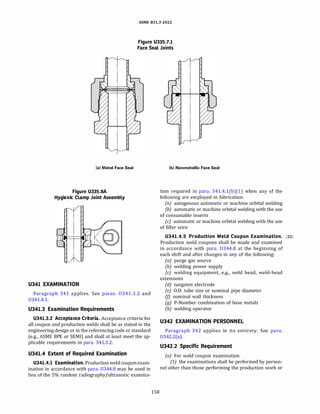
0335.7.1
U335.8A
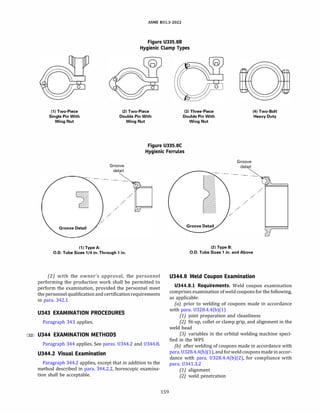
U335.8B
U335.8C
H301
H311
M300
R307
S301.1
S302.1
S303.1
Tables
300.4
302.3.3C
302.3.30
302.3.4
302.3.S
304.1.1
304.4.1
308.2.1
314.2.1
323.2.2
323.2.2A
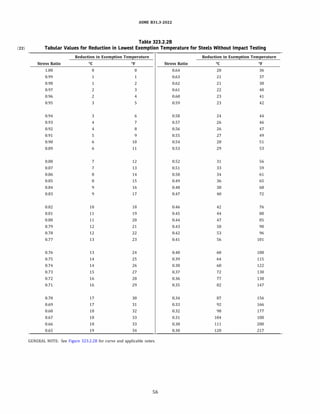
323.2.28
323.3.1
323.3.4
323.3.S
326.1
330.1.1
331.1.1
331.1.2
331.1.3
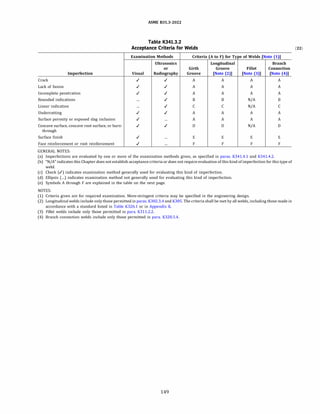
341.3.2
A323.2.2
A323.4.2C
A323.4.3
A326.1
A341.3.2
K302.3.3D
Blanks ...........................................................
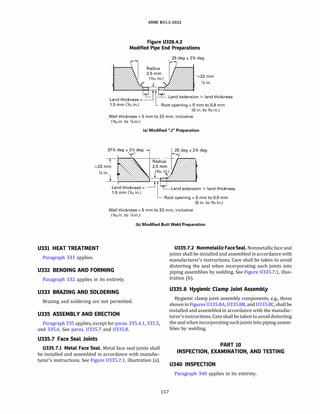
Modified Pipe End Preparations .........................................
Face Seal Joints .....................................................
Hygienic Clamp Joint Assembly .........................................
Hygienic Clamp Types ................................................
Hygienic Ferrules ...................................................
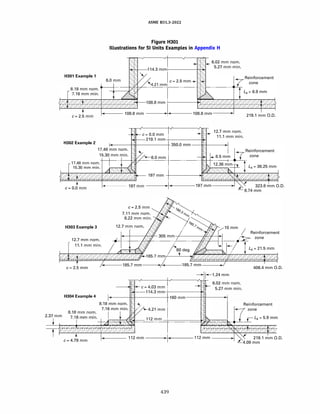
Illustrations for SI Units Examples in Appendix H ............................
Illustrations for U.S. Customary Units Examples in Appendix H ..................
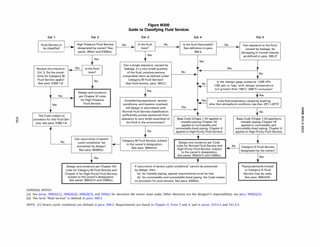
Guide to Classifying Fluid Services .......................................
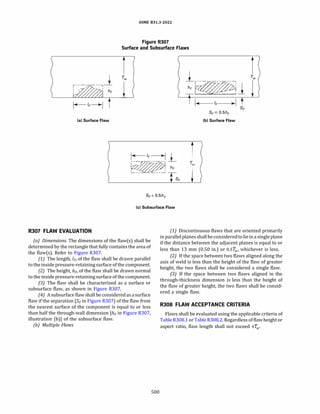
Surface and Subsurface Flaws ..........................................
Example 1: Simple Code-Compliant Model .................................
Example 2: Lift-Off Model .............................................
Example 3: Moment Reversal Model ......................................
Status of Appendices in ASME 831.3 .....................................
Increased Casting Quality Factors, Ee .....................................
Acceptance Levels for Castings ..........................................
Longitudinal Weld Joint Quality Factor, Ej
..................................
Weld Joint Strength Reduction Factor, W..................................
Values of Coefficient Y for t < D/6 .......................................
ASME BPVC References for Closures ......................................
Permissible Sizes/Rating Classes for Slip-On Flanges Used as Lapped Flanges ........
Minimum Schedule of Components With External Threads ......................
Requirements for Low Temperature Toughness Tests for Metals .................
Tabular Values for Minimum Temperatures Without Impact Testing for Carbon Steel
Materials .......................................................
Tabular Values for Reduction in Lowest Exemption Temperature for Steels Without Impact
Testing .........................................................
Impact Testing Requirements for Metals ...................................
Charpy Impact Test Temperature Reduction ................................
Minimum Required Charpy V-Notch Impact Values ...........................
Component Standards ................................................
Preheat Temperatures ................................................
Postweld Heat Treatment .............................................
Alternate Postweld Heat Treatment Requirements for Carbon and Low Alloy Steels, P-Nos. 1
and 3 ..........................................................
Exemptions to Mandatory Postweld Heat Treatment ..........................
Acceptance Criteria for Welds - Visual and Radiographic Examination ............
Requirements for Low Temperature Toughness Tests for Nonmetals ..............
Recommended Temperature Limits for Reinforced Thermosetting Resin Pipe ........
Recommended Temperature Limits for Thermoplastics Used as Linings ............
Component Standards ................................................
Acceptance Criteria for Bonds ..........................................
Acceptable Severity Levels for Steel Castings ................................
xi
155
157
158
158
159
159
439
443
496
500
502
508
511
10
16
17
18
20
23
30
35
38
so
54
56
57
58
59
62
74
76
77
78
87
108
108
108
110
117
130
K305.1.2
K323.3.1
K323.3.S
K326.1
K341.3.2
A-1
A-lM
A-lA
A-18
A-2
A-2M
8-1
8-lM
8-2
8-3
8-4
8-5
8-6
C-1
C-lM
C-5
C-6
C-6M
C-8
K-1
K-lM
L301.2M
L301.2U
L303.2
R308.1
R308.2
S301.1
S301.3.1
S301.3.2
S301.S.1
S301.S.2
Required Ultrasonic or Eddy Current Examination of Pipe and Tubing for Longitudinal
Defects .........................................................
Impact Testing Requirements ...........................................
Minimum Required Charpy V-Notch Impact Values ...........................
Component Standards ................................................
Acceptance Criteria for Welds ..........................................
134
139
141
142
149
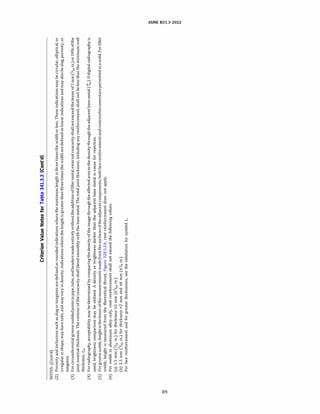
Criterion Value Notes for Table K341.3.2 .................................. 150
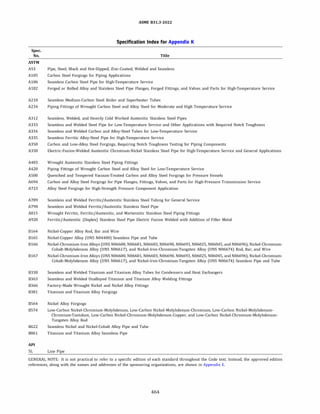
Specification Index for Appendix A ....................................... 163
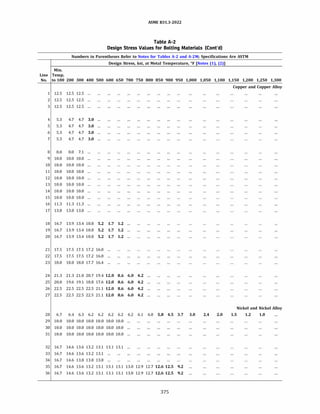
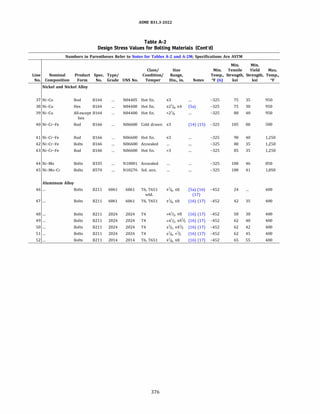
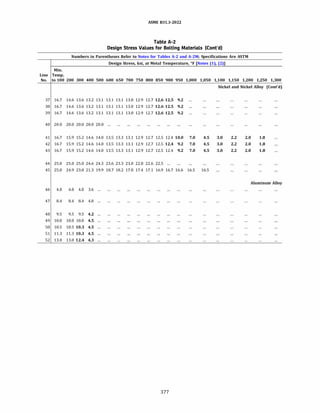
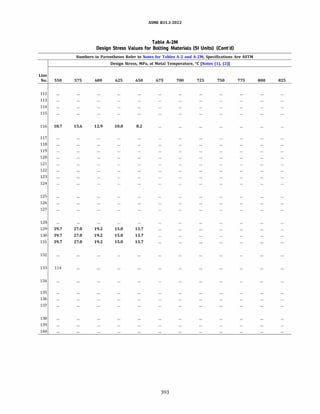
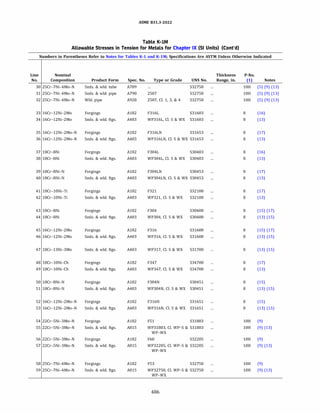
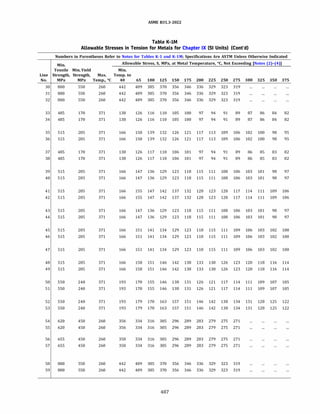
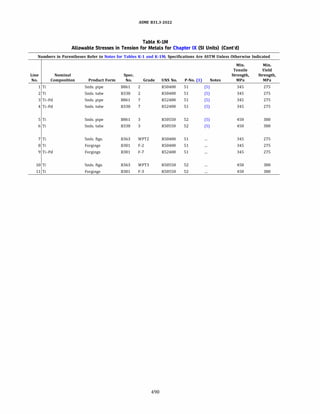
Basic Allowable Stresses in Tension for Metals ..............................
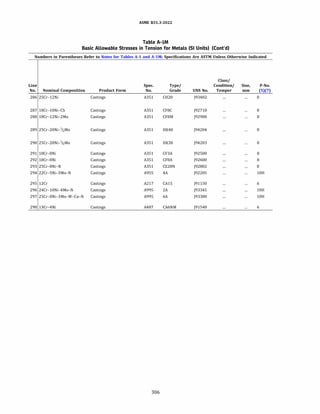
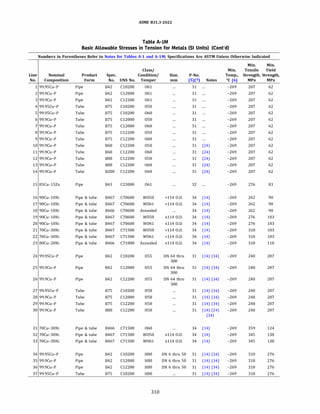
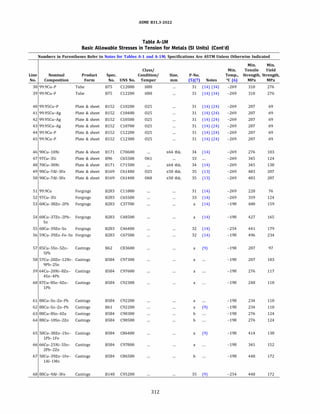
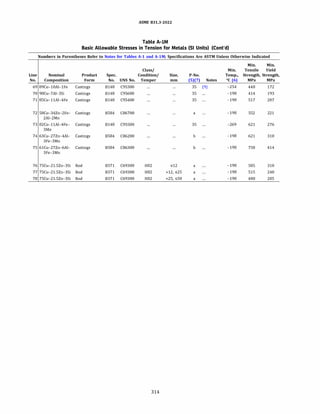
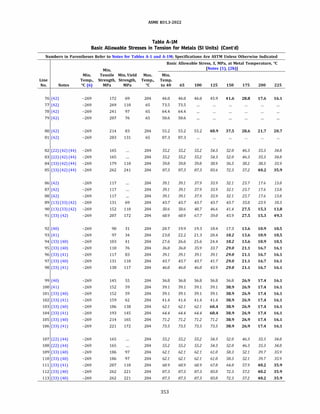
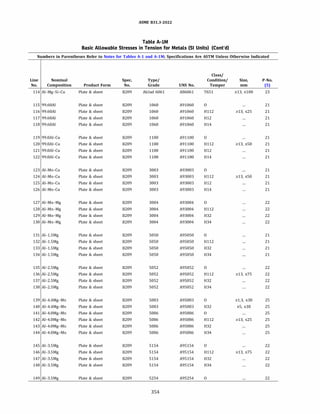
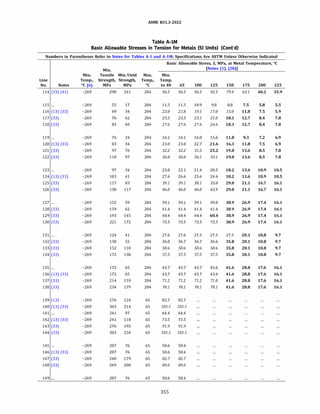
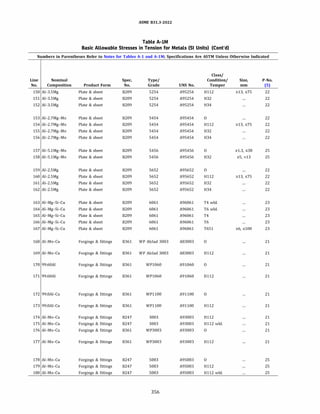
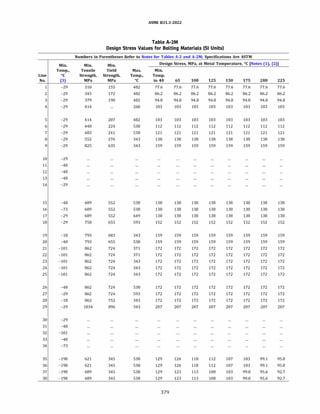
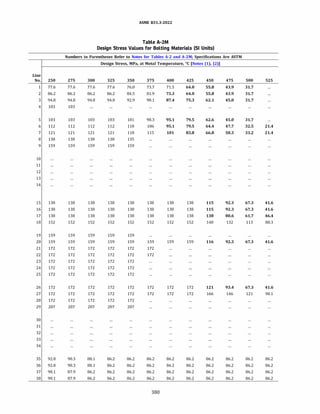
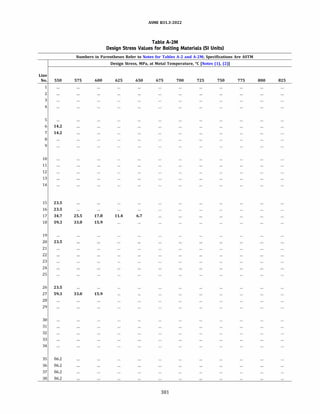
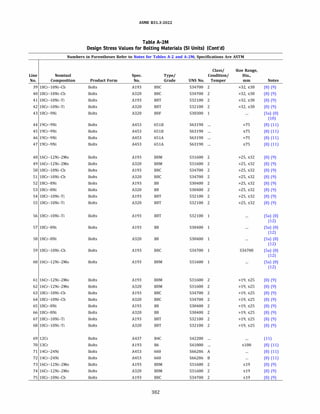
Basic Allowable Stresses in Tension for Metals (SI Units) .......................
Basic Casting Quality Factors, Ee ......•..................................
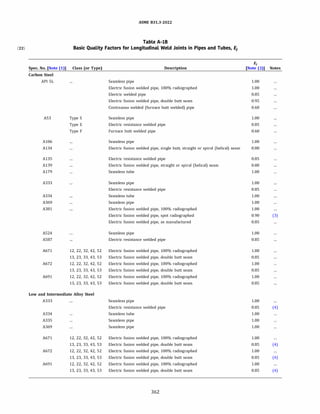
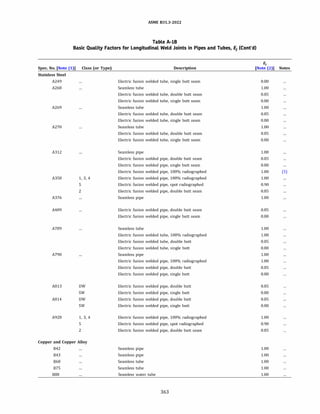
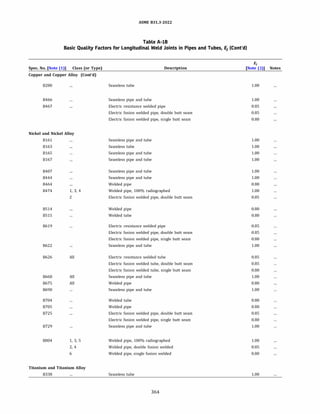
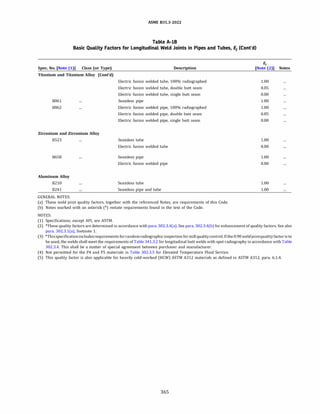
Basic Quality Factors for Longitudinal Weld Joints in Pipes and Tubes, Ej ...........
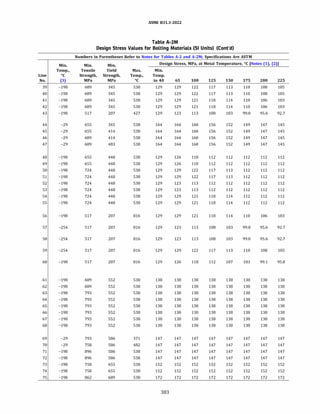
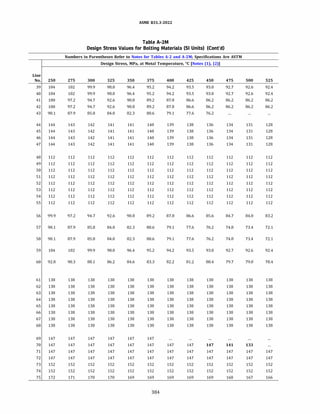
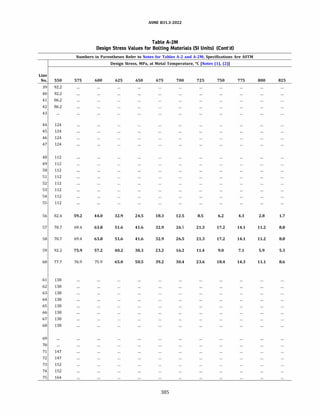
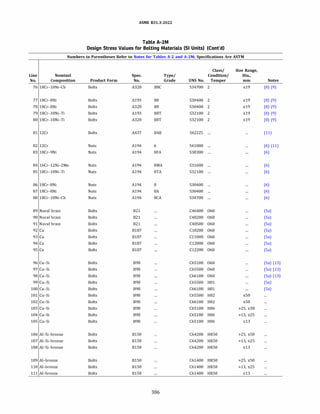
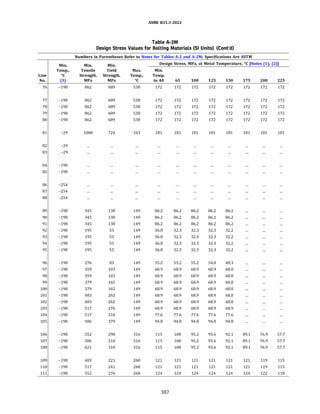
Design Stress Values for Bolting Materials .................................
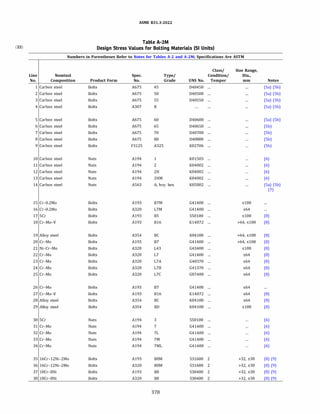
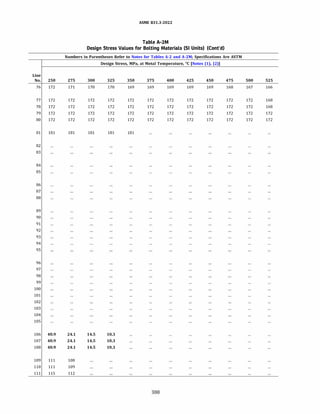
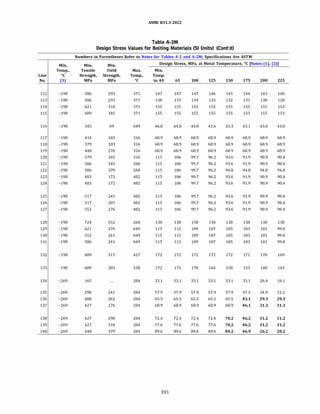
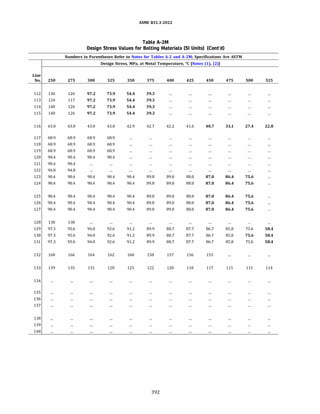
Design Stress Values for Bolting Materials (SI Units) ..........................
170
250
360
362
368
378
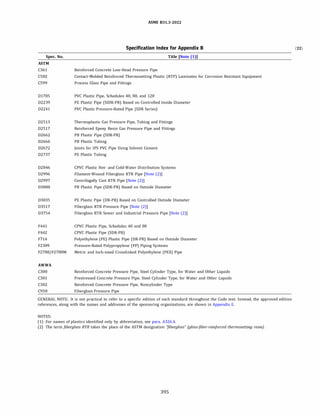
Specification Index for Appendix B ....................................... 395
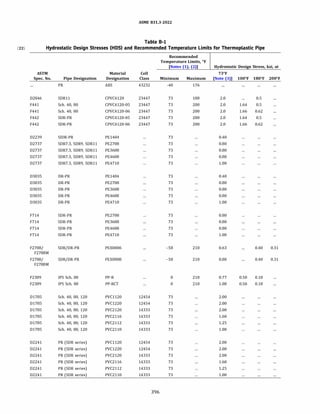
Hydrostatic Design Stresses (HOS) and Recommended Temperature Limits for
Thermoplastic Pipe ................................................
Hydrostatic Design Stresses (HOS) and Recommended Temperature Limits for
Thermoplastic Pipe (SI Units) ........................................
Listed Specifications for Laminated Reinforced Thermosetting Resin Pipe ...........
Listed Specifications for Filament Wound and Centrifugally Cast Reinforced Thermosetting
Resin and Reinforced Plastic Mortar Pipe ................................
Allowable Pressures and Recommended Temperature Limits for Concrete Pipe .......
Allowable Pressures and Recommended Temperature Limits for Borosilicate Glass
Pipe ...........................................................
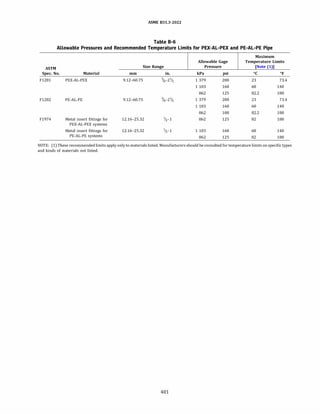
Allowable Pressures and Recommended Temperature Limits for PEX-AL-PEX and PE-AL-PE
Pipe ...........................................................
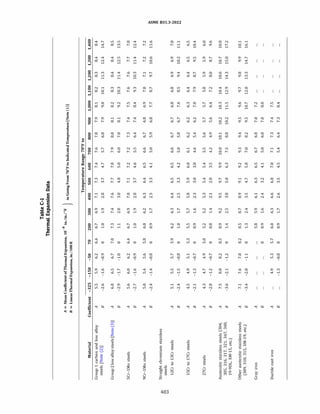
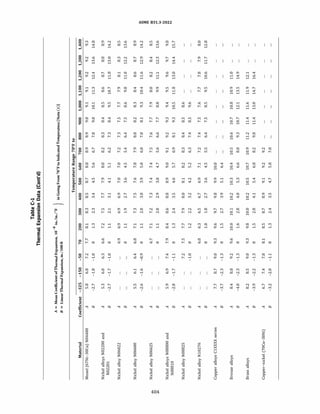
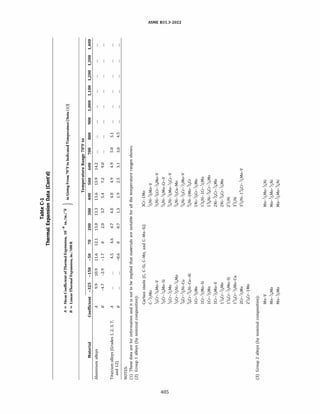
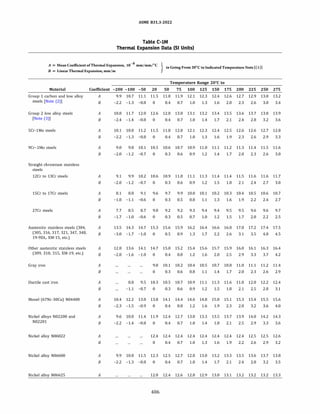
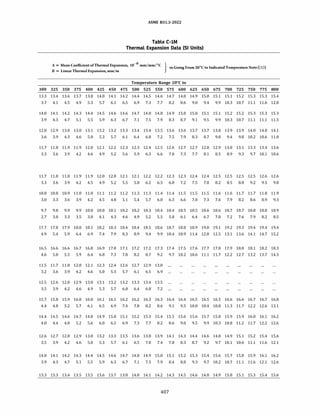
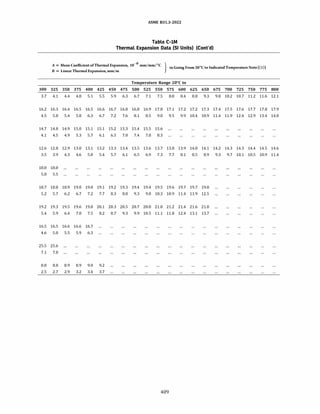
Thermal Expansion Data ..............................................
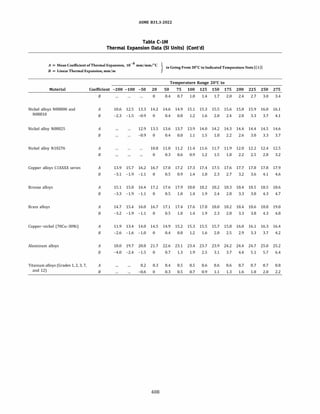
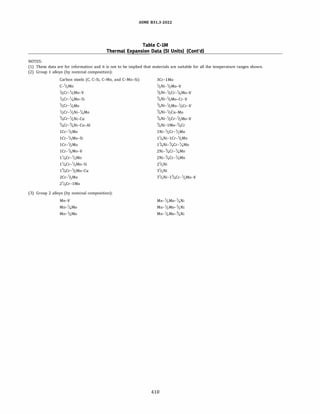
Thermal Expansion Data (SI Units) .......................................
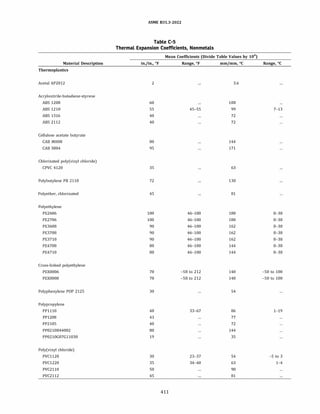
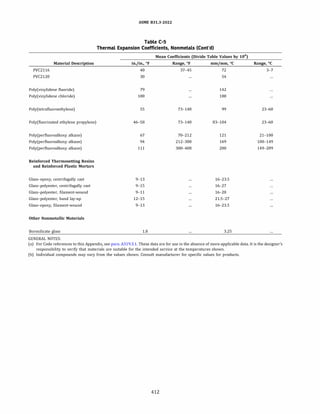
Thermal Expansion Coefficients, Nonmetals ................................
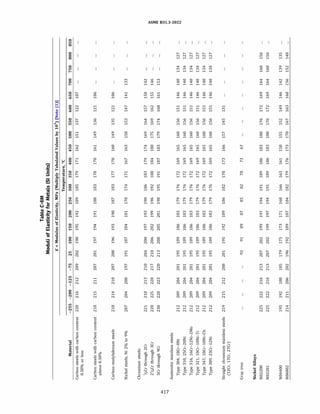
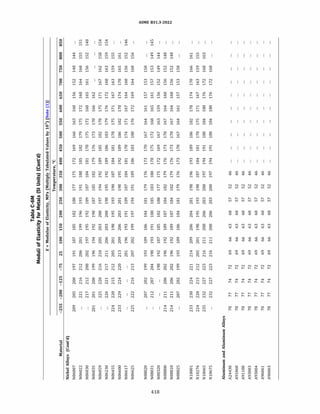
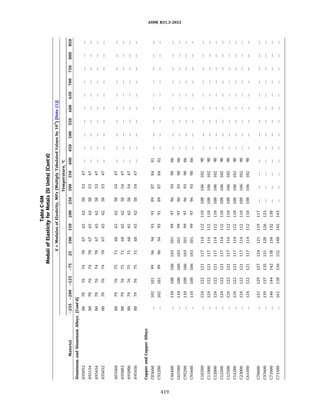
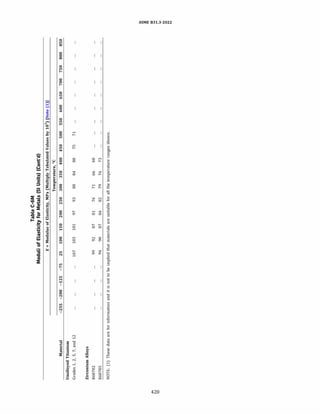
Moduli of Elasticity for Metals ..........................................
Moduli of Elasticity for Metals (SI Units) ..................................
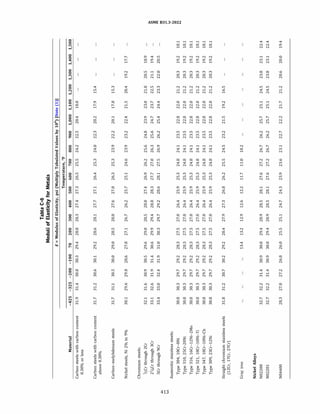
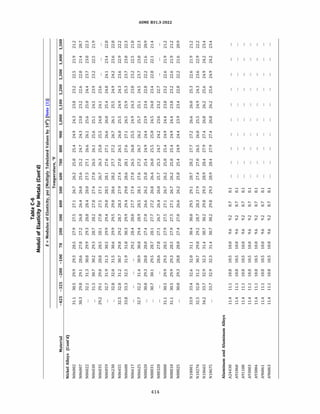
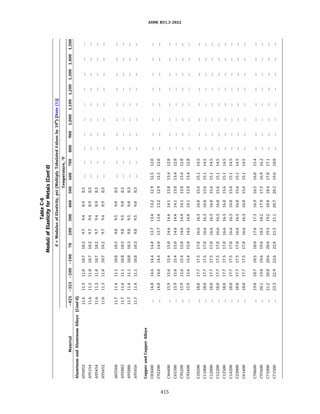
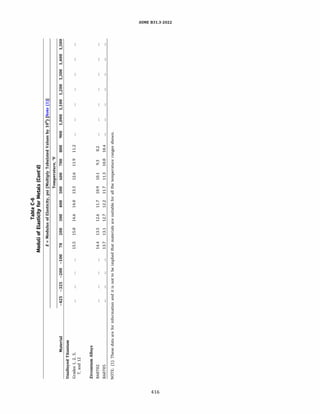
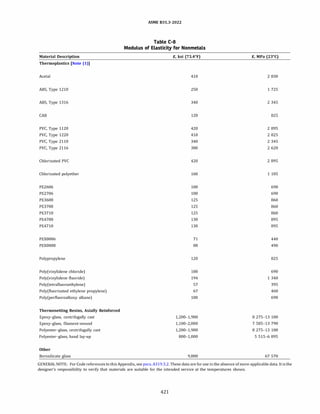
Modulus of Elasticity for Nonmetals ......................................
396
398
399
399
400
400
401
403
406
411
413
417
421
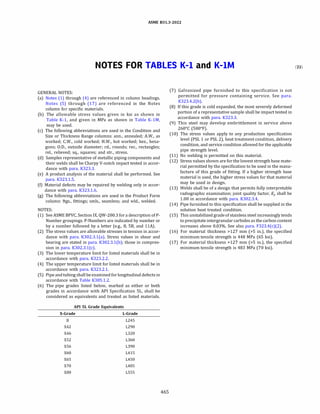
Specification Index for Appendix K ....................................... 464
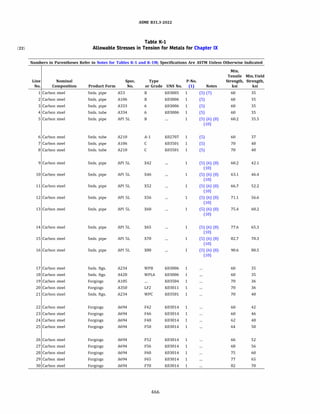
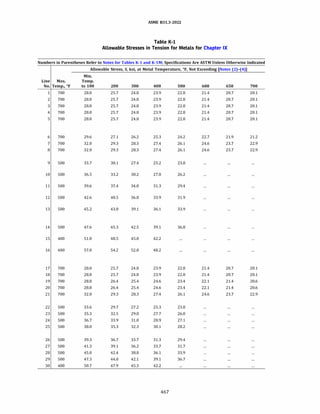
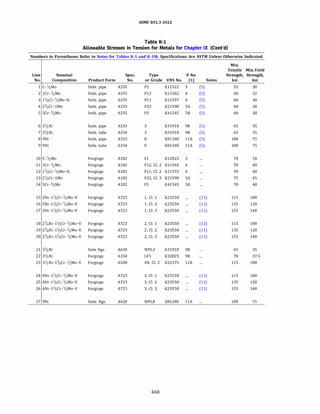
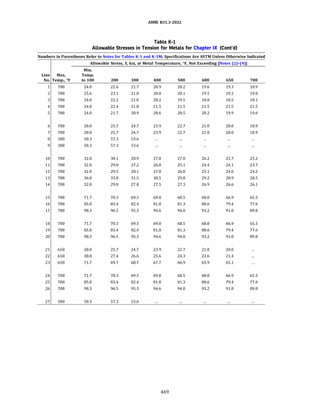
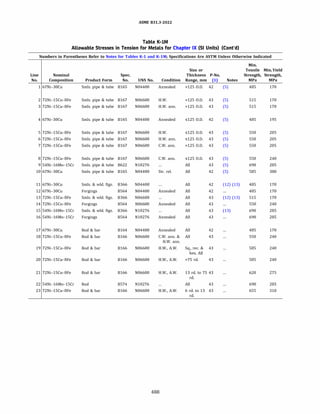
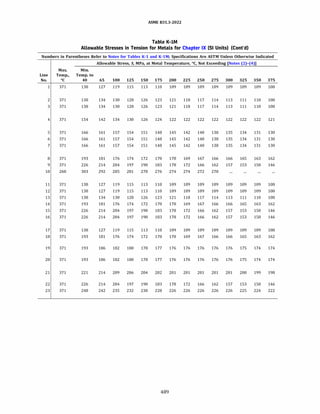
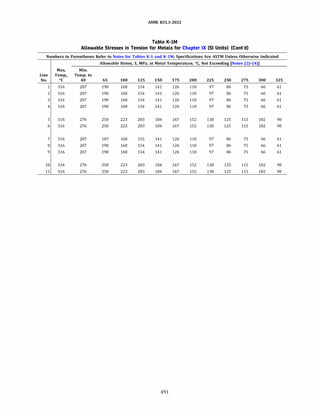
Allowable Stresses in Tension for Metals for Chapter IX .......................
Allowable Stresses in Tension for Metals for Chapter IX (SI Units) ................
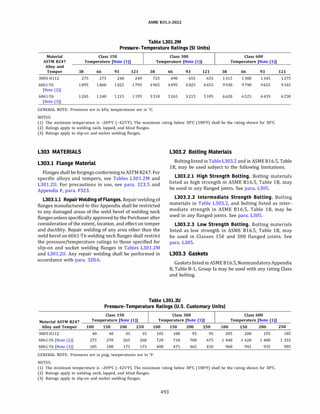
Pressure-Temperature Ratings (SI Units) ..................................
Pressure-Temperature Ratings (U.S. Customary Units) ........................
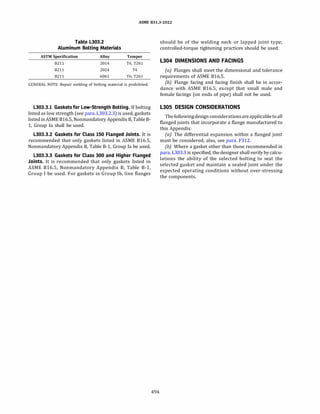
Aluminum Bolting Materials ............................................
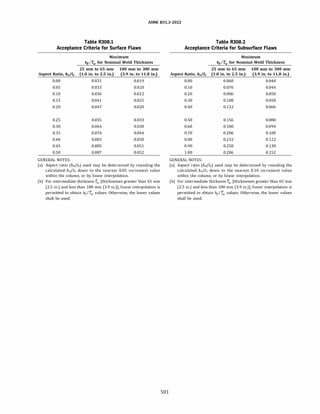
Acceptance Criteria for Surface Flaws .....................................
Acceptance Criteria for Subsurface Flaws ..................................
Example 1: Pressure-Temperature Combinations ............................
Example 1: Generic Pipe Stress Model Input ................................
Example 1: Element Connectivity, Type, and Lengths ..........................
Example 1: Operating Load Case Results: Internal Loads and Deflections ...........
Example 1: Operating Load Case Results: Reactions on Supports and Anchors ........
xii
466
480
493
493
494
501
501
503
503
504
sos
sos
S301.6
S301.7
S302.2
S302.3
S302.5
S302.6.2
S302.6.3
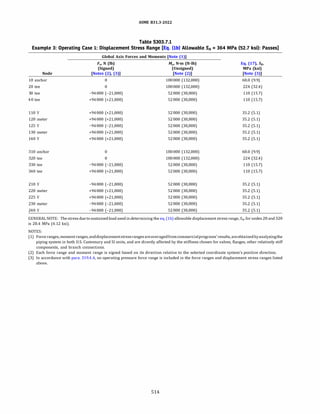
S303.1
S303.3
S303.7.1
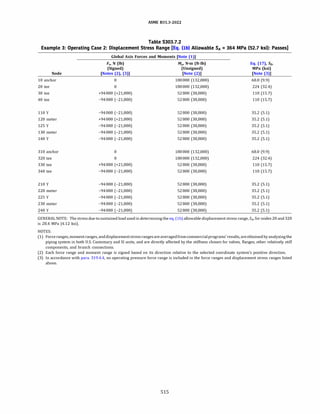
S303.7.2
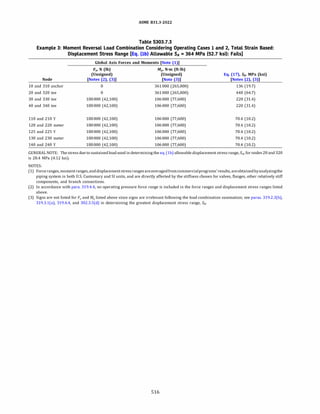
S303.7.3
W301-1
W302.1-1
W302.1-2
W302.l-3
W302.l-4
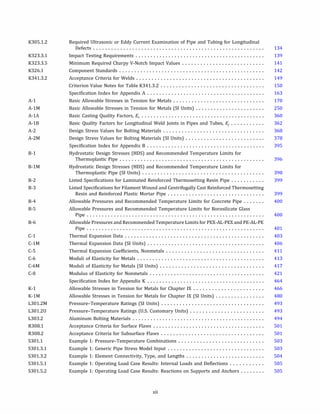
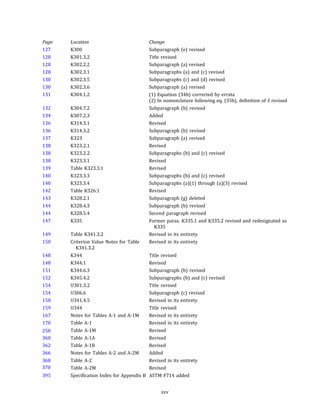
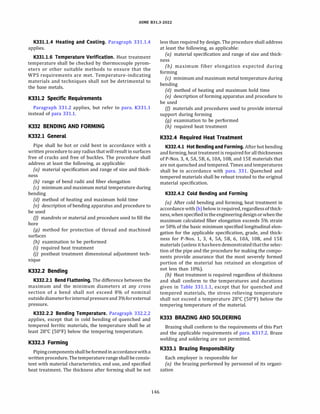
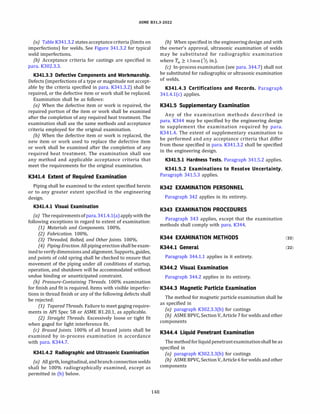
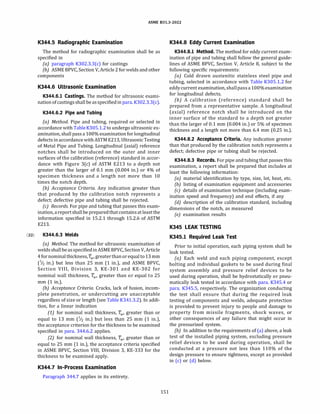
Index
Notes for Index
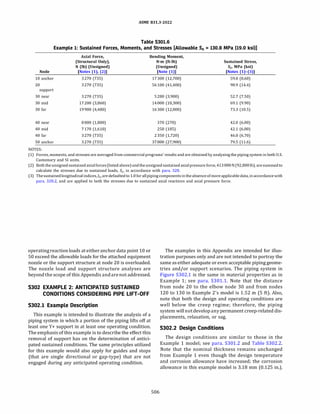
Example 1: Sustained Forces, Moments, and Stresses [Allowable Sh = 130.8 MPa (19.0 ksi)]
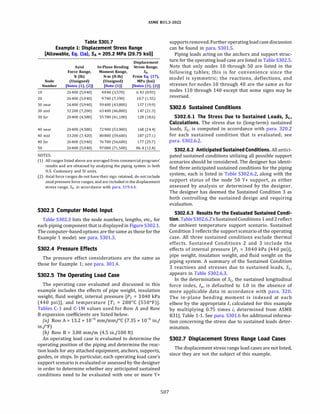
Example 1: Displacement Stress Range [Allowable, Eq. (la), SA = 205.2 MPa (29.75 ksi)]
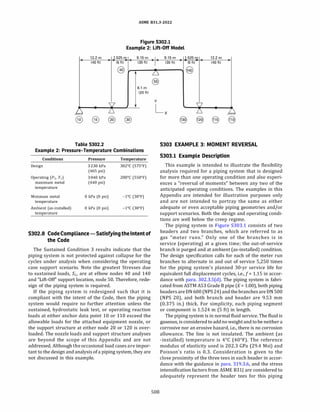
Example 2: Pressure-Temperature Combinations ............................
Example 2: Generic Pipe Stress Model Input: Component Connectivity, Type, and Lengths
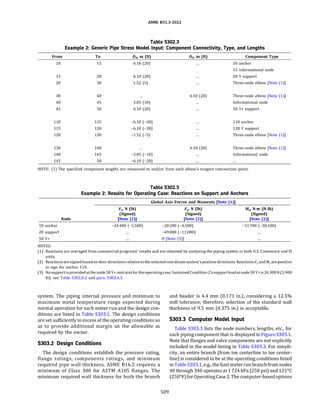
Example 2: Results for Operating Case: Reactions on Support and Anchors ..........
Example 2: Sustained Load Condition Listing ...............................
Example 2: Sustained Forces, Moments, and Stresses for Sustained Condition 3 With Node
50's Y+ Support Inactive [Allowable Sh = 127 MPa (18.4 ksi): Fails] .............
Example 3: Pressure-Temperature Combinations ............................
Example 3: Generic Pipe Stress Model Input: Component Connectivity, Type, and Lengths
Example 3: Operating Case 1: Displacement Stress Range [Eq. (lb) Allowable SA
= 364 MPa
(52.7 ksi): Passes] .................................................
Example 3: Operating Case 2: Displacement Stress Range [Eq. (lb) Allowable SA
= 364 MPa
(52.7 ksi): Passes] .................................................
Example 3: Moment Reversal Load Combination Considering Operating Cases 1 and 2, Total
Strain Based: Displacement Stress Range [Eq. (lb) Allowable SA = 364 MPa (52.7 ksi):
Fails] ..........................................................
Gamma Function Evaluation ............................................
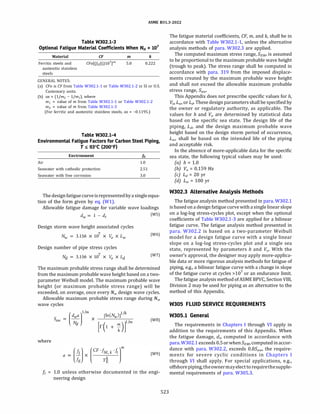
Fatigue Material Coefficients (-3cr) .......................................
Fatigue Material Coefficients (-2cr) .......................................
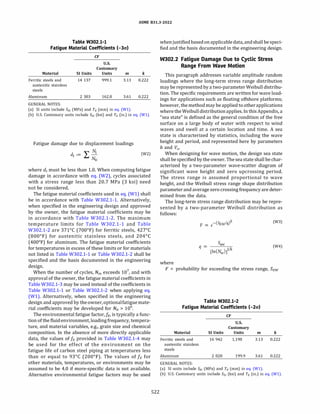
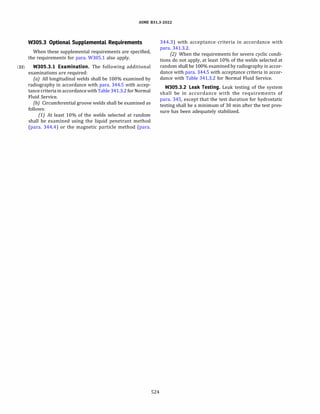
Optional Fatigue Material Coefficients When Ne; > 107
• • • • • • • • • • • • • • • • • • • • • • • • •
Environmental Fatigue Factors for Carbon Steel Piping, T � 93°
C (200°
F) ...........
xiii
506
507
508
509
509
510
511
512
513
514
515
516
521
522
522
523
523
530
546
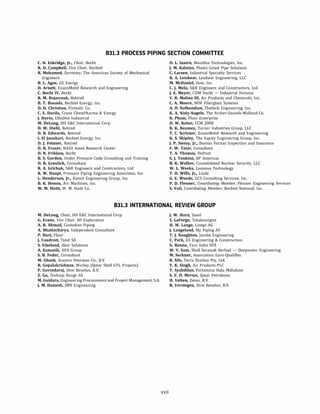
FOREWORD
Responding to evident need and at the request of The American Society of Mechanical Engineers (ASME), the American
Standards Association initiated Project 831 in March 1926, with ASME as sole administrative sponsor. The breadth of the
field involved required that membership of the Sectional Committee be drawn from some 40 engineering societies,
industries, government bureaus, institutes, and trade associations.
Initial publication in 1935 was as the American Tentative Standard Code for Pressure Piping. Revisions from 1942
through 1955 were published as American Standard Code for Pressure Piping, ASA 831.1. It was then decided to publish
asseparatedocuments thevarious industrySections, beginning with ASA 831.8-1955, Gas Transmissionand Distribution
Piping Systems. The first Petroleum Refinery Piping Code Section was designated ASA 831.3-1959. ASA 831.3 revisions
were published in 1962 and 1966.
In 1967-1969, the American Standards Association became first the United States of America Standards Institute, then
the American National Standards Institute (ANSI). The Sectional Committee became American National Standards
Committee 831 and the Code was renamed the American National Standard Code for Pressure Piping. The next
831.3 revision was designated ANSI 831.3-1973. Addenda were published through 1975.
Adraft CodeSectionforChemicalPlantPiping,preparedbySectionCommittee831.6,was readyforapprovalin 1974. It
was decided, rather than have two closely related Code Sections, to merge the Section Committees and develop a joint
Code Section, titled Chemical Plant and Petroleum Refinery Piping. The first edition was published as ANSI 831.3-1976.
In this Code, responsibility for piping design was conceptually integrated with that for the overall processing facility,
with safeguarding recognized as an effective safety measure. Three categories of Fluid Service were identified, with a
separate Chapter for Category M Fluid Service. Coverage for nonmetallic piping was introduced. New concepts were
betterdefined infive Addenda, the fourthofwhichadded AppendixM, agraphicaidto selectionoftheproper FluidService
category.
The Standards Committee was reorganized in 1978 as a Committee operating under ASME procedures with ANSI
accreditation. It is now the ASME Code for Pressure Piping, 831 Committee. Section committee structure remains essen­
tially unchanged.
The second edition of Chemical Plant and Petroleum Refinery Piping was compiled from the 1976 Edition and its five
Addenda, with nonmetal requirements editorially relocated to a separate Chapter. Its new designation was ANSI/ASME
831.3-1980.
Section Committee 831.10 had a draft Code for Cryogenic Piping ready for approval in 1981. Again, it was decided to
merge the two Section Committees and develop a more inclusive Code with the same title. The work of consolidation was
partially completed in the ANSI/ASME 831.3-1984 Edition.
Significant changes were made in Addenda to the 1984 Edition: integration of cryogenic requirements was completed;
a new stand-alone Chapter on high-pressure piping was added; and coverage of fabrication, inspection, testing, and
allowable stresses was reorganized. The new Edition was designated as ASME/ANSI 831.3-1987 Edition.
Addendato thesubsequent fiveEditions, published at3-year intervals, were primarily used tokeep the Codeup to date.
New Appendices were added, however, on requirements for bellowsexpansion joints, estimating servicelife, submittal of
Inquiries, aluminumflanges, andquality controlinthe 1990, 1993, 1999, and2002Editions, alldesignated as ASME 831.3.
In a program to clarify the application of all Sections of the Code for Pressure Piping, changes were made in the
Introduction and Scope statements of the 1996 Edition, and its title was changed to Process Piping.
Under direction of ASME Codes and Standardsmanagement, SI (metric)units ofmeasurementwere emphasized. With
certain exceptions, SI units were listed first in the 1996 Edition and were designated as the standard. Instructions for
conversion were given where SI units data were not available. U.S. Customary units also were given. By agreement, either
system may have been used.
Beginning with the 2004 Edition, the publication cycle of ASME 831.3 was changed to biennial. Other changes made in
the2004 Edition included the introduction ofthe weld joint strength reduction factor, W, and the additions of Appendix P,
Alternative Rules for Evaluating Stress Range, and Appendix S, Piping System Stress Analysis Examples.
Changes that were made to the 2006 and 2008 Editions of ASME 831.3 included the requirement that valves have
blowout-proof stems and the addition of a definition for elevated temperature fluid service, respectively. The most
significant change that was made to the 2010 Edition of ASME 831.3 was the addition of Chapter X, High Purity
xiv
Piping.In the 2012 Edition, TablesA-lM andA-2M were added toAppendix A that give allowable design values inSI units,
and Appendix N, Application of ASME 831.3 Internationally, was also added.
For the 2016 Edition, the allowable design values in SI units as shown in Tables A-lM andA-2M were changed from for
information only to values that may be used to meet the requirements of the Code.
In this Edition, SI units are given first, with U.S. Customary units in parentheses. The values in Tables A-1, A-2, 8-1, and
K-1 are given in U.S. Customary units, and the SI values are given in Tables A-lM, A-2M, 8-lM, and K-lM. Either the U.S.
Customary units or the SI units for these values may be used. Values in SI units are to be regarded as the standard, unless
otherwise agreed between the contracting parties.
Interpretations, Code Cases, and errata to theASME 831.3 Code on Process Piping are publishedon the following ASME
web page: http://go.asme.org/83lcommittee.
ASME 831.3-2022 was approved by ANSI on August 24, 2022.
xv
ASME 831 COMMITTEE
Code for Pressure Piping
(The following is the roster of the Committee at the time of approval of this Code.)
STANDARDS COMMITTEE OFFICERS
C. H. Eskridge, Jr., Chair
K. A. Vilminot, Vice Chair
J. Oh, Secretary
STANDARDS COMMITTEE PERSONNEL
D. Anderson, Retired
R. J. T. Appleby, Pipelines Consultant
K. C. Bodenhamer, TRC Pipeline Services
R. M. Bojarczuk, Retired
M. R. Braz, MRBraz & Associates, PLLC
M. Burkhart, The Burkhart Group, Inc.
R. D. Campbell, Bechtel Energy, Inc.
J. Caylor, Caylor Engineering & Associates, PLLC
J. S. Chin, TC Energy
D. D. Christian, Victaulic Co.
R. P. Deubler, Becht
D. W. Diehl, Retired
M. Engelkemier, Cargill
C. H. Eskridge, Jr., Becht
D. J. Fetzner, Retired
D. R. Frikken, Becht
R. A. Grichuk, S&B Engineers and Constructors, Ltd.
R. W. Haupt, Pressure Piping Engineering Associates, Inc.
xvi
G. A. Jolly, Samshin, Ltd.
K. Kaplan, Consultant
W. J. Mauro, Retired
J. E. Meyer, CDM Smith - Industrial Division
T. Monday, Team Industries, Inc.
J. Oh, The American Society of Mechanical Engineers
W. Olson, Gulf Interstate Engineering
D. W. Rahoi, CCM 2000
M. Rana, Consultant
R. K. Reamey, Turner Industries Group, LLC
M. J. Rosenfeld, RSI Pipeline Solutions, LLC
J. T. Schmitz, Southwest Gas Corp.
S. K. Sinha, Lucius Pitkin, Inc.
W. J. Sperko, Sperka Engineering Services, Inc.
F. W. Tatar, Consultant
K. A. Vilminot, Commonwealth Associates, Inc.
P. D. Flenner, Contributing Member, Flenner Engineering Services
M. L. Nayyar, Contributing Member, NICE
831.3 PROCESS PIPING SECTION COMMITTEE
C. H. Eskridge, Jr., Chair, Becht
R. D. Campbell, Vice Chair, Bechtel
R. Mohamed, Secretary, The American Society of Mechanical
Engineers
B. L. Agee, GE Energy
D. Arnett, ExxonMobil Research and Engineering
C. Becht IV, Becht
R. M. Bojarczuk, Retired
B. T. Bounds, Bechtel Energy, Inc.
D. D. Christian, Victaulic Co.
C. E. Davila, Crane ChemPharma & Energy
J. Davio, EllisDon Industrial
M. DeLong, IHI E&C International Corp.
D. W. Diehl, Retired
D. R. Edwards, Retired
I. El Jaouhari, Bechtel Energy, Inc.
D. J. Fetzner, Retired
D. R. Fraser, NASA Ames Research Center
D. R. Frikken, Becht
B. S. Gordon, Under Pressure Code Consulting and Training
0. R. Greulich, Consultant
R. A. Grichuk, S&B Engineers and Constructors, Ltd.
R. W. Haupt, Pressure Piping Engineering Associates, Inc.
L. Henderson, Jr., Kiewit Engineering Group, Inc.
B. K. Henon, Arc Machines, Inc.
W. M. Huitt, W. M. Huitt Co.
D. L. Ianiro, Mainthia Technologies, Inc.
J. M. Kalnins, Plastic-Lined Pipe Solutions
C. Larsen, Industrial Specialty Services
R. A. Leishear, Leishear Engineering, LLC
M. McDaniel, Dow, Inc.
C. J. Melo, S&B Engineers and Constructors, Ltd.
J. E. Meyer, CDM Smith - Industrial Division
V. B. Molina III, Air Products and Chemicals, Inc.
C. A. Moore, NOV Fiberglass Systems
A. D. Nalbandian, Thielsch Engineering, Inc.
K. A. Nisly-Nagele, The Archer-Daniels-Midland Co.
K. Pham, Fluor Enterprise
D. W. Rahoi, CCM 2000
R. K. Reamey, Turner Industries Group, LLC
T. C. Scrivner, ExxonMobil Research and Engineering
K. S. Shipley, The Equity Engineering Group, Inc.
J. P. Swezy, Jr., Bureau Veritas Inspection and Insurance
F. W. Tatar, Consultant
T. A. Thomas, DuPont
S. J. Tonkins, BP Americas
B. K. Walker, Consolidated Nuclear Security, LLC
W. L. Weeks, Lummus Technology
T. D. Wills, Jr., Linde
G. E. Woods, GCS Consulting Services, Inc.
P. D. Flenner, Contributing Member, Flenner Engineering Services
S. Vail, Contributing Member, Bechtel National, Inc.
831.3 INTERNATIONAL REVIEW GROUP
M. DeLong, Chair, IHI E&C International Corp.
G. Evans, Vice Chair, BP Exploration
A. B. Ahmad, Custodian Piping
A. Bhattacharya, Independent Consultant
P. Burt, Fluor
J. Caudroit, Total SA
S. Eikeland, Aker Solutions
A. Esmaeili, APA Group
S. B. Feder, Consultant
M. Ghosh, Aramco Overseas Co., B.V.
R. Gopalakrishnan, Worley (Qatar Shell GTL Projects)
P. Govindaraj, Dow Benelux, B.V.
Z. Gu, Technip Norge AS
M. Guidara, Engineering Procurement and Project Management, S.A.
J. M. Hamedi, JMH Engineering
xvii
J. W. Horn, Sasol
S. Laforge, Totalenergies
H. W. Lange, Lisega AG
J. Langeland, My Piping AS
T. J. Naughton, Jacobs Engineering
C. Park, GS Engineering & Construction
G. Renna, Yara Italia SPA
W. Y. Sam, Shell Sarawak Berhad - Deepwater Engineering
M. Seckner, Association Euro-Qualiflex
R. Sits, Terra Nimbus Pty, Ltd.
V. K. Singh, Air Products PLC
T. Syahdilan, Pertamina Hulu Mahakam
S. V. D. Merwe, Qatar Petroleum
H. Velten, Zeton, B.V.
R. Verstegen, Dow Benelux, B.V.
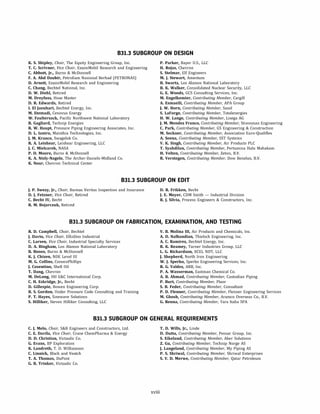
831.3 SUBGROUP ON DESIGN
K. S. Shipley, Chair, The Equity Engineering Group, Inc.
T. C. Scrivner, Vice Chair, ExxonMobil Research and Engineering
C. Abbott, Jr., Burns & McDonnell
F. A. Abd Dzubir, Petroliam Nasional Berhad (PETRONAS)
D. Arnett, ExxonMobil Research and Engineering
C. Chang, Bechtel National, Inc.
D. W. Diehl, Retired
M. Dreyfuss, Hose Master
D. R. Edwards, Retired
I. El Jaouhari, Bechtel Energy, Inc.
M. Etemadi, Cenovus Energy
W. Faultersack, Pacific Northwest National Laboratory
R. Gagliard, Technip Energies
R. W. Haupt, Pressure Piping Engineering Associates, Inc.
D. L. laniro, Mainthia Technologies, Inc.
J. M. Krance, Swagelok Co.
R. A. Leishear, Leishear Engineering, LLC
J. C. Mielcarek, NASA
P. D. Moore, Burns & McDonnell
K. A. Nisly-Nagele, The Archer-Daniels-Midland Co.
K. Nour, Chevron Technical Center
P. Parker, Bayer U.S., LLC
H. Rojas, Chevron
S. Stelmar, Elf Engineers
M. J. Stewart, Amentum
B. Swartz, Los Alamos National Laboratory
B. K. Walker, Consolidated Nuclear Security, LLC
G. E. Woods, GCS Consulting Services, Inc.
M. Engelkemier, Contributing Member, Cargill
A. Esmaeili, Contributing Member, APA Group
J. W. Horn, Contributing Member, Sasol
S. Laforge, Contributing Member, Totalenergies
H. W. Lange, Contributing Member, Lisega AG
J. M. Mendez Franco, Contributing Member, Stressman Engineering
C. Park, Contributing Member, GS Engineering & Construction
M. Seckner, Contributing Member, Association Euro-Qualiflex
A. Seena, Contributing Member, SST Systems
V. K. Singh, Contributing Member, Air Products PLC
T. Syahdilan, Contributing Member, Pertamina Hulu Mahakam
H. Velten, Contributing Member, Zeton, B.V.
R. Verstegen, Contributing Member, Dow Benelux, B.V.
831.3 SUBGROUP ON EDIT
J. P. Swezy, Jr., Chair, Bureau Veritas Inspection and Insurance
D. J. Fetzner, Vice Chair, Retired
C. Becht IV, Becht
R. M. Bojarczuk, Retired
D. R. Frikken, Becht
J. E. Meyer, CDM Smith - Industrial Division
R. J. Silvia, Process Engineers & Constructors, Inc.
831.3 SUBGROUP ON FABRICATION, EXAMINATION, AND TESTING
R. D. Campbell, Chair, Bechtel
J. Davio, Vice Chair, EllisDon Industrial
C. Larsen, Vice Chair, Industrial Specialty Services
D. A. Bingham, Los Alamos National Laboratory
B. Boseo, Burns & McDonnell
K. J. Chizen, NDE Level Ill
M. G. Collins, ConocoPhillips
J. Cosentino, Shell Oil
T. Dang, Chevron
M. DeLong, IHI E&C International Corp.
C. H. Eskridge, Jr., Becht
D. Gillespie, Bowen Engineering Corp.
B. S. Gordon, Under Pressure Code Consulting and Training
P. T. Hayes, Sinewave Solutions
S. Hilliker, Steven Hilliker Consulting, LLC
V. B. Molina III, Air Products and Chemicals, Inc.
A. D. Nalbandian, Thielsch Engineering, Inc.
A. C. Ramirez, Bechtel Energy, Inc.
R. K. Reamey, Turner Industries Group, LLC
L. G. Richardson, XCEL NDT, LLC
J. Shepherd, North Iron Engineering
W. J. Sperko, Sperka Engineering Services, Inc.
R. G. Valdez, ARB, Inc.
P. A. Wasserman, Eastman Chemical Co.
A. B. Ahmad, Contributing Member, Custodian Piping
P. Burt, Contributing Member, Fluor
S. B. Feder, Contributing Member, Consultant
P. D. Flenner, Contributing Member, Flenner Engineering Services
M. Ghosh, Contributing Member, Aramco Overseas Co., B.V.
G. Renna, Contributing Member, Yara Italia SPA
831.3 SUBGROUP ON GENERAL REQUIREMENTS
C. J. Melo, Chair, S&B Engineers and Constructors, Ltd.
C. E. Davila, Vice Chair, Crane ChemPharma & Energy
D. D. Christian, Victaulic Co.
G. Evans, BP Exploration
K. Landreth, T. D. Williamson
C. Linnick, Black and Veatch
T. A. Thomas, DuPont
G. B. Trinker, Victaulic Co.
xviii
T. D. Wills, Jr., Linde
D. Dutta, Contributing Member, Pensar Group, Inc.
S. Eikeland, Contributing Member, Aker Solutions
Z. Gu, Contributing Member, Technip Norge AS
J. Langeland, Contributing Member, My Piping AS
P. S. Shriwal, Contributing Member, Shriwal Enterprises
S. V. D. Merwe, Contributing Member, Qatar Petroleum
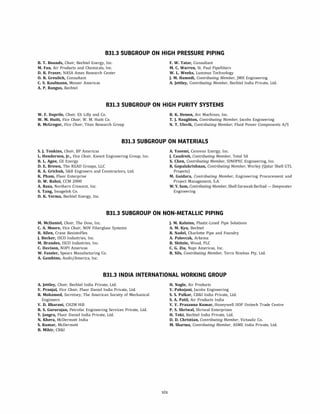
831.3 SUBGROUP ON HIGH PRESSURE PIPING
B. T. Bounds, Chair, Bechtel Energy, Inc.
M. Fan, Air Products and Chemicals, Inc.
D. R. Fraser, NASA Ames Research Center
0. R. Greulich, Consultant
C. S. Kaufmann, Messer Americas
A. P. Rangus, Bechtel
F. W. Tatar, Consultant
M. C. Warren, St. Paul Pipefitters
W. L. Weeks, Lummus Technology
J. M. Hamedi, Contributing Member, JMH Engineering
A. Jettley, Contributing Member, Bechtel India Private, Ltd.
831.3 SUBGROUP ON HIGH PURITY SYSTEMS
W. F. Daprile, Chair, Eli Lilly and Co.
W. M. Huitt, Vice Chair, W. M. Huitt Co.
R. McGregor, Vice Chair, Titan Research Group
B. K. Henon, Arc Machines, Inc.
T. J. Naughton, Contributing Member, Jacobs Engineering
N. T. Ulsvik, Contributing Member, Fluid Power Components A/S
831.3 SUBGROUP ON MATERIALS
S. J. Tonkins, Chair, BP Americas
L. Henderson, Jr., Vice Chair, Kiewit Engineering Group, Inc.
B. L. Agee, GE Energy
D. E. Brown, The READ Groups, LLC
R. A. Grichuk, S&B Engineers and Constructors, Ltd.
K. Pham, Fluor Enterprise
D. W. Rahoi, CCM 2000
A. Raza, Northern Crescent, Inc.
S. Tang, Swagelok Co.
D. K. Verma, Bechtel Energy, Inc.
A. Yasemi, Cenovus Energy, Inc.
J. Caudroit, Contributing Member, Total SA
X. Chen, Contributing Member, SINOPEC Engineering, Inc.
R. Gopalakrishnan, Contributing Member, Worley (Qatar Shell GTL
Projects)
M. Guidara, Contributing Member, Engineering Procurement and
Project Management, S.A.
W.Y. Sam, Contributing Member, Shell Sarawak Berhad- Deepwater
Engineering
831.3 SUBGROUP ON NON-METALLIC PIPING
M. McDaniel, Chair, The Dow, Inc.
C. A. Moore, Vice Chair, NOV Fiberglass Systems
B. Allen, Crane ResistoFlex
J. Becker, ISCO Industries, Inc.
M. Brandes, ISCO Industries, Inc.
C. Davison, NUPI Americas
W. Fassler, Spears Manufacturing Co.
A. Gambino, Asahi/America, Inc.
J. M. Kalnins, Plastic-Lined Pipe Solutions
A. M. Kyu, Bechtel
R. Nadel, Charlotte Pipe and Foundry
A. Palovcak, Arkema
B. Shitole, Wood, PLC
C. G. Ziu, Nupi Americas, Inc.
R. Sils, Contributing Member, Terra Nimbus Pty, Ltd.
831.3 INDIA INTERNATIONAL WORKING GROUP
A. Jettley, Chair, Bechtel India Private, Ltd.
V. Pranjal, Vice Chair, Fluor Daniel India Private, Ltd.
R. Mohamed, Secretary, The American Society of Mechanical
Engineers
V. D. Bharani, CH2M Hill
R. S. Gururajan, Petrofac Engineering Services Private, Ltd.
Y. Jangra, Fluor Daniel India Private, Ltd.
N. Khera, McDermott India
S. Kumar, McDermott
B. Mihir, CB&I
xix
H. Nagle, Air Products
V. Pahujani, Jacobs Engineering
S. S. Palkar, CB&I India Private, Ltd.
S. A. Patil, Air Products India
V. V. Prasanna Kumar, Honeywell UOP Unitech Trade Centre
P. S. Shriwal, Shriwal Enterprises
H. Toki, Bechtel India Private, Ltd.
D. D. Christian, Contributing Member, Victaulic Co.
M. Sharma, Contributing Member, ASME India Private, Ltd.
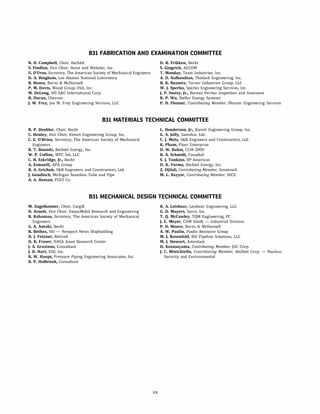
831 FABRICATION AND EXAMINATION COMMITTEE
R. D. Campbell, Chair, Bechtel
S. Findlan, Vice Chair, Stone and Webster, Inc.
U. D'Urso, Secretary, The American Society of Mechanical Engineers
D. A. Bingham, Los Alamos National Laboratory
B. Boseo, Burns & McDonnell
P. M. Davis, Wood Group USA, Inc.
M. DeLong, IHI E&C International Corp.
R. Duran, Chevron
J. W. Frey, Joe W. Frey Engineering Services, LLC
D. R. Frikken, Becht
S. Gingrich, AECOM
T. Monday, Team Industries, Inc.
A. D. Nalbandian, Thielsch Engineering, Inc.
R. K. Reamey, Turner Industries Group, LLC
W. J. Sperka, Sperka Engineering Services, Inc.
J. P. Swezy, Jr., Bureau Veritas Inspection and Insurance
K. P. Wu, Stellar Energy Systems
P. D. Flenner, Contributing Member, Flenner Engineering Services
831 MATERIALS TECHNICAL COMMITTEE
R. P. Deubler, Chair, Becht
C. Henley, Vice Chair, Kiewit Engineering Group, Inc.
C. E. O'Brien, Secretary, The American Society of Mechanical
Engineers
B. T. Bounds, Bechtel Energy, Inc.
W. P. Collins, WPC Sol, LLC
C. H. Eskridge, Jr., Becht
A. Esmaeili, APA Group
R. A. Grichuk, S&B Engineers and Constructors, Ltd.
J. Gundlach, Michigan Seamless Tube and Pipe
A. A. Hassan, PGES Co.
L. Henderson, Jr., Kiewit Engineering Group, Inc.
G. A. Jolly, Samshin, Ltd.
C. J. Melo, S&B Engineers and Constructors, Ltd.
K. Pham, Fluor Enterprise
D. W. Rahoi, CCM 2000
R. A. Schmidt, Canadoil
S. J. Tonkins, BP Americas
D. K. Verma, Bechtel Energy, Inc.
Z. Djilali, Contributing Member, Sonatrach
M. L. Nayyar, Contributing Member, NICE
831 MECHANICAL DESIGN TECHNICAL COMMITTEE
M. Engelkemier, Chair, Cargill
D. Arnett, Vice Chair, ExxonMobil Research and Engineering
R. Rahaman, Secretary, The American Society of Mechanical
Engineers
G. A. Antaki, Becht
R. Bethea, HII - Newport News Shipbuilding
D. J. Fetzner, Retired
D. R. Fraser, NASA Ames Research Center
J. A. Graziano, Consultant
J. D. Hart, SSD, Inc.
R. W. Haupt, Pressure Piping Engineering Associates, Inc.
B. P. Holbrook, Consultant
xx
R. A. Leishear, Leishear Engineering, LLC
G. D. Mayers, Serco, Inc.
T. Q. Mccawley, TQM Engineering, PC
J. E. Meyer, COM Smith - Industrial Division
P. D. Moore, Burns & McDonnell
A. W. Paulin, Paulin Resource Group
M. J. Rosenfeld, RSI Pipeline Solutions, LLC
M. J. Stewart, Amentum
H. Kosasayama, Contributing Member, JGC Corp.
J. C. Minichiello, Contributing Member, Bechtel Corp. - Nuclear,
Security and Environmental
INTRODUCTION
The ASME 831 Code for Pressure Piping consists of a
number of individually published Sections, each an Amer­
ican National Standard, under the direction of ASME
Committee 831, Code for Pressure Piping.
Rules for each Section reflect the kinds of piping instal­
lations considered during its development, as follows:
831.1
831.3
831.4
Power Piping: piping typically found in
electric power generating stations, in
industrial and institutional plants,
geothermal heating systems, and central
and district heating and cooling systems
Process Piping: piping typically found in
petroleum refineries; onshore and
offshore petroleum and natural gas
production facilities; chemical,
pharmaceutical, textile, paper, ore
processing, semiconductor, and cryogenic
plants; food and beverage processing
facilities; and related processing plants
and terminals
Pipeline Transportation Systems for Liquids
andSlurries: piping transporting products
that are predominately liquid between
plants and terminals and withinterminals,
pumping, regulating, and metering
stations
831.S Refrigeration Piping and Heat Transfer
Components: piping for refrigerants and
secondary coolants
831.8 Gas Transmission and Distribution Piping
Systems: piping transporting products
that are predominately gas between
sources and terminals, including
compressor, regulating, and metering
stations; gas gathering pipelines
831.9 Building Services Piping: piping typically
found in industrial, institutional,
commercial, and public buildings, and in
multi-unit residences, which does not
require the range of sizes, pressures, and
temperatures covered in 831.1
831.12 Hydrogen Piping and Pipelines: piping in
gaseous and liquid hydrogen service and
pipelines in gaseous hydrogen service
xxi
This is the 831.3 ProcessPiping CodeSection. Hereafter,
in this Introduction and in the text of this Code Section
831.3, where the word Code is used without specific iden­
tification, it means this Code Section.
It is the owner's responsibility to selectthe Code Section
that most nearly applies to a proposed piping installation.
Factors to be considered by the owner include limitations
of the Code Section; jurisdictional requirements; and the
applicability of other codes and standards. All applicable
requirements of the selected Code Section shall be met.
For some installations, more than one Code Section may
apply to different parts of the installation. The owner is
also responsible for imposing requirements supplemen­
tary to those of the Code if necessary to assure safe piping
for the proposed installation.
Certain piping within a facility may be subject to other
codes and standards, including but not limited to
- ANSI Z223.1 National Fuel Gas Code: piping for fuel
gas fromthe pointofdelivery totheconnectionofeach fuel
utilization device
- NFPA Fire Protection Standards: fire protection
systems using water, carbon dioxide, halon, foam, dry
chemicals, and wet chemicals
- NFPA 99 Health Care Facilities: medical and labora­
tory gas systems
- building and plumbing codes, as applicable, for
potable hot and cold water, and for sewer and drain
systems
The Code specifies engineering requirements deemed
necessary for safe design and construction of pressure
piping. While safety is the primary consideration, this
factoralonewill not necessarilygovernthefinalspecifica­
tions for any piping installation. The Code is not a design
handbook. Many decisions that must be made to produce a
sound piping installation are not specified in detail within
this Code. The Code does not serve as a substitute for
sound engineering judgments by the owner and the
designer.
To the greatest possible extent, Code requirements for
design are stated in terms of basic design principles and
formulas. These are supplemented as necessary with spe­
cific requirements to ensure uniform application of prin­
ciples and to guide selection and application of piping
elements. The Code prohibits designs and practices
known to be unsafe and contains warnings where
caution, but not prohibition, is warranted.
This Code Section includes the following:
(22)
(a) references to acceptable material specifications
andcomponentstandards, includingdimensionalrequire­
ments and pressure-temperature ratings
(bJ requirements for design ofcomponents and assem­
blies, including piping supports
(c) requirements anddata for evaluation and limitation
of stresses, reactions, and movements associated with
pressure, temperature changes, and other forces
(d) guidance and limitations on the selection and appli­
cation of materials, components, and joining methods
(e) requirements for the fabrication, assembly, and
erection of piping
(!) requirements for examination, inspection, and
testing of piping
Either International System (SI, also known as metric)
or U.S. Customary units may be used with this edition.
Local customary units may also be used to demonstrate
compliance with this Code. One system of units should be
used consistently for requirements applying to a specific
installation. The equations in this Code may be used with
anyconsistentsystemofunits. Itistheresponsibilityofthe
organization performing calculations to ensure that a
consistent system of units is used.
ASME Committee 831 is organized and operates under
procedures of The American Society of Mechanical Engi­
neers that have been accredited by the American National
Standards Institute. The Committee is a continuing one,
and keeps all Code Sections current with new develop­
ments in materials, construction, and industrial practice.
New editions are published at intervals of 2 years.
Code users will note that paragraphs in the Code are not
necessarily numbered consecutively. Such discontinuities
result from following a common outline, insofar as prac­
tical, for all Code Sections. In this way, corresponding
material is correspondingly numbered in most Code
Sections, thus facilitating reference by those who have
occasion to use more than one Section.
This edition of Code Section 831.3 is not retroactive.
Normally, agreement is made between contracting
partiestouse a specific edition, considering requirements
xxii
of the authority having jurisdiction. When specified as the
latest edition and when no edition is specified, the specific
edition is the one issued at least 6 months prior to the
original contract date for the first design activity.
Users of this Code are cautioned against making use of
Code revisions without assurance that they are acceptable
to the proper authorities in the jurisdiction where the
piping is to be installed.
The 831 Committee has established an orderly proce­
dure to consider requests for interpretation and revision
of Code requirements. To receive consideration, such
request must be in writing and must give full particulars
in accordance with Appendix Z.
The approved reply to an inquiry will be sent directly to
the inquirer. In addition, the question and reply will be
published in the ASME Interpretation Database at
http://go.asme.org/InterpsDatabase.
A Case is the prescribed form of reply when study indi­
cates that the Code wording needs clarification, or when
the reply modifies existing requirements of the Code or
grants permission to use new materials or alternative
constructions. The Case will be published on the 831.3
web page at http://go.asme.org/831committee.
Code Cases remain available for use until annulled by
the ASME 831 Standards Committee.
A request for revision of the Code will be placed on the
Committee's agenda. Further information or active parti­
cipation on the part of the proponent may be requested
during consideration of a proposed revision.
Materials ordinarily are listed in the stress tables only
when sufficient usage in piping within the scope of the
Code has been shown. Requests for listing shall include
evidence of satisfactory usage and specific data to
permit establishment of allowable stresses, maximum
and minimum temperature limits, and other restrictions.
Additional criteria can be found in the guidelines for addi­
tion of new materials in the ASME Boiler and Pressure
Vessel Code, Section II. (To develop usage and gain experi­
ence, unlisted materials may be used in accordance with
para. 323.1.2.)
ASME 831.3-2022
SUMMARY OF CHANGES
Following approval by the ASME 831 Committee and ASME, and after public review, ASME 831.3-2022 was approved by
the American National Standards Institute on August 24, 2022.
ASME 831.3-2022 includes the following changes identified by a margin note, (22).
Page
xxi
1
3
12
13
13
13
15
16
19
19
20
25
26
28
33
33
35
37
40
45
47
49
50
52
53
Location
Introduction
300
300.2
301.5.1
301.7
301.7.2
301.7.3
302.3.2
302.3.5
Figure 302.3.5
302.3.6
Table 302.3.5
304.3.3
Figure 304.3.3
Figure 304.3.4
305.2.1
305.2.3
307.2.3
314.2.2
319.3.1
321.1
322.6.3
323.2.2
Table 323.2.2
Figure 323.2.2A
Figure 323.2.28
Change
Editorially revised
Subparagraphs (b)(l) and (c)(3) revised
(1) Definitions ofconstruction, designated lot, combinationwelded
(COW) pipe, postweld hydrogen bakeout, and set pressure added
(2) Definitions ofexamination, types of; heat treatment; pipe;
submerged arc welding (SAW); and severe cyclic conditions
revised
Revised
Revised
Revised
Revised
Subparagraphs (e)(l) and (e)(2) revised
Equations (le) and (ld) and subpara. (f) revised
Image revised
(1) Subparagraphs (a)(l), (a)(l)(-a), and (a)(l)(-b) revised
(2) Subparagraph (a)(3) added
General Note (d) and Notes (1), (2), and (4) revised
Subparagraph (a) revised
General Note revised
Note at top offigure editorially redesignated as General Note and
revised
Revised
Subparagraph (b) revised
Added
Revised
Subparagraph (a) revised
Second paragraph revised
Footnote 13 deleted and subsequent footnote redesignated
Subparagraph (f) corrected by errata
(1) Note at top of table redesignated as General Note
(2) Note (1) revised
(1) Note at top of figure redesignated as General Note
(2) Graphic and Note (3) revised
Note at topoffigure redesignated as General Note (a) and existing
General Note redesignated as (b)
xxiii
Page Location Change
54 Table 323.2.2A Revised in its entirety
56 Table 323.2.28 Note at top of table redesignated as General Note
58 Table 323.3.4 Celsius values revised
62 Table 326.1 Revised
68 328.5.2 Subparagraph (d) added
68 328.5.4 Subparagraph (a) revised
71 328.5.5 Revised
73 Figure 328.5.5 (1) Title and illustration (e) revised
(2) Legend added
(3) General Note deleted
73 328.7 (1) First and third paragraphs and subpara. (d) revised
(2) Second paragraph added
75 331.1.2 Subparagraph (c) added
84 340.3 Revised
84 341.3.1 First paragraph revised
87 Table 341.3.2 "Imperfection" column and General Notes (a), (c), and (d) revised
88 Criterion Value Notes Revised
for Table 341.3.2
85 341.3.4 Revised in its entirety
85 341.4 Text added
85 341.4.1 Subparagraphs (a) and (b) revised in their entirety
91 341.4.4 Subparagraph (c) revised
91 341.5.3 First sentence revised
91 342.1 Revised
92 344 (1) Title revised
(2) Paragraph 344.1.3 relocated to para. 300.2
93 344.6.1 Subparagraphs (c)(2) and (c)(3) editorially revised
94 345.2.2 Subparagraph (d) added
96 345.4.3 Footnote redesignated as 1
96 345.5.2 Revised
96 345.5.5 Revised
98 A301.3.2 Title revised
104 A319 (1) Title revised
(2) Paragraph added
106 A321.5.1 Subparagraph (b) revised
106 A321.6 Added
110 Table A326.l Revised
116 A335.8.2 Revised
117 A341.4.1 Subparagraph (b) revised
118 A344 Title revised
120 M307.2 Subparagraph (a) revised
121 M314.2.2 Revised
123 M341.4 Subparagraph (b) revised
124 M344 Title revised
126 MA344 Title revised
xxiv
Page
127
128
128
128
130
130
131
132
134
136
136
137
138
138
138
139
140
140
142
143
144
144
147
149
150
148
148
151
152
154
154
158
159
167
170
250
360
362
366
368
378
Location
K300
K301.3.2
K302.2.2
K302.3.1
K302.3.5
K302.3.6
K304.1.2
K304.7.2
K307.2.3
K314.3.1
K314.3.2
K323
K323.2.1
K323.2.2
K323.3.1
Table K323.3.1
K323.3.3
K323.3.4
Table K326.1
K328.2.1
K328.4.3
K328.5.4
K335
Table K341.3.2
Criterion Value Notes for Table
K341.3.2
K344
K344.1
K344.6.3
K345.4.2
0301.3.2
0306.6
0341.4.5
U344
Notes for Tables A-1 and A-lM
Table A-1
Table A-lM
Table A-lA
Table A-18
Notes for Tables A-2 and A-2M
Table A-2
Table A-2M
Change
Subparagraph (e) revised
Title revised
Subparagraph (a) revised
Subparagraphs (a) and (c) revised
Subparagraphs (c) and (d) revised
Subparagraph (a) revised
(1) Equation (34b) corrected by errata
(2) In nomenclature following eq. (35b), definition of S revised
Subparagraph (b) revised
Added
Revised
Subparagraph (b) revised
Subparagraph (a) revised
Revised
Subparagraphs (b) and (c) revised
Revised
Revised
Subparagraphs (b) and (c) revised
Subparagraphs (a)(l) through (a)(3) revised
Revised
Subparagraph (g) deleted
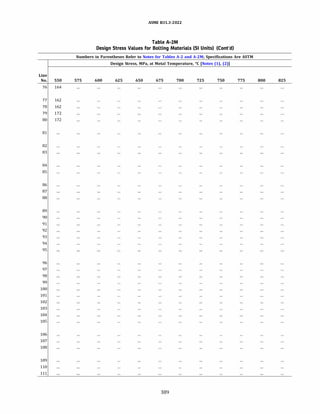
Subparagraph (b) revised
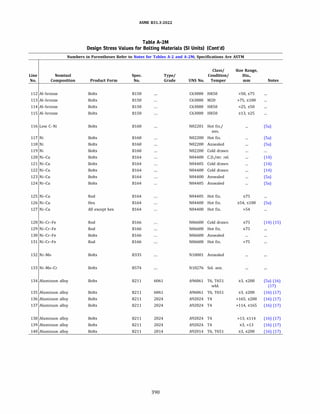
Second paragraph revised
Former paras. K335.1 and K335.2 revised and redesignated as
K335
Revised in its entirety
Title revised
Revised
Subparagraph (b) revised
Subparagraphs (b) and (c) revised
Title revised
Subparagraph (c) revised
Revised in its entirety
Title revised
Revised in its entirety
Revised
Revised
Revised
Added
Revised in its entirety
Revised
395 Specification Index for Appendix B ASTM F714 added
xxv
Page Location
396 Table B-1
398 Table B-lM
424 Appendix E
429 F301.4
429 F301.7.2
431 F307
431 F312.1
431 F319
434 F341
447 Appendix J
463 Appendix K
465 Notes for Tables K-1 and K-lM
466 Table K-1
480 Table K-lM
498 Appendix Q
502 Appendix S
524 W305.3.1
527 X302.2.2
530 Index
Change
Revised
Revised
Revised
Revised
Added
Subparagraph (c) added
(1) Subparagraph (a)(l) revised
(2) Subparagraph (a)(2) added and subsequent subparagraphs
redesignated
Added
Added
Revised
Revised
Revised in its entirety
Added
Revised
(1) Titles of all figures and tables revised
(2) Second paragraph of S303.1 revised
Revised in its entirety
Subparagraph (a) deleted and subsequent subparagraphs
redesignated and revised
Updated
xxvi
ASME 831.3-2022
Chapter I
Scope and Definitions
(22) 300 GENERAL STATEMENTS
(a) Identification This Process Piping Code is a Section
of The American Society of Mechanical Engineers Code for
Pressure Piping, ASME 831, an American National Stan­
dard. It is published as a separate document for conve­
nience of Code users.
(b) Responsibilities
(1) Owner. The owner of a piping installation shall
have overall responsibility for compliance with this
Code, and for establishing the requirements for design
andconstructionthat will govern the entire fluidhandling
or process installation of which the piping is a part. The
owner is also responsible for designating piping in Cate­
gory D, Category M, High Pressure, and High Purity Fluid
Services, and fordeterminingifaspecific Quality Systemis
to be employed. [See (d)(4) through (d)(7) and Appendix
Q.] Where applicable, the owner shall consider require­
ments imposed by the authority having jurisdiction
regarding the piping installation. The owner may desig­
nate a representative tocarry out selected responsibilities
required by this Code, but the owner retains ultimate
responsibility for the actions of the representative.
(2) Designer. The designer is responsible to the
owner for assurance that the engineering design of
piping complies with the requirements of this Code
and with any additional requirements established by
the owner.
(3) Manufacturer, Fabricator, and Erector. The
manufacturer, fabricator, and erector of piping are
responsible for providing materials, components, and
workmanship in compliance with the requirements of
this Code and of the engineering design.
(4) Owner's Inspector. The owner's Inspector (see
para. 340) is responsible to the owner for ensuring
that the requirements of this Code for inspection, exam­
ination, andtesting are met. If a Quality System is specified
by the owner to be employed, the owner's Inspector is
responsible for verifying that it is implemented.
(c) Intent of the Code
(1) !tistheintentofthis Codetoset forthengineering
requirements deemed necessary for safe design and
construction of piping installations.
(2) This Code is not intended to apply to the opera­
tion, examination, inspection, testing, maintenance, or
repair of piping that has been placed in service. See
para. F300.1 for examples of standards that may apply
1
in these situations. The provisions of this Code may
optionally be applied for those purposes, although
other considerations may also be necessary.
(3) The Code generally specifies a simplified
approach for many of its requirements. A designer
may choose to use a more rigorous analysis to develop
design, materials, fabrication, assembly, erection, exami­
nation, and testing requirements. When the designer
decides to take this approach, the designer shall
provide to the owner details and calculations demon­
strating that the proposed design, materials, fabrication,
assembly, erection, examination, and testing require­
ments are consistent with the criteria of this Code,
including the design criteria described in para. 302.
These details shall be adequate for the owner to verify
the validity of the approach. The approach may be imple­
mented following approval by the owner. The details and
calculations shall be documented in the engineering
design.
(4) Piping elements shall conform to the specifica­
tions and standards listed in this Code or, if not prohibited
by this Code, shall be qualified for use as set forth in ap­
plicable Chapters of this Code.
(SJ The engineering design shall specify any unusual
requirements for a particular service. Where service re­
quirements necessitate measures beyond those required
by this Code, such measures shall be specified by the engi­
neering design. Where so specified, the Code requires that
they be accomplished.
(6) Compatibility of materials with the service and
hazardsfrominstability ofcontained fluids are not within
the scope of this Code. See para. F323.
(d) Determining Code Requirements
(1) Code requirements for design and construction
include fluid service requirements, which affect selection
andapplication ofmaterials, components, andjoints. Fluid
service requirements include prohibitions, limitations,
and conditions, such as temperature limits or a require­
ment for safeguarding (see Appendix G). Code require­
ments for a piping system are the most restrictive of
those that apply to any of its elements.
(2) For metallic piping not designated by the owner
as Category M, High Pressure, or High Purity Fluid Service
(see para. 300.2 and Appendix M), Code requirements are
found in Chapters I through VI (the base Code) and fluid
service requirements are found in
ASME 831.3-2022
(-aJ Chapter III for materials
(-bJ Chapter II, Part 3, for components
(-cJ Chapter II, Part 4, for joints
(3J For nonmetallic piping and piping lined with
nonmetals, all requirements are found in Chapter VII.
Paragraph designations begin with "A."
(4J For piping in a fluid service designated as Cate­
gory M, all requirements are found in Chapter VIII. Para­
graph designations begin with "M."
(SJ For piping in a fluid service designated as Cate­
gory D, piping elements restricted to Category D Fluid
Service in Chapters I through VII, as well as elements
suitable for other fluid services, may be used.
(6J For piping designated as High Pressure Fluid
Service, all requirements are found in Chapter IX.
These rules apply only when specifiedby the owner. Para­
graph designations begin with "K."
(7J For piping designated as High Purity Fluid
Service, all requirements are found in Chapter X. Para­
graph designations begin with "U."
(BJ Requirements for Normal Fluid Service in
Chapters I through VI are applicable under severe
cyclic conditions unless alternative requirements for
severe cyclic conditions are stated.
(9J Requirements for Normal Fluid Service in
Chapters I through VI are applicable for Elevated
Temperature Fluid Service unless alternative require­
ments for Elevated Temperature Fluid Service are
invoked.
(eJ Appendices. Appendices of this Code contain Code
requirements,supplementaryguidance, or other informa­
tion. See para. 300.4 for a description of the status of each
Appendix.
(fJ Code Cases. ASME issues Code Cases that are appli­
cable to this Code. The Code Cases
(lJ modify the requirements of this Code
(2J are applicable from the issue date until the Cases
are annulled
(3J may be used only when approved by the owner.
When so approved, the Code Cases shallbe specified in the
engineeringdesignandbecomerequirementsofthisCode.
300.1 Scope
Rules for the Process Piping Code Section 831.31
have
been developed considering piping typically found in
petroleum refineries; onshore and offshore petroleum
and natural gas production facilities; chemical, pharma­
ceutical, textile, paper, oreprocessing, semiconductor, and
cryogenic plants; food and beverage processing facilities;
and related processing plants and terminals.
1 831 references here and elsewhere in this Code are to the ASME 831
Code for Pressure Piping and its various Sections, which are identified
and briefly described in the Introduction.
2
300.1.1 Content and Coverage
(aJ This Code prescribes requirements for materials
and components, design, fabrication, assembly, erection,
examination, inspection, and testing of piping.
(bJ This Code applies to piping for all fluids, including
(lJ raw, intermediate, and finished chemicals
(2J petroleum products
(3J gas, steam, air, and water
(4J fluidized solids
(SJ refrigerants
(6J cryogenic fluids
(cJ See Figure 300.1.1 for a diagram illustrating the
application of 831.3 piping at equipment. The joint
connecting piping to equipment is within the scope of
831.3.
300.1.2 Packaged Equipment Piping. Also included
within the scope of this Code is piping that interconnects
pieces or stages within a packaged equipment assembly.
300.1.3 Exclusions. This Code excludes the following:
(aJ piping systems designed for internal gage pres­
sures at or above zero but less than 105 kPa (15 psi),
provided the fluid handled is nonflammable, nontoxic,
and not damaging to human tissues as defined in
300.2, and its design temperature is from -29°
C
(-20°
F) through 186°
C (366°
F)
(bJ power boilers in accordance with ASME 8PVC,2
Section I and boiler external piping that is required to
conform to ASME 831.1
(cJ tubes, tube headers, crossovers, and manifolds of
fired heaters that are internal to the heater enclosure
(dJ pressure vessels, heat exchangers, pumps,
compressors, and other fluid handling or processing
equipment, including internal piping and connections
for external piping
300.1.4 Units of Measure. This Code states values in
both SI and U.S. Customary units. Within the text, the U.S.
Customary units are shown in parentheses or in separate
tables. The values stated in each system are not exact
equivalents; therefore, each system of units should be
used independently of the other.
When separate equations are provided for SI and U.S.
Customary units, those equations shall be executed using
variablesintheunitsassociated with thespecificequation.
The results obtained from execution of these equations
may be converted to other units.
2 ASME BPVC references here and elsewhere in this Code are to the
ASME Boiler and Pressure Vessel Code and its various Sections as
follows:
Section I, Rules for Construction of Power Boilers
Section II, Materials, Parts C and D
Section Ill, Rules for Construction of Nuclear Facility Components,
Division 1, Subsection NH
Section V, Nondestructive Examination
Section Vil], Rules for Construction of Pressure Vessels, Divisions 1, 2,
and 3
Section IX, Welding, Brazing, and Fusing Qualifications
ASME 831.3-2022
Figure 300.1.1
Diagram Illustrating Application of 831.3 Piping at Equipment
Tubes, tube headers,
crossovers and manifolds
of fired heaters, internal
to the heater enclosure
Legend
Power boilers in accordance
with 8PV Code Section I
Boiler external piping which
is required to conform to 831.1
:�-�
1
..,4
..,
Packaged equipment piping
(

,
Pressure vessels, heat
exchangers, pumps, com­
pressors and other fluid
handling or processing
equipment, including in­
ternal piping and con­
nections for external
piping
'
)
Piping within the scope of 831.3
Piping outside the scope
GENERAL NOTE: The means by which piping is attached to equipment is within the scope of the applicable piping code.
When necessary to convert from one system of units to
another, conversion should be made by rounding the
values to the number of significantdigits of implied preci­
sion in the starting value but not less than four significant
digits for use in calculations.
300.1.5 Rounding. The rules described in this para­
graph apply unless otherwise specified in the Code or
the engineering design. For purposes of determining
conformance with specified limits in this Code, an
observed value or a calculated value shall be rounded
"to the nearest unit" in the last right-hand significant
digit used in expressing the requirement, in accordance
with the rounding method of ASTM E29, Using Significant
Digits in Test Data to Determine Conformance with Speci­
fications. ASTM E29 requires that when rounding a
number to one having a specified number of significant
digits, choose that which is nearest. If two choices are
possible, as when the digits dropped are exactly a 5 or
a 5 followed only by zeros, choose that ending in an
even digit. See Appendix F, para. F300.1.5.
3
300.2 Definitions (22)
Some of the terms relating to piping are defined below.
For welding, brazing, andsoldering termsnotshownhere,
definitions in accordance with AWS Standard A3.03
apply.
air-hardened steel: a steel that hardens during cooling in
air from a temperature above its transformation range.
anneal heat treatment: see heat treatment.
arc cutting: a group of cutting processes wherein the
severing or removing of metals is effected by melting
with the heat of an arc between an electrode and the
base metal. (Includes carbon-arc cutting, metal-arc
cutting, gas metal-arc cutting, gas tungsten-arc cutting,
plasma-arc cutting, and air carbon-arc cutting.) See
also oxygen-arc cutting.
3 AWS A3.0M/A3.0, Standard Welding Terms and Definitions,
Including Terms for Adhesive Bonding, Brazing, Soldering, Thermal
Cutting and Thermal Spraying
ASME 831.3-2022
arc welding (AW): a group of welding processes that
produces coalescence of metals by heating them with
an arc or arcs, with or without the application of pressure
and with or without the use of filler metal.
assembly: the joining together of two or more piping
components by bolting, welding, bonding, screwing,
brazing, soldering, cementing, or use of packing
devices as specified by the engineering design.
autogenous weld: a weld made by fusion of the base metal
without the addition of filler metal [see also gas tungsten­
arc welding (GTA W)].
automaticwelding: weldingwithequipment thatperforms
the welding operation without adjustment of the controls
by an operator. The equipment may or may not perform
the loading and unloading of the work.
backing filler metal: see consumable insert.
backing ring: material in the form of a ring used to support
molten weld metal.
balanced piping system: see para. 319.2.2(a).
base material: the material to be brazed, soldered, welded,
or otherwise fused.
basic allowable stress: see stress terms frequently used.
bolt design stress: see stress terms frequently used.
bonded joint: a permanent joint in nonmetallic piping
made by one of the following methods:
(a) adhesivejoint: a joint made by applying an adhesive
to the surfaces to be joined and pressing them together
(b) butt-and-wrapped joint: a joint made by butting
together the joining surfaces and wrapping the joint
with plies of reinforcing fabric saturated with resin
(c) heat fusion joint: a joint made by heating the
surfaces to be joined and pressing them together to
achieve fusion
(d) hot gas weldedjoint: a joint made by simultaneously
heatingthe surfacestobejoinedand a filler materialwitha
stream of hot air or hot inert gas, then pressing the
surfaces together and applying the filler material to
achieve fusion
(e) solvent cemented joint: a joint made by using a
solvent cement to soften the surfaces to be joined and
pressing them together
(!) e/ectrofusion joint: a joint made by heating the
surfaces to be joined using an electrical resistance wire
coil that remains embedded in the joint.
bonder: one who performs a manual or semiautomatic
bonding operation.
bonding operator: one whooperatesmachine orautomatic
bonding equipment.
bonding procedure: the detailed methods and practices
involved in the production of a bonded joint.
4
bonding procedure specification (BPS): the document that
lists the parameters to be used in the construction of
bonded joints in accordance with the requirements of
this Code.
borescopic examination: a visual examination aided by a
mechanical or electromechanical device to examine the
inside diameter of inaccessible welds.
branch connectionfitting: an integrally reinforced fitting
welded to a run pipe and connected to a branch pipe by a
buttwelding, socket welding, threaded, or flanged joint;
includes a branch outlet fitting conforming to MSS SP-97.
brazing: a metal joining process wherein coalescence is
produced by use of a nonferrous filler metal having a
melting point above 427°
C (800°
F), but lower than
that of the base metals being joined. The filler metal is
distributed between the closely fitted surfaces of the
joint by capillary attraction.
buttjoint: a joint between two members aligned approxi­
mately in the same plane.
Category D: see fluid service.
Category M: see fluid service.
caulkedjoint: a joint in which suitable material (or mate­
rials) is either poured or compressed by the use of tools
into the annular space between a bell (or hub) and spigot
(or plain end), thus comprising the joint seal.
chemical plant: an industrial plant for the manufacture or
processing of chemicals, or of raw materials or intermedi­
ates for such chemicals. A chemical plant may include
supporting and service facilities, such as storage,
utility, and waste treatment units.
cold spring: see para. 319.2.4.
compression type tubefittings: tube fittings consisting of a
flareless, mechanical grip connection, including a body,
nut, and single or dual ferrules. See also para. 0306.6.
connectionsfor external piping: those integral parts of in­
dividual pieces of equipment that are designed for attach­
ment of external piping.
construction: anall-inclusive termcomprisingfabrication,
assembly, erection, inspection, examination, and testing.
consumable insert: preplaced filler metal that is complete­
ly fused into the root of the joint and becomes part of the
weld.
damaging to human tissues: for the purposes of this Code,
this phrase describes a fluid service in which exposure to
the fluid, caused by leakage under expected operating con­
ditions, can harm skin, eyes, or exposed mucous
membranes so that irreversible damage may result
unless prompt restorative measures are taken. (Restora­
tive measures may include flushing with water, adminis­
tration of antidotes, or medication.)
design minimum temperature: see para. 301.3.1.
ASME 831.3-2022
design pressure: see para. 301.2.
design temperature: see para. 301.3.
designatedlot: a defined group of welded, brazed, fused, or
bonded piping joints from which a specified percentage is
randomly selected for examination.
designer: the person or organization in responsible charge
of the engineering design.
displacement stress range: see para. 319.2.3.
elements: see piping elements.
engineering design: the detailed design governing a piping
system, developed from process and mechanical require­
ments, conforming to Code requirements, and including
all necessary specifications, drawings, and supporting
documents.
equipment connection: see connections for external piping.
erection: the completeinstallation ofa pipingsysteminthe
locations and on the supports designated by the engi­
neering design including any field assembly, fabrication,
examination, inspection, and testing of the system as
required by this Code.
examination, examiner: see paras. 341.1 and 341.2.
examination, extent of
(a) 100% examination: the complete examination of all
components, welds, or joints.
(b) random examination: thecomplete examinationofa
specified percentage of joints selected randomly from a
designated lot.
(c) spot examination: the examination of a limited
length of a weld or joint.
extruded outlet header: see para. 304.3.4.
fabrication: the preparation of piping for assembly,
including cutting, threading, grooving, forming,
bending, and joining of components into subassemblies.
Fabrication may be performed in the shop or in the field.
face of weld: the exposed surface ofa weld on the side from
which the welding was done.
face seal fitting: a High Purity Fluid Service fitting that
incorporates two machined faces and a metallic gasket
within an external/internal nut configuration to attain
a high leak integrity seal. See also para. U315.3(b).
filler material: the material to be added in making metallic
or nonmetallic joints.
fillet weld: a weld of approximately triangular cross
section joining two surfaces approximately at right
angles to each other in a lap joint, tee joint, or corner
joint. (See also size of weld and throat of a fillet weld.)
flammable: for the purposes of this Code, describes a fluid
that under ambient or expected operating conditions is a
vapor or produces vapors that can be ignited and continue
to burn in air. The term thus may apply, depending on
5
service conditions, to fluids defined for other purposes
as flammable or combustible.
fluid service: a general termconcerning the applicationofa
piping system, considering the combination of fluid prop­
erties, operating conditions, and other factors that estab­
lish the basis for design of the piping system. See
Appendix M.
(a) Category D Fluid Service: a fluid service in which all
of the following apply:
(1) the fluid handled is nonflammable, nontoxic, and
not damaging to human tissues as defined in para. 300.2
(2) the design gage pressure does not exceed 1 035
kPa (150 psi)
(3) the designtemperatureis not greater than 186°
C
(366°
F)
(4) the fluid temperature caused by anything other
than atmospheric conditions is not less than -29°
C
(-20°
F)
(b) Category M Fluid Service: a fluid service in which
both of the following apply:
(1) thefluidissohighly toxicthatasingleexposureto
a very small quantity of the fluid, caused by leakage, can
produce serious irreversible harm to persons on
breathing or bodily contact, even when prompt restora­
tive measures are taken
(2) after consideration of piping design, experience,
service conditions, and location, the owner determines
that the requirements for Normal Fluid Service do not
sufficiently provide the leak tightness required to
protect personnel from exposure
(c) Elevated Temperature Fluid Service: a fluid service
in which the piping metal temperature is sustained equal
to or greater than Tcr as defined in Table 302.3.5, General
Note (b).
(d) High Pressure Fluid Service: a fluid service for which
the owner specifies the use of Chapter IX for piping design
and construction; see also para. K300.
(e) High Purity Fluid Service: a fluid service that
requires alternative methods of fabrication, inspection,
examination, and testing not covered elsewhere in the
Code, withtheintenttoproduceacontrolledlevelofclean­
ness. The term thus applies to piping systems defined for
other purposes as high purity, ultra high purity, hygienic,
or aseptic.
(!) Normal Fluid Service: a fluid service pertaining to
most piping covered by this Code, i.e., not subject to
the rules for Category D, Category M, Elevated Tempera­
ture, High Pressure, or High Purity Fluid Service.
Julifillet weld: a fillet weld whose size is equal to the thick­
ness of the thinner member joined.
fusion: the melting together of filler material and base
material, or of base material only, that results in coales­
cence.
ASME 831.3-2022
gas metal-arc welding (GMA W): an arc-welding process
that produces coalescence of metals by heating them
with an arc between a continuous filler metal (consum­
able) electrode and the work. Shielding is obtained
entirely from an externally supplied gas, or gas
mixture. Some variations of this process are called MIG
or C02 welding (nonpreferred terms).
gastungsten-arcwelding (GTAW): an arc-welding process
that produces coalescence ofmetals by heating them with
an arc between a single tungsten (nonconsumable) elec­
trode and the work. Shielding is obtained from a gas or gas
mixture. Pressure may or may not be used and filler metal
may ormaynotbeused. (Thisprocesshassometimesbeen
called TIG welding.)
gaswelding: a group ofwelding processes wherein coales­
cence is produced by heating with a gas flame or flames,
with or without the application of pressure, and with or
without the use of filler material.
groove weld: a weld made in the groove between two
members to be joined.
heat-affected zone: that portion ofthe base material which
has not been melted, but whose mechanical properties or
microstructure have been altered by the heat of welding,
brazing, soldering, forming, or cutting.
heattreatment: the followingtermsdescribevarious types
and processes of heat treatment (see also postweld
hydrogen bakeout):
(a) annealing: heating to and holding at a suitable
temperature above the transformation temperature
range, followed by slow cooling to well below the trans­
formation temperature range.
(b) normalizing: heating a ferrous metal to a tempera­
ture above the transformation temperature range,
followed by cooling in room-temperature still air to
well below the transformation temperature range.
(c) quenching: when used as a part of a heat-treating
operation, a rapid cooling process that results in micro­
structural stabilization or changes in material properties
that would not have occurred without rapid cooling.
(d) recommended or required heat treatment: the appli­
cation of heat to a metal section subsequent to a cutting,
forming, or welding operation, as provided in para. 331.
(e) solution heat treatment: heating an alloy to a
suitable temperature, holding at that temperature long
enough to allow one or more constituents to enter into
solid solution, and then cooling rapidly enough to hold
the constituents in solution.
(fJ stress-relief: uniform heating of a structure or
portion thereof to a sufficient temperature below the
transformation temperature range to relieve the major
portion of the residual stresses, followed by uniform
cooling slowly enough to minimize development of
new residual stresses.
6
(g) tempering: reheating a hardened metal to a
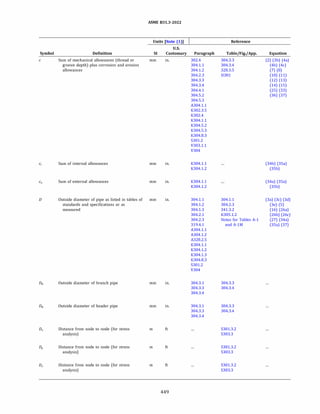
temperature below the transformation range to
improve toughness.
(h) transformation range: the temperature range over
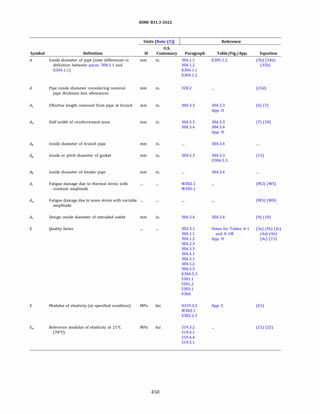
which a phase change occurs.
(i) transformation temperature: the temperature at
which a phase change begins or ends. In metals, phase
changes can be solid-state changes.
High Pressure Fluid Service: see fluid service.
High Purity Fluid Service: see fluid service.
hygienic clamp joint: a tube outside-diameter union
consisting of two neutered ferrules having flat faces
with a concentric groove and mating gasket that is
secured with a clamp, providing a nonprotruding, recess­
less product contact surface. See also para. U315.3(b).
indication, linear: in nondestructive examination, an indi­
cation having a length greater than 3 times its width.
indication, rounded: in nondestructive examination, an
indication with a length equal to or less than 3 times
its width. These indications may be circular, elliptical,
conical, or irregular in shape and may have tails.
inline portions of instruments: pressure-containing
portions of instruments that are in direct contact with
the fluid when installed in a piping system. Permanently
sealed fluid-filled tubing systems furnished with instru­
ments as temperature- or pressure-responsive devices,
e.g., pressure gages, pressure transmitters, and transdu­
cers, are excluded.
in-process examination: see para. 344.7.
inspection, Inspector: see para. 340.
integrally reinforced branch connectionfitting: see branch
connection fitting.
joint design: thejoint geometry together with the required
dimensions of the welded joint.
listed: forthepurposes ofthis Code, describesamaterial or
component thatconformsto a specification inAppendix A,
Appendix B, or Appendix K or to a standard in Table 326.1,
A326.l, or K326.1.
manual welding: a welding operation performed and
controlled completely by hand.
may: a term that indicates a provision is neither required
nor prohibited.
mechanical joint: a joint for the purpose of mechanical
strength or leak resistance, or both, in which the mechan­
ical strength is developed by threaded, grooved, rolled,
flared, or flanged pipe ends; or by bolts, pins, toggles,
or rings; and the leak resistance is developed by
threads and compounds, gaskets, rolled ends, caulking,
or machined and mated surfaces.
ASME 831.3-2022
miter or miter bend: for the purposes of this Code, two or
more straight sections of pipe matched and joined in a
plane bisecting the angle of junction so as to produce a
change in direction greater than 3 deg.
nominal: anumericalidentificationofdimension, capacity,
rating, or other characteristic used as a designation, not as
an exact measurement.
Normal Fluid Service: see fluid service.
normalizing: see heat treatment.
notch-sensitive: describes a metal subject to reduction in
strength in the presence of stress concentration. The
degree of notch sensitivity is usually expressed as the
strength determined in a notched specimen divided by
the strength determined in an unnotched specimen,
and can be obtained from either static or dynamic tests.
NPS: nominal pipe size (followed, when appropriate, by
the specific size designation number without an inch
symbol).
orbital welding: automatic or machine welding in which
the electrode rotates (orbits) around the circumference of
a stationary pipe or tube.
owner: the person, partnership, organization, or business
ultimately responsible for design, construction, operation,
and maintenance of a facility.
oxygen-arc cutting (OAC): an oxygen-cutting process that
usesanarcbetweenthe workpiece andaconsumableelec­
trode, through which oxygen is directed to the workpiece.
For oxidation-resistant metals, a chemical flux or metal
powder is used to facilitate the reaction.
oxygen cutting (OC): a group of thermal cutting processes
that severs or removes metal by means of the chemical
reaction between oxygen and the base metal at elevated
temperature. The necessary temperature ismaintainedby
the heat from an arc, an oxyfuel gas flame, or other source.
oxygen gouging: thermal gouging that uses an oxygen
cutting process variation to form a bevel or groove.
packaged equipment: an assembly of individual pieces or
stages of equipment, complete with interconnecting
piping and connections for external piping. The assembly
may be mounted on a skid or other structure prior to
delivery.
petroleum refinery: an industrial plant for processing or
handling ofpetroleumand products derived directly from
petroleum. Such a plant may be an individual gasoline
recovery plant, a treating plant, a gas processing plant
(including liquefaction), or an integrated refinery
having various process units and attendant facilities.
pipe: a pressure-tight cylinder used to convey a fluid or to
transmit a fluid pressure, ordinarily designated "pipe" in
applicable material specifications. Materials designated
"tube" or "tubing" in the specifications are treated as
pipe when intended for pressure service. Types of
7
pipe, according to the method of manufacture, are
defined as follows:
(a) combination welded (COW) pipe: electric-fusion
welded pipe made using a combination of the gas
metal-arc welding (GMAW) and submerged-arc
welding (SAW) processes, wherein the GMAW bead is
not completely removed by the SAW passes. Pipe is
made with a straight seam (COWL) or a helical (spiral)
seam (COWH).
(b) electric-fusion welded (EFW) pipe: pipe made with
one or two straight butt joints or one helical (spiral) butt
joint in which coalescence is produced in the preformed
tube by manual or automatic electric-arc welding. The
weld may be made by welding from one side or both
sides of the joint and may be made with or without
the addition of filler metal. Typical electric-fusion
welding processes used for pipe include autogenous
welding, combination welding (COW), and submerged­
arc welding (SAW).
(c) electric-resistance welded (ERW) pipe: pipe having
one straight or helical (spiral) longitudinal seam,
produced by low-frequency (LFW) or high-frequency
(HFW) electric welding without filler metal. The
process of forming a seam is performed by electric-resis­
tance welding, wherein the edges to be welded are
mechanically pressed together and the heat for
welding is generated by the resistance to flow of electric
current applied by induction (no electric contact) or
conduction. Also called electric welded (EW) pipe.
(d) furnace-butt-welded pipe, continuous-welded (CW)
pipe: furnace-welded pipe produced in continuous
lengths from coiled skelp and subsequently cut into indi­
vidual lengths. The longitudinal butt joint is forge-welded
by the mechanical pressure developed in rolling the hot­
formed skelp through a set of round pass welding rolls.
(e) seamless (SMLS) pipe: pipe without a welded seam,
produced by a hot-formingprocess, which canbe followed
by cold sizing or cold finishing to produce the desired
shape, dimensions, and properties.
(!) submerged-arc welded (SAW) pipe: electric-fusion
welded pipe made using the submerged-arc welding
process. At least one submerged-arc welding pass is
made on the outside of the pipe. When SAW is also
used to weldtheinside ofthepipe, such pipe is sometimes
referred to as double submerged-arc welded (DSAW)
pipe. Pipe is made with a straight seam (SAWL) or a
helical (spiral) seam (SAWH).
pipe-supporting elements: pipe-supporting elements
consist of fixtures and structural attachments as follows:
(a) fixtures: fixtures include elements that transfer the
load from the pipe or structural attachment to the
supporting structure or equipment. They include
hanging type fixtures, such as hanger rods, spring
hangers, sway braces, counterweights, turnbuckles,
struts, chains, guides, and anchors; and bearing type
ASME 831.3-2022
fixtures, such as saddles, bases, rollers, brackets, and
sliding supports.
(b) structural attachments: structural attachments
include elements that are welded, bolted, or clamped
to the pipe, such as clips, lugs, rings, clamps, clevises,
straps, and skirts.
piping: assemblies of piping components used to convey,
distribute, mix, separate, discharge, meter, control, or
snub fluid flows. Piping also includes pipe-supporting
elements, but does not include support structures,
such as building frames, bents, foundations, or any equip­
ment excluded from this Code (see para. 300.1.3).
piping components: mechanical elements suitable for
joining or assembly into pressure-tight fluid-containing
piping systems. Components include pipe, tubing, fittings,
flanges, gaskets, bolting, valves, and devices such as
expansion joints, flexible joints, pressure hoses, traps,
strainers, inline portions of instruments, and separators.
piping elements: anymaterial orwork required toplan and
install a piping system. Elements of piping include design
specifications, materials, components, supports, fabrica­
tion, examination, inspection, and testing.
piping installation: designed piping systems to which a
selected Code edition and addenda apply.
piping subassembly: a portion of a piping system that
consists of one or more piping components.
piping system: interconnected piping subject to the same
set or sets of design conditions.
plasma arc cutting (PAC): an arc cutting process thatuses a
constricted arc and removes molten metal with a high
velocity jet of ionized gas issuing from the constricting
orifice.
postweld heat treatment: see heat treatment.
postweld hydrogen bakeout: holding a completed or
partially completed weld at an elevated temperature
below 425°
C (800°
F) to facilitate hydrogen diffusion
from the weld.
preheating: the application of heat to the base material
immediately before or during a forming, welding, or
cutting process. See para. 330.
procedure qualification record (PQRJ: a document listing
all pertinent data, including the essential variables
employed and the test results, used in qualifying the
procedure specification.
process unit: an area whose boundaries are designated by
the engineering design within which reactions, separa­
tions, and other processes are carried out. Examples of
installations that are not classified as process units are
loading areas or terminals, bulk plants, compounding
plants, and tank farms and storage yards.
quench annealing: see solution heat treatment under heat
treatment.
8
quenching: see heat treatment.
readily accessible (for visual examination): those surfaces
that canbe examined froma distance ofnot more than 600
mm (24 in.) and at an angle of not less than 30 deg to the
surface to be examined.
reinforcement: see paras. 304.3 and A304.3. See also weld
reinforcement.
representative: a person, partnership, organization, or
business designated by the owner to carry out selected
responsibilities on the owner's behalf.
room temperature: temperature between 10°
C and 38°
C
(S0°
F and 100°
F).
root opening: the separation between the members to be
joined, at the root of the joint.
safeguarding: provision of protective measures of the
types outlined in Appendix G, where deemed necessary.
See Appendix G for detailed discussion.
sealbond: a bond intended primarilyto providejoint tight­
ness against leakage in nonmetallic piping.
seal weld: a weld intended primarily to provide joint tight­
ness against leakage in metallic piping.
semiautomatic arc welding: arc welding with equipment
that controls only the filler metal feed. The advance of the
welding is manually controlled.
set pressure: pressure at which a pressure relief device
begins to relieve, e.g., lift pressure of a spring-actuated
relief valve, bursting pressure of a rupture disk, or
breaking pressure of a breaking pin device.
severe cyclic conditions: conditions applying to specific
piping components or joints for which the owner or
the designer determines that design and construction
to better resist fatigue loading is warranted. See
Appendix F, para. F301.10.3 for guidance on designating
piping as being under severe cyclic conditions.
shall: a term that indicates a provision is a Code require­
ment.
shielded metal-arc welding (SMAW): an arc welding
process that produces coalescence of metals by heating
them with an arc between a covered metal electrode
and the work. Shielding is obtained from decomposition
of the electrode covering. Pressure is not used and filler
metal is obtained from the electrode.
should: a term that indicates a provision is recommended
as good practice but is not a Code requirement.
size of weld:
(a) fillet weld: the leg lengths (the leg length for equal­
leg welds) of the sides, adjoining the members welded, of
the largest triangle that can be inscribed within the weld
ASME 831.3-2022
cross section. Forweldsbetween perpendicularmembers,
the definitions in Figure 328.S.2A apply.
NOTE: When the angle between members exceeds 105 deg, size
is of less significance than effective throat (see also throat ofa
fillet weld).
{b) groove weld: the joint penetration (depth of bevel
plus the root penetration when specified). The size of a
groove weld and its effective throat are the same.
slag inclusion: nonmetallic solid material entrapped in
weld metal or between weld metal and base metal.
soldering: a metal joining process wherein coalescence is
produced by heating to suitable temperatures and by
using a nonferrous alloy fusible at temperatures below
427°
C (800°
F) and having a melting point below that
of the base metals being joined. The filler metal is distrib­
uted between closely fitted surfaces of the joint by capil­
lary attraction. In general, solders are lead-tin alloys and
may contain antimony, bismuth, and other elements.
solution heat treatment: see heat treatment.
stress ratio: see para. 323.2.2(b).
stress relief see heat treatment.
stress terms frequently used:
(a) basic allowable stress: this term, symbol S, repre­
sents the stress value for any material determined by
the appropriate stress basis in para. 302.3.2
(b) bolt design stress: this term represents the design
stressused todeterminetherequiredcross-sectional area
of bolts in a bolted joint
(c) hydrostatic design basis: selected properties of
plastic piping materials to be used in accordance with
ASTM 02837 or 02992 to determine the HOS [see (d)
below] for the material
(d) hydrostatic design stress {HDS): the maximum
continuous stress due to internal pressure to be used
inthedesign ofplastic piping, determinedfromthehydro­
static design basis by use of a service (design) factor
submerged arc welding {SAW): an arc welding process that
produces coalescence of metals by heating them with an
arc or arcs between a bare metal electrode or electrodes
and the work. The arc is shielded by a blanket of granular,
fusible materialon the work. Pressure isnotused andfiller
metal is obtained from the electrode and sometimes from
a supplemental source (welding rod, flux, or metal gran­
ules).
tack weld: a weld made to hold parts of a weldment in
proper alignment until the final welds are made.
tempering: see heat treatment.
thermoplastic: a plastic that is capable of being repeatedly
softened by increase of temperature and hardened by
decrease of temperature.
9
thermosettingresin: a resincapable ofbeing changedinto a
substantially infusible or insoluble product when cured at
room temperature, or by application of heat, or by chem­
ical means.
throat of a fillet weld:
(a) theoretical throat: the perpendicular distance from
the hypotenuse of the largest right triangle that can be
inscribed in the weld cross section to the root of the joint
(bJ actual throat: the shortest distance from the root of
a fillet weld to its face
(c) effective throat: the minimum distance, minus any
reinforcement (convexity), between the weld root and the
face of a fillet weld
toe ofweld: the junction between the face of a weld and the
base material.
tube: see pipe.
tungsten electrode: a nonfiller-metal electrode used in arc
welding or cutting, made principally of tungsten.
unbalanced piping system: see para. 319.2.2(b).
undercut: a groove melted into the base material adjacent
to the toe or root of a weld and left unfilled by weld mate­
rial.
visual examination: see para. 344.2.1.
weld: a localized coalescence of material wherein coales­
cence is produced either by heating to suitable tempera­
tures, with or without the application of pressure, or by
application of pressure alone, and with or without the use
of filler material.
weldcoupon: asample weldusedtodetermine weld accep­
tance. Types of weld coupons are defined as follows:
(a) primary weld coupon: made prior to the start of
production welding to establish a benchmark of weld
acceptance
(b) production weld coupon: made when any of the con­
ditionsinpara. 0341.4.S exist andusedtocompare against
a corresponding primary weld coupon to demonstrate
continued acceptability of welds during production
welding
weld coupon examination: see para. 0344.8.1.
weld reinforcement: weld material in excess of the speci­
fied weld size.
welder: one who performs a manual or semi-automatic
welding operation. (This term is sometimes erroneously
used to denote a welding machine.)
weldingoperator: one who operates machine or automatic
welding equipment.
welding procedure: the detailed methods and practices
involved in the production of a weldment.
welding procedure specification (WPS): the document that
lists the parameters to be used in construction of weld­
ments in accordance with requirements of this Code.
ASME 831.3-2022
300.4 Status of Appendices
weldment: anassemblywhosecomponentpartsarejoined
by welding.
300.3 Nomenclature
Dimensional and mathematical symbols used in this
CodearelistedinAppendixJ, with definitionsand location
references to each. Uppercase and lowercase English
lettersarelisted alphabetically, followed by Greek letters.
Table 300.4 indicates for each Appendix of this Code
whether it contains Code requirements, guidance, or
supplemental information. See the first page of each
Appendix for details.
NOTES:
Appendix
A
B
c
E
F
G
H
K
L
M
N
Q
R
s
v
w
x
z
Table 300.4
Status of Appendices in ASME 831.3
Title
Allowable Stresses and Quality Factors for Metallic Piping and Bolting Materials
Stress Tables and Allowable Pressure Tables for Nonmetals
Physical Properties of Piping Materials
Reference Standards
Guidance and Precautionary Considerations
Safeguarding
Sample Calculations for Branch Reinforcement
Nomenclature
Allowable Stresses for High Pressure Piping
Aluminum Alloy Pipe Flanges
Guide to Classifying Fluid Services
Application of ASME 831.3 Internationally
Quality System Program
Use of Alternative Ultrasonic Acceptance Criteria
Piping System Stress Analysis Examples
Allowable Variations in Elevated Temperature Service
High-Cycle Fatigue Assessment of Piping Systems
Metallic Bellows Expansion Joints
Preparation of Technical Inquiries
(1) Contains default requirements, to be used unless more directly applicable data are available.
(2) Contains no requirements but Code user is responsible for considering applicable items.
(3) Contains requirements applicable only when use of Chapter IX is specified.
Status
Requirements
Requirements
Requirements (Note (1)]
Requirements
Guidance [Note (2)]
Guidance [Note (2)]
Guidance
Information
Requirements (Note (3)]
Specification [Note (4)]
Guidance [Note (2)]
Guidance [Note (2)]
Guidance (Note (2)]
Requirements [Note (5)]
Guidance [Note (2)]
Guidance [Note (2)]
Requirements
Requirements
Requirements (Note (5)]
(4) Contains pressure-temperature ratings, materials, dimensions, and markings of forged aluminum alloy flanges.
(5) Contains administrative requirements.
10
ASME 831.3-2022
Chapter II
Design
PART 1
CONDITIONS AND CRITERIA
301 DESIGN CONDITIONS
Paragraph 301 states the qualifications of the Designer,
definesthe temperatures, pressures, and forcesapplicable
to the design of piping, and states the consideration that
shall be given to various effects andtheirconsequent load­
ings. See also Appendix F, para. F301.
301.1 Qualifications of the Designer
The Designer is the person(s) in charge of the engi­
neeringdesignofapipingsystemandshallbe experienced
in the use of this Code. The qualifications and experience
required of the Designer will depend on the complexity
and criticality of the system and the nature of the indiv­
idual's experience.The owner's approval is required ifthe
individual does not meet at least one of the following
criteria:
(a) Completion of a degree, accredited by an indepen­
dent agency [such as ABET (U.S. and international), NBA
(India), CTI (France), and CNAP (Chile)], in engineering,
science, or technology, requiring the equivalent of at least
4 yr of full-time study that provides exposure to funda­
mental subject matter relevant to the design of piping
systems, plus a minimum of 5 yr of experience in the
design of related pressure piping.
{b) Professional Engineering registration, recognized
by the local jurisdiction, and experience in the design
of related pressure piping.
(c) Completion ofan accredited engineering technician
or associates degree, requiring the equivalent of at least 2
yr of study, plus a minimum of 10 yr of experience in the
design of related pressure piping.
(d) Fifteen yr of experience in the design of related
pressure piping.
Experience in the design of related pressure piping is
satisfied by piping design experience that includes design
calculations for pressure, sustained and occasional loads,
and piping flexibility.
11
301.2 Design Pressure
301.2.1 General
(a) The design pressure of each component in a piping
system shall be not less than the pressure at the most
severe condition of coincident internal or external pres­
sure and temperature (minimum or maximum) expected
during service, except as provided in para. 302.2.4.
{b) The most severe condition is that which results in
the greatest required component thickness and the
highest component rating.
(c) When more than one set of pressure-temperature
conditions exist for a piping system, the conditions
governing the rating of components conforming to
listed standardsmay differ fromtheconditions governing
the rating of components designed in accordance with
para. 304.
{d) When a pipe is separated into individualized pres­
sure-containing chambers (including jacketed piping,
blanks, etc.), the partition wall shall be designed on
the basis of the most severe coincident temperature
(minimum or maximum) and differential pressure
between the adjoining chambers expected during
service, except as provided in para. 302.2.4.
301.2.2 Required Pressure Containment or Relief
(a) Provision shall be made to safely contain or relieve
(see para. 322.6.3) any expected pressure to which the
piping may be subjected. Piping not protected by a pres­
sure-relieving device, or that can be isolated from a pres­
sure-relieving device, shall be designed for at least the
highest expected pressure.
(b) Sources of pressure to be considered include
ambient influences, pressure oscillations and surges,
improper operation, decomposition of unstable fluids,
static head, and failure of control devices.
(c) The allowances of para. 302.2.4(f) are permitted,
provided that the other requirements of para. 302.2.4
are also met.
301.3 Design Temperature
The design temperature of each component in a piping
system is the temperature at which, under the coincident
pressure, the greatest thickness or highest component
rating is required in accordance with para. 301.2. (To
satisfy the requirements of para. 301.2, different
ASME 831.3-2022
components in the same piping system mayhave different
design temperatures.)
In establishing design temperatures, consider at least
the fluid temperatures, ambient temperatures, solar
radiation, heating or cooling medium temperatures,
and the applicable provisions of paras. 301.3.2,
301.3.3, and 301.3.4.
301.3.l Design Minimum Temperature. The design
minimum temperature is thelowestcomponent tempera­
ture expected in service. This temperature may establish
special design requirements and material qualification re­
quirements. See also paras. 301.4.4 and 323.2.2.
301.3.2 Uninsulated Piping Components
(a) For fluid temperatures below 65°
C (150°
F), the
component temperature shall be taken as the fluid
temperature unless solar radiation or other effects
result in a higher temperature.
{b) For fluid temperatures 65°
C (150°
F) and above,
unless a lower average wall temperature is determined
by test or heat transfer calculation, the temperature
for uninsulated components shall be no less than the
following values:
(1) valves, pipe, lapped ends, welding fittings, and
other components having wall thickness comparable to
that of the pipe - 95% of the fluid temperature
(2) flanges (except lap joint) including those on
fittings and valves - 90% of the fluid temperature
(3) lap joint flanges - 85% of the fluid temperature
(4) bolting - 80% of the fluid temperature
301.3.3 Externally Insulated PipingComponents. The
component designtemperature shallbe the fluid tempera­
ture unless calculations, tests, or service experience based
on measurements support the use of another tempera­
ture. Where piping is heated or cooled by tracing or jack­
eting, this effect shall be considered in establishing
component design temperatures.
301.3.4 Internally Insulated Piping Components. The
component design temperature shall be based on heat
transfer calculations or tests.
301.4 Ambient Effects
See Appendix F, para. F301.4.
301.4.l Cooling - Effects on Pressure. The cooling of
a gas or vapor in a piping system may reduce the pressure
sufficiently to create an internal vacuum. In such a case,
the piping shall be capable of withstanding the external
pressure at the lower temperature, or provision shall be
made to break the vacuum.
301.4.2 Fluid Expansion Effects. Provision shall be
made in the design either to withstand or to relieve
increased pressure caused by the heating of static fluid
in a piping component. See also para. 322.6.3(b)(2).
12
301.4.3 Atmospheric Icing. Where the design
minimum temperature of a piping system is below 0°
C
(32°
F), the possibility of moisture condensation and
buildup of ice shall be considered and provisions made
in the design to avoid resultant malfunctions. This
applies to surfaces of moving parts of shutoff valves,
controlvalves, pressure-reliefdevicesincludingdischarge
piping, and other components.
301.4.4 Low Ambient Temperature. Consideration
shall be given to low ambient temperature conditions
for displacement stress analysis.
301.5 Dynamic Effects
301.5.l Impact. When specified in the engineering (22)
design, impact forces caused by external or internal con­
ditions (including changes in flow rate, hydraulic shock,
liquid or solidslugging, flashing, geysering, and accidental
blast) shall be taken into account in the design of piping.
See Appendix F, para. F301.5.1.
301.5.2 Wind. The effect of wind loadingshall be taken
into account in the design of exposed piping. The analysis
considerations and loads may be as described in ASCE 7.
Authoritative local meteorological data may also be used
to define or refine the design wind loads.
301.5.3 Earthquake. The effect of earthquake loading
shall be taken into account in the design of piping. The
analysis considerations and loads may be as described
in ASCE 7. Authoritative local seismological data may
also be used to define or refine the design earthquake
loads.
301.5.4 Vibration. Piping shall be designed, arranged,
and supported to eliminate excessive and harmful effects
of vibration that may arise from such sources as impact,
pressure pulsation, turbulent flow vortices, resonance in
compressors, external vortex shedding (e.g., wind), and
acoustically induced vibration.
301.5.5 Discharge Reactions. Piping shall be designed,
arranged, and supported so as to withstand reaction
forces due to let-down or discharge of fluids.
301.6 Weight Effects
The following weight effects, combined with loads and
forces from other causes, shall be taken intoaccount in the
design of piping.
301.6.l Live Loads. These loads include the weight of
the medium transported or the medium used for test.
Snow and ice loads due to both environmental and oper­
ating conditions shall be considered.
301.6.2 Dead Loads. These loads consist of the weight
ofpipingcomponents, insulation, andothersuperimposed
permanent loads supported by the piping.
ASME 831.3-2022
(22) 301.7 Thermal Expansion and Contraction Effects
The following thermal effects, combined with loads and
forces from other causes, shall be considered in the design
of piping.
301.7.1 Thermal Loads Due to Restraints. These loads
consist of thrusts and moments that arise when free
thermal expansion and contraction of the piping are
prevented by restraints or anchors.
(22) 301.7.2 Loads Due to Temperature Gradients. These
loads arise from stresses in pipe walls resulting from
thermal shock due to large rapid temperature changes,
or from unequal temperature distribution as may
result from a high heat flux through a comparatively
thick pipe or stratified two-phase flow causing bowing
during cooldown of the line. See also Appendix F, para.
F301.7.2.
(22) 301.7.3 Loads Due to Differences in Expansion Char-
acteristics. These loadsresultfromdifferencesin thermal
expansion where materials with different thermal expan­
sion coefficients are combined, as in bimetallic, lined,
jacketed, flanged, welded, or metallic-nonmetallic piping.
301.8 Effects of Support, Anchor, and Terminal
Movements
The effects of movements of piping supports, anchors,
and connected equipment shall be taken into account in
the design of piping. These movements may result from
the flexibility and/or thermal expansion of equipment,
supports, or anchors; and from settlement, tidal move­
ments, or wind sway.
301.9 Reduced Ductility Effects
The harmful effects of reduced ductility shall be taken
into account in the design of piping. The effects may, for
example, result from welding, heat treatment, forming,
bending, or low operating temperatures, including the
chilling effect ofsudden loss of pressure on highly volatile
fluids. Low ambienttemperaturesexpected during opera­
tion shall be considered.
301.10 Cyclic Effects
Fatigue due to pressure cycling, thermal cycling, and
other cyclic loadings shall be considered in the design
of piping. See Appendix F, para. F301.10.
301.11 Air Condensation Effects
At operating temperatures below -191°
C (-312°
F) in
ambient air, condensation and oxygen enrichment occur.
These shall be considered in selecting materials, including
insulation, and adequate shielding and/or disposal shall
be provided.
13
302 DESIGN CRITERIA
302.1 General
Paragraph 302 states pressure-temperature ratings,
stress criteria, design allowances, and minimum design
values together with permissible variations of these
factors as applied to the design of piping.
302.2 Pressure-Temperature Design Criteria
302.2.1 Listed Components Having Established
Ratings. Except as limited elsewhere in the Code, pres­
sure-temperature ratings contained in standards for
piping components listed in Table 326.1 are acceptable
for design pressures and temperatures in accordance
with this Code. When the owner approves, provisions
ofthis Codemay beusedtoextendthe pressure-tempera­
ture ratings of a component beyond the ratings contained
in the listed standard.
302.2.2 Listed Components Not Having Specific
Ratings
(a) Some of the standards for fittings in Table 326.1
(e.g., ASME 816.9 and 816.11) state that pressure­
temperature ratings are based on straight seamless
pipe. Such fittings shall be rated as calculated for straight
seamless pipe with the same allowable stresses as the
fitting and the nominal thickness corresponding to the
wall thickness or class designation of the fitting, less
all applicableallowances (e.g., thread depth and corrosion
allowance), and considering the manufacturing under­
tolerances of the fittings and the pipe.
(b) For components with straight or spiral (helical
seam) longitudinal welded joints, the pressure rating
as determined for seamless pipe shall be multiplied by
the weld joint strength reduction factor, W, as defined
in para. 302.3.S(e).
(c) Other listed components not addressed in
para. 302.2.1 or para. 302.2.2(a) shall have their pres­
sure-temperature ratings established in accordance
with the rules in para. 304.
302.2.3 Unlisted Components. Piping components not
listed in Table 326.1 may be used subject to all of the
following requirements:
(a) The material shall comply with para. 323.
(b) The designer shall be satisfied that the design is
suitable for the intended service.
(c) Pressure-temperature ratings shall be established
in accordance with the rules in para. 304.
302.2.4 Allowances for Pressure and Temperature
Variations. Occasional variations of pressure, tempera­
ture, or both may occur in a piping system.Suchvariations
shall be considered in selecting design pressure
(para. 301.2) and design temperature (para. 301.3).
The most severe coincident pressure and temperature
ASME 831.3-2022
shall determine the design conditions unless all of the
following criteria are met (see Appendix F, para.
F302.2.4):
(a) The piping system shall have no pressure­
containing components of gray iron or other nonductile
metal.
(b) Circumferential pressure stresses (based on
minimum pipe wall thickness, less allowances) shall
not exceed the yield strength at temperature (see
para. 302.3 of this Code and S
y data in ASME BPVC,
Section II, Part D, Table Y-1).
(c) Combinedstresses shallnot exceed thelimitsestab­
lished in para. 302.3.6.
{d) The total number of pressure-temperature varia­
tions above the design conditions shall not exceed 1000
during the life of the piping system.
(e) In no case shall the increased pressure exceed the
test pressure used under para. 345for the piping system.
(fJ Occasional variations above design conditions shall
remain within one of the following limits for pressure
design.
(1) Subject to the owner's approval, it is permissible
to exceed the pressure rating or the allowable stressfor
pressuredesignat thetemperature oftheincreasedcondi­
tion by not more than
(-a) 33%for nomore thanlOh at anyone time and
no more than 100 h/y, or
(-b) 20%for nomorethan SOh atanyone time and
no more than 500 h/y
The effects of such variations shall be determined by
the designer to be safe over the service life of the piping
system by methods acceptable to the owner. (See
Appendix V.)
(2) When the variation is self-limiting (e.g., due to a
pressure-relieving event), and lasts no more than SOh at
any one time and not more than 500 h/y, it is permissible
to exceed the pressure rating or the allowable stressfor
pressuredesignat thetemperature oftheincreasedcondi­
tion by not more than 20%.
(g) The combined effects of the sustained and cyclic
variations on the serviceability of all components in
the system shall have been evaluated.
(h) Temperature variations below the minimum
temperature shown in Appendix A are not permitted
unless the requirements of para. 323.2.2 are met for
the lowest temperature during the variation.
{i) The application of pressures exceeding pressure­
temperature ratings of valves may under certain condi­
tions cause loss of seat tightness or difficulty of operation.
The differential pressure on the valve closure element
14
should not exceed the maximum differential pressure
rating established by the valve manufacturer. Such appli­
cations are the owner's responsibility.
302.2.5 Ratings at Junction of Different Services.
When two services that operate at different pressure­
temperature conditions are connected, the valve segre­
gating the two services shall be rated for the more
severe service condition. Where multiple valves are
used (e.g., in a double block and bleed arrangement),
all of the valves shall be rated for the more severe
service condition. Ifthevalve(s) will operate at a different
temperature due to remoteness from a header or piece of
equipment, the valve(s) (and any mating flanges) may be
selected on the basis of the different temperature.
302.3 Allowable Stresses and Other Stress Limits
302.3.1 General. The allowable stresses defined in (a),
(b), and (c) shall be used in design calculations unless
modified by other provisions of this Code.
(a) Tension. Basic allowable stresses, S, in tension for
metals listed in Tables A-1 and A-lM, and design stresses,
S,for bolting materials listed in Tables A-2 and A-2M were
determined in accordance with para. 302.3.2.
In equations elsewhere in the Code where the product
SEappears, thevalueSismultipliedbyoneofthefollowing
quality factors:1
(1) casting quality factor Ee as defined in
para. 302.3.3 and tabulatedforvarious material specifica­
tions in Table A-lA, andfor various levels of supplemen­
tary examination in Table 302.3.3C, or
(2) longitudinal weld joint factor Ej as defined in
302.3.4 and tabulatedfor various material specifications
and classes in Table A-18, andfor various types of joints
and supplementary examinations in Table 302.3.4
The stress values in TablesA-1, A-lM, A-2, andA-2M are
grouped by materials and product forms, and are for
stated temperatures up to the limit provided in para.
323.2.l(a). Straight-line interpolation between tempera­
tures is permissible. The temperature intended is the
design temperature (see para. 301.3).
(bJ Shear andBearing. Allowable stresses inshearshall
be 0.80 times the basic allowable stress in tension tabu­
lated in Appendix A. Allowable stress in bearing shall be
1.60 times that value.
(c) Compression. Allowable stresses in compression
shall be no greater than the basic allowable stresses in
tension as tabulated in Appendix A. Consideration shall
be given to structural stability.
1
Ifacomponent ismadeofcastings joinedby longitudinalwelds, both a
casting and a weld joint quality factor shall be applied. The equivalent
quality factor E is the product of £0 Table A-lA, and Ej, Table A-lB.
ASME 831.3-2022
(22) 302.3.2 Bases for Design Stresses.2
The bases for
establishing design stress values for bolting materials
and basic allowable stressvalues for other metallic mate­
rials in this Code are specified in (a) through (d). In the
application of these criteria,the yieldstrengthat tempera­
ture is considered to be SyRy and the tensile strength at
temperature is considered to be l.lSTRT, where
RT = ratio of the average temperature-dependent trend
curve value of tensile strength to the room temperature
tensile strength
Ry = ratio of the average temperature-dependent trend
curve value of yield strength to the room temperature
yield strength
ST = specified minimum tensile strength at room
temperature
Sy = specifiedminimumyieldstrengthatroomtempera­
ture
(a) Bolting Materials. Design stress values at tempera­
ture forboltingmaterialsshallnot exceedthe lowestofthe
following:
(1) at temperatures below the creep range, for
bolting materials whose strength has not been enhanced
by heat treatment or strain hardening, the lowest of one­
fourth of ST, one-fourth of tensile strength at temperature,
two-thirds of Sy, and two-thirds of yield strength at
temperature
(2) at temperatures below the creep range, for
bolting materials whose strength has been enhanced
by heat treatment or strain hardening, the lowest of
one-fifth of ST, one-fourth of the tensile strength at
temperature, one-fourth of Sy, and two-thirds of the
yield strength at temperature (unless these values are
lower than corresponding values for annealed material,
in which case the annealed values shall be used)
(3) 100% of the average stress for a creep rate of
0.01% per 1000 h
(4) 67% of the average stress for rupture at the end
of 100000 h
(5) 80% of minimum stress for rupture at the end of
100000 h
(b) Gray Iron. Basicallowablestress values at tempera­
ture for gray iron shall not exceed the lower of the
following:
(1) one-tenth of ST
(2) one-tenth of the tensile strength at temperature
2
These bases are the same as those for ASME BPVC, Section Ill, Class 1
materials, given in ASME BPVC, Section II, Part D. Stress values in B31.3,
Appendix A, at temperatures below the creep range generally are the
same as those listed in ASME BPVC, Section II, Part D, Tables 2A and 2B,
and in Table 3 for bolting, corresponding to those bases. They have been
adjusted as necessary to exclude casting quality factors and longitudinal
weld joint quality factors. Stress values at temperatures in the creep
range generally are the same as those in ASME BPVC, Section II, Part
D, Tables lA and lB, corresponding to the bases for ASME BPVC,
Section Vlll, Division 1.
15
(c) Malleable Iron. Basic allowable stress values at
temperature for malleable iron shall not exceed the
lower of the following:
(1) one-fifth of ST
(2) one-fifth of the tensile strength at temperature
(d) Other Materials. Basic allowable stress values at
temperature for materials other than bolting materials,
gray iron, and malleable iron shall not exceed the
lowest of the following:
(1) the lower of one-third of ST and one-third of
tensile strength at temperature.
(2) exceptas provided in (3)below,the lower of two­
thirds of Sy and two-thirds of yield strength at tempera­
ture.
(3) for austenitic stainless steels and nickel alloys
having similar stress-strain behavior, the lower of
two-thirds of Sy and 90% of yield strength at temperature
[see (e)].
(4) 100% of the average stress for a creep rate of
0.01% per 1000 h.
(5) for temperatures up to and including 815°
(
(1,500°
F), 67% of the average stress for rupture at the
end of 100000 h.
(6) for temperatures higher than 815°
C (1,500°
F),
(100 x Favg)% times the average stress for rupture at
the end of 100 000 h. Favg is determined from the
slope, n, of the log time-to-rupture versus log stress
plot at 100 000 h such that log Favg
= l/n. Favg
shall
not exceed 0.67.
(7) 80% ofthe minimumstress forrupture atthe end
of 100000 h.
For structural grade materials, the basic allowable
stress shall be 0.92 times the lowest value determined
in (1) through (7).
(e) Application Limits. Application of stress values
determined in accordance with (d)(3) is not recommend­
ed for flangedjoints and other components in whichslight
deformation can cause leakage or malfunction.
(1) These values are shown in italics or boldface in
Table A-1, as explained in Note (2a) in Appendix A, Notes
for Tables A-1 and A-lM. Instead, either 75% of the stress
value in Table A-1 or two-thirds of the yield strength at
temperature listed in ASME BPVC, Section II, Part D, Table
Y-1 should be used.
(2) Stress values determined in accordance with
(d)(3) are not identified in Table A-lM. See Note (2b)
in Appendix A, Notes for Tables A-1 and A-lM.. When
using Table A-lM, two-thirds of the yield strength at
temperature listed in ASME BPVC, Section II, Part D,
Table Y-1 should be used.
302.3.3 Casting Quality Factor, Ee
(a) General. The casting quality factors, E0 defined
hereinshallbe used forcast components not having pres­
sure-temperature ratings established by standards in
Table 326.1.
ASME 831.3-2022
(1)
Table 302.3.3C
Increased Casting Quality Factors, Ee
Supplementary Examination
in Accordance With Note(s) Factor, Ee
(2)(a) or (2)(b)
(3)(a) or (3)(b)
0.85
0.85
0.95
0.90
1.00
1.00
(1) and (2)(a) or (2)(b)
(1) and (3)(a) or (3)(b)
(2)(a) or (2)(b) and (3)(a) or (3)(b)
GENERAL NOTE: Titles of standards referenced in this Table's Notes
are as follows:
ASME 846.1 Surface Texture (Surface Roughness, Waviness
and Lay)
ASTM E94 Guide for Radiographic Examination Using Indus­
trial Radiographic Film
ASTM E114 Practice for Ultrasonic Pulse-Echo Straight-Beam
Contact Testing
ASTM E165 Practice for Liquid Penetrant Testing for General
Industry
ASTM E709 Guide for Magnetic Particle Testing
MSS SP-53 Quality Standard for Steel Castings and Forgings
for Valves, Flanges, Fittings, and Other Piping
Components - Magnetic Particle Examination
Method
MSS SP-93 Quality Standard for Steel Castings and Forgings
for Valves, Flanges, Fittings, and Other Piping
Components - Liquid Penetrant Examination
Method
NOTES:
(1) Machine all surfaces to a finish of 6.3 µm Ra (250 µin. Ra in accor­
dance with ASME 846.1), thus increasing the effectiveness of
(2)
(3)
surface examination.
(a) Examine all surfaces of each casting (ferromagneticmaterial
only) by the magnetic particle method in accordance with ASTM
E709. Judge acceptability in accordance with MSS SP-53, Table 1.
{b) Examine all surfaces of each casting by the liquid penetrant
method, in accordance with ASTM E165. Judge acceptability in
accordance with SP-93, Table 1.
(a) Fully examine each casting ultrasonically in accordance with
ASTM El14, accepting a casting only if there is no evidence of depth
of defects in excess of 5% of wall thickness.
(b) Fully radiograph each casting in accordance with ASTM E94.
Judge in accordance with the stated acceptance levels in
Table 302.3.30.
16
(b) Basic Quality Factors. Castings ofgray andmalleable
iron, conforming to listed specifications, are assigned a
basic casting qualityfactor, E0 of 1.00(dueto theirconser­
vative allowable stress basis). For most other metals,
static castings that conform to the material specification
and have been visually examined as required by MSS SP­
SS, Quality Standard for Steel Castings for Valves, Flanges
and Fittings and Other Piping Components - Visual
Method, are assigned a basic casting quality factor, E0
of 0.80. Centrifugal castings that meet specification re­
quirements only for chemical analysis, tensile, hydro­
static, and flattening tests, and visual examination are
assigned a basic casting quality factor of 0.80. Basic
casting quality factors are tabulated for listed specifica­
tions in Table A-lA.
(c) Increased Quality Factors. Casting quality factors
may be increased when supplementary examinations
are performed on each casting. Table 302.3.3C states
the increased casting quality factors, Ee, that may be
used for various combinations of supplementary exami­
nation. Table 302.3.30 states the acceptance criteria for
the examination methods specified in the Notes to Table
302.3.3C. Qualityfactors higherthan those shown in Table
302.3.3C do not result from combining tests (2)(a) and
(2)(b), or (3)(a) and (3)(b). In no case shall the quality
factor exceed 1.00.
Several of the specifications in Appendix A require
machining of all surfaces and/or one or more of these
supplementary examinations. In such cases, the appro­
priate increased quality factor is shown in Table A-lA.
302.3.4 Weld Joint Quality Factor, Ei
(a) Basic Quality Factors. The weld joint quality factors,
Ej, tabulated in Table A-18 are basic factors for straight or
spiral (helical seam) welded joints for pressure­
containing components as shown in Table 302.3.4.
(b) Increased Quality Factors. Table 302.3.4 also indi­
cates higher joint quality factors that may be substituted
for those in Table A-18 for certain kinds of welds if addi­
tional examination is performed beyond that required by
the product specification.
302.3.5 Limits of Calculated Stresses Due to (22)
Sustained Loads and Displacement Strains
(a) Internal Pressure Stresses. Stresses due to internal
pressure shall be considered safe when the wall thickness
of the piping component, including any reinforcement,
meets the requirements of para. 304.
(b) External Pressure Stresses. Stresses due to external
pressure shall be considered safe when the wall thickness
of the piping component, and its means of stiffening, meet
the requirements of para. 304.
(c) Stresses Due to Sustained Loads, SL. The stresses due
to sustained loads, SL, in anycomponentin a piping system
(see para. 320), shall not exceed Sh, where Sh is the basic
allowable stress provided in Table A-1 or Table A-lM at
ASME 831.3-2022
Table 302.3.30
Acceptance Levels for Castings
Material
Examined
Thickness, T
Steel
T :5 25 mm
(1 in.)
Steel
T > 25 mm,
:5 51 mm
(2 in.)
Steel
T> 51 mm,
:5 114 mm
(41
/2 in.)
Steel
T > 114 mm,
:5 305 mm
(12 in.)
Aluminum and
magnesium
Copper, Ni-Cu
Bronze
Applicable
Standard
ASTM E446
ASTM E446
ASTM E186
ASTM E280
ASTM E155
ASTM E272
ASTM E310
Acceptance
Level (or Acceptable
Class) Discontinuities
1 Types A, B, C
2 Types A, B, C
2 Categories A, B, C
Shown in reference
radiographs
2 Codes A, Ba, Bb
2 Codes A and B
GENERAL NOTE: Titles of ASTM standards referenced in this Table
are as follows:
E155 Reference Radiographs for Inspection of Aluminum and
Magnesium Castings
E186 Reference Radiographs for Heavy-Walled (2 to 41/z-in.
(50.8 to 114 mm)) Steel Castings
E272 Reference Radiographs for High-Strength Copper-Base
and Nickel-Copper Alloy Castings
E280 Reference Radiographs for Heavy-Walled (41
/2 to 12 in.
(114 to 305 mm)) Steel Castings
E310 Reference Radiographs for Tin Bronze Castings
E446 Reference Radiographs for Steel Castings Up to 2 in. (50.8
mm) in Thickness
the metal temperature for the operating condition being
considered.
(d) Allowable Displacement Stress Range, SA- The
computed displacement stress range, SE, in a piping
system (see para. 319.4.4) shall not exceed the allowable
displacement stress range, SA (see paras. 319.2.3 and
319.3.4), calculated by eq. (la)
SA = j(l.25Sc + 0.2 SSh) (la)
When Sh is greater than SL, the difference between
them may be added to the term 0.25Sh in eq. (la). In
that case, the allowable stress range is calculated by
eq. (lb)
(lb)
For eqs. (la) and (lb)
17
f = stress range factor,3
calculated by eq. (le)4
f (seeFigure30 2.3.S) = 20(N)-
0
·
333
::5.fm (le)
fm maximum value of stress range factor; 1.2 for
ferrous materials with specified minimum
tensile strengths ::;S17 MPa (::;;?5 ksi) and at
metal temperatures :,;371°
C (::,700°
F); otherwise
N
Sc
sh
SL
fm = 1.0
equivalent number of full displacement cycles
during the expected service life of the piping
system5
basic allowable stress6
at minimum metal
temperature expected during the displacement
cycle under analysis
138 MPa (20 ksi) maximum
basic allowable stress6
at maximum metal
temperature expected during the displacement
cycle under analysis
138 MPa (20 ksi) maximum
stress due to sustained loads; in systems where
supports may be active in some conditions and
inactive in others, the maximum value of
sustained stress, considering all support condi­
tions, shall be used
When the computed stress range varies, whether
from thermal expansion or other conditions, SE is
defined as the greatest computed displacement stress
range. The value of N in such cases can be calculated
by eq. (ld)
where
NE
N;
r;
S;
N =NE + L (r
?
Ni)fori = 1, 2, ..., n (ld)
number of cycles of maximum computed dis­
placement stress range, SE
number of cycles associated with displacement
stress range, S;
SJSE
anycomputed displacement stress rangesmaller
than SE
Whenthetotalnumberofsignificantstresscyclesdueto
allcausesexceeds100000, andwiththeowner'sapproval,
the designer may elect to apply the alternative fatigue
assessment rules in Appendix W to satisfy the
3 Applies to essentially noncorroded piping. Corrosion can sharply
decrease cyclic life; therefore, corrosion resistant materials should
be consideredwhere alargenumber ofmajorstress cyclesis anticipated.
4
The minimum value for/is 0.15, which results in an allowable dis­
placement stress range, SA, for an indefinitely large number of cycles.
5
The designeriscautioned that the fatigue life ofmaterials operatedat
elevated temperature may be reduced.
6 For castings, the basic allowable stress shall be multiplied by the
applicable casting quality factor, Ee. For longitudinal welds, the basic
allowable stress need not be multiplied by the weld quality factor, E1.
ASME 831.3-2022
Table 302.3.4
Longitudinal Weld Joint Quality Factor, Ei
Factor,
No. Type of Joint Type of Seam Examination E;
1 Furnace butt weld, Straight As required by listed specification 0.60
continuous weld
�
[Note (1)]
2 Electric resistance Straight or spiral (helical seam) As required by listed specification 0.85
weld
�
[Note (1)]
3 Electric fusion weld
(a) Single butt weld Straight or spiral (helical seam) As required by listed specification or 0.80
this Code
(with or without filler
�
Additionally spot radiographed in 0.90
metal) accordance with para. 341.5.1
Additionally 100% radiographed in 1.00
accordance with para. 344.5.1 and
Table 341.3.2
(b) Double butt weld Straight or spiral (helical seam) As required by listed specification 0.85
(except as provided in4 below) or this Code
(with or without filler
�
Additionally spot radiographed in 0.90
metal) accordance with para. 341.5.1
Additionally 100% radiographed in 1.00
accordance with para. 344.5.1 and
Table 341.3.2
4 Specific specification
AP! SL, electric fusion Straight (with one or two As required by specification 0.95
weld, double butt
�
seams) or spiral (helical seam) Additionally 100% radiographed in 1.00
seam accordance with para. 344.5.1
and Table 341.3.2
NOTE: (1) It is not permitted to increase the joint quality factor by additional examination for joint 1 or 2.
displacementstress range requirements ofthis paragraph
and of para. 319. A significant stress cycle is defined in
para. W300. When the alternative rules of Appendix W
are applied, the calculations shall be documented in
the engineering design.
(e) WeldjointStrength Reduction Factor, W. At elevated
temperatures, the long-term strength of weld joints may
be lower than the long-term strength of the base material.
The weld joint strength reduction factor, W, is the ratio
ofthe nominal stress to cause failure ofa weld joint to that
of the corresponding base material for an elevated
temperature condition of the same duration. It only
applies at weld locations in longitudinal or spiral
(helical seam) welded piping components. The designer
is responsible for the application of weld joint strength
reduction factors to other welds (e.g., circumferential).
When determining the required wall thickness for
internal pressure in accordance with para. 304, for
each coincident operating pressure-temperature condi­
tion under consideration, the product of the basic allow­
able stress and the applicable weld quality factor,SE, shall
be multiplied by W.
18
Wis equal to 1.0 when evaluating occasional loads, e.g.,
wind and earthquake, or when evaluating permissible
variations in accordance with para. 302.2.4. Application
of Wis notrequiredwhen determiningthe pressurerating
for the occasional load or permissible variation condition.
It is also not required when calculating the allowable
stress range for displacement stresses, SA, in (d).
For other than occasional loads or permissible varia­
tions, W shall be in accordance with Table 302.3.S
except as provided in (f).
(/) Alternative WeldjointStrength Reduction Factors. A
weld joint strength reduction factor other than that listed
in Table302.3.Smaybe used in accordancewith one ofthe
following criteria:
(1) Creep test data may be used to determine the
weld joint strength reduction factor, W. However, the
use of creep test data to increase the factor W above
that shown in Table 302.3.S is not permitted for the
CrMo and Creep Strength Enhanced Ferritic (CSEF)
steels materials, as defined in Table 302.3.S. Creep
testing of weld joints to determine weld joint strength
reduction factors, when permitted, should be full thick­
ness cross-weld specimens with test durations of at
least 1 000 h. Full thickness tests shall be used unless
ASME 831.3-2022
Figure 302.3.5
Stress Range Factor, f
1.2
1.0
0.8
� 0.6
•••••••
'

See also Appeodlx W)>

�
�
0.4
0.2
0.0
103
104
Legend:
105
106
107
108
109
N (cycles)
••••••• Ferrous materials, specified minimum tensile strength :5517 MPa (75 ksi),
and at design metal temperatures s371°
C (700°
F)
-- All other materials
the designer otherwise considers effects such as stress
redistribution across the weld.
(2) With the owner's approval, extensive successful
experience may be used to justify the factor Wabove that
shown in Table 302.3.5. Successful experience must
include same or like material, weld metal composition,
and welding process under equivalent, or more severe,
sustained operating conditions.
(22) 302.3.6 Limits of Calculated Stresses Due to Occa-
sional Loads
(a) Operation. Stresses due to occasional loads may be
calculated using the equations for stress due to sustained
loads in para. 320.2.
(1) Subject to the limits of para. 302.2.4, the sum of
the stresses due to sustained loads, such as pressure and
weight, SL, and of the stresses produced by occasional
19
loads, such as wind and earthquake, shall not exceed
1.33 times the basic allowable stress provided in Table
A-1 orTableA-lM as modifiedby (3) at themetal tempera­
ture for the occasional condition being considered. Wind
and earthquake forces need not be considered as acting
concurrently.
(2) For Elevated Temperature Fluid Service (see
definition in para. 300.2) ofmaterials having ductile beha­
vior, as an alternative to the use of 1.33 times the basic
allowable stress provided inTableA-1 orTableA-lM, the
allowablestress foroccasionalloadsofshort duration, e.g.,
surge, extreme wind, or earthquake, may be taken as the
lowest of the following:
(-a) the strength reduction factor times 90% ofthe
yield strength at the metal temperature for the occasional
condition being considered.The strength reduction factor
represents the reduction in yield strength with long-term
exposure of the material to elevated temperatures and, in
(22)
(22)
N
0
Steel
Group
Carbon
Steel
Cr
Mo
[Notes
(1)-(3)]
CSEF
(N
+
T)
[Notes
(3)-(5)]
CSEF
[Notes
(3),
(4)]
(Subcritical
PWHT)
Autogenous
welds
in
austenitic
stainless
grade
3xx,
and
N088xx
and
N066xx
nickel
alloys
[Note
(6)]
Austenitic
stainless
grade
3xx
and
N088xx
nickel
alloys
[Notes
(7),
(8)]
Other
materials
[Note
(9)]
GENERAL
NOTES:
S427
(
S800)
1
1
454
(850)
1
0.95
482
(900)
1
0.91
1
Table
302.3.5
Weld
Joint
Strength
Reduction
Factor,
W
Component
Temperature,
T;,
°
C
(
°
F)
510
538
566
593
621
649
677
(950)
(
1,000)
(
1,050)
(
1,100)
(
1,150)
(
1,200)
(
1,250)
1
1
1
1
0.86
0.82
0.77
0.73
0.68
0.64
1
0.95
0.91
0.86
0.82
0.77
0.5
0.5
0.5
0.5
0.5
0.5
1
1
1
1
1
1
1
1
0.95
0.91
0.86
0.82
0.77
0.73
704
732
760
788
816
(
1,300)
(
1,350)
(
1,400)
(
1,450)
(
1,500)
1
1
1
1
1
0.68
0.64
0.59
0.55
0.5
(a)
Weld
joint
strength
reduction
factors
at
temperatures
above
the
upper
temperature
limit
listed
in
Appendix
A
for
the
base
metal
or
outside
of
the
applicable
range
in
Table
302.3.5
are
the
responsibility
of
the
designer.
At
temperatures
below
those
where
weld
joint
strength
reduction
factors
are
tabulated,
a
value
of
1.0
shall
be
used
for
the
factor
W
where
required;
however,
the
additional
rules
of
this
Table
and
Notes
do
not
apply.
(b)
T
cr
=
temperature
25
°
C
(50
°
F)
below
the
temperature
identifying
the
start
of
time-dependent
properties
listed
under
"NOTES
-
TIME-DEPENDENT
PROPERTIES"
(Txx)
in
the
Notes
to
ASME
BPVC,
Section
II,
Part
D,
Tables
lA
and
18
for
the
base
metals
joined
by
welding.
For
materials
not
listed
in
Section
II,
Part
D,
T
c
rshall
be
the
temperature
where
the
creep
rate
or
stress
rupture
criteria
in
paras.
302.3.2(d)(
4)
through
302.3.2(d)(7)
governs
the
basic
allowable
stress
value
of
the
metals
joined
by
welding.
When
the
base
metals
differ,
the
lower
value
of
T
cr
shall
be
used
for
the
weld
joint.
(c)
T;
=
temperature,
°
C
(
°
F),
of
the
component
for
the
coincident
operating
pressure-temperature
condition,
i,
under
consideration.
(d)
CAUTIONARY
NOTE:
There
are
many
factors
that
may
affect
the
life
of
a
welded
joint
at
elevated
temperature
and
all
of
those
factors
cannot
be
addressed
in
a
table
of
weld
joint
strength
reduction
factors.
For
example,
fabrication
issues
such
as
the
deviation
from
a
true
circular
form
in
pipe
(e.g.,
"peaking"
at
longitudinal
weld
seams)
or
offset
at
the
weld
joint
can
cause
an
increase
in
stress
that
may
result
in
reduced
service
life
and
control
of
these
deviations
is
recommended.
(
e)
The
weld
joint
strength
reduction
factor,
W,
may
be
determined
using
linear
interpolation
for
intermediate
temperature
values.
NOTES:
(1)
The
Cr-Mo
steels
include
1
/
2
Cr-
%
Mo,
lCr-
1
/iMo,
1
%
Cr-
%
Mo-Si,
2
%
Cr-1Mo,
3Cr-1Mo,
5Cr-
1
/
2
Mo,
and
9Cr-1Mo.
Longitudinal
and
spiral
(helical
seam)
welds
shall
be
normalized,
normalized
and
tempered,
or
subjected
to
proper
subcritical
postweld
heat
treatment
(PWHT)
for
the
alloy.
Required
examination
is
in
accordance
with
para.
341.4.4
or
para.
305.2.4.
(2)
Longitudinal
and
spiral
(helical
seam)
seam
fusion
welded
piping
components
are
not
permitted
for
C-
1
/
2
Mo
steel
above
454
°
C
(850
°
F).
(3)
The
required
carbon
content
of
the
weld
filler
metal
shall
be
�0.05
C
wt.%.
See
para.
341.4.4(b)
for
examination
requirements.
The
basicity
index
of
SAW
flux
shall
be
�1.0.
(4)
The
CSEF
(Creep
Strength
Enhanced
Ferritic)
steels
include
2
1
/
4
Cr-l.6W-V-Cb,
9Cr-1Mo-V,
9Cr-1Mo-1W-Cb,
9Cr-2W,
and
12Cr-2W.
(5)
N
+
T
=
Normalizing
+
Tempering
PWHT.
(6)
Autogenous
welds
without
filler
metal
in
austenitic
stainless
steel
(grade
3xx)
and
austenitic
nickel
alloys
UNS
Nos.
N066xx
and
N088xx.
A
solution
anneal
after
welding
is
required
for
use
of
the
factors
in
the
Table.
See
para.
341.4.3(b)
for
examination
requirements.
>
"'
!:Tl
0::,
w
......
w
N
0
N
N
N
,....
Table
302.3.5
Weld
Joint
Strength
Reduction
Factor,
W
(Cont'd)
NOTES:
(Cont'd)
(7)
Alternatively,
the
100,000
hr
Stress
Rupture
Factors
listed
in
ASME
BPVC,
Section
lll,
Division
1,
Subsection
NH,
Tables
1-14.10
A-xx,
B-xx,
and
C-xx
may
be
used
as
the
weld
joint
strength
reduction
factor
for
the
materials
and
welding
consumables
specified.
(8)
Certain
heats
of
the
austenitic
stainless
steels,
particularly
for
those
grades
whose
creep
strength
is
enhanced
by
the
precipitation
of
temper-resistant
carbides
and
carbonitrides,
can
suffer
from
an
embrittlement
condition
in
the
weld
heat-affected
zone
that
can
lead
to
premature
failure
of
welded
components
operating
at
elevated
temperatures.
A
solution
annealing
heat
treatment
of
the
weld
area
mitigates
this
susceptibility.
(9)
For
materials
other
than
carbon
steel,
CrMo,
CSEF,
and
the
austenitic
alloys
listed
in
Table
302.3.5,
W
shall
be
as
follows:
For
T;,;;
T
w
W=
l.O.
For
SI
units,
for
T
cr
<
T;,;;
816
°
C,
W=
l
-
0.00164(T;
-
T
cr
),
For
U.S.
Customary
units,
for
T
cr
<
T;,;;
1,500
°
F,
W
=
1-
0.000909(T;
-
T
cr
).
If
T;
exceeds
the
upper
temperature
for
which
an
allowable
stress
value
is
listed
in
Appendix
A
for
the
base
metal,
the
value
for
W
is
the
responsibility
of
the
designer.
>
"'
tTl
t:ll
w
......
w
.:..,
0
N
N
ASME 831.3-2022
the absence of more-applicable data, shall be taken as 1.0
for austenitic stainless steel and 0.8 for other materials.
The yield strength shall be as listed in ASME BPVC, Section
II, Part D, Table Y-1 or shall be determined in accordance
with para. 302.3.2.
(-bJ four times the basic allowable stress provided
in Table A-1 or Table A-lM as modified by (3).
(-c) for occasional loads that exceed 10 h over the
life of the piping system, the stress resulting in a 20%
creep usage factor in accordance with Appendix V.
(3) Required modifications to the basic allowable
stress are
(-a) Where the basic allowable stress value
exceeds two-thirds of yield strength at temperature,
the basic allowable stress value shall be reduced as speci­
fied in para. 302.3.2(e).
(-bJ The basic allowablestress for castings shall be
multiplied by the casting quality factor, Ee.
(-c) When both (-a) and (-b) apply, the modifica­
tion described in (-a) shall be applied first, followed by the
modification described in (-b).
(b) Test. Stresses due to test conditions are not subject
to the limitations in para. 302.3. It is not necessary to
considerother occasionalloads,e.g., windand earthquake,
as occurring concurrently with test loads.
302.4 Allowances
In determining the minimum required thickness of a
piping component, allowances shall be included for corro­
sion, erosion, and thread depth or groove depth. See defi­
nition for c in para. 304.1.l(b).
302.5 Mechanical Strength
(a) Designs shall be checked for adequacy of mechan­
ical strength under applicable loadings. When necessary,
thewallthicknessshallbeincreasedtopreventoverstress,
damage, collapse, or buckling due to superimposed loads
from supports, ice formation, backfill, transportation,
handling, or other loads enumerated in para. 301.
(b) Where increasing the thickness would excessively
increase local stresses or the risk of brittle fracture, or is
otherwise impracticable, the impact of applied loads may
be mitigated through additional supports, braces, or other
means without requiring an increased wall thickness. Par­
ticular consideration should be given to the mechanical
strength ofsmall pipe connections topiping or equipment.
PART2
PRESSURE DESIGN OF PIPING COMPONENTS
303 GENERAL
Components manufactured in accordance with stan­
dards listed in Table 326.1 shall be considered suitable
for use at pressure-temperature ratings in accordance
22
with para. 302.2.1 or 302.2.2, as applicable. The rules
in para. 304 are intended for pressure design of compo­
nents not covered in Table 326.1, but may be used for a
special or more-rigorous design of such components, or to
satisfy requirements of para. 302.2.2. Designs shall be
checked for adequacy of mechanical strength as described
in para. 302.S.
304 PRESSURE DESIGN OF COMPONENTS
304.1 Straight Pipe
304.1.l General
(a) The required thickness of straight sections of pipe
shall be determined in accordance with eq. (2)
tm = t + c (2)
The minimum thickness, T, for the pipe selected,
considering manufacturer's minus tolerance, shall be
not less than tm.
(b) The following nomenclature is used in the equa­
tions for pressure design of straight pipe:
c = sum of the mechanical allowances (thread or
groove depth) plus corrosion and erosion allow­
ances. For threaded components, the nominal
thread depth (dimension h of ASME 81.20.1, or
equivalent) shall apply. For machined surfaces
or grooves where the tolerance is not specified,
the tolerance shall be assumed to be 0.5 mm (0.02
in.) in addition to the specified depth of the cut.
D = outside diameter of pipe as listed in tables of stan­
dards or specifications or as measured
d = inside diameter of pipe. For pressure design
calculation, the inside diameter of the pipe is
themaximumvalueallowableunderthepurchase
specification.
E = quality factor from Table A-lA or Table A-18
P = internal design gage pressure
S = stress value for material from Table A-1 or Table
A-lM
T = pipe wall thickness (measured or minimum in
accordance with the purchase specification)
t = pressure design thickness, as calculated in accor­
dance with para. 304.1.2 for internal pressure or
as determined in accordance with para. 304.1.3
for external pressure
tm = minimum required thickness, including mechan­
ical, corrosion, and erosion allowances
W = weldjointstrengthreductionfactorinaccordance
with para. 302.3.S(e)
Y = coefficient from Table 304.1.1, valid for t < D/6
and for materials shown. The value of Y may be
interpolated for intermediate temperatures. Fort
;:: D/6, Y=
d+2c
D+d+2c
ASME 831.3-2022
Table 304.1.1
Values of Coefficient Y for t < D/6
482 (900) 510 538
Material and Below (950) (1,000)
Ferritic steels
Austenitic steels
Nickel alloys
0.4 0.5 0.7
0.4 0.4 0.4
0.4 0.4 0.4
UNS Nos. N06617,
N08800, N08810,
and N08825
Gray iron
Other ductile metals
0.0
0.4 0.4 0.4
304.1.2 Straight Pipe Under Internal Pressure
(a) Fort< D/6, the internal pressure design thickness
for straight pipe shall be not less than that calculated in
accordance with either eq. (3a) or eq. (3b)
PD
t= Daj
2(SEW + PY)
P(d + 2c)
t=-------
2[SEW - P(l - Y)]
(3b)
(b) Fort� D/6 or for P/SE > 0.385, calculation of pres­
sure design thickness for straight pipe requires special
consideration of factors such as theory of failure,
effects of fatigue, and thermal stress.
304.1.3 Straight Pipe Under External Pressure. To
determine wall thickness and stiffening requirements
for straight pipe under external pressure, the procedure
outlined in ASME BPVC, Section VIII, Division 1, UG-28
through UG-30 shall be followed, using as the design
length, L, the running centerline length between any
two sections stiffened in accordance with UG-29. As an
exception, for pipe with D0/t < 10, the value of S to be
used in determining P02 shall be the lesser of the following
values for pipe material at design temperature:
(a) 1.5 times the stress value from Table A-1 or Table
A-lM of this Code, or
(b) 0.9 times the yield strength tabulated in ASME
BPVC, Section II, Part D, Table Y-1 for materials listed
therein
(ThesymbolD0 inASME BPVC,SectionVIII is equivalent
to D in this Code.)
304.2 Curved and Mitered Segments of Pipe
304.2.1 Pipe Bends. The minimum required thickness,
t
m, of a bend, after bending, in its finished form, shall be
determined in accordance with eqs. (2) and (3c)
23
Temperature, °
C (°
F)
566
(1,050)
0.7
0.4
0.4
0.4
593 621 649
(1,100) (1,150) (1,200)
0.7 0.7 0.7
0.5 0.7 0.7
0.4 0.4 0.5
0.4 0.4 0.4
PD
t=-------
2[(SEW/I) + PY]
where at the intrados (inside bend radius)
4(R1/D) - 1
J=-----
4(R1/D) - 2
and at the extrados (outside bend radius)
I = _4
_
(R
_
1/
_
D
_
)
_
+_1
4(R1/D)+ 2
677 (1,250)
and Above
0.7
0.7
0.7
0.4
(3c)
(3d)
(3e)
and at the sidewall on the bend centerline radius, I= 1.0,
and where
R1 = bend radius of welding elbow or pipe bend
Thickness variations from the intrados to the extrados
and along the length of the bend shall be gradual. The
thickness requirements apply at the mid-span of the
bend, y/2, at the intrados, extrados, and bend centerline
radius. The minimum thickness at the end tangents shall
not be less than the requirements of para. 304.1 for
straight pipe (see Figure 304.2.1).
304.2.2 Elbows. Manufactured elbows not in accor­
dance with para. 303 shall be qualified as required by
para. 304.7.2 or designed in accordance with para.
304.2.1, except as provided in para. 328.4.2(b)(6).
304.2.3 Miter Bends. An angular offset of 3 deg or less
(angle ain Figure 304.2.3) does not require design consid­
eration as a miter bend. Acceptable methods for pressure
design of multiple and single miter bends are given in (a)
and (b) below.
(a) Multiple Miter Bends. The maximum allowable
internal pressure shall be the lesser value calculated
from eqs. (4a) and (4b). These equations are not applica­
ble when e exceeds 22.5 deg.
ASME 831.3-2022
Figure 304.2.1
Nomenclature for Pipe Bends
I
I
I
I
I
I
: R,
lntrados
�
I
I
I
Figure 304.2.3
Nomenclature for Miter Bends
SEW(T - c)
(
T - c
l
� =
�aj
r2 (T-c) + 0.643tane�r2(T-c)
(4b)
(b) Single Miter Bends
(1) The maximum allowable internal pressure for a
single miter bend with angle(} not greater than 22.5 deg
shall be calculated by eq. (4a).
(2) The maximum allowable internal pressure for a
single miter bend with angle(} greater than 22.5 deg shall
be calculated by eq. (4c)
24
SEW(T - c)
(
T - c
l
�= �0
r2 (T- c) + l.2Stane�r2(T-c)
(c) The miter pipe wall thickness, T, used in eqs. (4a),
(4b), and (4c) shall extend a distance not less than M from
the inside crotch of the end miter welds where
M = the larger of 2.5(r2 7)0
·
5
or tan(} (R1 - r2)
The length of taper at the end of the miter pipe may be
included in the distance, M.
(d) The following nomenclature is used in eqs. (4a),
(4b), and (4c) for the pressure design of miter bends:
c = same as defined in para. 304.1.1
E = same as defined in para. 304.1.1
Pm maximum allowable internal pressure for miter
bends
R1 effective radius of miter bend, defined as the
shortest distance from the pipe centerline to
the intersection of the planes of adjacent
miter joints
r2 = mean radius of pipe using nominal wall 'f
S = same as defined in para. 304.1.1
T = miterpipewallthickness(measuredorminimum
in accordance with the purchase specification)
W = same as defined in para. 304.1.1
a = angle of change in direction at miter joint
2()
(} = angle of miter cut
Forcompliancewith this Code, the value ofR1 shall be
not less than that given by eq. (5)
A D
R1 = -- + - (5)
tan(} 2
where A has the following empirical values:
(1) For SI units
(T- c), mm
s13
13 < (T - c) < 22
�22
A
25
2(T - c)
(2(T - c)/3] + 30
(2) For U.S. Customary units
(T - c), in.
s0.5
0.5 < (T - c) < 0.88
�0.88
A
1.0
2(T - c)
(2(T - c)/3] + 1.17
304.2.4 Curved and Mitered Segments of Pipe Under
External Pressure. The wall thickness of curved and
mitered segments of pipe subjected to external pressure
may be determined as specified for straight pipe in
para. 304.1.3.
ASME 831.3-2022
304.3 Branch Connections
304.3.1 General
(a) Except as provided in (b) below, the requirements
in paras. 304.3.2 through 304.3.4 are applicable to the
following branch connections:
(1) fittings (tees, extruded outlets, branch outlet
fittings in accordance with MSS SP-97, laterals, crosses)
(2) couplings not larger than ON 80 (NPS 3) and
unlisted cast or forged branch connection fittings (see
para. 300.2) attached to the run pipe by welding
(3) welding the branch pipe directly to the run pipe,
with or without added reinforcement, as covered in
para. 328.5.4
(b) The rules in paras. 304.3.2 through 304.3.4 are
minimumrequirements, validonlyforbranchconnections
in which (using the nomenclature of Figure 304.3.3)
(1) the run pipe diameter-to-thickness ratio (Dh/Th)
is less than 100 and the branch-to-run diameter ratio
(Db/Dh) is not greater than 1.0
(2) for run pipe with Dh/Th � 100, the branch
diameter, Db, is less than one-half the run diameter, Dh
(3) angle f3 is at least 45 deg
(4) the axisofthebranchintersectstheaxisoftherun
(c) Where the provisions of (a) and (b) above are not
met, pressuredesignshallbe qualifiedasrequiredbypara.
304.7.2.
{d) Other design considerations relating to branch
connections are stated in para. 304.3.5.
304.3.2 Strength of Branch Connections. A pipe
having a branch connection is weakened by the
opening that mustbemadeinitand, unless the wall thick­
ness of the pipe is sufficiently in excess of that required to
sustain the pressure, it is necessary to provide added re­
inforcement. The amount of reinforcement required to
sustain the pressure shall be determined in accordance
with para. 304.3.3 or para. 304.3.4. There are,
however, certain branch connections that have adequate
pressure strength orreinforcementasconstructed. It may
be assumed without calculation that a branch connection
has adequate strength to sustain the internal and external
pressure that will be applied to it if
(a) the branch connection is made with a listed branch
type fitting such as an ASME 816.9 or ASME 816.11 tee, or
MSS SP-97 branch connection fitting. See para. 303.
{b) the branch connection is made by welding a listed
threadedorsocket welding couplingorlistedhalfcoupling
directly to the run in accordance with para. 328.5.4,
provided the size of the branch does not exceed ON SO
(NPS 2) nor one-fourth the nominal size of the run.
The minimum wall thickness of the coupling anywhere
in the reinforcement zone (if threads are in the zone,
wall thickness is measured from root of thread to
minimum outside diameter) shall be not less than that
of the unthreaded branch pipe. In no case shall a coupling
25
orhalfcouplinghave aratinglessthan Class3000in accor­
dance with ASME 816.11.
(c) the branch connection utilizes an unlisted branch
connectionfitting (see para. 300.2), providedthe fitting is
made frommaterialslistedinTableA-1 orTableA-lM and
provided that the branch connection is qualified as
required by para. 304.7.2.
304.3.3 Reinforcement of Welded Branch Connec- (22)
tions. Added reinforcement is required to meet the
criteria in(b)and(c) when it isnotinherent inthecompo­
nents of the branch connection. Sample problems illus­
trating the calculations for branch reinforcement are
shown in Appendix H.
(a) Nomenclature. The nomenclature below is used in
the pressure design of branch connections. It is illustrated
in Figure 304.3.3, which does not indicate preferred
design or fabrication details. Some of the terms
defined in Appendix J are subject to further definitions
or variations, as follows:
b subscript referring to branch
d1 = effective length removed from pipe at branch. For
branch intersections where the branch opening is
a projection of the branch pipe inside diameter
(e.g., pipe-to-pipe fabricated branch), d1 = [Db
- 2(Tb - c)]/sin f3
d2 "half width" of reinforcement zone
d1 or (Tb - c) + (Th - c) + di/2, whichever is
greater, but in any case not more than Dh
h subscript referring to run or header
L4 height of reinforcement zone outside of run pipe
2.S(Th - c) or 2.S(Tb - c) + Tn whichever is less
Tb branch pipe thickness (measured or minimum in
accordance with the purchase specification)
except for branch connection fittings (see
para. 300.2). For such connections the value of
Th for use in calculating L4, d2, andA3 is the thick­
ness of the reinforcing barrel (minimum per
purchase specification), provided that the
barrel thickness is uniform (see Figure
K328.S.4) and extends at least to the L4 limit
(see Figure 304.3.3).
Tr = minimum thickness of reinforcing ring or saddle
made from pipe (use nominal thickness if made
from plate)
O if there is no reinforcing ring or saddle
t = pressure design thickness of pipe, according to
the appropriate wall thickness equation orproce­
dure in para. 304.1. For welded pipe, when the
branch does not intersect the longitudinal
weld of the run, the basic allowable stress, S,
for the pipe may be used in determining th for
the purpose of reinforcement calculation only.
When the branch does intersect the longitudinal
weld of the run, the product SEW (of the stress
value, S; the appropriate weld joint quality factor,
Ej, from Table A-18; and the weld joint strength
(22)
N
°'
Limits
of
�
!
orcmnent
Figure
304.3.3
Branch
Connection
Nomenclature
D
b
-
-
,-
Miii
I
Nominal
thickness�
r,b
�
tolerance
j
f
-
--
T
�
;f
�
�
t-
-
areas
--�
I
-
L4
I
(
�
l.
l
---+------
�
Branch
pipe
t
'
Branch
pipe
or
nozzle
Thickness,
meesured
or
minimum
per
purchase
specification
thickness
L
tw»
tmmW
JWmmfffl
I
I
l.-------d
1
t
i
./
.23)
'R
un
pip
e
J
.....
1----------
d2--------
-.,
��
------P------------
L-----d2
�--
_
---
�
_
t
Pipe
GENERAL
NOTE:
This
Figure
illustrates
the
nomenclature
of
para.
304.3.3.
it
does
not
indicate
preferred
design
or
fabrication
details.
For
typical
weld
details,
see
Figures
328.5.40
and
328.5.4F.
?;;
:s:
rTl
C!l
w
....
w
,:..,
0
N
N
ASME 831.3-2022
reduction factor, W; see para. 302.3.5) for the run
pipe shall be used in the calculation. The product
SEWof the branch shall be used in calculating th.
/3 = smaller angle between axes of branch and run
(b) Required Reinforcement Area. The reinforcement
area, Ai, required for a branch connection under internal
pressure is
(6)
For a branch connection under external pressure, area Ai
is one-half the area calculated by eq. (6), using as th the
thickness required for external pressure.
(c) AvailableArea. The area available for reinforcement
is defined as
(6a)
These areas are all within the reinforcement zone and are
further defined below.
(1) Area A2 is the area resulting from excess thick­
ness in the run pipe wall
A2 = (2d2 - d1)(Th - th - c) (7)
(2) Area A3 is the area resulting from excess thick­
ness in the branch pipe wall
(8)
If the allowable stress for the branch pipe wall is less than
that for the runpipe, its calculatedarea mustbe reducedin
the ratio of allowable stressvalues of thebranch to the run
in determining its contributions to area A3.
(3) Area A4 is the area of other metal provided by
welds and properly attached reinforcement [see (f)].
Weld areas shall be based on the minimum dimensions
specified in para. 328.5.4, except that larger dimensions
may be used if the welder has been specifically instructed
to make the welds to those dimensions.
(d) Reinforcement Zone. The reinforcement zone is a
parallelogram whose length extends a distance, d2, on
each side of the centerline of the branch pipe and
whose width starts at the inside surface of the run
pipe (in its corroded condition) and extends beyond
the outside surface of the run pipe a perpendicular
distance, L4.
(e) Multiple Branches. When two or more branch
connectionsaresoclosely spaced that their reinforcement
zones overlap, the distance between centers of the open­
ings should be at least 11/2 times their average diameter,
and the area of reinforcement between any two openings
shall be not less than 50% of the total that both require.
Each opening shall have adequate reinforcement in accor­
dance with (b) and (c). No part of the metal cross section
may apply to more than one opening orbe evaluated more
than once in any combined area. (Consult PF! Standard ES-
7, Minimum Length and Spacing for Branch Connections,
27
for detailed recommendations on spacing of welded
nozzles.)
(D Added Reinforcement
(1) Reinforcement added in the form of a ring or
saddle as part of area A4 shall be of reasonably constant
width.
(2) Material used for reinforcement may differ from
that of the run pipe provided it is compatible with run and
branch pipes with respect to weldability, heat treatment
requirements, galvanic corrosion, thermal expansion, etc.
(3) if the allowable stress for the reinforcement
material is less than that for the run pipe, its calculated
area must be reduced in the ratio of allowable stress
values in determining its contribution to area A4.
(4) No additional credit may be taken for a material
having higher allowable stress value than the run pipe.
304.3.4 Reinforcement of Extruded Outlet Headers
(a) The principles of reinforcement stated in
para. 304.3.3 are essentially applicable to extruded
outlet headers. An extruded outlet header is a length
ofpipe inwhichone ormoreoutletsforbranch connection
have been formed by extrusion, using a die or dies to
control the radii of the extrusion. The extruded outlet
projects above the surface of the header a distance hx
at least equal to the external radius of the outlet rx
(i.e., hx ;:: rx),
(b) The rules in this paragraph are minimum require­
ments, valid only within the limits of geometry shown in
Figure 304.3.4, and only where the axis of the outlet inter­
sects and is perpendicular to the axis of the header. Where
these requirements are not met, or where nonintegral
material such as a ring, pad, or saddle has been added
to theoutlet,pressuredesignshallbequalifiedas required
by para. 304.7.2.
(c) Nomenclature. The nomenclature used herein is il­
lustrated in Figure 304.3.4. Note the use of subscript x
signifying extruded. Refer to para. 304.3.3(a) for nomen­
clature not listed here.
dx = the design inside diameter of the extruded outlet,
measured at the level of the outside surface of the
header. This dimension is taken after removal of
all mechanical and corrosion allowances, and all
thickness tolerances.
d2 half width of reinforcement zone (equal to dx)
hx height of the extruded outlet. This must be equal
to or greater than rx [except as shown in
Figure 304.3.4, illustration (b)].
L5 height of reinforcement zone
0.7-JDbTx
rx radius of curvature of external contoured portion
of outlet, measured in the plane containing the
axes of the header and branch
Tx corroded finished thickness of extruded outlet,
measured at a height equal to rx above the
outside surface of the header
ASME 831.3-2022
Figure 304.3.4
(22) Extruded Outlet Header Nomenclature
Limits of Centerline of
reinforcement
Header
Corrosion _]
Ly '=.$���������
allowance, c
T
MilI tolerance
(a)
Thickness, measured
or minimum per purchase
specification
c
Mill tolerance
[if required, see
illustration (d)J to
match branch pipe
1:3 maximum taper.
dx -1--Header
Extruded
outlet
-I
(c) [Note (2)1
28
Extrusion
taper
Extruded outlet
(b) [Note (1)]
Branch pipe
or nozzle
Limits of
reinforcement
zone
Extruded outlet
Header
ASME 831.3-2022
Figure 304.3.4
Extruded Outlet Header Nomenclature (Cont'd)
Branch pipe
or nozzle
reinforcement
zone
rx
hx Ni'OI!---- dx --+--------IOHJ'
Required area
A1 = K (th) fdx)
Header
m�
Dh dh c ... 1�----- d2 -----1------ d2 -----1--�I
f j MUI '°''""�
{d} [Note (3)1
GENERAL NOTE: This Figure illustrates the nomenclature of para. 304.3.4. It does not indicate preferred design or fabrication details.
NOTES:
(1) Illustration to show method of establishing Tx when the taper encroaches on the crotch radius.
(2) Illustration is drawn for condition where K = 1.00.
(3) Illustration is drawn for condition where K = 1.00 and dx < db.
(d) Limitations on Radius rx, The external contour
radius, rx, is subject to the following limitations:
(1) minimum rx - the lesser of 0.05Db or 38 mm
(1.50 in.)
(2) maximum rx shall not exceed
(-a) for Db < ON 200 (NPS 8), 32 mm (1.25 in.)
(-b) for Db � ON 200, O.lDb + 13 mm (0.50 in.)
(3) for an external contour with multiple radii, the
requirements of (1) and (2) above apply, considering the
best-fit radius over a 45-deg arc as the maximum radius
(4J machining shall not be employed in order to meet
the above requirements
(e) Required Reinforcement Area. The required area of
reinforcement is defined by
A1 = Kthdx
(9)
where K is determined as follows:
(1) For Db/Dh > 0.60, K = 1.00.
(2) For 0.60 � Db/Dh > 0.15, K = 0.6 + %(Db/Dh).
(3) For Db/Dh :5 0.15, K = 0.70.
(fJ AvailableArea. The area available for reinforcement
is defined as
(9a)
29
These areas are all within the reinforcement zone and
are further defined below.
(1) Area A2 is the area resulting from excess thickness
in the header wall
(10)
(2) Area A3 is the area resulting from excess thickness
in the branch pipe wall
A3
= 2Ls
(Tb - tb - c) (11)
(3) Area A4 is the area resulting from excess thickness
in the extruded outlet lip
A4 = 2rx[Tx - (Tb - c)] (12)
(g) Reinforcement of Multiple Openings. The rules of
para. 304.3.3(e) shall befollowed, except that the required
area and reinforcement area shall be as given in this para­
graph.
(h) Identification. The manufacturer shall establish the
design pressure and temperature for each extruded outlet
header and shall mark the header with this information,
together with the symbol "831.3" (indicating the
ASME 831.3-2022
Table 304.4.1
ASME BPVC References for Closures
Concave to Convex to
Type of Closure Pressure Pressure
Ellipsoidal UG-32(d) UG-33(d)
Torispherical UG-32(e) UG-33(e)
Hemispherical UG-32(1) UG-33(c)
Conical (no transition UG-32(g) UG-33(1)
to knuckle)
Toriconical UG-32(h) UG-33(1)
Flat (pressure on UG-34 UG-34
either side)
GENERAL NOTE: Paragraph numbers are from ASME BPVC, Section
VIII, Division 1.
applicable Code Section) and the manufacturer's name or
trademark.
304.3.5 Additional Design Considerations. The re­
quirements of paras.304.3.1 through 304.3.4areintended
toensure satisfactory performance ofa branch connection
subject only to pressure. The designer shall also consider
the following:
(a) Inadditiontopressureloadings, externalforcesand
movementsare applied to a branchconnectionby thermal
expansion andcontraction, dead and live loads, and move­
ment of piping terminals and supports. Special considera­
tion shall be given to the design of a branch connection to
withstand these forces and movements.
(b) Branch connections made by welding the branch
pipe directly to the run pipe should be avoided under
the following circumstances:
(1) when branch size approaches run size, particu­
larly if pipe formed by more than 1.5% cold expansion, or
expanded pipe of a material subject to work hardening, is
used as the run pipe
(2) where repetitive stresses may be imposed on the
connection by vibration, pulsating pressure, temperature
cycling, etc.
In such cases, it is recommended that the design be
conservative and that consideration be given to the use of
tee fittings or complete encirclement types of reinforce­
ment.
(c) Adequate flexibility shall be provided in a small line
that branches from a large run, to accommodate thermal
expansion and other movements of the larger line (see
para. 319.6).
(d) if ribs, gussets, or clamps are used to stiffen the
branch connection, their areas cannot be counted as
contributing to the reinforcement area determined in
para. 304.3.3(c) or para. 304.3.4(f). However, ribs or
gussets may be used for pressure-strengthening a
branch connection in lieu of reinforcement covered in
30
paras. 304.3.3 and 304.3.4 if the design is qualified as
required by para. 304.7.2.
(e) For branch connections that do not meet the re­
quirements of para. 304.3.l(b), integral reinforcement,
complete encirclement reinforcement, or other means
of reinforcement should be considered.
304.3.6 Branch Connections Under External Pres­
sure. Pressure design for a branch connection subjected
to external pressure may be determined in accordance
with para. 304.3.1, using the reinforcement area require­
ment stated in para. 304.3.3(b).
304.4 Closures
304.4.1 General
(a) Closures not in accordance with para. 303 or (b)
shall be qualified as required by para. 304.7.2.
{b) For materials and design conditions covered
therein, closures may be designed in accordance with
rules in ASME BPVC, Section VIII, Division 1, calculated
from eq. (13)
tm = t + c (13)
where
c = sum of allowances defined in para. 304.1.1
t = pressure design thickness,calculated for the type
of closure and direction of loading, shown in
Table 304.4.1, except that the symbols used to
determine t shall be as follows:
E same as defined in para. 304.1.1
P design gage pressure
S S times W, with S and W as defined in
para. 304.1.1
tm minimum required thickness, including mechan­
ical, corrosion, and erosion allowance
304.4.2 Openings in Closures
(a) The rules in (b) through (g) apply to openings not
larger than one-half the inside diameter of the closure as
defined in the ASME BPVC, Section VIII, Division 1, UG-36.
A closure with a larger opening should be designed as a
reducer in accordance with para. 304.6 or, if the closure is
flat, as a flange in accordance with para. 304.S.
{b) Aclosureis weakenedbyan openingand, unless the
thickness of the closure is sufficiently in excess of that
required to sustain pressure, it is necessary to provide
added reinforcement. The need for and amount of rein­
forcement required shall be determined in accordance
with the subparagraphs below except that it shall be
considered that the opening has adequate reinforcement
if the outlet connection meets the requirements in
para. 304.3.2(b) or para. 304.3.2(c).
(c) Reinforcement for an opening in a closure shall be
so distributed that reinforcement area on each side of an
opening (considering any plane through the center of the
ASME 831.3-2022
opening normal to the surface of the closure) will equal at
least one-half the required area in that plane.
(d) The total cross-sectional area required for rein­
forcement in any given plane passing through the
center of the opening shall not be less than that
defined in ASME BPVC, Section VIII, Division 1, UG-37
(b), UG-38, and UG-39.
(e) The reinforcement area and reinforcement zone
shall be calculated in accordance with para. 304.3.3 or
para. 304.3.4, considering the subscript hand other refer­
ences to the run or header pipe as applying to the closure.
Where the closure is curved, the boundaries of the rein­
forcement zone shall follow thecontour of theclosure, and
dimensions of the reinforcement zone shall be measured
parallel to and perpendicular to the closure surface.
(j) If two or more openings are to be located in a
closure, the rules in paras. 304.3.3 and 304.3.4 for the re­
inforcement of multiple openings apply.
(g) The additional design considerations for branch
connections discussed in para. 304.3.5 apply equally to
openings in closures.
304.5 Pressure Design of Flanges and Blanks
304.5.1 Flanges - General
(a) Flanges not in accordance with para. 303 or (b) or
(d) shall be qualified as required by para. 304.7.2.
(b) A flange may be designed in accordance with ASME
BPVC, Section VIII, Division 1, Mandatory Appendix 2
(Rules for Bolted Flange Connections with Ring Type
Gaskets) or ASME BPVC, Section VIII, Division 2, 4.16
(Design Rules for Flanged Joints), using the allowable
stresses and temperature limits of this Code. Nomencla­
ture shall be as defined in Appendix 2, except as follows:
P = design gage pressure
S0 = bolt design stress at atmospheric temperature
Sb = bolt design stress at design temperature
s1 = product SEW [of the stress value, S; the appro­
priate quality factor, E, from Table A-lA or
Table A-lB; and weld joint strength reduction
factor in accordance with para. 302.3.5(e)] for
flange or pipe material. See para. 302.3.2(e).
(c) The rules in (b)aboveare not applicabletoa flanged
joint having a gasket that extends outside the bolts
(usually to the outside diameter of the flange).
(d) For flanges that make solid contact outside the
bolts, ASME BPVC, Section VIII, Division 1, Appendix Y
should be used.
(e) See Section VIII, Division 1, Appendix S, for consid­
erations applicable to bolted joint assembly.
304.5.2 Blind Flanges
(a) Blind flanges not in accordance with para. 303 or
(b) shall be qualified as required by para. 304.7.2.
31
(b) A blind flange may be designed in accordance with
eq. (14). The minimum thickness, considering the manu­
facturer's minus tolerance, shall be not less than tm:
tm = t + c (14)
where c is the sum of allowances defined in para. 304.1.1.
To calculate t, the rules of ASME BPVC, Section VIII, Divi­
sion 1, UG-34 may be used with the following changes to
the UG-34 nomenclature:
P = internal or external design gage pressure
SE = SEW [product of the basic allowable stress value,
S; the appropriate quality factor, E, from
Table A-lA or Table A-lB; and the weld joint
strength reduction factor, W, in accordance
with para. 302.3.5(e)] for flange material [see
para. 302.3.2(e)]
t = pressure design thickness, as calculated for the
given styles of blind flange, using the appropriate
equations for bolted flat cover plates in UG-34
304.5.3 Blanks
(a) Blanks not inaccordance with para. 303 or (b) shall
be qualified as required by para. 304.7.2.
{b) The minimum required thickness of a permanent
blank (representative configurations shown in
Figure 304.5.3) shall be calculated in accordance with
eq. (15)
(15)
where
c = sum of allowances defined in para. 304.1.1
d9 = inside diameter of gasket for raised or flat face
flanges, or the gasket pitch diameter for ring
joint and fully retained gasketed flanges
E = same as defined in para. 304.1.1
P = design gage pressure
S = same as defined in para. 304.1.1
W = same as defined in para. 304.1.1
304.6 Reducers
304.6.1 Concentric Reducers
(a) Concentric reducers not in accordance with
para. 303 or (b) shall be qualified as required by para.
304.7.2.
(b) Concentric reducers made in a conical or reversed
curve section, or a combination of such sections, may be
designed in accordance with the rules for conical and tori­
conical closures stated in para. 304.4.1.
304.6.2 Eccentric Reducers. Eccentric reducers not in
accordance withpara.303shallbequalifiedas required by
para. 304.7.2.
ASME 831.3-2022
Figure 304.5.3
Blanks
304.7 Pressure Design of Other Components
304.7.l Listed Components. Other pressure­
containing components manufactured in accordance
with standards in Table 326.1 may be utilized in accor­
dance with para. 303.
304.7.2 Unlisted Components. Pressure design of
unlisted components to which the rules elsewhere in
para. 304 do not apply shall be based on the pressure
design criteria of this Code. The designer shall ensure
that the pressure design has been substantiated
through one or more of the means stated in (a)
through (d). Nate that designs are also required to be
checkedfor adequacy ofmechanical strength as described
in para. 302.S. Documentation showing compliance with
this paragraph shall be available for the owner's approval.
(a) extensive, successful service experience under
comparable conditions with similarly proportioned
components of the same or like material.
(b) experimental stress analysis, such as described in
ASME BPVC, Section VIII, Division 2, Annex 5-F. The basic
allowable stress from Table A-1 or Table A-lM shall be
used in place of the allowable stress, S, in Division 2
where applicable.
(c) proof test in accordance with ASME 816.9, MSS SP-
97, or ASME BPVC, Section VIII, Division 1, UG-101. The
basic allowable stress from Table A-1 or Table A-lM shall
32
--------
be used in place of the allowable stresses, Sand 52, in Divi­
sion 1 where applicable.
(d) detailedstressanalysis (e.g., finiteelementmethod)
with resultsevaluatedas describedinASME BPVC, Section
VIII, Division 2, Part S. The basic allowable stress from
TableA-1or TableA-lM shall be used inplace of the allow­
able stress, S, in Division 2 where applicable. Load design
factors used in a Division 2 evaluation shall be consistent
with the design bases in para. 302.3.2. At design tempera­
turesin the creep range, additional considerationsbeyond
the scope of Division 2 may be necessary.
(e) For any of the above, the designer may interpolate
between sizes, wall thicknesses, and pressure classes, and
may determine analogies among related materials.
304.7.3 MetallicComponentsWith Nonmetallic Pres­
sure Parts.Componentsnotcoveredbystandardslistedin
Table 326.1, in which both metallic and nonmetallic parts
contain the pressure, shall be evaluated by applicable re­
quirements of para. A304.7.2 as well as those of para.
304.7.2.
304.7.4 Expansion Joints
(a) Metallic Bellows Expansion Joints. The design of
bellows type expansion joints shall be in accordance
with Appendix X. See also Appendix F, para. F304.7.4
for further design considerations.
ASME 831.3-2022
(b) Slip Type Expansion Joints
(1) Pressure-containing elements shall be in accor­
dancewith para.318andotherapplicablerequirementsof
this Code.
(2) External piping loads shall not impose excessive
bending on the joint.
(3J The effective pressure thrust area shall be
computed using the outside diameter of the pipe.
(c) Other Types ofExpansionJoint. The design of other
types of expansion joint shall be qualified as required by
para. 304.7.2.
PART 3
FLUID SERVICE REQUIREMENTS FOR PIPING
COMPONENTS
305 PIPE
Pipe includes componentsdesignated as tube or tubing
in the material specification, when intended for pressure
service.
305.1 General
Listed pipe may be used in Normal Fluid Service except
as stated in paras. 305.2.1 and 305.2.2. Unlisted pipe may
be used only as provided in para. 302.2.3.
305.2 Specific Requirements
(22) 305.2.1 Pipe for Category D Fluid Service. The
following carbon steel pipe maybeused only for Category
D Fluid Service:
AP! SL CW (furnace butt welded pipe, continuous
welded)
ASTM AS3, Type F
ASTM Al34 made from other than ASTM A285 plate
305.2.2 Pipe Requiring Safeguarding. When used for
other than Category D Fluid Service, the following carbon
steel pipe shall be safeguarded:
ASTM Al34 made from ASTM A285 plate
ASTM Al39
(22) 305.2.3 Pipe for Severe Cyclic Conditions
(a) Except as limited in (b) through (d), only the
followingpipemaybeusedunder severecyclicconditions:
(1) pipe listed in Table A-lA, where Ee � 0.90,7
or
(2) pipe listed in Table A-18, where E1 � 0.907
{b) For AP! SL pipe, onlythe followingmaterials maybe
used:
Grade A or 8, seamless
Grade A or 8, SAWL
Grade X42, seamless
Grade X46, seamless
Grade XS2, seamless
7 See para. 302.3.3.
33
Grade XS6, seamless
Grade X60, seamless
(c) For copper pipe, only ASTM 842 may be used.
(d) For copperalloypipe, onlyASTM 8466maybeused.
(e) For aluminum alloy pipe, only ASTM 8210 and
8241, both in tempers O and H112, may be used.
305.2.4 Elevated Temperature Fluid Service. In
Elevated Temperature Fluid Service, all longitudinal or
spiral (helical seam) welds in P-No. 4 or P-No. S materials
shall be examined by 100% radiography or 100% ultra­
sonic examination. Acceptance criteria are as stated in
para. 341.3.2 and in Table 341.3.2, for Normal Fluid
Service, unless otherwise specified.
306 FITTINGS, BENDS, MITERS, LAPS, AND
BRANCH CONNECTIONS
Fittings, bends, miters, laps, and branch connections
may be used in accordance with paras. 306.1 through
306.S. Pipe and other materials used in such components
shall be suitable for the manufacturing or fabrication
process and the fluid service.
306.1 Pipe Fittings
306.1.1 Listed Fittings. Listed fittings may be used in
Normal Fluid Service in accordance with para. 303.
306.1.2 Unlisted Fittings. Unlisted fittings may be
used only in accordance with para. 302.2.3.
306.1.3 Specific Fittings
(a) Proprietary weldingbranch outlet fittings thathave
been design proof tested successfully as prescribed in
ASME 816.9, MSS SP-97, or ASME8PVC, SectionVIII, Divi­
sion 1, UG-101 may be used within their established
ratings.
{bJ The lap thickness ofa proprietary "Type C" lap-joint
stub-end buttwelding fitting shall conform to the require­
ments of para. 306.4.2 for flared laps.
306.1.4 Fittings for Severe Cyclic Conditions
(a) Only the following fittings may be used under
severe cyclic conditions:
(1) forged.
(2) wrought, seamless or welded. If welded, requires
100% radiograph of welds in accordance with
para. 344.5.1 and Table 341.3.2.
(3) cast, with factor Ee � 0.90.7
(b) Fittings conforming to MSS SP-43, MSS SP-119, and
proprietary "Type C" lap-joint stub-end welding fittings
shall not be used under severe cyclic conditions.
ASME 831.3-2022
306.2 Pipe Bends
306.2.1 General
(a) A pipebend made inaccordancewith paras.332.2.1
and 332.2.2, and verified for pressure design in accor­
dance with para. 304.2.1, is suitable for the same
service as the pipe from which it is made.
{b) A pipe bend made in accordance with para. 332.2.2,
but not meeting the flattening limits of para. 332.2.1, may
be qualified for pressure design by para. 304.7.2 and shall
not exceed the rating of the straight pipe from which it is
made.
306.2.2 Corrugated and Other Bends. Bends of other
designs (such as creased or corrugated) shall be qualified
for pressure design as required by para. 304.7.2.
306.2.3 Bends for Severe Cyclic Conditions. A pipe
bend designed as creased or corrugated shall not be
used under severe cyclic conditions.
306.3 Miter Bends
306.3.1 General. Except as stated in para. 306.3.2, a
miter bend made in accordance with para. 304.2.3 and
welded in accordance with para. 311.1 is suitable for
use in Normal Fluid Service.
306.3.2 Miter Bends for Category D Fluid Service. A
miter bend that makes a change in direction at a single
joint (angle a in Figure 304.2.3) greater than 45 deg,
or is welded in accordance with para. 311.1, may be
used only for Category D Fluid Service.
306.3.3 Miter Bends for Severe Cyclic Conditions. A
miter bend to be used under severe cyclic conditions
shall be made in accordance with para. 304.2.3 and
welded in accordance with para. 311.1, and shall have
an angle a (see Figure 304.2.3) :5 22.5 deg.
306.4 Laps
The following requirements do not apply to fittings
conforming to para. 306.1, specifically lap-joint stub
ends conforming to ASME 816.9, nor to laps integrally
hot-forged on pipe ends, except as noted in paras.
306.4.3 and 306.4.4(a).
306.4.1 Fabricated Laps. A fabricated lap is suitable
for use in Normal Fluid Service, provided that all of
the following requirements are met:
(a) The outside diameter of the lap shall be within the
dimensional tolerances of the correspondingASME 816.9
lap-joint stub end.
{b) The lap thickness shall be at least equal to the
nominal wall thickness of the pipe to which it is attached.
(c) The lap material shall have an allowable stress at
least as great as that of the pipe.
(d) Weldingshall be inaccordancewith para.311.1 and
fabrication shall be in accordance with para. 328.5.5.
34
306.4.2 Flared Laps. See para. 308.2.5 for require­
ments of lapped flanges for use with flared laps. A
flared lap is suitable for use in Normal Fluid Service,
provided that all of the following requirements are met:
(a) The pipe used shall be of a specification and grade
suitable for forming without cracks, surface buckling, or
other defects.
{b) The outside diameter of the lap shall be within the
dimensional tolerances of the correspondingASME 816.9
lap-joint stub end.
(c) The radius of fillet shall not exceed 3 mm (118 in.).
(d) The lap thickness at any point shall be at least 95%
of the minimum pipe wall thickness, T, multiplied by the
ratio ofthe pipe outsidediameter to the diameter at which
the lap thickness is measured.
(e) Pressure design shall be qualified as required by
para. 304.7.2.
306.4.3 Forged Laps. A lap integrally hot-forged on a
pipeendissuitable for Normal FluidServiceonlywhenthe
requirements of para. 332 are met. Its dimensions shall
conform to those for lap-joint stub ends given in ASME
816.9.
306.4.4 Laps for Severe Cyclic Conditions
(a) A forged lap-joint stub end in accordance with
para. 306.1 or a lap integrally hot-forged on a pipe end
in accordance with para. 306.4.3 may be used under
severe cyclic conditions.
(b) A fabricated lap to be used under severe cyclic con­
ditions shall conform to the requirements of para. 306.4.1,
except that welding shall be in accordance with para.
311.1. A fabricated lap shall conform to a detail shown
in Figure 328.5.5, illustration (d) or (e).
(c) A flared lap is not permitted under severe cyclic
conditions.
306.5 Fabricated Branch Connections
The following requirements do not apply to fittings
conforming to para. 306.1.
306.5.1 General. A fabricated branch connection made
and verified for pressure design in accordance with
para. 304.3, and welded in accordance with para.
311.1, is suitable for use in Normal Fluid Service.
306.5.2 Fabricated Branch Connections for Severe
Cyclic Conditions. A fabricated branch connection to
be used under severe cyclic conditions shall conform
to the requirements of para. 306.5.1, except that
weldingshallbeinaccordancewithpara.311.1, withfabri­
cation limited to a detail equivalent to Figure 328.5.40,
illustration (b) or (d), or to Figure 328.5.4E.
306.6 Thermowells
Thermowells shall comply with ASME PTC 19.3 TW
where applicable.
ASME 831.3-2022
307 VALVES AND SPECIALTY COMPONENTS
The following requirements for valves shall also be met
as applicable by other pressure-containing piping compo­
nents, such as traps, strainers, and separators. See also
Appendix F, paras. F301.4 and F307.
307.1 General
307.1.1 Listed Valves. A listed valve is suitable for use
in Normal Fluid Service, except as stated in para. 307.2.
307.1.2 Unlisted Valves. Unlisted valves may be used
only in accordance with para. 302.2.3.
307.2 Specific Requirements
307.2.1 Bonnet Bolting. A bolted bonnet valve whose
bonnet is secured to the body by less than four bolts, or by
a U-bolt, may be used only for Category D Fluid Service.
307.2.2 Stem Retention. Valves shall be designed so
that the stem seal retaining fasteners (e.g., packing,
gland fasteners) alone do not retain the stem. Specifically,
the design shall be such that the stem shall not be capable
of removal from the valve, while the valve is under pres­
sure, by the removal of the stem seal retainer (e.g., gland)
alone.
(22) 307.2.3 Double Seated Valves. For double seated
valves largerthan ON 50(NPS 2), thedesigner shall deter­
mine if a change in fluid temperature or a change in fluid
phase could result in a pressure-temperature condition
between the valve seats above the pressure-temperature
rating of the valve. Under such conditions, one of the
following requirements shall be met:
(a) Valvesshallbe equipped with a means torelieve the
internal body cavity pressure (e.g., self-relieving seat
design or relief device).
(b) Valve cavity design shall be substantiated by one or
more of the means stated in paras. 304.7.2(b) through
304.7.2(d) for the increased pressure-temperaturecondi­
tion.
308 FLANGES, BLANKS, FLANGE FACINGS, AND
GASKETS
308.1 General
308.1.1 Listed Components. A listed flange, blank, or
gasket issuitable for use in Normal Fluid Service, except as
stated elsewhere in para. 308.
308.1.2 Unlisted Components. Unlisted flanges,
blanks, and gaskets may be used only in accordance
with para. 302.2.3.
308.2 Specific Requirements for Flanges
See Appendix F, paras. F308.2 and F312.
35
308.2.1 Slip-On Flanges
(a) A slip-on flange shall be double-welded as shown in
Figure 328.5.28 when the service is
(1) subject to severe erosion, crevice corrosion, or
cyclic loading
(2) flammable, toxic, or damaging to human tissue
(3) under severe cyclic conditions
(4) at temperatures below -101°
C (-150°
F)
(b) The use of slip-on flangesshould be avoided where
many large temperature cycles are expected, particularly
if the flanges are not insulated.
(c) Slip-on Flanges as Lapped Flanges. A slip-on flange
may be used as a lapped flange only as shown in
Table 308.2.1 unless pressure design is qualified in accor­
dance with para. 304.5.1. A corner radius or bevel shall
conform to one of the following as applicable:
(1) For an ASME 816.9 lap joint stub end or a forged
lap (see para. 306.4.3), the corner radius shall be as speci­
fied in ASME 816.5, Tables 9 and 12, dimension r.
(2) For a fabricated lap, the corner bevel shall be at
leasthalfthenominalthicknessofthepipe towhichthelap
is attached (see Figure 328.5.5).
(3) For a flared lap see para. 308.2.5.
308.2.2 Expanded-Joint Flanges. A flange having an
expanded-joint insert is subject to the requirements
for expanded joints in para. 313.
308.2.3 Socket Welding and Threaded Flanges. A
socket welding flange is subject to the requirements
for socket welds in para. 311.2.2. A threaded flange is
subject to the requirements for threaded joints in para.
314.
308.2.4 Flanges for Severe Cyclic Conditions. Unless
it is safeguarded, a flange to be used under severe cyclic
conditions shall be welding neck conforming to ASME
816.5 or ASME 816.47, or a similarly proportioned
flange designed in accordance with para. 304.5.1.
308.2.5 Flangesfor Flared Metallic Laps. For a flange
used with a flared metallic lap (para. 306.4.2), the inter­
section of face and bore shall be beveled or rounded
approximately 3 mm (118 in.). See also para. 308.2.l(c).
Table 308.2.1
Permissible Sizes/Rating Classes for
Slip-On Flanges Used as Lapped Flanges
Rating Class
150
300
Maximum Flange Size
DN
300
200
NPS
12
8
GENERAL NOTE: Actual thickness of the slip-on flange at the bolt
circle shall be atleastequal to the minimum required flange thickness
for lapped flanges in ASME 816.5.
ASME 831.3-2022
308.3 Flange Facings
The flange facing shall be compatible with the gasket
and bolting employed.
308.4 Gaskets
Gaskets shall be selected so that the required seating
load is compatible with the flange rating and facing, the
strength ofthe flange, anditsbolting.SeeAppendix F, para.
F308.4.
309 BOLTING
Bolting includes bolts, bolt studs, studs, cap screws,
nuts, and washers. See also Appendix F, para. F309.
309.1 General
309.1.1 Listed Bolting. Listedboltingissuitableforuse
in Normal Fluid Service, except as stated elsewhere in
para. 309.
309.1.2 Unlisted Bolting. Unlistedboltingmay be used
only in accordance with para. 302.2.3.
309.1.3 Bolting for Components. Bolting for compo­
nents conforming to a listed standard shall be in accor­
dance with that standard if specified therein.
309.1.4 Selection Criteria. Bolting selected shall be
adequate to seat the gasket and maintain joint tightness
under all design conditions.
309.2 Specific Bolting
309.2.1 LowYieldStrength Bolting. Boltinghavingnot
more than 207 MPa (30 ksi) specified minimum yield
strength shall not be used for flanged joints rated
ASME 816.S Class 400 and higher, nor for flanged
joints using metallic gaskets, unless calculations have
been made showing adequate strength to maintain
joint tightness.
309.2.2 CarbonSteel Bolting. Exceptwhere limited by
other provisions of this Code, carbon steel bolting may be
used with nonmetallic gaskets in flanged joints rated
ASME 816.S Class 300 and lower for boltmetal tempera­
turesat-29°
Cto 204°
C (-20°
Fto400°
F), inclusive. Ifthese
bolts are galvanized, heavy hexagon nuts, threaded to suit,
shall be used.
309.2.3 Bolting for Metallic Flange Combinations.
Any bolting that meets the requirements of para. 309
may be used with any combination of flange material
and facing. If either flange is to the ASME 816.1, ASME
816.24 manufactured from an ASTM 861 or an ASTM
862 casting, MSS SP-42, or MSS SP-51 specification,
the bolting material shall be no stronger than low
yield strength bolting unless
(a) both flanges have flat faces and a full-face gasket is
used, or
36
(b) sequence andtorquelimitsforbolt-uparespecified,
with consideration of sustained loads, displacement
strains, occasional loads (see paras. 302.3.S and
302.3.6), and strength of the flanges
309.2.4 Bolting for Severe Cyclic Conditions. Low
yield strength bolting (see para. 309.2.1) shall not be
used for flanged joints under severe cyclic conditions.
309.3 Tapped Holes
Tapped holes for pressure-retaining bolting in metallic
piping components shall be of sufficient depth that the
thread engagement will be at least seven-eighths times
the nominal thread diameter.
PART 4
FLUID SERVICE REQUIREMENTS FOR PIPING
JOINTS
310 GENERAL
Piping joints shall be selected considering joint tight­
ness and mechanical strength under expected service
and testconditionsofpressure,temperature, andexternal
loading. See para. 302.S.
311 WELDED JOINTS
Jointsmay bemade byweldingin anymaterialforwhich
it is possible to qualify welding procedures, welders, and
welding operators in conformance with the rules in
Chapter V.
311.1 General
Welds shall conform to the following:
(a) Welding shall be in accordance with para. 328.
(b) Preheating and heat treatment shall be in accor-
dance with paras. 330 and 331, respectively.
(c) Examination shall be in accordance with
para. 341.4.
(d) Acceptance criteria shall be in accordance with
para. 341.3.2.
311.2 Specific Requirements
311.2.1 Backing Rings and Consumable Inserts
(a) If a backing ring is used where the resulting crevice
is detrimental (e.g., subject to corrosion, vibration, or
severe cyclic conditions), it should be removed and the
internal joint face ground smooth. When it is impractical
to remove the backing ring in such a case, consideration
shall be given to welding without backing rings or to the
use of consumable inserts or removable nonmetallic
backing rings.
(b) Split backing rings shall not be used under severe
cyclic conditions.
ASME 831.3-2022
311.2.2 Socket Welds
(a) Socket welded joints (para. 328.5.2) should be
avoided in any service where crevice corrosion or
severe erosion may occur.
{b) Socket welded joints shall conform to the following:
(1) Socket dimensions shall conform to ASME 816.5
for flanges and ASME 816.11 or MSS SP-119 for other
socket-welding components.
(2) Weld dimensions shall not be less than those
shown in Figures 328.5.28 and 328.5.2C.
(c) Socketweldslarger than ON 50 (NPS 2) shall not be
used under severe cyclic conditions.
(d} A drain or bypass in a component may be attached
by socket welding, provided the socket dimensions
conform to ASME 816.5, para. 6.12.3.
311.2.3 Fillet Welds
(a) Filletweldsinaccordance withpara. 328.5.2maybe
used as primary welds to attach socket welding compo­
nents and slip-on flanges.
{b) Fillet welds may also be used to attach reinforce­
ment and structural attachments, to supplement the
strength or reduce stress concentration of primary
welds, and to prevent disassembly of joints.
311.2.4 Seal Welds. Seal welds (para. 328.5.3) may be
used only to prevent leakage of threaded joints and shall
not be considered as contributing any strength to the
joints.
312 FLANGED JOINTS
See Appendix F, para. F312.1.
312.1 Joints Using Flanges of Different Ratings
Where flanges of different ratings are bolted together,
the rating of the joint shall not exceed that of the lower
rated flange. Bolting torque shall be limited so that exces­
sive loads will not be imposed on the lower rated flange in
obtaining a tight joint.
312.2 Metal to Nonmetal Flanged Joints
Where a metallic flange is boltedtoa nonmetallic flange,
bothshouldbe flat-faced.Afull-facedgasketispreferred. If
a gasket extending only to the inner edge of the bolts is
used, bolting torque shall be limited so that the nonme­
tallic flange is not overloaded.
312.3 Flanged Joint Assembly
See para. 335.2.5.
313 EXPANDED JOINTS
(a) Expanded joints shall not be used under severe
cyclic conditions. For other services, adequate means
shall be provided to prevent separation of the joint. If
37
the fluid is toxic or damaging to human tissue, safe­
guarding is required.
(b) Consideration shall be given to the tightness of
expanded joints when subjected to vibration, differential
expansion or contraction due to temperature cycling, or
external mechanical loads.
314 THREADED JOINTS
314.1 General
Threaded joints are suitable for Normal Fluid Service
except as stated elsewhere in para. 314. They may be used
under severe cyclic conditions only as provided in paras.
314.2.l(c) and 314.2.2.
(a) Threaded joints should be avoided in any service
where crevice corrosion, severe erosion, or cyclic loading
may occur.
(b) When threaded joints are intended to be seal
welded, thread sealing compound shall not be used.
(c) Layout of piping employing threaded joints should,
insofar as possible, minimize stress on joints, giving
specialconsiderationtostressesduetothermalexpansion
and operation of valves (particularly a valve at a free end).
Provision should be made to counteract forces that would
tend to unscrew the joints.
(d) Except for specially designed joints employing lens
ringsorsimilargaskets, threaded flangesin whichthe pipe
ends project through to serve as the gasket surface may be
used only for Category D Fluid Service.
314.2 Specific Requirements
314.2.1 Taper-Threaded Joints. For joints in which the
threads of both mating components conform to ASME
81.20.1
(a) the minimum thickness of components with
external threads shall be the greater of tm in accordance
with para. 304.1.1 and the schedule shown in Table
314.2.1
(b) threaded components shall be checked for
adequacy of mechanical strength as described in
para. 302.5
(c) threaded components of a specialty nature that are
not subject to external moment loading, such as thermo­
wells, may be used under severe cyclic conditions
A coupling having straight threads may be used only for
Category D Fluid Service, and only with taper-threaded
mating components.
314.2.2 Straight-Threaded Joints. Threaded joints in (22)
which the tightness of the joint is provided by a seating
surface other than the threads (e.g., a union comprising
male and femaleends joined with a threaded union nut, or
other designs shown typically in Figure 335.3.3) may be
used. Ifsuch joints are used under severe cyclicconditions
andaresubject toexternal momentloadings, safeguarding
is required.
ASME 831.3-2022
Table 314.2.1
Minimum Schedule of Components
With External Threads
Notch- Size Range
Sensitive [Note (2)] Minimum
Fluid Material Schedule
Service [Note (1)] DN NPS [Note (3)]
Normal Yes 540 511/z 80
50-150 2-6 40
>150 >6 None
No 5150 56 40
>150 >6 None
Category D Either All All None
NOTES:
(1) Carbon steel is generally considered to be notch sensitive,
whereas stainless steel is generally considered to be not
notch sensitive.
(2) For sizes over DN 50 (NPS 2), the joint shall be safeguarded (see
Appendix G) for a fluidservice that is flammable, toxic, ordama­
ging to human tissue.
(3) Minimum schedules40 and BOarelisted inASME 836.lOM, which
areidenticaltoschedules405 andBOSlistedinASME B36.l9M for
DN 150 (NPS 6) and smaller.
315 TUBING JOINTS
315.1 General
Inselecting and applying flared, flareless, and compres­
sion type tubing fittings, the designer shall consider the
possible adverse effects on the joints of such factors as
assembly and disassembly, cyclic loading, vibration,
shock, and thermal expansion and contraction.
315.2 Joints Conforming to Listed Standards
Jointsusing flared, flareless,orcompressiontype tubing
fittings covered by listed standards may beused in Normal
Fluid Service provided that
(a) the fittings and joints are compatible with the
tubing with which they are to be used (considering
maximum and minimum wall thickness) and are used
within the pressure-temperature limitations of the
fitting and the joint
{b) the joints are safeguarded when used under severe
cyclic conditions
315.3 Joints Not Conforming to Listed Standards
Jointsusing flared, flareless, or compression type tubing
fittings not listed inTable326.1may beused inaccordance
with para. 315.2 provided that the design is qualified in
accordance with para. 304.7.2.
38
316 CAULKED JOINTS
Caulked joints such as bell type joints shall be limited to
Category D Fluid Service and to a temperature not over
93°
C (200°
F). They shall be used within the pressure­
temperature limitations of the joint and pipe. Provisions
shall be made to prevent disengagement of joints, to
prevent buckling of the piping, and to sustain lateral reac­
tions produced by branch connections or other causes.
317 SOLDERED AND BRAZED JOINTS
317.1 Soldered Joints
Soldered joints shall be made in accordance with the
provisions of para. 333 and may be used only in Category
D fluid service. Fillet joints made with solder metal are not
permitted. The low melting point ofsolder shall beconsid­
ered wherepossibleexposure to fireor elevated tempera­
ture is involved.
317.2 Brazed and Braze Welded Joints
(a) Brazed and brazewelded joints madeinaccordance
with the provisions in para. 333 are suitable for Normal
Fluid Service. They shall be safeguarded in fluid services
that are flammable, toxic, or damaging to human tissue.
They shall not beused under severe cyclic conditions. The
melting point of brazing alloys shall be considered where
possible exposure to fire is involved.
(b) Fillet joints made with brazing filler metal are not
permitted.
318 SPECIAL JOINTS
Special joints are those not covered elsewhere in
Chapter II, Part 4, such as bell type and packed gland
type joints.
318.1 General
318.1.1 Listed Joints. Joints using listed components
are suitable for Normal Fluid Service.
318.1.2 Unlisted Joints. For joints that utilize unlisted
components, pressure design shall be qualified as
required by para. 304.7.2.
318.2 Specific Requirements
318.2.1 Joint Integrity. Separation of the joint shall be
prevented by ameans that has sufficient strength to with­
stand anticipated conditions of service.
318.2.2 Joint Interlocks. Either mechanical or welded
interlocks shall be provided to prevent separation of any
joint used for a fluid service that is flammable, toxic, or
damaging to human tissues, of any joint to be used under
severe cyclic conditions, and of any joint exposed to
temperatures in the creep range.
ASME 831.3-2022
318.2.3 Bell and Gland Type Joints. Bell-type and
gland-type joints used under severe cyclic conditions
shall be safeguarded.
PART 5
FLEXIBILITY AND SUPPORT
319 PIPING FLEXIBILITY
319.1 Requirements
319.1.1 Basic Requirements. Piping systems shall have
sufficient flexibility to prevent thermal expansion or
contraction or movements of piping supports and term­
inals from causing
(a) failure of piping or supports from overstress or
fatigue
{b) leakage at joints
(c) detrimental stresses or distortion in piping and
valves or in connected equipment (e.g., pumps and
turbines), resulting from excessive thrusts and
moments in the piping
319.1.2 Specific Requirements. In para. 319, concepts,
data, and methods are given for determining the require­
ments for flexibility in a piping system and for assuring
that the system meets all of these requirements. In brief,
these requirements are that
(a) the computed stress range at any point due to dis­
placements in the system shall not exceed the allowable
stress range established in para. 302.3.5
(b) reaction forces computed in para. 319.5 shall not be
detrimental to supports or connected equipment
(c) computed movement of the piping shall be within
any prescribed limits, and properly accounted for in the
flexibility calculations
If it is determined that a piping system does not have
adequate inherent flexibility, means for increasing flex­
ibility shall be provided in accordance with para. 319.7.
319.2 Concepts
Concepts characteristic of piping flexibility analysis are
covered in the following paragraphs. Special considera­
tion is given to displacements (strains) in the piping
system, and to resultant axial, bending, and torsional dis­
placement stress ranges.
319.2.1 Displacement Strains
(a) Thermal Displacements. A piping system will
undergo dimensional changes with any change in
temperature. If it is constrained from free expansion
or contraction by connected equipment and restraints
such as guides and anchors, it will be displaced from
its unrestrained position.
39
(b) Restraint Flexibility. If restraints are not considered
rigid, their flexibility may be considered in determining
displacement stress range and reactions.
(c) Externally Imposed Displacements. Externally
caused movementofrestraints will impose displacements
on the piping in addition to those related to thermal
effects. Movements may result from tidal changes
(dock piping), wind sway (e.g., piping supported from
atallslendertower),or temperaturechangesinconnected
equipment.
Movement due to earth settlement, since it is a single
cycle effect, will not significantly influence fatigue life. A
displacement stress range greater than that permitted by
para. 302.3.S(d) may be allowable if due consideration is
given to avoidance of excessive localized strain and end
reactions.
{d) TotalDisplacementStrains. Thermaldisplacements,
reaction displacements, and externally imposed displace­
mentsallhaveequivalent effectson thepiping system, and
shall be considered together in determining the total dis­
placement strains (proportional deformation) in various
parts of the piping system.
319.2.2 Displacement Stresses
(a) Elastic Behavior. Stresses may be considered
proportional to the total displacement strains in a
piping system in which the strains are well-distributed
and not excessive at any point (a balanced system).
Layout of systems should aim for such a condition,
which is assumed in flexibility analysis methods provided
in this Code.
(b) Overstrained Behavior. Stresses cannot be consid­
ered proportional to displacement strains throughout a
piping system in which an excessive amount of strain
may occur in localized portions of the system (an unbal­
anced system). Operation of an unbalanced system in the
creep range may aggravate the deleterious effects due to
creep strain accumulation in the most susceptible regions
of the system. Unbalance may result from one or more of
the following:
(1) highly stressed small size pipe runs in series with
large or relatively stiff pipe runs.
(2) a local reduction in size or wall thickness, or local
use of material having reduced yield strength (for
example, girth welds of substantially lower strength
than the base metal).
(3) a line configuration in a system ofuniform size in
which the expansion or contraction must be absorbed
largely in a shortoffset from the majorportion of the run.
(4) variation of piping material or temperature in a
line. When differences in the elastic modulus within a
piping system will significantly affect the stress distribu­
tion, the resulting displacement stresses shall be
computed basedonthe actual elastic moduli atthe respec­
tive operating temperatures for each segment in the
system and then multiplied by the ratio of the elastic
ASME 831.3-2022
modulus at ambient temperature to the modulus used in
the analysis for each segment.
Unbalance should be avoided or minimized by design
and layout of piping systems, particularly those using
materialsof low ductility. Many of the effects of unbalance
can be mitigated by selective use of cold spring. If unba­
lance cannot be avoided, the designer shall use appro­
priate analytical methods in accordance with
para. 319.4 to assure adequate flexibility as defined in
para. 319.1.
319.2.3 Displacement Stress Range
(a) In contrast with stresses fromsustainedloads, such
as internal pressure or weight, displacement stresses may
be permitted to attain sufficient magnitude to cause local
yielding in various portions of a piping system. When the
system is initially operated at the condition of greatest
displacement (highest or lowest temperature, or greatest
imposed movement) from its installed condition, any
yielding or creep brings about a reduction or relaxation
of stress. When the system is later returned to its original
condition (or a condition of opposite displacement), a
reversal and redistribution of stresses occurs that is
referred to as self-springing. It is similar to cold springing
in its effects.
{b) While stresses resulting from displacement strains
diminish with time due to yielding or creep, the algebraic
difference between strains in the extreme displacement
condition and the original (as-installed) condition (or any
anticipated condition with a greater differential effect)
remains substantially constant during any one cycle of
operation. This difference in strains produces a corre­
sponding stress differential, the displacement stress
range, that is used as the criterion in the design of
piping for flexibility. In evaluating systems where
supports may be active in some conditions and not
others (e.g., pipes lifting off supports), this difference
in strains may be influenced by the changing distribution
of sustained load. In such cases, the displacement strain
range is based on the algebraic difference between the
calculated positions of the pipe that define the range.
In addition to the displacement strain, each calculated
position shall include the sustained loads present in
the condition under evaluation. See para. 302.3.S(d)
for the allowable stress range, SA, and para. 319.4.4(a)
for the computed displacement stress range, Se,
319.2.4 Cold Spring. Cold spring is the intentional
deformation of piping during assembly to produce a
desired initial displacement and reaction. Cold spring
is beneficial in that it serves to balance the magnitude
of the reaction under initial and extreme displacement
conditions. When cold spring is properly applied there
is less likelihood of overstrain during initial operation;
hence, it is recommended especially for piping materials
of limited ductility. There is also less deviation from as­
installed dimensions during initial operation, so that
40
hangers will not be displaced as far from their original
settings.
Inasmuchastheservicelife ofapipingsystemisaffected
more by the range of stress variation than by the magni­
tude of stress at a given time, no credit for cold spring is
permitted in stress range calculations. However, in calcu­
lating the thrusts and moments where actual reactions as
well as their range of variations are significant, credit is
given for cold spring.
319.3 Properties for Flexibility Analysis
The following paragraphsdeal with propertiesofpiping
materials and their application in piping flexibility stress
analysis.
319.3.1 Thermal Expansion Data (22)
(a) Valuesfor Stress Range. Values of thermal displace­
ment to be used in determining total displacement strains
for computing the stress range shall be determined from
Appendix C as the algebraic difference between the value
at maximum metal temperature and that at the minimum
metal temperature for the thermal cycle under analysis.
See also Appendix F, para. F319.3.1(a).
(b) Values for Reactions. Values of thermal displace­
ments to be used in determining total displacement
strains for computation of reactions on supports and
connected equipmentshallbe determined as the algebraic
difference between the value at maximum (or minimum)
temperature for the thermal cycle under analysis and the
value at the temperature expected during installation.
319.3.2 Modulus of Elasticity. The reference modulus
of elasticity at 21°
C (70°
F), Ea, and the modulus of elas­
ticity at maximum or minimum temperature, Em, shall be
taken as the values shown in Appendix C for the tempera­
tures determined in para. 319.3.l(a) or para. 319.3.l(b).
For materials not included in Appendix C, reference shall
be made to authoritative source data, such as publications
of the National Institute of Standards and Technology.
319.3.3 Poisson's Ratio. Poisson's ratio may be taken
as0.3 at all temperatures for all metals. More accurate and
authoritative data may be used if available.
319.3.4 Allowable Stresses
(a) The allowable displacement stress range, SA, and
permissible additive stresses shall be as specified in
para. 302.3.S(d) for systems primarily stressed in
bending and/or torsion.
(b) ThestressintensificationfactorsinASME 83lJ have
beendevelopedfromfatigue testsofrepresentativepiping
components and assemblies manufactured from ductile
ferrous materials using the test procedures in ASME
831J andnumerical methods. The allowable displacement
stress range is based on tests of carbon and austenitic
stainless steels. Caution should be exercised when
using eqs. (la) and (lb) (para. 302.3.5) for allowable
ASME 831.3-2022
displacement stress range for some nonferrous materials
(e.g., certain copper and aluminum alloys) for other than
low cycle applications.
319.3.5 Dimensions. Nominal thicknesses and outside
diameters of pipe and fittings shall be used in flexibility
calculations.
319.3.6 Flexibility andStress Intensification Factors.
The flexibility factors, k, and stress intensification factors,
i, shall not be less than unity. In the absence of more
directly applicable data, the flexibility factor, k, and
stress intensification factor, i, shown in ASME 83lJ
shall be used for flexibility calculations described in
para. 319.4. Flexibility factors and stress intensification
factors for branch connections are defined for in-plane,
out-plane, and torsion moments on both the run and
branch legs. Branch leg calculations shall use the appro­
priate branch factor (i.e., k;b, k0b, ktb, i;b, i0b, and itb), and run
leg calculations shall use the appropriate run factor (i.e.,
k;r, kor, ktr, i;r, ior, and itr),
Flexibility factors and stress intensification factors may
be developed in accordance with ASME B31J, Nonmanda­
tory Appendices B and A, respectively.
For piping components or attachments (such as valves,
strainers, anchor rings, or bands) not covered in ASME
B31J, suitable stress intensification factors may be
assumed by comparison of their significant geometry
with that of the components shown. The validity of
any assumptions is the responsibility of the designer. If
two or more of the geometries shown in ASME 83lJ
are combined, their combined k and i might be signifi­
cantly different from the values shown. Examples
include trunnions on elbows and branch connection
fittings welded to anything other than straight pipe.
319.4 Flexibility Analysis
319.4.1 Formal Analysis Not Required. No formal
analysis of adequate flexibility is required for a piping
system that
(a) duplicates, or replaceswithout significant change, a
system operating with a successful service record
(b) can readily bejudged adequate by comparison with
previously analyzed systems
(c) is of uniform size, has no more than two points of
fixation, no intermediate restraints, and falls within the
limitations of empirical eq. (16)8
8 WARNING: No general proof can be offered that this equation will
yield accurate or consistently conservative results. It is not applicable
to systems used under severe cyclic conditions. It should be used with
caution in configurations such as unequal leg U-bends or near-straight
"sawtooth" runs, or for large thin-wall pipe (i;,, 5), or where extraneous
displacements (not in the direction connecting anchor points) constitute
a large part of the total displacement. There is no assurance that terminal
reactions will be acceptably low, even if a piping system falls within the
limitations of eq. (16).
41
where
Dy
---- �K1
(L - u)2
D outside diameter of pipe, mm (in.)
(16)
Ea reference modulus of elasticity at 21°
C (70°
F),
MPa (ksi)
K1 208 000 SA/Ea, (mm/m)2
30 SA/Ea, (in./ft)2
L developed length of piping between anchors, m
(ft)
SA allowable displacement stress range in accor­
dance with eq. (la), MPa (ksi)
U = anchor distance, straight linebetween anchors, m
(ft)
y = resultant of total displacement strains, mm (in.),
to be absorbed by the piping system
319.4.2 Formal Analysis Requirements
(a) Any piping system that does not meet the criteria in
para. 319.4.1 shall be analyzed by a simplified, approxi­
mate, or comprehensive method of analysis, as appro­
priate.
(b) Asimplifiedorapproximate method maybeapplied
onlyifusedwithintherangeofconfigurationsforwhichits
adequacy has been demonstrated.
(c) Acceptable comprehensive methods of analysis
include analytical and chart methods that provide an
evaluation of the forces, moments, and stresses caused
by displacement strains (see para. 319.2.1).
{d) Comprehensive analysis shall take into account
stress intensification factors for any component other
than straight pipe. Credit may be taken for the extra flex­
ibility of such a component.
319.4.3 Basic Assumptions and Requirements. Stan­
dard assumptions specified in para. 319.3 shall be
followed in all cases. In calculating the flexibility of a
piping system between anchor points, the system shall
be treated as a whole. The significance of all parts of
the line and of all restraints introduced for the
purpose of reducing moments and forces on equipment
or small branch lines, and also the restraint introduced by
support friction, shallbe recognized. Consider alldisplace­
ments, as outlined in para. 319.2.1, over the temperature
range defined by para. 319.3.1.
319.4.4 Flexibility Stresses
(a) The axial, bending, and torsional displacement
stress ranges shall be computed using the reference
modulus ofelasticityat21°
C (70°
F), Ea, except as provided
in para. 319.2.2(b)(4), and then combined in accordance
with eq. (17) to determine the computed displacement
stress range, SE, which shall not exceed the allowable dis­
placement stress range, SA, in para. 302.3.5(d). See also
ASME 831.3-2022
eq. (ld) and Appendix S, Example 3 for the greatest
computed displacement stress range.
where
Aµ
Fa
(17)
cross-sectional area of pipe; see para. 319.3.S
axial force range between any two conditions
being evaluated
axial stress intensification factor. In the absence
of more-applicable data, ia = 1.0 for elbows, pipe
bends, and miter bends (single, closely spaced,
and widely spaced), and i0 = i0 for other compo­
nents; see also para. 319.3.6.
torsional stress intensification factor; see
para. 319.3.6.
torsional moment range between any two condi­
tions being evaluated
axial stress range due to displacement strains
iaFa/Ap
bending stress range due to displacement strains
torsional stress range due to displacement
strains
itMtf2Z
Z = section modulus of pipe; see para. 319.3.S
{b) The bending stress range, Sb, to be used in eq. (17)
for elbows, miter bends, and branch connections (Legs 1,
2, and 3) shall be calculated in accordance with eq. (18),
with moments as shown in Figures 319.4.4A and 319.4.48
where
i;
M;
)(iiMi + (ioAfo)
2
(18)
Sb = --'-------­
Z
in-plane stress intensification factor; see
para. 319.3.6
out-plane stress intensification factor; see
para. 319.3.6
in-plane bending moment range between any
two conditions being evaluated
out-plane bending moment range between any
two conditions being evaluated
319.5 Reactions
Reaction forces and moments used to design restraints
and supports for a piping system, and to evaluate the
effects of piping displacement on connected equipment,
shall be based on the maximum load from operating con­
ditions, including weight, pressure, and other sustained
loads; thermal displacement; and, where applicable, occa­
sional loads. The reactions shall be calculated using the
modulus of elasticity at the temperature of the condition,
Em (Ea may be used instead of Em when it provides a more
conservative result). The temperature of the condition
may differ in different locations within the piping system.
42
Where cold spring is used in the pipingsystem, experi­
ence has shown that it cannot be fully assured. Therefore,
the reactions shall be computed both with the assumption
that only two-thirds of the design cold spring is present,
and with four-thirds of the design cold spring present.
If it is necessary to determine the reactions at ambient
temperature, the designer shall consider loads at that
condition, including the design cold spring and self
springing of piping. Self springing may occur if the oper­
atingstressin thepipingsystemexceedsthe yield strength
of the material or if the piping operates at temperatures in
the creep range of the material.
319.5.1 Maximum Reactions for Simple Systems. For
a two-anchor piping system without intermediate
restraints, the maximum instantaneous valuesof reaction
forces and moments may be estimated from eqs. (21) and
(22).
(a) For Extreme Displacement Conditions, Rm, The
temperature for this computation is the maximum or
minimum metal temperature defined in para.
319.3.l(b), whichever produces the larger reaction.
where
R = R(l -
2C
)
Em
(21)
m
3 Ea
C = cold-spring factor varying from zero for no cold
spring to 1.0 for 100% cold spring. (The factor
two-thirds is based on experience showing that
Figure 319.4.4A
Moments in Bends
M; (),
ASME 831.3-2022
Figure 319.4.48
Moments in Branch Connections
Leg 1 I
I
�'
specified cold spring cannot be fully assured,
even with elaborate precautions.)
Ea reference modulus of elasticity at 21°
C (70°
F)
Em modulus of elasticity at maximum or minimum
metal temperature
R range of reaction forces or moments (derived
from flexibility analysis) corresponding to the
full displacement stress range and based on Ea
Rm estimated instantaneous maximum reaction
force or moment at maximum or minimum
metal temperature
(b) For Original Condition, Ra. The temperature for this
computation is the expected temperature at which the
piping is to be assembled.
Ra = CR or C1R, whichever is greater, where nomen­
clature is as in (a) and
ShEa
c1 = 1 - -- (22)
SEEm
estimated self-spring or relaxation factor; use
zero if value of C1 is negative
Ra estimated instantaneous reaction force or
moment at installation temperature
cb cb
43
i Leg 2
I
SE computed displacement stress range (see
para. 319.4.4)
Sh see definition in para. 302.3.S(d)
319.5.2 Maximum Reactions for Complex Systems.
For multianchor piping systems and for two-anchor
systems with intermediate restraints, eqs. (21) and
(22) are not applicable. Each case must be studied to esti­
mate location, nature, and extent of local overstrain, and
its effect on stress distribution and reactions.
319.6 Calculation of Movements
Calculations of displacements and rotations at specific
locations may be required where clearance problems are
involved. In caseswheresmall-sizebranchpipesattached
to stiffer run pipes are to be calculated separately, the
linear and angular movements of the junction point
must be calculated or estimated for proper analysis of
the branch.
ASME 831.3-2022
319.7 Means of Increasing Flexibility
The layout of piping often provides inherent flexibility
through changes in direction, so that displacements
produce chiefly bending and torsional strains within
prescribedlimits. Theamountofaxialtensionor compres­
sion strain (which produces large reactions) usually is
small.
Where the piping lacks built-in changes of direction, or
where it is unbalanced [see para. 319.2.2(b)], large reac­
tions or detrimental overstrain may be encountered. The
designer should consider adding flexibilitybyoneor more
of the following means: bends, loops, or offsets; swivel
joints; corrugated pipe; expansion joints of the bellows
or slip-joint type; or other devices permitting angular,
rotational, or axial movement. Suitable anchors, ties, or
other devices shall be provided as necessary to resist
end forces produced by fluid pressure, frictional resis­
tance to movement, and other causes. When expansion
joints or other similar devices are provided, the stiffness
ofthejointor deviceshouldbeconsideredin anyflexibility
analysis of the piping.
320 ANALYSIS OF SUSTAINED LOADS
320.1 Basic Assumptions and Requirements
Sustained conditions may be evaluated by detailed
analysis, approximate methods, or simplified means
such as span tables. When detailed analysis is performed,
thestress duetosustainedloads, SL, shallbecomputedand
combined as described in this paragraph and shall not
exceed the allowable described in para. 302.3.S(c). See
Appendix S, Example 2 for guidance on loading conditions
andsupportscenarios thatresultinthegreatestSL foreach
operating condition being considered. The loads due to
weight should be based on the nominal thickness of all
system components unless otherwise justified in a
more rigorous analysis. Section moduli used to
compute the stresses in this paragraph shall be based
on nominal pipe dimensions less allowances, i.e., the
sum of mechanical (thread or groove depth), internal
and external corrosion, and erosion allowances. Areas
used to compute the stresses in this paragraph assume
nominal pipe dimensions less allowances affecting the
inside diameter of the pipe, i.e., the sum of mechanical
and internal corrosion and erosion allowances. It is the
responsibility of the designer to determine sustained
stress indices, Ia, I;, /0, and ft, when a piping component
is not explicitly addressed in ASME 831J, e.g., base-ells,
reducing elbows, crosses, close proximity fittings, etc.,
as well as elbows, pipe bends, or miters other than 90
deg or supported by a trunnion. Sustained stress
indices shall not be lower than 1.00.
44
320.2 Stress Due to Sustained Loads
The equation for the stress due to sustained loads, such
as pressure and weight, SL, is provided in eq. (23a). Equa­
tions for the stress due to sustainedbending moments, Sb,
are presented in eq. (23b).
where
SL = �(ISal + Sb)
2
+ (2St)
2 (23a)
�(IiMi + (IaAfo)
2
Sb = --------
Z
(23b)
I; = sustained in-plane moment index. In the absence
ofmore-applicabledata,9
I; is taken as thegreater
of 0.7Si; or 1.00.
/0 sustained out-plane moment index. In the
absence of more-applicable data,9
/0 is taken
as the greater of 0.7Si0 or 1.00.
M; in-plane moment due to sustained loads, e.g.,
pressure and weight
M0 out-plane moment due to sustained loads, e.g.,
pressure and weight
Z = sustained section modulus.Zin eqs. (23b) and
(23c), is described in para. 319.4.4 but is
computed in this paragraph using nominal
pipe dimensions less allowances; seepara. 320.1.
The equation for the stress due to sustained torsional
moment, St, is
(23c)
where
ft = sustained torsionalmomentindex. In the absence
of more-applicable data,9
ft is taken as 1.00.
Mt = torsional moment due to sustained loads, e.g.,
pressure and weight
The equation for the stress due to sustained longitudinal
force, Sa, is
(23d)
where
AP = cross-sectional area of the pipe, considering
nominal pipe dimensions less allowances; see
para. 320.1
Fa longitudinal force due to sustained loads, e.g.,
pressure and weight
Ia sustainedlongitudinalforce index. In the absence
of more-applicable data,9
Ia is taken as 1.00.
9The sustained stress or moment factor determined from ASME 8311,
Table 1-1, General Note (d) may be considered as more applicable data.
ASME 831.3-2022
The sustained longitudinal force, F0, includes the
sustained force due to pressure, which is PjAf unless
the piping system includes an expansion joint that is
not designed to carry this force itself, where Pj is the
internal operating pressure for the condition being
considered, A1 = rrd
2
/4, anddis the pipe inside diameter
considering pipe wall thickness less applicable allow­
ances; see para. 320.1. For piping systems that contain
expansion joints, it is the responsibility of the designer
to determine the sustainedlongitudinal force due to pres­
sure in the piping system.
321 PIPING SUPPORT
(22) 321.1 General
The design of support structures (not covered by this
Code) and of supporting elements (see definitions of
piping and pipe supporting elements in para. 300.2)
shall bebased on allconcurrentlyactingloads transmitted
into such supports. These loads, defined in para. 301,
include weight effects, loads introduced by service pres­
sures and temperatures, vibration, wind, earthquake,
shock, and displacement strain (see para. 319.2.2).
For piping containing gas or vapor, weight calculations
need not include the weight of liquid if the designer has
taken specific precautions against entrance of liquid into
thepiping, and ifthe piping is notto be subjected tohydro­
static testing.
321.1.1 Objectives. The layout and design ofpiping and
its supporting elements shall be directed toward
preventing the following:
(a) piping stresses in excess of those permitted in this
Code
{b) leakage at joints
(c) excessive thrusts and moments on connected
equipment (such as pumps and turbines)
{d) excessive stresses in the supporting (or
restraining) elements
(e) resonance with imposed or fluid-induced vibra­
tions
(fJ excessive interference with thermal expansion and
contraction in piping which is otherwise adequately flex­
ible
(g) unintentional disengagement of piping from its
supports
{h) excessive piping sag in piping requiring drainage
slope
(i) excessive distortion or sag of piping (e.g., thermo­
plastics) subject to creep under conditions of repeated
thermal cycling
OJ excessive heat flow, exposing supporting elements
to temperature extremes outside their design limits
321.1.2 Analysis. In general, the location and design of
pipe supporting elements may be based on simple calcu­
lations and engineering judgment. However, when a more
45
refined analysis is required and a piping analysis, which
may include support stiffness, is made, the stresses,
moments, and reactions determined thereby shall be
used in the design of supporting elements.
321.1.3 Stresses for Pipe Supporting Elements.Allow­
able stresses for materials used for pipe supporting
elements, except springs, shall be in accordance with
para. 302.3.1. Longitudinal weld joint factors, Ej,
however, need not be applied to the allowable stresses
for welded piping components that are to be used for
pipe supporting elements.
321.1.4 Materials
(a) Permanent supports and restraints shall be of
material suitable for the service conditions. If steel is
cold-formedtoa centerlineradius less thantwiceits thick­
ness, it shall be annealed or normalized after forming.
{b) Gray, ductile, and malleable iron may be used for
rollers, roller bases, anchor bases, and other supporting
elements subject chiefly to compressive loading. Gray iron
is not recommended if the piping may be subject to
impact-type loading resulting from pulsation or vibration.
Ductile and malleable iron may be used for pipe and beam
clamps, hanger flanges, clips, brackets, and swivel rings.
(c) Steel of an unknown specification may be used for
pipe supporting elements that are not welded directly to
pressure-containing piping components. (Compatible
intermediate materials of known specification may be
welded directly to such components.) Basic allowable
stress in tension or compression shall not exceed 82
MPa (12 ksi) and the support temperature shall be
within the range of -29°
C to 343°
C (-20°
F to 650°
F).
For stress values in shear and bearing, see para.
302.3.l(b).
{d) Wood or other materials may be used for pipe
supporting elements, provided the supporting element
is properly designed, considering temperature, strength,
and durability.
(e) Attachments welded or bonded to the piping shall
be of a material compatible with the piping and service.
For other requirements, see para. 321.3.2.
321.1.5 Threads. Screw threads shall conform to ASME
81.1 unless other threads are required for adjustment
under heavy loads. Turnbuckles and adjusting nuts
shall have the full length of internal threads engaged.
Any threaded adjustment shall be provided with a
locknut, unless locked by other means.
321.2 Fixtures
321.2.1 Anchors and Guides
(a) A supporting element used as an anchor shall be
designed to maintain an essentially fixed position.
ASME 831.3-2022
(b) To protect terminal equipment or other (weaker)
portions of the system, restraints (such as anchors and
guides) shall be provided where necessary to control
movement or to direct expansion into those portions
of the system that are designed to absorb them. The
design, arrangement, and location of restraints shall
ensurethatexpansionjointmovementsoccurin the direc­
tions for which the joint is designed. In addition to the
other thermal forces and moments, the effects of friction
in other supports of the system shall be considered in the
design of such anchors and guides.
(c) Piping layout, anchors, restraints, guides, and
supports foralltypes of expansion joints shallbedesigned
in accordance with Appendix X, para. X301.2.
321.2.2 Inextensible Supports Other ThanAnchors
and Guides10
(a) Supporting elements shall be designed to permit
the free movement of piping caused by thermal expansion
and contraction.
{b) Hangers include pipe and beam clamps, clips,
brackets, rods, straps, chains, and other devices. They
shall be proportioned for all required loads. Safe loads
for threaded parts shall be based on the root area of
the threads.
(c) Sliding Supports. Sliding supports (or shoes) and
brackets shall be designed to resist the forces due to fric­
tion in addition to the loads imposed by bearing. The
dimensions of the support shall provide for the expected
movement of the supported piping.
321.2.3 Resilient Supports10
(a) Spring supports shall be designed to exert a
supporting force, at the point of attachment to the
pipe, equal to the load as determined by weight
balance calculations. They shall be provided with
means to prevent misalignment, buckling, or eccentric
loadingof the springs, and to prevent unintentional disen­
gagement of the load.
(b) Constant-support spring hangers provide a
substantially uniform supporting force throughout the
range of travel. The use of this type of spring hanger is
advantageous at locations subject to appreciable move­
ment with thermal changes. Hangers of this type
should be selected so that their travel range exceeds
expected movements.
(c) Means shall be provided to prevent overstressing
spring hangers due to excessive deflections. It is recom­
mended that all spring hangers be provided with position
indicators.
321.2.4 Counterweight Supports. Counterweights
shall be provided with stops to limit travel. Weights
shall be positively secured. Chains, cables, hangers,
10 Various types of inextensible (solid) and resilient supports are il­
lustrated in MSS SP-58.
46
rocker arms, or other devices used to attach the counter­
weight load to the piping shall be subject to the require­
ments of para. 321.2.2.
321.2.5 Hydraulic Supports. Anarrangement utilizing
a hydraulic cylinder may be used to give a constant
supporting force. Safety devices and stops shall be
provided to support the load in case of hydraulic failure.
321.3 Structural Attachments
External and internal attachments to piping shall be
designed so that they will not cause undue flattening
of the pipe, excessive localized bending stresses, or
harmfulthermal gradients in the pipewall. It is important
that attachments be designed to minimize stress concen­
tration, particularly in cyclic services.
321.3.1 NonintegralAttachments. Nonintegralattach­
ments, in which the reaction between the piping and the
attachmentisbycontact, includeclamps, slings, cradles, U­
bolts, saddles, straps, and clevises. If the weight of a
vertical pipe is supported by a clamp, it is recommended
to prevent slippage that the clamp be located below a
flange, fitting, or support lugs welded to the pipe.
321.3.2 Integral Attachments. Integral attachments
include plugs, ears, shoes, plates, trunnions, stanchions,
structural shapes, and angle clips, cast on or welded to
the piping. Thematerialforintegralattachmentsattached
by welding shall be of good weldable quality. [See
para. 321.1.4(e) for material requirements.] Preheating,
welding, and heat treatment requirements shall be in
accordance with Chapter V. Consideration shall be
given to the localized stresses induced in the piping
component by welding the integral attachment, as well
as differential thermal displacement strains between
theattachment and the component towhichit is attached.
Welds shall be proportioned so that the shear stresses
meet the requirements of para. 302.3.l(b). If the
allowed stress values differ between the piping compo­
nent and the attachment material, the lower of the two
values shall be used. Where postweld heat treatment
of the piping is required by para. 331, weldsfor structural
attachments made directly to pressure-containing mate­
rials shall be postweld heat treated. Welds for structural
attachments not made directly to pressure-containing
materials do not require postweld heat treatment.
(a) Integral reinforcement, complete encirclement re­
inforcement, or intermediate pads of suitable alloy and
design may be used to reduce contamination or undesir­
able heat effects in alloy piping.
(b) Intermediate pads, integral reinforcement,
complete encirclement reinforcement, or other means
of reinforcement may be used to distribute stresses.
The design of pipe-supporting elements and the local
effects on the piping component are the responsibility of
the designer. Nonmandatory guidance on the design of
ASME 831.3-2022
supports and attachments may be found as referenced in
ASME BPVC, Section VIII, Division 1, Nonmandatory
Appendix G, G-9. The designer is cautioned that not all
the listed standards and bulletins in G-9 are well
suited for use on branch-diameter-to-run-diameter and
run-diameter-to-run-thickness ratios typical for pipe
support component analyses (e.g., Appendix A of WRC
Bulletin 53711
lists the limitations to WRC Bulletin 537).
321.4 Structural Connections
The load from piping and pipe supporting elements
(including restraints and braces) shall be suitably trans­
mitted to a pressure vessel, building, platform, support
structure, foundation, or to other piping capable of
bearing the load without deleterious effects. See
Appendix F, para. F321.4.
PART 6
SYSTEMS
322 SPECIFIC PIPING SYSTEMS
322.3 Instrument Piping
322.3.l Definition.Instrumentpipingwithin the scope
of this Code includes all piping and piping components
used toconnectinstrumentsto otherpipingor equipment,
and control piping used to connect air or hydraulically
operated control apparatus. It does not include instru­
ments, or permanently sealed fluid-filled tubing
systems furnished with instruments as temperature or
pressure responsive devices.
322.3.2 Requirements. Instrument piping shall meet
theapplicablerequirementsoftheCode and thefollowing:
(a) The design pressure and temperature for instru­
ment piping shall be determined in accordance with
para. 301. If more severe conditions are experienced
during blowdown of the piping, they may be treated as
occasional variations in accordance with para. 302.2.4.
{b) Consideration shall be given to the mechanical
strength (including fatigue) of small instrument connec­
tions to piping or apparatus (see para. 304.3.5).
(c) Instrument piping containing fluids that are
normally static and subject to freezing shall be protected
by heat tracing or other heating methods, and insulation.
{d) If it will be necessary to blow down (or bleed)
instrument piping containing toxic or flammable fluids,
consideration shall be given to safe disposal.
11 WRC (Welding Research Council) 537-2010, "Precision Equations
and Enhanced Diagrams for Local Stresses in Spherical and
Cylindrical Shells Due to External Loadings for Implementation of
WRC Bulletin 107."
47
322.6 Pressure-Relieving Systems
Pressure-relieving systems within the scope of this
Code shall conform to the following requirements. See
also Appendix F, para. F322.6.
322.6.l StopValvesin Pressure Relief Piping.Ifoneor
more stop valves are installed between the piping being
protected and its protective device or devices, or between
theprotectivedevice ordevices andthe point ofdischarge,
they shall meet the requirements of (a) and either (b) or
(c), below.
(a) A full-area stop valve may be installed on the inlet
side of a pressure-relieving device. A full area stop valve
may be placed on the discharge side of a pressure­
relieving device when its discharge is connected to a
common header with other discharge lines from other
pressure-relieving devices. Stop valves of less than full
area may be used on both the inlet side and discharge
side of pressure-relieving devices as outlined herein if
the stop valves are of such type and size that the increase
in pressure drop will not reduce the relieving capacity
below that required, nor adversely affect the proper
operation of the pressure-relieving device.
(b) Stop valves to be used in pressure relief piping shall
be so constructed or positively controlled that the closing
of the maximum number of block valves possible at one
time will not reduce the pressure-relieving capacity
provided by the unaffected relieving devices below the
required relieving capacity.
(c) As analternativeto (b) above, stopvalvesshall be so
constructed and arranged that they can be locked or
sealed in either the open or closed position. See
Appendix F, para. F322.6.
322.6.2 Pressure Relief Discharge Piping. Discharge
lines from pressure-relieving safety devices shall be
designed to facilitate drainage.Whendischargingdirectly
to the atmosphere, discharge shall not impinge on other
piping or equipment and shall be directed away from plat­
forms and other areas used by personnel.Reactions on the
pipingsystemdueto actuation ofsafetyreliefdevicesshall
be considered, and adequate strength shall be provided to
withstand these reactions.
322.6.3 Pressure-Relieving Devices (22)
(a) Pressure-relieving devices required by
para. 301.2.2(a) shall be in accordance with ASME
BPVC, Section VIII, Division 1, UG-125(c), UG-126, UG-
127, and UG-132 through UG-136, excluding UG-135(e)
and UG-136(c). The terms design pressure12
and piping
system shall be substituted for maximum allowable
working pressure and vessel, respectively, in these para­
graphs. The required relieving capacity of any
12 The design pressure for pressure relief is the maximum design pres­
sure permitted, considering all components in the piping system.
ASME 831.3-2022
pressure-relievingdeviceshallincludeconsideration ofall
piping systems that it protects.
{b) Relief set pressure shall be in accordance with
SectionVIII, Division 1, withthe exceptions stated in alter­
natives (1) and (2), below.
(1) With the owner's approval, the set pressure may
exceed the limits in Section VIII, Division 1, provided that
the limit on maximum relieving pressure stated in (c)
below will not be exceeded.
48
(2) For a liquid thermal expansion relief device that
protects only a blocked-in portion of a piping system, the
set pressure shall not exceed the lesser of the system test
pressure or 120% of design pressure.
(c) The maximum relieving pressure13
shall be in
accordance with Section VIII, Division 1, with the excep­
tion that the allowances in para. 302.2.4(f) are permitted,
provided that all other requirements of para. 302.2.4 are
also met.
13 Maximum relieving pressure is themaximum system pressure during
a pressure-relieving event.
ASME 831.3-2022
Chapter Ill
Materials
323 GENERAL REQUIREMENTS
Chapter III states limitations and required qualifica­
tions for materials based on their inherent properties.
Their use in piping is also subject to requirements and
limitations in other parts of this Code [see para.
300(d)]. See also para. 321.1.4 for support materials,
and Appendix F, para. F323, for precautionary considera­
tions.
323.1 Materials and Specifications
323.1.1 Listed Materials. Any material used in pres­
sure-containing piping components shall conform to a
listed specification except as provided in para. 323.1.2.
323.1.2 Unlisted Materials. Unlisted materials may be
used provided they conform to a published specification
covering chemistry, physical and mechanical properties,
method and process of manufacture, heat treatment, and
quality control, and otherwise meet the requirements of
thisCode.SeealsoASME BPVC, Section II, Part D, Appendix
S. Allowable stresses shall be determined in accordance
with the applicable allowable stress basis of this Code or a
more conservative basis.
323.1.3 Unknown Materials. Materials of unknown
specification shall not be used for pressure-containing
piping components.
323.1.4 Reclaimed Materials. Reclaimed pipe and
other piping components may be used, provided they
are properly identified as conforming to a listed or
published specification (para. 323.1.1 or para. 323.1.2)
and otherwise meet the requirements of this Code. Suffi­
cient cleaning and inspection shall be made to determine
minimum wall thickness and freedom from imperfections
that would be unacceptable in the intended service.
323.2 Temperature Limitations
The designer shall verify that materials that meet other
requirements of the Code are suitable for service
throughout the operating temperature range.
323.2.1 Upper Temperature Limits, Listed Materials.
A listed material may be used at a temperature above the
maximum for which a stress value or rating is shown, only
if
(a) there is no prohibition in Appendix A or elsewhere
in the Code
(b) the designer verifies the serviceability of the mate­
rial in accordance with para. 323.2.4
49
323.2.2 Lower Temperature Limits, Listed Materials. (22)
Listed materials shall be tested as described in
Table 323.2.2 except as exempted by (d) through Ci).
See Appendix F, para. F323.2.2.
(a) The allowable stress or component rating at any
temperature colder than the minimum shown in Table
A-1, Table A-lM, or Figure 323.2.2A shall not exceed
the stress value or rating at the minimum temperature
in Table A-1, Table A-lM, or the component standard.
(b) The stress ratio is used in Figure 323.2.28 to deter­
mine theallowable reduction in the impact test exemption
temperature. Thestressratio isdefinedasthemaximumof
the following:
(1) circumferential pressure stress for the condition
under consideration (based on minimum pipe wall thick­
ness lessallowances)divided by the basicallowable stress
at the condition under consideration.
(2) for piping components with pressure ratings, the
pressure for theconditionunderconsiderationdivided by
the pressure rating at the condition under consideration.
(3) combined stress due to pressure, dead loads, live
loads, and displacement strain for the condition under
consideration divided by the basic allowable stress at
the condition under consideration. In calculating this
combined stress, the forces and moments in the piping
system for these combined sustained loads and displace­
ment strains shall be calculated using nominal dimen­
sions, and the stresses shall be calculated using
eqs. (23a) through (23d) with all of the stress indices
takenas1.0 Ua = I; /0 = ft
= 1.0)andusingsectionproperties
based on the nominal dimensions less corrosion, erosion,
and mechanical allowances. Also see Appendix F, para.
F323.2.2.
(c) Minimum impact test exemption temperature
reduction may be used only when all of the following
apply:
(1) The piping is not in Elevated Temperature Fluid
Service.
(2) Local stresses caused by shock loading, thermal
bowing, and differential expansion between dissimilar
metals (e.g., austenitic welded to ferritic) are less than
10% of the basic allowable stresses at the condition
under consideration.
(3) The piping is safeguarded from maintenance
loads, e.g., using a valve wheel wrench on a small bore
valve.
(d) Impact testing of the base metal is not required if
the design minimum temperature iswarmer than or equal
to the temperature listed in the Min. Temp. column of
(22)
ASME 831.3-2022
Table 323.2.2
Requirements for Low Temperature Toughness Tests for Metals
Column B
Design Minimum
Temperature Colder Than
Column A Minimum Temperature in
Design Minimum Temperature atorWarmer Than Minimum Table A-1, Table A-lM,
Temperature in Table A-1, Table A-lM, or Figure 323.2.2A or Figure 323.2.2A or as
Type of Material or as Described in Para. 323.2.2(h) Described in Para. 323.2.2(h)
Listed 1 Gray iron A-1 No additional requirements B-1 No additional requirements
Materials 2 Malleable and ductile A-2 No additional requirements B-2 Materials designated in
iron; carbon steel in Box 2 shall not be used.
accordance with
Note (1)
(a) Base Metal (b) Weld Metal [Note (2)]
3 Other carbon steels; low A-3 (a) No additional A-3 (b) The weld metal of the B-3 Each heat,test unit,or lot of
and intermediate alloy requirements welding procedure qualification base material as identified in
steels; and ferritic, test coupon shall be impact the applicable base metal
martensitic, and duplex tested at or below the design specification shall be impact
stainless steels minimum temperature when tested except when Note (3)
that temperature is less than or Note (4) is satisfied. When
-18°
C (0°
F), except when materials are subjected to
Note (3) or Note (4) is satisfied; heat treatment during fabri-
impact testing of the weld metal cation,including hot bending
is not required when the clas- or forming and postweld heat
sification of the welding treatment such as that
consumables according to the required by Table 331.1.1,
filler metal specification impact testing shall be
requires impact testing at or performed on material that
below the design minimum has been subjected to heat
temperature. treatment simulating the
anticipated heat treatment,
including, for postweld heat
treatment,at least 80% of the
time at temperature. Each
welding procedure specifica-
tion shall be qualified in
accordance with Table
323.3.1.
4 Austenitic stainless steels A-4 (a) If A-4 (b) Weld metal deposits shall B-4 Base metal and weld metal
(1) carbon content by be impact tested in accordance deposits shall be impact
analysis >0.1% or with para. 323.3 if design tested in accordance with
(2) material is not in minimum temperature para. 323.3.See Notes (2),(5),
solution heat treated <-29°
C (<-20°
F) except as and (6).
condition, then impact provided in para. 323.2.2 and in
test in accordance with Notes (5) and (6)
para. 323.3 for design
minimum temperature
<-29°
C (<-20°
F) except
as provided in
Notes (5) and (6)
5 Austenitic ductile iron, A-5 (a) No additional A-5 (b) Welding is not permitted. B-5 Base metal shall be impact
ASTM A571 requirements tested in accordance with
para 323.3. Do not use
<-l96°
C (<-320°
F). Welding
is not permitted.
6 Aluminum, copper, A-6 (a) No additional A-6 (b) No additional B-6 Designer shall be assured
nickel, and their alloys; requirements requirements unless filler by suitable tests [see
unalloyed titanium metal composition is outside Note (7)] that base metal,
the range for base metal weld deposits, and HAZ are
composition; then test in suitable at the design
accordance with item 8-6 minimum temperature
Unlisted 7 An unlisted material shall conform to a published specification. Where composition, heat treatment, and product form are
Materials comparable to those of a listed material, requirements for the corresponding listed material shall be met. Other unlisted
materials shall be qualified as required in the applicable section of column B.
GENERAL NOTE: These toughness test requirements are in addition to tests required by the material specification.
NOTES:
(1) Carbonsteelsconformingto the following aresubjectto the limitations in Box 8-2: plates in accordance withASTMA36,A283,andA570; pipe
in accordance withASTMAl34 when made from these plates; structural shapes in accordance withASTMA992; and pipe in accordance with
ASTM A53 Type F and AP! SL Gr. A25 CW.
(2) Impact tests that meet the requirements of Table 323.3.1,which are performed as part of the weld procedure qualification,will satisfy all
requirements of para. 323.2.2, and need not be repeated for production welds.
so
ASME 831.3-2022
Table 323.2.2
Requirements for Low Temperature Toughness Tests for Metals (Cont'd)
NOTES: (Cont'd)
(3) See paras. 323.2.2(g) through (i).
(4) Impact tests are not required when the maximum obtainable Charpy specimen has a width along the notch of less than 2.5 mm (0.098 in.).
Under these conditions, and where the stress ratio defined in para. 323.2.2(b) is greater than 0.3, the design minimum temperature shall not
be colder than the lower of -48°
C (-55°
F) or the minimum temperature for the material in Table A-1 or Table A-lM. See also para. 323.2.2(g).
(5) Impact tests are not required when the maximum obtainable Charpy specimen has a width along the notch of less than 2.5 mm (0.098 in.).
(6) For austenitic stainless steels, impact testing is not required ifthe design minimum temperature is warmer than or equalto -104°
C (-155°
F),
and the stress ratio as defined in para. 323.2.2(b) is 0.3 or less. See also para. 323.2.2(g).
(7) Tests may include tensile elongation, sharp-notch tensile strength (to be compared with unnotched tensile strength), or other tests,
conducted at or colder than design minimum temperature. See also para. 323.3.4.
Table A-1, or Table A-lM, except as provided in Table
323.2.2, Box A-4(a) for austenitic stainless steel base
material. In some cases, welds will require either
impact testing or testing as described in Table 323.2.2,
Box B-6 even when the base metal is not required to
be tested. See (f) for steels or Table 323.2.2, Box A-6
(b) for other materials.
(e) For carbon steels with a letter designation in the
Min. Temp. column of Table A-1 or Table A-lM, the
minimum temperature is defined by the applicable
curve and Notes in Figure 323.2.2A. If a design
minimum temperature-thickness combination is on or
above the curve, impact testing exemption requirements
described in (d) apply.
(f) For steel materials, impact testing of welds,
including those made in manufacturing (e.g., for seam
welded pipe and welded tees), is required if either
base material is required to be impact tested or if the
design minimum temperature is colder than -29°
C
(-20°
F), except for manufacturing welds in austenitic
stainless steel base materials having a carbon content
not exceeding 0.10% and supplied in the solution heat
treated condition or as provided in Table 323.2.2,
Boxes A-3(b) and A-4(b). Forimpacttesting of production
welds, see Table 323.2.2, Note (2).
(g) For steels, impact testing is not required for mate­
rial (including welds) if the stress ratio as defined in (b) is
0.3 or less, the design minimum temperature is warmer
than or equal to -104°
C (-155°
F), and when (c) applies.
(h) For carbon, low alloy, and intermediate alloy steel
materials (including welds) that have not been qualified
by impact testing, the minimum temperature from
Table A-1, Table A-lM, or Figure 323.2.2A may be
reduced to a temperature no colder than -48 °
C
(-55°
F) by the temperature reduction provided in
Figure 323.2.28 when (c) applies. For carbon, low
alloy, and intermediate alloy steel welds that require
impact testing in accordance with Table 323.2.2, Box
A-3(b), the temperature reduction from Figure
323.2.28 shall be applied to -29°
C (-20°
F).
{i) For carbon, low alloy, and intermediate alloy steel
materials (including welds) that have been qualified by
impact testing, the permitted design minimum tempera-
51
ture may be reduced to a temperature no colder than
-104°
( (-155°
F) by the temperature reduction from
Figure 323.2.28 when (c) applies.
UJ Impact testing is not required for the following
combinations of weld metals and design minimum
temperatures:
(1) for austenitic stainless steel base materials
having a carbon content not exceeding 0.10%, welded
without filler metal, at design minimum temperatures
of -104°
( (-155°
F) and warmer
(2) for austenitic weld metal
(-a) having a carbon content not exceeding 0.10%,
and produced with filler metals conforming to AWS AS.4,
AS.9, AS.11, AS.14, orAS.221
at design minimumtempera­
tures of -104°
C (-155°
F) and warmer, or
(-b) havingacarbon contentexceeding0.10%,and
producedwithfillermetalsconforming toAWSAS.4,AS.9,
AS.11, AS.14, or AS.221
at design minimum temperatures
of -48°
C (-55°
F) and warmer
323.2.3 Temperature Limits, Unlisted Materials. An
unlisted material, acceptable under para. 323.1.2, shall
be qualified for service at all temperatures within a
stated range, from design minimum temperature to
design maximum temperature, in accordance with
para. 323.2.4.
323.2.4 Verification of Serviceability
(a) When an unlistedmaterial is to be used, or when a
listedmaterialis to beused abovethehighesttemperature
for which stress values appearinAppendixA, thedesigner
is responsible for demonstrating the validity of the allow­
able stresses and other limits used in design and of the
1 Titles of referenced AWS standards are as follows:
AWS AS.4/AS.4M, Specification for Stainless Steel Electrodes for
Shielded Metal Arc Welding
AWS AS.9/AS.9M, Welding Consumables-Wire Electrodes, Strip
Electrodes, Wires, and Rods for Arc Welding of Stainless and Heat
Resisting Steels-Classification
AS.11/AS.11M, Specification for Nickeland Nickel-AlloyWelding Elec­
trodes for Shielded Metal Arc Welding
A5.14/AS.14M, Specification for Nickel and Nickel-Alloy BareWelding
Electrodes and Rods
A5.22/AS.22M, Specification for Stainless Steel Flux Cored and Metal
Cored Welding Electrodes and Rods
(22)
ASME 831.3-2022
Figure 323.2.2A
Minimum Temperatures Without Impact Testing for Carbon Steel Materials
Nominal Thickness, 'f, in. [Note (1)]
0 0.394 0.5 1.0 1.5 2.0 2.5 3.0
130
50 120
110
40
100
90
30
80
�- 20
70
0. 10
E
60
50
Q)
0.
E
� 40 �
E E
:::,
0
-�
30 :::,
c
� -8
20 �
18
§, -10
"iii
Q)
Cl
10
"iii
Q)
0 Cl
-20
-10
-29 -20
-30
-30
-40 -40
-48 -55
-50 -60
0 10 20 30 40 50 60 70
Nominal Thickness, 'f, mm [Note (1)]
GENERAL NOTE: See Table A-1 or Table A-lM for the designated curve for a listed material; see Table 323.2.2A for tabular values.
NOTES:
(1) For blind flanges and blanks made from materials with a letter designation in the Min. Temp. column of TableA-1 or TableA-lM, Tshall be%
of the total thickness, where the total thickness is the thickness of the blind flange or blank including the thickness of the facing(s), if
applicable.
(2) Any carbon steel material may be used to a minimum temperature of -29°
C (-20°
F) for Category D Fluid Service.
(3) X and L grades of API SL PSLl, 290 and stronger grades of CSA Z245.l, and ASTM A381 materials may be used in accordance with Curve B if
normalized or quenched and tempered.
(4) The following materials may be used in accordance with Curve D if normalized:
(a) ASTM A516 plate, all grades
(b) ASTM A671 pipe made from A516 plate, all grades
(c) ASTM A672 pipe made from A516 plate, all grades
(5) A welding procedure for the manufacture of pipe or components shall include impact testing of welds and HAZ for any design minimum
temperature below -29°
C (-20°
F), except as provided in Table 323.2.2, A-3(b).
(6) Impact testing in accordancewith para. 323.3 is required for any design minimum temperaturebelow -48°
C (-55°
F), except as permitted by
Note (3) in Table 323.2.2.
52
ASME 831.3-2022
Figure 323.2.28
Reduction in Lowest Exemption Temperature for Steels Without Impact Testing
0.9
0.8
0.7
0.6
·.;:::;
�
(/) 0.5
0.4
0.3
0.2
0.1
0
0
GENERAL NOTES:
10
(18)
20
(36)
(a) See Table 323.2.28 for tabular values.
30
(54)
-..............-----
40
(72)
50
(90)
---------r-----
60 70 80 90 100 110 120
(108) (126) (144) (162) (180) (198) (216)
Temperature Reduction, 0
c (°
F)
(b) See para. 323.2.2(b) to determine stress ratio.
53
(22)
ASME 831.3-2022
Table 323.2.2A
(22) Tabular Values for Minimum Temperatures Without Impact Testing for Carbon Steel Materials
Lowest Exemption Temperature
Nominal Thickness, Curve A Curve B Curve C
'f [Note (1}] [Note (2}] [Note (3}] [Note (3}] Curve D
mm in. oc Of oc Of oc Of oc Of
6.4 0.25 -8 18 -29 -20 -48 -55 -48 -55
7.9 0.3125 -8 18 -29 -20 -48 -55 -48 -55
9.5 0.375 -8 18 -29 -20 -48 -55 -48 -55
10.0 0.394 -8 18 -29 -20 -48 -55 -48 -55
11.1 0.4375 -4 25 -29 -20 -40 -40 -48 -55
12.7 0.5 0 32 -29 -20 -37 -34 -48 -55
14.3 0.5625 3 37 -22 -7 -32 -26 -46 -51
15.9 0.625 6 43 -17 2 -30 -22 -44 -48
17.5 0.6875 9 48 -13 9 -28 -18 -43 -45
19.1 0.75 12 53 -9 15 -26 -15 -41 -42
20.6 0.8125 14 57 -7 20 -24 -12 -39 -38
22.2 0.875 16 61 -4 25 -23 -9 -38 -36
23.8 0.9375 18 65 -2 29 -21 -6 -36 -33
25.4 1.0 20 68 1 33 -19 -3 -34 -30
27.0 1.0625 22 72 2 36 -18 -1 -33 -28
28.6 1.125 24 75 4 39 -17 2 -32 -26
30.2 1.1875 25 77 6 42 -16 4 -31 -23
31.8 1.25 27 80 7 44 -14 6 -29 -21
33.3 1.3125 28 82 8 46 -13 8 -28 -19
34.9 1.375 29 84 9 48 -12 10 -28 -18
36.5 1.4375 30 86 9 49 -11 12 -27 -16
38.1 1.5 31 88 11 51 -10 14 -26 -14
39.7 1.5625 32 90 12 53 -9 16 -25 -13
41.3 1.625 33 92 13 55 -8 17 -24 -11
42.9 1.6875 34 93 14 57 -7 19 -23 -10
44.5 1.75 34 94 14 58 -7 20 -22 -8
46.0 1.8125 36 96 15 59 -6 22 -22 -7
47.6 1.875 36 97 16 61 -5 23 -21 -6
49.2 1.9375 37 98 17 62 -4 24 -21 -5
50.8 2.0 37 99 17 63 -3 26 -20 -4
52.4 2.0625 38 100 18 64 -3 27 -19 -3
54.0 2.125 38 101 18 65 -2 28 -19 -2
55.6 2.1875 39 102 19 66 -2 29 -18 -1
57.2 2.25 39 102 19 67 -1 30 -18 0
58.7 2.3125 39 103 20 68 -1 31 -17 1
60.3 2.375 40 104 21 69 0 32 -17 2
61.9 2.4375 41 105 21 70 1 33 -16 3
63.5 2.5 41 105 22 71 1 34 -16 4
65.1 2.5625 41 106 22 71 2 35 -15 5
66.7 2.625 42 107 23 73 2 36 -14 6
68.3 2.6875 42 107 23 73 3 37 -14 7
69.9 2.75 42 108 23 74 3 38 -13 8
71.4 2.8125 42 108 24 75 4 39 -13 8
73.0 2.875 43 109 24 76 4 40 -13 9
74.6 2.9375 43 109 25 77 4 40 -12 10
76.2 3.0 43 110 25 77 5 41 -12 11
GENERAL NOTE: See Figure 323.2.2A for curves.
54
ASME 831.3-2022
Table 323.2.2A
Tabular Values for Minimum Temperatures Without Impact Testing for Carbon Steel Materials (Cont'd)
NOTES:
(1) For blind flanges and blanks made from materials with a letter designation in the Min.Temp.column ofTableA-1 or TableA-lM, f shall be 1/4
of the total thickness, where the total thickness is the thickness of the blind flange or blank including the thickness of the facing(s), if
applicable.
(2) X and L grades of API SL PSLl, 290 and stronger grades of CSA Z245.1, and ASTM A381 materials may be used in accordance with Curve B if
normalized or quenched and tempered.
(3) The following materials may be used in accordance with Curve D if normalized:
(a) ASTM A516 plate, all grades
(b) ASTM A671 pipe made from A516 plate, all grades
(c) ASTM A672 pipe made from A516 plate, all grades
approach taken in using the material, including the deri­
vation of stressdataand the establishmentof temperature
limits.
(b) Data for the development of design limits shall be
obtained from a sound scientific program carried out in
accordance with recognized technology for both the mate­
rial and the intended service conditions. Factors to be
considered include
(1) applicability and reliability of the data, especially
for extremes of the temperature range
(2) resistance of the material to deleterious effectsof
the fluid service and of the environment throughout the
temperature range
(3) determination of allowable stresses in accor­
dance with para. 302.3
323.3 Impact Testing Methods and Acceptance
Criteria
323.3.l General. When impact testing is required by
Table 323.2.2, provisions elsewhere in this Code, or
the engineering design, it shall be done in accordance
with Table 323.3.1 using the testing methods and accep­
tance criteriadescribedinparas. 323.3.2through 323.3.5.
323.3.2 Procedure. Impact testing of each product
form of material for any specification (including welds
in the components) shall be done using procedures
and apparatus in accordance withASTM A370. For mate­
rial forms that are represented by the ASTM specifications
listed below, impact tests shall be conducted in confor­
mance with those requirements as well. When conflicts
exist between the specific requirements of this Code
and the requirements of those specifications, the require­
ments of this Code shall take precedence.
Pipe
Tube
Fittings
Forgings
Castings
Bolting
Product Form ASTM Spec. No.
A333
A334
A420
A350
A352
A320
55
Table continued
Product Form ASTM Spec. No.
Plate A20
GENERAL NOTE: Titles of referenced standards not listed in the
Specifications Index for Appendix A are A20 General Require­
ments for Steel Plates for Pressure Vessels and A370 Test
Methods and Definitions for Mechanical Testing of Steel
Products.
323.3.3 Test Specimens. Each set of impact test speci­
mens shall consist of three specimen bars.All impact tests
shall be made using standard 10 mm (0.394 in.) square
cross section CharpyV-notch specimen bars, except when
the material shape or thickness does not permit. Charpy
impact tests may be performed on specimens of full mate­
rial thickness, which may be machined to remove surface
irregularities.Alternatively, such materialmaybereduced
in thickness to produce the largest possible Charpy
subsize specimen. See Table 323.3.4.
323.3.4 Test Temperatures. For all Charpy impact
tests, the test temperature criteria in (a) or (b) shall
be observed. The test specimens, as well as the handling
tongs, shallbecooledforasufficientlengthoftime toreach
the test temperature.
(a) For Materials ofThickness Equal to or Greater Than
10 mm (0.394 in.). Where the largest attainable CharpyV­
notch specimen has a width along the notch of at least 8
mm (0.315in.),the Charpytestusingsuchaspecimenshall
be conducted at a temperature not higher than the design
minimum temperature. Where the largest possible test
specimen has a width along the notch less than 8 mm,
the test shall be conducted at a temperature lower
than the design minimum temperature by the amount
shown in Table 323.3.4 for that specimen width.
(b) For Materials With Thickness Less Than 10 mm
(0.394 in.). Where the largest attainable Charpy V­
notch specimen has a width along the notch of at least
80% of the material thickness, the Charpy test of such
a specimen shall be conducted at a temperature not
higher than the design minimum temperature. Where
the largest possible test specimen has a width along
ASME 831.3-2022
Table 323.2.28
(22) Tabular Values for Reduction in Lowest Exemption Temperature for Steels Without Impact Testing
Reduction in Exemption Temperature Reduction in Exemption Temperature
Stress Ratio oc Of Stress Ratio oc Of
1.00 0 0 0.64 20 36
0.99 1 1 0.63 21 37
0.98 1 2 0.62 21 38
0.97 2 3 0.61 22 40
0.96 2 4 0.60 23 41
0.95 3 5 0.59 23 42
0.94 3 6 0.58 24 44
0.93 4 7 0.57 26 46
0.92 4 8 0.56 26 47
0.91 5 9 0.55 27 49
0.90 6 10 0.54 28 51
0.89 6 11 0.53 29 53
0.88 7 12 0.52 31 56
0.87 7 13 0.51 33 59
0.86 8 14 0.50 34 61
0.85 8 15 0.49 36 65
0.84 9 16 0.48 38 68
0.83 9 17 0.47 40 72
0.82 10 18 0.46 42 76
0.81 11 19 0.45 44 80
0.80 11 20 0.44 47 85
0.79 12 21 0.43 50 90
0.78 12 22 0.42 53 96
0.77 13 23 0.41 56 101
0.76 13 24 0.40 60 108
0.75 14 25 0.39 64 115
0.74 14 26 0.38 68 122
0.73 15 27 0.37 72 130
0.72 16 28 0.36 77 138
0.71 16 29 0.35 82 147
0.70 17 30 0.34 87 156
0.69 17 31 0.33 92 166
0.68 18 32 0.32 98 177
0.67 18 33 0.31 104 188
0.66 18 33 0.30 111 200
0.65 19 34 0.30 120 217
GENERAL NOTE: See Figure 323.2.28 for curve and applicable notes.
56
Test Characteristics
Tests Number of
on tests
Materials
Location and
orientation
of specimens
Tests by
Tests Qualification
on Welds requirements
in Extent of testing
Fabrication [Note (3)]
or Assembly
Location and
orientation
of specimens
Tests by
NOTES:
ASME 831.3-2022
Table 323.3.1
Impact Testing Requirements for Metals
Column A Column B
Materials Tested by the Manufacturer [Note (1)] Materials Not Tested by the Manufacturer
or Those in Table 323.2.2 Requiring Impact Tests or Those Tested But Heat Treated During
Only on Welds or After Fabrication
A-1 The greater of the number required by B-1 The number required by the applicable
(a) the material specification or specification listed in para. 323.3.2
(b) the applicable specification listed in [Note (2)]
para. 323.3.2 (Note (2)]
2 As required by the applicable specification listed in para. 323.3.2.
A-3 The manufacturer B-3 The fabricator or erector
4 The supplementary essential variables of ASME BPVC, Section IX, shall apply to the welding
procedure qualification.
A-5 Impacttests shallbe performedontheweldmetal B-5 If simulated heat treatment is required by
and the heat-affected zone (HAZ) of the procedure Table 323.2.2, item B-3, and materials were
qualification test coupon at or below the design supplied without impact test data based on
minimum temperature and shall meet the test pieces that were subjected to such heat
acceptance criteria applicable to the base metal in treatment, the fabricator or erector shall
accordance with para. 323.3. conduct impact tests on material that has
been given such heat treatment.
6
(a) Weld metal: across the weld, with notch in the weld metal; notch axis shall be normal to material
(b)
surface, with one face of specimen 51.5 mm (51
/16 in.) from the material surface.
HAZ: across the weld and long enough to locate notch in the HAZ after
etching; notch axis shall be approximately normal to material surface and shall include as
much as possible of the HAZ in the fracture.
7 The fabricator or erector
(1) A certified report of impact tests performed (after being appropriately heat treated as required by Table 323.2.2, item B-3) by the manu­
facturershall be obtainedasevidencethatthematerial (including anyweldsused initsmanufacture) meetstherequirements ofthis Code and
that
(a) the tests were conducted on specimens representative of the material delivered to and used by the fabricator or erector, or
(b) the tests were conducted on specimens removed from test pieces of the material which received heat treatment separately in the same
manner as the material (including heat treatment by the manufacturer) so as to be representative of the finished piping
(2) If welding is used in manufacture, fabrication, or erection, tests of the HAZ will suffice for the tests of the base material.
(3) The test piece shall be large enough to permit preparing three specimens from the weld metal and three from the HAZ (if required) in
accordance with para. 323.3. If this is not possible, preparation of additional test pieces is required.
the notch of less than 80% of the material thickness, the
test shall be conducted at a temperature lower than the
design minimum temperature by an amount equal to the
difference (referring to Table 323.3.4) between the
temperature reduction corresponding to the actual mate­
rial thickness and the temperature reduction corre­
sponding to the Charpy specimen width actually tested.
323.3.5 Acceptance Criteria
(a) Minimum Energy Requirements. Except for bolting
materials, the applicable minimum energy requirement
for carbon and low alloy steels with specified
minimum tensile strengths less than 656 MPa (95 ksi)
shall be those shown in Table 323.3.5.
57
(b) Lateral Expansion Requirements. Other carbon and
low alloy steels having specified minimum tensile
strengths equal to or greater than 656 MPa (95 ksi),
all bolting materials, and all high alloy steels (P-Nos. 6,
7, 8, lOH, and 101) shall have a lateral expansion opposite
the notch of not less than 0.38 mm (0.015 in.) for all
specimen sizes. The lateral expansion is the increase in
width of the broken impact specimen over that of the
unbroken specimen measured on the compression
side, parallel to the line constituting the bottom of the
V-notch (see ASTM A370).
(c) Weld Impact Test Requirements. Where two base
metals having different required impact test acceptance
criteria are joined by welding, the impact test acceptance
criteria shall conform to the requirements of the base
(22)
ASME 831.3-2022
Table 323.3.4
Charpy Impact Test Temperature Reduction
Temperature
Reduction
Actual Material Thickness Below Design
[See Para. 323.3.4(b)] or Charpy Impact Minimum
Specimen Width Along the Notch [Note (1)] Temperature
mm in. oc Of
10 (full size standard bar) 0.394 0 0
9 0.354 0 0
8 0.315 0 0
7.5 (% size bar) 0.295 3 5
7 0.276 4 8
6.67 (% size bar) 0.262 6 10
6 0.236 8 15
5 (112 size bar) 0.197 11 20
4 0.157 17 30
3.33 (% size bar) 0.131 19 35
3 0.118 22 40
2.5 (% size bar) 0.098 28 50
GENERAL NOTE: These temperature reduction criteria do not apply
when Table 323.3.5specifieslateral expansion for minimum required
values.
NOTE: (1) Straight-line interpolation for intermediate values is
permitted.
material having a specified minimum tensile strength
most closely matching the specified minimum tensile
strength of the weld metal.
{d) Retests
(1) For Absorbed Energy Criteria. When the average
value of the three specimens equals or exceeds the
minimum value permitted for a single specimen and
the value for more than one specimen is below the
required average value, or when the value for one
specimen is below the minimum value permitted for a
single specimen, a retest of three additional specimens
shallbe made.Thevaluefor each oftheseretestspecimens
shall equal or exceed the required average value.
(2) For Lateral Expansion Criterion. If the value of
lateral expansion for one specimen in a group of three
is below 0.38 mm (0.015 in.) but not below 0.25 mm
(0.01 in.), and if the average value for three specimens
equals or exceeds 0.38 mm (0.015 in.), a retest of
three additional specimens may be made, each of
which must equal or exceed the specified minimum
value of 0.38 mm (0.015 in.). In the case of heat
58
treated materials, if the required values are not obtained
in the retest or if the values in the initial test are below the
minimum allowed for retest, the material may be reheat
treated and retested.After reheat treatment, a set of three
specimens shall be made. For acceptance, the lateral
expansion of each of the specimens must equal or
exceed the specified minimum value of 0.38 mm
(0.015 in.).
(3) For Erratic Test Results. When an erratic result is
caused by a defective specimen or there is uncertainty in
the test procedure, a retest will be allowed.
323.4 Fluid Service Requirements for Materials
323.4.1 General. Requirements in para. 323.4 apply to
pressure-containingparts.They do not apply to materials
used for supports, gaskets, packing, or bolting. See also
Appendix F, para. F323.4.
323.4.2 Specific Requirements
(a) Ductile Iron. Ductile iron shall not be used for pres­
sure containing parts at temperatures below -29°
C
(-20°
F) (except austenitic ductile iron) or above 343°
C
(650°
F). Austenitic ductile iron conforming to ASTM
A571 may be used at temperatures below -29°
C
(-20°
F) down to the temperature of the impact test
conducted in accordance with that specification but
not below -196°
C (-320°
F).
Valves having bodies and bonnets or covers made of
materials conforming to ASTM A395 and meeting the re­
quirements of ASME 816.42 and additional requirements
of ASME 816.34 Standard Class, AP! 594, AP! 599, or AP!
609maybeused withinthepressure-temperatureratings
given in ASME 816.42.
Welding shall not be performed in the fabrication or
repair of ductile iron components nor in assembly of
such components in a piping system.
(bJ Other Cast Irons. The following shall not be used
under severe cyclicconditions. If safeguarding isprovided
against excessiveheat and thermal shock and mechanical
shock and abuse, they may be used in other services
subject to the following requirements:
(1) Gray iron shall not be used above ground within
process unit limits in hydrocarbon or other flammable
fluid service at temperatures above 149°
C (300°
F) nor
at gagepressuresabove 1035kPa (150psi). In other loca­
tions the pressure limit shall be 2760 kPa (400 psi).
(2) Malleable iron shall not be used in any fluid
service at temperatures below -29°
C (-20°
F) or above
343°
C (650°
F) and shall not be used in flammable fluid
service at temperatures above 149°
C (300°
F) nor at
gage pressures above 2760 kPa (400 psi).
(3) High silicon iron (14.5% Si) shall not be used in
flammable fluid service. The manufacturer should be
consulted for pressure-temperature ratings and for
precautionary measures when using this material.
ASME 831.3-2022
Table 323.3.5
Minimum Required Charpy V-Notch Impact Values
Energy [Note (2)]
Fully Deoxidized Other Than Fully
Specified Minimum Number of Specimens Steels Deoxidized Steels
Tensile Strength [Note (1)] Joules ft-lbf Joules ft-lbf
(a) Carbon and Low Alloy Steels
448 MPa (65 ksi) and less Average for 3 specimens 18 13 14 10
Minimum for 1 specimen 14 10 10 7
Over 448 to 517 MPa (75 ksi) Average for 3 specimens 20 15 18 13
Minimum for 1 specimen 16 12 14 10
Over 517 but not incl. 656 MPa (95 ksi) Average for 3 specimens 27 20
Minimum for 1 specimen 20 15
Lateral Expansion
656 MPa and over (Note (3)] Minimum for 3 specimens 0.38 mm (0.015 in.)
(b) Steels in P-Nos. 6, 7, 8, lOH, and 101 Minimum for 3 specimens 0.38 mm (0.015 in.)
NOTES:
(1) See para. 323.3.S(d) for permissible retests.
(2) Energy values in this Table are for standard size specimens. For subsize specimens, these values shall be multiplied by the ratio of the actual
specimen width to that of a full-size specimen, 10 mm (0.394 in.).
(3) For bolting of this strength level in nominal sizes M 52 (2 in.) and under, the impact requirements ofASTM A320 may be applied. For bolting
over M 52, requirements of this Table shall apply.
(c) Other Materials
(1) If welding or thermal cutting is performed on
aluminum castings, the stress values in Appendix A
and component ratings listed in Table 326.1 are not ap­
plicable.Itis the designer'sresponsibilitytoestablishsuch
stresses and ratings consistent with the requirements of
this Code.
(2) Lead and tin and their alloys shall not be used in
flammable fluid services.
323.4.3 Cladding and Lining Materials. Materials with
metallic cladding or metallic lining may be used in accor­
dance with the following provisions:
(a) If piping components are made from integrally clad
plate conforming to
(1) ASTM A263, Corrosion-Resisting Chromium
Steel Clad Plate, Sheet, and Strip
(2) ASTM A264, Stainless Chromium-Nickel Steel
Clad Plate, Sheet, and Strip
(3) ASTM A265, Nickel and Nickel-Base Alloy Clad
Plate, Sheet, and Strip
Then pressure design in accordance with rules in
para. 304 may be based upon the total thickness of
basemetal and cladding after any allowance for corrosion
has been deducted, provided that both the base metal and
the cladding metal are acceptable for Code use under para.
323.1, and provided that the clad plate has been shear
tested and meets all shear test requirements of the appli­
cable ASTM specification. The allowable stress for each
59
material (base and cladding) shall be taken from
Appendix A, or determined in accordance with the
rulesinpara. 302.3, provided, however, that the allowable
stress used for thecladdingportionofthe designthickness
shall never be greater than the allowable stress used for
the base portion.
(b) For all other metallic clad or lined piping compo­
nents, the base metal shall be an acceptable Code material
as defined in para. 323.1 and the thickness used in pres­
sure design in accordance with para. 304 shall not include
thethicknessofthecladdingorlining.Theallowablestress
used shallbe that for the base metalatthe design tempera­
ture. For such components, the cladding or lining may be
any material that, in the judgment of the user, is suitable
for the intended service and for the method of manufac­
ture and assembly of the piping component.
(c) Except for componentsdesigned inaccordance with
provisions of (a), fluid service requirements for materials
stated inthisCode shallnotrestrict theiruseas claddingor
lining in pipe or other components. Fluid service require­
ments for the outer material (including those for compo­
nents and joints) shall govern, except that temperature
limitations of both inner and outer materials, and of
any bond between them, shall be considered.
{d) Fabrication by welding of clad or lined piping
componentsandtheinspectionandtestingofsuchcompo­
nents shall be done in accordance with applicable provi­
sions of ASME BPVC, Section VIII, Division 1, UCL-30
ASME 831.3-2022
through UCL-52, or the provisions ofChapters V and VI of
this Code, whichever are more stringent.
323.5 Deterioration of Materials in Service
Selection of material to resist deterioration in service is
not within the scope of thisCode. See para. 300(c)(6). Rec­
ommendations based on experience are presented for
guidance in Appendix F, para. F323.
60
325 MATERIALS - MISCELLANEOUS
325.1 Joining and Auxiliary Materials
When selecting materials such as adhesives, cements,
solvents, solders, brazing materials, packing, and 0-rings
for making or sealing joints, the designer shall consider
their suitability for the fluid service. (Consideration
should also be given to the possible effects of the
joining or auxiliary materials on the fluid handled.)
ASME 831.3-2022
Chapter IV
Standards for Piping Components
326 DIMENSIONS AND RATINGS
OF COMPONENTS
326.1 Dimensional Requirements
326.1.1 Listed Piping Components. Dimensional stan­
dards1
for piping components are listed in Table 326.1.
Dimensional requirements contained in specifications
listedinAppendixAshallalsobe consideredrequirements
of this Code.
326.1.2 Unlisted Piping Components. Piping compo­
nents not listed in Table 326.1 or Appendix A shall
meet the pressure design requirements described in
para. 302.2.3 and the mechanical strength requirements
described in para. 302.5.
326.1.3 Threads. The dimensions of piping connection
threads not otherwise covered by a governing component
standard or specification shall conform to the require­
ments of applicable standards listed in Table 326.1 or
Appendix A.
1 It is not practical to refer to a specific edition of each standard
throughout the Code text. Instead, the approved edition references,
along with the names and addresses of sponsoring organizations, are
shown in Appendix E.
61
326.2 Ratings of Components
326.2.1 Listed Components. The pressure-tempera­
ture ratings of components listed in Table 326.1 are
acceptedforpressuredesignin accordancewithpara.303.
326.2.2 Unlisted Components. The pressure­
temperature ratings of unlisted piping components
shall conform to the applicable provisions of para. 304.
326.3 Reference Documents
The documents listed in Table 326.1 contain references
to codes, standards, and specifications not listed in Table
326.1. Such unlisted codes, standards, and specifications
shall be used only in the context of the listed documents in
which they appear.
The design, materials, fabrication, assembly, examina­
tion, inspection, and testing requirements of this Code are
not applicable to components manufactured in accor­
dance with the documents listed in Table 326.1, unless
specifically stated in this Code or the listed document.
(22)
ASME 831.3-2022
Table 326.1
Component Standards
Standard or Specification
Bolting
Square, Hex, Heavy Hex, and Askew Head Bolts and Hex, Heavy Hex, Hex Flange, Lobed Head, and Lag Screws
(Inch Series) .................................................................................
Nuts for General Applications: Machine Screw Nuts, Hex, Square, Hex Flange, and Coupling Nuts (Inch Series) . . . .
Continuous Thread Stud, Double-End Stud, and Flange Bolting Stud (Stud Bolt) (Inch Series) ..................
Metallic Fittings, Valves, and Flanges
Gray Iron Pipe Flanges and Flanged Fittings: Classes 25, 1 25, and 250 .....................................
Malleable Iron Threaded Fittings: Classes 150 and 300 .................................................
Gray Iron Threaded Fittings: Classes 1 25 and 250 .....................................................
Pipe Flanges and Flanged Fittings: NPS 1/z Through NPS 24 Metric/Inch Standard ...........................
Factory-Made Wrought Buttwelding Fittings ..........................................................
Face-to-Face and End-To-End Dimensions of Valves ....................................................
Forged Fittings, Socket-Welding and Threaded ........................................................
Ferrous Pipe Plugs, Bushings, and Locknuts With Pipe Threads ..........................................
Cast Copper Alloy Threaded Fittings: Classes 1 25 and 250 (Note ( 1)] ......................................
Cast Copper Alloy Solder Joint Pressure Fittings .......................................................
Wrought Copper and Copper Alloy Solder-Joint Pressure Fittings .........................................
Cast Copper Alloy Pipe Flanges, Flanged Fittings, and Valves: Classes 150, 300, 600, 900, 1500, and 2500 ........
Cast Copper Alloy Fittings for Flared Copper Tubes ....................................................
Valves - Flanged, Threaded, and Welding End .......................................................
Orifice Flanges ..................................................................................
Malleable Iron Threaded Pipe Unions: Classes 150, 250, and 300 .........................................
Ductile Iron Pipe Flanges and Flanged Fittings: Classes 150 and 300 ......................................
Large Diameter Steel Flanges: NPS 26 Through NPS 60 Metric/Inch Standard ...............................
Line Blanks ....................................................................................
Wrought Copper and Copper Alloy Braze-Joint Pressure Fittings ..........................................
Bioprocessing Equipment [Note ( 2)] ................................................................
Specification for Pipeline and Piping Valves [Note ( 3)] ..................................................
Flanged Steel Pressure-relief Valves .................................................................
Check Valves: Flanged, Lug, Wafer, and Butt-welding ...................................................
Metal Plug Valves - Flanged, Threaded, and Welding Ends .............................................
Steel Gate Valves - Flanged and Butt-welding Ends, Bolted Bonnets ......................................
Gate, Globe, and Check Valves for Sizes DN 100 (NPS 4) and Smaller for the Petroleum and Natural Gas Industries
Corrosion-resistant, Bolted Bonnet Gate Valves - Flanged and Butt-welding Ends ...........................
Metal Ball Valves - Flanged, Threaded, and Welding Ends ..............................................
Butterfly Valves: Double-flanged, Lug- and Wafer-type, and Butt-welding Ends
Performance of Gasketed Mechanical Couplings for Use in Piping Applications ..............................
Performance of Fittings for Use with Gasketed Mechanical Couplings Used in Piping Applications
Ductile-Iron and Gray-Iron Fittings .................................................................
Flanged Ductile-Iron Pipe With Ductile-Iron or Gray-Iron Threaded Flanges ................................
Steel Pipe Flanges for Waterworks Service, Sizes 4 in.Through 144 in.( 100 mm Through 3,600 mm) ...........
Dimensions for Fabricated Steel Water Pipe Fittings ...................................................
Stainless-Steel Pipe Flange Joints for Water Service - Sizes 2 in.Through 7 2 in.(SO mm Through 1,800 mm) ....
Metal-Seated Gate Valves for Water Supply Service ....................................................
Standard Finishes for Contact Faces of Pipe Flanges and Connecting-End Flanges of Valves and Fittings ..........
62
Designation
ASME 818.2.1
ASME 818.2.2
ASME 818.3 1.2
ASME 816.1
ASME 816.3
ASME 816.
4
ASME 816.
5
ASME 816.
9
ASME 816.10
ASME 816.1 1
ASME 816.14
ASME 816.15
ASME 816.18
ASME 816.2 2
ASME 816.24
ASME 816.26
ASME 816.34
ASME 816.36
ASME 816.39
ASME 816.
4 2
ASME 816.
47
ASME 816.
48
ASME 816.
50
ASME BPE
API 60
API 5 26
API 594
API 599
API 600
API 60 2
API 60 3
API 608
API 609
ASTM F 1476
ASTM F 1548
AWWA C 1 10
AWWA C 1 15
AWWA C 207
AWWA C 208
AWWA C 2 28
AWWA CSOO
MSS SP-6
ASME 831.3-2022
Table 326.1
Component Standards (Cont'd)
Standard or Specification
Metallic Fittings, Valves, and Flanges (Cont'd)
Spot Facing for Bronze, Iron, and Steel Flanges .......................................................
Standard Marking System for Valves, Fittings, Flanges, and Unions ........................................
Corrosion-Resistant Gate, Globe, Angle, and CheckValves with Flanged and Butt Weld Ends (Classes 150, 300, and 6 00)
Wrought and Fabricated Butt-Welding Fittings for Low Pressure, Corrosion Resistant Applications [Note (4)] .....
Steel Pipeline Flanges ............................................................................
Drain and Bypass Connections .....................................................................
Class 150LW Corrosion Resistant Flanges and Cast Flanged Fittings.......................................
High-Pressure Chemical Industry Flanges and Threaded Stubs for Use with Lens Gaskets ......................
Gray Iron Gate Valves, Flanged and Threaded Ends ....................................................
Gray Iron Swing Check Valves, Flanged and Threaded Ends..............................................
Ball Valves with Flanged or Butt-Welding Ends for General Service .......................................
High-Strength, Wrought, Butt-Welding Fittings ........................................................
Gray Iron Plug Valves, Flanged and Threaded Ends....................................................
Socket Welding Reducer Inserts ....................................................................
Bronze Gate, Globe, Angle, and Check Valves ..........................................................
Stainless-Steel or Stainless-Steel-Lined, Bonnetless, Knife Gate Valves with Flanged Ends ......................
Class 3000 and 6 000 Pipe Unions, Socket Welding and Threaded (Carbon Steel, Alloy Steel, Stainless Steels, and Nickel
Alloys) ......................................................................................
Gray Iron Globe and Angle Valves, Flanged and Threaded Ends ..........................................
Diaphragm Valves ...............................................................................
Swage(d) Nipples and Bull Plugs...................................................................
Integrally Reinforced Forged Branch Outlet Fittings - Socket Welding, Threaded, and Buttwelding Ends .........
Instrument Valves for Code Applications .............................................................
Cast Copper Alloy Flanges and Flanged Fittings: Class 1 2
5, 150, and 300 ...................................
Factory-Made Wrought Belled End Pipe Fittings for Socket-Welding (Note (
5)] ..............................
Ductile Iron Gate Valves ..........................................................................
Ductile Iron Swing Check Valves ...................................................................
Refrigeration Tube Fittings - General Specifications ...................................................
Hydraulic Tube Fittings...........................................................................
Hydraulic Flanged Tube, Pipe, and Hose Connections, 4-Screw Flange Connection Part 1 : 3
.
5 MPa to 3
5 MPa (Code 6 1 )
Hydraulic Flanged Tube, Pipe, and Hose Connections, 4-Screw Flange Connection Part 2: 42 MPa (Code 6 2)
Metallic Pipe and Tubes (Note (6)]
Welded and Seamless Wrought Steel Pipe
Stainless Steel Pipe ..............................................................................
Flanged Ductile-Iron Pipe With Ductile-Iron or Gray-Iron Threaded Flanges................................
Thickness Design of Ductile-Iron Pipe ...............................................................
Ductile-Iron Pipe, Centrifugally Cast.................................................................
Steel Water Pipe, 6 in
. (150 mm) and Larger.........................................................
Miscellaneous
Unified Inch Screw Threads (UN and UNR Thread Form)
Pipe Threads, General Purpose (Inch) ...............................................................
Dryseal Pipe Threads (Inch) .......................................................................
Hose Coupling Screw Threads (Inch) ................................................................
Metallic Gaskets for Pipe Flanges...................................................................
Nonmetallic Flat Gaskets for Pipe Flanges............................................................
Buttwelding Ends ...............................................................................
Surface Texture (Surface Roughness, Waviness, and Lay) ................................................
63
Designation
MSS SP-9
MSS SP-2
5
MSS SP-42
MSS SP-43
MSS SP-44
MSS SP-4
5
MSS SP-
51
MSS SP-65
MSS SP-70
MSS SP-71
MSS SP-72
MSS SP-7
5
MSS SP-78
MSS SP-79
MSS SP-80
MSS SP-81
MSS SP-83
MSS SP-8
5
MSS SP-88
MSS SP-9
5
MSS SP-97
MSS SP-1 0
5
MSS SP-1 06
MSS SP-1 1 9
MSS SP-1 28
MSS SP-1 36
SAE )51 3
SAE )51 4
SAE )51 8-1
SAE )51 8-2
ASME 836.lOM
ASME B36.l 9M
AWWA C1 15
AWWA C150
AWWA C151
AWWA C200
ASME 81.1
ASME 81.20
.1
ASME 81.20
.3
ASME 81.20
.7
ASME 81 6.20
ASME 81 6.21
ASME 81 6.2
5
ASME 846.1
Thermowells (Note (7)]
ASME 831.3-2022
Table 326.1
Component Standards (Cont'd)
Standard or Specification
Miscellaneous (Cont'd)
Threading, Gauging, and Inspection of Casing, Tubing, and Line Pipe Threads ...............................
Rubber-Gasket Joints for Ductile-Iron Pressure Pipe and Fittings .........................................
Grooved and Shouldered Joints [Note (8)] ............................................................
Flexible Metal Hose [Notes (9), (10)] ................................................................
Pipe Hangers and Supports - Materials, Design, Manufacture, Selection, Application, and Installation ...........
Standard for Fire Hose Connections
GENERAL NOTES:
Designation
ASME PTC 19.3 TW
AP! SB
AWWA Clll
AWWA C606
BS 6501, Part 1
MSS SP-58
NFPA 196 3
(a) It is not practical to refer to a specific edition of each standard throughout the Code text.Instead, the approved edition references, along with
the names and addresses of the sponsoring organizations, are shown in Appendix E.
(b) Many of the listed standards allow the use of materials not listed in Appendix A.
(1) When the standard requires calculations in accordance with this Code, materials not listed in Appendix A are required to be qualified as
unlisted materials in accordance with para. 32 3.1.2.
(2) Whenthestandard does not require calculations in accordance with this Code, materials used in accordance with the listed standard need
not be qualified in accordance with para. para. 323.1.2.
NOTES:
(1) This standard allows straight pipe threads in sizes ,;;ON 15 (,;;NPS 1
/2); see last paragraph of para. 314.
2.
1.
(2) Part DT of ASME BPE covers dimensions and tolerances for stainless steel automatic welding and hygienic clamp tube fittings and process
components.
( 3) AP! 60 allows design and calculations for pressure-containing elements to be in accordance with various internationally recognized design
codes or standards.Only AP! 60 valves with design and calculations for pressure-containing elements in accordance with ASME 816.34 are
considered a "listed component" for the purpose of this Code.
(4) Cautionary Note: See MSS SP-4 3 for special provisions concerning ratings.(In accordance with MSS SP-4 3, the pressure ratings for Class CR
fittings are 30% of those calculated for straight seamless pipe of minimum wall thickness.
)
(SJ MSS SP-119 includes three classes of fittings: MP, MARINE, and CR.Only the MP class fittings are considered a "Listed Component" for the
purpose of this Code.Cautionary Note: See MSS SP-119 (Section 5) for special provisions concerning ratings.(In accordance with MSS SP-
119, the pressure ratings for MP class fittings are 87.
5% of those calculated for straight seamless pipe of minimum wall thickness.
)
(6) See also Appendix A.
(7) ASME PTC 19.3 TWallowsmechanical design ofthermowells tobe in accordancewith various design codes.Only PTC 19.3 TW thermowells
with design and calculations for pressure-containing elements in accordance with ASME 8 31.3 are considered a "listed component" for the
purpose of this Code.
(8) For use with this Code, the rated pressure of components covered by this standard shall be based on no greater than one-third the
hydrostatic test failure pressure (the pressure at fracture or leakage), rather than one-half the hydrostatic test failure pressure specified
in AWWA C606.
(9) Welding and brazing to be in accordance with paras. 328 and 3 3 3, respectively, in lieu of the referenced specifications in this standard.
(10) Thisstandard contains recommendedmaterials ofconstruction for certain chemical services; theresponsibility forthe ultimate selection of
material is the responsibility of the Owner and is, therefore, not within the scope of this Code.
64
ASME 831.3-2022
Chapter V
Fabrication, Assembly, and Erection
327 GENERAL
Metallicpipingmaterialsandcomponentsare prepared
for assembly and erection by one or more of the fabrica­
tion processes covered in paras. 328, 330, 331, 332, and
333. When any of these processes is used in assembly or
erection, requirements are the same as for fabrication.
328 WELDING AND BRAZING
Welding and brazing shall conform to the requirements
of this Chapter and the applicable requirements of
para. 311.2.
328.1 Responsibility
Each employer is responsible for
(a) the welding and brazing performed by personnel of
its organization
(b) conducting the qualification tests required to
qualify the welding or brazing procedure specifications
used by personnel in its organization, except as provided
in paras. 328.2.1 and 328.2.2
(c) conducting the qualification tests required to
qualify the welders, brazers, and operators, except as
provided in para. 328.2.3
328.2 Welding and Brazing Qualification
Welding and brazing procedure specifications (WPSs
and BPSs) to be followed in production welding shall
be prepared and qualified, and welders, brazers, and
operators shall be qualified as required by ASME
BPVC, Section IX except as modified by para. 333 for
brazing of Category D Fluid Service piping and by the
following subparagraphs.
328.2.l Standard Welding Procedure Specifications.
Standard welding procedure specifications published
by the American Welding Society and listed in ASME
BPVC, Section IX, Appendix E are permitted for Code
construction within the limitations established by
ASME BPVC, Section IX, Article V.
328.2.2 ProcedureQualification by Others. Inorderto
avoid duplication of effort and subject to the approval of
the owner, WPSs and BPSs qualified by a technically
competent group or agency may be used provided the
following are met:
65
(a) The procedures meet the requirements of ASME
BPVC, Section IX and any additional qualification require­
ments of this Code.
(b) The employer has qualified at least one welder,
brazer, or operator following each WPS or BPS.
(c) The employer's business name shall be shown on
each WPS and BPS, and on each qualification record. In
addition, qualification records shall be signed and
dated by the employer, thereby accepting responsibility
for the qualifications performed by others.
328.2.3 Performance Qualification by Others. In
order to avoid duplication of effort and subject to the
approval oftheowner, anemployermayacceptthe perfor­
mance qualification of a welder, brazer, or operator made
by a previous employer. This acceptance is limited to
performance qualifications that were made on pipe or
tube test coupons. The new employer shall have the
WPS or BPS that was followed during qualification or
an equivalent WPS or BPS that is within the limits of
the essential variables set forth in ASME BPVC, Section
IX. An employer accepting such qualification tests shall
obtain a copy of the performance qualification test
record from the previous employer. The record shall
show the name of the employer by whom the welder,
brazer, oroperatorwasqualifiedandthedateofthatquali­
fication. Evidence shall also be provided that the welder,
brazer, or operator has maintained qualification in accor­
dancewith QW-322 and QB-322 ofASME BPVC, Section IX,
except that this evidence may be provided by anemployer
responsible for the individual's welding or brazing perfor­
mance even if not the original qualifying employer. The
new employer's business name shall be shown on the
qualification record, and it shall be signed and dated
by the employer, thereby accepting responsibility for
the qualifications performed by others.
328.2.4 Qualification Records. The employer shall
maintain copies of the procedure and performance quali­
fication records specified by ASME BPVC, Section IX that
shall be available to the Inspector at the location where
welding is being done.
328.3 Welding Materials
328.3.l Electrodes and Filler Metal. Welding elec­
trodes and filler metal, including consumable inserts,
shall conform to the requirements of ASME BPVC,
ASME 831.3-2022
Section II, Part C. An electrode or filler metal not
conforming to the above may be used provided the
WPS and the welders who will follow the WPS have
been qualified as required by ASME BPVC, Section IX.
Unless otherwise specified by the Designer, welding elec­
trodesand fillermetalsused shall produceweld metal that
complies with the following:
(a) The nominal tensile strength of the weld metal shall
equal or exceed the minimum specified tensile strength of
the base metals being joined, or the weaker of the two if
base metals of two different strengths are being joined.
{b) The nominal chemical analysis of the weld metal
shall be similar to the nominal chemical analysis of the
major alloying elements of the base metal (e.g., 2%%
Cr, 1% Mo steels should be joined using 2%% Cr, 1%
Mo filler metals).
(c) If base metals of different chemical analysis are
being joined, the nominal chemical analysis of the weld
metal shall be similar to either base metal or an inter­
mediate composition, except as specified below for aus­
tenitic steels joined to ferritic steels.
(d) When austenitic steels are joined to ferritic steels,
the weld metal shall have a predominantly austenitic
microstructure.
(e) For nonferrous metals, the weld metal shall be that
recommendedbythe manufacturerofthenonferrousbase
metal or by industry associations for that metal.
328.3.2 Weld Backing Material. When backing rings
are used, they shall conform to the following:
(a) Ferrous Metal Backing Rings. These shall be ofweld­
able quality. Sulfur content shall not exceed 0.05%.
(b) If two abutting surfaces are to be welded to a third
member used as a backing ring and one or two ofthe three
members are ferritic and the other member or members
are austenitic, the satisfactory use of such materials shall
be demonstrated by welding procedure qualified as
required by para. 328.2.
Backing rings may be of the continuous machined or
split-band type. Some commonly used types are shown in
Figure 328.3.2.
(c) Nonferrous and Nonmetallic Backing Rings. Backing
rings of nonferrous or nonmetallic material may be used,
provided the designer approves their use and the welding
procedure using them is qualified as required by
para. 328.2.
328.3.3 Consumable Inserts.Consumable inserts may
be used, provided they are of the same nominal composi­
tion as the filler metal, will not cause detrimental alloying
oftheweld metal, and theweldingprocedureusingthemis
qualified as required by para. 328.2. Some commonly used
types are shown in Figure 328.3.2.
66
328.4 Preparation for Welding
328.4.1 Cleaning. Internal and external surfaces to be
thermally cut or welded shall be clean and free from paint,
oil, rust, scale, and other material that would be detri­
mental to either the weld or the base metal when heat
is applied.
328.4.2 End Preparation
(a) General
(1) End preparation is acceptable only if the surface
isreasonably smoothandtrue, and slagfromoxygenorarc
cutting is cleaned from thermally cut surfaces. Discolora­
tionremainingonathermallycutsurfaceisnotconsidered
detrimental oxidation.
(2) End preparation for groove welds specified in
ASME 816.25, or any other that meets the WPS, is accept­
able. [For convenience, the basic bevel angles of ASME
816.25 and some additional J-bevel angles are shown
in Figure 328.4.2, illustrations (a) and (b).]
{b) Circumferential Welds
(1) if component ends are trimmed as shown in
Figure 328.3.2, illustration (a) or illustration (b) to fit
backing rings or consumable inserts, or as shown in
Figure 328.4.3, illustration (a) or illustration (b) to
correct internal misalignment, such trimming shall not
reduce the finished wall thickness below the required
minimum wall thickness, tm.
(2) Component ends may be bored to allow for a
completely recessed backing ring, provided theremaining
net thickness of the finished ends is not less than tm.
(3) it is permissible to size pipe ends of the same
nominal size to improve alignment if wall thickness re­
quirements are maintained.
(4) Where necessary, weld metal may be deposited
inside or outside of the component to permit alignment or
provide for machining to ensure satisfactory seating of
rings or inserts.
(5) When a girth or miter groove weld joins compo­
nents of unequal wall thickness and one is more than 11
/2
times the thickness of the other, end preparation and
geometry shall be in accordance with acceptable
designs for unequal wall thickness in ASME 816.25.
(6) Butt-weld fittings manufactured in accordance
with ASME 816.9 may be trimmed to produce an
angular joint offset in their connections to pipe or to
other butt-weld fittings without being subject to design
qualifications in accordance with para. 304.7.2, provided
the total angular offset produced between the two jointed
parts does not exceed 3 deg.
ASME 831.3-2022
Figure 328.3.2
Typical Backing Rings and Consumable Inserts
3mmto5mm
( 1
/s in.to 3t,6 In.)
(al Butt Joint With Bored Pipe Ends
and Solid or Split Backing Ring [Note (11]
3mmto5mm
11/s in.to3/,a in.I
(bl Butt Joint With Teper-Bored Ends
and Solid Backing Ring [Note (1)]
0:8
.·,:.·:. :· ....
(c) Nonmnilllc Remavmi.
Backing Ring (Rffllletory)
(d) Square Ring or Round
Wire Type
�
le) Flat Rectanaui.r Ring
Typical
Consumlble
lnseru
y
(ft Formed Ring Type
(g) Y·Type
NOTE: (1) Refer to ASME 816.25 for detailed dimensional information on welding ends.
+
Figure 328.4.2
Typical Butt Weld End Preparation
37 1/2 deg ± 21
/2 deg 20 deg ± 21/2 deg
T�
y
•
< 22 mm 5mm
-
( 7/
i
-1:_
in.)
�5mm±0.8mm
(1/15 in.± 1/32 in.)
(a) Wall Thickness 6 mm to 22 mm,
Inclusive ( 3t,6 in. to 7/8 in.)
20 deg ± 21
/2 deg
>22 mm
( 7/s in.)
...,_
____._ "",._,,_,..,,_,.��� T.1.<:..£.,LL,�'..£.£.,4,.4.,�
1.5mm± 0.8mm
(1/15 in.±1/32 in.)
(b) Wall Thickness Over 22 mm (7/8 In.)
67
328.4.3 Alignment
(a) Circumferential Welds
(1) Inside surfaces of components at ends to be
joined in girth or miter groove welds shall be aligned
within the dimensional limits in the WPS and the engi­
neering design.
(2) Ifthe external surfaces ofthe components are not
aligned, the weld shall be tapered between them.
(b) Longitudinal Welds. Alignment of longitudinal
groove welds (not made in accordance with a standard
listed in Table A-1, Table A-lM, or Table 326.1) shall
conform to the requirements of para. 328.4.3(a).
(c) Branch Connection Welds
(1) Branch connections that abut the outside surface
of the run pipe shall be contoured for groove welds that
meet the WPS requirements [see Figure 328.4.4, illustra­
tions (a) and (b)].
(2) Branch connections that are inserted through a
run opening shall be inserted at least as far as the inside
surface of the run pipe at all points [see Figure 328.4.4,
illustration (c)] and shall otherwise conform to para.
328.4.3(c)(1).
(3) Run openings for branch connections shall not
deviate from the required contour more than the dimen­
sion min Figure 328.4.4. In no case shall deviations of the
shape of the opening cause the root spacing tolerance
ASME 831.3-2022
Figure 328.4.3
Trimming and Permitted Misalignment
misalignment.
See WPS.
'
'·,�30deg max.
(a) Thicker Pipe Taper-Bored to Align
misalignment.
See WPS.
Round��
corner )--J 30 deg
max.
(b) Thicker Pipe Bored for Alignment
limitsintheWPStobeexceeded.Weldmetalmay beadded
and refinished if necessary for compliance.
{d) Spacing. The root opening of the joint shall be
within the tolerance limits in the WPS.
328.5 Welding Requirements
328.5.1 General
(a) Welds, including addition of weld metal for align­
ment [paras. 328.4.2(b)(4) and 328.4.3(c)(3)], shall be
made in accordance with a qualified procedure and by
qualified welders or welding operators.
(b) Eachqualifiedwelderandweldingoperatorshallbe
assignedan identification symbol. Unless otherwise speci­
fied in the engineering design, each pressure-containing
weld or adjacent area shall be marked with the identifica­
tion symbol of the welder or welding operator. In lieu of
marking the weld, appropriate records shall be filed.
(c) Tackweldsat therootofthe joint shall be madewith
filler metal equivalent to that used in the root pass. Tack
welds shall be made by a qualified welder or welding
operator. Tack welds shall be fused with the root pass
weld, except that those that have cracked shall be
removed. Bridgetacks(above theweld)shallbe removed.
(d) Peening isprohibitedon the root passand final pass
of a weld.
(e) No welding shall be done ifthere is impingement on
the weld area of rain, snow, sleet, or excessive wind, or if
the weld area is frosted or wet.
68
(f) Welding End Valves. The welding sequence and
procedure and any heat treatment for a welding end
valve shall be such as to preserve the seat tightness of
the valve.
328.5.2 Fillet and Socket Welds. Fillet welds (22)
(including socket welds) may vary from convex to
concave. The size of a fillet weld is determined as
shown in Figure 328.S.2A.
(a) For any single continuous fillet weld greater than 5
mm (6 in.), the weld may be less than the specified fillet
weld size by not more than 1.5 mm (6 in.), provided the
total undersized portion of the weld does not exceed 10%
of the total length of the weld or SO mm (2 in.), whichever
is less.
{b) Typical weld details for slip-on and socket welding
flanges are shown in Figure 328.5.28; minimum welding
dimensions for other socket welding components are
shown in Figure 328.S.2C or MSS SP-119.
(c) Ifslip-on flangesare singlewelded, theweldshall be
at the hub.
328.5.3 Seal Welds. Seal welding shall be done by a
qualified welder. Seal welds shall cover all exposed
threads.
328.5.4 Welded Branch Connections
(a) Figures 328.5.4A through 328.S.4F show accept­
able details of branch connections with and without
added reinforcement, in which the branch pipe is
connected directly to the run pipe. The illustrations
are typical and are not intended to exclude acceptable
details not shown.
(b) Figure 328.5.40 shows basic types of weld attach­
ments used in the fabrication of branch connections. The
location and minimum size of attachment welds shall
conformto the requirementsherein.Weldsshallbe calcu­
lated in accordance with para. 304.3.3 but shall be not less
than the sizes shown in Figure 328.5.40. Figure 328.S.4F
shows the basic types of attachment welds used with inte­
grally reinforced branch connection fittings. The location
and the minimum size of the attachment welds shall
conform to the requirements of (i) below.
(c) The nomenclature and symbols used herein, in
Figure 328.5.40, and in Figure 328.S.4F are
Tb
nominal thickness of branch
nominal thickness of header
nominal thickness of the branch weld for inte­
grally reinforced branch connection fittings
(1) as specified by the manufacturer of the
branch connection fitting
(2) the full depth of the resultant weld
groove, after fit-up, if no manufacturer's weld
thickness is specified
(22)
(al
Legend:
g = root gap per welding specification
m = the lesser of 3.2 mm (1
/8 in.) or 0.5 'fb
ASME 831.3-2022
Figure 328.4.4
Preparation for Branch Connections
(bl
Figure 328.5.2A
Fillet and Socket Weld Sizes
Surface of perpendicular member
vex fillet weld Size of
Surface of perpendicular member
Size of Surface of
weld
weld horizontal member
Theoretical throat ______.,
fillet weld
Surface of
horizontal member
Theoretical throat
(cl
Equal Leg Fillet Weld [Note 11)] Unequal Leg Fillet Weld [Note 12)I
NOTES:
(1) The size of an equal leg fillet weld is the leg length of the largest inscribed isosceles right triangle(theoretical throat= 0.707 x size).
(2) The size of unequal leg fillet weld is the leg lengths of the largest right triangle that can be inscribed within the weld cross section [e.g.,
13 mm x 19 mm(% in. x % in.)].
Figure 328.5.28
Minimum Attachment Weld Dimensions for Double-Welded Slip-On and Socket Welding Flanges
�The lesser of Tor 6 mm ( 1/4 in.)
(al Front and Back Welds (bl Face and Back Welds
Legend:
Xm;n= the lesser of 1.4 'f or the thickness of the hub
69
approx. gap
before welding
(cl Socket Welding Flange
ASME 831.3-2022
Figure 328.5.2C
Minimum Attachment Weld Dimensions for Socket Welding Components Other Than Flanges
Cx (min.) = 1.09 for the thickness
of the socket wall,
whichever is smaller
,____...,_ Socket wall thickness
Figures 328.5.4A, B, C
Typical Welded Branch Connections
----+---
(al Without Added
Reinforcement
(bl With Added
Reinforcement
(cl Angular Branch Without
Added Reinforcement
(3) as documented and specified in the
engineering design in accordance with
para. 300(c)(3), or
(4) calculated and documented in accor­
dance with the requirements of para. 304.7.2
Tr nominal thickness of reinforcing pad or saddle
tc lesser of 0.7 Tb or 6 mm (% in.)
tmin lesser of Ti, or f,.
(d) Branch connections, including branch connection
fittings (see paras. 300.2 and 304.3.2), that abut the
outside of the run or that are inserted in an opening in
the run shall be attached by fully penetrated groove
welds. The welds shall be finished with cover fillet
70
welds having a throat dimension not less than tc. See
Figure 328.5.40, illustrations (a) and (b).
(e) A reinforcing pad or saddle shall be attached to the
branch pipe by either
(1) a fully penetrated groove weld finished with a
cover fillet weld having a throat dimension not less
than t0 or
(2) a fillet weld having a throat dimension not less
than 0.7tmin- See Figure 328.5.40, illustration (e).
(/) Theouteredge ofareinforcingpadorsaddleshallbe
attached to the run pipe by a fillet weld having a throat
dimension not less than 0.5 Tr. See Figure 328.5.40, illus­
trations (c), (d), and (e).
ASME 831.3-2022
Figure 328.5.40
Acceptable Details for Branch Attachment Welds
(al (bl (cl
(di (el
GENERAL NOTE: These illustrations show minimum acceptable welds. Welds may be larger than those shown here.
Figure 328.5.4E
Acceptable Details for Branch Attachments Suitable for 100% Radiography
(al Contour Outlet Fitting
(g) Reinforcing pads and saddles shall have a good fit
with the parts to which they are attached. A vent hole shall
be provided at the side (not at the crotch) of any pad or
saddle to reveal leakage in the weld between branch and
run and to allow venting during welding and heat treat­
ment.A pad or saddle may be made in more than one piece
if joints between pieces have strength equivalent to pad or
saddle parent metal, and if each piece has a vent hole.
(h) Examination and any necessary repairs of the
completed weld between branch and run shall be
made before adding a pad or saddle.
{i) Figure 328.5.4F shows additional integrally rein­
forced branch connections typical of MSS SP-97 fittings
that abut the outside of the run attached by a full pene­
trationgrooveweld. Theweldsshallbe finishedwithcover
fillets having a throat dimension not less than tc- The cover
71
(bl Extruded Header Outlet
fillet weld shall fill and smoothly transition to the attach­
ment weld and run pipe or fitting.
328.5.5 Fabricated Laps. Figure 328.5.5 shows accept- (22)
abledetailsfor fabricated laps. Theillustrationsaretypical
and are not intended to exclude other acceptable designs.
Fabrication shall be in accordance with the following re­
quirements:
(a) Minimum weld dimensions shall be in accordance
with those shown in Figure 328.5.5.
(b) Welds shall be full penetration.
(c) Corner groove welds shall be finished with cover
fillet welds having a minimum throat dimension of
0.707(7' - c).
{d) Final machining of laps may be completed after
welding.
ASME 831.3-2022
Figure 328.5.4F
Acceptable Details for Integrally Reinforced Branch Connections
Manufacturer's weld
line (if applicable)
Note (1)
(a) Transverse
Manufacturer's weld
line (if applicable)
"'-
t
Note (3)- �
(c) Transverse
Manufacturer's weld
line (if applicable)
�
Note (3)

Heel
�
Manufacturer's weld
line (if applicable)
Note (3)
le
/
Note (3)
(e) Transverse
GENERAL NOTE: Welds shall be in accordance with para. 328.5.4(i).
NOTES:
Manufacturer's weld
line (if applicable)
Note (1)
(bl Longitudinal
/
/
(di Longitudinal
Crotch
(fl Longitudinal
le Note (3)
(1) Cover fillet weld shall provide a smooth transition to the run pipe with an equal leg fillet at the longitudinal section to an equal leg fillet,
unequal (oblique) leg fillet, or groove butt joint at the transverse section (depending on branch connection size).
(2) Heat treatment requirements shall be in accordance with para. 331.l.3(a).
(3) Cover filletweld shallprovide asmooth transition to the run pipewith an equal leg filletatthecrotch inthe longitudinal sectionto an equalleg
fillet, unequal (oblique) leg fillet, orgroove buttjoint at the transversesection (depending on branch connection size) to nothing atthe heel of
the branch connection fitting in the longitudinal section.
72
ASME 831.3-2022
Figure 328.5.5
Typical Details for Fabricated Laps
(a)
Legend:
_j_
T
(b)
c = sum of allowances defined in para. 304.1.1
r = corner radius of fabricated lap
'f = nominal wall thickness of pipe
T2 = minimum thickness of fabricated lap
(e) Welds maybecontouredormachinedtoradius, r, as
in Figure 328.S.S, illustration (e), if necessary, to match
ASME B16.S lapped joint flanges.
328.5.6 Welding for Severe Cyclic Conditions. A
welding procedure shall be employed that provides a
smooth, regular, fully penetrated inner surface.
328.6 Weld Repair
A weld defect to be repaired shall be removed to sound
metal. Repair welds shall be made using a welding proce­
dure qualified in accordance with para. 328.2, recognizing
that the cavity to be repaired may differ in contour and
dimensions from the original joint. Repair welds shall be
made by welders or welding operators qualified in accor­
dance with para. 328.2. Preheating and heat treatment
shall be as required for the original welding. See also
para. 341.3.3.
(22) 328.7 Attachment Welds
The welding of structural and other non-pressure­
retaining attachments may bemadeby complete penetra­
tion, partial penetration, fillet, or stud welding.
For temporary attachments on pressure-retaining
components, the surfaces where attachments have
been removed shall be finished by grinding or other ac­
ceptable means. Surfaces shall be blended smoothly into
the surrounding base metal without encroaching on the
minimum required thickness, tm, and examined. See
para. 341.4 for the extent of required examinations.
Low energy capacitor discharge welding may be used
for welding thermocouples or strain gages without
preheat above 10°
C (50°
F) or subsequent postweld
heat treatment on P-No. 1 through P-No. SB and P-No.
lSE materials, provided
(c)
73
(d)
J_
T t--
1
(e)
(a) a Welding Procedure Specification is prepared,
describing the low energy capacitor discharge equipment,
the combination of materials to be joined, and the tech­
nique of application; qualification of the welding proce­
dure is not required
(b) the energy output of the welding process is limited
to 125 W-sec
(c) for P-No. SA, P-No. SB, and P-No. lSE materials, the
maximum carbon content of the material is 0.15%
{d) after thermocouples or strain gages are removed,
the areas shall be examined in accordance with
para. 341.4.
330 PREHEATING
330.1 General
The preheat requirements herein apply to all types of
welding, includingtackwelds, repairwelds, andsealwelds
on threaded joints.
The preheating rules in ASME B31P may be used as an
alternate.
330.1.1 Requirements. Unless specified otherwise in
the engineering design, the minimum preheat tempera­
tures for materials of various P-Numbers are given in
Table 330.1.1. The thickness intended in Table 330.1.1
is that of the nominal thickness of the thicker component
[as defined in para. 331.1.3(c)]. Higher minimum preheat
temperatures may be required by the WPS or by the engi­
neering design.
330.1.2 Unlisted Materials. Preheat requirements for
an unlisted material shall be specified in the WPS.
(22)
ASME 831.3-2022
Table 330.1.1
Preheat Temperatures
Greater Material
Base Metal P-No. Thickness Additional Limits Required Minimum Temperature
[Note (1}] Base Metal Group mm in. [Note (2}] oc OF
1 Carbon steel s25 sl None 10 so
>25 >l %C s 0.30 [Note (3)] 10 so
>25 >l %C > 0.30 [Note (3)] 95 200
3 Alloy steel, Cr s 1/z% $13 $
1
/2 SMTS s 450 MPa (65 ksi) 10 so
>13 >1
/2 SMTS s 450 MPa (65 ksi) 95 200
All All SMTS > 450 MPa (65 ksi) 95 200
4 Alloy steel, 1/z% < Cr All All None 120 250
s 2%
SA Alloy steel All All SMTS s 414 MPa (60 ksi) 150 300
All All SMTS > 414 MPa (60 ksi) 200 400
SB Alloy steel All All SMTS s 414 MPa (60 ksi) 150 300
All All SMTS > 414 MPa (60 ksi) 200 400
>13 >'l2 %Cr > 6.0 [Note (3)] 200 400
6 Martensitic stainless All All None 200 [Note (4)] 400 [Note (4)]
steel
9A Nickel alloy steel All All None 120 250
9B Nickel alloy steel All All None 150 300
101 27Cr steel All All None 150 [Note (S)] 300 [Note (S)]
lSE 9Cr-1Mo-V CSEF All All None 200 400
steel
All other materials None 10 so
NOTES:
(1) P-Nos. and Group Nos. from ASME BPVC, Section IX, Table QW/QB-422.
(2) SMTS = Specified Minimum Tensile Strength.
(3) Composition may be based on ladle or product analysis or in accordance with specification limits.
(4) Maximum interpass temperature 315°
C (600°
F).
(5) Maintain interpass temperature between 150°
C and 230°
C (300°
F and 450°
F).
74
ASME 831.3-2022
330.1.3 Preheat Temperature Verification
(a) Preheat temperature shall be checked by use of
temperature indicating crayons, thermocouple pyrom­
eters, or other suitable means to ensure that the tempera­
ture specified in the WPS is obtained prior to and
maintained during welding.
(b) Thermocouples may be temporarily attached
directly to pressure-containing parts using the low
energy capacitor discharge method of welding in accor­
dance with para. 328.7.
330.1.4 Preheat Zone. The preheat zone shall be at or
above the specified minimum temperature in all direc­
tions from the point of welding for a distance of the
larger of 75 mm (3 in.) or 1.5 times the greater
nominal thickness.
The base metal temperature for tack welds shall be at or
above the specified minimum temperature for a distance
not less than 25 mm(1 in.) in all directions from the point
of welding.
330.2 Specific Requirements
330.2.1 Different P-No. Materials. When welding two
differentP-No.materials, thepreheattemperatureshallbe
the higher temperature for the material being welded as
shown in Table 330.1.1.
330.2.2 Interruption of Welding. After welding
commences, the minimum preheat temperature shall
be maintained until any required PWHT is performed
on P-Nos. 3, 4, SA, SB, 6, and lSE, except when all of
the following conditions are satisfied:
(a) A minimum of at least 10 mm(% in.) thickness of
weld is deposited or 25% of the welding groove is filled,
whichever is less(the weld shall be sufficiently supported
to prevent overstressing the weld if the weldment is to be
moved or otherwise loaded). Caution is advised that the
surface condition prior to cooling should be smooth and
free of sharp discontinuities.
(b) For P-Nos. 3, 4, and SA materials, the weld is
allowed to cool slowly to room temperature.
(c) For P-Nos. SB, 6, and lSE materials, the weld is
subjected to an adequate intermediate heat treatment
with a controlled rate of cooling. Thepreheattemperature
may be reduced to 95°
C(200°
F)(minimum) for the
purpose of root examination without performing an inter­
mediate heat treatment. Intermediate heat treatment for
P-No. SB or P-No. lSE materials may be omitted when
using low-hydrogen electrodes and filler metals classified
by the filler metal specification with an optional supple­
mental diffusible-hydrogendesignatorofH4 or lower and
suitably controlled by maintenance procedures to avoid
contamination by hydrogen-producing sources. The
surface of the base metal prepared for welding shall be
free of contaminants.
75
(d) After cooling and before welding is resumed, visual
examination of the weld shall be performed to assure that
no cracks have formed.
(e) Required preheat shall be applied before welding is
resumed.
331 HEAT TREATMENT
331.1 General
331.1.1 Postweld Heat Treatment Requirements
(a) PWHT shall be in accordance with the material
groupings (P-Nos. and Group Nos.) and ranges in
Table 331.1.1 except as provided in Table 331.1.2 and
Table 331.1.3. The PWHT rules in ASME B31P may be
used as an alternate. See Appendix F, para. F331.l. The
P-Numbers and Group Numbers are defined in ASME
BPVC, Section IX, Table QW/QB-422.(Note that the P­
Nos. are also listed in Appendix A.)
{b) The PWHT to be used after production welding
shallbespecifiedintheWPSandshallbeusedinqualifying
the welding procedure.
(c) The engineering design shall specify the examina­
tionand/orotherproductionqualitycontrol(notless than
the requirements of this Code) to ensure that the final
welds are of adequate quality.
331.1.2 Other Heat Treatments (22)
(a) Heat treatment for bending and forming shall be in
accordance with para. 332.4.
(b) See Table 302.3.5 for special heat treatment re­
quirements for longitudinal or spiral(helical seam)
welds in Elevated Temperature Fluid Service.
(c) Postweld hydrogen bakeout performed at a
temperature colder than that required by Table
331.1.1(or the alternates as allowed by Table 331.1.2)
is not considered PWHT. Separate procedure qualifica­
tions are not required when a postweld hydrogen
bakeout is performed.
331.1.3 Definition of Thicknesses Governing PWHT
(a) The term control thickness as used in Table 331.1.1
and Table 331.1.3 is the lesser of
(1) the thickness of the weld
(2) the thickness of the materials being joined at the
weld or the thickness of the pressure-containing material
if the weld is attaching a nonpressure-containing material
to a pressure-containing material.
(b) Thickness of the weld, which is a factor in deter­
mining the control thickness, is defined as follows:
(1) groove welds (girth and longitudinal) - the
thicker of the two abutting ends after weld preparation,
including I.D. machining
(2) fillet welds - the throat thickness of the weld
(3) partial penetration welds - the depth of the
weld groove
P-No. and Group No.
(ASME BPVC, Section IX, QW/QB-420)
P-No. 1, Group Nos. 1-3
P-No. 3, Group Nos. 1 and 2
P-No. 4, Group Nos. 1 and 2
P-No. SA, Group No. 1
P-No. SB, Group No. 1
ASME 831.3-2022
Table 331.1.1
Postweld Heat Treatment
Holding Temperature Range,
�C (°
F) [Note (1)]
595 to 650 (1,100 to 1,200)
650 to 705 (1,200 to 1,300)
675 to 760 (1,250 to 1,400)
P-No. 6, Group Nos. 1-3 760 to 800 (1,400 to 1,475)
P-No. 7, Group Nos. 1 and 2 (Note (3)] 730 to 775 (1,350 to 1,425)
P-No. 8, Group Nos. 1-4
P-No. 9A, Group No. 1
P-No. 98, Group No. 1
P-No. lOH, Group No. 1
P-No. 101, Group No. 1 [Note (3)]
P-No. llA
P-No. lSE, Group No. 1
P-No. 62
All other materials
PWHT not required unless required by WPS
595 to 650 (1,100 to 1,200)
PWHT not required unless required by
WPS. If done, see Note (4).
730 to 815 (1,350 to 1,500)
550 to 585 (1,025 to 1,085) (Note (5)]
705 to 775 (1,300 to 1,425)
(Notes (6), (7)]
540 to 595 (1,000 to 1,100)
PWHT as required by WPS
GENERAL NOTE: The exemptions for mandatory PWHT are defined in Table 331.1.3.
NOTES:
Minimum Holding Time at Temperature for
Control Thickness [Note (2)]
Up to 50 mm (2 in.) Over 50 mm (2 in.)
1 h/25 mm (1 hr/in.); 2 hr plus 15 min for each
15 min min. additional 25 mm (in.)
over 50 mm (2 in.)
1 h/25 mm (1 hr/in.);
30 min min.
1 h/25 mm (1 hr/in.) up
to 125 mm (5 in.) plus
15 min for each
additional 25 mm (in.)
over 125 mm (5 in.)
See Note (8)
In accordance with WPS In accordance with WPS
(1) The holding temperature range is further defined in para. 331.l.6(c) and Table 331.1.2.
(2) The control thickness is defined in para. 331.1.3.
(3) Cooling rate shall not be greater than 55°
C (100°
F) per hour in the range above 650°
C (1,200°
F), after which the cooling rate shall be
sufficiently rapid to prevent embrittlement.
(4) If PWHT is performed after welding, it shall be within the following temperature ranges for the specific alloy, followed by rapid cooling:
Alloys S31803 and S32205 - 1020°
C to 1100°
C (1,870°
F to 2,010°
F)
Alloy S32550 - 1040°
C to 1120°
C (1,900°
F to 2,050°
F)
Alloy S32750 - 1025°
C to 1125°
C (1,880°
F to 2,060°
F)
All others - 980°
C to 1040°
C (1,800°
F to 1,900°
F)
(5) Cooling rate shall be >165°
C (>300°
F)/h to 315°
C (600°
F)/h.
(6) Theminimum PWHT holding temperature may be 675°
C (1,250°
F) for nominal material thicknesses [see para. 331.l.3(c)] ,;;13 mm (,;;Y2 in.).
(7) The Ni+ Mn content of the filler metal shall not exceed 1.2% unless specified by the designer, in which case the maximum temperature to be
reached during PWHT shall be the lower transformation temperature of the filler metal, as determined by analysis and calculation or by test,
but not exceeding 800°
C (1,470°
F). If the800°
C (1,470°
F)limit was not exceededbut thelower transformation temperatureofthe fillermetal
was exceeded or if the composition of the filler metal is unknown, the weld must be removed and replaced. It shall then be rewelded with
compliant filler metal and subjected to a compliant PWHT. If the800°
C (1,470°
F) limit was exceeded, the weld and the entire area affected by
the PWHT will be removed and, if reused, shall be renormalized and tempered prior toreinstallation.The lowertransformationtemperature
is the steady-state temperature at which the austenite phase transformation occurs.
(8) Heattreat within14 days afterwelding. Holdtimeshall beincreased by1.2hforeach25 mm (1in.)over25 mm (1in.)thickness. Coolto425°
C
(800°
F) at a rate $280°
C (,;;500°
F)/h.
76
ASME 831.3-2022
Table 331.1.2
Alternate Postweld Heat Treatment Requirements
for Carbon and Low Alloy Steels, P-Nos. I and 3
Decrease in Specified Minimum
Temperature, °
C (°
F)
30 (50)
55 (100)
85 (150) (Note (2)]
110 (200) (Note (2)]
NOTES:
Minimum Holding Time at
Decreased Temperature,
h [Note (1)]
2
4
10
20
(1) Times shown apply to thicknesses :525 mm (:51 in.). Add 15 min/
25 mm (15 min/in.)ofthickness for control thicknesses >25 mm
(>l in.) (see para. 331.1.3).
(2) A decrease >55°
C (>100°
F) below the minimum specified
temperature is allowable only for P-No. 1, Group Nos. 1 and 2
materials.
77
P-No. and Group No.
(ASME BPVC, Section IX,
Table QW/QB-420)
[Note (1)]
P-No. 1, all Group Nos.
P-No. 3, Group Nos. 1 and 2
P-No. 4, Group No. 1
P-No. SA, Group No. 1
P-No. SB, Group No. 1
ASME 831.3-2022
Table 331.1.3
Exemptions to Mandatory Postweld Heat Treatment
All
Control Thickness,
mm (in.) [Note (2)]
s16 mm (s% in.)
s16 mm (s% in.)
Type of Weld
All
All
Groove
s16 mm (s% in.) except Socket and fillet welds
the thickness of a
socket weld fitting or
flange need not be
considered
s16 mm (s% in.)
s16 mm (s% in.)
Seal welds and
non-load-carrying
attachments [Note (7)]
Groove
s16 mm (s% in.) except Socket and fillet welds
the thickness of a
socket weld fitting or
flange need not be
considered
s16 mm (s% in.) Seal welds and
non-load-carrying
attachments [Note (7)]
78
Additional Limitations Required for
Exemption From PWHT [Notes (3)-(5)]
A preheat of 95°
C (200°
F) is applied prior to
welding on any nominal material thickness
>25 mm (>1 in.)
Multiple layer welds are used when the nominal
material thickness >5 mm (>3
/16 in.) [Note (6)]
A preheat of 95°
C (200°
F) is applied prior to
welding on any nominal material thickness
>13 mm (>1
/2 in.)
A specified carbon content of the base materials
s0.25%
Multiple layer welds are used when the nominal
material thickness >5 mm (>3
/16 in.) [Note (6)]
Mandatory preheat has been applied
Specified carbon content of the base materials
s0.15%
Multiple layer welds are used when the nominal
material thickness >5 mm (>3/i6 in.) [Note (6)]
Mandatory preheat has been applied
Throat thickness of the fillet weld or the socket
weld s13 mm (s1
/2 in.)
Specified carbon content of the pipe material
s0.15%
Nominal material thickness of the pipe s16 mm
(s% in.)
Multiple layer welds are used when the nominal
material thickness >5 mm (>3
/16 in.) [Note (6)]
Mandatory preheat has been applied
Multiple layer welds are used when the nominal
material thickness >5 mm (>3/i6 in.) [Note (6)]
Mandatory preheat has been applied
Specified carbon content of the base materials
s0.15%
Multiple layer welds are used when the nominal
material thickness >5 mm (>3/i6 in.) [Note (6)]
Mandatory preheat has been applied
Throat thickness of the fillet weld or the socket
weld s13 mm (s1
/2 in.)
Specified carbon content of the pipe material
s0.15%
Nominal thickness of the pipe sS mm (s3/i6 in.)
Multiple layer welds are used when the nominal
material thickness >5 mm (>3
/16 in.) [Note (6)]
Mandatory preheat has been applied
Multiple layer welds are used when the nominal
material thickness >5 mm (>3
/16 in.) [Note (6)]
No exemptions from PWHT
ASME 831.3-2022
Table 331.1.3
Exemptions to Mandatory Postweld Heat Treatment (Cont'd)
P-No. and Group No.
(ASME BPVC, Section IX,
Table QW/QB-420)
[Note (1)]
P-No. 6, Group Nos. 1-3
P-No. 7, Group No. 1
P-No. 7, Group No. 2
P-No. 8, all Group Nos.
P-No. 9A, Group No. 1
P-No. 98, Group No. 1
P-No. lOH, Group No. 1
P-No. 101, Group No. 1
P-No. 11A
P-No. 15E
P-No. 62
NOTES:
Control Thickness,
mm (in.) [Note (2)]
All
All
All
All
All
All
All
$50 mm ($2 in.)
Type of Weld
All
All
All
All
All
All
All
All
Additional Limitations Required for
Exemption From PWHT [Notes (3)-(5)]
Specified carbon content of the base materials
$0.08%
Nominal material thickness $10 mm ($% in.)
Weld filler metal is A-No. 8, A-No. 9, or F-No. 43
composition [Note (8)]
Specified carbon content of the base materials
$0.08%
Nominal material thickness $10 mm ($% in.)
Weld filler metal is A-No. 8, A-No. 9, or
F-No. 43 composition [Note (8)]
No exemptions from PWHT
PWHT neither required nor prohibited
Specified carbon content of the pipe material
$0.15%
Nominal material thickness $13 mm ($1/z in.)
Mandatory preheat has been applied
Nominal material thickness $16 mm ($% in.) and
the WPS has been qualified using a material
of equal or greater thickness than used in the
production weld
PWHT neither required nor prohibited
PWHT neither required nor prohibited for
nominal material thickness $13 mm ($'l2 in.)
No exemptions from PWHT
(1) If differences with the P-No. listed in Appendix A are found, the P-No. listed in ASME BPVC, Section IX, Table QW/QB-422 applies.
(2) The control thickness is defined in para. 331.1.3.
(3) The nominal material thickness is defined in para. 331.1.3(c).
(4) No exemptions are permitted for PWHTs required by the designer or the WPS.
(5) Additional exemptions for welds made in accordance with para. 328.7 may be taken for the materials addressed.
(6) Single-layer orsingle-passweldsmaybeexemptedfromPWHT, provided the WPS hasbeen qualifiedusingsingle-passweldswith ±10% heat
input and that all other conditions for exemption are met.
(7) Non-load-carrying attachments are defined as items where no pressure loads or significant mechanical loads are transmitted through the
attachment to the pipe or pressure-containing material.
(8) The A-Nos. and the F-Nos. are found in ASME BPVC, Section IX, Tables QW-442 and QW-432, respectively.
79
ASME 831.3-2022
(4) material repair welds - thedepth ofthecavity to
be repaired
(SJ branch welds - the dimension existing in the
planeintersectingthelongitudinal axes, calculatedasindi­
cated for each detail using the thickness through the weld
for the details shown in Figures 328.5.40 and 328.5.4F.
This thickness shall be computed using the following
formulas:
(-a) for Figure 328.5.40, use
illustration (a) = Tb + tc
illustration (b) = Th + tc
illustration (c) = greater ofTb + tc orT,. + tc
illustration (d) = Tf, + Tr + tc
illustration (e) = Tb + tc
(-b) for Figure 328.5.4F, use Tm + tc for all illustra-
tions
(c) The term nominal material thickness as used in
Table 331.1.3 is the thicker of the materials being
joined at the weld.
331.1.4 Heating and Cooling. The heating method
shall provide the required metal temperature, metal
temperature uniformity, and temperature control, and
may include an enclosed furnace, local flameheating, elec­
tric resistance, electric induction, or exothermic chemical
reaction. Above 315°
C (600°
F), the rate of heating and
cooling shall not exceed 335°
C/h (600°
F/hr) divided
by one-half the maximum material thickness in inches
at the weld, but in no case shall the rate exceed
335°
C/h (600°
F/hr). See Table 331.1.1 for cooling rate
requirements for P-Nos. 7, 101, 11A, and 62 materials.
331.1.6 Temperature Verification. Heat treatment
temperature shall be checked by thermocouple pyrom­
eters or other suitable methods to ensure that the
WPSrequirementsaremet.Seepara.328.7 forattachment
of thermocouples by the low energy capacitor discharge
method of welding.
(a) If used, the heat treatment furnace shall be cali­
brated such that the PWHT can be controlled within
the required temperature range.
(b) Any required PWHT shall be as required by the
qualified WPS.
(c) For welds that require PWHT in accordance with
Table 331.1.1, the temperature of the material during
PWHT shall be within the range specified. However, if
80
specified by the designer, the range may be extended
as permitted by Table 331.1.2, provided the lower trans­
formation temperature of the material is not exceeded.
331.2 Specific Requirements
Where warranted by experience or knowledge of
service conditions, alternative methods of heat treatment
or exceptions to the basic heat treatment provisions of
para. 331.1 may be adopted as provided in paras.
331.2.1 and 331.2.2.
331.2.1 Alternative Heat Treatment. Normalizing, or
normalizing and tempering, or annealing may be
applied in lieu of the required heat treatment after
welding, bending, or forming, provided that the mechan­
ical properties of any affected weld and base metal meet
specification requirements after such treatment and that
the substitution is approved by the designer.
331.2.2 Exceptions to Basic Requirements. As indi­
cated in para. 331, the basic practices therein may
require modification to suit service conditions in some
cases. In such cases, the designer may specify more-strin­
gent requirements in the engineering design, including
heat treatment and hardness limitations for lesser thick­
ness, or may specify less stringent heat treatment and
hardness requirements, including none.
Whenprovisions less stringent than those in para. 331
are specified, the designer must demonstrate to the
owner's satisfaction the adequacy of those provisions
by comparable service experience, considering service
temperature and its effects, frequency and intensity of
thermal cycling, flexibility stress levels, probability of
brittle failure, and other pertinent factors. In addition,
appropriatetests shallbeconducted,includingWPS quali­
fication tests.
331.2.3 Dissimilar Materials
(a) Heat treatment of welded joints between dissimilar
ferritic metals or between ferritic metals using dissimilar
ferriticfillermetal shallbeatthehigherofthetemperature
ranges in Table 331.1.1 for the materials in the joint. This
may require the use of material transition joint designs.
(b) Heat treatment of welded joints including both
ferritic and austenitic components and filler metals
shall be as required for the ferritic material or materials
unless otherwise specified in the engineering design.
331.2.4 Delayed Heat Treatment. If a weldment is
allowed to cool prior to heat treatment, the rate of
cooling shall be controlled or other means shall be
used to prevent detrimental effects in the piping.
331.2.5 Partial Heat Treatment. When an entire
piping assembly to be heat treated cannot be fitted
into the furnace, it is permissible to heat treat in more
than one heat, provided there is at least 300 mm (1 ft)
overlap between successive heats, and that parts of the
ASME 831.3-2022
assembly outside the furnace are protected from harmful
temperature gradients. This method may not be used for
austenitizing heat treatments for ferritic materials.
331.2.6 Local Heat Treatment. Welds may be locally
postweld heat treated by heating a circumferential band
around the entire component with the weld located in the
center of the band. The width of the band heated to the
specified temperature range shall be at least three times
the wall thickness at the weld of the thickest part being
joined. For nozzle and attachment welds, the width of the
band heated to the specified temperature range shall
extend beyond the nozzle weld or attachment weld on
each side at least two times the run pipe thickness,
andshallextendcompletelyaroundtherunpipe.Guidance
for the placement of thermocouples on circumferential
butt welds is provided in AWS Dl0.10, Sections 5, 6,
and 8. Special consideration shall be given to the place­
ment of thermocouples when heating welds adjacent to
large heat sinks such as valves or fittings, or when joining
parts of different thicknesses. No part of the materials
subjected to the heat source shall exceed the lower trans­
formation temperature of the material except as
permitted by para. 331.2.1. Particular care must be exer­
cised when the applicable PWHT temperature is close to
the material's lower transformation temperature, such as
for P-No. 15E materials or when materials of different P­
Nos. are being joined. This method may not be used for
austenitizing heat treatments.
332 BENDING AND FORMING
332.1 General
Pipe may be bent and components may be formed by
anyhot or cold method that is suitable for the material, the
fluid service, and the severity of the bending or forming
process.1
The finished surface shall be free of cracks and
substantially free from buckling. Thickness after bending
or forming shall be not less than that required by the
design.
332.2 Bending
332.2.1 Bend Flattening. Flattening of a bend, the
difference between maximum and minimum diameters
at any cross section, shall not exceed 8% of nominal
outsidediameter forinternalpressureand3% forexternal
pressure. Removal of metal shall not be used to achieve
these requirements.
332.2.2 Bending Temperature
(a) Cold bending of ferritic materials shall be done at a
temperature below the transformation range.
1 For pipe bending, PF! Standard ES-24, Pipe Bending Methods,
Tolerances, Process and Material Requirements, may be used as a guide.
81
(b) Hot bending shall be done at a temperature above
the transformation range and in any case within a
temperature range consistent with the material and
the intended service.
332.2.3 Corrugated and Other Bends. Dimensions and
configuration shall conform to the design qualified in
accordance with para. 306.2.2.
332.3 Forming
The temperature range for forming shall be consistent
with material, intended service, and specified heat treat­
ment.
332.4 Required Heat Treatment
Heat treatment shall be performed in accordance with
para. 331.1.1 when required by para. 332.4.1 or para.
332.4.2. The process and temperature control methods
described in ASME 831P are recommended.
332.4.1 Hot Bending and Forming. After hot bending
andforming, heattreatment isrequiredfor P-Nos.3, 4, 5, 6,
and lOA materials in all thicknesses. Durations and
temperatures shall be in accordance with para. 331.
332.4.2 Cold Bendingand Forming. Aftercold bending
and forming, heat treatment is required (for all thick­
nesses, and with temperature and duration as given in
Table331.1.1) when any of the following conditions exist:
(a) for P-Nos. 1 through 6 materials, where the
maximum calculated fiber elongation after bending or
forming exceeds 50% of specified basic minimum elonga­
tion (in the direction of severest forming) for the appli­
cable specification, grade, and thickness. This
requirement may be waived if it can be demonstrated
that the selection of pipe and the choice of bending or
forming process provide assurance that, in the finished
condition, the most severely strained material retains
at least 10% elongation.
{b) foranymaterialrequiringimpact testing, where the
maximum calculated fiber elongation after bending or
forming will exceed 5%.
(c) when specified in the engineering design.
333 BRAZING AND SOLDERING
333.1 Qualification
333.1.1 Brazing Qualification. The qualification of
brazing procedures, brazers, and brazing operators
shall be in accordance with para. 328.2. For Category
D Fluid Service at design temperature not over 93°
C
(200°
F), such qualification is not requiredunlessspecified
in the engineering design.
333.1.2 Soldering Qualification. The qualification of
solderers shall be in accordance with the requirements
of ASTM 8828, Standard Practice for Making Capillary
ASME 831.3-2022
Joints by Soldering of Copper and CopperAlloy Tube and
Fittings.
333.2 Brazing and Soldering Materials
333.2.l Brazing Filler Metal and Flux. Brazing filler
metal and flux shall comply withAWSA5.8, Specification
for Filler Metals for Brazing and Braze Welding, andAWS
A5.31, Specification for Fluxes for Brazing and Braze
Welding, respectively, or other filler metals and fluxes
that have been qualified in accordance with ASME
BPVC, Section IX.
333.2.2 Soldering Filler Metal and Flux. Soldering
fillermetaland fluxshallcomply withASTM 832, Standard
Specification for Solder Metal, andASTM 8813, Standard
Specification for Liquid and Paste Fluxes for Soldering of
Copper and Copper Alloy Tube, respectively.
333.3 Preparation and Cleaning
333.3.l Surface Preparation. Thesurfacestobebrazed
or soldered shall be clean and free from grease, oxides,
paint, scale, and dirt of any kind. A suitable chemical
or mechanical cleaning method shall be used if necessary
to provide a clean wettable surface.
333.3.2 Joint Clearance. The clearance between
surfaces to be joined by soldering or brazing shall be
no larger than necessary to allow complete capillary
distribution of the filler metal.
333.3.3 Flux Removal. Residual flux shall be removed.
335 ASSEMBLY AND ERECTION
335.1 Alignment
(a) Piping Distortions.Any distortion of piping to bring
it intoalignment forjoint assembly that introduces adetri­
mental strain in equipment or piping components is
prohibited.
(b) Cold Spring. Before assembling any joints to be cold
sprung, guides, supports, and anchors shall be examined
for errors that might interfere with desired movement or
lead to undesired movement. The gap or overlap of piping
prior to assembly shall be checked against the drawing
and corrected if necessary. Heating shall not be used
to help in closing the gap because it defeats the
purpose of cold springing.
(c) Flanged Joints. Unless otherwise specified in the
engineering design, flanged joints shall be aligned as
described in (1) or (2), and (3).
(1) Before bolting, mating gasket contact surfaces
shall be aligned to each other within 1 mm in 200 mm
(1/16 in./ft), measured across any diameter.
(2) The flanged joint shall be capable of being bolted
suchthatthegasketcontactsurfacesbearuniformlyonthe
gasket.
82
(3) Flange bolt holes shall be aligned within 3 mm
(118 in.) maximum offset.
335.2 Flanged Joints
335.2.l Preparation for Assembly.Any damage to the
gasket seating surface that would prevent gasket seating
shall be repaired, or the flange shall be replaced.
335.2.2 Bolting Torque
(a) In assembling flanged joints, the gasket shall be
uniformly compressed to the proper design loading.
(b) Special care shall be used in assembling flanged
joints in which the flanges have widely differing mechan­
ical properties. Tightening to a predetermined torque is
recommended.
335.2.3 Bolt Length. Bolts shall extend through their
nuts such that there is complete thread engagement for
the full depth of the nut.
335.2.4 Gaskets. No more than one gasket shall be
used between contact faces in assembling a flanged joint.
335.2.5 Flanged Joint Assembly. Assembly require­
mentsforbolted flangedjointsand flangedjointassembler
qualifications shall be considered in the engineering
design. Forguidance,seeASMEPCC-1, Guidelines forPres­
sure Boundary Bolted Flange Joint Assembly, and ASME
BPVC, Section VIII, Division 1, NonmandatoryAppendix S.
335.3 Threaded Joints
335.3.l Thread Compound or Lubricant. Any
compound or lubricant used on threads shall be suitable
for the service temperatures and shall not react unfavor­
ably with either the service fluid or the piping material.
335.3.2 Joints for Seal Welding. A threaded joint to be
seal welded shall be made up without thread compound.A
joint containing thread compound that leaks during leak
testing may be seal welded in accordance with
para. 328.5.3, provided all compound is removed from
exposed threads.
335.3.3 Straight Threaded Joints. Typical joints using
straight threads, with sealing at a surface other than the
threads, are shown in Figure 335.3.3, illustrations (a), (b),
and (c). Care shall be taken to avoid distorting the seat
when incorporating such joints into piping assemblies
by welding, brazing, or bonding.
335.4 Tubing Joints
335.4.l Flared Tubing Joints. The sealing surface of
the flare shall be examined for imperfections before
assembly and any flare having imperfections shall be
rejected.
ASME 831.3-2022
Figure 335.3.3
Typical Threaded Joints Using Straight Threads
(a)
GENERAL NOTE: Threads are ASME Bl.1 straight threads.
335.4.2 Flareless and Compression Tubing Joints.
Where the manufacturer's instructions call for a specified
number of turnsofthe nut, these shallbe counted from the
point at which the nut becomes finger tight.
335.5 Caulked Joints
Caulkedjoints shallbeinstalledandassembledinaccor­
dance with the manufacturer's instructions, as modified
by the engineering design. Care shall be taken to ensure
adequate engagement of joint members.
335.6 Expanded Joints and Special Joints
335.6.l General. Expanded joints and specialjoints (as
defined in para. 318) shall be installed and assembled in
accordance with themanufacturer'sinstructions, as modi­
fied by the engineering design. Care shall be taken to
ensure adequate engagement of joint members.
(b)
83
(cl
335.6.2 Packed Joints. Where a packed joint is used to
absorb thermal expansion, proper clearance shall be
provided at the bottom of the socket to permit this move­
ment.
335.9 Cleaning of Piping
This Code does not prescribe mandatoryprocedures for
flushing and cleaning. However, for potential hazards that
may result from performing such procedures refer to
Appendix F, para. F335.9 for precautionary considera­
tions.
335.10 Identification of Piping
See Appendix F, para. F335.10.
ASME 831.3-2022
Chapter VI
Inspection, Examination, and Testing
340 INSPECTION
340.1 General
This Code distinguishes between examination (see
para. 341) and inspection. Inspection applies to functions
performed for the owner by the owner's Inspector or the
Inspector's delegates. References in this Code to the
"Inspector" aretotheowner's Inspector or theInspector's
delegates.
340.2 Responsibility for Inspection
It is the owner's responsibility, exercised through the
owner'sInspector, toverify that all required examinations
and testing have been completed and to inspect the piping
to the extent necessary to be satisfied that it conforms to
all applicable examination requirements of the Code and
of the engineering design.
(22) 340.3 Rights of the Owner's Inspector
The owner's Inspector and the Inspector's delegates
shall have access to any place where work concerned
with the piping installation is being performed. This
includes manufacture, fabrication, heat treatment,
assembly, erection, examination, and testing of the
piping. They shall havetheright to audit any examination,
to inspect the piping, to perform examinations using any
method specified by the engineering design, and to review
all certifications and records necessary to satisfy the
owner's responsibility stated in para. 340.2.
340.4 Qualifications of the Owner's Inspector
(a) The owner's Inspector shall be designated by the
owner and shall be the owner, an employee of the owner,
an employee of an engineering or scientific organization,
or the employee of a recognized insurance or inspection
company acting as the owner's agent. The owner's
Inspector shall not represent nor be an employee of
the piping manufacturer, fabricator, or erector unless
the owner isalso the manufacturer, fabricator, or erector.
{b) The owner's Inspector shall meet one of the
following requirements:
(1) have at least 10 yr of experience in the design,
fabrication, or examination of industrial pressure piping.
Each 20% of satisfactorily completed work toward an ac-
84
credited engineering degree shall be considered equiva­
lent to 1 yr of experience, up to 5 yr total.
(2) have a professional engineering registration or
nationally recognized equivalent with at least 5 yr of
experience in the design, fabrication, or examination of
industrial pressure piping.
(3) be a certified welding inspector or a senior certi­
fied welding inspector as defined in AWS QCl, Specifica­
tion for AWS Certification of Welding Inspectors, or
nationally recognized equivalent with at least 5 yr of
experience in the design, fabrication, or examination of
industrial pressure piping.
(4) be an authorized piping inspector as defined in
AP! 570, Piping Inspection Code: In-service Inspection,
Rating, Repair, and Alteration of Piping Systems, with
at least 5 yr of experience in the design, fabrication, or
examination of industrial pressure piping.
(c) In delegating performance of inspection, the
owner's Inspector is responsible for determining that a
person to whom an inspection function is delegated is
qualified to perform that function.
341 EXAMINATION
341.1 General
Examination applies to quality control functions
performed by the manufacturer (for components only),
fabricator, or erector. Reference in this Code to an exam­
iner is to a person who performs quality control examina­
tions.
341.2 Responsibility for Examination
Inspectiondoes not relieve the manufacturer, the fabri­
cator, or the erector of the responsibility for
(a) providing materials, components, and workman­
ship in accordance with the requirements of this Code
and of the engineering design [see para. 300(b)(3)]
(b) performing all required examinations
(c) preparing suitable records of examinations and
tests for the Inspector's use
341.3 Examination Requirements
341.3.1 General. Prior to initial operation, each piping (22)
installation, including components and workmanship,
shall be examined in accordance with the applicable
ASME 831.3-2022
requirements of para. 341. The method and extent of any
additional examination required by the engineering
design, and the acceptance criteria to be applied, shall
be specified. Joints not included in examinationsrequired
by para. 341.4 or by theengineering design are accepted if
they pass the leak test required by para. 345.
(a) For P-Nos. 3, 4, SA, SB, SC, and lSE materials, exam­
inations shall be performed after completion of heat treat­
ment. However, examinations need not be repeated on
welds or portions of welds that are subjected to additional
heat treatments and have not been repaired by welding.
{b) For a welded branch connection, the examination
of, and any necessary repairs to, the pressure-containing
weld shall be completed before any reinforcing pad or
saddle is added.
341.3.2 Acceptance Criteria. Acceptance criteria shall
be as stated in the engineering design and shall at least
meet the applicable requirements stated below.
(a) Welds. See Figure 341.3.2 for typical weld imper-
fections.
(1) For radiography and visual, see Table 341.3.2.
(2) For magnetic particle, see para. 344.3.2.
(3) For liquid penetrant, see para. 344.4.2.
(4) For ultrasonic, see para. 344.6.2.
{b) Castings. Acceptance criteria for castings are speci­
fied in para. 302.3.3.
341.3.3 Defective Components and Workmanship.
Defects (imperfections of a type or magnitude not accept­
able by the criteria specified in para. 341.3.2) shall be
repaired, or the defective item or work shall be replaced.
Discontinuities detected outside the area required to be
examined during weld joint examinations should be eval­
uated and resolved in a manner acceptable to the owner
and designer.
Examination shall be as follows:
(a) When the defective item or work is repaired, the
repaired portion of the item or work shall be examined.
The examination shall use the same methods and accep­
tance criteria employed for the original examination. See
also para. 341.3.l(a).
(b) When the defective item or work is replaced, the
new item or work used to replace the defective item
or work shall be examined. The examination shall use
any method and applicable acceptance criteria that
meet the requirements for the original examination.
See also para. 341.3.l(a).
(22) 341.3.4 ProgressiveSamplingfor Examination.When
required spot examination or random examination of a
designated lot reveals a defect, additional joints shall
be examinedusing any method and applicable acceptance
criteria that meet the requirements for the original exam­
ination. These joints shall be from the same designated lot,
and shall be the work of the same welder, brazer, bonder,
or operator.
85
(a) Two additional joints from that designated lot shall
be examined for each defective joint.
(b) If the joints examined as required by (a) are accept­
able, the defective joint or joints shall be repaired or
replaced and examined as specified in para. 341.3.3.
All remaining joints in the designated lot represented
by the joints from (a) are acceptable.
(c) If any of the joints examined under (a) reveals a
defect, the defective joint or joints shall be either repaired
or replaced and examined as specified in para. 341.3.3.
Further, two additional joints in the designated lot
shall be examined for each defective joint.
(d} If all the joints examined as required by (c) are ac­
ceptable, all remaining joints in the designated lot repre­
sented by the joints from (c) are acceptable.
(e) If any of the joints examined as required by (c)
revealsadefect, such jointorjointsshallbeeitherrepaired
or replaced and examined as specified in para. 341.3.3. All
remaining joints in the designated lot represented by the
joints from (c) that were not examined shall either
(1) be replaced and examined as required or
(2) be completely examined and, if defective, either
be repaired or replaced and examined as specified in
para. 341.3.3
Also see Appendix F, para. F341.3.4.
(j) If any of the defective joints are repaired or replaced
and examined, and a defect is detected in the repaired or
replaced joint, continued progressive sampling in accor­
dance with (a), (c), and (e) is not required based on the
newdefectsfound. Thedefectivejointsshallberepairedor
replaced and examined as specified in para. 341.3.3 until
acceptable.
341.4 Extent of Required Examination (22)
For all fluid services, surfaces where attachment welds
have been removed shall be visually examined in accor­
dance with para. 344.2 and shall show no evidence of
cracking, lack of fusion, or surface porosity.
Where temporary attachments were made on P-No. 4,
P-No. SA, P-No. SB, and P-No. lSE materials, the surfaces
shall also be examined by the magnetic particle or liquid
penetrantmethodsin accordance withpara.344.3orpara.
344.4, respectively.
341.4.1 Examination - Normal Fluid Service. Piping (22)
in Normal Fluid Service shall be examined to the extent
specified herein or to any greater extent specified in the
engineering design. Acceptance criteria are as stated in
para. 341.3.2 and in Table 341.3.2, for Normal Fluid
Service unless otherwise specified.
(a) Visual Examination. The following shall be exam­
ined in accordance with para. 344.2:
(1) sufficient materials and components selected at
randomto satisfy the examiner that they conformto speci­
fications and are free from defects.
ASME 831.3-2022
Figure 341.3.2
Typical Weld Imperfections
Lack of fusion between weld bead and base metal
(•I Side Well Lack of Fusion
(bl Leck of Fiiiion e.twe111
Ad)IIC8llt p-
���
Incomplete filling at root on one aide only Incomplete filling at root
(cl Incomplete Penetration due to Internal
Mlulignment
Root bead fused to both inside surfaces but
canter of root slightly below inside
surface of pipe (not incomplete penetration)
(e) Conc11ve Root Surfem (Suck-Up)
(di Incomplete Panetretion
of Weld Groow
Internal undercut
(fl Undercut
(g) E- External Reinforcement
86
a:)
-..J
Table
341.3.2
Acceptance
Criteria
for
Welds
-
Visual
and
Radiographic
Examination
Criteria
(A
to
M)
for
Types
of
Welds
and
for
Service
Conditions
[Note
(1)]
Normal
and
Category
M
Fluid
Service
Severe
Cyclic
Conditions
Category
D
Fluid
Service
Examination
Methods
Girth,
Girth,
Miter
Miter
Groove,
and
Groove,
and
Girth
Branch
Longitudinal
Branch
and
Branch
Connection
Groove
Fillet
Connection
Longitudinal
Fillet
Miter
Longitudinal
Fillet
Connection
Welds
Weld
Weld
Welds
Groove
Weld
Weld
Groove
Groove
Weld
Weld
Weld
[Note
(2)]
[Note
(3)1
[Note
(4)]
[Note
(2)1
[Note
(3)]
[Note
(4)]
Welds
[Note
(3)]
[Note
(4)]
[Note
(2)]
Imperfection
Visual
Radiography
A
A
A
A
A
A
A
A
A
A
Crack
./
./
A
A
A
A
A
A
c
A
N/A
A
Lack
of
fusion
./
./
B
A
N/A
A
A
N/A
c
A
N/A
B
Incomplete
penetration
./
./
E
E
N/A
D
D
N/A
N/A
N/A
N/A
N/A
Rounded
Indications
...
./
G
G
N/A
F
F
N/A
N/A
N/A
N/A
N/A
Linear
indications
...
./
H
A
H
A
A
A
I
A
H
H
Undercutting
./
./
A
A
A
A
A
A
A
A
A
A
Surface
porosity
or
exposed
slag
./
...
inclusion
[Note
(SJ]
N/A
N/A
N/A
J
J
J
N/A
N/A
N/A
N/A
Surface
finish
./
...
K
K
N/A
K
K
N/A
K
K
N/A
K
Concave
surface,
concave
root
./
./
surface,
or
burn-through
L
L
L
L
L
L
M
M
M
M
Face
reinforcement
or
root
rein-
./
...
forcement
GENERAL
NOTES:
(a)
Imperfections
are
evaluated
by
one
or
more
of
the
examination
methods
given,
as
specified
in
paras.
341.4.1,
341.4.2,
341.4.3,
and
M341.4,
or
by
the
engineering
design.
(b)
"N/A"
indicates
the
Code
does
not
establish
acceptance
criteria
or
does
not
require
evaluation
of
this
kind
of
imperfection
for
this
type
of
weld.
(c)
Check(./)
indicates
examination
method
generally
used
for
evaluating
this
kind
of
imperfection.
(d)
Ellipsis
(
...
)
indicates
examination
method
not
generally
used
for
evaluating
this
kind
of
imperfection.
NOTES:
(1)
Criteria
given
are
for
required
examination.
More-stringent
criteria
may
be
specified
in
the
engineering
design.
See
also
paras.
341.5
and
341.5.3.
(2)
Branch
connection
weld
includes
pressure
containing
welds
in
branches
and
fabricated
laps.
(3)
Longitudinal
groove
weld
includes
straight
and
spiral
(helical)
seam.
Criteria
are
not
intended
to
apply
to
welds
made
in
accordance
with
a
standard
listed
in
Table
A-1,
Table
A-lM,
or
Table
326.1.
Alternative
Leak
Test
requires
examination
of
these
welds;
see
para.
345.9.
(4)
Fillet
weld
includes
socket
and
seal
welds,
and
attachment
welds
for
slip-on
flanges,
branch
reinforcement,
and
supports.
(SJ
These
imperfections
are
evaluated
only
for
welds
,;;5
mm
(,;;3/i
6
in.)
in
nominal
thickness.
(22)
>
"'
tTl
t:ll
w
......
w
.:..,
0
N
N
(22)
00
00
NOTES:
Symbol
A
B
c
D
E
F
G
H
K
L
M
Criterion
Value
Notes
for
Table
341.3.2
Criterion
Measure
Extent
of
imperfection
Cumulative
length
of
incomplete
penetration
Cumulative
length
of
lack
of
fusion
and
incomplete
penetration
Size
and
distribution
of
rounded
indications
Size
and
distribution
of
rounded
indications
Linear
indications
Individual
length
Individual
width
Cumulative
length
Linear
indications
Individual
length
Individual
width
Cumulative
length
Depth
of
undercut
Cumulative
length
of
internal
and
external
undercut
Depth
of
undercut
Cumulative
length
of
internal
and
external
undercut
Surface
roughness
Depth
of
surface
concavity,
root
surface
concavity,
or
burn-through
Height
of
face
reinforcement
or
root
reinforcement
(Note
(5)]
in
any
plane
through
the
weld
shall
be
within
limits
of
the
applicable
height
value
in
the
tabulation
at
right,
except
as
provided
in
Note
(6).
Weld
metal
shall
merge
smoothly
into
the
component
surfaces.
Height
of
face
reinforcement
or
root
reinforcement
(Note
(5)]
as
described
in
L.
Note
(6)
does
not
apply.
Acceptable
Value
Limits
[Note
(1))
Zero
(no
evident
imperfection)
s38
mm
(sl.5
in.)
in
any
150
mm
(6
in.)
weld
length
or
25%
of
total
weld
length,
whichever
is
less
s38
mm
(sl.5
in.)
in
any
150
mm
(6
in.)
weld
length
or
25%
of
total
weld
length,
whichever
is
less
See
ASME
BPVC,
Section
VIII,
Division
1,
Appendix
4
[Note
(2)]
For
fw
s
6
mm
(%
in.),
limit
is
same
as
D
(Note
(2)]
For
fw
>
6mm
(1;
4
in.),
limit
is
1.5
x
D
(Note
(2)]
sfw/
3
s2.5
mm
(s%
2
in.)
and
sfw/
3
sfw
in
any
12
fw
weld
length
(Note
(2)]
s2fw
s3
mm
(s'ls
in.)
and
sfw/2
s4fw
in
any
150
mm
(6
in.)
weld
length
or
8%
of
total
weld
length,
whichever
is
less
(Note
(2)]
sl
mm
(s%
2
in.)
and
sfw/4
s38
mm
(sl.5
in.)
in
any
150
mm
(6
in.)
weld
length
or
25%
of
total
weld
length,
whichever
is
less
sl.5
mm
(s
1
/
16
in.)
and
s[T,v/4
or
1
mm
(%
2
in.)]
s38
mm
(sl.5
in.)
in
any
150
mm
(6
in.)
weld
length
or
25%
of
total
weld
length,
whichever
is
less
s12.5
µm
(s500
µin.)
R
a
in
accordance
with
ASME
846.1
Total
joint
thickness,
including
weld
reinforcement,
::C:fw
(Notes
(3),
(4)]
fw,
mm
(in.)
s6
(s%)
>6
(>%),
s13
(s
1
/
2
)
>13
(>1/z),
s25
(sl)
>25
(>l)
Limit
is
twice
the
value
applicable
for
L
above
Height,
mm
(in.)
sl.5
(s
1
/
16
)
s3
(s'ls)
s4
(s
%
2
)
s5
(s
6
)
(1)
Where
two
limiting
values
are
separated
by
"and;'
the
lesser
of
the
values
determines
acceptance.
Where
two
sets
of
values
are
separated
by
"or,"
the
larger
value
is
acceptable.
fw
is
the
nominal
wall
thickness
of
the
thinner
of
two
components
joined
by
a
butt
weld.
>
"'
!:Tl
0::,
w
....
w
N
0
N
N
a:)
'°
Criterion
Value
Notes
for
Table
341.3.2
(Cont'd)
NOTES:
(Cont'd)
(2)
Porosity
and
inclusions
such
as
slag
or
tungsten
are
defined
as
rounded
indications
where
the
maximum
len
g
th
is
three
times
the
width
or
less.
These
indications
may
be
circular,
elliptical,
or
irregular
in
shape;
may
have
tails;
and
may
vary
in
density.
Indications
where
the
length
is
greater
than
three
times
the
width
are
defined
as
linear
indications
and
may
also
be
slag,
porosity,
or
tungsten.
(3)
For
circumferential
groove
welded
joints
in
pipe,
tube,
and
headers
made
entirely
without
the
addition
of
filler
metal,
external
concavity
shall
not
exceed
the
lesser
of
1
mm
(
%
2
in.)
or
10%
of
the
joint
nominal
thickness.
The
contour
of
the
concavity
shall
blend
smoothly
with
the
base
metal.
The
total
joint
thickness,
including
any
reinforcement,
shall
not
be
less
than
the
minimum
wall
thickness,
t
m
.
(
4)
For
radiography,
acceptability
may
be
determined
by
comparing
the
density
of
the
image
through
the
affected
area
to
the
density
through
the
adjacent
base
metal
(fwJ
.
If
digital
radiography
is
used,
brightness
comparison
may
be
utilized.
A
density
or
brightness
darker
than
the
adjacent
base
metal
is
cause
for
rejection.
(5)
For
groove
welds,
height
is
the
lesser
of
the
measurements
made
from
the
surfaces
of
the
adjacent
components;
both
face
reinforcement
and
rootreinforcementare
permitted
in
a
weld.
For
fillet
welds,
height
is
measured
from
the
theoretical
throat,
Figure
328.5.2A;
root
reinforcement
does
not
apply.
(6)
For
welds
in
aluminum
alloy
only,
root
reinforcement
shall
not
exceed
the
following
values:
(a)
1.5
mm
(
1!
16
in.)
for
thickness
s2
mm
(s
%
4
in.)
(b)
2.5
mm
(
%
2
in.)
for
thickness
>2
mm
and
s6
mm
(s
%
in.)
For
face
reinforcement
and
for
greater
thicknesses,
see
the
tabulation
for
symbol
L.
>
"'
tTl
t:ll
w
......
w
.:..,
0
N
N
ASME 831.3-2022
(2) at least 5% of fabrication, as defined in
para. 300.2, selected at random.
(3) 100% of all completed welds, except those in
components made in accordance with a listed standard.
See para. 341.5.l(a) for examination of longitudinal welds
required to have a joint factor, Ej, of 0.90.
(4) asufficientnumberofthreaded, bolted, andother
mechanical joints selected at random to satisfy the exam­
iner that they conform to the applicable requirements of
para. 335. When pneumatic testing is to be performed, all
threaded, bolted, and other mechanical joints shall be
examined.
(SJ alignment, supports, and cold spring selected at
random during erection.
(6) erectedpiping selected at random for evidence of
defects that would require repair or replacement, and for
other evident deviations from the intent of the design.
{b) Other Examinations. When random examination of
designated lots is required, the fabricator or erector shall
establish the basis for designated lots unless otherwise
specified in the engineering design. The welded,
brazed, fused, orbonded joints selected from a designated
lot shallbechosenin amannerthatprecludesdisclosureof
theirselectiontotheindividualwhoseworkisbeingexam­
ined. More than one basis for a designated lot may be
defined. See PF! Standard ES-48, Random Examination,
for examples of designated lots. Random or spot examina­
tionswillnot ensure aproduct ofaprescribedqualitylevel
throughout. Joints not examined in a designated lot may
have flaws that further examinations would reveal. If
detection of all flaws within a piping system is required,
the engineering design should specify 100% volumetric
examination.
(1) At least 5% of circumferential butt and miter
grooveweldswithineachdesignated lot shall besubjected
to random examination by radiography in accordance
with para. 344.5 or by ultrasonic examination in accor­
dance with para. 344.6. The welds to be examined
shall include the work product of each welder or
welding operator whose welds are part of the designated
lot. The work of welders depositing only tack welds need
not be represented as part of the designated lot. Welds
shall also be selected to maximize coverage of intersec­
tions with longitudinal joints. When a circumferential
weld with one or more intersecting longitudinal welds
is examined, at least the adjacent 38 mm (11
/2 in.) of
each intersecting weld shall be examined. In-process ex­
amination in accordance with para. 344.7 may be substi­
tuted for all or part of the radiographic or ultrasonic
examination on a weld-for-weld basis if specified in
the engineering design or specifically authorized by
the Inspector.
(2) At least 5% of all brazed joints within each desig­
nated lot shall be examined by in-process examination in
accordance with para. 344.7. The joints to be examined
90
shall include the work of each brazer or brazing operator
whose brazed joints are part of the designated lot.
(c) Certifications and Records. The examiner shall be
assured, by examination of certifications, records, and
other evidence, that the materials and components are
of the specified grades and that they have received
required heat treatment, examination, and testing. The
examiner shall provide the Inspector with a certification
that all the quality control requirements ofthe Code and of
the engineering design have been carried out.
341.4.2 Examination - Category D Fluid Service.
Piping and piping elements for Category D Fluid
Service as designated in the engineering design shall
be visually examined in accordance with para. 344.2 to
the extent necessary to satisfy the examiner that compo­
nents, materials, and workmanship conform to the re­
quirements of this Code and the engineering design.
Acceptance criteria are as stated in para. 341.3.2 and
inTable341.3.2, for Category D fluidservice, unless other­
wise specified.
341.4.3 Examination - Severe Cyclic Conditions.
Piping to be used under severe cyclic conditions shall
be examined to the extent specified herein or to any
greater extent specified in the engineeringdesign. Accep­
tance criteria are as stated in para. 341.3.2 and in Table
341.3.2, for severe cyclic conditions, unless otherwise
specified.
(a) Visual Examination. The requirements of
para. 341.4.l(a) apply with the following exceptions:
(1) All fabrication shall be examined.
(2) All threaded, bolted, and other joints shall be
examined.
(3) All piping erection shall be examined to verify
dimensions and alignment. Supports, guides, and
pointsofcold spring shallbecheckedtoensure that move­
ment of the piping under all conditions of startup, opera­
tion, and shutdown will be accommodated without undue
binding or unanticipated constraint.
(b) Other Examination. All circumferential butt and
miter groove welds and all fabricated branch connection
welds comparable to those shown in Figure 328.5.4E shall
be examined by 100% radiography in accordance with
para. 344.5, or (if specified in the engineering design)
by 100% ultrasonic examination in accordance with
para. 344.6. Socket welds and branch connection welds
that are not radiographed shall be examined by magnetic
particle or liquid penetrant methods in accordance with
para. 344.3 or para. 344.4.
(c) In-process examination in accordance with
para. 344.7, supplementedbyappropriate nondestructive
examination, may be substituted for the examination
required in (b) above on a weld-for-weldbasisif specified
in the engineering design or specifically authorized by the
Inspector.
ASME 831.3-2022
(d) Certification and Records. The requirements of
para. 341.4.l(c) apply.
(22) 341.4.4 Examination - Elevated Temperature Fluid
Service. Piping in Elevated Temperature Fluid Service
shall be examined to the extent specified herein or to
any greater extent specified in the engineering design.
Acceptance criteria are as stated in para. 341.3.2 and
in Table 341.3.2, for Normal Fluid Service, unless the re­
quirements for severe cyclic conditions apply or other­
wise specified.
(a) Visual Examination. The requirements of
para. 341.4.l(a) apply with the following exceptions:
(1) All fabrication shall be examined.
(2) All threaded, bolted, and other joints shall be
examined.
(3) All piping erection shall be examined to verify
dimensions and alignment. Supports, guides, and
pointsofcold spring shallbecheckedto ensure that move­
ment of the piping under all conditions of startup, opera­
tion, and shutdown will be accommodated without undue
binding or unanticipated constraint.
{b) Additional Examination. The examination require­
ments of para. 341.4.l(b) apply with the following excep­
tions:
(1) Fabrication for longitudinal and spiral (helical
seam) welds in P-No. 4 and P-No. 5 materials, except
those in components made in accordance with a listed
specification, shall be examined by 100% radiography
in accordance with para. 344.5, or by 100% ultrasonic
examination in accordance with para. 344.6.
(2) Socket welds and branch connection welds in
P-No. 4 and P-No. 5 materials that are not radiographed
or ultrasonically examined shall be examined by magnetic
particle or liquid penetrant methods in accordance with
para. 344.3 or para. 344.4.
(c) Additional Examination Required for Autogenous
Welds, Without Filler Metal, in Austenitic Stainless Steel
and Austenitic High Nickel Alloys. Autogenously welded
pipe shall receive nondestructive examination in accor­
dance with the material specification. Autogenously
welded expansion joint bellows shall be examined in
accordance with Appendix X, para. X302.2.2(b).
(d) Certification and Records. The requirements of
para. 341.4.l(c) apply.
341.5 Supplementary Examination
Any of the methods of examination described in
para. 344 may be specified by the engineering design
to supplement the examination required by para.
341.4. The extent of supplementary examination to be
performed and any acceptance criteria that differ from
those in para. 341.3.2 shall be specified in the engineering
design.
91
341.5.1 Spot Radiography
(a) Longitudinal Welds. Spot radiography forlongitudi­
nal groove welds required to have a weld joint factor Ej of
0.90 requires examination by radiography in accordance
with para. 344.5 of at least 300mm (1 ft) in each 30m (100
ft) of weld for each welder or welding operator. Accep­
tance criteria are those stated in Table 341.3.2 for radio­
graphy under Normal Fluid Service.
(b) Circumferential Butt Welds and Other Welds. It is
recommended that the extent of examination be not
less than one shot on one in each 20 welds for each
welder or welding operator. Unless otherwise specified,
acceptance criteria are asstatedinTable 341.3.2 forradio­
graphy under Normal Fluid Service for the type of joint
examined.
(c) Progressive Sampling for Examination. The provi­
sions of para. 341.3.4 are applicable.
(d} Welds to Be Examined. The locations of welds and
the points at which they are to be examined by spot radio­
graphy shall be selected or approved by the Inspector.
341.5.2 Hardness Tests. Hardness tests are not
required to verify proper heat treatment except as other­
wise specified in the engineering design.
341.5.3 Examinations to Resolve Uncertainty. Other (22)
methods, techniques, or bothmay be usedto provide addi­
tional information for the characterization, orientation,
validation, and evaluation of suspect indications. Accep­
tance criteria shall be those for the required examination.
342 EXAMINATION PERSONNEL
342.1 Personnel Qualification and Certification (22)
Personnel performing nondestructive examination to
the requirements of this Code shall be qualified and certi­
fied for the method to be used in accordance with their
employer's written practice. The written practice shall be
based on the training, examination, and experience re­
quirements of one of the following:
(a) ASME BPVC, Section V, Article 1
(b) ASNT CP-189
(c) ASNT SNT-TC-lA
(d) other national or international central certification
programs or standards
342.2 Specific Requirement
For in-process examination, the examinations shall be
performed by personnel other than those performing the
production work.
343 EXAMINATION PROCEDURES
Any examinationshall be performed in accordance with
a written procedure that conforms to one of the methods
specifiedinpara. 344, includingspecialmethods(seepara.
ASME 831.3-2022
344.1.2). Procedures shall be written as required in ASME
BPVC, Section V, Article 1, T-150. The employer shall make
the examination procedures employed available to the
Inspector.
(22) 344 EXAMINATION METHODS
344.1 General
344.1.1 Methods. Except as provided in para. 344.1.2,
any examination required by this Code, by the engineering
design, or by the Inspector shall be performed in accor­
dance with one of the methods specified herein.
344.1.2 Special Methods. If a method not specified
herein is to be used, it and its acceptance criteria shall
be specified in the engineering design in enough detail
to permit qualification of the necessary procedures
and examiners.
344.2 Visual Examination
344.2.1 Definition. Visual examination is the direct
observation of the external and internal portions of
components, joints, and other piping elements that are
readily accessible or can be exposed to view before,
during, or after manufacture, fabrication, assembly, erec­
tion, examination, or testing. This examination includes
verification of Code and engineering design requirements
for materials, components, dimensions, joint preparation,
alignment, welding, bonding, brazing, bolting, threading,
or otherjoining method, supports, assembly, and erection.
344.2.2 Method. Visual examination shall be
performed in accordance with ASME BPVC, Section V,
Article 9. Examination shall be by the direct visual tech­
nique.The use of aremotevisualtechniqueand the accep­
tance criteria beyond the requirements of this Code shall
be a matter of agreement between contracting parties
prior to the start of fabrication.
Records of individual visual examinations are not
required except for those of in-process examinations
as specified in para. 344.7.
344.3 Magnetic Particle Examination
344.3.1 Method. Examination of castings is covered in
para. 302.3.3. Magnetic particle examination of welds and
of components other than castings shall be performed in
accordance with ASME BPVC, Section V, Article 7.
344.3.2 Acceptance Criteria. Magnetic particle indica­
tions are caused by the attraction of the test media to
surface or near-surface discontinuities in the area
under test. However, all such indications are not neces­
sarily imperfections, since excessive roughness, magnetic
permeability variations, etc., may produce nonrelevant
indications. Inadvertent accumulation of particles not
related to magnetic attraction is classified as a false indi-
92
cation. Indications shall be verified as being relevant,
nonrelevant, or false. Additional surface preparation
and/or other test methods may be used as needed to
verify the relevance of an indication.
An indication of an imperfection may be larger than the
imperfection that causes it; however, the size of the indi­
cation is the basis for acceptance evaluation. Only indica­
tions that have any dimension greater than 1.5 mm (1116
in.) shall be considered relevant.
(a) Indications
(1) A linear indication is one having a length greater
than three times its width.
(2) A rounded indication is one of circular or ellip­
tical shape with a length equal to or less than three times
its width.
(b) Examination. All surfaces to be examined shall be
free of
(1) relevant linear indications
(2) relevant rounded indications >5.0 mm (>6 in.)
(3) four or more relevant rounded indications in a
line separated by 1.5 mm (1116 in.) or less, edge to edge
344.4 Liquid Penetrant Examination
344.4.1 Method. Examination of castings is covered in
para. 302.3.3. Liquid penetrant examination of welds and
of components other than castings shall be performed in
accordance with ASME BPVC, Section V, Article 6.
344.4.2 Acceptance Criteria. Liquid penetrant indica­
tionsare causedby the bleed-out ofa visible or fluorescent
dye from a surface discontinuity in the area under test.
However, all such indications are not necessarily imper­
fections, since excessive roughness, poor surface prepara­
tion, etc., may produce nonrelevant indications.
Inadvertent evidence of penetrant not related to actual
bleed-out is classified as a false indication. Indications
shall be verified as being relevant, nonrelevant, or
false. Additional surface preparation and/or other test
methods may be used as needed to verify the relevance
of an indication.
An indication of an imperfection may be larger than the
imperfection that causes it; however, the size of the indi­
cation is the basis for acceptance evaluation. Only indica­
tions that have any dimension greater than 1.5 mm (6
in.) shall be considered relevant.
(a) Indications
(1) A linear indication is one having a length greater
than three times its width.
(2) A rounded indication is one of circular or ellip­
tical shape with a length equal to or less than three times
its width.
(b) Examination. All surfaces to be examined shall be
free of
(1) relevant linear indications
(2) relevant rounded indications >5.0 mm (>6 in.)
ASME 831.3-2022
(3) four or more relevant rounded indications in a
line separated by 1.5 mm(1116 in.) or less, edge to edge
344.5 Radiographic Examination
344.5.l Method. Radiography of castings is covered in
para. 302.3.3. Radiography of welds and of components
other than castings shall be performed in accordance with
ASME BPVC, Section V, Article 2. For the purpose of image
quality indicator(IQ!) selection, for welds with reinforce­
ment, the thickness used shall be the nominal wall thick­
ness, Tw, plus the allowable external reinforcement and
internal reinforcement(protrusion) combined.
344.5.2 Extent of Radiography
(a) 100% Radiography. This applies only to girth and
miter groove welds and to fabricated branch connection
welds comparable to Figure 328.S.4E, unless otherwise
specified in the engineering design.
(b) Random Radiography. This applies only to girth and
miter groove welds.
(c) Spot Radiography. This requires a single exposure
radiograph in accordance with para. 344.5.1 at a point
within a specified extent of welding. For girth, miter,
and branch groove welds, the minimum requirement is
(1) for sizes :5DN 65(:5NPS 21/z), a single elliptical
exposure encompassing the entire weld circumference
(2) for sizes >DN 65, the lesser of 25% of the inside
circumference or 152 mm(6 in.)
For longitudinal welds, the minimum requirement is
152 mm(6 in.) of weld length.
344.6 Ultrasonic Examination
(22) 344.6.l Method. Examination of castings is covered in
para. 302.3.3; other product forms are not covered. Ultra­
sonic examination of welds shall be performed in accor­
dancewithASME BPVC, SectionV, Article4, exceptthatthe
alternative specified in(a) and(b) below is permitted for
basic calibration blocks specified in T-434.2.1 and T-
434.3.
(a) Whenthe basic calibration blockshavenot received
heat treatment in accordance with T-434.1.S, transfer
methods shall be used to correlate the responses from
the basic calibration block and the component. Transfer
is accomplished by noting the difference between
responses received from the same reference reflector
in the basic calibration block and in the component
and correcting for the difference.
{b) The reference reflector may be a V-notch(which
must subsequently be removed), an angle beam search
unit acting as a reflector, or any other reflector that
will aid in accomplishing the transfer.
(c) When the transfer method is chosen as an alterna­
tive, it shall be used, at the minimum
(1) for sizes :5DN SO (:5NPS 2), once in each ten
welded joints examined
93
(2) for sizes >DN SO(>NPS 2) and :5DN 450(:5NPS
18), once in each 1.5 m(S ft) of welding examined
(3) for sizes >DN 450(>NPS 18), once for each
welded joint examined
(d) Each type of material and each size and wall thick­
ness shall be considered separately in applying the
transfer method. In addition, the transfer method shall
be used at least twice on each type of weld joint.
(e) The reference level for monitoring discontinuities
shall be modified to reflect the transfer correction when
the transfer method is used.
344.6.2 Acceptance Criteria. Acceptance criteria shall
be as described in(a) or(b).
(a) A discontinuity is unacceptable if the amplitude of
the indication exceeds the reference level and its length
exceeds
(1) 6 mm(% in.) for Tw :S 19mm(% in.)
(2) Tw/3 for 19 mm(% in.) <Tw :S 57mm(2% in.)
(3) 19 mm(% in.) for Tw > 57mm(21
/4 in.)
(b) The fracture-mechanics-based ultrasonic examina­
tion acceptance criteria in Appendix R may be used if all
requirements of Appendix R are met.
344.7 In-Process Examination
344.7.l Definition. In-process examination comprises
examination of the following, as applicable:
(a) joint preparation and cleanliness
{b) preheating
(c) fit-up, joint clearance, and internal alignment prior
to joining
{d) variables specified by the joining procedure,
including filler material
(1) (for welding) position and electrode
(2) (for brazing) position, flux, brazing temperature,
proper wetting, and capillary action
(e) (for welding) condition of the root pass after
cleaning - external and, where accessible, internal -
aided by liquid penetrant or magnetic particle examina­
tion when specified in the engineering design
(f) (for welding) slag removal and weld condition
between passes
(g) appearance of the finished joint
344.7.2 Method. The examination is visual, in accor­
dance with para. 344.2, unless additional methods are
specified in the engineering design.
345 TESTING
345.1 Required Leak Test
Prior to initial operation, and after completion of the
applicable examinations required by para. 341, each
piping system shall be tested to ensure tightness. The
test shall be a hydrostatic leak test in accordance with
para. 345.4 except as provided herein.
ASME 831.3-2022
(a) At theowner'soption, apipingsystem in Category D
fluid service may be subjected to an initial service leak test
in accordance with para. 345.7, in lieu of the hydrostatic
leak test.
(b) Where the owner considers a hydrostatic leak test
impracticable, either a pneumatic test in accordance with
para. 345.5 or a combined hydrostatic-pneumatic test in
accordance with para. 345.6 may be substituted, recog­
nizing the hazard of energy stored in compressed gas.
(c) Where the owner considers both hydrostatic and
pneumatic leak testing impracticable, the alternative
specifiedinpara.345.9maybeusedifbothofthe following
conditions apply:
(1) a hydrostatic test would
(-a) damage linings or internal insulation or
(-b) contaminate a process that would be hazard­
ous, corrosive, or inoperative in the presence of moisture
or
(-c) require significant support modifications for
the hydrostatic test load or
(-d) present the danger of brittle fracture due to
low metal temperature during the test
(2) a pneumatic test would
(-a) present an undue hazard ofpossible release of
energy stored in the system or
(-b) present the danger of brittle fracture due to
low metal temperature during the test
(d} Unless specified in the engineering design, lines
open to the atmosphere, such as vents or drains down­
stream of the last shutoff valve, need not be leak tested.
345.2 General Requirements for Leak Tests
Requirements in para. 345.2 apply to more than one
type of leak test.
345.2.1 Limitations on Pressure
(a) Reduced Test Pressure. If the test pressure would
produce a circumferential or longitudinal stress (based
on minimum pipe wall thickness) in excess of yield
strength at test temperature or is greater than 1.5
times the component rating at test temperature, the
test pressure may be reduced to the maximum pressure
that will not exceed the lesser of the yield strength or 1.5
times a component rating at test temperature. [See
para. 302.3.2.] For metallic bellows expansion joints,
see Appendix X, para. X302.2.3(a).
{bJ Test FluidExpansion. If a pressure test is to be main­
tained foraperiodoftimeandthetest fluidinthesystemis
subject to thermal expansion, precautionsshall betakento
avoid excessive pressure.
(c) Preliminary Pneumatic Test. A preliminary test
using air at no more than 170 kPa (25 psi) gage pressure
may be made prior to hydrostatic testing to locate major
leaks.
94
345.2.2 Other Test Requirements (22)
(a) Examinationfor Leaks. The leak test pressure shall
be maintained for at least 10 min and then all joints and
connections shall be examined for leaks. The test pressure
may be reduced to not less than the design pressure while
performing this examination.
(bJ Heat Treatment. Leak tests shall be conducted after
any heat treatment has been completed.
(cJ Low Test Temperature. Thepossibilityofbrittlefrac­
ture shall be considered when conducting leak tests at
metal temperatures near the ductile-brittle transition
temperature.
(d} Test Gages
(1) One or more pressure-indicating gages shall be
connected to the piping in a manner in which they will
receive full test pressure.
(2) Dial indicating pressure gages used in leak
testing should be graduated over a range of about
double the intended test pressure, but in no case shall
the range be less than 1Vz nor more than 4 times the
test pressure.
(3) Digital reading pressure gages having a wider
range of pressure may be used, provided the readings
give the same or greater degree of accuracy as obtained
with dial pressure gages.
(4) The level of accuracy for pressure test gages
should be specified in the engineering design.
(5) Each gage shall be calibrated against a standard
dead weight tester or a calibrated master gage. The gage
shall have been calibrated within 12 months prior to each
test, or any time there is reason to believe the gage is in
error. Calibration may exceed 12 months with owner's
approval.
345.2.3 Special Provisions for Testing
(a) Piping Components and Subassemb/ies. Piping
componentsandsubassembliesmaybetestedeithersepa­
rately or as assembled piping.
(bJ Flangedjoints. Flangedjointsusedtoconnectpiping
componentsand subassemblies that have previously been
tested, and flanged joints at which a blank or blind is used
toisolateequipmentorother pipingduringatest, neednot
be leak tested in accordance with para. 345.1.
(c) Closure Welds. The final weld connecting piping
systems or components that have been successfully
tested in accordance with para. 345 need not be leak
tested provided theweldis examined in-process in accor­
dance with para. 344.7 and passes with 100% radio­
graphic examination in accordance with para. 344.5 or
100% ultrasonic examination in accordance with para.
344.6.
(d) Instrument Connections. Threaded joints, tubing
joints, or a combination of these joints used to connect
instruments to previously leak tested piping need not
be leak tested in accordance with para. 345.1.
(e) See also Appendix F, para. F345.2.3.
ASME 831.3-2022
345.2.4 Externally Pressured Piping
(a) Except as provided in (b) below, piping systems
subject to external pressure shall be tested at an internal
gage pressure 1.5 times the external differential pressure,
but not less than 105 kPa (15 psi).
(b) Asanalternativetoleak testingunderinternalpres­
sure, piping systems designed for vacuum service only
maybe subjectedto a vacuumleak test method, technique,
and acceptance criteria specified by the owner. The
vacuum leak test shall be performed following a
written procedure complying with the applicable tech­
nical requirements of ASME BPVC, Section V, Article
10. Leak-testing personnel shall be qualified and certified
as required by ASME BPVC, Section V, Article 1, T-120(e)
or (f).
345.2.5 Jacketed Piping
(a) The internal line shall be leak tested on the basis of
theinternalorexternaldesignpressure,whicheverresults
in a higher test pressure. This test must be performed
before the jacket is completed if it is necessary to
provide visual access to joints of the internal line as
required by para. 345.3.1.
{b) The jacket shall be leak tested in accordance with
para. 345.1 based on thejacketdesignconditions. The test
pressureispermittedto be lower when sospecifiedin the
engineering design.
345.2.6 Repairs or Additions After Leak Testing. If
repairs or additions are made following the leak test,
the affected piping shall be retested, except that for
minor repairs or additions the owner may waive retest
requirements when precautionary measures are taken
to assure sound construction.
345.2.7 Test Records. Records shall be made of each
piping system during the testing, including
(a) date of test
(b) identification of piping system tested
(c) test fluid
(d) test pressure
(e) certification of results by examiner
These records need not be retained after completion of
the test if a certification by the Inspector that the piping
has satisfactorily passed pressure testing as required by
this Code is retained.
345.3 Preparation for Leak Test
345.3.1 Joints Exposed
(a) Except as provided in (b) and (c) below, all joints,
welds(including structural attachment weldsto pressure­
containing components), and bonds shall be left uninsu­
lated and exposed for examination during leak testing.
(b) Joints previously tested in accordance with this
Code may be insulated or covered.
95
(c) At the owner's option, joints in Category D Fluid
Service that are subject to a hydrostatic leak test (see
para. 345.4) or an initial service leak test (see para.
345.7) may be insulated and have protective weather
sheathing installed prior to leak testing. Consideration
shall be given to increasing the test period to allow
time for possible leakage to pass through the insulation
and weather sheathing.
(d) All joints may be primed and painted prior to leak
testing unless a sensitive leak test (see para. 345.8) is
required.
345.3.2 Temporary Supports. Piping designed for
vapor or gas shall be provided with additional temporary
supports, if necessary, to support the weight of test liquid.
345.3.3 Piping With Expansion Joints
(a) Unrestrained expansion joints depend on external
main anchors to resist pressure thrust forces. Except as
limited in (c), a piping system containing unrestrained
expansion joints shall be leak tested without any
temporary restraints in accordance with para. 345 up
to 150% of the expansion joint design pressure. If the
required test pressure exceeds 150% of the expansion
joint design pressure and the main anchors are not
designed to resist the pressure thrust forces at the
required test pressure, for that portion of the test
when the pressure exceeds 150% of the expansion
joint design pressure, the expansion joint shall either
be temporarily removed or temporary restraints shall
be added to resist the pressure thrust forces.
(b) Self-restrained metallic bellows expansion joints
(i.e., tied, hinged, pressure balanced, etc.) have restraint
hardware designed to resist the pressure thrust forces.
Except as limited in (c), a piping system containing
self-restrained expansion joints shall be leak tested in
accordance with para. 345. A self-restrained expansion
jointpreviouslyshop tested by the manufacturer in accor­
dance with Appendix X may be excluded from the system
tobe leaktested, exceptwhenasensitiveleaktest inaccor­
dance with para. 345.8 is required. Restrainthardwarefor
all types ofexpansion joints shall be designed for the pres­
sure thrust forces at the test pressure.
(c) When a metallic bellows expansion joint is installed
in the piping system subject to a leak test and the leak test
pressure determined in accordance with para. 345
exceeds the pressure of the test performed by the manu­
facturer in accordance with Appendix X, the required leak
test pressure shall be reduced to the manufacturer's test
pressure.
345.3.4 LimitsofTested Piping.Equipment that is not
tobetestedshallbe eitherdisconnected from thepipingor
isolated by blinds or other means during the test. A valve
may be used provided the valve (including its closure
mechanism) is suitable for the test pressure.
ASME 831.3-2022
345.4 Hydrostatic Leak Test
345.4.1 Test Fluid. The fluid shall be water unless
there is the possibility of damage due to freezing or to
adverse effects of water on the piping or the process
(see Appendix F, para. F345.4.1). In that case another
suitable nontoxic liquid may be used. If the liquid is flam­
mable, its flash point shall be at least 49°
C (120°
F), and
consideration shall be given to the test environment.
345.4.2 Test Pressure. Except as provided in
para. 345.4.3, the hydrostatic test pressure at every
point in a metallic piping system shall be as follows:
(a) not less than 1.5 times the design pressure.
(b) when the design temperature is greater than the
test temperature, the minimum test pressure, at the
point under consideration, shall be calculated using
eq. (24).
Py= 1.5 PSy/S
where
P = internal design gage pressure
Pr = minimum test gage pressure
(24)
S = allowable stress at component design tempera­
ture for the prevalent pipe material; see
Table A-1 or Table A-lM
Sr = allowable stress at test temperature for the
prevalent pipe material; see Table A-1 or
Table A-lM
(c) in those cases where the piping system may not
include pipe itself, any other component in the piping
system, other than pipe-supporting elements and
bolting, may be used to determine the Sr/S ratio based
on the applicable allowable stresses obtained from
Table A-1 or Table A-lM. In those cases where the
piping system may be made up of equivalent lengths
of more than one material, the Sr/S ratio shall be
based on the minimum calculated ratio of the included
materials.
(22) 345.4.3 Hydrostatic Test of Piping With Vessels as a
System1
(a) Where the test pressure of piping attached to a
vessel is the same as or less than the test pressure for
the vessel, the piping may be tested with the vessel at
the piping test pressure.
{b) Where the test pressure of the piping exceeds the
vessel test pressure, and it is not considered practicable to
isolatethe piping from thevessel,the piping and thevessel
may be tested together at the vessel test pressure,
providedtheowner approvesandthevessel test pressure
is not less than 77% of the piping test pressure calculated
in accordance with para. 345.4.2(b).
1 The provisions of para.345.4.3do notaffect the pressuretestrequire­
ments of any applicable vessel code.
96
345.5 Pneumatic Leak Test
345.5.1 Precautions. Pneumatic testing involves the
hazard of released energy stored in compressed gas. Par­
ticular care must therefore be taken to minimize the
chance of brittle failure during a pneumatic leak test.
Test temperature is important in this regard and must
be considered when the designer chooses the material
of construction. See para. 345.2.2(c) and Appendix F,
paras. F323.4 and F345.5.1.
345.5.2 Pressure Relief Device. A pressure relief (22)
device shall be provided, having a set pressure not
higher than 110% of the test pressure, except that for
test pressures lower than 700 kPa (100 psi), the set pres-
sure may be ashighas 70 kPa (10 psi)above the test pres­
sure, but not higher than 1.5 times the rating of the
weakest component in the system.
345.5.3 Test Fluid. The gas used as test fluid, if not air,
shall be nonflammable and nontoxic.
345.5.4 Test Pressure. The test pressure shall be not
less than 1.1 times the design pressure and shall not
exceed the lesser of
(a) 1.33 times the design pressure
(b) thepressurethatwouldexceed 90% ofthe pressure
described in para. 345.2.l(a)
345.5.5 Procedure. The pressure shall be gradually (22)
increased until a gage pressure that is the lesser of
one-half the test pressure or 170 kPa (25 psi) is attained,
at which time a preliminary leak check shall be made of all
joints. Thereafter, the pressure shall be gradually
increased in steps until the test pressure is reached,
holding the pressure at eachsteplong enough to equalize
piping strains. The pressure shall then be reduced to the
design pressure before examining for leakage in accor­
dance with para. 345.2.2(a).
345.6 Hydrostatic-Pneumatic Leak Test
If a combination hydrostatic-pneumatic leak test is
used, the requirements of para. 345.5 shall be met, and
the pressure in the liquid filled part of the piping shall
not exceed the limits stated in para. 345.4.2.
345.7 Initial Service Leak Test
This test is applicable only to piping in Category D Fluid
Service, at the owner's option. See para. 345.l(a).
345.7.1 Test Fluid. The test fluid is the service fluid.
345.7.2 Procedure. During or prior to initial operation,
the pressure shall be gradually increased in steps until the
operating pressure is reached, holding the pressure at
each step long enough to equalize piping strains. A pre­
liminary check shall be made as described in para. 345.5.5
if the service fluid is a gas or vapor.
ASME 831.3-2022
345.7.3 Examination for Leaks. The examination for
leaks required by para. 345.2.2(a) shall be conducted
while thesystemis at operating pressure. It is permissible
to omit examination for leaks of joints and connections
previously tested in accordance with this Code.
345.8 Sensitive Leak Test
345.8.1 Precautions. The precautions described in
para. 345.5.1 shall be considered when applicable.
345.8.2 Method. The test shall be the Bubble Test -
Direct Pressure Technique in accordance with ASME
BPVC, Section V, Article 10, Mandatory Appendix I or
another leak test method that has a demonstrated sensi­
tivity not less than 10-3
std mL/s under test conditions.
When the Bubble Test - Direct Pressure Technique is
used
(a) the test pressure shall be at least the lesser of 105
kPa (15 psi) or 25% of the design pressure.
{b) the pressure shall be gradually increased until a
gage pressure equal to the lesser of one-half the test pres­
sure or 170 kPa (25 psi) is attained, at which time a pre­
liminary check shall be made. Then the pressure shall be
gradually increased in steps until the test pressure is
reached, the pressure being held long enough at each
step to equalize piping strains.
345.9 Alternative Leak Test
The following procedures and leak test method may be
used only under the conditions stated in para. 345.l(c).
345.9.1 Examination of Welds. Welds, including those
used in the manufacture of welded pipe and fittings, that
have not been subjected to hydrostatic or pneumatic leak
97
tests in accordance with this Code, shall be examined as
follows:
(a) Circumferential, longitudinal, and spiral (helical
seam) groove weldsshallbe 100% radiographedin accor­
dance with para. 344.5 or 100% ultrasonically examined
in accordance with para. 344.6.
(b) All welds, including structural attachment welds,
not covered in (a) above, shall be examined using the
liquid penetrant method (see para. 344.4) or, for magnetic
materials, the magnetic particle method (see para. 344.3).
345.9.2 Flexibility Analysis. A flexibility analysis of
the piping system shall have been made in accordance
with the requirements of para. 319.4.2(b), if applicable,
or paras. 319.4.2(c) and 319.4.2(d).
345.9.3 Test Method. The system shall be subjected to
a sensitive leak test in accordance with para. 345.8.
346 RECORDS
346.2 Responsibility
It is the responsibility of the piping designer, the manu­
facturer, the fabricator, and the erector, as applicable, to
prepare the records required by this Code and by the engi­
neering design.
346.3 Retention of Records
Unless otherwise specified by the engineering design,
the followingrecordsshallberetained foratleast 5yrafter
the record is generated for the project:
(a) examination procedures
{b) examination personnel qualifications
(c) examination reports
ASME 831.3-2022
Chapter VII
Nonmetallic Piping and Piping Lined With Nonmetals
A300 GENERAL STATEMENTS
(a) Chapter VII pertains to nonmetallic piping and to
piping lined with nonmetals.
(b) The organization, content, and paragraph designa­
tions of this Chapter correspond to those of the first six
Chapters (the base Code). The prefix A is used.
(c) Provisions and requirements ofthe base Code apply
only as stated in this Chapter.
(d) Metallic piping that provides the pressure contain­
ment for a nonmetallic lining shall conform to the require­
ments of Chapters I through VI, and to those in Chapter VII
not limited to nonmetals.
(e) This Chapter makes no provision for piping to be
used under severe cyclic conditions.
(fJ With the exceptions stated above, Chapter I applies
in its entirety.
PART 1
CONDITIONS AND CRITERIA
A301 DESIGN CONDITIONS
Paragraph 301applies initsentirety, with the exception
of paras. 301.2 and 301.3. See below.
A301.2 Design Pressure
Paragraph 301.2 applies in its entirety, except that
referencesto paras.A302.2.4andA304replace references
to paras. 302.2.4 and 304, respectively.
A301.3 Design Temperature
Paragraph 301.3 applies with the following exceptions.
A301.3.l Design Minimum Temperature .
Paragraph 301.3.1 applies; but see para. A323.2.2,
rather than para. 323.2.2.
(22) A301.3.2 Uninsulated Piping Components. The
component designtemperatureshallbethe fluid tempera­
ture, unless a higher temperature will result from solar
radiation or other external heat sources.
98
A302 DESIGN CRITERIA
Paragraph A302 states pressure-temperature ratings,
stress criteria, design allowances, and minimum design
values, together with permissible variations of these
factors as applied to the design of piping.
A302.l General
The designer shall be satisfied as to the adequacy of the
nonmetallic material and its manufacture, considering at
least the following:
(a) tensile, compressive, flexural, and shear strength,
and modulus of elasticity, at design temperature (long
term and short term)
(b) creep rate at design conditions
(c) design stress and its basis
(d) ductility and plasticity
(e) impact and thermal shock properties
(fJ temperature limits
(g) transitiontemperature - melting and vaporization
(h) porosity and permeability
(i) testing methods
OJ methods of making joints and their efficiency
(k) possibility of deterioration in service
A302.2 Pressure-Temperature Design Criteria
A302.2.l Listed Components Having Established
Ratings. Paragraph 302.2.1 applies, except that reference
to Table A326.1 replaces reference to Table 326.1.
A302.2.2 Listed Components Not Having Specific
Ratings. Nonmetallic piping components for which
design stresses have been developed in accordance
with para. A302.3, but which do not have specific pres­
sure-temperature ratings, shall be rated by rules for pres­
sure design in para. A304, within the range of
temperatures for which stresses are shown in
Appendix B, modified as applicable by other rules of
this Code.
Piping components that do not have allowable stresses
or pressure-temperature ratings shall be qualified for
pressure design as required by para. A304.7.2.
A302.2.3 Unlisted Components. Paragraph 302.2.3
applies, except that references to Table A326.1 and
paras. A304 and A323 replace references to Table
326.1 and paras. 304 and 323, respectively.
ASME 831.3-2022
A302.2.4 Allowances for Pressure and Temperature
Variations
(a) Nonmetallic Piping. Allowances for variations of
pressureor temperature, orboth,abovedesignconditions
are not permitted. The most severe conditions of coinci­
dent pressure and temperature shall be used to determine
the design conditions for a piping system. See paras. 301.2
and 301.3.
(b) MetallicPiping With Nonmetallic Lining. Allowances
for pressure and temperature variations provided in
para. 302.2.4 are permitted only if the suitability of the
lining material for the increased conditions is established
through prior successful service experience or tests under
comparable conditions.
A302.2.5 Rating at Junction of Different Services.
When two services that operate at different pressure­
temperature conditions are connected, the valve segre­
gating the two services shall be rated for the more
severe service condition.
A302.3 Allowable Stresses and Other Design
Limits
A302.3.l General
(a) Table B-1 contains hydrostatic design stresses
(HOS).TablesB-2andB-3providelistingsofspecifications
that meet the criteria of paras. A302.3.2(b) and
A302.3.2(c), respectively. Tables B-4 and B-5 contain
allowable pressures. These HOS values, allowable
stress criteria, and pressures shall be used in accordance
with the Notes to Appendix B, and may be used in design
calculations (where the allowable stress S means the
appropriate design stress) except as modified by other
provisions of this Code. Use of hydrostatic design stresses
for calculations other than pressure design has not been
verified. The bases for determining allowable stresses and
pressures are outlined in para. A302.3.2.
(b) The stresses and allowable pressures are grouped
by materials and listed for stated temperatures. Straight­
line interpolation between temperatures is permissible.
99
A302.3.2 Bases for Allowable Stresses and Pres­
sures1
(a) Thermoplastics. The method of determining HOS is
described in ASTM 02837. HOS values are given in
Table B-1 for those materials and temperatures for
which sufficient data have been compiled to substantiate
the determination of stress.
(b) Reinforced Thermosetting Resin (Laminated). The
design stress (DS) values for materials listed in
Table B-2 shall be one-tenth of the minimum tensile
strengths specified in ASTM C582 and are valid only in
the temperature range from -29°
C (-20°
F) through
82°
C (180°
F).
(c) Reinforced Thermosetting Resin and Reinforced
Plastic Mortar (Filament Wound and Centrifugally Cast).
The hydrostatic design basis stress (HOBS) values for
materials listed in Table B-3 shall be obtained by the
procedures in ASTM 02992 and are valid only at 23°
C
(73°
F). HOS shall be obtained by multiplying the HOBS
by a service (design) factor2
selected for the application,
in accordance with procedures described in ASTM 02992,
within the following limits:
(1) When using the cyclic HOBS, the service (design)
factor F shall not exceed 1.0.
(2) When using the static HOBS, the service (design)
factor F shall not exceed 0.5.
(d} Other Materials. Allowable pressures in Tables B-4
and B-5 have been determined conservatively from
physical properties of materials conforming to the
listed specifications, and have been confirmed by exten­
siveexperience. Useofother materialsshall be qualifiedas
required by para. A304.7.2.
1 Titles of ASTM Specifications and AWWA Standards referenced
herein are as follows:
ASTM Cl4, Concrete Sewer, Storm Drain, and Culvert Pipe
ASTM C301, Method of Testing Vitrified Clay Pipe
ASTM C582, Contact-Molded Reinforced Thermosetting Plastic (RTP)
Laminates for Corrosion Resistant Equipment
ASTM 02321, Practice for Underground Installation of Thermoplastic
Pipe for Sewers and Other Gravity-Flow Applications
ASTM 02837, Test Method for Obtaining Hydrostatic Design Basis for
Thermoplastic Pipe Materials or Pressure Design Basis for Thermo­
plastic Pipe Products
ASTM 02992, Practice for Obtaining Hydrostatic or Pressure Design
Basis for "Fiberglass" (Glass-Fiber-RTR) Pipe and Fittings
ASTM 03839, Underground Installation of Fiberglass Pipe
AWWA C900, Polyvinyl Chloride (PVC) Pressure Pipe and Fabricated
Fittings, 4 In. Through 60 In. (100 mm Through 1,500 mm)
AWWA C950, Glass-Fiber-Reinforced Thermosetting Resin Pressure
Pipe
2 The service(design) factor, F, should beselected by thedesigner after
evaluating fully the service conditions and the engineering properties of
the specific material under consideration. Aside from the limits in
paras. A302.3.2(c)(l) and A302.3.2(c)(2), it is not the intent of this
Code to specify service (design) factors.
ASME 831.3-2022
A302.3.3 Limits of Calculated Stresses Due to
Sustained Loads1
(a) Internal Pressure Stresses. Limits of stress due to
internal pressure are covered in para. A304.
(b) External Pressure Stresses. Stresses due to uniform
external pressure shall be considered safe when the wall
thickness of the component and its means of stiffening
have been qualified as required by para. A304.7.2.
(c) External Loading Stresses. Design of piping under
external loading shall be based on the following:
(1) Thermoplastic Piping. ASTM 02321 or AWWA
C900.
(2) Reinforced Thermosetting Resin {RTR} and Rein­
forced Plastic Mortar (RPM) Piping. ASTM 03839 or
Appendix A of AWWA C950.
(3) Strain and possible buckling shall be considered
when determining the maximum allowable deflection in
(1) or (2) above, but in no case shall the allowable diame­
tral deflection exceed 5% of the pipe inside diameter.
(4) Nonmetallic piping not covered in (1) or (2)
above shall be subjected to a crushing or three-edge
bearing test in accordance with ASTM C14 or C301;
the allowable load shall be 25% of the minimum value
obtained.
A302.3.4 Limits of Calculated Stresses Due to Occa­
sional Loads
(a) Operation
(1) For other than RTR and RPM piping, the sum of
stresses in any component in a piping system due to
sustained loads, such as pressure and weight, and of
the stresses produced by occasional loads, such as
wind or earthquake, shall not exceed the limits in the ap­
plicable part of para. A302.3.3.
(2) For RTR and RPM piping, the sum of stresses due
to operating loads plus stresses due to occasional loads
may be as much as 1.33 times the limits in the applicable
part of para. A302.3.3.
(3) Wind and earthquake forces need not be consid­
ered as acting concurrently.
(b) Test. Stresses due to test conditions are not subject
to the limitations in para. A302.3.3. It is not necessary to
consider other occasional loads, such as wind and earth­
quake, as occurring concurrently with test loads.
A302.4 Allowances
Paragraph 302.4 applies in its entirety.
100
PART 2
PRESSURE DESIGN OF PIPING COMPONENTS
A303 GENERAL
Paragraph 303 applies, except that references to Table
A326.l and para. A302.2.1 replace references to Table
326.1 and para. 302.2.1. For nonmetallic components,
reference to para. A304 replaces reference to para. 304.
A304 PRESSURE DESIGN OF PIPING
COMPONENTS
A304.l Straight Pipe
A304.l.l General
(a) The required thickness of straight sections of pipe
shall be determined by eq. (25).
tm = t + c (25)
The minimum thickness T for the pipe selected,
considering manufacturer's minus tolerance, shall be
not less than tm,
(b) The following nomenclature is used in the equa­
tions for pressure design of straight pipe:
c = the sum of mechanical allowances (thread or
groove depth) plus corrosion and erosion allow­
ance. For threaded components, the nominal
thread depth (dimension h of ASME 81.20.1 or
equivalent) shall apply. For machined surfaces
or grooves where the tolerance is not specified,
the tolerance shall be assumed to be 0.5 mm (0.02
in.) in addition to the specified depth of the cut.
D = outside diameter of pipe
F = service (design) factor. See para. A302.3.2(c).
P = internal design gage pressure
S = design stress from applicable table in Appendix B
T = pipe wall thickness (measured or minimum in
accordance with the purchase specification)
t = pressure design thickness, as calculated in accor­
dance withpara. A304.l.2for internalpressure or
as determined in accordance with para. A304.l.3
for external pressure
tm minimum required thickness, including mechan­
ical, corrosion, and erosion allowances
A304.l.2 Straight Nonmetallic Pipe Under Internal
Pressure. The internal pressure design thickness, t,
shall be not less than that calculated by one of the
following equations, using stress values listed in or
derived from the appropriate table in Appendix B:
ASME 831.3-2022
(a) Thermoplastic Pipe [see para. A302.3.2(a)]
PD
t = --(Table B-1) (26a)
2S + P
{b) RTR {Laminated) Pipe [see para. A302.3.2(b)]3
PD
t = --(Table B-2)
2S + P
(26b)
(c) RTR {Filament Wound) and RPM (Centrifugally Cast)
Pipe [see para. A302.3.2(c)]3
PD
t = (Table B-3)
2SF+ P
(26c)
A304.l.3 Straight Pipe Under External Pressure
(a) Nonmetallic Pipe. The external pressure design
thickness, t, shall be qualified as required by
para. A304.7.2.
{b) Metallic Pipe Lined With Nonmetals
(1) The external pressure designthickness, t, for the
base (outer) material shall be determined in accordance
with para. 304.1.3.
(2) The external pressure design thickness, t, for the
lining material shall be qualified as required by
para. A304.7.2.
A304.2 Curved and Mitered Segments of Pipe
A304.2.l Pipe Bends. The minimum required thick­
ness, tm, of a bend, after bending, shall be determined
as for straight pipe in accordance with para. A304.l.
A304.2.2 Elbows. Manufactured elbows not in accor­
dance with para. A303 shall be qualified as required by
para. A304.7.2.
A304.2.3 Miter Bends. Miter bendsshall be qualifiedas
required by para. A304.7.2.
A304.3 Branch Connections
A304.3.l General.Apipehavingabranchconnectionis
weakened by the opening that must be made in it and,
unless the wall thickness of the pipe is sufficiently in
excess of that required to sustain the pressure, it is nec­
essary to provide added reinforcement. The amount of
reinforcement shall be qualified as required by
para. A304.7.2 except as provided in para. A304.3.2.
A304.3.2 Branch Connections Using Fittings. It may
be assumed without calculation that a branch connection
has adequate strength to sustain the internal and external
pressurethat will beapplied toitifitutilizesafitting(atee,
lateral, or cross) in accordance with para. A303.
3 The internal design pressure thickness, t, shall not include any thick­
ness of the pipe wall reinforced with less than 20% by weight of reinfor­
cing fibers.
101
A304.3.3 Additional Design Considerations. The re­
quirements of paras. A304.3.1 and A304.3.2 are intended
toassuresatisfactoryperformanceofa branch connection
subjected only to internal or external pressure. The
designer shall also consider paras. 304.3.S(a),
304.3.S(c), and 304.3.S(d).
A304.4 Closures
Closures not in accordance with para. A303 shall be
qualified as required by para. A304.7.2.
A304.5 Pressure Design of Nonmetallic Flanges
A304.5.l General
(a) Flanges not in accordance with (b), (d), or para.
A303 shall be qualified as required by para. A304.7.2.
(b) Flanges for use with flat ring gaskets may be
designed in accordance with ASME BPVC, Section Vlll,
Division 1, Appendix 2, except that the allowable stresses
and temperature limits of this Code shall govern. Nomen­
clature shall be as defined in ASME BPVC, except for the
following:
P = design gage pressure
Sa = bolt design stress at atmospheric temperature4
Sh = bolt design stress at design temperature4
s1 = allowable stress for flange material from
Table B-1, Table B-2, or Table B-3
(c) The rules in (b)aboveare not applicable toa flanged
joint having a gasket that extends outside the bolts
(usually to the outside diameter of the flange).
(d} For flanges that make solid contact outside the
bolts, ASME BPVC, Section Vlll, Division 1, Appendix Y
should be used.
A304.5.2 Blind Flanges. Blind flanges not in accor­
dance with para. A303 may be designed in accordance
with para. 304.5.2, except that allowable stress, S, shall
be taken from tables in Appendix B. Otherwise, they
shall be qualified as required by para. A304.7.2.
A304.6 Reducers
Reducers not in accordance with para. A303 shall be
qualified as required by para. A304.7.2.
A304.7 Pressure Design of Other Components
A304.7.l Listed Components. Other pressure
containing components, manufactured in accordance
withstandards inTableA326.1butnotcovered elsewhere
in para. A304, may be utilized in accordance with para.
A303.
A304.7.2 Unlisted Components. Pressure design of
unlisted components and joints, to which the rules else­
where in para. A304 do not apply, shall be based on
4 Boltdesignstressesshall notexceedthosein TableA-2 orTableA-2M.
ASME 831.3-2022
calculations consistent with the design criteria of this
Code. Calculations shall be substantiated by one or
both of the means stated in (a) and (b) below, considering
applicable ambient and dynamic effects in paras. 301.4
through 301.11.
(a) extensive, successful service experience under
comparable design conditions with similarly propor­
tioned components made of the same or like material
(b) performance test under design conditions
includingapplicable dynamic and creep effects, continued
for a time period sufficient to determine the acceptability
of the component or joint for its design life
For (a) or (b) above, the designer may interpolate
between sizes, wall thicknesses, and pressure classes,
and may determine analogies among related materials.
A304.7.3 Nonmetallic Components With Metallic
Pressure Parts. Components not covered by standards
in Table A326.1, in which both nonmetallic and metallic
parts contain the pressure, shall be evaluated by applica­
ble requirements of para. 304.7.2 as well as those of para.
A304.7.2.
PART 3
FLUID SERVICE REQUIREMENTS FOR PIPING
COMPONENTS
A305 PIPE
Listed pipemay beused in Normal Fluid Service, subject
to the limitations of the pressure-containing material and
para. A323.4. Unlisted pipe may be used only in accor­
dance with para. A302.2.3.
A306 FITTINGS, BENDS, MITERS, LAPS, AND
BRANCH CONNECTIONS
General. Fittings, bends, miters, laps, and branch
connections may be used in accordance with
paras. A306.1 through A306.5. Pipe and other materials
used in such components shall be suitable for the manu­
facturing process and the fluid service.
A306.l Pipe Fittings
A306.l.l Listed Fittings. Listed fittings may be used in
Normal Fluid Service subject to limitations on materials.
A306.l.2 Unlisted Fittings. Unlisted fittings may be
used only in accordance with para. A302.2.3.
A306.2 Pipe Bends
A306.2.l General. A bend made in accordance with
para. A332 and verified for pressuredesign in accordance
with para. A304.2.1 shall be suitable for the same service
as the pipe from which it is made.
102
A306.2.2 Corrugated and Other Bends. Bends of other
designs (such as creased or corrugated) shall be qualified
for pressure design as required by para. A304.7.2.
A306.3 Miter Bends
Except as specified in para. 306.3.2, a miter bend that
conforms to para. A304.2.3 may be used in Normal Fluid
Service.
A306.4 Fabricated or Flared Laps
The following requirements do not apply to fittings
conforming to para. A306.1.
A306.4.l Fabricated Laps
(a) The requirements in paras. 306.4.l(a) and
306.4.l(b) shall be met.
(b) Lap material shall be suitable for the service con­
ditions. Pressure design shall be qualified as required by
para. A304.7.2.
A306.4.2 Flared Laps. Flared laps shall not be used in
nonmetallic piping.
A306.5 Fabricated Branch Connections
The following requirements do not apply to fittings
conforming to para. A306.1.
A306.5.l General. A fabricated branch connection
made by bonding the branch pipe directly to the
header pipe, with or without added reinforcement as
stated in para. 328.5.4, and shown in Figure 328.5.4,
may be used in Normal Fluid Service, provided that pres­
sure design is qualified as required by para. A304.7.2.
A306.5.2 Specific Requirements. Fabricated branch
connections shall be made as specified in para. A328.5.
A307 VALVES AND SPECIALTY COMPONENTS
Paragraph 307 applies in its entirety, except that in
para. 307.1.2 references to paras. A302.2.3 and
A304.7.2 replace references to paras. 302.2.3 and
304.7.2, respectively.
A308 FLANGES, BLANKS, FLANGE FACINGS, AND
GASKETS
A308.l General
Paragraph 308.1 applies, except that in para. 308.1.2
reference to para. A302.2.3 replaces reference to para.
302.2.3.
ASME 831.3-2022
A308.2 Nonmetallic Flanges
A308.2.l General
(a) Flanges shall be adequate, with suitable facing,
gasketing, and bolting, to develop the full rating of the
joint and to withstand expected external loadings.
{b) The designer should consult the manufacturer for
ratings of flanges.
A308.2.2 Threaded Flanges. Threaded flanges are
subject to the requirements for threaded joints in
para. A314.
A308.3 Flange Facings
Paragraph 308.3 applies in its entirety.
A308.4 Limitations on Gaskets
See also Appendix F, para. F308.4.
A308.4.l Lining Used as Facing or Gasket. Lining
material extended over the flange face and used as a
gasket shall conform to para. 308.4.
A309 BOLTING
Bolting includes bolts, bolt studs, studs, cap screws,
nuts, and washers. See Appendix F, para. F309.
A309.l General
Paragraph 309.1 applies in its entirety.
A309.2 Specific Bolting
Any bolting that meets the requirements of para. 309.1
may be used with anycombinationof flange materialsand
flangefacings. Jointassembly shallconformto the require­
ments of para. A335.2.
A309.3 Tapped Holes in Nonmetallic Components
Tapped holes for pressure-retaining bolting in piping
components may be used provided pressure design is
qualified as required by para. A304.7.2.
PART 4
FLUID SERVICE REQUIREMENTS FOR PIPING
JOINTS
A310 GENERAL
Paragraph 310 applies in its entirety.
103
A311 BONDED JOINTS IN PLASTICS
A311.l General
Bonding shall be in accordance with para. A328 and
examination shall be in accordance with para. A341.4.1
for use in Normal Fluid Service, subject to the limitations
of the material.
A311.2 Specific Requirements
A311.2.l Fillet Bonds. A fillet bond may be usedonly in
conjunction with aqualifiedhotgas weldingprocedure for
bonding (see para. A328.5.2).
A311.2.2 Seal Bonds. A seal bond may be used only to
prevent leakage of a threaded joint and only if it has been
demonstrated that there will be no deleterious effect on
the materials bonded.
A311.2.3 Joints Limited to Category D Fluid Service.
Joints that have been examined in accordance with
para. 341.4.2 may be used only for Category D Fluid
Service.
A312 FLANGED JOINTS
The designer should consult the manufacturer for
ratings of flanged joints in nonmetallic piping and in
piping lined with nonmetals.
A313 EXPANDED JOINTS
Paragraph 313 applies in its entirety.
A314 THREADED JOINTS
A314.l General
A threaded joint is suitable for use in Normal Fluid
Service, subject to the limitations of the material and re­
quirements elsewhere inpara.A314.A joint conformingto
para. 314.l(d) shall not be used.
A314.2 Specific Requirements
A314.2.l Thermoplastic Piping
(a) Polyethylene (PE) pipe and tubing shall not be
joined by threaded joints.
{b) Threaded joints in other thermoplastic piping shall
conform to all of the following:
(1) The pipe wall shall be at least as thick asSchedule
80 as defined in ASTM Dl785.
(2) Threads shall be NPT, and shall conform to ASME
Bl.20.1 or ASTM F1498.
(3) Threads shall conform to applicable standards in
Table A326.1.
(4) A suitable thread sealant shall be used.
ASME 831.3-2022
A314.2.2 Reinforced Thermosetting Resin Piping.
Threaded joints in reinforced thermosetting resin
(RTR) piping shall conform to the following:
(a) External threads shall be factory cut or molded on
special thick-walled pipe ends.
(b) Matching internal threads shall be factory cut or
molded in the fittings.
(c) Threading of plain ends of RTR pipe is not
permitted, except where such threads are limited to
the function of a mechanical lock to matching internal
threads factory cut or molded in the bottom portions
of fittings with deep sockets.
(d) Factory cut or molded threaded nipples, couplings,
or adapters, bonded to plain-end RTR pipe and fittings,
may be used where it is necessary to provide connections
to threaded metallic piping.
A314.2.3 Reinforced Plastic Mortar Piping. Threaded
joints are not permitted in reinforced plastic mortar
(RPM) piping.
A315 TUBING JOINTS
Paragraph315 appliesinitsentirety, subject tomaterial
limitations, exclusion of para. 315.2(b) regarding severe
cyclic conditions, and replacement of references to Table
326.1 and para. 304.7.2 with references to Table A326.1
and para. A304.7.2, respectively.
A316 CAULKED JOINTS
Paragraph 316 applies in its entirety.
A318 SPECIAL JOINTS
Special joints are those not covered elsewhere in
Chapter VII, Part 4, such as bell type and packed gland
type joints.
A318.1 General
Paragraph 318.1 applies in its entirety, except that, in
para. 318.1.2, reference to para. A304.7.2 replaces refer­
ence to para. 304.7.2.
A318.2 Specific Requirements
Paragraph 318.2 applies with the exception of para.
318.2.3.
A318.3 Piping Lined With Nonmetals
A318.3.l Welding of Metallic Piping
(a) General. Joints made in accordance with the rules in
para. A329.1 may be used in Normal Fluid Service, subject
to material limitations.
{b) Specific Requirements. Welds shall be limited to
those that do not affect the serviceability of the lining.
104
A318.3.2 Flared Linings
(a) General. Flared ends of linings made in accordance
with the rules in para. A329.2 may be used in Normal Fluid
Service, subject to material limitations.
{b) Specific Requirements. Flaring shall be limited to
applications that do not affect the serviceability of the
lining.
A318.4 Flexible Elastomeric Sealed Joints
Flexible elastomeric seals conforming to the following
may be used in Normal Fluid Service, subject to material
limitations:
(a) Seals for joints in thermoplastic piping shall
conform to ASTM 03139.
{b) Seals for joints in RTR and RPM piping shall
conform to ASTM 04161.
PART 5
FLEXIBILITY AND SUPPORT
A319 FLEXIBILITY OF NONMETALLIC PIPING AND (22)
PIPING LINED WITH NONMETALS
For nonmetallic piping, paras. A319.1 through A319.7
apply. For piping lined with nonmetals, para. 319 applies
in its entirety.
A319.1 Requirements
A319.l.l Basic Requirements. Piping systems shall be
designed to prevent thermal expansion or contraction,
pressure expansion, or movement of piping supports
and terminals from causing
(a) failure of piping or supports from overstrain or
fatigue
{b) leakage at joints
(c) detrimental stresses or distortion in piping or in
connected equipment (e.g., pumps), resulting from exces­
sive thrusts and moments in the piping
A319.l.2 Specific Requirements
(a) In para. A319, guidance, concepts, and data are
giventoassistthe designerin assuringadequateflexibility
in piping systems. No specific stress-limiting criteria or
methods of stress analysis are presented, since stress­
strain behavior of most nonmetals differs considerably
from that of metals covered by para. 319 and is less
well defined for mathematical analysis.
{b) Piping systems should be designed and laid out so
that flexural stresses resulting from displacement due to
expansion, contraction, and other movement are mini­
mized. Thisconceptrequiresspecialattentiontosupports,
terminals, andotherrestraints, aswell astothetechniques
outlined in para. A319.7. See also para. A319.2.2(b).
ASME 831.3-2022
(c) Further information on design of thermoplastic
piping can be found in PP! Technical Report TR-21.
A319.2 Concepts
A319.2.l Displacement Strains.The concepts of strain
imposed by restraint of thermal expansion or contraction,
and by external movement, described in para. 319.2.1,
apply inprincipletononmetals. Nevertheless, theassump­
tion that stresses throughout the piping systems can be
predicted from these strains because of fully elastic beha­
vior of the piping materials is not always valid.
(a) In thermoplastics piping, displacement strains are
not likely to produce immediate failure but may result in
detrimental distortion. Progressive deformation may
occur upon repeated thermal cycling or on prolonged
exposure to elevated temperature.
{b) In brittle piping (e.g., porcelain and glass) and some
RTR and RPM piping, the materials show rigid behavior
and develop high displacement stresses up to the point of
sudden breakage due to overstrain.
(c) RTR and RPM piping are assumed to display linear
elastic behavior, having displacement stresses propor­
tional to displacement strains.
A319.2.2 Displacement Stresses
(a) Elastic Behavior. The assumption that displacement
strains will produce proportional stress over a sufficiently
wide range tojustify anelastic stressanalysisis notalways
validfor nonmetals.RTRandRPM pipingshall bedesigned
for linear elastic behavior, having displacement stresses
proportional to displacement strains. In brittle piping,
strains initially will produce relatively large elastic
stresses. The total displacement strain must be kept
small, however, since overstrain results in failure
rather than plastic deformation. In thermoplastic
piping, strains generally will produce stresses of the over­
strained (plastic) type, even at relatively low values of
totaldisplacement strain. If a methodof flexibility analysis
that assumeselastic behaviorisselectedfor thermoplastic
piping, the designer shall demonstrate its validity for the
pipingsystem under consideration and shall establish safe
limits for computed stresses.
(bJ Overstrained Behavior. Stresses cannot be consid­
ered proportional to displacement strains throughout a
piping system in which an excessive amount of strain
may occur in localized portions of the piping [an unbal­
anced system; see para. 319.2.2(b)] or in which elastic
behavior of the piping material cannot be assumed. Over­
strain shall be minimized by system layout and excessive
displacements shall be minimized by special joints or
expansion devices (see para. A319.7).
A319.2.3 Cold Spring. Cold spring is the intentional
deformation of piping during assembly to produce a
desired initial displacement or reaction. Cold spring
may be beneficial in serving to balance the magnitude
105
of the reaction under initial and extreme displacement
conditions. When cold spring is properly applied, there
is less likelihood of overstrain during initial operation.
There is also less deviation from as-installed dimensions
during initial operation, so that hangers will not be
displaced as far from their original settings. No credit
for cold spring is permitted in stress range calculations,
or in calculating thrusts and moments.
A319.3 Properties for Flexibility Analysis
A319.3.l Thermal Expansion Data. Appendix C lists
coefficients of thermal expansion for several nonmetals.
More precise values in some instances may be obtainable
from manufacturers of components. If these values are to
be used in stress analysis, the thermal displacements shall
be determined as stated in para. 319.3.1.
A319.3.2 Modulus of Elasticity. Appendix C lists
representative data on the tensile modulus of elasticity,
E, for several nonmetals as obtained under typical labo­
ratory rate of strain (loading) conditions. More precise
values of the short-term and working estimates of effec­
tive moduli of elasticity for givenconditionsof loadingand
temperature may be obtainable from the manufacturer.
For materials and temperatures not listed, refer to
ASTM or PP! documents, or to manufacturer's data.
(a) Because oftheir viscoelasticity, the effective moduli
of thermoplastics under actual conditions of use will
depend on both the specific course of the strain (or
load)with time and thespecificcharacteristics of thether­
moplastic.
(b) The modulus may also vary with the orientation of
the specimen. Because the reinforcement plays a signifi­
cantrolein developing the physical properties forRTRand
RPM piping, the modulus may vary with the type and
orientation of the reinforcement.
A319.3.3 Poisson's Ratio.Poisson's ratio varies widely
depending upon material and temperature. For that
reason, simplified formulas used in stress analysis for
metals may not be valid for nonmetals. For RTR and
RPM piping, Poisson's ratio varies with the orientation
of the reinforcement.
A319.3.4 Dimensions. Nominal thicknesses and
outside diametersofpipe and fittings shall beusedin flex­
ibility calculations.
A319.4 Analysis
A319.4.l Formal Analysis Not Required. No formal
analysis is required for a piping system that
(a) duplicates, or replaces without significant change, a
system operating with a successful service record
{bJ can readily be judged adequate by comparison with
previously analyzed systems, or
ASME 831.3-2022
(c) is laid out with a conservative margin of inherent
flexibility, or employs joining methods or expansion joint
devices, or a combination of these methods, in accordance
with manufacturers' instructions
A319.4.2 FormalAnalysis Requirements. For a piping
system that does not meet the above criteria, the designer
shall demonstrate adequate flexibility by simplified,
approximate, or comprehensive stress analysis, using a
method that can be shown to be valid for the specific
case. If substantiallyelasticbehavior can be demonstrated
for the piping system [see para. A319.2.2(a)], methods
outlined in para. 319.4 may be applicable.
A319.5 Reactions
Paragraph 319.5 may be applicable if a formal stress
analysis can be shown to be valid for the specific case.
A319.6 Movements
Special attention shall be given to movement (displace­
ment or rotation) of piping with respect to supports and
pointsof close clearance. Movementsof the run pipe at the
junction of a small branch connection shall be considered
in determining the need for flexibility in the branch pipe.
A319.7 Means of Increasing Flexibility
Piping layout often provides adequate inherent flex­
ibility through changes in direction, wherein displace­
ments produce chiefly bending and torsional strains of
low magnitude. The amount of tension or compression
strain (which can produce larger reactions) usually is
small.
Where piping lacks inherent flexibility or is unbalanced,
additional flexibility shall be provided by one or more of
the following means: bends, loops, or offsets; swivel or
flexible joints; corrugated, bellows, or slip-joint expansion
joints; or other devices permitting angular, rotational, or
axial movement. Suitable anchors, ties, or other devices
shall be provided as necessary to resist end forces
produced by fluid pressure, frictional resistance to move­
ment, and other causes.
A321 PIPING SUPPORT
Paragraph 321 applies in its entirety.
A321.5 Supports for Nonmetallic Piping
(22) A321.5.l General. In addition to other applicable re-
quirements of para. 321, supports, guides, and anchors
shall be selected and applied to comply with the principles
and requirements of para. A319 and the following:
(a) Piping shall be supported, guided, and anchored in
such a manner as to prevent damage to the piping. Point
loads and narrow areas of contact between piping and
supports shall be avoided. Suitable padding, compatible
with the piping material, shall be placed between piping
106
and supports where damage to piping may occur. Local
stresses at points of support, including clamping forces,
shall be considered.
(b) Valves and equipment that would transmit exces­
sive loads, e.g., weight, operation, to the piping shall be
independently supported to prevent such loads.
(c) Consideration shall be given to mechanical
guarding in traffic areas.
(d) Manufacturers' recommendations for support shall
be considered.
A321.5.2 Supports for Thermoplastic, RTR, and RPM
Piping.
(a) Supports shall be spaced to avoid excessive sag or
deformation at the design temperature and within the
design life of the piping system.
{b) Decreases in the modulus of elasticity with
increasing temperature and creep of material with
time shall be considered when applicable.
(c) The thermal expansionof the piping system shall be
considered in the design and location of supports.
{d) Where axial restraint is required, positive stops,
such as shear collars, shall be provided as axial restraint.
Frictional forces from clamping pressure shall not be
considered as an anchor mechanism unless the
support/anchor is specifically recommended for this
purpose by the manufacturer.
A321.5.3 Supports for Brittle Piping. Brittle piping,
such asglass, shall be well supported but free of hindrance
to expansion or other movement. Not more than one
anchor shall be provided in any straight run without
an expansion joint.
A321.6 Supports for Piping Lined With Nonmetals (22)
A321.6.l General. In addition to other applicable re­
quirements of para. 321, supports, guides, and anchors
shall be selected and applied to prevent damage to the
nonmetal liner within the piping.
PART 6
SYSTEMS
A322 SPECIFIC PIPING SYSTEMS
A322.3 Instrument Piping
Paragraph 322.3 applies in its entirety, except that
referencesto paras.A301andA302.2.4replace references
to paras. 301 and 302.2.4, respectively.
A322.6 Pressure-Relieving Systems
Paragraph 322.6 applies in its entirety, except for para.
322.6.3. See para. A322.6.3.
ASME 831.3-2022
A322.6.3 Overpressure Protection. Paragraph 322.6.3
applies, except that maximum relieving pressure shall be
in accordance with para. A302.2.4.
PART7
MATERIALS
A323 GENERAL REQUIREMENTS
A323.l Materials and Specifications
Paragraph 323.1 applies except for para. 323.1.4. See
para. A323.l.4.
A323.l.4 Reclaimed Materials. Reclaimed piping
components may be used, provided they are properly
identified as conforming to a listed or published specifi­
cation(seepara.323.1.1) and otherwise meet the require­
ments of this Code. The user shall verify that components
are suitable for the intended service. Sufficient cleaning,
examination, and testing shall be performed to determine
the minimum available wall thickness and freedom from
any of the following to an extent that would be unaccept­
able in the intended service:
(a) imperfections
{b) reduction of mechanical properties, or
(c) absorption of deleterious substances
A323.2 Temperature Limitations
The designer shall verify that materials that meet other
requirements of the Code are suitable for service
throughout the operating temperature range. Also see
the Notes for Tables B-1 through B-5 in Appendix B.
A323.2.l UpperTemperature Limits, Listed Materials
(a) Except as provided in (b) below, a listed material
shall not be used at a design temperature higher than the
maximum for which a stress value or rating is shown, or
higher than the maximum recommended temperature in
Table A323.4.2C for RTR materials and in Table A323.4.3
for thermoplastics used as linings.
{b) A listed material may be used at a temperature
higher than the maximum stated in (a) above if there
is no prohibition in Appendix B or elsewhere in the
Code, and if the designer verifies the serviceability of
the material in accordance with para. 323.2.4.
A323.2.2 LowerTemperature Limits, Listed Materials
(a) Materials for use at design minimum temperatures
below certain limits must usually be tested to determine
that they have suitable toughness for use in Code piping.
Table A323.2.2 sets forth those requirements.
{b) When materials are qualified for use at tempera­
tures below the minimum temperature listed in
Appendix B, the allowable stresses or pressures shall
not exceedthevaluesfor the lowest temperatures shown.
107
(cJ SeealsotherecommendedlimitsinTableA323.4.2C
for reinforced thermosetting resin pipe and in Table
A323.4.3 for thermoplastics used as linings.
A323.2.3 Temperature Limits, Unlisted Materials.
Paragraph 323.2.3 applies.
A323.2.4 Verification of Serviceability. When an
unlisted material is to be used, or when a listed material
istobeusedabove orbelow thelimitsin Appendix B, Table
A323.4.2C, or Table A323.4.3, the designer shall comply
with the requirements of para. 323.2.4.
A323.4 Fluid Service Requirements for
Nonmetallic Materials
A323.4.l General
(a) Nonmetallic materials shall be safeguarded against
excessive temperature, shock, vibration, pulsation, and
mechanical abuse in all fluid services.
(b) Requirements in para. A323.4 apply to pressure­
containing parts. They do not apply to materials used
for supports, gaskets, or packing. See also Appendix F,
para. FA323.4.
A323.4.2 Specific Requirements
(a) Thermoplastics
(1) They shall not be used in flammable fluid service
above ground, unless all of the following are met:
(-a) The size of the piping does not exceed DN 25
(NPS 1).
(-b) Owner's approval is obtained.
(-cJ Safeguarding in accordance with Appendix G
is provided.
(-d) The precautions of Appendix F, paras.
F323.l(a) through F323.l(c) are considered.
(2) They shall be safeguarded when used in other
than Category D Fluid Service.
(3) PVCandCPVCshall notbe usedin compressedair
or other compressed gas service.
(b) ReinforcedPlastic Mortars (RPM) Piping. Thispiping
shall be safeguarded when used in other than Category D
Fluid Service.
(c) Reinforced Thermosetting Resins (RTR) Piping. This
piping shall be safeguarded when used in toxic or flam­
mable fluid services. Table A323.4.2C gives the recom­
m e n d e d t e m p e r a t u r e l i m i t s for r e i n f o r c e d
thermosetting resins.
(d) Borosilicate Glass and Porcelain
(1) They shall be safeguarded when used in toxic or
flammable fluid services.
(2) They shall be safeguarded against large, rapid
temperature changes in fluid services.
ASME 831.3-2022
Table A323.2.2
Requirements for Low Temperature Toughness Tests for Nonmetals
Column A
At or Above Listed
Minimum Column B
Type of Material Temperature Below Listed Minimum Temperature
Listed nonmetallic materials No added requirement The designershall havetest results at or below the lowest expectedservicetemperature
which assure that the materials and bonds will have adequate toughness and are
suitable at the design minimum temperature.
Unlisted materials An unlisted material shall conform to a published specification. Where composition, properties, and product form
are comparable to those of a listed material, requirements for the corresponding listed material shall be met.
Other unlisted materials shall be qualified as required in Column B.
GENERAL NOTE: These requirements are in addition to the requirements of the material specification.
Table A323.4.2C
Recommended Temperature Limits
for Reinforced Thermosetting Resin Pipe
Recommended Temperature Limits
Materials Minimum I Maximum
Resin Reinforcing oc Of oc Of
Epoxy Glass fiber -29 -20 149 300
Phenolic Glass fiber -29 -20 149 300
furan Carbon -29 -20 93 200
furan Glass fiber -29 -20 93 200
Polyester Glass fiber -29 -20 93 200
Vinyl ester Glass fiber -29 -20 93 200
GENERAL NOTE: These temperature limits apply only to materials
listed and do not reflect evidence of successful use in specific fluid
services at these temperatures. The designer should consult the
manufacturer for specific applications, particularly as the tempera­
ture limits are approached.
A323.4.3 Piping Lined With Nonmetals
(a) Metallic Piping Lined With Nonmetals. Fluid service
requirements for the base (outer) material in para. 323.4
govern except as stated in (d) below.
(b) Nonmetallic Piping Lined With Nonmetals. Fluid
service requirements for the base (outer) material in
para. A323.4.2 govern, except as stated in (d) below.
(c) Nonmetallic Lining Materials. The lining may be any
materialthat, inthejudgmentoftheuser, issuitable forthe
intended service and for the method of manufacture and
assembly of the piping. Fluid service requirements in
para. A323.4.2 do not apply to materials used as linings.
(d) Propertiesofboththebaseandliningmaterials, and
of any bond between them, shall be considered in estab­
lishing temperature limitations. Table A323.4.3 gives rec­
ommended temperature limits for thermoplastic
materials used as linings.
A323.5 Deterioration of Materials in Service
Paragraph 323.5 applies in its entirety.
108
A325 MATERIALS - MISCELLANEOUS
Paragraph 325 applies in its entirety.
PART 8
STANDARDS FOR PIPING COMPONENTS
A326 DIMENSIONS AND RATINGS OF
COMPONENTS
A326.l Requirements
Paragraph 326 applies in its entirety except that refer­
ences to Table A326.1 and Appendix B replace references
to Table 326.1 and Appendix A, respectively.
Table A323.4.3
Recommended Temperature Limits
for Thermoplastics Used as Linings
Materials Minimum Maximum
[Note (1)] oc Of oc Of
PfA -198 -325 260 500
PTFE -198 -325 260 500
FEP -198 -325 204 400
ECTFE -198 -325 171 340
ETFE -198 -325 149 300
PVDF -18 0 135 275
pp -18 0 107 225
PVDC -18 0 79 175
GENERAL NOTE: These temperature limits are based on material
tests and do not necessarily reflect evidence of successful use as
piping component linings in specific fluid services at these tempera­
tures.The designershould consult themanufacturerfor specificappli­
cations, particularly as temperature limits are approached.
NOTE: (1) See para. A326.4 for definitions of materials.
ASME 831.3-2022
A326.4 Abbreviations in Table A326.l and
Appendix B
The abbreviations tabulated below are used in this
Chapter to replace lengthy phrases in the text, in the
titles ofstandards inTable A326.l, and inthe Specification
Index for Appendix B. Those marked with an asterisk (*)
are in accordance with ASTM 01600, Standard Termi­
nology for Abbreviated Terms Relating to Plastics.
Those items marked with a dagger (t) are in accordance
with ASTM F412, Standard Terminology Relating to
Plastic Piping Systems.
Abbreviation
ABS*t
BPS
CPVC*t
DRt
DS
E-CTFE*
ETFE*
FEP*
HOBS
HDSt
PB*t
PE*t
PEX
PFA*
PP*t
PQR
PRt
PTFE*
PVC*t
PVDC*
PVDF*
RPM
RTP
RTR
SDRt
SIDRt
WPS
Term
Acrylonitrile-butadiene-styrene plastics
Bonding Procedure Specification
Chlorinated poly(vinyl chloride) plastics
Dimension ratio
Design stress
Ethylene-chlorotrifluoroethylene
Ethylene-tetrafluoroethylene copolymer
Perfluoro (ethylene-propylene) copolymer
Hydrostatic Design Basis Stress
Hydrostatic Design Stress
Polybutylene-1
Polyethylene
Cross-linked polyethylene
Perfluoro (alkoxyalkane)
Polypropylene
Procedure Qualification Record
Pressure rating
Polytetrafluoroethylene
Poly(vinyl chloride)
Poly(vinylidene chloride)
Poly(vinylidene fluoride)
Reinforced plastic mortar
Reinforced thermosetting plastic
Reinforced thermosetting resin
Standard dimension ratios
Standard inside diameter dimension ratio
Welding Procedure Specification
PART9
FABRICATION, ASSEMBLY, AND ERECTION
A327 GENERAL
Piping materials and components are prepared for
assembly and erection by one or more of the fabrication
processes in paras. A328, A329, A332, and A334. When
any of these processes is used in assembly and erection,
requirements are the same as for fabrication.
109
A328 BONDING OF PLASTICS
Paragraph A328 applies only to joints in thermoplastic,
RTR, and RPM piping. Bonding shall conform to paras.
A328.l through A328.7 and the applicable requirements
of para. A311.
A328.l Bonding Responsibility
Each employer is responsible for the bonding done by
personnel ofhis/her organization and, except as provided
in paras. A328.2.2 and A328.2.3, shall conduct the
required performance qualification tests to qualify
bonding procedure specifications (BPS) and bonders or
bonding operators.
A328.2 Bonding Qualifications
A328.2.l Qualification Requirements
(a) Qualification of the BPS to be used, and of the
performance of bonders and bonding operators, is
required. To qualify a BPS, all tests and examinations
specifiedthereinand in para.A328.2.5 shall be completed
successfully.
(b) In addition to the procedure for making the bonds,
the BPS shall specify at least the following:
(1) all materials and supplies (including storage re­
quirements)
(2) tools and fixtures (including proper care and
handling)
(3) environmental requirements (e.g., temperature,
humidity, and methods of measurement)
(4) joint preparation
(SJ dimensional requirements and tolerances
(6) cure time (see para. FA328.2.l)
(7) protection of work
(8) tests andexaminations other thanthose required
by para. A328.2.S
(9) acceptance criteria for the completed test
assembly
A328.2.2 Procedure Qualification by Others. Subject
tothe specific approval ofthe Inspector, a BPS qualified by
others may be used provided that
(a) the Inspector satisfies him/herself that the
proposed qualified BPS has been prepared and executed
bya responsiblerecognizedorganizationwith expertise in
the field of bonding
(b) by signature, the employer accepts both the BPS
and procedure qualification record (PQR) as his/her own
(c) the employer has at least one currently employed
bonder who, while in his/her employ, has satisfactorily
passed a performance qualification test using the
proposed qualified BPS
A328.2.3 Performance Qualification by Others.
Without the Inspector's specific approval, an employer
shall not accept a performance qualification test made
by a bonder or bonding operator for another employer.
(22)
ASME 831.3-2022
Table A326.l
Component Standards
Standard or Specification
Nonmetallic Fittings, Valves, and Flanges
Process Glass Pipe and Fittings ..................................................................
Threaded PVC Plastic Pipe Fittings, Sch 80 .........................................................
PVC Plastic Pipe Fittings, Sch 40 .................................................................
PVC Plastic Pipe Fittings, Sch 80 .................................................................
Socket-Type ABS Plastic Pipe Fittings, Sch 40 .......................................................
Thermoplastic Gas Pressure Pipe, Tubing, and Fittings ...............................................
Reinforced Epoxy Resin Gas Pressure Pipe and Fittings ..............................................
Plastic Insert Fittings for PE Plastic Pipe ..........................................................
Socket-Type PE Fittings for Outside Diameter-Controlled PE Pipe and Tubing .............................
CPVC Plastic Hot- and Cold-Water Distribution Systems ..............................................
Butt Heat Fusion PE Plastic Fittings for PE Plastic Pipe and Tubing .....................................
Fiberglass RTR Pipe Fittings for Nonpressure Applications [Note (1)) ...................................
Machine Made "Fiberglass" (Glass-Fiber-Reinforced Thermosetting Resin) Flanges .........................
Contact Molded Fiberglass RTR Flanges [Note (1)) ..................................................
Fiberglass Pressure Pipe Fittings .................................................................
Contact-Molded "Fiberglass" (Glass-Fiber-Reinforced Thermosetting Resin) Corrosion Resistant Pipe and Fittings
Threaded CPVC Plastic Pipe Fittings, Sch 80 ........................................................
Socket-Type CPVC Plastic Pipe Fittings, Sch 40 ......................................................
CPVC Plastic Pipe Fittings, Schedule 80 ...........................................................
Electrofusion Type PE Fittings for Outside Diameter Controlled PE Pipe and Tubing .......................
Plastic-Lined Ferrous Metal Pipe, Fittings, and Flanges [Notes (2)-(4)) ..................................
Special Engineered Fittings, Appurtenances or Valves for Use in PVC or CPVC Systems .....................
Pressure-Rated Polypropylene (PP) Piping Systems ..................................................
Plastic Industrial Ball Valves [Notes (2), (3)) .......................................................
Nonmetallic Pipes and Tubes
PE Line Pipe
Low Pressure Fiberglass Line Pipe ...............................................................
Reinforced Concrete Low-Head Pressure Pipe ......................................................
Process Glass Pipe and Fittings ..................................................................
ABS Plastic Pipe, Sch 40 and 80 .................................................................
PVC Plastic Pipe, Sch 40, 80 and 120 .............................................................
PE Plastic Pipe (SIDR-PR) Based on Controlled Inside Diameter ........................................
PVC Plastic Pressure-Rated Pipe (SDR Series) ......................................................
ABS Plastic Pipe (SOR-PR) ......................................................................
Thermoplastic Gas Pressure Pipe, Tubing, and Fittings ...............................................
Reinforced Epoxy Resin Gas Pressure Pipe and Fittings ..............................................
PB Plastic Pipe (SDR-PR) .......................................................................
PB Plastic Tubing .............................................................................
Joints for JPS PVC Pipe Using Solvent Cement ......................................................
PE Plastic Tubing .............................................................................
CPVC Plastic Hot- and Cold-Water Distribution System ...............................................
110
Designation
ASTM C599
ASTM 02464
ASTM 02466
ASTM 02467
ASTM 02468
ASTM 02513
ASTM 02517
ASTM 02609
ASTM 02683
ASTM D2846/D2846M
ASTM 03261
ASTM 03840
ASTM 04024
ASTM 05421
ASTM 05685
ASTM 06041
ASTM F437
ASTM F438
ASTM F439
ASTM F1055
ASTM F1545
ASTM F1970
ASTM F2389
MSS SP-122
AP! 15LE
AP! 15LR
ASTM C361
ASTM C599
ASTM 01527
ASTM 01785
ASTM 02239
ASTM 02241
ASTM 02282
ASTM 02513
ASTM 02517
ASTM 02662
ASTM 02666
ASTM 02672
ASTM 02737
ASTM D2846/D2846M
ASME 831.3-2022
Table A326.l
Component Standards (Cont'd)
Standard or Specification
Nonmetallic Pipes and Tubes (Cont'd)
Filament-Wound Fiberglass RTR Pipe [Note (1)] ....................................................
Centrifugally Cast Fiberglass RTR Pipe ............................................................
PB Plastic Pipe (SOR-PR) Based on Outside Diameter ................................................
PE Plastic Pipe (DR-PR) Based on Controlled Outside Diameter ........................................
Fiberglass RTR Pressure Pipe [Note (1)] ..........................................................
Fiberglass RTR Sewer and Industrial Pressure Pipe [Note (1)] .........................................
Contact-Molded "Fiberglass" (Glass-Fiber-Reinforced Thermosetting Resin) Corrosion Resistant Pipe and Fittings
CPVC Plastic Pipe, Sch 40 and 80 ................................................................
CPVC Plastic Pipe (SOR-PR) .....................................................................
Crosslinked Polyethylene/Aluminum/Crosslinked Polyethylene (PEX-AL-PEX) Pressure Pipe .................
Polyethylene/Aluminum/Polyethylene (PE-AL-PE) Composite Pressure Pipe ..............................
Polyolefin Pipe and Fittings for Corrosive Waste Drainage Systems [Notes (2), (3)] ........................
Plastic-Lined Ferrous Metal Pipe, Fittings, and Flanges [Notes (2)-(4)] ..................................
PVDF Corrosive Waste Drainage Systems ..........................................................
Pressure-Rated Polypropylene (PP) Piping Systems ..................................................
Metric and Inch-sized Crosslinked Polyethylene (PEX) Pipe ...........................................
Reinforced Concrete Pressure Pipe, Steel Cylinder Type, for Water and Other Liquids ......................
Prestressed Concrete Pressure Pipe, Steel Cylinder Type, for Water and Other Liquids .....................
Reinforced Concrete Pressure Pipe, Noncylinder Type ................................................
Polyvinyl Chloride (PVC) Pressure Pipe and Fabricated Fittings, 4 In.Through 60 In.(100 mm Through 1,500 mm)
Fiberglass Pressure Pipe
Miscellaneous
Contact-Molded RTP Laminates for Corrosion Resistant Equipment .....................................
Threads for Fiberglass RTR Pipe (60 deg stub) [Note (1)] ............................................
Solvent Cements for ABS Plastic Pipe and Fittings ...................................................
Solvent Cements for PVC Plastic Piping Systems ....................................................
Joints for Plastic Pressure Pipes Using Flexible Elastomeric Seals .......................................
Fiberglass RTR Pipe Joints Using Flexible Elastomeric Seals [Note (1)] ..................................
Design and Construction of Nonmetallic Enveloped Gaskets for Corrosive Service .........................
Solvent Cements for CPVC Plastic Pipe and Fittings ..................................................
Taper Pipe Threads 60°
for Thermoplastic Pipe and Fittings ..........................................
Designation
ASTM 02996
ASTM 02997
ASTM 03000
ASTM 03035
ASTM 03517
ASTM 03754
ASTM 06041
ASTM F441/F441M
ASTM F442/F442M
ASTM F1281
ASTM F1282
ASTM F1412
ASTM F1545
ASTM F1673
ASTM F2389
ASTM F2788/F2788M
AWWA C300
AWWA C301
AWWA C302
AWWA C900
AWWA C950
ASTM C582
ASTM 01694
ASTM 02235
ASTM 02564
ASTM 03139
ASTM 04161
ASTM F336
ASTM F493
ASTM F1498
GENERAL NOTE: It is not practical to refer to a specific edition of each standard throughout the Code text.Instead, the approved edition
references, along with the names and addresses of the sponsoring organizations, are shown in Appendix E.
NOTES:
(1) The term "fiberglass RTR " takes the place of the ASTM designation "fiberglass (glass-fiber-reinforced thermosetting resin)."
(2) This Standard allows the use of materials not listed in Appendix A or Appendix B.
(1) When the standard requires calculations in accordance with this Code, materials not listed in Appendix A or Appendix B are required to be
qualified as unlisted materials in accordance with para. 323.1.2.
(2) When the standard does not require calculations in accordance with this Code, materials used in accordance with the listed standard need
not be qualified in accordance with para. 323.1.2.
(3) This Standard contains no pressure-temperature ratings.
(4) Cautionary Note: A metallic piping component lined with nonmetal requires proper interaction between liner and host metallic piping
component.This is demonstrated by qualification testing required in ASTM F1545.The designer should review this documentation for
compliance.
111
ASME 831.3-2022
Ifapprovalis given, it islimitedtoworkon pipingusingthe
same or equivalent BPS. An employer accepting such
performance qualification tests shall obtain a copy of
the performance qualification test record from the
previous employer, showing the name of the employer
by whom the bonder or bonding operator was qualified,
the date of such qualification, and the date the bonder or
bonding operator last bonded pressure piping under such
performance qualification.
A328.2.4 Qualification Records. The employer shall
maintain a self-certified record, available to the owner
or owner's agent and to the Inspector, of the BPS used
and the bonders or bonding operators employed by
him/her, and showing the dates and results of BPS quali­
fications and bonding performance qualifications.
A328.2.5 Qualification Tests. Tests, as specified in
para. A328.2.1(a), shall be performed to qualify each
BPS and the performance of each bonder and bonding
operator. Test assemblies shall conform to (a) below
and the test method shall be in accordance with either
(b) or (c).
(a) Test Assembly. The assembly shall be fabricated in
one pipe size in accordance with the BPS and shall contain
at least one of each different type of joint identified in the
BPS. More than one test assembly may be prepared if nec­
essary to accommodate all of the joint types or to assure
thatat least one ofeach joint type is loaded in both circum­
ferential and longitudinal directions. The size of pipe and
fittings in the assembly shall be as follows:
(1) When the largest size to be qualified is ON 100
(NPS 4) or smaller, the test assembly shall be the largest
size qualified.
(2) When the largest size to be qualified is greater
than ON 100 (NPS 4), the size of the test assembly shall be
between 25% and 100% of the largest piping size qual­
ified, but shall be a minimum of ON 100 (NPS 4).
(b) Burst Test Method. The test assembly shall be
subjected to abursttestin accordancewith the applicable
sections of ASTM 01599.5
The time to burst in this stan­
dard may be extended. The test is successful iffailure initi­
ates outside of any bonded joint.
(c) Hydrostatic Test Method. The test assembly shall be
subjected to hydrostatic pressure of at least PT for not less
than 1 hr with no leakage or separation of joints.
(1) For thermoplastics, PT shall be determined in
accordance with eq. (27)
5 Titles of referenced standards and specifications are listed in
Table A326.l, except ASTM 01599, Test Method for Resistance to
Short-Time Hydraulic Pressure of Plastic Pipe, Tubing, and Fittings;
ASTM 02657, Practice for Heat Fusion Joining of Polyolefin Pipe and
Fittings; ASTM 02855, Practice for Making Solvent-Cemented Joints
with PVC Pipe and Fittings; and ASTM F1290, Practice for
Electrofusion Joining Polyolefin Pipe and Fittings.
112
-(Ss + SH)
Py= 0.80T _
D-T
outside diameter of pipe
(27)
where
D
SH = mean long-term hydrostatic strength (LTHS) at
the test temperature, in accordance with ASTM
02837 or from the applicable component stan­
dard or manufacturer's data
mean short-term burst stress at the test tempera­
ture, in accordance with ASTM 015995
or from
the applicable component standard or manufac­
turer's data
T nominal thickness of pipe
(2) For RTR(laminated and filament-wound) and RPM,
PT shall be 3 times the manufacturer'sallowablepressure
for the components being joined.
(3) The test shall be conducted so that the joint is
loaded in both the circumferential and longitudinal direc­
tions.
A328.2.6 Performance Requalification. Renewal of a
bonding performance qualification is required when
(a) a bonder or bonding operator has not used the spe­
cific bonding process for a period of 6 months or more, or
(b) there is specific reason to question the individual's
ability to make bonds that meet the BPS
A328.3 Bonding Materials and Equipment
A328.3.l Materials. Bonding materials that have dete­
riorated by exposure to air or prolonged storage, or will
not spread smoothly, shall not be used in making joints.
A328.3.2 Equipment. Fixtures and tools used in
making joints shall be in such condition as to perform
their functions satisfactorily.
A328.4 Preparation for Bonding
Preparation shall be defined in the BPS and shallspecify
such requirements as
(a) cutting
(b) cleaning
(c) preheat
(d) end preparation
(e) fit-up
A328.5 Bonding Requirements
A328.5.l General
(a) Production joints shall be made only in accordance
with a written bonding procedure specification (BPS) that
has been qualified in accordance with para.A328.2. Manu­
facturers of piping materials, bonding materials, and
bonding equipment should be consulted in the prepara­
tion of the BPS.
ASME 831.3-2022
Figure A328.5.3
Thermoplastic Solvent Cemented Joint
Socket Joint
{b) Production joints shall be made only by qualified
bonders or bonding operators who have appropriate
training or experience in the use of the applicable BPS
andhavesatisfactorilypassed a performance qualification
test that was performed in accordance with a qualified
BPS.
(c) Each qualified bonder and bonding operator shall
be assigned an identification symbol. Unless otherwise
specified in the engineering design, each pressure­
containing bond or adjacent area shall be stenciled or
otherwise suitably marked with the identification
symbol of the bonder or bonding operator. Identification
stamping shall not be used and any marking paint or ink
shall not be detrimental to the piping material. In lieu of
marking the bond, appropriate records may be filed.
(d) Qualification in one BPS does not qualify a bonder
or bonding operator for any other bonding procedure.
(e) Longitudinal joints are not covered in para. A328.
A328.5.2 Hot Gas Welded Joints in Thermoplastic
Pipings
(a) Preparation. Surfaces to be hot gas welded together
shallbecleaned ofanyforeignmaterial. For buttwelds, the
joining edges should be beveled at 20 deg to40 deg with 1
mm (%2 in.) root face and root gap.
{b) Procedure. Joints shall be made in accordance with
the qualified BPS.
(c) Branch Connections. Afabricated branchconnection
shall be made by inserting the branch pipe in the hole in
the run pipe. Dimensions of the joint shall conform to
Figure 328.4.4, illustration (c). The hole in the run
pipe shall be beveled at 45 deg. Alternatively, a fabricated
branch connection shall be made using a manufactured
full reinforcement saddle with integral socket.
A328.5.3 Solvent Cemented Joints in Thermoplastic
Pipings
(a) Preparation. Thermoplastic pipe and fitting
surfaces shall be prepared in accordance with ASTM
02855 for PVC, ASTM F493 for CPVC, and ASTM
113
02235 for ABS. A dry fit test of each joint is required
before solvent cementing. The pipe shall enter the
fitting socket between one-third and two-thirds of the
full socket depth when assembled by hand.
(b) Procedure. Joints shall be made in accordance with
the qualified BPS. ASTM 02855 provides a suitable basis
for development of such a procedure. Solvent cements for
PVC, CPVC, and ABS shall conform to ASTM 02564, ASTM
02846, and ASTM 02235, respectively. Application of
cement to both surfaces to be joined and assembly of
these surfaces shall produce a continuous bond
between them with visual evidence of cement at least
flush with the outer end of the fitting bore around the
entire joint perimeter. See Figure A328.5.3.
(c) Branch Connections. Afabricated branchconnection
shall be made using a manufactured full reinforcement
saddle with integral branch socket. The reinforcement
saddle shall be solvent cemented to the run pipe over
its entire contact surface.
A328.5.4 Heat FusionJointsinThermoplasticPipings
(a) Preparation. Surfacestobeheatfused together shall
be cleaned of all foreign material.
{b) Procedure. Joints shall be made in accordance with
the qualified BPS. The generalproceduresinASTM 02657,
Techniques I - Socket Fusion, II - Butt Fusion, and III -
Saddle Fusion, provide a suitable basis for development of
such a procedure. Uniform heating of both surfaces to be
joined and assembly of these surfaces shall produce a
continuous homogeneous bond between them and
shall produce a small fillet of fused material at the
outer limits of the joint. See Figure A328.5.4 for typical
heat fusion joints. Fixtures shall be used to align compo­
nents when joints are made.
(cJ Branch Connections. Afabricated branchconnection
is permitted only where molded fittings are unavailable.
A328.5.5 Electrofusion Joints in Thermoplastic
Pipings
(a) Preparation. Surfacestobeheatfused together shall
be cleaned of all foreign material.
(b) Procedure. Joints shall be made in accordance with
the qualified BPS. The general procedures in ASTM F1290,
Technique I - Coupling Procedure and Technique II -
Saddle Procedure, provide a suitable basis for the devel­
opment of such a procedure. See Figure A328.5.5.
A328.5.6 Adhesive Joints in RTR and RPM Piping
(a) Procedure. Joints shall be made in accordance with
the qualified BPS. Application of adhesive to the surfaces
tobejoined and assemblyofthese surfaces shall produce a
continuous bond between them and shall seal over all cuts
to protect the reinforcement from the service fluid. See
Figure A328.5.6.
Coupling
Socket Joint
Coupling
Wire
coils
Butt
Figure A328.5.6
ASME 831.3-2022
Figure A328.5.4
Thermoplastic Heat Fusion Joints
Butt Joint Saddle Joint
Figure A328.S.S
Thermoplastic Electrofusion Joints
Saddle
Fully Tapered Thermosetting Adhesive Joint
(b) Branch Connections. A fabricated branch connec­
tion shall be made using a manufactured full reinforce­
ment saddle having a socket or integral length of
branch pipe suitable for a nozzle or coupling. The hole
in the run pipe shall be made with a hole saw; the cut
edges of the hole shall be sealed with adhesive at the
time the saddle is bonded to the run pipe.
114
A328.5.7 Butt-and-Wrapped Joints in RTR and RPM
Piping5
(a) Procedure. Joints shall be made in accordance with
the qualified BPS. Application of plies of reinforcement
saturated with catalyzed resin to the surfaces to be
joined shall produce a continuous structure with them.
Cuts shall be sealed to protect the reinforcement from
the service fluid. See Figure A328.5.7.
ASME 831.3-2022
Figure A328.5.7
Thermosetting Wrapped Joints
Overwrapped
Bell and Spigot Joint
Butt and Wrapped
Joint
(b) Branch Connections. For a fabricated branch
connection made by inserting the branch pipe into a
hole in the run pipe, the hole shall be made with a
hole saw.
A328.6 Bonding Repair
Defective material, joints, and other workmanship that
fails to meet the requirements of this Code and of the engi­
neering design shall be repaired or replaced. See also
para. 341.3.3.
A328.7 Seal Bonds
If threaded joints are to be seal bonded in accordance
with para. A311.2.2, the work shall be done by qualified
bonders and all exposed threads shall be covered by the
seal bond.
A329 FABRICATION OF PIPING LINED WITH
NONMETALS
A329.l Welding of Metallic Piping
A329.l.l General
(a) Paragraph A329.1 applies only to welding subas­
semblies of metallic piping that have previously been
lined with nonmetals.
{b) Welding that conforms to para. A329.1 may be used
in accordance with para. A318.3.1.
A329.l.2 Specific Welding Requirements. Welding
shall conform to the requirements of para. 328 and the
following additional requirements:
115
(a) Modifications made in preparation for welding to
suit manufacturer's recommendations shall be specified
in the engineering design.
{b) Welding shall be performed so as to maintain the
continuity of the lining and its serviceability.
(c) If a lining has been damaged, it shall be repaired or
replaced.
{d) Qualification to one WPS for a specific lining mate­
rial does not qualify a welder or welding operator for any
other welding procedure involving different lining mate­
rials.
A329.2 Flaring of Nonmetallic Linings
A329.2.l General
(a) Paragraph A329.2 applies only to the flaring of
liningsin pipe that haspreviouslybeen lined with nonme­
tals.
(b) Flaring that conforms to para. A329.2 may be used
in accordance with para. A318.3.2.
(c) Flaring shall be performed only in accordance with
a writtenflaringprocedurespecification, and onlyby qual­
ified operators who have appropriate training or experi­
ence in the use of the applicable flaring procedure
specification.
A332 BENDING AND FORMING
A332.l General
Paragraph 332.1 applies in its entirety.
A332.2 Bending
Paragraph 332.2 applies, except para. 332.2.2.
A332.3 Forming
Paragraph 332.3 applies, except for heat treatment.
A334 JOINING NONPLASTIC PIPING
A334.l Borosilicate Glass Piping
Short unflanged pieces used to correct for differences
between fabrication drawings and field dimensions may
be cut to length and finished in the field.
A334.2 Repair of Defects
Defective material, joints, and other workmanship in
nonplastic piping that fail to meet the requirements of
para. A334 or of the engineering design shall be repaired
or replaced.
Completed repairsand replacementsshallbeexamined,
subject to the same limitations on imperfections as the
original work.
ASME 831.3-2022
A335 ASSEMBLY AND ERECTION
A335.l Alignment
Paragraph 335.1 applies in its entirety.
A335.2 Flanged and Mechanical Joints
Paragraph 335.2 applies in its entirety.
A335.2.5 Nonmetallic Bolted Joints
(a) Bolted joints in nonmetallic piping may be
assembled with any combination of flange material and
flange facings, except that the following apply when
other than flat face flanges and full face gaskets are used:
(1) consideration shall be given to the strength of the
flanges, and to sustained loads, displacement strains, and
occasional loads described in paras. A302.3.3 and
A302.3.4
(2) an appropriate bolt-up sequence shall be speci­
fied
{b) Appropriate limits shall be specified for bolt-up
torque, and those limits shall not be exceeded.
(c) Flat washers shall be used under bolt heads and
nuts.
A335.2.6 Metallic Piping Lined With Nonmetals. In
assembling mechanical joints in metallic piping lined
with nonmetals, consideration shall be given to means
for maintaining electrical continuity between pipe
sections, where static sparking could cause ignition of
flammable vapors. See Appendix F, para. FA323.4(a).
A335.3 Threaded Joints
Paragraph 335.3 applies except for para. 335.3.2. See
para. A335.3.2.
A335.3.2 Joints for Seal Bonding. A threaded joint to
be seal bonded shall be made up without thread
compound. A joint containing thread compound that
leaks during leak testing may be seal bonded in accor­
dance with para. A328.6, provided all compound is
removed from exposed threads.
A335.3.4 Tools, Nonmetallic Piping. Either strap
wrenches or other full circumference wrenches shall
be used to tighten threaded pipe joints. Tools and
other devices used to hold or apply forces to the pipe
shall be such that the pipe surface is not scored or
deeply scratched.
A335.3.5 RTR and RPM Piping. In assembling
threaded joints in RTR and RPM piping, where threads
may be exposed to fluids that can attack the reinforcing
material, threads shall be coated with sufficient resin to
cover the threads and completely fill the clearance
between the pipe and the fitting.
116
A335.4 Tubing Joints
A335.4.l Flared Joints in Thermoplastic Tubing. In
addition to preparation in accordance with para.
335.4.1, the end of the tubing shall be cut perpendicular
to the tube centerline, preferably with a tubing cutter
specially made for thermoplastic tubing. No cuts,
scratches, dirt, or surface damage to either inside or
outside diameter are permitted on the pipe end to be
flared.
A335.4.2 Flareless and Compression Tubing Joints.
Paragraph 335.4.2 applies.
A335.5 Caulked Joints
Paragraph 335.5 applies.
A335.6 Special Joints
Paragraph 335.6 applies, except that expanded joints
are not permitted.
A335.6.3 Flexible Elastomeric Sealed Joints.
Assembly of flexible elastomeric sealed joints shall be
in accordance with the manufacturer's recommendations
and the following:
(a) Seal and bearing surfaces shall be free from injur­
ious imperfections.
{b) Any lubricant used to facilitate joint assembly shall
becompatiblewiththejointcomponents andtheintended
service.
(c) Proper joint clearances and piping restraints (if not
integral in the joint design) shall be provided to prevent
joint separation when expansion can occur due to thermal
and/or pressure effects.
A335.8 Assembly of Brittle Piping
A335.8.l General. Care shall be used to avoid
scratching of brittle nonmetallic piping in handling and
supporting. Any scratched or chipped components
shall be replaced. Care shall be used in handling glass­
lined and cement-lined metal pipe because the lining
can be injured or broken by blows that do not dent or
break the pipe.
A335.8.2 Borosilicate Glass Piping. In addition to the (22)
precaution in para. A335.8.l, borosilicate glass piping
components shall be protected from weld spatter. Any
component so damaged shall be replaced. Flanges and
cushion inserts shall be carefully fitted and aligned to
pipe, fittings, and valve ends. Gaskets shall be as recom­
mended for the joint. Installation and torquing of bolts
shall be in accordance with the manufacturer's recom­
mendations.
A335.9 Cleaning of Piping
See Appendix F, para. F335.9.
ASME 831.3-2022
Table A341.3.2
Acceptance Criteria for Bonds
Thermoplastic Material RTR and RPM Materials
-----------�------------- [Note (1)] - Adhesive
Type of Imperfection Hot Gas Welded Joint Solvent Cemented Joint Heat Fusion Joint Cemented Joint
Cracks None permitted Not applicable None permitted None permitted
None permitted
None permitted
None permitted
None permitted
Adhesive, 25%
Unfilled areas in joint None permitted None permitted None permitted
Unbonded areas in joint
Inclusions of charred material
Unfused filler material inclusions
Protrusion of material into pipe
None permitted None permitted None permitted
None permitted Not applicable None permitted
None permitted Not applicable Not applicable
Not applicable Cement, 50% Fused material, 25%
bore, % of pipe wall thickness
NOTE: (1) RTR = reinforced thermosetting resin; RPM = reinforced plastic mortar.
PART 10
INSPECTION, EXAMINATION, AND TESTING
A340 INSPECTION
Paragraph 340 applies in its entirety.
A341 EXAMINATION
A341.l General
Paragraph 341.1 applies.
A341.2 Responsibility for Examination
Paragraph 341.2 applies in its entirety.
A341.3 Examination Requirements
A341.3.l Responsib ility for Examination.
Paragraph 341.3.1 applies, except for paras. 341.3.l(a)
and 341.3.l(b), which apply only for metals.
A341.3.2 Acceptance Criteria. Acceptance criteria
shall be as stated in the engineering design, and shall
at least meet the applicable requirements for bonds in
Table A341.3.2 and requirements elsewhere in the Code.
A341.3.3 Defective Components and Workmanship.
Paragraph 341.3.3 applies in its entirety.
A341.3.4 Progressive Sampling for Examination.
Paragraph 341.3.4 applies in its entirety.
A341.4 Extent of Required Examination
(22) A341.4.l Examination Normally Required. Piping in
Normal Fluid Service shall be examined to the extent
specified herein or to any greater extent specified in
the engineering design. Acceptance criteria are as
stated in para. A341.3.2 unless otherwise specified.
(a) Visual Examination. At least the following shall be
examined in accordance with para. 344.2:
(1) materials and components in accordance with
para. 341.4.l(a)(l).
117
(2) at least 5% of fabrication. For bonds, each type of
bond made by each bonder and bonding operator shall be
represented.
(3) 100% of fabricationfor bondsother than circum­
ferential, except those in components made in accordance
with a listed specification.
(4) assembly and erection of piping in accordance
with paras. 341.4.l(a)(4), 341.4.l(a)(5), and
341.4.l(a)(6).
(b) Other Examination. At least 5% of all fused or
bonded joints within each designated lot shall be exam­
ined by in-process examination in accordance with
para. 344.7. The joints to be examined shall include
the work of each bonder and bonding operator.
(c) Certifications and Records. Paragraph 341.4.l(c)
applies.
A341.4.2 Examination - Category D Fluid Service.
Piping and piping elements for Category D Fluid
Service as designated in the engineering design shall
be visually examined to the extent necessary to satisfy
the examiner that components, materials, and workman­
ship conform to the requirements of this Code and the
engineering design.
A341.5 Supplementary Examination
A341.5.l General.Any applicable method of examina­
tion described in para. 344 may be specified by the engi­
neering design to supplement the examination required
bypara.A341.4. Theextentofsupplementaryexamination
to be performed and any acceptance criteria that differ
from those in para. A341.3.2 shall be specified in the engi­
neering design.
A341.5.2 Examinations to Resolve Uncertainty.
Paragraph 341.5.3 applies.
A342 EXAMINATION PERSONNEL
Paragraph 342 applies in its entirety.
ASME 831.3-2022
A343 EXAMINATION PROCEDURES
Paragraph 343 applies in its entirety.
(22) A344 EXAMINATION METHODS
A344.l General
Paragraph 344.1 applies in its entirety.
A344.2 Visual Examination
Paragraph 344.2 applies in its entirety.
A344.5 Radiographic Examination
Radiographic examination may be used in accordance
with para. 344.1.2.
A344.6 Ultrasonic Examination
Ultrasonic examination may be used in accordance with
para. 344.1.2.
A344.7 In-Process Examination
Paragraph 344.7 applies in its entirety.
A345 TESTING
A345.l Required Leak Test
(a) Prior to initial operation, each piping system shall
be tested to ensure tightness. The test shall be a hydro­
static leak test in accordance with para. A345.4, except as
provided herein.
{b) Paragraphs 345.l(a) and 345.l(b) apply.
A345.2 General Requirements for Leak Test
Requirements in para. A345.2 apply to more than one
type of leak test.
A 3 4 5 . 2 . l Li m i t a t i on s on P r e s s u r e .
Paragraphs 345.2.l(b) and 345.2.l(c) apply.
A345.2.2 Other Test Requirements
(a) Paragraph 345.2.2(a) applies.
{b) The possibility of brittle fracture shall be consid­
ered when conducting leak tests on brittle materials or
at low temperature.
(c) Paragraphs 345.2.3 through 345.2.7 apply.
A345.3 Preparation for Leak Test
Paragraph 345.3 applies in its entirety, considering
bonds in place of welds, and excluding expansion joints.
118
A345.4 Hydrostatic Leak Test
A345.4.l Test Fluid. Paragraph 345.4.1 applies.
A345.4.2 Test Pressure
(a) Nonmetallic Piping. Except as provided in
para. A345.4.3, the hydrostatic test pressure at any
point in a nonmetallic piping system shall be not less
than 1.5 times the design pressure, but shall not
exceed 1.5 times the maximum rated pressure of the
lowest-rated component in the system.
{b) Thermoplast
icPiping. For piping systems in which
the design temperature is above the test temperature,
para. 345.4.2(b) applies, except that S and ST shall be
from Table 8-1 instead of Table A-1 or Table A-lM.
(c) Metallic Piping With Nonmetallic Lining.
Paragraph 345.4.2 applies.
A345.4.3 Hydro
staticTest of Piping With Vessels as a
System. Paragraph 345.4.3 applies.
A345.5 Pneumatic Leak Test
A345.5.l Precautio
ns. In addition to the requirements
of para. 345.5.1, a pneumatic test of nonmetallic piping is
permitted only with the owner's approval, and precau­
tions in Appendix F, para. FA323.4 should be considered.
A345.5.2 Other Requirements
(a) Paragraphs 345.5.2 through 345.5.5 apply.
(b) PVC and CPVC piping shall not be pneumatically
tested.
A345.6 Hydrostatic-Pneumatic Leak Test
If a combined hydrostatic-pneumatic leak test is used,
the requirements of para. A345.5 shall be met, and the
pressure in the liquid-filled part of the piping shall not
exceed the values calculated in accordance with para.
A345.4.2 or para. 345.4.2, as applicable.
A345.7 Initial Service Leak Test
Paragraph 345.7 applies in its entirety for Category D
Fluid Service only.
A345.8 Sensitive Leak Test
Paragraph 345.8 applies.
A346 RECORDS
Paragraph 346 applies in its entirety.
ASME 831.3-2022
Chapter VI11
Piping for Category M Fluid Service
M300 GENERAL STATEMENTS
(a) Chapter VIII pertains to piping designated by the
owner as being in Category M Fluid Service. See para.
300(b)(l) and Appendix M.
(b) The organization, content, and paragraph designa­
tions of this Chapter correspond to those of the base Code
(Chapters I through VI) and Chapter VII. The prefix M is
used.
(c) Provisions and requirements of the base Code and
Chapter VII apply only as stated in this Chapter.
(d) Considerationshall begivento thepossibleneed for
engineered safeguards as described in Appendix G, para.
G300.3, inadditionto theinherentsafeguardsdescribedin
paras. G300.1 and G300.2.
(e) This Chapter makes no provision for piping to be
used under severe cyclic conditions. If it is not feasible to
eliminate the severe cyclic conditions, the engineering
design shall specify any necessary provisions in accor­
dance with para. 300(c)(5).
(fJ Chapter I applies in its entirety.
PART 1
CONDITIONS AND CRITERIA
M301 DESIGN CONDITIONS
Paragraph 301 applies in its entirety, with the excep­
tions of paras. 301.3 and 301.5. See paras. M301.3 and
M301.5.
M301.3 Design Temperature, Metallic Piping
Use of any temperature other than the fluid tempera­
ture as the design temperature shall be substantiated by
heat transfer calculations confirmed by tests or by experi­
mental measurements.
M301.5 Dynamic Effects
Paragraph 301.5 applies with the exception of paras.
301.5.1 and 301.5.4. See paras. M301.5.1 and M301.5.4.
M301.5.l Impact. Design, layout, and operation of
piping shall be conducted so as to minimize impact
and shock loads. In the event that such loadings are
unavoidable, para. 301.5.1 applies.
119
M301.5.4 Vibration.Suitable dynamic analysis, such as
computer simulation, shall be made where necessary to
avoid or minimize conditions that lead to detrimental
vibration, pulsation, or resonance effects in the piping.
M302 DESIGN CRITERIA
M302.l General
Paragraph M302 pertains to pressure-temperature
ratings, stress criteria, design allowances, and
minimum design values, together with permissible varia­
tions of these factors as applied to piping design.
Paragraph 302 applies in its entirety, with the exception
of para. 302.2.4. See para. M302.2.4.
M302.2.4 Allowance for Pressure and Temperature
Variations, Metallic Piping. Use of allowances in
para. 302.2.4 is not permitted.
PART 2
PRESSURE DESIGN OF METALLIC PIPING
COMPONENTS
M303 GENERAL
Paragraph 303 applies in its entirety.
M304 PRESSURE DESIGN OF METALLIC
COMPONENTS
Paragraph 304 applies in its entirety.
PART 3
FLUID SERVICE REQUIREMENTS FOR METALLIC
PIPING COMPONENTS
M305 PIPE
M305.l General
Listed pipe may be used in accordance with
para. M305.2. Unlisted pipe may be used only as provided
in para. 302.2.3.
ASME 831.3-2022
M305.2 Specific Requirements for Metallic Pipe
Pipe listed in para. 305.2.2 shall not be used. The provi­
sion for severe cyclic conditions in para. 305.2.3 does not
apply [see para. M300(e)].
M306 METALLIC FITTINGS, BENDS, MITERS,
LAPS, AND BRANCH CONNECTIONS
General. Fittings, bends, miters, laps, and branch
connections may be used in accordance with
paras. M306.1 through M306.6. Pipe and other materials
used in such components shall be suitable for the manu­
facturing process and the fluid service.
M306.l Pipe Fittings
Paragraph 306.1 applies in its entirety, with the excep­
tion of paras. 306.1.3 and 306.1.4. See para. M306.1.3.
M306.l.3 Specific Fittings
(a) Proprietaryweldingbranch outlet fittings that have
been design proof tested successfully as prescribed in
ASME 816.9, MSS SP-97, or ASME BPVC, Section VIII, Divi­
sion 1, UG-101 may be used within their established
ratings.
{b) Fittings conforming to MSS SP-43 and MSS SP-119
shall not be used.
(c) Proprietary "Type C" lap-joint stub-end butt­
welding fittings shall not be used.
M306.2 Pipe Bends
Paragraph 306.2 applies, except that bends designed as
creased or corrugated shall not be used.
M306.3 Miter Bends
Amiterbend shallconformtopara.306.3.1 and shallnot
make a change in direction at a single joint (angle a in
Figure 304.2.3) greater than 22.5 deg. Paragraph
306.3.3 does not apply [see para. M300(e)].
M306.4 Fabricated or Flared Laps
M306.4.l General. The following requirements do not
apply to fittings conforming to para. M306.1, nor to laps
integrally forged on pipe ends. Paragraph 306.4.1 applies.
M306.4.2 Flared Laps. Flared laps shall not be used.
M306.5 Fabricated Branch Connections
The following requirements do not apply to fittings
conforming to para. M306.1. Paragraph 306.5.1 applies,
with the following exceptions:
(a) Of the methods listed in para. 304.3.l(a), the one in
para. 304.3.l(a)(3) may be used only if those in paras.
304.3.l(a)(l) and 304.3.l(a)(2) are unavailable.
120
(b) Of the branch connections described in
paras. 304.3.2(b) and 304.3.2(c), those having threaded
outlets are permitted only in accordance with para.
M314 and those having socket welding outlets are
permitted only in accordance with para. M311.2.
M306.6 Closures
The following requirements do not apply to blind
flanges or to fittings conforming to para. M306.1. Of
the closures described in para. 304.4, flat closures in
accordance with ASME BPVC, Section VIII, Division 1,
UG-34and UW-13, and conical closures without transition
knuckles [UG-32(g) and UG-33(f)], may be used only if
others are not available. The requirements in M306.5
apply to openings in closures [see also para. 304.4.2(b)].
M307 METALLIC VALVES AND SPECIALTY
COMPONENTS
The following requirements for valves shall also be met
as applicableby otherpressure-containingpipingcompo­
nents, e.g., traps, strainers, and separators. See also
Appendix F, paras. F301.4 and F307.
M307.l General
Paragraph 307.1 applies, subject to the requirements in
para. M307.2.
M307.2 Specific Requirements (22)
(a) Paragraphs 307.2.2 and 307.2.3 apply.
{b) Valves having threaded bonnet joints (other than
union joints) shall not be used.
(c) Only metallic valves conforming to the following
requirements may be used:
(1) Special consideration shall be given to valve
design to prevent stem leakage to the environment.
(2) Bonnet or cover plate closures and body joints
shall be flanged, secured by at least four bolts with
gasketing conforming to para. 308.4; or proprietary,
attached by bolts, lugs, or other substantial means, and
having a gasketdesign that increases gasket compression
as fluid pressure increases; or secured with a full pene­
tration weld made in accordance with para. M311; or
secured by a straight thread sufficient for mechanical
strength, a metal-to-metal seat, and a seal weld made
in accordance with para. M311, all acting in series.
M308 FLANGES, BLANKS, FLANGE FACINGS, AND
GASKETS
Paragraph 308.1 applies in its entirety.
M308.2 Specific Requirements for Metallic
Flanges
Paragraph 308.2.4 does not apply [see para. M300(e)].
The following shall not be used:
ASME 831.3-2022
(a) single-welded slip-on flanges
(b) expanded-joint flanges
(c) slip-on flanges used as lapped flanges unless the
requirements in para. 308.2.l(c) are met
(d) threaded metallic flanges, except those employing
lens rings or similar gaskets and those used in lined pipe
where the liner extends over the gasket face
M308.3 Flange Facings
Paragraph 308.3 applies in its entirety.
M308.4 Gaskets
Paragraph 308.4 applies in its entirety.
M308.5 Blanks
All blanks shall be marked with material, rating, and
size.
M309 BOLTING
Paragraph 309 applies, except for para. 309.2.4 [see
para. M300(e)].
PART 4
FLUID SERVICE REQUIREMENTS FOR METALLIC
PIPING JOINTS
M310 METALLIC PIPING, GENERAL
Paragraph 310 applies in its entirety.
M311 WELDED JOINTS IN METALLIC PIPING
Welded joints may be made in any metal for which it is
possible to qualify welding procedures, welders, and
welding operators in accordance with para. M328.
M311.1 General
Paragraph 311.1 applies with the following exceptions:
(a) Split backing rings shall not be used.
{b) Socket weldedjoints greater than ON 50 (NPS2)are
not permitted.
(c) Examination shall be in accordance with
para. M341.4.
M311.2 Specific Requirements
Paragraphs 311.2.l(a); 311.2.2(a), 311.2.2(b), and
311.2.2(d); 311.2.3; and 311.2.4 apply.
M312 FLANGED JOINTS IN METALLIC PIPING
Paragraph 312 applies in its entirety.
121
M313 EXPANDED JOINTS IN METALLIC PIPING
Expanded joints shall not be used.
M314 THREADED JOINTS IN METALLIC PIPING
M314.1 General
Paragraphs 314.l(a), 314.l(b), and 314.l(c) apply.
M314.2 Specific Requirements
M314.2.l Taper-Threaded Joints. Paragraph 314.2.1
applies except that only components suitable for
Normal Fluid Service in sizes 8 :5 ON :5 25 (% :5 NPS :5
1) are permitted (see Table 314.2.1). Sizes smaller
than ON 20 (NPS %) shall be safeguarded (see
Appendix G).
M314.2.2 Straight-Threaded Joints. Paragraph (22)
314.2.2 applies. In addition, components shall have
adequate mechanical strength and the joint shall have
a confined seating surface not subject to relative rotation
as or after the joint is tightened. [See Figure 335.3.3, illus­
trations (b) and (c) for acceptable designs.]
M315 TUBING JOINTS IN METALLIC PIPING
Paragraph 315 applies, except for para. 315.2(b).
M316 CAULKED JOINTS
Caulked joints shall not be used.
M317 SOLDERED AND BRAZED JOINTS
Soldered, brazed, and braze welded joints shall not be
used.
M318 SPECIAL JOINTS IN METALLIC PIPING
Paragraph 318applies, withtheexceptionthat adhesive
joints and bell type joints shall not be used.
PART 5
FLEXIBILITY AND SUPPORT OF METALLIC PIPING
M319 FLEXIBILITY OF METALLIC PIPING
Paragraph 319 applies, with the exception that the
simplified rules in para. 319.4.l(c) do not apply.
M320 ANALYSIS OF SUSTAINED LOADS
Paragraph 320 applies.
M321 PIPING SUPPORT
Paragraph 321applies, exceptthatsupportingelements
welded to the piping shall be of listed material.
ASME 831.3-2022
PART 6
SYSTEMS
M322 SPECIFIC PIPING SYSTEMS
M322.3 Instrument Piping
Paragraph 322.3 applies, with the exception that for
signal tubing in contact with process fluids and
process temperature-pressure conditions
(a) tubing shall be not larger than 16 mm (% in.) O.D.
and shall be suitable for the service
{b) anaccessibleblockvalveshallbeprovidedtoisolate
the tubing from the pipeline
(c) joining methods shall conform to the requirements
of para. M315
M322.6 Pressure-Relieving Systems
Paragraph 322.6 applies, except for para. 322.6.3. See
para. M322.6.3.
M322.6.3 Overpressure Protection
(a) Paragraph 322.6.3(a) applies.
(b) Relief set pressure shall be in accordance with
ASME BPVC, Section VIII, Division 1.
(c) The maximum relieving pressure shall be in accor­
dance with Section VIII, Division 1.
PART 7
METALLIC MATERIALS
M323 GENERAL REQUIREMENTS
M323.1 Materials and Specifications
Paragraph 323.1.1 applies. See paras. M323.1.2,
M323.1.3, and M323.1.4.
M323.l.2 Unlisted Materials. Paragraph 323.1.2
applies, withtheadditional requirement that the designer
shall fully document the determination of allowable
stresses as part of the engineering design.
M323.l.3 Unknown Materials. Materials of unknown
specification shall not be used.
M323.l.4 Reclaimed Metallic Materials. Reclaimed
materials may be used when the material certification
records are available for the specificmaterials employed,
and the designer is assured that the material is sound and
free from harmful defects.
M323.2 Temperature Limitations
Paragraph 323.2 applies with the exception that, in
regard to lower temperature limits, the relaxation of
minimum temperature limits stated in Notes (3) and
(6) of Table 323.2.2 and in paras. 323.2.2(h) and
323.2.2(i) is not permitted.
122
M323.3 Impact Testing Methods and Acceptance
Criteria
Paragraph 323.3 applies in its entirety.
M323.4 Fluid Service Requirements for Metallic
Materials
Paragraph 323.4.1 applies.
M323.4.2 Specific Requirements. Paragraph 323.4.2
applies, except that cast irons other than ductile iron
shall not be used for pressure-containing parts, and
lead and tin shall be used only as linings.
M323.4.3 Metallic Cladding and Lining Materials. In
additiontothe requirements ofpara.323.4.3, where mate­
rials covered in paras. 323.4.2(c)(2) and 323.4.3 are used
as cladding or lining in which the cladding or lining also
serves as a gasket or as part of the flange facing, consid­
eration shall be given to the design of the flanged joint to
prevent leakage to the environment.
M323.5 Deterioration of Materials in Service
Paragraph 323.5 applies in its entirety.
M325 MATERIALS - MISCELLANEOUS
M325.1 Joining and Auxiliary Materials
Inapplyingpara.325, materialssuchassolvents, brazes,
and solders shall not be used. Nonmetallic materials used
as gaskets and packing materials shall be suitable for the
fluid service.
PART 8
STANDARDS FOR PIPING COMPONENTS
M326 DIMENSIONS AND RATINGS OF
COMPONENTS
Paragraph 326.1.3 applies.
M326.1 Dimensional Requirements
M326.l.l Listed Piping Components. Except for prohi­
bitions and restrictions stated elsewhere in Chapter VIII,
components made in accordance with standards and
specifications listed in Table 326.1 may be used in Cate­
gory M service.
M 3 2 6 .l.2 Unlisted P i p i n g Com ponents.
Paragraph 326.1.2 applies, except that dimensions of
unlisted components shall be governed by requirements
in paras. 303 and 304.
M326.2 Ratings of Components
Paragraph 326.2 applies in its entirety.
ASME 831.3-2022
M326.3 Reference Documents
Paragraph 326.3 applies in its entirety.
PART 9
FABRICATION, ASSEMBLY, AND ERECTION OF
METALLIC PIPING
M327 GENERAL
Metallic piping materials and components are prepared
for assembly and erection by one or more of the fabrica­
tion processes in paras. M328, M330, M331, and M332.
When any of these processes is used in assembly and erec­
tion, requirements are the same as for fabrication.
M328 WELDING OF METALS
Welding shall be in accordance with paras. M311.1 and
328, except see para. M328.3.
M328.3 Welding Materials
Paragraph 328.3 applies in its entirety, except that split
backing rings shall not be used, and removable backing
rings and consumable inserts may be used only where
their suitability has been demonstrated by procedure
qualification.
M330 PREHEATING OF METALS
Paragraph 330 applies in its entirety.
M331 HEAT TREATMENT OF METALS
Paragraph 331 applies in itsentirety, with the exception
that no requirements less stringent than those of Table
331.1.2 or Table 331.1.3 for PWHT shall be specified.
M332 BENDING AND FORMING OF METALS
Paragraph 332 applies in its entirety, except that
bending that conforms to para. 332.2.3 is not permitted.
M335 ASSEMBLY AND ERECTION OF METALLIC
PIPING
M335.l General
M335.l.l Alignment. In addition to the requirements
of para. 335.1, any bending or forming required for align­
ment and fit-up shall be heat treated if required by para.
332.4.
M335.2 Flanged Joints
Paragraph 335.2 applies in its entirety.
123
M335.3 Threaded Joints
Paragraphs 335.3.1 and 335.3.2 apply. See paras.
M335.3.3 and M335.3.4.
M335.3.3 Straight-Threaded Joints. The require­
ments of para. 335.3.3 are subject to the limitations in
para. M322.
M335.3.4 Condition of Threads. Taper-threaded
components and threaded ends permitted under
para. M314.2.1 shall be examined before assembly for
cleanliness and continuity of threads and shall be rejected
if not in conformance with ASME 81.20.1 or other appli­
cable standards.
M335.4 Tubing Joints
M335.4.l Flared Tubing Joints. The requirements of
para. 335.4.1 apply; however, see para. M322 for limita­
tions associated with specific piping systems.
M335.4.2 Flareless and Compression Tubing Joints.
The requirements of para. 335.4.2 apply; however, see
para. M322 for limitations associated with specific
piping systems.
M335.6 Special Joints
Special joints shall be in accordance with paras. M318
and 335.6.1.
M335.9 Cleaning of Piping
See Appendix F, para. F335.9.
M335.10 Identification of Piping
See Appendix F, para. F335.10.
PART 10
INSPECTION, EXAMINATION, TESTING, AND
RECORDS OF METALLIC PIPING
M340 INSPECTION
Paragraph 340 applies in its entirety.
M341 EXAMINATION
Paragraphs 341.1, 341.2, 341.3, and 341.5 apply in their
entirety. See para. M341.4.
M341.4 Extent of Required Examination (22)
Paragraph 341.4.1 applies with the following excep­
tions:
(a) Visual Examination
(1) All fabrication shall be examined.
(2) All threaded, bolted, and other mechanical joints
shall be examined.
ASME 831.3-2022
(b) Other Examination. The radiography/ultrasonic ex­
amination requirements of para. 341.4.l(b)(l) apply,
except that 100% of circumferential butt and miter
grooveweldsand of fabricated lap and branch connection
welds comparable to those shown in Figure 328.5.4E;
Figure 328.5.4F; and Figure 328.5.5, illustrations (d)
and (e), shall be examined.
M342 EXAMINATION PERSONNEL
Paragraph 342 applies.
M343 EXAMINATION PROCEDURES
Paragraph 343 applies.
(22) M344 EXAMINATION METHODS
Paragraph 344 applies in its entirety.
M345 TESTING
Paragraph 345 applies, except that
(a) a sensitive leak test in accordance with para. 345.8
shall be included in the required leaktest (see para. 345.1)
{b) the initial service leak test (see para. 345.7) does
not apply
M346 RECORDS
Paragraph 346 applies in its entirety.
PARTS 11 THROUGH 20
CORRESPONDING TO CHAPTER VII
See para. M300(b).
MAJOO GENERAL STATEMENTS
Paragraphs MA300 through MA346 apply to nonme­
tallic piping and piping lined with nonmetals, based on
Chapter VII. Paragraph A300(d) applies.
PART 11
CONDITIONS AND CRITERIA
MA301 DESIGN CONDITIONS
Paragraph A301 applies in its entirety.
MA302 DESIGN CRITERIA
Paragraphs A302.1 and A302.4 apply. See paras.
MA302.2 and MA302.3.
MA302.2 Pressure-Temperature Design Criteria
Paragraph A302.2 applies, with the exception of para.
A302.2.4. See para. MA302.2.4.
124
MA302.2.4 Allowances for Pressure and Tempera­
ture Variation. Paragraph A302.2.4(a) applies to both
nonmetallicpipingandtometallicpipingwithnonmetallic
lining.
MA302.3 Allowable Stresses and Other Design
Limits
Paragraph A302.3 applies.
MA302.4 Allowances
Paragraph 302.4 applies in its entirety.
PART 12
PRESSURE DESIGN OF NONMETALLIC PIPING
COMPONENTS
MA303 GENERAL
Paragraph A303 applies in its entirety.
MA304 PRESSURE DESIGN OF NONMETALLIC
COMPONENTS
Paragraph A304 applies in its entirety.
PART 13
FLUID SERVICE REQUIREMENTS FOR
NONMETALLIC PIPING COMPONENTS
MA305 PIPE
Paragraph A305 applies in its entirety.
MA306 NONMETALLIC FITTINGS, BENDS,
MITERS, LAPS, AND BRANCH
CONNECTIONS
Paragraphs A306.1 and A306.2 apply. See para.
MA306.3.
MA306.3 Miter Bends
Miter bends not designated as fittings conforming to
para. A306.1 shall not be used.
MA306.4 Fabricated Laps
Fabricated laps shall not be used.
MA306.5 Fabricated Branch Connections
Nonmetallic fabricated branch connections shall not be
used.
ASME 831.3-2022
MA307 VALVES AND SPECIALTY COMPONENTS
Paragraph A307 applies, except that nonmetallic valves
and specialty components shall not be used.
MA308 FLANGES, BLANKS, FLANGE FACINGS,
AND GASKETS
Paragraphs A308.1, 308.3, and A308.4 apply in their
entirety. See para. MA308.2.
MA308.2 Nonmetallic Flanges
Threaded nonmetallic flanges shall not be used.
MA309 BOLTING
Paragraph A309 applies in its entirety.
PART 14
FLUID SERVICE REQUIREMENTS FOR
NONMETALLIC PIPING JOINTS
MA310 GENERAL
Paragraph 310 applies in its entirety.
MA311 BONDED JOINTS
MA311.l General
Paragraph A311.1 applies in its entirety.
MA311.2 Specific Requirements
Hot gas welded, heat fusion, solvent cemented, and
adhesivebondedjointsarenotpermittedexceptinlinings.
MA312 FLANGED JOINTS
Paragraph 312 applies in its entirety.
MA313 EXPANDED JOINTS
Expanded joints shall not be used.
MA314 THREADED JOINTS
MA314.l General
Threaded joints shall not be used.
MA315 TUBING JOINTS IN NONMETALLIC PIPING
Paragraph A315 applies in its entirety.
MA316 CAULKED JOINTS
Caulked joints shall not be used.
125
MA318 SPECIAL JOINTS
Paragraph A318 applies in its entirety.
PART 15
FLEXIBILITY AND SUPPORT OF NONMETALLIC
PIPING
MA319 PIPING FLEXIBILITY
Paragraph A319 applies in its entirety.
MA321 PIPING SUPPORT
Paragraph A321 applies in its entirety.
PART 16
NONMETALLIC AND NONMETALLIC-LINED
SYSTEMS
MA322 SPECIFIC PIPING SYSTEMS
Paragraph A322 applies in its entirety.
PART 17
NONMETALLIC MATERIALS
MA323 GENERAL REQUIREMENTS
Paragraph A323.1 applies with the additional require­
ment described in para. MA323.1.2. Paragraph A323.2
applies in its entirety. See para. MA323.4.
MA323.l.2 Unlisted Materials. Paragraph 323.1.2
applieswith the additional requirement that the designer
shall fully document the determination of allowable
stresses as part of the engineering design.
MA323.4 Fluid Service Requirements for
Nonmetallic Materials
Paragraph A323.4.1 applies. See paras. MA323.4.2 and
MA323.4.3.
MA323.4. 2 Specific Requi r ements.
Paragraph A323.4.2 applies, except that materials
listed under paras. A323.4.2(a), A323.4.2(b), and
A323.4.2(d) may be used only as linings. Thermoplastics
may be used as gaskets in accordance with paras. M325.1
and MA323.4.3.
MA323.4.3 Nonmetallic Lining Materials.
Paragraph A323.4.3 applies with the additional require­
ment that where a material in para. A323.4.2 is used as a
lining that also serves as a gasket or as part of the flange
facing, consideration shallbegiventodesignofthe flanged
joint to prevent leakage to the environment.
ASME 831.3-2022
PART 18
STANDARDS FOR NONMETALLIC AND
NONMETALLIC-LINED PIPING COMPONENTS
MA326 DIMENSIONS AND RATINGS OF
COMPONENTS
Paragraph A326 applies in its entirety. Table A326.1
applies, except for components and systems prohibited
or restricted elsewhere in this Chapter.
PART 19
FABRICATION, ASSEMBLY, AND ERECTION OF
NONMETALLIC AND NONMETALLIC-LINED PIPING
MA327 GENERAL
Paragraph A327 applies in its entirety.
MA328 BONDING OF PLASTICS
Paragraph A328 applies in its entirety.
MA329 FABRICATION OF PIPING LINED WITH
NONMETALS
Paragraph A329 applies in its entirety.
MA332 BENDING AND FORMING
Paragraph A332 applies in its entirety.
MA334 JOINING NONPLASTIC PIPING
Paragraph A334 applies in its entirety.
MA335 ASSEMBLY AND ERECTION
Paragraph A335 applies in its entirety.
PART 20
INSPECTION, EXAMINATION, TESTING, AND
RECORDS OF NONMETALLIC AND
NONMETALLIC-LINED PIPING
MA340 INSPECTION
Paragraph 340 applies in its entirety.
126
MA341 EXAMINATION
Paragraph A341 applies in its entirety.
MA341.l General
Paragraphs 341.1, 341.2, A341.3, and A341.5 apply in
their entirety. See para. MA341.4.
MA341.4 Extent of Required Examination
Paragraph A341.4.1 applies, except as follows:
(a) Visual Examination
(1) All fabrication shall be visually examined.
(2) All bolted and other mechanical joints shall be
examined.
MA342 EXAMINATION PERSONNEL
Paragraph 342 applies in its entirety.
MA343 EXAMINATION PROCEDURES
Paragraph 343 applies in its entirety.
MA344 EXAMINATION METHODS
Paragraph A344 applies in its entirety.
MA345 TESTING
Paragraph A345 applies except that
(a) a sensitive leak test in accordance with para. 345.8
shall be included in the required leak test (see para.
A345.1)
(b) the initial service leak test (see para. A345.7) does
not apply
MA346 RECORDS
Paragraph 346 applies in its entirety.
(22)
ASME 831.3-2022
Chapter IX
High Pressure Piping
(22) K300 GENERAL STATEMENTS
(a) ChapterIX providesalternative rules for designand
constructionofpipingdesignated by the owner as being in
High Pressure Fluid Service. See para. 300(b)(l) and
Appendix M.
(1) Use of this Chapter is permitted only when the
owner designates the piping as being in High Pressure
Fluid Service. When piping is so designated, the require­
ments of this Chapter apply in their entirety.
(2) There are no pressure limitations for the appli­
cation of these rules. See Appendix F, para. FK300.
(b) Responsibilities. In addition to the responsibilities
stated in para. 300(b)
(1) for piping designated as being in High Pressure
Fluid Service, the owner shall provide all system opera­
tions information necessary for the designer to perform
the analyses and testing required by this Chapter
(2) the designer shall make a written report to the
owner summarizing the design calculations and certifying
that the design has been performed in accordance with
this Chapter
(c) The organization, content, and, wherever possible,
paragraph designations of this Chapter correspond to
those of the base Code (Chapters I through VI). The
prefix K is used.
(d} ProvisionsandrequirementsofthebaseCodeapply
only as stated in this Chapter.
(e) Paragraphs 300(a) and 300(c) through 300(f)
apply, but in para. 300(c)(3), refer to para. K302
instead of para. 302.
K300.l Scope
K300.l.l Content and Coverage. Paragraph 300.1.1
applies with the exceptions stated in paras. K300.1.3
and K300.1.6.
K300.l.2 Packaged Equipment Piping. Intercon­
necting piping as described in para. 300.1.2 shall
conform to the requirements of this Chapter.
K300.l.3 Exclusions. In addition to the exclusions
stated in para. 300.1.3, this Chapter excludes nonmetallic
piping and piping lined with nonmetals.
K300.l.4 Unitsof Measure. Paragraph 300.1.4 applies.
K300.l.5 Rounding. Paragraph 300.1.5 applies.
127
K300.l.6 Category M Fluid Service. This Chapter
makes no provision for piping in Category M Fluid
Service. Ifsuch piping is required by the owner, the engi­
neering design shall be developed as provided in
para. 300(c)(5).
K300.2 Definitions
Paragraph 300.2 applies except for terms relating only
to nonmetals and severe cyclic conditions.
The term "allowable stress" isusedinlieuofbasicallow­
able stress.
Theterm "safeguarding" andotherterms characterizing
hazardous fluid services are not used in this Chapter but
should be taken into account in design.
K300.3 Nomenclature
Paragraph 300.3 applies.
K300.4 Status of Appendices
Paragraph 300.4 and Table 300.4 apply, except for
Appendices A, B, H, L, R, S, V, and X.
PART 1
CONDITIONS AND CRITERIA
K301 DESIGN CONDITIONS
Paragraph 301 applies with the exceptions of paras.
301.2, 301.3, 301.4.2, 301.5, and 301.7.3.
K301.2 Design Pressure
K301.2.l General. Paragraph 301.2.1 applies, except
that references to para. 302.2.4 are not applicable and
refer to para. K304 instead of para. 304.
K301.2.2 Required Pressure Containment or Relief.
Paragraphs 301.2.2(a) and 301.2.2(b) apply, but refer
to para. K322.6.3 instead of para. 322.6.3. Paragraph
301.2.2(c) is not applicable.
K301.3 Design Temperature
Paragraph 301.3 applies with the exceptions of paras.
301.3.1 and 301.3.2 and the following exceptions in the
text:
(a) Refer to para. K301.2 instead of para. 301.2.
ASME 831.3-2022
(b) Refer to para. K301.3.2 instead of para. 301.3.2.
K301.3.l Design Minimum Temperature. Paragraph
301.3.1 applies, but refer to para. K323.2.2 instead of
para. 323.2.2.
(22) K301.3.2 Uninsulated Piping Components. The fluid
temperatureshall be used as thecomponenttemperature.
K301.4 Ambient Effects
K301.4.2 Fluid Expansion Effects. Paragraph 301.4.2
applies, except that reference to para. 322.6.3(b)(2) is not
applicable.
K301.5 Dynamic Effects
Paragraph 301.5 applies with the exception of para.
301.5.4.
K301.5.4 Vibration. Suitable dynamic analysis shall be
made where necessary, to avoid or minimize conditions
that lead to detrimental vibration, pulsation, or resonance
effects in the piping.
K301.7 Thermal Expansion and Contraction
Effects
K301.7.3 LoadsDuetoDifferencesinExpansionChar­
acteristics. Paragraph 301.7.3 applies, except that refer­
ence to metallic-nonmetallic piping is not applicable.
K302 DESIGN CRITERIA
K302.l General
In para. K302, pressure-temperature ratings, stress
criteria, design allowances, and minimum design
values are stated, and permissible variations of these
factors as applied to design of high pressure piping
systems are formulated.
The designer shall be satisfied as to the adequacy of the
design, and of materials and their manufacture, consid­
ering at least the following:
(a) tensile, compressive, flexural, and shear strength at
design temperature
(b) fatigue strength
(c) design stress and its basis
(d) ductility and toughness
(e) possible deterioration of mechanical properties in
service
(fJ thermal properties
(g) temperature limits
(h) resistance to corrosion and erosion
{i) fabrication methods
(j) examination and testing methods
(k) hydrostatic test conditions
(I) bore imperfections
128
K302.2 Pressure-Temperature Design Criteria
K302.2.l Listed Components Having Established
Ratings. Pressure-temperature ratings for certain
piping components have been established and are
contained in some of the standards in Table K326.1.
Unless limited elsewhere in this Chapter, those ratings
are acceptable for design pressures and temperatures
under this Chapter. With the owner's approval, the
rules and limits of this Chapter may be used to extend
the pressure-temperature ratings of a component
beyond the ratings of the listed standard, but not
beyond the limits stated in para. K323.2.
K302.2.2 Listed Components Not Having Specific (22)
Ratings
(a) Piping components for which design stresses have
been developed in accordance with para. K302.3, but that
do not have specific pressure-temperature ratings, shall
be rated by rules for pressure design in para. K304, within
the range of temperatures for which stresses are shown in
Table K-1 or Table K-lM, modified as applicable by other
rules of this Chapter.
(b) Piping components that do not have allowable
stresses or pressure-temperature ratings shall be quali­
fied for pressure design as required by para. K304.7.2.
K302.2.3 Unlisted Components. Piping components
not listed in Table K326.1 may be used subject to all
of the following requirements:
(a) The material shall comply with para. K323.
{b) The designer shall be satisfied that the design is
suitable for the intended service.
(c) Pressure-temperature ratings shall be established
in accordance with the rules in para. K304.
(d} Fatigue analysis shall be performed as required by
para. K304.8.
K302.2.4 Allowance for Pressure and Temperature
Variations. Variations in pressure, temperature, or
both above the design conditions, except during pres­
sure-relieving events (see para. K322.6.3), are not
permitted for any piping system. The design pressure
anddesigntemperature resulting in the mostseverecoin­
cident pressure and temperature shall determine the
design conditions. See paras. K301.2 and K301.3.
K302.2.5 Ratings at Junction of Different Services.
Paragraph 302.2.5 applies.
K302.3 Allowable Stresses and Other Design
Limits
K302.3.l General. The allowable stresses defined (22)
below shall be used in design calculations unless modified
by other provisions of this Chapter.
ASME 831.3-2022
(a) Tension. Allowable stresses in tension for use in
design in accordance with this Chapter are listed in
Tables K-1 and K-lM, except that maximum allowable
stress values and design stress intensity values for
bolting, respectively, are listed in ASME BPVC, Section
II, Part D, Tables 3 and 4.
The tabulated stress values in Tables K-1 and K-lM
are grouped by materials and product form and are for
stated temperatures up to the limitprovidedfor the mate­
rials in para. K323.2.l. Straight line interpolation between
temperatures to determine the allowable stress for a spe­
cific design temperature is permissible. Extrapolation is
not permitted.
{b) Shear and Bearing. Allowable stress in shear shall
be 0.57 times Syt· Allowable stress in bearing shall be 1.0
times Syt· See para. K302.3.2(b) for definition of Syt·
(c) Compression. Allowable stress in compression shall
be no greater than the allowable stress in tension tabu­
lated in Tables K-1 and K-lM.Consideration shall be given
to structural stability.
{d) Fatigue. Allowable values of stress amplitude,
which are provided as a function of design life in
ASME BPVC, Section VIII, Division 3, Article KD-3, may
be used in fatigue analysis in accordance with
para. K304.8.
K302.3.2 Bases for Allowable Stresses. The bases for
establishing allowable stress values for materials in this
Chapter are as follows:
(a) Bolting Materials. The criteria of ASME BPVC,
Section II, Part D, Appendix 2, 2-120 or 2-130, or
Section VIII, Division 3, Article KD-6, KD-620, as applica­
ble, apply.
(b) Other Materials. Allowable stress values at
temperature for materials other than bolting materials
shall not exceed the lower of the values calculated
from eqs. (31a) and (31b). Sut and Syt shall be determined
in accordance with eqs. (3ld) and (3lc), except that Sut
and Syt shall not exceed ST and Sy, respectively.
where
s = -
1
-s
1.25 yt
Syt = SyRy
Sut = l.lSyRy
(31a)
(31b)
(31c)
(31d)
129
RT = ratio of the average temperature dependent
trend curve value of tensile strength to the
room temperature tensile strength
Ry = ratio of the average temperature dependent
trend curve value of yield strength to the
room temperature yield strength
S = allowable stress
ST = specified minimum tensile strength at room
temperature
Sut = tensile strength at temperature
Sy = specified minimum yield strength at room
temperature
Syt = yield strength at temperature
(c) Unlisted Materials. For a material that conforms to
para. K323.l.2, allowable stress values at temperature
shall be calculated in accordance with (b).
(1) Except as provided in (2), Sut and Syt shall be
determined in accordance with eqs. (3ld) and (3lc),
respectively.
(2) If the tensile and yield strengths at temperature
for an unlisted material are contained in ASME BPVC,
Section II, Part D, Tables U-1 and Y-1, respectively,
those tensile and yield strengths at temperature values
may be used directly in the determination of allowable
stress.
{d) Cyclic Stresses. Allowable values of alternating
stress shall be in accordance with ASME BPVC, Section
VIII, Division 3, Article KD-3.
K302.3.3 Castings.1
Cast piping components shall
conform to all of the following requirements:
(a) All surfaces shall have a roughness average, Ra, not
greater than 6.3 µm Ra (250 µin. Ra); see ASME 846.1 for a
definition of Ra.
(b) All nonferromagnetic surfaces shall be examined
using the liquid penetrant method in accordance with
ASTM E165, with acceptability judged in accordance
with MSS SP-93, Table 1. All ferromagnetic surfaces
shall be examined using either the liquid penetrant
method or the magnetic particle method, in accordance
with ASTM E165 or ASTM E709, respectively. Accept­
ability of imperfections, including those in weld
repairs, shall be judged in accordance with MSS SP-93,
Table 1 or MSS SP-53, Table 1, respectively.
(c) Each casting shall be fully examined either ultraso­
nically in accordance with ASTM E114 or radiographically
in accordance with ASTM E94. Cracks and hot tears (Cate­
gory D and E discontinuities in accordance with the stan­
dards listed in Table K302.3.3D) andimperfectionswhose
depths exceed 3% of nominal wall thickness are not
permitted. Acceptable severity levels for radiographic ex­
amination of castings shall be in accordance with Table
K302.3.3D.
1 See Notes to Tables 302.3.3C and 302.3.30 for titles of standards
referenced herein.
ASME 831.3-2022
Table K302.3.3D
Acceptable Severity Levels for Steel Castings
Acceptable Acceptable
Thickness Applicable Severity Discontinuity
Examined, mm (in.) Standards Level Categories
T � 51 (2) ASTM E446 1 A, B, C
51 < f � 114 (4.5) ASTM E186 1 A, B, C
114 < T � 305 (12) ASTM E280 1 A, B, C
K302.3.4 Weld Joint Quality Factor. Piping compo­
nents containing welds shall have a weld joint quality
factor E1
= 1.00 (see Table 302.3.4), except that the accep­
tance criteria for these welds shall be in accordance with
para. K341.3.2. Spiral (helical seam) welds are not
permitted.
(22) K302.3.5 Limits of Calculated Stresses Due to
Sustained Loads and Displacement Strains
(a) Internal Pressure Stresses. Stresses due to internal
pressure shall be considered safe when the wall thickness
of the piping component, and its means of stiffening, meet
the requirements of para. K304.
(b) External Pressure Stresses. Stresses due to external
pressure shall be considered safe when the wall thickness
of the piping component, and its means of stiffening, meet
the requirements of para. K304.
(c) Stresses Due to Sustained Loads, SL. The stresses due
tosustained loads, SL, in any component in a piping system
(see para. K320) shall not exceed Sh, where Sh is the allow­
able stress provided in Table K-1 or Table K-lM at the
metal temperature for the operating condition being
considered. The thickness of pipe used in calculating SL
shall be the nominal thickness minus the mechanical,
corrosion, and erosion allowance, c.
{d) Allowable Displacement Stress Range, SA - The
computed displacement stress range, SE, in a piping
system (see para. 319.4.4) shall not exceed the allowable
displacement stress range, SA (see para. 319.2.3), calcu­
lated by
(32)
where
Sc = allowable stress from Table K-1 or Table K-lM at
minimum metal temperature expected during the
displacement cycle under analysis
Sh allowable stress from Table K-1 or Table K-lM at
maximummetaltemperatureexpectedduring the
displacement cycle under analysis
130
K302.3.6 Limits of Calculated Stresses Due to (22)
Occasional Loads
(a) Operation. Stresses due to occasional loads may be
calculated using the equations for stress due to sustained
loads in para. K320.2. The sum of the stresses due to
sustained loads, such as pressure and weight, SL, and
of the stresses produced by occasional loads, such as
wind and earthquake, shallnotexceed1.2timesthe allow­
able stress provided in Table K-1 or Table K-lM. Wind and
earthquake forces need not be considered as acting
concurrently.
{b) Test. Stresses due to test conditions are not subject
to the limitations in para. K302.3. It is not necessary to
consider other occasional loads, such as wind and earth­
quake, as occurring concurrently with test loads.
K302.4 Allowances
In determining the minimum required thickness of a
piping component, allowances shall be included for corro­
sion, erosion, and thread or groove depth. See the defini­
tion of c in para. K304.1.l(b).
K302.5 Mechanical Strength
Paragraph 302.S applies.
PART 2
PRESSURE DESIGN OF PIPING COMPONENTS
K303 GENERAL
Components manufactured in accordance with stan­
dards listed in Table K326.l shall be considered suitable
for use at pressure-temperature ratings in accordance
with para. K302.2.
K304 PRESSURE DESIGN OF HIGH PRESSURE
COMPONENTS
K304.l Straight Pipe
K304.l.l General
(a) The required wall thickness of straight sections of
pipe shall be determined in accordance with eq. (33).
tm = t + c (33)
The minimum wall thickness, T, for the pipe selected,
considering manufacturer's minus tolerance, shall be not
less than tm.
(b) The following nomenclature is used in the equation
for pressure design of straight pipe:
(22)
ASME 831.3-2022
C C; + C0
the sum of mechanical allowances2
(thread or
groove depth) plus corrosion and erosion allow­
ances (where c; = the sum of internal allowances
and c0 = the sum of external allowances). For
threaded components, the nominal thread
depth (dimension h of ASME 81.20.1 or equiva­
lent) shall apply, except that for straight threaded
connections, the external thread groove depth
need not be considered provided
(1) it does not exceed 20% of the wall thick-
ness
(2) the ratio of outside to inside diameter,
D/d, is greater than 1.1
(3) the internally threaded attachment
provides adequate reinforcement
(4J the thread plus the undercut area, if any,
does not extend beyond the reinforcement for a
distance more than the nominal wall thickness of
the pipe
t = pressure design wall thickness, as calculated in
para. K304.1.2 for internal pressure, or in accor­
dance with the procedure listed in para. K304.1.3
for external pressure
tm minimum required wall thickness, including
mechanical, corrosion, and erosion allowances
Adequate reinforcement by the attachment is defined as
that necessary to ensure that the static burst pressure of
the connection will equal or exceed that of the unthreaded
portion of the pipe. The adequacy of the reinforcement
shall be substantiated as required by para. K304.7.2.
K304.l.2 Straight Pipe Under Internal Pressure. The
internal pressure design wall thickness, t, shall be not less
than that calculated in accordance with eq. (34a) for pipe
with a specified outside diameter and minimum wall
thickness, or eq. (34b) for pipe with a specified inside
diameter and minimum wall thickness3
or
-
d + 2c;
[ (PIS) ]
t----e -1
2
(34a)
(34b)
Alternatively, the internal design gage pressure, P, may
be calculated by eq. (3Sa) or eq. (3Sb)3
P=Sxln °
�
D - 2c
�
D -2(T - c;)
(35a)
2 For machined surfaces or grooves where the tolerance is not speci­
fied, the tolerance shall be assumed to be 0.5 mm (0.02 in.) in addition to
the specified depth of the cut.
131
or
p = S X 1)_d_+_2_(T_-_,'-
o) l
l d + 2c; J (35b)
where
D = outsidediameterofpipe. Fordesigncalculations in
accordance with this Chapter, the outside
diameter of the pipe is the maximum value allow­
able under the specifications.
d inside diameter of pipe. For design calculations in
accordance with this Chapter, the inside diameter
of the pipe is the maximum value allowable under
the specifications.
P = internal design gage pressure
S = allowable stress from Table K-1 or Table K-lM
T = pipe wall thickness (measured or minimum in
accordance with the purchase specification)
K304.l.3 Straight Pipe Under External Pressure. The
pressure design thickness for straight pipe under external
pressure shall be determined in accordance with
para. K304.1.2. Straight pipe under external pressure
shall also meet the criteria against buckling given in
ASME BPVC, SectionVIII, Division 3, Article KD-2, KD-222.
K304.2 Curved and Mitered Segments of Pipe
K304.2.l Pipe Bends. The minimum required wall
thickness, tm, of abend, after bending, may be determined
as for straight pipe in accordance with para. K304.1,
provided that the bend radius of the pipe centerline is
equal to or greater than ten times the nominal pipe
outside diameter and the tolerances and strain limits
ofpara. K332 are met. Otherwise the designshall be qual­
ified as required by para. K304.7.2.
K304.2.2 Elbows. Manufactured elbows not in accor­
dance with para. K303 and pipe bends not in accordance
with para. K304.2.1 shall be qualified as required by para.
K304.7.2.
K304.2.3 Miter Bends. Miter bends are not permitted.
K304.2.4 Curved Segments of Pipe Under External
Pressure. The wall thickness of curved segments of
pipe subjected to external pressure may be determined
as specified for straight pipe in para. K304.1.3.
K304.3 Branch Connections
K304.3.l General. Acceptable branch connections
include a fitting in accordance with para. K303, an
extruded outlet in accordance with para. 304.3.4, or a
3 Any mechanical, corrosion, or erosion allowance, c, not specified as
internal, C;, or external, c0, shall be assumed to be internal, i.e., c = C; and c0
= 0.
ASME 831.3-2022
branch connection fitting (see para. 300.2) similar to that
shown in Figure K328.5.4.
K304.3.2 Strength of Branch Connections
(a) The opening made for a branch connection reduces
both static and fatigue strength ofthe run pipe. There shall
be sufficient material in the branch connection to contain
pressure and meet reinforcement requirements.
{b) Static pressure design of a branch connection not in
accordance with para. K303 shall conform to para. 304.3.4
for an extruded outlet or shall be qualified as required by
para. K304.7.2.
K304.3.3 Reinforcement of Welded Branch Connec­
tions. Branch connections made as provided in
para. 304.3.3 are not permitted.
K304.4 Closures
(a) Closures not in accordance with para. K303 or (b)
below shall be qualified as required by para. K304.7.2.
(b) Closures may be designed in accordance with the
methods, allowable stresses, and temperature limits of
ASME BPVC, Section VIII, Division 2 or Division 3, and
ASME BPVC, Section II, Part D.
K304.5 Pressure Design of Flanges and Blanks
K304.5.l Flanges - General
(a) Flanges not in accordance with para. K303 or (b)
below shall be qualified as required by para. K304.7.2.
(b) A flange may be designed in accordance with the
methods, allowable stresses, and temperature limits of
ASME BPVC, Section VIII, Division 2, Part 4, para. 4.16,
or Part 5, or Division 3, Article KD-6, and ASME BPVC,
Section II, Part D.
K304.5.2 Blind Flanges
(a) Blind flanges not in accordance with para. K303 or
(b) or (c) below shall be qualified as required by para.
K304.7.2.
(b) A blind flange may be designed in accordance with
eq. (36). The thickness of the flange selected shall be not
lessthan tm (see para. K304.l.1 for nomenclature), consid­
ering manufacturing tolerance
tm = t + c (36)
The methods, allowable stresses, and temperature
limits of ASME BPVC, Section VIII, Division 2, Part 4,
para. 4.6 may be used, with the following changes in
nomenclature, to calculate tm :
c = sum of mechanical allowances, defined in
para. K304.l.1
t = pressure design thickness as calculated for the
given style of blind flange using the appropriate
equation of ASME BPVC, Section VIII, Division 2,
Part 4, para. 4.6
132
(c) A blind flange may be designed in accordance with
the rules, allowable stresses, and temperature limits of
ASME BPVC, Section VIII, Division 3, Article KD-6 and
ASME BPVC, Section II, Part D.
K304.5.3 Blanks. Design of blanks shall be in accor­
dance with para. 304.5.3(b), except that E shall be 1.00
and the definitions of S and c shall be in accordance
with para. K304.l.l.
K304.6 Reducers
Reducers not in accordance with para. K303 shall be
qualified as required by para. K304.7.2.
K304.7 Pressure Design of Other Components
K304.7.l Listed Components. Other pressure­
containing components manufactured in accordance
with standards in Table K326.l may be utilized in accor­
dance with para. K303.
K304.7.2 Unlisted Components. Pressure design of (22)
unlisted components to which the rules elsewhere in
para. K304 do not apply shall be based on the pressure
design criteria of this Chapter. The designer shall ensure
that the pressure design has been substantiated through
one or more of the means stated in (a), (b), and (c) below.
Note that designs are also required to be checked for
adequacy of mechanical strength as described in para.
K302.5.
(a) extensive, successful service experience under
comparable design conditions with similarly propor­
tioned components made of the same or like material.
{b) performance testing sufficient to substantiate both
the static pressure design and fatigue life at the intended
operating conditions. Static pressure design may be
substantiated by demonstrating that failure or excessive
plastic deformation does not occur at a pressure equiva­
lent to two times the internal design pressure, P. The test
pressure shallbetwotimesthe designpressuremultiplied
by the ratio of allowable stress at test temperature to the
allowable stress at design temperature, and by the ratio of
actual yield strength to the specified minimum yield
strength at room temperature from Table K-1 or Table
K-lM.
(c) detailedstressanalysis (e.g., finiteelement method)
with resultsevaluated asdescribedinASME BPVC, Section
VIII, Division 3, Article KD-2, except that for linear elastic
analysis, the Division 3 stress intensity limits due to
combined sustained and occasional loads may be
increasedby the same factor applied in para. K302.3.6(a).
{d) for (a), (b), and (c) above, interpolations supported
by analysis are permitted between sizes, wall thicknesses,
and pressure classes, as well as analogies among related
materials with supporting material property data. Extra­
polation is not permitted.
ASME 831.3-2022
K304.7.3 Components With Nonmetallic Parts.
Gaskets, packing, seals, and valve seats that meet the ap­
plicable requirements of para.A302.l may be used. Other
nonmetallic parts are not permitted.
K304.7.4 Expansion Joints. Expansion joints are not
permitted.
K304.8 Fatigue Analysis
K304.8.l General. A fatigue analysis shall be
performed on each piping system, including all compo­
nents4
and joints therein, and considering the stresses
resulting from attachments, to determine its suitability
for the cyclic operating conditions5
specified in the engi­
neering design. Except as permitted in (a) and (b) below,
or in paras. K304.8.4 and K304.8.5, this analysis shall be in
accordance withASME BPVC, Section VIII, Division 3.6
The
cyclic conditions shall include pressure variations as well
as thermal variations or displacement stresses. The re­
quirements of para. K304.8 are in addition to the require­
ments for a flexibility analysis stated in para. K319. No
formal fatigue analysis is required in systems that
(a) are duplicates of successfully operating installa­
tions or replacements without significant change of
systems with a satisfactory service record or
(b) can readily be judged adequate by comparison with
previously analyzed systems
K304.8.2 Amplitude of Alternating Stress
(a) The values of the alternating stress intensity, the
associated mean stress, and the equivalent alternating
stress intensity shall be determined in accordance with
ASME BPVC, Section VIII, Division 3, Articles KD-2 and
KD-3. The allowable amplitude of the equivalent alter­
nating stress shall be determined from the applicable
design fatigue curve in Article KD-3.
(b) Ifit canbe shownthat thepiping componentwillfail
in a leak-before-burst mode, the number of design cycles
(design fatigue life) may be calculated in accordance with
either ASME BPVC, Section VIII, Division 3, Article KD-3 or
Article KD-4. If a leak-before-burst mode of failure cannot
be shown, the fracture mechanics evaluation outlined in
Article KD-4 shall be used to determine the number of
design cycles of the component.
(c) Additional Considerations. Thedesigneriscautioned
that the considerations listed in para. K302.1 may reduce
thefatiguelifeofthecomponentbelowthevaluepredicted
by (a) or (b) above.
4
Bore imperfections may reduce fatigue life.
5 Ifthe range oftemperature change varies, equivalent fulltemperature
cycles N may be computed using eq. (ld) in para. 302.3.5.
6
Fatigue analysis in accordance withASME BPVC, Section VIII, Division
3 requires that stress concentration factors be used in computing the
cyclic stresses.
133
K304.8.3 Pressure Stress Evaluation for Fatigue
Analysis
(a) For fatigue analysis of straight pipe, eq.(37) may be
used to calculate the stress intensity7
at the inside surface
due only to internal pressure
S =
PD
2
(37)
2(T - c)[D - (T - c)J
(b) For fatigue analysis of curved pipe, eq. (37) may be
used, with the dimensions of the straight pipe from which
itwasformed, to calculate themaximumstress intensity at
the inside surface due only to internal pressure, provided
that the centerline bend radius is not less than ten times
the nominal outside diameter of the pipe, and that the
tolerance and strain limits of para. K332 are met.
Bends of smaller radius shall be qualified as required
by para. K304.7.2.
(c) If the value of S calculated by eq. (37) exceeds two
times Syc at the average temperature during the loading
cycle, an inelastic analysis shall be performed. See para.
K302.3.2(b) for the definition of Syc·
K304.8.4 Fatigue Evaluation by Test. With the
owner's approval, the design fatigue life of a component
may be established by destructive testing in accordance
with para. K304.7.2 in lieu of the above analysis require­
ments.
K304.8.5 Extended Fatigue Life.Thedesignfatiguelife
ofpiping components may be extended beyond that deter­
minedbyASME BPVC, SectionVIII, Division 3, Article KD-3
by the use of one of the following methods, provided that
the component is qualified in accordance with
para. K304.7.2:
(a) surface treatments, such as improved surface finish
(b) prestressing methods, such as autofrettage, shot
peening, or shrink fit
The designer is cautioned that the benefits of prestress
may be reduced due to thermal, strain softening, or other
effects.
PART 3
FLUID SERVICE REQUIREMENTS FOR PIPING
COMPONENTS
KJOS PIPE
Pipe includes components designated as tube or tubing
in the material specification, when intended for pressure
service.
7 The term "stress intensity" is defined in ASME BPVC, Section VIII,
Division 3.
ASME 831.3-2022
Table K305.1.2
Required Ultrasonic or Eddy Current Examinationof Pipe
and Tubing for Longitudinal Defects
Diameter, mm (in.)
d < 3.2 (%)
or D < 6.4 (%)
3.2 (%) 5 d 5 17.5 (11
/16)
and 6.4 (%) 5 D 5 25.4 (1)
d > 17.5 (1
1116)
or D > 25.4 (1)
Examination
Required
None
Eddy current (ET)
[Note (1)] or
ultrasonic (UT)
Ultrasonic (UT)
Paragraph
Reference
K344.8 or
K344.6
K344.6
NOTE: (1) This examination is limited to cold drawn austenitic stain­
less steel pipe and tubing.
KJOS.I Requirements
K305.1.1 General. Pipeandtubingshallbeeitherseam­
less or longitudinally welded with straight seam and a
joint quality factor E1
= 1.00, examined in accordance
with Note (2) of Table K341.3.2. Spiral (helical seam)
welds are not permitted.
K305.1.2 Additional Examination. Pipe and tubing
shall have passed a 100% examination for longitudinal
defects in accordance with Table K305.1.2. This examina­
tion is in addition to acceptance tests required by the
material specification.
K305.1.3 Heat Treatment. Heat treatment, if required,
shall be in accordance with para. K331.
K305.1.4 Unlisted Pipe andTubing. Unlisted pipe and
tubing may be used only in accordance with
para. K302.2.3.
K306 FITTINGS, BENDS, AND BRANCH
CONNECTIONS
Pipe and other materials used in fittings, bends, and
branch connections shall be suitable for the manufac­
turing or fabrication process and otherwise suitable
for the service.
K306.l Pipe Fittings
K306.l.1 General. All castings shall have examination
and acceptance criteria in accordance with para. K302.3.3.
All welds shall have a weld quality factor E1 = 1.00, with
examination and acceptance criteria in accordance with
paras. K341 through K344. Spiral(helical seam) welds are
not permitted. Listed fittings may be used in accordance
with para. K303. Unlisted fittings may be used only in
accordance with para. K302.2.3.
K306.1.2 Specific Fittings
(a) Socket welding fittings are not permitted.
134
(b) Threaded fittings are permitted only in accordance
with para. K314.
(c) Branch connection fittings (see para. 300.2) whose
design has been performance tested successfully as
required by para. K304.7.2(b) may be used within
their established ratings.
K306.2 Pipe Bends
K306.2.1 General. A bend made in accordance with
para. K332.2 and verified for pressure design in accor­
dance with para. K304.2.1 shall be suitable for the
same service as the pipe from which it is made.
K306.2.2 Corrugated and Other Bends. Bends of other
design (such as creased or corrugated) are not permitted.
K306.3 Miter Bends
Miter bends are not permitted.
K306.4 Fabricated or Flared Laps
Only forged laps are permitted.
K306.5 Fabricated Branch Connections
Fabricated branch connectionsconstructed by welding
shall be fabricated in accordance with para. K328.5.4 and
examined in accordance with para. K341.4.
K307 VALVES AND SPECIALTY COMPONENTS
The followingrequirementsforvalvesshallalso be met,
asapplicable, by otherpressure-containingpiping compo­
nents, e.g., traps, strainers, and separators. See also
Appendix F, paras. F301.4 and F307.
K307.l General
K307.1.1 ListedValves.Alistedvalve issuitableforuse
in High Pressure Fluid Service, except as stated in
para. K307.2.
K307.1.2 UnlistedValves. Unlisted valves may be used
only in accordance with para. K302.2.3.
K307.2 Specific Requirements
K307.2.1 Bonnet Bolting. The bonnets of bolted
bonnet valves shall be secured to their bodies by at
least four bolts.
K307.2.2 Stem Retention. Paragraph 307.2.2 applies.
K307.2.3 Double Seated Valves. Paragraph 307.2.3 (22)
applies, except for para. 307.2.3(b). Valve cavity design
shall be substantiated by one or more of the means
stated in paras. K304.7.2(b) and K304.7.2(c) for the
increased pressure-temperature condition.
ASME 831.3-2022
K308 FLANGES, BLANKS, FLANGE FACINGS, AND
GASKETS
K308.l General
Pressure design of unlisted flanges shall be verified in
accordance with para. K304.5.1 orqualified as required by
para. K304.7.2.
K308.2 Specific Flanges
K308.2.l Threaded Flanges. Threaded flanges may be
used only within the limitations on threaded joints in
para. K314.
K308.2.2 Other Flange Types. Slip-on, socket welding,
and expanded joint flanges, and flanges for flared laps, are
not permitted.
K308.3 Flange Facings
The flange facing shall be suitable forthe service and for
the gasket and bolting employed.
K308.4 Gaskets
Gaskets shall be selected so that the required seating
load is compatible with the flange rating and facing, the
strength of the flange, and its bolting. Materials shall be
suitable for the service conditions. Mode of gasket failure
shall be considered in gasket selection and joint design.
K308.5 Blanks
Blanks shall have a marking, identifying material, pres­
sure-temperature rating, and size, that is visible after
installation.
K309 BOLTING
Bolting, including bolts, bolt studs, studs, cap screws,
nuts, and washers, shall meet the requirements of
ASME BPVC, Section VIII, Division 2, Part 3, para. 3.7;
Part 4, para. 4.16; and Part 5, para. 5.7. See also
Appendix F, para. F309, of this Code.
PART 4
FLUID SERVICE REQUIREMENTS FOR PIPING
JOINTS
K310 GENERAL
Joints shall be suitable for the fluid handled, and for the
pressure-temperature and other mechanical loadings
expected in service.
Factors such as assembly and disassembly (if applica­
ble), cyclic loading, vibration, shock, bending, and thermal
expansion and contraction of joints shall be considered in
the engineering design.
135
K311 WELDED JOINTS
K311.l General
Welds shall conform to the following:
(a) Welding shall be in accordance with para. K328.
(b) Preheating and heat treatment shall be in accor-
dance with paras. K330 and K331, respectively.
(c) Examination shall be in accordance with
para. K341.4, with acceptance criteria as shown in
Table K341.3.2.
K311.2 Specific Requirements
K311.2.l Backing Rings and Consumable Inserts.
Backing rings shall not be used. Consumable inserts
shall not be used in butt welded joints except when speci­
fied by the engineering design.
K311.2.2 FilletWelds. Fillet weldsmaybeused only for
structural attachments in accordance with the require­
ments of paras. K321 and K328.5.2.
K311.2.3 Other Weld Types. Socket welds and seal
welds are not permitted.
K312 FLANGED JOINTS
Flanged joints shall be selected for leak tightness,
considering the requirements of para. K308, flange
facing finish, and method of attachment. See also para.
F312.
K312.l Joints Using Flanges of Different Ratings
Paragraph 312.1 applies.
K313 EXPANDED JOINTS
Expanded joints are not permitted.
K314 THREADED PIPE JOINTS
For the purposes of this paragraph, "pipe" does not
include tube or tubing.
K314.l General
Except as provided in paras. K314.2 and K314.3,
threaded pipe joints are not permitted.
(a) Layout of piping shall be such as to minimize strain
on threaded joints that could adversely affect sealing.
(b) Supports shall be designed to control or minimize
strain and vibration on threaded joints and seals.
K314.2 Taper-Threaded Pipe Joints
(a) Taper-threaded pipe joints shall be used only for
instrumentation, vents, drains, and similar purposes,
and shall be not larger than DN 15 (NPS 1
/2).
ASME 831.3-2022
(b) The nominal wall thickness of piping components
with external taper threads shallbe at least as thick as that
specified for Schedule 160 in ASME B36.10M.
K314.3 Straight-Threaded Pipe Joints
(22) K314.3.l Joints With Seal Formed by Projecting Pipe.
Threaded joints where the threads are used to attach
flanges or fittings, and in which the pipe end projects
through the flange or fitting and is machined to form
the sealing surface with a lens ring, cone ring, or other
similar sealing device, may be used. Such joints shall
be qualified in accordance with para. K304.7.2.
(22) K314.3.2 Other Straight-Threaded Joints
(a) OtherJoints Using Components Conforming to Listed
Standards. Pipe joints may incorporate straight-threaded
fittings conforming to listed standards in Table K326.l,
provided the fittings
(1) are compatible with the pipe with which they are
used, considering tolerances and other characteristics
(2) comply with para. K302.2.l or para. K302.2.2
(b) Other Joints Using Components Not Conforming to
Listed Standards. Other straight-threaded pipe joints
(e.g., a union comprising external and internal ends
joined with a threaded union nut, or other designs
shown typically in Figure 335.3.3) may be used. Such
joints shall be qualified by performance testing in accor­
dance with para. K304.7.2(b). Testing shall be conducted
for each material type/grade and heat treatment condi­
tion, component configuration (e.g., elbow), size (e.g.,
NPS), and pressure rating. Performance testing of
jointsin which the processof making up the joint involves
significant uncontrolled loads (e.g., hammer unions) shall
include testing designed to simulate actual loads.
K315 TUBING JOINTS
K315.1 Flared End Tubing Joints
Flared end tubing joints, whether the flare provides the
seal, carries the load, or both, may be used, provided the
type of fitting selected is adequate for the design pressure,
other loadings, and the design temperature. The design
shall also be qualified in accordance with para. K304.7.2.
K315.2 Flareless Tubing Joints Using Components
Conforming to Listed Standards
Tubing joints may incorporate flareless type fittings
conforming to listed standards in Table K326.l, provided
the fittings
(a) are compatible with the tubing with which they are
used, considering tolerances and other characteristics
(b) comply with para. K302.2.1 or para. K302.2.2
136
K315.3 Flareless Tubing Joints Using Components
Not Conforming to Listed Standards
Tubing joints may incorporate flareless type fittings not
conforming to listed standards in Table K326.l, provided
the type of fitting selected is adequate for the design pres­
sure, other loadings, and the design temperature, and
meets the requirements of para. K302.2.3.
K316 CAULKED JOINTS
Caulked joints are not permitted.
K317 SOLDERED AND BRAZED JOINTS
K317.1 Soldered Joints
Soldered joints are not permitted.
K317.2 Brazed and Braze Welded Joints
(a) Braze welded joints and fillet joints made with
brazing filler metal are not permitted.
(b) Brazed joints shall be made in accordance with
para. K333 and shall be qualified as required by para.
K304.7.2. Such application is the owner's responsibility.
The melting point of brazing alloys shall be considered
when exposure to fire is possible.
K318 SPECIAL JOINTS
Special joints are those not covered elsewhere in this
Part.
K318.1 General
Joints may be used in accordance with para. 318.2 and
the requirements for materials and components in this
Chapter.
K318.2 Specific Requirements
K318.2.l Prototype Tests. A prototype joint shall have
been subjected to performance tests in accordance with
para. K304.7.2(b) to determine the safety of the joint
undertest conditions simulating all expected service con­
ditions. Testing shall include cyclic simulation.
K318.2.2 Prohibited Joints. Bell type and adhesive
joints are not permitted.
PART 5
FLEXIBILITY AND SUPPORT
K319 FLEXIBILITY
Flexibility analysis shall be performed for each piping
system.Paragraphs 319.1 through 319.6 apply, except for
para. 319.4.l(c). The computed displacement stress range
shall be within the allowable displacement stress range in
ASME 831.3-2022
para. K302.3.5 and shall also be included in the fatigue
analysis in accordance with para. K304.8.
K320 ANALYSIS OF SUSTAINED LOADS
K320.l Basic Assumptions and Requirements
Paragraph 320.1 applies, but refer to para. K302.3.5(c)
instead of para. 302.3.S(c).
K320.2 Stress Due to Sustained Loads
Paragraph 320.2 applies, except that references to
expansion joints are not applicable.
K321 PIPING SUPPORT
Piping supports and methods of attachment shall be in
accordance with para. 321 except as modified below, and
shall be detailed in the engineering design.
K321.l General
K321.l.l Objectives. Paragraph 321.1.1 applies, but
substitute "Chapter" for "Code" in 321.1.l(a).
K321.l.4 Materials. Paragraph 321.1.4 applies, but
replace 321.1.4(e) with the following:
(e) Attachmentsweldedtothe pipingshallbe ofamate­
rial compatible with the piping and the service. Other re­
quirements are specified in paras. K321.3.2 and
K323.4.2(b).
K321.3 Structural Attachments
K321.3.2 Integral Attachments. Paragraph 321.3.2
applies, but substitute "K321.1.4(e)" for "321.1.4(e)"
and "Chapter IX" for "Chapter V."
PART 6
SYSTEMS
K322 SPECIFIC PIPING SYSTEMS
K322.3 Instrument Piping
K322.3.l Definition. Instrument piping within the
scopeofthisChapter includesallpipingandpipingcompo­
nents used to connect instruments to high pressure piping
or equipment. Instruments, permanently sealed fluid­
filled tubing systems furnished with instruments as
temperature- or pressure-responsive devices, and
control piping for air or hydraulically operated control
apparatus (not connected directly to the high pressure
piping or equipment) are not within the scope of this
Chapter.
K322.3.2 Requirements. Instrument piping within the
scope of this Chapter shall be in accordance with
para. 322.3.2 except that the design pressure and
137
temperature shall be determined in accordance with
para. K301, and the requirements of para. K310 shall
apply. Instruments, and control piping not within the
scope of this Chapter, shall be designed in accordance
with para. 322.3.
K322.6 Pressure-Relieving Systems
Paragraph 322.6 applies, except for para. 322.6.3.
K322.6.3 Overpressure Protection. Overpressure
protection for high pressure piping systems shall
conform to the following:
(a) The cumulative capacity of pressure relief devices
shallbesufficienttopreventthepressure fromrisingmore
than 10% above the design pressure at the operating
temperature during the relieving condition.
{b) System protection shall include one pressure relief
device with a setpressureat or below the design pressure
at the operating temperature for the relieving condition.
The setpressureofadditional pressure reliefdevices shall
not exceed 105% of the design pressure.
PART 7
MATERIALS
K323 GENERAL REQUIREMENTS (22)
(a) Paragraph K323 states limitations and required
qualifications for materials based on their inherent prop­
erties. Their use is also subject to requirements elsewhere
in Chapter IX and in Table K-1 or Table K-lM.
(b) Specific attention should be given to the manufac­
turing process to ensure uniformity of properties
throughout each piping component.
(c) See para. K321.1.4 for support materials.
K323.l Materials and Specifications
K323.l.l Listed Materials
(a) Any material used in a pressure-containing piping
component shall conform to a listed specification, except
as provided in (b) below or in para. K323.1.2.
(b) Materials manufactured to specification editions
different from those listed in Appendix E may be used,
provided
(1) the requirements for chemical composition and
heat-treatmentcondition intheeditionofthespecification
towhich thematerialwasmanufacturedmeettherequire­
ments of the listed edition
(2) the specified minimum tensile and yield
strengths, and, if applicable, the specified maximum
tensile and yield strengths, required by the two editions
of the specification are the same, and
(3) the material has been tested and examined in
accordance with the requirements of the listed edition
of the specification
ASME 831.3-2022
A material that does not meet the requirements of
(b)(l), (b)(2), and (b)(3) may be evaluated as an unlisted
material in accordance with para. K323.1.2.
K323.l.2 Unlisted Materials. An unlisted material may
be used, provided it conforms to a published specification
covering chemistry, physical and mechanical properties,
method and process of manufacture, heat treatment, and
quality control, and otherwise meets the requirements of
this Chapter. Allowable stresses shall be determined in
accordance with the applicable allowable stress basis
of this Chapter or a more conservative basis.
K323.l.3 Unknown Materials. Materials of unknown
specification, type, or grade are not permitted.
K323.l.4 Reclaimed Materials. Reclaimed pipe and
other piping components may be used provided they
are properly identified as conforming to a listed specifi­
cation, have documented service history for the material
and fatigue life evaluation, and otherwise meet the re­
quirements of this Chapter. Sufficient cleaning andinspec­
tion shall be made to determine minimum wall thickness
and freedom from defects that would be unacceptable in
the intended service.
K323.l.5 Product Analysis. Conformance of materials
to the product analysis chemical requirements of the ap­
plicable specification shall be verified, and certification
shall be supplied. Requirements for product analysis
are defined in the applicable materials specification.
K323.l.6 Repair of Materials by Welding. A material
defect may be repaired by welding, provided that all of the
following criteria are met:
(a) The materialspecificationprovidesfor weld repair.
(b) The welding procedure and welders or welding
operators are qualified as required by para. K328.2.
(c) The repair and its examination are performed in
accordance with the material specification and with
the owner's approval.
K323.2 Temperature Limitations
The designer shall verify that materials that meet other
requirements of this Chapter are suitable for service
throughout the operating temperature range.
(22) K323.2.l Upper Temperature Limits, Listed Mate-
rials. A listed material shall not be used at a temperature
above the maximum for which a stress value is shown in
Table K-1 or Table K-lM.
(22) K323.2.2 LowerTemperature Limits, Listed Materials
(a) The design minimum temperature for listed mate­
rials and their welds shall not be colder than the impact
test temperature determined in accordance with
para. K323.3.4(a), except as provided in (b) or (c) below.
138
(b) For listed materials and their welds subjected to
neither longitudinal nor circumferential stresses
greaterthan41MPa (6 ksi), the designminimum tempera­
ture shall not be colder than the lower of -48°
C (-55°
F)
and the impact test temperature determined in accor­
dance with para. K323.3.4(a).
(c) For listed materials and their welds exempted from
Charpy impact testing by para. K323.3.l(a), the design
minimum temperature shall not be colder than -198°
C
(-325°
F) for fully austenitic stainless steels, or -48°
C
(-SS°
F) for other materials.
K323.2.3 Temperature Limits, Unlisted Materials. An
unlisted material acceptableunderpara. K323.1.2shallbe
qualified for service at all temperatures within a stated
range from design minimum temperature to design
(maximum) temperature, in accordance with para.
K323.2.4. However, the upper temperature limit shall
be less than the temperature for which an allowable
stress, determined in accordance with para. 302.3.2, is
governed by the creep or stress rupture provisions of
that paragraph.
K323.2.4 Verification of Serviceability
(a) When an unlisted material is used, the designer is
responsible for demonstrating the validity of the allow­
able stresses and other design limits, and of the approach
taken in using the material, including the derivation of
stress data and the establishment of temperature limits.
(b) Paragraph 323.2.4(b) applies except that allowable
stress values shall be determined inaccordancewith para.
K302.3.
K323.3 Impact Testing Methods and Acceptance
Criteria
K323.3.l General (22)
(a) Metallic piping components and their welds used in
High Pressure Fluid Service shallbe subjected to CharpyV­
notch impact testing, with the following exceptions:
(1) nuts
(2) washers
(3) gaskets, including lens rings, cone rings, and
other similar sealing devices
(4) other piping components and their welds where
the maximum obtainable longitudinal Charpy V-notch
specimen (see para. K323.3.3) has a width along the
notch less than 2.5 mm (0.098 in.)
(b) The testing shall be performed in accordance with
Table K323.3.1 on representative samples using the
testing methods described in paras. K323.3.2 through
K323.3.4. Acceptance criteria are described in para.
K323.3.5.
K323.3.2 Procedure. Paragraph 323.3.2 applies.
ASME 831.3-2022
Table K323.3.l
Impact Testing Requirements
Column A
Test Pipe, Tubes, and Components Column B Column C
Characteristics Made From Pipe or Tubes Other Components, Fittings, Etc. Bolts
Tests on Number of tests As required by the material specification, or one test set per lot (Note (1)], whichever is greater, except as
Materials permitted by para. K323.3.l(a).
Location and (a) Transverse to the longitudinal (a) Transverse to the direction (a) Bolts :552 mm (:52 in.) nominal
orientation of axis, with notch parallel to of maximum elongation during size made in accordance with
specimens axis. [Note (4)] rolling or to direction of ASTM A320 shall meet the
(Note (3)] (b) Where component size, shape, major working during forging. impact requirements of that
or both do not permit Notch shall be oriented parallel specification.
specimens as specified in (a) to direction of maximum (b) For all other bolts, longitudinal
above, paras. K323.3.3(b) elongation or major working. specimens shall be taken. The
through K323.3.3(d) apply as (Note (4)] impact values obtained shall
needed. (b) If there is no single identifiable meet the transverse values of
axis, e.g., for castings or Table K323.3.5.
triaxial forgings, specimens
shall either meet the
longitudinal values of Table
K323.3.5, or three sets of
orthogonal specimens shall be
prepared, and the lowest
impact values obtained from
any set shall meet the
transverse values of
Table K323.3.5.
(c) Where component size,
shape, or both do not permit
specimens as specified in (a)
or (b) above, paras. K323.3.3(c)
and K323.3.3(d) apply as
needed.
Tests on Procedure Impact tests shall be valid only if the thickness of the test material meets the requirements of ASME BPVC,
Welds in qualification Section IX, Table QW-451.1 (including Notes), except that if the thickness is less than 16 mm (% in.), the
Fabrication thickness thickness of the test material shall be the minimum thickness qualified.
or Assembly limits
[Note (5)) Testing Impacttests shall be performed on theweld metal andthe HAZ ofthe procedure qualificationtest coupon at a
requirements test temperature no warmer than that determined in accordance with para. K323.3.4.
[Note (6)]
Location and (1) Weld metal impact specimens shall be taken across the weld with the notch in the weld metal. Each
orientation specimen shall be oriented so that the notch axis is normal to the surface of the material and one face of the
of specimens specimen shall be within 1.5 mm (1116 in.) of the surface of the material.
(2) Heat-affected zone impact specimens shall be taken across the weld and have sufficient length to locate
the notch in the heat-affected zone, after etching. The notch shall be cut approximately normal to the
material surface in such a manner as to include as much heat-affected zone material as possible in the
resulting fracture.
Acceptance (1) Impact tests shall meet the acceptance criteria applicable to the base metal in accordance with
criteria para. K323.3.5.
(2) Theimpactvalues obtained fromboththeweldmetal and HAZ specimens shallmeetthetransversevalues
in Table K323.3.5.
NOTES:
(1) A lot shall consist of pipe or components of the same nominal size, made from the same heat of material, and heat treated together. If a
continuous type furnace is used, pipe or components may be considered to have been heat treated together if they are processed during a
single continuous time period at the same furnace conditions.
(2) DELETED.
(3) Impact tests shall be performed on a representative sample of material after completion of all heat treatment and forming operations
involving plastic deformation, except that cold bends made in accordance with para. K304.2.1 need not be tested after bending.
(4) For welded piping components, specimens shall be taken from the base metal, weld metal, and the heat-affected zone.
(5) For welds in the fabrication or assembly of piping or components, including repair welds.
(6) The test piece shall be large enough to permit preparing the number of specimens required by para. K323.3. If this is not possible, additional
test pieces shall be prepared.
139
(22)
ASME 831.3-2022
Figure K323.3.3
Example of an Acceptable Impact Test Specimen
I
I

Note(1)
GENERAL NOTE: This Figure illustrates how an acceptable trans­
verse Charpy specimen can be obtained from a tubing or component
shape toosmall for a full length standard specimenin accordance with
ASTM A370. The corners of a longitudinal specimen parallel to and on
the side opposite the notch may be as shown.
NOTE: (1) Corners of the Charpy specimen [see para. K323.3.3(d)]
may follow the contour of the component within the dimension limits
shown.
(22) K323.3.3 Test Specimens
(a) Each set of impact test specimens shall consist of
three specimen bars. Impact tests shall be made using
standard 10 mm (0.394 in.) square cross section
Charpy V-notch specimen bars oriented in the transverse
direction.
{b) Where component size, shape, or both do not
permit specimens as specified in (a) above, standard
10 mm square cross-section longitudinal Charpy speci­
mens may be prepared.
(c) Wherecomponentsize, shape, orbothdonotpermit
specimens as specified in (a) or (b) above, subsize longi­
tudinal Charpyspecimensmaybeprepared.Testtempera­
ture shall be reduced in accordance with Table 323.3.4.
(d) Ifnecessaryin(a), (b), or(c) above, cornersofspeci­
mens parallel toand on the side oppositethe notch may be
as shown in Figure K323.3.3.
(22) K323.3.4 Test Temperatures. For all Charpy impact
tests, the test temperature criteria in (a) or (c) below
shall be observed.
(a) Charpy impact tests shall be conducted at a
temperature no warmer than the coldest of the following:
(1) 21°
C (70°
F)
(2) when the design minimum temperature is
warmerthanorequalto -48°
C(-55°
F), thelowestcompo­
nent temperatureexpected in service at which a material
140
or weld will be subjected to a longitudinal or circumfer­
ential stress greater than 41 MPa (6 ksi)
(3) when the design minimumtemperature is colder
than -48°
C (-55°
F), the design minimum temperature
(b) In specifying the temperatures in (a)(2) and (a)(3),
the following shall be considered:
(1) range of operating conditions
(2) upset conditions
(3) ambient temperature extremes
(4) required leak test temperature
(c) Where the largest possible test specimen has a
width along the notch less than the lesser of 80% of
the material thickness or 8 mm (0.315 in.), the test
shall be conducted at a reduced temperature in accor­
dance with Table 323.3.4, considering the temperature
as reduced below the test temperature required by (a).
K323.3.5 Acceptance Criteria
(a) Minimum Energy Requirementsfor Materials Other
Than Bolting. The applicable minimum impact energy re­
quirements for materials shall be those shown in
Table K323.3.5. Lateral expansion shall be measured in
accordance with ASTM A370 (for title see para.
323.3.2). The results shall be included in the impact
test report.
{b) Minimum Energy Requirements for Bolting Mate­
rials. The applicable minimum energy requirements
shall be those shown inTable K323.3.5except as provided
in Table K323.3.l.
(c) Weld Impact Test Requirements. Where two base
metals having different required impact energy values
are joined by welding, the impact test energy require­
ments shall equal or exceed the requirements of the
base material having the lower required impact energy.
(d) Retests
(1) Retest for Absorbed Energy Criteria. When the
average value of the three specimens equals or
exceeds the minimum value permitted for a single
specimen, and the value for more than one specimen is
below the required average value, or when the value
for one specimen is below the minimum value permitted
for a single specimen, a retest of three additional speci­
mens shall be made. The value for each of these retest
specimens shall equal or exceed the required average
value.
(2) Retest for Erratic Test Results. When an erratic
result is caused by a defective specimen or uncertainty
in the test, a retest will be allowed. The report giving
test results shall specifically state why the original
specimen was considered defective or which step of
the test procedure was carried out incorrectly.
ASME 831.3-2022
Table 1<323.3.5
Minimum Required Charpy V-Notch Impact Values
Energy, J (ft-lbt), for Specified Minimum Yield Strength,
Specimen Pipe Wall or Component Number of Specimens MPa (ksi) [Note (2)]
Orientation Thickness, mm (in.) [Note (1)] S932 (S135) >932 (>135)
Transverse s25 (sl) Average for 3 27 (20) 34 (25)
Minimum for 1 20 (15) 27 (20)
>25 and sSl (>l and s2) Average for 3 34 (25) 41 (30)
Minimum for 1 27 (20) 33 (24)
>51 (>2) Average for 3 41 (30) 47 (35)
Minimum for 1 33 (24) 38 (28)
Longitudinal s25 (sl) Average for 3 54 (40) 68 (SO)
Minimum for 1 41 (30) 54 (40)
>25 and sSl (>l and s2) Average for 3 68 (50) 81 (60)
Minimum for 1 54 (40) 65 (48)
>51 (>2) Average for 3 81 (60) 95 (70)
Minimum for 1 65 (48) 76 (56)
NOTES:
(1) See para. K323.3.S(c) for permissible retests.
(2) Energy values in this Table are for standard size specimens. For subsize specimens, these values shall bemultipliedby the ratio of the actual
specimen width to that of a full-size specimen, 10 mm (0.394 in.).
K323.4 Requirements for Materials
K323.4.l General. Requirementsin para. K323.4 apply
to pressure-containing parts, not to materials used as
supports, gaskets, packing, or bolting. See also
Appendix F, para. F323.4.
K323.4.2 Specific Requirements
(a) Ductile iron and other cast irons are not permitted.
(b) Zinc-coated materials are not permitted for pres-
sure containing components and may not be attached
to pressure-containing components by welding.
K323.4.3 Metallic Clad and Lined Materials.Materials
with metallic cladding or lining may be used in accordance
with the following provisions:
(a) For metallic clad or lined piping components, the
base metal shall be an acceptable material as defined in
para. K323, and the thickness used in pressure design in
accordance withpara. K304 shallnotincludethethickness
ofthe cladding or lining. The allowable stress used shall be
that forthe base metal atthe design temperature. For such
components, the cladding or lining may be any material
that, in the judgment of the user, is suitable for the
intended service and for the method of manufacture
and assembly of the piping component.
141
(b) Fabrication by welding of clad or lined piping
components andtheinspection andtestingofsuchcompo­
nents shall be done in accordance with applicable provi­
sions of ASME BPVC, Section VIII, Division 1, UCL-30
through UCL-52, and the provisions of this Chapter.
(c) Ifa metallic liner also serves as a gasket or as part of
the flange facing, the requirements and limitations in
para. K308.4 apply.
K323.5 Deterioration of Materials in Service
Paragraph 323.5 applies.
K325 MISCELLANEOUS MATERIALS
Paragraph 325 applies.
PART 8
STANDARDS FOR PIPING COMPONENTS
K326 REQUIREMENTS FOR COMPONENTS
K326.l Dimensional Requirements
K326.l.l Listed Piping Components. Dimensional
standards for piping components are listed in
Table K326.1. Dimensional requirements contained in
(22)
ASME 831.3-2022
Table K326.1
Component Standards
Standard or Specification
Bolting
Square, Hex, Heavy Hex, and Askew Head Bolts and Hex, Heavy Hex, Hex Flange, Lobed Head, and Lag Screws (Inch
Series) ........................................................................................
Nuts for General Applications: Machine Screw Nuts, Hex, Square, Hex Flange, and Coupling Nuts (Inch Series)
Metallic Fittings, Valves, and Flanges
Pipe Flanges and Flanged Fittings: NPS 1h Through NPS 2 4 Metric/Inch Standard [Note (1)] ....................
Factory-Made Wrought Buttwelding Fittings [Note (1)] ...................................................
Forged Fittings, Socket-Welding and Threaded [Note (1)] .................................................
Valves - Flanged, Threaded, and Welding End [Note (1)] .................................................
Line Blanks [Note (1)] ......................................., ., ., ........, · , · · · · · · · · · · , · , · · · · · · · · ·
Standard Marking System for Valves, Fittings, Flanges, and Unions ..........................................
High-Pressure Chemical Industry Flanges and Threaded Stubs for Use with Lens Gaskets (Note (1)] ...............
Metallic Pipe and Tubes (Note (2))
Welded and Seamless Wrought Steel Pipe (Note (1)] .....................................................
Stainless Steel Pipe (Note (1)] .......................................................................
Miscellaneous
Threading, Gauging, and Inspection of Casing, Tubing, and Line Pipe Threads .................................
Unified Inch Screw Threads (UN and UNR Thread Form) .................................................
Pipe Threads, General Purpose (Inch) .................................................................
Metallic Gaskets for Pipe Flanges .....................................................................
Buttwelding Ends .................................................................................
Surface Texture (
Surface Roughness, Waviness, and Lay) ..................................................
Designation
ASME 818.2.1
ASME 818.2.2
ASME 816.
5
ASME 816.9
ASME 816.1 1
ASME 816.
34
ASME 816.48
MSS SP- 25
MSS SP-65
ASME 8
3
6.lOM
ASME B3
6.l 9M
AP I SB
ASME 81.1
ASME 81.20.1
ASME 816.20
ASME 816.25
ASME 846.1
GENERAL NOTE: The approved edition dates of these standards and specifications, along with the names and addresses of the sponsoring
organizations, are shown in Appendix E.
NOTES:
(1) The use of components made in accordance with these standards is permissible, provided they are
(a) examined and leak tested in accordance with the requirements of paras . K34 1 and K345, respectively .
(b) impact tested inaccordance with the methods describedin paras . K323.3.l through K323.3.4,and meet the acceptance criteria specified in
para . K323.3.5.Note that such impact testing may require the destruction of one component from the same lot as the component to be used in
service [see Table K323.3.l, Note (1)].
(c) in accordance with the fluid service requirements in Parts 3and 4 of this Chapter .
(2) See also Appendix K.
specificationslistedinAppendixKshallalso beconsidered
requirements of this Code.
K326.1.2 Unlisted Piping Components. Piping compo­
nents not listed in Table K326.1 or Appendix K shall meet
the pressure design requirements described in para.
K302.2.3 and the mechanical strength requirements
described in para. K302.5.
K326.1.3 Threads. The dimensions of piping connec­
tionthreadsnototherwisecoveredbyagoverningcompo­
nent standard or specification shall conform to the
requirements of applicable standards listed in
Table K326.1 or Appendix K.
142
K326.2 Ratings of Components
K326.2.1 Listed Components. The pressure-tempera­
ture ratings of components listed in Table K326.1 are
accepted for pressure design in accordance with para.
K303.
K326.2.2 Unlisted Components. The pressure­
temperature ratings of unlisted piping components
shall conform to the applicable provisions of para. K304.
K326.3 Reference Documents
The documents listed in Table K326.1 contain refer­
ences to codes, standards, and specifications not listed
inTable K326.1. Suchunlistedcodes, standards, andspeci­
fications shall be used only in the context of the listed
documents in which they appear.
ASME 831.3-2022
The design, materials, fabrication, assembly, examina­
tion, inspection, and testing requirements of this Chapter
are not applicable to components manufactured in accor­
dance with the documents listed in Table K326.1, unless
specifically stated in this Chapter or in the listed docu­
ment.
K326.4 Repair of Piping Components by Welding
A defect in a piping component may be repaired by
welding subject to all of the following requirements:
(a) The piping component specification provides for
weld repair or, if not covered by a specification, the manu­
facturer allows for weld repair.
{b) The welding procedure and welders or welding
operators are qualified as required by para. K328.2.
(c) The repair and its examination are performed in
accordance with the piping component specification or,
if not covered by a specification, the manufacturer's re­
quirements.
{d) The owner approves the weld repair.
PART 9
FABRICATION, ASSEMBLY, AND ERECTION
K327 GENERAL
Piping materials and components are prepared for
assembly and erection by one or more of the fabrication
processes covered in paras. K328, K330, K331, K332, and
K333. When any of these processesis used in assembly or
erection, requirements are the same as for fabrication.
K328 WELDING
Welding shall conform to the requirements of this Part
and the applicable requirements of para. K311.
K328.l Welding Responsibility
Each employer is responsible for
(a) the welding performed by personnel of its organ­
ization
{b) conducting the qualification tests required to
qualify the welding procedure specifications used by per­
sonnel in its organization
(c) conducting the qualification tests required to
qualify its welders and welding operators
K328.2 Welding Qualifications
(22) K328.2.l Qualification Requirements. Qualification of
the welding procedures tobe used and of the performance
of welders and welding operators shall comply with the
requirements of ASME BPVC, Section IX, except as modi­
fied herein.
(a) Impact tests shall be performed for all procedure
qualifications in accordance with para. K323.3.
143
(b) Except as provided in (f), test weldments shall be
made using the same specification and type or grade of
base metal(s), and the same specification and classifica­
tion of filler metal(s)as will be usedinproduction welding.
(c) Test weldments shall be subjected toessentially the
same heat treatment, including cooling rate and cumula­
tive time at temperature, as the production welds.
(d) When tensile specimens are required by ASME
BPVC, Section IX, the yield strength shall also be deter­
mined, using the method required for the base metal.
The yield strength of each test specimen shall be not
less than the specified minimum yield strength at
room temperature (Sy) for the base metals joined.
Where two base metals having different Sy values are
joinedby welding, theyieldstrength ofeachtestspecimen
shall be not less than the lower of the two Sy values.
(e) Mechanical testing is required for all performance
qualification tests.
(j) if the same specification and classification of filler
metal(s) as will be used in production welding are
employed, qualification on pipe or tubing shall also
qualify for plate of the same type or grade, but qualifica­
tion on plate does not qualify for pipe or tubing.
K328.2.2 Procedure Qualification by Others. Qualifi­
cation of welding procedures by others is not permitted.
K328.2.3 Performance Qualification by Others.
Welding performance qualification by others is not
permitted.
K328.2.4 Qualification Records. Paragraph 328.2.4
applies.
K328.3 Materials
K328.3.l Electrodes and Filler Metal. Paragraph
328.3.1 applies, together with the following additional re­
quirements:
(a) Welding electrodes and filler metals shall be speci­
fied in the engineering design.
(b) With the owner's approval, a welding electrode or
filler metal not conforming to a specification listed in
ASME BPVC, Section II, Part C may be used if a procedure
qualification test, including an all-weld-metal test in
accordance withAWS 84.0MorAWS 84.08
, isfirstsuccess­
fully made.
K328.3.2 Weld Backing Material. Backing rings shall
not be used.
K328.3.3 Consumable Inserts. Paragraph 328.3.3
applies, except that procedures shall be qualified as
required by para. K328.2.
8Titles of referenced AWS standards are as follows: AWS 84.0M,
Standard Methods for Mechanical Testing of Welds, and AWS 84.0,
Standard Methods for Mechanical Testing of Welds.
ASME 831.3-2022
K328.4 Preparation for Welding
K328.4.l Cleaning. Paragraph 328.4.1 applies.
K328.4.2 End Preparation
(a) General
(1) Butt weld end preparation is acceptable only if
the surface is machined or ground to bright metal.
(2) Butt welding endpreparationcontained in ASME
816.25 orany other endpreparationthat meets theproce­
dure qualification is acceptable. [For convenience, the
basic bevel angles taken from ASME 816.25, with some
additional J-bevel angles, are shown in Figure 328.4.2,
illustrations (a) and (b).]
{b) Circumferential Welds
(1) If components' ends are trimmed as shown in
Figure 328.4.2, illustration (a) or (b) to accommodate
consumable inserts, or as shown in Figure K328.4.3 to
correct internal misalignment, such trimming shall not
result in a finished wall thickness before welding less
than the required minimum wall thickness, tm,
(2) It is permissible to size pipe ends of the same
nominal size to improve alignment, if wall thickness re­
quirements are maintained.
(3) Where necessary, weld metal may be deposited
on the inside or outside of the component to permit align­
ment or provide for machining to ensure satisfactory
seating of inserts.
(4) When a butt weld joins sections of unequal wall
thickness and the thicker wall is more than 11
/2 times the
thickness of the other, endpreparationandgeometryshall
be in accordance with acceptable designs for unequal wall
thickness in ASME 816.5.
(22) K328.4.3 Alignment
(a) Girth Butt Welds
(1) Inside diameters of components at the ends to be
joined shall be aligned within the dimensional limits in the
welding procedure and the engineering design, except
that no more than 1.5 mm (1116 in.) misalignment is
permitted as shown in Figure K328.4.3.
(2) If the external surfaces of the two components
are not aligned, the weld shall be tapered between the
two surfaces with a slope not steeper than 1:4.
{b) Longitudinal Buttjoints. Preparation for longitudi­
nal butt welds (not made in accordance with a standard
listed in Table K-1, Table K-lM, or Table K326.l) shall
conform to the requirements of (a).
(c) Branch Connection Welds
(1) The dimension m in Figure K328.5.4 shall not
exceed ±1.5 mm (6 in.).
(2) The dimension g in Figure K328.5.4 shall be
specifiedin the engineeringdesignand the welding proce­
dure.
144
K328.5 Welding Requirements
K 3 2 8 . 5 . l Ge neral. T h e r e q u i r e m e n t s o f
paras. 328.5.l(b), 328.5.l(d), 328.5.l(e), and 328.5.l(f)
apply in addition to the requirements specified below.
(a) All welds, including tack welds, repair welds, and
t h e a d d i t i o n o f w e l d m e t a l f o r a l i g n m e n t
[paras. K328.4.2(b)(3) and K328.4.3(c)(l)], shall be
made by qualified welders or welding operators, in accor­
dance with a qualified procedure.
(b) Tackweldsattheroot ofthejointshallbe madewith
filler metal equivalent to that used for the root pass. Tack
welds shall be fused with the root pass weld, except that
those that have cracked shall be removed. Bridge tacks
(above the root) shall be removed.
K328.5.2 Fillet Welds. Fillet welds, where permitted
(see para. K311.2.2), shall be fused with and shall
merge smoothly into the component surfaces.
K328.5.3 Seal Welds. Seal welds are not permitted.
K328.5.4 Welded Branch Connec tions. Branch (22)
connectionfittings(seepara.300.2), attachedbysmoothly
contoured full penetration groove welds of a design that
permits 100% interpretable radiographic examination,
are the only types acceptable.
Figure K328.5.4 shows acceptable details of welded
branch connections. The illustrations are typical and
are not intended to exclude acceptable details not shown.
K328.5.5 Fabricated Laps. Fabricated laps are not
permitted.
K328.6 Weld Repair
Paragraph 328.6 applies, except that procedures and
performance shall be qualified as required by para.
K328.2.l. See also para. K341.3.3.
Figure K328.4.3
Pipe Bored for Alignment:
Trimming and Permitted Misalignment
Round corner
Permitted misalignment
� 1.5 mm (1
/rn in.). See WPS. ,,; 30 deg
ASME 831.3-2022
Figure K328.S.4
Some Acceptable Welded Branch Connections Suitable for 100% Radiography
K330 PREHEATING
K330.1 General
The preheat requirements herein apply to all types of
welding, including tack welds and repair welds.
K330.l.l Requirements. Paragraph 330.1.1 applies.
K330.l.2 Unlisted Materials. Paragraph 330.1.2
applies.
K330.l.3 Temperature Verification. Paragraph
330.1.3(a) applies. Temperature-indicating materials
andtechniquesshallnotbe detrimentaltothebasemetals.
K330.l.4 Preheat Zone. Paragraph 330.1.4 applies.
K330.2 Specific Requirements
Paragraph 330.2 applies in its entirety.
K331 HEAT TREATMENT
K331.1 General
K331.l.l Postweld Heat Treatment Requirements.
The provisions of para. 331.1.1 and Tables 331.1.1
through 331.1.3 apply, except as specified below.
145
(a) The exemptions to mandatorypostweld heat treat­
ment in Table 331.1.3 for P-No. 1, all Group Nos., are not
permitted when the control thickness exceeds 19 mm
c
3
I4 in.).
(b) The exemptions to mandatory postweld heat treat­
ment in Table 331.1.3 for P-No. 4, Group No. 1 and P-No.
SA, Group No. 1 materials are not permitted
(c) For quenched and tempered materials, any heat
treatment of other than longitudinal welds shall be
performed at a temperature no warmer than 28°
C
(50°
F) below the tempering temperature of the material.
When this heat treatment temperature is lower than the
rangespecifiedinTable331.1.1, the decreaseinheattreat­
ment temperature shall be accompanied by an increase in
holding time in accordance with Table 331.1.2.
(d) Longitudinal welds in quenched and tempered
material shall be heat treated in accordance with the ap­
plicable material specification.
(e) Refer to para. K331.l.3 instead of para. 331.1.3.
(/) Refer to Appendix K instead of Appendix A.
(g) ASME 831P and para. 328.7 do not apply.
K331.l.2 Other Heat Treatments. Heat treatment for
bending and forming shall be in accordance with
para. K332.4.
K331.l.3 Definition of Thicknesses Governing Post­
weld Heat Treatment. The provisions of para. 331.1.3
apply, except for para. 331.l.3(b)(S).
ASME 831.3-2022
K331.1.4 Heating and Cooling. Paragraph 331.1.4
applies.
K331.1.6 Temperature Verification. Heat treatment
temperature shall be checked by thermocouple pyrom­
eters or other suitable methods to ensure that the
WPS requirements are met. Temperature-indicating
materials and techniques shall not be detrimental to
the base metals.
K331.2 Specific Requirements
Paragraph 331.2 applies, but refer to para. K331.1
instead of para 331.1.
K332 BENDING AND FORMING
K332.l General
Pipe shall be hot or cold bent in accordance with a
written procedure to any radius that will result in surfaces
free of cracks and free of buckles. The procedure shall
address at least the following, as applicable:
(a) material specification and range of size and thick-
ness
{b) range of bend radii and fiber elongation
(c) minimum and maximum metal temperature during
bending
(d) method of heating and maximum hold time
(e) description of bending apparatus and procedure to
be used
(fJ mandrels or material and procedure used to fill the
bore
(g) method for protection of thread and machined
surfaces
(h) examination to be performed
{i) required heat treatment
UJ postheat treatment dimensional adjustment tech­
nique
K332.2 Bending
K332.2.l Bend Flattening. The difference between the
maximum and the minimum diameters at any cross
section of a bend shall not exceed 8% of nominal
outsidediameterforinternalpressureand3%forexternal
pressure.
K332.2.2 Bending Temperature. Paragraph 332.2.2
applies, except that in cold bending of quenched and
tempered ferritic materials, the temperature shall be at
least 28°
C (50°
F) below the tempering temperature.
K332.3 Forming
Pipingcomponentsshallbeformedinaccordancewitha
written procedure. The temperature rangeshallbe consis­
tent with material characteristics, end use, and specified
heat treatment. The thickness after forming shall be not
146
less than required by design. The procedure shall address
at least the following, as applicable:
(a) material specification and range of size and thick­
ness
(b) maximum fiber elongation expected during
forming
(c) minimum and maximum metal temperature during
bending
(d) method of heating and maximum hold time
(e) description of forming apparatus and procedure to
be used
(fJ materials and procedures used to provide internal
support during forming
(g) examination to be performed
{h) required heat treatment
K332.4 Required Heat Treatment
K332.4.l Hot Bending and Forming. After hot bending
and forming, heat treatment is required for all thicknesses
of P-Nos. 3, 4, SA, SB, 6, lOA, 108, and lSE materials that
are not quenched and tempered. Times and temperatures
shall be in accordance with para. 331. Quenched and
tempered materials shall be reheat treated to the original
material specification.
K332.4.2 Cold Bending and Forming
(a) After cold bending and forming, heat treatment in
accordance with (b) below is required, regardlessof thick­
ness, whenspecifiedintheengineering designorwhenthe
maximum calculated fiber elongation exceeds 5% strain
or 50% of the basic minimum specified longitudinal elon­
gation for the applicable specification, grade, and thick­
ness for P-Nos. 1, 3, 4, SA, SB, 6, lOA, 108, and lSE
materials (unless it hasbeendemonstratedthatthe selec­
tion of the pipe and the procedure for making the compo­
nents provide assurance that the most severely formed
portion of the material has retained an elongation of
not less than 10%).
(bJ Heat treatment is required regardless of thickness
and shall conform to the temperatures and durations
given in Table 331.1.1, except that for quenched and
tempered materials, the stress relieving temperature
shall not exceed a temperature 28°
C (50°
F) below the
tempering temperature of the material.
K333 BRAZING AND SOLDERING
Brazing shall conform to the requirements of this Part
and the applicable requirements of para. K317.2. Braze
welding and soldering are not permitted.
K333.l Brazing Responsibility
Each employer is responsible for
(a) the brazing performed by personnel of its organi­
zation
ASME 831.3-2022
(b) conducting the qualification tests required to
qualify the brazing procedure specifications used by per­
sonnel in its organization
(c) conducting the qualification tests required to
qualify its brazers and brazing operators
K333.2 Brazing Qualifications
K333.2.l Qualification Requirements. The qualifica­
tionofbrazing procedures, brazers, and brazing operators
shall be in accordance with the requirements of ASME
BPVC, Section IX.
K333.2.2 Procedure Qualification by Others. Brazing
procedure specifications qualified by a technically compe­
tent group or agency may be used, provided the following
requirements are met:
(a) The owner shall approve the use of brazing proce­
dure specifications qualified by others.
(b) The brazing procedure specificationsshall meet the
requirements of para. K333.2.1.
(c) The employer's business name shall be shown on
each brazing procedure specification and on each brazing
procedure qualification record.
(d) The employer shall accept responsibility for each
brazing procedure qualification performed by others
by signing and dating each brazing procedure qualifica­
tion record.
(e) The employer shall conduct the qualification tests
required to qualify its brazers and brazing operators.
K333.2.3 Performance Qualification by Others. An
employer may accept the performance qualification of
a brazer or brazing operator made by a technically compe­
tent group or agency, provided the following require­
ments are met:
(a) The owner shall approve the use of brazing perfor­
mance qualifications qualified by others.
{b) The brazer or brazing operator performance quali­
fications were made on pipe test coupons.
(c) The employer shall have a brazing procedure spec­
ification such that the performance qualification is within
thelimitsoftheessential variablessetforthinASME BPVC,
Section IX.
(d) The employer shall have a copy of the performance
qualification test record. The record shall show the name
ofthe technically competent group or agency by whom the
brazer or brazing operator was qualified and the date of
that qualification. Evidence shall also be provided that the
brazer or brazing operator has maintainedqualification in
accordance with ASME BPVC, Section IX, QB-322.
(e) The employer's business name shall be shown on
the brazing performance qualification record.
(f] The employer shall accept responsibility for the
brazing performance qualifications performed by
others by signing and dating the qualification.
147
K333.2.4 Qualification Records. The employer shall
maintain copies of the brazing procedure specification
and performance qualification records specified by
ASME BPVC, Section IX. These records shall be made avail­
able to the Inspector upon request.
K333.3 Materials
Brazing filler metals and flux shall beinaccordance with
para. 333.2.1.
K333.4 Preparation and Cleaning
Paragraph 333.3 applies, except that soldering is not
permitted.
K335 ASSEMBLV AND ERECTION (22)
Paragraphs 335.1 and 335.2 apply.
K335.3 Threaded Joints
Paragraph 335.3 applies, except that threaded joints
shall not be seal welded.
K335.4 Special Joints
Special joints (as defined in para. K318) shall be
installed and assembled in accordance with the manufac­
turer's instructions, as modified by the engineering
design. Care shall be taken to ensure full engagement
of joint members.
K335.5 Cleaning of Piping
See Appendix F, para. F335.9.
PART 10
INSPECTION, EXAMINATION, AND TESTING
K340 INSPECTION
Paragraphs 340.1 through 340.4 apply.
K341 EXAMINATION
Paragraphs 341.1 and 341.2 apply.
K341.3 Examination Requirements
K341.3.l General. Prior to initial operation, each
piping installation, including components and workman­
ship, shall be examined in accordance with para. K341.4
and the engineering design. If heat treatment is
performed, examination shall be conducted after its
completion.
K341.3.2 Acceptance Criteria. Acceptance criteria
shall be as stated in the engineering design and shall
at least meet the applicable requirements stated in (a)
and (b) below, and elsewhere in this Chapter.
ASME 831.3-2022
(a) Table K341.3.2 statesacceptance criteria (limits on
imperfections) for welds. See Figure 341.3.2 for typical
weld imperfections.
(b) Acceptance criteria for castings are specified in
para. K302.3.3.
K341.3.3 Defective Components and Workmanship.
Defects (imperfections of a type or magnitude not accept­
able by the criteria specified in para. K341.3.2) shall be
repaired, or the defective item or work shall be replaced.
Examination shall be as follows:
(a) When the defective item or work is repaired, the
repaired portion of the item or work shall be examined
after the completion of any required heat treatment. The
examination shall use the same methods and acceptance
criteria employed for the original examination.
{b) When the defective item or work is replaced, the
new item or work used to replace the defective item
or work shall be examined after the completion of any
required heat treatment. The examination shall use
any method and applicable acceptance criteria that
meet the requirements for the original examination.
K341.4 Extent of Required Examination
Piping shall be examined to the extent specified herein
or to any greater extent specified in the engineering
design.
K341.4.l Visual Examination
(a) The requirementsofpara. 341.4.l(a)apply with the
following exceptions in regard to extent of examination:
(1) Materials and Components. 100%.
(2) Fabrication. 100%.
(3) Threaded, Bolted, and Other Joints. 100%.
(4) Piping Erection. All piping erection shall be exam­
inedto verifydimensionsand alignment. Supports, guides,
and points of cold spring shall be checked to ensure that
movement of the piping under all conditions of startup,
operation, and shutdown will be accommodated without
undue binding or unanticipated constraint.
(b) Pressure-Containing Threads. 100% examination
for finish and fit is required. Items with visible imperfec­
tions in thread finish or any of the following defects shall
be rejected:
(1) Tapered Threads. Failure to meet gaging require­
ments in AP! Spec SB or ASME 81.20.1, as applicable.
(2) Straight Threads. Excessively loose or tight fit
when gaged for light interference fit.
(c) Brazed Joints. 100% of all brazed joints shall be
examined by in-process examination in accordance
with para. K344.7.
K341.4.2 Radiographic and Ultrasonic Examination
(a) All girth, longitudinal, and branch connectionwelds
shall be 100% radiographically examined, except as
permitted in (b) below.
148
(b) When specified in the engineering design and with
the owner's approval, ultrasonic examination of welds
may be substituted for radiographic examination
where fw 2: 13 mm (1/z in.).
(c) In-process examination (see para. 344.7) shall not
be substituted for radiographic or ultrasonic examination
of welds.
K341.4.3 Certifications and Records. Paragraph
341.4.l(c) applies.
K341.5 Supplementary Examination
Any of the examination methods described in
para. K344 may be specified by the engineering design
to supplement the examination required by para.
K341.4. The extent of supplementary examination to
be performed and any acceptance criteria that differ
from those specified in para. K341.3.2 shall be specified
in the engineering design.
K341.5.l Hardness Tests. Paragraph 341.5.2 applies.
K341.5.2 Examinations to Resolve Uncertainty.
Paragraph 341.5.3 applies.
K342 EXAMINATION PERSONNEL
Paragraph 342 applies in its entirety.
K343 EXAMINATION PROCEDURES
Paragraph 343 applies, except that the examination
methods shall comply with para. K344.
K344 EXAMINATION METHODS (22)
K344.l General (22)
Paragraph 344.1.1 applies in it entirety.
K344.2 Visual Examination
Paragraph 344.2 applies in its entirety.
K344.3 Magnetic Particle Examination
The method for magnetic particle examination shall be
as specified in
(a) paragraph K302.3.3(b) for castings
(b) ASME BPVC, Section V, Article 7 for welds and other
components
K344.4 Liquid Penetrant Examination
The method for liquidpenetrantexaminationshall be as
specified in
(a) paragraph K302.3.3(b) for castings
(b) ASME BPVC, Section V, Article 6 for welds and other
components
ASME 831.3-2022
Table K341.3.2
Acceptance Criteria for Welds
Examination Methods Criteria (A to F) for Type of Welds [Note (1))
Ultrasonics Longitudinal Branch
or Girth Groove Fillet Connection
Imperfection Visual Radiography Groove [Note (2)) [Note (3)) [Note (4))
Crack ./ ./ A A A A
Lack of fusion ./ ./ A A A A
Incomplete penetration ./ ./ A A A A
Rounded indications ... ./ B B N/A B
Linear indication ... ./ c c N/A c
Undercutting ./ ./ A A A A
Surface porosity or exposed slag inclusion ./ ... A A A A
Concave surface, concave root surface, or burn- ./ ./ D D N/A D
through
Surface finish ./ ... E E E E
Face reinforcement or root reinforcement ./ ... F F F F
GENERAL NOTES:
(a) Imperfections are evaluated by one or more of the examination methods given, as specified in paras. K341.4.1 and K341.4.2.
(b) "N/A" indicates this Chapter does not establish acceptance criteria or does not require evaluation of this kind of imperfection for this type of
weld.
(c) Check (./) indicates examination method generally used for evaluating this kind of imperfection.
(d) Ellipsis (...) indicates examination method not generally used for evaluating this kind of imperfection.
(e) Symbols A through F are explained in the table on the next page.
NOTES:
(1) Criteria given are for required examination. More-stringent criteria may be specified in the engineering design.
(2) Longitudinal welds include only those permitted in paras. K302.3.4 and K305. The criteria shall be met by all welds, including those made in
accordance with a standard listed in Table K326.1 or in Appendix K.
(3) Fillet welds include only those permitted in para. K311.2.2.
(4) Branch connection welds include only those permitted in para. K328.5.4.
149
(22)
(22)
Symbol
A
B
c
D
E
F
NOTES:
ASME 831.3-2022
Criterion Value Notes for Table K341.3.2
Criterion
Measure Acceptable Value Limits [Note (1))
Extent of imperfection Zero(no evident imperfection)
Size and distribution of rounded indications See ASME BPVC, Section VIII, Division 1, Appendix 4 (Note(2)
]
Linear indications. Linear indications are
unacceptable if the amplitude exceeds the
reference level, or linear indications have lengths
that exceed
Individual length (Note(3)
]
Cumulative length
6 mm(% in.) for T.v ::; 19mm(% in.)
fw/3 for 19 mm(% in.)
< Tw .'.', 57mm(2% in.)
19 mm(% in.) for fw > 57mm(2% in.)
::;f.v in any 12 fw weld length [Note(2)
]
Depth of surface concavity, root surface concavity, or fw, mm(in.) Depth, mm(in.)
burn-through
-<_-1-3�(<_-1
�,,
2
�)
��������1 -5 �( -1
�,)������������
Surface roughness
Height of face reinforcement or root reinforcement
(Note(4)
] in any plane through the weld shall
be within the limits of the applicable height
value in the tabulation at the right. Weld metal
shall be fused with and merge smoothly into
the component surfaces.
r $ · $ '16
>13(>1
/2) and ,;;51(,;;2) ,;;3(,;;%)
>51(>2) ,;;4($%2)
and total joint thickness including weld reinforcement ?.fw
,;;12.5 µm(,;;500 µin.) Ra(see ASME 846.1 for definition of roughness
average, Ra)
Tw, mm(in.)
,;;13($
1
/2)
>13(>1
/2) and ,;;51(,;;2)
>51(>2)
,;;1.5(,;;1Ji6)
,;;3(,;;%)
,;;4($%2)
Height, mm(in.)
(1) Where two limiting values are given, the lesser measured value governs acceptance. Tw is the nominal wall thickness of the thinner of two
components joined by a butt weld.
(2) Porosityand inclusions suchasslagor tungsten are defined as rounded indicationswhere themaximumlengthisthree timesthewidthorless.
These indications may be circular, elliptical, or irregular in shape; may have tails; and may vary in density. Indications where the length is
greater than three times the width are defined as linear indications and may also be slag, porosity, or tungsten.
(3) For ultrasonic examination, refer to para. K344.6.3 for acceptable value limits.
(4) For groove welds, height is the lesser of the measurements made from the surfaces of the adjacent components. For fillet welds, height is
measured from the theoretical throat; root reinforcement does not apply. Required thickness tm shall not include face reinforcement or root
reinforcement.
150
(22)
ASME 831.3-2022
K344.5 Radiographic Examination
The method for radiographic examination shall be as
specified in
(a) paragraph K302.3.3(c) for castings
(b) ASME BPVC, Section V, Article 2 for welds and other
components
K344.6 Ultrasonic Examination
K344.6.l Castings. The method for ultrasonic exami­
nationof castingsshall be asspecified inpara. K302.3.3(c).
K344.6.2 Pipe and Tubing
(a) Method. Pipe and tubing, required or selected in
accordance with Table K305.l.2to undergo ultrasonic ex­
amination, shall pass a 100% examinationfor longitudinal
defects in accordance withASTM E213, Ultrasonic Testing
of Metal Pipe and Tubing. Longitudinal (axial) reference
notches shall be introduced on the outer and inner
surfaces of the calibration (reference) standard in accor­
dance with Figure 3(c) of ASTM E213 to a depth not
greater than the larger of 0.1 mm (0.004 in.) or 4% of
specimen thickness and a length not more than 10
times the notch depth.
{b) Acceptance Criteria. Any indication greater than
that produced by the calibration notch represents a
defect; defective pipe and tubing shall be rejected.
(c) Records. For pipe and tubing that passes this exam­
ination, areportshallbe preparedthatcontainsatleastthe
information specified in 15.2.1 through 15.2.6 of ASTM
E213.
K344.6.3 Welds
(a) Method. The method for ultrasonic examination of
weldsshallbe asspecifiedinASME BPVC, SectionV, Article
4 fornominalthickness, fw, greaterthanorequal to13 mm
(1;2 in.) but less than 25 mm (1 in.), and ASME BPVC,
Section VIII, Division 3, KE-301 and KE-302 for
nominal wall thickness, fw, greater than or equal to 25
mm (1 in.).
(b) Acceptance Criteria. Cracks, lack of fusion, incom­
plete penetration, or undercutting are unacceptable
regardless of size or length (see Table K34l.3.2). In addi­
tion, for a linear indication
(1) for nominal wall thickness, fw, greater than or
equal to 13 mm (1;2 in.) but less than 25 mm (1 in.),
the acceptance criterion for the thickness to be examined
specified in para. 344.6.2 applies.
(2) for nominal wall thickness, fw, greater than or
equal to 25 mm (1 in.), the acceptance criteria specified
in ASME BPVC, Section VIII, Division 3, KE-333 for the
thickness to be examined apply.
K344.7 In-Process Examination
Paragraph 344.7 applies in its entirety.
151
K344.8 Eddy Current Examination
K344.8.l Method. The method for eddy current exam­
ination of pipe and tubing shall follow the general guide­
lines of ASME BPVC, Section V, Article 8, subject to the
following specific requirements:
(a) Cold drawn austenitic stainless steel pipe and
tubing, selected in accordance with Table K305.l.2 for
eddycurrent examination, shallpassa 100% examination
for longitudinal defects.
(b) A calibration (reference) standard shall be
prepared from a representative sample. A longitudinal
(axial) reference notch shall be introduced on the
inner surface of the standard to a depth not greater
than the larger of 0.1 mm (0.004 in.) or 5% of specimen
thickness and a length not more than 6.4 mm (0.25 in.).
K344.8.2 Acceptance Criteria. Any indication greater
than that produced by the calibration notch represents a
defect; defective pipe or tubing shall be rejected.
K344.8.3 Records. For pipe and tubing that passes this
examination, a report shall be prepared that includes at
least the following information:
(a) material identification by type, size, lot, heat, etc.
{b) listing of examination equipment and accessories
(c) details of examination technique (including exam-
ination speed and frequency) and end effects, if any
(d) description of the calibration standard, including
dimensions of the notch, as measured
(e) examination results
K345 LEAK TESTING
K345.l Required Leak Test
Prior to initial operation, each piping system shall be
leak tested.
(a) Each weld and each piping component, except
bolting and individual gaskets to be used during final
system assembly and pressure relief devices to be
used during operation, shall be hydrostatically or pneu­
matically leak tested in accordance with para. K345.4 or
para. K345.5, respectively. The organization conducting
the test shall ensure that during the required leak
testing of components and welds, adequate protection
is provided to prevent injury to people and damage to
property from missile fragments, shock waves, or
other consequences of any failure that might occur in
the pressurized system.
(b) In addition to the requirements of (a) above, a leak
test of the installed piping system, excluding pressure
relief devices to be used during operation, shall be
conducted at a pressure not less than 110% of the
design pressure to ensure tightness, except as provided
in (c) or (d) below.
ASME 831.3-2022
(c) If the leak test required in (a) above is conducted on
the installed piping system, theadditionaltest in(b)above
is not required.
(d) With the owner's approval, pressure relief devices
to be used during operation may be included in the leak
test required in (b) above. The leak test pressure may be
reduced to prevent the operation of, or damage to, the
pressure relief devices, but shall not be less than 90%
of the lowest set pressure of the pressure relief
devices in the system.
(e) For closure welds, examination in accordance with
para. K345.2.3(c) may be substituted for the leak test
required in (a) above.
(fJ None of the following leak tests may be used in lieu
of the leak tests required in para. K345.1:
(1) initial service leak test (see para. 345.7)
(2) sensitive leak test (see para. 345.8)
(3) alternative leak test (see para. 345.9)
K345.2 General Requirements for Leak Tests
Paragraphs 345.2.4 through 345.2.7 apply. See below
for paras. K345.2.l, K345.2.2, and K345.2.3.
K345.2.l Limitations on Pressure
(a) Through-Thickness Yielding. If the test pressure
would produce stress (exclusive of stress intensification)
inexcess ofSyt at the outside surface ofa component at test
temperature, as determined by calculation or by testing in
accordance with para. K304.7.2(b), the test pressure may
be reduced to the maximum pressure that will result in a
stress (exclusive of stress intensification) at the outside
surface that will not exceed Syt·
(b) The provisions of paras. 345.2.l(b) and 345.2.l(c)
apply.
K345.2.2 Other Test Requirements. Paragraph
345.2.2 applies. In addition, the minimum metal tempera­
ture during testing shall be not less than the impact test
temperature (see para. K323.3.4).
K345.2.3 Special Provisions for Leak Testing.
Paragraphs (a), (b), and (c) below apply only to the
leak test specified in para. K345.l(a). They are not appli­
cable to the installed piping system leak test specified in
para. K345.l(b).
(a) Piping Components and Su bassemblies. Piping
components and subassemblies may be leak tested
either separately or as assembled piping.
(b) Flangedjoints. Flangedjointsusedtoconnectpiping
components that have previously been leak tested, and
flanged joints at which a blank or blind flange is used
to isolate equipment or other piping during the leak
test, need not be leak tested.
(c) Closure Welds. Leak testing of the final weld
connecting piping systems or components that have
been successfully leak tested is not required, provided
the weld is examined in-process in accordance with
152
para. 344.7 and passes the required 100% radiographic
examination in accordance with para. K341.4.2.
K345.3 Preparation for Leak Test
Paragraph 345.3 applies in its entirety.
K345.4 Hydrostatic Leak Test
Paragraph 345.4.1 applies. See paras. K345.4.2 and
K345.4.3 below.
K345.4.2 Test Pressure for Components and Welds. (22)
Except as provided in para. K345.4.3, the hydrostatic
test pressure at every point in a metallic piping system
shall be as follows:
(a) not less than 1.25 times the design pressure.
(bJ when the design temperature is greater than the
test temperature, the minimum test pressure, at the
point under consideration, shall be calculated by eq. (38)
where
PT = l.2SPST/S (38)
P = internal design gage pressure
Pr = minimum test gage pressure
S = allowable stress at component design tempera­
ture for the prevalent pipe material; see
Table K-1 or Table K-lM
Sr = allowable stress at test temperature for the
prevalent pipe material; see Table K-1 or
Table K-lM
(c) in those cases where the piping system may not
include pipe itself, any other component in the piping
system, other than pipe-supporting elements and
bolting, may be used to determine the Sr/S ratio based
on the applicable allowable stresses obtained from
Table K-1 or Table K-lM. In those cases where the
piping system may be made up of equivalent lengths
of more than one material, the Sr/S ratio shall be
based on the minimum calculated ratio of the included
materials.
K345.4.3 HydrostaticTest of PipingWithVesselsasa
System. Paragraph 345.4.3(a) applies.
K345.5 Pneumatic Leak Test
Paragraph 345.5 applies, except for para. 345.5.4. See
para. K345.5.4 below.
K345.5.4 Test Pressure. The pneumatic test pressure
for components and welds shall be identical to that
required for the hydrostatic test in accordance with
para. K345.4.2.
ASME 831.3-2022
K345.6 Hydrostatic-Pneumatic Leak Test for
Components and Welds
If a combination hydrostatic-pneumatic leak test is
used, the requirements of para. K345.5 shall be met,
and the pressure in the liquid-filled part of the piping
shall not exceed the limits stated in para. K345.4.2.
K346 RECORDS
K346.1 Responsibility
It istheresponsibility ofthe designer, the manufacturer,
the fabricator, and the erector, as applicable, to prepare
the records required by this Chapter and by the engi­
neering design.
K346.2 Required Records
At least the following records, as applicable, shall be
provided to the owner or the Inspector by the person
responsible for their preparation:
153
(a) the engineering design
(b) the written report required in para. K300(b)(2)
(c) material certifications
(d) procedures used for fabrication, welding, brazing,
heat treatment, examination, and testing
(e) repair records of materials and piping components,
including the welding procedure used for each, and loca­
tion of repairs
(fJ performance qualifications for welders, brazers,
and welding and brazing operators
(g) qualifications of examination personnel
(h) records of examination of pipe and tubing for lon­
gitudinal defects as specified in paras. K344.6.2(c) and
K344.8.3, as applicable
K346.3 Retention of Records
The owner shall retain one set of the required records
for at least 5 yr after they are received.
ASME 831.3-2022
Chapter X
High Purity Piping
U300 GENERAL STATEMENTS
(a) Chapter X pertains to piping designated by the
owner as being in High Purity Fluid Service. See also
Appendix M.
(b) The organization, content, and paragraph designa­
tions of this Chapter correspond to those of the base Code
(Chapters I through VI), Chapter VII, and Chapter VIII. The
prefix O is used to designate Chapter X requirements.
(c) Provisions and requirements of the base Code,
Chapter VII, and Chapter VIII apply only as stated in
this Chapter.
(d) For piping not in High Purity Fluid Service, Code
requirements are found in Chapters I through IX.
(e) High Purity Piping. Chapter X provides alternative
rules for design and construction of piping designated by
the owner as being High Purity Fluid Service.
(1) These rules apply only when specified by the
owner, and only as a whole, not in part.
(2) Chapter X rules do not provide for High Pressure
Fluid Service.
(3) Chapter VII applies to nonmetallic piping and
piping lined with nonmetals in High Purity Fluid Service.
(fJ Chapter I applies.
PART 1
CONDITIONS AND CRITERIA
Chapter II, Part 1 applies. See para. 0301.3.2(b)(5).
U301 DESIGN CONDITIONS
U301.3 Design Temperature
(22) U301.3.2 Uninsulated Piping Components
{b)
(SJ compression, face seal, and hygienic clamped
fittings and joints - 100% of the fluid temperature
PART2
PRESSURE DESIGN OF PIPING COMPONENTS
Chapter II, Part 2 applies. See Figure 0304.5.3 for repre­
sentative configuration for metal face seal blanks.
154
PART 3
FLUID SERVICE REQUIREMENTS FOR PIPING
COMPONENTS
Chapter II, Part 3applies. Seeparas. 0306.6, 0307.3, and
0308.
U306 FITTINGS, BENDS, MITERS, LAPS, AND
BRANCH CONNECTIONS
U306.6 Tube Fittings (22)
(a) Tube fittings not listedin Table326.1orAppendixA
shall meet the pressure design requirements described in
para. 302.2.3 and the mechanical strength requirements
described in para. 303.
(b) Compression-type tube fittings may be used in
accordance with para. 0315.2 provided that the type of
fitting selected complies with the following:
(1) The gripping action of the fitting shall provide
vibration resistance as demonstrated by exhibiting a
stress intensity factor equal to or less than 1.5.
(2) Intermixing of components from different manu­
facturers is permitted only when specified in the engi­
neering design.
(c) Face seal or hygienic clamp-type fittings in which
the tightness of the joint is provided by a seating surface
other than the threads (e.g., a metal face-seal fitting
comprising internal and external threaded components,
glands, and gasket or other designs shown typically in
Figure 0335.7.1) may be used.
U307 VALVES AND SPECIALTY COMPONENTS
U307.3 High Purity Fluid Service Valves
Valves such as ball, bellows, and diaphragm valves
designed for High Purity Fluid Service that are not
listed in Table 326.1 shall meet the pressure design re­
quirements described in para. 302.2.2 and the mechanical
strength requirements described in para. 303.
U308 FLANGES, BLANKS, FLANGE FACINGS, AND
GASKETS
Flanges should be avoided whenever possible. When
flanges are utilized, para. 308 applies, except expanded
joint flanges described in para. 308.2.2 are not permitted.
ASME 831.3-2022
Figure U304.5.3
Blanks
'
'
L__
(al Hygienic Clamp-Type Fitting
PART4
FLUID SERVICE REQUIREMENTS FOR PIPING
JOINTS
Chapter II, Part 4 applies, except expanded joints, flared
tube fittings, and caulked joints, described in paras. 313,
315, and 316, respectively, are not permitted. See paras.
0311, 0311.l(c), 0314, and 0315.
U311 WELDED JOINTS
Paragraph 311 applies, except for para. 311.l(c). See
para. 0311.l(c).
U311.l General
(c) Examination shall be in accordance with
para. 0341.4.1.
U314 THREADED JOINTS
Threaded joints should be avoided whenever possible.
When threaded joints are utilized, para. 314 applies.
U315 TUBING JOINTS
Paragraph 315 applies. See paras. 0315.1, 0315.Z(c),
and 0315.3.
U315.l General
In selecting and applying compression, face seal, and
hygienic clamp-type tube fittings, the designer shall
consider the possible adverse effects on the joints of
such factors as assembly and disassembly, cyclic
155
(bl Metal Face Seal
loading, vibration, shock, and thermal expansion and
contraction. See para. F0315.
U315.2 Joints Conforming to Listed Standards
(c) Joints using compression, face seal, hygienic clamp,
andautomaticweldingtube fittingscoveredby listedstan­
dards may be used.
U315.3 Joints Not Conforming to Listed Standards
(a) Compression-type tube fitting joints shall be fully
gageable on initial installation to ensure sufficient tight­
ening.
(b) Safeguarding is required for face seal or hygienic
clamp-type joints used under severe cyclic conditions.
PART5
FLEXIBILITY AND SUPPORT
Chapter II, Part 5 applies. See para. 0319.3.6.
U319 PIPING FLEXIBILITY
U319.3 Properties for Flexibility Analysis
U319.3.6 Flexibility and Stress Intensification
Factors. Paragraph 319.3.6 applies; however, piping
components used in high-purity applications, e.g., multi­
port block valves, hygienic unions, crosses, and point-of­
use and adaptor fittings, often do not have geometries
similar to those in ASME B31J.
ASME 831.3-2022
PART 6
SYSTEMS
Chapter II, Part 6 applies.
PART 7
METALLIC MATERIALS
The provisions and requirements in Chapter III for
materials apply. Materials commonly used in high
purity process piping systems include austenitic, ferritic,
and duplex stainless steels, and nickel and nickel alloys.
PART 8
STANDARDS FOR PIPING COMPONENTS
Chapter IV applies.
PART 9
FABRICATION, ASSEMBLY, AND ERECTION
U327 GENERAL
Metallic piping materials and components are prepared
for assembly and erection by one or more of the fabrica­
tion processes covered in paras. 0328, 0330, 0331, and
0332. When any of these processes is used in assembly or
erection, requirements are the same as for fabrication.
U328 WELDING
Paragraph 328 applies, except for paras. 328.3.2,
328.5.4, and 328.5.5. See paras. U328.2(a), U328.2(b),
U328.2(c), 0328.4, 0328.4.2, 0328.4.4, and 0328.5.l(g)
for additional requirements.
U328.2 Welding and Brazing Qualification
The welding process shall be orbital GTAW, except for
the following:
(a) Tack welds made prior to orbital welding may be
manual GTAW.
{b) Manual GTAW may be used, with the owner's
approval, on those welds wheretheorbital welding equip­
ment cannot be used.
(c) A change in the type or nominal composition of the
backing (purge) gas shall require requalification.
U328.4 Preparation for Welding
Paragraph 328.4.1 applies. Additionally, when weld
coupon examination is specified in the engineering
design or in the referencing code or standard (e.g.,
ASME BPE or SEMI), primary weld coupons shall be
made in accordance with para. 0328.4.4(b)(l) and exam­
ined in accordance with para. 0344.8 prior to the start of
production welding. This will demonstrate that the orbital
156
welding equipment is set up properly and the weld
program is sufficient to make repeatable production
welds in accordancewiththequalified welding procedure
specification (WPS).
U328.4.2 End Preparations
(a) Paragraph 328.4.2(a)(l) applies, with the excep­
tion that discoloration requirements shall be based on
thereferencingcode or standard(e.g., ASME BPE or SEMI).
(b) End preparations for GTAW are as follows:
(1) Components having nominal wall thickness of
3 mm (% in.) and less shall have ends prepared in accor­
dance with the referencing code or standard (e.g., ASME
BPE or SEMI).
(2) Pipe from 5 mm to 22 mm (3/i6 in. to 7
/8 in.)
nominal wall thickness shall be in accordance with
ASME B16.25. "J" or bevel groove angles suitable for
orbital welding are shown in Figure 0328.4.2.
(3) For pipe with nominal wall thickness 5 mm to
22 mm (3/i6 in. to 7
/8 in.), a modified "J" end preparation
with an extended land as shown in Figure 0328.4.2, illus­
tration (a) may be used.
(4) Apipewithamodified "J" endpreparationmaybe
welded to a pipe fitting with a 371
/2 -deg bevel end as
shown in Figure 0328.4.2, illustration (b).
U328.4.4 Preparation of Weld Coupons
(a) Weld coupons shall be made by qualified welding
operators usingthesamequalified WPSandthesamevari­
ables used for production welds.
(b) Methods
(1) Primary weld coupons shall be made from two
short sections of tubing selected from the same diameter,
wall thickness, and alloy as the material used for produc­
tion. Sections shall be of sufficient length for fit up in the
weld head allowing for attachment of inside diameter
purge apparatus outside of the weld head. The sections
shall be welded together in a square groove weld on a
butt joint.
(2) Production weld coupons may be made in accor­
dance with (1) or, at the owner's discretion, may be cut
from actual production welds. The weld coupons shall be
selected to ensure that the work product of each welding
operator doing the production welding is represented.
U328.5 Welding Requirements
U328.5.l General
(g) Tack welds shall be fully consumed after comple­
tion of the weld. Tack welds shall be made by a qualified
welder or welding operator.
U330 PREHEATING
Paragraph 330 applies.
ASME 831.3-2022
Figure U328.4.2
Modified Pipe End Preparations
25 deg ± 2Y2
deg
:522 mm
�in.
L d h. k
L-J[ly Land extension 2: land thickness
an t 1c ness=
1.5 mm (Y,6 in.) Root opening= O mm to 0.8 mm
(0 in. to Y32
in.)
Wall thickness= 5 mm to 22 mm, inclusive
(¥,5 in. to �in.)
(al Modified "J" Preparation
37Y2
�
deg ±
Ydeg .... 2
�
deg ± 2Y2
deg
T Radius
:522 mm 2.5 mm
�in
_j
�
�
Land thickness= =rf�Land extension 2: land thickness
1.5 mm (Y,5 in.)
LRoot opening= 0 mm to 0.8 mm
(0 in. to Y:i2
in.)
Wall thickness= 5 mm to 22 mm, inclusive
(¥,5 in. to �in.)
(bl Modified Butt Weld Preparation
U331 HEAT TREATMENT U335.7.2 Nonmetallic FaceSeal.Nonmetallicface seal
joints shall be installed and assembled in accordance with
manufacturer's instructions. Care shall be taken to avoid
distorting the seal when incorporating such joints into
piping assemblies by welding. See Figure 0335.7.1, illus­
tration (b).
Paragraph 331 applies.
U332 BENDING AND FORMING
Paragraph 332 applies in its entirety.
U333 BRAZING AND SOLDERING
Brazing and soldering are not permitted.
U335 ASSEMBLY AND ERECTION
Paragraph 335 applies, except for paras. 335.4.1, 335.5,
and 335.6. See paras. U335.7 and 0335.8.
U335.7 Face Seal Joints
U335.7.l Metal Face Seal. Metal face seal joints shall
be installed and assembled in accordance with manufac­
turer's instructions. See Figure 0335.7.1, illustration (a).
157
U335.8 Hygienic Clamp Joint Assembly
Hygienic clamp joint assembly components, e.g., those
shown in Figures 0335.8A, 0335.88, and 0335.8C, shall be
installed and assembled in accordance with the manufac­
turer'sinstructions. Care shall be taken to avoid distorting
the seal when incorporating suchjoints into piping assem­
blies by welding.
PART 10
INSPECTION, EXAMINATION, AND TESTING
U340 INSPECTION
Paragraph 340 applies in its entirety.
ASME 831.3-2022
Figure U335.7.1
Face Seal Joints
(a) Metal Face Seal
Figure U335.8A
Hygienic Clamp Joint Assembly
U341 EXAMINATION
Paragraph 341 applies. See paras. 0341.3.2 and
0341.4.1.
U341.3 Examination Requirements
U341.3.2 Acceptance Criteria. Acceptance criteria for
all coupon and production welds shall be as stated in the
engineering design or in the referencing code or standard
(e.g., ASME BPE or SEMI) and shall at least meet the ap­
plicable requirements in para. 341.3.2.
U341.4 Extent of Required Examination
U341.4.1 Examination.Productionweld couponexam­
ination in accordance with para. 0344.8 may be used in
lieu of the 5% random radiography/ultrasonic examina-
158
(b) Nonmetallic Face Seal
tion required in para. 341.4.l(b)(l) when any of the
following are employed in fabrication:
(a) autogenous automatic or machine orbital welding
(b) automatic or machine orbital welding with the use
of consumable inserts
(c) automatic or machine orbital welding with the use
of filler wire
U341.4.5 Production Weld Coupon Examination. (22)
Production weld coupons shall be made and examined
in accordance with para. 0344.8 at the beginning of
each shift and after changes in any of the following:
(a) purge gas source
(b) welding power supply
(c) welding equipment, e.g., weld head, weld-head
extensions
(d) tungsten electrode
(e) O.D. tube size or nominal pipe diameter
(!) nominal wall thickness
(g) P-Number combination of base metals
(h) welding operator
U342 EXAMINATION PERSONNEL
Paragraph 342 applies in its entirety. See para.
0342.2(a).
U342.2 Specific Requirement
(a) For weld coupon examination
(1) the examinations shall be performed by person­
nel other than those performing the production work or
ASME 831.3-2022
Figure U335.8B
Hygienic Clamp Types
(1) Two-Piece
Single Pin With
Wing Nut
(2) Two-Piece
Double Pin With
Wing Nut
(3) Three-Piece
Double Pin With
Wing Nut
(4) Two-Bolt
Heavy Duty
Figure U335.8C
Hygienic Ferrules
Groove
detail
(1) Type A:
0.0. Tube Sizes 1/4 in. Through 1 in.
(2) with the owner's approval, the personnel
performing the production work shall be permitted to
perform the examination, provided the personnel meet
the personnel qualification and certificationrequirements
in para. 342.1
U343 EXAMINATION PROCEDURES
Paragraph 343 applies.
(22) U344 EXAMINATION METHODS
Paragraph 344 applies. See paras. U344.2 and U344.8.
U344.2 Visual Examination
Paragraph 344.2 applies, except that in addition to the
method described in para. 344.2.2, borescopic examina­
tion shall be acceptable.
159
(2) Type B:
Groove
detail
-- ---
0.0. Tube Sizes 1 in. and Above
U344.8 Weld Coupon Examination
U344.8.l Requirements. Weld coupon examination
comprises examination ofweld coupons for the following,
as applicable:
(a) prior to welding of coupons made in accordance
with para. U328.4.4(b)(l)
(1) joint preparation and cleanliness
(2) fit-up, collet or clamp grip, and alignment in the
weld head
(3) variables in the orbital welding machine speci­
fied in the WPS
(b) after welding of coupons made in accordance with
para. U328.4.4(b)(1), and forweld coupons made in accor­
dance with para. U328.4.4(b)(2), for compliance with
para. U341.3.2
(1) alignment
(2) weld penetration
ASME 831.3-2022
(3) weld bead width variation
(4) weld bead meander
(SJ discoloration
(6) weld defects, e.g., cracks, porosity, or sulfur
stringers
To allow direct visual examination of the inside
surfaces,theweld couponmaybecutor a suitable indirect
visual examination method (e.g., borescopic examination)
may be used.
U344.8.2 Method. A weld coupon shall be made to
allow visual examination in accordance with
para. 0344.2, unless otherwise specified in the engi­
neering design.
U345 TESTING
Paragraph 345 applies except for paras. 345.1, 345.8,
and 345.9. See paras. 0345.1, 0345.8, and 0345.9.
U345.1 Required Leak Test
Paragraph 345.1 applies, except that, at the owner's
option, a helium mass spectrometer test in accordance
with para. 0345.8.1 may be substituted for thehydrostatic
leak test.
U345.8 Sensitive Leak Test
Paragraph 345.8 applies, except that the helium mass
spectrometer test described in para. 0345.8.1 is also an
acceptable method.
U345.8.l Helium Mass Spectrometer Test. The test
shall be one of the following methods and performed
in accordance with the following:
(a) For pressurized systems, the test shall be in accor­
dance with ASME BPVC, Section V, Article 10, Appendix IV
(Helium Mass Spectrometer - Detector Probe Tech­
nique).
(1) The test pressure shall be the lesser of 105 kPa
(15 psig) gage or 25% of the design pressure.
(2) Prior to testing, the test pressure shall be held a
minimum of 30 min.
(3) Unless otherwise specified in the engineering
design, the system tested is acceptable when no
leakage is detected that exceeds the allowable leakage
rate of 1 x 10⁻⁴
std cc/s.
{b) For evacuated systems, the test shall be in accor­
dance with ASME BPVC, Section V, Article 10, Appendix V
(Helium Mass Spectrometer Test - Tracer Probe Tech­
nique).
(1) The piping system shall be evacuated to an abso­
lute pressure sufficient for connection of the helium mass
spectrometer to the system.
(2) Unless otherwise specified in the engineering
design, the system tested is acceptable when no
leakage is detected that exceeds the allowable leakage
rate of 1 x 10⁻⁵
std cc/s.
160
U345.9 Alternative Leak Test
Paragraph 345.9 applies, except that welds may be
examined by weld coupon examination method in accor­
dance with para. 0341.4.5 and the test method may be
helium mass spectrometer test in accordance with
para. 0345.8.1.
U346 RECORDS
U346.2 Responsibility
It is the responsibility of the piping designer, the manu­
facturer, the fabricator, and the erector, as applicable, to
prepare the records required by this Code, ASME BPE,
SEMI, or other industry standard as specified in the engi­
neering design.
U346.3 Retention of Records
Paragraph 346.3 applies.
PART 11
HIGH PURITY PIPING IN CATEGORY M FLUID
SERVICE
UMJOO GENERAL STATEMENTS
(a) Chapter X, Part 11 pertains to piping designated by
the owner as being high purity piping in Category M Fluid
Service. See also Appendix M.
(b) The organization, content, and paragraph designa­
tions of these Parts correspond to those of Chapter VIII.
The prefix UM is used.
(c) Paragraphs M300(d), M300(e), and M300(f) apply.
(d} Provisions and requirements of Chapter VIII apply
with the additional requirements in paras. UM307,
UM307.2, UM322, UM322.3, UM328, UM335,
UM335.3.3, UM341, UM341.4(b)(l) and UM341.4(b)(2),
and UM345(b).
UM307 METALLIC VALVES AND SPECIALTY
COMPONENTS
Paragraph M307 applies in its entirety. See also para.
UM307.2(a).
UM307.2 Specific Requirements
(a) For bellows or diaphragm sealed type valves, the
bonnetorcoverplate closure shallbe securedby a straight
thread sufficient for mechanical strength, have a metal-to­
meta! seat, and include a secondary stem seal.
UM322 SPECIFIC PIPING SYSTEMS
Paragraph M322 applies, except for para. M322.3(c).
See para. UM322.3(c).
ASME 831.3-2022
UM322.3 Instrument Piping
(c) joining methods shall conform to the requirements
of para. 0315
UM328 WELDING OF MATERIALS
Welding shall be in accordance with paras. M311.1 and
0328, except examination shall be in accordance with
para. OM341.
UM335 ASSEMBLY AND ERECTION OF METALLIC
PIPING
Paragraph M335 applies, except for para. M335.3.3. See
para. OM335.3.3.
UM335.3.3 Straight-Threaded Joints. The require­
ments of para. M335.3.3 are subject to the limitations
in para. OM322.
161
UM341 EXAMINATION
Paragraph M341 applies. See OM341.4(b)(l) and
OM341.4(b)(2).
UM341.4 Extent of Required Examination
(b) Other Examination
(1) The 100% radiography/ultrasonic examination
required in para. M341.4(b) applies.
(2) The in-process examination alternative
permitted in para. 341.4.l(b)(l) applies, except a weld
coupon examination in accordance with para. 0344.8 is
also an acceptable substitute when specified in the engi­
neering design or by the Inspector.
UM345 TESTING
Paragraph M345(a) applies. See (b).
(b) A sensitive leak test in accordance with
para. 0345.8 shall be included in the required leak test
(see para. 0345.1).
ASME 831.3-2022
APPENDIX A
ALLOWABLE STRESSES AND QUALITY FACTORS
FOR METALLIC PIPING AND BOLTING MATERIALS
Begins on the next page.
162
Spec. No.
ASTM
A36
A47
A48
A53
A105
A106
A126
A134
A135
A139
A179
A181
A182
A193
A194
A197
A203
A204
A213
A216
A217
A234
A240
A268
A269
A270
A276
A278
A283
ASME 831.3-2022
Specification Index for Appendix A
Title
Carbon Structural Steel
Ferritic Malleable Iron Castings
Gray Iron Castings
Pipe, Steel, Black and Hot-Dipped, Zinc-Coated,
Welded and Seamless
Carbon Steel Forgings for Piping Applications
Seamless Carbon Steel Pipe for High-Temperature
Service
Gray Iron Castings for Valves, Flanges, and Pipe
Fittings
Pipe, Steel, Electric-Fusion (Arc)-Welded (Sizes
NPS 16 and Over)
Electric-Resistance-Welded Steel Pipe
Electric-Fusion (Arc)-Welded Steel Pipe (NPS 4 and
Over)
Seamless Cold-Drawn Low-Carbon Steel Heat­
Exchanger and Condenser Tubes
Carbon Steel Forgings, for General-Purpose Piping
Forged or Rolled Alloy and Stainless Steel Pipe
Flanges, Forged Fittings, and Valves and Parts for
High-Temperature Service
Alloy-Steel and Stainless Steel Bolting for
High Temperature or High Pressure Service and
Other Special Purpose Applications
Carbon Steel, Alloy Steel, and Stainless Steel Nuts for
Bolts for HighPressureor High Temperature Service,
or Both
Cupola Malleable Iron
Pressure Vessel Plates, Alloy Steel, Nickel
Pressure Vessel Plates, Alloy Steel, Molybdenum
Seamless Ferritic and Austenitic Alloy-Steel Boiler,
Superheater, and Heat-Exchanger Tubes
Steel Castings, Carbon, Suitable for Fusion Welding,
for High-Temperature Service
Steel Castings, Martensitic Stainless and Alloy, for
Pressure-Containing Parts, Suitable for High­
Temperature Service
Piping Fittings of Wrought Carbon Steel and Alloy
Steel for Moderate and High Temperature Service
Chromium and Chromium-Nickel Stainless Steel
Plate, Sheet, and Strip for Pressure Vessels
and for General Applications
Seamless and Welded Ferritic and Martensitic
Stainless Steel Tubing for General Service
Seamless and Welded Austenitic Stainless Steel
Tubing for General Service
Seamlessand WeldedAusteniticandFerritic/Austenitic
Stainless Steel Sanitary Tubing
Stainless Steel Bars and Shapes
Gray Iron Castings for Pressure-Containing Parts for
Temperatures Up to 650°
F (350°
C)
Low and Intermediate Tensile Strength Carbon Steel
Plates
Spec. No. Title
ASTM (Cont'd)
A285
A299
A302
A307
A312
A320
A333
A334
A335
A350
A351
A352
A353
A354
A358
A369
A376
A381
A387
A395
A403
A409
A420
A426
A437
Pressure Vessel Plates, Carbon Steel, Low- and
Intermediate-Tensile Strength
Pressure Vessel Plates, Carbon Steel, Manganese­
Silicon
Pressure Vessel Plates, Alloy Steel, Manganese­
Molybdenum and Manganese-Molybdenum-Nickel
Carbon Steel Bolts and Studs, 60 000 PSI Tensile
Strength
Seamless, Welded, and Heavily Cold Worked Austenitic
Stainless Steel Pipes
Alloy-Steel and Stainless Steel Bolting for Low­
Temperature Service
Seamless and Welded Steel Pipe for Low-Temperature
Service and Other Applications with Required Notch
Toughness
Seamless and Welded Carbon and Alloy-Steel Tubes for
Low-Temperature Service
SeamlessFerritic Alloy-Steel Pipe for High-Temperature
Service
Carbon and Low-Alloy Steel Forgings, Requiring Notch
Toughness Testing for Piping Components
Castings, Austenitic, for Pressure-Containing Parts
Steel Castings, Ferritic and Martensitic, for Pressure­
Containing Parts, Suitable for Low-Temperature
Service
Pressure Vessel Plates, Alloy Steel, Double-Normalized
and Tempered 9% Nickel
Quenched and Tempered Alloy Steel Bolts, Studs, and
Other Externally Threaded Fasteners
Electric-Fusion-Welded Austenitic Chromium-Nickel
StainlessSteel Pipe for High-Temperature Service and
General Applications
Carbon and Ferritic Alloy Steel Forged and Bored Pipe
for High-Temperature Service
Seamless Austenitic Steel Pipe for High-Temperature
Service
Metal-Arc-Welded Carbon or High-Strength Low-Alloy
Steel Pipe for Use With High-Pressure Transmission
Systems
Pressure Vessel Plates, Alloy Steel, Chromium­
Molybdenum
FerriticDuctileIron Pressure-RetainingCastings for Use
at Elevated Temperatures
Wrought Austenitic Stainless Steel Piping Fittings
Welded Large Diameter Austenitic Steel Pipe for
Corrosive or High-Temperature Service
Piping Fittings of Wrought Carbon Steel and Alloy Steel
for Low-Temperature Service
Centrifugally Cast Ferritic Alloy Steel Pipe for High­
Temperature Service
Stainless and Alloy-Steel Turbine-Type Bolting Material
Specially Heat Treated for High-Temperature Service
163
ASME 831.3-2022
Specification Index for Appendix A (Cont'd)
Spec. No. Title
ASTM (Cont'd)
A451 Centrifugally Cast Austenitic Steel Pipe for High-
Temperature Service
A453 High-TemperatureBolting, with Expansion Coefficients
Comparable to Austenitic Stainless Steels
A479 Stainless Steel Bars and Shapes for Use in Boilers and
Other Pressure Vessels
A487 Steel Castings Suitable for Pressure Service
A494 Castings, Nickel and Nickel Alloy
A515
A516
A524
A536
A537
A553
A563
A571
A587
A645
A671
A672
A675
A691
A694
A696
A707
A789
A790
Pressure Vessel Plates, Carbon Steel, for Intermediate­
and Higher-Temperature Service
Pressure Vessel Plates, Carbon Steel, for Moderate- and
Lower-Temperature Service
Seamless Carbon Steel Pipe forAtmospheric and Lower
Temperatures
Ductile Iron Castings
Pressure Vessel Plates, Heat-Treated, Carbon­
Manganese-Silicon Steel
Pressure Vessel Plates, Alloy Steel, Quenched and
Tempered 7, 8, and 9 % Nickel
Carbon and Alloy Steel Nuts
AusteniticDuctileIronCastings forPressure-Containing
Parts Suitable for Low-Temperature Service
Electric-Resistance-Welded Low-Carbon Steel Pipe for
the Chemical Industry
Pressure Vessel Plates, 5 % and 5 1/2 % Nickel Alloy
Steels, Specially Heat Treated
Electric-Fusion-Welded Steel Pipe for Atmospheric and
Lower Temperatures
Electric-Fusion-Welded Steel Pipe for High-Pressure
Service at Moderate Temperatures
Steel Bars, Carbon, Hot-Wrought, Special Quality,
Mechanical Properties
Carbon and Alloy Steel Pipe, Electric-Fusion-Welded for
High-Pressure Service at High Temperatures
Carbon and Alloy Steel Forgings for Pipe Flanges,
Fittings, Valves, and Parts for High-Pressure
Transmission Service
Steel Bars, Carbon, Hot-Wrought or Cold-Finished,
Special Quality, for Pressure Piping Components
Forged Carbon and Alloy Steel Flanges for Low­
Temperature Service
Seamless and WeldedFerritic/Austenitic Stainless Steel
Tubing for General Service
Seamless and WeldedFerritic/Austenitic Stainless Steel
Pipe
A813 Single- or Double-WeldedAusteniticStainless SteelPipe
A814 Cold-Worked Welded Austenitic Stainless Steel Pipe
A815 Wrought Ferritic, Ferritic/Austenitic, and Martensitic
Stainless Steel Piping Fittings
Spec. No. Title
ASTM (Cont'd)
A860 Wrought High-Strength Ferritic Steel Butt-Welding
Fittings
A928 Ferritic/Austenitic (Duplex) StainlessSteelPipe Electric
Fusion Welded with Addition of Filler Metal
A992 Structural Steel Shapes
A995 Castings, Austenitic-Ferritic (Duplex) StainlessSteel, for
A1010
AlOll
A1053
821
826
842
843
861
862
868
875
888
896
898
8127
8148
8150
8152
8160
8161
8162
8163
8164
8165
8166
Pressure-Containing Parts
Higher-StrengthMartensitic Stainless Steel Plate, Sheet,
and Strip
Steel, Sheet and Strip, Hot-Rolled, Carbon, Structural,
High-Strength Low-Alloy, High-Strength Low-Alloy
with Improved Formability, and Ultra-High Strength
Welded Ferritic-Martensitic Stainless Steel Pipe
Naval Brass Rod, Bar, and Shapes
Aluminum-Alloy Sand Castings
Seamless Copper Pipe, Standard Sizes
Seamless Red Brass Pipe, Standard Sizes
Steam or Valve Bronze Castings
Composition Bronze or Ounce Metal Castings
Seamless Copper Tube, Bright Annealed
Seamless Copper Tube
Seamless Copper Water Tube
Copper-Silicon Alloy Plate, Sheet, Strip, and Rolled Bar
for General Purposes and Pressure Vessels
Copper-Silicon Alloy Rod, Bar and Shapes
Nickel-Copper Alloy (UNS N04400) Plate, Sheet, and
Strip
Aluminum-Bronze Sand Castings
Aluminum Bronze Rod, Bar and Shapes
Copper Sheet, Strip, Plate and Rolled Bar
Nickel Rod and Bar
Nickel Seamless Pipe and Tube
Nickel Plate, Sheet and Strip
Seamless Nickel and Nickel Alloy Condenser and Heat
Exchanger Tubes
Nickel-Copper Alloy Rod, Bar, and Wire
Nickel-Copper Alloy (UNS N04400) Seamless Pipe and
Tube
Nickel-Chromium-Aluminum Alloy, Nickel-Chromium­
Iron Alloys, Nickel-Chromium-Cobalt-Molybdenum
Alloy, Nickel-Iron-Chromium-Tungsten Alloy, and
Nickel-Chromium-Molybdenum-Copper Alloy Rod,
Bar, and Wire
164
ASME 831.3-2022
Specification Index for Appendix A (Cont'd)
Spec. No. Title Spec. No. Title
ASTM (Cont'd) ASTM (Cont'd)
8167
8168
8169
8171
8187
8209
8210
8211
8221
8241
8247
8265
8280
8283
8333
8335
8345
8348
8361
8363
8366
8367
8371
8381
8407
8408
8409
8423
Nickel-Chromium-Iron Alloys (UNS N06600,N06601,
N06603,N06690,N06693,N06025,N06045,and
N06696),Nickel-Chromium-Cobalt-Molybdenum
Alloy (UNS N06617),and Nickel-Iron-Chromium­
Tungsten Alloy (UNS N06674) Seamless Pipe and
Tube
Nickel-Chromium-Iron Alloys (UNS N06600,N06601,
N06603,N06690,N06693,N06025,N06045,and
N06696),Nickel-Chromium-Cobalt-Molybdenum
Alloy (UNS N06617),and Nickel-lron-Chromium­
Tungsten Alloy (UNS N06674) Plate,Sheet and Strip
Aluminum Bronze Sheet,Strip,and Rolled Bar
Copper-Alloy Plate and Sheet for Pressure Vessels,
Condensers,and Heat Exchangers
Copper,Bus Bar,Rod,and Shapes and General Purpose
Rod,Bar,and Shapes
Aluminum and Aluminum-Alloy Sheet and Plate
Aluminum and Aluminum-Alloy Drawn Seamless Tubes
Aluminum and Aluminum-Alloy Rolled or Cold Finished
Bar,Rod,and Wire
Aluminum and Aluminum-Alloy Extruded Bars,Rods,
Wire,Profiles,and Tubes
Aluminum and Aluminum-Alloy Seamless Pipe and
Seamless Extruded Tube
Aluminum and Aluminum-Alloy Die Forgings,Hand
Forgings,and Rolled Ring Forgings
Titanium and Titanium Alloy Strip,Sheet,and Plate
Seamless Copper Tube for Air Conditioning and
Refrigeration Field Service
Copper and Copper-Alloy Die Forgings (Hot-Pressed)
Nickel-Molybdenum Alloy Plate,Sheet, and Strip
Nickel-Molybdenum Alloy Rod
Aluminum and Aluminum-Alloy Seamless Pipe and
Seamless Extruded Tube for Gas and Oil Transmission
and Distribution Piping Systems
Titanium and Titanium Alloy Bars and Billets
Factory-Made Wrought Aluminum and Aluminum-Alloy
Welding Fittings
Seamless and Welded Unalloyed Titanium and Titanium
Alloy Welding Fittings
Factory-Made Wrought Nickel and Nickel Alloy Fittings
Titanium and Titanium Alloy Castings
Copper-Zinc-Silicon Alloy Rod
Titanium and Titanium Alloy Forgings
Nickel-Iron-Chromium Alloy Seamless Pipe and Tube
Nickel-Iron-Chromium Alloy Rod and Bar
Nickel-Iron-Chromium Alloy Plate,Sheet,and Strip
Nickel-Iron-Chromium-Molybdenum-Copper Alloy
(UNS N08825,N08221,and N06845) Seamless Pipe
and Tube
8424
8425
8435
8443
8444
8446
8462
8463
8464
8466
8467
8474
8491
8493
8514
8515
8517
8523
8550
8551
8564
8572
8574
8575
8581
165
Ni-Fe-Cr-Mo-Cu Alloy (UNS N08825,UNS N08221,and
UNS N06845) Plate,Sheet,and Strip
Ni-Fe-Cr-Mo-Cu Alloy (UNS N08825,UNS N08221,and
UNS N06845) Rod and Bar
UNS N06002,UNS N06230,UNS N12160,and UNS
R30556 Plate,Sheet,and Strip
Nickel-Chromium-Molybdenum-ColumbiumAlloy (UNS
N06625) and Nickel-Chromium-Molybdenum-Silicon
Alloy (UNS N06219) Plate,Sheet,and Strip
Nickel-Chromium-Molybdenum-Columbium Alloys
(UNS N06625 and UNS N06852) and Nickel­
Chromium-Molybdenum-Silicon Alloy (UNS N06219)
Pipe and Tube
Nickel-Chromium-Molybdenum-ColumbiumAlloy (UNS
N06625),Nickel-Chromium-Molybdenum-Silicon
Alloy (UNS N06219),and Nickel-Chromium­
Molybdenum-Tungsten Alloy (UNS N06650) Rod and
Bar
Forged or Rolled Nickel Alloy Pipe Flanges,Forged
Fittings,and Valves and Parts for Corrosive High­
Temperature Service
UNS N08020 Alloy Plate,Sheet,and Strip
Welded UNS N08020 Alloy Pipe
Seamless Copper-Nickel Pipe and Tube
Welded Copper-Nickel Pipe
Electric Fusion Welded Nickel and Nickel Alloy Pipe
Aluminum and Aluminum-Alloy Extruded Round Tubes
for General-Purpose Applications
Zirconium and Zirconium Alloy Forgings
Welded Nickel-Iron-Chromium Alloy Pipe
Welded UNS N08120,UNS N08800,UNS N08810,and
UNS N08811 Alloy Tubes
Welded Nickel-Chromium-Iron-Alloy (UNS N06600,
UNS N06603,UNS N06025,and UNS N06045) Pipe
Seamless and Welded Zirconium and Zirconium Alloy
Tubes
Zirconium and Zirconium Alloy Bar and Wire
Zirconium and Zirconium Alloy Strip,Sheet,and Plate
Nickel Alloy Forgings
UNS N06002,UNS N06230,UNS N12160,and UNS
R30556 Rod
Low-Carbon Nickel-Chromium-Molybdenum,Low­
Carbon Nickel-Molybdenum-Chromium,Low-Carbon
Nickel-Molybdenum-Chromium-Tantalum,Low­
Carbon Nickel-Chromium-Molybdenum-Copper,and
Low-Carbon Nickel-Chromium-Molybdenum­
Tungsten Alloy Rod
Low-Carbon Nickel-Chromium-Molybdenum,Low­
Carbon Nickel-Chromium-Molybdenum-Copper,
Low-Carbon Nickel-Chromium-Molybdenum­
Tantalum,Low-Carbon Nickel-Chromium­
Molybdenum-Tungsten,and Low-Carbon Nickel­
Molybdenum-Chromium Alloy Plate,Sheet and Strip
Nickel-Chromium-Iron-Molybdenum-Copper Alloy Rod
ASME 831.3-2022
Specification Index for Appendix A (Cont'd)
Spec. No. Title Spec. No. Title
ASTM (Cont'd) ASTM (Cont'd)
8582
8584
8619
8620
8621
8622
8625
8626
8649
8658
8668
8675
8688
8690
Nickel-Chromium-Iron-Molybdenum-Copper Alloy
Plate, Sheet, and Strip
Copper Alloy Sand Castings for General Applications
Welded Nickel and Nickel-Cobalt Alloy Pipe
Nickel-Iron-Chromium-Molybdenum Alloy (UNS
N08320) Plate, Sheet, and Strip
Nickel-Iron-Chromium-Molybdenum Alloy (UNS
N08320) Rod
Seamless Nickel and Nickel-Cobalt Alloy Pipe and Tube
UNS N08925,UNS N08031,UNS N08932,UNS N08926,
UNS N08354, UNS N08830, and UNS R20033 Plate,
Sheet, and Strip
Welded Nickel and Nickel-Cobalt Alloy Tube
Ni-Fe-Cr-Mo-Cu-N Low-Carbon Alloys (UNS N08925,
UNS N08031, UNS N08034, UNS N08354, and UNS
N08926), and Cr-Ni-Fe-N Low-Carbon Alloy (UNS
R20033) Bar and Wire,and Ni-Cr-Fe-Mo-NAlloy (UNS
N08936) Wire
Seamless and Welded Zirconium and Zirconium Alloy
Pipe
UNS N08028 Seamless Pipe and Tube
UNS N08367 Welded Pipe
Chromium-Nickel-Molybdenum-Iron (UNS N08367)
Plate, Sheet, and Strip
Iron-Nickel-Chromium-Molybdenum Alloy (UNS
N08367) Seamless Pipe and Tube
8704
8705
8709
8725
8729
8804
8861
8862
E112
F3125
API
SL
CSA
Z245.l
Welded UNS N06625, UNS N06219 and UNS N08825
Alloy Tubes
Nickel-Alloy (UNS N06625, N06219 and N08825)
Welded Pipe
Iron-Nickel-Chromium-Molybdenum Alloy (UNS
N08028) Plate, Sheet, and Strip
Welded Nickel (UNS N02200/UNS N02201) and Nickel
Copper Alloy (UNS N04400) Pipe
Seamless UNS N08020,UNS N08026,and UNS N08024
Nickel-Alloy Pipe and Tube
UNS N08367 and UNS N08926 Welded Pipe
Titanium and Titanium Alloy Seamless Pipe
Titanium and Titanium Alloy Welded Pipe
Standard Test Methods for Determining Average Grain
Size
High Strength Structural Bolts, Steel and Alloy Steel,
Heat Treated, 120 ksi (830 MPa) and 150 ksi (1040
MPa) Minimum Tensile Strength
Line Pipe
Steel Pipe
GENERAL NOTE: It is not practical to refer to a specific edition of each standard throughout the Code text. Instead, the approved edition
references, along with the names and addresses of the sponsoring organizations, are shown in Appendix E.
166
ASME 831.3-2022
NOTES FOR TABLES A-1 and A-IM
GENERAL NOTES:
(a) The allowable stress values, P-Number assignments, and
minimum temperatures, together with the referenced
Notes in the stress tables, are requirements of this Code.
(b) Notes(1)through(7)arereferencedincolumnheadingsand
in body headings for material type and product form; Note
(8) and all subsequent Notes are referenced in the Notes
column forspecificmaterials.Notes marked with an asterisk
(*) restate requirements found in the text of the Code.
(c) The stress values given in ksi as shown in Table A-1, and
given in MPa as shown in Table A-lM, may be used. The
values stated in ksi are not exact equivalents to the
values stated in MPa. Therefore, for any given material,
theuserof theCode shoulduseonlytheksiortheMPavalues.
(d) For copper and copper alloys, the following symbols are
used in the Temper column: H = drawn; HOl = quarter
hard; H02 = half hard; H06 = extra hard; H55 = light
drawn; H58 = drawn, general purpose; H80 = hard
drawn; HR50 = drawn, stress relieved; M20 = hot rolled;
025 = hot rolled, annealed; 050 = light annealed; 060 =
soft annealed; 061 = annealed; WOSO = welded, annealed;
and W061 = welded, fully finished, annealed.
(e) For nickel and nickel alloys, the following abbreviations are
used in the Class column: ann., annealed; C.D., cold worked;
forg., forged; H.F., hot finished; H.R., hot rolled; H.W., hot
worked; pit., plate; R., rolled; rel., relieved; sol., solution;
str., stress; and tr., treated.
(f) In Table A-lM, the following abbreviations are used in the
Product Form column: CW, continuous welded; EW, electric
welded; forg., forgings; ftg., fittings; pl., plate; shps., shapes;
sht., sheet; smls., seamless; struct., structural; and wld.,
welded.
NOTES:
(1) *The stress values are basic allowable stresses in tension in
accordance with para. 302.3.l(a). For pressure design, the
stress values aremultiplied bytheappropriatequalityfactor
E(Ee fromTableA-lAorEj from TableA-lB). Stress valuesin
shear and bearing are stated in para. 302.3.l(b); those in
compression in para. 302.3.l(c).
(2a) *In Table A-1, stress values printed in italics exceed two­
thirds of theexpectedyield strength attemperature. Stress
values in boldface are equal to 90% of expected yield
strength at temperature. See paras. 302.3.2(d)(3) and
302.3.2(e).
(2b) *In Table A-lM, stress values printed in italics are tensile­
controlled values. Yield-controlled stress values are in
normal font and time-dependent stress values are in bold­
face.
(3) The stress values for austenitic stainless steels in these
Tables may not be applicable if the material has been
given a final heat treatment other than that required by
167
(4)
(5)
(6)
(7)
(8)
the material specification or by reference to Note (30) or
Note (31).
Reserved
*SeeASMEBPVC, Section IX, QW-200.3 fora descriptionofP­
Number groupings. P-Numbers are indicated by number or
by a number followed by a letter (e.g., 8, SB, or 11A).
*The minimum temperature shown is that design minimum
temperature for which the material is normally suitable
withoutimpacttestingotherthan thatrequiredby themate­
rial specification. However, the use of a material at a design
minimum temperature colder than -29°
C (-20°
F) is estab­
Iished by rules elsewhere in this Code, including
para. 323.2.2 and other impact test requirements. For
carbon steels with a letter designation in the Min. Temp.
column, see para. 323.2.2(e) and the applicable curve
and Notes in Figure 323.2.2A.
The letter "a" indicates alloys that are not recommended for
welding and that, if welded, must be individually qualified.
The letter "b" indicates copper base alloys that must be indi­
vidually qualified.
*There are restrictions on the use of this material in the text
of the Code as follows:
(a) See para. 305.2.1; temperature limits are -29°
C to
186°
C (-20°
F to 366°
F).
(b) See para. 305.2.2; pipe shall be safeguarded when
used outside the temperature limits in Note (Sa).
(c) See Table 323.2.2, box B-2.
(d) See para. 323.4.2(a).
(e) See para. 323.4.2(b).
(9) *For pressure-temperature ratings of components made in
accordance with standards listed in Table 326.1, see para.
326.2.1. Stress values may be used to calculate ratings for
unlisted components, and special ratings for listed compo­
nents, as permitted by para. 303.
(10) Component standards listed in Table 326.1 impose the
following restrictions on this material when used as a
forging: composition, properties, heat treatment, and
grain size shall conform to this specification; manufac­
turing procedures, tolerances, tests, certification, and
markings shall be in accordance with ASTM B564.
(11) *For use under this Code, radiography shall be performed
after heat treatment.
(12) *Certain forms of this material, as stated in Table 323.2.2,
must be impact tested to qualify for service below -29°
C
(-20°
F). Alternatively, if provisions for impact testing are
included in the material specification as supplementary
requirements and are invoked, the material may be
used down to the temperature at which the test was
conducted in accordance with the specification.
(13) Properties of this material vary with thickness or size.
Stress values are based on minimum properties for the
thickness listed.
(22)
ASME 831.3-2022
(14) For use in Code piping at the stated stress values, the
required minimum tensile and yield properties must be
verified by tensile test. If such tests are not required by
the material specification, they shall be specified in the
purchase order.
(15) For service temperature >454°
C (>850°
F), weldmetal shall
have a carbon content >0.05%.
(16) Heat treatment is required after welding for all products of
zirconium Grade R60705. See Table 331.1.1.
(17) Mechanical properties of fittings made from forging stock
shall meet the minimum tensile requirements of one of the
bar, forging, or rod specifications listed in Table 2 of 8366
for which tensile testing is required.
(18) Stress values shown are for materials in the normalized
and tempered condition, or when the heat treatment is
unknown. If material is annealed, use the following
values above 510°
C (950°
F):
Temp., °C 538 566 593 621 649
S, MPa 55.1 39.3 26.2 16.5 9.6
Temp., °F 1,000 1,050 1,100 1,150 1,200
S, ksi 8.0 5.7 3.8 2.4 1.4
(19) The minimum tensile strength of the reduced section
tensile specimen in accordance with ASME BPVC,
Section IX, QW-462.1, shall not be less than 758 MPa
(110.0 ksi).
(20) Forpipesizes;;:ON200(;;:NPS8) with wallthicknesses ;;:Sch
140,the specifiedminimumtensilestrengthis 483MPa(70
ksi).
(21) For material thickness >127 mm (>5 in.), the specified
minimum tensile strength is 483 MPa (70 ksi).
(22) The minimum tensile strength for weld (qualification) and
stress values shown shall be multiplied by 0.90 for pipe
having an outside diameter less than 51 mm (2 in.) and
a D/t value less than 15. This requirement may be
waived if it can be shown that the welding procedure
to be used will consistently produce welds that meet
the listed minimum tensile strength of 165 MPa (24 ksi).
(23) For material thickness >127 mm (>5 in.), the specified
minimum tensile strength is 448 MPa (65 ksi).
(24) Yield strength is not stated in the material specification.
The value shown is based on yield strengths of materials
with similar characteristics.
(25) This steel may develop embrittlement after service at
approximately 316°
C (600°
F) and higher temperature.
(26) This unstabilizedgrade of stainless steel increasingly tends
to precipitateintergranularcarbides as the carbon content
increases above 0.03%. See also para. F323.4(c)(2).
168
(27) For temperatures above 427°
C (800°
F), these stress
values apply only when the carbon content is 0.04% or
higher.
(28) For temperatures above 538°
C (1,000°
F), these stress
values apply only when the carbon content is 0.04% or
higher.
(29) Thestressvaluesabove538°
C(l,000°
F)listed hereshallbe
used only when the steel's austenitic micrograin size, as
defined in ASTM E112, is No. 6 or less (coarser grain).
Otherwise,thelowerstressvalueslistedforthesamemate­
rial, specification, and grade shall be used.
(30) For temperatures above 538°
C (l,000°
F), these stress
values may be used only if the material has been
heat treated by heating to a minimum temperature of
1093°
C (2,000°
F) and quenching in water or rapidly
cooling by other means.
(31) For temperatures above 538°
C (1,000°
F), these stress
values may be used only if the material has been heat
treated by heating to a minimum temperature of
1038°
C (1,900°
F) and quenching in water or rapidly
cooling by other means.
(32) Stress values shown are for the loweststrength base mate­
rial permitted by the specification to be used in the manu­
facture of this grade of fitting. If a higher strength base
material is used, the higher stress values for that material
may be used in design.
(33) For welded construction with work hardened grades, use
the stress values for annealed material; for welded
construction with precipitation hardened grades, use
the special stress values for welded construction given
in the Tables.
(34) If material is welded, brazed, or soldered, the allowable
stress values for the annealed condition shall be used.
(35) This steel is intended for use at high temperatures; it may
have low ductility and/or low impact properties at room
temperature after being used above the temperature indi­
cated by para. F323.4(c)(4).
(36) The specification permits this material to be furnished
without solution heat treatment or with otherthan a solu­
tion heat treatment. When the material has not been solu­
tion heattreated,theminimumtemperature shall be -29°
C
(-20°
F) unless the material is impact tested in accordance
with para. 323.3.
(37) Impact requirements for seamless fittings shall be
governed by those listed in this Table for the particular
base material specification in the grades permitted
(A312, A240, and A182). When A276 materials are
used in the manufacture of these fittings, the Notes,
minimum temperatures, and allowable stresses for
comparable grades of A240 materials shall apply.
(38) For use under this Code, impact testing shall be performed
in accordance with para. 323.3 at the design minimum
temperature but not warmer than -29°
C (-20°
F).
ASME 831.3-2022
(39) This material when used below -29°
C (-20°
F) shall be
impact tested if the carbon content is above 0.10%.
(40) Stress values shown are 90% of those for the corre­
sponding core material.
(41) The tension test specimen from plate 12.7 mm (1;2 in.) and
thicker is machined from the core and does not include the
cladding alloy; therefore, the stress values listed are those
for materials less than 12.7 mm.
(42) This material may be used only in nonpressure applica­
tions.
(43) *The stress values given for this material are not applicable
when either welding or thermal cutting is employed [see
para. 323.4.2(c)].
(44) For stress relieved tempers (T351, T3510, T3511, T451,
T4510, T4511, T651, T6510, T6511), stress values for
material in the listed temper shall be used.
(45) Stress values shown are applicable for "die" forgings only.
(46) The minimum temperature shown is for the heaviest wall
meeting the specified mechanical property requirements
in the specification. The minimum temperature for lighter
walls shall be as shown in the following tabulation:
Impact Test Temperature (0
C) for Plate Thicknesses Shown
Spec. No. and Grade Max. 51 mm Over 51 mm to 76 mm
A203 A -68 -59
A203 B -68 -59
A203 D -101 -87
A203 E -101 -87
Impact Test Temperature (°
F) for Plate Thicknesses Shown
Spec. No. and Grade Max. 2 in. Over 2 in. to 3 in.
A203 A -90 -75
A203 B -90 -75
A203 D -150 -125
A203 E -150 -125
(47) If no welding is employed in fabrication of piping from
these materials, the stress values may be increased to
230 MPa (33.3 ksi).
(48) The stressvalue to be used for this gray ironmaterialat its
upper temperature limit of 232°
C (450°
F) is the same as
that shown in the 204°
C (400°
F) column.
(49) If the chemical composition of this Grade is such as to
render it hardenable, qualification under P-No. 6 is
required.
(50) This material is grouped in P-No. 7 because its harden­
ability is low.
(51) This material may require special consideration for
welding qualification. See ASME BPVC, Section IX, Table
QW/QB-422. For use in this Code, a qualified WPS is
required for each strength level of material.
(52) These materials are normally microalloyed with Cb, V,
and/or Ti. Supplemental specifications agreed to by manu­
facturer and purchaser commonly establish chemistry
more restrictive than the base specification, as well as
plate rolling specifications and requirements for weld­
ability (i.e., C-equivalent) and toughness.
169
(53) Stress relief heat treatment is required for service above
232°
C (450°
F).
(54) The maximum operating temperature is arbitrarily set at
260°
C (500°
F) because hard temper adversely affects
design stress in the creep rupture temperature ranges.
(55) Pipe produced to this specification is not intended for high
temperature service. The stress values apply to any heat
treatment condition, delivery condition, and service condi­
tion allowed for the applicable pipe strength level. Ther­
momechanical rolled or thermomechanical formed pipe
shall not be heat treated at a temperature warmer than
580°
C (1,075°
F).
(56) Because of thermal instability, this material is not recom­
mended for service above 427°
C (800°
F).
(57) Conversion of carbides to graphite may occur after
prolonged exposure to temperatures over 427°
C
(800°
F). See para. F323.4(b)(2).
(58) Conversion of carbides to graphite may occur after
prolonged exposure to temperatures over 468°
C
(875°
F). See para. F323.4(b)(3).
(59) For temperatures above 482°
C (900°
F), consider the
advantages of killed steel. See para. F323.4(b)(4).
(60) Alloy 625 (UNS N06625) in the annealed condition is
subject to severelossof impact strength atroomtempera­
ture after exposure in the range of538°
Cto760°
C(1,000°
F
to 1,400°
F).
(61) Annealed at approximately 982°
C (1,800°
F).
(62) Annealed at approximately 1 121°
C (2,050°
F).
(63) The pipe grades listed below, marked as either or both
grades in accordance with API Specification SL, shall be
considered as equivalents and treated as listed materials.
API SL Grade Equivalents
X-Grade L-Grade
A25 L175
A L210
B L245
X42 L290
X46 L320
X52 L360
X56 L390
X60 L415
X65 L450
X70 L485
X80 L555
(64) For use under this Code, the heat treatment requirements
for pipe manufactured to A671, A672, and A691 shall be as
required by para. 331 for the particular material being
used.
ASME 831.3-2022
Table A-1
(22) Basic Allowable Stresses in Tension for Metals
Numbers in Parentheses Refer to Notes for Tables A-1 and A-lM; Specifications Are ASTM Unless Otherwise Indicated
Class/
Line Condition/
No. Material Product Form Spec. No. Type/Grade UNS No. Temper Notes
Iron - Castings
1 Gray A48 20 F11401 (Se) (48)
2 Gray A278 20 F11401 (Se) (48)
3 Gray A126 A F11501 (Se) (9) (48)
4 Gray A48 25 F11701 (Se) (48)
5 Gray A278 25 F11701 (Se) (48)
6 Gray A48 30 F12101 (Se) (48)
7 Gray A278 30 F12101 (Se) (48)
8 Gray A126 B F12102 (Se) (9) (48)
9 Gray A48 35 F12401 (Se) (48)
10 Gray A278 35 F12401 (Se) (48)
11 Gray A48 40 F12801 (Se) (9) (48)
12 Gray A126 c F12802 (Se) (9) (48)
13 Gray A278 40 F12803 (Se) (53)
14 Gray A48 45 F13101 (Se) (48)
15 Gray A48 50 F13501 (Se) (48)
16 Gray A278 50 F13502 (Se) (53)
17 Gray A48 55 F13801 (Se) (48)
18 Gray A48 60 F14101 (Se) (48)
19 Gray A278 60 F14102 (Se) (53)
20 Cupola malleable A197 F22000 (Se) (9)
21 Malleable A47 32510 F22200 (Se) (9)
22 Ferritic ductile A395 60-40-18 F32800 (8d) (9)
23 Austenitic ductile A571 D-2M F43010 1 (8d)
24 Ductile A536 65-45-12 >F33100 (8d) (9)
170
ASME 831.3-2022
Table A-1
Basic Allowable Stresses in Tension for Metals
Numbers in Parentheses Refer to Notes for Tables A-1 and A-lM; Specifications Are ASTM Unless Otherwise Indicated
Min. Basic Allowable Stress, S, ksi, at Metal Temperature, 0
f [Notes (1), (2a)]
Min. Tensile Min. Yield Min.
Line Temp., 0
f Strength, Strength, Max. Temp. to
No. (6) ksi ksi Temp., 0
f 100 200 300 400 500 600 650
Iron - Castings
1 -20 20 400 2.0 2.0 2.0 2.0
2 -20 20 400 2.0 2.0 2.0 2.0
3 -20 21 400 2.0 2.0 2.0 2.0
4 -20 25 400 2.5 2.5 2.5 2.5
5 -20 25 400 2.5 2.5 2.5 2.5
6 -20 30 400 3.0 3.0 3.0 3.0
7 -20 30 400 3.0 3.0 3.0 3.0
8 -20 31 400 3.0 3.0 3.0 3.0
9 -20 35 400 3.5 3.5 3.5 3.5
10 -20 35 400 3.5 3.5 3.5 3.5
11 -20 40 400 4.0 4.0 4.0 4.0
12 -20 41 400 4.0 4.0 4.0 4.0
13 -20 40 650 4.0 4.0 4.0 4.0 4.0 4.0 4.0
14 -20 45 400 4.5 4.5 4.5 4.5
15 -20 50 400 5.0 5.0 5.0 5.0
16 -20 50 650 5.0 5.0 5.0 5.0 5.0 5.0 5.0
17 -20 55 400 5.5 5.5 5.5 5.5
18 -20 60 400 6.0 6.0 6.0 6.0
19 -20 60 650 6.0 6.0 6.0 6.0 6.0 6.0 6.0
20 -20 40 30 650 8.0 8.0 8.0 8.0 8.0 8.0 8.0
21 -20 50 32.5 650 10.0 10.0 10.0 10.0 10.0 10.0 10.0
22 -20 60 40 650 20.0 19.0 17.9 16.9 15.9 14.9 14.1
23 -20 65 30 100 20.0
24 -20 65 45 500 21.7 21.7 21.7 21.7 21.6
171
ASME 831.3-2022
Table A-1
Basic Allowable Stresses in Tension for Metals (Cont'd)
Numbers in Parentheses Refer to Notes for Tables A-1 and A-lM; Specifications Are ASTM Unless Otherwise Indicated
Min.
Class/ Min. Tensile
Line Product Type/ Condition/ Size, P-No. Temp., Strength,
No. Material Form Spec. No. Grade UNS No. Temper in. (5) Notes Of (6) ksi
Carbon Steel - Pipes and Tubes
1 A285 Gr. A A134 A285A K01700 1 (Sb) (57) B 45
2 A285 Gr. A A672 A45 K01700 1 (57) (59) B 45
(64)
3 cw AP! SL A25 PSL 1 1 (Ba) (Be) (63) -20 45
4 Smls & EW API SL A25 PSL 1 1 (57) (59) B 45
(63)
5 ... A179 K01200 1 (57) (59) -20 47
6 Type F A53 A K02504 1 (Ba) (Be) -20 48
7 ... A139 A 1 (Sb) A 48
8 ... A587 K11500 1 (57) (59) -20 48
9 ... A53 A K02504 1 (57) (59) B 48
10 ... A106 A K02501 1 (57) B 48
11 ... A135 A 1 (57) (59) B 48
12 ... A369 FPA K02501 1 (57) B 48
13 ... AP! SL A PSL 1 1 (57) (59) B 48.6
(63)
14 A285 Gr. B A134 A285B K02200 1 (Sb) (57) B so
15 A285 Gr. B A672 ASO K02200 1 (57) (59) B so
(64)
16 A285 Gr. C A134 A285C K02801 1 (Sb) (57) A 55
17 ... A524 II K02104 1 (57) -20 55
18 ... A333 1 K03008 1 (57) (59) -50 55
19 ... A334 1 K03008 1 (57) (59) -50 55
20 A285 Gr. C A671 CASS K02801 1 (59) (64) A 55
21 A285 Gr. C A672 ASS K02801 1 (57) (59) A 55
(64)
22 A516 Gr. 55 ... A672 css K01800 1 (57)(64) c 55
23 A516 Gr. 60 ... A671 CC60 K02100 1 (57) (64) c 60
24 A515 Gr. 60 ... A671 CB60 K02401 1 (57) (64) B 60
25 A515 Gr. 60 ... A672 860 K02401 1 (57) (64) B 60
26 A516 Gr. 60 ... A672 C60 K02100 1 (57) (64) c 60
27 ... A139 B K03003 1 (Sb) A 60
28 ... A135 B K03018 1 (57) (59) B 60
29 ... A524 K02104 1 (57) -20 60
30 ... A53 B K03005 1 (57) (59) B 60
172
ASME 831.3-2022
Table A-1
Basic Allowable Stresses in Tension for Metals (Cont'd)
Numbers in Parentheses Refer to Notes for Tables A-1 and A-lM; Specifications Are ASTM Unless Otherwise Indicated
Basic Allowable Stress, S, ksi, at Metal Temperature, 0
f [Notes (1), (2a)]
Min.Yield Max. Min.
Line Strength, Temp., Temp.
No. ksi Of to 100 200 300 400 500 600 650 700 750 800 850 900 950 1,000 1,050 1,100
Carbon Steel - Pipes and Tubes
1 24 900 15.0 14.7 14.2 13.7 13.0 12.3 11.9 11.5 10.7 9.2 7.9 5.9
2 24 1,100 15.0 14.7 14.2 13.7 13.0 12.3 11.9 11.5 10.7 9.2 7.9 5.9 4.0 2.5 1.6 1.0
3 25.4 400 15.0 15.0 14.7 14.2
4 25.4 400 15.0 15.0 14.7 14.2
5 26 1,100 15.7 15.7 15.3 14.8 14.1 13.3 12.8 12.4 10.7 9.2 7.9 5.9 4.0 2.5 1.6 1.0
6 30 400 16.0 16.0 16.0 16.0
7 30 300 16.0 16.0 16.0
8 30 850 16.0 16.0 16.0 16.0 16.0 15.3 14.6 12.5 10.7 9.2 7.9
9 30 1,100 16.0 16.0 16.0 16.0 16.0 15.3 14.6 12.5 10.7 9.2 7.9 5.9 4.0 2.5 1.6 1.0
10 30 1,100 16.0 16.0 16.0 16.0 16.0 15.3 14.6 12.5 10.7 9.2 7.9 5.9 4.0 2.5 1.6 1.0
11 30 1,100 16.0 16.0 16.0 16.0 16.0 15.3 14.6 12.5 10.7 9.2 7.9 5.9 4.0 2.5 1.6 1.0
12 30 1,100 16.0 16.0 16.0 16.0 16.0 15.3 14.6 12.5 10.7 9.2 7.9 5.9 4.0 2.5 1.6 1.0
13 30.5 1,100 16.0 16.0 16.0 16.0 16.0 15.3 14.6 12.5 10.7 9.2 7.9 5.9 4.0 2.5 1.6 1.0
14 27 900 16.7 16.5 15.9 15.4 14.7 13.8 13.3 12.5 10.7 9.2 7.9 5.9
15 27 1,100 16.7 16.5 15.9 15.4 14.7 13.8 13.3 12.5 10.7 9.2 7.9 5.9 4.0 2.5 1.6 1.0
16 30 900 18.3 18.3 17.7 17.1 16.3 15.3 14.8 14.3 13.0 10.8 8.7 5.9
17 30 1,000 18.3 18.3 17.7 17.1 16.3 15.3 14.8 14.3 13.0 10.8 8.7 5.9 4.0 2.5
18 30 1,100 18.3 18.3 17.7 17.1 16.3 15.3 14.8 14.3 13.0 10.8 8.7 5.9 4.0 2.5 1.6 1.0
19 30 1,100 18.3 18.3 17.7 17.1 16.3 15.3 14.8 14.3 13.0 10.8 8.7 5.9 4.0 2.5 1.6 1.0
20 30 1,100 18.3 18.3 17.7 17.1 16.3 15.3 14.8 14.3 13.0 10.8 8.7 5.9 4.0 2.5 1.6 1.0
21 30 1,100 18.3 18.3 17.7 17.1 16.3 15.3 14.8 14.3 13.0 10.8 8.7 5.9 4.0 2.5 1.6 1.0
22 30 1,100 18.3 18.3 17.7 17.1 16.3 15.3 14.8 14.3 13.0 10.8 8.7 5.9 4.0 2.5 1.6 1.0
23 32 1,000 20.0 19.5 18.9 18.2 17.4 16.4 15.8 15.3 13.0 10.8 8.7 5.9 4.0 2.5
24 32 1,100 20.0 19.5 18.9 18.2 17.4 16.4 15.8 15.3 13.0 10.8 8.7 5.9 4.0 2.5 1.6 1.0
25 32 1,100 20.0 19.5 18.9 18.2 17.4 16.4 15.8 15.3 13.0 10.8 8.7 5.9 4.0 2.5 1.6 1.0
26 32 1,100 20.0 19.5 18.9 18.2 17.4 16.4 15.8 15.3 13.0 10.8 8.7 5.9 4.0 2.5 1.6 1.0
27 35 300 20.0 20.0 20.0
28 35 1,000 20.0 20.0 20.0 19.9 19.0 17.9 17.3 16.7 13.9 11.4 8.7 5.9 4.0 2.5
29 35 1,000 20.0 20.0 20.0 19.9 19.0 17.9 17.3 16.7 13.9 11.4 8.7 5.9 4.0 2.5
30 35 1,100 20.0 20.0 20.0 19.9 19.0 17.9 17.3 16.7 13.9 11.4 8.7 5.9 4.0 2.5 1.6 1.0
173
ASME 831.3-2022
Table A-1
Basic Allowable Stresses in Tension for Metals (Cont'd)
Numbers in Parentheses Refer to Notes for Tables A-1 and A-lM; Specifications Are ASTM Unless Otherwise Indicated
Min.
Class/ Min. Tensile
Line Product Type/ Condition/ Size, P-No. Temp., Strength,
No. Material Form Spec. No. Grade UNS No. Temper in. (5) Notes Of (6) ksi
Carbon Steel - Pipes and Tubes
31 ... A106 8 K03006 1 (57) 8 60
32 ... A333 6 K03006 1 (57) -50 60
33 ... A334 6 K03006 1 (57) -50 60
34 ... A369 FP8 K03006 1 (57) -20 60
35 ... A381 Y35 1 A 60
36 ... CSA 241 1 (57)(59) 8 60
Z245.1
37 ... APISL 8 PSL 1 1 (57) (59) 8 60.2
(63)
38 ... APISL 8 PSL 2 1 (57) (59) 32 60.2
(63)
39 ... A139 c K03004 1 (Sb) A 60
40 ... A139 D K03010 1 (Sb) A 60
41 ... A381 Y42 1 A 60
42 ... CSA 290 1 (55) A 60
Z245.1
43 ... AP! SL X42 PSL 1 1 (55) (63) A 60.2
44 ... AP! SL X42 PSL 2 1 (55) (63) 32 60.2
45 ... A381 Y48 1 (55) (63) A 62
46 ... A381 Y46 1 A 63
47 ... AP! SL X46 PSL 1 1 (55) (63) A 63.1
48 ... AP! SL X46 PSL 2 1 (55) (63) 32 63.1
49 ... A381 YSO 1 A 64
50 A516 Gr. 65 ... A671 CC65 K02403 1 (57) (64) 8 65
51 A515 Gr. 65 ... A671 CB65 K02800 1 (57) (64) A 65
52 A515 Gr. 65 ... A672 865 K02800 1 (57) (64) A 65
53 A516 Gr. 65 ... A672 C65 K02403 1 (57) (64) 8 65
54 ... A139 E K03012 1 (Sb) A 66
55 ... A381 Y52 1 A 66
56 ... CSA 359 1 (55) A 66
Z245.1
57 ... AP! SL X52 PSL 1 1 (55)(63) A 66.7
58 ... AP! SL X52 PSL 2 1 (55)(63) 32 66.7
59 A516 Gr. 70 ... A671 CC70 K02700 1 (57) (64) 8 70
60 A515 Gr. 70 ... A671 CB70 K03101 1 (57) (64) A 70
61 A515 Gr. 70 ... A672 870 K03101 1 (57) (64) A 70
62 A516 Gr. 70 ... A672 C70 K02700 1 (57) (64) 8 70
174
ASME 831.3-2022
Table A-1
Basic Allowable Stresses in Tension for Metals (Cont'd)
Numbers in Parentheses Refer to Notes for Tables A-1 and A-lM; Specifications Are ASTM Unless Otherwise Indicated
Basic Allowable Stress, S, ksi, at Metal Temperature, 0
f [Notes (1), (2a)]
Min.Yield Max. Min.
Line Strength, Temp., Temp.
No. ksi Of to 100 200 300 400 500 600 650 700 750 800 850 900 950 1,000 1,050 1,100
Carbon Steel - Pipes and Tubes (Cont'd)
31 35 1,100 20.0 20.0 20.0 19.9 19.0 17.9 17.3 16.7 13.9 11.4 8.7 5.9 4.0 2.5 1.6 1.0
32 35 1,100 20.0 20.0 20.0 19.9 19.0 17.9 17.3 16.7 13.9 11.4 8.7 5.9 4.0 2.5 1.6 1.0
33 35 1,100 20.0 20.0 20.0 19.9 19.0 17.9 17.3 16.7 13.9 11.4 8.7 5.9 4.0 2.5 1.6 1.0
34 35 1,100 20.0 20.0 20.0 19.9 19.0 17.9 17.3 16.7 13.9 11.4 8.7 5.9 4.0 2.5 1.6 1.0
35 35 1,100 20.0 20.0 20.0 19.9 19.0 17.9 17.3 16.7 13.9 11.4 8.7 5.9 4.0 2.5 1.6 1.0
36 35 1,100 20.0 20.0 20.0 19.9 19.0 17.9 17.3 16.7 13.9 11.4 8.7 5.9 4.0 2.5 1.6 1.0
37 35.5 1,100 20.0 20.0 20.0 19.9 19.0 17.9 17.3 16.7 13.9 11.4 8.7 5.9 4.0 2.5 1.6 1.0
38 35.5 1,100 20.0 20.0 20.0 19.9 19.0 17.9 17.3 16.7 13.9 11.4 8.7 5.9 4.0 2.5 1.6 1.0
39 42 300 20.0 20.0 20.0
40 46 300 20.0 20.0 20.0
41 42 400 20.0 20.0 20.0 20.0
42 42 500 20.0 20.0 20.0 20.0 19.7
43 42.1 500 20.1 20.1 20.1 20.1 19.8
44 42.1 500 20.1 20.1 201 20.1 19.8
45 48 650 20.7 20.7 20.7 20.7 20.7 20.7 18.7
46 46 500 21.0 21.0 21.0 21.0
47 46.4 500 21.0 21.0 21.0 21.0 21.0
48 46.4 500 21.0 21.0 21.0 21.0 21.0
49 50 650 21.3 21.3 21.3 21.3 21.3 21.3 18.7
50 35 1,000 21.7 21.4 20.6 19.9 19.0 17.9 17.3 16.7 13.9 11.4 8.7 5.9 4.0 2.5
51 35 1,100 21.7 21.4 20.6 19.9 19.0 17.9 17.3 16.7 13.9 11.4 8.7 5.9 4.0 2.5 1.6 1.0
52 35 1,100 21.7 21.4 20.6 19.9 19.0 17.9 17.3 16.7 13.9 11.4 8.7 5.9 4.0 2.5 1.6 1.0
53 35 1,100 21.7 21.4 20.6 19.9 19.0 17.9 17.3 16.7 13.9 11.4 8.7 5.9 4.0 2.5 1.6 1.0
54 52 300 22.0 22.0 22.0
55 52 400 22.0 22.0 22.0 22.0
56 52 500 22.0 22.0 22.0 22.0 22.0
57 52.2 500 22.2 22.2 22.2 22.2 22.2
58 52.2 500 22.2 22.2 22.2 22.2 22.2
59 38 1,000 23.3 23.2 22.4 21.6 20.6 19.4 18.8 18.1 14.8 12.0 9.3 6.7 4.0 2.5
60 38 1,100 23.3 23.2 22.4 21.6 20.6 19.4 18.8 18.1 14.8 12.0 9.3 6.7 4.0 2.5 1.6 1.0
61 38 1,100 23.3 23.2 22.4 21.6 20.6 19.4 18.8 18.1 14.8 12.0 9.3 6.7 4.0 2.5 1.6 1.0
62 38 1,100 23.3 23.2 22.4 21.6 20.6 19.4 18.8 18.1 14.8 12.0 9.3 6.7 4.0 2.5 1.6 1.0
175
ASME 831.3-2022
Table A-1
Basic Allowable Stresses in Tension for Metals (Cont'd)
Numbers in Parentheses Refer to Notes for Tables A-1 and A-lM; Specifications Are ASTM Unless Otherwise Indicated
Min.
Class/ Min. Tensile
Line Product Type/ Condition/ Size, P-No. Temp., Strength,
No. Material Form Spec. No. Grade UNS No. Temper in. (5) Notes Of (6) ksi
Carbon Steel - Pipes and Tubes
63 ... A106 c K03501 1 (57) B 70
64 A537 Cl. 1 A671 CD70 K12437 :521
/2 thk. 1 (64) D 70
65 A537 Cl. 1 A672 D70 K12437 :521
/2 thk. 1 (64) D 70
66 A537 Cl. 1 A691 CMSH-70 K12437 :521
/2 thk. 1 (64) D 70
67 ... A381 Y56 1 (52) A 71
68 ... CSA 386 1 (52) (55) A 71
Z245.l
69 ... AP! SL X56 PSL 1 1 (52) (55) A 71.1
(63)
70 ... AP! SL X56 PSL 2 1 (52) (55) 32 71.1
(63)
71 A299 Gr. A A671 CK75 K02803 >l thk. 1 (57) (64) A 75
72 A299 Gr. A A672 N75 K02803 >l thk. 1 (57) (64) A 75
73 A299 Gr. A A691 CMS-75 K02803 >l thk. 1 (57) (64) A 75
74 A299 Gr. A A671 CK75 K02803 :51 thk. 1 (57) (64) A 75
75 A299 Gr. A A672 N75 K02803 :51 thk. 1 (57) (64) A 75
76 A299 Gr. A A691 CMS-75 K02803 :51 thk. 1 (57) (64) A 75
77 ... A381 Y60 1 (52) A 75
78 ... CSA 414 1 (52) (55) A 75
Z245.l
79 ... AP! SL X60 PSL 1 1 (52) (55) A 75.4
(63)
80 ... AP! SL X60 PSL 2 1 (52) (55) 32 75.4
(63)
81 ... CSA 448 1 (52) (55) A 77
Z245.l
82 ... AP! SL X65 PSL 1 1 (52) (55) A 77.6
(63)
83 ... AP! SL X65 PSL 2 1 (52) (55)(63) 32 77.6
84 ... CSA 483 1 (51) (52) A 82
Z245.l (55)
85 ... AP! SL X70 PSL 1 1 (51) (52) A 82.7
(55) (63)
86 ... AP! SL X70 PSL 2 1 (51) (52) 32 82.7
(55) (63)
87 ... CSA 550 1 (51) (52) A 90
Z245.l (55)
88 ... AP! SL XBO PSL 2 1 (51) (52) 32 90.6
(55) (63)
Carbon Steel - Pipes (Structural Grade)
89 AlOll Gr. 30 ... A134 A1011SS30 K02502 1 (Ba) (Be) -20 49
176
ASME 831.3-2022
Table A-1
Basic Allowable Stresses in Tension for Metals (Cont'd)
Numbers in Parentheses Refer to Notes for Tables A-1 and A-lM; Specifications Are ASTM Unless Otherwise Indicated
Basic Allowable Stress, S, ksi, at Metal Temperature, 0
f [Notes (1), (2a)]
Min.Yield Max. Min.
Line Strength, Temp., Temp.
No. ksi Of to 100 200 300 400 500 600 650 700 750 800 850 900 950 1,000 1,050 1,100
Carbon Steel - Pipes and Tubes (Cont'd)
63 40 800 23.3 23.3 23.3 22.8 21.7 20.4 19.8 18.3 14.8 12.0 ...
64 50 700 23.3 23.3 22.8 22.7 22.7 22.4 21.9 18.3
65 50 700 23.3 23.3 22.8 22.7 22.7 22.4 21.9 18.3
66 50 700 23.3 23.3 22.8 22.7 22.7 22.4 21.9 18.3
67 56 400 23.7 23.7 23.7 23.7
68 56 500 23.7 23.7 23.7 23.7 23.7
69 56.6 500 23.7 23.7 23.7 23.7 23.7
70 56.6 500 23.7 23.7 23.7 23.7 23.7
71 40 1,100 25.0 24.4 23.6 22.8 21.7 20.4 19.8 19.1 15.7 12.6 9.3 6.7 4.0 2.5 1.6 1.0
72 40 1,100 25.0 24.4 23.6 22.8 21.7 20.4 19.8 19.1 15.7 12.6 9.3 6.7 4.0 2.5 1.6 1.0
73 40 1,100 25.0 24.4 23.6 22.8 21.7 20.4 19.8 19.1 15.7 12.6 9.3 6.7 4.0 2.5 1.6 1.0
74 42 700 25.0 25.0 24.8 23.9 22.8 21.5 20.8 19.6
75 42 700 25.0 25.0 24.8 23.9 22.8 21.5 20.8 19.6
76 42 700 25.0 25.0 24.8 23.9 22.8 21.5 20.8 19.6
77 60 400 25.0 25.0 25.0 25.0
78 60 500 25.0 25.0 25.0 25.0 25.0
79 60.2 500 25.1 25.1 25.1 25.1 25.1
80 60.2 500 25.1 25.1 25.1 25.1 25.1
81 65 500 25.7 25.7 25.7 25.7 25.7
82 65.3 500 25.9 25.9 25.9 25.9 25.9
83 65.3 500 25.9 25.9 25.9 25.9 25.9
84 70 400 27.3 27.3 27.3 27.3
85 70.3 400 27.6 27.6 27.6 27.6
86 70.3 400 27.6 27.6 27.6 27.6
87 80 400 30.0 30.0 30.0 30.0
88 80.5 400 30.2 30.2 30.2 30.2
Carbon Steel - Pipes (Structural Grade)
89 30 400 15.0 15.0 15.0 15.0
177
ASME 831.3-2022
Table A-1
Basic Allowable Stresses in Tension for Metals (Cont'd)
Numbers in Parentheses Refer to Notes for Tables A-1 and A-lM; Specifications Are ASTM Unless Otherwise Indicated
Min.
Class/ Min. Tensile
Line Product Type/ Condition/ Size, P-No. Temp., Strength,
No. Material Form Spec. No. Grade UNS No. Temper in. (5) Notes Of (6) ksi
Carbon Steel - Pipes (Structural Grade)
90 AlOll Gr. 33 ... A134 A1011SS33 K02502 1 (Ba) (Be) -20 52
91 AlOll Gr. 36 ... A134 A1011SS36-Tl K02502 1 (Ba) (Be) -20 53
92 AlOll Gr. 40 ... A134 A1011SS40 K02502 1 (Ba) (Be) -20 55
93 A36 A134 A36 K02600 1 (Ba) (Be) -20 58
94 A283 Gr. D A134 A283D K02702 1 (Ba) (Be) -20 60
95 AlOll Gr. 45 ... A134 A1011SS45 K02507 1 (Ba) (Be) -20 60
96 AlOll Gr. 50 ... A134 A1011SS50 K02507 1 (Ba) (Be) -20 65
Carbon Steel - Plates, Bars, Shapes, and Sheets
97 ... A285 A K01700 1 (57) (59) B 45
98 ... A285 B K02200 1 (57) (59) B 50
99 ... A516 55 K01800 1 (57) c 55
100 ... A285 c K02801 1 (57) (59) A 55
101 ... A516 60 K02100 1 (57) c 60
102 ... A515 60 K02401 1 (57) B 60
103 ... A696 B K03200 1 (57) A 60
104 ... A516 65 K02403 1 (57) B 65
105 ... A515 65 K02800 1 (57) A 65
106 ... A516 70 K02700 1 (57) B 70
107 ... A515 70 K03101 1 (57) A 70
108 ... A696 c K03200 1 (57) A 70
109 ... A537 K12437 1 :521
/2 thk. 1 D 70
110 ... A299 A K02803 >l thk. 1 (57) A 75
111 ... A299 A K02803 :51 thk. 1 (57) A 75
Carbon Steel - Plates, Bars, Shapes, and Sheets (Structural)
112 ... AlOll SS30 K02502 1 (Be) (57) A 49
113 ... AlOll SS33 K02502 1 (Be) (57) A 52
114 ... AlOll SS36-Tl K02502 1 (Be) (57) A 53
115 ... A283 c K02401 1 (Be) (57) A 55
116 ... AlOll SS40 K02502 1 (Be) (57) A 55
178
ASME 831.3-2022
Table A-1
Basic Allowable Stresses in Tension for Metals (Cont'd)
Numbers in Parentheses Refer to Notes for Tables A-1 and A-lM; Specifications Are ASTM Unless Otherwise Indicated
Basic Allowable Stress, S, ksi, at Metal Temperature, 0
f [Notes (1), (2a)]
Min.Yield Max. Min.
Line Strength, Temp., Temp.
No. ksi Of to 100 200 300 400 500 600 650 700 750 800 850 900 950 1,000 1,050 1,100
Carbon Steel - Pipes (Structural Grade) (Cont'd)
90 33 400 15.9 15.9 15.9 15.9
91 36 400 16.3 16.3 16.3 16.3
92 40 400 16.9 16.9 16.9 16.9
93 36 400 17.8 17.8 17.8 17.8
94 33 300 18.4 18.4 17.9
95 45 400 18.4 18.4 18.4 18.4
96 so 400 19.9 19.9 19.9 19.9
Carbon Steel - Plates, Bars, Shapes, and Sheets
97 24 1,100 15.0 14.7 14.2 13.7 13.0 12.3 11.9 11.5 10.7 9.2 7.9 5.9 4.0 2.5 1.6 1.0
98 27 1,100 16.7 16.5 15.9 15.4 14.7 13.8 13.3 12.5 10.7 9.2 7.9 5.9 4.0 2.5 1.6 1.0
99 30 1,000 18.3 18.3 17.7 17.1 16.3 15.3 14.8 14.3 13.0 10.8 8.7 5.9 4.0 2.5
100 30 1,100 18.3 18.3 17.7 17.1 16.3 15.3 14.8 14.3 13.0 10.8 8.7 5.9 4.0 2.5 1.6 1.0
101 32 1,000 20.0 19.5 18.9 18.2 17.4 16.4 15.8 15.3 13.0 10.8 8.7 5.9 4.0 2.5
102 32 1,000 20.0 19.5 18.9 18.2 17.4 16.4 15.8 15.3 13.0 10.8 8.7 5.9 4.0 2.5
103 35 700 20.0 20.0 20.0 19.9 19.0 17.9 17.3 15.6
104 35 1,000 21.7 21.4 20.6 19.9 19.0 17.9 17.3 16.7 13.9 11.4 8.7 5.9 4.0 2.5
105 35 1,000 21.7 21.4 20.6 19.9 19.0 17.9 17.3 16.7 13.9 11.4 8.7 5.9 4.0 2.5
106 38 1,000 23.3 23.2 22.4 21.6 20.6 19.4 18.8 18.1 14.8 12.0 9.3 6.7 4.0 2.5
107 38 1,000 23.3 23.2 22.4 21.6 20.6 19.4 18.8 18.1 14.8 12.0 9.3 6.7 4.0 2.5
108 40 700 23.3 23.3 23.3 22.8 21.7 20.5 19.7 18.3
109 so 700 23.3 23.3 22.8 22.7 22.7 22.4 21.9 18.3
110 40 1,100 25.0 24.4 23.6 22.8 21.7 20.4 19.8 19.1 15.7 12.6 9.3 6.7 4.0 2.5 1.6 1.0
111 42 1,100 25.0 25.0 24.8 23.9 22.8 21.5 20.8 19.6 15.7 12.6 9.3 6.7 4.0 2.5 1.6 1.0
Carbon Steel - Plates, Bars, Shapes, and Sheets (Structural)
112 30 750 15.0 15.0 15.0 15.0 15.0 14.1 13.4 11.5 9.8
113 33 750 15.9 15.9 15.9 15.9 15.9 15.5 13.4 11.5 9.8
114 36 750 16.3 16.3 16.3 16.3 16.3 16.3 13.4 11.5 9.8
115 30 750 16.8 16.8 16.3 15.7 15.0 14.1 13.6 13.2 12.0
116 40 750 16.8 16.8 16.8 16.8 16.8 16.8 16.8 14.4 12.0
179
ASME 831.3-2022
Table A-1
Basic Allowable Stresses in Tension for Metals (Cont'd)
Numbers in Parentheses Refer to Notes for Tables A-1 and A-lM; Specifications Are ASTM Unless Otherwise Indicated
Min.
Class/ Min. Tensile
Line Product Type/ Condition/ Size, P-No. Temp., Strength,
No. Material Form Spec. No. Grade UNS No. Temper in. (5) Notes Of (6) ksi
Carbon Steel - Plates, Bars, Shapes, and Sheets (Structural)
117 ... A36 K02600 1 (Be) A 58
118 ... A283 D K02702 1 (Be) (57) A 60
119 ... A1011 SS45 K02507 1 (Be) (57) A 60
120 ... A1011 SS50 K02507 1 (Be) (57) A 65
121 ... A992 1 (Be) (57) A 65
Carbon Steel - Forgings and Fittings
122 ... A350 LFl K03009 1 (9) (57) (59) -20 60
123 ... A181 K03502 60 1 (9) (57) (59) A 60
124 ... A420 WPL6 K03006 1 (57) -50 60
125 ... A234 WPB K03006 1 (57) (59) B 60
126 ... A694 F42 K03014 1 (9) -20 60
127 ... A707 Ll K02302 1 1 (9) -20 60
128 ... A707 L2 K03301 1 1 (9) -50 60
129 ... A707 L3 K12510 1 1 (9) -50 60
130 ... A860 WPHY 42 1 -50 60
131 ... A694 F46 K03014 1 (9) -20 63
132 ... A860 WPHY 46 1 -50 63
133 ... A694 F52 K03014 1 (9) -20 66
134 ... A707 Ll K02302 2 1 (9) -20 66
135 ... A707 L2 K03301 2 1 (9) -50 66
136 ... A707 L3 K12510 2 1 (9) -50 66
137 ... A860 WPHY 52 1 -50 66
138 ... A350 LF2 K03011 1 1 (9) (57) -50 70
139 ... A350 LF2 K03011 2 1 (9) (57) 0 70
140 ... A105 K03504 1 (9) (57) (59) -20 70
141 ... A181 K03502 70 1 (9) (57) (59) A 70
142 ... A234 WPC K03501 1 (57) (59) B 70
143 ... A694 F56 K03014 1 (9) -20 71
144 ... A694 F60 K03014 1 (9) -20 75
145 ... A707 L2 K03301 3 1 (9) -50 75
146 ... A707 L3 K12510 3 1 (9) -50 75
147 ... A860 WPHY 60 1 -50 75
180
ASME 831.3-2022
Table A-1
Basic Allowable Stresses in Tension for Metals (Cont'd)
Numbers in Parentheses Refer to Notes for Tables A-1 and A-lM; Specifications Are ASTM Unless Otherwise Indicated
Basic Allowable Stress, S, ksi, at Metal Temperature, °F [Notes (1), (2a)]
Min.Yield Max. Min.
Line Strength, Temp., Temp.
No. ksi Of to 100 200 300 400 500 600 650 700 750 800 850 900 950 1,000 1,050 1,100
Carbon Steel - Plates, Bars, Shapes, and Sheets (Structural) (Cont'd)
117 36 700 17.8 17.8 17.8 17.8 17.8 16.9 16.4 14.4
118 33 750 18.4 18.4 17.9 17.3 16.5 15.5 15.0 14.5 12.8
119 45 750 18.4 18.4 18.4 18.4 18.4 18.4 18.4 15.5 12.8
120 50 750 19.9 19.9 19.9 19.9 19.9 19.9 18.9 15.5 12.8
121 50 800 19.9 19.9 19.9 19.9 19.9 19.9 18.9 15.5 12.8 10.5 ...
Carbon Steel - Forgings and Fittings
122 30 1,000 20.0 18.3 17.7 17.1 16.3 15.3 14.8 14.3 13.8 11.4 8.7 5.9 4.0 2.5
123 30 1,100 20.0 18.3 17.7 17.1 16.3 15.3 14.8 14.3 13.8 11.4 8.7 5.9 4.0 2.5 1.6 1.0
124 35 1,000 20.0 20.0 20.0 19.9 19.0 17.9 17.3 16.7 13.9 11.4 8.7 5.9 4.0 2.5
125 35 1,100 20.0 20.0 20.0 19.9 19.0 17.9 17.3 16.7 13.9 11.4 8.7 5.9 4.0 2.5 1.6 1.0
126 42 500 20.0 20.0 20.0 20.0 19.7
127 42 500 20.0 20.0 20.0 20.0 19.7
128 42 500 20.0 20.0 20.0 20.0 19.7
129 42 500 20.0 20.0 20.0 20.0 19.7
130 42 500 20.0 20.0 20.0 20.0 19.7
131 46 500 21.0 21.0 21.0 21.0 21.0
132 46 500 21.0 21.0 21.0 21.0 21.0
133 52 500 22.0 22.0 22.0 22.0 22.0
134 52 500 22.0 22.0 22.0 22.0 22.0
135 52 500 22.0 22.0 22.0 22.0 22.0
136 52 500 22.0 22.0 22.0 22.0 22.0
137 52 500 22.0 22.0 22.0 22.0 22.0
138 36 1,000 23.3 22.0 21.2 20.5 19.6 18.4 17.8 17.2 14.8 12.0 9.3 6.7 4.0 2.5
139 36 1,000 23.3 22.0 21.2 20.5 19.6 18.4 17.8 17.2 14.8 12.0 9.3 6.7 4.0 2.5
140 36 1,100 23.3 22.0 21.2 20.5 19.6 18.4 17.8 17.2 14.8 12.0 9.3 6.7 4.0 2.5 1.6 1.0
141 36 1,100 23.3 22.0 21.2 20.5 19.6 18.4 17.8 17.2 14.8 12.0 9.3 6.7 4.0 2.5 1.6 1.0
142 40 800 23.3 23.3 23.3 22.8 21.7 20.4 19.8 18.3 14.8 12.0 ...
143 56 500 23.7 23.7 23.7 23.7 23.7
144 60 500 25.0 25.0 25.0 25.0 25.0
145 60 500 25.0 25.0 25.0 25.0 25.0
146 60 500 25.0 25.0 25.0 25.0 25.0
147 60 500 25.0 25.0 25.0 25.0 25.0
181
ASME 831.3-2022
Table A-1
Basic Allowable Stresses in Tension for Metals (Cont'd)
Numbers in Parentheses Refer to Notes for Tables A-1 and A-lM; Specifications Are ASTM Unless Otherwise Indicated
Min.
Class/ Min. Tensile
Line Product Type/ Condition/ Size, P-No. Temp., Strength,
No. Material Form Spec. No. Grade UNS No. Temper in. (5) Notes Of (6) ksi
Carbon Steel - Forgings and Fittings
148 ... A694 F65 K03014 1 (9) -20 77
149 ... A860 WPHY 65 1 -50 77
150 ... A694 F70 K03014 1 (9) (38) (51) 82
151 ... A860 WPHY 70 1 (51) -50 82
Carbon Steel - Castings
152 ... A216 WCA 102502 1 (57) -20 60
153 ... A352 LCB 103003 1 (9) (57) -50 65
154 ... A352 LCC 102505 1 (9) -50 70
155 ... A216 WCB 103002 1 (9) (57) -20 70
156 ... A216 wee 102503 1 (9) (57) -20 70
182
ASME 831.3-2022
Table A-1
Basic Allowable Stresses in Tension for Metals (Cont'd)
Numbers in Parentheses Refer to Notes for Tables A-1 and A-lM; Specifications Are ASTM Unless Otherwise Indicated
Basic Allowable Stress, S, ksi, at Metal Temperature, °F [Notes (1), (2a)]
Min.Yield Max. Min.
Line Strength, Temp., Temp.
No. ksi Of to 100 200 300 400 500 600 650 700 750 800 850 900 950 1,000 1,050 1,100
Carbon Steel - Forgings and Fittings (Cont'd)
148 65 500 25.7 25.7 25.7 25.7 25.7
149 65 500 25.7 25.7 25.7 25.7 25.7
150 70 400 27.3 27.3 27.3 27.3
151 70 400 27.3 27.3 27.3 27.3
Carbon Steel - Castings
152 30 1,100 20.0 18.3 17.7 17.1 16.3 15.3 14.8 14.3 13.8 11.4 8.7 5.9 4.0 2.5 1.6 1.0
153 35 1,100 21.7 21.4 20.6 19.9 19.0 17.9 17.3 16.7 13.9 11.4 9.0 6.3 4.0 2.5 1.6 1.0
154 40 700 23.3 23.3 23.3 22.8 21.7 20.4 19.8 19.2
155 36 1,100 23.3 22.0 21.2 20.5 19.6 18.4 17.8 17.2 14.8 12.0 9.3 6.7 4.0 2.5 1.6 1.0
156 40 1,000 23.3 23.3 23.3 22.8 21.7 20.4 19.8 18.3 14.8 12.0 9.3 6.7 4.0 2.5
183
ASME 831.3-2022
Table A-1
Basic Allowable Stresses in Tension for Metals (Cont'd)
Numbers in Parentheses Refer to Notes for Tables A-1 and A-lM; Specifications Are ASTM Unless Otherwise Indicated
Class/ Min.
Condi- p. Min. Min.Yield Tensile Max.
Line Nominal Product Spec. Type/ UNS tion/ Size, No. Temp., Strength, Strength, Temp.,
No. Composition Form No. Grade No. Temper in. (5) Notes Of (6) ksi ksi Of
Low and Intermediate Alloy Steel - Pipes
1 1
/
2Cr-1/zMo A335 P2 K11547 3 -20 55 30 1,000
2 1
/
2Cr-1
/
2Mo A691 1/zCR K12143 3 (11) (64) -20 55 33 1,000
A387 Gr. 2 Cl. 1
3 C-'l2Mo A335 Pl K11522 3 (58) -20 55 30 1,100
4 C-1
/zMO A369 FPl K11522 3 (58) -20 55 30 1,100
5 1
/
2Cr-1
/2Mo A369 FP2 K11547 3 -20 55 30 1,100
6 1Cr-1
/
2Mo A691 lCR K11757 4 (11) (64) -20 55 33 1,200
A387 Gr. 12 Cl.
1
7 1
/
2Cr-1
/
2Mo A426 CP2 )11547 3 -20 60 30 1,100
8 1'l2Si-'l2Mo A335 P15 K11578 3 -20 60 30 1,100
9 C-1
/2Mo-Si A426 CP15 )11522 3 -20 60 30 1,100
10 lCr-1/zMo A426 CP12 )11562 4 -20 60 30 1,200
11 5Cr-11
/
2Si-1/zMo A426 CPSb )51545 SB -20 60 30 1,200
12 3Cr-Mo A426 CP21 )31545 SA -20 60 30 1,200
13 %Cr-%Ni-Cu-AI A333 4 K11267 4 -150 60 35 650
14 2Cr-1
/
2Mo A369 FP3b K21509 4 -20 60 30 1,200
15 lCr-1/zMo A335 P12 K11562 4 -20 60 32 1,200
16 lCr-1/zMo A369 FP12 K11562 4 -20 60 32 1,200
17 1%Cr-1
/
2Mo-Si A335 Pll K11597 4 -20 60 30 1,200
18 1%Cr-1
/
2Mo-Si A369 FP11 K11597 4 -20 60 30 1,200
19 1%Cr-'l2Mo-Si A691 1%CR K11789 4 (11) (64) -20 60 35 1,200
A387 Gr. 11 Cl.
1
20 5Cr-1
/
2Mo A691 SCR K41545 SB (11) (64) -20 60 30 1,200
A387 Gr. 5 Cl. 1
21 5Cr-1
/
2Mo A335 PS K41545 SB -20 60 30 1,200
22 5Cr-1
/
2Mo-Si A335 PSb K51545 SB -20 60 30 1,200
23 SCr-1/zMo-Ti A335 PSc K41245 SB -20 60 30 1,200
24 5Cr-1
/
2Mo A369 FPS K41545 SB -20 60 30 1,200
25 9Cr-1Mo A335 P9 K90941 SB -20 60 30 1,200
26 9Cr-1Mo A369 FP9 K90941 SB -20 60 30 1,200
27 9Cr-1Mo A691 9CR K90941 SB (11) (64) -20 60 30 1,200
A387 Gr. 9 Cl. 1
28 3Cr-1Mo A335 P21 K31545 SA ... -20 60 30 1,200
184
ASME 831.3-2022
Table A-1
Basic Allowable Stresses in Tension for Metals (Cont'd)
Numbers in Parentheses Refer to Notes for Tables A-1 and A-lM; Specifications Are ASTM Unless Otherwise Indicated
Basic Allowable Stress, S, ksi, at Metal Temperature, °F [Notes (1), (2a)]
Min.
Line Temp.
No. to 100 200 300 400 500 600 650 700 750 800 850 900 950 1,000 1,050 1,100 1,150 1,200
Low and Intermediate Alloy Steel - Pipes
1 18.3 18.3 18.0 17.4 16.9 16.4 16.1 15.7 15.4 14.9 14.5 13.9 9.2 5.9
2 18.3 18.3 18.3 18.3 18.3 18.0 17.7 17.3 16.9 16.4 15.9 14.3 9.2 5.9
3 18.3 18.3 18.0 17.4 16.9 16.4 16.1 15.7 15.4 14.9 14.5 13.7 8.2 4.8 4.0 2.4
4 18.3 18.3 18.0 17.4 16.9 16.4 16.1 15.7 15.4 14.9 14.5 13.7 8.2 4.8 4.0 2.4
5 18.3 18.3 18.0 17.4 16.9 16.4 16.1 15.7 15.4 14.9 14.5 13.9 9.2 5.9 4.1 2.5
6 18.3 18.3 17.6 17.6 17.2 16.8 16.5 16.3 16.0 15.7 15.4 15.0 11.3 7.2 4.5 2.8 1.8 1.1
7 20.0 18.8 18.0 17.4 16.9 16.4 16.1 15.7 15.4 14.9 14.5 13.9 9.2 5.9 4.0 2.4
8 20.0 18.8 18.2 17.7 17.3 16.8 16.6 16.3 15.9 15.4 13.8 12.5 10.0 6.3 4.0 2.4
9 20.0 18.8 18.2 17.7 17.3 16.8 16.6 16.3 15.9 15.4 13.8 12.5 10.0 6.3 4.0 2.4
10 20.0 18.1 17.0 16.2 15.7 15.2 15.0 14.8 14.6 14.3 14.0 13.6 11.3 7.2 4.5 2.8 1.8 1.1
11 20.0 18.1 17.4 17.2 17.1 16.8 16.6 16.3 15.9 15.4 14.3 10.9 8.0 5.8 4.2 2.9 1.8 1.0
12 20.0 18.7 18.2 18.0 17.9 17.9 17.9 17.9 17.9 17.7 16.0 12.0 9.0 7.0 5.5 4.0 2.7 1.5
13 20.0 19.1 18.2 17.3 16.4 15.5 15.0
14 20.0 18.7 18.2 18.0 17.9 17.9 17.9 17.9 17.9 17.7 17.5 12.5 10.0 6.2 4.2 2.6 1.4 1.0
15 20.0 19.3 18.1 17.3 16.7 16.3 16.0 15.8 15.5 15.3 14.9 14.5 11.3 7.2 4.5 2.8 1.8 1.1
16 20.0 19.3 18.1 17.3 16.7 16.3 16.0 15.8 15.5 15.3 14.9 14.5 11.3 7.2 4.5 2.8 1.8 1.1
17 20.0 18.5 17.6 16.8 16.2 15.7 15.4 15.1 14.8 14.4 14.0 13.6 9.3 6.3 4.2 2.8 1.9 1.2
18 20.0 18.5 17.6 16.8 16.2 15.7 15.4 15.1 14.8 14.4 14.0 13.6 9.3 6.3 4.2 2.8 1.9 1.2
19 20.0 20.0 20.0 19.6 18.9 18.3 18.0 17.6 17.2 16.8 16.4 13.7 9.3 6.3 4.2 2.8 1.9 1.2
20 20.0 18.1 17.4 17.2 17.1 16.8 16.6 16.3 15.9 15.4 14.3 10.9 8.0 5.8 4.2 2.9 1.8 1.0
21 20.0 18.1 17.4 17.2 17.1 16.8 16.6 16.3 15.9 15.4 14.3 10.9 8.0 5.8 4.2 2.9 1.8 1.0
22 20.0 18.1 17.4 17.2 17.1 16.8 16.6 16.3 15.9 15.4 14.3 10.9 8.0 5.8 4.2 2.9 1.8 1.0
23 20.0 18.1 17.4 17.2 17.1 16.8 16.6 16.3 15.9 15.4 14.3 10.9 8.0 5.8 4.2 2.9 1.8 1.0
24 20.0 18.1 17.4 17.2 17.1 16.8 16.6 16.3 15.9 15.4 14.3 10.9 8.0 5.8 4.2 2.9 1.8 1.0
25 20.0 18.1 17.4 17.2 17.1 16.8 16.6 16.3 15.9 15.4 14.8 14.1 10.6 7.4 5.0 3.3 2.2 1.5
26 20.0 18.1 17.4 17.2 17.1 16.8 16.6 16.3 15.9 15.4 14.8 14.1 10.6 7.4 5.0 3.3 2.2 1.5
27 20.0 18.1 17.4 17.2 17.1 16.8 16.6 16.3 15.9 15.4 14.8 14.1 10.6 7.4 5.0 3.3 2.2 1.5
28 20.0 18.7 18.2 18.0 17.9 17.9 17.9 17.9 17.9 17.7 16.0 12.0 9.0 7.0 5.5 4.0 2.7 1.5
185
ASME 831.3-2022
Table A-1
Basic Allowable Stresses in Tension for Metals (Cont'd)
Numbers in Parentheses Refer to Notes for Tables A-1 and A-lM; Specifications Are ASTM Unless Otherwise Indicated
Class/ Min.
Condi- p. Min. Min.Yield Tensile Max.
Line Nominal Product Spec. Type/ UNS tion/ Size, No. Temp., Strength, Strength, Temp.,
No. Composition Form No. Grade No. Temper in. (5) Notes Of (6) ksi ksi Of
Low and Intermediate Alloy Steel - Pipes
29 3Cr-1Mo A369 FP21 K31545 SA ... -20 60 30 1,200
30 3Cr-1Mo A691 3CR K31545 SA (11) (64) -20 60 30 1,200
A387 Gr. 21 Cl.
1
31 2%Cr-1Mo A691 2%CR K21590 SA (11) (15) -20 60 30 1,200
A387 Gr. 22 Cl. (18)
1 (64)
32 2%Cr-1Mo A369 FP22 K21590 SA (15) (18) -20 60 30 1,200
33 2%Cr-1Mo A335 P22 K21590 SA (15) (18) -20 60 30 1,200
34 2Ni-1Cu A333 9 K22035 9A -100 63 46 100
35 2Ni-1Cu A334 9 K22035 9A -100 63 46 100
36 2%Ni A333 7 K21903 9A ... -100 65 35 1,100
37 2%Ni A334 7 K21903 9A ... -100 65 35 1,100
38 3Y2Ni A333 3 K31918 98 -150 65 35 1,100
39 3Y2Ni A334 3 K31918 98 -150 65 35 1,100
40 C-Y2Mo A426 CPl )12521 3 (58) -20 65 35 1,100
41 C-1
/2Mo A204 Gr. A672 L65 K11820 3 (11) (58) -20 65 37 1,100
A (64)
42 C-1
/2Mo A204 Gr. A691 CM-65 K11820 3 (11) (58) -20 65 37 1,100
A (64)
43 2%Ni A203 Gr. 8 A671 CF870 K22103 9A (11) (46) -20 70 40 100
(64)
44 31
/2Ni A203 Gr. E A671 CFE70 K32018 98 (11) (46) -20 70 40 100
(64)
45 C-1
/2Mo A204 Gr. A672 L70 K12020 3 (11) (58) -20 70 40 1,100
8 (64)
46 C-1
/2Mo A204 Gr. A691 CM-70 K12020 3 (11) (58) -20 70 40 1,100
8 (64)
47 1%cr-Y2Mo A426 CPll )12072 4 -20 70 40 1,200
48 2%Cr-1Mo A426 CP22 )21890 SA (15) -20 70 40 1,200
49 C-1
/2Mo A204 Gr. A672 L75 K12320 3 (11) (58) -20 75 43 1,100
c (64)
so C-Y2Mo A204 Gr. A691 CM-75 K12320 3 (11) (58) -20 75 43 1,100
c (64)
51 9Cr-1Mo-V A335 P91 K90901 53 lSE ... -20 85 60 1,200
thk.
186
ASME 831.3-2022
Table A-1
Basic Allowable Stresses in Tension for Metals (Cont'd)
Numbers in Parentheses Refer to Notes for Tables A-1 and A-lM; Specifications Are ASTM Unless Otherwise Indicated
Basic Allowable Stress, S, ksi, at Metal Temperature, °F [Notes (1), (2a)]
Min.
Line Temp.
No. to 100 200 300 400 500 600 650 700 750 800 850 900 950 1,000 1,050 1,100 1,150 1,200
Low and Intermediate Alloy Steel - Pipes (Cont'd)
29 20.0 18.7 18.2 18.0 17.9 17.9 17.9 17.9 17.9 17.7 16.0 12.0 9.0 7.0 5.5 4.0 2.7 1.5
30 20.0 18.5 18.2 18.0 17.9 17.9 17.9 17.9 17.9 17.7 16.0 12.0 9.0 7.0 5.5 4.0 2.7 1.5
31 20.0 18.7 18.2 18.0 17.9 17.9 17.9 17.9 17.9 17.7 17.1 13.6 10.8 8.0 5.7 3.8 2.4 1.4
32 20.0 18.7 18.2 18.0 17.9 17.9 17.9 17.9 17.9 17.7 17.1 13.6 10.8 8.0 5.7 3.8 2.4 1.4
33 20.0 18.7 18.2 18.0 17.9 17.9 17.9 17.9 17.9 17.7 17.1 13.6 10.8 8.0 5.7 3.8 2.4 1.4
34 21.0
35 21.0
36 21.7 21.4 20.6 19.9 18.9 17.5 16.7 15.7 13.9 11.4 9.0 6.5 4.5 2.5 1.6 1.0
37 21.7 21.4 20.6 19.9 18.9 17.5 16.7 15.7 13.9 11.4 9.0 6.5 4.5 2.5 1.6 1.0
38 21.7 21.4 20.6 19.9 18.9 17.5 16.7 15.7 13.9 11.4 9.0 6.5 4.5 2.5 1.6 1.0
39 21.7 21.4 20.6 19.9 18.9 17.5 16.7 15.7 13.9 11.4 9.0 6.5 4.5 2.5 1.6 1.0
40 21.7 21.7 21.0 20.3 19.7 19.1 18.7 18.4 17.9 17.4 16.9 13.7 8.2 4.8 4.0 2.4
41 21.7 21.7 21.7 21.5 20.8 20.2 19.8 19.4 19.0 18.4 17.9 13.7 8.2 4.8 4.0 2.4
42 21.7 21.7 21.7 21.5 20.8 20.2 19.8 19.4 19.0 18.4 17.9 13.7 8.2 4.8 4.0 2.4
43 23.3
44 23.3
45 23.3 23.3 23.3 23.2 22.5 21.8 21.4 21.0 20.5 19.9 19.3 13.7 8.2 4.8 4.0 2.4
46 23.3 23.3 23.3 23.2 22.5 21.8 21.4 21.0 20.5 19.9 19.3 13.7 8.2 4.8 4.0 2.4
47 23.3 23.3 23.3 22.5 21.7 20.9 20.5 20.1 19.7 19.2 18.7 13.7 9.3 6.3 4.2 2.8 1.9 1.2
48 23.3 23.3 22.6 22.6 22.6 22.6 22.6 22.6 22.6 22.6 21.9 15.8 11.4 7.8 5.1 3.2 2.0 1.2
49 25.0 25.0 25.0 25.0 24.2 23.4 23.0 22.6 22.0 21.4 20.7 13.7 8.2 4.8 4.0 2.4
50 25.0 25.0 25.0 25.0 24.2 23.4 23.0 22.6 22.0 21.4 20.7 13.7 8.2 4.8 4.0 2.4
51 28.3 28.3 28.3 28.2 28.1 27.7 27.3 26.7 25.9 24.9 23.7 22.3 20.7 18.0 14.0 10.3 7.0 4.3
187
ASME 831.3-2022
Table A-1
Basic Allowable Stresses in Tension for Metals (Cont'd)
Numbers in Parentheses Refer to Notes for Tables A-1 and A-lM; Specifications Are ASTM Unless Otherwise Indicated
Class/ Min.
Condi- p. Min. Min.Yield Tensile Max.
Line Nominal Product Spec. Type/ UNS tion/ Size, No. Temp., Strength, Strength, Temp.,
No. Composition Form No. Grade No. Temper in. (5) Notes Of (6) ksi ksi Of
Low and Intermediate Alloy Steel - Pipes
52 9Cr-1Mo-V A691 91 K90901 ,;;3 lSE (11) (64) -20 85 60 1,200
thk.
53 SCr-1/zMo A426 CPS 142045 SB -20 90 60 1,200
54 9Cr-1Mo A426 CP9 182090 SB -20 90 60 1,200
55 9Ni A333 8 K81340 llA (47) -320 100 75 200
56 9Ni A334 8 K81340 llA ... -320 100 75 200
Low and Intermediate Alloy Steel - Plates
57 1
/
2Cr-1
/
2Mo A387 2 K12143 1 3 -20 55 33 1,000
58 lCr-1/zMo A387 12 K11757 1 4 -20 55 33 1,200
59 9Cr-1Mo A387 9 K90941 1 SB -20 60 30 1,200
60 1%cr-Y2Mo-Si A387 11 K11789 1 4 -20 60 35 1,200
61 5Cr-1
/
2Mo A387 5 K41545 1 SB -20 60 30 1,200
62 3Cr-1Mo A387 21 K31545 1 SA ... -20 60 30 1,200
63 2%Cr-1Mo A387 22 K21590 1 SA (15) -20 60 30 1,200
64 2%Ni A203 A K21703 9A (12) (46) -20 65 37 1,000
65 31
/zNi A203 D K31718 98 (12) (46) -20 65 37 1,000
66 C-Y2Mo A204 A K11820 3 (58) -20 65 37 1,100
67 lCr-1/zMo A387 12 K11757 2 4 -20 65 40 1,200
68 2%Ni A203 B K22103 9A (12) (46) -20 70 40 1,000
69 3Y2Ni A203 E K32018 98 (12) (46) -20 70 40 1,000
70 1
/
2Cr-1
/
2Mo A387 2 K12143 2 3 -20 70 45 1,000
71 C-1
/zMO A204 B K12020 3 (58) -20 70 40 1,100
72 Mn-1
/
2Mo A302 A K12021 3 -20 75 45 1,000
73 C-Y2Mo A204 c K12320 3 (58) -20 75 43 1,100
74 1%Cr-1
/
2Mo-Si A387 11 K11789 2 4 -20 75 45 1,200
75 SCr-1/zMo A387 5 K41545 2 SB -20 75 45 1,200
76 3Cr-1Mo A387 21 K31545 2 SA ... -20 75 45 1,200
77 2%Cr-1Mo A387 22 K21590 2 SA (15) -20 75 45 1,200
78 Mn-1/zMo A302 B K12022 3 -20 80 50 1,000
79 Mn-1
/
2Mo-1
/zNi A302 c K12039 3 -20 80 50 1,000
80 Mn-1
/
2Mo-%Ni A302 D K12054 3 -20 80 50 1,000
81 9Cr-1Mo-V A387 91 K90901 2 ,;;3 lSE ... -20 85 60 1,200
thk.
188
ASME 831.3-2022
Table A-1
Basic Allowable Stresses in Tension for Metals (Cont'd)
Numbers in Parentheses Refer to Notes for Tables A-1 and A-lM; Specifications Are ASTM Unless Otherwise Indicated
Basic Allowable Stress, S, ksi, at Metal Temperature, °F [Notes (1), (2a)]
Min.
Line Temp.
No. to 100 200 300 400 500 600 650 700 750 800 850 900 950 1,000 1,050 1,100 1,150 1,200
Low and Intermediate Alloy Steel - Pipes (Cont'd)
52 28.3 28.3 28.3 28.2 28.1 27.7 27.3 26.7 25.9 24.9 23.7 22.3 20.7 18.0 14.0 10.3 7.0 4.3
53 30.0 29.9 29.1 28.8 28.7 28.3 27.9 27.3 26.5 25.5 24.2 16.4 11.0 7.4 5.0 3.3 2.2 1.5
54 30.0 29.9 29.1 28.8 28.7 28.3 27.9 27.3 26.5 25.5 24.2 16.4 11.0 7.4 5.0 3.8 2.2 1.5
55 33.3 33.3
56 33.3 33.3
Low and Intermediate Alloy Steel - Plates
57 18.3 18.3 18.3 18.3 18.3 18.0 17.7 17.3 16.9 16.4 15.9 14.3 9.2 5.9
58 18.3 18.0 17.6 17.6 17.2 16.8 16.5 16.3 16.0 15.7 15.4 15.0 11.3 7.2 4.5 2.8 1.8 1.1
59 20.0 18.1 17.4 17.2 17.1 16.8 16.6 16.3 15.9 15.4 14.8 14.1 10.6 7.4 5.0 3.3 2.2 1.5
60 20.0 20.0 20.0 19.6 18.9 18.3 18.0 17.6 17.2 16.8 16.4 13.7 9.3 6.3 4.2 2.8 1.9 1.2
61 20.0 18.1 17.4 17.2 17.1 16.8 16.6 16.3 15.9 15.4 14.3 10.9 8.0 5.8 4.2 2.9 1.8 1.0
62 20.0 18.3 17.5 17.0 16.6 16.2 16.0 15.8 15.5 15.2 14.9 12.0 9.0 7.0 5.5 4.0 2.7 1.5
63 20.0 18.7 18.2 18.0 17.9 17.9 17.9 17.9 17.9 17.7 17.1 13.6 10.8 8.0 5.7 3.8 2.4 1.4
64 21.7 21.7 21.7 21.1 20.0 18.5 17.6 16.6 13.9 11.4 9.0 6.5 4.5 2.5
65 21.7 21.7 21.7 21.1 20.0 18.5 17.6 16.6 13.9 11.4 9.0 6.5 4.5 2.5
66 21.7 21.7 21.7 21.5 20.8 20.2 19.8 19.4 19.0 18.4 17.9 13.7 8.2 4.8 4.0 2.4
67 21.7 21.3 20.8 20.8 20.8 20.3 20.0 19.7 19.4 19.1 18.6 18.0 11.3 7.2 4.5 2.8 1.8 1.1
68 23.3 23.3 23.3 22.8 21.6 20.0 19.0 16.9 13.9 11.4 9.0 6.5 4.5 2.5
69 23.3 23.3 23.3 22.8 21.6 20.0 19.0 18.0 14.8 12.0 9.3 6.5 4.5 2.5
70 23.3 23.3 23.3 23.3 23.3 23.3 23.3 23.3 23.1 22.4 21.7 20.9 9.2 5.9
71 23.3 23.3 23.3 23.2 22.5 21.8 21.4 21.0 20.5 19.9 19.3 13.7 8.2 4.8 4.0 2.4
72 25.0 25.0 25.0 25.0 25.0 25.0 24.9 24.4 23.9 23.2 20.0 13.7 8.2 4.8
73 25.0 25.0 25.0 25.0 24.2 23.4 23.0 22.6 22.0 21.4 20.7 13.7 8.2 4.8 4.0 2.4
74 25.0 25.0 25.0 25.0 24.4 23.5 23.1 22.6 22.2 21.6 20.2 13.7 9.3 6.3 4.2 2.8 1.9 1.2
75 25.0 24.9 24.2 24.0 24.0 23.6 23.2 22.7 16.5 16.0 15.1 10.9 8.0 5.8 4.2 2.9 1.8 1.0
76 25.0 25.0 24.2 24.2 24.2 24.2 24.2 24.2 24.2 24.2 18.1 13.1 9.5 6.8 4.9 3.2 2.4 1.3
77 25.0 25.0 24.3 24.1 24.0 23.8 23.6 23.4 23.0 22.5 21.9 15.8 11.4 7.8 5.1 3.2 2.0 1.2
78 26.7 26.7 26.7 26.7 26.7 26.7 26.7 26.7 26.5 25.7 20.0 13.7 8.2 4.8
79 26.7 26.7 26.7 26.7 26.7 26.7 26.7 26.7 26.5 25.7 20.0 13.7 8.2 4.8
80 26.7 26.7 26.7 26.7 26.7 26.7 26.7 26.7 26.5 25.7 20.0 13.7 8.2 4.8
81 28.3 28.3 28.3 28.2 28.1 27.7 27.3 26.7 25.9 24.9 23.7 22.3 20.7 18.0 14.0 10.3 7.0 4.3
189
ASME 831.3-2022
Table A-1
Basic Allowable Stresses in Tension for Metals (Cont'd)
Numbers in Parentheses Refer to Notes for Tables A-1 and A-lM; Specifications Are ASTM Unless Otherwise Indicated
Class/ Min.
Condi- p. Min. Min.Yield Tensile Max.
Line Nominal Product Spec. Type/ UNS tion/ Size, No. Temp., Strength, Strength, Temp.,
No. Composition Form No. Grade No. Temper in. (5) Notes Of (6) ksi ksi Of
Low and Intermediate Alloy Steel - Plates
82 8Ni A553 II K71340 llA (47) -275 100 85 100
83 5Ni-%Mo A645 A K41583 llA ... -275 95 65 200
84 9Ni A553 K81340 llA (47) -320 100 85 200
85 9Ni A353 ... K81340 llA (47) -320 100 75 200
Low and Intermediate Alloy Steel - Forgings and Fittings
86 C-Y2Mo A234 WPl K12821 3 (58) -20 55 30 1,100
87 1Cr-1
/2Mo A182 F12 K11562 1 4 (9) -20 60 32 1,200
88 1Cr-1
/2Mo A234 WP12 K12062 1 4 -20 60 32 1,200
89 1%Cr-'l2Mo-Si A182 Fll K11597 1 4 (9) -20 60 30 1,200
90 1%Cr-'l2Mo-Si A234 WPll K11597 1 4 -20 60 30 1,200
91 2%Cr-1Mo A182 F22 K21590 1 SA (9) (15) -20 60 30 1,200
(18)
92 2%Cr-1Mo A234 WP22 K21590 1 SA (15) -20 60 30 1,200
93 5Cr-1
/2Mo A234 WPS K41545 SB -20 60 30 1,200
94 9Cr-1Mo A234 WP9 K90941 SB -20 60 30 1,200
95 3Y2Ni A420 WPL3 K31918 98 -150 65 35 650
96 3Y2Ni A350 LF3 K32025 98 (9) -150 70 37.5 650
97 1
/2Cr-1
/2Mo A182 F2 K12122 3 (9) -20 70 40 1,000
98 C-1
/2Mo A182 Fl K12822 3 (9) (58) -20 70 40 1,100
99 lCr-1/iMo A182 F12 K11564 2 4 (9) -20 70 40 1,200
100 1Cr-1
/2Mo A234 WP12 K12062 2 4 -20 70 40 1,200
101 1%Cr-1
/2Mo-Si A182 Fll K11572 2 4 (9) -20 70 40 1,200
102 1%Cr-1
/2Mo-Si A234 WPll K11572 2 4 -20 70 40 1,200
103 SCr-1/iMo A182 FS K41545 SB (9) -20 70 40 1,200
104 3Cr-1Mo A182 F21 K31545 SA (9) -20 75 45 1,200
105 2%Cr-1Mo A182 F22 K21590 3 SA (9) (15) -20 75 45 1,200
106 2%Cr-1Mo A234 WP22 K21590 3 SA (15) -20 75 45 1,200
107 9Cr-1Mo A182 F9 K90941 SB (9) -20 85 55 1,200
190
ASME 831.3-2022
Table A-1
Basic Allowable Stresses in Tension for Metals (Cont'd)
Numbers in Parentheses Refer to Notes for Tables A-1 and A-lM; Specifications Are ASTM Unless Otherwise Indicated
Basic Allowable Stress, S, ksi, at Metal Temperature, °F [Notes (1), (2a)]
Min.
Line Temp.
No. to 100 200 300 400 500 600 650 700 750 800 850 900 950 1,000 1,050 1,100 1,150 1,200
Low and Intermediate Alloy Steel - Plates (Cont'd)
82 33.3
83 31.7 31.7
84 33.3 33.3
85 33.3 33.3
Low and Intermediate Alloy Steel - Forgings and Fittings
86 18.3 18.3 18.0 17.4 16.9 16.4 16.1 15.7 15.4 14.9 14.5 13.7 8.2 4.8 4.0 2.4
87 20.0 19.3 18.1 17.3 16.7 16.3 16.0 15.8 15.5 15.3 14.9 14.5 11.3 7.2 4.5 2.8 1.8 1.1
88 20.0 19.3 18.1 17.3 16.7 16.3 16.0 15.8 15.5 15.3 14.9 14.5 11.3 7.2 4.5 2.8 1.8 1.1
89 20.0 18.5 17.6 16.8 16.2 15.7 15.4 15.1 14.8 14.4 14.0 13.6 9.3 6.3 4.2 2.8 1.9 1.2
90 20.0 18.5 17.6 16.8 16.2 15.7 15.4 15.1 14.8 14.4 14.0 13.6 9.3 6.3 4.2 2.8 1.9 1.2
91 20.0 18.7 18.2 18.0 17.9 17.9 17.9 17.9 17.9 17.7 17.1 13.6 10.8 8.0 5.7 3.8 2.4 1.4
92 20.0 18.7 18.2 18.0 17.9 17.9 17.9 17.9 17.9 17.7 17.1 13.6 10.8 8.0 5.7 3.8 2.4 1.4
93 20.0 18.1 17.4 17.2 17.1 16.8 16.6 16.3 15.9 15.4 14.3 10.9 8.0 5.8 4.2 2.9 1.8 1.0
94 20.0 18.1 17.4 17.2 17.1 16.8 16.6 16.3 15.9 15.4 14.8 14.1 11.0 7.4 5.0 3.3 2.2 1.5
95 21.7 21.4 20.6 19.9 18.9 17.5 16.7
96 23.3 22.9 22.1 21.4 20.3 18.8 17.9
97 23.3 23.3 23.3 23.2 22.5 21.8 21.4 21.0 20.5 19.9 19.3 18.6 9.2 5.9
98 23.3 23.3 23.3 23.2 22.5 21.8 21.4 21.0 20.5 19.9 19.3 13.7 8.2 4.8 4.0 2.4
99 23.3 22.9 22.4 21.7 20.9 20.3 20.0 19.7 19.4 19.1 18.6 18.0 11.3 7.2 4.5 2.8 1.8 1.1
100 23.3 22.9 22.4 21.7 20.9 20.3 20.0 19.7 19.4 19.1 18.6 18.0 11.3 7.2 4.5 2.8 1.8 1.1
101 23.3 23.3 23.3 22.5 21.7 20.9 20.5 20.1 19.7 19.2 18.7 13.7 9.3 6.3 4.2 2.8 1.9 1.2
102 23.3 23.3 23.3 22.5 21.7 20.9 20.5 20.1 19.7 19.2 18.7 13.7 9.3 6.3 4.2 2.8 1.9 1.2
103 23.3 23.3 22.6 22.4 22.4 22.0 21.7 21.2 20.6 19.8 14.3 10.9 8.0 5.8 4.2 2.9 1.8 1.0
104 25.0 25.0 24.3 24.1 24.0 23.8 23.6 23.4 23.0 22.5 18.1 13.1 9.5 6.8 4.9 3.2 2.4 1.3
105 25.0 25.0 24.2 24.2 24.2 24.2 24.2 24.2 24.2 24.2 21.9 15.8 11.4 7.8 5.1 3.2 2.0 1.2
106 25.0 25.0 24.2 24.2 24.2 24.2 24.2 24.2 24.2 24.2 21.9 15.8 11.4 7.8 5.1 3.2 2.0 1.2
107 28.3 28.3 27.4 27.2 27.1 26.8 26.3 25.8 25.0 24.0 22.9 15.2 10.6 7.4 5.0 3.3 2.2 1.5
191
ASME 831.3-2022
Table A-1
Basic Allowable Stresses in Tension for Metals (Cont'd)
Numbers in Parentheses Refer to Notes for Tables A-1 and A-lM; Specifications Are ASTM Unless Otherwise Indicated
Class/ Min.
Condi- p. Min. Min.Yield Tensile Max.
Line Nominal Product Spec. Type/ UNS tion/ Size, No. Temp., Strength, Strength, Temp.,
No. Composition Form No. Grade No. Temper in. (5) Notes Of (6) ksi ksi Of
Low and Intermediate Alloy Steel - Forgings and Fittings
108 9Cr-1Mo-V A182 F91 K90901 ,;;3 lSE ... -20 85 60 1,200
thk.
109 9Cr-1Mo-V A234 WP91 K90901 ,;;3 lSE ... -20 85 60 1,200
thk.
110 SCr-1/zMo A182 FSa K42544 SB (9) -20 90 65 1,200
111 9Ni A420 WPL8 K81340 llA (47) -320 100 75 200
Low and Intermediate Alloy Steel - Castings
112 C-1
/2Mo A352 LCl )12522 3 (9) (58) -75 65 35 700
113 C-1
/2Mo A217 WCl )12524 3 (9) (58) -20 65 35 1,100
114 21
/2Ni A352 LC2 )22500 9A (9) -100 70 40 650
115 31
/2Ni A352 LC3 )31550 98 (9) -150 70 40 650
116 1Ni-1
/2Cr-1/zMo A217 WC4 )12082 4 (9) -20 70 40 1,000
117 %Ni-1Mo-%Cr A217 wcs )22000 4 (9) -20 70 40 1,100
118 1%cr-Y2Mo A217 WC6 )12072 4 (9) -20 70 40 1,200
119 2%Cr-1Mo A217 WC9 )21890 SA (9) -20 70 40 1,200
120 SCr-1/zMo A217 cs )42045 SB (9) -20 90 60 1,200
121 9Cr-1Mo A217 C12 )82090 SB (9) -20 90 60 1,200
192
ASME 831.3-2022
Table A-1
Basic Allowable Stresses in Tension for Metals (Cont'd)
Numbers in Parentheses Refer to Notes for Tables A-1 and A-lM; Specifications Are ASTM Unless Otherwise Indicated
Basic Allowable Stress, S, ksi, at Metal Temperature, °F [Notes (1), (2a)]
Min.
Line Temp.
No. to 100 200 300 400 500 600 650 700 750 800 850 900 950 1,000 1,050 1,100 1,150 1,200
Low and Intermediate Alloy Steel - Forgings and Fittings (Cont'd)
108 28.3 28.3 28.3 28.2 28.1 27.7 27.3 26.7 25.9 24.9 23.7 22.3 20.7 18.0 14.0 10.3 7.0 4.3
109 28.3 28.3 28.3 28.2 28.1 27.7 27.3 26.7 25.9 24.9 23.7 22.3 20.7 18.0 14.0 10.3 7.0 4.3
110 30.0 29.9 29.1 28.8 28.7 28.3 27.9 27.3 26.5 25.5 14.3 10.9 8.0 5.8 4.2 2.9 1.8 1.0
111 33.3 33.3
Low and Intermediate Alloy Steel - Castings
112 21.7 21.7 21.0 20.3 19.7 19.1 18.7 18.4
113 21.7 21.7 21.0 20.3 19.7 19.1 18.7 18.4 17.9 17.4 16.9 13.7 8.2 4.8 4.0 2.4
114 23.3 23.3 23.3 22.8 21.6 20.0 19.0
115 23.3 23.3 23.3 22.8 21.6 20.0 19.0
116 23.3 23.3 23.3 23.3 23.0 22.4 22.1 21.7 21.2 20.6 19.8 14.3 9.2 5.9
117 23.3 23.3 23.3 23.3 23.0 22.4 22.1 21.7 21.2 20.6 19.8 14.3 9.2 5.9 4.0 2.4
118 23.3 23.3 23.3 22.5 21.7 20.9 20.5 20.1 19.7 19.2 18.7 13.7 9.3 6.3 4.2 2.8 1.9 1.2
119 23.3 23.3 22.6 22.6 22.6 22.6 22.6 22.6 22.6 22.6 21.9 15.8 11.4 7.8 5.1 3.2 2.0 1.2
120 30.0 29.9 29.1 28.8 28.7 28.3 27.9 27.3 26.5 25.5 14.3 10.9 8.0 5.8 4.2 2.9 1.8 1.0
121 30.0 29.9 29.1 28.8 28.7 28.3 27.9 27.3 26.5 25.5 24.2 15.2 10.6 7.4 5.0 3.3 2.2 1.5
193
ASME 831.3-2022
Table A-1
Basic Allowable Stresses in Tension for Metals (Cont'd)
Numbers in Parentheses Refer to Notes for Tables A-1 and A-lM; Specifications Are ASTM Unless Otherwise Indicated
Class/
Condi- Min. Min. Tensile Min. Yield Max.
Line Nominal Product Spec. Type/ UNS tion/ Size, P-No. Temp., Strength, Strength, Temp.,
No. Composition Form No. Grade No. Temper in. (5) (7) Notes Of (6) ksi ksi Of
Stainless Steel - Pipes and Tubes (3)
18Cr-10Ni-Ti 5mls. pipe A312 TP321 532100 ... >% thk. 8 (28) -425 70 25 1,500
2 18Cr-10Ni-Ti 5mls. pipe A376 TP321 532100 ... >% thk. 8 (28) (36) -425 70 25 1,500
18Cr-8Ni Tube A213 TP304L 530403 8 (14) (36) -425 70 25 1,500
4 18Cr-8Ni Tube A269 TP304L 530403 ... 8 (14) (36) -425 70 25 1,500
18Cr-8Ni Tube A270 TP304L 530403 8 (14) -425 70 25 1,500
6 18Cr-8Ni Pipe A312 TP304L 530403 ... 8 -425 70 25 1,500
18Cr-8Ni Pipe A358 3041 530403 ... 8 (36) -425 70 25 1,500
8 16Cr-12Ni-2Mo Tube A213 TP316L 531603 8 (14) (36) -425 70 25 1,500
9 16Cr-12Ni-2Mo Tube A269 TP316L 531603 8 (14) (36) -425 70 25 1,500
10 16Cr-12Ni-2Mo Tube A270 TP316L 531603 ... 8 (14) -425 70 25 1,500
11 16Cr-12Ni-2Mo Pipe A312 TP316L 531603 ... 8 -425 70 25 1,500
12 16Cr-12Ni-2Mo Pipe A358 316L 531603 8 (36) -425 70 25 1,500
13 16Cr-12Ni-2Mo-Ti Tube A213 TP316Ti 531635 ... 8 (30) -325 75 30 1,500
14 18Cr-10Ni-Ti 5mls. pipe A312 TP321 532100 ... >% thk. 8 (28) (30) -425 70 25 1,500
15 18Cr-10Ni-Ti 5mls. pipe A376 TP321 532100 >% thk. 8 (28) (30) -425 70 25 1,500
(36)
16 18Cr-10Ni-Ti 5mls. pipe A312 TP321H 532109 ... >% thk. 8 (30) -325 70 25 1,500
17 18Cr-10Ni-Ti 5mls. pipe A376 TP321H 532109 >% thk. 8 (30) (36) -325 70 25 1,500
18 25Cr-12Ni A451 CPH8 )93400 ... 8 (26) (28) -325 65 28 1,500
(35)
19 25Cr-20Ni A451 CPK20 )94202 ... 8 (12) (28) -325 65 28 1,500
(35) (39)
20 llCr-Ti Tube A268 TP409 540900 7 (35) -20 60 30 100
21 18Cr-Ti Tube A268 TP430Ti 543036 ... 7 (35) (49) -20 60 40 100
22 16Cr-14Ni-2Mo A451 CPFlOMC )92971 ... 8 (28) -325 70 30 100
23 12Cr-Al Tube A268 TP405 540500 7 (35) -20 60 30 1,000
24 13Cr Tube A268 TP410 541000 6 (35) -20 60 30 1,200
25 17Cr Tube A268 TP430 543000 ... 7 (35) (49) -20 60 35 1,200
26 18Cr-13Ni-3Mo Pipe A312 TP317L 531703 ... 8 -325 75 30 850
27 25Cr-20Ni Pipe A312 TP3105 531008 ... 8 (28) (35) -325 75 30 1,500
28 25Cr-20Ni A358 3105 531008 8 (28) (35) -325 75 30 1,500
(36)
29 25Cr-20Ni Pipe A409 TP3105 531008 ... 8 (28) (31) -325 75 30 1,500
(35) (36)
30 18Cr-10Ni-Ti 5mls. pipe A312 TP321 532100 ... �% thk. 8 (28) -425 75 30 1,500
31 18Cr-10Ni-Ti Wld. pipe A312 TP321 532100 ... 8 (28) -425 75 30 1,500
32 18Cr-10Ni-Ti Wld. pipe A358 321 532100 8 (28) (36) -425 75 30 1,500
33 18Cr-10Ni-Ti 5mls. pipe A376 TP321 532100 ... �% thk. 8 (28) (36) -425 75 30 1,500
34 18Cr-10Ni-Ti Wld. pipe A409 TP321 532100 ... 8 (28) (36) -425 75 30 1,500
35 23Cr-12Ni Pipe A312 TP309 8 (28) (35) -325 75 30 1,500
(39)
36 23Cr-12Ni A358 3095 530908 ... 8 (28) (31) -325 75 30 1,500
(35) (36)
194
ASME 831.3-2022
Table A-1
Basic Allowable Stresses in Tension for Metals (Cont'd)
Numbers in Parentheses Refer to Notes for Tables A-1 and A-lM; Specifications Are ASTM Unless Otherwise Indicated
Min.
Line Temp.
Basic Allowable Stress, S, ksi, at Metal Temperature, °F [Notes (1). (2a)]
No. to 100 200 300 400 500 600 650 700 750 800 850 900 950 1,000 1,050 1,100 1,150 1,200 1,250 1,300 1,350 1,400 1,450 1,500
16.7 16.7 16.7 16.7 16.1 15.2 14.9 14.6 14.3 14.1 13.9 13.8 13.6 13.5 9.6
16.7 16.7 16.7 16.7 16.1 15.2 14.9 14.6 14.3 14.1 13.9 13.8 13.6 13.5 9.6
16.7 16.7 16.7 15.8 14.7 14.0 13.7 13.5 13.3 13.0 12.8 12.6 12.3 12.0 6.3
6.9
6.9
5.1
4 16.7 16.7 16.7 15.8 14.7 14.0 13.7 13.5 13.3 13.0 12.8 12.6 12.3 12.0 6.3 5.1
5 16.7 16.7 16.7 15.8 14.7 14.0 13.7 13.5 13.3 13.0 12.8 12.6 12.3 12.0 6.3 5.1
6 16.7 16.7 16.7 15.8 14.7 14.0 13.7 13.5 13.3 13.0 12.8 12.6 12.3 12.0 6.3 5.1
7 16.7 16.7 16.7 15.8 14.7 14.0 13.7 13.5 13.3 13.0 12.8 12.6 12.3 12.0 6.3 5.1
8 16.7 16.7 16.7 15.7 14.8 14.0 13.7 13.5 13.2 12.9 12.7 12.4 12.1 11.8 11.6 11.4
9 16.7 16.7 16.7 15.7 14.8 14.0 13.7 13.5 13.2 12.9 12.7 12.4 12.1 11.8 11.6 11.4
10 16.7 16.7 16.7 15.7 14.8 14.0 13.7 13.5 13.2 12.9 12.7 12.4 12.1 11.8 11.6 11.4
11 16.7 16.7 16.7 15.7 14.8 14.0 13.7 13.5 13.2 12.9 12.7 12.4 12.1 11.8 11.6 11.4
12 16.7 16.7 16.7 15.7 14.8 14.0 13.7 13.5 13.2 12.9 12.7 12.4 12.1 11.8 11.6 11.4
13 20.0 20.0 20.0 19.3 17.8 16.8 16.5 16.2 16.1 15.9 15.8 15.7 15.5 15.3 15.1 12.3
14 16.7 16.7 16.7 16.7 16.1 15.2 14.9 14.6 14.3 14.1 13.9 13.8 13.6 13.5 12.3 9.1
15 16.7 16.7 16.7 16.7 16.1 15.2 14.9 14.6 14.3 14.1 13.9 13.8 13.6 13.5 12.3 9.1
16 16.7 16.7 16.7 16.7 16.1 15.2 14.9 14.6 14.3 14.1 13.9 13.8 13.6 13.5 12.3 9.1
17 16.7 16.7 16.7 16.7 16.1 15.2 14.9 14.6 14.3 14.1 13.9 13.8 13.6 13.5 12.3 9.1
18 18.7 18.7 18.5 18.0 17.7 17.1 16.7 16.3 15.9 15.4 14.9 14.4 13.9 11.1 8.5 6.5
19 18.7 18.7 18.5 18.0 17.7 17.1 16.7 16.3 15.9 15.4 14.9 14.4 13.9 11.3 9.8 8.5
20 20.0
21 20.0
22 20.0
23 20.0 20.0 19.6 19.3 19.0 18.5 18.1 17.7 17.1 16.4 15.6 14.3 8.4 4.0
24 20.0 20.0 19.6 19.3 19.0 18.5 18.1 17.7 17.1 16.4 15.6 12.3 8.8 6.4 4.4
25 20.0 20.0 19.6 19.3 19.0 18.5 18.1 17.7 17.1 16.4 15.6 12.0 9.2 6.5 4.5
26 20.0 20.0 20.0 18.9 17.7 16.9 16.5 16.2 15.8 15.5 15.2 ...
27 20.0 20.0 20.0 20.0 19.3 18.5 18.2 17.9 17.7 17.4 17.2 16.9 15.9 9.9
28 20.0 20.0 20.0 20.0 19.3 18.5 18.2 17.9 17.7 17.4 17.2 16.9 15.9 9.9
29 20.0 20.0 20.0 20.0 19.3 18.5 18.2 17.9 17.7 17.4 17.2 16.9 15.9 9.9
7.1
7.1
7.1
30 20.0 20.0 20.0 20.0 19.3 18.3 17.8 17.5 17.2 16.9 16.7 16.5 16.4 16.2 9.6
31 20.0 20.0 20.0 20.0 19.3 18.3 17.8 17.5 17.2 16.9 16.7 16.5 16.4 16.2 9.6
32 20.0 20.0 20.0 20.0 19.3 18.3 17.8 17.5 17.2 16.9 16.7 16.5 16.4 16.2 9.6
33 20.0 20.0 20.0 20.0 19.3 18.3 17.8 17.5 17.2 16.9 16.7 16.5 16.4 16.2 9.6
34 20.0 20.0 20.0 20.0 19.3 18.3 17.8 17.5 17.2 16.9 16.7 16.5 16.4 16.2 9.6
35 20.0 20.0 20.0 20.0 19.4 18.8 18.5 18.2 18.0 17.7 17.5 17.2 16.9 13.8 10.3
36 20.0 20.0 20.0 20.0 19.4 18.8 18.5 18.2 18.0 17.7 17.5 17.2 16.9 13.8 10.3
195
2.9
3.2
5.0
5.0
5.0
6.9
6.9
6.9
6.9
6.9
7.6
7.6
5.0 3.6
5.0 3.6
4.0 3.2
4.0 3.2
4.0 3.2
4.0 3.2
4.0 3.2
8.8 6.4
8.8 6.4
8.8 6.4
8.8 6.4
8.8 6.4
9.8 7.4
6.9 5.4
6.9 5.4
6.9 5.4
6.9 5.4
5.0 3.8
7.3 6.0
1.8 1.0
2.4 1.8
3.6 2.5
3.6 2.5
3.6 2.5
5.0 3.6
5.0 3.6
5.0 3.6
5.0 3.6
5.0 3.6
5.5 4.0
5.5 4.0
Stainless Steel - Pipes and Tubes (3)
2.6
2.6
2.6
2.6
2.6
2.6
2.6
4.7
4.7
4.7
4.7
4.7
5.5
4.1
4.1
4.1
4.1
2.9
4.8
1.5
1.5
1.5
2.6
2.6
2.6
2.6
2.6
3.0
3.0
1.7
1.7
2.1
2.1
2.1
2.1
2.1
3.5
3.5
3.5
3.5
3.5
4.1
3.2
3.2
3.2
3.2
2.3
3.5
0.8
0.8
0.8
1.7
1.7
1.7
1.7
1.7
2.2
2.2
1.1
1.1
1.7
1.7
1.7
1.7
1.7
2.5
2.5
2.5
2.5
2.5
3.1
2.5
2.5
2.5
2.5
1.8
2.4
0.5
0.5
0.5
1.1
1.1
1.1
1.1
1.1
1.7
1.7
0.8
0.8
1.1
1.1
1.1
1.1
1.1
1.8
1.8
1.8
1.8
1.8
2.3
1.9
1.9
1.9
1.9
1.3
1.6
0.4
0.4
0.4
0.8
0.8
0.8
0.8
0.8
1.3
1.3
0.5
0.5
1.0
1.0
1.0
1.0
1.0
1.3
1.3
1.3
1.3
1.3
1.7
1.5
1.5
1.5
1.5
0.9
1.1
0.3
0.3
0.3
0.5
0.5
0.5
0.5
0.5
1.0
1.0
0.3
0.3
0.9
0.9
0.9
0.9
0.9
1.0
1.0
1.0
1.0
1.0
1.3
1.1
1.1
1.1
1.1
0.8
0.8
0.2
0.2
0.2
0.3
0.3
0.3
0.3
0.3
0.8
0.8
ASME 831.3-2022
Table A-1
Basic Allowable Stresses in Tension for Metals (Cont'd)
Numbers in Parentheses Refer to Notes for Tables A-1 and A-lM; Specifications Are ASTM Unless Otherwise Indicated
Class/
Condi- Min. Min. Tensile Min. Yield Max.
Line Nominal Product Spec. Type/ UNS tion/ Size, P-No. Temp., Strength, Strength, Temp.,
No. Composition Form No. Grade No. Temper in. (5) (7) Notes Of (6) ksi ksi Of
Stainless Steel - Pipes and Tubes (3)
37 18Cr-8Ni A451 CPF8 )92600 8 (26) (28) -425 70 30 1,500
38 18Cr-10Ni-Cb Pipe A312 TP347 534700 ... 8 -425 75 30 1,500
39 18Cr-10Ni-Cb Pipe A358 347 534700 ... 8 (30) (36) -425 75 30 1,500
40 18Cr-10Ni-Cb Pipe A376 TP347 534700 8 (30) (36) -425 75 30 1,500
41 18Cr-10Ni-Cb Pipe A409 TP347 534700 8 (30) (36) -425 75 30 1,500
42 18Cr-10Ni-Cb Pipe A312 TP348 534800 ... 8 -325 75 30 1,500
43 18Cr-10Ni-Cb Pipe A358 348 534800 8 (30) (36) -325 75 30 1,500
44 18Cr-10Ni-Cb Pipe A376 TP348 534800 8 (30) (36) -325 75 30 1,500
45 18Cr-10Ni-Cb Pipe A409 TP348 534800 8 (30) (36) -325 75 30 1,500
46 25Cr-12Ni A451 CPHlO )93402 ... 8 (12) (14) -325 70 30 1,500
(28) (35)
(39)
47 25Cr-12Ni A451 CPH20 )93402 8 (12) (14) -325 70 30 1,500
(28) (35)
(39)
48 25Cr-20Ni Pipe A312 TP310H 531009 8 (29) (35) -325 75 30 1,500
(39)
49 18Cr-10Ni-Cb A451 CPf8C )92710 ... 8 (28) -325 70 30 1,500
so 18Cr-10Ni-Ti 5mls. pipe A312 TP321 532100 s% thk. 8 (28) (30) -425 75 30 1,500
51 18Cr-10Ni-Ti Wld. pipe A312 TP321 532100 ... 8 (28) (30) -425 75 30 1,500
52 18Cr-10Ni-Ti Wld. pipe A358 321 532100 ... 8 (28) (30) -425 75 30 1,500
(36)
53 18Cr-10Ni-Ti 5mls. pipe A376 TP321 532100 ... s% thk. 8 (28) (30) -425 75 30 1,500
(36)
54 18Cr-10Ni-Ti Wld. pipe A409 TP321 532100 ... 8 (28) (30) -425 75 30 1,500
(36)
SS 18Cr-10Ni-Ti 5mls. pipe A312 TP321H 532109 ... s% thk. 8 (30) -325 75 30 1,500
56 18Cr-10Ni-Ti Wld. pipe A312 TP321H 532109 ... 8 (30) -325 75 30 1,500
57 18Cr-10Ni-Ti Wld. pipe A358 321H 532109 8 (30) (36) -325 75 30 1,500
58 18Cr-10Ni-Ti 5mls. pipe A376 TP321H 532109 s% thk. 8 (30) (36) -325 75 30 1,500
59 16Cr-12Ni-2Mo Tube A213 TP316 531600 8 (14) (26) -425 75 30 1,500
(28) (31)
(36)
60 16Cr-12Ni-2Mo Tube A269 TP316 531600 ... 8 (14) (26) -425 75 30 1,500
(28) (31)
(36)
61 16Cr-12Ni-2Mo Tube A270 TP316 531600 8 (14) (26) -425 75 30 1,500
(28)
62 16Cr-12Ni-2Mo Pipe A312 TP316 531600 ... 8 (26) (28) -425 75 30 1,500
63 16Cr-12Ni-2Mo Pipe A358 316 531600 ... 8 (26) (28) -425 75 30 1,500
(31) (36)
64 16Cr-12Ni-2Mo Pipe A376 TP316 531600 ... 8 (26) (28) -425 75 30 1,500
(31) (36)
65 16Cr-12Ni-2Mo Pipe A409 TP316 531600 8 (26) (28) -425 75 30 1,500
(31) (36)
66 18Cr-13Ni-3Mo Pipe A312 TP317 531700 ... 8 (26) (28) -325 75 30 1,500
67 18Cr-13Ni-3Mo Pipe A409 TP317 531700 ... 8 (26) (28) -325 75 30 1,500
(31) (36)
196
ASME 831.3-2022
Table A-1
Basic Allowable Stresses in Tension for Metals (Cont'd)
Numbers in Parentheses Refer to Notes for Tables A-1 and A-lM; Specifications Are ASTM Unless Otherwise Indicated
Min.
Line Temp.
Basic Allowable Stress, S, ksi, at Metal Temperature, °F [Notes (1). (2a)]
No. to 100 200 300 400 500 600 650 700 750 800 850 900 950 1,000 1,050 1,100 1,150 1,200 1,250 1,300 1,350 1,400 1,450 1,500
37 20.0 20.0 20.0 18.6 17.5 16.6 16.2 15.8 15.5 15.2 14.9 14.6 14.3 12.2 9.5
38 20.0 20.0 20.0 20.0 20.0 19.3 19.0 18.7 18.5 18.3 18.2 18.1 18.1 16.0 12.1
39 20.0 20.0 20.0 20.0 20.0 19.3 19.0 18.7 18.5 18.3 18.2 18.1 18.1 16.0 12.1
40 20.0 20.0 20.0 20.0 20.0 19.3 19.0 18.7 18.5 18.3 18.2 18.1 18.1 16.0 12.1
41 20.0 20.0 20.0 20.0 20.0 19.3 19.0 18.7 18.5 18.3 18.2 18.1 18.1 16.0 12.1
42 20.0 20.0 20.0 20.0 20.0 19.3 19.0 18.7 18.5 18.3 18.2 18.1 18.1 16.0 12.1
43 20.0 20.0 20.0 20.0 20.0 19.3 19.0 18.7 18.5 18.3 18.2 18.1 18.1 16.0 12.1
44 20.0 20.0 20.0 20.0 20.0 19.3 19.0 18.7 18.5 18.3 18.2 18.1 18.1 16.0 12.1
45 20.0 20.0 20.0 20.0 20.0 19.3 19.0 18.7 18.5 18.3 18.2 18.1 18.1 16.0 12.1
7.5
9.1
9.1
9.1
9.1
9.1
9.1
9.1
9.1
46 20.0 20.0 19.9 19.4 18.9 18.3 17.9 17.5 17.0 16.5 16.0 15.4 14.9 11.1 8.5 6.5
47 20.0 20.0 19.9 19.4 18.9 18.3 17.9 17.5 17.0 16.5 16.0 15.4 14.9 11.1 8.5 6.5
48 20.0 20.0 20.0 20.0 19.3 18.5 18.2 17.9 17.7 17.4 17.2 16.9 16.7 13.8 10.3 7.6
49 20.0 20.0 20.0 18.6 17.5 16.6 16.2 15.8 15.5 15.2 14.9 14.6 14.3 14.0 12.1 9.1
so 20.0 20.0 20.0 20.0 19.3 18.3 17.8 17.5 17.2 16.9 16.7 16.5 16.4 16.2 12.3 9.1
51 20.0 20.0 20.0 20.0 19.3 18.3 17.8 17.5 17.2 16.9 16.7 16.5 16.4 16.2 12.3 9.1
52 20.0 20.0 20.0 20.0 19.3 18.3 17.8 17.5 17.2 16.9 16.7 16.5 16.4 16.2 12.3 9.1
53 20.0 20.0 20.0 20.0 19.3 18.3 17.8 17.5 17.2 16.9 16.7 16.5 16.4 16.2 12.3 9.1
54 20.0 20.0 20.0 20.0 19.3 18.3 17.8 17.5 17.2 16.9 16.7 16.5 16.4 16.2 12.3 9.1
55 20.0 20.0 20.0 20.0 19.3 18.3 17.8 17.5 17.2 16.9 16.7 16.5 16.4 16.2 12.3 9.1
56 20.0 20.0 20.0 20.0 19.3 18.3 17.8 17.5 17.2 16.9 16.7 16.5 16.4 16.2 12.3 9.1
57 20.0 20.0 20.0 20.0 19.3 18.3 17.8 17.5 17.2 16.9 16.7 16.5 16.4 16.2 12.3 9.1
58 20.0 20.0 20.0 20.0 19.3 18.3 17.8 17.5 17.2 16.9 16.7 16.5 16.4 16.2 12.3 9.1
59 20.0 20.0 20.0 19.3 18.0 17.0 16.6 16.3 16.1 15.9 15.7 15.6 15.4 15.3 15.1 12.4
60 20.0 20.0 20.0 19.3 18.0 17.0 16.6 16.3 16.1 15.9 15.7 15.6 15.4 15.3 15.1 12.4
61 20.0 20.0 20.0 19.3 18.0 17.0 16.6 16.3 16.1 15.9 15.7 15.6 15.4 15.3 15.1 12.4
62 20.0 20.0 20.0 19.3 18.0 17.0 16.6 16.3 16.1 15.9 15.7 15.6 15.4 15.3 15.1 12.4
63 20.0 20.0 20.0 19.3 18.0 17.0 16.6 16.3 16.1 15.9 15.7 15.6 15.4 15.3 15.1 12.4
64 20.0 20.0 20.0 19.3 18.0 17.0 16.6 16.3 16.1 15.9 15.7 15.6 15.4 15.3 15.1 12.4
65 20.0 20.0 20.0 19.3 18.0 17.0 16.6 16.3 16.1 15.9 15.7 15.6 15.4 15.3 15.1 12.4
66 20.0 20.0 20.0 19.3 18.0 17.0 16.6 16.3 16.1 15.9 15.7 15.6 15.4 15.3 15.1 12.4
67 20.0 20.0 20.0 19.3 18.0 17.0 16.6 16.3 16.1 15.9 15.7 15.6 15.4 15.3 15.1 12.4
197
Stainless Steel - Pipes and Tubes (3) (Cont'd)
6.0 4.8
6.1 4.4
6.1 4.4
6.1 4.4
6.1 4.4
6.1 4.4
6.1 4.4
6.1 4.4
6.1 4.4
5.0 3.8
5.0 3.8
5.5 4.0
6.1 4.4
6.9 5.4
6.9 5.4
6.9 5.4
6.9 5.4
6.9 5.4
6.9 5.4
6.9 5.4
6.9 5.4
6.9 5.4
9.8 7.4
9.8 7.4
9.8 7.4
9.8 7.4
9.8 7.4
9.8 7.4
9.8 7.4
9.8 7.4
9.8 7.4
3.9
3.3
3.3
3.3
3.3
3.3
3.3
3.3
3.3
2.9
2.9
3.0
3.3
4.1
4.1
4.1
4.1
4.1
4.1
4.1
4.1
4.1
5.5
5.5
5.5
5.5
5.5
5.5
5.5
5.5
5.5
3.3
2.2
2.2
2.2
2.2
2.2
2.2
2.2
2.2
2.3
2.3
2.2
2.2
3.2
3.2
3.2
3.2
3.2
3.2
3.2
3.2
3.2
4.1
4.1
4.1
4.1
4.1
4.1
4.1
4.1
4.1
2.7
1.5
1.5
1.5
1.5
1.5
1.5
1.5
1.5
1.8
1.8
1.7
1.5
2.5
2.5
2.5
2.5
2.5
2.5
2.5
2.5
2.5
3.1
3.1
3.1
3.1
3.1
3.1
3.1
3.1
3.1
2.3
1.2
1.2
1.2
1.2
1.2
1.2
1.2
1.2
1.3
1.3
1.3
1.2
1.9
1.9
1.9
1.9
1.9
1.9
1.9
1.9
1.9
2.3
2.3
2.3
2.3
2.3
2.3
2.3
2.3
2.3
2.0
0.9
0.9
0.9
0.9
0.9
0.9
0.9
0.9
0.9
0.9
1.0
0.9
1.5
1.5
1.5
1.5
1.5
1.5
1.5
1.5
1.5
1.7
1.7
1.7
1.7
1.7
1.7
1.7
1.7
1.7
1.7
0.8
0.8
0.8
0.8
0.8
0.8
0.8
0.8
0.8
0.8
0.8
0.8
1.1
1.1
1.1
1.1
1.1
1.1
1.1
1.1
1.1
1.3
1.3
1.3
1.3
1.3
1.3
1.3
1.3
1.3
ASME 831.3-2022
Table A-1
Basic Allowable Stresses in Tension for Metals (Cont'd)
Numbers in Parentheses Refer to Notes for Tables A-1 and A-lM; Specifications Are ASTM Unless Otherwise Indicated
Class/
Condi- Min. Min. Tensile Min. Yield Max.
Line Nominal Product Spec. Type/ UNS tion/ Size, P-No. Temp., Strength, Strength, Temp.,
No. Composition Form No. Grade No. Temper in. (5) (7) Notes Of (6) ksi ksi Of
Stainless Steel - Pipes and Tubes (3)
68 16Cr-12Ni-2Mo Pipe A376 TP316H 531609 ... 8 (26) (31) -325 75 30 1,500
(36)
69 16Cr-12Ni-2Mo Pipe A312 TP316H 531609 ... 8 (26) -325 75 30 1,500
70 18Cr-10Ni-Cb Pipe A376 TP347H 534709 ... 8 (30) (36) -325 75 30 1,500
71 18Cr-10Ni-Cb Pipe A312 TP347 534700 8 (28) -425 75 30 1,500
72 18Cr-10Ni-Cb Pipe A358 347 534700 8 (28) (30) -425 75 30 1,500
(36)
73 18Cr-10Ni-Cb Pipe A376 TP347 534700 8 (28) (30) -425 75 30 1,500
(36)
74 18Cr-10Ni-Cb Pipe A409 TP347 534700 8 (28) (30) -425 75 30 1,500
(36)
75 18Cr-10Ni-Cb Pipe A312 TP348 534800 ... 8 (28) -325 75 30 1,500
76 18Cr-10Ni-Cb Pipe A358 348 534800 8 (28) (30) -325 75 30 1,500
(36)
77 18Cr-10Ni-Cb Pipe A376 TP348 534800 8 (28) (30) -325 75 30 1,500
(36)
78 18Cr-10Ni-Cb Pipe A409 TP348 534800 8 (28) (30) -325 75 30 1,500
(36)
79 18Cr-10Ni-Cb Pipe A312 TP347H 534709 ... 8 -325 75 30 1,500
80 18Cr-10Ni-Cb Pipe A312 TP348H 534809 8 -325 75 30 1,500
81 18Cr-8Ni Tube A213 TP304 530400 ... 8 (14) (26) -425 75 30 1,500
(28) (31)
(36)
82 18Cr-8Ni Tube A269 TP304 530400 ... 8 (14) (26) -425 75 30 1,500
(28) (31)
(36)
83 18Cr-8Ni Tube A270 TP304 530400 8 (14) (26) -425 75 30 1,500
(28)
84 18Cr-8Ni Pipe A312 TP304 530400 8 (26) (28) -425 75 30 1,500
85 18Cr-8Ni Pipe A358 304 530400 8 (26) (28) -425 75 30 1,500
(31) (36)
86 18Cr-8Ni Pipe A376 TP304 530400 8 (20) (26) -425 75 30 1,500
(28) (31)
(36)
87 18Cr-8Ni Pipe A376 TP304H 530409 ... 8 (26) (31) -325 75 30 1,500
(36)
88 18Cr-8Ni Pipe A409 TP304 530400 8 (26) (28) -425 75 30 1,500
(31) (36)
89 18Cr-8Ni Pipe A312 TP304H 530409 8 (26) -325 75 30 1,500
90 18Cr-12Ni-2Mo A451 CPf8M )92900 ... 8 (26) (28) -425 70 30 1,500
91 44fe-25Ni-21Cr-Mo Tube A249 N08904 ... 45 -325 71 31 500
92 44fe-25Ni-21Cr-Mo Pipe A312 N08904 ... 45 -325 71 31 500
93 20Cr-Cu Tube A268 TP443 544300 (35) -20 70 40 1,000
94 27Cr Tube A268 TP446-1 544600 ... lOJ (35) -20 70 40 1,000
95 12Cr Wld. pipe A1053 so 541003 ... 7 -20 70 so 600
96 25Cr-8Ni-N A451 CPE20N )92802 ... 8 (35) (39) -325 80 40 900
97 23Cr-4Ni-Mo-Cu-N A789 532304 ... lOH (25) -60 87 58 600
98 23Cr-4Ni-Mo-Cu-N A790 532304 lOH (25) -60 87 58 600
99 23Cr-4Ni-Mo-Cu-N Wld. pipe A928 2304 532304 ... lOH (25) -60 87 58 600
198
ASME 831.3-2022
Table A-1
Basic Allowable Stresses in Tension for Metals (Cont'd)
Numbers in Parentheses Refer to Notes for Tables A-1 and A-lM; Specifications Are ASTM Unless Otherwise Indicated
Min.
Line Temp.
Basic Allowable Stress, S, ksi, at Metal Temperature, °F [Notes (1). (2a)]
No. to 100 200 300 400 500 600 650 700 750 800 850 900 950 1,000 1,050 1,100 1,150 1,200 1,250 1,300 1,350 1,400 1,450 1,500
Stainless Steel - Pipes and Tubes (3) (Cont'd)
68 20.0 20.0 20.0 19.3 18.0 17.0 16.6 16.3 16.1 15.9 15.7 15.6 15.4 15.3 15.1 12.4 9.8 7.4
69 20.0 20.0 20.0 19.3 18.0 17.0 16.6 16.3 16.1 15.9 15.7 15.6 15.4 15.3 15.1 12.4 9.8 7.4
70 20.0 20.0 20.0 20.0 20.0 19.3 19.0 18.7 18.5 18.3 18.2 18.1 18.1 18.1 17.4 14.1 10.5 7.9
71 20.0 20.0 20.0 20.0 20.0 19.3 19.0 18.7 18.5 18.3 18.2 18.1 18.1 18.1 17.4 14.1 10.5 7.9
72 20.0 20.0 20.0 20.0 20.0 19.3 19.0 18.7 18.5 18.3 18.2 18.1 18.1 18.1 17.4 14.1 10.5 7.9
73 20.0 20.0 20.0 20.0 20.0 19.3 19.0 18.7 18.5 18.3 18.2 18.1 18.1 18.1 17.4 14.1 10.5 7.9
74 20.0 20.0 20.0 20.0 20.0 19.3 19.0 18.7 18.5 18.3 18.2 18.1 18.1 18.1 17.4 14.1 10.5 7.9
75 20.0 20.0 20.0 20.0 20.0 19.3 19.0 18.7 18.5 18.3 18.2 18.1 18.1 18.1 17.4 14.1 10.5 7.9
76 20.0 20.0 20.0 20.0 20.0 19.3 19.0 18.7 18.5 18.3 18.2 18.1 18.1 18.1 17.4 14.1 10.5 7.9
77 20.0 20.0 20.0 20.0 20.0 19.3 19.0 18.7 18.5 18.3 18.2 18.1 18.1 18.1 17.4 14.1 10.5 7.9
78 20.0 20.0 20.0 20.0 20.0 19.3 19.0 18.7 18.5 18.3 18.2 18.1 18.1 18.1 17.4 14.1 10.5 7.9
79 20.0 20.0 20.0 20.0 20.0 19.3 19.0 18.7 18.5 18.3 18.2 18.1 18.1 18.1 17.4 14.1 10.5 7.9
80 20.0 20.0 20.0 20.0 20.0 19.3 19.0 18.7 18.5 18.3 18.2 18.1 18.1 18.1 17.4 14.1 10.5 7.9
81 20.0 20.0 20.0 18.6 17.5 16.6 16.2 15.8 15.5 15.2 14.9 14.6 14.3 14.0 12.4 9.8 7.7 6.1
82 20.0 20.0 20.0 18.6 17.5 16.6 16.2 15.8 15.5 15.2 14.9 14.6 14.3 14.0 12.4 9.8 7.7 6.1
83 20.0 20.0 20.0 18.6 17.5 16.6 16.2 15.8 15.5 15.2 14.9 14.6 14.3 14.0 12.4 9.8 7.7 6.1
84 20.0 20.0 20.0 18.6 17.5 16.6 16.2 15.8 15.5 15.2 14.9 14.6 14.3 14.0 12.4 9.8 7.7 6.1
85 20.0 20.0 20.0 18.6 17.5 16.6 16.2 15.8 15.5 15.2 14.9 14.6 14.3 14.0 12.4 9.8 7.7 6.1
86 20.0 20.0 20.0 18.6 17.5 16.6 16.2 15.8 15.5 15.2 14.9 14.6 14.3 14.0 12.4 9.8 7.7 6.1
87 20.0 20.0 20.0 18.6 17.5 16.6 16.2 15.8 15.5 15.2 14.9 14.6 14.3 14.0 12.4 9.8 7.7 6.1
88 20.0 20.0 20.0 18.6 17.5 16.6 16.2 15.8 15.5 15.2 14.9 14.6 14.3 14.0 12.4 9.8 7.7 6.1
89 20.0 20.0 20.0 18.6 17.5 16.6 16.2 15.8 15.5 15.2 14.9 14.6 14.3 14.0 12.4 9.8 7.7 6.1
90 20.0 20.0 18.9 17.0 15.8 15.0 14.7 14.4 14.2 14.1 13.9 13.7 13.4 13.1 11.5 8.9 6.9 5.4
91 20.7 20.7 20.4 18.7 17.1
92 20.7 20.7 20.4 18.7 17.1
93 23.3 23.3 23.3 23.3 23.3 23.3 14.6 12.5 10.7 9.2 7.9 5.9 4.0 2.5
94 23.3 23.3 22.5 21.9 21.5 20.9 20.6 20.2 19.7 19.1 18.4 17.5 16.4 15.1
95 23.3 23.3 23.3 22.8 22.1 21.2
96 26.7 26.7 26.7 26.7 26.7 26.7 26.7 26.7 26.7 26.7 26.7 26.7
97 29.0 27.9 26.1 24.7 22.9 19.2
98 29.0 27.9 26.1 24.7 22.9 19.2
99 29.0 27.9 26.1 24.7 22.9 19.2
199
5.5
5.5
5.9
5.9
5.9
5.9
5.9
5.9
5.9
5.9
5.9
5.9
5.9
4.7
4.7
4.7
4.7
4.7
4.7
4.7
4.7
4.7
4.3
4.1
4.1
4.4
4.4
4.4
4.4
4.4
4.4
4.4
4.4
4.4
4.4
4.4
3.7
3.7
3.7
3.7
3.7
3.7
3.7
3.7
3.7
3.4
3.1
3.1
3.2
3.2
3.2
3.2
3.2
3.2
3.2
3.2
3.2
3.2
3.2
2.9
2.9
2.9
2.9
2.9
2.9
2.9
2.9
2.9
2.8
2.3
2.3
2.5
2.5
2.5
2.5
2.5
2.5
2.5
2.5
2.5
2.5
2.5
2.3
2.3
2.3
2.3
2.3
2.3
2.3
2.3
2.3
2.3
1.7
1.7
1.8
1.8
1.8
1.8
1.8
1.8
1.8
1.8
1.8
1.8
1.8
1.8
1.8
1.8
1.8
1.8
1.8
1.8
1.8
1.8
1.9
1.3
1.3
1.3
1.3
1.3
1.3
1.3
1.3
1.3
1.3
1.3
1.3
1.3
1.4
1.4
1.4
1.4
1.4
1.4
1.4
1.4
1.4
1.6
ASME 831.3-2022
Table A-1
Basic Allowable Stresses in Tension for Metals (Cont'd)
Numbers in Parentheses Refer to Notes for Tables A-1 and A-lM; Specifications Are ASTM Unless Otherwise Indicated
Class/
Condi- Min. Min. Tensile Min. Yield Max.
Line Nominal Product Spec. Type/ UNS tion/ Size, P-No. Temp., Strength, Strength, Temp.,
No. Composition Form No. Grade No. Temper in. (5) (7) Notes Of (6) ksi ksi Of
Stainless Steel - Pipes and Tubes (3)
100 20Cr-18Ni-6Mo Pipe A813 531254 8 -325 94 44 850
101 20Cr-18Ni-6Mo Pipe A814 531254 ... 8 -325 94 44 850
102 13Cr A426 CPCA15 )91150 ... 6 (35) -20 90 65 100
103 20Cr-18Ni-6Mo Wld. pipe A358 531254 ... >6 8 -325 95 45 850
104 20Cr-18Ni-6Mo Wld pipe A358 531254 ... �:;3/16 8 -325 100 45 850
105 22Cr-5Ni-3Mo-N A789 531803 lOH (25) -60 90 65 600
106 22Cr-5Ni-3Mo-N A790 531803 lOH (25) -60 90 65 600
107 22Cr-5Ni-3Mo-N Wld. pipe A928 531803 lOH (25) -60 90 65 600
108 16Cr-4Ni-6Mn Pipe A312 TP201LN 520153 ... 8 -325 95 45 850
109 16Cr-4Ni-6Mn Wld. pipe A358 201LN 520153 8 (36) -325 95 45 850
110 20Cr-18Ni-6Mo Tube A249 531254 ,3;,. thk. 8 -325 95 45 850
111 20Cr-18Ni-6Mo Tube A249 531254 ... S
3
/16 thk. 8 -325 98 45 850
112 20Cr-18Ni-6Mo Pipe A312 531254 ,3;,. thk. 8 -325 95 45 850
113 20Cr-18Ni-6Mo Pipe A312 531254 S
3
/16 thk. 8 -325 98 45 850
114 26Cr-4Ni-Mo A790 532900 lOH (25) -20 90 70 100
115 46Fe-24Ni-21Cr-6Mo- 5mls. & wld. A312 N08367 >3/16 45 (26) -325 95 45 800
Cu-N pipe
116 46fe-24Ni-21Cr-6Mo- Wld. pipe A358 N08367 ... >
3
/16 45 (26) -325 95 45 800
Cu-N
117 46fe-24Ni-21Cr-6Mo- Wld. pipe A813 N08367 ... >
3
/16 45 (26) -325 95 45 800
Cu-N
118 46Fe-24Ni-21Cr-6Mo- Wld. pipe A814 N08367 >
3
/16 45 (26) -325 95 45 800
Cu-N
119 46Fe-24Ni-21Cr-6Mo- 5mls. & wld. A312 N08367 ::;;3/16 45 (26) -325 100 45 800
Cu-N pipe
120 46fe-24Ni-21Cr-6Mo- Wld. pipe A358 N08367 ... �3;16 45 (26) -325 100 45 800
Cu-N
121 46fe-24Ni-21Cr-6Mo- Wld. pipe A813 N08367 ... �
3
/16 45 (26) -325 100 45 800
Cu-N
122 46fe-24Ni-21Cr-6Mo- Wld. pipe A814 N08367 ... �:;3/16 45 (26) -325 100 45 800
Cu-N
123 21Cr-5Mn-11;,Ni-Cu-N Tube A789 532101 >
3
/16 lOH (25) -20 94 65 600
124 21Cr-5Mn-11
/2Ni-Cu-N Pipe A790 532101 ... >6 lOH (25) -20 94 65 600
125 22Cr-5Ni-3Mo-N 5mls. & wld. A790 2205 532205 ... lOH (25) -60 95 65 600
pipe
126 22Cr-5Ni-3Mo-N 5mls. & wld. A789 532205 ... lOH (25) -60 95 70 600
tube
127 21Cr-5Mn-11
/2Ni-Cu-N Tube A789 532101 ... �6 lOH (25) -20 101 77 600
128 21Cr-5Mn-11
/2Ni-Cu-N Pipe A790 532101 ... �:;3/16 lOH (25) -20 101 77 600
129 21Cr-31
/2Ni-13
/4Mo-N A789 532003 ... >0.187 lOH (25) -60 95 65 650
thk.
130 21Cr-31
/2Ni-13;.Mo-N A790 532003 ... >0.187 lOH (25) -60 95 65 650
thk.
200
ASME 831.3-2022
Table A-1
Basic Allowable Stresses in Tension for Metals (Cont'd)
Numbers in Parentheses Refer to Notes for Tables A-1 and A-lM; Specifications Are ASTM Unless Otherwise Indicated
Basic Allowable Stress, S, ksi, at Metal Temperature, °F [Notes (1). (2a)]
Min.
Line Temp.
No. to 100 200 300 400 500 600 650 700 750 800 850 900 950 1,000 1,050 1,100 1,150 1,200 1,250 1,300 1,350 1,400 1,450 1,500
Stainless Steel - Pipes and Tubes (3) (Cont'd)
100 29.3 29.3 28.9 26.7 25.8 24.7 24.3 24.1 23.9 23.8 23.6
101 29.3 29.3 28.9 26.7 25.8 24.7 24.3 24.1 23.9 23.8 23.6
102 30.0
103 30.0 30.0 29.6 27.3 25.8 24.7 24.3 24.1 23.9 23.7 22.8
104 30.0 30.0 29.6 27.3 25.8 24.7 24.3 24.1 23.9 23.7 22.8
105 30.0 30.0 28.9 27.8 27.2 26.9
106 30.0 30.0 28.9 27.8 27.2 26.9
107 30.0 30.0 28.9 27.8 27.2 26.9
108 30.0 27.6 24.7 23.4 23.0 22.9 22.8 22.6 22.3 21.8 21.5
109 30.0 27.6 24.7 23.4 23.0 22.9 22.8 22.6 22.3 21.8 21.5
110 30.0 30.0 29.5 27.3 25.8 24.7 24.3 24.1 23.9 23.7 23.6
111 30.0 30.0 29.5 27.3 25.8 24.7 24.3 24.1 23.9 23.7 23.6
112 30.0 30.0 29.5 27.3 25.8 24.7 24.3 24.1 23.9 23.7 23.6
113 30.0 30.0 29.5 27.3 25.8 24.7 24.3 24.1 23.9 23.7 23.6
114 30.0
115 30.0 30.0 29.9 28.6 27.7 26.2 25.7 25.1 24.7 24.3
116 30.0 30.0 29.9 28.6 27.7 26.2 25.7 25.1 24.7 24.3
117 30.0 30.0 29.9 28.6 27.7 26.2 25.7 25.1 24.7 24.3
118 30.0 30.0 29.9 28.6 27.7 26.2 25.7 25.1 24.7 24.3
119 30.0 30.0 30.0 29.6 27.7 26.2 25.7 25.1 24.7 24.3
120 30.0 30.0 30.0 29.6 27.7 26.2 25.7 25.1 24.7 24.3
121 30.0 30.0 30.0 29.6 27.7 26.2 25.7 25.1 24.7 24.3
122 30.0 30.0 30.0 29.6 27.7 26.2 25.7 25.1 24.7 24.3
123 31.3 31.3 29.8 28.5 28.5 28.5
124 31.3 31.3 29.8 28.5 28.5 28.5
125 31.7 31.7 30.6 29.4 28.7 28.4
126 31.7 31.7 30.6 29.4 28.7 28.4
127 33.7 33.7 32.1 31.0 30.9 30.9
128 33.7 33.7 32.1 31.0 30.9 30.9
129 31.7 30.7 28.9 28.6 28.6 28.6 28.6
130 31.7 30.7 28.9 28.6 28.6 28.6 28.6
201
ASME 831.3-2022
Table A-1
Basic Allowable Stresses in Tension for Metals (Cont'd)
Numbers in Parentheses Refer to Notes for Tables A-1 and A-lM; Specifications Are ASTM Unless Otherwise Indicated
Class/
Condi- Min. Min. Tensile Min. Yield Max.
Line Nominal Product Spec. Type/ UNS tion/ Size, P-No. Temp., Strength, Strength, Temp.,
No. Composition Form No. Grade No. Temper in. (5) (7) Notes Of (6) ksi ksi Of
Stainless Steel - Pipes and Tubes (3)
131 21Cr-31
/2Ni-1';.Mo-N Wld pipe A928 532003 ... >0.187 lOH (25) -60 95 65 650
thk.
132 22Cr-5Ni-3Mo-N Wld pipe A928 2205 532205 lOH (25) -60 95 65 600
133 24Cr-4Ni-3Mn- 5mls. & wld. A789 582441 >0.40 thk. lOH (25) -60 99 70 600
l.SMo-N tube
134 24Cr-4Ni-3Mn- 5mls. & wld. A790 582441 >0.40 thk. lOH (25) -60 99 70 600
l.SMo-N pipe
135 21Cr-3V2Ni-13
/4Mo-N A789 532003 ... �0.187 lOH (25) -60 100 70 650
thk.
136 21Cr-31
/2Ni-1';.Mo-N A790 532003 ... �0.187 lOH (25) -60 100 70 650
thk.
137 21Cr-31
/2Ni-1';.Mo-N Wld. pipe A928 532003 ... �0.187 lOH (25) -60 100 70 650
thk.
138 24Cr-4Ni-3Mn- 5mls. & wld. A789 582441 <0.40 thk. lOH (25) -60 107 78 600
l.SMo-N tube
139 24Cr-4Ni-3Mn- 5mls. & wld. A790 582441 <0.40 thk. lOH (25) -60 107 78 600
l.SMo-N pipe
140 25Cr-8Ni-3Mo- A789 532760 ... lOH (25) -60 109 80 600
W-Cu-N
141 25Cr-8Ni-3Mo- A790 532760 ... lOH (25) -60 109 80 600
W-Cu-N
142 29Cr-6.5Ni-2Mo-N Tube A789 532906 >0.40 thk. lOH (25) -60 109 80 600
143 29Cr-6.5Ni-2Mo-N Pipe A790 532906 ... >0.40 thk. lOH (25) -60 109 80 600
144 24Cr-17Ni-6Mn-41
/2Mo- A358 534565 8 (36) -325 115 60 800
N
145 25Cr-7Ni-4Mo-N 5mls. & wld. A789 532750 lOH (25) -60 116 80 600
tube
146 25Cr-7Ni-4Mo-N 5mls. & wld. A790 2507 532750 ... lOH (25) -60 116 80 600
pipe
147 25Cr-7Ni-4Mo-N Wld. pipe A928 2507 532750 ... lOH (25) -60 116 80 600
148 29Cr-6.5Ni-2Mo-N Tube A789 532906 ... <0.40 thk. lOH (25) -60 116 94 600
149 29Cr-6.5Ni-2Mo-N Pipe A790 532906 ... <0.40 thk. lOH (25) -60 116 94 600
Stainless Steel - Plates and Sheets (3)
150 18Cr-11Ni A240 305 530500 8 (26) (36) -325 70 25 100
(39)
151 12Cr-Al A240 405 540500 ... 7 (35) -20 60 25 1,000
152 18Cr-8Ni A240 304L 530403 ... 8 (36) -425 70 25 1,500
153 16Cr-12Ni-2Mo A240 316L 531603 ... 8 (36) -425 70 25 1,500
154 18Cr-8Ni A240 302 530200 8 (26) (36) -325 75 30 1,000
155 12Cr-1Ni AlOlO 40 541003 7 -20 66 40 600
156 12Cr-1Ni AlOlO so 541003 7 -20 70 so 600
157 13Cr A240 4105 541008 ... 7 (35) (SO) -20 60 30 1,200
158 13Cr A240 410 541000 ... 6 (35) -20 65 30 1,200
202
ASME 831.3-2022
Table A-1
Basic Allowable Stresses in Tension for Metals (Cont'd)
Numbers in Parentheses Refer to Notes for Tables A-1 and A-lM; Specifications Are ASTM Unless Otherwise Indicated
Min.
Line Temp.
Basic Allowable Stress, S, ksi, at Metal Temperature, °F [Notes (1). (2a)]
No. to 100 200 300 400 500 600 650 700 750 800 850 900 950 1,000 1,050 1,100 1,150 1,200 1,250 1,300 1,350 1,400 1,450 1,500
Stainless Steel - Pipes and Tubes (3) (Cont'd)
131 31.7 30.7 28.9 28.6 28.6 28.6 28.6
132 31.7 31.7 30.6 29.4 28.7 28.4
133 32.9 32.9 32.9 32.9 32.9 32.8
134 32.9 32.9 32.9 32.9 32.9 32.8
135 33.3 32.3 30.4 30.1 30.1 30.1 30.1
136 33.3 32.3 30.4 30.1 30.1 30.1 30.1
137 33.3 32.3 30.4 30.1 30.1 30.1 30.1
138 35.8 35.8 35.8 35.8 35.8 35.7
139 35.8 35.8 35.8 35.8 35.8 35.7
140 36.3 35.9 34.4 34.0 34.0 34.0
141 36.3 35.9 34.4 34.0 34.0 34.0
142 36.3 36.3 34.0 33.5 33.0 33.0
143 36.3 36.3 34.0 33.5 33.0 33.0
144 38.3 38.1 35.8 34.5 33.8 33.2 33.1 32.7 32.4 32.0
145 38.7 38.5 36.4 35.1 34.5 34.3
146 38.7 38.5 36.4 35.1 34.5 34.3
147 38.7 38.5 36.4 35.1 34.5 34.3
148 38.7 38.6 36.8 35.6 35.2 35.2
149 38.7 38.6 36.8 35.6 35.2 35.2
Stainless Steel - Plates and Sheets (3)
150 16.7
151 16.7 15.3 14.8 14.5 14.3 14.0 13.8 13.5 13.1 12.6 12.0 11.3 8.4 4.0
152 16.7 16.7 16.7 15.8 14.7 14.0 13.7 13.5 13.3 13.0 12.8 12.6 12.3 12.0 6.3 5.1 4.0 3.2 2.6 2.1 1.7 1.1 1.0 0.9
153 16.7 16.7 16.7 15.7 14.8 14.0 13.7 13.5 13.2 12.9 12.7 12.4 12.1 11.8 10.8 10.2 8.8 6.4 4.7 3.5 2.5 1.8 1.3 1.0
154 20.0 20.0 20.0 18.6 17.5 16.6 16.2 15.8 15.5 15.2 14.9 14.6 14.3 14.0
155 22.0 22.0 22.0 21.5 20.8 20.0
156 23.3 23.3 23.3 22.8 22.1 21.2
157 20.0 18.4 17.8 17.4 17.2 16.8 16.6 16.2 15.7 15.1 14.4 12.3 8.8 6.4 4.4 2.9 1.8 1.0
158 20.0 18.4 17.8 17.4 17.2 16.8 16.6 16.2 15.7 15.1 14.4 12.3 8.8 6.4 4.4 2.9 1.8 1.0
203
Line
No.
159
160
161
162
163
164
165
166
167
168
169
170
171
172
173
174
175
176
177
178
179
180
181
182
183
184
185
186
187
ASME 831.3-2022
Table A-1
Basic Allowable Stresses in Tension for Metals (Cont'd)
Numbers in Parentheses Refer to Notes for Tables A-1 and A-lM; Specifications Are ASTM Unless Otherwise Indicated
Class/
Condi-
Nominal Product Spec. Type/ UNS tion/
Composition Form No. Grade No. Temper
Stainless Steel - Plates and Sheets (3)
15Cr A240 429 542900 ...
17Cr A240 430 543000 ...
18Cr-13Ni-3Mo A240 317L 531703 ...
25Cr-20Ni A240 3105 531008 ...
18Cr-10Ni-Ti Plate, sheet, A240 321 532100
strip
23Cr-12Ni A240 3095 530908
18Cr-10Ni-Cb A240 347 534700 ...
18Cr-10Ni-Cb A240 348 534800 ...
25Cr-20Ni A240 310H 531009
18Cr-10Ni-Ti Plate, sheet, A240 321 532100 ...
strip
18Cr-10Ni-Ti Plate, sheet, A240 321H 532109 ...
strip
16Cr-12Ni-2Mo A240 316 531600 ...
18Cr-13Ni-3Mo A240 317 531700 ...
18Cr-10Ni-Cb A240 347 534700
18Cr-10Ni-Cb A240 348 534800 ...
18Cr-8Ni A240 304 530400 ...
44Fe-25Ni-21Cr-Mo A240 904L N08904
23Cr-4Ni-Mo-Cu-N A240 2304 532304 ...
22Cr-5Ni-3Mo-N A240 531803
16Cr-4Ni-6Mn A240 201LN 520153
20Cr-18Ni-6Mo A240 531254 ...
20Cr-18Ni-6Mo A240 531254
46Fe-24Ni-21Cr-6Mo- Plate A240 N08367
Cu-N
46Fe-24Ni-21Cr-6Mo- Sheet & strip A240 N08367
Cu-N
21Cr-5Mn-11
/2Ni-Cu-N A240 532101 ...
24Cr-4Ni-3Mn- A240 582441 ...
1.5Mo-N
21Cr-5Mn-11
/2Ni-Cu-N A240 532101 ...
22Cr-5Ni-3Mo-N A240 2205 532205 ...
21Cr-31
/2Ni-l3/.Mo-N A240 532003
204
Size,
in.
>
3
/16 thk.
s3
/16 thk.
>3/16
::;;3/16
>
3
/16 thk.
�0.40 thk.
S3
/16 thk.
>0.187
thk.
P-No.
(5) (7)
6
7
8
8
8
8
8
8
8
8
8
8
8
8
8
8
45
lOH
lOH
8
8
8
45
45
lOH
lOH
lOH
lOH
lOH
Min.
Temp.,
Notes Of (6)
(35) -20
(35) -20
(36) -325
(28) (31) -325
(35) (36)
(28) (31) -325
(36)
(28) (35) -325
(36)
(36) -425
(36) -325
(29) (35) -325
(39)
(28) (30) -325
(36)
(30) (36) -325
(26) (28) -425
(36)
(26) (28) -325
(36)
(28) (36) -425
(28) (36) -325
(26) (28) -425
(36)
-325
(25) -60
(25) -60
-325
-325
-325
(26) -325
(26) -325
(25) -20
(25) -60
(25) -20
(25) -60
(25) -60
Min. Tensile Min. Yield Max.
Strength, Strength, Temp.,
ksi ksi Of
65 30 1,200
65 30 1,200
75 30 850
75 30 1,500
75 30 1,500
75 30 1,500
75 30 1,500
75 30 1,500
75 30 1,500
75 30 1,500
75 30 1,500
75 30 1,500
75 30 1,500
75 30 1,500
75 30 1,500
75 30 1,500
71 31 500
87 58 600
90 65 600
95 45 850
95 45 850
98 45 850
95 45 800
100 45 800
94 65 600
99 70 600
101 77 600
95 65 600
95 65 650
ASME 831.3-2022
Table A-1
Basic Allowable Stresses in Tension for Metals (Cont'd)
Numbers in Parentheses Refer to Notes for Tables A-1 and A-lM; Specifications Are ASTM Unless Otherwise Indicated
Basic Allowable Stress, S, ksi, at Metal Temperature, °F [Notes (1). (2a)]
Min.
Line Temp.
No. to 100 200 300 400 500 600 650 700 750 800 850 900 950 1,000 1,050 1,100 1,150 1,200 1,250 1,300 1,350 1,400 1,450 1,500
Stainless Steel - Plates and Sheets (3) (Cont'd)
159 20.0 18.4 17.8 17.4 17.2 16.8 16.6 16.2 15.7 15.1 14.4 12.0 9.2 6.5 4.5 3.2 2.4 1.8
160 20.0 18.4 17.8 17.4 17.2 16.8 16.6 16.2 15.7 15.1 14.4 12.0 9.2 6.5 4.5 3.2 2.4 1.8
161 20.0 20.0 20.0 18.9 17.7 16.9 16.5 16.2 15.8 15.5 15.2
162 20.0 20.0 20.0 20.0 19.3 18.5 18.2 17.9 17.7 17.4 17.2 16.9 15.9 9.9 7.1 5.0 3.6 2.5 1.5 0.8 0.5 0.4 0.3 0.2
163 20.0 20.0 20.0 20.0 19.3 18.3 17.8 17.5 17.2 16.9 16.7 16.5 16.4 16.2 9.6 6.9 5.0 3.6 2.6 1.7 1.1 0.8 0.5 0.3
164 20.0 20.0 20.0 20.0 19.4 18.8 18.5 18.2 18.0 17.7 17.5 17.2 16.9 13.8 10.3 7.6 5.5 4.0 3.0 2.2 1.7 1.3 1.0 0.8
165 20.0 20.0 20.0 20.0 20.0 19.3 19.0 18.7 18.5 18.3 18.2 18.1 18.1 16.0 12.1 9.1 6.1 4.4 3.3 2.2 1.5 1.2 0.9 0.8
166 20.0 20.0 20.0 20.0 20.0 19.3 19.0 18.7 18.5 18.3 18.2 18.1 18.1 16.0 12.1 9.1 6.1 4.4 3.3 2.2 1.5 1.2 0.9 0.8
167 20.0 20.0 20.0 20.0 19.3 18.5 18.2 17.9 17.7 17.4 17.2 16.9 16.7 13.8 10.3 7.6 5.5 4.0 3.0 2.2 1.7 1.3 1.0 0.8
168 20.0 20.0 20.0 20.0 19.3 18.3 17.8 17.5 17.2 16.9 16.7 16.5 16.4 16.2 12.3 9.1 6.9 5.4 4.1 3.2 2.5 1.9 1.5 1.1
169 20.0 20.0 20.0 20.0 19.3 18.3 17.8 17.5 17.2 16.9 16.7 16.5 16.4 16.2 12.3 9.1 6.9 5.4 4.1 3.2 2.5 1.9 1.5 1.1
170 20.0 20.0 20.0 19.3 18.0 17.0 16.6 16.3 16.1 15.9 15.7 15.6 15.4 15.3 15.1 12.4 9.8 7.4 5.5 4.1 3.1 2.3 1.7 1.3
171 20.0 20.0 20.0 19.3 18.0 17.0 16.6 16.3 16.1 15.9 15.7 15.6 15.4 15.3 15.1 12.4 9.8 7.4 5.5 4.1 3.1 2.3 1.7 1.3
172 20.0 20.0 20.0 20.0 20.0 19.3 19.0 18.7 18.5 18.3 18.2 18.1 18.1 18.1 17.4 14.1 10.5 7.9 5.9 4.4 3.2 2.5 1.8 1.3
173 20.0 20.0 20.0 20.0 20.0 19.3 19.0 18.7 18.5 18.3 18.2 18.1 18.1 18.1 17.4 14.1 10.5 7.9 5.9 4.4 3.2 2.5 1.8 1.3
174 20.0 20.0 20.0 18.6 17.5 16.6 16.2 15.8 15.5 15.2 14.9 14.6 14.3 14.0 12.4 9.8 7.7 6.1 4.7 3.7 2.9 2.3 1.8 1.4
175 20.7 20.7 20.4 18.7 17.1
176 29.0 27.9 26.1 24.7 22.9 19.2
177 30.0 30.0 28.9 27.8 27.2 26.9
178 30.0 27.6 24.7 23.4 23.0 22.9 22.8 22.6 22.3 21.8 21.5
179 30.0 30.0 29.6 27.4 25.8 24.7 24.3 24.1 23.9 23.7 23.6
180 30.0 30.0 29.6 27.4 25.8 24.7 24.3 24.1 23.9 23.7 23.6
181 30.0 30.0 29.9 28.6 27.7 26.2 25.7 25.1 24.7 24.3
182 30.0 30.0 30.0 29.6 27.7 26.2 25.7 25.1 24.7 24.3
183 31.3 31.3 29.8 28.5 28.5 28.5
184 32.9 32.9 32.9 32.9 32.9 32.8
185 33.7 33.7 32.1 31.0 30.9 30.9
186 31.7 31.7 30.6 29.4 28.7 28.4
187 31.7 30.7 28.9 28.6 28.6 28.6 28.6
205
ASME 831.3-2022
Table A-1
Basic Allowable Stresses in Tension for Metals (Cont'd)
Numbers in Parentheses Refer to Notes for Tables A-1 and A-lM; Specifications Are ASTM Unless Otherwise Indicated
Class/
Condi- Min. Min. Tensile Min. Yield Max.
Line Nominal Product Spec. Type/ UNS tion/ Size, P-No. Temp., Strength, Strength, Temp.,
No. Composition Form No. Grade No. Temper in. (5) (7) Notes Of (6) ksi ksi Of
Stainless Steel - Plates and Sheets (3)
188 21Cr-31
/2Ni-1';.Mo-N A240 532003 ... s0.187 lOH (25) -60 100 70 650
thk.
189 24Cr-4Ni-3Mn- A240 582441 <0.40 thk. lOH (25) -60 107 78 600
1.SMo-N
190 29Cr-6.5Ni-2Mo-N A240 532906 ... �0.40 thk. lOH (25) -60 109 80 600
191 29Cr-6.5Ni-2Mo-N A240 532906 <0.40 thk. lOH (25) -60 116 94 600
192 25Cr-8Ni-3Mo- A240 532760 lOH (25) -60 109 80 600
W-Cu-N
193 25Cr-7Ni-4Mo-N A240 2507 532750 ... lOH (25) -60 116 80 600
Stainless Steel - Forgings and Fittings (3)
194 18Cr-13Ni-3Mo A182 F317L 531703 ... sS thk. 8 (9) (23) -325 70 25 850
195 18Cr-8Ni A182 F304L 530403 ... 8 (9) (23) -425 70 25 1,500
196 18Cr-8Ni A403 WP304L 530403 8 (32) (37) -425 70 25 1,500
197 16Cr-12Ni-2Mo A182 F316L 531603 8 (9) (23) -425 70 25 1,500
198 16Cr-12Ni-2Mo A403 WP316L 531603 8 (32) (37) -425 70 25 1,500
199 18Cr-13Ni-3Mo A403 WP317L 531703 8 (32) (37) -325 75 30 850
200 25Cr-20Ni A182 F310 531000 8 (9) (35) -325 75 30 1,500
(39)
201 25Cr-20Ni A403 WP3105 531008 8 (28) (32) -325 75 30 1,500
(35) (37)
202 18Cr-10Ni-Ti 5mls. fittings A403 WP321 532100 >% thk. 8 (28) -325 70 25 1,500
203 18Cr-10Ni-Ti Forgings A182 F321 532100 ... 8 (9) (21) -325 75 30 1,500
(28)
204 18Cr-10Ni-Ti 5mls. fittings A403 WP321 532100 ... s% thk. 8 (28) -325 75 30 1,500
205 18Cr-10Ni-Ti Wld. fittings A403 WP321 532100 ... 8 (28) -325 75 30 1,500
206 23Cr-12Ni A403 WP309 530900 8 (28) (32) -325 75 30 1,500
(35) (37)
(39)
207 25Cr-20Ni A182 F310H 531009 8 (9) (21) -325 75 30 1,500
(29) (35)
(39)
208 25Cr-20Ni A403 WP310H 531009 ... 8 (28) (29) -325 75 30 1,500
(32) (35)
(37) (39)
209 18Cr-10Ni-Cb A182 F347 534700 8 (9) (21) -425 75 30 1,500
210 18Cr-10Ni-Cb A403 WP347 534700 8 (32) (37) -425 75 30 1,500
211 18Cr-10Ni-Cb A182 F348 534800 ... 8 (9) (21) -325 75 30 1,500
212 18Cr-10Ni-Cb A403 WP348 534800 8 (32) (37) -325 75 30 1,500
213 18Cr-10Ni-Ti 5mls. fittings A403 WP321 532100 >% thk. 8 (28) (30) -325 70 25 1,500
214 18Cr-10Ni-Ti 5mls. fittings A403 WP321H 532109 >% thk. 8 (30) -325 70 25 1,500
215 18Cr-10Ni-Ti Forgings A182 F321 532100 ... 8 (9) (21) -325 75 30 1,500
(28) (30)
216 18Cr-10Ni-Ti Forgings A182 F321H 532109 ... 8 (9) (21) -325 75 30 1,500
217 18Cr-10Ni-Ti 5mls. fittings A403 WP321 532100 ... s% thk. 8 (28) (30) -325 75 30 1,500
218 18Cr-10Ni-Ti 5mls. fittings A403 WP321H 532109 s% thk. 8 (30) -325 75 30 1,500
206
ASME 831.3-2022
Table A-1
Basic Allowable Stresses in Tension for Metals (Cont'd)
Numbers in Parentheses Refer to Notes for Tables A-1 and A-lM; Specifications Are ASTM Unless Otherwise Indicated
Min.
Line Temp.
Basic Allowable Stress, S, ksi, at Metal Temperature, °F [Notes (1). (2a)]
No. to 100 200 300 400 500 600 650 700 750 800 850 900 950 1,000 1,050 1,100 1,150 1,200 1,250 1,300 1,350 1,400 1,450 1,500
188 33.3 32.3 30.4 30.1 30.1 30.1 30.1
189 35.8 35.8 35.8 35.8 35.8 35.7
190 36.3 36.3 34.5 33.5 33.0 33.0
191 38.7 38.6 36.8 35.6 35.2 35.2
192 36.3 36.3 34.8 34.0 33.9 33.9
193 38.7 38.5 36.4 35.1 34.5 34.3
194 16.7 16.7 16.7 15.7 14.8 14.0 13.7 13.5 13.2 12.9 12.7
195 16.7
196 16.7
16.7 16.7 15.8 14.7 14.0 13.7 13.5 13.3 13.0 12.8 12.6 12.3 12.0 6.3 5.1
16.7 16.7 15.8 14.7 14.0 13.7 13.5 13.3 13.0 12.8 12.6 12.3 12.0 6.3 5.1
197 16.7
198 16.7
16.7 16.7 15.7 14.8 14.0 13.7 13.5 13.2 12.9 12.7 12.4 12.1 11.8 10.8 10.2
16.7 16.7 15.7 14.8 14.0 13.7 13.5 13.2 12.9 12.7 12.4 12.1 11.8 10.8 10.2
199 20.0 20.0 20.0 18.9 17.7 16.9 16.5 16.2 15.8 15.5 15.2
200 20.0 20.0 20.0 20.0 19.3 18.5 18.2 17.9 17.7 17.4 17.2 16.9 15.9 9.9 7.1
201 20.0 20.0 20.0 20.0 19.3 18.5 18.2 17.9 17.7 17.4 17.2 16.9 15.9 9.9 7.1
202 16.7 16.7 16.7 16.7 16.1 15.2 14.9 14.6 14.3 14.1 13.9 13.8 13.6 13.5 9.6
203 20.0 20.0 20.0 20.0 19.3 18.3 17.8 17.5 17.2 16.9 16.7 16.5 16.4 16.2 9.6
204 20.0 20.0 20.0 20.0 19.3 18.3 17.8 17.5 17.2 16.9 16.7 16.5 16.4 16.2 9.6
205 20.0 20.0 20.0 20.0 19.3 18.3 17.8 17.5 17.2 16.9 16.7 16.5 16.4 16.2 9.6
206 20.0 20.0 20.0 20.0 19.4 18.8 18.5 18.2 18.0 17.7 17.5 17.2 16.9 13.8 10.3
207 20.0 20.0 20.0 20.0 19.3 18.5 18.2 17.9 17.7 17.4 17.2 16.9 16.7 13.8 10.3
208 20.0 20.0 20.0 20.0 19.3 18.5 18.2 17.9 17.7 17.4 17.2 16.9 16.7 13.8 10.3
209 20.0 20.0 20.0 20.0 20.0 19.3 19.0 18.7 18.5 18.3 18.2 18.1 18.1 16.0 12.1
210 20.0 20.0 20.0 20.0 20.0 19.3 19.0 18.7 18.5 18.3 18.2 18.1 18.1 16.0 12.1
211 20.0 20.0 20.0 20.0 20.0 19.3 19.0 18.7 18.5 18.3 18.2 18.1 18.1 16.0 12.1
212 20.0 20.0 20.0 20.0 20.0 19.3 19.0 18.7 18.5 18.3 18.2 18.1 18.1 16.0 12.1
213 16.7
214 16.7
215 20.0
216 20.0
217 20.0
218 20.0
16.7 16.7 16.7 16.1 15.2 14.9 14.6 14.3 14.1 13.9 13.8 13.6 13.5 12.3
16.7 16.7 16.7 16.1 15.2 14.9 14.6 14.3 14.1 13.9 13.8 13.6 13.5 12.3
20.0 20.0 20.0 19.3 18.3 17.8 17.5 17.2 16.9 16.7 16.5 16.4 16.2 12.3
20.0 20.0 20.0 19.3 18.3 17.8 17.5 17.2 16.9 16.7 16.5 16.4 16.2 12.3
20.0 20.0 20.0 19.3 18.3 17.8 17.5 17.2 16.9 16.7 16.5 16.4 16.2 12.3
20.0 20.0 20.0 19.3 18.3 17.8 17.5 17.2 16.9 16.7 16.5 16.4 16.2 12.3
207
5.0
5.0
6.9
6.9
6.9
6.9
7.6
7.6
7.6
9.1
9.1
9.1
9.1
9.1
9.1
9.1
9.1
9.1
9.1
Stainless Steel - Plates and Sheets (3) (Cont'd)
4.0 3.2
4.0 3.2
8.8 6.4
8.8 6.4
3.6 2.5
3.6 2.5
5.0 3.6
5.0 3.6
5.0 3.6
5.0 3.6
5.5 4.0
5.5 4.0
5.5 4.0
6.1 4.4
6.1 4.4
6.1 4.4
6.1 4.4
6.9
6.9
6.9
6.9
6.9
6.9
5.4
5.4
5.4
5.4
5.4
5.4
Stainless Steel - Forgings and Fittings (3)
2.6
2.6
4.7
4.7
1.5
1.5
2.6
2.6
2.6
2.6
3.0
3.0
3.0
3.3
3.3
3.3
3.3
4.1
4.1
4.1
4.1
4.1
4.1
2.1
2.1
3.5
3.5
0.8
0.8
1.7
1.7
1.7
1.7
2.2
2.2
2.2
2.2
2.2
2.2
2.2
3.2
3.2
3.2
3.2
3.2
3.2
1.7
1.7
2.5
2.5
0.5
0.5
1.1
1.1
1.1
1.1
1.7
1.7
1.7
1.5
1.5
1.5
1.5
2.5
2.5
2.5
2.5
2.5
2.5
1.1
1.1
1.8
1.8
0.4
0.4
0.8
0.8
0.8
0.8
1.3
1.3
1.3
1.2
1.2
1.2
1.2
1.9
1.9
1.9
1.9
1.9
1.9
1.0
1.0
1.3
1.3
0.3
0.3
0.5
0.5
0.5
0.5
1.0
1.0
1.0
0.9
0.9
0.9
0.9
1.5
1.5
1.5
1.5
1.5
1.5
0.9
0.9
1.0
1.0
0.2
0.2
0.3
0.3
0.3
0.3
0.8
0.8
0.8
0.8
0.8
0.8
0.8
1.1
1.1
1.1
1.1
1.1
1.1
ASME 831.3-2022
Table A-1
Basic Allowable Stresses in Tension for Metals (Cont'd)
Numbers in Parentheses Refer to Notes for Tables A-1 and A-lM; Specifications Are ASTM Unless Otherwise Indicated
Class/
Condi- Min. Min. Tensile Min. Yield Max.
Line Nominal Product Spec. Type/ UNS tion/ Size, P-No. Temp., Strength, Strength, Temp.,
No. Composition Form No. Grade No. Temper in. (5) (7) Notes Of (6) ksi ksi Of
Stainless Steel - Forgings and Fittings (3)
219 18Cr-10Ni-Ti Wld. fittings A403 WP321 532100 ... 8 (28) (30) -325 75 30 1,500
220 18Cr-10Ni-Ti Wld. fittings A403 WP321H 532109 ... 8 (30) -325 75 30 1,500
221 16Cr-12Ni-2Mo A403 WP316H 531609 ... 8 (26) (32) -325 75 30 1,500
(37)
222 16Cr-12Ni-2Mo A182 F316H 531609 ... 8 (9) (21) -325 75 30 1,500
(26)
223 18Cr-10Ni-Cb A403 WP347H 534709 ... 8 (32) (37) -325 75 30 1,500
224 18Cr-10Ni-Cb A182 F347 534700 8 (9) (21) -425 75 30 1,500
(28)
225 18Cr-10Ni-Cb A403 WP347 534700 8 (28) (32) -425 75 30 1,500
(37)
226 18Cr-10Ni-Cb A182 F348 534800 ... 8 (9) (21) -325 75 30 1,500
(28)
227 18Cr-10Ni-Cb A403 WP348 534800 ... 8 (28) (32) -325 75 30 1,500
(37)
228 18Cr-10Ni-Cb A182 F347H 534709 8 (9) (21) -325 75 30 1,500
229 18Cr-10Ni-Cb A182 F348H 534809 8 (9) (21) -325 75 30 1,500
230 16Cr-12Ni-2Mo A182 F316 531600 8 (9) (21) -425 75 30 1,500
(26) (28)
231 16Cr-12Ni-2Mo A403 WP316 531600 8 (26) (28) -425 75 30 1,500
(32) (37)
232 18Cr-13Ni-3Mo A403 WP317 531700 8 (26) (28) -325 75 30 1,500
(32)
233 18Cr-8Ni A182 F304 530400 8 (9) (21) -425 75 30 1,500
(26) (28)
234 18Cr-8Ni A403 WP304 530400 8 (26) (28) -425 75 30 1,500
(32) (37)
235 18Cr-8Ni A403 WP304H 530409 8 (26) (32) -325 75 30 1,500
(37)
236 18Cr-8Ni A182 F304H 530409 8 (9) (21) -325 75 30 1,500
(26)
237 44Fe-25Ni-21Cr-Mo A182 F904L N08904 ... 45 -325 71 31 500
238 13Cr A182 F6a 541000 6 (35) -20 70 40 1,000
239 13Cr A182 F6a 541000 6 (35) -20 85 55 1,200
240 20Cr-18Ni-6Mo A182 F44 531254 8 -325 94 44 850
241 20Cr-18Ni-6Mo A403 WP531254 531254 8 -325 94 44 850
242 23Cr-4Ni-Mo-Cu-N A182 F68 532304 lOH (25) -60 87 58 600
243 22Cr-5Ni-3Mo-N A182 F51 531803 lOH (25) -60 90 65 600
244 22Cr-5Ni-3Mo-N A815 WP531803 531803 lOH (25) -60 90 65 600
245 46Fe-24Ni-21Cr-6Mo- Forgings A182 F62 N08367 45 (26) -325 95 45 800
Cu-N
246 46Fe-24Ni-21Cr-6Mo- Fittings A403 WP6XN N08367 45 (26) -325 95 45 800
Cu-N
247 21Cr-5Mn-11
/2Ni-Cu-N A815 WP32101 532101 lOH (25) -20 94 65 600
248 22Cr-5Ni-3Mo-N A182 F60 532205 ... lOH (25) -60 95 65 600
249 22Cr-5Ni-3Mo-N A815 WP532205 532205 ... lOH (25) -60 95 65 600
208
ASME 831.3-2022
Table A-1
Basic Allowable Stresses in Tension for Metals (Cont'd)
Numbers in Parentheses Refer to Notes for Tables A-1 and A-lM; Specifications Are ASTM Unless Otherwise Indicated
Min.
Line Temp.
Basic Allowable Stress, S, ksi, at Metal Temperature, °F [Notes (1). (2a)]
No. to 100 200 300 400 500 600 650 700 750 800 850 900 950 1,000 1,050 1,100 1,150 1,200 1,250 1,300 1,350 1,400 1,450 1,500
Stainless Steel - Forgings and Fittings (3) (Cont'd)
219 20.0
220 20.0
221 20.0
222 20.0
223 20.0
224 20.0
225 20.0
226 20.0
227 20.0
228 20.0
229 20.0
230 20.0
231 20.0
232 20.0
233 20.0
234 20.0
235 20.0
236 20.0
20.0 20.0 20.0 19.3 18.3 17.8 17.5 17.2 16.9 16.7 16.5 16.4 16.2 12.3 9.1 6.9
20.0 20.0 20.0 19.3 18.3 17.8 17.5 17.2 16.9 16.7 16.5 16.4 16.2 12.3 9.1 6.9
20.0 20.0 19.3 18.0 17.0 16.6 16.3 16.1 15.9 15.7 15.6 15.4 15.3 15.1 12.4 9.8
20.0 20.0 19.3 18.0 17.0 16.6 16.3 16.1 15.9 15.7 15.6 15.4 15.3 15.1 12.4 9.8
20.0 20.0 20.0 20.0 19.3 19.0 18.7 18.5 18.3 18.2 18.1 18.1 18.1 17.4 14.1 10.5
20.0 20.0 20.0 20.0 19.3 19.0 18.7 18.5 18.3 18.2 18.1 18.1 18.1 17.4 14.1 10.5
20.0 20.0 20.0 20.0 19.3 19.0 18.7 18.5 18.3 18.2 18.1 18.1 18.1 17.4 14.1 10.5
20.0 20.0 20.0 20.0 19.3 19.0 18.7 18.5 18.3 18.2 18.1 18.1 18.1 17.4 14.1 10.5
20.0 20.0 20.0 20.0 19.3 19.0 18.7 18.5 18.3 18.2 18.1 18.1 18.1 17.4 14.1 10.5
20.0 20.0 20.0 20.0 19.3 19.0 18.7 18.5 18.3 18.2 18.1 18.1 18.1 17.4 14.1 10.5
20.0 20.0 20.0 20.0 19.3 19.0 18.7 18.5 18.3 18.2 18.1 18.1 18.1 17.4 14.1 10.5
20.0 20.0 19.3 18.0 17.0 16.6 16.3 16.1 15.9 15.7 15.6 15.4 15.3 15.1 12.4 9.8
20.0 20.0 19.3 18.0 17.0 16.6 16.3 16.1 15.9 15.7 15.6 15.4 15.3 15.1 12.4 9.8
20.0 20.0 19.3 18.0 17.0 16.6 16.3 16.1 15.9 15.7 15.6 15.4 15.3 15.1 12.4 9.8
20.0 20.0 18.6 17.5 16.6 16.2 15.8 15.5 15.2 14.9 14.6 14.3 14.0 12.4 9.8 7.7
20.0 20.0 18.6 17.5 16.6 16.2 15.8 15.5 15.2 14.9 14.6 14.3 14.0 12.4 9.8 7.7
20.0 20.0 18.6 17.5 16.6 16.2 15.8 15.5 15.2 14.9 14.6 14.3 14.0 12.4 9.8 7.7
20.0 20.0 18.6 17.5 16.6 16.2 15.8 15.5 15.2 14.9 14.6 14.3 14.0 12.4 9.8 7.7
237 20.7 20.7 20.4 18.7 17.1 ...
238 23.3 23.3 22.9 22.5 22.1 21.6 21.2 20.6 20.0 19.2 17.2 12.3 8.8 6.4
5.4
5.4
7.4
7.4
7.9
7.9
7.9
7.9
7.9
7.9
7.9
7.4
7.4
7.4
6.1
6.1
6.1
6.1
239 28.3 28.3 27.8 27.3 26.9 26.2 25.7 25.1 24.3 23.3 17.2 12.3 8.8 6.4 4.4 2.9 1.8 1.0
240 29.3
241 29.3
242 29.0
243 30.0
244 30.0
245 30.0
246 30.0
247 31.3
248 31.7
249 31.7
29.3 28.9 26.7 25.2 24.1 23.8 23.6 23.4 23.2 23.0
29.3 28.9 26.7 25.2 24.1 23.8 23.6 23.4 23.2 23.0 ...
27.9 26.1 24.7 22.9 19.2
30.0 28.9 27.8 27.2 26.9
30.0 28.9 27.8 27.2 26.9
30.0 29.9 28.6 27.7 26.2 25.7 25.1 24.7 24.3 ...
30.0 29.9 28.6 27.7 26.2 25.7 25.1 24.7 24.3
31.3 29.8 28.5 28.5 28.5
31.7 30.6 29.4 28.7 28.4
31.7 30.6 29.4 28.7 28.4
209
4.1
4.1
5.5
5.5
5.9
5.9
5.9
5.9
5.9
5.9
5.9
5.5
5.5
5.5
4.7
4.7
4.7
4.7
3.2
3.2
4.1
4.1
4.4
4.4
4.4
4.4
4.4
4.4
4.4
4.1
4.1
4.1
3.7
3.7
3.7
3.7
2.5
2.5
3.1
3.1
3.2
3.2
3.2
3.2
3.2
3.2
3.2
3.1
3.1
3.1
2.9
2.9
2.9
2.9
1.9
1.9
2.3
2.3
2.5
2.5
2.5
2.5
2.5
2.5
2.5
2.3
2.3
2.3
2.3
2.3
2.3
2.3
1.5
1.5
1.7
1.7
1.8
1.8
1.8
1.8
1.8
1.8
1.8
1.7
1.7
1.7
1.8
1.8
1.8
1.8
1.1
1.1
1.3
1.3
1.3
1.3
1.3
1.3
1.3
1.3
1.3
1.3
1.3
1.3
1.4
1.4
1.4
1.4
Line
No.
250
251
252
253
254
255
256
257
258
259
260
261
262
263
264
265
266
267
268
269
270
271
272
273
274
275
276
277
278
279
280
281
282
283
ASME 831.3-2022
Table A-1
Basic Allowable Stresses in Tension for Metals (Cont'd)
Numbers in Parentheses Refer to Notes for Tables A-1 and A-lM; Specifications Are ASTM Unless Otherwise Indicated
Nominal Product Spec. Type/ UNS
Composition Form No. Grade No.
Stainless Steel - Forgings and Fittings (3)
25Cr-8Ni-3Mo- A182 F55 532760
W-Cu-N
25Cr-8Ni-3Mo- A815 WP532760 532760
W-Cu-N
25Cr-7Ni-4Mo-N Forgings Al82 F53 532750
25Cr-7Ni-4Mo-N Fittings A815 WP532750 532750
Stainless Steel - Bar (3)
18Cr-8Ni A479 304 530400
18Cr-8Ni A479 304H 530409
18Cr-8Ni A479 304L 530403
16Cr-12Ni-2Mo A479 316 531600
16Cr-12Ni-2Mo A479 316H 531609
16Cr-12Ni-2Mo A479 316L 531603
18Cr-10Ni-Ti Bar A479 321 532100
18Cr-10Ni-Ti Bar A479 321H 532109
18Cr-10Ni-Cb A479 347 534700
18Cr-10Ni-Cb A479 347H 534709
44Fe-25Ni-21Cr-Mo A479 904L N08904
22Cr-5Ni-3Mo-N A479 531803
20Cr-18Ni-6Mo A479 531254
46Fe-24Ni-21Cr-6Mo- A479 N08367
Cu-N
21Cr-5Mn-1.5Ni-Cu-N A479 532101
22Cr-5Ni-3Mo-N A479 532205
24Cr-4Ni-3Mn- A479 582441
1.5Mo-N
22Cr-13Ni-5Mn A479 XM-19 520910
24Cr-4Ni-3Mn- A479 582441
1.5Mo-N
29Cr-6.5Ni-2Mo-N A479 532906
25Cr-7Ni-4Mo-N A479 532750
Stainless Steel - Castings (3)
29Ni-20Cr-3Cu-2Mo A351 CN7M N08007
35Ni-15Cr-1/2Mo A351 HT30 N08603
25Cr-12Ni A351 CHS )93400
25Cr-20Ni A351 CK20 )94202
16Cr-14Ni-2Mo A351 CFlOMC
18Cr-8Ni A351 CF3 )92500
18Cr-12Ni-2Mo A351 CF3M )92800
Class/
Condi-
tion/
Temper
...
...
...
...
...
...
...
...
...
...
Annealed
...
...
...
...
...
210
Size,
in.
Q
�
7
/16 thk.
...
<
7
/16 thk.
Q thk.
P-No.
(5) (7) Notes
lOH (25)
lOH (25)
lOH (25)
lOH (25)
8 (26) (28)
8 (26)
8
8 (26) (28)
8 (26)
8
8 (28)
8 (28) (30)
8 (30)
8
8 (28) (30)
8
45
lOH (25)
8
45 (26)
lOH (25)
lOH (25)
lOH (25)
8
lOH (25)
lOH (25)
lOH (25)
45 (9) (30)
45 (36) (39)
8 (9) (31)
8 (9) (27)
(31) (35)
(39)
8 (30)
8 (9)
8 (9)
Min. Min. Tensile Min. Yield Max.
Temp., Strength, Strength, Temp.,
Of (6) ksi ksi Of
-60 109 80 600
-60 109 80 600
-60 116 80 600
-60 116 80 600
-425 75 30 1,500
-325 75 30 1,500
-425 70 25 1,500
-425 75 30 1,500
-325 75 30 1,500
-425 70 25 1,500
-325 75 30 1,500
-325 75 30 1,500
-325 75 30 1,500
-425 75 30 1,500
-425 75 30 1,500
-325 75 30 1,500
-325 71 31 500
-60 90 65 600
-325 95 45 850
-325 95 45 800
-20 94 65 600
-60 95 65 600
-60 99 70 600
-325 100 55 1,200
-60 107 78 600
-60 109 80 600
-60 116 80 600
-325 62 25 100
-325 65 28 100
-325 65 28 1,500
-325 65 28 1,500
-325 70 30 100
-425 70 30 800
-425 70 30 850
ASME 831.3-2022
Table A-1
Basic Allowable Stresses in Tension for Metals (Cont'd)
Numbers in Parentheses Refer to Notes for Tables A-1 and A-lM; Specifications Are ASTM Unless Otherwise Indicated
Basic Allowable Stress, S, ksi, at Metal Temperature, °F [Notes (1). (2a)]
Min.
Line Temp.
No. to 100 200 300 400 500 600 650 700 750 800 850
250 36.3 36.3 34.8 34.0 33.9 33.9
251 36.3 36.3 34.8 34.0 33.9 33.9
252 38.7 38.5 36.4 35.1 34.5 34.3
253 38.7 38.5 36.4 35.1 34.5 34.3
254 20.0 20.0 20.0 18.6 17.5 16.6 16.2 15.8 15.5 15.2 14.9
255 20.0 20.0 20.0 18.7 17.5 16.4 16.2 16.0 15.6 15.2 14.9
256 16.7 16.7 16.7 15.8 14.8 14.0 13.7 13.5 13.3 13.0 12.8
257 20.0 20.0 20.0 19.3 17.9 17.0 16.7 16.3 16.1 15.9 15.7
258 20.0 20.0 20.0 19.3 17.9 17.0 16.7 16.3 16.1 15.9 15.7
259 16.7 16.7 16.7 15.5 14.4 13.5 13.2 12.9 12.6 12.4 12.1
260 20.0 20.0 20.0 20.0 19.3 18.3 17.8 17.5 17.2 16.9 16.7
261 20.0 20.0 20.0 20.0 19.3 18.3 17.8 17.5 17.2 16.9 16.7
262 20.0 20.0 20.0 20.0 19.3 18.3 17.8 17.5 17.2 16.9 16.7
263 20.0 20.0 20.0 20.0 20.0 19.3 19.0 18.7 18.5 18.3 18.2
264 20.0 20.0 20.0 20.0 20.0 19.3 19.0 18.7 18.5 18.3 18.2
265 20.0 20.0 20.0 20.0 20.0 19.3 19.0 18.7 18.5 18.3 18.2
266 20.7 20.7 20.4 18.7 17.1
267 30.0 30.0 28.9 27.8 27.2 26.9
268 30.0 30.0 29.5 27.3 25.8 24.7 24.3 24.1 23.9 23.7 23.6
269 30.0
270 31.3
271 31.7
272 32.9
273 33.3
274 35.8
275 36.3
276 38.7
277 16.7
278 18.7
279 18.7
280 18.7
281 20.0
30.0 29.9 28.6
31.3 29.8 28.5
31.7 30.6 29.4
32.9 32.9 32.9
33.1 31.4 30.4
35.8 35.8 35.8
36.3 34.5 33.5
38.5 36.4 35.1
18.7 18.5 18.0
18.7 18.5 18.0
27.7 26.2 25.7 25.1 24.7 24.3
28.5 28.5
28.7 28.4
32.9 32.8
29.7 29.2 29.0 28.8 28.6 28.3
35.8 35.7
33.0 33.0
34.5 34.3
17.7 17.1 16.7 16.3 15.9 15.4
17.7 17.1 16.7 16.3 15.9 15.4
282 20.0 20.0 20.0 18.6 17.5 16.6 16.2 15.8 15.5 15.2
27.9
14.9
14.9
283 20.0 20.0 20.0 19.2 17.9 17.0 16.6 16.3 16.0 15.8 15.7
900 950 1,000 1,050 1,100 1,150 1,200 1,250 1,300 1,350 1,400 1,450 1,500
Stainless Steel - Forgings and Fittings (3) (Cont'd)
Stainless Steel - Bar (3)
14.6 14.3 14.0 12.4 9.8 7.7 6.1 4.7 3.7 2.9 2.3 1.8 1.4
14.6 14.4 13.8 12.2 9.7 7.7 6.0 4.7 3.7 2.9 2.3 1.8 1.4
11.9 9.9 7.8 6.3 5.1 4.0 3.2 2.6 2.1 1.7 1.1 1.0 0.9
15.5 15.4 15.3 14.5 12.4 9.8 7.4 5.5 4.1 3.1 2.3 1.7 1.3
15.5 15.4 15.3 14.5 12.4 9.8 7.4 5.5 4.1 3.1 2.3 1.7 1.3
11.8 11.5 11.2 10.8 10.2 8.8 6.4 4.7 3.5 2.5 1.8 1.3 1.0
16.5 16.4 16.2 9.6 6.9 5.0 3.6 2.6 1.7 1.1 0.8 0.5 0.3
16.5 16.4 16.2 12.3 9.1 6.9 5.4 4.1 3.2 2.5 1.9 1.5 1.1
16.5 16.4 16.2 12.3 9.1 6.9 5.4 4.1 3.2 2.5 1.9 1.5 1.1
18.1 18.1 16.0 12.1 9.1 6.1 4.4 3.3 2.2 1.5 1.2 0.9 0.8
18.1 18.1 18.1 17.4 14.1 10.5 7.9 5.9 4.4 3.2 2.5 1.8 1.3
18.1 18.1 18.1 17.4 14.1 10.5 7.9 5.9 4.4 3.2 2.5 1.8 1.3
27.5 27.0 26.3 25.5 20.4 13.0 8.3
Stainless Steel - Castings (3)
14.4 13.9 11.1 8.5 6.5 5.0 3.8 2.9 2.3 1.8 1.3 0.9 0.8
14.4 13.9 11.3 9.8 8.5 7.3 6.0 4.8 3.5 2.4 1.6 1.1 0.8
211
ASME 831.3-2022
Table A-1
Basic Allowable Stresses in Tension for Metals (Cont'd)
Numbers in Parentheses Refer to Notes for Tables A-1 and A-lM; Specifications Are ASTM Unless Otherwise Indicated
Class/
Condi- Min. Min. Tensile Min. Yield Max.
Line Nominal Product Spec. Type/ UNS tion/ Size, P-No. Temp., Strength, Strength, Temp.,
No. Composition Form No. Grade No. Temper in. (5) (7) Notes Of (6) ksi ksi Of
Stainless Steel - Castings (3)
284 18Cr-8Ni A351 CFS )92600 8 (9) (26) -425 70 30 1,500
(27) (31)
285 25Cr-12Ni A351 CHlO )93401 ... 8 (27) (31) -325 70 30 1,500
(35)
286 25Cr-12Ni A351 CH20 )93402 ... 8 (9) (27) -325 70 30 1,500
(31) (35)
(39)
287 18Cr-10Ni-Cb A351 CFSC )92710 ... 8 (9) (28) -325 70 30 1,500
288 18Cr-12Ni-2Mo A351 CFSM )92900 ... 8 (9) (26) -425 70 30 1,500
(27) (30)
289 25Cr-20Ni-1;,Mo A351 HK40 )94204 8 (35) (36) -325 62 35 100
(39)
290 25Cr-20Ni-1;,Mo A351 HK30 )94203 8 (35) (39) -325 65 35 100
291 18Cr-8Ni A351 CF3A )92500 8 (9) (56) -425 77 35 700
292 18Cr-8Ni A351 CFSA )92600 ... 8 (9) (26) -425 77 35 700
(56)
293 25Cr-8Ni-N A351 CE20N )92802 ... 8 (35) (39) -325 80 40 900
294 22Cr-5Ni-3Mo-N A995 4A )92205 lOH (9) (25) -60 90 60 500
295 12Cr A217 CA15 )91150 6 (35) -20 90 65 1,200
296 24Cr-10Ni-4Mo-N A995 2A )93345 ... lOH (9) -60 95 65 600
297 25Cr-8Ni-3Mo-W-Cu-N ... A995 6A )93380 ... lOH (9) (25) -60 100 65 600
298 13Cr-4Ni A487 CA6NM )91540 A 6 (9) (35) -20 110 80 700
212
ASME 831.3-2022
Table A-1
Basic Allowable Stresses in Tension for Metals (Cont'd)
Numbers in Parentheses Refer to Notes for Tables A-1 and A-lM; Specifications Are ASTM Unless Otherwise Indicated
Min.
Line Temp.
Basic Allowable Stress, S, ksi, at Metal Temperature, °F [Notes (1). (2a)]
No. to 100 200 300 400 500 600 650 700 750 800 850 900 950 1,000 1,050 1,100 1,150 1,200 1,250 1,300 1,350 1,400 1,450 1,500
284 20.0 20.0 20.0 18.6 17.5 16.6 16.2 15.8 15.5 15.2 14.9 14.6 14.3 12.2
285 20.0 20.0 19.9 19.4 18.9 18.3 17.9 17.5 17.0 16.5 15.9 15.4 14.3 11.1
286 20.0 20.0 19.9 19.4 18.9 18.3 17.9 17.5 17.0 16.5 15.9 15.4 14.3 11.1
287 20.0 20.0 20.0 19.5 18.8 18.4 18.3 18.3 18.2 18.2 18.1 18.0 18.0 16.0
288 20.0 20.0 20.0 18.6 17.5 16.6 16.2 15.8 15.5 15.2 14.9 14.6 14.3 14.0
289 20.7
290 21.7
291 23.3 23.3 22.7 21.7 20.4 19.3 18.9 18.5
292 23.3 23.3 22.7 21.7 20.4 19.3 18.9 18.5
293 26.7 26.7 26.7 26.7 26.7 26.7 26.7 26.7 26.7 26.7 26.7 26.7
294 30.0 30.0 28.7 28.4 28.2
295 30.0 30.0 29.4 28.9 28.4 27.7 27.2 26.5 17.5 16.8 14.9 11.0 7.6 5.0
296 31.7 31.6 29.3 28.2 28.2 28.2
297 33.3 33.2 31.4 30.3 29.8 29.6
298 36.7 36.7 35.9 35.3 34.8 33.9 33.3 32.4
213
9.5 7.5
8.5 6.5
8.5 6.5
12.1 9.1
12.1 9.1
3.3 2.3
6.0 4.8
5.0 3.8
5.0 3.8
6.1 4.4
6.1 4.4
1.5 1.0
Stainless Steel - Castings (3) (Cont'd)
3.9 3.3 2.7 2.3 2.0 1.7
2.9 2.3 1.8 1.3 0.9 0.8
2.9 2.3 1.8 1.3 0.9 0.8
3.3 2.2 1.5 1.2 0.9 0.8
3.3 2.2 1.5 1.2 0.9 0.8
ASME 831.3-2022
Table A-1
Basic Allowable Stresses in Tension for Metals (Cont'd)
Numbers in Parentheses Refer to Notes for Tables A-1 and A-lM; Specifications Are ASTM Unless Otherwise Indicated
Min.
Class/ Min. Tensile Min.Yield Max.
Line Nominal Product Spec. UNS Condition/ Size P-No. Temp., Strength, Strength, Temp.,
No. Composition Form No. No. Temper Range, in. (5)(7) Notes Of (6) ksi ksi Of (6)
Copper and Copper Alloy - Pipes and Tubes
1 99.95Cu-P Pipe 842 C10200 061 31 -452 30 9 500
2 99.9Cu-P Pipe 842 C12000 061 31 -452 30 9 500
3 99.9Cu-P Pipe 842 C12200 061 31 -452 30 9 500
4 99.95Cu-P Tube 875 C10200 050 31 -452 30 9 500
5 99.95Cu-P Tube 875 C10200 060 31 -452 30 9 500
6 99.9Cu-P Tube 875 C12000 050 31 -452 30 9 500
7 99.9Cu-P Tube 875 C12000 060 31 -452 30 9 500
8 99.9Cu-P Tube 875 C12200 050 31 -452 30 9 500
9 99.9Cu-P Tube 875 C12200 060 31 -452 30 9 500
10 99.9Cu-P Tube 868 C12200 050 31 (24) -452 30 9 500
11 99.9Cu-P Tube 868 C12200 060 31 (24) -452 30 9 500
12 99.9Cu-P Tube 888 C12200 050 31 (24) -452 30 9 500
13 99.9Cu-P Tube 888 C12200 060 31 (24) -452 30 9 500
14 99.9Cu-P Tube 8280 C12200 060 31 (24) -452 30 9 500
15 85Cu-15Zn Pipe 843 C23000 061 32 -452 40 12 450
16 90Cu-10Ni 8467 C70600 W050 >4.5 O.D. 34 (14) -452 38 13 600
17 90Cu-10Ni 8467 C70600 W061 >4.5 O.D. 34 (14) -452 38 13 600
18 90Cu-10Ni 8466 C70600 Annealed 34 (14) -452 38 13 600
19 90Cu-10Ni 8467 C70600 W050 54.5 O.D. 34 (14) -452 40 15 600
20 90Cu-10Ni 8467 C70600 W061 54.5 O.D. 34 (14) -452 40 15 600
21 70Cu-30Ni 8467 C71500 W050 >4.5 O.D. 34 (14) -452 45 15 700
22 70Cu-30Ni 8467 C71500 W061 >4.5 O.D. 34 (14) -452 45 15 700
23 80Cu-20Ni 8466 C71000 Annealed 54.5 O.D. 34 (14) -452 45 16 700
24 99.95Cu-P Pipe 842 C10200 H55 NPS 2Y2 31 (14) (34) -452 36 30 400
thru 12
25 99.9Cu-P Pipe 842 C12000 H55 NPS 2Y2 31 (14) (34) -452 36 30 400
thru 12
26 99.9Cu-P Pipe 842 C12200 H55 NPS 2Y2 31 (14) (34) -452 36 30 400
thru 12
27 99.95Cu-P Tube 875 C10200 H58 31 (14) (34) -452 36 30 400
28 99.9Cu-P Tube 875 C12000 H58 31 (14) (34) -452 36 30 400
29 99.9Cu-P Tube 875 C12200 H58 31 (14) (34) -452 36 30 400
30 99.9Cu-P Tube 888 C12200 H58 31 (14) (24) (34) -452 36 30 400
31 70Cu-30Ni 8466 C71500 060 34 (14) -452 52 18 700
32 70Cu-30Ni 8467 C71500 W050 54.5 O.D. 34 (14) -452 50 20 700
33 70Cu-30Ni 8467 C71500 W061 54.5 O.D. 34 (14) -452 50 20 700
34 99.95Cu-P Pipe 842 C10200 H80 NPS 1fa 31 (14) (34) -452 45 40 400
thru 2
35 99.9Cu-P Pipe 842 C12000 H80 NPS 1fa 31 (14) (34) -452 45 40 400
thru 2
214
ASME 831.3-2022
Table A-1
Basic Allowable Stresses in Tension for Metals (Cont'd)
Numbers in Parentheses Refer to Notes for Tables A-1 and A-lM; Specifications Are ASTM Unless Otherwise Indicated
Basic Allowable Stress, S, ksi, at Metal Temperature, °F [Notes (1), (2a)]
Min.
Line Temp.
No. to 100 150 200 250 300 350 400 450 500 550 600 650 700
Copper and Copper Alloy - Pipes and Tubes
1 6.0 5.1 4.9 4.8 4.7 4.0 3.0 2.3 1.7
2 6.0 5.1 4.9 4.8 4.7 4.0 3.0 2.3 1.7
3 6.0 5.1 4.9 4.8 4.7 4.0 3.0 2.3 1.7
4 6.0 5.1 4.9 4.8 4.7 4.0 3.0 2.3 1.7
5 6.0 5.1 4.9 4.8 4.7 4.0 3.0 2.3 1.7
6 6.0 5.1 4.9 4.8 4.7 4.0 3.0 2.3 1.7
7 6.0 5.1 4.9 4.8 4.7 4.0 3.0 2.3 1.7
8 6.0 5.1 4.9 4.8 4.7 4.0 3.0 2.3 1.7
9 6.0 5.1 4.9 4.8 4.7 4.0 3.0 2.3 1.7
10 6.0 5.1 4.9 4.8 4.7 4.0 3.0 2.3 1.7
11 6.0 5.1 4.9 4.8 4.7 4.0 3.0 2.3 1.7
12 6.0 5.1 4.9 4.8 4.7 4.0 3.0 2.3 1.7
13 6.0 5.1 4.9 4.8 4.7 4.0 3.0 2.3 1.7
14 6.0 5.1 4.9 4.8 4.7 4.0 3.0 2.3 1.7
15 8.0 7.9 7.9 7.9 7.9 7.0 5.0 2.0
16 8.7 8.4 8.2 8.0 7.8 7.7 7.5 7.4 7.3 7.0 6.0
17 8.7 8.4 8.2 8.0 7.8 7.7 7.5 7.4 7.3 7.0 6.0
18 8.7 8.4 8.2 8.0 7.8 7.7 7.5 7.4 7.3 7.0 6.0
19 10.0 9.7 9.5 9.3 9.1 8.9 8.7 8.5 8.0 7.0 6.0
20 10.0 9.7 9.5 9.3 9.1 8.9 8.7 8.5 8.0 7.0 6.0
21 10.0 9.6 9.4 9.2 9.0 8.8 8.6 8.4 8.2 8.1 8.0 7.9 7.8
22 10.0 9.6 9.4 9.2 9.0 8.8 8.6 8.4 8.2 8.1 8.0 7.9 7.8
23 10.7 10.6 10.5 10.4 10.2 10.1 9.9 9.6 9.3 8.9 8.4 7.7 7.0
24 12.0 11.6 10.9 10.4 10.0 9.8 9.5
25 12.0 11.6 10.9 10.4 10.0 9.8 9.5
26 12.0 11.6 10.9 10.4 10.0 9.8 9.5
27 12.0 11.6 10.9 10.4 10.0 9.8 9.5
28 12.0 11.6 10.9 10.4 10.0 9.8 9.5
29 12.0 11.6 10.9 10.4 10.0 9.8 9.5
30 12.0 11.6 10.9 10.4 10.0 9.8 9.5
31 12.0 11.6 11.3 11.0 10.8 10.6 10.3 10.1 9.9 9.8 9.6 9.5 9.4
32 13.3 12.9 12.6 12.3 12.0 11.7 11.5 11.2 11.0 10.8 10.7 10.5 10.4
33 13.3 12.9 12.6 12.3 12.0 11.7 11.5 11.2 11.0 10.8 10.7 10.5 10.4
34 15.0 14.5 13.6 13.0 12.6 12.2 4.3
35 15.0 14.5 13.6 13.0 12.6 12.2 4.3
215
ASME 831.3-2022
Table A-1
Basic Allowable Stresses in Tension for Metals (Cont'd)
Numbers in Parentheses Refer to Notes for Tables A-1 and A-lM; Specifications Are ASTM Unless Otherwise Indicated
Min.
Class/ Min. Tensile Min.Yield Max.
Line Nominal Product Spec. UNS Condition/ Size P-No. Temp., Strength, Strength, Temp.,
No. Composition Form No. No. Temper Range, in. (5)(7) Notes Of (6) ksi ksi Of (6)
Copper and Copper Alloy - Pipes and Tubes
36 99.9Cu-P Pipe 842 C12200 H80 NPS 1fa 31 (14) (34) -452 45 40 400
thru 2
37 99.95Cu-P Tube 875 C10200 H80 31 (14) (34) -452 45 40 400
38 99.9Cu-P Tube 875 C12000 H80 31 (14) (34) -452 45 40 400
39 99.9Cu-P Tube 875 C12200 H80 31 (14) (34) -452 45 40 400
Copper and Copper Alloy - Plates and Sheets
40 99.95Cu-P 8152 C10200 025 31 (14) (24) -452 30 10 500
41 99.95Cu-Ag 8152 C10400 025 31 (14) (24) -452 30 10 500
42 99.95Cu-Ag 8152 ClOSOO 025 31 (14) (24) -452 30 10 500
43 99.95Cu-Ag 8152 C10700 025 31 (14) (24) -452 30 10 500
44 99.9Cu-P 8152 C12200 025 31 (14) (24) -452 30 10 500
45 99.9Cu-P 8152 C12300 025 31 (14) (24) -452 30 10 500
46 90Cu-10Ni 8171 C70600 ... 52.S thk. 34 (14) -452 40 15 600
47 97Cu-3Si 896 C65500 061 33 -452 so 18 400
48 70Cu-30Ni 8171 C71500 ... 52.S thk. 34 (14) -452 so 20 700
49 90Cu-7Al- 8169 C61400 025 52.0 thk. 35 (13) -452 70 30 500
3Fe
so 90Cu-7Al- 8169 C61400 060 52.0 thk. 35 (13) -452 70 30 500
3Fe
Copper and Copper Alloy - Forgings
51 99.9Cu 8283 CllOOO ... 31 (14) -452 33 11 500
52 97Cu-3Si 8283 C65500 ... 33 (14) -452 52 18 400
53 60Cu-38Zn- 8283 C37700 ... a (14) -325 58 23 400
2Pb
54 60Cu-37Zn- 8283 C48500 ... a (14) -325 62 24 400
2Pb-Sn
SS 60Cu-39Zn- 8283 C46400 ... 32 (14) -425 64 26 400
Sn
56 59Cu-39Zn- 8283 C67500 ... 32 (14) -325 72 34 400
Fe-Sn
Copper and Copper Alloy - Castings
57 85Cu-5Sn- 862 C83600 ... a (9) -325 30 14 450
SZn-SPb
58 57Cu-20Zn- 8584 C97300 ... a -325 30 15 100
12Ni-9Pb-
2Sn
59 64Cu-20Ni- 8584 C97600 ... a -325 40 17 300
8Zn-4Sn-
4Pb
60 87Cu-8Sn- 8584 C92300 ... a -325 36 16 400
4Zn-1Pb
216
ASME 831.3-2022
Table A-1
Basic Allowable Stresses in Tension for Metals (Cont'd)
Numbers in Parentheses Refer to Notes for Tables A-1 and A-lM; Specifications Are ASTM Unless Otherwise Indicated
Basic Allowable Stress, S, ksi, at Metal Temperature, °F [Notes (1), (2a)]
Min.
Line Temp.
No. to 100 150 200 250 300 350 400 450 500 550 600 650 700
Copper and Copper Alloy - Pipes and Tubes (Cont'd)
36 15.0 14.5 13.6 13.0 12.6 12.2 4.3
37 15.0 14.5 13.6 13.0 12.6 12.2 4.3
38 15.0 14.5 13.6 13.0 12.6 12.2 4.3
39 15.0 14.5 13.6 13.0 12.6 12.2 4.3
Copper and Copper Alloy - Plates and Sheets
40 6.7 5.7 5.4 5.3 5.0 4.0 3.0 2.3 1.7
41 6.7 5.7 5.4 5.3 5.0 4.0 3.0 2.3 1.7
42 6.7 5.7 5.4 5.3 5.0 4.0 3.0 2.3 1.7
43 6.7 5.7 5.4 5.3 5.0 4.0 3.0 2.3 1.7
44 6.7 5.7 5.4 5.3 5.0 4.0 3.0 2.3 1.7
45 6.7 5.7 5.4 5.3 5.0 4.0 3.0 2.3 1.7
46 10.0 9.7 9.5 9.3 9.1 8.9 8.7 8.5 8.0 7.0 6.0
47 12.0 12.0 11.9 11.9 11.9 10.7 6.8
48 13.3 12.9 12.6 12.3 12.0 11.7 11.5 11.2 11.0 10.8 10.7 10.5 10.4
49 20.0 19.9 19.8 19.7 19.5 19.4 19.2 19.0 18.8
50 20.0 19.9 19.8 19.7 19.5 19.4 19.2 19.0 18.8
Copper and Copper Alloy - Forgings
51 7.3 6.2 6.0 5.8 5.0 4.0 3.0 2.3 1.7
52 12.0 12.0 11.9 11.9 11.9 10.7 6.8
53 15.3 14.5 13.9 13.3 10.5 7.5 2.0
54 16.0 16.0 16.0 16.0 16.0 16.0 16.0
55 17.3 17.3 17.3 17.3 17.1 6.3 2.5
56 22.7 22.7 22.7 22.7 22.7 22.7 22.7
Copper and Copper Alloy - Castings
57 9.3 9.3 9.2 8.6 8.1 7.7 7.4 7.3
58 10.0
59 11.3 10.1 9.5 9.1 8.7
60 10.7 10.7 10.7 10.7 10.7 10.7 10.7
217
ASME 831.3-2022
Table A-1
Basic Allowable Stresses in Tension for Metals (Cont'd)
Numbers in Parentheses Refer to Notes for Tables A-1 and A-lM; Specifications Are ASTM Unless Otherwise Indicated
Min.
Class/ Min. Tensile Min.Yield Max.
Line Nominal Product Spec. UNS Condition/ Size P-No. Temp., Strength, Strength, Temp.,
No. Composition Form No. No. Temper Range, in. (5)(7) Notes Of (6) ksi ksi Of (6)
Copper and Copper Alloy - Castings
61 88Cu-Sn-Zn- 8584 C92200 ... a -325 34 16 400
Pb
62 88Cu-Sn-Zn- 861 C92200 ... a (9) -325 34 16 550
Pb
63 88Cu-8Sn- 8584 C90300 ... b -325 40 18 400
4Zn
64 88Cu-10Sn- 8584 C90500 ... b -325 40 18 400
2Zn
65 58Cu-38Zn- 8584 C86400 ... a (9) -325 60 20 350
1Sn-1Pb-
1Fe
66 66Cu-25Ni- 8584 C97800 ... a -325 50 22 350
5Sn-2Pb-
2Zn
67 58Cu-39Zn- 8584 C86500 ... b -325 65 25 350
1Fe-1Al-
1Mn
68 88Cu-9Al- 8148 C95200 ... 35 (9) -425 65 25 600
3Fe
69 89Cu-10Al- 8148 C95300 ... 35 (9) -425 65 25 600
1Fe
70 90Cu-7Al-3Si 8148 C95600 ... 35 -325 60 28 100
71 85Cu-11Al- 8148 C95400 ... 35 -325 75 30 500
4Fe
72 58Cu-34Zn- 8584 C86700 ... a -325 80 32 350
2Fe-2Al-
2Mn
73 82Cu-11Al- 8148 C95500 ... 35 -452 90 40 500
4Fe-3Mn
74 63Cu-27Zn- 8584 C86200 ... b -325 90 45 350
4Al-3Fe-
3Mn
75 61Cu-27Zn- 8584 C86300 ... b -325 110 60 350
6Al-3Fe-
3Mn
Copper and Copper Alloy - Rod
76 75Cu- 8371 C69300 H02 :51
/2 a -325 85 45 300
21.5Zn-3Si
77 75Cu- 8371 C69300 H02 >1
/2, :51 a -325 75 35 300
21.5Zn-3Si
78 75Cu- 8371 C69300 H02 >1, :52 a -325 70 30 300
21.5Zn-3Si
218
ASME 831.3-2022
Table A-1
Basic Allowable Stresses in Tension for Metals (Cont'd)
Numbers in Parentheses Refer to Notes for Tables A-1 and A-lM; Specifications Are ASTM Unless Otherwise Indicated
Min.
Line Temp.
No. to 100
61 10.7
62 10.7
63 12.0
64 12.0
65 13.3
66 14.7
67 16.7
68 16.7
69 16.7
70 18.7
71 20.0
72 21.3
73 26.7
74 30.0
75 36.7
76 28.3
77 23.3
78 20.0
150
9.6
9.6
12.0
12.0
13.3
14.7
16.7
15.7
16.7
19.0
21.3
26.7
30.0
36.7
25.9
20.2
17.3
Basic Allowable Stress, S, ksi, at Metal Temperature, °F [Notes (1), (2a)]
200
9.5
9.5
12.0
12.0
13.3
14.7
16.7
15.2
16.7
18.7
21.3
26.7
30.0
36.7
25.4
19.8
17.0
250 300
9.4 9.2
9.4 9.2
12.0 12.0
12.0 12.0
13.3 13.3
14.7 14.7
16.7 16.7
14.8 14.5
16.7 16.7
18.5 18.5
21.3 21.3
26.7 26.7
30.0 30.0
36.7 36.7
25.4 25.4
19.8 19.8
17.0 17.0
350 400
8.9 8.6
8.9 8.6
12.0 12.0
12.0 12.0
13.3
14.7
16.7
14.3 14.2
16.7 16.7
18.5 18.5
21.3
26.7 26.7
30.0
36.7
219
450 500 550 600 650 700
Copper and Copper Alloy - Castings (Cont'd)
8.4 8.3 8.3
14.1 14.1 11.7 7.4
16.7 16.7 16.7 16.7
16.0 13.9
26.7 26.7
Copper and Copper Alloy - Rod
ASME 831.3-2022
Table A-1
Basic Allowable Stresses in Tension for Metals (Cont'd)
Numbers in Parentheses Refer to Notes for Tables A-1 and A-lM; Specifications Are ASTM Unless Otherwise Indicated
Line.
No
Nominal
Composition
Product Spec. Type/
Form No. Grade
Nickel and Nickel Alloy - Pipes and Tubes
99.0Ni-Low C
99.0Ni-Low C
99.0Ni
4 99.0Ni
5 99.0Ni-Low C
6 99.0Ni-Low C
7 99.0Ni
8 99.0Ni
9 67Ni-30Cu
10 67Ni-30Cu
11 33Ni-42Fe-21Cr
12 72Ni-15Cr-8Fe
13 33Ni-42Fe-21Cr
14 33Ni-42Fe-21Cr
15 33Ni-42Fe-21Cr-AI-Ti
16 67Ni-30Cu
17 67Ni-30Cu
18 26Ni-22Cr-5Mo-Ti
19 26Ni-22Cr-5Mo-Ti
20 99.0Ni-Low C
21 99.0Ni-Low C
22 33Ni-42Fe-21Cr
23 72Ni-15Cr-8Fe
24 72Ni-15Cr-8Fe
25 33Ni-42Fe-21Cr
26 31Ni-31Fe-29Cr-Mo
27 99.0Ni
28 99.0Ni
29 35Ni-35Fe-20Cr-Cb
30 35Ni-35Fe-20Cr-Cb
31 35Ni-35Fe-20Cr-Cb
32 42Ni-21.5Cr-3Mo-2.3Cu
33 42Ni-21.5Cr-3Mo-2.3Cu
34 42Ni-21.5Cr-3Mo-2.3Cu
35 42Ni-21.5Cr-3Mo-2.3Cu
36 42Ni-21.5Cr-3Mo-2.3Cu
37 47Ni-22Cr-19Fe-6Mo
38 47Ni-22Cr-19Fe-6Mo
39 40Ni-29Cr-15Fe-5Mo
40 40Ni-29Cr-15Fe-5Mo
8161
8725
8161
8725
8161
8725
8161
8725
8165
8725
8407
8167
8407
8514
8407
8165
8725
8619
8622
8161
8725
8514
8167
8167
8407
8668
8161
8725
8464
8474
8729
8163
8423
8474
8704
8705
8619
8622
8619
8622
UNS
No.
Class/
Condition/
Temper
N02201 Annealed
N02201 Annealed
N02200 Annealed
N02200 Annealed
N02201 Annealed
N02201 Annealed
N02200 Annealed
N02200 Annealed
N04400 Annealed
N04400 Annealed
N08800 H.F. or H.F.
ann.
Size
Range,
in.
p.
No.
(5)
(7)
>5 O.D. 41
>5 O.D. 41
>S O.D. 41
>5 O.D. 41
55 O.D. 41
55 O.D. 41
55 O.D. 41
55 O.D. 41
>5 O.D. 42
>S O.D. 42
45
Notes
N06600 H.F. or H.F. >5 O.D. 43
ann.
N08810 C.D. sol. ann.
or H.F. ann.
N08810 Annealed
N08811 C.D. sol. ann.
or H.F. ann.
N04400 Annealed
N04400 Annealed
N08320 Sol. ann.
N08320 Sol. ann.
N02201 Str. rel.
N02201 Str. rel.
N08800 Annealed
45 (62)
45 (62)
45 (62)
55 O.D. 42
55 O.D. 42
45
45
41
41
45
N06600 H.F. or H.F. 55 O.D. 43
ann.
N06600 C.D. ann.
N08800 C.D. ann.
N08028 Sol. ann.
N02200 Str. rel.
N02200 Str. rel.
N08020 Annealed
N08020 Annealed
N08020 Annealed
N08825 Annealed
N08825 C.D. ann.
N08825 Annealed
N08825 Annealed
N08825 ...
N06007 Sol. ann.
N06007 Sol. ann.
N06030 Sol. ann.
N06030 Sol. ann.
>5 O.D. 43
220
45 (61)
45
41
41
45
45
45
45
45
45
45
45
45
45
45
45
Min.
Temp.,
Of (6)
-325
-325
-325
-325
-325
-325
-325
-325
-325
-325
-325
-325
-325
-325
-325
-325
-325
-325
-325
-325
-325
-325
-325
-325
-325
-325
-325
-325
-325
-325
-325
-325
-325
-325
-325
-325
-325
-325
-325
-325
Minimum Minimum
Tensile Yield Max.
Strength, Strength, Temp.,
ksi ksi °F
so
so
SS
SS
so
so
SS
SS
70
70
65
75
65
65
65
70
70
75
75
60
60
75
80
80
75
73
65
65
80
80
80
85
85
85
85
85
90
90
85
85
10
10
12
12
12
12
15
15
25
25
25
25
25
25
25
28
28
28
28
30
30
30
30
30
30
31
40
40
35
35
35
35
35
35
35
35
35
35
35
35
1,200
1,200
600
600
1,200
1,200
600
600
900
900
1,500
1,200
1,650
1,650
1,650
900
900
800
800
600
600
1,500
1,200
1,200
1,500
850
600
600
800
800
800
1,000
1,000
1,000
1,000
1,000
1,000
800
800
800
Basic Allowable
Stress, S, ksi, at
Metal
Temperature, °F
[Notes (1). (2a)]
Min.
Temp.
to
100
6.7
6.7
8.0
8.0
8.0
8.0
200 300
6.4 6.3
6.4 6.3
8.0 8.0
8.0 8.0
7.7 7.5
7.7 7.5
10.0 10.0 10.0
10.0 10.0 10.0
16.7 14.6 13.6
16.7 14.6 13.6
16.7 16.7 16.7
16.7 16.7 16.7
16.7 16.7 16.7
16.7 16.7 16.7
16.7 16.7 16.7
18.7 16.4 15.2
18.7 16.4 15.2
18.7 18.7 18.7
18.7 18.7 18.7
20.0 20.0 19.8
20.0 20.0 19.8
20.0 20.0 20.0
20.0 20.0 20.0
20.0 20.0 20.0
20.0 20.0 20.0
20.7 20.7 20.7
21.7 21.7 21.6
21.7 21.7 21.6
23.3 23.3 23.3
23.3 23.3 23.3
23.3 23.3 23.3
23.3 23.3 23.3
23.3 23.3 23.3
23.3 23.3 23.3
23.3 23.3 23.3
23.3 23.3 23.3
23.3 23.3 23.3
23.3 23.3 23.3
23.3 23.3 23.3
23.3 23.3 23.3
ASME 831.3-2022
Table A-1
Basic Allowable Stresses in Tension for Metals (Cont'd)
Numbers in Parentheses Refer to Notes for Tables A-1 and A-lM; Specifications Are ASTM Unless Otherwise Indicated
Basic Allowable Stress, S, ksi, at Metal Temperature, 'F [Notes (1), (2a)]
Line
No. 400 500 600 650 700 750 800 850 900 950 1,000 1,050 1,100 1,150 1,200 1,250 1,300 1,350 1,400 1,450 1,500 1,550 1,600 1,650
Nickel and Nickel Alloy - Pipes and Tubes
6.3 6.3 6.3 6.2 6.2 6.1 6.0 5.8 4.5 3.7 3.0 2.4 2.0 1.5 1.2
6.3 6.3 6.3 6.2 6.2 6.1 6.0 5.8 4.5 3.7 3.0 2.4 2.0 1.5 1.2
8.0 8.0 8.0
4 8.0 8.0 8.0
5 7.5 7.5 7.5 7.5 7.4 7.3 7.2 5.8 4.5 3.7 3.0 2.4 2.0 1.5 1.2
6 7.5 7.5 7.5 7.5 7.4 7.3 7.2 5.8 4.5 3.7 3.0 2.4 2.0 1.5 1.2
7 10.0 10.0 10.0
8 10.0 10.0 10.0
9 13.2 13.1 13.1 13.1 13.0 12.9 12.7 11.0 8.0 ...
10 13.2 13.1 13.1 13.1 13.0 12.9 12.7 11.0 8.0
11 16.7 16.7 16.7 16.7 16.7 16.7 16.7 16.7 16.7 16.7 16.6 16.3 13.0 9.8 6.6 4.2 2.0 1.6 1.1 1.0 0.8
12 16.7 16.7 16.7 16.7 16.7 16.7 16.7 16.7 16.0 10.6 7.0 4.5 3.0 2.2 2.0
13 16.7 16.7 16.5 16.1 15.7 15.3 15.0 14.7 14.5 14.2 14.0 13.8 11.6 9.3 7.4 5.9 4.7 3.8 3.0 2.4 1.9 1.4 1.1 0.86
14 16.7 16.7 16.5 16.1 15.7 15.3 15.0 14.7 14.5 14.2 14.0 13.8 11.6 9.3 7.4 5.9 4.7 3.8 3.0 2.4 1.9 1.4 1.1 0.86
15 16.7 16.7 16.5 16.1 15.7 15.3 15.0 14.7 14.5 14.2 14.0 13.8 12.9 10.4 8.3 6.7 5.4 4.3 3.4 2.7 2.2 1.6 1.2 0.91
16 14.7 14.7 14.7 14.7 14.6 14.5 14.3 11.0 8.0
17 14.7 14.7 14.7 14.7 14.6 14.5 14.3 11.0 8.0
18 18.7 18.7 18.6 18.2 17.8 17.5 17.2
19 18.7 18.7 18.6 18.2 17.8 17.5 17.2
20 19.8 19.7 19.0
21 19.8 19.7 19.0
22 20.0 20.0 20.0 20.0 20.0 20.0 20.0 20.0 20.0 20.0 19.9 17.0 13.0 9.8 6.6 4.2 2.0 1.6 1.1 1.0 0.8
23 20.0 20.0 20.0 20.0 20.0 20.0 20.0 20.0 16.0 10.6 7.0 4.5 3.0 2.2 2.0
24 20.0 20.0 20.0 20.0 20.0 20.0 20.0 20.0 16.0 10.6 7.0 4.5 3.0 2.2 2.0
25 20.0 20.0 20.0 20.0 20.0 20.0 20.0 20.0 20.0 20.0 19.9 17.0 13.0 9.8 6.6 4.2 2.0 1.6 1.1 1.0 0.8
26 20.7 20.7 19.5 18.9 18.3 17.7 17.2 16.7 ...
27 21.6 21.4 20.6
28 21.6 21.4 20.6
29 23.3 23.3 23.3 23.3 23.3 23.2 22.7
30 23.3 23.3 23.3 23.3 23.3 23.2 22.7
31 23.3 23.3 23.3 23.3 23.3 23.2 22.7
32 23.3 23.3 23.3 23.3 23.3 23.2 23.0 22.9 22.8 22.6 22.3
33 23.3 23.3 23.3 23.3 23.3 23.2 23.0 22.9 22.8 22.6 22.3
34 23.3 23.3 23.3 23.3 23.3 23.2 23.0 22.9 22.8 22.6 22.3
35 23.3 23.3 23.3 23.3 23.3 23.2 23.0 22.9 22.8 22.6 22.3
36 23.3 23.3 23.3 23.3 23.3 23.2 23.0 22.9 22.8 22.6 22.3
37 23.3 23.3 22.7 22.4 22.2 22.0 21.8 21.7 20.0 19.5 18.9
38 23.3 23.3 22.7 22.4 22.2 22.0 21.8 ...
39 23.2 22.1 21.3 20.9 20.5 20.1 19.7 ...
40 23.2 22.1 21.3 20.9 20.5 20.1 19.7
221
ASME 831.3-2022
Table A-1
Basic Allowable Stresses in Tension for Metals (Cont'd)
Numbers in Parentheses Refer to Notes for Tables A-1 and A-lM; Specifications Are ASTM Unless Otherwise Indicated
Line.
No
Nominal
Composition
Product Spec. Type/
Form No. Grade
Nickel and Nickel Alloy - Pipes and Tubes
41 40Ni-29Cr-15Fe-5Mo
42 72Ni-15Cr-8Fe
43 72Ni-15Cr-8Fe
44 58Ni-29Cr-9Fe
45 58Ni-29Cr-9Fe
46 37Ni-33Fe-25Cr
47 37Ni-33Fe-25Cr
48 37Ni-33Fe-25Cr
49 37Ni-33Fe-25Cr
SO 61Ni-16Mo-16Cr
51 47Ni-22Cr-9Mo-18Fe
52 47Ni-22Cr-9Mo-18Fe
53 31Ni-33Fe-27Cr-6.5Mo­
Cu-N
54 31Ni-33Fe-27Cr-6.5Mo­
Cu-N
SS 61Ni-16Mo-16Cr
56 54Ni-16Mo-15Cr
57 54Ni-16Mo-15Cr
58 54Ni-16Mo-15Cr
59 67Ni-30Cu
60 67Ni-30Cu
61 46Fe-24Ni-21Cr-6Mo­
Cu-N
62 46Fe-24Ni-21Cr-6Mo­
Cu-N
63 46Fe-24Ni-21Cr-6Mo­
Cu-N
64 46Fe-24Ni-21Cr-6Mo­
Cu-N
65 46Fe-24Ni-21Cr-6Mo­
Cu-N
66 46Fe-24Ni-21Cr-6Mo-
Cu-N
67 55Ni-21Cr-13.5Mo
68 55Ni-21Cr-13.5Mo
69 58Ni-33Cr-8Mo
70 58Ni-33Cr-8Mo
71 58Ni-33Cr-8Mo
72 59Ni-23Cr-16Mo
73 59Ni-23Cr-16Mo
74 59Ni-23Cr-16Mo
75 59Ni-23Cr-16Mo-1.6Cu
76 59Ni-23Cr-16Mo-1.6Cu
77 59Ni-23Cr-16Mo-1.6Cu
78 62Ni-22Mo-15Cr
8626
8167
8517
8163
8167
8163
8407
8514
8515
8619
8619
8622
8619
8622
8622
8619
8622
8626
8165
8725
8675
8690
8804
8675
8690
8804
8619
8622
8619
8622
8626
8619
8622
8626
8619
8622
8626
8619
UNS
No.
Class/
Condition/
Temper
N06030 Sol. ann.
N06600 C.D. ann.
N06600 C.D. ann.
N06690 C.D. ann.
N06690 C.D. ann.
N08120 Sol. ann.
N08120 Sol. ann.
N08120 Sol. ann.
N08120 Sol. ann.
N06455 Sol. ann.
N06002 Sol. ann.
N06002 Sol. ann.
N08031 Annealed
N08031 Annealed
N06455 Sol. ann.
N10276 Sol. ann.
N10276 Sol. ann.
N10276 Sol. ann.
N04400 Str. rel.
N04400 Str. rel.
N08367 Annealed
N08367 Annealed
N08367 Annealed
N08367 Annealed
N08367 Annealed
N08367 Annealed
N06022 Sol. ann.
N06022 Sol. ann.
N06035 Sol. ann.
N06035 Sol. ann.
N06035 Sol. ann.
N06059 Sol. ann.
N06059 Sol. ann.
N06059 Sol. ann.
N06200 Sol. ann.
N06200 Sol. ann.
N06200 Sol. ann.
N10362 Sol. ann.
Size
Range,
in.
p.
No.
(5)
(7)
45
�S O.D. 43
Notes
43 -325
�3 O.D. 43
�S O.D. 43
>%6
All
All
All
All
All
222
45
45
45
45
43
43
43
45
45
43
43
43
43
42 (54)
42 (54)
45
45
45
45
45
45
43
43
43
43
43
43
43
43
43
43
43
43
Min.
Temp.,
Of (6)
-325
-325
80
-325
-325
-325
-325
-325
-325
-325
-325
-325
-325
-325
-325
-325
-325
-325
-325
-325
-325
-325
-325
-325
-325
-325
-325
-325
-325
-325
-325
-325
-325
-325
-325
-325
-325
-325
Minimum Minimum
Tensile Yield Max.
Strength, Strength, Temp.,
ksi ksi °F
85
80
35
85
85
90
90
90
90
100
100
100
94
94
100
100
100
100
85
85
95
95
95
100
100
100
100
100
85
85
85
100
100
100
100
100
100
105
35 800
35 1,200
1,200 23.3
35
35
40
40
40
40
40
40
40
40
40
40
41
41
41
SS
SS
45
45
45
45
45
45
45
45
35
35
35
45
45
45
45
45
45
45
900
900
1,650
1,650
1,650
1,650
800
1,500
1,500
800
800
800
1,250
1,250
1,250
500
500
900
900
900
900
900
800
800
800
800
800
800
800
800
800
800
800
800
800
Basic Allowable
Stress, S, ksi, at
Metal
Temperature, °F
[Notes (1). (2a)]
Min.
Temp.
to
100 200 300
23.3 23.3 23.3
23.3 23.3 23.3
23.3 23.3 23.3
23.3 23.3 23.3
23.3 23.3 23.3
26.7 26.7 26.7
26.7 26.7 26.7
26.7 26.7 26.7
26.7 26.7 26.7
26.7 26.7 26.7
26.7 26.7 26.7
26.7 26.7 26.7
26.7 26.7 26.7
26.7 26.7 26.7
26.7 26.7 26.7
27.3 27.3 27.3
27.3 27.3 27.3
27.3 27.3 27.3
28.3 28.3 28.3
28.3 28.3 28.3
30.0 30.0 29.9
30.0 30.0 29.9
30.0 30.0 29.9
30.0 30.0 30.0
30.0 30.0 30.0
30.0 30.0 29.9
30.0 30.0 30.0
30.0 30.0 30.0
23.3 23.3 23.3
23.3 23.3 23.3
23.3 23.3 23.3
30.0 30.0 30.0
30.0 30.0 30.0
30.0 30.0 30.0
30.0 30.0 30.0
30.0 30.0 30.0
30.0 30.0 30.0
30.0 30.0 30.0
ASME 831.3-2022
Table A-1
Basic Allowable Stresses in Tension for Metals (Cont'd)
Numbers in Parentheses Refer to Notes for Tables A-1 and A-lM; Specifications Are ASTM Unless Otherwise Indicated
Basic Allowable Stress, S, ksi, at Metal Temperature, 'F [Notes (1), (2a)]
Line
No. 400 500 600 650 700 750 800 850 900 950 1,000 1,050 1,100 1,150 1,200 1,250 1,300 1,350 1,400 1,450 1,500 1,550 1,600 1,650
Nickel and Nickel Alloy - Pipes and Tubes (Cont'd)
41 23.2 22.1 21.3 20.9 20.5 20.1 19.7 ...
42 23.3 23.3 23.3 23.3 23.3 23.3 23.3 16.0 10.6 7.0 4.5 3.0 2.2 2.0
43 23.3 23.3 23.3 23.3 23.3 23.3 23.3 16.0 10.6 7.0 4.5 3.0 2.2 2.0
44 23.3 23.3 23.3 23.3 23.3 23.3 23.3 23.3 23.3
45 23.3 23.3 23.3 23.3 23.3 23.3 23.3 23.3 23.3
46 26.7 25.1 24.4 23.3 22.9 22.6 22.4 22.2 22.1 22.0 21.9 21.9 17.9 14.2 12.3 9.4 7.6 6.2 5.0 4.0 3.2 2.6 2.0 1.4
47 26.7 25.1 24.4 23.3 22.9 22.6 22.4 22.2 22.1 22.0 21.9 21.9 17.9 14.2 12.3 9.4 7.6 6.2 5.0 4.0 3.2 2.6 2.0 1.4
48 26.7 25.1 24.4 23.3 22.9 22.6 22.4 22.2 22.1 22.0 21.9 21.9 17.9 14.2 12.3 9.4 7.6 6.2 5.0 4.0 3.2 2.6 2.0 1.4
49 26.7 25.1 24.4 23.3 22.9 22.6 22.4 22.2 22.1 22.0 21.9 21.9 17.9 14.2 12.3 9.4 7.6 6.2 5.0 4.0 3.2 2.6 2.0 1.4
so 26.7 26.7 26.7 26.7 26.5 26.2 25.8
51 26.7 25.5 24.2 23.7 23.3 22.9 22.7 22.5 19.6 19.5 19.3 19.3 17.5 14.1 11.3 9.3 7.7 6.1 4.8 3.8 3.0
52 26.7 25.5 24.2 23.7 23.3 22.9 22.7 22.5 19.6 19.5 19.3 19.3 17.5 14.1 11.3 9.3 7.7 6.1 4.8 3.8 3.0
53 24.7 23.3 22.2 21.7 11.1 8.9 7.2
54 24.7 23.3 22.2 21.7 11.1 8.9 7.2
SS 26.7 26.7 26.7 26.7 26.5 26.1 25.8
56 27.3 26.9 25.2 24.6 24.0 23.5 23.1 22.8 22.6 22.4 22.3 18.5 15.0 12.2 9.8 7.8
57 27.3 26.9 25.2 24.6 24.0 23.5 23.1 22.8 22.6 22.4 22.3 18.5 15.0 12.2 9.8 7.8
58 27.3 26.9 25.2 24.6 24.0 23.5 23.1 22.8 22.6 22.4 22.3 18.5 15.0 12.2 9.8 7.8
59 28.3 28.3
60 28.3 28.3
61 28.6 27.7 26.2 25.6 25.1 24.7 24.3 23.9 23.6
62 28.6 27.7 26.2 25.6 25.1 24.7 24.3 23.9 23.6
63 28.6 27.7 26.2 25.6 25.1 24.7 24.3 23.9 23.6
64 29.6 27.7 26.2 25.6 25.1 24.7 24.3 23.9 23.6
65 29.6 27.7 26.2 25.6 25.1 24.7 24.3 23.9 23.6
66 28.6 27.7 26.2 25.6 25.1 24.7 24.3
67 30.0 29.0 27.6 27.0 26.5 26.1 25.7
68 30.0 29.0 27.6 27.0 26.5 26.1 25.7
69 22.2 20.6 19.7 19.4 19.2 19.0 18.8
70 22.2 20.6 19.7 19.4 19.2 19.0 18.8
71 22.2 20.6 19.7 19.4 19.2 19.0 18.8
72 30.0 29.7 28.2 27.5 26.8 26.1 25.5
73 30.0 29.7 28.2 27.5 26.8 26.1 25.5
74 30.0 29.7 28.2 27.5 26.8 26.1 25.5
75 30.0 28.6 26.9 26.2 25.7 25.4 25.2
76 30.0 28.6 26.9 26.2 25.7 25.4 25.2
77 30.0 28.6 26.9 26.2 25.7 25.4 25.2
78 30.0 28.9 27.7 27.3 27.0 26.7 26.4
223
ASME 831.3-2022
Table A-1
Basic Allowable Stresses in Tension for Metals (Cont'd)
Numbers in Parentheses Refer to Notes for Tables A-1 and A-lM; Specifications Are ASTM Unless Otherwise Indicated
Line.
No
Nominal
Composition
Product Spec. Type/
Form No. Grade
Nickel and Nickel Alloy - Pipes and Tubes
79 62Ni-22Mo-15Cr
80 62Ni-22Mo-15Cr
81 62Ni-28Mo-5Fe
82 62Ni-28Mo-5Fe
83 65Ni-28Mo-2Fe
84 65Ni-28Mo-2Fe
85 65Ni-29.5Mo-2Fe-2Cr
86 65Ni-29.5Mo-2Fe-2Cr
87 65Ni-29.5Mo-2Fe-2Cr
88 60Ni-22Cr-9Mo-3.5Cb
89 60Ni-22Cr-9Mo-3.5Cb
90 57Ni-22Cr-14W-2Mo­
La
91 57Ni-22Cr-14W-2Mo­
La
92 57Ni-22Cr-14W-2Mo­
La
93 33Cr-31Ni-32Fe-l.5Mo-
0.6Cu-N
94 33Cr-31Ni-32Fe-l.5Mo-
0.6Cu-N
95 33Cr-31Ni-32Fe-l.5Mo-
0.6Cu-N
8622
8626
8619
8622
8619
8622
8619
8622
8626
8444
8705
8619
8622
8626
8619
8622
8626
Nickel and Nickel Alloy - Plates and Sheets
96 99.0Ni-Low C
97 99.0Ni-Low C
98 99.0Ni
99 99.0Ni
100 33Ni-42Fe-21Cr
101 33Ni-42Fe-21Cr-AI-Ti
102 26Ni-22Cr-5Mo-Ti
103 67Ni-30Cu
104 47Ni-22Cr-19Fe-6Mo
105 33Ni-42Fe-21Cr
106 31Ni-31Fe-29Cr-Mo
107 42Ni-21.5Cr-3Mo-2.3Cu
108 35Ni-35Fe-20Cr-Cb
109 40Ni-29Cr-15Fe-5Mo
110 47Ni-22Cr-19Fe-6Mo
111 47Ni-22Cr-9Mo-18Fe
112 72Ni-15Cr-8Fe
113 72Ni-15Cr-8Fe
114 58Ni-29Cr-9Fe
Plate 8162
Plate 8162
Plate 8162
Plate 8162
8409
8409
8620
Plate 8127
8582
8409
8709
8424
8463
8582
8582
8435
Plate 8168
Plate 8168
Plate 8168
UNS
No.
Class/
Condition/
Temper
N10362 Sol. ann.
N10362 Sol. ann.
NlOOOl Sol. ann.
NlOOOl Sol. ann.
N10665 Sol. ann.
N10665 Sol. ann.
N10675 Sol. ann.
N10675 Sol. ann.
N10675 Sol. ann.
N06625 Annealed
N06625 Annealed
N06230 Sol. ann.
N06230 Sol. ann.
N06230 Sol. ann.
R20033 Sol. ann.
R20033 Sol. ann.
R20033 Sol. ann.
N02201 H.R. ann.
N02201 H.R. as R.
N02200 H.R. ann.
N02200 H.R. as R.
N08810 Annealed
N08811 Annealed
N08320 Sol. ann.
N04400 H.R. ann.
N06007 Sol. ann.
N08800 Annealed
N08028 Sol. ann.
N08825 Annealed
Size
Range,
in.
All
All
All
All
All
All
All
All
All
N08020 Annealed All
N06030 Sol. ann. All
N06007 Sol. ann. s';.
N06002 H.R. sol. ann. All
N06600 H.R. ann.
N06600 H.R. as R.
N06690 Annealed
224
p.
No.
(5)
(7)
43
43
44
44
44
44
44
44
44
Notes
Min.
Temp.,
Of (6)
-325
-325
-325
-325
-325
-325
-325
-325
-325
43 (19) -325
(60)
43 (19) -325
43
43
43
45
45
45
41
41
41
41
45
45
45
42
45
45
45
45
45
45
45
43
43
43
43
(60)
-325
-325
-325
-325
-325
-325
-325
-325
-325
-325
-325
-325
-325
-325
-325
-325
-325
-325
-325
-325
-325
-325
-325
-325
-325
Minimum Minimum
Tensile Yield Max.
Strength, Strength, Temp.,
ksi ksi °F
105
105
100
100
110
110
110
110
110
120
120
110
110
110
109
109
109
so
so
SS
SS
65
65
75
70
85
75
73
85
80
85
90
95
80
85
85
45
45
45
45
51
51
51
51
51
60
60
45
45
45
SS
SS
SS
12
12
15
20
25
25
28
28
30
30
31
35
35
35
35
35
35
35
35
800
800
800
800
800
800
800
800
800
1,200
1,200
1,650
1,650
1,650
800
800
800
1,200
1,200
600
600
1,650
1,650
800
900
1,000
1,500
850
1,000
800
800
1,000
800
1,200
1,200
900
Basic Allowable
Stress, S, ksi, at
Metal
Temperature, °F
[Notes (1). (2a)]
Min.
Temp.
to
100 200 300
30.0 30.0 30.0
30.0 30.0 30.0
30.0 30.0 30.0
30.0 30.0 30.0
34.0 34.0 34.0
34.0 34.0 34.0
34.0 34.0 34.0
34.0 34.0 34.0
34.0 34.0 34.0
40.0 40.0 39.6
40.0 40.0 39.6
30.0 30.0 30.0
30.0 30.0 30.0
30.0 30.0 30.0
36.3 30.9 28.1
36.3 30.9 28.1
36.3 30.9 28.1
8.0
8.0
7.7 7.5
7.7 7.5
10.0 10.0 10.0
13.3 13.3 13.3
16.7 16.7 16.7
16.7 16.7 16.7
18.7 18.7 18.7
18.7 16.4 15.2
20.0 20.0 20.0
20.0 20.0 20.0
20.7 20.7 20.7
23.3 23.3 23.3
23.3 23.3 23.3
23.3 23.3 23.3
23.3 23.3 23.3
23.3 23.3 23.3
23.3 23.3 23.3
23.3 23.3 23.3
23.3 23.3 23.3
ASME 831.3-2022
Table A-1
Basic Allowable Stresses in Tension for Metals (Cont'd)
Numbers in Parentheses Refer to Notes for Tables A-1 and A-lM; Specifications Are ASTM Unless Otherwise Indicated
Basic Allowable Stress, S, ksi, at Metal Temperature, 'F [Notes (1), (2a)]
Line
No. 400 500 600 650 700 750 800 850 900 950 1,000 1,050 1,100 1,150 1,200 1,250 1,300 1,350 1,400 1,450 1,500 1,550 1,600 1,650
Nickel and Nickel Alloy - Pipes and Tubes (Cont'd)
79 30.0 28.9 27.7 27.3 27.0 26.7 26.4
80 30.0 28.9 27.7 27.3 27.0 26.7 26.4
81 30.0 30.0 30.0 30.0 30.0 30.0 29.9
82 30.0 30.0 30.0 30.0 30.0 30.0 29.9
83 34.0 34.0 34.0 34.0 34.0 34.0 34.0
84 34.0 34.0 34.0 34.0 34.0 34.0 34.0
85 34.0 34.0 34.0 34.0 34.0 33.9 33.5
86 34.0 34.0 34.0 34.0 34.0 33.9 33.5
87 34.0 34.0 34.0 34.0 34.0 33.9 33.5
88 39.2 38.6 37.8 37.4 37.0 36.6 36.3 36.1 35.8 35.4 31.2 31.2 23.1 21.0 13.2
89 39.2 38.6 37.8 37.4 37.0 36.6 36.3 36.1 35.8 35.4 31.2 31.2 23.1 21.0 13.2
90 30.0 30.0 29.6 29.1 28.7 28.4 28.2 28.2 28.2 28.2 28.2 28.2 23.2 19.0 15.6 12.9 10.6 8.5 6.7 5.3 4.1 2.9 2.1 1.5
91 30.0 30.0 29.6 29.1 28.7 28.4 28.2 28.2 28.2 28.2 28.2 28.2 23.2 19.0 15.6 12.9 10.6 8.5 6.7 5.3 4.1 2.9 2.1 1.5
92 30.0 30.0 29.6 29.1 28.7 28.4 28.2 28.2 28.2 28.2 28.2 28.2 23.2 19.0 15.6 12.9 10.6 8.5 6.7 5.3 4.1 2.9 2.1 1.5
93 43 24.7 23.8 23.5 23.1 22.9 22.6
94 26.1 24.7 23.8 23.5 23.1 22.9 22.6
95 26.1 24.7 23.8 23.5 23.1 22.9 22.6
Nickel and Nickel Alloy - Plates and Sheets
96 7.5 7.5 7.5 7.5 7.4 7.4 7.2 5.8 4.5 3.7 3.0 2.4 2.0 1.5 1.2
97 7.5 7.5 7.5 7.5 7.4 7.4 7.2 5.8 4.5 3.7 3.0 2.4 2.0 1.5 1.2
98 10.0 10.0 10.0
99 13.3 13.3 13.3
100 16.7 16.7 16.6 16.2 15.8 15.5 15.1 14.9 14.6 14.3 14.0 13.8 11.6 9.3 7.4 5.9 4.7 3.8 3.0 2.4 1.9 1.4 1.1 0.86
101 16.7 16.7 16.5 16.1 15.7 15.3 15.0 14.7 14.5 14.2 14.0 13.7 12.9 10.4 8.3 6.7 5.4 4.3 3.4 2.7 2.2 1.6 1.2 0.91
102 18.7 18.7 18.6 18.2 17.8 17.5 17.2
103 14.7 14.7 14.7 14.7 14.6 14.5 14.3 11.0 8.0 ...
104 20.0 20.0 19.5 19.2 19.0 18.8 18.7 18.6 18.5 18.4 18.3
105 20.0 20.0 20.0 20.0 20.0 20.0 20.0 20.0 20.0 20.0 19.9 17.0 13.0 9.8 6.6 4.2 2.0 1.6 1.1 1.0 0.8
106 20.7 20.7 19.5 18.9 18.3 17.7 17.2 16.7 ...
107 23.3 23.3 23.3 23.3 23.3 23.2 23.0 22.9 22.8 22.6 22.3
108 23.3 23.3 23.3 23.3 23.3 23.2 22.7 ...
109 23.2 22.1 21.3 20.9 20.5 20.1 19.7 ...
110 23.3 23.3 22.7 22.4 22.2 22.0 21.8 21.7 20.0 19.5 18.9
111 23.3 22.3 21.2 20.7 20.3 20.1 19.9
112 23.3 23.3 23.3 23.3 23.3 23.3 23.3 23.3 16.0 10.6 7.0 4.5 3.0 2.2 2.0
113 23.3 23.3 23.3 23.3 23.3 23.3 23.3 23.3 16.0 10.6 7.0 4.5 3.0 2.2 2.0
114 23.3 23.3 23.3 23.3 23.3 23.3 23.3 23.3 23.3
225
ASME 831.3-2022
Table A-1
Basic Allowable Stresses in Tension for Metals (Cont'd)
Numbers in Parentheses Refer to Notes for Tables A-1 and A-lM; Specifications Are ASTM Unless Otherwise Indicated
Basic Allowable
Stress, S, ksi, at
Metal
Temperature, °F
[Notes (1). (2a)]
p. Minimum Minimum Min.
Class/ Size No. Min. Tensile Yield Max. Temp.
Line. Nominal Product Spec. Type/ UNS Condition/ Range, (5) Temp., Strength, Strength, Temp., to
No Composition Form No. Grade No. Temper in. (7) Notes Of (6) ksi ksi Of 100 200 300
Nickel and Nickel Alloy - Plates and Sheets
115 58Ni-29Cr-9Fe Sheet 8168 N06690 Annealed 0.018- 43 -325 85 35 900 23.3 23.3 23.3
0.250
116 67Ni-30Cu Plate 8127 N04400 H.R. as R. 42 -325 75 40 900 25.0 25.0 24.7
117 37Ni-33Fe-25Cr 8409 N08120 Sol. ann. All 45 -325 90 40 1,650 26.7 26.7 26.7
118 31Ni-33Fe-27Cr-6.5Mo- 8625 N08031 Annealed All 45 -325 94 40 800 26.7 26.7 26.7
Cu-N
119 61Ni-16Mo-16Cr 8575 N06455 Sol. ann. All 43 -325 100 40 800 26.7 26.7 26.7
120 54Ni-16Mo-15Cr 8575 N10276 Sol. ann. All 43 -325 100 41 1,250 27.3 27.3 27.3
121 60Ni-22Cr-9Mo-3.5Cb Plate 8443 N06625 Annealed All 43 (19) -325 110 SS 1,200 36.7 36.7 36.3
(60)
122 57Ni-22Cr-14W-2Mo- 8435 N06230 Sol. ann. All 43 -325 110 45 1,650 30.0 30.0 30.0
La
123 55Ni-21Cr-13.5Mo Sheet 8575 N06022 Sol. ann. <
3
/16 43 -325 100 45 800 30.0 30.0 30.0
124 58Ni-33Cr-8Mo 8575 N06035 Sol. ann. All 43 -325 85 35 800 23.3 23.3 23.3
125 46Fe-24Ni-21Cr-6Mo- 8688 N08367 Annealed >6 45 -325 95 45 900 30.0 30.0 29.9
Cu-N
126 46Fe-24Ni-21Cr-6Mo- 8688 N08367 Annealed s;6 45 -325 100 45 900 30.0 30.0 30.0
Cu-N
127 59Ni-23Cr-16Mo 8575 N06059 Sol. ann. All 43 -325 100 45 800 30.0 30.0 30.0
128 59Ni-23Cr-16Mo-l.6Cu 8575 N06200 Sol. ann. All 43 -325 100 45 800 30.0 30.0 30.0
129 62Ni-22Mo-15Cr 8575 N10362 Sol. ann. All 43 -325 105 45 800 30.0 30.0 30.0
130 62Ni-28Mo-5Fe Plate 8333 NlOOOl Sol. ann. :::?/16, 44 -325 100 45 800 30.0 30.0 30.0
:521
/2
131 62Ni-28Mo-5Fe Sheet 8333 NlOOOl Sol. ann. <%6 44 -325 115 so 800 33.3 33.3 33.3
132 65Ni-28Mo-2Fe 8333 N10665 Sol. ann. All 44 -325 110 51 800 34.0 34.0 34.0
133 65Ni-29.5Mo-2Fe-2Cr 8333 N10675 Sol. ann. All 44 -325 110 51 800 34.0 34.0 34.0
134 33Cr-31Ni-32Fe-l.5Mo- 8625 R20033 Sol. ann. All 45 -325 109 SS 800 36.3 30.9 28.1
0.6Cu-N
Nickel and Nickel Alloy - Forgings and Fittings
135 99.0Ni-Low C 8160 N02201 Annealed All 41 (9) -325 so 10 1,200 6.7 6.4 6.3
(10)
136 99.0Ni-Low C 8366 N02201 Annealed All 41 (17) -325 so 10 1,200 6.7 6.4 6.3
(32)
137 99.0Ni 8366 N02200 Annealed All 41 (17) -325 SS 15 600 10.0 10.0 10.0
(32)
138 99.0Ni 8564 N02200 Annealed All 41 (9) -325 SS 15 600 10.0 10.0 10.0
139 33Ni-42Fe-21Cr 8564 N08810 Annealed 45 (9) -325 65 25 1,650 16.7 16.7 16.7
140 33Ni-42Fe-21Cr-Al-Ti 8564 N08811 Annealed 45 (9) -325 65 25 1,650 16.7 16.7 16.7
141 33Ni-42Fe-21Cr 8366 N08810 Annealed All 45 (9) -325 65 25 1,650 16.7 16.7 16.7
(17)
142 33Ni-42Fe-21Cr-Al-Ti 8366 N08811 Annealed All 45 (9) -325 65 25 1,650 16.7 16.7 16.7
(17)
143 67Ni-30Cu 8564 N04400 Annealed 42 (9) -325 70 25 900 16.7 14.6 13.6
144 67Ni-30Cu 8366 N04400 Annealed All 42 (17) -325 70 25 900 16.7 14.6 13.6
(32)
226
ASME 831.3-2022
Table A-1
Basic Allowable Stresses in Tension for Metals (Cont'd)
Numbers in Parentheses Refer to Notes for Tables A-1 and A-lM; Specifications Are ASTM Unless Otherwise Indicated
Basic Allowable Stress, S, ksi, at Metal Temperature, 'F [Notes (1), (2a)]
Line
No. 400 500 600 650 700 750 800 850 900 950 1,000 1,050 1,100 1,150 1,200 1,250 1,300 1,350 1,400 1,450 1,500 1,550 1,600 1,650
Nickel and Nickel Alloy - Plates and Sheets (Cont'd)
115 23.3 23.3 23.3 23.3 23.3 23.3 23.3 23.3 23.3
116 23.9 23.4 23.1 22.9 22.7 20.0 14.5 8.5 4.0
117 26.7 25.1 24.4 23.3 22.9 22.6 22.4 22.2 22.1 22.0 21.9 21.9 17.9 14.2 12.3 9.4 7.6 6.2 5.0 4.0 3.2 2.6 2.0 1.4
118 24.7 23.3 22.2 21.7 21.3 20.9 20.5
119 26.7 26.7 26.7 26.7 26.5 26.1 25.8
120 27.3 26.9 25.2 24.6 24.0 23.5 23.1 22.8 22.6 22.4 22.3 18.5 15.0 12.2 9.8 7.8
121 35.9 35.4 34.7 34.3 33.9 33.6 33.3 33.1 32.8 32.5 31.2 31.2 23.1 21.0 13.2
122 30.0 30.0 29.6 29.1 28.7 28.4 28.2 28.2 28.2 28.2 28.2 28.2 23.2 19.0 15.6 12.9 10.6 8.5 6.7 5.3 4.1 2.9 2.1 1.5
123 30.0 29.0 27.6 27.0 26.5 26.1 25.7
124 22.2 20.6 19.7 19.4 19.2 19.0 18.8
125 28.6 27.7 26.2 25.6 25.1 24.7 24.3 23.9 23.6
126 29.6 27.7 26.2 25.6 25.1 24.7 24.3 23.9 23.6
127 30.0 29.6 28.1 27.5 26.7 26.1 25.6
128 30.0 28.6 26.9 26.2 25.7 25.4 25.2
129 30.0 28.9 27.7 27.3 27.0 26.7 26.4
130 30.0 30.0 30.0 30.0 30.0 30.0 29.8
131 33.3 33.3 33.3 33.3 33.3 33.3 33.2
132 34.0 34.0 34.0 34.0 34.0 34.0 34.0
133 34.0 34.0 34.0 34.0 34.0 33.9 33.5
134 26.1 24.7 23.8 23.5 23.1 22.9 22.6
Nickel and Nickel Alloy - Forgings and Fittings
135 6.3 6.3 6.3 6.2 6.2 6.1 6.0 5.8 4.5 3.7 3.0 2.4 2.0 1.5 1.2
136 6.3 6.3 6.3 6.2 6.2 6.1 6.0 5.8 4.5 3.7 3.0 2.4 2.0 1.5 1.2
137 10.0 10.0 10.0
138 10.0 10.0 10.0
139 16.7 16.7 16.5 16.1 15.7 15.3 15.0 14.7 14.5 14.2 14.0 13.8 11.6 9.3 7.4 5.9 4.7 3.8 3.0 2.4 1.9 1.4 1.1 0.86
140 16.7 16.7 16.5 16.1 15.7 15.3 15.0 14.7 14.5 14.2 14.0 13.8 12.9 10.4 8.3 6.7 5.4 4.3 3.4 2.7 2.2 1.6 1.2 0.91
141 16.7 16.7 16.5 16.1 15.7 15.3 15.0 14.7 14.5 14.2 14.0 13.8 11.6 9.3 7.4 5.9 4.7 3.8 3.0 2.4 1.9 1.4 1.1 0.86
142 16.7 16.7 16.5 16.1 15.7 15.3 15.0 14.7 14.5 14.2 14.0 13.8 12.9 10.4 8.3 6.7 5.4 4.3 3.4 2.7 2.2 1.6 1.2 0.91
143 13.2 13.1 13.1 13.1 13.0 12.9 12.7 11.0 8.0
144 13.2 13.1 13.1 13.1 13.0 12.9 12.7 11.0 8.0
227
ASME 831.3-2022
Table A-1
Basic Allowable Stresses in Tension for Metals (Cont'd)
Numbers in Parentheses Refer to Notes for Tables A-1 and A-lM; Specifications Are ASTM Unless Otherwise Indicated
Line.
No
Nominal
Composition
Product Spec. Type/
Form No. Grade
Nickel and Nickel Alloy - Forgings and Fittings
145 72Ni-15Cr-8Fe
146 40Ni-29Cr-15Fe-5Mo
147 40Ni-29Cr-15Fe-5Mo
148 33Ni-42Fe-21Cr
149 33Ni-42Fe-21Cr
150 35Ni-35Fe-20Cr-Cb
151 35Ni-35Fe-20Cr-Cb
152 72Ni-15Cr-8Fe
153 42Ni-21.5Cr-3Mo-2.3Cu
8366
8366
8462
8366
8564
8366
8462
8564
8366
154 42Ni-21.5Cr-3Mo-2.3Cu 8564
155 58Ni-29Cr-9Fe Forg. 8564
156 37Ni-33Fe-25Cr
157 37Ni-33Fe-25Cr
158 47Ni-22Cr-9Mo-18Fe
159 31Ni-33Fe-27Cr-6.5Mo-
Cu-N
160 31Ni-33Fe-27Cr-6.5Mo­
Cu-N
161 54Ni-16Mo-15Cr
162 54Ni-16Mo-15Cr
163 54Ni-16Mo-15Cr
164 62Ni-28Mo-5Fe
165 55Ni-21Cr-13.5Mo
166 55Ni-21Cr-13.5Mo
167 55Ni-21Cr-13.5Mo
168 58Ni-33Cr-8Mo
169 58Ni-33Cr-8Mo
170 58Ni-33Cr-8Mo
171 59Ni-23Cr-16Mo
172 59Ni-23Cr-16Mo
173 59Ni-23Cr-16Mo-1.6Cu
174 59Ni-23Cr-16Mo-1.6Cu
175 59Ni-23Cr-16Mo-1.6Cu
176 62Ni-22Mo-15Cr
177 62Ni-22Mo-15Cr
178 62Ni-22Mo-15Cr
179 60Ni-22Cr-9Mo-3.5Cb
180 65Ni-28Mo-2Fe
8366
8564
8366
8366
8564
8366
8462
8564
8366
8366
8462
8564
8366
8462
8564
8366
8564
8366
8462
8564
8366
8462
8564
8564
8366
Class/ Size
UNS
No.
Condition/ Range,
Temper in.
N06600 Annealed
N06030 Sol. ann.
N06030 Sol. ann.
N08800 C.D. ann.
N08800 Annealed
N08020 Annealed
N08020 Annealed
N06600 Annealed
N08825 C.D. ann.
N08825 Annealed
N06690 Annealed
N08120 Sol. ann.
N08120 Sol. ann.
N06002 Sol. ann.
N08031 Sol. ann.
N08031 Annealed
H.W.
N10276 Sol. ann.
N10276 Sol. ann.
N10276 Sol. ann.
NlOOOl Sol. ann.
N06022 Sol. ann.
N06022 Sol. ann.
N06022 Sol. ann.
N06035 Sol. ann.
N06035 Sol. ann.
N06035 Sol. ann.
N06059 Sol. ann.
All
All
All
All
All
All
All
All
All
All
All
All
All
All
All
All
All
All
All
All
All
All
All
All
N06059 H.W. sol. ann. All
N06200 Sol. ann.
N06200 Sol. ann.
N06200 Sol. ann.
N10362 Sol. ann.
N10362 Sol. ann.
N10362 Sol. ann.
N06625 Annealed
N10665 Sol. ann.
All
All
All
All
All
All
All
228
Basic Allowable
Stress, S, ksi, at
Metal
Temperature, °F
[Notes (1). (2a)]
P- Minimum Minimum Min.
No. Min. Tensile Yield Max. Temp.
(5) Temp., Strength, Strength, Temp., to
(7) Notes °F (6) ksi ksi °F 100 200 300
43 (17) -325
(32)
45 (17) -325
45
45 (17)
45 (9)
45 (17)
45 (9)
43 (9)
45 (17)
45
43 (9)
45
45
43 (32)
45 (17)
45
-325
-325
-325
-325
-325
-325
-325
-325
-325
-325
-325
-325
-325
-325
43 (17) -325
43 (9) -325
43 (9) -325
44 (32) -325
43 (17) -325
(32)
43 (9) -325
43 (9) -325
43 (17) -325
(32)
43 (9) -325
43 (9) -325
43 (17) -325
43
43 (17)
43
43
-325
-325
-325
-325
43 (9) -325
43 (9) -325
43 (9) -325
43 (9) -325
(19)
44 (17) -325
75
85
85
75
75
80
80
80
85
85
85
90
90
100
94
94
100
100
100
100
100
100
100
85
85
85
100
100
100
100
100
105
105
105
120
110
25
35
35
30
30
35
35
35
35
35
35
40
40
40
40
40
41
41
41
45
45
45
45
35
35
35
45
45
45
45
45
45
45
45
60
51
1,200
800
800
1,500
1,500
800
800
1,200
1,000
1,000
900
1,650
1,650
1,500
800
800
1,250
1,250
1,250
800
800
800
800
800
800
800
800
800
800
800
800
800
800
800
1,200
800
16.7 16.7 16.7
23.3 23.3 23.3
23.3 23.3 23.3
20.0 20.0 20.0
20.0 20.0 20.0
23.3 23.3 23.3
23.3 23.3 23.3
23.3 23.3 23.3
23.3 23.3 23.3
23.3 23.3 23.3
23.3 23.3 23.3
26.7 26.7 26.7
26.7 26.7 26.7
26.7 26.7 26.7
26.7 26.7 26.7
26.7 26.7 26.7
27.3 27.3 27.3
27.3 27.3 27.3
27.3 27.3 27.3
30.0 30.0 30.0
30.0 30.0 30.0
30.0 30.0 30.0
30.0 30.0 30.0
23.3 23.3 23.3
23.3 23.3 23.3
23.3 23.3 23.3
30.0 30.0 30.0
30.0 30.0 30.0
30.0 30.0 30.0
30.0 30.0 30.0
30.0 30.0 30.0
30.0 30.0 30.0
30.0 30.0 30.0
30.0 30.0 30.0
40.0 40.0 39.6
34.0 34.0 34.0
ASME 831.3-2022
Table A-1
Basic Allowable Stresses in Tension for Metals (Cont'd)
Numbers in Parentheses Refer to Notes for Tables A-1 and A-lM; Specifications Are ASTM Unless Otherwise Indicated
Basic Allowable Stress, S, ksi, at Metal Temperature, 'F [Notes (1), (2a)]
Line
No. 400 500 600 650 700 750 800 850 900 950 1,000 1,050 1,100 1,150 1,200 1,250 1,300 1,350 1,400 1,450 1,500 1,550 1,600 1,650
Nickel and Nickel Alloy - Forgings and Fittings (Cont'd)
145 16.7 16.7 16.7 16.7 16.7 16.7 16.7 16.5 15.9 10.6 7.0 4.5 3.0 2.2 2.0
146 23.2 22.1 21.3 20.9 20.5 20.1 19.7
147 23.2 22.1 21.3 20.9 20.5 20.1 19.7
148 20.0 20.0 20.0 20.0 20.0 20.0 20.0 20.0 20.0 20.0 19.9 17.0 13.0 9.8 6.6 4.2 2.0 1.6 1.1 1.0 0.8
149 20.0 20.0 20.0 20.0 20.0 20.0 20.0 20.0 20.0 20.0 19.9 17.0 13.0 9.8 6.6 4.2 2.0 1.6 1.1 1.0 0.8
150 23.3 23.3 23.3 23.3 23.3 23.2 22.7 ...
151 23.3 23.3 23.3 23.3 23.3 23.2 22.7 ...
152 23.3 23.3 23.3 23.3 23.3 23.3 23.3 23.3 16.0 10.6 7.0 4.5 3.0 2.2 2.0
153 23.3 23.3 23.3 23.3 23.3 23.2 23.0 22.9 22.8 22.6 22.3
154 23.3 23.3 23.3 23.3 23.3 23.2 23.0 22.9 22.8 22.6 22.3
155 23.3 23.3 23.3 23.3 23.3 23.3 23.3 23.3 23.3 ...
156 26.7 25.1 24.4 23.3 22.9 22.6 22.4 22.2 22.1 22.0 21.9 21.9 17.9 14.2 12.3 9.4 7.6 6.2 5.0 4.0 3.2 2.6 2.0 1.4
157 26.7 25.1 24.4 23.3 22.9 22.6 22.4 22.2 22.1 22.0 21.9 21.9 17.9 14.2 12.3 9.4 7.6 6.2 5.0 4.0 3.2 2.6 2.0 1.4
158 26.7 25.5 24.2 23.7 23.3 22.9 22.7 22.5 19.6 19.5 19.3 19.3 17.5 14.1 11.3 9.3 7.7 6.1 4.8 3.8 3.0
159 24.7 23.3 22.2 21.7 21.3 20.9 20.5
160 24.7 23.3 22.2 21.7 21.3 20.9 20.5
161 27.3 26.9 25.2 24.6 24.0 23.5 23.1 22.8 22.6 22.4 22.3 18.5 15.0 12.2 9.8 7.8
162 27.3 26.9 25.2 24.6 24.0 23.5 23.1 22.8 22.6 22.4 22.3 18.5 15.0 12.2 9.8 7.8
163 27.3 26.9 25.2 24.6 24.0 23.5 23.1 22.8 22.6 22.4 22.3 18.5 15.0 12.2 9.8 7.8
164 30.0 30.0 30.0 30.0 30.0 30.0 29.9 ...
165 30.0 29.0 27.6 27.0 26.5 26.1 25.7
166 30.0 30.0 27.6 27.0 26.5 26.1 25.7
167 30.0 29.0 27.6 27.0 26.5 26.1 25.7
168 22.2 20.6 19.7 19.4 19.2 19.0 18.8
169 22.2 20.6 19.7 19.4 19.2 19.0 18.8
170 22.2 20.6 19.7 19.4 19.2 19.0 18.8
171 30.0 29.7 28.2 27.5 26.8 26.1 25.5
172 30.0 29.7 28.2 27.5 26.8 26.1 25.5
173 30.0 28.6 26.9 26.2 25.7 25.4 25.2
174 30.0 28.6 26.9 26.2 25.7 25.4 25.2
175 30.0 28.6 26.9 26.2 25.7 25.4 25.2
176 30.0 28.9 27.7 27.3 27.0 26.7 26.4
177 30.0 28.9 27.7 27.3 27.0 26.7 26.4
178 30.0 28.9 27.7 27.3 27.0 26.7 26.4
179 39.2 38.6 37.8 37.4 37.0 36.6 36.3 36.1 35.8 35.4 31.2 31.2 23.1 21.0 13.2
180 34.0 34.0 34.0 34.0 34.0 34.0 34.0 ...
229
ASME 831.3-2022
Table A-1
Basic Allowable Stresses in Tension for Metals (Cont'd)
Numbers in Parentheses Refer to Notes for Tables A-1 and A-lM; Specifications Are ASTM Unless Otherwise Indicated
Basic Allowable
Stress, S, ksi, at
Metal
Temperature, °F
[Notes (1). (2a)]
p. Minimum Minimum Min.
Class/ Size No. Min. Tensile Yield Max. Temp.
Line. Nominal Product Spec. Type/ UNS Condition/ Range, (5) Temp., Strength, Strength, Temp., to
No Composition Form No. Grade No. Temper in. (7) Notes Of (6) ksi ksi Of 100 200 300
Nickel and Nickel Alloy - Forgings and Fittings
181 65Ni-29.5Mo-2Fe-2Cr 8366 N10675 Sol. ann. All 44 (17) -325 110 51 800 34.0 34.0 34.0
182 65Ni-29.5Mo-2Fe-2Cr 8462 N10675 Sol. ann. All 44 -325 110 51 800 34.0 34.0 34.0
183 65Ni-29.5Mo-2Fe-2Cr 8564 N10675 Sol. ann. All 44 -325 110 51 800 34.0 34.0 34.0
184 57Ni-22Cr-14W-2Mo- 8564 N06230 Sol. ann. All 43 -325 110 45 1,650 30.0 30.0 30.0
La
185 57Ni-22Cr-14W-2Mo- 8366 N06230 Sol. ann. All 43 (17) -325 110 45 1,650 30.0 30.0 30.0
La
186 33Cr-31Ni-32Fe-1.5Mo- 8366 R20033 Sol. ann. All 45 -325 109 55 800 36.3 30.9 28.1
0.6Cu-N
187 33Cr-31Ni-32Fe-1.5Mo- 8462 R20033 Sol. ann. All 45 -325 109 55 800 36.3 30.9 28.1
0.6Cu-N
188 33Cr-31Ni-32Fe-1.5Mo- 8564 R20033 Sol. ann. All 45 -325 109 55 800 36.3 30.9 28.1
0.6Cu-N
Nickel and Nickel Alloy - Rod and Bar
189 99.0Ni 8160 N02200 H.W. All 41 (9) -325 60 15 600 10.0 10.0 10.0
190 99.0Ni 8160 N02200 Annealed All 41 (9) -325 55 15 600 10.0 10.0 10.0
191 67Ni-30Cu 8164 N04400 Ann. forg. All 42 (13) -325 70 25 900 16.7 14.6 13.6
192 33Ni-42Fe-21Cr Bar 8408 N08810 Sol. tr. or 45 -325 65 25 1,650 16.7 16.7 16.7
ann.
193 33Ni-42Fe-21Cr-AI-Ti Bar 8408 N08811 Sol. tr. or 45 -325 65 25 1,650 16.7 16.7 16.7
ann.
194 33Ni-42Fe-21Cr Bar 8408 N08800 H.F. 45 -325 75 30 1,500 20.0 20.0 20.0
195 26Ni-22Cr-5Mo-Ti 8621 N08320 Sol. ann. All 45 -325 75 28 800 18.7 18.7 18.7
196 47Ni-22Cr-19Fe-6Mo 8581 N06007 Sol. ann. >
3
/4 45 -325 85 30 1,000 20.0 20.0 20.0
197 42Ni-21.5Cr-3Mo-2.3Cu 8425 N08825 Annealed 45 -325 85 35 1,000 23.3 23.3 23.3
198 58Ni-29Cr-9Fe Bar 8166 N06690 H.R. >3 43 -325 85 35 900 23.3 23.3 23.3
199 58Ni-29Cr-9Fe Bar 8166 N06690 H.R or C.D. All 43 -325 85 35 900 23.3 23.3 23.3
ann.
200 47Ni-22Cr-19Fe-6Mo 8581 N06007 Sol. ann. �
3
/4 45 -325 90 35 1,000 23.3 23.3 23.3
201 40Ni-29Cr-15Fe-5Mo 8581 N06030 Sol. ann. All 45 -325 85 35 800 23.3 23.3 23.3
202 37Ni-33Fe-25Cr 8408 N08120 Sol. ann. All 45 -325 90 40 1,650 26.7 26.7 26.7
203 3lNi-33Fe-27Cr-6.5Mo- 8649 N08031 Annealed All 45 -325 94 40 800 26.7 26.7 26.7
Cu-N
204 67Ni-30Cu 8164 N04400 H.W. All 42 -325 80 40 950 26.7 25.8 24.8
except
hex. >2%
205 58Ni-33Cr-8Mo 8574 N06035 Sol. ann. All 43 (9) -325 85 35 800 23.3 23.3 23.3
206 61Ni-16Mo-16Cr 8574 N06455 Sol. ann. All 43 (9) -325 100 40 800 26.7 26.7 26.7
207 54Ni-16Mo-15Cr 8574 N10276 Sol. ann. All 43 -325 100 41 1,250 27.3 27.3 27.3
208 62Ni-22Mo-15Cr 8574 N10362 Sol. ann. All 43 (9) -325 105 45 800 30.0 30.0 30.0
230
ASME 831.3-2022
Table A-1
Basic Allowable Stresses in Tension for Metals (Cont'd)
Numbers in Parentheses Refer to Notes for Tables A-1 and A-lM; Specifications Are ASTM Unless Otherwise Indicated
Basic Allowable Stress, S, ksi, at Metal Temperature, 'F [Notes (1), (2a)]
Line
No. 400 500 600 650 700 750 800 850 900 950 1,000 1,050 1,100 1,150 1,200 1,250 1,300 1,350 1,400 1,450 1,500 1,550 1,600 1,650
Nickel and Nickel Alloy - Forgings and Fittings (Cont'd)
181 34.0 34.0 34.0 34.0 34.0 33.9 33.5
182 34.0 34.0 34.0 34.0 34.0 33.9 33.5
183 34.0 34.0 34.0 34.0 34.0 33.9 33.5
184 30.0 30.0 29.6 29.1 28.7 28.4 28.2 28.2 28.2 28.2 28.2 28.2 23.2 19.0 15.6 12.9 10.6 8.5 6.7 5.3 4.1 2.9 2.1 1.5
185 30.0 30.0 29.6 29.1 28.7 28.4 28.2 28.2 28.2 28.2 28.2 28.2 23.2 19.0 15.6 12.9 10.6 8.5 6.7 5.3 4.1 2.9 2.1 1.5
186 26.1 24.7 23.8 23.5 23.1 22.9 22.6
187 26.1 24.7 23.8 23.5 23.1 22.9 22.6
188 26.1 24.7 23.8 23.5 23.1 22.9 22.6
Nickel and Nickel Alloy - Rod and Bar
189 10.0 10.0 10.0
190 10.0 10.0 10.0
191 13.2 13.1 13.1 13.1 13.0 12.9 12.7 11.0 8.0
192 16.7 16.7 16.5 16.1 15.7 15.3 15.0 14.7 14.5 14.2 14.0 13.8 11.6 9.3 7.4 5.9 4.7 3.8 3.0 2.4 1.9 1.4 1.1 0.86
193 16.7 16.7 16.5 16.1 15.7 15.3 15.0 14.7 14.5 14.2 14.0 13.7 12.9 10.4 8.3 6.7 5.4 4.3 3.4 2.7 2.2 1.6 1.2 0.91
194 20.0 20.0 20.0 20.0 20.0 20.0 20.0 20.0 20.0 20.0 19.9 17.0 13.0 9.8 6.6 4.2 2.0 1.6 1.1 1.0 0.8
195 18.7 18.7 18.6 18.2 17.8 17.5 17.2
196 20.0 20.0 19.5 19.2 19.0 18.8 18.7 18.6 18.5 18.4 18.3
197 23.3 23.3 23.3 23.3 23.3 23.2 23.0 22.9 22.8 22.6 22.3
198 23.3 23.3 23.3 23.3 23.3 23.3 23.3 23.3 23.3
199 23.3 23.3 23.3 23.3 23.3 23.3 23.3 23.3 23.3 ...
200 23.3 23.3 22.7 22.4 22.2 22.0 21.8 21.7 20.0 19.5 18.9
201 23.2 22.1 21.3 20.9 20.5 20.1 19.7
202 26.7 25.1 24.4 23.3 22.9 22.6 22.4 22.2 22.1 22.0 21.9 21.9 17.9 14.2 12.3 9.4 7.6 6.2 5.0 4.0 3.2 2.6 2.0 1.4
203 24.7 23.3 22.2 21.7 21.3 20.9 20.5
204 23.9 23.4 23.1 22.9 22.7 20.0 14.5 8.5 4.0 1.9
205 22.2 20.6 19.7 19.4 19.2 19.0 18.8 ...
206 26.7 26.7 26.7 26.7 26.5 26.1 25.8
207 27.3 26.9 25.2 24.6 24.0 23.5 23.1 22.8 22.6 22.4 22.3 18.5 15.0 12.2 9.8 7.8
208 30.0 28.9 27.7 27.3 27.0 26.7 26.4 ...
231
ASME 831.3-2022
Table A-1
Basic Allowable Stresses in Tension for Metals (Cont'd)
Numbers in Parentheses Refer to Notes for Tables A-1 and A-lM; Specifications Are ASTM Unless Otherwise Indicated
Basic Allowable
Stress, S, ksi, at
Metal
Temperature, °F
[Notes (1). (2a)]
p. Minimum Minimum Min.
Class/ Size No. Min. Tensile Yield Max. Temp.
Line. Nominal Product Spec. Type/ UNS Condition/ Range, (5) Temp., Strength, Strength, Temp., to
No Composition Form No. Grade No. Temper in. (7) Notes Of (6) ksi ksi Of 100 200 300
Nickel and Nickel Alloy - Rod and Bar
209 60Ni-22Cr-9Mo-3.5Cb 8446 N06625 Annealed >4 to 10 43 (9) -325 110 so 1,200 33.3 33.3 33.3
(19)
(60)
210 60Ni-22Cr-9Mo-3.5Cb 8446 N06625 Annealed 54 43 (9) -325 120 60 1,250 40.0 40.0 40.0
(19)
(60)
211 57Ni-22Cr-14W-2Mo- 8572 N06230 Sol. ann. All 43 -325 110 45 1,650 30.0 30.0 30.0
La
212 59Ni-23Cr-16Mo 8574 N06059 Sol. ann. All 43 -325 100 45 800 30.0 30.0 30.0
213 59Ni-23Cr-16Mo-1.6Cu 8574 N06200 Sol. ann. All 43 -325 100 45 800 30.0 30.0 30.0
214 65Ni-29.5Mo-2Fe-2Cr 8335 N10675 Sol. ann. All 44 -325 110 51 800 34.0 34.0 34.0
215 33Cr-31Ni-32Fe-l.5Mo- 8649 R20033 Sol. ann. All 45 -325 109 SS 800 36.3 30.9 28.1
0.6Cu-N
Nickel and Nickel Alloy - Castings
216 59Ni-22Cr-14Mo- 4Fe- A494 CX2MW N26022 43 (9) -325 80 45 500 26.7 26.7 26.7
3W
217 53Ni-17Mo-16Cr- 6Fe- A494 CW12- N30002 (9) -325 72 40 1,000 24.0 24.0 24.0
SW MW
218 56Ni-l9Mo-18Cr-2Fe A494 CW6M N30107 44 (9) -325 72 40 1,000 24.0 24.0 24.0
232
ASME 831.3-2022
Table A-1
Basic Allowable Stresses in Tension for Metals (Cont'd)
Numbers in Parentheses Refer to Notes for Tables A-1 and A-lM; Specifications Are ASTM Unless Otherwise Indicated
Basic Allowable Stress, S, ksi, at Metal Temperature, 'F [Notes (1), (2a)]
Line
No. 400 500 600 650 700 750 800 850 900 950 1,000 1,050 1,100 1,150 1,200 1,250 1,300 1,350 1,400 1,450 1,500 1,550 1,600 1,650
Nickel and Nickel Alloy - Rod and Bar (Cont'd)
209 33.3 33.3 33.3 33.3 33.3 33.3 33.3 33.1 32.8 32.5 31.2 31.2 23.1 21.0 13.2
210 40.0 38.3 38.0 37.7 37.4 37.4 37.4 37.4 37.4 37.4 37.4 37.4 37.4 27.7 21.0 13.2
211 30.0 30.0 29.6 29.1 28.7 28.4 28.2 28.2 28.2 28.2 28.2 28.2 23.2 19.0 15.6 12.9 10.6 8.5 6.7 5.3 4.1 2.9 2.1 1.5
212 30.0 29.7 28.2 27.5 26.8 26.1 25.5
213 30.0 28.6 26.9 26.2 25.7 25.4 25.2
214 34.0 34.0 34.0 34.0 34.0 33.9 33.5
215 26.1 24.7 23.8 23.5 23.1 22.9 22.6 ...
216 26.7 26.7
217 24.0 24.0 24.0 24.0 24.0 24.0 24.0 24.0 24.0 24.0 22.8
218 24.0 24.0 24.0 24.0 24.0 24.0 24.0 24.0 24.0 24.0 22.8
Nickel and Nickel Alloy - Castings
233
ASME 831.3-2022
Table A-1
Basic Allowable Stresses in Tension for Metals (Cont'd)
Numbers in Parentheses Refer to Notes for Tables A-1 and A-lM; Specifications Are ASTM Unless Otherwise Indicated
Class/ Min.
Line Nominal Product Spec. Type/ Condition/ P-No. Temp.,
No. Composition Form No. Grade UNS No. Temper (5) Notes Of (6)
Titanium and Titanium Alloy - Pipes and Tubes
1 Ti Smls. & wld. tube 8338 1 R50250 Annealed 51 -75
2 Ti Smls. pipe 8861 1 R50250 Annealed 51 -75
3 Ti Wld. pipe 8862 1 R50250 Annealed 51 -75
4 Ti Smls. & wld. tube 8338 2 R50400 Annealed 51 -75
5 Ti Smls. pipe 8861 2 R50400 Annealed 51 -75
6 Ti Wld. pipe 8862 2 R50400 Annealed 51 -75
7 Ti Smls. & wld. tube 8338 3 R50550 Annealed 52 -75
8 Ti Smls. pipe 8861 3 R50550 Annealed 52 -75
9 Ti Wld. pipe 8862 3 R50550 Annealed 52 -75
10 Ti-Pd Smls. & wld. tube 8338 7 R52400 Annealed 51 -75
11 Ti-Pd Smls. pipe 8861 7 R52400 Annealed 51 -75
12 Ti-Pd Wld. pipe 8862 7 R52400 Annealed 51 -75
13 Ti-0.3Mo-0.8Ni Smls. & wld. tube 8338 12 R53400 Annealed 52 -75
14 Ti-0.3Mo-0.8Ni Smls. pipe 8861 12 R53400 Annealed 52 -75
15 Ti-0.3Mo-0.8Ni Wld. pipe 8862 12 R53400 Annealed 52 -75
Titanium and Titanium Alloy - Plates, Sheets, and Strips
16 Ti 8265 1 R50250 Annealed 51 -75
17 Ti 8265 2 R50400 Annealed 51 -75
18 Ti 8265 3 R50550 Annealed 52 -75
19 Ti-Pd 8265 7 R52400 Annealed 51 -75
20 Ti-0.3Mo-0.8Ni 8265 12 R53400 Annealed 52 -75
Titanium and Titanium Alloy - Forgings and Fittings
21 Ti Fittings 8363 WPTl R50250 Annealed 51 -75
22 Ti Forgings 8381 F-1 R50250 Annealed 51 -75
23 Ti Fittings 8363 WPT2 R50400 Annealed 51 -75
24 Ti Forgings 8381 F-2 R50400 Annealed 51 -75
25 Ti Fittings 8363 WPT3 R50550 Annealed 52 -75
26 Ti Forgings 8381 F-3 R50550 Annealed 52 -75
27 Ti-Pd Fittings 8363 WPT7 R52400 Annealed 51 -75
28 Ti-Pd Forgings 8381 F-7 R52400 Annealed 51 -75
29 Ti-0.3Mo-0.8Ni Fittings 8363 WPT12 R53400 Annealed 52 -75
30 Ti-0.3Mo-0.8Ni Forgings 8381 F-12 R53400 Annealed 52 -75
Titanium and Titanium Alloy - Bars
31 Ti 8348 1 R50250 Annealed 51 -75
32 Ti 8348 2 R50400 Annealed 51 -75
33 Ti 8348 3 R50550 Annealed 52 -75
234
ASME 831.3-2022
Table A-1
Basic Allowable Stresses in Tension for Metals (Cont'd)
Numbers in Parentheses Refer to Notes for Tables A-1 and A-lM; Specifications Are ASTM Unless Otherwise Indicated
Minimum Minimum Basic Allowable Stress, S, ksi, at Metal Temperature, °F [Notes (1), (2a)]
Tensile Yield Min.
Line Strength, Strength, Max. Temp. to
No. ksi ksi Temp., °F 100 150 200 250 300 350 400 450 500 550 600 650 700
Titanium and Titanium Alloy - Pipes and Tubes
1 35 20 600 11.7 10.7 9.3 8.2 7.2 6.3 5.5 4.7 4.2 3.8 3.5
2 35 20 600 11.7 10.7 9.3 8.2 7.2 6.3 5.5 4.7 4.2 3.8 3.5
3 35 20 600 11.7 10.7 9.3 8.2 7.2 6.3 5.5 4.7 4.2 3.8 3.5
4 50 40 600 16.7 15.6 14.5 13.3 12.1 11.2 10.3 9.6 8.9 8.2 7.6
5 50 40 600 16.7 15.6 14.5 13.3 12.1 11.2 10.3 9.6 8.9 8.2 7.6
6 50 40 600 16.7 15.6 14.5 13.3 12.1 11.2 10.3 9.6 8.9 8.2 7.6
7 65 55 600 21.7 20.0 18.4 16.6 14.9 13.5 12.1 11.0 9.9 9.3 8.6
8 65 55 600 21.7 20.0 18.4 16.6 14.9 13.5 12.1 11.0 9.9 9.3 8.6
9 65 55 600 21.7 20.0 18.4 16.6 14.9 13.5 12.1 11.0 9.9 9.3 8.6
10 50 40 600 16.7 15.6 14.5 13.3 12.1 11.2 10.3 9.6 8.9 8.2 7.6
11 50 40 600 16.7 15.6 14.5 13.3 12.1 11.2 10.3 9.6 8.9 8.2 7.6
12 50 40 600 16.7 15.6 14.5 13.3 12.1 11.2 10.3 9.6 8.9 8.2 7.6
13 70 50 600 23.3 22.6 21.8 20.4 18.9 17.8 16.7 16.0 15.2 14.8 14.4
14 70 50 600 23.3 22.6 21.8 20.4 18.9 17.8 16.7 16.0 15.2 14.8 14.4
15 70 50 600 23.3 22.6 21.8 20.4 18.9 17.8 16.7 16.0 15.2 14.8 14.4
Titanium and Titanium Alloy - Plates, Sheets, and Strips
16 35 20 600 11.7 10.7 9.3 8.2 7.2 6.3 5.5 4.7 4.2 3.8 3.5
17 50 40 600 16.7 15.6 14.5 13.3 12.1 11.2 10.3 9.6 8.9 8.2 7.6
18 65 55 600 21.7 20.0 18.4 16.6 14.9 13.5 12.1 11.0 9.9 9.3 8.6
19 50 40 600 16.7 15.6 14.5 13.3 12.1 11.2 10.3 9.6 8.9 8.2 7.6
20 70 50 600 23.3 22.6 21.8 20.4 18.9 17.8 16.7 16.0 15.2 14.8 14.4
Titanium and Titanium Alloy - Forgings and Fittings
21 35 20 600 11.7 10.7 9.3 8.2 7.2 6.3 5.5 4.7 4.2 3.8 3.5
22 35 20 600 11.7 10.7 9.3 8.2 7.2 6.3 5.5 4.7 4.2 3.8 3.5
23 50 40 600 16.7 15.6 14.5 13.3 12.1 11.2 10.3 9.6 8.9 8.2 7.6
24 50 40 600 16.7 15.6 14.5 13.3 12.1 11.2 10.3 9.6 8.9 8.2 7.6
25 65 55 600 21.7 20.0 18.4 16.6 14.9 13.5 12.1 11.0 9.9 9.3 8.6
26 65 55 600 21.7 20.0 18.4 16.6 14.9 13.5 12.1 11.0 9.9 9.3 8.6
27 50 40 600 16.7 15.6 14.5 13.3 12.1 11.2 10.3 9.6 8.9 8.2 7.6
28 50 40 600 16.7 15.6 14.5 13.3 12.1 11.2 10.3 9.6 8.9 8.2 7.6
29 70 50 600 23.3 22.6 21.8 20.4 18.9 17.8 16.7 16.0 15.2 14.8 14.4
30 70 50 600 23.3 22.6 21.8 20.4 18.9 17.8 16.7 16.0 15.2 14.8 14.4
Titanium and Titanium Alloy - Bars
31 35 20 600 11.7 10.7 9.3 8.2 7.2 6.3 5.5 4.7 4.2 3.8 3.5
32 50 40 600 16.7 15.6 14.5 13.3 12.1 11.2 10.3 9.6 8.9 8.2 7.6
33 65 55 600 21.7 20.0 18.4 16.6 14.9 13.5 12.1 11.0 9.9 9.3 8.6
235
ASME 831.3-2022
Table A-1
Basic Allowable Stresses in Tension for Metals (Cont'd)
Numbers in Parentheses Refer to Notes for Tables A-1 and A-lM; Specifications Are ASTM Unless Otherwise Indicated
Class/ Min.
Line Nominal Product Spec. Type/ Condition/ P-No. Temp.,
No. Composition Form No. Grade UNS No. Temper (5) Notes Of (6)
Titanium and Titanium Alloy - Bars
34 Ti-Pd 8348 7 R52400 Annealed 51 -75
35 Ti-0.3Mo-0.8Ni 8348 12 R53400 Annealed 52 -75
Titanium and Titanium Alloy - Castings
36 Ti 8367 C-2 R52550 51 (14) (44) -75
37 Ti 8367 C-3 R52550 52 (14) (44) -75
38 Ti-Pd 8367 C-7 R52700 51 (14) (44) -75
Zirconium and Zirconium Alloy - Pipes and Tubes
39 99.2Zr Smls. & wld. tube 8523 R60702 61 -75
40 99.2Zr Smls. & wld. tube 8658 R60702 61 -75
41 95.5Zr + 2.5Nb Smls. & wld. pipe 8658 R60705 62 (16) -75
Zirconium and Zirconium Alloy - Plates and Sheets
42 99.2Zr Plate, sheet, strip 8551 R60702 61 -75
43 95.5Zr + 2.5Nb Plate, sheet, strip 8551 R60705 62 (16) -75
Zirconium and Zirconium Alloy - Forgings and Bar
44 99.2Zr Forgings 8493 R60702 61 -75
45 99.2Zr Bar, wire 8550 R60702 61 -75
46 95.5Zr + 2.5Nb Forgings 8493 R60705 62 (16) -75
47 95.5Zr + 2.5Nb Bar, wire 8550 R60705 62 (16) -75
236
ASME 831.3-2022
Table A-1
Basic Allowable Stresses in Tension for Metals (Cont'd)
Numbers in Parentheses Refer to Notes for Tables A-1 and A-lM; Specifications Are ASTM Unless Otherwise Indicated
Minimum Minimum Basic Allowable Stress, S, ksi, at Metal Temperature, °F [Notes (1), (2a)]
Tensile Yield Min.
Line Strength, Strength, Max. Temp. to
No. ksi ksi Temp., °F 100 150 200 250 300 350 400 450 500 550 600 650 700
Titanium and Titanium Alloy - Bars (Cont'd)
34 so 40 600 16.7 15.6 14.5 13.3 12.1 11.2 10.3 9.6 8.9 8.2 7.6
35 70 so 600 23.3 22.6 21.8 20.4 18.9 17.8 16.7 16.0 15.2 14.8 14.4
Titanium and Titanium Alloy - Castings
36 so 40 500 16.7 15.2 13.8 12.6 11.4 10.4 9.5 8.7 7.9
37 65 55 500 21.7 20.0 18.4 16.6 14.9 13.5 12.1 11.0 9.9
38 so 40 500 16.7 15.2 13.8 12.6 11.4 10.4 9.5 8.7 7.9
Zirconium and Zirconium Alloy - Pipes and Tubes
39 55 30 700 18.3 17.2 15.4 13.6 12.0 10.6 9.3 8.3 7.4 6.6 6.0 5.6 5.2
40 55 30 700 18.3 17.2 15.4 13.6 12.0 10.6 9.3 8.3 7.4 6.6 6.0 5.6 5.2
41 80 55 700 26.7 24.4 22.1 20.4 18.9 17.7 16.7 15.8 15.0 14.4 13.9 13.5 13.2
Zirconium and Zirconium Alloy - Plates and Sheets
42 55 30 700 18.3 17.2 15.4 13.6 12.0 10.6 9.3 8.3 7.4 6.6 6.0 5.6 5.2
43 80 55 700 26.7 24.4 22.1 20.4 18.9 17.7 16.7 15.8 15.0 14.4 13.9 13.5 13.2
Zirconium and Zirconium Alloy - Forgings and Bar
44 55 30 700 18.3 17.2 15.4 13.6 12.0 10.6 9.3 8.3 7.4 6.6 6.0 5.6 5.2
45 55 30 700 18.3 17.2 15.4 13.6 12.0 10.6 9.3 8.3 7.4 6.6 6.0 5.6 5.2
46 70 55 700 23.3 21.3 19.3 17.8 16.5 15.5 14.6 13.8 13.1 12.6 12.2 11.8 11.5
47 80 55 700 26.7 24.4 22.1 20.4 18.9 17.7 16.7 15.8 15.0 14.4 13.9 13.5 13.2
237
ASME 831.3-2022
Table A-1
Basic Allowable Stresses in Tension for Metals (Cont'd)
Numbers in Parentheses Refer to Notes for Tables A-1 and A-lM; Specifications Are ASTM Unless Otherwise Indicated
Class/ Size or
Line. Nominal Product Spec. Type/ UNS Condition/ Thickness P-No.
No. Composition Form No. Grade No. Temper Range, in. (5) Notes
Aluminum Alloy - Seamless Pipes and Tubes
1 Al-Mn-Cu 8210 Alclad 3003 A83003 0 21 (14) (33)
2 Al-Mn-Cu 8210 Alclad 3003 A83003 H112 21 (14) (33)
3 Al-Mn-Cu 8241 Alclad 3003 A83003 0 21 (14) (33)
4 Al-Mn-Cu 8241 Alclad 3003 A83003 H112 21 (14) (33)
5 Al-Mn-Cu 8210 Alclad 3003 A83003 H14 21 (14) (33)
6 Al-Mn-Cu 8210 Alclad 3003 A83003 H18 21 (14) (33)
7 99.60Al 8210 1060 A91060 0 21 (14) (33)
8 99.60Al 8210 1060 A91060 H112 21 (14) (33)
9 99.60Al 8210 1060 A91060 Hll3 21 (14) (33)
10 99.60Al 8241 1060 A91060 0 21 (14) (33)
11 99.60Al 8241 1060 A91060 H112 21 (14) (33)
12 99.60Al 8241 1060 A91060 H113 21 (14) (33)
13 99.60Al 8210 1060 A91060 H14 21 (14) (33)
14 99.0Al-Cu 8241 1100 A91100 0 21 (14) (33)
15 99.0Al-Cu 8241 1100 A91100 H112 21 (14) (33)
16 99.0Al-Cu 8210 1100 A91100 H113 21 (14) (33)
17 99.0Al-Cu 8210 1100 A91100 H14 21 (14) (33)
18 Al-Mn-Cu 8210 3003 A93003 0 21 (14) (33)
19 Al-Mn-Cu 8210 3003 A93003 H112 21 (14) (33)
20 Al-Mn-Cu 8241 3003 A93003 0 21 (14) (33)
21 Al-Mn-Cu 8241 3003 A93003 H112 21 (14) (33)
22 Al-Mn-Cu 8491 3003 A93003 0 21 (14) (33)
23 Al-Mn-Cu 8491 3003 A93003 H112 21 (14) (33)
24 Al-Mn-Cu 8210 3003 A93003 H14 21 (14) (33)
25 Al-Mn-Cu 8210 3003 A93003 H18 21 (14) (33)
26 Al-Mn-Cu 8241 3003 A93003 H18 21 (14) (33)
27 Al-2.5Mg 8210 5052 A95052 0 22 (14)
28 Al-2.5Mg 8241 5052 A95052 0 22 (14)
29 Al-2.5Mg 8210 5052 A95052 H32 22 (14) (33)
30 Al-2.5Mg 8210 5052 A95052 H34 22 (14) (33)
31 Al-4.4Mg-Mn 8210 5083 A95083 0 25 (33)
32 Al-4.4Mg-Mn 8210 5083 A95083 H112 25 (33)
33 Al-4.4Mg-Mn 8241 5083 A95083 0 25 (33)
34 Al-4.4Mg-Mn 8241 5083 A95083 H112 25 (33)
35 Al-4.0Mg-Mn 8210 5086 A95086 0 25 (33)
36 Al-4.0Mg-Mn 8210 5086 A95086 H112 25 (33)
37 Al-4.0Mg-Mn 8241 5086 A95086 0 25 (33)
38 Al-4.0Mg-Mn 8241 5086 A95086 H112 25 (33)
39 Al-4.0Mg-Mn 8210 5086 A95086 H32 25 (33)
238
ASME 831.3-2022
Table A-1
Basic Allowable Stresses in Tension for Metals (Cont'd)
Numbers in Parentheses Refer to Notes for Tables A-1 and A-lM; Specifications Are ASTM Unless Otherwise Indicated
Basic Allowable Stress, S, ksi, at Metal Temperature, 0f [Notes (1), (2a)]
Minimum Min.
Min. Minimum Yield Max. Temp.
Line. Temp., Tensile Strength, Temp., to
No. Of (6) Strength, ksi ksi" Of 100 150 200 250 300 350 400
Aluminum Alloy - Seamless Pipes and Tubes
-452 13 4.5 400 3.0 2.9 2.8 2.7 2.5 1.9 1.5
2 -452 13 4.5 400 3.0 2.9 2.8 2.7 2.5 1.9 1.5
3 -452 13 4.5 400 3.0 2.9 2.8 2.7 2.5 1.9 1.5
4 -452 13 4.5 400 3.0 2.9 2.8 2.7 2.5 1.9 1.5
5 -452 19 16 400 6.3 6.3 6.3 6.1 4.3 3.0 2.3
6 -452 26 23 400 8.7 8.7 8.7 8.4 4.3 3.0 2.3
7 -452 8.5 2.5 400 1.7 1.7 1.6 1.4 1.2 1.1 0.8
8 -452 8.5 2.5 400 1.7 1.7 1.6 1.4 1.2 1.1 0.8
9 -452 8.5 2.5 400 1.7 1.7 1.6 1.4 1.2 1.1 0.8
10 -452 8.5 2.5 400 1.7 1.7 1.6 1.4 1.2 1.1 0.8
11 -452 8.5 2.5 400 1.7 1.7 1.6 1.4 1.2 1.1 0.8
12 -452 8.5 2.5 400 1.7 1.7 1.6 1.4 1.2 1.1 0.8
13 -452 12 10 400 4.0 4.0 4.0 4.0 2.7 1.8 1.1
14 -452 11 3 400 2.0 2.0 2.0 1.9 1.7 1.3 1.0
15 -452 11 3 400 2.0 2.0 2.0 1.9 1.7 1.3 1.0
16 -452 11 3.5 400 2.3 2.3 2.3 2.3 1.7 1.3 1.0
17 -452 16 14 400 5.3 5.3 5.3 4.9 2.8 1.9 1.1
18 -452 14 5 400 3.3 3.2 3.1 3.0 2.7 1.9 1.5
19 -452 14 5 400 3.3 3.2 3.1 3.0 2.7 1.9 1.5
20 -452 14 5 400 3.3 3.2 3.1 3.0 2.7 1.9 1.5
21 -452 14 5 400 3.3 3.2 3.1 3.0 2.7 1.9 1.5
22 -452 14 5 400 3.3 3.2 3.1 3.0 2.7 1.9 1.5
23 -452 14 5 400 3.3 3.2 3.1 3.0 2.7 1.9 1.5
24 -452 20 17 400 6.7 6.7 6.5 4.8 4.3 3.0 2.3
25 -452 27 24 400 9.0 9.0 8.7 8.0 5.3 3.5 2.5
26 -452 27 24 400 9.0 9.0 8.7 8.0 5.3 3.5 2.5
27 -452 25 10 400 6.7 6.7 6.7 6.6 6.1 4.1 2.3
28 -452 25 10 400 6.7 6.7 6.7 6.6 6.1 4.1 2.3
29 -452 31 23 400 10.3 10.3 10.3 10.3 6.1 4.1 2.3
30 -452 34 26 400 11.3 11.3 11.3 11.3 6.1 4.1 2.3
31 -452 39 16 150 10.7 10.7
32 -452 39 16 150 10.7 10.7
33 -452 39 16 150 10.7 10.7
34 -452 39 16 150 10.7 10.7
35 -452 35 14 150 9.3 9.3
36 -452 35 14 150 9.3 9.3
37 -452 35 14 150 9.3 9.3
38 -452 35 14 150 9.3 9.3
39 -452 40 28 150 13.3 13.3
239
ASME 831.3-2022
Table A-1
Basic Allowable Stresses in Tension for Metals (Cont'd)
Numbers in Parentheses Refer to Notes for Tables A-1 and A-lM; Specifications Are ASTM Unless Otherwise Indicated
Class/ Size or
Line. Nominal Product Spec. Type/ UNS Condition/ Thickness P-No.
No. Composition Form No. Grade No. Temper Range, in. (5) Notes
Aluminum Alloy - Seamless Pipes and Tubes
40 Al-4.0Mg-Mn 8210 5086 A95086 H34 25 (33)
41 Al-3.SMg 8210 5154 A95154 0 22
42 Al-3.SMg 8210 5154 A95154 H34 22 (33)
43 Al-2.7Mg-Mn 8241 5454 A95454 0 22 (33)
44 Al-2.7Mg-Mn 8241 5454 A95454 H112 22 (33)
45 Al-5.lMg-Mn 8210 5456 A95456 0 25 (33)
46 Al-5.lMg-Mn 8210 5456 A95456 H112 25 (33)
47 Al-5.lMg-Mn 8241 5456 A95456 0 25 (33)
48 Al-5.lMg-Mn 8241 5456 A95456 H112 25 (33)
49 Al-Mg-Si-Cu 8210 6061 A96061 T4 wld. 23 (22) (44)
so Al-Mg-Si-Cu 8210 6061 A96061 T6 wld. 23 (22) (44)
51 Al-Mg-Si-Cu 8241 6061 A96061 T4 wld. 23 (22) (44)
52 Al-Mg-Si-Cu 8241 6061 A96061 T6 wld. 23 (22) (44)
53 Al-Mg-Si-Cu 8241 6061 A96061 T4 23 (33) (44)
54 Al-Mg-Si-Cu 8210 6061 A96061 T4 23 (33)
55 Al-Mg-Si-Cu 8241 6061 A96061 T6 23 (33) (44)
56 Al-Mg-Si-Cu 8210 6061 A96061 T6 23 (33)
57 Al-Mg-Si 8210 6063 A96063 T4 wld. 23
58 Al-Mg-Si 8210 6063 A96063 TS wld. 23
59 Al-Mg-Si 8210 6063 A96063 T6 wld. 23
60 Al-Mg-Si 8241 6063 A96063 T4 wld. 23
61 Al-Mg-Si 8241 6063 A96063 TS wld. 23
62 Al-Mg-Si 8241 6063 A96063 T6 wld. 23
63 Al-Mg-Si 8241 6063 A96063 T4 �0.500 23 (33)
64 Al-Mg-Si 8210 6063 A96063 T4 23 (33)
65 Al-Mg-Si 8241 6063 A96063 TS �0.500 23 (33)
66 Al-Mg-Si 8241 6063 A96063 T6 23 (33)
67 Al-Mg-Si 8210 6063 A96063 T6 23 (33)
Aluminum Alloy - Structural Tubes
68 Al-Mn-Cu 8221 Alclad 3003 A83003 0 21 (33) (42)
69 Al-Mn-Cu 8221 Alclad 3003 A83003 H112 21 (33) (42)
70 99.0Al 8221 1060 A91060 0 21 (33) (42)
71 99.0Al 8221 1060 A91060 H112 21 (33) (42)
72 99.0Al-Cu 8221 1100 A91100 0 21 (33) (42)
73 99.0Al-Cu 8221 1100 A91100 H112 21 (33) (42)
74 Al-Mn-Cu 8221 3003 A93003 0 21 (33) (42)
75 Al-Mn-Cu 8221 3003 A93003 H112 21 (33) (42)
240
ASME 831.3-2022
Table A-1
Basic Allowable Stresses in Tension for Metals (Cont'd)
Numbers in Parentheses Refer to Notes for Tables A-1 and A-lM; Specifications Are ASTM Unless Otherwise Indicated
Basic Allowable Stress, S, ksi, at Metal Temperature, 0f [Notes (1), (2a)]
Minimum Min.
Min. Minimum Yield Max. Temp.
Line. Temp., Tensile Strength, Temp., to
No. Of (6) Strength, ksi ksi" Of 100 150 200 250 300 350 400
Aluminum Alloy - Seamless Pipes and Tubes (Cont'd)
40 -452 44 34 150 14.7 14.7
41 -452 30 11 150 7.3 7.3
42 -452 39 29 150 13.3 13.0
43 -452 31 12 400 8.0 8.0 8.0 7.4 5.5 4.1 3.0
44 -452 31 12 400 8.0 8.0 8.0 7.4 5.5 4.1 3.0
45 -452 41 19 150 12.7 12.7
46 -452 41 19 150 12.7 12.7
47 -452 41 19 150 12.7 12.7
48 -452 41 19 150 12.7 12.7
49 -452 24 400 8.0 8.0 8.0 8.0 7.7 6.9 5.1
50 -452 24 400 8.0 8.0 8.0 8.0 7.7 6.9 5.1
51 -452 24 400 8.0 8.0 8.0 8.0 7.7 6.9 5.1
52 -452 24 400 8.0 8.0 8.0 8.0 7.7 6.9 5.1
53 -452 26 16 400 8.7 8.7 8.7 8.7 8.3 7.4 5.2
54 -452 30 16 400 10.0 10.0 10.0 9.9 9.5 8.4 5.2
55 -452 38 35 400 12.7 12.7 12.7 12.3 10.5 8.1 5.2
56 -452 42 35 400 14.0 14.0 14.0 13.6 11.7 8.9 5.2
57 -452 17 400 5.7 5.7 5.6 5.3 4.8 3.8 2.0
58 -452 17 400 5.7 5.7 5.6 5.3 4.8 3.8 2.0
59 -452 17 400 5.7 5.7 5.6 5.3 4.8 3.8 2.0
60 -452 17 400 5.7 5.7 5.6 5.3 4.8 3.8 2.0
61 -452 17 400 5.7 5.7 5.6 5.3 4.8 3.8 2.0
62 -452 17 400 5.7 5.7 5.6 5.3 4.8 3.8 2.0
63 -452 19 10 400 6.3 6.3 6.3 6.3 5.8 3.9 1.5
64 -452 22 10 400 6.7 6.5 6.5 6.3 6.3 4.5 1.7
65 -452 22 16 400 7.3 7.3 7.3 7.3 7.1 3.8 2.0
66 -452 30 25 400 10.0 10.0 10.0 9.1 7.2 3.4 2.0
67 -452 33 28 400 11.0 11.0 11.0 9.6 7.3 3.8 2.0
Aluminum Alloy - Structural Tubes
68 -452 13 4.5 400 3.0 2.9 2.8 2.7 2.5 1.9 1.5
69 -452 13 4.5 400 3.0 2.9 2.8 2.7 2.5 1.9 1.5
70 -452 8.5 2.5 400 1.7 1.7 1.6 1.4 1.2 1.1 0.8
71 -452 8.5 2.5 400 1.7 1.7 1.6 1.4 1.2 1.1 0.8
72 -452 11 3 400 2.0 2.0 2.0 1.9 1.7 1.3 1.0
73 -452 11 3 400 2.0 2.0 2.0 1.9 1.7 1.3 1.0
74 -452 14 5 400 3.3 3.2 3.1 3.0 2.7 1.9 1.5
75 -452 14 5 400 3.3 3.2 3.1 3.0 2.7 1.9 1.5
241
ASME 831.3-2022
Table A-1
Basic Allowable Stresses in Tension for Metals (Cont'd)
Numbers in Parentheses Refer to Notes for Tables A-1 and A-lM; Specifications Are ASTM Unless Otherwise Indicated
Class/ Size or
Line. Nominal Product Spec. Type/ UNS Condition/ Thickness P-No.
No. Composition Form No. Grade No. Temper Range, in. (5) Notes
Aluminum Alloy - Structural Tubes
76 Al-2.SMg 8221 5052 A95052 0 22 (42)
77 Al-4.4Mg-Mn 8221 5083 A95083 0 25 (42)
78 Al-4.0Mg-Mn 8221 5086 A95086 0 25 (42)
79 Al-3.SMg 8221 5154 A95154 0 22 (42)
BO Al-2.7Mg-Mn 8221 5454 A95454 0 22 (42)
Bl Al-5.lMg-Mn 8221 5456 A95456 0 25 (42)
82 Al-Mg-Si-Cu 8221 6061 A96061 T4 wld. 23 (22) (42) (44)
83 Al-Mg-Si-Cu 8221 6061 A96061 T6 wld. 23 (22) (42) (44)
84 Al-Mg-Si-Cu 8221 6061 A96061 T4 23 (33) (42) (44)
BS Al-Mg-Si-Cu 8221 6061 A96061 T6 23 (33) (42) (44)
86 Al-Mg-Si 8221 6063 A96063 T4 wld. 23 (42)
87 Al-Mg-Si 8221 6063 A96063 TS wld. 23 (42)
BB Al-Mg-Si 8221 6063 A96063 T6 wld. 23 (42)
89 Al-Mg-Si 8221 6063 A96063 T4 �0.500 23 (13) (33) (42)
90 Al-Mg-Si 8221 6063 A96063 TS �0.500 23 (13) (33) (42)
91 Al-Mg-Si 8221 6063 A96063 T6 23 (33) (42)
Aluminum Alloy - Plates and Sheets
92 Al-Mn-Cu 8209 Alclad 3003 AB3003 0 0.006-0.499 21 (40)
93 Al-Mn-Cu 8209 Alclad 3003 AB3003 0 0.500-3.000 21 (41)
94 Al-Mn-Cu 8209 Alclad 3003 AB3003 H112 0.500-2.000 21 (33) (40)
95 Al-Mn-Cu 8209 Alclad 3003 AB3003 H12 0.017-0.499 21 (33) (40)
96 Al-Mn-Cu 8209 Alclad 3003 AB3003 H12 0.500-2.000 21 (33) (41)
97 Al-Mn-Cu 8209 Alclad 3003 AB3003 H14 0.009-0.499 21 (33) (40)
98 Al-Mn-Cu 8209 Alclad 3003 AB3003 H14 0.500-1.000 21 (33) (41)
99 Al-Mn-Mg 8209 Alclad 3004 AB3004 0 0.006-0.499 22 (40)
100 Al-Mn-Mg 8209 Alclad 3004 AB3004 0 0.500-3.000 22 (41)
101 Al-Mn-Mg 8209 Alclad 3004 AB3004 H112 0.250-0.499 22 (33) (40)
102 Al-Mn-Mg 8209 Alclad 3004 AB3004 H112 0.500-3.000 22 (33) (41)
103 Al-Mn-Mg 8209 Alclad 3004 AB3004 H32 0.017-0.499 22 (33) (40)
104 Al-Mn-Mg 8209 Alclad 3004 AB3004 H32 0.500-2.000 22 (33) (41)
105 Al-Mn-Mg 8209 Alclad 3004 AB3004 H34 0.009-0.499 22 (33) (40)
106 Al-Mn-Mg 8209 Alclad 3004 AB3004 H34 0.500-1.000 22 (33) (41)
107 Al-Mg-Si-Cu 8209 Alclad 6061 AB6061 T4 wld. 23 (22) (44)
108 Al-Mg-Si-Cu 8209 Alclad 6061 AB6061 T6 wld. 23 (22) (44)
109 Al-Mg-Si-Cu 8209 Alclad 6061 AB6061 T4 23 (33) (40)
110 Al-Mg-Si-Cu 8209 Alclad 6061 AB6061 T451 0.250-0.499 23 (33) (40)
111 Al-Mg-Si-Cu 8209 Alclad 6061 AB6061 T451 0.500-3.000 23 (33) (41)
112 Al-Mg-Si-Cu 8209 Alclad 6061 AB6061 T6 23 (33) (40)
113 Al-Mg-Si-Cu 8209 Alclad 6061 AB6061 T651 0.250-0.499 23 (33) (40)
114 Al-Mg-Si-Cu 8209 Alclad 6061 AB6061 T651 0.500-4.000 23 (33) (41)
242
ASME 831.3-2022
Table A-1
Basic Allowable Stresses in Tension for Metals (Cont'd)
Numbers in Parentheses Refer to Notes for Tables A-1 and A-lM; Specifications Are ASTM Unless Otherwise Indicated
Basic Allowable Stress, S, ksi, at Metal Temperature, 0f [Notes (1), (2a)]
Minimum Min.
Min. Minimum Yield Max. Temp.
Line. Temp., Tensile Strength, Temp., to
No. Of (6) Strength, ksi ksi" Of 100 150 200 250 300 350 400
Aluminum Alloy - Structural Tubes (Cont'd)
76 -452 25 10 400 6.7 6.7 6.7 6.6 6.1 4.1 2.3
77 -452 39 16 150 10.7 10.7
78 -452 35 14 150 9.3 9.3
79 -452 30 11 150 7.3 7.3
80 -452 31 12 400 8.0 8.0 8.0 7.4 5.5 4.1 3.0
81 -452 41 19 150 12.7 12.7
82 -452 24 400 8.0 8.0 8.0 8.0 7.7 6.9 5.1
83 -452 24 400 8.0 8.0 8.0 8.0 7.7 6.9 5.1
84 -452 26 16 400 8.7 8.7 8.7 8.7 8.3 7.4 5.2
85 -452 38 35 400 12.7 12.7 12.7 12.3 10.5 8.1 5.2
86 -452 17 400 5.7 5.7 5.6 5.3 4.8 3.8 2.0
87 -452 17 400 5.7 5.7 5.6 5.3 4.8 3.8 2.0
88 -452 17 400 5.7 5.7 5.6 5.3 4.8 3.8 2.0
89 -452 19 10 400 6.3 6.3 6.3 6.3 5.8 3.9 1.5
90 -452 22 16 400 7.3 7.3 7.3 7.3 7.1 3.8 2.0
91 -452 30 25 400 10.0 10.0 10.0 9.1 7.2 3.4 2.0
Aluminum Alloy - Plates and Sheets
92 -452 13 4.5 400 3.0 2.9 2.8 2.7 2.5 1.9 1.5
93 -452 14 5 400 3.3 3.2 3.1 3.0 2.7 1.9 1.5
94 -452 15 6 400 4.0 3.9 3.7 3.6 2.7 1.9 1.5
95 -452 16 11 400 5.3 5.3 5.2 4.9 4.3 3.0 2.3
96 -452 17 12 400 5.7 5.7 5.7 5.7 4.3 3.0 2.3
97 -452 19 16 400 6.3 6.3 6.3 6.1 4.3 3.0 2.3
98 -452 20 17 400 6.7 6.7 6.7 6.5 4.3 3.0 2.3
99 -452 21 8 400 5.3 5.3 5.3 5.3 5.3 3.8 2.3
100 -452 22 8.5 400 5.7 5.6 5.6 5.6 5.6 3.8 2.3
101 -452 22 8.5 400 5.7 5.6 5.6 5.6 5.6 3.8 2.3
102 -452 23 9 400 6.0 6.0 6.0 6.0 5.7 3.8 2.3
103 -452 27 20 400 9.0 9.0 9.0 9.0 5.7 3.8 2.3
104 -452 28 21 400 9.3 9.3 9.3 9.3 5.7 3.8 2.3
105 -452 31 24 400 10.3 10.3 10.3 10.3 5.7 3.8 2.3
106 -452 32 25 400 10.7 10.7 10.7 10.7 5.7 3.8 2.3
107 -452 24 400 8.0 8.0 8.0 8.0 7.7 6.9 5.1
108 -452 24 400 8.0 8.0 8.0 8.0 7.7 6.9 5.1
109 -452 27 14 400 9.0 9.0 9.0 8.9 8.6 7.6 5.2
110 -452 27 14 400 9.0 9.0 9.0 8.9 8.6 7.6 5.2
111 -452 30 16 400 9.0 9.0 9.0 8.9 8.5 8.4 5.2
112 -452 38 32 400 12.7 12.7 12.7 12.3 10.6 8.1 5.2
113 -452 38 32 400 12.7 12.7 12.7 12.3 10.6 8.1 5.2
114 -452 42 35 400 14.0 14.0 14.0 13.6 11.7 8.9 5.2
243
ASME 831.3-2022
Table A-1
Basic Allowable Stresses in Tension for Metals (Cont'd)
Numbers in Parentheses Refer to Notes for Tables A-1 and A-lM; Specifications Are ASTM Unless Otherwise Indicated
Class/ Size or
Line. Nominal Product Spec. Type/ UNS Condition/ Thickness P-No.
No. Composition Form No. Grade No. Temper Range, in. (5) Notes
Aluminum Alloy - Plates and Sheets
115 99.60Al 8209 1060 A91060 0 21
116 99.60Al 8209 1060 A91060 H112 0.500-1.000 21 (13) (33)
117 99.60Al 8209 1060 A91060 H12 21 (33)
118 99.60Al 8209 1060 A91060 H14 21 (33)
119 99.0Al-Cu 8209 1100 A91100 0 21
120 99.0Al-Cu 8209 1100 A91100 H112 0.500-2.000 21 (13) (33)
121 99.0Al-Cu 8209 1100 A91100 H12 21 (33)
122 99.0Al-Cu 8209 1100 A91100 H14 21 (33)
123 Al-Mn-Cu 8209 3003 A93003 0 21
124 Al-Mn-Cu 8209 3003 A93003 H112 0.500-2.000 21 (13) (33)
125 Al-Mn-Cu 8209 3003 A93003 H12 21 (33)
126 Al-Mn-Cu 8209 3003 A93003 H14 21 (33)
127 Al-Mn-Mg 8209 3004 A93004 0 22
128 Al-Mn-Mg 8209 3004 A93004 H112 22 (33)
129 Al-Mn-Mg 8209 3004 A93004 H32 22 (33)
130 Al-Mn-Mg 8209 3004 A93004 H34 22 (33)
131 Al-l.5Mg 8209 5050 A95050 0 21
132 Al-l.5Mg 8209 5050 A95050 H112 21 (33)
133 Al-l.5Mg 8209 5050 A95050 H32 21 (33)
134 Al-l.5Mg 8209 5050 A95050 H34 21 (33)
135 Al-2.5Mg 8209 5052 A95052 0 22
136 Al-2.5Mg 8209 5052 A95052 H112 0.500-3.000 22 (13) (33)
137 Al-2.5Mg 8209 5052 A95052 H32 22 (33)
138 Al-2.5Mg 8209 5052 A95052 H34 22 (33)
139 Al-4.4Mg-Mn 8209 5083 A95083 0 0.051-1.500 25 (13)
140 Al-4.4Mg-Mn 8209 5083 A95083 H32 0.188-1.500 25 (13) (33)
141 Al-4.0Mg-Mn 8209 5086 A95086 0 25
142 Al-4.0Mg-Mn 8209 5086 A95086 H112 0.500-1.000 25 (13) (33)
143 Al-4.0Mg-Mn 8209 5086 A95086 H32 25 (33)
144 Al-4.0Mg-Mn 8209 5086 A95086 H34 25 (33)
145 Al-3.5Mg 8209 5154 A95154 0 22
146 Al-3.5Mg 8209 5154 A95154 H112 0.500-3.000 22 (13) (33)
147 Al-3.5Mg 8209 5154 A95154 H32 22 (33)
148 Al-3.5Mg 8209 5154 A95154 H34 22 (33)
149 Al-3.5Mg 8209 5254 A95254 0 22
150 Al-3.5Mg 8209 5254 A95254 H112 0.500-3.000 22 (13) (33)
151 Al-3.5Mg 8209 5254 A95254 H32 22 (33)
152 Al-3.5Mg 8209 5254 A95254 H34 22 (33)
244
ASME 831.3-2022
Table A-1
Basic Allowable Stresses in Tension for Metals (Cont'd)
Numbers in Parentheses Refer to Notes for Tables A-1 and A-lM; Specifications Are ASTM Unless Otherwise Indicated
Basic Allowable Stress, S, ksi, at Metal Temperature, 0f [Notes (1), (2a)]
Minimum Min.
Min. Minimum Yield Max. Temp.
Line. Temp., Tensile Strength, Temp., to
No. Of (6) Strength, ksi ksi" Of 100 150 200 250 300 350 400
Aluminum Alloy - Plates and Sheets (Cont'd)
115 -452 8 2.5 400 1.7 1.6 1.6 1.4 1.2 1.1 0.8
116 -452 10 5 400 3.3 3.2 2.9 2.5 2.0 1.5 0.9
117 -452 11 9 400 3.7 3.7 3.4 3.1 2.7 1.8 1.1
118 -452 12 10 400 4.0 4.0 4.0 4.0 2.7 1.8 1.1
119 -452 11 3.5 400 2.3 2.3 2.3 2.3 1.7 1.3 1.0
120 -452 12 5 400 3.3 3.3 3.3 3.2 2.4 1.7 1.0
121 -452 14 11 400 4.7 4.7 4.6 3.8 2.8 1.9 1.1
122 -452 16 14 400 5.3 5.3 5.3 4.9 2.8 1.9 1.1
123 -452 14 5 400 3.3 3.2 3.1 3.0 2.7 1.9 1.5
124 -452 15 6 400 4.0 3.9 3.7 3.6 2.7 1.9 1.5
125 -452 17 12 400 5.7 5.7 5.6 5.2 4.3 3.0 2.3
126 -452 20 17 400 6.7 6.7 6.7 6.5 4.3 3.0 2.3
127 -452 22 8.5 400 5.7 5.7 5.7 5.7 5.7 3.8 2.3
128 -452 23 9 400 6.0 6.0 6.0 6.0 5.8 3.8 2.3
129 -452 28 21 400 9.3 9.3 9.3 9.3 5.7 3.8 2.3
130 -452 32 25 400 10.7 10.7 10.7 10.7 5.7 3.8 2.3
131 -452 18 6 400 4.0 4.0 4.0 4.0 4.0 2.8 1.4
132 -452 20 8 400 5.3 5.3 5.3 5.2 5.2 2.8 1.4
133 -452 22 16 400 7.3 7.3 7.3 7.3 5.3 2.8 1.4
134 -452 25 20 400 8.3 8.3 8.3 7.8 5.3 2.8 1.4
135 -452 25 9.5 400 6.3 6.3 6.3 6.2 6.1 4.1 2.3
136 -452 25 9.5 400 6.3 6.3 6.3 6.3 6.1 4.1 2.3
137 -452 31 23 400 10.3 10.3 10.3 10.3 6.1 4.1 2.3
138 -452 34 26 400 11.3 11.3 11.3 11.3 6.1 4.1 2.3
139 -452 40 18 150 12.0 12.0
140 -452 44 31 150 14.7 14.7
141 -452 35 14 150 9.3 9.3
142 -452 35 16 150 9.3 9.3
143 -452 40 28 150 13.3 13.3
144 -452 44 34 150 14.7 14.7
145 -452 30 11 150 7.3 7.3
146 -452 30 11 150 7.3 7.3
147 -452 36 26 150 12.0 12.0
148 -452 39 29 150 13.0 13.0
149 -452 30 11 150 7.3 7.3
150 -452 30 11 150 7.3 7.3
151 -452 36 26 150 12.0 12.0
152 -452 39 29 150 13.0 13.0
245
ASME 831.3-2022
Table A-1
Basic Allowable Stresses in Tension for Metals (Cont'd)
Numbers in Parentheses Refer to Notes for Tables A-1 and A-lM; Specifications Are ASTM Unless Otherwise Indicated
Class/ Size or
Line. Nominal Product Spec. Type/ UNS Condition/ Thickness P-No.
No. Composition Form No. Grade No. Temper Range, in. (5) Notes
Aluminum Alloy - Plates and Sheets
153 Al-2.7Mg-Mn 8209 5454 A95454 0 22
154 Al-2.7Mg-Mn 8209 5454 A95454 H112 0.500-3.000 22 (13) (33)
155 Al-2.7Mg-Mn 8209 5454 A95454 H32 22 (33)
156 Al-2.7Mg-Mn 8209 5454 A95454 H34 22 (33)
157 Al-5.lMg-Mn 8209 5456 A95456 0 0.051-1.500 25 (13)
158 Al-5.lMg-Mn 8209 5456 A95456 H32 0.188-0.499 25 (13) (33)
159 Al-2.5Mg 8209 5652 A95652 0 22
160 Al-2.5Mg 8209 5652 A95652 H112 0.500-3.000 22 (13) (33)
161 Al-2.5Mg 8209 5652 A95652 H32 22 (33)
162 Al-2.5Mg 8209 5652 A95652 H34 22 (33)
163 Al-Mg-Si-Cu 8209 6061 A96061 T4 wld. 23 (22) (44)
164 Al-Mg-Si-Cu 8209 6061 A96061 T6 wld. 23 (22) (44)
165 Al-Mg-Si-Cu 8209 6061 A96061 T4 23 (33) (44)
166 Al-Mg-Si-Cu 8209 6061 A96061 T6 23 (33)
167 Al-Mg-Si-Cu 8209 6061 A96061 T651 0.250-4.000 23 (13) (33)
Aluminum Alloy - Forgings and Fittings
168 Al-Mn-Cu 8361 WP Alclad 3003 A83003 0 21 (13) (14) (32) (33) (40)
169 Al-Mn-Cu 8361 WP Alclad 3003 A83003 H112 21 (13) (14) (32) (33) (40)
170 99.60Al 8361 WP1060 A91060 0 21 (13) (14) (32) (33)
171 99.60Al 8361 WP1060 A91060 H112 21 (13) (14) (32) (33)
172 99.0Al-Cu 8361 WPllOO A91100 0 21 (13) (14) (32) (33)
173 99.0Al-Cu 8361 WPllOO A91100 H112 21 (13) (14) (32) (33)
174 Al-Mn-Cu 8247 3003 A93003 H112 21 (9) (45)
175 Al-Mn-Cu 8247 3003 A93003 H112 wld. 21 (9) (45)
176 Al-Mn-Cu 8361 WP3003 A93003 0 21 (13) (14) (32) (33)
177 Al-Mn-Cu 8361 WP3003 A93003 H112 21 (13) (14) (32) (33)
178 Al-Mn-Cu 8247 5083 A95083 0 25 (9) (32) (33)
179 Al-Mn-Cu 8247 5083 A95083 H112 25 (9) (32) (33)
180 Al-Mn-Cu 8247 5083 A95083 H112 wld. 25 (9) (32) (33)
181 Al-4.4Mg-Mn 8361 WP5083 A95083 0 25 (13) (32) (33)
182 Al-4.4Mg-Mn 8361 WP5083 A95083 H112 25 (13) (32) (33)
183 Al-3.5Mg 8361 WP5154 A95154 0 22 (32) (33)
184 Al-3.5Mg 8361 WP5154 A95154 H112 22 (32) (33)
185 Al-Mg-Si-Cu 8247 6061 A96061 T6 wld. 23 (9) (22)
186 Al-Mg-Si-Cu 8361 WP6061 A96061 T4 wld. 23 (22) (32) (44)
187 Al-Mg-Si-Cu 8361 WP6061 A96061 T6 wld. 23 (22) (32) (44)
188 Al-Mg-Si-Cu 8361 WP6061 A96061 T4 23 (13) (32) (33) (44)
189 Al-Mg-Si-Cu 8247 6061 A96061 T6 23 (9) (33)
190 Al-Mg-Si-Cu 8361 WP6061 A96061 T6 23 (13) (32) (33) (44)
246
ASME 831.3-2022
Table A-1
Basic Allowable Stresses in Tension for Metals (Cont'd)
Numbers in Parentheses Refer to Notes for Tables A-1 and A-lM; Specifications Are ASTM Unless Otherwise Indicated
Basic Allowable Stress, S, ksi, at Metal Temperature, °F [Notes (1), (2a)]
Minimum Min.
Min. Minimum Yield Max. Temp.
Line. Temp., Tensile Strength, Temp., to
No. Of (6) Strength, ksi ksi" Of 100 150 200 250 300 350 400
Aluminum Alloy - Plates and Sheets (Cont'd)
153 -452 31 12 400 8.0 8.0 8.0 7.4 5.5 4.1 3.0
154 -452 31 12 400 8.0 8.0 8.0 7.4 5.5 4.1 3.0
155 -452 36 26 400 12.0 12.0 12.0 7.5 5.5 4.1 3.0
156 -452 39 29 400 13.0 13.0 13.0 7.5 5.5 4.1 3.0
157 -452 42 19 150 12.7 12.7
158 -452 46 33 150 15.3 15.3
159 -452 25 9.5 400 6.3 6.3 6.3 6.2 6.1 4.1 2.3
160 -452 25 9.5 400 6.3 6.3 6.3 6.3 6.1 4.1 2.3
161 -452 31 23 400 10.3 10.3 10.3 10.3 6.1 4.1 2.3
162 -452 34 26 400 11.3 11.3 11.3 11.3 6.1 4.1 2.3
163 -452 24 400 8.0 8.0 8.0 8.0 7.7 6.9 5.1
164 -452 24 400 8.0 8.0 8.0 8.0 7.7 6.9 5.1
165 -452 30 16 400 10.0 10.0 10.0 9.9 9.5 8.4 5.2
166 -452 42 35 400 14.0 14.0 14.0 13.6 11.7 8.9 5.2
167 -452 42 35 400 14.0 14.0 14.0 13.6 11.7 8.9 5.2
Aluminum Alloy - Forgings and Fittings
168 -452 13 4.5 400 3.0 2.9 2.8 2.7 2.5 1.9 1.5
169 -452 13 4.5 400 3.0 2.9 2.8 2.7 2.5 1.9 1.5
170 -452 8 2.5 400 1.7 1.6 1.6 1.4 1.2 1.1 0.8
171 -452 8 2.5 400 1.7 1.6 1.6 1.4 1.2 1.1 0.8
172 -452 11 3 400 2.0 2.0 2.0 1.9 1.7 1.3 1.0
173 -452 11 3 400 2.0 2.0 2.0 1.9 1.7 1.3 1.0
174 -452 14 5 400 3.3 3.2 3.1 3.0 2.7 1.9 1.5
175 -452 14 5 400 3.3 3.2 3.1 3.0 2.7 1.9 1.5
176 -452 14 5 400 3.3 3.2 3.1 3.0 2.7 1.9 1.5
177 -452 14 5 400 3.3 3.2 3.1 3.0 2.7 1.9 1.5
178 -452 39 16 150 10.7 10.7
179 -452 39 16 150 10.7 10.7
180 -452 39 16 150 10.7 10.7
181 -452 39 16 150 10.7 10.7
182 -452 39 16 150 10.7 10.7
183 -452 30 11 150 7.3 7.3
184 -452 30 11 150 7.3 7.3
185 -452 24 400 8.0 8.0 8.0 8.0 7.7 6.9 5.1
186 -452 24 400 8.0 8.0 8.0 8.0 7.7 6.9 5.1
187 -452 24 400 8.0 8.0 8.0 8.0 7.7 6.9 5.1
188 -452 26 16 400 8.7 8.7 8.7 8.7 8.3 7.4 5.2
189 -452 38 35 400 12.7 12.7 12.7 12.3 10.5 8.1 5.2
190 -452 38 35 400 12.7 12.7 12.7 12.3 10.5 8.1 5.2
247
ASME 831.3-2022
Table A-1
Basic Allowable Stresses in Tension for Metals (Cont'd)
Numbers in Parentheses Refer to Notes for Tables A-1 and A-lM; Specifications Are ASTM Unless Otherwise Indicated
Class/ Size or
Line. Nominal Product Spec. Type/ UNS Condition/ Thickness P-No.
No. Composition Form No. Grade No. Temper Range, in. (5) Notes
Aluminum Alloy - Forgings and Fittings
191 Al-Mg-Si 8361 WP6063 A96063 T4 wld. 23 (32)
192 Al-Mg-Si 8361 WP6063 A96063 T6 wld. 23 (32)
193 Al-Mg-Si 8361 WP6063 A96063 T4 23 (13) (32) (33)
194 Al-Mg-Si 8361 WP6063 A96063 T6 23 (13) (32) (33)
Aluminum Alloy - Castings
195 Al-Si-Mg 826 356.0 A03560 T71 26 (9) (43)
196 Al-Si-Mg 826 356.0 A03560 T6 26 (9) (43)
197 Al-Si 826 443.0 A04430 F (9) (43)
248
ASME 831.3-2022
Table A-1
Basic Allowable Stresses in Tension for Metals (Cont'd)
Numbers in Parentheses Refer to Notes for Tables A-1 and A-lM; Specifications Are ASTM Unless Otherwise Indicated
Basic Allowable Stress, S, ksi, at Metal Temperature, °F [Notes (1), (2a)]
Minimum Min.
Min. Minimum Yield Max. Temp.
Line. Temp., Tensile Strength, Temp., to
No. Of (6) Strength, ksi ksi" Of 100 150 200 250 300 350 400
Aluminum Alloy - Forgings and Fittings (Cont'd)
191 -452 17 400 5.7 5.7 5.7 5.7 5.5 3.8 2.0
192 -452 17 400 5.7 5.7 5.7 5.7 5.5 3.8 2.0
193 -452 18 9 400 6.0 5.9 5.8 5.7 5.5 3.7 1.4
194 -452 30 25 400 10.0 10.0 10.0 9.1 7.2 3.4 2.0
Aluminum Alloy - Castings
195 -452 25 18 400 8.3 8.3 8.3 8.1 7.3 5.5 2.4
196 -452 30 20 250 10.0 10.0 10.0 8.4
197 -452 17 7 400 4.7 4.7 4.7 4.7 4.7 4.7 3.5
249
ASME 831.3-2022
Table A-IM
(22) Basic Allowable Stresses in Tension for Metals (SI Units)
Numbers in Parentheses Refer to Notes for Tables A-1 and A-lM; Specifications Are ASTM Unless Otherwise Indicated
Min.
Class/ Min. Tensile Min. Yield
Line Nominal Product Spec. Type/ Condition/ Temp., Strgth., Strgth., Max.
No. Composition Form No. Grade UNS No. Temper Notes �C (6) MPa MPa Temp., °C
1 Fe Castings A126 A F11501 (Be) (9) (48) -29 145 204
2 Fe Castings A48 150 F11401 (Be) (48) -29 150 204
3 Fe Castings A278 150 F11401 (Be) (48) -29 150 204
4 Fe Castings A48 175 F11701 (Be) (48) -29 175 204
5 Fe Castings A278 175 F11701 (Be) (48) -29 175 204
6 Fe Castings A48 200 F12101 (Be) (48) -29 200 204
7 Fe Castings A278 200 F12101 (Be) (48) -29 200 204
8 Fe Castings A126 B F12102 (Be) (9) (48) -29 214 204
9 Fe Castings A48 225 (Be) (48) -29 225 204
10 Fe Castings A278 225 (Be) (48) -29 225 204
11 Fe Castings A48 250 F12401 (Be) (9) (48) -29 250 204
12 Fe Castings A278 250 F12401 (Be) (53) -29 250 343
13 Fe Castings A48 275 F12801 (Be) (48) -29 275 204
14 Fe Castings A278 275 F12803 (Be) (53) -29 275 204
15 Fe Castings A48 375 (Be) (48) -29 375 204
16 Fe Castings A278 380 F13801 (Be) (53) -29 380 204
17 Fe Castings A197 F22000 (Be) (9) -29 275 200 343
18 Fe Castings A126 c F12802 (Be) (9) (48) -29 283 204
19 Fe Castings A48 300 F13101 (Be) (48) -29 300 204
20 Fe Castings A278 300 Fl3101 (Be) (53) -29 300 343
21 Fe Castings A48 325 (Be) (48) -29 325 204
22 Fe Castings A278 325 (Be) (53) -29 325 204
23 Fe Castings A47 22010 F22200 (Be) (9) -29 340 220 343
24 Fe Castings A48 350 F13501 (Be) (48) -29 350 204
25 Fe Castings A278 350 F13502 (Be) (53) -29 350 343
26 Fe Castings A48 400 F14101 (Be) (48) -29 400 204
27 Fe Castings A278 415 F14102 (Be) (53) -29 415 204
28 Fe Castings A395 60-40-18 F32800 (8d) (9) -29 415 275 343
29 Fe Castings A536 65-45-12 F33100 (8d) (9) -29 448 310 260
30 Fe Castings A571 D-2M F43010 3 (8d) -29 450 205 40
250
ASME 831.3-2022
Table A-IM
Basic Allowable Stresses in Tension for Metals (SI Units)
Numbers in Parentheses Refer to Notes for Tables A-1 and A-lM; Specifications Are ASTM Unless Otherwise Indicated
Basic Allowable Stress, S, MPa, at Metal Temperature, °C (Notes (1), (2b)]
Min.
Line Temp. to
No. 40 65 100 125 150 175 200 225 250 275 300 325 350
1 13.8 13.8 13.8 13.8 13.8 13.8 13.8 13.8
2 15.0 15.0 15.0 15.0 15.0 15.0 15.0 15.0
3 15.0 15.0 15.0 15.0 15.0 15.0 15.0 15.0
4 17.5 17.5 17.5 17.5 17.5 17.5 17.5 17.5
5 17.5 17.5 17.5 17.5 17.5 17.5 17.5 17.5
6 20.0 20.0 20.0 20.0 20.0 20.0 20.0 20.0
7 20.0 20.0 20.0 20.0 20.0 20.0 20.0 20.0
8 20.7 20.7 20.7 20.7 20.7 20.7 20.7 20.7
9 22.5 22.5 22.5 22.5 22.5 22.5 22.5 22.5
10 22.5 22.5 22.5 22.5 22.5 22.5 22.5 22.5
11 25.0 25.0 25.0 25.0 25.0 25.0 25.0 25.0
12 25.0 25.0 25.0 25.0 25.0 25.0 25.0 25.0 27.6 27.6 27.6 27.6 27.6
13 27.5 27.5 27.5 27.5 27.5 27.5 27.5 27.5
14 27.5 27.5 27.5 27.5 27.5 27.5 27.5 27.5
15 37.5 37.5 37.5 37.5 37.5 37.5 37.5 37.5
16 38.0 38.0 38.0 38.0 38.0 38.0 38.0 38.0
17 55.2 55.2 55.2 55.2 55.2 55.2 55.2 55.2 55.2 55.2 55.2 55.2 55.2
18 27.6 27.6 27.6 27.6 27.6 27.6 27.6 27.6
19 30.0 30.0 30.0 30.0 30.0 30.0 30.0 30.0
20 30.0 30.0 30.0 30.0 30.0 30.0 30.0 30.0 34.5 34.5 34.5 34.5 34.5
21 32.5 32.5 32.5 32.5 32.5 32.5 32.5 32.5
22 32.5 32.5 32.5 32.5 32.5 32.5 32.5 32.5
23 68.0 68.0 68.0 68.0 68.0 68.0 68.0 68.0 68.0 68.0 68.0 68.0 68.0
24 35.0 35.0 35.0 35.0 35.0 35.0 35.0 35.0
25 35.0 35.0 35.0 35.0 35.0 35.0 35.0 35.0 41.4 41.4 41.4 41.4 41.4
26 37.5 37.5 40.0 40.0 40.0 40.0 40.0 40.0
27 41.5 41.5 41.5 41.5 41.5 41.5 41.5 41.5
28 137 133 128 125 122 119 116 112 109 106 103 98.0 93.5
29 149 149 149 149 149 149 148 148 148 147
30 137
251
ASME 831.3-2022
Table A-IM
Basic Allowable Stresses in Tension for Metals (SI Units) (Cont'd)
Numbers in Parentheses Refer to Notes for Tables A-1 and A-lM; Specifications Are ASTM Unless Otherwise Indicated
Min. Min.
Class/ P- Min. Tensile Yield Max.
Line Nominal Spec. Type/ Cond./ Size, No. Temp., Strength, Strength, Temp.,
No. Composition Product Form No. Grade UNS No. Temper mm (5) Notes �C (6) MPa MPa oc
Carbon steel Pipe & tube A134 A285A K01700 (Sb) (57) B 310 165 482
2 Carbon steel Pipe & tube A672 A45 K01700 (57) (59) B 310 165 593
(64)
3 Carbon steel CW pipe AP! SL A25 PSL 1 (Sa) (Sc) -29 310 175 204
(63)
4 Carbon steel Smls. & EW pipe AP! SL A25 PSL 1 (57) (59) B 310 175 204
(63)
5 Carbon steel Pipe & tube A179 K01200 (57) (59) -29 324 179 593
6 Carbon steel Pipe & tube A53 A K02504 (Sa) (Sc) -29 331 207 204
7 Carbon steel Pipe & tube A139 A (Sb) A 331 207 149
8 Carbon steel Pipe & tube A587 KllSOO (57) (59) -29 331 207 454
9 Carbon steel Pipe & tube A53 A K02504 (57) (59) B 331 207 593
10 Carbon steel Pipe & tube A106 A K02501 (57) B 331 207 593
11 Carbon steel Pipe & tube A135 A (57) (59) B 331 207 593
12 Carbon steel Pipe & tube A369 FPA K02501 (57) B 331 207 593
13 Carbon steel Pipe AP! SL A PSL 1 (57) (59) B 335 210 593
(63)
14 Carbon steel Pipe & tube A134 A285B K02200 (Sb) (57) B 345 186 482
15 Carbon steel Pipe & tube A672 ASO K02200 (57) (59) B 345 186 593
(64)
16 Carbon steel Pipe & tube A134 A285C K02801 (Sb) (57) A 379 207 482
17 Carbon steel Pipe & tube A524 II K02104 (57) -29 379 207 538
18 Carbon steel Pipe & tube A333 K03008 (57) (59) -46 379 207 593
19 Carbon steel Pipe & tube A334 K03008 (57) (59) -46 379 207 593
20 Carbon steel Pipe & tube A671 CASS K02801 (59) (64) A 379 207 593
21 Carbon steel Pipe & tube A672 ASS K02801 (57) (59) A 379 207 593
(64)
22 Carbon steel Pipe & tube A672 css K01800 (57) (64) c 379 207 593
23 Carbon steel Pipe & tube A671 CC60 K02100 (57) (64) c 414 221 538
24 Carbon steel Pipe & tube A671 CB60 K02401 (57) (64) B 414 221 593
25 Carbon steel Pipe & tube A672 860 K02401 (57) (64) B 414 221 593
26 Carbon steel Pipe & tube A672 C60 K02100 (57) (64) c 414 221 593
27 Carbon steel Pipe & tube A139 B K03003 (Sb) A 414 241 149
28 Carbon steel Pipe & tube A135 B K03018 (57) (59) B 414 241 538
29 Carbon steel Pipe & tube A524 K02104 (57) -29 414 241 538
30 Carbon steel Pipe & tube A53 B K03005 (57) (59) B 414 241 593
31 Carbon steel Pipe & tube A106 B K03006 (57) B 414 241 593
32 Carbon steel Pipe & tube A333 6 K03006 (57) -46 414 241 593
33 Carbon steel Pipe & tube A334 6 K03006 (57) -46 414 241 593
34 Carbon steel Pipe & tube A369 FPB K03006 (57) -29 414 241 593
252
ASME 831.3-2022
Table A-IM
Basic Allowable Stresses in Tension for Metals (SI Units) (Cont'd)
Numbers in Parentheses Refer to Notes for Tables A-1 and A-lM; Specifications Are ASTM Unless Otherwise Indicated
Basic Allowable Stress, S, MPa, at Metal Temperature, °C [Notes (1), (2b})
Min.
Line Temp.
No. to 40 65 100 150 200 250 300 325 350 375 400 425 450 475 500 525 550 575 600
103 103 101 97.5 94.6 90.8 86.1 83.6 81.1 78.6 73.3 64.0 55.8 43.9 40.7
2 103
3 103
4 103
5 108
6 110
7 110
8 110
9 110
10 110
11 110
12 110
13 110
14 115
15 115
16 126
17 126
18 126
19 126
20 126
21 126
22 126
23 138
24 138
25 138
26 138
27 138
28 138
29 138
30 138
31 138
32 138
33 138
34 138
103 101 97.5 94.6 90.8 86.1 83.6 81.1 78.6 73.3 64.0 55.8 43.9 31.7 21.4 14.2 9.40 6.89
103 103 102 98.5 91.0
103 103 102 98.5 91.0
108 108 106 102 98.3 93.3 90.6 87.8 84.3 73.3 64.0 55.8 43.9 31.7 21.4 14.2 9.40 6.89
110 110 110 110
110 110 110
110 110 110 110 110 108 105 97.0 84.3 73.3 64.0 55.8 54.5
110 110 110 110 110 108 105 97.0 84.3 73.3 64.0 55.8 43.9 31.7 21.4 14.2 9.40 6.89
110 110 110 110 110 108 105 97.0 84.3 73.3 64.0 55.8 43.9 31.7 21.4 14.2 9.40 6.89
110 110 110 110 110 108 105 97.0 84.3 73.3 64.0 55.8 43.9 31.7 21.4 14.2 9.40 6.89
110 110 110 110 110 108 105 97.0 84.3 73.3 64.0 55.8 43.9 31.7 21.4 14.2 9.40 6.89
110 110 110 110 110 108 105 97.0 84.3 73.3 64.0 55.8 43.9 31.7 21.4 14.2 9.40 6.89
115 113 110 106 102 96.9 94.1 91.2 84.3 73.3 64.0 55.8 43.9 40.7
115 113 110 106 102 96.9 94.1 91.2 84.3 73.3 64.0 55.8 43.9 31.7 21.4 14.2 9.40 6.89
126 126 122 118 113 108 105 101 98.3 89.1 75.4 62.6 45.5 31.6
126 126 122 118 113 108 105 101 98.3 89.1 75.4 62.6 45.5 31.6 21.9 12.7
126 126 122 118 113
126 126 122 118 113
126 126 122 118 113
126 126 122 118 113
126 126 122 118 113
138 134 130 126 121
138 134 130 126 121
138 134 130 126 121
138 134 130 126 121
138 138 138
108 105
108 105
108 105
108 105
108 105
115 111
115 111
115 111
115 111
101 98.3 89.1 75.4 62.6 45.5 31.6 21.9 12.7 9.40 6.89
101 98.3 89.1 75.4 62.6 45.5 31.6 21.9 12.7 9.40 6.89
101 98.3 89.1 75.4 62.6 45.5 31.6 21.9 12.7 9.40 6.89
101 98.3 89.1 75.4 62.6 45.5 31.6 21.9 12.7 9.40 6.89
101 98.3 89.1 75.4 62.6 45.5 31.6 21.9 12.7 9.40 6.89
108 105 88.9 75.3 62.7 45.5 31.6 21.9 12.7
108 105 88.9 75.3 62.7 45.5 31.6 21.9 12.7 9.40 6.89
108 105 88.9 75.3 62.7 45.5 31.6 21.9 12.7 9.40 6.89
108 105 88.9 75.3 62.7 45.5 31.6 21.9 12.7 9.40 6.89
138 138 138 138 132 126 122 118 113 95.1 79.5 62.6 45.0 31.7 21.4 17.2
138 138 138 138 132 126 122 118 113 95.1 79.5 62.6 45.0 31.7 21.4 17.2
138 138 138 138 132 126 122 118 113 95.1 79.5 62.6 45.0 31.7 21.4 14.2 9.40 6.89
138 138 138 138 132 126 122 118 113 95.1 79.5 62.6 45.0 31.7 21.4 14.2 9.40 6.89
138 138 138 138 132 126 122 118 113 95.1 79.5 62.6 45.0 31.7 21.4 14.2 9.40 6.89
138 138 138 138 132 126 122 118 113 95.1 79.5 62.6 45.0 31.7 21.4 14.2 9.40 6.89
138 138 138 138 132 126 122 118 113 95.1 79.5 62.6 45.0 31.7 21.4 14.2 9.40 6.89
253
ASME 831.3-2022
Table A-IM
Basic Allowable Stresses in Tension for Metals (SI Units) (Cont'd)
Numbers in Parentheses Refer to Notes for Tables A-1 and A-lM; Specifications Are ASTM Unless Otherwise Indicated
Min. Min.
Class/ P- Min. Tensile Yield Max.
Line Nominal Spec. Type/ Cond./ Size, No. Temp., Strength, Strength, Temp.,
No. Composition Product Form No. Grade UNS No. Temper mm (5) Notes �C (6) MPa MPa oc
35 Carbon steel Pipe A381 Y35 A 415 240 593
36 Carbon steel Pipe CSA 241 (57) (59) B 414 241 593
Z245.l
37 Carbon steel Pipe AP! SL 8 PSL 1 (57) (59) 8 415 245 593
(63)
38 Carbon steel Pipe AP! SL L245 PSL 2 (57) (59) 0 415 245 593
(63)
39 Carbon steel Pipe & tube A139 c K03004 (Sb) A 414 290 149
40 Carbon steel Pipe & tube A139 D K03010 (Sb) A 414 317 149
41 Carbon steel Pipe A381 Y42 A 415 290 204
42 Carbon steel Pipe CSA 290 (55) A 414 290 260
Z245.l
43 Carbon steel Pipe AP! SL L290 PSL 1 (55) (63) A 415 290 260
44 Carbon steel Pipe AP! SL L290 PSL 2 (55) (63) 0 415 290 260
45 Carbon steel Pipe A381 Y48 A 430 330 343
46 Carbon steel Pipe A381 Y46 A 435 316 204
47 Carbon steel Pipe AP! SL L320 PSL 1 (55) (63) A 435 320 260
48 Carbon steel Pipe AP! SL L320 PSL 2 (55) (63) 0 435 320 260
49 Carbon steel Pipe A381 YSO A 440 345 343
50 Carbon steel Pipe & tube A671 CC65 K02403 (57) (64) 8 448 241 538
51 Carbon steel Pipe & tube A671 C865 K02800 (57) (64) A 448 241 593
52 Carbon steel Pipe & tube A672 865 K02800 (57) (64) A 448 241 593
53 Carbon steel Pipe & tube A672 C65 K02403 (57) (64) 8 448 241 593
54 Carbon steel Pipe & tube A139 E K03012 (Sb) A 455 359 149
55 Carbon steel Pipe A381 Y52 A 455 360 204
56 Carbon steel Pipe CSA 359 (55) A 455 359 260
Z245.l
57 Carbon steel Pipe AP! SL L360 PSL 1 (55) (63) A 460 360 260
58 Carbon steel Pipe AP! SL L360 PSL 2 (55) (63) 0 460 360 260
59 Carbon steel Pipe & tube A671 CC70 K02700 (57) (64) 8 483 262 538
60 Carbon steel Pipe & tube A671 CB70 K03101 (57) (64) A 483 262 593
61 Carbon steel Pipe & tube A672 870 K03101 (57) (64) A 483 262 593
62 Carbon steel Pipe & tube A672 C70 K02700 (57) (64) 8 483 262 593
63 Carbon steel Pipe & tube A106 c K03501 (57) 8 483 276 427
64 Carbon steel Pipe & tube A671 CD70 K12437 �64 (64) D 483 345 371
65 Carbon steel Pipe & tube A672 070 K12437 �64 (64) D 483 345 371
66 Carbon steel Pipe & tube A691 CMSH-70 K12437 �64 (64) D 483 345 371
67 Carbon steel Pipe & tube A381 Y56 (52) A 490 385 204
68 Carbon steel Pipe CSA 386 (52) (55) A 490 386 260
Z245.1
254
ASME 831.3-2022
Table A-IM
Basic Allowable Stresses in Tension for Metals (SI Units) (Cont'd)
Numbers in Parentheses Refer to Notes for Tables A-1 and A-lM; Specifications Are ASTM Unless Otherwise Indicated
Basic Allowable Stress, S, MPa, at Metal Temperature, °C [Notes (1), (2b})
Min.
Line Temp.
No. to 40 65 100 150 200 250 300 325 350 375 400 425 450 475 500 525 550 575 600
35 138 138 138 138 138 132 126 122 118 113 95.1 79.5 62.6 45.0 31.7 21.4 14.2 9.40 6.89
36 138 138 138 138 138 132 126 122 118 113 95.1 79.5 62.6 45.0 31.7 21.4 14.2 9.40 6.89
37 138 138 138 138 138 132 126 122 118 113 95.1 79.5 62.6 45.0 31.7 21.4 14.2 9.40 6.89
38 138 138 138 138 138 132 126 122 118 113 95.1 79.5 62.6 45.0 31.7 21.4 14.2 9.40 6.89
39 138 138 138 138
40 138 138 138 138
41 138 138 138 138 138 138
42 138 138 138 138 138 138 132
43 138 138 138 138 138 138 132
44 138 138 138 138 138 138 132
45 142 142 142 142 142 142 142 142 129
46 145 145 145 145 145 145
47 145 145 145 145 145 145 145
48 145 145 145 145 145 145 145
49 147 147 147 147 147 147 147 147 129
50 149 149 147 142 138 132 126 122 118 113 95.0 79.6 63.2 45.3 31.7 21.9 12.7
51 149 149 147 142 138 132 126 122 118 113 95.0 79.6 63.2 45.3 31.7 21.9 12.7 9.40 6.89
52 149 149 147 142 138 132 126 122 118 113 95.0 79.6 63.2 45.3 31.7 21.9 12.7 9.40 6.89
53 149 149 147 142 138 132 126 122 118 113 95.0 79.6 63.2 45.3 31.7 21.9 12.7 9.40 6.89
54 152 152 152 152
55 152 152 152 152 152 152
56 152 152 152 152 152 152 152
57 153 153 153 153 153 153 153
58 153 153 153 153 153 153 153
59 161 161 159 154 150 144 136 132 128 122 101 83.8 67.1 51.0 33.6 21.3 12.9
60 161 161 159 154 150 144 136 132 128 122 101 83.8 67.1 51.0 33.6 21.3 12.9 9.40 6.89
61 161 161 159 154 150 144 136 132 128 122 101 83.8 67.1 51.0 33.6 21.3 12.9 9.40 6.89
62 161 161 159 154 150 144 136 132 128 122 101 83.8 67.1 51.0 33.6 21.3 12.9 9.40 6.89
63 161 161 161 161 158 151 144 139 135 122 101 83.8 82.7
64 161 161 161 157 156 156 156 154 148 126
65 161 161 161 157 156 156 156 154 148 126
66 161 161 161 157 156 156 156 154 148 126
67 163 163 163 163 163 163
68 163 163 163 163 163 163 163
255
ASME 831.3-2022
Table A-IM
Basic Allowable Stresses in Tension for Metals (SI Units) (Cont'd)
Numbers in Parentheses Refer to Notes for Tables A-1 and A-lM; Specifications Are ASTM Unless Otherwise Indicated
Min. Min.
Class/ P- Min. Tensile Yield Max.
Line Nominal Spec. Type/ Cond./ Size, No. Temp., Strength, Strength, Temp.,
No. Composition Product Form No. Grade UNS No. Temper mm (5) Notes �C (6) MPa MPa oc
69 Carbon steel Pipe AP! SL L390 PSL 1 (52) (55) A 490 390 260
(63)
70 Carbon steel Pipe AP! SL L390 PSL 2 (52) (55) 0 490 390 260
(63)
71 Carbon steel Pipe & tube A671 CK75 K02803 >25 (57) (64} A 517 276 593
72 Carbon steel Pipe & tube A672 N75 K02803 >25 (57) (64) A 517 276 593
73 Carbon steel Pipe & tube A691 CMS-75 K02803 >25 (57) (64) A 517 276 593
74 Carbon steel Pipe & tube A671 CK75 K02803 ,;2s (57) (64) A 517 290 371
75 Carbon steel Pipe & tube A672 N75 K02803 ,;25 (57) (64) A 517 290 371
76 Carbon steel Pipe & tube A691 CMS-75 K02803 ,;2s (57) (64) A 517 290 371
77 Carbon steel Pipe A381 ¥60 (52) A 515 415 204
78 Carbon steel Pipe CSA 414 (52) (55) A 517 414 260
Z245.1
79 Carbon steel Pipe AP! SL L415 PSL 1 (52) (55) A 520 415 260
(63)
BO Carbon steel Pipe AP! SL L415 PSL 2 (52) (55) 0 520 415 260
(63)
Bl Carbon steel Pipe CSA 448 (52) (55) A 531 448 260
Z245.l
82 Carbon steel Pipe AP! SL L450 PSL 1 (52) (SS) A 535 450 260
(63)
83 Carbon steel Pipe AP! SL L450 PSL 2 (52) (55) 0 535 450 260
(63)
84 Carbon steel Pipe CSA 483 (51) (52) A 565 483 204
Z245.1 (55)
BS Carbon steel Pipe AP! SL L485 PSL 1 (51) (52) A 570 485 204
(55)
(63)
86 Carbon steel Pipe AP! SL L485 PSL 2 (51) (52) 0 570 485 204
(55)
(63)
87 Carbon steel Pipe CSA 550 (51) (52) A 620 550 204
Z245.1 (55)
BB Carbon steel Pipe AP! SL LSSS PSL 2 (51) (52) 0 625 555 204
(55)
(63)
89 Carbon steel Structural pipe A134 A1011SS30 K02502 (Ba) (Be) -29 338 207 204
90 Carbon steel Structural pipe A134 A1011SS33 K02502 (Ba) (Be) -29 359 228 204
91 Carbon steel Structural pipe A134 A1011SS36-Tl K02502 (Ba) (Be) -29 365 248 204
92 Carbon steel Structural pipe A134 A1011SS40 K02502 (Ba) (Be) -29 379 276 204
93 Carbon steel Structural pipe A134 A36 K02600 (Ba) (Be) -29 400 248 204
94 Carbon steel Structural pipe A134 A283D K02702 (Ba) (Be) -29 414 228 149
95 Carbon steel Structural pipe A134 A1011SS45 K02507 (Ba) (Be) -29 414 310 204
96 Carbon steel Structural pipe A134 AlOllSSSO K02507 (Ba) (Be) -29 448 345 204
256
ASME 831.3-2022
Table A-IM
Basic Allowable Stresses in Tension for Metals (SI Units) (Cont'd)
Numbers in Parentheses Refer to Notes for Tables A-1 and A-lM; Specifications Are ASTM Unless Otherwise Indicated
Basic Allowable Stress, S, MPa, at Metal Temperature, °C [Notes (1), (2b})
Min.
Line Temp.
No. to 40 65 100 150 200 250 300 325 350 375 400 425 450 475 500 525 550 575 600
69 163 163 163 163 163 163 163
70 163 163 163 163 163 163 163
71 172 172 168 163 158 151 144 139 135 131 107 88.0 67.3 50.3 33.2 21.4 14.2 9.40 6.89
72 172 172 168 163 158 151 144 139 135 131 107 88.0 67.3 50.3 33.2 21.4 14.2 9.40 6.89
73 172 172 168 163 158 151 144 139 135 131 107 88.0 67.3 50.3 33.2 21.4 14.2 9.40 6.89
74 172 172 172 171 165 159 151 146 142 131
75 172 172 172 171 165 159 151 146 142 131
76 172 172 172 171 165 159 151 146 142 131
77 172 172 172 172 172 172
78 172 172 172 172 172 172 172
79 173 173 173 173 173 173 173
80 173 173 173 173 173 173 173
81 177 177 177 177 177 177 177
82 178 178 178 178 178 178 178
83 178 178 178 178 178 178 178
84 188 188 188 188 188 188
85 190 190 190 190 190 190
86 190 190 190 190 190 190
87 207 207 207 207 207 207
88 208 208 208 208 208 208
89 104 104 104 104 104
90 110 110 110 110 110
91 112 112 112 112 112
92 116 116 116 116 116
93 123 123 123 123 123
94 127 127 127 123
95 127 127 127 127 127
96 137 137 137 137 137
257
ASME 831.3-2022
Table A-IM
Basic Allowable Stresses in Tension for Metals (SI Units) (Cont'd)
Numbers in Parentheses Refer to Notes for Tables A-1 and A-lM; Specifications Are ASTM Unless Otherwise Indicated
Min. Min.
Class/ P- Min. Tensile Yield Max.
Line Nominal Spec. Type/ Cond./ Size, No. Temp., Strength, Strength, Temp.,
No. Composition Product Form No. Grade UNS No. Temper mm (5) Notes �C (6) MPa MPa oc
97 Carbon steel Plate, bar, shps., sheet A285 A K01700 (57) (59) B 310 165 593
98 Carbon steel Plate, bar, shps., sheet A285 B K02200 (57) (59) B 345 186 593
99 Carbon steel Plate, bar, shps., sheet A516 55 K01800 (57) c 379 207 454
100 Carbon steel Plate, bar, shps., sheet A285 c K02801 (57) (59) A 379 207 593
101 Carbon steel Plate, bar, shps., sheet A516 60 K02100 (57) c 414 221 454
102 Carbon steel Plate, bar, shps., sheet A515 60 K02401 (57) B 414 221 538
103 Carbon steel Plate, bar, shps., sheet A696 B K03200 (57) A 415 240 371
104 Carbon steel Plate, bar, shps., sheet A516 65 K02403 (57) B 448 241 454
105 Carbon steel Plate, bar, shps., sheet A515 65 K02800 (57) A 448 241 538
106 Carbon steel Plate, bar, shps., sheet A516 70 K02700 (57) B 483 262 454
107 Carbon steel Plate, bar, shps., sheet A515 70 K03101 (57) A 483 262 538
108 Carbon steel Plate, bar, shps., sheet A696 c K03200 (57) A 485 275 371
109 Carbon steel Plate, bar, shps., sheet A537 K12437 ,;64 D 483 345 371
110 Carbon steel Plate, bar, shps., sheet A299 A K02803 >25 (57) A 517 276 593
111 Carbon steel Plate, bar, shps., sheet A299 A K02803 ,;25 (57) A 517 290 593
112 Carbon steel Struct. sht., strip AlOll SS30 K02502 (Sc) (57) A 338 207 399
113 Carbon steel Struct. sht., strip AlOll SS33 K02502 (Sc) (57) A 359 228 399
114 Carbon steel Struct. sht., strip AlOll SS36-Tl K02502 (Sc) (57) A 365 248 399
115 Carbon steel Structural plate A283 c K02401 (Sc) (57) A 379 207 399
116 Carbon steel Stuct. sht., strip AlOll SS40 K02502 (Sc) (57) A 379 276 399
117 Carbon steel Structural steel A36 K02600 (Sc) A 400 248 371
118 Carbon steel Structural plate A283 D K02702 (Sc) (57) A 414 228 399
119 Carbon steel Struct. sht., strip AlOll SS45 K02507 (Sc) (57) A 414 310 399
120 Carbon steel Struct. sht., strip AlOll SS50 K02507 (Sc) (57) A 448 344 399
121 Carbon steel Structural shapes A992 (Sc) (57) A 448 344 427
122 Carbon steel Forgings & fittings A350 LFl K03009 (9) (57) -29 414 207 538
(59)
123 Carbon steel Forgings & fittings A181 K03502 60 (9) (57) A 414 207 593
(59)
124 Carbon steel Forgings & fittings A420 WPL6 K03006 (57) -46 414 241 538
125 Carbon steel Forgings & fittings A234 WPB K03006 (57) (59) B 414 241 593
126 Carbon steel Forgings & fittings A694 F42 K03014 (9) -29 415 290 260
258
ASME 831.3-2022
Table A-IM
Basic Allowable Stresses in Tension for Metals (SI Units) (Cont'd)
Numbers in Parentheses Refer to Notes for Tables A-1 and A-lM; Specifications Are ASTM Unless Otherwise Indicated
Basic Allowable Stress, S, MPa, at Metal Temperature, °C [Notes (1), (2b})
Min.
Line Temp.
No. to 40 65 100 150 200 250 300 325 350 375 400 425 450 475 500 525 550 575 600
97 103 103 101 97.5 94.6 90.8 86.1 83.6 81.1 78.6 73.3 64.0 55.8 43.9 31.7 21.4 14.2 9.40 6.89
98 115 115 113 110 106 102 96.9 94.1 91.2 84.3 73.3 64.0 55.8 43.9 31.7 21.4 14.2 9.40 6.89
99 126 126 126 122 118 113 108 105 101 98.3 89.1 75.4 62.6 45.5 31.6 21.9 12.7
100 126 126 126 122 118 113 108 105 101 98.3 89.0 75.3 62.1 45.0 31.7 21.4 14.2 9.40 6.89
101 138 138 134 130 126 121 115 111 108 105 88.9 75.3 62.7 45.5 31.6 21.9 12.7
102 138 138 134 130 126 121 115 111 108 105 88.9 75.3 62.7 45.5 31.6 21.9 12.7
103 138 138 138 138 138 132 125 122 118 115
104 149 149 147 142 138 132 126 122 118 113 95.0 79.6 63.2 45.3 31.7 21.9 12.7
105 149 149 147 142 138 132 126 122 118 113 95.0 79.6 63.2 45.3 31.7 21.9 12.7
106 161 161 159 154 150 144 136 132 128 122 101 83.8 67.1 51.0 33.6 21.3 12.9
107 161 161 159 154 150 144 136 132 128 122 101 83.8 67.1 51.0 33.6 21.3 12.9
108 161 161 161 161 158 151 144 139 135 131
109 161 161 161 157 156 156 156 154 148 126
110 172 172 168 163 158 151 144 139 135 131 107 88.0 67.3 50.3 33.2 21.4 14.2 9.40 6.89
111 172 172 172 171 165 159 151 146 142 131 107 88.0 67.3 50.3 33.2 21.4 14.2 9.40 6.89
112 104 104 104 104 104 104 99.4 96.6 89.2 77.6 67.9
113 110 110 110 110 110 110 109 106 89.2 77.6 67.9
114 112 112 112 112 112 112 112 112 89.2 77.6 67.9
115 116 116 116 112 109 104 99.4 96.6 92.9 90.4 82.4
116 116 116 116 116 116 116 116 116 114 96.6 82.4
117 123 123 123 123 123 123 119 115 112 99.4
118 127 127 127 123 120 115 109 106 102 99.4 88.1
119 127 127 127 127 127 127 127 127 124 104 88.1
120 137 137 137 137 137 137 137 137 124 104 88.1
121 137 137 137 137 137 137 137 137 117 105 87.5 73.2 58.1
122 138 130 126 122 118 113 108 105 101 98.3 95.1 79.5 62.6 45.0 31.7 21.4 17.2
123 138 130 126 122 118 113 108 105 101 98.3 95.1 79.5 62.6 45.0 31.7 21.4 14.2 9.40 6.89
124 138 138 138 138 138 132 126 122 118 113 95.1 79.5 62.6 45.0 31.7 21.4 17.2
125 138 138 138 138 138 132 126 122 118 113 95.1 79.5 62.6 45.0 31.7 21.4 14.2 9.40 6.89
126 138 138 138 138 138 137 132
259
ASME 831.3-2022
Table A-IM
Basic Allowable Stresses in Tension for Metals (SI Units) (Cont'd)
Numbers in Parentheses Refer to Notes for Tables A-1 and A-lM; Specifications Are ASTM Unless Otherwise Indicated
Min. Min.
Class/ P- Min. Tensile Yield Max.
Line Nominal Spec. Type/ Cond./ Size, No. Temp., Strength, Strength, Temp.,
No. Composition Product Form No. Grade UNS No. Temper mm (5) Notes �C (6) MPa MPa oc
127 Carbon steel Forgings & fittings A707 Ll K02302 (9) -29 415 290 260
128 Carbon steel Forgings & fittings A707 L2 K03301 (9) -46 415 290 260
129 Carbon steel Forgings & fittings A707 L3 K12510 (9) -46 415 290 260
130 Carbon steel Forgings & fittings A860 WPHY 42 -46 415 290 260
131 Carbon steel Forgings & fittings A694 F46 K03014 (9) -29 435 317 260
132 Carbon steel Forgings & fittings A860 WPHY 46 -46 435 317 260
133 Carbon steel Forgings & fittings A694 F52 K03014 (9) -29 455 360 260
134 Carbon steel Forgings & fittings A707 L1 K02302 2 (9) -29 455 360 260
135 Carbon steel Forgings & fittings A707 L2 K03301 2 (9) -46 455 360 260
136 Carbon steel Forgings & fittings A707 L3 K12510 2 (9) -46 455 360 260
137 Carbon steel Forgings & fittings A860 WPHY 52 -46 455 360 260
138 Carbon steel Forgings & fittings A350 LF2 K03011 (9) (57) -46 483 248 538
139 Carbon steel Forgings & fittings A350 LF2 K03011 2 (9) (57) -18 483 248 538
140 Carbon steel Forgings & fittings A105 K03504 (9) (57) -29 483 248 593
(59)
141 Carbon steel Forgings & fittings A181 K03502 70 (9) (57) A 483 248 593
(59)
142 Carbon steel Forgings & fittings A234 WPC K03501 (57) (59) B 483 276 427
143 Carbon steel Forgings & fittings A694 F56 K03014 (9) -29 490 385 260
144 Carbon steel Forgings & fittings A694 F60 K03014 (9) -29 515 415 260
145 Carbon steel Forgings & fittings A707 L2 K03301 3 (9) -46 515 415 260
146 Carbon steel Forgings & fittings A707 L3 K12510 3 (9) -46 515 415 260
147 Carbon steel Forgings & fittings A860 WPHY 60 -46 515 415 260
148 Carbon steel Forgings & fittings A694 F65 K03014 (9) -29 530 450 260
149 Carbon steel Forgings & fittings A860 WPHY 65 -46 530 450 260
150 Carbon steel Forgings & fittings A694 F70 K03014 (9) (38) 565 485 204
(51)
151 Carbon steel Forgings & fittings A860 WPHY 70 (51) -46 565 485 204
152 Carbon steel Castings A216 WCA )02502 (57) -29 414 207 593
153 Carbon steel Castings A352 LCB )03003 (9) (57) -46 448 241 593
154 Carbon steel Castings A352 LCC )02505 (9) -46 483 276 371
155 Carbon steel Castings A216 WCB )03002 (9) (57) -29 483 248 593
156 Carbon steel Castings A216 wee )02503 (9) (57) -29 483 276 538
260
ASME 831.3-2022
Table A-IM
Basic Allowable Stresses in Tension for Metals (SI Units) (Cont'd)
Numbers in Parentheses Refer to Notes for Tables A-1 and A-lM; Specifications Are ASTM Unless Otherwise Indicated
Basic Allowable Stress, S, MPa, at Metal Temperature, °C [Notes (1), (2b})
Min.
Line Temp.
No. to 40 65 100 150 200 250 300 325 350 375 400 425 450 475 500 525 550 575 600
127 138 138 138 138 138 137 132
128 138 138 138 138 138 137 132
129 138 138 138 138 138 137 132
130 138 138 138 138 138 137 132
131 145 145 145 145 145 145 144
132 145 145 145 145 145 145 144
133 150 150 150 150 150 150 150
134 150 150 150 150 150 150 150
135 150 150 150 150 150 150 150
136 150 150 150 150 150 150 150
137 150 150 150 150 150 150 150
138 161 156 151 146 142 136 129 125 122 118 101 83.8 66.8 50.3 33.2 21.4 17.2
139 161 156 151 146 142 136 129 125 122 118 101 83.8 66.8 50.3 33.2 21.4 17.2
140 161 156 151 146 142 136 129 125 122 118 101 83.8 66.8 50.3 33.2 21.4 14.2 9.40 6.89
141 161 156 151 146 142 136 129 125 122 118 101 83.8 66.8 50.3 33.2 21.4 14.2 9.40 6.89
142 161 161 161 161 158 151 144 139 135 122 101 83.8 82.7
143 163 163 163 163 163 163 163
144 172 172 172 172 172 172 172
145 172 172 172 172 172 172 172
146 172 172 172 172 172 172 172
147 172 172 172 172 172 172 172
148 177 177 177 177 177 177 177
149 177 177 177 177 177 177 177
150 188 188 188 188 188 188
151 188 188 188 188 188 188
152 138 130 126 122 118 113 108 105 101 98.3 95.1 79.5 62.6 45.0 31.7 21.4 14.2 9.40 6.89
153 149 149 147 142 138 132 126 122 118 113 95.1 79.5 64.4 47.7 32.5 21.4 14.2 9.40 6.89
154 161 161 161 161 158 151 139 137 136 132
155 161 156 151 146 142 136 129 125 122 118 101 83.8 66.8 50.3 33.2 21.4 14.2 9.40 6.89
156 161 161 161 161 158 151 144 139 135 122 101 83.8 66.8 50.3 33.2 21.4 17.2
261
ASME 831.3-2022
Table A-IM
Basic Allowable Stresses in Tension for Metals (SI Units) (Cont'd)
Numbers in Parentheses Refer to Notes for Tables A-1 and A-lM; Specifications Are ASTM Unless Otherwise Indicated
Min. Min.
Class/ Min. Tensile Yield Max.
Line Nominal Product Spec. Type/ UNS Condition/ Size, P-No. Temp., Strength, Strength, Temp.,
No. Composition Form No. Grade No. Temper mm (5) Notes �C (6) MPa MPa oc
'l2Cr-1
/2Mo Pipe A335 P2 K11547 3 -29 379 207 538
2 1
/2Cr-'l,Mo Pipe A691 Y2CR K12143 3 (11) (64) -29 379 228 538
3 c-'12Mo Pipe A335 Pl K11522 3 (58) -29 379 207 593
4 C-1
/,Mo Pipe A369 FPl K11522 3 (58) -29 379 207 593
5 1
/
2Cr-1
/2Mo Pipe A369 FP2 K11547 3 -29 379 207 593
6 1Cr-1
/
2Mo Pipe A691 lCR K11757 4 (11) (64) -29 379 228 649
7 '!2Cr-1
/2Mo Pipe A426 CP2 )11547 3 -29 414 207 593
8 lY2Si-1
/2Mo Pipe A335 PlS K11578 3 -29 414 207 593
9 C-'!2Mo-Si Pipe A426 CPlS )11522 3 -29 414 207 593
10 1Cr-1
/2Mo Pipe A426 CP12 )11562 4 -29 414 207 649
11 5Cr-l1
/
2Si-Y2Mo Pipe A426 CPSb )51545 SB -29 414 207 649
12 3Cr-Mo Pipe A426 CP21 )31545 SA -29 414 207 649
13 3;.cr-3
/4Ni-Cu-Al Pipe A333 4 K11267 4 -101 414 241 40
14 2Cr-1
/2Mo Pipe A369 FP3b K21509 4 -29 414 207 649
15 1Cr-1
/
2Mo Pipe A335 P12 K11562 4 -29 414 221 649
16 1Cr-1
/
2Mo Pipe A369 FP12 K11562 4 -29 414 221 649
17 11
/4Cr-1
/
2Mo-Si Pipe A335 Pll K11597 4 -29 414 207 649
18 11
/4Cr-1
/2Mo-Si Pipe A369 FPll K11597 4 -29 414 207 649
19 1Y4Cr-'!2Mo-Si Pipe A691 1';.CR K11789 4 (11) (64) -29 414 241 649
20 5Cr-1
/
2Mo Pipe A691 SCR K41545 SB (11) (64) -29 414 207 649
21 SCr-1
/zMo Pipe A335 PS K41545 SB -29 414 207 649
22 5Cr-1
/2Mo-Si Pipe A335 PSb K51545 SB -29 414 207 649
23 5Cr-1
/2Mo-Ti Pipe A335 PSc K41245 SB -29 414 207 649
24 5Cr-1
/
2Mo Pipe A369 FPS K41545 SB -29 414 207 649
25 9Cr-1Mo Pipe A335 P9 K90941 SB -29 414 207 649
26 9Cr-1Mo Pipe A369 FP9 K90941 SB -29 414 207 649
27 9Cr-1Mo Pipe A691 9CR K90941 SB (11) (64) -29 414 207 649
28 3Cr-1Mo Pipe A335 P21 K31545 SA -29 414 207 649
29 3Cr-1Mo Pipe A369 FP21 K31545 SA -29 414 207 649
30 3Cr-1Mo Pipe A691 3CR K31545 SA (11) (64) -29 414 207 649
31 2'!4Cr-1Mo Pipe A691 2';.CR K21590 SA (11) (15) (18) -29 414 207 649
(64)
32 21;.Cr-lMo Pipe A369 FP22 K21590 SA (15) (18) -29 414 207 649
33 21;.Cr-lMo Pipe A335 P22 K21590 SA (15) (18) -29 414 207 649
34 2Ni-1Cu Pipe A333 9 K22035 9A -73 434 317 40
35 2Ni-1Cu Pipe A334 9 K22035 9A -73 434 317 40
262
ASME 831.3-2022
Table A-IM
Basic Allowable Stresses in Tension for Metals (SI Units) (Cont'd)
Numbers in Parentheses Refer to Notes for Tables A-1 and A-lM; Specifications Are ASTM Unless Otherwise Indicated
Basic Allowable Stress, S, MPa, at Metal Temperature, °C [Notes (1), (2b)]
Min.
Line Temp.
No. to 40 65 100 125 150 175 200 225 250 275 300 325 350 375 400 425 450 475 500 525 550 575 600 625 650
126 126 126 126 124 122 120 119 117 115 114 112 110 108 106 103 100 97.1 74.4 49.9 40.7 ...
2 126 126 126 126 126 126 126 126 126 126 125 123 121 119 116 114 110 107 74.4 49.9 40.7 ...
3 126 126 126 126 124 122 120 119 117 115 114 112 110 108 106 103 100
4 126 126 126 126 124 122 120 119 117 115 114 112 110 108 106 103 100
5 126 126 126 126 124 122 120 119 117 115 114 112 110 108 106 103 100
97.1 68.0 42.3 30.5 23.2 16.5
97.1 68.0 42.3 30.5 23.2 16.5
97.1 93.5 49.9 34.7 23.9 17.2
6 126 126 123 122 122 122 122 121 120 118 116 115 114 112 110 109 106 104 92.1 61.1 40.4 26.4 17.4 11.6 7.58
7 138 133 129 126 124 122 120 119 117 115 114 112 110 108 106 103 100 97.1 74.4 49.9 34.3 23.2 16.5
8 138 133 129 127 125 124 122 121 120 118 117 115 114 112 110 107 103 88.4 74.7 53.7 35.6 23.2 16.5
9 138 133 129 127 125 124 122 121 120 118 117 115 114 112 110 107 103 88.4 74.7 53.7 35.6 23.2 16.5
10 138 129 124 120 117 115 112 110 109 107 106 105 103 102 100 98.7 96.8 94.6 92.0 61.1 40.4 26.4 17.4 11.6 7.58
11 138 129 124 122 120 119 119 118 118 117 117 116 114 112 110 106 103 80.6 61.7 46.4 34.7 25.5 17.8 11.4 6.89
12 138 132 128 126 125 124 124 124 124 124 124 124 124 124 123 122 121 89.2 68.8 54.2 43.4 34.0 25.1 17.1 10.3
13 138
14 138 132 128 126 125 124 124 124 124 124 124 124 124 124 123 122 121 118 74.7 53.3 36.0 24.6 15.5 9.21 6.89
15 138 138 132 128 125 122 120 118 116 114 113 112 110 109 107 105 103 101 92.1 61.1 40.4 26.4 17.4 11.6 7.58
16 138 138 132 128 125 122 120 118 116 114 113 112 110 109 107 105 103 101 92.1 61.1 40.4 26.4 17.4 11.6 7.58
17 138 131 126 124 121 119 116 115 113 111 109 107 106 104 102 99.6 97.2 94.5 73.7 52.0 36.3 25.2 17.6 12.3 8.27
18 138 131 126 124 121 119 116 115 113 111 109 107 106 104 102 99.6 97.2 94.5 73.7 52.0 36.3 25.2 17.6 12.3 8.27
19 138 138 138 138 138 138 136 134 131 129 127 125 123 121 119 116 113 104 73.7 52.0 36.3 25.2 17.6 12.3 8.27
20 138 129 124 122 120 119 119 118 118 117 117 116 114 112 110 106 103 80.6 61.7 46.4 34.7 25.5 17.8 11.4 6.89
21 138 129 124 122 120 119 119 118 118 117 117 116 114 112 110 106 103 80.6 61.7 46.4 34.7 25.5 17.8 11.4 6.89
22 138 129 124 122 120 119 119 118 118 117 117 116 114 112 110 106 103 80.6 61.7 46.4 34.7 25.5 17.8 11.4 6.89
23 138 129 124 122 120 119 119 118 118 117 117 116 114 112 110 106 103
24 138 129 124 122 120 119 119 118 118 117 117 116 114 112 110 106 103
25 138 129 124 122 120 119 119 118 118 117 117 116 114 112 110 106 103
26 138 129 124 122 120 119 119 118 118 117 117 116 114 112 110 106 103
27 138 129 124 122 120 119 119 118 118 117 117 116 114 112 110 106 103
28 138 132 128 126 125 124 124 124 124 124 124 124 124 124 123 122 121
29 138 132 128 126 125 124 124 124 124 124 124 124 124 124 123 122 121
30 138 132 128 126 125 124 124 124 124 124 124 124 124 124 123 122 121
31 138 132 128 126 125 124 124 124 124 124 124 124 124 124 123 122 121
80.6 61.7 46.4 34.7 25.5 17.8 11.4 6.89
80.6 61.7 46.4 34.7 25.5 17.8 11.4 6.89
98.3 83.2 60.2 42.9 29.9 20.6 14.4 10.3
98.3 83.2 60.2 42.9 29.9 20.6 14.4 10.3
98.3 83.2 60.2 42.9 29.9 20.6 14.4 10.3
89.2 68.8 54.2 43.4 34.0 25.1 17.1 10.3
89.2 68.8 54.2 43.4 34.0 25.1 17.1 10.3
89.2 68.8 54.2 43.4 34.0 25.1 17.1 10.3
99.6 80.9 63.3 47.5 34.2 23.5 15.3 9.65
32 138 132 128 126 125 124 124 124 124 124 124 124 124 124 123 122 121 99.6 80.9 63.3 47.5 34.2 23.5 15.3 9.65
33 138 132 128 126 125 124 124 124 124 124 124 124 124 124 123 122 121 99.6 80.9 63.3 47.5 34.2 23.5 15.3 9.65
34 145
35 145
263
ASME 831.3-2022
Table A-IM
Basic Allowable Stresses in Tension for Metals (SI Units) (Cont'd)
Numbers in Parentheses Refer to Notes for Tables A-1 and A-lM; Specifications Are ASTM Unless Otherwise Indicated
Min. Min.
Class/ Min. Tensile Yield Max.
Line Nominal Product Spec. Type/ UNS Condition/ Size, P-No. Temp., Strength, Strength, Temp.,
No. Composition Form No. Grade No. Temper mm (5) Notes �C (6) MPa MPa oc
36 2'l4Ni Pipe A333 7 K21903 9A -73 448 241 593
37 21;.Ni Pipe A334 7 K21903 9A -73 448 241 593
38 3Y,Ni Pipe A333 3 K31918 98 -101 448 241 593
39 3Y,Ni Pipe A334 3 K31918 98 -101 448 241 593
40 C-1
/2Mo Pipe A426 CPl ]12521 3 (58) -29 448 241 593
41 c-1!,Mo Pipe A672 L65 K11820 3 (11) (58) (64) -29 448 255 593
42 C-1
/2Mo Pipe A691 CM-65 K11820 3 (11) (58) (64) -29 448 255 593
43 2Y4Ni Pipe A671 CFB70 K22103 9A (11) (46) (64) -29 483 276 40
44 3Y,Ni Pipe A671 CFE70 K32018 98 (11) (46) (64) -29 483 276 40
45 C-1
/2Mo Pipe A672 L70 K12020 3 (11) (58) (64) -29 483 276 593
46 C-1
/2Mo Pipe A691 CM-70 K12020 3 (11) (58) (64) -29 483 276 593
47 l'l4Cr-'l2Mo Pipe A426 CP11 ]12072 4 -29 483 276 649
48 21;.Cr-lMo Pipe A426 CP22 ]21890 SA (15) -29 483 276 649
49 C-1
/2Mo Pipe A672 L75 K12320 3 (11) (58) (64) -29 517 296 593
so c-1!,Mo Pipe A691 CM-75 K12320 3 (11) (58) (64) -29 517 296 593
51 9Cr-1Mo-V Pipe A335 P91 K90901 ,,75 lSE -29 586 414 649
52 9Cr-1Mo-V Pipe A691 91 K90901 ,,75 lSE (11) (64) -29 586 414 649
53 5Cr-1
/2Mo Pipe A426 CPS ]42045 SB -29 621 414 649
54 9Cr-1Mo Pipe A426 CP9 ]82090 SB -29 621 414 649
55 9Ni Pipe A333 8 K81340 llA (47) -196 689 517 93
56 9Ni Pipe A334 8 K81340 11A -196 689 517 93
57 Y2Cr-1
/2Mo Plate A387 2 K12143 3 -29 379 228 538
58 1Cr-1
/2Mo Plate A387 12 K11757 4 -29 379 228 649
59 9Cr-1Mo Plate A387 9 K90941 SB -29 414 207 649
60 lY4Cr-'!2Mo-Si Plate A387 11 K11789 4 -29 414 241 649
61 5Cr-1
/2Mo Plate A387 5 K41545 SB -29 414 207 649
62 3Cr-1Mo Plate A387 21 K31545 SA -29 414 207 649
63 21
/4Cr-1Mo Plate A387 22 K21590 SA (15) -29 414 207 649
64 2Y4Ni Plate A203 A K21703 9A (12) (46) -29 448 255 538
65 3Y,Ni Plate A203 D K31718 98 (12) (46) -29 448 255 538
66 C-1
/2Mo Plate A204 A K11820 3 (58) -29 448 255 593
67 1Cr-1
/2Mo Plate A387 12 K11757 2 4 -29 448 276 649
68 2'l4Ni Plate A203 B K22103 9A (12) (46) -29 483 276 538
69 3Y,Ni Plate A203 E K32018 98 (12) (46) -29 483 276 538
264
ASME 831.3-2022
Table A-IM
Basic Allowable Stresses in Tension for Metals (SI Units) (Cont'd)
Numbers in Parentheses Refer to Notes for Tables A-1 and A-lM; Specifications Are ASTM Unless Otherwise Indicated
Basic Allowable Stress, S, MPa, at Metal Temperature, °C [Notes (1), (2b)]
Min.
Line Temp.
No. to 40 65 100 125 150 175 200 225 250 275 300 325 350 375 400 425 450 475 500 525 550 575 600 625 650
36 149 149 147 144 142 140 138 135 132 128 124 119 113 107 95.1 79.5 64.4 48.8 35.4 22.6 14.2 9.40 6.89 ...
37 149 149 147 144 142 140 138 135 132 128 124 119 113 107 95.1 79.5 64.4 48.8 35.4 22.6 14.2 9.40 6.89 ...
38 149 149 147 144 142 140 138 135 132 128 124 119 113 107 95.1 79.5 64.4 48.8 35.4 22.6 14.2 9.48 7.06 ...
39 149 149 147 144 142 140 138 135 132 128 124 119 113 107 95.1 79.5 64.4 48.8 35.4 22.6 14.2 9.48 7.06 ...
40 149 149 149 148 145 143 140 138 137 135 133 131 129 126 123 120 117 109 68.0 42.3 30.5 23.2 16.5
41 149 149 149 149 149 149 148 146 144 142 140 138 136 133 131 127 124 109 68.0 42.3 30.5 23.2 16.5
42 149 149 149 149 149 149 148 146 144 142 140 138 136 133 131 127 124 109 68.0 42.3 30.5 23.2 16.5
43 161
44 161
45 161 161 161 161 161 161 161 158 156 154 152 149 147 144 141 138 134 109 68.0 42.3 30.5 23.2 16.5
46 161 161 161 161 161 161 161 158 156 154 152 149 147 144 141 138 134 109 68.0 42.3 30.5 23.2 16.5
47 161
48 161
161 161 161 161 158 155 153 150 148 146 143 141 138 136 133 130 104
161 160 157 156 156 156 156 156 156 156 156 156 156 156 156 156 119
73.7 52.0 36.3 25.2 17.6 12.3
88.4 64.0 44.6 30.0 19.7 12.8
49 172 172 172 172 172 172 172 170 168 165 163 161 158 155 152 148 144 109 68.0 42.3 30.5 23.2 16.5
so 172 172 172 172 172 172 172 170 168 165 163 161 158 155 152 148 144 109 68.0 42.3 30.5 23.2 16.5
8.27
8.27
51 195 195 195 195 195 195 195 195 194 193 192 190 187 183 178 172 165 156 147 137 115 87.0 64.7 45.1 29.6
52 195 195 195 195 195 195 195 195 194 193 192 190 187 183 178 172 165 156 147 137 115 87.0 64.7 45.1 29.6
53 207 207 205 202 200 199 199 199 198 198 196 194 191 187 182 176 169
54 207 207 205 202 200 199 199 199 198 198 196 194 191 187 182 176 169
55 230 230 230
56 230 230 230
80.6 61.7 46.4 34.7 25.5 17.8 11.4 6.89
160 87.5 61.2 42.9 29.9 20.6 14.4 10.3
57 126 126 126 126 126 126 126 126 126 126 125 123 121 119 116 114 110 107 74.4 49.9 40.7 ...
58 126 126 123 122 122 122 122 121 120 118 116 115 114 112 110 109 106 104 92.1 61.1 40.4 26.4 17.4 11.6 7.58
59 138 129 124 122 120 119 119 118 118 117 117 116 114 112 110 106 103 98.3 83.2 60.2 42.9 29.9 20.6 14.4 10.3
60 138 138 138 138 138 138 136 134 131 129 127 125 123 121 119 116 113 104 73.7 52.0 36.3 25.2 17.6 12.3 8.27
61 138 129 124 122 120 119 119 118 118 117 117 116 114 112 110 106 103 80.6 61.7 46.4 34.7 25.5 17.8 11.4 6.89
62 138 130 126 123 121 119 117 116 115 114 112 111 110 109 107 105 103 89.2 68.8 54.2 43.4 34.0 25.1 17.1 10.3
63 138 132 128 126 125 124 124 124 124 124 124 124 124 124 123 122 121 99.6 80.9 63.3 47.5 34.2 23.5 15.3 9.65
64 149 149 149 149 149 148 146 143 140 136 131 126 120 113 95.1 79.5 64.4 48.8 35.4 22.6 17.2 ...
65 149 149 149 149 149 148 146 143 140 136 131 126 120 113 95.1 79.5 64.4 48.8 35.4 22.6 17.2 ...
66 149 149 149 149 149 149 148 146 144 142 140 138 136 133 131 127 124 109 68.0 42.3 30.5 23.2 16.5
67 149 149 146 144 144 144 144 144 144 143 141 139 138 136 134 132 129 126 92.1 61.1 40.4 26.4 17.4 11.6 7.58
68 161
69 161
161 161 161 161 160 158 155 151 147 142 136 130 113 95.1 79.5 64.4 48.8 35.4 22.6 17.2 ...
161 161 161 161 160 158 155 151 147 142 136 130 122 101 83.8 66.8 49.2 35.4 22.6 17.2 ...
265
ASME 831.3-2022
Table A-IM
Basic Allowable Stresses in Tension for Metals (SI Units) (Cont'd)
Numbers in Parentheses Refer to Notes for Tables A-1 and A-lM; Specifications Are ASTM Unless Otherwise Indicated
Min. Min.
Class/ Min. Tensile Yield Max.
Line Nominal Product Spec. Type/ UNS Condition/ Size, P-No. Temp., Strength, Strength, Temp.,
No. Composition Form No. Grade No. Temper mm (5) Notes �C (6) MPa MPa oc
70 1
/2Cr-';,Mo Plate A387 2 K12143 2 3 -29 483 310 538
71 C-1
/2Mo Plate A204 B K12020 3 (58) -29 483 276 593
72 Mn-1
/
2Mo Plate A302 A K12021 3 -29 517 310 538
73 C-1
/2Mo Plate A204 c K12320 3 (58) -29 517 296 593
74 1Y4Cr-Y2Mo-Si Plate A387 11 K11789 2 4 -29 517 310 649
75 5Cr-1
/
2Mo Plate A387 5 K41545 2 SB -29 517 310 649
76 3Cr-1Mo Plate A387 21 K31545 2 SA -29 517 310 649
77 21;.Cr-lMo Plate A387 22 K21590 2 SA (15) -29 517 310 649
78 Mn-1
/
2Mo Plate A302 B K12022 3 -29 552 345 538
79 Mn-';,Mo-Y2Ni Plate A302 c K12039 3 -29 552 345 538
80 Mn-1
/
2Mo-Ni Plate A302 D K12054 3 -29 552 345 538
81 9Cr-1Mo-V Plate A387 91 K90901 2 ,,75 lSE -29 586 414 649
82 8Ni Plate A553 II K71340 llA (47) -171 689 586 40
83 SNi-';.Mo Plate A645 A K41583 llA -171 655 448 93
84 9Ni Plate A553 K81340 llA (47) -196 689 586 93
85 9Ni Plate A353 K81340 llA (47) -196 689 517 93
86 C-1
/2Mo Forg. & ftg. A234 WPl K12821 3 (58) -29 379 207 593
87 1Cr-1
/
2Mo Forg. & ftg. A182 F12 K11562 4 (9) -29 414 221 649
88 1Cr-1
/
2Mo Forg. & ftg. A234 WP12 K12062 4 -29 414 221 649
89 1Y4Cr-Y2Mo-Si Forg. & ftg. A182 Fll K11597 4 (9) -29 414 207 649
90 1Y4Cr-1
/
2Mo-Si Forg. & ftg. A234 WPll K11597 4 -29 414 207 649
91 2Y4Cr-1Mo Forg. & ftg. A182 F22 K21590 SA (9) (15) (18) -29 414 207 649
92 21;.Cr-lMo Forg. & ftg. A234 WP22 K21590 SA (15) -29 414 207 649
93 5Cr-1
/
2Mo Forg. & ftg. A234 WPS K41545 SB -29 414 207 649
94 9Cr-1Mo Forg. & ftg. A234 WP9 K90941 SB -29 414 207 649
95 3Y2Ni Forg. & ftg. A420 WPL3 K31918 98 -101 448 241 343
96 3Y2Ni Forg. & ftg. A350 LF3 K32025 98 (9) -101 483 259 343
97 1
/2Cr-';,Mo Forg. & ftg. A182 F2 K12122 3 (9) -29 483 276 538
98 c-1
/2Mo Forg. & ftg. A182 Fl K12822 3 (9) (58) -29 483 276 593
99 1Cr-1
/
2Mo Forg. & ftg. A182 F12 K11564 2 4 (9) -29 483 276 649
100 1Cr-1
/
2Mo Forg. & ftg. A234 WP12 K12062 2 4 -29 483 276 649
266
ASME 831.3-2022
Table A-IM
Basic Allowable Stresses in Tension for Metals (SI Units) (Cont'd)
Numbers in Parentheses Refer to Notes for Tables A-1 and A-lM; Specifications Are ASTM Unless Otherwise Indicated
Basic Allowable Stress, S, MPa, at Metal Temperature, °C [Notes (1), (2b)]
Min.
Line Temp.
No. to 40 65 100 125 150 175 200 225 250 275 300 325 350 375 400 425 450 475 500 525 550 575 600 625 650
70 161 161 161 161 161 161 161 161 161 161 161 161 161 161 159 155 151 146 93.5 49.9 40.7 ...
71 161 161 161 161 161 161 161 158 156 154 152 149 147 144 141 138 134 109 68.0 42.3 30.5 23.2 16.5
72 172 172 172 172 172 172 172 172 172 172 172 172 171 168 165 160 154 104 68.0 42.3 33.1 ...
73 172 172 172 172 172 172 172 170 168 165 163 161 158 155 152 148 144 109 68.0 42.3 30.5 23.2 16.5
74 172 172 172 172 172 172 172 172 169 166 164 161 159 156 153 149 146
75 172 172 171 169 167 166 165 165 165 164 164 162 159 156 130 126 104
104 73.7 52.0 36.3 25.2 17.6 12.3
80.6 61.7 46.4 34.7 25.5 17.8 11.4
8.27
6.89
76 172 172 171 168 167 167 167 167 167 167 167 167 167 167 167 167 167 98.2 73.5 54.7 40.6 29.2 20.6 15.2 8.96
77 172 172 171 168 167 167 167 167 167 167 167 167 167 167 167 167 167 119 88.4 64.0 44.6 30.0 19.7 12.8 8.27
78 184 184 184 184 184 184 184 184 184 184 184 184 184 184 183 178 172 104 68.0 42.3 33.1 ...
79 184 184 184 184 184 184 184 184 184 184 184 184 184 184 183 178 172 104 68.0 42.3 33.1 ...
80 184 184 184 184 184 184 184 184 184 184 184 184 184 184 183 178 172 104 68.0 42.3 33.1 ...
Bl 195 195 195 195 195 195 195 195 194 193 192 190 187 183 178 172 165 156 147 137 115 87.0 64.7 45.1 29.6
82 230
83 218 218 218
84 230 230 230
85 230 230 230
86 126 126 126 126 124 122 120 119 117 115 114 112 110 108 106 103 100 97.1 68.0 42.3 30.5 23.2 16.5
87 138 129 124 120 117 115 112 110 109 107 106 105 103 102 100 98.7 96.B 94.6 92.0 61.1 40.4 26.4 17.4 11.6 7.58
88 138 138 132 128 125 122 120 118 116 114 113 112 110 109 107 105 103 101 92.1 61.1 40.4 26.4 17.4 11.6 7.58
89 138 131 126 124 121 119 116 115 113 111 109 107 106 104 102 99.6 97.2 94.5 73.7 52.0 36.3 25.2 17.6 12.3 8.27
90 138 131 126 124 121 119 116 115 113 111 109 107 106 104 102 99.6 97.2 94.5 73.7 52.0 36.3 25.2 17.6 12.3 8.27
91 138 132 128 126 125 124 124 124 124 124 124 124 124 124 123 122 121 99.6 80.9 63.3 47.5 34.2 23.5 15.3 9.65
92 138 132 128 126 125 124 124 124 124 124 124 124 124 124 123 122 121 99.6 80.9 63.3 47.5 34.2 23.5 15.3 9.65
93 138 129 124 122 120 119 119 118 118 117 117 116 114 112 110 106 103 80.6 61.7 46.4 34.7 25.5 17.8 11.4 6.89
94 138 129 124 122 120 119 119 118 118 117 117 116 114 112 110 106 103 98.3 87.5 61.2 42.9 29.9 20.6 14.4 10.3
95 149 149 147 144 142 140 138 135 132 128 124 119 113
96 161 160 157 155 152 150 148 145 142 137 133 128 122
97 161 161 161 161 161 161 161 158 156 154 152 149 147 144 141 138 134 129 93.5 49.9 40.7 ...
98 161 161 161 161 161 161 161 158 156 154 152 149 147 144 141 138 134 109 68.0 42.3 30.5 23.2 16.5
99 161 161 157 155 155 153 150 147 145 143 141 139 138 136 134 132 129 126 92.1 61.1 40.4 26.4 17.4 11.6 7.58
100 161 161 157 155 155 153 150 147 145 143 141 139 138 136 134 132 129 126 92.1 61.1 40.4 26.4 17.4 11.6 7.58
267
ASME 831.3-2022
Table A-IM
Basic Allowable Stresses in Tension for Metals (SI Units) (Cont'd)
Numbers in Parentheses Refer to Notes for Tables A-1 and A-lM; Specifications Are ASTM Unless Otherwise Indicated
Min. Min.
Class/ Min. Tensile Yield Max.
Line Nominal Product Spec. Type/ UNS Condition/ Size, P-No. Temp., Strength, Strength, Temp.,
No. Composition Form No. Grade No. Temper mm (5) Notes �C (6) MPa MPa oc
101 1';.Cr-Y2Mo-Si Forg. & ftg. A182 Fll K11572 2 4 (9) -29 483 276 649
102 l1/4Cr-1
/2Mo-Si Forg. & ftg. A234 WPll K11572 2 4 -29 483 276 649
103 SCr-1
/zMo Forg. & ftg. A182 FS K41545 SB (9) -29 483 276 649
104 3Cr-1Mo Forg. & ftg. A182 F21 K31545 SA (9) -29 517 310 649
105 2Y4Cr-1Mo Forg. & ftg. A182 F22 K21590 3 SA (9) (15) -29 517 310 649
106 21;.Cr-lMo Forg. & ftg. A234 WP22 K21590 3 SA (15) -29 517 310 649
107 9Cr-1Mo Forg. & ftg. A182 F9 K90941 SB (9) -29 586 379 649
108 9Cr-1Mo-V Forg. & ftg. A182 F91 K90901 �75 lSE -29 586 414 649
109 9Cr-1Mo-V Forg. & ftg. A234 WP91 K90901 �75 lSE -29 586 414 649
110 5Cr-1
/2Mo Forg. & ftg. A182 FSa K42544 SB (9) -29 621 448 649
111 9Ni Forg. & ftg. A420 WPL8 K81340 llA (47) -196 689 517 93
112 C-1
/zMo Castings A352 LCl ]12522 3 (9) (58) -59 448 241 371
113 c-1!2Mo Castings A217 WCl ]12524 3 (9) (58) -29 448 241 593
114 21!,Ni Castings A352 LC2 ]22500 9A (9) -73 483 276 343
115 3Y,Ni Castings A352 LC3 ]31550 98 (9) -101 483 276 343
116 1Ni-'l2Cr-1
/zMo Castings A217 WC4 ]12082 4 (9) -29 483 276 538
117 ';.Ni-lMo-3;.Cr Castings A217 wcs ]22000 4 (9) -29 483 276 593
118 lY4Cr-Y2Mo Castings A217 WC6 ]12072 4 (9) -29 483 276 649
119 2Y4Cr-1Mo Castings A217 WC9 ]21890 SA (9) -29 483 276 649
120 5Cr-1
/2Mo Castings A217 cs ]42045 SB (9) -29 621 414 649
121 9Cr-1Mo Castings A217 C12 ]82090 SB (9) -29 621 414 649
268
ASME 831.3-2022
Table A-IM
Basic Allowable Stresses in Tension for Metals (SI Units) (Cont'd)
Numbers in Parentheses Refer to Notes for Tables A-1 and A-lM; Specifications Are ASTM Unless Otherwise Indicated
Basic Allowable Stress, S, MPa, at Metal Temperature, °C [Notes (1), (2b)]
Min.
Line Temp.
No. to 40 65 100 125 150 175 200 225 250 275 300 325 350 375 400 425 450 475 500 525 550 575 600 625 650
101 161 161 161 161 161 158 155 153 150 148 146 143 141 138 136 133 130 104 73.7 52.0 36.3 25.2 17.6 12.3 8.27
102 161 161 161 161 161 158 155 153 150 148 146 143 141 138 136 133 130 104 73.7 52.0 36.3 25.2 17.6 12.3 8.27
103 161 161 160 157 156 155 155 155 154 154 153 151 149 146 142 137 131 80.6 61.7 46.4 34.7 25.5 17.8 11.4 6.89
104 172 172 172 169 168 167 166 166 165 165 164 164 162 161 158 155 152 98.2 73.5 54.7 40.6 29.2 20.6 15.2 8.96
105 172 172 171 168 167 167 167 167 167 167 167 167 167 167 167 167 167 119 88.4 64.0 44.6 30.0 19.7 12.8 8.27
106 172 172 171 168 167 167 167 167 167 167 167 167 167 167 167 167 167 119 88.4 64.0 44.6 30.0 19.7 12.8 8.27
107 195 195 194 191 189 188 188 188 187 187 186 184 181 177 172 166 159 151 83.2 60.2 42.9 29.9 20.6 14.4 10.3
108 195 195 195 195 195 195 195 195 194 193 192 190 187 183 178 172 165 156 147 137 115 87.0 64.7 45.1 29.6
109 195 195 195 195 195 195 195 195 194 193 192 190 187 183 178 172 165 156 147 137 115 87.0 64.7 45.1 29.6
110 207 207 205 202 200 199 199 199 198 198 196 194 191 187 182 176 169 80.6 61.7 46.4 34.7 25.5 17.8 11.4 6.89
111 230 230 230
112 149 149 149 148 145 143 140 138 137 135 133 131 129 127
113 149 149 149 148 145 143 140 138 137 135 133 131 129 126 123 120 117 109 68.0 42.3 30.5 23.2 16.5
114 161 161 161 161 161 160 158 155 151 147 142 136 131
115 161 161 161 161 161 160 158 155 151 147 142 136 131
116 161 161 161 161 161 161 161 161 159 158 156 154 152 149 146 142 137 131 74.4 49.9 40.7 ...
117 161 161 161 161 161 161 161 161 159 158 156 154 152 149 146 142 137 131 74.4 49.9 34.3 23.2 16.5
118 161 161 161 161 161 158 155 153 150 148 146 143 141 138 136 133 130 104 73.7 52.0 36.3 25.2 17.6 12.3 8.27
119 161 161 160 157 156 156 156 156 156 156 156 156 156 156 156 156 156 119 88.4 64.0 44.6 30.0 19.7 12.8 8.27
120 207 207 205 202 200 199 199 199 198 198 196 194 191 187 182 176 169 80.6 61.7 46.4 34.7 25.5 17.8 11.4 6.89
121 207 207 205 202 200 199 199 199 198 198 196 194 191 187 182 176 169 160 83.2 60.2 42.9 29.9 20.6 14.4 10.3
269
ASME 831.3-ZOZZ
Table A-IM
Basic Allowable Stresses in Tension for Metals (SI Units) (Cont'd)
Numbers in Parentheses Refer to Notes for Tables A-1 and A-lM; Specifications Are ASTM Unless Otherwise Indicated
Class/
Line Spec. Type/ Condition/ Size, P-No.
No. Nominal Composition Product Form No. Grade UNS No. Temper mm (5)(7)
1 18Cr-10Ni-Ti Smls. pipe A312 TP321 S32100 >10 8
2 18Cr-10Ni-Ti Smls. pipe A376 TP321 S32100 >10 8
3 18Cr-8Ni Tube A213 TP304L S30403 8
4 18Cr-8Ni Tube A269 TP304L S30403 8
5 18Cr-8Ni Tube A270 TP304L S30403 8
6 18Cr-8Ni Smls. & wld. pipe A312 TP304L S30403 8
10 16Cr-12Ni-2Mo Tube A270 TP316L S31603 8
11 16Cr-12Ni-2Mo Smls. & wld. pipe A312 TP316L S31603 8
12 16Cr-12Ni-2Mo Wld. pipe A358 316L S31603 8
13 16Cr-12Ni-2Mo-Ti Tube A213 TP316Ti S31635 8
14 18Cr-10Ni-Ti Smls. pipe A312 TP321 S32100 >10 8
15 18Cr-10Ni-Ti Smls. pipe A376 TP321 S32100 >10 8
16 18Cr-10Ni-Ti Smls. pipe A312 TP321H S32109 >10 8
17 18Cr-10Ni-Ti Smls. pipe A376 TP321H S32109 >10 8
18 25Cr-12Ni Pipe & tube A451 CPH8 193400 8
19 25Cr-20Ni Pipe & tube A451 CPK20 194202 8
20 llCr-Ti Tube A268 TP409 S40900 7
21 18Cr-Ti Tube A268 TP430Ti S43036 7
22 16Cr-14Ni-2Mo Pipe & tube A451 CPFlOMC 192971 8
23 12Cr-Al Tube A268 TP405 S40500 7
24 13Cr Tube A268 TP410 S41000 6
25 17Cr Tube A268 TP430 S43000 7
26 18Cr-13Ni-3Mo Smls. & wld. pipe A312 TP317L S31703 8
27 25Cr-20Ni Smls. & wld. pipe A312 TP310S S31008 8
28 25Cr-20Ni Wld. pipe A358 310S S31008 8
29 25Cr-20Ni Pipe A409 TP310S S31008 8
30 18Cr-10Ni-Ti Smls. pipe A312 TP321 S32100 slO 8
31 18Cr-10Ni-Ti Wld. pipe A312 TP321 S32100 8
32 18Cr-10Ni-Ti Wld. pipe A358 321 S32100 8
33 18Cr-10Ni-Ti Smls. pipe A376 TP321 S32100 slO 8
34 18Cr-10Ni-Ti Wld. pipe A409 TP321 S32100 8
270
ASME 831.3-2022
Table A-IM
Basic Allowable Stresses in Tension for Metals (SI Units) (Cont'd)
Numbers in Parentheses Refer to Notes for Tables A-1 and A-lM; Specifications Are ASTM Unless Otherwise Indicated
Basic Allowable Stress, S, MPa, at Metal
Temperature, °C
Min. [Notes (1), (2b), (3)]
Min. Min. Tensile Yield Max. Min.
Line Temp., Strength, Strength, Temp., Temp.
No. Notes °C (6) MPa MPa oc to 40 65 100 125 150 175 200
1 (28) -254 485 170 816 115 115 115 115 115 115 115
2 (28) (36) -254 485 170 816 115 115 115 115 115 115 115
3 (14) (36) -254 483 172 816 115 115 115 115 115 114 110
4 (14) (36) -254 483 172 816 115 115 115 115 115 114 110
5 (14) -254 483 172 816 115 115 115 115 115 114 110
6 ... -254 483 172 816 115 115 115 115 115 114 110
7 (36) -254 483 172 816 115 115 115 115 115 114 110
8 (14) (36) -254 483 172 816 115 115 115 115 115 113 109
9 (14) (36) -254 483 172 816 115 115 115 115 115 113 109
10 (14) -254 483 172 816 115 115 115 115 115 113 109
11 ... -254 483 172 816 115 115 115 115 115 113 109
12 (36) -254 483 172 816 115 115 115 115 115 113 109
13 (30) -254 517 207 816 138 138 138 138 138 138 134
14 (28) (30) -254 485 170 816 115 115 115 115 115 115 115
15 (28) (30) (36) -254 485 170 816 115 115 115 115 115 115 115
16 (30) -198 485 170 816 115 115 115 115 115 115 115
17 (30) (36) -198 485 170 816 115 115 115 115 115 115 115
18 (26) (28) (35) -198 448 193 816 129 129 129 129 127 125 124
19 (12) (28) (35) (39) -198 448 193 816 129 129 129 129 127 125 124
20 (35) -29 414 207 40 138
21 (35) (49) -29 414 276 40 138
22 (28) -198 483 207 40 138
23 (35) -29 414 207 538 138 138 138 137 135 134 133
24 (35) -29 414 207 649 138 138 138 137 135 134 133
25 (35) (49) -29 414 241 649 138 138 138 137 135 134 133
26 ... -198 517 207 454 138 138 138 138 138 136 131
27 (28) (35) -198 517 207 816 138 138 138 138 138 138 138
28 (28) (35) (36) -198 517 207 816 138 138 138 138 138 138 138
29 (28) (31) (35) (36) -198 517 207 816 138 138 138 138 138 138 138
30 (28) -254 515 205 816 138 138 138 138 138 138 138
31 (28) -254 515 205 816 138 138 138 138 138 138 138
32 (28) (36) -254 515 205 816 138 138 138 138 138 138 138
33 (28) (36) -254 515 205 816 138 138 138 138 138 138 138
34 (28) (36) -254 515 205 816 138 138 138 138 138 138 138
271
ASME 831.3-2022
Table A-IM
Basic Allowable Stresses in Tension for Metals (SI Units) (Cont'd)
Numbers in Parentheses Refer to Notes for Tables A-1 and A-lM; Specifications Are ASTM Unless Otherwise Indicated
Basic Allowable Stress, S, MPa, at Metal Temperature, °C [Notes (1), (2b), (3)]
Line
No. 225 250 275 300 325 350 375 400 425 450 475 500 525
1 115 112 109 106 104 102 100 99.0 97.0 96.3 95.3 94.4 93.6
2 115 112 109 106 104 102 100 99.0 97.0 96.3 95.3 94.4 93.6
3 106 103 99.9 97.7 95.7 94.1 92.6 91.3 90.0 88.7 87.3 85.6 83.7
4 106 103 99.9 97.7 95.7 94.1 92.6 91.3 90.0 88.7 87.3 85.6 83.7
5 106 103 99.9 97.7 95.7 94.1 92.6 91.3 90.0 88.7 87.3 85.6 83.7
6 106 103 99.9 97.7 95.7 94.1 92.6 91.3 90.0 88.7 87.3 85.6 83.7
7 106 103 99.9 97.7 95.7 94.1 92.6 91.3 90.0 88.7 87.3 85.6 83.7
8 106 103 100 98.1 96.1 94.3 92.6 90.9 89.3 87.6 85.9 84.2 82.5
9 106 103 100 98.1 96.1 94.3 92.6 90.9 89.3 87.6 85.9 84.2 82.5
10 106 103 100 98.1 96.1 94.3 92.6 90.9 89.3 87.6 85.9 84.2 82.5
11 106 103 100 98.1 96.1 94.3 92.6 90.9 89.3 87.6 85.9 84.2 82.5
12 106 103 100 98.1 96.1 94.3 92.6 90.9 89.3 87.6 85.9 84.2 82.5
13 129 124 120 117 115 113 112 111 110 109 108 107 106
14 115 112 109 106 104 102 100 99.0 97.0 96.3 95.3 94.4 93.6
15 115 112 109 106 104 102 100 99.0 97.0 96.3 95.3 94.4 93.6
16 115 112 109 106 104 102 100 99.0 97.0 96.3 95.3 94.4 93.6
17 115 112 109 106 104 102 100 99.0 97.0 96.3 95.3 94.4 93.6
18 124 123 121 119 117 115 112 109 106 103 100 96.9 93.7
19 124 123 121 119 117 115 112 109 106 103 100 96.9 93.7
20
21
22
23 132 131 130 129 127 124 121 118 114 109 103 70.1 38.8
24 132 131 130 129 127 124 121 118 114 109 92.5 68.4 51.1
25 132 131 130 129 127 124 121 118 114 109 88.7 69.8 52.6
26 127 123 120 118 115 113 111 109 107 105 103
27 137 134 131 129 127 125 123 122 120 119 117 116 84.9
28 137 134 131 129 127 125 123 122 120 119 117 116 84.9
29 137 134 131 129 127 125 123 122 120 119 117 116 84.9
30 138 135 131 128 125 122 120 119 117 115 114 113 112
31 138 135 131 128 125 122 120 119 117 115 114 113 112
32 138 135 131 128 125 122 120 119 117 115 114 113 112
33 138 135 131 128 125 122 120 119 117 115 114 113 112
34 138 135 131 128 125 122 120 119 117 115 114 113 112
272
ASME 831.3-2022
Table A-IM
Basic Allowable Stresses in Tension for Metals (SI Units) (Cont'd)
Numbers in Parentheses Refer to Notes for Tables A-1 and A-lM; Specifications Are ASTM Unless Otherwise Indicated
Basic Allowable Stress, S, MPa, at Metal Temperature, °C [Notes (1), (2b), (3)]
Line
No. 550 575 600 625 650 675 700 725 750 775 800 825
1 88.7 59.2 44.0 32.9 24.5 18.3 12.5 8.49 6.19 4.28 2.75 1.74
2 88.7 59.2 44.0 32.9 24.5 18.3 12.5 8.49 6.19 4.28 2.75 1.74
3 81.4 40.4 33.2 26.7 21.9 18.2 15.0 12.4 8.87 7.20 6.58 6.21
4 81.4 40.4 33.2 26.7 21.9 18.2 15.0 12.4 8.87 7.20 6.58 6.21
5 81.4 40.4 33.2 26.7 21.9 18.2 15.0 12.4 8.87 7.20 6.58 6.21
6 81.4 40.4 33.2 26.7 21.9 18.2 15.0 12.4 8.87 7.20 6.58 6.21
7 81.4 40.4 33.2 26.7 21.9 18.2 15.0 12.4 8.87 7.20 6.58 6.21
8 80.8 79.3 77.9 58.0 43.6 33.0 25.3 18.8 14.0 10.4 7.99 6.89
9 80.8 79.3 77.9 58.0 43.6 33.0 25.3 18.8 14.0 10.4 7.99 6.89
10 80.8 79.3 77.9 58.0 43.6 33.0 25.3 18.8 14.0 10.4 7.99 6.89
11 80.8 79.3 77.9 58.0 43.6 33.0 25.3 18.8 14.0 10.4 7.99 6.89
12 80.8 73.0 67.9 58.0 43.6 33.0 25.3 18.8 14.0 10.4 7.99 6.89
13 106 101 80.3 65.5 50.4 38.6 29.6 23.0 17.7 13.4 10.4 8.05
14 92.7 76.5 58.7 46.0 36.8 28.7 23.0 18.4 14.5 11.5 9.02 6.83
15 92.7 76.5 58.7 46.0 36.8 28.7 23.0 18.4 14.5 11.5 9.02 6.83
16 92.7 76.5 58.7 46.0 36.8 28.7 23.0 18.4 14.5 11.5 9.02 6.83
17 92.7 76.5 58.7 46.0 36.8 28.7 23.0 18.4 14.5 11.5 9.02 6.83
18 68.1 53.5 42.1 33.2 25.9 20.3 16.5 13.2 10.1 7.35 5.89 5.52
19 73.2 64.4 56.5 49.0 41.0 33.5 25.4 18.3 12.8 9.01 6.59 5.52
20
21
22
23 27.6
24 37.4 26.3 17.8 11.4 6.89
25 38.1 27.6 20.6 15.9 12.4
26
27 59.0 43.5 31.9 23.6 16.9 10.7 6.10 3.90 2.99 2.36 1.73 1.38
28 59.0 43.5 31.9 23.6 16.9 10.7 6.10 3.90 2.99 2.36 1.73 1.38
29 59.0 43.5 31.9 23.6 16.9 10.7 6.10 3.90 2.99 2.36 1.73 1.38
30 88.7 59.2 44.0 32.9 24.5 18.3 12.5 8.49 6.19 4.28 2.75 1.74
31 88.7 59.2 44.0 32.9 24.5 18.3 12.5 8.49 6.19 4.28 2.75 1.74
32 88.7 59.2 44.0 32.9 24.5 18.3 12.5 8.49 6.19 4.28 2.75 1.74
33 88.7 59.2 44.0 32.9 24.5 18.3 12.5 8.49 6.19 4.28 2.75 1.74
34 88.7 59.2 44.0 32.9 24.5 18.3 12.5 8.49 6.19 4.28 2.75 1.74
273
ASME 831.3-ZOZZ
Table A-IM
Basic Allowable Stresses in Tension for Metals (SI Units) (Cont'd)
Numbers in Parentheses Refer to Notes for Tables A-1 and A-lM; Specifications Are ASTM Unless Otherwise Indicated
Class/
Line Spec. Type/ Condition/ Size, P-No.
No. Nominal Composition Product Form No. Grade UNS No. Temper mm (5)(7)
35 23Cr-12Ni Smls. & wld. pipe A312 TP309 8
36 23Cr-12Ni Wld. pipe A358 309S S30908 8
37 18Cr-8Ni Pipe & tube A451 CPF8 192600 8
38 18Cr-10Ni-Cb Smls. & wld. pipe A312 TP347 S34700 8
39 18Cr-10Ni-Cb Wld. pipe A358 347 S34700 8
40 18Cr-10Ni-Cb Pipe A376 TP347 S34700 8
41 18Cr-10Ni-Cb Pipe A409 TP347 S34700 8
42 18Cr-10Ni-Cb Smls. & wld. pipe A312 TP348 S34800 8
43 18Cr-10Ni-Cb Wld. pipe A358 348 S34800 8
44 18Cr-10Ni-Cb Pipe A376 TP348 S34800 8
45 18Cr-10Ni-Cb Pipe A409 TP348 S34800 8
46 25Cr-12Ni Pipe & tube A451 CPHlO 193402 8
47 25Cr-12Ni Pipe & tube A451 CPH20 193402 8
48 25Cr-20Ni Smls. & wld. pipe A312 TP310H S31009 8
49 18Cr-10Ni-Cb Pipe & tube A451 CPF8C 192710 8
so 18Cr-10Ni-Ti Smls. pipe A312 TP321 S32100 slO 8
51 18Cr-10Ni-Ti Wld. pipe A312 TP321 S32100 8
52 18Cr-10Ni-Ti Wld. pipe A358 321 S32100 8
53 18Cr-10Ni-Ti Smls. pipe A376 TP321 S32100 slO 8
54 18Cr-10Ni-Ti Wld. pipe A409 TP321 S32100 8
55 18Cr-10Ni-Ti Smls. pipe A312 TP321H S32109 slO 8
56 18Cr-10Ni-Ti Wld. pipe A312 TP321H S32109 8
57 18Cr-10Ni-Ti Wld. pipe A358 321H S32109 8
58 18Cr-10Ni-Ti Smls. pipe A376 TP321H S32109 slO 8
59 16Cr-12Ni-2Mo Tube A213 TP316 S31600 8
60 16Cr-12Ni-2Mo Tube A269 TP316 S31600 8
61 16Cr-12Ni-2Mo Tube A270 TP316 S31600 8
62 16Cr-12Ni-2Mo Smls. & wld. pipe A312 TP316 S31600 8
63 16Cr-12Ni-2Mo Wld. pipe A358 316 S31600 8
64 16Cr-12Ni-2Mo Pipe A376 TP316 S31600 8
65 16Cr-12Ni-2Mo Pipe A409 TP316 S31600 8
66 18Cr-13Ni-3Mo Smls. & wld. pipe A312 TP317 S31700 8
67 18Cr-13Ni-3Mo Pipe A409 TP317 S31700 8
274
ASME 831.3-2022
Table A-IM
Basic Allowable Stresses in Tension for Metals (SI Units) (Cont'd)
Numbers in Parentheses Refer to Notes for Tables A-1 and A-lM; Specifications Are ASTM Unless Otherwise Indicated
Basic Allowable Stress, S, MPa, at Metal
Temperature, °C
Min. [Notes (1), (2b), (3)]
Min. Min. Tensile Yield Max. Min.
Line Temp., Strength, Strength, Temp., Temp.
No. Notes °C (6) MPa MPa oc to 40 65 100 125 150 175 200
35 (28) (35) (39) -198 517 207 816 138 138 138 138 138 138 138
36 (28) (31) (35) (36) -198 517 207 816 138 138 138 138 138 138 138
37 (26) (28) -254 483 207 816 138 138 138 138 138 134 129
38 ... -254 517 207 816 138 138 138 138 138 138 138
39 (30) (36) -254 517 207 816 138 138 138 138 138 138 138
40 (30) (36) -254 517 207 816 138 138 138 138 138 138 138
41 (30) (36) -254 517 207 816 138 138 138 138 138 138 138
42 ... -198 517 207 816 138 138 138 138 138 138 138
43 (30) (36) -198 517 207 816 138 138 138 138 138 138 138
44 (30) (36) -198 517 207 816 138 138 138 138 138 138 138
45 (30) (36) -198 517 207 816 138 138 138 138 138 138 138
46 (12) (14) (28) (35) -198 483 207 816 138 138 138 138 137 135 134
(39)
47 (12) (14) (28) (35) -198 483 207 816 138 138 138 138 137 135 134
(39)
48 (29) (35) (39) -198 517 207 816 138 138 138 138 138 138 138
49 (28) -198 483 207 816 138 138 138 138 138 134 129
so (28) (30) -254 515 205 816 138 138 138 138 138 138 138
51 (28) (30) -254 515 205 816 138 138 138 138 138 138 138
52 (28) (30) (36) -254 515 205 816 138 138 138 138 138 138 138
53 (28) (30) (36) -254 515 205 816 138 138 138 138 138 138 138
54 (28) (30) (36) -254 515 205 816 138 138 138 138 138 138 138
55 (30) -198 515 205 816 138 138 138 138 138 138 138
56 (30) -198 515 205 816 138 138 138 138 138 138 138
57 (30) (36) -198 515 205 816 138 138 138 138 138 138 138
58 (30) (36) -198 515 205 816 138 138 138 138 138 138 138
59 (14) (26) (28) (31) -254 517 207 816 138 138 138 138 138 138 134
(36)
60 (14) (26) (28) (31) -254 517 207 816 138 138 138 138 138 138 134
(36)
61 (14) (26) (28) -254 517 207 816 138 138 138 138 138 138 134
62 (26) (28) -254 517 207 816 138 138 138 138 138 138 134
63 (26) (28) (31) (36) -254 517 207 816 138 138 138 138 138 138 134
64 (26) (28) (31) (36) -254 517 207 816 138 138 138 138 138 138 134
65 (26) (28) (31) (36) -254 517 207 816 138 138 138 138 138 138 134
66 (26) (28) -198 517 207 816 138 138 138 138 138 138 134
67 (26) (28) (31) (36) -198 517 207 816 138 138 138 138 138 138 134
275
ASME 831.3-2022
Table A-IM
Basic Allowable Stresses in Tension for Metals (SI Units) (Cont'd)
Numbers in Parentheses Refer to Notes for Tables A-1 and A-lM; Specifications Are ASTM Unless Otherwise Indicated
Basic Allowable Stress, S, MPa, at Metal Temperature, °C [Notes (1), (2b), (3)]
Line
No. 225 250 275 300 325 350 375 400 425 450 475 500 525
35 138 135 133 131 129 127 125 124 122 121 119 117 108
36 138 135 133 131 129 127 125 124 122 121 119 117 108
37 125 122 119 116 113 111 109 107 105 103 101 99.1 94.4
38 138 138 137 135 132 130 128 127 126 126 125 125 125
39 138 138 137 135 132 130 128 127 126 126 125 125 125
40 138 138 137 135 132 130 128 127 126 126 125 125 125
41 138 138 137 135 132 130 128 127 126 126 125 125 125
42 138 138 137 135 132 130 128 127 126 126 125 125 125
43 138 138 137 135 132 130 128 127 126 126 125 125 125
44 138 138 137 135 132 130 128 127 126 126 125 125 125
45 138 138 137 135 132 130 128 127 126 126 125 125 125
46 133 131 129 128 125 123 120 117 114 111 107 104 100
47 133 131 129 128 125 123 120 117 114 111 107 104 100
48 137 134 131 129 127 125 123 122 120 119 117 116 108
49 125 122 119 116 113 111 109 107 105 103 101 99.1 97.3
so 138 135 131 128 125 122 120 119 117 115 114 113 112
51 138 135 131 128 125 122 120 119 117 115 114 113 112
52 138 135 131 128 125 122 120 119 117 115 114 113 112
53 138 135 131 128 125 122 120 119 117 115 114 113 112
54 138 135 131 128 125 122 120 119 117 115 114 113 112
55 138 135 131 128 125 122 120 119 117 115 114 113 112
56 138 135 131 128 125 122 120 119 117 115 114 113 112
57 138 135 131 128 125 122 120 119 117 115 114 113 112
58 138 135 131 128 125 122 120 119 117 115 114 113 112
59 129 125 122 119 116 114 112 111 110 109 108 107 106
60 129 125 122 119 116 114 112 111 110 109 108 107 106
61 129 125 122 119 116 114 112 111 110 109 108 107 106
62 129 125 122 119 116 114 112 111 110 109 108 107 106
63 129 125 122 119 116 114 112 111 110 109 108 107 106
64 129 125 122 119 116 114 112 111 110 109 108 107 106
65 129 125 122 119 116 114 112 111 110 109 108 107 106
66 129 125 122 119 116 114 112 111 110 109 108 107 106
67 129 125 122 119 116 114 112 111 110 109 108 107 106
276
ASME 831.3-2022
Table A-IM
Basic Allowable Stresses in Tension for Metals (SI Units) (Cont'd)
Numbers in Parentheses Refer to Notes for Tables A-1 and A-lM; Specifications Are ASTM Unless Otherwise Indicated
Basic Allowable Stress, S, MPa, at Metal Temperature, °C [Notes (1), (2b), (3)]
Line
No. 550 575 600 625 650 675 700 725 750 775 800 825
35 83.7 64.0 48.5 36.3 27.3 21.0 15.9 12.5 9.87 7.65 5.97 5.17
36 83.7 64.0 48.5 36.3 27.3 21.0 15.9 12.5 9.87 7.65 5.97 5.17
37 75.3 60.4 49.0 40.1 32.8 27.2 23.4 19.6 16.8 14.7 12.8 11.7
38 97.6 75.9 57.2 40.2 30.3 23.2 16.2 11.4 8.97 7.08 5.89 5.52
39 97.6 75.9 57.2 40.2 30.3 23.2 16.2 11.4 8.97 7.08 5.89 5.52
40 97.6 75.9 57.2 40.2 30.3 23.2 16.2 11.4 8.97 7.08 5.89 5.52
41 97.6 75.9 57.2 40.2 30.3 23.2 16.2 11.4 8.97 7.08 5.89 5.52
42 97.6 75.9 57.2 40.2 30.3 23.2 16.2 11.4 8.97 7.08 5.89 5.52
43 97.6 75.9 57.2 40.2 30.3 23.2 16.2 11.4 8.97 7.08 5.89 5.52
44 97.6 75.9 57.2 40.2 30.3 23.2 16.2 11.4 8.97 7.08 5.89 5.52
45 97.6 75.9 57.2 40.2 30.3 23.2 16.2 11.4 8.97 7.08 5.89 5.52
46 68.1 53.5 42.1 33.2 25.9 20.3 16.5 13.2 10.1 7.35 5.89 5.52
47 68.1 53.5 42.1 33.2 25.9 20.3 16.5 13.2 10.1 7.35 5.89 5.52
48 83.7 64.0 48.5 36.3 27.3 21.0 15.9 12.5 9.87 7.65 5.97 5.17
49 95.5 75.9 57.2 40.2 30.3 23.2 16.2 11.4 8.97 7.08 5.89 5.52
so 100 76.5 58.7 46.0 36.8 28.7 23.0 18.4 14.5 11.5 9.02 6.83
51 100 76.5 58.7 46.0 36.8 28.7 23.0 18.4 14.5 11.5 9.02 6.83
52 100 76.5 58.7 46.0 36.8 28.7 23.0 18.4 14.5 11.5 9.02 6.83
53 100 76.5 58.7 46.0 36.8 28.7 23.0 18.4 14.5 11.5 9.02 6.83
54 100 76.5 58.7 46.0 36.8 28.7 23.0 18.4 14.5 11.5 9.02 6.83
55 100 76.5 58.7 46.0 36.8 28.7 23.0 18.4 14.5 11.5 9.02 6.83
56 100 76.5 58.7 46.0 36.8 28.7 23.0 18.4 14.5 11.5 9.02 6.83
57 100 76.5 58.7 46.0 36.8 28.7 23.0 18.4 14.5 11.5 9.02 6.83
58 100 76.5 58.7 46.0 36.8 28.7 23.0 18.4 14.5 11.5 9.02 6.83
59 105 97.8 80.8 65.0 50.4 38.6 29.6 23.0 17.4 13.3 10.4 8.96
60 105 97.8 80.8 65.0 50.4 38.6 29.6 23.0 17.4 13.3 10.4 8.96
61 105 97.8 80.8 65.0 50.4 38.6 29.6 23.0 17.4 13.3 10.4 8.96
62 105 97.8 80.8 65.0 50.4 38.6 29.6 23.0 17.4 13.3 10.4 8.96
63 105 97.8 80.8 65.0 50.4 38.6 29.6 23.0 17.4 13.3 10.4 8.96
64 105 97.8 80.8 65.0 50.4 38.6 29.6 23.0 17.4 13.3 10.4 8.96
65 105 97.8 80.8 65.0 50.4 38.6 29.6 23.0 17.4 13.3 10.4 8.96
66 105 97.8 80.8 65.0 50.4 38.6 29.6 23.0 17.4 13.3 10.4 8.96
67 105 97.8 80.8 65.0 50.4 38.6 29.6 23.0 17.4 13.3 10.4 8.96
277
ASME 831.3-ZOZZ
Table A-IM
Basic Allowable Stresses in Tension for Metals (SI Units) (Cont'd)
Numbers in Parentheses Refer to Notes for Tables A-1 and A-lM; Specifications Are ASTM Unless Otherwise Indicated
Class/
Line Spec. Type/ Condition/ Size, P-No.
No. Nominal Composition Product Form No. Grade UNS No. Temper mm (5)(7)
68 16Cr-12Ni-2Mo Pipe A376 TP316H S31609 8
69 16Cr-12Ni-2Mo Smls. & wld. pipe A312 TP316H S31609 8
70 18Cr-10Ni-Cb Pipe A376 TP347H S34709 8
71 18Cr-10Ni-Cb Smls. & wld. pipe A312 TP347 S34700 8
72 18Cr-10Ni-Cb Wld. pipe A358 347 S34700 8
73 18Cr-10Ni-Cb Pipe A376 TP347 S34700 8
74 18Cr-10Ni-Cb Pipe A409 TP347 S34700 8
75 18Cr-10Ni-Cb Smls. & wld. pipe A312 TP348 S34800 8
76 18Cr-10Ni-Cb Wld. pipe A358 348 S34800 8
77 18Cr-10Ni-Cb Pipe A376 TP348 S34800 8
78 18Cr-10Ni-Cb Pipe A409 TP348 S34800 8
79 18Cr-10Ni-Cb Smls. & wld. pipe A312 TP347H S34709 8
80 18Cr-10Ni-Cb Smls. & wld. pipe A312 TP348H S34809 8
81 18Cr-8Ni Tube A213 TP304 S30400 8
82 18Cr-8Ni Tube A269 TP304 S30400 8
83 18Cr-8Ni Tube A270 TP304 S30400 8
84 18Cr-8Ni Smls. & wld. pipe A312 TP304 S30400 8
85 18Cr-8Ni Wld. pipe A358 304 S30400 8
86 18Cr-8Ni Pipe A376 TP304 S30400 8
87 18Cr-8Ni Pipe A376 TP304H S30409 8
88 18Cr-8Ni Pipe A409 TP304 S30400 8
89 18Cr-8Ni Smls. & wld. pipe A312 TP304H S30409 8
90 18Cr-12Ni-2Mo Pipe & tube A451 CPF8M 192900 8
91 44Fe-25Ni-21Cr-Mo Wld. tube A249 N08904 45
92 44Fe-25Ni-21Cr-Mo Smls. & wld. pipe A312 N08904 45
93 20Cr-Cu Tube A268 TP443 S44300 a
94 27Cr Tube A268 TP446-1 S44600 101
95 12Cr Wld. pipe A1053 so S41003 7
96 25Cr-8Ni-N Pipe & tube A451 CPE20N J92802 8
97 23Cr-4Ni-Mo-Cu-N Smls. & wld. tube A789 S32304 lOH
98 23Cr-4Ni-Mo-Cu-N Smls. & wld. pipe A790 S32304 lOH
99 23Cr-4Ni-Mo-Cu-N Pipe & tube A928 2304 S32304 lOH
278
ASME 831.3-2022
Table A-IM
Basic Allowable Stresses in Tension for Metals (SI Units) (Cont'd)
Numbers in Parentheses Refer to Notes for Tables A-1 and A-lM; Specifications Are ASTM Unless Otherwise Indicated
Basic Allowable Stress, S, MPa, at Metal
Temperature, °C
Min. [Notes (1), (2b), (3)]
Min. Min. Tensile Yield Max. Min.
Line Temp., Strength, Strength, Temp., Temp.
No. Notes °C (6) MPa MPa oc to 40 65 100 125 150 175 200
68 (26) (31) (36) -198 517 207 816 138 138 138 138 138 138 134
69 (26) -198 517 207 816 138 138 138 138 138 138 134
70 (30) (36) -198 517 207 816 138 138 138 138 138 138 138
71 (28) -254 517 207 816 138 138 138 138 138 138 138
72 (28) (30) (36) -254 517 207 816 138 138 138 138 138 138 138
73 (28) (30) (36) -254 517 207 816 138 138 138 138 138 138 138
74 (28) (30) (36) -254 517 207 816 138 138 138 138 138 138 138
75 (28) -198 517 207 816 138 138 138 138 138 138 138
76 (28) (30) (36) -198 517 207 816 138 138 138 138 138 138 138
77 (28) (30) (36) -198 517 207 816 138 138 138 138 138 138 138
78 (28) (30) (36) -198 517 207 816 138 138 138 138 138 138 138
79 ... -198 517 207 816 138 138 138 138 138 138 138
80 ... -198 517 207 816 138 138 138 138 138 138 138
81 (14) (26) (28) (31) -254 517 207 816 138 138 138 138 138 134 129
(36)
82 (14) (26) (28) (31) -254 517 207 816 138 138 138 138 138 134 129
(36)
83 (14) (26) (28) -254 517 207 816 138 138 138 138 138 134 129
84 (26) (28) -254 517 207 816 138 138 138 138 138 134 129
85 (26) (28) (31) (36) -254 517 207 816 138 138 138 138 138 134 129
86 (20) (26) (28) (31) -254 517 207 816 138 138 138 138 138 134 129
(36)
87 (26) (31) (36) -198 517 207 816 138 138 138 138 138 134 129
88 (26) (28) (31) (36) -254 517 207 816 138 138 138 138 138 134 129
89 (26) -198 517 207 816 138 138 138 138 138 134 129
90 (26) (28) -254 483 207 816 138 138 138 138 130 124 118
91 (26) -198 490 220 260 143 143 143 143 141 135 130
92 (26) -198 490 220 260 143 143 143 143 141 135 130
93 (35) -29 483 276 538 161 161 161 161 161 161 161
94 (35) -29 483 276 538 161 161 161 158 155 153 152
95 ... -29 485 350 316 162 162 162 162 162 161 159
96 (35) (39) -198 552 276 482 184 184 184 184 184 184 184
97 (25) -51 600 400 316 200 200 191 185 180 175 171
98 (25) -51 600 400 316 200 200 191 185 180 175 171
99 (25) -51 600 400 316 200 200 191 185 180 175 171
279
ASME 831.3-2022
Table A-IM
Basic Allowable Stresses in Tension for Metals (SI Units) (Cont'd)
Numbers in Parentheses Refer to Notes for Tables A-1 and A-lM; Specifications Are ASTM Unless Otherwise Indicated
Basic Allowable Stress, S, MPa, at Metal Temperature, °C [Notes (1), (2b), (3)]
Line
No. 225 250 275 300 325 350 375 400 425 450 475 500 525
68 129 125 122 119 116 114 112 111 110 109 108 107 106
69 129 125 122 119 116 114 112 111 110 109 108 107 106
70 138 138 137 135 132 130 129 127 126 126 125 125 125
71 138 138 137 135 132 130 129 127 126 126 125 125 125
72 138 138 137 135 132 130 128 127 126 126 125 125 125
73 138 138 137 135 132 130 128 127 126 126 125 125 125
74 138 138 137 135 132 130 128 127 126 126 125 125 125
75 138 138 137 135 132 130 128 127 126 126 125 125 125
76 138 138 137 135 132 130 128 127 126 126 125 125 125
77 138 138 137 135 132 130 128 127 126 126 125 125 125
78 138 138 137 135 132 130 128 127 126 126 125 125 125
79 138 138 137 135 132 130 129 127 126 126 125 125 125
80 138 138 137 135 132 130 129 127 126 126 125 125 125
81 125 122 119 116 113 111 109 107 105 103 101 99.1 97.3
82 125 122 119 116 113 111 109 107 105 103 101 99.1 97.3
83 125 122 119 116 113 111 109 107 105 103 101 99.1 97.3
84 125 122 119 116 113 111 109 107 105 103 101 99.1 97.3
85 125 122 119 116 113 111 109 107 105 103 101 99.1 97.3
86 125 122 119 116 113 111 109 107 105 103 101 99.1 97.3
87 125 122 119 116 113 111 109 107 105 103 101 99.1 97.3
88 125 122 119 116 113 111 109 107 105 103 101 99.1 97.3
89 125 122 119 116 113 111 109 107 105 103 101 99.1 97.3
90 114 110 107 104 102 101 99.3 98.1 97.0 95.9 94.7 93.3 91.5
91 125 120 116
92 125 120 116
93 161 161 161 161 161 97.0 84.3 73.3 64.0 55.8 43.9 31.7 21.4
94 150 149 147 145 144 141 139 136 132 128 122 116 109
95 156 154 152 149 146
96 184 184 184 184 184 184 184 184 184 184 184 184
97 166 161 153 143 111
98 166 161 153 143 111
99 166 161 153 143 111
280
ASME 831.3-2022
Table A-IM
Basic Allowable Stresses in Tension for Metals (SI Units) (Cont'd)
Numbers in Parentheses Refer to Notes for Tables A-1 and A-lM; Specifications Are ASTM Unless Otherwise Indicated
Basic Allowable Stress, S, MPa, at Metal Temperature, °C [Notes (1), (2b), (3)]
Line
No. 550 575 600 625 650 675 700 725 750 775 800 825
68 105 97.8 80.8 65.0 50.4 38.6 29.6 23.0 17.4 13.3 10.4 8.96
69 105 97.8 80.8 65.0 50.4 38.6 29.6 23.0 17.4 13.3 10.4 8.96
70 125 112 90.6 69.6 53.8 41.4 31.8 24.0 18.8 14.6 10.9 8.96
71 125 112 90.6 69.6 53.8 41.4 31.8 24.0 18.8 14.6 10.9 8.96
72 125 112 90.6 69.6 53.8 41.4 31.8 24.0 18.8 14.6 10.9 8.96
73 125 112 90.6 69.6 53.8 41.4 31.8 24.0 18.8 14.6 10.9 8.96
74 125 112 90.6 69.6 53.8 41.4 31.8 24.0 18.8 14.6 10.9 8.96
75 125 112 90.6 69.6 53.8 41.4 31.8 24.0 18.8 14.6 10.9 8.96
76 125 112 90.6 69.6 53.8 41.4 31.8 24.0 18.8 14.6 10.9 8.96
77 125 112 90.6 69.6 53.8 41.4 31.8 24.0 18.8 14.6 10.9 8.96
78 125 112 90.6 69.6 53.8 41.4 31.8 24.0 18.8 14.6 10.9 8.96
79 125 112 90.6 69.6 53.8 41.4 31.8 24.0 18.8 14.6 10.9 8.96
80 125 112 90.6 69.6 53.8 41.4 31.8 24.0 18.8 14.6 10.9 8.96
81 95.5 78.9 63.8 51.6 41.6 32.9 26.5 21.3 17.2 14.1 11.2 9.65
82 95.5 78.9 63.8 51.6 41.6 32.9 26.5 21.3 17.2 14.1 11.2 9.65
83 95.5 78.9 63.8 51.6 41.6 32.9 26.5 21.3 17.2 14.1 11.2 9.65
84 95.5 78.9 63.8 51.6 41.6 32.9 26.5 21.3 17.2 14.1 11.2 9.65
85 95.5 78.9 63.8 51.6 41.6 32.9 26.5 21.3 17.2 14.1 11.2 9.65
86 95.5 78.9 63.8 51.6 41.6 32.9 26.5 21.3 17.2 14.1 11.2 9.65
87 95.5 78.9 63.8 51.6 41.6 32.9 26.5 21.3 17.2 14.1 11.2 9.65
88 95.5 78.9 63.8 51.6 41.6 32.9 26.5 21.3 17.2 14.1 11.2 9.65
89 95.5 78.9 63.8 51.6 41.6 32.9 26.5 21.3 17.2 14.1 11.2 9.65
90 89.1 72.7 57.7 46.0 36.9 30.1 24.3 20.3 17.0 14.3 12.1 11.0
91
92
93 17.2
94 104
95
96
97
98
99
281
ASME 831.3-ZOZZ
Table A-IM
Basic Allowable Stresses in Tension for Metals (SI Units) (Cont'd)
Numbers in Parentheses Refer to Notes for Tables A-1 and A-lM; Specifications Are ASTM Unless Otherwise Indicated
Class/
Line Spec. Type/ Condition/ Size, P-No.
No. Nominal Composition Product Form No. Grade UNS No. Temper mm (5)(7)
100 20Cr-18Ni-6Mo Pipe & tube A813 S31254 8
101 20Cr-18Ni-6Mo Pipe & tube A814 S31254 8
102 13Cr Pipe & tube A426 CPCA15 191150 6
103 20Cr-18Ni-6Mo Wld. pipe A358 S31254 >5.0 8
104 20Cr-18Ni-6Mo Wld. pipe A358 S31254 s5.0 8
105 22Cr-5Ni-3Mo-N Smls. & wld. tube A789 S31803 lOH
106 22Cr-5Ni-3Mo-N Smls. & wld. pipe A790 S31803 lOH
107 22Cr-5Ni-3Mo-N Pipe & tube A928 S31803 lOH
108 16Cr-4Ni-6Mn Pipe A312 TP201LN S20153 8
109 16Cr-4Ni-6Mn Wld. pipe A358 201LN S20153 8
110 20Cr-18Ni-6Mo Pipe & tube A249 S31254 >5.00 8
111 20Cr-18Ni-6Mo Pipe & tube A249 S31254 s5.00 8
112 20Cr-18Ni-6Mo Pipe & tube A312 S31254 >5.00 8
113 20Cr-18Ni-6Mo Pipe & tube A312 S31254 s5.00 8
114 26Cr-4Ni-Mo Smls. & wld. pipe A790 S32900 lOH
115 46Fe-24Ni-21Cr-6Mo- Smls. & wld. pipe A312 N08367 >5.0 45
Cu-N
116 46Fe-24Ni-21Cr-6Mo- Wld. pipe A358 N08367 >5.0 45
Cu-N
117 46Fe-24Ni-21Cr-6Mo- Wld. pipe A813 N08367 >5.0 45
Cu-N
118 46Fe-24Ni-21Cr-6Mo- Wld. pipe A814 N08367 >5.0 45
Cu-N
119 46Fe-24Ni-21Cr-6Mo- Smls. & wld. pipe A312 N08367 s5.0 45
Cu-N
120 46Fe-24Ni-21Cr-6Mo- Wld. pipe A358 N08367 s5.0 45
Cu-N
121 46Fe-24Ni-21Cr-6Mo- Wld. pipe A813 N08367 s5.0 45
Cu-N
122 46Fe-24Ni-21Cr-6Mo- Wld. pipe A814 N08367 s5.0 45
Cu-N
123 21Cr-5Mn-11
/2Ni-Cu-N Smls. & wld. tube A789 S32101 >5.0 lOH
124 21Cr-5Mn-11
/zNi-Cu-N Smls. & wld. pipe A790 S32101 >5.0 lOH
125 22Cr-5Ni-3Mo-N Smls. & wld. pipe A790 2205 S32205 lOH
126 22Cr-5Ni-3Mo-N Smls. & wld. pipe A789 S32205 lOH
127 24Cr-4Ni-3Mn-l.5Mo-N Smls. & wld. tube A789 S82441 2'10.0 lOH
128 24Cr-4Ni-3Mn-l.5Mo-N Smls. & wld. pipe A790 S82441 2'10.0 lOH
129 21Cr-5Mn-11
/zNi-Cu-N Smls. & wld. tube A789 S32101 s5.0 lOH
130 21Cr-5Mn-1YzNi-Cu-N Smls. & wld. pipe A790 S32101 s5.0 lOH
282
ASME 831.3-2022
Table A-IM
Basic Allowable Stresses in Tension for Metals (SI Units) (Cont'd)
Numbers in Parentheses Refer to Notes for Tables A-1 and A-lM; Specifications Are ASTM Unless Otherwise Indicated
Basic Allowable Stress, S, MPa, at Metal
Temperature, °C
Min. [Notes (1), (2b), (3)]
Min. Min. Tensile Yield Max. Min.
Line Temp., Strength, Strength, Temp., Temp.
No. Notes °C (6) MPa MPa oc to 40 65 100 125 150 175 200
100 ... -198 650 300 454 202 202 202 202 199 192 185
101 ... -198 650 300 454 202 202 202 202 199 192 185
102 (35) -29 621 448 40 207
103 ... -198 655 310 475 207 207 207 207 203 196 189
104 ... -198 690 310 475 207 207 207 207 203 196 189
105 (25) -51 621 448 316 207 207 207 204 199 196 193
106 (25) -51 621 448 316 207 207 207 204 199 196 193
107 (25) -51 621 448 316 207 207 207 204 199 196 193
108 ... -198 655 310 454 207 206 187 177 170 165 162
109 (36) -198 655 310 454 207 206 187 177 170 165 162
110 ... -198 655 310 454 207 207 207 207 203 196 190
111 ... -198 675 310 454 207 207 207 207 203 196 190
112 ... -198 655 310 454 207 207 207 207 203 196 190
113 ... -198 675 310 454 207 207 207 207 203 196 190
114 (25) -29 621 483 40 207
115 (26) -198 655 310 427 207 207 207 207 206 202 198
116 (26) -198 655 310 427 207 207 207 207 206 202 198
117 (26) -198 655 310 427 207 207 207 207 206 202 198
118 (26) -198 655 310 427 207 207 207 207 206 202 198
119 (26) -198 690 310 427 207 207 207 207 207 207 205
120 (26) -198 690 310 427 207 207 207 207 207 207 205
121 (26) -198 690 310 427 207 207 207 207 207 207 205
122 (26) -198 690 310 427 207 207 207 207 207 207 205
123 (25) -29 650 450 316 217 217 215 211 206 203 199
124 (25) -29 650 450 316 217 217 215 211 206 203 199
125 (25) -51 655 450 316 218 218 218 215 210 206 203
126 (25) -51 655 485 316 218 218 218 215 210 206 203
127 (25) -51 680 480 316 227 227 227 227 227 227 227
128 (25) -51 680 480 316 227 227 227 227 227 227 227
129 (25) -29 700 530 316 233 233 231 227 222 219 215
130 (25) -29 700 530 316 233 233 231 227 222 219 215
283
ASME 831.3-2022
Table A-IM
Basic Allowable Stresses in Tension for Metals (SI Units) (Cont'd)
Numbers in Parentheses Refer to Notes for Tables A-1 and A-lM; Specifications Are ASTM Unless Otherwise Indicated
Basic Allowable Stress, S, MPa, at Metal Temperature, °C [Notes (1), (2b), (3)]
Line
No. 225 250 275 300 325 350 375 400 425 450 475 500 525
100 180 175 171 168 165 164 162 161 160 159 158
101 180 175 171 168 165 164 162 161 160 159 158
102
103 184 179 175 172 169 167 165 165 164 163 161
104 184 179 175 172 169 167 165 165 164 163 161
105 190 188 187 186 185
106 190 188 187 186 185
107 190 188 187 186 185
108 160 159 158 158 158 157 156 154 152 149 146
109 160 159 158 158 158 157 156 154 152 149 146
110 184 179 175 172 169 167 166 165 164 163 161
111 184 179 175 172 169 167 166 165 164 163 161
112 184 179 175 172 169 167 166 165 164 163 161
113 184 179 175 172 169 167 166 165 164 163 161
114
115 195 192 188 184 179 176 173 170 167 166
116 195 192 188 184 179 176 173 170 167 166
117 195 192 188 184 179 176 173 170 167 166
118 195 192 188 184 179 176 173 170 167 166
119 199 194 188 184 179 176 173 170 167 166
120 199 194 188 184 179 176 173 170 167 166
121 199 194 188 184 179 176 173 170 167 166
122 199 194 188 184 179 176 173 170 167 166
123 199 199 199 199 199
124 199 199 199 199 199
125 201 199 197 196 196
126 201 199 197 196 196
127 227 227 227 227 227
128 227 227 227 227 227
129 214 214 214 214 214
130 214 214 214 214 214
284
ASME 831.3-2022
Table A-IM
Basic Allowable Stresses in Tension for Metals (SI Units) (Cont'd)
Numbers in Parentheses Refer to Notes for Tables A-1 and A-lM; Specifications Are ASTM Unless Otherwise Indicated
Basic Allowable Stress, S, MPa, at Metal Temperature, °C [Notes (1), (2b), (3)]
Line
No. 550 575 600 625 650 675 700 725 750 775 800 825
100
101
102
103
104
105
106
107
108
109
110
111
112
113
114
115
116
117
118
119
120
121
122
123
124
125
126
127
128
129
130
285
ASME 831.3-ZOZZ
Table A-IM
Basic Allowable Stresses in Tension for Metals (SI Units) (Cont'd)
Numbers in Parentheses Refer to Notes for Tables A-1 and A-lM; Specifications Are ASTM Unless Otherwise Indicated
Class/
Line Spec. Type/ Condition/ Size, P-No.
No. Nominal Composition Product Form No. Grade UNS No. Temper mm (5)(7)
131 21Cr-31
/2Ni-1%Mo-N 5mls. & wld. tube A789 532003 >5.00 lOH
132 21Cr-31
/2Ni-1%Mo-N 5mls. & wld. pipe A790 532003 >5.00 lOH
133 21Cr-3YzNi-1%Mo-N Pipe & tube A928 532003 >5.00 lOH
134 22Cr-5Ni-3Mo-N Pipe & tube A928 2205 532205 lOH
135 21Cr-3YzNi-1%Mo-N 5mls. & wld. tube A789 532003 s5.00 lOH
136 21Cr-31
/2Ni-1%Mo-N 5mls. & wld. pipe A790 532003 s5.00 lOH
137 21Cr-31
/2Ni-1%Mo-N Pipe & tube A928 532003 s5.00 lOH
138 24Cr-4Ni-3Mn-1.5Mo-N 5mls. & wld. tube A789 582441 <10.0 lOH
139 24Cr-4Ni-3Mn-1.5Mo-N 5mls. & wld. pipe A790 582441 <10.0 lOH
140 25Cr-8Ni-3Mo-W-Cu-N 5mls. & wld. tube A789 532760 lOH
141 25Cr-8Ni-3Mo-W-Cu-N 5mls. & wld. pipe A790 532760 lOH
142 29Cr-6.5Ni-2Mo-N 5mls. & wld. tube A789 532906 2'10 lOH
143 29Cr-6.5Ni-2Mo-N 5mls. & wld. pipe A790 532906 2'10 lOH
144 24Cr-17Ni-6Mn-41
/2Mo-N Pipe & tube A358 534565 8
145 25Cr-7Ni-4Mo-N 5mls. & wld. tube A789 532750 lOH
146 25Cr-7Ni-4Mo-N 5mls. & wld. pipe A790 2507 532750 lOH
147 25Cr-7Ni-4Mo-N Pipe & tube A928 2507 532750 lOH
148 29Cr-6.5Ni-2Mo-N 5mls. & wld. tube A789 532906 <10 lOH
149 29Cr-6.5Ni-2Mo-N 5mls. & wld. pipe A790 532906 <10 lOH
150 18Cr-11Ni Plate & sheet A240 305 530500 8
151 12Cr-Al Plate & sheet A240 405 540500 7
152 18Cr-8Ni Plate & sheet A240 304L 530403 8
153 16Cr-12Ni-2Mo Plate & sheet A240 316L 531603 8
154 18Cr-8Ni Plate & sheet A240 302 530200 8
155 12Cr-1Ni Plate, sheet, strip A1010 40 541003 7
156 12Cr-1Ni Plate, sheet, strip A1010 50 541003 7
157 13Cr Plate & sheet A240 4105 541008 7
158 13Cr Plate & sheet A240 410 541000 6
159 15Cr Plate & sheet A240 429 542900 6
160 17Cr Plate & sheet A240 430 543000 7
161 18Cr-13Ni-3Mo Plate & sheet A240 317L 531703 8
286
ASME 831.3-2022
Table A-IM
Basic Allowable Stresses in Tension for Metals (SI Units) (Cont'd)
Numbers in Parentheses Refer to Notes for Tables A-1 and A-lM; Specifications Are ASTM Unless Otherwise Indicated
Basic Allowable Stress, S, MPa, at Metal
Temperature, °C
Min. [Notes (1), (2b), (3)]
Min. Min. Tensile Yield Max. Min.
Line Temp., Strength, Strength, Temp., Temp.
No. Notes °C (6) MPa MPa oc to 40 65 100 125 150 175 200
131 (25) -51 655 450 343 218 218 210 203 199 197 197
132 (25) -51 655 450 343 218 218 210 203 199 197 197
133 (25) -51 655 450 343 218 218 210 203 199 197 197
134 (25) -51 655 450 316 218 218 218 215 210 206 203
135 (25) -51 690 485 343 230 230 221 214 209 207 207
136 (25) -51 690 485 343 230 230 221 214 209 207 207
137 (25) -51 690 485 343 230 230 221 214 209 207 207
138 (25) -51 740 540 316 247 247 247 247 247 247 247
139 (25) -51 740 540 316 247 247 247 247 247 247 247
140 (25) -51 750 550 316 250 250 248 243 238 236 234
141 (25) -51 750 550 316 250 250 248 243 238 236 234
142 (25) -51 750 550 316 251 251 249 243 238 235 231
143 (25) -51 750 550 316 251 251 249 243 238 235 231
144 (36) -198 795 415 427 264 264 260 253 247 242 238
145 (25) -51 800 550 316 267 265 264 257 251 247 243
146 (25) -51 800 550 316 267 265 264 257 251 247 243
147 (25) -51 800 552 316 267 265 264 257 251 247 243
148 (25) -51 800 650 316 267 267 265 259 253 250 246
149 (25) -51 800 650 316 267 267 265 259 253 250 246
150 (26) (36) (39) -198 483 172 40 115
151 (35) -29 414 172 538 115 109 105 103 102 101 100
152 (36) -254 483 172 816 115 115 115 115 115 114 110
153 (36) -254 483 172 816 115 115 115 115 115 113 109
154 (26) (36) -198 517 207 538 138 138 138 138 138 134 129
155 ... -29 455 275 316 152 152 152 152 152 151 149
156 ... -29 485 350 316 162 162 162 162 162 161 159
157 (35) (50) -29 414 207 649 138 130 126 124 122 121 120
158 (35) -29 448 207 649 138 130 126 124 122 121 120
159 (35) -29 448 207 649 138 130 126 124 122 121 120
160 (35) -29 448 207 649 138 130 126 124 122 121 120
161 (36) -198 517 207 454 138 138 138 138 138 136 131
287
ASME 831.3-2022
Table A-IM
Basic Allowable Stresses in Tension for Metals (SI Units) (Cont'd)
Numbers in Parentheses Refer to Notes for Tables A-1 and A-lM; Specifications Are ASTM Unless Otherwise Indicated
Basic Allowable Stress, S, MPa, at Metal Temperature, °C [Notes (1), (2b), (3)]
Line
No. 225 250 275 300 325 350 375 400 425 450 475 500 525
131 197 197 197 197 197 197
132 197 197 197 197 197 197
133 197 197 197 197 197 197
134 201 199 197 196 196
135 207 207 207 207 207 207
136 207 207 207 207 207 207
137 207 207 207 207 207 207
138 247 247 247 247 247
139 247 247 247 247 247
140 233 233 233 233 233
141 233 233 233 233 233
142 230 228 228 228 228
143 230 228 228 228 228
144 235 234 232 231 229 228 226 223 221 218
145 241 238 237 237 236
146 241 238 237 237 236
147 241 238 237 237 236
148 245 243 243 242 242
149 245 243 243 242 242
150
151 99.7 99.1 98.4 97.5 96.2 94.7 92.6 90.1 87.0 83.4 79.2 70.1 38.8
152 106 103 99.9 97.7 95.7 94.1 92.6 91.3 90.0 88.7 87.3 85.6 83.7
153 106 103 100 98.1 96.1 94.3 92.6 90.9 89.3 87.6 85.9 84.2 82.5
154 125 122 119 116 113 111 109 107 105 103 101 99.1 97.3
155 147 145 142 140 137
156 156 154 152 149 146
157 120 119 118 117 115 114 111 108 104 100 92.5 68.4 51.1
158 120 119 118 117 115 114 111 108 104 100 92.5 68.4 51.1
159 120 119 118 117 115 114 111 108 104 100 88.7 69.8 52.6
160 120 119 118 117 115 114 111 108 104 100 88.7 69.8 52.6
161 127 123 120 118 115 113 111 109 107 105 103
288
ASME 831.3-2022
Table A-IM
Basic Allowable Stresses in Tension for Metals (SI Units) (Cont'd)
Numbers in Parentheses Refer to Notes for Tables A-1 and A-lM; Specifications Are ASTM Unless Otherwise Indicated
Basic Allowable Stress, S, MPa, at Metal Temperature, °C [Notes (1), (2b), (3)]
Line
No. 550 575 600 625 650 675 700 725 750 775 800 825
131
132
133
134
135
136
137
138
139
140
141
142
143
144
145
146
147
148
149
150
151 27.6
152 81.4 40.4 33.2 26.7 21.9 18.2 15.0 12.4 8.87 7.20 6.58 6.21
153 80.8 73.0 67.9 58.0 43.6 33.0 25.3 18.8 14.0 10.4 7.99 6.89
154 96.4
155
156
157 37.4 26.3 17.8 11.4 6.89
158 37.4 26.3 17.8 11.4 6.89
159 38.1 27.6 20.6 15.9 12.4
160 38.1 27.6 20.6 15.9 12.4
161
289
ASME 831.3-ZOZZ
Table A-IM
Basic Allowable Stresses in Tension for Metals (SI Units) (Cont'd)
Numbers in Parentheses Refer to Notes for Tables A-1 and A-lM; Specifications Are ASTM Unless Otherwise Indicated
Class/
Line Spec. Type/ Condition/ Size, P-No.
No. Nominal Composition Product Form No. Grade UNS No. Temper mm (5)(7)
162 25Cr-20Ni Plate & sheet A240 310S S31008 8
163 18Cr-10Ni-Ti Plate, sheet, strip A240 321 S32100 8
164 23Cr-12Ni Plate & sheet A240 309S S30908 8
165 18Cr-10Ni-Cb Plate & sheet A240 347 S34700 8
166 18Cr-10Ni-Cb Plate & sheet A240 348 S34800 8
167 25Cr-20Ni Plate & sheet A240 310H S31009 8
168 18Cr-10Ni-Ti Plate, sheet, strip A240 321 S32100 8
169 18Cr-10Ni-Ti Plate, sheet, strip A240 321H S32109 8
170 16Cr-12Ni-2Mo Plate & sheet A240 316 S31600 8
171 18Cr-13Ni-3Mo Plate & sheet A240 317 S31700 8
172 18Cr-10Ni-Cb Plate & sheet A240 347 S34700 8
173 18Cr-10Ni-Cb Plate & sheet A240 348 S34800 8
174 18Cr-8Ni Plate & sheet A240 304 S30400 8
175 44Fe-25Ni-21Cr-Mo Plate & sheet A240 904L N08904 45
176 23Cr-4Ni-Mo-Cu-N Plate & sheet A240 2304 S32304 lOH
177 22Cr-5Ni-3Mo-N Plate & sheet A240 S31803 lOH
178 16Cr-4Ni-6Mn Plate & sheet A240 201LN S20153 8
179 20Cr-18Ni-6Mo Plate A240 S31254 >5.0 8
180 20Cr-18Ni-6Mo Sheet A240 S31254 55.0 8
181 46Fe-24Ni-21Cr-6Mo- Plate A240 N08367 >5.0 45
Cu-N
182 46Fe-24Ni-21Cr-6Mo- Sheet & strip A240 N08367 55.0 45
Cu-N
183 21Cr-5Mn-1.5Ni-Cu-N Plate & sheet A240 S32101 >5.0 lOH
184 22Cr-5Ni-3Mo-N Plate & sheet A240 2205 S32205 lOH
185 24Cr-4Ni-3Mn-1.5Mo-N Plate & sheet A240 S82441 �10.0 lOH
186 21Cr-5Mn-1.5Ni-Cu-N Plate & sheet A240 S32101 55.0 lOH
187 21Cr-31/zNi-1%Mo-N Plate & sheet A240 S32003 >5.00 lOH
188 21Cr-31/zNi-1%Mo-N Plate & sheet A240 S32003 55.00 lOH
189 24Cr-4Ni-3Mn-1.5Mo-N Plate & sheet A240 S82441 <10.0 lOH
190 29Cr-6.5Ni-2Mo-N Plate & sheet A240 S32906 �10.0 lOH
290
ASME 831.3-2022
Table A-IM
Basic Allowable Stresses in Tension for Metals (SI Units) (Cont'd)
Numbers in Parentheses Refer to Notes for Tables A-1 and A-lM; Specifications Are ASTM Unless Otherwise Indicated
Basic Allowable Stress, S, MPa, at Metal
Temperature, °C
Min. [Notes (1), (2b), (3)]
Min. Min. Tensile Yield Max. Min.
Line Temp., Strength, Strength, Temp., Temp.
No. Notes °C (6) MPa MPa oc to 40 65 100 125 150 175 200
162 (28) (31) (35) (36) -198 517 207 816 138 138 138 138 138 138 138
163 (28) (31) (36) -198 515 205 816 138 138 138 138 138 138 138
164 (28) (35) (36) -198 517 207 816 138 138 138 138 138 138 138
165 (36) -254 517 207 816 138 138 138 138 138 138 138
166 (36) -198 517 207 816 138 138 138 138 138 138 138
167 (29) (35) (39) -198 517 207 816 138 138 138 138 138 138 138
168 (28) (30) (36) -198 515 205 816 138 138 138 138 138 138 138
169 (30) (36) -198 515 205 816 138 138 138 138 138 138 138
170 (26) (28) (36) -254 517 207 816 138 138 138 138 138 138 134
171 (26) (28) (36) -198 517 207 816 138 138 138 138 138 138 134
172 (28) (36) -254 517 207 816 138 138 138 138 138 138 138
173 (28) (36) -198 517 207 816 138 138 138 138 138 138 138
174 (26) (28) (36) -254 517 207 816 138 138 138 138 138 134 129
175 (26) -198 490 220 260 143 143 143 143 141 135 130
176 (25) -51 600 400 316 200 200 191 185 180 175 171
177 (25) -51 620 450 316 207 207 207 204 199 196 193
178 ... -198 655 310 454 207 206 187 177 170 165 162
179 ... -254 655 310 454 207 207 207 207 203 196 190
180 ... -254 690 310 454 207 207 207 207 203 196 190
181 (26) -198 655 310 427 207 207 207 207 206 202 198
182 (26) -198 690 310 427 207 207 207 207 207 207 205
183 (25) -29 650 450 316 217 217 217 211 206 203 199
184 (25) -51 655 450 316 218 218 218 215 210 206 203
185 (25) -51 680 480 316 227 227 227 227 227 227 227
186 (25) -29 700 530 316 233 233 231 227 222 219 215
187 (25) -51 655 450 343 218 218 210 203 199 197 197
188 (25) -51 690 485 343 230 230 221 214 209 207 207
189 (25) -51 740 540 316 247 247 247 247 247 247 247
190 (25) -51 750 550 316 251 251 249 243 238 235 231
291
ASME 831.3-2022
Table A-IM
Basic Allowable Stresses in Tension for Metals (SI Units) (Cont'd)
Numbers in Parentheses Refer to Notes for Tables A-1 and A-lM; Specifications Are ASTM Unless Otherwise Indicated
Basic Allowable Stress, S, MPa, at Metal Temperature, °C [Notes (1), (2b), (3)]
Line
No. 225 250 275 300 325 350 375 400 425 450 475 500 525
162 137 134 131 129 127 125 123 122 120 119 117 116 84.9
163 138 135 131 128 125 122 120 119 117 115 114 113 112
164 138 135 133 131 129 127 125 124 122 121 119 117 108
165 138 138 137 135 132 130 128 127 126 126 125 125 125
166 138 138 137 135 132 130 128 127 126 126 125 125 125
167 137 134 131 129 127 125 123 122 120 119 117 116 108
168 138 135 131 128 125 122 120 119 117 115 114 113 112
169 138 135 131 128 125 122 120 119 117 115 114 113 112
170 129 125 122 119 116 114 112 111 110 109 108 107 106
171 129 125 122 119 116 114 112 111 110 109 108 107 106
172 138 138 137 135 132 130 128 127 126 126 125 125 125
173 138 138 137 135 132 130 128 127 126 126 125 125 125
174 125 122 119 116 113 111 109 107 105 103 101 99.1 97.3
175 125 120 116
176 166 161 153 143 111
177 190 188 187 186 185
178 160 159 158 158 158 157 156 154 152 149 146
179 184 179 175 172 169 167 166 165 164 163 161
180 184 179 175 172 169 167 166 165 164 163 161
181 195 192 188 184 179 176 173 170 167 166
182 199 194 188 184 179 176 173 170 167 166
183 199 199 199 199 199
184 201 199 197 196 196
185 227 227 227 227 227
186 214 214 214 214 214
187 197 197 197 197 197 197
188 207 207 207 207 207 207
189 247 247 247 247 247
190 230 228 228 228 228
292
ASME 831.3-2022
Table A-IM
Basic Allowable Stresses in Tension for Metals (SI Units) (Cont'd)
Numbers in Parentheses Refer to Notes for Tables A-1 and A-lM; Specifications Are ASTM Unless Otherwise Indicated
Basic Allowable Stress, S, MPa, at Metal Temperature, °C [Notes (1), (2b), (3)]
Line
No. 550 575 600 625 650 675 700 725 750 775 800 825
162 59.0 43.5 31.9 23.6 16.9 10.7 6.10 3.90 2.99 2.36 1.73 1.38
163 88.7 59.2 44.0 32.9 24.5 18.3 12.5 8.49 6.19 4.28 2.75 1.74
164 83.7 64.0 48.5 36.3 27.3 21.0 15.9 12.5 9.87 7.65 5.97 5.17
165 97.6 75.9 57.2 40.2 30.3 23.2 16.2 11.4 8.97 7.08 5.89 5.52
166 97.6 75.9 57.2 40.2 30.3 23.2 16.2 11.4 8.97 7.08 5.89 5.52
167 83.7 64.0 48.5 36.3 27.3 21.0 15.9 12.5 9.87 7.65 5.97 5.17
168 100 76.5 58.7 46.0 36.8 28.7 23.0 18.4 14.5 11.5 9.02 6.83
169 100 76.5 58.7 46.0 36.8 28.7 23.0 18.4 14.5 11.5 9.02 6.83
170 105 97.8 80.8 65.0 50.4 38.6 29.6 23.0 17.4 13.3 10.4 8.96
171 105 97.8 80.8 65.0 50.4 38.6 29.6 23.0 17.4 13.3 10.4 8.96
172 125 112 90.6 69.6 53.8 41.4 31.8 24.0 18.8 14.6 10.9 8.96
173 125 112 90.6 69.6 53.8 41.4 31.8 24.0 18.8 14.6 10.9 8.96
174 95.5 78.9 63.8 51.6 41.6 32.9 26.5 21.3 17.2 14.1 11.2 9.65
175
176
177
178
179
180
181
182
183
184
185
186
187
188
189
190
293
ASME 831.3-ZOZZ
Table A-IM
Basic Allowable Stresses in Tension for Metals (SI Units) (Cont'd)
Numbers in Parentheses Refer to Notes for Tables A-1 and A-lM; Specifications Are ASTM Unless Otherwise Indicated
Class/
Line Spec. Type/ Condition/ Size, P-No.
No. Nominal Composition Product Form No. Grade UNS No. Temper mm (5)(7)
191 29Cr-6.5Ni-2Mo-N Plate & sheet A240 S32906 slO.O lOH
192 25Cr-8Ni-3Mo-W-Cu-N Plate & sheet A240 S32760 lOH
193 25Cr-7Ni-4Mo-N Plate & sheet A240 2507 S32750 lOH
194 18Cr-13Ni-3Mo Forgings & fittings A182 F317L S31703 5125 8
195 18Cr-8Ni Forgings & fittings A182 F304L S30403 8
196 18Cr-8Ni Forgings & fittings A403 WP304L S30403 8
197 16Cr-12Ni-2Mo Forgings & fittings A182 F316L S31603 8
198 16Cr-12Ni-2Mo Forgings & fittings A403 WP316L S31603 8
199 18Cr-13Ni-3Mo Forgings & fittings A403 WP317L S31703 8
200 25Cr-20Ni Forgings & fittings A182 F310 S31000 8
201 25Cr-20Ni Forgings & fittings A403 WP310S S31008 8
202 18Cr-10Ni-Ti Smls. fittings A403 WP321 S32100 >10 8
203 18Cr-10Ni-Ti Forgings A182 F321 S32100 8
204 18Cr-10Ni-Ti Smls. fittings A403 WP321 S32100 slO 8
205 18Cr-10Ni-Ti Wld. fittings A403 WP321 S32100 8
206 23Cr-12Ni Forgings & fittings A403 WP309 S30900 8
207 25Cr-20Ni Forgings & fittings A182 F310H S31009 8
208 25Cr-20Ni Forgings & fittings A403 WP310H S31009 8
209 18Cr-10Ni-Cb Forgings & fittings A182 F347 S34700 8
210 18Cr-10Ni-Cb Forgings & fittings A403 WP347 S34700 8
211 18Cr-10Ni-Cb Forgings & fittings A182 F348 S34800 8
212 18Cr-10Ni-Cb Forgings & fittings A403 WP348 S34800 8
213 18Cr-10Ni-Ti Smls. fittings A403 WP321 S32100 >10 8
214 18Cr-10Ni-Ti Smls. fittings A403 WP321H S32109 >10 8
215 18Cr-10Ni-Ti Forgings A182 F321 S32100 8
216 18Cr-10Ni-Ti Forgings A182 F321H S32109 8
217 18Cr-10Ni-Ti Smls. fittings A403 WP321 S32100 slO 8
218 18Cr-10Ni-Ti Smls. fittings A403 WP321H S32109 slO 8
219 18Cr-10Ni-Ti Wld. fittings A403 WP321 S32100 8
220 18Cr-10Ni-Ti Wld. fittings A403 WP321H S32109 8
221 16Cr-12Ni-2Mo Forgings & fittings A403 WP316H S31609 8
294
ASME 831.3-2022
Table A-IM
Basic Allowable Stresses in Tension for Metals (SI Units) (Cont'd)
Numbers in Parentheses Refer to Notes for Tables A-1 and A-lM; Specifications Are ASTM Unless Otherwise Indicated
Basic Allowable Stress, S, MPa, at Metal
Temperature, °C
Min. [Notes (1), (2b), (3)]
Min. Min. Tensile Yield Max. Min.
Line Temp., Strength, Strength, Temp., Temp.
No. Notes °C (6) MPa MPa oc to 40 65 100 125 150 175 200
191 (25) -51 800 650 316 267 267 265 259 253 250 246
192 (25) -51 750 550 316 250 250 248 243 238 236 234
193 (25) -51 800 550 316 267 265 264 257 251 247 243
194 (9) (23) -198 483 172 454 115 115 115 115 115 113 109
195 (9) (23) -254 483 172 816 115 115 115 115 115 114 110
196 (32) (37) -254 483 172 816 115 115 115 115 115 114 110
197 (9) (23) -254 483 172 816 115 115 115 115 115 113 109
198 (32) (37) -254 483 172 816 115 115 115 115 115 113 109
199 (32) (37) -198 517 207 454 138 138 138 138 138 136 131
200 (9) (35) (39) -198 517 207 816 138 138 138 138 138 138 138
201 (28) (32) (35) (37) -198 517 207 816 138 138 138 138 138 138 138
202 (28) -198 485 170 816 115 115 115 115 115 115 115
203 (9) (21) (28) -198 515 205 816 138 138 138 138 138 138 138
204 (28) -198 515 205 816 138 138 138 138 138 138 138
205 (28) -198 515 205 816 138 138 138 138 138 138 138
206 (28) (32) (35) (37) -198 517 207 816 138 138 138 138 138 138 138
(39)
207 (9) (21) (29) (35) (39) -198 517 207 816 138 138 138 138 138 138 138
208 (29) (32) (35) (37) -198 517 207 816 138 138 138 138 138 138 138
(39)
209 (9) (21) -254 517 207 816 138 138 138 138 138 138 138
210 (32) (37) -254 517 207 816 138 138 138 138 138 138 138
211 (9) (21) -198 517 207 816 138 138 138 138 138 138 138
212 (32) (37) -198 517 207 816 138 138 138 138 138 138 138
213 (28) (30) -198 485 170 816 115 115 115 115 115 115 115
214 (30) -198 485 170 816 115 115 115 115 115 115 115
215 (9) (21) (28) (30) -198 515 205 816 138 138 138 138 138 138 138
216 (9) (21) -198 515 205 816 138 138 138 138 138 138 138
217 (28) (30) -198 515 205 816 138 138 138 138 138 138 138
218 (30) -198 515 205 816 138 138 138 138 138 138 138
219 (28) (30) -198 515 205 816 138 138 138 138 138 138 138
220 (30) -198 515 205 816 138 138 138 138 138 138 138
221 (26) (32) (37) -198 517 207 816 138 138 138 138 138 138 134
295
ASME 831.3-2022
Table A-IM
Basic Allowable Stresses in Tension for Metals (SI Units) (Cont'd)
Numbers in Parentheses Refer to Notes for Tables A-1 and A-lM; Specifications Are ASTM Unless Otherwise Indicated
Basic Allowable Stress, S, MPa, at Metal Temperature, °C [Notes (1), (2b), (3)]
Line
No. 225 250 275 300 325 350 375 400 425 450 475 500 525
191 245 243 243 242 242
192 233 233 233 233 233
193 241 238 237 237 236
194 106 103 100 98.1 96.1 94.3 92.6 90.9 89.3 87.6 85.9
195 106 103 99.9 97.7 95.7 94.1 92.6 91.3 90.0 88.7 87.3 85.6 83.7
196 106 103 99.9 97.7 95.7 94.1 92.6 91.3 90.0 88.7 87.3 85.6 83.7
197 106 103 100 98.1 96.1 94.3 92.6 90.9 89.3 87.6 85.9 84.2 82.5
198 106 103 100 98.1 96.1 94.3 92.6 90.9 89.3 87.6 85.9 84.2 82.5
199 127 123 120 118 115 113 111 109 107 105 103
200 137 134 131 129 127 125 123 122 120 119 117 116 84.9
201 137 134 131 129 127 125 123 122 120 119 117 116 84.9
202 115 112 109 106 104 102 100 99.0 97.0 96.3 95.3 94.4 93.6
203 138 135 131 128 125 122 120 119 117 115 114 113 112
204 138 135 131 128 125 122 120 119 117 115 114 113 112
205 138 135 131 128 125 122 120 119 117 115 114 113 112
206 138 135 133 131 129 127 125 124 122 121 119 117 108
207 137 134 131 129 127 125 123 122 120 119 117 116 108
208 137 134 131 129 127 125 123 122 120 119 117 116 108
209 138 138 137 135 132 130 128 127 126 126 125 125 125
210 138 138 137 135 132 130 128 127 126 126 125 125 125
211 138 138 137 135 132 130 128 127 126 126 125 125 125
212 138 138 137 135 132 130 128 127 126 126 125 125 125
213 115 112 109 106 104 102 100 99.0 97.0 96.3 95.3 94.4 93.6
214 115 112 109 106 104 102 100 99.0 97.0 96.3 95.3 94.4 93.6
215 138 135 131 128 125 122 120 119 117 115 114 113 112
216 138 135 131 128 125 122 120 119 117 115 114 113 112
217 138 135 131 128 125 122 120 119 117 115 114 113 112
218 138 135 131 128 125 122 120 119 117 115 114 113 112
219 138 135 131 128 125 122 120 119 117 115 114 113 112
220 138 135 131 128 125 122 120 119 117 115 114 113 112
221 129 125 122 119 116 114 112 111 110 109 108 107 106
296
ASME 831.3-2022
Table A-IM
Basic Allowable Stresses in Tension for Metals (SI Units) (Cont'd)
Numbers in Parentheses Refer to Notes for Tables A-1 and A-lM; Specifications Are ASTM Unless Otherwise Indicated
Basic Allowable Stress, S, MPa, at Metal Temperature, °C [Notes (1), (2b), (3)]
Line
No. 550 575 600 625 650 675 700 725 750 775 800 825
191
192
193
194
195 81.4 40.4 33.2 26.7 21.9 18.2 15.0 12.4 8.87 7.20 6.58 6.21
196 81.4 40.4 33.2 26.7 21.9 18.2 15.0 12.4 8.87 7.20 6.58 6.21
197 80.8 73.0 67.9 58.0 43.6 33.0 25.3 18.8 14.0 10.4 7.99 6.89
198 80.8 73.0 67.9 58.0 43.6 33.0 25.3 18.8 14.0 10.4 7.99 6.89
199
200 59.0 43.5 31.9 23.6 16.9 10.7 6.10 3.90 2.99 2.36 1.73 1.38
201 59.0 43.5 31.9 23.6 16.9 10.7 6.10 3.90 2.99 2.36 1.73 1.38
202 88.7 59.2 44.0 32.9 24.5 18.3 12.5 8.49 6.19 4.28 2.75 1.74
203 88.7 59.2 44.0 32.9 24.5 18.3 12.5 8.49 6.19 4.28 2.75 1.74
204 88.7 59.2 44.0 32.9 24.5 18.3 12.5 8.49 6.19 4.28 2.75 1.74
205 88.7 59.2 44.0 32.9 24.5 18.3 12.5 8.49 6.19 4.28 2.75 1.74
206 83.7 64.0 48.5 36.3 27.3 21.0 15.9 12.5 9.87 7.65 5.97 5.17
207 83.7 64.0 48.5 36.3 27.3 21.0 15.9 12.5 9.87 7.65 5.97 5.17
208 83.7 64.0 48.5 36.3 27.3 21.0 15.9 12.5 9.87 7.65 5.97 5.17
209 97.6 75.9 57.2 40.2 30.3 23.2 16.2 11.4 8.97 7.08 5.89 5.52
210 97.6 75.9 57.2 40.2 30.3 23.2 16.2 11.4 8.97 7.08 5.89 5.52
211 97.6 75.9 57.2 40.2 30.3 23.2 16.2 11.4 8.97 7.08 5.89 5.52
212 97.6 75.9 57.2 40.2 30.3 23.2 16.2 11.4 8.97 7.08 5.89 5.52
213 92.7 76.5 58.7 46.0 36.8 28.7 23.0 18.4 14.5 11.5 9.02 6.83
214 92.7 76.5 58.7 46.0 36.8 28.7 23.0 18.4 14.5 11.5 9.02 6.83
215 100 76.5 58.7 46.0 36.8 28.7 23.0 18.4 14.5 11.5 9.02 6.83
216 100 76.5 58.7 46.0 36.8 28.7 23.0 18.4 14.5 11.5 9.02 6.83
217 100 76.5 58.7 46.0 36.8 28.7 23.0 18.4 14.5 11.5 9.02 6.83
218 100 76.5 58.7 46.0 36.8 28.7 23.0 18.4 14.5 11.5 9.02 6.83
219 100 76.5 58.7 46.0 36.8 28.7 23.0 18.4 14.5 11.5 9.02 6.83
220 100 76.5 58.7 46.0 36.8 28.7 23.0 18.4 14.5 11.5 9.02 6.83
221 105 97.8 80.8 65.0 50.4 38.6 29.6 23.0 17.4 13.3 10.4 8.96
297
ASME 831.3-ZOZZ
Table A-IM
Basic Allowable Stresses in Tension for Metals (SI Units) (Cont'd)
Numbers in Parentheses Refer to Notes for Tables A-1 and A-lM; Specifications Are ASTM Unless Otherwise Indicated
Class/
Line Spec. Type/ Condition/ Size, P-No.
No. Nominal Composition Product Form No. Grade UNS No. Temper mm (5)(7)
222 16Cr-12Ni-2Mo Forgings & fittings A182 F316H S31609 8
223 18Cr-10Ni-Cb Forgings & fittings A403 WP347H S34709 8
224 18Cr-10Ni-Cb Forgings & fittings A182 F347 S34700 8
225 18Cr-10Ni-Cb Forgings & fittings A403 WP347 S34700 8
226 18Cr-10Ni-Cb Forgings & fittings A182 F348 S34800 8
227 18Cr-10Ni-Cb Forgings & fittings A403 WP348 S34800 8
228 18Cr-10Ni-Cb Forgings & fittings A182 F347H S34709 8
229 18Cr-10Ni-Cb Forgings & fittings A182 F348H S34809 8
230 16Cr-12Ni-2Mo Forgings & fittings A182 F316 S31600 8
231 16Cr-12Ni-2Mo Forgings & fittings A403 WP316 S31600 8
232 18Cr-13Ni-3Mo Forgings & fittings A403 WP317 S31700 8
233 18Cr-8Ni Forgings & fittings A182 F304 S30400 8
234 18Cr-8Ni Forgings & fittings A403 WP304 S30400 8
235 18Cr-8Ni Forgings & fittings A403 WP304H S30409 8
236 18Cr-8Ni Forgings & fittings A182 F304H S30409 8
237 44Fe-25Ni-21Cr-Mo Forgings A182 F904L N08904 45
238 13Cr Forgings & fittings A182 F6a S41000 1 6
239 13Cr Forgings & fittings A182 F6a S41000 2 6
240 20Cr-18Ni-6Mo Forgings A182 F44 S31254 8
241 20Cr-18Ni-6Mo Fittings A403 WPS31254 S31254 8
242 23Cr-4Ni-Mo-Cu-N Forgings A182 F68 S32304 lOH
243 22Cr-5Ni-3Mo-N Forgings A182 F51 S31803 lOH
244 22Cr-5Ni-3Mo-N Fittings A815 WPS31803 S31803 lOH
245 46Fe-24Ni-21Cr-6Mo- Forgings A182 F62 N08367 45
Cu-N
246 46Fe-24Ni-21Cr-6Mo- Fittings A403 WP6XN N08367 45
Cu-N
247 21Cr-5Mn-11
/2Ni-Cu-N Fittings A815 WPS32101 S32101 lOH
248 22Cr-5Ni-3Mo-N Forgings A182 F60 S32205 lOH
249 22Cr-5Ni-3Mo-N Fittings A815 WPS32205 S32205 lOH
250 25Cr-8Ni-3Mo-W-Cu-N Forgings & fittings A182 F55 S32760 lOH
251 25Cr-8Ni-3Mo-W-Cu-N Forgings & fittings A815 WPS32760 S32760 lOH
298
ASME 831.3-2022
Table A-IM
Basic Allowable Stresses in Tension for Metals (SI Units) (Cont'd)
Numbers in Parentheses Refer to Notes for Tables A-1 and A-lM; Specifications Are ASTM Unless Otherwise Indicated
Basic Allowable Stress, S, MPa, at Metal
Temperature, °C
Min. [Notes (1), (2b), (3)]
Min. Min. Tensile Yield Max. Min.
Line Temp., Strength, Strength, Temp., Temp.
No. Notes °C (6) MPa MPa oc to 40 65 100 125 150 175 200
222 (9) (21) (26) -198 517 207 816 138 138 138 138 138 138 134
223 (32) (37) -198 517 207 816 138 138 138 138 138 138 138
224 (9) (21) (28) -254 517 207 816 138 138 138 138 138 138 138
225 (28) (32) (37) -254 517 207 816 138 138 138 138 138 138 138
226 (9) (21) (28) -198 517 207 816 138 138 138 138 138 138 138
227 (28) (32) (37) -198 517 207 816 138 138 138 138 138 138 138
228 (9) (21) -198 517 207 816 138 138 138 138 138 138 138
229 (9) (21) -198 517 207 816 138 138 138 138 138 138 138
230 (9) (21) (26) (28) -254 517 207 816 138 138 138 138 138 138 134
231 (26) (28) (32) (37) -254 517 207 816 138 138 138 138 138 138 134
232 (26) (28) (32) -198 517 207 816 138 138 138 138 138 138 134
233 (9) (21) (26) (28) -254 517 207 816 138 138 138 138 138 134 129
234 (26) (28) (32) (37) -254 517 207 816 138 138 138 138 138 134 129
235 (26) (32) (37) -198 517 207 816 138 138 138 138 138 134 129
236 (9) (21) (26) -198 517 207 816 138 138 138 138 138 134 129
237 (26) -198 490 220 260 143 143 143 143 141 135 130
238 (35) -29 483 276 538 161 161 161 160 158 156 155
239 (35) -29 586 379 649 195 195 195 194 191 190 188
240 ... -198 650 300 454 202 202 202 202 199 192 185
241 ... -198 650 300 454 202 202 202 202 199 192 185
242 (25) -51 600 400 316 200 200 191 185 180 175 171
243 (25) -51 620 450 316 207 207 207 204 199 196 193
244 (25) -51 620 450 316 207 207 207 204 199 196 193
245 (26) -198 655 310 427 207 207 207 207 206 202 198
246 (26) -198 655 310 427 207 207 207 207 206 202 198
247 (25) -29 650 450 316 217 217 215 211 206 203 199
248 (25) -51 655 450 316 218 218 218 215 210 206 203
249 (25) -51 655 450 316 218 218 218 215 210 206 203
250 (25) -51 750 550 316 250 250 248 243 238 236 234
251 (25) -51 750 550 316 250 250 248 243 238 236 234
299
ASME 831.3-2022
Table A-IM
Basic Allowable Stresses in Tension for Metals (SI Units) (Cont'd)
Numbers in Parentheses Refer to Notes for Tables A-1 and A-lM; Specifications Are ASTM Unless Otherwise Indicated
Basic Allowable Stress, S, MPa, at Metal Temperature, °C [Notes (1), (2b), (3)]
Line
No. 225 250 275 300 325 350 375 400 425 450 475 500 525
222 129 125 122 119 116 114 112 111 110 109 108 107 106
223 138 138 137 135 132 130 129 127 126 126 125 125 125
224 138 138 137 135 132 130 128 127 126 126 125 125 125
225 138 138 137 135 132 130 129 127 126 126 125 125 125
226 138 138 137 135 132 130 128 127 126 126 125 125 125
227 138 138 137 135 132 130 128 127 126 126 125 125 125
228 138 138 137 135 132 130 129 127 126 126 125 125 125
229 138 138 137 135 132 130 129 127 126 126 125 125 125
230 129 125 122 119 116 114 112 111 110 109 108 107 106
231 129 125 122 119 116 114 112 111 110 109 108 107 106
232 129 125 122 119 116 114 112 111 110 109 108 107 106
233 125 122 119 116 113 111 109 107 105 103 101 99.1 97.3
234 125 122 119 116 113 111 109 107 105 103 101 99.1 97.3
235 125 122 119 116 113 111 109 107 105 103 101 99.1 97.3
236 125 122 119 116 113 111 109 107 105 103 101 99.1 97.3
237 125 120 116
238 154 153 152 150 148 145 142 137 133 125 92.5 68.4 51.1
239 187 186 184 182 180 176 172 167 161 125 92.5 68.4 51.1
240 180 175 171 168 165 164 162 161 160 159 158
241 180 175 171 168 165 164 162 161 160 159 158
242 166 161 153 143 111
243 190 188 187 186 185
244 190 188 187 186 185
245 195 192 188 184 179 176 173 170 167 166
246 195 192 188 184 179 176 173 170 167 166
247 199 199 199 199 199
248 201 199 197 196 196
249 201 199 197 196 196
250 233 233 233 233 233
251 233 233 233 233 233
300
ASME 831.3-2022
Table A-IM
Basic Allowable Stresses in Tension for Metals (SI Units) (Cont'd)
Numbers in Parentheses Refer to Notes for Tables A-1 and A-lM; Specifications Are ASTM Unless Otherwise Indicated
Basic Allowable Stress, S, MPa, at Metal Temperature, °C [Notes (1), (2b), (3)]
Line
No. 550 575 600 625 650 675 700 725 750 775 800 825
222 105 97.8 80.8 65.0 50.4 38.6 29.6 23.0 17.4 13.3 10.4 8.96
223 125 112 90.6 69.6 53.8 41.4 31.8 24.0 18.8 14.6 10.9 8.96
224 125 112 90.6 69.6 53.8 41.4 31.8 24.0 18.8 14.6 10.9 8.96
225 125 112 90.6 69.6 53.8 41.4 31.8 24.0 18.8 14.6 10.9 8.96
226 125 112 90.6 69.6 53.8 41.4 31.8 24.0 18.8 14.6 10.9 8.96
227 125 112 90.6 69.6 53.8 41.4 31.8 24.0 18.8 14.6 10.9 8.96
228 125 112 90.6 69.6 53.8 41.4 31.8 24.0 18.8 14.6 10.9 8.96
229 125 112 90.6 69.6 53.8 41.4 31.8 24.0 18.8 14.6 10.9 8.96
230 105 97.8 80.8 65.0 50.4 38.6 29.6 23.0 17.4 13.3 10.4 8.96
231 105 97.8 80.8 65.0 50.4 38.6 29.6 23.0 17.4 13.3 10.4 8.96
232 105 97.8 80.8 65.0 50.4 38.6 29.6 23.0 17.4 13.3 10.4 8.96
233 95.5 78.9 63.8 51.6 41.6 32.9 26.5 21.3 17.2 14.1 11.2 9.65
234 95.5 78.9 63.8 51.6 41.6 32.9 26.5 21.3 17.2 14.1 11.2 9.65
235 95.5 78.9 63.8 51.6 41.6 32.9 26.5 21.3 17.2 14.1 11.2 9.65
236 95.5 78.9 63.8 51.6 41.6 32.9 26.5 21.3 17.2 14.1 11.2 9.65
237
238 44.1
239 37.4 26.3 17.8 11.4 6.89
240
241
242
243
244
245
246
247
248
249
250
251
301
ASME 831.3-ZOZZ
Table A-IM
Basic Allowable Stresses in Tension for Metals (SI Units) (Cont'd)
Numbers in Parentheses Refer to Notes for Tables A-1 and A-lM; Specifications Are ASTM Unless Otherwise Indicated
Class/
Line Spec. Type/ Condition/ Size, P-No.
No. Nominal Composition Product Form No. Grade UNS No. Temper mm (5)(7)
252 25Cr-7Ni-4Mo-N Forgings & fittings A182 F53 S32750 s50 lOH
253 25Cr-7Ni-4Mo-N Forgings & fittings A815 WPS32750 S32750 lOH
254 18Cr-8Ni Bar A479 304 S30400 8
255 18Cr-8Ni Bar A479 304H S30409 8
256 18Cr-8Ni Bar A479 304L S30403 8
257 16Cr-12Ni-2Mo Bar A479 316 S31600 8
258 16Cr-12Ni-2Mo Bar A479 316H S31609 8
259 16Cr-12Ni-2Mo Bar A479 316L S31603 8
260 18Cr-10Ni-Ti Bar A479 321 S32100 8
261 18Cr-10Ni-Ti Bar A479 321 S32100 8
262 18Cr-10Ni-Ti Bar A479 321H S32109 8
263 18Cr-10Ni-Cb Bar A479 347 S34700 8
264 18Cr-10Ni-Cb Bar A479 347 S34700 8
265 18Cr-10Ni-Cb Bar A479 347H S34709 8
266 44Fe-25Ni-21Cr-Mo Bar A479 904L N08904 45
267 22Cr-5Ni-3Mo-N Bar A479 S31803 lOH
268 20Cr-18Ni-6Mo Bar A479 S31254 8
269 46Fe-24Ni-21Cr-6Mo- Bar A479 N08367 45
Cu-N
270 21Cr-5Mn-l.5Ni-Cu-N Bar A479 S32101 lOH
271 22Cr-5Ni-3Mo-N Bar A479 S32205 lOH
272 24Cr-4Ni-3Mn-l.5Mo-N Bar A479 S82441 �11.0 lOH
273 22Cr-13Ni-5Mn Bar A479 XM-19 S20910 Annealed 8
274 24Cr-4Ni-3Mn-l.5Mo-N Bar A479 S82441 <11.0 lOH
275 29Cr-6.5Ni-2Mo-N Bar A479 S32906 lOH
276 25Cr-7Ni-4Mo-N Bar A479 S32750 s50 lOH
277 29Ni-20Cr-3Cu-2Mo Castings A351 CN7M N08007 45
278 35Ni-15Cr-1;zMo Castings A351 HT30 N08603 45
279 25Cr-12Ni Castings A351 CH8 193400 8
280 25Cr-20Ni Castings A351 CK20 194202 8
281 16Cr-14Ni-2Mo Castings A351 CFlOMC 8
282 18Cr-8Ni Castings A351 CF3 192500 8
283 18Cr-12Ni-2Mo Castings A351 CF3M 192800 8
284 18Cr-8Ni Castings A351 CF8 192600 8
285 25Cr-12Ni Castings A351 CHlO 193401 8
302
ASME 831.3-2022
Table A-IM
Basic Allowable Stresses in Tension for Metals (SI Units) (Cont'd)
Numbers in Parentheses Refer to Notes for Tables A-1 and A-lM; Specifications Are ASTM Unless Otherwise Indicated
Basic Allowable Stress, S, MPa, at Metal
Temperature, °C
Min. [Notes (1), (2b), (3)]
Min. Min. Tensile Yield Max. Min.
Line Temp., Strength, Strength, Temp., Temp.
No. Notes °C (6) MPa MPa oc to 40 65 100 125 150 175 200
252 (25) -51 800 550 316 267 265 264 257 251 247 243
253 (25) -51 800 550 316 267 265 264 257 251 247 243
254 (26) (28) -254 517 207 816 138 138 138 138 138 134 129
255 (26) -198 517 207 816 138 138 138 138 138 134 129
256 ... -254 483 172 816 115 115 115 115 115 114 110
257 (26) (28) -254 517 207 816 138 138 138 138 138 138 134
258 (26) -198 517 207 816 138 138 138 138 138 138 134
259 ... -254 483 172 816 115 115 115 115 115 113 109
260 (28) -198 515 205 816 138 138 138 138 138 138 138
261 (28) (30) -198 515 205 816 138 138 138 138 138 138 138
262 (30) -198 515 205 816 138 138 138 138 138 138 138
263 ... -254 517 207 816 138 138 138 138 138 138 138
264 (28) (30) -254 517 207 816 138 138 138 138 138 138 138
265 ... -198 517 207 816 138 138 138 138 138 138 138
266 (26) -198 490 220 260 143 143 143 143 141 135 130
267 (25) -51 620 450 316 207 207 207 204 199 196 193
268 ... -198 655 310 454 207 207 207 207 203 196 190
269 (26) -198 655 310 427 207 207 207 207 206 202 198
270 (25) -29 650 450 316 217 217 215 211 206 203 199
271 (25) -51 655 450 316 218 218 218 215 210 206 203
272 (25) -51 680 480 316 227 227 227 227 227 227 227
273 ... -198 690 380 649 230 230 227 221 217 213 210
274 (25) -51 740 540 316 247 247 247 247 247 247 247
275 (25) -51 750 550 316 251 251 249 243 238 235 231
276 (25) -51 800 550 316 267 265 264 257 251 247 243
277 (9) (30) -198 427 172 40 115
278 (36) (39) -198 448 193 40 129
279 (9) (31) -198 448 193 816 129 129 129 129 127 125 124
280 (9) (27) (31) (35) (39) -198 448 193 816 129 129 129 129 127 125 124
281 (30) -198 483 207 40 138
282 (9) -254 483 207 427 138 138 138 138 138 134 129
283 (9) -254 483 207 454 138 138 138 138 138 138 133
284 (9) (26) (27) (31) -254 483 207 816 138 138 138 138 138 134 129
285 (27) (31) (35) -198 483 207 816 138 138 138 138 137 136 134
303
ASME 831.3-2022
Table A-IM
Basic Allowable Stresses in Tension for Metals (SI Units) (Cont'd)
Numbers in Parentheses Refer to Notes for Tables A-1 and A-lM; Specifications Are ASTM Unless Otherwise Indicated
Basic Allowable Stress, S, MPa, at Metal Temperature, °C [Notes (1), (2b), (3)]
Line
No. 225 250 275 300 325 350 375 400 425 450 475 500 525
252 241 238 237 237 236
253 241 238 237 237 236
254 125 122 119 116 113 111 109 107 105 103 101 99.1 97.3
255 125 122 119 116 113 111 109 107 105 103 101 99.1 97.3
256 106 103 99.9 97.7 95.7 94.1 92.6 91.3 90.0 88.7 87.3 85.6 83.7
257 129 125 122 119 116 114 112 111 110 109 108 107 106
258 129 125 122 119 116 114 112 111 110 109 108 107 106
259 106 103 100 98.1 96.1 94.3 92.6 90.9 89.3 87.6 85.9 84.2 82.5
260 138 135 131 128 125 122 120 119 117 115 114 113 112
261 138 135 131 128 125 122 120 119 117 115 114 113 112
262 138 135 131 128 125 122 120 119 117 115 114 113 112
263 138 138 137 135 132 130 128 127 126 126 125 125 125
264 138 138 137 135 132 130 128 127 126 126 125 125 125
265 138 138 137 135 132 130 128 127 126 126 125 125 125
266 125 120 116
267 190 188 187 186 185
268 184 179 175 172 169 167 166 165 164 163 161
269 195 192 188 184 179 176 173 170 167 166
270 199 199 199 199 199
271 201 199 197 196 196
272 227 227 227 227 227
273 207 205 204 202 201 200 199 197 195 193 191 188 183
274 247 247 247 247 247
275 230 228 228 228 228
276 241 238 237 237 236
277
278
279 124 123 121 119 117 115 112 109 106 103 100 96.9 93.7
280 124 123 121 119 117 115 112 109 106 103 100 96.9 93.7
281
282 125 122 119 116 113 111 109 107 105 103
283 129 125 122 119 116 114 112 111 109 108 107
284 125 122 119 116 113 111 109 107 105 103 101 99.1 94.4
285 132 131 130 128 125 123 120 117 114 110 107 104 101
304
ASME 831.3-2022
Table A-IM
Basic Allowable Stresses in Tension for Metals (SI Units) (Cont'd)
Numbers in Parentheses Refer to Notes for Tables A-1 and A-lM; Specifications Are ASTM Unless Otherwise Indicated
Basic Allowable Stress, S, MPa, at Metal Temperature, °C [Notes (1), (2b), (3)]
Line
No. 550 575 600 625 650 675 700 725 750 775 800 825
252
253
254 95.5 78.9 63.8 51.6 41.6 32.9 26.5 21.3 17.2 14.1 11.2 9.65
255 95.5 78.9 63.8 51.6 41.6 32.9 26.5 21.3 17.2 14.1 11.2 9.65
256 81.4 40.4 33.2 26.7 21.9 18.2 15.0 12.4 8.87 7.20 6.58 6.21
257 105 97.8 80.8 65.0 50.4 38.6 29.6 23.0 17.4 13.3 10.4 8.96
258 105 97.8 80.8 65.0 50.4 38.6 29.6 23.0 17.4 13.3 10.4 8.96
259 80.8 73.0 67.9 58.0 43.6 33.0 25.3 18.8 14.0 10.4 7.99 6.89
260 88.7 59.2 44.0 32.9 24.5 18.3 12.5 8.49 6.19 4.28 2.75 1.74
261 100 76.5 58.7 46.0 36.8 28.7 23.0 18.4 14.5 11.5 9.02 6.83
262 100 76.5 58.7 46.0 36.8 28.7 23.0 18.4 14.5 11.5 9.02 6.83
263 97.6 75.9 57.2 40.2 30.3 23.2 16.2 11.4 8.97 7.08 5.89 5.52
264 125 112 90.6 69.6 53.8 41.4 31.8 24.0 18.8 14.6 10.9 8.96
265 125 112 90.6 69.6 53.8 41.4 31.8 24.0 18.8 14.6 10.9 8.96
266
267
268
269
270
271
272
273 179 174 132 83.6 56.1
274
275
276
277
278
279 68.1 53.5 42.1 33.2 25.9 20.3 16.5 13.2 10.1 7.35 5.89 5.52
280 73.2 64.4 56.5 49.0 41.0 33.5 25.4 18.3 12.8 9.01 6.59 5.52
281
282
283
284 75.3 60.4 49.0 40.1 32.8 27.2 23.4 19.6 16.8 14.7 12.8 11.7
285 68.2 53.7 42.1 33.2 25.9 20.3 16.4 13.3 10.2 7.25 5.74 5.33
305
ASME 831.3-ZOZZ
Table A-IM
Basic Allowable Stresses in Tension for Metals (SI Units) (Cont'd)
Numbers in Parentheses Refer to Notes for Tables A-1 and A-lM; Specifications Are ASTM Unless Otherwise Indicated
Class/
Line Spec. Type/ Condition/ Size, P-No.
No. Nominal Composition Product Form No. Grade UNS No. Temper mm (5)(7)
286 25Cr-12Ni Castings A351 CH20 193402 8
287 18Cr-10Ni-Cb Castings A351 CF8C 192710 8
288 18Cr-12Ni-2Mo Castings A351 CF8M 192900 8
289 25Cr-20Ni-1/zMo Castings A351 HK40 194204 8
290 25Cr-20Ni-1/2Mo Castings A351 HK30 194203 8
291 18Cr-8Ni Castings A351 CF3A 192500 8
292 18Cr-8Ni Castings A351 CF8A 192600 8
293 25Cr-8Ni-N Castings A351 CE20N 192802 8
294 22Cr-5Ni-3Mo-N Castings A955 4A 192205 lOH
295 12Cr Castings A217 CA15 191150 6
296 24Cr-10Ni-4Mo-N Castings A995 2A 193345 lOH
297 25Cr-8Ni-3Mo-W-Cu-N Castings A995 6A 193380 lOH
298 13Cr-4Ni Castings A487 CA6NM 191540 6
306
ASME 831.3-2022
Table A-IM
Basic Allowable Stresses in Tension for Metals (SI Units) (Cont'd)
Numbers in Parentheses Refer to Notes for Tables A-1 and A-lM; Specifications Are ASTM Unless Otherwise Indicated
Basic Allowable Stress, S, MPa, at Metal
Temperature, °C
Min. [Notes (1), (2b), (3)]
Min. Min. Tensile Yield Max. Min.
Line Temp., Strength, Strength, Temp., Temp.
No. Notes °C (6) MPa MPa oc to 40 65 100 125 150 175 200
286 (9) (27) (31) (35) (39) -198 483 207 816 138 138 138 138 137 136 134
287 (9) (28) -198 485 205 816 138 138 138 138 138 138 135
288 (9) (26) (27) (30) -254 483 207 816 138 138 138 138 138 134 129
(35) (36) (39) -198 427 241 40 142
290 (35) (39) -198 448 241 40 149
291 (9) (56) -254 531 241 371 161 161 161 160 156 153 151
292 (9) (26) (56) -254 531 241 371 161 161 161 160 156 153 151
293 (35) (39) -198 552 276 482 184 184 184 184 184 184 184
294 (9) (25) -51 620 415 260 207 207 207 202 198 197 196
295 (35) -29 621 448 649 207 207 207 205 203 201 199
296 (9) -51 655 448 316 218 218 216 208 201 197 195
297 (9) (25) -51 689 448 316 230 230 227 221 216 212 209
298 (9) (35) -29 758 552 371 253 253 253 251 248 245 244
307
ASME 831.3-2022
Table A-IM
Basic Allowable Stresses in Tension for Metals (SI Units) (Cont'd)
Numbers in Parentheses Refer to Notes for Tables A-1 and A-lM; Specifications Are ASTM Unless Otherwise Indicated
Basic Allowable Stress, S, MPa, at Metal Temperature, °C [Notes (1), (2b), (3)]
Line
No. 225 250 275 300 325 350 375 400 425 450 475 500 525
286 132 131 130 128 125 123 120 117 114 110 107 104 101
287 132 130 128 127 127 126 126 126 125 125 124 124 124
288 125 122 119 116 113 111 109 107 105 103 101 99.1 97.3
289
290
291 146 142 138 135 132 130 127
292 146 142 138 135 132 130 127
293 184 184 184 184 184 184 184 184 184 184 184 184
294 196 196 192
295 198 197 195 193 190 187 182 120 105 82.1 59.9 41.8
296 194 194 194 194 194
297 207 206 205 204 204
298 242 240 238 236 232 228 224
308
ASME 831.3-2022
Table A-IM
Basic Allowable Stresses in Tension for Metals (SI Units) (Cont'd)
Numbers in Parentheses Refer to Notes for Tables A-1 and A-lM; Specifications Are ASTM Unless Otherwise Indicated
Basic Allowable Stress, S, MPa, at Metal Temperature, °C [Notes (1), (2b), (3)]
Line
No. 550 575 600 625 650 675 700 725 750 775 800 825
286 68.2 53.7 42.1 33.2 25.9 20.3 16.4 13.3 10.2 7.25 5.74 5.33
287 98.3 77.2 57.7 39.9 30.0 23.2 16.3 11.2 8.93 7.08 5.77 5.32
288 95.5 75.9 57.2 40.2 30.3 23.2 16.2 11.4 8.97 7.08 5.89 5.52
289
290
291
292
293
294
295 28.7 20.1 14.3 9.77 6.89
296
297
298
309
ASME 831.3-2022
Table A-IM
Basic Allowable Stresses in Tension for Metals (SI Units) (Cont'd)
Numbers in Parentheses Refer to Notes for Tables A-1 and A-lM; Specifications Are ASTM Unless Otherwise Indicated
Min. Min.
Class/ Min. Tensile Yield
Line Nominal Product Spec. Condition/ Size, P-No. Temp., Strength, Strength,
No. Composition Form No. UNS No. Temper mm (5)(7) Notes �C (6) MPa MPa
1 99.95Cu-P Pipe 842 C10200 061 31 -269 207 62
2 99.9Cu-P Pipe 842 C12000 061 31 -269 207 62
3 99.9Cu-P Pipe 842 C12200 061 31 -269 207 62
4 99.95Cu-P Tube 875 C10200 050 31 -269 207 62
5 99.95Cu-P Tube 875 C10200 060 31 -269 207 62
6 99.9Cu-P Tube 875 C12000 050 31 -269 207 62
7 99.9Cu-P Tube 875 C12000 060 31 -269 207 62
8 99.9Cu-P Tube 875 C12200 050 31 -269 207 62
9 99.9Cu-P Tube 875 C12200 060 31 -269 207 62
10 99.9Cu-P Tube 868 C12200 050 31 (24) -269 207 62
11 99.9Cu-P Tube 868 C12200 060 31 (24) -269 207 62
12 99.9Cu-P Tube 888 C12200 050 31 (24) -269 207 62
13 99.9Cu-P Tube 888 C12200 060 31 (24) -269 207 62
14 99.9Cu-P Tube 8280 C12200 060 31 (24) -269 207 62
15 85Cu-15Zn Pipe 843 C23000 061 32 -269 276 83
16 90Cu-10Ni Pipe & tube 8467 C70600 W050 >114 O.D. 34 (14) -269 262 90
17 90Cu-10Ni Pipe & tube 8467 C70600 W061 >114 O.D. 34 (14) -269 262 90
18 90Cu-10Ni Pipe & tube 8466 C70600 Annealed 34 (14) -269 262 90
19 90Cu-10Ni Pipe & tube 8467 C70600 W050 s114 O.D. 34 (14) -269 276 103
20 90Cu-10Ni Pipe & tube 8467 C70600 W061 s114 O.D. 34 (14) -269 276 103
21 70Cu-30Ni Pipe & tube 8467 C71500 W050 >114 O.D. 34 (14) -269 310 103
22 70Cu-30Ni Pipe & tube 8467 C71500 W061 >114 O.D. 34 (14) -269 310 103
23 80Cu-20Ni Pipe & tube 8466 C71000 Annealed s114 O.D. 34 (14) -269 310 110
24 99.95Cu-P Pipe 842 C10200 H55 DN 64 thru 31 (14) (34) -269 248 207
300
25 99.9Cu-P Pipe 842 C12000 H55 DN 64 thru 31 (14) (34) -269 248 207
300
26 99.9Cu-P Pipe 842 C12200 H55 DN 64 thru 31 (14) (34) -269 248 207
300
27 99.95Cu-P Tube 875 C10200 H58 31 (14) (34) -269 248 207
28 99.9Cu-P Tube 875 C12000 H58 31 (14) (34) -269 248 207
29 99.9Cu-P Tube 875 C12200 H58 31 (14) (34) -269 248 207
30 99.9Cu-P Tube 888 C12200 H58 31 (14) (24) -269 248 207
(34)
31 70Cu-30Ni Pipe & tube 8466 C71500 060 34 (14) -269 359 124
32 70Cu-30Ni Pipe & tube 8467 C71500 W050 s114 O.D. 34 (14) -269 345 138
33 70Cu-30Ni Pipe & tube 8467 C71500 W061 s114 O.D. 34 (14) -269 345 138
34 99.95Cu-P Pipe 842 C10200 HBO DN 6 thru 50 31 (14) (34) -269 310 276
35 99.9Cu-P Pipe 842 C12000 HBO DN 6 thru 50 31 (14) (34) -269 310 276
36 99.9Cu-P Pipe 842 C12200 HBO DN 6 thru 50 31 (14) (34) -269 310 276
37 99.95Cu-P Tube 875 C10200 HBO 31 (14) (34) -269 310 276
310
ASME 831.3-2022
Table A-IM
Basic Allowable Stresses in Tension for Metals (SI Units) (Cont'd)
Numbers in Parentheses Refer to Notes for Tables A-1 and A-lM; Specifications Are ASTM Unless Otherwise Indicated
Basic Allowable Stress, S, MPa, at Metal Temperature, °C [Notes (1), (2b)]
Max. Min.
Line Temp., Temp.
No. oc to 40 65 100 125 150 175 200 225 250 275 300 325 350 375
1 260 41.4 34.9 33.5 32.9 32.2 28.0 21.7 16.7 12.9 11.6
2 260 41.4 34.9 33.5 32.9 32.2 28.0 21.7 16.7 12.9 11.6
3 260 41.4 34.9 33.5 32.9 32.2 28.0 21.7 16.7 12.9 11.6
4 260 41.4 34.9 33.5 32.9 32.2 28.0 21.7 16.7 12.9 11.6
5 260 41.4 34.9 33.5 32.9 32.2 28.0 21.7 16.7 12.9 11.6
6 260 41.4 34.9 33.5 32.9 32.2 28.0 21.7 16.7 12.9 11.6
7 260 41.4 34.9 33.5 32.9 32.2 28.0 21.7 16.7 12.9 11.6
8 260 41.4 34.9 33.5 32.9 32.2 28.0 21.7 16.7 12.9 11.6
9 260 41.4 34.9 33.5 32.9 32.2 28.0 21.7 16.7 12.9 11.6
10 260 41.4 34.9 33.5 32.9 32.2 28.0 21.7 16.7 12.9 11.6
11 260 41.4 34.9 33.5 32.9 32.2 28.0 21.7 16.7 12.9 11.6
12 260 41.4 34.9 33.5 32.9 32.2 28.0 21.7 16.7 12.9 11.6
13 260 41.4 34.9 33.5 32.9 32.2 28.0 21.7 16.7 12.9 11.6
14 260 41.4 34.9 33.5 32.9 32.2 28.0 21.7 16.7 12.9 11.6
15 232 55.2 54.7 54.7 54.7 54.7 54.7 36.4 17.5 13.8
16 316 59.8 58.0 56.1 54.9 53.8 52.9 52.0 51.2 50.4 49.7 45.1 39.3
17 316 59.8 58.0 56.1 54.9 53.8 52.9 52.0 51.2 50.4 49.7 45.1 39.3
18 316 59.8 58.0 56.1 54.9 53.8 52.9 52.0 51.2 50.4 49.7 45.1 39.3
19 316 68.9 67.0 65.1 63.7 62.4 61.1 60.0 59.1 58.3 51.3 45.1 39.3
20 316 68.9 67.0 65.1 63.7 62.4 61.1 60.0 59.1 58.3 51.3 45.1 39.3
21 371 68.9 66.6 64.6 63.2 61.9 60.7 59.5 58.4 57.4 56.2 55.5 54.9 54.3 53.8
22 371 68.9 66.6 64.6 63.2 61.9 60.7 59.5 58.4 57.4 56.2 55.5 54.9 54.3 53.8
23 371 73.5 72.8 72.1 71.4 70.6 69.6 68.3 66.6 64.7 62.4 60.0 56.2 51.9 48.3
24 204 82.7 80.0 74.1 71.3 69.2 67.4 65.7 65.3
25 204 82.7 80.0 74.1 71.3 69.2 67.4 65.7 65.3
26 204 82.7 80.0 74.1 71.3 69.2 67.4 65.7 65.3
27 204 82.7 80.0 74.1 71.3 69.2 67.4 65.7 65.3
28 204 82.7 80.0 74.1 71.3 69.2 67.4 65.7 65.3
29 204 82.7 80.0 74.1 71.3 69.2 67.4 65.7 65.3
30 204 82.7 80.0 74.1 71.3 69.2 67.4 65.7 65.3
31 371 82.7 79.8 77.5 75.9 74.3 72.9 71.5 70.2 68.9 67.8 66.8 65.9 65.3 64.8
32 371 91.9 88.7 86.1 84.3 82.6 81.0 79.4 78.0 76.6 75.3 74.2 73.2 72.5 71.7
33 371 91.9 88.7 86.1 84.3 82.6 81.0 79.4 78.0 76.6 75.3 74.2 73.2 72.5 71.7
34 204 103 100 92.6 89.1 86.5 84.3 35.8 29.6
35 204 103 100 92.6 89.1 86.5 84.3 35.8 29.6
36 204 103 100 92.6 89.1 86.5 84.3 35.8 29.6
37 204 103 100 92.6 89.1 86.5 84.3 35.8 29.6
311
ASME 831.3-2022
Table A-IM
Basic Allowable Stresses in Tension for Metals (SI Units) (Cont'd)
Numbers in Parentheses Refer to Notes for Tables A-1 and A-lM; Specifications Are ASTM Unless Otherwise Indicated
Min. Min.
Class/ Min. Tensile Yield
Line Nominal Product Spec. Condition/ Size, P-No. Temp., Strength, Strength,
No. Composition Form No. UNS No. Temper mm (5)(7) Notes �C (6) MPa MPa
38 99.9Cu-P Tube 875 C12000 H80 31 (14) (34) -269 310 276
39 99.9Cu-P Tube 875 C12200 H80 31 (14) (34) -269 310 276
40 99.95Cu-P Plate & sheet 8152 C10200 025 31 (14) (24) -269 207 69
41 99.95Cu-Ag Plate & sheet 8152 C10400 025 31 (14) (24) -269 207 69
42 99.95Cu-Ag Plate & sheet 8152 C10500 025 31 (14) (24) -269 207 69
43 99.95Cu-Ag Plate & sheet 8152 C10700 025 31 (14) (24) -269 207 69
44 99.9Cu-P Plate & sheet 8152 C12200 025 31 (14) (24) -269 207 69
45 99.9Cu-P Plate & sheet 8152 C12300 025 31 (14) (24) -269 207 69
46 90Cu-10Ni Plate & sheet 8171 C70600 564 thk. 34 (14) -269 276 103
47 97Cu-3Si Plate & sheet 896 C65500 061 33 -269 345 124
48 70Cu-30Ni Plate & sheet 8171 C71500 564 thk. 34 (14) -269 345 138
49 90Cu-7Al-3Fe Plate & sheet 8169 C61400 025 550 thk. 35 (13) -269 483 207
50 90Cu-7Al-3Fe Plate & sheet 8169 C61400 060 550 thk. 35 (13) -269 483 207
51 99.9Cu Forgings 8283 CllOOO 31 (14) -269 228 76
52 97Cu-3Si Forgings 8283 C65500 33 (14) -269 359 124
53 60Cu-38Zn-2Pb Forgings 8283 C37700 a (14) -198 400 159
54 60Cu-37Zn-2Pb- Forgings 8283 C48500 a (14) -198 427 165
Sn
55 60Cu-39Zn-Sn Forgings 8283 C46400 32 (14) -254 441 179
56 59Cu-39Zn-Fe-Sn Forgings 8283 C67500 32 (14) -198 496 234
57 85Cu-5Sn-5Zn- Castings 862 C83600 a (9) -198 207 97
5Pb
58 57Cu-20Zn-12Ni- Castings 8584 C97300 a -198 207 103
9Pb-2Sn
59 64Cu-20Ni-8Zn- Castings 8584 C97600 a -198 276 117
4Sn-4Pb
60 87Cu-8Sn-4Zn- Castings 8584 C92300 a -198 248 110
lPb
61 88Cu-Sn-Zn-Pb Castings 8584 C92200 a -198 234 110
62 88Cu-Sn-Zn-Pb Castings 861 C92200 a (9) -198 234 110
63 88Cu-8Sn-4Zn Castings 8584 C90300 b -198 276 124
64 88Cu-10Sn-2Zn Castings 8584 C90500 b -198 276 124
65 58Cu-38Zn-1Sn- Castings 8584 C86400 a (9) -198 414 138
1Pb-1Fe
66 66Cu-25Ni-5Sn- Castings 8584 C97800 a -198 345 152
2Pb-2Zn
67 58Cu-39Zn-1Fe- Castings 8584 C86500 b -198 448 172
1Al-1Mn
68 88Cu-9Al-3Fe Castings 8148 C95200 35 (9) -254 448 172
312
ASME 831.3-2022
Table A-IM
Basic Allowable Stresses in Tension for Metals (SI Units) (Cont'd)
Numbers in Parentheses Refer to Notes for Tables A-1 and A-lM; Specifications Are ASTM Unless Otherwise Indicated
Basic Allowable Stress, S, MPa, at Metal Temperature, °C [Notes (1), (2b)]
Max. Min.
Line Temp., Temp.
No. oc to 40 65 100 125 150 175 200 225 250 275 300 325 350 375
38 204 103 100 92.6 89.1 86.5 84.3 35.8 29.6
39 204 103 100 92.6 89.1 86.5 84.3 35.8 29.6
40 260 46.0 39.1 37.1 36.5 34.2 28.0 21.7 16.7 12.9 11.6
41 260 46.0 39.1 37.1 36.5 34.2 28.0 21.7 16.7 12.9 11.6
42 260 46.0 39.1 37.1 36.5 34.2 28.0 21.7 16.7 12.9 11.6
43 260 46.0 39.1 37.1 36.5 34.2 28.0 21.7 16.7 12.9 11.6
44 260 46.0 39.1 37.1 36.5 34.2 28.0 21.7 16.7 12.9 11.6
45 260 46.0 39.1 37.1 36.5 34.2 28.0 21.7 16.7 12.9 11.6
46 316 68.9 67.0 65.1 63.7 62.4 61.1 60.0 59.1 58.3 51.3 45.1 39.3
47 204 82.7 82.7 82.7 82.7 82.7 75.4 50.8 31.9
48 371 91.9 88.7 86.1 84.3 82.6 81.0 79.4 78.0 76.6 75.3 74.2 73.2 72.5 71.7
49 260 138 137 136 135 135 134 133 131 130 130
50 260 138 137 136 135 135 134 133 131 130 130
51 260 50.6 42.8 40.8 40.2 34.2 28.0 21.7 16.7 12.9 11.6
52 204 82.7 82.7 82.7 82.7 82.7 75.4 50.8 31.9
53 204 106 99.8 94.5 91.1 71.4 52.8 17.0 13.8
54 204 110 110 110 110 110 110 110 110
55 204 120 120 120 120 118 118 20.0 17.2
56 204 156 156 156 156 156 156 156 156
57 232 64.4 64.4 62.6 59.1 55.7 53.0 51.2 50.3 50.1
58 40 68.9
59 149 78.1 69.6 64.9 62.5 60.3
60 204 73.5 73.5 73.5 73.5 73.5 73.5 73.5 73.5
61 204 73.5 66.4 65.3 64.6 63.3 61.5 59.6 58.1
62 288 73.5 66.4 65.3 64.6 63.3 61.5 59.6 58.1 57.5 57.5 57.3
63 204 82.7 82.7 82.7 82.7 82.7 82.7 82.7 82.7
64 204 82.7 82.7 82.7 82.7 82.7 82.7 82.7 82.7
65 177 91.9 91.9 91.9 91.9 91.9 91.9 91.9
66 177 101 101 101 101 101 101 101
67 177 115 115 115 115 115 115 115
68 316 115 108 104 102 99.8 98.6 97.8 97.5 97.4 97.4 65.9 43.7
313
ASME 831.3-2022
Table A-IM
Basic Allowable Stresses in Tension for Metals (SI Units) (Cont'd)
Numbers in Parentheses Refer to Notes for Tables A-1 and A-lM; Specifications Are ASTM Unless Otherwise Indicated
Min. Min.
Class/ Min. Tensile Yield
Line Nominal Product Spec. Condition/ Size, P-No. Temp., Strength, Strength,
No. Composition Form No. UNS No. Temper mm (5)(7) Notes �C (6) MPa MPa
69 89Cu-10Al-1Fe Castings 8148 C95300 35 (9) -254 448 172
70 90Cu-7Al-3Si Castings 8148 C95600 35 -198 414 193
71 85Cu-11Al-4Fe Castings 8148 C95400 35 -198 517 207
72 58Cu-34Zn-2Fe- Castings 8584 C86700 a -198 552 221
2Al-2Mn
73 82Cu-11Al-4Fe- Castings 8148 C95500 35 -269 621 276
3Mn
74 63Cu-27Zn-4Al- Castings 8584 C86200 b -198 621 310
3Fe-3Mn
75 61Cu-27Zn-6Al- Castings 8584 C86300 b -198 758 414
3Fe-3Mn
76 75Cu-21.5Zn-3Si Rod 8371 C69300 H02 $12 a -198 585 310
77 75Cu-21.5Zn-3Si Rod 8371 C69300 H02 >12, ,;;25 a -198 515 240
78 75Cu-21.5Zn-3Si Rod 8371 C69300 H02 >25, ,;;50 a -198 480 205
314
ASME 831.3-2022
Table A-IM
Basic Allowable Stresses in Tension for Metals (SI Units) (Cont'd)
Numbers in Parentheses Refer to Notes for Tables A-1 and A-lM; Specifications Are ASTM Unless Otherwise Indicated
Basic Allowable Stress, S, MPa, at Metal Temperature, °C [Notes (1), (2b)]
Max. Min.
Line Temp., Temp.
No. oc to 40 65 100 125 150 175 200 225 250 275 300 325 350 375
69 316 115 115 115 115 115 115 115 115 115 115 115 115
70 40 129
71 260 138 131 128 128 128 128 128 128 101 95.8
72 177 147 147 147 147 147 147 147
73 260 184 184 184 184 184 184 184 184 184 184
74 177 207 207 207 207 207 207 207
75 177 253 253 253 253 253 253 253
76 149 195 179 176 176 176
77 149 161 139 137 137 137
78 149 138 119 117 117 117
315
ASME 831.3-ZOZZ
Table A-IM
Basic Allowable Stresses in Tension for Metals (SI Units) (Cont'd)
Numbers in Parentheses Refer to Notes for Tables A-1 and A-lM; Specifications Are ASTM Unless Otherwise Indicated
Class/
Line Spec. Type/ Condition/ Size, P-No.
No. Nominal Composition Product Form No. Grade UNS No. Temper mm (5)(7)
1 99.0Ni-Low C Pipe & tube 8161 N02201 Annealed >125 41
2 99.0Ni-Low C Pipe & tube 8725 N02201 Annealed >125 41
3 99.0Ni Pipe & tube 8161 N02200 Annealed >125 41
4 99.0Ni Pipe & tube 8725 N02200 Annealed >125 41
5 99.0Ni-Low C Pipe & tube 8161 N02201 Annealed $125 41
6 99.0Ni-Low C Pipe & tube 8725 N02201 Annealed ,;;125 41
7 99.0Ni Pipe & tube 8161 N02200 Annealed ,;;125 41
8 99.0Ni Pipe & tube 8725 N02200 Annealed ,;;125 41
9 67Ni-30Cu Pipe & tube 8165 N04400 Annealed >125 42
10 67Ni-30Cu Pipe & tube 8725 N04400 Annealed >125 42
11 33Ni-42Fe-21Cr Pipe & tube 8407 N08800 H.F. or H.F. 45
ann.
12 72Ni-15Cr-8Fe Pipe & tube 8167 N06600 H.F. or H.F. >125 43
ann.
13 33Ni-42Fe-21Cr Pipe & tube 8407 N08810 C.D. sol. ann. 45
or H.F.
ann.
14 33Ni-42Fe-21Cr Pipe & tube 8514 N08810 Annealed 45
15 33Ni-42Fe-21Cr-Al-Ti Pipe & tube 8407 N08811 C.D. sol. ann. 45
or H.F.
ann.
16 67Ni-30Cu Pipe & tube 8165 N04400 Annealed $125 42
17 67Ni-30Cu Pipe & tube 8725 N04400 Annealed ,;;125 42
18 26Ni-22Cr-5Mo-Ti Pipe & tube 8619 N08320 Sol. ann. 45
19 26Ni-22Cr-5Mo-Ti Pipe & tube 8622 N08320 Sol. ann. 45
20 99.0Ni-Low C Pipe & tube 8161 N02201 Str. rel. 41
21 99.0Ni-Low C Pipe & tube 8725 N02201 Str. rel. 41
22 33Ni-42Fe-21Cr Pipe & tube 8514 N08800 Annealed 45
23 72Ni-15Cr-8Fe Pipe & tube 8167 N06600 H.F. or H.F. ,;;125 43
ann.
24 72Ni-15Cr-8Fe Pipe & tube 8167 N06600 C.D. ann. >125 43
25 33Ni-42Fe-21Cr Pipe & tube 8407 N08800 C.D. ann. 45
26 31Ni-31Fe-29Cr-Mo Pipe & tube 8668 N08028 Sol. ann. 45
27 99.0Ni Pipe & tube 8161 N02200 Str. rel. 41
28 99.0Ni Pipe & tube 8725 N02200 Str. rel. 41
29 35Ni-35Fe-20Cr-Cb Pipe & tube 8464 N08020 Annealed 45
30 35Ni-35Fe-20Cr-Cb Pipe & tube 8474 N08020 Annealed 45
31 35Ni-35Fe-20Cr-Cb Pipe & tube 8729 N08020 Annealed 45
32 42Ni-21.5Cr-3Mo-2.3Cu Smls. tube 8163 N08825 Annealed 45
33 42Ni-21.5Cr-3Mo-2.3Cu Pipe & tube 8423 N08825 C.D. ann. 45
34 42Ni-21.5Cr-3Mo-2.3Cu Pipe & tube 8474 N08825 Annealed 45
316
ASME 831.3-2022
Table A-IM
Basic Allowable Stresses in Tension for Metals (SI Units) (Cont'd)
Numbers in Parentheses Refer to Notes for Tables A-1 and A-lM; Specifications Are ASTM Unless Otherwise Indicated
Basic Allowable Stress, S, MPa, at Metal Temperature, °C
[Notes (1), (2b)]
Min. Min. Min.
Min. Tensile Yield Max. Temp.
Line Temp., Strength, Strength, Temp., to
No. Notes °C (6) MPa MPa oc 40 65 100 125 150 175 200 225 250
1 ... -198 345 69 649 46.0 44.7 43.9 43.6 43.3 43.2 43.2 43.2 43.2
2 ... -198 345 69 649 46.0 44.7 43.9 43.6 43.3 43.2 43.2 43.2 43.2
3 ... -198 379 83 316 55.2 55.2 55.2 55.2 55.2 55.2 55.2 55.2 55.2
4 ... -198 379 83 316 55.2 55.2 55.2 55.2 55.2 55.2 55.2 55.2 55.2
5 ... -198 345 83 649 55.2 53.8 52.8 52.3 51.9 51.7 51.6 51.6 51.6
6 ... -198 345 83 649 55.2 53.8 52.8 52.3 51.9 51.7 51.6 51.6 51.6
7 ... -198 379 103 316 68.9 68.9 68.9 68.9 68.9 68.9 68.9 68.9 68.9
8 ... -198 379 103 316 68.9 68.9 68.9 68.9 68.9 68.9 68.9 68.9 68.9
9 ... -198 483 172 482 115 106 99.7 96.2 93.6 91.9 90.9 90.4 90.4
10 ... -198 483 172 482 115 106 99.7 96.2 93.6 91.9 90.9 90.4 90.4
11 ... -198 448 172 816 115 115 115 115 115 115 115 115 115
12 ... -198 517 172 649 115 115 115 115 115 115 115 115 115
13 (62) -198 448 172 899 115 115 115 115 115 115 115 115 115
14 (62) -198 448 172 899 115 115 115 115 115 115 115 115 115
15 (62) -198 448 172 899 115 115 115 115 115 115 115 115 115
16 ... -198 483 193 482 129 119 112 108 105 103 102 101 101
17 ... -198 483 193 482 129 119 112 108 105 103 102 101 101
18 ... -198 517 193 427 129 129 129 129 129 129 129 129 129
19 ... -198 517 193 427 129 129 129 129 129 129 129 129 129
20 ... -198 414 207 316 138 138 138 137 137 137 137 137 136
21 ... -198 414 207 316 138 138 138 137 137 137 137 137 136
22 ... -198 517 207 816 138 138 138 138 138 138 138 138 138
23 ... -198 552 207 649 138 138 138 138 138 138 138 138 138
24 ... -198 552 207 649 138 138 138 138 138 138 138 138 138
25 (61) -198 517 207 816 138 138 138 138 138 138 138 138 138
26 ... -198 505 215 454 143 143 143 143 143 143 143 143 143
27 ... -198 448 276 316 149 149 149 149 149 149 149 149 148
28 ... -198 448 276 316 149 149 149 149 149 149 149 149 148
29 ... -198 552 241 427 161 161 161 161 161 161 161 161 161
30 ... -198 552 241 427 161 161 161 161 161 161 161 161 161
31 ... -198 552 241 427 161 161 161 161 161 161 161 161 161
32 ... -198 585 240 538 161 161 161 161 161 161 161 161 161
33 ... -198 585 240 538 161 161 161 161 161 161 161 161 161
34 ... -198 585 240 538 161 161 161 161 161 161 161 161 161
317
ASME 831.3-2022
Table A-IM
Basic Allowable Stresses in Tension for Metals (SI Units) (Cont'd)
Numbers in Parentheses Refer to Notes for Tables A-1 and A-lM; Specifications Are ASTM Unless Otherwise Indicated
Basic Allowable Stress, S, MPa, at Metal Temperature, °C [Notes (1), (2b)]
Line
No. 275 300 325 350 375 400 425 450 475 500 525 550 575
1 43.2 43.2 43.1 42.9 42.6 42.1 41.5 40.7 33.1 27.4 22.8 18.7 15.6
2 43.2 43.2 43.1 42.9 42.6 42.1 41.5 40.7 33.1 27.4 22.8 18.7 15.6
3 55.2 55.2 55.2
4 55.2 55.2 55.2
5 51.6 51.6 51.6 51.5 51.2 50.7 49.9 41.4 33.1 27.4 22.8 18.7 15.6
6 51.6 51.6 51.6 51.5 51.2 50.7 49.9 41.4 33.1 27.4 22.8 18.7 15.6
7 68.9 68.9 68.9
8 68.9 68.9 68.9
9 90.4 90.4 90.4 90.4 89.8 89.0 88.0 79.7 59.9 55.2
10 90.4 90.4 90.4 90.4 89.8 89.0 88.0 79.7 59.9 55.2
11 115 115 115 115 115 115 115 115 115 115 115 113 107
12 115 115 115 115 115 115 115 115 115 84.8 58.4 39.7 27.0
13 115 115 113 110 108 106 104 102 100 98.6 97.1 95.7 91.8
14 115 115 113 110 108 106 104 102 100 98.6 97.1 95.7 91.8
15 115 115 113 110 108 106 104 102 100 98.6 97.1 95.7 92.5
16 101 101 101 101 100 99.6 98.6 79.7 59.9 55.2
17 101 101 101 101 100 99.6 98.6 79.7 59.9 55.2
18 129 129 127 125 122 121 119 119
19 129 129 127 125 122 121 119 119
20 135 133 130
21 135 133 130
22 138 138 138 138 138 138 138 138 138 138 138 136 107
23 138 138 138 138 138 138 138 138 138 84.8 58.4 39.7 27.0
24 138 138 138 138 138 138 138 138 138 84.8 58.4 39.7 27.0
25 138 138 138 138 138 138 138 138 138 138 138 136 107
26 140 137 133 130 125 122 119 116 113
27 146 144 141
28 146 144 141
29 161 161 161 161 161 160 157 156
30 161 161 161 161 161 160 157 156
31 161 161 161 161 161 160 157 156
32 161 161 161 161 161 160 159 158 157 156 155 153
33 161 161 161 161 161 160 159 158 157 156 155 153
34 161 161 161 161 161 160 159 158 157 156 155 153
318
ASME 831.3-2022
Table A-IM
Basic Allowable Stresses in Tension for Metals (SI Units) (Cont'd)
Numbers in Parentheses Refer to Notes for Tables A-1 and A-lM; Specifications Are ASTM Unless Otherwise Indicated
Basic Allowable Stress, S, MPa, at Metal Temperature, °C [Notes (1), (2b)]
Line
No. 600 625 650 675 700 725 750 775 800 825 850 875 900
1 12.9 10.0 8.27
2 12.9 10.0 8.27
3
4
5 12.9 10.0 8.27
6 12.9 10.0 8.27
7
8
9
10
11 83.8 63.9 44.7 29.8 15.5 11.7 8.68 7.20 6.25 5.11
12 19.2 15.0 13.8
13 75.7 62.6 50.6 41.2 33.6 27.7 22.6 18.3 15.0 11.9 9.03 7.35 5.86
14 75.7 62.6 50.6 41.2 33.6 27.7 22.6 18.3 15.0 11.9 9.03 7.35 5.86
15 84.5 69.5 56.7 46.8 38.5 31.5 25.5 20.7 17.0 13.9 11.2 9.33 7.58
16
17
18
19
20
21
22 83.8 63.9 44.7 29.8 15.5 11.7 8.68 7.20 6.25 5.11
23 19.2 15.0 13.8
24 19.2 15.0 13.8
25 83.8 63.9 44.7 29.8 15.5 11.7 8.68 7.20 6.25 5.11
26
27
28
29
30
31
32
33
34
319
ASME 831.3-ZOZZ
Table A-IM
Basic Allowable Stresses in Tension for Metals (SI Units) (Cont'd)
Numbers in Parentheses Refer to Notes for Tables A-1 and A-lM; Specifications Are ASTM Unless Otherwise Indicated
Line Spec.
No. Nominal Composition Product Form No.
35 42Ni-21.5Cr-3Mo-2.3Cu Wld. tube 8704
320
Type/
Grade
Class/
Condition/ Size,
UNS No. Temper mm
N08825 Annealed
P-No.
(5)(7)
45
ASME 831.3-2022
Table A-IM
Basic Allowable Stresses in Tension for Metals (SI Units) (Cont'd)
Numbers in Parentheses Refer to Notes for Tables A-1 and A-lM; Specifications Are ASTM Unless Otherwise Indicated
Basic Allowable Stress, S, MPa, at Metal Temperature, °C
[Notes (1), (2b)]
Min. Min. Min.
Min. Tensile Yield Max. Temp.
Line Temp., Strength, Strength, Temp., to
No. Notes °C (6) MPa MPa oc 40 65 100 125 150 175 200 225 250
35 ... -198 585 240 538 161 161 161 161 161 161 161 161 161
36 ... -198 585 240 538 161 161 161 161 161 161 161 161 161
37 ... -198 621 241 538 161 161 161 161 161 161 161 161 161
38 ... -198 621 241 427 161 161 161 161 161 161 161 161 161
39 ... -198 586 241 427 161 161 161 161 161 161 161 157 154
40 ... -198 586 241 427 161 161 161 161 161 161 161 157 154
41 ... -198 586 241 427 161 161 161 161 161 161 161 157 154
42 ... -198 552 241 649 161 161 161 161 161 161 161 161 161
43 ... -198 552 241 649 161 161 161 161 161 161 161 161 161
44 ... -198 586 241 482 160 160 160 160 160 160 160 160 160
45 ... -198 586 240 482 160 160 160 160 160 160 160 160 160
46 ... -198 621 276 899 184 184 184 184 184 184 184 180 175
47 ... -198 621 276 899 184 184 184 184 184 184 184 180 175
48 ... -198 621 276 899 184 184 184 184 184 184 184 180 175
49 ... -198 621 276 899 184 184 184 184 184 184 184 180 175
so ... -198 689 276 427 184 184 184 184 184 184 184 184 184
51 ... -198 689 276 816 184 184 184 184 184 184 184 184 178
52 ... -198 689 276 816 184 184 184 184 184 184 184 184 178
53 ... -198 648 276 427 184 184 184 184 184 177 171 166 162
54 ... -198 648 276 427 184 184 184 184 184 177 171 166 162
55 ... -198 689 276 427 184 184 184 184 184 184 184 184 184
56 ... -198 689 283 677 188 188 188 188 188 188 188 188 187
57 ... -198 689 283 677 188 188 188 188 188 188 188 188 187
58 ... -198 689 283 677 188 188 188 188 188 188 188 188 187
59 (54) -198 586 379 260 195 195 195 195 195 195 195 195 195
60 (54) -198 586 379 260 195 195 195 195 195 195 195 195 195
61 ... -198 655 310 427 207 207 207 207 206 202 198 195 192
62 ... -198 655 310 427 207 207 207 207 206 202 198 195 192
63 ... -198 655 310 427 207 207 207 207 206 202 198 195 192
64 ... -198 689 310 427 207 207 207 207 206 202 198 195 192
65 ... -198 689 310 427 207 207 207 207 206 202 198 195 192
66 ... -198 689 310 427 207 207 207 207 206 202 198 195 192
321
ASME 831.3-2022
Table A-IM
Basic Allowable Stresses in Tension for Metals (SI Units) (Cont'd)
Numbers in Parentheses Refer to Notes for Tables A-1 and A-lM; Specifications Are ASTM Unless Otherwise Indicated
Basic Allowable Stress, S, MPa, at Metal Temperature, °C [Notes (1), (2b)]
Line
No. 275 300 325 350 375 400 425 450 475 500 525 550 575
35 161 161 161 161 161 160 159 158 157 156 155 153
36 161 161 161 161 161 160 159 158 157 156 155 153
37 160 158 156 154 153 152 151 150 149 136 132 130
38 160 158 156 154 153 152 151 150
39 151 148 146 143 141 138 136 136
40 151 148 146 143 141 138 136 136
41 151 148 146 143 141 138 136 136
42 161 161 161 161 161 161 161 161 161 84.8 58.4 39.7 27.0
43 161 161 161 161 161 161 161 161 161 84.8 58.4 39.7 27.0
44 160 160 160 160 160 160 160 160 160 160
45 160 160 160 160 160 160 160 160 160 160
46 170 166 163 160 158 156 154 153 153 152 151 151 151
47 170 166 163 160 158 156 154 153 153 152 151 151 151
48 170 166 163 160 158 156 154 153 153 152 151 151 151
49 170 166 163 160 158 156 154 153 153 152 151 151 151
so 184 184 184 184 183 180 178 178
51 173 169 165 162 160 158 157 155 154 135 134 133 129
52 173 169 165 162 160 158 157 155 154 135 134 133 129
53 158 155 152 149 74.2 61.1 50.3 49.6
54 158 155 152 149 74.2 61.1 50.3 49.6
55 184 184 184 184 182 180 178 178
56 183 177 172 169 165 162 159 157 156 155 154 143 118
57 183 177 172 169 165 162 159 157 156 155 154 143 118
58 183 177 172 169 165 162 159 157 156 155 154 143 118
59 195
60 195
61 188 183 179 176 173 170 168 167
62 188 183 179 176 173 170 168 167
63 188 183 179 176 173 170 168 167
64 188 183 179 176 173 170 168 167
65 188 183 179 176 173 170 168 167
66 188 183 179 176 173 170 168 167
322
ASME 831.3-2022
Table A-IM
Basic Allowable Stresses in Tension for Metals (SI Units) (Cont'd)
Numbers in Parentheses Refer to Notes for Tables A-1 and A-lM; Specifications Are ASTM Unless Otherwise Indicated
Basic Allowable Stress, S, MPa, at Metal Temperature, °C [Notes (1), (2b)]
Line
No. 600 625 650 675 700 725 750 775 800 825 850 875 900
35
36
37
38
39
40
41
42 19.2 15.0 13.8
43 19.2 15.0 13.8
44
45
46 117 96.2 79.3 65.6 54.4 45.0 37.2 30.6 25.1 20.5 16.5 13.0 9.8
47 117 96.2 79.3 65.6 54.4 45.0 37.2 30.6 25.1 20.5 16.5 13.0 9.8
48 117 96.2 79.3 65.6 54.4 45.0 37.2 30.6 25.1 20.5 16.5 13.0 9.8
49 117 96.2 79.3 65.6 54.4 45.0 37.2 30.6 25.1 20.5 16.5 13.0 9.8
50
51 115 94.2 77.3 64.9 54.7 44.7 36.1 29.2 23.6 20.7
52 115 94.2 77.3 64.9 54.7 44.7 36.1 29.2 23.6 20.7
53
54
55
56 99.1 81.6 67.0 54.6 42.2
57 99.1 81.6 67.0 54.6 42.2
58 99.1 81.6 67.0 54.6 42.2
59
60
61
62
63
64
65
66
323
ASME 831.3-ZOZZ
Table A-IM
Basic Allowable Stresses in Tension for Metals (SI Units) (Cont'd)
Numbers in Parentheses Refer to Notes for Tables A-1 and A-lM; Specifications Are ASTM Unless Otherwise Indicated
Class/
Line Spec. Type/ Condition/ Size, P-No.
No. Nominal Composition Product Form No. Grade UNS No. Temper mm (5)(7)
67 55Ni-21Cr-13.5Mo Pipe & tube 8619 N06022 Sol. ann. 43
324
ASME 831.3-2022
Table A-IM
Basic Allowable Stresses in Tension for Metals (SI Units) (Cont'd)
Numbers in Parentheses Refer to Notes for Tables A-1 and A-lM; Specifications Are ASTM Unless Otherwise Indicated
Basic Allowable Stress, S, MPa, at Metal Temperature, °C
[Notes (1), (2b)]
Min. Min. Min.
Min. Tensile Yield Max. Temp.
Line Temp., Strength, Strength, Temp., to
No. Notes °C (6) MPa MPa oc 40 65 100 125 150 175 200 225 250
67 ... -198 689 310 427 207 207 207 207 207 207 207 204 202
68 ... -198 689 310 427 207 207 207 207 207 207 207 204 202
69 ... -198 586 241 427 161 161 161 161 161 161 154 149 144
70 ... -198 586 241 427 161 161 161 161 161 161 154 149 144
71 ... -198 586 241 427 161 161 161 161 161 161 154 149 144
72 ... -198 689 310 427 207 207 207 207 207 207 207 207 206
73 ... -198 689 310 427 207 207 207 207 207 207 207 207 206
74 ... -198 689 310 427 207 207 207 207 207 207 207 207 206
75 ... -198 689 310 427 207 207 207 207 207 207 207 207 200
76 ... -198 689 310 427 207 207 207 207 207 207 207 207 200
77 ... -198 689 310 427 207 207 207 207 207 207 207 207 200
78 ... -198 725 310 427 207 207 207 207 207 207 204 202 199
79 ... -198 725 310 427 207 207 207 207 207 207 204 202 199
80 ... -198 725 310 427 207 207 207 207 207 207 204 202 199
81 ... -198 689 310 427 207 207 207 207 207 207 207 207 207
82 ... -198 689 310 427 207 207 207 207 207 207 207 207 207
83 ... -198 758 352 427 234 234 234 234 234 234 234 234 234
84 ... -198 758 352 427 234 234 234 234 234 234 234 234 234
85 ... -198 758 352 427 234 234 234 234 234 234 234 234 234
86 ... -198 758 352 427 234 234 234 234 234 234 234 234 234
87 ... -198 758 352 427 234 234 234 234 234 234 234 234 234
88 (19) (60) -198 827 414 649 276 276 276 274 273 272 270 269 267
89 (19) (60) -198 827 414 649 276 276 276 274 273 272 270 269 267
90 ... -198 758 310 899 207 207 207 207 207 207 207 207 207
91 ... -198 758 310 899 207 207 207 207 207 207 207 207 207
92 ... -198 758 310 899 207 207 207 207 207 207 207 207 207
93 ... -198 750 380 427 250 231 209 200 193 187 181 176 172
94 ... -198 750 380 427 250 231 209 200 193 187 181 176 172
95 ... -198 750 380 427 250 231 209 200 193 187 181 176 172
96 ... -198 345 83 649 55.2 53.8 52.8 52.3 51.9 51.7 51.6 51.6 51.6
97 ... -198 345 83 649 55.2 53.8 52.8 52.3 51.9 51.7 51.6 51.6 51.6
98 ... -198 379 103 316 68.9 68.9 68.9 68.9 68.9 68.9 68.9 68.9 68.9
99 ... -198 379 138 316 91.9 91.9 91.9 91.9 91.9 91.9 91.9 91.9 91.9
100 ... -198 448 172 899 115 115 115 115 115 115 115 115 115
101 ... -198 448 172 899 115 115 115 115 115 115 115 115 115
325
ASME 831.3-2022
Table A-IM
Basic Allowable Stresses in Tension for Metals (SI Units) (Cont'd)
Numbers in Parentheses Refer to Notes for Tables A-1 and A-lM; Specifications Are ASTM Unless Otherwise Indicated
Basic Allowable Stress, S, MPa, at Metal Temperature, °C [Notes (1), (2b)]
Line
No. 275 300 325 350 375 400 425 450 475 500 525 550 575
67 197 193 189 185 182 180 177 177
68 197 193 189 185 182 180 177 177
69 140 137 135 133 132 131 129 128
70 140 137 135 133 132 131 129 128
71 140 137 135 133 132 131 129 128
72 202 197 192 188 184 180 176 176
73 202 197 192 188 184 180 176 176
74 202 197 192 188 184 180 176 176
75 194 188 184 180 177 175 174 173
76 194 188 184 180 177 175 174 173
77 194 188 184 180 177 175 174 173
78 197 193 190 188 186 184 182 180
79 197 193 190 188 186 184 182 180
80 197 193 190 188 186 184 182 180
81 207 207 207 207 207 207 206 206
82 207 207 207 207 207 207 206 206
83 234 234 234 234 234 234 234 234
84 234 234 234 234 234 234 234 234
85 234 234 234 234 234 233 231 230
86 234 234 234 234 234 233 231 230
87 234 234 234 234 234 233 231 230
88 265 262 260 257 255 252 251 249 247 245 242 215 194
89 265 262 260 257 255 252 251 249 247 245 242 215 194
90 207 207 203 199 197 196 195 195 195 195 195 195 183
91 207 207 203 199 197 196 195 195 195 195 195 195 183
92 207 207 203 199 197 196 195 195 195 195 195 195 183
93 169 165 163 161 159 157 156 155
94 169 165 163 161 159 157 156 155
95 169 165 163 161 159 157 156 155
96 51.6 51.6 51.6 51.5 51.2 50.7 49.9 41.4 33.1 27.4 22.8 18.7 15.6
97 51.6 51.6 51.6 51.5 51.2 50.7 49.9 41.4 33.1 27.4 22.8 18.7 15.6
98 68.9 68.9 68.9
99 91.9 91.9 91.9
100 115 115 113 110 108 105 104 102 100 98.6 97.1 95.9 91.8
101 115 115 113 110 108 105 104 102 100 98.6 97.1 96.1 94.1
326
ASME 831.3-2022
Table A-IM
Basic Allowable Stresses in Tension for Metals (SI Units) (Cont'd)
Numbers in Parentheses Refer to Notes for Tables A-1 and A-lM; Specifications Are ASTM Unless Otherwise Indicated
Basic Allowable Stress, S, MPa, at Metal Temperature, °C [Notes (1), (2b)]
Line
No. 600 625 650 675 700 725 750 775 800 825 850 875 900
67
68
69
70
71
72
73
74
75
76
77
78
79
80
81
82
83
84
85
86
87
88 156 136 91.0
89 156 136 91.0
90 153 128 107 89.7 74.7 61.9 50.8 41.1 32.6 25.2 18.9 13.8 10.2
91 153 128 107 89.7 74.7 61.9 50.8 41.1 32.6 25.2 18.9 13.8 10.2
92 153 128 107 89.7 74.7 61.9 50.8 41.1 32.6 25.2 18.9 13.8 10.2
93
94
95
96 12.9 10.0 8.27
97 12.9 10.0 8.27
98
99
100 75.7 62.6 50.6 41.2 33.6 27.7 22.6 18.3 15.0 11.9 9.03 7.35 5.86
101 85.5 69.3 56.8 46.8 38.6 31.5 25.5 20.6 17.1 13.8 10.7 7.98 6.20
327
ASME 831.3-ZOZZ
Table A-IM
Basic Allowable Stresses in Tension for Metals (SI Units) (Cont'd)
Numbers in Parentheses Refer to Notes for Tables A-1 and A-lM; Specifications Are ASTM Unless Otherwise Indicated
Line
No. Nominal Composition Product Form
102 26Ni-22Cr-5Mo-Ti Pl. & sht.
Spec.
No.
8620
328
Type/
Grade
Class/
Condition/ Size,
UNS No. Temper mm
N08320 Sol. ann. All
P-No.
(5)(7)
45
0.5 to 6 43
C.R. ann.
ASME 831.3-2022
Table A-IM
Basic Allowable Stresses in Tension for Metals (SI Units) (Cont'd)
Numbers in Parentheses Refer to Notes for Tables A-1 and A-lM; Specifications Are ASTM Unless Otherwise Indicated
Basic Allowable Stress, S, MPa, at Metal Temperature, °C
[Notes (1), (2b)]
Min. Min. Min.
Min. Tensile Yield Max. Temp.
Line Temp., Strength, Strength, Temp., to
No. Notes °C (6) MPa MPa oc 40 65 100 125 150 175 200 225 250
102 ... -198 517 193 427 129 129 129 129 129 129 129 129 129
103 ... -198 483 193 482 129 119 112 108 105 103 102 101 101
104 ... -198 586 207 538 138 138 138 138 138 138 138 138 138
105 ... -198 517 207 816 138 138 138 138 138 138 138 138 138
106 ... -198 sos 215 454 143 143 143 143 143 143 143 143 143
107 (9) -198 585 240 538 161 161 161 161 161 161 161 161 161
108 ... -198 552 241 427 161 161 161 161 161 161 161 161 161
109 ... -198 586 241 427 161 161 161 161 161 161 161 157 154
110 ... -198 621 241 538 161 161 161 161 161 161 161 161 161
111 ... -198 655 241 427 161 161 161 161 161 161 161 161 156
112 ... -198 552 241 649 161 161 161 161 161 161 161 161 161
113 ... -198 586 241 649 161 161 161 161 161 161 161 161 161
114 ... -198 586 240 482 160 160 160 160 160 160 160 160 160
115 ... -198 586 240 482 160 160 160 160 160 160 160 160 160
116 ... -198 517 276 482 172 172 172 171 170 168 165 164 162
117 ... -198 621 276 899 184 184 184 184 184 184 184 180 175
118 ... -198 648 276 427 184 184 184 184 184 177 171 166 162
119 ... -198 689 276 427 184 184 184 184 184 184 184 184 184
120 ... -198 689 283 677 188 188 188 188 188 188 188 188 187
121 (19) (60) -198 758 379 649 253 253 253 251 250 249 248 247 245
122 ... -198 758 310 899 207 207 207 207 207 207 207 207 207
123 ... -198 689 310 427 207 207 207 207 207 207 207 204 202
124 ... -198 586 241 427 161 161 161 161 161 161 154 149 144
125 ... -198 655 310 427 207 207 207 207 206 202 198 195 192
126 ... -198 689 310 427 207 207 207 207 207 207 206 199 193
127 ... -198 689 310 427 207 207 207 207 207 207 207 207 206
128 ... -198 689 310 427 207 207 207 207 207 207 207 207 200
129 ... -198 725 310 427 207 207 207 207 207 207 204 202 199
130 ... -198 689 310 427 207 207 207 207 207 207 207 207 207
131 ... -198 793 345 427 230 230 230 230 230 230 230 230 230
132 ... -198 758 352 427 234 234 234 234 234 234 234 234 234
133 ... -198 758 352 427 234 234 234 234 234 234 234 234 234
134 ... -198 750 380 427 250 231 209 200 193 187 181 176 172
135 (9) (10) -198 345 69 649 46.0 44.7 43.9 43.6 43.3 43.2 43.2 43.2 43.2
136 (17) (32) -198 345 69 649 46.0 44.7 43.9 43.6 43.3 43.2 43.2 43.2 43.2
329
ASME 831.3-2022
Table A-IM
Basic Allowable Stresses in Tension for Metals (SI Units) (Cont'd)
Numbers in Parentheses Refer to Notes for Tables A-1 and A-lM; Specifications Are ASTM Unless Otherwise Indicated
Basic Allowable Stress, S, MPa, at Metal Temperature, °C [Notes (1), (2b)]
Line
No. 275 300 325 350 375 400 425 450 475 500 525 550 575
102 129 129 127 125 122 121 119 119
103 101 101 101 101 100 99.6 98.6 79.7 59.9 55.2
104 138 135 134 132 131 130 129 128 128 127 127 126
105 138 138 138 138 138 138 138 138 138 138 138 136 107
106 140 137 133 130 125 122 119 116 113
107 161 161 161 161 161 160 159 158 157 156 155 153
108 161 161 161 161 161 160 157 156
109 151 148 146 143 141 138 136 136
110 160 158 156 154 153 152 151 150 149 136 132 130
111 152 148 145 142 140 138 137 137
112 161 161 161 161 161 161 161 161 161 84.8 58.4 39.7 27.0
113 161 161 161 161 161 161 161 161 161 84.8 58.4 39.7 27.0
114 160 160 160 160 160 160 160 160 160 160
115 160 160 160 160 160 160 160 160 160 160
116 161 160 159 158 156 136 102 63.8 33.5 27.6
117 170 166 163 160 158 156 154 153 153 152 151 151 151
118 158 155 152 149 146 144 141 140
119 184 184 184 184 182 180 178 176
120 183 177 172 169 165 162 159 157 156 155 154 143 118
121 243 241 238 236 233 231 230 228 227 225 222 215 194
122 207 207 203 199 197 196 195 195 195 195 195 195 183
123 197 193 189 185 182 180 177 177
124 140 137 135 133 132 131 129 128
125 188 183 179 176 173 170 168 167
126 188 183 179 176 173 170 168 167
127 202 197 192 188 184 180 176 176
128 194 188 184 180 177 175 174 173
129 197 193 190 188 186 184 182 180
130 207 207 207 207 207 207 206 206
131 230 230 230 230 230 230 229 229
132 234 234 234 234 234 234 234 234
133 234 234 234 234 234 233 231 230
134 169 165 163 161 159 157 156 155
135 43.2 43.2 43.1 42.9 42.6 42.1 41.5 40.7 33.1 27.4 22.8 18.7 15.6
136 43.2 43.2 43.1 42.9 42.6 42.1 41.5 40.7 33.1 27.4 22.8 18.7 15.6
330
ASME 831.3-2022
Table A-IM
Basic Allowable Stresses in Tension for Metals (SI Units) (Cont'd)
Numbers in Parentheses Refer to Notes for Tables A-1 and A-lM; Specifications Are ASTM Unless Otherwise Indicated
Basic Allowable Stress, S, MPa, at Metal Temperature, °C [Notes (1), (2b)]
Line
No. 600 625 650 675 700 725 750 775 800 825 850 875 900
102
103
104
105 83.8 63.9 44.7 29.8 15.5 11.7 8.68 7.20 6.25 5.11
106
107
108
109
110
111
112 19.2 15.0 13.8
113 19.2 15.0 13.8
114
115
116
117 117 96.2 79.3 65.6 54.4 45.0 37.2 30.6 25.1 20.5 16.5 13.0 9.8
118
119
120 99.1 81.6 67.0 54.6 42.2
121 156 136 91.0
122 153 128 107 89.7 74.7 61.9 50.8 41.1 32.6 25.2 18.9 13.8 10.2
123
124
125
126
127
128
129
130
131
132
133
134
135 12.9 10.0 8.27
136 12.9 10.0 8.27
331
ASME 831.3-ZOZZ
Table A-IM
Basic Allowable Stresses in Tension for Metals (SI Units) (Cont'd)
Numbers in Parentheses Refer to Notes for Tables A-1 and A-lM; Specifications Are ASTM Unless Otherwise Indicated
Line Spec.
No. Nominal Composition Product Form No.
137 99.0Ni Forg. & ftg. 8366
332
Type/
Grade
Class/
Condition/ Size,
UNS No. Temper mm
N02200 Annealed All
P-No.
(5)(7)
41
All 45
H.W.
ASME 831.3-2022
Table A-IM
Basic Allowable Stresses in Tension for Metals (SI Units) (Cont'd)
Numbers in Parentheses Refer to Notes for Tables A-1 and A-lM; Specifications Are ASTM Unless Otherwise Indicated
Basic Allowable Stress, S, MPa, at Metal Temperature, °C
[Notes (1), (2b)]
Min. Min. Min.
Min. Tensile Yield Max. Temp.
Line Temp., Strength, Strength, Temp., to
No. Notes °C (6) MPa MPa oc 40 65 100 125 150 175 200 225 250
137 (17) (32) -198 380 105 260 70.0 70.0 70.0 70.0 70.0 70.0 70.0 70.0 70.0
138 (9) -198 379 103 316 68.9 68.9 68.9 68.9 68.9 68.9 68.9 68.9 68.9
139 (9) -198 448 172 899 115 115 115 115 115 115 115 115 115
140 (9) -198 448 172 899 115 115 115 115 115 115 115 115 115
141 (9) (17) -198 450 170 899 115 115 115 115 115 115 115 115 115
142 (9) (17) -198 450 170 899 115 115 115 115 115 115 115 115 115
143 (9) -198 483 172 482 115 106 99.7 96.2 93.6 91.9 90.9 90.4 90.4
144 (17) (32) -198 483 172 482 115 106 99.7 96.2 93.6 91.9 90.9 90.4 90.4
145 (17) (32) -198 517 172 649 115 115 115 115 115 115 115 115 115
146 (17) -198 586 241 427 161 161 161 161 161 161 161 157 154
147 ... -198 586 241 427 161 161 161 161 161 161 161 157 154
148 (17) -198 517 207 816 138 138 138 138 138 138 138 138 138
149 (9) -198 517 207 816 138 138 138 138 138 138 138 138 138
150 (17) -198 552 241 427 161 161 161 161 161 161 161 161 161
151 (9) -198 552 241 427 161 161 161 161 161 161 161 161 161
152 (9) -198 552 241 649 161 161 161 161 161 161 161 161 161
153 (9) (17) -198 585 240 538 161 161 161 161 161 161 161 161 161
154 (9) -198 585 240 538 160 160 160 160 160 160 160 160 160
155 (9) -198 586 241 482 160 160 160 160 160 160 160 160 160
156 ... -198 621 276 899 184 184 184 184 184 184 184 180 175
157 ... -198 621 276 899 184 184 184 184 184 184 184 180 175
158 (32) -198 689 276 816 184 184 184 184 184 184 184 184 178
159 (17) -198 648 276 427 184 184 184 184 184 177 171 166 162
160 ... -198 648 276 427 184 184 184 184 184 177 171 166 162
161 (17) -198 689 283 677 188 188 188 188 188 188 188 188 187
162 (9) -198 689 283 677 188 188 188 188 188 188 188 188 187
163 (9) -198 689 283 677 188 188 188 188 188 188 188 188 187
164 (32) -198 689 310 427 207 207 207 207 207 207 207 207 207
165 (17) (32) -198 689 310 427 207 207 207 207 207 207 207 204 202
166 (9) -198 689 310 427 207 207 207 207 207 207 207 204 202
167 (9) -198 689 310 427 207 207 207 207 207 207 207 204 202
168 (17) (32) -198 586 241 427 161 161 161 161 161 161 154 149 144
169 (9) -198 586 241 427 161 161 161 161 161 161 154 149 144
170 (9) -198 586 241 427 161 161 161 161 161 161 154 149 144
333
ASME 831.3-2022
Table A-IM
Basic Allowable Stresses in Tension for Metals (SI Units) (Cont'd)
Numbers in Parentheses Refer to Notes for Tables A-1 and A-lM; Specifications Are ASTM Unless Otherwise Indicated
Basic Allowable Stress, S, MPa, at Metal Temperature, °C [Notes (1), (2b)]
Line
No. 275 300 325 350 375 400 425 450 475 500 525 550 575
137 70.0
138 68.9 68.9 68.9
139 115 115 113 110 108 105 104 102 100 98.6 97.1 95.9 91.8
140 115 115 113 110 108 105 104 102 100 98.7 97.1 96.1 94.1
141 115 115 113 110 108 105 104 102 100 98.6 97.1 95.9 91.8
142 115 115 113 110 108 105 104 102 100 98.7 97.1 96.1 94.1
143 90.4 90.4 90.4 90.4 89.8 89.0 88.0 79.7 59.9 55.2
144 90.4 90.4 90.4 90.4 89.8 89.0 88.0 79.7 59.9 55.2
145 115 115 115 115 115 115 115 115 115 84.8 58.4 39.7 27.0
146 151 148 146 143 141 138 136 136
147 151 148 146 143 141 138 136 136
148 138 138 138 138 138 138 138 138 138 138 138 136 107
149 138 138 138 138 138 138 138 138 138 138 138 136 107
150 161 161 161 161 161 160 157 156
151 161 161 161 161 161 160 157 156
152 161 161 161 161 161 161 161 161 161 84.8 58.4 39.7 27.0
153 161 161 161 161 161 160 159 158 157 156 155 153
154 160 160 160 160 160 159 158 157 156 156 154 151
155 160 160 160 160 160 160 160 160 160 160
156 170 166 163 160 158 156 154 153 153 152 151 151 151
157 170 166 163 160 158 156 154 153 153 152 151 151 151
158 173 169 165 162 160 158 157 155 154 135 134 133 129
159 158 155 152 149 146 144 141 141
160 158 155 152 149 146 144 141 141
161 183 177 172 169 165 162 159 157 156 155 154 143 118
162 183 177 172 169 165 162 159 157 156 155 154 143 118
163 183 177 172 169 165 162 159 157 156 155 154 143 118
164 207 207 207 207 207 207 206 206
165 197 193 189 185 182 180 177 177
166 197 193 189 185 182 180 177 177
167 197 193 189 185 182 180 177 177
168 140 137 135 133 132 131 129 128
169 140 137 135 133 132 131 129 128
170 140 137 135 133 132 131 129 128
334
ASME 831.3-2022
Table A-IM
Basic Allowable Stresses in Tension for Metals (SI Units) (Cont'd)
Numbers in Parentheses Refer to Notes for Tables A-1 and A-lM; Specifications Are ASTM Unless Otherwise Indicated
Basic Allowable Stress, S, MPa, at Metal Temperature, °C [Notes (1), (2b)]
Line
No. 600 625 650 675 700 725 750 775 800 825 850 875 900
137
138
139 75.7 62.6 50.6 41.2 33.6 27.7 22.6 18.3 15.0 11.9 9.03 7.35 5.86
140 85.5 69.3 56.8 46.8 38.6 31.5 25.5 20.6 17.1 13.8 10.2 7.98 6.20
141 75.7 62.6 50.6 41.2 33.6 27.7 22.6 18.3 15.0 11.9 9.03 7.35 5.86
142 85.5 69.3 56.8 46.8 38.6 31.5 25.5 20.6 17.1 13.8 10.2 7.98 6.20
143
144
145 19.2 15.0 13.8
146
147
148 83.8 63.9 44.7 29.8 15.5 11.7 8.68 7.20 6.25 5.11
149 83.8 63.9 44.7 29.8 15.5 11.7 8.68 7.20 6.25 5.11
150
151
152 19.2 15.0 13.8
153
154
155
156 117 96.2 79.3 65.6 54.4 45.0 37.2 30.6 25.1 20.5 16.5 13.0 9.8
157 117 96.2 79.3 65.6 54.4 45.0 37.2 30.6 25.1 20.5 16.5 13.0 9.8
158 115 94.2 77.3 64.9 54.7 44.7 36.1 29.2 23.6 19.1
159
160
161 99.1 81.6 67.0 54.6 42.2
162 99.1 81.6 67.0 54.6 42.2
163 99.1 81.6 67.0 54.6 42.2
164
165
166
167
168
169
170
335
ASME 831.3-ZOZZ
Table A-IM
Basic Allowable Stresses in Tension for Metals (SI Units) (Cont'd)
Numbers in Parentheses Refer to Notes for Tables A-1 and A-lM; Specifications Are ASTM Unless Otherwise Indicated
Line Spec. Type/
No. Nominal Composition Product Form No. Grade UNS No.
171 59Ni-23Cr-16Mo Forg. & ftg. 8366 N06059
336
Class/
Condition/
Temper
Sol. ann.
ann.
ann.
C.D. ann.
Size, P-No.
mm (5)(7)
All 43
All 43
45
All 43
ASME 831.3-2022
Table A-IM
Basic Allowable Stresses in Tension for Metals (SI Units) (Cont'd)
Numbers in Parentheses Refer to Notes for Tables A-1 and A-lM; Specifications Are ASTM Unless Otherwise Indicated
Basic Allowable Stress, S, MPa, at Metal Temperature, °C
[Notes (1), (2b)]
Min. Min. Min.
Min. Tensile Yield Max. Temp.
Line Temp., Strength, Strength, Temp., to
No. Notes °C (6) MPa MPa oc 40 65 100 125 150 175 200 225 250
171 (17) -198 689 310 427 207 207 207 207 207 207 207 207 206
172 ... -198 689 310 427 207 207 207 207 207 207 207 207 206
173 (17) -198 689 310 427 207 207 207 207 207 207 207 207 200
174 ... -198 689 310 427 207 207 207 207 207 207 207 207 200
175 ... -198 689 310 427 207 207 207 207 207 207 207 207 200
176 ... -198 725 310 427 207 207 207 207 207 207 204 202 199
177 ... -198 725 310 427 207 207 207 207 207 207 204 202 199
178 ... -198 725 310 427 207 207 207 207 207 207 204 202 199
179 (9) (19) -198 827 414 649 276 276 276 274 273 272 270 269 267
180 (17) -198 758 352 427 234 234 234 234 234 234 234 234 234
181 (17) -198 758 352 427 234 234 234 234 234 234 234 234 234
182 ... -198 758 352 427 234 234 234 234 234 234 234 234 234
183 ... -198 758 352 427 234 234 234 234 234 234 234 234 234
184 ... -198 758 310 899 207 207 207 207 207 207 207 207 207
185 (17) -198 758 310 899 207 207 207 207 207 207 207 207 207
186 ... -198 750 380 427 250 231 209 200 193 187 181 176 172
187 ... -198 750 380 427 250 231 209 200 193 187 181 176 172
188 ... -198 750 380 427 250 231 209 200 193 187 181 176 172
189 (9) -198 414 103 316 68.9 68.9 68.9 68.9 68.9 68.9 68.9 68.9 68.9
190 (9) -198 379 103 316 68.9 68.9 68.9 68.9 68.9 68.9 68.9 68.9 68.9
191 (13) -198 483 172 482 115 106 99.7 96.2 93.6 91.9 90.9 90.4 90.4
192 (9) -198 450 170 899 115 115 115 115 115 115 115 115 115
193 (9) -198 450 170 899 115 115 115 115 115 115 115 115 115
194 (9) -198 515 205 816 138 138 138 138 138 138 138 138 138
195 ... -198 517 193 427 129 129 129 129 129 129 129 129 129
196 ... -198 586 207 538 138 138 138 138 138 138 138 138 138
197 (9) -198 585 240 538 161 161 161 161 161 161 161 161 161
198 ... -198 585 240 482 160 160 160 160 160 160 160 160 160
199 ... -198 586 240 482 160 160 160 160 160 160 160 160 160
200 ... -198 621 241 538 161 161 161 161 161 161 161 161 161
201 ... -198 586 241 427 161 161 161 161 161 161 161 157 154
337
ASME 831.3-2022
Table A-IM
Basic Allowable Stresses in Tension for Metals (SI Units) (Cont'd)
Numbers in Parentheses Refer to Notes for Tables A-1 and A-lM; Specifications Are ASTM Unless Otherwise Indicated
Basic Allowable Stress, S, MPa, at Metal Temperature, °C [Notes (1), (2b)]
Line
No. 275 300 325 350 375 400 425 450 475 500 525 550 575
171 202 197 192 188 184 180 176 176
172 202 197 192 188 184 180 176 176
173 194 188 184 180 177 175 174 173
174 194 188 184 180 177 175 174 173
175 194 188 184 180 177 175 174 173
176 197 193 190 188 186 184 182 180
177 197 193 190 188 186 184 182 180
178 197 193 190 188 186 184 182 180
179 265 262 260 257 255 252 251 249 247 245 242 215 194
180 234 234 234 234 234 234 234 234
181 234 234 234 234 234 233 231 230
182 234 234 234 234 234 233 231 230
183 234 234 234 234 234 233 231 230
184 207 207 203 199 197 196 195 195 195 195 195 195 183
185 207 207 203 199 197 196 195 195 195 195 195 195 183
186 169 165 163 161 159 157 156 155
187 169 165 163 161 159 157 156 155
188 169 165 163 161 159 157 156 155
189 68.9 68.9 68.9
190 68.9 68.9 68.9
191 90.4 90.4 90.4 90.4 89.8 89.0 88.0 79.7 59.9 55.2
192 115 115 113 110 108 105 104 102 100 98.6 97.1 95.9 91.8
193 115 115 113 110 108 105 104 102 100 98.7 97.1 96.1 94.1
194 138 138 138 138 138 138 138 138 138 138 137 131 108
195 129 129 127 125 122 121 119 119
196 138 135 134 132 131 130 129 128 128 127 127 126
197 161 161 161 161 161 160 159 158 157 156 155 153
198 160 160 160 160 160 160 160 160 160 160
199 160 160 160 160 160 160 160 160 160 160
200 160 158 156 154 153 152 151 150 149 136 132 130
201 151 148 146 143 141 138 136 136
338
ASME 831.3-2022
Table A-IM
Basic Allowable Stresses in Tension for Metals (SI Units) (Cont'd)
Numbers in Parentheses Refer to Notes for Tables A-1 and A-lM; Specifications Are ASTM Unless Otherwise Indicated
Basic Allowable Stress, S, MPa, at Metal Temperature, °C [Notes (1), (2b)]
Line
No. 600 625 650 675 700 725 750 775 800 825 850 875 900
171
172
173
174
175
176
177
178
179 156 136 91.0
180
181
182
183
184 153 128 107 89.7 74.7 61.9 50.8 41.1 32.6 25.2 18.9 13.8 10.2
185 153 128 107 89.7 74.7 61.9 50.8 41.1 32.6 25.2 18.9 13.8 10.2
186
187
188
189
190
191
192 75.7 62.6 50.6 41.2 33.6 27.7 22.6 18.3 15.0 11.9 9.03 7.35 5.86
193 85.5 69.3 56.8 46.8 38.6 31.5 25.5 20.6 17.1 13.8 10.2 7.98 6.20
194 85.0 64.4 44.8 30.0 15.5 11.3 8.82 6.98 6.43 5.00
195
196
197
198
199
200
201
339
ASME 831.3-ZOZZ
Table A-IM
Basic Allowable Stresses in Tension for Metals (SI Units) (Cont'd)
Numbers in Parentheses Refer to Notes for Tables A-1 and A-lM; Specifications Are ASTM Unless Otherwise Indicated
Line
No. Nominal Composition Product Form
202 31Ni-33Fe-27Cr-6.5Mo- Rod & bar
Cu-N
Spec.
No.
8649
340
Type/
Grade UNS No.
N08031
Class/
Condition/ Size, P-No.
Temper mm (5)(7)
Annealed All 45
42
hex >54
43
5250
ASME 831.3-2022
Table A-IM
Basic Allowable Stresses in Tension for Metals (SI Units) (Cont'd)
Numbers in Parentheses Refer to Notes for Tables A-1 and A-lM; Specifications Are ASTM Unless Otherwise Indicated
Basic Allowable Stress, S, MPa, at Metal Temperature, °C
[Notes (1), (2b)]
Min. Min. Min.
Min. Tensile Yield Max. Temp.
Line Temp., Strength, Strength, Temp., to
No. Notes °C (6) MPa MPa oc 40 65 100 125 150 175 200 225 250
202 ... -198 648 276 427 184 184 184 184 184 177 171 166 162
203 ... -198 552 276 510 184 182 177 174 171 168 165 164 162
204 (9) -198 586 241 427 161 161 161 161 161 161 154 149 144
205 ... -198 621 276 899 184 184 184 184 184 184 184 180 175
206 (9) -198 689 276 427 184 184 184 184 184 184 184 184 184
207 ... -198 689 283 677 188 188 188 188 188 188 188 188 187
208 ... -198 725 310 427 207 207 207 207 207 207 204 202 199
209 (9) (19) -198 758 345 649 230 230 230 230 230 230 230 230 230
(60)
210 (9) (19) -198 827 414 649 276 276 276 274 273 272 270 269 267
(60)
211 ... -198 758 310 899 207 207 207 207 207 207 207 207 207
212 ... -198 689 310 427 207 207 207 207 207 207 207 207 206
213 ... -198 689 310 427 207 207 207 207 207 207 207 207 200
214 ... -198 758 352 427 234 234 234 234 234 234 234 234 234
215 ... -198 750 380 427 250 231 209 200 193 187 181 176 172
216 (9) -198 550 310 260 184 184 184 184 184 184 184 184 184
217 (9) -198 495 275 538 165 165 165 165 165 165 165 165 165
218 (9) -198 495 275 538 165 165 165 165 165 165 165 165 165
341
ASME 831.3-2022
Table A-IM
Basic Allowable Stresses in Tension for Metals (SI Units) (Cont'd)
Numbers in Parentheses Refer to Notes for Tables A-1 and A-lM; Specifications Are ASTM Unless Otherwise Indicated
Basic Allowable Stress, S, MPa, at Metal Temperature, °C [Notes (1), (2b)]
Line
No. 275 300 325 350 375 400 425 450 475 500 525 550 575
202 158 155 152 149 146 144 141 141
203 161 160 159 158 156 136 102 63.8 33.5 17.0 13.0
204 140 137 135 133 132 131 129 128
205 170 166 163 160 158 156 154 153 153 152 151 151 151
206 184 184 184 184 182 180 178 178
207 183 177 172 169 165 162 159 157 156 155 154 143 118
208 197 193 190 188 186 184 182 180
209 230 230 230 230 230 230 230 228 227 225 222 215 194
210 265 262 260 257 255 252 251 249 247 245 242 215 194
211 207 207 203 199 197 196 195 195 195 195 195 195 183
212 202 197 192 188 184 180 176 176
213 194 188 184 180 177 175 174 173
214 234 234 234 234 234 233 231 230
215 169 165 163 161 159 157 156 155
216 184
217 165 165 165 165 165 165 165 165 165 165 165 157
218 165 165 165 165 165 165 165 165 165 165 165 157
342
ASME 831.3-2022
Table A-IM
Basic Allowable Stresses in Tension for Metals (SI Units) (Cont'd)
Numbers in Parentheses Refer to Notes for Tables A-1 and A-lM; Specifications Are ASTM Unless Otherwise Indicated
Basic Allowable Stress, S, MPa, at Metal Temperature, °C [Notes (1), (2b)]
Line
No. 600 625 650 675 700 725 750 775 800 825 850 875 900
202
203
204
205 117 96.2 79.3 65.6 54.4 45.0 37.2 30.6 25.1 20.5 16.5 13.0 9.8
206
207 99.1 81.6 67.0 54.6 42.2
208
209 156 136 91.0
210 156 136 91.0
211 153 128 107 89.7 74.7 61.9 50.8 41.1 32.6 25.2 18.9 13.8 10.2
212
213
214
215
216
217
218
343
ASME 831.3-2022
Table A-IM
Basic Allowable Stresses in Tension for Metals (SI Units) (Cont'd)
Numbers in Parentheses Refer to Notes for Tables A-1 and A-lM; Specifications Are ASTM Unless Otherwise Indicated
Min. Min.
Class/ Temp., Tensile Min. Yield
Line Nominal Spec. Type/ Condition/ P-No. oc Strength, Strength,
No. Composition Product Form No. Grade UNS No. Temper (5) Notes (6) MPa MPa
1 Ti Smls. & wld. tube 8338 1 R50250 Annealed 51 -59 240 138
2 Ti Smls. pipe 8861 1 R50250 Annealed 51 -59 240 138
3 Ti Wld. pipe 8862 1 R50250 Annealed 51 -59 240 138
4 Ti Smls. & wld. tube 8338 2 R50400 Annealed 51 -59 345 275
5 Ti Smls. pipe 8861 2 R50400 Annealed 51 -59 345 275
6 Ti Wld. pipe 8862 2 R50400 Annealed 51 -59 345 275
7 Ti Smls. & wld. tube 8338 3 R50550 Annealed 52 -59 450 380
8 Ti Smls. pipe 8861 3 R50550 Annealed 52 -59 450 380
9 Ti Wld. pipe 8862 3 R50550 Annealed 52 -59 450 380
10 Ti-Pd Smls. & wld. tube 8338 7 R52400 Annealed 51 -59 345 275
11 Ti-Pd Smls. pipe 8861 7 R52400 Annealed 51 -59 345 275
12 Ti-Pd Wld. pipe 8862 7 R52400 Annealed 51 -59 345 275
13 Ti-0.3Mo-0.8Ni Smls. & wld. tube 8338 12 R53400 Annealed 52 -59 485 345
14 Ti-0.3Mo-0.8Ni Smls. pipe 8861 12 R53400 Annealed 52 -59 485 345
15 Ti-0.3Mo-0.8Ni Wld. pipe 8862 12 R53400 Annealed 52 -59 485 345
16 Ti Plate, sheet, strip 8265 1 R50250 Annealed 51 -59 240 138
17 Ti Plate, sheet, strip 8265 2 R50400 Annealed 51 -59 345 275
18 Ti Plate, sheet, strip 8265 3 R50550 Annealed 52 -59 450 380
19 Ti-Pd Plate, sheet, strip 8265 7 R52400 Annealed 51 -59 345 275
20 Ti-0.3Mo-0.8Ni Plate, sheet, strip 8265 12 R53400 Annealed 52 -59 485 345
21 Ti Fittings 8363 WPTl R50250 Annealed 51 -59 240 138
22 Ti Forgings 8381 F-1 R50250 Annealed 51 -59 240 138
23 Ti Fittings 8363 WPT2 R50400 Annealed 51 -59 345 275
24 Ti Forgings 8381 F-2 R50400 Annealed 51 -59 345 275
25 Ti Fittings 8363 WPT3 R50550 Annealed 52 -59 450 380
26 Ti Forgings 8381 F-3 R50550 Annealed 52 -59 450 380
27 Ti-Pd Fittings 8363 WPT7 R52400 Annealed 51 -59 345 275
28 Ti-Pd Forgings 8381 F-7 R52400 Annealed 51 -59 345 275
29 Ti-0.3Mo-0.8Ni Fittings 8363 WPT12 R53400 Annealed 52 -59 485 345
30 Ti-0.3Mo-0.8Ni Forgings 8381 F-12 R53400 Annealed 52 -59 485 345
31 Ti Bar 8348 1 R50250 Annealed 51 -59 240 138
32 Ti Bar 8348 2 R50400 Annealed 51 -59 345 275
33 Ti Bar 8348 3 R50550 Annealed 52 -59 450 380
34 Ti-Pd Bar 8348 7 R52400 Annealed 51 -59 345 275
35 Ti-0.3Mo-0.8Ni Bar 8348 12 R53400 Annealed 52 -59 485 345
36 Ti Castings 8367 C-2 R52550 ... 51 (14) (44) -59 345 275
37 Ti Castings 8367 C-3 R52550 ... 52 (14) (44) -59 450 380
38 Ti-Pd Castings 8367 C-7 R52700 ... 51 (14) (44) -59 345 275
344
ASME 831.3-2022
Table A-IM
Basic Allowable Stresses in Tension for Metals (SI Units) (Cont'd)
Numbers in Parentheses Refer to Notes for Tables A-1 and A-lM; Specifications Are ASTM Unless Otherwise Indicated
Basic Allowable Stress, S, MPa, at Metal Temperature, °C (Notes (1), (2b)]
Max. Min.
Line Temp., Temp. to
No. oc 40 65 100 125 150 175 200 225 250 275 300 325
1 316 80.3 73.8 62.4 55.5 49.4 43.4 38.3 33.9 30.2 27.3 25.2 23.7
2 316 80.3 73.8 62.4 55.5 49.4 43.4 38.3 33.9 30.2 27.3 25.2 23.7
3 316 80.3 73.8 62.4 55.5 49.4 43.4 38.3 33.9 30.2 27.3 25.2 23.7
4 316 115 108 98.3 90.7 83.0 77.5 72.0 67.3 62.7 58.7 54.7 50.7
5 316 115 108 98.3 90.7 83.0 77.5 72.0 67.3 62.7 58.7 54.7 50.7
6 316 115 108 98.3 90.7 83.0 77.5 72.0 67.3 62.7 58.7 54.7 50.7
7 316 149 139 124 113 102 93.3 84.7 77.7 70.7 66.2 61.7 57.7
8 316 149 139 124 113 102 93.3 84.7 77.7 70.7 66.2 61.7 57.7
9 316 149 139 124 113 102 93.3 84.7 77.7 70.7 66.2 61.7 57.7
10 316 115 108 98.3 90.7 83.0 77.5 72.0 67.3 62.7 58.7 54.7 50.7
11 316 115 108 98.3 90.7 83.0 77.5 72.0 67.3 62.7 58.7 54.7 50.7
12 316 115 108 98.3 90.7 83.0 77.5 72.0 67.3 62.7 58.7 54.7 50.7
13 316 161 156 148 139 130 123 116 111 106 104 101 98.3
14 316 161 156 148 139 130 123 116 111 106 104 101 98.3
15 316 161 156 148 139 130 123 116 111 106 104 101 98.3
16 316 80.3 73.8 62.4 55.5 49.4 43.4 38.3 33.9 30.2 27.3 25.2 23.7
17 316 115 108 98.3 90.7 83.0 77.5 72.0 67.3 62.7 58.7 54.7 50.7
18 316 149 139 124 113 102 93.3 84.7 77.7 70.7 66.2 61.7 57.7
19 316 115 108 98.3 90.7 83.0 77.5 72.0 67.3 62.7 58.7 54.7 50.7
20 316 161 156 148 139 130 123 116 111 106 104 101 98.3
21 316 80.3 73.8 62.4 55.5 49.4 43.4 38.3 33.9 30.2 27.3 25.2 23.7
22 316 80.3 73.8 62.4 55.5 49.4 43.4 38.3 33.9 30.2 27.3 25.2 23.7
23 316 115 108 98.3 90.7 83.0 77.5 72.0 67.3 62.7 58.7 54.7 50.7
24 316 115 108 98.3 90.7 83.0 77.5 72.0 67.3 62.7 58.7 54.7 50.7
25 316 149 139 124 113 102 93.3 84.7 77.7 70.7 66.2 61.7 57.7
26 316 149 139 124 113 102 93.3 84.7 77.7 70.7 66.2 61.7 57.7
27 316 115 108 98.3 90.7 83.0 77.5 72.0 67.3 62.7 58.7 54.7 50.7
28 316 115 108 98.3 90.7 83.0 77.5 72.0 67.3 62.7 58.7 54.7 50.7
29 316 161 156 148 139 130 123 116 111 106 104 101 98.3
30 316 161 156 148 139 130 123 116 111 106 104 101 98.3
31 316 80.3 73.8 62.4 55.5 49.4 43.4 38.3 33.9 30.2 27.3 25.2 23.7
32 316 115 108 98.3 90.7 83.0 77.5 72.0 67.3 62.7 58.7 54.7 50.7
33 316 149 139 124 113 102 93.3 84.7 77.7 70.7 66.2 61.7 57.7
34 316 115 108 98.3 90.7 83.0 77.5 72.0 67.3 62.7 58.7 54.7 50.7
35 316 161 156 148 139 130 123 116 111 106 104 101 98.3
36 260 115 106 92.7 85.3 78.0 72.2 66.3 61.5 56.7 52.0
37 260 149 139 124 113 102 93.3 84.7 77.7 70.7 65.3
38 260 115 106 92.7 85.3 78.0 72.2 66.3 61.5 56.7 52.0
345
ASME 831.3-2022
Table A-IM
Basic Allowable Stresses in Tension for Metals (SI Units) (Cont'd)
Numbers in Parentheses Refer to Notes for Tables A-1 and A-lM; Specifications Are ASTM Unless Otherwise Indicated
Min.
Min. Tensile Min. Yield Max.
Line Nominal Spec. P-No. Temp., Strength, Strength, Temp.,
No. Composition Product Form No. UNS No. (5) Notes �C (6) MPa MPa oc
1 99.2Zr Smls & wld. 8523 R60702 61 -59 380 205 371
tube
2 99.2Zr Smls. & wld. 8658 R60702 61 -59 380 205 371
pipe
3 95.5Zr + 2.5Nb Smls. & wld. 8658 R60705 62 (16) -59 550 380 371
pipe
4 99.2Zr Plate, sheet, 8551 R60702 61 -59 380 205 371
strip
5 95.5Zr + 2.5Nb Plate, sheet, 8551 R60705 62 (16) -59 550 380 371
strip
6 99.2Zr Forgings 8493 R60702 61 -59 380 205 371
7 99.2Zr Bar, wire 8550 R60702 61 -59 380 205 371
8 95.5Zr + 2.5Nb Forgings 8493 R60705 62 (16) -59 485 380 380
9 95.5Zr + 2.5Nb Bar, wire 8550 R60705 62 (16) -59 550 380 371
346
ASME 831.3-2022
Table A-IM
Basic Allowable Stresses in Tension for Metals (SI Units) (Cont'd)
Numbers in Parentheses Refer to Notes for Tables A-1 and A-lM; Specifications Are ASTM Unless Otherwise Indicated
Basic Allowable Stress, S, MPa, at Metal Temperature, °C [Notes (1), (2b)]
Min.
Line Temp.
No. to 40 65 100 125 150 175 200 225 250 275 300 325 350 375
1 126 119 103 92.4 82.5 73.6 65.7 58.8 52.8 47.8 43.7 40.4 37.8 36.1
2 126 119 103 92.4 82.5 73.6 65.7 58.8 52.8 47.8 43.7 40.4 37.8 36.1
3 184 169 149 139 130 123 116 111 106 101 97.6 94.6 92.4 91.0
4 126 119 103 92.4 82.5 73.6 65.7 58.8 52.8 47.8 43.7 40.4 37.8 36.1
5 184 169 149 139 130 123 116 111 106 101 97.6 94.6 92.4 91.0
6 126 119 103 92.4 82.5 73.6 65.7 58.8 52.8 47.8 43.7 40.4 37.8 36.1
7 126 119 103 92.4 82.5 73.6 65.7 58.8 52.8 47.8 43.7 40.4 37.8 36.1
8 161 148 130 122 114 108 101 97.1 92.7 88.4 85.4 82.8 80.8 79.6
9 184 169 149 139 130 123 116 111 106 101 97.6 94.6 92.4 91.0
347
ASME 831.3-2022
Table A-IM
Basic Allowable Stresses in Tension for Metals (SI Units) (Cont'd)
Numbers in Parentheses Refer to Notes for Tables A-1 and A-lM; Specifications Are ASTM Unless Otherwise Indicated
Class/
Line Nominal Spec. Type/ Condition/ Size, P-No.
No. Composition Product Form No. Grade UNS No. Temper mm (5)
1 Al-Mn-Cu Smls. pipe & tube 8210 Alclad 3003 A83003 0 21
2 Al-Mn-Cu Smls. pipe & tube 8210 Alclad 3003 A83003 H112 21
3 Al-Mn-Cu Smls. pipe & tube 8241 Alclad 3003 A83003 0 21
4 Al-Mn-Cu Smls. pipe & tube 8241 Alclad 3003 A83003 H112 21
5 Al-Mn-Cu Smls. pipe & tube 8210 Alclad 3003 A83003 H14 21
6 Al-Mn-Cu Smls. pipe & tube 8210 Alclad 3003 A83003 H18 21
7 99.60Al Smls. pipe & tube 8210 1060 A91060 0 21
8 99.60Al Smls. pipe & tube 8210 1060 A91060 H112 21
9 99.60Al Smls. pipe & tube 8210 1060 A91060 H113 21
10 99.60Al Smls. pipe & tube 8241 1060 A91060 0 21
11 99.60Al Smls. pipe & tube 8241 1060 A91060 H112 21
12 99.60Al Smls. pipe & tube 8241 1060 A91060 Hll3 21
13 99.60Al Smls. pipe & tube 8210 1060 A91060 H14 21
14 99.0Al-Cu Smls. pipe & tube 8241 1100 A91100 0 21
15 99.0Al-Cu Smls. pipe & tube 8241 1100 A91100 H112 21
16 99.0Al-Cu Smls. pipe & tube 8210 1100 A91100 Hll3 21
17 99.0Al-Cu Smls. pipe & tube 8210 1100 A91100 H14 21
18 Al-Mn-Cu Smls. pipe & tube 8210 3003 A93003 0 21
19 Al-Mn-Cu Smls. pipe & tube 8210 3003 A93003 H112 21
20 Al-Mn-Cu Smls. pipe & tube 8241 3003 A93003 0 21
21 Al-Mn-Cu Smls. pipe & tube 8241 3003 A93003 H112 21
22 Al-Mn-Cu Smls. pipe & tube 8491 3003 A93003 0 21
23 Al-Mn-Cu Smls. pipe & tube 8491 3003 A93003 H112 21
24 Al-Mn-Cu Smls. pipe & tube 8210 3003 A93003 H14 21
25 Al-Mn-Cu Smls. pipe & tube 8210 3003 A93003 H18 21
26 Al-Mn-Cu Smls. pipe & tube 8241 3003 A93003 H18 21
27 Al-2.SMg Smls. pipe & tube 8210 5052 A95052 0 22
28 Al-2.SMg Smls. pipe & tube 8241 5052 A95052 0 22
29 Al-2.SMg Smls. pipe & tube 8210 5052 A95052 H32 22
30 Al-2.SMg Smls. pipe & tube 8210 5052 A95052 H34 22
31 Al-4.4Mg-Mn Smls. pipe & tube 8210 5083 A95083 0 25
32 Al-4.4Mg-Mn Smls. pipe & tube 8210 5083 A95083 H112 25
33 Al-4.4Mg-Mn Smls. pipe & tube 8241 5083 A95083 0 25
34 Al-4.4Mg-Mn Smls. pipe & tube 8241 5083 A95083 H112 25
35 Al-4.0Mg-Mn Smls. pipe & tube 8210 5086 A95086 0 25
36 Al-4.0Mg-Mn Smls. pipe & tube 8210 5086 A95086 H112 25
37 Al-4.0Mg-Mn Smls. pipe & tube 8241 5086 A95086 0 25
38 Al-4.0Mg-Mn Smls. pipe & tube 8241 5086 A95086 H112 25
348
ASME 831.3-2022
Table A-IM
Basic Allowable Stresses in Tension for Metals (SI Units) (Cont'd)
Numbers in Parentheses Refer to Notes for Tables A-1 and A-lM; Specifications Are ASTM Unless Otherwise Indicated
Basic Allowable Stress, S, MPa, at Metal Temperature, °C
Min. [Notes (1), (2b)]
Min. Tensile Min.Yield Max. Min.
Line Temp., Strength, Strength, Temp., Temp.
No. Notes 0
( (6) MPa MPa oc to 40 65 100 125 150 175 200 225
1 (14) (33) -269 90 31 204 20.7 19.9 19.3 18.4 17.3 13.6 10.9 10.5
2 (14) (33) -269 90 31 204 20.7 19.9 19.3 18.4 17.3 13.6 10.9 10.5
3 (14) (33) -269 90 31 204 20.7 19.9 19.3 18.4 17.3 13.6 10.9 10.5
4 (14) (33) -269 90 31 204 20.7 19.9 19.3 18.4 17.3 13.6 10.9 10.5
5 (14) (33) -269 131 110 204 43.7 43.7 43.7 41.7 29.0 21.1 16.7 16.1
6 (14) (33) -269 179 159 204 59.8 59.8 59.8 57.0 29.0 21.1 16.7 16.1
7 (14) (33) -269 59 17 204 11.5 11.5 10.9 9.8 8.8 7.5 5.8 5.5
8 (14) (33) -269 59 17 204 11.5 11.5 10.9 9.8 8.8 7.5 5.8 5.5
9 (14) (33) -269 59 17 204 11.5 11.5 10.9 9.8 8.8 7.5 5.8 5.5
10 (14) (33) -269 59 17 204 11.5 11.5 10.9 9.8 8.8 7.5 5.8 5.5
11 (14) (33) -269 59 17 204 11.5 11.5 10.9 9.8 8.8 7.5 5.8 5.5
12 (14) (33) -269 59 17 204 11.5 11.5 10.9 9.8 8.8 7.5 5.8 5.5
13 (14) (33) -269 83 69 204 27.6 27.6 27.6 26.6 18.1 12.7 8.4 7.8
14 (14) (33) -269 76 21 204 13.8 13.8 13.7 13.2 11.8 9.3 7.2 6.9
15 (14) (33) -269 76 21 204 13.8 13.8 13.7 13.2 11.8 9.3 7.2 6.9
16 (14) (33) -269 76 24 204 16.1 16.1 16.0 15.6 11.8 9.3 7.2 6.9
17 (14) (33) -269 110 97 204 36.8 36.8 36.1 33.1 19.0 13.6 8.5 7.8
18 (14) (33) -269 97 34 204 23.0 22.1 21.4 20.5 18.2 13.6 10.9 10.5
19 (14) (33) -269 97 34 204 23.0 22.1 21.4 20.5 18.2 13.6 10.9 10.5
20 (14) (33) -269 97 34 204 23.0 22.1 21.4 20.5 18.2 13.6 10.9 10.5
21 (14) (33) -269 97 34 204 23.0 22.1 21.4 20.5 18.2 13.6 10.9 10.5
22 (14) (33) -269 97 34 204 23.0 22.1 21.4 20.5 18.2 13.6 10.9 10.5
23 (14) (33) -269 97 34 204 23.0 22.1 21.4 20.5 18.2 13.6 10.9 10.5
24 (14) (33) -269 138 117 204 46.0 46.0 46.0 43.9 29.0 21.1 16.7 16.1
25 (14) (33) -269 186 165 204 62.1 62.1 60.3 52.1 36.1 24.5 18.0 17.0
26 (14) (33) -269 186 165 204 62.1 62.1 60.3 52.1 36.1 24.5 18.0 17.0
27 (14) -269 172 69 204 46.0 46.0 46.0 45.9 41.6 28.8 17.6 16.1
28 (14) -269 172 69 204 46.0 46.0 46.0 45.9 41.6 28.8 17.6 16.1
29 (14) (33) -269 214 159 204 71.2 71.2 71.2 71.0 41.6 28.8 17.6 16.1
30 (14) (33) -269 234 179 204 78.1 78.1 78.1 78.1 41.6 28.8 17.6 16.1
31 (33) -269 269 110 65 73.5 73.5
32 (33) -269 269 110 65 73.5 73.5
33 (33) -269 269 110 65 73.5 73.5
34 (33) -269 269 110 65 73.5 73.5
35 (33) -269 241 97 65 64.4 64.4
36 (33) -269 241 97 65 64.4 64.4
37 (33) -269 241 97 65 64.4 64.4
38 (33) -269 241 97 65 64.4 64.4
349
ASME 831.3-2022
Table A-IM
Basic Allowable Stresses in Tension for Metals (SI Units) (Cont'd)
Numbers in Parentheses Refer to Notes for Tables A-1 and A-lM; Specifications Are ASTM Unless Otherwise Indicated
Class/
Line Nominal Spec. Type/ Condition/ Size, P-No.
No. Composition Product Form No. Grade UNS No. Temper mm (5)
39 Al-4.0Mg-Mn Smls. pipe & tube 8210 5086 A95086 H32 25
40 Al-4.0Mg-Mn Smls. pipe & tube 8210 5086 A95086 H34 25
41 Al-3.SMg Smls. pipe & tube 8210 5154 A95154 0 22
42 Al-3.SMg Smls. pipe & tube 8210 5154 A95154 H34 22
43 Al-2.7Mg-Mn Smls. pipe & tube 8241 5454 A95454 0 22
44 Al-2.7Mg-Mn Smls. pipe & tube 8241 5454 A95454 H112 22
45 Al-5.lMg-Mn Smls. pipe & tube 8210 5456 A95456 0 25
46 Al-5.lMg-Mn Smls. pipe & tube 8210 5456 A95456 H112 25
47 Al-5.lMg-Mn Smls. pipe & tube 8241 5456 A95456 0 25
48 Al-5.lMg-Mn Smls. pipe & tube 8241 5456 A95456 H112 25
49 Al-Mg-Si-Cu Smls. pipe & tube 8210 6061 A96061 T4 wld. 23
so Al-Mg-Si-Cu Smls. pipe & tube 8210 6061 A96061 T6 wld. 23
51 Al-Mg-Si-Cu Smls. pipe & tube 8241 6061 A96061 T4 wld. 23
52 Al-Mg-Si-Cu Smls. pipe & tube 8241 6061 A96061 T6 wld. 23
53 Al-Mg-Si-Cu Smls. pipe & tube 8241 6061 A96061 T4 23
54 Al-Mg-Si-Cu Smls. pipe & tube 8210 6061 A96061 T4 23
SS Al-Mg-Si-Cu Smls. pipe & tube 8241 6061 A96061 T6 23
56 Al-Mg-Si-Cu Smls. pipe & tube 8210 6061 A96061 T6 23
57 Al-Mg-Si Smls. pipe & tube 8210 6063 A96063 T4 wld. 23
58 Al-Mg-Si Smls. pipe & tube 8210 6063 A96063 TS wld. 23
59 Al-Mg-Si Smls. pipe & tube 8210 6063 A96063 T6 wld. 23
60 Al-Mg-Si Smls. pipe & tube 8241 6063 A96063 T4 wld. 23
61 Al-Mg-Si Smls. pipe & tube 8241 6063 A96063 TS wld. 23
62 Al-Mg-Si Smls. pipe & tube 8241 6063 A96063 T6 wld. 23
63 Al-Mg-Si Smls. pipe & tube 8241 6063 A96063 T4 513 23
64 Al-Mg-Si Smls. pipe & tube 8210 6063 A96063 T4 23
65 Al-Mg-Si Smls. pipe & tube 8241 6063 A96063 TS 513 23
66 Al-Mg-Si Smls. pipe & tube 8241 6063 A96063 T6 23
67 Al-Mg-Si Smls. pipe & tube 8210 6063 A96063 T6 23
68 Al-Mn-Cu Structural tube 8221 Alclad 3003 A83003 0 21
69 Al-Mn-Cu Structural tube 8221 Alclad 3003 A83003 H112 21
70 99.0Al Structural tube 8221 1060 A91060 0 21
71 99.0Al Structural tube 8221 1060 A91060 H112 21
72 99.0Al-Cu Structural tube 8221 1100 A91100 0 21
73 99.0Al-Cu Structural tube 8221 1100 A91100 H112 21
74 Al-Mn-Cu Structural tube 8221 3003 A93003 0 21
75 Al-Mn-Cu Structural tube 8221 3003 A93003 H112 21
350
ASME 831.3-2022
Table A-IM
Basic Allowable Stresses in Tension for Metals (SI Units) (Cont'd)
Numbers in Parentheses Refer to Notes for Tables A-1 and A-lM; Specifications Are ASTM Unless Otherwise Indicated
Basic Allowable Stress, S, MPa, at Metal Temperature, °C
Min. [Notes (1), (2b)]
Min. Tensile Min.Yield Max. Min.
Line Temp., Strength, Strength, Temp., Temp.
No. Notes 0
( (6) MPa MPa oc to 40 65 100 125 150 175 200 225
39 (33) -269 276 193 65 91.9 91.9
40 (33) -269 303 234 65 101.1 101.1
41 ... -269 207 76 65 50.6 50.6
42 (33) -269 269 200 65 89.6 89.6
43 (33) -269 214 83 204 55.2 55.2 55.2 48.9 37.5 28.6 21.7 20.7
44 (33) -269 214 83 204 55.2 55.2 55.2 48.9 37.5 28.6 21.7 20.7
45 (33) -269 283 131 65 87.3 87.3
46 (33) -269 283 131 65 87.3 87.3
47 (33) -269 283 131 65 87.3 87.3
48 (33) -269 283 131 65 87.3 87.3
49 (22) (44) -269 165 204 55.2 55.2 55.2 54.3 52.0 46.3 35.3 34.8
so (22) (44) -269 165 204 55.2 55.2 55.2 54.3 52.0 46.3 35.3 34.8
51 (22) (44) -269 165 204 55.2 55.2 55.2 54.3 52.0 46.3 35.3 34.8
52 (22) (44) -269 165 204 55.2 55.2 55.2 54.3 52.0 46.3 35.3 34.8
53 (33) (44) -269 179 110 204 59.8 59.8 59.8 58.9 56.3 50.2 38.3 35.9
54 (33) -269 207 110 204 68.9 68.9 68.9 67.8 64.8 57.9 40.2 35.9
55 (33) (44) -269 262 241 204 87.3 87.3 87.3 83.6 72.3 57.2 40.2 35.9
56 (33) -269 290 241 204 96.5 96.5 96.5 92.5 79.9 63.1 40.2 35.9
57 ... -269 117 204 39.1 39.1 37.9 35.9 32.1 25.7 17.6 13.8
58 ... -269 117 204 39.1 39.1 37.9 35.9 32.1 25.7 17.6 13.8
59 ... -269 117 204 39.1 39.1 37.9 35.9 32.1 25.7 17.6 13.8
60 ... -269 117 204 39.1 39.1 37.9 35.9 32.1 25.7 17.6 13.8
61 ... -269 117 204 39.1 39.1 37.9 35.9 32.1 25.7 17.6 13.8
62 ... -269 117 204 39.1 39.1 37.9 35.9 32.1 25.7 17.6 13.8
63 (33) -269 131 69 204 43.7 43.7 43.7 43.7 43.7 35.8 23.9 10.3
64 (33) -269 152 69 204 46.0 45.8 45.8 45.5 45.5 41.5 27.7 12.0
65 (33) -269 152 110 204 50.6 50.6 48.7 46.6 41.4 27.5 15.3 13.8
66 (33) -269 207 172 204 68.9 68.9 67.7 59.0 45.9 27.5 15.3 49.3
67 (33) -269 228 193 204 75.8 75.8 74.8 64.0 49.2 27.5 15.3 13.8
68 (33) (42) -269 90 31 204 20.7 19.9 19.3 18.4 17.3 13.6 10.9 10.5
69 (33) (42) -269 90 31 204 20.7 19.9 19.3 18.4 17.3 13.6 10.9 10.5
70 (33) (42) -269 59 17 204 11.5 11.5 10.9 9.8 8.8 7.5 5.8 5.5
71 (33) (42) -269 59 17 204 11.5 11.5 10.9 9.8 8.8 7.5 5.8 5.5
72 (33) (42) -269 76 21 204 13.8 13.8 13.7 13.2 11.8 9.3 7.2 6.9
73 (33) (42) -269 76 21
ASME B31.3 2022 Procces piping code for b31.3

ASME B31.3 2022 Procces piping code for b31.3

  • 1.
    Process Piping ASME Codefor Pressure Piping, 831 AN INTERNATIONAL PIPING CODE®
  • 2.
    Process Piping ASME Codefor Pressure Piping, 831 AN INTERNATIONAL PIPING CODE® � The American Society of � Mechanical Engineers Two Park Avenue • New York, NY • 10016 USA
  • 3.
    Date of Issuance:January 31, 2023 The next edition of this Code is scheduled for publication in 2024. This Code will become effective 6 months after the Date of Issuance. ASME issues written replies to inquiries concerning interpretations of technical aspects of this Code. Interpretations are published on the Committee web page and under http://go.asme.org/lnterpsDatabase. Periodically certain actions of the ASME 831 Committee may be published as Cases. Cases are published on the ASME website under the 831 Committee page at http://go.asme.org/831committee as they are issued. Errata to codes and standards may be posted on the ASME website under the Committee Pages of the associated codes and standards to provide corrections to incorrectly published items, or to correct typographical or grammatical errors in codes and standards. Such errata shall be used on the date posted. The 831 Committee Page can be found at http://go.asme.org/831committee. The associated 831 Committee Page for each code and standard can be accessed from this main page. There is an option available to automatically receive an e-mail notification when errata are posted to a particular code or standard. This option can be found on the appropriate Committee Page after selecting "Errata" in the "Publication Information" section. ASME is the registered trademark of The American Society of Mechanical Engineers. This international code or standard was developed under procedures accredited as meeting the criteria for American National Standards anditisanAmericanNationalStandard.Thestandardscommitteethatapprovedthecodeorstandardwasbalancedtoensurethatindividuals from competent and concerned interests had an opportunity to participate. The proposed code or standard was made available for public review andcomment, whichprovidedanopportunity foradditionalpublic inputfromindustry, academia, regulatory agencies, andthepublic­ at-large. ASMEdoes not "approve," "rate," or "endorse" any item, construction, proprietary device, or activity. ASME does not take any position with respect to the validity of any patent rights asserted in connection with any items mentioned in this document, and does not undertake to insure anyone utilizing a standard against liability for infringement of any applicable letters patent, nor does ASME assume any such liability. Users of a code or standard are expressly advised that determination of the validity of any such patent rights, and the risk of infringement of such rights, is entirely their own responsibility. Participation by federal agency representatives or persons affiliated with industry is not to be interpreted as government or industry endorsement of this code or standard. ASME accepts responsibility for only those interpretations of this document issued in accordance with the established ASME procedures and policies, which precludes the issuance of interpretations by individuals. No part of this document may be reproduced in any form, in an electronic retrieval system or otherwise, without the prior written permission of the publisher. The American Society of Mechanical Engineers Two Park Avenue, New York, NY 10016-5990 Copyright © 2023 by THE AMERICAN SOCIETY OF MECHANICAL ENGINEERS All rights reserved Printed in U.S.A.
  • 4.
    CONTENTS Foreword ...................................................................... xiv CommitteeRoster ................................................................ xvi Introduction ..................................................................... xxi Summary of Changes .............................................................. xxiii Chapter I 300 Chapter II Part 1 301 302 Part 2 303 304 Part 3 305 306 307 308 309 Part 4 310 311 312 313 314 315 316 317 318 Part 5 319 320 321 Part 6 322 Chapter III 323 325 Scope and Definitions ............................................... General Statements .................................................. Design ........................................................... Conditions and Criteria .............................................. Design Conditions ................................................... Design Criteria ..................................................... Pressure Design of Piping Components .................................. General .......................................................... Pressure Design of Components ......................................... Fluid Service Requirements for Piping Components ........................ Pipe ............................................................. Fittings, Bends, Miters, Laps, and Branch Connections ......................... Valves and Specialty Components ........................................ Flanges, Blanks, Flange Facings, and Gaskets ................................ Bolting ........................................................... Fluid Service Requirements for Piping Joints ............................. General .......................................................... Welded Joints ...................................................... Flanged Joints ...................................................... Expanded Joints .................................................... Threaded Joints .................................................... Tubing Joints ...................................................... Caulked Joints ...................................................... Soldered and Brazed Joints ............................................ Special Joints ...................................................... Flexibility and Support .............................................. Piping Flexibility .................................................... Analysis of Sustained Loads ............................................ Piping Support ..................................................... Systems .......................................................... Specific Piping Systems ............................................... Materials ......................................................... General Requirements ................................................ Materials - Miscellaneous ............................................ iii 1 1 11 11 11 13 22 22 22 33 33 33 35 35 36 36 36 36 37 37 37 38 38 38 38 39 39 44 45 47 47 49 49 60
  • 5.
    Chapter IV 326 Chapter V 327 328 330 331 332 333 335 ChapterVI 340 341 342 343 344 345 346 Chapter VII A300 Part 1 A301 A302 Part 2 A303 A304 Part 3 A305 A306 A307 A308 A309 Part 4 A310 A311 A312 A313 A314 A315 A316 A318 Part 5 A319 A321 Part 6 Standards for Piping Components . . . . . . . . . . . . . . . . . . . . . . . . . . . . . . . . . . . . . . Dimensions and Ratings of Components ................................... Fabrication, Assembly, and Erection . . . . . . . . . . . . . . . . . . . . . . . . . . . . . . . . . . . . General .......................................................... Welding and Brazing ................................................. Preheating ........................................................ Heat Treatment ..................................................... Bending and Forming ................................................ Brazing and Soldering ................................................ Assembly and Erection ............................................... Inspection, Examination, and Testing . . . . . . . . . . . . . . . . . . . . . . . . . . . . . . . . . . . Inspection ......................................................... Examination ....................................................... Examination Personnel ............................................... Examination Procedures .............................................. Examination Methods ................................................ Testing ........................................................... Records .......................................................... Nonmetallic Piping and Piping Lined With Nonmetals . . . . . . . . . . . . . . . . . . . . . . General Statements .................................................. Conditions and Criteria . . . . . . . . . . . . . . . . . . . . . . . . . . . . . . . . . . . . . . . . . . . . . . Design Conditions ................................................... Design Criteria ..................................................... Pressure Design of Piping Components . . . . . . . . . . . . . . . . . . . . . . . . . . . . . . . . . . General .......................................................... Pressure Design of Piping Components .................................... Fluid Service Requirements for Piping Components . . . . . . . . . . . . . . . . . . . . . . . . Pipe ............................................................. Fittings, Bends, Miters, Laps, and Branch Connections ......................... Valves and Specialty Components ........................................ Flanges, Blanks, Flange Facings, and Gaskets ................................ Bolting ........................................................... Fluid Service Requirements for Piping Joints . . . . . . . . . . . . . . . . . . . . . . . . . . . . . General .......................................................... Bonded Joints in Plastics .............................................. Flanged Joints ...................................................... Expanded Joints .................................................... Threaded Joints .................................................... Tubing Joints ...................................................... Caulked Joints ...................................................... Special Joints ...................................................... Flexibility and Support . . . . . . . . . . . . . . . . . . . . . . . . . . . . . . . . . . . . . . . . . . . . . . Flexibility of Nonmetallic Piping and Piping Lined With Nonmetals ............... Piping Support ..................................................... Systems . . . . . . . . . . . . . . . . . . . . . . . . . . . . . . . . . . . . . . . . . . . . . . . . . . . . . . . . . . iv 61 61 65 65 65 73 75 81 81 82 84 84 84 91 91 92 93 97 98 98 98 98 98 100 100 100 102 102 102 102 102 103 103 103 103 103 103 103 104 104 104 104 104 106 106
  • 6.
    A322 Part 7 A323 A325 Part 8 A326 Part9 A327 A328 A329 A332 A334 A335 Part 10 A340 A341 A342 A343 A344 A345 A346 Chapter VIII M300 Part 1 M301 M302 Part 2 M303 M304 Part 3 M305 M306 M307 M308 M309 Part 4 M310 M311 M312 M313 M314 M315 M316 M317 M318 Specific Piping Systems ............................................... Materials ......................................................... General Requirements ................................................ Materials - Miscellaneous ............................................ Standards for Piping Components ...................................... Dimensions and Ratings of Components ................................... Fabrication, Assembly, and Erection .................................... General .......................................................... Bonding of Plastics .................................................. Fabrication of Piping Lined With Nonmetals ................................ Bending and Forming ................................................ Joining Nonplastic Piping .............................................. Assembly and Erection ............................................... Inspection, Examination, and Testing ................................... Inspection ......................................................... Examination ....................................................... Examination Personnel ............................................... Examination Procedures .............................................. Examination Methods ................................................ Testing ........................................................... Records .......................................................... Piping for Category M Fluid Service .................................... General Statements .................................................. Conditions and Criteria .............................................. Design Conditions ................................................... Design Criteria ..................................................... Pressure Design of Metallic Piping Components ........................... General .......................................................... Pressure Design of Metallic Components ................................... Fluid Service Requirements for Metallic Piping Components ................. Pipe ............................................................. Metallic Fittings, Bends, Miters, Laps, and Branch Connections ................... Metallic Valves and Specialty Components ................................. Flanges, Blanks, Flange Facings, and Gaskets ................................ Bolting ........................................................... Fluid Service Requirements for Metallic Piping Joints ...................... Metallic Piping, General ............................................... Welded Joints in Metallic Piping ......................................... Flanged Joints in Metallic Piping ........................................ Expanded Joints in Metallic Piping ....................................... Threaded Joints in Metallic Piping ....................................... Tubing Joints in Metallic Piping ......................................... Caulked Joints ...................................................... Soldered and Brazed Joints ............................................ Special Joints in Metallic Piping ......................................... v 106 107 107 108 108 108 109 109 109 115 115 115 116 117 117 117 117 118 118 118 118 119 119 119 119 119 119 119 119 119 119 120 120 120 121 121 121 121 121 121 121 121 121 121 121
  • 7.
    Part 5 M319 M320 M321 Part 6 M322 Part7 M323 M325 Part 8 M326 Part 9 M327 M328 M330 M331 M332 M335 Part 10 M340 M341 M342 M343 M344 M345 M346 Parts 11-20 MA300 Part 11 MA301 MA302 Part 12 MA303 MA304 Part 13 MA305 MA306 MA307 MA308 MA309 Part 14 MA310 MA311 MA312 MA313 Flexibility and Support of Metallic Piping ................................ Flexibility of Metallic Piping ............................................ Analysis of Sustained Loads ............................................ Piping Support ..................................................... Systems .......................................................... Specific Piping Systems ............................................... Metallic Materials .................................................. General Requirements ................................................ Materials - Miscellaneous ............................................ Standards for Piping Components ...................................... Dimensions and Ratings of Components ................................... Fabrication, Assembly, and Erection of Metallic Piping ...................... General .......................................................... Welding of Metals ................................................... Preheating of Metals ................................................. Heat Treatment of Metals ............................................. Bending and Forming of Metals ......................................... Assembly and Erection of Metallic Piping .................................. Inspection, Examination, Testing, and Records of Metallic Piping .............. Inspection ......................................................... Examination ....................................................... Examination Personnel ............................................... Examination Procedures .............................................. Examination Methods ................................................ Testing ........................................................... Records .......................................................... Corresponding to Chapter VII ......................................... General Statements .................................................. Conditions and Criteria .............................................. Design Conditions ................................................... Design Criteria ..................................................... Pressure Design of Nonmetallic Piping Components ........................ General .......................................................... Pressure Design of Nonmetallic Components ................................ Fluid Service Requirements for Nonmetallic Piping Components .............. Pipe ............................................................. Nonmetallic Fittings, Bends, Miters, Laps, and Branch Connections ................ Valves and Specialty Components ........................................ Flanges, Blanks, Flange Facings, and Gaskets ................................ Bolting ........................................................... Fluid Service Requirements for Nonmetallic Piping Joints ................... General .......................................................... Bonded Joints ...................................................... Flanged Joints ...................................................... Expanded Joints .................................................... vi 121 121 121 121 122 122 122 122 122 122 122 123 123 123 123 123 123 123 123 123 123 124 124 124 124 124 124 124 124 124 124 124 124 124 124 124 124 125 125 125 125 125 125 125 125
  • 8.
    MA314 MA315 MA316 MA318 Part 15 MA319 MA321 Part 16 MA322 Part17 MA323 Part 18 MA326 Part 19 MA327 MA328 MA329 MA332 MA334 MA335 Part 20 MA340 MA341 MA342 MA343 MA344 MA345 MA346 Chapter IX K300 Part 1 K301 K302 Part 2 K303 K304 Part 3 K305 K306 K307 K308 K309 Part 4 K310 Threaded Joints .................................................... Tubing Joints in Nonmetallic Piping ...................................... Caulked Joints ...................................................... Special Joints ...................................................... Flexibility and Support of Nonmetallic Piping ............................. Piping Flexibility .................................................... Piping Support ..................................................... Nonmetallic and Nonmetallic-Lined Systems .............................. Specific Piping Systems ............................................... Nonmetallic Materials ............................................... General Requirements ................................................ Standards for Nonmetallic and Nonmetallic-Lined Piping Components .......... Dimensions and Ratings of Components ................................... Fabrication, Assembly, and Erection of Nonmetallic and Nonmetallic-Lined Piping ......................................................... General .......................................................... Bonding of Plastics .................................................. Fabrication of Piping Lined With Nonmetals ................................ Bending and Forming ................................................ Joining Nonplastic Piping .............................................. Assembly and Erection ............................................... Inspection, Examination, Testing, and Records of Nonmetallic and Nonmetallic-Lined Piping ......................................................... Inspection ......................................................... Examination ....................................................... Examination Personnel ............................................... Examination Procedures .............................................. Examination Methods ................................................ Testing ........................................................... Records .......................................................... High Pressure Piping ................................................ General Statements .................................................. Conditions and Criteria .............................................. Design Conditions ................................................... Design Criteria ..................................................... Pressure Design of Piping Components .................................. General .......................................................... Pressure Design of High Pressure Components .............................. Fluid Service Requirements for Piping Components ........................ Pipe ............................................................. Fittings, Bends, and Branch Connections ................................... Valves and Specialty Components ........................................ Flanges, Blanks, Flange Facings, and Gaskets ................................ Bolting ........................................................... Fluid Service Requirements for Piping Joints ............................. General .......................................................... vii 125 125 125 125 125 125 125 125 125 125 125 126 126 126 126 126 126 126 126 126 126 126 126 126 126 126 126 126 127 127 127 127 128 130 130 130 133 133 134 134 135 135 135 135
  • 9.
    K311 K312 K313 K314 K315 K316 K317 K318 Part 5 K319 K320 K321 Part 6 K322 Part7 K323 K325 Part 8 K326 Part 9 K327 K328 K330 K331 K332 K333 K335 Part 10 K340 K341 K342 K343 K344 K345 K346 Chapter X U300 Part 1 U301 Part 2 Part 3 U306 U307 U308 Part 4 Welded Joints ...................................................... Flanged Joints ...................................................... Expanded Joints .................................................... Threaded Pipe Joints ................................................. Tubing Joints ...................................................... Caulked Joints ...................................................... Soldered and Brazed Joints ............................................ Special Joints ...................................................... Flexibility and Support .............................................. Flexibility ......................................................... Analysis of Sustained Loads ............................................ Piping Support ..................................................... Systems .......................................................... Specific Piping Systems ............................................... Materials ......................................................... General Requirements ................................................ Miscellaneous Materials ............................................... Standards for Piping Components ...................................... Requirements for Components .......................................... Fabrication, Assembly, and Erection .................................... General .......................................................... Welding .......................................................... Preheating ........................................................ Heat Treatment ..................................................... Bending and Forming ................................................ Brazing and Soldering ................................................ Assembly and Erection ............................................... Inspection, Examination, and Testing ................................... Inspection ......................................................... Examination ....................................................... Examination Personnel ............................................... Examination Procedures .............................................. Examination Methods ................................................ Leak Testing ....................................................... Records .......................................................... High Purity Piping .................................................. General Statements .................................................. Conditions and Criteria .............................................. Design Conditions ................................................... Pressure Design of Piping Components .................................. Fluid Service Requirements for Piping Components ........................ Fittings, Bends, Miters, Laps, and Branch Connections ......................... Valves and Specialty Components ........................................ Flanges, Blanks, Flange Facings, and Gaskets ................................ Fluid Service Requirements for Piping Joints ............................. viii 135 135 135 135 136 136 136 136 136 136 137 137 137 137 137 137 141 141 141 143 143 143 145 145 146 146 147 147 147 147 148 148 148 151 153 154 154 154 154 154 154 154 154 154 155
  • 10.
    U311 U314 U315 Part 5 U319 Part 6 Part7 Part 8 Part 9 U327 U328 U330 U331 U332 U333 U335 Part 10 U340 U341 U342 U343 U344 U345 U346 Part 11 UM300 UM307 UM322 UM328 UM335 UM341 UM345 Appendices A B c D E F G H K L Welded Joints ...................................................... Threaded Joints .................................................... Tubing Joints ...................................................... Flexibility and Support .............................................. Piping Flexibility .................................................... Systems .......................................................... Metallic Materials .................................................. Standards for Piping Components ...................................... Fabrication, Assembly, and Erection .................................... General .......................................................... Welding .......................................................... Preheating ........................................................ Heat Treatment ..................................................... Bending and Forming ................................................ Brazing and Soldering ................................................ Assembly and Erection ............................................... Inspection, Examination, and Testing ................................... Inspection ......................................................... Examination ....................................................... Examination Personnel ............................................... Examination Procedures .............................................. Examination Methods ................................................ Testing ........................................................... Records .......................................................... High Purity Piping in Category M Fluid Service ........................... General Statements .................................................. Metallic Valves and Specialty Components ................................. Specific Piping Systems ............................................... Welding of Materials ................................................. Assembly and Erection of Metallic Piping .................................. Examination ....................................................... Testing ........................................................... Allowable Stresses and Quality Factors for Metallic Piping and Bolting Materials ...... Stress Tables and Allowable Pressure Tables for Nonmetals ..................... Physical Properties of Piping Materials .................................... Flexibility and Stress Intensification Factors ................................ Reference Standards ................................................. Guidance and Precautionary Considerations ................................ Safeguarding ....................................................... Sample Calculations for Branch Reinforcement .............................. 155 155 155 155 155 156 156 156 156 156 156 156 157 157 157 157 157 157 158 158 159 159 160 160 160 160 160 160 161 161 161 161 162 394 402 423 424 429 436 438 Nomenclature ...................................................... 447 Allowable Stresses for High Pressure Piping ................................ Aluminum Alloy Pipe Flanges ........................................... ix 463 492
  • 11.
    M N Q R s v w x z Figures 300.1.1 302.3.5 304.2.1 304.2.3 304.3.3 304.3.4 304.5.3 319.4.4A 319.4.4B 323.2.2A 323.2.28 328.3.2 328.4.2 328.4.3 328.4.4 328.5.2A 328.5.28 328.5.2C 328.5.4A, B, C 328.5.40 328.5.4E 328.5.4F 328.5.5 335.3.3 341.3.2 A328.S.3 A328.S.4 A328.5.5 A328.5.6 A328.5.7 K323.3.3 K328.4.3 K328.5.4 Guideto Classifying Fluid Services ....................................... Application of ASME B31.3 Internationally ................................. Quality System Program .............................................. Use of Alternative Ultrasonic Acceptance Criteria ............................ Piping System Stress Analysis Examples ................................... Allowable Variations in Elevated Temperature Service ......................... High-Cycle Fatigue Assessment of Piping Systems ............................ Metallic Bellows Expansion Joints ........................................ Preparation of Technical Inquiries ....................................... Diagram Illustrating Application of 831.3 Piping at Equipment ................... Stress Range Factor, f . . . . . . . . . . . . . . . . . . . . . . . . . . . . . . . . . . . . . . . . . . . . . . . . Nomenclature for Pipe Bends ........................................... Nomenclature for Miter Bends .......................................... Branch Connection Nomenclature ........................................ Extruded Outlet Header Nomenclature .................................... Blanks ........................................................... Moments in Bends .................................................. Moments in Branch Connections ........................................ Minimum Temperatures Without Impact Testing for Carbon Steel Materials ......... Reduction in Lowest Exemption Temperature for Steels Without Impact Testing ...... Typical Backing Rings and Consumable Inserts .............................. Typical Butt Weld End Preparation ...................................... Trimming and Permitted Misalignment .................................... Preparation for Branch Connections ...................................... Fillet and Socket Weld Sizes ........................................... Minimum Attachment Weld Dimensions for Double-Welded Slip-On and Socket Welding Flanges ........................................................ Minimum Attachment Weld Dimensions for Socket Welding Components Other Than Flanges ........................................................ Typical Welded Branch Connections ...................................... Acceptable Details for Branch Attachment Welds ............................. Acceptable Details for Branch Attachments Suitable for 100% Radiography ......... Acceptable Details for Integrally Reinforced Branch Connections ................. Typical Details for Fabricated Laps ....................................... Typical Threaded Joints Using Straight Threads ............................. Typical Weld Imperfections ............................................ Thermoplastic Solvent Cemented Joint .................................... Thermoplastic Heat Fusion Joints ........................................ Thermoplastic Electrofusion Joints ....................................... Fully Tapered Thermosetting Adhesive Joint ................................ Thermosetting Wrapped Joints .......................................... Example of an Acceptable Impact Test Specimen ............................. Pipe Bored for Alignment: Trimming and Permitted Misalignment ................ Some Acceptable Welded Branch Connections Suitable for 100% Radiography ....... x 495 497 498 499 502 517 520 525 529 3 19 24 24 26 28 32 42 43 52 53 67 67 68 69 69 69 70 70 71 71 72 73 83 86 113 114 114 114 115 140 144 145
  • 12.
    0304.5.3 0328.4.2 0335.7.1 U335.8A U335.8B U335.8C H301 H311 M300 R307 S301.1 S302.1 S303.1 Tables 300.4 302.3.3C 302.3.30 302.3.4 302.3.S 304.1.1 304.4.1 308.2.1 314.2.1 323.2.2 323.2.2A 323.2.28 323.3.1 323.3.4 323.3.S 326.1 330.1.1 331.1.1 331.1.2 331.1.3 341.3.2 A323.2.2 A323.4.2C A323.4.3 A326.1 A341.3.2 K302.3.3D Blanks ........................................................... Modified PipeEnd Preparations ......................................... Face Seal Joints ..................................................... Hygienic Clamp Joint Assembly ......................................... Hygienic Clamp Types ................................................ Hygienic Ferrules ................................................... Illustrations for SI Units Examples in Appendix H ............................ Illustrations for U.S. Customary Units Examples in Appendix H .................. Guide to Classifying Fluid Services ....................................... Surface and Subsurface Flaws .......................................... Example 1: Simple Code-Compliant Model ................................. Example 2: Lift-Off Model ............................................. Example 3: Moment Reversal Model ...................................... Status of Appendices in ASME 831.3 ..................................... Increased Casting Quality Factors, Ee ..................................... Acceptance Levels for Castings .......................................... Longitudinal Weld Joint Quality Factor, Ej .................................. Weld Joint Strength Reduction Factor, W.................................. Values of Coefficient Y for t < D/6 ....................................... ASME BPVC References for Closures ...................................... Permissible Sizes/Rating Classes for Slip-On Flanges Used as Lapped Flanges ........ Minimum Schedule of Components With External Threads ...................... Requirements for Low Temperature Toughness Tests for Metals ................. Tabular Values for Minimum Temperatures Without Impact Testing for Carbon Steel Materials ....................................................... Tabular Values for Reduction in Lowest Exemption Temperature for Steels Without Impact Testing ......................................................... Impact Testing Requirements for Metals ................................... Charpy Impact Test Temperature Reduction ................................ Minimum Required Charpy V-Notch Impact Values ........................... Component Standards ................................................ Preheat Temperatures ................................................ Postweld Heat Treatment ............................................. Alternate Postweld Heat Treatment Requirements for Carbon and Low Alloy Steels, P-Nos. 1 and 3 .......................................................... Exemptions to Mandatory Postweld Heat Treatment .......................... Acceptance Criteria for Welds - Visual and Radiographic Examination ............ Requirements for Low Temperature Toughness Tests for Nonmetals .............. Recommended Temperature Limits for Reinforced Thermosetting Resin Pipe ........ Recommended Temperature Limits for Thermoplastics Used as Linings ............ Component Standards ................................................ Acceptance Criteria for Bonds .......................................... Acceptable Severity Levels for Steel Castings ................................ xi 155 157 158 158 159 159 439 443 496 500 502 508 511 10 16 17 18 20 23 30 35 38 so 54 56 57 58 59 62 74 76 77 78 87 108 108 108 110 117 130
  • 13.
    K305.1.2 K323.3.1 K323.3.S K326.1 K341.3.2 A-1 A-lM A-lA A-18 A-2 A-2M 8-1 8-lM 8-2 8-3 8-4 8-5 8-6 C-1 C-lM C-5 C-6 C-6M C-8 K-1 K-lM L301.2M L301.2U L303.2 R308.1 R308.2 S301.1 S301.3.1 S301.3.2 S301.S.1 S301.S.2 Required Ultrasonic orEddy Current Examination of Pipe and Tubing for Longitudinal Defects ......................................................... Impact Testing Requirements ........................................... Minimum Required Charpy V-Notch Impact Values ........................... Component Standards ................................................ Acceptance Criteria for Welds .......................................... 134 139 141 142 149 Criterion Value Notes for Table K341.3.2 .................................. 150 Specification Index for Appendix A ....................................... 163 Basic Allowable Stresses in Tension for Metals .............................. Basic Allowable Stresses in Tension for Metals (SI Units) ....................... Basic Casting Quality Factors, Ee ......•.................................. Basic Quality Factors for Longitudinal Weld Joints in Pipes and Tubes, Ej ........... Design Stress Values for Bolting Materials ................................. Design Stress Values for Bolting Materials (SI Units) .......................... 170 250 360 362 368 378 Specification Index for Appendix B ....................................... 395 Hydrostatic Design Stresses (HOS) and Recommended Temperature Limits for Thermoplastic Pipe ................................................ Hydrostatic Design Stresses (HOS) and Recommended Temperature Limits for Thermoplastic Pipe (SI Units) ........................................ Listed Specifications for Laminated Reinforced Thermosetting Resin Pipe ........... Listed Specifications for Filament Wound and Centrifugally Cast Reinforced Thermosetting Resin and Reinforced Plastic Mortar Pipe ................................ Allowable Pressures and Recommended Temperature Limits for Concrete Pipe ....... Allowable Pressures and Recommended Temperature Limits for Borosilicate Glass Pipe ........................................................... Allowable Pressures and Recommended Temperature Limits for PEX-AL-PEX and PE-AL-PE Pipe ........................................................... Thermal Expansion Data .............................................. Thermal Expansion Data (SI Units) ....................................... Thermal Expansion Coefficients, Nonmetals ................................ Moduli of Elasticity for Metals .......................................... Moduli of Elasticity for Metals (SI Units) .................................. Modulus of Elasticity for Nonmetals ...................................... 396 398 399 399 400 400 401 403 406 411 413 417 421 Specification Index for Appendix K ....................................... 464 Allowable Stresses in Tension for Metals for Chapter IX ....................... Allowable Stresses in Tension for Metals for Chapter IX (SI Units) ................ Pressure-Temperature Ratings (SI Units) .................................. Pressure-Temperature Ratings (U.S. Customary Units) ........................ Aluminum Bolting Materials ............................................ Acceptance Criteria for Surface Flaws ..................................... Acceptance Criteria for Subsurface Flaws .................................. Example 1: Pressure-Temperature Combinations ............................ Example 1: Generic Pipe Stress Model Input ................................ Example 1: Element Connectivity, Type, and Lengths .......................... Example 1: Operating Load Case Results: Internal Loads and Deflections ........... Example 1: Operating Load Case Results: Reactions on Supports and Anchors ........ xii 466 480 493 493 494 501 501 503 503 504 sos sos
  • 14.
    S301.6 S301.7 S302.2 S302.3 S302.5 S302.6.2 S302.6.3 S303.1 S303.3 S303.7.1 S303.7.2 S303.7.3 W301-1 W302.1-1 W302.1-2 W302.l-3 W302.l-4 Index Notes for Index Example1: Sustained Forces, Moments, and Stresses [Allowable Sh = 130.8 MPa (19.0 ksi)] Example 1: Displacement Stress Range [Allowable, Eq. (la), SA = 205.2 MPa (29.75 ksi)] Example 2: Pressure-Temperature Combinations ............................ Example 2: Generic Pipe Stress Model Input: Component Connectivity, Type, and Lengths Example 2: Results for Operating Case: Reactions on Support and Anchors .......... Example 2: Sustained Load Condition Listing ............................... Example 2: Sustained Forces, Moments, and Stresses for Sustained Condition 3 With Node 50's Y+ Support Inactive [Allowable Sh = 127 MPa (18.4 ksi): Fails] ............. Example 3: Pressure-Temperature Combinations ............................ Example 3: Generic Pipe Stress Model Input: Component Connectivity, Type, and Lengths Example 3: Operating Case 1: Displacement Stress Range [Eq. (lb) Allowable SA = 364 MPa (52.7 ksi): Passes] ................................................. Example 3: Operating Case 2: Displacement Stress Range [Eq. (lb) Allowable SA = 364 MPa (52.7 ksi): Passes] ................................................. Example 3: Moment Reversal Load Combination Considering Operating Cases 1 and 2, Total Strain Based: Displacement Stress Range [Eq. (lb) Allowable SA = 364 MPa (52.7 ksi): Fails] .......................................................... Gamma Function Evaluation ............................................ Fatigue Material Coefficients (-3cr) ....................................... Fatigue Material Coefficients (-2cr) ....................................... Optional Fatigue Material Coefficients When Ne; > 107 • • • • • • • • • • • • • • • • • • • • • • • • • Environmental Fatigue Factors for Carbon Steel Piping, T � 93° C (200° F) ........... xiii 506 507 508 509 509 510 511 512 513 514 515 516 521 522 522 523 523 530 546
  • 15.
    FOREWORD Responding to evidentneed and at the request of The American Society of Mechanical Engineers (ASME), the American Standards Association initiated Project 831 in March 1926, with ASME as sole administrative sponsor. The breadth of the field involved required that membership of the Sectional Committee be drawn from some 40 engineering societies, industries, government bureaus, institutes, and trade associations. Initial publication in 1935 was as the American Tentative Standard Code for Pressure Piping. Revisions from 1942 through 1955 were published as American Standard Code for Pressure Piping, ASA 831.1. It was then decided to publish asseparatedocuments thevarious industrySections, beginning with ASA 831.8-1955, Gas Transmissionand Distribution Piping Systems. The first Petroleum Refinery Piping Code Section was designated ASA 831.3-1959. ASA 831.3 revisions were published in 1962 and 1966. In 1967-1969, the American Standards Association became first the United States of America Standards Institute, then the American National Standards Institute (ANSI). The Sectional Committee became American National Standards Committee 831 and the Code was renamed the American National Standard Code for Pressure Piping. The next 831.3 revision was designated ANSI 831.3-1973. Addenda were published through 1975. Adraft CodeSectionforChemicalPlantPiping,preparedbySectionCommittee831.6,was readyforapprovalin 1974. It was decided, rather than have two closely related Code Sections, to merge the Section Committees and develop a joint Code Section, titled Chemical Plant and Petroleum Refinery Piping. The first edition was published as ANSI 831.3-1976. In this Code, responsibility for piping design was conceptually integrated with that for the overall processing facility, with safeguarding recognized as an effective safety measure. Three categories of Fluid Service were identified, with a separate Chapter for Category M Fluid Service. Coverage for nonmetallic piping was introduced. New concepts were betterdefined infive Addenda, the fourthofwhichadded AppendixM, agraphicaidto selectionoftheproper FluidService category. The Standards Committee was reorganized in 1978 as a Committee operating under ASME procedures with ANSI accreditation. It is now the ASME Code for Pressure Piping, 831 Committee. Section committee structure remains essen­ tially unchanged. The second edition of Chemical Plant and Petroleum Refinery Piping was compiled from the 1976 Edition and its five Addenda, with nonmetal requirements editorially relocated to a separate Chapter. Its new designation was ANSI/ASME 831.3-1980. Section Committee 831.10 had a draft Code for Cryogenic Piping ready for approval in 1981. Again, it was decided to merge the two Section Committees and develop a more inclusive Code with the same title. The work of consolidation was partially completed in the ANSI/ASME 831.3-1984 Edition. Significant changes were made in Addenda to the 1984 Edition: integration of cryogenic requirements was completed; a new stand-alone Chapter on high-pressure piping was added; and coverage of fabrication, inspection, testing, and allowable stresses was reorganized. The new Edition was designated as ASME/ANSI 831.3-1987 Edition. Addendato thesubsequent fiveEditions, published at3-year intervals, were primarily used tokeep the Codeup to date. New Appendices were added, however, on requirements for bellowsexpansion joints, estimating servicelife, submittal of Inquiries, aluminumflanges, andquality controlinthe 1990, 1993, 1999, and2002Editions, alldesignated as ASME 831.3. In a program to clarify the application of all Sections of the Code for Pressure Piping, changes were made in the Introduction and Scope statements of the 1996 Edition, and its title was changed to Process Piping. Under direction of ASME Codes and Standardsmanagement, SI (metric)units ofmeasurementwere emphasized. With certain exceptions, SI units were listed first in the 1996 Edition and were designated as the standard. Instructions for conversion were given where SI units data were not available. U.S. Customary units also were given. By agreement, either system may have been used. Beginning with the 2004 Edition, the publication cycle of ASME 831.3 was changed to biennial. Other changes made in the2004 Edition included the introduction ofthe weld joint strength reduction factor, W, and the additions of Appendix P, Alternative Rules for Evaluating Stress Range, and Appendix S, Piping System Stress Analysis Examples. Changes that were made to the 2006 and 2008 Editions of ASME 831.3 included the requirement that valves have blowout-proof stems and the addition of a definition for elevated temperature fluid service, respectively. The most significant change that was made to the 2010 Edition of ASME 831.3 was the addition of Chapter X, High Purity xiv
  • 16.
    Piping.In the 2012Edition, TablesA-lM andA-2M were added toAppendix A that give allowable design values inSI units, and Appendix N, Application of ASME 831.3 Internationally, was also added. For the 2016 Edition, the allowable design values in SI units as shown in Tables A-lM andA-2M were changed from for information only to values that may be used to meet the requirements of the Code. In this Edition, SI units are given first, with U.S. Customary units in parentheses. The values in Tables A-1, A-2, 8-1, and K-1 are given in U.S. Customary units, and the SI values are given in Tables A-lM, A-2M, 8-lM, and K-lM. Either the U.S. Customary units or the SI units for these values may be used. Values in SI units are to be regarded as the standard, unless otherwise agreed between the contracting parties. Interpretations, Code Cases, and errata to theASME 831.3 Code on Process Piping are publishedon the following ASME web page: http://go.asme.org/83lcommittee. ASME 831.3-2022 was approved by ANSI on August 24, 2022. xv
  • 17.
    ASME 831 COMMITTEE Codefor Pressure Piping (The following is the roster of the Committee at the time of approval of this Code.) STANDARDS COMMITTEE OFFICERS C. H. Eskridge, Jr., Chair K. A. Vilminot, Vice Chair J. Oh, Secretary STANDARDS COMMITTEE PERSONNEL D. Anderson, Retired R. J. T. Appleby, Pipelines Consultant K. C. Bodenhamer, TRC Pipeline Services R. M. Bojarczuk, Retired M. R. Braz, MRBraz & Associates, PLLC M. Burkhart, The Burkhart Group, Inc. R. D. Campbell, Bechtel Energy, Inc. J. Caylor, Caylor Engineering & Associates, PLLC J. S. Chin, TC Energy D. D. Christian, Victaulic Co. R. P. Deubler, Becht D. W. Diehl, Retired M. Engelkemier, Cargill C. H. Eskridge, Jr., Becht D. J. Fetzner, Retired D. R. Frikken, Becht R. A. Grichuk, S&B Engineers and Constructors, Ltd. R. W. Haupt, Pressure Piping Engineering Associates, Inc. xvi G. A. Jolly, Samshin, Ltd. K. Kaplan, Consultant W. J. Mauro, Retired J. E. Meyer, CDM Smith - Industrial Division T. Monday, Team Industries, Inc. J. Oh, The American Society of Mechanical Engineers W. Olson, Gulf Interstate Engineering D. W. Rahoi, CCM 2000 M. Rana, Consultant R. K. Reamey, Turner Industries Group, LLC M. J. Rosenfeld, RSI Pipeline Solutions, LLC J. T. Schmitz, Southwest Gas Corp. S. K. Sinha, Lucius Pitkin, Inc. W. J. Sperko, Sperka Engineering Services, Inc. F. W. Tatar, Consultant K. A. Vilminot, Commonwealth Associates, Inc. P. D. Flenner, Contributing Member, Flenner Engineering Services M. L. Nayyar, Contributing Member, NICE
  • 18.
    831.3 PROCESS PIPINGSECTION COMMITTEE C. H. Eskridge, Jr., Chair, Becht R. D. Campbell, Vice Chair, Bechtel R. Mohamed, Secretary, The American Society of Mechanical Engineers B. L. Agee, GE Energy D. Arnett, ExxonMobil Research and Engineering C. Becht IV, Becht R. M. Bojarczuk, Retired B. T. Bounds, Bechtel Energy, Inc. D. D. Christian, Victaulic Co. C. E. Davila, Crane ChemPharma & Energy J. Davio, EllisDon Industrial M. DeLong, IHI E&C International Corp. D. W. Diehl, Retired D. R. Edwards, Retired I. El Jaouhari, Bechtel Energy, Inc. D. J. Fetzner, Retired D. R. Fraser, NASA Ames Research Center D. R. Frikken, Becht B. S. Gordon, Under Pressure Code Consulting and Training 0. R. Greulich, Consultant R. A. Grichuk, S&B Engineers and Constructors, Ltd. R. W. Haupt, Pressure Piping Engineering Associates, Inc. L. Henderson, Jr., Kiewit Engineering Group, Inc. B. K. Henon, Arc Machines, Inc. W. M. Huitt, W. M. Huitt Co. D. L. Ianiro, Mainthia Technologies, Inc. J. M. Kalnins, Plastic-Lined Pipe Solutions C. Larsen, Industrial Specialty Services R. A. Leishear, Leishear Engineering, LLC M. McDaniel, Dow, Inc. C. J. Melo, S&B Engineers and Constructors, Ltd. J. E. Meyer, CDM Smith - Industrial Division V. B. Molina III, Air Products and Chemicals, Inc. C. A. Moore, NOV Fiberglass Systems A. D. Nalbandian, Thielsch Engineering, Inc. K. A. Nisly-Nagele, The Archer-Daniels-Midland Co. K. Pham, Fluor Enterprise D. W. Rahoi, CCM 2000 R. K. Reamey, Turner Industries Group, LLC T. C. Scrivner, ExxonMobil Research and Engineering K. S. Shipley, The Equity Engineering Group, Inc. J. P. Swezy, Jr., Bureau Veritas Inspection and Insurance F. W. Tatar, Consultant T. A. Thomas, DuPont S. J. Tonkins, BP Americas B. K. Walker, Consolidated Nuclear Security, LLC W. L. Weeks, Lummus Technology T. D. Wills, Jr., Linde G. E. Woods, GCS Consulting Services, Inc. P. D. Flenner, Contributing Member, Flenner Engineering Services S. Vail, Contributing Member, Bechtel National, Inc. 831.3 INTERNATIONAL REVIEW GROUP M. DeLong, Chair, IHI E&C International Corp. G. Evans, Vice Chair, BP Exploration A. B. Ahmad, Custodian Piping A. Bhattacharya, Independent Consultant P. Burt, Fluor J. Caudroit, Total SA S. Eikeland, Aker Solutions A. Esmaeili, APA Group S. B. Feder, Consultant M. Ghosh, Aramco Overseas Co., B.V. R. Gopalakrishnan, Worley (Qatar Shell GTL Projects) P. Govindaraj, Dow Benelux, B.V. Z. Gu, Technip Norge AS M. Guidara, Engineering Procurement and Project Management, S.A. J. M. Hamedi, JMH Engineering xvii J. W. Horn, Sasol S. Laforge, Totalenergies H. W. Lange, Lisega AG J. Langeland, My Piping AS T. J. Naughton, Jacobs Engineering C. Park, GS Engineering & Construction G. Renna, Yara Italia SPA W. Y. Sam, Shell Sarawak Berhad - Deepwater Engineering M. Seckner, Association Euro-Qualiflex R. Sits, Terra Nimbus Pty, Ltd. V. K. Singh, Air Products PLC T. Syahdilan, Pertamina Hulu Mahakam S. V. D. Merwe, Qatar Petroleum H. Velten, Zeton, B.V. R. Verstegen, Dow Benelux, B.V.
  • 19.
    831.3 SUBGROUP ONDESIGN K. S. Shipley, Chair, The Equity Engineering Group, Inc. T. C. Scrivner, Vice Chair, ExxonMobil Research and Engineering C. Abbott, Jr., Burns & McDonnell F. A. Abd Dzubir, Petroliam Nasional Berhad (PETRONAS) D. Arnett, ExxonMobil Research and Engineering C. Chang, Bechtel National, Inc. D. W. Diehl, Retired M. Dreyfuss, Hose Master D. R. Edwards, Retired I. El Jaouhari, Bechtel Energy, Inc. M. Etemadi, Cenovus Energy W. Faultersack, Pacific Northwest National Laboratory R. Gagliard, Technip Energies R. W. Haupt, Pressure Piping Engineering Associates, Inc. D. L. laniro, Mainthia Technologies, Inc. J. M. Krance, Swagelok Co. R. A. Leishear, Leishear Engineering, LLC J. C. Mielcarek, NASA P. D. Moore, Burns & McDonnell K. A. Nisly-Nagele, The Archer-Daniels-Midland Co. K. Nour, Chevron Technical Center P. Parker, Bayer U.S., LLC H. Rojas, Chevron S. Stelmar, Elf Engineers M. J. Stewart, Amentum B. Swartz, Los Alamos National Laboratory B. K. Walker, Consolidated Nuclear Security, LLC G. E. Woods, GCS Consulting Services, Inc. M. Engelkemier, Contributing Member, Cargill A. Esmaeili, Contributing Member, APA Group J. W. Horn, Contributing Member, Sasol S. Laforge, Contributing Member, Totalenergies H. W. Lange, Contributing Member, Lisega AG J. M. Mendez Franco, Contributing Member, Stressman Engineering C. Park, Contributing Member, GS Engineering & Construction M. Seckner, Contributing Member, Association Euro-Qualiflex A. Seena, Contributing Member, SST Systems V. K. Singh, Contributing Member, Air Products PLC T. Syahdilan, Contributing Member, Pertamina Hulu Mahakam H. Velten, Contributing Member, Zeton, B.V. R. Verstegen, Contributing Member, Dow Benelux, B.V. 831.3 SUBGROUP ON EDIT J. P. Swezy, Jr., Chair, Bureau Veritas Inspection and Insurance D. J. Fetzner, Vice Chair, Retired C. Becht IV, Becht R. M. Bojarczuk, Retired D. R. Frikken, Becht J. E. Meyer, CDM Smith - Industrial Division R. J. Silvia, Process Engineers & Constructors, Inc. 831.3 SUBGROUP ON FABRICATION, EXAMINATION, AND TESTING R. D. Campbell, Chair, Bechtel J. Davio, Vice Chair, EllisDon Industrial C. Larsen, Vice Chair, Industrial Specialty Services D. A. Bingham, Los Alamos National Laboratory B. Boseo, Burns & McDonnell K. J. Chizen, NDE Level Ill M. G. Collins, ConocoPhillips J. Cosentino, Shell Oil T. Dang, Chevron M. DeLong, IHI E&C International Corp. C. H. Eskridge, Jr., Becht D. Gillespie, Bowen Engineering Corp. B. S. Gordon, Under Pressure Code Consulting and Training P. T. Hayes, Sinewave Solutions S. Hilliker, Steven Hilliker Consulting, LLC V. B. Molina III, Air Products and Chemicals, Inc. A. D. Nalbandian, Thielsch Engineering, Inc. A. C. Ramirez, Bechtel Energy, Inc. R. K. Reamey, Turner Industries Group, LLC L. G. Richardson, XCEL NDT, LLC J. Shepherd, North Iron Engineering W. J. Sperko, Sperka Engineering Services, Inc. R. G. Valdez, ARB, Inc. P. A. Wasserman, Eastman Chemical Co. A. B. Ahmad, Contributing Member, Custodian Piping P. Burt, Contributing Member, Fluor S. B. Feder, Contributing Member, Consultant P. D. Flenner, Contributing Member, Flenner Engineering Services M. Ghosh, Contributing Member, Aramco Overseas Co., B.V. G. Renna, Contributing Member, Yara Italia SPA 831.3 SUBGROUP ON GENERAL REQUIREMENTS C. J. Melo, Chair, S&B Engineers and Constructors, Ltd. C. E. Davila, Vice Chair, Crane ChemPharma & Energy D. D. Christian, Victaulic Co. G. Evans, BP Exploration K. Landreth, T. D. Williamson C. Linnick, Black and Veatch T. A. Thomas, DuPont G. B. Trinker, Victaulic Co. xviii T. D. Wills, Jr., Linde D. Dutta, Contributing Member, Pensar Group, Inc. S. Eikeland, Contributing Member, Aker Solutions Z. Gu, Contributing Member, Technip Norge AS J. Langeland, Contributing Member, My Piping AS P. S. Shriwal, Contributing Member, Shriwal Enterprises S. V. D. Merwe, Contributing Member, Qatar Petroleum
  • 20.
    831.3 SUBGROUP ONHIGH PRESSURE PIPING B. T. Bounds, Chair, Bechtel Energy, Inc. M. Fan, Air Products and Chemicals, Inc. D. R. Fraser, NASA Ames Research Center 0. R. Greulich, Consultant C. S. Kaufmann, Messer Americas A. P. Rangus, Bechtel F. W. Tatar, Consultant M. C. Warren, St. Paul Pipefitters W. L. Weeks, Lummus Technology J. M. Hamedi, Contributing Member, JMH Engineering A. Jettley, Contributing Member, Bechtel India Private, Ltd. 831.3 SUBGROUP ON HIGH PURITY SYSTEMS W. F. Daprile, Chair, Eli Lilly and Co. W. M. Huitt, Vice Chair, W. M. Huitt Co. R. McGregor, Vice Chair, Titan Research Group B. K. Henon, Arc Machines, Inc. T. J. Naughton, Contributing Member, Jacobs Engineering N. T. Ulsvik, Contributing Member, Fluid Power Components A/S 831.3 SUBGROUP ON MATERIALS S. J. Tonkins, Chair, BP Americas L. Henderson, Jr., Vice Chair, Kiewit Engineering Group, Inc. B. L. Agee, GE Energy D. E. Brown, The READ Groups, LLC R. A. Grichuk, S&B Engineers and Constructors, Ltd. K. Pham, Fluor Enterprise D. W. Rahoi, CCM 2000 A. Raza, Northern Crescent, Inc. S. Tang, Swagelok Co. D. K. Verma, Bechtel Energy, Inc. A. Yasemi, Cenovus Energy, Inc. J. Caudroit, Contributing Member, Total SA X. Chen, Contributing Member, SINOPEC Engineering, Inc. R. Gopalakrishnan, Contributing Member, Worley (Qatar Shell GTL Projects) M. Guidara, Contributing Member, Engineering Procurement and Project Management, S.A. W.Y. Sam, Contributing Member, Shell Sarawak Berhad- Deepwater Engineering 831.3 SUBGROUP ON NON-METALLIC PIPING M. McDaniel, Chair, The Dow, Inc. C. A. Moore, Vice Chair, NOV Fiberglass Systems B. Allen, Crane ResistoFlex J. Becker, ISCO Industries, Inc. M. Brandes, ISCO Industries, Inc. C. Davison, NUPI Americas W. Fassler, Spears Manufacturing Co. A. Gambino, Asahi/America, Inc. J. M. Kalnins, Plastic-Lined Pipe Solutions A. M. Kyu, Bechtel R. Nadel, Charlotte Pipe and Foundry A. Palovcak, Arkema B. Shitole, Wood, PLC C. G. Ziu, Nupi Americas, Inc. R. Sils, Contributing Member, Terra Nimbus Pty, Ltd. 831.3 INDIA INTERNATIONAL WORKING GROUP A. Jettley, Chair, Bechtel India Private, Ltd. V. Pranjal, Vice Chair, Fluor Daniel India Private, Ltd. R. Mohamed, Secretary, The American Society of Mechanical Engineers V. D. Bharani, CH2M Hill R. S. Gururajan, Petrofac Engineering Services Private, Ltd. Y. Jangra, Fluor Daniel India Private, Ltd. N. Khera, McDermott India S. Kumar, McDermott B. Mihir, CB&I xix H. Nagle, Air Products V. Pahujani, Jacobs Engineering S. S. Palkar, CB&I India Private, Ltd. S. A. Patil, Air Products India V. V. Prasanna Kumar, Honeywell UOP Unitech Trade Centre P. S. Shriwal, Shriwal Enterprises H. Toki, Bechtel India Private, Ltd. D. D. Christian, Contributing Member, Victaulic Co. M. Sharma, Contributing Member, ASME India Private, Ltd.
  • 21.
    831 FABRICATION ANDEXAMINATION COMMITTEE R. D. Campbell, Chair, Bechtel S. Findlan, Vice Chair, Stone and Webster, Inc. U. D'Urso, Secretary, The American Society of Mechanical Engineers D. A. Bingham, Los Alamos National Laboratory B. Boseo, Burns & McDonnell P. M. Davis, Wood Group USA, Inc. M. DeLong, IHI E&C International Corp. R. Duran, Chevron J. W. Frey, Joe W. Frey Engineering Services, LLC D. R. Frikken, Becht S. Gingrich, AECOM T. Monday, Team Industries, Inc. A. D. Nalbandian, Thielsch Engineering, Inc. R. K. Reamey, Turner Industries Group, LLC W. J. Sperka, Sperka Engineering Services, Inc. J. P. Swezy, Jr., Bureau Veritas Inspection and Insurance K. P. Wu, Stellar Energy Systems P. D. Flenner, Contributing Member, Flenner Engineering Services 831 MATERIALS TECHNICAL COMMITTEE R. P. Deubler, Chair, Becht C. Henley, Vice Chair, Kiewit Engineering Group, Inc. C. E. O'Brien, Secretary, The American Society of Mechanical Engineers B. T. Bounds, Bechtel Energy, Inc. W. P. Collins, WPC Sol, LLC C. H. Eskridge, Jr., Becht A. Esmaeili, APA Group R. A. Grichuk, S&B Engineers and Constructors, Ltd. J. Gundlach, Michigan Seamless Tube and Pipe A. A. Hassan, PGES Co. L. Henderson, Jr., Kiewit Engineering Group, Inc. G. A. Jolly, Samshin, Ltd. C. J. Melo, S&B Engineers and Constructors, Ltd. K. Pham, Fluor Enterprise D. W. Rahoi, CCM 2000 R. A. Schmidt, Canadoil S. J. Tonkins, BP Americas D. K. Verma, Bechtel Energy, Inc. Z. Djilali, Contributing Member, Sonatrach M. L. Nayyar, Contributing Member, NICE 831 MECHANICAL DESIGN TECHNICAL COMMITTEE M. Engelkemier, Chair, Cargill D. Arnett, Vice Chair, ExxonMobil Research and Engineering R. Rahaman, Secretary, The American Society of Mechanical Engineers G. A. Antaki, Becht R. Bethea, HII - Newport News Shipbuilding D. J. Fetzner, Retired D. R. Fraser, NASA Ames Research Center J. A. Graziano, Consultant J. D. Hart, SSD, Inc. R. W. Haupt, Pressure Piping Engineering Associates, Inc. B. P. Holbrook, Consultant xx R. A. Leishear, Leishear Engineering, LLC G. D. Mayers, Serco, Inc. T. Q. Mccawley, TQM Engineering, PC J. E. Meyer, COM Smith - Industrial Division P. D. Moore, Burns & McDonnell A. W. Paulin, Paulin Resource Group M. J. Rosenfeld, RSI Pipeline Solutions, LLC M. J. Stewart, Amentum H. Kosasayama, Contributing Member, JGC Corp. J. C. Minichiello, Contributing Member, Bechtel Corp. - Nuclear, Security and Environmental
  • 22.
    INTRODUCTION The ASME 831Code for Pressure Piping consists of a number of individually published Sections, each an Amer­ ican National Standard, under the direction of ASME Committee 831, Code for Pressure Piping. Rules for each Section reflect the kinds of piping instal­ lations considered during its development, as follows: 831.1 831.3 831.4 Power Piping: piping typically found in electric power generating stations, in industrial and institutional plants, geothermal heating systems, and central and district heating and cooling systems Process Piping: piping typically found in petroleum refineries; onshore and offshore petroleum and natural gas production facilities; chemical, pharmaceutical, textile, paper, ore processing, semiconductor, and cryogenic plants; food and beverage processing facilities; and related processing plants and terminals Pipeline Transportation Systems for Liquids andSlurries: piping transporting products that are predominately liquid between plants and terminals and withinterminals, pumping, regulating, and metering stations 831.S Refrigeration Piping and Heat Transfer Components: piping for refrigerants and secondary coolants 831.8 Gas Transmission and Distribution Piping Systems: piping transporting products that are predominately gas between sources and terminals, including compressor, regulating, and metering stations; gas gathering pipelines 831.9 Building Services Piping: piping typically found in industrial, institutional, commercial, and public buildings, and in multi-unit residences, which does not require the range of sizes, pressures, and temperatures covered in 831.1 831.12 Hydrogen Piping and Pipelines: piping in gaseous and liquid hydrogen service and pipelines in gaseous hydrogen service xxi This is the 831.3 ProcessPiping CodeSection. Hereafter, in this Introduction and in the text of this Code Section 831.3, where the word Code is used without specific iden­ tification, it means this Code Section. It is the owner's responsibility to selectthe Code Section that most nearly applies to a proposed piping installation. Factors to be considered by the owner include limitations of the Code Section; jurisdictional requirements; and the applicability of other codes and standards. All applicable requirements of the selected Code Section shall be met. For some installations, more than one Code Section may apply to different parts of the installation. The owner is also responsible for imposing requirements supplemen­ tary to those of the Code if necessary to assure safe piping for the proposed installation. Certain piping within a facility may be subject to other codes and standards, including but not limited to - ANSI Z223.1 National Fuel Gas Code: piping for fuel gas fromthe pointofdelivery totheconnectionofeach fuel utilization device - NFPA Fire Protection Standards: fire protection systems using water, carbon dioxide, halon, foam, dry chemicals, and wet chemicals - NFPA 99 Health Care Facilities: medical and labora­ tory gas systems - building and plumbing codes, as applicable, for potable hot and cold water, and for sewer and drain systems The Code specifies engineering requirements deemed necessary for safe design and construction of pressure piping. While safety is the primary consideration, this factoralonewill not necessarilygovernthefinalspecifica­ tions for any piping installation. The Code is not a design handbook. Many decisions that must be made to produce a sound piping installation are not specified in detail within this Code. The Code does not serve as a substitute for sound engineering judgments by the owner and the designer. To the greatest possible extent, Code requirements for design are stated in terms of basic design principles and formulas. These are supplemented as necessary with spe­ cific requirements to ensure uniform application of prin­ ciples and to guide selection and application of piping elements. The Code prohibits designs and practices known to be unsafe and contains warnings where caution, but not prohibition, is warranted. This Code Section includes the following: (22)
  • 23.
    (a) references toacceptable material specifications andcomponentstandards, includingdimensionalrequire­ ments and pressure-temperature ratings (bJ requirements for design ofcomponents and assem­ blies, including piping supports (c) requirements anddata for evaluation and limitation of stresses, reactions, and movements associated with pressure, temperature changes, and other forces (d) guidance and limitations on the selection and appli­ cation of materials, components, and joining methods (e) requirements for the fabrication, assembly, and erection of piping (!) requirements for examination, inspection, and testing of piping Either International System (SI, also known as metric) or U.S. Customary units may be used with this edition. Local customary units may also be used to demonstrate compliance with this Code. One system of units should be used consistently for requirements applying to a specific installation. The equations in this Code may be used with anyconsistentsystemofunits. Itistheresponsibilityofthe organization performing calculations to ensure that a consistent system of units is used. ASME Committee 831 is organized and operates under procedures of The American Society of Mechanical Engi­ neers that have been accredited by the American National Standards Institute. The Committee is a continuing one, and keeps all Code Sections current with new develop­ ments in materials, construction, and industrial practice. New editions are published at intervals of 2 years. Code users will note that paragraphs in the Code are not necessarily numbered consecutively. Such discontinuities result from following a common outline, insofar as prac­ tical, for all Code Sections. In this way, corresponding material is correspondingly numbered in most Code Sections, thus facilitating reference by those who have occasion to use more than one Section. This edition of Code Section 831.3 is not retroactive. Normally, agreement is made between contracting partiestouse a specific edition, considering requirements xxii of the authority having jurisdiction. When specified as the latest edition and when no edition is specified, the specific edition is the one issued at least 6 months prior to the original contract date for the first design activity. Users of this Code are cautioned against making use of Code revisions without assurance that they are acceptable to the proper authorities in the jurisdiction where the piping is to be installed. The 831 Committee has established an orderly proce­ dure to consider requests for interpretation and revision of Code requirements. To receive consideration, such request must be in writing and must give full particulars in accordance with Appendix Z. The approved reply to an inquiry will be sent directly to the inquirer. In addition, the question and reply will be published in the ASME Interpretation Database at http://go.asme.org/InterpsDatabase. A Case is the prescribed form of reply when study indi­ cates that the Code wording needs clarification, or when the reply modifies existing requirements of the Code or grants permission to use new materials or alternative constructions. The Case will be published on the 831.3 web page at http://go.asme.org/831committee. Code Cases remain available for use until annulled by the ASME 831 Standards Committee. A request for revision of the Code will be placed on the Committee's agenda. Further information or active parti­ cipation on the part of the proponent may be requested during consideration of a proposed revision. Materials ordinarily are listed in the stress tables only when sufficient usage in piping within the scope of the Code has been shown. Requests for listing shall include evidence of satisfactory usage and specific data to permit establishment of allowable stresses, maximum and minimum temperature limits, and other restrictions. Additional criteria can be found in the guidelines for addi­ tion of new materials in the ASME Boiler and Pressure Vessel Code, Section II. (To develop usage and gain experi­ ence, unlisted materials may be used in accordance with para. 323.1.2.)
  • 24.
    ASME 831.3-2022 SUMMARY OFCHANGES Following approval by the ASME 831 Committee and ASME, and after public review, ASME 831.3-2022 was approved by the American National Standards Institute on August 24, 2022. ASME 831.3-2022 includes the following changes identified by a margin note, (22). Page xxi 1 3 12 13 13 13 15 16 19 19 20 25 26 28 33 33 35 37 40 45 47 49 50 52 53 Location Introduction 300 300.2 301.5.1 301.7 301.7.2 301.7.3 302.3.2 302.3.5 Figure 302.3.5 302.3.6 Table 302.3.5 304.3.3 Figure 304.3.3 Figure 304.3.4 305.2.1 305.2.3 307.2.3 314.2.2 319.3.1 321.1 322.6.3 323.2.2 Table 323.2.2 Figure 323.2.2A Figure 323.2.28 Change Editorially revised Subparagraphs (b)(l) and (c)(3) revised (1) Definitions ofconstruction, designated lot, combinationwelded (COW) pipe, postweld hydrogen bakeout, and set pressure added (2) Definitions ofexamination, types of; heat treatment; pipe; submerged arc welding (SAW); and severe cyclic conditions revised Revised Revised Revised Revised Subparagraphs (e)(l) and (e)(2) revised Equations (le) and (ld) and subpara. (f) revised Image revised (1) Subparagraphs (a)(l), (a)(l)(-a), and (a)(l)(-b) revised (2) Subparagraph (a)(3) added General Note (d) and Notes (1), (2), and (4) revised Subparagraph (a) revised General Note revised Note at top offigure editorially redesignated as General Note and revised Revised Subparagraph (b) revised Added Revised Subparagraph (a) revised Second paragraph revised Footnote 13 deleted and subsequent footnote redesignated Subparagraph (f) corrected by errata (1) Note at top of table redesignated as General Note (2) Note (1) revised (1) Note at top of figure redesignated as General Note (2) Graphic and Note (3) revised Note at topoffigure redesignated as General Note (a) and existing General Note redesignated as (b) xxiii
  • 25.
    Page Location Change 54Table 323.2.2A Revised in its entirety 56 Table 323.2.28 Note at top of table redesignated as General Note 58 Table 323.3.4 Celsius values revised 62 Table 326.1 Revised 68 328.5.2 Subparagraph (d) added 68 328.5.4 Subparagraph (a) revised 71 328.5.5 Revised 73 Figure 328.5.5 (1) Title and illustration (e) revised (2) Legend added (3) General Note deleted 73 328.7 (1) First and third paragraphs and subpara. (d) revised (2) Second paragraph added 75 331.1.2 Subparagraph (c) added 84 340.3 Revised 84 341.3.1 First paragraph revised 87 Table 341.3.2 "Imperfection" column and General Notes (a), (c), and (d) revised 88 Criterion Value Notes Revised for Table 341.3.2 85 341.3.4 Revised in its entirety 85 341.4 Text added 85 341.4.1 Subparagraphs (a) and (b) revised in their entirety 91 341.4.4 Subparagraph (c) revised 91 341.5.3 First sentence revised 91 342.1 Revised 92 344 (1) Title revised (2) Paragraph 344.1.3 relocated to para. 300.2 93 344.6.1 Subparagraphs (c)(2) and (c)(3) editorially revised 94 345.2.2 Subparagraph (d) added 96 345.4.3 Footnote redesignated as 1 96 345.5.2 Revised 96 345.5.5 Revised 98 A301.3.2 Title revised 104 A319 (1) Title revised (2) Paragraph added 106 A321.5.1 Subparagraph (b) revised 106 A321.6 Added 110 Table A326.l Revised 116 A335.8.2 Revised 117 A341.4.1 Subparagraph (b) revised 118 A344 Title revised 120 M307.2 Subparagraph (a) revised 121 M314.2.2 Revised 123 M341.4 Subparagraph (b) revised 124 M344 Title revised 126 MA344 Title revised xxiv
  • 26.
    Page 127 128 128 128 130 130 131 132 134 136 136 137 138 138 138 139 140 140 142 143 144 144 147 149 150 148 148 151 152 154 154 158 159 167 170 250 360 362 366 368 378 Location K300 K301.3.2 K302.2.2 K302.3.1 K302.3.5 K302.3.6 K304.1.2 K304.7.2 K307.2.3 K314.3.1 K314.3.2 K323 K323.2.1 K323.2.2 K323.3.1 Table K323.3.1 K323.3.3 K323.3.4 Table K326.1 K328.2.1 K328.4.3 K328.5.4 K335 TableK341.3.2 Criterion Value Notes for Table K341.3.2 K344 K344.1 K344.6.3 K345.4.2 0301.3.2 0306.6 0341.4.5 U344 Notes for Tables A-1 and A-lM Table A-1 Table A-lM Table A-lA Table A-18 Notes for Tables A-2 and A-2M Table A-2 Table A-2M Change Subparagraph (e) revised Title revised Subparagraph (a) revised Subparagraphs (a) and (c) revised Subparagraphs (c) and (d) revised Subparagraph (a) revised (1) Equation (34b) corrected by errata (2) In nomenclature following eq. (35b), definition of S revised Subparagraph (b) revised Added Revised Subparagraph (b) revised Subparagraph (a) revised Revised Subparagraphs (b) and (c) revised Revised Revised Subparagraphs (b) and (c) revised Subparagraphs (a)(l) through (a)(3) revised Revised Subparagraph (g) deleted Subparagraph (b) revised Second paragraph revised Former paras. K335.1 and K335.2 revised and redesignated as K335 Revised in its entirety Revised in its entirety Title revised Revised Subparagraph (b) revised Subparagraphs (b) and (c) revised Title revised Subparagraph (c) revised Revised in its entirety Title revised Revised in its entirety Revised in its entirety Revised Revised Revised Added Revised in its entirety Revised 395 Specification Index for Appendix B ASTM F714 added xxv
  • 27.
    Page Location 396 TableB-1 398 Table B-lM 424 Appendix E 429 F301.4 429 F301.7.2 431 F307 431 F312.1 431 F319 434 F341 447 Appendix J 463 Appendix K 465 Notes for Tables K-1 and K-lM 466 Table K-1 480 Table K-lM 498 Appendix Q 502 Appendix S 524 W305.3.1 527 X302.2.2 530 Index Change Revised Revised Revised Revised Added Subparagraph (c) added (1) Subparagraph (a)(l) revised (2) Subparagraph (a)(2) added and subsequent subparagraphs redesignated Added Added Revised Revised Revised in its entirety Revised in its entirety Added Revised (1) Titles of all figures and tables revised (2) Second paragraph of S303.1 revised Revised in its entirety Subparagraph (a) deleted and subsequent subparagraphs redesignated and revised Updated xxvi
  • 28.
    ASME 831.3-2022 Chapter I Scopeand Definitions (22) 300 GENERAL STATEMENTS (a) Identification This Process Piping Code is a Section of The American Society of Mechanical Engineers Code for Pressure Piping, ASME 831, an American National Stan­ dard. It is published as a separate document for conve­ nience of Code users. (b) Responsibilities (1) Owner. The owner of a piping installation shall have overall responsibility for compliance with this Code, and for establishing the requirements for design andconstructionthat will govern the entire fluidhandling or process installation of which the piping is a part. The owner is also responsible for designating piping in Cate­ gory D, Category M, High Pressure, and High Purity Fluid Services, and fordeterminingifaspecific Quality Systemis to be employed. [See (d)(4) through (d)(7) and Appendix Q.] Where applicable, the owner shall consider require­ ments imposed by the authority having jurisdiction regarding the piping installation. The owner may desig­ nate a representative tocarry out selected responsibilities required by this Code, but the owner retains ultimate responsibility for the actions of the representative. (2) Designer. The designer is responsible to the owner for assurance that the engineering design of piping complies with the requirements of this Code and with any additional requirements established by the owner. (3) Manufacturer, Fabricator, and Erector. The manufacturer, fabricator, and erector of piping are responsible for providing materials, components, and workmanship in compliance with the requirements of this Code and of the engineering design. (4) Owner's Inspector. The owner's Inspector (see para. 340) is responsible to the owner for ensuring that the requirements of this Code for inspection, exam­ ination, andtesting are met. If a Quality System is specified by the owner to be employed, the owner's Inspector is responsible for verifying that it is implemented. (c) Intent of the Code (1) !tistheintentofthis Codetoset forthengineering requirements deemed necessary for safe design and construction of piping installations. (2) This Code is not intended to apply to the opera­ tion, examination, inspection, testing, maintenance, or repair of piping that has been placed in service. See para. F300.1 for examples of standards that may apply 1 in these situations. The provisions of this Code may optionally be applied for those purposes, although other considerations may also be necessary. (3) The Code generally specifies a simplified approach for many of its requirements. A designer may choose to use a more rigorous analysis to develop design, materials, fabrication, assembly, erection, exami­ nation, and testing requirements. When the designer decides to take this approach, the designer shall provide to the owner details and calculations demon­ strating that the proposed design, materials, fabrication, assembly, erection, examination, and testing require­ ments are consistent with the criteria of this Code, including the design criteria described in para. 302. These details shall be adequate for the owner to verify the validity of the approach. The approach may be imple­ mented following approval by the owner. The details and calculations shall be documented in the engineering design. (4) Piping elements shall conform to the specifica­ tions and standards listed in this Code or, if not prohibited by this Code, shall be qualified for use as set forth in ap­ plicable Chapters of this Code. (SJ The engineering design shall specify any unusual requirements for a particular service. Where service re­ quirements necessitate measures beyond those required by this Code, such measures shall be specified by the engi­ neering design. Where so specified, the Code requires that they be accomplished. (6) Compatibility of materials with the service and hazardsfrominstability ofcontained fluids are not within the scope of this Code. See para. F323. (d) Determining Code Requirements (1) Code requirements for design and construction include fluid service requirements, which affect selection andapplication ofmaterials, components, andjoints. Fluid service requirements include prohibitions, limitations, and conditions, such as temperature limits or a require­ ment for safeguarding (see Appendix G). Code require­ ments for a piping system are the most restrictive of those that apply to any of its elements. (2) For metallic piping not designated by the owner as Category M, High Pressure, or High Purity Fluid Service (see para. 300.2 and Appendix M), Code requirements are found in Chapters I through VI (the base Code) and fluid service requirements are found in
  • 29.
    ASME 831.3-2022 (-aJ ChapterIII for materials (-bJ Chapter II, Part 3, for components (-cJ Chapter II, Part 4, for joints (3J For nonmetallic piping and piping lined with nonmetals, all requirements are found in Chapter VII. Paragraph designations begin with "A." (4J For piping in a fluid service designated as Cate­ gory M, all requirements are found in Chapter VIII. Para­ graph designations begin with "M." (SJ For piping in a fluid service designated as Cate­ gory D, piping elements restricted to Category D Fluid Service in Chapters I through VII, as well as elements suitable for other fluid services, may be used. (6J For piping designated as High Pressure Fluid Service, all requirements are found in Chapter IX. These rules apply only when specifiedby the owner. Para­ graph designations begin with "K." (7J For piping designated as High Purity Fluid Service, all requirements are found in Chapter X. Para­ graph designations begin with "U." (BJ Requirements for Normal Fluid Service in Chapters I through VI are applicable under severe cyclic conditions unless alternative requirements for severe cyclic conditions are stated. (9J Requirements for Normal Fluid Service in Chapters I through VI are applicable for Elevated Temperature Fluid Service unless alternative require­ ments for Elevated Temperature Fluid Service are invoked. (eJ Appendices. Appendices of this Code contain Code requirements,supplementaryguidance, or other informa­ tion. See para. 300.4 for a description of the status of each Appendix. (fJ Code Cases. ASME issues Code Cases that are appli­ cable to this Code. The Code Cases (lJ modify the requirements of this Code (2J are applicable from the issue date until the Cases are annulled (3J may be used only when approved by the owner. When so approved, the Code Cases shallbe specified in the engineeringdesignandbecomerequirementsofthisCode. 300.1 Scope Rules for the Process Piping Code Section 831.31 have been developed considering piping typically found in petroleum refineries; onshore and offshore petroleum and natural gas production facilities; chemical, pharma­ ceutical, textile, paper, oreprocessing, semiconductor, and cryogenic plants; food and beverage processing facilities; and related processing plants and terminals. 1 831 references here and elsewhere in this Code are to the ASME 831 Code for Pressure Piping and its various Sections, which are identified and briefly described in the Introduction. 2 300.1.1 Content and Coverage (aJ This Code prescribes requirements for materials and components, design, fabrication, assembly, erection, examination, inspection, and testing of piping. (bJ This Code applies to piping for all fluids, including (lJ raw, intermediate, and finished chemicals (2J petroleum products (3J gas, steam, air, and water (4J fluidized solids (SJ refrigerants (6J cryogenic fluids (cJ See Figure 300.1.1 for a diagram illustrating the application of 831.3 piping at equipment. The joint connecting piping to equipment is within the scope of 831.3. 300.1.2 Packaged Equipment Piping. Also included within the scope of this Code is piping that interconnects pieces or stages within a packaged equipment assembly. 300.1.3 Exclusions. This Code excludes the following: (aJ piping systems designed for internal gage pres­ sures at or above zero but less than 105 kPa (15 psi), provided the fluid handled is nonflammable, nontoxic, and not damaging to human tissues as defined in 300.2, and its design temperature is from -29° C (-20° F) through 186° C (366° F) (bJ power boilers in accordance with ASME 8PVC,2 Section I and boiler external piping that is required to conform to ASME 831.1 (cJ tubes, tube headers, crossovers, and manifolds of fired heaters that are internal to the heater enclosure (dJ pressure vessels, heat exchangers, pumps, compressors, and other fluid handling or processing equipment, including internal piping and connections for external piping 300.1.4 Units of Measure. This Code states values in both SI and U.S. Customary units. Within the text, the U.S. Customary units are shown in parentheses or in separate tables. The values stated in each system are not exact equivalents; therefore, each system of units should be used independently of the other. When separate equations are provided for SI and U.S. Customary units, those equations shall be executed using variablesintheunitsassociated with thespecificequation. The results obtained from execution of these equations may be converted to other units. 2 ASME BPVC references here and elsewhere in this Code are to the ASME Boiler and Pressure Vessel Code and its various Sections as follows: Section I, Rules for Construction of Power Boilers Section II, Materials, Parts C and D Section Ill, Rules for Construction of Nuclear Facility Components, Division 1, Subsection NH Section V, Nondestructive Examination Section Vil], Rules for Construction of Pressure Vessels, Divisions 1, 2, and 3 Section IX, Welding, Brazing, and Fusing Qualifications
  • 30.
    ASME 831.3-2022 Figure 300.1.1 DiagramIllustrating Application of 831.3 Piping at Equipment Tubes, tube headers, crossovers and manifolds of fired heaters, internal to the heater enclosure Legend Power boilers in accordance with 8PV Code Section I Boiler external piping which is required to conform to 831.1 :�-� 1 ..,4 .., Packaged equipment piping ( , Pressure vessels, heat exchangers, pumps, com­ pressors and other fluid handling or processing equipment, including in­ ternal piping and con­ nections for external piping ' ) Piping within the scope of 831.3 Piping outside the scope GENERAL NOTE: The means by which piping is attached to equipment is within the scope of the applicable piping code. When necessary to convert from one system of units to another, conversion should be made by rounding the values to the number of significantdigits of implied preci­ sion in the starting value but not less than four significant digits for use in calculations. 300.1.5 Rounding. The rules described in this para­ graph apply unless otherwise specified in the Code or the engineering design. For purposes of determining conformance with specified limits in this Code, an observed value or a calculated value shall be rounded "to the nearest unit" in the last right-hand significant digit used in expressing the requirement, in accordance with the rounding method of ASTM E29, Using Significant Digits in Test Data to Determine Conformance with Speci­ fications. ASTM E29 requires that when rounding a number to one having a specified number of significant digits, choose that which is nearest. If two choices are possible, as when the digits dropped are exactly a 5 or a 5 followed only by zeros, choose that ending in an even digit. See Appendix F, para. F300.1.5. 3 300.2 Definitions (22) Some of the terms relating to piping are defined below. For welding, brazing, andsoldering termsnotshownhere, definitions in accordance with AWS Standard A3.03 apply. air-hardened steel: a steel that hardens during cooling in air from a temperature above its transformation range. anneal heat treatment: see heat treatment. arc cutting: a group of cutting processes wherein the severing or removing of metals is effected by melting with the heat of an arc between an electrode and the base metal. (Includes carbon-arc cutting, metal-arc cutting, gas metal-arc cutting, gas tungsten-arc cutting, plasma-arc cutting, and air carbon-arc cutting.) See also oxygen-arc cutting. 3 AWS A3.0M/A3.0, Standard Welding Terms and Definitions, Including Terms for Adhesive Bonding, Brazing, Soldering, Thermal Cutting and Thermal Spraying
  • 31.
    ASME 831.3-2022 arc welding(AW): a group of welding processes that produces coalescence of metals by heating them with an arc or arcs, with or without the application of pressure and with or without the use of filler metal. assembly: the joining together of two or more piping components by bolting, welding, bonding, screwing, brazing, soldering, cementing, or use of packing devices as specified by the engineering design. autogenous weld: a weld made by fusion of the base metal without the addition of filler metal [see also gas tungsten­ arc welding (GTA W)]. automaticwelding: weldingwithequipment thatperforms the welding operation without adjustment of the controls by an operator. The equipment may or may not perform the loading and unloading of the work. backing filler metal: see consumable insert. backing ring: material in the form of a ring used to support molten weld metal. balanced piping system: see para. 319.2.2(a). base material: the material to be brazed, soldered, welded, or otherwise fused. basic allowable stress: see stress terms frequently used. bolt design stress: see stress terms frequently used. bonded joint: a permanent joint in nonmetallic piping made by one of the following methods: (a) adhesivejoint: a joint made by applying an adhesive to the surfaces to be joined and pressing them together (b) butt-and-wrapped joint: a joint made by butting together the joining surfaces and wrapping the joint with plies of reinforcing fabric saturated with resin (c) heat fusion joint: a joint made by heating the surfaces to be joined and pressing them together to achieve fusion (d) hot gas weldedjoint: a joint made by simultaneously heatingthe surfacestobejoinedand a filler materialwitha stream of hot air or hot inert gas, then pressing the surfaces together and applying the filler material to achieve fusion (e) solvent cemented joint: a joint made by using a solvent cement to soften the surfaces to be joined and pressing them together (!) e/ectrofusion joint: a joint made by heating the surfaces to be joined using an electrical resistance wire coil that remains embedded in the joint. bonder: one who performs a manual or semiautomatic bonding operation. bonding operator: one whooperatesmachine orautomatic bonding equipment. bonding procedure: the detailed methods and practices involved in the production of a bonded joint. 4 bonding procedure specification (BPS): the document that lists the parameters to be used in the construction of bonded joints in accordance with the requirements of this Code. borescopic examination: a visual examination aided by a mechanical or electromechanical device to examine the inside diameter of inaccessible welds. branch connectionfitting: an integrally reinforced fitting welded to a run pipe and connected to a branch pipe by a buttwelding, socket welding, threaded, or flanged joint; includes a branch outlet fitting conforming to MSS SP-97. brazing: a metal joining process wherein coalescence is produced by use of a nonferrous filler metal having a melting point above 427° C (800° F), but lower than that of the base metals being joined. The filler metal is distributed between the closely fitted surfaces of the joint by capillary attraction. buttjoint: a joint between two members aligned approxi­ mately in the same plane. Category D: see fluid service. Category M: see fluid service. caulkedjoint: a joint in which suitable material (or mate­ rials) is either poured or compressed by the use of tools into the annular space between a bell (or hub) and spigot (or plain end), thus comprising the joint seal. chemical plant: an industrial plant for the manufacture or processing of chemicals, or of raw materials or intermedi­ ates for such chemicals. A chemical plant may include supporting and service facilities, such as storage, utility, and waste treatment units. cold spring: see para. 319.2.4. compression type tubefittings: tube fittings consisting of a flareless, mechanical grip connection, including a body, nut, and single or dual ferrules. See also para. 0306.6. connectionsfor external piping: those integral parts of in­ dividual pieces of equipment that are designed for attach­ ment of external piping. construction: anall-inclusive termcomprisingfabrication, assembly, erection, inspection, examination, and testing. consumable insert: preplaced filler metal that is complete­ ly fused into the root of the joint and becomes part of the weld. damaging to human tissues: for the purposes of this Code, this phrase describes a fluid service in which exposure to the fluid, caused by leakage under expected operating con­ ditions, can harm skin, eyes, or exposed mucous membranes so that irreversible damage may result unless prompt restorative measures are taken. (Restora­ tive measures may include flushing with water, adminis­ tration of antidotes, or medication.) design minimum temperature: see para. 301.3.1.
  • 32.
    ASME 831.3-2022 design pressure:see para. 301.2. design temperature: see para. 301.3. designatedlot: a defined group of welded, brazed, fused, or bonded piping joints from which a specified percentage is randomly selected for examination. designer: the person or organization in responsible charge of the engineering design. displacement stress range: see para. 319.2.3. elements: see piping elements. engineering design: the detailed design governing a piping system, developed from process and mechanical require­ ments, conforming to Code requirements, and including all necessary specifications, drawings, and supporting documents. equipment connection: see connections for external piping. erection: the completeinstallation ofa pipingsysteminthe locations and on the supports designated by the engi­ neering design including any field assembly, fabrication, examination, inspection, and testing of the system as required by this Code. examination, examiner: see paras. 341.1 and 341.2. examination, extent of (a) 100% examination: the complete examination of all components, welds, or joints. (b) random examination: thecomplete examinationofa specified percentage of joints selected randomly from a designated lot. (c) spot examination: the examination of a limited length of a weld or joint. extruded outlet header: see para. 304.3.4. fabrication: the preparation of piping for assembly, including cutting, threading, grooving, forming, bending, and joining of components into subassemblies. Fabrication may be performed in the shop or in the field. face of weld: the exposed surface ofa weld on the side from which the welding was done. face seal fitting: a High Purity Fluid Service fitting that incorporates two machined faces and a metallic gasket within an external/internal nut configuration to attain a high leak integrity seal. See also para. U315.3(b). filler material: the material to be added in making metallic or nonmetallic joints. fillet weld: a weld of approximately triangular cross section joining two surfaces approximately at right angles to each other in a lap joint, tee joint, or corner joint. (See also size of weld and throat of a fillet weld.) flammable: for the purposes of this Code, describes a fluid that under ambient or expected operating conditions is a vapor or produces vapors that can be ignited and continue to burn in air. The term thus may apply, depending on 5 service conditions, to fluids defined for other purposes as flammable or combustible. fluid service: a general termconcerning the applicationofa piping system, considering the combination of fluid prop­ erties, operating conditions, and other factors that estab­ lish the basis for design of the piping system. See Appendix M. (a) Category D Fluid Service: a fluid service in which all of the following apply: (1) the fluid handled is nonflammable, nontoxic, and not damaging to human tissues as defined in para. 300.2 (2) the design gage pressure does not exceed 1 035 kPa (150 psi) (3) the designtemperatureis not greater than 186° C (366° F) (4) the fluid temperature caused by anything other than atmospheric conditions is not less than -29° C (-20° F) (b) Category M Fluid Service: a fluid service in which both of the following apply: (1) thefluidissohighly toxicthatasingleexposureto a very small quantity of the fluid, caused by leakage, can produce serious irreversible harm to persons on breathing or bodily contact, even when prompt restora­ tive measures are taken (2) after consideration of piping design, experience, service conditions, and location, the owner determines that the requirements for Normal Fluid Service do not sufficiently provide the leak tightness required to protect personnel from exposure (c) Elevated Temperature Fluid Service: a fluid service in which the piping metal temperature is sustained equal to or greater than Tcr as defined in Table 302.3.5, General Note (b). (d) High Pressure Fluid Service: a fluid service for which the owner specifies the use of Chapter IX for piping design and construction; see also para. K300. (e) High Purity Fluid Service: a fluid service that requires alternative methods of fabrication, inspection, examination, and testing not covered elsewhere in the Code, withtheintenttoproduceacontrolledlevelofclean­ ness. The term thus applies to piping systems defined for other purposes as high purity, ultra high purity, hygienic, or aseptic. (!) Normal Fluid Service: a fluid service pertaining to most piping covered by this Code, i.e., not subject to the rules for Category D, Category M, Elevated Tempera­ ture, High Pressure, or High Purity Fluid Service. Julifillet weld: a fillet weld whose size is equal to the thick­ ness of the thinner member joined. fusion: the melting together of filler material and base material, or of base material only, that results in coales­ cence.
  • 33.
    ASME 831.3-2022 gas metal-arcwelding (GMA W): an arc-welding process that produces coalescence of metals by heating them with an arc between a continuous filler metal (consum­ able) electrode and the work. Shielding is obtained entirely from an externally supplied gas, or gas mixture. Some variations of this process are called MIG or C02 welding (nonpreferred terms). gastungsten-arcwelding (GTAW): an arc-welding process that produces coalescence ofmetals by heating them with an arc between a single tungsten (nonconsumable) elec­ trode and the work. Shielding is obtained from a gas or gas mixture. Pressure may or may not be used and filler metal may ormaynotbeused. (Thisprocesshassometimesbeen called TIG welding.) gaswelding: a group ofwelding processes wherein coales­ cence is produced by heating with a gas flame or flames, with or without the application of pressure, and with or without the use of filler material. groove weld: a weld made in the groove between two members to be joined. heat-affected zone: that portion ofthe base material which has not been melted, but whose mechanical properties or microstructure have been altered by the heat of welding, brazing, soldering, forming, or cutting. heattreatment: the followingtermsdescribevarious types and processes of heat treatment (see also postweld hydrogen bakeout): (a) annealing: heating to and holding at a suitable temperature above the transformation temperature range, followed by slow cooling to well below the trans­ formation temperature range. (b) normalizing: heating a ferrous metal to a tempera­ ture above the transformation temperature range, followed by cooling in room-temperature still air to well below the transformation temperature range. (c) quenching: when used as a part of a heat-treating operation, a rapid cooling process that results in micro­ structural stabilization or changes in material properties that would not have occurred without rapid cooling. (d) recommended or required heat treatment: the appli­ cation of heat to a metal section subsequent to a cutting, forming, or welding operation, as provided in para. 331. (e) solution heat treatment: heating an alloy to a suitable temperature, holding at that temperature long enough to allow one or more constituents to enter into solid solution, and then cooling rapidly enough to hold the constituents in solution. (fJ stress-relief: uniform heating of a structure or portion thereof to a sufficient temperature below the transformation temperature range to relieve the major portion of the residual stresses, followed by uniform cooling slowly enough to minimize development of new residual stresses. 6 (g) tempering: reheating a hardened metal to a temperature below the transformation range to improve toughness. (h) transformation range: the temperature range over which a phase change occurs. (i) transformation temperature: the temperature at which a phase change begins or ends. In metals, phase changes can be solid-state changes. High Pressure Fluid Service: see fluid service. High Purity Fluid Service: see fluid service. hygienic clamp joint: a tube outside-diameter union consisting of two neutered ferrules having flat faces with a concentric groove and mating gasket that is secured with a clamp, providing a nonprotruding, recess­ less product contact surface. See also para. U315.3(b). indication, linear: in nondestructive examination, an indi­ cation having a length greater than 3 times its width. indication, rounded: in nondestructive examination, an indication with a length equal to or less than 3 times its width. These indications may be circular, elliptical, conical, or irregular in shape and may have tails. inline portions of instruments: pressure-containing portions of instruments that are in direct contact with the fluid when installed in a piping system. Permanently sealed fluid-filled tubing systems furnished with instru­ ments as temperature- or pressure-responsive devices, e.g., pressure gages, pressure transmitters, and transdu­ cers, are excluded. in-process examination: see para. 344.7. inspection, Inspector: see para. 340. integrally reinforced branch connectionfitting: see branch connection fitting. joint design: thejoint geometry together with the required dimensions of the welded joint. listed: forthepurposes ofthis Code, describesamaterial or component thatconformsto a specification inAppendix A, Appendix B, or Appendix K or to a standard in Table 326.1, A326.l, or K326.1. manual welding: a welding operation performed and controlled completely by hand. may: a term that indicates a provision is neither required nor prohibited. mechanical joint: a joint for the purpose of mechanical strength or leak resistance, or both, in which the mechan­ ical strength is developed by threaded, grooved, rolled, flared, or flanged pipe ends; or by bolts, pins, toggles, or rings; and the leak resistance is developed by threads and compounds, gaskets, rolled ends, caulking, or machined and mated surfaces.
  • 34.
    ASME 831.3-2022 miter ormiter bend: for the purposes of this Code, two or more straight sections of pipe matched and joined in a plane bisecting the angle of junction so as to produce a change in direction greater than 3 deg. nominal: anumericalidentificationofdimension, capacity, rating, or other characteristic used as a designation, not as an exact measurement. Normal Fluid Service: see fluid service. normalizing: see heat treatment. notch-sensitive: describes a metal subject to reduction in strength in the presence of stress concentration. The degree of notch sensitivity is usually expressed as the strength determined in a notched specimen divided by the strength determined in an unnotched specimen, and can be obtained from either static or dynamic tests. NPS: nominal pipe size (followed, when appropriate, by the specific size designation number without an inch symbol). orbital welding: automatic or machine welding in which the electrode rotates (orbits) around the circumference of a stationary pipe or tube. owner: the person, partnership, organization, or business ultimately responsible for design, construction, operation, and maintenance of a facility. oxygen-arc cutting (OAC): an oxygen-cutting process that usesanarcbetweenthe workpiece andaconsumableelec­ trode, through which oxygen is directed to the workpiece. For oxidation-resistant metals, a chemical flux or metal powder is used to facilitate the reaction. oxygen cutting (OC): a group of thermal cutting processes that severs or removes metal by means of the chemical reaction between oxygen and the base metal at elevated temperature. The necessary temperature ismaintainedby the heat from an arc, an oxyfuel gas flame, or other source. oxygen gouging: thermal gouging that uses an oxygen cutting process variation to form a bevel or groove. packaged equipment: an assembly of individual pieces or stages of equipment, complete with interconnecting piping and connections for external piping. The assembly may be mounted on a skid or other structure prior to delivery. petroleum refinery: an industrial plant for processing or handling ofpetroleumand products derived directly from petroleum. Such a plant may be an individual gasoline recovery plant, a treating plant, a gas processing plant (including liquefaction), or an integrated refinery having various process units and attendant facilities. pipe: a pressure-tight cylinder used to convey a fluid or to transmit a fluid pressure, ordinarily designated "pipe" in applicable material specifications. Materials designated "tube" or "tubing" in the specifications are treated as pipe when intended for pressure service. Types of 7 pipe, according to the method of manufacture, are defined as follows: (a) combination welded (COW) pipe: electric-fusion welded pipe made using a combination of the gas metal-arc welding (GMAW) and submerged-arc welding (SAW) processes, wherein the GMAW bead is not completely removed by the SAW passes. Pipe is made with a straight seam (COWL) or a helical (spiral) seam (COWH). (b) electric-fusion welded (EFW) pipe: pipe made with one or two straight butt joints or one helical (spiral) butt joint in which coalescence is produced in the preformed tube by manual or automatic electric-arc welding. The weld may be made by welding from one side or both sides of the joint and may be made with or without the addition of filler metal. Typical electric-fusion welding processes used for pipe include autogenous welding, combination welding (COW), and submerged­ arc welding (SAW). (c) electric-resistance welded (ERW) pipe: pipe having one straight or helical (spiral) longitudinal seam, produced by low-frequency (LFW) or high-frequency (HFW) electric welding without filler metal. The process of forming a seam is performed by electric-resis­ tance welding, wherein the edges to be welded are mechanically pressed together and the heat for welding is generated by the resistance to flow of electric current applied by induction (no electric contact) or conduction. Also called electric welded (EW) pipe. (d) furnace-butt-welded pipe, continuous-welded (CW) pipe: furnace-welded pipe produced in continuous lengths from coiled skelp and subsequently cut into indi­ vidual lengths. The longitudinal butt joint is forge-welded by the mechanical pressure developed in rolling the hot­ formed skelp through a set of round pass welding rolls. (e) seamless (SMLS) pipe: pipe without a welded seam, produced by a hot-formingprocess, which canbe followed by cold sizing or cold finishing to produce the desired shape, dimensions, and properties. (!) submerged-arc welded (SAW) pipe: electric-fusion welded pipe made using the submerged-arc welding process. At least one submerged-arc welding pass is made on the outside of the pipe. When SAW is also used to weldtheinside ofthepipe, such pipe is sometimes referred to as double submerged-arc welded (DSAW) pipe. Pipe is made with a straight seam (SAWL) or a helical (spiral) seam (SAWH). pipe-supporting elements: pipe-supporting elements consist of fixtures and structural attachments as follows: (a) fixtures: fixtures include elements that transfer the load from the pipe or structural attachment to the supporting structure or equipment. They include hanging type fixtures, such as hanger rods, spring hangers, sway braces, counterweights, turnbuckles, struts, chains, guides, and anchors; and bearing type
  • 35.
    ASME 831.3-2022 fixtures, suchas saddles, bases, rollers, brackets, and sliding supports. (b) structural attachments: structural attachments include elements that are welded, bolted, or clamped to the pipe, such as clips, lugs, rings, clamps, clevises, straps, and skirts. piping: assemblies of piping components used to convey, distribute, mix, separate, discharge, meter, control, or snub fluid flows. Piping also includes pipe-supporting elements, but does not include support structures, such as building frames, bents, foundations, or any equip­ ment excluded from this Code (see para. 300.1.3). piping components: mechanical elements suitable for joining or assembly into pressure-tight fluid-containing piping systems. Components include pipe, tubing, fittings, flanges, gaskets, bolting, valves, and devices such as expansion joints, flexible joints, pressure hoses, traps, strainers, inline portions of instruments, and separators. piping elements: anymaterial orwork required toplan and install a piping system. Elements of piping include design specifications, materials, components, supports, fabrica­ tion, examination, inspection, and testing. piping installation: designed piping systems to which a selected Code edition and addenda apply. piping subassembly: a portion of a piping system that consists of one or more piping components. piping system: interconnected piping subject to the same set or sets of design conditions. plasma arc cutting (PAC): an arc cutting process thatuses a constricted arc and removes molten metal with a high velocity jet of ionized gas issuing from the constricting orifice. postweld heat treatment: see heat treatment. postweld hydrogen bakeout: holding a completed or partially completed weld at an elevated temperature below 425° C (800° F) to facilitate hydrogen diffusion from the weld. preheating: the application of heat to the base material immediately before or during a forming, welding, or cutting process. See para. 330. procedure qualification record (PQRJ: a document listing all pertinent data, including the essential variables employed and the test results, used in qualifying the procedure specification. process unit: an area whose boundaries are designated by the engineering design within which reactions, separa­ tions, and other processes are carried out. Examples of installations that are not classified as process units are loading areas or terminals, bulk plants, compounding plants, and tank farms and storage yards. quench annealing: see solution heat treatment under heat treatment. 8 quenching: see heat treatment. readily accessible (for visual examination): those surfaces that canbe examined froma distance ofnot more than 600 mm (24 in.) and at an angle of not less than 30 deg to the surface to be examined. reinforcement: see paras. 304.3 and A304.3. See also weld reinforcement. representative: a person, partnership, organization, or business designated by the owner to carry out selected responsibilities on the owner's behalf. room temperature: temperature between 10° C and 38° C (S0° F and 100° F). root opening: the separation between the members to be joined, at the root of the joint. safeguarding: provision of protective measures of the types outlined in Appendix G, where deemed necessary. See Appendix G for detailed discussion. sealbond: a bond intended primarilyto providejoint tight­ ness against leakage in nonmetallic piping. seal weld: a weld intended primarily to provide joint tight­ ness against leakage in metallic piping. semiautomatic arc welding: arc welding with equipment that controls only the filler metal feed. The advance of the welding is manually controlled. set pressure: pressure at which a pressure relief device begins to relieve, e.g., lift pressure of a spring-actuated relief valve, bursting pressure of a rupture disk, or breaking pressure of a breaking pin device. severe cyclic conditions: conditions applying to specific piping components or joints for which the owner or the designer determines that design and construction to better resist fatigue loading is warranted. See Appendix F, para. F301.10.3 for guidance on designating piping as being under severe cyclic conditions. shall: a term that indicates a provision is a Code require­ ment. shielded metal-arc welding (SMAW): an arc welding process that produces coalescence of metals by heating them with an arc between a covered metal electrode and the work. Shielding is obtained from decomposition of the electrode covering. Pressure is not used and filler metal is obtained from the electrode. should: a term that indicates a provision is recommended as good practice but is not a Code requirement. size of weld: (a) fillet weld: the leg lengths (the leg length for equal­ leg welds) of the sides, adjoining the members welded, of the largest triangle that can be inscribed within the weld
  • 36.
    ASME 831.3-2022 cross section.Forweldsbetween perpendicularmembers, the definitions in Figure 328.S.2A apply. NOTE: When the angle between members exceeds 105 deg, size is of less significance than effective throat (see also throat ofa fillet weld). {b) groove weld: the joint penetration (depth of bevel plus the root penetration when specified). The size of a groove weld and its effective throat are the same. slag inclusion: nonmetallic solid material entrapped in weld metal or between weld metal and base metal. soldering: a metal joining process wherein coalescence is produced by heating to suitable temperatures and by using a nonferrous alloy fusible at temperatures below 427° C (800° F) and having a melting point below that of the base metals being joined. The filler metal is distrib­ uted between closely fitted surfaces of the joint by capil­ lary attraction. In general, solders are lead-tin alloys and may contain antimony, bismuth, and other elements. solution heat treatment: see heat treatment. stress ratio: see para. 323.2.2(b). stress relief see heat treatment. stress terms frequently used: (a) basic allowable stress: this term, symbol S, repre­ sents the stress value for any material determined by the appropriate stress basis in para. 302.3.2 (b) bolt design stress: this term represents the design stressused todeterminetherequiredcross-sectional area of bolts in a bolted joint (c) hydrostatic design basis: selected properties of plastic piping materials to be used in accordance with ASTM 02837 or 02992 to determine the HOS [see (d) below] for the material (d) hydrostatic design stress {HDS): the maximum continuous stress due to internal pressure to be used inthedesign ofplastic piping, determinedfromthehydro­ static design basis by use of a service (design) factor submerged arc welding {SAW): an arc welding process that produces coalescence of metals by heating them with an arc or arcs between a bare metal electrode or electrodes and the work. The arc is shielded by a blanket of granular, fusible materialon the work. Pressure isnotused andfiller metal is obtained from the electrode and sometimes from a supplemental source (welding rod, flux, or metal gran­ ules). tack weld: a weld made to hold parts of a weldment in proper alignment until the final welds are made. tempering: see heat treatment. thermoplastic: a plastic that is capable of being repeatedly softened by increase of temperature and hardened by decrease of temperature. 9 thermosettingresin: a resincapable ofbeing changedinto a substantially infusible or insoluble product when cured at room temperature, or by application of heat, or by chem­ ical means. throat of a fillet weld: (a) theoretical throat: the perpendicular distance from the hypotenuse of the largest right triangle that can be inscribed in the weld cross section to the root of the joint (bJ actual throat: the shortest distance from the root of a fillet weld to its face (c) effective throat: the minimum distance, minus any reinforcement (convexity), between the weld root and the face of a fillet weld toe ofweld: the junction between the face of a weld and the base material. tube: see pipe. tungsten electrode: a nonfiller-metal electrode used in arc welding or cutting, made principally of tungsten. unbalanced piping system: see para. 319.2.2(b). undercut: a groove melted into the base material adjacent to the toe or root of a weld and left unfilled by weld mate­ rial. visual examination: see para. 344.2.1. weld: a localized coalescence of material wherein coales­ cence is produced either by heating to suitable tempera­ tures, with or without the application of pressure, or by application of pressure alone, and with or without the use of filler material. weldcoupon: asample weldusedtodetermine weld accep­ tance. Types of weld coupons are defined as follows: (a) primary weld coupon: made prior to the start of production welding to establish a benchmark of weld acceptance (b) production weld coupon: made when any of the con­ ditionsinpara. 0341.4.S exist andusedtocompare against a corresponding primary weld coupon to demonstrate continued acceptability of welds during production welding weld coupon examination: see para. 0344.8.1. weld reinforcement: weld material in excess of the speci­ fied weld size. welder: one who performs a manual or semi-automatic welding operation. (This term is sometimes erroneously used to denote a welding machine.) weldingoperator: one who operates machine or automatic welding equipment. welding procedure: the detailed methods and practices involved in the production of a weldment. welding procedure specification (WPS): the document that lists the parameters to be used in construction of weld­ ments in accordance with requirements of this Code.
  • 37.
    ASME 831.3-2022 300.4 Statusof Appendices weldment: anassemblywhosecomponentpartsarejoined by welding. 300.3 Nomenclature Dimensional and mathematical symbols used in this CodearelistedinAppendixJ, with definitionsand location references to each. Uppercase and lowercase English lettersarelisted alphabetically, followed by Greek letters. Table 300.4 indicates for each Appendix of this Code whether it contains Code requirements, guidance, or supplemental information. See the first page of each Appendix for details. NOTES: Appendix A B c E F G H K L M N Q R s v w x z Table 300.4 Status of Appendices in ASME 831.3 Title Allowable Stresses and Quality Factors for Metallic Piping and Bolting Materials Stress Tables and Allowable Pressure Tables for Nonmetals Physical Properties of Piping Materials Reference Standards Guidance and Precautionary Considerations Safeguarding Sample Calculations for Branch Reinforcement Nomenclature Allowable Stresses for High Pressure Piping Aluminum Alloy Pipe Flanges Guide to Classifying Fluid Services Application of ASME 831.3 Internationally Quality System Program Use of Alternative Ultrasonic Acceptance Criteria Piping System Stress Analysis Examples Allowable Variations in Elevated Temperature Service High-Cycle Fatigue Assessment of Piping Systems Metallic Bellows Expansion Joints Preparation of Technical Inquiries (1) Contains default requirements, to be used unless more directly applicable data are available. (2) Contains no requirements but Code user is responsible for considering applicable items. (3) Contains requirements applicable only when use of Chapter IX is specified. Status Requirements Requirements Requirements (Note (1)] Requirements Guidance [Note (2)] Guidance [Note (2)] Guidance Information Requirements (Note (3)] Specification [Note (4)] Guidance [Note (2)] Guidance [Note (2)] Guidance (Note (2)] Requirements [Note (5)] Guidance [Note (2)] Guidance [Note (2)] Requirements Requirements Requirements (Note (5)] (4) Contains pressure-temperature ratings, materials, dimensions, and markings of forged aluminum alloy flanges. (5) Contains administrative requirements. 10
  • 38.
    ASME 831.3-2022 Chapter II Design PART1 CONDITIONS AND CRITERIA 301 DESIGN CONDITIONS Paragraph 301 states the qualifications of the Designer, definesthe temperatures, pressures, and forcesapplicable to the design of piping, and states the consideration that shall be given to various effects andtheirconsequent load­ ings. See also Appendix F, para. F301. 301.1 Qualifications of the Designer The Designer is the person(s) in charge of the engi­ neeringdesignofapipingsystemandshallbe experienced in the use of this Code. The qualifications and experience required of the Designer will depend on the complexity and criticality of the system and the nature of the indiv­ idual's experience.The owner's approval is required ifthe individual does not meet at least one of the following criteria: (a) Completion of a degree, accredited by an indepen­ dent agency [such as ABET (U.S. and international), NBA (India), CTI (France), and CNAP (Chile)], in engineering, science, or technology, requiring the equivalent of at least 4 yr of full-time study that provides exposure to funda­ mental subject matter relevant to the design of piping systems, plus a minimum of 5 yr of experience in the design of related pressure piping. {b) Professional Engineering registration, recognized by the local jurisdiction, and experience in the design of related pressure piping. (c) Completion ofan accredited engineering technician or associates degree, requiring the equivalent of at least 2 yr of study, plus a minimum of 10 yr of experience in the design of related pressure piping. (d) Fifteen yr of experience in the design of related pressure piping. Experience in the design of related pressure piping is satisfied by piping design experience that includes design calculations for pressure, sustained and occasional loads, and piping flexibility. 11 301.2 Design Pressure 301.2.1 General (a) The design pressure of each component in a piping system shall be not less than the pressure at the most severe condition of coincident internal or external pres­ sure and temperature (minimum or maximum) expected during service, except as provided in para. 302.2.4. {b) The most severe condition is that which results in the greatest required component thickness and the highest component rating. (c) When more than one set of pressure-temperature conditions exist for a piping system, the conditions governing the rating of components conforming to listed standardsmay differ fromtheconditions governing the rating of components designed in accordance with para. 304. {d) When a pipe is separated into individualized pres­ sure-containing chambers (including jacketed piping, blanks, etc.), the partition wall shall be designed on the basis of the most severe coincident temperature (minimum or maximum) and differential pressure between the adjoining chambers expected during service, except as provided in para. 302.2.4. 301.2.2 Required Pressure Containment or Relief (a) Provision shall be made to safely contain or relieve (see para. 322.6.3) any expected pressure to which the piping may be subjected. Piping not protected by a pres­ sure-relieving device, or that can be isolated from a pres­ sure-relieving device, shall be designed for at least the highest expected pressure. (b) Sources of pressure to be considered include ambient influences, pressure oscillations and surges, improper operation, decomposition of unstable fluids, static head, and failure of control devices. (c) The allowances of para. 302.2.4(f) are permitted, provided that the other requirements of para. 302.2.4 are also met. 301.3 Design Temperature The design temperature of each component in a piping system is the temperature at which, under the coincident pressure, the greatest thickness or highest component rating is required in accordance with para. 301.2. (To satisfy the requirements of para. 301.2, different
  • 39.
    ASME 831.3-2022 components inthe same piping system mayhave different design temperatures.) In establishing design temperatures, consider at least the fluid temperatures, ambient temperatures, solar radiation, heating or cooling medium temperatures, and the applicable provisions of paras. 301.3.2, 301.3.3, and 301.3.4. 301.3.l Design Minimum Temperature. The design minimum temperature is thelowestcomponent tempera­ ture expected in service. This temperature may establish special design requirements and material qualification re­ quirements. See also paras. 301.4.4 and 323.2.2. 301.3.2 Uninsulated Piping Components (a) For fluid temperatures below 65° C (150° F), the component temperature shall be taken as the fluid temperature unless solar radiation or other effects result in a higher temperature. {b) For fluid temperatures 65° C (150° F) and above, unless a lower average wall temperature is determined by test or heat transfer calculation, the temperature for uninsulated components shall be no less than the following values: (1) valves, pipe, lapped ends, welding fittings, and other components having wall thickness comparable to that of the pipe - 95% of the fluid temperature (2) flanges (except lap joint) including those on fittings and valves - 90% of the fluid temperature (3) lap joint flanges - 85% of the fluid temperature (4) bolting - 80% of the fluid temperature 301.3.3 Externally Insulated PipingComponents. The component designtemperature shallbe the fluid tempera­ ture unless calculations, tests, or service experience based on measurements support the use of another tempera­ ture. Where piping is heated or cooled by tracing or jack­ eting, this effect shall be considered in establishing component design temperatures. 301.3.4 Internally Insulated Piping Components. The component design temperature shall be based on heat transfer calculations or tests. 301.4 Ambient Effects See Appendix F, para. F301.4. 301.4.l Cooling - Effects on Pressure. The cooling of a gas or vapor in a piping system may reduce the pressure sufficiently to create an internal vacuum. In such a case, the piping shall be capable of withstanding the external pressure at the lower temperature, or provision shall be made to break the vacuum. 301.4.2 Fluid Expansion Effects. Provision shall be made in the design either to withstand or to relieve increased pressure caused by the heating of static fluid in a piping component. See also para. 322.6.3(b)(2). 12 301.4.3 Atmospheric Icing. Where the design minimum temperature of a piping system is below 0° C (32° F), the possibility of moisture condensation and buildup of ice shall be considered and provisions made in the design to avoid resultant malfunctions. This applies to surfaces of moving parts of shutoff valves, controlvalves, pressure-reliefdevicesincludingdischarge piping, and other components. 301.4.4 Low Ambient Temperature. Consideration shall be given to low ambient temperature conditions for displacement stress analysis. 301.5 Dynamic Effects 301.5.l Impact. When specified in the engineering (22) design, impact forces caused by external or internal con­ ditions (including changes in flow rate, hydraulic shock, liquid or solidslugging, flashing, geysering, and accidental blast) shall be taken into account in the design of piping. See Appendix F, para. F301.5.1. 301.5.2 Wind. The effect of wind loadingshall be taken into account in the design of exposed piping. The analysis considerations and loads may be as described in ASCE 7. Authoritative local meteorological data may also be used to define or refine the design wind loads. 301.5.3 Earthquake. The effect of earthquake loading shall be taken into account in the design of piping. The analysis considerations and loads may be as described in ASCE 7. Authoritative local seismological data may also be used to define or refine the design earthquake loads. 301.5.4 Vibration. Piping shall be designed, arranged, and supported to eliminate excessive and harmful effects of vibration that may arise from such sources as impact, pressure pulsation, turbulent flow vortices, resonance in compressors, external vortex shedding (e.g., wind), and acoustically induced vibration. 301.5.5 Discharge Reactions. Piping shall be designed, arranged, and supported so as to withstand reaction forces due to let-down or discharge of fluids. 301.6 Weight Effects The following weight effects, combined with loads and forces from other causes, shall be taken intoaccount in the design of piping. 301.6.l Live Loads. These loads include the weight of the medium transported or the medium used for test. Snow and ice loads due to both environmental and oper­ ating conditions shall be considered. 301.6.2 Dead Loads. These loads consist of the weight ofpipingcomponents, insulation, andothersuperimposed permanent loads supported by the piping.
  • 40.
    ASME 831.3-2022 (22) 301.7Thermal Expansion and Contraction Effects The following thermal effects, combined with loads and forces from other causes, shall be considered in the design of piping. 301.7.1 Thermal Loads Due to Restraints. These loads consist of thrusts and moments that arise when free thermal expansion and contraction of the piping are prevented by restraints or anchors. (22) 301.7.2 Loads Due to Temperature Gradients. These loads arise from stresses in pipe walls resulting from thermal shock due to large rapid temperature changes, or from unequal temperature distribution as may result from a high heat flux through a comparatively thick pipe or stratified two-phase flow causing bowing during cooldown of the line. See also Appendix F, para. F301.7.2. (22) 301.7.3 Loads Due to Differences in Expansion Char- acteristics. These loadsresultfromdifferencesin thermal expansion where materials with different thermal expan­ sion coefficients are combined, as in bimetallic, lined, jacketed, flanged, welded, or metallic-nonmetallic piping. 301.8 Effects of Support, Anchor, and Terminal Movements The effects of movements of piping supports, anchors, and connected equipment shall be taken into account in the design of piping. These movements may result from the flexibility and/or thermal expansion of equipment, supports, or anchors; and from settlement, tidal move­ ments, or wind sway. 301.9 Reduced Ductility Effects The harmful effects of reduced ductility shall be taken into account in the design of piping. The effects may, for example, result from welding, heat treatment, forming, bending, or low operating temperatures, including the chilling effect ofsudden loss of pressure on highly volatile fluids. Low ambienttemperaturesexpected during opera­ tion shall be considered. 301.10 Cyclic Effects Fatigue due to pressure cycling, thermal cycling, and other cyclic loadings shall be considered in the design of piping. See Appendix F, para. F301.10. 301.11 Air Condensation Effects At operating temperatures below -191° C (-312° F) in ambient air, condensation and oxygen enrichment occur. These shall be considered in selecting materials, including insulation, and adequate shielding and/or disposal shall be provided. 13 302 DESIGN CRITERIA 302.1 General Paragraph 302 states pressure-temperature ratings, stress criteria, design allowances, and minimum design values together with permissible variations of these factors as applied to the design of piping. 302.2 Pressure-Temperature Design Criteria 302.2.1 Listed Components Having Established Ratings. Except as limited elsewhere in the Code, pres­ sure-temperature ratings contained in standards for piping components listed in Table 326.1 are acceptable for design pressures and temperatures in accordance with this Code. When the owner approves, provisions ofthis Codemay beusedtoextendthe pressure-tempera­ ture ratings of a component beyond the ratings contained in the listed standard. 302.2.2 Listed Components Not Having Specific Ratings (a) Some of the standards for fittings in Table 326.1 (e.g., ASME 816.9 and 816.11) state that pressure­ temperature ratings are based on straight seamless pipe. Such fittings shall be rated as calculated for straight seamless pipe with the same allowable stresses as the fitting and the nominal thickness corresponding to the wall thickness or class designation of the fitting, less all applicableallowances (e.g., thread depth and corrosion allowance), and considering the manufacturing under­ tolerances of the fittings and the pipe. (b) For components with straight or spiral (helical seam) longitudinal welded joints, the pressure rating as determined for seamless pipe shall be multiplied by the weld joint strength reduction factor, W, as defined in para. 302.3.S(e). (c) Other listed components not addressed in para. 302.2.1 or para. 302.2.2(a) shall have their pres­ sure-temperature ratings established in accordance with the rules in para. 304. 302.2.3 Unlisted Components. Piping components not listed in Table 326.1 may be used subject to all of the following requirements: (a) The material shall comply with para. 323. (b) The designer shall be satisfied that the design is suitable for the intended service. (c) Pressure-temperature ratings shall be established in accordance with the rules in para. 304. 302.2.4 Allowances for Pressure and Temperature Variations. Occasional variations of pressure, tempera­ ture, or both may occur in a piping system.Suchvariations shall be considered in selecting design pressure (para. 301.2) and design temperature (para. 301.3). The most severe coincident pressure and temperature
  • 41.
    ASME 831.3-2022 shall determinethe design conditions unless all of the following criteria are met (see Appendix F, para. F302.2.4): (a) The piping system shall have no pressure­ containing components of gray iron or other nonductile metal. (b) Circumferential pressure stresses (based on minimum pipe wall thickness, less allowances) shall not exceed the yield strength at temperature (see para. 302.3 of this Code and S y data in ASME BPVC, Section II, Part D, Table Y-1). (c) Combinedstresses shallnot exceed thelimitsestab­ lished in para. 302.3.6. {d) The total number of pressure-temperature varia­ tions above the design conditions shall not exceed 1000 during the life of the piping system. (e) In no case shall the increased pressure exceed the test pressure used under para. 345for the piping system. (fJ Occasional variations above design conditions shall remain within one of the following limits for pressure design. (1) Subject to the owner's approval, it is permissible to exceed the pressure rating or the allowable stressfor pressuredesignat thetemperature oftheincreasedcondi­ tion by not more than (-a) 33%for nomore thanlOh at anyone time and no more than 100 h/y, or (-b) 20%for nomorethan SOh atanyone time and no more than 500 h/y The effects of such variations shall be determined by the designer to be safe over the service life of the piping system by methods acceptable to the owner. (See Appendix V.) (2) When the variation is self-limiting (e.g., due to a pressure-relieving event), and lasts no more than SOh at any one time and not more than 500 h/y, it is permissible to exceed the pressure rating or the allowable stressfor pressuredesignat thetemperature oftheincreasedcondi­ tion by not more than 20%. (g) The combined effects of the sustained and cyclic variations on the serviceability of all components in the system shall have been evaluated. (h) Temperature variations below the minimum temperature shown in Appendix A are not permitted unless the requirements of para. 323.2.2 are met for the lowest temperature during the variation. {i) The application of pressures exceeding pressure­ temperature ratings of valves may under certain condi­ tions cause loss of seat tightness or difficulty of operation. The differential pressure on the valve closure element 14 should not exceed the maximum differential pressure rating established by the valve manufacturer. Such appli­ cations are the owner's responsibility. 302.2.5 Ratings at Junction of Different Services. When two services that operate at different pressure­ temperature conditions are connected, the valve segre­ gating the two services shall be rated for the more severe service condition. Where multiple valves are used (e.g., in a double block and bleed arrangement), all of the valves shall be rated for the more severe service condition. Ifthevalve(s) will operate at a different temperature due to remoteness from a header or piece of equipment, the valve(s) (and any mating flanges) may be selected on the basis of the different temperature. 302.3 Allowable Stresses and Other Stress Limits 302.3.1 General. The allowable stresses defined in (a), (b), and (c) shall be used in design calculations unless modified by other provisions of this Code. (a) Tension. Basic allowable stresses, S, in tension for metals listed in Tables A-1 and A-lM, and design stresses, S,for bolting materials listed in Tables A-2 and A-2M were determined in accordance with para. 302.3.2. In equations elsewhere in the Code where the product SEappears, thevalueSismultipliedbyoneofthefollowing quality factors:1 (1) casting quality factor Ee as defined in para. 302.3.3 and tabulatedforvarious material specifica­ tions in Table A-lA, andfor various levels of supplemen­ tary examination in Table 302.3.3C, or (2) longitudinal weld joint factor Ej as defined in 302.3.4 and tabulatedfor various material specifications and classes in Table A-18, andfor various types of joints and supplementary examinations in Table 302.3.4 The stress values in TablesA-1, A-lM, A-2, andA-2M are grouped by materials and product forms, and are for stated temperatures up to the limit provided in para. 323.2.l(a). Straight-line interpolation between tempera­ tures is permissible. The temperature intended is the design temperature (see para. 301.3). (bJ Shear andBearing. Allowable stresses inshearshall be 0.80 times the basic allowable stress in tension tabu­ lated in Appendix A. Allowable stress in bearing shall be 1.60 times that value. (c) Compression. Allowable stresses in compression shall be no greater than the basic allowable stresses in tension as tabulated in Appendix A. Consideration shall be given to structural stability. 1 Ifacomponent ismadeofcastings joinedby longitudinalwelds, both a casting and a weld joint quality factor shall be applied. The equivalent quality factor E is the product of £0 Table A-lA, and Ej, Table A-lB.
  • 42.
    ASME 831.3-2022 (22) 302.3.2Bases for Design Stresses.2 The bases for establishing design stress values for bolting materials and basic allowable stressvalues for other metallic mate­ rials in this Code are specified in (a) through (d). In the application of these criteria,the yieldstrengthat tempera­ ture is considered to be SyRy and the tensile strength at temperature is considered to be l.lSTRT, where RT = ratio of the average temperature-dependent trend curve value of tensile strength to the room temperature tensile strength Ry = ratio of the average temperature-dependent trend curve value of yield strength to the room temperature yield strength ST = specified minimum tensile strength at room temperature Sy = specifiedminimumyieldstrengthatroomtempera­ ture (a) Bolting Materials. Design stress values at tempera­ ture forboltingmaterialsshallnot exceedthe lowestofthe following: (1) at temperatures below the creep range, for bolting materials whose strength has not been enhanced by heat treatment or strain hardening, the lowest of one­ fourth of ST, one-fourth of tensile strength at temperature, two-thirds of Sy, and two-thirds of yield strength at temperature (2) at temperatures below the creep range, for bolting materials whose strength has been enhanced by heat treatment or strain hardening, the lowest of one-fifth of ST, one-fourth of the tensile strength at temperature, one-fourth of Sy, and two-thirds of the yield strength at temperature (unless these values are lower than corresponding values for annealed material, in which case the annealed values shall be used) (3) 100% of the average stress for a creep rate of 0.01% per 1000 h (4) 67% of the average stress for rupture at the end of 100000 h (5) 80% of minimum stress for rupture at the end of 100000 h (b) Gray Iron. Basicallowablestress values at tempera­ ture for gray iron shall not exceed the lower of the following: (1) one-tenth of ST (2) one-tenth of the tensile strength at temperature 2 These bases are the same as those for ASME BPVC, Section Ill, Class 1 materials, given in ASME BPVC, Section II, Part D. Stress values in B31.3, Appendix A, at temperatures below the creep range generally are the same as those listed in ASME BPVC, Section II, Part D, Tables 2A and 2B, and in Table 3 for bolting, corresponding to those bases. They have been adjusted as necessary to exclude casting quality factors and longitudinal weld joint quality factors. Stress values at temperatures in the creep range generally are the same as those in ASME BPVC, Section II, Part D, Tables lA and lB, corresponding to the bases for ASME BPVC, Section Vlll, Division 1. 15 (c) Malleable Iron. Basic allowable stress values at temperature for malleable iron shall not exceed the lower of the following: (1) one-fifth of ST (2) one-fifth of the tensile strength at temperature (d) Other Materials. Basic allowable stress values at temperature for materials other than bolting materials, gray iron, and malleable iron shall not exceed the lowest of the following: (1) the lower of one-third of ST and one-third of tensile strength at temperature. (2) exceptas provided in (3)below,the lower of two­ thirds of Sy and two-thirds of yield strength at tempera­ ture. (3) for austenitic stainless steels and nickel alloys having similar stress-strain behavior, the lower of two-thirds of Sy and 90% of yield strength at temperature [see (e)]. (4) 100% of the average stress for a creep rate of 0.01% per 1000 h. (5) for temperatures up to and including 815° ( (1,500° F), 67% of the average stress for rupture at the end of 100000 h. (6) for temperatures higher than 815° C (1,500° F), (100 x Favg)% times the average stress for rupture at the end of 100 000 h. Favg is determined from the slope, n, of the log time-to-rupture versus log stress plot at 100 000 h such that log Favg = l/n. Favg shall not exceed 0.67. (7) 80% ofthe minimumstress forrupture atthe end of 100000 h. For structural grade materials, the basic allowable stress shall be 0.92 times the lowest value determined in (1) through (7). (e) Application Limits. Application of stress values determined in accordance with (d)(3) is not recommend­ ed for flangedjoints and other components in whichslight deformation can cause leakage or malfunction. (1) These values are shown in italics or boldface in Table A-1, as explained in Note (2a) in Appendix A, Notes for Tables A-1 and A-lM. Instead, either 75% of the stress value in Table A-1 or two-thirds of the yield strength at temperature listed in ASME BPVC, Section II, Part D, Table Y-1 should be used. (2) Stress values determined in accordance with (d)(3) are not identified in Table A-lM. See Note (2b) in Appendix A, Notes for Tables A-1 and A-lM.. When using Table A-lM, two-thirds of the yield strength at temperature listed in ASME BPVC, Section II, Part D, Table Y-1 should be used. 302.3.3 Casting Quality Factor, Ee (a) General. The casting quality factors, E0 defined hereinshallbe used forcast components not having pres­ sure-temperature ratings established by standards in Table 326.1.
  • 43.
    ASME 831.3-2022 (1) Table 302.3.3C IncreasedCasting Quality Factors, Ee Supplementary Examination in Accordance With Note(s) Factor, Ee (2)(a) or (2)(b) (3)(a) or (3)(b) 0.85 0.85 0.95 0.90 1.00 1.00 (1) and (2)(a) or (2)(b) (1) and (3)(a) or (3)(b) (2)(a) or (2)(b) and (3)(a) or (3)(b) GENERAL NOTE: Titles of standards referenced in this Table's Notes are as follows: ASME 846.1 Surface Texture (Surface Roughness, Waviness and Lay) ASTM E94 Guide for Radiographic Examination Using Indus­ trial Radiographic Film ASTM E114 Practice for Ultrasonic Pulse-Echo Straight-Beam Contact Testing ASTM E165 Practice for Liquid Penetrant Testing for General Industry ASTM E709 Guide for Magnetic Particle Testing MSS SP-53 Quality Standard for Steel Castings and Forgings for Valves, Flanges, Fittings, and Other Piping Components - Magnetic Particle Examination Method MSS SP-93 Quality Standard for Steel Castings and Forgings for Valves, Flanges, Fittings, and Other Piping Components - Liquid Penetrant Examination Method NOTES: (1) Machine all surfaces to a finish of 6.3 µm Ra (250 µin. Ra in accor­ dance with ASME 846.1), thus increasing the effectiveness of (2) (3) surface examination. (a) Examine all surfaces of each casting (ferromagneticmaterial only) by the magnetic particle method in accordance with ASTM E709. Judge acceptability in accordance with MSS SP-53, Table 1. {b) Examine all surfaces of each casting by the liquid penetrant method, in accordance with ASTM E165. Judge acceptability in accordance with SP-93, Table 1. (a) Fully examine each casting ultrasonically in accordance with ASTM El14, accepting a casting only if there is no evidence of depth of defects in excess of 5% of wall thickness. (b) Fully radiograph each casting in accordance with ASTM E94. Judge in accordance with the stated acceptance levels in Table 302.3.30. 16 (b) Basic Quality Factors. Castings ofgray andmalleable iron, conforming to listed specifications, are assigned a basic casting qualityfactor, E0 of 1.00(dueto theirconser­ vative allowable stress basis). For most other metals, static castings that conform to the material specification and have been visually examined as required by MSS SP­ SS, Quality Standard for Steel Castings for Valves, Flanges and Fittings and Other Piping Components - Visual Method, are assigned a basic casting quality factor, E0 of 0.80. Centrifugal castings that meet specification re­ quirements only for chemical analysis, tensile, hydro­ static, and flattening tests, and visual examination are assigned a basic casting quality factor of 0.80. Basic casting quality factors are tabulated for listed specifica­ tions in Table A-lA. (c) Increased Quality Factors. Casting quality factors may be increased when supplementary examinations are performed on each casting. Table 302.3.3C states the increased casting quality factors, Ee, that may be used for various combinations of supplementary exami­ nation. Table 302.3.30 states the acceptance criteria for the examination methods specified in the Notes to Table 302.3.3C. Qualityfactors higherthan those shown in Table 302.3.3C do not result from combining tests (2)(a) and (2)(b), or (3)(a) and (3)(b). In no case shall the quality factor exceed 1.00. Several of the specifications in Appendix A require machining of all surfaces and/or one or more of these supplementary examinations. In such cases, the appro­ priate increased quality factor is shown in Table A-lA. 302.3.4 Weld Joint Quality Factor, Ei (a) Basic Quality Factors. The weld joint quality factors, Ej, tabulated in Table A-18 are basic factors for straight or spiral (helical seam) welded joints for pressure­ containing components as shown in Table 302.3.4. (b) Increased Quality Factors. Table 302.3.4 also indi­ cates higher joint quality factors that may be substituted for those in Table A-18 for certain kinds of welds if addi­ tional examination is performed beyond that required by the product specification. 302.3.5 Limits of Calculated Stresses Due to (22) Sustained Loads and Displacement Strains (a) Internal Pressure Stresses. Stresses due to internal pressure shall be considered safe when the wall thickness of the piping component, including any reinforcement, meets the requirements of para. 304. (b) External Pressure Stresses. Stresses due to external pressure shall be considered safe when the wall thickness of the piping component, and its means of stiffening, meet the requirements of para. 304. (c) Stresses Due to Sustained Loads, SL. The stresses due to sustained loads, SL, in anycomponentin a piping system (see para. 320), shall not exceed Sh, where Sh is the basic allowable stress provided in Table A-1 or Table A-lM at
  • 44.
    ASME 831.3-2022 Table 302.3.30 AcceptanceLevels for Castings Material Examined Thickness, T Steel T :5 25 mm (1 in.) Steel T > 25 mm, :5 51 mm (2 in.) Steel T> 51 mm, :5 114 mm (41 /2 in.) Steel T > 114 mm, :5 305 mm (12 in.) Aluminum and magnesium Copper, Ni-Cu Bronze Applicable Standard ASTM E446 ASTM E446 ASTM E186 ASTM E280 ASTM E155 ASTM E272 ASTM E310 Acceptance Level (or Acceptable Class) Discontinuities 1 Types A, B, C 2 Types A, B, C 2 Categories A, B, C 2 Categories A, B, C Shown in reference radiographs 2 Codes A, Ba, Bb 2 Codes A and B GENERAL NOTE: Titles of ASTM standards referenced in this Table are as follows: E155 Reference Radiographs for Inspection of Aluminum and Magnesium Castings E186 Reference Radiographs for Heavy-Walled (2 to 41/z-in. (50.8 to 114 mm)) Steel Castings E272 Reference Radiographs for High-Strength Copper-Base and Nickel-Copper Alloy Castings E280 Reference Radiographs for Heavy-Walled (41 /2 to 12 in. (114 to 305 mm)) Steel Castings E310 Reference Radiographs for Tin Bronze Castings E446 Reference Radiographs for Steel Castings Up to 2 in. (50.8 mm) in Thickness the metal temperature for the operating condition being considered. (d) Allowable Displacement Stress Range, SA- The computed displacement stress range, SE, in a piping system (see para. 319.4.4) shall not exceed the allowable displacement stress range, SA (see paras. 319.2.3 and 319.3.4), calculated by eq. (la) SA = j(l.25Sc + 0.2 SSh) (la) When Sh is greater than SL, the difference between them may be added to the term 0.25Sh in eq. (la). In that case, the allowable stress range is calculated by eq. (lb) (lb) For eqs. (la) and (lb) 17 f = stress range factor,3 calculated by eq. (le)4 f (seeFigure30 2.3.S) = 20(N)- 0 · 333 ::5.fm (le) fm maximum value of stress range factor; 1.2 for ferrous materials with specified minimum tensile strengths ::;S17 MPa (::;;?5 ksi) and at metal temperatures :,;371° C (::,700° F); otherwise N Sc sh SL fm = 1.0 equivalent number of full displacement cycles during the expected service life of the piping system5 basic allowable stress6 at minimum metal temperature expected during the displacement cycle under analysis 138 MPa (20 ksi) maximum basic allowable stress6 at maximum metal temperature expected during the displacement cycle under analysis 138 MPa (20 ksi) maximum stress due to sustained loads; in systems where supports may be active in some conditions and inactive in others, the maximum value of sustained stress, considering all support condi­ tions, shall be used When the computed stress range varies, whether from thermal expansion or other conditions, SE is defined as the greatest computed displacement stress range. The value of N in such cases can be calculated by eq. (ld) where NE N; r; S; N =NE + L (r ? Ni)fori = 1, 2, ..., n (ld) number of cycles of maximum computed dis­ placement stress range, SE number of cycles associated with displacement stress range, S; SJSE anycomputed displacement stress rangesmaller than SE Whenthetotalnumberofsignificantstresscyclesdueto allcausesexceeds100000, andwiththeowner'sapproval, the designer may elect to apply the alternative fatigue assessment rules in Appendix W to satisfy the 3 Applies to essentially noncorroded piping. Corrosion can sharply decrease cyclic life; therefore, corrosion resistant materials should be consideredwhere alargenumber ofmajorstress cyclesis anticipated. 4 The minimum value for/is 0.15, which results in an allowable dis­ placement stress range, SA, for an indefinitely large number of cycles. 5 The designeriscautioned that the fatigue life ofmaterials operatedat elevated temperature may be reduced. 6 For castings, the basic allowable stress shall be multiplied by the applicable casting quality factor, Ee. For longitudinal welds, the basic allowable stress need not be multiplied by the weld quality factor, E1.
  • 45.
    ASME 831.3-2022 Table 302.3.4 LongitudinalWeld Joint Quality Factor, Ei Factor, No. Type of Joint Type of Seam Examination E; 1 Furnace butt weld, Straight As required by listed specification 0.60 continuous weld � [Note (1)] 2 Electric resistance Straight or spiral (helical seam) As required by listed specification 0.85 weld � [Note (1)] 3 Electric fusion weld (a) Single butt weld Straight or spiral (helical seam) As required by listed specification or 0.80 this Code (with or without filler � Additionally spot radiographed in 0.90 metal) accordance with para. 341.5.1 Additionally 100% radiographed in 1.00 accordance with para. 344.5.1 and Table 341.3.2 (b) Double butt weld Straight or spiral (helical seam) As required by listed specification 0.85 (except as provided in4 below) or this Code (with or without filler � Additionally spot radiographed in 0.90 metal) accordance with para. 341.5.1 Additionally 100% radiographed in 1.00 accordance with para. 344.5.1 and Table 341.3.2 4 Specific specification AP! SL, electric fusion Straight (with one or two As required by specification 0.95 weld, double butt � seams) or spiral (helical seam) Additionally 100% radiographed in 1.00 seam accordance with para. 344.5.1 and Table 341.3.2 NOTE: (1) It is not permitted to increase the joint quality factor by additional examination for joint 1 or 2. displacementstress range requirements ofthis paragraph and of para. 319. A significant stress cycle is defined in para. W300. When the alternative rules of Appendix W are applied, the calculations shall be documented in the engineering design. (e) WeldjointStrength Reduction Factor, W. At elevated temperatures, the long-term strength of weld joints may be lower than the long-term strength of the base material. The weld joint strength reduction factor, W, is the ratio ofthe nominal stress to cause failure ofa weld joint to that of the corresponding base material for an elevated temperature condition of the same duration. It only applies at weld locations in longitudinal or spiral (helical seam) welded piping components. The designer is responsible for the application of weld joint strength reduction factors to other welds (e.g., circumferential). When determining the required wall thickness for internal pressure in accordance with para. 304, for each coincident operating pressure-temperature condi­ tion under consideration, the product of the basic allow­ able stress and the applicable weld quality factor,SE, shall be multiplied by W. 18 Wis equal to 1.0 when evaluating occasional loads, e.g., wind and earthquake, or when evaluating permissible variations in accordance with para. 302.2.4. Application of Wis notrequiredwhen determiningthe pressurerating for the occasional load or permissible variation condition. It is also not required when calculating the allowable stress range for displacement stresses, SA, in (d). For other than occasional loads or permissible varia­ tions, W shall be in accordance with Table 302.3.S except as provided in (f). (/) Alternative WeldjointStrength Reduction Factors. A weld joint strength reduction factor other than that listed in Table302.3.Smaybe used in accordancewith one ofthe following criteria: (1) Creep test data may be used to determine the weld joint strength reduction factor, W. However, the use of creep test data to increase the factor W above that shown in Table 302.3.S is not permitted for the CrMo and Creep Strength Enhanced Ferritic (CSEF) steels materials, as defined in Table 302.3.S. Creep testing of weld joints to determine weld joint strength reduction factors, when permitted, should be full thick­ ness cross-weld specimens with test durations of at least 1 000 h. Full thickness tests shall be used unless
  • 46.
    ASME 831.3-2022 Figure 302.3.5 StressRange Factor, f 1.2 1.0 0.8 � 0.6 ••••••• ' See also Appeodlx W)> � � 0.4 0.2 0.0 103 104 Legend: 105 106 107 108 109 N (cycles) ••••••• Ferrous materials, specified minimum tensile strength :5517 MPa (75 ksi), and at design metal temperatures s371° C (700° F) -- All other materials the designer otherwise considers effects such as stress redistribution across the weld. (2) With the owner's approval, extensive successful experience may be used to justify the factor Wabove that shown in Table 302.3.5. Successful experience must include same or like material, weld metal composition, and welding process under equivalent, or more severe, sustained operating conditions. (22) 302.3.6 Limits of Calculated Stresses Due to Occa- sional Loads (a) Operation. Stresses due to occasional loads may be calculated using the equations for stress due to sustained loads in para. 320.2. (1) Subject to the limits of para. 302.2.4, the sum of the stresses due to sustained loads, such as pressure and weight, SL, and of the stresses produced by occasional 19 loads, such as wind and earthquake, shall not exceed 1.33 times the basic allowable stress provided in Table A-1 orTableA-lM as modifiedby (3) at themetal tempera­ ture for the occasional condition being considered. Wind and earthquake forces need not be considered as acting concurrently. (2) For Elevated Temperature Fluid Service (see definition in para. 300.2) ofmaterials having ductile beha­ vior, as an alternative to the use of 1.33 times the basic allowable stress provided inTableA-1 orTableA-lM, the allowablestress foroccasionalloadsofshort duration, e.g., surge, extreme wind, or earthquake, may be taken as the lowest of the following: (-a) the strength reduction factor times 90% ofthe yield strength at the metal temperature for the occasional condition being considered.The strength reduction factor represents the reduction in yield strength with long-term exposure of the material to elevated temperatures and, in (22)
  • 47.
    (22) N 0 Steel Group Carbon Steel Cr Mo [Notes (1)-(3)] CSEF (N + T) [Notes (3)-(5)] CSEF [Notes (3), (4)] (Subcritical PWHT) Autogenous welds in austenitic stainless grade 3xx, and N088xx and N066xx nickel alloys [Note (6)] Austenitic stainless grade 3xx and N088xx nickel alloys [Notes (7), (8)] Other materials [Note (9)] GENERAL NOTES: S427 ( S800) 1 1 454 (850) 1 0.95 482 (900) 1 0.91 1 Table 302.3.5 Weld Joint Strength Reduction Factor, W Component Temperature, T;, ° C ( ° F) 510 538 566 593 621 649 677 (950) ( 1,000) ( 1,050) ( 1,100) ( 1,150) ( 1,200) ( 1,250) 1 1 1 1 0.86 0.82 0.77 0.73 0.68 0.64 1 0.95 0.91 0.86 0.82 0.77 0.5 0.5 0.5 0.5 0.5 0.5 1 1 1 1 1 1 1 1 0.95 0.91 0.86 0.82 0.77 0.73 704 732 760 788 816 ( 1,300) ( 1,350) ( 1,400) ( 1,450) ( 1,500) 1 1 1 1 1 0.68 0.64 0.59 0.55 0.5 (a) Weld joint strength reduction factors at temperatures above the upper temperature limit listed in Appendix A for the base metal or outside of the applicable range in Table 302.3.5 are the responsibility of the designer. At temperatures below those where weld joint strength reduction factors are tabulated, a value of 1.0 shall be used for the factor W where required; however, the additional rules of this Table and Notes do not apply. (b) T cr = temperature 25 ° C (50 ° F) below the temperature identifying the start of time-dependent properties listed under "NOTES - TIME-DEPENDENT PROPERTIES" (Txx) in the Notes to ASME BPVC, Section II, Part D, Tables lA and 18 for the base metals joined by welding. For materials not listed in Section II, Part D, T c rshall be the temperature where the creep rate or stress rupture criteria in paras. 302.3.2(d)( 4) through 302.3.2(d)(7) governs the basic allowable stress value of the metals joined by welding. When the base metals differ, the lower value of T cr shall be used for the weld joint. (c) T; = temperature, ° C ( ° F), of the component for the coincident operating pressure-temperature condition, i, under consideration. (d) CAUTIONARY NOTE: There are many factors that may affect the life of a welded joint at elevated temperature and all of those factors cannot be addressed in a table of weld joint strength reduction factors. For example, fabrication issues such as the deviation from a true circular form in pipe (e.g., "peaking" at longitudinal weld seams) or offset at the weld joint can cause an increase in stress that may result in reduced service life and control of these deviations is recommended. ( e) The weld joint strength reduction factor, W, may be determined using linear interpolation for intermediate temperature values. NOTES: (1) The Cr-Mo steels include 1 / 2 Cr- % Mo, lCr- 1 /iMo, 1 % Cr- % Mo-Si, 2 % Cr-1Mo, 3Cr-1Mo, 5Cr- 1 / 2 Mo, and 9Cr-1Mo. Longitudinal and spiral (helical seam) welds shall be normalized, normalized and tempered, or subjected to proper subcritical postweld heat treatment (PWHT) for the alloy. Required examination is in accordance with para. 341.4.4 or para. 305.2.4. (2) Longitudinal and spiral (helical seam) seam fusion welded piping components are not permitted for C- 1 / 2 Mo steel above 454 ° C (850 ° F). (3) The required carbon content of the weld filler metal shall be �0.05 C wt.%. See para. 341.4.4(b) for examination requirements. The basicity index of SAW flux shall be �1.0. (4) The CSEF (Creep Strength Enhanced Ferritic) steels include 2 1 / 4 Cr-l.6W-V-Cb, 9Cr-1Mo-V, 9Cr-1Mo-1W-Cb, 9Cr-2W, and 12Cr-2W. (5) N + T = Normalizing + Tempering PWHT. (6) Autogenous welds without filler metal in austenitic stainless steel (grade 3xx) and austenitic nickel alloys UNS Nos. N066xx and N088xx. A solution anneal after welding is required for use of the factors in the Table. See para. 341.4.3(b) for examination requirements. > "' !:Tl 0::, w ...... w N 0 N N
  • 48.
    N ,.... Table 302.3.5 Weld Joint Strength Reduction Factor, W (Cont'd) NOTES: (Cont'd) (7) Alternatively, the 100,000 hr Stress Rupture Factors listed in ASME BPVC, Section lll, Division 1, Subsection NH, Tables 1-14.10 A-xx, B-xx, and C-xx may be used as the weld joint strength reduction factor for the materials and welding consumables specified. (8) Certain heats of the austenitic stainless steels, particularly for those grades whose creep strength is enhanced by the precipitation of temper-resistant carbides and carbonitrides, can suffer from an embrittlement condition in the weld heat-affected zone that can lead to premature failure of welded components operating at elevated temperatures. A solution annealing heat treatment of the weld area mitigates this susceptibility. (9) For materials other than carbon steel, CrMo, CSEF, and the austenitic alloys listed in Table 302.3.5, W shall be as follows: For T;,;; T w W= l.O. For SI units, for T cr < T;,;; 816 ° C, W= l - 0.00164(T; - T cr ), For U.S. Customary units, for T cr < T;,;; 1,500 ° F, W = 1- 0.000909(T; - T cr ). If T; exceeds the upper temperature for which an allowable stress value is listed in Appendix A for the base metal, the value for W is the responsibility of the designer. > "' tTl t:ll w ...... w .:.., 0 N N
  • 49.
    ASME 831.3-2022 the absenceof more-applicable data, shall be taken as 1.0 for austenitic stainless steel and 0.8 for other materials. The yield strength shall be as listed in ASME BPVC, Section II, Part D, Table Y-1 or shall be determined in accordance with para. 302.3.2. (-bJ four times the basic allowable stress provided in Table A-1 or Table A-lM as modified by (3). (-c) for occasional loads that exceed 10 h over the life of the piping system, the stress resulting in a 20% creep usage factor in accordance with Appendix V. (3) Required modifications to the basic allowable stress are (-a) Where the basic allowable stress value exceeds two-thirds of yield strength at temperature, the basic allowable stress value shall be reduced as speci­ fied in para. 302.3.2(e). (-bJ The basic allowablestress for castings shall be multiplied by the casting quality factor, Ee. (-c) When both (-a) and (-b) apply, the modifica­ tion described in (-a) shall be applied first, followed by the modification described in (-b). (b) Test. Stresses due to test conditions are not subject to the limitations in para. 302.3. It is not necessary to considerother occasionalloads,e.g., windand earthquake, as occurring concurrently with test loads. 302.4 Allowances In determining the minimum required thickness of a piping component, allowances shall be included for corro­ sion, erosion, and thread depth or groove depth. See defi­ nition for c in para. 304.1.l(b). 302.5 Mechanical Strength (a) Designs shall be checked for adequacy of mechan­ ical strength under applicable loadings. When necessary, thewallthicknessshallbeincreasedtopreventoverstress, damage, collapse, or buckling due to superimposed loads from supports, ice formation, backfill, transportation, handling, or other loads enumerated in para. 301. (b) Where increasing the thickness would excessively increase local stresses or the risk of brittle fracture, or is otherwise impracticable, the impact of applied loads may be mitigated through additional supports, braces, or other means without requiring an increased wall thickness. Par­ ticular consideration should be given to the mechanical strength ofsmall pipe connections topiping or equipment. PART2 PRESSURE DESIGN OF PIPING COMPONENTS 303 GENERAL Components manufactured in accordance with stan­ dards listed in Table 326.1 shall be considered suitable for use at pressure-temperature ratings in accordance 22 with para. 302.2.1 or 302.2.2, as applicable. The rules in para. 304 are intended for pressure design of compo­ nents not covered in Table 326.1, but may be used for a special or more-rigorous design of such components, or to satisfy requirements of para. 302.2.2. Designs shall be checked for adequacy of mechanical strength as described in para. 302.S. 304 PRESSURE DESIGN OF COMPONENTS 304.1 Straight Pipe 304.1.l General (a) The required thickness of straight sections of pipe shall be determined in accordance with eq. (2) tm = t + c (2) The minimum thickness, T, for the pipe selected, considering manufacturer's minus tolerance, shall be not less than tm. (b) The following nomenclature is used in the equa­ tions for pressure design of straight pipe: c = sum of the mechanical allowances (thread or groove depth) plus corrosion and erosion allow­ ances. For threaded components, the nominal thread depth (dimension h of ASME 81.20.1, or equivalent) shall apply. For machined surfaces or grooves where the tolerance is not specified, the tolerance shall be assumed to be 0.5 mm (0.02 in.) in addition to the specified depth of the cut. D = outside diameter of pipe as listed in tables of stan­ dards or specifications or as measured d = inside diameter of pipe. For pressure design calculation, the inside diameter of the pipe is themaximumvalueallowableunderthepurchase specification. E = quality factor from Table A-lA or Table A-18 P = internal design gage pressure S = stress value for material from Table A-1 or Table A-lM T = pipe wall thickness (measured or minimum in accordance with the purchase specification) t = pressure design thickness, as calculated in accor­ dance with para. 304.1.2 for internal pressure or as determined in accordance with para. 304.1.3 for external pressure tm = minimum required thickness, including mechan­ ical, corrosion, and erosion allowances W = weldjointstrengthreductionfactorinaccordance with para. 302.3.S(e) Y = coefficient from Table 304.1.1, valid for t < D/6 and for materials shown. The value of Y may be interpolated for intermediate temperatures. Fort ;:: D/6, Y= d+2c D+d+2c
  • 50.
    ASME 831.3-2022 Table 304.1.1 Valuesof Coefficient Y for t < D/6 482 (900) 510 538 Material and Below (950) (1,000) Ferritic steels Austenitic steels Nickel alloys 0.4 0.5 0.7 0.4 0.4 0.4 0.4 0.4 0.4 UNS Nos. N06617, N08800, N08810, and N08825 Gray iron Other ductile metals 0.0 0.4 0.4 0.4 304.1.2 Straight Pipe Under Internal Pressure (a) Fort< D/6, the internal pressure design thickness for straight pipe shall be not less than that calculated in accordance with either eq. (3a) or eq. (3b) PD t= Daj 2(SEW + PY) P(d + 2c) t=------- 2[SEW - P(l - Y)] (3b) (b) Fort� D/6 or for P/SE > 0.385, calculation of pres­ sure design thickness for straight pipe requires special consideration of factors such as theory of failure, effects of fatigue, and thermal stress. 304.1.3 Straight Pipe Under External Pressure. To determine wall thickness and stiffening requirements for straight pipe under external pressure, the procedure outlined in ASME BPVC, Section VIII, Division 1, UG-28 through UG-30 shall be followed, using as the design length, L, the running centerline length between any two sections stiffened in accordance with UG-29. As an exception, for pipe with D0/t < 10, the value of S to be used in determining P02 shall be the lesser of the following values for pipe material at design temperature: (a) 1.5 times the stress value from Table A-1 or Table A-lM of this Code, or (b) 0.9 times the yield strength tabulated in ASME BPVC, Section II, Part D, Table Y-1 for materials listed therein (ThesymbolD0 inASME BPVC,SectionVIII is equivalent to D in this Code.) 304.2 Curved and Mitered Segments of Pipe 304.2.1 Pipe Bends. The minimum required thickness, t m, of a bend, after bending, in its finished form, shall be determined in accordance with eqs. (2) and (3c) 23 Temperature, ° C (° F) 566 (1,050) 0.7 0.4 0.4 0.4 593 621 649 (1,100) (1,150) (1,200) 0.7 0.7 0.7 0.5 0.7 0.7 0.4 0.4 0.5 0.4 0.4 0.4 PD t=------- 2[(SEW/I) + PY] where at the intrados (inside bend radius) 4(R1/D) - 1 J=----- 4(R1/D) - 2 and at the extrados (outside bend radius) I = _4 _ (R _ 1/ _ D _ ) _ +_1 4(R1/D)+ 2 677 (1,250) and Above 0.7 0.7 0.7 0.4 (3c) (3d) (3e) and at the sidewall on the bend centerline radius, I= 1.0, and where R1 = bend radius of welding elbow or pipe bend Thickness variations from the intrados to the extrados and along the length of the bend shall be gradual. The thickness requirements apply at the mid-span of the bend, y/2, at the intrados, extrados, and bend centerline radius. The minimum thickness at the end tangents shall not be less than the requirements of para. 304.1 for straight pipe (see Figure 304.2.1). 304.2.2 Elbows. Manufactured elbows not in accor­ dance with para. 303 shall be qualified as required by para. 304.7.2 or designed in accordance with para. 304.2.1, except as provided in para. 328.4.2(b)(6). 304.2.3 Miter Bends. An angular offset of 3 deg or less (angle ain Figure 304.2.3) does not require design consid­ eration as a miter bend. Acceptable methods for pressure design of multiple and single miter bends are given in (a) and (b) below. (a) Multiple Miter Bends. The maximum allowable internal pressure shall be the lesser value calculated from eqs. (4a) and (4b). These equations are not applica­ ble when e exceeds 22.5 deg.
  • 51.
    ASME 831.3-2022 Figure 304.2.1 Nomenclaturefor Pipe Bends I I I I I I : R, lntrados � I I I Figure 304.2.3 Nomenclature for Miter Bends SEW(T - c) ( T - c l � = �aj r2 (T-c) + 0.643tane�r2(T-c) (4b) (b) Single Miter Bends (1) The maximum allowable internal pressure for a single miter bend with angle(} not greater than 22.5 deg shall be calculated by eq. (4a). (2) The maximum allowable internal pressure for a single miter bend with angle(} greater than 22.5 deg shall be calculated by eq. (4c) 24 SEW(T - c) ( T - c l �= �0 r2 (T- c) + l.2Stane�r2(T-c) (c) The miter pipe wall thickness, T, used in eqs. (4a), (4b), and (4c) shall extend a distance not less than M from the inside crotch of the end miter welds where M = the larger of 2.5(r2 7)0 · 5 or tan(} (R1 - r2) The length of taper at the end of the miter pipe may be included in the distance, M. (d) The following nomenclature is used in eqs. (4a), (4b), and (4c) for the pressure design of miter bends: c = same as defined in para. 304.1.1 E = same as defined in para. 304.1.1 Pm maximum allowable internal pressure for miter bends R1 effective radius of miter bend, defined as the shortest distance from the pipe centerline to the intersection of the planes of adjacent miter joints r2 = mean radius of pipe using nominal wall 'f S = same as defined in para. 304.1.1 T = miterpipewallthickness(measuredorminimum in accordance with the purchase specification) W = same as defined in para. 304.1.1 a = angle of change in direction at miter joint 2() (} = angle of miter cut Forcompliancewith this Code, the value ofR1 shall be not less than that given by eq. (5) A D R1 = -- + - (5) tan(} 2 where A has the following empirical values: (1) For SI units (T- c), mm s13 13 < (T - c) < 22 �22 A 25 2(T - c) (2(T - c)/3] + 30 (2) For U.S. Customary units (T - c), in. s0.5 0.5 < (T - c) < 0.88 �0.88 A 1.0 2(T - c) (2(T - c)/3] + 1.17 304.2.4 Curved and Mitered Segments of Pipe Under External Pressure. The wall thickness of curved and mitered segments of pipe subjected to external pressure may be determined as specified for straight pipe in para. 304.1.3.
  • 52.
    ASME 831.3-2022 304.3 BranchConnections 304.3.1 General (a) Except as provided in (b) below, the requirements in paras. 304.3.2 through 304.3.4 are applicable to the following branch connections: (1) fittings (tees, extruded outlets, branch outlet fittings in accordance with MSS SP-97, laterals, crosses) (2) couplings not larger than ON 80 (NPS 3) and unlisted cast or forged branch connection fittings (see para. 300.2) attached to the run pipe by welding (3) welding the branch pipe directly to the run pipe, with or without added reinforcement, as covered in para. 328.5.4 (b) The rules in paras. 304.3.2 through 304.3.4 are minimumrequirements, validonlyforbranchconnections in which (using the nomenclature of Figure 304.3.3) (1) the run pipe diameter-to-thickness ratio (Dh/Th) is less than 100 and the branch-to-run diameter ratio (Db/Dh) is not greater than 1.0 (2) for run pipe with Dh/Th � 100, the branch diameter, Db, is less than one-half the run diameter, Dh (3) angle f3 is at least 45 deg (4) the axisofthebranchintersectstheaxisoftherun (c) Where the provisions of (a) and (b) above are not met, pressuredesignshallbe qualifiedasrequiredbypara. 304.7.2. {d) Other design considerations relating to branch connections are stated in para. 304.3.5. 304.3.2 Strength of Branch Connections. A pipe having a branch connection is weakened by the opening that mustbemadeinitand, unless the wall thick­ ness of the pipe is sufficiently in excess of that required to sustain the pressure, it is necessary to provide added re­ inforcement. The amount of reinforcement required to sustain the pressure shall be determined in accordance with para. 304.3.3 or para. 304.3.4. There are, however, certain branch connections that have adequate pressure strength orreinforcementasconstructed. It may be assumed without calculation that a branch connection has adequate strength to sustain the internal and external pressure that will be applied to it if (a) the branch connection is made with a listed branch type fitting such as an ASME 816.9 or ASME 816.11 tee, or MSS SP-97 branch connection fitting. See para. 303. {b) the branch connection is made by welding a listed threadedorsocket welding couplingorlistedhalfcoupling directly to the run in accordance with para. 328.5.4, provided the size of the branch does not exceed ON SO (NPS 2) nor one-fourth the nominal size of the run. The minimum wall thickness of the coupling anywhere in the reinforcement zone (if threads are in the zone, wall thickness is measured from root of thread to minimum outside diameter) shall be not less than that of the unthreaded branch pipe. In no case shall a coupling 25 orhalfcouplinghave aratinglessthan Class3000in accor­ dance with ASME 816.11. (c) the branch connection utilizes an unlisted branch connectionfitting (see para. 300.2), providedthe fitting is made frommaterialslistedinTableA-1 orTableA-lM and provided that the branch connection is qualified as required by para. 304.7.2. 304.3.3 Reinforcement of Welded Branch Connec- (22) tions. Added reinforcement is required to meet the criteria in(b)and(c) when it isnotinherent inthecompo­ nents of the branch connection. Sample problems illus­ trating the calculations for branch reinforcement are shown in Appendix H. (a) Nomenclature. The nomenclature below is used in the pressure design of branch connections. It is illustrated in Figure 304.3.3, which does not indicate preferred design or fabrication details. Some of the terms defined in Appendix J are subject to further definitions or variations, as follows: b subscript referring to branch d1 = effective length removed from pipe at branch. For branch intersections where the branch opening is a projection of the branch pipe inside diameter (e.g., pipe-to-pipe fabricated branch), d1 = [Db - 2(Tb - c)]/sin f3 d2 "half width" of reinforcement zone d1 or (Tb - c) + (Th - c) + di/2, whichever is greater, but in any case not more than Dh h subscript referring to run or header L4 height of reinforcement zone outside of run pipe 2.S(Th - c) or 2.S(Tb - c) + Tn whichever is less Tb branch pipe thickness (measured or minimum in accordance with the purchase specification) except for branch connection fittings (see para. 300.2). For such connections the value of Th for use in calculating L4, d2, andA3 is the thick­ ness of the reinforcing barrel (minimum per purchase specification), provided that the barrel thickness is uniform (see Figure K328.S.4) and extends at least to the L4 limit (see Figure 304.3.3). Tr = minimum thickness of reinforcing ring or saddle made from pipe (use nominal thickness if made from plate) O if there is no reinforcing ring or saddle t = pressure design thickness of pipe, according to the appropriate wall thickness equation orproce­ dure in para. 304.1. For welded pipe, when the branch does not intersect the longitudinal weld of the run, the basic allowable stress, S, for the pipe may be used in determining th for the purpose of reinforcement calculation only. When the branch does intersect the longitudinal weld of the run, the product SEW (of the stress value, S; the appropriate weld joint quality factor, Ej, from Table A-18; and the weld joint strength
  • 53.
  • 54.
    ASME 831.3-2022 reduction factor,W; see para. 302.3.5) for the run pipe shall be used in the calculation. The product SEWof the branch shall be used in calculating th. /3 = smaller angle between axes of branch and run (b) Required Reinforcement Area. The reinforcement area, Ai, required for a branch connection under internal pressure is (6) For a branch connection under external pressure, area Ai is one-half the area calculated by eq. (6), using as th the thickness required for external pressure. (c) AvailableArea. The area available for reinforcement is defined as (6a) These areas are all within the reinforcement zone and are further defined below. (1) Area A2 is the area resulting from excess thick­ ness in the run pipe wall A2 = (2d2 - d1)(Th - th - c) (7) (2) Area A3 is the area resulting from excess thick­ ness in the branch pipe wall (8) If the allowable stress for the branch pipe wall is less than that for the runpipe, its calculatedarea mustbe reducedin the ratio of allowable stressvalues of thebranch to the run in determining its contributions to area A3. (3) Area A4 is the area of other metal provided by welds and properly attached reinforcement [see (f)]. Weld areas shall be based on the minimum dimensions specified in para. 328.5.4, except that larger dimensions may be used if the welder has been specifically instructed to make the welds to those dimensions. (d) Reinforcement Zone. The reinforcement zone is a parallelogram whose length extends a distance, d2, on each side of the centerline of the branch pipe and whose width starts at the inside surface of the run pipe (in its corroded condition) and extends beyond the outside surface of the run pipe a perpendicular distance, L4. (e) Multiple Branches. When two or more branch connectionsaresoclosely spaced that their reinforcement zones overlap, the distance between centers of the open­ ings should be at least 11/2 times their average diameter, and the area of reinforcement between any two openings shall be not less than 50% of the total that both require. Each opening shall have adequate reinforcement in accor­ dance with (b) and (c). No part of the metal cross section may apply to more than one opening orbe evaluated more than once in any combined area. (Consult PF! Standard ES- 7, Minimum Length and Spacing for Branch Connections, 27 for detailed recommendations on spacing of welded nozzles.) (D Added Reinforcement (1) Reinforcement added in the form of a ring or saddle as part of area A4 shall be of reasonably constant width. (2) Material used for reinforcement may differ from that of the run pipe provided it is compatible with run and branch pipes with respect to weldability, heat treatment requirements, galvanic corrosion, thermal expansion, etc. (3) if the allowable stress for the reinforcement material is less than that for the run pipe, its calculated area must be reduced in the ratio of allowable stress values in determining its contribution to area A4. (4) No additional credit may be taken for a material having higher allowable stress value than the run pipe. 304.3.4 Reinforcement of Extruded Outlet Headers (a) The principles of reinforcement stated in para. 304.3.3 are essentially applicable to extruded outlet headers. An extruded outlet header is a length ofpipe inwhichone ormoreoutletsforbranch connection have been formed by extrusion, using a die or dies to control the radii of the extrusion. The extruded outlet projects above the surface of the header a distance hx at least equal to the external radius of the outlet rx (i.e., hx ;:: rx), (b) The rules in this paragraph are minimum require­ ments, valid only within the limits of geometry shown in Figure 304.3.4, and only where the axis of the outlet inter­ sects and is perpendicular to the axis of the header. Where these requirements are not met, or where nonintegral material such as a ring, pad, or saddle has been added to theoutlet,pressuredesignshallbequalifiedas required by para. 304.7.2. (c) Nomenclature. The nomenclature used herein is il­ lustrated in Figure 304.3.4. Note the use of subscript x signifying extruded. Refer to para. 304.3.3(a) for nomen­ clature not listed here. dx = the design inside diameter of the extruded outlet, measured at the level of the outside surface of the header. This dimension is taken after removal of all mechanical and corrosion allowances, and all thickness tolerances. d2 half width of reinforcement zone (equal to dx) hx height of the extruded outlet. This must be equal to or greater than rx [except as shown in Figure 304.3.4, illustration (b)]. L5 height of reinforcement zone 0.7-JDbTx rx radius of curvature of external contoured portion of outlet, measured in the plane containing the axes of the header and branch Tx corroded finished thickness of extruded outlet, measured at a height equal to rx above the outside surface of the header
  • 55.
    ASME 831.3-2022 Figure 304.3.4 (22)Extruded Outlet Header Nomenclature Limits of Centerline of reinforcement Header Corrosion _] Ly '=.$��������� allowance, c T MilI tolerance (a) Thickness, measured or minimum per purchase specification c Mill tolerance [if required, see illustration (d)J to match branch pipe 1:3 maximum taper. dx -1--Header Extruded outlet -I (c) [Note (2)1 28 Extrusion taper Extruded outlet (b) [Note (1)] Branch pipe or nozzle Limits of reinforcement zone Extruded outlet Header
  • 56.
    ASME 831.3-2022 Figure 304.3.4 ExtrudedOutlet Header Nomenclature (Cont'd) Branch pipe or nozzle reinforcement zone rx hx Ni'OI!---- dx --+--------IOHJ' Required area A1 = K (th) fdx) Header m� Dh dh c ... 1�----- d2 -----1------ d2 -----1--�I f j MUI '°''""� {d} [Note (3)1 GENERAL NOTE: This Figure illustrates the nomenclature of para. 304.3.4. It does not indicate preferred design or fabrication details. NOTES: (1) Illustration to show method of establishing Tx when the taper encroaches on the crotch radius. (2) Illustration is drawn for condition where K = 1.00. (3) Illustration is drawn for condition where K = 1.00 and dx < db. (d) Limitations on Radius rx, The external contour radius, rx, is subject to the following limitations: (1) minimum rx - the lesser of 0.05Db or 38 mm (1.50 in.) (2) maximum rx shall not exceed (-a) for Db < ON 200 (NPS 8), 32 mm (1.25 in.) (-b) for Db � ON 200, O.lDb + 13 mm (0.50 in.) (3) for an external contour with multiple radii, the requirements of (1) and (2) above apply, considering the best-fit radius over a 45-deg arc as the maximum radius (4J machining shall not be employed in order to meet the above requirements (e) Required Reinforcement Area. The required area of reinforcement is defined by A1 = Kthdx (9) where K is determined as follows: (1) For Db/Dh > 0.60, K = 1.00. (2) For 0.60 � Db/Dh > 0.15, K = 0.6 + %(Db/Dh). (3) For Db/Dh :5 0.15, K = 0.70. (fJ AvailableArea. The area available for reinforcement is defined as (9a) 29 These areas are all within the reinforcement zone and are further defined below. (1) Area A2 is the area resulting from excess thickness in the header wall (10) (2) Area A3 is the area resulting from excess thickness in the branch pipe wall A3 = 2Ls (Tb - tb - c) (11) (3) Area A4 is the area resulting from excess thickness in the extruded outlet lip A4 = 2rx[Tx - (Tb - c)] (12) (g) Reinforcement of Multiple Openings. The rules of para. 304.3.3(e) shall befollowed, except that the required area and reinforcement area shall be as given in this para­ graph. (h) Identification. The manufacturer shall establish the design pressure and temperature for each extruded outlet header and shall mark the header with this information, together with the symbol "831.3" (indicating the
  • 57.
    ASME 831.3-2022 Table 304.4.1 ASMEBPVC References for Closures Concave to Convex to Type of Closure Pressure Pressure Ellipsoidal UG-32(d) UG-33(d) Torispherical UG-32(e) UG-33(e) Hemispherical UG-32(1) UG-33(c) Conical (no transition UG-32(g) UG-33(1) to knuckle) Toriconical UG-32(h) UG-33(1) Flat (pressure on UG-34 UG-34 either side) GENERAL NOTE: Paragraph numbers are from ASME BPVC, Section VIII, Division 1. applicable Code Section) and the manufacturer's name or trademark. 304.3.5 Additional Design Considerations. The re­ quirements of paras.304.3.1 through 304.3.4areintended toensure satisfactory performance ofa branch connection subject only to pressure. The designer shall also consider the following: (a) Inadditiontopressureloadings, externalforcesand movementsare applied to a branchconnectionby thermal expansion andcontraction, dead and live loads, and move­ ment of piping terminals and supports. Special considera­ tion shall be given to the design of a branch connection to withstand these forces and movements. (b) Branch connections made by welding the branch pipe directly to the run pipe should be avoided under the following circumstances: (1) when branch size approaches run size, particu­ larly if pipe formed by more than 1.5% cold expansion, or expanded pipe of a material subject to work hardening, is used as the run pipe (2) where repetitive stresses may be imposed on the connection by vibration, pulsating pressure, temperature cycling, etc. In such cases, it is recommended that the design be conservative and that consideration be given to the use of tee fittings or complete encirclement types of reinforce­ ment. (c) Adequate flexibility shall be provided in a small line that branches from a large run, to accommodate thermal expansion and other movements of the larger line (see para. 319.6). (d) if ribs, gussets, or clamps are used to stiffen the branch connection, their areas cannot be counted as contributing to the reinforcement area determined in para. 304.3.3(c) or para. 304.3.4(f). However, ribs or gussets may be used for pressure-strengthening a branch connection in lieu of reinforcement covered in 30 paras. 304.3.3 and 304.3.4 if the design is qualified as required by para. 304.7.2. (e) For branch connections that do not meet the re­ quirements of para. 304.3.l(b), integral reinforcement, complete encirclement reinforcement, or other means of reinforcement should be considered. 304.3.6 Branch Connections Under External Pres­ sure. Pressure design for a branch connection subjected to external pressure may be determined in accordance with para. 304.3.1, using the reinforcement area require­ ment stated in para. 304.3.3(b). 304.4 Closures 304.4.1 General (a) Closures not in accordance with para. 303 or (b) shall be qualified as required by para. 304.7.2. {b) For materials and design conditions covered therein, closures may be designed in accordance with rules in ASME BPVC, Section VIII, Division 1, calculated from eq. (13) tm = t + c (13) where c = sum of allowances defined in para. 304.1.1 t = pressure design thickness,calculated for the type of closure and direction of loading, shown in Table 304.4.1, except that the symbols used to determine t shall be as follows: E same as defined in para. 304.1.1 P design gage pressure S S times W, with S and W as defined in para. 304.1.1 tm minimum required thickness, including mechan­ ical, corrosion, and erosion allowance 304.4.2 Openings in Closures (a) The rules in (b) through (g) apply to openings not larger than one-half the inside diameter of the closure as defined in the ASME BPVC, Section VIII, Division 1, UG-36. A closure with a larger opening should be designed as a reducer in accordance with para. 304.6 or, if the closure is flat, as a flange in accordance with para. 304.S. {b) Aclosureis weakenedbyan openingand, unless the thickness of the closure is sufficiently in excess of that required to sustain pressure, it is necessary to provide added reinforcement. The need for and amount of rein­ forcement required shall be determined in accordance with the subparagraphs below except that it shall be considered that the opening has adequate reinforcement if the outlet connection meets the requirements in para. 304.3.2(b) or para. 304.3.2(c). (c) Reinforcement for an opening in a closure shall be so distributed that reinforcement area on each side of an opening (considering any plane through the center of the
  • 58.
    ASME 831.3-2022 opening normalto the surface of the closure) will equal at least one-half the required area in that plane. (d) The total cross-sectional area required for rein­ forcement in any given plane passing through the center of the opening shall not be less than that defined in ASME BPVC, Section VIII, Division 1, UG-37 (b), UG-38, and UG-39. (e) The reinforcement area and reinforcement zone shall be calculated in accordance with para. 304.3.3 or para. 304.3.4, considering the subscript hand other refer­ ences to the run or header pipe as applying to the closure. Where the closure is curved, the boundaries of the rein­ forcement zone shall follow thecontour of theclosure, and dimensions of the reinforcement zone shall be measured parallel to and perpendicular to the closure surface. (j) If two or more openings are to be located in a closure, the rules in paras. 304.3.3 and 304.3.4 for the re­ inforcement of multiple openings apply. (g) The additional design considerations for branch connections discussed in para. 304.3.5 apply equally to openings in closures. 304.5 Pressure Design of Flanges and Blanks 304.5.1 Flanges - General (a) Flanges not in accordance with para. 303 or (b) or (d) shall be qualified as required by para. 304.7.2. (b) A flange may be designed in accordance with ASME BPVC, Section VIII, Division 1, Mandatory Appendix 2 (Rules for Bolted Flange Connections with Ring Type Gaskets) or ASME BPVC, Section VIII, Division 2, 4.16 (Design Rules for Flanged Joints), using the allowable stresses and temperature limits of this Code. Nomencla­ ture shall be as defined in Appendix 2, except as follows: P = design gage pressure S0 = bolt design stress at atmospheric temperature Sb = bolt design stress at design temperature s1 = product SEW [of the stress value, S; the appro­ priate quality factor, E, from Table A-lA or Table A-lB; and weld joint strength reduction factor in accordance with para. 302.3.5(e)] for flange or pipe material. See para. 302.3.2(e). (c) The rules in (b)aboveare not applicabletoa flanged joint having a gasket that extends outside the bolts (usually to the outside diameter of the flange). (d) For flanges that make solid contact outside the bolts, ASME BPVC, Section VIII, Division 1, Appendix Y should be used. (e) See Section VIII, Division 1, Appendix S, for consid­ erations applicable to bolted joint assembly. 304.5.2 Blind Flanges (a) Blind flanges not in accordance with para. 303 or (b) shall be qualified as required by para. 304.7.2. 31 (b) A blind flange may be designed in accordance with eq. (14). The minimum thickness, considering the manu­ facturer's minus tolerance, shall be not less than tm: tm = t + c (14) where c is the sum of allowances defined in para. 304.1.1. To calculate t, the rules of ASME BPVC, Section VIII, Divi­ sion 1, UG-34 may be used with the following changes to the UG-34 nomenclature: P = internal or external design gage pressure SE = SEW [product of the basic allowable stress value, S; the appropriate quality factor, E, from Table A-lA or Table A-lB; and the weld joint strength reduction factor, W, in accordance with para. 302.3.5(e)] for flange material [see para. 302.3.2(e)] t = pressure design thickness, as calculated for the given styles of blind flange, using the appropriate equations for bolted flat cover plates in UG-34 304.5.3 Blanks (a) Blanks not inaccordance with para. 303 or (b) shall be qualified as required by para. 304.7.2. {b) The minimum required thickness of a permanent blank (representative configurations shown in Figure 304.5.3) shall be calculated in accordance with eq. (15) (15) where c = sum of allowances defined in para. 304.1.1 d9 = inside diameter of gasket for raised or flat face flanges, or the gasket pitch diameter for ring joint and fully retained gasketed flanges E = same as defined in para. 304.1.1 P = design gage pressure S = same as defined in para. 304.1.1 W = same as defined in para. 304.1.1 304.6 Reducers 304.6.1 Concentric Reducers (a) Concentric reducers not in accordance with para. 303 or (b) shall be qualified as required by para. 304.7.2. (b) Concentric reducers made in a conical or reversed curve section, or a combination of such sections, may be designed in accordance with the rules for conical and tori­ conical closures stated in para. 304.4.1. 304.6.2 Eccentric Reducers. Eccentric reducers not in accordance withpara.303shallbequalifiedas required by para. 304.7.2.
  • 59.
    ASME 831.3-2022 Figure 304.5.3 Blanks 304.7Pressure Design of Other Components 304.7.l Listed Components. Other pressure­ containing components manufactured in accordance with standards in Table 326.1 may be utilized in accor­ dance with para. 303. 304.7.2 Unlisted Components. Pressure design of unlisted components to which the rules elsewhere in para. 304 do not apply shall be based on the pressure design criteria of this Code. The designer shall ensure that the pressure design has been substantiated through one or more of the means stated in (a) through (d). Nate that designs are also required to be checkedfor adequacy ofmechanical strength as described in para. 302.S. Documentation showing compliance with this paragraph shall be available for the owner's approval. (a) extensive, successful service experience under comparable conditions with similarly proportioned components of the same or like material. (b) experimental stress analysis, such as described in ASME BPVC, Section VIII, Division 2, Annex 5-F. The basic allowable stress from Table A-1 or Table A-lM shall be used in place of the allowable stress, S, in Division 2 where applicable. (c) proof test in accordance with ASME 816.9, MSS SP- 97, or ASME BPVC, Section VIII, Division 1, UG-101. The basic allowable stress from Table A-1 or Table A-lM shall 32 -------- be used in place of the allowable stresses, Sand 52, in Divi­ sion 1 where applicable. (d) detailedstressanalysis (e.g., finiteelementmethod) with resultsevaluatedas describedinASME BPVC, Section VIII, Division 2, Part S. The basic allowable stress from TableA-1or TableA-lM shall be used inplace of the allow­ able stress, S, in Division 2 where applicable. Load design factors used in a Division 2 evaluation shall be consistent with the design bases in para. 302.3.2. At design tempera­ turesin the creep range, additional considerationsbeyond the scope of Division 2 may be necessary. (e) For any of the above, the designer may interpolate between sizes, wall thicknesses, and pressure classes, and may determine analogies among related materials. 304.7.3 MetallicComponentsWith Nonmetallic Pres­ sure Parts.Componentsnotcoveredbystandardslistedin Table 326.1, in which both metallic and nonmetallic parts contain the pressure, shall be evaluated by applicable re­ quirements of para. A304.7.2 as well as those of para. 304.7.2. 304.7.4 Expansion Joints (a) Metallic Bellows Expansion Joints. The design of bellows type expansion joints shall be in accordance with Appendix X. See also Appendix F, para. F304.7.4 for further design considerations.
  • 60.
    ASME 831.3-2022 (b) SlipType Expansion Joints (1) Pressure-containing elements shall be in accor­ dancewith para.318andotherapplicablerequirementsof this Code. (2) External piping loads shall not impose excessive bending on the joint. (3J The effective pressure thrust area shall be computed using the outside diameter of the pipe. (c) Other Types ofExpansionJoint. The design of other types of expansion joint shall be qualified as required by para. 304.7.2. PART 3 FLUID SERVICE REQUIREMENTS FOR PIPING COMPONENTS 305 PIPE Pipe includes componentsdesignated as tube or tubing in the material specification, when intended for pressure service. 305.1 General Listed pipe may be used in Normal Fluid Service except as stated in paras. 305.2.1 and 305.2.2. Unlisted pipe may be used only as provided in para. 302.2.3. 305.2 Specific Requirements (22) 305.2.1 Pipe for Category D Fluid Service. The following carbon steel pipe maybeused only for Category D Fluid Service: AP! SL CW (furnace butt welded pipe, continuous welded) ASTM AS3, Type F ASTM Al34 made from other than ASTM A285 plate 305.2.2 Pipe Requiring Safeguarding. When used for other than Category D Fluid Service, the following carbon steel pipe shall be safeguarded: ASTM Al34 made from ASTM A285 plate ASTM Al39 (22) 305.2.3 Pipe for Severe Cyclic Conditions (a) Except as limited in (b) through (d), only the followingpipemaybeusedunder severecyclicconditions: (1) pipe listed in Table A-lA, where Ee � 0.90,7 or (2) pipe listed in Table A-18, where E1 � 0.907 {b) For AP! SL pipe, onlythe followingmaterials maybe used: Grade A or 8, seamless Grade A or 8, SAWL Grade X42, seamless Grade X46, seamless Grade XS2, seamless 7 See para. 302.3.3. 33 Grade XS6, seamless Grade X60, seamless (c) For copper pipe, only ASTM 842 may be used. (d) For copperalloypipe, onlyASTM 8466maybeused. (e) For aluminum alloy pipe, only ASTM 8210 and 8241, both in tempers O and H112, may be used. 305.2.4 Elevated Temperature Fluid Service. In Elevated Temperature Fluid Service, all longitudinal or spiral (helical seam) welds in P-No. 4 or P-No. S materials shall be examined by 100% radiography or 100% ultra­ sonic examination. Acceptance criteria are as stated in para. 341.3.2 and in Table 341.3.2, for Normal Fluid Service, unless otherwise specified. 306 FITTINGS, BENDS, MITERS, LAPS, AND BRANCH CONNECTIONS Fittings, bends, miters, laps, and branch connections may be used in accordance with paras. 306.1 through 306.S. Pipe and other materials used in such components shall be suitable for the manufacturing or fabrication process and the fluid service. 306.1 Pipe Fittings 306.1.1 Listed Fittings. Listed fittings may be used in Normal Fluid Service in accordance with para. 303. 306.1.2 Unlisted Fittings. Unlisted fittings may be used only in accordance with para. 302.2.3. 306.1.3 Specific Fittings (a) Proprietary weldingbranch outlet fittings thathave been design proof tested successfully as prescribed in ASME 816.9, MSS SP-97, or ASME8PVC, SectionVIII, Divi­ sion 1, UG-101 may be used within their established ratings. {bJ The lap thickness ofa proprietary "Type C" lap-joint stub-end buttwelding fitting shall conform to the require­ ments of para. 306.4.2 for flared laps. 306.1.4 Fittings for Severe Cyclic Conditions (a) Only the following fittings may be used under severe cyclic conditions: (1) forged. (2) wrought, seamless or welded. If welded, requires 100% radiograph of welds in accordance with para. 344.5.1 and Table 341.3.2. (3) cast, with factor Ee � 0.90.7 (b) Fittings conforming to MSS SP-43, MSS SP-119, and proprietary "Type C" lap-joint stub-end welding fittings shall not be used under severe cyclic conditions.
  • 61.
    ASME 831.3-2022 306.2 PipeBends 306.2.1 General (a) A pipebend made inaccordancewith paras.332.2.1 and 332.2.2, and verified for pressure design in accor­ dance with para. 304.2.1, is suitable for the same service as the pipe from which it is made. {b) A pipe bend made in accordance with para. 332.2.2, but not meeting the flattening limits of para. 332.2.1, may be qualified for pressure design by para. 304.7.2 and shall not exceed the rating of the straight pipe from which it is made. 306.2.2 Corrugated and Other Bends. Bends of other designs (such as creased or corrugated) shall be qualified for pressure design as required by para. 304.7.2. 306.2.3 Bends for Severe Cyclic Conditions. A pipe bend designed as creased or corrugated shall not be used under severe cyclic conditions. 306.3 Miter Bends 306.3.1 General. Except as stated in para. 306.3.2, a miter bend made in accordance with para. 304.2.3 and welded in accordance with para. 311.1 is suitable for use in Normal Fluid Service. 306.3.2 Miter Bends for Category D Fluid Service. A miter bend that makes a change in direction at a single joint (angle a in Figure 304.2.3) greater than 45 deg, or is welded in accordance with para. 311.1, may be used only for Category D Fluid Service. 306.3.3 Miter Bends for Severe Cyclic Conditions. A miter bend to be used under severe cyclic conditions shall be made in accordance with para. 304.2.3 and welded in accordance with para. 311.1, and shall have an angle a (see Figure 304.2.3) :5 22.5 deg. 306.4 Laps The following requirements do not apply to fittings conforming to para. 306.1, specifically lap-joint stub ends conforming to ASME 816.9, nor to laps integrally hot-forged on pipe ends, except as noted in paras. 306.4.3 and 306.4.4(a). 306.4.1 Fabricated Laps. A fabricated lap is suitable for use in Normal Fluid Service, provided that all of the following requirements are met: (a) The outside diameter of the lap shall be within the dimensional tolerances of the correspondingASME 816.9 lap-joint stub end. {b) The lap thickness shall be at least equal to the nominal wall thickness of the pipe to which it is attached. (c) The lap material shall have an allowable stress at least as great as that of the pipe. (d) Weldingshall be inaccordancewith para.311.1 and fabrication shall be in accordance with para. 328.5.5. 34 306.4.2 Flared Laps. See para. 308.2.5 for require­ ments of lapped flanges for use with flared laps. A flared lap is suitable for use in Normal Fluid Service, provided that all of the following requirements are met: (a) The pipe used shall be of a specification and grade suitable for forming without cracks, surface buckling, or other defects. {b) The outside diameter of the lap shall be within the dimensional tolerances of the correspondingASME 816.9 lap-joint stub end. (c) The radius of fillet shall not exceed 3 mm (118 in.). (d) The lap thickness at any point shall be at least 95% of the minimum pipe wall thickness, T, multiplied by the ratio ofthe pipe outsidediameter to the diameter at which the lap thickness is measured. (e) Pressure design shall be qualified as required by para. 304.7.2. 306.4.3 Forged Laps. A lap integrally hot-forged on a pipeendissuitable for Normal FluidServiceonlywhenthe requirements of para. 332 are met. Its dimensions shall conform to those for lap-joint stub ends given in ASME 816.9. 306.4.4 Laps for Severe Cyclic Conditions (a) A forged lap-joint stub end in accordance with para. 306.1 or a lap integrally hot-forged on a pipe end in accordance with para. 306.4.3 may be used under severe cyclic conditions. (b) A fabricated lap to be used under severe cyclic con­ ditions shall conform to the requirements of para. 306.4.1, except that welding shall be in accordance with para. 311.1. A fabricated lap shall conform to a detail shown in Figure 328.5.5, illustration (d) or (e). (c) A flared lap is not permitted under severe cyclic conditions. 306.5 Fabricated Branch Connections The following requirements do not apply to fittings conforming to para. 306.1. 306.5.1 General. A fabricated branch connection made and verified for pressure design in accordance with para. 304.3, and welded in accordance with para. 311.1, is suitable for use in Normal Fluid Service. 306.5.2 Fabricated Branch Connections for Severe Cyclic Conditions. A fabricated branch connection to be used under severe cyclic conditions shall conform to the requirements of para. 306.5.1, except that weldingshallbeinaccordancewithpara.311.1, withfabri­ cation limited to a detail equivalent to Figure 328.5.40, illustration (b) or (d), or to Figure 328.5.4E. 306.6 Thermowells Thermowells shall comply with ASME PTC 19.3 TW where applicable.
  • 62.
    ASME 831.3-2022 307 VALVESAND SPECIALTY COMPONENTS The following requirements for valves shall also be met as applicable by other pressure-containing piping compo­ nents, such as traps, strainers, and separators. See also Appendix F, paras. F301.4 and F307. 307.1 General 307.1.1 Listed Valves. A listed valve is suitable for use in Normal Fluid Service, except as stated in para. 307.2. 307.1.2 Unlisted Valves. Unlisted valves may be used only in accordance with para. 302.2.3. 307.2 Specific Requirements 307.2.1 Bonnet Bolting. A bolted bonnet valve whose bonnet is secured to the body by less than four bolts, or by a U-bolt, may be used only for Category D Fluid Service. 307.2.2 Stem Retention. Valves shall be designed so that the stem seal retaining fasteners (e.g., packing, gland fasteners) alone do not retain the stem. Specifically, the design shall be such that the stem shall not be capable of removal from the valve, while the valve is under pres­ sure, by the removal of the stem seal retainer (e.g., gland) alone. (22) 307.2.3 Double Seated Valves. For double seated valves largerthan ON 50(NPS 2), thedesigner shall deter­ mine if a change in fluid temperature or a change in fluid phase could result in a pressure-temperature condition between the valve seats above the pressure-temperature rating of the valve. Under such conditions, one of the following requirements shall be met: (a) Valvesshallbe equipped with a means torelieve the internal body cavity pressure (e.g., self-relieving seat design or relief device). (b) Valve cavity design shall be substantiated by one or more of the means stated in paras. 304.7.2(b) through 304.7.2(d) for the increased pressure-temperaturecondi­ tion. 308 FLANGES, BLANKS, FLANGE FACINGS, AND GASKETS 308.1 General 308.1.1 Listed Components. A listed flange, blank, or gasket issuitable for use in Normal Fluid Service, except as stated elsewhere in para. 308. 308.1.2 Unlisted Components. Unlisted flanges, blanks, and gaskets may be used only in accordance with para. 302.2.3. 308.2 Specific Requirements for Flanges See Appendix F, paras. F308.2 and F312. 35 308.2.1 Slip-On Flanges (a) A slip-on flange shall be double-welded as shown in Figure 328.5.28 when the service is (1) subject to severe erosion, crevice corrosion, or cyclic loading (2) flammable, toxic, or damaging to human tissue (3) under severe cyclic conditions (4) at temperatures below -101° C (-150° F) (b) The use of slip-on flangesshould be avoided where many large temperature cycles are expected, particularly if the flanges are not insulated. (c) Slip-on Flanges as Lapped Flanges. A slip-on flange may be used as a lapped flange only as shown in Table 308.2.1 unless pressure design is qualified in accor­ dance with para. 304.5.1. A corner radius or bevel shall conform to one of the following as applicable: (1) For an ASME 816.9 lap joint stub end or a forged lap (see para. 306.4.3), the corner radius shall be as speci­ fied in ASME 816.5, Tables 9 and 12, dimension r. (2) For a fabricated lap, the corner bevel shall be at leasthalfthenominalthicknessofthepipe towhichthelap is attached (see Figure 328.5.5). (3) For a flared lap see para. 308.2.5. 308.2.2 Expanded-Joint Flanges. A flange having an expanded-joint insert is subject to the requirements for expanded joints in para. 313. 308.2.3 Socket Welding and Threaded Flanges. A socket welding flange is subject to the requirements for socket welds in para. 311.2.2. A threaded flange is subject to the requirements for threaded joints in para. 314. 308.2.4 Flanges for Severe Cyclic Conditions. Unless it is safeguarded, a flange to be used under severe cyclic conditions shall be welding neck conforming to ASME 816.5 or ASME 816.47, or a similarly proportioned flange designed in accordance with para. 304.5.1. 308.2.5 Flangesfor Flared Metallic Laps. For a flange used with a flared metallic lap (para. 306.4.2), the inter­ section of face and bore shall be beveled or rounded approximately 3 mm (118 in.). See also para. 308.2.l(c). Table 308.2.1 Permissible Sizes/Rating Classes for Slip-On Flanges Used as Lapped Flanges Rating Class 150 300 Maximum Flange Size DN 300 200 NPS 12 8 GENERAL NOTE: Actual thickness of the slip-on flange at the bolt circle shall be atleastequal to the minimum required flange thickness for lapped flanges in ASME 816.5.
  • 63.
    ASME 831.3-2022 308.3 FlangeFacings The flange facing shall be compatible with the gasket and bolting employed. 308.4 Gaskets Gaskets shall be selected so that the required seating load is compatible with the flange rating and facing, the strength ofthe flange, anditsbolting.SeeAppendix F, para. F308.4. 309 BOLTING Bolting includes bolts, bolt studs, studs, cap screws, nuts, and washers. See also Appendix F, para. F309. 309.1 General 309.1.1 Listed Bolting. Listedboltingissuitableforuse in Normal Fluid Service, except as stated elsewhere in para. 309. 309.1.2 Unlisted Bolting. Unlistedboltingmay be used only in accordance with para. 302.2.3. 309.1.3 Bolting for Components. Bolting for compo­ nents conforming to a listed standard shall be in accor­ dance with that standard if specified therein. 309.1.4 Selection Criteria. Bolting selected shall be adequate to seat the gasket and maintain joint tightness under all design conditions. 309.2 Specific Bolting 309.2.1 LowYieldStrength Bolting. Boltinghavingnot more than 207 MPa (30 ksi) specified minimum yield strength shall not be used for flanged joints rated ASME 816.S Class 400 and higher, nor for flanged joints using metallic gaskets, unless calculations have been made showing adequate strength to maintain joint tightness. 309.2.2 CarbonSteel Bolting. Exceptwhere limited by other provisions of this Code, carbon steel bolting may be used with nonmetallic gaskets in flanged joints rated ASME 816.S Class 300 and lower for boltmetal tempera­ turesat-29° Cto 204° C (-20° Fto400° F), inclusive. Ifthese bolts are galvanized, heavy hexagon nuts, threaded to suit, shall be used. 309.2.3 Bolting for Metallic Flange Combinations. Any bolting that meets the requirements of para. 309 may be used with any combination of flange material and facing. If either flange is to the ASME 816.1, ASME 816.24 manufactured from an ASTM 861 or an ASTM 862 casting, MSS SP-42, or MSS SP-51 specification, the bolting material shall be no stronger than low yield strength bolting unless (a) both flanges have flat faces and a full-face gasket is used, or 36 (b) sequence andtorquelimitsforbolt-uparespecified, with consideration of sustained loads, displacement strains, occasional loads (see paras. 302.3.S and 302.3.6), and strength of the flanges 309.2.4 Bolting for Severe Cyclic Conditions. Low yield strength bolting (see para. 309.2.1) shall not be used for flanged joints under severe cyclic conditions. 309.3 Tapped Holes Tapped holes for pressure-retaining bolting in metallic piping components shall be of sufficient depth that the thread engagement will be at least seven-eighths times the nominal thread diameter. PART 4 FLUID SERVICE REQUIREMENTS FOR PIPING JOINTS 310 GENERAL Piping joints shall be selected considering joint tight­ ness and mechanical strength under expected service and testconditionsofpressure,temperature, andexternal loading. See para. 302.S. 311 WELDED JOINTS Jointsmay bemade byweldingin anymaterialforwhich it is possible to qualify welding procedures, welders, and welding operators in conformance with the rules in Chapter V. 311.1 General Welds shall conform to the following: (a) Welding shall be in accordance with para. 328. (b) Preheating and heat treatment shall be in accor- dance with paras. 330 and 331, respectively. (c) Examination shall be in accordance with para. 341.4. (d) Acceptance criteria shall be in accordance with para. 341.3.2. 311.2 Specific Requirements 311.2.1 Backing Rings and Consumable Inserts (a) If a backing ring is used where the resulting crevice is detrimental (e.g., subject to corrosion, vibration, or severe cyclic conditions), it should be removed and the internal joint face ground smooth. When it is impractical to remove the backing ring in such a case, consideration shall be given to welding without backing rings or to the use of consumable inserts or removable nonmetallic backing rings. (b) Split backing rings shall not be used under severe cyclic conditions.
  • 64.
    ASME 831.3-2022 311.2.2 SocketWelds (a) Socket welded joints (para. 328.5.2) should be avoided in any service where crevice corrosion or severe erosion may occur. {b) Socket welded joints shall conform to the following: (1) Socket dimensions shall conform to ASME 816.5 for flanges and ASME 816.11 or MSS SP-119 for other socket-welding components. (2) Weld dimensions shall not be less than those shown in Figures 328.5.28 and 328.5.2C. (c) Socketweldslarger than ON 50 (NPS 2) shall not be used under severe cyclic conditions. (d} A drain or bypass in a component may be attached by socket welding, provided the socket dimensions conform to ASME 816.5, para. 6.12.3. 311.2.3 Fillet Welds (a) Filletweldsinaccordance withpara. 328.5.2maybe used as primary welds to attach socket welding compo­ nents and slip-on flanges. {b) Fillet welds may also be used to attach reinforce­ ment and structural attachments, to supplement the strength or reduce stress concentration of primary welds, and to prevent disassembly of joints. 311.2.4 Seal Welds. Seal welds (para. 328.5.3) may be used only to prevent leakage of threaded joints and shall not be considered as contributing any strength to the joints. 312 FLANGED JOINTS See Appendix F, para. F312.1. 312.1 Joints Using Flanges of Different Ratings Where flanges of different ratings are bolted together, the rating of the joint shall not exceed that of the lower rated flange. Bolting torque shall be limited so that exces­ sive loads will not be imposed on the lower rated flange in obtaining a tight joint. 312.2 Metal to Nonmetal Flanged Joints Where a metallic flange is boltedtoa nonmetallic flange, bothshouldbe flat-faced.Afull-facedgasketispreferred. If a gasket extending only to the inner edge of the bolts is used, bolting torque shall be limited so that the nonme­ tallic flange is not overloaded. 312.3 Flanged Joint Assembly See para. 335.2.5. 313 EXPANDED JOINTS (a) Expanded joints shall not be used under severe cyclic conditions. For other services, adequate means shall be provided to prevent separation of the joint. If 37 the fluid is toxic or damaging to human tissue, safe­ guarding is required. (b) Consideration shall be given to the tightness of expanded joints when subjected to vibration, differential expansion or contraction due to temperature cycling, or external mechanical loads. 314 THREADED JOINTS 314.1 General Threaded joints are suitable for Normal Fluid Service except as stated elsewhere in para. 314. They may be used under severe cyclic conditions only as provided in paras. 314.2.l(c) and 314.2.2. (a) Threaded joints should be avoided in any service where crevice corrosion, severe erosion, or cyclic loading may occur. (b) When threaded joints are intended to be seal welded, thread sealing compound shall not be used. (c) Layout of piping employing threaded joints should, insofar as possible, minimize stress on joints, giving specialconsiderationtostressesduetothermalexpansion and operation of valves (particularly a valve at a free end). Provision should be made to counteract forces that would tend to unscrew the joints. (d) Except for specially designed joints employing lens ringsorsimilargaskets, threaded flangesin whichthe pipe ends project through to serve as the gasket surface may be used only for Category D Fluid Service. 314.2 Specific Requirements 314.2.1 Taper-Threaded Joints. For joints in which the threads of both mating components conform to ASME 81.20.1 (a) the minimum thickness of components with external threads shall be the greater of tm in accordance with para. 304.1.1 and the schedule shown in Table 314.2.1 (b) threaded components shall be checked for adequacy of mechanical strength as described in para. 302.5 (c) threaded components of a specialty nature that are not subject to external moment loading, such as thermo­ wells, may be used under severe cyclic conditions A coupling having straight threads may be used only for Category D Fluid Service, and only with taper-threaded mating components. 314.2.2 Straight-Threaded Joints. Threaded joints in (22) which the tightness of the joint is provided by a seating surface other than the threads (e.g., a union comprising male and femaleends joined with a threaded union nut, or other designs shown typically in Figure 335.3.3) may be used. Ifsuch joints are used under severe cyclicconditions andaresubject toexternal momentloadings, safeguarding is required.
  • 65.
    ASME 831.3-2022 Table 314.2.1 MinimumSchedule of Components With External Threads Notch- Size Range Sensitive [Note (2)] Minimum Fluid Material Schedule Service [Note (1)] DN NPS [Note (3)] Normal Yes 540 511/z 80 50-150 2-6 40 >150 >6 None No 5150 56 40 >150 >6 None Category D Either All All None NOTES: (1) Carbon steel is generally considered to be notch sensitive, whereas stainless steel is generally considered to be not notch sensitive. (2) For sizes over DN 50 (NPS 2), the joint shall be safeguarded (see Appendix G) for a fluidservice that is flammable, toxic, ordama­ ging to human tissue. (3) Minimum schedules40 and BOarelisted inASME 836.lOM, which areidenticaltoschedules405 andBOSlistedinASME B36.l9M for DN 150 (NPS 6) and smaller. 315 TUBING JOINTS 315.1 General Inselecting and applying flared, flareless, and compres­ sion type tubing fittings, the designer shall consider the possible adverse effects on the joints of such factors as assembly and disassembly, cyclic loading, vibration, shock, and thermal expansion and contraction. 315.2 Joints Conforming to Listed Standards Jointsusing flared, flareless,orcompressiontype tubing fittings covered by listed standards may beused in Normal Fluid Service provided that (a) the fittings and joints are compatible with the tubing with which they are to be used (considering maximum and minimum wall thickness) and are used within the pressure-temperature limitations of the fitting and the joint {b) the joints are safeguarded when used under severe cyclic conditions 315.3 Joints Not Conforming to Listed Standards Jointsusing flared, flareless, or compression type tubing fittings not listed inTable326.1may beused inaccordance with para. 315.2 provided that the design is qualified in accordance with para. 304.7.2. 38 316 CAULKED JOINTS Caulked joints such as bell type joints shall be limited to Category D Fluid Service and to a temperature not over 93° C (200° F). They shall be used within the pressure­ temperature limitations of the joint and pipe. Provisions shall be made to prevent disengagement of joints, to prevent buckling of the piping, and to sustain lateral reac­ tions produced by branch connections or other causes. 317 SOLDERED AND BRAZED JOINTS 317.1 Soldered Joints Soldered joints shall be made in accordance with the provisions of para. 333 and may be used only in Category D fluid service. Fillet joints made with solder metal are not permitted. The low melting point ofsolder shall beconsid­ ered wherepossibleexposure to fireor elevated tempera­ ture is involved. 317.2 Brazed and Braze Welded Joints (a) Brazed and brazewelded joints madeinaccordance with the provisions in para. 333 are suitable for Normal Fluid Service. They shall be safeguarded in fluid services that are flammable, toxic, or damaging to human tissue. They shall not beused under severe cyclic conditions. The melting point of brazing alloys shall be considered where possible exposure to fire is involved. (b) Fillet joints made with brazing filler metal are not permitted. 318 SPECIAL JOINTS Special joints are those not covered elsewhere in Chapter II, Part 4, such as bell type and packed gland type joints. 318.1 General 318.1.1 Listed Joints. Joints using listed components are suitable for Normal Fluid Service. 318.1.2 Unlisted Joints. For joints that utilize unlisted components, pressure design shall be qualified as required by para. 304.7.2. 318.2 Specific Requirements 318.2.1 Joint Integrity. Separation of the joint shall be prevented by ameans that has sufficient strength to with­ stand anticipated conditions of service. 318.2.2 Joint Interlocks. Either mechanical or welded interlocks shall be provided to prevent separation of any joint used for a fluid service that is flammable, toxic, or damaging to human tissues, of any joint to be used under severe cyclic conditions, and of any joint exposed to temperatures in the creep range.
  • 66.
    ASME 831.3-2022 318.2.3 Belland Gland Type Joints. Bell-type and gland-type joints used under severe cyclic conditions shall be safeguarded. PART 5 FLEXIBILITY AND SUPPORT 319 PIPING FLEXIBILITY 319.1 Requirements 319.1.1 Basic Requirements. Piping systems shall have sufficient flexibility to prevent thermal expansion or contraction or movements of piping supports and term­ inals from causing (a) failure of piping or supports from overstress or fatigue {b) leakage at joints (c) detrimental stresses or distortion in piping and valves or in connected equipment (e.g., pumps and turbines), resulting from excessive thrusts and moments in the piping 319.1.2 Specific Requirements. In para. 319, concepts, data, and methods are given for determining the require­ ments for flexibility in a piping system and for assuring that the system meets all of these requirements. In brief, these requirements are that (a) the computed stress range at any point due to dis­ placements in the system shall not exceed the allowable stress range established in para. 302.3.5 (b) reaction forces computed in para. 319.5 shall not be detrimental to supports or connected equipment (c) computed movement of the piping shall be within any prescribed limits, and properly accounted for in the flexibility calculations If it is determined that a piping system does not have adequate inherent flexibility, means for increasing flex­ ibility shall be provided in accordance with para. 319.7. 319.2 Concepts Concepts characteristic of piping flexibility analysis are covered in the following paragraphs. Special considera­ tion is given to displacements (strains) in the piping system, and to resultant axial, bending, and torsional dis­ placement stress ranges. 319.2.1 Displacement Strains (a) Thermal Displacements. A piping system will undergo dimensional changes with any change in temperature. If it is constrained from free expansion or contraction by connected equipment and restraints such as guides and anchors, it will be displaced from its unrestrained position. 39 (b) Restraint Flexibility. If restraints are not considered rigid, their flexibility may be considered in determining displacement stress range and reactions. (c) Externally Imposed Displacements. Externally caused movementofrestraints will impose displacements on the piping in addition to those related to thermal effects. Movements may result from tidal changes (dock piping), wind sway (e.g., piping supported from atallslendertower),or temperaturechangesinconnected equipment. Movement due to earth settlement, since it is a single cycle effect, will not significantly influence fatigue life. A displacement stress range greater than that permitted by para. 302.3.S(d) may be allowable if due consideration is given to avoidance of excessive localized strain and end reactions. {d) TotalDisplacementStrains. Thermaldisplacements, reaction displacements, and externally imposed displace­ mentsallhaveequivalent effectson thepiping system, and shall be considered together in determining the total dis­ placement strains (proportional deformation) in various parts of the piping system. 319.2.2 Displacement Stresses (a) Elastic Behavior. Stresses may be considered proportional to the total displacement strains in a piping system in which the strains are well-distributed and not excessive at any point (a balanced system). Layout of systems should aim for such a condition, which is assumed in flexibility analysis methods provided in this Code. (b) Overstrained Behavior. Stresses cannot be consid­ ered proportional to displacement strains throughout a piping system in which an excessive amount of strain may occur in localized portions of the system (an unbal­ anced system). Operation of an unbalanced system in the creep range may aggravate the deleterious effects due to creep strain accumulation in the most susceptible regions of the system. Unbalance may result from one or more of the following: (1) highly stressed small size pipe runs in series with large or relatively stiff pipe runs. (2) a local reduction in size or wall thickness, or local use of material having reduced yield strength (for example, girth welds of substantially lower strength than the base metal). (3) a line configuration in a system ofuniform size in which the expansion or contraction must be absorbed largely in a shortoffset from the majorportion of the run. (4) variation of piping material or temperature in a line. When differences in the elastic modulus within a piping system will significantly affect the stress distribu­ tion, the resulting displacement stresses shall be computed basedonthe actual elastic moduli atthe respec­ tive operating temperatures for each segment in the system and then multiplied by the ratio of the elastic
  • 67.
    ASME 831.3-2022 modulus atambient temperature to the modulus used in the analysis for each segment. Unbalance should be avoided or minimized by design and layout of piping systems, particularly those using materialsof low ductility. Many of the effects of unbalance can be mitigated by selective use of cold spring. If unba­ lance cannot be avoided, the designer shall use appro­ priate analytical methods in accordance with para. 319.4 to assure adequate flexibility as defined in para. 319.1. 319.2.3 Displacement Stress Range (a) In contrast with stresses fromsustainedloads, such as internal pressure or weight, displacement stresses may be permitted to attain sufficient magnitude to cause local yielding in various portions of a piping system. When the system is initially operated at the condition of greatest displacement (highest or lowest temperature, or greatest imposed movement) from its installed condition, any yielding or creep brings about a reduction or relaxation of stress. When the system is later returned to its original condition (or a condition of opposite displacement), a reversal and redistribution of stresses occurs that is referred to as self-springing. It is similar to cold springing in its effects. {b) While stresses resulting from displacement strains diminish with time due to yielding or creep, the algebraic difference between strains in the extreme displacement condition and the original (as-installed) condition (or any anticipated condition with a greater differential effect) remains substantially constant during any one cycle of operation. This difference in strains produces a corre­ sponding stress differential, the displacement stress range, that is used as the criterion in the design of piping for flexibility. In evaluating systems where supports may be active in some conditions and not others (e.g., pipes lifting off supports), this difference in strains may be influenced by the changing distribution of sustained load. In such cases, the displacement strain range is based on the algebraic difference between the calculated positions of the pipe that define the range. In addition to the displacement strain, each calculated position shall include the sustained loads present in the condition under evaluation. See para. 302.3.S(d) for the allowable stress range, SA, and para. 319.4.4(a) for the computed displacement stress range, Se, 319.2.4 Cold Spring. Cold spring is the intentional deformation of piping during assembly to produce a desired initial displacement and reaction. Cold spring is beneficial in that it serves to balance the magnitude of the reaction under initial and extreme displacement conditions. When cold spring is properly applied there is less likelihood of overstrain during initial operation; hence, it is recommended especially for piping materials of limited ductility. There is also less deviation from as­ installed dimensions during initial operation, so that 40 hangers will not be displaced as far from their original settings. Inasmuchastheservicelife ofapipingsystemisaffected more by the range of stress variation than by the magni­ tude of stress at a given time, no credit for cold spring is permitted in stress range calculations. However, in calcu­ lating the thrusts and moments where actual reactions as well as their range of variations are significant, credit is given for cold spring. 319.3 Properties for Flexibility Analysis The following paragraphsdeal with propertiesofpiping materials and their application in piping flexibility stress analysis. 319.3.1 Thermal Expansion Data (22) (a) Valuesfor Stress Range. Values of thermal displace­ ment to be used in determining total displacement strains for computing the stress range shall be determined from Appendix C as the algebraic difference between the value at maximum metal temperature and that at the minimum metal temperature for the thermal cycle under analysis. See also Appendix F, para. F319.3.1(a). (b) Values for Reactions. Values of thermal displace­ ments to be used in determining total displacement strains for computation of reactions on supports and connected equipmentshallbe determined as the algebraic difference between the value at maximum (or minimum) temperature for the thermal cycle under analysis and the value at the temperature expected during installation. 319.3.2 Modulus of Elasticity. The reference modulus of elasticity at 21° C (70° F), Ea, and the modulus of elas­ ticity at maximum or minimum temperature, Em, shall be taken as the values shown in Appendix C for the tempera­ tures determined in para. 319.3.l(a) or para. 319.3.l(b). For materials not included in Appendix C, reference shall be made to authoritative source data, such as publications of the National Institute of Standards and Technology. 319.3.3 Poisson's Ratio. Poisson's ratio may be taken as0.3 at all temperatures for all metals. More accurate and authoritative data may be used if available. 319.3.4 Allowable Stresses (a) The allowable displacement stress range, SA, and permissible additive stresses shall be as specified in para. 302.3.S(d) for systems primarily stressed in bending and/or torsion. (b) ThestressintensificationfactorsinASME 83lJ have beendevelopedfromfatigue testsofrepresentativepiping components and assemblies manufactured from ductile ferrous materials using the test procedures in ASME 831J andnumerical methods. The allowable displacement stress range is based on tests of carbon and austenitic stainless steels. Caution should be exercised when using eqs. (la) and (lb) (para. 302.3.5) for allowable
  • 68.
    ASME 831.3-2022 displacement stressrange for some nonferrous materials (e.g., certain copper and aluminum alloys) for other than low cycle applications. 319.3.5 Dimensions. Nominal thicknesses and outside diameters of pipe and fittings shall be used in flexibility calculations. 319.3.6 Flexibility andStress Intensification Factors. The flexibility factors, k, and stress intensification factors, i, shall not be less than unity. In the absence of more directly applicable data, the flexibility factor, k, and stress intensification factor, i, shown in ASME 83lJ shall be used for flexibility calculations described in para. 319.4. Flexibility factors and stress intensification factors for branch connections are defined for in-plane, out-plane, and torsion moments on both the run and branch legs. Branch leg calculations shall use the appro­ priate branch factor (i.e., k;b, k0b, ktb, i;b, i0b, and itb), and run leg calculations shall use the appropriate run factor (i.e., k;r, kor, ktr, i;r, ior, and itr), Flexibility factors and stress intensification factors may be developed in accordance with ASME B31J, Nonmanda­ tory Appendices B and A, respectively. For piping components or attachments (such as valves, strainers, anchor rings, or bands) not covered in ASME B31J, suitable stress intensification factors may be assumed by comparison of their significant geometry with that of the components shown. The validity of any assumptions is the responsibility of the designer. If two or more of the geometries shown in ASME 83lJ are combined, their combined k and i might be signifi­ cantly different from the values shown. Examples include trunnions on elbows and branch connection fittings welded to anything other than straight pipe. 319.4 Flexibility Analysis 319.4.1 Formal Analysis Not Required. No formal analysis of adequate flexibility is required for a piping system that (a) duplicates, or replaceswithout significant change, a system operating with a successful service record (b) can readily bejudged adequate by comparison with previously analyzed systems (c) is of uniform size, has no more than two points of fixation, no intermediate restraints, and falls within the limitations of empirical eq. (16)8 8 WARNING: No general proof can be offered that this equation will yield accurate or consistently conservative results. It is not applicable to systems used under severe cyclic conditions. It should be used with caution in configurations such as unequal leg U-bends or near-straight "sawtooth" runs, or for large thin-wall pipe (i;,, 5), or where extraneous displacements (not in the direction connecting anchor points) constitute a large part of the total displacement. There is no assurance that terminal reactions will be acceptably low, even if a piping system falls within the limitations of eq. (16). 41 where Dy ---- �K1 (L - u)2 D outside diameter of pipe, mm (in.) (16) Ea reference modulus of elasticity at 21° C (70° F), MPa (ksi) K1 208 000 SA/Ea, (mm/m)2 30 SA/Ea, (in./ft)2 L developed length of piping between anchors, m (ft) SA allowable displacement stress range in accor­ dance with eq. (la), MPa (ksi) U = anchor distance, straight linebetween anchors, m (ft) y = resultant of total displacement strains, mm (in.), to be absorbed by the piping system 319.4.2 Formal Analysis Requirements (a) Any piping system that does not meet the criteria in para. 319.4.1 shall be analyzed by a simplified, approxi­ mate, or comprehensive method of analysis, as appro­ priate. (b) Asimplifiedorapproximate method maybeapplied onlyifusedwithintherangeofconfigurationsforwhichits adequacy has been demonstrated. (c) Acceptable comprehensive methods of analysis include analytical and chart methods that provide an evaluation of the forces, moments, and stresses caused by displacement strains (see para. 319.2.1). {d) Comprehensive analysis shall take into account stress intensification factors for any component other than straight pipe. Credit may be taken for the extra flex­ ibility of such a component. 319.4.3 Basic Assumptions and Requirements. Stan­ dard assumptions specified in para. 319.3 shall be followed in all cases. In calculating the flexibility of a piping system between anchor points, the system shall be treated as a whole. The significance of all parts of the line and of all restraints introduced for the purpose of reducing moments and forces on equipment or small branch lines, and also the restraint introduced by support friction, shallbe recognized. Consider alldisplace­ ments, as outlined in para. 319.2.1, over the temperature range defined by para. 319.3.1. 319.4.4 Flexibility Stresses (a) The axial, bending, and torsional displacement stress ranges shall be computed using the reference modulus ofelasticityat21° C (70° F), Ea, except as provided in para. 319.2.2(b)(4), and then combined in accordance with eq. (17) to determine the computed displacement stress range, SE, which shall not exceed the allowable dis­ placement stress range, SA, in para. 302.3.5(d). See also
  • 69.
    ASME 831.3-2022 eq. (ld)and Appendix S, Example 3 for the greatest computed displacement stress range. where Aµ Fa (17) cross-sectional area of pipe; see para. 319.3.S axial force range between any two conditions being evaluated axial stress intensification factor. In the absence of more-applicable data, ia = 1.0 for elbows, pipe bends, and miter bends (single, closely spaced, and widely spaced), and i0 = i0 for other compo­ nents; see also para. 319.3.6. torsional stress intensification factor; see para. 319.3.6. torsional moment range between any two condi­ tions being evaluated axial stress range due to displacement strains iaFa/Ap bending stress range due to displacement strains torsional stress range due to displacement strains itMtf2Z Z = section modulus of pipe; see para. 319.3.S {b) The bending stress range, Sb, to be used in eq. (17) for elbows, miter bends, and branch connections (Legs 1, 2, and 3) shall be calculated in accordance with eq. (18), with moments as shown in Figures 319.4.4A and 319.4.48 where i; M; )(iiMi + (ioAfo) 2 (18) Sb = --'-------­ Z in-plane stress intensification factor; see para. 319.3.6 out-plane stress intensification factor; see para. 319.3.6 in-plane bending moment range between any two conditions being evaluated out-plane bending moment range between any two conditions being evaluated 319.5 Reactions Reaction forces and moments used to design restraints and supports for a piping system, and to evaluate the effects of piping displacement on connected equipment, shall be based on the maximum load from operating con­ ditions, including weight, pressure, and other sustained loads; thermal displacement; and, where applicable, occa­ sional loads. The reactions shall be calculated using the modulus of elasticity at the temperature of the condition, Em (Ea may be used instead of Em when it provides a more conservative result). The temperature of the condition may differ in different locations within the piping system. 42 Where cold spring is used in the pipingsystem, experi­ ence has shown that it cannot be fully assured. Therefore, the reactions shall be computed both with the assumption that only two-thirds of the design cold spring is present, and with four-thirds of the design cold spring present. If it is necessary to determine the reactions at ambient temperature, the designer shall consider loads at that condition, including the design cold spring and self springing of piping. Self springing may occur if the oper­ atingstressin thepipingsystemexceedsthe yield strength of the material or if the piping operates at temperatures in the creep range of the material. 319.5.1 Maximum Reactions for Simple Systems. For a two-anchor piping system without intermediate restraints, the maximum instantaneous valuesof reaction forces and moments may be estimated from eqs. (21) and (22). (a) For Extreme Displacement Conditions, Rm, The temperature for this computation is the maximum or minimum metal temperature defined in para. 319.3.l(b), whichever produces the larger reaction. where R = R(l - 2C ) Em (21) m 3 Ea C = cold-spring factor varying from zero for no cold spring to 1.0 for 100% cold spring. (The factor two-thirds is based on experience showing that Figure 319.4.4A Moments in Bends M; (),
  • 70.
    ASME 831.3-2022 Figure 319.4.48 Momentsin Branch Connections Leg 1 I I �' specified cold spring cannot be fully assured, even with elaborate precautions.) Ea reference modulus of elasticity at 21° C (70° F) Em modulus of elasticity at maximum or minimum metal temperature R range of reaction forces or moments (derived from flexibility analysis) corresponding to the full displacement stress range and based on Ea Rm estimated instantaneous maximum reaction force or moment at maximum or minimum metal temperature (b) For Original Condition, Ra. The temperature for this computation is the expected temperature at which the piping is to be assembled. Ra = CR or C1R, whichever is greater, where nomen­ clature is as in (a) and ShEa c1 = 1 - -- (22) SEEm estimated self-spring or relaxation factor; use zero if value of C1 is negative Ra estimated instantaneous reaction force or moment at installation temperature cb cb 43 i Leg 2 I SE computed displacement stress range (see para. 319.4.4) Sh see definition in para. 302.3.S(d) 319.5.2 Maximum Reactions for Complex Systems. For multianchor piping systems and for two-anchor systems with intermediate restraints, eqs. (21) and (22) are not applicable. Each case must be studied to esti­ mate location, nature, and extent of local overstrain, and its effect on stress distribution and reactions. 319.6 Calculation of Movements Calculations of displacements and rotations at specific locations may be required where clearance problems are involved. In caseswheresmall-sizebranchpipesattached to stiffer run pipes are to be calculated separately, the linear and angular movements of the junction point must be calculated or estimated for proper analysis of the branch.
  • 71.
    ASME 831.3-2022 319.7 Meansof Increasing Flexibility The layout of piping often provides inherent flexibility through changes in direction, so that displacements produce chiefly bending and torsional strains within prescribedlimits. Theamountofaxialtensionor compres­ sion strain (which produces large reactions) usually is small. Where the piping lacks built-in changes of direction, or where it is unbalanced [see para. 319.2.2(b)], large reac­ tions or detrimental overstrain may be encountered. The designer should consider adding flexibilitybyoneor more of the following means: bends, loops, or offsets; swivel joints; corrugated pipe; expansion joints of the bellows or slip-joint type; or other devices permitting angular, rotational, or axial movement. Suitable anchors, ties, or other devices shall be provided as necessary to resist end forces produced by fluid pressure, frictional resis­ tance to movement, and other causes. When expansion joints or other similar devices are provided, the stiffness ofthejointor deviceshouldbeconsideredin anyflexibility analysis of the piping. 320 ANALYSIS OF SUSTAINED LOADS 320.1 Basic Assumptions and Requirements Sustained conditions may be evaluated by detailed analysis, approximate methods, or simplified means such as span tables. When detailed analysis is performed, thestress duetosustainedloads, SL, shallbecomputedand combined as described in this paragraph and shall not exceed the allowable described in para. 302.3.S(c). See Appendix S, Example 2 for guidance on loading conditions andsupportscenarios thatresultinthegreatestSL foreach operating condition being considered. The loads due to weight should be based on the nominal thickness of all system components unless otherwise justified in a more rigorous analysis. Section moduli used to compute the stresses in this paragraph shall be based on nominal pipe dimensions less allowances, i.e., the sum of mechanical (thread or groove depth), internal and external corrosion, and erosion allowances. Areas used to compute the stresses in this paragraph assume nominal pipe dimensions less allowances affecting the inside diameter of the pipe, i.e., the sum of mechanical and internal corrosion and erosion allowances. It is the responsibility of the designer to determine sustained stress indices, Ia, I;, /0, and ft, when a piping component is not explicitly addressed in ASME 831J, e.g., base-ells, reducing elbows, crosses, close proximity fittings, etc., as well as elbows, pipe bends, or miters other than 90 deg or supported by a trunnion. Sustained stress indices shall not be lower than 1.00. 44 320.2 Stress Due to Sustained Loads The equation for the stress due to sustained loads, such as pressure and weight, SL, is provided in eq. (23a). Equa­ tions for the stress due to sustainedbending moments, Sb, are presented in eq. (23b). where SL = �(ISal + Sb) 2 + (2St) 2 (23a) �(IiMi + (IaAfo) 2 Sb = -------- Z (23b) I; = sustained in-plane moment index. In the absence ofmore-applicabledata,9 I; is taken as thegreater of 0.7Si; or 1.00. /0 sustained out-plane moment index. In the absence of more-applicable data,9 /0 is taken as the greater of 0.7Si0 or 1.00. M; in-plane moment due to sustained loads, e.g., pressure and weight M0 out-plane moment due to sustained loads, e.g., pressure and weight Z = sustained section modulus.Zin eqs. (23b) and (23c), is described in para. 319.4.4 but is computed in this paragraph using nominal pipe dimensions less allowances; seepara. 320.1. The equation for the stress due to sustained torsional moment, St, is (23c) where ft = sustained torsionalmomentindex. In the absence of more-applicable data,9 ft is taken as 1.00. Mt = torsional moment due to sustained loads, e.g., pressure and weight The equation for the stress due to sustained longitudinal force, Sa, is (23d) where AP = cross-sectional area of the pipe, considering nominal pipe dimensions less allowances; see para. 320.1 Fa longitudinal force due to sustained loads, e.g., pressure and weight Ia sustainedlongitudinalforce index. In the absence of more-applicable data,9 Ia is taken as 1.00. 9The sustained stress or moment factor determined from ASME 8311, Table 1-1, General Note (d) may be considered as more applicable data.
  • 72.
    ASME 831.3-2022 The sustainedlongitudinal force, F0, includes the sustained force due to pressure, which is PjAf unless the piping system includes an expansion joint that is not designed to carry this force itself, where Pj is the internal operating pressure for the condition being considered, A1 = rrd 2 /4, anddis the pipe inside diameter considering pipe wall thickness less applicable allow­ ances; see para. 320.1. For piping systems that contain expansion joints, it is the responsibility of the designer to determine the sustainedlongitudinal force due to pres­ sure in the piping system. 321 PIPING SUPPORT (22) 321.1 General The design of support structures (not covered by this Code) and of supporting elements (see definitions of piping and pipe supporting elements in para. 300.2) shall bebased on allconcurrentlyactingloads transmitted into such supports. These loads, defined in para. 301, include weight effects, loads introduced by service pres­ sures and temperatures, vibration, wind, earthquake, shock, and displacement strain (see para. 319.2.2). For piping containing gas or vapor, weight calculations need not include the weight of liquid if the designer has taken specific precautions against entrance of liquid into thepiping, and ifthe piping is notto be subjected tohydro­ static testing. 321.1.1 Objectives. The layout and design ofpiping and its supporting elements shall be directed toward preventing the following: (a) piping stresses in excess of those permitted in this Code {b) leakage at joints (c) excessive thrusts and moments on connected equipment (such as pumps and turbines) {d) excessive stresses in the supporting (or restraining) elements (e) resonance with imposed or fluid-induced vibra­ tions (fJ excessive interference with thermal expansion and contraction in piping which is otherwise adequately flex­ ible (g) unintentional disengagement of piping from its supports {h) excessive piping sag in piping requiring drainage slope (i) excessive distortion or sag of piping (e.g., thermo­ plastics) subject to creep under conditions of repeated thermal cycling OJ excessive heat flow, exposing supporting elements to temperature extremes outside their design limits 321.1.2 Analysis. In general, the location and design of pipe supporting elements may be based on simple calcu­ lations and engineering judgment. However, when a more 45 refined analysis is required and a piping analysis, which may include support stiffness, is made, the stresses, moments, and reactions determined thereby shall be used in the design of supporting elements. 321.1.3 Stresses for Pipe Supporting Elements.Allow­ able stresses for materials used for pipe supporting elements, except springs, shall be in accordance with para. 302.3.1. Longitudinal weld joint factors, Ej, however, need not be applied to the allowable stresses for welded piping components that are to be used for pipe supporting elements. 321.1.4 Materials (a) Permanent supports and restraints shall be of material suitable for the service conditions. If steel is cold-formedtoa centerlineradius less thantwiceits thick­ ness, it shall be annealed or normalized after forming. {b) Gray, ductile, and malleable iron may be used for rollers, roller bases, anchor bases, and other supporting elements subject chiefly to compressive loading. Gray iron is not recommended if the piping may be subject to impact-type loading resulting from pulsation or vibration. Ductile and malleable iron may be used for pipe and beam clamps, hanger flanges, clips, brackets, and swivel rings. (c) Steel of an unknown specification may be used for pipe supporting elements that are not welded directly to pressure-containing piping components. (Compatible intermediate materials of known specification may be welded directly to such components.) Basic allowable stress in tension or compression shall not exceed 82 MPa (12 ksi) and the support temperature shall be within the range of -29° C to 343° C (-20° F to 650° F). For stress values in shear and bearing, see para. 302.3.l(b). {d) Wood or other materials may be used for pipe supporting elements, provided the supporting element is properly designed, considering temperature, strength, and durability. (e) Attachments welded or bonded to the piping shall be of a material compatible with the piping and service. For other requirements, see para. 321.3.2. 321.1.5 Threads. Screw threads shall conform to ASME 81.1 unless other threads are required for adjustment under heavy loads. Turnbuckles and adjusting nuts shall have the full length of internal threads engaged. Any threaded adjustment shall be provided with a locknut, unless locked by other means. 321.2 Fixtures 321.2.1 Anchors and Guides (a) A supporting element used as an anchor shall be designed to maintain an essentially fixed position.
  • 73.
    ASME 831.3-2022 (b) Toprotect terminal equipment or other (weaker) portions of the system, restraints (such as anchors and guides) shall be provided where necessary to control movement or to direct expansion into those portions of the system that are designed to absorb them. The design, arrangement, and location of restraints shall ensurethatexpansionjointmovementsoccurin the direc­ tions for which the joint is designed. In addition to the other thermal forces and moments, the effects of friction in other supports of the system shall be considered in the design of such anchors and guides. (c) Piping layout, anchors, restraints, guides, and supports foralltypes of expansion joints shallbedesigned in accordance with Appendix X, para. X301.2. 321.2.2 Inextensible Supports Other ThanAnchors and Guides10 (a) Supporting elements shall be designed to permit the free movement of piping caused by thermal expansion and contraction. {b) Hangers include pipe and beam clamps, clips, brackets, rods, straps, chains, and other devices. They shall be proportioned for all required loads. Safe loads for threaded parts shall be based on the root area of the threads. (c) Sliding Supports. Sliding supports (or shoes) and brackets shall be designed to resist the forces due to fric­ tion in addition to the loads imposed by bearing. The dimensions of the support shall provide for the expected movement of the supported piping. 321.2.3 Resilient Supports10 (a) Spring supports shall be designed to exert a supporting force, at the point of attachment to the pipe, equal to the load as determined by weight balance calculations. They shall be provided with means to prevent misalignment, buckling, or eccentric loadingof the springs, and to prevent unintentional disen­ gagement of the load. (b) Constant-support spring hangers provide a substantially uniform supporting force throughout the range of travel. The use of this type of spring hanger is advantageous at locations subject to appreciable move­ ment with thermal changes. Hangers of this type should be selected so that their travel range exceeds expected movements. (c) Means shall be provided to prevent overstressing spring hangers due to excessive deflections. It is recom­ mended that all spring hangers be provided with position indicators. 321.2.4 Counterweight Supports. Counterweights shall be provided with stops to limit travel. Weights shall be positively secured. Chains, cables, hangers, 10 Various types of inextensible (solid) and resilient supports are il­ lustrated in MSS SP-58. 46 rocker arms, or other devices used to attach the counter­ weight load to the piping shall be subject to the require­ ments of para. 321.2.2. 321.2.5 Hydraulic Supports. Anarrangement utilizing a hydraulic cylinder may be used to give a constant supporting force. Safety devices and stops shall be provided to support the load in case of hydraulic failure. 321.3 Structural Attachments External and internal attachments to piping shall be designed so that they will not cause undue flattening of the pipe, excessive localized bending stresses, or harmfulthermal gradients in the pipewall. It is important that attachments be designed to minimize stress concen­ tration, particularly in cyclic services. 321.3.1 NonintegralAttachments. Nonintegralattach­ ments, in which the reaction between the piping and the attachmentisbycontact, includeclamps, slings, cradles, U­ bolts, saddles, straps, and clevises. If the weight of a vertical pipe is supported by a clamp, it is recommended to prevent slippage that the clamp be located below a flange, fitting, or support lugs welded to the pipe. 321.3.2 Integral Attachments. Integral attachments include plugs, ears, shoes, plates, trunnions, stanchions, structural shapes, and angle clips, cast on or welded to the piping. Thematerialforintegralattachmentsattached by welding shall be of good weldable quality. [See para. 321.1.4(e) for material requirements.] Preheating, welding, and heat treatment requirements shall be in accordance with Chapter V. Consideration shall be given to the localized stresses induced in the piping component by welding the integral attachment, as well as differential thermal displacement strains between theattachment and the component towhichit is attached. Welds shall be proportioned so that the shear stresses meet the requirements of para. 302.3.l(b). If the allowed stress values differ between the piping compo­ nent and the attachment material, the lower of the two values shall be used. Where postweld heat treatment of the piping is required by para. 331, weldsfor structural attachments made directly to pressure-containing mate­ rials shall be postweld heat treated. Welds for structural attachments not made directly to pressure-containing materials do not require postweld heat treatment. (a) Integral reinforcement, complete encirclement re­ inforcement, or intermediate pads of suitable alloy and design may be used to reduce contamination or undesir­ able heat effects in alloy piping. (b) Intermediate pads, integral reinforcement, complete encirclement reinforcement, or other means of reinforcement may be used to distribute stresses. The design of pipe-supporting elements and the local effects on the piping component are the responsibility of the designer. Nonmandatory guidance on the design of
  • 74.
    ASME 831.3-2022 supports andattachments may be found as referenced in ASME BPVC, Section VIII, Division 1, Nonmandatory Appendix G, G-9. The designer is cautioned that not all the listed standards and bulletins in G-9 are well suited for use on branch-diameter-to-run-diameter and run-diameter-to-run-thickness ratios typical for pipe support component analyses (e.g., Appendix A of WRC Bulletin 53711 lists the limitations to WRC Bulletin 537). 321.4 Structural Connections The load from piping and pipe supporting elements (including restraints and braces) shall be suitably trans­ mitted to a pressure vessel, building, platform, support structure, foundation, or to other piping capable of bearing the load without deleterious effects. See Appendix F, para. F321.4. PART 6 SYSTEMS 322 SPECIFIC PIPING SYSTEMS 322.3 Instrument Piping 322.3.l Definition.Instrumentpipingwithin the scope of this Code includes all piping and piping components used toconnectinstrumentsto otherpipingor equipment, and control piping used to connect air or hydraulically operated control apparatus. It does not include instru­ ments, or permanently sealed fluid-filled tubing systems furnished with instruments as temperature or pressure responsive devices. 322.3.2 Requirements. Instrument piping shall meet theapplicablerequirementsoftheCode and thefollowing: (a) The design pressure and temperature for instru­ ment piping shall be determined in accordance with para. 301. If more severe conditions are experienced during blowdown of the piping, they may be treated as occasional variations in accordance with para. 302.2.4. {b) Consideration shall be given to the mechanical strength (including fatigue) of small instrument connec­ tions to piping or apparatus (see para. 304.3.5). (c) Instrument piping containing fluids that are normally static and subject to freezing shall be protected by heat tracing or other heating methods, and insulation. {d) If it will be necessary to blow down (or bleed) instrument piping containing toxic or flammable fluids, consideration shall be given to safe disposal. 11 WRC (Welding Research Council) 537-2010, "Precision Equations and Enhanced Diagrams for Local Stresses in Spherical and Cylindrical Shells Due to External Loadings for Implementation of WRC Bulletin 107." 47 322.6 Pressure-Relieving Systems Pressure-relieving systems within the scope of this Code shall conform to the following requirements. See also Appendix F, para. F322.6. 322.6.l StopValvesin Pressure Relief Piping.Ifoneor more stop valves are installed between the piping being protected and its protective device or devices, or between theprotectivedevice ordevices andthe point ofdischarge, they shall meet the requirements of (a) and either (b) or (c), below. (a) A full-area stop valve may be installed on the inlet side of a pressure-relieving device. A full area stop valve may be placed on the discharge side of a pressure­ relieving device when its discharge is connected to a common header with other discharge lines from other pressure-relieving devices. Stop valves of less than full area may be used on both the inlet side and discharge side of pressure-relieving devices as outlined herein if the stop valves are of such type and size that the increase in pressure drop will not reduce the relieving capacity below that required, nor adversely affect the proper operation of the pressure-relieving device. (b) Stop valves to be used in pressure relief piping shall be so constructed or positively controlled that the closing of the maximum number of block valves possible at one time will not reduce the pressure-relieving capacity provided by the unaffected relieving devices below the required relieving capacity. (c) As analternativeto (b) above, stopvalvesshall be so constructed and arranged that they can be locked or sealed in either the open or closed position. See Appendix F, para. F322.6. 322.6.2 Pressure Relief Discharge Piping. Discharge lines from pressure-relieving safety devices shall be designed to facilitate drainage.Whendischargingdirectly to the atmosphere, discharge shall not impinge on other piping or equipment and shall be directed away from plat­ forms and other areas used by personnel.Reactions on the pipingsystemdueto actuation ofsafetyreliefdevicesshall be considered, and adequate strength shall be provided to withstand these reactions. 322.6.3 Pressure-Relieving Devices (22) (a) Pressure-relieving devices required by para. 301.2.2(a) shall be in accordance with ASME BPVC, Section VIII, Division 1, UG-125(c), UG-126, UG- 127, and UG-132 through UG-136, excluding UG-135(e) and UG-136(c). The terms design pressure12 and piping system shall be substituted for maximum allowable working pressure and vessel, respectively, in these para­ graphs. The required relieving capacity of any 12 The design pressure for pressure relief is the maximum design pres­ sure permitted, considering all components in the piping system.
  • 75.
    ASME 831.3-2022 pressure-relievingdeviceshallincludeconsideration ofall pipingsystems that it protects. {b) Relief set pressure shall be in accordance with SectionVIII, Division 1, withthe exceptions stated in alter­ natives (1) and (2), below. (1) With the owner's approval, the set pressure may exceed the limits in Section VIII, Division 1, provided that the limit on maximum relieving pressure stated in (c) below will not be exceeded. 48 (2) For a liquid thermal expansion relief device that protects only a blocked-in portion of a piping system, the set pressure shall not exceed the lesser of the system test pressure or 120% of design pressure. (c) The maximum relieving pressure13 shall be in accordance with Section VIII, Division 1, with the excep­ tion that the allowances in para. 302.2.4(f) are permitted, provided that all other requirements of para. 302.2.4 are also met. 13 Maximum relieving pressure is themaximum system pressure during a pressure-relieving event.
  • 76.
    ASME 831.3-2022 Chapter Ill Materials 323GENERAL REQUIREMENTS Chapter III states limitations and required qualifica­ tions for materials based on their inherent properties. Their use in piping is also subject to requirements and limitations in other parts of this Code [see para. 300(d)]. See also para. 321.1.4 for support materials, and Appendix F, para. F323, for precautionary considera­ tions. 323.1 Materials and Specifications 323.1.1 Listed Materials. Any material used in pres­ sure-containing piping components shall conform to a listed specification except as provided in para. 323.1.2. 323.1.2 Unlisted Materials. Unlisted materials may be used provided they conform to a published specification covering chemistry, physical and mechanical properties, method and process of manufacture, heat treatment, and quality control, and otherwise meet the requirements of thisCode.SeealsoASME BPVC, Section II, Part D, Appendix S. Allowable stresses shall be determined in accordance with the applicable allowable stress basis of this Code or a more conservative basis. 323.1.3 Unknown Materials. Materials of unknown specification shall not be used for pressure-containing piping components. 323.1.4 Reclaimed Materials. Reclaimed pipe and other piping components may be used, provided they are properly identified as conforming to a listed or published specification (para. 323.1.1 or para. 323.1.2) and otherwise meet the requirements of this Code. Suffi­ cient cleaning and inspection shall be made to determine minimum wall thickness and freedom from imperfections that would be unacceptable in the intended service. 323.2 Temperature Limitations The designer shall verify that materials that meet other requirements of the Code are suitable for service throughout the operating temperature range. 323.2.1 Upper Temperature Limits, Listed Materials. A listed material may be used at a temperature above the maximum for which a stress value or rating is shown, only if (a) there is no prohibition in Appendix A or elsewhere in the Code (b) the designer verifies the serviceability of the mate­ rial in accordance with para. 323.2.4 49 323.2.2 Lower Temperature Limits, Listed Materials. (22) Listed materials shall be tested as described in Table 323.2.2 except as exempted by (d) through Ci). See Appendix F, para. F323.2.2. (a) The allowable stress or component rating at any temperature colder than the minimum shown in Table A-1, Table A-lM, or Figure 323.2.2A shall not exceed the stress value or rating at the minimum temperature in Table A-1, Table A-lM, or the component standard. (b) The stress ratio is used in Figure 323.2.28 to deter­ mine theallowable reduction in the impact test exemption temperature. Thestressratio isdefinedasthemaximumof the following: (1) circumferential pressure stress for the condition under consideration (based on minimum pipe wall thick­ ness lessallowances)divided by the basicallowable stress at the condition under consideration. (2) for piping components with pressure ratings, the pressure for theconditionunderconsiderationdivided by the pressure rating at the condition under consideration. (3) combined stress due to pressure, dead loads, live loads, and displacement strain for the condition under consideration divided by the basic allowable stress at the condition under consideration. In calculating this combined stress, the forces and moments in the piping system for these combined sustained loads and displace­ ment strains shall be calculated using nominal dimen­ sions, and the stresses shall be calculated using eqs. (23a) through (23d) with all of the stress indices takenas1.0 Ua = I; /0 = ft = 1.0)andusingsectionproperties based on the nominal dimensions less corrosion, erosion, and mechanical allowances. Also see Appendix F, para. F323.2.2. (c) Minimum impact test exemption temperature reduction may be used only when all of the following apply: (1) The piping is not in Elevated Temperature Fluid Service. (2) Local stresses caused by shock loading, thermal bowing, and differential expansion between dissimilar metals (e.g., austenitic welded to ferritic) are less than 10% of the basic allowable stresses at the condition under consideration. (3) The piping is safeguarded from maintenance loads, e.g., using a valve wheel wrench on a small bore valve. (d) Impact testing of the base metal is not required if the design minimum temperature iswarmer than or equal to the temperature listed in the Min. Temp. column of
  • 77.
    (22) ASME 831.3-2022 Table 323.2.2 Requirementsfor Low Temperature Toughness Tests for Metals Column B Design Minimum Temperature Colder Than Column A Minimum Temperature in Design Minimum Temperature atorWarmer Than Minimum Table A-1, Table A-lM, Temperature in Table A-1, Table A-lM, or Figure 323.2.2A or Figure 323.2.2A or as Type of Material or as Described in Para. 323.2.2(h) Described in Para. 323.2.2(h) Listed 1 Gray iron A-1 No additional requirements B-1 No additional requirements Materials 2 Malleable and ductile A-2 No additional requirements B-2 Materials designated in iron; carbon steel in Box 2 shall not be used. accordance with Note (1) (a) Base Metal (b) Weld Metal [Note (2)] 3 Other carbon steels; low A-3 (a) No additional A-3 (b) The weld metal of the B-3 Each heat,test unit,or lot of and intermediate alloy requirements welding procedure qualification base material as identified in steels; and ferritic, test coupon shall be impact the applicable base metal martensitic, and duplex tested at or below the design specification shall be impact stainless steels minimum temperature when tested except when Note (3) that temperature is less than or Note (4) is satisfied. When -18° C (0° F), except when materials are subjected to Note (3) or Note (4) is satisfied; heat treatment during fabri- impact testing of the weld metal cation,including hot bending is not required when the clas- or forming and postweld heat sification of the welding treatment such as that consumables according to the required by Table 331.1.1, filler metal specification impact testing shall be requires impact testing at or performed on material that below the design minimum has been subjected to heat temperature. treatment simulating the anticipated heat treatment, including, for postweld heat treatment,at least 80% of the time at temperature. Each welding procedure specifica- tion shall be qualified in accordance with Table 323.3.1. 4 Austenitic stainless steels A-4 (a) If A-4 (b) Weld metal deposits shall B-4 Base metal and weld metal (1) carbon content by be impact tested in accordance deposits shall be impact analysis >0.1% or with para. 323.3 if design tested in accordance with (2) material is not in minimum temperature para. 323.3.See Notes (2),(5), solution heat treated <-29° C (<-20° F) except as and (6). condition, then impact provided in para. 323.2.2 and in test in accordance with Notes (5) and (6) para. 323.3 for design minimum temperature <-29° C (<-20° F) except as provided in Notes (5) and (6) 5 Austenitic ductile iron, A-5 (a) No additional A-5 (b) Welding is not permitted. B-5 Base metal shall be impact ASTM A571 requirements tested in accordance with para 323.3. Do not use <-l96° C (<-320° F). Welding is not permitted. 6 Aluminum, copper, A-6 (a) No additional A-6 (b) No additional B-6 Designer shall be assured nickel, and their alloys; requirements requirements unless filler by suitable tests [see unalloyed titanium metal composition is outside Note (7)] that base metal, the range for base metal weld deposits, and HAZ are composition; then test in suitable at the design accordance with item 8-6 minimum temperature Unlisted 7 An unlisted material shall conform to a published specification. Where composition, heat treatment, and product form are Materials comparable to those of a listed material, requirements for the corresponding listed material shall be met. Other unlisted materials shall be qualified as required in the applicable section of column B. GENERAL NOTE: These toughness test requirements are in addition to tests required by the material specification. NOTES: (1) Carbonsteelsconformingto the following aresubjectto the limitations in Box 8-2: plates in accordance withASTMA36,A283,andA570; pipe in accordance withASTMAl34 when made from these plates; structural shapes in accordance withASTMA992; and pipe in accordance with ASTM A53 Type F and AP! SL Gr. A25 CW. (2) Impact tests that meet the requirements of Table 323.3.1,which are performed as part of the weld procedure qualification,will satisfy all requirements of para. 323.2.2, and need not be repeated for production welds. so
  • 78.
    ASME 831.3-2022 Table 323.2.2 Requirementsfor Low Temperature Toughness Tests for Metals (Cont'd) NOTES: (Cont'd) (3) See paras. 323.2.2(g) through (i). (4) Impact tests are not required when the maximum obtainable Charpy specimen has a width along the notch of less than 2.5 mm (0.098 in.). Under these conditions, and where the stress ratio defined in para. 323.2.2(b) is greater than 0.3, the design minimum temperature shall not be colder than the lower of -48° C (-55° F) or the minimum temperature for the material in Table A-1 or Table A-lM. See also para. 323.2.2(g). (5) Impact tests are not required when the maximum obtainable Charpy specimen has a width along the notch of less than 2.5 mm (0.098 in.). (6) For austenitic stainless steels, impact testing is not required ifthe design minimum temperature is warmer than or equalto -104° C (-155° F), and the stress ratio as defined in para. 323.2.2(b) is 0.3 or less. See also para. 323.2.2(g). (7) Tests may include tensile elongation, sharp-notch tensile strength (to be compared with unnotched tensile strength), or other tests, conducted at or colder than design minimum temperature. See also para. 323.3.4. Table A-1, or Table A-lM, except as provided in Table 323.2.2, Box A-4(a) for austenitic stainless steel base material. In some cases, welds will require either impact testing or testing as described in Table 323.2.2, Box B-6 even when the base metal is not required to be tested. See (f) for steels or Table 323.2.2, Box A-6 (b) for other materials. (e) For carbon steels with a letter designation in the Min. Temp. column of Table A-1 or Table A-lM, the minimum temperature is defined by the applicable curve and Notes in Figure 323.2.2A. If a design minimum temperature-thickness combination is on or above the curve, impact testing exemption requirements described in (d) apply. (f) For steel materials, impact testing of welds, including those made in manufacturing (e.g., for seam welded pipe and welded tees), is required if either base material is required to be impact tested or if the design minimum temperature is colder than -29° C (-20° F), except for manufacturing welds in austenitic stainless steel base materials having a carbon content not exceeding 0.10% and supplied in the solution heat treated condition or as provided in Table 323.2.2, Boxes A-3(b) and A-4(b). Forimpacttesting of production welds, see Table 323.2.2, Note (2). (g) For steels, impact testing is not required for mate­ rial (including welds) if the stress ratio as defined in (b) is 0.3 or less, the design minimum temperature is warmer than or equal to -104° C (-155° F), and when (c) applies. (h) For carbon, low alloy, and intermediate alloy steel materials (including welds) that have not been qualified by impact testing, the minimum temperature from Table A-1, Table A-lM, or Figure 323.2.2A may be reduced to a temperature no colder than -48 ° C (-55° F) by the temperature reduction provided in Figure 323.2.28 when (c) applies. For carbon, low alloy, and intermediate alloy steel welds that require impact testing in accordance with Table 323.2.2, Box A-3(b), the temperature reduction from Figure 323.2.28 shall be applied to -29° C (-20° F). {i) For carbon, low alloy, and intermediate alloy steel materials (including welds) that have been qualified by impact testing, the permitted design minimum tempera- 51 ture may be reduced to a temperature no colder than -104° ( (-155° F) by the temperature reduction from Figure 323.2.28 when (c) applies. UJ Impact testing is not required for the following combinations of weld metals and design minimum temperatures: (1) for austenitic stainless steel base materials having a carbon content not exceeding 0.10%, welded without filler metal, at design minimum temperatures of -104° ( (-155° F) and warmer (2) for austenitic weld metal (-a) having a carbon content not exceeding 0.10%, and produced with filler metals conforming to AWS AS.4, AS.9, AS.11, AS.14, orAS.221 at design minimumtempera­ tures of -104° C (-155° F) and warmer, or (-b) havingacarbon contentexceeding0.10%,and producedwithfillermetalsconforming toAWSAS.4,AS.9, AS.11, AS.14, or AS.221 at design minimum temperatures of -48° C (-55° F) and warmer 323.2.3 Temperature Limits, Unlisted Materials. An unlisted material, acceptable under para. 323.1.2, shall be qualified for service at all temperatures within a stated range, from design minimum temperature to design maximum temperature, in accordance with para. 323.2.4. 323.2.4 Verification of Serviceability (a) When an unlistedmaterial is to be used, or when a listedmaterialis to beused abovethehighesttemperature for which stress values appearinAppendixA, thedesigner is responsible for demonstrating the validity of the allow­ able stresses and other limits used in design and of the 1 Titles of referenced AWS standards are as follows: AWS AS.4/AS.4M, Specification for Stainless Steel Electrodes for Shielded Metal Arc Welding AWS AS.9/AS.9M, Welding Consumables-Wire Electrodes, Strip Electrodes, Wires, and Rods for Arc Welding of Stainless and Heat Resisting Steels-Classification AS.11/AS.11M, Specification for Nickeland Nickel-AlloyWelding Elec­ trodes for Shielded Metal Arc Welding A5.14/AS.14M, Specification for Nickel and Nickel-Alloy BareWelding Electrodes and Rods A5.22/AS.22M, Specification for Stainless Steel Flux Cored and Metal Cored Welding Electrodes and Rods
  • 79.
    (22) ASME 831.3-2022 Figure 323.2.2A MinimumTemperatures Without Impact Testing for Carbon Steel Materials Nominal Thickness, 'f, in. [Note (1)] 0 0.394 0.5 1.0 1.5 2.0 2.5 3.0 130 50 120 110 40 100 90 30 80 �- 20 70 0. 10 E 60 50 Q) 0. E � 40 � E E :::, 0 -� 30 :::, c � -8 20 � 18 §, -10 "iii Q) Cl 10 "iii Q) 0 Cl -20 -10 -29 -20 -30 -30 -40 -40 -48 -55 -50 -60 0 10 20 30 40 50 60 70 Nominal Thickness, 'f, mm [Note (1)] GENERAL NOTE: See Table A-1 or Table A-lM for the designated curve for a listed material; see Table 323.2.2A for tabular values. NOTES: (1) For blind flanges and blanks made from materials with a letter designation in the Min. Temp. column of TableA-1 or TableA-lM, Tshall be% of the total thickness, where the total thickness is the thickness of the blind flange or blank including the thickness of the facing(s), if applicable. (2) Any carbon steel material may be used to a minimum temperature of -29° C (-20° F) for Category D Fluid Service. (3) X and L grades of API SL PSLl, 290 and stronger grades of CSA Z245.l, and ASTM A381 materials may be used in accordance with Curve B if normalized or quenched and tempered. (4) The following materials may be used in accordance with Curve D if normalized: (a) ASTM A516 plate, all grades (b) ASTM A671 pipe made from A516 plate, all grades (c) ASTM A672 pipe made from A516 plate, all grades (5) A welding procedure for the manufacture of pipe or components shall include impact testing of welds and HAZ for any design minimum temperature below -29° C (-20° F), except as provided in Table 323.2.2, A-3(b). (6) Impact testing in accordancewith para. 323.3 is required for any design minimum temperaturebelow -48° C (-55° F), except as permitted by Note (3) in Table 323.2.2. 52
  • 80.
    ASME 831.3-2022 Figure 323.2.28 Reductionin Lowest Exemption Temperature for Steels Without Impact Testing 0.9 0.8 0.7 0.6 ·.;:::; � (/) 0.5 0.4 0.3 0.2 0.1 0 0 GENERAL NOTES: 10 (18) 20 (36) (a) See Table 323.2.28 for tabular values. 30 (54) -..............----- 40 (72) 50 (90) ---------r----- 60 70 80 90 100 110 120 (108) (126) (144) (162) (180) (198) (216) Temperature Reduction, 0 c (° F) (b) See para. 323.2.2(b) to determine stress ratio. 53 (22)
  • 81.
    ASME 831.3-2022 Table 323.2.2A (22)Tabular Values for Minimum Temperatures Without Impact Testing for Carbon Steel Materials Lowest Exemption Temperature Nominal Thickness, Curve A Curve B Curve C 'f [Note (1}] [Note (2}] [Note (3}] [Note (3}] Curve D mm in. oc Of oc Of oc Of oc Of 6.4 0.25 -8 18 -29 -20 -48 -55 -48 -55 7.9 0.3125 -8 18 -29 -20 -48 -55 -48 -55 9.5 0.375 -8 18 -29 -20 -48 -55 -48 -55 10.0 0.394 -8 18 -29 -20 -48 -55 -48 -55 11.1 0.4375 -4 25 -29 -20 -40 -40 -48 -55 12.7 0.5 0 32 -29 -20 -37 -34 -48 -55 14.3 0.5625 3 37 -22 -7 -32 -26 -46 -51 15.9 0.625 6 43 -17 2 -30 -22 -44 -48 17.5 0.6875 9 48 -13 9 -28 -18 -43 -45 19.1 0.75 12 53 -9 15 -26 -15 -41 -42 20.6 0.8125 14 57 -7 20 -24 -12 -39 -38 22.2 0.875 16 61 -4 25 -23 -9 -38 -36 23.8 0.9375 18 65 -2 29 -21 -6 -36 -33 25.4 1.0 20 68 1 33 -19 -3 -34 -30 27.0 1.0625 22 72 2 36 -18 -1 -33 -28 28.6 1.125 24 75 4 39 -17 2 -32 -26 30.2 1.1875 25 77 6 42 -16 4 -31 -23 31.8 1.25 27 80 7 44 -14 6 -29 -21 33.3 1.3125 28 82 8 46 -13 8 -28 -19 34.9 1.375 29 84 9 48 -12 10 -28 -18 36.5 1.4375 30 86 9 49 -11 12 -27 -16 38.1 1.5 31 88 11 51 -10 14 -26 -14 39.7 1.5625 32 90 12 53 -9 16 -25 -13 41.3 1.625 33 92 13 55 -8 17 -24 -11 42.9 1.6875 34 93 14 57 -7 19 -23 -10 44.5 1.75 34 94 14 58 -7 20 -22 -8 46.0 1.8125 36 96 15 59 -6 22 -22 -7 47.6 1.875 36 97 16 61 -5 23 -21 -6 49.2 1.9375 37 98 17 62 -4 24 -21 -5 50.8 2.0 37 99 17 63 -3 26 -20 -4 52.4 2.0625 38 100 18 64 -3 27 -19 -3 54.0 2.125 38 101 18 65 -2 28 -19 -2 55.6 2.1875 39 102 19 66 -2 29 -18 -1 57.2 2.25 39 102 19 67 -1 30 -18 0 58.7 2.3125 39 103 20 68 -1 31 -17 1 60.3 2.375 40 104 21 69 0 32 -17 2 61.9 2.4375 41 105 21 70 1 33 -16 3 63.5 2.5 41 105 22 71 1 34 -16 4 65.1 2.5625 41 106 22 71 2 35 -15 5 66.7 2.625 42 107 23 73 2 36 -14 6 68.3 2.6875 42 107 23 73 3 37 -14 7 69.9 2.75 42 108 23 74 3 38 -13 8 71.4 2.8125 42 108 24 75 4 39 -13 8 73.0 2.875 43 109 24 76 4 40 -13 9 74.6 2.9375 43 109 25 77 4 40 -12 10 76.2 3.0 43 110 25 77 5 41 -12 11 GENERAL NOTE: See Figure 323.2.2A for curves. 54
  • 82.
    ASME 831.3-2022 Table 323.2.2A TabularValues for Minimum Temperatures Without Impact Testing for Carbon Steel Materials (Cont'd) NOTES: (1) For blind flanges and blanks made from materials with a letter designation in the Min.Temp.column ofTableA-1 or TableA-lM, f shall be 1/4 of the total thickness, where the total thickness is the thickness of the blind flange or blank including the thickness of the facing(s), if applicable. (2) X and L grades of API SL PSLl, 290 and stronger grades of CSA Z245.1, and ASTM A381 materials may be used in accordance with Curve B if normalized or quenched and tempered. (3) The following materials may be used in accordance with Curve D if normalized: (a) ASTM A516 plate, all grades (b) ASTM A671 pipe made from A516 plate, all grades (c) ASTM A672 pipe made from A516 plate, all grades approach taken in using the material, including the deri­ vation of stressdataand the establishmentof temperature limits. (b) Data for the development of design limits shall be obtained from a sound scientific program carried out in accordance with recognized technology for both the mate­ rial and the intended service conditions. Factors to be considered include (1) applicability and reliability of the data, especially for extremes of the temperature range (2) resistance of the material to deleterious effectsof the fluid service and of the environment throughout the temperature range (3) determination of allowable stresses in accor­ dance with para. 302.3 323.3 Impact Testing Methods and Acceptance Criteria 323.3.l General. When impact testing is required by Table 323.2.2, provisions elsewhere in this Code, or the engineering design, it shall be done in accordance with Table 323.3.1 using the testing methods and accep­ tance criteriadescribedinparas. 323.3.2through 323.3.5. 323.3.2 Procedure. Impact testing of each product form of material for any specification (including welds in the components) shall be done using procedures and apparatus in accordance withASTM A370. For mate­ rial forms that are represented by the ASTM specifications listed below, impact tests shall be conducted in confor­ mance with those requirements as well. When conflicts exist between the specific requirements of this Code and the requirements of those specifications, the require­ ments of this Code shall take precedence. Pipe Tube Fittings Forgings Castings Bolting Product Form ASTM Spec. No. A333 A334 A420 A350 A352 A320 55 Table continued Product Form ASTM Spec. No. Plate A20 GENERAL NOTE: Titles of referenced standards not listed in the Specifications Index for Appendix A are A20 General Require­ ments for Steel Plates for Pressure Vessels and A370 Test Methods and Definitions for Mechanical Testing of Steel Products. 323.3.3 Test Specimens. Each set of impact test speci­ mens shall consist of three specimen bars.All impact tests shall be made using standard 10 mm (0.394 in.) square cross section CharpyV-notch specimen bars, except when the material shape or thickness does not permit. Charpy impact tests may be performed on specimens of full mate­ rial thickness, which may be machined to remove surface irregularities.Alternatively, such materialmaybereduced in thickness to produce the largest possible Charpy subsize specimen. See Table 323.3.4. 323.3.4 Test Temperatures. For all Charpy impact tests, the test temperature criteria in (a) or (b) shall be observed. The test specimens, as well as the handling tongs, shallbecooledforasufficientlengthoftime toreach the test temperature. (a) For Materials ofThickness Equal to or Greater Than 10 mm (0.394 in.). Where the largest attainable CharpyV­ notch specimen has a width along the notch of at least 8 mm (0.315in.),the Charpytestusingsuchaspecimenshall be conducted at a temperature not higher than the design minimum temperature. Where the largest possible test specimen has a width along the notch less than 8 mm, the test shall be conducted at a temperature lower than the design minimum temperature by the amount shown in Table 323.3.4 for that specimen width. (b) For Materials With Thickness Less Than 10 mm (0.394 in.). Where the largest attainable Charpy V­ notch specimen has a width along the notch of at least 80% of the material thickness, the Charpy test of such a specimen shall be conducted at a temperature not higher than the design minimum temperature. Where the largest possible test specimen has a width along
  • 83.
    ASME 831.3-2022 Table 323.2.28 (22)Tabular Values for Reduction in Lowest Exemption Temperature for Steels Without Impact Testing Reduction in Exemption Temperature Reduction in Exemption Temperature Stress Ratio oc Of Stress Ratio oc Of 1.00 0 0 0.64 20 36 0.99 1 1 0.63 21 37 0.98 1 2 0.62 21 38 0.97 2 3 0.61 22 40 0.96 2 4 0.60 23 41 0.95 3 5 0.59 23 42 0.94 3 6 0.58 24 44 0.93 4 7 0.57 26 46 0.92 4 8 0.56 26 47 0.91 5 9 0.55 27 49 0.90 6 10 0.54 28 51 0.89 6 11 0.53 29 53 0.88 7 12 0.52 31 56 0.87 7 13 0.51 33 59 0.86 8 14 0.50 34 61 0.85 8 15 0.49 36 65 0.84 9 16 0.48 38 68 0.83 9 17 0.47 40 72 0.82 10 18 0.46 42 76 0.81 11 19 0.45 44 80 0.80 11 20 0.44 47 85 0.79 12 21 0.43 50 90 0.78 12 22 0.42 53 96 0.77 13 23 0.41 56 101 0.76 13 24 0.40 60 108 0.75 14 25 0.39 64 115 0.74 14 26 0.38 68 122 0.73 15 27 0.37 72 130 0.72 16 28 0.36 77 138 0.71 16 29 0.35 82 147 0.70 17 30 0.34 87 156 0.69 17 31 0.33 92 166 0.68 18 32 0.32 98 177 0.67 18 33 0.31 104 188 0.66 18 33 0.30 111 200 0.65 19 34 0.30 120 217 GENERAL NOTE: See Figure 323.2.28 for curve and applicable notes. 56
  • 84.
    Test Characteristics Tests Numberof on tests Materials Location and orientation of specimens Tests by Tests Qualification on Welds requirements in Extent of testing Fabrication [Note (3)] or Assembly Location and orientation of specimens Tests by NOTES: ASME 831.3-2022 Table 323.3.1 Impact Testing Requirements for Metals Column A Column B Materials Tested by the Manufacturer [Note (1)] Materials Not Tested by the Manufacturer or Those in Table 323.2.2 Requiring Impact Tests or Those Tested But Heat Treated During Only on Welds or After Fabrication A-1 The greater of the number required by B-1 The number required by the applicable (a) the material specification or specification listed in para. 323.3.2 (b) the applicable specification listed in [Note (2)] para. 323.3.2 (Note (2)] 2 As required by the applicable specification listed in para. 323.3.2. A-3 The manufacturer B-3 The fabricator or erector 4 The supplementary essential variables of ASME BPVC, Section IX, shall apply to the welding procedure qualification. A-5 Impacttests shallbe performedontheweldmetal B-5 If simulated heat treatment is required by and the heat-affected zone (HAZ) of the procedure Table 323.2.2, item B-3, and materials were qualification test coupon at or below the design supplied without impact test data based on minimum temperature and shall meet the test pieces that were subjected to such heat acceptance criteria applicable to the base metal in treatment, the fabricator or erector shall accordance with para. 323.3. conduct impact tests on material that has been given such heat treatment. 6 (a) Weld metal: across the weld, with notch in the weld metal; notch axis shall be normal to material (b) surface, with one face of specimen 51.5 mm (51 /16 in.) from the material surface. HAZ: across the weld and long enough to locate notch in the HAZ after etching; notch axis shall be approximately normal to material surface and shall include as much as possible of the HAZ in the fracture. 7 The fabricator or erector (1) A certified report of impact tests performed (after being appropriately heat treated as required by Table 323.2.2, item B-3) by the manu­ facturershall be obtainedasevidencethatthematerial (including anyweldsused initsmanufacture) meetstherequirements ofthis Code and that (a) the tests were conducted on specimens representative of the material delivered to and used by the fabricator or erector, or (b) the tests were conducted on specimens removed from test pieces of the material which received heat treatment separately in the same manner as the material (including heat treatment by the manufacturer) so as to be representative of the finished piping (2) If welding is used in manufacture, fabrication, or erection, tests of the HAZ will suffice for the tests of the base material. (3) The test piece shall be large enough to permit preparing three specimens from the weld metal and three from the HAZ (if required) in accordance with para. 323.3. If this is not possible, preparation of additional test pieces is required. the notch of less than 80% of the material thickness, the test shall be conducted at a temperature lower than the design minimum temperature by an amount equal to the difference (referring to Table 323.3.4) between the temperature reduction corresponding to the actual mate­ rial thickness and the temperature reduction corre­ sponding to the Charpy specimen width actually tested. 323.3.5 Acceptance Criteria (a) Minimum Energy Requirements. Except for bolting materials, the applicable minimum energy requirement for carbon and low alloy steels with specified minimum tensile strengths less than 656 MPa (95 ksi) shall be those shown in Table 323.3.5. 57 (b) Lateral Expansion Requirements. Other carbon and low alloy steels having specified minimum tensile strengths equal to or greater than 656 MPa (95 ksi), all bolting materials, and all high alloy steels (P-Nos. 6, 7, 8, lOH, and 101) shall have a lateral expansion opposite the notch of not less than 0.38 mm (0.015 in.) for all specimen sizes. The lateral expansion is the increase in width of the broken impact specimen over that of the unbroken specimen measured on the compression side, parallel to the line constituting the bottom of the V-notch (see ASTM A370). (c) Weld Impact Test Requirements. Where two base metals having different required impact test acceptance criteria are joined by welding, the impact test acceptance criteria shall conform to the requirements of the base
  • 85.
    (22) ASME 831.3-2022 Table 323.3.4 CharpyImpact Test Temperature Reduction Temperature Reduction Actual Material Thickness Below Design [See Para. 323.3.4(b)] or Charpy Impact Minimum Specimen Width Along the Notch [Note (1)] Temperature mm in. oc Of 10 (full size standard bar) 0.394 0 0 9 0.354 0 0 8 0.315 0 0 7.5 (% size bar) 0.295 3 5 7 0.276 4 8 6.67 (% size bar) 0.262 6 10 6 0.236 8 15 5 (112 size bar) 0.197 11 20 4 0.157 17 30 3.33 (% size bar) 0.131 19 35 3 0.118 22 40 2.5 (% size bar) 0.098 28 50 GENERAL NOTE: These temperature reduction criteria do not apply when Table 323.3.5specifieslateral expansion for minimum required values. NOTE: (1) Straight-line interpolation for intermediate values is permitted. material having a specified minimum tensile strength most closely matching the specified minimum tensile strength of the weld metal. {d) Retests (1) For Absorbed Energy Criteria. When the average value of the three specimens equals or exceeds the minimum value permitted for a single specimen and the value for more than one specimen is below the required average value, or when the value for one specimen is below the minimum value permitted for a single specimen, a retest of three additional specimens shallbe made.Thevaluefor each oftheseretestspecimens shall equal or exceed the required average value. (2) For Lateral Expansion Criterion. If the value of lateral expansion for one specimen in a group of three is below 0.38 mm (0.015 in.) but not below 0.25 mm (0.01 in.), and if the average value for three specimens equals or exceeds 0.38 mm (0.015 in.), a retest of three additional specimens may be made, each of which must equal or exceed the specified minimum value of 0.38 mm (0.015 in.). In the case of heat 58 treated materials, if the required values are not obtained in the retest or if the values in the initial test are below the minimum allowed for retest, the material may be reheat treated and retested.After reheat treatment, a set of three specimens shall be made. For acceptance, the lateral expansion of each of the specimens must equal or exceed the specified minimum value of 0.38 mm (0.015 in.). (3) For Erratic Test Results. When an erratic result is caused by a defective specimen or there is uncertainty in the test procedure, a retest will be allowed. 323.4 Fluid Service Requirements for Materials 323.4.1 General. Requirements in para. 323.4 apply to pressure-containingparts.They do not apply to materials used for supports, gaskets, packing, or bolting. See also Appendix F, para. F323.4. 323.4.2 Specific Requirements (a) Ductile Iron. Ductile iron shall not be used for pres­ sure containing parts at temperatures below -29° C (-20° F) (except austenitic ductile iron) or above 343° C (650° F). Austenitic ductile iron conforming to ASTM A571 may be used at temperatures below -29° C (-20° F) down to the temperature of the impact test conducted in accordance with that specification but not below -196° C (-320° F). Valves having bodies and bonnets or covers made of materials conforming to ASTM A395 and meeting the re­ quirements of ASME 816.42 and additional requirements of ASME 816.34 Standard Class, AP! 594, AP! 599, or AP! 609maybeused withinthepressure-temperatureratings given in ASME 816.42. Welding shall not be performed in the fabrication or repair of ductile iron components nor in assembly of such components in a piping system. (bJ Other Cast Irons. The following shall not be used under severe cyclicconditions. If safeguarding isprovided against excessiveheat and thermal shock and mechanical shock and abuse, they may be used in other services subject to the following requirements: (1) Gray iron shall not be used above ground within process unit limits in hydrocarbon or other flammable fluid service at temperatures above 149° C (300° F) nor at gagepressuresabove 1035kPa (150psi). In other loca­ tions the pressure limit shall be 2760 kPa (400 psi). (2) Malleable iron shall not be used in any fluid service at temperatures below -29° C (-20° F) or above 343° C (650° F) and shall not be used in flammable fluid service at temperatures above 149° C (300° F) nor at gage pressures above 2760 kPa (400 psi). (3) High silicon iron (14.5% Si) shall not be used in flammable fluid service. The manufacturer should be consulted for pressure-temperature ratings and for precautionary measures when using this material.
  • 86.
    ASME 831.3-2022 Table 323.3.5 MinimumRequired Charpy V-Notch Impact Values Energy [Note (2)] Fully Deoxidized Other Than Fully Specified Minimum Number of Specimens Steels Deoxidized Steels Tensile Strength [Note (1)] Joules ft-lbf Joules ft-lbf (a) Carbon and Low Alloy Steels 448 MPa (65 ksi) and less Average for 3 specimens 18 13 14 10 Minimum for 1 specimen 14 10 10 7 Over 448 to 517 MPa (75 ksi) Average for 3 specimens 20 15 18 13 Minimum for 1 specimen 16 12 14 10 Over 517 but not incl. 656 MPa (95 ksi) Average for 3 specimens 27 20 Minimum for 1 specimen 20 15 Lateral Expansion 656 MPa and over (Note (3)] Minimum for 3 specimens 0.38 mm (0.015 in.) (b) Steels in P-Nos. 6, 7, 8, lOH, and 101 Minimum for 3 specimens 0.38 mm (0.015 in.) NOTES: (1) See para. 323.3.S(d) for permissible retests. (2) Energy values in this Table are for standard size specimens. For subsize specimens, these values shall be multiplied by the ratio of the actual specimen width to that of a full-size specimen, 10 mm (0.394 in.). (3) For bolting of this strength level in nominal sizes M 52 (2 in.) and under, the impact requirements ofASTM A320 may be applied. For bolting over M 52, requirements of this Table shall apply. (c) Other Materials (1) If welding or thermal cutting is performed on aluminum castings, the stress values in Appendix A and component ratings listed in Table 326.1 are not ap­ plicable.Itis the designer'sresponsibilitytoestablishsuch stresses and ratings consistent with the requirements of this Code. (2) Lead and tin and their alloys shall not be used in flammable fluid services. 323.4.3 Cladding and Lining Materials. Materials with metallic cladding or metallic lining may be used in accor­ dance with the following provisions: (a) If piping components are made from integrally clad plate conforming to (1) ASTM A263, Corrosion-Resisting Chromium Steel Clad Plate, Sheet, and Strip (2) ASTM A264, Stainless Chromium-Nickel Steel Clad Plate, Sheet, and Strip (3) ASTM A265, Nickel and Nickel-Base Alloy Clad Plate, Sheet, and Strip Then pressure design in accordance with rules in para. 304 may be based upon the total thickness of basemetal and cladding after any allowance for corrosion has been deducted, provided that both the base metal and the cladding metal are acceptable for Code use under para. 323.1, and provided that the clad plate has been shear tested and meets all shear test requirements of the appli­ cable ASTM specification. The allowable stress for each 59 material (base and cladding) shall be taken from Appendix A, or determined in accordance with the rulesinpara. 302.3, provided, however, that the allowable stress used for thecladdingportionofthe designthickness shall never be greater than the allowable stress used for the base portion. (b) For all other metallic clad or lined piping compo­ nents, the base metal shall be an acceptable Code material as defined in para. 323.1 and the thickness used in pres­ sure design in accordance with para. 304 shall not include thethicknessofthecladdingorlining.Theallowablestress used shallbe that for the base metalatthe design tempera­ ture. For such components, the cladding or lining may be any material that, in the judgment of the user, is suitable for the intended service and for the method of manufac­ ture and assembly of the piping component. (c) Except for componentsdesigned inaccordance with provisions of (a), fluid service requirements for materials stated inthisCode shallnotrestrict theiruseas claddingor lining in pipe or other components. Fluid service require­ ments for the outer material (including those for compo­ nents and joints) shall govern, except that temperature limitations of both inner and outer materials, and of any bond between them, shall be considered. {d) Fabrication by welding of clad or lined piping componentsandtheinspectionandtestingofsuchcompo­ nents shall be done in accordance with applicable provi­ sions of ASME BPVC, Section VIII, Division 1, UCL-30
  • 87.
    ASME 831.3-2022 through UCL-52,or the provisions ofChapters V and VI of this Code, whichever are more stringent. 323.5 Deterioration of Materials in Service Selection of material to resist deterioration in service is not within the scope of thisCode. See para. 300(c)(6). Rec­ ommendations based on experience are presented for guidance in Appendix F, para. F323. 60 325 MATERIALS - MISCELLANEOUS 325.1 Joining and Auxiliary Materials When selecting materials such as adhesives, cements, solvents, solders, brazing materials, packing, and 0-rings for making or sealing joints, the designer shall consider their suitability for the fluid service. (Consideration should also be given to the possible effects of the joining or auxiliary materials on the fluid handled.)
  • 88.
    ASME 831.3-2022 Chapter IV Standardsfor Piping Components 326 DIMENSIONS AND RATINGS OF COMPONENTS 326.1 Dimensional Requirements 326.1.1 Listed Piping Components. Dimensional stan­ dards1 for piping components are listed in Table 326.1. Dimensional requirements contained in specifications listedinAppendixAshallalsobe consideredrequirements of this Code. 326.1.2 Unlisted Piping Components. Piping compo­ nents not listed in Table 326.1 or Appendix A shall meet the pressure design requirements described in para. 302.2.3 and the mechanical strength requirements described in para. 302.5. 326.1.3 Threads. The dimensions of piping connection threads not otherwise covered by a governing component standard or specification shall conform to the require­ ments of applicable standards listed in Table 326.1 or Appendix A. 1 It is not practical to refer to a specific edition of each standard throughout the Code text. Instead, the approved edition references, along with the names and addresses of sponsoring organizations, are shown in Appendix E. 61 326.2 Ratings of Components 326.2.1 Listed Components. The pressure-tempera­ ture ratings of components listed in Table 326.1 are acceptedforpressuredesignin accordancewithpara.303. 326.2.2 Unlisted Components. The pressure­ temperature ratings of unlisted piping components shall conform to the applicable provisions of para. 304. 326.3 Reference Documents The documents listed in Table 326.1 contain references to codes, standards, and specifications not listed in Table 326.1. Such unlisted codes, standards, and specifications shall be used only in the context of the listed documents in which they appear. The design, materials, fabrication, assembly, examina­ tion, inspection, and testing requirements of this Code are not applicable to components manufactured in accor­ dance with the documents listed in Table 326.1, unless specifically stated in this Code or the listed document.
  • 89.
    (22) ASME 831.3-2022 Table 326.1 ComponentStandards Standard or Specification Bolting Square, Hex, Heavy Hex, and Askew Head Bolts and Hex, Heavy Hex, Hex Flange, Lobed Head, and Lag Screws (Inch Series) ................................................................................. Nuts for General Applications: Machine Screw Nuts, Hex, Square, Hex Flange, and Coupling Nuts (Inch Series) . . . . Continuous Thread Stud, Double-End Stud, and Flange Bolting Stud (Stud Bolt) (Inch Series) .................. Metallic Fittings, Valves, and Flanges Gray Iron Pipe Flanges and Flanged Fittings: Classes 25, 1 25, and 250 ..................................... Malleable Iron Threaded Fittings: Classes 150 and 300 ................................................. Gray Iron Threaded Fittings: Classes 1 25 and 250 ..................................................... Pipe Flanges and Flanged Fittings: NPS 1/z Through NPS 24 Metric/Inch Standard ........................... Factory-Made Wrought Buttwelding Fittings .......................................................... Face-to-Face and End-To-End Dimensions of Valves .................................................... Forged Fittings, Socket-Welding and Threaded ........................................................ Ferrous Pipe Plugs, Bushings, and Locknuts With Pipe Threads .......................................... Cast Copper Alloy Threaded Fittings: Classes 1 25 and 250 (Note ( 1)] ...................................... Cast Copper Alloy Solder Joint Pressure Fittings ....................................................... Wrought Copper and Copper Alloy Solder-Joint Pressure Fittings ......................................... Cast Copper Alloy Pipe Flanges, Flanged Fittings, and Valves: Classes 150, 300, 600, 900, 1500, and 2500 ........ Cast Copper Alloy Fittings for Flared Copper Tubes .................................................... Valves - Flanged, Threaded, and Welding End ....................................................... Orifice Flanges .................................................................................. Malleable Iron Threaded Pipe Unions: Classes 150, 250, and 300 ......................................... Ductile Iron Pipe Flanges and Flanged Fittings: Classes 150 and 300 ...................................... Large Diameter Steel Flanges: NPS 26 Through NPS 60 Metric/Inch Standard ............................... Line Blanks .................................................................................... Wrought Copper and Copper Alloy Braze-Joint Pressure Fittings .......................................... Bioprocessing Equipment [Note ( 2)] ................................................................ Specification for Pipeline and Piping Valves [Note ( 3)] .................................................. Flanged Steel Pressure-relief Valves ................................................................. Check Valves: Flanged, Lug, Wafer, and Butt-welding ................................................... Metal Plug Valves - Flanged, Threaded, and Welding Ends ............................................. Steel Gate Valves - Flanged and Butt-welding Ends, Bolted Bonnets ...................................... Gate, Globe, and Check Valves for Sizes DN 100 (NPS 4) and Smaller for the Petroleum and Natural Gas Industries Corrosion-resistant, Bolted Bonnet Gate Valves - Flanged and Butt-welding Ends ........................... Metal Ball Valves - Flanged, Threaded, and Welding Ends .............................................. Butterfly Valves: Double-flanged, Lug- and Wafer-type, and Butt-welding Ends Performance of Gasketed Mechanical Couplings for Use in Piping Applications .............................. Performance of Fittings for Use with Gasketed Mechanical Couplings Used in Piping Applications Ductile-Iron and Gray-Iron Fittings ................................................................. Flanged Ductile-Iron Pipe With Ductile-Iron or Gray-Iron Threaded Flanges ................................ Steel Pipe Flanges for Waterworks Service, Sizes 4 in.Through 144 in.( 100 mm Through 3,600 mm) ........... Dimensions for Fabricated Steel Water Pipe Fittings ................................................... Stainless-Steel Pipe Flange Joints for Water Service - Sizes 2 in.Through 7 2 in.(SO mm Through 1,800 mm) .... Metal-Seated Gate Valves for Water Supply Service .................................................... Standard Finishes for Contact Faces of Pipe Flanges and Connecting-End Flanges of Valves and Fittings .......... 62 Designation ASME 818.2.1 ASME 818.2.2 ASME 818.3 1.2 ASME 816.1 ASME 816.3 ASME 816. 4 ASME 816. 5 ASME 816. 9 ASME 816.10 ASME 816.1 1 ASME 816.14 ASME 816.15 ASME 816.18 ASME 816.2 2 ASME 816.24 ASME 816.26 ASME 816.34 ASME 816.36 ASME 816.39 ASME 816. 4 2 ASME 816. 47 ASME 816. 48 ASME 816. 50 ASME BPE API 60 API 5 26 API 594 API 599 API 600 API 60 2 API 60 3 API 608 API 609 ASTM F 1476 ASTM F 1548 AWWA C 1 10 AWWA C 1 15 AWWA C 207 AWWA C 208 AWWA C 2 28 AWWA CSOO MSS SP-6
  • 90.
    ASME 831.3-2022 Table 326.1 ComponentStandards (Cont'd) Standard or Specification Metallic Fittings, Valves, and Flanges (Cont'd) Spot Facing for Bronze, Iron, and Steel Flanges ....................................................... Standard Marking System for Valves, Fittings, Flanges, and Unions ........................................ Corrosion-Resistant Gate, Globe, Angle, and CheckValves with Flanged and Butt Weld Ends (Classes 150, 300, and 6 00) Wrought and Fabricated Butt-Welding Fittings for Low Pressure, Corrosion Resistant Applications [Note (4)] ..... Steel Pipeline Flanges ............................................................................ Drain and Bypass Connections ..................................................................... Class 150LW Corrosion Resistant Flanges and Cast Flanged Fittings....................................... High-Pressure Chemical Industry Flanges and Threaded Stubs for Use with Lens Gaskets ...................... Gray Iron Gate Valves, Flanged and Threaded Ends .................................................... Gray Iron Swing Check Valves, Flanged and Threaded Ends.............................................. Ball Valves with Flanged or Butt-Welding Ends for General Service ....................................... High-Strength, Wrought, Butt-Welding Fittings ........................................................ Gray Iron Plug Valves, Flanged and Threaded Ends.................................................... Socket Welding Reducer Inserts .................................................................... Bronze Gate, Globe, Angle, and Check Valves .......................................................... Stainless-Steel or Stainless-Steel-Lined, Bonnetless, Knife Gate Valves with Flanged Ends ...................... Class 3000 and 6 000 Pipe Unions, Socket Welding and Threaded (Carbon Steel, Alloy Steel, Stainless Steels, and Nickel Alloys) ...................................................................................... Gray Iron Globe and Angle Valves, Flanged and Threaded Ends .......................................... Diaphragm Valves ............................................................................... Swage(d) Nipples and Bull Plugs................................................................... Integrally Reinforced Forged Branch Outlet Fittings - Socket Welding, Threaded, and Buttwelding Ends ......... Instrument Valves for Code Applications ............................................................. Cast Copper Alloy Flanges and Flanged Fittings: Class 1 2 5, 150, and 300 ................................... Factory-Made Wrought Belled End Pipe Fittings for Socket-Welding (Note ( 5)] .............................. Ductile Iron Gate Valves .......................................................................... Ductile Iron Swing Check Valves ................................................................... Refrigeration Tube Fittings - General Specifications ................................................... Hydraulic Tube Fittings........................................................................... Hydraulic Flanged Tube, Pipe, and Hose Connections, 4-Screw Flange Connection Part 1 : 3 . 5 MPa to 3 5 MPa (Code 6 1 ) Hydraulic Flanged Tube, Pipe, and Hose Connections, 4-Screw Flange Connection Part 2: 42 MPa (Code 6 2) Metallic Pipe and Tubes (Note (6)] Welded and Seamless Wrought Steel Pipe Stainless Steel Pipe .............................................................................. Flanged Ductile-Iron Pipe With Ductile-Iron or Gray-Iron Threaded Flanges................................ Thickness Design of Ductile-Iron Pipe ............................................................... Ductile-Iron Pipe, Centrifugally Cast................................................................. Steel Water Pipe, 6 in . (150 mm) and Larger......................................................... Miscellaneous Unified Inch Screw Threads (UN and UNR Thread Form) Pipe Threads, General Purpose (Inch) ............................................................... Dryseal Pipe Threads (Inch) ....................................................................... Hose Coupling Screw Threads (Inch) ................................................................ Metallic Gaskets for Pipe Flanges................................................................... Nonmetallic Flat Gaskets for Pipe Flanges............................................................ Buttwelding Ends ............................................................................... Surface Texture (Surface Roughness, Waviness, and Lay) ................................................ 63 Designation MSS SP-9 MSS SP-2 5 MSS SP-42 MSS SP-43 MSS SP-44 MSS SP-4 5 MSS SP- 51 MSS SP-65 MSS SP-70 MSS SP-71 MSS SP-72 MSS SP-7 5 MSS SP-78 MSS SP-79 MSS SP-80 MSS SP-81 MSS SP-83 MSS SP-8 5 MSS SP-88 MSS SP-9 5 MSS SP-97 MSS SP-1 0 5 MSS SP-1 06 MSS SP-1 1 9 MSS SP-1 28 MSS SP-1 36 SAE )51 3 SAE )51 4 SAE )51 8-1 SAE )51 8-2 ASME 836.lOM ASME B36.l 9M AWWA C1 15 AWWA C150 AWWA C151 AWWA C200 ASME 81.1 ASME 81.20 .1 ASME 81.20 .3 ASME 81.20 .7 ASME 81 6.20 ASME 81 6.21 ASME 81 6.2 5 ASME 846.1
  • 91.
    Thermowells (Note (7)] ASME831.3-2022 Table 326.1 Component Standards (Cont'd) Standard or Specification Miscellaneous (Cont'd) Threading, Gauging, and Inspection of Casing, Tubing, and Line Pipe Threads ............................... Rubber-Gasket Joints for Ductile-Iron Pressure Pipe and Fittings ......................................... Grooved and Shouldered Joints [Note (8)] ............................................................ Flexible Metal Hose [Notes (9), (10)] ................................................................ Pipe Hangers and Supports - Materials, Design, Manufacture, Selection, Application, and Installation ........... Standard for Fire Hose Connections GENERAL NOTES: Designation ASME PTC 19.3 TW AP! SB AWWA Clll AWWA C606 BS 6501, Part 1 MSS SP-58 NFPA 196 3 (a) It is not practical to refer to a specific edition of each standard throughout the Code text.Instead, the approved edition references, along with the names and addresses of the sponsoring organizations, are shown in Appendix E. (b) Many of the listed standards allow the use of materials not listed in Appendix A. (1) When the standard requires calculations in accordance with this Code, materials not listed in Appendix A are required to be qualified as unlisted materials in accordance with para. 32 3.1.2. (2) Whenthestandard does not require calculations in accordance with this Code, materials used in accordance with the listed standard need not be qualified in accordance with para. para. 323.1.2. NOTES: (1) This standard allows straight pipe threads in sizes ,;;ON 15 (,;;NPS 1 /2); see last paragraph of para. 314. 2. 1. (2) Part DT of ASME BPE covers dimensions and tolerances for stainless steel automatic welding and hygienic clamp tube fittings and process components. ( 3) AP! 60 allows design and calculations for pressure-containing elements to be in accordance with various internationally recognized design codes or standards.Only AP! 60 valves with design and calculations for pressure-containing elements in accordance with ASME 816.34 are considered a "listed component" for the purpose of this Code. (4) Cautionary Note: See MSS SP-4 3 for special provisions concerning ratings.(In accordance with MSS SP-4 3, the pressure ratings for Class CR fittings are 30% of those calculated for straight seamless pipe of minimum wall thickness. ) (SJ MSS SP-119 includes three classes of fittings: MP, MARINE, and CR.Only the MP class fittings are considered a "Listed Component" for the purpose of this Code.Cautionary Note: See MSS SP-119 (Section 5) for special provisions concerning ratings.(In accordance with MSS SP- 119, the pressure ratings for MP class fittings are 87. 5% of those calculated for straight seamless pipe of minimum wall thickness. ) (6) See also Appendix A. (7) ASME PTC 19.3 TWallowsmechanical design ofthermowells tobe in accordancewith various design codes.Only PTC 19.3 TW thermowells with design and calculations for pressure-containing elements in accordance with ASME 8 31.3 are considered a "listed component" for the purpose of this Code. (8) For use with this Code, the rated pressure of components covered by this standard shall be based on no greater than one-third the hydrostatic test failure pressure (the pressure at fracture or leakage), rather than one-half the hydrostatic test failure pressure specified in AWWA C606. (9) Welding and brazing to be in accordance with paras. 328 and 3 3 3, respectively, in lieu of the referenced specifications in this standard. (10) Thisstandard contains recommendedmaterials ofconstruction for certain chemical services; theresponsibility forthe ultimate selection of material is the responsibility of the Owner and is, therefore, not within the scope of this Code. 64
  • 92.
    ASME 831.3-2022 Chapter V Fabrication,Assembly, and Erection 327 GENERAL Metallicpipingmaterialsandcomponentsare prepared for assembly and erection by one or more of the fabrica­ tion processes covered in paras. 328, 330, 331, 332, and 333. When any of these processes is used in assembly or erection, requirements are the same as for fabrication. 328 WELDING AND BRAZING Welding and brazing shall conform to the requirements of this Chapter and the applicable requirements of para. 311.2. 328.1 Responsibility Each employer is responsible for (a) the welding and brazing performed by personnel of its organization (b) conducting the qualification tests required to qualify the welding or brazing procedure specifications used by personnel in its organization, except as provided in paras. 328.2.1 and 328.2.2 (c) conducting the qualification tests required to qualify the welders, brazers, and operators, except as provided in para. 328.2.3 328.2 Welding and Brazing Qualification Welding and brazing procedure specifications (WPSs and BPSs) to be followed in production welding shall be prepared and qualified, and welders, brazers, and operators shall be qualified as required by ASME BPVC, Section IX except as modified by para. 333 for brazing of Category D Fluid Service piping and by the following subparagraphs. 328.2.l Standard Welding Procedure Specifications. Standard welding procedure specifications published by the American Welding Society and listed in ASME BPVC, Section IX, Appendix E are permitted for Code construction within the limitations established by ASME BPVC, Section IX, Article V. 328.2.2 ProcedureQualification by Others. Inorderto avoid duplication of effort and subject to the approval of the owner, WPSs and BPSs qualified by a technically competent group or agency may be used provided the following are met: 65 (a) The procedures meet the requirements of ASME BPVC, Section IX and any additional qualification require­ ments of this Code. (b) The employer has qualified at least one welder, brazer, or operator following each WPS or BPS. (c) The employer's business name shall be shown on each WPS and BPS, and on each qualification record. In addition, qualification records shall be signed and dated by the employer, thereby accepting responsibility for the qualifications performed by others. 328.2.3 Performance Qualification by Others. In order to avoid duplication of effort and subject to the approval oftheowner, anemployermayacceptthe perfor­ mance qualification of a welder, brazer, or operator made by a previous employer. This acceptance is limited to performance qualifications that were made on pipe or tube test coupons. The new employer shall have the WPS or BPS that was followed during qualification or an equivalent WPS or BPS that is within the limits of the essential variables set forth in ASME BPVC, Section IX. An employer accepting such qualification tests shall obtain a copy of the performance qualification test record from the previous employer. The record shall show the name of the employer by whom the welder, brazer, oroperatorwasqualifiedandthedateofthatquali­ fication. Evidence shall also be provided that the welder, brazer, or operator has maintained qualification in accor­ dancewith QW-322 and QB-322 ofASME BPVC, Section IX, except that this evidence may be provided by anemployer responsible for the individual's welding or brazing perfor­ mance even if not the original qualifying employer. The new employer's business name shall be shown on the qualification record, and it shall be signed and dated by the employer, thereby accepting responsibility for the qualifications performed by others. 328.2.4 Qualification Records. The employer shall maintain copies of the procedure and performance quali­ fication records specified by ASME BPVC, Section IX that shall be available to the Inspector at the location where welding is being done. 328.3 Welding Materials 328.3.l Electrodes and Filler Metal. Welding elec­ trodes and filler metal, including consumable inserts, shall conform to the requirements of ASME BPVC,
  • 93.
    ASME 831.3-2022 Section II,Part C. An electrode or filler metal not conforming to the above may be used provided the WPS and the welders who will follow the WPS have been qualified as required by ASME BPVC, Section IX. Unless otherwise specified by the Designer, welding elec­ trodesand fillermetalsused shall produceweld metal that complies with the following: (a) The nominal tensile strength of the weld metal shall equal or exceed the minimum specified tensile strength of the base metals being joined, or the weaker of the two if base metals of two different strengths are being joined. {b) The nominal chemical analysis of the weld metal shall be similar to the nominal chemical analysis of the major alloying elements of the base metal (e.g., 2%% Cr, 1% Mo steels should be joined using 2%% Cr, 1% Mo filler metals). (c) If base metals of different chemical analysis are being joined, the nominal chemical analysis of the weld metal shall be similar to either base metal or an inter­ mediate composition, except as specified below for aus­ tenitic steels joined to ferritic steels. (d) When austenitic steels are joined to ferritic steels, the weld metal shall have a predominantly austenitic microstructure. (e) For nonferrous metals, the weld metal shall be that recommendedbythe manufacturerofthenonferrousbase metal or by industry associations for that metal. 328.3.2 Weld Backing Material. When backing rings are used, they shall conform to the following: (a) Ferrous Metal Backing Rings. These shall be ofweld­ able quality. Sulfur content shall not exceed 0.05%. (b) If two abutting surfaces are to be welded to a third member used as a backing ring and one or two ofthe three members are ferritic and the other member or members are austenitic, the satisfactory use of such materials shall be demonstrated by welding procedure qualified as required by para. 328.2. Backing rings may be of the continuous machined or split-band type. Some commonly used types are shown in Figure 328.3.2. (c) Nonferrous and Nonmetallic Backing Rings. Backing rings of nonferrous or nonmetallic material may be used, provided the designer approves their use and the welding procedure using them is qualified as required by para. 328.2. 328.3.3 Consumable Inserts.Consumable inserts may be used, provided they are of the same nominal composi­ tion as the filler metal, will not cause detrimental alloying oftheweld metal, and theweldingprocedureusingthemis qualified as required by para. 328.2. Some commonly used types are shown in Figure 328.3.2. 66 328.4 Preparation for Welding 328.4.1 Cleaning. Internal and external surfaces to be thermally cut or welded shall be clean and free from paint, oil, rust, scale, and other material that would be detri­ mental to either the weld or the base metal when heat is applied. 328.4.2 End Preparation (a) General (1) End preparation is acceptable only if the surface isreasonably smoothandtrue, and slagfromoxygenorarc cutting is cleaned from thermally cut surfaces. Discolora­ tionremainingonathermallycutsurfaceisnotconsidered detrimental oxidation. (2) End preparation for groove welds specified in ASME 816.25, or any other that meets the WPS, is accept­ able. [For convenience, the basic bevel angles of ASME 816.25 and some additional J-bevel angles are shown in Figure 328.4.2, illustrations (a) and (b).] {b) Circumferential Welds (1) if component ends are trimmed as shown in Figure 328.3.2, illustration (a) or illustration (b) to fit backing rings or consumable inserts, or as shown in Figure 328.4.3, illustration (a) or illustration (b) to correct internal misalignment, such trimming shall not reduce the finished wall thickness below the required minimum wall thickness, tm. (2) Component ends may be bored to allow for a completely recessed backing ring, provided theremaining net thickness of the finished ends is not less than tm. (3) it is permissible to size pipe ends of the same nominal size to improve alignment if wall thickness re­ quirements are maintained. (4) Where necessary, weld metal may be deposited inside or outside of the component to permit alignment or provide for machining to ensure satisfactory seating of rings or inserts. (5) When a girth or miter groove weld joins compo­ nents of unequal wall thickness and one is more than 11 /2 times the thickness of the other, end preparation and geometry shall be in accordance with acceptable designs for unequal wall thickness in ASME 816.25. (6) Butt-weld fittings manufactured in accordance with ASME 816.9 may be trimmed to produce an angular joint offset in their connections to pipe or to other butt-weld fittings without being subject to design qualifications in accordance with para. 304.7.2, provided the total angular offset produced between the two jointed parts does not exceed 3 deg.
  • 94.
    ASME 831.3-2022 Figure 328.3.2 TypicalBacking Rings and Consumable Inserts 3mmto5mm ( 1 /s in.to 3t,6 In.) (al Butt Joint With Bored Pipe Ends and Solid or Split Backing Ring [Note (11] 3mmto5mm 11/s in.to3/,a in.I (bl Butt Joint With Teper-Bored Ends and Solid Backing Ring [Note (1)] 0:8 .·,:.·:. :· .... (c) Nonmnilllc Remavmi. Backing Ring (Rffllletory) (d) Square Ring or Round Wire Type � le) Flat Rectanaui.r Ring Typical Consumlble lnseru y (ft Formed Ring Type (g) Y·Type NOTE: (1) Refer to ASME 816.25 for detailed dimensional information on welding ends. + Figure 328.4.2 Typical Butt Weld End Preparation 37 1/2 deg ± 21 /2 deg 20 deg ± 21/2 deg T� y • < 22 mm 5mm - ( 7/ i -1:_ in.) �5mm±0.8mm (1/15 in.± 1/32 in.) (a) Wall Thickness 6 mm to 22 mm, Inclusive ( 3t,6 in. to 7/8 in.) 20 deg ± 21 /2 deg >22 mm ( 7/s in.) ...,_ ____._ "",._,,_,..,,_,.��� T.1.<:..£.,LL,�'..£.£.,4,.4.,� 1.5mm± 0.8mm (1/15 in.±1/32 in.) (b) Wall Thickness Over 22 mm (7/8 In.) 67 328.4.3 Alignment (a) Circumferential Welds (1) Inside surfaces of components at ends to be joined in girth or miter groove welds shall be aligned within the dimensional limits in the WPS and the engi­ neering design. (2) Ifthe external surfaces ofthe components are not aligned, the weld shall be tapered between them. (b) Longitudinal Welds. Alignment of longitudinal groove welds (not made in accordance with a standard listed in Table A-1, Table A-lM, or Table 326.1) shall conform to the requirements of para. 328.4.3(a). (c) Branch Connection Welds (1) Branch connections that abut the outside surface of the run pipe shall be contoured for groove welds that meet the WPS requirements [see Figure 328.4.4, illustra­ tions (a) and (b)]. (2) Branch connections that are inserted through a run opening shall be inserted at least as far as the inside surface of the run pipe at all points [see Figure 328.4.4, illustration (c)] and shall otherwise conform to para. 328.4.3(c)(1). (3) Run openings for branch connections shall not deviate from the required contour more than the dimen­ sion min Figure 328.4.4. In no case shall deviations of the shape of the opening cause the root spacing tolerance
  • 95.
    ASME 831.3-2022 Figure 328.4.3 Trimmingand Permitted Misalignment misalignment. See WPS. ' '·,�30deg max. (a) Thicker Pipe Taper-Bored to Align misalignment. See WPS. Round�� corner )--J 30 deg max. (b) Thicker Pipe Bored for Alignment limitsintheWPStobeexceeded.Weldmetalmay beadded and refinished if necessary for compliance. {d) Spacing. The root opening of the joint shall be within the tolerance limits in the WPS. 328.5 Welding Requirements 328.5.1 General (a) Welds, including addition of weld metal for align­ ment [paras. 328.4.2(b)(4) and 328.4.3(c)(3)], shall be made in accordance with a qualified procedure and by qualified welders or welding operators. (b) Eachqualifiedwelderandweldingoperatorshallbe assignedan identification symbol. Unless otherwise speci­ fied in the engineering design, each pressure-containing weld or adjacent area shall be marked with the identifica­ tion symbol of the welder or welding operator. In lieu of marking the weld, appropriate records shall be filed. (c) Tackweldsat therootofthe joint shall be madewith filler metal equivalent to that used in the root pass. Tack welds shall be made by a qualified welder or welding operator. Tack welds shall be fused with the root pass weld, except that those that have cracked shall be removed. Bridgetacks(above theweld)shallbe removed. (d) Peening isprohibitedon the root passand final pass of a weld. (e) No welding shall be done ifthere is impingement on the weld area of rain, snow, sleet, or excessive wind, or if the weld area is frosted or wet. 68 (f) Welding End Valves. The welding sequence and procedure and any heat treatment for a welding end valve shall be such as to preserve the seat tightness of the valve. 328.5.2 Fillet and Socket Welds. Fillet welds (22) (including socket welds) may vary from convex to concave. The size of a fillet weld is determined as shown in Figure 328.S.2A. (a) For any single continuous fillet weld greater than 5 mm (6 in.), the weld may be less than the specified fillet weld size by not more than 1.5 mm (6 in.), provided the total undersized portion of the weld does not exceed 10% of the total length of the weld or SO mm (2 in.), whichever is less. {b) Typical weld details for slip-on and socket welding flanges are shown in Figure 328.5.28; minimum welding dimensions for other socket welding components are shown in Figure 328.S.2C or MSS SP-119. (c) Ifslip-on flangesare singlewelded, theweldshall be at the hub. 328.5.3 Seal Welds. Seal welding shall be done by a qualified welder. Seal welds shall cover all exposed threads. 328.5.4 Welded Branch Connections (a) Figures 328.5.4A through 328.S.4F show accept­ able details of branch connections with and without added reinforcement, in which the branch pipe is connected directly to the run pipe. The illustrations are typical and are not intended to exclude acceptable details not shown. (b) Figure 328.5.40 shows basic types of weld attach­ ments used in the fabrication of branch connections. The location and minimum size of attachment welds shall conformto the requirementsherein.Weldsshallbe calcu­ lated in accordance with para. 304.3.3 but shall be not less than the sizes shown in Figure 328.5.40. Figure 328.S.4F shows the basic types of attachment welds used with inte­ grally reinforced branch connection fittings. The location and the minimum size of the attachment welds shall conform to the requirements of (i) below. (c) The nomenclature and symbols used herein, in Figure 328.5.40, and in Figure 328.S.4F are Tb nominal thickness of branch nominal thickness of header nominal thickness of the branch weld for inte­ grally reinforced branch connection fittings (1) as specified by the manufacturer of the branch connection fitting (2) the full depth of the resultant weld groove, after fit-up, if no manufacturer's weld thickness is specified (22)
  • 96.
    (al Legend: g = rootgap per welding specification m = the lesser of 3.2 mm (1 /8 in.) or 0.5 'fb ASME 831.3-2022 Figure 328.4.4 Preparation for Branch Connections (bl Figure 328.5.2A Fillet and Socket Weld Sizes Surface of perpendicular member vex fillet weld Size of Surface of perpendicular member Size of Surface of weld weld horizontal member Theoretical throat ______., fillet weld Surface of horizontal member Theoretical throat (cl Equal Leg Fillet Weld [Note 11)] Unequal Leg Fillet Weld [Note 12)I NOTES: (1) The size of an equal leg fillet weld is the leg length of the largest inscribed isosceles right triangle(theoretical throat= 0.707 x size). (2) The size of unequal leg fillet weld is the leg lengths of the largest right triangle that can be inscribed within the weld cross section [e.g., 13 mm x 19 mm(% in. x % in.)]. Figure 328.5.28 Minimum Attachment Weld Dimensions for Double-Welded Slip-On and Socket Welding Flanges �The lesser of Tor 6 mm ( 1/4 in.) (al Front and Back Welds (bl Face and Back Welds Legend: Xm;n= the lesser of 1.4 'f or the thickness of the hub 69 approx. gap before welding (cl Socket Welding Flange
  • 97.
    ASME 831.3-2022 Figure 328.5.2C MinimumAttachment Weld Dimensions for Socket Welding Components Other Than Flanges Cx (min.) = 1.09 for the thickness of the socket wall, whichever is smaller ,____...,_ Socket wall thickness Figures 328.5.4A, B, C Typical Welded Branch Connections ----+--- (al Without Added Reinforcement (bl With Added Reinforcement (cl Angular Branch Without Added Reinforcement (3) as documented and specified in the engineering design in accordance with para. 300(c)(3), or (4) calculated and documented in accor­ dance with the requirements of para. 304.7.2 Tr nominal thickness of reinforcing pad or saddle tc lesser of 0.7 Tb or 6 mm (% in.) tmin lesser of Ti, or f,. (d) Branch connections, including branch connection fittings (see paras. 300.2 and 304.3.2), that abut the outside of the run or that are inserted in an opening in the run shall be attached by fully penetrated groove welds. The welds shall be finished with cover fillet 70 welds having a throat dimension not less than tc. See Figure 328.5.40, illustrations (a) and (b). (e) A reinforcing pad or saddle shall be attached to the branch pipe by either (1) a fully penetrated groove weld finished with a cover fillet weld having a throat dimension not less than t0 or (2) a fillet weld having a throat dimension not less than 0.7tmin- See Figure 328.5.40, illustration (e). (/) Theouteredge ofareinforcingpadorsaddleshallbe attached to the run pipe by a fillet weld having a throat dimension not less than 0.5 Tr. See Figure 328.5.40, illus­ trations (c), (d), and (e).
  • 98.
    ASME 831.3-2022 Figure 328.5.40 AcceptableDetails for Branch Attachment Welds (al (bl (cl (di (el GENERAL NOTE: These illustrations show minimum acceptable welds. Welds may be larger than those shown here. Figure 328.5.4E Acceptable Details for Branch Attachments Suitable for 100% Radiography (al Contour Outlet Fitting (g) Reinforcing pads and saddles shall have a good fit with the parts to which they are attached. A vent hole shall be provided at the side (not at the crotch) of any pad or saddle to reveal leakage in the weld between branch and run and to allow venting during welding and heat treat­ ment.A pad or saddle may be made in more than one piece if joints between pieces have strength equivalent to pad or saddle parent metal, and if each piece has a vent hole. (h) Examination and any necessary repairs of the completed weld between branch and run shall be made before adding a pad or saddle. {i) Figure 328.5.4F shows additional integrally rein­ forced branch connections typical of MSS SP-97 fittings that abut the outside of the run attached by a full pene­ trationgrooveweld. Theweldsshallbe finishedwithcover fillets having a throat dimension not less than tc- The cover 71 (bl Extruded Header Outlet fillet weld shall fill and smoothly transition to the attach­ ment weld and run pipe or fitting. 328.5.5 Fabricated Laps. Figure 328.5.5 shows accept- (22) abledetailsfor fabricated laps. Theillustrationsaretypical and are not intended to exclude other acceptable designs. Fabrication shall be in accordance with the following re­ quirements: (a) Minimum weld dimensions shall be in accordance with those shown in Figure 328.5.5. (b) Welds shall be full penetration. (c) Corner groove welds shall be finished with cover fillet welds having a minimum throat dimension of 0.707(7' - c). {d) Final machining of laps may be completed after welding.
  • 99.
    ASME 831.3-2022 Figure 328.5.4F AcceptableDetails for Integrally Reinforced Branch Connections Manufacturer's weld line (if applicable) Note (1) (a) Transverse Manufacturer's weld line (if applicable) "'- t Note (3)- � (c) Transverse Manufacturer's weld line (if applicable) � Note (3) Heel � Manufacturer's weld line (if applicable) Note (3) le / Note (3) (e) Transverse GENERAL NOTE: Welds shall be in accordance with para. 328.5.4(i). NOTES: Manufacturer's weld line (if applicable) Note (1) (bl Longitudinal / / (di Longitudinal Crotch (fl Longitudinal le Note (3) (1) Cover fillet weld shall provide a smooth transition to the run pipe with an equal leg fillet at the longitudinal section to an equal leg fillet, unequal (oblique) leg fillet, or groove butt joint at the transverse section (depending on branch connection size). (2) Heat treatment requirements shall be in accordance with para. 331.l.3(a). (3) Cover filletweld shallprovide asmooth transition to the run pipewith an equal leg filletatthecrotch inthe longitudinal sectionto an equalleg fillet, unequal (oblique) leg fillet, orgroove buttjoint at the transversesection (depending on branch connection size) to nothing atthe heel of the branch connection fitting in the longitudinal section. 72
  • 100.
    ASME 831.3-2022 Figure 328.5.5 TypicalDetails for Fabricated Laps (a) Legend: _j_ T (b) c = sum of allowances defined in para. 304.1.1 r = corner radius of fabricated lap 'f = nominal wall thickness of pipe T2 = minimum thickness of fabricated lap (e) Welds maybecontouredormachinedtoradius, r, as in Figure 328.S.S, illustration (e), if necessary, to match ASME B16.S lapped joint flanges. 328.5.6 Welding for Severe Cyclic Conditions. A welding procedure shall be employed that provides a smooth, regular, fully penetrated inner surface. 328.6 Weld Repair A weld defect to be repaired shall be removed to sound metal. Repair welds shall be made using a welding proce­ dure qualified in accordance with para. 328.2, recognizing that the cavity to be repaired may differ in contour and dimensions from the original joint. Repair welds shall be made by welders or welding operators qualified in accor­ dance with para. 328.2. Preheating and heat treatment shall be as required for the original welding. See also para. 341.3.3. (22) 328.7 Attachment Welds The welding of structural and other non-pressure­ retaining attachments may bemadeby complete penetra­ tion, partial penetration, fillet, or stud welding. For temporary attachments on pressure-retaining components, the surfaces where attachments have been removed shall be finished by grinding or other ac­ ceptable means. Surfaces shall be blended smoothly into the surrounding base metal without encroaching on the minimum required thickness, tm, and examined. See para. 341.4 for the extent of required examinations. Low energy capacitor discharge welding may be used for welding thermocouples or strain gages without preheat above 10° C (50° F) or subsequent postweld heat treatment on P-No. 1 through P-No. SB and P-No. lSE materials, provided (c) 73 (d) J_ T t-- 1 (e) (a) a Welding Procedure Specification is prepared, describing the low energy capacitor discharge equipment, the combination of materials to be joined, and the tech­ nique of application; qualification of the welding proce­ dure is not required (b) the energy output of the welding process is limited to 125 W-sec (c) for P-No. SA, P-No. SB, and P-No. lSE materials, the maximum carbon content of the material is 0.15% {d) after thermocouples or strain gages are removed, the areas shall be examined in accordance with para. 341.4. 330 PREHEATING 330.1 General The preheat requirements herein apply to all types of welding, includingtackwelds, repairwelds, andsealwelds on threaded joints. The preheating rules in ASME B31P may be used as an alternate. 330.1.1 Requirements. Unless specified otherwise in the engineering design, the minimum preheat tempera­ tures for materials of various P-Numbers are given in Table 330.1.1. The thickness intended in Table 330.1.1 is that of the nominal thickness of the thicker component [as defined in para. 331.1.3(c)]. Higher minimum preheat temperatures may be required by the WPS or by the engi­ neering design. 330.1.2 Unlisted Materials. Preheat requirements for an unlisted material shall be specified in the WPS. (22)
  • 101.
    ASME 831.3-2022 Table 330.1.1 PreheatTemperatures Greater Material Base Metal P-No. Thickness Additional Limits Required Minimum Temperature [Note (1}] Base Metal Group mm in. [Note (2}] oc OF 1 Carbon steel s25 sl None 10 so >25 >l %C s 0.30 [Note (3)] 10 so >25 >l %C > 0.30 [Note (3)] 95 200 3 Alloy steel, Cr s 1/z% $13 $ 1 /2 SMTS s 450 MPa (65 ksi) 10 so >13 >1 /2 SMTS s 450 MPa (65 ksi) 95 200 All All SMTS > 450 MPa (65 ksi) 95 200 4 Alloy steel, 1/z% < Cr All All None 120 250 s 2% SA Alloy steel All All SMTS s 414 MPa (60 ksi) 150 300 All All SMTS > 414 MPa (60 ksi) 200 400 SB Alloy steel All All SMTS s 414 MPa (60 ksi) 150 300 All All SMTS > 414 MPa (60 ksi) 200 400 >13 >'l2 %Cr > 6.0 [Note (3)] 200 400 6 Martensitic stainless All All None 200 [Note (4)] 400 [Note (4)] steel 9A Nickel alloy steel All All None 120 250 9B Nickel alloy steel All All None 150 300 101 27Cr steel All All None 150 [Note (S)] 300 [Note (S)] lSE 9Cr-1Mo-V CSEF All All None 200 400 steel All other materials None 10 so NOTES: (1) P-Nos. and Group Nos. from ASME BPVC, Section IX, Table QW/QB-422. (2) SMTS = Specified Minimum Tensile Strength. (3) Composition may be based on ladle or product analysis or in accordance with specification limits. (4) Maximum interpass temperature 315° C (600° F). (5) Maintain interpass temperature between 150° C and 230° C (300° F and 450° F). 74
  • 102.
    ASME 831.3-2022 330.1.3 PreheatTemperature Verification (a) Preheat temperature shall be checked by use of temperature indicating crayons, thermocouple pyrom­ eters, or other suitable means to ensure that the tempera­ ture specified in the WPS is obtained prior to and maintained during welding. (b) Thermocouples may be temporarily attached directly to pressure-containing parts using the low energy capacitor discharge method of welding in accor­ dance with para. 328.7. 330.1.4 Preheat Zone. The preheat zone shall be at or above the specified minimum temperature in all direc­ tions from the point of welding for a distance of the larger of 75 mm (3 in.) or 1.5 times the greater nominal thickness. The base metal temperature for tack welds shall be at or above the specified minimum temperature for a distance not less than 25 mm(1 in.) in all directions from the point of welding. 330.2 Specific Requirements 330.2.1 Different P-No. Materials. When welding two differentP-No.materials, thepreheattemperatureshallbe the higher temperature for the material being welded as shown in Table 330.1.1. 330.2.2 Interruption of Welding. After welding commences, the minimum preheat temperature shall be maintained until any required PWHT is performed on P-Nos. 3, 4, SA, SB, 6, and lSE, except when all of the following conditions are satisfied: (a) A minimum of at least 10 mm(% in.) thickness of weld is deposited or 25% of the welding groove is filled, whichever is less(the weld shall be sufficiently supported to prevent overstressing the weld if the weldment is to be moved or otherwise loaded). Caution is advised that the surface condition prior to cooling should be smooth and free of sharp discontinuities. (b) For P-Nos. 3, 4, and SA materials, the weld is allowed to cool slowly to room temperature. (c) For P-Nos. SB, 6, and lSE materials, the weld is subjected to an adequate intermediate heat treatment with a controlled rate of cooling. Thepreheattemperature may be reduced to 95° C(200° F)(minimum) for the purpose of root examination without performing an inter­ mediate heat treatment. Intermediate heat treatment for P-No. SB or P-No. lSE materials may be omitted when using low-hydrogen electrodes and filler metals classified by the filler metal specification with an optional supple­ mental diffusible-hydrogendesignatorofH4 or lower and suitably controlled by maintenance procedures to avoid contamination by hydrogen-producing sources. The surface of the base metal prepared for welding shall be free of contaminants. 75 (d) After cooling and before welding is resumed, visual examination of the weld shall be performed to assure that no cracks have formed. (e) Required preheat shall be applied before welding is resumed. 331 HEAT TREATMENT 331.1 General 331.1.1 Postweld Heat Treatment Requirements (a) PWHT shall be in accordance with the material groupings (P-Nos. and Group Nos.) and ranges in Table 331.1.1 except as provided in Table 331.1.2 and Table 331.1.3. The PWHT rules in ASME B31P may be used as an alternate. See Appendix F, para. F331.l. The P-Numbers and Group Numbers are defined in ASME BPVC, Section IX, Table QW/QB-422.(Note that the P­ Nos. are also listed in Appendix A.) {b) The PWHT to be used after production welding shallbespecifiedintheWPSandshallbeusedinqualifying the welding procedure. (c) The engineering design shall specify the examina­ tionand/orotherproductionqualitycontrol(notless than the requirements of this Code) to ensure that the final welds are of adequate quality. 331.1.2 Other Heat Treatments (22) (a) Heat treatment for bending and forming shall be in accordance with para. 332.4. (b) See Table 302.3.5 for special heat treatment re­ quirements for longitudinal or spiral(helical seam) welds in Elevated Temperature Fluid Service. (c) Postweld hydrogen bakeout performed at a temperature colder than that required by Table 331.1.1(or the alternates as allowed by Table 331.1.2) is not considered PWHT. Separate procedure qualifica­ tions are not required when a postweld hydrogen bakeout is performed. 331.1.3 Definition of Thicknesses Governing PWHT (a) The term control thickness as used in Table 331.1.1 and Table 331.1.3 is the lesser of (1) the thickness of the weld (2) the thickness of the materials being joined at the weld or the thickness of the pressure-containing material if the weld is attaching a nonpressure-containing material to a pressure-containing material. (b) Thickness of the weld, which is a factor in deter­ mining the control thickness, is defined as follows: (1) groove welds (girth and longitudinal) - the thicker of the two abutting ends after weld preparation, including I.D. machining (2) fillet welds - the throat thickness of the weld (3) partial penetration welds - the depth of the weld groove
  • 103.
    P-No. and GroupNo. (ASME BPVC, Section IX, QW/QB-420) P-No. 1, Group Nos. 1-3 P-No. 3, Group Nos. 1 and 2 P-No. 4, Group Nos. 1 and 2 P-No. SA, Group No. 1 P-No. SB, Group No. 1 ASME 831.3-2022 Table 331.1.1 Postweld Heat Treatment Holding Temperature Range, �C (° F) [Note (1)] 595 to 650 (1,100 to 1,200) 595 to 650 (1,100 to 1,200) 650 to 705 (1,200 to 1,300) 675 to 760 (1,250 to 1,400) 675 to 760 (1,250 to 1,400) P-No. 6, Group Nos. 1-3 760 to 800 (1,400 to 1,475) P-No. 7, Group Nos. 1 and 2 (Note (3)] 730 to 775 (1,350 to 1,425) P-No. 8, Group Nos. 1-4 P-No. 9A, Group No. 1 P-No. 98, Group No. 1 P-No. lOH, Group No. 1 P-No. 101, Group No. 1 [Note (3)] P-No. llA P-No. lSE, Group No. 1 P-No. 62 All other materials PWHT not required unless required by WPS 595 to 650 (1,100 to 1,200) 595 to 650 (1,100 to 1,200) PWHT not required unless required by WPS. If done, see Note (4). 730 to 815 (1,350 to 1,500) 550 to 585 (1,025 to 1,085) (Note (5)] 705 to 775 (1,300 to 1,425) (Notes (6), (7)] 540 to 595 (1,000 to 1,100) PWHT as required by WPS GENERAL NOTE: The exemptions for mandatory PWHT are defined in Table 331.1.3. NOTES: Minimum Holding Time at Temperature for Control Thickness [Note (2)] Up to 50 mm (2 in.) Over 50 mm (2 in.) 1 h/25 mm (1 hr/in.); 2 hr plus 15 min for each 15 min min. additional 25 mm (in.) over 50 mm (2 in.) 1 h/25 mm (1 hr/in.); 30 min min. 1 h/25 mm (1 hr/in.) up to 125 mm (5 in.) plus 15 min for each additional 25 mm (in.) over 125 mm (5 in.) See Note (8) In accordance with WPS In accordance with WPS (1) The holding temperature range is further defined in para. 331.l.6(c) and Table 331.1.2. (2) The control thickness is defined in para. 331.1.3. (3) Cooling rate shall not be greater than 55° C (100° F) per hour in the range above 650° C (1,200° F), after which the cooling rate shall be sufficiently rapid to prevent embrittlement. (4) If PWHT is performed after welding, it shall be within the following temperature ranges for the specific alloy, followed by rapid cooling: Alloys S31803 and S32205 - 1020° C to 1100° C (1,870° F to 2,010° F) Alloy S32550 - 1040° C to 1120° C (1,900° F to 2,050° F) Alloy S32750 - 1025° C to 1125° C (1,880° F to 2,060° F) All others - 980° C to 1040° C (1,800° F to 1,900° F) (5) Cooling rate shall be >165° C (>300° F)/h to 315° C (600° F)/h. (6) Theminimum PWHT holding temperature may be 675° C (1,250° F) for nominal material thicknesses [see para. 331.l.3(c)] ,;;13 mm (,;;Y2 in.). (7) The Ni+ Mn content of the filler metal shall not exceed 1.2% unless specified by the designer, in which case the maximum temperature to be reached during PWHT shall be the lower transformation temperature of the filler metal, as determined by analysis and calculation or by test, but not exceeding 800° C (1,470° F). If the800° C (1,470° F)limit was not exceededbut thelower transformation temperatureofthe fillermetal was exceeded or if the composition of the filler metal is unknown, the weld must be removed and replaced. It shall then be rewelded with compliant filler metal and subjected to a compliant PWHT. If the800° C (1,470° F) limit was exceeded, the weld and the entire area affected by the PWHT will be removed and, if reused, shall be renormalized and tempered prior toreinstallation.The lowertransformationtemperature is the steady-state temperature at which the austenite phase transformation occurs. (8) Heattreat within14 days afterwelding. Holdtimeshall beincreased by1.2hforeach25 mm (1in.)over25 mm (1in.)thickness. Coolto425° C (800° F) at a rate $280° C (,;;500° F)/h. 76
  • 104.
    ASME 831.3-2022 Table 331.1.2 AlternatePostweld Heat Treatment Requirements for Carbon and Low Alloy Steels, P-Nos. I and 3 Decrease in Specified Minimum Temperature, ° C (° F) 30 (50) 55 (100) 85 (150) (Note (2)] 110 (200) (Note (2)] NOTES: Minimum Holding Time at Decreased Temperature, h [Note (1)] 2 4 10 20 (1) Times shown apply to thicknesses :525 mm (:51 in.). Add 15 min/ 25 mm (15 min/in.)ofthickness for control thicknesses >25 mm (>l in.) (see para. 331.1.3). (2) A decrease >55° C (>100° F) below the minimum specified temperature is allowable only for P-No. 1, Group Nos. 1 and 2 materials. 77
  • 105.
    P-No. and GroupNo. (ASME BPVC, Section IX, Table QW/QB-420) [Note (1)] P-No. 1, all Group Nos. P-No. 3, Group Nos. 1 and 2 P-No. 4, Group No. 1 P-No. SA, Group No. 1 P-No. SB, Group No. 1 ASME 831.3-2022 Table 331.1.3 Exemptions to Mandatory Postweld Heat Treatment All Control Thickness, mm (in.) [Note (2)] s16 mm (s% in.) s16 mm (s% in.) Type of Weld All All Groove s16 mm (s% in.) except Socket and fillet welds the thickness of a socket weld fitting or flange need not be considered s16 mm (s% in.) s16 mm (s% in.) Seal welds and non-load-carrying attachments [Note (7)] Groove s16 mm (s% in.) except Socket and fillet welds the thickness of a socket weld fitting or flange need not be considered s16 mm (s% in.) Seal welds and non-load-carrying attachments [Note (7)] 78 Additional Limitations Required for Exemption From PWHT [Notes (3)-(5)] A preheat of 95° C (200° F) is applied prior to welding on any nominal material thickness >25 mm (>1 in.) Multiple layer welds are used when the nominal material thickness >5 mm (>3 /16 in.) [Note (6)] A preheat of 95° C (200° F) is applied prior to welding on any nominal material thickness >13 mm (>1 /2 in.) A specified carbon content of the base materials s0.25% Multiple layer welds are used when the nominal material thickness >5 mm (>3 /16 in.) [Note (6)] Mandatory preheat has been applied Specified carbon content of the base materials s0.15% Multiple layer welds are used when the nominal material thickness >5 mm (>3/i6 in.) [Note (6)] Mandatory preheat has been applied Throat thickness of the fillet weld or the socket weld s13 mm (s1 /2 in.) Specified carbon content of the pipe material s0.15% Nominal material thickness of the pipe s16 mm (s% in.) Multiple layer welds are used when the nominal material thickness >5 mm (>3 /16 in.) [Note (6)] Mandatory preheat has been applied Multiple layer welds are used when the nominal material thickness >5 mm (>3/i6 in.) [Note (6)] Mandatory preheat has been applied Specified carbon content of the base materials s0.15% Multiple layer welds are used when the nominal material thickness >5 mm (>3/i6 in.) [Note (6)] Mandatory preheat has been applied Throat thickness of the fillet weld or the socket weld s13 mm (s1 /2 in.) Specified carbon content of the pipe material s0.15% Nominal thickness of the pipe sS mm (s3/i6 in.) Multiple layer welds are used when the nominal material thickness >5 mm (>3 /16 in.) [Note (6)] Mandatory preheat has been applied Multiple layer welds are used when the nominal material thickness >5 mm (>3 /16 in.) [Note (6)] No exemptions from PWHT
  • 106.
    ASME 831.3-2022 Table 331.1.3 Exemptionsto Mandatory Postweld Heat Treatment (Cont'd) P-No. and Group No. (ASME BPVC, Section IX, Table QW/QB-420) [Note (1)] P-No. 6, Group Nos. 1-3 P-No. 7, Group No. 1 P-No. 7, Group No. 2 P-No. 8, all Group Nos. P-No. 9A, Group No. 1 P-No. 98, Group No. 1 P-No. lOH, Group No. 1 P-No. 101, Group No. 1 P-No. 11A P-No. 15E P-No. 62 NOTES: Control Thickness, mm (in.) [Note (2)] All All All All All All All $50 mm ($2 in.) Type of Weld All All All All All All All All Additional Limitations Required for Exemption From PWHT [Notes (3)-(5)] Specified carbon content of the base materials $0.08% Nominal material thickness $10 mm ($% in.) Weld filler metal is A-No. 8, A-No. 9, or F-No. 43 composition [Note (8)] Specified carbon content of the base materials $0.08% Nominal material thickness $10 mm ($% in.) Weld filler metal is A-No. 8, A-No. 9, or F-No. 43 composition [Note (8)] No exemptions from PWHT PWHT neither required nor prohibited Specified carbon content of the pipe material $0.15% Nominal material thickness $13 mm ($1/z in.) Mandatory preheat has been applied Nominal material thickness $16 mm ($% in.) and the WPS has been qualified using a material of equal or greater thickness than used in the production weld PWHT neither required nor prohibited PWHT neither required nor prohibited for nominal material thickness $13 mm ($'l2 in.) No exemptions from PWHT No exemptions from PWHT (1) If differences with the P-No. listed in Appendix A are found, the P-No. listed in ASME BPVC, Section IX, Table QW/QB-422 applies. (2) The control thickness is defined in para. 331.1.3. (3) The nominal material thickness is defined in para. 331.1.3(c). (4) No exemptions are permitted for PWHTs required by the designer or the WPS. (5) Additional exemptions for welds made in accordance with para. 328.7 may be taken for the materials addressed. (6) Single-layer orsingle-passweldsmaybeexemptedfromPWHT, provided the WPS hasbeen qualifiedusingsingle-passweldswith ±10% heat input and that all other conditions for exemption are met. (7) Non-load-carrying attachments are defined as items where no pressure loads or significant mechanical loads are transmitted through the attachment to the pipe or pressure-containing material. (8) The A-Nos. and the F-Nos. are found in ASME BPVC, Section IX, Tables QW-442 and QW-432, respectively. 79
  • 107.
    ASME 831.3-2022 (4) materialrepair welds - thedepth ofthecavity to be repaired (SJ branch welds - the dimension existing in the planeintersectingthelongitudinal axes, calculatedasindi­ cated for each detail using the thickness through the weld for the details shown in Figures 328.5.40 and 328.5.4F. This thickness shall be computed using the following formulas: (-a) for Figure 328.5.40, use illustration (a) = Tb + tc illustration (b) = Th + tc illustration (c) = greater ofTb + tc orT,. + tc illustration (d) = Tf, + Tr + tc illustration (e) = Tb + tc (-b) for Figure 328.5.4F, use Tm + tc for all illustra- tions (c) The term nominal material thickness as used in Table 331.1.3 is the thicker of the materials being joined at the weld. 331.1.4 Heating and Cooling. The heating method shall provide the required metal temperature, metal temperature uniformity, and temperature control, and may include an enclosed furnace, local flameheating, elec­ tric resistance, electric induction, or exothermic chemical reaction. Above 315° C (600° F), the rate of heating and cooling shall not exceed 335° C/h (600° F/hr) divided by one-half the maximum material thickness in inches at the weld, but in no case shall the rate exceed 335° C/h (600° F/hr). See Table 331.1.1 for cooling rate requirements for P-Nos. 7, 101, 11A, and 62 materials. 331.1.6 Temperature Verification. Heat treatment temperature shall be checked by thermocouple pyrom­ eters or other suitable methods to ensure that the WPSrequirementsaremet.Seepara.328.7 forattachment of thermocouples by the low energy capacitor discharge method of welding. (a) If used, the heat treatment furnace shall be cali­ brated such that the PWHT can be controlled within the required temperature range. (b) Any required PWHT shall be as required by the qualified WPS. (c) For welds that require PWHT in accordance with Table 331.1.1, the temperature of the material during PWHT shall be within the range specified. However, if 80 specified by the designer, the range may be extended as permitted by Table 331.1.2, provided the lower trans­ formation temperature of the material is not exceeded. 331.2 Specific Requirements Where warranted by experience or knowledge of service conditions, alternative methods of heat treatment or exceptions to the basic heat treatment provisions of para. 331.1 may be adopted as provided in paras. 331.2.1 and 331.2.2. 331.2.1 Alternative Heat Treatment. Normalizing, or normalizing and tempering, or annealing may be applied in lieu of the required heat treatment after welding, bending, or forming, provided that the mechan­ ical properties of any affected weld and base metal meet specification requirements after such treatment and that the substitution is approved by the designer. 331.2.2 Exceptions to Basic Requirements. As indi­ cated in para. 331, the basic practices therein may require modification to suit service conditions in some cases. In such cases, the designer may specify more-strin­ gent requirements in the engineering design, including heat treatment and hardness limitations for lesser thick­ ness, or may specify less stringent heat treatment and hardness requirements, including none. Whenprovisions less stringent than those in para. 331 are specified, the designer must demonstrate to the owner's satisfaction the adequacy of those provisions by comparable service experience, considering service temperature and its effects, frequency and intensity of thermal cycling, flexibility stress levels, probability of brittle failure, and other pertinent factors. In addition, appropriatetests shallbeconducted,includingWPS quali­ fication tests. 331.2.3 Dissimilar Materials (a) Heat treatment of welded joints between dissimilar ferritic metals or between ferritic metals using dissimilar ferriticfillermetal shallbeatthehigherofthetemperature ranges in Table 331.1.1 for the materials in the joint. This may require the use of material transition joint designs. (b) Heat treatment of welded joints including both ferritic and austenitic components and filler metals shall be as required for the ferritic material or materials unless otherwise specified in the engineering design. 331.2.4 Delayed Heat Treatment. If a weldment is allowed to cool prior to heat treatment, the rate of cooling shall be controlled or other means shall be used to prevent detrimental effects in the piping. 331.2.5 Partial Heat Treatment. When an entire piping assembly to be heat treated cannot be fitted into the furnace, it is permissible to heat treat in more than one heat, provided there is at least 300 mm (1 ft) overlap between successive heats, and that parts of the
  • 108.
    ASME 831.3-2022 assembly outsidethe furnace are protected from harmful temperature gradients. This method may not be used for austenitizing heat treatments for ferritic materials. 331.2.6 Local Heat Treatment. Welds may be locally postweld heat treated by heating a circumferential band around the entire component with the weld located in the center of the band. The width of the band heated to the specified temperature range shall be at least three times the wall thickness at the weld of the thickest part being joined. For nozzle and attachment welds, the width of the band heated to the specified temperature range shall extend beyond the nozzle weld or attachment weld on each side at least two times the run pipe thickness, andshallextendcompletelyaroundtherunpipe.Guidance for the placement of thermocouples on circumferential butt welds is provided in AWS Dl0.10, Sections 5, 6, and 8. Special consideration shall be given to the place­ ment of thermocouples when heating welds adjacent to large heat sinks such as valves or fittings, or when joining parts of different thicknesses. No part of the materials subjected to the heat source shall exceed the lower trans­ formation temperature of the material except as permitted by para. 331.2.1. Particular care must be exer­ cised when the applicable PWHT temperature is close to the material's lower transformation temperature, such as for P-No. 15E materials or when materials of different P­ Nos. are being joined. This method may not be used for austenitizing heat treatments. 332 BENDING AND FORMING 332.1 General Pipe may be bent and components may be formed by anyhot or cold method that is suitable for the material, the fluid service, and the severity of the bending or forming process.1 The finished surface shall be free of cracks and substantially free from buckling. Thickness after bending or forming shall be not less than that required by the design. 332.2 Bending 332.2.1 Bend Flattening. Flattening of a bend, the difference between maximum and minimum diameters at any cross section, shall not exceed 8% of nominal outsidediameter forinternalpressureand3% forexternal pressure. Removal of metal shall not be used to achieve these requirements. 332.2.2 Bending Temperature (a) Cold bending of ferritic materials shall be done at a temperature below the transformation range. 1 For pipe bending, PF! Standard ES-24, Pipe Bending Methods, Tolerances, Process and Material Requirements, may be used as a guide. 81 (b) Hot bending shall be done at a temperature above the transformation range and in any case within a temperature range consistent with the material and the intended service. 332.2.3 Corrugated and Other Bends. Dimensions and configuration shall conform to the design qualified in accordance with para. 306.2.2. 332.3 Forming The temperature range for forming shall be consistent with material, intended service, and specified heat treat­ ment. 332.4 Required Heat Treatment Heat treatment shall be performed in accordance with para. 331.1.1 when required by para. 332.4.1 or para. 332.4.2. The process and temperature control methods described in ASME 831P are recommended. 332.4.1 Hot Bending and Forming. After hot bending andforming, heattreatment isrequiredfor P-Nos.3, 4, 5, 6, and lOA materials in all thicknesses. Durations and temperatures shall be in accordance with para. 331. 332.4.2 Cold Bendingand Forming. Aftercold bending and forming, heat treatment is required (for all thick­ nesses, and with temperature and duration as given in Table331.1.1) when any of the following conditions exist: (a) for P-Nos. 1 through 6 materials, where the maximum calculated fiber elongation after bending or forming exceeds 50% of specified basic minimum elonga­ tion (in the direction of severest forming) for the appli­ cable specification, grade, and thickness. This requirement may be waived if it can be demonstrated that the selection of pipe and the choice of bending or forming process provide assurance that, in the finished condition, the most severely strained material retains at least 10% elongation. {b) foranymaterialrequiringimpact testing, where the maximum calculated fiber elongation after bending or forming will exceed 5%. (c) when specified in the engineering design. 333 BRAZING AND SOLDERING 333.1 Qualification 333.1.1 Brazing Qualification. The qualification of brazing procedures, brazers, and brazing operators shall be in accordance with para. 328.2. For Category D Fluid Service at design temperature not over 93° C (200° F), such qualification is not requiredunlessspecified in the engineering design. 333.1.2 Soldering Qualification. The qualification of solderers shall be in accordance with the requirements of ASTM 8828, Standard Practice for Making Capillary
  • 109.
    ASME 831.3-2022 Joints bySoldering of Copper and CopperAlloy Tube and Fittings. 333.2 Brazing and Soldering Materials 333.2.l Brazing Filler Metal and Flux. Brazing filler metal and flux shall comply withAWSA5.8, Specification for Filler Metals for Brazing and Braze Welding, andAWS A5.31, Specification for Fluxes for Brazing and Braze Welding, respectively, or other filler metals and fluxes that have been qualified in accordance with ASME BPVC, Section IX. 333.2.2 Soldering Filler Metal and Flux. Soldering fillermetaland fluxshallcomply withASTM 832, Standard Specification for Solder Metal, andASTM 8813, Standard Specification for Liquid and Paste Fluxes for Soldering of Copper and Copper Alloy Tube, respectively. 333.3 Preparation and Cleaning 333.3.l Surface Preparation. Thesurfacestobebrazed or soldered shall be clean and free from grease, oxides, paint, scale, and dirt of any kind. A suitable chemical or mechanical cleaning method shall be used if necessary to provide a clean wettable surface. 333.3.2 Joint Clearance. The clearance between surfaces to be joined by soldering or brazing shall be no larger than necessary to allow complete capillary distribution of the filler metal. 333.3.3 Flux Removal. Residual flux shall be removed. 335 ASSEMBLY AND ERECTION 335.1 Alignment (a) Piping Distortions.Any distortion of piping to bring it intoalignment forjoint assembly that introduces adetri­ mental strain in equipment or piping components is prohibited. (b) Cold Spring. Before assembling any joints to be cold sprung, guides, supports, and anchors shall be examined for errors that might interfere with desired movement or lead to undesired movement. The gap or overlap of piping prior to assembly shall be checked against the drawing and corrected if necessary. Heating shall not be used to help in closing the gap because it defeats the purpose of cold springing. (c) Flanged Joints. Unless otherwise specified in the engineering design, flanged joints shall be aligned as described in (1) or (2), and (3). (1) Before bolting, mating gasket contact surfaces shall be aligned to each other within 1 mm in 200 mm (1/16 in./ft), measured across any diameter. (2) The flanged joint shall be capable of being bolted suchthatthegasketcontactsurfacesbearuniformlyonthe gasket. 82 (3) Flange bolt holes shall be aligned within 3 mm (118 in.) maximum offset. 335.2 Flanged Joints 335.2.l Preparation for Assembly.Any damage to the gasket seating surface that would prevent gasket seating shall be repaired, or the flange shall be replaced. 335.2.2 Bolting Torque (a) In assembling flanged joints, the gasket shall be uniformly compressed to the proper design loading. (b) Special care shall be used in assembling flanged joints in which the flanges have widely differing mechan­ ical properties. Tightening to a predetermined torque is recommended. 335.2.3 Bolt Length. Bolts shall extend through their nuts such that there is complete thread engagement for the full depth of the nut. 335.2.4 Gaskets. No more than one gasket shall be used between contact faces in assembling a flanged joint. 335.2.5 Flanged Joint Assembly. Assembly require­ mentsforbolted flangedjointsand flangedjointassembler qualifications shall be considered in the engineering design. Forguidance,seeASMEPCC-1, Guidelines forPres­ sure Boundary Bolted Flange Joint Assembly, and ASME BPVC, Section VIII, Division 1, NonmandatoryAppendix S. 335.3 Threaded Joints 335.3.l Thread Compound or Lubricant. Any compound or lubricant used on threads shall be suitable for the service temperatures and shall not react unfavor­ ably with either the service fluid or the piping material. 335.3.2 Joints for Seal Welding. A threaded joint to be seal welded shall be made up without thread compound.A joint containing thread compound that leaks during leak testing may be seal welded in accordance with para. 328.5.3, provided all compound is removed from exposed threads. 335.3.3 Straight Threaded Joints. Typical joints using straight threads, with sealing at a surface other than the threads, are shown in Figure 335.3.3, illustrations (a), (b), and (c). Care shall be taken to avoid distorting the seat when incorporating such joints into piping assemblies by welding, brazing, or bonding. 335.4 Tubing Joints 335.4.l Flared Tubing Joints. The sealing surface of the flare shall be examined for imperfections before assembly and any flare having imperfections shall be rejected.
  • 110.
    ASME 831.3-2022 Figure 335.3.3 TypicalThreaded Joints Using Straight Threads (a) GENERAL NOTE: Threads are ASME Bl.1 straight threads. 335.4.2 Flareless and Compression Tubing Joints. Where the manufacturer's instructions call for a specified number of turnsofthe nut, these shallbe counted from the point at which the nut becomes finger tight. 335.5 Caulked Joints Caulkedjoints shallbeinstalledandassembledinaccor­ dance with the manufacturer's instructions, as modified by the engineering design. Care shall be taken to ensure adequate engagement of joint members. 335.6 Expanded Joints and Special Joints 335.6.l General. Expanded joints and specialjoints (as defined in para. 318) shall be installed and assembled in accordance with themanufacturer'sinstructions, as modi­ fied by the engineering design. Care shall be taken to ensure adequate engagement of joint members. (b) 83 (cl 335.6.2 Packed Joints. Where a packed joint is used to absorb thermal expansion, proper clearance shall be provided at the bottom of the socket to permit this move­ ment. 335.9 Cleaning of Piping This Code does not prescribe mandatoryprocedures for flushing and cleaning. However, for potential hazards that may result from performing such procedures refer to Appendix F, para. F335.9 for precautionary considera­ tions. 335.10 Identification of Piping See Appendix F, para. F335.10.
  • 111.
    ASME 831.3-2022 Chapter VI Inspection,Examination, and Testing 340 INSPECTION 340.1 General This Code distinguishes between examination (see para. 341) and inspection. Inspection applies to functions performed for the owner by the owner's Inspector or the Inspector's delegates. References in this Code to the "Inspector" aretotheowner's Inspector or theInspector's delegates. 340.2 Responsibility for Inspection It is the owner's responsibility, exercised through the owner'sInspector, toverify that all required examinations and testing have been completed and to inspect the piping to the extent necessary to be satisfied that it conforms to all applicable examination requirements of the Code and of the engineering design. (22) 340.3 Rights of the Owner's Inspector The owner's Inspector and the Inspector's delegates shall have access to any place where work concerned with the piping installation is being performed. This includes manufacture, fabrication, heat treatment, assembly, erection, examination, and testing of the piping. They shall havetheright to audit any examination, to inspect the piping, to perform examinations using any method specified by the engineering design, and to review all certifications and records necessary to satisfy the owner's responsibility stated in para. 340.2. 340.4 Qualifications of the Owner's Inspector (a) The owner's Inspector shall be designated by the owner and shall be the owner, an employee of the owner, an employee of an engineering or scientific organization, or the employee of a recognized insurance or inspection company acting as the owner's agent. The owner's Inspector shall not represent nor be an employee of the piping manufacturer, fabricator, or erector unless the owner isalso the manufacturer, fabricator, or erector. {b) The owner's Inspector shall meet one of the following requirements: (1) have at least 10 yr of experience in the design, fabrication, or examination of industrial pressure piping. Each 20% of satisfactorily completed work toward an ac- 84 credited engineering degree shall be considered equiva­ lent to 1 yr of experience, up to 5 yr total. (2) have a professional engineering registration or nationally recognized equivalent with at least 5 yr of experience in the design, fabrication, or examination of industrial pressure piping. (3) be a certified welding inspector or a senior certi­ fied welding inspector as defined in AWS QCl, Specifica­ tion for AWS Certification of Welding Inspectors, or nationally recognized equivalent with at least 5 yr of experience in the design, fabrication, or examination of industrial pressure piping. (4) be an authorized piping inspector as defined in AP! 570, Piping Inspection Code: In-service Inspection, Rating, Repair, and Alteration of Piping Systems, with at least 5 yr of experience in the design, fabrication, or examination of industrial pressure piping. (c) In delegating performance of inspection, the owner's Inspector is responsible for determining that a person to whom an inspection function is delegated is qualified to perform that function. 341 EXAMINATION 341.1 General Examination applies to quality control functions performed by the manufacturer (for components only), fabricator, or erector. Reference in this Code to an exam­ iner is to a person who performs quality control examina­ tions. 341.2 Responsibility for Examination Inspectiondoes not relieve the manufacturer, the fabri­ cator, or the erector of the responsibility for (a) providing materials, components, and workman­ ship in accordance with the requirements of this Code and of the engineering design [see para. 300(b)(3)] (b) performing all required examinations (c) preparing suitable records of examinations and tests for the Inspector's use 341.3 Examination Requirements 341.3.1 General. Prior to initial operation, each piping (22) installation, including components and workmanship, shall be examined in accordance with the applicable
  • 112.
    ASME 831.3-2022 requirements ofpara. 341. The method and extent of any additional examination required by the engineering design, and the acceptance criteria to be applied, shall be specified. Joints not included in examinationsrequired by para. 341.4 or by theengineering design are accepted if they pass the leak test required by para. 345. (a) For P-Nos. 3, 4, SA, SB, SC, and lSE materials, exam­ inations shall be performed after completion of heat treat­ ment. However, examinations need not be repeated on welds or portions of welds that are subjected to additional heat treatments and have not been repaired by welding. {b) For a welded branch connection, the examination of, and any necessary repairs to, the pressure-containing weld shall be completed before any reinforcing pad or saddle is added. 341.3.2 Acceptance Criteria. Acceptance criteria shall be as stated in the engineering design and shall at least meet the applicable requirements stated below. (a) Welds. See Figure 341.3.2 for typical weld imper- fections. (1) For radiography and visual, see Table 341.3.2. (2) For magnetic particle, see para. 344.3.2. (3) For liquid penetrant, see para. 344.4.2. (4) For ultrasonic, see para. 344.6.2. {b) Castings. Acceptance criteria for castings are speci­ fied in para. 302.3.3. 341.3.3 Defective Components and Workmanship. Defects (imperfections of a type or magnitude not accept­ able by the criteria specified in para. 341.3.2) shall be repaired, or the defective item or work shall be replaced. Discontinuities detected outside the area required to be examined during weld joint examinations should be eval­ uated and resolved in a manner acceptable to the owner and designer. Examination shall be as follows: (a) When the defective item or work is repaired, the repaired portion of the item or work shall be examined. The examination shall use the same methods and accep­ tance criteria employed for the original examination. See also para. 341.3.l(a). (b) When the defective item or work is replaced, the new item or work used to replace the defective item or work shall be examined. The examination shall use any method and applicable acceptance criteria that meet the requirements for the original examination. See also para. 341.3.l(a). (22) 341.3.4 ProgressiveSamplingfor Examination.When required spot examination or random examination of a designated lot reveals a defect, additional joints shall be examinedusing any method and applicable acceptance criteria that meet the requirements for the original exam­ ination. These joints shall be from the same designated lot, and shall be the work of the same welder, brazer, bonder, or operator. 85 (a) Two additional joints from that designated lot shall be examined for each defective joint. (b) If the joints examined as required by (a) are accept­ able, the defective joint or joints shall be repaired or replaced and examined as specified in para. 341.3.3. All remaining joints in the designated lot represented by the joints from (a) are acceptable. (c) If any of the joints examined under (a) reveals a defect, the defective joint or joints shall be either repaired or replaced and examined as specified in para. 341.3.3. Further, two additional joints in the designated lot shall be examined for each defective joint. (d} If all the joints examined as required by (c) are ac­ ceptable, all remaining joints in the designated lot repre­ sented by the joints from (c) are acceptable. (e) If any of the joints examined as required by (c) revealsadefect, such jointorjointsshallbeeitherrepaired or replaced and examined as specified in para. 341.3.3. All remaining joints in the designated lot represented by the joints from (c) that were not examined shall either (1) be replaced and examined as required or (2) be completely examined and, if defective, either be repaired or replaced and examined as specified in para. 341.3.3 Also see Appendix F, para. F341.3.4. (j) If any of the defective joints are repaired or replaced and examined, and a defect is detected in the repaired or replaced joint, continued progressive sampling in accor­ dance with (a), (c), and (e) is not required based on the newdefectsfound. Thedefectivejointsshallberepairedor replaced and examined as specified in para. 341.3.3 until acceptable. 341.4 Extent of Required Examination (22) For all fluid services, surfaces where attachment welds have been removed shall be visually examined in accor­ dance with para. 344.2 and shall show no evidence of cracking, lack of fusion, or surface porosity. Where temporary attachments were made on P-No. 4, P-No. SA, P-No. SB, and P-No. lSE materials, the surfaces shall also be examined by the magnetic particle or liquid penetrantmethodsin accordance withpara.344.3orpara. 344.4, respectively. 341.4.1 Examination - Normal Fluid Service. Piping (22) in Normal Fluid Service shall be examined to the extent specified herein or to any greater extent specified in the engineering design. Acceptance criteria are as stated in para. 341.3.2 and in Table 341.3.2, for Normal Fluid Service unless otherwise specified. (a) Visual Examination. The following shall be exam­ ined in accordance with para. 344.2: (1) sufficient materials and components selected at randomto satisfy the examiner that they conformto speci­ fications and are free from defects.
  • 113.
    ASME 831.3-2022 Figure 341.3.2 TypicalWeld Imperfections Lack of fusion between weld bead and base metal (•I Side Well Lack of Fusion (bl Leck of Fiiiion e.twe111 Ad)IIC8llt p- ��� Incomplete filling at root on one aide only Incomplete filling at root (cl Incomplete Penetration due to Internal Mlulignment Root bead fused to both inside surfaces but canter of root slightly below inside surface of pipe (not incomplete penetration) (e) Conc11ve Root Surfem (Suck-Up) (di Incomplete Panetretion of Weld Groow Internal undercut (fl Undercut (g) E- External Reinforcement 86
  • 114.
    a:) -..J Table 341.3.2 Acceptance Criteria for Welds - Visual and Radiographic Examination Criteria (A to M) for Types of Welds and for Service Conditions [Note (1)] Normal and Category M Fluid Service Severe Cyclic Conditions Category D Fluid Service Examination Methods Girth, Girth, Miter Miter Groove, and Groove, and Girth Branch Longitudinal Branch and Branch Connection Groove Fillet Connection Longitudinal Fillet Miter Longitudinal Fillet Connection Welds Weld Weld Welds Groove Weld Weld Groove Groove Weld Weld Weld [Note (2)] [Note (3)1 [Note (4)] [Note (2)1 [Note (3)] [Note (4)] Welds [Note (3)] [Note (4)] [Note (2)] Imperfection Visual Radiography A A A A A A A A A A Crack ./ ./ A A A A A A c A N/A A Lack of fusion ./ ./ B A N/A A A N/A c A N/A B Incomplete penetration ./ ./ E E N/A D D N/A N/A N/A N/A N/A Rounded Indications ... ./ G G N/A F F N/A N/A N/A N/A N/A Linear indications ... ./ H A H A A A I A H H Undercutting ./ ./ A A A A A A A A A A Surface porosity or exposed slag ./ ... inclusion [Note (SJ] N/A N/A N/A J J J N/A N/A N/A N/A Surface finish ./ ... K K N/A K K N/A K K N/A K Concave surface, concave root ./ ./ surface, or burn-through L L L L L L M M M M Face reinforcement or root rein- ./ ... forcement GENERAL NOTES: (a) Imperfections are evaluated by one or more of the examination methods given, as specified in paras. 341.4.1, 341.4.2, 341.4.3, and M341.4, or by the engineering design. (b) "N/A" indicates the Code does not establish acceptance criteria or does not require evaluation of this kind of imperfection for this type of weld. (c) Check(./) indicates examination method generally used for evaluating this kind of imperfection. (d) Ellipsis ( ... ) indicates examination method not generally used for evaluating this kind of imperfection. NOTES: (1) Criteria given are for required examination. More-stringent criteria may be specified in the engineering design. See also paras. 341.5 and 341.5.3. (2) Branch connection weld includes pressure containing welds in branches and fabricated laps. (3) Longitudinal groove weld includes straight and spiral (helical) seam. Criteria are not intended to apply to welds made in accordance with a standard listed in Table A-1, Table A-lM, or Table 326.1. Alternative Leak Test requires examination of these welds; see para. 345.9. (4) Fillet weld includes socket and seal welds, and attachment welds for slip-on flanges, branch reinforcement, and supports. (SJ These imperfections are evaluated only for welds ,;;5 mm (,;;3/i 6 in.) in nominal thickness. (22) > "' tTl t:ll w ...... w .:.., 0 N N
  • 115.
    (22) 00 00 NOTES: Symbol A B c D E F G H K L M Criterion Value Notes for Table 341.3.2 Criterion Measure Extent of imperfection Cumulative length of incomplete penetration Cumulative length of lack of fusion and incomplete penetration Size and distribution of rounded indications Size and distribution of rounded indications Linear indications Individual length Individual width Cumulative length Linear indications Individual length Individual width Cumulative length Depth of undercut Cumulative length of internal and external undercut Depth of undercut Cumulative length of internal and external undercut Surface roughness Depth of surface concavity, root surface concavity, or burn-through Height of face reinforcement or root reinforcement (Note (5)] in any plane through the weld shall be within limits of the applicable height value in the tabulation at right, except as provided in Note (6). Weld metal shall merge smoothly into the component surfaces. Height of face reinforcement or root reinforcement (Note (5)] as described in L. Note (6) does not apply. Acceptable Value Limits [Note (1)) Zero (no evident imperfection) s38 mm (sl.5 in.) in any 150 mm (6 in.) weld length or 25% of total weld length, whichever is less s38 mm (sl.5 in.) in any 150 mm (6 in.) weld length or 25% of total weld length, whichever is less See ASME BPVC, Section VIII, Division 1, Appendix 4 [Note (2)] For fw s 6 mm (% in.), limit is same as D (Note (2)] For fw > 6mm (1; 4 in.), limit is 1.5 x D (Note (2)] sfw/ 3 s2.5 mm (s% 2 in.) and sfw/ 3 sfw in any 12 fw weld length (Note (2)] s2fw s3 mm (s'ls in.) and sfw/2 s4fw in any 150 mm (6 in.) weld length or 8% of total weld length, whichever is less (Note (2)] sl mm (s% 2 in.) and sfw/4 s38 mm (sl.5 in.) in any 150 mm (6 in.) weld length or 25% of total weld length, whichever is less sl.5 mm (s 1 / 16 in.) and s[T,v/4 or 1 mm (% 2 in.)] s38 mm (sl.5 in.) in any 150 mm (6 in.) weld length or 25% of total weld length, whichever is less s12.5 µm (s500 µin.) R a in accordance with ASME 846.1 Total joint thickness, including weld reinforcement, ::C:fw (Notes (3), (4)] fw, mm (in.) s6 (s%) >6 (>%), s13 (s 1 / 2 ) >13 (>1/z), s25 (sl) >25 (>l) Limit is twice the value applicable for L above Height, mm (in.) sl.5 (s 1 / 16 ) s3 (s'ls) s4 (s % 2 ) s5 (s 6 ) (1) Where two limiting values are separated by "and;' the lesser of the values determines acceptance. Where two sets of values are separated by "or," the larger value is acceptable. fw is the nominal wall thickness of the thinner of two components joined by a butt weld. > "' !:Tl 0::, w .... w N 0 N N
  • 116.
    a:) '° Criterion Value Notes for Table 341.3.2 (Cont'd) NOTES: (Cont'd) (2) Porosity and inclusions such as slag or tungsten are defined as rounded indications where the maximum len g th is three times the width or less. These indications may be circular, elliptical, or irregular in shape; may have tails; and may vary in density. Indications where the length is greater than three times the width are defined as linear indications and may also be slag, porosity, or tungsten. (3) For circumferential groove welded joints in pipe, tube, and headers made entirely without the addition of filler metal, external concavity shall not exceed the lesser of 1 mm ( % 2 in.) or 10% of the joint nominal thickness. The contour of the concavity shall blend smoothly with the base metal. The total joint thickness, including any reinforcement, shall not be less than the minimum wall thickness, t m . ( 4) For radiography, acceptability may be determined by comparing the density of the image through the affected area to the density through the adjacent base metal (fwJ . If digital radiography is used, brightness comparison may be utilized. A density or brightness darker than the adjacent base metal is cause for rejection. (5) For groove welds, height is the lesser of the measurements made from the surfaces of the adjacent components; both face reinforcement and rootreinforcementare permitted in a weld. For fillet welds, height is measured from the theoretical throat, Figure 328.5.2A; root reinforcement does not apply. (6) For welds in aluminum alloy only, root reinforcement shall not exceed the following values: (a) 1.5 mm ( 1! 16 in.) for thickness s2 mm (s % 4 in.) (b) 2.5 mm ( % 2 in.) for thickness >2 mm and s6 mm (s % in.) For face reinforcement and for greater thicknesses, see the tabulation for symbol L. > "' tTl t:ll w ...... w .:.., 0 N N
  • 117.
    ASME 831.3-2022 (2) atleast 5% of fabrication, as defined in para. 300.2, selected at random. (3) 100% of all completed welds, except those in components made in accordance with a listed standard. See para. 341.5.l(a) for examination of longitudinal welds required to have a joint factor, Ej, of 0.90. (4) asufficientnumberofthreaded, bolted, andother mechanical joints selected at random to satisfy the exam­ iner that they conform to the applicable requirements of para. 335. When pneumatic testing is to be performed, all threaded, bolted, and other mechanical joints shall be examined. (SJ alignment, supports, and cold spring selected at random during erection. (6) erectedpiping selected at random for evidence of defects that would require repair or replacement, and for other evident deviations from the intent of the design. {b) Other Examinations. When random examination of designated lots is required, the fabricator or erector shall establish the basis for designated lots unless otherwise specified in the engineering design. The welded, brazed, fused, orbonded joints selected from a designated lot shallbechosenin amannerthatprecludesdisclosureof theirselectiontotheindividualwhoseworkisbeingexam­ ined. More than one basis for a designated lot may be defined. See PF! Standard ES-48, Random Examination, for examples of designated lots. Random or spot examina­ tionswillnot ensure aproduct ofaprescribedqualitylevel throughout. Joints not examined in a designated lot may have flaws that further examinations would reveal. If detection of all flaws within a piping system is required, the engineering design should specify 100% volumetric examination. (1) At least 5% of circumferential butt and miter grooveweldswithineachdesignated lot shall besubjected to random examination by radiography in accordance with para. 344.5 or by ultrasonic examination in accor­ dance with para. 344.6. The welds to be examined shall include the work product of each welder or welding operator whose welds are part of the designated lot. The work of welders depositing only tack welds need not be represented as part of the designated lot. Welds shall also be selected to maximize coverage of intersec­ tions with longitudinal joints. When a circumferential weld with one or more intersecting longitudinal welds is examined, at least the adjacent 38 mm (11 /2 in.) of each intersecting weld shall be examined. In-process ex­ amination in accordance with para. 344.7 may be substi­ tuted for all or part of the radiographic or ultrasonic examination on a weld-for-weld basis if specified in the engineering design or specifically authorized by the Inspector. (2) At least 5% of all brazed joints within each desig­ nated lot shall be examined by in-process examination in accordance with para. 344.7. The joints to be examined 90 shall include the work of each brazer or brazing operator whose brazed joints are part of the designated lot. (c) Certifications and Records. The examiner shall be assured, by examination of certifications, records, and other evidence, that the materials and components are of the specified grades and that they have received required heat treatment, examination, and testing. The examiner shall provide the Inspector with a certification that all the quality control requirements ofthe Code and of the engineering design have been carried out. 341.4.2 Examination - Category D Fluid Service. Piping and piping elements for Category D Fluid Service as designated in the engineering design shall be visually examined in accordance with para. 344.2 to the extent necessary to satisfy the examiner that compo­ nents, materials, and workmanship conform to the re­ quirements of this Code and the engineering design. Acceptance criteria are as stated in para. 341.3.2 and inTable341.3.2, for Category D fluidservice, unless other­ wise specified. 341.4.3 Examination - Severe Cyclic Conditions. Piping to be used under severe cyclic conditions shall be examined to the extent specified herein or to any greater extent specified in the engineeringdesign. Accep­ tance criteria are as stated in para. 341.3.2 and in Table 341.3.2, for severe cyclic conditions, unless otherwise specified. (a) Visual Examination. The requirements of para. 341.4.l(a) apply with the following exceptions: (1) All fabrication shall be examined. (2) All threaded, bolted, and other joints shall be examined. (3) All piping erection shall be examined to verify dimensions and alignment. Supports, guides, and pointsofcold spring shallbecheckedtoensure that move­ ment of the piping under all conditions of startup, opera­ tion, and shutdown will be accommodated without undue binding or unanticipated constraint. (b) Other Examination. All circumferential butt and miter groove welds and all fabricated branch connection welds comparable to those shown in Figure 328.5.4E shall be examined by 100% radiography in accordance with para. 344.5, or (if specified in the engineering design) by 100% ultrasonic examination in accordance with para. 344.6. Socket welds and branch connection welds that are not radiographed shall be examined by magnetic particle or liquid penetrant methods in accordance with para. 344.3 or para. 344.4. (c) In-process examination in accordance with para. 344.7, supplementedbyappropriate nondestructive examination, may be substituted for the examination required in (b) above on a weld-for-weldbasisif specified in the engineering design or specifically authorized by the Inspector.
  • 118.
    ASME 831.3-2022 (d) Certificationand Records. The requirements of para. 341.4.l(c) apply. (22) 341.4.4 Examination - Elevated Temperature Fluid Service. Piping in Elevated Temperature Fluid Service shall be examined to the extent specified herein or to any greater extent specified in the engineering design. Acceptance criteria are as stated in para. 341.3.2 and in Table 341.3.2, for Normal Fluid Service, unless the re­ quirements for severe cyclic conditions apply or other­ wise specified. (a) Visual Examination. The requirements of para. 341.4.l(a) apply with the following exceptions: (1) All fabrication shall be examined. (2) All threaded, bolted, and other joints shall be examined. (3) All piping erection shall be examined to verify dimensions and alignment. Supports, guides, and pointsofcold spring shallbecheckedto ensure that move­ ment of the piping under all conditions of startup, opera­ tion, and shutdown will be accommodated without undue binding or unanticipated constraint. {b) Additional Examination. The examination require­ ments of para. 341.4.l(b) apply with the following excep­ tions: (1) Fabrication for longitudinal and spiral (helical seam) welds in P-No. 4 and P-No. 5 materials, except those in components made in accordance with a listed specification, shall be examined by 100% radiography in accordance with para. 344.5, or by 100% ultrasonic examination in accordance with para. 344.6. (2) Socket welds and branch connection welds in P-No. 4 and P-No. 5 materials that are not radiographed or ultrasonically examined shall be examined by magnetic particle or liquid penetrant methods in accordance with para. 344.3 or para. 344.4. (c) Additional Examination Required for Autogenous Welds, Without Filler Metal, in Austenitic Stainless Steel and Austenitic High Nickel Alloys. Autogenously welded pipe shall receive nondestructive examination in accor­ dance with the material specification. Autogenously welded expansion joint bellows shall be examined in accordance with Appendix X, para. X302.2.2(b). (d) Certification and Records. The requirements of para. 341.4.l(c) apply. 341.5 Supplementary Examination Any of the methods of examination described in para. 344 may be specified by the engineering design to supplement the examination required by para. 341.4. The extent of supplementary examination to be performed and any acceptance criteria that differ from those in para. 341.3.2 shall be specified in the engineering design. 91 341.5.1 Spot Radiography (a) Longitudinal Welds. Spot radiography forlongitudi­ nal groove welds required to have a weld joint factor Ej of 0.90 requires examination by radiography in accordance with para. 344.5 of at least 300mm (1 ft) in each 30m (100 ft) of weld for each welder or welding operator. Accep­ tance criteria are those stated in Table 341.3.2 for radio­ graphy under Normal Fluid Service. (b) Circumferential Butt Welds and Other Welds. It is recommended that the extent of examination be not less than one shot on one in each 20 welds for each welder or welding operator. Unless otherwise specified, acceptance criteria are asstatedinTable 341.3.2 forradio­ graphy under Normal Fluid Service for the type of joint examined. (c) Progressive Sampling for Examination. The provi­ sions of para. 341.3.4 are applicable. (d} Welds to Be Examined. The locations of welds and the points at which they are to be examined by spot radio­ graphy shall be selected or approved by the Inspector. 341.5.2 Hardness Tests. Hardness tests are not required to verify proper heat treatment except as other­ wise specified in the engineering design. 341.5.3 Examinations to Resolve Uncertainty. Other (22) methods, techniques, or bothmay be usedto provide addi­ tional information for the characterization, orientation, validation, and evaluation of suspect indications. Accep­ tance criteria shall be those for the required examination. 342 EXAMINATION PERSONNEL 342.1 Personnel Qualification and Certification (22) Personnel performing nondestructive examination to the requirements of this Code shall be qualified and certi­ fied for the method to be used in accordance with their employer's written practice. The written practice shall be based on the training, examination, and experience re­ quirements of one of the following: (a) ASME BPVC, Section V, Article 1 (b) ASNT CP-189 (c) ASNT SNT-TC-lA (d) other national or international central certification programs or standards 342.2 Specific Requirement For in-process examination, the examinations shall be performed by personnel other than those performing the production work. 343 EXAMINATION PROCEDURES Any examinationshall be performed in accordance with a written procedure that conforms to one of the methods specifiedinpara. 344, includingspecialmethods(seepara.
  • 119.
    ASME 831.3-2022 344.1.2). Proceduresshall be written as required in ASME BPVC, Section V, Article 1, T-150. The employer shall make the examination procedures employed available to the Inspector. (22) 344 EXAMINATION METHODS 344.1 General 344.1.1 Methods. Except as provided in para. 344.1.2, any examination required by this Code, by the engineering design, or by the Inspector shall be performed in accor­ dance with one of the methods specified herein. 344.1.2 Special Methods. If a method not specified herein is to be used, it and its acceptance criteria shall be specified in the engineering design in enough detail to permit qualification of the necessary procedures and examiners. 344.2 Visual Examination 344.2.1 Definition. Visual examination is the direct observation of the external and internal portions of components, joints, and other piping elements that are readily accessible or can be exposed to view before, during, or after manufacture, fabrication, assembly, erec­ tion, examination, or testing. This examination includes verification of Code and engineering design requirements for materials, components, dimensions, joint preparation, alignment, welding, bonding, brazing, bolting, threading, or otherjoining method, supports, assembly, and erection. 344.2.2 Method. Visual examination shall be performed in accordance with ASME BPVC, Section V, Article 9. Examination shall be by the direct visual tech­ nique.The use of aremotevisualtechniqueand the accep­ tance criteria beyond the requirements of this Code shall be a matter of agreement between contracting parties prior to the start of fabrication. Records of individual visual examinations are not required except for those of in-process examinations as specified in para. 344.7. 344.3 Magnetic Particle Examination 344.3.1 Method. Examination of castings is covered in para. 302.3.3. Magnetic particle examination of welds and of components other than castings shall be performed in accordance with ASME BPVC, Section V, Article 7. 344.3.2 Acceptance Criteria. Magnetic particle indica­ tions are caused by the attraction of the test media to surface or near-surface discontinuities in the area under test. However, all such indications are not neces­ sarily imperfections, since excessive roughness, magnetic permeability variations, etc., may produce nonrelevant indications. Inadvertent accumulation of particles not related to magnetic attraction is classified as a false indi- 92 cation. Indications shall be verified as being relevant, nonrelevant, or false. Additional surface preparation and/or other test methods may be used as needed to verify the relevance of an indication. An indication of an imperfection may be larger than the imperfection that causes it; however, the size of the indi­ cation is the basis for acceptance evaluation. Only indica­ tions that have any dimension greater than 1.5 mm (1116 in.) shall be considered relevant. (a) Indications (1) A linear indication is one having a length greater than three times its width. (2) A rounded indication is one of circular or ellip­ tical shape with a length equal to or less than three times its width. (b) Examination. All surfaces to be examined shall be free of (1) relevant linear indications (2) relevant rounded indications >5.0 mm (>6 in.) (3) four or more relevant rounded indications in a line separated by 1.5 mm (1116 in.) or less, edge to edge 344.4 Liquid Penetrant Examination 344.4.1 Method. Examination of castings is covered in para. 302.3.3. Liquid penetrant examination of welds and of components other than castings shall be performed in accordance with ASME BPVC, Section V, Article 6. 344.4.2 Acceptance Criteria. Liquid penetrant indica­ tionsare causedby the bleed-out ofa visible or fluorescent dye from a surface discontinuity in the area under test. However, all such indications are not necessarily imper­ fections, since excessive roughness, poor surface prepara­ tion, etc., may produce nonrelevant indications. Inadvertent evidence of penetrant not related to actual bleed-out is classified as a false indication. Indications shall be verified as being relevant, nonrelevant, or false. Additional surface preparation and/or other test methods may be used as needed to verify the relevance of an indication. An indication of an imperfection may be larger than the imperfection that causes it; however, the size of the indi­ cation is the basis for acceptance evaluation. Only indica­ tions that have any dimension greater than 1.5 mm (6 in.) shall be considered relevant. (a) Indications (1) A linear indication is one having a length greater than three times its width. (2) A rounded indication is one of circular or ellip­ tical shape with a length equal to or less than three times its width. (b) Examination. All surfaces to be examined shall be free of (1) relevant linear indications (2) relevant rounded indications >5.0 mm (>6 in.)
  • 120.
    ASME 831.3-2022 (3) fouror more relevant rounded indications in a line separated by 1.5 mm(1116 in.) or less, edge to edge 344.5 Radiographic Examination 344.5.l Method. Radiography of castings is covered in para. 302.3.3. Radiography of welds and of components other than castings shall be performed in accordance with ASME BPVC, Section V, Article 2. For the purpose of image quality indicator(IQ!) selection, for welds with reinforce­ ment, the thickness used shall be the nominal wall thick­ ness, Tw, plus the allowable external reinforcement and internal reinforcement(protrusion) combined. 344.5.2 Extent of Radiography (a) 100% Radiography. This applies only to girth and miter groove welds and to fabricated branch connection welds comparable to Figure 328.S.4E, unless otherwise specified in the engineering design. (b) Random Radiography. This applies only to girth and miter groove welds. (c) Spot Radiography. This requires a single exposure radiograph in accordance with para. 344.5.1 at a point within a specified extent of welding. For girth, miter, and branch groove welds, the minimum requirement is (1) for sizes :5DN 65(:5NPS 21/z), a single elliptical exposure encompassing the entire weld circumference (2) for sizes >DN 65, the lesser of 25% of the inside circumference or 152 mm(6 in.) For longitudinal welds, the minimum requirement is 152 mm(6 in.) of weld length. 344.6 Ultrasonic Examination (22) 344.6.l Method. Examination of castings is covered in para. 302.3.3; other product forms are not covered. Ultra­ sonic examination of welds shall be performed in accor­ dancewithASME BPVC, SectionV, Article4, exceptthatthe alternative specified in(a) and(b) below is permitted for basic calibration blocks specified in T-434.2.1 and T- 434.3. (a) Whenthe basic calibration blockshavenot received heat treatment in accordance with T-434.1.S, transfer methods shall be used to correlate the responses from the basic calibration block and the component. Transfer is accomplished by noting the difference between responses received from the same reference reflector in the basic calibration block and in the component and correcting for the difference. {b) The reference reflector may be a V-notch(which must subsequently be removed), an angle beam search unit acting as a reflector, or any other reflector that will aid in accomplishing the transfer. (c) When the transfer method is chosen as an alterna­ tive, it shall be used, at the minimum (1) for sizes :5DN SO (:5NPS 2), once in each ten welded joints examined 93 (2) for sizes >DN SO(>NPS 2) and :5DN 450(:5NPS 18), once in each 1.5 m(S ft) of welding examined (3) for sizes >DN 450(>NPS 18), once for each welded joint examined (d) Each type of material and each size and wall thick­ ness shall be considered separately in applying the transfer method. In addition, the transfer method shall be used at least twice on each type of weld joint. (e) The reference level for monitoring discontinuities shall be modified to reflect the transfer correction when the transfer method is used. 344.6.2 Acceptance Criteria. Acceptance criteria shall be as described in(a) or(b). (a) A discontinuity is unacceptable if the amplitude of the indication exceeds the reference level and its length exceeds (1) 6 mm(% in.) for Tw :S 19mm(% in.) (2) Tw/3 for 19 mm(% in.) <Tw :S 57mm(2% in.) (3) 19 mm(% in.) for Tw > 57mm(21 /4 in.) (b) The fracture-mechanics-based ultrasonic examina­ tion acceptance criteria in Appendix R may be used if all requirements of Appendix R are met. 344.7 In-Process Examination 344.7.l Definition. In-process examination comprises examination of the following, as applicable: (a) joint preparation and cleanliness {b) preheating (c) fit-up, joint clearance, and internal alignment prior to joining {d) variables specified by the joining procedure, including filler material (1) (for welding) position and electrode (2) (for brazing) position, flux, brazing temperature, proper wetting, and capillary action (e) (for welding) condition of the root pass after cleaning - external and, where accessible, internal - aided by liquid penetrant or magnetic particle examina­ tion when specified in the engineering design (f) (for welding) slag removal and weld condition between passes (g) appearance of the finished joint 344.7.2 Method. The examination is visual, in accor­ dance with para. 344.2, unless additional methods are specified in the engineering design. 345 TESTING 345.1 Required Leak Test Prior to initial operation, and after completion of the applicable examinations required by para. 341, each piping system shall be tested to ensure tightness. The test shall be a hydrostatic leak test in accordance with para. 345.4 except as provided herein.
  • 121.
    ASME 831.3-2022 (a) Attheowner'soption, apipingsystem in Category D fluid service may be subjected to an initial service leak test in accordance with para. 345.7, in lieu of the hydrostatic leak test. (b) Where the owner considers a hydrostatic leak test impracticable, either a pneumatic test in accordance with para. 345.5 or a combined hydrostatic-pneumatic test in accordance with para. 345.6 may be substituted, recog­ nizing the hazard of energy stored in compressed gas. (c) Where the owner considers both hydrostatic and pneumatic leak testing impracticable, the alternative specifiedinpara.345.9maybeusedifbothofthe following conditions apply: (1) a hydrostatic test would (-a) damage linings or internal insulation or (-b) contaminate a process that would be hazard­ ous, corrosive, or inoperative in the presence of moisture or (-c) require significant support modifications for the hydrostatic test load or (-d) present the danger of brittle fracture due to low metal temperature during the test (2) a pneumatic test would (-a) present an undue hazard ofpossible release of energy stored in the system or (-b) present the danger of brittle fracture due to low metal temperature during the test (d} Unless specified in the engineering design, lines open to the atmosphere, such as vents or drains down­ stream of the last shutoff valve, need not be leak tested. 345.2 General Requirements for Leak Tests Requirements in para. 345.2 apply to more than one type of leak test. 345.2.1 Limitations on Pressure (a) Reduced Test Pressure. If the test pressure would produce a circumferential or longitudinal stress (based on minimum pipe wall thickness) in excess of yield strength at test temperature or is greater than 1.5 times the component rating at test temperature, the test pressure may be reduced to the maximum pressure that will not exceed the lesser of the yield strength or 1.5 times a component rating at test temperature. [See para. 302.3.2.] For metallic bellows expansion joints, see Appendix X, para. X302.2.3(a). {bJ Test FluidExpansion. If a pressure test is to be main­ tained foraperiodoftimeandthetest fluidinthesystemis subject to thermal expansion, precautionsshall betakento avoid excessive pressure. (c) Preliminary Pneumatic Test. A preliminary test using air at no more than 170 kPa (25 psi) gage pressure may be made prior to hydrostatic testing to locate major leaks. 94 345.2.2 Other Test Requirements (22) (a) Examinationfor Leaks. The leak test pressure shall be maintained for at least 10 min and then all joints and connections shall be examined for leaks. The test pressure may be reduced to not less than the design pressure while performing this examination. (bJ Heat Treatment. Leak tests shall be conducted after any heat treatment has been completed. (cJ Low Test Temperature. Thepossibilityofbrittlefrac­ ture shall be considered when conducting leak tests at metal temperatures near the ductile-brittle transition temperature. (d} Test Gages (1) One or more pressure-indicating gages shall be connected to the piping in a manner in which they will receive full test pressure. (2) Dial indicating pressure gages used in leak testing should be graduated over a range of about double the intended test pressure, but in no case shall the range be less than 1Vz nor more than 4 times the test pressure. (3) Digital reading pressure gages having a wider range of pressure may be used, provided the readings give the same or greater degree of accuracy as obtained with dial pressure gages. (4) The level of accuracy for pressure test gages should be specified in the engineering design. (5) Each gage shall be calibrated against a standard dead weight tester or a calibrated master gage. The gage shall have been calibrated within 12 months prior to each test, or any time there is reason to believe the gage is in error. Calibration may exceed 12 months with owner's approval. 345.2.3 Special Provisions for Testing (a) Piping Components and Subassemb/ies. Piping componentsandsubassembliesmaybetestedeithersepa­ rately or as assembled piping. (bJ Flangedjoints. Flangedjointsusedtoconnectpiping componentsand subassemblies that have previously been tested, and flanged joints at which a blank or blind is used toisolateequipmentorother pipingduringatest, neednot be leak tested in accordance with para. 345.1. (c) Closure Welds. The final weld connecting piping systems or components that have been successfully tested in accordance with para. 345 need not be leak tested provided theweldis examined in-process in accor­ dance with para. 344.7 and passes with 100% radio­ graphic examination in accordance with para. 344.5 or 100% ultrasonic examination in accordance with para. 344.6. (d) Instrument Connections. Threaded joints, tubing joints, or a combination of these joints used to connect instruments to previously leak tested piping need not be leak tested in accordance with para. 345.1. (e) See also Appendix F, para. F345.2.3.
  • 122.
    ASME 831.3-2022 345.2.4 ExternallyPressured Piping (a) Except as provided in (b) below, piping systems subject to external pressure shall be tested at an internal gage pressure 1.5 times the external differential pressure, but not less than 105 kPa (15 psi). (b) Asanalternativetoleak testingunderinternalpres­ sure, piping systems designed for vacuum service only maybe subjectedto a vacuumleak test method, technique, and acceptance criteria specified by the owner. The vacuum leak test shall be performed following a written procedure complying with the applicable tech­ nical requirements of ASME BPVC, Section V, Article 10. Leak-testing personnel shall be qualified and certified as required by ASME BPVC, Section V, Article 1, T-120(e) or (f). 345.2.5 Jacketed Piping (a) The internal line shall be leak tested on the basis of theinternalorexternaldesignpressure,whicheverresults in a higher test pressure. This test must be performed before the jacket is completed if it is necessary to provide visual access to joints of the internal line as required by para. 345.3.1. {b) The jacket shall be leak tested in accordance with para. 345.1 based on thejacketdesignconditions. The test pressureispermittedto be lower when sospecifiedin the engineering design. 345.2.6 Repairs or Additions After Leak Testing. If repairs or additions are made following the leak test, the affected piping shall be retested, except that for minor repairs or additions the owner may waive retest requirements when precautionary measures are taken to assure sound construction. 345.2.7 Test Records. Records shall be made of each piping system during the testing, including (a) date of test (b) identification of piping system tested (c) test fluid (d) test pressure (e) certification of results by examiner These records need not be retained after completion of the test if a certification by the Inspector that the piping has satisfactorily passed pressure testing as required by this Code is retained. 345.3 Preparation for Leak Test 345.3.1 Joints Exposed (a) Except as provided in (b) and (c) below, all joints, welds(including structural attachment weldsto pressure­ containing components), and bonds shall be left uninsu­ lated and exposed for examination during leak testing. (b) Joints previously tested in accordance with this Code may be insulated or covered. 95 (c) At the owner's option, joints in Category D Fluid Service that are subject to a hydrostatic leak test (see para. 345.4) or an initial service leak test (see para. 345.7) may be insulated and have protective weather sheathing installed prior to leak testing. Consideration shall be given to increasing the test period to allow time for possible leakage to pass through the insulation and weather sheathing. (d) All joints may be primed and painted prior to leak testing unless a sensitive leak test (see para. 345.8) is required. 345.3.2 Temporary Supports. Piping designed for vapor or gas shall be provided with additional temporary supports, if necessary, to support the weight of test liquid. 345.3.3 Piping With Expansion Joints (a) Unrestrained expansion joints depend on external main anchors to resist pressure thrust forces. Except as limited in (c), a piping system containing unrestrained expansion joints shall be leak tested without any temporary restraints in accordance with para. 345 up to 150% of the expansion joint design pressure. If the required test pressure exceeds 150% of the expansion joint design pressure and the main anchors are not designed to resist the pressure thrust forces at the required test pressure, for that portion of the test when the pressure exceeds 150% of the expansion joint design pressure, the expansion joint shall either be temporarily removed or temporary restraints shall be added to resist the pressure thrust forces. (b) Self-restrained metallic bellows expansion joints (i.e., tied, hinged, pressure balanced, etc.) have restraint hardware designed to resist the pressure thrust forces. Except as limited in (c), a piping system containing self-restrained expansion joints shall be leak tested in accordance with para. 345. A self-restrained expansion jointpreviouslyshop tested by the manufacturer in accor­ dance with Appendix X may be excluded from the system tobe leaktested, exceptwhenasensitiveleaktest inaccor­ dance with para. 345.8 is required. Restrainthardwarefor all types ofexpansion joints shall be designed for the pres­ sure thrust forces at the test pressure. (c) When a metallic bellows expansion joint is installed in the piping system subject to a leak test and the leak test pressure determined in accordance with para. 345 exceeds the pressure of the test performed by the manu­ facturer in accordance with Appendix X, the required leak test pressure shall be reduced to the manufacturer's test pressure. 345.3.4 LimitsofTested Piping.Equipment that is not tobetestedshallbe eitherdisconnected from thepipingor isolated by blinds or other means during the test. A valve may be used provided the valve (including its closure mechanism) is suitable for the test pressure.
  • 123.
    ASME 831.3-2022 345.4 HydrostaticLeak Test 345.4.1 Test Fluid. The fluid shall be water unless there is the possibility of damage due to freezing or to adverse effects of water on the piping or the process (see Appendix F, para. F345.4.1). In that case another suitable nontoxic liquid may be used. If the liquid is flam­ mable, its flash point shall be at least 49° C (120° F), and consideration shall be given to the test environment. 345.4.2 Test Pressure. Except as provided in para. 345.4.3, the hydrostatic test pressure at every point in a metallic piping system shall be as follows: (a) not less than 1.5 times the design pressure. (b) when the design temperature is greater than the test temperature, the minimum test pressure, at the point under consideration, shall be calculated using eq. (24). Py= 1.5 PSy/S where P = internal design gage pressure Pr = minimum test gage pressure (24) S = allowable stress at component design tempera­ ture for the prevalent pipe material; see Table A-1 or Table A-lM Sr = allowable stress at test temperature for the prevalent pipe material; see Table A-1 or Table A-lM (c) in those cases where the piping system may not include pipe itself, any other component in the piping system, other than pipe-supporting elements and bolting, may be used to determine the Sr/S ratio based on the applicable allowable stresses obtained from Table A-1 or Table A-lM. In those cases where the piping system may be made up of equivalent lengths of more than one material, the Sr/S ratio shall be based on the minimum calculated ratio of the included materials. (22) 345.4.3 Hydrostatic Test of Piping With Vessels as a System1 (a) Where the test pressure of piping attached to a vessel is the same as or less than the test pressure for the vessel, the piping may be tested with the vessel at the piping test pressure. {b) Where the test pressure of the piping exceeds the vessel test pressure, and it is not considered practicable to isolatethe piping from thevessel,the piping and thevessel may be tested together at the vessel test pressure, providedtheowner approvesandthevessel test pressure is not less than 77% of the piping test pressure calculated in accordance with para. 345.4.2(b). 1 The provisions of para.345.4.3do notaffect the pressuretestrequire­ ments of any applicable vessel code. 96 345.5 Pneumatic Leak Test 345.5.1 Precautions. Pneumatic testing involves the hazard of released energy stored in compressed gas. Par­ ticular care must therefore be taken to minimize the chance of brittle failure during a pneumatic leak test. Test temperature is important in this regard and must be considered when the designer chooses the material of construction. See para. 345.2.2(c) and Appendix F, paras. F323.4 and F345.5.1. 345.5.2 Pressure Relief Device. A pressure relief (22) device shall be provided, having a set pressure not higher than 110% of the test pressure, except that for test pressures lower than 700 kPa (100 psi), the set pres- sure may be ashighas 70 kPa (10 psi)above the test pres­ sure, but not higher than 1.5 times the rating of the weakest component in the system. 345.5.3 Test Fluid. The gas used as test fluid, if not air, shall be nonflammable and nontoxic. 345.5.4 Test Pressure. The test pressure shall be not less than 1.1 times the design pressure and shall not exceed the lesser of (a) 1.33 times the design pressure (b) thepressurethatwouldexceed 90% ofthe pressure described in para. 345.2.l(a) 345.5.5 Procedure. The pressure shall be gradually (22) increased until a gage pressure that is the lesser of one-half the test pressure or 170 kPa (25 psi) is attained, at which time a preliminary leak check shall be made of all joints. Thereafter, the pressure shall be gradually increased in steps until the test pressure is reached, holding the pressure at eachsteplong enough to equalize piping strains. The pressure shall then be reduced to the design pressure before examining for leakage in accor­ dance with para. 345.2.2(a). 345.6 Hydrostatic-Pneumatic Leak Test If a combination hydrostatic-pneumatic leak test is used, the requirements of para. 345.5 shall be met, and the pressure in the liquid filled part of the piping shall not exceed the limits stated in para. 345.4.2. 345.7 Initial Service Leak Test This test is applicable only to piping in Category D Fluid Service, at the owner's option. See para. 345.l(a). 345.7.1 Test Fluid. The test fluid is the service fluid. 345.7.2 Procedure. During or prior to initial operation, the pressure shall be gradually increased in steps until the operating pressure is reached, holding the pressure at each step long enough to equalize piping strains. A pre­ liminary check shall be made as described in para. 345.5.5 if the service fluid is a gas or vapor.
  • 124.
    ASME 831.3-2022 345.7.3 Examinationfor Leaks. The examination for leaks required by para. 345.2.2(a) shall be conducted while thesystemis at operating pressure. It is permissible to omit examination for leaks of joints and connections previously tested in accordance with this Code. 345.8 Sensitive Leak Test 345.8.1 Precautions. The precautions described in para. 345.5.1 shall be considered when applicable. 345.8.2 Method. The test shall be the Bubble Test - Direct Pressure Technique in accordance with ASME BPVC, Section V, Article 10, Mandatory Appendix I or another leak test method that has a demonstrated sensi­ tivity not less than 10-3 std mL/s under test conditions. When the Bubble Test - Direct Pressure Technique is used (a) the test pressure shall be at least the lesser of 105 kPa (15 psi) or 25% of the design pressure. {b) the pressure shall be gradually increased until a gage pressure equal to the lesser of one-half the test pres­ sure or 170 kPa (25 psi) is attained, at which time a pre­ liminary check shall be made. Then the pressure shall be gradually increased in steps until the test pressure is reached, the pressure being held long enough at each step to equalize piping strains. 345.9 Alternative Leak Test The following procedures and leak test method may be used only under the conditions stated in para. 345.l(c). 345.9.1 Examination of Welds. Welds, including those used in the manufacture of welded pipe and fittings, that have not been subjected to hydrostatic or pneumatic leak 97 tests in accordance with this Code, shall be examined as follows: (a) Circumferential, longitudinal, and spiral (helical seam) groove weldsshallbe 100% radiographedin accor­ dance with para. 344.5 or 100% ultrasonically examined in accordance with para. 344.6. (b) All welds, including structural attachment welds, not covered in (a) above, shall be examined using the liquid penetrant method (see para. 344.4) or, for magnetic materials, the magnetic particle method (see para. 344.3). 345.9.2 Flexibility Analysis. A flexibility analysis of the piping system shall have been made in accordance with the requirements of para. 319.4.2(b), if applicable, or paras. 319.4.2(c) and 319.4.2(d). 345.9.3 Test Method. The system shall be subjected to a sensitive leak test in accordance with para. 345.8. 346 RECORDS 346.2 Responsibility It is the responsibility of the piping designer, the manu­ facturer, the fabricator, and the erector, as applicable, to prepare the records required by this Code and by the engi­ neering design. 346.3 Retention of Records Unless otherwise specified by the engineering design, the followingrecordsshallberetained foratleast 5yrafter the record is generated for the project: (a) examination procedures {b) examination personnel qualifications (c) examination reports
  • 125.
    ASME 831.3-2022 Chapter VII NonmetallicPiping and Piping Lined With Nonmetals A300 GENERAL STATEMENTS (a) Chapter VII pertains to nonmetallic piping and to piping lined with nonmetals. (b) The organization, content, and paragraph designa­ tions of this Chapter correspond to those of the first six Chapters (the base Code). The prefix A is used. (c) Provisions and requirements ofthe base Code apply only as stated in this Chapter. (d) Metallic piping that provides the pressure contain­ ment for a nonmetallic lining shall conform to the require­ ments of Chapters I through VI, and to those in Chapter VII not limited to nonmetals. (e) This Chapter makes no provision for piping to be used under severe cyclic conditions. (fJ With the exceptions stated above, Chapter I applies in its entirety. PART 1 CONDITIONS AND CRITERIA A301 DESIGN CONDITIONS Paragraph 301applies initsentirety, with the exception of paras. 301.2 and 301.3. See below. A301.2 Design Pressure Paragraph 301.2 applies in its entirety, except that referencesto paras.A302.2.4andA304replace references to paras. 302.2.4 and 304, respectively. A301.3 Design Temperature Paragraph 301.3 applies with the following exceptions. A301.3.l Design Minimum Temperature . Paragraph 301.3.1 applies; but see para. A323.2.2, rather than para. 323.2.2. (22) A301.3.2 Uninsulated Piping Components. The component designtemperatureshallbethe fluid tempera­ ture, unless a higher temperature will result from solar radiation or other external heat sources. 98 A302 DESIGN CRITERIA Paragraph A302 states pressure-temperature ratings, stress criteria, design allowances, and minimum design values, together with permissible variations of these factors as applied to the design of piping. A302.l General The designer shall be satisfied as to the adequacy of the nonmetallic material and its manufacture, considering at least the following: (a) tensile, compressive, flexural, and shear strength, and modulus of elasticity, at design temperature (long term and short term) (b) creep rate at design conditions (c) design stress and its basis (d) ductility and plasticity (e) impact and thermal shock properties (fJ temperature limits (g) transitiontemperature - melting and vaporization (h) porosity and permeability (i) testing methods OJ methods of making joints and their efficiency (k) possibility of deterioration in service A302.2 Pressure-Temperature Design Criteria A302.2.l Listed Components Having Established Ratings. Paragraph 302.2.1 applies, except that reference to Table A326.1 replaces reference to Table 326.1. A302.2.2 Listed Components Not Having Specific Ratings. Nonmetallic piping components for which design stresses have been developed in accordance with para. A302.3, but which do not have specific pres­ sure-temperature ratings, shall be rated by rules for pres­ sure design in para. A304, within the range of temperatures for which stresses are shown in Appendix B, modified as applicable by other rules of this Code. Piping components that do not have allowable stresses or pressure-temperature ratings shall be qualified for pressure design as required by para. A304.7.2. A302.2.3 Unlisted Components. Paragraph 302.2.3 applies, except that references to Table A326.1 and paras. A304 and A323 replace references to Table 326.1 and paras. 304 and 323, respectively.
  • 126.
    ASME 831.3-2022 A302.2.4 Allowancesfor Pressure and Temperature Variations (a) Nonmetallic Piping. Allowances for variations of pressureor temperature, orboth,abovedesignconditions are not permitted. The most severe conditions of coinci­ dent pressure and temperature shall be used to determine the design conditions for a piping system. See paras. 301.2 and 301.3. (b) MetallicPiping With Nonmetallic Lining. Allowances for pressure and temperature variations provided in para. 302.2.4 are permitted only if the suitability of the lining material for the increased conditions is established through prior successful service experience or tests under comparable conditions. A302.2.5 Rating at Junction of Different Services. When two services that operate at different pressure­ temperature conditions are connected, the valve segre­ gating the two services shall be rated for the more severe service condition. A302.3 Allowable Stresses and Other Design Limits A302.3.l General (a) Table B-1 contains hydrostatic design stresses (HOS).TablesB-2andB-3providelistingsofspecifications that meet the criteria of paras. A302.3.2(b) and A302.3.2(c), respectively. Tables B-4 and B-5 contain allowable pressures. These HOS values, allowable stress criteria, and pressures shall be used in accordance with the Notes to Appendix B, and may be used in design calculations (where the allowable stress S means the appropriate design stress) except as modified by other provisions of this Code. Use of hydrostatic design stresses for calculations other than pressure design has not been verified. The bases for determining allowable stresses and pressures are outlined in para. A302.3.2. (b) The stresses and allowable pressures are grouped by materials and listed for stated temperatures. Straight­ line interpolation between temperatures is permissible. 99 A302.3.2 Bases for Allowable Stresses and Pres­ sures1 (a) Thermoplastics. The method of determining HOS is described in ASTM 02837. HOS values are given in Table B-1 for those materials and temperatures for which sufficient data have been compiled to substantiate the determination of stress. (b) Reinforced Thermosetting Resin (Laminated). The design stress (DS) values for materials listed in Table B-2 shall be one-tenth of the minimum tensile strengths specified in ASTM C582 and are valid only in the temperature range from -29° C (-20° F) through 82° C (180° F). (c) Reinforced Thermosetting Resin and Reinforced Plastic Mortar (Filament Wound and Centrifugally Cast). The hydrostatic design basis stress (HOBS) values for materials listed in Table B-3 shall be obtained by the procedures in ASTM 02992 and are valid only at 23° C (73° F). HOS shall be obtained by multiplying the HOBS by a service (design) factor2 selected for the application, in accordance with procedures described in ASTM 02992, within the following limits: (1) When using the cyclic HOBS, the service (design) factor F shall not exceed 1.0. (2) When using the static HOBS, the service (design) factor F shall not exceed 0.5. (d} Other Materials. Allowable pressures in Tables B-4 and B-5 have been determined conservatively from physical properties of materials conforming to the listed specifications, and have been confirmed by exten­ siveexperience. Useofother materialsshall be qualifiedas required by para. A304.7.2. 1 Titles of ASTM Specifications and AWWA Standards referenced herein are as follows: ASTM Cl4, Concrete Sewer, Storm Drain, and Culvert Pipe ASTM C301, Method of Testing Vitrified Clay Pipe ASTM C582, Contact-Molded Reinforced Thermosetting Plastic (RTP) Laminates for Corrosion Resistant Equipment ASTM 02321, Practice for Underground Installation of Thermoplastic Pipe for Sewers and Other Gravity-Flow Applications ASTM 02837, Test Method for Obtaining Hydrostatic Design Basis for Thermoplastic Pipe Materials or Pressure Design Basis for Thermo­ plastic Pipe Products ASTM 02992, Practice for Obtaining Hydrostatic or Pressure Design Basis for "Fiberglass" (Glass-Fiber-RTR) Pipe and Fittings ASTM 03839, Underground Installation of Fiberglass Pipe AWWA C900, Polyvinyl Chloride (PVC) Pressure Pipe and Fabricated Fittings, 4 In. Through 60 In. (100 mm Through 1,500 mm) AWWA C950, Glass-Fiber-Reinforced Thermosetting Resin Pressure Pipe 2 The service(design) factor, F, should beselected by thedesigner after evaluating fully the service conditions and the engineering properties of the specific material under consideration. Aside from the limits in paras. A302.3.2(c)(l) and A302.3.2(c)(2), it is not the intent of this Code to specify service (design) factors.
  • 127.
    ASME 831.3-2022 A302.3.3 Limitsof Calculated Stresses Due to Sustained Loads1 (a) Internal Pressure Stresses. Limits of stress due to internal pressure are covered in para. A304. (b) External Pressure Stresses. Stresses due to uniform external pressure shall be considered safe when the wall thickness of the component and its means of stiffening have been qualified as required by para. A304.7.2. (c) External Loading Stresses. Design of piping under external loading shall be based on the following: (1) Thermoplastic Piping. ASTM 02321 or AWWA C900. (2) Reinforced Thermosetting Resin {RTR} and Rein­ forced Plastic Mortar (RPM) Piping. ASTM 03839 or Appendix A of AWWA C950. (3) Strain and possible buckling shall be considered when determining the maximum allowable deflection in (1) or (2) above, but in no case shall the allowable diame­ tral deflection exceed 5% of the pipe inside diameter. (4) Nonmetallic piping not covered in (1) or (2) above shall be subjected to a crushing or three-edge bearing test in accordance with ASTM C14 or C301; the allowable load shall be 25% of the minimum value obtained. A302.3.4 Limits of Calculated Stresses Due to Occa­ sional Loads (a) Operation (1) For other than RTR and RPM piping, the sum of stresses in any component in a piping system due to sustained loads, such as pressure and weight, and of the stresses produced by occasional loads, such as wind or earthquake, shall not exceed the limits in the ap­ plicable part of para. A302.3.3. (2) For RTR and RPM piping, the sum of stresses due to operating loads plus stresses due to occasional loads may be as much as 1.33 times the limits in the applicable part of para. A302.3.3. (3) Wind and earthquake forces need not be consid­ ered as acting concurrently. (b) Test. Stresses due to test conditions are not subject to the limitations in para. A302.3.3. It is not necessary to consider other occasional loads, such as wind and earth­ quake, as occurring concurrently with test loads. A302.4 Allowances Paragraph 302.4 applies in its entirety. 100 PART 2 PRESSURE DESIGN OF PIPING COMPONENTS A303 GENERAL Paragraph 303 applies, except that references to Table A326.l and para. A302.2.1 replace references to Table 326.1 and para. 302.2.1. For nonmetallic components, reference to para. A304 replaces reference to para. 304. A304 PRESSURE DESIGN OF PIPING COMPONENTS A304.l Straight Pipe A304.l.l General (a) The required thickness of straight sections of pipe shall be determined by eq. (25). tm = t + c (25) The minimum thickness T for the pipe selected, considering manufacturer's minus tolerance, shall be not less than tm, (b) The following nomenclature is used in the equa­ tions for pressure design of straight pipe: c = the sum of mechanical allowances (thread or groove depth) plus corrosion and erosion allow­ ance. For threaded components, the nominal thread depth (dimension h of ASME 81.20.1 or equivalent) shall apply. For machined surfaces or grooves where the tolerance is not specified, the tolerance shall be assumed to be 0.5 mm (0.02 in.) in addition to the specified depth of the cut. D = outside diameter of pipe F = service (design) factor. See para. A302.3.2(c). P = internal design gage pressure S = design stress from applicable table in Appendix B T = pipe wall thickness (measured or minimum in accordance with the purchase specification) t = pressure design thickness, as calculated in accor­ dance withpara. A304.l.2for internalpressure or as determined in accordance with para. A304.l.3 for external pressure tm minimum required thickness, including mechan­ ical, corrosion, and erosion allowances A304.l.2 Straight Nonmetallic Pipe Under Internal Pressure. The internal pressure design thickness, t, shall be not less than that calculated by one of the following equations, using stress values listed in or derived from the appropriate table in Appendix B:
  • 128.
    ASME 831.3-2022 (a) ThermoplasticPipe [see para. A302.3.2(a)] PD t = --(Table B-1) (26a) 2S + P {b) RTR {Laminated) Pipe [see para. A302.3.2(b)]3 PD t = --(Table B-2) 2S + P (26b) (c) RTR {Filament Wound) and RPM (Centrifugally Cast) Pipe [see para. A302.3.2(c)]3 PD t = (Table B-3) 2SF+ P (26c) A304.l.3 Straight Pipe Under External Pressure (a) Nonmetallic Pipe. The external pressure design thickness, t, shall be qualified as required by para. A304.7.2. {b) Metallic Pipe Lined With Nonmetals (1) The external pressure designthickness, t, for the base (outer) material shall be determined in accordance with para. 304.1.3. (2) The external pressure design thickness, t, for the lining material shall be qualified as required by para. A304.7.2. A304.2 Curved and Mitered Segments of Pipe A304.2.l Pipe Bends. The minimum required thick­ ness, tm, of a bend, after bending, shall be determined as for straight pipe in accordance with para. A304.l. A304.2.2 Elbows. Manufactured elbows not in accor­ dance with para. A303 shall be qualified as required by para. A304.7.2. A304.2.3 Miter Bends. Miter bendsshall be qualifiedas required by para. A304.7.2. A304.3 Branch Connections A304.3.l General.Apipehavingabranchconnectionis weakened by the opening that must be made in it and, unless the wall thickness of the pipe is sufficiently in excess of that required to sustain the pressure, it is nec­ essary to provide added reinforcement. The amount of reinforcement shall be qualified as required by para. A304.7.2 except as provided in para. A304.3.2. A304.3.2 Branch Connections Using Fittings. It may be assumed without calculation that a branch connection has adequate strength to sustain the internal and external pressurethat will beapplied toitifitutilizesafitting(atee, lateral, or cross) in accordance with para. A303. 3 The internal design pressure thickness, t, shall not include any thick­ ness of the pipe wall reinforced with less than 20% by weight of reinfor­ cing fibers. 101 A304.3.3 Additional Design Considerations. The re­ quirements of paras. A304.3.1 and A304.3.2 are intended toassuresatisfactoryperformanceofa branch connection subjected only to internal or external pressure. The designer shall also consider paras. 304.3.S(a), 304.3.S(c), and 304.3.S(d). A304.4 Closures Closures not in accordance with para. A303 shall be qualified as required by para. A304.7.2. A304.5 Pressure Design of Nonmetallic Flanges A304.5.l General (a) Flanges not in accordance with (b), (d), or para. A303 shall be qualified as required by para. A304.7.2. (b) Flanges for use with flat ring gaskets may be designed in accordance with ASME BPVC, Section Vlll, Division 1, Appendix 2, except that the allowable stresses and temperature limits of this Code shall govern. Nomen­ clature shall be as defined in ASME BPVC, except for the following: P = design gage pressure Sa = bolt design stress at atmospheric temperature4 Sh = bolt design stress at design temperature4 s1 = allowable stress for flange material from Table B-1, Table B-2, or Table B-3 (c) The rules in (b)aboveare not applicable toa flanged joint having a gasket that extends outside the bolts (usually to the outside diameter of the flange). (d} For flanges that make solid contact outside the bolts, ASME BPVC, Section Vlll, Division 1, Appendix Y should be used. A304.5.2 Blind Flanges. Blind flanges not in accor­ dance with para. A303 may be designed in accordance with para. 304.5.2, except that allowable stress, S, shall be taken from tables in Appendix B. Otherwise, they shall be qualified as required by para. A304.7.2. A304.6 Reducers Reducers not in accordance with para. A303 shall be qualified as required by para. A304.7.2. A304.7 Pressure Design of Other Components A304.7.l Listed Components. Other pressure containing components, manufactured in accordance withstandards inTableA326.1butnotcovered elsewhere in para. A304, may be utilized in accordance with para. A303. A304.7.2 Unlisted Components. Pressure design of unlisted components and joints, to which the rules else­ where in para. A304 do not apply, shall be based on 4 Boltdesignstressesshall notexceedthosein TableA-2 orTableA-2M.
  • 129.
    ASME 831.3-2022 calculations consistentwith the design criteria of this Code. Calculations shall be substantiated by one or both of the means stated in (a) and (b) below, considering applicable ambient and dynamic effects in paras. 301.4 through 301.11. (a) extensive, successful service experience under comparable design conditions with similarly propor­ tioned components made of the same or like material (b) performance test under design conditions includingapplicable dynamic and creep effects, continued for a time period sufficient to determine the acceptability of the component or joint for its design life For (a) or (b) above, the designer may interpolate between sizes, wall thicknesses, and pressure classes, and may determine analogies among related materials. A304.7.3 Nonmetallic Components With Metallic Pressure Parts. Components not covered by standards in Table A326.1, in which both nonmetallic and metallic parts contain the pressure, shall be evaluated by applica­ ble requirements of para. 304.7.2 as well as those of para. A304.7.2. PART 3 FLUID SERVICE REQUIREMENTS FOR PIPING COMPONENTS A305 PIPE Listed pipemay beused in Normal Fluid Service, subject to the limitations of the pressure-containing material and para. A323.4. Unlisted pipe may be used only in accor­ dance with para. A302.2.3. A306 FITTINGS, BENDS, MITERS, LAPS, AND BRANCH CONNECTIONS General. Fittings, bends, miters, laps, and branch connections may be used in accordance with paras. A306.1 through A306.5. Pipe and other materials used in such components shall be suitable for the manu­ facturing process and the fluid service. A306.l Pipe Fittings A306.l.l Listed Fittings. Listed fittings may be used in Normal Fluid Service subject to limitations on materials. A306.l.2 Unlisted Fittings. Unlisted fittings may be used only in accordance with para. A302.2.3. A306.2 Pipe Bends A306.2.l General. A bend made in accordance with para. A332 and verified for pressuredesign in accordance with para. A304.2.1 shall be suitable for the same service as the pipe from which it is made. 102 A306.2.2 Corrugated and Other Bends. Bends of other designs (such as creased or corrugated) shall be qualified for pressure design as required by para. A304.7.2. A306.3 Miter Bends Except as specified in para. 306.3.2, a miter bend that conforms to para. A304.2.3 may be used in Normal Fluid Service. A306.4 Fabricated or Flared Laps The following requirements do not apply to fittings conforming to para. A306.1. A306.4.l Fabricated Laps (a) The requirements in paras. 306.4.l(a) and 306.4.l(b) shall be met. (b) Lap material shall be suitable for the service con­ ditions. Pressure design shall be qualified as required by para. A304.7.2. A306.4.2 Flared Laps. Flared laps shall not be used in nonmetallic piping. A306.5 Fabricated Branch Connections The following requirements do not apply to fittings conforming to para. A306.1. A306.5.l General. A fabricated branch connection made by bonding the branch pipe directly to the header pipe, with or without added reinforcement as stated in para. 328.5.4, and shown in Figure 328.5.4, may be used in Normal Fluid Service, provided that pres­ sure design is qualified as required by para. A304.7.2. A306.5.2 Specific Requirements. Fabricated branch connections shall be made as specified in para. A328.5. A307 VALVES AND SPECIALTY COMPONENTS Paragraph 307 applies in its entirety, except that in para. 307.1.2 references to paras. A302.2.3 and A304.7.2 replace references to paras. 302.2.3 and 304.7.2, respectively. A308 FLANGES, BLANKS, FLANGE FACINGS, AND GASKETS A308.l General Paragraph 308.1 applies, except that in para. 308.1.2 reference to para. A302.2.3 replaces reference to para. 302.2.3.
  • 130.
    ASME 831.3-2022 A308.2 NonmetallicFlanges A308.2.l General (a) Flanges shall be adequate, with suitable facing, gasketing, and bolting, to develop the full rating of the joint and to withstand expected external loadings. {b) The designer should consult the manufacturer for ratings of flanges. A308.2.2 Threaded Flanges. Threaded flanges are subject to the requirements for threaded joints in para. A314. A308.3 Flange Facings Paragraph 308.3 applies in its entirety. A308.4 Limitations on Gaskets See also Appendix F, para. F308.4. A308.4.l Lining Used as Facing or Gasket. Lining material extended over the flange face and used as a gasket shall conform to para. 308.4. A309 BOLTING Bolting includes bolts, bolt studs, studs, cap screws, nuts, and washers. See Appendix F, para. F309. A309.l General Paragraph 309.1 applies in its entirety. A309.2 Specific Bolting Any bolting that meets the requirements of para. 309.1 may be used with anycombinationof flange materialsand flangefacings. Jointassembly shallconformto the require­ ments of para. A335.2. A309.3 Tapped Holes in Nonmetallic Components Tapped holes for pressure-retaining bolting in piping components may be used provided pressure design is qualified as required by para. A304.7.2. PART 4 FLUID SERVICE REQUIREMENTS FOR PIPING JOINTS A310 GENERAL Paragraph 310 applies in its entirety. 103 A311 BONDED JOINTS IN PLASTICS A311.l General Bonding shall be in accordance with para. A328 and examination shall be in accordance with para. A341.4.1 for use in Normal Fluid Service, subject to the limitations of the material. A311.2 Specific Requirements A311.2.l Fillet Bonds. A fillet bond may be usedonly in conjunction with aqualifiedhotgas weldingprocedure for bonding (see para. A328.5.2). A311.2.2 Seal Bonds. A seal bond may be used only to prevent leakage of a threaded joint and only if it has been demonstrated that there will be no deleterious effect on the materials bonded. A311.2.3 Joints Limited to Category D Fluid Service. Joints that have been examined in accordance with para. 341.4.2 may be used only for Category D Fluid Service. A312 FLANGED JOINTS The designer should consult the manufacturer for ratings of flanged joints in nonmetallic piping and in piping lined with nonmetals. A313 EXPANDED JOINTS Paragraph 313 applies in its entirety. A314 THREADED JOINTS A314.l General A threaded joint is suitable for use in Normal Fluid Service, subject to the limitations of the material and re­ quirements elsewhere inpara.A314.A joint conformingto para. 314.l(d) shall not be used. A314.2 Specific Requirements A314.2.l Thermoplastic Piping (a) Polyethylene (PE) pipe and tubing shall not be joined by threaded joints. {b) Threaded joints in other thermoplastic piping shall conform to all of the following: (1) The pipe wall shall be at least as thick asSchedule 80 as defined in ASTM Dl785. (2) Threads shall be NPT, and shall conform to ASME Bl.20.1 or ASTM F1498. (3) Threads shall conform to applicable standards in Table A326.1. (4) A suitable thread sealant shall be used.
  • 131.
    ASME 831.3-2022 A314.2.2 ReinforcedThermosetting Resin Piping. Threaded joints in reinforced thermosetting resin (RTR) piping shall conform to the following: (a) External threads shall be factory cut or molded on special thick-walled pipe ends. (b) Matching internal threads shall be factory cut or molded in the fittings. (c) Threading of plain ends of RTR pipe is not permitted, except where such threads are limited to the function of a mechanical lock to matching internal threads factory cut or molded in the bottom portions of fittings with deep sockets. (d) Factory cut or molded threaded nipples, couplings, or adapters, bonded to plain-end RTR pipe and fittings, may be used where it is necessary to provide connections to threaded metallic piping. A314.2.3 Reinforced Plastic Mortar Piping. Threaded joints are not permitted in reinforced plastic mortar (RPM) piping. A315 TUBING JOINTS Paragraph315 appliesinitsentirety, subject tomaterial limitations, exclusion of para. 315.2(b) regarding severe cyclic conditions, and replacement of references to Table 326.1 and para. 304.7.2 with references to Table A326.1 and para. A304.7.2, respectively. A316 CAULKED JOINTS Paragraph 316 applies in its entirety. A318 SPECIAL JOINTS Special joints are those not covered elsewhere in Chapter VII, Part 4, such as bell type and packed gland type joints. A318.1 General Paragraph 318.1 applies in its entirety, except that, in para. 318.1.2, reference to para. A304.7.2 replaces refer­ ence to para. 304.7.2. A318.2 Specific Requirements Paragraph 318.2 applies with the exception of para. 318.2.3. A318.3 Piping Lined With Nonmetals A318.3.l Welding of Metallic Piping (a) General. Joints made in accordance with the rules in para. A329.1 may be used in Normal Fluid Service, subject to material limitations. {b) Specific Requirements. Welds shall be limited to those that do not affect the serviceability of the lining. 104 A318.3.2 Flared Linings (a) General. Flared ends of linings made in accordance with the rules in para. A329.2 may be used in Normal Fluid Service, subject to material limitations. {b) Specific Requirements. Flaring shall be limited to applications that do not affect the serviceability of the lining. A318.4 Flexible Elastomeric Sealed Joints Flexible elastomeric seals conforming to the following may be used in Normal Fluid Service, subject to material limitations: (a) Seals for joints in thermoplastic piping shall conform to ASTM 03139. {b) Seals for joints in RTR and RPM piping shall conform to ASTM 04161. PART 5 FLEXIBILITY AND SUPPORT A319 FLEXIBILITY OF NONMETALLIC PIPING AND (22) PIPING LINED WITH NONMETALS For nonmetallic piping, paras. A319.1 through A319.7 apply. For piping lined with nonmetals, para. 319 applies in its entirety. A319.1 Requirements A319.l.l Basic Requirements. Piping systems shall be designed to prevent thermal expansion or contraction, pressure expansion, or movement of piping supports and terminals from causing (a) failure of piping or supports from overstrain or fatigue {b) leakage at joints (c) detrimental stresses or distortion in piping or in connected equipment (e.g., pumps), resulting from exces­ sive thrusts and moments in the piping A319.l.2 Specific Requirements (a) In para. A319, guidance, concepts, and data are giventoassistthe designerin assuringadequateflexibility in piping systems. No specific stress-limiting criteria or methods of stress analysis are presented, since stress­ strain behavior of most nonmetals differs considerably from that of metals covered by para. 319 and is less well defined for mathematical analysis. {b) Piping systems should be designed and laid out so that flexural stresses resulting from displacement due to expansion, contraction, and other movement are mini­ mized. Thisconceptrequiresspecialattentiontosupports, terminals, andotherrestraints, aswell astothetechniques outlined in para. A319.7. See also para. A319.2.2(b).
  • 132.
    ASME 831.3-2022 (c) Furtherinformation on design of thermoplastic piping can be found in PP! Technical Report TR-21. A319.2 Concepts A319.2.l Displacement Strains.The concepts of strain imposed by restraint of thermal expansion or contraction, and by external movement, described in para. 319.2.1, apply inprincipletononmetals. Nevertheless, theassump­ tion that stresses throughout the piping systems can be predicted from these strains because of fully elastic beha­ vior of the piping materials is not always valid. (a) In thermoplastics piping, displacement strains are not likely to produce immediate failure but may result in detrimental distortion. Progressive deformation may occur upon repeated thermal cycling or on prolonged exposure to elevated temperature. {b) In brittle piping (e.g., porcelain and glass) and some RTR and RPM piping, the materials show rigid behavior and develop high displacement stresses up to the point of sudden breakage due to overstrain. (c) RTR and RPM piping are assumed to display linear elastic behavior, having displacement stresses propor­ tional to displacement strains. A319.2.2 Displacement Stresses (a) Elastic Behavior. The assumption that displacement strains will produce proportional stress over a sufficiently wide range tojustify anelastic stressanalysisis notalways validfor nonmetals.RTRandRPM pipingshall bedesigned for linear elastic behavior, having displacement stresses proportional to displacement strains. In brittle piping, strains initially will produce relatively large elastic stresses. The total displacement strain must be kept small, however, since overstrain results in failure rather than plastic deformation. In thermoplastic piping, strains generally will produce stresses of the over­ strained (plastic) type, even at relatively low values of totaldisplacement strain. If a methodof flexibility analysis that assumeselastic behaviorisselectedfor thermoplastic piping, the designer shall demonstrate its validity for the pipingsystem under consideration and shall establish safe limits for computed stresses. (bJ Overstrained Behavior. Stresses cannot be consid­ ered proportional to displacement strains throughout a piping system in which an excessive amount of strain may occur in localized portions of the piping [an unbal­ anced system; see para. 319.2.2(b)] or in which elastic behavior of the piping material cannot be assumed. Over­ strain shall be minimized by system layout and excessive displacements shall be minimized by special joints or expansion devices (see para. A319.7). A319.2.3 Cold Spring. Cold spring is the intentional deformation of piping during assembly to produce a desired initial displacement or reaction. Cold spring may be beneficial in serving to balance the magnitude 105 of the reaction under initial and extreme displacement conditions. When cold spring is properly applied, there is less likelihood of overstrain during initial operation. There is also less deviation from as-installed dimensions during initial operation, so that hangers will not be displaced as far from their original settings. No credit for cold spring is permitted in stress range calculations, or in calculating thrusts and moments. A319.3 Properties for Flexibility Analysis A319.3.l Thermal Expansion Data. Appendix C lists coefficients of thermal expansion for several nonmetals. More precise values in some instances may be obtainable from manufacturers of components. If these values are to be used in stress analysis, the thermal displacements shall be determined as stated in para. 319.3.1. A319.3.2 Modulus of Elasticity. Appendix C lists representative data on the tensile modulus of elasticity, E, for several nonmetals as obtained under typical labo­ ratory rate of strain (loading) conditions. More precise values of the short-term and working estimates of effec­ tive moduli of elasticity for givenconditionsof loadingand temperature may be obtainable from the manufacturer. For materials and temperatures not listed, refer to ASTM or PP! documents, or to manufacturer's data. (a) Because oftheir viscoelasticity, the effective moduli of thermoplastics under actual conditions of use will depend on both the specific course of the strain (or load)with time and thespecificcharacteristics of thether­ moplastic. (b) The modulus may also vary with the orientation of the specimen. Because the reinforcement plays a signifi­ cantrolein developing the physical properties forRTRand RPM piping, the modulus may vary with the type and orientation of the reinforcement. A319.3.3 Poisson's Ratio.Poisson's ratio varies widely depending upon material and temperature. For that reason, simplified formulas used in stress analysis for metals may not be valid for nonmetals. For RTR and RPM piping, Poisson's ratio varies with the orientation of the reinforcement. A319.3.4 Dimensions. Nominal thicknesses and outside diametersofpipe and fittings shall beusedin flex­ ibility calculations. A319.4 Analysis A319.4.l Formal Analysis Not Required. No formal analysis is required for a piping system that (a) duplicates, or replaces without significant change, a system operating with a successful service record {bJ can readily be judged adequate by comparison with previously analyzed systems, or
  • 133.
    ASME 831.3-2022 (c) islaid out with a conservative margin of inherent flexibility, or employs joining methods or expansion joint devices, or a combination of these methods, in accordance with manufacturers' instructions A319.4.2 FormalAnalysis Requirements. For a piping system that does not meet the above criteria, the designer shall demonstrate adequate flexibility by simplified, approximate, or comprehensive stress analysis, using a method that can be shown to be valid for the specific case. If substantiallyelasticbehavior can be demonstrated for the piping system [see para. A319.2.2(a)], methods outlined in para. 319.4 may be applicable. A319.5 Reactions Paragraph 319.5 may be applicable if a formal stress analysis can be shown to be valid for the specific case. A319.6 Movements Special attention shall be given to movement (displace­ ment or rotation) of piping with respect to supports and pointsof close clearance. Movementsof the run pipe at the junction of a small branch connection shall be considered in determining the need for flexibility in the branch pipe. A319.7 Means of Increasing Flexibility Piping layout often provides adequate inherent flex­ ibility through changes in direction, wherein displace­ ments produce chiefly bending and torsional strains of low magnitude. The amount of tension or compression strain (which can produce larger reactions) usually is small. Where piping lacks inherent flexibility or is unbalanced, additional flexibility shall be provided by one or more of the following means: bends, loops, or offsets; swivel or flexible joints; corrugated, bellows, or slip-joint expansion joints; or other devices permitting angular, rotational, or axial movement. Suitable anchors, ties, or other devices shall be provided as necessary to resist end forces produced by fluid pressure, frictional resistance to move­ ment, and other causes. A321 PIPING SUPPORT Paragraph 321 applies in its entirety. A321.5 Supports for Nonmetallic Piping (22) A321.5.l General. In addition to other applicable re- quirements of para. 321, supports, guides, and anchors shall be selected and applied to comply with the principles and requirements of para. A319 and the following: (a) Piping shall be supported, guided, and anchored in such a manner as to prevent damage to the piping. Point loads and narrow areas of contact between piping and supports shall be avoided. Suitable padding, compatible with the piping material, shall be placed between piping 106 and supports where damage to piping may occur. Local stresses at points of support, including clamping forces, shall be considered. (b) Valves and equipment that would transmit exces­ sive loads, e.g., weight, operation, to the piping shall be independently supported to prevent such loads. (c) Consideration shall be given to mechanical guarding in traffic areas. (d) Manufacturers' recommendations for support shall be considered. A321.5.2 Supports for Thermoplastic, RTR, and RPM Piping. (a) Supports shall be spaced to avoid excessive sag or deformation at the design temperature and within the design life of the piping system. {b) Decreases in the modulus of elasticity with increasing temperature and creep of material with time shall be considered when applicable. (c) The thermal expansionof the piping system shall be considered in the design and location of supports. {d) Where axial restraint is required, positive stops, such as shear collars, shall be provided as axial restraint. Frictional forces from clamping pressure shall not be considered as an anchor mechanism unless the support/anchor is specifically recommended for this purpose by the manufacturer. A321.5.3 Supports for Brittle Piping. Brittle piping, such asglass, shall be well supported but free of hindrance to expansion or other movement. Not more than one anchor shall be provided in any straight run without an expansion joint. A321.6 Supports for Piping Lined With Nonmetals (22) A321.6.l General. In addition to other applicable re­ quirements of para. 321, supports, guides, and anchors shall be selected and applied to prevent damage to the nonmetal liner within the piping. PART 6 SYSTEMS A322 SPECIFIC PIPING SYSTEMS A322.3 Instrument Piping Paragraph 322.3 applies in its entirety, except that referencesto paras.A301andA302.2.4replace references to paras. 301 and 302.2.4, respectively. A322.6 Pressure-Relieving Systems Paragraph 322.6 applies in its entirety, except for para. 322.6.3. See para. A322.6.3.
  • 134.
    ASME 831.3-2022 A322.6.3 OverpressureProtection. Paragraph 322.6.3 applies, except that maximum relieving pressure shall be in accordance with para. A302.2.4. PART7 MATERIALS A323 GENERAL REQUIREMENTS A323.l Materials and Specifications Paragraph 323.1 applies except for para. 323.1.4. See para. A323.l.4. A323.l.4 Reclaimed Materials. Reclaimed piping components may be used, provided they are properly identified as conforming to a listed or published specifi­ cation(seepara.323.1.1) and otherwise meet the require­ ments of this Code. The user shall verify that components are suitable for the intended service. Sufficient cleaning, examination, and testing shall be performed to determine the minimum available wall thickness and freedom from any of the following to an extent that would be unaccept­ able in the intended service: (a) imperfections {b) reduction of mechanical properties, or (c) absorption of deleterious substances A323.2 Temperature Limitations The designer shall verify that materials that meet other requirements of the Code are suitable for service throughout the operating temperature range. Also see the Notes for Tables B-1 through B-5 in Appendix B. A323.2.l UpperTemperature Limits, Listed Materials (a) Except as provided in (b) below, a listed material shall not be used at a design temperature higher than the maximum for which a stress value or rating is shown, or higher than the maximum recommended temperature in Table A323.4.2C for RTR materials and in Table A323.4.3 for thermoplastics used as linings. {b) A listed material may be used at a temperature higher than the maximum stated in (a) above if there is no prohibition in Appendix B or elsewhere in the Code, and if the designer verifies the serviceability of the material in accordance with para. 323.2.4. A323.2.2 LowerTemperature Limits, Listed Materials (a) Materials for use at design minimum temperatures below certain limits must usually be tested to determine that they have suitable toughness for use in Code piping. Table A323.2.2 sets forth those requirements. {b) When materials are qualified for use at tempera­ tures below the minimum temperature listed in Appendix B, the allowable stresses or pressures shall not exceedthevaluesfor the lowest temperatures shown. 107 (cJ SeealsotherecommendedlimitsinTableA323.4.2C for reinforced thermosetting resin pipe and in Table A323.4.3 for thermoplastics used as linings. A323.2.3 Temperature Limits, Unlisted Materials. Paragraph 323.2.3 applies. A323.2.4 Verification of Serviceability. When an unlisted material is to be used, or when a listed material istobeusedabove orbelow thelimitsin Appendix B, Table A323.4.2C, or Table A323.4.3, the designer shall comply with the requirements of para. 323.2.4. A323.4 Fluid Service Requirements for Nonmetallic Materials A323.4.l General (a) Nonmetallic materials shall be safeguarded against excessive temperature, shock, vibration, pulsation, and mechanical abuse in all fluid services. (b) Requirements in para. A323.4 apply to pressure­ containing parts. They do not apply to materials used for supports, gaskets, or packing. See also Appendix F, para. FA323.4. A323.4.2 Specific Requirements (a) Thermoplastics (1) They shall not be used in flammable fluid service above ground, unless all of the following are met: (-a) The size of the piping does not exceed DN 25 (NPS 1). (-b) Owner's approval is obtained. (-cJ Safeguarding in accordance with Appendix G is provided. (-d) The precautions of Appendix F, paras. F323.l(a) through F323.l(c) are considered. (2) They shall be safeguarded when used in other than Category D Fluid Service. (3) PVCandCPVCshall notbe usedin compressedair or other compressed gas service. (b) ReinforcedPlastic Mortars (RPM) Piping. Thispiping shall be safeguarded when used in other than Category D Fluid Service. (c) Reinforced Thermosetting Resins (RTR) Piping. This piping shall be safeguarded when used in toxic or flam­ mable fluid services. Table A323.4.2C gives the recom­ m e n d e d t e m p e r a t u r e l i m i t s for r e i n f o r c e d thermosetting resins. (d) Borosilicate Glass and Porcelain (1) They shall be safeguarded when used in toxic or flammable fluid services. (2) They shall be safeguarded against large, rapid temperature changes in fluid services.
  • 135.
    ASME 831.3-2022 Table A323.2.2 Requirementsfor Low Temperature Toughness Tests for Nonmetals Column A At or Above Listed Minimum Column B Type of Material Temperature Below Listed Minimum Temperature Listed nonmetallic materials No added requirement The designershall havetest results at or below the lowest expectedservicetemperature which assure that the materials and bonds will have adequate toughness and are suitable at the design minimum temperature. Unlisted materials An unlisted material shall conform to a published specification. Where composition, properties, and product form are comparable to those of a listed material, requirements for the corresponding listed material shall be met. Other unlisted materials shall be qualified as required in Column B. GENERAL NOTE: These requirements are in addition to the requirements of the material specification. Table A323.4.2C Recommended Temperature Limits for Reinforced Thermosetting Resin Pipe Recommended Temperature Limits Materials Minimum I Maximum Resin Reinforcing oc Of oc Of Epoxy Glass fiber -29 -20 149 300 Phenolic Glass fiber -29 -20 149 300 furan Carbon -29 -20 93 200 furan Glass fiber -29 -20 93 200 Polyester Glass fiber -29 -20 93 200 Vinyl ester Glass fiber -29 -20 93 200 GENERAL NOTE: These temperature limits apply only to materials listed and do not reflect evidence of successful use in specific fluid services at these temperatures. The designer should consult the manufacturer for specific applications, particularly as the tempera­ ture limits are approached. A323.4.3 Piping Lined With Nonmetals (a) Metallic Piping Lined With Nonmetals. Fluid service requirements for the base (outer) material in para. 323.4 govern except as stated in (d) below. (b) Nonmetallic Piping Lined With Nonmetals. Fluid service requirements for the base (outer) material in para. A323.4.2 govern, except as stated in (d) below. (c) Nonmetallic Lining Materials. The lining may be any materialthat, inthejudgmentoftheuser, issuitable forthe intended service and for the method of manufacture and assembly of the piping. Fluid service requirements in para. A323.4.2 do not apply to materials used as linings. (d) Propertiesofboththebaseandliningmaterials, and of any bond between them, shall be considered in estab­ lishing temperature limitations. Table A323.4.3 gives rec­ ommended temperature limits for thermoplastic materials used as linings. A323.5 Deterioration of Materials in Service Paragraph 323.5 applies in its entirety. 108 A325 MATERIALS - MISCELLANEOUS Paragraph 325 applies in its entirety. PART 8 STANDARDS FOR PIPING COMPONENTS A326 DIMENSIONS AND RATINGS OF COMPONENTS A326.l Requirements Paragraph 326 applies in its entirety except that refer­ ences to Table A326.1 and Appendix B replace references to Table 326.1 and Appendix A, respectively. Table A323.4.3 Recommended Temperature Limits for Thermoplastics Used as Linings Materials Minimum Maximum [Note (1)] oc Of oc Of PfA -198 -325 260 500 PTFE -198 -325 260 500 FEP -198 -325 204 400 ECTFE -198 -325 171 340 ETFE -198 -325 149 300 PVDF -18 0 135 275 pp -18 0 107 225 PVDC -18 0 79 175 GENERAL NOTE: These temperature limits are based on material tests and do not necessarily reflect evidence of successful use as piping component linings in specific fluid services at these tempera­ tures.The designershould consult themanufacturerfor specificappli­ cations, particularly as temperature limits are approached. NOTE: (1) See para. A326.4 for definitions of materials.
  • 136.
    ASME 831.3-2022 A326.4 Abbreviationsin Table A326.l and Appendix B The abbreviations tabulated below are used in this Chapter to replace lengthy phrases in the text, in the titles ofstandards inTable A326.l, and inthe Specification Index for Appendix B. Those marked with an asterisk (*) are in accordance with ASTM 01600, Standard Termi­ nology for Abbreviated Terms Relating to Plastics. Those items marked with a dagger (t) are in accordance with ASTM F412, Standard Terminology Relating to Plastic Piping Systems. Abbreviation ABS*t BPS CPVC*t DRt DS E-CTFE* ETFE* FEP* HOBS HDSt PB*t PE*t PEX PFA* PP*t PQR PRt PTFE* PVC*t PVDC* PVDF* RPM RTP RTR SDRt SIDRt WPS Term Acrylonitrile-butadiene-styrene plastics Bonding Procedure Specification Chlorinated poly(vinyl chloride) plastics Dimension ratio Design stress Ethylene-chlorotrifluoroethylene Ethylene-tetrafluoroethylene copolymer Perfluoro (ethylene-propylene) copolymer Hydrostatic Design Basis Stress Hydrostatic Design Stress Polybutylene-1 Polyethylene Cross-linked polyethylene Perfluoro (alkoxyalkane) Polypropylene Procedure Qualification Record Pressure rating Polytetrafluoroethylene Poly(vinyl chloride) Poly(vinylidene chloride) Poly(vinylidene fluoride) Reinforced plastic mortar Reinforced thermosetting plastic Reinforced thermosetting resin Standard dimension ratios Standard inside diameter dimension ratio Welding Procedure Specification PART9 FABRICATION, ASSEMBLY, AND ERECTION A327 GENERAL Piping materials and components are prepared for assembly and erection by one or more of the fabrication processes in paras. A328, A329, A332, and A334. When any of these processes is used in assembly and erection, requirements are the same as for fabrication. 109 A328 BONDING OF PLASTICS Paragraph A328 applies only to joints in thermoplastic, RTR, and RPM piping. Bonding shall conform to paras. A328.l through A328.7 and the applicable requirements of para. A311. A328.l Bonding Responsibility Each employer is responsible for the bonding done by personnel ofhis/her organization and, except as provided in paras. A328.2.2 and A328.2.3, shall conduct the required performance qualification tests to qualify bonding procedure specifications (BPS) and bonders or bonding operators. A328.2 Bonding Qualifications A328.2.l Qualification Requirements (a) Qualification of the BPS to be used, and of the performance of bonders and bonding operators, is required. To qualify a BPS, all tests and examinations specifiedthereinand in para.A328.2.5 shall be completed successfully. (b) In addition to the procedure for making the bonds, the BPS shall specify at least the following: (1) all materials and supplies (including storage re­ quirements) (2) tools and fixtures (including proper care and handling) (3) environmental requirements (e.g., temperature, humidity, and methods of measurement) (4) joint preparation (SJ dimensional requirements and tolerances (6) cure time (see para. FA328.2.l) (7) protection of work (8) tests andexaminations other thanthose required by para. A328.2.S (9) acceptance criteria for the completed test assembly A328.2.2 Procedure Qualification by Others. Subject tothe specific approval ofthe Inspector, a BPS qualified by others may be used provided that (a) the Inspector satisfies him/herself that the proposed qualified BPS has been prepared and executed bya responsiblerecognizedorganizationwith expertise in the field of bonding (b) by signature, the employer accepts both the BPS and procedure qualification record (PQR) as his/her own (c) the employer has at least one currently employed bonder who, while in his/her employ, has satisfactorily passed a performance qualification test using the proposed qualified BPS A328.2.3 Performance Qualification by Others. Without the Inspector's specific approval, an employer shall not accept a performance qualification test made by a bonder or bonding operator for another employer.
  • 137.
    (22) ASME 831.3-2022 Table A326.l ComponentStandards Standard or Specification Nonmetallic Fittings, Valves, and Flanges Process Glass Pipe and Fittings .................................................................. Threaded PVC Plastic Pipe Fittings, Sch 80 ......................................................... PVC Plastic Pipe Fittings, Sch 40 ................................................................. PVC Plastic Pipe Fittings, Sch 80 ................................................................. Socket-Type ABS Plastic Pipe Fittings, Sch 40 ....................................................... Thermoplastic Gas Pressure Pipe, Tubing, and Fittings ............................................... Reinforced Epoxy Resin Gas Pressure Pipe and Fittings .............................................. Plastic Insert Fittings for PE Plastic Pipe .......................................................... Socket-Type PE Fittings for Outside Diameter-Controlled PE Pipe and Tubing ............................. CPVC Plastic Hot- and Cold-Water Distribution Systems .............................................. Butt Heat Fusion PE Plastic Fittings for PE Plastic Pipe and Tubing ..................................... Fiberglass RTR Pipe Fittings for Nonpressure Applications [Note (1)) ................................... Machine Made "Fiberglass" (Glass-Fiber-Reinforced Thermosetting Resin) Flanges ......................... Contact Molded Fiberglass RTR Flanges [Note (1)) .................................................. Fiberglass Pressure Pipe Fittings ................................................................. Contact-Molded "Fiberglass" (Glass-Fiber-Reinforced Thermosetting Resin) Corrosion Resistant Pipe and Fittings Threaded CPVC Plastic Pipe Fittings, Sch 80 ........................................................ Socket-Type CPVC Plastic Pipe Fittings, Sch 40 ...................................................... CPVC Plastic Pipe Fittings, Schedule 80 ........................................................... Electrofusion Type PE Fittings for Outside Diameter Controlled PE Pipe and Tubing ....................... Plastic-Lined Ferrous Metal Pipe, Fittings, and Flanges [Notes (2)-(4)) .................................. Special Engineered Fittings, Appurtenances or Valves for Use in PVC or CPVC Systems ..................... Pressure-Rated Polypropylene (PP) Piping Systems .................................................. Plastic Industrial Ball Valves [Notes (2), (3)) ....................................................... Nonmetallic Pipes and Tubes PE Line Pipe Low Pressure Fiberglass Line Pipe ............................................................... Reinforced Concrete Low-Head Pressure Pipe ...................................................... Process Glass Pipe and Fittings .................................................................. ABS Plastic Pipe, Sch 40 and 80 ................................................................. PVC Plastic Pipe, Sch 40, 80 and 120 ............................................................. PE Plastic Pipe (SIDR-PR) Based on Controlled Inside Diameter ........................................ PVC Plastic Pressure-Rated Pipe (SDR Series) ...................................................... ABS Plastic Pipe (SOR-PR) ...................................................................... Thermoplastic Gas Pressure Pipe, Tubing, and Fittings ............................................... Reinforced Epoxy Resin Gas Pressure Pipe and Fittings .............................................. PB Plastic Pipe (SDR-PR) ....................................................................... PB Plastic Tubing ............................................................................. Joints for JPS PVC Pipe Using Solvent Cement ...................................................... PE Plastic Tubing ............................................................................. CPVC Plastic Hot- and Cold-Water Distribution System ............................................... 110 Designation ASTM C599 ASTM 02464 ASTM 02466 ASTM 02467 ASTM 02468 ASTM 02513 ASTM 02517 ASTM 02609 ASTM 02683 ASTM D2846/D2846M ASTM 03261 ASTM 03840 ASTM 04024 ASTM 05421 ASTM 05685 ASTM 06041 ASTM F437 ASTM F438 ASTM F439 ASTM F1055 ASTM F1545 ASTM F1970 ASTM F2389 MSS SP-122 AP! 15LE AP! 15LR ASTM C361 ASTM C599 ASTM 01527 ASTM 01785 ASTM 02239 ASTM 02241 ASTM 02282 ASTM 02513 ASTM 02517 ASTM 02662 ASTM 02666 ASTM 02672 ASTM 02737 ASTM D2846/D2846M
  • 138.
    ASME 831.3-2022 Table A326.l ComponentStandards (Cont'd) Standard or Specification Nonmetallic Pipes and Tubes (Cont'd) Filament-Wound Fiberglass RTR Pipe [Note (1)] .................................................... Centrifugally Cast Fiberglass RTR Pipe ............................................................ PB Plastic Pipe (SOR-PR) Based on Outside Diameter ................................................ PE Plastic Pipe (DR-PR) Based on Controlled Outside Diameter ........................................ Fiberglass RTR Pressure Pipe [Note (1)] .......................................................... Fiberglass RTR Sewer and Industrial Pressure Pipe [Note (1)] ......................................... Contact-Molded "Fiberglass" (Glass-Fiber-Reinforced Thermosetting Resin) Corrosion Resistant Pipe and Fittings CPVC Plastic Pipe, Sch 40 and 80 ................................................................ CPVC Plastic Pipe (SOR-PR) ..................................................................... Crosslinked Polyethylene/Aluminum/Crosslinked Polyethylene (PEX-AL-PEX) Pressure Pipe ................. Polyethylene/Aluminum/Polyethylene (PE-AL-PE) Composite Pressure Pipe .............................. Polyolefin Pipe and Fittings for Corrosive Waste Drainage Systems [Notes (2), (3)] ........................ Plastic-Lined Ferrous Metal Pipe, Fittings, and Flanges [Notes (2)-(4)] .................................. PVDF Corrosive Waste Drainage Systems .......................................................... Pressure-Rated Polypropylene (PP) Piping Systems .................................................. Metric and Inch-sized Crosslinked Polyethylene (PEX) Pipe ........................................... Reinforced Concrete Pressure Pipe, Steel Cylinder Type, for Water and Other Liquids ...................... Prestressed Concrete Pressure Pipe, Steel Cylinder Type, for Water and Other Liquids ..................... Reinforced Concrete Pressure Pipe, Noncylinder Type ................................................ Polyvinyl Chloride (PVC) Pressure Pipe and Fabricated Fittings, 4 In.Through 60 In.(100 mm Through 1,500 mm) Fiberglass Pressure Pipe Miscellaneous Contact-Molded RTP Laminates for Corrosion Resistant Equipment ..................................... Threads for Fiberglass RTR Pipe (60 deg stub) [Note (1)] ............................................ Solvent Cements for ABS Plastic Pipe and Fittings ................................................... Solvent Cements for PVC Plastic Piping Systems .................................................... Joints for Plastic Pressure Pipes Using Flexible Elastomeric Seals ....................................... Fiberglass RTR Pipe Joints Using Flexible Elastomeric Seals [Note (1)] .................................. Design and Construction of Nonmetallic Enveloped Gaskets for Corrosive Service ......................... Solvent Cements for CPVC Plastic Pipe and Fittings .................................................. Taper Pipe Threads 60° for Thermoplastic Pipe and Fittings .......................................... Designation ASTM 02996 ASTM 02997 ASTM 03000 ASTM 03035 ASTM 03517 ASTM 03754 ASTM 06041 ASTM F441/F441M ASTM F442/F442M ASTM F1281 ASTM F1282 ASTM F1412 ASTM F1545 ASTM F1673 ASTM F2389 ASTM F2788/F2788M AWWA C300 AWWA C301 AWWA C302 AWWA C900 AWWA C950 ASTM C582 ASTM 01694 ASTM 02235 ASTM 02564 ASTM 03139 ASTM 04161 ASTM F336 ASTM F493 ASTM F1498 GENERAL NOTE: It is not practical to refer to a specific edition of each standard throughout the Code text.Instead, the approved edition references, along with the names and addresses of the sponsoring organizations, are shown in Appendix E. NOTES: (1) The term "fiberglass RTR " takes the place of the ASTM designation "fiberglass (glass-fiber-reinforced thermosetting resin)." (2) This Standard allows the use of materials not listed in Appendix A or Appendix B. (1) When the standard requires calculations in accordance with this Code, materials not listed in Appendix A or Appendix B are required to be qualified as unlisted materials in accordance with para. 323.1.2. (2) When the standard does not require calculations in accordance with this Code, materials used in accordance with the listed standard need not be qualified in accordance with para. 323.1.2. (3) This Standard contains no pressure-temperature ratings. (4) Cautionary Note: A metallic piping component lined with nonmetal requires proper interaction between liner and host metallic piping component.This is demonstrated by qualification testing required in ASTM F1545.The designer should review this documentation for compliance. 111
  • 139.
    ASME 831.3-2022 Ifapprovalis given,it islimitedtoworkon pipingusingthe same or equivalent BPS. An employer accepting such performance qualification tests shall obtain a copy of the performance qualification test record from the previous employer, showing the name of the employer by whom the bonder or bonding operator was qualified, the date of such qualification, and the date the bonder or bonding operator last bonded pressure piping under such performance qualification. A328.2.4 Qualification Records. The employer shall maintain a self-certified record, available to the owner or owner's agent and to the Inspector, of the BPS used and the bonders or bonding operators employed by him/her, and showing the dates and results of BPS quali­ fications and bonding performance qualifications. A328.2.5 Qualification Tests. Tests, as specified in para. A328.2.1(a), shall be performed to qualify each BPS and the performance of each bonder and bonding operator. Test assemblies shall conform to (a) below and the test method shall be in accordance with either (b) or (c). (a) Test Assembly. The assembly shall be fabricated in one pipe size in accordance with the BPS and shall contain at least one of each different type of joint identified in the BPS. More than one test assembly may be prepared if nec­ essary to accommodate all of the joint types or to assure thatat least one ofeach joint type is loaded in both circum­ ferential and longitudinal directions. The size of pipe and fittings in the assembly shall be as follows: (1) When the largest size to be qualified is ON 100 (NPS 4) or smaller, the test assembly shall be the largest size qualified. (2) When the largest size to be qualified is greater than ON 100 (NPS 4), the size of the test assembly shall be between 25% and 100% of the largest piping size qual­ ified, but shall be a minimum of ON 100 (NPS 4). (b) Burst Test Method. The test assembly shall be subjected to abursttestin accordancewith the applicable sections of ASTM 01599.5 The time to burst in this stan­ dard may be extended. The test is successful iffailure initi­ ates outside of any bonded joint. (c) Hydrostatic Test Method. The test assembly shall be subjected to hydrostatic pressure of at least PT for not less than 1 hr with no leakage or separation of joints. (1) For thermoplastics, PT shall be determined in accordance with eq. (27) 5 Titles of referenced standards and specifications are listed in Table A326.l, except ASTM 01599, Test Method for Resistance to Short-Time Hydraulic Pressure of Plastic Pipe, Tubing, and Fittings; ASTM 02657, Practice for Heat Fusion Joining of Polyolefin Pipe and Fittings; ASTM 02855, Practice for Making Solvent-Cemented Joints with PVC Pipe and Fittings; and ASTM F1290, Practice for Electrofusion Joining Polyolefin Pipe and Fittings. 112 -(Ss + SH) Py= 0.80T _ D-T outside diameter of pipe (27) where D SH = mean long-term hydrostatic strength (LTHS) at the test temperature, in accordance with ASTM 02837 or from the applicable component stan­ dard or manufacturer's data mean short-term burst stress at the test tempera­ ture, in accordance with ASTM 015995 or from the applicable component standard or manufac­ turer's data T nominal thickness of pipe (2) For RTR(laminated and filament-wound) and RPM, PT shall be 3 times the manufacturer'sallowablepressure for the components being joined. (3) The test shall be conducted so that the joint is loaded in both the circumferential and longitudinal direc­ tions. A328.2.6 Performance Requalification. Renewal of a bonding performance qualification is required when (a) a bonder or bonding operator has not used the spe­ cific bonding process for a period of 6 months or more, or (b) there is specific reason to question the individual's ability to make bonds that meet the BPS A328.3 Bonding Materials and Equipment A328.3.l Materials. Bonding materials that have dete­ riorated by exposure to air or prolonged storage, or will not spread smoothly, shall not be used in making joints. A328.3.2 Equipment. Fixtures and tools used in making joints shall be in such condition as to perform their functions satisfactorily. A328.4 Preparation for Bonding Preparation shall be defined in the BPS and shallspecify such requirements as (a) cutting (b) cleaning (c) preheat (d) end preparation (e) fit-up A328.5 Bonding Requirements A328.5.l General (a) Production joints shall be made only in accordance with a written bonding procedure specification (BPS) that has been qualified in accordance with para.A328.2. Manu­ facturers of piping materials, bonding materials, and bonding equipment should be consulted in the prepara­ tion of the BPS.
  • 140.
    ASME 831.3-2022 Figure A328.5.3 ThermoplasticSolvent Cemented Joint Socket Joint {b) Production joints shall be made only by qualified bonders or bonding operators who have appropriate training or experience in the use of the applicable BPS andhavesatisfactorilypassed a performance qualification test that was performed in accordance with a qualified BPS. (c) Each qualified bonder and bonding operator shall be assigned an identification symbol. Unless otherwise specified in the engineering design, each pressure­ containing bond or adjacent area shall be stenciled or otherwise suitably marked with the identification symbol of the bonder or bonding operator. Identification stamping shall not be used and any marking paint or ink shall not be detrimental to the piping material. In lieu of marking the bond, appropriate records may be filed. (d) Qualification in one BPS does not qualify a bonder or bonding operator for any other bonding procedure. (e) Longitudinal joints are not covered in para. A328. A328.5.2 Hot Gas Welded Joints in Thermoplastic Pipings (a) Preparation. Surfaces to be hot gas welded together shallbecleaned ofanyforeignmaterial. For buttwelds, the joining edges should be beveled at 20 deg to40 deg with 1 mm (%2 in.) root face and root gap. {b) Procedure. Joints shall be made in accordance with the qualified BPS. (c) Branch Connections. Afabricated branchconnection shall be made by inserting the branch pipe in the hole in the run pipe. Dimensions of the joint shall conform to Figure 328.4.4, illustration (c). The hole in the run pipe shall be beveled at 45 deg. Alternatively, a fabricated branch connection shall be made using a manufactured full reinforcement saddle with integral socket. A328.5.3 Solvent Cemented Joints in Thermoplastic Pipings (a) Preparation. Thermoplastic pipe and fitting surfaces shall be prepared in accordance with ASTM 02855 for PVC, ASTM F493 for CPVC, and ASTM 113 02235 for ABS. A dry fit test of each joint is required before solvent cementing. The pipe shall enter the fitting socket between one-third and two-thirds of the full socket depth when assembled by hand. (b) Procedure. Joints shall be made in accordance with the qualified BPS. ASTM 02855 provides a suitable basis for development of such a procedure. Solvent cements for PVC, CPVC, and ABS shall conform to ASTM 02564, ASTM 02846, and ASTM 02235, respectively. Application of cement to both surfaces to be joined and assembly of these surfaces shall produce a continuous bond between them with visual evidence of cement at least flush with the outer end of the fitting bore around the entire joint perimeter. See Figure A328.5.3. (c) Branch Connections. Afabricated branchconnection shall be made using a manufactured full reinforcement saddle with integral branch socket. The reinforcement saddle shall be solvent cemented to the run pipe over its entire contact surface. A328.5.4 Heat FusionJointsinThermoplasticPipings (a) Preparation. Surfacestobeheatfused together shall be cleaned of all foreign material. {b) Procedure. Joints shall be made in accordance with the qualified BPS. The generalproceduresinASTM 02657, Techniques I - Socket Fusion, II - Butt Fusion, and III - Saddle Fusion, provide a suitable basis for development of such a procedure. Uniform heating of both surfaces to be joined and assembly of these surfaces shall produce a continuous homogeneous bond between them and shall produce a small fillet of fused material at the outer limits of the joint. See Figure A328.5.4 for typical heat fusion joints. Fixtures shall be used to align compo­ nents when joints are made. (cJ Branch Connections. Afabricated branchconnection is permitted only where molded fittings are unavailable. A328.5.5 Electrofusion Joints in Thermoplastic Pipings (a) Preparation. Surfacestobeheatfused together shall be cleaned of all foreign material. (b) Procedure. Joints shall be made in accordance with the qualified BPS. The general procedures in ASTM F1290, Technique I - Coupling Procedure and Technique II - Saddle Procedure, provide a suitable basis for the devel­ opment of such a procedure. See Figure A328.5.5. A328.5.6 Adhesive Joints in RTR and RPM Piping (a) Procedure. Joints shall be made in accordance with the qualified BPS. Application of adhesive to the surfaces tobejoined and assemblyofthese surfaces shall produce a continuous bond between them and shall seal over all cuts to protect the reinforcement from the service fluid. See Figure A328.5.6.
  • 141.
    Coupling Socket Joint Coupling Wire coils Butt Figure A328.5.6 ASME831.3-2022 Figure A328.5.4 Thermoplastic Heat Fusion Joints Butt Joint Saddle Joint Figure A328.S.S Thermoplastic Electrofusion Joints Saddle Fully Tapered Thermosetting Adhesive Joint (b) Branch Connections. A fabricated branch connec­ tion shall be made using a manufactured full reinforce­ ment saddle having a socket or integral length of branch pipe suitable for a nozzle or coupling. The hole in the run pipe shall be made with a hole saw; the cut edges of the hole shall be sealed with adhesive at the time the saddle is bonded to the run pipe. 114 A328.5.7 Butt-and-Wrapped Joints in RTR and RPM Piping5 (a) Procedure. Joints shall be made in accordance with the qualified BPS. Application of plies of reinforcement saturated with catalyzed resin to the surfaces to be joined shall produce a continuous structure with them. Cuts shall be sealed to protect the reinforcement from the service fluid. See Figure A328.5.7.
  • 142.
    ASME 831.3-2022 Figure A328.5.7 ThermosettingWrapped Joints Overwrapped Bell and Spigot Joint Butt and Wrapped Joint (b) Branch Connections. For a fabricated branch connection made by inserting the branch pipe into a hole in the run pipe, the hole shall be made with a hole saw. A328.6 Bonding Repair Defective material, joints, and other workmanship that fails to meet the requirements of this Code and of the engi­ neering design shall be repaired or replaced. See also para. 341.3.3. A328.7 Seal Bonds If threaded joints are to be seal bonded in accordance with para. A311.2.2, the work shall be done by qualified bonders and all exposed threads shall be covered by the seal bond. A329 FABRICATION OF PIPING LINED WITH NONMETALS A329.l Welding of Metallic Piping A329.l.l General (a) Paragraph A329.1 applies only to welding subas­ semblies of metallic piping that have previously been lined with nonmetals. {b) Welding that conforms to para. A329.1 may be used in accordance with para. A318.3.1. A329.l.2 Specific Welding Requirements. Welding shall conform to the requirements of para. 328 and the following additional requirements: 115 (a) Modifications made in preparation for welding to suit manufacturer's recommendations shall be specified in the engineering design. {b) Welding shall be performed so as to maintain the continuity of the lining and its serviceability. (c) If a lining has been damaged, it shall be repaired or replaced. {d) Qualification to one WPS for a specific lining mate­ rial does not qualify a welder or welding operator for any other welding procedure involving different lining mate­ rials. A329.2 Flaring of Nonmetallic Linings A329.2.l General (a) Paragraph A329.2 applies only to the flaring of liningsin pipe that haspreviouslybeen lined with nonme­ tals. (b) Flaring that conforms to para. A329.2 may be used in accordance with para. A318.3.2. (c) Flaring shall be performed only in accordance with a writtenflaringprocedurespecification, and onlyby qual­ ified operators who have appropriate training or experi­ ence in the use of the applicable flaring procedure specification. A332 BENDING AND FORMING A332.l General Paragraph 332.1 applies in its entirety. A332.2 Bending Paragraph 332.2 applies, except para. 332.2.2. A332.3 Forming Paragraph 332.3 applies, except for heat treatment. A334 JOINING NONPLASTIC PIPING A334.l Borosilicate Glass Piping Short unflanged pieces used to correct for differences between fabrication drawings and field dimensions may be cut to length and finished in the field. A334.2 Repair of Defects Defective material, joints, and other workmanship in nonplastic piping that fail to meet the requirements of para. A334 or of the engineering design shall be repaired or replaced. Completed repairsand replacementsshallbeexamined, subject to the same limitations on imperfections as the original work.
  • 143.
    ASME 831.3-2022 A335 ASSEMBLYAND ERECTION A335.l Alignment Paragraph 335.1 applies in its entirety. A335.2 Flanged and Mechanical Joints Paragraph 335.2 applies in its entirety. A335.2.5 Nonmetallic Bolted Joints (a) Bolted joints in nonmetallic piping may be assembled with any combination of flange material and flange facings, except that the following apply when other than flat face flanges and full face gaskets are used: (1) consideration shall be given to the strength of the flanges, and to sustained loads, displacement strains, and occasional loads described in paras. A302.3.3 and A302.3.4 (2) an appropriate bolt-up sequence shall be speci­ fied {b) Appropriate limits shall be specified for bolt-up torque, and those limits shall not be exceeded. (c) Flat washers shall be used under bolt heads and nuts. A335.2.6 Metallic Piping Lined With Nonmetals. In assembling mechanical joints in metallic piping lined with nonmetals, consideration shall be given to means for maintaining electrical continuity between pipe sections, where static sparking could cause ignition of flammable vapors. See Appendix F, para. FA323.4(a). A335.3 Threaded Joints Paragraph 335.3 applies except for para. 335.3.2. See para. A335.3.2. A335.3.2 Joints for Seal Bonding. A threaded joint to be seal bonded shall be made up without thread compound. A joint containing thread compound that leaks during leak testing may be seal bonded in accor­ dance with para. A328.6, provided all compound is removed from exposed threads. A335.3.4 Tools, Nonmetallic Piping. Either strap wrenches or other full circumference wrenches shall be used to tighten threaded pipe joints. Tools and other devices used to hold or apply forces to the pipe shall be such that the pipe surface is not scored or deeply scratched. A335.3.5 RTR and RPM Piping. In assembling threaded joints in RTR and RPM piping, where threads may be exposed to fluids that can attack the reinforcing material, threads shall be coated with sufficient resin to cover the threads and completely fill the clearance between the pipe and the fitting. 116 A335.4 Tubing Joints A335.4.l Flared Joints in Thermoplastic Tubing. In addition to preparation in accordance with para. 335.4.1, the end of the tubing shall be cut perpendicular to the tube centerline, preferably with a tubing cutter specially made for thermoplastic tubing. No cuts, scratches, dirt, or surface damage to either inside or outside diameter are permitted on the pipe end to be flared. A335.4.2 Flareless and Compression Tubing Joints. Paragraph 335.4.2 applies. A335.5 Caulked Joints Paragraph 335.5 applies. A335.6 Special Joints Paragraph 335.6 applies, except that expanded joints are not permitted. A335.6.3 Flexible Elastomeric Sealed Joints. Assembly of flexible elastomeric sealed joints shall be in accordance with the manufacturer's recommendations and the following: (a) Seal and bearing surfaces shall be free from injur­ ious imperfections. {b) Any lubricant used to facilitate joint assembly shall becompatiblewiththejointcomponents andtheintended service. (c) Proper joint clearances and piping restraints (if not integral in the joint design) shall be provided to prevent joint separation when expansion can occur due to thermal and/or pressure effects. A335.8 Assembly of Brittle Piping A335.8.l General. Care shall be used to avoid scratching of brittle nonmetallic piping in handling and supporting. Any scratched or chipped components shall be replaced. Care shall be used in handling glass­ lined and cement-lined metal pipe because the lining can be injured or broken by blows that do not dent or break the pipe. A335.8.2 Borosilicate Glass Piping. In addition to the (22) precaution in para. A335.8.l, borosilicate glass piping components shall be protected from weld spatter. Any component so damaged shall be replaced. Flanges and cushion inserts shall be carefully fitted and aligned to pipe, fittings, and valve ends. Gaskets shall be as recom­ mended for the joint. Installation and torquing of bolts shall be in accordance with the manufacturer's recom­ mendations. A335.9 Cleaning of Piping See Appendix F, para. F335.9.
  • 144.
    ASME 831.3-2022 Table A341.3.2 AcceptanceCriteria for Bonds Thermoplastic Material RTR and RPM Materials -----------�------------- [Note (1)] - Adhesive Type of Imperfection Hot Gas Welded Joint Solvent Cemented Joint Heat Fusion Joint Cemented Joint Cracks None permitted Not applicable None permitted None permitted None permitted None permitted None permitted None permitted Adhesive, 25% Unfilled areas in joint None permitted None permitted None permitted Unbonded areas in joint Inclusions of charred material Unfused filler material inclusions Protrusion of material into pipe None permitted None permitted None permitted None permitted Not applicable None permitted None permitted Not applicable Not applicable Not applicable Cement, 50% Fused material, 25% bore, % of pipe wall thickness NOTE: (1) RTR = reinforced thermosetting resin; RPM = reinforced plastic mortar. PART 10 INSPECTION, EXAMINATION, AND TESTING A340 INSPECTION Paragraph 340 applies in its entirety. A341 EXAMINATION A341.l General Paragraph 341.1 applies. A341.2 Responsibility for Examination Paragraph 341.2 applies in its entirety. A341.3 Examination Requirements A341.3.l Responsib ility for Examination. Paragraph 341.3.1 applies, except for paras. 341.3.l(a) and 341.3.l(b), which apply only for metals. A341.3.2 Acceptance Criteria. Acceptance criteria shall be as stated in the engineering design, and shall at least meet the applicable requirements for bonds in Table A341.3.2 and requirements elsewhere in the Code. A341.3.3 Defective Components and Workmanship. Paragraph 341.3.3 applies in its entirety. A341.3.4 Progressive Sampling for Examination. Paragraph 341.3.4 applies in its entirety. A341.4 Extent of Required Examination (22) A341.4.l Examination Normally Required. Piping in Normal Fluid Service shall be examined to the extent specified herein or to any greater extent specified in the engineering design. Acceptance criteria are as stated in para. A341.3.2 unless otherwise specified. (a) Visual Examination. At least the following shall be examined in accordance with para. 344.2: (1) materials and components in accordance with para. 341.4.l(a)(l). 117 (2) at least 5% of fabrication. For bonds, each type of bond made by each bonder and bonding operator shall be represented. (3) 100% of fabricationfor bondsother than circum­ ferential, except those in components made in accordance with a listed specification. (4) assembly and erection of piping in accordance with paras. 341.4.l(a)(4), 341.4.l(a)(5), and 341.4.l(a)(6). (b) Other Examination. At least 5% of all fused or bonded joints within each designated lot shall be exam­ ined by in-process examination in accordance with para. 344.7. The joints to be examined shall include the work of each bonder and bonding operator. (c) Certifications and Records. Paragraph 341.4.l(c) applies. A341.4.2 Examination - Category D Fluid Service. Piping and piping elements for Category D Fluid Service as designated in the engineering design shall be visually examined to the extent necessary to satisfy the examiner that components, materials, and workman­ ship conform to the requirements of this Code and the engineering design. A341.5 Supplementary Examination A341.5.l General.Any applicable method of examina­ tion described in para. 344 may be specified by the engi­ neering design to supplement the examination required bypara.A341.4. Theextentofsupplementaryexamination to be performed and any acceptance criteria that differ from those in para. A341.3.2 shall be specified in the engi­ neering design. A341.5.2 Examinations to Resolve Uncertainty. Paragraph 341.5.3 applies. A342 EXAMINATION PERSONNEL Paragraph 342 applies in its entirety.
  • 145.
    ASME 831.3-2022 A343 EXAMINATIONPROCEDURES Paragraph 343 applies in its entirety. (22) A344 EXAMINATION METHODS A344.l General Paragraph 344.1 applies in its entirety. A344.2 Visual Examination Paragraph 344.2 applies in its entirety. A344.5 Radiographic Examination Radiographic examination may be used in accordance with para. 344.1.2. A344.6 Ultrasonic Examination Ultrasonic examination may be used in accordance with para. 344.1.2. A344.7 In-Process Examination Paragraph 344.7 applies in its entirety. A345 TESTING A345.l Required Leak Test (a) Prior to initial operation, each piping system shall be tested to ensure tightness. The test shall be a hydro­ static leak test in accordance with para. A345.4, except as provided herein. {b) Paragraphs 345.l(a) and 345.l(b) apply. A345.2 General Requirements for Leak Test Requirements in para. A345.2 apply to more than one type of leak test. A 3 4 5 . 2 . l Li m i t a t i on s on P r e s s u r e . Paragraphs 345.2.l(b) and 345.2.l(c) apply. A345.2.2 Other Test Requirements (a) Paragraph 345.2.2(a) applies. {b) The possibility of brittle fracture shall be consid­ ered when conducting leak tests on brittle materials or at low temperature. (c) Paragraphs 345.2.3 through 345.2.7 apply. A345.3 Preparation for Leak Test Paragraph 345.3 applies in its entirety, considering bonds in place of welds, and excluding expansion joints. 118 A345.4 Hydrostatic Leak Test A345.4.l Test Fluid. Paragraph 345.4.1 applies. A345.4.2 Test Pressure (a) Nonmetallic Piping. Except as provided in para. A345.4.3, the hydrostatic test pressure at any point in a nonmetallic piping system shall be not less than 1.5 times the design pressure, but shall not exceed 1.5 times the maximum rated pressure of the lowest-rated component in the system. {b) Thermoplast icPiping. For piping systems in which the design temperature is above the test temperature, para. 345.4.2(b) applies, except that S and ST shall be from Table 8-1 instead of Table A-1 or Table A-lM. (c) Metallic Piping With Nonmetallic Lining. Paragraph 345.4.2 applies. A345.4.3 Hydro staticTest of Piping With Vessels as a System. Paragraph 345.4.3 applies. A345.5 Pneumatic Leak Test A345.5.l Precautio ns. In addition to the requirements of para. 345.5.1, a pneumatic test of nonmetallic piping is permitted only with the owner's approval, and precau­ tions in Appendix F, para. FA323.4 should be considered. A345.5.2 Other Requirements (a) Paragraphs 345.5.2 through 345.5.5 apply. (b) PVC and CPVC piping shall not be pneumatically tested. A345.6 Hydrostatic-Pneumatic Leak Test If a combined hydrostatic-pneumatic leak test is used, the requirements of para. A345.5 shall be met, and the pressure in the liquid-filled part of the piping shall not exceed the values calculated in accordance with para. A345.4.2 or para. 345.4.2, as applicable. A345.7 Initial Service Leak Test Paragraph 345.7 applies in its entirety for Category D Fluid Service only. A345.8 Sensitive Leak Test Paragraph 345.8 applies. A346 RECORDS Paragraph 346 applies in its entirety.
  • 146.
    ASME 831.3-2022 Chapter VI11 Pipingfor Category M Fluid Service M300 GENERAL STATEMENTS (a) Chapter VIII pertains to piping designated by the owner as being in Category M Fluid Service. See para. 300(b)(l) and Appendix M. (b) The organization, content, and paragraph designa­ tions of this Chapter correspond to those of the base Code (Chapters I through VI) and Chapter VII. The prefix M is used. (c) Provisions and requirements of the base Code and Chapter VII apply only as stated in this Chapter. (d) Considerationshall begivento thepossibleneed for engineered safeguards as described in Appendix G, para. G300.3, inadditionto theinherentsafeguardsdescribedin paras. G300.1 and G300.2. (e) This Chapter makes no provision for piping to be used under severe cyclic conditions. If it is not feasible to eliminate the severe cyclic conditions, the engineering design shall specify any necessary provisions in accor­ dance with para. 300(c)(5). (fJ Chapter I applies in its entirety. PART 1 CONDITIONS AND CRITERIA M301 DESIGN CONDITIONS Paragraph 301 applies in its entirety, with the excep­ tions of paras. 301.3 and 301.5. See paras. M301.3 and M301.5. M301.3 Design Temperature, Metallic Piping Use of any temperature other than the fluid tempera­ ture as the design temperature shall be substantiated by heat transfer calculations confirmed by tests or by experi­ mental measurements. M301.5 Dynamic Effects Paragraph 301.5 applies with the exception of paras. 301.5.1 and 301.5.4. See paras. M301.5.1 and M301.5.4. M301.5.l Impact. Design, layout, and operation of piping shall be conducted so as to minimize impact and shock loads. In the event that such loadings are unavoidable, para. 301.5.1 applies. 119 M301.5.4 Vibration.Suitable dynamic analysis, such as computer simulation, shall be made where necessary to avoid or minimize conditions that lead to detrimental vibration, pulsation, or resonance effects in the piping. M302 DESIGN CRITERIA M302.l General Paragraph M302 pertains to pressure-temperature ratings, stress criteria, design allowances, and minimum design values, together with permissible varia­ tions of these factors as applied to piping design. Paragraph 302 applies in its entirety, with the exception of para. 302.2.4. See para. M302.2.4. M302.2.4 Allowance for Pressure and Temperature Variations, Metallic Piping. Use of allowances in para. 302.2.4 is not permitted. PART 2 PRESSURE DESIGN OF METALLIC PIPING COMPONENTS M303 GENERAL Paragraph 303 applies in its entirety. M304 PRESSURE DESIGN OF METALLIC COMPONENTS Paragraph 304 applies in its entirety. PART 3 FLUID SERVICE REQUIREMENTS FOR METALLIC PIPING COMPONENTS M305 PIPE M305.l General Listed pipe may be used in accordance with para. M305.2. Unlisted pipe may be used only as provided in para. 302.2.3.
  • 147.
    ASME 831.3-2022 M305.2 SpecificRequirements for Metallic Pipe Pipe listed in para. 305.2.2 shall not be used. The provi­ sion for severe cyclic conditions in para. 305.2.3 does not apply [see para. M300(e)]. M306 METALLIC FITTINGS, BENDS, MITERS, LAPS, AND BRANCH CONNECTIONS General. Fittings, bends, miters, laps, and branch connections may be used in accordance with paras. M306.1 through M306.6. Pipe and other materials used in such components shall be suitable for the manu­ facturing process and the fluid service. M306.l Pipe Fittings Paragraph 306.1 applies in its entirety, with the excep­ tion of paras. 306.1.3 and 306.1.4. See para. M306.1.3. M306.l.3 Specific Fittings (a) Proprietaryweldingbranch outlet fittings that have been design proof tested successfully as prescribed in ASME 816.9, MSS SP-97, or ASME BPVC, Section VIII, Divi­ sion 1, UG-101 may be used within their established ratings. {b) Fittings conforming to MSS SP-43 and MSS SP-119 shall not be used. (c) Proprietary "Type C" lap-joint stub-end butt­ welding fittings shall not be used. M306.2 Pipe Bends Paragraph 306.2 applies, except that bends designed as creased or corrugated shall not be used. M306.3 Miter Bends Amiterbend shallconformtopara.306.3.1 and shallnot make a change in direction at a single joint (angle a in Figure 304.2.3) greater than 22.5 deg. Paragraph 306.3.3 does not apply [see para. M300(e)]. M306.4 Fabricated or Flared Laps M306.4.l General. The following requirements do not apply to fittings conforming to para. M306.1, nor to laps integrally forged on pipe ends. Paragraph 306.4.1 applies. M306.4.2 Flared Laps. Flared laps shall not be used. M306.5 Fabricated Branch Connections The following requirements do not apply to fittings conforming to para. M306.1. Paragraph 306.5.1 applies, with the following exceptions: (a) Of the methods listed in para. 304.3.l(a), the one in para. 304.3.l(a)(3) may be used only if those in paras. 304.3.l(a)(l) and 304.3.l(a)(2) are unavailable. 120 (b) Of the branch connections described in paras. 304.3.2(b) and 304.3.2(c), those having threaded outlets are permitted only in accordance with para. M314 and those having socket welding outlets are permitted only in accordance with para. M311.2. M306.6 Closures The following requirements do not apply to blind flanges or to fittings conforming to para. M306.1. Of the closures described in para. 304.4, flat closures in accordance with ASME BPVC, Section VIII, Division 1, UG-34and UW-13, and conical closures without transition knuckles [UG-32(g) and UG-33(f)], may be used only if others are not available. The requirements in M306.5 apply to openings in closures [see also para. 304.4.2(b)]. M307 METALLIC VALVES AND SPECIALTY COMPONENTS The following requirements for valves shall also be met as applicableby otherpressure-containingpipingcompo­ nents, e.g., traps, strainers, and separators. See also Appendix F, paras. F301.4 and F307. M307.l General Paragraph 307.1 applies, subject to the requirements in para. M307.2. M307.2 Specific Requirements (22) (a) Paragraphs 307.2.2 and 307.2.3 apply. {b) Valves having threaded bonnet joints (other than union joints) shall not be used. (c) Only metallic valves conforming to the following requirements may be used: (1) Special consideration shall be given to valve design to prevent stem leakage to the environment. (2) Bonnet or cover plate closures and body joints shall be flanged, secured by at least four bolts with gasketing conforming to para. 308.4; or proprietary, attached by bolts, lugs, or other substantial means, and having a gasketdesign that increases gasket compression as fluid pressure increases; or secured with a full pene­ tration weld made in accordance with para. M311; or secured by a straight thread sufficient for mechanical strength, a metal-to-metal seat, and a seal weld made in accordance with para. M311, all acting in series. M308 FLANGES, BLANKS, FLANGE FACINGS, AND GASKETS Paragraph 308.1 applies in its entirety. M308.2 Specific Requirements for Metallic Flanges Paragraph 308.2.4 does not apply [see para. M300(e)]. The following shall not be used:
  • 148.
    ASME 831.3-2022 (a) single-weldedslip-on flanges (b) expanded-joint flanges (c) slip-on flanges used as lapped flanges unless the requirements in para. 308.2.l(c) are met (d) threaded metallic flanges, except those employing lens rings or similar gaskets and those used in lined pipe where the liner extends over the gasket face M308.3 Flange Facings Paragraph 308.3 applies in its entirety. M308.4 Gaskets Paragraph 308.4 applies in its entirety. M308.5 Blanks All blanks shall be marked with material, rating, and size. M309 BOLTING Paragraph 309 applies, except for para. 309.2.4 [see para. M300(e)]. PART 4 FLUID SERVICE REQUIREMENTS FOR METALLIC PIPING JOINTS M310 METALLIC PIPING, GENERAL Paragraph 310 applies in its entirety. M311 WELDED JOINTS IN METALLIC PIPING Welded joints may be made in any metal for which it is possible to qualify welding procedures, welders, and welding operators in accordance with para. M328. M311.1 General Paragraph 311.1 applies with the following exceptions: (a) Split backing rings shall not be used. {b) Socket weldedjoints greater than ON 50 (NPS2)are not permitted. (c) Examination shall be in accordance with para. M341.4. M311.2 Specific Requirements Paragraphs 311.2.l(a); 311.2.2(a), 311.2.2(b), and 311.2.2(d); 311.2.3; and 311.2.4 apply. M312 FLANGED JOINTS IN METALLIC PIPING Paragraph 312 applies in its entirety. 121 M313 EXPANDED JOINTS IN METALLIC PIPING Expanded joints shall not be used. M314 THREADED JOINTS IN METALLIC PIPING M314.1 General Paragraphs 314.l(a), 314.l(b), and 314.l(c) apply. M314.2 Specific Requirements M314.2.l Taper-Threaded Joints. Paragraph 314.2.1 applies except that only components suitable for Normal Fluid Service in sizes 8 :5 ON :5 25 (% :5 NPS :5 1) are permitted (see Table 314.2.1). Sizes smaller than ON 20 (NPS %) shall be safeguarded (see Appendix G). M314.2.2 Straight-Threaded Joints. Paragraph (22) 314.2.2 applies. In addition, components shall have adequate mechanical strength and the joint shall have a confined seating surface not subject to relative rotation as or after the joint is tightened. [See Figure 335.3.3, illus­ trations (b) and (c) for acceptable designs.] M315 TUBING JOINTS IN METALLIC PIPING Paragraph 315 applies, except for para. 315.2(b). M316 CAULKED JOINTS Caulked joints shall not be used. M317 SOLDERED AND BRAZED JOINTS Soldered, brazed, and braze welded joints shall not be used. M318 SPECIAL JOINTS IN METALLIC PIPING Paragraph 318applies, withtheexceptionthat adhesive joints and bell type joints shall not be used. PART 5 FLEXIBILITY AND SUPPORT OF METALLIC PIPING M319 FLEXIBILITY OF METALLIC PIPING Paragraph 319 applies, with the exception that the simplified rules in para. 319.4.l(c) do not apply. M320 ANALYSIS OF SUSTAINED LOADS Paragraph 320 applies. M321 PIPING SUPPORT Paragraph 321applies, exceptthatsupportingelements welded to the piping shall be of listed material.
  • 149.
    ASME 831.3-2022 PART 6 SYSTEMS M322SPECIFIC PIPING SYSTEMS M322.3 Instrument Piping Paragraph 322.3 applies, with the exception that for signal tubing in contact with process fluids and process temperature-pressure conditions (a) tubing shall be not larger than 16 mm (% in.) O.D. and shall be suitable for the service {b) anaccessibleblockvalveshallbeprovidedtoisolate the tubing from the pipeline (c) joining methods shall conform to the requirements of para. M315 M322.6 Pressure-Relieving Systems Paragraph 322.6 applies, except for para. 322.6.3. See para. M322.6.3. M322.6.3 Overpressure Protection (a) Paragraph 322.6.3(a) applies. (b) Relief set pressure shall be in accordance with ASME BPVC, Section VIII, Division 1. (c) The maximum relieving pressure shall be in accor­ dance with Section VIII, Division 1. PART 7 METALLIC MATERIALS M323 GENERAL REQUIREMENTS M323.1 Materials and Specifications Paragraph 323.1.1 applies. See paras. M323.1.2, M323.1.3, and M323.1.4. M323.l.2 Unlisted Materials. Paragraph 323.1.2 applies, withtheadditional requirement that the designer shall fully document the determination of allowable stresses as part of the engineering design. M323.l.3 Unknown Materials. Materials of unknown specification shall not be used. M323.l.4 Reclaimed Metallic Materials. Reclaimed materials may be used when the material certification records are available for the specificmaterials employed, and the designer is assured that the material is sound and free from harmful defects. M323.2 Temperature Limitations Paragraph 323.2 applies with the exception that, in regard to lower temperature limits, the relaxation of minimum temperature limits stated in Notes (3) and (6) of Table 323.2.2 and in paras. 323.2.2(h) and 323.2.2(i) is not permitted. 122 M323.3 Impact Testing Methods and Acceptance Criteria Paragraph 323.3 applies in its entirety. M323.4 Fluid Service Requirements for Metallic Materials Paragraph 323.4.1 applies. M323.4.2 Specific Requirements. Paragraph 323.4.2 applies, except that cast irons other than ductile iron shall not be used for pressure-containing parts, and lead and tin shall be used only as linings. M323.4.3 Metallic Cladding and Lining Materials. In additiontothe requirements ofpara.323.4.3, where mate­ rials covered in paras. 323.4.2(c)(2) and 323.4.3 are used as cladding or lining in which the cladding or lining also serves as a gasket or as part of the flange facing, consid­ eration shall be given to the design of the flanged joint to prevent leakage to the environment. M323.5 Deterioration of Materials in Service Paragraph 323.5 applies in its entirety. M325 MATERIALS - MISCELLANEOUS M325.1 Joining and Auxiliary Materials Inapplyingpara.325, materialssuchassolvents, brazes, and solders shall not be used. Nonmetallic materials used as gaskets and packing materials shall be suitable for the fluid service. PART 8 STANDARDS FOR PIPING COMPONENTS M326 DIMENSIONS AND RATINGS OF COMPONENTS Paragraph 326.1.3 applies. M326.1 Dimensional Requirements M326.l.l Listed Piping Components. Except for prohi­ bitions and restrictions stated elsewhere in Chapter VIII, components made in accordance with standards and specifications listed in Table 326.1 may be used in Cate­ gory M service. M 3 2 6 .l.2 Unlisted P i p i n g Com ponents. Paragraph 326.1.2 applies, except that dimensions of unlisted components shall be governed by requirements in paras. 303 and 304. M326.2 Ratings of Components Paragraph 326.2 applies in its entirety.
  • 150.
    ASME 831.3-2022 M326.3 ReferenceDocuments Paragraph 326.3 applies in its entirety. PART 9 FABRICATION, ASSEMBLY, AND ERECTION OF METALLIC PIPING M327 GENERAL Metallic piping materials and components are prepared for assembly and erection by one or more of the fabrica­ tion processes in paras. M328, M330, M331, and M332. When any of these processes is used in assembly and erec­ tion, requirements are the same as for fabrication. M328 WELDING OF METALS Welding shall be in accordance with paras. M311.1 and 328, except see para. M328.3. M328.3 Welding Materials Paragraph 328.3 applies in its entirety, except that split backing rings shall not be used, and removable backing rings and consumable inserts may be used only where their suitability has been demonstrated by procedure qualification. M330 PREHEATING OF METALS Paragraph 330 applies in its entirety. M331 HEAT TREATMENT OF METALS Paragraph 331 applies in itsentirety, with the exception that no requirements less stringent than those of Table 331.1.2 or Table 331.1.3 for PWHT shall be specified. M332 BENDING AND FORMING OF METALS Paragraph 332 applies in its entirety, except that bending that conforms to para. 332.2.3 is not permitted. M335 ASSEMBLY AND ERECTION OF METALLIC PIPING M335.l General M335.l.l Alignment. In addition to the requirements of para. 335.1, any bending or forming required for align­ ment and fit-up shall be heat treated if required by para. 332.4. M335.2 Flanged Joints Paragraph 335.2 applies in its entirety. 123 M335.3 Threaded Joints Paragraphs 335.3.1 and 335.3.2 apply. See paras. M335.3.3 and M335.3.4. M335.3.3 Straight-Threaded Joints. The require­ ments of para. 335.3.3 are subject to the limitations in para. M322. M335.3.4 Condition of Threads. Taper-threaded components and threaded ends permitted under para. M314.2.1 shall be examined before assembly for cleanliness and continuity of threads and shall be rejected if not in conformance with ASME 81.20.1 or other appli­ cable standards. M335.4 Tubing Joints M335.4.l Flared Tubing Joints. The requirements of para. 335.4.1 apply; however, see para. M322 for limita­ tions associated with specific piping systems. M335.4.2 Flareless and Compression Tubing Joints. The requirements of para. 335.4.2 apply; however, see para. M322 for limitations associated with specific piping systems. M335.6 Special Joints Special joints shall be in accordance with paras. M318 and 335.6.1. M335.9 Cleaning of Piping See Appendix F, para. F335.9. M335.10 Identification of Piping See Appendix F, para. F335.10. PART 10 INSPECTION, EXAMINATION, TESTING, AND RECORDS OF METALLIC PIPING M340 INSPECTION Paragraph 340 applies in its entirety. M341 EXAMINATION Paragraphs 341.1, 341.2, 341.3, and 341.5 apply in their entirety. See para. M341.4. M341.4 Extent of Required Examination (22) Paragraph 341.4.1 applies with the following excep­ tions: (a) Visual Examination (1) All fabrication shall be examined. (2) All threaded, bolted, and other mechanical joints shall be examined.
  • 151.
    ASME 831.3-2022 (b) OtherExamination. The radiography/ultrasonic ex­ amination requirements of para. 341.4.l(b)(l) apply, except that 100% of circumferential butt and miter grooveweldsand of fabricated lap and branch connection welds comparable to those shown in Figure 328.5.4E; Figure 328.5.4F; and Figure 328.5.5, illustrations (d) and (e), shall be examined. M342 EXAMINATION PERSONNEL Paragraph 342 applies. M343 EXAMINATION PROCEDURES Paragraph 343 applies. (22) M344 EXAMINATION METHODS Paragraph 344 applies in its entirety. M345 TESTING Paragraph 345 applies, except that (a) a sensitive leak test in accordance with para. 345.8 shall be included in the required leaktest (see para. 345.1) {b) the initial service leak test (see para. 345.7) does not apply M346 RECORDS Paragraph 346 applies in its entirety. PARTS 11 THROUGH 20 CORRESPONDING TO CHAPTER VII See para. M300(b). MAJOO GENERAL STATEMENTS Paragraphs MA300 through MA346 apply to nonme­ tallic piping and piping lined with nonmetals, based on Chapter VII. Paragraph A300(d) applies. PART 11 CONDITIONS AND CRITERIA MA301 DESIGN CONDITIONS Paragraph A301 applies in its entirety. MA302 DESIGN CRITERIA Paragraphs A302.1 and A302.4 apply. See paras. MA302.2 and MA302.3. MA302.2 Pressure-Temperature Design Criteria Paragraph A302.2 applies, with the exception of para. A302.2.4. See para. MA302.2.4. 124 MA302.2.4 Allowances for Pressure and Tempera­ ture Variation. Paragraph A302.2.4(a) applies to both nonmetallicpipingandtometallicpipingwithnonmetallic lining. MA302.3 Allowable Stresses and Other Design Limits Paragraph A302.3 applies. MA302.4 Allowances Paragraph 302.4 applies in its entirety. PART 12 PRESSURE DESIGN OF NONMETALLIC PIPING COMPONENTS MA303 GENERAL Paragraph A303 applies in its entirety. MA304 PRESSURE DESIGN OF NONMETALLIC COMPONENTS Paragraph A304 applies in its entirety. PART 13 FLUID SERVICE REQUIREMENTS FOR NONMETALLIC PIPING COMPONENTS MA305 PIPE Paragraph A305 applies in its entirety. MA306 NONMETALLIC FITTINGS, BENDS, MITERS, LAPS, AND BRANCH CONNECTIONS Paragraphs A306.1 and A306.2 apply. See para. MA306.3. MA306.3 Miter Bends Miter bends not designated as fittings conforming to para. A306.1 shall not be used. MA306.4 Fabricated Laps Fabricated laps shall not be used. MA306.5 Fabricated Branch Connections Nonmetallic fabricated branch connections shall not be used.
  • 152.
    ASME 831.3-2022 MA307 VALVESAND SPECIALTY COMPONENTS Paragraph A307 applies, except that nonmetallic valves and specialty components shall not be used. MA308 FLANGES, BLANKS, FLANGE FACINGS, AND GASKETS Paragraphs A308.1, 308.3, and A308.4 apply in their entirety. See para. MA308.2. MA308.2 Nonmetallic Flanges Threaded nonmetallic flanges shall not be used. MA309 BOLTING Paragraph A309 applies in its entirety. PART 14 FLUID SERVICE REQUIREMENTS FOR NONMETALLIC PIPING JOINTS MA310 GENERAL Paragraph 310 applies in its entirety. MA311 BONDED JOINTS MA311.l General Paragraph A311.1 applies in its entirety. MA311.2 Specific Requirements Hot gas welded, heat fusion, solvent cemented, and adhesivebondedjointsarenotpermittedexceptinlinings. MA312 FLANGED JOINTS Paragraph 312 applies in its entirety. MA313 EXPANDED JOINTS Expanded joints shall not be used. MA314 THREADED JOINTS MA314.l General Threaded joints shall not be used. MA315 TUBING JOINTS IN NONMETALLIC PIPING Paragraph A315 applies in its entirety. MA316 CAULKED JOINTS Caulked joints shall not be used. 125 MA318 SPECIAL JOINTS Paragraph A318 applies in its entirety. PART 15 FLEXIBILITY AND SUPPORT OF NONMETALLIC PIPING MA319 PIPING FLEXIBILITY Paragraph A319 applies in its entirety. MA321 PIPING SUPPORT Paragraph A321 applies in its entirety. PART 16 NONMETALLIC AND NONMETALLIC-LINED SYSTEMS MA322 SPECIFIC PIPING SYSTEMS Paragraph A322 applies in its entirety. PART 17 NONMETALLIC MATERIALS MA323 GENERAL REQUIREMENTS Paragraph A323.1 applies with the additional require­ ment described in para. MA323.1.2. Paragraph A323.2 applies in its entirety. See para. MA323.4. MA323.l.2 Unlisted Materials. Paragraph 323.1.2 applieswith the additional requirement that the designer shall fully document the determination of allowable stresses as part of the engineering design. MA323.4 Fluid Service Requirements for Nonmetallic Materials Paragraph A323.4.1 applies. See paras. MA323.4.2 and MA323.4.3. MA323.4. 2 Specific Requi r ements. Paragraph A323.4.2 applies, except that materials listed under paras. A323.4.2(a), A323.4.2(b), and A323.4.2(d) may be used only as linings. Thermoplastics may be used as gaskets in accordance with paras. M325.1 and MA323.4.3. MA323.4.3 Nonmetallic Lining Materials. Paragraph A323.4.3 applies with the additional require­ ment that where a material in para. A323.4.2 is used as a lining that also serves as a gasket or as part of the flange facing, consideration shallbegiventodesignofthe flanged joint to prevent leakage to the environment.
  • 153.
    ASME 831.3-2022 PART 18 STANDARDSFOR NONMETALLIC AND NONMETALLIC-LINED PIPING COMPONENTS MA326 DIMENSIONS AND RATINGS OF COMPONENTS Paragraph A326 applies in its entirety. Table A326.1 applies, except for components and systems prohibited or restricted elsewhere in this Chapter. PART 19 FABRICATION, ASSEMBLY, AND ERECTION OF NONMETALLIC AND NONMETALLIC-LINED PIPING MA327 GENERAL Paragraph A327 applies in its entirety. MA328 BONDING OF PLASTICS Paragraph A328 applies in its entirety. MA329 FABRICATION OF PIPING LINED WITH NONMETALS Paragraph A329 applies in its entirety. MA332 BENDING AND FORMING Paragraph A332 applies in its entirety. MA334 JOINING NONPLASTIC PIPING Paragraph A334 applies in its entirety. MA335 ASSEMBLY AND ERECTION Paragraph A335 applies in its entirety. PART 20 INSPECTION, EXAMINATION, TESTING, AND RECORDS OF NONMETALLIC AND NONMETALLIC-LINED PIPING MA340 INSPECTION Paragraph 340 applies in its entirety. 126 MA341 EXAMINATION Paragraph A341 applies in its entirety. MA341.l General Paragraphs 341.1, 341.2, A341.3, and A341.5 apply in their entirety. See para. MA341.4. MA341.4 Extent of Required Examination Paragraph A341.4.1 applies, except as follows: (a) Visual Examination (1) All fabrication shall be visually examined. (2) All bolted and other mechanical joints shall be examined. MA342 EXAMINATION PERSONNEL Paragraph 342 applies in its entirety. MA343 EXAMINATION PROCEDURES Paragraph 343 applies in its entirety. MA344 EXAMINATION METHODS Paragraph A344 applies in its entirety. MA345 TESTING Paragraph A345 applies except that (a) a sensitive leak test in accordance with para. 345.8 shall be included in the required leak test (see para. A345.1) (b) the initial service leak test (see para. A345.7) does not apply MA346 RECORDS Paragraph 346 applies in its entirety. (22)
  • 154.
    ASME 831.3-2022 Chapter IX HighPressure Piping (22) K300 GENERAL STATEMENTS (a) ChapterIX providesalternative rules for designand constructionofpipingdesignated by the owner as being in High Pressure Fluid Service. See para. 300(b)(l) and Appendix M. (1) Use of this Chapter is permitted only when the owner designates the piping as being in High Pressure Fluid Service. When piping is so designated, the require­ ments of this Chapter apply in their entirety. (2) There are no pressure limitations for the appli­ cation of these rules. See Appendix F, para. FK300. (b) Responsibilities. In addition to the responsibilities stated in para. 300(b) (1) for piping designated as being in High Pressure Fluid Service, the owner shall provide all system opera­ tions information necessary for the designer to perform the analyses and testing required by this Chapter (2) the designer shall make a written report to the owner summarizing the design calculations and certifying that the design has been performed in accordance with this Chapter (c) The organization, content, and, wherever possible, paragraph designations of this Chapter correspond to those of the base Code (Chapters I through VI). The prefix K is used. (d} ProvisionsandrequirementsofthebaseCodeapply only as stated in this Chapter. (e) Paragraphs 300(a) and 300(c) through 300(f) apply, but in para. 300(c)(3), refer to para. K302 instead of para. 302. K300.l Scope K300.l.l Content and Coverage. Paragraph 300.1.1 applies with the exceptions stated in paras. K300.1.3 and K300.1.6. K300.l.2 Packaged Equipment Piping. Intercon­ necting piping as described in para. 300.1.2 shall conform to the requirements of this Chapter. K300.l.3 Exclusions. In addition to the exclusions stated in para. 300.1.3, this Chapter excludes nonmetallic piping and piping lined with nonmetals. K300.l.4 Unitsof Measure. Paragraph 300.1.4 applies. K300.l.5 Rounding. Paragraph 300.1.5 applies. 127 K300.l.6 Category M Fluid Service. This Chapter makes no provision for piping in Category M Fluid Service. Ifsuch piping is required by the owner, the engi­ neering design shall be developed as provided in para. 300(c)(5). K300.2 Definitions Paragraph 300.2 applies except for terms relating only to nonmetals and severe cyclic conditions. The term "allowable stress" isusedinlieuofbasicallow­ able stress. Theterm "safeguarding" andotherterms characterizing hazardous fluid services are not used in this Chapter but should be taken into account in design. K300.3 Nomenclature Paragraph 300.3 applies. K300.4 Status of Appendices Paragraph 300.4 and Table 300.4 apply, except for Appendices A, B, H, L, R, S, V, and X. PART 1 CONDITIONS AND CRITERIA K301 DESIGN CONDITIONS Paragraph 301 applies with the exceptions of paras. 301.2, 301.3, 301.4.2, 301.5, and 301.7.3. K301.2 Design Pressure K301.2.l General. Paragraph 301.2.1 applies, except that references to para. 302.2.4 are not applicable and refer to para. K304 instead of para. 304. K301.2.2 Required Pressure Containment or Relief. Paragraphs 301.2.2(a) and 301.2.2(b) apply, but refer to para. K322.6.3 instead of para. 322.6.3. Paragraph 301.2.2(c) is not applicable. K301.3 Design Temperature Paragraph 301.3 applies with the exceptions of paras. 301.3.1 and 301.3.2 and the following exceptions in the text: (a) Refer to para. K301.2 instead of para. 301.2.
  • 155.
    ASME 831.3-2022 (b) Referto para. K301.3.2 instead of para. 301.3.2. K301.3.l Design Minimum Temperature. Paragraph 301.3.1 applies, but refer to para. K323.2.2 instead of para. 323.2.2. (22) K301.3.2 Uninsulated Piping Components. The fluid temperatureshall be used as thecomponenttemperature. K301.4 Ambient Effects K301.4.2 Fluid Expansion Effects. Paragraph 301.4.2 applies, except that reference to para. 322.6.3(b)(2) is not applicable. K301.5 Dynamic Effects Paragraph 301.5 applies with the exception of para. 301.5.4. K301.5.4 Vibration. Suitable dynamic analysis shall be made where necessary, to avoid or minimize conditions that lead to detrimental vibration, pulsation, or resonance effects in the piping. K301.7 Thermal Expansion and Contraction Effects K301.7.3 LoadsDuetoDifferencesinExpansionChar­ acteristics. Paragraph 301.7.3 applies, except that refer­ ence to metallic-nonmetallic piping is not applicable. K302 DESIGN CRITERIA K302.l General In para. K302, pressure-temperature ratings, stress criteria, design allowances, and minimum design values are stated, and permissible variations of these factors as applied to design of high pressure piping systems are formulated. The designer shall be satisfied as to the adequacy of the design, and of materials and their manufacture, consid­ ering at least the following: (a) tensile, compressive, flexural, and shear strength at design temperature (b) fatigue strength (c) design stress and its basis (d) ductility and toughness (e) possible deterioration of mechanical properties in service (fJ thermal properties (g) temperature limits (h) resistance to corrosion and erosion {i) fabrication methods (j) examination and testing methods (k) hydrostatic test conditions (I) bore imperfections 128 K302.2 Pressure-Temperature Design Criteria K302.2.l Listed Components Having Established Ratings. Pressure-temperature ratings for certain piping components have been established and are contained in some of the standards in Table K326.1. Unless limited elsewhere in this Chapter, those ratings are acceptable for design pressures and temperatures under this Chapter. With the owner's approval, the rules and limits of this Chapter may be used to extend the pressure-temperature ratings of a component beyond the ratings of the listed standard, but not beyond the limits stated in para. K323.2. K302.2.2 Listed Components Not Having Specific (22) Ratings (a) Piping components for which design stresses have been developed in accordance with para. K302.3, but that do not have specific pressure-temperature ratings, shall be rated by rules for pressure design in para. K304, within the range of temperatures for which stresses are shown in Table K-1 or Table K-lM, modified as applicable by other rules of this Chapter. (b) Piping components that do not have allowable stresses or pressure-temperature ratings shall be quali­ fied for pressure design as required by para. K304.7.2. K302.2.3 Unlisted Components. Piping components not listed in Table K326.1 may be used subject to all of the following requirements: (a) The material shall comply with para. K323. {b) The designer shall be satisfied that the design is suitable for the intended service. (c) Pressure-temperature ratings shall be established in accordance with the rules in para. K304. (d} Fatigue analysis shall be performed as required by para. K304.8. K302.2.4 Allowance for Pressure and Temperature Variations. Variations in pressure, temperature, or both above the design conditions, except during pres­ sure-relieving events (see para. K322.6.3), are not permitted for any piping system. The design pressure anddesigntemperature resulting in the mostseverecoin­ cident pressure and temperature shall determine the design conditions. See paras. K301.2 and K301.3. K302.2.5 Ratings at Junction of Different Services. Paragraph 302.2.5 applies. K302.3 Allowable Stresses and Other Design Limits K302.3.l General. The allowable stresses defined (22) below shall be used in design calculations unless modified by other provisions of this Chapter.
  • 156.
    ASME 831.3-2022 (a) Tension.Allowable stresses in tension for use in design in accordance with this Chapter are listed in Tables K-1 and K-lM, except that maximum allowable stress values and design stress intensity values for bolting, respectively, are listed in ASME BPVC, Section II, Part D, Tables 3 and 4. The tabulated stress values in Tables K-1 and K-lM are grouped by materials and product form and are for stated temperatures up to the limitprovidedfor the mate­ rials in para. K323.2.l. Straight line interpolation between temperatures to determine the allowable stress for a spe­ cific design temperature is permissible. Extrapolation is not permitted. {b) Shear and Bearing. Allowable stress in shear shall be 0.57 times Syt· Allowable stress in bearing shall be 1.0 times Syt· See para. K302.3.2(b) for definition of Syt· (c) Compression. Allowable stress in compression shall be no greater than the allowable stress in tension tabu­ lated in Tables K-1 and K-lM.Consideration shall be given to structural stability. {d) Fatigue. Allowable values of stress amplitude, which are provided as a function of design life in ASME BPVC, Section VIII, Division 3, Article KD-3, may be used in fatigue analysis in accordance with para. K304.8. K302.3.2 Bases for Allowable Stresses. The bases for establishing allowable stress values for materials in this Chapter are as follows: (a) Bolting Materials. The criteria of ASME BPVC, Section II, Part D, Appendix 2, 2-120 or 2-130, or Section VIII, Division 3, Article KD-6, KD-620, as applica­ ble, apply. (b) Other Materials. Allowable stress values at temperature for materials other than bolting materials shall not exceed the lower of the values calculated from eqs. (31a) and (31b). Sut and Syt shall be determined in accordance with eqs. (3ld) and (3lc), except that Sut and Syt shall not exceed ST and Sy, respectively. where s = - 1 -s 1.25 yt Syt = SyRy Sut = l.lSyRy (31a) (31b) (31c) (31d) 129 RT = ratio of the average temperature dependent trend curve value of tensile strength to the room temperature tensile strength Ry = ratio of the average temperature dependent trend curve value of yield strength to the room temperature yield strength S = allowable stress ST = specified minimum tensile strength at room temperature Sut = tensile strength at temperature Sy = specified minimum yield strength at room temperature Syt = yield strength at temperature (c) Unlisted Materials. For a material that conforms to para. K323.l.2, allowable stress values at temperature shall be calculated in accordance with (b). (1) Except as provided in (2), Sut and Syt shall be determined in accordance with eqs. (3ld) and (3lc), respectively. (2) If the tensile and yield strengths at temperature for an unlisted material are contained in ASME BPVC, Section II, Part D, Tables U-1 and Y-1, respectively, those tensile and yield strengths at temperature values may be used directly in the determination of allowable stress. {d) Cyclic Stresses. Allowable values of alternating stress shall be in accordance with ASME BPVC, Section VIII, Division 3, Article KD-3. K302.3.3 Castings.1 Cast piping components shall conform to all of the following requirements: (a) All surfaces shall have a roughness average, Ra, not greater than 6.3 µm Ra (250 µin. Ra); see ASME 846.1 for a definition of Ra. (b) All nonferromagnetic surfaces shall be examined using the liquid penetrant method in accordance with ASTM E165, with acceptability judged in accordance with MSS SP-93, Table 1. All ferromagnetic surfaces shall be examined using either the liquid penetrant method or the magnetic particle method, in accordance with ASTM E165 or ASTM E709, respectively. Accept­ ability of imperfections, including those in weld repairs, shall be judged in accordance with MSS SP-93, Table 1 or MSS SP-53, Table 1, respectively. (c) Each casting shall be fully examined either ultraso­ nically in accordance with ASTM E114 or radiographically in accordance with ASTM E94. Cracks and hot tears (Cate­ gory D and E discontinuities in accordance with the stan­ dards listed in Table K302.3.3D) andimperfectionswhose depths exceed 3% of nominal wall thickness are not permitted. Acceptable severity levels for radiographic ex­ amination of castings shall be in accordance with Table K302.3.3D. 1 See Notes to Tables 302.3.3C and 302.3.30 for titles of standards referenced herein.
  • 157.
    ASME 831.3-2022 Table K302.3.3D AcceptableSeverity Levels for Steel Castings Acceptable Acceptable Thickness Applicable Severity Discontinuity Examined, mm (in.) Standards Level Categories T � 51 (2) ASTM E446 1 A, B, C 51 < f � 114 (4.5) ASTM E186 1 A, B, C 114 < T � 305 (12) ASTM E280 1 A, B, C K302.3.4 Weld Joint Quality Factor. Piping compo­ nents containing welds shall have a weld joint quality factor E1 = 1.00 (see Table 302.3.4), except that the accep­ tance criteria for these welds shall be in accordance with para. K341.3.2. Spiral (helical seam) welds are not permitted. (22) K302.3.5 Limits of Calculated Stresses Due to Sustained Loads and Displacement Strains (a) Internal Pressure Stresses. Stresses due to internal pressure shall be considered safe when the wall thickness of the piping component, and its means of stiffening, meet the requirements of para. K304. (b) External Pressure Stresses. Stresses due to external pressure shall be considered safe when the wall thickness of the piping component, and its means of stiffening, meet the requirements of para. K304. (c) Stresses Due to Sustained Loads, SL. The stresses due tosustained loads, SL, in any component in a piping system (see para. K320) shall not exceed Sh, where Sh is the allow­ able stress provided in Table K-1 or Table K-lM at the metal temperature for the operating condition being considered. The thickness of pipe used in calculating SL shall be the nominal thickness minus the mechanical, corrosion, and erosion allowance, c. {d) Allowable Displacement Stress Range, SA - The computed displacement stress range, SE, in a piping system (see para. 319.4.4) shall not exceed the allowable displacement stress range, SA (see para. 319.2.3), calcu­ lated by (32) where Sc = allowable stress from Table K-1 or Table K-lM at minimum metal temperature expected during the displacement cycle under analysis Sh allowable stress from Table K-1 or Table K-lM at maximummetaltemperatureexpectedduring the displacement cycle under analysis 130 K302.3.6 Limits of Calculated Stresses Due to (22) Occasional Loads (a) Operation. Stresses due to occasional loads may be calculated using the equations for stress due to sustained loads in para. K320.2. The sum of the stresses due to sustained loads, such as pressure and weight, SL, and of the stresses produced by occasional loads, such as wind and earthquake, shallnotexceed1.2timesthe allow­ able stress provided in Table K-1 or Table K-lM. Wind and earthquake forces need not be considered as acting concurrently. {b) Test. Stresses due to test conditions are not subject to the limitations in para. K302.3. It is not necessary to consider other occasional loads, such as wind and earth­ quake, as occurring concurrently with test loads. K302.4 Allowances In determining the minimum required thickness of a piping component, allowances shall be included for corro­ sion, erosion, and thread or groove depth. See the defini­ tion of c in para. K304.1.l(b). K302.5 Mechanical Strength Paragraph 302.S applies. PART 2 PRESSURE DESIGN OF PIPING COMPONENTS K303 GENERAL Components manufactured in accordance with stan­ dards listed in Table K326.l shall be considered suitable for use at pressure-temperature ratings in accordance with para. K302.2. K304 PRESSURE DESIGN OF HIGH PRESSURE COMPONENTS K304.l Straight Pipe K304.l.l General (a) The required wall thickness of straight sections of pipe shall be determined in accordance with eq. (33). tm = t + c (33) The minimum wall thickness, T, for the pipe selected, considering manufacturer's minus tolerance, shall be not less than tm. (b) The following nomenclature is used in the equation for pressure design of straight pipe:
  • 158.
    (22) ASME 831.3-2022 C C;+ C0 the sum of mechanical allowances2 (thread or groove depth) plus corrosion and erosion allow­ ances (where c; = the sum of internal allowances and c0 = the sum of external allowances). For threaded components, the nominal thread depth (dimension h of ASME 81.20.1 or equiva­ lent) shall apply, except that for straight threaded connections, the external thread groove depth need not be considered provided (1) it does not exceed 20% of the wall thick- ness (2) the ratio of outside to inside diameter, D/d, is greater than 1.1 (3) the internally threaded attachment provides adequate reinforcement (4J the thread plus the undercut area, if any, does not extend beyond the reinforcement for a distance more than the nominal wall thickness of the pipe t = pressure design wall thickness, as calculated in para. K304.1.2 for internal pressure, or in accor­ dance with the procedure listed in para. K304.1.3 for external pressure tm minimum required wall thickness, including mechanical, corrosion, and erosion allowances Adequate reinforcement by the attachment is defined as that necessary to ensure that the static burst pressure of the connection will equal or exceed that of the unthreaded portion of the pipe. The adequacy of the reinforcement shall be substantiated as required by para. K304.7.2. K304.l.2 Straight Pipe Under Internal Pressure. The internal pressure design wall thickness, t, shall be not less than that calculated in accordance with eq. (34a) for pipe with a specified outside diameter and minimum wall thickness, or eq. (34b) for pipe with a specified inside diameter and minimum wall thickness3 or - d + 2c; [ (PIS) ] t----e -1 2 (34a) (34b) Alternatively, the internal design gage pressure, P, may be calculated by eq. (3Sa) or eq. (3Sb)3 P=Sxln ° � D - 2c � D -2(T - c;) (35a) 2 For machined surfaces or grooves where the tolerance is not speci­ fied, the tolerance shall be assumed to be 0.5 mm (0.02 in.) in addition to the specified depth of the cut. 131 or p = S X 1)_d_+_2_(T_-_,'- o) l l d + 2c; J (35b) where D = outsidediameterofpipe. Fordesigncalculations in accordance with this Chapter, the outside diameter of the pipe is the maximum value allow­ able under the specifications. d inside diameter of pipe. For design calculations in accordance with this Chapter, the inside diameter of the pipe is the maximum value allowable under the specifications. P = internal design gage pressure S = allowable stress from Table K-1 or Table K-lM T = pipe wall thickness (measured or minimum in accordance with the purchase specification) K304.l.3 Straight Pipe Under External Pressure. The pressure design thickness for straight pipe under external pressure shall be determined in accordance with para. K304.1.2. Straight pipe under external pressure shall also meet the criteria against buckling given in ASME BPVC, SectionVIII, Division 3, Article KD-2, KD-222. K304.2 Curved and Mitered Segments of Pipe K304.2.l Pipe Bends. The minimum required wall thickness, tm, of abend, after bending, may be determined as for straight pipe in accordance with para. K304.1, provided that the bend radius of the pipe centerline is equal to or greater than ten times the nominal pipe outside diameter and the tolerances and strain limits ofpara. K332 are met. Otherwise the designshall be qual­ ified as required by para. K304.7.2. K304.2.2 Elbows. Manufactured elbows not in accor­ dance with para. K303 and pipe bends not in accordance with para. K304.2.1 shall be qualified as required by para. K304.7.2. K304.2.3 Miter Bends. Miter bends are not permitted. K304.2.4 Curved Segments of Pipe Under External Pressure. The wall thickness of curved segments of pipe subjected to external pressure may be determined as specified for straight pipe in para. K304.1.3. K304.3 Branch Connections K304.3.l General. Acceptable branch connections include a fitting in accordance with para. K303, an extruded outlet in accordance with para. 304.3.4, or a 3 Any mechanical, corrosion, or erosion allowance, c, not specified as internal, C;, or external, c0, shall be assumed to be internal, i.e., c = C; and c0 = 0.
  • 159.
    ASME 831.3-2022 branch connectionfitting (see para. 300.2) similar to that shown in Figure K328.5.4. K304.3.2 Strength of Branch Connections (a) The opening made for a branch connection reduces both static and fatigue strength ofthe run pipe. There shall be sufficient material in the branch connection to contain pressure and meet reinforcement requirements. {b) Static pressure design of a branch connection not in accordance with para. K303 shall conform to para. 304.3.4 for an extruded outlet or shall be qualified as required by para. K304.7.2. K304.3.3 Reinforcement of Welded Branch Connec­ tions. Branch connections made as provided in para. 304.3.3 are not permitted. K304.4 Closures (a) Closures not in accordance with para. K303 or (b) below shall be qualified as required by para. K304.7.2. (b) Closures may be designed in accordance with the methods, allowable stresses, and temperature limits of ASME BPVC, Section VIII, Division 2 or Division 3, and ASME BPVC, Section II, Part D. K304.5 Pressure Design of Flanges and Blanks K304.5.l Flanges - General (a) Flanges not in accordance with para. K303 or (b) below shall be qualified as required by para. K304.7.2. (b) A flange may be designed in accordance with the methods, allowable stresses, and temperature limits of ASME BPVC, Section VIII, Division 2, Part 4, para. 4.16, or Part 5, or Division 3, Article KD-6, and ASME BPVC, Section II, Part D. K304.5.2 Blind Flanges (a) Blind flanges not in accordance with para. K303 or (b) or (c) below shall be qualified as required by para. K304.7.2. (b) A blind flange may be designed in accordance with eq. (36). The thickness of the flange selected shall be not lessthan tm (see para. K304.l.1 for nomenclature), consid­ ering manufacturing tolerance tm = t + c (36) The methods, allowable stresses, and temperature limits of ASME BPVC, Section VIII, Division 2, Part 4, para. 4.6 may be used, with the following changes in nomenclature, to calculate tm : c = sum of mechanical allowances, defined in para. K304.l.1 t = pressure design thickness as calculated for the given style of blind flange using the appropriate equation of ASME BPVC, Section VIII, Division 2, Part 4, para. 4.6 132 (c) A blind flange may be designed in accordance with the rules, allowable stresses, and temperature limits of ASME BPVC, Section VIII, Division 3, Article KD-6 and ASME BPVC, Section II, Part D. K304.5.3 Blanks. Design of blanks shall be in accor­ dance with para. 304.5.3(b), except that E shall be 1.00 and the definitions of S and c shall be in accordance with para. K304.l.l. K304.6 Reducers Reducers not in accordance with para. K303 shall be qualified as required by para. K304.7.2. K304.7 Pressure Design of Other Components K304.7.l Listed Components. Other pressure­ containing components manufactured in accordance with standards in Table K326.l may be utilized in accor­ dance with para. K303. K304.7.2 Unlisted Components. Pressure design of (22) unlisted components to which the rules elsewhere in para. K304 do not apply shall be based on the pressure design criteria of this Chapter. The designer shall ensure that the pressure design has been substantiated through one or more of the means stated in (a), (b), and (c) below. Note that designs are also required to be checked for adequacy of mechanical strength as described in para. K302.5. (a) extensive, successful service experience under comparable design conditions with similarly propor­ tioned components made of the same or like material. {b) performance testing sufficient to substantiate both the static pressure design and fatigue life at the intended operating conditions. Static pressure design may be substantiated by demonstrating that failure or excessive plastic deformation does not occur at a pressure equiva­ lent to two times the internal design pressure, P. The test pressure shallbetwotimesthe designpressuremultiplied by the ratio of allowable stress at test temperature to the allowable stress at design temperature, and by the ratio of actual yield strength to the specified minimum yield strength at room temperature from Table K-1 or Table K-lM. (c) detailedstressanalysis (e.g., finiteelement method) with resultsevaluated asdescribedinASME BPVC, Section VIII, Division 3, Article KD-2, except that for linear elastic analysis, the Division 3 stress intensity limits due to combined sustained and occasional loads may be increasedby the same factor applied in para. K302.3.6(a). {d) for (a), (b), and (c) above, interpolations supported by analysis are permitted between sizes, wall thicknesses, and pressure classes, as well as analogies among related materials with supporting material property data. Extra­ polation is not permitted.
  • 160.
    ASME 831.3-2022 K304.7.3 ComponentsWith Nonmetallic Parts. Gaskets, packing, seals, and valve seats that meet the ap­ plicable requirements of para.A302.l may be used. Other nonmetallic parts are not permitted. K304.7.4 Expansion Joints. Expansion joints are not permitted. K304.8 Fatigue Analysis K304.8.l General. A fatigue analysis shall be performed on each piping system, including all compo­ nents4 and joints therein, and considering the stresses resulting from attachments, to determine its suitability for the cyclic operating conditions5 specified in the engi­ neering design. Except as permitted in (a) and (b) below, or in paras. K304.8.4 and K304.8.5, this analysis shall be in accordance withASME BPVC, Section VIII, Division 3.6 The cyclic conditions shall include pressure variations as well as thermal variations or displacement stresses. The re­ quirements of para. K304.8 are in addition to the require­ ments for a flexibility analysis stated in para. K319. No formal fatigue analysis is required in systems that (a) are duplicates of successfully operating installa­ tions or replacements without significant change of systems with a satisfactory service record or (b) can readily be judged adequate by comparison with previously analyzed systems K304.8.2 Amplitude of Alternating Stress (a) The values of the alternating stress intensity, the associated mean stress, and the equivalent alternating stress intensity shall be determined in accordance with ASME BPVC, Section VIII, Division 3, Articles KD-2 and KD-3. The allowable amplitude of the equivalent alter­ nating stress shall be determined from the applicable design fatigue curve in Article KD-3. (b) Ifit canbe shownthat thepiping componentwillfail in a leak-before-burst mode, the number of design cycles (design fatigue life) may be calculated in accordance with either ASME BPVC, Section VIII, Division 3, Article KD-3 or Article KD-4. If a leak-before-burst mode of failure cannot be shown, the fracture mechanics evaluation outlined in Article KD-4 shall be used to determine the number of design cycles of the component. (c) Additional Considerations. Thedesigneriscautioned that the considerations listed in para. K302.1 may reduce thefatiguelifeofthecomponentbelowthevaluepredicted by (a) or (b) above. 4 Bore imperfections may reduce fatigue life. 5 Ifthe range oftemperature change varies, equivalent fulltemperature cycles N may be computed using eq. (ld) in para. 302.3.5. 6 Fatigue analysis in accordance withASME BPVC, Section VIII, Division 3 requires that stress concentration factors be used in computing the cyclic stresses. 133 K304.8.3 Pressure Stress Evaluation for Fatigue Analysis (a) For fatigue analysis of straight pipe, eq.(37) may be used to calculate the stress intensity7 at the inside surface due only to internal pressure S = PD 2 (37) 2(T - c)[D - (T - c)J (b) For fatigue analysis of curved pipe, eq. (37) may be used, with the dimensions of the straight pipe from which itwasformed, to calculate themaximumstress intensity at the inside surface due only to internal pressure, provided that the centerline bend radius is not less than ten times the nominal outside diameter of the pipe, and that the tolerance and strain limits of para. K332 are met. Bends of smaller radius shall be qualified as required by para. K304.7.2. (c) If the value of S calculated by eq. (37) exceeds two times Syc at the average temperature during the loading cycle, an inelastic analysis shall be performed. See para. K302.3.2(b) for the definition of Syc· K304.8.4 Fatigue Evaluation by Test. With the owner's approval, the design fatigue life of a component may be established by destructive testing in accordance with para. K304.7.2 in lieu of the above analysis require­ ments. K304.8.5 Extended Fatigue Life.Thedesignfatiguelife ofpiping components may be extended beyond that deter­ minedbyASME BPVC, SectionVIII, Division 3, Article KD-3 by the use of one of the following methods, provided that the component is qualified in accordance with para. K304.7.2: (a) surface treatments, such as improved surface finish (b) prestressing methods, such as autofrettage, shot peening, or shrink fit The designer is cautioned that the benefits of prestress may be reduced due to thermal, strain softening, or other effects. PART 3 FLUID SERVICE REQUIREMENTS FOR PIPING COMPONENTS KJOS PIPE Pipe includes components designated as tube or tubing in the material specification, when intended for pressure service. 7 The term "stress intensity" is defined in ASME BPVC, Section VIII, Division 3.
  • 161.
    ASME 831.3-2022 Table K305.1.2 RequiredUltrasonic or Eddy Current Examinationof Pipe and Tubing for Longitudinal Defects Diameter, mm (in.) d < 3.2 (%) or D < 6.4 (%) 3.2 (%) 5 d 5 17.5 (11 /16) and 6.4 (%) 5 D 5 25.4 (1) d > 17.5 (1 1116) or D > 25.4 (1) Examination Required None Eddy current (ET) [Note (1)] or ultrasonic (UT) Ultrasonic (UT) Paragraph Reference K344.8 or K344.6 K344.6 NOTE: (1) This examination is limited to cold drawn austenitic stain­ less steel pipe and tubing. KJOS.I Requirements K305.1.1 General. Pipeandtubingshallbeeitherseam­ less or longitudinally welded with straight seam and a joint quality factor E1 = 1.00, examined in accordance with Note (2) of Table K341.3.2. Spiral (helical seam) welds are not permitted. K305.1.2 Additional Examination. Pipe and tubing shall have passed a 100% examination for longitudinal defects in accordance with Table K305.1.2. This examina­ tion is in addition to acceptance tests required by the material specification. K305.1.3 Heat Treatment. Heat treatment, if required, shall be in accordance with para. K331. K305.1.4 Unlisted Pipe andTubing. Unlisted pipe and tubing may be used only in accordance with para. K302.2.3. K306 FITTINGS, BENDS, AND BRANCH CONNECTIONS Pipe and other materials used in fittings, bends, and branch connections shall be suitable for the manufac­ turing or fabrication process and otherwise suitable for the service. K306.l Pipe Fittings K306.l.1 General. All castings shall have examination and acceptance criteria in accordance with para. K302.3.3. All welds shall have a weld quality factor E1 = 1.00, with examination and acceptance criteria in accordance with paras. K341 through K344. Spiral(helical seam) welds are not permitted. Listed fittings may be used in accordance with para. K303. Unlisted fittings may be used only in accordance with para. K302.2.3. K306.1.2 Specific Fittings (a) Socket welding fittings are not permitted. 134 (b) Threaded fittings are permitted only in accordance with para. K314. (c) Branch connection fittings (see para. 300.2) whose design has been performance tested successfully as required by para. K304.7.2(b) may be used within their established ratings. K306.2 Pipe Bends K306.2.1 General. A bend made in accordance with para. K332.2 and verified for pressure design in accor­ dance with para. K304.2.1 shall be suitable for the same service as the pipe from which it is made. K306.2.2 Corrugated and Other Bends. Bends of other design (such as creased or corrugated) are not permitted. K306.3 Miter Bends Miter bends are not permitted. K306.4 Fabricated or Flared Laps Only forged laps are permitted. K306.5 Fabricated Branch Connections Fabricated branch connectionsconstructed by welding shall be fabricated in accordance with para. K328.5.4 and examined in accordance with para. K341.4. K307 VALVES AND SPECIALTY COMPONENTS The followingrequirementsforvalvesshallalso be met, asapplicable, by otherpressure-containingpiping compo­ nents, e.g., traps, strainers, and separators. See also Appendix F, paras. F301.4 and F307. K307.l General K307.1.1 ListedValves.Alistedvalve issuitableforuse in High Pressure Fluid Service, except as stated in para. K307.2. K307.1.2 UnlistedValves. Unlisted valves may be used only in accordance with para. K302.2.3. K307.2 Specific Requirements K307.2.1 Bonnet Bolting. The bonnets of bolted bonnet valves shall be secured to their bodies by at least four bolts. K307.2.2 Stem Retention. Paragraph 307.2.2 applies. K307.2.3 Double Seated Valves. Paragraph 307.2.3 (22) applies, except for para. 307.2.3(b). Valve cavity design shall be substantiated by one or more of the means stated in paras. K304.7.2(b) and K304.7.2(c) for the increased pressure-temperature condition.
  • 162.
    ASME 831.3-2022 K308 FLANGES,BLANKS, FLANGE FACINGS, AND GASKETS K308.l General Pressure design of unlisted flanges shall be verified in accordance with para. K304.5.1 orqualified as required by para. K304.7.2. K308.2 Specific Flanges K308.2.l Threaded Flanges. Threaded flanges may be used only within the limitations on threaded joints in para. K314. K308.2.2 Other Flange Types. Slip-on, socket welding, and expanded joint flanges, and flanges for flared laps, are not permitted. K308.3 Flange Facings The flange facing shall be suitable forthe service and for the gasket and bolting employed. K308.4 Gaskets Gaskets shall be selected so that the required seating load is compatible with the flange rating and facing, the strength of the flange, and its bolting. Materials shall be suitable for the service conditions. Mode of gasket failure shall be considered in gasket selection and joint design. K308.5 Blanks Blanks shall have a marking, identifying material, pres­ sure-temperature rating, and size, that is visible after installation. K309 BOLTING Bolting, including bolts, bolt studs, studs, cap screws, nuts, and washers, shall meet the requirements of ASME BPVC, Section VIII, Division 2, Part 3, para. 3.7; Part 4, para. 4.16; and Part 5, para. 5.7. See also Appendix F, para. F309, of this Code. PART 4 FLUID SERVICE REQUIREMENTS FOR PIPING JOINTS K310 GENERAL Joints shall be suitable for the fluid handled, and for the pressure-temperature and other mechanical loadings expected in service. Factors such as assembly and disassembly (if applica­ ble), cyclic loading, vibration, shock, bending, and thermal expansion and contraction of joints shall be considered in the engineering design. 135 K311 WELDED JOINTS K311.l General Welds shall conform to the following: (a) Welding shall be in accordance with para. K328. (b) Preheating and heat treatment shall be in accor- dance with paras. K330 and K331, respectively. (c) Examination shall be in accordance with para. K341.4, with acceptance criteria as shown in Table K341.3.2. K311.2 Specific Requirements K311.2.l Backing Rings and Consumable Inserts. Backing rings shall not be used. Consumable inserts shall not be used in butt welded joints except when speci­ fied by the engineering design. K311.2.2 FilletWelds. Fillet weldsmaybeused only for structural attachments in accordance with the require­ ments of paras. K321 and K328.5.2. K311.2.3 Other Weld Types. Socket welds and seal welds are not permitted. K312 FLANGED JOINTS Flanged joints shall be selected for leak tightness, considering the requirements of para. K308, flange facing finish, and method of attachment. See also para. F312. K312.l Joints Using Flanges of Different Ratings Paragraph 312.1 applies. K313 EXPANDED JOINTS Expanded joints are not permitted. K314 THREADED PIPE JOINTS For the purposes of this paragraph, "pipe" does not include tube or tubing. K314.l General Except as provided in paras. K314.2 and K314.3, threaded pipe joints are not permitted. (a) Layout of piping shall be such as to minimize strain on threaded joints that could adversely affect sealing. (b) Supports shall be designed to control or minimize strain and vibration on threaded joints and seals. K314.2 Taper-Threaded Pipe Joints (a) Taper-threaded pipe joints shall be used only for instrumentation, vents, drains, and similar purposes, and shall be not larger than DN 15 (NPS 1 /2).
  • 163.
    ASME 831.3-2022 (b) Thenominal wall thickness of piping components with external taper threads shallbe at least as thick as that specified for Schedule 160 in ASME B36.10M. K314.3 Straight-Threaded Pipe Joints (22) K314.3.l Joints With Seal Formed by Projecting Pipe. Threaded joints where the threads are used to attach flanges or fittings, and in which the pipe end projects through the flange or fitting and is machined to form the sealing surface with a lens ring, cone ring, or other similar sealing device, may be used. Such joints shall be qualified in accordance with para. K304.7.2. (22) K314.3.2 Other Straight-Threaded Joints (a) OtherJoints Using Components Conforming to Listed Standards. Pipe joints may incorporate straight-threaded fittings conforming to listed standards in Table K326.l, provided the fittings (1) are compatible with the pipe with which they are used, considering tolerances and other characteristics (2) comply with para. K302.2.l or para. K302.2.2 (b) Other Joints Using Components Not Conforming to Listed Standards. Other straight-threaded pipe joints (e.g., a union comprising external and internal ends joined with a threaded union nut, or other designs shown typically in Figure 335.3.3) may be used. Such joints shall be qualified by performance testing in accor­ dance with para. K304.7.2(b). Testing shall be conducted for each material type/grade and heat treatment condi­ tion, component configuration (e.g., elbow), size (e.g., NPS), and pressure rating. Performance testing of jointsin which the processof making up the joint involves significant uncontrolled loads (e.g., hammer unions) shall include testing designed to simulate actual loads. K315 TUBING JOINTS K315.1 Flared End Tubing Joints Flared end tubing joints, whether the flare provides the seal, carries the load, or both, may be used, provided the type of fitting selected is adequate for the design pressure, other loadings, and the design temperature. The design shall also be qualified in accordance with para. K304.7.2. K315.2 Flareless Tubing Joints Using Components Conforming to Listed Standards Tubing joints may incorporate flareless type fittings conforming to listed standards in Table K326.l, provided the fittings (a) are compatible with the tubing with which they are used, considering tolerances and other characteristics (b) comply with para. K302.2.1 or para. K302.2.2 136 K315.3 Flareless Tubing Joints Using Components Not Conforming to Listed Standards Tubing joints may incorporate flareless type fittings not conforming to listed standards in Table K326.l, provided the type of fitting selected is adequate for the design pres­ sure, other loadings, and the design temperature, and meets the requirements of para. K302.2.3. K316 CAULKED JOINTS Caulked joints are not permitted. K317 SOLDERED AND BRAZED JOINTS K317.1 Soldered Joints Soldered joints are not permitted. K317.2 Brazed and Braze Welded Joints (a) Braze welded joints and fillet joints made with brazing filler metal are not permitted. (b) Brazed joints shall be made in accordance with para. K333 and shall be qualified as required by para. K304.7.2. Such application is the owner's responsibility. The melting point of brazing alloys shall be considered when exposure to fire is possible. K318 SPECIAL JOINTS Special joints are those not covered elsewhere in this Part. K318.1 General Joints may be used in accordance with para. 318.2 and the requirements for materials and components in this Chapter. K318.2 Specific Requirements K318.2.l Prototype Tests. A prototype joint shall have been subjected to performance tests in accordance with para. K304.7.2(b) to determine the safety of the joint undertest conditions simulating all expected service con­ ditions. Testing shall include cyclic simulation. K318.2.2 Prohibited Joints. Bell type and adhesive joints are not permitted. PART 5 FLEXIBILITY AND SUPPORT K319 FLEXIBILITY Flexibility analysis shall be performed for each piping system.Paragraphs 319.1 through 319.6 apply, except for para. 319.4.l(c). The computed displacement stress range shall be within the allowable displacement stress range in
  • 164.
    ASME 831.3-2022 para. K302.3.5and shall also be included in the fatigue analysis in accordance with para. K304.8. K320 ANALYSIS OF SUSTAINED LOADS K320.l Basic Assumptions and Requirements Paragraph 320.1 applies, but refer to para. K302.3.5(c) instead of para. 302.3.S(c). K320.2 Stress Due to Sustained Loads Paragraph 320.2 applies, except that references to expansion joints are not applicable. K321 PIPING SUPPORT Piping supports and methods of attachment shall be in accordance with para. 321 except as modified below, and shall be detailed in the engineering design. K321.l General K321.l.l Objectives. Paragraph 321.1.1 applies, but substitute "Chapter" for "Code" in 321.1.l(a). K321.l.4 Materials. Paragraph 321.1.4 applies, but replace 321.1.4(e) with the following: (e) Attachmentsweldedtothe pipingshallbe ofamate­ rial compatible with the piping and the service. Other re­ quirements are specified in paras. K321.3.2 and K323.4.2(b). K321.3 Structural Attachments K321.3.2 Integral Attachments. Paragraph 321.3.2 applies, but substitute "K321.1.4(e)" for "321.1.4(e)" and "Chapter IX" for "Chapter V." PART 6 SYSTEMS K322 SPECIFIC PIPING SYSTEMS K322.3 Instrument Piping K322.3.l Definition. Instrument piping within the scopeofthisChapter includesallpipingandpipingcompo­ nents used to connect instruments to high pressure piping or equipment. Instruments, permanently sealed fluid­ filled tubing systems furnished with instruments as temperature- or pressure-responsive devices, and control piping for air or hydraulically operated control apparatus (not connected directly to the high pressure piping or equipment) are not within the scope of this Chapter. K322.3.2 Requirements. Instrument piping within the scope of this Chapter shall be in accordance with para. 322.3.2 except that the design pressure and 137 temperature shall be determined in accordance with para. K301, and the requirements of para. K310 shall apply. Instruments, and control piping not within the scope of this Chapter, shall be designed in accordance with para. 322.3. K322.6 Pressure-Relieving Systems Paragraph 322.6 applies, except for para. 322.6.3. K322.6.3 Overpressure Protection. Overpressure protection for high pressure piping systems shall conform to the following: (a) The cumulative capacity of pressure relief devices shallbesufficienttopreventthepressure fromrisingmore than 10% above the design pressure at the operating temperature during the relieving condition. {b) System protection shall include one pressure relief device with a setpressureat or below the design pressure at the operating temperature for the relieving condition. The setpressureofadditional pressure reliefdevices shall not exceed 105% of the design pressure. PART 7 MATERIALS K323 GENERAL REQUIREMENTS (22) (a) Paragraph K323 states limitations and required qualifications for materials based on their inherent prop­ erties. Their use is also subject to requirements elsewhere in Chapter IX and in Table K-1 or Table K-lM. (b) Specific attention should be given to the manufac­ turing process to ensure uniformity of properties throughout each piping component. (c) See para. K321.1.4 for support materials. K323.l Materials and Specifications K323.l.l Listed Materials (a) Any material used in a pressure-containing piping component shall conform to a listed specification, except as provided in (b) below or in para. K323.1.2. (b) Materials manufactured to specification editions different from those listed in Appendix E may be used, provided (1) the requirements for chemical composition and heat-treatmentcondition intheeditionofthespecification towhich thematerialwasmanufacturedmeettherequire­ ments of the listed edition (2) the specified minimum tensile and yield strengths, and, if applicable, the specified maximum tensile and yield strengths, required by the two editions of the specification are the same, and (3) the material has been tested and examined in accordance with the requirements of the listed edition of the specification
  • 165.
    ASME 831.3-2022 A materialthat does not meet the requirements of (b)(l), (b)(2), and (b)(3) may be evaluated as an unlisted material in accordance with para. K323.1.2. K323.l.2 Unlisted Materials. An unlisted material may be used, provided it conforms to a published specification covering chemistry, physical and mechanical properties, method and process of manufacture, heat treatment, and quality control, and otherwise meets the requirements of this Chapter. Allowable stresses shall be determined in accordance with the applicable allowable stress basis of this Chapter or a more conservative basis. K323.l.3 Unknown Materials. Materials of unknown specification, type, or grade are not permitted. K323.l.4 Reclaimed Materials. Reclaimed pipe and other piping components may be used provided they are properly identified as conforming to a listed specifi­ cation, have documented service history for the material and fatigue life evaluation, and otherwise meet the re­ quirements of this Chapter. Sufficient cleaning andinspec­ tion shall be made to determine minimum wall thickness and freedom from defects that would be unacceptable in the intended service. K323.l.5 Product Analysis. Conformance of materials to the product analysis chemical requirements of the ap­ plicable specification shall be verified, and certification shall be supplied. Requirements for product analysis are defined in the applicable materials specification. K323.l.6 Repair of Materials by Welding. A material defect may be repaired by welding, provided that all of the following criteria are met: (a) The materialspecificationprovidesfor weld repair. (b) The welding procedure and welders or welding operators are qualified as required by para. K328.2. (c) The repair and its examination are performed in accordance with the material specification and with the owner's approval. K323.2 Temperature Limitations The designer shall verify that materials that meet other requirements of this Chapter are suitable for service throughout the operating temperature range. (22) K323.2.l Upper Temperature Limits, Listed Mate- rials. A listed material shall not be used at a temperature above the maximum for which a stress value is shown in Table K-1 or Table K-lM. (22) K323.2.2 LowerTemperature Limits, Listed Materials (a) The design minimum temperature for listed mate­ rials and their welds shall not be colder than the impact test temperature determined in accordance with para. K323.3.4(a), except as provided in (b) or (c) below. 138 (b) For listed materials and their welds subjected to neither longitudinal nor circumferential stresses greaterthan41MPa (6 ksi), the designminimum tempera­ ture shall not be colder than the lower of -48° C (-55° F) and the impact test temperature determined in accor­ dance with para. K323.3.4(a). (c) For listed materials and their welds exempted from Charpy impact testing by para. K323.3.l(a), the design minimum temperature shall not be colder than -198° C (-325° F) for fully austenitic stainless steels, or -48° C (-SS° F) for other materials. K323.2.3 Temperature Limits, Unlisted Materials. An unlisted material acceptableunderpara. K323.1.2shallbe qualified for service at all temperatures within a stated range from design minimum temperature to design (maximum) temperature, in accordance with para. K323.2.4. However, the upper temperature limit shall be less than the temperature for which an allowable stress, determined in accordance with para. 302.3.2, is governed by the creep or stress rupture provisions of that paragraph. K323.2.4 Verification of Serviceability (a) When an unlisted material is used, the designer is responsible for demonstrating the validity of the allow­ able stresses and other design limits, and of the approach taken in using the material, including the derivation of stress data and the establishment of temperature limits. (b) Paragraph 323.2.4(b) applies except that allowable stress values shall be determined inaccordancewith para. K302.3. K323.3 Impact Testing Methods and Acceptance Criteria K323.3.l General (22) (a) Metallic piping components and their welds used in High Pressure Fluid Service shallbe subjected to CharpyV­ notch impact testing, with the following exceptions: (1) nuts (2) washers (3) gaskets, including lens rings, cone rings, and other similar sealing devices (4) other piping components and their welds where the maximum obtainable longitudinal Charpy V-notch specimen (see para. K323.3.3) has a width along the notch less than 2.5 mm (0.098 in.) (b) The testing shall be performed in accordance with Table K323.3.1 on representative samples using the testing methods described in paras. K323.3.2 through K323.3.4. Acceptance criteria are described in para. K323.3.5. K323.3.2 Procedure. Paragraph 323.3.2 applies.
  • 166.
    ASME 831.3-2022 Table K323.3.l ImpactTesting Requirements Column A Test Pipe, Tubes, and Components Column B Column C Characteristics Made From Pipe or Tubes Other Components, Fittings, Etc. Bolts Tests on Number of tests As required by the material specification, or one test set per lot (Note (1)], whichever is greater, except as Materials permitted by para. K323.3.l(a). Location and (a) Transverse to the longitudinal (a) Transverse to the direction (a) Bolts :552 mm (:52 in.) nominal orientation of axis, with notch parallel to of maximum elongation during size made in accordance with specimens axis. [Note (4)] rolling or to direction of ASTM A320 shall meet the (Note (3)] (b) Where component size, shape, major working during forging. impact requirements of that or both do not permit Notch shall be oriented parallel specification. specimens as specified in (a) to direction of maximum (b) For all other bolts, longitudinal above, paras. K323.3.3(b) elongation or major working. specimens shall be taken. The through K323.3.3(d) apply as (Note (4)] impact values obtained shall needed. (b) If there is no single identifiable meet the transverse values of axis, e.g., for castings or Table K323.3.5. triaxial forgings, specimens shall either meet the longitudinal values of Table K323.3.5, or three sets of orthogonal specimens shall be prepared, and the lowest impact values obtained from any set shall meet the transverse values of Table K323.3.5. (c) Where component size, shape, or both do not permit specimens as specified in (a) or (b) above, paras. K323.3.3(c) and K323.3.3(d) apply as needed. Tests on Procedure Impact tests shall be valid only if the thickness of the test material meets the requirements of ASME BPVC, Welds in qualification Section IX, Table QW-451.1 (including Notes), except that if the thickness is less than 16 mm (% in.), the Fabrication thickness thickness of the test material shall be the minimum thickness qualified. or Assembly limits [Note (5)) Testing Impacttests shall be performed on theweld metal andthe HAZ ofthe procedure qualificationtest coupon at a requirements test temperature no warmer than that determined in accordance with para. K323.3.4. [Note (6)] Location and (1) Weld metal impact specimens shall be taken across the weld with the notch in the weld metal. Each orientation specimen shall be oriented so that the notch axis is normal to the surface of the material and one face of the of specimens specimen shall be within 1.5 mm (1116 in.) of the surface of the material. (2) Heat-affected zone impact specimens shall be taken across the weld and have sufficient length to locate the notch in the heat-affected zone, after etching. The notch shall be cut approximately normal to the material surface in such a manner as to include as much heat-affected zone material as possible in the resulting fracture. Acceptance (1) Impact tests shall meet the acceptance criteria applicable to the base metal in accordance with criteria para. K323.3.5. (2) Theimpactvalues obtained fromboththeweldmetal and HAZ specimens shallmeetthetransversevalues in Table K323.3.5. NOTES: (1) A lot shall consist of pipe or components of the same nominal size, made from the same heat of material, and heat treated together. If a continuous type furnace is used, pipe or components may be considered to have been heat treated together if they are processed during a single continuous time period at the same furnace conditions. (2) DELETED. (3) Impact tests shall be performed on a representative sample of material after completion of all heat treatment and forming operations involving plastic deformation, except that cold bends made in accordance with para. K304.2.1 need not be tested after bending. (4) For welded piping components, specimens shall be taken from the base metal, weld metal, and the heat-affected zone. (5) For welds in the fabrication or assembly of piping or components, including repair welds. (6) The test piece shall be large enough to permit preparing the number of specimens required by para. K323.3. If this is not possible, additional test pieces shall be prepared. 139 (22)
  • 167.
    ASME 831.3-2022 Figure K323.3.3 Exampleof an Acceptable Impact Test Specimen I I Note(1) GENERAL NOTE: This Figure illustrates how an acceptable trans­ verse Charpy specimen can be obtained from a tubing or component shape toosmall for a full length standard specimenin accordance with ASTM A370. The corners of a longitudinal specimen parallel to and on the side opposite the notch may be as shown. NOTE: (1) Corners of the Charpy specimen [see para. K323.3.3(d)] may follow the contour of the component within the dimension limits shown. (22) K323.3.3 Test Specimens (a) Each set of impact test specimens shall consist of three specimen bars. Impact tests shall be made using standard 10 mm (0.394 in.) square cross section Charpy V-notch specimen bars oriented in the transverse direction. {b) Where component size, shape, or both do not permit specimens as specified in (a) above, standard 10 mm square cross-section longitudinal Charpy speci­ mens may be prepared. (c) Wherecomponentsize, shape, orbothdonotpermit specimens as specified in (a) or (b) above, subsize longi­ tudinal Charpyspecimensmaybeprepared.Testtempera­ ture shall be reduced in accordance with Table 323.3.4. (d) Ifnecessaryin(a), (b), or(c) above, cornersofspeci­ mens parallel toand on the side oppositethe notch may be as shown in Figure K323.3.3. (22) K323.3.4 Test Temperatures. For all Charpy impact tests, the test temperature criteria in (a) or (c) below shall be observed. (a) Charpy impact tests shall be conducted at a temperature no warmer than the coldest of the following: (1) 21° C (70° F) (2) when the design minimum temperature is warmerthanorequalto -48° C(-55° F), thelowestcompo­ nent temperatureexpected in service at which a material 140 or weld will be subjected to a longitudinal or circumfer­ ential stress greater than 41 MPa (6 ksi) (3) when the design minimumtemperature is colder than -48° C (-55° F), the design minimum temperature (b) In specifying the temperatures in (a)(2) and (a)(3), the following shall be considered: (1) range of operating conditions (2) upset conditions (3) ambient temperature extremes (4) required leak test temperature (c) Where the largest possible test specimen has a width along the notch less than the lesser of 80% of the material thickness or 8 mm (0.315 in.), the test shall be conducted at a reduced temperature in accor­ dance with Table 323.3.4, considering the temperature as reduced below the test temperature required by (a). K323.3.5 Acceptance Criteria (a) Minimum Energy Requirementsfor Materials Other Than Bolting. The applicable minimum impact energy re­ quirements for materials shall be those shown in Table K323.3.5. Lateral expansion shall be measured in accordance with ASTM A370 (for title see para. 323.3.2). The results shall be included in the impact test report. {b) Minimum Energy Requirements for Bolting Mate­ rials. The applicable minimum energy requirements shall be those shown inTable K323.3.5except as provided in Table K323.3.l. (c) Weld Impact Test Requirements. Where two base metals having different required impact energy values are joined by welding, the impact test energy require­ ments shall equal or exceed the requirements of the base material having the lower required impact energy. (d) Retests (1) Retest for Absorbed Energy Criteria. When the average value of the three specimens equals or exceeds the minimum value permitted for a single specimen, and the value for more than one specimen is below the required average value, or when the value for one specimen is below the minimum value permitted for a single specimen, a retest of three additional speci­ mens shall be made. The value for each of these retest specimens shall equal or exceed the required average value. (2) Retest for Erratic Test Results. When an erratic result is caused by a defective specimen or uncertainty in the test, a retest will be allowed. The report giving test results shall specifically state why the original specimen was considered defective or which step of the test procedure was carried out incorrectly.
  • 168.
    ASME 831.3-2022 Table 1<323.3.5 MinimumRequired Charpy V-Notch Impact Values Energy, J (ft-lbt), for Specified Minimum Yield Strength, Specimen Pipe Wall or Component Number of Specimens MPa (ksi) [Note (2)] Orientation Thickness, mm (in.) [Note (1)] S932 (S135) >932 (>135) Transverse s25 (sl) Average for 3 27 (20) 34 (25) Minimum for 1 20 (15) 27 (20) >25 and sSl (>l and s2) Average for 3 34 (25) 41 (30) Minimum for 1 27 (20) 33 (24) >51 (>2) Average for 3 41 (30) 47 (35) Minimum for 1 33 (24) 38 (28) Longitudinal s25 (sl) Average for 3 54 (40) 68 (SO) Minimum for 1 41 (30) 54 (40) >25 and sSl (>l and s2) Average for 3 68 (50) 81 (60) Minimum for 1 54 (40) 65 (48) >51 (>2) Average for 3 81 (60) 95 (70) Minimum for 1 65 (48) 76 (56) NOTES: (1) See para. K323.3.S(c) for permissible retests. (2) Energy values in this Table are for standard size specimens. For subsize specimens, these values shall bemultipliedby the ratio of the actual specimen width to that of a full-size specimen, 10 mm (0.394 in.). K323.4 Requirements for Materials K323.4.l General. Requirementsin para. K323.4 apply to pressure-containing parts, not to materials used as supports, gaskets, packing, or bolting. See also Appendix F, para. F323.4. K323.4.2 Specific Requirements (a) Ductile iron and other cast irons are not permitted. (b) Zinc-coated materials are not permitted for pres- sure containing components and may not be attached to pressure-containing components by welding. K323.4.3 Metallic Clad and Lined Materials.Materials with metallic cladding or lining may be used in accordance with the following provisions: (a) For metallic clad or lined piping components, the base metal shall be an acceptable material as defined in para. K323, and the thickness used in pressure design in accordance withpara. K304 shallnotincludethethickness ofthe cladding or lining. The allowable stress used shall be that forthe base metal atthe design temperature. For such components, the cladding or lining may be any material that, in the judgment of the user, is suitable for the intended service and for the method of manufacture and assembly of the piping component. 141 (b) Fabrication by welding of clad or lined piping components andtheinspection andtestingofsuchcompo­ nents shall be done in accordance with applicable provi­ sions of ASME BPVC, Section VIII, Division 1, UCL-30 through UCL-52, and the provisions of this Chapter. (c) Ifa metallic liner also serves as a gasket or as part of the flange facing, the requirements and limitations in para. K308.4 apply. K323.5 Deterioration of Materials in Service Paragraph 323.5 applies. K325 MISCELLANEOUS MATERIALS Paragraph 325 applies. PART 8 STANDARDS FOR PIPING COMPONENTS K326 REQUIREMENTS FOR COMPONENTS K326.l Dimensional Requirements K326.l.l Listed Piping Components. Dimensional standards for piping components are listed in Table K326.1. Dimensional requirements contained in
  • 169.
    (22) ASME 831.3-2022 Table K326.1 ComponentStandards Standard or Specification Bolting Square, Hex, Heavy Hex, and Askew Head Bolts and Hex, Heavy Hex, Hex Flange, Lobed Head, and Lag Screws (Inch Series) ........................................................................................ Nuts for General Applications: Machine Screw Nuts, Hex, Square, Hex Flange, and Coupling Nuts (Inch Series) Metallic Fittings, Valves, and Flanges Pipe Flanges and Flanged Fittings: NPS 1h Through NPS 2 4 Metric/Inch Standard [Note (1)] .................... Factory-Made Wrought Buttwelding Fittings [Note (1)] ................................................... Forged Fittings, Socket-Welding and Threaded [Note (1)] ................................................. Valves - Flanged, Threaded, and Welding End [Note (1)] ................................................. Line Blanks [Note (1)] ......................................., ., ., ........, · , · · · · · · · · · · , · , · · · · · · · · · Standard Marking System for Valves, Fittings, Flanges, and Unions .......................................... High-Pressure Chemical Industry Flanges and Threaded Stubs for Use with Lens Gaskets (Note (1)] ............... Metallic Pipe and Tubes (Note (2)) Welded and Seamless Wrought Steel Pipe (Note (1)] ..................................................... Stainless Steel Pipe (Note (1)] ....................................................................... Miscellaneous Threading, Gauging, and Inspection of Casing, Tubing, and Line Pipe Threads ................................. Unified Inch Screw Threads (UN and UNR Thread Form) ................................................. Pipe Threads, General Purpose (Inch) ................................................................. Metallic Gaskets for Pipe Flanges ..................................................................... Buttwelding Ends ................................................................................. Surface Texture ( Surface Roughness, Waviness, and Lay) .................................................. Designation ASME 818.2.1 ASME 818.2.2 ASME 816. 5 ASME 816.9 ASME 816.1 1 ASME 816. 34 ASME 816.48 MSS SP- 25 MSS SP-65 ASME 8 3 6.lOM ASME B3 6.l 9M AP I SB ASME 81.1 ASME 81.20.1 ASME 816.20 ASME 816.25 ASME 846.1 GENERAL NOTE: The approved edition dates of these standards and specifications, along with the names and addresses of the sponsoring organizations, are shown in Appendix E. NOTES: (1) The use of components made in accordance with these standards is permissible, provided they are (a) examined and leak tested in accordance with the requirements of paras . K34 1 and K345, respectively . (b) impact tested inaccordance with the methods describedin paras . K323.3.l through K323.3.4,and meet the acceptance criteria specified in para . K323.3.5.Note that such impact testing may require the destruction of one component from the same lot as the component to be used in service [see Table K323.3.l, Note (1)]. (c) in accordance with the fluid service requirements in Parts 3and 4 of this Chapter . (2) See also Appendix K. specificationslistedinAppendixKshallalso beconsidered requirements of this Code. K326.1.2 Unlisted Piping Components. Piping compo­ nents not listed in Table K326.1 or Appendix K shall meet the pressure design requirements described in para. K302.2.3 and the mechanical strength requirements described in para. K302.5. K326.1.3 Threads. The dimensions of piping connec­ tionthreadsnototherwisecoveredbyagoverningcompo­ nent standard or specification shall conform to the requirements of applicable standards listed in Table K326.1 or Appendix K. 142 K326.2 Ratings of Components K326.2.1 Listed Components. The pressure-tempera­ ture ratings of components listed in Table K326.1 are accepted for pressure design in accordance with para. K303. K326.2.2 Unlisted Components. The pressure­ temperature ratings of unlisted piping components shall conform to the applicable provisions of para. K304. K326.3 Reference Documents The documents listed in Table K326.1 contain refer­ ences to codes, standards, and specifications not listed inTable K326.1. Suchunlistedcodes, standards, andspeci­ fications shall be used only in the context of the listed documents in which they appear.
  • 170.
    ASME 831.3-2022 The design,materials, fabrication, assembly, examina­ tion, inspection, and testing requirements of this Chapter are not applicable to components manufactured in accor­ dance with the documents listed in Table K326.1, unless specifically stated in this Chapter or in the listed docu­ ment. K326.4 Repair of Piping Components by Welding A defect in a piping component may be repaired by welding subject to all of the following requirements: (a) The piping component specification provides for weld repair or, if not covered by a specification, the manu­ facturer allows for weld repair. {b) The welding procedure and welders or welding operators are qualified as required by para. K328.2. (c) The repair and its examination are performed in accordance with the piping component specification or, if not covered by a specification, the manufacturer's re­ quirements. {d) The owner approves the weld repair. PART 9 FABRICATION, ASSEMBLY, AND ERECTION K327 GENERAL Piping materials and components are prepared for assembly and erection by one or more of the fabrication processes covered in paras. K328, K330, K331, K332, and K333. When any of these processesis used in assembly or erection, requirements are the same as for fabrication. K328 WELDING Welding shall conform to the requirements of this Part and the applicable requirements of para. K311. K328.l Welding Responsibility Each employer is responsible for (a) the welding performed by personnel of its organ­ ization {b) conducting the qualification tests required to qualify the welding procedure specifications used by per­ sonnel in its organization (c) conducting the qualification tests required to qualify its welders and welding operators K328.2 Welding Qualifications (22) K328.2.l Qualification Requirements. Qualification of the welding procedures tobe used and of the performance of welders and welding operators shall comply with the requirements of ASME BPVC, Section IX, except as modi­ fied herein. (a) Impact tests shall be performed for all procedure qualifications in accordance with para. K323.3. 143 (b) Except as provided in (f), test weldments shall be made using the same specification and type or grade of base metal(s), and the same specification and classifica­ tion of filler metal(s)as will be usedinproduction welding. (c) Test weldments shall be subjected toessentially the same heat treatment, including cooling rate and cumula­ tive time at temperature, as the production welds. (d) When tensile specimens are required by ASME BPVC, Section IX, the yield strength shall also be deter­ mined, using the method required for the base metal. The yield strength of each test specimen shall be not less than the specified minimum yield strength at room temperature (Sy) for the base metals joined. Where two base metals having different Sy values are joinedby welding, theyieldstrength ofeachtestspecimen shall be not less than the lower of the two Sy values. (e) Mechanical testing is required for all performance qualification tests. (j) if the same specification and classification of filler metal(s) as will be used in production welding are employed, qualification on pipe or tubing shall also qualify for plate of the same type or grade, but qualifica­ tion on plate does not qualify for pipe or tubing. K328.2.2 Procedure Qualification by Others. Qualifi­ cation of welding procedures by others is not permitted. K328.2.3 Performance Qualification by Others. Welding performance qualification by others is not permitted. K328.2.4 Qualification Records. Paragraph 328.2.4 applies. K328.3 Materials K328.3.l Electrodes and Filler Metal. Paragraph 328.3.1 applies, together with the following additional re­ quirements: (a) Welding electrodes and filler metals shall be speci­ fied in the engineering design. (b) With the owner's approval, a welding electrode or filler metal not conforming to a specification listed in ASME BPVC, Section II, Part C may be used if a procedure qualification test, including an all-weld-metal test in accordance withAWS 84.0MorAWS 84.08 , isfirstsuccess­ fully made. K328.3.2 Weld Backing Material. Backing rings shall not be used. K328.3.3 Consumable Inserts. Paragraph 328.3.3 applies, except that procedures shall be qualified as required by para. K328.2. 8Titles of referenced AWS standards are as follows: AWS 84.0M, Standard Methods for Mechanical Testing of Welds, and AWS 84.0, Standard Methods for Mechanical Testing of Welds.
  • 171.
    ASME 831.3-2022 K328.4 Preparationfor Welding K328.4.l Cleaning. Paragraph 328.4.1 applies. K328.4.2 End Preparation (a) General (1) Butt weld end preparation is acceptable only if the surface is machined or ground to bright metal. (2) Butt welding endpreparationcontained in ASME 816.25 orany other endpreparationthat meets theproce­ dure qualification is acceptable. [For convenience, the basic bevel angles taken from ASME 816.25, with some additional J-bevel angles, are shown in Figure 328.4.2, illustrations (a) and (b).] {b) Circumferential Welds (1) If components' ends are trimmed as shown in Figure 328.4.2, illustration (a) or (b) to accommodate consumable inserts, or as shown in Figure K328.4.3 to correct internal misalignment, such trimming shall not result in a finished wall thickness before welding less than the required minimum wall thickness, tm, (2) It is permissible to size pipe ends of the same nominal size to improve alignment, if wall thickness re­ quirements are maintained. (3) Where necessary, weld metal may be deposited on the inside or outside of the component to permit align­ ment or provide for machining to ensure satisfactory seating of inserts. (4) When a butt weld joins sections of unequal wall thickness and the thicker wall is more than 11 /2 times the thickness of the other, endpreparationandgeometryshall be in accordance with acceptable designs for unequal wall thickness in ASME 816.5. (22) K328.4.3 Alignment (a) Girth Butt Welds (1) Inside diameters of components at the ends to be joined shall be aligned within the dimensional limits in the welding procedure and the engineering design, except that no more than 1.5 mm (1116 in.) misalignment is permitted as shown in Figure K328.4.3. (2) If the external surfaces of the two components are not aligned, the weld shall be tapered between the two surfaces with a slope not steeper than 1:4. {b) Longitudinal Buttjoints. Preparation for longitudi­ nal butt welds (not made in accordance with a standard listed in Table K-1, Table K-lM, or Table K326.l) shall conform to the requirements of (a). (c) Branch Connection Welds (1) The dimension m in Figure K328.5.4 shall not exceed ±1.5 mm (6 in.). (2) The dimension g in Figure K328.5.4 shall be specifiedin the engineeringdesignand the welding proce­ dure. 144 K328.5 Welding Requirements K 3 2 8 . 5 . l Ge neral. T h e r e q u i r e m e n t s o f paras. 328.5.l(b), 328.5.l(d), 328.5.l(e), and 328.5.l(f) apply in addition to the requirements specified below. (a) All welds, including tack welds, repair welds, and t h e a d d i t i o n o f w e l d m e t a l f o r a l i g n m e n t [paras. K328.4.2(b)(3) and K328.4.3(c)(l)], shall be made by qualified welders or welding operators, in accor­ dance with a qualified procedure. (b) Tackweldsattheroot ofthejointshallbe madewith filler metal equivalent to that used for the root pass. Tack welds shall be fused with the root pass weld, except that those that have cracked shall be removed. Bridge tacks (above the root) shall be removed. K328.5.2 Fillet Welds. Fillet welds, where permitted (see para. K311.2.2), shall be fused with and shall merge smoothly into the component surfaces. K328.5.3 Seal Welds. Seal welds are not permitted. K328.5.4 Welded Branch Connec tions. Branch (22) connectionfittings(seepara.300.2), attachedbysmoothly contoured full penetration groove welds of a design that permits 100% interpretable radiographic examination, are the only types acceptable. Figure K328.5.4 shows acceptable details of welded branch connections. The illustrations are typical and are not intended to exclude acceptable details not shown. K328.5.5 Fabricated Laps. Fabricated laps are not permitted. K328.6 Weld Repair Paragraph 328.6 applies, except that procedures and performance shall be qualified as required by para. K328.2.l. See also para. K341.3.3. Figure K328.4.3 Pipe Bored for Alignment: Trimming and Permitted Misalignment Round corner Permitted misalignment � 1.5 mm (1 /rn in.). See WPS. ,,; 30 deg
  • 172.
    ASME 831.3-2022 Figure K328.S.4 SomeAcceptable Welded Branch Connections Suitable for 100% Radiography K330 PREHEATING K330.1 General The preheat requirements herein apply to all types of welding, including tack welds and repair welds. K330.l.l Requirements. Paragraph 330.1.1 applies. K330.l.2 Unlisted Materials. Paragraph 330.1.2 applies. K330.l.3 Temperature Verification. Paragraph 330.1.3(a) applies. Temperature-indicating materials andtechniquesshallnotbe detrimentaltothebasemetals. K330.l.4 Preheat Zone. Paragraph 330.1.4 applies. K330.2 Specific Requirements Paragraph 330.2 applies in its entirety. K331 HEAT TREATMENT K331.1 General K331.l.l Postweld Heat Treatment Requirements. The provisions of para. 331.1.1 and Tables 331.1.1 through 331.1.3 apply, except as specified below. 145 (a) The exemptions to mandatorypostweld heat treat­ ment in Table 331.1.3 for P-No. 1, all Group Nos., are not permitted when the control thickness exceeds 19 mm c 3 I4 in.). (b) The exemptions to mandatory postweld heat treat­ ment in Table 331.1.3 for P-No. 4, Group No. 1 and P-No. SA, Group No. 1 materials are not permitted (c) For quenched and tempered materials, any heat treatment of other than longitudinal welds shall be performed at a temperature no warmer than 28° C (50° F) below the tempering temperature of the material. When this heat treatment temperature is lower than the rangespecifiedinTable331.1.1, the decreaseinheattreat­ ment temperature shall be accompanied by an increase in holding time in accordance with Table 331.1.2. (d) Longitudinal welds in quenched and tempered material shall be heat treated in accordance with the ap­ plicable material specification. (e) Refer to para. K331.l.3 instead of para. 331.1.3. (/) Refer to Appendix K instead of Appendix A. (g) ASME 831P and para. 328.7 do not apply. K331.l.2 Other Heat Treatments. Heat treatment for bending and forming shall be in accordance with para. K332.4. K331.l.3 Definition of Thicknesses Governing Post­ weld Heat Treatment. The provisions of para. 331.1.3 apply, except for para. 331.l.3(b)(S).
  • 173.
    ASME 831.3-2022 K331.1.4 Heatingand Cooling. Paragraph 331.1.4 applies. K331.1.6 Temperature Verification. Heat treatment temperature shall be checked by thermocouple pyrom­ eters or other suitable methods to ensure that the WPS requirements are met. Temperature-indicating materials and techniques shall not be detrimental to the base metals. K331.2 Specific Requirements Paragraph 331.2 applies, but refer to para. K331.1 instead of para 331.1. K332 BENDING AND FORMING K332.l General Pipe shall be hot or cold bent in accordance with a written procedure to any radius that will result in surfaces free of cracks and free of buckles. The procedure shall address at least the following, as applicable: (a) material specification and range of size and thick- ness {b) range of bend radii and fiber elongation (c) minimum and maximum metal temperature during bending (d) method of heating and maximum hold time (e) description of bending apparatus and procedure to be used (fJ mandrels or material and procedure used to fill the bore (g) method for protection of thread and machined surfaces (h) examination to be performed {i) required heat treatment UJ postheat treatment dimensional adjustment tech­ nique K332.2 Bending K332.2.l Bend Flattening. The difference between the maximum and the minimum diameters at any cross section of a bend shall not exceed 8% of nominal outsidediameterforinternalpressureand3%forexternal pressure. K332.2.2 Bending Temperature. Paragraph 332.2.2 applies, except that in cold bending of quenched and tempered ferritic materials, the temperature shall be at least 28° C (50° F) below the tempering temperature. K332.3 Forming Pipingcomponentsshallbeformedinaccordancewitha written procedure. The temperature rangeshallbe consis­ tent with material characteristics, end use, and specified heat treatment. The thickness after forming shall be not 146 less than required by design. The procedure shall address at least the following, as applicable: (a) material specification and range of size and thick­ ness (b) maximum fiber elongation expected during forming (c) minimum and maximum metal temperature during bending (d) method of heating and maximum hold time (e) description of forming apparatus and procedure to be used (fJ materials and procedures used to provide internal support during forming (g) examination to be performed {h) required heat treatment K332.4 Required Heat Treatment K332.4.l Hot Bending and Forming. After hot bending and forming, heat treatment is required for all thicknesses of P-Nos. 3, 4, SA, SB, 6, lOA, 108, and lSE materials that are not quenched and tempered. Times and temperatures shall be in accordance with para. 331. Quenched and tempered materials shall be reheat treated to the original material specification. K332.4.2 Cold Bending and Forming (a) After cold bending and forming, heat treatment in accordance with (b) below is required, regardlessof thick­ ness, whenspecifiedintheengineering designorwhenthe maximum calculated fiber elongation exceeds 5% strain or 50% of the basic minimum specified longitudinal elon­ gation for the applicable specification, grade, and thick­ ness for P-Nos. 1, 3, 4, SA, SB, 6, lOA, 108, and lSE materials (unless it hasbeendemonstratedthatthe selec­ tion of the pipe and the procedure for making the compo­ nents provide assurance that the most severely formed portion of the material has retained an elongation of not less than 10%). (bJ Heat treatment is required regardless of thickness and shall conform to the temperatures and durations given in Table 331.1.1, except that for quenched and tempered materials, the stress relieving temperature shall not exceed a temperature 28° C (50° F) below the tempering temperature of the material. K333 BRAZING AND SOLDERING Brazing shall conform to the requirements of this Part and the applicable requirements of para. K317.2. Braze welding and soldering are not permitted. K333.l Brazing Responsibility Each employer is responsible for (a) the brazing performed by personnel of its organi­ zation
  • 174.
    ASME 831.3-2022 (b) conductingthe qualification tests required to qualify the brazing procedure specifications used by per­ sonnel in its organization (c) conducting the qualification tests required to qualify its brazers and brazing operators K333.2 Brazing Qualifications K333.2.l Qualification Requirements. The qualifica­ tionofbrazing procedures, brazers, and brazing operators shall be in accordance with the requirements of ASME BPVC, Section IX. K333.2.2 Procedure Qualification by Others. Brazing procedure specifications qualified by a technically compe­ tent group or agency may be used, provided the following requirements are met: (a) The owner shall approve the use of brazing proce­ dure specifications qualified by others. (b) The brazing procedure specificationsshall meet the requirements of para. K333.2.1. (c) The employer's business name shall be shown on each brazing procedure specification and on each brazing procedure qualification record. (d) The employer shall accept responsibility for each brazing procedure qualification performed by others by signing and dating each brazing procedure qualifica­ tion record. (e) The employer shall conduct the qualification tests required to qualify its brazers and brazing operators. K333.2.3 Performance Qualification by Others. An employer may accept the performance qualification of a brazer or brazing operator made by a technically compe­ tent group or agency, provided the following require­ ments are met: (a) The owner shall approve the use of brazing perfor­ mance qualifications qualified by others. {b) The brazer or brazing operator performance quali­ fications were made on pipe test coupons. (c) The employer shall have a brazing procedure spec­ ification such that the performance qualification is within thelimitsoftheessential variablessetforthinASME BPVC, Section IX. (d) The employer shall have a copy of the performance qualification test record. The record shall show the name ofthe technically competent group or agency by whom the brazer or brazing operator was qualified and the date of that qualification. Evidence shall also be provided that the brazer or brazing operator has maintainedqualification in accordance with ASME BPVC, Section IX, QB-322. (e) The employer's business name shall be shown on the brazing performance qualification record. (f] The employer shall accept responsibility for the brazing performance qualifications performed by others by signing and dating the qualification. 147 K333.2.4 Qualification Records. The employer shall maintain copies of the brazing procedure specification and performance qualification records specified by ASME BPVC, Section IX. These records shall be made avail­ able to the Inspector upon request. K333.3 Materials Brazing filler metals and flux shall beinaccordance with para. 333.2.1. K333.4 Preparation and Cleaning Paragraph 333.3 applies, except that soldering is not permitted. K335 ASSEMBLV AND ERECTION (22) Paragraphs 335.1 and 335.2 apply. K335.3 Threaded Joints Paragraph 335.3 applies, except that threaded joints shall not be seal welded. K335.4 Special Joints Special joints (as defined in para. K318) shall be installed and assembled in accordance with the manufac­ turer's instructions, as modified by the engineering design. Care shall be taken to ensure full engagement of joint members. K335.5 Cleaning of Piping See Appendix F, para. F335.9. PART 10 INSPECTION, EXAMINATION, AND TESTING K340 INSPECTION Paragraphs 340.1 through 340.4 apply. K341 EXAMINATION Paragraphs 341.1 and 341.2 apply. K341.3 Examination Requirements K341.3.l General. Prior to initial operation, each piping installation, including components and workman­ ship, shall be examined in accordance with para. K341.4 and the engineering design. If heat treatment is performed, examination shall be conducted after its completion. K341.3.2 Acceptance Criteria. Acceptance criteria shall be as stated in the engineering design and shall at least meet the applicable requirements stated in (a) and (b) below, and elsewhere in this Chapter.
  • 175.
    ASME 831.3-2022 (a) TableK341.3.2 statesacceptance criteria (limits on imperfections) for welds. See Figure 341.3.2 for typical weld imperfections. (b) Acceptance criteria for castings are specified in para. K302.3.3. K341.3.3 Defective Components and Workmanship. Defects (imperfections of a type or magnitude not accept­ able by the criteria specified in para. K341.3.2) shall be repaired, or the defective item or work shall be replaced. Examination shall be as follows: (a) When the defective item or work is repaired, the repaired portion of the item or work shall be examined after the completion of any required heat treatment. The examination shall use the same methods and acceptance criteria employed for the original examination. {b) When the defective item or work is replaced, the new item or work used to replace the defective item or work shall be examined after the completion of any required heat treatment. The examination shall use any method and applicable acceptance criteria that meet the requirements for the original examination. K341.4 Extent of Required Examination Piping shall be examined to the extent specified herein or to any greater extent specified in the engineering design. K341.4.l Visual Examination (a) The requirementsofpara. 341.4.l(a)apply with the following exceptions in regard to extent of examination: (1) Materials and Components. 100%. (2) Fabrication. 100%. (3) Threaded, Bolted, and Other Joints. 100%. (4) Piping Erection. All piping erection shall be exam­ inedto verifydimensionsand alignment. Supports, guides, and points of cold spring shall be checked to ensure that movement of the piping under all conditions of startup, operation, and shutdown will be accommodated without undue binding or unanticipated constraint. (b) Pressure-Containing Threads. 100% examination for finish and fit is required. Items with visible imperfec­ tions in thread finish or any of the following defects shall be rejected: (1) Tapered Threads. Failure to meet gaging require­ ments in AP! Spec SB or ASME 81.20.1, as applicable. (2) Straight Threads. Excessively loose or tight fit when gaged for light interference fit. (c) Brazed Joints. 100% of all brazed joints shall be examined by in-process examination in accordance with para. K344.7. K341.4.2 Radiographic and Ultrasonic Examination (a) All girth, longitudinal, and branch connectionwelds shall be 100% radiographically examined, except as permitted in (b) below. 148 (b) When specified in the engineering design and with the owner's approval, ultrasonic examination of welds may be substituted for radiographic examination where fw 2: 13 mm (1/z in.). (c) In-process examination (see para. 344.7) shall not be substituted for radiographic or ultrasonic examination of welds. K341.4.3 Certifications and Records. Paragraph 341.4.l(c) applies. K341.5 Supplementary Examination Any of the examination methods described in para. K344 may be specified by the engineering design to supplement the examination required by para. K341.4. The extent of supplementary examination to be performed and any acceptance criteria that differ from those specified in para. K341.3.2 shall be specified in the engineering design. K341.5.l Hardness Tests. Paragraph 341.5.2 applies. K341.5.2 Examinations to Resolve Uncertainty. Paragraph 341.5.3 applies. K342 EXAMINATION PERSONNEL Paragraph 342 applies in its entirety. K343 EXAMINATION PROCEDURES Paragraph 343 applies, except that the examination methods shall comply with para. K344. K344 EXAMINATION METHODS (22) K344.l General (22) Paragraph 344.1.1 applies in it entirety. K344.2 Visual Examination Paragraph 344.2 applies in its entirety. K344.3 Magnetic Particle Examination The method for magnetic particle examination shall be as specified in (a) paragraph K302.3.3(b) for castings (b) ASME BPVC, Section V, Article 7 for welds and other components K344.4 Liquid Penetrant Examination The method for liquidpenetrantexaminationshall be as specified in (a) paragraph K302.3.3(b) for castings (b) ASME BPVC, Section V, Article 6 for welds and other components
  • 176.
    ASME 831.3-2022 Table K341.3.2 AcceptanceCriteria for Welds Examination Methods Criteria (A to F) for Type of Welds [Note (1)) Ultrasonics Longitudinal Branch or Girth Groove Fillet Connection Imperfection Visual Radiography Groove [Note (2)) [Note (3)) [Note (4)) Crack ./ ./ A A A A Lack of fusion ./ ./ A A A A Incomplete penetration ./ ./ A A A A Rounded indications ... ./ B B N/A B Linear indication ... ./ c c N/A c Undercutting ./ ./ A A A A Surface porosity or exposed slag inclusion ./ ... A A A A Concave surface, concave root surface, or burn- ./ ./ D D N/A D through Surface finish ./ ... E E E E Face reinforcement or root reinforcement ./ ... F F F F GENERAL NOTES: (a) Imperfections are evaluated by one or more of the examination methods given, as specified in paras. K341.4.1 and K341.4.2. (b) "N/A" indicates this Chapter does not establish acceptance criteria or does not require evaluation of this kind of imperfection for this type of weld. (c) Check (./) indicates examination method generally used for evaluating this kind of imperfection. (d) Ellipsis (...) indicates examination method not generally used for evaluating this kind of imperfection. (e) Symbols A through F are explained in the table on the next page. NOTES: (1) Criteria given are for required examination. More-stringent criteria may be specified in the engineering design. (2) Longitudinal welds include only those permitted in paras. K302.3.4 and K305. The criteria shall be met by all welds, including those made in accordance with a standard listed in Table K326.1 or in Appendix K. (3) Fillet welds include only those permitted in para. K311.2.2. (4) Branch connection welds include only those permitted in para. K328.5.4. 149 (22)
  • 177.
    (22) Symbol A B c D E F NOTES: ASME 831.3-2022 Criterion ValueNotes for Table K341.3.2 Criterion Measure Acceptable Value Limits [Note (1)) Extent of imperfection Zero(no evident imperfection) Size and distribution of rounded indications See ASME BPVC, Section VIII, Division 1, Appendix 4 (Note(2) ] Linear indications. Linear indications are unacceptable if the amplitude exceeds the reference level, or linear indications have lengths that exceed Individual length (Note(3) ] Cumulative length 6 mm(% in.) for T.v ::; 19mm(% in.) fw/3 for 19 mm(% in.) < Tw .'.', 57mm(2% in.) 19 mm(% in.) for fw > 57mm(2% in.) ::;f.v in any 12 fw weld length [Note(2) ] Depth of surface concavity, root surface concavity, or fw, mm(in.) Depth, mm(in.) burn-through -<_-1-3�(<_-1 �,, 2 �) ��������1 -5 �( -1 �,)������������ Surface roughness Height of face reinforcement or root reinforcement (Note(4) ] in any plane through the weld shall be within the limits of the applicable height value in the tabulation at the right. Weld metal shall be fused with and merge smoothly into the component surfaces. r $ · $ '16 >13(>1 /2) and ,;;51(,;;2) ,;;3(,;;%) >51(>2) ,;;4($%2) and total joint thickness including weld reinforcement ?.fw ,;;12.5 µm(,;;500 µin.) Ra(see ASME 846.1 for definition of roughness average, Ra) Tw, mm(in.) ,;;13($ 1 /2) >13(>1 /2) and ,;;51(,;;2) >51(>2) ,;;1.5(,;;1Ji6) ,;;3(,;;%) ,;;4($%2) Height, mm(in.) (1) Where two limiting values are given, the lesser measured value governs acceptance. Tw is the nominal wall thickness of the thinner of two components joined by a butt weld. (2) Porosityand inclusions suchasslagor tungsten are defined as rounded indicationswhere themaximumlengthisthree timesthewidthorless. These indications may be circular, elliptical, or irregular in shape; may have tails; and may vary in density. Indications where the length is greater than three times the width are defined as linear indications and may also be slag, porosity, or tungsten. (3) For ultrasonic examination, refer to para. K344.6.3 for acceptable value limits. (4) For groove welds, height is the lesser of the measurements made from the surfaces of the adjacent components. For fillet welds, height is measured from the theoretical throat; root reinforcement does not apply. Required thickness tm shall not include face reinforcement or root reinforcement. 150
  • 178.
    (22) ASME 831.3-2022 K344.5 RadiographicExamination The method for radiographic examination shall be as specified in (a) paragraph K302.3.3(c) for castings (b) ASME BPVC, Section V, Article 2 for welds and other components K344.6 Ultrasonic Examination K344.6.l Castings. The method for ultrasonic exami­ nationof castingsshall be asspecified inpara. K302.3.3(c). K344.6.2 Pipe and Tubing (a) Method. Pipe and tubing, required or selected in accordance with Table K305.l.2to undergo ultrasonic ex­ amination, shall pass a 100% examinationfor longitudinal defects in accordance withASTM E213, Ultrasonic Testing of Metal Pipe and Tubing. Longitudinal (axial) reference notches shall be introduced on the outer and inner surfaces of the calibration (reference) standard in accor­ dance with Figure 3(c) of ASTM E213 to a depth not greater than the larger of 0.1 mm (0.004 in.) or 4% of specimen thickness and a length not more than 10 times the notch depth. {b) Acceptance Criteria. Any indication greater than that produced by the calibration notch represents a defect; defective pipe and tubing shall be rejected. (c) Records. For pipe and tubing that passes this exam­ ination, areportshallbe preparedthatcontainsatleastthe information specified in 15.2.1 through 15.2.6 of ASTM E213. K344.6.3 Welds (a) Method. The method for ultrasonic examination of weldsshallbe asspecifiedinASME BPVC, SectionV, Article 4 fornominalthickness, fw, greaterthanorequal to13 mm (1;2 in.) but less than 25 mm (1 in.), and ASME BPVC, Section VIII, Division 3, KE-301 and KE-302 for nominal wall thickness, fw, greater than or equal to 25 mm (1 in.). (b) Acceptance Criteria. Cracks, lack of fusion, incom­ plete penetration, or undercutting are unacceptable regardless of size or length (see Table K34l.3.2). In addi­ tion, for a linear indication (1) for nominal wall thickness, fw, greater than or equal to 13 mm (1;2 in.) but less than 25 mm (1 in.), the acceptance criterion for the thickness to be examined specified in para. 344.6.2 applies. (2) for nominal wall thickness, fw, greater than or equal to 25 mm (1 in.), the acceptance criteria specified in ASME BPVC, Section VIII, Division 3, KE-333 for the thickness to be examined apply. K344.7 In-Process Examination Paragraph 344.7 applies in its entirety. 151 K344.8 Eddy Current Examination K344.8.l Method. The method for eddy current exam­ ination of pipe and tubing shall follow the general guide­ lines of ASME BPVC, Section V, Article 8, subject to the following specific requirements: (a) Cold drawn austenitic stainless steel pipe and tubing, selected in accordance with Table K305.l.2 for eddycurrent examination, shallpassa 100% examination for longitudinal defects. (b) A calibration (reference) standard shall be prepared from a representative sample. A longitudinal (axial) reference notch shall be introduced on the inner surface of the standard to a depth not greater than the larger of 0.1 mm (0.004 in.) or 5% of specimen thickness and a length not more than 6.4 mm (0.25 in.). K344.8.2 Acceptance Criteria. Any indication greater than that produced by the calibration notch represents a defect; defective pipe or tubing shall be rejected. K344.8.3 Records. For pipe and tubing that passes this examination, a report shall be prepared that includes at least the following information: (a) material identification by type, size, lot, heat, etc. {b) listing of examination equipment and accessories (c) details of examination technique (including exam- ination speed and frequency) and end effects, if any (d) description of the calibration standard, including dimensions of the notch, as measured (e) examination results K345 LEAK TESTING K345.l Required Leak Test Prior to initial operation, each piping system shall be leak tested. (a) Each weld and each piping component, except bolting and individual gaskets to be used during final system assembly and pressure relief devices to be used during operation, shall be hydrostatically or pneu­ matically leak tested in accordance with para. K345.4 or para. K345.5, respectively. The organization conducting the test shall ensure that during the required leak testing of components and welds, adequate protection is provided to prevent injury to people and damage to property from missile fragments, shock waves, or other consequences of any failure that might occur in the pressurized system. (b) In addition to the requirements of (a) above, a leak test of the installed piping system, excluding pressure relief devices to be used during operation, shall be conducted at a pressure not less than 110% of the design pressure to ensure tightness, except as provided in (c) or (d) below.
  • 179.
    ASME 831.3-2022 (c) Ifthe leak test required in (a) above is conducted on the installed piping system, theadditionaltest in(b)above is not required. (d) With the owner's approval, pressure relief devices to be used during operation may be included in the leak test required in (b) above. The leak test pressure may be reduced to prevent the operation of, or damage to, the pressure relief devices, but shall not be less than 90% of the lowest set pressure of the pressure relief devices in the system. (e) For closure welds, examination in accordance with para. K345.2.3(c) may be substituted for the leak test required in (a) above. (fJ None of the following leak tests may be used in lieu of the leak tests required in para. K345.1: (1) initial service leak test (see para. 345.7) (2) sensitive leak test (see para. 345.8) (3) alternative leak test (see para. 345.9) K345.2 General Requirements for Leak Tests Paragraphs 345.2.4 through 345.2.7 apply. See below for paras. K345.2.l, K345.2.2, and K345.2.3. K345.2.l Limitations on Pressure (a) Through-Thickness Yielding. If the test pressure would produce stress (exclusive of stress intensification) inexcess ofSyt at the outside surface ofa component at test temperature, as determined by calculation or by testing in accordance with para. K304.7.2(b), the test pressure may be reduced to the maximum pressure that will result in a stress (exclusive of stress intensification) at the outside surface that will not exceed Syt· (b) The provisions of paras. 345.2.l(b) and 345.2.l(c) apply. K345.2.2 Other Test Requirements. Paragraph 345.2.2 applies. In addition, the minimum metal tempera­ ture during testing shall be not less than the impact test temperature (see para. K323.3.4). K345.2.3 Special Provisions for Leak Testing. Paragraphs (a), (b), and (c) below apply only to the leak test specified in para. K345.l(a). They are not appli­ cable to the installed piping system leak test specified in para. K345.l(b). (a) Piping Components and Su bassemblies. Piping components and subassemblies may be leak tested either separately or as assembled piping. (b) Flangedjoints. Flangedjointsusedtoconnectpiping components that have previously been leak tested, and flanged joints at which a blank or blind flange is used to isolate equipment or other piping during the leak test, need not be leak tested. (c) Closure Welds. Leak testing of the final weld connecting piping systems or components that have been successfully leak tested is not required, provided the weld is examined in-process in accordance with 152 para. 344.7 and passes the required 100% radiographic examination in accordance with para. K341.4.2. K345.3 Preparation for Leak Test Paragraph 345.3 applies in its entirety. K345.4 Hydrostatic Leak Test Paragraph 345.4.1 applies. See paras. K345.4.2 and K345.4.3 below. K345.4.2 Test Pressure for Components and Welds. (22) Except as provided in para. K345.4.3, the hydrostatic test pressure at every point in a metallic piping system shall be as follows: (a) not less than 1.25 times the design pressure. (bJ when the design temperature is greater than the test temperature, the minimum test pressure, at the point under consideration, shall be calculated by eq. (38) where PT = l.2SPST/S (38) P = internal design gage pressure Pr = minimum test gage pressure S = allowable stress at component design tempera­ ture for the prevalent pipe material; see Table K-1 or Table K-lM Sr = allowable stress at test temperature for the prevalent pipe material; see Table K-1 or Table K-lM (c) in those cases where the piping system may not include pipe itself, any other component in the piping system, other than pipe-supporting elements and bolting, may be used to determine the Sr/S ratio based on the applicable allowable stresses obtained from Table K-1 or Table K-lM. In those cases where the piping system may be made up of equivalent lengths of more than one material, the Sr/S ratio shall be based on the minimum calculated ratio of the included materials. K345.4.3 HydrostaticTest of PipingWithVesselsasa System. Paragraph 345.4.3(a) applies. K345.5 Pneumatic Leak Test Paragraph 345.5 applies, except for para. 345.5.4. See para. K345.5.4 below. K345.5.4 Test Pressure. The pneumatic test pressure for components and welds shall be identical to that required for the hydrostatic test in accordance with para. K345.4.2.
  • 180.
    ASME 831.3-2022 K345.6 Hydrostatic-PneumaticLeak Test for Components and Welds If a combination hydrostatic-pneumatic leak test is used, the requirements of para. K345.5 shall be met, and the pressure in the liquid-filled part of the piping shall not exceed the limits stated in para. K345.4.2. K346 RECORDS K346.1 Responsibility It istheresponsibility ofthe designer, the manufacturer, the fabricator, and the erector, as applicable, to prepare the records required by this Chapter and by the engi­ neering design. K346.2 Required Records At least the following records, as applicable, shall be provided to the owner or the Inspector by the person responsible for their preparation: 153 (a) the engineering design (b) the written report required in para. K300(b)(2) (c) material certifications (d) procedures used for fabrication, welding, brazing, heat treatment, examination, and testing (e) repair records of materials and piping components, including the welding procedure used for each, and loca­ tion of repairs (fJ performance qualifications for welders, brazers, and welding and brazing operators (g) qualifications of examination personnel (h) records of examination of pipe and tubing for lon­ gitudinal defects as specified in paras. K344.6.2(c) and K344.8.3, as applicable K346.3 Retention of Records The owner shall retain one set of the required records for at least 5 yr after they are received.
  • 181.
    ASME 831.3-2022 Chapter X HighPurity Piping U300 GENERAL STATEMENTS (a) Chapter X pertains to piping designated by the owner as being in High Purity Fluid Service. See also Appendix M. (b) The organization, content, and paragraph designa­ tions of this Chapter correspond to those of the base Code (Chapters I through VI), Chapter VII, and Chapter VIII. The prefix O is used to designate Chapter X requirements. (c) Provisions and requirements of the base Code, Chapter VII, and Chapter VIII apply only as stated in this Chapter. (d) For piping not in High Purity Fluid Service, Code requirements are found in Chapters I through IX. (e) High Purity Piping. Chapter X provides alternative rules for design and construction of piping designated by the owner as being High Purity Fluid Service. (1) These rules apply only when specified by the owner, and only as a whole, not in part. (2) Chapter X rules do not provide for High Pressure Fluid Service. (3) Chapter VII applies to nonmetallic piping and piping lined with nonmetals in High Purity Fluid Service. (fJ Chapter I applies. PART 1 CONDITIONS AND CRITERIA Chapter II, Part 1 applies. See para. 0301.3.2(b)(5). U301 DESIGN CONDITIONS U301.3 Design Temperature (22) U301.3.2 Uninsulated Piping Components {b) (SJ compression, face seal, and hygienic clamped fittings and joints - 100% of the fluid temperature PART2 PRESSURE DESIGN OF PIPING COMPONENTS Chapter II, Part 2 applies. See Figure 0304.5.3 for repre­ sentative configuration for metal face seal blanks. 154 PART 3 FLUID SERVICE REQUIREMENTS FOR PIPING COMPONENTS Chapter II, Part 3applies. Seeparas. 0306.6, 0307.3, and 0308. U306 FITTINGS, BENDS, MITERS, LAPS, AND BRANCH CONNECTIONS U306.6 Tube Fittings (22) (a) Tube fittings not listedin Table326.1orAppendixA shall meet the pressure design requirements described in para. 302.2.3 and the mechanical strength requirements described in para. 303. (b) Compression-type tube fittings may be used in accordance with para. 0315.2 provided that the type of fitting selected complies with the following: (1) The gripping action of the fitting shall provide vibration resistance as demonstrated by exhibiting a stress intensity factor equal to or less than 1.5. (2) Intermixing of components from different manu­ facturers is permitted only when specified in the engi­ neering design. (c) Face seal or hygienic clamp-type fittings in which the tightness of the joint is provided by a seating surface other than the threads (e.g., a metal face-seal fitting comprising internal and external threaded components, glands, and gasket or other designs shown typically in Figure 0335.7.1) may be used. U307 VALVES AND SPECIALTY COMPONENTS U307.3 High Purity Fluid Service Valves Valves such as ball, bellows, and diaphragm valves designed for High Purity Fluid Service that are not listed in Table 326.1 shall meet the pressure design re­ quirements described in para. 302.2.2 and the mechanical strength requirements described in para. 303. U308 FLANGES, BLANKS, FLANGE FACINGS, AND GASKETS Flanges should be avoided whenever possible. When flanges are utilized, para. 308 applies, except expanded joint flanges described in para. 308.2.2 are not permitted.
  • 182.
    ASME 831.3-2022 Figure U304.5.3 Blanks ' ' L__ (alHygienic Clamp-Type Fitting PART4 FLUID SERVICE REQUIREMENTS FOR PIPING JOINTS Chapter II, Part 4 applies, except expanded joints, flared tube fittings, and caulked joints, described in paras. 313, 315, and 316, respectively, are not permitted. See paras. 0311, 0311.l(c), 0314, and 0315. U311 WELDED JOINTS Paragraph 311 applies, except for para. 311.l(c). See para. 0311.l(c). U311.l General (c) Examination shall be in accordance with para. 0341.4.1. U314 THREADED JOINTS Threaded joints should be avoided whenever possible. When threaded joints are utilized, para. 314 applies. U315 TUBING JOINTS Paragraph 315 applies. See paras. 0315.1, 0315.Z(c), and 0315.3. U315.l General In selecting and applying compression, face seal, and hygienic clamp-type tube fittings, the designer shall consider the possible adverse effects on the joints of such factors as assembly and disassembly, cyclic 155 (bl Metal Face Seal loading, vibration, shock, and thermal expansion and contraction. See para. F0315. U315.2 Joints Conforming to Listed Standards (c) Joints using compression, face seal, hygienic clamp, andautomaticweldingtube fittingscoveredby listedstan­ dards may be used. U315.3 Joints Not Conforming to Listed Standards (a) Compression-type tube fitting joints shall be fully gageable on initial installation to ensure sufficient tight­ ening. (b) Safeguarding is required for face seal or hygienic clamp-type joints used under severe cyclic conditions. PART5 FLEXIBILITY AND SUPPORT Chapter II, Part 5 applies. See para. 0319.3.6. U319 PIPING FLEXIBILITY U319.3 Properties for Flexibility Analysis U319.3.6 Flexibility and Stress Intensification Factors. Paragraph 319.3.6 applies; however, piping components used in high-purity applications, e.g., multi­ port block valves, hygienic unions, crosses, and point-of­ use and adaptor fittings, often do not have geometries similar to those in ASME B31J.
  • 183.
    ASME 831.3-2022 PART 6 SYSTEMS ChapterII, Part 6 applies. PART 7 METALLIC MATERIALS The provisions and requirements in Chapter III for materials apply. Materials commonly used in high purity process piping systems include austenitic, ferritic, and duplex stainless steels, and nickel and nickel alloys. PART 8 STANDARDS FOR PIPING COMPONENTS Chapter IV applies. PART 9 FABRICATION, ASSEMBLY, AND ERECTION U327 GENERAL Metallic piping materials and components are prepared for assembly and erection by one or more of the fabrica­ tion processes covered in paras. 0328, 0330, 0331, and 0332. When any of these processes is used in assembly or erection, requirements are the same as for fabrication. U328 WELDING Paragraph 328 applies, except for paras. 328.3.2, 328.5.4, and 328.5.5. See paras. U328.2(a), U328.2(b), U328.2(c), 0328.4, 0328.4.2, 0328.4.4, and 0328.5.l(g) for additional requirements. U328.2 Welding and Brazing Qualification The welding process shall be orbital GTAW, except for the following: (a) Tack welds made prior to orbital welding may be manual GTAW. {b) Manual GTAW may be used, with the owner's approval, on those welds wheretheorbital welding equip­ ment cannot be used. (c) A change in the type or nominal composition of the backing (purge) gas shall require requalification. U328.4 Preparation for Welding Paragraph 328.4.1 applies. Additionally, when weld coupon examination is specified in the engineering design or in the referencing code or standard (e.g., ASME BPE or SEMI), primary weld coupons shall be made in accordance with para. 0328.4.4(b)(l) and exam­ ined in accordance with para. 0344.8 prior to the start of production welding. This will demonstrate that the orbital 156 welding equipment is set up properly and the weld program is sufficient to make repeatable production welds in accordancewiththequalified welding procedure specification (WPS). U328.4.2 End Preparations (a) Paragraph 328.4.2(a)(l) applies, with the excep­ tion that discoloration requirements shall be based on thereferencingcode or standard(e.g., ASME BPE or SEMI). (b) End preparations for GTAW are as follows: (1) Components having nominal wall thickness of 3 mm (% in.) and less shall have ends prepared in accor­ dance with the referencing code or standard (e.g., ASME BPE or SEMI). (2) Pipe from 5 mm to 22 mm (3/i6 in. to 7 /8 in.) nominal wall thickness shall be in accordance with ASME B16.25. "J" or bevel groove angles suitable for orbital welding are shown in Figure 0328.4.2. (3) For pipe with nominal wall thickness 5 mm to 22 mm (3/i6 in. to 7 /8 in.), a modified "J" end preparation with an extended land as shown in Figure 0328.4.2, illus­ tration (a) may be used. (4) Apipewithamodified "J" endpreparationmaybe welded to a pipe fitting with a 371 /2 -deg bevel end as shown in Figure 0328.4.2, illustration (b). U328.4.4 Preparation of Weld Coupons (a) Weld coupons shall be made by qualified welding operators usingthesamequalified WPSandthesamevari­ ables used for production welds. (b) Methods (1) Primary weld coupons shall be made from two short sections of tubing selected from the same diameter, wall thickness, and alloy as the material used for produc­ tion. Sections shall be of sufficient length for fit up in the weld head allowing for attachment of inside diameter purge apparatus outside of the weld head. The sections shall be welded together in a square groove weld on a butt joint. (2) Production weld coupons may be made in accor­ dance with (1) or, at the owner's discretion, may be cut from actual production welds. The weld coupons shall be selected to ensure that the work product of each welding operator doing the production welding is represented. U328.5 Welding Requirements U328.5.l General (g) Tack welds shall be fully consumed after comple­ tion of the weld. Tack welds shall be made by a qualified welder or welding operator. U330 PREHEATING Paragraph 330 applies.
  • 184.
    ASME 831.3-2022 Figure U328.4.2 ModifiedPipe End Preparations 25 deg ± 2Y2 deg :522 mm �in. L d h. k L-J[ly Land extension 2: land thickness an t 1c ness= 1.5 mm (Y,6 in.) Root opening= O mm to 0.8 mm (0 in. to Y32 in.) Wall thickness= 5 mm to 22 mm, inclusive (¥,5 in. to �in.) (al Modified "J" Preparation 37Y2 � deg ± Ydeg .... 2 � deg ± 2Y2 deg T Radius :522 mm 2.5 mm �in _j � � Land thickness= =rf�Land extension 2: land thickness 1.5 mm (Y,5 in.) LRoot opening= 0 mm to 0.8 mm (0 in. to Y:i2 in.) Wall thickness= 5 mm to 22 mm, inclusive (¥,5 in. to �in.) (bl Modified Butt Weld Preparation U331 HEAT TREATMENT U335.7.2 Nonmetallic FaceSeal.Nonmetallicface seal joints shall be installed and assembled in accordance with manufacturer's instructions. Care shall be taken to avoid distorting the seal when incorporating such joints into piping assemblies by welding. See Figure 0335.7.1, illus­ tration (b). Paragraph 331 applies. U332 BENDING AND FORMING Paragraph 332 applies in its entirety. U333 BRAZING AND SOLDERING Brazing and soldering are not permitted. U335 ASSEMBLY AND ERECTION Paragraph 335 applies, except for paras. 335.4.1, 335.5, and 335.6. See paras. U335.7 and 0335.8. U335.7 Face Seal Joints U335.7.l Metal Face Seal. Metal face seal joints shall be installed and assembled in accordance with manufac­ turer's instructions. See Figure 0335.7.1, illustration (a). 157 U335.8 Hygienic Clamp Joint Assembly Hygienic clamp joint assembly components, e.g., those shown in Figures 0335.8A, 0335.88, and 0335.8C, shall be installed and assembled in accordance with the manufac­ turer'sinstructions. Care shall be taken to avoid distorting the seal when incorporating suchjoints into piping assem­ blies by welding. PART 10 INSPECTION, EXAMINATION, AND TESTING U340 INSPECTION Paragraph 340 applies in its entirety.
  • 185.
    ASME 831.3-2022 Figure U335.7.1 FaceSeal Joints (a) Metal Face Seal Figure U335.8A Hygienic Clamp Joint Assembly U341 EXAMINATION Paragraph 341 applies. See paras. 0341.3.2 and 0341.4.1. U341.3 Examination Requirements U341.3.2 Acceptance Criteria. Acceptance criteria for all coupon and production welds shall be as stated in the engineering design or in the referencing code or standard (e.g., ASME BPE or SEMI) and shall at least meet the ap­ plicable requirements in para. 341.3.2. U341.4 Extent of Required Examination U341.4.1 Examination.Productionweld couponexam­ ination in accordance with para. 0344.8 may be used in lieu of the 5% random radiography/ultrasonic examina- 158 (b) Nonmetallic Face Seal tion required in para. 341.4.l(b)(l) when any of the following are employed in fabrication: (a) autogenous automatic or machine orbital welding (b) automatic or machine orbital welding with the use of consumable inserts (c) automatic or machine orbital welding with the use of filler wire U341.4.5 Production Weld Coupon Examination. (22) Production weld coupons shall be made and examined in accordance with para. 0344.8 at the beginning of each shift and after changes in any of the following: (a) purge gas source (b) welding power supply (c) welding equipment, e.g., weld head, weld-head extensions (d) tungsten electrode (e) O.D. tube size or nominal pipe diameter (!) nominal wall thickness (g) P-Number combination of base metals (h) welding operator U342 EXAMINATION PERSONNEL Paragraph 342 applies in its entirety. See para. 0342.2(a). U342.2 Specific Requirement (a) For weld coupon examination (1) the examinations shall be performed by person­ nel other than those performing the production work or
  • 186.
    ASME 831.3-2022 Figure U335.8B HygienicClamp Types (1) Two-Piece Single Pin With Wing Nut (2) Two-Piece Double Pin With Wing Nut (3) Three-Piece Double Pin With Wing Nut (4) Two-Bolt Heavy Duty Figure U335.8C Hygienic Ferrules Groove detail (1) Type A: 0.0. Tube Sizes 1/4 in. Through 1 in. (2) with the owner's approval, the personnel performing the production work shall be permitted to perform the examination, provided the personnel meet the personnel qualification and certificationrequirements in para. 342.1 U343 EXAMINATION PROCEDURES Paragraph 343 applies. (22) U344 EXAMINATION METHODS Paragraph 344 applies. See paras. U344.2 and U344.8. U344.2 Visual Examination Paragraph 344.2 applies, except that in addition to the method described in para. 344.2.2, borescopic examina­ tion shall be acceptable. 159 (2) Type B: Groove detail -- --- 0.0. Tube Sizes 1 in. and Above U344.8 Weld Coupon Examination U344.8.l Requirements. Weld coupon examination comprises examination ofweld coupons for the following, as applicable: (a) prior to welding of coupons made in accordance with para. U328.4.4(b)(l) (1) joint preparation and cleanliness (2) fit-up, collet or clamp grip, and alignment in the weld head (3) variables in the orbital welding machine speci­ fied in the WPS (b) after welding of coupons made in accordance with para. U328.4.4(b)(1), and forweld coupons made in accor­ dance with para. U328.4.4(b)(2), for compliance with para. U341.3.2 (1) alignment (2) weld penetration
  • 187.
    ASME 831.3-2022 (3) weldbead width variation (4) weld bead meander (SJ discoloration (6) weld defects, e.g., cracks, porosity, or sulfur stringers To allow direct visual examination of the inside surfaces,theweld couponmaybecutor a suitable indirect visual examination method (e.g., borescopic examination) may be used. U344.8.2 Method. A weld coupon shall be made to allow visual examination in accordance with para. 0344.2, unless otherwise specified in the engi­ neering design. U345 TESTING Paragraph 345 applies except for paras. 345.1, 345.8, and 345.9. See paras. 0345.1, 0345.8, and 0345.9. U345.1 Required Leak Test Paragraph 345.1 applies, except that, at the owner's option, a helium mass spectrometer test in accordance with para. 0345.8.1 may be substituted for thehydrostatic leak test. U345.8 Sensitive Leak Test Paragraph 345.8 applies, except that the helium mass spectrometer test described in para. 0345.8.1 is also an acceptable method. U345.8.l Helium Mass Spectrometer Test. The test shall be one of the following methods and performed in accordance with the following: (a) For pressurized systems, the test shall be in accor­ dance with ASME BPVC, Section V, Article 10, Appendix IV (Helium Mass Spectrometer - Detector Probe Tech­ nique). (1) The test pressure shall be the lesser of 105 kPa (15 psig) gage or 25% of the design pressure. (2) Prior to testing, the test pressure shall be held a minimum of 30 min. (3) Unless otherwise specified in the engineering design, the system tested is acceptable when no leakage is detected that exceeds the allowable leakage rate of 1 x 10⁻⁴ std cc/s. {b) For evacuated systems, the test shall be in accor­ dance with ASME BPVC, Section V, Article 10, Appendix V (Helium Mass Spectrometer Test - Tracer Probe Tech­ nique). (1) The piping system shall be evacuated to an abso­ lute pressure sufficient for connection of the helium mass spectrometer to the system. (2) Unless otherwise specified in the engineering design, the system tested is acceptable when no leakage is detected that exceeds the allowable leakage rate of 1 x 10⁻⁵ std cc/s. 160 U345.9 Alternative Leak Test Paragraph 345.9 applies, except that welds may be examined by weld coupon examination method in accor­ dance with para. 0341.4.5 and the test method may be helium mass spectrometer test in accordance with para. 0345.8.1. U346 RECORDS U346.2 Responsibility It is the responsibility of the piping designer, the manu­ facturer, the fabricator, and the erector, as applicable, to prepare the records required by this Code, ASME BPE, SEMI, or other industry standard as specified in the engi­ neering design. U346.3 Retention of Records Paragraph 346.3 applies. PART 11 HIGH PURITY PIPING IN CATEGORY M FLUID SERVICE UMJOO GENERAL STATEMENTS (a) Chapter X, Part 11 pertains to piping designated by the owner as being high purity piping in Category M Fluid Service. See also Appendix M. (b) The organization, content, and paragraph designa­ tions of these Parts correspond to those of Chapter VIII. The prefix UM is used. (c) Paragraphs M300(d), M300(e), and M300(f) apply. (d} Provisions and requirements of Chapter VIII apply with the additional requirements in paras. UM307, UM307.2, UM322, UM322.3, UM328, UM335, UM335.3.3, UM341, UM341.4(b)(l) and UM341.4(b)(2), and UM345(b). UM307 METALLIC VALVES AND SPECIALTY COMPONENTS Paragraph M307 applies in its entirety. See also para. UM307.2(a). UM307.2 Specific Requirements (a) For bellows or diaphragm sealed type valves, the bonnetorcoverplate closure shallbe securedby a straight thread sufficient for mechanical strength, have a metal-to­ meta! seat, and include a secondary stem seal. UM322 SPECIFIC PIPING SYSTEMS Paragraph M322 applies, except for para. M322.3(c). See para. UM322.3(c).
  • 188.
    ASME 831.3-2022 UM322.3 InstrumentPiping (c) joining methods shall conform to the requirements of para. 0315 UM328 WELDING OF MATERIALS Welding shall be in accordance with paras. M311.1 and 0328, except examination shall be in accordance with para. OM341. UM335 ASSEMBLY AND ERECTION OF METALLIC PIPING Paragraph M335 applies, except for para. M335.3.3. See para. OM335.3.3. UM335.3.3 Straight-Threaded Joints. The require­ ments of para. M335.3.3 are subject to the limitations in para. OM322. 161 UM341 EXAMINATION Paragraph M341 applies. See OM341.4(b)(l) and OM341.4(b)(2). UM341.4 Extent of Required Examination (b) Other Examination (1) The 100% radiography/ultrasonic examination required in para. M341.4(b) applies. (2) The in-process examination alternative permitted in para. 341.4.l(b)(l) applies, except a weld coupon examination in accordance with para. 0344.8 is also an acceptable substitute when specified in the engi­ neering design or by the Inspector. UM345 TESTING Paragraph M345(a) applies. See (b). (b) A sensitive leak test in accordance with para. 0345.8 shall be included in the required leak test (see para. 0345.1).
  • 189.
    ASME 831.3-2022 APPENDIX A ALLOWABLESTRESSES AND QUALITY FACTORS FOR METALLIC PIPING AND BOLTING MATERIALS Begins on the next page. 162
  • 190.
    Spec. No. ASTM A36 A47 A48 A53 A105 A106 A126 A134 A135 A139 A179 A181 A182 A193 A194 A197 A203 A204 A213 A216 A217 A234 A240 A268 A269 A270 A276 A278 A283 ASME 831.3-2022 SpecificationIndex for Appendix A Title Carbon Structural Steel Ferritic Malleable Iron Castings Gray Iron Castings Pipe, Steel, Black and Hot-Dipped, Zinc-Coated, Welded and Seamless Carbon Steel Forgings for Piping Applications Seamless Carbon Steel Pipe for High-Temperature Service Gray Iron Castings for Valves, Flanges, and Pipe Fittings Pipe, Steel, Electric-Fusion (Arc)-Welded (Sizes NPS 16 and Over) Electric-Resistance-Welded Steel Pipe Electric-Fusion (Arc)-Welded Steel Pipe (NPS 4 and Over) Seamless Cold-Drawn Low-Carbon Steel Heat­ Exchanger and Condenser Tubes Carbon Steel Forgings, for General-Purpose Piping Forged or Rolled Alloy and Stainless Steel Pipe Flanges, Forged Fittings, and Valves and Parts for High-Temperature Service Alloy-Steel and Stainless Steel Bolting for High Temperature or High Pressure Service and Other Special Purpose Applications Carbon Steel, Alloy Steel, and Stainless Steel Nuts for Bolts for HighPressureor High Temperature Service, or Both Cupola Malleable Iron Pressure Vessel Plates, Alloy Steel, Nickel Pressure Vessel Plates, Alloy Steel, Molybdenum Seamless Ferritic and Austenitic Alloy-Steel Boiler, Superheater, and Heat-Exchanger Tubes Steel Castings, Carbon, Suitable for Fusion Welding, for High-Temperature Service Steel Castings, Martensitic Stainless and Alloy, for Pressure-Containing Parts, Suitable for High­ Temperature Service Piping Fittings of Wrought Carbon Steel and Alloy Steel for Moderate and High Temperature Service Chromium and Chromium-Nickel Stainless Steel Plate, Sheet, and Strip for Pressure Vessels and for General Applications Seamless and Welded Ferritic and Martensitic Stainless Steel Tubing for General Service Seamless and Welded Austenitic Stainless Steel Tubing for General Service Seamlessand WeldedAusteniticandFerritic/Austenitic Stainless Steel Sanitary Tubing Stainless Steel Bars and Shapes Gray Iron Castings for Pressure-Containing Parts for Temperatures Up to 650° F (350° C) Low and Intermediate Tensile Strength Carbon Steel Plates Spec. No. Title ASTM (Cont'd) A285 A299 A302 A307 A312 A320 A333 A334 A335 A350 A351 A352 A353 A354 A358 A369 A376 A381 A387 A395 A403 A409 A420 A426 A437 Pressure Vessel Plates, Carbon Steel, Low- and Intermediate-Tensile Strength Pressure Vessel Plates, Carbon Steel, Manganese­ Silicon Pressure Vessel Plates, Alloy Steel, Manganese­ Molybdenum and Manganese-Molybdenum-Nickel Carbon Steel Bolts and Studs, 60 000 PSI Tensile Strength Seamless, Welded, and Heavily Cold Worked Austenitic Stainless Steel Pipes Alloy-Steel and Stainless Steel Bolting for Low­ Temperature Service Seamless and Welded Steel Pipe for Low-Temperature Service and Other Applications with Required Notch Toughness Seamless and Welded Carbon and Alloy-Steel Tubes for Low-Temperature Service SeamlessFerritic Alloy-Steel Pipe for High-Temperature Service Carbon and Low-Alloy Steel Forgings, Requiring Notch Toughness Testing for Piping Components Castings, Austenitic, for Pressure-Containing Parts Steel Castings, Ferritic and Martensitic, for Pressure­ Containing Parts, Suitable for Low-Temperature Service Pressure Vessel Plates, Alloy Steel, Double-Normalized and Tempered 9% Nickel Quenched and Tempered Alloy Steel Bolts, Studs, and Other Externally Threaded Fasteners Electric-Fusion-Welded Austenitic Chromium-Nickel StainlessSteel Pipe for High-Temperature Service and General Applications Carbon and Ferritic Alloy Steel Forged and Bored Pipe for High-Temperature Service Seamless Austenitic Steel Pipe for High-Temperature Service Metal-Arc-Welded Carbon or High-Strength Low-Alloy Steel Pipe for Use With High-Pressure Transmission Systems Pressure Vessel Plates, Alloy Steel, Chromium­ Molybdenum FerriticDuctileIron Pressure-RetainingCastings for Use at Elevated Temperatures Wrought Austenitic Stainless Steel Piping Fittings Welded Large Diameter Austenitic Steel Pipe for Corrosive or High-Temperature Service Piping Fittings of Wrought Carbon Steel and Alloy Steel for Low-Temperature Service Centrifugally Cast Ferritic Alloy Steel Pipe for High­ Temperature Service Stainless and Alloy-Steel Turbine-Type Bolting Material Specially Heat Treated for High-Temperature Service 163
  • 191.
    ASME 831.3-2022 Specification Indexfor Appendix A (Cont'd) Spec. No. Title ASTM (Cont'd) A451 Centrifugally Cast Austenitic Steel Pipe for High- Temperature Service A453 High-TemperatureBolting, with Expansion Coefficients Comparable to Austenitic Stainless Steels A479 Stainless Steel Bars and Shapes for Use in Boilers and Other Pressure Vessels A487 Steel Castings Suitable for Pressure Service A494 Castings, Nickel and Nickel Alloy A515 A516 A524 A536 A537 A553 A563 A571 A587 A645 A671 A672 A675 A691 A694 A696 A707 A789 A790 Pressure Vessel Plates, Carbon Steel, for Intermediate­ and Higher-Temperature Service Pressure Vessel Plates, Carbon Steel, for Moderate- and Lower-Temperature Service Seamless Carbon Steel Pipe forAtmospheric and Lower Temperatures Ductile Iron Castings Pressure Vessel Plates, Heat-Treated, Carbon­ Manganese-Silicon Steel Pressure Vessel Plates, Alloy Steel, Quenched and Tempered 7, 8, and 9 % Nickel Carbon and Alloy Steel Nuts AusteniticDuctileIronCastings forPressure-Containing Parts Suitable for Low-Temperature Service Electric-Resistance-Welded Low-Carbon Steel Pipe for the Chemical Industry Pressure Vessel Plates, 5 % and 5 1/2 % Nickel Alloy Steels, Specially Heat Treated Electric-Fusion-Welded Steel Pipe for Atmospheric and Lower Temperatures Electric-Fusion-Welded Steel Pipe for High-Pressure Service at Moderate Temperatures Steel Bars, Carbon, Hot-Wrought, Special Quality, Mechanical Properties Carbon and Alloy Steel Pipe, Electric-Fusion-Welded for High-Pressure Service at High Temperatures Carbon and Alloy Steel Forgings for Pipe Flanges, Fittings, Valves, and Parts for High-Pressure Transmission Service Steel Bars, Carbon, Hot-Wrought or Cold-Finished, Special Quality, for Pressure Piping Components Forged Carbon and Alloy Steel Flanges for Low­ Temperature Service Seamless and WeldedFerritic/Austenitic Stainless Steel Tubing for General Service Seamless and WeldedFerritic/Austenitic Stainless Steel Pipe A813 Single- or Double-WeldedAusteniticStainless SteelPipe A814 Cold-Worked Welded Austenitic Stainless Steel Pipe A815 Wrought Ferritic, Ferritic/Austenitic, and Martensitic Stainless Steel Piping Fittings Spec. No. Title ASTM (Cont'd) A860 Wrought High-Strength Ferritic Steel Butt-Welding Fittings A928 Ferritic/Austenitic (Duplex) StainlessSteelPipe Electric Fusion Welded with Addition of Filler Metal A992 Structural Steel Shapes A995 Castings, Austenitic-Ferritic (Duplex) StainlessSteel, for A1010 AlOll A1053 821 826 842 843 861 862 868 875 888 896 898 8127 8148 8150 8152 8160 8161 8162 8163 8164 8165 8166 Pressure-Containing Parts Higher-StrengthMartensitic Stainless Steel Plate, Sheet, and Strip Steel, Sheet and Strip, Hot-Rolled, Carbon, Structural, High-Strength Low-Alloy, High-Strength Low-Alloy with Improved Formability, and Ultra-High Strength Welded Ferritic-Martensitic Stainless Steel Pipe Naval Brass Rod, Bar, and Shapes Aluminum-Alloy Sand Castings Seamless Copper Pipe, Standard Sizes Seamless Red Brass Pipe, Standard Sizes Steam or Valve Bronze Castings Composition Bronze or Ounce Metal Castings Seamless Copper Tube, Bright Annealed Seamless Copper Tube Seamless Copper Water Tube Copper-Silicon Alloy Plate, Sheet, Strip, and Rolled Bar for General Purposes and Pressure Vessels Copper-Silicon Alloy Rod, Bar and Shapes Nickel-Copper Alloy (UNS N04400) Plate, Sheet, and Strip Aluminum-Bronze Sand Castings Aluminum Bronze Rod, Bar and Shapes Copper Sheet, Strip, Plate and Rolled Bar Nickel Rod and Bar Nickel Seamless Pipe and Tube Nickel Plate, Sheet and Strip Seamless Nickel and Nickel Alloy Condenser and Heat Exchanger Tubes Nickel-Copper Alloy Rod, Bar, and Wire Nickel-Copper Alloy (UNS N04400) Seamless Pipe and Tube Nickel-Chromium-Aluminum Alloy, Nickel-Chromium­ Iron Alloys, Nickel-Chromium-Cobalt-Molybdenum Alloy, Nickel-Iron-Chromium-Tungsten Alloy, and Nickel-Chromium-Molybdenum-Copper Alloy Rod, Bar, and Wire 164
  • 192.
    ASME 831.3-2022 Specification Indexfor Appendix A (Cont'd) Spec. No. Title Spec. No. Title ASTM (Cont'd) ASTM (Cont'd) 8167 8168 8169 8171 8187 8209 8210 8211 8221 8241 8247 8265 8280 8283 8333 8335 8345 8348 8361 8363 8366 8367 8371 8381 8407 8408 8409 8423 Nickel-Chromium-Iron Alloys (UNS N06600,N06601, N06603,N06690,N06693,N06025,N06045,and N06696),Nickel-Chromium-Cobalt-Molybdenum Alloy (UNS N06617),and Nickel-Iron-Chromium­ Tungsten Alloy (UNS N06674) Seamless Pipe and Tube Nickel-Chromium-Iron Alloys (UNS N06600,N06601, N06603,N06690,N06693,N06025,N06045,and N06696),Nickel-Chromium-Cobalt-Molybdenum Alloy (UNS N06617),and Nickel-lron-Chromium­ Tungsten Alloy (UNS N06674) Plate,Sheet and Strip Aluminum Bronze Sheet,Strip,and Rolled Bar Copper-Alloy Plate and Sheet for Pressure Vessels, Condensers,and Heat Exchangers Copper,Bus Bar,Rod,and Shapes and General Purpose Rod,Bar,and Shapes Aluminum and Aluminum-Alloy Sheet and Plate Aluminum and Aluminum-Alloy Drawn Seamless Tubes Aluminum and Aluminum-Alloy Rolled or Cold Finished Bar,Rod,and Wire Aluminum and Aluminum-Alloy Extruded Bars,Rods, Wire,Profiles,and Tubes Aluminum and Aluminum-Alloy Seamless Pipe and Seamless Extruded Tube Aluminum and Aluminum-Alloy Die Forgings,Hand Forgings,and Rolled Ring Forgings Titanium and Titanium Alloy Strip,Sheet,and Plate Seamless Copper Tube for Air Conditioning and Refrigeration Field Service Copper and Copper-Alloy Die Forgings (Hot-Pressed) Nickel-Molybdenum Alloy Plate,Sheet, and Strip Nickel-Molybdenum Alloy Rod Aluminum and Aluminum-Alloy Seamless Pipe and Seamless Extruded Tube for Gas and Oil Transmission and Distribution Piping Systems Titanium and Titanium Alloy Bars and Billets Factory-Made Wrought Aluminum and Aluminum-Alloy Welding Fittings Seamless and Welded Unalloyed Titanium and Titanium Alloy Welding Fittings Factory-Made Wrought Nickel and Nickel Alloy Fittings Titanium and Titanium Alloy Castings Copper-Zinc-Silicon Alloy Rod Titanium and Titanium Alloy Forgings Nickel-Iron-Chromium Alloy Seamless Pipe and Tube Nickel-Iron-Chromium Alloy Rod and Bar Nickel-Iron-Chromium Alloy Plate,Sheet,and Strip Nickel-Iron-Chromium-Molybdenum-Copper Alloy (UNS N08825,N08221,and N06845) Seamless Pipe and Tube 8424 8425 8435 8443 8444 8446 8462 8463 8464 8466 8467 8474 8491 8493 8514 8515 8517 8523 8550 8551 8564 8572 8574 8575 8581 165 Ni-Fe-Cr-Mo-Cu Alloy (UNS N08825,UNS N08221,and UNS N06845) Plate,Sheet,and Strip Ni-Fe-Cr-Mo-Cu Alloy (UNS N08825,UNS N08221,and UNS N06845) Rod and Bar UNS N06002,UNS N06230,UNS N12160,and UNS R30556 Plate,Sheet,and Strip Nickel-Chromium-Molybdenum-ColumbiumAlloy (UNS N06625) and Nickel-Chromium-Molybdenum-Silicon Alloy (UNS N06219) Plate,Sheet,and Strip Nickel-Chromium-Molybdenum-Columbium Alloys (UNS N06625 and UNS N06852) and Nickel­ Chromium-Molybdenum-Silicon Alloy (UNS N06219) Pipe and Tube Nickel-Chromium-Molybdenum-ColumbiumAlloy (UNS N06625),Nickel-Chromium-Molybdenum-Silicon Alloy (UNS N06219),and Nickel-Chromium­ Molybdenum-Tungsten Alloy (UNS N06650) Rod and Bar Forged or Rolled Nickel Alloy Pipe Flanges,Forged Fittings,and Valves and Parts for Corrosive High­ Temperature Service UNS N08020 Alloy Plate,Sheet,and Strip Welded UNS N08020 Alloy Pipe Seamless Copper-Nickel Pipe and Tube Welded Copper-Nickel Pipe Electric Fusion Welded Nickel and Nickel Alloy Pipe Aluminum and Aluminum-Alloy Extruded Round Tubes for General-Purpose Applications Zirconium and Zirconium Alloy Forgings Welded Nickel-Iron-Chromium Alloy Pipe Welded UNS N08120,UNS N08800,UNS N08810,and UNS N08811 Alloy Tubes Welded Nickel-Chromium-Iron-Alloy (UNS N06600, UNS N06603,UNS N06025,and UNS N06045) Pipe Seamless and Welded Zirconium and Zirconium Alloy Tubes Zirconium and Zirconium Alloy Bar and Wire Zirconium and Zirconium Alloy Strip,Sheet,and Plate Nickel Alloy Forgings UNS N06002,UNS N06230,UNS N12160,and UNS R30556 Rod Low-Carbon Nickel-Chromium-Molybdenum,Low­ Carbon Nickel-Molybdenum-Chromium,Low-Carbon Nickel-Molybdenum-Chromium-Tantalum,Low­ Carbon Nickel-Chromium-Molybdenum-Copper,and Low-Carbon Nickel-Chromium-Molybdenum­ Tungsten Alloy Rod Low-Carbon Nickel-Chromium-Molybdenum,Low­ Carbon Nickel-Chromium-Molybdenum-Copper, Low-Carbon Nickel-Chromium-Molybdenum­ Tantalum,Low-Carbon Nickel-Chromium­ Molybdenum-Tungsten,and Low-Carbon Nickel­ Molybdenum-Chromium Alloy Plate,Sheet and Strip Nickel-Chromium-Iron-Molybdenum-Copper Alloy Rod
  • 193.
    ASME 831.3-2022 Specification Indexfor Appendix A (Cont'd) Spec. No. Title Spec. No. Title ASTM (Cont'd) ASTM (Cont'd) 8582 8584 8619 8620 8621 8622 8625 8626 8649 8658 8668 8675 8688 8690 Nickel-Chromium-Iron-Molybdenum-Copper Alloy Plate, Sheet, and Strip Copper Alloy Sand Castings for General Applications Welded Nickel and Nickel-Cobalt Alloy Pipe Nickel-Iron-Chromium-Molybdenum Alloy (UNS N08320) Plate, Sheet, and Strip Nickel-Iron-Chromium-Molybdenum Alloy (UNS N08320) Rod Seamless Nickel and Nickel-Cobalt Alloy Pipe and Tube UNS N08925,UNS N08031,UNS N08932,UNS N08926, UNS N08354, UNS N08830, and UNS R20033 Plate, Sheet, and Strip Welded Nickel and Nickel-Cobalt Alloy Tube Ni-Fe-Cr-Mo-Cu-N Low-Carbon Alloys (UNS N08925, UNS N08031, UNS N08034, UNS N08354, and UNS N08926), and Cr-Ni-Fe-N Low-Carbon Alloy (UNS R20033) Bar and Wire,and Ni-Cr-Fe-Mo-NAlloy (UNS N08936) Wire Seamless and Welded Zirconium and Zirconium Alloy Pipe UNS N08028 Seamless Pipe and Tube UNS N08367 Welded Pipe Chromium-Nickel-Molybdenum-Iron (UNS N08367) Plate, Sheet, and Strip Iron-Nickel-Chromium-Molybdenum Alloy (UNS N08367) Seamless Pipe and Tube 8704 8705 8709 8725 8729 8804 8861 8862 E112 F3125 API SL CSA Z245.l Welded UNS N06625, UNS N06219 and UNS N08825 Alloy Tubes Nickel-Alloy (UNS N06625, N06219 and N08825) Welded Pipe Iron-Nickel-Chromium-Molybdenum Alloy (UNS N08028) Plate, Sheet, and Strip Welded Nickel (UNS N02200/UNS N02201) and Nickel Copper Alloy (UNS N04400) Pipe Seamless UNS N08020,UNS N08026,and UNS N08024 Nickel-Alloy Pipe and Tube UNS N08367 and UNS N08926 Welded Pipe Titanium and Titanium Alloy Seamless Pipe Titanium and Titanium Alloy Welded Pipe Standard Test Methods for Determining Average Grain Size High Strength Structural Bolts, Steel and Alloy Steel, Heat Treated, 120 ksi (830 MPa) and 150 ksi (1040 MPa) Minimum Tensile Strength Line Pipe Steel Pipe GENERAL NOTE: It is not practical to refer to a specific edition of each standard throughout the Code text. Instead, the approved edition references, along with the names and addresses of the sponsoring organizations, are shown in Appendix E. 166
  • 194.
    ASME 831.3-2022 NOTES FORTABLES A-1 and A-IM GENERAL NOTES: (a) The allowable stress values, P-Number assignments, and minimum temperatures, together with the referenced Notes in the stress tables, are requirements of this Code. (b) Notes(1)through(7)arereferencedincolumnheadingsand in body headings for material type and product form; Note (8) and all subsequent Notes are referenced in the Notes column forspecificmaterials.Notes marked with an asterisk (*) restate requirements found in the text of the Code. (c) The stress values given in ksi as shown in Table A-1, and given in MPa as shown in Table A-lM, may be used. The values stated in ksi are not exact equivalents to the values stated in MPa. Therefore, for any given material, theuserof theCode shoulduseonlytheksiortheMPavalues. (d) For copper and copper alloys, the following symbols are used in the Temper column: H = drawn; HOl = quarter hard; H02 = half hard; H06 = extra hard; H55 = light drawn; H58 = drawn, general purpose; H80 = hard drawn; HR50 = drawn, stress relieved; M20 = hot rolled; 025 = hot rolled, annealed; 050 = light annealed; 060 = soft annealed; 061 = annealed; WOSO = welded, annealed; and W061 = welded, fully finished, annealed. (e) For nickel and nickel alloys, the following abbreviations are used in the Class column: ann., annealed; C.D., cold worked; forg., forged; H.F., hot finished; H.R., hot rolled; H.W., hot worked; pit., plate; R., rolled; rel., relieved; sol., solution; str., stress; and tr., treated. (f) In Table A-lM, the following abbreviations are used in the Product Form column: CW, continuous welded; EW, electric welded; forg., forgings; ftg., fittings; pl., plate; shps., shapes; sht., sheet; smls., seamless; struct., structural; and wld., welded. NOTES: (1) *The stress values are basic allowable stresses in tension in accordance with para. 302.3.l(a). For pressure design, the stress values aremultiplied bytheappropriatequalityfactor E(Ee fromTableA-lAorEj from TableA-lB). Stress valuesin shear and bearing are stated in para. 302.3.l(b); those in compression in para. 302.3.l(c). (2a) *In Table A-1, stress values printed in italics exceed two­ thirds of theexpectedyield strength attemperature. Stress values in boldface are equal to 90% of expected yield strength at temperature. See paras. 302.3.2(d)(3) and 302.3.2(e). (2b) *In Table A-lM, stress values printed in italics are tensile­ controlled values. Yield-controlled stress values are in normal font and time-dependent stress values are in bold­ face. (3) The stress values for austenitic stainless steels in these Tables may not be applicable if the material has been given a final heat treatment other than that required by 167 (4) (5) (6) (7) (8) the material specification or by reference to Note (30) or Note (31). Reserved *SeeASMEBPVC, Section IX, QW-200.3 fora descriptionofP­ Number groupings. P-Numbers are indicated by number or by a number followed by a letter (e.g., 8, SB, or 11A). *The minimum temperature shown is that design minimum temperature for which the material is normally suitable withoutimpacttestingotherthan thatrequiredby themate­ rial specification. However, the use of a material at a design minimum temperature colder than -29° C (-20° F) is estab­ Iished by rules elsewhere in this Code, including para. 323.2.2 and other impact test requirements. For carbon steels with a letter designation in the Min. Temp. column, see para. 323.2.2(e) and the applicable curve and Notes in Figure 323.2.2A. The letter "a" indicates alloys that are not recommended for welding and that, if welded, must be individually qualified. The letter "b" indicates copper base alloys that must be indi­ vidually qualified. *There are restrictions on the use of this material in the text of the Code as follows: (a) See para. 305.2.1; temperature limits are -29° C to 186° C (-20° F to 366° F). (b) See para. 305.2.2; pipe shall be safeguarded when used outside the temperature limits in Note (Sa). (c) See Table 323.2.2, box B-2. (d) See para. 323.4.2(a). (e) See para. 323.4.2(b). (9) *For pressure-temperature ratings of components made in accordance with standards listed in Table 326.1, see para. 326.2.1. Stress values may be used to calculate ratings for unlisted components, and special ratings for listed compo­ nents, as permitted by para. 303. (10) Component standards listed in Table 326.1 impose the following restrictions on this material when used as a forging: composition, properties, heat treatment, and grain size shall conform to this specification; manufac­ turing procedures, tolerances, tests, certification, and markings shall be in accordance with ASTM B564. (11) *For use under this Code, radiography shall be performed after heat treatment. (12) *Certain forms of this material, as stated in Table 323.2.2, must be impact tested to qualify for service below -29° C (-20° F). Alternatively, if provisions for impact testing are included in the material specification as supplementary requirements and are invoked, the material may be used down to the temperature at which the test was conducted in accordance with the specification. (13) Properties of this material vary with thickness or size. Stress values are based on minimum properties for the thickness listed. (22)
  • 195.
    ASME 831.3-2022 (14) Foruse in Code piping at the stated stress values, the required minimum tensile and yield properties must be verified by tensile test. If such tests are not required by the material specification, they shall be specified in the purchase order. (15) For service temperature >454° C (>850° F), weldmetal shall have a carbon content >0.05%. (16) Heat treatment is required after welding for all products of zirconium Grade R60705. See Table 331.1.1. (17) Mechanical properties of fittings made from forging stock shall meet the minimum tensile requirements of one of the bar, forging, or rod specifications listed in Table 2 of 8366 for which tensile testing is required. (18) Stress values shown are for materials in the normalized and tempered condition, or when the heat treatment is unknown. If material is annealed, use the following values above 510° C (950° F): Temp., °C 538 566 593 621 649 S, MPa 55.1 39.3 26.2 16.5 9.6 Temp., °F 1,000 1,050 1,100 1,150 1,200 S, ksi 8.0 5.7 3.8 2.4 1.4 (19) The minimum tensile strength of the reduced section tensile specimen in accordance with ASME BPVC, Section IX, QW-462.1, shall not be less than 758 MPa (110.0 ksi). (20) Forpipesizes;;:ON200(;;:NPS8) with wallthicknesses ;;:Sch 140,the specifiedminimumtensilestrengthis 483MPa(70 ksi). (21) For material thickness >127 mm (>5 in.), the specified minimum tensile strength is 483 MPa (70 ksi). (22) The minimum tensile strength for weld (qualification) and stress values shown shall be multiplied by 0.90 for pipe having an outside diameter less than 51 mm (2 in.) and a D/t value less than 15. This requirement may be waived if it can be shown that the welding procedure to be used will consistently produce welds that meet the listed minimum tensile strength of 165 MPa (24 ksi). (23) For material thickness >127 mm (>5 in.), the specified minimum tensile strength is 448 MPa (65 ksi). (24) Yield strength is not stated in the material specification. The value shown is based on yield strengths of materials with similar characteristics. (25) This steel may develop embrittlement after service at approximately 316° C (600° F) and higher temperature. (26) This unstabilizedgrade of stainless steel increasingly tends to precipitateintergranularcarbides as the carbon content increases above 0.03%. See also para. F323.4(c)(2). 168 (27) For temperatures above 427° C (800° F), these stress values apply only when the carbon content is 0.04% or higher. (28) For temperatures above 538° C (1,000° F), these stress values apply only when the carbon content is 0.04% or higher. (29) Thestressvaluesabove538° C(l,000° F)listed hereshallbe used only when the steel's austenitic micrograin size, as defined in ASTM E112, is No. 6 or less (coarser grain). Otherwise,thelowerstressvalueslistedforthesamemate­ rial, specification, and grade shall be used. (30) For temperatures above 538° C (l,000° F), these stress values may be used only if the material has been heat treated by heating to a minimum temperature of 1093° C (2,000° F) and quenching in water or rapidly cooling by other means. (31) For temperatures above 538° C (1,000° F), these stress values may be used only if the material has been heat treated by heating to a minimum temperature of 1038° C (1,900° F) and quenching in water or rapidly cooling by other means. (32) Stress values shown are for the loweststrength base mate­ rial permitted by the specification to be used in the manu­ facture of this grade of fitting. If a higher strength base material is used, the higher stress values for that material may be used in design. (33) For welded construction with work hardened grades, use the stress values for annealed material; for welded construction with precipitation hardened grades, use the special stress values for welded construction given in the Tables. (34) If material is welded, brazed, or soldered, the allowable stress values for the annealed condition shall be used. (35) This steel is intended for use at high temperatures; it may have low ductility and/or low impact properties at room temperature after being used above the temperature indi­ cated by para. F323.4(c)(4). (36) The specification permits this material to be furnished without solution heat treatment or with otherthan a solu­ tion heat treatment. When the material has not been solu­ tion heattreated,theminimumtemperature shall be -29° C (-20° F) unless the material is impact tested in accordance with para. 323.3. (37) Impact requirements for seamless fittings shall be governed by those listed in this Table for the particular base material specification in the grades permitted (A312, A240, and A182). When A276 materials are used in the manufacture of these fittings, the Notes, minimum temperatures, and allowable stresses for comparable grades of A240 materials shall apply. (38) For use under this Code, impact testing shall be performed in accordance with para. 323.3 at the design minimum temperature but not warmer than -29° C (-20° F).
  • 196.
    ASME 831.3-2022 (39) Thismaterial when used below -29° C (-20° F) shall be impact tested if the carbon content is above 0.10%. (40) Stress values shown are 90% of those for the corre­ sponding core material. (41) The tension test specimen from plate 12.7 mm (1;2 in.) and thicker is machined from the core and does not include the cladding alloy; therefore, the stress values listed are those for materials less than 12.7 mm. (42) This material may be used only in nonpressure applica­ tions. (43) *The stress values given for this material are not applicable when either welding or thermal cutting is employed [see para. 323.4.2(c)]. (44) For stress relieved tempers (T351, T3510, T3511, T451, T4510, T4511, T651, T6510, T6511), stress values for material in the listed temper shall be used. (45) Stress values shown are applicable for "die" forgings only. (46) The minimum temperature shown is for the heaviest wall meeting the specified mechanical property requirements in the specification. The minimum temperature for lighter walls shall be as shown in the following tabulation: Impact Test Temperature (0 C) for Plate Thicknesses Shown Spec. No. and Grade Max. 51 mm Over 51 mm to 76 mm A203 A -68 -59 A203 B -68 -59 A203 D -101 -87 A203 E -101 -87 Impact Test Temperature (° F) for Plate Thicknesses Shown Spec. No. and Grade Max. 2 in. Over 2 in. to 3 in. A203 A -90 -75 A203 B -90 -75 A203 D -150 -125 A203 E -150 -125 (47) If no welding is employed in fabrication of piping from these materials, the stress values may be increased to 230 MPa (33.3 ksi). (48) The stressvalue to be used for this gray ironmaterialat its upper temperature limit of 232° C (450° F) is the same as that shown in the 204° C (400° F) column. (49) If the chemical composition of this Grade is such as to render it hardenable, qualification under P-No. 6 is required. (50) This material is grouped in P-No. 7 because its harden­ ability is low. (51) This material may require special consideration for welding qualification. See ASME BPVC, Section IX, Table QW/QB-422. For use in this Code, a qualified WPS is required for each strength level of material. (52) These materials are normally microalloyed with Cb, V, and/or Ti. Supplemental specifications agreed to by manu­ facturer and purchaser commonly establish chemistry more restrictive than the base specification, as well as plate rolling specifications and requirements for weld­ ability (i.e., C-equivalent) and toughness. 169 (53) Stress relief heat treatment is required for service above 232° C (450° F). (54) The maximum operating temperature is arbitrarily set at 260° C (500° F) because hard temper adversely affects design stress in the creep rupture temperature ranges. (55) Pipe produced to this specification is not intended for high temperature service. The stress values apply to any heat treatment condition, delivery condition, and service condi­ tion allowed for the applicable pipe strength level. Ther­ momechanical rolled or thermomechanical formed pipe shall not be heat treated at a temperature warmer than 580° C (1,075° F). (56) Because of thermal instability, this material is not recom­ mended for service above 427° C (800° F). (57) Conversion of carbides to graphite may occur after prolonged exposure to temperatures over 427° C (800° F). See para. F323.4(b)(2). (58) Conversion of carbides to graphite may occur after prolonged exposure to temperatures over 468° C (875° F). See para. F323.4(b)(3). (59) For temperatures above 482° C (900° F), consider the advantages of killed steel. See para. F323.4(b)(4). (60) Alloy 625 (UNS N06625) in the annealed condition is subject to severelossof impact strength atroomtempera­ ture after exposure in the range of538° Cto760° C(1,000° F to 1,400° F). (61) Annealed at approximately 982° C (1,800° F). (62) Annealed at approximately 1 121° C (2,050° F). (63) The pipe grades listed below, marked as either or both grades in accordance with API Specification SL, shall be considered as equivalents and treated as listed materials. API SL Grade Equivalents X-Grade L-Grade A25 L175 A L210 B L245 X42 L290 X46 L320 X52 L360 X56 L390 X60 L415 X65 L450 X70 L485 X80 L555 (64) For use under this Code, the heat treatment requirements for pipe manufactured to A671, A672, and A691 shall be as required by para. 331 for the particular material being used.
  • 197.
    ASME 831.3-2022 Table A-1 (22)Basic Allowable Stresses in Tension for Metals Numbers in Parentheses Refer to Notes for Tables A-1 and A-lM; Specifications Are ASTM Unless Otherwise Indicated Class/ Line Condition/ No. Material Product Form Spec. No. Type/Grade UNS No. Temper Notes Iron - Castings 1 Gray A48 20 F11401 (Se) (48) 2 Gray A278 20 F11401 (Se) (48) 3 Gray A126 A F11501 (Se) (9) (48) 4 Gray A48 25 F11701 (Se) (48) 5 Gray A278 25 F11701 (Se) (48) 6 Gray A48 30 F12101 (Se) (48) 7 Gray A278 30 F12101 (Se) (48) 8 Gray A126 B F12102 (Se) (9) (48) 9 Gray A48 35 F12401 (Se) (48) 10 Gray A278 35 F12401 (Se) (48) 11 Gray A48 40 F12801 (Se) (9) (48) 12 Gray A126 c F12802 (Se) (9) (48) 13 Gray A278 40 F12803 (Se) (53) 14 Gray A48 45 F13101 (Se) (48) 15 Gray A48 50 F13501 (Se) (48) 16 Gray A278 50 F13502 (Se) (53) 17 Gray A48 55 F13801 (Se) (48) 18 Gray A48 60 F14101 (Se) (48) 19 Gray A278 60 F14102 (Se) (53) 20 Cupola malleable A197 F22000 (Se) (9) 21 Malleable A47 32510 F22200 (Se) (9) 22 Ferritic ductile A395 60-40-18 F32800 (8d) (9) 23 Austenitic ductile A571 D-2M F43010 1 (8d) 24 Ductile A536 65-45-12 >F33100 (8d) (9) 170
  • 198.
    ASME 831.3-2022 Table A-1 BasicAllowable Stresses in Tension for Metals Numbers in Parentheses Refer to Notes for Tables A-1 and A-lM; Specifications Are ASTM Unless Otherwise Indicated Min. Basic Allowable Stress, S, ksi, at Metal Temperature, 0 f [Notes (1), (2a)] Min. Tensile Min. Yield Min. Line Temp., 0 f Strength, Strength, Max. Temp. to No. (6) ksi ksi Temp., 0 f 100 200 300 400 500 600 650 Iron - Castings 1 -20 20 400 2.0 2.0 2.0 2.0 2 -20 20 400 2.0 2.0 2.0 2.0 3 -20 21 400 2.0 2.0 2.0 2.0 4 -20 25 400 2.5 2.5 2.5 2.5 5 -20 25 400 2.5 2.5 2.5 2.5 6 -20 30 400 3.0 3.0 3.0 3.0 7 -20 30 400 3.0 3.0 3.0 3.0 8 -20 31 400 3.0 3.0 3.0 3.0 9 -20 35 400 3.5 3.5 3.5 3.5 10 -20 35 400 3.5 3.5 3.5 3.5 11 -20 40 400 4.0 4.0 4.0 4.0 12 -20 41 400 4.0 4.0 4.0 4.0 13 -20 40 650 4.0 4.0 4.0 4.0 4.0 4.0 4.0 14 -20 45 400 4.5 4.5 4.5 4.5 15 -20 50 400 5.0 5.0 5.0 5.0 16 -20 50 650 5.0 5.0 5.0 5.0 5.0 5.0 5.0 17 -20 55 400 5.5 5.5 5.5 5.5 18 -20 60 400 6.0 6.0 6.0 6.0 19 -20 60 650 6.0 6.0 6.0 6.0 6.0 6.0 6.0 20 -20 40 30 650 8.0 8.0 8.0 8.0 8.0 8.0 8.0 21 -20 50 32.5 650 10.0 10.0 10.0 10.0 10.0 10.0 10.0 22 -20 60 40 650 20.0 19.0 17.9 16.9 15.9 14.9 14.1 23 -20 65 30 100 20.0 24 -20 65 45 500 21.7 21.7 21.7 21.7 21.6 171
  • 199.
    ASME 831.3-2022 Table A-1 BasicAllowable Stresses in Tension for Metals (Cont'd) Numbers in Parentheses Refer to Notes for Tables A-1 and A-lM; Specifications Are ASTM Unless Otherwise Indicated Min. Class/ Min. Tensile Line Product Type/ Condition/ Size, P-No. Temp., Strength, No. Material Form Spec. No. Grade UNS No. Temper in. (5) Notes Of (6) ksi Carbon Steel - Pipes and Tubes 1 A285 Gr. A A134 A285A K01700 1 (Sb) (57) B 45 2 A285 Gr. A A672 A45 K01700 1 (57) (59) B 45 (64) 3 cw AP! SL A25 PSL 1 1 (Ba) (Be) (63) -20 45 4 Smls & EW API SL A25 PSL 1 1 (57) (59) B 45 (63) 5 ... A179 K01200 1 (57) (59) -20 47 6 Type F A53 A K02504 1 (Ba) (Be) -20 48 7 ... A139 A 1 (Sb) A 48 8 ... A587 K11500 1 (57) (59) -20 48 9 ... A53 A K02504 1 (57) (59) B 48 10 ... A106 A K02501 1 (57) B 48 11 ... A135 A 1 (57) (59) B 48 12 ... A369 FPA K02501 1 (57) B 48 13 ... AP! SL A PSL 1 1 (57) (59) B 48.6 (63) 14 A285 Gr. B A134 A285B K02200 1 (Sb) (57) B so 15 A285 Gr. B A672 ASO K02200 1 (57) (59) B so (64) 16 A285 Gr. C A134 A285C K02801 1 (Sb) (57) A 55 17 ... A524 II K02104 1 (57) -20 55 18 ... A333 1 K03008 1 (57) (59) -50 55 19 ... A334 1 K03008 1 (57) (59) -50 55 20 A285 Gr. C A671 CASS K02801 1 (59) (64) A 55 21 A285 Gr. C A672 ASS K02801 1 (57) (59) A 55 (64) 22 A516 Gr. 55 ... A672 css K01800 1 (57)(64) c 55 23 A516 Gr. 60 ... A671 CC60 K02100 1 (57) (64) c 60 24 A515 Gr. 60 ... A671 CB60 K02401 1 (57) (64) B 60 25 A515 Gr. 60 ... A672 860 K02401 1 (57) (64) B 60 26 A516 Gr. 60 ... A672 C60 K02100 1 (57) (64) c 60 27 ... A139 B K03003 1 (Sb) A 60 28 ... A135 B K03018 1 (57) (59) B 60 29 ... A524 K02104 1 (57) -20 60 30 ... A53 B K03005 1 (57) (59) B 60 172
  • 200.
    ASME 831.3-2022 Table A-1 BasicAllowable Stresses in Tension for Metals (Cont'd) Numbers in Parentheses Refer to Notes for Tables A-1 and A-lM; Specifications Are ASTM Unless Otherwise Indicated Basic Allowable Stress, S, ksi, at Metal Temperature, 0 f [Notes (1), (2a)] Min.Yield Max. Min. Line Strength, Temp., Temp. No. ksi Of to 100 200 300 400 500 600 650 700 750 800 850 900 950 1,000 1,050 1,100 Carbon Steel - Pipes and Tubes 1 24 900 15.0 14.7 14.2 13.7 13.0 12.3 11.9 11.5 10.7 9.2 7.9 5.9 2 24 1,100 15.0 14.7 14.2 13.7 13.0 12.3 11.9 11.5 10.7 9.2 7.9 5.9 4.0 2.5 1.6 1.0 3 25.4 400 15.0 15.0 14.7 14.2 4 25.4 400 15.0 15.0 14.7 14.2 5 26 1,100 15.7 15.7 15.3 14.8 14.1 13.3 12.8 12.4 10.7 9.2 7.9 5.9 4.0 2.5 1.6 1.0 6 30 400 16.0 16.0 16.0 16.0 7 30 300 16.0 16.0 16.0 8 30 850 16.0 16.0 16.0 16.0 16.0 15.3 14.6 12.5 10.7 9.2 7.9 9 30 1,100 16.0 16.0 16.0 16.0 16.0 15.3 14.6 12.5 10.7 9.2 7.9 5.9 4.0 2.5 1.6 1.0 10 30 1,100 16.0 16.0 16.0 16.0 16.0 15.3 14.6 12.5 10.7 9.2 7.9 5.9 4.0 2.5 1.6 1.0 11 30 1,100 16.0 16.0 16.0 16.0 16.0 15.3 14.6 12.5 10.7 9.2 7.9 5.9 4.0 2.5 1.6 1.0 12 30 1,100 16.0 16.0 16.0 16.0 16.0 15.3 14.6 12.5 10.7 9.2 7.9 5.9 4.0 2.5 1.6 1.0 13 30.5 1,100 16.0 16.0 16.0 16.0 16.0 15.3 14.6 12.5 10.7 9.2 7.9 5.9 4.0 2.5 1.6 1.0 14 27 900 16.7 16.5 15.9 15.4 14.7 13.8 13.3 12.5 10.7 9.2 7.9 5.9 15 27 1,100 16.7 16.5 15.9 15.4 14.7 13.8 13.3 12.5 10.7 9.2 7.9 5.9 4.0 2.5 1.6 1.0 16 30 900 18.3 18.3 17.7 17.1 16.3 15.3 14.8 14.3 13.0 10.8 8.7 5.9 17 30 1,000 18.3 18.3 17.7 17.1 16.3 15.3 14.8 14.3 13.0 10.8 8.7 5.9 4.0 2.5 18 30 1,100 18.3 18.3 17.7 17.1 16.3 15.3 14.8 14.3 13.0 10.8 8.7 5.9 4.0 2.5 1.6 1.0 19 30 1,100 18.3 18.3 17.7 17.1 16.3 15.3 14.8 14.3 13.0 10.8 8.7 5.9 4.0 2.5 1.6 1.0 20 30 1,100 18.3 18.3 17.7 17.1 16.3 15.3 14.8 14.3 13.0 10.8 8.7 5.9 4.0 2.5 1.6 1.0 21 30 1,100 18.3 18.3 17.7 17.1 16.3 15.3 14.8 14.3 13.0 10.8 8.7 5.9 4.0 2.5 1.6 1.0 22 30 1,100 18.3 18.3 17.7 17.1 16.3 15.3 14.8 14.3 13.0 10.8 8.7 5.9 4.0 2.5 1.6 1.0 23 32 1,000 20.0 19.5 18.9 18.2 17.4 16.4 15.8 15.3 13.0 10.8 8.7 5.9 4.0 2.5 24 32 1,100 20.0 19.5 18.9 18.2 17.4 16.4 15.8 15.3 13.0 10.8 8.7 5.9 4.0 2.5 1.6 1.0 25 32 1,100 20.0 19.5 18.9 18.2 17.4 16.4 15.8 15.3 13.0 10.8 8.7 5.9 4.0 2.5 1.6 1.0 26 32 1,100 20.0 19.5 18.9 18.2 17.4 16.4 15.8 15.3 13.0 10.8 8.7 5.9 4.0 2.5 1.6 1.0 27 35 300 20.0 20.0 20.0 28 35 1,000 20.0 20.0 20.0 19.9 19.0 17.9 17.3 16.7 13.9 11.4 8.7 5.9 4.0 2.5 29 35 1,000 20.0 20.0 20.0 19.9 19.0 17.9 17.3 16.7 13.9 11.4 8.7 5.9 4.0 2.5 30 35 1,100 20.0 20.0 20.0 19.9 19.0 17.9 17.3 16.7 13.9 11.4 8.7 5.9 4.0 2.5 1.6 1.0 173
  • 201.
    ASME 831.3-2022 Table A-1 BasicAllowable Stresses in Tension for Metals (Cont'd) Numbers in Parentheses Refer to Notes for Tables A-1 and A-lM; Specifications Are ASTM Unless Otherwise Indicated Min. Class/ Min. Tensile Line Product Type/ Condition/ Size, P-No. Temp., Strength, No. Material Form Spec. No. Grade UNS No. Temper in. (5) Notes Of (6) ksi Carbon Steel - Pipes and Tubes 31 ... A106 8 K03006 1 (57) 8 60 32 ... A333 6 K03006 1 (57) -50 60 33 ... A334 6 K03006 1 (57) -50 60 34 ... A369 FP8 K03006 1 (57) -20 60 35 ... A381 Y35 1 A 60 36 ... CSA 241 1 (57)(59) 8 60 Z245.1 37 ... APISL 8 PSL 1 1 (57) (59) 8 60.2 (63) 38 ... APISL 8 PSL 2 1 (57) (59) 32 60.2 (63) 39 ... A139 c K03004 1 (Sb) A 60 40 ... A139 D K03010 1 (Sb) A 60 41 ... A381 Y42 1 A 60 42 ... CSA 290 1 (55) A 60 Z245.1 43 ... AP! SL X42 PSL 1 1 (55) (63) A 60.2 44 ... AP! SL X42 PSL 2 1 (55) (63) 32 60.2 45 ... A381 Y48 1 (55) (63) A 62 46 ... A381 Y46 1 A 63 47 ... AP! SL X46 PSL 1 1 (55) (63) A 63.1 48 ... AP! SL X46 PSL 2 1 (55) (63) 32 63.1 49 ... A381 YSO 1 A 64 50 A516 Gr. 65 ... A671 CC65 K02403 1 (57) (64) 8 65 51 A515 Gr. 65 ... A671 CB65 K02800 1 (57) (64) A 65 52 A515 Gr. 65 ... A672 865 K02800 1 (57) (64) A 65 53 A516 Gr. 65 ... A672 C65 K02403 1 (57) (64) 8 65 54 ... A139 E K03012 1 (Sb) A 66 55 ... A381 Y52 1 A 66 56 ... CSA 359 1 (55) A 66 Z245.1 57 ... AP! SL X52 PSL 1 1 (55)(63) A 66.7 58 ... AP! SL X52 PSL 2 1 (55)(63) 32 66.7 59 A516 Gr. 70 ... A671 CC70 K02700 1 (57) (64) 8 70 60 A515 Gr. 70 ... A671 CB70 K03101 1 (57) (64) A 70 61 A515 Gr. 70 ... A672 870 K03101 1 (57) (64) A 70 62 A516 Gr. 70 ... A672 C70 K02700 1 (57) (64) 8 70 174
  • 202.
    ASME 831.3-2022 Table A-1 BasicAllowable Stresses in Tension for Metals (Cont'd) Numbers in Parentheses Refer to Notes for Tables A-1 and A-lM; Specifications Are ASTM Unless Otherwise Indicated Basic Allowable Stress, S, ksi, at Metal Temperature, 0 f [Notes (1), (2a)] Min.Yield Max. Min. Line Strength, Temp., Temp. No. ksi Of to 100 200 300 400 500 600 650 700 750 800 850 900 950 1,000 1,050 1,100 Carbon Steel - Pipes and Tubes (Cont'd) 31 35 1,100 20.0 20.0 20.0 19.9 19.0 17.9 17.3 16.7 13.9 11.4 8.7 5.9 4.0 2.5 1.6 1.0 32 35 1,100 20.0 20.0 20.0 19.9 19.0 17.9 17.3 16.7 13.9 11.4 8.7 5.9 4.0 2.5 1.6 1.0 33 35 1,100 20.0 20.0 20.0 19.9 19.0 17.9 17.3 16.7 13.9 11.4 8.7 5.9 4.0 2.5 1.6 1.0 34 35 1,100 20.0 20.0 20.0 19.9 19.0 17.9 17.3 16.7 13.9 11.4 8.7 5.9 4.0 2.5 1.6 1.0 35 35 1,100 20.0 20.0 20.0 19.9 19.0 17.9 17.3 16.7 13.9 11.4 8.7 5.9 4.0 2.5 1.6 1.0 36 35 1,100 20.0 20.0 20.0 19.9 19.0 17.9 17.3 16.7 13.9 11.4 8.7 5.9 4.0 2.5 1.6 1.0 37 35.5 1,100 20.0 20.0 20.0 19.9 19.0 17.9 17.3 16.7 13.9 11.4 8.7 5.9 4.0 2.5 1.6 1.0 38 35.5 1,100 20.0 20.0 20.0 19.9 19.0 17.9 17.3 16.7 13.9 11.4 8.7 5.9 4.0 2.5 1.6 1.0 39 42 300 20.0 20.0 20.0 40 46 300 20.0 20.0 20.0 41 42 400 20.0 20.0 20.0 20.0 42 42 500 20.0 20.0 20.0 20.0 19.7 43 42.1 500 20.1 20.1 20.1 20.1 19.8 44 42.1 500 20.1 20.1 201 20.1 19.8 45 48 650 20.7 20.7 20.7 20.7 20.7 20.7 18.7 46 46 500 21.0 21.0 21.0 21.0 47 46.4 500 21.0 21.0 21.0 21.0 21.0 48 46.4 500 21.0 21.0 21.0 21.0 21.0 49 50 650 21.3 21.3 21.3 21.3 21.3 21.3 18.7 50 35 1,000 21.7 21.4 20.6 19.9 19.0 17.9 17.3 16.7 13.9 11.4 8.7 5.9 4.0 2.5 51 35 1,100 21.7 21.4 20.6 19.9 19.0 17.9 17.3 16.7 13.9 11.4 8.7 5.9 4.0 2.5 1.6 1.0 52 35 1,100 21.7 21.4 20.6 19.9 19.0 17.9 17.3 16.7 13.9 11.4 8.7 5.9 4.0 2.5 1.6 1.0 53 35 1,100 21.7 21.4 20.6 19.9 19.0 17.9 17.3 16.7 13.9 11.4 8.7 5.9 4.0 2.5 1.6 1.0 54 52 300 22.0 22.0 22.0 55 52 400 22.0 22.0 22.0 22.0 56 52 500 22.0 22.0 22.0 22.0 22.0 57 52.2 500 22.2 22.2 22.2 22.2 22.2 58 52.2 500 22.2 22.2 22.2 22.2 22.2 59 38 1,000 23.3 23.2 22.4 21.6 20.6 19.4 18.8 18.1 14.8 12.0 9.3 6.7 4.0 2.5 60 38 1,100 23.3 23.2 22.4 21.6 20.6 19.4 18.8 18.1 14.8 12.0 9.3 6.7 4.0 2.5 1.6 1.0 61 38 1,100 23.3 23.2 22.4 21.6 20.6 19.4 18.8 18.1 14.8 12.0 9.3 6.7 4.0 2.5 1.6 1.0 62 38 1,100 23.3 23.2 22.4 21.6 20.6 19.4 18.8 18.1 14.8 12.0 9.3 6.7 4.0 2.5 1.6 1.0 175
  • 203.
    ASME 831.3-2022 Table A-1 BasicAllowable Stresses in Tension for Metals (Cont'd) Numbers in Parentheses Refer to Notes for Tables A-1 and A-lM; Specifications Are ASTM Unless Otherwise Indicated Min. Class/ Min. Tensile Line Product Type/ Condition/ Size, P-No. Temp., Strength, No. Material Form Spec. No. Grade UNS No. Temper in. (5) Notes Of (6) ksi Carbon Steel - Pipes and Tubes 63 ... A106 c K03501 1 (57) B 70 64 A537 Cl. 1 A671 CD70 K12437 :521 /2 thk. 1 (64) D 70 65 A537 Cl. 1 A672 D70 K12437 :521 /2 thk. 1 (64) D 70 66 A537 Cl. 1 A691 CMSH-70 K12437 :521 /2 thk. 1 (64) D 70 67 ... A381 Y56 1 (52) A 71 68 ... CSA 386 1 (52) (55) A 71 Z245.l 69 ... AP! SL X56 PSL 1 1 (52) (55) A 71.1 (63) 70 ... AP! SL X56 PSL 2 1 (52) (55) 32 71.1 (63) 71 A299 Gr. A A671 CK75 K02803 >l thk. 1 (57) (64) A 75 72 A299 Gr. A A672 N75 K02803 >l thk. 1 (57) (64) A 75 73 A299 Gr. A A691 CMS-75 K02803 >l thk. 1 (57) (64) A 75 74 A299 Gr. A A671 CK75 K02803 :51 thk. 1 (57) (64) A 75 75 A299 Gr. A A672 N75 K02803 :51 thk. 1 (57) (64) A 75 76 A299 Gr. A A691 CMS-75 K02803 :51 thk. 1 (57) (64) A 75 77 ... A381 Y60 1 (52) A 75 78 ... CSA 414 1 (52) (55) A 75 Z245.l 79 ... AP! SL X60 PSL 1 1 (52) (55) A 75.4 (63) 80 ... AP! SL X60 PSL 2 1 (52) (55) 32 75.4 (63) 81 ... CSA 448 1 (52) (55) A 77 Z245.l 82 ... AP! SL X65 PSL 1 1 (52) (55) A 77.6 (63) 83 ... AP! SL X65 PSL 2 1 (52) (55)(63) 32 77.6 84 ... CSA 483 1 (51) (52) A 82 Z245.l (55) 85 ... AP! SL X70 PSL 1 1 (51) (52) A 82.7 (55) (63) 86 ... AP! SL X70 PSL 2 1 (51) (52) 32 82.7 (55) (63) 87 ... CSA 550 1 (51) (52) A 90 Z245.l (55) 88 ... AP! SL XBO PSL 2 1 (51) (52) 32 90.6 (55) (63) Carbon Steel - Pipes (Structural Grade) 89 AlOll Gr. 30 ... A134 A1011SS30 K02502 1 (Ba) (Be) -20 49 176
  • 204.
    ASME 831.3-2022 Table A-1 BasicAllowable Stresses in Tension for Metals (Cont'd) Numbers in Parentheses Refer to Notes for Tables A-1 and A-lM; Specifications Are ASTM Unless Otherwise Indicated Basic Allowable Stress, S, ksi, at Metal Temperature, 0 f [Notes (1), (2a)] Min.Yield Max. Min. Line Strength, Temp., Temp. No. ksi Of to 100 200 300 400 500 600 650 700 750 800 850 900 950 1,000 1,050 1,100 Carbon Steel - Pipes and Tubes (Cont'd) 63 40 800 23.3 23.3 23.3 22.8 21.7 20.4 19.8 18.3 14.8 12.0 ... 64 50 700 23.3 23.3 22.8 22.7 22.7 22.4 21.9 18.3 65 50 700 23.3 23.3 22.8 22.7 22.7 22.4 21.9 18.3 66 50 700 23.3 23.3 22.8 22.7 22.7 22.4 21.9 18.3 67 56 400 23.7 23.7 23.7 23.7 68 56 500 23.7 23.7 23.7 23.7 23.7 69 56.6 500 23.7 23.7 23.7 23.7 23.7 70 56.6 500 23.7 23.7 23.7 23.7 23.7 71 40 1,100 25.0 24.4 23.6 22.8 21.7 20.4 19.8 19.1 15.7 12.6 9.3 6.7 4.0 2.5 1.6 1.0 72 40 1,100 25.0 24.4 23.6 22.8 21.7 20.4 19.8 19.1 15.7 12.6 9.3 6.7 4.0 2.5 1.6 1.0 73 40 1,100 25.0 24.4 23.6 22.8 21.7 20.4 19.8 19.1 15.7 12.6 9.3 6.7 4.0 2.5 1.6 1.0 74 42 700 25.0 25.0 24.8 23.9 22.8 21.5 20.8 19.6 75 42 700 25.0 25.0 24.8 23.9 22.8 21.5 20.8 19.6 76 42 700 25.0 25.0 24.8 23.9 22.8 21.5 20.8 19.6 77 60 400 25.0 25.0 25.0 25.0 78 60 500 25.0 25.0 25.0 25.0 25.0 79 60.2 500 25.1 25.1 25.1 25.1 25.1 80 60.2 500 25.1 25.1 25.1 25.1 25.1 81 65 500 25.7 25.7 25.7 25.7 25.7 82 65.3 500 25.9 25.9 25.9 25.9 25.9 83 65.3 500 25.9 25.9 25.9 25.9 25.9 84 70 400 27.3 27.3 27.3 27.3 85 70.3 400 27.6 27.6 27.6 27.6 86 70.3 400 27.6 27.6 27.6 27.6 87 80 400 30.0 30.0 30.0 30.0 88 80.5 400 30.2 30.2 30.2 30.2 Carbon Steel - Pipes (Structural Grade) 89 30 400 15.0 15.0 15.0 15.0 177
  • 205.
    ASME 831.3-2022 Table A-1 BasicAllowable Stresses in Tension for Metals (Cont'd) Numbers in Parentheses Refer to Notes for Tables A-1 and A-lM; Specifications Are ASTM Unless Otherwise Indicated Min. Class/ Min. Tensile Line Product Type/ Condition/ Size, P-No. Temp., Strength, No. Material Form Spec. No. Grade UNS No. Temper in. (5) Notes Of (6) ksi Carbon Steel - Pipes (Structural Grade) 90 AlOll Gr. 33 ... A134 A1011SS33 K02502 1 (Ba) (Be) -20 52 91 AlOll Gr. 36 ... A134 A1011SS36-Tl K02502 1 (Ba) (Be) -20 53 92 AlOll Gr. 40 ... A134 A1011SS40 K02502 1 (Ba) (Be) -20 55 93 A36 A134 A36 K02600 1 (Ba) (Be) -20 58 94 A283 Gr. D A134 A283D K02702 1 (Ba) (Be) -20 60 95 AlOll Gr. 45 ... A134 A1011SS45 K02507 1 (Ba) (Be) -20 60 96 AlOll Gr. 50 ... A134 A1011SS50 K02507 1 (Ba) (Be) -20 65 Carbon Steel - Plates, Bars, Shapes, and Sheets 97 ... A285 A K01700 1 (57) (59) B 45 98 ... A285 B K02200 1 (57) (59) B 50 99 ... A516 55 K01800 1 (57) c 55 100 ... A285 c K02801 1 (57) (59) A 55 101 ... A516 60 K02100 1 (57) c 60 102 ... A515 60 K02401 1 (57) B 60 103 ... A696 B K03200 1 (57) A 60 104 ... A516 65 K02403 1 (57) B 65 105 ... A515 65 K02800 1 (57) A 65 106 ... A516 70 K02700 1 (57) B 70 107 ... A515 70 K03101 1 (57) A 70 108 ... A696 c K03200 1 (57) A 70 109 ... A537 K12437 1 :521 /2 thk. 1 D 70 110 ... A299 A K02803 >l thk. 1 (57) A 75 111 ... A299 A K02803 :51 thk. 1 (57) A 75 Carbon Steel - Plates, Bars, Shapes, and Sheets (Structural) 112 ... AlOll SS30 K02502 1 (Be) (57) A 49 113 ... AlOll SS33 K02502 1 (Be) (57) A 52 114 ... AlOll SS36-Tl K02502 1 (Be) (57) A 53 115 ... A283 c K02401 1 (Be) (57) A 55 116 ... AlOll SS40 K02502 1 (Be) (57) A 55 178
  • 206.
    ASME 831.3-2022 Table A-1 BasicAllowable Stresses in Tension for Metals (Cont'd) Numbers in Parentheses Refer to Notes for Tables A-1 and A-lM; Specifications Are ASTM Unless Otherwise Indicated Basic Allowable Stress, S, ksi, at Metal Temperature, 0 f [Notes (1), (2a)] Min.Yield Max. Min. Line Strength, Temp., Temp. No. ksi Of to 100 200 300 400 500 600 650 700 750 800 850 900 950 1,000 1,050 1,100 Carbon Steel - Pipes (Structural Grade) (Cont'd) 90 33 400 15.9 15.9 15.9 15.9 91 36 400 16.3 16.3 16.3 16.3 92 40 400 16.9 16.9 16.9 16.9 93 36 400 17.8 17.8 17.8 17.8 94 33 300 18.4 18.4 17.9 95 45 400 18.4 18.4 18.4 18.4 96 so 400 19.9 19.9 19.9 19.9 Carbon Steel - Plates, Bars, Shapes, and Sheets 97 24 1,100 15.0 14.7 14.2 13.7 13.0 12.3 11.9 11.5 10.7 9.2 7.9 5.9 4.0 2.5 1.6 1.0 98 27 1,100 16.7 16.5 15.9 15.4 14.7 13.8 13.3 12.5 10.7 9.2 7.9 5.9 4.0 2.5 1.6 1.0 99 30 1,000 18.3 18.3 17.7 17.1 16.3 15.3 14.8 14.3 13.0 10.8 8.7 5.9 4.0 2.5 100 30 1,100 18.3 18.3 17.7 17.1 16.3 15.3 14.8 14.3 13.0 10.8 8.7 5.9 4.0 2.5 1.6 1.0 101 32 1,000 20.0 19.5 18.9 18.2 17.4 16.4 15.8 15.3 13.0 10.8 8.7 5.9 4.0 2.5 102 32 1,000 20.0 19.5 18.9 18.2 17.4 16.4 15.8 15.3 13.0 10.8 8.7 5.9 4.0 2.5 103 35 700 20.0 20.0 20.0 19.9 19.0 17.9 17.3 15.6 104 35 1,000 21.7 21.4 20.6 19.9 19.0 17.9 17.3 16.7 13.9 11.4 8.7 5.9 4.0 2.5 105 35 1,000 21.7 21.4 20.6 19.9 19.0 17.9 17.3 16.7 13.9 11.4 8.7 5.9 4.0 2.5 106 38 1,000 23.3 23.2 22.4 21.6 20.6 19.4 18.8 18.1 14.8 12.0 9.3 6.7 4.0 2.5 107 38 1,000 23.3 23.2 22.4 21.6 20.6 19.4 18.8 18.1 14.8 12.0 9.3 6.7 4.0 2.5 108 40 700 23.3 23.3 23.3 22.8 21.7 20.5 19.7 18.3 109 so 700 23.3 23.3 22.8 22.7 22.7 22.4 21.9 18.3 110 40 1,100 25.0 24.4 23.6 22.8 21.7 20.4 19.8 19.1 15.7 12.6 9.3 6.7 4.0 2.5 1.6 1.0 111 42 1,100 25.0 25.0 24.8 23.9 22.8 21.5 20.8 19.6 15.7 12.6 9.3 6.7 4.0 2.5 1.6 1.0 Carbon Steel - Plates, Bars, Shapes, and Sheets (Structural) 112 30 750 15.0 15.0 15.0 15.0 15.0 14.1 13.4 11.5 9.8 113 33 750 15.9 15.9 15.9 15.9 15.9 15.5 13.4 11.5 9.8 114 36 750 16.3 16.3 16.3 16.3 16.3 16.3 13.4 11.5 9.8 115 30 750 16.8 16.8 16.3 15.7 15.0 14.1 13.6 13.2 12.0 116 40 750 16.8 16.8 16.8 16.8 16.8 16.8 16.8 14.4 12.0 179
  • 207.
    ASME 831.3-2022 Table A-1 BasicAllowable Stresses in Tension for Metals (Cont'd) Numbers in Parentheses Refer to Notes for Tables A-1 and A-lM; Specifications Are ASTM Unless Otherwise Indicated Min. Class/ Min. Tensile Line Product Type/ Condition/ Size, P-No. Temp., Strength, No. Material Form Spec. No. Grade UNS No. Temper in. (5) Notes Of (6) ksi Carbon Steel - Plates, Bars, Shapes, and Sheets (Structural) 117 ... A36 K02600 1 (Be) A 58 118 ... A283 D K02702 1 (Be) (57) A 60 119 ... A1011 SS45 K02507 1 (Be) (57) A 60 120 ... A1011 SS50 K02507 1 (Be) (57) A 65 121 ... A992 1 (Be) (57) A 65 Carbon Steel - Forgings and Fittings 122 ... A350 LFl K03009 1 (9) (57) (59) -20 60 123 ... A181 K03502 60 1 (9) (57) (59) A 60 124 ... A420 WPL6 K03006 1 (57) -50 60 125 ... A234 WPB K03006 1 (57) (59) B 60 126 ... A694 F42 K03014 1 (9) -20 60 127 ... A707 Ll K02302 1 1 (9) -20 60 128 ... A707 L2 K03301 1 1 (9) -50 60 129 ... A707 L3 K12510 1 1 (9) -50 60 130 ... A860 WPHY 42 1 -50 60 131 ... A694 F46 K03014 1 (9) -20 63 132 ... A860 WPHY 46 1 -50 63 133 ... A694 F52 K03014 1 (9) -20 66 134 ... A707 Ll K02302 2 1 (9) -20 66 135 ... A707 L2 K03301 2 1 (9) -50 66 136 ... A707 L3 K12510 2 1 (9) -50 66 137 ... A860 WPHY 52 1 -50 66 138 ... A350 LF2 K03011 1 1 (9) (57) -50 70 139 ... A350 LF2 K03011 2 1 (9) (57) 0 70 140 ... A105 K03504 1 (9) (57) (59) -20 70 141 ... A181 K03502 70 1 (9) (57) (59) A 70 142 ... A234 WPC K03501 1 (57) (59) B 70 143 ... A694 F56 K03014 1 (9) -20 71 144 ... A694 F60 K03014 1 (9) -20 75 145 ... A707 L2 K03301 3 1 (9) -50 75 146 ... A707 L3 K12510 3 1 (9) -50 75 147 ... A860 WPHY 60 1 -50 75 180
  • 208.
    ASME 831.3-2022 Table A-1 BasicAllowable Stresses in Tension for Metals (Cont'd) Numbers in Parentheses Refer to Notes for Tables A-1 and A-lM; Specifications Are ASTM Unless Otherwise Indicated Basic Allowable Stress, S, ksi, at Metal Temperature, °F [Notes (1), (2a)] Min.Yield Max. Min. Line Strength, Temp., Temp. No. ksi Of to 100 200 300 400 500 600 650 700 750 800 850 900 950 1,000 1,050 1,100 Carbon Steel - Plates, Bars, Shapes, and Sheets (Structural) (Cont'd) 117 36 700 17.8 17.8 17.8 17.8 17.8 16.9 16.4 14.4 118 33 750 18.4 18.4 17.9 17.3 16.5 15.5 15.0 14.5 12.8 119 45 750 18.4 18.4 18.4 18.4 18.4 18.4 18.4 15.5 12.8 120 50 750 19.9 19.9 19.9 19.9 19.9 19.9 18.9 15.5 12.8 121 50 800 19.9 19.9 19.9 19.9 19.9 19.9 18.9 15.5 12.8 10.5 ... Carbon Steel - Forgings and Fittings 122 30 1,000 20.0 18.3 17.7 17.1 16.3 15.3 14.8 14.3 13.8 11.4 8.7 5.9 4.0 2.5 123 30 1,100 20.0 18.3 17.7 17.1 16.3 15.3 14.8 14.3 13.8 11.4 8.7 5.9 4.0 2.5 1.6 1.0 124 35 1,000 20.0 20.0 20.0 19.9 19.0 17.9 17.3 16.7 13.9 11.4 8.7 5.9 4.0 2.5 125 35 1,100 20.0 20.0 20.0 19.9 19.0 17.9 17.3 16.7 13.9 11.4 8.7 5.9 4.0 2.5 1.6 1.0 126 42 500 20.0 20.0 20.0 20.0 19.7 127 42 500 20.0 20.0 20.0 20.0 19.7 128 42 500 20.0 20.0 20.0 20.0 19.7 129 42 500 20.0 20.0 20.0 20.0 19.7 130 42 500 20.0 20.0 20.0 20.0 19.7 131 46 500 21.0 21.0 21.0 21.0 21.0 132 46 500 21.0 21.0 21.0 21.0 21.0 133 52 500 22.0 22.0 22.0 22.0 22.0 134 52 500 22.0 22.0 22.0 22.0 22.0 135 52 500 22.0 22.0 22.0 22.0 22.0 136 52 500 22.0 22.0 22.0 22.0 22.0 137 52 500 22.0 22.0 22.0 22.0 22.0 138 36 1,000 23.3 22.0 21.2 20.5 19.6 18.4 17.8 17.2 14.8 12.0 9.3 6.7 4.0 2.5 139 36 1,000 23.3 22.0 21.2 20.5 19.6 18.4 17.8 17.2 14.8 12.0 9.3 6.7 4.0 2.5 140 36 1,100 23.3 22.0 21.2 20.5 19.6 18.4 17.8 17.2 14.8 12.0 9.3 6.7 4.0 2.5 1.6 1.0 141 36 1,100 23.3 22.0 21.2 20.5 19.6 18.4 17.8 17.2 14.8 12.0 9.3 6.7 4.0 2.5 1.6 1.0 142 40 800 23.3 23.3 23.3 22.8 21.7 20.4 19.8 18.3 14.8 12.0 ... 143 56 500 23.7 23.7 23.7 23.7 23.7 144 60 500 25.0 25.0 25.0 25.0 25.0 145 60 500 25.0 25.0 25.0 25.0 25.0 146 60 500 25.0 25.0 25.0 25.0 25.0 147 60 500 25.0 25.0 25.0 25.0 25.0 181
  • 209.
    ASME 831.3-2022 Table A-1 BasicAllowable Stresses in Tension for Metals (Cont'd) Numbers in Parentheses Refer to Notes for Tables A-1 and A-lM; Specifications Are ASTM Unless Otherwise Indicated Min. Class/ Min. Tensile Line Product Type/ Condition/ Size, P-No. Temp., Strength, No. Material Form Spec. No. Grade UNS No. Temper in. (5) Notes Of (6) ksi Carbon Steel - Forgings and Fittings 148 ... A694 F65 K03014 1 (9) -20 77 149 ... A860 WPHY 65 1 -50 77 150 ... A694 F70 K03014 1 (9) (38) (51) 82 151 ... A860 WPHY 70 1 (51) -50 82 Carbon Steel - Castings 152 ... A216 WCA 102502 1 (57) -20 60 153 ... A352 LCB 103003 1 (9) (57) -50 65 154 ... A352 LCC 102505 1 (9) -50 70 155 ... A216 WCB 103002 1 (9) (57) -20 70 156 ... A216 wee 102503 1 (9) (57) -20 70 182
  • 210.
    ASME 831.3-2022 Table A-1 BasicAllowable Stresses in Tension for Metals (Cont'd) Numbers in Parentheses Refer to Notes for Tables A-1 and A-lM; Specifications Are ASTM Unless Otherwise Indicated Basic Allowable Stress, S, ksi, at Metal Temperature, °F [Notes (1), (2a)] Min.Yield Max. Min. Line Strength, Temp., Temp. No. ksi Of to 100 200 300 400 500 600 650 700 750 800 850 900 950 1,000 1,050 1,100 Carbon Steel - Forgings and Fittings (Cont'd) 148 65 500 25.7 25.7 25.7 25.7 25.7 149 65 500 25.7 25.7 25.7 25.7 25.7 150 70 400 27.3 27.3 27.3 27.3 151 70 400 27.3 27.3 27.3 27.3 Carbon Steel - Castings 152 30 1,100 20.0 18.3 17.7 17.1 16.3 15.3 14.8 14.3 13.8 11.4 8.7 5.9 4.0 2.5 1.6 1.0 153 35 1,100 21.7 21.4 20.6 19.9 19.0 17.9 17.3 16.7 13.9 11.4 9.0 6.3 4.0 2.5 1.6 1.0 154 40 700 23.3 23.3 23.3 22.8 21.7 20.4 19.8 19.2 155 36 1,100 23.3 22.0 21.2 20.5 19.6 18.4 17.8 17.2 14.8 12.0 9.3 6.7 4.0 2.5 1.6 1.0 156 40 1,000 23.3 23.3 23.3 22.8 21.7 20.4 19.8 18.3 14.8 12.0 9.3 6.7 4.0 2.5 183
  • 211.
    ASME 831.3-2022 Table A-1 BasicAllowable Stresses in Tension for Metals (Cont'd) Numbers in Parentheses Refer to Notes for Tables A-1 and A-lM; Specifications Are ASTM Unless Otherwise Indicated Class/ Min. Condi- p. Min. Min.Yield Tensile Max. Line Nominal Product Spec. Type/ UNS tion/ Size, No. Temp., Strength, Strength, Temp., No. Composition Form No. Grade No. Temper in. (5) Notes Of (6) ksi ksi Of Low and Intermediate Alloy Steel - Pipes 1 1 / 2Cr-1/zMo A335 P2 K11547 3 -20 55 30 1,000 2 1 / 2Cr-1 / 2Mo A691 1/zCR K12143 3 (11) (64) -20 55 33 1,000 A387 Gr. 2 Cl. 1 3 C-'l2Mo A335 Pl K11522 3 (58) -20 55 30 1,100 4 C-1 /zMO A369 FPl K11522 3 (58) -20 55 30 1,100 5 1 / 2Cr-1 /2Mo A369 FP2 K11547 3 -20 55 30 1,100 6 1Cr-1 / 2Mo A691 lCR K11757 4 (11) (64) -20 55 33 1,200 A387 Gr. 12 Cl. 1 7 1 / 2Cr-1 / 2Mo A426 CP2 )11547 3 -20 60 30 1,100 8 1'l2Si-'l2Mo A335 P15 K11578 3 -20 60 30 1,100 9 C-1 /2Mo-Si A426 CP15 )11522 3 -20 60 30 1,100 10 lCr-1/zMo A426 CP12 )11562 4 -20 60 30 1,200 11 5Cr-11 / 2Si-1/zMo A426 CPSb )51545 SB -20 60 30 1,200 12 3Cr-Mo A426 CP21 )31545 SA -20 60 30 1,200 13 %Cr-%Ni-Cu-AI A333 4 K11267 4 -150 60 35 650 14 2Cr-1 / 2Mo A369 FP3b K21509 4 -20 60 30 1,200 15 lCr-1/zMo A335 P12 K11562 4 -20 60 32 1,200 16 lCr-1/zMo A369 FP12 K11562 4 -20 60 32 1,200 17 1%Cr-1 / 2Mo-Si A335 Pll K11597 4 -20 60 30 1,200 18 1%Cr-1 / 2Mo-Si A369 FP11 K11597 4 -20 60 30 1,200 19 1%Cr-'l2Mo-Si A691 1%CR K11789 4 (11) (64) -20 60 35 1,200 A387 Gr. 11 Cl. 1 20 5Cr-1 / 2Mo A691 SCR K41545 SB (11) (64) -20 60 30 1,200 A387 Gr. 5 Cl. 1 21 5Cr-1 / 2Mo A335 PS K41545 SB -20 60 30 1,200 22 5Cr-1 / 2Mo-Si A335 PSb K51545 SB -20 60 30 1,200 23 SCr-1/zMo-Ti A335 PSc K41245 SB -20 60 30 1,200 24 5Cr-1 / 2Mo A369 FPS K41545 SB -20 60 30 1,200 25 9Cr-1Mo A335 P9 K90941 SB -20 60 30 1,200 26 9Cr-1Mo A369 FP9 K90941 SB -20 60 30 1,200 27 9Cr-1Mo A691 9CR K90941 SB (11) (64) -20 60 30 1,200 A387 Gr. 9 Cl. 1 28 3Cr-1Mo A335 P21 K31545 SA ... -20 60 30 1,200 184
  • 212.
    ASME 831.3-2022 Table A-1 BasicAllowable Stresses in Tension for Metals (Cont'd) Numbers in Parentheses Refer to Notes for Tables A-1 and A-lM; Specifications Are ASTM Unless Otherwise Indicated Basic Allowable Stress, S, ksi, at Metal Temperature, °F [Notes (1), (2a)] Min. Line Temp. No. to 100 200 300 400 500 600 650 700 750 800 850 900 950 1,000 1,050 1,100 1,150 1,200 Low and Intermediate Alloy Steel - Pipes 1 18.3 18.3 18.0 17.4 16.9 16.4 16.1 15.7 15.4 14.9 14.5 13.9 9.2 5.9 2 18.3 18.3 18.3 18.3 18.3 18.0 17.7 17.3 16.9 16.4 15.9 14.3 9.2 5.9 3 18.3 18.3 18.0 17.4 16.9 16.4 16.1 15.7 15.4 14.9 14.5 13.7 8.2 4.8 4.0 2.4 4 18.3 18.3 18.0 17.4 16.9 16.4 16.1 15.7 15.4 14.9 14.5 13.7 8.2 4.8 4.0 2.4 5 18.3 18.3 18.0 17.4 16.9 16.4 16.1 15.7 15.4 14.9 14.5 13.9 9.2 5.9 4.1 2.5 6 18.3 18.3 17.6 17.6 17.2 16.8 16.5 16.3 16.0 15.7 15.4 15.0 11.3 7.2 4.5 2.8 1.8 1.1 7 20.0 18.8 18.0 17.4 16.9 16.4 16.1 15.7 15.4 14.9 14.5 13.9 9.2 5.9 4.0 2.4 8 20.0 18.8 18.2 17.7 17.3 16.8 16.6 16.3 15.9 15.4 13.8 12.5 10.0 6.3 4.0 2.4 9 20.0 18.8 18.2 17.7 17.3 16.8 16.6 16.3 15.9 15.4 13.8 12.5 10.0 6.3 4.0 2.4 10 20.0 18.1 17.0 16.2 15.7 15.2 15.0 14.8 14.6 14.3 14.0 13.6 11.3 7.2 4.5 2.8 1.8 1.1 11 20.0 18.1 17.4 17.2 17.1 16.8 16.6 16.3 15.9 15.4 14.3 10.9 8.0 5.8 4.2 2.9 1.8 1.0 12 20.0 18.7 18.2 18.0 17.9 17.9 17.9 17.9 17.9 17.7 16.0 12.0 9.0 7.0 5.5 4.0 2.7 1.5 13 20.0 19.1 18.2 17.3 16.4 15.5 15.0 14 20.0 18.7 18.2 18.0 17.9 17.9 17.9 17.9 17.9 17.7 17.5 12.5 10.0 6.2 4.2 2.6 1.4 1.0 15 20.0 19.3 18.1 17.3 16.7 16.3 16.0 15.8 15.5 15.3 14.9 14.5 11.3 7.2 4.5 2.8 1.8 1.1 16 20.0 19.3 18.1 17.3 16.7 16.3 16.0 15.8 15.5 15.3 14.9 14.5 11.3 7.2 4.5 2.8 1.8 1.1 17 20.0 18.5 17.6 16.8 16.2 15.7 15.4 15.1 14.8 14.4 14.0 13.6 9.3 6.3 4.2 2.8 1.9 1.2 18 20.0 18.5 17.6 16.8 16.2 15.7 15.4 15.1 14.8 14.4 14.0 13.6 9.3 6.3 4.2 2.8 1.9 1.2 19 20.0 20.0 20.0 19.6 18.9 18.3 18.0 17.6 17.2 16.8 16.4 13.7 9.3 6.3 4.2 2.8 1.9 1.2 20 20.0 18.1 17.4 17.2 17.1 16.8 16.6 16.3 15.9 15.4 14.3 10.9 8.0 5.8 4.2 2.9 1.8 1.0 21 20.0 18.1 17.4 17.2 17.1 16.8 16.6 16.3 15.9 15.4 14.3 10.9 8.0 5.8 4.2 2.9 1.8 1.0 22 20.0 18.1 17.4 17.2 17.1 16.8 16.6 16.3 15.9 15.4 14.3 10.9 8.0 5.8 4.2 2.9 1.8 1.0 23 20.0 18.1 17.4 17.2 17.1 16.8 16.6 16.3 15.9 15.4 14.3 10.9 8.0 5.8 4.2 2.9 1.8 1.0 24 20.0 18.1 17.4 17.2 17.1 16.8 16.6 16.3 15.9 15.4 14.3 10.9 8.0 5.8 4.2 2.9 1.8 1.0 25 20.0 18.1 17.4 17.2 17.1 16.8 16.6 16.3 15.9 15.4 14.8 14.1 10.6 7.4 5.0 3.3 2.2 1.5 26 20.0 18.1 17.4 17.2 17.1 16.8 16.6 16.3 15.9 15.4 14.8 14.1 10.6 7.4 5.0 3.3 2.2 1.5 27 20.0 18.1 17.4 17.2 17.1 16.8 16.6 16.3 15.9 15.4 14.8 14.1 10.6 7.4 5.0 3.3 2.2 1.5 28 20.0 18.7 18.2 18.0 17.9 17.9 17.9 17.9 17.9 17.7 16.0 12.0 9.0 7.0 5.5 4.0 2.7 1.5 185
  • 213.
    ASME 831.3-2022 Table A-1 BasicAllowable Stresses in Tension for Metals (Cont'd) Numbers in Parentheses Refer to Notes for Tables A-1 and A-lM; Specifications Are ASTM Unless Otherwise Indicated Class/ Min. Condi- p. Min. Min.Yield Tensile Max. Line Nominal Product Spec. Type/ UNS tion/ Size, No. Temp., Strength, Strength, Temp., No. Composition Form No. Grade No. Temper in. (5) Notes Of (6) ksi ksi Of Low and Intermediate Alloy Steel - Pipes 29 3Cr-1Mo A369 FP21 K31545 SA ... -20 60 30 1,200 30 3Cr-1Mo A691 3CR K31545 SA (11) (64) -20 60 30 1,200 A387 Gr. 21 Cl. 1 31 2%Cr-1Mo A691 2%CR K21590 SA (11) (15) -20 60 30 1,200 A387 Gr. 22 Cl. (18) 1 (64) 32 2%Cr-1Mo A369 FP22 K21590 SA (15) (18) -20 60 30 1,200 33 2%Cr-1Mo A335 P22 K21590 SA (15) (18) -20 60 30 1,200 34 2Ni-1Cu A333 9 K22035 9A -100 63 46 100 35 2Ni-1Cu A334 9 K22035 9A -100 63 46 100 36 2%Ni A333 7 K21903 9A ... -100 65 35 1,100 37 2%Ni A334 7 K21903 9A ... -100 65 35 1,100 38 3Y2Ni A333 3 K31918 98 -150 65 35 1,100 39 3Y2Ni A334 3 K31918 98 -150 65 35 1,100 40 C-Y2Mo A426 CPl )12521 3 (58) -20 65 35 1,100 41 C-1 /2Mo A204 Gr. A672 L65 K11820 3 (11) (58) -20 65 37 1,100 A (64) 42 C-1 /2Mo A204 Gr. A691 CM-65 K11820 3 (11) (58) -20 65 37 1,100 A (64) 43 2%Ni A203 Gr. 8 A671 CF870 K22103 9A (11) (46) -20 70 40 100 (64) 44 31 /2Ni A203 Gr. E A671 CFE70 K32018 98 (11) (46) -20 70 40 100 (64) 45 C-1 /2Mo A204 Gr. A672 L70 K12020 3 (11) (58) -20 70 40 1,100 8 (64) 46 C-1 /2Mo A204 Gr. A691 CM-70 K12020 3 (11) (58) -20 70 40 1,100 8 (64) 47 1%cr-Y2Mo A426 CPll )12072 4 -20 70 40 1,200 48 2%Cr-1Mo A426 CP22 )21890 SA (15) -20 70 40 1,200 49 C-1 /2Mo A204 Gr. A672 L75 K12320 3 (11) (58) -20 75 43 1,100 c (64) so C-Y2Mo A204 Gr. A691 CM-75 K12320 3 (11) (58) -20 75 43 1,100 c (64) 51 9Cr-1Mo-V A335 P91 K90901 53 lSE ... -20 85 60 1,200 thk. 186
  • 214.
    ASME 831.3-2022 Table A-1 BasicAllowable Stresses in Tension for Metals (Cont'd) Numbers in Parentheses Refer to Notes for Tables A-1 and A-lM; Specifications Are ASTM Unless Otherwise Indicated Basic Allowable Stress, S, ksi, at Metal Temperature, °F [Notes (1), (2a)] Min. Line Temp. No. to 100 200 300 400 500 600 650 700 750 800 850 900 950 1,000 1,050 1,100 1,150 1,200 Low and Intermediate Alloy Steel - Pipes (Cont'd) 29 20.0 18.7 18.2 18.0 17.9 17.9 17.9 17.9 17.9 17.7 16.0 12.0 9.0 7.0 5.5 4.0 2.7 1.5 30 20.0 18.5 18.2 18.0 17.9 17.9 17.9 17.9 17.9 17.7 16.0 12.0 9.0 7.0 5.5 4.0 2.7 1.5 31 20.0 18.7 18.2 18.0 17.9 17.9 17.9 17.9 17.9 17.7 17.1 13.6 10.8 8.0 5.7 3.8 2.4 1.4 32 20.0 18.7 18.2 18.0 17.9 17.9 17.9 17.9 17.9 17.7 17.1 13.6 10.8 8.0 5.7 3.8 2.4 1.4 33 20.0 18.7 18.2 18.0 17.9 17.9 17.9 17.9 17.9 17.7 17.1 13.6 10.8 8.0 5.7 3.8 2.4 1.4 34 21.0 35 21.0 36 21.7 21.4 20.6 19.9 18.9 17.5 16.7 15.7 13.9 11.4 9.0 6.5 4.5 2.5 1.6 1.0 37 21.7 21.4 20.6 19.9 18.9 17.5 16.7 15.7 13.9 11.4 9.0 6.5 4.5 2.5 1.6 1.0 38 21.7 21.4 20.6 19.9 18.9 17.5 16.7 15.7 13.9 11.4 9.0 6.5 4.5 2.5 1.6 1.0 39 21.7 21.4 20.6 19.9 18.9 17.5 16.7 15.7 13.9 11.4 9.0 6.5 4.5 2.5 1.6 1.0 40 21.7 21.7 21.0 20.3 19.7 19.1 18.7 18.4 17.9 17.4 16.9 13.7 8.2 4.8 4.0 2.4 41 21.7 21.7 21.7 21.5 20.8 20.2 19.8 19.4 19.0 18.4 17.9 13.7 8.2 4.8 4.0 2.4 42 21.7 21.7 21.7 21.5 20.8 20.2 19.8 19.4 19.0 18.4 17.9 13.7 8.2 4.8 4.0 2.4 43 23.3 44 23.3 45 23.3 23.3 23.3 23.2 22.5 21.8 21.4 21.0 20.5 19.9 19.3 13.7 8.2 4.8 4.0 2.4 46 23.3 23.3 23.3 23.2 22.5 21.8 21.4 21.0 20.5 19.9 19.3 13.7 8.2 4.8 4.0 2.4 47 23.3 23.3 23.3 22.5 21.7 20.9 20.5 20.1 19.7 19.2 18.7 13.7 9.3 6.3 4.2 2.8 1.9 1.2 48 23.3 23.3 22.6 22.6 22.6 22.6 22.6 22.6 22.6 22.6 21.9 15.8 11.4 7.8 5.1 3.2 2.0 1.2 49 25.0 25.0 25.0 25.0 24.2 23.4 23.0 22.6 22.0 21.4 20.7 13.7 8.2 4.8 4.0 2.4 50 25.0 25.0 25.0 25.0 24.2 23.4 23.0 22.6 22.0 21.4 20.7 13.7 8.2 4.8 4.0 2.4 51 28.3 28.3 28.3 28.2 28.1 27.7 27.3 26.7 25.9 24.9 23.7 22.3 20.7 18.0 14.0 10.3 7.0 4.3 187
  • 215.
    ASME 831.3-2022 Table A-1 BasicAllowable Stresses in Tension for Metals (Cont'd) Numbers in Parentheses Refer to Notes for Tables A-1 and A-lM; Specifications Are ASTM Unless Otherwise Indicated Class/ Min. Condi- p. Min. Min.Yield Tensile Max. Line Nominal Product Spec. Type/ UNS tion/ Size, No. Temp., Strength, Strength, Temp., No. Composition Form No. Grade No. Temper in. (5) Notes Of (6) ksi ksi Of Low and Intermediate Alloy Steel - Pipes 52 9Cr-1Mo-V A691 91 K90901 ,;;3 lSE (11) (64) -20 85 60 1,200 thk. 53 SCr-1/zMo A426 CPS 142045 SB -20 90 60 1,200 54 9Cr-1Mo A426 CP9 182090 SB -20 90 60 1,200 55 9Ni A333 8 K81340 llA (47) -320 100 75 200 56 9Ni A334 8 K81340 llA ... -320 100 75 200 Low and Intermediate Alloy Steel - Plates 57 1 / 2Cr-1 / 2Mo A387 2 K12143 1 3 -20 55 33 1,000 58 lCr-1/zMo A387 12 K11757 1 4 -20 55 33 1,200 59 9Cr-1Mo A387 9 K90941 1 SB -20 60 30 1,200 60 1%cr-Y2Mo-Si A387 11 K11789 1 4 -20 60 35 1,200 61 5Cr-1 / 2Mo A387 5 K41545 1 SB -20 60 30 1,200 62 3Cr-1Mo A387 21 K31545 1 SA ... -20 60 30 1,200 63 2%Cr-1Mo A387 22 K21590 1 SA (15) -20 60 30 1,200 64 2%Ni A203 A K21703 9A (12) (46) -20 65 37 1,000 65 31 /zNi A203 D K31718 98 (12) (46) -20 65 37 1,000 66 C-Y2Mo A204 A K11820 3 (58) -20 65 37 1,100 67 lCr-1/zMo A387 12 K11757 2 4 -20 65 40 1,200 68 2%Ni A203 B K22103 9A (12) (46) -20 70 40 1,000 69 3Y2Ni A203 E K32018 98 (12) (46) -20 70 40 1,000 70 1 / 2Cr-1 / 2Mo A387 2 K12143 2 3 -20 70 45 1,000 71 C-1 /zMO A204 B K12020 3 (58) -20 70 40 1,100 72 Mn-1 / 2Mo A302 A K12021 3 -20 75 45 1,000 73 C-Y2Mo A204 c K12320 3 (58) -20 75 43 1,100 74 1%Cr-1 / 2Mo-Si A387 11 K11789 2 4 -20 75 45 1,200 75 SCr-1/zMo A387 5 K41545 2 SB -20 75 45 1,200 76 3Cr-1Mo A387 21 K31545 2 SA ... -20 75 45 1,200 77 2%Cr-1Mo A387 22 K21590 2 SA (15) -20 75 45 1,200 78 Mn-1/zMo A302 B K12022 3 -20 80 50 1,000 79 Mn-1 / 2Mo-1 /zNi A302 c K12039 3 -20 80 50 1,000 80 Mn-1 / 2Mo-%Ni A302 D K12054 3 -20 80 50 1,000 81 9Cr-1Mo-V A387 91 K90901 2 ,;;3 lSE ... -20 85 60 1,200 thk. 188
  • 216.
    ASME 831.3-2022 Table A-1 BasicAllowable Stresses in Tension for Metals (Cont'd) Numbers in Parentheses Refer to Notes for Tables A-1 and A-lM; Specifications Are ASTM Unless Otherwise Indicated Basic Allowable Stress, S, ksi, at Metal Temperature, °F [Notes (1), (2a)] Min. Line Temp. No. to 100 200 300 400 500 600 650 700 750 800 850 900 950 1,000 1,050 1,100 1,150 1,200 Low and Intermediate Alloy Steel - Pipes (Cont'd) 52 28.3 28.3 28.3 28.2 28.1 27.7 27.3 26.7 25.9 24.9 23.7 22.3 20.7 18.0 14.0 10.3 7.0 4.3 53 30.0 29.9 29.1 28.8 28.7 28.3 27.9 27.3 26.5 25.5 24.2 16.4 11.0 7.4 5.0 3.3 2.2 1.5 54 30.0 29.9 29.1 28.8 28.7 28.3 27.9 27.3 26.5 25.5 24.2 16.4 11.0 7.4 5.0 3.8 2.2 1.5 55 33.3 33.3 56 33.3 33.3 Low and Intermediate Alloy Steel - Plates 57 18.3 18.3 18.3 18.3 18.3 18.0 17.7 17.3 16.9 16.4 15.9 14.3 9.2 5.9 58 18.3 18.0 17.6 17.6 17.2 16.8 16.5 16.3 16.0 15.7 15.4 15.0 11.3 7.2 4.5 2.8 1.8 1.1 59 20.0 18.1 17.4 17.2 17.1 16.8 16.6 16.3 15.9 15.4 14.8 14.1 10.6 7.4 5.0 3.3 2.2 1.5 60 20.0 20.0 20.0 19.6 18.9 18.3 18.0 17.6 17.2 16.8 16.4 13.7 9.3 6.3 4.2 2.8 1.9 1.2 61 20.0 18.1 17.4 17.2 17.1 16.8 16.6 16.3 15.9 15.4 14.3 10.9 8.0 5.8 4.2 2.9 1.8 1.0 62 20.0 18.3 17.5 17.0 16.6 16.2 16.0 15.8 15.5 15.2 14.9 12.0 9.0 7.0 5.5 4.0 2.7 1.5 63 20.0 18.7 18.2 18.0 17.9 17.9 17.9 17.9 17.9 17.7 17.1 13.6 10.8 8.0 5.7 3.8 2.4 1.4 64 21.7 21.7 21.7 21.1 20.0 18.5 17.6 16.6 13.9 11.4 9.0 6.5 4.5 2.5 65 21.7 21.7 21.7 21.1 20.0 18.5 17.6 16.6 13.9 11.4 9.0 6.5 4.5 2.5 66 21.7 21.7 21.7 21.5 20.8 20.2 19.8 19.4 19.0 18.4 17.9 13.7 8.2 4.8 4.0 2.4 67 21.7 21.3 20.8 20.8 20.8 20.3 20.0 19.7 19.4 19.1 18.6 18.0 11.3 7.2 4.5 2.8 1.8 1.1 68 23.3 23.3 23.3 22.8 21.6 20.0 19.0 16.9 13.9 11.4 9.0 6.5 4.5 2.5 69 23.3 23.3 23.3 22.8 21.6 20.0 19.0 18.0 14.8 12.0 9.3 6.5 4.5 2.5 70 23.3 23.3 23.3 23.3 23.3 23.3 23.3 23.3 23.1 22.4 21.7 20.9 9.2 5.9 71 23.3 23.3 23.3 23.2 22.5 21.8 21.4 21.0 20.5 19.9 19.3 13.7 8.2 4.8 4.0 2.4 72 25.0 25.0 25.0 25.0 25.0 25.0 24.9 24.4 23.9 23.2 20.0 13.7 8.2 4.8 73 25.0 25.0 25.0 25.0 24.2 23.4 23.0 22.6 22.0 21.4 20.7 13.7 8.2 4.8 4.0 2.4 74 25.0 25.0 25.0 25.0 24.4 23.5 23.1 22.6 22.2 21.6 20.2 13.7 9.3 6.3 4.2 2.8 1.9 1.2 75 25.0 24.9 24.2 24.0 24.0 23.6 23.2 22.7 16.5 16.0 15.1 10.9 8.0 5.8 4.2 2.9 1.8 1.0 76 25.0 25.0 24.2 24.2 24.2 24.2 24.2 24.2 24.2 24.2 18.1 13.1 9.5 6.8 4.9 3.2 2.4 1.3 77 25.0 25.0 24.3 24.1 24.0 23.8 23.6 23.4 23.0 22.5 21.9 15.8 11.4 7.8 5.1 3.2 2.0 1.2 78 26.7 26.7 26.7 26.7 26.7 26.7 26.7 26.7 26.5 25.7 20.0 13.7 8.2 4.8 79 26.7 26.7 26.7 26.7 26.7 26.7 26.7 26.7 26.5 25.7 20.0 13.7 8.2 4.8 80 26.7 26.7 26.7 26.7 26.7 26.7 26.7 26.7 26.5 25.7 20.0 13.7 8.2 4.8 81 28.3 28.3 28.3 28.2 28.1 27.7 27.3 26.7 25.9 24.9 23.7 22.3 20.7 18.0 14.0 10.3 7.0 4.3 189
  • 217.
    ASME 831.3-2022 Table A-1 BasicAllowable Stresses in Tension for Metals (Cont'd) Numbers in Parentheses Refer to Notes for Tables A-1 and A-lM; Specifications Are ASTM Unless Otherwise Indicated Class/ Min. Condi- p. Min. Min.Yield Tensile Max. Line Nominal Product Spec. Type/ UNS tion/ Size, No. Temp., Strength, Strength, Temp., No. Composition Form No. Grade No. Temper in. (5) Notes Of (6) ksi ksi Of Low and Intermediate Alloy Steel - Plates 82 8Ni A553 II K71340 llA (47) -275 100 85 100 83 5Ni-%Mo A645 A K41583 llA ... -275 95 65 200 84 9Ni A553 K81340 llA (47) -320 100 85 200 85 9Ni A353 ... K81340 llA (47) -320 100 75 200 Low and Intermediate Alloy Steel - Forgings and Fittings 86 C-Y2Mo A234 WPl K12821 3 (58) -20 55 30 1,100 87 1Cr-1 /2Mo A182 F12 K11562 1 4 (9) -20 60 32 1,200 88 1Cr-1 /2Mo A234 WP12 K12062 1 4 -20 60 32 1,200 89 1%Cr-'l2Mo-Si A182 Fll K11597 1 4 (9) -20 60 30 1,200 90 1%Cr-'l2Mo-Si A234 WPll K11597 1 4 -20 60 30 1,200 91 2%Cr-1Mo A182 F22 K21590 1 SA (9) (15) -20 60 30 1,200 (18) 92 2%Cr-1Mo A234 WP22 K21590 1 SA (15) -20 60 30 1,200 93 5Cr-1 /2Mo A234 WPS K41545 SB -20 60 30 1,200 94 9Cr-1Mo A234 WP9 K90941 SB -20 60 30 1,200 95 3Y2Ni A420 WPL3 K31918 98 -150 65 35 650 96 3Y2Ni A350 LF3 K32025 98 (9) -150 70 37.5 650 97 1 /2Cr-1 /2Mo A182 F2 K12122 3 (9) -20 70 40 1,000 98 C-1 /2Mo A182 Fl K12822 3 (9) (58) -20 70 40 1,100 99 lCr-1/iMo A182 F12 K11564 2 4 (9) -20 70 40 1,200 100 1Cr-1 /2Mo A234 WP12 K12062 2 4 -20 70 40 1,200 101 1%Cr-1 /2Mo-Si A182 Fll K11572 2 4 (9) -20 70 40 1,200 102 1%Cr-1 /2Mo-Si A234 WPll K11572 2 4 -20 70 40 1,200 103 SCr-1/iMo A182 FS K41545 SB (9) -20 70 40 1,200 104 3Cr-1Mo A182 F21 K31545 SA (9) -20 75 45 1,200 105 2%Cr-1Mo A182 F22 K21590 3 SA (9) (15) -20 75 45 1,200 106 2%Cr-1Mo A234 WP22 K21590 3 SA (15) -20 75 45 1,200 107 9Cr-1Mo A182 F9 K90941 SB (9) -20 85 55 1,200 190
  • 218.
    ASME 831.3-2022 Table A-1 BasicAllowable Stresses in Tension for Metals (Cont'd) Numbers in Parentheses Refer to Notes for Tables A-1 and A-lM; Specifications Are ASTM Unless Otherwise Indicated Basic Allowable Stress, S, ksi, at Metal Temperature, °F [Notes (1), (2a)] Min. Line Temp. No. to 100 200 300 400 500 600 650 700 750 800 850 900 950 1,000 1,050 1,100 1,150 1,200 Low and Intermediate Alloy Steel - Plates (Cont'd) 82 33.3 83 31.7 31.7 84 33.3 33.3 85 33.3 33.3 Low and Intermediate Alloy Steel - Forgings and Fittings 86 18.3 18.3 18.0 17.4 16.9 16.4 16.1 15.7 15.4 14.9 14.5 13.7 8.2 4.8 4.0 2.4 87 20.0 19.3 18.1 17.3 16.7 16.3 16.0 15.8 15.5 15.3 14.9 14.5 11.3 7.2 4.5 2.8 1.8 1.1 88 20.0 19.3 18.1 17.3 16.7 16.3 16.0 15.8 15.5 15.3 14.9 14.5 11.3 7.2 4.5 2.8 1.8 1.1 89 20.0 18.5 17.6 16.8 16.2 15.7 15.4 15.1 14.8 14.4 14.0 13.6 9.3 6.3 4.2 2.8 1.9 1.2 90 20.0 18.5 17.6 16.8 16.2 15.7 15.4 15.1 14.8 14.4 14.0 13.6 9.3 6.3 4.2 2.8 1.9 1.2 91 20.0 18.7 18.2 18.0 17.9 17.9 17.9 17.9 17.9 17.7 17.1 13.6 10.8 8.0 5.7 3.8 2.4 1.4 92 20.0 18.7 18.2 18.0 17.9 17.9 17.9 17.9 17.9 17.7 17.1 13.6 10.8 8.0 5.7 3.8 2.4 1.4 93 20.0 18.1 17.4 17.2 17.1 16.8 16.6 16.3 15.9 15.4 14.3 10.9 8.0 5.8 4.2 2.9 1.8 1.0 94 20.0 18.1 17.4 17.2 17.1 16.8 16.6 16.3 15.9 15.4 14.8 14.1 11.0 7.4 5.0 3.3 2.2 1.5 95 21.7 21.4 20.6 19.9 18.9 17.5 16.7 96 23.3 22.9 22.1 21.4 20.3 18.8 17.9 97 23.3 23.3 23.3 23.2 22.5 21.8 21.4 21.0 20.5 19.9 19.3 18.6 9.2 5.9 98 23.3 23.3 23.3 23.2 22.5 21.8 21.4 21.0 20.5 19.9 19.3 13.7 8.2 4.8 4.0 2.4 99 23.3 22.9 22.4 21.7 20.9 20.3 20.0 19.7 19.4 19.1 18.6 18.0 11.3 7.2 4.5 2.8 1.8 1.1 100 23.3 22.9 22.4 21.7 20.9 20.3 20.0 19.7 19.4 19.1 18.6 18.0 11.3 7.2 4.5 2.8 1.8 1.1 101 23.3 23.3 23.3 22.5 21.7 20.9 20.5 20.1 19.7 19.2 18.7 13.7 9.3 6.3 4.2 2.8 1.9 1.2 102 23.3 23.3 23.3 22.5 21.7 20.9 20.5 20.1 19.7 19.2 18.7 13.7 9.3 6.3 4.2 2.8 1.9 1.2 103 23.3 23.3 22.6 22.4 22.4 22.0 21.7 21.2 20.6 19.8 14.3 10.9 8.0 5.8 4.2 2.9 1.8 1.0 104 25.0 25.0 24.3 24.1 24.0 23.8 23.6 23.4 23.0 22.5 18.1 13.1 9.5 6.8 4.9 3.2 2.4 1.3 105 25.0 25.0 24.2 24.2 24.2 24.2 24.2 24.2 24.2 24.2 21.9 15.8 11.4 7.8 5.1 3.2 2.0 1.2 106 25.0 25.0 24.2 24.2 24.2 24.2 24.2 24.2 24.2 24.2 21.9 15.8 11.4 7.8 5.1 3.2 2.0 1.2 107 28.3 28.3 27.4 27.2 27.1 26.8 26.3 25.8 25.0 24.0 22.9 15.2 10.6 7.4 5.0 3.3 2.2 1.5 191
  • 219.
    ASME 831.3-2022 Table A-1 BasicAllowable Stresses in Tension for Metals (Cont'd) Numbers in Parentheses Refer to Notes for Tables A-1 and A-lM; Specifications Are ASTM Unless Otherwise Indicated Class/ Min. Condi- p. Min. Min.Yield Tensile Max. Line Nominal Product Spec. Type/ UNS tion/ Size, No. Temp., Strength, Strength, Temp., No. Composition Form No. Grade No. Temper in. (5) Notes Of (6) ksi ksi Of Low and Intermediate Alloy Steel - Forgings and Fittings 108 9Cr-1Mo-V A182 F91 K90901 ,;;3 lSE ... -20 85 60 1,200 thk. 109 9Cr-1Mo-V A234 WP91 K90901 ,;;3 lSE ... -20 85 60 1,200 thk. 110 SCr-1/zMo A182 FSa K42544 SB (9) -20 90 65 1,200 111 9Ni A420 WPL8 K81340 llA (47) -320 100 75 200 Low and Intermediate Alloy Steel - Castings 112 C-1 /2Mo A352 LCl )12522 3 (9) (58) -75 65 35 700 113 C-1 /2Mo A217 WCl )12524 3 (9) (58) -20 65 35 1,100 114 21 /2Ni A352 LC2 )22500 9A (9) -100 70 40 650 115 31 /2Ni A352 LC3 )31550 98 (9) -150 70 40 650 116 1Ni-1 /2Cr-1/zMo A217 WC4 )12082 4 (9) -20 70 40 1,000 117 %Ni-1Mo-%Cr A217 wcs )22000 4 (9) -20 70 40 1,100 118 1%cr-Y2Mo A217 WC6 )12072 4 (9) -20 70 40 1,200 119 2%Cr-1Mo A217 WC9 )21890 SA (9) -20 70 40 1,200 120 SCr-1/zMo A217 cs )42045 SB (9) -20 90 60 1,200 121 9Cr-1Mo A217 C12 )82090 SB (9) -20 90 60 1,200 192
  • 220.
    ASME 831.3-2022 Table A-1 BasicAllowable Stresses in Tension for Metals (Cont'd) Numbers in Parentheses Refer to Notes for Tables A-1 and A-lM; Specifications Are ASTM Unless Otherwise Indicated Basic Allowable Stress, S, ksi, at Metal Temperature, °F [Notes (1), (2a)] Min. Line Temp. No. to 100 200 300 400 500 600 650 700 750 800 850 900 950 1,000 1,050 1,100 1,150 1,200 Low and Intermediate Alloy Steel - Forgings and Fittings (Cont'd) 108 28.3 28.3 28.3 28.2 28.1 27.7 27.3 26.7 25.9 24.9 23.7 22.3 20.7 18.0 14.0 10.3 7.0 4.3 109 28.3 28.3 28.3 28.2 28.1 27.7 27.3 26.7 25.9 24.9 23.7 22.3 20.7 18.0 14.0 10.3 7.0 4.3 110 30.0 29.9 29.1 28.8 28.7 28.3 27.9 27.3 26.5 25.5 14.3 10.9 8.0 5.8 4.2 2.9 1.8 1.0 111 33.3 33.3 Low and Intermediate Alloy Steel - Castings 112 21.7 21.7 21.0 20.3 19.7 19.1 18.7 18.4 113 21.7 21.7 21.0 20.3 19.7 19.1 18.7 18.4 17.9 17.4 16.9 13.7 8.2 4.8 4.0 2.4 114 23.3 23.3 23.3 22.8 21.6 20.0 19.0 115 23.3 23.3 23.3 22.8 21.6 20.0 19.0 116 23.3 23.3 23.3 23.3 23.0 22.4 22.1 21.7 21.2 20.6 19.8 14.3 9.2 5.9 117 23.3 23.3 23.3 23.3 23.0 22.4 22.1 21.7 21.2 20.6 19.8 14.3 9.2 5.9 4.0 2.4 118 23.3 23.3 23.3 22.5 21.7 20.9 20.5 20.1 19.7 19.2 18.7 13.7 9.3 6.3 4.2 2.8 1.9 1.2 119 23.3 23.3 22.6 22.6 22.6 22.6 22.6 22.6 22.6 22.6 21.9 15.8 11.4 7.8 5.1 3.2 2.0 1.2 120 30.0 29.9 29.1 28.8 28.7 28.3 27.9 27.3 26.5 25.5 14.3 10.9 8.0 5.8 4.2 2.9 1.8 1.0 121 30.0 29.9 29.1 28.8 28.7 28.3 27.9 27.3 26.5 25.5 24.2 15.2 10.6 7.4 5.0 3.3 2.2 1.5 193
  • 221.
    ASME 831.3-2022 Table A-1 BasicAllowable Stresses in Tension for Metals (Cont'd) Numbers in Parentheses Refer to Notes for Tables A-1 and A-lM; Specifications Are ASTM Unless Otherwise Indicated Class/ Condi- Min. Min. Tensile Min. Yield Max. Line Nominal Product Spec. Type/ UNS tion/ Size, P-No. Temp., Strength, Strength, Temp., No. Composition Form No. Grade No. Temper in. (5) (7) Notes Of (6) ksi ksi Of Stainless Steel - Pipes and Tubes (3) 18Cr-10Ni-Ti 5mls. pipe A312 TP321 532100 ... >% thk. 8 (28) -425 70 25 1,500 2 18Cr-10Ni-Ti 5mls. pipe A376 TP321 532100 ... >% thk. 8 (28) (36) -425 70 25 1,500 18Cr-8Ni Tube A213 TP304L 530403 8 (14) (36) -425 70 25 1,500 4 18Cr-8Ni Tube A269 TP304L 530403 ... 8 (14) (36) -425 70 25 1,500 18Cr-8Ni Tube A270 TP304L 530403 8 (14) -425 70 25 1,500 6 18Cr-8Ni Pipe A312 TP304L 530403 ... 8 -425 70 25 1,500 18Cr-8Ni Pipe A358 3041 530403 ... 8 (36) -425 70 25 1,500 8 16Cr-12Ni-2Mo Tube A213 TP316L 531603 8 (14) (36) -425 70 25 1,500 9 16Cr-12Ni-2Mo Tube A269 TP316L 531603 8 (14) (36) -425 70 25 1,500 10 16Cr-12Ni-2Mo Tube A270 TP316L 531603 ... 8 (14) -425 70 25 1,500 11 16Cr-12Ni-2Mo Pipe A312 TP316L 531603 ... 8 -425 70 25 1,500 12 16Cr-12Ni-2Mo Pipe A358 316L 531603 8 (36) -425 70 25 1,500 13 16Cr-12Ni-2Mo-Ti Tube A213 TP316Ti 531635 ... 8 (30) -325 75 30 1,500 14 18Cr-10Ni-Ti 5mls. pipe A312 TP321 532100 ... >% thk. 8 (28) (30) -425 70 25 1,500 15 18Cr-10Ni-Ti 5mls. pipe A376 TP321 532100 >% thk. 8 (28) (30) -425 70 25 1,500 (36) 16 18Cr-10Ni-Ti 5mls. pipe A312 TP321H 532109 ... >% thk. 8 (30) -325 70 25 1,500 17 18Cr-10Ni-Ti 5mls. pipe A376 TP321H 532109 >% thk. 8 (30) (36) -325 70 25 1,500 18 25Cr-12Ni A451 CPH8 )93400 ... 8 (26) (28) -325 65 28 1,500 (35) 19 25Cr-20Ni A451 CPK20 )94202 ... 8 (12) (28) -325 65 28 1,500 (35) (39) 20 llCr-Ti Tube A268 TP409 540900 7 (35) -20 60 30 100 21 18Cr-Ti Tube A268 TP430Ti 543036 ... 7 (35) (49) -20 60 40 100 22 16Cr-14Ni-2Mo A451 CPFlOMC )92971 ... 8 (28) -325 70 30 100 23 12Cr-Al Tube A268 TP405 540500 7 (35) -20 60 30 1,000 24 13Cr Tube A268 TP410 541000 6 (35) -20 60 30 1,200 25 17Cr Tube A268 TP430 543000 ... 7 (35) (49) -20 60 35 1,200 26 18Cr-13Ni-3Mo Pipe A312 TP317L 531703 ... 8 -325 75 30 850 27 25Cr-20Ni Pipe A312 TP3105 531008 ... 8 (28) (35) -325 75 30 1,500 28 25Cr-20Ni A358 3105 531008 8 (28) (35) -325 75 30 1,500 (36) 29 25Cr-20Ni Pipe A409 TP3105 531008 ... 8 (28) (31) -325 75 30 1,500 (35) (36) 30 18Cr-10Ni-Ti 5mls. pipe A312 TP321 532100 ... �% thk. 8 (28) -425 75 30 1,500 31 18Cr-10Ni-Ti Wld. pipe A312 TP321 532100 ... 8 (28) -425 75 30 1,500 32 18Cr-10Ni-Ti Wld. pipe A358 321 532100 8 (28) (36) -425 75 30 1,500 33 18Cr-10Ni-Ti 5mls. pipe A376 TP321 532100 ... �% thk. 8 (28) (36) -425 75 30 1,500 34 18Cr-10Ni-Ti Wld. pipe A409 TP321 532100 ... 8 (28) (36) -425 75 30 1,500 35 23Cr-12Ni Pipe A312 TP309 8 (28) (35) -325 75 30 1,500 (39) 36 23Cr-12Ni A358 3095 530908 ... 8 (28) (31) -325 75 30 1,500 (35) (36) 194
  • 222.
    ASME 831.3-2022 Table A-1 BasicAllowable Stresses in Tension for Metals (Cont'd) Numbers in Parentheses Refer to Notes for Tables A-1 and A-lM; Specifications Are ASTM Unless Otherwise Indicated Min. Line Temp. Basic Allowable Stress, S, ksi, at Metal Temperature, °F [Notes (1). (2a)] No. to 100 200 300 400 500 600 650 700 750 800 850 900 950 1,000 1,050 1,100 1,150 1,200 1,250 1,300 1,350 1,400 1,450 1,500 16.7 16.7 16.7 16.7 16.1 15.2 14.9 14.6 14.3 14.1 13.9 13.8 13.6 13.5 9.6 16.7 16.7 16.7 16.7 16.1 15.2 14.9 14.6 14.3 14.1 13.9 13.8 13.6 13.5 9.6 16.7 16.7 16.7 15.8 14.7 14.0 13.7 13.5 13.3 13.0 12.8 12.6 12.3 12.0 6.3 6.9 6.9 5.1 4 16.7 16.7 16.7 15.8 14.7 14.0 13.7 13.5 13.3 13.0 12.8 12.6 12.3 12.0 6.3 5.1 5 16.7 16.7 16.7 15.8 14.7 14.0 13.7 13.5 13.3 13.0 12.8 12.6 12.3 12.0 6.3 5.1 6 16.7 16.7 16.7 15.8 14.7 14.0 13.7 13.5 13.3 13.0 12.8 12.6 12.3 12.0 6.3 5.1 7 16.7 16.7 16.7 15.8 14.7 14.0 13.7 13.5 13.3 13.0 12.8 12.6 12.3 12.0 6.3 5.1 8 16.7 16.7 16.7 15.7 14.8 14.0 13.7 13.5 13.2 12.9 12.7 12.4 12.1 11.8 11.6 11.4 9 16.7 16.7 16.7 15.7 14.8 14.0 13.7 13.5 13.2 12.9 12.7 12.4 12.1 11.8 11.6 11.4 10 16.7 16.7 16.7 15.7 14.8 14.0 13.7 13.5 13.2 12.9 12.7 12.4 12.1 11.8 11.6 11.4 11 16.7 16.7 16.7 15.7 14.8 14.0 13.7 13.5 13.2 12.9 12.7 12.4 12.1 11.8 11.6 11.4 12 16.7 16.7 16.7 15.7 14.8 14.0 13.7 13.5 13.2 12.9 12.7 12.4 12.1 11.8 11.6 11.4 13 20.0 20.0 20.0 19.3 17.8 16.8 16.5 16.2 16.1 15.9 15.8 15.7 15.5 15.3 15.1 12.3 14 16.7 16.7 16.7 16.7 16.1 15.2 14.9 14.6 14.3 14.1 13.9 13.8 13.6 13.5 12.3 9.1 15 16.7 16.7 16.7 16.7 16.1 15.2 14.9 14.6 14.3 14.1 13.9 13.8 13.6 13.5 12.3 9.1 16 16.7 16.7 16.7 16.7 16.1 15.2 14.9 14.6 14.3 14.1 13.9 13.8 13.6 13.5 12.3 9.1 17 16.7 16.7 16.7 16.7 16.1 15.2 14.9 14.6 14.3 14.1 13.9 13.8 13.6 13.5 12.3 9.1 18 18.7 18.7 18.5 18.0 17.7 17.1 16.7 16.3 15.9 15.4 14.9 14.4 13.9 11.1 8.5 6.5 19 18.7 18.7 18.5 18.0 17.7 17.1 16.7 16.3 15.9 15.4 14.9 14.4 13.9 11.3 9.8 8.5 20 20.0 21 20.0 22 20.0 23 20.0 20.0 19.6 19.3 19.0 18.5 18.1 17.7 17.1 16.4 15.6 14.3 8.4 4.0 24 20.0 20.0 19.6 19.3 19.0 18.5 18.1 17.7 17.1 16.4 15.6 12.3 8.8 6.4 4.4 25 20.0 20.0 19.6 19.3 19.0 18.5 18.1 17.7 17.1 16.4 15.6 12.0 9.2 6.5 4.5 26 20.0 20.0 20.0 18.9 17.7 16.9 16.5 16.2 15.8 15.5 15.2 ... 27 20.0 20.0 20.0 20.0 19.3 18.5 18.2 17.9 17.7 17.4 17.2 16.9 15.9 9.9 28 20.0 20.0 20.0 20.0 19.3 18.5 18.2 17.9 17.7 17.4 17.2 16.9 15.9 9.9 29 20.0 20.0 20.0 20.0 19.3 18.5 18.2 17.9 17.7 17.4 17.2 16.9 15.9 9.9 7.1 7.1 7.1 30 20.0 20.0 20.0 20.0 19.3 18.3 17.8 17.5 17.2 16.9 16.7 16.5 16.4 16.2 9.6 31 20.0 20.0 20.0 20.0 19.3 18.3 17.8 17.5 17.2 16.9 16.7 16.5 16.4 16.2 9.6 32 20.0 20.0 20.0 20.0 19.3 18.3 17.8 17.5 17.2 16.9 16.7 16.5 16.4 16.2 9.6 33 20.0 20.0 20.0 20.0 19.3 18.3 17.8 17.5 17.2 16.9 16.7 16.5 16.4 16.2 9.6 34 20.0 20.0 20.0 20.0 19.3 18.3 17.8 17.5 17.2 16.9 16.7 16.5 16.4 16.2 9.6 35 20.0 20.0 20.0 20.0 19.4 18.8 18.5 18.2 18.0 17.7 17.5 17.2 16.9 13.8 10.3 36 20.0 20.0 20.0 20.0 19.4 18.8 18.5 18.2 18.0 17.7 17.5 17.2 16.9 13.8 10.3 195 2.9 3.2 5.0 5.0 5.0 6.9 6.9 6.9 6.9 6.9 7.6 7.6 5.0 3.6 5.0 3.6 4.0 3.2 4.0 3.2 4.0 3.2 4.0 3.2 4.0 3.2 8.8 6.4 8.8 6.4 8.8 6.4 8.8 6.4 8.8 6.4 9.8 7.4 6.9 5.4 6.9 5.4 6.9 5.4 6.9 5.4 5.0 3.8 7.3 6.0 1.8 1.0 2.4 1.8 3.6 2.5 3.6 2.5 3.6 2.5 5.0 3.6 5.0 3.6 5.0 3.6 5.0 3.6 5.0 3.6 5.5 4.0 5.5 4.0 Stainless Steel - Pipes and Tubes (3) 2.6 2.6 2.6 2.6 2.6 2.6 2.6 4.7 4.7 4.7 4.7 4.7 5.5 4.1 4.1 4.1 4.1 2.9 4.8 1.5 1.5 1.5 2.6 2.6 2.6 2.6 2.6 3.0 3.0 1.7 1.7 2.1 2.1 2.1 2.1 2.1 3.5 3.5 3.5 3.5 3.5 4.1 3.2 3.2 3.2 3.2 2.3 3.5 0.8 0.8 0.8 1.7 1.7 1.7 1.7 1.7 2.2 2.2 1.1 1.1 1.7 1.7 1.7 1.7 1.7 2.5 2.5 2.5 2.5 2.5 3.1 2.5 2.5 2.5 2.5 1.8 2.4 0.5 0.5 0.5 1.1 1.1 1.1 1.1 1.1 1.7 1.7 0.8 0.8 1.1 1.1 1.1 1.1 1.1 1.8 1.8 1.8 1.8 1.8 2.3 1.9 1.9 1.9 1.9 1.3 1.6 0.4 0.4 0.4 0.8 0.8 0.8 0.8 0.8 1.3 1.3 0.5 0.5 1.0 1.0 1.0 1.0 1.0 1.3 1.3 1.3 1.3 1.3 1.7 1.5 1.5 1.5 1.5 0.9 1.1 0.3 0.3 0.3 0.5 0.5 0.5 0.5 0.5 1.0 1.0 0.3 0.3 0.9 0.9 0.9 0.9 0.9 1.0 1.0 1.0 1.0 1.0 1.3 1.1 1.1 1.1 1.1 0.8 0.8 0.2 0.2 0.2 0.3 0.3 0.3 0.3 0.3 0.8 0.8
  • 223.
    ASME 831.3-2022 Table A-1 BasicAllowable Stresses in Tension for Metals (Cont'd) Numbers in Parentheses Refer to Notes for Tables A-1 and A-lM; Specifications Are ASTM Unless Otherwise Indicated Class/ Condi- Min. Min. Tensile Min. Yield Max. Line Nominal Product Spec. Type/ UNS tion/ Size, P-No. Temp., Strength, Strength, Temp., No. Composition Form No. Grade No. Temper in. (5) (7) Notes Of (6) ksi ksi Of Stainless Steel - Pipes and Tubes (3) 37 18Cr-8Ni A451 CPF8 )92600 8 (26) (28) -425 70 30 1,500 38 18Cr-10Ni-Cb Pipe A312 TP347 534700 ... 8 -425 75 30 1,500 39 18Cr-10Ni-Cb Pipe A358 347 534700 ... 8 (30) (36) -425 75 30 1,500 40 18Cr-10Ni-Cb Pipe A376 TP347 534700 8 (30) (36) -425 75 30 1,500 41 18Cr-10Ni-Cb Pipe A409 TP347 534700 8 (30) (36) -425 75 30 1,500 42 18Cr-10Ni-Cb Pipe A312 TP348 534800 ... 8 -325 75 30 1,500 43 18Cr-10Ni-Cb Pipe A358 348 534800 8 (30) (36) -325 75 30 1,500 44 18Cr-10Ni-Cb Pipe A376 TP348 534800 8 (30) (36) -325 75 30 1,500 45 18Cr-10Ni-Cb Pipe A409 TP348 534800 8 (30) (36) -325 75 30 1,500 46 25Cr-12Ni A451 CPHlO )93402 ... 8 (12) (14) -325 70 30 1,500 (28) (35) (39) 47 25Cr-12Ni A451 CPH20 )93402 8 (12) (14) -325 70 30 1,500 (28) (35) (39) 48 25Cr-20Ni Pipe A312 TP310H 531009 8 (29) (35) -325 75 30 1,500 (39) 49 18Cr-10Ni-Cb A451 CPf8C )92710 ... 8 (28) -325 70 30 1,500 so 18Cr-10Ni-Ti 5mls. pipe A312 TP321 532100 s% thk. 8 (28) (30) -425 75 30 1,500 51 18Cr-10Ni-Ti Wld. pipe A312 TP321 532100 ... 8 (28) (30) -425 75 30 1,500 52 18Cr-10Ni-Ti Wld. pipe A358 321 532100 ... 8 (28) (30) -425 75 30 1,500 (36) 53 18Cr-10Ni-Ti 5mls. pipe A376 TP321 532100 ... s% thk. 8 (28) (30) -425 75 30 1,500 (36) 54 18Cr-10Ni-Ti Wld. pipe A409 TP321 532100 ... 8 (28) (30) -425 75 30 1,500 (36) SS 18Cr-10Ni-Ti 5mls. pipe A312 TP321H 532109 ... s% thk. 8 (30) -325 75 30 1,500 56 18Cr-10Ni-Ti Wld. pipe A312 TP321H 532109 ... 8 (30) -325 75 30 1,500 57 18Cr-10Ni-Ti Wld. pipe A358 321H 532109 8 (30) (36) -325 75 30 1,500 58 18Cr-10Ni-Ti 5mls. pipe A376 TP321H 532109 s% thk. 8 (30) (36) -325 75 30 1,500 59 16Cr-12Ni-2Mo Tube A213 TP316 531600 8 (14) (26) -425 75 30 1,500 (28) (31) (36) 60 16Cr-12Ni-2Mo Tube A269 TP316 531600 ... 8 (14) (26) -425 75 30 1,500 (28) (31) (36) 61 16Cr-12Ni-2Mo Tube A270 TP316 531600 8 (14) (26) -425 75 30 1,500 (28) 62 16Cr-12Ni-2Mo Pipe A312 TP316 531600 ... 8 (26) (28) -425 75 30 1,500 63 16Cr-12Ni-2Mo Pipe A358 316 531600 ... 8 (26) (28) -425 75 30 1,500 (31) (36) 64 16Cr-12Ni-2Mo Pipe A376 TP316 531600 ... 8 (26) (28) -425 75 30 1,500 (31) (36) 65 16Cr-12Ni-2Mo Pipe A409 TP316 531600 8 (26) (28) -425 75 30 1,500 (31) (36) 66 18Cr-13Ni-3Mo Pipe A312 TP317 531700 ... 8 (26) (28) -325 75 30 1,500 67 18Cr-13Ni-3Mo Pipe A409 TP317 531700 ... 8 (26) (28) -325 75 30 1,500 (31) (36) 196
  • 224.
    ASME 831.3-2022 Table A-1 BasicAllowable Stresses in Tension for Metals (Cont'd) Numbers in Parentheses Refer to Notes for Tables A-1 and A-lM; Specifications Are ASTM Unless Otherwise Indicated Min. Line Temp. Basic Allowable Stress, S, ksi, at Metal Temperature, °F [Notes (1). (2a)] No. to 100 200 300 400 500 600 650 700 750 800 850 900 950 1,000 1,050 1,100 1,150 1,200 1,250 1,300 1,350 1,400 1,450 1,500 37 20.0 20.0 20.0 18.6 17.5 16.6 16.2 15.8 15.5 15.2 14.9 14.6 14.3 12.2 9.5 38 20.0 20.0 20.0 20.0 20.0 19.3 19.0 18.7 18.5 18.3 18.2 18.1 18.1 16.0 12.1 39 20.0 20.0 20.0 20.0 20.0 19.3 19.0 18.7 18.5 18.3 18.2 18.1 18.1 16.0 12.1 40 20.0 20.0 20.0 20.0 20.0 19.3 19.0 18.7 18.5 18.3 18.2 18.1 18.1 16.0 12.1 41 20.0 20.0 20.0 20.0 20.0 19.3 19.0 18.7 18.5 18.3 18.2 18.1 18.1 16.0 12.1 42 20.0 20.0 20.0 20.0 20.0 19.3 19.0 18.7 18.5 18.3 18.2 18.1 18.1 16.0 12.1 43 20.0 20.0 20.0 20.0 20.0 19.3 19.0 18.7 18.5 18.3 18.2 18.1 18.1 16.0 12.1 44 20.0 20.0 20.0 20.0 20.0 19.3 19.0 18.7 18.5 18.3 18.2 18.1 18.1 16.0 12.1 45 20.0 20.0 20.0 20.0 20.0 19.3 19.0 18.7 18.5 18.3 18.2 18.1 18.1 16.0 12.1 7.5 9.1 9.1 9.1 9.1 9.1 9.1 9.1 9.1 46 20.0 20.0 19.9 19.4 18.9 18.3 17.9 17.5 17.0 16.5 16.0 15.4 14.9 11.1 8.5 6.5 47 20.0 20.0 19.9 19.4 18.9 18.3 17.9 17.5 17.0 16.5 16.0 15.4 14.9 11.1 8.5 6.5 48 20.0 20.0 20.0 20.0 19.3 18.5 18.2 17.9 17.7 17.4 17.2 16.9 16.7 13.8 10.3 7.6 49 20.0 20.0 20.0 18.6 17.5 16.6 16.2 15.8 15.5 15.2 14.9 14.6 14.3 14.0 12.1 9.1 so 20.0 20.0 20.0 20.0 19.3 18.3 17.8 17.5 17.2 16.9 16.7 16.5 16.4 16.2 12.3 9.1 51 20.0 20.0 20.0 20.0 19.3 18.3 17.8 17.5 17.2 16.9 16.7 16.5 16.4 16.2 12.3 9.1 52 20.0 20.0 20.0 20.0 19.3 18.3 17.8 17.5 17.2 16.9 16.7 16.5 16.4 16.2 12.3 9.1 53 20.0 20.0 20.0 20.0 19.3 18.3 17.8 17.5 17.2 16.9 16.7 16.5 16.4 16.2 12.3 9.1 54 20.0 20.0 20.0 20.0 19.3 18.3 17.8 17.5 17.2 16.9 16.7 16.5 16.4 16.2 12.3 9.1 55 20.0 20.0 20.0 20.0 19.3 18.3 17.8 17.5 17.2 16.9 16.7 16.5 16.4 16.2 12.3 9.1 56 20.0 20.0 20.0 20.0 19.3 18.3 17.8 17.5 17.2 16.9 16.7 16.5 16.4 16.2 12.3 9.1 57 20.0 20.0 20.0 20.0 19.3 18.3 17.8 17.5 17.2 16.9 16.7 16.5 16.4 16.2 12.3 9.1 58 20.0 20.0 20.0 20.0 19.3 18.3 17.8 17.5 17.2 16.9 16.7 16.5 16.4 16.2 12.3 9.1 59 20.0 20.0 20.0 19.3 18.0 17.0 16.6 16.3 16.1 15.9 15.7 15.6 15.4 15.3 15.1 12.4 60 20.0 20.0 20.0 19.3 18.0 17.0 16.6 16.3 16.1 15.9 15.7 15.6 15.4 15.3 15.1 12.4 61 20.0 20.0 20.0 19.3 18.0 17.0 16.6 16.3 16.1 15.9 15.7 15.6 15.4 15.3 15.1 12.4 62 20.0 20.0 20.0 19.3 18.0 17.0 16.6 16.3 16.1 15.9 15.7 15.6 15.4 15.3 15.1 12.4 63 20.0 20.0 20.0 19.3 18.0 17.0 16.6 16.3 16.1 15.9 15.7 15.6 15.4 15.3 15.1 12.4 64 20.0 20.0 20.0 19.3 18.0 17.0 16.6 16.3 16.1 15.9 15.7 15.6 15.4 15.3 15.1 12.4 65 20.0 20.0 20.0 19.3 18.0 17.0 16.6 16.3 16.1 15.9 15.7 15.6 15.4 15.3 15.1 12.4 66 20.0 20.0 20.0 19.3 18.0 17.0 16.6 16.3 16.1 15.9 15.7 15.6 15.4 15.3 15.1 12.4 67 20.0 20.0 20.0 19.3 18.0 17.0 16.6 16.3 16.1 15.9 15.7 15.6 15.4 15.3 15.1 12.4 197 Stainless Steel - Pipes and Tubes (3) (Cont'd) 6.0 4.8 6.1 4.4 6.1 4.4 6.1 4.4 6.1 4.4 6.1 4.4 6.1 4.4 6.1 4.4 6.1 4.4 5.0 3.8 5.0 3.8 5.5 4.0 6.1 4.4 6.9 5.4 6.9 5.4 6.9 5.4 6.9 5.4 6.9 5.4 6.9 5.4 6.9 5.4 6.9 5.4 6.9 5.4 9.8 7.4 9.8 7.4 9.8 7.4 9.8 7.4 9.8 7.4 9.8 7.4 9.8 7.4 9.8 7.4 9.8 7.4 3.9 3.3 3.3 3.3 3.3 3.3 3.3 3.3 3.3 2.9 2.9 3.0 3.3 4.1 4.1 4.1 4.1 4.1 4.1 4.1 4.1 4.1 5.5 5.5 5.5 5.5 5.5 5.5 5.5 5.5 5.5 3.3 2.2 2.2 2.2 2.2 2.2 2.2 2.2 2.2 2.3 2.3 2.2 2.2 3.2 3.2 3.2 3.2 3.2 3.2 3.2 3.2 3.2 4.1 4.1 4.1 4.1 4.1 4.1 4.1 4.1 4.1 2.7 1.5 1.5 1.5 1.5 1.5 1.5 1.5 1.5 1.8 1.8 1.7 1.5 2.5 2.5 2.5 2.5 2.5 2.5 2.5 2.5 2.5 3.1 3.1 3.1 3.1 3.1 3.1 3.1 3.1 3.1 2.3 1.2 1.2 1.2 1.2 1.2 1.2 1.2 1.2 1.3 1.3 1.3 1.2 1.9 1.9 1.9 1.9 1.9 1.9 1.9 1.9 1.9 2.3 2.3 2.3 2.3 2.3 2.3 2.3 2.3 2.3 2.0 0.9 0.9 0.9 0.9 0.9 0.9 0.9 0.9 0.9 0.9 1.0 0.9 1.5 1.5 1.5 1.5 1.5 1.5 1.5 1.5 1.5 1.7 1.7 1.7 1.7 1.7 1.7 1.7 1.7 1.7 1.7 0.8 0.8 0.8 0.8 0.8 0.8 0.8 0.8 0.8 0.8 0.8 0.8 1.1 1.1 1.1 1.1 1.1 1.1 1.1 1.1 1.1 1.3 1.3 1.3 1.3 1.3 1.3 1.3 1.3 1.3
  • 225.
    ASME 831.3-2022 Table A-1 BasicAllowable Stresses in Tension for Metals (Cont'd) Numbers in Parentheses Refer to Notes for Tables A-1 and A-lM; Specifications Are ASTM Unless Otherwise Indicated Class/ Condi- Min. Min. Tensile Min. Yield Max. Line Nominal Product Spec. Type/ UNS tion/ Size, P-No. Temp., Strength, Strength, Temp., No. Composition Form No. Grade No. Temper in. (5) (7) Notes Of (6) ksi ksi Of Stainless Steel - Pipes and Tubes (3) 68 16Cr-12Ni-2Mo Pipe A376 TP316H 531609 ... 8 (26) (31) -325 75 30 1,500 (36) 69 16Cr-12Ni-2Mo Pipe A312 TP316H 531609 ... 8 (26) -325 75 30 1,500 70 18Cr-10Ni-Cb Pipe A376 TP347H 534709 ... 8 (30) (36) -325 75 30 1,500 71 18Cr-10Ni-Cb Pipe A312 TP347 534700 8 (28) -425 75 30 1,500 72 18Cr-10Ni-Cb Pipe A358 347 534700 8 (28) (30) -425 75 30 1,500 (36) 73 18Cr-10Ni-Cb Pipe A376 TP347 534700 8 (28) (30) -425 75 30 1,500 (36) 74 18Cr-10Ni-Cb Pipe A409 TP347 534700 8 (28) (30) -425 75 30 1,500 (36) 75 18Cr-10Ni-Cb Pipe A312 TP348 534800 ... 8 (28) -325 75 30 1,500 76 18Cr-10Ni-Cb Pipe A358 348 534800 8 (28) (30) -325 75 30 1,500 (36) 77 18Cr-10Ni-Cb Pipe A376 TP348 534800 8 (28) (30) -325 75 30 1,500 (36) 78 18Cr-10Ni-Cb Pipe A409 TP348 534800 8 (28) (30) -325 75 30 1,500 (36) 79 18Cr-10Ni-Cb Pipe A312 TP347H 534709 ... 8 -325 75 30 1,500 80 18Cr-10Ni-Cb Pipe A312 TP348H 534809 8 -325 75 30 1,500 81 18Cr-8Ni Tube A213 TP304 530400 ... 8 (14) (26) -425 75 30 1,500 (28) (31) (36) 82 18Cr-8Ni Tube A269 TP304 530400 ... 8 (14) (26) -425 75 30 1,500 (28) (31) (36) 83 18Cr-8Ni Tube A270 TP304 530400 8 (14) (26) -425 75 30 1,500 (28) 84 18Cr-8Ni Pipe A312 TP304 530400 8 (26) (28) -425 75 30 1,500 85 18Cr-8Ni Pipe A358 304 530400 8 (26) (28) -425 75 30 1,500 (31) (36) 86 18Cr-8Ni Pipe A376 TP304 530400 8 (20) (26) -425 75 30 1,500 (28) (31) (36) 87 18Cr-8Ni Pipe A376 TP304H 530409 ... 8 (26) (31) -325 75 30 1,500 (36) 88 18Cr-8Ni Pipe A409 TP304 530400 8 (26) (28) -425 75 30 1,500 (31) (36) 89 18Cr-8Ni Pipe A312 TP304H 530409 8 (26) -325 75 30 1,500 90 18Cr-12Ni-2Mo A451 CPf8M )92900 ... 8 (26) (28) -425 70 30 1,500 91 44fe-25Ni-21Cr-Mo Tube A249 N08904 ... 45 -325 71 31 500 92 44fe-25Ni-21Cr-Mo Pipe A312 N08904 ... 45 -325 71 31 500 93 20Cr-Cu Tube A268 TP443 544300 (35) -20 70 40 1,000 94 27Cr Tube A268 TP446-1 544600 ... lOJ (35) -20 70 40 1,000 95 12Cr Wld. pipe A1053 so 541003 ... 7 -20 70 so 600 96 25Cr-8Ni-N A451 CPE20N )92802 ... 8 (35) (39) -325 80 40 900 97 23Cr-4Ni-Mo-Cu-N A789 532304 ... lOH (25) -60 87 58 600 98 23Cr-4Ni-Mo-Cu-N A790 532304 lOH (25) -60 87 58 600 99 23Cr-4Ni-Mo-Cu-N Wld. pipe A928 2304 532304 ... lOH (25) -60 87 58 600 198
  • 226.
    ASME 831.3-2022 Table A-1 BasicAllowable Stresses in Tension for Metals (Cont'd) Numbers in Parentheses Refer to Notes for Tables A-1 and A-lM; Specifications Are ASTM Unless Otherwise Indicated Min. Line Temp. Basic Allowable Stress, S, ksi, at Metal Temperature, °F [Notes (1). (2a)] No. to 100 200 300 400 500 600 650 700 750 800 850 900 950 1,000 1,050 1,100 1,150 1,200 1,250 1,300 1,350 1,400 1,450 1,500 Stainless Steel - Pipes and Tubes (3) (Cont'd) 68 20.0 20.0 20.0 19.3 18.0 17.0 16.6 16.3 16.1 15.9 15.7 15.6 15.4 15.3 15.1 12.4 9.8 7.4 69 20.0 20.0 20.0 19.3 18.0 17.0 16.6 16.3 16.1 15.9 15.7 15.6 15.4 15.3 15.1 12.4 9.8 7.4 70 20.0 20.0 20.0 20.0 20.0 19.3 19.0 18.7 18.5 18.3 18.2 18.1 18.1 18.1 17.4 14.1 10.5 7.9 71 20.0 20.0 20.0 20.0 20.0 19.3 19.0 18.7 18.5 18.3 18.2 18.1 18.1 18.1 17.4 14.1 10.5 7.9 72 20.0 20.0 20.0 20.0 20.0 19.3 19.0 18.7 18.5 18.3 18.2 18.1 18.1 18.1 17.4 14.1 10.5 7.9 73 20.0 20.0 20.0 20.0 20.0 19.3 19.0 18.7 18.5 18.3 18.2 18.1 18.1 18.1 17.4 14.1 10.5 7.9 74 20.0 20.0 20.0 20.0 20.0 19.3 19.0 18.7 18.5 18.3 18.2 18.1 18.1 18.1 17.4 14.1 10.5 7.9 75 20.0 20.0 20.0 20.0 20.0 19.3 19.0 18.7 18.5 18.3 18.2 18.1 18.1 18.1 17.4 14.1 10.5 7.9 76 20.0 20.0 20.0 20.0 20.0 19.3 19.0 18.7 18.5 18.3 18.2 18.1 18.1 18.1 17.4 14.1 10.5 7.9 77 20.0 20.0 20.0 20.0 20.0 19.3 19.0 18.7 18.5 18.3 18.2 18.1 18.1 18.1 17.4 14.1 10.5 7.9 78 20.0 20.0 20.0 20.0 20.0 19.3 19.0 18.7 18.5 18.3 18.2 18.1 18.1 18.1 17.4 14.1 10.5 7.9 79 20.0 20.0 20.0 20.0 20.0 19.3 19.0 18.7 18.5 18.3 18.2 18.1 18.1 18.1 17.4 14.1 10.5 7.9 80 20.0 20.0 20.0 20.0 20.0 19.3 19.0 18.7 18.5 18.3 18.2 18.1 18.1 18.1 17.4 14.1 10.5 7.9 81 20.0 20.0 20.0 18.6 17.5 16.6 16.2 15.8 15.5 15.2 14.9 14.6 14.3 14.0 12.4 9.8 7.7 6.1 82 20.0 20.0 20.0 18.6 17.5 16.6 16.2 15.8 15.5 15.2 14.9 14.6 14.3 14.0 12.4 9.8 7.7 6.1 83 20.0 20.0 20.0 18.6 17.5 16.6 16.2 15.8 15.5 15.2 14.9 14.6 14.3 14.0 12.4 9.8 7.7 6.1 84 20.0 20.0 20.0 18.6 17.5 16.6 16.2 15.8 15.5 15.2 14.9 14.6 14.3 14.0 12.4 9.8 7.7 6.1 85 20.0 20.0 20.0 18.6 17.5 16.6 16.2 15.8 15.5 15.2 14.9 14.6 14.3 14.0 12.4 9.8 7.7 6.1 86 20.0 20.0 20.0 18.6 17.5 16.6 16.2 15.8 15.5 15.2 14.9 14.6 14.3 14.0 12.4 9.8 7.7 6.1 87 20.0 20.0 20.0 18.6 17.5 16.6 16.2 15.8 15.5 15.2 14.9 14.6 14.3 14.0 12.4 9.8 7.7 6.1 88 20.0 20.0 20.0 18.6 17.5 16.6 16.2 15.8 15.5 15.2 14.9 14.6 14.3 14.0 12.4 9.8 7.7 6.1 89 20.0 20.0 20.0 18.6 17.5 16.6 16.2 15.8 15.5 15.2 14.9 14.6 14.3 14.0 12.4 9.8 7.7 6.1 90 20.0 20.0 18.9 17.0 15.8 15.0 14.7 14.4 14.2 14.1 13.9 13.7 13.4 13.1 11.5 8.9 6.9 5.4 91 20.7 20.7 20.4 18.7 17.1 92 20.7 20.7 20.4 18.7 17.1 93 23.3 23.3 23.3 23.3 23.3 23.3 14.6 12.5 10.7 9.2 7.9 5.9 4.0 2.5 94 23.3 23.3 22.5 21.9 21.5 20.9 20.6 20.2 19.7 19.1 18.4 17.5 16.4 15.1 95 23.3 23.3 23.3 22.8 22.1 21.2 96 26.7 26.7 26.7 26.7 26.7 26.7 26.7 26.7 26.7 26.7 26.7 26.7 97 29.0 27.9 26.1 24.7 22.9 19.2 98 29.0 27.9 26.1 24.7 22.9 19.2 99 29.0 27.9 26.1 24.7 22.9 19.2 199 5.5 5.5 5.9 5.9 5.9 5.9 5.9 5.9 5.9 5.9 5.9 5.9 5.9 4.7 4.7 4.7 4.7 4.7 4.7 4.7 4.7 4.7 4.3 4.1 4.1 4.4 4.4 4.4 4.4 4.4 4.4 4.4 4.4 4.4 4.4 4.4 3.7 3.7 3.7 3.7 3.7 3.7 3.7 3.7 3.7 3.4 3.1 3.1 3.2 3.2 3.2 3.2 3.2 3.2 3.2 3.2 3.2 3.2 3.2 2.9 2.9 2.9 2.9 2.9 2.9 2.9 2.9 2.9 2.8 2.3 2.3 2.5 2.5 2.5 2.5 2.5 2.5 2.5 2.5 2.5 2.5 2.5 2.3 2.3 2.3 2.3 2.3 2.3 2.3 2.3 2.3 2.3 1.7 1.7 1.8 1.8 1.8 1.8 1.8 1.8 1.8 1.8 1.8 1.8 1.8 1.8 1.8 1.8 1.8 1.8 1.8 1.8 1.8 1.8 1.9 1.3 1.3 1.3 1.3 1.3 1.3 1.3 1.3 1.3 1.3 1.3 1.3 1.3 1.4 1.4 1.4 1.4 1.4 1.4 1.4 1.4 1.4 1.6
  • 227.
    ASME 831.3-2022 Table A-1 BasicAllowable Stresses in Tension for Metals (Cont'd) Numbers in Parentheses Refer to Notes for Tables A-1 and A-lM; Specifications Are ASTM Unless Otherwise Indicated Class/ Condi- Min. Min. Tensile Min. Yield Max. Line Nominal Product Spec. Type/ UNS tion/ Size, P-No. Temp., Strength, Strength, Temp., No. Composition Form No. Grade No. Temper in. (5) (7) Notes Of (6) ksi ksi Of Stainless Steel - Pipes and Tubes (3) 100 20Cr-18Ni-6Mo Pipe A813 531254 8 -325 94 44 850 101 20Cr-18Ni-6Mo Pipe A814 531254 ... 8 -325 94 44 850 102 13Cr A426 CPCA15 )91150 ... 6 (35) -20 90 65 100 103 20Cr-18Ni-6Mo Wld. pipe A358 531254 ... >6 8 -325 95 45 850 104 20Cr-18Ni-6Mo Wld pipe A358 531254 ... �:;3/16 8 -325 100 45 850 105 22Cr-5Ni-3Mo-N A789 531803 lOH (25) -60 90 65 600 106 22Cr-5Ni-3Mo-N A790 531803 lOH (25) -60 90 65 600 107 22Cr-5Ni-3Mo-N Wld. pipe A928 531803 lOH (25) -60 90 65 600 108 16Cr-4Ni-6Mn Pipe A312 TP201LN 520153 ... 8 -325 95 45 850 109 16Cr-4Ni-6Mn Wld. pipe A358 201LN 520153 8 (36) -325 95 45 850 110 20Cr-18Ni-6Mo Tube A249 531254 ,3;,. thk. 8 -325 95 45 850 111 20Cr-18Ni-6Mo Tube A249 531254 ... S 3 /16 thk. 8 -325 98 45 850 112 20Cr-18Ni-6Mo Pipe A312 531254 ,3;,. thk. 8 -325 95 45 850 113 20Cr-18Ni-6Mo Pipe A312 531254 S 3 /16 thk. 8 -325 98 45 850 114 26Cr-4Ni-Mo A790 532900 lOH (25) -20 90 70 100 115 46Fe-24Ni-21Cr-6Mo- 5mls. & wld. A312 N08367 >3/16 45 (26) -325 95 45 800 Cu-N pipe 116 46fe-24Ni-21Cr-6Mo- Wld. pipe A358 N08367 ... > 3 /16 45 (26) -325 95 45 800 Cu-N 117 46fe-24Ni-21Cr-6Mo- Wld. pipe A813 N08367 ... > 3 /16 45 (26) -325 95 45 800 Cu-N 118 46Fe-24Ni-21Cr-6Mo- Wld. pipe A814 N08367 > 3 /16 45 (26) -325 95 45 800 Cu-N 119 46Fe-24Ni-21Cr-6Mo- 5mls. & wld. A312 N08367 ::;;3/16 45 (26) -325 100 45 800 Cu-N pipe 120 46fe-24Ni-21Cr-6Mo- Wld. pipe A358 N08367 ... �3;16 45 (26) -325 100 45 800 Cu-N 121 46fe-24Ni-21Cr-6Mo- Wld. pipe A813 N08367 ... � 3 /16 45 (26) -325 100 45 800 Cu-N 122 46fe-24Ni-21Cr-6Mo- Wld. pipe A814 N08367 ... �:;3/16 45 (26) -325 100 45 800 Cu-N 123 21Cr-5Mn-11;,Ni-Cu-N Tube A789 532101 > 3 /16 lOH (25) -20 94 65 600 124 21Cr-5Mn-11 /2Ni-Cu-N Pipe A790 532101 ... >6 lOH (25) -20 94 65 600 125 22Cr-5Ni-3Mo-N 5mls. & wld. A790 2205 532205 ... lOH (25) -60 95 65 600 pipe 126 22Cr-5Ni-3Mo-N 5mls. & wld. A789 532205 ... lOH (25) -60 95 70 600 tube 127 21Cr-5Mn-11 /2Ni-Cu-N Tube A789 532101 ... �6 lOH (25) -20 101 77 600 128 21Cr-5Mn-11 /2Ni-Cu-N Pipe A790 532101 ... �:;3/16 lOH (25) -20 101 77 600 129 21Cr-31 /2Ni-13 /4Mo-N A789 532003 ... >0.187 lOH (25) -60 95 65 650 thk. 130 21Cr-31 /2Ni-13;.Mo-N A790 532003 ... >0.187 lOH (25) -60 95 65 650 thk. 200
  • 228.
    ASME 831.3-2022 Table A-1 BasicAllowable Stresses in Tension for Metals (Cont'd) Numbers in Parentheses Refer to Notes for Tables A-1 and A-lM; Specifications Are ASTM Unless Otherwise Indicated Basic Allowable Stress, S, ksi, at Metal Temperature, °F [Notes (1). (2a)] Min. Line Temp. No. to 100 200 300 400 500 600 650 700 750 800 850 900 950 1,000 1,050 1,100 1,150 1,200 1,250 1,300 1,350 1,400 1,450 1,500 Stainless Steel - Pipes and Tubes (3) (Cont'd) 100 29.3 29.3 28.9 26.7 25.8 24.7 24.3 24.1 23.9 23.8 23.6 101 29.3 29.3 28.9 26.7 25.8 24.7 24.3 24.1 23.9 23.8 23.6 102 30.0 103 30.0 30.0 29.6 27.3 25.8 24.7 24.3 24.1 23.9 23.7 22.8 104 30.0 30.0 29.6 27.3 25.8 24.7 24.3 24.1 23.9 23.7 22.8 105 30.0 30.0 28.9 27.8 27.2 26.9 106 30.0 30.0 28.9 27.8 27.2 26.9 107 30.0 30.0 28.9 27.8 27.2 26.9 108 30.0 27.6 24.7 23.4 23.0 22.9 22.8 22.6 22.3 21.8 21.5 109 30.0 27.6 24.7 23.4 23.0 22.9 22.8 22.6 22.3 21.8 21.5 110 30.0 30.0 29.5 27.3 25.8 24.7 24.3 24.1 23.9 23.7 23.6 111 30.0 30.0 29.5 27.3 25.8 24.7 24.3 24.1 23.9 23.7 23.6 112 30.0 30.0 29.5 27.3 25.8 24.7 24.3 24.1 23.9 23.7 23.6 113 30.0 30.0 29.5 27.3 25.8 24.7 24.3 24.1 23.9 23.7 23.6 114 30.0 115 30.0 30.0 29.9 28.6 27.7 26.2 25.7 25.1 24.7 24.3 116 30.0 30.0 29.9 28.6 27.7 26.2 25.7 25.1 24.7 24.3 117 30.0 30.0 29.9 28.6 27.7 26.2 25.7 25.1 24.7 24.3 118 30.0 30.0 29.9 28.6 27.7 26.2 25.7 25.1 24.7 24.3 119 30.0 30.0 30.0 29.6 27.7 26.2 25.7 25.1 24.7 24.3 120 30.0 30.0 30.0 29.6 27.7 26.2 25.7 25.1 24.7 24.3 121 30.0 30.0 30.0 29.6 27.7 26.2 25.7 25.1 24.7 24.3 122 30.0 30.0 30.0 29.6 27.7 26.2 25.7 25.1 24.7 24.3 123 31.3 31.3 29.8 28.5 28.5 28.5 124 31.3 31.3 29.8 28.5 28.5 28.5 125 31.7 31.7 30.6 29.4 28.7 28.4 126 31.7 31.7 30.6 29.4 28.7 28.4 127 33.7 33.7 32.1 31.0 30.9 30.9 128 33.7 33.7 32.1 31.0 30.9 30.9 129 31.7 30.7 28.9 28.6 28.6 28.6 28.6 130 31.7 30.7 28.9 28.6 28.6 28.6 28.6 201
  • 229.
    ASME 831.3-2022 Table A-1 BasicAllowable Stresses in Tension for Metals (Cont'd) Numbers in Parentheses Refer to Notes for Tables A-1 and A-lM; Specifications Are ASTM Unless Otherwise Indicated Class/ Condi- Min. Min. Tensile Min. Yield Max. Line Nominal Product Spec. Type/ UNS tion/ Size, P-No. Temp., Strength, Strength, Temp., No. Composition Form No. Grade No. Temper in. (5) (7) Notes Of (6) ksi ksi Of Stainless Steel - Pipes and Tubes (3) 131 21Cr-31 /2Ni-1';.Mo-N Wld pipe A928 532003 ... >0.187 lOH (25) -60 95 65 650 thk. 132 22Cr-5Ni-3Mo-N Wld pipe A928 2205 532205 lOH (25) -60 95 65 600 133 24Cr-4Ni-3Mn- 5mls. & wld. A789 582441 >0.40 thk. lOH (25) -60 99 70 600 l.SMo-N tube 134 24Cr-4Ni-3Mn- 5mls. & wld. A790 582441 >0.40 thk. lOH (25) -60 99 70 600 l.SMo-N pipe 135 21Cr-3V2Ni-13 /4Mo-N A789 532003 ... �0.187 lOH (25) -60 100 70 650 thk. 136 21Cr-31 /2Ni-1';.Mo-N A790 532003 ... �0.187 lOH (25) -60 100 70 650 thk. 137 21Cr-31 /2Ni-1';.Mo-N Wld. pipe A928 532003 ... �0.187 lOH (25) -60 100 70 650 thk. 138 24Cr-4Ni-3Mn- 5mls. & wld. A789 582441 <0.40 thk. lOH (25) -60 107 78 600 l.SMo-N tube 139 24Cr-4Ni-3Mn- 5mls. & wld. A790 582441 <0.40 thk. lOH (25) -60 107 78 600 l.SMo-N pipe 140 25Cr-8Ni-3Mo- A789 532760 ... lOH (25) -60 109 80 600 W-Cu-N 141 25Cr-8Ni-3Mo- A790 532760 ... lOH (25) -60 109 80 600 W-Cu-N 142 29Cr-6.5Ni-2Mo-N Tube A789 532906 >0.40 thk. lOH (25) -60 109 80 600 143 29Cr-6.5Ni-2Mo-N Pipe A790 532906 ... >0.40 thk. lOH (25) -60 109 80 600 144 24Cr-17Ni-6Mn-41 /2Mo- A358 534565 8 (36) -325 115 60 800 N 145 25Cr-7Ni-4Mo-N 5mls. & wld. A789 532750 lOH (25) -60 116 80 600 tube 146 25Cr-7Ni-4Mo-N 5mls. & wld. A790 2507 532750 ... lOH (25) -60 116 80 600 pipe 147 25Cr-7Ni-4Mo-N Wld. pipe A928 2507 532750 ... lOH (25) -60 116 80 600 148 29Cr-6.5Ni-2Mo-N Tube A789 532906 ... <0.40 thk. lOH (25) -60 116 94 600 149 29Cr-6.5Ni-2Mo-N Pipe A790 532906 ... <0.40 thk. lOH (25) -60 116 94 600 Stainless Steel - Plates and Sheets (3) 150 18Cr-11Ni A240 305 530500 8 (26) (36) -325 70 25 100 (39) 151 12Cr-Al A240 405 540500 ... 7 (35) -20 60 25 1,000 152 18Cr-8Ni A240 304L 530403 ... 8 (36) -425 70 25 1,500 153 16Cr-12Ni-2Mo A240 316L 531603 ... 8 (36) -425 70 25 1,500 154 18Cr-8Ni A240 302 530200 8 (26) (36) -325 75 30 1,000 155 12Cr-1Ni AlOlO 40 541003 7 -20 66 40 600 156 12Cr-1Ni AlOlO so 541003 7 -20 70 so 600 157 13Cr A240 4105 541008 ... 7 (35) (SO) -20 60 30 1,200 158 13Cr A240 410 541000 ... 6 (35) -20 65 30 1,200 202
  • 230.
    ASME 831.3-2022 Table A-1 BasicAllowable Stresses in Tension for Metals (Cont'd) Numbers in Parentheses Refer to Notes for Tables A-1 and A-lM; Specifications Are ASTM Unless Otherwise Indicated Min. Line Temp. Basic Allowable Stress, S, ksi, at Metal Temperature, °F [Notes (1). (2a)] No. to 100 200 300 400 500 600 650 700 750 800 850 900 950 1,000 1,050 1,100 1,150 1,200 1,250 1,300 1,350 1,400 1,450 1,500 Stainless Steel - Pipes and Tubes (3) (Cont'd) 131 31.7 30.7 28.9 28.6 28.6 28.6 28.6 132 31.7 31.7 30.6 29.4 28.7 28.4 133 32.9 32.9 32.9 32.9 32.9 32.8 134 32.9 32.9 32.9 32.9 32.9 32.8 135 33.3 32.3 30.4 30.1 30.1 30.1 30.1 136 33.3 32.3 30.4 30.1 30.1 30.1 30.1 137 33.3 32.3 30.4 30.1 30.1 30.1 30.1 138 35.8 35.8 35.8 35.8 35.8 35.7 139 35.8 35.8 35.8 35.8 35.8 35.7 140 36.3 35.9 34.4 34.0 34.0 34.0 141 36.3 35.9 34.4 34.0 34.0 34.0 142 36.3 36.3 34.0 33.5 33.0 33.0 143 36.3 36.3 34.0 33.5 33.0 33.0 144 38.3 38.1 35.8 34.5 33.8 33.2 33.1 32.7 32.4 32.0 145 38.7 38.5 36.4 35.1 34.5 34.3 146 38.7 38.5 36.4 35.1 34.5 34.3 147 38.7 38.5 36.4 35.1 34.5 34.3 148 38.7 38.6 36.8 35.6 35.2 35.2 149 38.7 38.6 36.8 35.6 35.2 35.2 Stainless Steel - Plates and Sheets (3) 150 16.7 151 16.7 15.3 14.8 14.5 14.3 14.0 13.8 13.5 13.1 12.6 12.0 11.3 8.4 4.0 152 16.7 16.7 16.7 15.8 14.7 14.0 13.7 13.5 13.3 13.0 12.8 12.6 12.3 12.0 6.3 5.1 4.0 3.2 2.6 2.1 1.7 1.1 1.0 0.9 153 16.7 16.7 16.7 15.7 14.8 14.0 13.7 13.5 13.2 12.9 12.7 12.4 12.1 11.8 10.8 10.2 8.8 6.4 4.7 3.5 2.5 1.8 1.3 1.0 154 20.0 20.0 20.0 18.6 17.5 16.6 16.2 15.8 15.5 15.2 14.9 14.6 14.3 14.0 155 22.0 22.0 22.0 21.5 20.8 20.0 156 23.3 23.3 23.3 22.8 22.1 21.2 157 20.0 18.4 17.8 17.4 17.2 16.8 16.6 16.2 15.7 15.1 14.4 12.3 8.8 6.4 4.4 2.9 1.8 1.0 158 20.0 18.4 17.8 17.4 17.2 16.8 16.6 16.2 15.7 15.1 14.4 12.3 8.8 6.4 4.4 2.9 1.8 1.0 203
  • 231.
    Line No. 159 160 161 162 163 164 165 166 167 168 169 170 171 172 173 174 175 176 177 178 179 180 181 182 183 184 185 186 187 ASME 831.3-2022 Table A-1 BasicAllowable Stresses in Tension for Metals (Cont'd) Numbers in Parentheses Refer to Notes for Tables A-1 and A-lM; Specifications Are ASTM Unless Otherwise Indicated Class/ Condi- Nominal Product Spec. Type/ UNS tion/ Composition Form No. Grade No. Temper Stainless Steel - Plates and Sheets (3) 15Cr A240 429 542900 ... 17Cr A240 430 543000 ... 18Cr-13Ni-3Mo A240 317L 531703 ... 25Cr-20Ni A240 3105 531008 ... 18Cr-10Ni-Ti Plate, sheet, A240 321 532100 strip 23Cr-12Ni A240 3095 530908 18Cr-10Ni-Cb A240 347 534700 ... 18Cr-10Ni-Cb A240 348 534800 ... 25Cr-20Ni A240 310H 531009 18Cr-10Ni-Ti Plate, sheet, A240 321 532100 ... strip 18Cr-10Ni-Ti Plate, sheet, A240 321H 532109 ... strip 16Cr-12Ni-2Mo A240 316 531600 ... 18Cr-13Ni-3Mo A240 317 531700 ... 18Cr-10Ni-Cb A240 347 534700 18Cr-10Ni-Cb A240 348 534800 ... 18Cr-8Ni A240 304 530400 ... 44Fe-25Ni-21Cr-Mo A240 904L N08904 23Cr-4Ni-Mo-Cu-N A240 2304 532304 ... 22Cr-5Ni-3Mo-N A240 531803 16Cr-4Ni-6Mn A240 201LN 520153 20Cr-18Ni-6Mo A240 531254 ... 20Cr-18Ni-6Mo A240 531254 46Fe-24Ni-21Cr-6Mo- Plate A240 N08367 Cu-N 46Fe-24Ni-21Cr-6Mo- Sheet & strip A240 N08367 Cu-N 21Cr-5Mn-11 /2Ni-Cu-N A240 532101 ... 24Cr-4Ni-3Mn- A240 582441 ... 1.5Mo-N 21Cr-5Mn-11 /2Ni-Cu-N A240 532101 ... 22Cr-5Ni-3Mo-N A240 2205 532205 ... 21Cr-31 /2Ni-l3/.Mo-N A240 532003 204 Size, in. > 3 /16 thk. s3 /16 thk. >3/16 ::;;3/16 > 3 /16 thk. �0.40 thk. S3 /16 thk. >0.187 thk. P-No. (5) (7) 6 7 8 8 8 8 8 8 8 8 8 8 8 8 8 8 45 lOH lOH 8 8 8 45 45 lOH lOH lOH lOH lOH Min. Temp., Notes Of (6) (35) -20 (35) -20 (36) -325 (28) (31) -325 (35) (36) (28) (31) -325 (36) (28) (35) -325 (36) (36) -425 (36) -325 (29) (35) -325 (39) (28) (30) -325 (36) (30) (36) -325 (26) (28) -425 (36) (26) (28) -325 (36) (28) (36) -425 (28) (36) -325 (26) (28) -425 (36) -325 (25) -60 (25) -60 -325 -325 -325 (26) -325 (26) -325 (25) -20 (25) -60 (25) -20 (25) -60 (25) -60 Min. Tensile Min. Yield Max. Strength, Strength, Temp., ksi ksi Of 65 30 1,200 65 30 1,200 75 30 850 75 30 1,500 75 30 1,500 75 30 1,500 75 30 1,500 75 30 1,500 75 30 1,500 75 30 1,500 75 30 1,500 75 30 1,500 75 30 1,500 75 30 1,500 75 30 1,500 75 30 1,500 71 31 500 87 58 600 90 65 600 95 45 850 95 45 850 98 45 850 95 45 800 100 45 800 94 65 600 99 70 600 101 77 600 95 65 600 95 65 650
  • 232.
    ASME 831.3-2022 Table A-1 BasicAllowable Stresses in Tension for Metals (Cont'd) Numbers in Parentheses Refer to Notes for Tables A-1 and A-lM; Specifications Are ASTM Unless Otherwise Indicated Basic Allowable Stress, S, ksi, at Metal Temperature, °F [Notes (1). (2a)] Min. Line Temp. No. to 100 200 300 400 500 600 650 700 750 800 850 900 950 1,000 1,050 1,100 1,150 1,200 1,250 1,300 1,350 1,400 1,450 1,500 Stainless Steel - Plates and Sheets (3) (Cont'd) 159 20.0 18.4 17.8 17.4 17.2 16.8 16.6 16.2 15.7 15.1 14.4 12.0 9.2 6.5 4.5 3.2 2.4 1.8 160 20.0 18.4 17.8 17.4 17.2 16.8 16.6 16.2 15.7 15.1 14.4 12.0 9.2 6.5 4.5 3.2 2.4 1.8 161 20.0 20.0 20.0 18.9 17.7 16.9 16.5 16.2 15.8 15.5 15.2 162 20.0 20.0 20.0 20.0 19.3 18.5 18.2 17.9 17.7 17.4 17.2 16.9 15.9 9.9 7.1 5.0 3.6 2.5 1.5 0.8 0.5 0.4 0.3 0.2 163 20.0 20.0 20.0 20.0 19.3 18.3 17.8 17.5 17.2 16.9 16.7 16.5 16.4 16.2 9.6 6.9 5.0 3.6 2.6 1.7 1.1 0.8 0.5 0.3 164 20.0 20.0 20.0 20.0 19.4 18.8 18.5 18.2 18.0 17.7 17.5 17.2 16.9 13.8 10.3 7.6 5.5 4.0 3.0 2.2 1.7 1.3 1.0 0.8 165 20.0 20.0 20.0 20.0 20.0 19.3 19.0 18.7 18.5 18.3 18.2 18.1 18.1 16.0 12.1 9.1 6.1 4.4 3.3 2.2 1.5 1.2 0.9 0.8 166 20.0 20.0 20.0 20.0 20.0 19.3 19.0 18.7 18.5 18.3 18.2 18.1 18.1 16.0 12.1 9.1 6.1 4.4 3.3 2.2 1.5 1.2 0.9 0.8 167 20.0 20.0 20.0 20.0 19.3 18.5 18.2 17.9 17.7 17.4 17.2 16.9 16.7 13.8 10.3 7.6 5.5 4.0 3.0 2.2 1.7 1.3 1.0 0.8 168 20.0 20.0 20.0 20.0 19.3 18.3 17.8 17.5 17.2 16.9 16.7 16.5 16.4 16.2 12.3 9.1 6.9 5.4 4.1 3.2 2.5 1.9 1.5 1.1 169 20.0 20.0 20.0 20.0 19.3 18.3 17.8 17.5 17.2 16.9 16.7 16.5 16.4 16.2 12.3 9.1 6.9 5.4 4.1 3.2 2.5 1.9 1.5 1.1 170 20.0 20.0 20.0 19.3 18.0 17.0 16.6 16.3 16.1 15.9 15.7 15.6 15.4 15.3 15.1 12.4 9.8 7.4 5.5 4.1 3.1 2.3 1.7 1.3 171 20.0 20.0 20.0 19.3 18.0 17.0 16.6 16.3 16.1 15.9 15.7 15.6 15.4 15.3 15.1 12.4 9.8 7.4 5.5 4.1 3.1 2.3 1.7 1.3 172 20.0 20.0 20.0 20.0 20.0 19.3 19.0 18.7 18.5 18.3 18.2 18.1 18.1 18.1 17.4 14.1 10.5 7.9 5.9 4.4 3.2 2.5 1.8 1.3 173 20.0 20.0 20.0 20.0 20.0 19.3 19.0 18.7 18.5 18.3 18.2 18.1 18.1 18.1 17.4 14.1 10.5 7.9 5.9 4.4 3.2 2.5 1.8 1.3 174 20.0 20.0 20.0 18.6 17.5 16.6 16.2 15.8 15.5 15.2 14.9 14.6 14.3 14.0 12.4 9.8 7.7 6.1 4.7 3.7 2.9 2.3 1.8 1.4 175 20.7 20.7 20.4 18.7 17.1 176 29.0 27.9 26.1 24.7 22.9 19.2 177 30.0 30.0 28.9 27.8 27.2 26.9 178 30.0 27.6 24.7 23.4 23.0 22.9 22.8 22.6 22.3 21.8 21.5 179 30.0 30.0 29.6 27.4 25.8 24.7 24.3 24.1 23.9 23.7 23.6 180 30.0 30.0 29.6 27.4 25.8 24.7 24.3 24.1 23.9 23.7 23.6 181 30.0 30.0 29.9 28.6 27.7 26.2 25.7 25.1 24.7 24.3 182 30.0 30.0 30.0 29.6 27.7 26.2 25.7 25.1 24.7 24.3 183 31.3 31.3 29.8 28.5 28.5 28.5 184 32.9 32.9 32.9 32.9 32.9 32.8 185 33.7 33.7 32.1 31.0 30.9 30.9 186 31.7 31.7 30.6 29.4 28.7 28.4 187 31.7 30.7 28.9 28.6 28.6 28.6 28.6 205
  • 233.
    ASME 831.3-2022 Table A-1 BasicAllowable Stresses in Tension for Metals (Cont'd) Numbers in Parentheses Refer to Notes for Tables A-1 and A-lM; Specifications Are ASTM Unless Otherwise Indicated Class/ Condi- Min. Min. Tensile Min. Yield Max. Line Nominal Product Spec. Type/ UNS tion/ Size, P-No. Temp., Strength, Strength, Temp., No. Composition Form No. Grade No. Temper in. (5) (7) Notes Of (6) ksi ksi Of Stainless Steel - Plates and Sheets (3) 188 21Cr-31 /2Ni-1';.Mo-N A240 532003 ... s0.187 lOH (25) -60 100 70 650 thk. 189 24Cr-4Ni-3Mn- A240 582441 <0.40 thk. lOH (25) -60 107 78 600 1.SMo-N 190 29Cr-6.5Ni-2Mo-N A240 532906 ... �0.40 thk. lOH (25) -60 109 80 600 191 29Cr-6.5Ni-2Mo-N A240 532906 <0.40 thk. lOH (25) -60 116 94 600 192 25Cr-8Ni-3Mo- A240 532760 lOH (25) -60 109 80 600 W-Cu-N 193 25Cr-7Ni-4Mo-N A240 2507 532750 ... lOH (25) -60 116 80 600 Stainless Steel - Forgings and Fittings (3) 194 18Cr-13Ni-3Mo A182 F317L 531703 ... sS thk. 8 (9) (23) -325 70 25 850 195 18Cr-8Ni A182 F304L 530403 ... 8 (9) (23) -425 70 25 1,500 196 18Cr-8Ni A403 WP304L 530403 8 (32) (37) -425 70 25 1,500 197 16Cr-12Ni-2Mo A182 F316L 531603 8 (9) (23) -425 70 25 1,500 198 16Cr-12Ni-2Mo A403 WP316L 531603 8 (32) (37) -425 70 25 1,500 199 18Cr-13Ni-3Mo A403 WP317L 531703 8 (32) (37) -325 75 30 850 200 25Cr-20Ni A182 F310 531000 8 (9) (35) -325 75 30 1,500 (39) 201 25Cr-20Ni A403 WP3105 531008 8 (28) (32) -325 75 30 1,500 (35) (37) 202 18Cr-10Ni-Ti 5mls. fittings A403 WP321 532100 >% thk. 8 (28) -325 70 25 1,500 203 18Cr-10Ni-Ti Forgings A182 F321 532100 ... 8 (9) (21) -325 75 30 1,500 (28) 204 18Cr-10Ni-Ti 5mls. fittings A403 WP321 532100 ... s% thk. 8 (28) -325 75 30 1,500 205 18Cr-10Ni-Ti Wld. fittings A403 WP321 532100 ... 8 (28) -325 75 30 1,500 206 23Cr-12Ni A403 WP309 530900 8 (28) (32) -325 75 30 1,500 (35) (37) (39) 207 25Cr-20Ni A182 F310H 531009 8 (9) (21) -325 75 30 1,500 (29) (35) (39) 208 25Cr-20Ni A403 WP310H 531009 ... 8 (28) (29) -325 75 30 1,500 (32) (35) (37) (39) 209 18Cr-10Ni-Cb A182 F347 534700 8 (9) (21) -425 75 30 1,500 210 18Cr-10Ni-Cb A403 WP347 534700 8 (32) (37) -425 75 30 1,500 211 18Cr-10Ni-Cb A182 F348 534800 ... 8 (9) (21) -325 75 30 1,500 212 18Cr-10Ni-Cb A403 WP348 534800 8 (32) (37) -325 75 30 1,500 213 18Cr-10Ni-Ti 5mls. fittings A403 WP321 532100 >% thk. 8 (28) (30) -325 70 25 1,500 214 18Cr-10Ni-Ti 5mls. fittings A403 WP321H 532109 >% thk. 8 (30) -325 70 25 1,500 215 18Cr-10Ni-Ti Forgings A182 F321 532100 ... 8 (9) (21) -325 75 30 1,500 (28) (30) 216 18Cr-10Ni-Ti Forgings A182 F321H 532109 ... 8 (9) (21) -325 75 30 1,500 217 18Cr-10Ni-Ti 5mls. fittings A403 WP321 532100 ... s% thk. 8 (28) (30) -325 75 30 1,500 218 18Cr-10Ni-Ti 5mls. fittings A403 WP321H 532109 s% thk. 8 (30) -325 75 30 1,500 206
  • 234.
    ASME 831.3-2022 Table A-1 BasicAllowable Stresses in Tension for Metals (Cont'd) Numbers in Parentheses Refer to Notes for Tables A-1 and A-lM; Specifications Are ASTM Unless Otherwise Indicated Min. Line Temp. Basic Allowable Stress, S, ksi, at Metal Temperature, °F [Notes (1). (2a)] No. to 100 200 300 400 500 600 650 700 750 800 850 900 950 1,000 1,050 1,100 1,150 1,200 1,250 1,300 1,350 1,400 1,450 1,500 188 33.3 32.3 30.4 30.1 30.1 30.1 30.1 189 35.8 35.8 35.8 35.8 35.8 35.7 190 36.3 36.3 34.5 33.5 33.0 33.0 191 38.7 38.6 36.8 35.6 35.2 35.2 192 36.3 36.3 34.8 34.0 33.9 33.9 193 38.7 38.5 36.4 35.1 34.5 34.3 194 16.7 16.7 16.7 15.7 14.8 14.0 13.7 13.5 13.2 12.9 12.7 195 16.7 196 16.7 16.7 16.7 15.8 14.7 14.0 13.7 13.5 13.3 13.0 12.8 12.6 12.3 12.0 6.3 5.1 16.7 16.7 15.8 14.7 14.0 13.7 13.5 13.3 13.0 12.8 12.6 12.3 12.0 6.3 5.1 197 16.7 198 16.7 16.7 16.7 15.7 14.8 14.0 13.7 13.5 13.2 12.9 12.7 12.4 12.1 11.8 10.8 10.2 16.7 16.7 15.7 14.8 14.0 13.7 13.5 13.2 12.9 12.7 12.4 12.1 11.8 10.8 10.2 199 20.0 20.0 20.0 18.9 17.7 16.9 16.5 16.2 15.8 15.5 15.2 200 20.0 20.0 20.0 20.0 19.3 18.5 18.2 17.9 17.7 17.4 17.2 16.9 15.9 9.9 7.1 201 20.0 20.0 20.0 20.0 19.3 18.5 18.2 17.9 17.7 17.4 17.2 16.9 15.9 9.9 7.1 202 16.7 16.7 16.7 16.7 16.1 15.2 14.9 14.6 14.3 14.1 13.9 13.8 13.6 13.5 9.6 203 20.0 20.0 20.0 20.0 19.3 18.3 17.8 17.5 17.2 16.9 16.7 16.5 16.4 16.2 9.6 204 20.0 20.0 20.0 20.0 19.3 18.3 17.8 17.5 17.2 16.9 16.7 16.5 16.4 16.2 9.6 205 20.0 20.0 20.0 20.0 19.3 18.3 17.8 17.5 17.2 16.9 16.7 16.5 16.4 16.2 9.6 206 20.0 20.0 20.0 20.0 19.4 18.8 18.5 18.2 18.0 17.7 17.5 17.2 16.9 13.8 10.3 207 20.0 20.0 20.0 20.0 19.3 18.5 18.2 17.9 17.7 17.4 17.2 16.9 16.7 13.8 10.3 208 20.0 20.0 20.0 20.0 19.3 18.5 18.2 17.9 17.7 17.4 17.2 16.9 16.7 13.8 10.3 209 20.0 20.0 20.0 20.0 20.0 19.3 19.0 18.7 18.5 18.3 18.2 18.1 18.1 16.0 12.1 210 20.0 20.0 20.0 20.0 20.0 19.3 19.0 18.7 18.5 18.3 18.2 18.1 18.1 16.0 12.1 211 20.0 20.0 20.0 20.0 20.0 19.3 19.0 18.7 18.5 18.3 18.2 18.1 18.1 16.0 12.1 212 20.0 20.0 20.0 20.0 20.0 19.3 19.0 18.7 18.5 18.3 18.2 18.1 18.1 16.0 12.1 213 16.7 214 16.7 215 20.0 216 20.0 217 20.0 218 20.0 16.7 16.7 16.7 16.1 15.2 14.9 14.6 14.3 14.1 13.9 13.8 13.6 13.5 12.3 16.7 16.7 16.7 16.1 15.2 14.9 14.6 14.3 14.1 13.9 13.8 13.6 13.5 12.3 20.0 20.0 20.0 19.3 18.3 17.8 17.5 17.2 16.9 16.7 16.5 16.4 16.2 12.3 20.0 20.0 20.0 19.3 18.3 17.8 17.5 17.2 16.9 16.7 16.5 16.4 16.2 12.3 20.0 20.0 20.0 19.3 18.3 17.8 17.5 17.2 16.9 16.7 16.5 16.4 16.2 12.3 20.0 20.0 20.0 19.3 18.3 17.8 17.5 17.2 16.9 16.7 16.5 16.4 16.2 12.3 207 5.0 5.0 6.9 6.9 6.9 6.9 7.6 7.6 7.6 9.1 9.1 9.1 9.1 9.1 9.1 9.1 9.1 9.1 9.1 Stainless Steel - Plates and Sheets (3) (Cont'd) 4.0 3.2 4.0 3.2 8.8 6.4 8.8 6.4 3.6 2.5 3.6 2.5 5.0 3.6 5.0 3.6 5.0 3.6 5.0 3.6 5.5 4.0 5.5 4.0 5.5 4.0 6.1 4.4 6.1 4.4 6.1 4.4 6.1 4.4 6.9 6.9 6.9 6.9 6.9 6.9 5.4 5.4 5.4 5.4 5.4 5.4 Stainless Steel - Forgings and Fittings (3) 2.6 2.6 4.7 4.7 1.5 1.5 2.6 2.6 2.6 2.6 3.0 3.0 3.0 3.3 3.3 3.3 3.3 4.1 4.1 4.1 4.1 4.1 4.1 2.1 2.1 3.5 3.5 0.8 0.8 1.7 1.7 1.7 1.7 2.2 2.2 2.2 2.2 2.2 2.2 2.2 3.2 3.2 3.2 3.2 3.2 3.2 1.7 1.7 2.5 2.5 0.5 0.5 1.1 1.1 1.1 1.1 1.7 1.7 1.7 1.5 1.5 1.5 1.5 2.5 2.5 2.5 2.5 2.5 2.5 1.1 1.1 1.8 1.8 0.4 0.4 0.8 0.8 0.8 0.8 1.3 1.3 1.3 1.2 1.2 1.2 1.2 1.9 1.9 1.9 1.9 1.9 1.9 1.0 1.0 1.3 1.3 0.3 0.3 0.5 0.5 0.5 0.5 1.0 1.0 1.0 0.9 0.9 0.9 0.9 1.5 1.5 1.5 1.5 1.5 1.5 0.9 0.9 1.0 1.0 0.2 0.2 0.3 0.3 0.3 0.3 0.8 0.8 0.8 0.8 0.8 0.8 0.8 1.1 1.1 1.1 1.1 1.1 1.1
  • 235.
    ASME 831.3-2022 Table A-1 BasicAllowable Stresses in Tension for Metals (Cont'd) Numbers in Parentheses Refer to Notes for Tables A-1 and A-lM; Specifications Are ASTM Unless Otherwise Indicated Class/ Condi- Min. Min. Tensile Min. Yield Max. Line Nominal Product Spec. Type/ UNS tion/ Size, P-No. Temp., Strength, Strength, Temp., No. Composition Form No. Grade No. Temper in. (5) (7) Notes Of (6) ksi ksi Of Stainless Steel - Forgings and Fittings (3) 219 18Cr-10Ni-Ti Wld. fittings A403 WP321 532100 ... 8 (28) (30) -325 75 30 1,500 220 18Cr-10Ni-Ti Wld. fittings A403 WP321H 532109 ... 8 (30) -325 75 30 1,500 221 16Cr-12Ni-2Mo A403 WP316H 531609 ... 8 (26) (32) -325 75 30 1,500 (37) 222 16Cr-12Ni-2Mo A182 F316H 531609 ... 8 (9) (21) -325 75 30 1,500 (26) 223 18Cr-10Ni-Cb A403 WP347H 534709 ... 8 (32) (37) -325 75 30 1,500 224 18Cr-10Ni-Cb A182 F347 534700 8 (9) (21) -425 75 30 1,500 (28) 225 18Cr-10Ni-Cb A403 WP347 534700 8 (28) (32) -425 75 30 1,500 (37) 226 18Cr-10Ni-Cb A182 F348 534800 ... 8 (9) (21) -325 75 30 1,500 (28) 227 18Cr-10Ni-Cb A403 WP348 534800 ... 8 (28) (32) -325 75 30 1,500 (37) 228 18Cr-10Ni-Cb A182 F347H 534709 8 (9) (21) -325 75 30 1,500 229 18Cr-10Ni-Cb A182 F348H 534809 8 (9) (21) -325 75 30 1,500 230 16Cr-12Ni-2Mo A182 F316 531600 8 (9) (21) -425 75 30 1,500 (26) (28) 231 16Cr-12Ni-2Mo A403 WP316 531600 8 (26) (28) -425 75 30 1,500 (32) (37) 232 18Cr-13Ni-3Mo A403 WP317 531700 8 (26) (28) -325 75 30 1,500 (32) 233 18Cr-8Ni A182 F304 530400 8 (9) (21) -425 75 30 1,500 (26) (28) 234 18Cr-8Ni A403 WP304 530400 8 (26) (28) -425 75 30 1,500 (32) (37) 235 18Cr-8Ni A403 WP304H 530409 8 (26) (32) -325 75 30 1,500 (37) 236 18Cr-8Ni A182 F304H 530409 8 (9) (21) -325 75 30 1,500 (26) 237 44Fe-25Ni-21Cr-Mo A182 F904L N08904 ... 45 -325 71 31 500 238 13Cr A182 F6a 541000 6 (35) -20 70 40 1,000 239 13Cr A182 F6a 541000 6 (35) -20 85 55 1,200 240 20Cr-18Ni-6Mo A182 F44 531254 8 -325 94 44 850 241 20Cr-18Ni-6Mo A403 WP531254 531254 8 -325 94 44 850 242 23Cr-4Ni-Mo-Cu-N A182 F68 532304 lOH (25) -60 87 58 600 243 22Cr-5Ni-3Mo-N A182 F51 531803 lOH (25) -60 90 65 600 244 22Cr-5Ni-3Mo-N A815 WP531803 531803 lOH (25) -60 90 65 600 245 46Fe-24Ni-21Cr-6Mo- Forgings A182 F62 N08367 45 (26) -325 95 45 800 Cu-N 246 46Fe-24Ni-21Cr-6Mo- Fittings A403 WP6XN N08367 45 (26) -325 95 45 800 Cu-N 247 21Cr-5Mn-11 /2Ni-Cu-N A815 WP32101 532101 lOH (25) -20 94 65 600 248 22Cr-5Ni-3Mo-N A182 F60 532205 ... lOH (25) -60 95 65 600 249 22Cr-5Ni-3Mo-N A815 WP532205 532205 ... lOH (25) -60 95 65 600 208
  • 236.
    ASME 831.3-2022 Table A-1 BasicAllowable Stresses in Tension for Metals (Cont'd) Numbers in Parentheses Refer to Notes for Tables A-1 and A-lM; Specifications Are ASTM Unless Otherwise Indicated Min. Line Temp. Basic Allowable Stress, S, ksi, at Metal Temperature, °F [Notes (1). (2a)] No. to 100 200 300 400 500 600 650 700 750 800 850 900 950 1,000 1,050 1,100 1,150 1,200 1,250 1,300 1,350 1,400 1,450 1,500 Stainless Steel - Forgings and Fittings (3) (Cont'd) 219 20.0 220 20.0 221 20.0 222 20.0 223 20.0 224 20.0 225 20.0 226 20.0 227 20.0 228 20.0 229 20.0 230 20.0 231 20.0 232 20.0 233 20.0 234 20.0 235 20.0 236 20.0 20.0 20.0 20.0 19.3 18.3 17.8 17.5 17.2 16.9 16.7 16.5 16.4 16.2 12.3 9.1 6.9 20.0 20.0 20.0 19.3 18.3 17.8 17.5 17.2 16.9 16.7 16.5 16.4 16.2 12.3 9.1 6.9 20.0 20.0 19.3 18.0 17.0 16.6 16.3 16.1 15.9 15.7 15.6 15.4 15.3 15.1 12.4 9.8 20.0 20.0 19.3 18.0 17.0 16.6 16.3 16.1 15.9 15.7 15.6 15.4 15.3 15.1 12.4 9.8 20.0 20.0 20.0 20.0 19.3 19.0 18.7 18.5 18.3 18.2 18.1 18.1 18.1 17.4 14.1 10.5 20.0 20.0 20.0 20.0 19.3 19.0 18.7 18.5 18.3 18.2 18.1 18.1 18.1 17.4 14.1 10.5 20.0 20.0 20.0 20.0 19.3 19.0 18.7 18.5 18.3 18.2 18.1 18.1 18.1 17.4 14.1 10.5 20.0 20.0 20.0 20.0 19.3 19.0 18.7 18.5 18.3 18.2 18.1 18.1 18.1 17.4 14.1 10.5 20.0 20.0 20.0 20.0 19.3 19.0 18.7 18.5 18.3 18.2 18.1 18.1 18.1 17.4 14.1 10.5 20.0 20.0 20.0 20.0 19.3 19.0 18.7 18.5 18.3 18.2 18.1 18.1 18.1 17.4 14.1 10.5 20.0 20.0 20.0 20.0 19.3 19.0 18.7 18.5 18.3 18.2 18.1 18.1 18.1 17.4 14.1 10.5 20.0 20.0 19.3 18.0 17.0 16.6 16.3 16.1 15.9 15.7 15.6 15.4 15.3 15.1 12.4 9.8 20.0 20.0 19.3 18.0 17.0 16.6 16.3 16.1 15.9 15.7 15.6 15.4 15.3 15.1 12.4 9.8 20.0 20.0 19.3 18.0 17.0 16.6 16.3 16.1 15.9 15.7 15.6 15.4 15.3 15.1 12.4 9.8 20.0 20.0 18.6 17.5 16.6 16.2 15.8 15.5 15.2 14.9 14.6 14.3 14.0 12.4 9.8 7.7 20.0 20.0 18.6 17.5 16.6 16.2 15.8 15.5 15.2 14.9 14.6 14.3 14.0 12.4 9.8 7.7 20.0 20.0 18.6 17.5 16.6 16.2 15.8 15.5 15.2 14.9 14.6 14.3 14.0 12.4 9.8 7.7 20.0 20.0 18.6 17.5 16.6 16.2 15.8 15.5 15.2 14.9 14.6 14.3 14.0 12.4 9.8 7.7 237 20.7 20.7 20.4 18.7 17.1 ... 238 23.3 23.3 22.9 22.5 22.1 21.6 21.2 20.6 20.0 19.2 17.2 12.3 8.8 6.4 5.4 5.4 7.4 7.4 7.9 7.9 7.9 7.9 7.9 7.9 7.9 7.4 7.4 7.4 6.1 6.1 6.1 6.1 239 28.3 28.3 27.8 27.3 26.9 26.2 25.7 25.1 24.3 23.3 17.2 12.3 8.8 6.4 4.4 2.9 1.8 1.0 240 29.3 241 29.3 242 29.0 243 30.0 244 30.0 245 30.0 246 30.0 247 31.3 248 31.7 249 31.7 29.3 28.9 26.7 25.2 24.1 23.8 23.6 23.4 23.2 23.0 29.3 28.9 26.7 25.2 24.1 23.8 23.6 23.4 23.2 23.0 ... 27.9 26.1 24.7 22.9 19.2 30.0 28.9 27.8 27.2 26.9 30.0 28.9 27.8 27.2 26.9 30.0 29.9 28.6 27.7 26.2 25.7 25.1 24.7 24.3 ... 30.0 29.9 28.6 27.7 26.2 25.7 25.1 24.7 24.3 31.3 29.8 28.5 28.5 28.5 31.7 30.6 29.4 28.7 28.4 31.7 30.6 29.4 28.7 28.4 209 4.1 4.1 5.5 5.5 5.9 5.9 5.9 5.9 5.9 5.9 5.9 5.5 5.5 5.5 4.7 4.7 4.7 4.7 3.2 3.2 4.1 4.1 4.4 4.4 4.4 4.4 4.4 4.4 4.4 4.1 4.1 4.1 3.7 3.7 3.7 3.7 2.5 2.5 3.1 3.1 3.2 3.2 3.2 3.2 3.2 3.2 3.2 3.1 3.1 3.1 2.9 2.9 2.9 2.9 1.9 1.9 2.3 2.3 2.5 2.5 2.5 2.5 2.5 2.5 2.5 2.3 2.3 2.3 2.3 2.3 2.3 2.3 1.5 1.5 1.7 1.7 1.8 1.8 1.8 1.8 1.8 1.8 1.8 1.7 1.7 1.7 1.8 1.8 1.8 1.8 1.1 1.1 1.3 1.3 1.3 1.3 1.3 1.3 1.3 1.3 1.3 1.3 1.3 1.3 1.4 1.4 1.4 1.4
  • 237.
    Line No. 250 251 252 253 254 255 256 257 258 259 260 261 262 263 264 265 266 267 268 269 270 271 272 273 274 275 276 277 278 279 280 281 282 283 ASME 831.3-2022 Table A-1 BasicAllowable Stresses in Tension for Metals (Cont'd) Numbers in Parentheses Refer to Notes for Tables A-1 and A-lM; Specifications Are ASTM Unless Otherwise Indicated Nominal Product Spec. Type/ UNS Composition Form No. Grade No. Stainless Steel - Forgings and Fittings (3) 25Cr-8Ni-3Mo- A182 F55 532760 W-Cu-N 25Cr-8Ni-3Mo- A815 WP532760 532760 W-Cu-N 25Cr-7Ni-4Mo-N Forgings Al82 F53 532750 25Cr-7Ni-4Mo-N Fittings A815 WP532750 532750 Stainless Steel - Bar (3) 18Cr-8Ni A479 304 530400 18Cr-8Ni A479 304H 530409 18Cr-8Ni A479 304L 530403 16Cr-12Ni-2Mo A479 316 531600 16Cr-12Ni-2Mo A479 316H 531609 16Cr-12Ni-2Mo A479 316L 531603 18Cr-10Ni-Ti Bar A479 321 532100 18Cr-10Ni-Ti Bar A479 321 532100 18Cr-10Ni-Ti Bar A479 321H 532109 18Cr-10Ni-Cb A479 347 534700 18Cr-10Ni-Cb A479 347 534700 18Cr-10Ni-Cb A479 347H 534709 44Fe-25Ni-21Cr-Mo A479 904L N08904 22Cr-5Ni-3Mo-N A479 531803 20Cr-18Ni-6Mo A479 531254 46Fe-24Ni-21Cr-6Mo- A479 N08367 Cu-N 21Cr-5Mn-1.5Ni-Cu-N A479 532101 22Cr-5Ni-3Mo-N A479 532205 24Cr-4Ni-3Mn- A479 582441 1.5Mo-N 22Cr-13Ni-5Mn A479 XM-19 520910 24Cr-4Ni-3Mn- A479 582441 1.5Mo-N 29Cr-6.5Ni-2Mo-N A479 532906 25Cr-7Ni-4Mo-N A479 532750 Stainless Steel - Castings (3) 29Ni-20Cr-3Cu-2Mo A351 CN7M N08007 35Ni-15Cr-1/2Mo A351 HT30 N08603 25Cr-12Ni A351 CHS )93400 25Cr-20Ni A351 CK20 )94202 16Cr-14Ni-2Mo A351 CFlOMC 18Cr-8Ni A351 CF3 )92500 18Cr-12Ni-2Mo A351 CF3M )92800 Class/ Condi- tion/ Temper ... ... ... ... ... ... ... ... ... ... Annealed ... ... ... ... ... 210 Size, in. Q � 7 /16 thk. ... < 7 /16 thk. Q thk. P-No. (5) (7) Notes lOH (25) lOH (25) lOH (25) lOH (25) 8 (26) (28) 8 (26) 8 8 (26) (28) 8 (26) 8 8 (28) 8 (28) (30) 8 (30) 8 8 (28) (30) 8 45 lOH (25) 8 45 (26) lOH (25) lOH (25) lOH (25) 8 lOH (25) lOH (25) lOH (25) 45 (9) (30) 45 (36) (39) 8 (9) (31) 8 (9) (27) (31) (35) (39) 8 (30) 8 (9) 8 (9) Min. Min. Tensile Min. Yield Max. Temp., Strength, Strength, Temp., Of (6) ksi ksi Of -60 109 80 600 -60 109 80 600 -60 116 80 600 -60 116 80 600 -425 75 30 1,500 -325 75 30 1,500 -425 70 25 1,500 -425 75 30 1,500 -325 75 30 1,500 -425 70 25 1,500 -325 75 30 1,500 -325 75 30 1,500 -325 75 30 1,500 -425 75 30 1,500 -425 75 30 1,500 -325 75 30 1,500 -325 71 31 500 -60 90 65 600 -325 95 45 850 -325 95 45 800 -20 94 65 600 -60 95 65 600 -60 99 70 600 -325 100 55 1,200 -60 107 78 600 -60 109 80 600 -60 116 80 600 -325 62 25 100 -325 65 28 100 -325 65 28 1,500 -325 65 28 1,500 -325 70 30 100 -425 70 30 800 -425 70 30 850
  • 238.
    ASME 831.3-2022 Table A-1 BasicAllowable Stresses in Tension for Metals (Cont'd) Numbers in Parentheses Refer to Notes for Tables A-1 and A-lM; Specifications Are ASTM Unless Otherwise Indicated Basic Allowable Stress, S, ksi, at Metal Temperature, °F [Notes (1). (2a)] Min. Line Temp. No. to 100 200 300 400 500 600 650 700 750 800 850 250 36.3 36.3 34.8 34.0 33.9 33.9 251 36.3 36.3 34.8 34.0 33.9 33.9 252 38.7 38.5 36.4 35.1 34.5 34.3 253 38.7 38.5 36.4 35.1 34.5 34.3 254 20.0 20.0 20.0 18.6 17.5 16.6 16.2 15.8 15.5 15.2 14.9 255 20.0 20.0 20.0 18.7 17.5 16.4 16.2 16.0 15.6 15.2 14.9 256 16.7 16.7 16.7 15.8 14.8 14.0 13.7 13.5 13.3 13.0 12.8 257 20.0 20.0 20.0 19.3 17.9 17.0 16.7 16.3 16.1 15.9 15.7 258 20.0 20.0 20.0 19.3 17.9 17.0 16.7 16.3 16.1 15.9 15.7 259 16.7 16.7 16.7 15.5 14.4 13.5 13.2 12.9 12.6 12.4 12.1 260 20.0 20.0 20.0 20.0 19.3 18.3 17.8 17.5 17.2 16.9 16.7 261 20.0 20.0 20.0 20.0 19.3 18.3 17.8 17.5 17.2 16.9 16.7 262 20.0 20.0 20.0 20.0 19.3 18.3 17.8 17.5 17.2 16.9 16.7 263 20.0 20.0 20.0 20.0 20.0 19.3 19.0 18.7 18.5 18.3 18.2 264 20.0 20.0 20.0 20.0 20.0 19.3 19.0 18.7 18.5 18.3 18.2 265 20.0 20.0 20.0 20.0 20.0 19.3 19.0 18.7 18.5 18.3 18.2 266 20.7 20.7 20.4 18.7 17.1 267 30.0 30.0 28.9 27.8 27.2 26.9 268 30.0 30.0 29.5 27.3 25.8 24.7 24.3 24.1 23.9 23.7 23.6 269 30.0 270 31.3 271 31.7 272 32.9 273 33.3 274 35.8 275 36.3 276 38.7 277 16.7 278 18.7 279 18.7 280 18.7 281 20.0 30.0 29.9 28.6 31.3 29.8 28.5 31.7 30.6 29.4 32.9 32.9 32.9 33.1 31.4 30.4 35.8 35.8 35.8 36.3 34.5 33.5 38.5 36.4 35.1 18.7 18.5 18.0 18.7 18.5 18.0 27.7 26.2 25.7 25.1 24.7 24.3 28.5 28.5 28.7 28.4 32.9 32.8 29.7 29.2 29.0 28.8 28.6 28.3 35.8 35.7 33.0 33.0 34.5 34.3 17.7 17.1 16.7 16.3 15.9 15.4 17.7 17.1 16.7 16.3 15.9 15.4 282 20.0 20.0 20.0 18.6 17.5 16.6 16.2 15.8 15.5 15.2 27.9 14.9 14.9 283 20.0 20.0 20.0 19.2 17.9 17.0 16.6 16.3 16.0 15.8 15.7 900 950 1,000 1,050 1,100 1,150 1,200 1,250 1,300 1,350 1,400 1,450 1,500 Stainless Steel - Forgings and Fittings (3) (Cont'd) Stainless Steel - Bar (3) 14.6 14.3 14.0 12.4 9.8 7.7 6.1 4.7 3.7 2.9 2.3 1.8 1.4 14.6 14.4 13.8 12.2 9.7 7.7 6.0 4.7 3.7 2.9 2.3 1.8 1.4 11.9 9.9 7.8 6.3 5.1 4.0 3.2 2.6 2.1 1.7 1.1 1.0 0.9 15.5 15.4 15.3 14.5 12.4 9.8 7.4 5.5 4.1 3.1 2.3 1.7 1.3 15.5 15.4 15.3 14.5 12.4 9.8 7.4 5.5 4.1 3.1 2.3 1.7 1.3 11.8 11.5 11.2 10.8 10.2 8.8 6.4 4.7 3.5 2.5 1.8 1.3 1.0 16.5 16.4 16.2 9.6 6.9 5.0 3.6 2.6 1.7 1.1 0.8 0.5 0.3 16.5 16.4 16.2 12.3 9.1 6.9 5.4 4.1 3.2 2.5 1.9 1.5 1.1 16.5 16.4 16.2 12.3 9.1 6.9 5.4 4.1 3.2 2.5 1.9 1.5 1.1 18.1 18.1 16.0 12.1 9.1 6.1 4.4 3.3 2.2 1.5 1.2 0.9 0.8 18.1 18.1 18.1 17.4 14.1 10.5 7.9 5.9 4.4 3.2 2.5 1.8 1.3 18.1 18.1 18.1 17.4 14.1 10.5 7.9 5.9 4.4 3.2 2.5 1.8 1.3 27.5 27.0 26.3 25.5 20.4 13.0 8.3 Stainless Steel - Castings (3) 14.4 13.9 11.1 8.5 6.5 5.0 3.8 2.9 2.3 1.8 1.3 0.9 0.8 14.4 13.9 11.3 9.8 8.5 7.3 6.0 4.8 3.5 2.4 1.6 1.1 0.8 211
  • 239.
    ASME 831.3-2022 Table A-1 BasicAllowable Stresses in Tension for Metals (Cont'd) Numbers in Parentheses Refer to Notes for Tables A-1 and A-lM; Specifications Are ASTM Unless Otherwise Indicated Class/ Condi- Min. Min. Tensile Min. Yield Max. Line Nominal Product Spec. Type/ UNS tion/ Size, P-No. Temp., Strength, Strength, Temp., No. Composition Form No. Grade No. Temper in. (5) (7) Notes Of (6) ksi ksi Of Stainless Steel - Castings (3) 284 18Cr-8Ni A351 CFS )92600 8 (9) (26) -425 70 30 1,500 (27) (31) 285 25Cr-12Ni A351 CHlO )93401 ... 8 (27) (31) -325 70 30 1,500 (35) 286 25Cr-12Ni A351 CH20 )93402 ... 8 (9) (27) -325 70 30 1,500 (31) (35) (39) 287 18Cr-10Ni-Cb A351 CFSC )92710 ... 8 (9) (28) -325 70 30 1,500 288 18Cr-12Ni-2Mo A351 CFSM )92900 ... 8 (9) (26) -425 70 30 1,500 (27) (30) 289 25Cr-20Ni-1;,Mo A351 HK40 )94204 8 (35) (36) -325 62 35 100 (39) 290 25Cr-20Ni-1;,Mo A351 HK30 )94203 8 (35) (39) -325 65 35 100 291 18Cr-8Ni A351 CF3A )92500 8 (9) (56) -425 77 35 700 292 18Cr-8Ni A351 CFSA )92600 ... 8 (9) (26) -425 77 35 700 (56) 293 25Cr-8Ni-N A351 CE20N )92802 ... 8 (35) (39) -325 80 40 900 294 22Cr-5Ni-3Mo-N A995 4A )92205 lOH (9) (25) -60 90 60 500 295 12Cr A217 CA15 )91150 6 (35) -20 90 65 1,200 296 24Cr-10Ni-4Mo-N A995 2A )93345 ... lOH (9) -60 95 65 600 297 25Cr-8Ni-3Mo-W-Cu-N ... A995 6A )93380 ... lOH (9) (25) -60 100 65 600 298 13Cr-4Ni A487 CA6NM )91540 A 6 (9) (35) -20 110 80 700 212
  • 240.
    ASME 831.3-2022 Table A-1 BasicAllowable Stresses in Tension for Metals (Cont'd) Numbers in Parentheses Refer to Notes for Tables A-1 and A-lM; Specifications Are ASTM Unless Otherwise Indicated Min. Line Temp. Basic Allowable Stress, S, ksi, at Metal Temperature, °F [Notes (1). (2a)] No. to 100 200 300 400 500 600 650 700 750 800 850 900 950 1,000 1,050 1,100 1,150 1,200 1,250 1,300 1,350 1,400 1,450 1,500 284 20.0 20.0 20.0 18.6 17.5 16.6 16.2 15.8 15.5 15.2 14.9 14.6 14.3 12.2 285 20.0 20.0 19.9 19.4 18.9 18.3 17.9 17.5 17.0 16.5 15.9 15.4 14.3 11.1 286 20.0 20.0 19.9 19.4 18.9 18.3 17.9 17.5 17.0 16.5 15.9 15.4 14.3 11.1 287 20.0 20.0 20.0 19.5 18.8 18.4 18.3 18.3 18.2 18.2 18.1 18.0 18.0 16.0 288 20.0 20.0 20.0 18.6 17.5 16.6 16.2 15.8 15.5 15.2 14.9 14.6 14.3 14.0 289 20.7 290 21.7 291 23.3 23.3 22.7 21.7 20.4 19.3 18.9 18.5 292 23.3 23.3 22.7 21.7 20.4 19.3 18.9 18.5 293 26.7 26.7 26.7 26.7 26.7 26.7 26.7 26.7 26.7 26.7 26.7 26.7 294 30.0 30.0 28.7 28.4 28.2 295 30.0 30.0 29.4 28.9 28.4 27.7 27.2 26.5 17.5 16.8 14.9 11.0 7.6 5.0 296 31.7 31.6 29.3 28.2 28.2 28.2 297 33.3 33.2 31.4 30.3 29.8 29.6 298 36.7 36.7 35.9 35.3 34.8 33.9 33.3 32.4 213 9.5 7.5 8.5 6.5 8.5 6.5 12.1 9.1 12.1 9.1 3.3 2.3 6.0 4.8 5.0 3.8 5.0 3.8 6.1 4.4 6.1 4.4 1.5 1.0 Stainless Steel - Castings (3) (Cont'd) 3.9 3.3 2.7 2.3 2.0 1.7 2.9 2.3 1.8 1.3 0.9 0.8 2.9 2.3 1.8 1.3 0.9 0.8 3.3 2.2 1.5 1.2 0.9 0.8 3.3 2.2 1.5 1.2 0.9 0.8
  • 241.
    ASME 831.3-2022 Table A-1 BasicAllowable Stresses in Tension for Metals (Cont'd) Numbers in Parentheses Refer to Notes for Tables A-1 and A-lM; Specifications Are ASTM Unless Otherwise Indicated Min. Class/ Min. Tensile Min.Yield Max. Line Nominal Product Spec. UNS Condition/ Size P-No. Temp., Strength, Strength, Temp., No. Composition Form No. No. Temper Range, in. (5)(7) Notes Of (6) ksi ksi Of (6) Copper and Copper Alloy - Pipes and Tubes 1 99.95Cu-P Pipe 842 C10200 061 31 -452 30 9 500 2 99.9Cu-P Pipe 842 C12000 061 31 -452 30 9 500 3 99.9Cu-P Pipe 842 C12200 061 31 -452 30 9 500 4 99.95Cu-P Tube 875 C10200 050 31 -452 30 9 500 5 99.95Cu-P Tube 875 C10200 060 31 -452 30 9 500 6 99.9Cu-P Tube 875 C12000 050 31 -452 30 9 500 7 99.9Cu-P Tube 875 C12000 060 31 -452 30 9 500 8 99.9Cu-P Tube 875 C12200 050 31 -452 30 9 500 9 99.9Cu-P Tube 875 C12200 060 31 -452 30 9 500 10 99.9Cu-P Tube 868 C12200 050 31 (24) -452 30 9 500 11 99.9Cu-P Tube 868 C12200 060 31 (24) -452 30 9 500 12 99.9Cu-P Tube 888 C12200 050 31 (24) -452 30 9 500 13 99.9Cu-P Tube 888 C12200 060 31 (24) -452 30 9 500 14 99.9Cu-P Tube 8280 C12200 060 31 (24) -452 30 9 500 15 85Cu-15Zn Pipe 843 C23000 061 32 -452 40 12 450 16 90Cu-10Ni 8467 C70600 W050 >4.5 O.D. 34 (14) -452 38 13 600 17 90Cu-10Ni 8467 C70600 W061 >4.5 O.D. 34 (14) -452 38 13 600 18 90Cu-10Ni 8466 C70600 Annealed 34 (14) -452 38 13 600 19 90Cu-10Ni 8467 C70600 W050 54.5 O.D. 34 (14) -452 40 15 600 20 90Cu-10Ni 8467 C70600 W061 54.5 O.D. 34 (14) -452 40 15 600 21 70Cu-30Ni 8467 C71500 W050 >4.5 O.D. 34 (14) -452 45 15 700 22 70Cu-30Ni 8467 C71500 W061 >4.5 O.D. 34 (14) -452 45 15 700 23 80Cu-20Ni 8466 C71000 Annealed 54.5 O.D. 34 (14) -452 45 16 700 24 99.95Cu-P Pipe 842 C10200 H55 NPS 2Y2 31 (14) (34) -452 36 30 400 thru 12 25 99.9Cu-P Pipe 842 C12000 H55 NPS 2Y2 31 (14) (34) -452 36 30 400 thru 12 26 99.9Cu-P Pipe 842 C12200 H55 NPS 2Y2 31 (14) (34) -452 36 30 400 thru 12 27 99.95Cu-P Tube 875 C10200 H58 31 (14) (34) -452 36 30 400 28 99.9Cu-P Tube 875 C12000 H58 31 (14) (34) -452 36 30 400 29 99.9Cu-P Tube 875 C12200 H58 31 (14) (34) -452 36 30 400 30 99.9Cu-P Tube 888 C12200 H58 31 (14) (24) (34) -452 36 30 400 31 70Cu-30Ni 8466 C71500 060 34 (14) -452 52 18 700 32 70Cu-30Ni 8467 C71500 W050 54.5 O.D. 34 (14) -452 50 20 700 33 70Cu-30Ni 8467 C71500 W061 54.5 O.D. 34 (14) -452 50 20 700 34 99.95Cu-P Pipe 842 C10200 H80 NPS 1fa 31 (14) (34) -452 45 40 400 thru 2 35 99.9Cu-P Pipe 842 C12000 H80 NPS 1fa 31 (14) (34) -452 45 40 400 thru 2 214
  • 242.
    ASME 831.3-2022 Table A-1 BasicAllowable Stresses in Tension for Metals (Cont'd) Numbers in Parentheses Refer to Notes for Tables A-1 and A-lM; Specifications Are ASTM Unless Otherwise Indicated Basic Allowable Stress, S, ksi, at Metal Temperature, °F [Notes (1), (2a)] Min. Line Temp. No. to 100 150 200 250 300 350 400 450 500 550 600 650 700 Copper and Copper Alloy - Pipes and Tubes 1 6.0 5.1 4.9 4.8 4.7 4.0 3.0 2.3 1.7 2 6.0 5.1 4.9 4.8 4.7 4.0 3.0 2.3 1.7 3 6.0 5.1 4.9 4.8 4.7 4.0 3.0 2.3 1.7 4 6.0 5.1 4.9 4.8 4.7 4.0 3.0 2.3 1.7 5 6.0 5.1 4.9 4.8 4.7 4.0 3.0 2.3 1.7 6 6.0 5.1 4.9 4.8 4.7 4.0 3.0 2.3 1.7 7 6.0 5.1 4.9 4.8 4.7 4.0 3.0 2.3 1.7 8 6.0 5.1 4.9 4.8 4.7 4.0 3.0 2.3 1.7 9 6.0 5.1 4.9 4.8 4.7 4.0 3.0 2.3 1.7 10 6.0 5.1 4.9 4.8 4.7 4.0 3.0 2.3 1.7 11 6.0 5.1 4.9 4.8 4.7 4.0 3.0 2.3 1.7 12 6.0 5.1 4.9 4.8 4.7 4.0 3.0 2.3 1.7 13 6.0 5.1 4.9 4.8 4.7 4.0 3.0 2.3 1.7 14 6.0 5.1 4.9 4.8 4.7 4.0 3.0 2.3 1.7 15 8.0 7.9 7.9 7.9 7.9 7.0 5.0 2.0 16 8.7 8.4 8.2 8.0 7.8 7.7 7.5 7.4 7.3 7.0 6.0 17 8.7 8.4 8.2 8.0 7.8 7.7 7.5 7.4 7.3 7.0 6.0 18 8.7 8.4 8.2 8.0 7.8 7.7 7.5 7.4 7.3 7.0 6.0 19 10.0 9.7 9.5 9.3 9.1 8.9 8.7 8.5 8.0 7.0 6.0 20 10.0 9.7 9.5 9.3 9.1 8.9 8.7 8.5 8.0 7.0 6.0 21 10.0 9.6 9.4 9.2 9.0 8.8 8.6 8.4 8.2 8.1 8.0 7.9 7.8 22 10.0 9.6 9.4 9.2 9.0 8.8 8.6 8.4 8.2 8.1 8.0 7.9 7.8 23 10.7 10.6 10.5 10.4 10.2 10.1 9.9 9.6 9.3 8.9 8.4 7.7 7.0 24 12.0 11.6 10.9 10.4 10.0 9.8 9.5 25 12.0 11.6 10.9 10.4 10.0 9.8 9.5 26 12.0 11.6 10.9 10.4 10.0 9.8 9.5 27 12.0 11.6 10.9 10.4 10.0 9.8 9.5 28 12.0 11.6 10.9 10.4 10.0 9.8 9.5 29 12.0 11.6 10.9 10.4 10.0 9.8 9.5 30 12.0 11.6 10.9 10.4 10.0 9.8 9.5 31 12.0 11.6 11.3 11.0 10.8 10.6 10.3 10.1 9.9 9.8 9.6 9.5 9.4 32 13.3 12.9 12.6 12.3 12.0 11.7 11.5 11.2 11.0 10.8 10.7 10.5 10.4 33 13.3 12.9 12.6 12.3 12.0 11.7 11.5 11.2 11.0 10.8 10.7 10.5 10.4 34 15.0 14.5 13.6 13.0 12.6 12.2 4.3 35 15.0 14.5 13.6 13.0 12.6 12.2 4.3 215
  • 243.
    ASME 831.3-2022 Table A-1 BasicAllowable Stresses in Tension for Metals (Cont'd) Numbers in Parentheses Refer to Notes for Tables A-1 and A-lM; Specifications Are ASTM Unless Otherwise Indicated Min. Class/ Min. Tensile Min.Yield Max. Line Nominal Product Spec. UNS Condition/ Size P-No. Temp., Strength, Strength, Temp., No. Composition Form No. No. Temper Range, in. (5)(7) Notes Of (6) ksi ksi Of (6) Copper and Copper Alloy - Pipes and Tubes 36 99.9Cu-P Pipe 842 C12200 H80 NPS 1fa 31 (14) (34) -452 45 40 400 thru 2 37 99.95Cu-P Tube 875 C10200 H80 31 (14) (34) -452 45 40 400 38 99.9Cu-P Tube 875 C12000 H80 31 (14) (34) -452 45 40 400 39 99.9Cu-P Tube 875 C12200 H80 31 (14) (34) -452 45 40 400 Copper and Copper Alloy - Plates and Sheets 40 99.95Cu-P 8152 C10200 025 31 (14) (24) -452 30 10 500 41 99.95Cu-Ag 8152 C10400 025 31 (14) (24) -452 30 10 500 42 99.95Cu-Ag 8152 ClOSOO 025 31 (14) (24) -452 30 10 500 43 99.95Cu-Ag 8152 C10700 025 31 (14) (24) -452 30 10 500 44 99.9Cu-P 8152 C12200 025 31 (14) (24) -452 30 10 500 45 99.9Cu-P 8152 C12300 025 31 (14) (24) -452 30 10 500 46 90Cu-10Ni 8171 C70600 ... 52.S thk. 34 (14) -452 40 15 600 47 97Cu-3Si 896 C65500 061 33 -452 so 18 400 48 70Cu-30Ni 8171 C71500 ... 52.S thk. 34 (14) -452 so 20 700 49 90Cu-7Al- 8169 C61400 025 52.0 thk. 35 (13) -452 70 30 500 3Fe so 90Cu-7Al- 8169 C61400 060 52.0 thk. 35 (13) -452 70 30 500 3Fe Copper and Copper Alloy - Forgings 51 99.9Cu 8283 CllOOO ... 31 (14) -452 33 11 500 52 97Cu-3Si 8283 C65500 ... 33 (14) -452 52 18 400 53 60Cu-38Zn- 8283 C37700 ... a (14) -325 58 23 400 2Pb 54 60Cu-37Zn- 8283 C48500 ... a (14) -325 62 24 400 2Pb-Sn SS 60Cu-39Zn- 8283 C46400 ... 32 (14) -425 64 26 400 Sn 56 59Cu-39Zn- 8283 C67500 ... 32 (14) -325 72 34 400 Fe-Sn Copper and Copper Alloy - Castings 57 85Cu-5Sn- 862 C83600 ... a (9) -325 30 14 450 SZn-SPb 58 57Cu-20Zn- 8584 C97300 ... a -325 30 15 100 12Ni-9Pb- 2Sn 59 64Cu-20Ni- 8584 C97600 ... a -325 40 17 300 8Zn-4Sn- 4Pb 60 87Cu-8Sn- 8584 C92300 ... a -325 36 16 400 4Zn-1Pb 216
  • 244.
    ASME 831.3-2022 Table A-1 BasicAllowable Stresses in Tension for Metals (Cont'd) Numbers in Parentheses Refer to Notes for Tables A-1 and A-lM; Specifications Are ASTM Unless Otherwise Indicated Basic Allowable Stress, S, ksi, at Metal Temperature, °F [Notes (1), (2a)] Min. Line Temp. No. to 100 150 200 250 300 350 400 450 500 550 600 650 700 Copper and Copper Alloy - Pipes and Tubes (Cont'd) 36 15.0 14.5 13.6 13.0 12.6 12.2 4.3 37 15.0 14.5 13.6 13.0 12.6 12.2 4.3 38 15.0 14.5 13.6 13.0 12.6 12.2 4.3 39 15.0 14.5 13.6 13.0 12.6 12.2 4.3 Copper and Copper Alloy - Plates and Sheets 40 6.7 5.7 5.4 5.3 5.0 4.0 3.0 2.3 1.7 41 6.7 5.7 5.4 5.3 5.0 4.0 3.0 2.3 1.7 42 6.7 5.7 5.4 5.3 5.0 4.0 3.0 2.3 1.7 43 6.7 5.7 5.4 5.3 5.0 4.0 3.0 2.3 1.7 44 6.7 5.7 5.4 5.3 5.0 4.0 3.0 2.3 1.7 45 6.7 5.7 5.4 5.3 5.0 4.0 3.0 2.3 1.7 46 10.0 9.7 9.5 9.3 9.1 8.9 8.7 8.5 8.0 7.0 6.0 47 12.0 12.0 11.9 11.9 11.9 10.7 6.8 48 13.3 12.9 12.6 12.3 12.0 11.7 11.5 11.2 11.0 10.8 10.7 10.5 10.4 49 20.0 19.9 19.8 19.7 19.5 19.4 19.2 19.0 18.8 50 20.0 19.9 19.8 19.7 19.5 19.4 19.2 19.0 18.8 Copper and Copper Alloy - Forgings 51 7.3 6.2 6.0 5.8 5.0 4.0 3.0 2.3 1.7 52 12.0 12.0 11.9 11.9 11.9 10.7 6.8 53 15.3 14.5 13.9 13.3 10.5 7.5 2.0 54 16.0 16.0 16.0 16.0 16.0 16.0 16.0 55 17.3 17.3 17.3 17.3 17.1 6.3 2.5 56 22.7 22.7 22.7 22.7 22.7 22.7 22.7 Copper and Copper Alloy - Castings 57 9.3 9.3 9.2 8.6 8.1 7.7 7.4 7.3 58 10.0 59 11.3 10.1 9.5 9.1 8.7 60 10.7 10.7 10.7 10.7 10.7 10.7 10.7 217
  • 245.
    ASME 831.3-2022 Table A-1 BasicAllowable Stresses in Tension for Metals (Cont'd) Numbers in Parentheses Refer to Notes for Tables A-1 and A-lM; Specifications Are ASTM Unless Otherwise Indicated Min. Class/ Min. Tensile Min.Yield Max. Line Nominal Product Spec. UNS Condition/ Size P-No. Temp., Strength, Strength, Temp., No. Composition Form No. No. Temper Range, in. (5)(7) Notes Of (6) ksi ksi Of (6) Copper and Copper Alloy - Castings 61 88Cu-Sn-Zn- 8584 C92200 ... a -325 34 16 400 Pb 62 88Cu-Sn-Zn- 861 C92200 ... a (9) -325 34 16 550 Pb 63 88Cu-8Sn- 8584 C90300 ... b -325 40 18 400 4Zn 64 88Cu-10Sn- 8584 C90500 ... b -325 40 18 400 2Zn 65 58Cu-38Zn- 8584 C86400 ... a (9) -325 60 20 350 1Sn-1Pb- 1Fe 66 66Cu-25Ni- 8584 C97800 ... a -325 50 22 350 5Sn-2Pb- 2Zn 67 58Cu-39Zn- 8584 C86500 ... b -325 65 25 350 1Fe-1Al- 1Mn 68 88Cu-9Al- 8148 C95200 ... 35 (9) -425 65 25 600 3Fe 69 89Cu-10Al- 8148 C95300 ... 35 (9) -425 65 25 600 1Fe 70 90Cu-7Al-3Si 8148 C95600 ... 35 -325 60 28 100 71 85Cu-11Al- 8148 C95400 ... 35 -325 75 30 500 4Fe 72 58Cu-34Zn- 8584 C86700 ... a -325 80 32 350 2Fe-2Al- 2Mn 73 82Cu-11Al- 8148 C95500 ... 35 -452 90 40 500 4Fe-3Mn 74 63Cu-27Zn- 8584 C86200 ... b -325 90 45 350 4Al-3Fe- 3Mn 75 61Cu-27Zn- 8584 C86300 ... b -325 110 60 350 6Al-3Fe- 3Mn Copper and Copper Alloy - Rod 76 75Cu- 8371 C69300 H02 :51 /2 a -325 85 45 300 21.5Zn-3Si 77 75Cu- 8371 C69300 H02 >1 /2, :51 a -325 75 35 300 21.5Zn-3Si 78 75Cu- 8371 C69300 H02 >1, :52 a -325 70 30 300 21.5Zn-3Si 218
  • 246.
    ASME 831.3-2022 Table A-1 BasicAllowable Stresses in Tension for Metals (Cont'd) Numbers in Parentheses Refer to Notes for Tables A-1 and A-lM; Specifications Are ASTM Unless Otherwise Indicated Min. Line Temp. No. to 100 61 10.7 62 10.7 63 12.0 64 12.0 65 13.3 66 14.7 67 16.7 68 16.7 69 16.7 70 18.7 71 20.0 72 21.3 73 26.7 74 30.0 75 36.7 76 28.3 77 23.3 78 20.0 150 9.6 9.6 12.0 12.0 13.3 14.7 16.7 15.7 16.7 19.0 21.3 26.7 30.0 36.7 25.9 20.2 17.3 Basic Allowable Stress, S, ksi, at Metal Temperature, °F [Notes (1), (2a)] 200 9.5 9.5 12.0 12.0 13.3 14.7 16.7 15.2 16.7 18.7 21.3 26.7 30.0 36.7 25.4 19.8 17.0 250 300 9.4 9.2 9.4 9.2 12.0 12.0 12.0 12.0 13.3 13.3 14.7 14.7 16.7 16.7 14.8 14.5 16.7 16.7 18.5 18.5 21.3 21.3 26.7 26.7 30.0 30.0 36.7 36.7 25.4 25.4 19.8 19.8 17.0 17.0 350 400 8.9 8.6 8.9 8.6 12.0 12.0 12.0 12.0 13.3 14.7 16.7 14.3 14.2 16.7 16.7 18.5 18.5 21.3 26.7 26.7 30.0 36.7 219 450 500 550 600 650 700 Copper and Copper Alloy - Castings (Cont'd) 8.4 8.3 8.3 14.1 14.1 11.7 7.4 16.7 16.7 16.7 16.7 16.0 13.9 26.7 26.7 Copper and Copper Alloy - Rod
  • 247.
    ASME 831.3-2022 Table A-1 BasicAllowable Stresses in Tension for Metals (Cont'd) Numbers in Parentheses Refer to Notes for Tables A-1 and A-lM; Specifications Are ASTM Unless Otherwise Indicated Line. No Nominal Composition Product Spec. Type/ Form No. Grade Nickel and Nickel Alloy - Pipes and Tubes 99.0Ni-Low C 99.0Ni-Low C 99.0Ni 4 99.0Ni 5 99.0Ni-Low C 6 99.0Ni-Low C 7 99.0Ni 8 99.0Ni 9 67Ni-30Cu 10 67Ni-30Cu 11 33Ni-42Fe-21Cr 12 72Ni-15Cr-8Fe 13 33Ni-42Fe-21Cr 14 33Ni-42Fe-21Cr 15 33Ni-42Fe-21Cr-AI-Ti 16 67Ni-30Cu 17 67Ni-30Cu 18 26Ni-22Cr-5Mo-Ti 19 26Ni-22Cr-5Mo-Ti 20 99.0Ni-Low C 21 99.0Ni-Low C 22 33Ni-42Fe-21Cr 23 72Ni-15Cr-8Fe 24 72Ni-15Cr-8Fe 25 33Ni-42Fe-21Cr 26 31Ni-31Fe-29Cr-Mo 27 99.0Ni 28 99.0Ni 29 35Ni-35Fe-20Cr-Cb 30 35Ni-35Fe-20Cr-Cb 31 35Ni-35Fe-20Cr-Cb 32 42Ni-21.5Cr-3Mo-2.3Cu 33 42Ni-21.5Cr-3Mo-2.3Cu 34 42Ni-21.5Cr-3Mo-2.3Cu 35 42Ni-21.5Cr-3Mo-2.3Cu 36 42Ni-21.5Cr-3Mo-2.3Cu 37 47Ni-22Cr-19Fe-6Mo 38 47Ni-22Cr-19Fe-6Mo 39 40Ni-29Cr-15Fe-5Mo 40 40Ni-29Cr-15Fe-5Mo 8161 8725 8161 8725 8161 8725 8161 8725 8165 8725 8407 8167 8407 8514 8407 8165 8725 8619 8622 8161 8725 8514 8167 8167 8407 8668 8161 8725 8464 8474 8729 8163 8423 8474 8704 8705 8619 8622 8619 8622 UNS No. Class/ Condition/ Temper N02201 Annealed N02201 Annealed N02200 Annealed N02200 Annealed N02201 Annealed N02201 Annealed N02200 Annealed N02200 Annealed N04400 Annealed N04400 Annealed N08800 H.F. or H.F. ann. Size Range, in. p. No. (5) (7) >5 O.D. 41 >5 O.D. 41 >S O.D. 41 >5 O.D. 41 55 O.D. 41 55 O.D. 41 55 O.D. 41 55 O.D. 41 >5 O.D. 42 >S O.D. 42 45 Notes N06600 H.F. or H.F. >5 O.D. 43 ann. N08810 C.D. sol. ann. or H.F. ann. N08810 Annealed N08811 C.D. sol. ann. or H.F. ann. N04400 Annealed N04400 Annealed N08320 Sol. ann. N08320 Sol. ann. N02201 Str. rel. N02201 Str. rel. N08800 Annealed 45 (62) 45 (62) 45 (62) 55 O.D. 42 55 O.D. 42 45 45 41 41 45 N06600 H.F. or H.F. 55 O.D. 43 ann. N06600 C.D. ann. N08800 C.D. ann. N08028 Sol. ann. N02200 Str. rel. N02200 Str. rel. N08020 Annealed N08020 Annealed N08020 Annealed N08825 Annealed N08825 C.D. ann. N08825 Annealed N08825 Annealed N08825 ... N06007 Sol. ann. N06007 Sol. ann. N06030 Sol. ann. N06030 Sol. ann. >5 O.D. 43 220 45 (61) 45 41 41 45 45 45 45 45 45 45 45 45 45 45 45 Min. Temp., Of (6) -325 -325 -325 -325 -325 -325 -325 -325 -325 -325 -325 -325 -325 -325 -325 -325 -325 -325 -325 -325 -325 -325 -325 -325 -325 -325 -325 -325 -325 -325 -325 -325 -325 -325 -325 -325 -325 -325 -325 -325 Minimum Minimum Tensile Yield Max. Strength, Strength, Temp., ksi ksi °F so so SS SS so so SS SS 70 70 65 75 65 65 65 70 70 75 75 60 60 75 80 80 75 73 65 65 80 80 80 85 85 85 85 85 90 90 85 85 10 10 12 12 12 12 15 15 25 25 25 25 25 25 25 28 28 28 28 30 30 30 30 30 30 31 40 40 35 35 35 35 35 35 35 35 35 35 35 35 1,200 1,200 600 600 1,200 1,200 600 600 900 900 1,500 1,200 1,650 1,650 1,650 900 900 800 800 600 600 1,500 1,200 1,200 1,500 850 600 600 800 800 800 1,000 1,000 1,000 1,000 1,000 1,000 800 800 800 Basic Allowable Stress, S, ksi, at Metal Temperature, °F [Notes (1). (2a)] Min. Temp. to 100 6.7 6.7 8.0 8.0 8.0 8.0 200 300 6.4 6.3 6.4 6.3 8.0 8.0 8.0 8.0 7.7 7.5 7.7 7.5 10.0 10.0 10.0 10.0 10.0 10.0 16.7 14.6 13.6 16.7 14.6 13.6 16.7 16.7 16.7 16.7 16.7 16.7 16.7 16.7 16.7 16.7 16.7 16.7 16.7 16.7 16.7 18.7 16.4 15.2 18.7 16.4 15.2 18.7 18.7 18.7 18.7 18.7 18.7 20.0 20.0 19.8 20.0 20.0 19.8 20.0 20.0 20.0 20.0 20.0 20.0 20.0 20.0 20.0 20.0 20.0 20.0 20.7 20.7 20.7 21.7 21.7 21.6 21.7 21.7 21.6 23.3 23.3 23.3 23.3 23.3 23.3 23.3 23.3 23.3 23.3 23.3 23.3 23.3 23.3 23.3 23.3 23.3 23.3 23.3 23.3 23.3 23.3 23.3 23.3 23.3 23.3 23.3 23.3 23.3 23.3 23.3 23.3 23.3 23.3 23.3 23.3
  • 248.
    ASME 831.3-2022 Table A-1 BasicAllowable Stresses in Tension for Metals (Cont'd) Numbers in Parentheses Refer to Notes for Tables A-1 and A-lM; Specifications Are ASTM Unless Otherwise Indicated Basic Allowable Stress, S, ksi, at Metal Temperature, 'F [Notes (1), (2a)] Line No. 400 500 600 650 700 750 800 850 900 950 1,000 1,050 1,100 1,150 1,200 1,250 1,300 1,350 1,400 1,450 1,500 1,550 1,600 1,650 Nickel and Nickel Alloy - Pipes and Tubes 6.3 6.3 6.3 6.2 6.2 6.1 6.0 5.8 4.5 3.7 3.0 2.4 2.0 1.5 1.2 6.3 6.3 6.3 6.2 6.2 6.1 6.0 5.8 4.5 3.7 3.0 2.4 2.0 1.5 1.2 8.0 8.0 8.0 4 8.0 8.0 8.0 5 7.5 7.5 7.5 7.5 7.4 7.3 7.2 5.8 4.5 3.7 3.0 2.4 2.0 1.5 1.2 6 7.5 7.5 7.5 7.5 7.4 7.3 7.2 5.8 4.5 3.7 3.0 2.4 2.0 1.5 1.2 7 10.0 10.0 10.0 8 10.0 10.0 10.0 9 13.2 13.1 13.1 13.1 13.0 12.9 12.7 11.0 8.0 ... 10 13.2 13.1 13.1 13.1 13.0 12.9 12.7 11.0 8.0 11 16.7 16.7 16.7 16.7 16.7 16.7 16.7 16.7 16.7 16.7 16.6 16.3 13.0 9.8 6.6 4.2 2.0 1.6 1.1 1.0 0.8 12 16.7 16.7 16.7 16.7 16.7 16.7 16.7 16.7 16.0 10.6 7.0 4.5 3.0 2.2 2.0 13 16.7 16.7 16.5 16.1 15.7 15.3 15.0 14.7 14.5 14.2 14.0 13.8 11.6 9.3 7.4 5.9 4.7 3.8 3.0 2.4 1.9 1.4 1.1 0.86 14 16.7 16.7 16.5 16.1 15.7 15.3 15.0 14.7 14.5 14.2 14.0 13.8 11.6 9.3 7.4 5.9 4.7 3.8 3.0 2.4 1.9 1.4 1.1 0.86 15 16.7 16.7 16.5 16.1 15.7 15.3 15.0 14.7 14.5 14.2 14.0 13.8 12.9 10.4 8.3 6.7 5.4 4.3 3.4 2.7 2.2 1.6 1.2 0.91 16 14.7 14.7 14.7 14.7 14.6 14.5 14.3 11.0 8.0 17 14.7 14.7 14.7 14.7 14.6 14.5 14.3 11.0 8.0 18 18.7 18.7 18.6 18.2 17.8 17.5 17.2 19 18.7 18.7 18.6 18.2 17.8 17.5 17.2 20 19.8 19.7 19.0 21 19.8 19.7 19.0 22 20.0 20.0 20.0 20.0 20.0 20.0 20.0 20.0 20.0 20.0 19.9 17.0 13.0 9.8 6.6 4.2 2.0 1.6 1.1 1.0 0.8 23 20.0 20.0 20.0 20.0 20.0 20.0 20.0 20.0 16.0 10.6 7.0 4.5 3.0 2.2 2.0 24 20.0 20.0 20.0 20.0 20.0 20.0 20.0 20.0 16.0 10.6 7.0 4.5 3.0 2.2 2.0 25 20.0 20.0 20.0 20.0 20.0 20.0 20.0 20.0 20.0 20.0 19.9 17.0 13.0 9.8 6.6 4.2 2.0 1.6 1.1 1.0 0.8 26 20.7 20.7 19.5 18.9 18.3 17.7 17.2 16.7 ... 27 21.6 21.4 20.6 28 21.6 21.4 20.6 29 23.3 23.3 23.3 23.3 23.3 23.2 22.7 30 23.3 23.3 23.3 23.3 23.3 23.2 22.7 31 23.3 23.3 23.3 23.3 23.3 23.2 22.7 32 23.3 23.3 23.3 23.3 23.3 23.2 23.0 22.9 22.8 22.6 22.3 33 23.3 23.3 23.3 23.3 23.3 23.2 23.0 22.9 22.8 22.6 22.3 34 23.3 23.3 23.3 23.3 23.3 23.2 23.0 22.9 22.8 22.6 22.3 35 23.3 23.3 23.3 23.3 23.3 23.2 23.0 22.9 22.8 22.6 22.3 36 23.3 23.3 23.3 23.3 23.3 23.2 23.0 22.9 22.8 22.6 22.3 37 23.3 23.3 22.7 22.4 22.2 22.0 21.8 21.7 20.0 19.5 18.9 38 23.3 23.3 22.7 22.4 22.2 22.0 21.8 ... 39 23.2 22.1 21.3 20.9 20.5 20.1 19.7 ... 40 23.2 22.1 21.3 20.9 20.5 20.1 19.7 221
  • 249.
    ASME 831.3-2022 Table A-1 BasicAllowable Stresses in Tension for Metals (Cont'd) Numbers in Parentheses Refer to Notes for Tables A-1 and A-lM; Specifications Are ASTM Unless Otherwise Indicated Line. No Nominal Composition Product Spec. Type/ Form No. Grade Nickel and Nickel Alloy - Pipes and Tubes 41 40Ni-29Cr-15Fe-5Mo 42 72Ni-15Cr-8Fe 43 72Ni-15Cr-8Fe 44 58Ni-29Cr-9Fe 45 58Ni-29Cr-9Fe 46 37Ni-33Fe-25Cr 47 37Ni-33Fe-25Cr 48 37Ni-33Fe-25Cr 49 37Ni-33Fe-25Cr SO 61Ni-16Mo-16Cr 51 47Ni-22Cr-9Mo-18Fe 52 47Ni-22Cr-9Mo-18Fe 53 31Ni-33Fe-27Cr-6.5Mo­ Cu-N 54 31Ni-33Fe-27Cr-6.5Mo­ Cu-N SS 61Ni-16Mo-16Cr 56 54Ni-16Mo-15Cr 57 54Ni-16Mo-15Cr 58 54Ni-16Mo-15Cr 59 67Ni-30Cu 60 67Ni-30Cu 61 46Fe-24Ni-21Cr-6Mo­ Cu-N 62 46Fe-24Ni-21Cr-6Mo­ Cu-N 63 46Fe-24Ni-21Cr-6Mo­ Cu-N 64 46Fe-24Ni-21Cr-6Mo­ Cu-N 65 46Fe-24Ni-21Cr-6Mo­ Cu-N 66 46Fe-24Ni-21Cr-6Mo- Cu-N 67 55Ni-21Cr-13.5Mo 68 55Ni-21Cr-13.5Mo 69 58Ni-33Cr-8Mo 70 58Ni-33Cr-8Mo 71 58Ni-33Cr-8Mo 72 59Ni-23Cr-16Mo 73 59Ni-23Cr-16Mo 74 59Ni-23Cr-16Mo 75 59Ni-23Cr-16Mo-1.6Cu 76 59Ni-23Cr-16Mo-1.6Cu 77 59Ni-23Cr-16Mo-1.6Cu 78 62Ni-22Mo-15Cr 8626 8167 8517 8163 8167 8163 8407 8514 8515 8619 8619 8622 8619 8622 8622 8619 8622 8626 8165 8725 8675 8690 8804 8675 8690 8804 8619 8622 8619 8622 8626 8619 8622 8626 8619 8622 8626 8619 UNS No. Class/ Condition/ Temper N06030 Sol. ann. N06600 C.D. ann. N06600 C.D. ann. N06690 C.D. ann. N06690 C.D. ann. N08120 Sol. ann. N08120 Sol. ann. N08120 Sol. ann. N08120 Sol. ann. N06455 Sol. ann. N06002 Sol. ann. N06002 Sol. ann. N08031 Annealed N08031 Annealed N06455 Sol. ann. N10276 Sol. ann. N10276 Sol. ann. N10276 Sol. ann. N04400 Str. rel. N04400 Str. rel. N08367 Annealed N08367 Annealed N08367 Annealed N08367 Annealed N08367 Annealed N08367 Annealed N06022 Sol. ann. N06022 Sol. ann. N06035 Sol. ann. N06035 Sol. ann. N06035 Sol. ann. N06059 Sol. ann. N06059 Sol. ann. N06059 Sol. ann. N06200 Sol. ann. N06200 Sol. ann. N06200 Sol. ann. N10362 Sol. ann. Size Range, in. p. No. (5) (7) 45 �S O.D. 43 Notes 43 -325 �3 O.D. 43 �S O.D. 43 >%6 All All All All All 222 45 45 45 45 43 43 43 45 45 43 43 43 43 42 (54) 42 (54) 45 45 45 45 45 45 43 43 43 43 43 43 43 43 43 43 43 43 Min. Temp., Of (6) -325 -325 80 -325 -325 -325 -325 -325 -325 -325 -325 -325 -325 -325 -325 -325 -325 -325 -325 -325 -325 -325 -325 -325 -325 -325 -325 -325 -325 -325 -325 -325 -325 -325 -325 -325 -325 -325 Minimum Minimum Tensile Yield Max. Strength, Strength, Temp., ksi ksi °F 85 80 35 85 85 90 90 90 90 100 100 100 94 94 100 100 100 100 85 85 95 95 95 100 100 100 100 100 85 85 85 100 100 100 100 100 100 105 35 800 35 1,200 1,200 23.3 35 35 40 40 40 40 40 40 40 40 40 40 41 41 41 SS SS 45 45 45 45 45 45 45 45 35 35 35 45 45 45 45 45 45 45 900 900 1,650 1,650 1,650 1,650 800 1,500 1,500 800 800 800 1,250 1,250 1,250 500 500 900 900 900 900 900 800 800 800 800 800 800 800 800 800 800 800 800 800 Basic Allowable Stress, S, ksi, at Metal Temperature, °F [Notes (1). (2a)] Min. Temp. to 100 200 300 23.3 23.3 23.3 23.3 23.3 23.3 23.3 23.3 23.3 23.3 23.3 23.3 23.3 23.3 23.3 26.7 26.7 26.7 26.7 26.7 26.7 26.7 26.7 26.7 26.7 26.7 26.7 26.7 26.7 26.7 26.7 26.7 26.7 26.7 26.7 26.7 26.7 26.7 26.7 26.7 26.7 26.7 26.7 26.7 26.7 27.3 27.3 27.3 27.3 27.3 27.3 27.3 27.3 27.3 28.3 28.3 28.3 28.3 28.3 28.3 30.0 30.0 29.9 30.0 30.0 29.9 30.0 30.0 29.9 30.0 30.0 30.0 30.0 30.0 30.0 30.0 30.0 29.9 30.0 30.0 30.0 30.0 30.0 30.0 23.3 23.3 23.3 23.3 23.3 23.3 23.3 23.3 23.3 30.0 30.0 30.0 30.0 30.0 30.0 30.0 30.0 30.0 30.0 30.0 30.0 30.0 30.0 30.0 30.0 30.0 30.0 30.0 30.0 30.0
  • 250.
    ASME 831.3-2022 Table A-1 BasicAllowable Stresses in Tension for Metals (Cont'd) Numbers in Parentheses Refer to Notes for Tables A-1 and A-lM; Specifications Are ASTM Unless Otherwise Indicated Basic Allowable Stress, S, ksi, at Metal Temperature, 'F [Notes (1), (2a)] Line No. 400 500 600 650 700 750 800 850 900 950 1,000 1,050 1,100 1,150 1,200 1,250 1,300 1,350 1,400 1,450 1,500 1,550 1,600 1,650 Nickel and Nickel Alloy - Pipes and Tubes (Cont'd) 41 23.2 22.1 21.3 20.9 20.5 20.1 19.7 ... 42 23.3 23.3 23.3 23.3 23.3 23.3 23.3 16.0 10.6 7.0 4.5 3.0 2.2 2.0 43 23.3 23.3 23.3 23.3 23.3 23.3 23.3 16.0 10.6 7.0 4.5 3.0 2.2 2.0 44 23.3 23.3 23.3 23.3 23.3 23.3 23.3 23.3 23.3 45 23.3 23.3 23.3 23.3 23.3 23.3 23.3 23.3 23.3 46 26.7 25.1 24.4 23.3 22.9 22.6 22.4 22.2 22.1 22.0 21.9 21.9 17.9 14.2 12.3 9.4 7.6 6.2 5.0 4.0 3.2 2.6 2.0 1.4 47 26.7 25.1 24.4 23.3 22.9 22.6 22.4 22.2 22.1 22.0 21.9 21.9 17.9 14.2 12.3 9.4 7.6 6.2 5.0 4.0 3.2 2.6 2.0 1.4 48 26.7 25.1 24.4 23.3 22.9 22.6 22.4 22.2 22.1 22.0 21.9 21.9 17.9 14.2 12.3 9.4 7.6 6.2 5.0 4.0 3.2 2.6 2.0 1.4 49 26.7 25.1 24.4 23.3 22.9 22.6 22.4 22.2 22.1 22.0 21.9 21.9 17.9 14.2 12.3 9.4 7.6 6.2 5.0 4.0 3.2 2.6 2.0 1.4 so 26.7 26.7 26.7 26.7 26.5 26.2 25.8 51 26.7 25.5 24.2 23.7 23.3 22.9 22.7 22.5 19.6 19.5 19.3 19.3 17.5 14.1 11.3 9.3 7.7 6.1 4.8 3.8 3.0 52 26.7 25.5 24.2 23.7 23.3 22.9 22.7 22.5 19.6 19.5 19.3 19.3 17.5 14.1 11.3 9.3 7.7 6.1 4.8 3.8 3.0 53 24.7 23.3 22.2 21.7 11.1 8.9 7.2 54 24.7 23.3 22.2 21.7 11.1 8.9 7.2 SS 26.7 26.7 26.7 26.7 26.5 26.1 25.8 56 27.3 26.9 25.2 24.6 24.0 23.5 23.1 22.8 22.6 22.4 22.3 18.5 15.0 12.2 9.8 7.8 57 27.3 26.9 25.2 24.6 24.0 23.5 23.1 22.8 22.6 22.4 22.3 18.5 15.0 12.2 9.8 7.8 58 27.3 26.9 25.2 24.6 24.0 23.5 23.1 22.8 22.6 22.4 22.3 18.5 15.0 12.2 9.8 7.8 59 28.3 28.3 60 28.3 28.3 61 28.6 27.7 26.2 25.6 25.1 24.7 24.3 23.9 23.6 62 28.6 27.7 26.2 25.6 25.1 24.7 24.3 23.9 23.6 63 28.6 27.7 26.2 25.6 25.1 24.7 24.3 23.9 23.6 64 29.6 27.7 26.2 25.6 25.1 24.7 24.3 23.9 23.6 65 29.6 27.7 26.2 25.6 25.1 24.7 24.3 23.9 23.6 66 28.6 27.7 26.2 25.6 25.1 24.7 24.3 67 30.0 29.0 27.6 27.0 26.5 26.1 25.7 68 30.0 29.0 27.6 27.0 26.5 26.1 25.7 69 22.2 20.6 19.7 19.4 19.2 19.0 18.8 70 22.2 20.6 19.7 19.4 19.2 19.0 18.8 71 22.2 20.6 19.7 19.4 19.2 19.0 18.8 72 30.0 29.7 28.2 27.5 26.8 26.1 25.5 73 30.0 29.7 28.2 27.5 26.8 26.1 25.5 74 30.0 29.7 28.2 27.5 26.8 26.1 25.5 75 30.0 28.6 26.9 26.2 25.7 25.4 25.2 76 30.0 28.6 26.9 26.2 25.7 25.4 25.2 77 30.0 28.6 26.9 26.2 25.7 25.4 25.2 78 30.0 28.9 27.7 27.3 27.0 26.7 26.4 223
  • 251.
    ASME 831.3-2022 Table A-1 BasicAllowable Stresses in Tension for Metals (Cont'd) Numbers in Parentheses Refer to Notes for Tables A-1 and A-lM; Specifications Are ASTM Unless Otherwise Indicated Line. No Nominal Composition Product Spec. Type/ Form No. Grade Nickel and Nickel Alloy - Pipes and Tubes 79 62Ni-22Mo-15Cr 80 62Ni-22Mo-15Cr 81 62Ni-28Mo-5Fe 82 62Ni-28Mo-5Fe 83 65Ni-28Mo-2Fe 84 65Ni-28Mo-2Fe 85 65Ni-29.5Mo-2Fe-2Cr 86 65Ni-29.5Mo-2Fe-2Cr 87 65Ni-29.5Mo-2Fe-2Cr 88 60Ni-22Cr-9Mo-3.5Cb 89 60Ni-22Cr-9Mo-3.5Cb 90 57Ni-22Cr-14W-2Mo­ La 91 57Ni-22Cr-14W-2Mo­ La 92 57Ni-22Cr-14W-2Mo­ La 93 33Cr-31Ni-32Fe-l.5Mo- 0.6Cu-N 94 33Cr-31Ni-32Fe-l.5Mo- 0.6Cu-N 95 33Cr-31Ni-32Fe-l.5Mo- 0.6Cu-N 8622 8626 8619 8622 8619 8622 8619 8622 8626 8444 8705 8619 8622 8626 8619 8622 8626 Nickel and Nickel Alloy - Plates and Sheets 96 99.0Ni-Low C 97 99.0Ni-Low C 98 99.0Ni 99 99.0Ni 100 33Ni-42Fe-21Cr 101 33Ni-42Fe-21Cr-AI-Ti 102 26Ni-22Cr-5Mo-Ti 103 67Ni-30Cu 104 47Ni-22Cr-19Fe-6Mo 105 33Ni-42Fe-21Cr 106 31Ni-31Fe-29Cr-Mo 107 42Ni-21.5Cr-3Mo-2.3Cu 108 35Ni-35Fe-20Cr-Cb 109 40Ni-29Cr-15Fe-5Mo 110 47Ni-22Cr-19Fe-6Mo 111 47Ni-22Cr-9Mo-18Fe 112 72Ni-15Cr-8Fe 113 72Ni-15Cr-8Fe 114 58Ni-29Cr-9Fe Plate 8162 Plate 8162 Plate 8162 Plate 8162 8409 8409 8620 Plate 8127 8582 8409 8709 8424 8463 8582 8582 8435 Plate 8168 Plate 8168 Plate 8168 UNS No. Class/ Condition/ Temper N10362 Sol. ann. N10362 Sol. ann. NlOOOl Sol. ann. NlOOOl Sol. ann. N10665 Sol. ann. N10665 Sol. ann. N10675 Sol. ann. N10675 Sol. ann. N10675 Sol. ann. N06625 Annealed N06625 Annealed N06230 Sol. ann. N06230 Sol. ann. N06230 Sol. ann. R20033 Sol. ann. R20033 Sol. ann. R20033 Sol. ann. N02201 H.R. ann. N02201 H.R. as R. N02200 H.R. ann. N02200 H.R. as R. N08810 Annealed N08811 Annealed N08320 Sol. ann. N04400 H.R. ann. N06007 Sol. ann. N08800 Annealed N08028 Sol. ann. N08825 Annealed Size Range, in. All All All All All All All All All N08020 Annealed All N06030 Sol. ann. All N06007 Sol. ann. s';. N06002 H.R. sol. ann. All N06600 H.R. ann. N06600 H.R. as R. N06690 Annealed 224 p. No. (5) (7) 43 43 44 44 44 44 44 44 44 Notes Min. Temp., Of (6) -325 -325 -325 -325 -325 -325 -325 -325 -325 43 (19) -325 (60) 43 (19) -325 43 43 43 45 45 45 41 41 41 41 45 45 45 42 45 45 45 45 45 45 45 43 43 43 43 (60) -325 -325 -325 -325 -325 -325 -325 -325 -325 -325 -325 -325 -325 -325 -325 -325 -325 -325 -325 -325 -325 -325 -325 -325 -325 Minimum Minimum Tensile Yield Max. Strength, Strength, Temp., ksi ksi °F 105 105 100 100 110 110 110 110 110 120 120 110 110 110 109 109 109 so so SS SS 65 65 75 70 85 75 73 85 80 85 90 95 80 85 85 45 45 45 45 51 51 51 51 51 60 60 45 45 45 SS SS SS 12 12 15 20 25 25 28 28 30 30 31 35 35 35 35 35 35 35 35 800 800 800 800 800 800 800 800 800 1,200 1,200 1,650 1,650 1,650 800 800 800 1,200 1,200 600 600 1,650 1,650 800 900 1,000 1,500 850 1,000 800 800 1,000 800 1,200 1,200 900 Basic Allowable Stress, S, ksi, at Metal Temperature, °F [Notes (1). (2a)] Min. Temp. to 100 200 300 30.0 30.0 30.0 30.0 30.0 30.0 30.0 30.0 30.0 30.0 30.0 30.0 34.0 34.0 34.0 34.0 34.0 34.0 34.0 34.0 34.0 34.0 34.0 34.0 34.0 34.0 34.0 40.0 40.0 39.6 40.0 40.0 39.6 30.0 30.0 30.0 30.0 30.0 30.0 30.0 30.0 30.0 36.3 30.9 28.1 36.3 30.9 28.1 36.3 30.9 28.1 8.0 8.0 7.7 7.5 7.7 7.5 10.0 10.0 10.0 13.3 13.3 13.3 16.7 16.7 16.7 16.7 16.7 16.7 18.7 18.7 18.7 18.7 16.4 15.2 20.0 20.0 20.0 20.0 20.0 20.0 20.7 20.7 20.7 23.3 23.3 23.3 23.3 23.3 23.3 23.3 23.3 23.3 23.3 23.3 23.3 23.3 23.3 23.3 23.3 23.3 23.3 23.3 23.3 23.3 23.3 23.3 23.3
  • 252.
    ASME 831.3-2022 Table A-1 BasicAllowable Stresses in Tension for Metals (Cont'd) Numbers in Parentheses Refer to Notes for Tables A-1 and A-lM; Specifications Are ASTM Unless Otherwise Indicated Basic Allowable Stress, S, ksi, at Metal Temperature, 'F [Notes (1), (2a)] Line No. 400 500 600 650 700 750 800 850 900 950 1,000 1,050 1,100 1,150 1,200 1,250 1,300 1,350 1,400 1,450 1,500 1,550 1,600 1,650 Nickel and Nickel Alloy - Pipes and Tubes (Cont'd) 79 30.0 28.9 27.7 27.3 27.0 26.7 26.4 80 30.0 28.9 27.7 27.3 27.0 26.7 26.4 81 30.0 30.0 30.0 30.0 30.0 30.0 29.9 82 30.0 30.0 30.0 30.0 30.0 30.0 29.9 83 34.0 34.0 34.0 34.0 34.0 34.0 34.0 84 34.0 34.0 34.0 34.0 34.0 34.0 34.0 85 34.0 34.0 34.0 34.0 34.0 33.9 33.5 86 34.0 34.0 34.0 34.0 34.0 33.9 33.5 87 34.0 34.0 34.0 34.0 34.0 33.9 33.5 88 39.2 38.6 37.8 37.4 37.0 36.6 36.3 36.1 35.8 35.4 31.2 31.2 23.1 21.0 13.2 89 39.2 38.6 37.8 37.4 37.0 36.6 36.3 36.1 35.8 35.4 31.2 31.2 23.1 21.0 13.2 90 30.0 30.0 29.6 29.1 28.7 28.4 28.2 28.2 28.2 28.2 28.2 28.2 23.2 19.0 15.6 12.9 10.6 8.5 6.7 5.3 4.1 2.9 2.1 1.5 91 30.0 30.0 29.6 29.1 28.7 28.4 28.2 28.2 28.2 28.2 28.2 28.2 23.2 19.0 15.6 12.9 10.6 8.5 6.7 5.3 4.1 2.9 2.1 1.5 92 30.0 30.0 29.6 29.1 28.7 28.4 28.2 28.2 28.2 28.2 28.2 28.2 23.2 19.0 15.6 12.9 10.6 8.5 6.7 5.3 4.1 2.9 2.1 1.5 93 43 24.7 23.8 23.5 23.1 22.9 22.6 94 26.1 24.7 23.8 23.5 23.1 22.9 22.6 95 26.1 24.7 23.8 23.5 23.1 22.9 22.6 Nickel and Nickel Alloy - Plates and Sheets 96 7.5 7.5 7.5 7.5 7.4 7.4 7.2 5.8 4.5 3.7 3.0 2.4 2.0 1.5 1.2 97 7.5 7.5 7.5 7.5 7.4 7.4 7.2 5.8 4.5 3.7 3.0 2.4 2.0 1.5 1.2 98 10.0 10.0 10.0 99 13.3 13.3 13.3 100 16.7 16.7 16.6 16.2 15.8 15.5 15.1 14.9 14.6 14.3 14.0 13.8 11.6 9.3 7.4 5.9 4.7 3.8 3.0 2.4 1.9 1.4 1.1 0.86 101 16.7 16.7 16.5 16.1 15.7 15.3 15.0 14.7 14.5 14.2 14.0 13.7 12.9 10.4 8.3 6.7 5.4 4.3 3.4 2.7 2.2 1.6 1.2 0.91 102 18.7 18.7 18.6 18.2 17.8 17.5 17.2 103 14.7 14.7 14.7 14.7 14.6 14.5 14.3 11.0 8.0 ... 104 20.0 20.0 19.5 19.2 19.0 18.8 18.7 18.6 18.5 18.4 18.3 105 20.0 20.0 20.0 20.0 20.0 20.0 20.0 20.0 20.0 20.0 19.9 17.0 13.0 9.8 6.6 4.2 2.0 1.6 1.1 1.0 0.8 106 20.7 20.7 19.5 18.9 18.3 17.7 17.2 16.7 ... 107 23.3 23.3 23.3 23.3 23.3 23.2 23.0 22.9 22.8 22.6 22.3 108 23.3 23.3 23.3 23.3 23.3 23.2 22.7 ... 109 23.2 22.1 21.3 20.9 20.5 20.1 19.7 ... 110 23.3 23.3 22.7 22.4 22.2 22.0 21.8 21.7 20.0 19.5 18.9 111 23.3 22.3 21.2 20.7 20.3 20.1 19.9 112 23.3 23.3 23.3 23.3 23.3 23.3 23.3 23.3 16.0 10.6 7.0 4.5 3.0 2.2 2.0 113 23.3 23.3 23.3 23.3 23.3 23.3 23.3 23.3 16.0 10.6 7.0 4.5 3.0 2.2 2.0 114 23.3 23.3 23.3 23.3 23.3 23.3 23.3 23.3 23.3 225
  • 253.
    ASME 831.3-2022 Table A-1 BasicAllowable Stresses in Tension for Metals (Cont'd) Numbers in Parentheses Refer to Notes for Tables A-1 and A-lM; Specifications Are ASTM Unless Otherwise Indicated Basic Allowable Stress, S, ksi, at Metal Temperature, °F [Notes (1). (2a)] p. Minimum Minimum Min. Class/ Size No. Min. Tensile Yield Max. Temp. Line. Nominal Product Spec. Type/ UNS Condition/ Range, (5) Temp., Strength, Strength, Temp., to No Composition Form No. Grade No. Temper in. (7) Notes Of (6) ksi ksi Of 100 200 300 Nickel and Nickel Alloy - Plates and Sheets 115 58Ni-29Cr-9Fe Sheet 8168 N06690 Annealed 0.018- 43 -325 85 35 900 23.3 23.3 23.3 0.250 116 67Ni-30Cu Plate 8127 N04400 H.R. as R. 42 -325 75 40 900 25.0 25.0 24.7 117 37Ni-33Fe-25Cr 8409 N08120 Sol. ann. All 45 -325 90 40 1,650 26.7 26.7 26.7 118 31Ni-33Fe-27Cr-6.5Mo- 8625 N08031 Annealed All 45 -325 94 40 800 26.7 26.7 26.7 Cu-N 119 61Ni-16Mo-16Cr 8575 N06455 Sol. ann. All 43 -325 100 40 800 26.7 26.7 26.7 120 54Ni-16Mo-15Cr 8575 N10276 Sol. ann. All 43 -325 100 41 1,250 27.3 27.3 27.3 121 60Ni-22Cr-9Mo-3.5Cb Plate 8443 N06625 Annealed All 43 (19) -325 110 SS 1,200 36.7 36.7 36.3 (60) 122 57Ni-22Cr-14W-2Mo- 8435 N06230 Sol. ann. All 43 -325 110 45 1,650 30.0 30.0 30.0 La 123 55Ni-21Cr-13.5Mo Sheet 8575 N06022 Sol. ann. < 3 /16 43 -325 100 45 800 30.0 30.0 30.0 124 58Ni-33Cr-8Mo 8575 N06035 Sol. ann. All 43 -325 85 35 800 23.3 23.3 23.3 125 46Fe-24Ni-21Cr-6Mo- 8688 N08367 Annealed >6 45 -325 95 45 900 30.0 30.0 29.9 Cu-N 126 46Fe-24Ni-21Cr-6Mo- 8688 N08367 Annealed s;6 45 -325 100 45 900 30.0 30.0 30.0 Cu-N 127 59Ni-23Cr-16Mo 8575 N06059 Sol. ann. All 43 -325 100 45 800 30.0 30.0 30.0 128 59Ni-23Cr-16Mo-l.6Cu 8575 N06200 Sol. ann. All 43 -325 100 45 800 30.0 30.0 30.0 129 62Ni-22Mo-15Cr 8575 N10362 Sol. ann. All 43 -325 105 45 800 30.0 30.0 30.0 130 62Ni-28Mo-5Fe Plate 8333 NlOOOl Sol. ann. :::?/16, 44 -325 100 45 800 30.0 30.0 30.0 :521 /2 131 62Ni-28Mo-5Fe Sheet 8333 NlOOOl Sol. ann. <%6 44 -325 115 so 800 33.3 33.3 33.3 132 65Ni-28Mo-2Fe 8333 N10665 Sol. ann. All 44 -325 110 51 800 34.0 34.0 34.0 133 65Ni-29.5Mo-2Fe-2Cr 8333 N10675 Sol. ann. All 44 -325 110 51 800 34.0 34.0 34.0 134 33Cr-31Ni-32Fe-l.5Mo- 8625 R20033 Sol. ann. All 45 -325 109 SS 800 36.3 30.9 28.1 0.6Cu-N Nickel and Nickel Alloy - Forgings and Fittings 135 99.0Ni-Low C 8160 N02201 Annealed All 41 (9) -325 so 10 1,200 6.7 6.4 6.3 (10) 136 99.0Ni-Low C 8366 N02201 Annealed All 41 (17) -325 so 10 1,200 6.7 6.4 6.3 (32) 137 99.0Ni 8366 N02200 Annealed All 41 (17) -325 SS 15 600 10.0 10.0 10.0 (32) 138 99.0Ni 8564 N02200 Annealed All 41 (9) -325 SS 15 600 10.0 10.0 10.0 139 33Ni-42Fe-21Cr 8564 N08810 Annealed 45 (9) -325 65 25 1,650 16.7 16.7 16.7 140 33Ni-42Fe-21Cr-Al-Ti 8564 N08811 Annealed 45 (9) -325 65 25 1,650 16.7 16.7 16.7 141 33Ni-42Fe-21Cr 8366 N08810 Annealed All 45 (9) -325 65 25 1,650 16.7 16.7 16.7 (17) 142 33Ni-42Fe-21Cr-Al-Ti 8366 N08811 Annealed All 45 (9) -325 65 25 1,650 16.7 16.7 16.7 (17) 143 67Ni-30Cu 8564 N04400 Annealed 42 (9) -325 70 25 900 16.7 14.6 13.6 144 67Ni-30Cu 8366 N04400 Annealed All 42 (17) -325 70 25 900 16.7 14.6 13.6 (32) 226
  • 254.
    ASME 831.3-2022 Table A-1 BasicAllowable Stresses in Tension for Metals (Cont'd) Numbers in Parentheses Refer to Notes for Tables A-1 and A-lM; Specifications Are ASTM Unless Otherwise Indicated Basic Allowable Stress, S, ksi, at Metal Temperature, 'F [Notes (1), (2a)] Line No. 400 500 600 650 700 750 800 850 900 950 1,000 1,050 1,100 1,150 1,200 1,250 1,300 1,350 1,400 1,450 1,500 1,550 1,600 1,650 Nickel and Nickel Alloy - Plates and Sheets (Cont'd) 115 23.3 23.3 23.3 23.3 23.3 23.3 23.3 23.3 23.3 116 23.9 23.4 23.1 22.9 22.7 20.0 14.5 8.5 4.0 117 26.7 25.1 24.4 23.3 22.9 22.6 22.4 22.2 22.1 22.0 21.9 21.9 17.9 14.2 12.3 9.4 7.6 6.2 5.0 4.0 3.2 2.6 2.0 1.4 118 24.7 23.3 22.2 21.7 21.3 20.9 20.5 119 26.7 26.7 26.7 26.7 26.5 26.1 25.8 120 27.3 26.9 25.2 24.6 24.0 23.5 23.1 22.8 22.6 22.4 22.3 18.5 15.0 12.2 9.8 7.8 121 35.9 35.4 34.7 34.3 33.9 33.6 33.3 33.1 32.8 32.5 31.2 31.2 23.1 21.0 13.2 122 30.0 30.0 29.6 29.1 28.7 28.4 28.2 28.2 28.2 28.2 28.2 28.2 23.2 19.0 15.6 12.9 10.6 8.5 6.7 5.3 4.1 2.9 2.1 1.5 123 30.0 29.0 27.6 27.0 26.5 26.1 25.7 124 22.2 20.6 19.7 19.4 19.2 19.0 18.8 125 28.6 27.7 26.2 25.6 25.1 24.7 24.3 23.9 23.6 126 29.6 27.7 26.2 25.6 25.1 24.7 24.3 23.9 23.6 127 30.0 29.6 28.1 27.5 26.7 26.1 25.6 128 30.0 28.6 26.9 26.2 25.7 25.4 25.2 129 30.0 28.9 27.7 27.3 27.0 26.7 26.4 130 30.0 30.0 30.0 30.0 30.0 30.0 29.8 131 33.3 33.3 33.3 33.3 33.3 33.3 33.2 132 34.0 34.0 34.0 34.0 34.0 34.0 34.0 133 34.0 34.0 34.0 34.0 34.0 33.9 33.5 134 26.1 24.7 23.8 23.5 23.1 22.9 22.6 Nickel and Nickel Alloy - Forgings and Fittings 135 6.3 6.3 6.3 6.2 6.2 6.1 6.0 5.8 4.5 3.7 3.0 2.4 2.0 1.5 1.2 136 6.3 6.3 6.3 6.2 6.2 6.1 6.0 5.8 4.5 3.7 3.0 2.4 2.0 1.5 1.2 137 10.0 10.0 10.0 138 10.0 10.0 10.0 139 16.7 16.7 16.5 16.1 15.7 15.3 15.0 14.7 14.5 14.2 14.0 13.8 11.6 9.3 7.4 5.9 4.7 3.8 3.0 2.4 1.9 1.4 1.1 0.86 140 16.7 16.7 16.5 16.1 15.7 15.3 15.0 14.7 14.5 14.2 14.0 13.8 12.9 10.4 8.3 6.7 5.4 4.3 3.4 2.7 2.2 1.6 1.2 0.91 141 16.7 16.7 16.5 16.1 15.7 15.3 15.0 14.7 14.5 14.2 14.0 13.8 11.6 9.3 7.4 5.9 4.7 3.8 3.0 2.4 1.9 1.4 1.1 0.86 142 16.7 16.7 16.5 16.1 15.7 15.3 15.0 14.7 14.5 14.2 14.0 13.8 12.9 10.4 8.3 6.7 5.4 4.3 3.4 2.7 2.2 1.6 1.2 0.91 143 13.2 13.1 13.1 13.1 13.0 12.9 12.7 11.0 8.0 144 13.2 13.1 13.1 13.1 13.0 12.9 12.7 11.0 8.0 227
  • 255.
    ASME 831.3-2022 Table A-1 BasicAllowable Stresses in Tension for Metals (Cont'd) Numbers in Parentheses Refer to Notes for Tables A-1 and A-lM; Specifications Are ASTM Unless Otherwise Indicated Line. No Nominal Composition Product Spec. Type/ Form No. Grade Nickel and Nickel Alloy - Forgings and Fittings 145 72Ni-15Cr-8Fe 146 40Ni-29Cr-15Fe-5Mo 147 40Ni-29Cr-15Fe-5Mo 148 33Ni-42Fe-21Cr 149 33Ni-42Fe-21Cr 150 35Ni-35Fe-20Cr-Cb 151 35Ni-35Fe-20Cr-Cb 152 72Ni-15Cr-8Fe 153 42Ni-21.5Cr-3Mo-2.3Cu 8366 8366 8462 8366 8564 8366 8462 8564 8366 154 42Ni-21.5Cr-3Mo-2.3Cu 8564 155 58Ni-29Cr-9Fe Forg. 8564 156 37Ni-33Fe-25Cr 157 37Ni-33Fe-25Cr 158 47Ni-22Cr-9Mo-18Fe 159 31Ni-33Fe-27Cr-6.5Mo- Cu-N 160 31Ni-33Fe-27Cr-6.5Mo­ Cu-N 161 54Ni-16Mo-15Cr 162 54Ni-16Mo-15Cr 163 54Ni-16Mo-15Cr 164 62Ni-28Mo-5Fe 165 55Ni-21Cr-13.5Mo 166 55Ni-21Cr-13.5Mo 167 55Ni-21Cr-13.5Mo 168 58Ni-33Cr-8Mo 169 58Ni-33Cr-8Mo 170 58Ni-33Cr-8Mo 171 59Ni-23Cr-16Mo 172 59Ni-23Cr-16Mo 173 59Ni-23Cr-16Mo-1.6Cu 174 59Ni-23Cr-16Mo-1.6Cu 175 59Ni-23Cr-16Mo-1.6Cu 176 62Ni-22Mo-15Cr 177 62Ni-22Mo-15Cr 178 62Ni-22Mo-15Cr 179 60Ni-22Cr-9Mo-3.5Cb 180 65Ni-28Mo-2Fe 8366 8564 8366 8366 8564 8366 8462 8564 8366 8366 8462 8564 8366 8462 8564 8366 8564 8366 8462 8564 8366 8462 8564 8564 8366 Class/ Size UNS No. Condition/ Range, Temper in. N06600 Annealed N06030 Sol. ann. N06030 Sol. ann. N08800 C.D. ann. N08800 Annealed N08020 Annealed N08020 Annealed N06600 Annealed N08825 C.D. ann. N08825 Annealed N06690 Annealed N08120 Sol. ann. N08120 Sol. ann. N06002 Sol. ann. N08031 Sol. ann. N08031 Annealed H.W. N10276 Sol. ann. N10276 Sol. ann. N10276 Sol. ann. NlOOOl Sol. ann. N06022 Sol. ann. N06022 Sol. ann. N06022 Sol. ann. N06035 Sol. ann. N06035 Sol. ann. N06035 Sol. ann. N06059 Sol. ann. All All All All All All All All All All All All All All All All All All All All All All All All N06059 H.W. sol. ann. All N06200 Sol. ann. N06200 Sol. ann. N06200 Sol. ann. N10362 Sol. ann. N10362 Sol. ann. N10362 Sol. ann. N06625 Annealed N10665 Sol. ann. All All All All All All All 228 Basic Allowable Stress, S, ksi, at Metal Temperature, °F [Notes (1). (2a)] P- Minimum Minimum Min. No. Min. Tensile Yield Max. Temp. (5) Temp., Strength, Strength, Temp., to (7) Notes °F (6) ksi ksi °F 100 200 300 43 (17) -325 (32) 45 (17) -325 45 45 (17) 45 (9) 45 (17) 45 (9) 43 (9) 45 (17) 45 43 (9) 45 45 43 (32) 45 (17) 45 -325 -325 -325 -325 -325 -325 -325 -325 -325 -325 -325 -325 -325 -325 43 (17) -325 43 (9) -325 43 (9) -325 44 (32) -325 43 (17) -325 (32) 43 (9) -325 43 (9) -325 43 (17) -325 (32) 43 (9) -325 43 (9) -325 43 (17) -325 43 43 (17) 43 43 -325 -325 -325 -325 43 (9) -325 43 (9) -325 43 (9) -325 43 (9) -325 (19) 44 (17) -325 75 85 85 75 75 80 80 80 85 85 85 90 90 100 94 94 100 100 100 100 100 100 100 85 85 85 100 100 100 100 100 105 105 105 120 110 25 35 35 30 30 35 35 35 35 35 35 40 40 40 40 40 41 41 41 45 45 45 45 35 35 35 45 45 45 45 45 45 45 45 60 51 1,200 800 800 1,500 1,500 800 800 1,200 1,000 1,000 900 1,650 1,650 1,500 800 800 1,250 1,250 1,250 800 800 800 800 800 800 800 800 800 800 800 800 800 800 800 1,200 800 16.7 16.7 16.7 23.3 23.3 23.3 23.3 23.3 23.3 20.0 20.0 20.0 20.0 20.0 20.0 23.3 23.3 23.3 23.3 23.3 23.3 23.3 23.3 23.3 23.3 23.3 23.3 23.3 23.3 23.3 23.3 23.3 23.3 26.7 26.7 26.7 26.7 26.7 26.7 26.7 26.7 26.7 26.7 26.7 26.7 26.7 26.7 26.7 27.3 27.3 27.3 27.3 27.3 27.3 27.3 27.3 27.3 30.0 30.0 30.0 30.0 30.0 30.0 30.0 30.0 30.0 30.0 30.0 30.0 23.3 23.3 23.3 23.3 23.3 23.3 23.3 23.3 23.3 30.0 30.0 30.0 30.0 30.0 30.0 30.0 30.0 30.0 30.0 30.0 30.0 30.0 30.0 30.0 30.0 30.0 30.0 30.0 30.0 30.0 30.0 30.0 30.0 40.0 40.0 39.6 34.0 34.0 34.0
  • 256.
    ASME 831.3-2022 Table A-1 BasicAllowable Stresses in Tension for Metals (Cont'd) Numbers in Parentheses Refer to Notes for Tables A-1 and A-lM; Specifications Are ASTM Unless Otherwise Indicated Basic Allowable Stress, S, ksi, at Metal Temperature, 'F [Notes (1), (2a)] Line No. 400 500 600 650 700 750 800 850 900 950 1,000 1,050 1,100 1,150 1,200 1,250 1,300 1,350 1,400 1,450 1,500 1,550 1,600 1,650 Nickel and Nickel Alloy - Forgings and Fittings (Cont'd) 145 16.7 16.7 16.7 16.7 16.7 16.7 16.7 16.5 15.9 10.6 7.0 4.5 3.0 2.2 2.0 146 23.2 22.1 21.3 20.9 20.5 20.1 19.7 147 23.2 22.1 21.3 20.9 20.5 20.1 19.7 148 20.0 20.0 20.0 20.0 20.0 20.0 20.0 20.0 20.0 20.0 19.9 17.0 13.0 9.8 6.6 4.2 2.0 1.6 1.1 1.0 0.8 149 20.0 20.0 20.0 20.0 20.0 20.0 20.0 20.0 20.0 20.0 19.9 17.0 13.0 9.8 6.6 4.2 2.0 1.6 1.1 1.0 0.8 150 23.3 23.3 23.3 23.3 23.3 23.2 22.7 ... 151 23.3 23.3 23.3 23.3 23.3 23.2 22.7 ... 152 23.3 23.3 23.3 23.3 23.3 23.3 23.3 23.3 16.0 10.6 7.0 4.5 3.0 2.2 2.0 153 23.3 23.3 23.3 23.3 23.3 23.2 23.0 22.9 22.8 22.6 22.3 154 23.3 23.3 23.3 23.3 23.3 23.2 23.0 22.9 22.8 22.6 22.3 155 23.3 23.3 23.3 23.3 23.3 23.3 23.3 23.3 23.3 ... 156 26.7 25.1 24.4 23.3 22.9 22.6 22.4 22.2 22.1 22.0 21.9 21.9 17.9 14.2 12.3 9.4 7.6 6.2 5.0 4.0 3.2 2.6 2.0 1.4 157 26.7 25.1 24.4 23.3 22.9 22.6 22.4 22.2 22.1 22.0 21.9 21.9 17.9 14.2 12.3 9.4 7.6 6.2 5.0 4.0 3.2 2.6 2.0 1.4 158 26.7 25.5 24.2 23.7 23.3 22.9 22.7 22.5 19.6 19.5 19.3 19.3 17.5 14.1 11.3 9.3 7.7 6.1 4.8 3.8 3.0 159 24.7 23.3 22.2 21.7 21.3 20.9 20.5 160 24.7 23.3 22.2 21.7 21.3 20.9 20.5 161 27.3 26.9 25.2 24.6 24.0 23.5 23.1 22.8 22.6 22.4 22.3 18.5 15.0 12.2 9.8 7.8 162 27.3 26.9 25.2 24.6 24.0 23.5 23.1 22.8 22.6 22.4 22.3 18.5 15.0 12.2 9.8 7.8 163 27.3 26.9 25.2 24.6 24.0 23.5 23.1 22.8 22.6 22.4 22.3 18.5 15.0 12.2 9.8 7.8 164 30.0 30.0 30.0 30.0 30.0 30.0 29.9 ... 165 30.0 29.0 27.6 27.0 26.5 26.1 25.7 166 30.0 30.0 27.6 27.0 26.5 26.1 25.7 167 30.0 29.0 27.6 27.0 26.5 26.1 25.7 168 22.2 20.6 19.7 19.4 19.2 19.0 18.8 169 22.2 20.6 19.7 19.4 19.2 19.0 18.8 170 22.2 20.6 19.7 19.4 19.2 19.0 18.8 171 30.0 29.7 28.2 27.5 26.8 26.1 25.5 172 30.0 29.7 28.2 27.5 26.8 26.1 25.5 173 30.0 28.6 26.9 26.2 25.7 25.4 25.2 174 30.0 28.6 26.9 26.2 25.7 25.4 25.2 175 30.0 28.6 26.9 26.2 25.7 25.4 25.2 176 30.0 28.9 27.7 27.3 27.0 26.7 26.4 177 30.0 28.9 27.7 27.3 27.0 26.7 26.4 178 30.0 28.9 27.7 27.3 27.0 26.7 26.4 179 39.2 38.6 37.8 37.4 37.0 36.6 36.3 36.1 35.8 35.4 31.2 31.2 23.1 21.0 13.2 180 34.0 34.0 34.0 34.0 34.0 34.0 34.0 ... 229
  • 257.
    ASME 831.3-2022 Table A-1 BasicAllowable Stresses in Tension for Metals (Cont'd) Numbers in Parentheses Refer to Notes for Tables A-1 and A-lM; Specifications Are ASTM Unless Otherwise Indicated Basic Allowable Stress, S, ksi, at Metal Temperature, °F [Notes (1). (2a)] p. Minimum Minimum Min. Class/ Size No. Min. Tensile Yield Max. Temp. Line. Nominal Product Spec. Type/ UNS Condition/ Range, (5) Temp., Strength, Strength, Temp., to No Composition Form No. Grade No. Temper in. (7) Notes Of (6) ksi ksi Of 100 200 300 Nickel and Nickel Alloy - Forgings and Fittings 181 65Ni-29.5Mo-2Fe-2Cr 8366 N10675 Sol. ann. All 44 (17) -325 110 51 800 34.0 34.0 34.0 182 65Ni-29.5Mo-2Fe-2Cr 8462 N10675 Sol. ann. All 44 -325 110 51 800 34.0 34.0 34.0 183 65Ni-29.5Mo-2Fe-2Cr 8564 N10675 Sol. ann. All 44 -325 110 51 800 34.0 34.0 34.0 184 57Ni-22Cr-14W-2Mo- 8564 N06230 Sol. ann. All 43 -325 110 45 1,650 30.0 30.0 30.0 La 185 57Ni-22Cr-14W-2Mo- 8366 N06230 Sol. ann. All 43 (17) -325 110 45 1,650 30.0 30.0 30.0 La 186 33Cr-31Ni-32Fe-1.5Mo- 8366 R20033 Sol. ann. All 45 -325 109 55 800 36.3 30.9 28.1 0.6Cu-N 187 33Cr-31Ni-32Fe-1.5Mo- 8462 R20033 Sol. ann. All 45 -325 109 55 800 36.3 30.9 28.1 0.6Cu-N 188 33Cr-31Ni-32Fe-1.5Mo- 8564 R20033 Sol. ann. All 45 -325 109 55 800 36.3 30.9 28.1 0.6Cu-N Nickel and Nickel Alloy - Rod and Bar 189 99.0Ni 8160 N02200 H.W. All 41 (9) -325 60 15 600 10.0 10.0 10.0 190 99.0Ni 8160 N02200 Annealed All 41 (9) -325 55 15 600 10.0 10.0 10.0 191 67Ni-30Cu 8164 N04400 Ann. forg. All 42 (13) -325 70 25 900 16.7 14.6 13.6 192 33Ni-42Fe-21Cr Bar 8408 N08810 Sol. tr. or 45 -325 65 25 1,650 16.7 16.7 16.7 ann. 193 33Ni-42Fe-21Cr-AI-Ti Bar 8408 N08811 Sol. tr. or 45 -325 65 25 1,650 16.7 16.7 16.7 ann. 194 33Ni-42Fe-21Cr Bar 8408 N08800 H.F. 45 -325 75 30 1,500 20.0 20.0 20.0 195 26Ni-22Cr-5Mo-Ti 8621 N08320 Sol. ann. All 45 -325 75 28 800 18.7 18.7 18.7 196 47Ni-22Cr-19Fe-6Mo 8581 N06007 Sol. ann. > 3 /4 45 -325 85 30 1,000 20.0 20.0 20.0 197 42Ni-21.5Cr-3Mo-2.3Cu 8425 N08825 Annealed 45 -325 85 35 1,000 23.3 23.3 23.3 198 58Ni-29Cr-9Fe Bar 8166 N06690 H.R. >3 43 -325 85 35 900 23.3 23.3 23.3 199 58Ni-29Cr-9Fe Bar 8166 N06690 H.R or C.D. All 43 -325 85 35 900 23.3 23.3 23.3 ann. 200 47Ni-22Cr-19Fe-6Mo 8581 N06007 Sol. ann. � 3 /4 45 -325 90 35 1,000 23.3 23.3 23.3 201 40Ni-29Cr-15Fe-5Mo 8581 N06030 Sol. ann. All 45 -325 85 35 800 23.3 23.3 23.3 202 37Ni-33Fe-25Cr 8408 N08120 Sol. ann. All 45 -325 90 40 1,650 26.7 26.7 26.7 203 3lNi-33Fe-27Cr-6.5Mo- 8649 N08031 Annealed All 45 -325 94 40 800 26.7 26.7 26.7 Cu-N 204 67Ni-30Cu 8164 N04400 H.W. All 42 -325 80 40 950 26.7 25.8 24.8 except hex. >2% 205 58Ni-33Cr-8Mo 8574 N06035 Sol. ann. All 43 (9) -325 85 35 800 23.3 23.3 23.3 206 61Ni-16Mo-16Cr 8574 N06455 Sol. ann. All 43 (9) -325 100 40 800 26.7 26.7 26.7 207 54Ni-16Mo-15Cr 8574 N10276 Sol. ann. All 43 -325 100 41 1,250 27.3 27.3 27.3 208 62Ni-22Mo-15Cr 8574 N10362 Sol. ann. All 43 (9) -325 105 45 800 30.0 30.0 30.0 230
  • 258.
    ASME 831.3-2022 Table A-1 BasicAllowable Stresses in Tension for Metals (Cont'd) Numbers in Parentheses Refer to Notes for Tables A-1 and A-lM; Specifications Are ASTM Unless Otherwise Indicated Basic Allowable Stress, S, ksi, at Metal Temperature, 'F [Notes (1), (2a)] Line No. 400 500 600 650 700 750 800 850 900 950 1,000 1,050 1,100 1,150 1,200 1,250 1,300 1,350 1,400 1,450 1,500 1,550 1,600 1,650 Nickel and Nickel Alloy - Forgings and Fittings (Cont'd) 181 34.0 34.0 34.0 34.0 34.0 33.9 33.5 182 34.0 34.0 34.0 34.0 34.0 33.9 33.5 183 34.0 34.0 34.0 34.0 34.0 33.9 33.5 184 30.0 30.0 29.6 29.1 28.7 28.4 28.2 28.2 28.2 28.2 28.2 28.2 23.2 19.0 15.6 12.9 10.6 8.5 6.7 5.3 4.1 2.9 2.1 1.5 185 30.0 30.0 29.6 29.1 28.7 28.4 28.2 28.2 28.2 28.2 28.2 28.2 23.2 19.0 15.6 12.9 10.6 8.5 6.7 5.3 4.1 2.9 2.1 1.5 186 26.1 24.7 23.8 23.5 23.1 22.9 22.6 187 26.1 24.7 23.8 23.5 23.1 22.9 22.6 188 26.1 24.7 23.8 23.5 23.1 22.9 22.6 Nickel and Nickel Alloy - Rod and Bar 189 10.0 10.0 10.0 190 10.0 10.0 10.0 191 13.2 13.1 13.1 13.1 13.0 12.9 12.7 11.0 8.0 192 16.7 16.7 16.5 16.1 15.7 15.3 15.0 14.7 14.5 14.2 14.0 13.8 11.6 9.3 7.4 5.9 4.7 3.8 3.0 2.4 1.9 1.4 1.1 0.86 193 16.7 16.7 16.5 16.1 15.7 15.3 15.0 14.7 14.5 14.2 14.0 13.7 12.9 10.4 8.3 6.7 5.4 4.3 3.4 2.7 2.2 1.6 1.2 0.91 194 20.0 20.0 20.0 20.0 20.0 20.0 20.0 20.0 20.0 20.0 19.9 17.0 13.0 9.8 6.6 4.2 2.0 1.6 1.1 1.0 0.8 195 18.7 18.7 18.6 18.2 17.8 17.5 17.2 196 20.0 20.0 19.5 19.2 19.0 18.8 18.7 18.6 18.5 18.4 18.3 197 23.3 23.3 23.3 23.3 23.3 23.2 23.0 22.9 22.8 22.6 22.3 198 23.3 23.3 23.3 23.3 23.3 23.3 23.3 23.3 23.3 199 23.3 23.3 23.3 23.3 23.3 23.3 23.3 23.3 23.3 ... 200 23.3 23.3 22.7 22.4 22.2 22.0 21.8 21.7 20.0 19.5 18.9 201 23.2 22.1 21.3 20.9 20.5 20.1 19.7 202 26.7 25.1 24.4 23.3 22.9 22.6 22.4 22.2 22.1 22.0 21.9 21.9 17.9 14.2 12.3 9.4 7.6 6.2 5.0 4.0 3.2 2.6 2.0 1.4 203 24.7 23.3 22.2 21.7 21.3 20.9 20.5 204 23.9 23.4 23.1 22.9 22.7 20.0 14.5 8.5 4.0 1.9 205 22.2 20.6 19.7 19.4 19.2 19.0 18.8 ... 206 26.7 26.7 26.7 26.7 26.5 26.1 25.8 207 27.3 26.9 25.2 24.6 24.0 23.5 23.1 22.8 22.6 22.4 22.3 18.5 15.0 12.2 9.8 7.8 208 30.0 28.9 27.7 27.3 27.0 26.7 26.4 ... 231
  • 259.
    ASME 831.3-2022 Table A-1 BasicAllowable Stresses in Tension for Metals (Cont'd) Numbers in Parentheses Refer to Notes for Tables A-1 and A-lM; Specifications Are ASTM Unless Otherwise Indicated Basic Allowable Stress, S, ksi, at Metal Temperature, °F [Notes (1). (2a)] p. Minimum Minimum Min. Class/ Size No. Min. Tensile Yield Max. Temp. Line. Nominal Product Spec. Type/ UNS Condition/ Range, (5) Temp., Strength, Strength, Temp., to No Composition Form No. Grade No. Temper in. (7) Notes Of (6) ksi ksi Of 100 200 300 Nickel and Nickel Alloy - Rod and Bar 209 60Ni-22Cr-9Mo-3.5Cb 8446 N06625 Annealed >4 to 10 43 (9) -325 110 so 1,200 33.3 33.3 33.3 (19) (60) 210 60Ni-22Cr-9Mo-3.5Cb 8446 N06625 Annealed 54 43 (9) -325 120 60 1,250 40.0 40.0 40.0 (19) (60) 211 57Ni-22Cr-14W-2Mo- 8572 N06230 Sol. ann. All 43 -325 110 45 1,650 30.0 30.0 30.0 La 212 59Ni-23Cr-16Mo 8574 N06059 Sol. ann. All 43 -325 100 45 800 30.0 30.0 30.0 213 59Ni-23Cr-16Mo-1.6Cu 8574 N06200 Sol. ann. All 43 -325 100 45 800 30.0 30.0 30.0 214 65Ni-29.5Mo-2Fe-2Cr 8335 N10675 Sol. ann. All 44 -325 110 51 800 34.0 34.0 34.0 215 33Cr-31Ni-32Fe-l.5Mo- 8649 R20033 Sol. ann. All 45 -325 109 SS 800 36.3 30.9 28.1 0.6Cu-N Nickel and Nickel Alloy - Castings 216 59Ni-22Cr-14Mo- 4Fe- A494 CX2MW N26022 43 (9) -325 80 45 500 26.7 26.7 26.7 3W 217 53Ni-17Mo-16Cr- 6Fe- A494 CW12- N30002 (9) -325 72 40 1,000 24.0 24.0 24.0 SW MW 218 56Ni-l9Mo-18Cr-2Fe A494 CW6M N30107 44 (9) -325 72 40 1,000 24.0 24.0 24.0 232
  • 260.
    ASME 831.3-2022 Table A-1 BasicAllowable Stresses in Tension for Metals (Cont'd) Numbers in Parentheses Refer to Notes for Tables A-1 and A-lM; Specifications Are ASTM Unless Otherwise Indicated Basic Allowable Stress, S, ksi, at Metal Temperature, 'F [Notes (1), (2a)] Line No. 400 500 600 650 700 750 800 850 900 950 1,000 1,050 1,100 1,150 1,200 1,250 1,300 1,350 1,400 1,450 1,500 1,550 1,600 1,650 Nickel and Nickel Alloy - Rod and Bar (Cont'd) 209 33.3 33.3 33.3 33.3 33.3 33.3 33.3 33.1 32.8 32.5 31.2 31.2 23.1 21.0 13.2 210 40.0 38.3 38.0 37.7 37.4 37.4 37.4 37.4 37.4 37.4 37.4 37.4 37.4 27.7 21.0 13.2 211 30.0 30.0 29.6 29.1 28.7 28.4 28.2 28.2 28.2 28.2 28.2 28.2 23.2 19.0 15.6 12.9 10.6 8.5 6.7 5.3 4.1 2.9 2.1 1.5 212 30.0 29.7 28.2 27.5 26.8 26.1 25.5 213 30.0 28.6 26.9 26.2 25.7 25.4 25.2 214 34.0 34.0 34.0 34.0 34.0 33.9 33.5 215 26.1 24.7 23.8 23.5 23.1 22.9 22.6 ... 216 26.7 26.7 217 24.0 24.0 24.0 24.0 24.0 24.0 24.0 24.0 24.0 24.0 22.8 218 24.0 24.0 24.0 24.0 24.0 24.0 24.0 24.0 24.0 24.0 22.8 Nickel and Nickel Alloy - Castings 233
  • 261.
    ASME 831.3-2022 Table A-1 BasicAllowable Stresses in Tension for Metals (Cont'd) Numbers in Parentheses Refer to Notes for Tables A-1 and A-lM; Specifications Are ASTM Unless Otherwise Indicated Class/ Min. Line Nominal Product Spec. Type/ Condition/ P-No. Temp., No. Composition Form No. Grade UNS No. Temper (5) Notes Of (6) Titanium and Titanium Alloy - Pipes and Tubes 1 Ti Smls. & wld. tube 8338 1 R50250 Annealed 51 -75 2 Ti Smls. pipe 8861 1 R50250 Annealed 51 -75 3 Ti Wld. pipe 8862 1 R50250 Annealed 51 -75 4 Ti Smls. & wld. tube 8338 2 R50400 Annealed 51 -75 5 Ti Smls. pipe 8861 2 R50400 Annealed 51 -75 6 Ti Wld. pipe 8862 2 R50400 Annealed 51 -75 7 Ti Smls. & wld. tube 8338 3 R50550 Annealed 52 -75 8 Ti Smls. pipe 8861 3 R50550 Annealed 52 -75 9 Ti Wld. pipe 8862 3 R50550 Annealed 52 -75 10 Ti-Pd Smls. & wld. tube 8338 7 R52400 Annealed 51 -75 11 Ti-Pd Smls. pipe 8861 7 R52400 Annealed 51 -75 12 Ti-Pd Wld. pipe 8862 7 R52400 Annealed 51 -75 13 Ti-0.3Mo-0.8Ni Smls. & wld. tube 8338 12 R53400 Annealed 52 -75 14 Ti-0.3Mo-0.8Ni Smls. pipe 8861 12 R53400 Annealed 52 -75 15 Ti-0.3Mo-0.8Ni Wld. pipe 8862 12 R53400 Annealed 52 -75 Titanium and Titanium Alloy - Plates, Sheets, and Strips 16 Ti 8265 1 R50250 Annealed 51 -75 17 Ti 8265 2 R50400 Annealed 51 -75 18 Ti 8265 3 R50550 Annealed 52 -75 19 Ti-Pd 8265 7 R52400 Annealed 51 -75 20 Ti-0.3Mo-0.8Ni 8265 12 R53400 Annealed 52 -75 Titanium and Titanium Alloy - Forgings and Fittings 21 Ti Fittings 8363 WPTl R50250 Annealed 51 -75 22 Ti Forgings 8381 F-1 R50250 Annealed 51 -75 23 Ti Fittings 8363 WPT2 R50400 Annealed 51 -75 24 Ti Forgings 8381 F-2 R50400 Annealed 51 -75 25 Ti Fittings 8363 WPT3 R50550 Annealed 52 -75 26 Ti Forgings 8381 F-3 R50550 Annealed 52 -75 27 Ti-Pd Fittings 8363 WPT7 R52400 Annealed 51 -75 28 Ti-Pd Forgings 8381 F-7 R52400 Annealed 51 -75 29 Ti-0.3Mo-0.8Ni Fittings 8363 WPT12 R53400 Annealed 52 -75 30 Ti-0.3Mo-0.8Ni Forgings 8381 F-12 R53400 Annealed 52 -75 Titanium and Titanium Alloy - Bars 31 Ti 8348 1 R50250 Annealed 51 -75 32 Ti 8348 2 R50400 Annealed 51 -75 33 Ti 8348 3 R50550 Annealed 52 -75 234
  • 262.
    ASME 831.3-2022 Table A-1 BasicAllowable Stresses in Tension for Metals (Cont'd) Numbers in Parentheses Refer to Notes for Tables A-1 and A-lM; Specifications Are ASTM Unless Otherwise Indicated Minimum Minimum Basic Allowable Stress, S, ksi, at Metal Temperature, °F [Notes (1), (2a)] Tensile Yield Min. Line Strength, Strength, Max. Temp. to No. ksi ksi Temp., °F 100 150 200 250 300 350 400 450 500 550 600 650 700 Titanium and Titanium Alloy - Pipes and Tubes 1 35 20 600 11.7 10.7 9.3 8.2 7.2 6.3 5.5 4.7 4.2 3.8 3.5 2 35 20 600 11.7 10.7 9.3 8.2 7.2 6.3 5.5 4.7 4.2 3.8 3.5 3 35 20 600 11.7 10.7 9.3 8.2 7.2 6.3 5.5 4.7 4.2 3.8 3.5 4 50 40 600 16.7 15.6 14.5 13.3 12.1 11.2 10.3 9.6 8.9 8.2 7.6 5 50 40 600 16.7 15.6 14.5 13.3 12.1 11.2 10.3 9.6 8.9 8.2 7.6 6 50 40 600 16.7 15.6 14.5 13.3 12.1 11.2 10.3 9.6 8.9 8.2 7.6 7 65 55 600 21.7 20.0 18.4 16.6 14.9 13.5 12.1 11.0 9.9 9.3 8.6 8 65 55 600 21.7 20.0 18.4 16.6 14.9 13.5 12.1 11.0 9.9 9.3 8.6 9 65 55 600 21.7 20.0 18.4 16.6 14.9 13.5 12.1 11.0 9.9 9.3 8.6 10 50 40 600 16.7 15.6 14.5 13.3 12.1 11.2 10.3 9.6 8.9 8.2 7.6 11 50 40 600 16.7 15.6 14.5 13.3 12.1 11.2 10.3 9.6 8.9 8.2 7.6 12 50 40 600 16.7 15.6 14.5 13.3 12.1 11.2 10.3 9.6 8.9 8.2 7.6 13 70 50 600 23.3 22.6 21.8 20.4 18.9 17.8 16.7 16.0 15.2 14.8 14.4 14 70 50 600 23.3 22.6 21.8 20.4 18.9 17.8 16.7 16.0 15.2 14.8 14.4 15 70 50 600 23.3 22.6 21.8 20.4 18.9 17.8 16.7 16.0 15.2 14.8 14.4 Titanium and Titanium Alloy - Plates, Sheets, and Strips 16 35 20 600 11.7 10.7 9.3 8.2 7.2 6.3 5.5 4.7 4.2 3.8 3.5 17 50 40 600 16.7 15.6 14.5 13.3 12.1 11.2 10.3 9.6 8.9 8.2 7.6 18 65 55 600 21.7 20.0 18.4 16.6 14.9 13.5 12.1 11.0 9.9 9.3 8.6 19 50 40 600 16.7 15.6 14.5 13.3 12.1 11.2 10.3 9.6 8.9 8.2 7.6 20 70 50 600 23.3 22.6 21.8 20.4 18.9 17.8 16.7 16.0 15.2 14.8 14.4 Titanium and Titanium Alloy - Forgings and Fittings 21 35 20 600 11.7 10.7 9.3 8.2 7.2 6.3 5.5 4.7 4.2 3.8 3.5 22 35 20 600 11.7 10.7 9.3 8.2 7.2 6.3 5.5 4.7 4.2 3.8 3.5 23 50 40 600 16.7 15.6 14.5 13.3 12.1 11.2 10.3 9.6 8.9 8.2 7.6 24 50 40 600 16.7 15.6 14.5 13.3 12.1 11.2 10.3 9.6 8.9 8.2 7.6 25 65 55 600 21.7 20.0 18.4 16.6 14.9 13.5 12.1 11.0 9.9 9.3 8.6 26 65 55 600 21.7 20.0 18.4 16.6 14.9 13.5 12.1 11.0 9.9 9.3 8.6 27 50 40 600 16.7 15.6 14.5 13.3 12.1 11.2 10.3 9.6 8.9 8.2 7.6 28 50 40 600 16.7 15.6 14.5 13.3 12.1 11.2 10.3 9.6 8.9 8.2 7.6 29 70 50 600 23.3 22.6 21.8 20.4 18.9 17.8 16.7 16.0 15.2 14.8 14.4 30 70 50 600 23.3 22.6 21.8 20.4 18.9 17.8 16.7 16.0 15.2 14.8 14.4 Titanium and Titanium Alloy - Bars 31 35 20 600 11.7 10.7 9.3 8.2 7.2 6.3 5.5 4.7 4.2 3.8 3.5 32 50 40 600 16.7 15.6 14.5 13.3 12.1 11.2 10.3 9.6 8.9 8.2 7.6 33 65 55 600 21.7 20.0 18.4 16.6 14.9 13.5 12.1 11.0 9.9 9.3 8.6 235
  • 263.
    ASME 831.3-2022 Table A-1 BasicAllowable Stresses in Tension for Metals (Cont'd) Numbers in Parentheses Refer to Notes for Tables A-1 and A-lM; Specifications Are ASTM Unless Otherwise Indicated Class/ Min. Line Nominal Product Spec. Type/ Condition/ P-No. Temp., No. Composition Form No. Grade UNS No. Temper (5) Notes Of (6) Titanium and Titanium Alloy - Bars 34 Ti-Pd 8348 7 R52400 Annealed 51 -75 35 Ti-0.3Mo-0.8Ni 8348 12 R53400 Annealed 52 -75 Titanium and Titanium Alloy - Castings 36 Ti 8367 C-2 R52550 51 (14) (44) -75 37 Ti 8367 C-3 R52550 52 (14) (44) -75 38 Ti-Pd 8367 C-7 R52700 51 (14) (44) -75 Zirconium and Zirconium Alloy - Pipes and Tubes 39 99.2Zr Smls. & wld. tube 8523 R60702 61 -75 40 99.2Zr Smls. & wld. tube 8658 R60702 61 -75 41 95.5Zr + 2.5Nb Smls. & wld. pipe 8658 R60705 62 (16) -75 Zirconium and Zirconium Alloy - Plates and Sheets 42 99.2Zr Plate, sheet, strip 8551 R60702 61 -75 43 95.5Zr + 2.5Nb Plate, sheet, strip 8551 R60705 62 (16) -75 Zirconium and Zirconium Alloy - Forgings and Bar 44 99.2Zr Forgings 8493 R60702 61 -75 45 99.2Zr Bar, wire 8550 R60702 61 -75 46 95.5Zr + 2.5Nb Forgings 8493 R60705 62 (16) -75 47 95.5Zr + 2.5Nb Bar, wire 8550 R60705 62 (16) -75 236
  • 264.
    ASME 831.3-2022 Table A-1 BasicAllowable Stresses in Tension for Metals (Cont'd) Numbers in Parentheses Refer to Notes for Tables A-1 and A-lM; Specifications Are ASTM Unless Otherwise Indicated Minimum Minimum Basic Allowable Stress, S, ksi, at Metal Temperature, °F [Notes (1), (2a)] Tensile Yield Min. Line Strength, Strength, Max. Temp. to No. ksi ksi Temp., °F 100 150 200 250 300 350 400 450 500 550 600 650 700 Titanium and Titanium Alloy - Bars (Cont'd) 34 so 40 600 16.7 15.6 14.5 13.3 12.1 11.2 10.3 9.6 8.9 8.2 7.6 35 70 so 600 23.3 22.6 21.8 20.4 18.9 17.8 16.7 16.0 15.2 14.8 14.4 Titanium and Titanium Alloy - Castings 36 so 40 500 16.7 15.2 13.8 12.6 11.4 10.4 9.5 8.7 7.9 37 65 55 500 21.7 20.0 18.4 16.6 14.9 13.5 12.1 11.0 9.9 38 so 40 500 16.7 15.2 13.8 12.6 11.4 10.4 9.5 8.7 7.9 Zirconium and Zirconium Alloy - Pipes and Tubes 39 55 30 700 18.3 17.2 15.4 13.6 12.0 10.6 9.3 8.3 7.4 6.6 6.0 5.6 5.2 40 55 30 700 18.3 17.2 15.4 13.6 12.0 10.6 9.3 8.3 7.4 6.6 6.0 5.6 5.2 41 80 55 700 26.7 24.4 22.1 20.4 18.9 17.7 16.7 15.8 15.0 14.4 13.9 13.5 13.2 Zirconium and Zirconium Alloy - Plates and Sheets 42 55 30 700 18.3 17.2 15.4 13.6 12.0 10.6 9.3 8.3 7.4 6.6 6.0 5.6 5.2 43 80 55 700 26.7 24.4 22.1 20.4 18.9 17.7 16.7 15.8 15.0 14.4 13.9 13.5 13.2 Zirconium and Zirconium Alloy - Forgings and Bar 44 55 30 700 18.3 17.2 15.4 13.6 12.0 10.6 9.3 8.3 7.4 6.6 6.0 5.6 5.2 45 55 30 700 18.3 17.2 15.4 13.6 12.0 10.6 9.3 8.3 7.4 6.6 6.0 5.6 5.2 46 70 55 700 23.3 21.3 19.3 17.8 16.5 15.5 14.6 13.8 13.1 12.6 12.2 11.8 11.5 47 80 55 700 26.7 24.4 22.1 20.4 18.9 17.7 16.7 15.8 15.0 14.4 13.9 13.5 13.2 237
  • 265.
    ASME 831.3-2022 Table A-1 BasicAllowable Stresses in Tension for Metals (Cont'd) Numbers in Parentheses Refer to Notes for Tables A-1 and A-lM; Specifications Are ASTM Unless Otherwise Indicated Class/ Size or Line. Nominal Product Spec. Type/ UNS Condition/ Thickness P-No. No. Composition Form No. Grade No. Temper Range, in. (5) Notes Aluminum Alloy - Seamless Pipes and Tubes 1 Al-Mn-Cu 8210 Alclad 3003 A83003 0 21 (14) (33) 2 Al-Mn-Cu 8210 Alclad 3003 A83003 H112 21 (14) (33) 3 Al-Mn-Cu 8241 Alclad 3003 A83003 0 21 (14) (33) 4 Al-Mn-Cu 8241 Alclad 3003 A83003 H112 21 (14) (33) 5 Al-Mn-Cu 8210 Alclad 3003 A83003 H14 21 (14) (33) 6 Al-Mn-Cu 8210 Alclad 3003 A83003 H18 21 (14) (33) 7 99.60Al 8210 1060 A91060 0 21 (14) (33) 8 99.60Al 8210 1060 A91060 H112 21 (14) (33) 9 99.60Al 8210 1060 A91060 Hll3 21 (14) (33) 10 99.60Al 8241 1060 A91060 0 21 (14) (33) 11 99.60Al 8241 1060 A91060 H112 21 (14) (33) 12 99.60Al 8241 1060 A91060 H113 21 (14) (33) 13 99.60Al 8210 1060 A91060 H14 21 (14) (33) 14 99.0Al-Cu 8241 1100 A91100 0 21 (14) (33) 15 99.0Al-Cu 8241 1100 A91100 H112 21 (14) (33) 16 99.0Al-Cu 8210 1100 A91100 H113 21 (14) (33) 17 99.0Al-Cu 8210 1100 A91100 H14 21 (14) (33) 18 Al-Mn-Cu 8210 3003 A93003 0 21 (14) (33) 19 Al-Mn-Cu 8210 3003 A93003 H112 21 (14) (33) 20 Al-Mn-Cu 8241 3003 A93003 0 21 (14) (33) 21 Al-Mn-Cu 8241 3003 A93003 H112 21 (14) (33) 22 Al-Mn-Cu 8491 3003 A93003 0 21 (14) (33) 23 Al-Mn-Cu 8491 3003 A93003 H112 21 (14) (33) 24 Al-Mn-Cu 8210 3003 A93003 H14 21 (14) (33) 25 Al-Mn-Cu 8210 3003 A93003 H18 21 (14) (33) 26 Al-Mn-Cu 8241 3003 A93003 H18 21 (14) (33) 27 Al-2.5Mg 8210 5052 A95052 0 22 (14) 28 Al-2.5Mg 8241 5052 A95052 0 22 (14) 29 Al-2.5Mg 8210 5052 A95052 H32 22 (14) (33) 30 Al-2.5Mg 8210 5052 A95052 H34 22 (14) (33) 31 Al-4.4Mg-Mn 8210 5083 A95083 0 25 (33) 32 Al-4.4Mg-Mn 8210 5083 A95083 H112 25 (33) 33 Al-4.4Mg-Mn 8241 5083 A95083 0 25 (33) 34 Al-4.4Mg-Mn 8241 5083 A95083 H112 25 (33) 35 Al-4.0Mg-Mn 8210 5086 A95086 0 25 (33) 36 Al-4.0Mg-Mn 8210 5086 A95086 H112 25 (33) 37 Al-4.0Mg-Mn 8241 5086 A95086 0 25 (33) 38 Al-4.0Mg-Mn 8241 5086 A95086 H112 25 (33) 39 Al-4.0Mg-Mn 8210 5086 A95086 H32 25 (33) 238
  • 266.
    ASME 831.3-2022 Table A-1 BasicAllowable Stresses in Tension for Metals (Cont'd) Numbers in Parentheses Refer to Notes for Tables A-1 and A-lM; Specifications Are ASTM Unless Otherwise Indicated Basic Allowable Stress, S, ksi, at Metal Temperature, 0f [Notes (1), (2a)] Minimum Min. Min. Minimum Yield Max. Temp. Line. Temp., Tensile Strength, Temp., to No. Of (6) Strength, ksi ksi" Of 100 150 200 250 300 350 400 Aluminum Alloy - Seamless Pipes and Tubes -452 13 4.5 400 3.0 2.9 2.8 2.7 2.5 1.9 1.5 2 -452 13 4.5 400 3.0 2.9 2.8 2.7 2.5 1.9 1.5 3 -452 13 4.5 400 3.0 2.9 2.8 2.7 2.5 1.9 1.5 4 -452 13 4.5 400 3.0 2.9 2.8 2.7 2.5 1.9 1.5 5 -452 19 16 400 6.3 6.3 6.3 6.1 4.3 3.0 2.3 6 -452 26 23 400 8.7 8.7 8.7 8.4 4.3 3.0 2.3 7 -452 8.5 2.5 400 1.7 1.7 1.6 1.4 1.2 1.1 0.8 8 -452 8.5 2.5 400 1.7 1.7 1.6 1.4 1.2 1.1 0.8 9 -452 8.5 2.5 400 1.7 1.7 1.6 1.4 1.2 1.1 0.8 10 -452 8.5 2.5 400 1.7 1.7 1.6 1.4 1.2 1.1 0.8 11 -452 8.5 2.5 400 1.7 1.7 1.6 1.4 1.2 1.1 0.8 12 -452 8.5 2.5 400 1.7 1.7 1.6 1.4 1.2 1.1 0.8 13 -452 12 10 400 4.0 4.0 4.0 4.0 2.7 1.8 1.1 14 -452 11 3 400 2.0 2.0 2.0 1.9 1.7 1.3 1.0 15 -452 11 3 400 2.0 2.0 2.0 1.9 1.7 1.3 1.0 16 -452 11 3.5 400 2.3 2.3 2.3 2.3 1.7 1.3 1.0 17 -452 16 14 400 5.3 5.3 5.3 4.9 2.8 1.9 1.1 18 -452 14 5 400 3.3 3.2 3.1 3.0 2.7 1.9 1.5 19 -452 14 5 400 3.3 3.2 3.1 3.0 2.7 1.9 1.5 20 -452 14 5 400 3.3 3.2 3.1 3.0 2.7 1.9 1.5 21 -452 14 5 400 3.3 3.2 3.1 3.0 2.7 1.9 1.5 22 -452 14 5 400 3.3 3.2 3.1 3.0 2.7 1.9 1.5 23 -452 14 5 400 3.3 3.2 3.1 3.0 2.7 1.9 1.5 24 -452 20 17 400 6.7 6.7 6.5 4.8 4.3 3.0 2.3 25 -452 27 24 400 9.0 9.0 8.7 8.0 5.3 3.5 2.5 26 -452 27 24 400 9.0 9.0 8.7 8.0 5.3 3.5 2.5 27 -452 25 10 400 6.7 6.7 6.7 6.6 6.1 4.1 2.3 28 -452 25 10 400 6.7 6.7 6.7 6.6 6.1 4.1 2.3 29 -452 31 23 400 10.3 10.3 10.3 10.3 6.1 4.1 2.3 30 -452 34 26 400 11.3 11.3 11.3 11.3 6.1 4.1 2.3 31 -452 39 16 150 10.7 10.7 32 -452 39 16 150 10.7 10.7 33 -452 39 16 150 10.7 10.7 34 -452 39 16 150 10.7 10.7 35 -452 35 14 150 9.3 9.3 36 -452 35 14 150 9.3 9.3 37 -452 35 14 150 9.3 9.3 38 -452 35 14 150 9.3 9.3 39 -452 40 28 150 13.3 13.3 239
  • 267.
    ASME 831.3-2022 Table A-1 BasicAllowable Stresses in Tension for Metals (Cont'd) Numbers in Parentheses Refer to Notes for Tables A-1 and A-lM; Specifications Are ASTM Unless Otherwise Indicated Class/ Size or Line. Nominal Product Spec. Type/ UNS Condition/ Thickness P-No. No. Composition Form No. Grade No. Temper Range, in. (5) Notes Aluminum Alloy - Seamless Pipes and Tubes 40 Al-4.0Mg-Mn 8210 5086 A95086 H34 25 (33) 41 Al-3.SMg 8210 5154 A95154 0 22 42 Al-3.SMg 8210 5154 A95154 H34 22 (33) 43 Al-2.7Mg-Mn 8241 5454 A95454 0 22 (33) 44 Al-2.7Mg-Mn 8241 5454 A95454 H112 22 (33) 45 Al-5.lMg-Mn 8210 5456 A95456 0 25 (33) 46 Al-5.lMg-Mn 8210 5456 A95456 H112 25 (33) 47 Al-5.lMg-Mn 8241 5456 A95456 0 25 (33) 48 Al-5.lMg-Mn 8241 5456 A95456 H112 25 (33) 49 Al-Mg-Si-Cu 8210 6061 A96061 T4 wld. 23 (22) (44) so Al-Mg-Si-Cu 8210 6061 A96061 T6 wld. 23 (22) (44) 51 Al-Mg-Si-Cu 8241 6061 A96061 T4 wld. 23 (22) (44) 52 Al-Mg-Si-Cu 8241 6061 A96061 T6 wld. 23 (22) (44) 53 Al-Mg-Si-Cu 8241 6061 A96061 T4 23 (33) (44) 54 Al-Mg-Si-Cu 8210 6061 A96061 T4 23 (33) 55 Al-Mg-Si-Cu 8241 6061 A96061 T6 23 (33) (44) 56 Al-Mg-Si-Cu 8210 6061 A96061 T6 23 (33) 57 Al-Mg-Si 8210 6063 A96063 T4 wld. 23 58 Al-Mg-Si 8210 6063 A96063 TS wld. 23 59 Al-Mg-Si 8210 6063 A96063 T6 wld. 23 60 Al-Mg-Si 8241 6063 A96063 T4 wld. 23 61 Al-Mg-Si 8241 6063 A96063 TS wld. 23 62 Al-Mg-Si 8241 6063 A96063 T6 wld. 23 63 Al-Mg-Si 8241 6063 A96063 T4 �0.500 23 (33) 64 Al-Mg-Si 8210 6063 A96063 T4 23 (33) 65 Al-Mg-Si 8241 6063 A96063 TS �0.500 23 (33) 66 Al-Mg-Si 8241 6063 A96063 T6 23 (33) 67 Al-Mg-Si 8210 6063 A96063 T6 23 (33) Aluminum Alloy - Structural Tubes 68 Al-Mn-Cu 8221 Alclad 3003 A83003 0 21 (33) (42) 69 Al-Mn-Cu 8221 Alclad 3003 A83003 H112 21 (33) (42) 70 99.0Al 8221 1060 A91060 0 21 (33) (42) 71 99.0Al 8221 1060 A91060 H112 21 (33) (42) 72 99.0Al-Cu 8221 1100 A91100 0 21 (33) (42) 73 99.0Al-Cu 8221 1100 A91100 H112 21 (33) (42) 74 Al-Mn-Cu 8221 3003 A93003 0 21 (33) (42) 75 Al-Mn-Cu 8221 3003 A93003 H112 21 (33) (42) 240
  • 268.
    ASME 831.3-2022 Table A-1 BasicAllowable Stresses in Tension for Metals (Cont'd) Numbers in Parentheses Refer to Notes for Tables A-1 and A-lM; Specifications Are ASTM Unless Otherwise Indicated Basic Allowable Stress, S, ksi, at Metal Temperature, 0f [Notes (1), (2a)] Minimum Min. Min. Minimum Yield Max. Temp. Line. Temp., Tensile Strength, Temp., to No. Of (6) Strength, ksi ksi" Of 100 150 200 250 300 350 400 Aluminum Alloy - Seamless Pipes and Tubes (Cont'd) 40 -452 44 34 150 14.7 14.7 41 -452 30 11 150 7.3 7.3 42 -452 39 29 150 13.3 13.0 43 -452 31 12 400 8.0 8.0 8.0 7.4 5.5 4.1 3.0 44 -452 31 12 400 8.0 8.0 8.0 7.4 5.5 4.1 3.0 45 -452 41 19 150 12.7 12.7 46 -452 41 19 150 12.7 12.7 47 -452 41 19 150 12.7 12.7 48 -452 41 19 150 12.7 12.7 49 -452 24 400 8.0 8.0 8.0 8.0 7.7 6.9 5.1 50 -452 24 400 8.0 8.0 8.0 8.0 7.7 6.9 5.1 51 -452 24 400 8.0 8.0 8.0 8.0 7.7 6.9 5.1 52 -452 24 400 8.0 8.0 8.0 8.0 7.7 6.9 5.1 53 -452 26 16 400 8.7 8.7 8.7 8.7 8.3 7.4 5.2 54 -452 30 16 400 10.0 10.0 10.0 9.9 9.5 8.4 5.2 55 -452 38 35 400 12.7 12.7 12.7 12.3 10.5 8.1 5.2 56 -452 42 35 400 14.0 14.0 14.0 13.6 11.7 8.9 5.2 57 -452 17 400 5.7 5.7 5.6 5.3 4.8 3.8 2.0 58 -452 17 400 5.7 5.7 5.6 5.3 4.8 3.8 2.0 59 -452 17 400 5.7 5.7 5.6 5.3 4.8 3.8 2.0 60 -452 17 400 5.7 5.7 5.6 5.3 4.8 3.8 2.0 61 -452 17 400 5.7 5.7 5.6 5.3 4.8 3.8 2.0 62 -452 17 400 5.7 5.7 5.6 5.3 4.8 3.8 2.0 63 -452 19 10 400 6.3 6.3 6.3 6.3 5.8 3.9 1.5 64 -452 22 10 400 6.7 6.5 6.5 6.3 6.3 4.5 1.7 65 -452 22 16 400 7.3 7.3 7.3 7.3 7.1 3.8 2.0 66 -452 30 25 400 10.0 10.0 10.0 9.1 7.2 3.4 2.0 67 -452 33 28 400 11.0 11.0 11.0 9.6 7.3 3.8 2.0 Aluminum Alloy - Structural Tubes 68 -452 13 4.5 400 3.0 2.9 2.8 2.7 2.5 1.9 1.5 69 -452 13 4.5 400 3.0 2.9 2.8 2.7 2.5 1.9 1.5 70 -452 8.5 2.5 400 1.7 1.7 1.6 1.4 1.2 1.1 0.8 71 -452 8.5 2.5 400 1.7 1.7 1.6 1.4 1.2 1.1 0.8 72 -452 11 3 400 2.0 2.0 2.0 1.9 1.7 1.3 1.0 73 -452 11 3 400 2.0 2.0 2.0 1.9 1.7 1.3 1.0 74 -452 14 5 400 3.3 3.2 3.1 3.0 2.7 1.9 1.5 75 -452 14 5 400 3.3 3.2 3.1 3.0 2.7 1.9 1.5 241
  • 269.
    ASME 831.3-2022 Table A-1 BasicAllowable Stresses in Tension for Metals (Cont'd) Numbers in Parentheses Refer to Notes for Tables A-1 and A-lM; Specifications Are ASTM Unless Otherwise Indicated Class/ Size or Line. Nominal Product Spec. Type/ UNS Condition/ Thickness P-No. No. Composition Form No. Grade No. Temper Range, in. (5) Notes Aluminum Alloy - Structural Tubes 76 Al-2.SMg 8221 5052 A95052 0 22 (42) 77 Al-4.4Mg-Mn 8221 5083 A95083 0 25 (42) 78 Al-4.0Mg-Mn 8221 5086 A95086 0 25 (42) 79 Al-3.SMg 8221 5154 A95154 0 22 (42) BO Al-2.7Mg-Mn 8221 5454 A95454 0 22 (42) Bl Al-5.lMg-Mn 8221 5456 A95456 0 25 (42) 82 Al-Mg-Si-Cu 8221 6061 A96061 T4 wld. 23 (22) (42) (44) 83 Al-Mg-Si-Cu 8221 6061 A96061 T6 wld. 23 (22) (42) (44) 84 Al-Mg-Si-Cu 8221 6061 A96061 T4 23 (33) (42) (44) BS Al-Mg-Si-Cu 8221 6061 A96061 T6 23 (33) (42) (44) 86 Al-Mg-Si 8221 6063 A96063 T4 wld. 23 (42) 87 Al-Mg-Si 8221 6063 A96063 TS wld. 23 (42) BB Al-Mg-Si 8221 6063 A96063 T6 wld. 23 (42) 89 Al-Mg-Si 8221 6063 A96063 T4 �0.500 23 (13) (33) (42) 90 Al-Mg-Si 8221 6063 A96063 TS �0.500 23 (13) (33) (42) 91 Al-Mg-Si 8221 6063 A96063 T6 23 (33) (42) Aluminum Alloy - Plates and Sheets 92 Al-Mn-Cu 8209 Alclad 3003 AB3003 0 0.006-0.499 21 (40) 93 Al-Mn-Cu 8209 Alclad 3003 AB3003 0 0.500-3.000 21 (41) 94 Al-Mn-Cu 8209 Alclad 3003 AB3003 H112 0.500-2.000 21 (33) (40) 95 Al-Mn-Cu 8209 Alclad 3003 AB3003 H12 0.017-0.499 21 (33) (40) 96 Al-Mn-Cu 8209 Alclad 3003 AB3003 H12 0.500-2.000 21 (33) (41) 97 Al-Mn-Cu 8209 Alclad 3003 AB3003 H14 0.009-0.499 21 (33) (40) 98 Al-Mn-Cu 8209 Alclad 3003 AB3003 H14 0.500-1.000 21 (33) (41) 99 Al-Mn-Mg 8209 Alclad 3004 AB3004 0 0.006-0.499 22 (40) 100 Al-Mn-Mg 8209 Alclad 3004 AB3004 0 0.500-3.000 22 (41) 101 Al-Mn-Mg 8209 Alclad 3004 AB3004 H112 0.250-0.499 22 (33) (40) 102 Al-Mn-Mg 8209 Alclad 3004 AB3004 H112 0.500-3.000 22 (33) (41) 103 Al-Mn-Mg 8209 Alclad 3004 AB3004 H32 0.017-0.499 22 (33) (40) 104 Al-Mn-Mg 8209 Alclad 3004 AB3004 H32 0.500-2.000 22 (33) (41) 105 Al-Mn-Mg 8209 Alclad 3004 AB3004 H34 0.009-0.499 22 (33) (40) 106 Al-Mn-Mg 8209 Alclad 3004 AB3004 H34 0.500-1.000 22 (33) (41) 107 Al-Mg-Si-Cu 8209 Alclad 6061 AB6061 T4 wld. 23 (22) (44) 108 Al-Mg-Si-Cu 8209 Alclad 6061 AB6061 T6 wld. 23 (22) (44) 109 Al-Mg-Si-Cu 8209 Alclad 6061 AB6061 T4 23 (33) (40) 110 Al-Mg-Si-Cu 8209 Alclad 6061 AB6061 T451 0.250-0.499 23 (33) (40) 111 Al-Mg-Si-Cu 8209 Alclad 6061 AB6061 T451 0.500-3.000 23 (33) (41) 112 Al-Mg-Si-Cu 8209 Alclad 6061 AB6061 T6 23 (33) (40) 113 Al-Mg-Si-Cu 8209 Alclad 6061 AB6061 T651 0.250-0.499 23 (33) (40) 114 Al-Mg-Si-Cu 8209 Alclad 6061 AB6061 T651 0.500-4.000 23 (33) (41) 242
  • 270.
    ASME 831.3-2022 Table A-1 BasicAllowable Stresses in Tension for Metals (Cont'd) Numbers in Parentheses Refer to Notes for Tables A-1 and A-lM; Specifications Are ASTM Unless Otherwise Indicated Basic Allowable Stress, S, ksi, at Metal Temperature, 0f [Notes (1), (2a)] Minimum Min. Min. Minimum Yield Max. Temp. Line. Temp., Tensile Strength, Temp., to No. Of (6) Strength, ksi ksi" Of 100 150 200 250 300 350 400 Aluminum Alloy - Structural Tubes (Cont'd) 76 -452 25 10 400 6.7 6.7 6.7 6.6 6.1 4.1 2.3 77 -452 39 16 150 10.7 10.7 78 -452 35 14 150 9.3 9.3 79 -452 30 11 150 7.3 7.3 80 -452 31 12 400 8.0 8.0 8.0 7.4 5.5 4.1 3.0 81 -452 41 19 150 12.7 12.7 82 -452 24 400 8.0 8.0 8.0 8.0 7.7 6.9 5.1 83 -452 24 400 8.0 8.0 8.0 8.0 7.7 6.9 5.1 84 -452 26 16 400 8.7 8.7 8.7 8.7 8.3 7.4 5.2 85 -452 38 35 400 12.7 12.7 12.7 12.3 10.5 8.1 5.2 86 -452 17 400 5.7 5.7 5.6 5.3 4.8 3.8 2.0 87 -452 17 400 5.7 5.7 5.6 5.3 4.8 3.8 2.0 88 -452 17 400 5.7 5.7 5.6 5.3 4.8 3.8 2.0 89 -452 19 10 400 6.3 6.3 6.3 6.3 5.8 3.9 1.5 90 -452 22 16 400 7.3 7.3 7.3 7.3 7.1 3.8 2.0 91 -452 30 25 400 10.0 10.0 10.0 9.1 7.2 3.4 2.0 Aluminum Alloy - Plates and Sheets 92 -452 13 4.5 400 3.0 2.9 2.8 2.7 2.5 1.9 1.5 93 -452 14 5 400 3.3 3.2 3.1 3.0 2.7 1.9 1.5 94 -452 15 6 400 4.0 3.9 3.7 3.6 2.7 1.9 1.5 95 -452 16 11 400 5.3 5.3 5.2 4.9 4.3 3.0 2.3 96 -452 17 12 400 5.7 5.7 5.7 5.7 4.3 3.0 2.3 97 -452 19 16 400 6.3 6.3 6.3 6.1 4.3 3.0 2.3 98 -452 20 17 400 6.7 6.7 6.7 6.5 4.3 3.0 2.3 99 -452 21 8 400 5.3 5.3 5.3 5.3 5.3 3.8 2.3 100 -452 22 8.5 400 5.7 5.6 5.6 5.6 5.6 3.8 2.3 101 -452 22 8.5 400 5.7 5.6 5.6 5.6 5.6 3.8 2.3 102 -452 23 9 400 6.0 6.0 6.0 6.0 5.7 3.8 2.3 103 -452 27 20 400 9.0 9.0 9.0 9.0 5.7 3.8 2.3 104 -452 28 21 400 9.3 9.3 9.3 9.3 5.7 3.8 2.3 105 -452 31 24 400 10.3 10.3 10.3 10.3 5.7 3.8 2.3 106 -452 32 25 400 10.7 10.7 10.7 10.7 5.7 3.8 2.3 107 -452 24 400 8.0 8.0 8.0 8.0 7.7 6.9 5.1 108 -452 24 400 8.0 8.0 8.0 8.0 7.7 6.9 5.1 109 -452 27 14 400 9.0 9.0 9.0 8.9 8.6 7.6 5.2 110 -452 27 14 400 9.0 9.0 9.0 8.9 8.6 7.6 5.2 111 -452 30 16 400 9.0 9.0 9.0 8.9 8.5 8.4 5.2 112 -452 38 32 400 12.7 12.7 12.7 12.3 10.6 8.1 5.2 113 -452 38 32 400 12.7 12.7 12.7 12.3 10.6 8.1 5.2 114 -452 42 35 400 14.0 14.0 14.0 13.6 11.7 8.9 5.2 243
  • 271.
    ASME 831.3-2022 Table A-1 BasicAllowable Stresses in Tension for Metals (Cont'd) Numbers in Parentheses Refer to Notes for Tables A-1 and A-lM; Specifications Are ASTM Unless Otherwise Indicated Class/ Size or Line. Nominal Product Spec. Type/ UNS Condition/ Thickness P-No. No. Composition Form No. Grade No. Temper Range, in. (5) Notes Aluminum Alloy - Plates and Sheets 115 99.60Al 8209 1060 A91060 0 21 116 99.60Al 8209 1060 A91060 H112 0.500-1.000 21 (13) (33) 117 99.60Al 8209 1060 A91060 H12 21 (33) 118 99.60Al 8209 1060 A91060 H14 21 (33) 119 99.0Al-Cu 8209 1100 A91100 0 21 120 99.0Al-Cu 8209 1100 A91100 H112 0.500-2.000 21 (13) (33) 121 99.0Al-Cu 8209 1100 A91100 H12 21 (33) 122 99.0Al-Cu 8209 1100 A91100 H14 21 (33) 123 Al-Mn-Cu 8209 3003 A93003 0 21 124 Al-Mn-Cu 8209 3003 A93003 H112 0.500-2.000 21 (13) (33) 125 Al-Mn-Cu 8209 3003 A93003 H12 21 (33) 126 Al-Mn-Cu 8209 3003 A93003 H14 21 (33) 127 Al-Mn-Mg 8209 3004 A93004 0 22 128 Al-Mn-Mg 8209 3004 A93004 H112 22 (33) 129 Al-Mn-Mg 8209 3004 A93004 H32 22 (33) 130 Al-Mn-Mg 8209 3004 A93004 H34 22 (33) 131 Al-l.5Mg 8209 5050 A95050 0 21 132 Al-l.5Mg 8209 5050 A95050 H112 21 (33) 133 Al-l.5Mg 8209 5050 A95050 H32 21 (33) 134 Al-l.5Mg 8209 5050 A95050 H34 21 (33) 135 Al-2.5Mg 8209 5052 A95052 0 22 136 Al-2.5Mg 8209 5052 A95052 H112 0.500-3.000 22 (13) (33) 137 Al-2.5Mg 8209 5052 A95052 H32 22 (33) 138 Al-2.5Mg 8209 5052 A95052 H34 22 (33) 139 Al-4.4Mg-Mn 8209 5083 A95083 0 0.051-1.500 25 (13) 140 Al-4.4Mg-Mn 8209 5083 A95083 H32 0.188-1.500 25 (13) (33) 141 Al-4.0Mg-Mn 8209 5086 A95086 0 25 142 Al-4.0Mg-Mn 8209 5086 A95086 H112 0.500-1.000 25 (13) (33) 143 Al-4.0Mg-Mn 8209 5086 A95086 H32 25 (33) 144 Al-4.0Mg-Mn 8209 5086 A95086 H34 25 (33) 145 Al-3.5Mg 8209 5154 A95154 0 22 146 Al-3.5Mg 8209 5154 A95154 H112 0.500-3.000 22 (13) (33) 147 Al-3.5Mg 8209 5154 A95154 H32 22 (33) 148 Al-3.5Mg 8209 5154 A95154 H34 22 (33) 149 Al-3.5Mg 8209 5254 A95254 0 22 150 Al-3.5Mg 8209 5254 A95254 H112 0.500-3.000 22 (13) (33) 151 Al-3.5Mg 8209 5254 A95254 H32 22 (33) 152 Al-3.5Mg 8209 5254 A95254 H34 22 (33) 244
  • 272.
    ASME 831.3-2022 Table A-1 BasicAllowable Stresses in Tension for Metals (Cont'd) Numbers in Parentheses Refer to Notes for Tables A-1 and A-lM; Specifications Are ASTM Unless Otherwise Indicated Basic Allowable Stress, S, ksi, at Metal Temperature, 0f [Notes (1), (2a)] Minimum Min. Min. Minimum Yield Max. Temp. Line. Temp., Tensile Strength, Temp., to No. Of (6) Strength, ksi ksi" Of 100 150 200 250 300 350 400 Aluminum Alloy - Plates and Sheets (Cont'd) 115 -452 8 2.5 400 1.7 1.6 1.6 1.4 1.2 1.1 0.8 116 -452 10 5 400 3.3 3.2 2.9 2.5 2.0 1.5 0.9 117 -452 11 9 400 3.7 3.7 3.4 3.1 2.7 1.8 1.1 118 -452 12 10 400 4.0 4.0 4.0 4.0 2.7 1.8 1.1 119 -452 11 3.5 400 2.3 2.3 2.3 2.3 1.7 1.3 1.0 120 -452 12 5 400 3.3 3.3 3.3 3.2 2.4 1.7 1.0 121 -452 14 11 400 4.7 4.7 4.6 3.8 2.8 1.9 1.1 122 -452 16 14 400 5.3 5.3 5.3 4.9 2.8 1.9 1.1 123 -452 14 5 400 3.3 3.2 3.1 3.0 2.7 1.9 1.5 124 -452 15 6 400 4.0 3.9 3.7 3.6 2.7 1.9 1.5 125 -452 17 12 400 5.7 5.7 5.6 5.2 4.3 3.0 2.3 126 -452 20 17 400 6.7 6.7 6.7 6.5 4.3 3.0 2.3 127 -452 22 8.5 400 5.7 5.7 5.7 5.7 5.7 3.8 2.3 128 -452 23 9 400 6.0 6.0 6.0 6.0 5.8 3.8 2.3 129 -452 28 21 400 9.3 9.3 9.3 9.3 5.7 3.8 2.3 130 -452 32 25 400 10.7 10.7 10.7 10.7 5.7 3.8 2.3 131 -452 18 6 400 4.0 4.0 4.0 4.0 4.0 2.8 1.4 132 -452 20 8 400 5.3 5.3 5.3 5.2 5.2 2.8 1.4 133 -452 22 16 400 7.3 7.3 7.3 7.3 5.3 2.8 1.4 134 -452 25 20 400 8.3 8.3 8.3 7.8 5.3 2.8 1.4 135 -452 25 9.5 400 6.3 6.3 6.3 6.2 6.1 4.1 2.3 136 -452 25 9.5 400 6.3 6.3 6.3 6.3 6.1 4.1 2.3 137 -452 31 23 400 10.3 10.3 10.3 10.3 6.1 4.1 2.3 138 -452 34 26 400 11.3 11.3 11.3 11.3 6.1 4.1 2.3 139 -452 40 18 150 12.0 12.0 140 -452 44 31 150 14.7 14.7 141 -452 35 14 150 9.3 9.3 142 -452 35 16 150 9.3 9.3 143 -452 40 28 150 13.3 13.3 144 -452 44 34 150 14.7 14.7 145 -452 30 11 150 7.3 7.3 146 -452 30 11 150 7.3 7.3 147 -452 36 26 150 12.0 12.0 148 -452 39 29 150 13.0 13.0 149 -452 30 11 150 7.3 7.3 150 -452 30 11 150 7.3 7.3 151 -452 36 26 150 12.0 12.0 152 -452 39 29 150 13.0 13.0 245
  • 273.
    ASME 831.3-2022 Table A-1 BasicAllowable Stresses in Tension for Metals (Cont'd) Numbers in Parentheses Refer to Notes for Tables A-1 and A-lM; Specifications Are ASTM Unless Otherwise Indicated Class/ Size or Line. Nominal Product Spec. Type/ UNS Condition/ Thickness P-No. No. Composition Form No. Grade No. Temper Range, in. (5) Notes Aluminum Alloy - Plates and Sheets 153 Al-2.7Mg-Mn 8209 5454 A95454 0 22 154 Al-2.7Mg-Mn 8209 5454 A95454 H112 0.500-3.000 22 (13) (33) 155 Al-2.7Mg-Mn 8209 5454 A95454 H32 22 (33) 156 Al-2.7Mg-Mn 8209 5454 A95454 H34 22 (33) 157 Al-5.lMg-Mn 8209 5456 A95456 0 0.051-1.500 25 (13) 158 Al-5.lMg-Mn 8209 5456 A95456 H32 0.188-0.499 25 (13) (33) 159 Al-2.5Mg 8209 5652 A95652 0 22 160 Al-2.5Mg 8209 5652 A95652 H112 0.500-3.000 22 (13) (33) 161 Al-2.5Mg 8209 5652 A95652 H32 22 (33) 162 Al-2.5Mg 8209 5652 A95652 H34 22 (33) 163 Al-Mg-Si-Cu 8209 6061 A96061 T4 wld. 23 (22) (44) 164 Al-Mg-Si-Cu 8209 6061 A96061 T6 wld. 23 (22) (44) 165 Al-Mg-Si-Cu 8209 6061 A96061 T4 23 (33) (44) 166 Al-Mg-Si-Cu 8209 6061 A96061 T6 23 (33) 167 Al-Mg-Si-Cu 8209 6061 A96061 T651 0.250-4.000 23 (13) (33) Aluminum Alloy - Forgings and Fittings 168 Al-Mn-Cu 8361 WP Alclad 3003 A83003 0 21 (13) (14) (32) (33) (40) 169 Al-Mn-Cu 8361 WP Alclad 3003 A83003 H112 21 (13) (14) (32) (33) (40) 170 99.60Al 8361 WP1060 A91060 0 21 (13) (14) (32) (33) 171 99.60Al 8361 WP1060 A91060 H112 21 (13) (14) (32) (33) 172 99.0Al-Cu 8361 WPllOO A91100 0 21 (13) (14) (32) (33) 173 99.0Al-Cu 8361 WPllOO A91100 H112 21 (13) (14) (32) (33) 174 Al-Mn-Cu 8247 3003 A93003 H112 21 (9) (45) 175 Al-Mn-Cu 8247 3003 A93003 H112 wld. 21 (9) (45) 176 Al-Mn-Cu 8361 WP3003 A93003 0 21 (13) (14) (32) (33) 177 Al-Mn-Cu 8361 WP3003 A93003 H112 21 (13) (14) (32) (33) 178 Al-Mn-Cu 8247 5083 A95083 0 25 (9) (32) (33) 179 Al-Mn-Cu 8247 5083 A95083 H112 25 (9) (32) (33) 180 Al-Mn-Cu 8247 5083 A95083 H112 wld. 25 (9) (32) (33) 181 Al-4.4Mg-Mn 8361 WP5083 A95083 0 25 (13) (32) (33) 182 Al-4.4Mg-Mn 8361 WP5083 A95083 H112 25 (13) (32) (33) 183 Al-3.5Mg 8361 WP5154 A95154 0 22 (32) (33) 184 Al-3.5Mg 8361 WP5154 A95154 H112 22 (32) (33) 185 Al-Mg-Si-Cu 8247 6061 A96061 T6 wld. 23 (9) (22) 186 Al-Mg-Si-Cu 8361 WP6061 A96061 T4 wld. 23 (22) (32) (44) 187 Al-Mg-Si-Cu 8361 WP6061 A96061 T6 wld. 23 (22) (32) (44) 188 Al-Mg-Si-Cu 8361 WP6061 A96061 T4 23 (13) (32) (33) (44) 189 Al-Mg-Si-Cu 8247 6061 A96061 T6 23 (9) (33) 190 Al-Mg-Si-Cu 8361 WP6061 A96061 T6 23 (13) (32) (33) (44) 246
  • 274.
    ASME 831.3-2022 Table A-1 BasicAllowable Stresses in Tension for Metals (Cont'd) Numbers in Parentheses Refer to Notes for Tables A-1 and A-lM; Specifications Are ASTM Unless Otherwise Indicated Basic Allowable Stress, S, ksi, at Metal Temperature, °F [Notes (1), (2a)] Minimum Min. Min. Minimum Yield Max. Temp. Line. Temp., Tensile Strength, Temp., to No. Of (6) Strength, ksi ksi" Of 100 150 200 250 300 350 400 Aluminum Alloy - Plates and Sheets (Cont'd) 153 -452 31 12 400 8.0 8.0 8.0 7.4 5.5 4.1 3.0 154 -452 31 12 400 8.0 8.0 8.0 7.4 5.5 4.1 3.0 155 -452 36 26 400 12.0 12.0 12.0 7.5 5.5 4.1 3.0 156 -452 39 29 400 13.0 13.0 13.0 7.5 5.5 4.1 3.0 157 -452 42 19 150 12.7 12.7 158 -452 46 33 150 15.3 15.3 159 -452 25 9.5 400 6.3 6.3 6.3 6.2 6.1 4.1 2.3 160 -452 25 9.5 400 6.3 6.3 6.3 6.3 6.1 4.1 2.3 161 -452 31 23 400 10.3 10.3 10.3 10.3 6.1 4.1 2.3 162 -452 34 26 400 11.3 11.3 11.3 11.3 6.1 4.1 2.3 163 -452 24 400 8.0 8.0 8.0 8.0 7.7 6.9 5.1 164 -452 24 400 8.0 8.0 8.0 8.0 7.7 6.9 5.1 165 -452 30 16 400 10.0 10.0 10.0 9.9 9.5 8.4 5.2 166 -452 42 35 400 14.0 14.0 14.0 13.6 11.7 8.9 5.2 167 -452 42 35 400 14.0 14.0 14.0 13.6 11.7 8.9 5.2 Aluminum Alloy - Forgings and Fittings 168 -452 13 4.5 400 3.0 2.9 2.8 2.7 2.5 1.9 1.5 169 -452 13 4.5 400 3.0 2.9 2.8 2.7 2.5 1.9 1.5 170 -452 8 2.5 400 1.7 1.6 1.6 1.4 1.2 1.1 0.8 171 -452 8 2.5 400 1.7 1.6 1.6 1.4 1.2 1.1 0.8 172 -452 11 3 400 2.0 2.0 2.0 1.9 1.7 1.3 1.0 173 -452 11 3 400 2.0 2.0 2.0 1.9 1.7 1.3 1.0 174 -452 14 5 400 3.3 3.2 3.1 3.0 2.7 1.9 1.5 175 -452 14 5 400 3.3 3.2 3.1 3.0 2.7 1.9 1.5 176 -452 14 5 400 3.3 3.2 3.1 3.0 2.7 1.9 1.5 177 -452 14 5 400 3.3 3.2 3.1 3.0 2.7 1.9 1.5 178 -452 39 16 150 10.7 10.7 179 -452 39 16 150 10.7 10.7 180 -452 39 16 150 10.7 10.7 181 -452 39 16 150 10.7 10.7 182 -452 39 16 150 10.7 10.7 183 -452 30 11 150 7.3 7.3 184 -452 30 11 150 7.3 7.3 185 -452 24 400 8.0 8.0 8.0 8.0 7.7 6.9 5.1 186 -452 24 400 8.0 8.0 8.0 8.0 7.7 6.9 5.1 187 -452 24 400 8.0 8.0 8.0 8.0 7.7 6.9 5.1 188 -452 26 16 400 8.7 8.7 8.7 8.7 8.3 7.4 5.2 189 -452 38 35 400 12.7 12.7 12.7 12.3 10.5 8.1 5.2 190 -452 38 35 400 12.7 12.7 12.7 12.3 10.5 8.1 5.2 247
  • 275.
    ASME 831.3-2022 Table A-1 BasicAllowable Stresses in Tension for Metals (Cont'd) Numbers in Parentheses Refer to Notes for Tables A-1 and A-lM; Specifications Are ASTM Unless Otherwise Indicated Class/ Size or Line. Nominal Product Spec. Type/ UNS Condition/ Thickness P-No. No. Composition Form No. Grade No. Temper Range, in. (5) Notes Aluminum Alloy - Forgings and Fittings 191 Al-Mg-Si 8361 WP6063 A96063 T4 wld. 23 (32) 192 Al-Mg-Si 8361 WP6063 A96063 T6 wld. 23 (32) 193 Al-Mg-Si 8361 WP6063 A96063 T4 23 (13) (32) (33) 194 Al-Mg-Si 8361 WP6063 A96063 T6 23 (13) (32) (33) Aluminum Alloy - Castings 195 Al-Si-Mg 826 356.0 A03560 T71 26 (9) (43) 196 Al-Si-Mg 826 356.0 A03560 T6 26 (9) (43) 197 Al-Si 826 443.0 A04430 F (9) (43) 248
  • 276.
    ASME 831.3-2022 Table A-1 BasicAllowable Stresses in Tension for Metals (Cont'd) Numbers in Parentheses Refer to Notes for Tables A-1 and A-lM; Specifications Are ASTM Unless Otherwise Indicated Basic Allowable Stress, S, ksi, at Metal Temperature, °F [Notes (1), (2a)] Minimum Min. Min. Minimum Yield Max. Temp. Line. Temp., Tensile Strength, Temp., to No. Of (6) Strength, ksi ksi" Of 100 150 200 250 300 350 400 Aluminum Alloy - Forgings and Fittings (Cont'd) 191 -452 17 400 5.7 5.7 5.7 5.7 5.5 3.8 2.0 192 -452 17 400 5.7 5.7 5.7 5.7 5.5 3.8 2.0 193 -452 18 9 400 6.0 5.9 5.8 5.7 5.5 3.7 1.4 194 -452 30 25 400 10.0 10.0 10.0 9.1 7.2 3.4 2.0 Aluminum Alloy - Castings 195 -452 25 18 400 8.3 8.3 8.3 8.1 7.3 5.5 2.4 196 -452 30 20 250 10.0 10.0 10.0 8.4 197 -452 17 7 400 4.7 4.7 4.7 4.7 4.7 4.7 3.5 249
  • 277.
    ASME 831.3-2022 Table A-IM (22)Basic Allowable Stresses in Tension for Metals (SI Units) Numbers in Parentheses Refer to Notes for Tables A-1 and A-lM; Specifications Are ASTM Unless Otherwise Indicated Min. Class/ Min. Tensile Min. Yield Line Nominal Product Spec. Type/ Condition/ Temp., Strgth., Strgth., Max. No. Composition Form No. Grade UNS No. Temper Notes �C (6) MPa MPa Temp., °C 1 Fe Castings A126 A F11501 (Be) (9) (48) -29 145 204 2 Fe Castings A48 150 F11401 (Be) (48) -29 150 204 3 Fe Castings A278 150 F11401 (Be) (48) -29 150 204 4 Fe Castings A48 175 F11701 (Be) (48) -29 175 204 5 Fe Castings A278 175 F11701 (Be) (48) -29 175 204 6 Fe Castings A48 200 F12101 (Be) (48) -29 200 204 7 Fe Castings A278 200 F12101 (Be) (48) -29 200 204 8 Fe Castings A126 B F12102 (Be) (9) (48) -29 214 204 9 Fe Castings A48 225 (Be) (48) -29 225 204 10 Fe Castings A278 225 (Be) (48) -29 225 204 11 Fe Castings A48 250 F12401 (Be) (9) (48) -29 250 204 12 Fe Castings A278 250 F12401 (Be) (53) -29 250 343 13 Fe Castings A48 275 F12801 (Be) (48) -29 275 204 14 Fe Castings A278 275 F12803 (Be) (53) -29 275 204 15 Fe Castings A48 375 (Be) (48) -29 375 204 16 Fe Castings A278 380 F13801 (Be) (53) -29 380 204 17 Fe Castings A197 F22000 (Be) (9) -29 275 200 343 18 Fe Castings A126 c F12802 (Be) (9) (48) -29 283 204 19 Fe Castings A48 300 F13101 (Be) (48) -29 300 204 20 Fe Castings A278 300 Fl3101 (Be) (53) -29 300 343 21 Fe Castings A48 325 (Be) (48) -29 325 204 22 Fe Castings A278 325 (Be) (53) -29 325 204 23 Fe Castings A47 22010 F22200 (Be) (9) -29 340 220 343 24 Fe Castings A48 350 F13501 (Be) (48) -29 350 204 25 Fe Castings A278 350 F13502 (Be) (53) -29 350 343 26 Fe Castings A48 400 F14101 (Be) (48) -29 400 204 27 Fe Castings A278 415 F14102 (Be) (53) -29 415 204 28 Fe Castings A395 60-40-18 F32800 (8d) (9) -29 415 275 343 29 Fe Castings A536 65-45-12 F33100 (8d) (9) -29 448 310 260 30 Fe Castings A571 D-2M F43010 3 (8d) -29 450 205 40 250
  • 278.
    ASME 831.3-2022 Table A-IM BasicAllowable Stresses in Tension for Metals (SI Units) Numbers in Parentheses Refer to Notes for Tables A-1 and A-lM; Specifications Are ASTM Unless Otherwise Indicated Basic Allowable Stress, S, MPa, at Metal Temperature, °C (Notes (1), (2b)] Min. Line Temp. to No. 40 65 100 125 150 175 200 225 250 275 300 325 350 1 13.8 13.8 13.8 13.8 13.8 13.8 13.8 13.8 2 15.0 15.0 15.0 15.0 15.0 15.0 15.0 15.0 3 15.0 15.0 15.0 15.0 15.0 15.0 15.0 15.0 4 17.5 17.5 17.5 17.5 17.5 17.5 17.5 17.5 5 17.5 17.5 17.5 17.5 17.5 17.5 17.5 17.5 6 20.0 20.0 20.0 20.0 20.0 20.0 20.0 20.0 7 20.0 20.0 20.0 20.0 20.0 20.0 20.0 20.0 8 20.7 20.7 20.7 20.7 20.7 20.7 20.7 20.7 9 22.5 22.5 22.5 22.5 22.5 22.5 22.5 22.5 10 22.5 22.5 22.5 22.5 22.5 22.5 22.5 22.5 11 25.0 25.0 25.0 25.0 25.0 25.0 25.0 25.0 12 25.0 25.0 25.0 25.0 25.0 25.0 25.0 25.0 27.6 27.6 27.6 27.6 27.6 13 27.5 27.5 27.5 27.5 27.5 27.5 27.5 27.5 14 27.5 27.5 27.5 27.5 27.5 27.5 27.5 27.5 15 37.5 37.5 37.5 37.5 37.5 37.5 37.5 37.5 16 38.0 38.0 38.0 38.0 38.0 38.0 38.0 38.0 17 55.2 55.2 55.2 55.2 55.2 55.2 55.2 55.2 55.2 55.2 55.2 55.2 55.2 18 27.6 27.6 27.6 27.6 27.6 27.6 27.6 27.6 19 30.0 30.0 30.0 30.0 30.0 30.0 30.0 30.0 20 30.0 30.0 30.0 30.0 30.0 30.0 30.0 30.0 34.5 34.5 34.5 34.5 34.5 21 32.5 32.5 32.5 32.5 32.5 32.5 32.5 32.5 22 32.5 32.5 32.5 32.5 32.5 32.5 32.5 32.5 23 68.0 68.0 68.0 68.0 68.0 68.0 68.0 68.0 68.0 68.0 68.0 68.0 68.0 24 35.0 35.0 35.0 35.0 35.0 35.0 35.0 35.0 25 35.0 35.0 35.0 35.0 35.0 35.0 35.0 35.0 41.4 41.4 41.4 41.4 41.4 26 37.5 37.5 40.0 40.0 40.0 40.0 40.0 40.0 27 41.5 41.5 41.5 41.5 41.5 41.5 41.5 41.5 28 137 133 128 125 122 119 116 112 109 106 103 98.0 93.5 29 149 149 149 149 149 149 148 148 148 147 30 137 251
  • 279.
    ASME 831.3-2022 Table A-IM BasicAllowable Stresses in Tension for Metals (SI Units) (Cont'd) Numbers in Parentheses Refer to Notes for Tables A-1 and A-lM; Specifications Are ASTM Unless Otherwise Indicated Min. Min. Class/ P- Min. Tensile Yield Max. Line Nominal Spec. Type/ Cond./ Size, No. Temp., Strength, Strength, Temp., No. Composition Product Form No. Grade UNS No. Temper mm (5) Notes �C (6) MPa MPa oc Carbon steel Pipe & tube A134 A285A K01700 (Sb) (57) B 310 165 482 2 Carbon steel Pipe & tube A672 A45 K01700 (57) (59) B 310 165 593 (64) 3 Carbon steel CW pipe AP! SL A25 PSL 1 (Sa) (Sc) -29 310 175 204 (63) 4 Carbon steel Smls. & EW pipe AP! SL A25 PSL 1 (57) (59) B 310 175 204 (63) 5 Carbon steel Pipe & tube A179 K01200 (57) (59) -29 324 179 593 6 Carbon steel Pipe & tube A53 A K02504 (Sa) (Sc) -29 331 207 204 7 Carbon steel Pipe & tube A139 A (Sb) A 331 207 149 8 Carbon steel Pipe & tube A587 KllSOO (57) (59) -29 331 207 454 9 Carbon steel Pipe & tube A53 A K02504 (57) (59) B 331 207 593 10 Carbon steel Pipe & tube A106 A K02501 (57) B 331 207 593 11 Carbon steel Pipe & tube A135 A (57) (59) B 331 207 593 12 Carbon steel Pipe & tube A369 FPA K02501 (57) B 331 207 593 13 Carbon steel Pipe AP! SL A PSL 1 (57) (59) B 335 210 593 (63) 14 Carbon steel Pipe & tube A134 A285B K02200 (Sb) (57) B 345 186 482 15 Carbon steel Pipe & tube A672 ASO K02200 (57) (59) B 345 186 593 (64) 16 Carbon steel Pipe & tube A134 A285C K02801 (Sb) (57) A 379 207 482 17 Carbon steel Pipe & tube A524 II K02104 (57) -29 379 207 538 18 Carbon steel Pipe & tube A333 K03008 (57) (59) -46 379 207 593 19 Carbon steel Pipe & tube A334 K03008 (57) (59) -46 379 207 593 20 Carbon steel Pipe & tube A671 CASS K02801 (59) (64) A 379 207 593 21 Carbon steel Pipe & tube A672 ASS K02801 (57) (59) A 379 207 593 (64) 22 Carbon steel Pipe & tube A672 css K01800 (57) (64) c 379 207 593 23 Carbon steel Pipe & tube A671 CC60 K02100 (57) (64) c 414 221 538 24 Carbon steel Pipe & tube A671 CB60 K02401 (57) (64) B 414 221 593 25 Carbon steel Pipe & tube A672 860 K02401 (57) (64) B 414 221 593 26 Carbon steel Pipe & tube A672 C60 K02100 (57) (64) c 414 221 593 27 Carbon steel Pipe & tube A139 B K03003 (Sb) A 414 241 149 28 Carbon steel Pipe & tube A135 B K03018 (57) (59) B 414 241 538 29 Carbon steel Pipe & tube A524 K02104 (57) -29 414 241 538 30 Carbon steel Pipe & tube A53 B K03005 (57) (59) B 414 241 593 31 Carbon steel Pipe & tube A106 B K03006 (57) B 414 241 593 32 Carbon steel Pipe & tube A333 6 K03006 (57) -46 414 241 593 33 Carbon steel Pipe & tube A334 6 K03006 (57) -46 414 241 593 34 Carbon steel Pipe & tube A369 FPB K03006 (57) -29 414 241 593 252
  • 280.
    ASME 831.3-2022 Table A-IM BasicAllowable Stresses in Tension for Metals (SI Units) (Cont'd) Numbers in Parentheses Refer to Notes for Tables A-1 and A-lM; Specifications Are ASTM Unless Otherwise Indicated Basic Allowable Stress, S, MPa, at Metal Temperature, °C [Notes (1), (2b}) Min. Line Temp. No. to 40 65 100 150 200 250 300 325 350 375 400 425 450 475 500 525 550 575 600 103 103 101 97.5 94.6 90.8 86.1 83.6 81.1 78.6 73.3 64.0 55.8 43.9 40.7 2 103 3 103 4 103 5 108 6 110 7 110 8 110 9 110 10 110 11 110 12 110 13 110 14 115 15 115 16 126 17 126 18 126 19 126 20 126 21 126 22 126 23 138 24 138 25 138 26 138 27 138 28 138 29 138 30 138 31 138 32 138 33 138 34 138 103 101 97.5 94.6 90.8 86.1 83.6 81.1 78.6 73.3 64.0 55.8 43.9 31.7 21.4 14.2 9.40 6.89 103 103 102 98.5 91.0 103 103 102 98.5 91.0 108 108 106 102 98.3 93.3 90.6 87.8 84.3 73.3 64.0 55.8 43.9 31.7 21.4 14.2 9.40 6.89 110 110 110 110 110 110 110 110 110 110 110 110 108 105 97.0 84.3 73.3 64.0 55.8 54.5 110 110 110 110 110 108 105 97.0 84.3 73.3 64.0 55.8 43.9 31.7 21.4 14.2 9.40 6.89 110 110 110 110 110 108 105 97.0 84.3 73.3 64.0 55.8 43.9 31.7 21.4 14.2 9.40 6.89 110 110 110 110 110 108 105 97.0 84.3 73.3 64.0 55.8 43.9 31.7 21.4 14.2 9.40 6.89 110 110 110 110 110 108 105 97.0 84.3 73.3 64.0 55.8 43.9 31.7 21.4 14.2 9.40 6.89 110 110 110 110 110 108 105 97.0 84.3 73.3 64.0 55.8 43.9 31.7 21.4 14.2 9.40 6.89 115 113 110 106 102 96.9 94.1 91.2 84.3 73.3 64.0 55.8 43.9 40.7 115 113 110 106 102 96.9 94.1 91.2 84.3 73.3 64.0 55.8 43.9 31.7 21.4 14.2 9.40 6.89 126 126 122 118 113 108 105 101 98.3 89.1 75.4 62.6 45.5 31.6 126 126 122 118 113 108 105 101 98.3 89.1 75.4 62.6 45.5 31.6 21.9 12.7 126 126 122 118 113 126 126 122 118 113 126 126 122 118 113 126 126 122 118 113 126 126 122 118 113 138 134 130 126 121 138 134 130 126 121 138 134 130 126 121 138 134 130 126 121 138 138 138 108 105 108 105 108 105 108 105 108 105 115 111 115 111 115 111 115 111 101 98.3 89.1 75.4 62.6 45.5 31.6 21.9 12.7 9.40 6.89 101 98.3 89.1 75.4 62.6 45.5 31.6 21.9 12.7 9.40 6.89 101 98.3 89.1 75.4 62.6 45.5 31.6 21.9 12.7 9.40 6.89 101 98.3 89.1 75.4 62.6 45.5 31.6 21.9 12.7 9.40 6.89 101 98.3 89.1 75.4 62.6 45.5 31.6 21.9 12.7 9.40 6.89 108 105 88.9 75.3 62.7 45.5 31.6 21.9 12.7 108 105 88.9 75.3 62.7 45.5 31.6 21.9 12.7 9.40 6.89 108 105 88.9 75.3 62.7 45.5 31.6 21.9 12.7 9.40 6.89 108 105 88.9 75.3 62.7 45.5 31.6 21.9 12.7 9.40 6.89 138 138 138 138 132 126 122 118 113 95.1 79.5 62.6 45.0 31.7 21.4 17.2 138 138 138 138 132 126 122 118 113 95.1 79.5 62.6 45.0 31.7 21.4 17.2 138 138 138 138 132 126 122 118 113 95.1 79.5 62.6 45.0 31.7 21.4 14.2 9.40 6.89 138 138 138 138 132 126 122 118 113 95.1 79.5 62.6 45.0 31.7 21.4 14.2 9.40 6.89 138 138 138 138 132 126 122 118 113 95.1 79.5 62.6 45.0 31.7 21.4 14.2 9.40 6.89 138 138 138 138 132 126 122 118 113 95.1 79.5 62.6 45.0 31.7 21.4 14.2 9.40 6.89 138 138 138 138 132 126 122 118 113 95.1 79.5 62.6 45.0 31.7 21.4 14.2 9.40 6.89 253
  • 281.
    ASME 831.3-2022 Table A-IM BasicAllowable Stresses in Tension for Metals (SI Units) (Cont'd) Numbers in Parentheses Refer to Notes for Tables A-1 and A-lM; Specifications Are ASTM Unless Otherwise Indicated Min. Min. Class/ P- Min. Tensile Yield Max. Line Nominal Spec. Type/ Cond./ Size, No. Temp., Strength, Strength, Temp., No. Composition Product Form No. Grade UNS No. Temper mm (5) Notes �C (6) MPa MPa oc 35 Carbon steel Pipe A381 Y35 A 415 240 593 36 Carbon steel Pipe CSA 241 (57) (59) B 414 241 593 Z245.l 37 Carbon steel Pipe AP! SL 8 PSL 1 (57) (59) 8 415 245 593 (63) 38 Carbon steel Pipe AP! SL L245 PSL 2 (57) (59) 0 415 245 593 (63) 39 Carbon steel Pipe & tube A139 c K03004 (Sb) A 414 290 149 40 Carbon steel Pipe & tube A139 D K03010 (Sb) A 414 317 149 41 Carbon steel Pipe A381 Y42 A 415 290 204 42 Carbon steel Pipe CSA 290 (55) A 414 290 260 Z245.l 43 Carbon steel Pipe AP! SL L290 PSL 1 (55) (63) A 415 290 260 44 Carbon steel Pipe AP! SL L290 PSL 2 (55) (63) 0 415 290 260 45 Carbon steel Pipe A381 Y48 A 430 330 343 46 Carbon steel Pipe A381 Y46 A 435 316 204 47 Carbon steel Pipe AP! SL L320 PSL 1 (55) (63) A 435 320 260 48 Carbon steel Pipe AP! SL L320 PSL 2 (55) (63) 0 435 320 260 49 Carbon steel Pipe A381 YSO A 440 345 343 50 Carbon steel Pipe & tube A671 CC65 K02403 (57) (64) 8 448 241 538 51 Carbon steel Pipe & tube A671 C865 K02800 (57) (64) A 448 241 593 52 Carbon steel Pipe & tube A672 865 K02800 (57) (64) A 448 241 593 53 Carbon steel Pipe & tube A672 C65 K02403 (57) (64) 8 448 241 593 54 Carbon steel Pipe & tube A139 E K03012 (Sb) A 455 359 149 55 Carbon steel Pipe A381 Y52 A 455 360 204 56 Carbon steel Pipe CSA 359 (55) A 455 359 260 Z245.l 57 Carbon steel Pipe AP! SL L360 PSL 1 (55) (63) A 460 360 260 58 Carbon steel Pipe AP! SL L360 PSL 2 (55) (63) 0 460 360 260 59 Carbon steel Pipe & tube A671 CC70 K02700 (57) (64) 8 483 262 538 60 Carbon steel Pipe & tube A671 CB70 K03101 (57) (64) A 483 262 593 61 Carbon steel Pipe & tube A672 870 K03101 (57) (64) A 483 262 593 62 Carbon steel Pipe & tube A672 C70 K02700 (57) (64) 8 483 262 593 63 Carbon steel Pipe & tube A106 c K03501 (57) 8 483 276 427 64 Carbon steel Pipe & tube A671 CD70 K12437 �64 (64) D 483 345 371 65 Carbon steel Pipe & tube A672 070 K12437 �64 (64) D 483 345 371 66 Carbon steel Pipe & tube A691 CMSH-70 K12437 �64 (64) D 483 345 371 67 Carbon steel Pipe & tube A381 Y56 (52) A 490 385 204 68 Carbon steel Pipe CSA 386 (52) (55) A 490 386 260 Z245.1 254
  • 282.
    ASME 831.3-2022 Table A-IM BasicAllowable Stresses in Tension for Metals (SI Units) (Cont'd) Numbers in Parentheses Refer to Notes for Tables A-1 and A-lM; Specifications Are ASTM Unless Otherwise Indicated Basic Allowable Stress, S, MPa, at Metal Temperature, °C [Notes (1), (2b}) Min. Line Temp. No. to 40 65 100 150 200 250 300 325 350 375 400 425 450 475 500 525 550 575 600 35 138 138 138 138 138 132 126 122 118 113 95.1 79.5 62.6 45.0 31.7 21.4 14.2 9.40 6.89 36 138 138 138 138 138 132 126 122 118 113 95.1 79.5 62.6 45.0 31.7 21.4 14.2 9.40 6.89 37 138 138 138 138 138 132 126 122 118 113 95.1 79.5 62.6 45.0 31.7 21.4 14.2 9.40 6.89 38 138 138 138 138 138 132 126 122 118 113 95.1 79.5 62.6 45.0 31.7 21.4 14.2 9.40 6.89 39 138 138 138 138 40 138 138 138 138 41 138 138 138 138 138 138 42 138 138 138 138 138 138 132 43 138 138 138 138 138 138 132 44 138 138 138 138 138 138 132 45 142 142 142 142 142 142 142 142 129 46 145 145 145 145 145 145 47 145 145 145 145 145 145 145 48 145 145 145 145 145 145 145 49 147 147 147 147 147 147 147 147 129 50 149 149 147 142 138 132 126 122 118 113 95.0 79.6 63.2 45.3 31.7 21.9 12.7 51 149 149 147 142 138 132 126 122 118 113 95.0 79.6 63.2 45.3 31.7 21.9 12.7 9.40 6.89 52 149 149 147 142 138 132 126 122 118 113 95.0 79.6 63.2 45.3 31.7 21.9 12.7 9.40 6.89 53 149 149 147 142 138 132 126 122 118 113 95.0 79.6 63.2 45.3 31.7 21.9 12.7 9.40 6.89 54 152 152 152 152 55 152 152 152 152 152 152 56 152 152 152 152 152 152 152 57 153 153 153 153 153 153 153 58 153 153 153 153 153 153 153 59 161 161 159 154 150 144 136 132 128 122 101 83.8 67.1 51.0 33.6 21.3 12.9 60 161 161 159 154 150 144 136 132 128 122 101 83.8 67.1 51.0 33.6 21.3 12.9 9.40 6.89 61 161 161 159 154 150 144 136 132 128 122 101 83.8 67.1 51.0 33.6 21.3 12.9 9.40 6.89 62 161 161 159 154 150 144 136 132 128 122 101 83.8 67.1 51.0 33.6 21.3 12.9 9.40 6.89 63 161 161 161 161 158 151 144 139 135 122 101 83.8 82.7 64 161 161 161 157 156 156 156 154 148 126 65 161 161 161 157 156 156 156 154 148 126 66 161 161 161 157 156 156 156 154 148 126 67 163 163 163 163 163 163 68 163 163 163 163 163 163 163 255
  • 283.
    ASME 831.3-2022 Table A-IM BasicAllowable Stresses in Tension for Metals (SI Units) (Cont'd) Numbers in Parentheses Refer to Notes for Tables A-1 and A-lM; Specifications Are ASTM Unless Otherwise Indicated Min. Min. Class/ P- Min. Tensile Yield Max. Line Nominal Spec. Type/ Cond./ Size, No. Temp., Strength, Strength, Temp., No. Composition Product Form No. Grade UNS No. Temper mm (5) Notes �C (6) MPa MPa oc 69 Carbon steel Pipe AP! SL L390 PSL 1 (52) (55) A 490 390 260 (63) 70 Carbon steel Pipe AP! SL L390 PSL 2 (52) (55) 0 490 390 260 (63) 71 Carbon steel Pipe & tube A671 CK75 K02803 >25 (57) (64} A 517 276 593 72 Carbon steel Pipe & tube A672 N75 K02803 >25 (57) (64) A 517 276 593 73 Carbon steel Pipe & tube A691 CMS-75 K02803 >25 (57) (64) A 517 276 593 74 Carbon steel Pipe & tube A671 CK75 K02803 ,;2s (57) (64) A 517 290 371 75 Carbon steel Pipe & tube A672 N75 K02803 ,;25 (57) (64) A 517 290 371 76 Carbon steel Pipe & tube A691 CMS-75 K02803 ,;2s (57) (64) A 517 290 371 77 Carbon steel Pipe A381 ¥60 (52) A 515 415 204 78 Carbon steel Pipe CSA 414 (52) (55) A 517 414 260 Z245.1 79 Carbon steel Pipe AP! SL L415 PSL 1 (52) (55) A 520 415 260 (63) BO Carbon steel Pipe AP! SL L415 PSL 2 (52) (55) 0 520 415 260 (63) Bl Carbon steel Pipe CSA 448 (52) (55) A 531 448 260 Z245.l 82 Carbon steel Pipe AP! SL L450 PSL 1 (52) (SS) A 535 450 260 (63) 83 Carbon steel Pipe AP! SL L450 PSL 2 (52) (55) 0 535 450 260 (63) 84 Carbon steel Pipe CSA 483 (51) (52) A 565 483 204 Z245.1 (55) BS Carbon steel Pipe AP! SL L485 PSL 1 (51) (52) A 570 485 204 (55) (63) 86 Carbon steel Pipe AP! SL L485 PSL 2 (51) (52) 0 570 485 204 (55) (63) 87 Carbon steel Pipe CSA 550 (51) (52) A 620 550 204 Z245.1 (55) BB Carbon steel Pipe AP! SL LSSS PSL 2 (51) (52) 0 625 555 204 (55) (63) 89 Carbon steel Structural pipe A134 A1011SS30 K02502 (Ba) (Be) -29 338 207 204 90 Carbon steel Structural pipe A134 A1011SS33 K02502 (Ba) (Be) -29 359 228 204 91 Carbon steel Structural pipe A134 A1011SS36-Tl K02502 (Ba) (Be) -29 365 248 204 92 Carbon steel Structural pipe A134 A1011SS40 K02502 (Ba) (Be) -29 379 276 204 93 Carbon steel Structural pipe A134 A36 K02600 (Ba) (Be) -29 400 248 204 94 Carbon steel Structural pipe A134 A283D K02702 (Ba) (Be) -29 414 228 149 95 Carbon steel Structural pipe A134 A1011SS45 K02507 (Ba) (Be) -29 414 310 204 96 Carbon steel Structural pipe A134 AlOllSSSO K02507 (Ba) (Be) -29 448 345 204 256
  • 284.
    ASME 831.3-2022 Table A-IM BasicAllowable Stresses in Tension for Metals (SI Units) (Cont'd) Numbers in Parentheses Refer to Notes for Tables A-1 and A-lM; Specifications Are ASTM Unless Otherwise Indicated Basic Allowable Stress, S, MPa, at Metal Temperature, °C [Notes (1), (2b}) Min. Line Temp. No. to 40 65 100 150 200 250 300 325 350 375 400 425 450 475 500 525 550 575 600 69 163 163 163 163 163 163 163 70 163 163 163 163 163 163 163 71 172 172 168 163 158 151 144 139 135 131 107 88.0 67.3 50.3 33.2 21.4 14.2 9.40 6.89 72 172 172 168 163 158 151 144 139 135 131 107 88.0 67.3 50.3 33.2 21.4 14.2 9.40 6.89 73 172 172 168 163 158 151 144 139 135 131 107 88.0 67.3 50.3 33.2 21.4 14.2 9.40 6.89 74 172 172 172 171 165 159 151 146 142 131 75 172 172 172 171 165 159 151 146 142 131 76 172 172 172 171 165 159 151 146 142 131 77 172 172 172 172 172 172 78 172 172 172 172 172 172 172 79 173 173 173 173 173 173 173 80 173 173 173 173 173 173 173 81 177 177 177 177 177 177 177 82 178 178 178 178 178 178 178 83 178 178 178 178 178 178 178 84 188 188 188 188 188 188 85 190 190 190 190 190 190 86 190 190 190 190 190 190 87 207 207 207 207 207 207 88 208 208 208 208 208 208 89 104 104 104 104 104 90 110 110 110 110 110 91 112 112 112 112 112 92 116 116 116 116 116 93 123 123 123 123 123 94 127 127 127 123 95 127 127 127 127 127 96 137 137 137 137 137 257
  • 285.
    ASME 831.3-2022 Table A-IM BasicAllowable Stresses in Tension for Metals (SI Units) (Cont'd) Numbers in Parentheses Refer to Notes for Tables A-1 and A-lM; Specifications Are ASTM Unless Otherwise Indicated Min. Min. Class/ P- Min. Tensile Yield Max. Line Nominal Spec. Type/ Cond./ Size, No. Temp., Strength, Strength, Temp., No. Composition Product Form No. Grade UNS No. Temper mm (5) Notes �C (6) MPa MPa oc 97 Carbon steel Plate, bar, shps., sheet A285 A K01700 (57) (59) B 310 165 593 98 Carbon steel Plate, bar, shps., sheet A285 B K02200 (57) (59) B 345 186 593 99 Carbon steel Plate, bar, shps., sheet A516 55 K01800 (57) c 379 207 454 100 Carbon steel Plate, bar, shps., sheet A285 c K02801 (57) (59) A 379 207 593 101 Carbon steel Plate, bar, shps., sheet A516 60 K02100 (57) c 414 221 454 102 Carbon steel Plate, bar, shps., sheet A515 60 K02401 (57) B 414 221 538 103 Carbon steel Plate, bar, shps., sheet A696 B K03200 (57) A 415 240 371 104 Carbon steel Plate, bar, shps., sheet A516 65 K02403 (57) B 448 241 454 105 Carbon steel Plate, bar, shps., sheet A515 65 K02800 (57) A 448 241 538 106 Carbon steel Plate, bar, shps., sheet A516 70 K02700 (57) B 483 262 454 107 Carbon steel Plate, bar, shps., sheet A515 70 K03101 (57) A 483 262 538 108 Carbon steel Plate, bar, shps., sheet A696 c K03200 (57) A 485 275 371 109 Carbon steel Plate, bar, shps., sheet A537 K12437 ,;64 D 483 345 371 110 Carbon steel Plate, bar, shps., sheet A299 A K02803 >25 (57) A 517 276 593 111 Carbon steel Plate, bar, shps., sheet A299 A K02803 ,;25 (57) A 517 290 593 112 Carbon steel Struct. sht., strip AlOll SS30 K02502 (Sc) (57) A 338 207 399 113 Carbon steel Struct. sht., strip AlOll SS33 K02502 (Sc) (57) A 359 228 399 114 Carbon steel Struct. sht., strip AlOll SS36-Tl K02502 (Sc) (57) A 365 248 399 115 Carbon steel Structural plate A283 c K02401 (Sc) (57) A 379 207 399 116 Carbon steel Stuct. sht., strip AlOll SS40 K02502 (Sc) (57) A 379 276 399 117 Carbon steel Structural steel A36 K02600 (Sc) A 400 248 371 118 Carbon steel Structural plate A283 D K02702 (Sc) (57) A 414 228 399 119 Carbon steel Struct. sht., strip AlOll SS45 K02507 (Sc) (57) A 414 310 399 120 Carbon steel Struct. sht., strip AlOll SS50 K02507 (Sc) (57) A 448 344 399 121 Carbon steel Structural shapes A992 (Sc) (57) A 448 344 427 122 Carbon steel Forgings & fittings A350 LFl K03009 (9) (57) -29 414 207 538 (59) 123 Carbon steel Forgings & fittings A181 K03502 60 (9) (57) A 414 207 593 (59) 124 Carbon steel Forgings & fittings A420 WPL6 K03006 (57) -46 414 241 538 125 Carbon steel Forgings & fittings A234 WPB K03006 (57) (59) B 414 241 593 126 Carbon steel Forgings & fittings A694 F42 K03014 (9) -29 415 290 260 258
  • 286.
    ASME 831.3-2022 Table A-IM BasicAllowable Stresses in Tension for Metals (SI Units) (Cont'd) Numbers in Parentheses Refer to Notes for Tables A-1 and A-lM; Specifications Are ASTM Unless Otherwise Indicated Basic Allowable Stress, S, MPa, at Metal Temperature, °C [Notes (1), (2b}) Min. Line Temp. No. to 40 65 100 150 200 250 300 325 350 375 400 425 450 475 500 525 550 575 600 97 103 103 101 97.5 94.6 90.8 86.1 83.6 81.1 78.6 73.3 64.0 55.8 43.9 31.7 21.4 14.2 9.40 6.89 98 115 115 113 110 106 102 96.9 94.1 91.2 84.3 73.3 64.0 55.8 43.9 31.7 21.4 14.2 9.40 6.89 99 126 126 126 122 118 113 108 105 101 98.3 89.1 75.4 62.6 45.5 31.6 21.9 12.7 100 126 126 126 122 118 113 108 105 101 98.3 89.0 75.3 62.1 45.0 31.7 21.4 14.2 9.40 6.89 101 138 138 134 130 126 121 115 111 108 105 88.9 75.3 62.7 45.5 31.6 21.9 12.7 102 138 138 134 130 126 121 115 111 108 105 88.9 75.3 62.7 45.5 31.6 21.9 12.7 103 138 138 138 138 138 132 125 122 118 115 104 149 149 147 142 138 132 126 122 118 113 95.0 79.6 63.2 45.3 31.7 21.9 12.7 105 149 149 147 142 138 132 126 122 118 113 95.0 79.6 63.2 45.3 31.7 21.9 12.7 106 161 161 159 154 150 144 136 132 128 122 101 83.8 67.1 51.0 33.6 21.3 12.9 107 161 161 159 154 150 144 136 132 128 122 101 83.8 67.1 51.0 33.6 21.3 12.9 108 161 161 161 161 158 151 144 139 135 131 109 161 161 161 157 156 156 156 154 148 126 110 172 172 168 163 158 151 144 139 135 131 107 88.0 67.3 50.3 33.2 21.4 14.2 9.40 6.89 111 172 172 172 171 165 159 151 146 142 131 107 88.0 67.3 50.3 33.2 21.4 14.2 9.40 6.89 112 104 104 104 104 104 104 99.4 96.6 89.2 77.6 67.9 113 110 110 110 110 110 110 109 106 89.2 77.6 67.9 114 112 112 112 112 112 112 112 112 89.2 77.6 67.9 115 116 116 116 112 109 104 99.4 96.6 92.9 90.4 82.4 116 116 116 116 116 116 116 116 116 114 96.6 82.4 117 123 123 123 123 123 123 119 115 112 99.4 118 127 127 127 123 120 115 109 106 102 99.4 88.1 119 127 127 127 127 127 127 127 127 124 104 88.1 120 137 137 137 137 137 137 137 137 124 104 88.1 121 137 137 137 137 137 137 137 137 117 105 87.5 73.2 58.1 122 138 130 126 122 118 113 108 105 101 98.3 95.1 79.5 62.6 45.0 31.7 21.4 17.2 123 138 130 126 122 118 113 108 105 101 98.3 95.1 79.5 62.6 45.0 31.7 21.4 14.2 9.40 6.89 124 138 138 138 138 138 132 126 122 118 113 95.1 79.5 62.6 45.0 31.7 21.4 17.2 125 138 138 138 138 138 132 126 122 118 113 95.1 79.5 62.6 45.0 31.7 21.4 14.2 9.40 6.89 126 138 138 138 138 138 137 132 259
  • 287.
    ASME 831.3-2022 Table A-IM BasicAllowable Stresses in Tension for Metals (SI Units) (Cont'd) Numbers in Parentheses Refer to Notes for Tables A-1 and A-lM; Specifications Are ASTM Unless Otherwise Indicated Min. Min. Class/ P- Min. Tensile Yield Max. Line Nominal Spec. Type/ Cond./ Size, No. Temp., Strength, Strength, Temp., No. Composition Product Form No. Grade UNS No. Temper mm (5) Notes �C (6) MPa MPa oc 127 Carbon steel Forgings & fittings A707 Ll K02302 (9) -29 415 290 260 128 Carbon steel Forgings & fittings A707 L2 K03301 (9) -46 415 290 260 129 Carbon steel Forgings & fittings A707 L3 K12510 (9) -46 415 290 260 130 Carbon steel Forgings & fittings A860 WPHY 42 -46 415 290 260 131 Carbon steel Forgings & fittings A694 F46 K03014 (9) -29 435 317 260 132 Carbon steel Forgings & fittings A860 WPHY 46 -46 435 317 260 133 Carbon steel Forgings & fittings A694 F52 K03014 (9) -29 455 360 260 134 Carbon steel Forgings & fittings A707 L1 K02302 2 (9) -29 455 360 260 135 Carbon steel Forgings & fittings A707 L2 K03301 2 (9) -46 455 360 260 136 Carbon steel Forgings & fittings A707 L3 K12510 2 (9) -46 455 360 260 137 Carbon steel Forgings & fittings A860 WPHY 52 -46 455 360 260 138 Carbon steel Forgings & fittings A350 LF2 K03011 (9) (57) -46 483 248 538 139 Carbon steel Forgings & fittings A350 LF2 K03011 2 (9) (57) -18 483 248 538 140 Carbon steel Forgings & fittings A105 K03504 (9) (57) -29 483 248 593 (59) 141 Carbon steel Forgings & fittings A181 K03502 70 (9) (57) A 483 248 593 (59) 142 Carbon steel Forgings & fittings A234 WPC K03501 (57) (59) B 483 276 427 143 Carbon steel Forgings & fittings A694 F56 K03014 (9) -29 490 385 260 144 Carbon steel Forgings & fittings A694 F60 K03014 (9) -29 515 415 260 145 Carbon steel Forgings & fittings A707 L2 K03301 3 (9) -46 515 415 260 146 Carbon steel Forgings & fittings A707 L3 K12510 3 (9) -46 515 415 260 147 Carbon steel Forgings & fittings A860 WPHY 60 -46 515 415 260 148 Carbon steel Forgings & fittings A694 F65 K03014 (9) -29 530 450 260 149 Carbon steel Forgings & fittings A860 WPHY 65 -46 530 450 260 150 Carbon steel Forgings & fittings A694 F70 K03014 (9) (38) 565 485 204 (51) 151 Carbon steel Forgings & fittings A860 WPHY 70 (51) -46 565 485 204 152 Carbon steel Castings A216 WCA )02502 (57) -29 414 207 593 153 Carbon steel Castings A352 LCB )03003 (9) (57) -46 448 241 593 154 Carbon steel Castings A352 LCC )02505 (9) -46 483 276 371 155 Carbon steel Castings A216 WCB )03002 (9) (57) -29 483 248 593 156 Carbon steel Castings A216 wee )02503 (9) (57) -29 483 276 538 260
  • 288.
    ASME 831.3-2022 Table A-IM BasicAllowable Stresses in Tension for Metals (SI Units) (Cont'd) Numbers in Parentheses Refer to Notes for Tables A-1 and A-lM; Specifications Are ASTM Unless Otherwise Indicated Basic Allowable Stress, S, MPa, at Metal Temperature, °C [Notes (1), (2b}) Min. Line Temp. No. to 40 65 100 150 200 250 300 325 350 375 400 425 450 475 500 525 550 575 600 127 138 138 138 138 138 137 132 128 138 138 138 138 138 137 132 129 138 138 138 138 138 137 132 130 138 138 138 138 138 137 132 131 145 145 145 145 145 145 144 132 145 145 145 145 145 145 144 133 150 150 150 150 150 150 150 134 150 150 150 150 150 150 150 135 150 150 150 150 150 150 150 136 150 150 150 150 150 150 150 137 150 150 150 150 150 150 150 138 161 156 151 146 142 136 129 125 122 118 101 83.8 66.8 50.3 33.2 21.4 17.2 139 161 156 151 146 142 136 129 125 122 118 101 83.8 66.8 50.3 33.2 21.4 17.2 140 161 156 151 146 142 136 129 125 122 118 101 83.8 66.8 50.3 33.2 21.4 14.2 9.40 6.89 141 161 156 151 146 142 136 129 125 122 118 101 83.8 66.8 50.3 33.2 21.4 14.2 9.40 6.89 142 161 161 161 161 158 151 144 139 135 122 101 83.8 82.7 143 163 163 163 163 163 163 163 144 172 172 172 172 172 172 172 145 172 172 172 172 172 172 172 146 172 172 172 172 172 172 172 147 172 172 172 172 172 172 172 148 177 177 177 177 177 177 177 149 177 177 177 177 177 177 177 150 188 188 188 188 188 188 151 188 188 188 188 188 188 152 138 130 126 122 118 113 108 105 101 98.3 95.1 79.5 62.6 45.0 31.7 21.4 14.2 9.40 6.89 153 149 149 147 142 138 132 126 122 118 113 95.1 79.5 64.4 47.7 32.5 21.4 14.2 9.40 6.89 154 161 161 161 161 158 151 139 137 136 132 155 161 156 151 146 142 136 129 125 122 118 101 83.8 66.8 50.3 33.2 21.4 14.2 9.40 6.89 156 161 161 161 161 158 151 144 139 135 122 101 83.8 66.8 50.3 33.2 21.4 17.2 261
  • 289.
    ASME 831.3-2022 Table A-IM BasicAllowable Stresses in Tension for Metals (SI Units) (Cont'd) Numbers in Parentheses Refer to Notes for Tables A-1 and A-lM; Specifications Are ASTM Unless Otherwise Indicated Min. Min. Class/ Min. Tensile Yield Max. Line Nominal Product Spec. Type/ UNS Condition/ Size, P-No. Temp., Strength, Strength, Temp., No. Composition Form No. Grade No. Temper mm (5) Notes �C (6) MPa MPa oc 'l2Cr-1 /2Mo Pipe A335 P2 K11547 3 -29 379 207 538 2 1 /2Cr-'l,Mo Pipe A691 Y2CR K12143 3 (11) (64) -29 379 228 538 3 c-'12Mo Pipe A335 Pl K11522 3 (58) -29 379 207 593 4 C-1 /,Mo Pipe A369 FPl K11522 3 (58) -29 379 207 593 5 1 / 2Cr-1 /2Mo Pipe A369 FP2 K11547 3 -29 379 207 593 6 1Cr-1 / 2Mo Pipe A691 lCR K11757 4 (11) (64) -29 379 228 649 7 '!2Cr-1 /2Mo Pipe A426 CP2 )11547 3 -29 414 207 593 8 lY2Si-1 /2Mo Pipe A335 PlS K11578 3 -29 414 207 593 9 C-'!2Mo-Si Pipe A426 CPlS )11522 3 -29 414 207 593 10 1Cr-1 /2Mo Pipe A426 CP12 )11562 4 -29 414 207 649 11 5Cr-l1 / 2Si-Y2Mo Pipe A426 CPSb )51545 SB -29 414 207 649 12 3Cr-Mo Pipe A426 CP21 )31545 SA -29 414 207 649 13 3;.cr-3 /4Ni-Cu-Al Pipe A333 4 K11267 4 -101 414 241 40 14 2Cr-1 /2Mo Pipe A369 FP3b K21509 4 -29 414 207 649 15 1Cr-1 / 2Mo Pipe A335 P12 K11562 4 -29 414 221 649 16 1Cr-1 / 2Mo Pipe A369 FP12 K11562 4 -29 414 221 649 17 11 /4Cr-1 / 2Mo-Si Pipe A335 Pll K11597 4 -29 414 207 649 18 11 /4Cr-1 /2Mo-Si Pipe A369 FPll K11597 4 -29 414 207 649 19 1Y4Cr-'!2Mo-Si Pipe A691 1';.CR K11789 4 (11) (64) -29 414 241 649 20 5Cr-1 / 2Mo Pipe A691 SCR K41545 SB (11) (64) -29 414 207 649 21 SCr-1 /zMo Pipe A335 PS K41545 SB -29 414 207 649 22 5Cr-1 /2Mo-Si Pipe A335 PSb K51545 SB -29 414 207 649 23 5Cr-1 /2Mo-Ti Pipe A335 PSc K41245 SB -29 414 207 649 24 5Cr-1 / 2Mo Pipe A369 FPS K41545 SB -29 414 207 649 25 9Cr-1Mo Pipe A335 P9 K90941 SB -29 414 207 649 26 9Cr-1Mo Pipe A369 FP9 K90941 SB -29 414 207 649 27 9Cr-1Mo Pipe A691 9CR K90941 SB (11) (64) -29 414 207 649 28 3Cr-1Mo Pipe A335 P21 K31545 SA -29 414 207 649 29 3Cr-1Mo Pipe A369 FP21 K31545 SA -29 414 207 649 30 3Cr-1Mo Pipe A691 3CR K31545 SA (11) (64) -29 414 207 649 31 2'!4Cr-1Mo Pipe A691 2';.CR K21590 SA (11) (15) (18) -29 414 207 649 (64) 32 21;.Cr-lMo Pipe A369 FP22 K21590 SA (15) (18) -29 414 207 649 33 21;.Cr-lMo Pipe A335 P22 K21590 SA (15) (18) -29 414 207 649 34 2Ni-1Cu Pipe A333 9 K22035 9A -73 434 317 40 35 2Ni-1Cu Pipe A334 9 K22035 9A -73 434 317 40 262
  • 290.
    ASME 831.3-2022 Table A-IM BasicAllowable Stresses in Tension for Metals (SI Units) (Cont'd) Numbers in Parentheses Refer to Notes for Tables A-1 and A-lM; Specifications Are ASTM Unless Otherwise Indicated Basic Allowable Stress, S, MPa, at Metal Temperature, °C [Notes (1), (2b)] Min. Line Temp. No. to 40 65 100 125 150 175 200 225 250 275 300 325 350 375 400 425 450 475 500 525 550 575 600 625 650 126 126 126 126 124 122 120 119 117 115 114 112 110 108 106 103 100 97.1 74.4 49.9 40.7 ... 2 126 126 126 126 126 126 126 126 126 126 125 123 121 119 116 114 110 107 74.4 49.9 40.7 ... 3 126 126 126 126 124 122 120 119 117 115 114 112 110 108 106 103 100 4 126 126 126 126 124 122 120 119 117 115 114 112 110 108 106 103 100 5 126 126 126 126 124 122 120 119 117 115 114 112 110 108 106 103 100 97.1 68.0 42.3 30.5 23.2 16.5 97.1 68.0 42.3 30.5 23.2 16.5 97.1 93.5 49.9 34.7 23.9 17.2 6 126 126 123 122 122 122 122 121 120 118 116 115 114 112 110 109 106 104 92.1 61.1 40.4 26.4 17.4 11.6 7.58 7 138 133 129 126 124 122 120 119 117 115 114 112 110 108 106 103 100 97.1 74.4 49.9 34.3 23.2 16.5 8 138 133 129 127 125 124 122 121 120 118 117 115 114 112 110 107 103 88.4 74.7 53.7 35.6 23.2 16.5 9 138 133 129 127 125 124 122 121 120 118 117 115 114 112 110 107 103 88.4 74.7 53.7 35.6 23.2 16.5 10 138 129 124 120 117 115 112 110 109 107 106 105 103 102 100 98.7 96.8 94.6 92.0 61.1 40.4 26.4 17.4 11.6 7.58 11 138 129 124 122 120 119 119 118 118 117 117 116 114 112 110 106 103 80.6 61.7 46.4 34.7 25.5 17.8 11.4 6.89 12 138 132 128 126 125 124 124 124 124 124 124 124 124 124 123 122 121 89.2 68.8 54.2 43.4 34.0 25.1 17.1 10.3 13 138 14 138 132 128 126 125 124 124 124 124 124 124 124 124 124 123 122 121 118 74.7 53.3 36.0 24.6 15.5 9.21 6.89 15 138 138 132 128 125 122 120 118 116 114 113 112 110 109 107 105 103 101 92.1 61.1 40.4 26.4 17.4 11.6 7.58 16 138 138 132 128 125 122 120 118 116 114 113 112 110 109 107 105 103 101 92.1 61.1 40.4 26.4 17.4 11.6 7.58 17 138 131 126 124 121 119 116 115 113 111 109 107 106 104 102 99.6 97.2 94.5 73.7 52.0 36.3 25.2 17.6 12.3 8.27 18 138 131 126 124 121 119 116 115 113 111 109 107 106 104 102 99.6 97.2 94.5 73.7 52.0 36.3 25.2 17.6 12.3 8.27 19 138 138 138 138 138 138 136 134 131 129 127 125 123 121 119 116 113 104 73.7 52.0 36.3 25.2 17.6 12.3 8.27 20 138 129 124 122 120 119 119 118 118 117 117 116 114 112 110 106 103 80.6 61.7 46.4 34.7 25.5 17.8 11.4 6.89 21 138 129 124 122 120 119 119 118 118 117 117 116 114 112 110 106 103 80.6 61.7 46.4 34.7 25.5 17.8 11.4 6.89 22 138 129 124 122 120 119 119 118 118 117 117 116 114 112 110 106 103 80.6 61.7 46.4 34.7 25.5 17.8 11.4 6.89 23 138 129 124 122 120 119 119 118 118 117 117 116 114 112 110 106 103 24 138 129 124 122 120 119 119 118 118 117 117 116 114 112 110 106 103 25 138 129 124 122 120 119 119 118 118 117 117 116 114 112 110 106 103 26 138 129 124 122 120 119 119 118 118 117 117 116 114 112 110 106 103 27 138 129 124 122 120 119 119 118 118 117 117 116 114 112 110 106 103 28 138 132 128 126 125 124 124 124 124 124 124 124 124 124 123 122 121 29 138 132 128 126 125 124 124 124 124 124 124 124 124 124 123 122 121 30 138 132 128 126 125 124 124 124 124 124 124 124 124 124 123 122 121 31 138 132 128 126 125 124 124 124 124 124 124 124 124 124 123 122 121 80.6 61.7 46.4 34.7 25.5 17.8 11.4 6.89 80.6 61.7 46.4 34.7 25.5 17.8 11.4 6.89 98.3 83.2 60.2 42.9 29.9 20.6 14.4 10.3 98.3 83.2 60.2 42.9 29.9 20.6 14.4 10.3 98.3 83.2 60.2 42.9 29.9 20.6 14.4 10.3 89.2 68.8 54.2 43.4 34.0 25.1 17.1 10.3 89.2 68.8 54.2 43.4 34.0 25.1 17.1 10.3 89.2 68.8 54.2 43.4 34.0 25.1 17.1 10.3 99.6 80.9 63.3 47.5 34.2 23.5 15.3 9.65 32 138 132 128 126 125 124 124 124 124 124 124 124 124 124 123 122 121 99.6 80.9 63.3 47.5 34.2 23.5 15.3 9.65 33 138 132 128 126 125 124 124 124 124 124 124 124 124 124 123 122 121 99.6 80.9 63.3 47.5 34.2 23.5 15.3 9.65 34 145 35 145 263
  • 291.
    ASME 831.3-2022 Table A-IM BasicAllowable Stresses in Tension for Metals (SI Units) (Cont'd) Numbers in Parentheses Refer to Notes for Tables A-1 and A-lM; Specifications Are ASTM Unless Otherwise Indicated Min. Min. Class/ Min. Tensile Yield Max. Line Nominal Product Spec. Type/ UNS Condition/ Size, P-No. Temp., Strength, Strength, Temp., No. Composition Form No. Grade No. Temper mm (5) Notes �C (6) MPa MPa oc 36 2'l4Ni Pipe A333 7 K21903 9A -73 448 241 593 37 21;.Ni Pipe A334 7 K21903 9A -73 448 241 593 38 3Y,Ni Pipe A333 3 K31918 98 -101 448 241 593 39 3Y,Ni Pipe A334 3 K31918 98 -101 448 241 593 40 C-1 /2Mo Pipe A426 CPl ]12521 3 (58) -29 448 241 593 41 c-1!,Mo Pipe A672 L65 K11820 3 (11) (58) (64) -29 448 255 593 42 C-1 /2Mo Pipe A691 CM-65 K11820 3 (11) (58) (64) -29 448 255 593 43 2Y4Ni Pipe A671 CFB70 K22103 9A (11) (46) (64) -29 483 276 40 44 3Y,Ni Pipe A671 CFE70 K32018 98 (11) (46) (64) -29 483 276 40 45 C-1 /2Mo Pipe A672 L70 K12020 3 (11) (58) (64) -29 483 276 593 46 C-1 /2Mo Pipe A691 CM-70 K12020 3 (11) (58) (64) -29 483 276 593 47 l'l4Cr-'l2Mo Pipe A426 CP11 ]12072 4 -29 483 276 649 48 21;.Cr-lMo Pipe A426 CP22 ]21890 SA (15) -29 483 276 649 49 C-1 /2Mo Pipe A672 L75 K12320 3 (11) (58) (64) -29 517 296 593 so c-1!,Mo Pipe A691 CM-75 K12320 3 (11) (58) (64) -29 517 296 593 51 9Cr-1Mo-V Pipe A335 P91 K90901 ,,75 lSE -29 586 414 649 52 9Cr-1Mo-V Pipe A691 91 K90901 ,,75 lSE (11) (64) -29 586 414 649 53 5Cr-1 /2Mo Pipe A426 CPS ]42045 SB -29 621 414 649 54 9Cr-1Mo Pipe A426 CP9 ]82090 SB -29 621 414 649 55 9Ni Pipe A333 8 K81340 llA (47) -196 689 517 93 56 9Ni Pipe A334 8 K81340 11A -196 689 517 93 57 Y2Cr-1 /2Mo Plate A387 2 K12143 3 -29 379 228 538 58 1Cr-1 /2Mo Plate A387 12 K11757 4 -29 379 228 649 59 9Cr-1Mo Plate A387 9 K90941 SB -29 414 207 649 60 lY4Cr-'!2Mo-Si Plate A387 11 K11789 4 -29 414 241 649 61 5Cr-1 /2Mo Plate A387 5 K41545 SB -29 414 207 649 62 3Cr-1Mo Plate A387 21 K31545 SA -29 414 207 649 63 21 /4Cr-1Mo Plate A387 22 K21590 SA (15) -29 414 207 649 64 2Y4Ni Plate A203 A K21703 9A (12) (46) -29 448 255 538 65 3Y,Ni Plate A203 D K31718 98 (12) (46) -29 448 255 538 66 C-1 /2Mo Plate A204 A K11820 3 (58) -29 448 255 593 67 1Cr-1 /2Mo Plate A387 12 K11757 2 4 -29 448 276 649 68 2'l4Ni Plate A203 B K22103 9A (12) (46) -29 483 276 538 69 3Y,Ni Plate A203 E K32018 98 (12) (46) -29 483 276 538 264
  • 292.
    ASME 831.3-2022 Table A-IM BasicAllowable Stresses in Tension for Metals (SI Units) (Cont'd) Numbers in Parentheses Refer to Notes for Tables A-1 and A-lM; Specifications Are ASTM Unless Otherwise Indicated Basic Allowable Stress, S, MPa, at Metal Temperature, °C [Notes (1), (2b)] Min. Line Temp. No. to 40 65 100 125 150 175 200 225 250 275 300 325 350 375 400 425 450 475 500 525 550 575 600 625 650 36 149 149 147 144 142 140 138 135 132 128 124 119 113 107 95.1 79.5 64.4 48.8 35.4 22.6 14.2 9.40 6.89 ... 37 149 149 147 144 142 140 138 135 132 128 124 119 113 107 95.1 79.5 64.4 48.8 35.4 22.6 14.2 9.40 6.89 ... 38 149 149 147 144 142 140 138 135 132 128 124 119 113 107 95.1 79.5 64.4 48.8 35.4 22.6 14.2 9.48 7.06 ... 39 149 149 147 144 142 140 138 135 132 128 124 119 113 107 95.1 79.5 64.4 48.8 35.4 22.6 14.2 9.48 7.06 ... 40 149 149 149 148 145 143 140 138 137 135 133 131 129 126 123 120 117 109 68.0 42.3 30.5 23.2 16.5 41 149 149 149 149 149 149 148 146 144 142 140 138 136 133 131 127 124 109 68.0 42.3 30.5 23.2 16.5 42 149 149 149 149 149 149 148 146 144 142 140 138 136 133 131 127 124 109 68.0 42.3 30.5 23.2 16.5 43 161 44 161 45 161 161 161 161 161 161 161 158 156 154 152 149 147 144 141 138 134 109 68.0 42.3 30.5 23.2 16.5 46 161 161 161 161 161 161 161 158 156 154 152 149 147 144 141 138 134 109 68.0 42.3 30.5 23.2 16.5 47 161 48 161 161 161 161 161 158 155 153 150 148 146 143 141 138 136 133 130 104 161 160 157 156 156 156 156 156 156 156 156 156 156 156 156 156 119 73.7 52.0 36.3 25.2 17.6 12.3 88.4 64.0 44.6 30.0 19.7 12.8 49 172 172 172 172 172 172 172 170 168 165 163 161 158 155 152 148 144 109 68.0 42.3 30.5 23.2 16.5 so 172 172 172 172 172 172 172 170 168 165 163 161 158 155 152 148 144 109 68.0 42.3 30.5 23.2 16.5 8.27 8.27 51 195 195 195 195 195 195 195 195 194 193 192 190 187 183 178 172 165 156 147 137 115 87.0 64.7 45.1 29.6 52 195 195 195 195 195 195 195 195 194 193 192 190 187 183 178 172 165 156 147 137 115 87.0 64.7 45.1 29.6 53 207 207 205 202 200 199 199 199 198 198 196 194 191 187 182 176 169 54 207 207 205 202 200 199 199 199 198 198 196 194 191 187 182 176 169 55 230 230 230 56 230 230 230 80.6 61.7 46.4 34.7 25.5 17.8 11.4 6.89 160 87.5 61.2 42.9 29.9 20.6 14.4 10.3 57 126 126 126 126 126 126 126 126 126 126 125 123 121 119 116 114 110 107 74.4 49.9 40.7 ... 58 126 126 123 122 122 122 122 121 120 118 116 115 114 112 110 109 106 104 92.1 61.1 40.4 26.4 17.4 11.6 7.58 59 138 129 124 122 120 119 119 118 118 117 117 116 114 112 110 106 103 98.3 83.2 60.2 42.9 29.9 20.6 14.4 10.3 60 138 138 138 138 138 138 136 134 131 129 127 125 123 121 119 116 113 104 73.7 52.0 36.3 25.2 17.6 12.3 8.27 61 138 129 124 122 120 119 119 118 118 117 117 116 114 112 110 106 103 80.6 61.7 46.4 34.7 25.5 17.8 11.4 6.89 62 138 130 126 123 121 119 117 116 115 114 112 111 110 109 107 105 103 89.2 68.8 54.2 43.4 34.0 25.1 17.1 10.3 63 138 132 128 126 125 124 124 124 124 124 124 124 124 124 123 122 121 99.6 80.9 63.3 47.5 34.2 23.5 15.3 9.65 64 149 149 149 149 149 148 146 143 140 136 131 126 120 113 95.1 79.5 64.4 48.8 35.4 22.6 17.2 ... 65 149 149 149 149 149 148 146 143 140 136 131 126 120 113 95.1 79.5 64.4 48.8 35.4 22.6 17.2 ... 66 149 149 149 149 149 149 148 146 144 142 140 138 136 133 131 127 124 109 68.0 42.3 30.5 23.2 16.5 67 149 149 146 144 144 144 144 144 144 143 141 139 138 136 134 132 129 126 92.1 61.1 40.4 26.4 17.4 11.6 7.58 68 161 69 161 161 161 161 161 160 158 155 151 147 142 136 130 113 95.1 79.5 64.4 48.8 35.4 22.6 17.2 ... 161 161 161 161 160 158 155 151 147 142 136 130 122 101 83.8 66.8 49.2 35.4 22.6 17.2 ... 265
  • 293.
    ASME 831.3-2022 Table A-IM BasicAllowable Stresses in Tension for Metals (SI Units) (Cont'd) Numbers in Parentheses Refer to Notes for Tables A-1 and A-lM; Specifications Are ASTM Unless Otherwise Indicated Min. Min. Class/ Min. Tensile Yield Max. Line Nominal Product Spec. Type/ UNS Condition/ Size, P-No. Temp., Strength, Strength, Temp., No. Composition Form No. Grade No. Temper mm (5) Notes �C (6) MPa MPa oc 70 1 /2Cr-';,Mo Plate A387 2 K12143 2 3 -29 483 310 538 71 C-1 /2Mo Plate A204 B K12020 3 (58) -29 483 276 593 72 Mn-1 / 2Mo Plate A302 A K12021 3 -29 517 310 538 73 C-1 /2Mo Plate A204 c K12320 3 (58) -29 517 296 593 74 1Y4Cr-Y2Mo-Si Plate A387 11 K11789 2 4 -29 517 310 649 75 5Cr-1 / 2Mo Plate A387 5 K41545 2 SB -29 517 310 649 76 3Cr-1Mo Plate A387 21 K31545 2 SA -29 517 310 649 77 21;.Cr-lMo Plate A387 22 K21590 2 SA (15) -29 517 310 649 78 Mn-1 / 2Mo Plate A302 B K12022 3 -29 552 345 538 79 Mn-';,Mo-Y2Ni Plate A302 c K12039 3 -29 552 345 538 80 Mn-1 / 2Mo-Ni Plate A302 D K12054 3 -29 552 345 538 81 9Cr-1Mo-V Plate A387 91 K90901 2 ,,75 lSE -29 586 414 649 82 8Ni Plate A553 II K71340 llA (47) -171 689 586 40 83 SNi-';.Mo Plate A645 A K41583 llA -171 655 448 93 84 9Ni Plate A553 K81340 llA (47) -196 689 586 93 85 9Ni Plate A353 K81340 llA (47) -196 689 517 93 86 C-1 /2Mo Forg. & ftg. A234 WPl K12821 3 (58) -29 379 207 593 87 1Cr-1 / 2Mo Forg. & ftg. A182 F12 K11562 4 (9) -29 414 221 649 88 1Cr-1 / 2Mo Forg. & ftg. A234 WP12 K12062 4 -29 414 221 649 89 1Y4Cr-Y2Mo-Si Forg. & ftg. A182 Fll K11597 4 (9) -29 414 207 649 90 1Y4Cr-1 / 2Mo-Si Forg. & ftg. A234 WPll K11597 4 -29 414 207 649 91 2Y4Cr-1Mo Forg. & ftg. A182 F22 K21590 SA (9) (15) (18) -29 414 207 649 92 21;.Cr-lMo Forg. & ftg. A234 WP22 K21590 SA (15) -29 414 207 649 93 5Cr-1 / 2Mo Forg. & ftg. A234 WPS K41545 SB -29 414 207 649 94 9Cr-1Mo Forg. & ftg. A234 WP9 K90941 SB -29 414 207 649 95 3Y2Ni Forg. & ftg. A420 WPL3 K31918 98 -101 448 241 343 96 3Y2Ni Forg. & ftg. A350 LF3 K32025 98 (9) -101 483 259 343 97 1 /2Cr-';,Mo Forg. & ftg. A182 F2 K12122 3 (9) -29 483 276 538 98 c-1 /2Mo Forg. & ftg. A182 Fl K12822 3 (9) (58) -29 483 276 593 99 1Cr-1 / 2Mo Forg. & ftg. A182 F12 K11564 2 4 (9) -29 483 276 649 100 1Cr-1 / 2Mo Forg. & ftg. A234 WP12 K12062 2 4 -29 483 276 649 266
  • 294.
    ASME 831.3-2022 Table A-IM BasicAllowable Stresses in Tension for Metals (SI Units) (Cont'd) Numbers in Parentheses Refer to Notes for Tables A-1 and A-lM; Specifications Are ASTM Unless Otherwise Indicated Basic Allowable Stress, S, MPa, at Metal Temperature, °C [Notes (1), (2b)] Min. Line Temp. No. to 40 65 100 125 150 175 200 225 250 275 300 325 350 375 400 425 450 475 500 525 550 575 600 625 650 70 161 161 161 161 161 161 161 161 161 161 161 161 161 161 159 155 151 146 93.5 49.9 40.7 ... 71 161 161 161 161 161 161 161 158 156 154 152 149 147 144 141 138 134 109 68.0 42.3 30.5 23.2 16.5 72 172 172 172 172 172 172 172 172 172 172 172 172 171 168 165 160 154 104 68.0 42.3 33.1 ... 73 172 172 172 172 172 172 172 170 168 165 163 161 158 155 152 148 144 109 68.0 42.3 30.5 23.2 16.5 74 172 172 172 172 172 172 172 172 169 166 164 161 159 156 153 149 146 75 172 172 171 169 167 166 165 165 165 164 164 162 159 156 130 126 104 104 73.7 52.0 36.3 25.2 17.6 12.3 80.6 61.7 46.4 34.7 25.5 17.8 11.4 8.27 6.89 76 172 172 171 168 167 167 167 167 167 167 167 167 167 167 167 167 167 98.2 73.5 54.7 40.6 29.2 20.6 15.2 8.96 77 172 172 171 168 167 167 167 167 167 167 167 167 167 167 167 167 167 119 88.4 64.0 44.6 30.0 19.7 12.8 8.27 78 184 184 184 184 184 184 184 184 184 184 184 184 184 184 183 178 172 104 68.0 42.3 33.1 ... 79 184 184 184 184 184 184 184 184 184 184 184 184 184 184 183 178 172 104 68.0 42.3 33.1 ... 80 184 184 184 184 184 184 184 184 184 184 184 184 184 184 183 178 172 104 68.0 42.3 33.1 ... Bl 195 195 195 195 195 195 195 195 194 193 192 190 187 183 178 172 165 156 147 137 115 87.0 64.7 45.1 29.6 82 230 83 218 218 218 84 230 230 230 85 230 230 230 86 126 126 126 126 124 122 120 119 117 115 114 112 110 108 106 103 100 97.1 68.0 42.3 30.5 23.2 16.5 87 138 129 124 120 117 115 112 110 109 107 106 105 103 102 100 98.7 96.B 94.6 92.0 61.1 40.4 26.4 17.4 11.6 7.58 88 138 138 132 128 125 122 120 118 116 114 113 112 110 109 107 105 103 101 92.1 61.1 40.4 26.4 17.4 11.6 7.58 89 138 131 126 124 121 119 116 115 113 111 109 107 106 104 102 99.6 97.2 94.5 73.7 52.0 36.3 25.2 17.6 12.3 8.27 90 138 131 126 124 121 119 116 115 113 111 109 107 106 104 102 99.6 97.2 94.5 73.7 52.0 36.3 25.2 17.6 12.3 8.27 91 138 132 128 126 125 124 124 124 124 124 124 124 124 124 123 122 121 99.6 80.9 63.3 47.5 34.2 23.5 15.3 9.65 92 138 132 128 126 125 124 124 124 124 124 124 124 124 124 123 122 121 99.6 80.9 63.3 47.5 34.2 23.5 15.3 9.65 93 138 129 124 122 120 119 119 118 118 117 117 116 114 112 110 106 103 80.6 61.7 46.4 34.7 25.5 17.8 11.4 6.89 94 138 129 124 122 120 119 119 118 118 117 117 116 114 112 110 106 103 98.3 87.5 61.2 42.9 29.9 20.6 14.4 10.3 95 149 149 147 144 142 140 138 135 132 128 124 119 113 96 161 160 157 155 152 150 148 145 142 137 133 128 122 97 161 161 161 161 161 161 161 158 156 154 152 149 147 144 141 138 134 129 93.5 49.9 40.7 ... 98 161 161 161 161 161 161 161 158 156 154 152 149 147 144 141 138 134 109 68.0 42.3 30.5 23.2 16.5 99 161 161 157 155 155 153 150 147 145 143 141 139 138 136 134 132 129 126 92.1 61.1 40.4 26.4 17.4 11.6 7.58 100 161 161 157 155 155 153 150 147 145 143 141 139 138 136 134 132 129 126 92.1 61.1 40.4 26.4 17.4 11.6 7.58 267
  • 295.
    ASME 831.3-2022 Table A-IM BasicAllowable Stresses in Tension for Metals (SI Units) (Cont'd) Numbers in Parentheses Refer to Notes for Tables A-1 and A-lM; Specifications Are ASTM Unless Otherwise Indicated Min. Min. Class/ Min. Tensile Yield Max. Line Nominal Product Spec. Type/ UNS Condition/ Size, P-No. Temp., Strength, Strength, Temp., No. Composition Form No. Grade No. Temper mm (5) Notes �C (6) MPa MPa oc 101 1';.Cr-Y2Mo-Si Forg. & ftg. A182 Fll K11572 2 4 (9) -29 483 276 649 102 l1/4Cr-1 /2Mo-Si Forg. & ftg. A234 WPll K11572 2 4 -29 483 276 649 103 SCr-1 /zMo Forg. & ftg. A182 FS K41545 SB (9) -29 483 276 649 104 3Cr-1Mo Forg. & ftg. A182 F21 K31545 SA (9) -29 517 310 649 105 2Y4Cr-1Mo Forg. & ftg. A182 F22 K21590 3 SA (9) (15) -29 517 310 649 106 21;.Cr-lMo Forg. & ftg. A234 WP22 K21590 3 SA (15) -29 517 310 649 107 9Cr-1Mo Forg. & ftg. A182 F9 K90941 SB (9) -29 586 379 649 108 9Cr-1Mo-V Forg. & ftg. A182 F91 K90901 �75 lSE -29 586 414 649 109 9Cr-1Mo-V Forg. & ftg. A234 WP91 K90901 �75 lSE -29 586 414 649 110 5Cr-1 /2Mo Forg. & ftg. A182 FSa K42544 SB (9) -29 621 448 649 111 9Ni Forg. & ftg. A420 WPL8 K81340 llA (47) -196 689 517 93 112 C-1 /zMo Castings A352 LCl ]12522 3 (9) (58) -59 448 241 371 113 c-1!2Mo Castings A217 WCl ]12524 3 (9) (58) -29 448 241 593 114 21!,Ni Castings A352 LC2 ]22500 9A (9) -73 483 276 343 115 3Y,Ni Castings A352 LC3 ]31550 98 (9) -101 483 276 343 116 1Ni-'l2Cr-1 /zMo Castings A217 WC4 ]12082 4 (9) -29 483 276 538 117 ';.Ni-lMo-3;.Cr Castings A217 wcs ]22000 4 (9) -29 483 276 593 118 lY4Cr-Y2Mo Castings A217 WC6 ]12072 4 (9) -29 483 276 649 119 2Y4Cr-1Mo Castings A217 WC9 ]21890 SA (9) -29 483 276 649 120 5Cr-1 /2Mo Castings A217 cs ]42045 SB (9) -29 621 414 649 121 9Cr-1Mo Castings A217 C12 ]82090 SB (9) -29 621 414 649 268
  • 296.
    ASME 831.3-2022 Table A-IM BasicAllowable Stresses in Tension for Metals (SI Units) (Cont'd) Numbers in Parentheses Refer to Notes for Tables A-1 and A-lM; Specifications Are ASTM Unless Otherwise Indicated Basic Allowable Stress, S, MPa, at Metal Temperature, °C [Notes (1), (2b)] Min. Line Temp. No. to 40 65 100 125 150 175 200 225 250 275 300 325 350 375 400 425 450 475 500 525 550 575 600 625 650 101 161 161 161 161 161 158 155 153 150 148 146 143 141 138 136 133 130 104 73.7 52.0 36.3 25.2 17.6 12.3 8.27 102 161 161 161 161 161 158 155 153 150 148 146 143 141 138 136 133 130 104 73.7 52.0 36.3 25.2 17.6 12.3 8.27 103 161 161 160 157 156 155 155 155 154 154 153 151 149 146 142 137 131 80.6 61.7 46.4 34.7 25.5 17.8 11.4 6.89 104 172 172 172 169 168 167 166 166 165 165 164 164 162 161 158 155 152 98.2 73.5 54.7 40.6 29.2 20.6 15.2 8.96 105 172 172 171 168 167 167 167 167 167 167 167 167 167 167 167 167 167 119 88.4 64.0 44.6 30.0 19.7 12.8 8.27 106 172 172 171 168 167 167 167 167 167 167 167 167 167 167 167 167 167 119 88.4 64.0 44.6 30.0 19.7 12.8 8.27 107 195 195 194 191 189 188 188 188 187 187 186 184 181 177 172 166 159 151 83.2 60.2 42.9 29.9 20.6 14.4 10.3 108 195 195 195 195 195 195 195 195 194 193 192 190 187 183 178 172 165 156 147 137 115 87.0 64.7 45.1 29.6 109 195 195 195 195 195 195 195 195 194 193 192 190 187 183 178 172 165 156 147 137 115 87.0 64.7 45.1 29.6 110 207 207 205 202 200 199 199 199 198 198 196 194 191 187 182 176 169 80.6 61.7 46.4 34.7 25.5 17.8 11.4 6.89 111 230 230 230 112 149 149 149 148 145 143 140 138 137 135 133 131 129 127 113 149 149 149 148 145 143 140 138 137 135 133 131 129 126 123 120 117 109 68.0 42.3 30.5 23.2 16.5 114 161 161 161 161 161 160 158 155 151 147 142 136 131 115 161 161 161 161 161 160 158 155 151 147 142 136 131 116 161 161 161 161 161 161 161 161 159 158 156 154 152 149 146 142 137 131 74.4 49.9 40.7 ... 117 161 161 161 161 161 161 161 161 159 158 156 154 152 149 146 142 137 131 74.4 49.9 34.3 23.2 16.5 118 161 161 161 161 161 158 155 153 150 148 146 143 141 138 136 133 130 104 73.7 52.0 36.3 25.2 17.6 12.3 8.27 119 161 161 160 157 156 156 156 156 156 156 156 156 156 156 156 156 156 119 88.4 64.0 44.6 30.0 19.7 12.8 8.27 120 207 207 205 202 200 199 199 199 198 198 196 194 191 187 182 176 169 80.6 61.7 46.4 34.7 25.5 17.8 11.4 6.89 121 207 207 205 202 200 199 199 199 198 198 196 194 191 187 182 176 169 160 83.2 60.2 42.9 29.9 20.6 14.4 10.3 269
  • 297.
    ASME 831.3-ZOZZ Table A-IM BasicAllowable Stresses in Tension for Metals (SI Units) (Cont'd) Numbers in Parentheses Refer to Notes for Tables A-1 and A-lM; Specifications Are ASTM Unless Otherwise Indicated Class/ Line Spec. Type/ Condition/ Size, P-No. No. Nominal Composition Product Form No. Grade UNS No. Temper mm (5)(7) 1 18Cr-10Ni-Ti Smls. pipe A312 TP321 S32100 >10 8 2 18Cr-10Ni-Ti Smls. pipe A376 TP321 S32100 >10 8 3 18Cr-8Ni Tube A213 TP304L S30403 8 4 18Cr-8Ni Tube A269 TP304L S30403 8 5 18Cr-8Ni Tube A270 TP304L S30403 8 6 18Cr-8Ni Smls. & wld. pipe A312 TP304L S30403 8 10 16Cr-12Ni-2Mo Tube A270 TP316L S31603 8 11 16Cr-12Ni-2Mo Smls. & wld. pipe A312 TP316L S31603 8 12 16Cr-12Ni-2Mo Wld. pipe A358 316L S31603 8 13 16Cr-12Ni-2Mo-Ti Tube A213 TP316Ti S31635 8 14 18Cr-10Ni-Ti Smls. pipe A312 TP321 S32100 >10 8 15 18Cr-10Ni-Ti Smls. pipe A376 TP321 S32100 >10 8 16 18Cr-10Ni-Ti Smls. pipe A312 TP321H S32109 >10 8 17 18Cr-10Ni-Ti Smls. pipe A376 TP321H S32109 >10 8 18 25Cr-12Ni Pipe & tube A451 CPH8 193400 8 19 25Cr-20Ni Pipe & tube A451 CPK20 194202 8 20 llCr-Ti Tube A268 TP409 S40900 7 21 18Cr-Ti Tube A268 TP430Ti S43036 7 22 16Cr-14Ni-2Mo Pipe & tube A451 CPFlOMC 192971 8 23 12Cr-Al Tube A268 TP405 S40500 7 24 13Cr Tube A268 TP410 S41000 6 25 17Cr Tube A268 TP430 S43000 7 26 18Cr-13Ni-3Mo Smls. & wld. pipe A312 TP317L S31703 8 27 25Cr-20Ni Smls. & wld. pipe A312 TP310S S31008 8 28 25Cr-20Ni Wld. pipe A358 310S S31008 8 29 25Cr-20Ni Pipe A409 TP310S S31008 8 30 18Cr-10Ni-Ti Smls. pipe A312 TP321 S32100 slO 8 31 18Cr-10Ni-Ti Wld. pipe A312 TP321 S32100 8 32 18Cr-10Ni-Ti Wld. pipe A358 321 S32100 8 33 18Cr-10Ni-Ti Smls. pipe A376 TP321 S32100 slO 8 34 18Cr-10Ni-Ti Wld. pipe A409 TP321 S32100 8 270
  • 298.
    ASME 831.3-2022 Table A-IM BasicAllowable Stresses in Tension for Metals (SI Units) (Cont'd) Numbers in Parentheses Refer to Notes for Tables A-1 and A-lM; Specifications Are ASTM Unless Otherwise Indicated Basic Allowable Stress, S, MPa, at Metal Temperature, °C Min. [Notes (1), (2b), (3)] Min. Min. Tensile Yield Max. Min. Line Temp., Strength, Strength, Temp., Temp. No. Notes °C (6) MPa MPa oc to 40 65 100 125 150 175 200 1 (28) -254 485 170 816 115 115 115 115 115 115 115 2 (28) (36) -254 485 170 816 115 115 115 115 115 115 115 3 (14) (36) -254 483 172 816 115 115 115 115 115 114 110 4 (14) (36) -254 483 172 816 115 115 115 115 115 114 110 5 (14) -254 483 172 816 115 115 115 115 115 114 110 6 ... -254 483 172 816 115 115 115 115 115 114 110 7 (36) -254 483 172 816 115 115 115 115 115 114 110 8 (14) (36) -254 483 172 816 115 115 115 115 115 113 109 9 (14) (36) -254 483 172 816 115 115 115 115 115 113 109 10 (14) -254 483 172 816 115 115 115 115 115 113 109 11 ... -254 483 172 816 115 115 115 115 115 113 109 12 (36) -254 483 172 816 115 115 115 115 115 113 109 13 (30) -254 517 207 816 138 138 138 138 138 138 134 14 (28) (30) -254 485 170 816 115 115 115 115 115 115 115 15 (28) (30) (36) -254 485 170 816 115 115 115 115 115 115 115 16 (30) -198 485 170 816 115 115 115 115 115 115 115 17 (30) (36) -198 485 170 816 115 115 115 115 115 115 115 18 (26) (28) (35) -198 448 193 816 129 129 129 129 127 125 124 19 (12) (28) (35) (39) -198 448 193 816 129 129 129 129 127 125 124 20 (35) -29 414 207 40 138 21 (35) (49) -29 414 276 40 138 22 (28) -198 483 207 40 138 23 (35) -29 414 207 538 138 138 138 137 135 134 133 24 (35) -29 414 207 649 138 138 138 137 135 134 133 25 (35) (49) -29 414 241 649 138 138 138 137 135 134 133 26 ... -198 517 207 454 138 138 138 138 138 136 131 27 (28) (35) -198 517 207 816 138 138 138 138 138 138 138 28 (28) (35) (36) -198 517 207 816 138 138 138 138 138 138 138 29 (28) (31) (35) (36) -198 517 207 816 138 138 138 138 138 138 138 30 (28) -254 515 205 816 138 138 138 138 138 138 138 31 (28) -254 515 205 816 138 138 138 138 138 138 138 32 (28) (36) -254 515 205 816 138 138 138 138 138 138 138 33 (28) (36) -254 515 205 816 138 138 138 138 138 138 138 34 (28) (36) -254 515 205 816 138 138 138 138 138 138 138 271
  • 299.
    ASME 831.3-2022 Table A-IM BasicAllowable Stresses in Tension for Metals (SI Units) (Cont'd) Numbers in Parentheses Refer to Notes for Tables A-1 and A-lM; Specifications Are ASTM Unless Otherwise Indicated Basic Allowable Stress, S, MPa, at Metal Temperature, °C [Notes (1), (2b), (3)] Line No. 225 250 275 300 325 350 375 400 425 450 475 500 525 1 115 112 109 106 104 102 100 99.0 97.0 96.3 95.3 94.4 93.6 2 115 112 109 106 104 102 100 99.0 97.0 96.3 95.3 94.4 93.6 3 106 103 99.9 97.7 95.7 94.1 92.6 91.3 90.0 88.7 87.3 85.6 83.7 4 106 103 99.9 97.7 95.7 94.1 92.6 91.3 90.0 88.7 87.3 85.6 83.7 5 106 103 99.9 97.7 95.7 94.1 92.6 91.3 90.0 88.7 87.3 85.6 83.7 6 106 103 99.9 97.7 95.7 94.1 92.6 91.3 90.0 88.7 87.3 85.6 83.7 7 106 103 99.9 97.7 95.7 94.1 92.6 91.3 90.0 88.7 87.3 85.6 83.7 8 106 103 100 98.1 96.1 94.3 92.6 90.9 89.3 87.6 85.9 84.2 82.5 9 106 103 100 98.1 96.1 94.3 92.6 90.9 89.3 87.6 85.9 84.2 82.5 10 106 103 100 98.1 96.1 94.3 92.6 90.9 89.3 87.6 85.9 84.2 82.5 11 106 103 100 98.1 96.1 94.3 92.6 90.9 89.3 87.6 85.9 84.2 82.5 12 106 103 100 98.1 96.1 94.3 92.6 90.9 89.3 87.6 85.9 84.2 82.5 13 129 124 120 117 115 113 112 111 110 109 108 107 106 14 115 112 109 106 104 102 100 99.0 97.0 96.3 95.3 94.4 93.6 15 115 112 109 106 104 102 100 99.0 97.0 96.3 95.3 94.4 93.6 16 115 112 109 106 104 102 100 99.0 97.0 96.3 95.3 94.4 93.6 17 115 112 109 106 104 102 100 99.0 97.0 96.3 95.3 94.4 93.6 18 124 123 121 119 117 115 112 109 106 103 100 96.9 93.7 19 124 123 121 119 117 115 112 109 106 103 100 96.9 93.7 20 21 22 23 132 131 130 129 127 124 121 118 114 109 103 70.1 38.8 24 132 131 130 129 127 124 121 118 114 109 92.5 68.4 51.1 25 132 131 130 129 127 124 121 118 114 109 88.7 69.8 52.6 26 127 123 120 118 115 113 111 109 107 105 103 27 137 134 131 129 127 125 123 122 120 119 117 116 84.9 28 137 134 131 129 127 125 123 122 120 119 117 116 84.9 29 137 134 131 129 127 125 123 122 120 119 117 116 84.9 30 138 135 131 128 125 122 120 119 117 115 114 113 112 31 138 135 131 128 125 122 120 119 117 115 114 113 112 32 138 135 131 128 125 122 120 119 117 115 114 113 112 33 138 135 131 128 125 122 120 119 117 115 114 113 112 34 138 135 131 128 125 122 120 119 117 115 114 113 112 272
  • 300.
    ASME 831.3-2022 Table A-IM BasicAllowable Stresses in Tension for Metals (SI Units) (Cont'd) Numbers in Parentheses Refer to Notes for Tables A-1 and A-lM; Specifications Are ASTM Unless Otherwise Indicated Basic Allowable Stress, S, MPa, at Metal Temperature, °C [Notes (1), (2b), (3)] Line No. 550 575 600 625 650 675 700 725 750 775 800 825 1 88.7 59.2 44.0 32.9 24.5 18.3 12.5 8.49 6.19 4.28 2.75 1.74 2 88.7 59.2 44.0 32.9 24.5 18.3 12.5 8.49 6.19 4.28 2.75 1.74 3 81.4 40.4 33.2 26.7 21.9 18.2 15.0 12.4 8.87 7.20 6.58 6.21 4 81.4 40.4 33.2 26.7 21.9 18.2 15.0 12.4 8.87 7.20 6.58 6.21 5 81.4 40.4 33.2 26.7 21.9 18.2 15.0 12.4 8.87 7.20 6.58 6.21 6 81.4 40.4 33.2 26.7 21.9 18.2 15.0 12.4 8.87 7.20 6.58 6.21 7 81.4 40.4 33.2 26.7 21.9 18.2 15.0 12.4 8.87 7.20 6.58 6.21 8 80.8 79.3 77.9 58.0 43.6 33.0 25.3 18.8 14.0 10.4 7.99 6.89 9 80.8 79.3 77.9 58.0 43.6 33.0 25.3 18.8 14.0 10.4 7.99 6.89 10 80.8 79.3 77.9 58.0 43.6 33.0 25.3 18.8 14.0 10.4 7.99 6.89 11 80.8 79.3 77.9 58.0 43.6 33.0 25.3 18.8 14.0 10.4 7.99 6.89 12 80.8 73.0 67.9 58.0 43.6 33.0 25.3 18.8 14.0 10.4 7.99 6.89 13 106 101 80.3 65.5 50.4 38.6 29.6 23.0 17.7 13.4 10.4 8.05 14 92.7 76.5 58.7 46.0 36.8 28.7 23.0 18.4 14.5 11.5 9.02 6.83 15 92.7 76.5 58.7 46.0 36.8 28.7 23.0 18.4 14.5 11.5 9.02 6.83 16 92.7 76.5 58.7 46.0 36.8 28.7 23.0 18.4 14.5 11.5 9.02 6.83 17 92.7 76.5 58.7 46.0 36.8 28.7 23.0 18.4 14.5 11.5 9.02 6.83 18 68.1 53.5 42.1 33.2 25.9 20.3 16.5 13.2 10.1 7.35 5.89 5.52 19 73.2 64.4 56.5 49.0 41.0 33.5 25.4 18.3 12.8 9.01 6.59 5.52 20 21 22 23 27.6 24 37.4 26.3 17.8 11.4 6.89 25 38.1 27.6 20.6 15.9 12.4 26 27 59.0 43.5 31.9 23.6 16.9 10.7 6.10 3.90 2.99 2.36 1.73 1.38 28 59.0 43.5 31.9 23.6 16.9 10.7 6.10 3.90 2.99 2.36 1.73 1.38 29 59.0 43.5 31.9 23.6 16.9 10.7 6.10 3.90 2.99 2.36 1.73 1.38 30 88.7 59.2 44.0 32.9 24.5 18.3 12.5 8.49 6.19 4.28 2.75 1.74 31 88.7 59.2 44.0 32.9 24.5 18.3 12.5 8.49 6.19 4.28 2.75 1.74 32 88.7 59.2 44.0 32.9 24.5 18.3 12.5 8.49 6.19 4.28 2.75 1.74 33 88.7 59.2 44.0 32.9 24.5 18.3 12.5 8.49 6.19 4.28 2.75 1.74 34 88.7 59.2 44.0 32.9 24.5 18.3 12.5 8.49 6.19 4.28 2.75 1.74 273
  • 301.
    ASME 831.3-ZOZZ Table A-IM BasicAllowable Stresses in Tension for Metals (SI Units) (Cont'd) Numbers in Parentheses Refer to Notes for Tables A-1 and A-lM; Specifications Are ASTM Unless Otherwise Indicated Class/ Line Spec. Type/ Condition/ Size, P-No. No. Nominal Composition Product Form No. Grade UNS No. Temper mm (5)(7) 35 23Cr-12Ni Smls. & wld. pipe A312 TP309 8 36 23Cr-12Ni Wld. pipe A358 309S S30908 8 37 18Cr-8Ni Pipe & tube A451 CPF8 192600 8 38 18Cr-10Ni-Cb Smls. & wld. pipe A312 TP347 S34700 8 39 18Cr-10Ni-Cb Wld. pipe A358 347 S34700 8 40 18Cr-10Ni-Cb Pipe A376 TP347 S34700 8 41 18Cr-10Ni-Cb Pipe A409 TP347 S34700 8 42 18Cr-10Ni-Cb Smls. & wld. pipe A312 TP348 S34800 8 43 18Cr-10Ni-Cb Wld. pipe A358 348 S34800 8 44 18Cr-10Ni-Cb Pipe A376 TP348 S34800 8 45 18Cr-10Ni-Cb Pipe A409 TP348 S34800 8 46 25Cr-12Ni Pipe & tube A451 CPHlO 193402 8 47 25Cr-12Ni Pipe & tube A451 CPH20 193402 8 48 25Cr-20Ni Smls. & wld. pipe A312 TP310H S31009 8 49 18Cr-10Ni-Cb Pipe & tube A451 CPF8C 192710 8 so 18Cr-10Ni-Ti Smls. pipe A312 TP321 S32100 slO 8 51 18Cr-10Ni-Ti Wld. pipe A312 TP321 S32100 8 52 18Cr-10Ni-Ti Wld. pipe A358 321 S32100 8 53 18Cr-10Ni-Ti Smls. pipe A376 TP321 S32100 slO 8 54 18Cr-10Ni-Ti Wld. pipe A409 TP321 S32100 8 55 18Cr-10Ni-Ti Smls. pipe A312 TP321H S32109 slO 8 56 18Cr-10Ni-Ti Wld. pipe A312 TP321H S32109 8 57 18Cr-10Ni-Ti Wld. pipe A358 321H S32109 8 58 18Cr-10Ni-Ti Smls. pipe A376 TP321H S32109 slO 8 59 16Cr-12Ni-2Mo Tube A213 TP316 S31600 8 60 16Cr-12Ni-2Mo Tube A269 TP316 S31600 8 61 16Cr-12Ni-2Mo Tube A270 TP316 S31600 8 62 16Cr-12Ni-2Mo Smls. & wld. pipe A312 TP316 S31600 8 63 16Cr-12Ni-2Mo Wld. pipe A358 316 S31600 8 64 16Cr-12Ni-2Mo Pipe A376 TP316 S31600 8 65 16Cr-12Ni-2Mo Pipe A409 TP316 S31600 8 66 18Cr-13Ni-3Mo Smls. & wld. pipe A312 TP317 S31700 8 67 18Cr-13Ni-3Mo Pipe A409 TP317 S31700 8 274
  • 302.
    ASME 831.3-2022 Table A-IM BasicAllowable Stresses in Tension for Metals (SI Units) (Cont'd) Numbers in Parentheses Refer to Notes for Tables A-1 and A-lM; Specifications Are ASTM Unless Otherwise Indicated Basic Allowable Stress, S, MPa, at Metal Temperature, °C Min. [Notes (1), (2b), (3)] Min. Min. Tensile Yield Max. Min. Line Temp., Strength, Strength, Temp., Temp. No. Notes °C (6) MPa MPa oc to 40 65 100 125 150 175 200 35 (28) (35) (39) -198 517 207 816 138 138 138 138 138 138 138 36 (28) (31) (35) (36) -198 517 207 816 138 138 138 138 138 138 138 37 (26) (28) -254 483 207 816 138 138 138 138 138 134 129 38 ... -254 517 207 816 138 138 138 138 138 138 138 39 (30) (36) -254 517 207 816 138 138 138 138 138 138 138 40 (30) (36) -254 517 207 816 138 138 138 138 138 138 138 41 (30) (36) -254 517 207 816 138 138 138 138 138 138 138 42 ... -198 517 207 816 138 138 138 138 138 138 138 43 (30) (36) -198 517 207 816 138 138 138 138 138 138 138 44 (30) (36) -198 517 207 816 138 138 138 138 138 138 138 45 (30) (36) -198 517 207 816 138 138 138 138 138 138 138 46 (12) (14) (28) (35) -198 483 207 816 138 138 138 138 137 135 134 (39) 47 (12) (14) (28) (35) -198 483 207 816 138 138 138 138 137 135 134 (39) 48 (29) (35) (39) -198 517 207 816 138 138 138 138 138 138 138 49 (28) -198 483 207 816 138 138 138 138 138 134 129 so (28) (30) -254 515 205 816 138 138 138 138 138 138 138 51 (28) (30) -254 515 205 816 138 138 138 138 138 138 138 52 (28) (30) (36) -254 515 205 816 138 138 138 138 138 138 138 53 (28) (30) (36) -254 515 205 816 138 138 138 138 138 138 138 54 (28) (30) (36) -254 515 205 816 138 138 138 138 138 138 138 55 (30) -198 515 205 816 138 138 138 138 138 138 138 56 (30) -198 515 205 816 138 138 138 138 138 138 138 57 (30) (36) -198 515 205 816 138 138 138 138 138 138 138 58 (30) (36) -198 515 205 816 138 138 138 138 138 138 138 59 (14) (26) (28) (31) -254 517 207 816 138 138 138 138 138 138 134 (36) 60 (14) (26) (28) (31) -254 517 207 816 138 138 138 138 138 138 134 (36) 61 (14) (26) (28) -254 517 207 816 138 138 138 138 138 138 134 62 (26) (28) -254 517 207 816 138 138 138 138 138 138 134 63 (26) (28) (31) (36) -254 517 207 816 138 138 138 138 138 138 134 64 (26) (28) (31) (36) -254 517 207 816 138 138 138 138 138 138 134 65 (26) (28) (31) (36) -254 517 207 816 138 138 138 138 138 138 134 66 (26) (28) -198 517 207 816 138 138 138 138 138 138 134 67 (26) (28) (31) (36) -198 517 207 816 138 138 138 138 138 138 134 275
  • 303.
    ASME 831.3-2022 Table A-IM BasicAllowable Stresses in Tension for Metals (SI Units) (Cont'd) Numbers in Parentheses Refer to Notes for Tables A-1 and A-lM; Specifications Are ASTM Unless Otherwise Indicated Basic Allowable Stress, S, MPa, at Metal Temperature, °C [Notes (1), (2b), (3)] Line No. 225 250 275 300 325 350 375 400 425 450 475 500 525 35 138 135 133 131 129 127 125 124 122 121 119 117 108 36 138 135 133 131 129 127 125 124 122 121 119 117 108 37 125 122 119 116 113 111 109 107 105 103 101 99.1 94.4 38 138 138 137 135 132 130 128 127 126 126 125 125 125 39 138 138 137 135 132 130 128 127 126 126 125 125 125 40 138 138 137 135 132 130 128 127 126 126 125 125 125 41 138 138 137 135 132 130 128 127 126 126 125 125 125 42 138 138 137 135 132 130 128 127 126 126 125 125 125 43 138 138 137 135 132 130 128 127 126 126 125 125 125 44 138 138 137 135 132 130 128 127 126 126 125 125 125 45 138 138 137 135 132 130 128 127 126 126 125 125 125 46 133 131 129 128 125 123 120 117 114 111 107 104 100 47 133 131 129 128 125 123 120 117 114 111 107 104 100 48 137 134 131 129 127 125 123 122 120 119 117 116 108 49 125 122 119 116 113 111 109 107 105 103 101 99.1 97.3 so 138 135 131 128 125 122 120 119 117 115 114 113 112 51 138 135 131 128 125 122 120 119 117 115 114 113 112 52 138 135 131 128 125 122 120 119 117 115 114 113 112 53 138 135 131 128 125 122 120 119 117 115 114 113 112 54 138 135 131 128 125 122 120 119 117 115 114 113 112 55 138 135 131 128 125 122 120 119 117 115 114 113 112 56 138 135 131 128 125 122 120 119 117 115 114 113 112 57 138 135 131 128 125 122 120 119 117 115 114 113 112 58 138 135 131 128 125 122 120 119 117 115 114 113 112 59 129 125 122 119 116 114 112 111 110 109 108 107 106 60 129 125 122 119 116 114 112 111 110 109 108 107 106 61 129 125 122 119 116 114 112 111 110 109 108 107 106 62 129 125 122 119 116 114 112 111 110 109 108 107 106 63 129 125 122 119 116 114 112 111 110 109 108 107 106 64 129 125 122 119 116 114 112 111 110 109 108 107 106 65 129 125 122 119 116 114 112 111 110 109 108 107 106 66 129 125 122 119 116 114 112 111 110 109 108 107 106 67 129 125 122 119 116 114 112 111 110 109 108 107 106 276
  • 304.
    ASME 831.3-2022 Table A-IM BasicAllowable Stresses in Tension for Metals (SI Units) (Cont'd) Numbers in Parentheses Refer to Notes for Tables A-1 and A-lM; Specifications Are ASTM Unless Otherwise Indicated Basic Allowable Stress, S, MPa, at Metal Temperature, °C [Notes (1), (2b), (3)] Line No. 550 575 600 625 650 675 700 725 750 775 800 825 35 83.7 64.0 48.5 36.3 27.3 21.0 15.9 12.5 9.87 7.65 5.97 5.17 36 83.7 64.0 48.5 36.3 27.3 21.0 15.9 12.5 9.87 7.65 5.97 5.17 37 75.3 60.4 49.0 40.1 32.8 27.2 23.4 19.6 16.8 14.7 12.8 11.7 38 97.6 75.9 57.2 40.2 30.3 23.2 16.2 11.4 8.97 7.08 5.89 5.52 39 97.6 75.9 57.2 40.2 30.3 23.2 16.2 11.4 8.97 7.08 5.89 5.52 40 97.6 75.9 57.2 40.2 30.3 23.2 16.2 11.4 8.97 7.08 5.89 5.52 41 97.6 75.9 57.2 40.2 30.3 23.2 16.2 11.4 8.97 7.08 5.89 5.52 42 97.6 75.9 57.2 40.2 30.3 23.2 16.2 11.4 8.97 7.08 5.89 5.52 43 97.6 75.9 57.2 40.2 30.3 23.2 16.2 11.4 8.97 7.08 5.89 5.52 44 97.6 75.9 57.2 40.2 30.3 23.2 16.2 11.4 8.97 7.08 5.89 5.52 45 97.6 75.9 57.2 40.2 30.3 23.2 16.2 11.4 8.97 7.08 5.89 5.52 46 68.1 53.5 42.1 33.2 25.9 20.3 16.5 13.2 10.1 7.35 5.89 5.52 47 68.1 53.5 42.1 33.2 25.9 20.3 16.5 13.2 10.1 7.35 5.89 5.52 48 83.7 64.0 48.5 36.3 27.3 21.0 15.9 12.5 9.87 7.65 5.97 5.17 49 95.5 75.9 57.2 40.2 30.3 23.2 16.2 11.4 8.97 7.08 5.89 5.52 so 100 76.5 58.7 46.0 36.8 28.7 23.0 18.4 14.5 11.5 9.02 6.83 51 100 76.5 58.7 46.0 36.8 28.7 23.0 18.4 14.5 11.5 9.02 6.83 52 100 76.5 58.7 46.0 36.8 28.7 23.0 18.4 14.5 11.5 9.02 6.83 53 100 76.5 58.7 46.0 36.8 28.7 23.0 18.4 14.5 11.5 9.02 6.83 54 100 76.5 58.7 46.0 36.8 28.7 23.0 18.4 14.5 11.5 9.02 6.83 55 100 76.5 58.7 46.0 36.8 28.7 23.0 18.4 14.5 11.5 9.02 6.83 56 100 76.5 58.7 46.0 36.8 28.7 23.0 18.4 14.5 11.5 9.02 6.83 57 100 76.5 58.7 46.0 36.8 28.7 23.0 18.4 14.5 11.5 9.02 6.83 58 100 76.5 58.7 46.0 36.8 28.7 23.0 18.4 14.5 11.5 9.02 6.83 59 105 97.8 80.8 65.0 50.4 38.6 29.6 23.0 17.4 13.3 10.4 8.96 60 105 97.8 80.8 65.0 50.4 38.6 29.6 23.0 17.4 13.3 10.4 8.96 61 105 97.8 80.8 65.0 50.4 38.6 29.6 23.0 17.4 13.3 10.4 8.96 62 105 97.8 80.8 65.0 50.4 38.6 29.6 23.0 17.4 13.3 10.4 8.96 63 105 97.8 80.8 65.0 50.4 38.6 29.6 23.0 17.4 13.3 10.4 8.96 64 105 97.8 80.8 65.0 50.4 38.6 29.6 23.0 17.4 13.3 10.4 8.96 65 105 97.8 80.8 65.0 50.4 38.6 29.6 23.0 17.4 13.3 10.4 8.96 66 105 97.8 80.8 65.0 50.4 38.6 29.6 23.0 17.4 13.3 10.4 8.96 67 105 97.8 80.8 65.0 50.4 38.6 29.6 23.0 17.4 13.3 10.4 8.96 277
  • 305.
    ASME 831.3-ZOZZ Table A-IM BasicAllowable Stresses in Tension for Metals (SI Units) (Cont'd) Numbers in Parentheses Refer to Notes for Tables A-1 and A-lM; Specifications Are ASTM Unless Otherwise Indicated Class/ Line Spec. Type/ Condition/ Size, P-No. No. Nominal Composition Product Form No. Grade UNS No. Temper mm (5)(7) 68 16Cr-12Ni-2Mo Pipe A376 TP316H S31609 8 69 16Cr-12Ni-2Mo Smls. & wld. pipe A312 TP316H S31609 8 70 18Cr-10Ni-Cb Pipe A376 TP347H S34709 8 71 18Cr-10Ni-Cb Smls. & wld. pipe A312 TP347 S34700 8 72 18Cr-10Ni-Cb Wld. pipe A358 347 S34700 8 73 18Cr-10Ni-Cb Pipe A376 TP347 S34700 8 74 18Cr-10Ni-Cb Pipe A409 TP347 S34700 8 75 18Cr-10Ni-Cb Smls. & wld. pipe A312 TP348 S34800 8 76 18Cr-10Ni-Cb Wld. pipe A358 348 S34800 8 77 18Cr-10Ni-Cb Pipe A376 TP348 S34800 8 78 18Cr-10Ni-Cb Pipe A409 TP348 S34800 8 79 18Cr-10Ni-Cb Smls. & wld. pipe A312 TP347H S34709 8 80 18Cr-10Ni-Cb Smls. & wld. pipe A312 TP348H S34809 8 81 18Cr-8Ni Tube A213 TP304 S30400 8 82 18Cr-8Ni Tube A269 TP304 S30400 8 83 18Cr-8Ni Tube A270 TP304 S30400 8 84 18Cr-8Ni Smls. & wld. pipe A312 TP304 S30400 8 85 18Cr-8Ni Wld. pipe A358 304 S30400 8 86 18Cr-8Ni Pipe A376 TP304 S30400 8 87 18Cr-8Ni Pipe A376 TP304H S30409 8 88 18Cr-8Ni Pipe A409 TP304 S30400 8 89 18Cr-8Ni Smls. & wld. pipe A312 TP304H S30409 8 90 18Cr-12Ni-2Mo Pipe & tube A451 CPF8M 192900 8 91 44Fe-25Ni-21Cr-Mo Wld. tube A249 N08904 45 92 44Fe-25Ni-21Cr-Mo Smls. & wld. pipe A312 N08904 45 93 20Cr-Cu Tube A268 TP443 S44300 a 94 27Cr Tube A268 TP446-1 S44600 101 95 12Cr Wld. pipe A1053 so S41003 7 96 25Cr-8Ni-N Pipe & tube A451 CPE20N J92802 8 97 23Cr-4Ni-Mo-Cu-N Smls. & wld. tube A789 S32304 lOH 98 23Cr-4Ni-Mo-Cu-N Smls. & wld. pipe A790 S32304 lOH 99 23Cr-4Ni-Mo-Cu-N Pipe & tube A928 2304 S32304 lOH 278
  • 306.
    ASME 831.3-2022 Table A-IM BasicAllowable Stresses in Tension for Metals (SI Units) (Cont'd) Numbers in Parentheses Refer to Notes for Tables A-1 and A-lM; Specifications Are ASTM Unless Otherwise Indicated Basic Allowable Stress, S, MPa, at Metal Temperature, °C Min. [Notes (1), (2b), (3)] Min. Min. Tensile Yield Max. Min. Line Temp., Strength, Strength, Temp., Temp. No. Notes °C (6) MPa MPa oc to 40 65 100 125 150 175 200 68 (26) (31) (36) -198 517 207 816 138 138 138 138 138 138 134 69 (26) -198 517 207 816 138 138 138 138 138 138 134 70 (30) (36) -198 517 207 816 138 138 138 138 138 138 138 71 (28) -254 517 207 816 138 138 138 138 138 138 138 72 (28) (30) (36) -254 517 207 816 138 138 138 138 138 138 138 73 (28) (30) (36) -254 517 207 816 138 138 138 138 138 138 138 74 (28) (30) (36) -254 517 207 816 138 138 138 138 138 138 138 75 (28) -198 517 207 816 138 138 138 138 138 138 138 76 (28) (30) (36) -198 517 207 816 138 138 138 138 138 138 138 77 (28) (30) (36) -198 517 207 816 138 138 138 138 138 138 138 78 (28) (30) (36) -198 517 207 816 138 138 138 138 138 138 138 79 ... -198 517 207 816 138 138 138 138 138 138 138 80 ... -198 517 207 816 138 138 138 138 138 138 138 81 (14) (26) (28) (31) -254 517 207 816 138 138 138 138 138 134 129 (36) 82 (14) (26) (28) (31) -254 517 207 816 138 138 138 138 138 134 129 (36) 83 (14) (26) (28) -254 517 207 816 138 138 138 138 138 134 129 84 (26) (28) -254 517 207 816 138 138 138 138 138 134 129 85 (26) (28) (31) (36) -254 517 207 816 138 138 138 138 138 134 129 86 (20) (26) (28) (31) -254 517 207 816 138 138 138 138 138 134 129 (36) 87 (26) (31) (36) -198 517 207 816 138 138 138 138 138 134 129 88 (26) (28) (31) (36) -254 517 207 816 138 138 138 138 138 134 129 89 (26) -198 517 207 816 138 138 138 138 138 134 129 90 (26) (28) -254 483 207 816 138 138 138 138 130 124 118 91 (26) -198 490 220 260 143 143 143 143 141 135 130 92 (26) -198 490 220 260 143 143 143 143 141 135 130 93 (35) -29 483 276 538 161 161 161 161 161 161 161 94 (35) -29 483 276 538 161 161 161 158 155 153 152 95 ... -29 485 350 316 162 162 162 162 162 161 159 96 (35) (39) -198 552 276 482 184 184 184 184 184 184 184 97 (25) -51 600 400 316 200 200 191 185 180 175 171 98 (25) -51 600 400 316 200 200 191 185 180 175 171 99 (25) -51 600 400 316 200 200 191 185 180 175 171 279
  • 307.
    ASME 831.3-2022 Table A-IM BasicAllowable Stresses in Tension for Metals (SI Units) (Cont'd) Numbers in Parentheses Refer to Notes for Tables A-1 and A-lM; Specifications Are ASTM Unless Otherwise Indicated Basic Allowable Stress, S, MPa, at Metal Temperature, °C [Notes (1), (2b), (3)] Line No. 225 250 275 300 325 350 375 400 425 450 475 500 525 68 129 125 122 119 116 114 112 111 110 109 108 107 106 69 129 125 122 119 116 114 112 111 110 109 108 107 106 70 138 138 137 135 132 130 129 127 126 126 125 125 125 71 138 138 137 135 132 130 129 127 126 126 125 125 125 72 138 138 137 135 132 130 128 127 126 126 125 125 125 73 138 138 137 135 132 130 128 127 126 126 125 125 125 74 138 138 137 135 132 130 128 127 126 126 125 125 125 75 138 138 137 135 132 130 128 127 126 126 125 125 125 76 138 138 137 135 132 130 128 127 126 126 125 125 125 77 138 138 137 135 132 130 128 127 126 126 125 125 125 78 138 138 137 135 132 130 128 127 126 126 125 125 125 79 138 138 137 135 132 130 129 127 126 126 125 125 125 80 138 138 137 135 132 130 129 127 126 126 125 125 125 81 125 122 119 116 113 111 109 107 105 103 101 99.1 97.3 82 125 122 119 116 113 111 109 107 105 103 101 99.1 97.3 83 125 122 119 116 113 111 109 107 105 103 101 99.1 97.3 84 125 122 119 116 113 111 109 107 105 103 101 99.1 97.3 85 125 122 119 116 113 111 109 107 105 103 101 99.1 97.3 86 125 122 119 116 113 111 109 107 105 103 101 99.1 97.3 87 125 122 119 116 113 111 109 107 105 103 101 99.1 97.3 88 125 122 119 116 113 111 109 107 105 103 101 99.1 97.3 89 125 122 119 116 113 111 109 107 105 103 101 99.1 97.3 90 114 110 107 104 102 101 99.3 98.1 97.0 95.9 94.7 93.3 91.5 91 125 120 116 92 125 120 116 93 161 161 161 161 161 97.0 84.3 73.3 64.0 55.8 43.9 31.7 21.4 94 150 149 147 145 144 141 139 136 132 128 122 116 109 95 156 154 152 149 146 96 184 184 184 184 184 184 184 184 184 184 184 184 97 166 161 153 143 111 98 166 161 153 143 111 99 166 161 153 143 111 280
  • 308.
    ASME 831.3-2022 Table A-IM BasicAllowable Stresses in Tension for Metals (SI Units) (Cont'd) Numbers in Parentheses Refer to Notes for Tables A-1 and A-lM; Specifications Are ASTM Unless Otherwise Indicated Basic Allowable Stress, S, MPa, at Metal Temperature, °C [Notes (1), (2b), (3)] Line No. 550 575 600 625 650 675 700 725 750 775 800 825 68 105 97.8 80.8 65.0 50.4 38.6 29.6 23.0 17.4 13.3 10.4 8.96 69 105 97.8 80.8 65.0 50.4 38.6 29.6 23.0 17.4 13.3 10.4 8.96 70 125 112 90.6 69.6 53.8 41.4 31.8 24.0 18.8 14.6 10.9 8.96 71 125 112 90.6 69.6 53.8 41.4 31.8 24.0 18.8 14.6 10.9 8.96 72 125 112 90.6 69.6 53.8 41.4 31.8 24.0 18.8 14.6 10.9 8.96 73 125 112 90.6 69.6 53.8 41.4 31.8 24.0 18.8 14.6 10.9 8.96 74 125 112 90.6 69.6 53.8 41.4 31.8 24.0 18.8 14.6 10.9 8.96 75 125 112 90.6 69.6 53.8 41.4 31.8 24.0 18.8 14.6 10.9 8.96 76 125 112 90.6 69.6 53.8 41.4 31.8 24.0 18.8 14.6 10.9 8.96 77 125 112 90.6 69.6 53.8 41.4 31.8 24.0 18.8 14.6 10.9 8.96 78 125 112 90.6 69.6 53.8 41.4 31.8 24.0 18.8 14.6 10.9 8.96 79 125 112 90.6 69.6 53.8 41.4 31.8 24.0 18.8 14.6 10.9 8.96 80 125 112 90.6 69.6 53.8 41.4 31.8 24.0 18.8 14.6 10.9 8.96 81 95.5 78.9 63.8 51.6 41.6 32.9 26.5 21.3 17.2 14.1 11.2 9.65 82 95.5 78.9 63.8 51.6 41.6 32.9 26.5 21.3 17.2 14.1 11.2 9.65 83 95.5 78.9 63.8 51.6 41.6 32.9 26.5 21.3 17.2 14.1 11.2 9.65 84 95.5 78.9 63.8 51.6 41.6 32.9 26.5 21.3 17.2 14.1 11.2 9.65 85 95.5 78.9 63.8 51.6 41.6 32.9 26.5 21.3 17.2 14.1 11.2 9.65 86 95.5 78.9 63.8 51.6 41.6 32.9 26.5 21.3 17.2 14.1 11.2 9.65 87 95.5 78.9 63.8 51.6 41.6 32.9 26.5 21.3 17.2 14.1 11.2 9.65 88 95.5 78.9 63.8 51.6 41.6 32.9 26.5 21.3 17.2 14.1 11.2 9.65 89 95.5 78.9 63.8 51.6 41.6 32.9 26.5 21.3 17.2 14.1 11.2 9.65 90 89.1 72.7 57.7 46.0 36.9 30.1 24.3 20.3 17.0 14.3 12.1 11.0 91 92 93 17.2 94 104 95 96 97 98 99 281
  • 309.
    ASME 831.3-ZOZZ Table A-IM BasicAllowable Stresses in Tension for Metals (SI Units) (Cont'd) Numbers in Parentheses Refer to Notes for Tables A-1 and A-lM; Specifications Are ASTM Unless Otherwise Indicated Class/ Line Spec. Type/ Condition/ Size, P-No. No. Nominal Composition Product Form No. Grade UNS No. Temper mm (5)(7) 100 20Cr-18Ni-6Mo Pipe & tube A813 S31254 8 101 20Cr-18Ni-6Mo Pipe & tube A814 S31254 8 102 13Cr Pipe & tube A426 CPCA15 191150 6 103 20Cr-18Ni-6Mo Wld. pipe A358 S31254 >5.0 8 104 20Cr-18Ni-6Mo Wld. pipe A358 S31254 s5.0 8 105 22Cr-5Ni-3Mo-N Smls. & wld. tube A789 S31803 lOH 106 22Cr-5Ni-3Mo-N Smls. & wld. pipe A790 S31803 lOH 107 22Cr-5Ni-3Mo-N Pipe & tube A928 S31803 lOH 108 16Cr-4Ni-6Mn Pipe A312 TP201LN S20153 8 109 16Cr-4Ni-6Mn Wld. pipe A358 201LN S20153 8 110 20Cr-18Ni-6Mo Pipe & tube A249 S31254 >5.00 8 111 20Cr-18Ni-6Mo Pipe & tube A249 S31254 s5.00 8 112 20Cr-18Ni-6Mo Pipe & tube A312 S31254 >5.00 8 113 20Cr-18Ni-6Mo Pipe & tube A312 S31254 s5.00 8 114 26Cr-4Ni-Mo Smls. & wld. pipe A790 S32900 lOH 115 46Fe-24Ni-21Cr-6Mo- Smls. & wld. pipe A312 N08367 >5.0 45 Cu-N 116 46Fe-24Ni-21Cr-6Mo- Wld. pipe A358 N08367 >5.0 45 Cu-N 117 46Fe-24Ni-21Cr-6Mo- Wld. pipe A813 N08367 >5.0 45 Cu-N 118 46Fe-24Ni-21Cr-6Mo- Wld. pipe A814 N08367 >5.0 45 Cu-N 119 46Fe-24Ni-21Cr-6Mo- Smls. & wld. pipe A312 N08367 s5.0 45 Cu-N 120 46Fe-24Ni-21Cr-6Mo- Wld. pipe A358 N08367 s5.0 45 Cu-N 121 46Fe-24Ni-21Cr-6Mo- Wld. pipe A813 N08367 s5.0 45 Cu-N 122 46Fe-24Ni-21Cr-6Mo- Wld. pipe A814 N08367 s5.0 45 Cu-N 123 21Cr-5Mn-11 /2Ni-Cu-N Smls. & wld. tube A789 S32101 >5.0 lOH 124 21Cr-5Mn-11 /zNi-Cu-N Smls. & wld. pipe A790 S32101 >5.0 lOH 125 22Cr-5Ni-3Mo-N Smls. & wld. pipe A790 2205 S32205 lOH 126 22Cr-5Ni-3Mo-N Smls. & wld. pipe A789 S32205 lOH 127 24Cr-4Ni-3Mn-l.5Mo-N Smls. & wld. tube A789 S82441 2'10.0 lOH 128 24Cr-4Ni-3Mn-l.5Mo-N Smls. & wld. pipe A790 S82441 2'10.0 lOH 129 21Cr-5Mn-11 /zNi-Cu-N Smls. & wld. tube A789 S32101 s5.0 lOH 130 21Cr-5Mn-1YzNi-Cu-N Smls. & wld. pipe A790 S32101 s5.0 lOH 282
  • 310.
    ASME 831.3-2022 Table A-IM BasicAllowable Stresses in Tension for Metals (SI Units) (Cont'd) Numbers in Parentheses Refer to Notes for Tables A-1 and A-lM; Specifications Are ASTM Unless Otherwise Indicated Basic Allowable Stress, S, MPa, at Metal Temperature, °C Min. [Notes (1), (2b), (3)] Min. Min. Tensile Yield Max. Min. Line Temp., Strength, Strength, Temp., Temp. No. Notes °C (6) MPa MPa oc to 40 65 100 125 150 175 200 100 ... -198 650 300 454 202 202 202 202 199 192 185 101 ... -198 650 300 454 202 202 202 202 199 192 185 102 (35) -29 621 448 40 207 103 ... -198 655 310 475 207 207 207 207 203 196 189 104 ... -198 690 310 475 207 207 207 207 203 196 189 105 (25) -51 621 448 316 207 207 207 204 199 196 193 106 (25) -51 621 448 316 207 207 207 204 199 196 193 107 (25) -51 621 448 316 207 207 207 204 199 196 193 108 ... -198 655 310 454 207 206 187 177 170 165 162 109 (36) -198 655 310 454 207 206 187 177 170 165 162 110 ... -198 655 310 454 207 207 207 207 203 196 190 111 ... -198 675 310 454 207 207 207 207 203 196 190 112 ... -198 655 310 454 207 207 207 207 203 196 190 113 ... -198 675 310 454 207 207 207 207 203 196 190 114 (25) -29 621 483 40 207 115 (26) -198 655 310 427 207 207 207 207 206 202 198 116 (26) -198 655 310 427 207 207 207 207 206 202 198 117 (26) -198 655 310 427 207 207 207 207 206 202 198 118 (26) -198 655 310 427 207 207 207 207 206 202 198 119 (26) -198 690 310 427 207 207 207 207 207 207 205 120 (26) -198 690 310 427 207 207 207 207 207 207 205 121 (26) -198 690 310 427 207 207 207 207 207 207 205 122 (26) -198 690 310 427 207 207 207 207 207 207 205 123 (25) -29 650 450 316 217 217 215 211 206 203 199 124 (25) -29 650 450 316 217 217 215 211 206 203 199 125 (25) -51 655 450 316 218 218 218 215 210 206 203 126 (25) -51 655 485 316 218 218 218 215 210 206 203 127 (25) -51 680 480 316 227 227 227 227 227 227 227 128 (25) -51 680 480 316 227 227 227 227 227 227 227 129 (25) -29 700 530 316 233 233 231 227 222 219 215 130 (25) -29 700 530 316 233 233 231 227 222 219 215 283
  • 311.
    ASME 831.3-2022 Table A-IM BasicAllowable Stresses in Tension for Metals (SI Units) (Cont'd) Numbers in Parentheses Refer to Notes for Tables A-1 and A-lM; Specifications Are ASTM Unless Otherwise Indicated Basic Allowable Stress, S, MPa, at Metal Temperature, °C [Notes (1), (2b), (3)] Line No. 225 250 275 300 325 350 375 400 425 450 475 500 525 100 180 175 171 168 165 164 162 161 160 159 158 101 180 175 171 168 165 164 162 161 160 159 158 102 103 184 179 175 172 169 167 165 165 164 163 161 104 184 179 175 172 169 167 165 165 164 163 161 105 190 188 187 186 185 106 190 188 187 186 185 107 190 188 187 186 185 108 160 159 158 158 158 157 156 154 152 149 146 109 160 159 158 158 158 157 156 154 152 149 146 110 184 179 175 172 169 167 166 165 164 163 161 111 184 179 175 172 169 167 166 165 164 163 161 112 184 179 175 172 169 167 166 165 164 163 161 113 184 179 175 172 169 167 166 165 164 163 161 114 115 195 192 188 184 179 176 173 170 167 166 116 195 192 188 184 179 176 173 170 167 166 117 195 192 188 184 179 176 173 170 167 166 118 195 192 188 184 179 176 173 170 167 166 119 199 194 188 184 179 176 173 170 167 166 120 199 194 188 184 179 176 173 170 167 166 121 199 194 188 184 179 176 173 170 167 166 122 199 194 188 184 179 176 173 170 167 166 123 199 199 199 199 199 124 199 199 199 199 199 125 201 199 197 196 196 126 201 199 197 196 196 127 227 227 227 227 227 128 227 227 227 227 227 129 214 214 214 214 214 130 214 214 214 214 214 284
  • 312.
    ASME 831.3-2022 Table A-IM BasicAllowable Stresses in Tension for Metals (SI Units) (Cont'd) Numbers in Parentheses Refer to Notes for Tables A-1 and A-lM; Specifications Are ASTM Unless Otherwise Indicated Basic Allowable Stress, S, MPa, at Metal Temperature, °C [Notes (1), (2b), (3)] Line No. 550 575 600 625 650 675 700 725 750 775 800 825 100 101 102 103 104 105 106 107 108 109 110 111 112 113 114 115 116 117 118 119 120 121 122 123 124 125 126 127 128 129 130 285
  • 313.
    ASME 831.3-ZOZZ Table A-IM BasicAllowable Stresses in Tension for Metals (SI Units) (Cont'd) Numbers in Parentheses Refer to Notes for Tables A-1 and A-lM; Specifications Are ASTM Unless Otherwise Indicated Class/ Line Spec. Type/ Condition/ Size, P-No. No. Nominal Composition Product Form No. Grade UNS No. Temper mm (5)(7) 131 21Cr-31 /2Ni-1%Mo-N 5mls. & wld. tube A789 532003 >5.00 lOH 132 21Cr-31 /2Ni-1%Mo-N 5mls. & wld. pipe A790 532003 >5.00 lOH 133 21Cr-3YzNi-1%Mo-N Pipe & tube A928 532003 >5.00 lOH 134 22Cr-5Ni-3Mo-N Pipe & tube A928 2205 532205 lOH 135 21Cr-3YzNi-1%Mo-N 5mls. & wld. tube A789 532003 s5.00 lOH 136 21Cr-31 /2Ni-1%Mo-N 5mls. & wld. pipe A790 532003 s5.00 lOH 137 21Cr-31 /2Ni-1%Mo-N Pipe & tube A928 532003 s5.00 lOH 138 24Cr-4Ni-3Mn-1.5Mo-N 5mls. & wld. tube A789 582441 <10.0 lOH 139 24Cr-4Ni-3Mn-1.5Mo-N 5mls. & wld. pipe A790 582441 <10.0 lOH 140 25Cr-8Ni-3Mo-W-Cu-N 5mls. & wld. tube A789 532760 lOH 141 25Cr-8Ni-3Mo-W-Cu-N 5mls. & wld. pipe A790 532760 lOH 142 29Cr-6.5Ni-2Mo-N 5mls. & wld. tube A789 532906 2'10 lOH 143 29Cr-6.5Ni-2Mo-N 5mls. & wld. pipe A790 532906 2'10 lOH 144 24Cr-17Ni-6Mn-41 /2Mo-N Pipe & tube A358 534565 8 145 25Cr-7Ni-4Mo-N 5mls. & wld. tube A789 532750 lOH 146 25Cr-7Ni-4Mo-N 5mls. & wld. pipe A790 2507 532750 lOH 147 25Cr-7Ni-4Mo-N Pipe & tube A928 2507 532750 lOH 148 29Cr-6.5Ni-2Mo-N 5mls. & wld. tube A789 532906 <10 lOH 149 29Cr-6.5Ni-2Mo-N 5mls. & wld. pipe A790 532906 <10 lOH 150 18Cr-11Ni Plate & sheet A240 305 530500 8 151 12Cr-Al Plate & sheet A240 405 540500 7 152 18Cr-8Ni Plate & sheet A240 304L 530403 8 153 16Cr-12Ni-2Mo Plate & sheet A240 316L 531603 8 154 18Cr-8Ni Plate & sheet A240 302 530200 8 155 12Cr-1Ni Plate, sheet, strip A1010 40 541003 7 156 12Cr-1Ni Plate, sheet, strip A1010 50 541003 7 157 13Cr Plate & sheet A240 4105 541008 7 158 13Cr Plate & sheet A240 410 541000 6 159 15Cr Plate & sheet A240 429 542900 6 160 17Cr Plate & sheet A240 430 543000 7 161 18Cr-13Ni-3Mo Plate & sheet A240 317L 531703 8 286
  • 314.
    ASME 831.3-2022 Table A-IM BasicAllowable Stresses in Tension for Metals (SI Units) (Cont'd) Numbers in Parentheses Refer to Notes for Tables A-1 and A-lM; Specifications Are ASTM Unless Otherwise Indicated Basic Allowable Stress, S, MPa, at Metal Temperature, °C Min. [Notes (1), (2b), (3)] Min. Min. Tensile Yield Max. Min. Line Temp., Strength, Strength, Temp., Temp. No. Notes °C (6) MPa MPa oc to 40 65 100 125 150 175 200 131 (25) -51 655 450 343 218 218 210 203 199 197 197 132 (25) -51 655 450 343 218 218 210 203 199 197 197 133 (25) -51 655 450 343 218 218 210 203 199 197 197 134 (25) -51 655 450 316 218 218 218 215 210 206 203 135 (25) -51 690 485 343 230 230 221 214 209 207 207 136 (25) -51 690 485 343 230 230 221 214 209 207 207 137 (25) -51 690 485 343 230 230 221 214 209 207 207 138 (25) -51 740 540 316 247 247 247 247 247 247 247 139 (25) -51 740 540 316 247 247 247 247 247 247 247 140 (25) -51 750 550 316 250 250 248 243 238 236 234 141 (25) -51 750 550 316 250 250 248 243 238 236 234 142 (25) -51 750 550 316 251 251 249 243 238 235 231 143 (25) -51 750 550 316 251 251 249 243 238 235 231 144 (36) -198 795 415 427 264 264 260 253 247 242 238 145 (25) -51 800 550 316 267 265 264 257 251 247 243 146 (25) -51 800 550 316 267 265 264 257 251 247 243 147 (25) -51 800 552 316 267 265 264 257 251 247 243 148 (25) -51 800 650 316 267 267 265 259 253 250 246 149 (25) -51 800 650 316 267 267 265 259 253 250 246 150 (26) (36) (39) -198 483 172 40 115 151 (35) -29 414 172 538 115 109 105 103 102 101 100 152 (36) -254 483 172 816 115 115 115 115 115 114 110 153 (36) -254 483 172 816 115 115 115 115 115 113 109 154 (26) (36) -198 517 207 538 138 138 138 138 138 134 129 155 ... -29 455 275 316 152 152 152 152 152 151 149 156 ... -29 485 350 316 162 162 162 162 162 161 159 157 (35) (50) -29 414 207 649 138 130 126 124 122 121 120 158 (35) -29 448 207 649 138 130 126 124 122 121 120 159 (35) -29 448 207 649 138 130 126 124 122 121 120 160 (35) -29 448 207 649 138 130 126 124 122 121 120 161 (36) -198 517 207 454 138 138 138 138 138 136 131 287
  • 315.
    ASME 831.3-2022 Table A-IM BasicAllowable Stresses in Tension for Metals (SI Units) (Cont'd) Numbers in Parentheses Refer to Notes for Tables A-1 and A-lM; Specifications Are ASTM Unless Otherwise Indicated Basic Allowable Stress, S, MPa, at Metal Temperature, °C [Notes (1), (2b), (3)] Line No. 225 250 275 300 325 350 375 400 425 450 475 500 525 131 197 197 197 197 197 197 132 197 197 197 197 197 197 133 197 197 197 197 197 197 134 201 199 197 196 196 135 207 207 207 207 207 207 136 207 207 207 207 207 207 137 207 207 207 207 207 207 138 247 247 247 247 247 139 247 247 247 247 247 140 233 233 233 233 233 141 233 233 233 233 233 142 230 228 228 228 228 143 230 228 228 228 228 144 235 234 232 231 229 228 226 223 221 218 145 241 238 237 237 236 146 241 238 237 237 236 147 241 238 237 237 236 148 245 243 243 242 242 149 245 243 243 242 242 150 151 99.7 99.1 98.4 97.5 96.2 94.7 92.6 90.1 87.0 83.4 79.2 70.1 38.8 152 106 103 99.9 97.7 95.7 94.1 92.6 91.3 90.0 88.7 87.3 85.6 83.7 153 106 103 100 98.1 96.1 94.3 92.6 90.9 89.3 87.6 85.9 84.2 82.5 154 125 122 119 116 113 111 109 107 105 103 101 99.1 97.3 155 147 145 142 140 137 156 156 154 152 149 146 157 120 119 118 117 115 114 111 108 104 100 92.5 68.4 51.1 158 120 119 118 117 115 114 111 108 104 100 92.5 68.4 51.1 159 120 119 118 117 115 114 111 108 104 100 88.7 69.8 52.6 160 120 119 118 117 115 114 111 108 104 100 88.7 69.8 52.6 161 127 123 120 118 115 113 111 109 107 105 103 288
  • 316.
    ASME 831.3-2022 Table A-IM BasicAllowable Stresses in Tension for Metals (SI Units) (Cont'd) Numbers in Parentheses Refer to Notes for Tables A-1 and A-lM; Specifications Are ASTM Unless Otherwise Indicated Basic Allowable Stress, S, MPa, at Metal Temperature, °C [Notes (1), (2b), (3)] Line No. 550 575 600 625 650 675 700 725 750 775 800 825 131 132 133 134 135 136 137 138 139 140 141 142 143 144 145 146 147 148 149 150 151 27.6 152 81.4 40.4 33.2 26.7 21.9 18.2 15.0 12.4 8.87 7.20 6.58 6.21 153 80.8 73.0 67.9 58.0 43.6 33.0 25.3 18.8 14.0 10.4 7.99 6.89 154 96.4 155 156 157 37.4 26.3 17.8 11.4 6.89 158 37.4 26.3 17.8 11.4 6.89 159 38.1 27.6 20.6 15.9 12.4 160 38.1 27.6 20.6 15.9 12.4 161 289
  • 317.
    ASME 831.3-ZOZZ Table A-IM BasicAllowable Stresses in Tension for Metals (SI Units) (Cont'd) Numbers in Parentheses Refer to Notes for Tables A-1 and A-lM; Specifications Are ASTM Unless Otherwise Indicated Class/ Line Spec. Type/ Condition/ Size, P-No. No. Nominal Composition Product Form No. Grade UNS No. Temper mm (5)(7) 162 25Cr-20Ni Plate & sheet A240 310S S31008 8 163 18Cr-10Ni-Ti Plate, sheet, strip A240 321 S32100 8 164 23Cr-12Ni Plate & sheet A240 309S S30908 8 165 18Cr-10Ni-Cb Plate & sheet A240 347 S34700 8 166 18Cr-10Ni-Cb Plate & sheet A240 348 S34800 8 167 25Cr-20Ni Plate & sheet A240 310H S31009 8 168 18Cr-10Ni-Ti Plate, sheet, strip A240 321 S32100 8 169 18Cr-10Ni-Ti Plate, sheet, strip A240 321H S32109 8 170 16Cr-12Ni-2Mo Plate & sheet A240 316 S31600 8 171 18Cr-13Ni-3Mo Plate & sheet A240 317 S31700 8 172 18Cr-10Ni-Cb Plate & sheet A240 347 S34700 8 173 18Cr-10Ni-Cb Plate & sheet A240 348 S34800 8 174 18Cr-8Ni Plate & sheet A240 304 S30400 8 175 44Fe-25Ni-21Cr-Mo Plate & sheet A240 904L N08904 45 176 23Cr-4Ni-Mo-Cu-N Plate & sheet A240 2304 S32304 lOH 177 22Cr-5Ni-3Mo-N Plate & sheet A240 S31803 lOH 178 16Cr-4Ni-6Mn Plate & sheet A240 201LN S20153 8 179 20Cr-18Ni-6Mo Plate A240 S31254 >5.0 8 180 20Cr-18Ni-6Mo Sheet A240 S31254 55.0 8 181 46Fe-24Ni-21Cr-6Mo- Plate A240 N08367 >5.0 45 Cu-N 182 46Fe-24Ni-21Cr-6Mo- Sheet & strip A240 N08367 55.0 45 Cu-N 183 21Cr-5Mn-1.5Ni-Cu-N Plate & sheet A240 S32101 >5.0 lOH 184 22Cr-5Ni-3Mo-N Plate & sheet A240 2205 S32205 lOH 185 24Cr-4Ni-3Mn-1.5Mo-N Plate & sheet A240 S82441 �10.0 lOH 186 21Cr-5Mn-1.5Ni-Cu-N Plate & sheet A240 S32101 55.0 lOH 187 21Cr-31/zNi-1%Mo-N Plate & sheet A240 S32003 >5.00 lOH 188 21Cr-31/zNi-1%Mo-N Plate & sheet A240 S32003 55.00 lOH 189 24Cr-4Ni-3Mn-1.5Mo-N Plate & sheet A240 S82441 <10.0 lOH 190 29Cr-6.5Ni-2Mo-N Plate & sheet A240 S32906 �10.0 lOH 290
  • 318.
    ASME 831.3-2022 Table A-IM BasicAllowable Stresses in Tension for Metals (SI Units) (Cont'd) Numbers in Parentheses Refer to Notes for Tables A-1 and A-lM; Specifications Are ASTM Unless Otherwise Indicated Basic Allowable Stress, S, MPa, at Metal Temperature, °C Min. [Notes (1), (2b), (3)] Min. Min. Tensile Yield Max. Min. Line Temp., Strength, Strength, Temp., Temp. No. Notes °C (6) MPa MPa oc to 40 65 100 125 150 175 200 162 (28) (31) (35) (36) -198 517 207 816 138 138 138 138 138 138 138 163 (28) (31) (36) -198 515 205 816 138 138 138 138 138 138 138 164 (28) (35) (36) -198 517 207 816 138 138 138 138 138 138 138 165 (36) -254 517 207 816 138 138 138 138 138 138 138 166 (36) -198 517 207 816 138 138 138 138 138 138 138 167 (29) (35) (39) -198 517 207 816 138 138 138 138 138 138 138 168 (28) (30) (36) -198 515 205 816 138 138 138 138 138 138 138 169 (30) (36) -198 515 205 816 138 138 138 138 138 138 138 170 (26) (28) (36) -254 517 207 816 138 138 138 138 138 138 134 171 (26) (28) (36) -198 517 207 816 138 138 138 138 138 138 134 172 (28) (36) -254 517 207 816 138 138 138 138 138 138 138 173 (28) (36) -198 517 207 816 138 138 138 138 138 138 138 174 (26) (28) (36) -254 517 207 816 138 138 138 138 138 134 129 175 (26) -198 490 220 260 143 143 143 143 141 135 130 176 (25) -51 600 400 316 200 200 191 185 180 175 171 177 (25) -51 620 450 316 207 207 207 204 199 196 193 178 ... -198 655 310 454 207 206 187 177 170 165 162 179 ... -254 655 310 454 207 207 207 207 203 196 190 180 ... -254 690 310 454 207 207 207 207 203 196 190 181 (26) -198 655 310 427 207 207 207 207 206 202 198 182 (26) -198 690 310 427 207 207 207 207 207 207 205 183 (25) -29 650 450 316 217 217 217 211 206 203 199 184 (25) -51 655 450 316 218 218 218 215 210 206 203 185 (25) -51 680 480 316 227 227 227 227 227 227 227 186 (25) -29 700 530 316 233 233 231 227 222 219 215 187 (25) -51 655 450 343 218 218 210 203 199 197 197 188 (25) -51 690 485 343 230 230 221 214 209 207 207 189 (25) -51 740 540 316 247 247 247 247 247 247 247 190 (25) -51 750 550 316 251 251 249 243 238 235 231 291
  • 319.
    ASME 831.3-2022 Table A-IM BasicAllowable Stresses in Tension for Metals (SI Units) (Cont'd) Numbers in Parentheses Refer to Notes for Tables A-1 and A-lM; Specifications Are ASTM Unless Otherwise Indicated Basic Allowable Stress, S, MPa, at Metal Temperature, °C [Notes (1), (2b), (3)] Line No. 225 250 275 300 325 350 375 400 425 450 475 500 525 162 137 134 131 129 127 125 123 122 120 119 117 116 84.9 163 138 135 131 128 125 122 120 119 117 115 114 113 112 164 138 135 133 131 129 127 125 124 122 121 119 117 108 165 138 138 137 135 132 130 128 127 126 126 125 125 125 166 138 138 137 135 132 130 128 127 126 126 125 125 125 167 137 134 131 129 127 125 123 122 120 119 117 116 108 168 138 135 131 128 125 122 120 119 117 115 114 113 112 169 138 135 131 128 125 122 120 119 117 115 114 113 112 170 129 125 122 119 116 114 112 111 110 109 108 107 106 171 129 125 122 119 116 114 112 111 110 109 108 107 106 172 138 138 137 135 132 130 128 127 126 126 125 125 125 173 138 138 137 135 132 130 128 127 126 126 125 125 125 174 125 122 119 116 113 111 109 107 105 103 101 99.1 97.3 175 125 120 116 176 166 161 153 143 111 177 190 188 187 186 185 178 160 159 158 158 158 157 156 154 152 149 146 179 184 179 175 172 169 167 166 165 164 163 161 180 184 179 175 172 169 167 166 165 164 163 161 181 195 192 188 184 179 176 173 170 167 166 182 199 194 188 184 179 176 173 170 167 166 183 199 199 199 199 199 184 201 199 197 196 196 185 227 227 227 227 227 186 214 214 214 214 214 187 197 197 197 197 197 197 188 207 207 207 207 207 207 189 247 247 247 247 247 190 230 228 228 228 228 292
  • 320.
    ASME 831.3-2022 Table A-IM BasicAllowable Stresses in Tension for Metals (SI Units) (Cont'd) Numbers in Parentheses Refer to Notes for Tables A-1 and A-lM; Specifications Are ASTM Unless Otherwise Indicated Basic Allowable Stress, S, MPa, at Metal Temperature, °C [Notes (1), (2b), (3)] Line No. 550 575 600 625 650 675 700 725 750 775 800 825 162 59.0 43.5 31.9 23.6 16.9 10.7 6.10 3.90 2.99 2.36 1.73 1.38 163 88.7 59.2 44.0 32.9 24.5 18.3 12.5 8.49 6.19 4.28 2.75 1.74 164 83.7 64.0 48.5 36.3 27.3 21.0 15.9 12.5 9.87 7.65 5.97 5.17 165 97.6 75.9 57.2 40.2 30.3 23.2 16.2 11.4 8.97 7.08 5.89 5.52 166 97.6 75.9 57.2 40.2 30.3 23.2 16.2 11.4 8.97 7.08 5.89 5.52 167 83.7 64.0 48.5 36.3 27.3 21.0 15.9 12.5 9.87 7.65 5.97 5.17 168 100 76.5 58.7 46.0 36.8 28.7 23.0 18.4 14.5 11.5 9.02 6.83 169 100 76.5 58.7 46.0 36.8 28.7 23.0 18.4 14.5 11.5 9.02 6.83 170 105 97.8 80.8 65.0 50.4 38.6 29.6 23.0 17.4 13.3 10.4 8.96 171 105 97.8 80.8 65.0 50.4 38.6 29.6 23.0 17.4 13.3 10.4 8.96 172 125 112 90.6 69.6 53.8 41.4 31.8 24.0 18.8 14.6 10.9 8.96 173 125 112 90.6 69.6 53.8 41.4 31.8 24.0 18.8 14.6 10.9 8.96 174 95.5 78.9 63.8 51.6 41.6 32.9 26.5 21.3 17.2 14.1 11.2 9.65 175 176 177 178 179 180 181 182 183 184 185 186 187 188 189 190 293
  • 321.
    ASME 831.3-ZOZZ Table A-IM BasicAllowable Stresses in Tension for Metals (SI Units) (Cont'd) Numbers in Parentheses Refer to Notes for Tables A-1 and A-lM; Specifications Are ASTM Unless Otherwise Indicated Class/ Line Spec. Type/ Condition/ Size, P-No. No. Nominal Composition Product Form No. Grade UNS No. Temper mm (5)(7) 191 29Cr-6.5Ni-2Mo-N Plate & sheet A240 S32906 slO.O lOH 192 25Cr-8Ni-3Mo-W-Cu-N Plate & sheet A240 S32760 lOH 193 25Cr-7Ni-4Mo-N Plate & sheet A240 2507 S32750 lOH 194 18Cr-13Ni-3Mo Forgings & fittings A182 F317L S31703 5125 8 195 18Cr-8Ni Forgings & fittings A182 F304L S30403 8 196 18Cr-8Ni Forgings & fittings A403 WP304L S30403 8 197 16Cr-12Ni-2Mo Forgings & fittings A182 F316L S31603 8 198 16Cr-12Ni-2Mo Forgings & fittings A403 WP316L S31603 8 199 18Cr-13Ni-3Mo Forgings & fittings A403 WP317L S31703 8 200 25Cr-20Ni Forgings & fittings A182 F310 S31000 8 201 25Cr-20Ni Forgings & fittings A403 WP310S S31008 8 202 18Cr-10Ni-Ti Smls. fittings A403 WP321 S32100 >10 8 203 18Cr-10Ni-Ti Forgings A182 F321 S32100 8 204 18Cr-10Ni-Ti Smls. fittings A403 WP321 S32100 slO 8 205 18Cr-10Ni-Ti Wld. fittings A403 WP321 S32100 8 206 23Cr-12Ni Forgings & fittings A403 WP309 S30900 8 207 25Cr-20Ni Forgings & fittings A182 F310H S31009 8 208 25Cr-20Ni Forgings & fittings A403 WP310H S31009 8 209 18Cr-10Ni-Cb Forgings & fittings A182 F347 S34700 8 210 18Cr-10Ni-Cb Forgings & fittings A403 WP347 S34700 8 211 18Cr-10Ni-Cb Forgings & fittings A182 F348 S34800 8 212 18Cr-10Ni-Cb Forgings & fittings A403 WP348 S34800 8 213 18Cr-10Ni-Ti Smls. fittings A403 WP321 S32100 >10 8 214 18Cr-10Ni-Ti Smls. fittings A403 WP321H S32109 >10 8 215 18Cr-10Ni-Ti Forgings A182 F321 S32100 8 216 18Cr-10Ni-Ti Forgings A182 F321H S32109 8 217 18Cr-10Ni-Ti Smls. fittings A403 WP321 S32100 slO 8 218 18Cr-10Ni-Ti Smls. fittings A403 WP321H S32109 slO 8 219 18Cr-10Ni-Ti Wld. fittings A403 WP321 S32100 8 220 18Cr-10Ni-Ti Wld. fittings A403 WP321H S32109 8 221 16Cr-12Ni-2Mo Forgings & fittings A403 WP316H S31609 8 294
  • 322.
    ASME 831.3-2022 Table A-IM BasicAllowable Stresses in Tension for Metals (SI Units) (Cont'd) Numbers in Parentheses Refer to Notes for Tables A-1 and A-lM; Specifications Are ASTM Unless Otherwise Indicated Basic Allowable Stress, S, MPa, at Metal Temperature, °C Min. [Notes (1), (2b), (3)] Min. Min. Tensile Yield Max. Min. Line Temp., Strength, Strength, Temp., Temp. No. Notes °C (6) MPa MPa oc to 40 65 100 125 150 175 200 191 (25) -51 800 650 316 267 267 265 259 253 250 246 192 (25) -51 750 550 316 250 250 248 243 238 236 234 193 (25) -51 800 550 316 267 265 264 257 251 247 243 194 (9) (23) -198 483 172 454 115 115 115 115 115 113 109 195 (9) (23) -254 483 172 816 115 115 115 115 115 114 110 196 (32) (37) -254 483 172 816 115 115 115 115 115 114 110 197 (9) (23) -254 483 172 816 115 115 115 115 115 113 109 198 (32) (37) -254 483 172 816 115 115 115 115 115 113 109 199 (32) (37) -198 517 207 454 138 138 138 138 138 136 131 200 (9) (35) (39) -198 517 207 816 138 138 138 138 138 138 138 201 (28) (32) (35) (37) -198 517 207 816 138 138 138 138 138 138 138 202 (28) -198 485 170 816 115 115 115 115 115 115 115 203 (9) (21) (28) -198 515 205 816 138 138 138 138 138 138 138 204 (28) -198 515 205 816 138 138 138 138 138 138 138 205 (28) -198 515 205 816 138 138 138 138 138 138 138 206 (28) (32) (35) (37) -198 517 207 816 138 138 138 138 138 138 138 (39) 207 (9) (21) (29) (35) (39) -198 517 207 816 138 138 138 138 138 138 138 208 (29) (32) (35) (37) -198 517 207 816 138 138 138 138 138 138 138 (39) 209 (9) (21) -254 517 207 816 138 138 138 138 138 138 138 210 (32) (37) -254 517 207 816 138 138 138 138 138 138 138 211 (9) (21) -198 517 207 816 138 138 138 138 138 138 138 212 (32) (37) -198 517 207 816 138 138 138 138 138 138 138 213 (28) (30) -198 485 170 816 115 115 115 115 115 115 115 214 (30) -198 485 170 816 115 115 115 115 115 115 115 215 (9) (21) (28) (30) -198 515 205 816 138 138 138 138 138 138 138 216 (9) (21) -198 515 205 816 138 138 138 138 138 138 138 217 (28) (30) -198 515 205 816 138 138 138 138 138 138 138 218 (30) -198 515 205 816 138 138 138 138 138 138 138 219 (28) (30) -198 515 205 816 138 138 138 138 138 138 138 220 (30) -198 515 205 816 138 138 138 138 138 138 138 221 (26) (32) (37) -198 517 207 816 138 138 138 138 138 138 134 295
  • 323.
    ASME 831.3-2022 Table A-IM BasicAllowable Stresses in Tension for Metals (SI Units) (Cont'd) Numbers in Parentheses Refer to Notes for Tables A-1 and A-lM; Specifications Are ASTM Unless Otherwise Indicated Basic Allowable Stress, S, MPa, at Metal Temperature, °C [Notes (1), (2b), (3)] Line No. 225 250 275 300 325 350 375 400 425 450 475 500 525 191 245 243 243 242 242 192 233 233 233 233 233 193 241 238 237 237 236 194 106 103 100 98.1 96.1 94.3 92.6 90.9 89.3 87.6 85.9 195 106 103 99.9 97.7 95.7 94.1 92.6 91.3 90.0 88.7 87.3 85.6 83.7 196 106 103 99.9 97.7 95.7 94.1 92.6 91.3 90.0 88.7 87.3 85.6 83.7 197 106 103 100 98.1 96.1 94.3 92.6 90.9 89.3 87.6 85.9 84.2 82.5 198 106 103 100 98.1 96.1 94.3 92.6 90.9 89.3 87.6 85.9 84.2 82.5 199 127 123 120 118 115 113 111 109 107 105 103 200 137 134 131 129 127 125 123 122 120 119 117 116 84.9 201 137 134 131 129 127 125 123 122 120 119 117 116 84.9 202 115 112 109 106 104 102 100 99.0 97.0 96.3 95.3 94.4 93.6 203 138 135 131 128 125 122 120 119 117 115 114 113 112 204 138 135 131 128 125 122 120 119 117 115 114 113 112 205 138 135 131 128 125 122 120 119 117 115 114 113 112 206 138 135 133 131 129 127 125 124 122 121 119 117 108 207 137 134 131 129 127 125 123 122 120 119 117 116 108 208 137 134 131 129 127 125 123 122 120 119 117 116 108 209 138 138 137 135 132 130 128 127 126 126 125 125 125 210 138 138 137 135 132 130 128 127 126 126 125 125 125 211 138 138 137 135 132 130 128 127 126 126 125 125 125 212 138 138 137 135 132 130 128 127 126 126 125 125 125 213 115 112 109 106 104 102 100 99.0 97.0 96.3 95.3 94.4 93.6 214 115 112 109 106 104 102 100 99.0 97.0 96.3 95.3 94.4 93.6 215 138 135 131 128 125 122 120 119 117 115 114 113 112 216 138 135 131 128 125 122 120 119 117 115 114 113 112 217 138 135 131 128 125 122 120 119 117 115 114 113 112 218 138 135 131 128 125 122 120 119 117 115 114 113 112 219 138 135 131 128 125 122 120 119 117 115 114 113 112 220 138 135 131 128 125 122 120 119 117 115 114 113 112 221 129 125 122 119 116 114 112 111 110 109 108 107 106 296
  • 324.
    ASME 831.3-2022 Table A-IM BasicAllowable Stresses in Tension for Metals (SI Units) (Cont'd) Numbers in Parentheses Refer to Notes for Tables A-1 and A-lM; Specifications Are ASTM Unless Otherwise Indicated Basic Allowable Stress, S, MPa, at Metal Temperature, °C [Notes (1), (2b), (3)] Line No. 550 575 600 625 650 675 700 725 750 775 800 825 191 192 193 194 195 81.4 40.4 33.2 26.7 21.9 18.2 15.0 12.4 8.87 7.20 6.58 6.21 196 81.4 40.4 33.2 26.7 21.9 18.2 15.0 12.4 8.87 7.20 6.58 6.21 197 80.8 73.0 67.9 58.0 43.6 33.0 25.3 18.8 14.0 10.4 7.99 6.89 198 80.8 73.0 67.9 58.0 43.6 33.0 25.3 18.8 14.0 10.4 7.99 6.89 199 200 59.0 43.5 31.9 23.6 16.9 10.7 6.10 3.90 2.99 2.36 1.73 1.38 201 59.0 43.5 31.9 23.6 16.9 10.7 6.10 3.90 2.99 2.36 1.73 1.38 202 88.7 59.2 44.0 32.9 24.5 18.3 12.5 8.49 6.19 4.28 2.75 1.74 203 88.7 59.2 44.0 32.9 24.5 18.3 12.5 8.49 6.19 4.28 2.75 1.74 204 88.7 59.2 44.0 32.9 24.5 18.3 12.5 8.49 6.19 4.28 2.75 1.74 205 88.7 59.2 44.0 32.9 24.5 18.3 12.5 8.49 6.19 4.28 2.75 1.74 206 83.7 64.0 48.5 36.3 27.3 21.0 15.9 12.5 9.87 7.65 5.97 5.17 207 83.7 64.0 48.5 36.3 27.3 21.0 15.9 12.5 9.87 7.65 5.97 5.17 208 83.7 64.0 48.5 36.3 27.3 21.0 15.9 12.5 9.87 7.65 5.97 5.17 209 97.6 75.9 57.2 40.2 30.3 23.2 16.2 11.4 8.97 7.08 5.89 5.52 210 97.6 75.9 57.2 40.2 30.3 23.2 16.2 11.4 8.97 7.08 5.89 5.52 211 97.6 75.9 57.2 40.2 30.3 23.2 16.2 11.4 8.97 7.08 5.89 5.52 212 97.6 75.9 57.2 40.2 30.3 23.2 16.2 11.4 8.97 7.08 5.89 5.52 213 92.7 76.5 58.7 46.0 36.8 28.7 23.0 18.4 14.5 11.5 9.02 6.83 214 92.7 76.5 58.7 46.0 36.8 28.7 23.0 18.4 14.5 11.5 9.02 6.83 215 100 76.5 58.7 46.0 36.8 28.7 23.0 18.4 14.5 11.5 9.02 6.83 216 100 76.5 58.7 46.0 36.8 28.7 23.0 18.4 14.5 11.5 9.02 6.83 217 100 76.5 58.7 46.0 36.8 28.7 23.0 18.4 14.5 11.5 9.02 6.83 218 100 76.5 58.7 46.0 36.8 28.7 23.0 18.4 14.5 11.5 9.02 6.83 219 100 76.5 58.7 46.0 36.8 28.7 23.0 18.4 14.5 11.5 9.02 6.83 220 100 76.5 58.7 46.0 36.8 28.7 23.0 18.4 14.5 11.5 9.02 6.83 221 105 97.8 80.8 65.0 50.4 38.6 29.6 23.0 17.4 13.3 10.4 8.96 297
  • 325.
    ASME 831.3-ZOZZ Table A-IM BasicAllowable Stresses in Tension for Metals (SI Units) (Cont'd) Numbers in Parentheses Refer to Notes for Tables A-1 and A-lM; Specifications Are ASTM Unless Otherwise Indicated Class/ Line Spec. Type/ Condition/ Size, P-No. No. Nominal Composition Product Form No. Grade UNS No. Temper mm (5)(7) 222 16Cr-12Ni-2Mo Forgings & fittings A182 F316H S31609 8 223 18Cr-10Ni-Cb Forgings & fittings A403 WP347H S34709 8 224 18Cr-10Ni-Cb Forgings & fittings A182 F347 S34700 8 225 18Cr-10Ni-Cb Forgings & fittings A403 WP347 S34700 8 226 18Cr-10Ni-Cb Forgings & fittings A182 F348 S34800 8 227 18Cr-10Ni-Cb Forgings & fittings A403 WP348 S34800 8 228 18Cr-10Ni-Cb Forgings & fittings A182 F347H S34709 8 229 18Cr-10Ni-Cb Forgings & fittings A182 F348H S34809 8 230 16Cr-12Ni-2Mo Forgings & fittings A182 F316 S31600 8 231 16Cr-12Ni-2Mo Forgings & fittings A403 WP316 S31600 8 232 18Cr-13Ni-3Mo Forgings & fittings A403 WP317 S31700 8 233 18Cr-8Ni Forgings & fittings A182 F304 S30400 8 234 18Cr-8Ni Forgings & fittings A403 WP304 S30400 8 235 18Cr-8Ni Forgings & fittings A403 WP304H S30409 8 236 18Cr-8Ni Forgings & fittings A182 F304H S30409 8 237 44Fe-25Ni-21Cr-Mo Forgings A182 F904L N08904 45 238 13Cr Forgings & fittings A182 F6a S41000 1 6 239 13Cr Forgings & fittings A182 F6a S41000 2 6 240 20Cr-18Ni-6Mo Forgings A182 F44 S31254 8 241 20Cr-18Ni-6Mo Fittings A403 WPS31254 S31254 8 242 23Cr-4Ni-Mo-Cu-N Forgings A182 F68 S32304 lOH 243 22Cr-5Ni-3Mo-N Forgings A182 F51 S31803 lOH 244 22Cr-5Ni-3Mo-N Fittings A815 WPS31803 S31803 lOH 245 46Fe-24Ni-21Cr-6Mo- Forgings A182 F62 N08367 45 Cu-N 246 46Fe-24Ni-21Cr-6Mo- Fittings A403 WP6XN N08367 45 Cu-N 247 21Cr-5Mn-11 /2Ni-Cu-N Fittings A815 WPS32101 S32101 lOH 248 22Cr-5Ni-3Mo-N Forgings A182 F60 S32205 lOH 249 22Cr-5Ni-3Mo-N Fittings A815 WPS32205 S32205 lOH 250 25Cr-8Ni-3Mo-W-Cu-N Forgings & fittings A182 F55 S32760 lOH 251 25Cr-8Ni-3Mo-W-Cu-N Forgings & fittings A815 WPS32760 S32760 lOH 298
  • 326.
    ASME 831.3-2022 Table A-IM BasicAllowable Stresses in Tension for Metals (SI Units) (Cont'd) Numbers in Parentheses Refer to Notes for Tables A-1 and A-lM; Specifications Are ASTM Unless Otherwise Indicated Basic Allowable Stress, S, MPa, at Metal Temperature, °C Min. [Notes (1), (2b), (3)] Min. Min. Tensile Yield Max. Min. Line Temp., Strength, Strength, Temp., Temp. No. Notes °C (6) MPa MPa oc to 40 65 100 125 150 175 200 222 (9) (21) (26) -198 517 207 816 138 138 138 138 138 138 134 223 (32) (37) -198 517 207 816 138 138 138 138 138 138 138 224 (9) (21) (28) -254 517 207 816 138 138 138 138 138 138 138 225 (28) (32) (37) -254 517 207 816 138 138 138 138 138 138 138 226 (9) (21) (28) -198 517 207 816 138 138 138 138 138 138 138 227 (28) (32) (37) -198 517 207 816 138 138 138 138 138 138 138 228 (9) (21) -198 517 207 816 138 138 138 138 138 138 138 229 (9) (21) -198 517 207 816 138 138 138 138 138 138 138 230 (9) (21) (26) (28) -254 517 207 816 138 138 138 138 138 138 134 231 (26) (28) (32) (37) -254 517 207 816 138 138 138 138 138 138 134 232 (26) (28) (32) -198 517 207 816 138 138 138 138 138 138 134 233 (9) (21) (26) (28) -254 517 207 816 138 138 138 138 138 134 129 234 (26) (28) (32) (37) -254 517 207 816 138 138 138 138 138 134 129 235 (26) (32) (37) -198 517 207 816 138 138 138 138 138 134 129 236 (9) (21) (26) -198 517 207 816 138 138 138 138 138 134 129 237 (26) -198 490 220 260 143 143 143 143 141 135 130 238 (35) -29 483 276 538 161 161 161 160 158 156 155 239 (35) -29 586 379 649 195 195 195 194 191 190 188 240 ... -198 650 300 454 202 202 202 202 199 192 185 241 ... -198 650 300 454 202 202 202 202 199 192 185 242 (25) -51 600 400 316 200 200 191 185 180 175 171 243 (25) -51 620 450 316 207 207 207 204 199 196 193 244 (25) -51 620 450 316 207 207 207 204 199 196 193 245 (26) -198 655 310 427 207 207 207 207 206 202 198 246 (26) -198 655 310 427 207 207 207 207 206 202 198 247 (25) -29 650 450 316 217 217 215 211 206 203 199 248 (25) -51 655 450 316 218 218 218 215 210 206 203 249 (25) -51 655 450 316 218 218 218 215 210 206 203 250 (25) -51 750 550 316 250 250 248 243 238 236 234 251 (25) -51 750 550 316 250 250 248 243 238 236 234 299
  • 327.
    ASME 831.3-2022 Table A-IM BasicAllowable Stresses in Tension for Metals (SI Units) (Cont'd) Numbers in Parentheses Refer to Notes for Tables A-1 and A-lM; Specifications Are ASTM Unless Otherwise Indicated Basic Allowable Stress, S, MPa, at Metal Temperature, °C [Notes (1), (2b), (3)] Line No. 225 250 275 300 325 350 375 400 425 450 475 500 525 222 129 125 122 119 116 114 112 111 110 109 108 107 106 223 138 138 137 135 132 130 129 127 126 126 125 125 125 224 138 138 137 135 132 130 128 127 126 126 125 125 125 225 138 138 137 135 132 130 129 127 126 126 125 125 125 226 138 138 137 135 132 130 128 127 126 126 125 125 125 227 138 138 137 135 132 130 128 127 126 126 125 125 125 228 138 138 137 135 132 130 129 127 126 126 125 125 125 229 138 138 137 135 132 130 129 127 126 126 125 125 125 230 129 125 122 119 116 114 112 111 110 109 108 107 106 231 129 125 122 119 116 114 112 111 110 109 108 107 106 232 129 125 122 119 116 114 112 111 110 109 108 107 106 233 125 122 119 116 113 111 109 107 105 103 101 99.1 97.3 234 125 122 119 116 113 111 109 107 105 103 101 99.1 97.3 235 125 122 119 116 113 111 109 107 105 103 101 99.1 97.3 236 125 122 119 116 113 111 109 107 105 103 101 99.1 97.3 237 125 120 116 238 154 153 152 150 148 145 142 137 133 125 92.5 68.4 51.1 239 187 186 184 182 180 176 172 167 161 125 92.5 68.4 51.1 240 180 175 171 168 165 164 162 161 160 159 158 241 180 175 171 168 165 164 162 161 160 159 158 242 166 161 153 143 111 243 190 188 187 186 185 244 190 188 187 186 185 245 195 192 188 184 179 176 173 170 167 166 246 195 192 188 184 179 176 173 170 167 166 247 199 199 199 199 199 248 201 199 197 196 196 249 201 199 197 196 196 250 233 233 233 233 233 251 233 233 233 233 233 300
  • 328.
    ASME 831.3-2022 Table A-IM BasicAllowable Stresses in Tension for Metals (SI Units) (Cont'd) Numbers in Parentheses Refer to Notes for Tables A-1 and A-lM; Specifications Are ASTM Unless Otherwise Indicated Basic Allowable Stress, S, MPa, at Metal Temperature, °C [Notes (1), (2b), (3)] Line No. 550 575 600 625 650 675 700 725 750 775 800 825 222 105 97.8 80.8 65.0 50.4 38.6 29.6 23.0 17.4 13.3 10.4 8.96 223 125 112 90.6 69.6 53.8 41.4 31.8 24.0 18.8 14.6 10.9 8.96 224 125 112 90.6 69.6 53.8 41.4 31.8 24.0 18.8 14.6 10.9 8.96 225 125 112 90.6 69.6 53.8 41.4 31.8 24.0 18.8 14.6 10.9 8.96 226 125 112 90.6 69.6 53.8 41.4 31.8 24.0 18.8 14.6 10.9 8.96 227 125 112 90.6 69.6 53.8 41.4 31.8 24.0 18.8 14.6 10.9 8.96 228 125 112 90.6 69.6 53.8 41.4 31.8 24.0 18.8 14.6 10.9 8.96 229 125 112 90.6 69.6 53.8 41.4 31.8 24.0 18.8 14.6 10.9 8.96 230 105 97.8 80.8 65.0 50.4 38.6 29.6 23.0 17.4 13.3 10.4 8.96 231 105 97.8 80.8 65.0 50.4 38.6 29.6 23.0 17.4 13.3 10.4 8.96 232 105 97.8 80.8 65.0 50.4 38.6 29.6 23.0 17.4 13.3 10.4 8.96 233 95.5 78.9 63.8 51.6 41.6 32.9 26.5 21.3 17.2 14.1 11.2 9.65 234 95.5 78.9 63.8 51.6 41.6 32.9 26.5 21.3 17.2 14.1 11.2 9.65 235 95.5 78.9 63.8 51.6 41.6 32.9 26.5 21.3 17.2 14.1 11.2 9.65 236 95.5 78.9 63.8 51.6 41.6 32.9 26.5 21.3 17.2 14.1 11.2 9.65 237 238 44.1 239 37.4 26.3 17.8 11.4 6.89 240 241 242 243 244 245 246 247 248 249 250 251 301
  • 329.
    ASME 831.3-ZOZZ Table A-IM BasicAllowable Stresses in Tension for Metals (SI Units) (Cont'd) Numbers in Parentheses Refer to Notes for Tables A-1 and A-lM; Specifications Are ASTM Unless Otherwise Indicated Class/ Line Spec. Type/ Condition/ Size, P-No. No. Nominal Composition Product Form No. Grade UNS No. Temper mm (5)(7) 252 25Cr-7Ni-4Mo-N Forgings & fittings A182 F53 S32750 s50 lOH 253 25Cr-7Ni-4Mo-N Forgings & fittings A815 WPS32750 S32750 lOH 254 18Cr-8Ni Bar A479 304 S30400 8 255 18Cr-8Ni Bar A479 304H S30409 8 256 18Cr-8Ni Bar A479 304L S30403 8 257 16Cr-12Ni-2Mo Bar A479 316 S31600 8 258 16Cr-12Ni-2Mo Bar A479 316H S31609 8 259 16Cr-12Ni-2Mo Bar A479 316L S31603 8 260 18Cr-10Ni-Ti Bar A479 321 S32100 8 261 18Cr-10Ni-Ti Bar A479 321 S32100 8 262 18Cr-10Ni-Ti Bar A479 321H S32109 8 263 18Cr-10Ni-Cb Bar A479 347 S34700 8 264 18Cr-10Ni-Cb Bar A479 347 S34700 8 265 18Cr-10Ni-Cb Bar A479 347H S34709 8 266 44Fe-25Ni-21Cr-Mo Bar A479 904L N08904 45 267 22Cr-5Ni-3Mo-N Bar A479 S31803 lOH 268 20Cr-18Ni-6Mo Bar A479 S31254 8 269 46Fe-24Ni-21Cr-6Mo- Bar A479 N08367 45 Cu-N 270 21Cr-5Mn-l.5Ni-Cu-N Bar A479 S32101 lOH 271 22Cr-5Ni-3Mo-N Bar A479 S32205 lOH 272 24Cr-4Ni-3Mn-l.5Mo-N Bar A479 S82441 �11.0 lOH 273 22Cr-13Ni-5Mn Bar A479 XM-19 S20910 Annealed 8 274 24Cr-4Ni-3Mn-l.5Mo-N Bar A479 S82441 <11.0 lOH 275 29Cr-6.5Ni-2Mo-N Bar A479 S32906 lOH 276 25Cr-7Ni-4Mo-N Bar A479 S32750 s50 lOH 277 29Ni-20Cr-3Cu-2Mo Castings A351 CN7M N08007 45 278 35Ni-15Cr-1;zMo Castings A351 HT30 N08603 45 279 25Cr-12Ni Castings A351 CH8 193400 8 280 25Cr-20Ni Castings A351 CK20 194202 8 281 16Cr-14Ni-2Mo Castings A351 CFlOMC 8 282 18Cr-8Ni Castings A351 CF3 192500 8 283 18Cr-12Ni-2Mo Castings A351 CF3M 192800 8 284 18Cr-8Ni Castings A351 CF8 192600 8 285 25Cr-12Ni Castings A351 CHlO 193401 8 302
  • 330.
    ASME 831.3-2022 Table A-IM BasicAllowable Stresses in Tension for Metals (SI Units) (Cont'd) Numbers in Parentheses Refer to Notes for Tables A-1 and A-lM; Specifications Are ASTM Unless Otherwise Indicated Basic Allowable Stress, S, MPa, at Metal Temperature, °C Min. [Notes (1), (2b), (3)] Min. Min. Tensile Yield Max. Min. Line Temp., Strength, Strength, Temp., Temp. No. Notes °C (6) MPa MPa oc to 40 65 100 125 150 175 200 252 (25) -51 800 550 316 267 265 264 257 251 247 243 253 (25) -51 800 550 316 267 265 264 257 251 247 243 254 (26) (28) -254 517 207 816 138 138 138 138 138 134 129 255 (26) -198 517 207 816 138 138 138 138 138 134 129 256 ... -254 483 172 816 115 115 115 115 115 114 110 257 (26) (28) -254 517 207 816 138 138 138 138 138 138 134 258 (26) -198 517 207 816 138 138 138 138 138 138 134 259 ... -254 483 172 816 115 115 115 115 115 113 109 260 (28) -198 515 205 816 138 138 138 138 138 138 138 261 (28) (30) -198 515 205 816 138 138 138 138 138 138 138 262 (30) -198 515 205 816 138 138 138 138 138 138 138 263 ... -254 517 207 816 138 138 138 138 138 138 138 264 (28) (30) -254 517 207 816 138 138 138 138 138 138 138 265 ... -198 517 207 816 138 138 138 138 138 138 138 266 (26) -198 490 220 260 143 143 143 143 141 135 130 267 (25) -51 620 450 316 207 207 207 204 199 196 193 268 ... -198 655 310 454 207 207 207 207 203 196 190 269 (26) -198 655 310 427 207 207 207 207 206 202 198 270 (25) -29 650 450 316 217 217 215 211 206 203 199 271 (25) -51 655 450 316 218 218 218 215 210 206 203 272 (25) -51 680 480 316 227 227 227 227 227 227 227 273 ... -198 690 380 649 230 230 227 221 217 213 210 274 (25) -51 740 540 316 247 247 247 247 247 247 247 275 (25) -51 750 550 316 251 251 249 243 238 235 231 276 (25) -51 800 550 316 267 265 264 257 251 247 243 277 (9) (30) -198 427 172 40 115 278 (36) (39) -198 448 193 40 129 279 (9) (31) -198 448 193 816 129 129 129 129 127 125 124 280 (9) (27) (31) (35) (39) -198 448 193 816 129 129 129 129 127 125 124 281 (30) -198 483 207 40 138 282 (9) -254 483 207 427 138 138 138 138 138 134 129 283 (9) -254 483 207 454 138 138 138 138 138 138 133 284 (9) (26) (27) (31) -254 483 207 816 138 138 138 138 138 134 129 285 (27) (31) (35) -198 483 207 816 138 138 138 138 137 136 134 303
  • 331.
    ASME 831.3-2022 Table A-IM BasicAllowable Stresses in Tension for Metals (SI Units) (Cont'd) Numbers in Parentheses Refer to Notes for Tables A-1 and A-lM; Specifications Are ASTM Unless Otherwise Indicated Basic Allowable Stress, S, MPa, at Metal Temperature, °C [Notes (1), (2b), (3)] Line No. 225 250 275 300 325 350 375 400 425 450 475 500 525 252 241 238 237 237 236 253 241 238 237 237 236 254 125 122 119 116 113 111 109 107 105 103 101 99.1 97.3 255 125 122 119 116 113 111 109 107 105 103 101 99.1 97.3 256 106 103 99.9 97.7 95.7 94.1 92.6 91.3 90.0 88.7 87.3 85.6 83.7 257 129 125 122 119 116 114 112 111 110 109 108 107 106 258 129 125 122 119 116 114 112 111 110 109 108 107 106 259 106 103 100 98.1 96.1 94.3 92.6 90.9 89.3 87.6 85.9 84.2 82.5 260 138 135 131 128 125 122 120 119 117 115 114 113 112 261 138 135 131 128 125 122 120 119 117 115 114 113 112 262 138 135 131 128 125 122 120 119 117 115 114 113 112 263 138 138 137 135 132 130 128 127 126 126 125 125 125 264 138 138 137 135 132 130 128 127 126 126 125 125 125 265 138 138 137 135 132 130 128 127 126 126 125 125 125 266 125 120 116 267 190 188 187 186 185 268 184 179 175 172 169 167 166 165 164 163 161 269 195 192 188 184 179 176 173 170 167 166 270 199 199 199 199 199 271 201 199 197 196 196 272 227 227 227 227 227 273 207 205 204 202 201 200 199 197 195 193 191 188 183 274 247 247 247 247 247 275 230 228 228 228 228 276 241 238 237 237 236 277 278 279 124 123 121 119 117 115 112 109 106 103 100 96.9 93.7 280 124 123 121 119 117 115 112 109 106 103 100 96.9 93.7 281 282 125 122 119 116 113 111 109 107 105 103 283 129 125 122 119 116 114 112 111 109 108 107 284 125 122 119 116 113 111 109 107 105 103 101 99.1 94.4 285 132 131 130 128 125 123 120 117 114 110 107 104 101 304
  • 332.
    ASME 831.3-2022 Table A-IM BasicAllowable Stresses in Tension for Metals (SI Units) (Cont'd) Numbers in Parentheses Refer to Notes for Tables A-1 and A-lM; Specifications Are ASTM Unless Otherwise Indicated Basic Allowable Stress, S, MPa, at Metal Temperature, °C [Notes (1), (2b), (3)] Line No. 550 575 600 625 650 675 700 725 750 775 800 825 252 253 254 95.5 78.9 63.8 51.6 41.6 32.9 26.5 21.3 17.2 14.1 11.2 9.65 255 95.5 78.9 63.8 51.6 41.6 32.9 26.5 21.3 17.2 14.1 11.2 9.65 256 81.4 40.4 33.2 26.7 21.9 18.2 15.0 12.4 8.87 7.20 6.58 6.21 257 105 97.8 80.8 65.0 50.4 38.6 29.6 23.0 17.4 13.3 10.4 8.96 258 105 97.8 80.8 65.0 50.4 38.6 29.6 23.0 17.4 13.3 10.4 8.96 259 80.8 73.0 67.9 58.0 43.6 33.0 25.3 18.8 14.0 10.4 7.99 6.89 260 88.7 59.2 44.0 32.9 24.5 18.3 12.5 8.49 6.19 4.28 2.75 1.74 261 100 76.5 58.7 46.0 36.8 28.7 23.0 18.4 14.5 11.5 9.02 6.83 262 100 76.5 58.7 46.0 36.8 28.7 23.0 18.4 14.5 11.5 9.02 6.83 263 97.6 75.9 57.2 40.2 30.3 23.2 16.2 11.4 8.97 7.08 5.89 5.52 264 125 112 90.6 69.6 53.8 41.4 31.8 24.0 18.8 14.6 10.9 8.96 265 125 112 90.6 69.6 53.8 41.4 31.8 24.0 18.8 14.6 10.9 8.96 266 267 268 269 270 271 272 273 179 174 132 83.6 56.1 274 275 276 277 278 279 68.1 53.5 42.1 33.2 25.9 20.3 16.5 13.2 10.1 7.35 5.89 5.52 280 73.2 64.4 56.5 49.0 41.0 33.5 25.4 18.3 12.8 9.01 6.59 5.52 281 282 283 284 75.3 60.4 49.0 40.1 32.8 27.2 23.4 19.6 16.8 14.7 12.8 11.7 285 68.2 53.7 42.1 33.2 25.9 20.3 16.4 13.3 10.2 7.25 5.74 5.33 305
  • 333.
    ASME 831.3-ZOZZ Table A-IM BasicAllowable Stresses in Tension for Metals (SI Units) (Cont'd) Numbers in Parentheses Refer to Notes for Tables A-1 and A-lM; Specifications Are ASTM Unless Otherwise Indicated Class/ Line Spec. Type/ Condition/ Size, P-No. No. Nominal Composition Product Form No. Grade UNS No. Temper mm (5)(7) 286 25Cr-12Ni Castings A351 CH20 193402 8 287 18Cr-10Ni-Cb Castings A351 CF8C 192710 8 288 18Cr-12Ni-2Mo Castings A351 CF8M 192900 8 289 25Cr-20Ni-1/zMo Castings A351 HK40 194204 8 290 25Cr-20Ni-1/2Mo Castings A351 HK30 194203 8 291 18Cr-8Ni Castings A351 CF3A 192500 8 292 18Cr-8Ni Castings A351 CF8A 192600 8 293 25Cr-8Ni-N Castings A351 CE20N 192802 8 294 22Cr-5Ni-3Mo-N Castings A955 4A 192205 lOH 295 12Cr Castings A217 CA15 191150 6 296 24Cr-10Ni-4Mo-N Castings A995 2A 193345 lOH 297 25Cr-8Ni-3Mo-W-Cu-N Castings A995 6A 193380 lOH 298 13Cr-4Ni Castings A487 CA6NM 191540 6 306
  • 334.
    ASME 831.3-2022 Table A-IM BasicAllowable Stresses in Tension for Metals (SI Units) (Cont'd) Numbers in Parentheses Refer to Notes for Tables A-1 and A-lM; Specifications Are ASTM Unless Otherwise Indicated Basic Allowable Stress, S, MPa, at Metal Temperature, °C Min. [Notes (1), (2b), (3)] Min. Min. Tensile Yield Max. Min. Line Temp., Strength, Strength, Temp., Temp. No. Notes °C (6) MPa MPa oc to 40 65 100 125 150 175 200 286 (9) (27) (31) (35) (39) -198 483 207 816 138 138 138 138 137 136 134 287 (9) (28) -198 485 205 816 138 138 138 138 138 138 135 288 (9) (26) (27) (30) -254 483 207 816 138 138 138 138 138 134 129 (35) (36) (39) -198 427 241 40 142 290 (35) (39) -198 448 241 40 149 291 (9) (56) -254 531 241 371 161 161 161 160 156 153 151 292 (9) (26) (56) -254 531 241 371 161 161 161 160 156 153 151 293 (35) (39) -198 552 276 482 184 184 184 184 184 184 184 294 (9) (25) -51 620 415 260 207 207 207 202 198 197 196 295 (35) -29 621 448 649 207 207 207 205 203 201 199 296 (9) -51 655 448 316 218 218 216 208 201 197 195 297 (9) (25) -51 689 448 316 230 230 227 221 216 212 209 298 (9) (35) -29 758 552 371 253 253 253 251 248 245 244 307
  • 335.
    ASME 831.3-2022 Table A-IM BasicAllowable Stresses in Tension for Metals (SI Units) (Cont'd) Numbers in Parentheses Refer to Notes for Tables A-1 and A-lM; Specifications Are ASTM Unless Otherwise Indicated Basic Allowable Stress, S, MPa, at Metal Temperature, °C [Notes (1), (2b), (3)] Line No. 225 250 275 300 325 350 375 400 425 450 475 500 525 286 132 131 130 128 125 123 120 117 114 110 107 104 101 287 132 130 128 127 127 126 126 126 125 125 124 124 124 288 125 122 119 116 113 111 109 107 105 103 101 99.1 97.3 289 290 291 146 142 138 135 132 130 127 292 146 142 138 135 132 130 127 293 184 184 184 184 184 184 184 184 184 184 184 184 294 196 196 192 295 198 197 195 193 190 187 182 120 105 82.1 59.9 41.8 296 194 194 194 194 194 297 207 206 205 204 204 298 242 240 238 236 232 228 224 308
  • 336.
    ASME 831.3-2022 Table A-IM BasicAllowable Stresses in Tension for Metals (SI Units) (Cont'd) Numbers in Parentheses Refer to Notes for Tables A-1 and A-lM; Specifications Are ASTM Unless Otherwise Indicated Basic Allowable Stress, S, MPa, at Metal Temperature, °C [Notes (1), (2b), (3)] Line No. 550 575 600 625 650 675 700 725 750 775 800 825 286 68.2 53.7 42.1 33.2 25.9 20.3 16.4 13.3 10.2 7.25 5.74 5.33 287 98.3 77.2 57.7 39.9 30.0 23.2 16.3 11.2 8.93 7.08 5.77 5.32 288 95.5 75.9 57.2 40.2 30.3 23.2 16.2 11.4 8.97 7.08 5.89 5.52 289 290 291 292 293 294 295 28.7 20.1 14.3 9.77 6.89 296 297 298 309
  • 337.
    ASME 831.3-2022 Table A-IM BasicAllowable Stresses in Tension for Metals (SI Units) (Cont'd) Numbers in Parentheses Refer to Notes for Tables A-1 and A-lM; Specifications Are ASTM Unless Otherwise Indicated Min. Min. Class/ Min. Tensile Yield Line Nominal Product Spec. Condition/ Size, P-No. Temp., Strength, Strength, No. Composition Form No. UNS No. Temper mm (5)(7) Notes �C (6) MPa MPa 1 99.95Cu-P Pipe 842 C10200 061 31 -269 207 62 2 99.9Cu-P Pipe 842 C12000 061 31 -269 207 62 3 99.9Cu-P Pipe 842 C12200 061 31 -269 207 62 4 99.95Cu-P Tube 875 C10200 050 31 -269 207 62 5 99.95Cu-P Tube 875 C10200 060 31 -269 207 62 6 99.9Cu-P Tube 875 C12000 050 31 -269 207 62 7 99.9Cu-P Tube 875 C12000 060 31 -269 207 62 8 99.9Cu-P Tube 875 C12200 050 31 -269 207 62 9 99.9Cu-P Tube 875 C12200 060 31 -269 207 62 10 99.9Cu-P Tube 868 C12200 050 31 (24) -269 207 62 11 99.9Cu-P Tube 868 C12200 060 31 (24) -269 207 62 12 99.9Cu-P Tube 888 C12200 050 31 (24) -269 207 62 13 99.9Cu-P Tube 888 C12200 060 31 (24) -269 207 62 14 99.9Cu-P Tube 8280 C12200 060 31 (24) -269 207 62 15 85Cu-15Zn Pipe 843 C23000 061 32 -269 276 83 16 90Cu-10Ni Pipe & tube 8467 C70600 W050 >114 O.D. 34 (14) -269 262 90 17 90Cu-10Ni Pipe & tube 8467 C70600 W061 >114 O.D. 34 (14) -269 262 90 18 90Cu-10Ni Pipe & tube 8466 C70600 Annealed 34 (14) -269 262 90 19 90Cu-10Ni Pipe & tube 8467 C70600 W050 s114 O.D. 34 (14) -269 276 103 20 90Cu-10Ni Pipe & tube 8467 C70600 W061 s114 O.D. 34 (14) -269 276 103 21 70Cu-30Ni Pipe & tube 8467 C71500 W050 >114 O.D. 34 (14) -269 310 103 22 70Cu-30Ni Pipe & tube 8467 C71500 W061 >114 O.D. 34 (14) -269 310 103 23 80Cu-20Ni Pipe & tube 8466 C71000 Annealed s114 O.D. 34 (14) -269 310 110 24 99.95Cu-P Pipe 842 C10200 H55 DN 64 thru 31 (14) (34) -269 248 207 300 25 99.9Cu-P Pipe 842 C12000 H55 DN 64 thru 31 (14) (34) -269 248 207 300 26 99.9Cu-P Pipe 842 C12200 H55 DN 64 thru 31 (14) (34) -269 248 207 300 27 99.95Cu-P Tube 875 C10200 H58 31 (14) (34) -269 248 207 28 99.9Cu-P Tube 875 C12000 H58 31 (14) (34) -269 248 207 29 99.9Cu-P Tube 875 C12200 H58 31 (14) (34) -269 248 207 30 99.9Cu-P Tube 888 C12200 H58 31 (14) (24) -269 248 207 (34) 31 70Cu-30Ni Pipe & tube 8466 C71500 060 34 (14) -269 359 124 32 70Cu-30Ni Pipe & tube 8467 C71500 W050 s114 O.D. 34 (14) -269 345 138 33 70Cu-30Ni Pipe & tube 8467 C71500 W061 s114 O.D. 34 (14) -269 345 138 34 99.95Cu-P Pipe 842 C10200 HBO DN 6 thru 50 31 (14) (34) -269 310 276 35 99.9Cu-P Pipe 842 C12000 HBO DN 6 thru 50 31 (14) (34) -269 310 276 36 99.9Cu-P Pipe 842 C12200 HBO DN 6 thru 50 31 (14) (34) -269 310 276 37 99.95Cu-P Tube 875 C10200 HBO 31 (14) (34) -269 310 276 310
  • 338.
    ASME 831.3-2022 Table A-IM BasicAllowable Stresses in Tension for Metals (SI Units) (Cont'd) Numbers in Parentheses Refer to Notes for Tables A-1 and A-lM; Specifications Are ASTM Unless Otherwise Indicated Basic Allowable Stress, S, MPa, at Metal Temperature, °C [Notes (1), (2b)] Max. Min. Line Temp., Temp. No. oc to 40 65 100 125 150 175 200 225 250 275 300 325 350 375 1 260 41.4 34.9 33.5 32.9 32.2 28.0 21.7 16.7 12.9 11.6 2 260 41.4 34.9 33.5 32.9 32.2 28.0 21.7 16.7 12.9 11.6 3 260 41.4 34.9 33.5 32.9 32.2 28.0 21.7 16.7 12.9 11.6 4 260 41.4 34.9 33.5 32.9 32.2 28.0 21.7 16.7 12.9 11.6 5 260 41.4 34.9 33.5 32.9 32.2 28.0 21.7 16.7 12.9 11.6 6 260 41.4 34.9 33.5 32.9 32.2 28.0 21.7 16.7 12.9 11.6 7 260 41.4 34.9 33.5 32.9 32.2 28.0 21.7 16.7 12.9 11.6 8 260 41.4 34.9 33.5 32.9 32.2 28.0 21.7 16.7 12.9 11.6 9 260 41.4 34.9 33.5 32.9 32.2 28.0 21.7 16.7 12.9 11.6 10 260 41.4 34.9 33.5 32.9 32.2 28.0 21.7 16.7 12.9 11.6 11 260 41.4 34.9 33.5 32.9 32.2 28.0 21.7 16.7 12.9 11.6 12 260 41.4 34.9 33.5 32.9 32.2 28.0 21.7 16.7 12.9 11.6 13 260 41.4 34.9 33.5 32.9 32.2 28.0 21.7 16.7 12.9 11.6 14 260 41.4 34.9 33.5 32.9 32.2 28.0 21.7 16.7 12.9 11.6 15 232 55.2 54.7 54.7 54.7 54.7 54.7 36.4 17.5 13.8 16 316 59.8 58.0 56.1 54.9 53.8 52.9 52.0 51.2 50.4 49.7 45.1 39.3 17 316 59.8 58.0 56.1 54.9 53.8 52.9 52.0 51.2 50.4 49.7 45.1 39.3 18 316 59.8 58.0 56.1 54.9 53.8 52.9 52.0 51.2 50.4 49.7 45.1 39.3 19 316 68.9 67.0 65.1 63.7 62.4 61.1 60.0 59.1 58.3 51.3 45.1 39.3 20 316 68.9 67.0 65.1 63.7 62.4 61.1 60.0 59.1 58.3 51.3 45.1 39.3 21 371 68.9 66.6 64.6 63.2 61.9 60.7 59.5 58.4 57.4 56.2 55.5 54.9 54.3 53.8 22 371 68.9 66.6 64.6 63.2 61.9 60.7 59.5 58.4 57.4 56.2 55.5 54.9 54.3 53.8 23 371 73.5 72.8 72.1 71.4 70.6 69.6 68.3 66.6 64.7 62.4 60.0 56.2 51.9 48.3 24 204 82.7 80.0 74.1 71.3 69.2 67.4 65.7 65.3 25 204 82.7 80.0 74.1 71.3 69.2 67.4 65.7 65.3 26 204 82.7 80.0 74.1 71.3 69.2 67.4 65.7 65.3 27 204 82.7 80.0 74.1 71.3 69.2 67.4 65.7 65.3 28 204 82.7 80.0 74.1 71.3 69.2 67.4 65.7 65.3 29 204 82.7 80.0 74.1 71.3 69.2 67.4 65.7 65.3 30 204 82.7 80.0 74.1 71.3 69.2 67.4 65.7 65.3 31 371 82.7 79.8 77.5 75.9 74.3 72.9 71.5 70.2 68.9 67.8 66.8 65.9 65.3 64.8 32 371 91.9 88.7 86.1 84.3 82.6 81.0 79.4 78.0 76.6 75.3 74.2 73.2 72.5 71.7 33 371 91.9 88.7 86.1 84.3 82.6 81.0 79.4 78.0 76.6 75.3 74.2 73.2 72.5 71.7 34 204 103 100 92.6 89.1 86.5 84.3 35.8 29.6 35 204 103 100 92.6 89.1 86.5 84.3 35.8 29.6 36 204 103 100 92.6 89.1 86.5 84.3 35.8 29.6 37 204 103 100 92.6 89.1 86.5 84.3 35.8 29.6 311
  • 339.
    ASME 831.3-2022 Table A-IM BasicAllowable Stresses in Tension for Metals (SI Units) (Cont'd) Numbers in Parentheses Refer to Notes for Tables A-1 and A-lM; Specifications Are ASTM Unless Otherwise Indicated Min. Min. Class/ Min. Tensile Yield Line Nominal Product Spec. Condition/ Size, P-No. Temp., Strength, Strength, No. Composition Form No. UNS No. Temper mm (5)(7) Notes �C (6) MPa MPa 38 99.9Cu-P Tube 875 C12000 H80 31 (14) (34) -269 310 276 39 99.9Cu-P Tube 875 C12200 H80 31 (14) (34) -269 310 276 40 99.95Cu-P Plate & sheet 8152 C10200 025 31 (14) (24) -269 207 69 41 99.95Cu-Ag Plate & sheet 8152 C10400 025 31 (14) (24) -269 207 69 42 99.95Cu-Ag Plate & sheet 8152 C10500 025 31 (14) (24) -269 207 69 43 99.95Cu-Ag Plate & sheet 8152 C10700 025 31 (14) (24) -269 207 69 44 99.9Cu-P Plate & sheet 8152 C12200 025 31 (14) (24) -269 207 69 45 99.9Cu-P Plate & sheet 8152 C12300 025 31 (14) (24) -269 207 69 46 90Cu-10Ni Plate & sheet 8171 C70600 564 thk. 34 (14) -269 276 103 47 97Cu-3Si Plate & sheet 896 C65500 061 33 -269 345 124 48 70Cu-30Ni Plate & sheet 8171 C71500 564 thk. 34 (14) -269 345 138 49 90Cu-7Al-3Fe Plate & sheet 8169 C61400 025 550 thk. 35 (13) -269 483 207 50 90Cu-7Al-3Fe Plate & sheet 8169 C61400 060 550 thk. 35 (13) -269 483 207 51 99.9Cu Forgings 8283 CllOOO 31 (14) -269 228 76 52 97Cu-3Si Forgings 8283 C65500 33 (14) -269 359 124 53 60Cu-38Zn-2Pb Forgings 8283 C37700 a (14) -198 400 159 54 60Cu-37Zn-2Pb- Forgings 8283 C48500 a (14) -198 427 165 Sn 55 60Cu-39Zn-Sn Forgings 8283 C46400 32 (14) -254 441 179 56 59Cu-39Zn-Fe-Sn Forgings 8283 C67500 32 (14) -198 496 234 57 85Cu-5Sn-5Zn- Castings 862 C83600 a (9) -198 207 97 5Pb 58 57Cu-20Zn-12Ni- Castings 8584 C97300 a -198 207 103 9Pb-2Sn 59 64Cu-20Ni-8Zn- Castings 8584 C97600 a -198 276 117 4Sn-4Pb 60 87Cu-8Sn-4Zn- Castings 8584 C92300 a -198 248 110 lPb 61 88Cu-Sn-Zn-Pb Castings 8584 C92200 a -198 234 110 62 88Cu-Sn-Zn-Pb Castings 861 C92200 a (9) -198 234 110 63 88Cu-8Sn-4Zn Castings 8584 C90300 b -198 276 124 64 88Cu-10Sn-2Zn Castings 8584 C90500 b -198 276 124 65 58Cu-38Zn-1Sn- Castings 8584 C86400 a (9) -198 414 138 1Pb-1Fe 66 66Cu-25Ni-5Sn- Castings 8584 C97800 a -198 345 152 2Pb-2Zn 67 58Cu-39Zn-1Fe- Castings 8584 C86500 b -198 448 172 1Al-1Mn 68 88Cu-9Al-3Fe Castings 8148 C95200 35 (9) -254 448 172 312
  • 340.
    ASME 831.3-2022 Table A-IM BasicAllowable Stresses in Tension for Metals (SI Units) (Cont'd) Numbers in Parentheses Refer to Notes for Tables A-1 and A-lM; Specifications Are ASTM Unless Otherwise Indicated Basic Allowable Stress, S, MPa, at Metal Temperature, °C [Notes (1), (2b)] Max. Min. Line Temp., Temp. No. oc to 40 65 100 125 150 175 200 225 250 275 300 325 350 375 38 204 103 100 92.6 89.1 86.5 84.3 35.8 29.6 39 204 103 100 92.6 89.1 86.5 84.3 35.8 29.6 40 260 46.0 39.1 37.1 36.5 34.2 28.0 21.7 16.7 12.9 11.6 41 260 46.0 39.1 37.1 36.5 34.2 28.0 21.7 16.7 12.9 11.6 42 260 46.0 39.1 37.1 36.5 34.2 28.0 21.7 16.7 12.9 11.6 43 260 46.0 39.1 37.1 36.5 34.2 28.0 21.7 16.7 12.9 11.6 44 260 46.0 39.1 37.1 36.5 34.2 28.0 21.7 16.7 12.9 11.6 45 260 46.0 39.1 37.1 36.5 34.2 28.0 21.7 16.7 12.9 11.6 46 316 68.9 67.0 65.1 63.7 62.4 61.1 60.0 59.1 58.3 51.3 45.1 39.3 47 204 82.7 82.7 82.7 82.7 82.7 75.4 50.8 31.9 48 371 91.9 88.7 86.1 84.3 82.6 81.0 79.4 78.0 76.6 75.3 74.2 73.2 72.5 71.7 49 260 138 137 136 135 135 134 133 131 130 130 50 260 138 137 136 135 135 134 133 131 130 130 51 260 50.6 42.8 40.8 40.2 34.2 28.0 21.7 16.7 12.9 11.6 52 204 82.7 82.7 82.7 82.7 82.7 75.4 50.8 31.9 53 204 106 99.8 94.5 91.1 71.4 52.8 17.0 13.8 54 204 110 110 110 110 110 110 110 110 55 204 120 120 120 120 118 118 20.0 17.2 56 204 156 156 156 156 156 156 156 156 57 232 64.4 64.4 62.6 59.1 55.7 53.0 51.2 50.3 50.1 58 40 68.9 59 149 78.1 69.6 64.9 62.5 60.3 60 204 73.5 73.5 73.5 73.5 73.5 73.5 73.5 73.5 61 204 73.5 66.4 65.3 64.6 63.3 61.5 59.6 58.1 62 288 73.5 66.4 65.3 64.6 63.3 61.5 59.6 58.1 57.5 57.5 57.3 63 204 82.7 82.7 82.7 82.7 82.7 82.7 82.7 82.7 64 204 82.7 82.7 82.7 82.7 82.7 82.7 82.7 82.7 65 177 91.9 91.9 91.9 91.9 91.9 91.9 91.9 66 177 101 101 101 101 101 101 101 67 177 115 115 115 115 115 115 115 68 316 115 108 104 102 99.8 98.6 97.8 97.5 97.4 97.4 65.9 43.7 313
  • 341.
    ASME 831.3-2022 Table A-IM BasicAllowable Stresses in Tension for Metals (SI Units) (Cont'd) Numbers in Parentheses Refer to Notes for Tables A-1 and A-lM; Specifications Are ASTM Unless Otherwise Indicated Min. Min. Class/ Min. Tensile Yield Line Nominal Product Spec. Condition/ Size, P-No. Temp., Strength, Strength, No. Composition Form No. UNS No. Temper mm (5)(7) Notes �C (6) MPa MPa 69 89Cu-10Al-1Fe Castings 8148 C95300 35 (9) -254 448 172 70 90Cu-7Al-3Si Castings 8148 C95600 35 -198 414 193 71 85Cu-11Al-4Fe Castings 8148 C95400 35 -198 517 207 72 58Cu-34Zn-2Fe- Castings 8584 C86700 a -198 552 221 2Al-2Mn 73 82Cu-11Al-4Fe- Castings 8148 C95500 35 -269 621 276 3Mn 74 63Cu-27Zn-4Al- Castings 8584 C86200 b -198 621 310 3Fe-3Mn 75 61Cu-27Zn-6Al- Castings 8584 C86300 b -198 758 414 3Fe-3Mn 76 75Cu-21.5Zn-3Si Rod 8371 C69300 H02 $12 a -198 585 310 77 75Cu-21.5Zn-3Si Rod 8371 C69300 H02 >12, ,;;25 a -198 515 240 78 75Cu-21.5Zn-3Si Rod 8371 C69300 H02 >25, ,;;50 a -198 480 205 314
  • 342.
    ASME 831.3-2022 Table A-IM BasicAllowable Stresses in Tension for Metals (SI Units) (Cont'd) Numbers in Parentheses Refer to Notes for Tables A-1 and A-lM; Specifications Are ASTM Unless Otherwise Indicated Basic Allowable Stress, S, MPa, at Metal Temperature, °C [Notes (1), (2b)] Max. Min. Line Temp., Temp. No. oc to 40 65 100 125 150 175 200 225 250 275 300 325 350 375 69 316 115 115 115 115 115 115 115 115 115 115 115 115 70 40 129 71 260 138 131 128 128 128 128 128 128 101 95.8 72 177 147 147 147 147 147 147 147 73 260 184 184 184 184 184 184 184 184 184 184 74 177 207 207 207 207 207 207 207 75 177 253 253 253 253 253 253 253 76 149 195 179 176 176 176 77 149 161 139 137 137 137 78 149 138 119 117 117 117 315
  • 343.
    ASME 831.3-ZOZZ Table A-IM BasicAllowable Stresses in Tension for Metals (SI Units) (Cont'd) Numbers in Parentheses Refer to Notes for Tables A-1 and A-lM; Specifications Are ASTM Unless Otherwise Indicated Class/ Line Spec. Type/ Condition/ Size, P-No. No. Nominal Composition Product Form No. Grade UNS No. Temper mm (5)(7) 1 99.0Ni-Low C Pipe & tube 8161 N02201 Annealed >125 41 2 99.0Ni-Low C Pipe & tube 8725 N02201 Annealed >125 41 3 99.0Ni Pipe & tube 8161 N02200 Annealed >125 41 4 99.0Ni Pipe & tube 8725 N02200 Annealed >125 41 5 99.0Ni-Low C Pipe & tube 8161 N02201 Annealed $125 41 6 99.0Ni-Low C Pipe & tube 8725 N02201 Annealed ,;;125 41 7 99.0Ni Pipe & tube 8161 N02200 Annealed ,;;125 41 8 99.0Ni Pipe & tube 8725 N02200 Annealed ,;;125 41 9 67Ni-30Cu Pipe & tube 8165 N04400 Annealed >125 42 10 67Ni-30Cu Pipe & tube 8725 N04400 Annealed >125 42 11 33Ni-42Fe-21Cr Pipe & tube 8407 N08800 H.F. or H.F. 45 ann. 12 72Ni-15Cr-8Fe Pipe & tube 8167 N06600 H.F. or H.F. >125 43 ann. 13 33Ni-42Fe-21Cr Pipe & tube 8407 N08810 C.D. sol. ann. 45 or H.F. ann. 14 33Ni-42Fe-21Cr Pipe & tube 8514 N08810 Annealed 45 15 33Ni-42Fe-21Cr-Al-Ti Pipe & tube 8407 N08811 C.D. sol. ann. 45 or H.F. ann. 16 67Ni-30Cu Pipe & tube 8165 N04400 Annealed $125 42 17 67Ni-30Cu Pipe & tube 8725 N04400 Annealed ,;;125 42 18 26Ni-22Cr-5Mo-Ti Pipe & tube 8619 N08320 Sol. ann. 45 19 26Ni-22Cr-5Mo-Ti Pipe & tube 8622 N08320 Sol. ann. 45 20 99.0Ni-Low C Pipe & tube 8161 N02201 Str. rel. 41 21 99.0Ni-Low C Pipe & tube 8725 N02201 Str. rel. 41 22 33Ni-42Fe-21Cr Pipe & tube 8514 N08800 Annealed 45 23 72Ni-15Cr-8Fe Pipe & tube 8167 N06600 H.F. or H.F. ,;;125 43 ann. 24 72Ni-15Cr-8Fe Pipe & tube 8167 N06600 C.D. ann. >125 43 25 33Ni-42Fe-21Cr Pipe & tube 8407 N08800 C.D. ann. 45 26 31Ni-31Fe-29Cr-Mo Pipe & tube 8668 N08028 Sol. ann. 45 27 99.0Ni Pipe & tube 8161 N02200 Str. rel. 41 28 99.0Ni Pipe & tube 8725 N02200 Str. rel. 41 29 35Ni-35Fe-20Cr-Cb Pipe & tube 8464 N08020 Annealed 45 30 35Ni-35Fe-20Cr-Cb Pipe & tube 8474 N08020 Annealed 45 31 35Ni-35Fe-20Cr-Cb Pipe & tube 8729 N08020 Annealed 45 32 42Ni-21.5Cr-3Mo-2.3Cu Smls. tube 8163 N08825 Annealed 45 33 42Ni-21.5Cr-3Mo-2.3Cu Pipe & tube 8423 N08825 C.D. ann. 45 34 42Ni-21.5Cr-3Mo-2.3Cu Pipe & tube 8474 N08825 Annealed 45 316
  • 344.
    ASME 831.3-2022 Table A-IM BasicAllowable Stresses in Tension for Metals (SI Units) (Cont'd) Numbers in Parentheses Refer to Notes for Tables A-1 and A-lM; Specifications Are ASTM Unless Otherwise Indicated Basic Allowable Stress, S, MPa, at Metal Temperature, °C [Notes (1), (2b)] Min. Min. Min. Min. Tensile Yield Max. Temp. Line Temp., Strength, Strength, Temp., to No. Notes °C (6) MPa MPa oc 40 65 100 125 150 175 200 225 250 1 ... -198 345 69 649 46.0 44.7 43.9 43.6 43.3 43.2 43.2 43.2 43.2 2 ... -198 345 69 649 46.0 44.7 43.9 43.6 43.3 43.2 43.2 43.2 43.2 3 ... -198 379 83 316 55.2 55.2 55.2 55.2 55.2 55.2 55.2 55.2 55.2 4 ... -198 379 83 316 55.2 55.2 55.2 55.2 55.2 55.2 55.2 55.2 55.2 5 ... -198 345 83 649 55.2 53.8 52.8 52.3 51.9 51.7 51.6 51.6 51.6 6 ... -198 345 83 649 55.2 53.8 52.8 52.3 51.9 51.7 51.6 51.6 51.6 7 ... -198 379 103 316 68.9 68.9 68.9 68.9 68.9 68.9 68.9 68.9 68.9 8 ... -198 379 103 316 68.9 68.9 68.9 68.9 68.9 68.9 68.9 68.9 68.9 9 ... -198 483 172 482 115 106 99.7 96.2 93.6 91.9 90.9 90.4 90.4 10 ... -198 483 172 482 115 106 99.7 96.2 93.6 91.9 90.9 90.4 90.4 11 ... -198 448 172 816 115 115 115 115 115 115 115 115 115 12 ... -198 517 172 649 115 115 115 115 115 115 115 115 115 13 (62) -198 448 172 899 115 115 115 115 115 115 115 115 115 14 (62) -198 448 172 899 115 115 115 115 115 115 115 115 115 15 (62) -198 448 172 899 115 115 115 115 115 115 115 115 115 16 ... -198 483 193 482 129 119 112 108 105 103 102 101 101 17 ... -198 483 193 482 129 119 112 108 105 103 102 101 101 18 ... -198 517 193 427 129 129 129 129 129 129 129 129 129 19 ... -198 517 193 427 129 129 129 129 129 129 129 129 129 20 ... -198 414 207 316 138 138 138 137 137 137 137 137 136 21 ... -198 414 207 316 138 138 138 137 137 137 137 137 136 22 ... -198 517 207 816 138 138 138 138 138 138 138 138 138 23 ... -198 552 207 649 138 138 138 138 138 138 138 138 138 24 ... -198 552 207 649 138 138 138 138 138 138 138 138 138 25 (61) -198 517 207 816 138 138 138 138 138 138 138 138 138 26 ... -198 505 215 454 143 143 143 143 143 143 143 143 143 27 ... -198 448 276 316 149 149 149 149 149 149 149 149 148 28 ... -198 448 276 316 149 149 149 149 149 149 149 149 148 29 ... -198 552 241 427 161 161 161 161 161 161 161 161 161 30 ... -198 552 241 427 161 161 161 161 161 161 161 161 161 31 ... -198 552 241 427 161 161 161 161 161 161 161 161 161 32 ... -198 585 240 538 161 161 161 161 161 161 161 161 161 33 ... -198 585 240 538 161 161 161 161 161 161 161 161 161 34 ... -198 585 240 538 161 161 161 161 161 161 161 161 161 317
  • 345.
    ASME 831.3-2022 Table A-IM BasicAllowable Stresses in Tension for Metals (SI Units) (Cont'd) Numbers in Parentheses Refer to Notes for Tables A-1 and A-lM; Specifications Are ASTM Unless Otherwise Indicated Basic Allowable Stress, S, MPa, at Metal Temperature, °C [Notes (1), (2b)] Line No. 275 300 325 350 375 400 425 450 475 500 525 550 575 1 43.2 43.2 43.1 42.9 42.6 42.1 41.5 40.7 33.1 27.4 22.8 18.7 15.6 2 43.2 43.2 43.1 42.9 42.6 42.1 41.5 40.7 33.1 27.4 22.8 18.7 15.6 3 55.2 55.2 55.2 4 55.2 55.2 55.2 5 51.6 51.6 51.6 51.5 51.2 50.7 49.9 41.4 33.1 27.4 22.8 18.7 15.6 6 51.6 51.6 51.6 51.5 51.2 50.7 49.9 41.4 33.1 27.4 22.8 18.7 15.6 7 68.9 68.9 68.9 8 68.9 68.9 68.9 9 90.4 90.4 90.4 90.4 89.8 89.0 88.0 79.7 59.9 55.2 10 90.4 90.4 90.4 90.4 89.8 89.0 88.0 79.7 59.9 55.2 11 115 115 115 115 115 115 115 115 115 115 115 113 107 12 115 115 115 115 115 115 115 115 115 84.8 58.4 39.7 27.0 13 115 115 113 110 108 106 104 102 100 98.6 97.1 95.7 91.8 14 115 115 113 110 108 106 104 102 100 98.6 97.1 95.7 91.8 15 115 115 113 110 108 106 104 102 100 98.6 97.1 95.7 92.5 16 101 101 101 101 100 99.6 98.6 79.7 59.9 55.2 17 101 101 101 101 100 99.6 98.6 79.7 59.9 55.2 18 129 129 127 125 122 121 119 119 19 129 129 127 125 122 121 119 119 20 135 133 130 21 135 133 130 22 138 138 138 138 138 138 138 138 138 138 138 136 107 23 138 138 138 138 138 138 138 138 138 84.8 58.4 39.7 27.0 24 138 138 138 138 138 138 138 138 138 84.8 58.4 39.7 27.0 25 138 138 138 138 138 138 138 138 138 138 138 136 107 26 140 137 133 130 125 122 119 116 113 27 146 144 141 28 146 144 141 29 161 161 161 161 161 160 157 156 30 161 161 161 161 161 160 157 156 31 161 161 161 161 161 160 157 156 32 161 161 161 161 161 160 159 158 157 156 155 153 33 161 161 161 161 161 160 159 158 157 156 155 153 34 161 161 161 161 161 160 159 158 157 156 155 153 318
  • 346.
    ASME 831.3-2022 Table A-IM BasicAllowable Stresses in Tension for Metals (SI Units) (Cont'd) Numbers in Parentheses Refer to Notes for Tables A-1 and A-lM; Specifications Are ASTM Unless Otherwise Indicated Basic Allowable Stress, S, MPa, at Metal Temperature, °C [Notes (1), (2b)] Line No. 600 625 650 675 700 725 750 775 800 825 850 875 900 1 12.9 10.0 8.27 2 12.9 10.0 8.27 3 4 5 12.9 10.0 8.27 6 12.9 10.0 8.27 7 8 9 10 11 83.8 63.9 44.7 29.8 15.5 11.7 8.68 7.20 6.25 5.11 12 19.2 15.0 13.8 13 75.7 62.6 50.6 41.2 33.6 27.7 22.6 18.3 15.0 11.9 9.03 7.35 5.86 14 75.7 62.6 50.6 41.2 33.6 27.7 22.6 18.3 15.0 11.9 9.03 7.35 5.86 15 84.5 69.5 56.7 46.8 38.5 31.5 25.5 20.7 17.0 13.9 11.2 9.33 7.58 16 17 18 19 20 21 22 83.8 63.9 44.7 29.8 15.5 11.7 8.68 7.20 6.25 5.11 23 19.2 15.0 13.8 24 19.2 15.0 13.8 25 83.8 63.9 44.7 29.8 15.5 11.7 8.68 7.20 6.25 5.11 26 27 28 29 30 31 32 33 34 319
  • 347.
    ASME 831.3-ZOZZ Table A-IM BasicAllowable Stresses in Tension for Metals (SI Units) (Cont'd) Numbers in Parentheses Refer to Notes for Tables A-1 and A-lM; Specifications Are ASTM Unless Otherwise Indicated Line Spec. No. Nominal Composition Product Form No. 35 42Ni-21.5Cr-3Mo-2.3Cu Wld. tube 8704 320 Type/ Grade Class/ Condition/ Size, UNS No. Temper mm N08825 Annealed P-No. (5)(7) 45
  • 348.
    ASME 831.3-2022 Table A-IM BasicAllowable Stresses in Tension for Metals (SI Units) (Cont'd) Numbers in Parentheses Refer to Notes for Tables A-1 and A-lM; Specifications Are ASTM Unless Otherwise Indicated Basic Allowable Stress, S, MPa, at Metal Temperature, °C [Notes (1), (2b)] Min. Min. Min. Min. Tensile Yield Max. Temp. Line Temp., Strength, Strength, Temp., to No. Notes °C (6) MPa MPa oc 40 65 100 125 150 175 200 225 250 35 ... -198 585 240 538 161 161 161 161 161 161 161 161 161 36 ... -198 585 240 538 161 161 161 161 161 161 161 161 161 37 ... -198 621 241 538 161 161 161 161 161 161 161 161 161 38 ... -198 621 241 427 161 161 161 161 161 161 161 161 161 39 ... -198 586 241 427 161 161 161 161 161 161 161 157 154 40 ... -198 586 241 427 161 161 161 161 161 161 161 157 154 41 ... -198 586 241 427 161 161 161 161 161 161 161 157 154 42 ... -198 552 241 649 161 161 161 161 161 161 161 161 161 43 ... -198 552 241 649 161 161 161 161 161 161 161 161 161 44 ... -198 586 241 482 160 160 160 160 160 160 160 160 160 45 ... -198 586 240 482 160 160 160 160 160 160 160 160 160 46 ... -198 621 276 899 184 184 184 184 184 184 184 180 175 47 ... -198 621 276 899 184 184 184 184 184 184 184 180 175 48 ... -198 621 276 899 184 184 184 184 184 184 184 180 175 49 ... -198 621 276 899 184 184 184 184 184 184 184 180 175 so ... -198 689 276 427 184 184 184 184 184 184 184 184 184 51 ... -198 689 276 816 184 184 184 184 184 184 184 184 178 52 ... -198 689 276 816 184 184 184 184 184 184 184 184 178 53 ... -198 648 276 427 184 184 184 184 184 177 171 166 162 54 ... -198 648 276 427 184 184 184 184 184 177 171 166 162 55 ... -198 689 276 427 184 184 184 184 184 184 184 184 184 56 ... -198 689 283 677 188 188 188 188 188 188 188 188 187 57 ... -198 689 283 677 188 188 188 188 188 188 188 188 187 58 ... -198 689 283 677 188 188 188 188 188 188 188 188 187 59 (54) -198 586 379 260 195 195 195 195 195 195 195 195 195 60 (54) -198 586 379 260 195 195 195 195 195 195 195 195 195 61 ... -198 655 310 427 207 207 207 207 206 202 198 195 192 62 ... -198 655 310 427 207 207 207 207 206 202 198 195 192 63 ... -198 655 310 427 207 207 207 207 206 202 198 195 192 64 ... -198 689 310 427 207 207 207 207 206 202 198 195 192 65 ... -198 689 310 427 207 207 207 207 206 202 198 195 192 66 ... -198 689 310 427 207 207 207 207 206 202 198 195 192 321
  • 349.
    ASME 831.3-2022 Table A-IM BasicAllowable Stresses in Tension for Metals (SI Units) (Cont'd) Numbers in Parentheses Refer to Notes for Tables A-1 and A-lM; Specifications Are ASTM Unless Otherwise Indicated Basic Allowable Stress, S, MPa, at Metal Temperature, °C [Notes (1), (2b)] Line No. 275 300 325 350 375 400 425 450 475 500 525 550 575 35 161 161 161 161 161 160 159 158 157 156 155 153 36 161 161 161 161 161 160 159 158 157 156 155 153 37 160 158 156 154 153 152 151 150 149 136 132 130 38 160 158 156 154 153 152 151 150 39 151 148 146 143 141 138 136 136 40 151 148 146 143 141 138 136 136 41 151 148 146 143 141 138 136 136 42 161 161 161 161 161 161 161 161 161 84.8 58.4 39.7 27.0 43 161 161 161 161 161 161 161 161 161 84.8 58.4 39.7 27.0 44 160 160 160 160 160 160 160 160 160 160 45 160 160 160 160 160 160 160 160 160 160 46 170 166 163 160 158 156 154 153 153 152 151 151 151 47 170 166 163 160 158 156 154 153 153 152 151 151 151 48 170 166 163 160 158 156 154 153 153 152 151 151 151 49 170 166 163 160 158 156 154 153 153 152 151 151 151 so 184 184 184 184 183 180 178 178 51 173 169 165 162 160 158 157 155 154 135 134 133 129 52 173 169 165 162 160 158 157 155 154 135 134 133 129 53 158 155 152 149 74.2 61.1 50.3 49.6 54 158 155 152 149 74.2 61.1 50.3 49.6 55 184 184 184 184 182 180 178 178 56 183 177 172 169 165 162 159 157 156 155 154 143 118 57 183 177 172 169 165 162 159 157 156 155 154 143 118 58 183 177 172 169 165 162 159 157 156 155 154 143 118 59 195 60 195 61 188 183 179 176 173 170 168 167 62 188 183 179 176 173 170 168 167 63 188 183 179 176 173 170 168 167 64 188 183 179 176 173 170 168 167 65 188 183 179 176 173 170 168 167 66 188 183 179 176 173 170 168 167 322
  • 350.
    ASME 831.3-2022 Table A-IM BasicAllowable Stresses in Tension for Metals (SI Units) (Cont'd) Numbers in Parentheses Refer to Notes for Tables A-1 and A-lM; Specifications Are ASTM Unless Otherwise Indicated Basic Allowable Stress, S, MPa, at Metal Temperature, °C [Notes (1), (2b)] Line No. 600 625 650 675 700 725 750 775 800 825 850 875 900 35 36 37 38 39 40 41 42 19.2 15.0 13.8 43 19.2 15.0 13.8 44 45 46 117 96.2 79.3 65.6 54.4 45.0 37.2 30.6 25.1 20.5 16.5 13.0 9.8 47 117 96.2 79.3 65.6 54.4 45.0 37.2 30.6 25.1 20.5 16.5 13.0 9.8 48 117 96.2 79.3 65.6 54.4 45.0 37.2 30.6 25.1 20.5 16.5 13.0 9.8 49 117 96.2 79.3 65.6 54.4 45.0 37.2 30.6 25.1 20.5 16.5 13.0 9.8 50 51 115 94.2 77.3 64.9 54.7 44.7 36.1 29.2 23.6 20.7 52 115 94.2 77.3 64.9 54.7 44.7 36.1 29.2 23.6 20.7 53 54 55 56 99.1 81.6 67.0 54.6 42.2 57 99.1 81.6 67.0 54.6 42.2 58 99.1 81.6 67.0 54.6 42.2 59 60 61 62 63 64 65 66 323
  • 351.
    ASME 831.3-ZOZZ Table A-IM BasicAllowable Stresses in Tension for Metals (SI Units) (Cont'd) Numbers in Parentheses Refer to Notes for Tables A-1 and A-lM; Specifications Are ASTM Unless Otherwise Indicated Class/ Line Spec. Type/ Condition/ Size, P-No. No. Nominal Composition Product Form No. Grade UNS No. Temper mm (5)(7) 67 55Ni-21Cr-13.5Mo Pipe & tube 8619 N06022 Sol. ann. 43 324
  • 352.
    ASME 831.3-2022 Table A-IM BasicAllowable Stresses in Tension for Metals (SI Units) (Cont'd) Numbers in Parentheses Refer to Notes for Tables A-1 and A-lM; Specifications Are ASTM Unless Otherwise Indicated Basic Allowable Stress, S, MPa, at Metal Temperature, °C [Notes (1), (2b)] Min. Min. Min. Min. Tensile Yield Max. Temp. Line Temp., Strength, Strength, Temp., to No. Notes °C (6) MPa MPa oc 40 65 100 125 150 175 200 225 250 67 ... -198 689 310 427 207 207 207 207 207 207 207 204 202 68 ... -198 689 310 427 207 207 207 207 207 207 207 204 202 69 ... -198 586 241 427 161 161 161 161 161 161 154 149 144 70 ... -198 586 241 427 161 161 161 161 161 161 154 149 144 71 ... -198 586 241 427 161 161 161 161 161 161 154 149 144 72 ... -198 689 310 427 207 207 207 207 207 207 207 207 206 73 ... -198 689 310 427 207 207 207 207 207 207 207 207 206 74 ... -198 689 310 427 207 207 207 207 207 207 207 207 206 75 ... -198 689 310 427 207 207 207 207 207 207 207 207 200 76 ... -198 689 310 427 207 207 207 207 207 207 207 207 200 77 ... -198 689 310 427 207 207 207 207 207 207 207 207 200 78 ... -198 725 310 427 207 207 207 207 207 207 204 202 199 79 ... -198 725 310 427 207 207 207 207 207 207 204 202 199 80 ... -198 725 310 427 207 207 207 207 207 207 204 202 199 81 ... -198 689 310 427 207 207 207 207 207 207 207 207 207 82 ... -198 689 310 427 207 207 207 207 207 207 207 207 207 83 ... -198 758 352 427 234 234 234 234 234 234 234 234 234 84 ... -198 758 352 427 234 234 234 234 234 234 234 234 234 85 ... -198 758 352 427 234 234 234 234 234 234 234 234 234 86 ... -198 758 352 427 234 234 234 234 234 234 234 234 234 87 ... -198 758 352 427 234 234 234 234 234 234 234 234 234 88 (19) (60) -198 827 414 649 276 276 276 274 273 272 270 269 267 89 (19) (60) -198 827 414 649 276 276 276 274 273 272 270 269 267 90 ... -198 758 310 899 207 207 207 207 207 207 207 207 207 91 ... -198 758 310 899 207 207 207 207 207 207 207 207 207 92 ... -198 758 310 899 207 207 207 207 207 207 207 207 207 93 ... -198 750 380 427 250 231 209 200 193 187 181 176 172 94 ... -198 750 380 427 250 231 209 200 193 187 181 176 172 95 ... -198 750 380 427 250 231 209 200 193 187 181 176 172 96 ... -198 345 83 649 55.2 53.8 52.8 52.3 51.9 51.7 51.6 51.6 51.6 97 ... -198 345 83 649 55.2 53.8 52.8 52.3 51.9 51.7 51.6 51.6 51.6 98 ... -198 379 103 316 68.9 68.9 68.9 68.9 68.9 68.9 68.9 68.9 68.9 99 ... -198 379 138 316 91.9 91.9 91.9 91.9 91.9 91.9 91.9 91.9 91.9 100 ... -198 448 172 899 115 115 115 115 115 115 115 115 115 101 ... -198 448 172 899 115 115 115 115 115 115 115 115 115 325
  • 353.
    ASME 831.3-2022 Table A-IM BasicAllowable Stresses in Tension for Metals (SI Units) (Cont'd) Numbers in Parentheses Refer to Notes for Tables A-1 and A-lM; Specifications Are ASTM Unless Otherwise Indicated Basic Allowable Stress, S, MPa, at Metal Temperature, °C [Notes (1), (2b)] Line No. 275 300 325 350 375 400 425 450 475 500 525 550 575 67 197 193 189 185 182 180 177 177 68 197 193 189 185 182 180 177 177 69 140 137 135 133 132 131 129 128 70 140 137 135 133 132 131 129 128 71 140 137 135 133 132 131 129 128 72 202 197 192 188 184 180 176 176 73 202 197 192 188 184 180 176 176 74 202 197 192 188 184 180 176 176 75 194 188 184 180 177 175 174 173 76 194 188 184 180 177 175 174 173 77 194 188 184 180 177 175 174 173 78 197 193 190 188 186 184 182 180 79 197 193 190 188 186 184 182 180 80 197 193 190 188 186 184 182 180 81 207 207 207 207 207 207 206 206 82 207 207 207 207 207 207 206 206 83 234 234 234 234 234 234 234 234 84 234 234 234 234 234 234 234 234 85 234 234 234 234 234 233 231 230 86 234 234 234 234 234 233 231 230 87 234 234 234 234 234 233 231 230 88 265 262 260 257 255 252 251 249 247 245 242 215 194 89 265 262 260 257 255 252 251 249 247 245 242 215 194 90 207 207 203 199 197 196 195 195 195 195 195 195 183 91 207 207 203 199 197 196 195 195 195 195 195 195 183 92 207 207 203 199 197 196 195 195 195 195 195 195 183 93 169 165 163 161 159 157 156 155 94 169 165 163 161 159 157 156 155 95 169 165 163 161 159 157 156 155 96 51.6 51.6 51.6 51.5 51.2 50.7 49.9 41.4 33.1 27.4 22.8 18.7 15.6 97 51.6 51.6 51.6 51.5 51.2 50.7 49.9 41.4 33.1 27.4 22.8 18.7 15.6 98 68.9 68.9 68.9 99 91.9 91.9 91.9 100 115 115 113 110 108 105 104 102 100 98.6 97.1 95.9 91.8 101 115 115 113 110 108 105 104 102 100 98.6 97.1 96.1 94.1 326
  • 354.
    ASME 831.3-2022 Table A-IM BasicAllowable Stresses in Tension for Metals (SI Units) (Cont'd) Numbers in Parentheses Refer to Notes for Tables A-1 and A-lM; Specifications Are ASTM Unless Otherwise Indicated Basic Allowable Stress, S, MPa, at Metal Temperature, °C [Notes (1), (2b)] Line No. 600 625 650 675 700 725 750 775 800 825 850 875 900 67 68 69 70 71 72 73 74 75 76 77 78 79 80 81 82 83 84 85 86 87 88 156 136 91.0 89 156 136 91.0 90 153 128 107 89.7 74.7 61.9 50.8 41.1 32.6 25.2 18.9 13.8 10.2 91 153 128 107 89.7 74.7 61.9 50.8 41.1 32.6 25.2 18.9 13.8 10.2 92 153 128 107 89.7 74.7 61.9 50.8 41.1 32.6 25.2 18.9 13.8 10.2 93 94 95 96 12.9 10.0 8.27 97 12.9 10.0 8.27 98 99 100 75.7 62.6 50.6 41.2 33.6 27.7 22.6 18.3 15.0 11.9 9.03 7.35 5.86 101 85.5 69.3 56.8 46.8 38.6 31.5 25.5 20.6 17.1 13.8 10.7 7.98 6.20 327
  • 355.
    ASME 831.3-ZOZZ Table A-IM BasicAllowable Stresses in Tension for Metals (SI Units) (Cont'd) Numbers in Parentheses Refer to Notes for Tables A-1 and A-lM; Specifications Are ASTM Unless Otherwise Indicated Line No. Nominal Composition Product Form 102 26Ni-22Cr-5Mo-Ti Pl. & sht. Spec. No. 8620 328 Type/ Grade Class/ Condition/ Size, UNS No. Temper mm N08320 Sol. ann. All P-No. (5)(7) 45 0.5 to 6 43 C.R. ann.
  • 356.
    ASME 831.3-2022 Table A-IM BasicAllowable Stresses in Tension for Metals (SI Units) (Cont'd) Numbers in Parentheses Refer to Notes for Tables A-1 and A-lM; Specifications Are ASTM Unless Otherwise Indicated Basic Allowable Stress, S, MPa, at Metal Temperature, °C [Notes (1), (2b)] Min. Min. Min. Min. Tensile Yield Max. Temp. Line Temp., Strength, Strength, Temp., to No. Notes °C (6) MPa MPa oc 40 65 100 125 150 175 200 225 250 102 ... -198 517 193 427 129 129 129 129 129 129 129 129 129 103 ... -198 483 193 482 129 119 112 108 105 103 102 101 101 104 ... -198 586 207 538 138 138 138 138 138 138 138 138 138 105 ... -198 517 207 816 138 138 138 138 138 138 138 138 138 106 ... -198 sos 215 454 143 143 143 143 143 143 143 143 143 107 (9) -198 585 240 538 161 161 161 161 161 161 161 161 161 108 ... -198 552 241 427 161 161 161 161 161 161 161 161 161 109 ... -198 586 241 427 161 161 161 161 161 161 161 157 154 110 ... -198 621 241 538 161 161 161 161 161 161 161 161 161 111 ... -198 655 241 427 161 161 161 161 161 161 161 161 156 112 ... -198 552 241 649 161 161 161 161 161 161 161 161 161 113 ... -198 586 241 649 161 161 161 161 161 161 161 161 161 114 ... -198 586 240 482 160 160 160 160 160 160 160 160 160 115 ... -198 586 240 482 160 160 160 160 160 160 160 160 160 116 ... -198 517 276 482 172 172 172 171 170 168 165 164 162 117 ... -198 621 276 899 184 184 184 184 184 184 184 180 175 118 ... -198 648 276 427 184 184 184 184 184 177 171 166 162 119 ... -198 689 276 427 184 184 184 184 184 184 184 184 184 120 ... -198 689 283 677 188 188 188 188 188 188 188 188 187 121 (19) (60) -198 758 379 649 253 253 253 251 250 249 248 247 245 122 ... -198 758 310 899 207 207 207 207 207 207 207 207 207 123 ... -198 689 310 427 207 207 207 207 207 207 207 204 202 124 ... -198 586 241 427 161 161 161 161 161 161 154 149 144 125 ... -198 655 310 427 207 207 207 207 206 202 198 195 192 126 ... -198 689 310 427 207 207 207 207 207 207 206 199 193 127 ... -198 689 310 427 207 207 207 207 207 207 207 207 206 128 ... -198 689 310 427 207 207 207 207 207 207 207 207 200 129 ... -198 725 310 427 207 207 207 207 207 207 204 202 199 130 ... -198 689 310 427 207 207 207 207 207 207 207 207 207 131 ... -198 793 345 427 230 230 230 230 230 230 230 230 230 132 ... -198 758 352 427 234 234 234 234 234 234 234 234 234 133 ... -198 758 352 427 234 234 234 234 234 234 234 234 234 134 ... -198 750 380 427 250 231 209 200 193 187 181 176 172 135 (9) (10) -198 345 69 649 46.0 44.7 43.9 43.6 43.3 43.2 43.2 43.2 43.2 136 (17) (32) -198 345 69 649 46.0 44.7 43.9 43.6 43.3 43.2 43.2 43.2 43.2 329
  • 357.
    ASME 831.3-2022 Table A-IM BasicAllowable Stresses in Tension for Metals (SI Units) (Cont'd) Numbers in Parentheses Refer to Notes for Tables A-1 and A-lM; Specifications Are ASTM Unless Otherwise Indicated Basic Allowable Stress, S, MPa, at Metal Temperature, °C [Notes (1), (2b)] Line No. 275 300 325 350 375 400 425 450 475 500 525 550 575 102 129 129 127 125 122 121 119 119 103 101 101 101 101 100 99.6 98.6 79.7 59.9 55.2 104 138 135 134 132 131 130 129 128 128 127 127 126 105 138 138 138 138 138 138 138 138 138 138 138 136 107 106 140 137 133 130 125 122 119 116 113 107 161 161 161 161 161 160 159 158 157 156 155 153 108 161 161 161 161 161 160 157 156 109 151 148 146 143 141 138 136 136 110 160 158 156 154 153 152 151 150 149 136 132 130 111 152 148 145 142 140 138 137 137 112 161 161 161 161 161 161 161 161 161 84.8 58.4 39.7 27.0 113 161 161 161 161 161 161 161 161 161 84.8 58.4 39.7 27.0 114 160 160 160 160 160 160 160 160 160 160 115 160 160 160 160 160 160 160 160 160 160 116 161 160 159 158 156 136 102 63.8 33.5 27.6 117 170 166 163 160 158 156 154 153 153 152 151 151 151 118 158 155 152 149 146 144 141 140 119 184 184 184 184 182 180 178 176 120 183 177 172 169 165 162 159 157 156 155 154 143 118 121 243 241 238 236 233 231 230 228 227 225 222 215 194 122 207 207 203 199 197 196 195 195 195 195 195 195 183 123 197 193 189 185 182 180 177 177 124 140 137 135 133 132 131 129 128 125 188 183 179 176 173 170 168 167 126 188 183 179 176 173 170 168 167 127 202 197 192 188 184 180 176 176 128 194 188 184 180 177 175 174 173 129 197 193 190 188 186 184 182 180 130 207 207 207 207 207 207 206 206 131 230 230 230 230 230 230 229 229 132 234 234 234 234 234 234 234 234 133 234 234 234 234 234 233 231 230 134 169 165 163 161 159 157 156 155 135 43.2 43.2 43.1 42.9 42.6 42.1 41.5 40.7 33.1 27.4 22.8 18.7 15.6 136 43.2 43.2 43.1 42.9 42.6 42.1 41.5 40.7 33.1 27.4 22.8 18.7 15.6 330
  • 358.
    ASME 831.3-2022 Table A-IM BasicAllowable Stresses in Tension for Metals (SI Units) (Cont'd) Numbers in Parentheses Refer to Notes for Tables A-1 and A-lM; Specifications Are ASTM Unless Otherwise Indicated Basic Allowable Stress, S, MPa, at Metal Temperature, °C [Notes (1), (2b)] Line No. 600 625 650 675 700 725 750 775 800 825 850 875 900 102 103 104 105 83.8 63.9 44.7 29.8 15.5 11.7 8.68 7.20 6.25 5.11 106 107 108 109 110 111 112 19.2 15.0 13.8 113 19.2 15.0 13.8 114 115 116 117 117 96.2 79.3 65.6 54.4 45.0 37.2 30.6 25.1 20.5 16.5 13.0 9.8 118 119 120 99.1 81.6 67.0 54.6 42.2 121 156 136 91.0 122 153 128 107 89.7 74.7 61.9 50.8 41.1 32.6 25.2 18.9 13.8 10.2 123 124 125 126 127 128 129 130 131 132 133 134 135 12.9 10.0 8.27 136 12.9 10.0 8.27 331
  • 359.
    ASME 831.3-ZOZZ Table A-IM BasicAllowable Stresses in Tension for Metals (SI Units) (Cont'd) Numbers in Parentheses Refer to Notes for Tables A-1 and A-lM; Specifications Are ASTM Unless Otherwise Indicated Line Spec. No. Nominal Composition Product Form No. 137 99.0Ni Forg. & ftg. 8366 332 Type/ Grade Class/ Condition/ Size, UNS No. Temper mm N02200 Annealed All P-No. (5)(7) 41 All 45 H.W.
  • 360.
    ASME 831.3-2022 Table A-IM BasicAllowable Stresses in Tension for Metals (SI Units) (Cont'd) Numbers in Parentheses Refer to Notes for Tables A-1 and A-lM; Specifications Are ASTM Unless Otherwise Indicated Basic Allowable Stress, S, MPa, at Metal Temperature, °C [Notes (1), (2b)] Min. Min. Min. Min. Tensile Yield Max. Temp. Line Temp., Strength, Strength, Temp., to No. Notes °C (6) MPa MPa oc 40 65 100 125 150 175 200 225 250 137 (17) (32) -198 380 105 260 70.0 70.0 70.0 70.0 70.0 70.0 70.0 70.0 70.0 138 (9) -198 379 103 316 68.9 68.9 68.9 68.9 68.9 68.9 68.9 68.9 68.9 139 (9) -198 448 172 899 115 115 115 115 115 115 115 115 115 140 (9) -198 448 172 899 115 115 115 115 115 115 115 115 115 141 (9) (17) -198 450 170 899 115 115 115 115 115 115 115 115 115 142 (9) (17) -198 450 170 899 115 115 115 115 115 115 115 115 115 143 (9) -198 483 172 482 115 106 99.7 96.2 93.6 91.9 90.9 90.4 90.4 144 (17) (32) -198 483 172 482 115 106 99.7 96.2 93.6 91.9 90.9 90.4 90.4 145 (17) (32) -198 517 172 649 115 115 115 115 115 115 115 115 115 146 (17) -198 586 241 427 161 161 161 161 161 161 161 157 154 147 ... -198 586 241 427 161 161 161 161 161 161 161 157 154 148 (17) -198 517 207 816 138 138 138 138 138 138 138 138 138 149 (9) -198 517 207 816 138 138 138 138 138 138 138 138 138 150 (17) -198 552 241 427 161 161 161 161 161 161 161 161 161 151 (9) -198 552 241 427 161 161 161 161 161 161 161 161 161 152 (9) -198 552 241 649 161 161 161 161 161 161 161 161 161 153 (9) (17) -198 585 240 538 161 161 161 161 161 161 161 161 161 154 (9) -198 585 240 538 160 160 160 160 160 160 160 160 160 155 (9) -198 586 241 482 160 160 160 160 160 160 160 160 160 156 ... -198 621 276 899 184 184 184 184 184 184 184 180 175 157 ... -198 621 276 899 184 184 184 184 184 184 184 180 175 158 (32) -198 689 276 816 184 184 184 184 184 184 184 184 178 159 (17) -198 648 276 427 184 184 184 184 184 177 171 166 162 160 ... -198 648 276 427 184 184 184 184 184 177 171 166 162 161 (17) -198 689 283 677 188 188 188 188 188 188 188 188 187 162 (9) -198 689 283 677 188 188 188 188 188 188 188 188 187 163 (9) -198 689 283 677 188 188 188 188 188 188 188 188 187 164 (32) -198 689 310 427 207 207 207 207 207 207 207 207 207 165 (17) (32) -198 689 310 427 207 207 207 207 207 207 207 204 202 166 (9) -198 689 310 427 207 207 207 207 207 207 207 204 202 167 (9) -198 689 310 427 207 207 207 207 207 207 207 204 202 168 (17) (32) -198 586 241 427 161 161 161 161 161 161 154 149 144 169 (9) -198 586 241 427 161 161 161 161 161 161 154 149 144 170 (9) -198 586 241 427 161 161 161 161 161 161 154 149 144 333
  • 361.
    ASME 831.3-2022 Table A-IM BasicAllowable Stresses in Tension for Metals (SI Units) (Cont'd) Numbers in Parentheses Refer to Notes for Tables A-1 and A-lM; Specifications Are ASTM Unless Otherwise Indicated Basic Allowable Stress, S, MPa, at Metal Temperature, °C [Notes (1), (2b)] Line No. 275 300 325 350 375 400 425 450 475 500 525 550 575 137 70.0 138 68.9 68.9 68.9 139 115 115 113 110 108 105 104 102 100 98.6 97.1 95.9 91.8 140 115 115 113 110 108 105 104 102 100 98.7 97.1 96.1 94.1 141 115 115 113 110 108 105 104 102 100 98.6 97.1 95.9 91.8 142 115 115 113 110 108 105 104 102 100 98.7 97.1 96.1 94.1 143 90.4 90.4 90.4 90.4 89.8 89.0 88.0 79.7 59.9 55.2 144 90.4 90.4 90.4 90.4 89.8 89.0 88.0 79.7 59.9 55.2 145 115 115 115 115 115 115 115 115 115 84.8 58.4 39.7 27.0 146 151 148 146 143 141 138 136 136 147 151 148 146 143 141 138 136 136 148 138 138 138 138 138 138 138 138 138 138 138 136 107 149 138 138 138 138 138 138 138 138 138 138 138 136 107 150 161 161 161 161 161 160 157 156 151 161 161 161 161 161 160 157 156 152 161 161 161 161 161 161 161 161 161 84.8 58.4 39.7 27.0 153 161 161 161 161 161 160 159 158 157 156 155 153 154 160 160 160 160 160 159 158 157 156 156 154 151 155 160 160 160 160 160 160 160 160 160 160 156 170 166 163 160 158 156 154 153 153 152 151 151 151 157 170 166 163 160 158 156 154 153 153 152 151 151 151 158 173 169 165 162 160 158 157 155 154 135 134 133 129 159 158 155 152 149 146 144 141 141 160 158 155 152 149 146 144 141 141 161 183 177 172 169 165 162 159 157 156 155 154 143 118 162 183 177 172 169 165 162 159 157 156 155 154 143 118 163 183 177 172 169 165 162 159 157 156 155 154 143 118 164 207 207 207 207 207 207 206 206 165 197 193 189 185 182 180 177 177 166 197 193 189 185 182 180 177 177 167 197 193 189 185 182 180 177 177 168 140 137 135 133 132 131 129 128 169 140 137 135 133 132 131 129 128 170 140 137 135 133 132 131 129 128 334
  • 362.
    ASME 831.3-2022 Table A-IM BasicAllowable Stresses in Tension for Metals (SI Units) (Cont'd) Numbers in Parentheses Refer to Notes for Tables A-1 and A-lM; Specifications Are ASTM Unless Otherwise Indicated Basic Allowable Stress, S, MPa, at Metal Temperature, °C [Notes (1), (2b)] Line No. 600 625 650 675 700 725 750 775 800 825 850 875 900 137 138 139 75.7 62.6 50.6 41.2 33.6 27.7 22.6 18.3 15.0 11.9 9.03 7.35 5.86 140 85.5 69.3 56.8 46.8 38.6 31.5 25.5 20.6 17.1 13.8 10.2 7.98 6.20 141 75.7 62.6 50.6 41.2 33.6 27.7 22.6 18.3 15.0 11.9 9.03 7.35 5.86 142 85.5 69.3 56.8 46.8 38.6 31.5 25.5 20.6 17.1 13.8 10.2 7.98 6.20 143 144 145 19.2 15.0 13.8 146 147 148 83.8 63.9 44.7 29.8 15.5 11.7 8.68 7.20 6.25 5.11 149 83.8 63.9 44.7 29.8 15.5 11.7 8.68 7.20 6.25 5.11 150 151 152 19.2 15.0 13.8 153 154 155 156 117 96.2 79.3 65.6 54.4 45.0 37.2 30.6 25.1 20.5 16.5 13.0 9.8 157 117 96.2 79.3 65.6 54.4 45.0 37.2 30.6 25.1 20.5 16.5 13.0 9.8 158 115 94.2 77.3 64.9 54.7 44.7 36.1 29.2 23.6 19.1 159 160 161 99.1 81.6 67.0 54.6 42.2 162 99.1 81.6 67.0 54.6 42.2 163 99.1 81.6 67.0 54.6 42.2 164 165 166 167 168 169 170 335
  • 363.
    ASME 831.3-ZOZZ Table A-IM BasicAllowable Stresses in Tension for Metals (SI Units) (Cont'd) Numbers in Parentheses Refer to Notes for Tables A-1 and A-lM; Specifications Are ASTM Unless Otherwise Indicated Line Spec. Type/ No. Nominal Composition Product Form No. Grade UNS No. 171 59Ni-23Cr-16Mo Forg. & ftg. 8366 N06059 336 Class/ Condition/ Temper Sol. ann. ann. ann. C.D. ann. Size, P-No. mm (5)(7) All 43 All 43 45 All 43
  • 364.
    ASME 831.3-2022 Table A-IM BasicAllowable Stresses in Tension for Metals (SI Units) (Cont'd) Numbers in Parentheses Refer to Notes for Tables A-1 and A-lM; Specifications Are ASTM Unless Otherwise Indicated Basic Allowable Stress, S, MPa, at Metal Temperature, °C [Notes (1), (2b)] Min. Min. Min. Min. Tensile Yield Max. Temp. Line Temp., Strength, Strength, Temp., to No. Notes °C (6) MPa MPa oc 40 65 100 125 150 175 200 225 250 171 (17) -198 689 310 427 207 207 207 207 207 207 207 207 206 172 ... -198 689 310 427 207 207 207 207 207 207 207 207 206 173 (17) -198 689 310 427 207 207 207 207 207 207 207 207 200 174 ... -198 689 310 427 207 207 207 207 207 207 207 207 200 175 ... -198 689 310 427 207 207 207 207 207 207 207 207 200 176 ... -198 725 310 427 207 207 207 207 207 207 204 202 199 177 ... -198 725 310 427 207 207 207 207 207 207 204 202 199 178 ... -198 725 310 427 207 207 207 207 207 207 204 202 199 179 (9) (19) -198 827 414 649 276 276 276 274 273 272 270 269 267 180 (17) -198 758 352 427 234 234 234 234 234 234 234 234 234 181 (17) -198 758 352 427 234 234 234 234 234 234 234 234 234 182 ... -198 758 352 427 234 234 234 234 234 234 234 234 234 183 ... -198 758 352 427 234 234 234 234 234 234 234 234 234 184 ... -198 758 310 899 207 207 207 207 207 207 207 207 207 185 (17) -198 758 310 899 207 207 207 207 207 207 207 207 207 186 ... -198 750 380 427 250 231 209 200 193 187 181 176 172 187 ... -198 750 380 427 250 231 209 200 193 187 181 176 172 188 ... -198 750 380 427 250 231 209 200 193 187 181 176 172 189 (9) -198 414 103 316 68.9 68.9 68.9 68.9 68.9 68.9 68.9 68.9 68.9 190 (9) -198 379 103 316 68.9 68.9 68.9 68.9 68.9 68.9 68.9 68.9 68.9 191 (13) -198 483 172 482 115 106 99.7 96.2 93.6 91.9 90.9 90.4 90.4 192 (9) -198 450 170 899 115 115 115 115 115 115 115 115 115 193 (9) -198 450 170 899 115 115 115 115 115 115 115 115 115 194 (9) -198 515 205 816 138 138 138 138 138 138 138 138 138 195 ... -198 517 193 427 129 129 129 129 129 129 129 129 129 196 ... -198 586 207 538 138 138 138 138 138 138 138 138 138 197 (9) -198 585 240 538 161 161 161 161 161 161 161 161 161 198 ... -198 585 240 482 160 160 160 160 160 160 160 160 160 199 ... -198 586 240 482 160 160 160 160 160 160 160 160 160 200 ... -198 621 241 538 161 161 161 161 161 161 161 161 161 201 ... -198 586 241 427 161 161 161 161 161 161 161 157 154 337
  • 365.
    ASME 831.3-2022 Table A-IM BasicAllowable Stresses in Tension for Metals (SI Units) (Cont'd) Numbers in Parentheses Refer to Notes for Tables A-1 and A-lM; Specifications Are ASTM Unless Otherwise Indicated Basic Allowable Stress, S, MPa, at Metal Temperature, °C [Notes (1), (2b)] Line No. 275 300 325 350 375 400 425 450 475 500 525 550 575 171 202 197 192 188 184 180 176 176 172 202 197 192 188 184 180 176 176 173 194 188 184 180 177 175 174 173 174 194 188 184 180 177 175 174 173 175 194 188 184 180 177 175 174 173 176 197 193 190 188 186 184 182 180 177 197 193 190 188 186 184 182 180 178 197 193 190 188 186 184 182 180 179 265 262 260 257 255 252 251 249 247 245 242 215 194 180 234 234 234 234 234 234 234 234 181 234 234 234 234 234 233 231 230 182 234 234 234 234 234 233 231 230 183 234 234 234 234 234 233 231 230 184 207 207 203 199 197 196 195 195 195 195 195 195 183 185 207 207 203 199 197 196 195 195 195 195 195 195 183 186 169 165 163 161 159 157 156 155 187 169 165 163 161 159 157 156 155 188 169 165 163 161 159 157 156 155 189 68.9 68.9 68.9 190 68.9 68.9 68.9 191 90.4 90.4 90.4 90.4 89.8 89.0 88.0 79.7 59.9 55.2 192 115 115 113 110 108 105 104 102 100 98.6 97.1 95.9 91.8 193 115 115 113 110 108 105 104 102 100 98.7 97.1 96.1 94.1 194 138 138 138 138 138 138 138 138 138 138 137 131 108 195 129 129 127 125 122 121 119 119 196 138 135 134 132 131 130 129 128 128 127 127 126 197 161 161 161 161 161 160 159 158 157 156 155 153 198 160 160 160 160 160 160 160 160 160 160 199 160 160 160 160 160 160 160 160 160 160 200 160 158 156 154 153 152 151 150 149 136 132 130 201 151 148 146 143 141 138 136 136 338
  • 366.
    ASME 831.3-2022 Table A-IM BasicAllowable Stresses in Tension for Metals (SI Units) (Cont'd) Numbers in Parentheses Refer to Notes for Tables A-1 and A-lM; Specifications Are ASTM Unless Otherwise Indicated Basic Allowable Stress, S, MPa, at Metal Temperature, °C [Notes (1), (2b)] Line No. 600 625 650 675 700 725 750 775 800 825 850 875 900 171 172 173 174 175 176 177 178 179 156 136 91.0 180 181 182 183 184 153 128 107 89.7 74.7 61.9 50.8 41.1 32.6 25.2 18.9 13.8 10.2 185 153 128 107 89.7 74.7 61.9 50.8 41.1 32.6 25.2 18.9 13.8 10.2 186 187 188 189 190 191 192 75.7 62.6 50.6 41.2 33.6 27.7 22.6 18.3 15.0 11.9 9.03 7.35 5.86 193 85.5 69.3 56.8 46.8 38.6 31.5 25.5 20.6 17.1 13.8 10.2 7.98 6.20 194 85.0 64.4 44.8 30.0 15.5 11.3 8.82 6.98 6.43 5.00 195 196 197 198 199 200 201 339
  • 367.
    ASME 831.3-ZOZZ Table A-IM BasicAllowable Stresses in Tension for Metals (SI Units) (Cont'd) Numbers in Parentheses Refer to Notes for Tables A-1 and A-lM; Specifications Are ASTM Unless Otherwise Indicated Line No. Nominal Composition Product Form 202 31Ni-33Fe-27Cr-6.5Mo- Rod & bar Cu-N Spec. No. 8649 340 Type/ Grade UNS No. N08031 Class/ Condition/ Size, P-No. Temper mm (5)(7) Annealed All 45 42 hex >54 43 5250
  • 368.
    ASME 831.3-2022 Table A-IM BasicAllowable Stresses in Tension for Metals (SI Units) (Cont'd) Numbers in Parentheses Refer to Notes for Tables A-1 and A-lM; Specifications Are ASTM Unless Otherwise Indicated Basic Allowable Stress, S, MPa, at Metal Temperature, °C [Notes (1), (2b)] Min. Min. Min. Min. Tensile Yield Max. Temp. Line Temp., Strength, Strength, Temp., to No. Notes °C (6) MPa MPa oc 40 65 100 125 150 175 200 225 250 202 ... -198 648 276 427 184 184 184 184 184 177 171 166 162 203 ... -198 552 276 510 184 182 177 174 171 168 165 164 162 204 (9) -198 586 241 427 161 161 161 161 161 161 154 149 144 205 ... -198 621 276 899 184 184 184 184 184 184 184 180 175 206 (9) -198 689 276 427 184 184 184 184 184 184 184 184 184 207 ... -198 689 283 677 188 188 188 188 188 188 188 188 187 208 ... -198 725 310 427 207 207 207 207 207 207 204 202 199 209 (9) (19) -198 758 345 649 230 230 230 230 230 230 230 230 230 (60) 210 (9) (19) -198 827 414 649 276 276 276 274 273 272 270 269 267 (60) 211 ... -198 758 310 899 207 207 207 207 207 207 207 207 207 212 ... -198 689 310 427 207 207 207 207 207 207 207 207 206 213 ... -198 689 310 427 207 207 207 207 207 207 207 207 200 214 ... -198 758 352 427 234 234 234 234 234 234 234 234 234 215 ... -198 750 380 427 250 231 209 200 193 187 181 176 172 216 (9) -198 550 310 260 184 184 184 184 184 184 184 184 184 217 (9) -198 495 275 538 165 165 165 165 165 165 165 165 165 218 (9) -198 495 275 538 165 165 165 165 165 165 165 165 165 341
  • 369.
    ASME 831.3-2022 Table A-IM BasicAllowable Stresses in Tension for Metals (SI Units) (Cont'd) Numbers in Parentheses Refer to Notes for Tables A-1 and A-lM; Specifications Are ASTM Unless Otherwise Indicated Basic Allowable Stress, S, MPa, at Metal Temperature, °C [Notes (1), (2b)] Line No. 275 300 325 350 375 400 425 450 475 500 525 550 575 202 158 155 152 149 146 144 141 141 203 161 160 159 158 156 136 102 63.8 33.5 17.0 13.0 204 140 137 135 133 132 131 129 128 205 170 166 163 160 158 156 154 153 153 152 151 151 151 206 184 184 184 184 182 180 178 178 207 183 177 172 169 165 162 159 157 156 155 154 143 118 208 197 193 190 188 186 184 182 180 209 230 230 230 230 230 230 230 228 227 225 222 215 194 210 265 262 260 257 255 252 251 249 247 245 242 215 194 211 207 207 203 199 197 196 195 195 195 195 195 195 183 212 202 197 192 188 184 180 176 176 213 194 188 184 180 177 175 174 173 214 234 234 234 234 234 233 231 230 215 169 165 163 161 159 157 156 155 216 184 217 165 165 165 165 165 165 165 165 165 165 165 157 218 165 165 165 165 165 165 165 165 165 165 165 157 342
  • 370.
    ASME 831.3-2022 Table A-IM BasicAllowable Stresses in Tension for Metals (SI Units) (Cont'd) Numbers in Parentheses Refer to Notes for Tables A-1 and A-lM; Specifications Are ASTM Unless Otherwise Indicated Basic Allowable Stress, S, MPa, at Metal Temperature, °C [Notes (1), (2b)] Line No. 600 625 650 675 700 725 750 775 800 825 850 875 900 202 203 204 205 117 96.2 79.3 65.6 54.4 45.0 37.2 30.6 25.1 20.5 16.5 13.0 9.8 206 207 99.1 81.6 67.0 54.6 42.2 208 209 156 136 91.0 210 156 136 91.0 211 153 128 107 89.7 74.7 61.9 50.8 41.1 32.6 25.2 18.9 13.8 10.2 212 213 214 215 216 217 218 343
  • 371.
    ASME 831.3-2022 Table A-IM BasicAllowable Stresses in Tension for Metals (SI Units) (Cont'd) Numbers in Parentheses Refer to Notes for Tables A-1 and A-lM; Specifications Are ASTM Unless Otherwise Indicated Min. Min. Class/ Temp., Tensile Min. Yield Line Nominal Spec. Type/ Condition/ P-No. oc Strength, Strength, No. Composition Product Form No. Grade UNS No. Temper (5) Notes (6) MPa MPa 1 Ti Smls. & wld. tube 8338 1 R50250 Annealed 51 -59 240 138 2 Ti Smls. pipe 8861 1 R50250 Annealed 51 -59 240 138 3 Ti Wld. pipe 8862 1 R50250 Annealed 51 -59 240 138 4 Ti Smls. & wld. tube 8338 2 R50400 Annealed 51 -59 345 275 5 Ti Smls. pipe 8861 2 R50400 Annealed 51 -59 345 275 6 Ti Wld. pipe 8862 2 R50400 Annealed 51 -59 345 275 7 Ti Smls. & wld. tube 8338 3 R50550 Annealed 52 -59 450 380 8 Ti Smls. pipe 8861 3 R50550 Annealed 52 -59 450 380 9 Ti Wld. pipe 8862 3 R50550 Annealed 52 -59 450 380 10 Ti-Pd Smls. & wld. tube 8338 7 R52400 Annealed 51 -59 345 275 11 Ti-Pd Smls. pipe 8861 7 R52400 Annealed 51 -59 345 275 12 Ti-Pd Wld. pipe 8862 7 R52400 Annealed 51 -59 345 275 13 Ti-0.3Mo-0.8Ni Smls. & wld. tube 8338 12 R53400 Annealed 52 -59 485 345 14 Ti-0.3Mo-0.8Ni Smls. pipe 8861 12 R53400 Annealed 52 -59 485 345 15 Ti-0.3Mo-0.8Ni Wld. pipe 8862 12 R53400 Annealed 52 -59 485 345 16 Ti Plate, sheet, strip 8265 1 R50250 Annealed 51 -59 240 138 17 Ti Plate, sheet, strip 8265 2 R50400 Annealed 51 -59 345 275 18 Ti Plate, sheet, strip 8265 3 R50550 Annealed 52 -59 450 380 19 Ti-Pd Plate, sheet, strip 8265 7 R52400 Annealed 51 -59 345 275 20 Ti-0.3Mo-0.8Ni Plate, sheet, strip 8265 12 R53400 Annealed 52 -59 485 345 21 Ti Fittings 8363 WPTl R50250 Annealed 51 -59 240 138 22 Ti Forgings 8381 F-1 R50250 Annealed 51 -59 240 138 23 Ti Fittings 8363 WPT2 R50400 Annealed 51 -59 345 275 24 Ti Forgings 8381 F-2 R50400 Annealed 51 -59 345 275 25 Ti Fittings 8363 WPT3 R50550 Annealed 52 -59 450 380 26 Ti Forgings 8381 F-3 R50550 Annealed 52 -59 450 380 27 Ti-Pd Fittings 8363 WPT7 R52400 Annealed 51 -59 345 275 28 Ti-Pd Forgings 8381 F-7 R52400 Annealed 51 -59 345 275 29 Ti-0.3Mo-0.8Ni Fittings 8363 WPT12 R53400 Annealed 52 -59 485 345 30 Ti-0.3Mo-0.8Ni Forgings 8381 F-12 R53400 Annealed 52 -59 485 345 31 Ti Bar 8348 1 R50250 Annealed 51 -59 240 138 32 Ti Bar 8348 2 R50400 Annealed 51 -59 345 275 33 Ti Bar 8348 3 R50550 Annealed 52 -59 450 380 34 Ti-Pd Bar 8348 7 R52400 Annealed 51 -59 345 275 35 Ti-0.3Mo-0.8Ni Bar 8348 12 R53400 Annealed 52 -59 485 345 36 Ti Castings 8367 C-2 R52550 ... 51 (14) (44) -59 345 275 37 Ti Castings 8367 C-3 R52550 ... 52 (14) (44) -59 450 380 38 Ti-Pd Castings 8367 C-7 R52700 ... 51 (14) (44) -59 345 275 344
  • 372.
    ASME 831.3-2022 Table A-IM BasicAllowable Stresses in Tension for Metals (SI Units) (Cont'd) Numbers in Parentheses Refer to Notes for Tables A-1 and A-lM; Specifications Are ASTM Unless Otherwise Indicated Basic Allowable Stress, S, MPa, at Metal Temperature, °C (Notes (1), (2b)] Max. Min. Line Temp., Temp. to No. oc 40 65 100 125 150 175 200 225 250 275 300 325 1 316 80.3 73.8 62.4 55.5 49.4 43.4 38.3 33.9 30.2 27.3 25.2 23.7 2 316 80.3 73.8 62.4 55.5 49.4 43.4 38.3 33.9 30.2 27.3 25.2 23.7 3 316 80.3 73.8 62.4 55.5 49.4 43.4 38.3 33.9 30.2 27.3 25.2 23.7 4 316 115 108 98.3 90.7 83.0 77.5 72.0 67.3 62.7 58.7 54.7 50.7 5 316 115 108 98.3 90.7 83.0 77.5 72.0 67.3 62.7 58.7 54.7 50.7 6 316 115 108 98.3 90.7 83.0 77.5 72.0 67.3 62.7 58.7 54.7 50.7 7 316 149 139 124 113 102 93.3 84.7 77.7 70.7 66.2 61.7 57.7 8 316 149 139 124 113 102 93.3 84.7 77.7 70.7 66.2 61.7 57.7 9 316 149 139 124 113 102 93.3 84.7 77.7 70.7 66.2 61.7 57.7 10 316 115 108 98.3 90.7 83.0 77.5 72.0 67.3 62.7 58.7 54.7 50.7 11 316 115 108 98.3 90.7 83.0 77.5 72.0 67.3 62.7 58.7 54.7 50.7 12 316 115 108 98.3 90.7 83.0 77.5 72.0 67.3 62.7 58.7 54.7 50.7 13 316 161 156 148 139 130 123 116 111 106 104 101 98.3 14 316 161 156 148 139 130 123 116 111 106 104 101 98.3 15 316 161 156 148 139 130 123 116 111 106 104 101 98.3 16 316 80.3 73.8 62.4 55.5 49.4 43.4 38.3 33.9 30.2 27.3 25.2 23.7 17 316 115 108 98.3 90.7 83.0 77.5 72.0 67.3 62.7 58.7 54.7 50.7 18 316 149 139 124 113 102 93.3 84.7 77.7 70.7 66.2 61.7 57.7 19 316 115 108 98.3 90.7 83.0 77.5 72.0 67.3 62.7 58.7 54.7 50.7 20 316 161 156 148 139 130 123 116 111 106 104 101 98.3 21 316 80.3 73.8 62.4 55.5 49.4 43.4 38.3 33.9 30.2 27.3 25.2 23.7 22 316 80.3 73.8 62.4 55.5 49.4 43.4 38.3 33.9 30.2 27.3 25.2 23.7 23 316 115 108 98.3 90.7 83.0 77.5 72.0 67.3 62.7 58.7 54.7 50.7 24 316 115 108 98.3 90.7 83.0 77.5 72.0 67.3 62.7 58.7 54.7 50.7 25 316 149 139 124 113 102 93.3 84.7 77.7 70.7 66.2 61.7 57.7 26 316 149 139 124 113 102 93.3 84.7 77.7 70.7 66.2 61.7 57.7 27 316 115 108 98.3 90.7 83.0 77.5 72.0 67.3 62.7 58.7 54.7 50.7 28 316 115 108 98.3 90.7 83.0 77.5 72.0 67.3 62.7 58.7 54.7 50.7 29 316 161 156 148 139 130 123 116 111 106 104 101 98.3 30 316 161 156 148 139 130 123 116 111 106 104 101 98.3 31 316 80.3 73.8 62.4 55.5 49.4 43.4 38.3 33.9 30.2 27.3 25.2 23.7 32 316 115 108 98.3 90.7 83.0 77.5 72.0 67.3 62.7 58.7 54.7 50.7 33 316 149 139 124 113 102 93.3 84.7 77.7 70.7 66.2 61.7 57.7 34 316 115 108 98.3 90.7 83.0 77.5 72.0 67.3 62.7 58.7 54.7 50.7 35 316 161 156 148 139 130 123 116 111 106 104 101 98.3 36 260 115 106 92.7 85.3 78.0 72.2 66.3 61.5 56.7 52.0 37 260 149 139 124 113 102 93.3 84.7 77.7 70.7 65.3 38 260 115 106 92.7 85.3 78.0 72.2 66.3 61.5 56.7 52.0 345
  • 373.
    ASME 831.3-2022 Table A-IM BasicAllowable Stresses in Tension for Metals (SI Units) (Cont'd) Numbers in Parentheses Refer to Notes for Tables A-1 and A-lM; Specifications Are ASTM Unless Otherwise Indicated Min. Min. Tensile Min. Yield Max. Line Nominal Spec. P-No. Temp., Strength, Strength, Temp., No. Composition Product Form No. UNS No. (5) Notes �C (6) MPa MPa oc 1 99.2Zr Smls & wld. 8523 R60702 61 -59 380 205 371 tube 2 99.2Zr Smls. & wld. 8658 R60702 61 -59 380 205 371 pipe 3 95.5Zr + 2.5Nb Smls. & wld. 8658 R60705 62 (16) -59 550 380 371 pipe 4 99.2Zr Plate, sheet, 8551 R60702 61 -59 380 205 371 strip 5 95.5Zr + 2.5Nb Plate, sheet, 8551 R60705 62 (16) -59 550 380 371 strip 6 99.2Zr Forgings 8493 R60702 61 -59 380 205 371 7 99.2Zr Bar, wire 8550 R60702 61 -59 380 205 371 8 95.5Zr + 2.5Nb Forgings 8493 R60705 62 (16) -59 485 380 380 9 95.5Zr + 2.5Nb Bar, wire 8550 R60705 62 (16) -59 550 380 371 346
  • 374.
    ASME 831.3-2022 Table A-IM BasicAllowable Stresses in Tension for Metals (SI Units) (Cont'd) Numbers in Parentheses Refer to Notes for Tables A-1 and A-lM; Specifications Are ASTM Unless Otherwise Indicated Basic Allowable Stress, S, MPa, at Metal Temperature, °C [Notes (1), (2b)] Min. Line Temp. No. to 40 65 100 125 150 175 200 225 250 275 300 325 350 375 1 126 119 103 92.4 82.5 73.6 65.7 58.8 52.8 47.8 43.7 40.4 37.8 36.1 2 126 119 103 92.4 82.5 73.6 65.7 58.8 52.8 47.8 43.7 40.4 37.8 36.1 3 184 169 149 139 130 123 116 111 106 101 97.6 94.6 92.4 91.0 4 126 119 103 92.4 82.5 73.6 65.7 58.8 52.8 47.8 43.7 40.4 37.8 36.1 5 184 169 149 139 130 123 116 111 106 101 97.6 94.6 92.4 91.0 6 126 119 103 92.4 82.5 73.6 65.7 58.8 52.8 47.8 43.7 40.4 37.8 36.1 7 126 119 103 92.4 82.5 73.6 65.7 58.8 52.8 47.8 43.7 40.4 37.8 36.1 8 161 148 130 122 114 108 101 97.1 92.7 88.4 85.4 82.8 80.8 79.6 9 184 169 149 139 130 123 116 111 106 101 97.6 94.6 92.4 91.0 347
  • 375.
    ASME 831.3-2022 Table A-IM BasicAllowable Stresses in Tension for Metals (SI Units) (Cont'd) Numbers in Parentheses Refer to Notes for Tables A-1 and A-lM; Specifications Are ASTM Unless Otherwise Indicated Class/ Line Nominal Spec. Type/ Condition/ Size, P-No. No. Composition Product Form No. Grade UNS No. Temper mm (5) 1 Al-Mn-Cu Smls. pipe & tube 8210 Alclad 3003 A83003 0 21 2 Al-Mn-Cu Smls. pipe & tube 8210 Alclad 3003 A83003 H112 21 3 Al-Mn-Cu Smls. pipe & tube 8241 Alclad 3003 A83003 0 21 4 Al-Mn-Cu Smls. pipe & tube 8241 Alclad 3003 A83003 H112 21 5 Al-Mn-Cu Smls. pipe & tube 8210 Alclad 3003 A83003 H14 21 6 Al-Mn-Cu Smls. pipe & tube 8210 Alclad 3003 A83003 H18 21 7 99.60Al Smls. pipe & tube 8210 1060 A91060 0 21 8 99.60Al Smls. pipe & tube 8210 1060 A91060 H112 21 9 99.60Al Smls. pipe & tube 8210 1060 A91060 H113 21 10 99.60Al Smls. pipe & tube 8241 1060 A91060 0 21 11 99.60Al Smls. pipe & tube 8241 1060 A91060 H112 21 12 99.60Al Smls. pipe & tube 8241 1060 A91060 Hll3 21 13 99.60Al Smls. pipe & tube 8210 1060 A91060 H14 21 14 99.0Al-Cu Smls. pipe & tube 8241 1100 A91100 0 21 15 99.0Al-Cu Smls. pipe & tube 8241 1100 A91100 H112 21 16 99.0Al-Cu Smls. pipe & tube 8210 1100 A91100 Hll3 21 17 99.0Al-Cu Smls. pipe & tube 8210 1100 A91100 H14 21 18 Al-Mn-Cu Smls. pipe & tube 8210 3003 A93003 0 21 19 Al-Mn-Cu Smls. pipe & tube 8210 3003 A93003 H112 21 20 Al-Mn-Cu Smls. pipe & tube 8241 3003 A93003 0 21 21 Al-Mn-Cu Smls. pipe & tube 8241 3003 A93003 H112 21 22 Al-Mn-Cu Smls. pipe & tube 8491 3003 A93003 0 21 23 Al-Mn-Cu Smls. pipe & tube 8491 3003 A93003 H112 21 24 Al-Mn-Cu Smls. pipe & tube 8210 3003 A93003 H14 21 25 Al-Mn-Cu Smls. pipe & tube 8210 3003 A93003 H18 21 26 Al-Mn-Cu Smls. pipe & tube 8241 3003 A93003 H18 21 27 Al-2.SMg Smls. pipe & tube 8210 5052 A95052 0 22 28 Al-2.SMg Smls. pipe & tube 8241 5052 A95052 0 22 29 Al-2.SMg Smls. pipe & tube 8210 5052 A95052 H32 22 30 Al-2.SMg Smls. pipe & tube 8210 5052 A95052 H34 22 31 Al-4.4Mg-Mn Smls. pipe & tube 8210 5083 A95083 0 25 32 Al-4.4Mg-Mn Smls. pipe & tube 8210 5083 A95083 H112 25 33 Al-4.4Mg-Mn Smls. pipe & tube 8241 5083 A95083 0 25 34 Al-4.4Mg-Mn Smls. pipe & tube 8241 5083 A95083 H112 25 35 Al-4.0Mg-Mn Smls. pipe & tube 8210 5086 A95086 0 25 36 Al-4.0Mg-Mn Smls. pipe & tube 8210 5086 A95086 H112 25 37 Al-4.0Mg-Mn Smls. pipe & tube 8241 5086 A95086 0 25 38 Al-4.0Mg-Mn Smls. pipe & tube 8241 5086 A95086 H112 25 348
  • 376.
    ASME 831.3-2022 Table A-IM BasicAllowable Stresses in Tension for Metals (SI Units) (Cont'd) Numbers in Parentheses Refer to Notes for Tables A-1 and A-lM; Specifications Are ASTM Unless Otherwise Indicated Basic Allowable Stress, S, MPa, at Metal Temperature, °C Min. [Notes (1), (2b)] Min. Tensile Min.Yield Max. Min. Line Temp., Strength, Strength, Temp., Temp. No. Notes 0 ( (6) MPa MPa oc to 40 65 100 125 150 175 200 225 1 (14) (33) -269 90 31 204 20.7 19.9 19.3 18.4 17.3 13.6 10.9 10.5 2 (14) (33) -269 90 31 204 20.7 19.9 19.3 18.4 17.3 13.6 10.9 10.5 3 (14) (33) -269 90 31 204 20.7 19.9 19.3 18.4 17.3 13.6 10.9 10.5 4 (14) (33) -269 90 31 204 20.7 19.9 19.3 18.4 17.3 13.6 10.9 10.5 5 (14) (33) -269 131 110 204 43.7 43.7 43.7 41.7 29.0 21.1 16.7 16.1 6 (14) (33) -269 179 159 204 59.8 59.8 59.8 57.0 29.0 21.1 16.7 16.1 7 (14) (33) -269 59 17 204 11.5 11.5 10.9 9.8 8.8 7.5 5.8 5.5 8 (14) (33) -269 59 17 204 11.5 11.5 10.9 9.8 8.8 7.5 5.8 5.5 9 (14) (33) -269 59 17 204 11.5 11.5 10.9 9.8 8.8 7.5 5.8 5.5 10 (14) (33) -269 59 17 204 11.5 11.5 10.9 9.8 8.8 7.5 5.8 5.5 11 (14) (33) -269 59 17 204 11.5 11.5 10.9 9.8 8.8 7.5 5.8 5.5 12 (14) (33) -269 59 17 204 11.5 11.5 10.9 9.8 8.8 7.5 5.8 5.5 13 (14) (33) -269 83 69 204 27.6 27.6 27.6 26.6 18.1 12.7 8.4 7.8 14 (14) (33) -269 76 21 204 13.8 13.8 13.7 13.2 11.8 9.3 7.2 6.9 15 (14) (33) -269 76 21 204 13.8 13.8 13.7 13.2 11.8 9.3 7.2 6.9 16 (14) (33) -269 76 24 204 16.1 16.1 16.0 15.6 11.8 9.3 7.2 6.9 17 (14) (33) -269 110 97 204 36.8 36.8 36.1 33.1 19.0 13.6 8.5 7.8 18 (14) (33) -269 97 34 204 23.0 22.1 21.4 20.5 18.2 13.6 10.9 10.5 19 (14) (33) -269 97 34 204 23.0 22.1 21.4 20.5 18.2 13.6 10.9 10.5 20 (14) (33) -269 97 34 204 23.0 22.1 21.4 20.5 18.2 13.6 10.9 10.5 21 (14) (33) -269 97 34 204 23.0 22.1 21.4 20.5 18.2 13.6 10.9 10.5 22 (14) (33) -269 97 34 204 23.0 22.1 21.4 20.5 18.2 13.6 10.9 10.5 23 (14) (33) -269 97 34 204 23.0 22.1 21.4 20.5 18.2 13.6 10.9 10.5 24 (14) (33) -269 138 117 204 46.0 46.0 46.0 43.9 29.0 21.1 16.7 16.1 25 (14) (33) -269 186 165 204 62.1 62.1 60.3 52.1 36.1 24.5 18.0 17.0 26 (14) (33) -269 186 165 204 62.1 62.1 60.3 52.1 36.1 24.5 18.0 17.0 27 (14) -269 172 69 204 46.0 46.0 46.0 45.9 41.6 28.8 17.6 16.1 28 (14) -269 172 69 204 46.0 46.0 46.0 45.9 41.6 28.8 17.6 16.1 29 (14) (33) -269 214 159 204 71.2 71.2 71.2 71.0 41.6 28.8 17.6 16.1 30 (14) (33) -269 234 179 204 78.1 78.1 78.1 78.1 41.6 28.8 17.6 16.1 31 (33) -269 269 110 65 73.5 73.5 32 (33) -269 269 110 65 73.5 73.5 33 (33) -269 269 110 65 73.5 73.5 34 (33) -269 269 110 65 73.5 73.5 35 (33) -269 241 97 65 64.4 64.4 36 (33) -269 241 97 65 64.4 64.4 37 (33) -269 241 97 65 64.4 64.4 38 (33) -269 241 97 65 64.4 64.4 349
  • 377.
    ASME 831.3-2022 Table A-IM BasicAllowable Stresses in Tension for Metals (SI Units) (Cont'd) Numbers in Parentheses Refer to Notes for Tables A-1 and A-lM; Specifications Are ASTM Unless Otherwise Indicated Class/ Line Nominal Spec. Type/ Condition/ Size, P-No. No. Composition Product Form No. Grade UNS No. Temper mm (5) 39 Al-4.0Mg-Mn Smls. pipe & tube 8210 5086 A95086 H32 25 40 Al-4.0Mg-Mn Smls. pipe & tube 8210 5086 A95086 H34 25 41 Al-3.SMg Smls. pipe & tube 8210 5154 A95154 0 22 42 Al-3.SMg Smls. pipe & tube 8210 5154 A95154 H34 22 43 Al-2.7Mg-Mn Smls. pipe & tube 8241 5454 A95454 0 22 44 Al-2.7Mg-Mn Smls. pipe & tube 8241 5454 A95454 H112 22 45 Al-5.lMg-Mn Smls. pipe & tube 8210 5456 A95456 0 25 46 Al-5.lMg-Mn Smls. pipe & tube 8210 5456 A95456 H112 25 47 Al-5.lMg-Mn Smls. pipe & tube 8241 5456 A95456 0 25 48 Al-5.lMg-Mn Smls. pipe & tube 8241 5456 A95456 H112 25 49 Al-Mg-Si-Cu Smls. pipe & tube 8210 6061 A96061 T4 wld. 23 so Al-Mg-Si-Cu Smls. pipe & tube 8210 6061 A96061 T6 wld. 23 51 Al-Mg-Si-Cu Smls. pipe & tube 8241 6061 A96061 T4 wld. 23 52 Al-Mg-Si-Cu Smls. pipe & tube 8241 6061 A96061 T6 wld. 23 53 Al-Mg-Si-Cu Smls. pipe & tube 8241 6061 A96061 T4 23 54 Al-Mg-Si-Cu Smls. pipe & tube 8210 6061 A96061 T4 23 SS Al-Mg-Si-Cu Smls. pipe & tube 8241 6061 A96061 T6 23 56 Al-Mg-Si-Cu Smls. pipe & tube 8210 6061 A96061 T6 23 57 Al-Mg-Si Smls. pipe & tube 8210 6063 A96063 T4 wld. 23 58 Al-Mg-Si Smls. pipe & tube 8210 6063 A96063 TS wld. 23 59 Al-Mg-Si Smls. pipe & tube 8210 6063 A96063 T6 wld. 23 60 Al-Mg-Si Smls. pipe & tube 8241 6063 A96063 T4 wld. 23 61 Al-Mg-Si Smls. pipe & tube 8241 6063 A96063 TS wld. 23 62 Al-Mg-Si Smls. pipe & tube 8241 6063 A96063 T6 wld. 23 63 Al-Mg-Si Smls. pipe & tube 8241 6063 A96063 T4 513 23 64 Al-Mg-Si Smls. pipe & tube 8210 6063 A96063 T4 23 65 Al-Mg-Si Smls. pipe & tube 8241 6063 A96063 TS 513 23 66 Al-Mg-Si Smls. pipe & tube 8241 6063 A96063 T6 23 67 Al-Mg-Si Smls. pipe & tube 8210 6063 A96063 T6 23 68 Al-Mn-Cu Structural tube 8221 Alclad 3003 A83003 0 21 69 Al-Mn-Cu Structural tube 8221 Alclad 3003 A83003 H112 21 70 99.0Al Structural tube 8221 1060 A91060 0 21 71 99.0Al Structural tube 8221 1060 A91060 H112 21 72 99.0Al-Cu Structural tube 8221 1100 A91100 0 21 73 99.0Al-Cu Structural tube 8221 1100 A91100 H112 21 74 Al-Mn-Cu Structural tube 8221 3003 A93003 0 21 75 Al-Mn-Cu Structural tube 8221 3003 A93003 H112 21 350
  • 378.
    ASME 831.3-2022 Table A-IM BasicAllowable Stresses in Tension for Metals (SI Units) (Cont'd) Numbers in Parentheses Refer to Notes for Tables A-1 and A-lM; Specifications Are ASTM Unless Otherwise Indicated Basic Allowable Stress, S, MPa, at Metal Temperature, °C Min. [Notes (1), (2b)] Min. Tensile Min.Yield Max. Min. Line Temp., Strength, Strength, Temp., Temp. No. Notes 0 ( (6) MPa MPa oc to 40 65 100 125 150 175 200 225 39 (33) -269 276 193 65 91.9 91.9 40 (33) -269 303 234 65 101.1 101.1 41 ... -269 207 76 65 50.6 50.6 42 (33) -269 269 200 65 89.6 89.6 43 (33) -269 214 83 204 55.2 55.2 55.2 48.9 37.5 28.6 21.7 20.7 44 (33) -269 214 83 204 55.2 55.2 55.2 48.9 37.5 28.6 21.7 20.7 45 (33) -269 283 131 65 87.3 87.3 46 (33) -269 283 131 65 87.3 87.3 47 (33) -269 283 131 65 87.3 87.3 48 (33) -269 283 131 65 87.3 87.3 49 (22) (44) -269 165 204 55.2 55.2 55.2 54.3 52.0 46.3 35.3 34.8 so (22) (44) -269 165 204 55.2 55.2 55.2 54.3 52.0 46.3 35.3 34.8 51 (22) (44) -269 165 204 55.2 55.2 55.2 54.3 52.0 46.3 35.3 34.8 52 (22) (44) -269 165 204 55.2 55.2 55.2 54.3 52.0 46.3 35.3 34.8 53 (33) (44) -269 179 110 204 59.8 59.8 59.8 58.9 56.3 50.2 38.3 35.9 54 (33) -269 207 110 204 68.9 68.9 68.9 67.8 64.8 57.9 40.2 35.9 55 (33) (44) -269 262 241 204 87.3 87.3 87.3 83.6 72.3 57.2 40.2 35.9 56 (33) -269 290 241 204 96.5 96.5 96.5 92.5 79.9 63.1 40.2 35.9 57 ... -269 117 204 39.1 39.1 37.9 35.9 32.1 25.7 17.6 13.8 58 ... -269 117 204 39.1 39.1 37.9 35.9 32.1 25.7 17.6 13.8 59 ... -269 117 204 39.1 39.1 37.9 35.9 32.1 25.7 17.6 13.8 60 ... -269 117 204 39.1 39.1 37.9 35.9 32.1 25.7 17.6 13.8 61 ... -269 117 204 39.1 39.1 37.9 35.9 32.1 25.7 17.6 13.8 62 ... -269 117 204 39.1 39.1 37.9 35.9 32.1 25.7 17.6 13.8 63 (33) -269 131 69 204 43.7 43.7 43.7 43.7 43.7 35.8 23.9 10.3 64 (33) -269 152 69 204 46.0 45.8 45.8 45.5 45.5 41.5 27.7 12.0 65 (33) -269 152 110 204 50.6 50.6 48.7 46.6 41.4 27.5 15.3 13.8 66 (33) -269 207 172 204 68.9 68.9 67.7 59.0 45.9 27.5 15.3 49.3 67 (33) -269 228 193 204 75.8 75.8 74.8 64.0 49.2 27.5 15.3 13.8 68 (33) (42) -269 90 31 204 20.7 19.9 19.3 18.4 17.3 13.6 10.9 10.5 69 (33) (42) -269 90 31 204 20.7 19.9 19.3 18.4 17.3 13.6 10.9 10.5 70 (33) (42) -269 59 17 204 11.5 11.5 10.9 9.8 8.8 7.5 5.8 5.5 71 (33) (42) -269 59 17 204 11.5 11.5 10.9 9.8 8.8 7.5 5.8 5.5 72 (33) (42) -269 76 21 204 13.8 13.8 13.7 13.2 11.8 9.3 7.2 6.9 73 (33) (42) -269 76 21