SOCIAL INNOVATION
Introduction to opportunities and risks and how to deal with them
Introduction
In the following, we will make fundamental considerations on the topic of
"risk", point out that risk and opportunity are closely related, that risk
management is about dealing with both, we will also introduce a simplified
and generally applicable process model for dealing with risks and we will
present checklists as a simple and useful method in risk management. All
this against the background of the subject area of "social innovation" and
its specific opportunities and risks.
Table of Content
a. What is «Risk»?
b. What is «Risk Management»?
c. Goals of Risk Management
d. Basic Terms of Risk Management
e. How does Risk Management work?
f. Social Innovation –
Opportunities and Risks
g. Methods in Risk Management
h. Conclusion
What is Risk?
Risk, as defined by ISO 31000, is “the effect of uncertainty on objectives.” This effect can be positive or negative
and includes outcomes that increase the likelihood and/or consequence that objectives will be achieved.
Source: https://www.researchgate.net/figure/Conceptual-diagram-of-a-scenario-funnel-Source-adapted-after-Mahmoud-et-al-2009_fig1_326258669 Source: https://www.riskevolves.com/risk-and-opportunity/
What is Risk?
Sponsoring Organizations of the Treadway Commission (COSO) defined risk as “The possibility that events will
occur and affect the achievement of a strategy and objectives.”
Source: https://commsrisk.com/wp-content/uploads/2016/06/coso_rainbow-777x437.jpg
Risk management is…
….the systematic application of processes and structures that enable an organization to identify, evaluate,
analyze, optimize, monitor, improve or transfer risk while communicating risk and risk decisions to
stakeholders. The overriding goal of risk management is to realize the potential opportunities while
managing the adverse effects of risk. (OCEG)
…a process to identify, assesses, manage, and control potential events or situations to provide reasonable
assurance regarding the achievement of the organization’s objectives (IIA)
…coordinated activities to direct and control an organization with regard to risk. (ISO)
What is Risk Management?
Source: https://www.it-daily.net/images/Aufmacherbilder/Risk-Management-Regenschirm-shutterstock_435729199-500.jpg
Goals of Risk Management
Source: https://www.it-daily.net/images/Aufmacherbilder/Risk-Management-Regenschirm-shutterstock_435729199-500.jpg
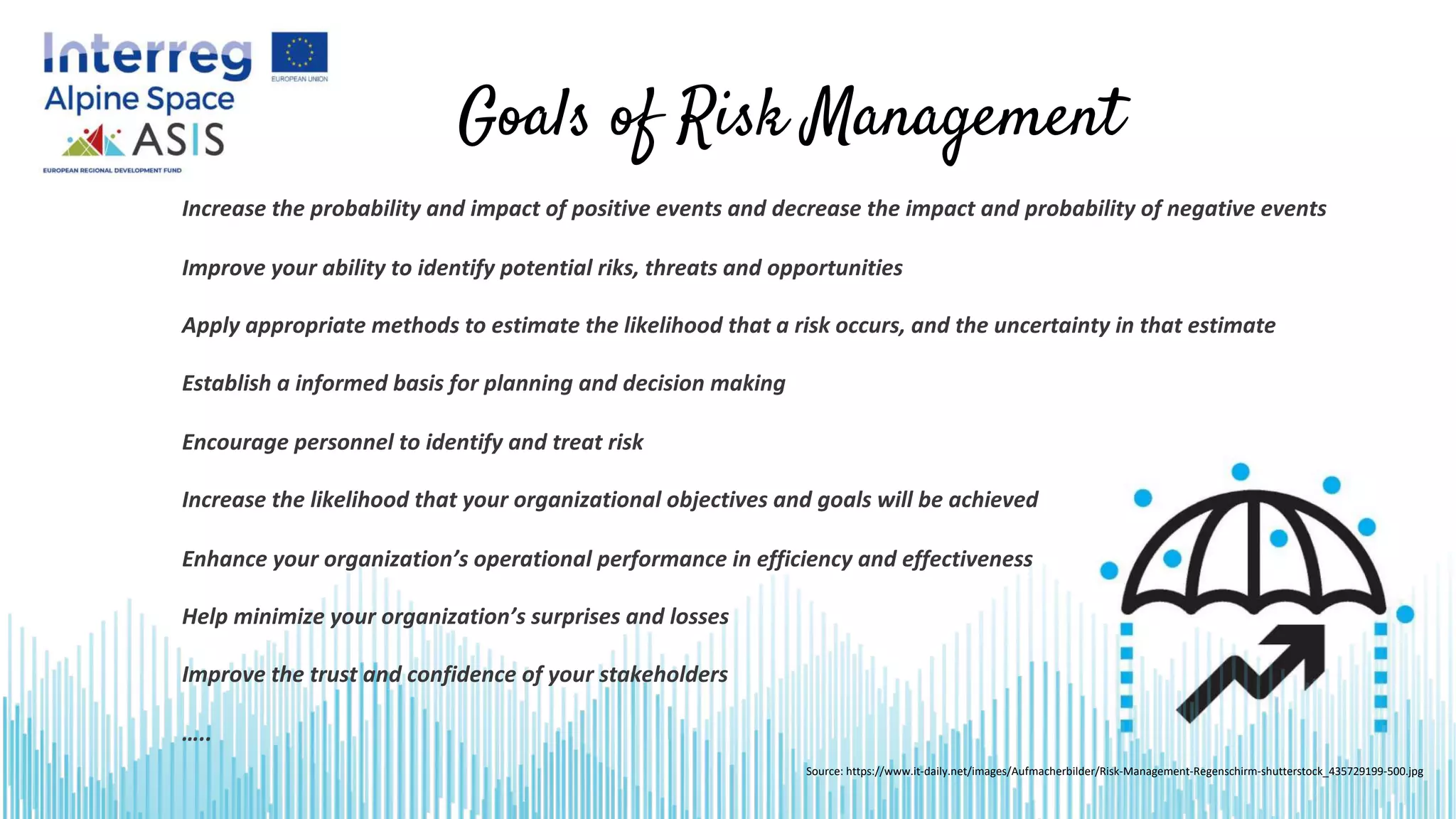
Increase the probability and impact of positive events and decrease the impact and probability of negative events
Improve your ability to identify potential riks, threats and opportunities
Apply appropriate methods to estimate the likelihood that a risk occurs, and the uncertainty in that estimate
Establish a informed basis for planning and decision making
Encourage personnel to identify and treat risk
Increase the likelihood that your organizational objectives and goals will be achieved
Enhance your organization’s operational performance in efficiency and effectiveness
Help minimize your organization’s surprises and losses
Improve the trust and confidence of your stakeholders
…..
Known Risks: Risks that can be identified and analyzed before their occurrence.
Unknown Risks: Risks that cannot be identified and analyzed before their occurrence.
Residual Risk: Risks that remain after implementing a risk response plan. It is difficult to remove the risk
completely so that the remained risk is deliberately accepted.
Risk Owner: A person who manages monitors and controls the identified risks within a project and is
responsible for the implementation of risk response strategies.
Secondary Risk: New risk that is occurred as a result of risk treatments.
Risk Attitude / Risk Appetite / Risk Tolerance: an “organization’s approach to assess
and eventually pursue, retain, take or turn away from risk.” (ISO 31000)
Basic Terms of Risk Management
Source: https://www.it-daily.net/images/Aufmacherbilder/Risk-Management-Regenschirm-shutterstock_435729199-500.jpg
How does Risk Management work?
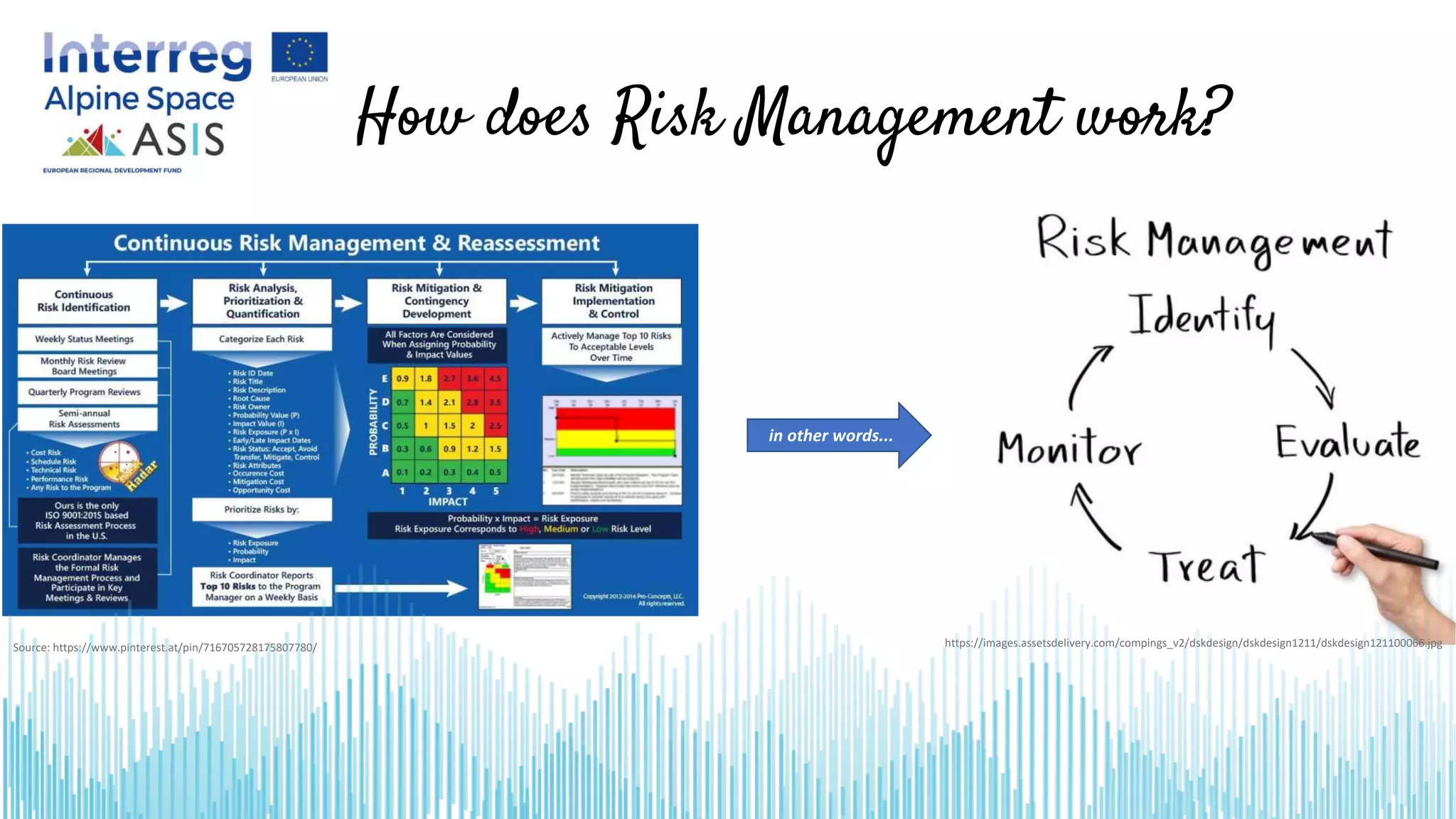
Source: https://www.pinterest.at/pin/716705728175807780/ https://images.assetsdelivery.com/compings_v2/dskdesign/dskdesign1211/dskdesign121100066.jpg
in other words...
After establishing the context and objectives and setting scope and risk criteria for the process, the process
based on the well establishes standard ISO 31000 starts with…
(1) Step 1 - Risk Identification: “Try to identify the critical, essential points in the process in every phase of
the process“
(1) Step 2 - Risk Analyses : “Try to find out what can go wrong and why for each of the identified points”
(1) Step 3 - Risk Evaluation: “Try to determine likelihood (measureable uncertainty) and impact and compare
the level of risk with the given risk criteria ("What level of risk is acceptable“?)”
(1) Step 4 - Risk Treatment: “If the level of risk is not acceptable put in place actions to change consequences
or impact – defining responsibilities and ownership of measures is particularly important here - or
determine whether the existing measures are sufficient”
(1) Step 5 - Risk Monitoring: “Monitor the RM-process, check the effectiveness of your measures on a regular
basis and keep an eye on changes that could affect your risk”
How does Risk Management work?
( STEP 6: GO TO STEP 1 AND START AGAIN )
Risk Management in a project setting
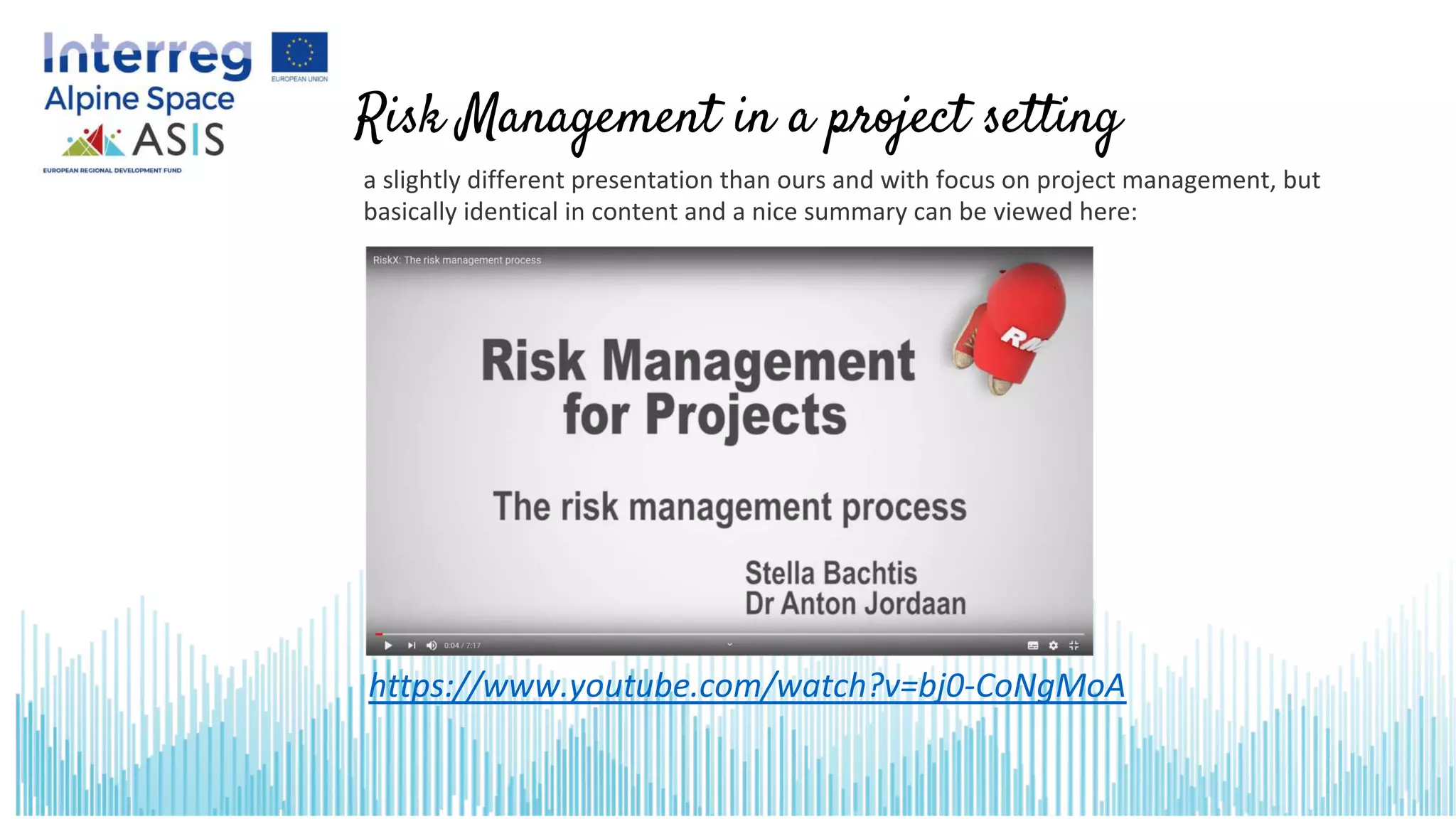
https://www.youtube.com/watch?v=bj0-CoNgMoA
a slightly different presentation than ours and with focus on project management, but
basically identical in content and a nice summary can be viewed here:
Risk Management in a project setting
Now that you are already familiar with the risk management process in general, here is a little
task for you:
https://learningapps.org/display?v=pj5k910gc20
https://i.pinimg.com/originals/00/43/f4/0043f436985e8c83820d8149bf491444.jpg
Note:
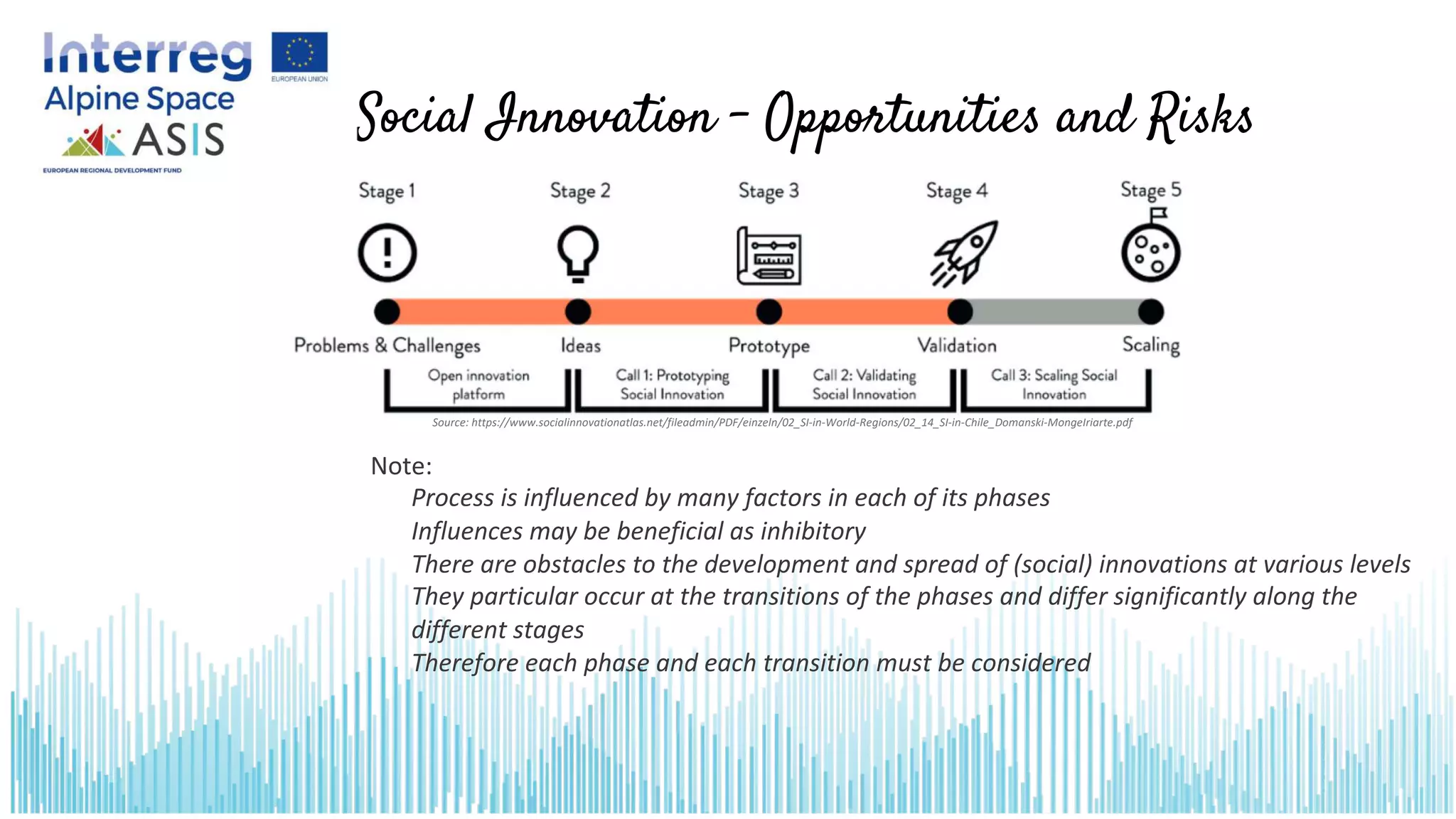
Process is influenced by many factors in each of its phases
Influences may be beneficial as inhibitory
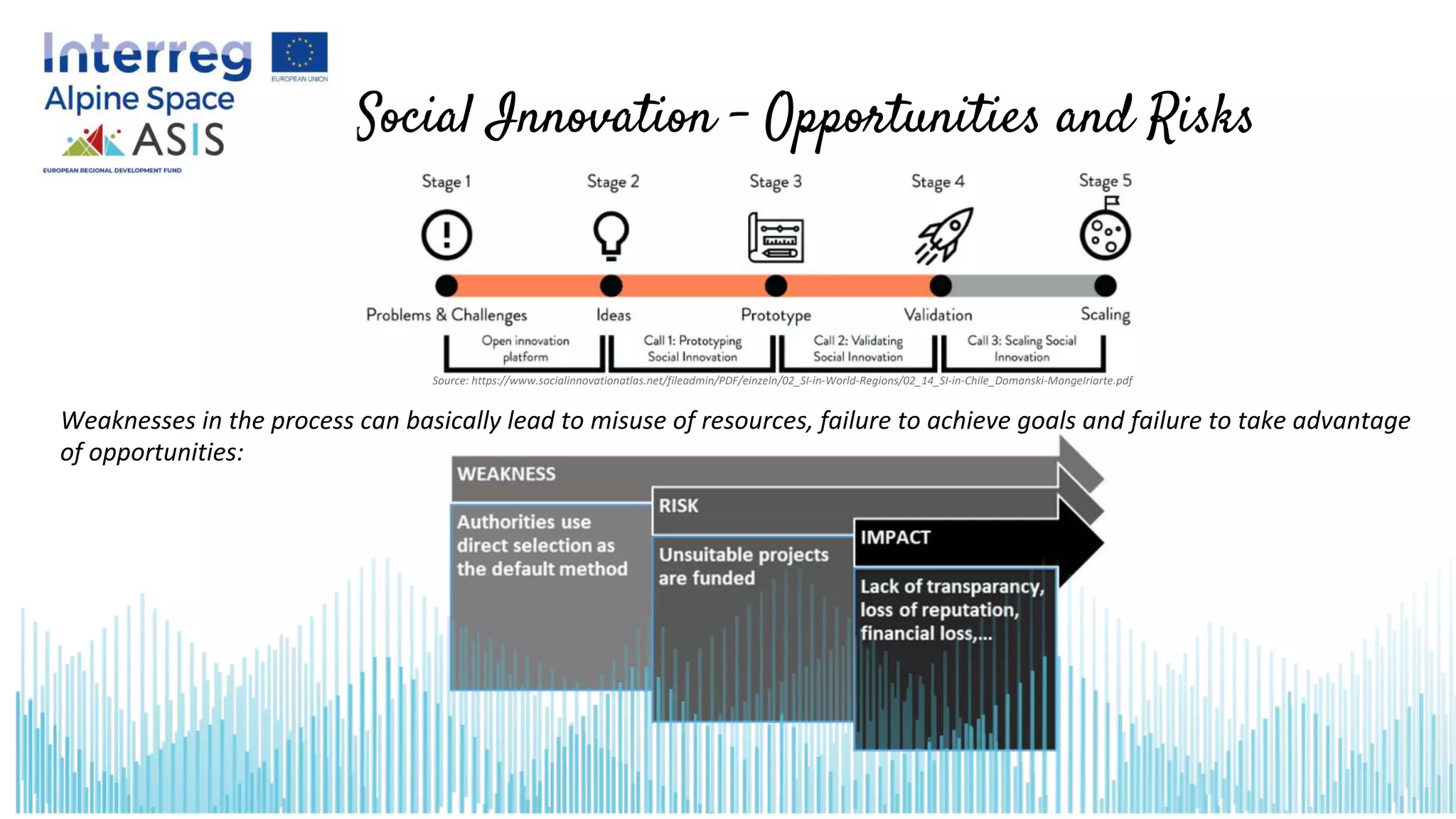
There are obstacles to the development and spread of (social) innovations at various levels
They particular occur at the transitions of the phases and differ significantly along the
different stages
Therefore each phase and each transition must be considered
Social Innovation – Opportunities and Risks
Source: https://www.socialinnovationatlas.net/fileadmin/PDF/einzeln/02_SI-in-World-Regions/02_14_SI-in-Chile_Domanski-MongeIriarte.pdf
Weaknesses in the process can basically lead to misuse of resources, failure to achieve goals and failure to take advantage
of opportunities:
Social Innovation – Opportunities and Risks
Source: https://www.socialinnovationatlas.net/fileadmin/PDF/einzeln/02_SI-in-World-Regions/02_14_SI-in-Chile_Domanski-MongeIriarte.pdf
Structured risk management will contribute to a fair, transparent and efficient procurement process by
showing system deficiencies and potential savings
Social Innovation – Opportunities and Risks
Main tasks for Risk Management related to the procurement process……
(1) ….recognize both risks and opportunities for those involved in the process in all phases of the process
(1) ….assess possible causes and consequences
(1) …..propose reactions to influence the impact or the probability of the entry, allocate responsibilities to take
action to reduce the likelihood and allocate who bears the cost of mitigation and the reduced benefits
Methods in Risk Management
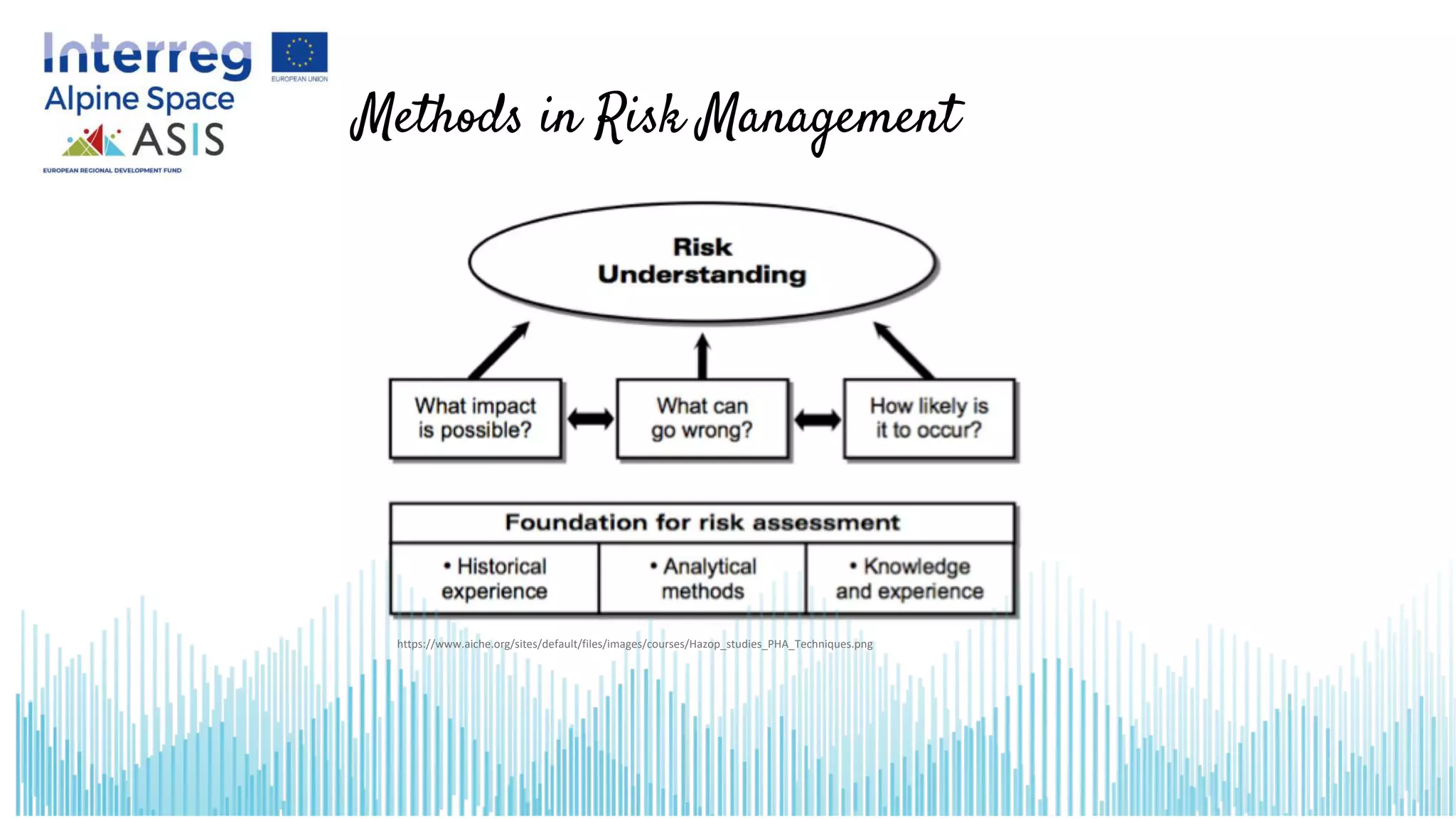
https://www.aiche.org/sites/default/files/images/courses/Hazop_studies_PHA_Techniques.png
Methods in Risk Management
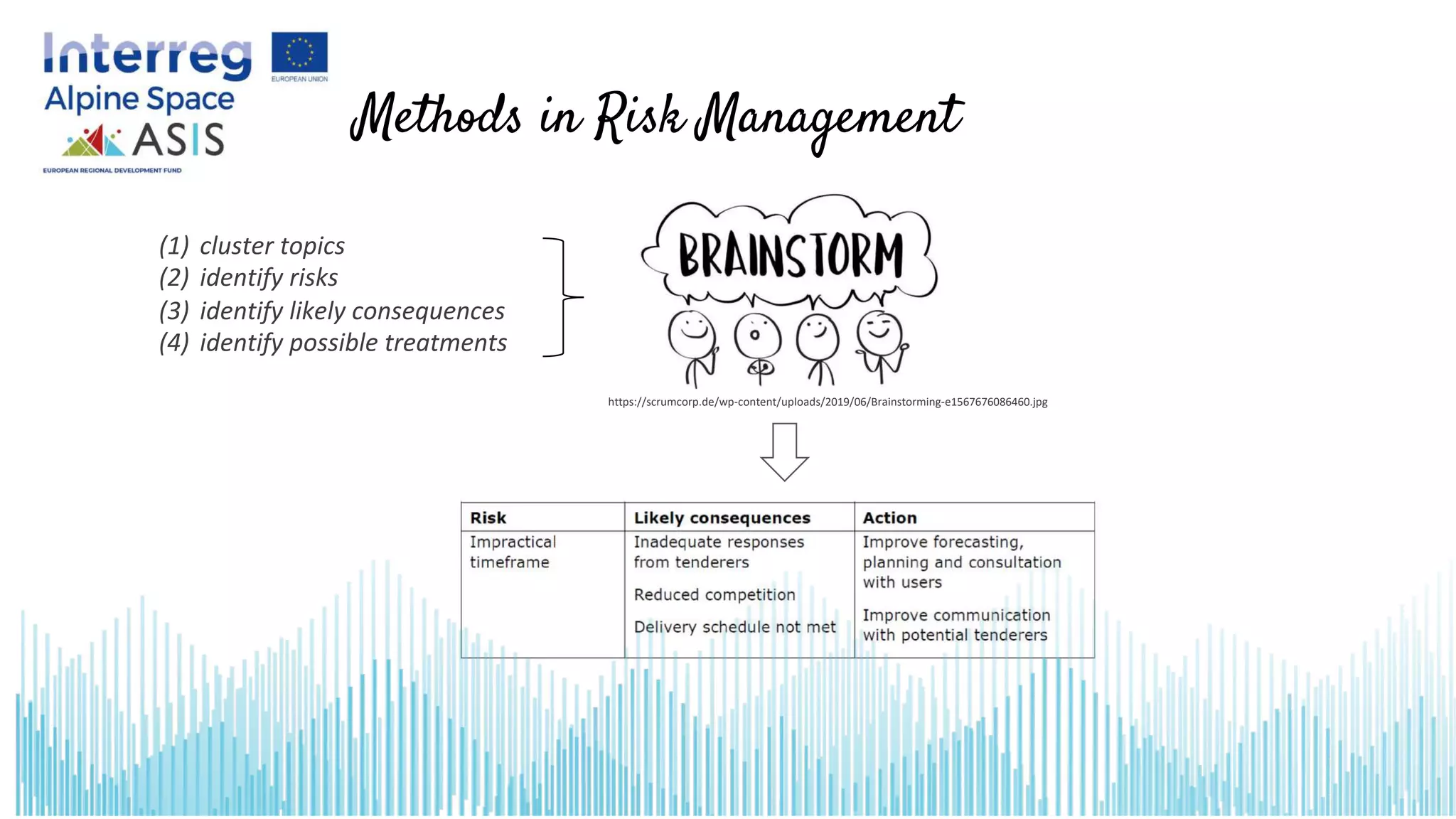
Checklists….
simple
usable results
quick overview of identified risks, likely consequences and possible measures
very helpful for a first approach to the management of risks
Methods in Risk Management
(1) cluster topics
(2) identify risks
(3) identify likely consequences
(4) identify possible treatments
https://scrumcorp.de/wp-content/uploads/2019/06/Brainstorming-e1567676086460.jpg
Conclusion
Note:
many social innovations fail due to organizational and structural resistance
it is necessary to create the appropriate framework conditions at various levels to promote social innovations,
starting with the procurement process
structured risk management will contribute to a fair, transparent and efficient procurement process by
showing system deficiencies and potential savings
Thank You For Participating!
…and you now may test your knowledge with
the respective quiz
https://images.indianexpress.com/2017/10/eye-quiz-759.jpg

Asis social innovation risk management

  • 1.
    SOCIAL INNOVATION Introduction toopportunities and risks and how to deal with them
  • 2.
    Introduction In the following,we will make fundamental considerations on the topic of "risk", point out that risk and opportunity are closely related, that risk management is about dealing with both, we will also introduce a simplified and generally applicable process model for dealing with risks and we will present checklists as a simple and useful method in risk management. All this against the background of the subject area of "social innovation" and its specific opportunities and risks.
  • 3.
    Table of Content a.What is «Risk»? b. What is «Risk Management»? c. Goals of Risk Management d. Basic Terms of Risk Management e. How does Risk Management work? f. Social Innovation – Opportunities and Risks g. Methods in Risk Management h. Conclusion
  • 4.
    What is Risk? Risk,as defined by ISO 31000, is “the effect of uncertainty on objectives.” This effect can be positive or negative and includes outcomes that increase the likelihood and/or consequence that objectives will be achieved. Source: https://www.researchgate.net/figure/Conceptual-diagram-of-a-scenario-funnel-Source-adapted-after-Mahmoud-et-al-2009_fig1_326258669 Source: https://www.riskevolves.com/risk-and-opportunity/
  • 5.
    What is Risk? SponsoringOrganizations of the Treadway Commission (COSO) defined risk as “The possibility that events will occur and affect the achievement of a strategy and objectives.” Source: https://commsrisk.com/wp-content/uploads/2016/06/coso_rainbow-777x437.jpg
  • 6.
    Risk management is… ….thesystematic application of processes and structures that enable an organization to identify, evaluate, analyze, optimize, monitor, improve or transfer risk while communicating risk and risk decisions to stakeholders. The overriding goal of risk management is to realize the potential opportunities while managing the adverse effects of risk. (OCEG) …a process to identify, assesses, manage, and control potential events or situations to provide reasonable assurance regarding the achievement of the organization’s objectives (IIA) …coordinated activities to direct and control an organization with regard to risk. (ISO) What is Risk Management? Source: https://www.it-daily.net/images/Aufmacherbilder/Risk-Management-Regenschirm-shutterstock_435729199-500.jpg
  • 7.
    Goals of RiskManagement Source: https://www.it-daily.net/images/Aufmacherbilder/Risk-Management-Regenschirm-shutterstock_435729199-500.jpg Increase the probability and impact of positive events and decrease the impact and probability of negative events Improve your ability to identify potential riks, threats and opportunities Apply appropriate methods to estimate the likelihood that a risk occurs, and the uncertainty in that estimate Establish a informed basis for planning and decision making Encourage personnel to identify and treat risk Increase the likelihood that your organizational objectives and goals will be achieved Enhance your organization’s operational performance in efficiency and effectiveness Help minimize your organization’s surprises and losses Improve the trust and confidence of your stakeholders …..
  • 8.
    Known Risks: Risksthat can be identified and analyzed before their occurrence. Unknown Risks: Risks that cannot be identified and analyzed before their occurrence. Residual Risk: Risks that remain after implementing a risk response plan. It is difficult to remove the risk completely so that the remained risk is deliberately accepted. Risk Owner: A person who manages monitors and controls the identified risks within a project and is responsible for the implementation of risk response strategies. Secondary Risk: New risk that is occurred as a result of risk treatments. Risk Attitude / Risk Appetite / Risk Tolerance: an “organization’s approach to assess and eventually pursue, retain, take or turn away from risk.” (ISO 31000) Basic Terms of Risk Management Source: https://www.it-daily.net/images/Aufmacherbilder/Risk-Management-Regenschirm-shutterstock_435729199-500.jpg
  • 9.
    How does RiskManagement work? Source: https://www.pinterest.at/pin/716705728175807780/ https://images.assetsdelivery.com/compings_v2/dskdesign/dskdesign1211/dskdesign121100066.jpg in other words...
  • 10.
    After establishing thecontext and objectives and setting scope and risk criteria for the process, the process based on the well establishes standard ISO 31000 starts with… (1) Step 1 - Risk Identification: “Try to identify the critical, essential points in the process in every phase of the process“ (1) Step 2 - Risk Analyses : “Try to find out what can go wrong and why for each of the identified points” (1) Step 3 - Risk Evaluation: “Try to determine likelihood (measureable uncertainty) and impact and compare the level of risk with the given risk criteria ("What level of risk is acceptable“?)” (1) Step 4 - Risk Treatment: “If the level of risk is not acceptable put in place actions to change consequences or impact – defining responsibilities and ownership of measures is particularly important here - or determine whether the existing measures are sufficient” (1) Step 5 - Risk Monitoring: “Monitor the RM-process, check the effectiveness of your measures on a regular basis and keep an eye on changes that could affect your risk” How does Risk Management work? ( STEP 6: GO TO STEP 1 AND START AGAIN )
  • 11.
    Risk Management ina project setting https://www.youtube.com/watch?v=bj0-CoNgMoA a slightly different presentation than ours and with focus on project management, but basically identical in content and a nice summary can be viewed here:
  • 12.
    Risk Management ina project setting Now that you are already familiar with the risk management process in general, here is a little task for you: https://learningapps.org/display?v=pj5k910gc20 https://i.pinimg.com/originals/00/43/f4/0043f436985e8c83820d8149bf491444.jpg
  • 13.
    Note: Process is influencedby many factors in each of its phases Influences may be beneficial as inhibitory There are obstacles to the development and spread of (social) innovations at various levels They particular occur at the transitions of the phases and differ significantly along the different stages Therefore each phase and each transition must be considered Social Innovation – Opportunities and Risks Source: https://www.socialinnovationatlas.net/fileadmin/PDF/einzeln/02_SI-in-World-Regions/02_14_SI-in-Chile_Domanski-MongeIriarte.pdf
  • 14.
    Weaknesses in theprocess can basically lead to misuse of resources, failure to achieve goals and failure to take advantage of opportunities: Social Innovation – Opportunities and Risks Source: https://www.socialinnovationatlas.net/fileadmin/PDF/einzeln/02_SI-in-World-Regions/02_14_SI-in-Chile_Domanski-MongeIriarte.pdf
  • 15.
    Structured risk managementwill contribute to a fair, transparent and efficient procurement process by showing system deficiencies and potential savings Social Innovation – Opportunities and Risks Main tasks for Risk Management related to the procurement process…… (1) ….recognize both risks and opportunities for those involved in the process in all phases of the process (1) ….assess possible causes and consequences (1) …..propose reactions to influence the impact or the probability of the entry, allocate responsibilities to take action to reduce the likelihood and allocate who bears the cost of mitigation and the reduced benefits
  • 16.
    Methods in RiskManagement https://www.aiche.org/sites/default/files/images/courses/Hazop_studies_PHA_Techniques.png
  • 17.
    Methods in RiskManagement Checklists…. simple usable results quick overview of identified risks, likely consequences and possible measures very helpful for a first approach to the management of risks
  • 18.
    Methods in RiskManagement (1) cluster topics (2) identify risks (3) identify likely consequences (4) identify possible treatments https://scrumcorp.de/wp-content/uploads/2019/06/Brainstorming-e1567676086460.jpg
  • 19.
    Conclusion Note: many social innovationsfail due to organizational and structural resistance it is necessary to create the appropriate framework conditions at various levels to promote social innovations, starting with the procurement process structured risk management will contribute to a fair, transparent and efficient procurement process by showing system deficiencies and potential savings
  • 20.
    Thank You ForParticipating! …and you now may test your knowledge with the respective quiz https://images.indianexpress.com/2017/10/eye-quiz-759.jpg