Asian clam breeding
S. Prudvi
M.Sc animal biotechnology,
SVU college of sciences,
Tirupati.
Introduction
Asian clamp are unisexual both male and female are present
in the same organism
Colour of the clam will varies. Based upon the water
fluctuation.
Black clam –lake (stagnant water)
Green clam-river (flowing water)
The shape of the clam also the temperature varies helps in
the sperm or ovum production
Temperature increase –male is dominant-releases the
spermatozoa
Temperature decreases-female is dominant-releases the ovum
The clam consists of two hard shells &to this shell the gills are
attached.
In the between to these gills the body systemic organization
was present &also contains a tongue/foot
The tongue/foot helps in locomotion& also in grasping the
food
The gills helps in breathing& where as the other parts
contains the along with other organizing systems of body.
Identification
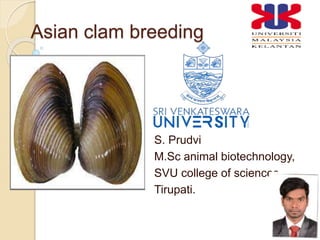
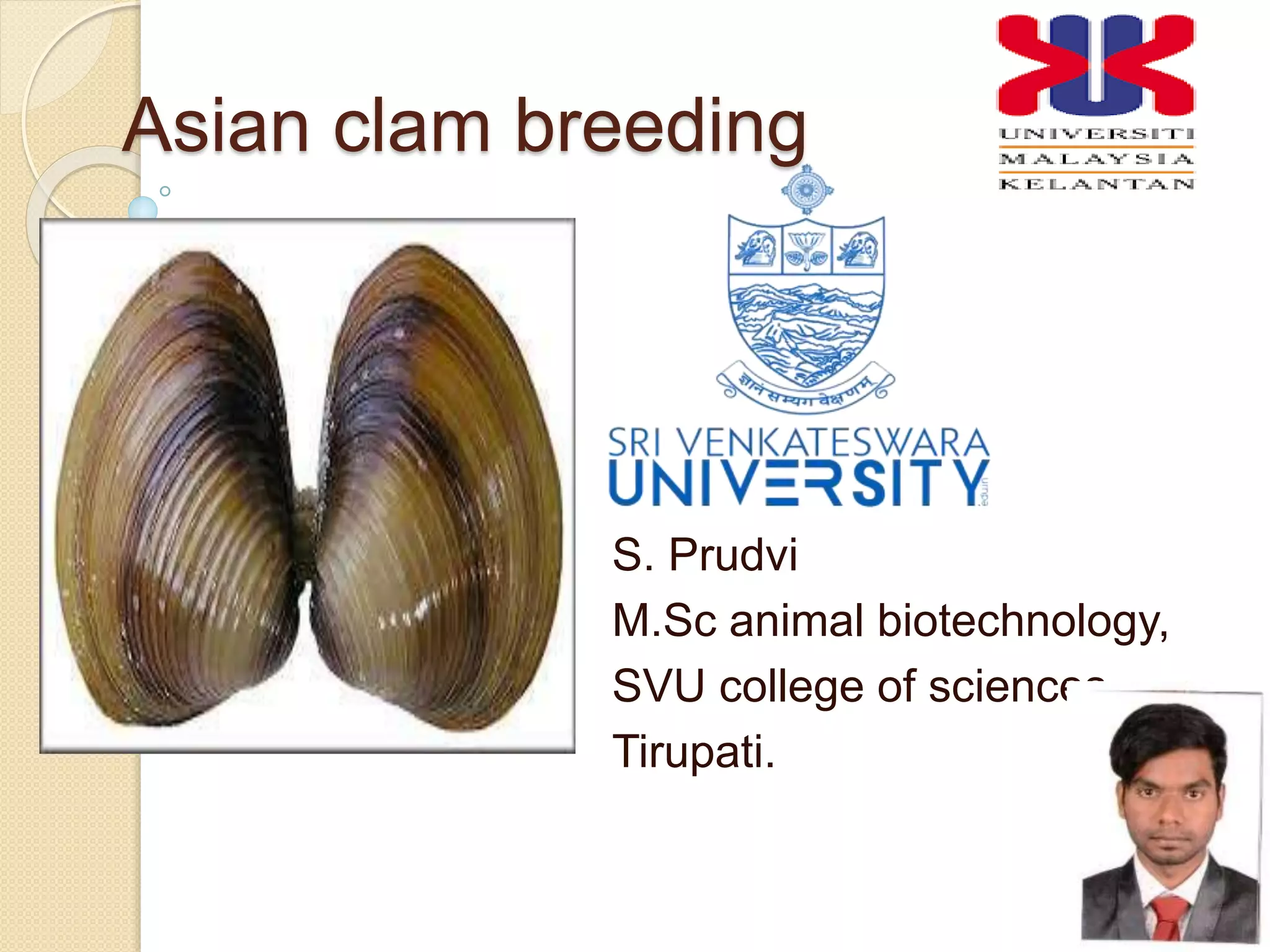
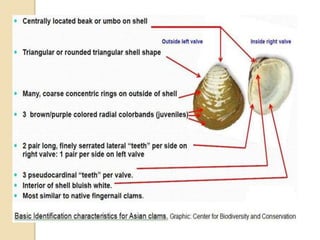
The species has a typical oval-triangular clam shape, with a
dorsal “beak” or umbo at the peak of the shell.
The outside of the shell (periostracum) is olive, or yellowish
to black-brown in color, with 1-3 brown/purple colored radial
bands (particularly in juveniles) and white erosion rings near
the umbo.
The inside layer of the shell, the nacre (or “mother of pearl
layer) is typically white-bluish white in color.

Inside each shell half (or valve), there are also 1-2 pair of
small, elongated and , finely serrated lateral “teeth” that
extend on either side from the umbo part way down on the
inside edge of each valve.
Also, the interior of each valve, immediately under the umbo,
there are 3 cardinal “teeth”
The clam most closely resembles
native sphaerid (fingernail) clams,
however, sphaerid clams are smaller
(6-14 mm), more oval in shape, cream
colored, have fine growth rings, lack
serrations on the lateral teeth and are
found completely buried in the
sediment.
These relatives of Corbicula are also
found in slow flowing waters with
poorer water quality.
Reproduction
Mature Asian Clams are hermaphroditic and it is believed that
they occasionally self fertilize.
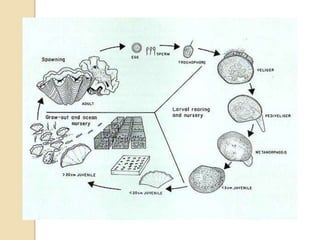
The young are incubated within the safety of the parent’s shell,
and are released 4-5 days later. The young
microscopic pedivelligers travel along the substrate to new
locations and attach to any available suitable
substrate with byssus fibers. Young that are hatched in the
spring usually attain sexual maturity by the
fall, and may live for up to seven years. Asian Clams typically
spawn between July and September.
· Asian Clams can release over 320-387 offspring daily,
depending on the conditions.
· Water temperature extremes (above 370 C and below 10C) can
inhibit spawning.
Management Methods
The breeding is mainly two types
1 heat shock
2 scrapping gonad
Heat shock method
temperature regulation
•Two sample of mini aquarium along with clams are
taken
•A healer with a temp of generally 24c-26c was
measured.
•And introduced into the aquarium containing water
& clam sample
•And left for four hrs
•Then transferred to the normal aquarium for
incubation then result can be observed
Scrapping gonad.
•Dissection of clam are done
•And only the part containing distilled &
gonads are taken as sample
•The gills shells, tongue/foot was not taken
•By pouring distilled water the sample was
smashed
•The liquid from this smashed sample was
taken & introduced into the group of samples
of clam
•Then transferred in to the normal aquarium
for incubation result can be observed from
48hours to 72 hours
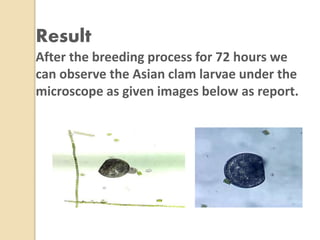
Result
After the breeding process for 72 hours we
can observe the Asian clam larvae under the
microscope as given images below as report.
Asian clam breeding

Asian clam breeding

  • 1.
    Asian clam breeding S.Prudvi M.Sc animal biotechnology, SVU college of sciences, Tirupati.
  • 2.
    Introduction Asian clamp areunisexual both male and female are present in the same organism Colour of the clam will varies. Based upon the water fluctuation. Black clam –lake (stagnant water) Green clam-river (flowing water) The shape of the clam also the temperature varies helps in the sperm or ovum production Temperature increase –male is dominant-releases the spermatozoa Temperature decreases-female is dominant-releases the ovum The clam consists of two hard shells &to this shell the gills are attached. In the between to these gills the body systemic organization was present &also contains a tongue/foot The tongue/foot helps in locomotion& also in grasping the food The gills helps in breathing& where as the other parts contains the along with other organizing systems of body.
  • 3.
    Identification The species hasa typical oval-triangular clam shape, with a dorsal “beak” or umbo at the peak of the shell. The outside of the shell (periostracum) is olive, or yellowish to black-brown in color, with 1-3 brown/purple colored radial bands (particularly in juveniles) and white erosion rings near the umbo. The inside layer of the shell, the nacre (or “mother of pearl layer) is typically white-bluish white in color.  Inside each shell half (or valve), there are also 1-2 pair of small, elongated and , finely serrated lateral “teeth” that extend on either side from the umbo part way down on the inside edge of each valve. Also, the interior of each valve, immediately under the umbo, there are 3 cardinal “teeth”
  • 4.
    The clam mostclosely resembles native sphaerid (fingernail) clams, however, sphaerid clams are smaller (6-14 mm), more oval in shape, cream colored, have fine growth rings, lack serrations on the lateral teeth and are found completely buried in the sediment. These relatives of Corbicula are also found in slow flowing waters with poorer water quality.
  • 6.
    Reproduction Mature Asian Clamsare hermaphroditic and it is believed that they occasionally self fertilize. The young are incubated within the safety of the parent’s shell, and are released 4-5 days later. The young microscopic pedivelligers travel along the substrate to new locations and attach to any available suitable substrate with byssus fibers. Young that are hatched in the spring usually attain sexual maturity by the fall, and may live for up to seven years. Asian Clams typically spawn between July and September. · Asian Clams can release over 320-387 offspring daily, depending on the conditions. · Water temperature extremes (above 370 C and below 10C) can inhibit spawning.
  • 8.
    Management Methods The breedingis mainly two types 1 heat shock 2 scrapping gonad Heat shock method temperature regulation •Two sample of mini aquarium along with clams are taken •A healer with a temp of generally 24c-26c was measured. •And introduced into the aquarium containing water & clam sample •And left for four hrs •Then transferred to the normal aquarium for incubation then result can be observed
  • 9.
    Scrapping gonad. •Dissection ofclam are done •And only the part containing distilled & gonads are taken as sample •The gills shells, tongue/foot was not taken •By pouring distilled water the sample was smashed •The liquid from this smashed sample was taken & introduced into the group of samples of clam •Then transferred in to the normal aquarium for incubation result can be observed from 48hours to 72 hours
  • 10.
    Result After the breedingprocess for 72 hours we can observe the Asian clam larvae under the microscope as given images below as report.