A Free-Market Perspective
       On the Financial Crisis
                   based on the 2009 book:
   Meltdown - A Free-Market Look at Why
        the Stock Market Collapsed,
   the Economy Tanked, and Government
      Bailouts Will Make Things Worse
           by Thomas E. Woods Jr.

A Presentation by Peter Emmel to Osher Course “The Financial
                                                          1
Crisis of 2008,” 3/10/2010.
Range of Opinions
• “The business of government is business.”
      • US President Calvin Coolidge, 1924(?)
• “The trouble with socialism is socialism. The
  trouble with capitalism is capitalists.”
      • Austrian Willi Schlamm, quoted by Wm. F. Buckley
• Now if the aerospace industry had told us after the
  1986 Challenger disaster that the key to better
  performance was to turbocharge the engines and
  quit performing preflight inspections, everyone
  would have agreed they were crazy. Yet that’s
  essentially what the finance lobby has done over
  the past decade ...”
      • Kevin Drum, in Mother Jones, Jan/Feb, 2010 (p.39)   2
Definitions
• Free-Market Economy
  – Prices are set by supply and demand
  – Government protects property rights and
    polices fraud & coercion
  – ... but is not otherwise involved in economy


                                                   3
Definitions
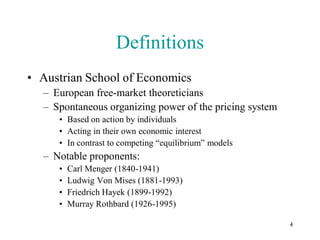
• Austrian School of Economics
  – European free-market theoreticians
  – Spontaneous organizing power of the pricing system
     • Based on action by individuals
     • Acting in their own economic interest
     • In contrast to competing “equilibrium” models
  – Notable proponents:
     •   Carl Menger (1840-1941)
     •   Ludwig Von Mises (1881-1993)
     •   Friedrich Hayek (1899-1992)
     •   Murray Rothbard (1926-1995)

                                                         4
Definitions
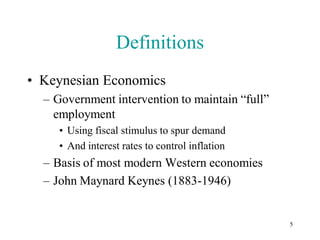
• Keynesian Economics
  – Government intervention to maintain “full”
    employment
     • Using fiscal stimulus to spur demand
     • And interest rates to control inflation
  – Basis of most modern Western economies
  – John Maynard Keynes (1883-1946)


                                                 5
Definitions
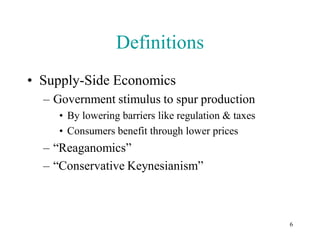
• Supply-Side Economics
  – Government stimulus to spur production
     • By lowering barriers like regulation & taxes
     • Consumers benefit through lower prices
  – “Reaganomics”
  – “Conservative Keynesianism”


                                                      6
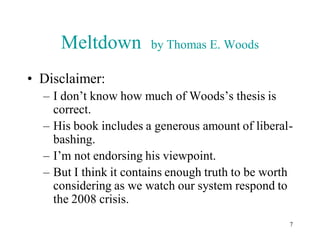
Meltdown          by Thomas E. Woods

• Disclaimer:
  – I don’t know how much of Woods’s thesis is
    correct.
  – His book includes a generous amount of liberal-
    bashing.
  – I’m not endorsing his viewpoint.
  – But I think it contains enough truth to be worth
    considering as we watch our system respond to
    the 2008 crisis.
                                                   7
Book Overview - 1
• Advocates US adoption of a free-market economy
• Explains how government intervention created &
  prolonged the boom
   – (thru low interest rates)
• ... and will prolong the bust
   – (through bailouts and excessive stimulus)
• Describes how free markets operate
• Counters the “myth” that de-regulation caused the
  crisis
                                                      8
Book Overview - 2
• Presents the “Austrian Theory” of economics
• Interprets selected historical boom/bust cycles
• Explains benefits of “sound money” vs “fiat
  money”
• Explains benefits of saving vs spending by the
  public
• Lists prescriptions for correcting our approach to
  the US economy

                                                       9
Causes: Gov’t Intervention -1
• Federal Reserve created boom by artificially
  holding down interest rates
  – Rationale:
     • Increase liquidity & cushion recessions
  – Result:
     • Encouraged risk-taking to earn higher returns


                                                       10
Causes: Gov’t Intervention - 2
• Manipulated markets by designating favored
  sectors
   – Rationale:
      • Deregulation (especially S&L, other financial)
      • Anti-discrimination & “Ownership Society”
      • Promote financial industry growth “Professional Exemption”
   – Result:
      • “Un-economic” credit and investment decisions
      • Lack of transparency (securitization & OTC trading)
      • Financial “products” ~40% of GDP

                                                                     11
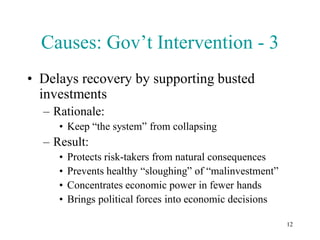
Causes: Gov’t Intervention - 3
• Delays recovery by supporting busted
  investments
  – Rationale:
     • Keep “the system” from collapsing
  – Result:
     •   Protects risk-takers from natural consequences
     •   Prevents healthy “sloughing” of “malinvestment”
     •   Concentrates economic power in fewer hands
     •   Brings political forces into economic decisions

                                                           12
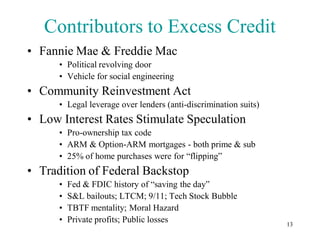
Contributors to Excess Credit
• Fannie Mae & Freddie Mac
      • Political revolving door
      • Vehicle for social engineering
• Community Reinvestment Act
      • Legal leverage over lenders (anti-discrimination suits)
• Low Interest Rates Stimulate Speculation
      • Pro-ownership tax code
      • ARM & Option-ARM mortgages - both prime & sub
      • 25% of home purchases were for “flipping”
• Tradition of Federal Backstop
      •   Fed & FDIC history of “saving the day”
      •   S&L bailouts; LTCM; 9/11; Tech Stock Bubble
      •   TBTF mentality; Moral Hazard
      •   Private profits; Public losses                          13
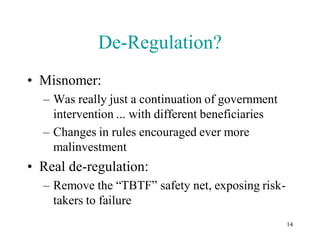
De-Regulation?
• Misnomer:
  – Was really just a continuation of government
    intervention ... with different beneficiaries
  – Changes in rules encouraged ever more
    malinvestment
• Real de-regulation:
  – Remove the “TBTF” safety net, exposing risk-
    takers to failure
                                                    14
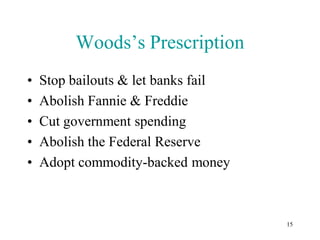
Woods’s Prescription
•   Stop bailouts & let banks fail
•   Abolish Fannie & Freddie
•   Cut government spending
•   Abolish the Federal Reserve
•   Adopt commodity-backed money


                                     15
Things aren’t always what they seem to be


Someone sent me this w/ the caption “Sunrise at the North Pole”
                                                           16
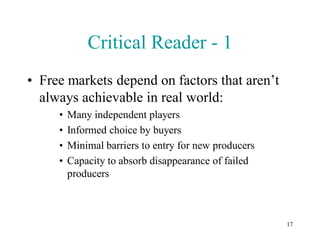
Critical Reader - 1
• Free markets depend on factors that aren’t
  always achievable in real world:
     •   Many independent players
     •   Informed choice by buyers
     •   Minimal barriers to entry for new producers
     •   Capacity to absorb disappearance of failed
         producers


                                                       17
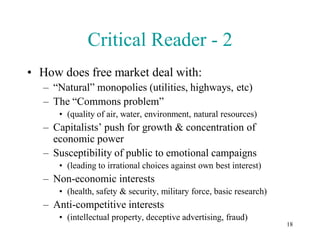
Critical Reader - 2
• How does free market deal with:
   – “Natural” monopolies (utilities, highways, etc)
   – The “Commons problem”
      • (quality of air, water, environment, natural resources)
   – Capitalists’ push for growth & concentration of
     economic power
   – Susceptibility of public to emotional campaigns
      • (leading to irrational choices against own best interest)
   – Non-economic interests
      • (health, safety & security, military force, basic research)
   – Anti-competitive interests
      • (intellectual property, deceptive advertising, fraud)
                                                                      18
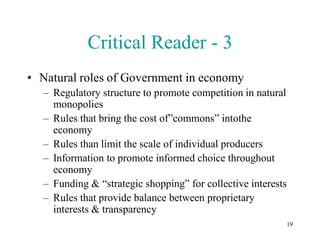
Critical Reader - 3
• Natural roles of Government in economy
  – Regulatory structure to promote competition in natural
    monopolies
  – Rules that bring the cost of”commons” intothe
    economy
  – Rules than limit the scale of individual producers
  – Information to promote informed choice throughout
    economy
  – Funding & “strategic shopping” for collective interests
  – Rules that provide balance between proprietary
    interests & transparency
                                                          19
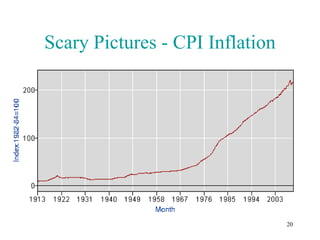
Scary Pictures - CPI Inflation


                                 20
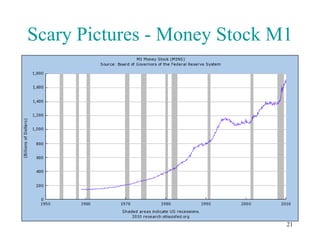
Scary Pictures - Money Stock M1


                              21
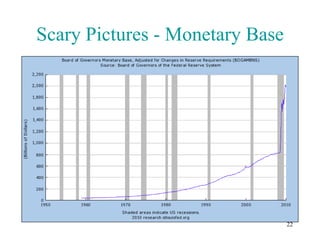
Scary Pictures - Monetary Base


                                 22
Deeper Look: Money - 1
• Role: Medium of Exchange; Store of Value
• A given supply of money can support *any*
  amount of commerce
      • (Overall Price Level) =
          (Money Supply) / (Aggregate of Goods & Services)
• Too much = Inflation; Too Little = Deflation
• Overall price increase is a *consequence* of
  inflation ... not its cause
      • (but government always blames others)
      • Discourages saving - things w/b more expensive in future
      • Encourages increased risk - seeking returns to “beat inflation”
• Deflation not same as Recession or Depression
      • 19th century saw dramatic growth in US economy and living
        standards ... but $1 bought more in 1900 than in 1800         23
Deeper Look: Money - 2
• In free market w/ constant money supply:
   – Prices track supply & demand
   – Rising prices in one sector are offset by falling prices in
     another
• Control of money supply gives government the
  power to mask trends
   – Steady moderate inflation looks like growth
   – Also reduces real cost of borrowing
   – Inflation = Silent Thief of Savings
                                                              24
Deeper Look: Money - 3
• Sound Money vs Fiat Money
  – Commodity-backed money
     • Redeemable for specie (gold, silver, etc.)
     • Any extension of credit must be preceded by an act of saving
  – Central Bank notes
     • Not redeemable for anything
     • No natural restriction on expansion of money supply
     • “Adding to money supply cannot increase the amount of real
       resources ... All it can do is make prices of real resources go
       up.” (p128)

                                                                         25
Deeper Look: Money - 4
• Spend if you love America ???
  – “A consumer is only able to buy things now because s/he
    has produced things in the past. Thus it is production that
    makes consumption possible.” (p.144)
  – “We are much wealthier now than we were 300 years ago
    not because we consume more ... but because we can
    produce much more ...” (p.146)
  – A higher savings rate slows economy in short run but it
    stores up future buying power ... to make business
    investments pay off
  – Saving = the only legitimate source of investment capital
  – International differences in saving rates (e.g. USA vs
    China) over time create massive shifts in relative
    economic power                                          26
Deeper Look: Money - 5
• Political Forces on Central Bank
   – Money buys access & legislative influence over rules
   – Spending & tax code = gov’t rewards friends
• Federal reserve Act 1913
   – Special-interest legislation masquerading as public
     interest
   – Facility for rescuing troubled banks
      • ... but not for preventing them from doing things that get them
        into trouble
   – “The point of the central bank is to alleviate pressures
     that the free market would otherwise impose.”
      • Jesus Huerta de Soto, quoted on p.178
                                                                      27
Deeper Look: Austrian School


                               28

Emmels Talk Free Market Perspective

  • 1.
    A Free-Market Perspective On the Financial Crisis based on the 2009 book: Meltdown - A Free-Market Look at Why the Stock Market Collapsed, the Economy Tanked, and Government Bailouts Will Make Things Worse by Thomas E. Woods Jr. A Presentation by Peter Emmel to Osher Course “The Financial 1 Crisis of 2008,” 3/10/2010.
  • 2.
    Range of Opinions •“The business of government is business.” • US President Calvin Coolidge, 1924(?) • “The trouble with socialism is socialism. The trouble with capitalism is capitalists.” • Austrian Willi Schlamm, quoted by Wm. F. Buckley • Now if the aerospace industry had told us after the 1986 Challenger disaster that the key to better performance was to turbocharge the engines and quit performing preflight inspections, everyone would have agreed they were crazy. Yet that’s essentially what the finance lobby has done over the past decade ...” • Kevin Drum, in Mother Jones, Jan/Feb, 2010 (p.39) 2
  • 3.
    Definitions • Free-Market Economy – Prices are set by supply and demand – Government protects property rights and polices fraud & coercion – ... but is not otherwise involved in economy 3
  • 4.
    Definitions • Austrian Schoolof Economics – European free-market theoreticians – Spontaneous organizing power of the pricing system • Based on action by individuals • Acting in their own economic interest • In contrast to competing “equilibrium” models – Notable proponents: • Carl Menger (1840-1941) • Ludwig Von Mises (1881-1993) • Friedrich Hayek (1899-1992) • Murray Rothbard (1926-1995) 4
  • 5.
    Definitions • Keynesian Economics – Government intervention to maintain “full” employment • Using fiscal stimulus to spur demand • And interest rates to control inflation – Basis of most modern Western economies – John Maynard Keynes (1883-1946) 5
  • 6.
    Definitions • Supply-Side Economics – Government stimulus to spur production • By lowering barriers like regulation & taxes • Consumers benefit through lower prices – “Reaganomics” – “Conservative Keynesianism” 6
  • 7.
    Meltdown by Thomas E. Woods • Disclaimer: – I don’t know how much of Woods’s thesis is correct. – His book includes a generous amount of liberal- bashing. – I’m not endorsing his viewpoint. – But I think it contains enough truth to be worth considering as we watch our system respond to the 2008 crisis. 7
  • 8.
    Book Overview -1 • Advocates US adoption of a free-market economy • Explains how government intervention created & prolonged the boom – (thru low interest rates) • ... and will prolong the bust – (through bailouts and excessive stimulus) • Describes how free markets operate • Counters the “myth” that de-regulation caused the crisis 8
  • 9.
    Book Overview -2 • Presents the “Austrian Theory” of economics • Interprets selected historical boom/bust cycles • Explains benefits of “sound money” vs “fiat money” • Explains benefits of saving vs spending by the public • Lists prescriptions for correcting our approach to the US economy 9
  • 10.
    Causes: Gov’t Intervention-1 • Federal Reserve created boom by artificially holding down interest rates – Rationale: • Increase liquidity & cushion recessions – Result: • Encouraged risk-taking to earn higher returns 10
  • 11.
    Causes: Gov’t Intervention- 2 • Manipulated markets by designating favored sectors – Rationale: • Deregulation (especially S&L, other financial) • Anti-discrimination & “Ownership Society” • Promote financial industry growth “Professional Exemption” – Result: • “Un-economic” credit and investment decisions • Lack of transparency (securitization & OTC trading) • Financial “products” ~40% of GDP 11
  • 12.
    Causes: Gov’t Intervention- 3 • Delays recovery by supporting busted investments – Rationale: • Keep “the system” from collapsing – Result: • Protects risk-takers from natural consequences • Prevents healthy “sloughing” of “malinvestment” • Concentrates economic power in fewer hands • Brings political forces into economic decisions 12
  • 13.
    Contributors to ExcessCredit • Fannie Mae & Freddie Mac • Political revolving door • Vehicle for social engineering • Community Reinvestment Act • Legal leverage over lenders (anti-discrimination suits) • Low Interest Rates Stimulate Speculation • Pro-ownership tax code • ARM & Option-ARM mortgages - both prime & sub • 25% of home purchases were for “flipping” • Tradition of Federal Backstop • Fed & FDIC history of “saving the day” • S&L bailouts; LTCM; 9/11; Tech Stock Bubble • TBTF mentality; Moral Hazard • Private profits; Public losses 13
  • 14.
    De-Regulation? • Misnomer: – Was really just a continuation of government intervention ... with different beneficiaries – Changes in rules encouraged ever more malinvestment • Real de-regulation: – Remove the “TBTF” safety net, exposing risk- takers to failure 14
  • 15.
    Woods’s Prescription • Stop bailouts & let banks fail • Abolish Fannie & Freddie • Cut government spending • Abolish the Federal Reserve • Adopt commodity-backed money 15
  • 16.
    Things aren’t alwayswhat they seem to be Someone sent me this w/ the caption “Sunrise at the North Pole” 16
  • 17.
    Critical Reader -1 • Free markets depend on factors that aren’t always achievable in real world: • Many independent players • Informed choice by buyers • Minimal barriers to entry for new producers • Capacity to absorb disappearance of failed producers 17
  • 18.
    Critical Reader -2 • How does free market deal with: – “Natural” monopolies (utilities, highways, etc) – The “Commons problem” • (quality of air, water, environment, natural resources) – Capitalists’ push for growth & concentration of economic power – Susceptibility of public to emotional campaigns • (leading to irrational choices against own best interest) – Non-economic interests • (health, safety & security, military force, basic research) – Anti-competitive interests • (intellectual property, deceptive advertising, fraud) 18
  • 19.
    Critical Reader -3 • Natural roles of Government in economy – Regulatory structure to promote competition in natural monopolies – Rules that bring the cost of”commons” intothe economy – Rules than limit the scale of individual producers – Information to promote informed choice throughout economy – Funding & “strategic shopping” for collective interests – Rules that provide balance between proprietary interests & transparency 19
  • 20.
    Scary Pictures -CPI Inflation 20
  • 21.
    Scary Pictures -Money Stock M1 21
  • 22.
    Scary Pictures -Monetary Base 22
  • 23.
    Deeper Look: Money- 1 • Role: Medium of Exchange; Store of Value • A given supply of money can support *any* amount of commerce • (Overall Price Level) = (Money Supply) / (Aggregate of Goods & Services) • Too much = Inflation; Too Little = Deflation • Overall price increase is a *consequence* of inflation ... not its cause • (but government always blames others) • Discourages saving - things w/b more expensive in future • Encourages increased risk - seeking returns to “beat inflation” • Deflation not same as Recession or Depression • 19th century saw dramatic growth in US economy and living standards ... but $1 bought more in 1900 than in 1800 23
  • 24.
    Deeper Look: Money- 2 • In free market w/ constant money supply: – Prices track supply & demand – Rising prices in one sector are offset by falling prices in another • Control of money supply gives government the power to mask trends – Steady moderate inflation looks like growth – Also reduces real cost of borrowing – Inflation = Silent Thief of Savings 24
  • 25.
    Deeper Look: Money- 3 • Sound Money vs Fiat Money – Commodity-backed money • Redeemable for specie (gold, silver, etc.) • Any extension of credit must be preceded by an act of saving – Central Bank notes • Not redeemable for anything • No natural restriction on expansion of money supply • “Adding to money supply cannot increase the amount of real resources ... All it can do is make prices of real resources go up.” (p128) 25
  • 26.
    Deeper Look: Money- 4 • Spend if you love America ??? – “A consumer is only able to buy things now because s/he has produced things in the past. Thus it is production that makes consumption possible.” (p.144) – “We are much wealthier now than we were 300 years ago not because we consume more ... but because we can produce much more ...” (p.146) – A higher savings rate slows economy in short run but it stores up future buying power ... to make business investments pay off – Saving = the only legitimate source of investment capital – International differences in saving rates (e.g. USA vs China) over time create massive shifts in relative economic power 26
  • 27.
    Deeper Look: Money- 5 • Political Forces on Central Bank – Money buys access & legislative influence over rules – Spending & tax code = gov’t rewards friends • Federal reserve Act 1913 – Special-interest legislation masquerading as public interest – Facility for rescuing troubled banks • ... but not for preventing them from doing things that get them into trouble – “The point of the central bank is to alleviate pressures that the free market would otherwise impose.” • Jesus Huerta de Soto, quoted on p.178 27
  • 28.