
AsEA Conference 2017
Rosetta Eun Ryong Lee
Seattle Girls’ School
Challenges and Opportunities for
API Affinity Groups
Rosetta Eun Ryong Lee (http://tiny.cc/rosettalee)
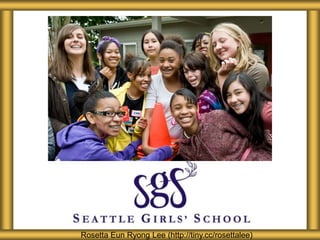
About Seattle Girls’ School
Rosetta Eun Ryong Lee (http://tiny.cc/rosettalee)
Agenda
 Basic Definitions
 What We’ve Tried and What
Happened
 Challenges
 Opportunities
 Resources
Rosetta Eun Ryong Lee (http://tiny.cc/rosettalee)
Basic Definitions
The term affinity group is used as a
bringing together of people who have an
identifier in common, e.g. race, gender,
religion, family status, etc. Affinity groups
are for individuals who identify as members
of the group and can speak to the
experience of being a member of the group
from the “I” perspective.
Rosetta Eun Ryong Lee (http://tiny.cc/rosettalee)
Basic Definitions
The term alliance group is used as a
bringing together of people who have a
common commitment to an identifier group,
e.g. race, gender, religion, family status,
etc. Alliance groups are for individuals who
identify as members of the group and/or as
people who support and stand in solidarity
with that group.
Rosetta Eun Ryong Lee (http://tiny.cc/rosettalee)
Basic Definitions
The term interest group is used as a
bringing together of people who want to
learn about, share, and engage in a special
interest, e.g. hobby, skill, topic, etc.
Interest groups are for individuals who want
to gather to teach, learn, and share.
Membership can be fluid and changing.
Rosetta Eun Ryong Lee (http://tiny.cc/rosettalee)
What We’ve Tried and
How It’s Going
Please work in groups of 3
and introduce yourselves.
Describe where your school
is in the process of
launching or implementing
API affinity groups. What
are some of the success
and challenges you’ve
experienced?
Rosetta Eun Ryong Lee (http://tiny.cc/rosettalee)
Why Affinity Groups Are Great
 Safety and Comfort to be
Authentic
 Affirmation
 Critical Mass
 Identity Socialization
 Building Resilience
 Preparing to Engage
Deeply with Other Groups
 Empowerment Toward
Action
Rosetta Eun Ryong Lee (http://tiny.cc/rosettalee)
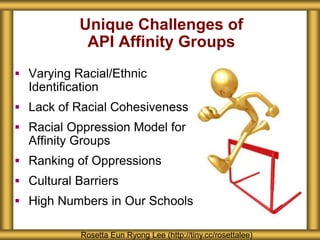
Unique Challenges of
API Affinity Groups
 Varying Racial/Ethnic
Identification
 Lack of Racial Cohesiveness
 Racial Oppression Model for
Affinity Groups
 Ranking of Oppressions
 Cultural Barriers
 High Numbers in Our Schools
Rosetta Eun Ryong Lee (http://tiny.cc/rosettalee)
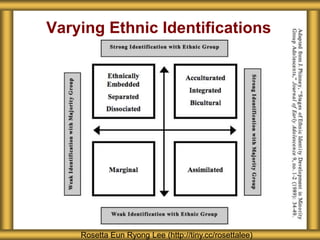
Varying Ethnic Identifications
Rosetta Eun Ryong Lee (http://tiny.cc/rosettalee)
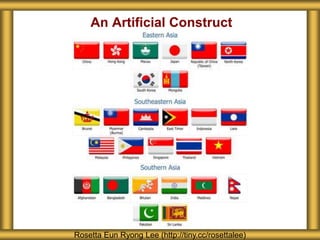
An Artificial Construct
Rosetta Eun Ryong Lee (http://tiny.cc/rosettalee)
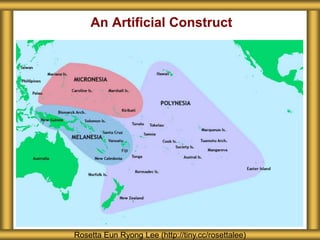
An Artificial Construct
Rosetta Eun Ryong Lee (http://tiny.cc/rosettalee)
An Artificial Construct
The Story of Asian Pacific America
Rosetta Eun Ryong Lee (http://tiny.cc/rosettalee)
Excerpts of Asian Pacific American History
 1763 Filipinos settle Saint Malo
 1778 Chinese sailors land in Hawaii
 1820s Chinese immigration begins in earnest
 1865 The Central Pacific Railroad Co. recruits Chinese
workers for the transcontinental railroad
 1878 Chinese are ruled ineligible for naturalized
citizenship
 1882 Chinese Exclusion Act is passed
Rosetta Eun Ryong Lee (http://tiny.cc/rosettalee)
 1941 Japan air force attacked Pearl Harbor; FBI arrests
pro-Japanese community leaders
 1941-45 Filipino resistance movement, working closely
with U.S. Army, fights the Japanese invaders
 1942, President Franklin D. Roosevelt signs Executive
Order 9066 on February 19, uprooting 100,000 people of
Japanese descent on the west coast to be sent to
Internment camps.
 1943-1945 Japanese Americans volunteer for the US
Army’s 442nd Regimental Combat Team and becomes
the highest decorated military unit in US history
 1946, the Luce–Celler Act of 1946 grants naturalization
opportunities to Filipino Americans and Indian Americans
(which included present-day Pakistanis and Bangladeshis)
Rosetta Eun Ryong Lee (http://tiny.cc/rosettalee)
Excerpts of Asian Pacific American History
 1968 Term “Asian American” is coined as a part of the
Asian American Movement, a radical movement for
social justice (Red Guard)
 1975 More than 130,000 refugees enter the U.S. from
Vietnam, Kampuchea, and Laos as Communist
governments are established there following the end of
the Indochina War.
 1982 Vincent Chin is accused of being a Japanese
(being blamed for loss of jobs) and beaten to death.
 1987 First formal signing of the Proclamation of Asian
Pacific American Heritage Week by the White House
Rosetta Eun Ryong Lee (http://tiny.cc/rosettalee)
Emergent Themes
 The Perpetual Immigrant
 The Worker Not Owner
 Black or White or Neither?
 Weak as a Socio-Political Group
 Ethnically Separated
Rosetta Eun Ryong Lee (http://tiny.cc/rosettalee)
Myth of the Model Minority
 Overly Hard Working and Tireless
 Will Work Under Extreme Circumstances
 Quiet and Cooperative
 Serene, Smart, Resilient
 Doesn’t Seek the Limelight
Rosetta Eun Ryong Lee (http://tiny.cc/rosettalee)
Legacy of the Myth
 Outsourcing of Cheap Labor
 Orientalism in Health Care
 Tokenism and Minimalization
 Stress of Achievement
 Funneling into STEM Fields
 Where Are You From?
Rosetta Eun Ryong Lee (http://tiny.cc/rosettalee)
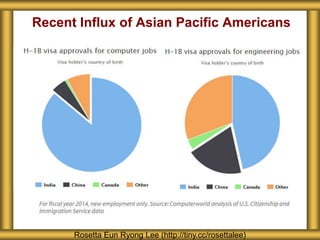
Recent Influx of Asian Pacific Americans
Rosetta Eun Ryong Lee (http://tiny.cc/rosettalee)
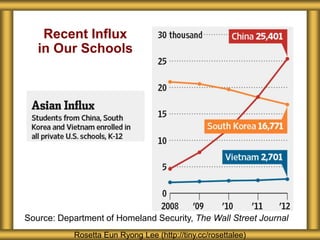
Recent Influx
in Our Schools
Rosetta Eun Ryong Lee (http://tiny.cc/rosettalee)
Source: Department of Homeland Security, The Wall Street Journal
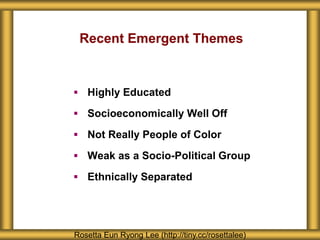
Recent Emergent Themes
 Highly Educated
 Socioeconomically Well Off
 Not Really People of Color
 Weak as a Socio-Political Group
 Ethnically Separated
Rosetta Eun Ryong Lee (http://tiny.cc/rosettalee)
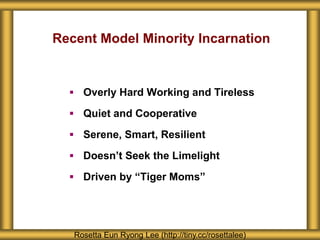
Recent Model Minority Incarnation
 Overly Hard Working and Tireless
 Quiet and Cooperative
 Serene, Smart, Resilient
 Doesn’t Seek the Limelight
 Driven by “Tiger Moms”
Rosetta Eun Ryong Lee (http://tiny.cc/rosettalee)
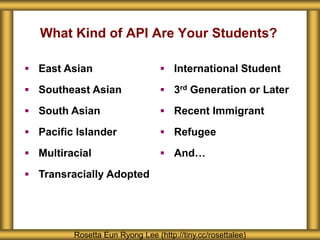
What Kind of API Are Your Students?
Rosetta Eun Ryong Lee (http://tiny.cc/rosettalee)
 East Asian
 Southeast Asian
 South Asian
 Pacific Islander
 Multiracial
 Transracially Adopted
 International Student
 3rd Generation or Later
 Recent Immigrant
 Refugee
 And…
How Do the Obstacles Manifest?
Rosetta Eun Ryong Lee (http://tiny.cc/rosettalee)
 Varying Racial/Ethnic
Identification
 Lack of Racial Cohesiveness
 Racial Oppression Model for
Affinity Groups
 Ranking of Oppressions
 Cultural Barriers
 High Numbers in Our Schools
 Other?
Stage 1: Identify the Need
 Gather data around the
school’s population
 Gather research on the
challenges groups face
 Gather research on the
benefit of affinity groups,
explicit conversations
 Gather data around need
and desire
 CONNECT TO YOUR
MISSION
Rosetta Eun Ryong Lee (http://tiny.cc/rosettalee)
Stage 2: Determine Format and
Definitions
 Affinity, Alliance, or Interest?
 Identities/Identifiers
 Timing
 Space
 Facilitators
 Group Goals or Mission
Statements
 Curriculum
Rosetta Eun Ryong Lee (http://tiny.cc/rosettalee)
Stage 3: Communicate and Invite
 Initial Communication from
Head
 Communicate the Need, the
What, the How, and the Who
 Communicate Definitions,
Goals, and Missions
 FAQs
 Faculty/Staff,
Parents/Guardians, Students
Rosetta Eun Ryong Lee (http://tiny.cc/rosettalee)
Stage 4: Facilitate Groups
 Identity Pride
 History
 Positive Change and
Activism
 Opportunities and
Challenges
 Strategies for Success
 Supporting Each Other
Rosetta Eun Ryong Lee (http://tiny.cc/rosettalee)
Stage 5: Wash, Rinse, Repeat
 Assess Effectiveness
 Make Improvements
 Re-Launch Every Year
 Utilize Student/Family Voice
 United Front
Rosetta Eun Ryong Lee (http://tiny.cc/rosettalee)
Possible Affinity Group Curriculum
 Culture Share
 Celebrations of
Holidays/Events
 Identity Exercises
 Current Events
 Movies
 Field Trips
 “What Do I Do If…”
Rosetta Eun Ryong Lee (http://tiny.cc/rosettalee)
Factors Leading to More Success
 Pride > Struggle
 Deflection of Blame
 Inclusive of Full Spectrum
 Who’s in the Room
 Youth Driven Curricula
 Opportunities to Share
 Collective Action
Rosetta Eun Ryong Lee (http://tiny.cc/rosettalee)
Factors Leading to Less Success
 Lack of Consistency
 Lack of Budget
 Lack of Curricula
 Reinforcement of
Stereotypes
 Chauvinism
 Adult Agenda
 Visitors and Gawkers
Rosetta Eun Ryong Lee (http://tiny.cc/rosettalee)
Reflection
What information was
new, useful, interesting,
worrisome, etc.? What
questions do you have?
What’s missing?
Rosetta Eun Ryong Lee (http://tiny.cc/rosettalee)
Resources
Full resources, web links,
downloadable documents, and more can
be found at:
https://sites.google.com/a/sgs-
wa.org/sgsprofessionaloutreach/affinity-
group-resource-page
(or go to tiny.cc/rosettalee and scroll down for
“Affinity Group Resource Page” under
“Generally Used Sessions”)
Rosetta Eun Ryong Lee (http://tiny.cc/rosettalee)
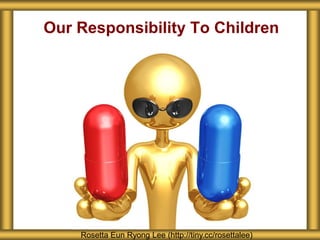
Our Responsibility To Children
Rosetta Eun Ryong Lee (http://tiny.cc/rosettalee)
Presenter Information
Rosetta Eun Ryong Lee
6th Faculty and
Professional Outreach
Seattle Girls’ School
2706 S Jackson Street
Seattle WA 98144
(206) 805-6562
rlee@seattlegirlsschool.org
http://tiny.cc/rosettalee
Rosetta Eun Ryong Lee (http://tiny.cc/rosettalee)

AsEA 2017 API Affinity Group Challenges and Opportunities

  • 1.
    AsEA Conference 2017 RosettaEun Ryong Lee Seattle Girls’ School Challenges and Opportunities for API Affinity Groups Rosetta Eun Ryong Lee (http://tiny.cc/rosettalee)
  • 2.
    About Seattle Girls’School Rosetta Eun Ryong Lee (http://tiny.cc/rosettalee)
  • 3.
    Agenda  Basic Definitions What We’ve Tried and What Happened  Challenges  Opportunities  Resources Rosetta Eun Ryong Lee (http://tiny.cc/rosettalee)
  • 4.
    Basic Definitions The termaffinity group is used as a bringing together of people who have an identifier in common, e.g. race, gender, religion, family status, etc. Affinity groups are for individuals who identify as members of the group and can speak to the experience of being a member of the group from the “I” perspective. Rosetta Eun Ryong Lee (http://tiny.cc/rosettalee)
  • 5.
    Basic Definitions The termalliance group is used as a bringing together of people who have a common commitment to an identifier group, e.g. race, gender, religion, family status, etc. Alliance groups are for individuals who identify as members of the group and/or as people who support and stand in solidarity with that group. Rosetta Eun Ryong Lee (http://tiny.cc/rosettalee)
  • 6.
    Basic Definitions The terminterest group is used as a bringing together of people who want to learn about, share, and engage in a special interest, e.g. hobby, skill, topic, etc. Interest groups are for individuals who want to gather to teach, learn, and share. Membership can be fluid and changing. Rosetta Eun Ryong Lee (http://tiny.cc/rosettalee)
  • 7.
    What We’ve Triedand How It’s Going Please work in groups of 3 and introduce yourselves. Describe where your school is in the process of launching or implementing API affinity groups. What are some of the success and challenges you’ve experienced? Rosetta Eun Ryong Lee (http://tiny.cc/rosettalee)
  • 8.
    Why Affinity GroupsAre Great  Safety and Comfort to be Authentic  Affirmation  Critical Mass  Identity Socialization  Building Resilience  Preparing to Engage Deeply with Other Groups  Empowerment Toward Action Rosetta Eun Ryong Lee (http://tiny.cc/rosettalee)
  • 9.
    Unique Challenges of APIAffinity Groups  Varying Racial/Ethnic Identification  Lack of Racial Cohesiveness  Racial Oppression Model for Affinity Groups  Ranking of Oppressions  Cultural Barriers  High Numbers in Our Schools Rosetta Eun Ryong Lee (http://tiny.cc/rosettalee)
  • 10.
    Varying Ethnic Identifications RosettaEun Ryong Lee (http://tiny.cc/rosettalee)
  • 11.
    An Artificial Construct RosettaEun Ryong Lee (http://tiny.cc/rosettalee)
  • 12.
    An Artificial Construct RosettaEun Ryong Lee (http://tiny.cc/rosettalee)
  • 13.
    Rosetta Eun RyongLee (http://tiny.cc/rosettalee) An Artificial Construct
  • 14.
    The Story ofAsian Pacific America Rosetta Eun Ryong Lee (http://tiny.cc/rosettalee)
  • 15.
    Excerpts of AsianPacific American History  1763 Filipinos settle Saint Malo  1778 Chinese sailors land in Hawaii  1820s Chinese immigration begins in earnest  1865 The Central Pacific Railroad Co. recruits Chinese workers for the transcontinental railroad  1878 Chinese are ruled ineligible for naturalized citizenship  1882 Chinese Exclusion Act is passed Rosetta Eun Ryong Lee (http://tiny.cc/rosettalee)
  • 16.
     1941 Japanair force attacked Pearl Harbor; FBI arrests pro-Japanese community leaders  1941-45 Filipino resistance movement, working closely with U.S. Army, fights the Japanese invaders  1942, President Franklin D. Roosevelt signs Executive Order 9066 on February 19, uprooting 100,000 people of Japanese descent on the west coast to be sent to Internment camps.  1943-1945 Japanese Americans volunteer for the US Army’s 442nd Regimental Combat Team and becomes the highest decorated military unit in US history  1946, the Luce–Celler Act of 1946 grants naturalization opportunities to Filipino Americans and Indian Americans (which included present-day Pakistanis and Bangladeshis) Rosetta Eun Ryong Lee (http://tiny.cc/rosettalee) Excerpts of Asian Pacific American History
  • 17.
    Excerpts of AsianPacific American History  1968 Term “Asian American” is coined as a part of the Asian American Movement, a radical movement for social justice (Red Guard)  1975 More than 130,000 refugees enter the U.S. from Vietnam, Kampuchea, and Laos as Communist governments are established there following the end of the Indochina War.  1982 Vincent Chin is accused of being a Japanese (being blamed for loss of jobs) and beaten to death.  1987 First formal signing of the Proclamation of Asian Pacific American Heritage Week by the White House Rosetta Eun Ryong Lee (http://tiny.cc/rosettalee)
  • 18.
    Emergent Themes  ThePerpetual Immigrant  The Worker Not Owner  Black or White or Neither?  Weak as a Socio-Political Group  Ethnically Separated Rosetta Eun Ryong Lee (http://tiny.cc/rosettalee)
  • 19.
    Myth of theModel Minority  Overly Hard Working and Tireless  Will Work Under Extreme Circumstances  Quiet and Cooperative  Serene, Smart, Resilient  Doesn’t Seek the Limelight Rosetta Eun Ryong Lee (http://tiny.cc/rosettalee)
  • 20.
    Legacy of theMyth  Outsourcing of Cheap Labor  Orientalism in Health Care  Tokenism and Minimalization  Stress of Achievement  Funneling into STEM Fields  Where Are You From? Rosetta Eun Ryong Lee (http://tiny.cc/rosettalee)
  • 21.
    Recent Influx ofAsian Pacific Americans Rosetta Eun Ryong Lee (http://tiny.cc/rosettalee)
  • 22.
    Recent Influx in OurSchools Rosetta Eun Ryong Lee (http://tiny.cc/rosettalee) Source: Department of Homeland Security, The Wall Street Journal
  • 23.
    Recent Emergent Themes Highly Educated  Socioeconomically Well Off  Not Really People of Color  Weak as a Socio-Political Group  Ethnically Separated Rosetta Eun Ryong Lee (http://tiny.cc/rosettalee)
  • 24.
    Recent Model MinorityIncarnation  Overly Hard Working and Tireless  Quiet and Cooperative  Serene, Smart, Resilient  Doesn’t Seek the Limelight  Driven by “Tiger Moms” Rosetta Eun Ryong Lee (http://tiny.cc/rosettalee)
  • 25.
    What Kind ofAPI Are Your Students? Rosetta Eun Ryong Lee (http://tiny.cc/rosettalee)  East Asian  Southeast Asian  South Asian  Pacific Islander  Multiracial  Transracially Adopted  International Student  3rd Generation or Later  Recent Immigrant  Refugee  And…
  • 26.
    How Do theObstacles Manifest? Rosetta Eun Ryong Lee (http://tiny.cc/rosettalee)  Varying Racial/Ethnic Identification  Lack of Racial Cohesiveness  Racial Oppression Model for Affinity Groups  Ranking of Oppressions  Cultural Barriers  High Numbers in Our Schools  Other?
  • 27.
    Stage 1: Identifythe Need  Gather data around the school’s population  Gather research on the challenges groups face  Gather research on the benefit of affinity groups, explicit conversations  Gather data around need and desire  CONNECT TO YOUR MISSION Rosetta Eun Ryong Lee (http://tiny.cc/rosettalee)
  • 28.
    Stage 2: DetermineFormat and Definitions  Affinity, Alliance, or Interest?  Identities/Identifiers  Timing  Space  Facilitators  Group Goals or Mission Statements  Curriculum Rosetta Eun Ryong Lee (http://tiny.cc/rosettalee)
  • 29.
    Stage 3: Communicateand Invite  Initial Communication from Head  Communicate the Need, the What, the How, and the Who  Communicate Definitions, Goals, and Missions  FAQs  Faculty/Staff, Parents/Guardians, Students Rosetta Eun Ryong Lee (http://tiny.cc/rosettalee)
  • 30.
    Stage 4: FacilitateGroups  Identity Pride  History  Positive Change and Activism  Opportunities and Challenges  Strategies for Success  Supporting Each Other Rosetta Eun Ryong Lee (http://tiny.cc/rosettalee)
  • 31.
    Stage 5: Wash,Rinse, Repeat  Assess Effectiveness  Make Improvements  Re-Launch Every Year  Utilize Student/Family Voice  United Front Rosetta Eun Ryong Lee (http://tiny.cc/rosettalee)
  • 32.
    Possible Affinity GroupCurriculum  Culture Share  Celebrations of Holidays/Events  Identity Exercises  Current Events  Movies  Field Trips  “What Do I Do If…” Rosetta Eun Ryong Lee (http://tiny.cc/rosettalee)
  • 33.
    Factors Leading toMore Success  Pride > Struggle  Deflection of Blame  Inclusive of Full Spectrum  Who’s in the Room  Youth Driven Curricula  Opportunities to Share  Collective Action Rosetta Eun Ryong Lee (http://tiny.cc/rosettalee)
  • 34.
    Factors Leading toLess Success  Lack of Consistency  Lack of Budget  Lack of Curricula  Reinforcement of Stereotypes  Chauvinism  Adult Agenda  Visitors and Gawkers Rosetta Eun Ryong Lee (http://tiny.cc/rosettalee)
  • 35.
    Reflection What information was new,useful, interesting, worrisome, etc.? What questions do you have? What’s missing? Rosetta Eun Ryong Lee (http://tiny.cc/rosettalee)
  • 36.
    Resources Full resources, weblinks, downloadable documents, and more can be found at: https://sites.google.com/a/sgs- wa.org/sgsprofessionaloutreach/affinity- group-resource-page (or go to tiny.cc/rosettalee and scroll down for “Affinity Group Resource Page” under “Generally Used Sessions”) Rosetta Eun Ryong Lee (http://tiny.cc/rosettalee)
  • 37.
    Our Responsibility ToChildren Rosetta Eun Ryong Lee (http://tiny.cc/rosettalee)
  • 38.
    Presenter Information Rosetta EunRyong Lee 6th Faculty and Professional Outreach Seattle Girls’ School 2706 S Jackson Street Seattle WA 98144 (206) 805-6562 rlee@seattlegirlsschool.org http://tiny.cc/rosettalee Rosetta Eun Ryong Lee (http://tiny.cc/rosettalee)

Editor's Notes