Ascending Aorta Surgical
Repair Techniques
By: Samuel Moreno; MS.
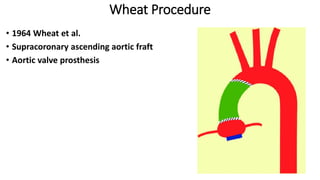
Wheat Procedure
• 1964 Wheat et al.
• Supracoronary ascending aortic fraft
• Aortic valve prosthesis
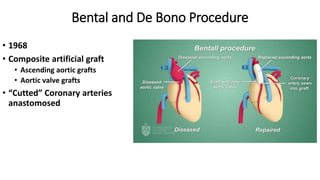
Bental and De Bono Procedure
• 1968
• Composite artificial graft
• Ascending aortic grafts
• Aortic valve grafts
• “Cutted” Coronary arteries
anastomosed
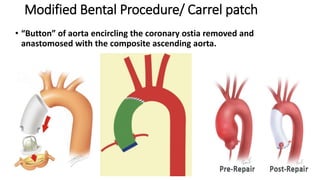
Modified Bental Procedure/ Carrel patch
• “Button” of aorta encircling the coronary ostia removed and
anastomosed with the composite ascending aorta.
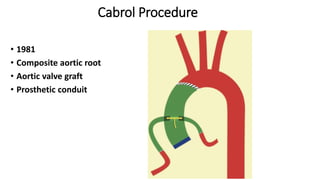
Cabrol Procedure
• 1981
• Composite aortic root
• Aortic valve graft
• Prosthetic conduit

Ascending aorta surgical repair techniques

Editor's Notes

  • #2 Why ?  aneurisms and acute aortic síndromes ( aortic dissection and intramural hematoma)
  • #3 An ascending aortic graft that is placed distal to the coronary ostia is known as a supracoronary graft Su- pracoronary grafting is indicated in patients with an ascending aortic aneurysm of atherosclerotic origin and normal sinuses ofValsalva preservation of the coronary ostia minimizes the risk for pseudoaneurysms, stenosis, thrombosis, and kinking at the coronary anasto- mosis site One recognized complication of supracoronary grafting is the development of dis- section or aneurysm of the native aorta proximal to the graft. Patients with annuloaortic ectasia or Marfan syndrome are especially prone to such a complication; thus, a composite repair method (ie, graft plus valve) is typically preferred in such patients
  • #4 developed a procedure for patients with both aortic valvular disease and dilatation of the sinuses of Valsalva
  • #5 The relatively common development of pseudo- aneurysms at the coronary artery anastomosis sites led to the creation of the modified Bentall procedure
  • #6 Cabrol procedure was developed in 1981 as an alternative to the modified Bentall procedure in patients with aortic dissection, annuloaortic ectasia, or atherosclerotic aneurysm and in whom the button Bentall technique is not achievable, such as those with severe atherosclerosis of the as- cending aorta, which precludes good-quality aortic buttons; severe proximal coronary artery disease; and a failed Ross procedure In the Cabrol procedure, a composite aortic root and aortic valve graft and a prosthetic conduit anastomose the coronary ostia to the aortic graft in a side-to-side manner Intrinsic complications of the Cabrol procedure include early postoperative death in patients with aortic dissection, anastomotic leak, coronary graft insufficiency from kinking or inti- mal hyperplasia, acute coronary graft thrombosis, and endocarditis