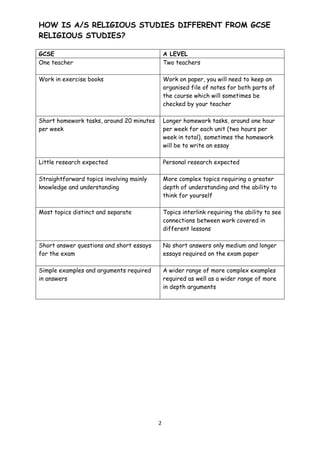
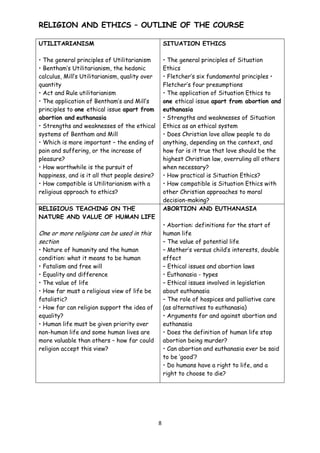
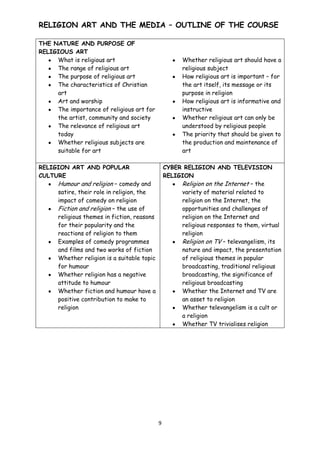
A/S RELIGIOUS STUDIES<br />HANDBOOK<br />RELIGION AND ETHICS<br />RELIGION ART AND THE MEDIA<br />HOW IS A/S RELIGIOUS STUDIES DIFFERENT FROM GCSE RELIGIOUS STUDIES?<br />GCSEA LEVELOne teacherTwo teachersWork in exercise booksWork on paper, you will need to keep an organised file of notes for both parts of the course which will sometimes be checked by your teacherShort homework tasks, around 20 minutes per weekLonger homework tasks, around one hour per week for each unit (two hours per week in total), sometimes the homework will be to write an essayLittle research expectedPersonal research expectedStraightforward topics involving mainly knowledge and understandingMore complex topics requiring a greater depth of understanding and the ability to think for yourselfMost topics distinct and separateTopics interlink requiring the ability to see connections between work covered in different lessonsShort answer questions and short essays for the examNo short answers only medium and longer essays required on the exam paperSimple examples and arguments required in answersA wider range of more complex examples required as well as a wider range of more in depth arguments<br />WHAT WILL I DO AND WHAT IS EXPECTED IN A/S RELIGIOUS STUDIES<br />The A/S Religious Studies course is split into two units, Religion and Ethics, and Religion Art and the Media.  There will be two exams at the end of the course one for each of the units.
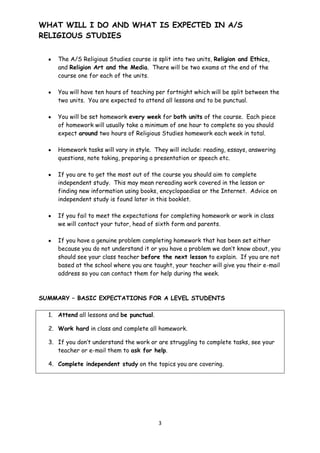
You will have ten hours of teaching per fortnight which will be split between the two units.  You are expected to attend all lessons and to be punctual.
You will be set homework every week for both units of the course.  Each piece of homework will usually take a minimum of one hour to complete so you should expect around two hours of Religious Studies homework each week in total.
Homework tasks will vary in style.  They will include: reading, essays, answering questions, note taking, preparing a presentation or speech etc.
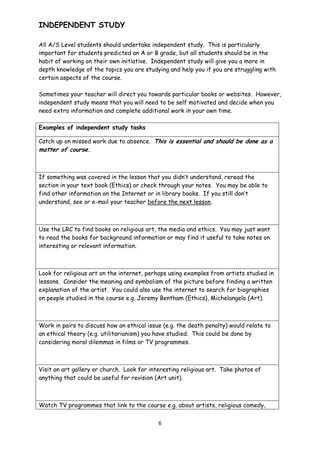
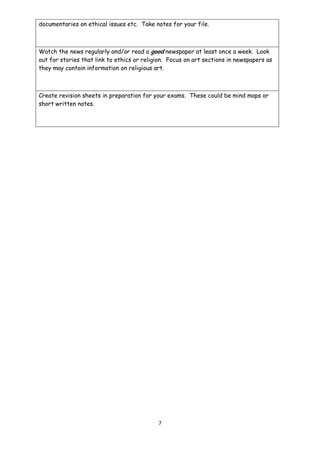
If you are to get the most out of the course you should aim to complete independent study.  This may mean rereading work covered in the lesson or finding new information using books, encyclopaedias or the Internet.  Advice on independent study is found later in this booklet.
If you fail to meet the expectations for completing homework or work in class we will contact your tutor, head of sixth form and parents.
If you have a genuine problem completing homework that has been set either because you do not understand it or you have a problem we don’t know about, you should see your class teacher before the next lesson to explain.  If you are not based at the school where you are taught, your teacher will give you their e-mail address so you can contact them for help during the week.
SUMMARY – BASIC EXPECTATIONS FOR A LEVEL STUDENTS
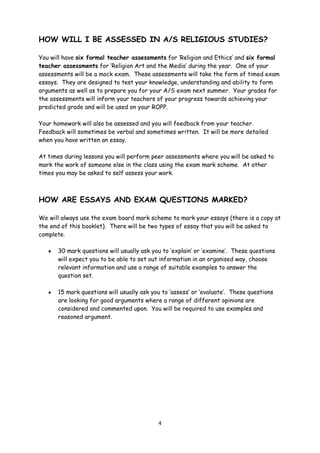
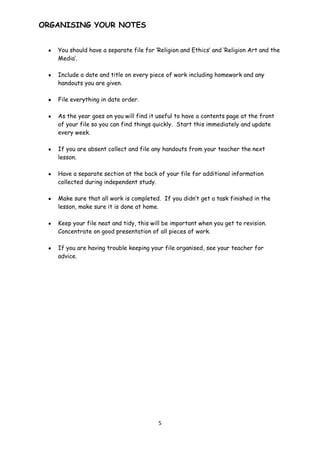
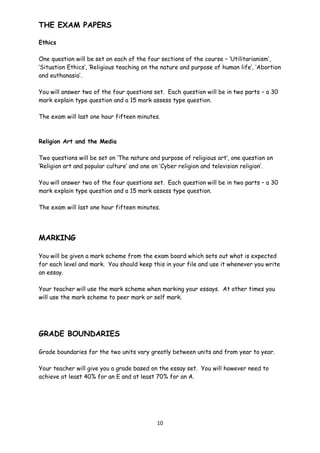
Attend all lessons and be punctual.Work hard in class and complete all homework.If you don’t understand the work or are struggling to complete tasks, see your teacher or e-mail them to ask for help.Complete independent study on the topics you are covering.HOW WILL I BE ASSESSED IN A/S RELIGIOUS STUDIES?<br />You will have six formal teacher assessments for ‘Religion and Ethics’ and six formal teacher assessments for ‘Religion Art and the Media’ during the year.  One of your assessments will be a mock exam.  These assessments will take the form of timed exam essays.  They are designed to test your knowledge, understanding and ability to form arguments as well as to prepare you for your A/S exam next summer.  Your grades for the assessments will inform your teachers of your progress towards achieving your predicted grade and will be used on your ROPP.<br />Your homework will also be assessed and you will feedback from your teacher.  Feedback will sometimes be verbal and sometimes written.  It will be more detailed when you have written an essay.<br />At times during lessons you will perform peer assessments where you will be asked to mark the work of someone else in the class using the exam mark scheme.  At other times you may be asked to self assess your work.<br />HOW ARE ESSAYS AND EXAM QUESTIONS MARKED?<br />We will always use the exam board mark scheme to mark your essays (there is a copy at the end of this booklet).  There will be two types of essay that you will be asked to complete.  <br />30 mark questions will usually ask you to ‘explain’ or ‘examine’.  These questions will expect you to be able to set out information in an organised way, choose relevant information and use a range of suitable examples to answer the question set.<br />15 mark questions will usually ask you to ‘assess’ or ‘evaluate’.  These questions are looking for good arguments where a range of different opinions are considered and commented upon.  You will be required to use examples and reasoned argument.<br />ORGANISING YOUR NOTES<br />You should have a separate file for ‘Religion and Ethics’ and ‘Religion Art and the Media’.
Include a date and title on every piece of work including homework and any handouts you are given.
File everything in date order.

As re booklet

  • 1.
    A/S RELIGIOUS STUDIES<br/>HANDBOOK<br />RELIGION AND ETHICS<br />RELIGION ART AND THE MEDIA<br />HOW IS A/S RELIGIOUS STUDIES DIFFERENT FROM GCSE RELIGIOUS STUDIES?<br />GCSEA LEVELOne teacherTwo teachersWork in exercise booksWork on paper, you will need to keep an organised file of notes for both parts of the course which will sometimes be checked by your teacherShort homework tasks, around 20 minutes per weekLonger homework tasks, around one hour per week for each unit (two hours per week in total), sometimes the homework will be to write an essayLittle research expectedPersonal research expectedStraightforward topics involving mainly knowledge and understandingMore complex topics requiring a greater depth of understanding and the ability to think for yourselfMost topics distinct and separateTopics interlink requiring the ability to see connections between work covered in different lessonsShort answer questions and short essays for the examNo short answers only medium and longer essays required on the exam paperSimple examples and arguments required in answersA wider range of more complex examples required as well as a wider range of more in depth arguments<br />WHAT WILL I DO AND WHAT IS EXPECTED IN A/S RELIGIOUS STUDIES<br />The A/S Religious Studies course is split into two units, Religion and Ethics, and Religion Art and the Media. There will be two exams at the end of the course one for each of the units.
  • 2.
    You will haveten hours of teaching per fortnight which will be split between the two units. You are expected to attend all lessons and to be punctual.
  • 3.
    You will beset homework every week for both units of the course. Each piece of homework will usually take a minimum of one hour to complete so you should expect around two hours of Religious Studies homework each week in total.
  • 4.
    Homework tasks willvary in style. They will include: reading, essays, answering questions, note taking, preparing a presentation or speech etc.
  • 5.
    If you areto get the most out of the course you should aim to complete independent study. This may mean rereading work covered in the lesson or finding new information using books, encyclopaedias or the Internet. Advice on independent study is found later in this booklet.
  • 6.
    If you failto meet the expectations for completing homework or work in class we will contact your tutor, head of sixth form and parents.
  • 7.
    If you havea genuine problem completing homework that has been set either because you do not understand it or you have a problem we don’t know about, you should see your class teacher before the next lesson to explain. If you are not based at the school where you are taught, your teacher will give you their e-mail address so you can contact them for help during the week.
  • 8.
    SUMMARY – BASICEXPECTATIONS FOR A LEVEL STUDENTS
  • 9.
  • 10.
    Attend all lessonsand be punctual.Work hard in class and complete all homework.If you don’t understand the work or are struggling to complete tasks, see your teacher or e-mail them to ask for help.Complete independent study on the topics you are covering.HOW WILL I BE ASSESSED IN A/S RELIGIOUS STUDIES?<br />You will have six formal teacher assessments for ‘Religion and Ethics’ and six formal teacher assessments for ‘Religion Art and the Media’ during the year. One of your assessments will be a mock exam. These assessments will take the form of timed exam essays. They are designed to test your knowledge, understanding and ability to form arguments as well as to prepare you for your A/S exam next summer. Your grades for the assessments will inform your teachers of your progress towards achieving your predicted grade and will be used on your ROPP.<br />Your homework will also be assessed and you will feedback from your teacher. Feedback will sometimes be verbal and sometimes written. It will be more detailed when you have written an essay.<br />At times during lessons you will perform peer assessments where you will be asked to mark the work of someone else in the class using the exam mark scheme. At other times you may be asked to self assess your work.<br />HOW ARE ESSAYS AND EXAM QUESTIONS MARKED?<br />We will always use the exam board mark scheme to mark your essays (there is a copy at the end of this booklet). There will be two types of essay that you will be asked to complete. <br />30 mark questions will usually ask you to ‘explain’ or ‘examine’. These questions will expect you to be able to set out information in an organised way, choose relevant information and use a range of suitable examples to answer the question set.<br />15 mark questions will usually ask you to ‘assess’ or ‘evaluate’. These questions are looking for good arguments where a range of different opinions are considered and commented upon. You will be required to use examples and reasoned argument.<br />ORGANISING YOUR NOTES<br />You should have a separate file for ‘Religion and Ethics’ and ‘Religion Art and the Media’.
  • 11.
    Include a dateand title on every piece of work including homework and any handouts you are given.
  • 12.