SOR I   SOR II
HSC External Examination
     Specifications


  Studies of Religion I
Studies of Religion I
The external examination provides a measure of student achievement
in a range of syllabus outcomes that can be reliably measured in an
examination setting.
The external examination and its marking and reporting relate to
syllabus standards by:
 ► providing clear links to syllabus outcomes
 ► enabling students to demonstrate the levels of achievement
 ► outlined in the course performance scale applying marking guidelines based on
   established criteria.
The syllabus on p 37 states the aim of
 SOR is to 'develop a comprehensive
view of religious traditions and the link
   this has on the life of adherents'
    Given the changes to the HSC exam in 2009
     and the current exam structure changes for
    2010, it is (in my opinion) VERY important to
      note the above point in relation to exam
                   question structure.              4
Section I: Religion and Belief Systems in
              Australia post-1945
                           15 marks
►This section is comprised of ten multiple-choice questions
 and one short-answer question.
►Questions may be based on stimulus material.
 Stimulus Material may be used for more than 1 question. (M/
 C and Short Answer)
►All questions are compulsory.
Added information
►NOTE:
 Numbering system of Multiple Choice for SOR I/II is as
 follows;
 1-10= M/C
 11= Short Answer
 12-21=M/C (SOR II ONLY)
 22= Short Answer (SOR II ONLY)
►M/C will be answered on two answer sheets
►Short answer response sheet is in the exam paper itself
 (~3/4 page of writing)
Section II: Religious Tradition Depth Study
                               15 marks

►There will be five questions, each from a different religious tradition.
►Each question is worth 15 marks.
►Each question will be in three non-dependent parts.
 NB: CHANGE IN 2010- No ‘Maximum Mark’ per part
 i.e used to be a max. of 6 marks per part- NO LONGER THE
 CASE!
 CAREFUL USING PAST PAPERS AS A SAMPLE
►Students will complete ONE question from Section II. (SOR I students
 only)
►2010-EXPECTED LENGTH OF RESPONSE= 600 words/4 pages
Section III: Religious Tradition Depth Study
                               20 marks
►There will be five questions, each consisting of one extended response
 question.
►Each question is worth 20 marks.
►Students will complete ONE question from Section III.
►The question attempted must be from a DIFFERENT religious tradition
 from that attempted in Section II.
►2010-EXPECTED LENGTH OF RESPONSE= 800 words/6 pages


►LINK
HSC External Examination
     Specifications

 Studies of Religion II
Studies of Religion II
The external examination provides a measure of student achievement
in a range of syllabus outcomes that can be reliably measured in an
examination setting.
The external examination and its marking and reporting relate to
syllabus standards by:
 ► providing clear links to syllabus outcomes
 ► enabling students to demonstrate the levels of achievement
 ► outlined in the course performance scale applying marking guidelines based on
   established criteria.
The syllabus on p 37 states the aim of
 SOR is to 'develop a comprehensive
view of religious traditions and the link
   this has on the life of adherents'
    Given the changes to the HSC exam in 2009
     and the current exam structure changes for
    2010, it is (in my opinion) VERY important to
      note the above point in relation to exam
                   question structure.              11
Section I
          Religion and Belief Systems in Australia post-1945
                                15 marks
►This section is comprised of ten multiple-choice questions
 and one short-answer question.
►Questions may be based on stimulus material.
 Stimulus Material may be used for more than 1 question. (M/
 C and Short Answer)
►All questions are compulsory.
Section I
                     Religion and Non-Religion
                              15 marks
►This section is comprised of ten multiple-choice questions
 and one short-answer question.
►Questions may be based on stimulus material. Source
 Material may be used for more than 1 question. (M/C and
 Short Answer)
►All questions are compulsory.
Added information
►NOTE:
 Numbering system of Multiple Choice for SOR I/II is as
 follows;
 1-10= M/C
 11= Short Answer
 12-21=M/C (SOR II ONLY)
 22= Short Answer (SOR II ONLY)
►M/C will be answered on two answer sheets
►Short answer response sheet is in the exam paper itself
 (~3/4 page of writing)
Section II: Religious Tradition Depth Study
                            30 marks
►There   will be five questions, each from a different religious
 tradition.
►Each question is worth 15 marks.
►Each question will be in three non-dependent parts.
 NB: CHANGE IN 2010- No ‘Maximum Mark’ per part
 i.e used to be a max. of 6 marks per part- NO LONGER THE
 CASE!
 CAREFUL USING PAST PAPERS AS A SAMPLE
►Students   will complete TWO questions from Section II.
►2010-EXPECTED     LENGTH OF RESPONSE= 600 words/4 pages
Section III: Religious Tradition Depth Study
                            20 marks

►There   will be five questions, each consisting of one extended
 response question.
►Each question is worth 20 marks.
►Students will complete ONE question from Section III.
►The question attempted must be from a DIFFERENT religious
 tradition from that attempted in Section II.
►2010-EXPECTED    LENGTH OF RESPONSE= 800 words/6 pages
Section IV: Religion and Peace
                           20 marks

►There   will be ONE question requiring an extended response.
►2010-EXPECTED    LENGTH OF RESPONSE= 800 words/6 pages
Studies of Religion
                          RUBRIC
In your answer you will be assessed on how well you:
►incorporate significant aspects of religion to illustrate your
 answer
►use language and terminology appropriate to the study of
 religion
►presents ideas clearly in a well-structured answer
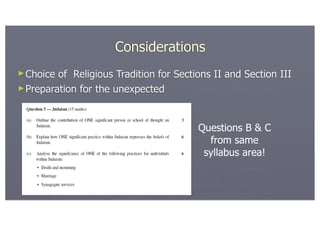
Considerations
►Choice of Religious Tradition for Sections II and Section III
►Preparation for the unexpected


                                        Questions B & C
                                          from same
                                         syllabus area!
Other points raised
►  (limited) Range of terms used in syllabus not indicative of
 what may be used in HSC
 i.e can use other terms as opposed to those used in syllabus
►Stimulus Material- have to reference to - not a “distracter”
 but actually a resource that can be used in answering your
 question/s.
►Section II- note range of marks (can now exceed 6/
 section)
►Peace   question (SOR II)= “extended response” .: same style
 as /20 question
►Section II and III- there will be an “administration check”
 after the papers have been marked to ensure correct religions
 have been done (i.e have not done the same one 2/3 times!)
 - take the best mark of similar questions as your mark /35
 or /50
►Rubric=  no mention of “religious traditions” but you have to
 use them WHERE APPROPRIATE i.e don’t force yourself to
 mention them if not applicable
►Significant Aspects
►Use of language and terminology
►Presents ideas clearly and is well structured
►Can  double dip in some areas (Sect II and into Sect III)
 i.e concept of asking the same thing ‘twice’ (/15 then in /20)
 .: have to be prepared for the unexpected
 .: knowledge of syllabus is a good thing!
“00” Vs “0”
►Major  difference now between a non-serious attempt and just
 getting it ‘wrong’
 Marking criteria has no zero grade as such
 .: MUST ATTEMPT EVERYTHING- don’t leave gaps as marks
 are there to be given.
Expected lengths?

►Now   stated as 600 words/4 exam booklet pages for /15 and
 800 words/6 exam booklet pages /20
►NOTE: 1.8 minutes per mark so this should also be a guide
 for lengths etc
The 2009 HSC
►NB- The ‘traditional structure’ of the questions changed in the
 20 mark section.

 “And it came to pass, when he had sat down with them to meat, he took
 the1 bread and blessed; and breaking it he gave to them. 31And their
 eyes were opened, and they knew him; and he vanished out of their
 sight. 32And they said one to another, Was not our heart burning within
 us, while he spake to us in the way, while he opened to us the
 scriptures?” (Luke 24:30-32)
 With reference to Luke’s post-resurrection account in the
 quotation, assess Christianity as a living religious tradition in the
 life of its adherents.
                                                               26
Therefore……...
►YOU MUST KNOW THE SYLLABUS AREAS AND WHAT
 THE SYLLABUS ASKS YOU TO DO

 -> ‘STUDENTS LEARN ABOUT’ AND ‘STUDENTS LEARN
 TO’
►Huge stress on ‘develop(ing) a comprehensive view of
 religious traditions and the link this has on the life of
 adherents’ (pg 37 of syllabus)
►Essay writing practice is also a ‘must do’ task (but don’t
 pre-empt essay questions and then use these for
 memorisation (pre-planned essays)
                                                    27
►end

2005 Hsc Syllabus Exam Structure Modified 2010

  • 1.
    SOR I SOR II
  • 2.
    HSC External Examination Specifications Studies of Religion I
  • 3.
    Studies of ReligionI The external examination provides a measure of student achievement in a range of syllabus outcomes that can be reliably measured in an examination setting. The external examination and its marking and reporting relate to syllabus standards by: ► providing clear links to syllabus outcomes ► enabling students to demonstrate the levels of achievement ► outlined in the course performance scale applying marking guidelines based on established criteria.
  • 4.
    The syllabus onp 37 states the aim of SOR is to 'develop a comprehensive view of religious traditions and the link this has on the life of adherents' Given the changes to the HSC exam in 2009 and the current exam structure changes for 2010, it is (in my opinion) VERY important to note the above point in relation to exam question structure. 4
  • 5.
    Section I: Religionand Belief Systems in Australia post-1945 15 marks ►This section is comprised of ten multiple-choice questions and one short-answer question. ►Questions may be based on stimulus material. Stimulus Material may be used for more than 1 question. (M/ C and Short Answer) ►All questions are compulsory.
  • 6.
    Added information ►NOTE: Numberingsystem of Multiple Choice for SOR I/II is as follows; 1-10= M/C 11= Short Answer 12-21=M/C (SOR II ONLY) 22= Short Answer (SOR II ONLY) ►M/C will be answered on two answer sheets ►Short answer response sheet is in the exam paper itself (~3/4 page of writing)
  • 7.
    Section II: ReligiousTradition Depth Study 15 marks ►There will be five questions, each from a different religious tradition. ►Each question is worth 15 marks. ►Each question will be in three non-dependent parts. NB: CHANGE IN 2010- No ‘Maximum Mark’ per part i.e used to be a max. of 6 marks per part- NO LONGER THE CASE! CAREFUL USING PAST PAPERS AS A SAMPLE ►Students will complete ONE question from Section II. (SOR I students only) ►2010-EXPECTED LENGTH OF RESPONSE= 600 words/4 pages
  • 8.
    Section III: ReligiousTradition Depth Study 20 marks ►There will be five questions, each consisting of one extended response question. ►Each question is worth 20 marks. ►Students will complete ONE question from Section III. ►The question attempted must be from a DIFFERENT religious tradition from that attempted in Section II. ►2010-EXPECTED LENGTH OF RESPONSE= 800 words/6 pages ►LINK
  • 9.
    HSC External Examination Specifications Studies of Religion II
  • 10.
    Studies of ReligionII The external examination provides a measure of student achievement in a range of syllabus outcomes that can be reliably measured in an examination setting. The external examination and its marking and reporting relate to syllabus standards by: ► providing clear links to syllabus outcomes ► enabling students to demonstrate the levels of achievement ► outlined in the course performance scale applying marking guidelines based on established criteria.
  • 11.
    The syllabus onp 37 states the aim of SOR is to 'develop a comprehensive view of religious traditions and the link this has on the life of adherents' Given the changes to the HSC exam in 2009 and the current exam structure changes for 2010, it is (in my opinion) VERY important to note the above point in relation to exam question structure. 11
  • 12.
    Section I Religion and Belief Systems in Australia post-1945 15 marks ►This section is comprised of ten multiple-choice questions and one short-answer question. ►Questions may be based on stimulus material. Stimulus Material may be used for more than 1 question. (M/ C and Short Answer) ►All questions are compulsory.
  • 13.
    Section I Religion and Non-Religion 15 marks ►This section is comprised of ten multiple-choice questions and one short-answer question. ►Questions may be based on stimulus material. Source Material may be used for more than 1 question. (M/C and Short Answer) ►All questions are compulsory.
  • 14.
    Added information ►NOTE: Numberingsystem of Multiple Choice for SOR I/II is as follows; 1-10= M/C 11= Short Answer 12-21=M/C (SOR II ONLY) 22= Short Answer (SOR II ONLY) ►M/C will be answered on two answer sheets ►Short answer response sheet is in the exam paper itself (~3/4 page of writing)
  • 15.
    Section II: ReligiousTradition Depth Study 30 marks ►There will be five questions, each from a different religious tradition. ►Each question is worth 15 marks. ►Each question will be in three non-dependent parts. NB: CHANGE IN 2010- No ‘Maximum Mark’ per part i.e used to be a max. of 6 marks per part- NO LONGER THE CASE! CAREFUL USING PAST PAPERS AS A SAMPLE ►Students will complete TWO questions from Section II. ►2010-EXPECTED LENGTH OF RESPONSE= 600 words/4 pages
  • 16.
    Section III: ReligiousTradition Depth Study 20 marks ►There will be five questions, each consisting of one extended response question. ►Each question is worth 20 marks. ►Students will complete ONE question from Section III. ►The question attempted must be from a DIFFERENT religious tradition from that attempted in Section II. ►2010-EXPECTED LENGTH OF RESPONSE= 800 words/6 pages
  • 17.
    Section IV: Religionand Peace 20 marks ►There will be ONE question requiring an extended response. ►2010-EXPECTED LENGTH OF RESPONSE= 800 words/6 pages
  • 18.
    Studies of Religion RUBRIC In your answer you will be assessed on how well you: ►incorporate significant aspects of religion to illustrate your answer ►use language and terminology appropriate to the study of religion ►presents ideas clearly in a well-structured answer
  • 19.
    Considerations ►Choice of ReligiousTradition for Sections II and Section III ►Preparation for the unexpected Questions B & C from same syllabus area!
  • 20.
    Other points raised ► (limited) Range of terms used in syllabus not indicative of what may be used in HSC i.e can use other terms as opposed to those used in syllabus ►Stimulus Material- have to reference to - not a “distracter” but actually a resource that can be used in answering your question/s. ►Section II- note range of marks (can now exceed 6/ section)
  • 21.
    ►Peace question (SOR II)= “extended response” .: same style as /20 question ►Section II and III- there will be an “administration check” after the papers have been marked to ensure correct religions have been done (i.e have not done the same one 2/3 times!) - take the best mark of similar questions as your mark /35 or /50
  • 22.
    ►Rubric= nomention of “religious traditions” but you have to use them WHERE APPROPRIATE i.e don’t force yourself to mention them if not applicable ►Significant Aspects ►Use of language and terminology ►Presents ideas clearly and is well structured
  • 23.
    ►Can doubledip in some areas (Sect II and into Sect III) i.e concept of asking the same thing ‘twice’ (/15 then in /20) .: have to be prepared for the unexpected .: knowledge of syllabus is a good thing!
  • 24.
    “00” Vs “0” ►Major difference now between a non-serious attempt and just getting it ‘wrong’ Marking criteria has no zero grade as such .: MUST ATTEMPT EVERYTHING- don’t leave gaps as marks are there to be given.
  • 25.
    Expected lengths? ►Now stated as 600 words/4 exam booklet pages for /15 and 800 words/6 exam booklet pages /20 ►NOTE: 1.8 minutes per mark so this should also be a guide for lengths etc
  • 26.
    The 2009 HSC ►NB-The ‘traditional structure’ of the questions changed in the 20 mark section. “And it came to pass, when he had sat down with them to meat, he took the1 bread and blessed; and breaking it he gave to them. 31And their eyes were opened, and they knew him; and he vanished out of their sight. 32And they said one to another, Was not our heart burning within us, while he spake to us in the way, while he opened to us the scriptures?” (Luke 24:30-32) With reference to Luke’s post-resurrection account in the quotation, assess Christianity as a living religious tradition in the life of its adherents. 26
  • 27.
    Therefore……... ►YOU MUST KNOWTHE SYLLABUS AREAS AND WHAT THE SYLLABUS ASKS YOU TO DO -> ‘STUDENTS LEARN ABOUT’ AND ‘STUDENTS LEARN TO’ ►Huge stress on ‘develop(ing) a comprehensive view of religious traditions and the link this has on the life of adherents’ (pg 37 of syllabus) ►Essay writing practice is also a ‘must do’ task (but don’t pre-empt essay questions and then use these for memorisation (pre-planned essays) 27
  • 28.