Mixed/cross elasticity
• Dependson the prices of other goods: complementary and
substitutes
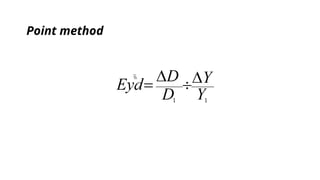
• X, Y -
Where: :
E dx (py) – mixed elasticity of demand,
Δdx/dx- change of demand of good (service) x compared to initial demand of that good,
Δ py/py – change of price of good (service) y compared to initial price of that good.
7.
Cross elasticity ofsubstitutes
• X –apples
• Y – pears
PY down
Dx – down
PY – up
DY - up
8.
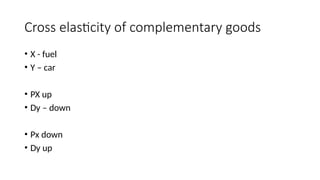
Cross elasticity ofcomplementary goods
• X - fuel
• Y – car
• PX up
• Dy – down
• Px down
• Dy up
9.
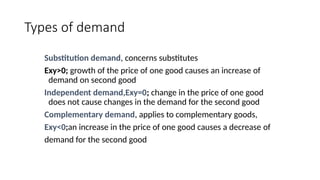
Types of demand
Substitutiondemand, concerns substitutes
Exy>0; growth of the price of one good causes an increase of
demand on second good
Independent demand,Exy=0; change in the price of one good
does not cause changes in the demand for the second good
Complementary demand, applies to complementary goods,
Exy<0;an increase in the price of one good causes a decrease of
demand for the second good
10.
For substitute goods-cross elasticity of
demand is positive (an increase in the price of
coffee stimulates demand for tea).
For complementary goods cross elasticity of
demand is negative (an increase in the price
of gasoline reduces the demand for cars with
big engine).
11.
The use ofelasticity
One of the most practical applications of price elasticity of
demand is its relationship to the total revenue of
producers/sellers.
A seller who knows the price elasticity of demand for his
good can make better decisions because he knows what will
happen if he raises or lowers the price of his good.
12.
The impact ofprice elasticity of demand on
producer revenues
Revenue (R) = P* Q
R = 1 * 6 = 6
R = 2 * 6 = 12
R = 2 * 7 = 14
13.
The impact ofprice elasticity of demand on
producer revenues
14.
The impact ofprice elasticity of demand on
producer revenues
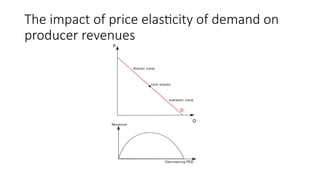
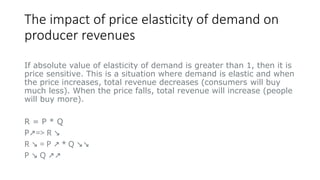
If absolute value of elasticity of demand is greater than 1, then it is
price sensitive. This is a situation where demand is elastic and when
the price increases, total revenue decreases (consumers will buy
much less). When the price falls, total revenue will increase (people
will buy more).
R = P * Q
P => R
↗ ↘
R = P * Q
↘ ↗ ↘↘
P Q
↘ ↗↗
15.
The impact ofprice elasticity of demand on
producer revenues
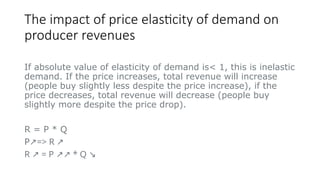
If absolute value of elasticity of demand is< 1, this is inelastic
demand. If the price increases, total revenue will increase
(people buy slightly less despite the price increase), if the
price decreases, total revenue will decrease (people buy
slightly more despite the price drop).
R = P * Q
P => R
↗ ↗
R = P * Q
↗ ↗↗ ↘
16.
The impact ofprice elasticity of demand on
producer revenues
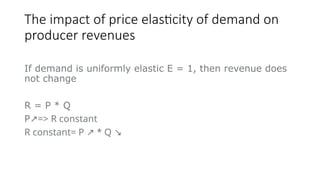
If demand is uniformly elastic E = 1, then revenue does
not change
R = P * Q
P => R
↗ constant
R constant= P * Q
↗ ↘
17.
The impact ofprice elasticity of demand on
producer revenues
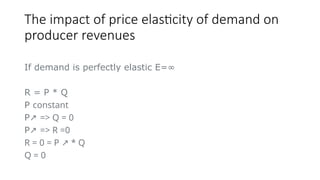
If demand is perfectly elastic E=∞
R = P * Q
P constant
P↗ => Q = 0
P↗ => R =0
R = 0 = P * Q
↗
Q = 0
18.
The impact ofprice elasticity of demand on
producer revenues
If demand is perfectly inelastic E=0
R = P * Q
Q constant
P => R
↗↗↗ ↗↗↗
R = P * Q
↗↗↗ ↗↗↗ constant
19.
Tax burden
• theway in which the tax burden is shared between the consumer and the
producer/seller
• The distribution of the tax burden depends on the relative price
elasticity of supply and demand.
• When supply is more elastic than demand, consumers take over most
of the tax burden.
• When demand is more elastic than supply, producers absorb most of
the tax costs.
• The greater the inelasticity of supply and demand, the greater the tax
revenue.
Tax burden
• Grossprice –With taking into account taxes
• Net price – without taxes
22.
Tax burden
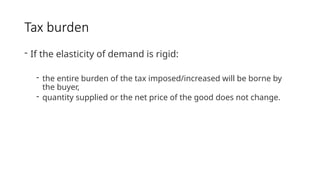
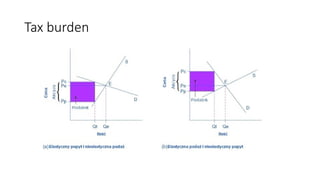
- Ifthe elasticity of demand is rigid:
- the entire burden of the tax imposed/increased will be borne by
the buyer,
- quantity supplied or the net price of the good does not change.
23.
Tax burden
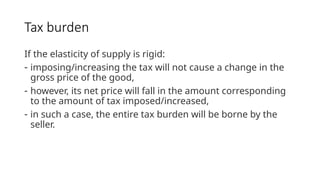
If theelasticity of supply is rigid:
- imposing/increasing the tax will not cause a change in the
gross price of the good,
- however, its net price will fall in the amount corresponding
to the amount of tax imposed/increased,
- in such a case, the entire tax burden will be borne by the
seller.
24.
Tax burden
If thedemand for a good would be perfectly flexible:
- imposing/increasing tax with the gross price unchanged =>
demand reduction and net price decrease,
- Lack of the possibility of passing the tax on to the buyer.
25.
Tax burden
If thesupply of good would be infinitely flexible:
-imposing/increasing the tax would result in a reduction in
this supply while the gross price increases, until the
equilibrium price determined by the willingness of buyers to
pay a higher price is reached.
26.
Tax burden
- theless flexible supply and demand are, the smaller is the
impact of the tax on a given type of economic activity
because imposing/increasing the tax does not cause major
changes in the allocation of resources,
- the greater the elasticity, the greater the impact of taxes on
the allocation of resources