274
Grade Level: Grade 1
Subject: Arts
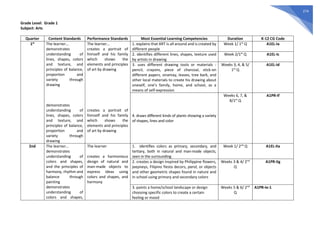
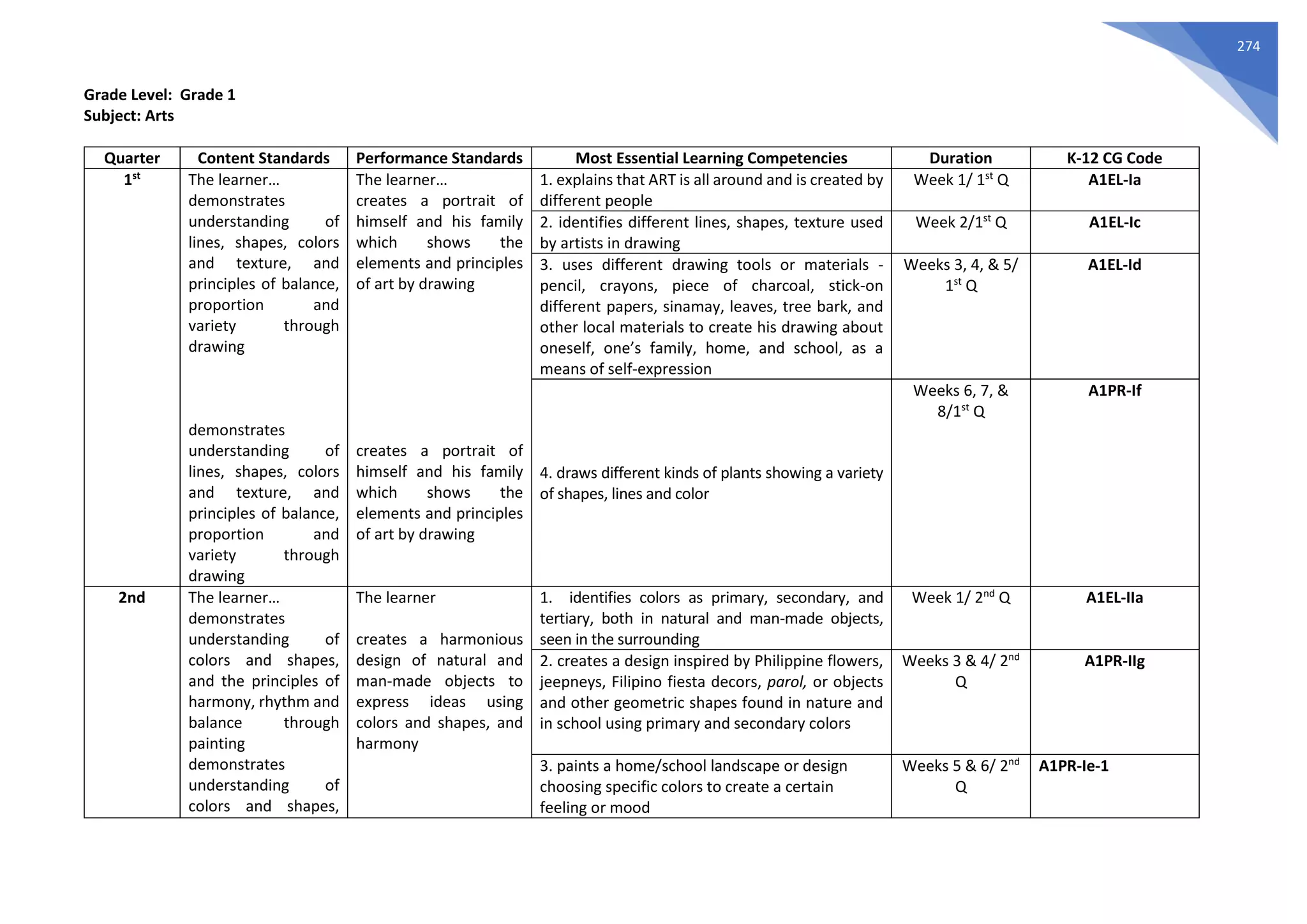
Quarter Content Standards Performance Standards Most Essential Learning Competencies Duration K-12 CG Code
1st
The learner…
demonstrates
understanding of
lines, shapes, colors
and texture, and
principles of balance,
proportion and
variety through
drawing
demonstrates
understanding of
lines, shapes, colors
and texture, and
principles of balance,
proportion and
variety through
drawing
The learner…
creates a portrait of
himself and his family
which shows the
elements and principles
of art by drawing
creates a portrait of
himself and his family
which shows the
elements and principles
of art by drawing
1. explains that ART is all around and is created by
different people
Week 1/ 1st
Q A1EL-Ia
2. identifies different lines, shapes, texture used
by artists in drawing
Week 2/1st
Q A1EL-Ic
3. uses different drawing tools or materials -
pencil, crayons, piece of charcoal, stick-on
different papers, sinamay, leaves, tree bark, and
other local materials to create his drawing about
oneself, one’s family, home, and school, as a
means of self-expression
Weeks 3, 4, & 5/
1st
Q
A1EL-Id
4. draws different kinds of plants showing a variety
of shapes, lines and color
Weeks 6, 7, &
8/1st
Q
A1PR-If
2nd The learner…
demonstrates
understanding of
colors and shapes,
and the principles of
harmony, rhythm and
balance through
painting
demonstrates
understanding of
colors and shapes,
The learner
creates a harmonious
design of natural and
man-made objects to
express ideas using
colors and shapes, and
harmony
1. identifies colors as primary, secondary, and
tertiary, both in natural and man-made objects,
seen in the surrounding
Week 1/ 2nd
Q A1EL-IIa
2. creates a design inspired by Philippine flowers,
jeepneys, Filipino fiesta decors, parol, or objects
and other geometric shapes found in nature and
in school using primary and secondary colors
Weeks 3 & 4/ 2nd
Q
A1PR-IIg
3. paints a home/school landscape or design
choosing specific colors to create a certain
feeling or mood
Weeks 5 & 6/ 2nd
Q
A1PR-Ie-1
275
and the principles of
harmony, rhythm and
balance through
painting
creates a harmonious
design of natural and
man-made objects to
express ideas using
colors and shapes, and
harmony
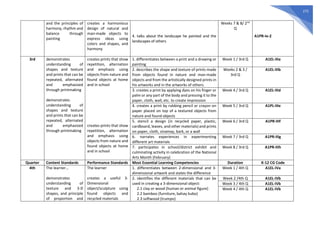
4. talks about the landscape he painted and the
landscapes of others
Weeks 7 & 8/ 2nd
Q
A1PR-Ie-2
3rd demonstrates
understanding of
shapes and texture
and prints that can be
repeated, alternated
and emphasized
through printmaking
demonstrates
understanding of
shapes and texture
and prints that can be
repeated, alternated
and emphasized
through printmaking
creates prints that show
repetition, alternation
and emphasis using
objects from nature and
found objects at home
and in school
creates prints that show
repetition, alternation
and emphasis using
objects from nature and
found objects at home
and in school
1. differentiates between a print and a drawing or
painting
Week 1 / 3rd Q A1EL-IIIa
2. describes the shape and texture of prints made
from objects found in nature and man-made
objects and from the artistically designed prints in
his artworks and in the artworks of others.
Weeks 2 & 3 /
3rd Q
A1EL-IIIb
3. creates a print by applying dyes on his finger or
palm or any part of the body and pressing it to the
paper, cloth, wall, etc. to create impression
Week 4 / 3rd Q A1EL-IIId
4. creates a print by rubbing pencil or crayon on
paper placed on top of a textured objects from
nature and found objects
Week 5 / 3rd Q A1PL-IIIe
5. stencil a design (in recycled paper, plastic,
cardboard, leaves, and other materials) and prints
on paper, cloth, sinamay, bark, or a wall
Week 6 / 3rd Q A1PR-IIIf
6. narrates experiences in experimenting
different art materials
Week 7 / 3rd Q A1PR-IIIg
7. participates in school/district exhibit and
culminating activity in celebration of the National
Arts Month (February)
Week 8 / 3rd Q A1PR-IIIh
Quarter Content Standards Performance Standards Most Essential Learning Competencies Duration K-12 CG Code
4th The learner…
demonstrates
understanding of
texture and 3-D
shapes, and principle
of proportion and
The learner
creates a useful 3-
Dimensional
object/sculpture using
found objects and
recycled materials
1. differentiates between 2-dimensional and 3-
dimensional artwork and states the difference
Week 1 / 4th Q A1EL-IVa
2. identifies the different materials that can be
used in creating a 3-dimensional object:
2.1 clay or wood (human or animal figure)
2.2 bamboo (furniture, bahay kubo)
2.3 softwood (trumpo)
Week 2 /4th Q A1EL-IVb
Week 3 / 4th Q A1EL-IVb
Week 4 / 4th Q A1EL-IVb
276
emphasis through 3-
D works and
sculpture
demonstrates
understanding of
texture and 3-D
shapes, and principle
of proportion and
emphasis through 3-
D works and
sculpture
creates a useful 3-
Dimensional
object/sculpture using
found objects and
recycled materials
2.4 paper, cardboard, (masks)
2.5 found material (parol, sarangola)
3. creates 3D objects that are well proportioned,
balanced and show emphasis in design, like any of
the following: a pencil holder, bowl, container,
using recycled materials like plastic bottles, etc.
Week 5-6 / 4th Q A1PR-IVe
4. creates masks, human figures out of recyclable
materials such as cardboards, papers, baskets,
leaves, strings, clay, cardboard, glue, found
materials, bilao, paper plate, strings, seeds, flour-
salt mixture, or paper-mache, and other found
materials
Week 7,8, & 9 /
4th Q
A1PR-IVf-1
A1PR-IVg
A1PR-IVh
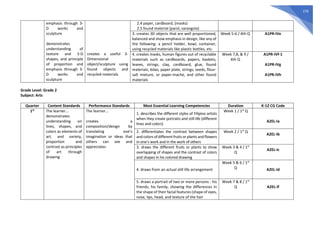
Grade Level: Grade 2
Subject: Arts
Quarter Content Standards Performance Standards Most Essential Learning Competencies Duration K-12 CG Code
1st
The learner…
demonstrates
understanding on
lines, shapes, and
colors as elements of
art, and variety,
proportion and
contrast as principles
of art through
drawing
The learner…
creates a
composition/design by
translating one’s
imagination or ideas that
others can see and
appreciates
1. describes the different styles of Filipino artists
when they create portraits and still life (different
lines and colors)
Week 1 / 1st
Q
A2EL-Ia
2. differentiates the contrast between shapes
and colors of different fruits or plants and flowers
in one’s work and in the work of others
Week 2 / 1st
Q
A2EL-Ib
3. draws the different fruits or plants to show
overlapping of shapes and the contrast of colors
and shapes in his colored drawing
Week 3 & 4 / 1st
Q
A2EL-Ic
4. draws from an actual still life arrangement
Week 5 & 6 / 1st
Q A2EL-Id
5. draws a portrait of two or more persons - his
friends, his family, showing the differences in
the shape of their facial features (shape of eyes,
nose, lips, head, and texture of the hair
Week 7 & 8 / 1st
Q A2EL-If

ARTS MELCs Grade 1.pdf

  • 1.
    274 Grade Level: Grade1 Subject: Arts Quarter Content Standards Performance Standards Most Essential Learning Competencies Duration K-12 CG Code 1st The learner… demonstrates understanding of lines, shapes, colors and texture, and principles of balance, proportion and variety through drawing demonstrates understanding of lines, shapes, colors and texture, and principles of balance, proportion and variety through drawing The learner… creates a portrait of himself and his family which shows the elements and principles of art by drawing creates a portrait of himself and his family which shows the elements and principles of art by drawing 1. explains that ART is all around and is created by different people Week 1/ 1st Q A1EL-Ia 2. identifies different lines, shapes, texture used by artists in drawing Week 2/1st Q A1EL-Ic 3. uses different drawing tools or materials - pencil, crayons, piece of charcoal, stick-on different papers, sinamay, leaves, tree bark, and other local materials to create his drawing about oneself, one’s family, home, and school, as a means of self-expression Weeks 3, 4, & 5/ 1st Q A1EL-Id 4. draws different kinds of plants showing a variety of shapes, lines and color Weeks 6, 7, & 8/1st Q A1PR-If 2nd The learner… demonstrates understanding of colors and shapes, and the principles of harmony, rhythm and balance through painting demonstrates understanding of colors and shapes, The learner creates a harmonious design of natural and man-made objects to express ideas using colors and shapes, and harmony 1. identifies colors as primary, secondary, and tertiary, both in natural and man-made objects, seen in the surrounding Week 1/ 2nd Q A1EL-IIa 2. creates a design inspired by Philippine flowers, jeepneys, Filipino fiesta decors, parol, or objects and other geometric shapes found in nature and in school using primary and secondary colors Weeks 3 & 4/ 2nd Q A1PR-IIg 3. paints a home/school landscape or design choosing specific colors to create a certain feeling or mood Weeks 5 & 6/ 2nd Q A1PR-Ie-1
  • 2.
    275 and the principlesof harmony, rhythm and balance through painting creates a harmonious design of natural and man-made objects to express ideas using colors and shapes, and harmony 4. talks about the landscape he painted and the landscapes of others Weeks 7 & 8/ 2nd Q A1PR-Ie-2 3rd demonstrates understanding of shapes and texture and prints that can be repeated, alternated and emphasized through printmaking demonstrates understanding of shapes and texture and prints that can be repeated, alternated and emphasized through printmaking creates prints that show repetition, alternation and emphasis using objects from nature and found objects at home and in school creates prints that show repetition, alternation and emphasis using objects from nature and found objects at home and in school 1. differentiates between a print and a drawing or painting Week 1 / 3rd Q A1EL-IIIa 2. describes the shape and texture of prints made from objects found in nature and man-made objects and from the artistically designed prints in his artworks and in the artworks of others. Weeks 2 & 3 / 3rd Q A1EL-IIIb 3. creates a print by applying dyes on his finger or palm or any part of the body and pressing it to the paper, cloth, wall, etc. to create impression Week 4 / 3rd Q A1EL-IIId 4. creates a print by rubbing pencil or crayon on paper placed on top of a textured objects from nature and found objects Week 5 / 3rd Q A1PL-IIIe 5. stencil a design (in recycled paper, plastic, cardboard, leaves, and other materials) and prints on paper, cloth, sinamay, bark, or a wall Week 6 / 3rd Q A1PR-IIIf 6. narrates experiences in experimenting different art materials Week 7 / 3rd Q A1PR-IIIg 7. participates in school/district exhibit and culminating activity in celebration of the National Arts Month (February) Week 8 / 3rd Q A1PR-IIIh Quarter Content Standards Performance Standards Most Essential Learning Competencies Duration K-12 CG Code 4th The learner… demonstrates understanding of texture and 3-D shapes, and principle of proportion and The learner creates a useful 3- Dimensional object/sculpture using found objects and recycled materials 1. differentiates between 2-dimensional and 3- dimensional artwork and states the difference Week 1 / 4th Q A1EL-IVa 2. identifies the different materials that can be used in creating a 3-dimensional object: 2.1 clay or wood (human or animal figure) 2.2 bamboo (furniture, bahay kubo) 2.3 softwood (trumpo) Week 2 /4th Q A1EL-IVb Week 3 / 4th Q A1EL-IVb Week 4 / 4th Q A1EL-IVb
  • 3.
    276 emphasis through 3- Dworks and sculpture demonstrates understanding of texture and 3-D shapes, and principle of proportion and emphasis through 3- D works and sculpture creates a useful 3- Dimensional object/sculpture using found objects and recycled materials 2.4 paper, cardboard, (masks) 2.5 found material (parol, sarangola) 3. creates 3D objects that are well proportioned, balanced and show emphasis in design, like any of the following: a pencil holder, bowl, container, using recycled materials like plastic bottles, etc. Week 5-6 / 4th Q A1PR-IVe 4. creates masks, human figures out of recyclable materials such as cardboards, papers, baskets, leaves, strings, clay, cardboard, glue, found materials, bilao, paper plate, strings, seeds, flour- salt mixture, or paper-mache, and other found materials Week 7,8, & 9 / 4th Q A1PR-IVf-1 A1PR-IVg A1PR-IVh Grade Level: Grade 2 Subject: Arts Quarter Content Standards Performance Standards Most Essential Learning Competencies Duration K-12 CG Code 1st The learner… demonstrates understanding on lines, shapes, and colors as elements of art, and variety, proportion and contrast as principles of art through drawing The learner… creates a composition/design by translating one’s imagination or ideas that others can see and appreciates 1. describes the different styles of Filipino artists when they create portraits and still life (different lines and colors) Week 1 / 1st Q A2EL-Ia 2. differentiates the contrast between shapes and colors of different fruits or plants and flowers in one’s work and in the work of others Week 2 / 1st Q A2EL-Ib 3. draws the different fruits or plants to show overlapping of shapes and the contrast of colors and shapes in his colored drawing Week 3 & 4 / 1st Q A2EL-Ic 4. draws from an actual still life arrangement Week 5 & 6 / 1st Q A2EL-Id 5. draws a portrait of two or more persons - his friends, his family, showing the differences in the shape of their facial features (shape of eyes, nose, lips, head, and texture of the hair Week 7 & 8 / 1st Q A2EL-If