Origins and Rise
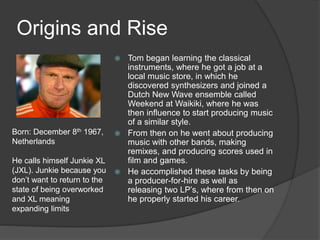
 Tom began learning the classical
instruments, where he got a job at a
local music store, in which he
discovered synthesizers and joined a
Dutch New Wave ensemble called
Weekend at Waikiki, where he was
then influence to start producing music
of a similar style.
 From then on he went about producing
music with other bands, making
remixes, and producing scores used in
film and games.
 He accomplished these tasks by being
a producer-for-hire as well as
releasing two LP’s, where from then on
he properly started his career.
Born: December 8th 1967,
Netherlands
He calls himself Junkie XL
(JXL). Junkie because you
don’t want to return to the
state of being overworked
and XL meaning
expanding limits
Influences
 His mother was a music teacher
and thus he was inspired to take
up classical musical instruments.
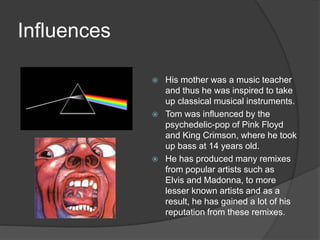
 Tom was influenced by the
psychedelic-pop of Pink Floyd
and King Crimson, where he took
up bass at 14 years old.
 He has produced many remixes
from popular artists such as
Elvis and Madonna, to more
lesser known artists and as a
result, he has gained a lot of his
reputation from these remixes.
Genre and Style
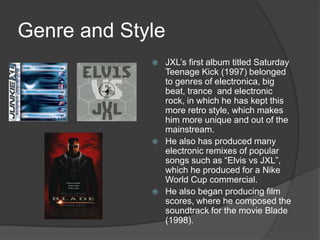
 JXL’s first album titled Saturday
Teenage Kick (1997) belonged
to genres of electronica, big
beat, trance and electronic
rock, in which he has kept this
more retro style, which makes
him more unique and out of the
mainstream.
 He also has produced many
electronic remixes of popular
songs such as “Elvis vs JXL”,
which he produced for a Nike
World Cup commercial.
 He also began producing film
scores, where he composed the
soundtrack for the movie Blade
(1998).
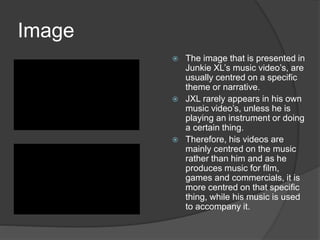
Image
 The image that is presented in
Junkie XL’s music video’s, are
usually centred on a specific
theme or narrative.
 JXL rarely appears in his own
music video’s, unless he is
playing an instrument or doing
a certain thing.
 Therefore, his videos are
mainly centred on the music
rather than him and as he
produces music for film,
games and commercials, it is
more centred on that specific
thing, while his music is used
to accompany it.
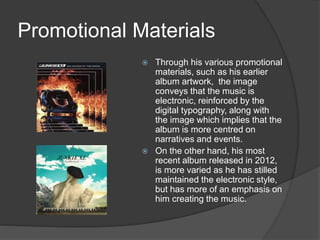
Promotional Materials
 Through his various promotional
materials, such as his earlier
album artwork, the image
conveys that the music is
electronic, reinforced by the
digital typography, along with
the image which implies that the
album is more centred on
narratives and events.
 On the other hand, his most
recent album released in 2012,
is more varied as he has stilled
maintained the electronic style,
but has more of an emphasis on
him creating the music.
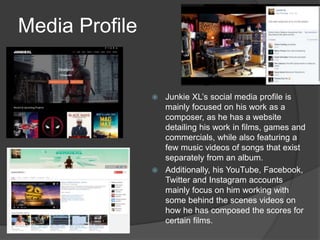
Media Profile
 Junkie XL’s social media profile is
mainly focused on his work as a
composer, as he has a website
detailing his work in films, games and
commercials, while also featuring a
few music videos of songs that exist
separately from an album.
 Additionally, his YouTube, Facebook,
Twitter and Instagram accounts
mainly focus on him working with
some behind the scenes videos on
how he has composed the scores for
certain films.
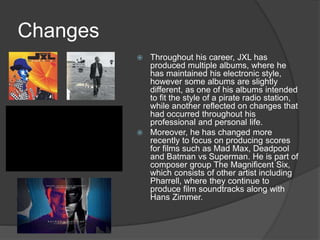
Changes
 Throughout his career, JXL has
produced multiple albums, where he
has maintained his electronic style,
however some albums are slightly
different, as one of his albums intended
to fit the style of a pirate radio station,
while another reflected on changes that
had occurred throughout his
professional and personal life.
 Moreover, he has changed more
recently to focus on producing scores
for films such as Mad Max, Deadpool
and Batman vs Superman. He is part of
composer group The Magnificent Six,
which consists of other artist including
Pharrell, where they continue to
produce film soundtracks along with
Hans Zimmer.
Critical Reception
 Throughout his album releases,
JXL has achieved mostly positive
reviews with an average of 3/5
stars, while his remixes achieve
mixed reviews, but he has
achieved a few awards small
time awards.
 However, his work on
soundtracks for films has
achieved many major awards,
such as the best original score
for Mad Max, along with multiple
BMI Film Music Awards and a
Grammy.

Artist Case Study - Max Elmore

  • 2.
    Origins and Rise Tom began learning the classical instruments, where he got a job at a local music store, in which he discovered synthesizers and joined a Dutch New Wave ensemble called Weekend at Waikiki, where he was then influence to start producing music of a similar style.  From then on he went about producing music with other bands, making remixes, and producing scores used in film and games.  He accomplished these tasks by being a producer-for-hire as well as releasing two LP’s, where from then on he properly started his career. Born: December 8th 1967, Netherlands He calls himself Junkie XL (JXL). Junkie because you don’t want to return to the state of being overworked and XL meaning expanding limits
  • 3.
    Influences  His motherwas a music teacher and thus he was inspired to take up classical musical instruments.  Tom was influenced by the psychedelic-pop of Pink Floyd and King Crimson, where he took up bass at 14 years old.  He has produced many remixes from popular artists such as Elvis and Madonna, to more lesser known artists and as a result, he has gained a lot of his reputation from these remixes.
  • 4.
    Genre and Style JXL’s first album titled Saturday Teenage Kick (1997) belonged to genres of electronica, big beat, trance and electronic rock, in which he has kept this more retro style, which makes him more unique and out of the mainstream.  He also has produced many electronic remixes of popular songs such as “Elvis vs JXL”, which he produced for a Nike World Cup commercial.  He also began producing film scores, where he composed the soundtrack for the movie Blade (1998).
  • 5.
    Image  The imagethat is presented in Junkie XL’s music video’s, are usually centred on a specific theme or narrative.  JXL rarely appears in his own music video’s, unless he is playing an instrument or doing a certain thing.  Therefore, his videos are mainly centred on the music rather than him and as he produces music for film, games and commercials, it is more centred on that specific thing, while his music is used to accompany it.
  • 6.
    Promotional Materials  Throughhis various promotional materials, such as his earlier album artwork, the image conveys that the music is electronic, reinforced by the digital typography, along with the image which implies that the album is more centred on narratives and events.  On the other hand, his most recent album released in 2012, is more varied as he has stilled maintained the electronic style, but has more of an emphasis on him creating the music.
  • 7.
    Media Profile  JunkieXL’s social media profile is mainly focused on his work as a composer, as he has a website detailing his work in films, games and commercials, while also featuring a few music videos of songs that exist separately from an album.  Additionally, his YouTube, Facebook, Twitter and Instagram accounts mainly focus on him working with some behind the scenes videos on how he has composed the scores for certain films.
  • 8.
    Changes  Throughout hiscareer, JXL has produced multiple albums, where he has maintained his electronic style, however some albums are slightly different, as one of his albums intended to fit the style of a pirate radio station, while another reflected on changes that had occurred throughout his professional and personal life.  Moreover, he has changed more recently to focus on producing scores for films such as Mad Max, Deadpool and Batman vs Superman. He is part of composer group The Magnificent Six, which consists of other artist including Pharrell, where they continue to produce film soundtracks along with Hans Zimmer.
  • 9.
    Critical Reception  Throughouthis album releases, JXL has achieved mostly positive reviews with an average of 3/5 stars, while his remixes achieve mixed reviews, but he has achieved a few awards small time awards.  However, his work on soundtracks for films has achieved many major awards, such as the best original score for Mad Max, along with multiple BMI Film Music Awards and a Grammy.