Collaborative filtering and kNN based recommendation to overcome
cold start and sparsity issues: A comparative analysis
MOTTO
The project aims to improve the effectiveness of
Recommender Systems by tackling two critical issues:
Cold Start Problem: Recommender systems often
struggle when dealing with new users or items for which
there is limited or no historical data. This is known as the
"cold start" problem.
Data Sparsity: Recommender systems typically operate on
large datasets, and the majority of users have only rated a
small fraction of the available items, resulting in data
sparsity.
Memory-Based CF Approaches:
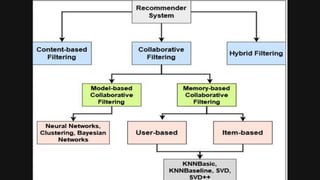
The project employs memory-based CF techniques, including
KNNBasic, KNNBaseline, KNNWithMeans, SVD, and SVD++, to
calculate similarities and make predictions based on user
preferences.
Model-Based CF Approach:
In addition to memory-based methods, the project also
utilizes a model-based CF approach called Co-Clustering to
improve recommendation accuracy.
Key Project Objectives and
Approaches Used:
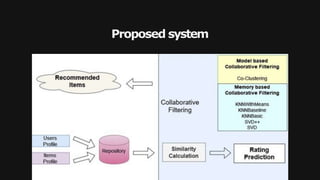
1. User-Item Similarity Matrix: The project's first objective is
to create a user-item similarity matrix to capture
relationships between users and items based on their
historical interactions and ratings.
2. Prediction Matrix: Another crucial goal is to generate a
prediction matrix that can estimate user preferences for
unrated items, effectively providing personalized
recommendations.
Memory-based CF approach
Proposed system
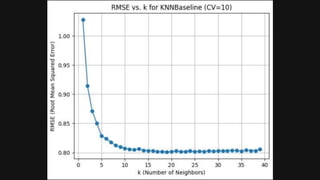
Result
this project focuses on applying collaborative filtering techniques to enhance
recommender systems, making them more effective and accurate, especially
when dealing with new users and sparse data. The successful implementation
of the K-NNBaseline approach demonstrates its capability to mitigate common
challenges in recommendation systems, ultimately maximizing the relevance of
recommended items to users.
Code Snippets
and Results
Libraries that weimported
RatingMatrix
T H A N K Y O U

Artificial Intelligence In Recommender Systems

  • 1.
    Collaborative filtering andkNN based recommendation to overcome cold start and sparsity issues: A comparative analysis
  • 2.
    MOTTO The project aimsto improve the effectiveness of Recommender Systems by tackling two critical issues: Cold Start Problem: Recommender systems often struggle when dealing with new users or items for which there is limited or no historical data. This is known as the "cold start" problem. Data Sparsity: Recommender systems typically operate on large datasets, and the majority of users have only rated a small fraction of the available items, resulting in data sparsity.
  • 3.
    Memory-Based CF Approaches: Theproject employs memory-based CF techniques, including KNNBasic, KNNBaseline, KNNWithMeans, SVD, and SVD++, to calculate similarities and make predictions based on user preferences. Model-Based CF Approach: In addition to memory-based methods, the project also utilizes a model-based CF approach called Co-Clustering to improve recommendation accuracy. Key Project Objectives and Approaches Used: 1. User-Item Similarity Matrix: The project's first objective is to create a user-item similarity matrix to capture relationships between users and items based on their historical interactions and ratings. 2. Prediction Matrix: Another crucial goal is to generate a prediction matrix that can estimate user preferences for unrated items, effectively providing personalized recommendations.
  • 5.
  • 6.
  • 7.
    Result this project focuseson applying collaborative filtering techniques to enhance recommender systems, making them more effective and accurate, especially when dealing with new users and sparse data. The successful implementation of the K-NNBaseline approach demonstrates its capability to mitigate common challenges in recommendation systems, ultimately maximizing the relevance of recommended items to users.
  • 8.
  • 9.
  • 11.
  • 19.
    T H AN K Y O U